
IPM: from Integrated Pest Management to Intelligent Pest Management
|
|
|
- Emerald Robbins
- 10 years ago
- Views:
Transcription
1 IPM: from Integrated Pest Management to Intelligent Pest Management About the author: Joe Boggs Assistant Professor The Ohio State University Extension and OSU Department of Entomology Joe Boggs Boggs draws upon years of practical experience in providing technical support and educational outreach on tree pest diagnostics and management to reexamine well-known Integrated Pest Management principles through the lens of modern arboriculture. The result is a simple 4-Step approach to pest management. From determining which pests matter to deciding when to pull the pesticide trigger, this presentation uses real-life case studies to educate participants on how to apply intelligent pest management concepts to meet client needs and expectations. Extended abstract: Arboriculture has always included a customer service component. However, at no other time have tree service customers had access to so much information. Unfortunately, information that shapes societal attitudes towards pest management is often inaccurate, inconsistent, and subject to the vagaries of 1-minute media sound bites and 140-character text messages. Social networking means the impact of a single misapplication of an insecticide can quickly reverberate around the world to immediately influence the attitudes of tree care customers. While it may seem that trying to meet client needs and expectations in the age of social media is like trying to hit a moving target, there is one expectation that remains unchanging: clients want perfect landscapes at minimal costs. Of course, there is no avoiding the fact that trees will have pests. Indeed, all landscape plants including trees are living organisms and there are other living organisms that will make a living on them. The only way to have perfect landscapes is to use silk flowers and artificial turf! It is important to keep things in perspective; to educate our tree care clients on some simple facts about insect and mite tree pests. This is not an easy task given the common misconception that most insects and mites are pests. In fact, of the 90,000+ described species of insects in North America north of Mexico, only 6,700 are pests (7.4%) and only 700 are serious pests (0.7%). The remaining 6,000 (6.6%) insect species rarely cause significant damage. Mites and microorganisms probably conform to a similar if not more dramatic ratio. This reality flies in the face of the public's perception that first and foremost, insects cause damage and they are scary! In fact, insects are so beneficial they are considered "key organisms" in all terrestrial ecosystems. This designation means that if insects are removed, the ecosystems would collapse! As the famed Harvard biologist, E.O. Wilson said, "If all mankind were to disappear, the world would regenerate back to the rich state of equilibrium
2 that existed ten thousand years ago. If insects were to vanish, the environment would collapse into chaos." Very few insects are pests and all pests are not equal. A few hickory tussock moth caterpillars feeding on the leaves of a mature oak tree causes no harm to the overall health of the tree; it's not about looks, it's about tree health. The Integrated Pest Management (IPM) concept first appeared in print in 1967 (1). The approach evolved out of pest managers and entomologists recognizing that the continual reliance on a single pest management tactic - insecticides - had produced a number of unintended consequences including pest resistance and negative environmental impacts. The IPM approach combined the judicious use of insecticides with other pest management tools including the use of cultural (e.g. plant selection) and biological (e.g. insect predators) pest suppression methods. IPM was widely adopted by both agricultural crop managers as well as entomologists. In fact, it was so widely accepted by the scientific community that by 2000, there were 67 published definitions for IPM (2). Although different, some shared common ideas and language. For example, 54% included the word economics; 48% had the word "environment;" 25% included "ecology" or "ecological;" and 17% referenced "economic threshold" or "economic injury level." Many "how to" conceptual guides to IPM decision-making have also evolved over time. Some are lists; others are graphic depictions of the components of an IPM program. An example of an IPM list appears on the Cornel University Biological Control website (3). There are four components: 1. Set Action Thresholds 2. Monitor and Identify Pests 3. Prevention 4. Control. A graphic depiction of the components of an IPM program appears in Figure 1 (4). "Cultural" tactics serve as the base signifying a greater importance compared to "Chemical" tactics at the top. The point is further emphasized by the arrows on the left showing tactics towards the base are "preventative" whereas tactics at the top are "intervention."
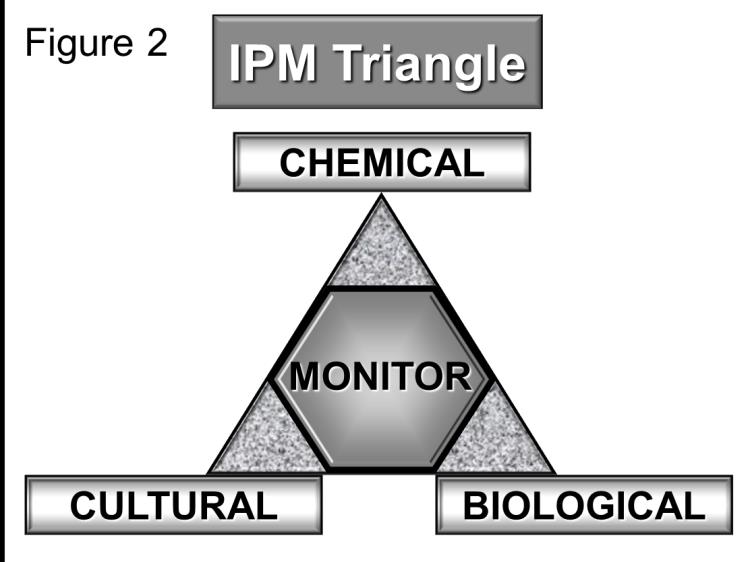
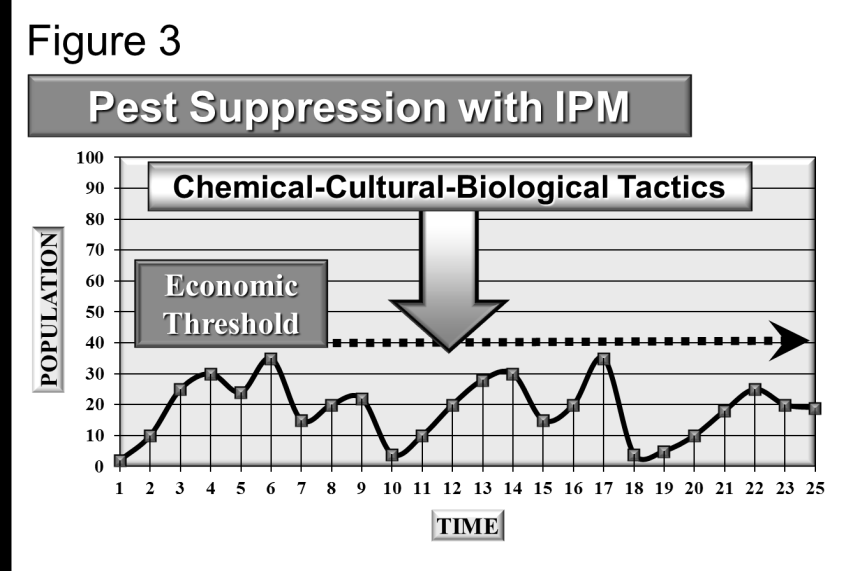
3 A simple 3-component graphic representation of IPM tactics has been used by the speaker for a number of years (Figure 2). The value of this elementary visual perspective is that the tactics are easy to remember and tied together by the need to "Monitor;" from keeping an eye on the overall health of trees, to monitoring for developing pest problems, to gauging the need to react, to assessing the efficacy of applied pest management tactics. Another way to visualize the importance of integrating all three components is to view this graphic as a threelegged stool with the seat being "Monitor." Remove any piece of the stool, and it collapses! The IPM concept was first introduced to manage pest of field crops such as corn, soybeans, cotton, etc. Figure 3 illustrates that the objective is use the three basic IPM tactics to keep pest populations below a recognized "Economic Threshold" that has been established through scientific research. Unfortunately, there are no economic thresholds for urban trees based on direct values such as those used for field crops. For example, just because a blue spruce was purchased for $500 does not justify spending $500 to protect the spruce; the tree would then be worth $1,000, but it's never going to be sold. Replacement cost values for urban trees are not connected to the economics of pest management decisions except for documenting loss; using them to justify expenditures falls under the "value added" economic column rather than return on investment. Of course, the National Tree Benefits Calculator (5) does allow us to determine tree benefits values, such as impacts on property value, heating/cooling costs, etc., for urban trees. These values have been justifiably used to validate preventative insecticide applications to protect ash trees from emerald ash borer (EAB); however, they are not the same as the "Economic Thresholds" used in IPM programs which are like on - off switches over time. As pest populations approach Economic Thresholds (a.k.a. Action Thresholds), IPM tactics are brought to bear (switches are turned on) to suppress the pest population. The justification for action is that costs will be covered through increased crop yields, such as an increase in bushels of corn per acre. If the "switch" is an insecticide application, it's turned on to suppress, and turned off once the pest population drops below the economic threshold; applications are not continual. The switch is turned on and stays on with protecting ash trees from EAB and the expected return on investment is measured through indirect economic benefits such as reduced heating/cooling costs; the trees themselves are not being sold.
4 With no real economic thresholds for urban trees, pest management decisions are often based solely on "Aesthetic Thresholds." This is highly subjective; pest impacts are in the eyes of the beholder. One of the 67 definitions for IPM published prior to the year 2000 read: "Integrated Pest Management means 'Intelligent Pest Management'" (6). Applying this prescient message to urban tree pest management means all aspects of modern arboricultural knowledge should be brought to bear in dealing with tree pests. Following is a simple 4-Step pest management program that meets that standard: 4 Steps in an Effective Pest Management Program for Urban Trees: 1. Support good tree health! 2. Identify the pest(s): the Diagnosis. 3. Separate the serious pests from the not-so-serious pests. 4. Devise a multi-tactic management strategy targeting the serious pests. Supporting good tree health is the first step because by fully exploiting this step, steps 2, 3, and 4 may never need to be considered! Step 1 includes three simple actions: proper tree selection (right tree, right place); proper installation (plant it right!); and appropriate aftercare (proper watering, pruning, etc.). Tree selection includes considering trees that are resistant to a prevailing pest problem. Planting non-native birch trees where the North American native bronze birch borer is endemic is not a good idea; planting native birch trees is a good idea. Proper pest identification has historically been viewed as the first step in a pest management program. However, as noted above, if step 1 is fully followed, there may be no need to identify a pest; there may be no pest! Of course, even the best managed trees may attract unwanted pests. The key is to make certain that you are making an accurate identification and you are certain the problem is indeed a tree pest and not some other problem such as a disease or physiological issue; the value of employing accurate tree problem diagnostics should never be ignored. Separating the serious from the not-so-serious pests can be a challenge; however, the full evaluation should be based on pest impacts on tree health rather than on tree aesthetics. Fortunately, much has been learned over the years regarding the intricate relationships between native pests and their native tree hosts. Native pests are not killers of their native hosts; if they were, both would have gone extinct. However, it is common for native pests to select stressed or dying native hosts which takes us back to Step 1! It is important to keep things in perspective; to educate our tree care clients on the true facts about tree pests and their hosts. Finally, devise a multi-tactic management strategy (IPM) targeting the serious pests. This final-step positioning of integrated pest management illustrates the proper perspective relative to tree pests: it's not all about pests, it's all about trees! This is why the simple 3- component IPM visual graphic presented in Figure 2 is so helpful; it's really a simple "treatment" selection triangle. Dealing with redheaded pine sawfly? Your hands and feet provide the most effective "Cultural" treatment of the problem: knock the sawfly colonies to the ground and step on them! Dealing with aphids? Perhaps the best "treatment" is to do
5 nothing a let the "Biological" component do the job; aphids are the meat items of the insect world. Have a North American tree that is heavily infested with the calico scale? This sucking insect is non-native to North America, so populations can build rapidly requiring the selection of a "Chemical" IPM component. However, using a systemic rather than a topical insecticide will reduce exposure to beneficial insects; it will preserve the "Biological" component on the IPM triangle. The bottom line is that IPM should mean "Intelligent Pest Management." After all, the original IPM concept took us away from an identify-and-kill approach to pest management and focused our attention on more holistic perspectives. It's not just about tree pests, it's about trees; and it's also about arborists making intelligent pest management decisions. References: 1. Smith, R. F., & van den Bosch, R. (1967). Integrated control. In: W.W. Kilglore & R.L. Doutt (Eds.), Pest control: biological, physical and selected chemical methods (pp ). New York: Academic Press. 2. Waheed I. Bajwa and Marcos Kogan Compendium of IPM Definitions (CID), What is IPM and how is it defined in the Worldwide Literature? Integrated Plant Protection Center (IPPC), Oregon State University, Publication 998, May Cornel University Biological Control Website: 4. Penn State Extension; PA Integrated Pest Management website: 5. National Tree Benefits Calculator 6. Zweig, G. and A. Aspelin The role of pesticides in developing countries. In: Formulation of pesticides in developing countries. United Nations Industrial Developing Organization. United Nations Publication E B P: pp 1-12
Entomology 101 Integrated Pest Management IPM. Terminology Related to Pests. Types of damage. Strategies of Pest Control or Management
 Entomology 101 Integrated Pest Management IPM David J. Shetlar, Ph.D. The BugDoc The Ohio State University, OARDC & OSU Extension Columbus, OH November, 2009, D.J. Shetlar, all rights reserved The evolution
Advanced Intelligence Report Tree & Shrub Insect Control: Protecting Trees from Emerald Ash Borer
 Advanced Intelligence Report Treating For Emerald Ash Borer With Bayer Advanced Tree and Shrub Insect Control Soil Drench Dr. Bruce Stewart, Bayer Advanced Consumer Products Emerald Ash Borer (EAB) is
Tree Integrated Pest Management. Dan Nortman Virginia Cooperative Extension, York County
 Tree Integrated Pest Management Dan Nortman Virginia Cooperative Extension, York County IPM Refresher Definition: The use of a combination of appropriate pest control tactics to reduce pest population
Upscaling of locally proven IPM technologies for control of pest of economic importance i
 Technology Fact Sheet for Adaptation Upscaling of locally proven IPM technologies for control of pest of economic importance i Technology: Upscaling of locally proven IPM technologies for control of pest
Introduction to the concepts of IPM
 DEPARTMENT OF PRIMARY INDUSTRY AND FISHERIES Principles of Integrated Pest Management Deanna Chin and Brian Thistleton, Entomology, Diagnostic Services What is a pest? Principles of IPM Introduction to
What is a pest? How Insects Become Pests. How do insects become pests? Problems with Pesticides. What is most commonly used to control insect pests?
 What is a pest? How Insects Become Pests How do insects become pests? Introduction outside of native range Becomes disease vector Plant or animal (inclu. human) disease vector Host shift in native insect
Chapter 1: Integrated Pest Management (IPM)
 Chapter 1: Integrated Pest Management (IPM) Introduction Pests are an inevitable problem faced by nursery growers. For the purposes of this document, the term pest refers to insects, diseases, weeds, slugs,
Pest Management - Holistic Pest Control?
 Pest Management - Holistic Pest Control? 2. Modern control tactics and the birth of IPM The action of parasites, predators, and pathogens in maintaining another organism s density at a lower average than
Don t Bug Me An Integrated Pest management Activity by
 http://www.life.umd.edu/grad/mlfsc/ Don t Bug Me An Integrated Pest management Activity by Suzanne Avtges Jessica Matthews John Gorrell Kim Vogt Don t Bug Me - A Teaching Unit on Integrated Pest Management
NATURE AND SCOPE OF BIOLOGICAL CONTROL
 Biological Control of Pests, ENTO 675, UH-Manoa, Fall 2000, M. W. Johnson 1 NATURE AND SCOPE OF BIOLOGICAL CONTROL I. DEFINITIONS A. H. S. Smith (1919) first used term "biological control" to signify the
Integrated Pest Management
 Chapter 2 Integrated Pest Management In This Chapter Keywords After learning the information in this chapter, you will be able to: 1. Define Integrated Pest Management (IPM). 2. List and describe the 5
Integrated Pest Management
 Integrated Pest Management Andrea Veres Junior Technical Officer FAO REU [email protected] Yerevan, Armenia 2013 Why develop IPM? Agriculture was: not sustainable optimized inputs for maximum profit
#1: Threshold and Injury Calculations the Theory. #2: Putting Economic Injury Levels and Action Thresholds to Use. Related Topics
 Module #4 What is a Threshold? p. 1 www.nysaes.cornell.edu/ipmnet/ne.ipm.region What is a Threshold? By James VanKirk Overview Concept Activity Handouts The Economic Injury Level and the Action Threshold
What is Integrated Pest Management?
 SLIDE 1: This is Steve Johnson, University of Maine Cooperative Extension, bringing you information on Integrated Pest Management. It is possible to receive a Maine Board of Pesticides Control recertification
Resources: Arthropod Pest Management
 8a. Arthropod Pest Management Resources 1 Resources: Arthropod Pest Management Suggested Readings for Students (see Print Resources for annotations and URLs) Benbrook, Charles M. 1996. Chapter 7: Bio-intensive
Introduction to Integrated Pest Management. John C. Wise, Ph.D. Michigan State University MSU Trevor Nichols Research Complex
 Introduction to Integrated Pest Management John C. Wise, Ph.D. Michigan State University MSU Trevor Nichols Research Complex What is Integrated Pest Management? Integrated Pest Management (IPM) New concept;
Integrated Pest Management
 Integrated Pest Management Ecology and Human Impact R. Bruce Chapman Insect Science Ltd Pest organisms When do organisms become pests? When an organism s population exceeds a threshold level, and control
INSECT MANAGEMENT (Roberts & McPherson)
 INSECT MANAGEMENT (Roberts & McPherson) A number of insect pests are capable of severely damaging soybeans. However, it is important to realize that soybeans can withstand considerable insect damage at
Unit 4 Lesson 1: A Pest by Any Other Name
 Focus Areas: Pest Control: Biological; Environmental Science, Language Arts Focus Skills: critical thinking, conducting research, observing, graphing, interpreting data Objectives To explore human attitudes
A DISCOVERY REGARDING THE DEATH OF ASH TREES IN THE PLYMOUTH AREA
 A DISCOVERY REGARDING THE DEATH OF ASH TREES IN THE PLYMOUTH AREA As you are probably aware, we have seen a significant amount of dying ash trees in the Plymouth, Canton, Northville area. This prompted
INTEGRATED PEST MANAGEMENT SYSTEM FOR KENNESAW STATE UNIVERSITY
 INTEGRATED PEST MANAGEMENT SYSTEM FOR KENNESAW STATE UNIVERSITY KENNESAW, GEORGIA PREPARED JANUARY 1997 REVISED NOVEMBER 2006 TABLE OF CONTENTS Introduction and Principles of Integrated Pest Management
Prevent Trees and Bushes from Having Direct Contact with Your Home.
 6 Ways to Kill a Cockroach: How to Rid Your Home of Roaches, Ants, and Other Unhealthy Pests Florida's warm and humid climate is a magnet for many insect pests that often threaten your home. It would be
Recommended Resources: The following resources may be useful in teaching
 Unit D: Controlling Pests and Diseases in the Orchard Lesson 1: Managing and Controlling Pests of Fruit and Nut Crops Student Learning Objectives: Instruction in this lesson should result in students achieving
Pruning Mature Trees. Reasons for Pruning
 Pruning Mature Trees Pruning is the most common tree maintenance procedure. Although forest trees grow quite well with only nature's pruning, landscape trees require a higher level of care to maintain
Discover Entomology. Discover Entomology. A Science, a Career, a Lifetime. A Science, a Career, a Lifetime
 Discover Entomology A Science, a Career, a Lifetime Discover Entomology A Science, a Career, a Lifetime What is Entomology? Entomology is the study of insects. Entomologists study bees, ants, beetles,
PEST IDENTIFICATION. PMA 4570/6228 Lab 1 July 3 2014
 PEST IDENTIFICATION PMA 4570/6228 Lab 1 July 3 2014 Steps towards a successful IPM program 1. Correct identification 2. Monitoring 3. Economic thresholds 4. Choice of optimum pest control option Pests
ECONOMIC INJURY LEVEL (EIL) AND ECONOMIC THRESHOLD (ET) CONCEPTS IN PEST MANAGEMENT. David G. Riley University of Georgia Tifton, Georgia, USA
 ECONOMIC INJURY LEVEL (EIL) AND ECONOMIC THRESHOLD (ET) CONCEPTS IN PEST MANAGEMENT David G. Riley University of Georgia Tifton, Georgia, USA One of the fundamental concepts of integrated pest management
SAMPLE INTEGRATED PEST MANAGEMENT (IPM) BID SPECIFICATIONS FOR COMMERCIAL PEST CONTROL SERVICES
 1. GENERAL SAMPLE INTEGRATED PEST MANAGEMENT (IPM) BID SPECIFICATIONS FOR COMMERCIAL PEST CONTROL SERVICES Ornamental & Turf & Arborist (Tree Care) Full Service Contract Includes Pesticide Applications
-* -* -* -* reflecting. A~fion ~ynop i. Gl) ~ linking to real world
 Afion ynop i Students make food webs of their study site, then trace how a change in one population could affect other populations within the web. Session 1 1. Show a food web made by a team of ecologists.
Karen J. English Graphic and Web Designer. Please click the thumbnails on the following pages to view larger versions of the images.
 Karen J. English Graphic and Web Designer Please click the thumbnails on the following pages to view larger versions of the images. graphic design: small pieces graphic design: large pieces web design
Grasshopper and Bean Leaf Beetle
 FS 905 Economic Thresholds in Soybeans Grasshopper and Bean Leaf Beetle Michael A. Catangui, Ph.D. Extension entomologist & assistant professor Plant Science Department South Dakota State University Economic
Determining the Use of Technology in World Food and Fiber Production
 Lesson A8 1 Determining the Use of Technology in World Food and Fiber Production Unit A. Mechanical Systems and Technology Problem Area 8. Technology Systems Lesson 1. Determining the Use of Technology
Integrated Pest Management (IPM) Learning Objectives. What is Integrated Pest Management (IPM)? After studying this section, you should be able to:
 General Knowledge: Integrated Pest Management (IPM) Integrated Pest Management (IPM) Learning Objectives After studying this section, you should be able to: Define the concept of Integrated Pest Management
Date CEU's Contents Course # Distribution
 2016 Approved On-line / CD/ Correspondence Courses [Updated Thursday, May 18, 2016] On-line Courses Note: The CEU s indicated with the special category specific indication can be used for the expansion
A Ros-E-IQ By Robert B. Martin Jr.
 A Ros-E-IQ By Robert B. Martin Jr. The Rose is the most beautiful flower in the environment and rose bushes have diverse uses in the green landscape. But the public's interest in rose gardening is changing.
Insect Pests of Pecan. Will Hudson Extension Entomologist
 Insect Pests of Pecan Will Hudson Extension Entomologist How important is nut drop to production? Pecan trees typically lose 75% of the pecans between nut set and shell hardening even when protected from
Compendium of IPM Definitions (CID)
 Compendium of IPM Definitions (CID) What is IPM and how is it defined in the Worldwide Literature? Waheed I. Bajwa and Marcos Kogan Integrated Plant Protection Center (IPPC) Oregon State University, Corvallis
Total Course Hours. Semester Degree code. ID Course Name Professor Course Content Summary. 90 1 st 11070
 LEA0170 Invertebrate Zoology I Italo Delalibera Junior Characterization and importance of the Porifera, Cnidaria, Platyhelminthes, Nemata, Mollusca, Annelida, Echinodermata phyla and smaller invertebrate
Hard Decisions Ahead With Ash Trees
 Hard Decisions Ahead With Ash Trees By: Stanton Gill, Extension Specialist in IPM and Entomology for Greenhouses and Nurseries Central Maryland Research and Education Center University of Maryland Protect
Plant Biology (776) Expanded Course Description 11:776:408 TURFGRASS PEST SCIENCE
 Plant Biology (776) Expanded Course Description 11:776:408 TURFGRASS PEST SCIENCE (4 cr) Prerequisites and registration restrictions: 01:119:101 102 or 01:119:103 or 01:119:115 116 117; and 11:776:238
Chemical versus Biological Control of Sugarcane. By Abid Hussain Matiari Sugar Mills Ltd.
 Chemical versus Biological Control of Sugarcane By Abid Hussain Matiari Sugar Mills Ltd. Sugarcane It is an important cash crop, Pakistan is the fifth largest cane producing country. However, its yield
ENERGY IN FERTILIZER AND PESTICIDE PRODUCTION AND USE
 Farm Energy IQ Conserving Energy in Nutrient Use and Pest Control INTRODUCTION Fertilizers and pesticides are the most widely used sources of nutrients and pest control, respectively. Fertilizer and pesticides
LIME SULPHUR INSECTICIDE MITICIDE FUNGICIDE COMMERCIAL DANGER: CORROSIVE TO EYES READ THE LABEL AND ATTACHED BOOKLET BEFORE USING
 datapak group M fungicide LIME SULPHUR INSECTICIDE MITICIDE FUNGICIDE COMMERCIAL DANGER: CORROSIVE TO EYES READ THE LABEL AND ATTACHED BOOKLET BEFORE USING REGISTRATION NO. 16465 PEST CONTROL PRODUCTS
Sample Integrated Pest Management Plan. Arborist (Tree Care) Facility Name Address Telephone Number
 Note: Not all tree care and maintenance practices are addressed in this sample. A licensed arborist should be consulted for recommendations regarding pruning, hazard management, cabling, bracing and treatment
IPM Definitions 1990-1998
 IPM Definitions 1990-1998 1998 1. "Integrated pest management, or IPM is a systematic approach to crop protection that uses increased information and improved decision-making paradigms to reduce purchased
Black Dotted Brown Moth
 Athens-Clarke County Community Tree Program Black Dotted Brown Moth Athens is experiencing its fourth year of significant infestation by the black dotted brown moth (Cissusa spadix). The caterpillar of
Integrated Pest Management (IPM) Policy
 Integrated Pest Management (IPM) Policy What is Integrated Pest Management (IPM)? Integrated pest management (IPM) is an approach to pest control that utilizes regular monitoring and record keeping to
EU Parliament Redefining IPM Bruxelles, 1 July 2015. Integrated Pest Management State of play Directive on sustainable use of pesticides
 EU Parliament Redefining IPM Bruxelles, 1 July 2015 Integrated Pest Management State of play Directive on sustainable use of pesticides Patrizia Pitton E3 Pesticides and Biocides DG SANTE Food safety Contents
Integrated Pest Management At Boise State University
 Integrated Pest Management At Boise State University Purpose The purpose of this document is to provide an overview of Boise State University Landscape Service department s philosophy regarding plant health
Insects That Kill Trees. Diane G. Alston Extension Entomologist Utah State University 2004 Professional Tree Care Workshops
 Insects That Kill Trees Diane G. Alston Extension Entomologist Utah State University 2004 Professional Tree Care Workshops Topics Introduction websites, IPM strategies Ips bark beetles Tree borers flatheaded,
Outline. What is IPM Principles of IPM Methods of Pest Management Economic Principles The Place of Pesticides in IPM
 Improving Control Systems in Thailand for Plant and Plants Products Intended for Export to the European Union co-funded by the European Union and Thai Department of Agriculture Preharvest Use of Pesticides
Integrated Pest Management
 Integrated Pest Management Science and Language Arts Brief Description: This lesson will focus all of the information the students have learned about pests in the other insect lessons in a decision-making
3. Which relationship can correctly be inferred from the data presented in the graphs below?
 1. Recent evidence indicates that lakes in large areas of New York State are being affected by acid rain. The major effect of acid rain in the lakes is (1) an increase in game fish population levels (3)
ORGANIC. PEST MANAGEMENT POLICY for. Turf and Landscape
 WAYNE 0. ATTRIDGE, D TOWN OF MARBLEHEAD Board of Health 7 WIDGER ROAD CARL D. GOODMAN, Esq., Ch MARBLEHEAD, MA 01945 DAVID B. BECKER, D.M.D., (781-631-0212) HELAINE R. HA ORGANIC PEST MANAGEMENT POLICY
Why hire an arborist?
 Why hire an arborist? Spring is fast approaching and that means gardens to attend and flowers to plant, but what about your trees? Now is the best time to hire an arborist to maintain your trees before
Pests of Woody Ornamental Plants An Online Resource for IPM Information
 Title: Pests of Woody Ornamental Plants An Online Resource for IPM Information Project Leaders: Shari Romar, Lead Writer; Gary Couch, Technical Advisor, NYS IPM Program; Jody Gangloff-Kaufmann, Project
Forest Insect Pests and Diseases
 Forest Insect Pests and Diseases Forest insect pests The forest is home to an abundant diversity of organisms, including insects. The study of forest insects is called forest entomology. Many insects play
MINNESOTA DEPARTMENT OF NATURAL RESOURCES. Division of Forestry
 MINNESOTA DEPARTMENT OF NATURAL RESOURCES Division of Forestry Other major programs: Private Forest Management Urban and Community Forestry Insect and Disease Management Urban and Community Forestry
Oak Trees BASIC GROWING REQUIREMENTS FOR YOUR
 They are beautiful in their peace, They are wise in their silence. They will stand after we are dust. They teach us, and we tend them. G.A. MacDunelmor BASIC GROWING REQUIREMENTS FOR YOUR Oak Trees The
Integrated Pest Management Plan
 Integrated Pest Management Plan ENVIRONMENTAL HEALTH & SAFETY Version 1.2 October 21, 2015 Table of Contents A. Introduction...1 B. Scope...1 C. Responsibilities...2 1. Department...2 2. Supervisor...3
Objectives. EAB Symptoms 8/18/14. Emerald Ash Borer: A Threat to Colorado s Community Forests. 1- to 2-Year Life Cycle.
 8/18/14 Emerald Ash Borer: A Threat to Colorado s Community Forests Objectives Introduce EAB Pest origins and biology Current impacts Threat to Colorado Keith Wood Community Forestry Program Manager Colorado
POLICY REGARDING PEST MANAGEMENT ON CITY PROPERTY
 POLICY REGARDING PEST MANAGEMENT ON CITY PROPERTY 1. The purpose of this policy is to eliminate or reduce pesticide use to the greatest possible extent. The City of Madison agrees with the US EPA that
TOWN OF WOODSIDE RESOLUTION ADOPTING AN UPDATED INTEGRATED PEST MANAGEMENT POLICY
 TOWN OF WOODSIDE Report to Town Council Agenda Item 3 Prepared by: Kevin Bryant, Assistant Town Manager September 27, 2011 Approved by: Susan George, Town Manager SUBJECT: RESOLUTION ADOPTING AN UPDATED
The Connecticut Tree Protective Association s Position Statement on Exceptions to the Arborist Law
 The Connecticut Tree Protective Association s Position Statement on Exceptions to the Arborist Law It is the position of the Connecticut Tree Protective Association that, whenever an individual or firm
Diagnosing Disorders of Trees
 148 Appendix A Diagnosing Disorders of Trees Diagnosing tree problems can be difficult. Symptoms and signs can be subtle or only visible using special techniques, important information can be missing,
Class Insecta - The insects
 A Introduction 1. Very species rich 2. Characteristics a. 3 pairs of legs b. 2 pairs of wings (most) except flies (1 pair of wings - Diptera) B. Distribution 1. All habitats except saltwater - replaced
BENEFITS OF USING IPM
 Edward J. Bechinski and William H. Bohl Potato growers who use IPM consider all available pest control tools. Alternatives to conventional pesticides are the foundation of every IPM plan. Pesticides play
The need for longitudinal study of the dual roles of insects as pests and food resources in agroecosystems
 THE H. R. MacCARTHY LECTURE COMMITTEE IS PLEASED TO PRESENT THE 15 TH ANNUAL H. R. MacCARTHY PEST MANAGEMENT LECTURE ENTITLED The need for longitudinal study of the dual roles of insects as pests and food
DIABLO VALLEY COLLEGE CATALOG 2015-2016
 HORTICULTURE HORT Tish Young, Dean Biological and Health Sciences Division Physical Sciences Building, Room 263 Possible career opportunities The horticulture program prepares students for numerous state
Tree Assessment Report Prepared for: Dr. Peter Giarrizzo 18 Franklin Place Pelham NY 10803
 Pelham Board of Education Tree Assessment Report Prepared for: Dr. Peter Giarrizzo 18 Franklin Place Pelham NY 10803 Prepared by: Ken Almstead, Certified Arborist NY 0335 Tree Risk Assessor Qualification
What you need to know about the management of. the Emerald Ash. Borer (EAB) Guidelines for hiring tree care services to manage urban trees
 What you need to know about the management of the Emerald Ash Borer (EAB) Guidelines for hiring tree care services to manage urban trees What is an Emerald Ash Borer? This booklet has been designed for
THE IMPORTANCE OF NATURAL ENEMIES IN IPM SYSTEMS
 Natural Enemies in IPM Systems 145 THE IMPORTANCE OF NATURAL ENEMIES IN IPM SYSTEMS I. Problems Resulting From Total Reliance on Pesticides A. Development of insecticide resistance in pest species 1. As
NYS DEC s Regulation of Invasive Species Management Programs
 NYS DEC s Regulation of Invasive Species Management Programs John W. Bennett - Pesticide Program Manager NYSDEC Region 5 Presentation Goals NYS DEC Jurisdiction Application/Permit Requirements Required
Using Degree-Day Tools To Improve Pest Management: Dont get caught off-guard!
 Using Degree-Day Tools To Improve Pest Management: Dont get caught off-guard! Len Coop, IPPC, OSU Corvallis Jan 25, 2012 You fell asleep, didn't you? Topics for today's session: Degree-day/phenology concepts
Integrated Pest Management: Principles & Practice. Dr. Ana Legrand Connecticut IPM Program University of Connecticut
 Integrated Pest Management: Principles & Practice Dr. Ana Legrand Connecticut IPM Program University of Connecticut Integrated Pest Management IPM is the selection, integration and implementation of pest
FAQs: Gene drives - - What is a gene drive?
 FAQs: Gene drives - - What is a gene drive? During normal sexual reproduction, each of the two versions of a given gene has a 50 percent chance of being inherited by a particular offspring (Fig 1A). Gene
Genetically modified crops in Integrated Pest Management
 Federal Department of Economic Affairs, Education and Research EAER Agroscope Genetically modified crops in Integrated Pest Management Franz Bigler, Michael Meissle and Jörg Romeis Agroscope ART Zürich,
The Strategic Use of Supplier Price and Cost Analysis
 The Strategic Use of Supplier Price and Cost Analysis Michael E. Smith, Ph.D., C.Q.A. MBA Program Director and Associate Professor of Management & International Business Western Carolina University Lee
INTEGRATED PEST CONTROL
 19 TOPIC 3 INTEGRATED PEST CONTROL Scope Chemical pesticides are now the traditional solution to pest problems, and they have saved lives and crops. Their use, however, has created significant problems,
Public Perceptions of Labeling Genetically Modified Foods
 Public Perceptions of Labeling Genetically Modified Foods Working Paper 2013-01 William K. Hallman, Ph.D. Cara L. Cuite, Ph.D. Xenia K. Morin, Ph.D. Release date: November 1, 2013 For more information:
AP ENVIRONMENTAL SCIENCE 2010 SCORING GUIDELINES
 AP ENVIRONMENTAL SCIENCE 2010 SCORING GUIDELINES Question 3 (a) Why are zebra mussels located primarily in areas in the eastern United States rather than in the western United States? One point can be
Everything You Wanted to Know About Spiders!
 Everything You Wanted to Know About Spiders! How do spiders fit into the Animal Kingdom? Spiders are arthropods, a group of invertebrates containing insects, crustaceans, millipedes, centipedes, arachnids
Systemic Insecticide Technology for Tree Care
 Systemic Insecticide Technology for Tree Care Dan Herms Department of Entomology The Ohio State University Ohio Agricultural Research and Development Center Wooster [email protected] Landscapes are diverse
REFRAMING RISK: AN UPDATED APPROACH TO PRIORITIZATION
 REFRAMING RISK: AN UPDATED APPROACH TO PRIORITIZATION TRANG T. VO Plant Epidemiology and Risk Analysis Laboratory Plant Protection and Quarantine Animal and Plant Health Inspection Service U.S. Department
OSU Extension Service Master Gardener Program. Organic Pest Control. Weston Miller OSU Extension Service Community and Urban Horticulture faculty
 Organic Pest Control Weston Miller OSU Extension Service Community and Urban Horticulture faculty Audience Question What does the term organic pest control mean to you? Preview of Presentation Organic
Integrated Pest Management & the New Pesticide Legislation
 Integrated Pest Management & the New Pesticide Legislation Requirements from January 2014 Tuesday 4 th March, 2014, Gordon Rennick B.Agr.Sc., M.Sc., Lyrath Hotel, Kilkenny. Sustainable Use of pesticides
SYSTEMS APPROACH FOR PEST RISK MANAGEMENT OF FRUIT FLIES (TEPHRITIDAE)
 ISPM 35 INTERNATIONAL STANDARDS FOR PHYTOSANITARY MEASURES ISPM 35 SYSTEMS APPROACH FOR PEST RISK MANAGEMENT OF FRUIT FLIES (TEPHRITIDAE) (2012) Produced by the Secretariat of the International Plant Protection