
Applications for a Switched-Capacitor Instrumentation Building Block
|
|
|
- Esther Clarissa Morris
- 10 years ago
- Views:
Transcription
1 Application Note July 9 Applications for a Switched-Capacitor Instrumentation Building Block Jim Williams CMOS analog IC design is largely based on manipulation of charge. Switches and capacitors are the elements used to control and distribute the charge. Monolithic filters, data converters and voltage converters rely on the excellent characteristics of IC CMOS switches. Because of the importance of switches in their circuits, CMOS designers have developed techniques to minimize switch induced errors, particularly those associated with stray capacitance and switch timing. Until now, these techniques have been used only in the internal construction of monolithic devices. A new device, the LTC 0, makes these switches available for board-level use. Multi-pole switching and a self-driven, non-overlapping clock allow the device to be used in circuits which are impractical with other switches. Conceptually, the LTC0 is simple. Figure details its features. The oscillator, free-running at 00kHz, drives a non-overlapping clock. Placing a capacitor from Pin to ground shifts the oscillator frequency downward to any desired point. The pin may also be driven from an external source, synchronizing the switches to external circuitry. A non-overlapping clock controls both DPDT switch sections. The non-overlapping drive prevents simultaneous conduction in the series connected switch sections. Charge balancing circuitry cancels the effects of stray capacitance. Pins and 0 may be used as guard points for Pins and in particularly sensitive applications. L, LT, LTC, LTM, Linear Technology and the Linear logo are registered trademarks of Linear Technology Corporation. All other trademarks are the property of their respective owners. DP A 0 SA SA C A C A CHARGE BALANCING CIRCUITRY SA SA DP B SB SB C B C B CHARGE BALANCING CIRCUITRY SB SB NON-OVERLAPPING CLOCK C T OSCILLATOR V V AN0 F0 Figure. Block Diagram of LTC0 Showing Individual Switches anf AN-

2 Application Note Although the device s operation is simple, it permits surprisingly sophisticated circuit functions. Additionally, the careful attention paid to switching characteristics makes implementing such functions relatively easy. Discrete timing and charge-balance compensation networks are eliminated, reducing component count and trimming requirements. Classical analog circuits work by utilizing continuous functions. Their operation is usually described in terms of voltage and current. Switched-capacitor based circuits are sampled data systems which approximate continuous functions with bandwidth limited by the sampling frequency. Their operation is described in the distribution of charge over time. To best understand the circuits which follow, this distinction should be kept in mind. Analog sampled data and carrier-based systems are less common than true continuous approaches, and developing a working familiarity with them requires some thought. Switched-capacitor approaches have greatly aided analog MOS IC design. The LTC0 brings many of the freedoms and advantages of CMOS IC switched-capacitor circuits to the board level, providing a valuable addition to available design techniques. Instrumentation Amplifier Figure uses the LTC0 to build a simple, precise instrumentation amplifier. An LTC0 and an LT 0 dual op amp are used, allowing a dual instrumentation amplifi er using just two packages. A single DPDT section converts the differential input to a ground referred single-ended signal at the LT0 s input. With the input switches closed, C acquires the input signal. When the input switches open, C s switches close and C receives charge. Continuous clocking forces C s voltage to equal the difference between the circuit s inputs. The 0.0 capacitor at Pin sets the switching frequency at 00Hz. Common mode voltages are rejected by over 0dB and drift is low. DIFFERENTIAL INPUT C (EXTERNAL) C / LT0 V OUT R R AN0 F0 0.0 / LTC0 CMRR > 0dB AT DC CMRR > 0dB AT 0Hz DUAL SUPPLY OR SINGLE GAIN = R/R V OS 0μV V OS μv/ C T COMMON MODE INPUT VOLTAGE INCLUDES THE SUPPLIES Figure. ± Precision Instrumentation Amplifi er anf AN-

3 Application Note Amplifier gain is set in the conventional manner. This circuit is a simple, economical way to build a high performance instrumentation amplifier. Its DC characteristics rival any IC or hybrid unit and it can operate from a single supply. The common mode range includes the supply rails, allowing the circuit to read across shunts in the supply lines. The performance of the instrumentation amplifier depends on the output amplifier used. Specifications for an LT0 appear in the figure. Lower fi gures for offset, drift and bias current are achievable by employing type LT00, LT0, LT0 or the chopper-stabilized LTC0. Ultrahigh Performance Instrumentation Amplifier Figure is similar to Figure, but utilizes the remaining LTC0 section to construct a low drift chopper amplifier. This approach maintains the true differential inputs while achieving 0.μV/ C drift. The differential input is converted to a single-ended potential at Pin of the LTC0. This voltage is chopped into a 00Hz square wave by the switching action of Pins, and. A, AC-coupled, amplifies this signal. A s square wave output, also AC-coupled, is synchronously demodulated by switches, and. Because this switch section is synchronously driven with the input chopper, proper amplitude and polarity information is presented to A, the DC output amplifier. This stage integrates the square wave into a DC voltage to provide the output. The output is divided down and fed back to Pin of the input chopper where it serves as the zero signal reference. Because the main amplifier is AC-coupled, its DC terms do not affect overall circuit offset, resulting in the extremely low offset and drift noted in the specifications. This circuit offers lower offset and drift than any commercially available instrumentation amplifier. Lock-In Amplifier The AC carrier approach used in Figure may be extended to form a lock-in amplifier. A lock-in amplifier works by synchronously detecting the carrier modulated output of the signal source. Because the desired signal information is contained within the carrier, the system constitutes an extremely narrow-band amplifier. Non-carrier related components are rejected and the amplifi er passes only signals which are coherent with the carrier. In practice, lock-in amplifiers can extract a signal 0dB below the noise level. INPUT / LTC0 CHOPPER / LTC0 M AC AMPLIFIER LT0 00Ω PHASE SENSITIVE DEMODULATOR / LTC0 DC OUTPUT AMPLIFIER LT0 OUTPUT INPUT 0.0 R 0.0 OFFSET = 0μV DRIFT = 0.μV/ C FULL DIFFERENTIAL INPUT CMRR = 0dB OPEN-LOOP GAIN > 0 GAIN = R/R I BIAS = na R 00Ω AN0 F0 Figure. Chopper-Stabilized Instrumentation Amplifi er anf AN-

4 Application Note Figure shows a lock-in amplifier which uses a single LTC0 section. In this application, the signal source is a thermistor bridge which detects extremely small temperature shifts in a biochemical microcalorimetry reaction chamber. The 00Hz carrier is applied at T s input (Trace A, Figure ). T s fl oating output drives the thermistor bridge, which presents a single-ended output to A. A operates at an AC gain of 000. A 0Hz broadband noise source is also deliberately injected into A s input (Trace B). The carrier s zero crossings are detected by C. C s output clocks the LTC0 (Trace C). A s output (Trace D) shows the desired 00Hz signal buried within the 0Hz noise source. The LTC0 s zero-cross-synchronized switching at A s positive input (Trace E) causes A s gain to alternate between plus and minus one. As a result, A s output is synchronously demodulated by A. A s output (Trace F) consists of demodulated carrier signal and non-coherent components. The desired carrier amplitude and polarity information is discernible in A s output and is extracted by filter averaging at A. To trim this circuit, adjust the phase potentiometer so that C switches when the carrier crosses through zero. THERMISTOR BRIDGE IS THE SIGNAL SOURCE SYNCHRONOUS DEMODULATOR 00Hz SINE DRIVE T.9k R T.9k.9k TEST POINT A LT00 00Ω 0k* 0k* / LTC0 LM0A 0pF M LT0 V OUT 000 DC BRIDGE SIGNAL 0k 0k PHASE TRIM μf LT0 T = TFSXZZ, TOROTEL R T = YSI THERMISTOR 00.9k AT. C *MATCH 0.0% *.9k = VISHAY S-0 OPERATE LTC0 WITH ± SUPPLIES LOCK-IN AMPLIFIER TECHNIQUE USED TO EXTRACT VERY SMALL SIGNALS BURIED INTO NOISE AN0 F0 ZERO CROSSING DETECTOR Figure. Lock-In Amplifer A = V/DIV B = V/DIV C = 0V/DIV D = /DIV E = /DIV F = /DIV HORIZONTAL = ms Figure AN0 F0 anf AN-

5 Application Note Wide Range, Digitally Controlled, Variable Gain Amplifi er Aside from low drift and noise rejection, another dimension in amplifier design is variable gain. Designing a wide range, digitally variable gain block with good DC stability is a diffi cult task. Such configurations usually involve relays or temperature compensated FET networks in expensive and complex arrangements. The circuit shown in Figure uses the LTC0 in a variable gain amplifier which features continuously variable gain from 0 to 000, gain stability of 0ppm/ C and single-ended or differential input. The circuit uses two separate LTC0s. Unit A is clocked by a frequency input which could be derived from a host processor. LTC0B is continuously clocked by a Hz source which could also be processor supplied. Both LTC0s function as the sampled data equivalent of a resistor within the bandwidth set by A s 0.0 value and the switchedcapacitor equivalent feedback resistor. The time-averaged current delivered to the summing point by LTC0A is a function of the 0.0 capacitor s input-derived voltage and the commutation frequency at Pin. Low commutation frequencies result in small time-averaged current values, approximating a large input resistor. Higher frequencies produce an equivalent small input resistor. LTC0B, in A s feedback path, acts in a similar fashion. For the circuit values given, the gain is simply: G f IN 00. = µf 0 00pF Gain stability depends on the ratiometric stability between the Hz and variable clocks (which could be derived from a common source) and the ratio stability of the capacitors. For polystyrene types, this will typically be 0ppm/ C. The circuit input, determined by the pin connections shown in the figure, may be either single-ended or fully differential. Additionally, although A is connected as an inverter, the circuit s overall transfer function may be either positive or negative. As shown, with Pins A and A grounded and the input applied to A, it is negative. B LTC0B B C 00pF B B B Hz CLOCK B B 0.0 A LTC0A A A C 0.0 A A LT0 e OUT AN0 F0 A A A e IN (FOR DIFFERENTIAL INPUT, GROUND PIN A AND USE PINS A AND A FOR INPUTS) f IN 0kHz TO 0kHz = GAIN 0 TO 000 Figure. Variable-Gain Amplifi er anf AN-

6 Application Note Precision, Linearized Platinum RTD Signal Conditioner Figure shows a circuit which provides complete, linearized signal conditioning for a platinum RTD. One side of the RTD sensor is grounded, often desirable for noise considerations. This LTC0 based circuit is considerably simpler than instrumentation or multi-amplifier based designs and will operate from a single supply. A serves as a voltage-controlled ground referred current source by differentially sensing the voltage across the Ω feedback resistor. The LTC0 section which does this presents a single-ended signal to A s negative input, closing a loop. The k-0. combination sets amplifi er roll-off well below the LTC0 s switching frequency and the confi guration is stable. Because A s loop forces a fi xed voltage across the Ω resistor, the current through R P is constant. A s operating point is primarily fixed by the. LT009 voltage reference. The RTD s constant current forces the voltage across it to vary with its resistance, which has a nearly linear positive temperature coefficient. The nonlinearity could cause several degrees of error over the circuit s 0 C to 00 C operating range. A amplifies R P s output, while simultaneously supplying nonlinearity correction. The correction is implemented by feeding a portion of A s output back to A s input via the 0k to 0k divider. This causes the current supplied to R P to slightly shift with its operating point, compensating sensor nonlinearity to within ±0.0 C. The remaining LTC0 section furnishes A with a differential input. This allows an offsetting potential, derived from the LT009 reference, to be subtracted from R P s output. Scaling is arranged so 0 C equals 0V at A s output. Circuit gain is set by A s feedback values and linearity correction is derived from the output. 0k* (LINEARITY CORRECTION LOOP) / LT0 0. k* 0k ZERO ADJUST 0k*.k LT009..k* k / LTC0 Ω / LTC0 / LT0 GAIN ADJUST 0V TO V = 0 C TO 00 C ±0.0 C k.0k* R P I K 00Ω AT 0 C R P = ROSEMOUNT MFRTD * % FILM RESISTOR TRIM SEQUENCE: SET SENSOR TO 0 C VALUE. ADJUST ZERO FOR 0V OUT SET SENSOR TO 00 C VALUE. ADJUST GAIN FOR,000V OUT SET SENSOR TO 00 C VALUE. ADJUST LINEARITY FOR.000V OUT REPEAT AS REQUIRED 0.0 * AN0 F0 Figure. Linearized Platinum Signal Conditioner anf AN-

7 Application Note To calibrate this circuit, substitute a precision decade box (e.g., General Radio ) for R P. Set the box to the 0 C value (00.00Ω) and adjust the offset trim for a 0.00V output. Next, set the decade box for a 0 C output (.Ω) and adjust the gain trim for a.00v output reading. Finally, set the box to 9.0 C (00.00 C) and trim the linearity adjustment for a.000v output. Repeat this sequence until all three points are fixed. Total error over the entire range will be within ±0.0 C. The resistance values given are for a nominal 00.00Ω (0 C) sensor. Sensors deviating from this nominal value can be used by factoring in the deviation from 00.00Ω. This deviation, which is manufacturer specified for each individual sensor, is an offset term due to winding tolerances during fabrication of the RTD. The gain slope of the platinum is primarily fixed by the purity of the material and is a very small error term. Note that A constitutes a voltage controlled current source with input and output referred to ground. This is a difficult function to achieve and is worthy of separate mention. Relative Humidity Sensor Signal Conditioner Relative humidity is a diffi cult physical parameter to transduce, and most transducers available require fairly complex signal conditioning circuity. Figure combines two LTC0s with a recently introduced capacitively based humidity transducer in a simple charge pump based circuit. The sensor specified has a nominal 00pF capacitance at RH = %, with a slope of.pf/% RH. The average voltage across this device must be zero. This provision prevents deleterious electrochemical migration in the sensor. LTC0A inverts a resistively scaled portion of the LT009 reference, generating a negative potential at Pin A. LTC0B alternately charges and discharges the humidity sensor via Pins B, B and B. With B and B connected, the sensor charges via the unit to the negative potential at Pin A. When the B-B pair opens, B is connected to A s summing point via B. The sensor now discharges into the summing point through the capacitor. Since the charge voltage is fixed, B B B 0. 0Ω 0. 00pF 00Ω 0k % RH TRIM LTC0A A A B B 00pF B LT009. A A LTC0B A A B B 90% RH TRIM SENSOR = PANAMETRICS #RHS 00pF AT RH = %.pf/% RH B A LT0 AN0 F0 0V TO V = 0% to 00% RH SENSOR M Figure. Relative Humidity Signal Conditioner anf AN-

8 Application Note the average current into the summing point is determined by the sensor s humidity related value. The value AC couples the sensor to the charge-discharge path, maintaining the required zero average voltage across the device. The M resistor prevents accumulation of charge, which would stop current fl ow. The average current into A s summing point is balanced by packets of charge delivered by the switched-capacitor network in A s feedback loop. The 0. capacitor gives A an integrator-like response, and its output is DC. To allow 0% RH to equal 0V, offsetting is required. The signal and feedback terms biasing the summing point are expressed in charge form. Because of this, the offset must also be delivered to the summing point as charge, instead of a simple DC current. If this is not done, the circuit will be affected by frequency drift of LTC0B s oscillator. Section B-B-B serves this function, delivering LT009-referenced offsetting charge to A. Drift terms in this circuit include the LT009 and the ratio stability of the sensor and the 00pF capacitors. These terms are well within the sensor s % accuracy specification and temperature compensation is not required. To calibrate this circuit, place the sensor in a known % RH environment and adjust the % RH trim for 0.0 output. Next, place the sensor in a 90% RH environment and set the 90% RH trim for 900mV output. Repeat this procedure until both points are fixed. Once calibrated, this circuit is accurate within % in the % to 90% RH range. Figure 9 shows an alternate circuit which requires two op amps but needs only one LTC0 package. This circuit retains insensitivity to clock frequency while permitting a DC offset trim. This is accomplished by summing in the offset current after A. 0.0 / LTC0 0 * 00pF 00 90% RH TRIM LT00.V / LTC0 LT0 0k LM0A OUTPUT 0V TO V = 0% TO 00% SENSOR M 00pF 9k* 0k % RH TRIM k * = % FILM RESISTOR SENSOR = PANAMETRICS #RHS 00pF AT RH = %.pf/%rh * AN0 F09 Figure 9. Relative Humidity Signal Conditioner anf AN-

9 Application Note LVDT Signal Conditioner LVDTs (linear variable differential transformers) are another example of a transducer which the LTC0 can signal condition. An LVDT is a transformer with a mechanically actuated core. The primary is driven by a sine wave, usually amplitude stabilized. Sine drive eliminates error inducing harmonics in the transformer. The two secondaries are connected in opposed phase. When the core is positioned in the magnetic center of the transformer, the secondary outputs cancel and there is no output. Moving the core away from the center position unbalances the flux ratio between the secondaries, developing an output. Figure 0 shows an LTC0 based LVDT signal conditioner. A and its associated components furnish the amplitude stable sine wave source. A s positive feedback path is a Wein bridge, tuned for.khz. Q, the LT00 reference, and additional components in A s negative loop unity-gain stabilize the amplifier. A s output (Trace A, Figure ), an amplitude stable sine wave, drives the LVDT. C detects zero crossings and feeds the LTC0 clock pin (Trace B). A speed-up network at C s input compensates LVDT phase shift, synchronizing the LTC0 s clock to the transformer s output zero crossings. The LTC0 alternately connects each end of the transformer to ground, / LTC k 0.00 AMPLITUDE STABLE SINE WAVE SOURCE 0k Q N.k.k LT0 0k 0μF N9 LT00.V.k.kHz YEL-BLK YEL-RED LVDT RD-BLUE BLUE GRN BLK / LT0 OUTPUT 0V ±. 0M ±.0MM 00k 0k GAIN TRIM AN0 F0 LVDT = SCHAEVITZ E-00 / LTC0 0.0 PHASE TRIM LT0 TO PIN, LTC0 Figure 0. LVDT Signal Conditioner anf AN-9

10 Application Note A = 0V B = 0V C = 0.V D = 0.V E = 0.V HORIZONTAL = 00μs Figure AN0 F resulting in positive half-wave rectification at Pins and (Traces C and D, respectively). These points are summed (Trace E) at a lowpass filter which feeds A. A furnishes gain scaling and the circuit s output. The LTC0 s synchronized clocking means the information presented to the lowpass filter is amplitude and phase sensitive. The circuit output indicates how far the core is from center and on which side. To calibrate this circuit, center the LVDT core in the transformer and adjust the phase trim for 0V output. Next, move the core to either extreme position and set the gain trim for.0v output. Charge Pump F V and V F Converters Figure shows two related circuits, both of which show how the LTC0 can simplify a precision circuit function. Charge pump F V and V F converters usually require substantial compensation for non-ideal charge gating behavior. These examples equal the performance of such circuits, while requiring no compensations. These circuits are economical, component count is low, and the 0.00% transfer linearity equals that of more complex designs. Figure A is an F V converter. The LTC0 s clock pin is driven from the input (Trace A, Figure ). With the input high, Pins and are shorted and is open. The 000pF capacitor receives charge from the unit, which is biased by the LT00. At the input s negativegoing edge, Pins and open and and close. The 000pF capacitor quickly removes current (Trace B) from A s summing node. Initially, current is transferred through A s feedback capacitor and the amplifi er output goes negative (Trace C). When A recovers, it slews positive to a level which resets the summing junction to zero. A s feedback capacitor averages this action over many cycles and the circuit output is a DC level linearly related to frequency. A s feedback resistors set the circuit s DC gain. To trim the circuit, apply 0kHz in and set the 0kΩ gain trim for exactly V output. The primary drift term in this circuit is the 0ppm/ C tempco of the 000pF capacitor, which should be polystyrene. This can be reduced to within 0ppm/ C by using a feedback resistor with an opposing tempco (e.g., TRW #MTR-/0ppm). The input pulse width must be low for at least 00ns to allow complete discharge of the 000pF capacitor. In Figure B, the LTC0 based charge pump is placed in A s feedback loop, resulting in a V F converter. The clock pin is driven from A s output. Assume that A s negative input is just below 0V. The amplifi er output is positive. Under these conditions, LTC0 s Pins and are shorted and is open, allowing the 0.0 capacitor to charge toward the negative.v LT00. When the input-voltage-derived current forces A s summing point (Trace A, Figure ) positive, its output (Trace B) goes negative. This reverses the LT0 s switch states, connecting Pins and. Current flows from the summing point into the 0.0μF capacitor (Trace C). The 0pF-k combination at A s positive input (Trace D) ensures A will remain low long enough for the 0.0 capacitor to completely reset to zero. When the 0pF-k positive feedback path decays, A s output returns positive and the entire cycle repeats. The oscillation frequency of this action is directly related to the input voltage with a transfer linearity of 0.00%. Start-up or overdrive conditions could force A to go to the negative rail and stay there. Q prevents this by pulling the summing point negative if A s output stays low long enough to charge the -0k RC. Two LTC0 switch sections provide complementary sink-source outputs. Similar to the F V circuit, the 0.0 capacitor is the primary drift term, and the resistor type noted above will provide optimum tempco cancellation. To calibrate this circuit, apply V and adjust the gain trim for a 0kHz output. anf AN-0

11 Application Note k* 0k GAIN TRIM LT00.C FREQUENCY IN 0kHz TO 0kHz / LTC0 000pF LF OUTPUT 0V TO V *k = TRW #MTR-/0ppm POLYSTYRENE A = 0V B = ma C = 0. AC-COUPLED AN0 Fa a. Frequency-to-Voltage Converter HORIZONTAL = 0ns/DIV Figure AN0 F LT009. / LTC0 f OUT 0kHz TO 0kHz 0.0 A = 0mV B = 0V V IN 0V TO V.9k* GAIN.k LF 0pF POLYSTYRENE *TRW MTR /0ppm C = 0mA D = HORIZONTAL = 0μs/DIV Figure AN0 F k 0k Q N90A AN0 Fb b. Voltage-to-Frequency Converter Figure anf AN-

12 Application Note -Bit A D Converter Figure shows the LTC0 used to implement an economical -bit A D converter. The circuit is selfclocking, has a serial output, and completes a full-scale conversion in ms. Two LTC0s are used in this design. Unit A free-runs, alternately charging the 00pF capacitor from the LT00 reference source and then dumping it into A s summing point. A, connected as an integrator, responds with a linear ramp output (Trace B, Figure ). This ramp is compared to the input voltage by CB. When the crossing occurs, CB s output goes low (Trace C, just faintly visible in the photograph), setting the flip-flop high (Trace D). This pulls LTC0 s Pin high, resetting A s integrator capacitor via the paralleled switches. Simultaneously, Pin B opens, LT0B B B LT00.V 0Ω B B B B GAIN TRIM A LT0A A B B B B A 0.* 00pF* A *POLYSTYERENE CAPACITORS. MOUNT IN CLOSE PROXIMITY A CA / LT9A A LT0 e IN 0V TO V 0.00μF CB / LT9A P Q C CLR Q N SERIAL OUTPUT 0V TO V = 0 TO 09 COUNTS M AN0 F Figure. -Bit A D Converter A = 0V/DIV A B = 0.V/DIV C = 0V/DIV D = 0V/DIV E = 0V/DIV B F = 00mV/DIV G = 0V/DIV H = 0V/DIV A HORIZONTAL = 00μs/DIV B HORIZONTAL = 0μs/DIV Figure AN0 F anf AN-

13 Application Note preventing charge from being delivered to A s summing point during the reset. The flip-fl op s Q output, low during this interval, causes an AC negative-going spike at CA. This forces CA s output high, inserting a gap in the output clock pulse stream (Trace A). The width of this gap, set by the components at CA s negative input, is sufficient to allow a complete reset of A s integrating capacitor. The number of pulses between gaps is directly related to the input voltage. The actual conversion begins at the gap s negative edge and ends at its positive edge. The flip-fl op output may be used for resetting. Alternately, a processor driven time-out routine can determine the end of conversion. Traces E through H offer expanded scale versions of Traces A through D, respectively. The staircase detail of A s ramp output refl ects the charge pumping action at its summing point. Note that drift in the 00pF and 0. capacitors, which should be polystyrene, ratiometrically cancels. Full-scale drift for this circuit is typically 0ppm/ C, allowing it to hold -bit accuracy over C 0 C. To calibrate the circuit, apply V in and trim the gain potentiometer for 09 pulses out between data stream gaps. Miscellaneous Circuits Figures to show a group of miscellaneous circuits, most of which are derivations of applications covered in the text. As such, only brief comments are provided. Voltage-Controlled Current Source Grounded Source and Load This is a simple, precise voltage-controlled current source. Bipolar supplies will permit bipolar output. Configurations featuring a grounded voltage control source and a grounded load are usually more complex and depend upon several components for stability. In this circuit, accuracy and stability are almost entirely dependent on the 00Ω shunt. Current Sensing in Supply Rails The LTC0 can sense current through a shunt in either of its supply rails (Figure ). This capability has wide application in battery and solar-powered systems. If the ground-referred voltage output is unloaded by an amplifier, the shunt can operate with very little voltage drop across it, minimizing losses. INPUT 0V TO V / LT0 0.μF POSITIVE OR NEGATIVE RAIL I E R SHUNT I = E R SHUNT LTC0 / LTC0 E 00Ω 0.0 AN0 F Figure. Precision Current Sensing in Supply Rails 0.00 I OUT = V IN 00Ω AN0 F OPERATES FROM A SINGLE SUPPLY Figure. Voltage Controlled Current Source with Ground Referred Input and Output anf AN-

14 Application Note 0.0% Analog Multiplier Figure 9, using the V F and F V circuits previously described, forms a high precision analog multiplier. The F V input frequency is locked to the V F output because the LTC0 s clock is common to both sections. The F V reference is used as one input of the multiplier, while the V F furnishes the other. To calibrate, short the X and Y inputs to.0v and trim for a V output. Inverting a Reference Figure 0 allows a reference to be inverted with ppm accuracy. This circuit features high input impedance and requires no trimming. Low Power, Driven, Temperature Compensated Crystal Oscillator Figure uses the LTC0 to differentiate between a temperature sensing network and a DC reference. The single-ended output biases a varactor-tuned crystal oscillator to compensate drift. The varactor-crystal network has high DC impedance, eliminating the need for an LTC0 output amplifier. Simple Thermometer Figure s circuit is conceptually similar to the platinum RTD example of Figure. The thermistor network specified eliminates the requirement for a linearity trim, at the expense of accuracy and range of operation. / LTC0 LT00-.V Y INPUT.k* N90A (FOR START-UP) LT0 k 0pF 0.0 X INPUT 0k / LTC k* LT0 0k OUTPUT TRIM OPERATE LTC0 FROM ± POLYSTYRENE, MOUNT CLOSE *% FILM RESISTOR ADJUST OUTPUT TRIM SO X Y = OUTPUT ±0.0% OUTPUT XY ±0.0% AN0 F9 Figure 9. Analog Multiplier with 0.0% Accuracy LT00.V LTC0 V REF ±ppm AN0 F0 Figure 0. Precision Voltage Inverter anf AN-

15 Application Note 0Ω LT009..k* LTC0 XTAL.MHz 00Ω NA.k* MV09 0k R T.k TEMPERATURE COMPENSATION GENERATOR 0pF 0pF 0Ω.MHz OUT 0.0ppm/ C 0 C TO 0 C R T 0Ω YSI0 OSCILLATOR R T * THERMALLY COUPLED AN0 F Figure. Temperature Compensated Crystal Oscillator 0k %.k LT00..k 0 C 0k / LTC0 / LT0 0V TO.000V = 0 C TO 00 C ±0. C. 00Ω 00 C T 0 AN0 F T = YELLOW SPRINGS #0 ALL RESISTORS = TRW MAR- 0.% UNLESS NOTED 0.00 Figure. Linear Thermometer High Current, Inductorless, Switching Regulator Figure shows a high efficiency battery driven regulator with a A output capacity. Additionally, it does not require an inductor, an unusual feature for a switching regulator operating at this current level. The LTC0 switched-capacitor building block provides non-overlapping complementary drive to the Q-Q power MOSFETs. The MOSFETs are arranged so that C and C are alternately placed in series and then in parallel. During the series phase, the V battery s current fl ows through both capacitors, charging them and furnishing load current. During the parallel phase, both capacitors deliver current to the load. Traces A and B, Figure, are the LTC0-supplied drives to Q and Q, respectively. Q and Q receive similar drive from Pins and. The diode-resistor networks provide additional non-overlapping drive characteristics, preventing simultaneous drive to the series-parallel phase switches. Normally, the output would be one-half of the supply voltage, but C and its associated components close a feedback loop, forcing the output to. With the circuit in the series phase, the anf Information furnished by Linear Technology Corporation is believed to be accurate and reliable. However, no responsibility is assumed for its use. Linear Technology Corporation makes no representation that the interconnection of its circuits as described herein will not infringe on existing patent rights. AN-

16 Application Note output (Trace C) heads rapidly positive. When the output exceeds, C trips, forcing the LTC0 oscillator pin (Trace D) high. This truncates the LTC0 s triangle wave oscillator cycle. The circuit is forced into the parallel phase and the output coasts down slowly until the next LTC0 clock cycle begins. C s output diode prevents the triangle down-slope from being affected and the 00pF capacitor provides sharp transitions. The loop regulates the output to by feedback controlling the turn-off point of the series phase. The circuit constitutes a large-scale switched-capacitor voltage divider which is never allowed to complete a full cycle. The high transient currents are easily handled by the power MOSFETs and overall efficiency is %. V V k C LT0 k LT00.V REFERENCE LTC0 GATES PN CELLS S Q D S 0μF Q D 00pF 0μF k AN0 F V OUT A V V S Q D D Q S V 0pF V ALL DIODES ARE N Q, Q, Q = IRF9 P-CHANNEL Q = IRF N-CHANNEL Figure. Inductorless Switching Regulator A = 0V/DIV B = 0V/DIV C = 00mV/DIV AC-COUPLED D = 0V/DIV HORIZONTAL = 0μs/DIV Figure AN0 F AN- GP/IM 0 0K PRINTED IN USA Linear Technology Corporation 0 McCarthy Blvd., Milpitas, CA 90- (0) -900 FAX: (0) LINEAR TECHNOLOGY CORPORATION 9 anf

Op Amp Circuit Collection
 Op Amp Circuit Collection Note: National Semiconductor recommends replacing 2N2920 and 2N3728 matched pairs with LM394 in all application circuits. Section 1 Basic Circuits Inverting Amplifier Difference
Application Note 142 August 2013. New Linear Regulators Solve Old Problems AN142-1
 August 2013 New Linear Regulators Solve Old Problems Bob Dobkin, Vice President, Engineering and CTO, Linear Technology Corp. Regulators regulate but are capable of doing much more. The architecture of
Isolated AC Sine Wave Input 3B42 / 3B43 / 3B44 FEATURES APPLICATIONS PRODUCT OVERVIEW FUNCTIONAL BLOCK DIAGRAM
 Isolated AC Sine Wave Input 3B42 / 3B43 / 3B44 FEATURES AC averaging technique used to rectify, amplify, and filter 50 Hz to 400 Hz sine-wave signals. Accepts inputs of between 20 mv to 550 V rms to give
Application Note 12 October 1985. Circuit Techniques for Clock Sources AN12-1
 October 1985 Circuit Techniques for Clock Sources Jim Williams Almost all digital or communication systems require some form of clock source. Generating accurate and stable clock signals is often a difficult
A Collection of Differential to Single-Ended Signal Conditioning Circuits for Use with the LTC2400, a 24-Bit No Latency Σ ADC in an SO-8
 Application Note August 999 A Collection of Differential to Single-Ended Signal Conditioning Circuits for Use with the LTC00, a -Bit No Latency Σ ADC in an SO- By Kevin R. Hoskins and Derek V. Redmayne
Thermal Techniques in Measurement and Control Circuitry
 December 1984 Thermal Techniques in Measurement and Control Circuitry Jim Williams Designers spend much time combating thermal effects in circuitry. The close relationship between temperature and electronic
Reading: HH Sections 4.11 4.13, 4.19 4.20 (pgs. 189-212, 222 224)
 6 OP AMPS II 6 Op Amps II In the previous lab, you explored several applications of op amps. In this exercise, you will look at some of their limitations. You will also examine the op amp integrator and
Application Note 18 March 1986. Power Gain Stages for Monolithic Amplifiers AN18-1. Jim Williams
 March 1986 Power Gain Stages for Monolithic Amplifiers Jim Williams Most monolithic amplifiers cannot supply more than a few hundred milliwatts of output power. Standard IC processing techniques set device
Precision, Unity-Gain Differential Amplifier AMP03
 a FEATURES High CMRR: db Typ Low Nonlinearity:.% Max Low Distortion:.% Typ Wide Bandwidth: MHz Typ Fast Slew Rate: 9.5 V/ s Typ Fast Settling (.%): s Typ Low Cost APPLICATIONS Summing Amplifiers Instrumentation
www.jameco.com 1-800-831-4242
 Distributed by: www.jameco.com 1-800-831-4242 The content and copyrights of the attached material are the property of its owner. LF411 Low Offset, Low Drift JFET Input Operational Amplifier General Description
Chapter 12: The Operational Amplifier
 Chapter 12: The Operational Amplifier 12.1: Introduction to Operational Amplifier (Op-Amp) Operational amplifiers (op-amps) are very high gain dc coupled amplifiers with differential inputs; they are used
LM118/LM218/LM318 Operational Amplifiers
 LM118/LM218/LM318 Operational Amplifiers General Description The LM118 series are precision high speed operational amplifiers designed for applications requiring wide bandwidth and high slew rate. They
LM139/LM239/LM339/LM2901/LM3302 Low Power Low Offset Voltage Quad Comparators
 Low Power Low Offset Voltage Quad Comparators General Description The LM139 series consists of four independent precision voltage comparators with an offset voltage specification as low as 2 mv max for
Section 3. Sensor to ADC Design Example
 Section 3 Sensor to ADC Design Example 3-1 This section describes the design of a sensor to ADC system. The sensor measures temperature, and the measurement is interfaced into an ADC selected by the systems
Programmable Single-/Dual-/Triple- Tone Gong SAE 800
 Programmable Single-/Dual-/Triple- Tone Gong Preliminary Data SAE 800 Bipolar IC Features Supply voltage range 2.8 V to 18 V Few external components (no electrolytic capacitor) 1 tone, 2 tones, 3 tones
LF442 Dual Low Power JFET Input Operational Amplifier
 LF442 Dual Low Power JFET Input Operational Amplifier General Description The LF442 dual low power operational amplifiers provide many of the same AC characteristics as the industry standard LM1458 while
LM101A LM201A LM301A Operational Amplifiers
 LM101A LM201A LM301A Operational Amplifiers General Description The LM101A series are general purpose operational amplifiers which feature improved performance over industry standards like the LM709 Advanced
SG2525A SG3525A REGULATING PULSE WIDTH MODULATORS
 SG2525A SG3525A REGULATING PULSE WIDTH MODULATORS 8 TO 35 V OPERATION 5.1 V REFERENCE TRIMMED TO ± 1 % 100 Hz TO 500 KHz OSCILLATOR RANGE SEPARATE OSCILLATOR SYNC TERMINAL ADJUSTABLE DEADTIME CONTROL INTERNAL
High Common-Mode Rejection. Differential Line Receiver SSM2141. Fax: 781/461-3113 FUNCTIONAL BLOCK DIAGRAM FEATURES. High Common-Mode Rejection
 a FEATURES High Common-Mode Rejection DC: 00 db typ 60 Hz: 00 db typ 20 khz: 70 db typ 40 khz: 62 db typ Low Distortion: 0.00% typ Fast Slew Rate: 9.5 V/ s typ Wide Bandwidth: 3 MHz typ Low Cost Complements
Use and Application of Output Limiting Amplifiers (HFA1115, HFA1130, HFA1135)
 Use and Application of Output Limiting Amplifiers (HFA111, HFA110, HFA11) Application Note November 1996 AN96 Introduction Amplifiers with internal voltage clamps, also known as limiting amplifiers, have
MP2259 1A, 16V, 1.4MHz Step-Down Converter
 MP59 1A, 1V, 1.MHz Step-Down Converter TM The Future of Analog IC Technology DESCRIPTION The MP59 is a monolithic integrated stepdown switch mode converter with an internal power MOSFET. It achieves 1A
QUICK START GUIDE FOR DEMONSTRATION CIRCUIT 956 24-BIT DIFFERENTIAL ADC WITH I2C LTC2485 DESCRIPTION
 LTC2485 DESCRIPTION Demonstration circuit 956 features the LTC2485, a 24-Bit high performance Σ analog-to-digital converter (ADC). The LTC2485 features 2ppm linearity, 0.5µV offset, and 600nV RMS noise.
PIN CONFIGURATION FEATURES ORDERING INFORMATION ABSOLUTE MAXIMUM RATINGS. D, F, N Packages
 DESCRIPTION The µa71 is a high performance operational amplifier with high open-loop gain, internal compensation, high common mode range and exceptional temperature stability. The µa71 is short-circuit-protected
LM 358 Op Amp. If you have small signals and need a more useful reading we could amplify it using the op amp, this is commonly used in sensors.
 LM 358 Op Amp S k i l l L e v e l : I n t e r m e d i a t e OVERVIEW The LM 358 is a duel single supply operational amplifier. As it is a single supply it eliminates the need for a duel power supply, thus
ICS650-44 SPREAD SPECTRUM CLOCK SYNTHESIZER. Description. Features. Block Diagram DATASHEET
 DATASHEET ICS650-44 Description The ICS650-44 is a spread spectrum clock synthesizer intended for video projector and digital TV applications. It generates three copies of an EMI optimized 50 MHz clock
TDA4605 CONTROL CIRCUIT FOR SWITCH MODE POWER SUPPLIES USING MOS TRANSISTORS
 CONTROL CIRCUIT FOR SWITCH MODE POWER SUPPLIES USING MOS TRANSISTORS Fold-Back Characteristic provides Overload Protection for External Diodes Burst Operation under Short-Circuit and no Load Conditions
Single-Stage High Power Factor Flyback for LED Lighting
 Application Note Stockton Wu AN012 May 2014 Single-Stage High Power Factor Flyback for LED Lighting Abstract The application note illustrates how the single-stage high power factor flyback converter uses
DESCRIPTION FEATURES TYPICAL APPLICATION. LT1097 Low Cost, Low Power Precision Op Amp APPLICATIONS
 LT97 Low Cost, Low Power Precision Op Amp FEATRES Offset Voltage µv Max Offset Voltage Drift µv/ C Max Bias Current pa Max Offset Current pa Max Bias and Offset Current Drift pa/ C Max Supply Current µa
THERMAL ANEMOMETRY ELECTRONICS, SOFTWARE AND ACCESSORIES
 TSI and TSI logo are registered trademarks of TSI Incorporated. SmartTune is a trademark of TSI Incorporated. THERMAL ANEMOMETRY ELECTRONICS, SOFTWARE AND ACCESSORIES IFA 300 Constant Temperature Anemometry
ICS379. Quad PLL with VCXO Quick Turn Clock. Description. Features. Block Diagram
 Quad PLL with VCXO Quick Turn Clock Description The ICS379 QTClock TM generates up to 9 high quality, high frequency clock outputs including a reference from a low frequency pullable crystal. It is designed
Features. Ordering Information. * Underbar marking may not be to scale. Part Identification
 MIC86 Teeny Ultra Low Power Op Amp General Description The MIC86 is a rail-to-rail output, input common-mode to ground, operational amplifier in Teeny SC7 packaging. The MIC86 provides 4kHz gain-bandwidth
LF412 Low Offset Low Drift Dual JFET Input Operational Amplifier
 LF412 Low Offset Low Drift Dual JFET Input Operational Amplifier General Description These devices are low cost high speed JFET input operational amplifiers with very low input offset voltage and guaranteed
Wide Bandwidth, Fast Settling Difet OPERATIONAL AMPLIFIER
 Wide Bandwidth, Fast Settling Difet OPERATIONAL AMPLIFIER FEATURES HIGH GAIN-BANDWIDTH: 35MHz LOW INPUT NOISE: 1nV/ Hz HIGH SLEW RATE: V/µs FAST SETTLING: 24ns to.1% FET INPUT: I B = 5pA max HIGH OUTPUT
TRIPLE PLL FIELD PROG. SPREAD SPECTRUM CLOCK SYNTHESIZER. Features
 DATASHEET ICS280 Description The ICS280 field programmable spread spectrum clock synthesizer generates up to four high-quality, high-frequency clock outputs including multiple reference clocks from a low-frequency
Precision Diode Rectifiers
 by Kenneth A. Kuhn March 21, 2013 Precision half-wave rectifiers An operational amplifier can be used to linearize a non-linear function such as the transfer function of a semiconductor diode. The classic
TS321 Low Power Single Operational Amplifier
 SOT-25 Pin Definition: 1. Input + 2. Ground 3. Input - 4. Output 5. Vcc General Description The TS321 brings performance and economy to low power systems. With high unity gain frequency and a guaranteed
Making Accurate Voltage Noise and Current Noise Measurements on Operational Amplifiers Down to 0.1Hz
 Author: Don LaFontaine Making Accurate Voltage Noise and Current Noise Measurements on Operational Amplifiers Down to 0.1Hz Abstract Making accurate voltage and current noise measurements on op amps in
SPREAD SPECTRUM CLOCK GENERATOR. Features
 DATASHEET ICS7152 Description The ICS7152-01, -02, -11, and -12 are clock generators for EMI (Electro Magnetic Interference) reduction (see below for frequency ranges and multiplier ratios). Spectral peaks
TL082 Wide Bandwidth Dual JFET Input Operational Amplifier
 TL082 Wide Bandwidth Dual JFET Input Operational Amplifier General Description These devices are low cost high speed dual JFET input operational amplifiers with an internally trimmed input offset voltage
DDX 7000 & 8003. Digital Partial Discharge Detectors FEATURES APPLICATIONS
 DDX 7000 & 8003 Digital Partial Discharge Detectors The HAEFELY HIPOTRONICS DDX Digital Partial Discharge Detector offers the high accuracy and flexibility of digital technology, plus the real-time display
Low Cost Instrumentation Amplifier AD622
 Data Sheet FEATURES Easy to use Low cost solution Higher performance than two or three op amp design Unity gain with no external resistor Optional gains with one external resistor (Gain range: 2 to 000)
DESCRIPTIO. LT1226 Low Noise Very High Speed Operational Amplifier
 FEATRES Gain of Stable GHz Gain Bandwidth V/µs Slew Rate.6nV/ Hz Input Noise Voltage V/mV Minimum DC Gain, R L = Ω mv Maximum Input Offset Voltage ±V Minimum Output Swing into Ω ide Supply Range ±.V to
LM134-LM234-LM334. Three terminal adjustable current sources. Features. Description
 Three terminal adjustable current sources Features Operates from 1V to 40V 0.02%/V current regulation Programmable from 1µA to 10mA ±3% initial accuracy Description The LM134/LM234/LM334 are 3-terminal
Programmable-Gain Transimpedance Amplifiers Maximize Dynamic Range in Spectroscopy Systems
 Programmable-Gain Transimpedance Amplifiers Maximize Dynamic Range in Spectroscopy Systems PHOTODIODE VOLTAGE SHORT-CIRCUIT PHOTODIODE SHORT- CIRCUIT VOLTAGE 0mV DARK ark By Luis Orozco Introduction Precision
Content Map For Career & Technology
 Content Strand: Applied Academics CT-ET1-1 analysis of electronic A. Fractions and decimals B. Powers of 10 and engineering notation C. Formula based problem solutions D. Powers and roots E. Linear equations
Conversion Between Analog and Digital Signals
 ELET 3156 DL - Laboratory #6 Conversion Between Analog and Digital Signals There is no pre-lab work required for this experiment. However, be sure to read through the assignment completely prior to starting
Features. Modulation Frequency (khz) VDD. PLL Clock Synthesizer with Spread Spectrum Circuitry GND
 DATASHEET IDT5P50901/2/3/4 Description The IDT5P50901/2/3/4 is a family of 1.8V low power, spread spectrum clock generators capable of reducing EMI radiation from an input clock. Spread spectrum technique
css Custom Silicon Solutions, Inc.
 css Custom Silicon Solutions, Inc. CSS555(C) CSS555/ PART DESCRIPTION The CSS555 is a micro-power version of the popular 555 Timer IC. It is pin-for-pin compatible with the standard 555 timer and features
Analog Signal Conditioning
 Analog Signal Conditioning Analog and Digital Electronics Electronics Digital Electronics Analog Electronics 2 Analog Electronics Analog Electronics Operational Amplifiers Transistors TRIAC 741 LF351 TL084
Digital to Analog Converter. Raghu Tumati
 Digital to Analog Converter Raghu Tumati May 11, 2006 Contents 1) Introduction............................... 3 2) DAC types................................... 4 3) DAC Presented.............................
OPERATIONAL AMPLIFIERS. o/p
 OPERATIONAL AMPLIFIERS 1. If the input to the circuit of figure is a sine wave the output will be i/p o/p a. A half wave rectified sine wave b. A fullwave rectified sine wave c. A triangular wave d. A
Inrush Current. Although the concepts stated are universal, this application note was written specifically for Interpoint products.
 INTERPOINT Although the concepts stated are universal, this application note was written specifically for Interpoint products. In today s applications, high surge currents coming from the dc bus are a
1.5A Very L.D.O Voltage Regulator LM29150/29151/29152
 FEATURES High Current Capability 1.5A Low Dropout Voltage 350mV Low Ground Current Accurate 1% Guaranteed Initial Tolerance Extremely Fast Transient Response Reverse-Battery and "Load Dump" Protection
ICL8038. Features. Precision Waveform Generator/Voltage Controlled Oscillator. Ordering Information. Pinout. Functional Diagram
 Semiconductor IL0 September 99 File Number 4. Precision Waveform Generator/Voltage ontrolled Oscillator The IL0 waveform generator is a monolithic integrated circuit capable of producing high accuracy
MPC 4. Machinery Protection Card Type MPC 4 FEATURES. Continuous on-line Machinery Protection Card
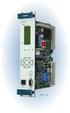 Machinery Protection Card Type FEATURES Continuous on-line Machinery Protection Card Real-time measurement and monitoring using state-of-the-art DSP techniques Fully VME-compatible slave interface Fully
Application Note 58 Crystal Considerations with Dallas Real Time Clocks
 www.dalsemi.com Application Note 58 Crystal Considerations with Dallas Real Time Clocks Dallas Semiconductor offers a variety of real time clocks (RTCs). The majority of these are available either as integrated
High Speed, Low Power Dual Op Amp AD827
 a FEATURES High Speed 50 MHz Unity Gain Stable Operation 300 V/ms Slew Rate 120 ns Settling Time Drives Unlimited Capacitive Loads Excellent Video Performance 0.04% Differential Gain @ 4.4 MHz 0.198 Differential
Description. 5k (10k) - + 5k (10k)
 THAT Corporation Low Noise, High Performance Microphone Preamplifier IC FEATURES Excellent noise performance through the entire gain range Exceptionally low THD+N over the full audio bandwidth Low power
AP331A XX G - 7. Lead Free G : Green. Packaging (Note 2)
 Features General Description Wide supply Voltage range: 2.0V to 36V Single or dual supplies: ±1.0V to ±18V Very low supply current drain (0.4mA) independent of supply voltage Low input biasing current:
Description. Output Stage. 5k (10k) - + 5k (10k)
 THAT Corporation Low Noise, High Performance Audio Preamplifier IC FEATURES Low Noise: 1 nv/hz input noise (60dB gain) 34 nv/hz input noise (0dB gain) (1512) Low THD+N (full audio bandwidth): 0.0005% 40dB
High Speed, Low Cost, Triple Op Amp ADA4861-3
 High Speed, Low Cost, Triple Op Amp ADA486-3 FEATURES High speed 73 MHz, 3 db bandwidth 625 V/μs slew rate 3 ns settling time to.5% Wide supply range: 5 V to 2 V Low power: 6 ma/amplifier. db flatness:
Features. Applications
 LM555 Timer General Description The LM555 is a highly stable device for generating accurate time delays or oscillation. Additional terminals are provided for triggering or resetting if desired. In the
Pulse Width Modulation Amplifiers EQUIVALENT CIRCUIT DIAGRAM. 200mV + - SMART CONTROLLER .01F OSC Q3. 2200pF
 Pulse Width Modulation Amplifiers MSA MSA FEATURES LOW COST HIGH VOLTAGE VOLTS HIGH OUTPUT CURRENT AMPS kw OUTPUT CAPABILITY VARIABLE SWITCHING FREQUEY APPLICATIONS BRUSH MOTOR CONTROL MRI MAGNETIC BEARINGS
Designing Stable Compensation Networks for Single Phase Voltage Mode Buck Regulators
 Designing Stable Compensation Networks for Single Phase Voltage Mode Buck Regulators Technical Brief December 3 TB47. Author: Doug Mattingly Assumptions This Technical Brief makes the following assumptions:.
Quad, Rail-to-Rail, Fault-Protected, SPST Analog Switches
 19-2418; Rev ; 4/2 Quad, Rail-to-Rail, Fault-Protected, General Description The are quad, single-pole/single-throw (SPST), fault-protected analog switches. They are pin compatible with the industry-standard
24-Bit Analog-to-Digital Converter (ADC) for Weigh Scales FEATURES S8550 VFB. Analog Supply Regulator. Input MUX. 24-bit Σ ADC. PGA Gain = 32, 64, 128
 24-Bit Analog-to-Digital Converter (ADC) for Weigh Scales DESCRIPTION Based on Avia Semiconductor s patented technology, HX711 is a precision 24-bit analogto-digital converter (ADC) designed for weigh
Kit 106. 50 Watt Audio Amplifier
 Kit 106 50 Watt Audio Amplifier T his kit is based on an amazing IC amplifier module from ST Electronics, the TDA7294 It is intended for use as a high quality audio class AB amplifier in hi-fi applications
PowerAmp Design. PowerAmp Design PAD135 COMPACT HIGH VOLATGE OP AMP
 PowerAmp Design COMPACT HIGH VOLTAGE OP AMP Rev G KEY FEATURES LOW COST SMALL SIZE 40mm SQUARE HIGH VOLTAGE 200 VOLTS HIGH OUTPUT CURRENT 10A PEAK 40 WATT DISSIPATION CAPABILITY 200V/µS SLEW RATE APPLICATIONS
Lock - in Amplifier and Applications
 Lock - in Amplifier and Applications What is a Lock in Amplifier? In a nut shell, what a lock-in amplifier does is measure the amplitude V o of a sinusoidal voltage, V in (t) = V o cos(ω o t) where ω o
Contents. Document information
 User Manual Contents Document information... 2 Introduction... 3 Warnings... 3 Manufacturer... 3 Description... Installation... Configuration... Troubleshooting...11 Technical data...12 Device Scope: PCB
Tire pressure monitoring
 Application Note AN601 Tire pressure monitoring 1 Purpose This document is intended to give hints on how to use the Intersema pressure sensors in a low cost tire pressure monitoring system (TPMS). 2 Introduction
MH88500. Hybrid Subscriber Line Interface Circuit (SLIC) Preliminary Information. Features. Description. Applications. Ordering Information
 Hybrid Subscriber Line Interface Circuit (SLIC) Features Differential to single ended conversion No transformers required Minimum installation space Off-Hook detection and LED indicator drive Relay drive
Technical Note #3. Error Amplifier Design and Applications. Introduction
 Technical Note #3 Error Amplifier Design and Applications Introduction All regulating power supplies require some sort of closed-loop control to force the output to match the desired value. Both digital
Analog Devices Welcomes Hittite Microwave Corporation NO CONTENT ON THE ATTACHED DOCUMENT HAS CHANGED
 Analog Devices Welcomes Hittite Microwave Corporation NO CONTENT ON THE ATTACHED DOCUMENT HAS CHANGED www.analog.com www.hittite.com THIS PAGE INTENTIONALLY LEFT BLANK v.113 Frequency Divider Operation
Rail-to-Rail, High Output Current Amplifier AD8397
 Rail-to-Rail, High Output Current Amplifier AD8397 FEATURES Dual operational amplifier Voltage feedback Wide supply range from 3 V to 24 V Rail-to-rail output Output swing to within.5 V of supply rails
Push-Pull FET Driver with Integrated Oscillator and Clock Output
 19-3662; Rev 1; 5/7 Push-Pull FET Driver with Integrated Oscillator General Description The is a +4.5V to +15V push-pull, current-fed topology driver subsystem with an integrated oscillator for use in
PS25202 EPIC Ultra High Impedance ECG Sensor Advance Information
 EPIC Ultra High Impedance ECG Sensor Advance Information Data Sheet 291498 issue 2 FEATURES Ultra high input resistance, typically 20GΩ. Dry-contact capacitive coupling. Input capacitance as low as 15pF.
Buffer Op Amp to ADC Circuit Collection
 Application Report SLOA098 March 2002 Buffer Op Amp to ADC Circuit Collection Bruce Carter High Performance Linear Products ABSTRACT This document describes various techniques that interface buffer op
High Speed, Low Power Monolithic Op Amp AD847
 a FEATURES Superior Performance High Unity Gain BW: MHz Low Supply Current:.3 ma High Slew Rate: 3 V/ s Excellent Video Specifications.% Differential Gain (NTSC and PAL).9 Differential Phase (NTSC and
ULRASONIC GENERATOR POWER CIRCUITRY. Will it fit on PC board
 ULRASONIC GENERATOR POWER CIRCUITRY Will it fit on PC board MAJOR COMPONENTS HIGH POWER FACTOR RECTIFIER RECTIFIES POWER LINE RAIL SUPPLY SETS VOLTAGE AMPLITUDE INVERTER INVERTS RAIL VOLTAGE FILTER FILTERS
Power Supplies. 1.0 Power Supply Basics. www.learnabout-electronics.org. Module
 Module 1 www.learnabout-electronics.org Power Supplies 1.0 Power Supply Basics What you ll learn in Module 1 Section 1.0 Power Supply Basics. Basic functions of a power supply. Safety aspects of working
Fully Differential CMOS Amplifier
 ECE 511 Analog Electronics Term Project Fully Differential CMOS Amplifier Saket Vora 6 December 2006 Dr. Kevin Gard NC State University 1 Introduction In this project, a fully differential CMOS operational
MODEL 1211 CURRENT PREAMPLEFIER
 MODEL 1211 CURRENT PREAMPLEFIER Phone: (607)539-1108 Email: [email protected] www.dlinstruments.com The Model 1211 Current Preamplifier was designed to provide all of the features required of a modern
TLI4946. Datasheet TLI4946K, TLI4946-2K, TLI4946-2L. Sense and Control. May 2009
 May 2009 TLI4946 High Precision Hall Effect Latches for Industrial and Consumer Applications TLI4946K, TLI4946-2K, TLI4946-2L Datasheet Rev. 1.0 Sense and Control Edition 2009-05-04 Published by Infineon
Features. Note Switches shown in digital high state
 DAC1020 DAC1021 DAC1022 10-Bit Binary Multiplying D A Converter DAC1220 DAC1222 12-Bit Binary Multiplying D A Converter General Description The DAC1020 and the DAC1220 are respectively 10 and 12-bit binary
ICS514 LOCO PLL CLOCK GENERATOR. Description. Features. Block Diagram DATASHEET
 DATASHEET ICS514 Description The ICS514 LOCO TM is the most cost effective way to generate a high-quality, high-frequency clock output from a 14.31818 MHz crystal or clock input. The name LOCO stands for
Evaluating AC Current Sensor Options for Power Delivery Systems
 Evaluating AC Current Sensor Options for Power Delivery Systems State-of-the-art isolated ac current sensors based on CMOS technology can increase efficiency, performance and reliability compared to legacy
Chapter 6 PLL and Clock Generator
 Chapter 6 PLL and Clock Generator The DSP56300 core features a Phase Locked Loop (PLL) clock generator in its central processing module. The PLL allows the processor to operate at a high internal clock
Physics 120 Lab 6: Field Effect Transistors - Ohmic region
 Physics 120 Lab 6: Field Effect Transistors - Ohmic region The FET can be used in two extreme ways. One is as a voltage controlled resistance, in the so called "Ohmic" region, for which V DS < V GS - V
BIASING OF CONSTANT CURRENT MMIC AMPLIFIERS (e.g., ERA SERIES) (AN-60-010)
 BIASING OF CONSTANT CURRENT MMIC AMPLIFIERS (e.g., ERA SERIES) (AN-60-010) Introduction The Mini-Circuits family of microwave monolithic integrated circuit (MMIC) Darlington amplifiers offers the RF designer
Tamura Closed Loop Hall Effect Current Sensors
 Tamura Closed Loop Hall Effect Current Sensors AC, DC, & Complex Currents Galvanic Isolation Fast Response Wide Frequency Bandwidth Quality & Reliability RoHs Compliance Closed Loop Hall Effect Sensors
GT Sensors Precision Gear Tooth and Encoder Sensors
 GT Sensors Precision Gear Tooth and Encoder Sensors NVE s GT Sensor products are based on a Low Hysteresis GMR sensor material and are designed for use in industrial speed applications where magnetic detection
Operational Amplifiers
 Module 6 Amplifiers Operational Amplifiers The Ideal Amplifier What you ll learn in Module 6. Section 6.0. Introduction to Operational Amplifiers. Understand Concept of the Ideal Amplifier and the Need
Fig. 1 :Block diagram symbol of the operational amplifier. Characteristics ideal op-amp real op-amp
 Experiment: General Description An operational amplifier (op-amp) is defined to be a high gain differential amplifier. When using the op-amp with other mainly passive elements, op-amp circuits with various
Understanding Power Impedance Supply for Optimum Decoupling
 Introduction Noise in power supplies is not only caused by the power supply itself, but also the load s interaction with the power supply (i.e. dynamic loads, switching, etc.). To lower load induced noise,
Series AMLDL-Z Up to 1000mA LED Driver
 FEATURES: Click on Series name for product info on aimtec.com Series Up to ma LED Driver Models Single output Model Input Voltage (V) Step Down DC/DC LED driver Operating Temperature range 4ºC to 85ºC
Homework Assignment 03
 Question 1 (2 points each unless noted otherwise) Homework Assignment 03 1. A 9-V dc power supply generates 10 W in a resistor. What peak-to-peak amplitude should an ac source have to generate the same
NE555 SA555 - SE555. General-purpose single bipolar timers. Features. Description
 NE555 SA555 - SE555 General-purpose single bipolar timers Features Low turn-off time Maximum operating frequency greater than 500 khz Timing from microseconds to hours Operates in both astable and monostable
DIGITAL-TO-ANALOGUE AND ANALOGUE-TO-DIGITAL CONVERSION
 DIGITAL-TO-ANALOGUE AND ANALOGUE-TO-DIGITAL CONVERSION Introduction The outputs from sensors and communications receivers are analogue signals that have continuously varying amplitudes. In many systems
Constant Current Control for DC-DC Converters
 Constant Current Control for DC-DC Converters Introduction... Theory of Operation... Power Limitations... Voltage Loop Stability...2 Current Loop Compensation...3 Current Control Example...5 Battery Charger