
Marine Protected Area Networks: Process design and ecosystembased. Hannah Thomas & Nicholas Shears
|
|
|
- Dale Allison
- 10 years ago
- Views:
Transcription
1 Marine Protected Area Networks: Process design and ecosystembased approaches Hannah Thomas & Nicholas Shears


2 Forest & Bird is New Zealand s largest independent conservation organisation that works to preserve our natural heritage and native species. Citation: Thomas, H.L. & Shears, N. (2013). Marine Protected Areas: A comparison of approaches. The Royal Forest and Bird Protection Society of New Zealand, Wellington, New Zealand.. Front cover photograph: Seafanz (

3 Executive Summary and Recommendations New Zealand s long history of marine life protection is impressive compared to other efforts elsewhere in the world, being one of the first countries to establish a number of highly protected Marine Protected Areas (MPAs), or Marine Reserves. However, New Zealand s marine reserves were established individually and independently to protect local-scale marine wildlife, rather than systematically as a coherent network designed to protect national-scale biodiversity and ecosystem services. In total, only 7% of New Zealand territorial waters are protected in marine reserves, but most of this lies offshore, leaving just 0.3% of mainland waters protected within reserves. As part of its programme to develop positive and visionary campaigns for New Zealand s sustainable future, the Royal Forest and Bird Protection Society of New Zealand commissioned this report to inform their oceans management policy and to support their comments on emerging proposals for new MPAs in New Zealand. The objectives of the report were to: 1) review a selection of recent MPA network design processes from around the world, 2) summarise the key issues emerging from the scientific literature used to design MPA networks, 3) develop recommendations for future MPA design processes, particularly in relation to notake zones and the New Zealand MPA Policy, and 4) highlight examples of the benefits of MPAs to fisheries. We selected three MPA network design processes as relevant case studies: 1) the California Marine Life Protection Act Initiative; 2) the UK Marine Conservation Zones Project; and 3) the Australian Great Barrier Reef Marine Park Representative Areas Program. These case studies were specifically chosen because they used the latest scientific literature to guide their MPA network design guidance, and because of their similarities to New Zealand s MPA process in terms of spatial scale, marine environment, stakeholder engagement and socio-economic landscape. Ecological Design Guidelines Using explicit and, where appropriate, numerical guidelines is extremely important for the design process, as this provides stakeholders with scientifically justifiable rules of engagement for MPA planning and also provide managers with a quantitative framework with which to evaluate MPA network proposals. All three case studies developed strong science guidelines for achieving long-term biodiversity persistence within MPA networks, consisting of a scientific literature review and expert advice to produce a series of general principles or rules of thumb, often accompanied by clear numerical targets. Although the case study guidelines were not identical, the key principles that formed the basis of their network design processes could be identified as: 1) habitat; 2) adequacy of habitat coverage; 3) viability of MPA size; 4) replication of habitats in MPAs; 5) connectivity between MPAs; 6) using best available evidence; and 7) levels of protection (variety of MPA types and amount of habitat in no-take zones). Although many of these aspects are included to some extent in the existing NZ MPA Policy guidelines, we provide some recommended revisions of these guidelines to bring New

4 Executive Summary Zealand s efforts more in line with international design processes. Our recommendations for ecological design guidelines are: 1) All habitats are represented in the network. The appropriate habitat classification should match the spatial scale of the conservation planning efforts and ecosystem processes should be represented. 2) Enough of each specific habitat should be included in the network to be functionally protected. If sufficient biodiversity data permit, habitat-specific targets would be recommended. In the absence of such data, we would recommend rigorous application of other scientifically robust design principles (e.g. viability, connectivity and representativity). 3) MPAs should be large enough to cover the majority of species adult movement distances. Based on these case studies and extensive studies from existing New Zealand reserves, we would recommend that MPAs have a minimum coastline length of 5-10 km, preferably km, and should extend along the depth gradient from intertidal to deeper offshore waters, preferably to the 12 nautical mile limit. 4) Several examples of each habitat should be included within separated MPAs. A precautionary number of replicates would be 3, with two replicates being the minimum. 5) The spacing between MPAs should allow larval dispersal to occur. We recommend that MPAs, with similar habitats where possible, should be placed within km of each other. Levels of Protection The level of protection afforded to a MPA defines the MPA s status or type (e.g. marine reserve ) and the varying activities that are managed or restricted within its boundaries, potentially ranging from multiple uses to no-take and even no-entry zones. Processes that have successfully established ecologically robust MPA networks over large spatial scales typically have no-take zones at their core. The level of protection required for an MPA in a particular area is dependent on the goals of the MPA design process and also the level of activities that already occur in an area. If the goal of the MPA process is biodiversity protection and long-term persistence, then it is essential that any permitted activities do not compromise this goal. These goals and the required levels of protection must be made clear in order to ensure stakeholders involved in the design process are in no doubt of the expected outcomes, thereby increasing the likelihood of a successful MPA planning process. Although partially protected multiple-use MPAs can play an important role in protecting sensitive habitats and benthic ecosystems against particularly destructive fishing practices, such as trawling, it is clear from the literature that these MPAs have limited conservation benefits compared to no-take zones. Even relatively low levels of fishing pressure can suppress many populations and prevent recovery, and fishing methods that are allowed to continue in an MPA tend to take up the slack in terms of catching the fish that may otherwise have been caught by the prohibited methods. The appropriate proportion of no-take zones for adequate ecosystem protection is likely to be driven by specific network goals, spatial extent, sensitive habitats and levels of human activity 4

5 Executive Summary in the area of intervention. A wide range of no-take zone targets exists for both global ocean management and within specific MPA network designs, ranging from 10-75% coverage of a given area. However, some network design processes have replaced a pre-determined target with very clear ecological design guidelines for replication, viability, connectivity and levels of protection in order to establish, by default, a proportion of no-take zones that is appropriate to the conservation needs of a given region. Although the current New Zealand MPA Policy was written to achieve the objectives of the New Zealand Biodiversity Strategy, which aims to protect 10% in marine reserves, it lacks clear design guidance on the required level of protection. Our recommendations for levels of protection are: 1) No-take zones are considered a critical part of any MPA network design for: a. Maximum conservation benefits No-take zones ensure a high level of protection for biodiversity structure and function, they remove uncertainty regarding the impacts of activities and they have been shown to deliver significant ecological direct and indirect benefits for fisheries and biodiversity, in tropical and temperate areas. b. Simplicity and cost-effectiveness from a management perspective There is no doubt for users over what activities are allowed within an MPA, making enforcement easier and compliance higher. c. No preference for certain stakeholder groups Establishing no-take zones for everyone can be less controversial than identifying selective use zones. d. Provide insurance against changes in future use No-take zones remove the risk of permitted activities increasing in intensity in the future following an MPA establishment, either due to subsequent changes in user behaviour or general population increases. 2) New Zealand MPA policy guidelines and process are strengthened so that the levels of protection are sufficient to protect biodiversity. The amount of no-take zones incorporated into the network can be determined in several ways but the associated guidelines should be explicit and criteria-driven so that stakeholder progress can be evaluated and any proposals can be justifiably assessed according to the necessary goals. 3) Ensure that establishing the level of protection afforded to MPAs (i.e. no-take vs. restricted fishing) is an integral, justifiable and transparent part of the stakeholder design process. This aspect is so important to the success of the process that it must be very closely associated with any consideration of spatial areas. Fisheries benefits from MPAs MPAs, being permanent, have historically been used as a conservation tool to protect threatened habitats, whereas fisheries management areas tend to be temporary closures. It is now being increasingly encouraged that MPAs be utilized as an ecosystem-based approach to managing our natural resources, particularly fisheries. Global analyses of numerous marine reserves throughout the world are consistent in showing that on average, the majority have had a positive effect on previously harvested species, with some impressive increases in biomass, density, size and species richness within their boundaries, often within short timescales and for both temperate and tropical ecosystems alike. Some larger reserve networks 5
6 Executive Summary like the Great Barrier Reef Marine Park are also seeing benefits to larger, more mobile species, such as dugongs, turtles and sharks. In the past, several studies have concluded that MPAs can provide some benefits to fisheries through the spill-over of adult target species. With recent technological developments, researchers are now demonstrating a much greater and more important contribution of MPAs to wider fished populations through the export of larvae. Continual improvements in our knowledge and useful lessons learned means that designing reserves specifically for both fisheries and conservation benefits is technically possible and highly desirable, but most current MPAs are too small to deliver the biological conditions necessary to promote fishery recoveries. The vast majority are still single, isolated reserves without the multiplicative benefits provided by large networks of no-take and multiple use MPAs. Analysis of existing reserve performance has led to clearer science guidelines in future network design to achieve improved fisheries benefits without the implicit trade-off against conservation goals, but progress in this direction will require greater collaboration between fisheries and conservation to achieve successful ecosystem management. 6
7 Abbreviations BOP BZ CBD CIZ CPZ DEFRA EEZ EUNIS GBRMP GBRMPA GBRMP RAP GUZ IUCN IUCN-WCPA HPZ JNCC MCZ MLPA MNPZ MPA NE NTA NTZ OSPAR PZ SAC SMCA SMP SMR SPA SRZ SSSI Biophysical Operating Principles (Australia) Buffer Zones (Australia) Convention on Biological Diversity Commonwealth Island Zones (Australia) Conservation Park Zones (Australia) UK Department of Environment, Food and Rural Affairs Economic Exclusion Zone European Nature Information System Great Barrier Reef Marine Park (Australia) Great Barrier Reef Marine Park Authority (Australia) Great Barrier Reef Marine Park Representative Areas Program (Australia) General Use Zones (Australia) International Union for the Conservation of Nature IUCN World Commission on Protected Areas Habitat Protection Zones (Australia) Joint Nature Conservation Committee (UK Statutory Nature Conservation Body) Marine Conservation Zones (UK) Marine Life Protection Act (California) Marine National Park Zones (Australia) Marine Protected Area Natural England (UK Statutory Nature Conservation Body) No take area (Australia) No take zone Oslo Paris Convention (North East Atlantic Regional Seas Convention) Preservation zones (Australia) Special Area of Conservation (UK) State Marine Conservation Area (California) State Marine Park (California) State Marine Reserve (California) Special Protection Area (UK) Scientific Research Zones (Australia) Site of Special Scientific Interest (UK)

8 Table of Contents Executive Summary and Recommendations... 3 Abbreviations... 7 Introduction... 9 Context... 9 Objectives Selecting case studies Report structure Chapter 1: Overview of the case studies and New Zealand MPA network design processes.. 12 Case Study no 1: Australia s Great Barrier Reef Marine Park Representative Areas Program (GBRMP RAP process) Case Study no 2: California Marine Life Protection Act Initiative (MLPA Initiative) Case Study no 3: United Kingdom Marine Conservation Zones Project (UK MCZ Project) MPA network developments in New Zealand References Chapter 2: Scientific guidelines for designing MPA networks Introduction and overview PART I Ecological design guidelines Representativity Adequacy Viability Replication Connectivity Best available evidence Additional considerations References PART II: Levels of protection in MPA networks Ecological effects of different types of MPAs Proportion of habitat within no-take zones Case Studies: Conclusions References Chapter 3: The fisheries benefits of Marine Protected Areas Increase in biological characteristics Evidence for spill-over and larval dispersal Socio-economic improvements Drawing conclusions for fisheries benefits References... 60
9 Introduction Context New Zealand demonstrated its early commitment to marine conservation through the establishment of a Marine Reserves Act in 1971, followed shortly afterwards by one of the world s first marine no-take reserves at Cape Rodney-Okakari Point, also known as Goat Island, in The creation of the Poor Knights Marine Reserve in 1981 and the Kermadec Islands Marine Reserve in 1990 continued this exemplary trend in strong, forward-thinking marine conservation action and a total of 34 highly protected marine reserves are currently in place. Although New Zealand s long history of marine life protection is impressive compared to other efforts elsewhere in the world, these New Zealand reserves were established individually and independently, rather than systematically as a coherent network designed to protect biodiversity and ecosystem services at a national scale for the long-term. In total, only 7% of New Zealand territorial waters are protected in marine reserves and the two reserves making up the greatest proportion of this coverage - the Kermadec Islands and the Auckland Island (Motu Maha) reserves are situated considerably offshore, leaving just 0.3% of mainland waters protected within reserves. In 2000, the New Zealand Department of Conservation reviewed the Marine Reserves Act (1971) and subsequently drafted a new Marine Reserves Bill, which is currently reaching its concluding stages. A recent review of New Zealand s current MPA planning framework and a comparison with international developments by Mulcahy, Peart and Bull 1 has identified an urgent need to develop new MPA legislation in New Zealand. Mulcahy et al. (2012) provide a series of recommendations on how legislative reform should proceed. This reflects similar changes occurring internationally, as Australia 2, California 3, Canada 4 and the UK 5 reviewed and strengthened their marine laws to pave the way for systematic planning of marine protected area (MPA) networks for greater biodiversity protection. Accompanying the new marine policies, there has also been an associated shift towards encouraging far greater participation from local people and marine users in the design of MPAs, in part to increase support and compliance for the overall outcomes, but more importantly to accompany the positive momentum around the ecosystem approach to marine protection and the need to develop integrated management to accommodate both ecosystem dynamics and human resource requirements. 1 Mulcahy, K, Peart, R, Bull, A Safeguarding our Oceans: Strengthening marine protection in New Zealand. Environmental Defence Society 2 Environment Protection and Biodiversity Conservation Act Marine Life Protection Act National Marine Conservation Areas Act Marine and Coastal Access Act 2009

10 Introduction Objectives As part of its programme to develop positive and visionary campaigns for a sustainable future, Forest and Bird (F&B) commissioned this report to inform their oceans management policy and to support their comments on emerging proposals for new MPAs in New Zealand. The objectives of the report were to: 1. Review a selection of recent MPA network design processes from around the world 2. Synthesize the key issues emerging from the scientific literature used to design MPA networks in other countries 3. Develop high-level recommendations for future MPA design processes, particularly in relation to no-take zones and the New Zealand MPA Policy 4. Highlight examples of the benefits of MPAs to both biodiversity and fisheries In contrast to the review of Mulcahy et al., which focuses on reviewing the legislative side of MPA planning in New Zealand and overseas, our report concentrates on the ecological aspects of designing MPA networks. It is envisaged that the results of this report will complement those of Mulcahy et al. and provide the scientific guidance necessary for designing comprehensive MPA networks in New Zealand. Selecting case studies To meet the first three objectives of this report, we selected a small number of MPA network design processes as appropriate and relevant case studies: 1) the California Marine Life Protection Act Initiative ( MLPA Initiative ); 2) the UK Marine Conservation Zones Project ( UK MCZ Project ); and 3) the Australian Great Barrier Reef Marine Park following its Representative Areas Program ( GBRMP RAP ). These case studies were specifically chosen for their similarity in MPA network design approach, as well as their relevance to the New Zealand process in terms of spatial scale, marine environment and socio-economic landscape. All three case studies are large-scale MPA network implementation processes systematically designed to establish an ecosystem approach to protection of the marine environment. All three were required to use the best available scientific understanding and evidence to guide their outcomes, and therefore raise the key marine issues that emerge from this scale of process. Since the temperate UK and California marine environments may be considered to contain functionally similar ecosystems to those in New Zealand, they should provide applicable ecological guidance. Situated within similar socioeconomic and socio-political contexts, all three case studies had legislation in place with a mandate to use a participatory approach that involved stakeholders at all stages of the process, and took some account of the socio-economic implications of MPA designation on stakeholders. 10

11 Introduction Exploring the similarities of these case study processes can provide strong recommendations for other such processes. In addition, the finer scale differences between them in terms of local ecosystems, human activities and policy frameworks, have resulted in methodological variations in implementation, and identifying these can provide extremely interesting points of comparisons and lessons to be learned. Therefore the main focus of this report is to compare and contrast these approaches, highlight the process outcomes and suggest what considerations would be advisable for a similar process in New Zealand. Report structure The report is divided into three major chapters: Chapter 1) Overview of the case study and New Zealand MPA network design processes Chapter 2) Scientific guidelines for designing MPA networks Chapter 3) Benefits of MPAs to conservation and fisheries Chapter 1 describes the case studies in turn, giving an overview of their legal mandates, geographical location and coverage, start and finish dates, general process structure and current status, with outcomes where appropriate. A summary of the current New Zealand MPA process is also given. Chapter 2 looks at the scientific guidelines that were followed by each case study, and describes the different approaches. These design guidelines are divided into two parts; Part 1 looks at the ecological design guidelines that are common to all three processes, and Part 2 describes the levels of protection in an MPA network, outlines the importance of highly protected areas (i.e. marine reserves), reviews the literature on how much habitat should be captured within highly protected areas, and how the case study outcomes were affected by the different ways in which the international case studies incorporated levels of protection into the planning process. Both Parts 1 and 2 have a recommendations section at the end that compares the case study design guidelines with those in the New Zealand MPA Process. Finally, Chapter 3 looks at the benefits of MPAs and MPA networks to both fisheries and conservation by reviewing the large body of published literature dealing with theoretical and empirical research on individual MPAs as well as MPA networks. For the purposes of this report, we gathered published and unpublished literature and information on the three case studies. 11

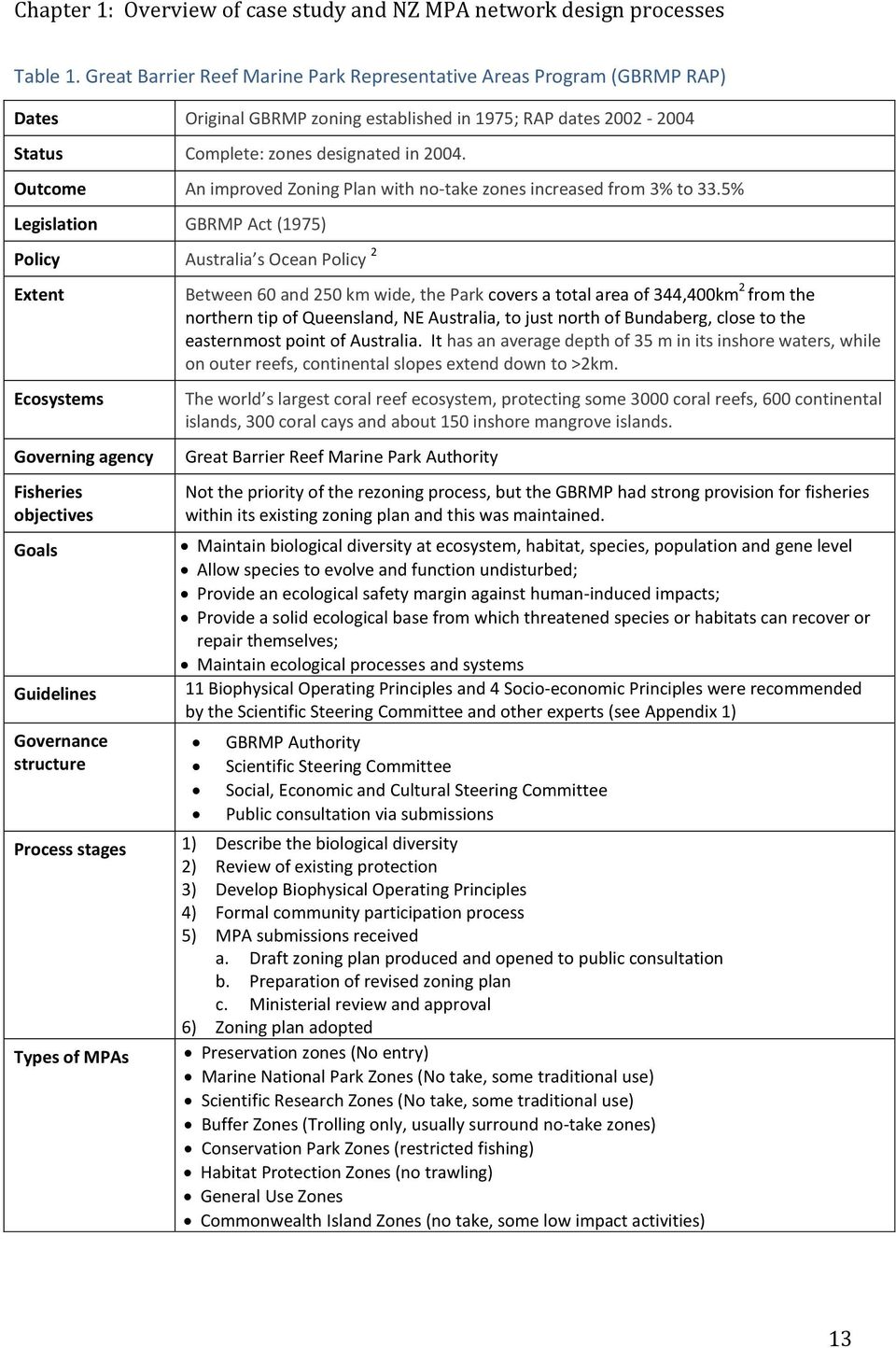
12 Chapter 1: Overview of the case studies and New Zealand MPA network design processes Case Study no 1: Australia s Great Barrier Reef Marine Park Representative Areas Program (GBRMP RAP process) The Marine Park was created in 1975 by the Great Barrier Reef Marine Park Act (1975). The initial zoning of the GBR Marine Park was done in Sections, beginning in 1982, with the entire Marine Park being zoned at least once by 1988 and various sections being subject to review in the period The GBRMP is designed as a multiple use park regulated through a system of 8 zones specifying allowed activities. Following a review of the zoning plan, the GBRMP Authority and a Scientific Steering Committee agreed that protection was insufficient for many habitats and was not comprehensive across the different bioregions. In 2002 public participation was invited on a new rezoning plan, called the Representative Areas Program, designed to increase the amount of each habitat protected within notake zones in order to ensure adequate protection across the Great Figure 1. The Great Barrier Reef Marine Park Barrier Reef. This process focused on establishing new no-take zones but also addressed other issues to improve the entire GBRMP zoning plan (e.g. zone boundaries were amended, additional mitigation measures were established for selected activities, the zoning plan was standardized, protection measures for some fish species were increased). The new Zoning Plan was completed in 2004 and included 33.5% highly protected areas and 31% habitat protection zones.

13 Chapter 1: Overview of case study and NZ MPA network design processes Table 1. Great Barrier Reef Marine Park Representative Areas Program (GBRMP RAP) Dates Original GBRMP zoning established in 1975; RAP dates Status Complete: zones designated in Outcome An improved Zoning Plan with no-take zones increased from 3% to 33.5% Legislation GBRMP Act (1975) Policy Australia s Ocean Policy 2 Extent Ecosystems Governing agency Fisheries objectives Goals Guidelines Governance structure Process stages Types of MPAs Between 60 and 250 km wide, the Park covers a total area of 344,400km 2 from the northern tip of Queensland, NE Australia, to just north of Bundaberg, close to the easternmost point of Australia. It has an average depth of 35 m in its inshore waters, while on outer reefs, continental slopes extend down to >2km. The world s largest coral reef ecosystem, protecting some 3000 coral reefs, 600 continental islands, 300 coral cays and about 150 inshore mangrove islands. Great Barrier Reef Marine Park Authority Not the priority of the rezoning process, but the GBRMP had strong provision for fisheries within its existing zoning plan and this was maintained. Maintain biological diversity at ecosystem, habitat, species, population and gene level Allow species to evolve and function undisturbed; Provide an ecological safety margin against human-induced impacts; Provide a solid ecological base from which threatened species or habitats can recover or repair themselves; Maintain ecological processes and systems 11 Biophysical Operating Principles and 4 Socio-economic Principles were recommended by the Scientific Steering Committee and other experts (see Appendix 1) GBRMP Authority Scientific Steering Committee Social, Economic and Cultural Steering Committee Public consultation via submissions 1) Describe the biological diversity 2) Review of existing protection 3) Develop Biophysical Operating Principles 4) Formal community participation process 5) MPA submissions received a. Draft zoning plan produced and opened to public consultation b. Preparation of revised zoning plan c. Ministerial review and approval 6) Zoning plan adopted Preservation zones (No entry) Marine National Park Zones (No take, some traditional use) Scientific Research Zones (No take, some traditional use) Buffer Zones (Trolling only, usually surround no-take zones) Conservation Park Zones (restricted fishing) Habitat Protection Zones (no trawling) General Use Zones Commonwealth Island Zones (no take, some low impact activities) 13
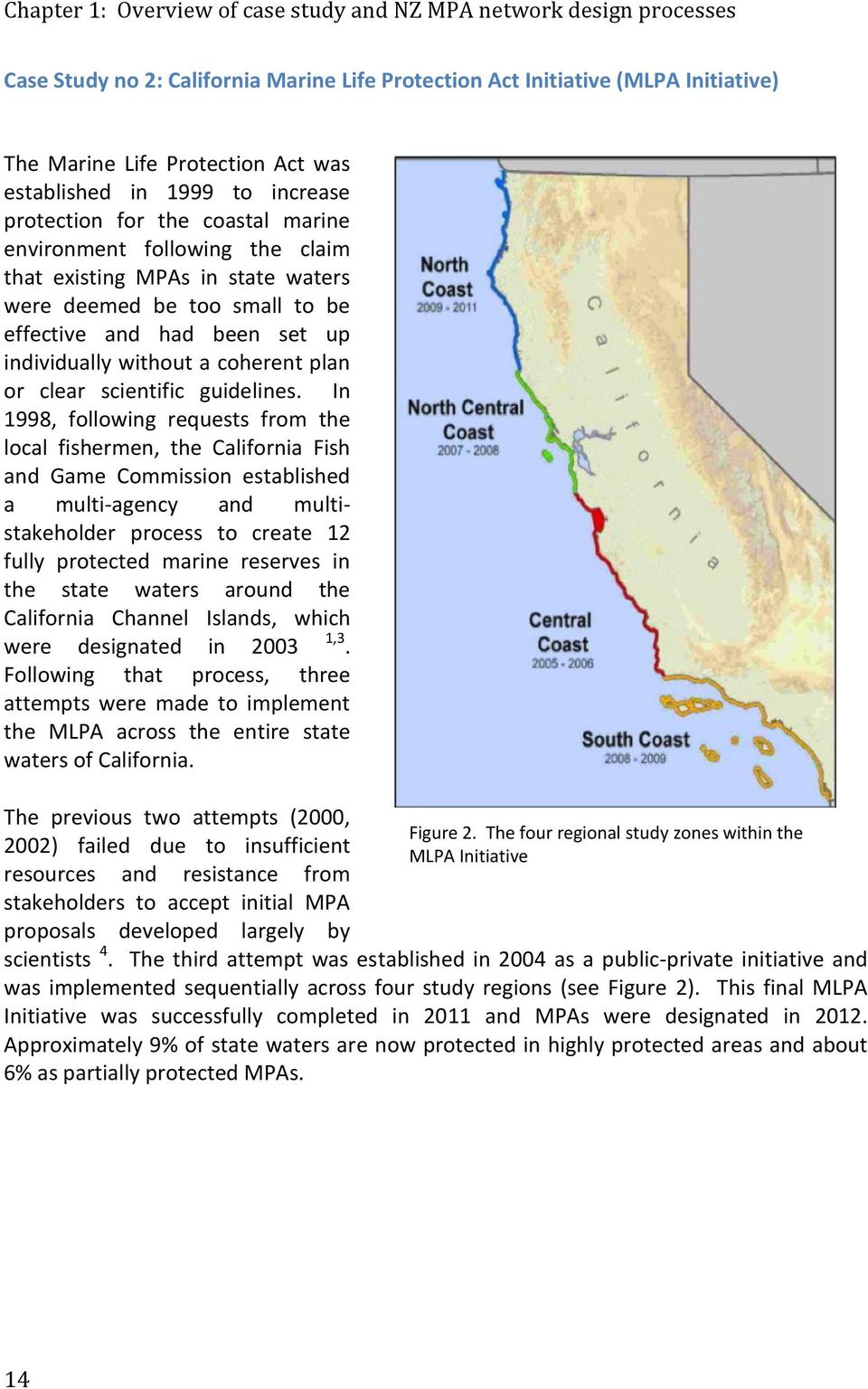
14 Chapter 1: Overview of case study and NZ MPA network design processes Case Study no 2: California Marine Life Protection Act Initiative (MLPA Initiative) The Marine Life Protection Act was established in 1999 to increase protection for the coastal marine environment following the claim that existing MPAs in state waters were deemed be too small to be effective and had been set up individually without a coherent plan or clear scientific guidelines. In 1998, following requests from the local fishermen, the California Fish and Game Commission established a multi-agency and multistakeholder process to create 12 fully protected marine reserves in the state waters around the California Channel Islands, which were designated in ,3. Following that process, three attempts were made to implement the MLPA across the entire state waters of California. The previous two attempts (2000, 2002) failed due to insufficient resources and resistance from stakeholders to accept initial MPA proposals developed largely by Figure 2. The four regional study zones within the MLPA Initiative scientists 4. The third attempt was established in 2004 as a public-private initiative and was implemented sequentially across four study regions (see Figure 2). This final MLPA Initiative was successfully completed in 2011 and MPAs were designated in Approximately 9% of state waters are now protected in highly protected areas and about 6% as partially protected MPAs. 14
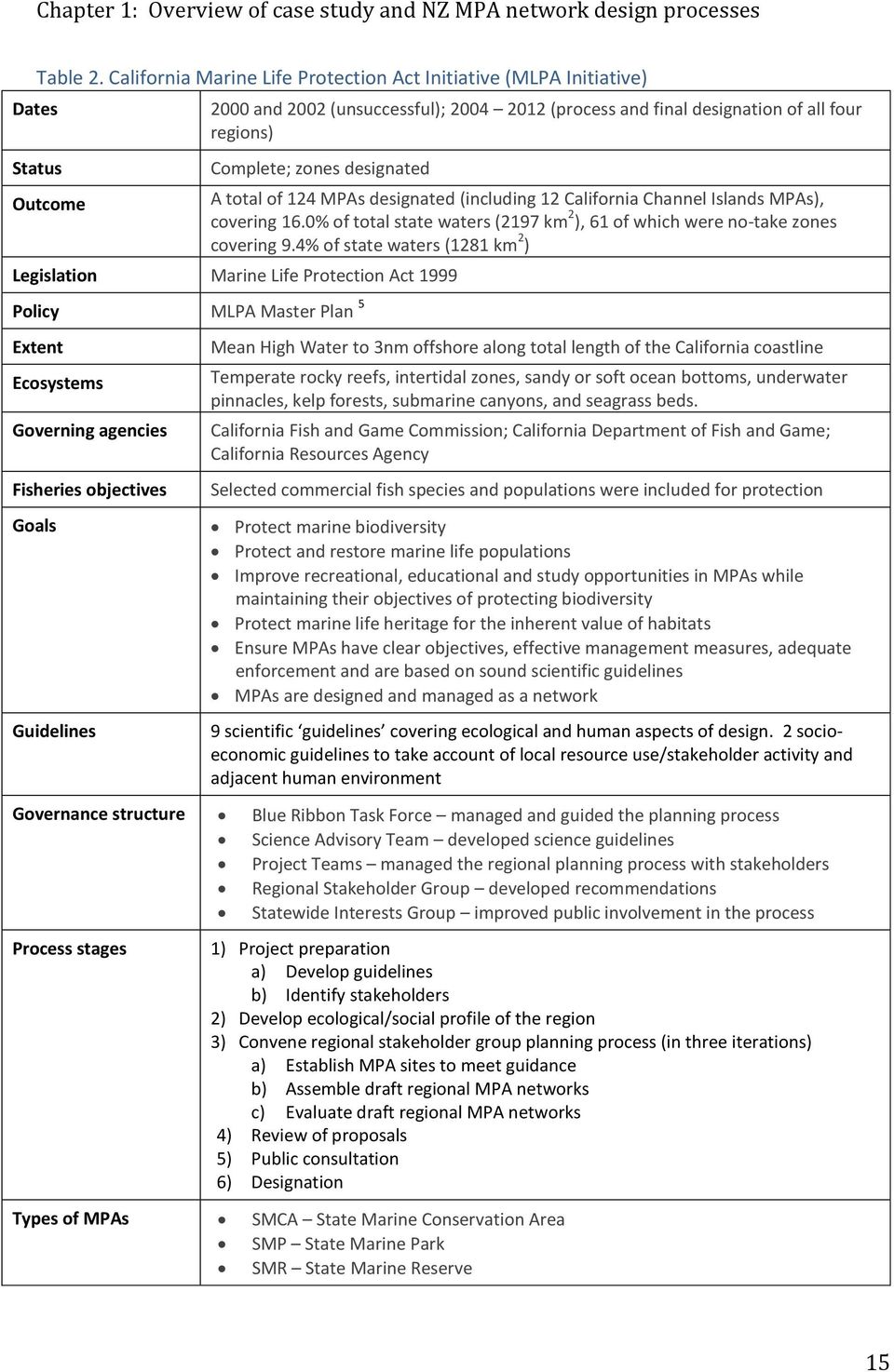
15 Chapter 1: Overview of case study and NZ MPA network design processes Dates Table 2. California Marine Life Protection Act Initiative (MLPA Initiative) Status Outcome 2000 and 2002 (unsuccessful); (process and final designation of all four regions) Complete; zones designated A total of 124 MPAs designated (including 12 California Channel Islands MPAs), covering 16.0% of total state waters (2197 km 2 ), 61 of which were no-take zones covering 9.4% of state waters (1281 km 2 ) Legislation Marine Life Protection Act 1999 Policy MLPA Master Plan 5 Extent Ecosystems Governing agencies Fisheries objectives Goals Guidelines Mean High Water to 3nm offshore along total length of the California coastline Temperate rocky reefs, intertidal zones, sandy or soft ocean bottoms, underwater pinnacles, kelp forests, submarine canyons, and seagrass beds. California Fish and Game Commission; California Department of Fish and Game; California Resources Agency Selected commercial fish species and populations were included for protection Protect marine biodiversity Protect and restore marine life populations Improve recreational, educational and study opportunities in MPAs while maintaining their objectives of protecting biodiversity Protect marine life heritage for the inherent value of habitats Ensure MPAs have clear objectives, effective management measures, adequate enforcement and are based on sound scientific guidelines MPAs are designed and managed as a network 9 scientific guidelines covering ecological and human aspects of design. 2 socioeconomic guidelines to take account of local resource use/stakeholder activity and adjacent human environment Governance structure Blue Ribbon Task Force managed and guided the planning process Science Advisory Team developed science guidelines Project Teams managed the regional planning process with stakeholders Regional Stakeholder Group developed recommendations Statewide Interests Group improved public involvement in the process Process stages 1) Project preparation a) Develop guidelines b) Identify stakeholders 2) Develop ecological/social profile of the region 3) Convene regional stakeholder group planning process (in three iterations) a) Establish MPA sites to meet guidance b) Assemble draft regional MPA networks c) Evaluate draft regional MPA networks 4) Review of proposals 5) Public consultation 6) Designation Types of MPAs SMCA State Marine Conservation Area SMP State Marine Park SMR State Marine Reserve 15
16 Chapter 1: Overview of case study and NZ MPA network design processes Case Study no 3: United Kingdom Marine Conservation Zones Project (UK MCZ Project) The Marine and Coastal Access Act was signed in 2009, requiring a network of MPAs in UK waters. Although a number of European MPAs already existed in British waters (the Natura 2000 sites protecting habitats of European importance), the MCZ designation type aimed to protect representative examples of nationally important habitats (as well as nationally rare and threatened species and habitats), and was also an attempt to integrate all the various MPA designations into a single ecologically coherent network. England began its stakeholder Figure 3. The four MCZ Regional Projects participation phase in 2009, but Scotland, Wales and Northern Ireland chose to adopt differing approaches that resulted in them commencing their MCZ projects at a later date. The UK MCZ Project in English waters was undertaken in four regions simultaneously (see Figure 3). Recommendations for a network of 127 sites were submitted to the Government in 2011 and in December 2012, 31 of those were selected for potential designation in 2014, subject to public consultation. As the process has not yet reached designation stage, the likely outcome is uncertain. Stakeholders recommended approximately 15% of England s EEZ to be protected within 127 MPAs and approximately 1.9% in 65 highly protected areas. At the present time, however, none of the 31 MPAs selected for potential designation in 2014 were to be highly protected. Table 3. United Kingdom Marine Conservation Zones Project (UK MCZ Project) Dates Status Outcome 2009 present Recommendations (Sept 2011) followed by public consultation (Jan-Mar 2013). First set of 31 MPAs (none are highly protected) have been put forward for potential designation in As yet unknown. 127 MCZs (and 65 highly protected areas) were recommended by stakeholder groups (in 2011), but at the time of writing, the Government has selected only a first tranche of 31 MCZs for potential designation, with no highly protected areas. Legislation Marine and Coastal Access Act 2009 Policy Guidance Note 1 6 Ecological Network Guidance 7 16

17 Chapter 1: Overview of case study and NZ MPA network design processes Extent Ecosystems Governing agencies Fisheries objectives Goals Guidelines English waters from Mean High Water to 200nm (or neighbouring EEZ) 23 Broad scale habitats were identified from the European classification system (EUNIS), describing biogenic reefs and intertidal, infralittoral, circalittoral and subtidal rock and mixed sediment habitats characterized by high, medium and low energy levels. Natural England (NE) and Joint Nature Conservation Committee (JNCC) None (the UK has a fisheries quota system established under the European Common Fisheries Policy) MCZs may be designated to conserve and/or aid the recovery of: The range of marine biodiversity in our waters; Rare or threatened habitats and species; Globally/regionally significant areas for geographically restricted habitats or species; Important aggregations or communities of marine species; Areas important for key life cycle stages of mobile species, including habitats known to be important for their reproduction and nursery stages; Areas contributing to maintenance of marine biodiversity and ecosystem function; Features of particular geological or geomorphological interest 7 Design Principles describe 19 ecological guidelines, with 11 additional further consideration guidelines 7. One overarching objective was to minimise the socioeconomic impacts on stakeholder activity Governance structure MCZ Project Team managed and guided the process Statutory Nature Conservation Agencies (JNCC/NE) delivered the science guidelines and project delivery guidance Science Advisory Panel assessed the recommendations Regional Stakeholder Groups developed recommendations Regional MCZ Project Teams managed the planning process Process stages Types of MPAs 1) Project preparation a. Identify stakeholders b. Develop guidelines 2) Stakeholder group formation and data collation 3) Develop ecological/social profile of the region 4) Convene regional stakeholder group planning process (in three iterative stages) a. Establish MCZ sites b. Evaluation of progress c. Finalise recommendations 5) Develop Impact Assessment 6) Review of recommendations and formal submission to Government 7) Public consultation 8) Designation MCZs are one type of MPA but can have any combination of restrictions depending upon the features for conservation and the impacts upon them. Reference Area MCZs are highly protected areas with no extraction, deposition or disturbance 17

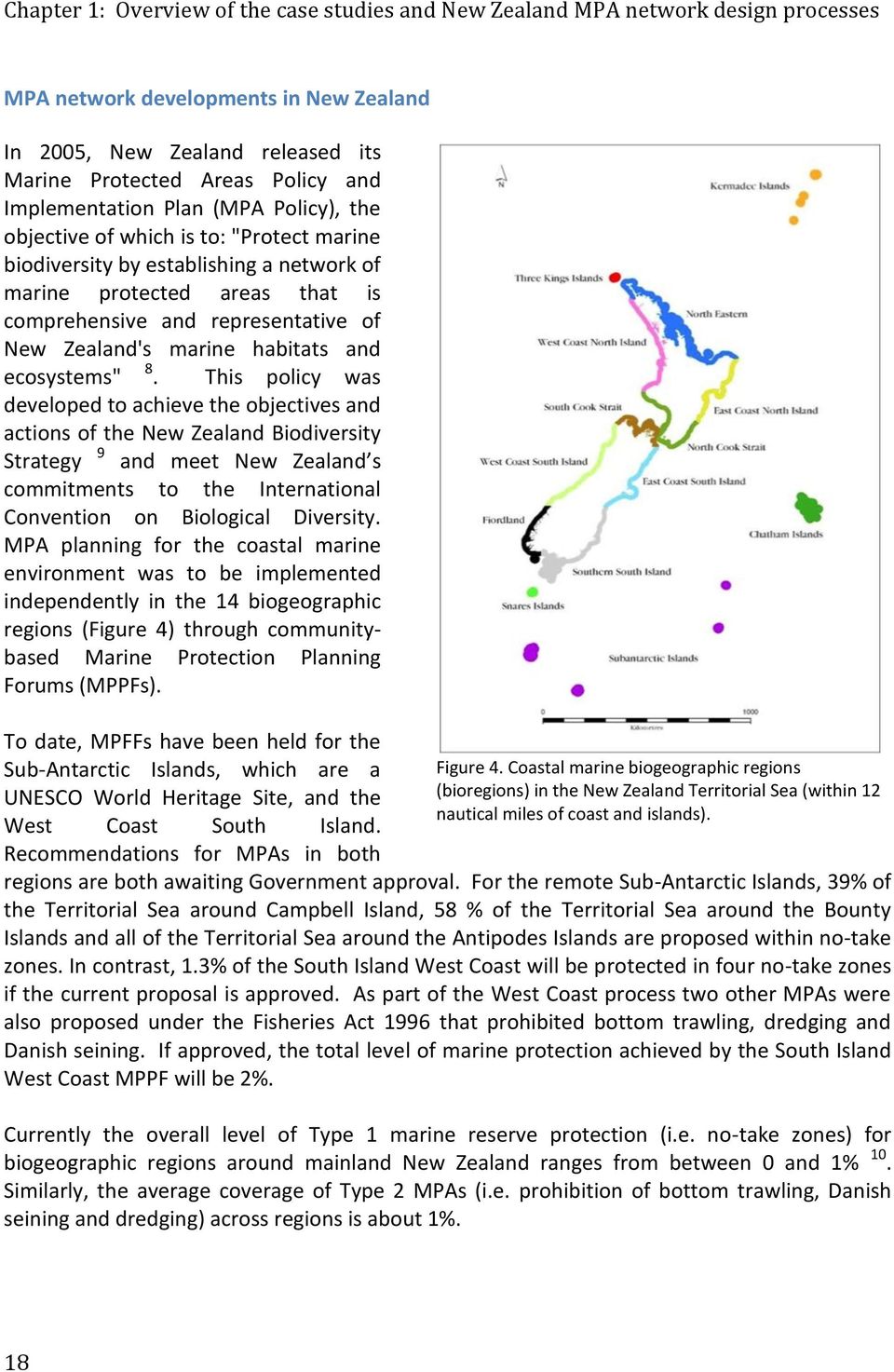
18 Chapter 1: Overview of the case studies and New Zealand MPA network design processes MPA network developments in New Zealand In 2005, New Zealand released its Marine Protected Areas Policy and Implementation Plan (MPA Policy), the objective of which is to: "Protect marine biodiversity by establishing a network of marine protected areas that is comprehensive and representative of New Zealand's marine habitats and ecosystems" 8. This policy was developed to achieve the objectives and actions of the New Zealand Biodiversity Strategy 9 and meet New Zealand s commitments to the International Convention on Biological Diversity. MPA planning for the coastal marine environment was to be implemented independently in the 14 biogeographic regions (Figure 4) through communitybased Marine Protection Planning Forums (MPPFs). To date, MPFFs have been held for the Sub-Antarctic Islands, which are a UNESCO World Heritage Site, and the West Coast South Island. Recommendations for MPAs in both Figure 4. Coastal marine biogeographic regions (bioregions) in the New Zealand Territorial Sea (within 12 nautical miles of coast and islands). regions are both awaiting Government approval. For the remote Sub-Antarctic Islands, 39% of the Territorial Sea around Campbell Island, 58 % of the Territorial Sea around the Bounty Islands and all of the Territorial Sea around the Antipodes Islands are proposed within no-take zones. In contrast, 1.3% of the South Island West Coast will be protected in four no-take zones if the current proposal is approved. As part of the West Coast process two other MPAs were also proposed under the Fisheries Act 1996 that prohibited bottom trawling, dredging and Danish seining. If approved, the total level of marine protection achieved by the South Island West Coast MPPF will be 2%. Currently the overall level of Type 1 marine reserve protection (i.e. no-take zones) for biogeographic regions around mainland New Zealand ranges from between 0 and 1% 10. Similarly, the average coverage of Type 2 MPAs (i.e. prohibition of bottom trawling, Danish seining and dredging) across regions is about 1%. 18
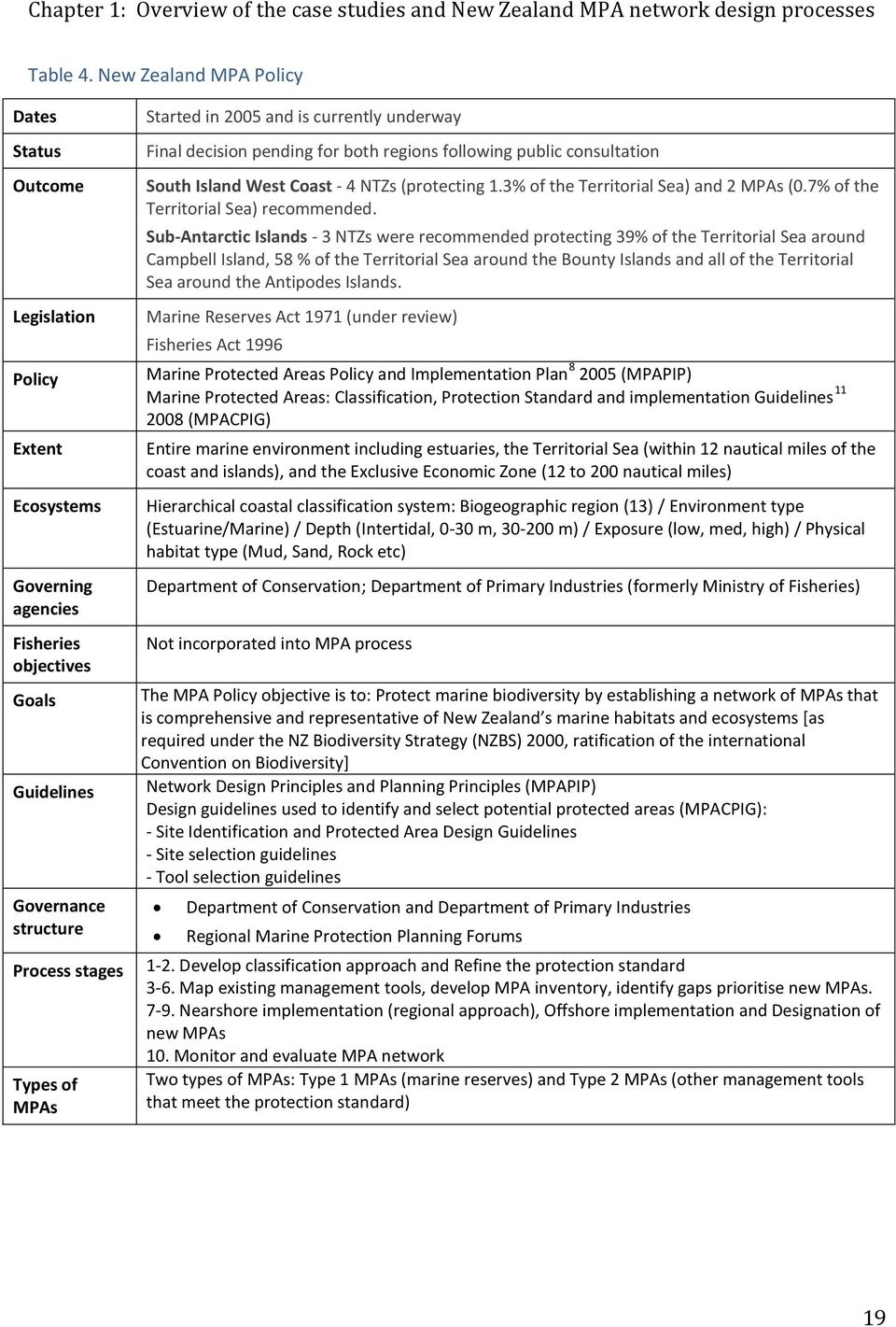
19 Chapter 1: Overview of the case studies and New Zealand MPA network design processes Table 4. New Zealand MPA Policy Dates Status Outcome Legislation Policy Extent Ecosystems Governing agencies Fisheries objectives Goals Guidelines Governance structure Process stages Types of MPAs Started in 2005 and is currently underway Final decision pending for both regions following public consultation South Island West Coast - 4 NTZs (protecting 1.3% of the Territorial Sea) and 2 MPAs (0.7% of the Territorial Sea) recommended. Sub-Antarctic Islands - 3 NTZs were recommended protecting 39% of the Territorial Sea around Campbell Island, 58 % of the Territorial Sea around the Bounty Islands and all of the Territorial Sea around the Antipodes Islands. Marine Reserves Act 1971 (under review) Fisheries Act 1996 Marine Protected Areas Policy and Implementation Plan (MPAPIP) Marine Protected Areas: Classification, Protection Standard and implementation Guidelines (MPACPIG) Entire marine environment including estuaries, the Territorial Sea (within 12 nautical miles of the coast and islands), and the Exclusive Economic Zone (12 to 200 nautical miles) Hierarchical coastal classification system: Biogeographic region (13) / Environment type (Estuarine/Marine) / Depth (Intertidal, 0-30 m, m) / Exposure (low, med, high) / Physical habitat type (Mud, Sand, Rock etc) Department of Conservation; Department of Primary Industries (formerly Ministry of Fisheries) Not incorporated into MPA process The MPA Policy objective is to: Protect marine biodiversity by establishing a network of MPAs that is comprehensive and representative of New Zealand s marine habitats and ecosystems [as required under the NZ Biodiversity Strategy (NZBS) 2000, ratification of the international Convention on Biodiversity] Network Design Principles and Planning Principles (MPAPIP) Design guidelines used to identify and select potential protected areas (MPACPIG): - Site Identification and Protected Area Design Guidelines - Site selection guidelines - Tool selection guidelines Department of Conservation and Department of Primary Industries Regional Marine Protection Planning Forums 1-2. Develop classification approach and Refine the protection standard 3-6. Map existing management tools, develop MPA inventory, identify gaps prioritise new MPAs Nearshore implementation (regional approach), Offshore implementation and Designation of new MPAs 10. Monitor and evaluate MPA network Two types of MPAs: Type 1 MPAs (marine reserves) and Type 2 MPAs (other management tools that meet the protection standard) 19
20 Chapter 1: Overview of the case studies and New Zealand MPA network design processes References 1. Osmond, M., Airame, S., Caldwell, M. & Day, J. Lessons for marine conservation planning: A comparison of three marine protected area planning processes. Ocean Coast. Manag. 53, (2010). 2. Commonwealth Government of Australia. Australia s Ocean Policy. (1998). At < 3. Davis, G. E. Science and society: Marine reserve design for the California Channel Islands. Conserv. Biol. 19, (2005). 4. Gleason, M. et al. Designing a network of marine protected areas in California: Achievements, costs, lessons learned, and challenges ahead. Ocean Coast. Manag. (2012). doi: /j.ocecoaman California Department of Fish and Game. The Marine Life Protection Act Master Plan for Marine Protected Areas. (2010). At < revisedmp0108.pdf> 6. DEFRA. Guidance on the selection and designation of Marine Conservation Zones in the UK (Note 1). Guidance on the proposed approach to the selection and designation of Marine Conservation Zones under Part 5 of the Marine and Coastal Access Act. (2010). 7. NE & JNCC. The Marine Conservation Zone Project: Ecological Network Guidance. (2010). 8. Department of Conservation & Ministry of Fisheries. MPA Policy and Implementation Plan. (2005). 9. New Zealand Government. New Zealand Biodiversity Strategy. (2000). At < 10. Department of Conservation & Ministry of Fisheries. Coastal marine habitats and marine protected areas in the New Zealand Territorial Sea: a broad scale gap analysis. (2011). 11. Department of Conservation & Ministry of Fisheries. Marine Protected Areas: Classification, Protection Standard and Implementation Guidelines. (2008). 20

21 Chapter 2: Scientific guidelines for designing MPA networks Introduction and overview Greater awareness of the need for increased marine protection and sustainable resource management has resulted in the development of MPA networks around the world. Achieving long-term biodiversity persistence within these MPA networks is more likely if their design is shaped by the best available scientific guidance on conservation planning for both population sustainability and ecosystem protection. Many such guidelines exist 1 8 and are being used as the foundation for MPA network design processes around the world. Although the three case study processes are currently at different stages of implementation (see Chapter 1), all three developed strong science guidelines for MPA network development that essentially consisted of a scientific literature review and expert advice to produce a series of general principles or rules of thumb, often accompanied by clear numerical targets. This section of the report aims to compare and contrast the ecological principles that were used by these case studies, first describing the scientific research that underpins the guidelines and then providing comment on how effectively these guidelines were translated into actual reserve design, with recommendations for future processes. Although the three case study guidelines are not identical, it is possible to distil out the key principles that form the basis of the network design process for all three, which are: 1. Representativity including the full range of habitats to protect all biodiversity 2. Adequacy ensuring sufficient habitat coverage for long term biodiversity persistence 3. Viability ensuring MPAs are large enough to sustain and expand populations 4. Replication including more than one example of each habitat to minimise risk 5. Connectivity ensuring adult and/or larval organisms can move between sites 6. Best available evidence using up-to-date information and local knowledge but ensuring the process is not delayed by the assimilation of better data 7. Levels of protection including marine reserves in a network for the best ecological protection. Part 1 outlines the first six guidelines, looking at the scientific literature underpinning them and how each of the case studies applied such science in practice. Part 2 first explains the different levels of protection afforded to MPAs and examines the literature on what proportion of a marine environment should be included within marine reserves. It then describes how these levels of protection were incorporated into each of the three case study processes, what the respective outcomes were and how this might offer guidance to the New Zealand MPA process.
22 Chapter 2: Scientific guidelines for designing MPA networks PART I Ecological design guidelines Representativity Context and international case study application Representativity 6, usually describes the goal of including samples of all organisational levels of biodiversity (i.e. habitats, communities, species and genes) within any established area boundaries 5,9. This concept is sometimes referred to as comprehensiveness 10, but should be distinguished from representativeness, which has been used (e.g. GBRMP) to refer to the selection of habitats or species that are typical of their kind 11. Habitats can act as a surrogate for species in the planning process 12 but the full biogeographic range of habitats must be incorporated at the appropriate spatial scale in order to meet any objective to protect biodiversity 7,12. When choosing the appropriate level of habitat classification for setting conservation objectives or targets, it is critical that the scale of habitat classification matches the scale of the spatial planning efforts in order to capture the variation in biological assemblages found at that local level 13,14. Rice and Houston 15 suggest that the identification of larger scale, common habitats is appropriate, to avoid a situation where all fine-scale unique habitats need to be classified and therefore incorporated into the network. To capture locally important examples of biodiversity, representativity can often include rare species or habitats that are characteristic of the area. As well as habitats, incorporating ecological processes should also be considered (e.g. spawning grounds or productive upwellings) at sufficient sizes to ensure the persistence of species at all trophic levels 15. Representativity can also be applied across disciplines, including valuable or important cultural or spiritual areas 1. It was the recognition that habitats other than coral reefs were under-represented in the Great Barrier Reef Marine Park (GBRMP) that led to the Representative Areas Program (RAP) rezoning in ,16. Using biological and physical spatial datasets on the distribution of habitats, plants and animals, a team of over 60 GBRMP experts designed a classification scheme for the rezoning process, identifying 70 specific bioregions at a scale dictated by the amount of available data, the presence of habitat patterns, and the zoning extent 11. In addition to special/unique places, the GBRMP RAP process also recommended cross-shelf and latitudinal gradients be captured to ensure that the full diversity of habitats was represented. To define the representative key habitats, the California MLPA Science Advisory Team used large-scale ecological, oceanographic and geological datasets to classify habitats according to two biological patterns, one described by community assemblage and the other by depth. This classification scheme was then revised to reflect the particular biogeography of each subregional planning area 17. Additional habitat types defined by oceanographic process (e.g. upwellings, freshwater plumes, larval retention areas) were also included Also referred to in the literature as representivity or representation. 22
23 Chapter 2: Scientific guidelines for designing MPA networks Classification of the UK marine environment falls within the revised Europe-wide comprehensive hierarchical system devised by the European Nature Information System (EUNIS) 19, encompassing terrestrial, marine and coastal environments from broad to fine scales and derived from analysis of physical and/or biological characteristics. The UK MCZ process used EUNIS broad-scale habitats as the basis for habitat representativity targets, supported by information on finer-scale habitats where available. Additional lists of habitats and species considered to be rare and threatened were also included, as specified in a range of national legislation 20. Unfortunately, the EUNIS habitat definitions used to identify MCZs did not align well with the different habitat classification used to identify pre-existing UK MPAs, which created considerable challenges for the gap analysis undertaken to evaluate habitat protection within existing MPAs and additional effort required to achieve representativity in MCZs. New Zealand context The New Zealand Marine Protected Areas Policy s main objective is to protect marine biodiversity by establishing a network of MPAs that is [both] comprehensive and representative of New Zealand s marine habitats and ecosystems. In order to achieve this, the policy aims to protect representative examples of the full range of marine habitats and ecosystems, as well as outstanding, rare, distinctive or internationally or nationally important marine habitats and ecosystems. The policy also mandates a consistent approach to classifying habitats. In general this guideline is in accordance with the other international case studies. Table 4. Representativity MLPA Initiative UK MCZ Project GBRMP Representative Areas Program 1) All key habitats should be protected (N.B. these were listed, with depth zones and important oceanographic habitats, but the list was often influenced by the regional composition of the SAT) 2) The network should include offshore open ocean to capture those areas that are critical for lifecycle stages 3) Habitats with unique features or those that are rare, should be targeted for inclusion 1) Include examples of all 23 EUNIS Level 3 broad-scale habitats in the network 2) Include examples of all listed rare and threatened habitats specified 3) Include examples of all listed rare and threatened species of low and high mobility 1) Include typical examples of each community and physical environment type (BOP 7) 2) Include biophysically special/unique places (BOP 9) 3) Represent cross-shelf and latitudinal diversity in the network of no-take zones (BOP 11) NZ MPA Process 1) Protect the full range of marine habitats and ecosystems 2) MPAs should be designated based on a consistent approach to classification of habitats and ecosystems 3) Represent latitudinal and longitudinal variation 23
24 Chapter 2: Scientific guidelines for designing MPA networks Adequacy Context and international case study application A network of MPAs must be sufficient in size to sustain its ecological objectives in the longterm, which relies on the inclusion of an adequate proportion of each of the component habitats or features. The principle of adequacy here refers to the overall amount of habitat included within a network of all MPA types and should not be confused with the proportion contained specifically within marine reserves (no-take zones), which is discussed in Part 2: Levels of Protection. Nevertheless, the adequacy principle is controversial in that it often results in the application of one or many percentage targets either data-dependent or dataindependent for area coverage. Targets clearly provide specific, measurable indicators of success that can be explicitly justified and objectively monitored within an adaptive management framework 5 and provide clear objectives for stakeholder-driven processes. Using data-independent targets has been discredited by several authors, as they are insensitive to different habitat requirements or species assemblages 21, overlook ecological processes or habitat-specific features 22 and provide a false sense of security 23. Rondinini 24 appraised the strengths and weaknesses of different methodologies used to develop data-dependent targets (either marine or terrestrial) for habitat adequacy. He concluded that methods used to establish fixed targets across all habitats were simple to communicate, but scientifically unjustified, as they did not consider the variation in different habitats and their differing protection needs. He considered developing habitat-specific targets based on species-area curves see 25 to be the most scientifically robust and defensible approach, but noted the requirement for high levels of analysis and habitat-specific data. When the large amounts of necessary data are absent, Rondinini considered developing heuristic rules of thumb see 26 to be a comprehensive and scientifically sound approach. As a result of his review, Rondinini developed habitat-specific maximum and minimum numerical targets (between 10-40% coverage depending upon habitat) to represent the adequacy principle in the UK MPA network design guidelines 27, as developing species-area curves was considered the most scientifically robust method given the amount and nature of the available broad-scale habitat data. In terms of practical implementation, this method was successful in providing MCZ stakeholders with measurable, defensible and non-subjective goals, and these targets were met for the majority of habitats, although it required a great deal of staff analysis time to evaluate progress in meeting each of the separate targets. In the GBRMP RAP process, habitat-specific adequacy targets of 20% for reef and non-reef bioregions were established by the Scientific Steering Committee 10,11. However, since the GBRMP RAP rezoning established only no-take zones, the elaboration of percentage targets related only how much of each bioregion would be included within these no-take zones, rather than how much would be adequate within a network containing a range of protection levels. In sharp contrast to both the other case studies, the MLPA Initiative science guidelines did not 24
25 Chapter 2: Scientific guidelines for designing MPA networks include numerical targets for adequacy, but relied upon the presence of other specific network design principles (habitat representation and replication, MPA size and spacing) to deliver an ecologically sustainable network of MPAs 28. This was an interesting departure from the planning process undertaken in the California Channel Islands just prior to the MLPA process (and included within it) that used fixed numerical targets of 30-50% of each habitat to deliver the network objectives 29. In their summary of the MLPA Initiative process, Gleeson and colleagues 28 intimated that the removal of numerical adequacy targets was due to the criticism the fixed percentage approach received. New Zealand context The New Zealand MPA Policy was designed to help achieve the New Zealand Biodiversity Strategy target of protecting 10% of the marine environment by 2010 through a network of representative protected marine areas 30, as recommended by the Convention on Biological Diversity in 2005 (CBD 2005a). A recent gap analysis by the Department of Conservation 31 states that the ultimate extent of protection will be determined by what coverage is required to establish a comprehensive and representative network of marine protected areas. While 10% is recognised as the target set out in the NZ Biodiversity Strategy, there is no explicit MPA Policy guideline providing a recommendation on the amount or proportion of area to be protected. Consequently, after extensive stakeholder engagement in MPA planning for the west coast of the South Island, only four marine reserves were proposed and these have been significantly reduced in size to protect, if approved, only 1% of that region in no-take zones. Table 5. Adequacy MLPA Initiative UK MCZ Project GBRMP Representative Areas Program None specified (Incorporated in design through guidelines on minimum size and maximum spacing of MPAs) Specific percentage targets (minimum and maximum thresholds) given for each broadscale habitat and feature of conservation importance 1) Represent at least 3 reefs and 20% of reef area and 20% of reef perimeter in each reef bioregion in no-take areas (NTAs) 2) Represent a minimum amount (20%) of each non-reef bioregion in NTAs, with specific habitats requiring special provisions NZ MPA Process None specified 25
26 Chapter 2: Scientific guidelines for designing MPA networks Viability Context and international case study application A viable network is considered to be ecologically self-sustaining in the long-term 7 with individual MPAs of sufficient size to allow most ecological processes to operate within them 32. Viability can be evaluated either at the MPA level the minimum size for an individual MPA to be self-sustaining but also at the system level the configurations of large and small sites within a network. At the individual MPA level, a quantitative review of 89 studies on the effects of no take reserves on fish size, biomass, density and species richness demonstrated that reserve size was not critical to significant increases for all these metrics 33. However, although very small reserves produced proportionally equal results to large reserves (e.g. a doubling in biomass), Halpern stressed that this did not necessarily make small reserves self sustaining or desirable for fisheries managers, since a doubling of numbers in a small site is a much smaller absolute increase than doubling in a large reserve. More recent studies have however demonstrated that small reserves have limited benefits in protecting exploited species 34,35. Small MPAs may be expected to enhance larval export or exchange through their increased edge-to-area ratio, but more edges also means faster export of adults, which is unlikely to sustain populations large enough to persist long term 12,36. While small reserves may achieve high densities of target species on a per area basis (i.e. transect level), Roberts and Hawkins (2000) point out that given the small geographic area the overall importance of the MPA for the wider population is likely to be negligible. Obviously, larger MPAs protect more fish and therefore have a greater potential to contribute to the wider larval pool. For individual MPAs to support self-sustaining populations, they need to retain a given species within their boundaries throughout their lifecycle 4. Given the long larval duration of most marine species this is not possible without very large reserves. Instead, individual reserves typically need to be large enough to encompass the home range of desired species and therefore viable size will depend upon the mobility of species identified for protection. The Science Advisory Team for the MLPA Initiative investigated patterns in adult movement according to habitat preferences 17, The viability principle recommended MPAs should be between 5-10km but preferably 10-20km in coastline length for the MLPA Initiative. These distances were considered appropriate to encompass the home ranges of a large proportion of coastal species (Fig. 5, Saarman et al 2012), while also allowing populations of some shortdispersing species, such as abalone, to potentially be self-sustaining. 26
27 Chapter 2: Scientific guidelines for designing MPA networks Figure 5. Reproduced from Saarman et al 2012: A graphical representation of adult movement patterns of west coast fish species derived from a literature review. Each fish represents an individual species for which movements have been studied. Many fish species associated with rocky reef habitats exhibit home range movements of 10 km or less. Fish images courtesy of Larry Allen. The MCZ Project reviewed adult movement information as well as researching life-history traits, physiology, and evolutionary origin 37. The resulting guidelines for broad-scale habitats specified a 5km minimum dimension but an average of 10-20km By contrast, the GBRMP RAP Scientific Steering Committee specified a much larger minimum dimension of 20km. The MLPA Initiative included a requirement that sites extend from coastal, intertidal waters to deeper offshore waters, to ensure protection of the habitats used throughout the lifecycle of targeted species and thereby fixing a minimum width and length to all sites (the maximum distance from shore was limited to 3 nautical miles for the MLPA Initiative as this is the edge of State waters). Factors other than ecological persistence such as management effectiveness, stakeholder support and compliance should also contribute to the viability debate at both the individual and system level. In inshore highly developed or populated areas, smaller sites would minimise the socio-economic impact on stakeholders, and may therefore be easier to set up and enforce. However, it is important that these small reserves remain of sufficient size to be viable (i.e. at or above minimum size requirements) in order for them to contribute to the 27
28 Chapter 2: Scientific guidelines for designing MPA networks greater network and play a role in biodiversity protection. The UK MCZ Project provided minimum patch sizes (e.g. 0.5km) for rare and threatened habitats and species within MPAs, but in combination with other guidelines, this unfortunately led to the recommendation of extremely small Reference Areas for individual habitats that were unlikely to provide effective protection. In some cases there may be a case for small MPAs below the recommended size for specific conservation purposes, such as protecting spawning grounds or sea bird and marine mammal breeding colonies. In offshore areas, MPAs that are small are harder to manage and enforce, as well as being harder for ships to accurately locate and avoid 36. At the network level, viability refers to whether a few large sites perform better than several smaller ones. The GBRMP RAP recommended that fewer, larger areas be established rather than smaller ones, to avoid edge-effects 10, but neither the MCZ Project or the MLPA Initiative considered this question explicitly, although the minimum size and spacing guidelines suggested a preference for few larger reserves. Roberts et al. 36 consider that within any given network of MPAs, there is no optimal MPA size and that to balance expected ecological, social and economic benefits a network design should have MPAs of varying sizes. When taking all network design principles into account together, however, Roberts et al. 37 noted that a tendency to select smaller-sized MPAs would require a greater number of MPAs overall in order to achieve representativity and connectivity, and thus recommended that fewer, larger MPAs were the preferred approach in order to avoid potential management and enforcement challenges. With hindsight, it may have been very useful for the UK MCZ Project to have undertaken a preliminary analysis to examine the likely outcomes of its viability principles, since the ultimate MCZ network recommendation reflected the prediction made by Roberts et al. and consisted of a very large number of sites (n=127), some as small as 0.5km in diameter. Boundary configuration of individual MPAs is also critical in ensuring viability and is also important for MPA management (i.e. compliance). Ideally, boundaries need to be simple with low boundary length-to-area ratios in order to minimise edge effects and maximise the effective area of the MPA. The MLPA Initiative and the MCZ Project provided detailed guidance on how to set MPA boundaries to take into consideration issues such as capturing the feature of interest and using easily recognisable navigational aids and coordinates. New Zealand context The NZ MPA Policy & Implementation Plan suggests that MPAs should be of sufficient size to provide for the maintenance of populations of plants and animals and recommends that any efforts should protect fewer, larger areas rather than numerous smaller areas. This guideline of fewer larger MPAs is consistent with the other case studies but no numerical guidance is given on MPA size. Recent research suggests that the minimum size requirements of no-take zones used in the international case studies (e.g., minimum coastline lengths of 5km and preferred of km) would be appropriate in the New Zealand context. Babcock et al. 38 found that marine 28
29 Chapter 2: Scientific guidelines for designing MPA networks reserves with sizes of approximately 5 km 2 (i.e. 5km of coast with 1km distance to offshore boundary) were too small to fully protect resident reserve snapper populations. Therefore, while reserves spanning ~5km of coast are known to still have conservation benefits and result in increased biomasses of snapper 39, this size should be considered a minimum. Table 6. Viability MLPA Initiative UK MCZ Project GBRMP Representative Areas Program 1) 5-10km min (10-20km preferred) length 2) Must extend from intertidal to deeper offshore 1) MCZs for broad-scale habitats should have a minimum diameter of 5 km with the average size being between 10 and 20 km in diameter 2) Patches of habitats of conservation importance within MCZs should have a minimum diameter as specified (minimum patch size = 0.1km). 1) No-take areas (NTAs) should be at least 20 km long on the smallest dimension (except for coastal bioregions) 2) For a given amount of area to be protected, protect fewer, larger areas rather than smaller areas, particularly to minimise edge effects resulting from use of the surrounding areas. 3) Where a reef is incorporated into NTAs, the whole reef should be included to avoid fragmentation NZ MPA Process 1) Protected areas may be of various shapes and sizes but should be of sufficient size to provide for the maintenance of populations of plants and animals. 2) Have fewer larger (versus numerous smaller) protected areas [Secondary consideration] Replication Context and international case study application Ecological resilience is encouraged through the non-contiguous replication of adequately protected representative habitats within an MPA network. Ensuring that duplicate or multiple examples of each bio-geographical habitat type are included within an MPA network increases persistence of biodiversity in the long term by reducing the risk of catastrophic damage from environmental or anthropogenic disturbance storms or oil spills 7,12 or unexpected declines in population numbers 1,32. Provided replicates are located to facilitate inter-connectivity, replicate MPAs therefore ensure that species can move between protected areas of suitable habitat or key lifecycle areas 1, which should increase the conservation and fisheries benefits of the network, beyond that of any single MPA. Multiple examples of each biological habitat also increase the chance of capturing samples of natural variation in biological communities 2. Replicate examples also allow standardised comparison between similar MPAs, which provides the opportunity to analyse the cause of variation 4,7 and supports an adaptive approach to management. There are other approaches to achieving resilience. Allison et al. 40 also looked at building resilience through the inclusion of an insurance factor that calculated the additional area of habitat required to withstand the likely occurrence of catastrophes, such as oil spills, 29
30 Chapter 2: Scientific guidelines for designing MPA networks hurricanes or combined events. The Convention on Biological Diversity Technical Guidance 32 states that, in addition to replication, resilience can be increased by ensuring that areas exhibiting specific characteristics associated with adaptability are included in MPAs (e.g. areas of high biodiversity, upwellings, areas on ecological boundaries). The GBRMP RAP incorporated at least 3-4 replicates of each bioregion into no-take areas, with larger or smaller habitats requiring more or less replicates respectively 10. With its objectives to support biodiversity and support the recovery of wildlife populations (including target fish species) the MLPA Initiative required 3-5 replicates of each key habitat, in order to provide robust analytical power for management decisions, buffer against risk of catastrophe and to protect against annual variations in larval production 18. The UK MCZ Project recommended that at least two examples of broad scale habitats were protected and additionally, that 3-5 examples of the more rare and threatened habitats and species were included in the network 20. However, without modelled distributions of the rare and threatened features or clarity on how to link these two guidance principles together in an ecologically meaningful way, the location of recommended MCZs was driven very strongly by the presence of rare species records alone, dramatically reducing the strength of the evidence base and political support for designation. New Zealand context The NZ MPA Policy and Implementation plan states under Network Design Principle 3 that the number of replicate MPAs included in the network will usually be two. However, in circumstances where a habitat or ecosystem is particularly vulnerable to irreversible change, more replicates may be established as a national priority. This guideline is in contrast to the international case studies, which typically required at least 3 replicates. Table 7. Replication MLPA Initiative UK MCZ Project GBRMP Representative Areas Program 3-5 examples of each habitat per biogeographic region In each biogeographic region: 1) 2 examples of each EUNIS Level 3 broad-scale habitat 2) 3-5 examples of each key feature 1) Represent at least 3 reefs and 20% of reef area and 20% of reef perimeter in each reef bioregion in no-take areas 2) For most bioregions, 3 4 NTAs are recommended. For some very small bioregions fewer areas are recommended, whilst for some very large or long bioregions, more no-take areas are recommended. NZ MPA Process Consideration should be given to whether the site provides replication of habitats and ecosystems in a biogeographic region. [Secondary consideration] 30
31 Chapter 2: Scientific guidelines for designing MPA networks Connectivity Context and international case study application Although individual, independent MPAs are a valuable tool for biodiversity conservation and fisheries management, MPA networks should deliver far greater benefits due to the ecological linkages between sites and the greater spatial scales involved. Connectivity aims to maximise the ecological linkages between sites within an MPA network, such that the overall benefits of the MPA network far exceed the summed benefits of the individual MPAs. This fundamentally requires the exchange of eggs, larvae, juveniles and adults among MPAs with the aim of maintaining species populations in the long term across all parts of their range 32. Achieving connectivity is a challenging goal, as it requires an understanding of larval dispersal patterns, adult and juvenile mobility, distribution of key habitats, and oceanographic characteristics (e.g. currents, upwellings). Effective connectivity is also highly dependent upon the size of individual reserves that protect the population, as ideally they need to be big enough to retain some larval recruits and therefore be self-sustaining (particularly for short dispersers), but also small enough and sufficiently well connected to each other to facilitate spill-over and exchange of larvae to replenish other populations and surrounding fishing grounds 41. Despite its critical importance, Gaines et al. 42 found that few theoretical models exploring the effects of reserve design incorporated the complexities of larval dispersal explicitly, particularly the role of ocean currents in delivering flow-generated connectivity. Through modelling the effect of advection on larval dispersal, Gaines et al. suggested that taking ocean current patterns into account in reserve design could significantly enhance connectivity and therefore fisheries benefits. In reality, larval dispersal patterns and adult movement distances vary hugely between species and will be affected by changing ocean conditions, so any connectivity reserve design must attempt to maximize the possibilities for larval and individual exchange between the widest range of species 7. To achieve this, MPAs need to be spaced in a fashion (i.e. close enough to each other) that larvae from the large majority of species can disperse from one MPA to the next. Using genetic data for common dispersal distances for marine invertebrates and fish species 43,44, the connectivity principle for the MLPA Initiative required reserves to be sited within km of each other, in order to be within the dispersal range of most commercial or recreational groundfish or invertebrate species 18. When advising the UK MCZ Project on connectivity, Roberts et al. 37 looked at the genetic evidence (e.g. Kinlan, S. D. Gaines, and Lester 2005; Kinlan and S. D. Gaines 2003) but also examined data from theoretical models of larval propagule dispersal 45, measured export of larvae from MPAs 46, the spread of invasive species 47 and other approaches (e.g. distance between spawning and nursery grounds) to predict the likely dispersal distances of UK marine 31
32 Chapter 2: Scientific guidelines for designing MPA networks organisms. However, Roberts et al. (2010) also argued that delivery of ecological connectivity would be strongly influenced by habitat specificity and levels of protection. Dispersing larvae are only likely to survive if they find suitable habitats in which to settle and MPA spacing should therefore be habitat specific. Furthermore, highly protected MPAs that reduce fishing serve to increase the reproductive output within them (e.g. more reproductively successful individuals) and therefore potentially increase the distances that individuals from those populations are likely to cover. In its scientific guidance, the MCZ Project s connectivity principle encouraged the use of species-specific dispersal distances to determine MPA spacing (if they were known), but otherwise recommended that similar habitats inside MPAs to occur within 40-80km of each other (though in practice, similar habitats were described at a very broad-scale level) 20. New Zealand context The NZ MPA Process documentation recognises the importance of maximising connectivity in designing MPA networks but does not provide guidelines on how this might be achieved. As seen in the MLPA and UK MCZ project this connectivity principle can be incorporated into MPA planning with a simple spacing guideline that gives recommended maximum distances between MPAs. Table 8. Connectivity MLPA Initiative UK MCZ Project GBRMP Representative Areas Program 1) Sites should be separated by km 1) Known species-specific dispersal distances or critical areas for life-cycles of listed species should be used to determine the spacing between MPAs 2) MPAs of similar habitats should be separated, where possible, by no more than km 3) Connectivity may be approximated by ensuring that MPAs are well distributed across the regional MCZ project areas 1) Avoid fragmentation - Where a reef is incorporated into a site, the whole reef should be included NZ MPA Process 1) Maximise connectivity the design of the protected area network should seek to maximise and enhance the linkages among individual protected areas, groups of protected areas within a given biogeographic region, and across biogeographic regions. Best available evidence Context and international case study application This was an explicit and highly significant guideline for all three MPA network design processes. Primarily, this recommendation ensures that networks are designed using what is currently known about the necessary biological and ecological processes, such as migration patterns, species assemblages and connectivity, incorporating various forms of information in ways that can be useful for planning and capturing important local knowledge 10,18,20. 32
33 Chapter 2: Scientific guidelines for designing MPA networks Equally important is the principle that gaps in data, perceptions relating to the quality of data or the possibility of obtaining improved data should not delay the process of designing the MPA network, which could make the process more costly and result in the degradation of important features. Measures to protect vulnerable habitats and improve resource management should be implemented as soon as possible, using the highest quality data that is available at any given time, using an adaptive management approach that allows for sites to be monitored and adjusted in the future if objectives are not being met. Although this guideline was listed as one of the seven major principles for the UK MCZ Project and instigated a very large data-gathering exercise, inadequacy of data was given as the main reason why the UK Government Minister chose to delay designation of MCZ sites 48, a source of considerable controversy. To avoid this disappointing situation, it would be sensible to combine the best available data principle with clear guidance on the depth of information, data sources and types of data manipulation that might be questioned (e.g. grey literature, historical records, modelling species distribution on sparse data points), as well as the levels of evidence that would be necessary to support the recommendation of a site (e.g. at least one fine-scale, ground-truthed habitat map source). New Zealand context The NZ MPA Process Planning Principle 7 states that Best available information will be taken into account in decision-making. Additional considerations Although the major ecological design principles shared by all three case studies were fairly simple to identify at the generic level, there were other ecological network design considerations that were given different levels of priority across the three processes. Ecosystem Services Ecosystems services can be described as the beneficial services that humans receive from ecosystem functions 49. As studies advance in understanding ecosystem services, our appreciation of their value grows. Key services such as fisheries, environmental resilience, pollution control and tourism are all delivered by ecosystem functions such as primary productivity, larval supply and trophic web dynamics. These beneficial ecosystem functions should be protected wherever possible to ensure the sustainability of our resources, such as food, raw materials, and societal well-being, and to build resilience against the impacts of climate change 50. However, ecosystem service quantification and valuation is still in its infancy and the quality of available data and surrounding uncertainties may present significant challenges to MPA network planning processes. At present, capturing ecosystem pattern (i.e. habitats) and processes (i.e. spawning/nursery grounds) is probably, a more valid approach to network design than attempting to incorporate the science of ecosystem service valuation in its early development. 33
34 Chapter 2: Scientific guidelines for designing MPA networks Although ecosystem services were not explicitly described as conservation targets within the case studies examined here, many of the important ecosystem processes that underpin the most valuable ecosystem services were identified for incorporation within the networks through the major design principles (e.g. the connectivity and viability guidelines are based upon larval dispersal distances). In the MLPA initiative, upwellings, freshwater plumes and larval retention centres were included as key habitats that needed representation within the network, and areas of particular productivity (e.g. kelp forests) were recommended for special consideration 18. Similarly, the viability principle required all sites to extend from shallow inshore to deeper offshore areas in order to maintain movement between spawning grounds. In both the UK MCZ Project and the GBRMP RAP, ecosystem processes were also captured within the connectivity and viability principles, but, like the MLPA Initiative, the UK MCZ Project also identified areas that play significant roles in key lifecycle stages (e.g. spawning and nursery grounds, migratory pathways) and sites of high biodiversity or productivity (called Areas of Additional Ecological Importance) for additional consideration within the network 20. However, since these areas were not considered as key habitats and were therefore not expressly listed for representation within the network (i.e. they were a secondary consideration), their inclusion in MPA recommendations was not as prominent as the key habitats themselves. The GBRMP RAP appeared to give less consideration to ecosystem processes through its guidelines, as the connectivity principle was not described through larval dispersal. The Biophysical Operating Principles included biophysically special or unique places to ensure the capture of outstanding places necessary for the maintenance of biodiversity 51, but upwellings and high productivity were not apparently given deliberate consideration. New Zealand context Specific provision for protecting ecosystem services is not incorporated into the NZ MPA Process although provision is made to protect New Zealand s natural marine habitats and ecosystems in a healthy functioning state. An additional consideration involves taking into account obligations that arise from Treaty of Waitangi commitments to tangata whenua, by providing for the special relationship between the Crown and Maori, including kaitiakitanga, customary use and mätauranga Maori. Recommendations for the New Zealand MPA Process In the NZ MPA Process there are a number of principles and guidelines provided 52,53. As their name suggests, guidelines are recommendations for network design and are not prescriptive. However, where the network design process involves stakeholder groups, often with differing objectives, the use of specific, science-based numeric targets is the most efficient and effective way to produce MPA recommendations, as they can be justified and measured. When comparing the NZ MPA Process to the clear guidelines developed by all three case studies, it is clear that the NZ guidelines are not numeric or particularly specific. We believe that simple, 34
35 Chapter 2: Scientific guidelines for designing MPA networks yet highly specific and scientifically justifiable guidelines contributed to the successful delivery of these planning processes, primarily because stakeholders had clear instructions with which to design reserves and managers had clear measures with which to evaluate the conservation value of proposed networks. There are strong parallels and considerable overlap in the ecological design guidelines used in the three case studies reviewed in this report. This is largely due to the fact that they are all based on the best available science from around the world at the time (including research from New Zealand MPAs), and also because there are strong functional similarities between the three systems. New Zealand marine ecosystems have a number of functionally analogous species and ecosystems to those found in the other systems, particularly with California. Therefore, we can be confident that recommendations from these case study guidelines should support the NZ process in delivering an ecologically comprehensive and coherent network of MPAs that delivers protection for long-term biodiversity persistence. Consequently, we propose that subsequent guidance developed for the NZ MPA Process follows these recommendations: - All habitats are represented in the network. The appropriate habitat classification should match the spatial scale of the conservation planning efforts and at fine scales should result in the definition of common rather than unique habitats. Ecosystem processes (e.g. important areas for biodiversity, productivity and species life cycle events) should be represented. This guidance appears in the NZ documentation and both an appropriate habitat classification process and a gap analysis have been proposed. - Enough of each specific habitat should be included in the network to be functionally protected. If sufficient biodiversity data permit, habitat-specific targets would be recommended (following a species-area curve calculation to ensure protection of a clear majority of species found in each habitat). In the absence of such data, we would recommend rigorous application of other scientifically robust design principles (e.g. viability, connectivity and representativity), as demonstrated by the MLPA Initiative. However, this latter approach was arguably only successful because of the transparent establishment of measures of the level of protection during the planning process with stakeholders (See Chapter 2, Part 2) and therefore any transfer of this approach to the NZ process should ensure protection measures are considered at the same time as the design principles. The NZ MPA Policy highlights the use of a protection standard, which is an encouraging sign that levels of adequate protection are likely to be considered as a critical part of the MPA network design process. - MPAs should be large enough to cover the majority of species adult movement distances. Based on these case studies and extensive studies from existing New Zealand reserves, we would recommend that MPAs have a minimum coastline length of 5-10 km, preferably km, and should extend along the depth gradient from intertidal to deeper offshore waters, preferably to the 12 nautical mile limit. 35
36 Chapter 2: Scientific guidelines for designing MPA networks - Several examples of each habitat should be included within separated MPAs. Looking at the case studies, we would recommend that a precautionary number of replicates would be 3, with two replicates being the bare minimum. Replicates are more effective if they are habitat-based to avoid single records driving the design. - The spacing between MPAs should allow larval dispersal to occur. Numerous factors influence successful connectivity (hydrodynamics, suitable habitat distribution, MPA size and protection levels) and therefore guidelines are likely to be predictions and rules of thumb. We recommend that MPAs, with similar habitats where possible, should be placed within km of each other. References 1. IUCN-WCPA. Establishing resilient marine protected area networks-making it happen: full technical version, including ecological, social and governance considerations, as well as case studies. (2008). at < ist,+california+state+program,+the+nature%22+&ots=d9vehd16ut&sig=3ol912pcwax4nkxrgwgknlzlzgg> 2. OSPAR. Guidance for developing a network of marine protected areas. (2006). 3. Botsford, L. W., Micheli, F. & Hastings, A. Principles for the Design of Marine Reserves. Ecol. Appl. 13, S25 S31 (2003). 4. Sobel, J. & Dahlgren, C. Marine Reserves: A Guide to Science, Design and Use. (Island Press, 2001). 5. Margules, C. R. & Pressey, R. L. Systematic conservation planning. Nature 405, (2000). 6. Kelleher, G. & Phillips, A. Guidelines for marine protected areas. (1999). at < 7. Ballantine, W. J. Design principles for systems of no-take marine reserves. in (1997). 8. Kelleher, G. & Kenchington, R. Guidelines for Establishing Marine Protected Areas. vii+ 79 pp. (IUCN, 1992). 9. UNEP-WCMC. National and Regional Networks of Marine Protected Areas: A Review of Progress. (UNEP-WCMC, Cambridge, 2008). 10. Fernandes, L. et al. A process to design a network of marine no-take areas: Lessons from the Great Barrier Reef. Ocean Coast. Manag. 52, (2009). 11. Day, J. et al. The representative areas program for protecting biodiversity in the Great Barrier Reef World Heritage Area. in Proc. Ninth Int. Coral Reef Symp. Bali Oct , (2002). 12. Roberts, C. et al. Ecological Criteria for Evaluating Candidate Sites for Marine Reserves. Ecol. Appl. 13, S199 S214 (2003). 13. Day, J. Zoning lessons from the Great Barrier Reef Marine Park. Ocean Coast. Manag. 45, (2002). 14. Stevens, T. Rigor and Representativeness in Marine Protected Area Design. Coast. Manag. 30, (2002). 15. Rice, J. & Houston, K. Representativity and networks of Marine Protected Areas. Aquat. Conserv. Mar. Freshw. Ecosyst. 21, (2011). 16. Fernandes, L. et al. Establishing Representative No-Take Areas in the Great Barrier Reef: Large-Scale Implementation of Theory on Marine Protected Areas. Conserv. Biol. 19, (2005). 17. Carr, M. H., Saarman, E. & Caldwell, M. R. The role of Rules of Thumb in science-based environmental policy: California s Marine Life Protection Act as a Case Study. Stanf. J. Law Sci. Policy 2, (2010). 18. California Department of Fish and Game. The Marine Life Protection Act Master Plan for Marine Protected Areas. (2010). at < revisedmp0108.pdf> 19. Davies, C. E., Moss, D. & Hill, M. O. EUNIS habitat classification revised Rep. Eur. Environ. Agency-Eur. Top. Cent. Nat. Prot. Biodivers (2004). 20. NE & JNCC. The Marine Conservation Zone Project: Ecological Network Guidance. (2010). 21. Solomon, M., Van Jaarsveld, A. S., Biggs, H. C. & Knight, M. H. Conservation targets for viable species assemblages? Biodivers. Conserv. 12, (2003). 36
37 Chapter 2: Scientific guidelines for designing MPA networks 22. Svancara, L. K. et al. Policy-driven versus evidence-based conservation: a review of political targets and biological needs. BioScience 55, (2005). 23. Agardy, T. et al. Dangerous targets? Unresolved issues and ideological clashes around marine protected areas. Aquat. Conserv. Mar. Freshw. Ecosyst. 13, (2003). 24. Rondinini, C. A review of methodologies that could be used to formulate ecologically meaningful targets for marine habitat coverage within the UK MPA network. Jncc Rep. 438, (2010). 25. Desmet, P. & Cowling, R. Using the species-area relationship to set baseline targets for conservation. Ecol. Soc. 9, 11 (2004). 26. Pressey, R. L., Cowling, R. M. & Rouget, M. Formulating conservation targets for biodiversity pattern and process in the Cape Floristic Region, South Africa. Biol. Conserv. 112, (2003). 27. Rondinini, C. Meeting the MPA network design principles of representativity and adequacy: Developing species-area curves for habitats. Jncc Rep. 439, (2010). 28. Gleason, M. et al. Science-based and stakeholder-driven marine protected area network planning: A successful case study from north central California. Ocean Coast. Manag. 53, (2010). 29. Airamé, S. et al. Applying Ecological Criteria to Marine Reserve Design: A Case Study from the California Channel Islands. Ecol. Appl. 13, S170 S184 (2003). 30. New Zealand Government. New Zealand Biodiversity Strategy. (2000). at < 31. Department of Conservation & Ministry of Fisheries. Coastal marine habitats and marine protected areas in the New Zealand Territorial Sea: a broad scale gap analysis. (2011). 32. CBD. Technical Advice on the establishment and management of a national system of marine and coastal protected areas. in Secr. Conv. Biol. Divers. Montr. 64 (2005). at < 33. Halpern, B. S. The Impact of Marine Reserves: Do Reserves Work and Does Reserve Size Matter? Ecol. Appl. 13, S117 S137 (2003). 34. Barrett, N. S., Buxton, C. D. & Edgar, G. J. Changes in invertebrate and macroalgal populations in Tasmanian marine reserves in the decade following protection. J. Exp. Mar. Biol. Ecol. 370, (2009). 35. Claudet, J. et al. Marine reserves: size and age do matter. Ecol. Lett (2008). 36. Roberts, C., Halpern, B., Palumbi, S. R. & Warner, R. R. Designing Marine Reserve Networks Why Small, Isolated Protected Areas Are Not Enough. Conserv. Pr. 2, (2001). 37. Roberts, C., Hawkins, J. P., Fletcher, J., Hands, S. & Raab, K. Guidance on the size and spacing of Marine Protected Areas in England. (2010). 38. Babcock, R. C., Egli, D. P. & Attwood, C. G. Incorporating behavioural variation in individual-based simulation models of marine reserve effectiveness. Environ. Conserv. 39, (2012). 39. Willis, T. J., Millar, R. B. & Babcock, R. C. Protection of exploited fish in temperate regions: high density and biomass of snapper Pagrus auratus (Sparidae) in northern New Zealand marine reserves. J. Appl. Ecol. 40, (2003). 40. Allison, G. W., Gaines, S. D., Lubchenco, J. & Possingham, H. P. Ensuring persistence of marine reserves: catastrophes require adopting an insurance factor. Ecol. Appl. 13, 8 24 (2003). 41. Roberts, C. et al. Application of Ecological Criteria in Selecting Marine Reserves and Developing Reserve Networks. Ecol. Appl. 13, S215 S228 (2003). 42. Gaines, S. D., Gaylord, B. & Largier, J. L. Avoiding Current Oversights in Marine Reserve Design. Ecol. Appl. 13, S32 S46 (2003). 43. Kinlan, B. P., Gaines, S. D. & Lester, S. E. Propagule dispersal and the scales of marine community process. Divers. Distrib. 11, (2005). 44. Kinlan, B. P. & Gaines, S. D. Propagule dispersal in marine and terrestrial environments: a community perspective. Ecology 84, (2003). 45. Van der Molen, J., Rogers, S. I., Ellis, J. R., Fox, C. J. & McCloghrie, P. Dispersal patterns of the eggs and larvae of springspawning fish in the Irish Sea, UK. J. Sea Res. 58, (2007). 46. Planes, S., Jones, G. P. & Thorrold, S. R. Larval dispersal connects fish populations in a network of marine protected areas. Proc. Natl. Acad. Sci. 106, (2009). 47. Shanks, A. L., Grantham, B. A. & Carr, M. H. Propagule dispersal distance and the size and spacing of marine reserves. Ecol. Appl. 13, (2003). 37
38 Chapter 2: Scientific guidelines for designing MPA networks 48. Carrington, D. UK seas to gain 31 marine conservation zones. The Guardian (2012). at < 49. Costanza, R. et al. The value of the world s ecosystem services and natural capital. Publ. Online 15 May 1997 Doi a0 387, (1997). 50. McLeod, E., Salm, R., Green, A. & Almany, J. Designing marine protected area networks to address the impacts of climate change. Front. Ecol. Environ. 7, (2008). 51. Fernandes, L., Dobbs, K., Day, J. & Slegers, S. Identifying biologically and physically special or unique sites for inclusion in the protected area design for the Great Barrier Reef Marine Park. Ocean Coast. Manag. 53, (2010). 52. Department of Conservation & Ministry of Fisheries. Marine Protected Areas: Classification, Protection Standard and Implementation Guidelines. (2008). 53. Department of Conservation & Ministry of Fisheries. MPA Policy and Implementation Plan. (2005). 38
39 Chapter 2: Scientific guidelines for designing MPA networks PART II: Levels of protection in MPA networks The level of protection afforded to a MPA defines the MPA status or type (e.g. marine reserve ) and the varying activities that are managed or restricted within its boundaries, potentially ranging from multiple uses to no-take and even no-entry zones. In this section, we examine the rationale for including MPAs of differing levels of protection within an MPA network and summarise the literature describing the ecological effects of these different MPA types. We then look at what has been suggested as an appropriate proportion of any network that should be contained in no-take zones. Highly protected MPAs that restrict all extractive activities are typically termed No-take zones (NTZs) or Marine reserves, and a wide variety of names are used to describe MPAs that allow certain activities, such as conservation areas, marine parks etc. The level of protection required and the type of MPA implemented in a particular area is clearly dependent on the goals of the MPA design process and also the level of activities that already occur in an area. As there is a long and varied history of extractive uses in most coastal areas, no-take zones are often contentious. However, if the goal of the MPA process is biodiversity protection and long-term persistence, then it is essential that any permitted activities do not compromise this goal. Due to the complexity and inter-connectedness of foodwebs and ecosystems, removal of particular components (i.e. target species) may indirectly impact on other components of the ecosystem, affecting its biodiversity. Since the direct and indirect impacts of various activities on ecosystems are often uncertain, ensuring biodiversity protection requires the precautionary approach through establishing NTZs that eliminate real and potential threats from human activities within, or even adjacent to, an MPA. Processes that have established MPA networks over large spatial scales typically have no-take zones at their core and over time these have begun to demonstrate successful progress as a result 1. However, these MPA networks also contain a variety of other MPAs that restrict or manage activities as necessary. These partially protected multipleuse MPAs can play an important role in protecting sensitive habitats and benthic ecosystems against particularly destructive fishing practices, such as trawling. Establishing these MPA types and the activity restrictions should be part of the network design itself, and the process by which this is achieved may have a significant impact on the overall support for the network and therefore its likely ecological success. It is important to note that identifying levels of protection describes a process for agreeing the appropriate management measures necessary to deliver an MPA s ecological objectives, which is not the same as achieving management effectiveness once the MPA is in place (e.g. strong compliance with regulations and control of illegal activities). Both are essential for successful marine protection to occur. 39
40 Chapter 2: Scientific guidelines for designing MPA networks Ecological effects of different types of MPAs Research into the effectiveness of MPAs has largely focussed on no-take zones or marine reserves and there is considerable literature on their value in protecting biodiversity See meta-analysis by 2. Because marine reserves restrict all activities, numerous case studies of individual reserves demonstrate that they allow recovery of both species and habitats at all depths which therefore promotes increased population growth, provides shelter for vulnerable species, maintains biodiversity and strengthens ecosystem resilience to climate change and catastrophe 1. In their meta-analysis of 149 no-take marine reserves from 29 countries, Lester et al. 2 confirm previous findings that suggest no take reserves result in statistically significant increases in biomass, density, number and species richness, though not necessarily for all taxonomic groups. Temperate no-take reserves were found to show similar, or even increased, positive biological responses compared with tropical ones, though this conclusion can only be drawn for reef habitats, given the lack of comparative marine reserve data for other habitat types. Despite the considerable biological evidence supporting no-take zone efficacy, the practice of limiting all activities remains unpalatable to those who feel that certain fishing activities are not a significant threat to biodiversity and ecosystems e.g. 3. Although there are fewer studies which investigate the relative effectiveness of MPAs allowing different levels of protection, such studies still demonstrate that partially protected MPAs (allowing certain types of fishing) have limited conservation benefits compared to no-take zones 4 6. This is explained by a number of reasons. Firstly, even relatively low levels of fishing pressure can suppress many populations and prevent recovery, and secondly, fishing methods that are allowed to continue in an MPA effectively take up the slack in terms of catching the fish that may have been caught by the prohibited methods. Furthermore, increasing evidence suggests that partial protection can concentrate fishing efforts towards particular target species, thus increasing the likely impact 4. In northern New Zealand, comparisons have been made between coastal marine reserves (no-take), marine parks (allowing recreational fishing) and fully fished/open access areas 7,8. These studies found that the density and size of both reef fish (including snapper) and lobster were comparable between the open access areas and the marine parks, concluding that in coastal areas where recreational fishing effort is high there is no conservation value in protecting against commercial fishing alone. By contrast, the no-take zones in both studies contained targeted species that were considerably larger and more abundant, a pattern that has been demonstrated worldwide 2. 40
41 Chapter 2: Scientific guidelines for designing MPA networks Proportion of habitat within no-take zones Any recommended proportion of NTZs within a network is likely to be driven by specific network goals, spatial area, sensitive habitats and levels of human activity. To catalyse global efforts, the World Parks Congress set a target in 2003 to include 20-30% of each habitat within strictly protected areas 9. For biodiversity protection, Ballantine 10 suggested 10% of New Zealand s coastal environment should be protected in no-take zones, while Bohnsack 11 argued that 20-30% in no-take zones was precautionary for coral reef ecosystems for review, see 12. Studies have estimated that highly protected areas aimed at improving fishing catch sizes should capture 20-40% of the fished area, but the range expands to 20-50% when these are designed to reduce the risk of overexploitation see 1 for a review and other reviews have suggested much higher proportions (35-75%) in 12,13. In their review, Roberts and Hawkins 1 highlight the very different reasons for setting targets fisheries yields, risk management, ethics, conservation or connectivity - but agree that targets tend to converge around 20-40% to deliver maximum benefits in the face of uncertainty. It is worth noting that most of the aforementioned targets were not recommended as a proportion of a larger network of multiple use MPAs. In this context of MPA network design, the question is two-fold: firstly, how much habitat should be protected in the network, and secondly, how much of the network should be within highly protected areas rather than multiple use? We have addressed the first question within the adequacy guidelines (see Part 1: Ecological design guidelines). In answer to the second question, the California Channel Islands required 30-50% of its network to be protected within marine reserves and the GBRMP Representative Areas program included at least 20% of reef and non-reef bioregions within no-take zones. Neither the UK MCZ Project nor the California MLPA Initiative adopted targets for NTZs. In slightly different approaches, both processes established very clear ecological design guidelines for replication, viability and connectivity and applied these to the guidance on levels of protection, which would automatically establish a proportion of NTZs within their respective networks without having a predetermined target. As we have described below, this approach and its added benefits worked sufficiently well for the MLPA Initiative that it would arguably be preferable to target setting. However, it did not work effectively for the UK MCZ Project and we have suggested reasons why this may be so. The reviewed case studies all incorporated both highly protected MPAs and partially protected MPAs within their design guidelines to varying extents. How this was done and the outcome of the process is summarized for each case study below. 41
42 Chapter 2: Scientific guidelines for designing MPA networks Case Studies: Great Barrier Reef Marine Park MPA types The original GBRMP plan created seven main types of MPAs it called zones, provided for increasing levels of protection and various types of resource use, covering the spectrum from general use to completely no-take and no entry. Three of the seven zones are no-take, though two of these zones permit some traditional uses to occur. Mandate in regard to MPA types The Great Barrier Reef Marine Park Act 1975 makes provision for a zoning plan to facilitate reasonable use of the Marine Park, as well as requiring that it protect areas in the Marine Park that are of high conservation value; and protect and conserve the biodiversity of the Marine Park, including ecosystems, habitats, populations and genes. In order to achieve this mandate, and to meet Australia s other international commitments to protect biodiversity (e.g. Australia s Ocean Policy), both the original zoning plan and the RAP included highly protected areas (Marine National Park Zones, Preservation Zones and Scientific Research Zones) justified by the GBRMP Authority through scientific evidence supporting the value of no-take zones. To achieve the objectives of the RAP, which was focused exclusively on expanding NTZ coverage, clear Biophysical Operational Principles (BOPs) were recommended by the Scientific Steering Committee, with input from other experts, to guide the establishment of a new representative network of no-take areas 14. Methods The RAP rezoning was highly participative in its nature and required an extensive communications strategy and two formal public consultations during which individual MPA recommendations were submitted and then incorporated into a draft zoning plan. From the outset, the RAP was designed to expand the network of no-take zones according to the associated ecological principles (see Part I). Although the process was controversial, the management measures and governance of any recommended sites was clear to stakeholders. Outcome In 2004, the proportion of the GBRMP protected by no-take zones was increased from less than 5% to more than 33%, and now protects representative and replicated examples of each of the broad habitat types. The average size of a no-take area increased 5 times to 700 km 2 and the overall network now contains a minimum amount of each bioregion: reef bioregion percentages range from 20% to 47% and non-reef bioregion percentages range from 20% to >90% 14. The overall percentage coverage of each zone is presented in Table 9 below: 42
43 Chapter 2: Scientific guidelines for designing MPA networks reproduced from 15 Table 9: GBRMP Zone definitions, areas, restrictions and objectives Type % Governance Zone objectives during the Representative Areas Area Program (RAP) Preservation 0.3 No-take, no entry For biologically significant populations of protected Zone species; to preserve some areas of the GBR in its natural state undisturbed by man Marine National Park Zone Scientific Research Zone 32.3 No-take (some traditional use permitted) 0.1 No-take (some traditional use permitted) For protecting representative habitats and species following the Biophysical Operating Principles designed for the RAP For maintaining areas previously zoned as SRZs; and the waters adjacent to the six major research institutions in the Marine Park Buffer Zone 3.8 Only trolling For areas important for trolling for pelagic species around reefs or waters that are MNPZ or PZ, to provide for future conservation in areas where there are presently few activities Conservation Park Zone Habitat Protection Zone General Use Zone 1.8 Restricted fishing (recreational) For protecting waters adjacent to nationally/internationally important wetlands/conservation areas, areas previously zoned as CPZ but not identified as potential no-take zones, places of public access and areas of high recreational use 31.5 No trawling For existing HPZs not identified as a potential CPZ, SRZ, BZ or MNPZ, or a buffer around all islands and reefs in order to achieve the HPZ objective of ecologically sustainable use, including fishing. Trawling should generally not occur any closer than 500m from all reefs and islands and thus this guideline avoids associated impacts of trawling in these areas 31.0 General use For areas not meeting other zone guidelines; and areas important for trawling or shipping which were not within 500m of a reef or island Ecological outcomes McCook et al. 5 found compelling evidence using various methods to suggest that GBRMP no-take zones benefit fish populations. Compared with fished zones, monitoring detected a doubling of number, size and biomass of commercially targeted coral trout inside no-take zones within two years of the re-zoning, and similar effects for other target species. Less obvious trends in fish number increases also held true in notake zones for reef habitats in deeper waters, both in-shore and offshore. However, the differential in numbers was most dramatic in no-go reserves, suggesting that noncompliance may well be the reason why the effect is less strong in no-take reserves. This tiered effect on increasing fish numbers in fished, no-take and no-entry zones respectively was also seen in shark species (refs from 5. This provides one of the very 43
44 Chapter 2: Scientific guidelines for designing MPA networks few empirical comparisons between the effects of different MPA types and is strong evidence for the importance of marine reserves (no-take and no-entry) in delivering the successful ecological objectives in MPA networks. Given the greater size, age and therefore increased larval output of target fish in the GBRMP, and the connectivity established between no-take reserves during the careful re-zoning, it is highly likely that the GBRMP no-take zones provide substantial larval supply across the entire network, including fished areas. Using genetic parentage analysis to explore patterns of larval dispersal for two species of exploited coral reef fish within a network of no-take marine reserves on the Great Barrier Reef, Harrison et al. 16 found that populations resident in three reserves exported 83% (coral trout, Plectropomus maculatus) and 55% (stripey snapper, Lutjanus carponotatus) of assigned offspring to fished reefs, with the remainder having recruited to natal reserves or other reserves in the region. Overall, they estimated that the no-take zones (28% of the local reef area surveyed) produced approximately half of all juvenile recruitment to both reserve and fished reefs within 30 km. The California MLPA Process MPA types Three types of MPA designations were used in California: State Marine Reserves (fully protected no-take areas), State Marine Parks (where some recreational take may be allowed but commercial take is not allowed), and State Marine Conservation Areas (where some recreational and/or commercial take may be allowed) 17. Mandate in regard to MPA types The Marine Life Protection Act states that Marine life reserves [defined as no-take] are an essential element of an MPA system because they protect habitat and ecosystems, conserve biological diversity, provide a sanctuary for fish and other sea life, enhance recreational and educational opportunities, provide a reference point against which scientists can measure changes elsewhere in the marine environment, and may help rebuild depleted fisheries. Consequently, the MLPA required a core of no-take zones as a critical component of the statewide network 17. Methods During the stakeholder group meetings, MPAs were recommended according the ecological principles (see Part I), along with their boundary shapes and the activities that would be permitted within them. These proposals were evaluated by the Science Advisory Team, which assigned levels of protection based on a simple conceptual model of species interactions and the potential impacts that permitted activities might have upon the species and habitats to be protected, as well as the interaction between species 18. The conceptual model contained a series of questions, the results of which allowed MPAs to be given one of five levels of protection ranging from low to high. The MLPA Initiative (the overall decision-making team with Science Advisory Team advice) decided that MPA recommendations offering moderate-high or high levels of 44
45 Chapter 2: Scientific guidelines for designing MPA networks protection were sufficient to fulfill the aims and objectives of the MLPA itself. During the planning phase with stakeholders, the conceptual model was custom-built into MarineMap, the decision support tool that was used to provide stakeholders with immediate feedback on how their MPA recommendations met science guidelines, including levels of protection 19. Outcome The newly redesigned statewide network in California includes a total of 124 MPAs protecting 16% of state waters and comprises 37 State Marine Reserves and 69 State Marine Conservation Areas 20. Of these MPAs, 61 are designated as no-take, covering 9.4% of state waters. A further 17 (2.7%) allow extraction of some marine resources, but are still considered to offer a high level of ecosystem protection that is sufficient to contribute toward the ecological goals of the MLPA. The remaining 46 MPAs in the statewide network (~4%) offer less protection to ecosystems and are therefore unlikely to contribute substantially to the ecological goals of the MLPA due to the types of allowed fishing activities. However, these MPAs are intended to contribute to the other goals (e.g. recreation) 20. In general, the commercial and recreational activities permitted within State Marine Conservation Areas are primarily considered to have low ecological impact and, in the case of commercial species, predominantly target highly transient species such as squid and pelagic finfish, with no destructive fishing activities (such as trawling) allowed. Ecological outcomes Having only just been completed in 2012, it is too early to explore the statewide implications and ecological effects of the California MPA network. However, numerous studies from the Channel Islands Marine Reserve Network, which was established in 2003, have now been published, demonstrating the ecological effects of these reserves. Within the no-take zones there has been an increase in size and abundance of numerous targeted reef fish species 21 as well as spiny lobster 22,23. There has also been a network-wide increase in the densities of exploited sea cucumbers within the no-take MPAs (Shears and Kushner unpubl. data). Studies from an older no-take reserve at the Channel Islands have also demonstrated that the size and biomass of exploited sea urchins is considerably larger than at fished sites 24 To our knowledge no comparisons of the efficacy of different MPA types have been carried out in California. 45
46 Chapter 2: Scientific guidelines for designing MPA networks The UK Marine Conservation Zones Project MPA types The UK MCZ project provided for the creation of a new type of MPA designation: Marine Conservation Zones (MCZs), one highly protected example of which was termed a Reference Area (RAs). The new nationally important MCZs would be complementary to the existing MPA types: Special Areas of Conservation (SACs); Specially Protected Areas (SPAs); Sites of Special Scientific Interest (SSSIs) and Ramsar Sites. In sharp contrast to other case study processes, UK site designations do not have any predetermined restrictions associated with them and the governance or management of these sites is determined by the identification of activities deemed to damage or disturb the specific features listed for protection. MPA Mandate in regard to MPA types The 2009 Marine and Coastal Access Act supported the creation of Marine Conservation Zones to form an ecologically coherent network of MPAs for conserving marine flora or fauna, marine habitats or types of marine habitat and features of geological or geomorphological interest. The MCZ Ecological Network Guidance 25 called for MCZs to have a range of protection levels, including at least one very highly protected MCZ for each habitat or feature of importance to be called a Reference Area where no extractive, depositional or damaging activities would be permitted. However, there was also strong Government advocacy for minimizing the socio-economic impact of MCZs to sea-users. As with all UK MPAs, UK Government policy for establishing MCZ levels of protection requires the evaluation of sites on a case-by case basis, depending upon the features for protection within the sites, their vulnerability to potentially damaging activities and the level of exposure to those activities. Therefore, MPA protection levels (e.g. sites characterized by specific activity restrictions) could not be pre-determined and the term levels of protection referred to the highly variable levels of activity restrictions or management measures that could be applied to a site depending upon its characteristics. Methods During the stakeholder group meetings, the features for protection were first identified according to the ecological principles (see Part I) and appropriate site boundaries were established around them. At three stages during the process, the Science Advisory Panel of scientists evaluated the extent to which the network met the Ecological Network Guidance principles. However, since the UK process of identifying site-by-site protection levels was too data demanding and time-consuming for the stakeholder groups to feasibly undertake, final stakeholder MCZ recommendations had no management measures associated with them and were inevitably put forward with strong assumptions about potential activity restrictions. Outcome The UK MCZ process is not yet complete. Final stakeholder recommendations for 127 MCZs and 65 Reference Areas (some RAs occurred entirely within MCZs) were submitted to the 46
47 Chapter 2: Scientific guidelines for designing MPA networks Government in However, these recommendations were sometimes submitted with strong caveats associated with them, suggesting that support would be withdrawn by various sectors if restrictions on their activities were subsequently imposed after site designation. Subsequent to submission of the recommendations, the UK Government declared that it would designate MCZs in a staggered series of tranches, aiming to designate the first 31 MCZs in 2013, although none of these will be highly protected Reference Areas. After site designation, the levels of protection associated with each MCZ will be determined. Ecological Outcome Since the UK process is not yet complete to designation stage, it will not yet be possible to evaluate the ecological success of these areas. Stakeholders recommended 15% of England s EEZ to be protected within 127 MCZs and approximately 1.9% in 65 Reference Areas (NTZs), but initial Government feedback suggests that the entire network is unlikely to be designated. Public consultation has been sought for the first set of only 31 MCZs (and no NTZs). If this first set is designated, the area likely to receive partial protection in multiple use MPAs would be 10,524 km 2. Conclusions In both the GBRMP RAP and California MLPA Initiative the focus was on incorporating substantial sites offering a high level of protection in order to achieve broad conservation goals. In both cases, a variety of MPA types were available, and a small proportion of MPAs (~5%) were established that allowed a variety of low impact recreational and commercial uses (e.g. Buffer Zones or Conservation Park Zones in GBR and SMCAs in California). However, due to strong policy and scientific support for higher protection levels to achieve conservation goals, a significant proportion of the MPAs established were no-take zones (GBR 33% and California 9%). In the GBRMP a large proportion of area (32%) was also set aside as Habitat Protection Zones where trawling is prohibited. The GBRMP set a minimum threshold of 20% of each bioregion to be protected within no-take zones, but successfully managed to exceed that threshold by also requiring all other design guidelines (size, replication, connectivity) be met, ultimately designating 32.7% of the GBRMP as no-take. By contrast, the California MLPA set no minimum threshold or any specific design guidelines for no-take zones, yet designated 9% state waters (58% of its total MPA coverage) in no-take zones. This was done through clear legal and policy demands for effective biodiversity conservation, which were translated by the Science Advisory Team as requiring high levels of protection in practice. In addition, very strong communication between the stakeholders and the Science Advisory Team, as well as powerful decision support technology and a relatively simple methodology, meant that stakeholders were given immediate feedback on whether their MPA designs (including activity restrictions) would provide the necessary protection to achieve the MLPA s ecological objectives. 47
48 Chapter 2: Scientific guidelines for designing MPA networks Although the MCZ process had clear ecological guidelines that specified the delivery of science-based MPAs with a range of protection levels, the process to date has not succeeded in identifying the necessary levels of protection for sites or establishing highly protected sites. This is arguably due to the threat-based process for levels of protection for recommended sites. Although the UK Policy is a commendable attempt to make the management of MPAs specific to the threats that occur in each site, the process is heavily dependent upon a complex process requiring evidence to show feature distribution, level of exposure to activities and the damaging effect of those activities on that specific feature. Gathering this body of evidence is hugely time consuming and costly, but since ultimately the data are often sparse and rarely gathered from the exact site/feature/activity combination in question, competent authority experts are required to assess and decide the specific levels of protection required, leaving stakeholders excluded from critical information and decisions that might seriously affect their livelihoods and would certainly affect their MCZ recommendations. In the UK MCZ situation, this resulted in a loss of stakeholder support for the process and the outcomes, which may affect compliance after site designation. Moreover, the strong evidence requirement made it difficult to apply the precautionary principle, as any establishment of management measures without strong supporting data could be justifiably contested by the stakeholder sectors likely to be impacted. Interestingly, Kearney et al. 3 have strongly criticised the recent Australian National Representative System for Marine Protected Areas (NRSMPA) for not taking a threat-based approach to establishing levels of protection, which they imply would have allowed many forms of sustainable or environmentally benign fishing to take place. Although site-specific assessment of threats is a pragmatic approach to identifying the appropriate management for an MPA network, the significant challenges of this approach should not be underestimated, since they could negatively affect the overall outcome in the ways demonstrated by the UK MCZ process. Although both the MLPA Initiative and the UK MCZ Project attempted to identify levels of protection based upon site-specific threats, only the MLPA Initiative was successful in achieving this with stakeholder group support, scientific endorsement and prior to designation. Key to this success were some important factors that were unfortunately absent in the UK MCZ Project, such as the development of a scientifically-robust yet stakeholderfriendly conceptual model of activity impacts on ecological features, the strong stakeholder/science Advisory Team interaction to validate suggested site protection levels, and the custom-built spatial planning decision support software to provide real-time evaluation of stakeholder site recommendations (ecological components and levels of protection) against the MLPA science guidelines. Without these elements in place, appropriate levels of protection can still be established, as demonstrated by the GBRMP RAP use of simple but effective targets for no-take zones. 48
49 Chapter 2: Scientific guidelines for designing MPA networks Recommendations for the New Zealand MPA Process By evaluating the practical and, where possible, ecological outcomes of these three MPA network design processes, we would recommend: 1) No-take zones are considered a critical part of any MPA network design for the following reasons: a) Maximum conservation benefits No-take zones ensure a high level of biodiversity protection, for habitats and species, as well as structure and function, and therefore form an integral part of an ecosystem approach to resource management and biodiversity conservation. They remove uncertainty (other than that created by non-compliance) around whether allowing certain types of fishing in an MPA may have negative effects on ecosystem structure and biodiversity. In contrast to partially protected areas, they have been shown to deliver significant ecological direct and indirect benefits for fisheries and biodiversity, in tropical and temperate areas. b) Simplicity and cost-effectiveness from a management perspective There is no doubt for users over what activities are allowed within an MPA, making enforcement easier and compliance higher, thereby increasing the economic and ecological return on the high price of MPA designation. c) No preference for certain stakeholder groups Allowing only selected stakeholder groups to carry out extractive activities (e.g. recreational line fishing) in a given area can create conflict. Establishing no-take zones for everyone can be less controversial than identifying selective use zones. d) Provide insurance against changes in future use No-take zones remove the risk of permitted activities increasing in intensity in the future following an MPA establishment, either due to subsequent changes in user behaviour 26 or general population increases. 2) Strengthening the New Zealand MPA policy guidelines and process so that the levels of protection are sufficient to protect biodiversity The amount of no-take zones incorporated into the network can be determined in several ways, either through setting science-based targets for levels of protection (e.g. GBRMP), establishing specific ecological (size, spacing and replicate) guidelines for no-take zones (e.g. GBRMP) or through setting high protection-based thresholds for meeting ecological objectives (e.g. MLPA Initiative). Since the MLPA Initiative delivered MPA-specific levels of protection amounting to a significant proportion of NTZs in the overall network, we would recommend this approach as an exemplary outcome that successfully balances cutting edge ecological objectives and stakeholder participation. However, the MLPA Initiative was dependent upon a number of factors being successfully implemented together (e.g. strong policy, solid SAT mandate, clear science-based guidelines, close SAT-stakeholder working relationship and powerful decision support tools). Where these conditions are present, we would strongly recommend an MLPA- 49
50 Chapter 2: Scientific guidelines for designing MPA networks style approach, but where this enabling environment may not be possible, we would recommend the approach of using simple science-based and habitat specific targets, as well as associated size, spacing and connectivity guidelines, as this would seem to offer the lowest risk with greatest potential ecological success. Whatever the final approach to establishing NTZs (NTZ target or combination of other guidelines), the associated guidelines should be explicit and criteria-driven so that stakeholder progress can be evaluated and any proposals can be justifiably assessed according to the necessary goals. Should the target approach be adopted, great care should be taken in establishing the necessary targets to ensure that these are precautionary, applicable to the regional habitats and developed with stakeholders to ensure long-term support. 3) Ensure that establishing levels of protection for MPAs is an integral part of the stakeholder design process This aspect is so important to the success of the process that it must be very closely associated with any consideration of spatial areas. Stakeholders are unlikely to recommend MPAs unless restrictions can be established, and NTZs are usually highly controversial. The simplest approach follows that of the GBRMP, which established defined zones with clearly, articulated activity restrictions associated with them. Recommendations were made to fit to these zones and overall network design had to meet the necessary target criteria for NTZ coverage. Although it is efficient, this process risks overlooking the specific needs of a site in order to fulfill fairly generic targets. Since activity restrictions will depend upon the habitats in question and the activities occurring, they should ideally be site-based for maximum conservation value. As the UK MCZ Project demonstrated, overly prescriptive methodologies for achieving appropriate site-based protection could cause considerable problems that undermine the outcomes. However, the MLPA Initiative managed to achieve site-specific protection levels in the stakeholder planning process by developing a simple conceptual model that allowed, via live decision support software tools and instant evaluation by the necessary decision makers. As noted above, however, this successful method does require the presence of several enabling factors, which should not be overlooked. References 1. Roberts, C. & Hawkins, J. P. Fully-protected marine reserves: a guide. 1250, (WWF Endangered seas campaign Washington, DC, 2000). 2. Lester, S. E. et al. Biological effects within no-take marine reserves: a global synthesis. Mar. Ecol. Prog. Ser. 384, (2009). 3. Kearney, R., Farebrother, G., Buxton, C. D. & Goodsell, P. How terrestrial management concepts have led to unrealistic expectations of marine protected areas. Mar. Policy 38, (2013). 4. Currie, J., Sink, K., Le Noury, P. & Branch, G. Comparing fish communities in sanctuaries, partly protected areas and openaccess reefs in South-East Africa. Afr. J. Mar. Sci. 34, (2012). 5. McCook, L. J. et al. Marine Reserves Special Feature: From the Cover: Adaptive management of the Great Barrier Reef: A globally significant demonstration of the benefits of networks of marine reserves. Proc. Natl. Acad. Sci. 107, (2010). 6. Lester, S. E. & Halpern, B. Biological responses in marine no-take reserves versus partially protected areas. Mar. Ecol. Prog. Ser. 367, (2008). 50
51 Chapter 2: Scientific guidelines for designing MPA networks 7. Shears, N. T., Grace, R. V., Usmar, N. R., Kerr, V. & Babcock, R. C. Long-term trends in lobster populations in a partially protected vs. no-take Marine Park. Biol. Conserv. 132, (2006). 8. Denny, C. M. & Babcock, R. C. Do partial marine reserves protect reef fish assemblages? Biol. Conserv. 116, (2004). 9. IUCN. Vth World Parks Congress Recommendations. (2003). at < 10. Ballantine, W. J. Marine Reserves for New Zealand. (1991). 11. Bohnsack, J. A. et al. A rationale for minimum 20-30% no-take protection. in Proc. Ninth Int. Coral Reef Symp. Bali Oct , (2002). 12. CBD. Technical Advice on the establishment and management of a national system of marine and coastal protected areas. in Secr. Conv. Biol. Divers. Montr. 64 (2005). at < 13. Fogarty, M. J., Bohnsack, J. A. & Dayton, P. K. Marine reserves and resource management. (2000). at < 14. Fernandes, L. et al. Establishing Representative No-Take Areas in the Great Barrier Reef: Large-Scale Implementation of Theory on Marine Protected Areas. Conserv. Biol. 19, (2005). 15. Great Barrier Reef Marine Park Authority. Report on the Great Barrier Reef Marine Park zoning Plan. (2003). 16. Harrison, H. B. et al. Larval export from marine reserves and the recruitment benefit for fish and fisheries. Curr. Biol. (2012). at < 17. Kirlin, J. et al. California s Marine Life Protection Act Initiative: Supporting implementation of legislation establishing a statewide network of marine protected areas. Ocean Coast. Manag. (2012). doi: /j.ocecoaman Saarman, E. et al. The role of science in supporting marine protected area network planning and design in California. Ocean Coast. Manag. (2012). at < 19. Merrifield, M. S. et al. MarineMap: A web-based platform for collaborative marine protected area planning. Ocean Coast. Manag. (2012). doi: /j.ocecoaman Gleason, M. et al. Designing a network of marine protected areas in California: Achievements, costs, lessons learned, and challenges ahead. Ocean Coast. Manag. (2012). doi: /j.ocecoaman Hamilton, S. L., Caselle, J. E., Malone, D. P. & Carr, M. H. Incorporating biogeography into evaluations of the Channel Islands marine reserve network. Proc. Natl. Acad. Sci. U. S. A. 107, (2010). 22. Kay, M. C. & Wilson, J. R. Spatially explicit mortality of California spiny lobster (Panulirus interruptus) across a marine reserve network. Environ. Conserv. 39, (2012). 23. Kay, M. C. et al. Collaborative assessment of California spiny lobster population and fishery responses to a marine reserve network. Ecol. Appl. 22, (2012). 24. Shears, N. T., Kushner, D. J., Katz, S. L. & Gaines, S. D. Reconciling conflict between the direct and indirect effects of marine reserve protection. Environ. Conserv. 39, (2012). 25. NE & JNCC. The Marine Conservation Zone Project: Ecological Network Guidance. (2010). 26. Denny, C. M. & Babcock, R. C. Do partial marine reserves protect reef fish assemblages? Biol. Conserv. 116, (2004). 51
52 Chapter 3: The fisheries benefits of Marine Protected Areas Over the last few decades, the need to protect our threatened ocean biodiversity and rapidly declining fish stocks has become an urgent priority for both conservationists and fisheries managers. Marine Protected Areas (MPAs), being permanent, have historically been used as a conservation tool to protect threatened habitats, whereas fisheries management areas tend to be temporary closures. However, MPAs are increasingly being encouraged as an ecosystembased approach to managing our natural resources, including fisheries. The potential dual role of MPAs tends to spark some debate regarding the potential to deliver win-win scenarios for conservation and fisheries 1. This chapter looks for demonstrated examples of MPA benefits to fisheries that would strengthen support for a more coherent, collaborative approach to conservation and fisheries management. Unfortunately, the task of demonstrating the effects of MPAs on fisheries is not an easy one, since it can take considerable time for these sites to reveal their impact and the value of any improvements are often hard to quantify 2. Very few large MPA networks have been in place long enough to support any noticeable biological or socio-economic change in adjacent fisheries, so supportive evidence is usually derived from theoretical modelling, rather than long-term experimental case studies, which are especially rare in temperate regions 3,4. However, as the number of established MPAs grows, so too does the empirical data available to assess the effects of such management tools. In addition to their contributions to conservation science, MPAs do provide us with case studies for resource economics and management 2, but the difficulties associated with achieving ideal experimental design make extracting the socioeconomic findings potentially even more difficult than proving the biological ones 5. In order to provide benefits to fisheries, MPAs need to successfully protect and enhance the populations of commercially valuable species, such that they improve overall yield, catch per unit effort (CPUE), or profit of an adjacent fishery. However, these socio-economic effects are the final link in a complex chain. Biological conditions must allow fish populations to increase inside MPAs, sustaining their own larval recruitment, to a point where they spillover into open areas to be caught or export their larvae to other areas 6 and the potential for spillover and larval export will differ for each species depending on their mobility, reproductive biology, longevity and other life-history traits 7. Unequivocal empirical evidence for improved fishing conditions as a direct result of MPA establishment (rather than as a result of other factors, such as reduced fishing effort outside) is therefore tough to find. Ideally, this would require: before and after controls for replicate MPAs in any given location to prove the direct reserve effects on stocks within the boundaries; removal of all potentially confounding factors around the reserves (e.g. changes in fishing effort, distribution, gear type); a clear density gradient of fish stocks declining with distance from the reserve; and improved yield for fisheries that is independent of effort, vessel power and technology, as well as climatic and environmental variation.
53 Chapter 3: The fisheries benefits of Marine Protected Areas Since perfect experimental conditions are so rare in reality, theoretical models have often been used to explore the likelihood of spillover, dispersal or improved fisheries. Empirical case studies have often simplified the situation by focusing on the direct and indirect benefits of MPAs separately, looking only at biological improvements within reserves or observing the result of MPA designation on fishers behaviour, perceptions or yield data and making well-informed suggestions as to the cause. Given the added layer of complexity incurred by any economic analyses of these results, far fewer studies and published papers have examined the socioeconomic benefits of MPAs to fisheries 8, and these studies tend to rely on qualitative rather than quantitative results. Increase in biological characteristics With regard to the direct effects of MPA performance, several reviews of the literature have tackled the issue of improved biological effects within reserves e.g. 7,9,10. Despite early claims that results of many scientific studies were ambiguous 6, major global analyses of numerous marine reserves throughout the world are consistent in showing that on average, the majority can be seen to have a positive effect on previously harvested species, with some impressive increases in biomass, density, size and species richness within their boundaries 7,9, often within short timescales 11. Although there has been suggestion that temperate ecosystems do not show a similar pattern due to the increased mobility and longer larval dispersal times of species, temperate reserves showed the same effects, and in some cases (e.g. for density and biomass) displayed even more pronounced effects than within tropical reserves 7, as demonstrated by the increases in target fish species within the California Channel Islands reserves 3,12. Where previously MPAs were considered likely to provide such benefits only for smaller, sedentary or site-faithful species 13, some larger reserve networks like the Great Barrier Reef Marine Park are seeing benefits to larger, more mobile species, such as dugongs, turtles and sharks 14. In addition, increasing evidence is emerging for the same sorts of direct benefits to occur in large-scale and offshore MPAs 15,16. Thus the role of reserves in protecting harvested species within their boundaries is unequivocal, assuming they are designed properly and adequately enforced. 53
54 Chapter 3: The fisheries benefits of Marine Protected Areas BOX 1. California Channel Islands The Channel Islands National Marine Sanctuary (CINMS) off the coast of Santa Barbara supports several important fisheries, and is one of the ten most economically important spiny lobster (Panulirus interruptus) fisheries in California waters 17. In 1999, fishermen campaigned to the California Fish and Game Commission to create a network of marine reserves in the CINMS 18. In 1999, a systematic and participatory designation process began, following a clear set of science guidelines and in 2003, 10 marine reserves (no-take zones) and 2 partially protected MPAs covering a total of 12% of California State waters were established in law. These reserves then contributed to the MLPA Initiative that immediately followed. In their examination of 16 reefs inside and outside of three of the CINMS reserves, Kay and Wilson 19 found that the mean total mortality of female lobsters was significantly lower at sites inside reserves than outside and that there was a positive relationship between mortality and proximity to reserve borders, a relationship that was not observed outside of reserves. In contrast to single MPAs, networks of MPAs are designed to capture the variation in habitats and, like the CINMS network, are often situated across environmental gradients, making it difficult to evaluate the strength of any biological response observed. Five years after the designation of the network, Hamilton et al. 12 analysed the densities and biomass of fish species and controlled for the biogeographic gradient across the reserves. Although they found no significant difference in biological effects for non-commercial species, targeted species densities were on average 1.45 times greater inside reserves than outside. An even stronger trend was found for biomass of targeted species inside and out (average of 1.8 times greater biomass), with no marked difference for non-targeted species. 54
55 Chapter 3: The fisheries benefits of Marine Protected Areas Evidence for spill-over and larval dispersal The potential benefits from reserves for fisheries arise either through the recovery and subsequent spillover of adults and juveniles into adjacent fisheries, or the extensive dispersal of larvae that results in successful recruitment elsewhere 20. Several studies have concluded that the biological effects of MPAs generally provide some considerable benefits to fisheries by replenishing and sometimes improving them through the spill-over of adult target species A clear example of this is found in two small marine reserves established for coral reef fishery protection at Apo Island and Sumilon Island in the Philippines. A study by Russ and Alcala 24 showed that increasing fish density and species richness that was strongly correlated with reserve age but research in the open fished areas around the reserve also showed such increases over time, most pronounced closest to the boundaries, strongly suggesting a density-dependent spillover effect had occurred 21. It has been well demonstrated that due to the accumulation of large individuals in reserves, the reproductive output of harvested species can be considerably greater from reserves than adjacent areas 25. However, the importance of larval production from reserves to adjacent fished populations has until recently been largely unknown and very hard to quantify. In a study in the Great Barrier Reef Marine Park, Harrison et al. 26 used genetic techniques to estimate the actual contribution of larvae produced in marine reserves to the greater larval pool. They estimated that no-take reserves, which accounted for just 28% of the local reef area, produced approximately half of all juvenile recruitment of coral trout to both reserve and fished reefs within 30 km. Consequently, populations in reserves can provide a significant source of larvae to maintain and replenishment populations outside reserves. While it is more difficult to demonstrate and quantify than adult spillover from reserves, the role of reserves as a potential source of larvae for fished populations is of greater consequence to fisheries management than movement of adults beyond reserve boundaries. 55
56 Chapter 3: The fisheries benefits of Marine Protected Areas BOX 3: Leigh Marine Reserve, New Zealand The Cape Rodney to Okakari Point (Leigh) Marine Reserve is New Zealand s oldest marine reserve and is also the most well studied. Following protection in 1975, the abundance and size of snapper (Pagrus auratus) and spiny lobster (Jasus edwardsii) increased substantially within the marine reserve 11. Over the subsequent years this increase in predatory species had cascading effects on lower trophic levels with declines in sea urchins and consequent indirect increases in kelp 27. The ecological changes within the reserve are clear and the evidence for them being related to protection from fishing are strong given the availability of baseline data from before reserve establishment as well as through comparison with non-reserve sites and experimental studies. How these changes within the reserve benefit adjacent fisheries are less well understood and the evidence for positive effects on adjacent fisheries is circumstantial. Given the higher biomasses and larger sizes of both snapper Figure 7. Leigh Marine Reserve, NZ and lobster in the reserve compared to adjacent fished areas Figure 6. Santa Barbara Channel the egg production of both species is considerably higher Islands, 25,28. For Califor example, Willis et al. 25 estimated that a reserve the size of Leigh (c. 5 km of coastline) might conservatively produce a quantity of snapper eggs equivalent to that produced by c. 90 km of unprotected coastline. These studies demonstrate how protection of harvested species even within small reserves can contribute disproportionately to the greater larval pool. The Leigh Marine Reserve is approximately 5 km long and the alongshore boundary is only 800m offshore. Movement studies on both snapper and lobster indicates that these species frequently move beyond the offshore boundary and are consequently vulnerable to fishing. Trapping studies utilising commercial fishermen found that CPUE along the offshore boundary of the reserve was no different to the adjacent unprotected coastal areas 32. However, due to the limited offshore extent of the boundary (800 m) intense fishing on this boundary is thought to have led to subsequent declines in the abundance of lobsters in the reserve 11,33. While, Kelly et al. 28 indicated that the reserve did not have a negative effect on the livelihood of local fishers, the subsequent declines suggested that the offshore extent of the reserve was not sufficient to protect resident populations of lobster. Similarly, a more recent modelling study on snapper (Babcock et al 2012) that utilised acoustic telemetry data to define different behavioural modes of snapper indicated that marine reserves with sizes similar to Leigh (c. 5 km 2 ) were too small to fully protect resident reserve snapper populations. While these studies indicate that populations of target species within the Leigh reserve contribute to adjacent fisheries through adult spillover, they also highlight that the reserve size, particularly the distance to the offshore boundary, is not sufficient to fully protect these species. 56
57 Chapter 3: The fisheries benefits of Marine Protected Areas Socio-economic improvements So with strong evidence of the role of MPAs in protecting exploited species and increasing evidence to suggest or demonstrate spillover effects from marine reserves, what results have been shown for the associated socio-economic effects of reserves on yield, catchability or revenue? Theoretical models have predicted a range of reserve benefits for fisheries, including equivalent or improved yields compared to fishing a fixed-fraction of the population 34, increased CPUE adjacent to reserves for more mobile species, and no net loss of benefits from fishing displacement, provided the placement of an MPA did not redirect fishing effort to an area where spawning stocks were even more vulnerable 4. Gaines et al. 35 synthesized the results from 57 papers explicitly modelling the effects of reserve networks on expected fisheries yield or profit and found that more than half reported reserves to benefit fisheries and, of those, most found that optimum benefits occurred through the protection of almost 50% of fisheries area. While these results suggest potential benefits theoretical models are necessarily simplistic views of a very dynamic ecosystem, and tend to overlook important aspects of reality, such as species mobility, habitat heterogeneity, and variations in fishing patterns 4, as well as fishing displacement or irreversible ecosystem changes caused by overfishing 6. When turning to real-world examples, observable patterns in fishing behaviour around MPAs can suggest a perceived benefit to local fisheries. Direct observations and satellite tracking have exposed along the line fishing behaviour, where vessel movement patterns cluster around the reserves and tightly trace their boundaries where one would expect the greatest MPA spillover effects 13,22,36,37. Reviewing the empirical data to support fisheries benefits from scientifically robust MPA designs, Gell and Roberts 5 highlighted studies in Kenya 23, Egypt 38, St Lucia 39 and South Africa 40 that indicated CPUE for commercial fish species was significantly higher either within MPAs, or nearer to the MPA boundaries. The two previously mentioned marine reserves at Apo and Sumilon Islands in the Philippines were repeatedly closed and reopened to fisheries over two decades, with corresponding increases and decreases in fisheries catch 22. In this instance, fishers benefited from CPUE rates that were 45 times higher within 200m of the Apo Island reserve, compared to all other fishing grounds
58 Chapter 3: The fisheries benefits of Marine Protected Areas BOX 2: Georges Bank, Gulf of Maine, USA Georges Bank is a shallow bank and legendarily productive fishing ground 37 for groundfish species such as cod, haddock and yellowtail flounder. Due to declining groundfish stocks and fear of fisheries collapse, three areas across Georges Bank (Area I, Area II and the Nantucket Lightship Closed Area; see Fig 8) totaling 17,000km 2 were permanently closed to all ground trawling fishing gears from These marine reserves were clearly established as spatial fisheries management tools to diversify existing management efforts and mitigate the stock declines that were not responding to more traditional measures. Closed areas were selected based upon the presence of vulnerable groundfish nursery areas. Protection levels inside these closed areas were ia dictated by the proportion of stock protected within the closures (17-29% Figure of the 8: reproduced species range from Murawski across all et al. three (200 areas), the movement of vulnerable sizes into open areas (limited movement for groundfish species), and the level of fishing effort outside. Simultaneously, this surrounding fishing effort was significantly controlled, with measures including a 50% reduction in mobile fleet fishing effort, an increase in minimum mesh size, a moratorium on new vessels in the area and trip limits for haddock and cod 13. By 2001, stocks of target groundfish species had rebounded dramatically; haddock populations increased five-fold, yellowtail flounder increased 8-fold and biomass increases of 50% were seen for cod. Scallop biomass had increased 14-fold 37 and densities of legal sized scallops were 9-14 times greater than fished areas outside the closed areas cited in: 5. Additional benefits were also noticed, such as the recovery of benthic habitats after the removal of bottom trawling gear pressure. Indirect indication of spillover of fish into open areas was demonstrated in spatial analysis of satellite-tracked vessel information, showing significant fishing effort had been redirected around the boundaries of the closed areas 36, also known as fishing-the-line. Areas showing the highest fishing concentration were the same as those that would be predicted to have the highest scallop larvae export from the closed areas cited in: 5. 58
59 Chapter 3: The fisheries benefits of Marine Protected Areas Drawing conclusions for fisheries benefits These examples of empirical evidence demonstrate that MPAs can provide benefits to fisheries from increased catch rates. However, the evidence base is still small and given the substantial differences between conditions, it may therefore be unwise to suggest these results can be generalized elsewhere 42,43. In certain case studies, such as Georges Bank and Apo Island, it is noteworthy that the objectives of the reserves were entirely focused upon stock protection and sustainability and that wider biodiversity or conservation benefits were not main priorities. Both scientists and fisheries managers concede the difficulty in establishing direct cause and effect between closed areas and fisheries benefits, particularly when it is accepted that for some target species, complementary fisheries management measures outside reserves can be as important in reducing fish mortality as the reserves themselves 7,13. In the case of Georges Bank, we can only conclude that it was the combination of closed area marine reserves and reduced fishing efforts that succeeded in meeting specific fisheries recovery objectives. Similarly, fisheries managers in Apo Island supported the reserve approach as one of the only viable options for recovering a tropical coral reef fishery, given the limited mobility of adults and the complications associated with implementing more conventional fisheries measures in coral reef habitats 24. This raises the key issue of establishing specific objectives for reserves, against which empirical results can be judged and success evaluated. Several authors have expressed concern that overzealous advocacy for MPAs has lead to lack of rigorous scientific testing against such explicit objectives, which may damage the credibility of MPAs as a valid tool for fisheries management when designed appropriately 42,43. Marine reserves alone cannot overcome issues such as intense or unregulated fishing pressure outside their boundaries 44 or lack of compliance within their boundaries 45, both of which can exert a strong influence on whether fisheries recover 43. Without specific objectives for fisheries management, marine reserves may not benefit from the complementary fisheries regulations and enforcement (voluntary or otherwise) that appear to have been integral to the success of Georges Bank and Apo Island. The successful recovery of a fishery through spatial measures such as a reserve will depend on prior knowledge of and specific design for all the necessary life-history characteristics of the target species 35,43. While growing numbers of success stories have led to emphatic arguments that MPAs have delivered both conservation and fisheries benefits, their undoubted success may be more circumstantial than by specific design. The development of MPA networks is still largely in its infancy worldwide and scientific research is only just starting to provide answers to some of the big questions regarding the fishery benefits of MPA networks. The signs from GBRMP are very promising 26 and over time the potential benefits of this MPA network, and others, to fisheries will be borne out by further study. With continual improvements in our knowledge and useful lessons learned, the suggestion is that designing reserves specifically for both fisheries and conservation benefits is technically possible and highly desirable, but most current MPAs are too small to deliver the biological conditions necessary to promote fishery recoveries and the vast majority are still single, isolated reserves, struggling in a sea of increasing pressures without the multiplicative benefits provided 59
60 Chapter 3: The fisheries benefits of Marine Protected Areas by large networks of no-take and multiple use MPAs 35. Analysis of existing reserve performance has led to clearer science guidelines in future network design to achieve improved fisheries benefits without the implicit trade-off against conservation goals 35. Any potential win-win scenario must therefore be accompanied by a far greater collaboration between fisheries and conservation to achieve successful ecosystem management 1. Although large MPA networks are now being designed or implemented to hopefully fulfill this dual expectation (e.g. California MLPA, GBRMP), the debate is by no means concluded. Overfishing is only one of the numerous negative pressures facing ecosystem persistence, and in marine environments, pollution, climate change and cumulative impacts present increasingly worrying threats. However, it is important to recognise that unlike these other impacts, the impacts of fishing can be easily controlled and effectively eliminated spatially with the use of MPAs. Although MPAs should not be expected to achieve long-term conservation success on their own 35,46, large, well-designed MPA networks offer insurance policies against current and future risks to both fisheries and biodiversity 47. References 1. Jones, P. J. S. Point-of-View: Arguments for conventional fisheries management and against no-take marine protected areas: only half of the story? Reviews in Fish Biology and Fisheries 17, (2006). 2. Agardy, T. Advances in marine conservation: The role of marine protected areas. Trends in Ecology & Evolution 9, (1994). 3. Tetreault, I. & Ambrose, R. F. Temperate marine reserves enhance targeted but not untargeted fishes in multiple no-take MPAs. Ecological Applications 17, (2007). 4. Roberts, C. & Sargant, H. FISHERY BENEFITS OF FULLY PROTECTED MARINE RESERVES: WHY HABITAT AND BEHAVIOR ARE IMPORTANT. Natural Resource Modeling 15, (2002). 5. Gell, F. R. & Roberts, C. M. Benefits beyond boundaries: the fishery effects of marine reserves. Trends in Ecology & Evolution 18, (2003). 6. Willis, T. j., Millar, R. b., Babcock, R. c. & Tolimieri, N. Burdens of evidence and the benefits of marine reserves: putting Descartes before des horse? Environmental Conservation 30, (2003). 7. Lester, S. E. et al. Biological effects within no-take marine reserves: a global synthesis. Marine Ecology Progress Series 384, (2009). 8. Alban, F., Appere, G. & Boncoeur, J. Economic analysis of marine protected areas. A literature Review. 51 (2006). 9. Halpern, B. S. The Impact of Marine Reserves: Do Reserves Work and Does Reserve Size Matter? Ecological Applications 13, S117 S137 (2003). 10. Halpern, B. S. & Warner, R. R. Marine reserves have rapid and lasting effects. Ecology letters 5, (2002). 11. Babcock, R. C. et al. Decadal trends in marine reserves reveal differential rates of change in direct and indirect effects. PNAS 107, (2010). 12. Hamilton, S. L., Caselle, J. E., Malone, D. P. & Carr, M. H. Incorporating biogeography into evaluations of the Channel Islands marine reserve network. Proc. Natl. Acad. Sci. U. S. A. 107, (2010). 13. Murawski, S. A., Brown, R., Lai, H. L., Rago, P. J. & Hendrickson, L. Large-scale closed areas as a fishery-management tool in temperate marine systems: the Georges Bank experience. Bulletin of Marine Science 66, (2000). 14. McCook, L. J. et al. Marine Reserves Special Feature: From the Cover: Adaptive management of the Great Barrier Reef: A globally significant demonstration of the benefits of networks of marine reserves. Proceedings of the National Academy of Sciences 107, (2010). 15. Alemany, D., Iribarne, O. O. & Acha, E. M. Effects of a large-scale and offshore marine protected area on the demersal fish assemblage in the Southwest Atlantic. ICES J. Mar. Sci. 70, (2013). 16. Maggs, J. Q., Mann, B. Q. & Cowley, P. D. Contribution of a large no-take zone to the management of vulnerable reef fishesin the South-WestIndian Ocean. Fisheries Research In press, (2012). 60
61 Chapter 3: The fisheries benefits of Marine Protected Areas 17. Abramson, S., Cairns, C., DeLeuw, K., Hamrin, S. & Hardy, D. Collaborative monitoring of the spiny lobster. (2005). 18. Osmond, M., Airame, S., Caldwell, M. & Day, J. Lessons for marine conservation planning: A comparison of three marine protected area planning processes. Ocean & Coastal Management 53, (2010). 19. Kay, M. C. & Wilson, J. R. Spatially explicit mortality of California spiny lobster (Panulirus interruptus) across a marine reserve network. Environmental Conservation 39, (2012). 20. Gell, F. R. & Roberts, C. M. Benefits beyond boundaries: the fishery effects of marine reserves. Trends in Ecology & Evolution 18, (2003). 21. Abesamis, R. A. & Russ, G. R. Density-dependent spillover from a marine reserve: long-term evidence. Ecological Applications 15, (2005). 22. Alcala, A. C., Russ, G. R., Maypa, A. P. & Calumpong, H. P. A long-term, spatially replicated experimental test of the effect of marine reserves on local fish yields. Canadian Journal of Fisheries and Aquatic Sciences 62, (2005). 23. McClanahan, T. R. & Mangi, S. Spillover of exploitable fishes from a marine park and its effect on the adjacent fishery. Ecological Applications 10, (2000). 24. Russ, G. R. & Alcala, A. C. Do marine reserves export adult fish biomass? Evidence from Apo Island, central Philippines. Marine ecology progress series. Oldendorf 132, 1 9 (1996). 25. Willis, T. J., Millar, R. B. & Babcock, R. C. Protection of exploited fish in temperate regions: high density and biomass of snapper Pagrus auratus (Sparidae) in northern New Zealand marine reserves. Journal of Applied Ecology 40, (2003). 26. Harrison, H. B. et al. Larval export from marine reserves and the recruitment benefit for fish and fisheries. Current Biology (2012). at < 27. Shears, N. & Babcock, R. Marine reserves demonstrate top-down control of community structure on temperate reefs. Oecologia 132, (2002). 28. Kelly, S., Scott, D., MacDiarmid, A. B. & Babcock, R. C. Spiny lobster,< i> Jasus edwardsii</i>, recovery in New Zealand marine reserves. Biological Conservation 92, (2000). 29. Parsons, D. M., Morrison, M. A. & Slater, M. J. Responses to marine reserves: Decreased dispersion of the sparid Pagrus auratus (snapper). Biological Conservation 143, (2010). 30. Egli, D. P. & Babcock, R. C. Ultrasonic tracking reveals multiple behavioural modes of snapper (Pagrus auratus) in a temperate no-take marine reserve. ICES J. Mar. Sci. 61, (2004). 31. Kelly, S. & MacDiarmid, A. B. Movement patterns of mature spiny lobsters, Jasus edwardsii, from a marine reserve. New Zealand Journal of Marine and Freshwater Research 37, (2003). 32. Kelly, S., Scott, D. & MacDiarmid, A. B. The Value of a Spillover Fishery for Spiny Lobsters Around a Marine Reserve in Northern New Zealand. Coastal Management 30, (2002). 33. Kelly, S. Temporal variation in the movement of the spiny lobster Jasus edwardsii. Mar. Freshwater Res. 52, (2001). 34. Hastings, A. & Botsford, L. W. Equivalence in Yield from Marine Reserves and Traditional Fisheries Management. Science 284, (1999). 35. Gaines, S. D., White, C., Carr, M. H. & Palumbi, S. R. Designing marine reserve networks for both conservation and fisheries management. PNAS 107, (2010). 36. Murawski, S., Wigley, S., Fogarty, M., Rago, P. & Mountain, D. Effort distribution and catch patterns adjacent to temperate MPAs. ICES Journal of Marine Science (2005). doi: /j.icesjms Fogarty, M. J. & Murawski, S. A. Do Marine Protected Areas Really Work? Oceanus 43, 1 3 (2005). 38. Galal, N., Ormond, R. F. G. & Hassan, O. Effect of a network of no-take reserves in increasing catch per unit effort and stocks of exploited reef fish at Nabq, South Sinai, Egypt. Mar. Freshwater Res. 53, (2002). 39. Roberts, C., Bohnsack, J. A., Gell, F., Hawkins, J. P. & Goodridge, R. Effects of Marine Reserves on Adjacent Fisheries. Science 294, (2001). 40. Cowley, P. D., Brouwer, S. L. & Tilney, R. L. The role of the Tsitsikamma National Park in the management of four shoreangling fish along the south-eastern Cape coast of South Africa. South African Journal of Marine Science 24, (2002). 41. Russ, G. R., Alcala, A. C. & Maypa, A. P. Spillover from marine reserves: the case of Naso vlamingii at Apo Island, the Philippines. Marine Ecology Progress Series 264, (2003). 42. Sale, P. et al. Critical science gaps impede use of no-take fishery reserves. Trends in Ecology & Evolution 20, (2005). 61
62 Chapter 3: The fisheries benefits of Marine Protected Areas 43. Hilborn, R. et al. When can marine reserves improve fisheries management? Ocean & Coastal Management 47, (2004). 44. Kaiser, M. J. Are marine protected areas a red herring or fisheries panacea? Canadian Journal of Fisheries and Aquatic Sciences 62, (2005). 45. Bloomfield, H. j., Sweeting, C. j., Mill, A. c., Stead, S. m. & Polunin, N. v. c. No-trawl area impacts: perceptions, compliance and fish abundances. Environmental Conservation 39, (2012). 46. Agardy, T. et al. Dangerous targets? Unresolved issues and ideological clashes around marine protected areas. Aquatic Conservation: Marine and Freshwater Ecosystems 13, (2003). 47. Allison, G. W., Gaines, S. D., Lubchenco, J. & Possingham, H. P. Ensuring Persistence of Marine Reserves: Catastrophes Require Adopting an Insurance Factor. Ecological Applications 13, S8 S24 (2003). 62
63 Appendix 1: Comparison of all four case study MPA network design processes AUSTRALIA CALIFORNIA UK NEW ZEALAND Name Great Barrier Reef Marine Park Representative Areas Program (RAP) California Marine Life Protection Act Initiative (MLPA Initiative) United Kingdom Marine Conservation Zones Project (UK MCZ Project) New Zealand MPA Policy Dates Original GBRMP zoning established in 1975; RAP dates and 2002 (unsuccessful); (successful process and final designation of all four regions) 2009 present Started in 2005 and is currently underway Status Complete: zones designated in Complete; zones designated Recommendations (Sept 2011) followed by public consultation (Jan-Mar 2013). First set of 31 MPAs (none are highly protected) have been put forward for potential designation in Final decision pending for both regions following public consultation Outcome An improved Zoning Plan with no-take zones increased from 3% to 33.5% A total of 124 MPAs designated (including 12 California Channel Islands MPAs), covering 16.0% of total state waters (2197 km 2 ), 61 of which were no-take zones covering 9.4% of state waters (1281 km 2 ) As yet unknown. 127 MCZs (and 65 highly protected areas) were recommended by stakeholder groups (in 2011), but at the time of writing, the Government has selected only a first tranche of 31 MCZs for potential designation, with no highly protected areas. South Island West Coast - 4 NTZs (protecting 1.3% of the Territorial Sea) and 2 MPAs (0.7% of the Territorial Sea) recommended. Sub-Antarctic Islands - 3 NTZs were recommended, covering 39% of the Territorial Sea around Campbell Island, 58 % of the Territorial Sea around the Bounty Islands and all of the Territorial Sea around the Antipodes Islands. Legislation GBRMP Act (1975) Marine Life Protection Act 1999 Marine and Coastal Access Act 2009 Marine Reserves Act 1971 (under review) Fisheries Act 1996 Policy Australia s Ocean Policy MLPA Master Plan Guidance Note 1 Ecological Network Guidance Marine Protected Areas Policy and Implementation Plan 2005 (MPAPIP) Marine Protected Areas: Classification, Protection Standard and implementation Guidelines 2008 (MPACPIG) Extent Between 60 and 250 km wide, the Park covers a total area of 344,400km 2 from the northern tip of Queensland, NE Australia, to just north of Bundaberg, close to the easternmost point of Australia. Mean High Water to 3nm offshore along total length of the California coastline English waters from Mean High Water to 200nm (or neighbouring EEZ) Entire marine environment including estuaries, the Territorial Sea (within 12 nautical miles of the coast and islands), and the Exclusive Economic Zone (12 to 200 nautical miles) 63
64 Appendix 1: Comparison of all four case study MPA network design processes Ecosystems AUSTRALIA CALIFORNIA UK NEW ZEALAND The world s largest coral reef ecosystem, protecting some 3000 coral reefs, 600 continental islands, 300 coral cays and about 150 inshore mangrove islands. Temperate rocky reefs, intertidal zones, sandy or soft ocean bottoms, underwater pinnacles, kelp forests, submarine canyons, and seagrass beds. 23 Broad scale habitats were identified from the European classification system (EUNIS), describing biogenic reefs and intertidal, infralittoral, circalittoral and subtidal rock and mixed sediment habitats characterized by high, medium and low energy levels. Hierarchical coastal classification system: Biogeographic region (13)/Environment type (Estuarine/Marine)/Depth (Intertidal, 0-30 m, m)/exposure(low, med, high)/physical habitat type (Mud, Sand, Rock etc) Governing agency Great Barrier Reef Marine Park Authority California Fish and Game Commission; California Department of Fish and Game; California Resources Agency Natural England (NE) and Joint Nature Conservation Committee (JNCC) Department of Conservation; Department of Primary Industries (formerly Ministry of Fisheries) Fisheries objectives Not the priority of the rezoning process, but the GBRMP had strong provision for fisheries within its existing zoning plan and this was maintained. Selected commercial fish species and populations were included for protection None (the UK has a fisheries quota system established under the European Common Fisheries Policy) Not incorporated into MPA process Goals Maintain biological diversity at ecosystem, habitat, species, population and gene level Allow species to evolve and function undisturbed; Provide an ecological safety margin against human-induced impacts; Provide a solid ecological base from which threatened species or habitats can recover or repair themselves; Maintain ecological processes and systems Protect marine biodiversity Protect and restore marine life populations Improve recreational, educational and study opportunities in MPAs while maintaining their objectives of protecting biodiversity Protect marine life heritage for the inherent value of habitats Ensure MPAs have clear objectives, effective management measures, adequate enforcement and are based on sound scientific guidelines MPAs are designed and managed as a network MCZs may be designated to conserve and/or aid the recovery of: The range of marine biodiversity in our waters; Rare or threatened habitats and species; Globally/regionally significant areas for geographically restricted habitats or species; Important aggregations or communities of marine species; Areas important for key life cycle stages of mobile species, including habitats known to be important for their reproduction and nursery stages; Areas contributing to maintenance of marine biodiversity and ecosystem function; Features of particular geological or geomorphological interest The MPA Policy objective is to: Protect marine biodiversity by establishing a network of MPAs that is comprehensive and representative of New Zealand s marine habitats and ecosystems [as required under the NZ Biodiversity Strategy (NZBS) 2000, ratification of the international Convention on Biodiversity] Guidelines 11 Biophysical Operating Principles and 4 Socio-economic Principles were recommended by the Scientific Steering Committee and other experts 9 scientific guidelines covering ecological and human aspects of design. 2 socioeconomic guidelines to take account of local resource use/stakeholder activity and 7 Design Principles describe 19 ecological guidelines, with 11 additional further consideration guidelines. An overarching objective was to minimise the socio- Network Design Principles and Planning Principles (MPAPIP). Design guidelines used to identify and select potential protected areas 64
65 Appendix 1: Comparison of all four case study MPA network design processes AUSTRALIA CALIFORNIA UK NEW ZEALAND adjacent human environment economic impacts on stakeholder activity (MPACPIG) Governance structure Process stages Types of MPAs GBRMP Authority Scientific Steering Committee Social, Economic and Cultural Steering Committee Public consultation via submissions 7) Describe the biological diversity 8) Review of existing protection 9) Develop Biophysical Operating Principles 10) Formal community participation process 11) MPA submissions received a. Draft zoning plan produced and opened to public consultation b. Preparation of revised zoning plan c. Ministerial review and approval 12) Zoning plan adopted Preservation zones Marine National Park Zones Scientific Research Zones Buffer Zones Conservation Park Zones Habitat Protection Zones General Use Zones Commonwealth Island Zones Blue Ribbon Task Force managed and guided the planning process Science Advisory Team developed science guidelines Project Teams managed the regional planning process with stakeholders Regional Stakeholder Group developed recommendations Statewide Interests Group improved public involvement in the process 7) Project preparation a) Develop guidelines b) Identify stakeholders 8) Develop ecological/social profile of the region 9) Convene regional stakeholder group planning process (in three iterations) a) Establish MPA sites to meet guidance b) Assemble draft regional MPA networks c) Evaluate draft regional MPA networks 10) Review of proposals 11) Public consultation 12) Designation SMCA State Marine Conservation Area SMP State Marine Park SMR State Marine Reserve MCZ Project Team managed and guided the process Statutory Nature Conservation Agencies (JNCC/NE) delivered the science guidelines and project delivery guidance Science Advisory Panel assessed the recommendations Regional Stakeholder Groups developed recommendations Regional MCZ Project Teams managed the planning process 9) Project preparation a. Identify stakeholders b. Develop guidelines 10) Stakeholder group formation and data collation 11) Develop ecological/social profile of the region 12) Convene regional stakeholder group planning process ( (in three iterative stages) a. Establish MCZ sites b. Evaluation of progress c. Finalise recommendations 13) Develop Impact Assessment 14) Review of recommendations and formal submission to Government 15) Public consultation 16) Designation MCZs are one type of MPA but can have any combination of restrictions depending upon the features for conservation and the impacts upon them. Reference Area MCZs are highly protected areas with no extraction, deposition or disturbance Department of Conservation and Department of Primary Industries Regional Marine Protection Planning Forums 1-2. Develop classification approach and Refine the protection standard 3-6. Map existing management tools, develop MPA inventory, identify gaps prioritise new MPAs Nearshore implementation (regional approach), Offshore implementation and Designation of new MPAs 10. Monitor and evaluate MPA network Two types of MPAs: Type 1 MPAs (marine reserves) and Type 2 MPAs (other management tools that meet the protection standard) 65
66 Appendix 1: Comparison of all four case study MPA network design processes No-take zone target within the network AUSTRALIA CALIFORNIA UK NEW ZEALAND No-Take Areas 20% of each habitat to be contained within NTAs except smaller areas. (33% achieved.) No-take areas (NTAs) should be at least 20 km long on the smallest dimension (except for coastal bioregions) None specified (determined by default through application of other design principles) Reference Areas : 1 example of each feature to be included within a viable Reference Area with no damaging, depositional or disturbing activities permitted. None specified. The NZBS aimed to achieve a target of protecting 10% of New Zealand's marine environment by 2010 in view of establishing a network of representative protected marine areas but does not specify no-take Habitat representativity 1) Include typical examples of each community and physical environment type (BOP 7) 2) Include biophysically special/unique places (BOP 9) 3) Represent cross-shelf and latitudinal diversity in the network of no-take zones (BOP 11) 4) All key habitats should be protected (N.B. these were listed, with depth zones and important oceanographic habitats, but the list was often influenced by the regional composition of the SAT) 5) The network should include offshore open ocean to capture those areas that are critical for lifecycle stages 6) Habitats with unique features or those that are rare, should be targeted for inclusion 1) Include examples of all 23 EUNIS Level 3 broad-scale habitats in the network 2) Include examples of all listed rare and threatened habitats specified 3) Include examples of all listed rare and threatened species of low and high mobility 1) Protect the full range of marine habitats and ecosystems 2) MPAs should be designated based on a consistent approach to classification of habitats and ecosystems 3) Represent latitudinal and longitudinal variation Adequacy (habitat coverage) 1) Represent at least 3 reefs and 20% of reef area and 20% of reef perimeter in each reef bioregion in no-take areas (NTAs) 2) Represent a minimum amount (20%) of each non-reef bioregion in NTAs, with specific habitats requiring special provisions None specified (Incorporated in design through guidelines on minimum size and maximum spacing of MPAs) Specific percentage targets (minimum and maximum thresholds) given for each broadscale habitat and feature of conservation importance None specified Viability (size) 1) No-take areas (NTAs) should be at least 20 km long on the smallest dimension (except for coastal bioregions) 2) For a given amount of area to be protected, protect fewer, larger areas rather than smaller areas, particularly to minimise edge effects resulting from 1) 5-10km min (10-20km preferred) length 2) Must extend from intertidal to deeper offshore 1) MCZs for broad-scale habitats should have a minimum diameter of 5 km with the average size being between 10 and 20 km in diameter 2) Patches of habitats of conservation importance within MCZs should have a minimum diameter as specified (minimum 1) Protected areas may be of various shapes and sizes but should be of sufficient size to provide for the maintenance of populations of plants and animals. 2) Have fewer larger (versus numerous smaller) protected areas 66
67 Appendix 1: Comparison of all four case study MPA network design processes Replication AUSTRALIA CALIFORNIA UK NEW ZEALAND use of the surrounding areas. 3) Where a reef is incorporated into NTAs, the whole reef should be included to avoid fragmentation 1) Represent at least 3 reefs and 20% of reef area and 20% of reef perimeter in each reef bioregion in no-take areas 2) For most bioregions, 3 4 NTAs are recommended. For some very small bioregions fewer areas are recommended, whilst for some very large or long bioregions, more no-take areas are recommended. 3-5 examples of each habitat per biogeographic region patch size = 0.1km). In each biogeographic region: 1) 2 examples of each EUNIS Level 3 broadscale habitat 2) 3-5 examples of each key feature [Secondary consideration] Consideration should be given to whether the site provides replication of habitats and ecosystems in a biogeographic region. [Secondary consideration] Connectivity 1) Avoid fragmentation - Where a reef is incorporated into a site, the whole reef should be included 1) Sites should be separated by km 1) Known species-specific dispersal distances or critical areas for life-cycles of listed species should be used to determine the spacing between MPAs 2) MPAs of similar habitats should be separated, where possible, by no more than km 3) Connectivity may be approximated by ensuring that MPAs are well distributed across the regional MCZ project areas 1) Maximise connectivity the design of the protected area network should seek to maximise and enhance the linkages among individual protected areas, groups of protected areas within a given biogeographic region, and across biogeographic regions. Scientific evidence and development of guidelines 1) Use all available data (BOP 9) 2) Include consideration of sea and adjacent land uses in determining NTAs (BOP 11) Best available data Best available data Planning Principle 7: Best available information will be taken into account in decision-making. 67
Appendix A. The Marine Life Protection Act (MLPA)
 Appendix A. The Marine Life Protection Act (MLPA) THE PEOPLE OF THE STATE OF CALIFORNIA DO ENACT AS FOLLOWS: SECTION 1. Chapter 10.5 (commencing with Section 2850) is added to Division 3 of the Fish and
Different Types of Marine Protected Area
 A protected area is defined by the IUCN as a clearly defined geographical space, recognised, dedicated and managed, through legal or other effective means, to achieve the long-term conservation of nature
Establishing large-scale trans-boundaries MPA networks: the OSPAR example in North-East Atlantic
 Establishing large-scale trans-boundaries MPA networks: the OSPAR example in North-East Atlantic Introduction A pledge to establish a representative network of marine and coastal protected areas by 2012
A Functional Classification System for Marine Protected Areas in the United States
 A Functional Classification System for Marine Protected Areas in the United States The U.S. Classification System: An Objective Approach for Understanding the Purpose and Effects of MPAs as an Ecosystem
 Developing a Representative System of Marine Protected Areas in NSW 1 Developing a Representative System of Marine Protected Areas in NSW an Overview N O V E M B E R 2 0 0 1 New South Wales Developing
MPA NETWORKS MODULE 2 2.1 INTRODUCTION TO MPA NETWORKS. Advantages of Networks 2.2 TYPES OF MPA NETWORKS. Social Networks. Ecological Networks
 2.1 INTRODUCTION TO MPA NETWORKS Advantages of Networks 2.2 TYPES OF MPA NETWORKS Social Networks Ecological Networks Management-based Networks Case Study: A Regional Approach to MPA Development in West
Approaches to biogeographic classification of the world s oceans. Marjo Vierros United Nations University Institute of Advanced Studies
 Approaches to biogeographic classification of the world s oceans Marjo Vierros United Nations University Institute of Advanced Studies This presentation will cover International policy developments of
Scientific & information management considerations (Best Practice #4 and 12# and Broader consideration #3)
 Public education, communication & awareness (Broader consideration #6) Best Practice examples Virtually the entire community (including the local communities and the wider public) are very familiar with
Northern Territory Fisheries Resource Sharing Framework
 Northern Territory Fisheries Resource Sharing Framework Page 1 of 11 Introduction Fishing is important in the Northern Territory (Territory). Coastal Aboriginal people recognise sea country out to the
California Marine Life Protection Act Initiative California Natural Resources Agency 1416 Ninth Street, Suite 1311 Sacramento, CA 95814 916.654.
 California Marine Life Protection Act Initiative California Natural Resources Agency 1416 Ninth Street, Suite 1311 Sacramento, CA 95814 916.654.1885 To: MLPA Blue Ribbon Task Force From: MLPA I-Team Subject:
The Marine Protected Area Inventory
 The Marine Protected Area Inventory New pictures Jordan Gass, Hugo Selbie and Charlie Wahle ESRI Ocean Forum November 6, 2013 Outline What is the MPA Inventory? Purpose Data How it s used Future directions
GREAT BARRIER REEF. Climate Change Action Plan
 GREAT BARRIER REEF Climate Change Action Plan 2007 2011 Climate change is now recognised as the greatest long-term threat to the Great Barrier Reef. The Great Barrier Reef is internationally renowned as
Sites of Importance for Nature Conservation (SINCs). Guidelines for their Identification, Selection and Designation
 Sites of Importance for Nature Conservation (SINCs). Guidelines for their Identification, Selection and Designation Isle of Wight Biodiversity Partnership August 2010 1. Introduction 1.1 This document
Explanatory Memorandum to the Conservation of Habitats and Species (Amendment) Regulations 2012
 Explanatory Memorandum to the Conservation of Habitats and Species (Amendment) Regulations 2012 This Explanatory Memorandum has been prepared by the Environment and Sustainable Development Department and
Progress Towards the Development of the Six Country Coral Triangle Marine Protected Area System (CTMPAS)
 Progress Towards the Development of the Six Country Coral Triangle Marine Protected Area System (CTMPAS) Alan White Senior Scientist, The Nature Conservancy and Lynette Laroya MPA Technical Working Group,
How To Write A Listing Policy For A Species At Risk Act
 Fisheries and Oceans Canada Species at Risk Act Listing Policy and Directive for Do Not List Advice DFO SARA Listing Policy Preamble The Fisheries and Oceans Canada (DFO) Species at Risk Act (SARA) Listing
TOURISM AND THE GREAT BARRIER REEF
 GEF International Waters Conference TOURISM AND THE GREAT BARRIER REEF Doug Baird, Environment and Compliance Manager Quicksilver Group Cairns & Port Douglas, Australia The Great Barrier Reef stretches
Environmental damage: extending the Environmental Liability Directive into marine waters
 www.gov.uk/defra Environmental damage: extending the Environmental Liability Directive into marine waters Consultation on amending the Environmental Damage (Prevention and Remediation) Regulations 2009
no-entry only research and monitoring activities no-take zones incorporates other non-extractive uses
 Seaflower Biosphere Reserve Country: COLUMBIA Project Overview Columbia declared the archipelago of San Andres, Old Providence, and Santa Catalina a biosphere reserve called the Seaflower Biosphere Reserve.
Marine Protected Areas POLICY
 Marine Protected Areas POLICY Canada March 1999 Published by: Canada Marine Ecosystems Conservation Branch Oceans Directorate Ottawa, ON K1A 0E6 DFO / 5870 Minister of Public Works and Government Service
SOUTH GEORGIA AND SOUTH SANDWICH ISLANDS MARINE PROTECTED AREAS: EXISTING PROTECTION AND PROPOSALS FOR FURTHER PROTECTION
 SOUTH GEORGIA AND SOUTH SANDWICH ISLANDS MARINE PROTECTED AREAS: EXISTING PROTECTION AND PROPOSALS FOR FURTHER PROTECTION CONSULTATION DOCUMENT OCTOBER 2012 1 1. Background 1.1 What is a marine protected
Ecosystem-Based Management: Making it Work in the EU Dr. Ronán Long
 Ecosystem-Based Management: Making it Work in the EU www.marinelaw.ie Overview 1. Context 2. Definitions 3. Legal Basis: International & Regional Law EU Law 4. Conclusions The Context Commission Report
NATIONAL PRIORITIES FOR INTRODUCED MARINE PEST RESEARCH AND DEVELOPMENT 2013 2023
 NATIONAL PRIORITIES FOR INTRODUCED MARINE PEST RESEARCH AND DEVELOPMENT 2013 2023 Developed by the Marine Pest Sectoral Committee, 2013 Commonwealth of Australia Ownership of intellectual property rights
Protected Area Categories and Management Objectives
 Protected Area Categories and Management Objectives A protected area is defined as: An area of land and/or sea especially dedicated to the protection and maintenance of biological diversity, and of natural
SUBSIDIARY LEGISLATION WILDLIFE & PROTECTED AREAS. Marine Protected Areas Order 2012. S. R. & O. No: 1 of 2012
 SUBSIDIARY LEGISLATION WILDLIFE & PROTECTED AREAS Marine Protected Areas Order 2012 S. R. & O. No: 1 of 2012 Made: 23 February 2012 Published: 29 February 2012 Coming into force: on publication IN EXERCISE
Longboat Dr Noeleen Smyth. Pitcairn 24 21 41 S, 128 18 58 W. UK Overseas Territories and Crown Dependencies: 2011 Biodiversity snapshot 87
 Longboat Dr Noeleen Smyth Pitcairn 24 21 41 S, 128 18 58 W 13 UK Overseas Territories and Crown Dependencies: 2011 Biodiversity snapshot 87 Pitcairn Author: Michele Christian, Division Manager Natural
Alan White The Nature Conservancy
 The Coral Triangle Region, The Coral Triangle Initiative, and the Development of the Six Country Marine Protected Area System Alan White The Nature Conservancy The Coral Triangle Initiative Coral Triangle
Table of Contents. Tasmanian Marine Protected Areas Strategy 1
 Table of Contents Introduction 3 Marine and Marine Industries Council 4 Marine Ecosystem Management in Tasmania 5 Representative System of Marine Protected Areas 6 Primary Goal 6 Secondary Goals 6 Ecological
Potential Management Options
 MARINE CONSERVATION ZONES IN THE NORTHERN IRELAND INSHORE REGION Guidance on the Development of Conservation Objectives and Potential Management Options Document version control Version Date Author Comments
Reef Health Incident Response System
 Reef Health Incident Response System 2011 Commonwealth of Australia 2007 Published by the Great Barrier Reef Marine Park Authority Reef Health Incident Response System. 2011 ISSN 2200-2057 (pdf) This work
Kermadec. Ocean Sanctuary
 Kermadec Ocean Sanctuary Kermadec Ocean Sanctuary, New Zealand Coral Sea Marine Reserve, Australia Pacific Remote Islands National Marine Monument, United States Proposed Pitcairn Marine Reserve, United
A framework for integrated wetland inventory, assessment and monitoring
 "Wetlands: water, life, and culture" 8th Meeting of the Conference of the Contracting Parties to the Convention on Wetlands (Ramsar, Iran, 1971) Valencia, Spain, 18-26 November 2002 Background Ramsar COP8
The Norwegian ecosystem-based management plan for the Barents Sea and sea areas off the Lofoten Islands. The Barents Sea
 The Norwegian ecosystem-based management plan for the Barents Sea and sea areas off the Lofoten Islands By: Dr. Erik Olsen, Research Scientist The Barents Sea Continental shelf sea Average depth 230m Area
CALIFORNIA OCEAN PROTECTION COUNCIL. Staff Recommendation March 11, 2011 STATEWIDE SCIENCE INTEGRATION AND MARINE PROTECTED AREA MONITORING PROGRAMS
 CALIFORNIA OCEAN PROTECTION COUNCIL Staff Recommendation March 11, 2011 STATEWIDE SCIENCE INTEGRATION AND MARINE PROTECTED AREA MONITORING PROGRAMS File No.: 08-123-02 File No.: 06-090-02 Project Managers:
Biological Diversity and Tourism: Development of Guidelines for Sustainable Tourism in Vulnerable Ecosystems
 Biological Diversity and Tourism: Development of Guidelines for Sustainable Tourism in Vulnerable Ecosystems Secretariat of the Convention on Biological Diversity Foreword The rapid and often uncontrolled
Possible management measures and potential fisheries displacement analysis Upper Loch Fyne and Loch Goil
 Purpose v1.0 Page 1 Possible Marine Protected Areas (pmpas) Analysis of possible fisheries management measures The purpose of this paper is to set out possible management measures of the pmpa and provide
Mediterranean-Mare Nostrum Nature and Culture Common Destiny
 Mediterranean-Mare Nostrum Nature and Culture Common Destiny Marine conservation Protection and Management Alain Jeudy de Grissac Marine Conservation Programme Manager June 2010 Toulon La Garde France
Marine Protected Areas: An Overview Kate Smukler New England Regional Coordinator
 Marine Protected Areas: An Overview Kate Smukler New England Regional Coordinator www.mpa.gov MPAs: Many types, many purposes Conservation and sustainable use Important natural and cultural resources
5 Year Strategic Plan
 Mid Atlantic Fishery Management Council 5 Year Strategic Plan 2014 2018 DRAFT 5/31/2013 Table of Contents Table of Contents... 1 Introduction... 2 The Mid Atlantic Fishery Management Council... 2 Rationale
MINISTERIAL MEETING OF THE BLUE WEEK 2015
 5 JUNE 2015 MINISTERIAL MEETING OF THE BLUE WEEK 2015 We, Ministers responsible for Ocean/ Fisheries/ Maritime Affairs, having met in Lisbon on June the 5 th, 2015, at the invitation of the Minister of
CHAPTER 2: APPROACH AND METHODS APPROACH
 CHAPTER 2: APPROACH AND METHODS APPROACH Given Hawaii s biological uniqueness on a global scale, the Comprehensive Wildlife Conservation Strategy (CWCS) recognizes the importance of protecting all native
21st International Conference of The Coastal Society
 21st International Conference of The Coastal Society MARINE STEWARDSHIP AREA OFFERS A MODEL FOR INTEGRATING SCIENCE, MANAGEMENT, STEWARDSHIP AND ECOSYSTEM THINKING IN THE CONSERVATION OF COASTAL RESOURCES
Views from Living Marine Resources Management and the Coral Triangle Project
 Views from Living Marine Resources Management and the Coral Triangle Project Annadel Salvio Cabanban Ecosystem Approach to Fisheries Management Specialist, Coral Triangle Initiative Southeast Asia Project:
Aiding the Hydro-scheme development process. Web-links to useful information sources
 Aiding the Hydro-scheme development process. Web-links to useful information sources Web-pages are in bold. These pages aim at providing developers, land-owners, decision makers and advisors with a collation
Environmental damage: Extending the Environmental Liability Directive into marine waters
 Environmental damage: Extending the Environmental Liability Directive into marine waters Consultation on amending the Environmental Liability (Prevention and Remediation) Regulations (Northern Ireland)
Great Barrier Reef Marine Park sedimentology revealed
 issue 84 Dec 2006 Great Barrier Reef Marine Park sedimentology revealed New research into inter-reefal environments will assist reef managers Emma Mathews and Andrew Heap Geoscience Australia has completed
Top 10 Myths Concerning Ecosystem Approaches to Ocean Resource Management
 Top 10 Myths Concerning Ecosystem Approaches to Ocean Resource Management Steven Murawski, Ph.D. United Nations Open-ended Informal Consultative Process on Oceans and the Law of the Sea Panel: Demystifying
RECALLING Paragraph b of Article 13 of the Convention on the Protection of the Marine Environment of the Baltic Sea Area, 1974 (Helsinki Convention),
 CONVENTION ON THE PROTECTION OF THE MARINE ENVIRONMENT OF THE BALTIC SEA AREA HELSINKI COMMISSION - Baltic Marine HELCOM 19/98 Environment Protection Commission 15/1 Annex 3 19th Meeting Helsinki, 23-27
Marine Stewardship Council
 Marine Stewardship Council MSC Fishery Standard Principles and Criteria for Sustainable Fishing Version 1.1 1 st May 2010 Committees responsible for this Standard This standard is intended to be used on
National Marine Sanctuaries Act
 Please note: This text is from the fourth edition of Federal Historic Preservation Laws, published in 2006 by the National Center for Cultural Resources, National Park Service, Department of the Interior.
How To Manage Protected Areas
 ECHOES FROM BARILOCHE: Conclusions, Recommendations and Action Guidelines The Second Latin American Congress on National Parks and other Protected Areas aimed to asses, value and project the contribution
Monitoring for Conservation Planning and Management. Environmental Evaluators Forum EPA Headquarters, USA June 14 15, 2007
 Monitoring for Conservation Planning and Management Environmental Evaluators Forum EPA Headquarters, USA June 14 15, 2007 Key Types of Decisions Prioritization (where Status to allocate scarce conservation
Marine Protected Areas Along California s Central Coast: A Multicriteria Analysis of Network Design
 University of California Santa Barbara Marine Protected Areas Along California s Central Coast: A Multicriteria Analysis of Network Design A Group Project submitted in partial satisfaction of the requirements
The current institutional and legal context for biodiversity conservation and management is characterised by the following features:
 National BiodiversityStrategyandActionPlan (NBSAP),St. Lucia page 8 Resource tenure and access Most agricultural lands, and a majority of forest lands, are privately owned. Two significant trends can be
NEW YORK SEASCAPE PROGRAM A COMMITMENT TO OCEAN CONSERVATION
 NEW YORK SEASCAPE PROGRAM A COMMITMENT TO OCEAN CONSERVATION JULY 2012 1 Wildlife Conservation Society The Wildlife Conservation Society (WCS) saves wildlife and wild places worldwide. We do so through
Coral Triangle Initiative (CTI) on Coral Reefs, Fisheries and Food Securities
 2008/MRCWG/022 Agenda Item: 10 Coral Triangle Initiative (CTI) on Coral Reefs, Fisheries and Food Securities Purpose: Information Submitted by: Indonesia 21 st Marine Resource Conservation Working Group
Reef Magic Education and Research Field trips. Links to the Australian Curriculum v6.0 Science
 Reef Magic Education and Research Field trips. Links to the Australian Curriculum v6.0 Science Year Level Biological Science Description Foundation Living things have basic needs including food and water.
1 Overview introducing global issues and legal tools through local case studies. 2 Importance of legal protections for natural areas
 Warren G. Lavey [email protected] University of Illinois (USA) Online Course 2015 Environmental Policy: Legal Protections for Overview of 16 Lessons Lesson Topic Three key messages Sources of case studies
MPA Baseline Program. Annual Progress Report. North Coast Region
 MPA Baseline Program Annual Progress Report Principal Investigators - please use this form to submit your MPA Baseline Program project annual report, including an update on activities completed over the
Aquatic Biomes, Continued
 Aquatic Biomes, Continued Introduction Extent of Marine biomes Issues & challenges Factors influencing distribution Dynamics in time & space Depth Tour of marine biomes Issues (by biome) Freshwater biomes
Required and Recommended Supporting Information for IUCN Red List Assessments
 Required and Recommended Supporting Information for IUCN Red List Assessments This is Annex 1 of the Rules of Procedure IUCN Red List Assessment Process 2013-2016 as approved by the IUCN SSC Steering Committee
MEPC 56/23 ANNEX 2 Page 1 ANNEX 2 RESOLUTION MEPC.162(56) Adopted on 13 July 2007
 Page 1 RESOLUTION MEPC.162(56) Adopted on 13 July 2007 GUIDELINES FOR RISK ASSESSMENT UNDER REGULATION A-4 OF THE BWM CONVENTION (G7) THE MARINE ENVIRONMENT PROTECTION COMMITTEE, RECALLING Article 38(a)
Protected Areas on Private Land: Shaping the Future of the Park System in Australia
 11 Protected Areas on Private Land: Shaping the Future of the Park System in Australia Greg Leaman, Director of National Parks and Wildlife, Department of Environment, Water and Natural Resources, GPO
ECOLOGICAL RESTORATION A MEANS OF CONSERVING BIODIVERSITY AND SUSTAINING LIVELIHOODS
 ECOLOGICAL A MEANS OF CONSERVING BIODIVERSITY AND SUSTAINING LIVELIHOODS RESTORATION The Society for Ecological Restoration International (SER) is a non-profit organization infused with the energy of involved
Co-creation progress update and an invitation to respond. Overview of ideas from co-creation activities towards a Climate Ready UK...
 Department for Environment, Food and Rural Affairs Climate Ready Co-creation progress update and an invitation to respond July 2012 Contents Overview of ideas from co-creation activities towards a Climate
864 653-7224 SFI INC. LAUNCHES NEW STANDARD LEADS FOREST CERTIFICATION FORWARD
 FOR IMMEDIATE RELEASE Contact: Rick Cantrell January 12, 2010 SFI Vice President and COO 864 653-7224 SFI INC. LAUNCHES NEW STANDARD LEADS FOREST CERTIFICATION FORWARD WASHINGTON Sustainable Forestry Initiative
Ecosystem perspective on ORs & OCTs
 Workshop on the Application of an Ecosystem Approach for development of Sustainable Aquaculture in Europe s Outermost Regions and Overseas Countries and Territories Session 3: Stakeholders presentations
Quality. Quality Status report 2010 Ospar Commission. [email protected] www.ospar.org. New Court 48 Carey Street London WC2A 2JQ
 Quality Status report 2010 Ospar Commission OSPAR Commission New Court 48 Carey Street London WC2A 2JQ T +44 (0) 20 7430 5200 F +44 (0) 20 7430 5225 [email protected] www.ospar.org Quality StaTus Report
Framework for the National System of Marine Protected Areas of the United States of America
 National Marine Protected Areas Center A collaboration between National Oceanic and Atmospheric Administration and Department of the Interior Framework for the National System of Marine Protected Areas
Coastal Resilience through Integrated Coastal Management. Alan T. White Indian Ocean Tsunami Warning System Program
 Coastal Resilience through Integrated Coastal Management Alan T. White Indian Ocean Tsunami Warning System Program The coastal zone:an endangered environment Overexploitation and destruction Unplanned
Review of PIRSA s Cost Recovery Policy and practices, including their application to the Fisheries and Aquaculture Industries Primary Industries and
 Review of PIRSA s Cost Recovery Policy and practices, including their application to the Fisheries and Aquaculture Industries Primary Industries and Regions SA 29 July 2015 Contents Executive Summary...
Development proposals will require to demonstrate, according to scale, type and location, that they:-
 Appendix 2 : Relevant Development Plan Policies Angus Local Plan Review 2009 Policy S1 : Development Boundaries (a) Within development boundaries proposals for new development on sites not allocated on
Chatham Rock Phosphate Marine Consent Application. P Kennedy - Environmental Impact Assessment Evidence Summary
 Chatham Rock Phosphate Marine Consent Application P Kennedy - Environmental Impact Assessment Evidence Summary My evidence and this summary cover the following matters: Seabed and sediment Discharge and
Introduction to protection goals, ecosystem services and roles of risk management and risk assessment. Lorraine Maltby
 Introduction to protection goals, ecosystem services and roles of risk management and risk assessment. Lorraine Maltby Problem formulation Risk assessment Risk management Robust and efficient environmental
How To Be Sustainable With Tourism
 QUÉBEC DECLARATION ON ECOTOURISM In the framework of the UN International Year of Ecotourism, 2002, under the aegis of the United Nations Environment Programme (UNEP) and the World Tourism Organization
Australian Government Response to the Senate Committee on Finance and Public Administration
 Australian Government Response to the Senate Committee on Finance and Public Administration Australian Government Response to the Senate Committee on Finance and Public Administration Native Vegetation
INTEGRATED PLANNING AND REPORTING
 Government of Western Australia Department of Local Government INTEGRATED PLANNING AND REPORTING Framework and Guidelines Integrated Planning and Reporting Framework and Guidelines p1. Contents Foreword
Peninsular Florida Landscape Conservation Cooperative. Charter. Background
 Charter Background The Peninsular Florida Landscape Conservation Cooperative (Conservation Cooperative) is part of a national network of Landscape Conservation Cooperatives (LCCs). LCCs are applied conservation
An Effective Marine Protected Area. Pacific Island Marine Protected Area Community (PIMPAC)
 An Effective Marine Protected Area Pacific Island Marine Protected Area Community (PIMPAC) Background: The PIMPAC initiative is designed to enhance Marine Protected Area (MPA) management effectiveness
SECTION 10.0 MANAGEMENT UNIT 5: HORNSEA
 10.1 Summary Information 10.1.1 Location SECTION 10.0 MANAGEMENT UNIT 5: HORNSEA The limits of Management Unit 5, a 2.9km stretch of shoreline fronting the town of Hornsea on the Holderness coast, are
case study 7: south east queensland healthy waterways partnership
 2 Australia s National Programme of Action for the Protection of the Marine Environment from Land-Based Activities introduction South-east Queensland s marine systems support large populations of dugongs
Asset Management Policy March 2014
 Asset Management Policy March 2014 In February 2011, we published our current Asset Management Policy. This is the first update incorporating further developments in our thinking on capacity planning and
Guidelines for Animal Disease Control
 Guidelines for Animal Disease Control 1. Introduction and objectives The guidelines are intended to help countries identify priorities, objectives and the desired goal of disease control programmes. Disease
EUROPEAN BANK FOR RECONSTRUCTION AND DEVELOPMENT
 EUROPEAN BANK FOR RECONSTRUCTION AND DEVELOPMENT PROJECT COMPLAINT MECHANISM COMPLIANCE REVIEW MONITORING REPORT IV BOSKOV MOST HYDRO POWER PROJECT, REQUEST NUMBER: 2011/05 March 2016 Compliance Review
GIANT S CAUSEWAY AND CAUSEWAY COAST WORLD HERITAGE SITE. Management Plan. Summary
 GIANT S CAUSEWAY AND CAUSEWAY COAST WORLD HERITAGE SITE Management Plan Summary FEBRUARY 2005 INTRODUCTION Background and Context The WHS Management Plan for the Giant's Causeway and Causeway Coast World
Marine Programme Evidence Plan
 www.defra.gov.uk Marine Programme Evidence Plan Policy portfolio: Marine and Fisheries Policy area within portfolio: Marine environment, marine biodiversity, marine and freshwater fisheries Timeframe covered
CONSERVATION AREAS ACT
 CONSERVATION AREAS ACT CAP. 30.15 Conservation Areas Act CAP. 30.15 Arrangement of Sections CONSERVATION AREAS ACT Arrangement of Sections Section 1 Short title... 5 2 Interpretation... 5 3 Declaration