
Top 10 Myths Concerning Ecosystem Approaches to Ocean Resource Management
|
|
|
- Abraham Andrews
- 10 years ago
- Views:
Transcription
1 Top 10 Myths Concerning Ecosystem Approaches to Ocean Resource Management Steven Murawski, Ph.D. United Nations Open-ended Informal Consultative Process on Oceans and the Law of the Sea Panel: Demystifying Ecosystem Approaches and Oceans 12 June, 2006 Ecosystem approaches to ocean resource management are not well defined and we do not know how to implement them REALITY: Ecosystem approaches to management have been extensively defined both in terms of their purpose and characteristics i.e., NOAA s characteristics include: geographically specified adaptive, collaborative take uncertainties into account multiple influential factors balances diverse societal objectives implemented incrementally and objectively EAM has been implemented in both formal and informal ways in at local, national, and international levels 1
2 NOAA s Definition of Ecosystem Approaches An ecosystem approach to management (EAM) is one that provides a comprehensive framework for living resource decision making. In contrast to individual species or single issue management, EAM considers a wider range of relevant ecological, environmental, and human factors bearing on societal choices regarding resource use. EAM requires a paradigm shift in management institutions and science support. REALITY: EAM as a management context is EVOLUTION not REVOLUTION. Many (most) marine resource management institutions worldwide have adopted EAM principles, For example, bycatch and habitat interactions are now considered in routinely in fisheries management, Energy exploration and extraction activities increasingly account for impacts on biota. 2
3 There are no good examples of EAM in practice anywhere in the world s oceans. REALITY: Many international, regional, and local examples where EAM principles are implemented. Convention for the Conservations of Antarctic Marine Living Resources (CCAMLR) U.S. National Environmental Policy Act (NEPA) There is insufficient information for any area currently available to answer ecosystem questions necessary for EAM. REALITY: EAM builds upon existing institutions and information collected for a variety of specific purposes and provides a framework to combine data for additional value. Incorporates new information as becomes available, Identifies science priorities to reduce uncertainty and improve understanding of effects of policy choices. 3

4 EAM is too difficult to apply in multinational RMOs, and can only apply in a few developed countries in the world that have the technical and financial resources to support it. REALITY: Regional EAM programs are being implemented in a diverse set of the world s large marine ecosystems (LMEs) LMEs defined by natural boundaries of coastal regions using hydrography, biodiversity, and productivity, LMEs overlap territorial jurisdictions and many of these efforts are in developing world (i.e. Gulf of Guinea) LMEs of the World and Linked Watersheds 121 Countries, 17 LME programs, >$US 650 million Global Environmental Facility and a number of Donor Countries 4

5 There are no existing principles or guidelines for implementing EAM. REALITY: Principles and guidelines for the development of EAM have been articulated by a sectoral interests for terrestrial, coastal, and oceanic systems. Groups adopt principles applicable to individual sectors, Principles reflect management choice and degree of risk and consequences. There are no appropriate management benchmarks and associated indicators of success in achieving ecosystem objectives. REALITY: Ecosystems are complex with many dimensions. Suites of indicators will be chosen based on specific contexts and societal priorities. Scallop Density (kg/tow, meats) Overall Density Closed Areas Open Areas Mean Trophic Level Trophic Changes in Landings Northwest Atlantic Pauly et al Year 5

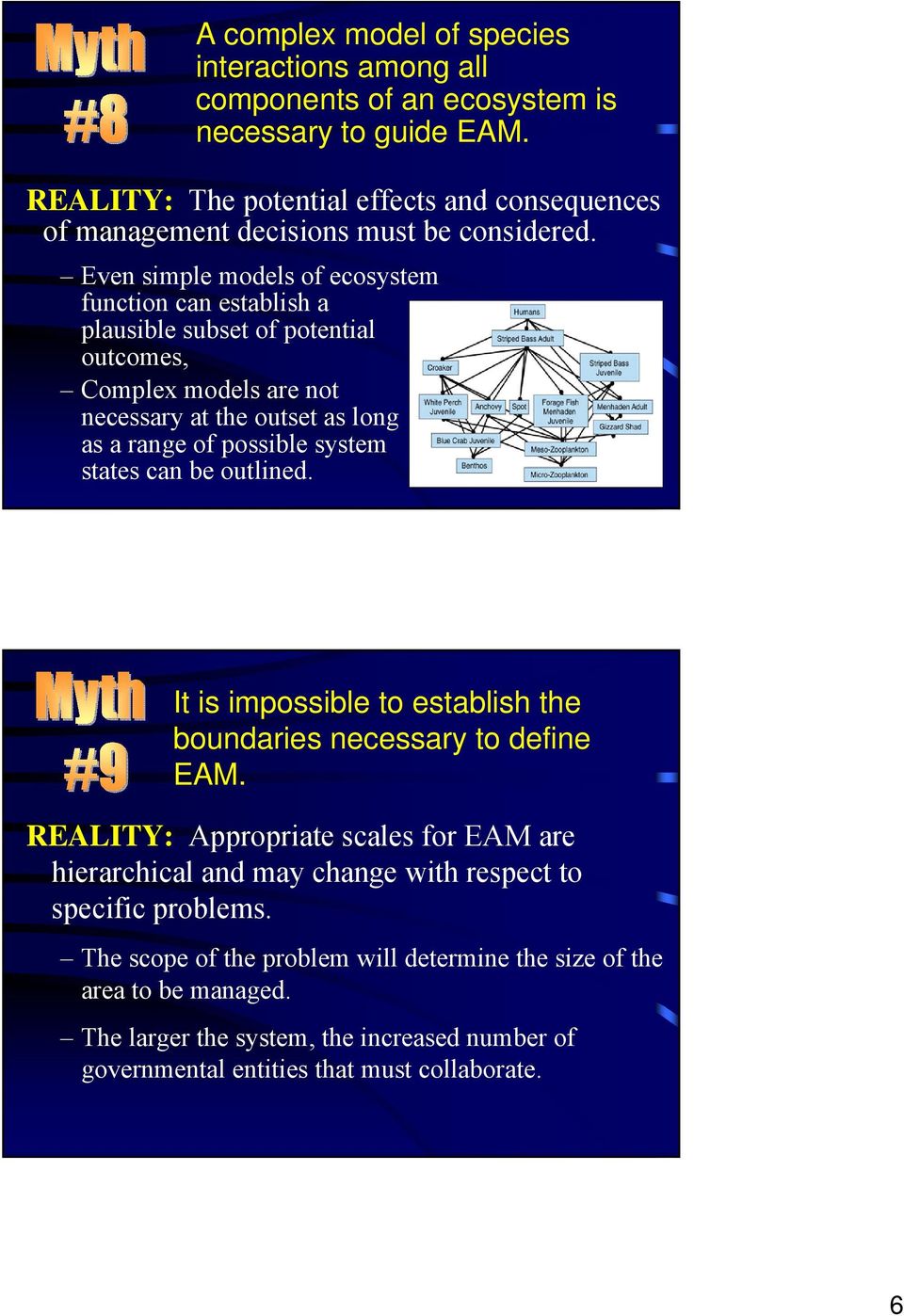
6 A complex model of species interactions among all components of an ecosystem is necessary to guide EAM. REALITY: The potential effects and consequences of management decisions must be considered. Even simple models of ecosystem function can establish a plausible subset of potential outcomes, Complex models are not necessary at the outset as long as a range of possible system states can be outlined. It is impossible to establish the boundaries necessary to define EAM. REALITY: Appropriate scales for EAM are hierarchical and may change with respect to specific problems. The scope of the problem will determine the size of the area to be managed. The larger the system, the increased number of governmental entities that must collaborate. 6
7 REALITY: Marine Protected Areas (MPAs) are an essential component of EAM. EAM MPA MPAs are just one of several ecosystem and fishery management tools, Other tools include harvesting restrictions, extraction quotas, activity prohibition areas, gear prohibitions, etc. 7
A Functional Classification System for Marine Protected Areas in the United States
 A Functional Classification System for Marine Protected Areas in the United States The U.S. Classification System: An Objective Approach for Understanding the Purpose and Effects of MPAs as an Ecosystem
Marine Protected Areas POLICY
 Marine Protected Areas POLICY Canada March 1999 Published by: Canada Marine Ecosystems Conservation Branch Oceans Directorate Ottawa, ON K1A 0E6 DFO / 5870 Minister of Public Works and Government Service
Ecosystem-Based Management: Making it Work in the EU Dr. Ronán Long
 Ecosystem-Based Management: Making it Work in the EU www.marinelaw.ie Overview 1. Context 2. Definitions 3. Legal Basis: International & Regional Law EU Law 4. Conclusions The Context Commission Report
The Marine Protected Area Inventory
 The Marine Protected Area Inventory New pictures Jordan Gass, Hugo Selbie and Charlie Wahle ESRI Ocean Forum November 6, 2013 Outline What is the MPA Inventory? Purpose Data How it s used Future directions
Views from Living Marine Resources Management and the Coral Triangle Project
 Views from Living Marine Resources Management and the Coral Triangle Project Annadel Salvio Cabanban Ecosystem Approach to Fisheries Management Specialist, Coral Triangle Initiative Southeast Asia Project:
Appendix A. The Marine Life Protection Act (MLPA)
 Appendix A. The Marine Life Protection Act (MLPA) THE PEOPLE OF THE STATE OF CALIFORNIA DO ENACT AS FOLLOWS: SECTION 1. Chapter 10.5 (commencing with Section 2850) is added to Division 3 of the Fish and
Environmental Compliance Questionnaire for National Oceanic and Atmospheric Administration Federal Financial Assistance Applicants
 OMB Approval No.: 0648-0538 Environmental Compliance Questionnaire for National Oceanic and Atmospheric Administration Federal Financial Assistance Applicants Instructions The National Environmental Policy
Ecosystem perspective on ORs & OCTs
 Workshop on the Application of an Ecosystem Approach for development of Sustainable Aquaculture in Europe s Outermost Regions and Overseas Countries and Territories Session 3: Stakeholders presentations
Progress Towards the Development of the Six Country Coral Triangle Marine Protected Area System (CTMPAS)
 Progress Towards the Development of the Six Country Coral Triangle Marine Protected Area System (CTMPAS) Alan White Senior Scientist, The Nature Conservancy and Lynette Laroya MPA Technical Working Group,
Marine Fisheries Stock Assessment Improvement Plan
 Marine Fisheries Stock Assessment Improvement Plan Report of the National Marine Fisheries Service National Task Force for Improving Fish Stock Assessments Pamela M. Mace (Chair), Norman W. Bartoo, Anne
Marine Protected Areas: An Overview Kate Smukler New England Regional Coordinator
 Marine Protected Areas: An Overview Kate Smukler New England Regional Coordinator www.mpa.gov MPAs: Many types, many purposes Conservation and sustainable use Important natural and cultural resources
Approaches to biogeographic classification of the world s oceans. Marjo Vierros United Nations University Institute of Advanced Studies
 Approaches to biogeographic classification of the world s oceans Marjo Vierros United Nations University Institute of Advanced Studies This presentation will cover International policy developments of
INTERNATIONAL OBLIGATIONS AND AGREEMENTS
 INTERNATIONAL OBLIGATIONS AND AGREEMENTS TITLE DESCRIPTION Ratification Focal Point CONVENTIONS The United Nations Convention on the Law of the Sea (UNCLOS) also called the Law of the Sea Convention or
Maria Espinosa Romero John Driscoll
 Maria Espinosa Romero John Driscoll Fisheries management in Canada a. Traditionally done on a stock-by-stock basis; b. Canada s commitments to ecosystem approach will change this; c. Two interrelated pathways
California Marine Life Protection Act Initiative California Natural Resources Agency 1416 Ninth Street, Suite 1311 Sacramento, CA 95814 916.654.
 California Marine Life Protection Act Initiative California Natural Resources Agency 1416 Ninth Street, Suite 1311 Sacramento, CA 95814 916.654.1885 To: MLPA Blue Ribbon Task Force From: MLPA I-Team Subject:
5 Year Strategic Plan
 Mid Atlantic Fishery Management Council 5 Year Strategic Plan 2014 2018 DRAFT 5/31/2013 Table of Contents Table of Contents... 1 Introduction... 2 The Mid Atlantic Fishery Management Council... 2 Rationale
SUBSIDIARY LEGISLATION WILDLIFE & PROTECTED AREAS. Marine Protected Areas Order 2012. S. R. & O. No: 1 of 2012
 SUBSIDIARY LEGISLATION WILDLIFE & PROTECTED AREAS Marine Protected Areas Order 2012 S. R. & O. No: 1 of 2012 Made: 23 February 2012 Published: 29 February 2012 Coming into force: on publication IN EXERCISE
Japan s Arctic Policies with regards to Maritime Law and Jurisdictional Issues
 1 Japan s Arctic Policies with regards to Maritime Law and Jurisdictional Issues Prof T Ikeshima LLB, LLM, DES, PhD Waseda University 2 Outline Introduction: geographical background Japan s interests and
Establishing large-scale trans-boundaries MPA networks: the OSPAR example in North-East Atlantic
 Establishing large-scale trans-boundaries MPA networks: the OSPAR example in North-East Atlantic Introduction A pledge to establish a representative network of marine and coastal protected areas by 2012
Transforming wasted resources. for a sustainable future. The sustainable management of bycatch in Latin America and Caribbean trawl fisheries
 Transforming wasted resources for a sustainable future The sustainable management of bycatch in Latin America and Caribbean trawl fisheries REBYC-II LAC Shrimp trawling and other types of bottom trawling
Different Types of Marine Protected Area
 A protected area is defined by the IUCN as a clearly defined geographical space, recognised, dedicated and managed, through legal or other effective means, to achieve the long-term conservation of nature
INTERIM MEASURES ADOPTED BY PARTICIPANTS IN NEGOTIATIONS TO ESTABLISH SOUTH PACIFIC REGIONAL FISHERIES MANAGEMENT ORGANISATION
 INTERIM MEASURES ADOPTED BY PARTICIPANTS IN NEGOTIATIONS TO ESTABLISH SOUTH PACIFIC REGIONAL FISHERIES MANAGEMENT ORGANISATION Participants in the negotiations to establish a South Pacific Regional Fisheries
SERVICES NATIONAL MARINE FISHERIES SERVICE FISHERIES MARKET NEWS HOME PAGES
 HOME PAGES The National Marine Fisheries Service provides information on programs and data available to the public and fishing industry via home page. Please use the following address for NMFS home page
NOAA NATIONAL SEA GRANT COLLEGE PROGRAM 2014 2017 STRATEGIC PLAN
 NOAA NATIONAL SEA GRANT COLLEGE PROGRAM 2014 2017 STRATEGIC PLAN Sustaining our nation s ocean, coastal and Great Lakes resources through university based research, communications, education, extension
An Effective Marine Protected Area. Pacific Island Marine Protected Area Community (PIMPAC)
 An Effective Marine Protected Area Pacific Island Marine Protected Area Community (PIMPAC) Background: The PIMPAC initiative is designed to enhance Marine Protected Area (MPA) management effectiveness
Publication supported in part by an Institutional Grant (NA10OAR4170099) to the Texas Sea Grant College Program from the National Sea Grant Office,
 Publication supported in part by an Institutional Grant (NA10OAR4170099) to the Texas Sea Grant College Program from the National Sea Grant Office, National Oceanic and Atmospheric Administration, U.S.
CHALLENGES AND OPPORTUNITIES FOR THE MAKAH TRIBE AND OLYMPIC COAST NATIONAL MARINE SANCTUARY
 CHALLENGES AND OPPORTUNITIES FOR THE MAKAH TRIBE AND OLYMPIC COAST NATIONAL MARINE SANCTUARY Vincent Cooke, Makah Tribe George Galasso, Olympic National Marine Sanctuary The Makah Tribe is a self-governing
The current institutional and legal context for biodiversity conservation and management is characterised by the following features:
 National BiodiversityStrategyandActionPlan (NBSAP),St. Lucia page 8 Resource tenure and access Most agricultural lands, and a majority of forest lands, are privately owned. Two significant trends can be
PROGNOSES OF SEA-FISH SPECIES CATCHES IN GREECE AT BIOLOGICAL AND BIODIVERSITY RISK
 Journal of Environmental Protection and Ecology 16, No 1, 92 97 (2015) Risk management PROGNOSES OF SEA-FISH SPECIES CATCHES IN GREECE AT BIOLOGICAL AND BIODIVERSITY RISK G. TEGOS a *, K. ONKOV b a Applied
Introduction to protection goals, ecosystem services and roles of risk management and risk assessment. Lorraine Maltby
 Introduction to protection goals, ecosystem services and roles of risk management and risk assessment. Lorraine Maltby Problem formulation Risk assessment Risk management Robust and efficient environmental
Federal Register / Vol. 73, No. 33 / Tuesday, February 19, 2008 / Rules and Regulations
 Federal Register / Vol. 73, No. 33 / Tuesday, February 19, 2008 / Rules and Regulations 9035 553(d)(3). This finding is based upon the reasons provided above for waiver of prior notice and opportunity
Alan White The Nature Conservancy
 The Coral Triangle Region, The Coral Triangle Initiative, and the Development of the Six Country Marine Protected Area System Alan White The Nature Conservancy The Coral Triangle Initiative Coral Triangle
DIFFERENCES AMONG the B.S. IN FISHERIES AND WILDLIFE SCIENCE (FW), ENVIRONMENTAL SCIENCES (ES) and NATURAL RESOURCES (NR)
 DIFFERENCES AMONG the B.S. IN FISHERIES AND WILDLIFE SCIENCE (FW), ENVIRONMENTAL SCIENCES (ES) and NATURAL RESOURCES (NR) This document was designed to help you understand the differences among the FW,
Marine biological diversity beyond areas of national jurisdiction. Legal and policy framework
 Marine biological diversity beyond areas of national jurisdiction Legal and policy framework 1. The United Nations Convention on the Law of the Sea (UNCLOS) provides the legal framework within which all
FRAMEWORK FOR THE NATIONAL SYSTEM OF MARINE PROTECTED AREAS OF THE UNITED STATES OF AMERICA
 ii FRAMEWORK FOR THE NATIONAL SYSTEM OF MARINE PROTECTED AREAS OF THE UNITED STATES OF AMERICA U.S. United States of America USOAP U.S. Ocean Action Plan (USOAP) USGS US Geological Survey WCPA/IUCN World
SOUTH GEORGIA AND SOUTH SANDWICH ISLANDS MARINE PROTECTED AREAS: EXISTING PROTECTION AND PROPOSALS FOR FURTHER PROTECTION
 SOUTH GEORGIA AND SOUTH SANDWICH ISLANDS MARINE PROTECTED AREAS: EXISTING PROTECTION AND PROPOSALS FOR FURTHER PROTECTION CONSULTATION DOCUMENT OCTOBER 2012 1 1. Background 1.1 What is a marine protected
Coral Triangle Initiative (CTI) on Coral Reefs, Fisheries and Food Securities
 2008/MRCWG/022 Agenda Item: 10 Coral Triangle Initiative (CTI) on Coral Reefs, Fisheries and Food Securities Purpose: Information Submitted by: Indonesia 21 st Marine Resource Conservation Working Group
Integrated Ocean Management Plan for the Beaufort Sea: 2009 and beyond
 Integrated Ocean Management Plan for the Beaufort Sea: 2009 and beyond Beaufort Sea Partnership Integrated Ocean Management Plan (IOMP) for the Beaufort Sea: 2009 and Beyond 2009 Beaufort Sea Planning
ASHLEY MURPHY JOHNSON. 6351 Christopher Creek Road West, Jacksonville, Fl 32217 (904) 514-2583 [email protected]
 ASHLEY MURPHY JOHNSON 6351 Christopher Creek Road West, Jacksonville, Fl 32217 (904) 514-2583 [email protected] EDUCATION Ph.D. in Interdisciplinary Ecology August 2004 Dissertation: Estuary Use Planning
Importance of Coral Triangle to Food Security and Livelihoods
 U.S. Support, Challenges and Opportunities Most Diverse Ecological Complexes on Earth Cooperation the Key: Regional Conservation s Amazon Congo Basin Importance of Food Security and Livelihoods 363 million
Commercial Electronic Logbook Pilot Project
 Commercial Electronic Logbook Pilot Project SEFSC Brett Pierce and Dave Gloeckner Fishery Monitoring Branch Southeast Fisheries Science Center September 16, 2014 Goals and Objectives Goal: Create on-board
ECOSYSTEM-BASED F I S H E R Y MANAGEMENT
 ECOSYSTEM-BASED F I S H E R Y MANAGEMENT A Report to Congress by the Ecosystem Principles Advisory Panel As mandated by the Sustainable Fisheries Act amendments to the Magnuson-Stevens Fishery Conservation
One Major Six Concentrations. Department of Environmental Conservation University of Massachusetts Amherst
 One Major Six Concentrations Natural Resources Conservation Undergraduate Major Department of Environmental Conservation University of Massachusetts Amherst Conserving Earth s biological diversity and
How To Manage Protected Areas
 ECHOES FROM BARILOCHE: Conclusions, Recommendations and Action Guidelines The Second Latin American Congress on National Parks and other Protected Areas aimed to asses, value and project the contribution
Gulf Coast Ecosystem Restoration Council
 Gulf Coast Ecosystem Restoration Council Progress Report August 2013-August 2014 Background In July 2012, The Resources and Ecosystems Sustainability, Tourist Opportunities, and Revived Economies of the
SUMMARY MISSION STATEMENT
 MISSION STATEMENT University of Maryland Center for Environmental Science SUMMARY MISSION STATEMENT Through its four laboratories across Maryland, the University of Maryland Center for Environmental Science
Mediterranean-Mare Nostrum Nature and Culture Common Destiny
 Mediterranean-Mare Nostrum Nature and Culture Common Destiny Marine conservation Protection and Management Alain Jeudy de Grissac Marine Conservation Programme Manager June 2010 Toulon La Garde France
Nouméa Communiqué 2nd Oceania 21 Conference Nouméa, 2 July 2014
 Nouméa Communiqué 2 nd Oceania 21 Conference Nouméa, 2 July 2014 1. The 2 nd Oceania 21 Conference ( Oceania 21 ), organised by the New Caledonian Government, with the support of France, and was chaired
How To Write A Listing Policy For A Species At Risk Act
 Fisheries and Oceans Canada Species at Risk Act Listing Policy and Directive for Do Not List Advice DFO SARA Listing Policy Preamble The Fisheries and Oceans Canada (DFO) Species at Risk Act (SARA) Listing
Northern Territory Fisheries Resource Sharing Framework
 Northern Territory Fisheries Resource Sharing Framework Page 1 of 11 Introduction Fishing is important in the Northern Territory (Territory). Coastal Aboriginal people recognise sea country out to the
National Marine Sanctuaries Act
 Please note: This text is from the fourth edition of Federal Historic Preservation Laws, published in 2006 by the National Center for Cultural Resources, National Park Service, Department of the Interior.
Okaloosa RESTORE Advisory Committee
 Data Collection Form Part A: Project Information (To be completed by all Proposers) Okaloosa RESTORE Advisory Committee Approved by the Okaloosa RESTORE Advisory Committee: December 4, 2014 Okaloosa County,
Broken Arrow Public Schools AP Environmental Science Objectives Revised 11-19-08
 1 st six weeks 1 Identify questions and problems that can be answered through scientific investigation. 2 Design and conduct scientific investigations to answer questions about the world by creating hypotheses;
NOAA COASTAL SERVICES CENTER Strategic Plan: 2010 to 2015
 NOAA COASTAL SERVICES CENTER Strategic Plan: 2010 to 2015 N a t i o n a l O c e a n i c a n d A t m o s p h e r i c A d m i n i s t r a t i o n ( N O A A ) C o a s t a l S e r v i c e s C e n t e r March
How To Be Sustainable With Tourism
 QUÉBEC DECLARATION ON ECOTOURISM In the framework of the UN International Year of Ecotourism, 2002, under the aegis of the United Nations Environment Programme (UNEP) and the World Tourism Organization
Applying Knowledge Management to Scale up Partnership Investments
 Applying Knowledge Management to Scale up Partnership Investments for Sustainable Development of Large Marine Ecosystems of East Asia and Their Coasts Project Title Applying Knowledge Management to Scale
Scientific & information management considerations (Best Practice #4 and 12# and Broader consideration #3)
 Public education, communication & awareness (Broader consideration #6) Best Practice examples Virtually the entire community (including the local communities and the wider public) are very familiar with
REGIONAL ELECTRONIC TECHNOLOGIES IMPLEMENTATION PLAN FOR WEST COAST MARINE FISHERIES DRAFT JANUARY 27, 2015
 REGIONAL ELECTRONIC TECHNOLOGIES IMPLEMENTATION PLAN FOR WEST COAST MARINE FISHERIES DRAFT JANUARY 27, 2015 Introduction In recent years, the National Marine Fisheries Service (NMFS) and the Pacific Fishery
Getting Involved: Cooperative Program and Grant Opportunities for Fishermen in the South Atlantic Region An Overview
 Getting Involved: Cooperative Program and Grant Opportunities for Fishermen in the South Atlantic Region An Overview Fisheries managers often receive questions from fishermen regarding opportunities to
A Policy Respecting the Prohibition of Bulk Water Removal from Major River Basins in Nunavut
 Indian and Northern Affairs Canada Affaires indiennes et du Nord Canada A Policy Respecting the Prohibition of Bulk Water Removal from Major River Basins in Nunavut Published under the authority of the
Oregon. Climate Change Adaptation Framework
 Oregon Climate Change Adaptation Framework Oregon Environmental Quality Commission Climate Change Adaptation Framework Presentation at a glance: Purposes of the framework Participating agencies Climate
Shark, Skate and Ray Conservation Plan
 Shark, Skate and Ray Conservation Plan Introduction Sharks, skates and rays, collectively known as elasmobranchs are caught in fisheries worldwide, including in EU and UK waters. Many have been depleted
MPA NETWORKS MODULE 2 2.1 INTRODUCTION TO MPA NETWORKS. Advantages of Networks 2.2 TYPES OF MPA NETWORKS. Social Networks. Ecological Networks
 2.1 INTRODUCTION TO MPA NETWORKS Advantages of Networks 2.2 TYPES OF MPA NETWORKS Social Networks Ecological Networks Management-based Networks Case Study: A Regional Approach to MPA Development in West
UMCES Draft Mission Statement, March 31, 2014
 MISSION STATEMENT University of Maryland Center for Environmental Science SUMMARY MISSION STATEMENT Through its four laboratories distributed across Maryland, the University of Maryland Center for Environmental
7th Framework Programme Theme 6 Environment (including climate change)
 7th Framework Programme Theme 6 Environment (including climate change) «Environnement» et «Énergie» Programme D. Deybe DG RTD Environment Directorate 1 Cooperation Collaborative Research Ten themes 1.
CONSERVATION AREAS ACT
 CONSERVATION AREAS ACT CAP. 30.15 Conservation Areas Act CAP. 30.15 Arrangement of Sections CONSERVATION AREAS ACT Arrangement of Sections Section 1 Short title... 5 2 Interpretation... 5 3 Declaration
Policy & Management Applications of Blue Carbon. fact SHEET
 Policy & Management Applications of Blue Carbon fact SHEET Policy & Management Applications of Blue Carbon Coastal Blue Carbon - An Important Wetland Ecosystem Service Coastal Blue Carbon refers to the
Coastal Resilience through Integrated Coastal Management. Alan T. White Indian Ocean Tsunami Warning System Program
 Coastal Resilience through Integrated Coastal Management Alan T. White Indian Ocean Tsunami Warning System Program The coastal zone:an endangered environment Overexploitation and destruction Unplanned
NOAA s Role in the Licensing of Offshore LNG Terminals
 NOAA s Role in the Licensing of Offshore LNG Terminals Emily Lindow, National Oceanic and Atmospheric Administration Senior Advisor to the Under Secretary of Commerce for Oceans and Atmosphere NOAA and
An International Instrument on Conservation and Sustainable Use of Biodiversity in Marine Areas beyond National Jurisdiction
 An International Instrument on Conservation and Sustainable Use of Biodiversity in Marine Areas beyond National Jurisdiction Exploring Different Elements to Consider Series of Policy Briefs on Scope, Parameters
Framework for the National System of Marine Protected Areas of the United States of America
 National Marine Protected Areas Center A collaboration between National Oceanic and Atmospheric Administration and Department of the Interior Framework for the National System of Marine Protected Areas
IMO ANY OTHER BUSINESS. Shipping noise and marine mammals. Submitted by the United States
 INTERNATIONAL MARITIME ORGANIZATION E IMO MARINE ENVIRONMENT PROTECTION COMMITTEE 57th session Agenda item 20 MEPC 57/INF.4 17 December 2007 ENGLISH ONLY ANY OTHER BUSINESS Shipping noise and marine mammals
Using LCA models to inform about industry-led efforts to reduce the ecological footprint of farmed salmon from feed and other inputs "
 Using LCA models to inform about industry-led efforts to reduce the ecological footprint of farmed salmon from feed and other inputs " Authors Jason Mann (EWOS Canada, presentation) Louise Buttle (EWOS
no-entry only research and monitoring activities no-take zones incorporates other non-extractive uses
 Seaflower Biosphere Reserve Country: COLUMBIA Project Overview Columbia declared the archipelago of San Andres, Old Providence, and Santa Catalina a biosphere reserve called the Seaflower Biosphere Reserve.
AP ENVIRONMENTAL SCIENCE 2006 SCORING GUIDELINES. Question 4
 AP ENVIRONMENTAL SCIENCE 2006 SCORING GUIDELINES Question 4 (a) Identify the five-year period during which the greatest rate of decline in the fish harvest took place. For that five-year period, calculate
How do abiotic factors and physical processes impact life in the ocean?
 This website would like to remind you: Your browser (Apple Safari 7) is out of date. Update your browser for more security, comfort and the best experience on this site. Activitydevelop Ocean Abiotic Factors
The CLME Project: Governance for Caribbean Living Marine Resources
 The CLME Project: Governance for Caribbean Living Marine Resources Lucia Fanning, Robin Mahon, Patrick McConney, Bertha Simmons Centre for Resource Management and Environmental Studies UWI, Cave Hill Campus,
U.S. Army Corps. of Engineers. A Learning Organization
 U.S. Army Corps A Learning Organization The Corps is committed to the protection of coral reefs and the effective mitigation of any impacts. The Corps believes that there is a need to improve the understanding