
Illinois Criteria for Meeting the NCLB Requirements for Highly Qualified Teachers
|
|
|
- Clemence Young
- 10 years ago
- Views:
Transcription
1 Illinois Criteria for Meeting the NCLB Requirements for Highly Qualified Teachers Illinois State Board of Education ADOPTED June 17,

2 Illinois Criteria for Meeting the NCLB Requirements for Highly Qualified Teachers The No Child Left Behind Act of 2001 (NCLB) requires that, by the end of the school year, all teachers in core academic subjects must be highly qualified in the areas of teaching assignment. All teachers in programs supported with Title I funds who were or are newly hired after the first day of the school year are required to be highly qualified at the time of employment. According to the definition set forth in NCLB, teachers are considered to be highly qualified if they (1) have a bachelor s degree; (2) have full State certification; and (3) have demonstrated subject-matter competence in the area(s) taught. The following criteria define the specific requirements that Illinois teachers must meet to be considered highly qualified for NCLB purposes. The criteria define full certification and the options available for demonstrating subject matter competence for two groups: current teachers and teachers who are new to the profession. This document is designed to serve as a resource that can be used by teachers, administrators, and others to identify the options for being considered highly qualified at a given grade level, for a specific student population, and for special circumstances. These criteria do not replace state requirements for teaching assignments; all such rules remain in place and must be observed by local districts in placing teachers into the classroom. The criteria for being considered highly qualified represent baseline qualifications necessary to meet the NCLB requirements. Terms used in these criteria are defined as follows: Academic Major Federal requirements allow states to define an academic major for use in determining whether a teacher can be considered highly qualified. Illinois defines an academic major as 32 semester hours or as otherwise indicated by the institution on the individual s official transcript. Arts NCLB allows states to define the core academic area of the Arts. The Illinois criteria for highly qualified teachers are based on a definition of the Arts as music and art. Content Area Test A test that assesses subject-matter knowledge specific to each certificate or endorsement; this excludes the Test of Basic Skills and the Assessment of Professional Teaching (APT). The Elementary/Middle Grades Test, the Mathematics Test, the French Test and the LBS I Test are examples of Content Area Tests. ADOPTED June 17,
3 Core Academic Subjects NCLB defines core academic subjects as including English, reading or language arts, mathematics, science, foreign languages, civics and government, economics, arts, history and geography. Note: NCLB has identified several specific subject areas under the general areas of the sciences and social sciences. The Illinois criteria treat these subject areas consistent with the new state certification structure and the standards for these academic areas. This includes an expectation for core competencies and specific designations related to subject areas. Current Teachers Teachers who received their first certificate in Illinois on or before June 30, 2002 are considered current teachers for NCLB purposes. Elementary/Middle Grades Test This is a new name for the Illinois Certification System Elementary Test. The name change is designed to more accurately reflect the content of the test and the range of grades covered; there has been no change in the content of the test. Full Certification Certificates, including alternative certificates, issued by the State of Illinois consistent with the law are considered full certificates. This excludes certificates issued to individuals when certification or licensure requirements have been waived, such as provisional vocational certificates and full-time substitute certificates. It includes provisional certificates issued to teachers coming into Illinois from another state and the Short-Term Emergency Certificate in Special Education. New Teachers Teachers who received their first certificate in Illinois on or after July 1, 2002 are considered new teachers for NCLB purposes. Primary Responsibility The requirements for consideration as highly qualified are linked to the teacher s assignment and whether he or she has primary responsibility for providing content instruction. For the purposes of determining highly qualified status, primary responsibility is defined as being the sole teacher or the instructor of record. In team teaching situations, the district will identify the teacher or teachers with primary responsibility, except that teachers must be highly qualified for the subjects for which they have full teaching responsibility. The term highly qualified indicates that a teacher has the certification and subject matter competence required to teach a particular subject area, grade level and/or group of students. It is linked directly to the teacher s specific teaching assignment, so a teacher may be highly qualified for one assignment and not for another. Use of the term highly qualified should not be construed as an evaluation of the professional teaching abilities of the teacher. Additional information about Illinois certification requirements and the No Child Left Behind Act can be accessed at and ADOPTED June 17,
4 Illinois Criteria for Meeting the NCLB Requirements for Highly Qualified Teachers Part I Criteria for Current Teachers to Be Considered Highly Qualified All Illinois teachers must meet requirements of the Illinois Administrative Code for their specific teaching assignment. To meet NCLB requirements, teachers who were first certified to teach in Illinois on or before June 30, 2002, and who retain a valid certificate are considered highly qualified in the area of teaching responsibility if they meet the following requirements. These requirements represent the Illinois High Objective Uniform State Standard of Evaluation or HOUSSE as authorized by NCLB. Current teachers must hold a valid Illinois teaching certificate that is appropriate to the grade level and meet one of the following options. 1. Pass the Elementary/Middle Grades Test or the Content-Area Test for the area of teaching responsibility. 2. Have a major or coursework equivalent to a major in the area of teaching responsibility. 3. Have a master s degree or other advanced degree/credential in the area of teaching responsibility. 4. Be certified by the National Board for Professional Teaching Standards in the area of teaching responsibility. 5. Have an endorsement or its coursework equivalent that is sufficient to meet the Illinois minimum requirements for the area of teaching responsibility, have teaching experience in the area of teaching responsibility, and have engaged in continuing professional development in the area of teaching responsibility. ADOPTED June 17,
5 Part II Criteria for New Teachers to be Considered highly qualified All Illinois teachers must meet requirements of the Illinois Administrative Code for their specific teaching assignment. To meet NCLB requirements, teachers who were certified in Illinois on or after July 1, 2002 are considered highly qualified in the area of teaching responsibility if they meet the following requirements. Elementary Grades (K 4) Teaching assignment: Primary responsibility for teaching content in the core academic subjects in a self-contained classroom. Options to be considered highly qualified 1. Hold Elementary Certificate (Type 03) that is endorsed for self-contained general education and pass the Elementary/Middle Grades Test 2. Hold Elementary Certificate (Type 03) that is endorsed for self-contained general education and hold a National Board Certificate as a Middle Childhood Generalist (ages 7 12) (applicable only through grade 6) 3. Hold Early Childhood Certificate (Type 04) and pass the Early Childhood Test (option is applicable only through grade 3) 4. Hold Early Childhood Certificate (Type 04) and hold a National Board Certificate as an Early Childhood Generalist (ages 3 8) (option applicable only through grade 3) 5. Hold a Provisional Early Childhood or Elementary Certificate that is based on certification in another state or nation and pass the Early Childhood Test or the Elementary/Middle Grades Test within 9 months of certification 6. Hold a Special K 12 Certificate (Type 10) and pass the Content-Area Test (option applicable only for the subject for which the certificate is endorsed e.g., art or music) ADOPTED June 17,
6 Middle Grades (5 8) Teaching assignment: Primary responsibility for teaching content in the core academic subjects in a middle grades setting, whether self-contained or departmentalized. Options to be considered highly qualified 1. Hold Elementary Certificate (Type 03) and pass the Elementary/Middle Grades Test 2. Hold Elementary Certificate (03) and a middle grades endorsement or the coursework equivalent, and pass the Elementary/Middle Grade test. 3. Hold a Secondary Certificate (Type 09) and meet one of the following options: o Pass the Content-Area Test for each area of teaching responsibility (applicable only for grades 6 8) o Have a major or coursework equivalent to a major o Have a graduate degree or advanced certification (e.g., NBPTS) in each area of teaching responsibility (applicable only for grades 6 8) o Pass the elementary/middle grade test. 4. Hold a Special K 12 Certificate (Type 10) endorsed in the area of teaching responsibility and pass the Content-Area Test 5. Hold a Provisional Elementary, Secondary or Special K 12 Certificate (as listed above) based on certification in another state or nation and pass the Elementary/Middle Grades Test or the Content-Area Test for each area of teaching responsibility within 9 months of certification. Secondary Grades (9 12) Teaching assignment: Primary responsibility for teaching content in the core academic subjects in a secondary setting. Options to be considered highly qualified 1. Hold a Secondary Certificate (Type 09) and meet one of the following options: o Pass the Content-Area Test for each area of teaching responsibility o Have a major or coursework equivalent to a major in each area of teaching responsibility o Have a graduate degree or advanced certification (e.g., NBPTS) in each area of teaching responsibility 2. Hold an Elementary Certificate (Type 03) and meet one of the following options: o Pass the Elementary/Middle Grades Test and the Content-Area Test in the area of teaching responsibility (applicable only for grade 9) o Pass the Elementary/Middle Grades Test and have a major or coursework equivalent to a major (applicable only for grade 9) o Have a graduate degree or advanced certification (e.g., NBPTS) in each area of teaching responsibility (applicable only to grade 9) ADOPTED June 17,
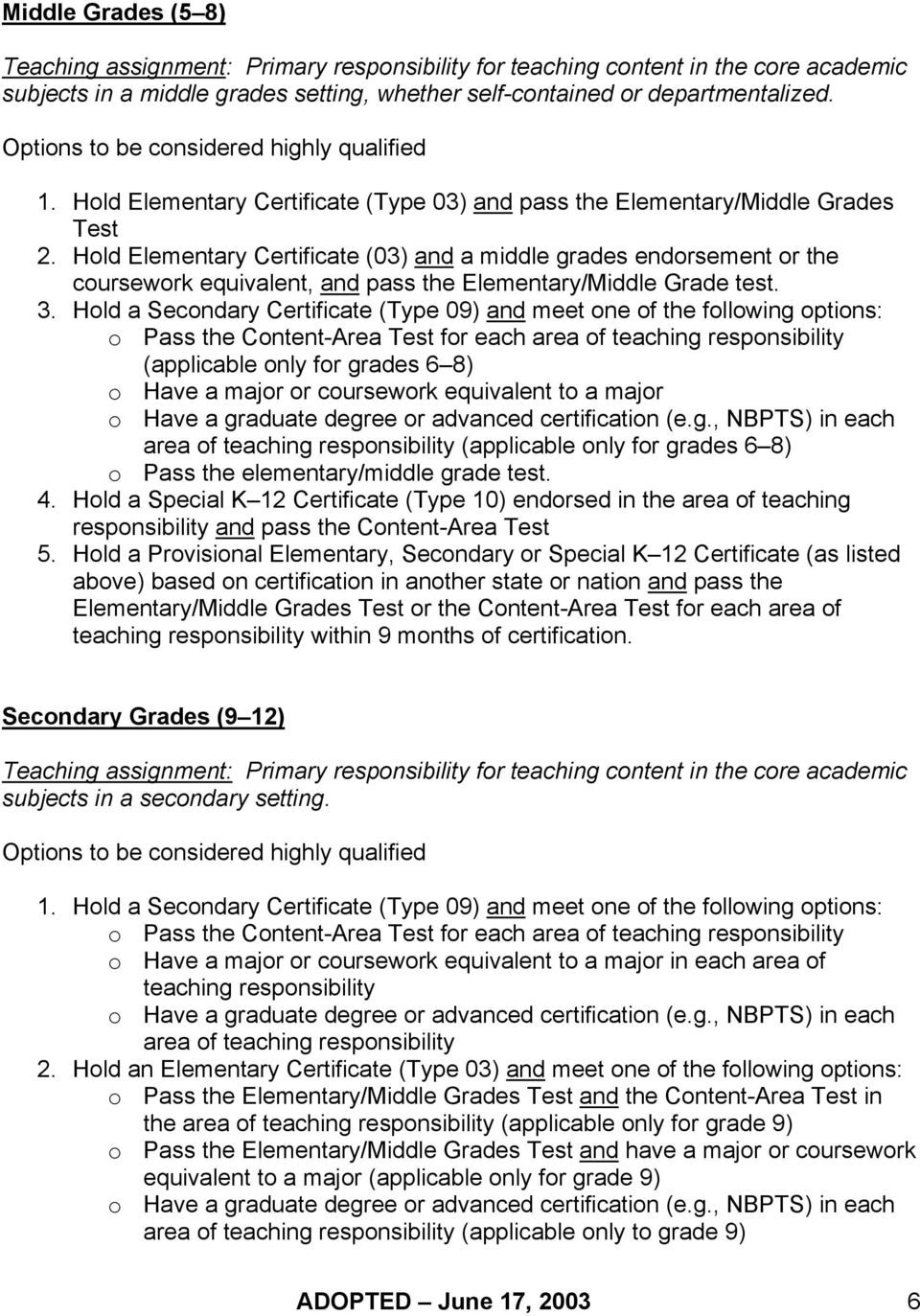
7 3. Hold a Provisional Elementary (applicable only to grade 9), Secondary or Special K 12 Certificate (as listed above) based on certification in another state or nation; and pass the required tests for each area of teaching responsibility (see above) within 9 months of certification Special Education The criteria for determining whether a special education teacher is highly qualified for his or her assignment will be defined when additional guidance is provided by the federal government (e.g., through the reauthorization of the Individuals with Disabilities Education Act (IDEA). Until that time, special education teachers will not be included in school, district or state data regarding highly qualified teachers. Bilingual Education and English-as-a-Second Language Education Teaching Assignment Primary responsibility for teaching content to students with Limited English Proficiency in a Bilingual or English-as-a-Second-Language (ESL) program. Options to be considered highly qualified Hold an Early Childhood, Elementary, Secondary, Special K 12 or Special Preschool Age 21 Certificate appropriate for the grade level of the teaching assignment and hold the Bilingual or ESL credential (Approval or Endorsement) appropriate to the certificate and meet one of the following options: o Pass the Content-Area Test for each area of teaching responsibility o Hold a major or coursework equivalent to a major in each area of teaching responsibility o Hold a graduate degree or advanced certification (e.g., NBPTS) in each area of teaching responsibility Special Circumstances Charter school teachers No certification is required but to be highly qualified, the teacher must hold a bachelor s degree and demonstrate competence in the area of teaching responsibility by passing the content test(s). Alternative Certificate Holders Hold an Illinois Alternative Certificate through an Illinois approved alternative program and demonstrate competence by passing the appropriate content test(s). ADOPTED June 17,
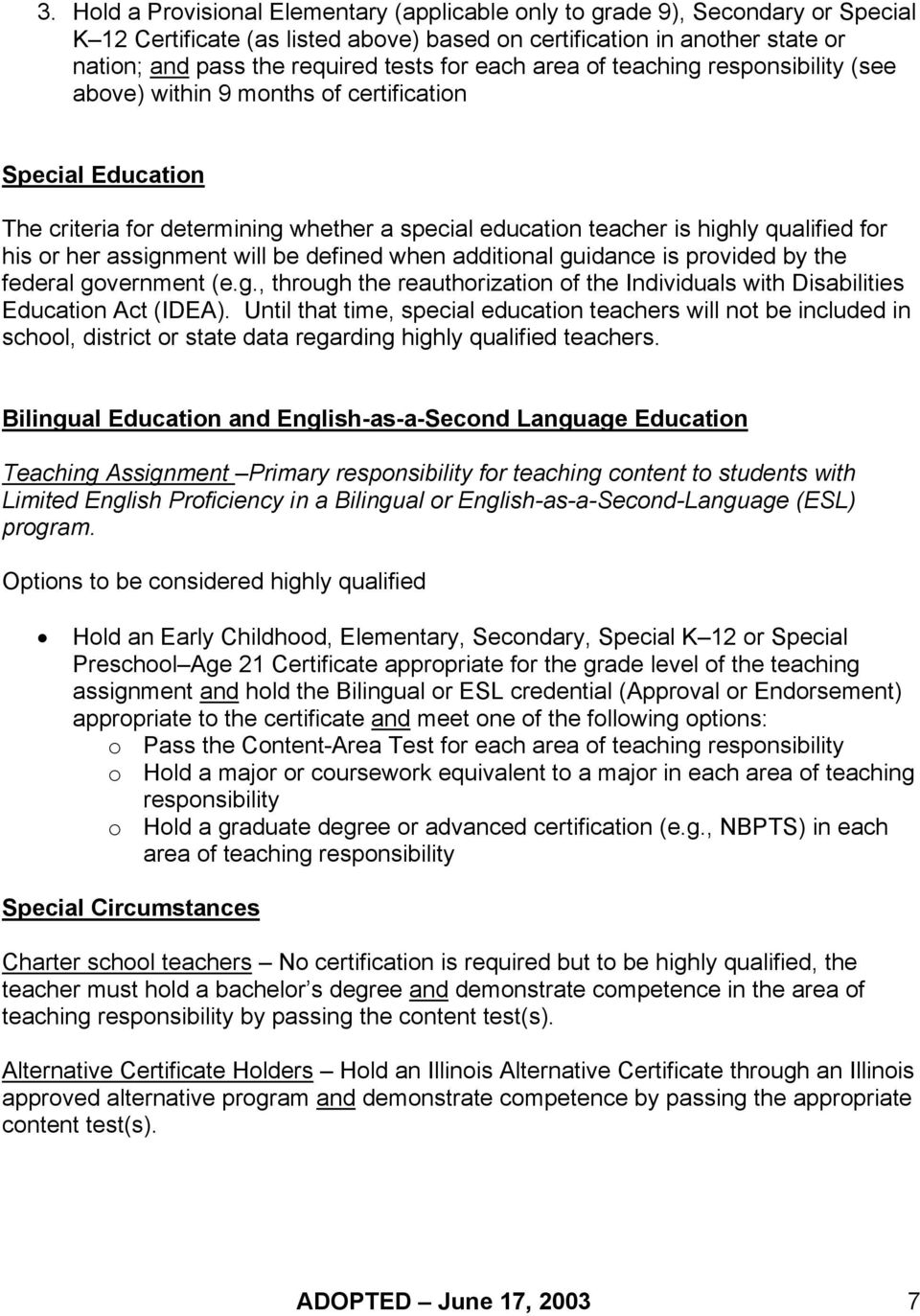
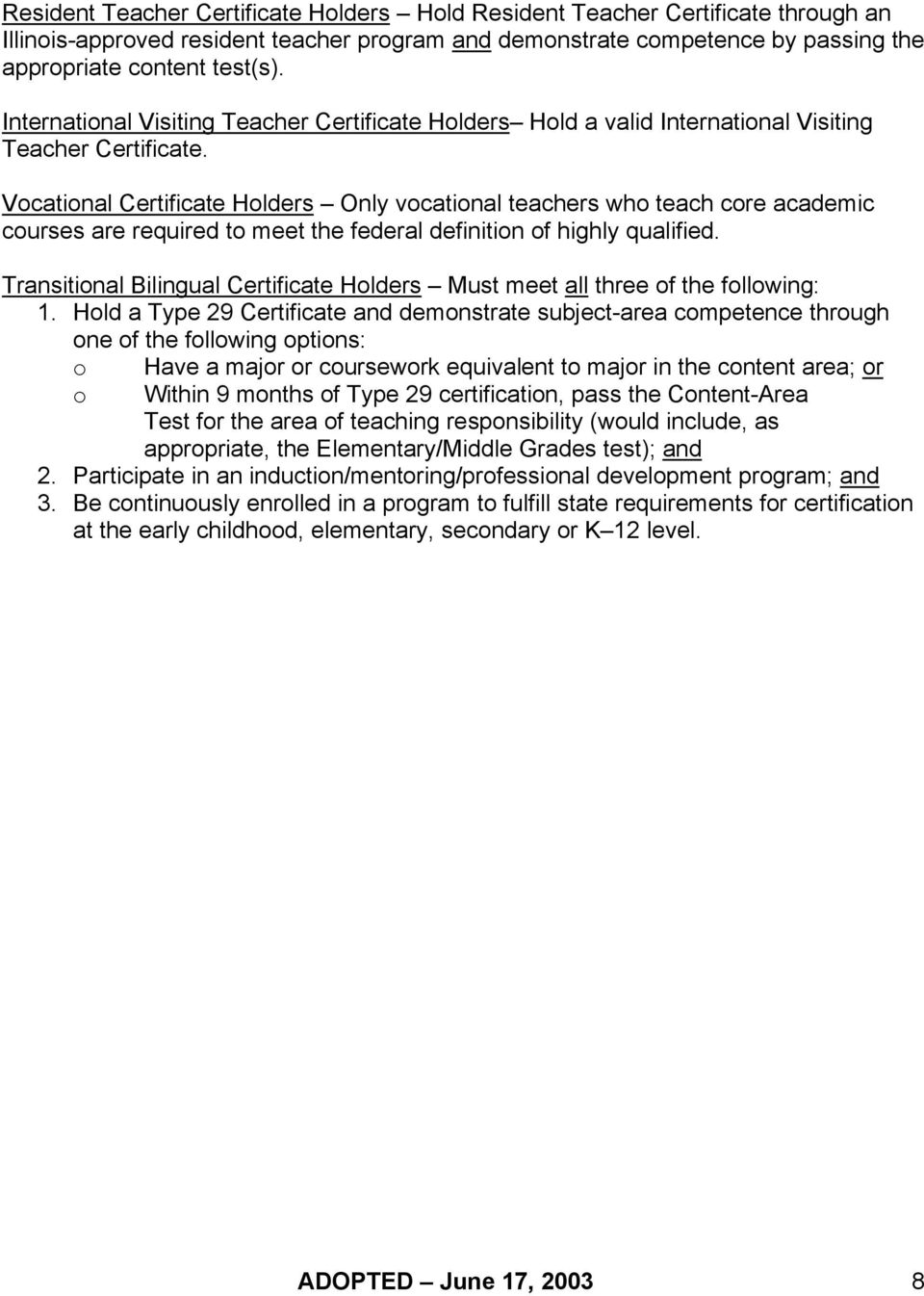
8 Resident Teacher Certificate Holders Hold Resident Teacher Certificate through an Illinois-approved resident teacher program and demonstrate competence by passing the appropriate content test(s). International Visiting Teacher Certificate Holders Hold a valid International Visiting Teacher Certificate. Vocational Certificate Holders Only vocational teachers who teach core academic courses are required to meet the federal definition of highly qualified. Transitional Bilingual Certificate Holders Must meet all three of the following: 1. Hold a Type 29 Certificate and demonstrate subject-area competence through one of the following options: o o Have a major or coursework equivalent to major in the content area; or Within 9 months of Type 29 certification, pass the Content-Area Test for the area of teaching responsibility (would include, as appropriate, the Elementary/Middle Grades test); and 2. Participate in an induction/mentoring/professional development program; and 3. Be continuously enrolled in a program to fulfill state requirements for certification at the early childhood, elementary, secondary or K 12 level. ADOPTED June 17,
Procedures and Guidelines New Hampshire s Highly Qualified Teacher Requirements No Child Left Behind Act (NCLB) 2001
 Procedures and Guidelines New Hampshire s Highly Qualified Teacher Requirements No Child Left Behind Act (NCLB) 2001 General Information about HQT According to the No Child Left Behind Act of 2001, all
http://www.ccusd.k12.ca.us/board_ed/policies/4000/4112-24ar.htm
 AR 4112.24 Teacher Qualifications Under The No Child Left Behind Act Definitions Core academic subjects include English, reading or language arts, mathematics, science, foreign languages, civics and government,
Understanding the Illinois NCLB Requirements
 Understanding the Illinois NCLB Requirements 1 Federal Requirements The federal NCLB (No Child Left Behind) Act took effect in FY03 NCLB law requires all teachers in Title I programs or receiving Title
2415.03 HIGHLY QUALIFIED TEACHERS (M)
 2415.03/Page 1 of 7 2415.03 M Introduction The No Child Left Behind Act (NCLB) of 2001 requires all teachers be or become highly qualified in the core academic content area(s) they teach. New, newly hired
NCLB and the Highly Qualified Teacher
 October 2008 NCLB the Highly Qualified Teacher GENERAL 1. Who must meet the highly qualified teacher requirements? All teachers who teach core academic subjects (provide direct instruction, i.e. are the
Mississippi Department of Education Highly Qualified Teacher Criteria The No Child Left Behind Act of 2001
 Mississippi Department of Education Highly Qualified Teacher Criteria The No Child Left Behind Act of 2001 General Information 1. Mississippi issues teacher licenses at four levels to persons who have
The New Jersey Highly Qualified Teacher Approved Forms
 The New Jersey Highly Qualified Teacher Approved Forms REVISED JULY 2008 Table of Contents The New Jersey Highly Qualified Teacher Approved Forms The New Jersey Highly Qualified Teacher Identification
Personnel TEACHER QUALIFICATIONS UNDER THE NO CHILD LEFT BEHIND ACT
 Administrative Regulation SANGER UNIFIED SCHOOL DISTRICT AR 4112.24 (a) Personnel TEACHER QUALIFICATIONS UNDER THE NO CHILD LEFT BEHIND ACT Definitions Core academic subjects include English, reading or
TENNESSEE PLAN FOR IMPLEMENTING THE TEACHER AND PARAPROFESSIONAL QUALITY PROVISIONS OF THE NO CHILD LEFT BEHIND ACT OF 2001
 TENNESSEE PLAN FOR IMPLEMENTING THE TEACHER AND PARAPROFESSIONAL QUALITY PROVISIONS OF THE NO CHILD LEFT BEHIND ACT OF 2001 TENNESSEE STATE DEPARTMENT OF EDUCATION LANA C. SEIVERS COMMISSIONER AUGUST 18,
The Alabama Model for Identifying Highly Qualified Teachers Revised 2006. REVISED 2010 for Teachers of Reading (Effective August 1, 2010)
 Revised The Alabama Model for Identifying Highly Qualified Teachers Revised 2006 REVISED 2010 for Teachers of Reading (Effective August 1, 2010) REVISED and Effective January 30, 2015 Teachers of Students
The New Jersey Model for Identifying Highly Qualified Teachers
 The New Jersey Model for Identifying Highly Qualified Teachers The New Jersey Model for Identifying Highly Qualified Teachers William L. Librera, Ed.D. Commissioner of Education Richard Ten Eyck Assistant
1. Who must complete the Highly Qualified Teacher Identification Form?
 General Form Instructions (A E) 1. Who must complete the Highly Qualified Teacher Identification Form? All active teachers working in elementary schools who teach core academic content areas. This includes
National Board for Professional Teaching Standards Certification Incentive Program
 Certificated Personnel BP 4112.2(a) CERTIFICATION The Superintendent or designee shall ensure that persons employed in positions requiring certification qualifications have the appropriate credential or
Handbook for Districts Highly Qualified Teachers in Colorado
 Handbook for Districts Highly Qualified Teachers in Colorado October 2012 http://www.cde.state.co.us/fedprograms/tii/a_hqt.asp Purpose This resource has been created to inform educators and other interested
TEACHER QUALIFICATIONS UNDER THE NO CHILD LEFT BEHIND ACT
 Certificated Personnel Administrative Regulation 4112.24(a) TEACHER QUALIFICATIONS UNDER THE NO CHILD LEFT BEHIND ACT Definitions Core academic subjects include English, reading or language arts, mathematics,
PERSONNEL QUALIFICATIONS
 PERSONNEL QUALIFICATIONS Special Education Staff Teachers assigned to serve students with disabilities shall possess the credential that authorizes them to teach the primary disability of the students
TEACHER QUALIFICATIONS UNDER THE NO CHILD LEFT BEHIND ACT
 Certificated Personnel BP 4112.24(a) Recognizing the importance of teacher effectiveness in improving student achievement, the Board of Trustees desires to recruit and hire teachers who possess the subject
Early Childhood; Elementary/Middle Grades; Special K-12; and Teacher Leader Endorsements
 Early Childhood; Elementary/Middle Grades; Special K-12; and Teacher Leader Endorsements 1 FALL 2013 ILLINOIS STATE BOARD OF EDUCATION LICENSURE OFFICER TRAINING WEBINAR 3 Early Childhood Endorsement Completion
ESEA Highly Qualified Teachers
 ESEA Highly Qualified Teachers Odyssey 2015 What Does ESEA Say? Highly Qualified The term highly qualified means the teacher has a bachelor s degree, obtained full State licensure with subject matter competency
No Child Left Behind Statute. Requirements for Meeting the Definition of a Highly Qualified Teacher
 No Child Left Behind Requirements for Meeting the Definition of a Highly Qualified Teacher Title II, Part A Teacher and Principal Training and Recruiting fund Statute II-A www.ed.gov/legislation/esea02/pg20.html
Teacher Service Record (TSR) System Updates For the 2006-2007 School Year
 Teacher Service Record (TSR) System Updates For the 2006-2007 School Year General Federal law requires every state to accurately report on the highly qualified status of teachers assigned to core academic
AN INFORMATIONAL BRIEF PREPARED FOR MEMBERS OF THE OHIO GENERAL ASSEMBLY BY THE LEGISLATIVE SERVICE COMMISSION STAFF
 Members Only AN INFORMATIONAL BRIEF PREPARED FOR MEMBERS OF THE OHIO GENERAL ASSEMBLY BY THE LEGISLATIVE SERVICE COMMISSION STAFF Highly Qualified Teachers and Paraprofessionals Under the No Child Left
Illinois Educator Licensure Frequently Asked Questions
 Illinois Educator Licensure Frequently Asked Questions Click a topic below (ctrl + click) to be taken to a list of questions relating to that topic. You may then select your question from the list to see
Highly Qualified Teachers Workbook
 Highly Qualified Teachers Workbook CASPA CDE http://www.cde.state.co.us/fedprograms/nclb/downloads/tiia_hqtwkbk.pdf 3/15/06 PHILOSOPHY The intent of the highly qualified teacher portion of the No Child
Highly Qualified Teacher Requirements
 Overview Highly Qualified Teacher Requirements Elementary and Secondary Education Act of 2001 and Individuals with Disabilities Education Improvement Act of 2004 The Elementary and Secondary Education
Highly Qualified Exceptional Student Education Teachers. Questions and Answers
 Florida Department of Education Bureau of Exceptional Education and Student Services Highly Qualified Exceptional Student Education Teachers Questions and Answers Exceptional student education (ESE) teachers
Early Childhood Education
 Early Childhood Education Four-year-olds and Younger to Grade 3 JULY 2010 Early Childhood Education Four-year-olds and Younger to Grade 3 Page 6 Highly Qualified Requirements At a Glance No Child Left
EDUCATOR CERTIFICATION
 EDUCATOR CERTIFICATION TEXAS EDUCATION AGENCY KERRI ELZIE CERTIFICATION SPECIALIST 1 TEA Website - TEAL and ECOS Assignment Rules New Certificates and Tests Bilingual, ESL and Special Education Health
Educator Certification
 Educator Certification TEXAS EDUCATION AGENCY Sherisse Reyes & Geronima Brady Certification Specialists Agenda TEA Website - TEAL and ECOS Assignment Rules New Certificates and Tests Bilingual, ESL and
Frequently Asked Questions
 Frequently Asked Questions Click a topic below to be taken to a list of questions relating to that topic. You may then select your question from the list to see the corresponding answer. TOPICS o The Exchange
Guidance for the Implementation of NCLB Highly Qualified Teacher Requirements
 Guidance for the Implementation of NCLB Highly Qualified Teacher Requirements Division of Educator Leadership and Quality Texas Education Agency Updated September 5, 2014 Based on the December 2006 USDE-Approved
Guidelines for Special Education Teachers Certificated or Teaching at the Secondary Level to Meet the Highly Qualified Requirement
 Guidelines for Special Education Teachers Certificated or Teaching at the Secondary Level to Meet the Highly Qualified Requirement The purpose of this document is to explain/clarify how the term highly
THE MICHIGAN DEFINITION FOR IDENTIFYING HIGHLY QUALIFIED TEACHERS
 STATE OF MICHIGAN STATE BOARD OF EDUCATION THE MICHIGAN DEFINITION FOR IDENTIFYING HIGHLY QUALIFIED TEACHERS In Accordance With Criteria Provided By The No Child Left Behind (NCLB) Act Of 2001 MICHIGAN
of Arizona s Certification Process
 The s&a s of Arizona s Certification Process Published by the Arizona Education Association s uality Teaching & Learning Center Revised August 2006 Arizona s Professional Teaching Standards 1. The teacher
HIGHLY QUALIFIED SPECIAL EDUCATION TEACHERS IN NEVADA TECHNICAL ASSISTANCE DOCUMENT. Nevada DEPARTMENT OF EDUCATION. July 2005
 HIGHLY QUALIFIED SPECIAL EDUCATION TEACHERS IN NEVADA TECHNICAL ASSISTANCE DOCUMENT Nevada DEPARTMENT OF EDUCATION July 2005 Nevada Department of Education Office of Special Education, Elementary and Secondary
Hello, this TICAL presentation is designed to help administrators and teachers learn more about the. Slide 1
 Slide 1 Slide 2 NCLB Highly Qualified Teacher Essentials Presented by: Gabe Soumakian TICAL Cadre Member Director of Human Resources Santa Monica-Malibu Malibu USD NCLB Key Performance Goal for HQT All
STATE OF HAWAII Department of Education Highly Qualified Teacher Section P.O. Box 2360 Honolulu, HI 96804
 STATE OF HAWAII Department of Education Highly Qualified Teacher Section P.O. Box 2360 Honolulu, HI 96804 TITLE II A HIGHLY QUALIFIED TEACHER No Child Left Behind Act of 2001 GUIDELINES Updated July 2013
MAT FAQs What is the MAT Program? What is the MAT accelerated program? What instructional endorsement areas are available? What is an endorsement?
 MAT FAQs What is the MAT Program? The MAT is a Master of Arts in Teaching designed for individuals who meet the admission requirements and wish to teach in the public school system. What is the MAT accelerated
Illinois Licensure Requirements and Content Endorsement Requirements July 1, 2013
 Illinois Licensure Requirements and Content Endorsement Requirements July 1, 2013 (Revised September 23, 2013) Licensure Requirements: Pages 2-4 Content Endorsement Requirements: Pages 5-13 Illinois Educator
2014-2015. Educator Requirements for Highly Qualified
 2014-2015 Educator Requirements for Highly Qualified Effective Teachers and Leaders Unit Eric Brooks, Director (602) 364-1842 John Huppenthal, Superintendent of Public Instruction 1 Administrator Section
This section incorporates requirements found in Section 21-13 of the School Code. Preparation and Licensure Board
 5/21B-5 Licensure Powers of the State Board of Education This section incorporates the provisions of Sections 21-0.01 (certification powers and duties of ISBE) and 21-1c (exclusive certification authority)
Highly Qualified Teachers Questions & Answers. No Child Left Behind (NCLB) of 2001. February 11, 2009
 Highly Qualified Teachers Questions & Answers February 11, 2009 NOTE: The first step in verifying a teacher s Highly Qualified status is to ensure that they are properly state certified, endorsed or authorized
The state basic skills proficiency test shall not be required of the following: (Education Code 44830)
 Personnel AR 4112.2(a) CERTIFICATION Registration Each person employed by the district for a position requiring certification qualifications shall, within 60 days after beginning employment, register with
Highly Qualified Teachers Questions & Answers. No Child Left Behind (NCLB) of 2001 February 29, 2008
 Highly Qualified Teachers Questions & Answers See the Michigan Definition for Identifying Highly Qualified Teachers at www.michigan.gov/documents/definitionofhighlyqualifiedteachers_63281_7.pdf. Section
Slidell ISD 249908 EMPLOYMENT REQUIREMENTS AND RESTRICTIONS CREDENTIALS AND RECORDS
 NOTICE TO PARENTS: QUALIFICATIONS ADDITIONAL INFORMATION PROFESSIONAL PERSONNEL CERTIFICATE FAILURE OF As a condition of receiving assistance under Title I, Part A of the ESEA (20 U.S.C. 6301 et seq.),
Identifying Highly Qualified Teachers Pursuant to the No Child Left Behind Act of 2001. Kentucky s Education Professional Standards Board
 Identifying Highly Qualified Teachers Pursuant to the No Child Left Behind Act of 2001 Kentucky s Education Professional Standards Board Revised October 1, 2009 (Note: Future revisions may be necessary
NCLB. Teacher Requirements. Resource Guide
 December 2007 NCLB Teacher Requirements Resource Guide Prepared by the Professional Development and Curriculum Support Division California Department of Education Table of Contents Introduction SECTION
QUESTIONS & ANSWERS Highly Qualified Status and Michigan s Special Education Teachers January 2008
 QUESTIONS & ANSWERS Highly Qualified Status and Michigan s Special Education Teachers January 2008 1. Q: What are the core academic subjects? A: The core academic subjects, as defined by the Elementary
TEACHER CERTIFICATION STATE OF MICHIGAN
 TEACHER CERTIFICATION STATE OF MICHIGAN In order to teach professionally in the State of Michigan, individuals must be certified and approved by the State Department of Education. Provisional certificates
TITLE 23: EDUCATION AND CULTURAL RESOURCES SUBTITLE A: EDUCATION CHAPTER I: STATE BOARD OF EDUCATION SUBCHAPTER b: PERSONNEL
 ISBE 23 ILLINOIS ADMINISTRATIVE CODE 25 TITLE 23: EDUCATION AND CULTURAL RESOURCES : EDUCATION CHAPTER I: STATE BOARD OF EDUCATION : PERSONNEL Section 25.10 Accredited Institution PART 25 EDUCATOR LICENSURE
Highly Qualified Teachers Questions & Answers Elementary and Secondary Education Act (ESEA) No Child Left Behind (NCLB) of 2001 May 6, 2005
 Highly Qualified Teachers Questions & Answers See the Michigan Definition for Identifying Highly Qualified Teachers at www.michigan.gov/documents/definitionofhighlyqualifiedteachers_63281_7.pdf. Section
Special Education Grades PK-12 JULY 2010 Special Education (Grades PK-12) Page 84
 Special Education Grades PK-12 JULY 2010 Special Education (Grades PK-12) Page 84 Highly Qualified Requirements At a Glance No Child Left Behind Act of 2001 According to the No Child Left Behind Act of
DATE ISSUED: 10/14/2009 1 of 10 UPDATE 86 DBA(LEGAL)-P
 NOTICE TO PARENTS: QUALIFICATIONS ADDITIONAL INFORMATION PROFESSIONAL PERSONNEL CERTIFICATE FAILURE OF CERTIFICATION As a condition of receiving assistance under Title I, Part A of the ESEA (20 U.S.C.
Highly Qualified Teacher Resource Manual
 2012 13 School Year Highly Qualified Teacher Resource Manual Guidelines & Workbook Meeting the Highly Qualified Teacher Requirements of the Elementary and Secondary Education Act of 2001 Randy I. Dorn
Ohio. Highly Qualified Teacher (HQT) Toolkit
 Ohio Highly Qualified Teacher (HQT) Toolkit 2012-2013 20 Ohio Highly Qualified Teacher (HQT) Toolkit School Year 2012-2013 Table of Contents Highly Qualified Teacher (HQT) Information for Administrators
Definition of the Highly Qualified Teacher (HQT) Who Needs to Demonstrate Content Expertise*
 Definition of the Highly Qualified Teacher (HQT) To Satisfy the Federal Definition of Highly Qualified, Teachers Must: Have at least a Bachel s degree Have valid state certification o CE and CEAS are considered
School District of Escambia County Teacher Certification Handbook
 School District of Escambia County Teacher Certification Handbook Out-of-Field Teachers NCLB & HOUSSE Teachers Dawn Ramirez, Coordinator Educator Certification [email protected] (850) 469-6250
Certificates Become Licenses By June 1, 2013
 Certificates Become Licenses By June 1, 2013 Parts of the Act effective immediately August 26, 2012 (SB 1799 signed into law) Other effective dates: January 1, 2012 February 1, 2012 July 1, 2012 Most
NCLB. Teacher Requirements. Resource Guide
 March 1, 2004 NCLB Teacher Requirements Resource Guide Prepared by the Professional Development and Curriculum Support Division California Department of Education information becomes available, so please
State Board for Educator Certification Discussion of 19 TAC 230.37 and 230.77
 Item 22: Discussion of 19 TAC Chapter 230, Professional Educator Preparation and Certification, Subchapter D, Types and Classes of Certificates Issued, 230.37, Probationary Certificates, and Subchapter
Table 6 Unit Assessment System: Transition Point Assessments
 Admission Entry to clinical practice Exit from clinical practice Program completion After program completion Initial Teacher Preparation Programs Early Childhood, Elementary, Special Education & History
DATE ISSUED: 10/16/2013 1 of 10 UPDATE 98 DBA(LEGAL)-P
 NOTICE TO PARENTS: QUALIFICATIONS ADDITIONAL INFORMATION PROFESSIONAL PERSONNEL CERTIFICATE LICENSE As a condition of receiving assistance under Title I, Part A of the Elementary and Secondary Education
ARTICLE 15. SCHOOL SETTINGS AND LICENSE CONTENT AREAS
 ARTICLE 15. SCHOOL SETTINGS AND LICENSE CONTENT AREAS Rule 1. Elementary 511 IAC 15-1-1 Elementary school setting -4; IC 20-28-5-3 Sec. 1. (a) An applicant is eligible for the elementary school setting
New Pathways to Teaching in New Jersey: An Alternate Route to Teacher Certification PROGRAM OVERVIEW
 New Pathways to Teaching in New Jersey: An Alternate Route to Teacher Certification PROGRAM OVERVIEW Transforming our community.. One student at a time Office of Continuing Education 1033 Springfield Ave
Teacher Certification
 100% online coursework Self-paced program Approved by the Texas Education Agency/State Board for Educator Certification Low upfront cost Teacher Certification Course Catalog www.etools4education.com Main
TEACHER ASSIGNMENT CHART
 TEACHER ASSIGNMENT CHART TABLE OF CONTENTS PART I REQUIREMENTS FOR ASSIGNMENT OF TEACHERS PREKINDERGARTEN-GRADE 6 GRADES 6-8 ELECTIVES, DISCIPLINARY COURSES, LOCAL CREDIT COURSES, AND INNOVATIVE COURSES,
Requirements 9/22/2014. Tim Regal TEA, Division of Educator Leadership and Quality September 29, 2014
 Tim Regal TEA, Division of Educator Leadership and Quality September 29, 2014 2014 Texas Education Agency District HQ requirements are based on the acceptance of NCLB Title I, Part A funds. Districts that
SAN DIEGO COMMUNITY COLLEGE DISTRICT CONTINUING EDUCATION CENTERS ADDITIONAL FACULTY SERVICE AREA (FSA) APPLICATION FORM
 SAN DIEGO COMMUNITY COLLEGE DISTRICT CONTINUING EDUCATION CENTERS ADDITIONAL FACULTY SERVICE AREA (FSA) APPLICATION FORM INSTRUCTIONS: Please refer to the list of minimum qualification requirements below
SECTION 1. AMENDATORY 70 O.S. 2001, Section 6-122.3, is amended to read as follows:
 ENROLLED HOUSE BILL NO. 1333 By: Denney and Coody of the House and Coates of the Senate An Act relating to schools; amending 70 O.S. 2001, Section 6-122.3, which relates to alternative placement teaching
Sec. 1. The following definitions in this section apply throughout this title:
 TITLE 511 INDIANA STATE BOARD OF EDUCATION ARTICLE 10.1 TEACHER TRAINING AND LICENSING Rule 1. Definitions 511 IAC 10.1-1-1 Definitions Sec. 1. The following definitions in this section apply throughout
New Pathways to Teaching in New Jersey: An Alternate Route to Teacher Certification PROGRAM OVERVIEW
 New Pathways to Teaching in New Jersey: An Alternate Route to Teacher Certification PROGRAM OVERVIEW Office of School Relations 2600 Woodbridge Ave. Edison, N.J. 08818 Revised December 2015 New Pathways
Questions and Answers Regarding the Requirements for Highly Qualified Teachers Under ESEA and IDEA
 Questions and Answers Regarding the Requirements for Highly Qualified Teachers Under ESEA and IDEA September 15, 2015 09/15/2015 1 Questions and Answers Regarding the Requirements for Highly Qualified
7-2-613. Endorsements A. An endorsement shall be automatically renewed with the certificate on which it is posted. B. Except as noted, all
 7-2-613. Endorsements A. An endorsement shall be automatically renewed with the certificate on which it is posted. B. Except as noted, all endorsements are subject to the general certification provisions
District of Columbia Office of the State Superintendent of Education LOCAL EDUCATION AGENCY HIGHLY QUALIFIED (HQ) RESOURCE GUIDE
 District of Columbia Office of the State Superintendent of Education LOCAL EDUCATION AGENCY HIGHLY QUALIFIED (HQ) RESOURCE GUIDE Division of Elementary and Secondary Education 810 First Street, NE, Eighth
Presenter: Teri Clark, Administrator, Professional Services Division
 3E Information Professional Services Committee Authorizations for Teaching Executive Summary: This agenda item continues the discussion begun at the October 2008 Commission meeting related to the teaching