
Highly Qualified Exceptional Student Education Teachers. Questions and Answers
|
|
|
- Dominic Shaw
- 9 years ago
- Views:
Transcription
1 Florida Department of Education Bureau of Exceptional Education and Student Services Highly Qualified Exceptional Student Education Teachers Questions and Answers Exceptional student education (ESE) teachers who deliver direct instruction to students with disabilities in core academic subject areas as defined by No Child Left Behind (NCLB) must meet the appropriate state special education certification requirements for the grade level and exceptionality of the students being taught, in addition to meeting the same standard for subject matter competency to be highly qualified (HQ). These requirements apply whether the direct core academic instruction is provided in a self-contained classroom, a resource room, or any other setting. The Florida Department of Education (DOE) is providing the following questions and answers to assist school district personnel in implementing the DOE September 16, 2004, and December 8, 2005, memorandums regarding highly qualified requirements for ESE teachers. ESE teachers should work through their principals, ESE directors, and district personnel offices to determine their HQ status. The highly qualified teacher (HQT) determination is complex and is based on the specific courses taught, the level of instruction of the ESE students, and the individual teacher s background and teaching experiences. Definitions A highly qualified teacher (HQT) meets NCLB requirements for the HQT designation, with: 1. An acceptable bachelor s or higher degree, 2. State licensure/certification (no requirements waived), and 3. Demonstration of subject competency for the subject(s) and grade level(s) taught. The highly qualified (HQ) designation is triggered by specific core academic courses listed in the Florida Course Code Directory (CCD). Additionally, HQ is defined by the level of instruction provided for the ESE students in some ESE courses. For purposes of completing a HOUSSE plan, a new teacher has less than one full school year of teaching experience. The definition is not tied to a specific year of employment, i.e For purposes of completing a HOUSSE plan, an experienced teacher has at least one school year or more of full-time teaching experience. The experience does not have to be in Florida. Core academic subjects are English, reading, language arts, mathematics, science, foreign languages (other than English), civics, government, economics, arts, history, and geography. FLDOE has defined arts as music, art, and drama in regards to core academic subjects. The teacher of record is the teacher who provides primary instruction and gives the grades. The level of instruction is based on the grade level content that is provided, not the reading or math level of the student.
2 PreK HQT 1. Are there changes to the previously released technical assistance paper (TAP) FY , Highly Qualified Teacher Requirements for Special Program Under the No Child Left Behind Act, regarding the questions related to preschool children? Yes. Subsequent to the publication of this TAP, the U.S. Department of Education released further clarification related to preschool teachers working in Title I preschool programs. Based on this clarification, the answers included in that TAP are no longer applicable. 2. Do the requirements related to HQT apply to preschool programs operated by school districts? No. In the March 4, 2004, document entitled Serving Preschool Children Under Title I, the U.S. Department of Education clarified that the requirements for the highly qualified designation apply to states that consider preschool as part of public elementary education. Since Florida s public education system begins with kindergarten, the requirements related to highly qualified personnel are not applicable to school district-operated preschool programs, including programs serving pre-kindergarten children with disabilities. The Florida Course Code Directory and Instructional Personnel Assignments document provides guidance to districts on the credentials that are required for instructional personnel serving preschool children. 3. Do the requirements related to HQT apply to pre-kindergarten/kindergarten combination classes? Yes. The ESE teacher must meet the HQ requirements for kindergarten level certification in addition to ESE certification if any of the students are enrolled in kindergarten. Elementary (K-6) HQT 4. Is the reading endorsement or reading certification required for an ESE teacher teaching reading to ESE students at the elementary level (courses #771002, # , # )? No. The elementary ESE teacher does not have to have the reading endorsement and/or certification. However, because of the Title II monitoring finding, the ESE teacher would have to meet the HQ requirements for an elementary teacher using one of the options listed in the ESE Teachers (K-6) Teaching Elementary Education chart ( If the ESE teacher meets the HQ requirements of a general education elementary teacher, then the ESE teacher also meets HQ for reading, grades K-6. An ESE teacher certainly can go beyond this requirement and obtain the reading endorsement or reading certification. 5. Is the reading endorsement or reading certification required for an ESE teacher teaching reading to ESE students in grade 6 (course # )? No. However, the ESE teacher must meet the elementary highly qualified requirements (see question above).
3 6. Which HQ requirements must an ESE teacher meet if teaching a general education course to ESE students? Highly qualified is triggered by courses; consequently, an ESE teacher who teaches a general education core academic course must meet the HQ requirements for the subject taught in addition to the appropriate ESE certification listed in the course code directory. 7. If an ESE teacher is teaching core academic subjects (78 courses) to grade 6 students, which HQ requirements must the teacher meet? The ESE teacher must meet either the HQ requirements for an elementary teacher using one of the options listed in the ESE Teachers (K-6) Teaching Elementary Education chart ( pass the appropriate subject area exam, hold a certification appropriate for 5-9, 6-12, or K-12, or meet the requirements for a HOUSSE plan appropriate for the subject(s) taught. 8. If a teacher has elementary education certification, is it necessary for the teacher to have taken and passed the elementary education subject area test? The teacher must either pass the elementary subject area test or complete an elementary HOUSSE plan. 9. Is an ESE teacher who has met HQ requirements through an ESE Elementary HOUSSE plan considered an HQT for general education? No. The HOUSSE plan for ESE elementary was specifically developed to allow ESE teachers to teach core academic subjects to ESE students in grades K-6. Middle/High (7-12) HQT 10. Is the reading endorsement or reading certification required for an ESE teacher teaching reading to ESE students in grades 7 12 (courses # , , )? It depends on the level of instruction. If the level of instruction of the students is elementary, then the ESE teacher must meet the HQ requirements for elementary education. If the level of instruction of the students is above the elementary level, the ESE teacher would be required to have the reading endorsement or certification. 11. Is an ESE teacher who has met HQ requirements through an ESE Middle/Secondary Content Course HOUSSE plan considered an HQT for general education? No. The HOUSSE plan for ESE middle/secondary content course was specifically developed to allow ESE teachers to teach core academic subjects to ESE students in grades 7-12.
4 12. Which HQ requirements must an ESE teacher meet if teaching core academic subjects (78 or 79 courses) to ESE students? It depends on the level of instruction of the content, not the students reading or math levels. The ESE teacher must be HQ in the specific content area(s) in addition to the appropriate ESE certification if the students are taught the Sunshine State Standards, assessed by the FCAT, and/or working toward a standard diploma. The ESE teacher must be HQ in elementary education in addition to the appropriate ESE certification if the students are working on alternate achievement standards, assessed by an alternate achievement test, and working toward a special diploma. 13. Which HQ requirements must an ESE teacher meet if teaching a general education course to ESE students? Highly qualified is triggered by courses; consequently, an ESE teacher who teaches a general education core academic course must meet the HQ requirements for the subject taught in addition to the appropriate ESE certification listed in the course code directory. 14. How does an ESE teacher who is providing instruction at the secondary level in core academic subject(s) to ESE students become HQ? An ESE secondary teacher who is teaching a core subject must either meet the ESE Middle/Secondary Content Course HOUSSE plan, pass the subject area test for the core academic subject(s) taught, pass the middle grades integrated curriculum exam (if appropriate for the specific course according to the CCD), or hold a certification for the appropriate middle/secondary content area. Information concerning an online study module for the middle grades integrated curriculum exam (MGIC) can be located at How does an ESE teacher who is providing instruction at the secondary level in a core academic subject(s) to ESE students working on alternate achievement standards become HQ? If the level of instruction for the students is elementary, the ESE teacher needs to meet the highly qualified requirements for elementary education (see question # 12). 16. How does an ESE teacher who is providing instruction far below grade level in a core academic subject(s) to ESE students who are taking the FCAT but not working toward a standard diploma become HQ? If the level of instruction is elementary, the ESE teacher needs to meet the highly qualified for elementary education (see question # 12). If the level of instruction is above the elementary level, the ESE teacher is required to meet HQ for the appropriate secondary core course(s).
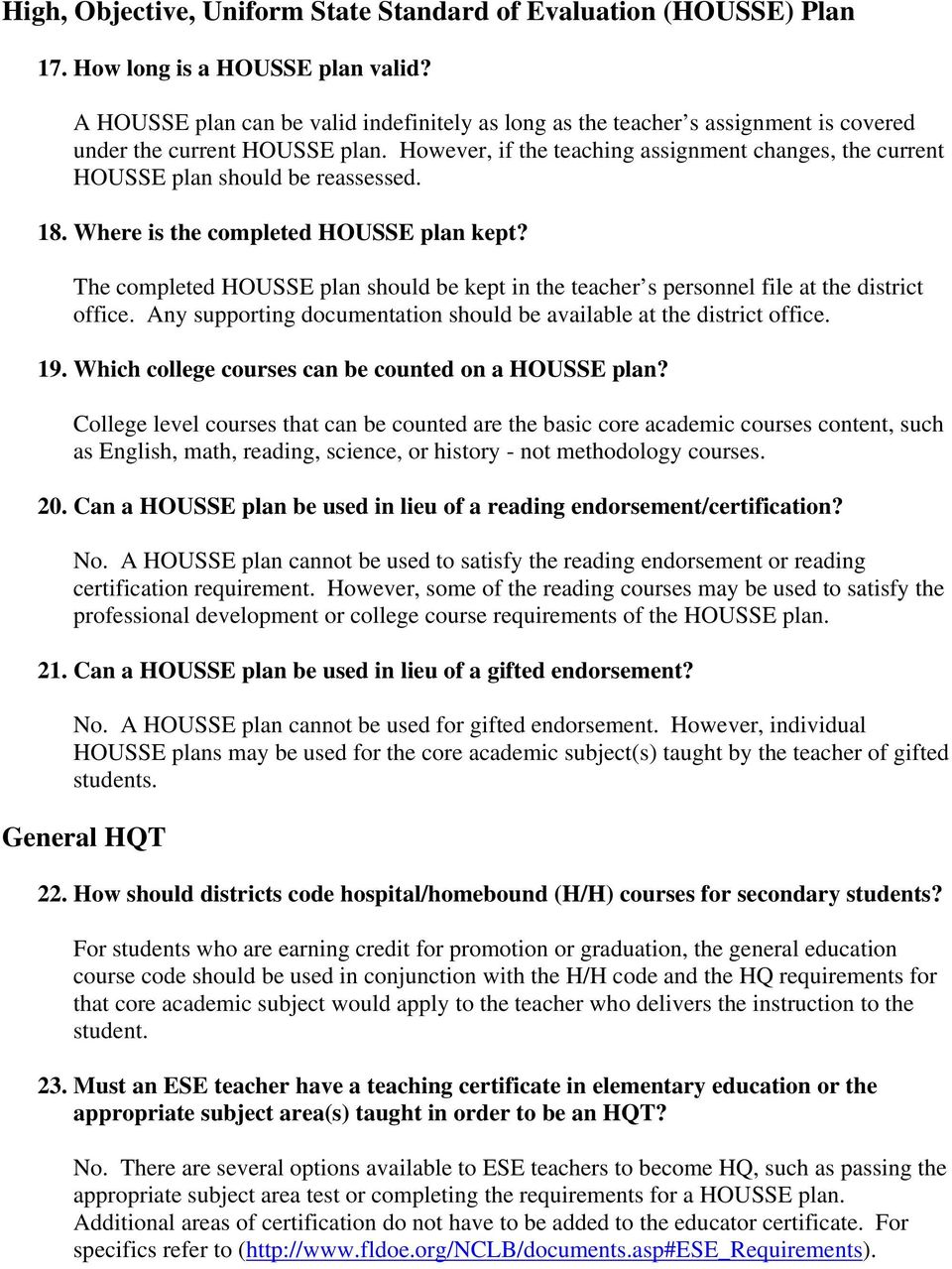
5 High, Objective, Uniform State Standard of Evaluation (HOUSSE) Plan 17. How long is a HOUSSE plan valid? A HOUSSE plan can be valid indefinitely as long as the teacher s assignment is covered under the current HOUSSE plan. However, if the teaching assignment changes, the current HOUSSE plan should be reassessed. 18. Where is the completed HOUSSE plan kept? The completed HOUSSE plan should be kept in the teacher s personnel file at the district office. Any supporting documentation should be available at the district office. 19. Which college courses can be counted on a HOUSSE plan? College level courses that can be counted are the basic core academic courses content, such as English, math, reading, science, or history - not methodology courses. 20. Can a HOUSSE plan be used in lieu of a reading endorsement/certification? No. A HOUSSE plan cannot be used to satisfy the reading endorsement or reading certification requirement. However, some of the reading courses may be used to satisfy the professional development or college course requirements of the HOUSSE plan. 21. Can a HOUSSE plan be used in lieu of a gifted endorsement? No. A HOUSSE plan cannot be used for gifted endorsement. However, individual HOUSSE plans may be used for the core academic subject(s) taught by the teacher of gifted students. General HQT 22. How should districts code hospital/homebound (H/H) courses for secondary students? For students who are earning credit for promotion or graduation, the general education course code should be used in conjunction with the H/H code and the HQ requirements for that core academic subject would apply to the teacher who delivers the instruction to the student. 23. Must an ESE teacher have a teaching certificate in elementary education or the appropriate subject area(s) taught in order to be an HQT? No. There are several options available to ESE teachers to become HQ, such as passing the appropriate subject area test or completing the requirements for a HOUSSE plan. Additional areas of certification do not have to be added to the educator certificate. For specifics refer to (
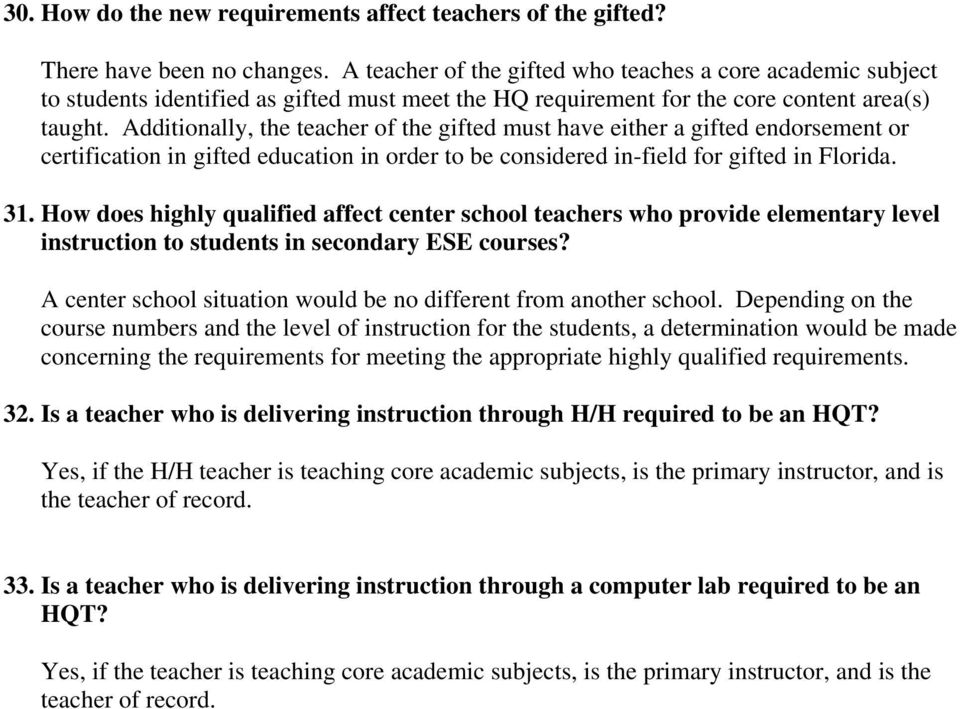
6 24. Must teachers meet the highly qualified requirements if they are not teaching a core academic subject? No. Only teachers who teach core academic courses are required to meet the definition of an HQT. 25. Which ESE courses do not trigger the HQ requirements? Most of the courses which are not core academic are listed under the subject heading of special courses, special skills courses, therapies, etc. These courses target specific skills that are more applicable to certain areas of exceptionality, such as students who are on modified curricula. Attached within this document is a chart that lists all the ESE courses and the certification or highly qualified requirements. 26. Which service delivery models do not require content area certification? Consultation, co-teaching, and support facilitation do not require content area certification. 27. Which course number should be used for support facilitation for a student with significant cognitive impairments in a general education class? The ESE course number and the students should be assigned to the general education teacher if that teacher is teaching students with significant cognitive impairments, on a modified curriculum, and assessed on an alternate assessment. The general education teacher does not need ESE certification. As far as highly qualified, the basic education teacher would have the subject area expertise with the ESE teacher providing the ESE support necessary as identified in the individual educational plan (IEP). In the Florida Course Code Directory under support facilitation, the narrative section under ESE states, In cases where non-ese certified teachers have classes in which students are enrolled in general education courses as well as students who are enrolled in ESE courses, the basic education teacher is not out-of-field for the ESE course if an ESE certified teacher is providing support facilitation services. 28. Is an ESE teacher, with appropriate general education certification, HQ to teach a general education class to ESE students and general education students in the same setting? Yes, if the ESE teacher has the appropriate general education certification for the grade level assigned. However, since the ESE teacher is serving in the role of the general education teacher, the teacher cannot simultaneously provide ESE services and general education services. A teacher cannot serve in both roles (an ESE teacher and general education teacher) during the same class period. 29. Can a teacher s HQ status change from one year to the next? Yes. HQ depends on the teaching assignment. If a teacher s assignment changes, the HQ status must be reassessed to ensure that the teacher can demonstrate competency in the new subject area(s).
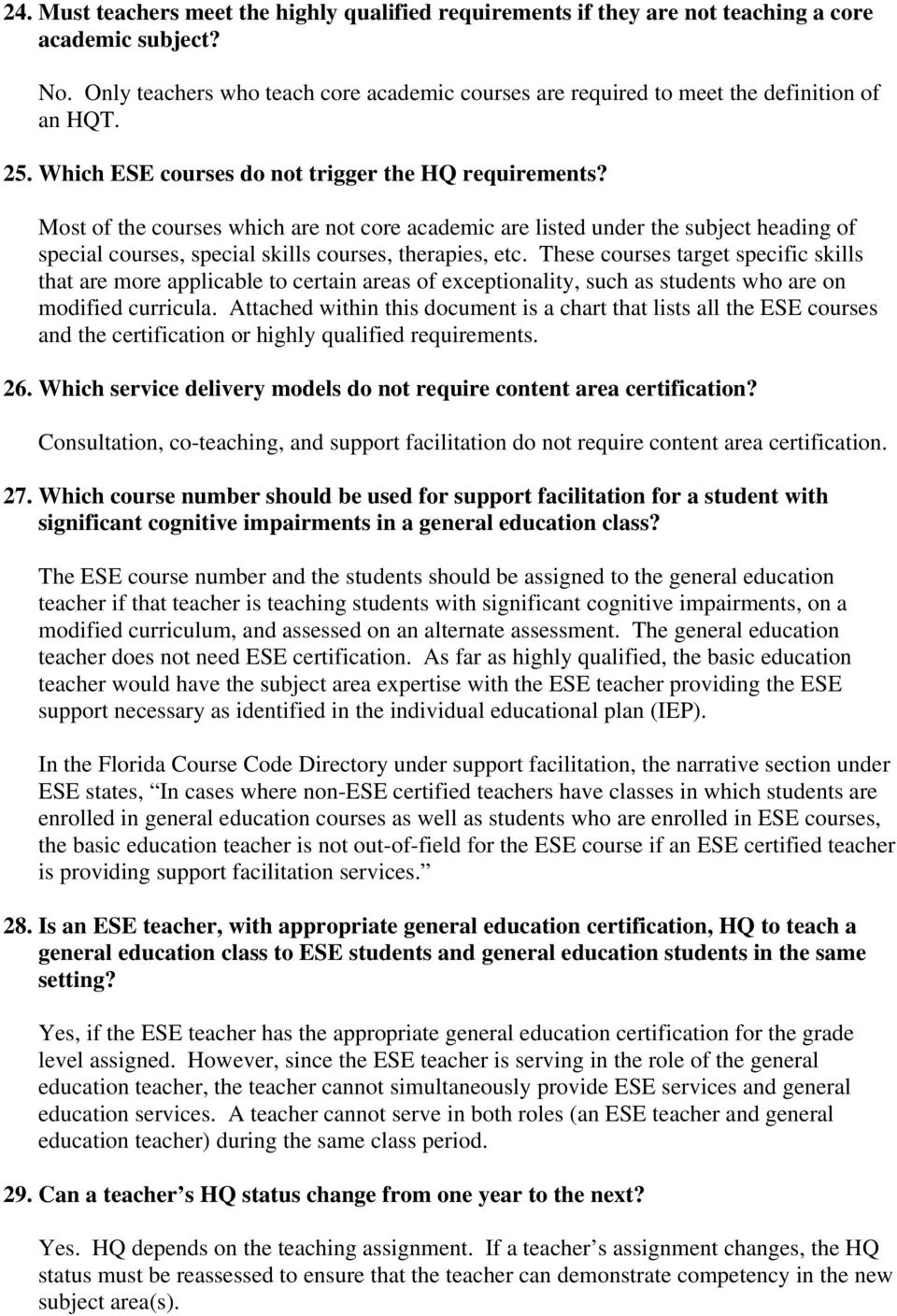
7 30. How do the new requirements affect teachers of the gifted? There have been no changes. A teacher of the gifted who teaches a core academic subject to students identified as gifted must meet the HQ requirement for the core content area(s) taught. Additionally, the teacher of the gifted must have either a gifted endorsement or certification in gifted education in order to be considered in-field for gifted in Florida. 31. How does highly qualified affect center school teachers who provide elementary level instruction to students in secondary ESE courses? A center school situation would be no different from another school. Depending on the course numbers and the level of instruction for the students, a determination would be made concerning the requirements for meeting the appropriate highly qualified requirements. 32. Is a teacher who is delivering instruction through H/H required to be an HQT? Yes, if the H/H teacher is teaching core academic subjects, is the primary instructor, and is the teacher of record. 33. Is a teacher who is delivering instruction through a computer lab required to be an HQT? Yes, if the teacher is teaching core academic subjects, is the primary instructor, and is the teacher of record.
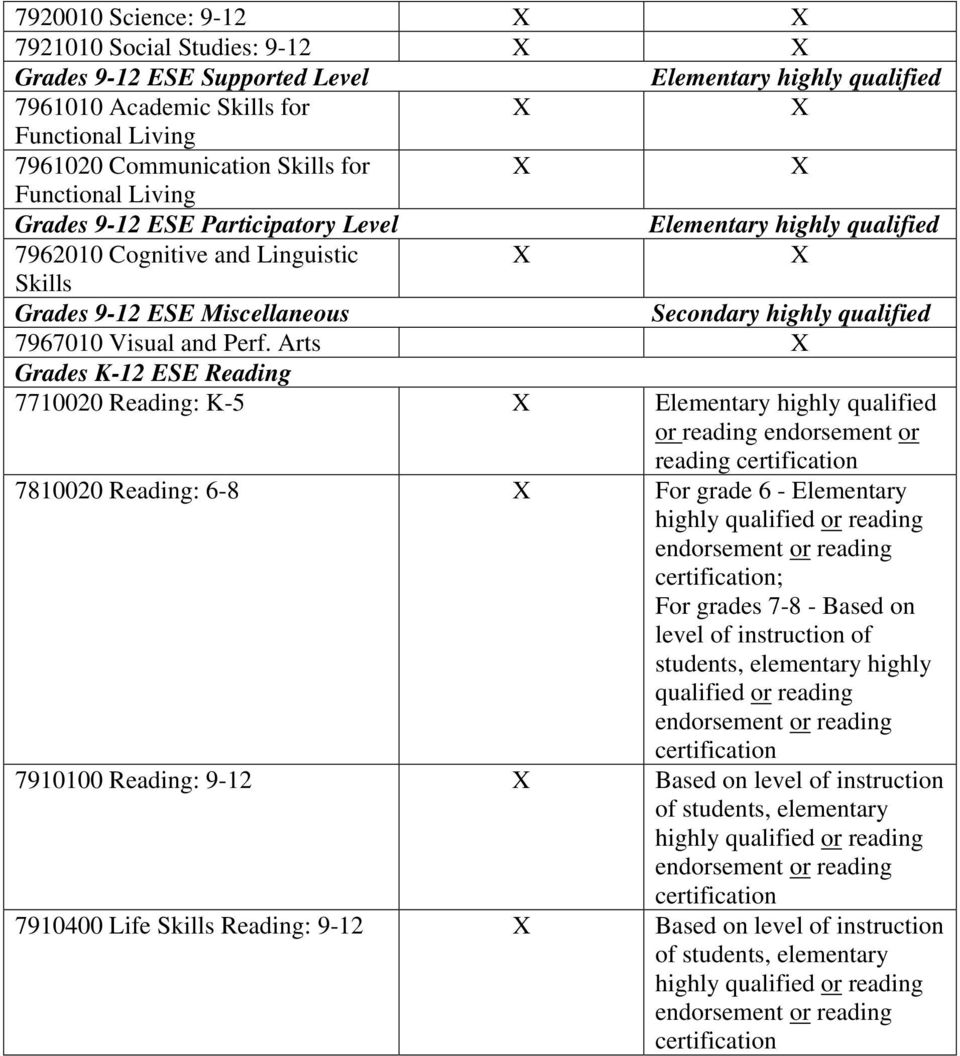
8 Florida Department of Education No Child Left Behind Act and Exceptional Student Education Teacher Requirements February 2006 Required for NCLB Highly Qualified ESE COURSES Certification to match ESE Table in CCD Evidence of Core Academic Subject knowledge through subject area test or HOUSSE plan (for experienced teachers) Elementary ESE Academics General Elementary Highly Qualified Academics: K Academics Skills: K Advanced Academics: K Developmental Skills: K-5 Elementary ESE Academics Subject Areas Elementary Highly Qualified Art: K-5 ESE optional, must meet subject area HQT Language Arts: K Communications: K : Spelling: K : Writing: K : Math: K : Music K-5 ESE optional, must meet subject area HQT : Science: K Social Studies K-5 Grades 6-8 ESE Academics General Elementary or Higher (based on level of instruction of students) Academics: Academic Skills: Advanced Academics: Developmental Skills: 6-8 Grades 6-8 ESE Academics Subject Areas Elementary or Higher (based on level of instruction of students) Language Arts: Communications: Math: Science: Social Studies: 6-8 Grades 6-8 ESE Miscellaneous Visual & Perform Arts: 6-8 ESE optional, must meet subject area HQT Music: 6-8 ESE optional, must meet subject area HQT Secondary Highly Qualified Grades 9-12 ESE Academics Subject Areas Elementary or Higher (based on level of instruction of students) English: Life Skills Comm Math: Life Skills Math: 9-12

9 Science: Social Studies: 9-12 Grades 9-12 ESE Supported Level Elementary highly qualified Academic Skills for Functional Living Communication Skills for Functional Living Grades 9-12 ESE Participatory Level Elementary highly qualified Cognitive and Linguistic Skills Grades 9-12 ESE Miscellaneous Secondary highly qualified Visual and Perf. Arts Grades K-12 ESE Reading Reading: K-5 Elementary highly qualified or reading endorsement or reading certification Reading: 6-8 For grade 6 - Elementary highly qualified or reading endorsement or reading certification; For grades Based on level of instruction of students, elementary highly qualified or reading endorsement or reading certification Reading: 9-12 Based on level of instruction of students, elementary highly qualified or reading endorsement or reading certification Life Skills Reading: 9-12 Based on level of instruction of students, elementary highly qualified or reading endorsement or reading certification
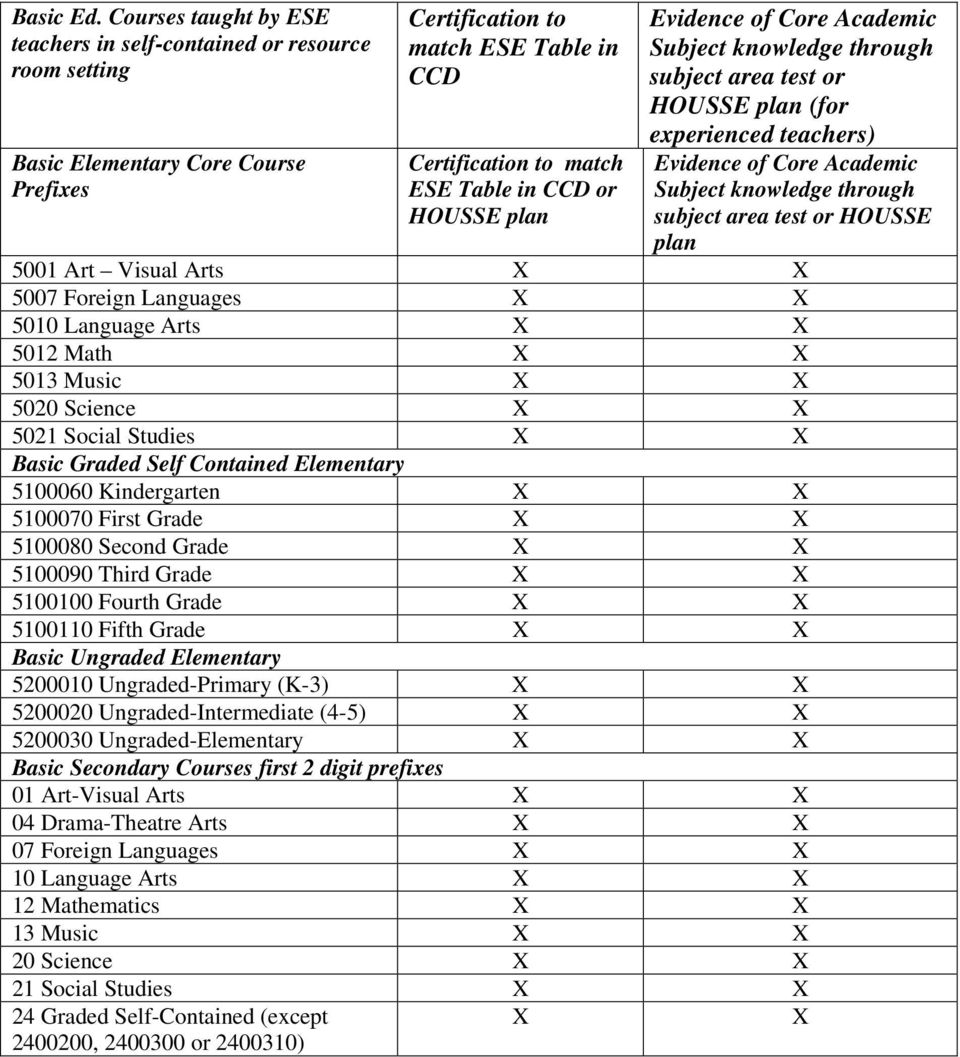
10 Basic Ed. Courses taught by ESE teachers in self-contained or resource room setting Basic Elementary Core Course Prefixes Certification to match ESE Table in CCD Certification to match ESE Table in CCD or HOUSSE plan Evidence of Core Academic Subject knowledge through subject area test or HOUSSE plan (for experienced teachers) Evidence of Core Academic Subject knowledge through subject area test or HOUSSE plan 5001 Art Visual Arts 5007 Foreign Languages 5010 Language Arts 5012 Math 5013 Music 5020 Science 5021 Social Studies Basic Graded Self Contained Elementary Kindergarten First Grade Second Grade Third Grade Fourth Grade Fifth Grade Basic Ungraded Elementary Ungraded-Primary (K-3) Ungraded-Intermediate (4-5) Ungraded-Elementary Basic Secondary Courses first 2 digit prefixes 01 Art-Visual Arts 04 Drama-Theatre Arts 07 Foreign Languages 10 Language Arts 12 Mathematics 13 Music 20 Science 21 Social Studies 24 Graded Self-Contained (except , or )
2011-2012. Course Code Directory and Instructional Personnel Assignments
 2011-2012 Course Code Directory and Instructional Personnel Assignments This document applies to programs in public schools, grades PreK-12, and certain postsecondary programs that begin in the time period
Procedures and Guidelines New Hampshire s Highly Qualified Teacher Requirements No Child Left Behind Act (NCLB) 2001
 Procedures and Guidelines New Hampshire s Highly Qualified Teacher Requirements No Child Left Behind Act (NCLB) 2001 General Information about HQT According to the No Child Left Behind Act of 2001, all
QUESTIONS & ANSWERS Highly Qualified Status and Michigan s Special Education Teachers January 2008
 QUESTIONS & ANSWERS Highly Qualified Status and Michigan s Special Education Teachers January 2008 1. Q: What are the core academic subjects? A: The core academic subjects, as defined by the Elementary
Hello, this TICAL presentation is designed to help administrators and teachers learn more about the. Slide 1
 Slide 1 Slide 2 NCLB Highly Qualified Teacher Essentials Presented by: Gabe Soumakian TICAL Cadre Member Director of Human Resources Santa Monica-Malibu Malibu USD NCLB Key Performance Goal for HQT All
Illinois Criteria for Meeting the NCLB Requirements for Highly Qualified Teachers
 Illinois Criteria for Meeting the NCLB Requirements for Highly Qualified Teachers Illinois State Board of Education ADOPTED June 17, 2003 1 Illinois Criteria for Meeting the NCLB Requirements for Highly
Early Childhood Education
 Early Childhood Education Four-year-olds and Younger to Grade 3 JULY 2010 Early Childhood Education Four-year-olds and Younger to Grade 3 Page 6 Highly Qualified Requirements At a Glance No Child Left
ESEA Highly Qualified Teachers
 ESEA Highly Qualified Teachers Odyssey 2015 What Does ESEA Say? Highly Qualified The term highly qualified means the teacher has a bachelor s degree, obtained full State licensure with subject matter competency
The New Jersey Highly Qualified Teacher Approved Forms
 The New Jersey Highly Qualified Teacher Approved Forms REVISED JULY 2008 Table of Contents The New Jersey Highly Qualified Teacher Approved Forms The New Jersey Highly Qualified Teacher Identification
Years in District. Assignment
 Assignment Years in District Years of Service Highest Degree Salary Technology Education, Secondary, 7-12 22 25 Master's degree $89,125 General Science, Intermediate, 10-12 23 25 Master's degree $89,125
School District of Escambia County Teacher Certification Handbook
 School District of Escambia County Teacher Certification Handbook Out-of-Field Teachers NCLB & HOUSSE Teachers Dawn Ramirez, Coordinator Educator Certification [email protected] (850) 469-6250
Mississippi Department of Education Highly Qualified Teacher Criteria The No Child Left Behind Act of 2001
 Mississippi Department of Education Highly Qualified Teacher Criteria The No Child Left Behind Act of 2001 General Information 1. Mississippi issues teacher licenses at four levels to persons who have
THE GEORGIA IMPLEMENTATION GUIDELINES. The No Child Left Behind Act of 2001 Title II, Part A. Criteria for Highly Qualified Teachers
 THE GEORGIA IMPLEMENTATION GUIDELINES The No Child Left Behind Act of 2001 Title II, Part A Criteria for Highly Qualified Teachers Revised August 2010 The Georgia Implementation Guidelines The No Child
The Alabama Model for Identifying Highly Qualified Teachers Revised 2006. REVISED 2010 for Teachers of Reading (Effective August 1, 2010)
 Revised The Alabama Model for Identifying Highly Qualified Teachers Revised 2006 REVISED 2010 for Teachers of Reading (Effective August 1, 2010) REVISED and Effective January 30, 2015 Teachers of Students
NCLB and the Highly Qualified Teacher
 October 2008 NCLB the Highly Qualified Teacher GENERAL 1. Who must meet the highly qualified teacher requirements? All teachers who teach core academic subjects (provide direct instruction, i.e. are the
District of Columbia Office of the State Superintendent of Education LOCAL EDUCATION AGENCY HIGHLY QUALIFIED (HQ) RESOURCE GUIDE
 District of Columbia Office of the State Superintendent of Education LOCAL EDUCATION AGENCY HIGHLY QUALIFIED (HQ) RESOURCE GUIDE Division of Elementary and Secondary Education 810 First Street, NE, Eighth
Understanding the Illinois NCLB Requirements
 Understanding the Illinois NCLB Requirements 1 Federal Requirements The federal NCLB (No Child Left Behind) Act took effect in FY03 NCLB law requires all teachers in Title I programs or receiving Title
Highly Qualified Teachers Questions & Answers. No Child Left Behind (NCLB) of 2001. February 11, 2009
 Highly Qualified Teachers Questions & Answers February 11, 2009 NOTE: The first step in verifying a teacher s Highly Qualified status is to ensure that they are properly state certified, endorsed or authorized
Handbook for Districts Highly Qualified Teachers in Colorado
 Handbook for Districts Highly Qualified Teachers in Colorado October 2012 http://www.cde.state.co.us/fedprograms/tii/a_hqt.asp Purpose This resource has been created to inform educators and other interested
TENNESSEE PLAN FOR IMPLEMENTING THE TEACHER AND PARAPROFESSIONAL QUALITY PROVISIONS OF THE NO CHILD LEFT BEHIND ACT OF 2001
 TENNESSEE PLAN FOR IMPLEMENTING THE TEACHER AND PARAPROFESSIONAL QUALITY PROVISIONS OF THE NO CHILD LEFT BEHIND ACT OF 2001 TENNESSEE STATE DEPARTMENT OF EDUCATION LANA C. SEIVERS COMMISSIONER AUGUST 18,
Special Education Grades PK-12 JULY 2010 Special Education (Grades PK-12) Page 84
 Special Education Grades PK-12 JULY 2010 Special Education (Grades PK-12) Page 84 Highly Qualified Requirements At a Glance No Child Left Behind Act of 2001 According to the No Child Left Behind Act of
Technical Assistance Paper
 Pam Stewart Commissioner of Education DPS: 2014-94 Date: August 1, 2014 Technical Assistance Paper What s Special about Special Education? Specially Designed Instruction for Students with Disabilities
IMPORTANT PLEASE READ CAREFULLY!
 Name Social Security # School Position (subject and grade level) IMPORTANT PLEASE READ CAREFULLY! I have received Osceola District Schools Certification Handbook to use as a resource for questions I may
Highly Qualified Teacher Requirements
 Overview Highly Qualified Teacher Requirements Elementary and Secondary Education Act of 2001 and Individuals with Disabilities Education Improvement Act of 2004 The Elementary and Secondary Education
Highly Qualified Teachers Questions & Answers Elementary and Secondary Education Act (ESEA) No Child Left Behind (NCLB) of 2001 May 6, 2005
 Highly Qualified Teachers Questions & Answers See the Michigan Definition for Identifying Highly Qualified Teachers at www.michigan.gov/documents/definitionofhighlyqualifiedteachers_63281_7.pdf. Section
Teacher Service Record (TSR) System Updates For the 2006-2007 School Year
 Teacher Service Record (TSR) System Updates For the 2006-2007 School Year General Federal law requires every state to accurately report on the highly qualified status of teachers assigned to core academic
HQTs & HQPs : Highly Qualified Teachers & Paraprofessionals
 HQTs & HQPs : Highly Qualified Teachers & Paraprofessionals LEA Federal Grants Boot Camp September 2009 1 Session Objectives Understand highly qualified requirements for core subject teachers (ESEA, 1119).
Certification Teacher Competencies and Skills 1
 Attachment 1 Voluntary Prekindergarten (VPK) Education Instructor Credentials Bachelor s and Related Certification Coverages/Teacher Competencies and Skills Current Bachelor s Early Childhood Education/Preschool
Highly Qualified Teachers Questions & Answers. No Child Left Behind (NCLB) of 2001 February 29, 2008
 Highly Qualified Teachers Questions & Answers See the Michigan Definition for Identifying Highly Qualified Teachers at www.michigan.gov/documents/definitionofhighlyqualifiedteachers_63281_7.pdf. Section
1. Who must complete the Highly Qualified Teacher Identification Form?
 General Form Instructions (A E) 1. Who must complete the Highly Qualified Teacher Identification Form? All active teachers working in elementary schools who teach core academic content areas. This includes
Guidelines for Special Education Teachers Certificated or Teaching at the Secondary Level to Meet the Highly Qualified Requirement
 Guidelines for Special Education Teachers Certificated or Teaching at the Secondary Level to Meet the Highly Qualified Requirement The purpose of this document is to explain/clarify how the term highly
No Child Left Behind Statute. Requirements for Meeting the Definition of a Highly Qualified Teacher
 No Child Left Behind Requirements for Meeting the Definition of a Highly Qualified Teacher Title II, Part A Teacher and Principal Training and Recruiting fund Statute II-A www.ed.gov/legislation/esea02/pg20.html
Guide Sheet for Highly Qualified Teachers For Title II, Part A coordinators Prepared by Cindy Godsey/Mike Carr KY EPSB Revised June 2013
 Guide Sheet for Highly Qualified Teachers For Title II, Part A coordinators Prepared by Cindy Godsey/Mike Carr KY EPSB Revised June 2013 Conditions required to demonstrate Highly Qualified Status 1. Must
NCLB. Teacher Requirements. Resource Guide
 December 2007 NCLB Teacher Requirements Resource Guide Prepared by the Professional Development and Curriculum Support Division California Department of Education Table of Contents Introduction SECTION
Questions and Answers Regarding the Requirements for Highly Qualified Teachers Under ESEA and IDEA
 Questions and Answers Regarding the Requirements for Highly Qualified Teachers Under ESEA and IDEA September 15, 2015 09/15/2015 1 Questions and Answers Regarding the Requirements for Highly Qualified
2415.03 HIGHLY QUALIFIED TEACHERS (M)
 2415.03/Page 1 of 7 2415.03 M Introduction The No Child Left Behind Act (NCLB) of 2001 requires all teachers be or become highly qualified in the core academic content area(s) they teach. New, newly hired
Identifying Highly Qualified Teachers Pursuant to the No Child Left Behind Act of 2001. Kentucky s Education Professional Standards Board
 Identifying Highly Qualified Teachers Pursuant to the No Child Left Behind Act of 2001 Kentucky s Education Professional Standards Board Revised October 1, 2009 (Note: Future revisions may be necessary
Personnel TEACHER QUALIFICATIONS UNDER THE NO CHILD LEFT BEHIND ACT
 Administrative Regulation SANGER UNIFIED SCHOOL DISTRICT AR 4112.24 (a) Personnel TEACHER QUALIFICATIONS UNDER THE NO CHILD LEFT BEHIND ACT Definitions Core academic subjects include English, reading or
The New Jersey Model for Identifying Highly Qualified Teachers
 The New Jersey Model for Identifying Highly Qualified Teachers The New Jersey Model for Identifying Highly Qualified Teachers William L. Librera, Ed.D. Commissioner of Education Richard Ten Eyck Assistant
HIGHLY QUALIFIED TEACHER REQUIREMENTS FOR ESEA AND IDEA
 HIGHLY QUALIFIED TEACHER REQUIREMENTS FOR ESEA AND IDEA J U L I A F A L L O N, D E B B I E P A R R I O T T, P AT S M I T H S O N & H I S A M I Y O S H I D A O F F I C E O F S U P E R I N T E N D E N T
http://www.ccusd.k12.ca.us/board_ed/policies/4000/4112-24ar.htm
 AR 4112.24 Teacher Qualifications Under The No Child Left Behind Act Definitions Core academic subjects include English, reading or language arts, mathematics, science, foreign languages, civics and government,
2014-2015. Educator Requirements for Highly Qualified
 2014-2015 Educator Requirements for Highly Qualified Effective Teachers and Leaders Unit Eric Brooks, Director (602) 364-1842 John Huppenthal, Superintendent of Public Instruction 1 Administrator Section
Definition of the Highly Qualified Teacher (HQT) Who Needs to Demonstrate Content Expertise*
 Definition of the Highly Qualified Teacher (HQT) To Satisfy the Federal Definition of Highly Qualified, Teachers Must: Have at least a Bachel s degree Have valid state certification o CE and CEAS are considered
Michigan Merit Curriculum High School Graduation Requirements
 Michigan Merit Curriculum High School Graduation Requirements 45 Understanding Michigan s graduation requirements will enable you to help your child obtain a high school diploma and ultimately succeed
HIGHLY QUALIFIED SPECIAL EDUCATION TEACHERS IN NEVADA TECHNICAL ASSISTANCE DOCUMENT. Nevada DEPARTMENT OF EDUCATION. July 2005
 HIGHLY QUALIFIED SPECIAL EDUCATION TEACHERS IN NEVADA TECHNICAL ASSISTANCE DOCUMENT Nevada DEPARTMENT OF EDUCATION July 2005 Nevada Department of Education Office of Special Education, Elementary and Secondary
PERSONNEL QUALIFICATIONS
 PERSONNEL QUALIFICATIONS Special Education Staff Teachers assigned to serve students with disabilities shall possess the credential that authorizes them to teach the primary disability of the students
Ohio. Highly Qualified Teacher (HQT) Toolkit
 Ohio Highly Qualified Teacher (HQT) Toolkit 2012-2013 20 Ohio Highly Qualified Teacher (HQT) Toolkit School Year 2012-2013 Table of Contents Highly Qualified Teacher (HQT) Information for Administrators
NO CHILD LEFT BEHIND (NCLB) HIGHLY QUALIFIED SUMMARY REPORT
 December 8, 215 215 HCISD NO CHILD LEFT BEHIND (NCLB) HIGHLY QUALIFIED SUMMARY REPORT Prepared by: Rosalinda R. Vargas, Assistant Superintendent for Human Services Email: [email protected] Harlingen
Guidance for the Implementation of NCLB Highly Qualified Teacher Requirements
 Guidance for the Implementation of NCLB Highly Qualified Teacher Requirements Division of Educator Leadership and Quality Texas Education Agency Updated September 5, 2014 Based on the December 2006 USDE-Approved
Educational Practices REFERENCE GUIDE. Aligned to the AdvancED Standards for Quality Schools
 Educational Practices REFERENCE GUIDE Aligned to the AdvancED Standards for Quality Schools Table of Contents Introduction... 3 Purpose and Direction... 4 Governance and Leadership... 5 Duties of the Governing
Special Education Program Descriptions 2014-2015
 Special Education Program Descriptions 2014-2015 Stillwater Central School District 1068 Hudson Avenue Stillwater, New York 12180 Introduction This document provides descriptions of the special education
Title of Regulation Regulation No.: 43-62. REQUIREMENTS FOR ADDITIONAL Effective Date: 06/26/15 AREAS OF CERTIFICATION
 Title of Regulation Regulation No.: 43-62 REQUIREMENTS FOR ADDITIONAL Effective Date: 06/26/15 AREAS OF CERTIFICATION Constitutional and Statutory Provisions: Section(s): 59-5-60(1). General powers of
ESE Scheduling for Elementary Schools
 Section 2 ESE Scheduling for Elementary Schools Introduction It will be necessary for the data processor and the school based ESE contact person to work closely together to develop the school's ESE master
FLORIDA DEPARTMENT OF EDUCATION
 FLORIDA DEPARTMENT OF EDUCATION STATE BOARD OF EDUCATION T. WILLARD FAIR, Chairman Members DR. AKSHAY DESAI Dr. Eric J. Smith Commissioner of Education MARK KAPLAN ROBERTO MARTÍNEZ JOHN R. PADGET KATHLEEN
One (1) semester hour in teaching SWD
 Renewal of a Florida Professional Certificate Requirements for Applications Received On or After July 1, 2014 Section 1012.585, Florida Statues, and Chapter 6A-4.0051, Florida Administrative Code The Florida
HIGHLY QUALIFIED TEACHER HOUSSE FOR PENNSYLVANIA EDUCATORS
 HIGHLY QUALIFIED TEACHER HOUSSE FOR PENNSYLVANIA EDUCATORS Under Pennsylvania s Highly Qualified Teacher (HQT) HOUSSE program, experienced Pennsylvania teachers may demonstrate subject matter competency
Highly Qualified Teachers Workbook
 Highly Qualified Teachers Workbook CASPA CDE http://www.cde.state.co.us/fedprograms/nclb/downloads/tiia_hqtwkbk.pdf 3/15/06 PHILOSOPHY The intent of the highly qualified teacher portion of the No Child
AN INFORMATIONAL BRIEF PREPARED FOR MEMBERS OF THE OHIO GENERAL ASSEMBLY BY THE LEGISLATIVE SERVICE COMMISSION STAFF
 Members Only AN INFORMATIONAL BRIEF PREPARED FOR MEMBERS OF THE OHIO GENERAL ASSEMBLY BY THE LEGISLATIVE SERVICE COMMISSION STAFF Highly Qualified Teachers and Paraprofessionals Under the No Child Left
TEACHER QUALIFICATIONS UNDER THE NO CHILD LEFT BEHIND ACT
 Certificated Personnel Administrative Regulation 4112.24(a) TEACHER QUALIFICATIONS UNDER THE NO CHILD LEFT BEHIND ACT Definitions Core academic subjects include English, reading or language arts, mathematics,
2014-2015 Adult High School Technical Assistance Guide. Florida Department of Education
 2014-2015 Adult High School Technical Assistance Guide Florida Department of Education Florida Department of Education Division of Career and Adult Education 325 West Gaines Street, Room 754 Tallahassee,
Sonya Butler. Coordinator of Certification, NCLB Compliance and Recruitment
 The School District of Osceola County, Florida CERTIFICATION HANDBOOK Sonya Butler Coordinator of Certification, NCLB Compliance and Recruitment Revised June 2011 Name School Position (exactly as listed
Highly Qualified Teacher Resource Manual
 2012 13 School Year Highly Qualified Teacher Resource Manual Guidelines & Workbook Meeting the Highly Qualified Teacher Requirements of the Elementary and Secondary Education Act of 2001 Randy I. Dorn
April 2008 SUBJECT: CONTINUUM OF SPECIAL EDUCATION SERVICES FOR SCHOOL-AGE STUDENTS WITH DISABILITIES
 THE STATE EDUCATION DEPARTMENT / THE UNIVERSITY OF THE STATE OF NEW YORK / ALBANY, NY 12234 OFFICE OF VOCATIONAL AND EDUCATIONAL SERVICES FOR INDIVIDUALS WITH DISABILITIES STATEWIDE COORDINATOR FOR SPECIAL
Excerpts from Part 200 of the Regulations Regarding Consultant Teacher Services
 C onsultant teacher services support students with disabilities who are enrolled in general education classes, including career and technical education classes. The intent of consultant teacher services
Continuum of Special Education Services for School-Age Students with Disabilities. April 2008 (Updated November 2013)
 Continuum of Special Education Services for School-Age Students with Disabilities April 2008 (Updated November 2013) The University of the State of New York The State Education Department Office of P-12
TEACHER QUALIFICATIONS UNDER THE NO CHILD LEFT BEHIND ACT
 Certificated Personnel BP 4112.24(a) Recognizing the importance of teacher effectiveness in improving student achievement, the Board of Trustees desires to recruit and hire teachers who possess the subject
THE MICHIGAN DEFINITION FOR IDENTIFYING HIGHLY QUALIFIED TEACHERS
 STATE OF MICHIGAN STATE BOARD OF EDUCATION THE MICHIGAN DEFINITION FOR IDENTIFYING HIGHLY QUALIFIED TEACHERS In Accordance With Criteria Provided By The No Child Left Behind (NCLB) Act Of 2001 MICHIGAN
Service Delivery Models
 Service Delivery Models Anne Arundel County Public Schools (AACPS) is committed to educational excellence by "Elevating all Students, Eliminating all Gaps." To that end, AACPS offers a full continuum of
Required Credentials for Professional Staff Members in the Instructional Programs of South Carolina s Public Schools
 Required Credentials f Professional Staff Members in the Instructional Programs of South Carolina s Public Schools Effective f the 2014 15 School Year Contents Introduction... iii District Professional
SPECIAL EDUCATION SERVICE DELIVERY PLAN
 SPECIAL EDUCATION SERVICE DELIVERY PLAN Dubuque Community School District 2300 Chaney Road Dubuque, Iowa 52001 P: 563/552-3000 F: 563/552-3102 www.dbqschools.org DISTRICT DEVELOPED SPECIAL EDUCATION SERVICE
HOMESCHOOLING IN PENNSYLVANIA: A FACT SHEET
 HOMESCHOOLING IN PENNSYLVANIA: A FACT SHEET DOES PENNSYLVANIA ALLOW PARENTS TO TEACH THEIR CHILDREN AT HOME? Yes. Parents in Pennsylvania can teach their children at home. Pennsylvania's law on home education
Requirements 9/22/2014. Tim Regal TEA, Division of Educator Leadership and Quality September 29, 2014
 Tim Regal TEA, Division of Educator Leadership and Quality September 29, 2014 2014 Texas Education Agency District HQ requirements are based on the acceptance of NCLB Title I, Part A funds. Districts that
Educational Practices Reference Guide. Aligned to the Advance ED Standards for Quality Schools
 Aligned to the Advance ED Standards for Quality Schools February 2010 Table of Contents Page Number Introduction 3 Vision and Purpose 4 Governance and Leadership Duties of the Governing Authority 4 Role
A Question and Answer Guide to Home Schooling Your Child
 A Question and Answer Guide to Home Schooling Your Child Westerly Public Schools Home Schooling Handbook Westerly Public Schools 23 Highland Avenue Westerly, RI 02891 Rhode Island Law The State of Rhode
Kindergarten Teacher Qualifications
 Kindergarten Teacher Qualifications Schools should hire a Kindergarten supervisor who must be graduate of: Bachelor of Early Childhood Education, Bachelor of Science in Preschool Education, Bachelor of
Educator Certification
 Educator Certification TEXAS EDUCATION AGENCY Sherisse Reyes & Geronima Brady Certification Specialists Agenda TEA Website - TEAL and ECOS Assignment Rules New Certificates and Tests Bilingual, ESL and
Presenter: Teri Clark, Administrator, Professional Services Division
 3E Information Professional Services Committee Authorizations for Teaching Executive Summary: This agenda item continues the discussion begun at the October 2008 Commission meeting related to the teaching