
Measurement data monitoring with testo Saveris Small Business Edition. Instruction manual
|
|
|
- Hugh Scott
- 10 years ago
- Views:
Transcription
1 Measurement data monitoring with testo Saveris Small Business Edition Instruction manual

2 2

3 1 Contents 1 Contents 1 Contents Safety and the environment About this document Ensure safety Protecting the environment Specifications Use System requirements Product description Saveris base Saveris base GSM module (optional) Control keys Displays Save radio probe Radio probe without display Radio probe with display Meaning of the LED displays at the probes Saveris Ethernet probes Saveris router Saveris converter Saveris analog coupler First steps Flowchart Inserting SIM card (optional) Connecting USB cable to the Saveris base (optional) Connecting GSM antenna (optional) Connecting Saveris base with power supply Power supply via mains unit Power supply via plug-in/screw connection (optional) Inserting batteries in the probes Connecting radio probe Installing Saveris software Starting up hardware Starting Saveris software Expand measuring system Integrating a Saveris router (optional) Connecting router with power supply (mains unit) Connecting router with power supply (AC/DC)

4 1 Contents Connecting router Assigning probes Connecting routers in series Assigning an IP address to the Saveris base (optional) Integrating Saveris Ethernet probe (optional) Connecting the network cable Connecting Ethernet probe with power supply (mains unit) Connecting USB cable and installing driver (optional) Assigning connection data Connecting the network cable to the Saveris base Starting up Ethernet probes Integrating Saveris converter (optional) Integrating Saveris analog coupler (optional) Performing the test run Checking system availability Testing the system Checking alarm chain Mounting the hardware Mounting the Saveris base on the wall Setting up Saveris base with stand Mounting the probe on the wall Checking the measuring system again Using the product User interface Menus and commands Start Edit Options Axes Template Selecting projects Style template Creating, editing and deleting zones Creating zones Change zones Deleting zones Configuring the alarms Basic settings for the SMS messages Setting up base alarms Setting up alarm groups Components Channels Analyzing series of measurements Diagram view Enlarging the view Information on a reading (crosshairs) Showing regression curve Text field Characteristics of a curve Settings for the axes in the diagram
5 1 Contents Table view Marking readings Dropping the marking Inserting extreme values or mean in the table Compressing readings Dropping compression Determining largest reading Determining the smallest reading Add rows Compress Drop compression Analyzing alarms Checking alarms Acknowledge the alarm Creating evaluations Printing measurement data Archiving with automatic reports Checking the database capacity System settings General settings for the Saveris base Show operating data of the probes Settings for the radio probe Ethernet probes Analog coupler Report settings Maintaining the product Maintenance Replacement of components Deleting components Adding new components Logging components back in Calibration and adjustment On-site calibration and adjustment External calibration and adjustment Saving data in the Saveris base Restarting the Saveris base Removing probe from wall bracket Changing batteries at probe Changing a battery Carrying out a software and firmware system update Carrying out a software update Uninstalling software Software installation Carrying out a firmware system update Technical data Saveris base Saveris radio probe

6 1 Contents Saveris router Saveris Ethernet probes Saveris converter Saveris analog coupler Tips and assistance Questions and answers Saveris base alarm messages Accessories and spare parts

7 2 Safety and the environment 2 Safety and the environment 2.1. About this document Symbols and writing standards Representat Explanation ion Warning advice, risk level according to the signal word: Warning! Serious physical injury may occur. Caution! Slight physical injury or damage to the equipment may occur. > Implement the specified precautionary measures. Note: Basic or further information Action: more steps, the sequence must be followed. >... Action: a step or an optional step Result of an action.... Position numbers for the clarification of the relationship between text and picture.... Menu Elements of the instrument, the instrument display or the program interface. [OK] Control keys of the instrument or buttons of the program interface Functions/paths within a menu.... Example entries Use > Familiarity with a PC as well as the Microsoft products, especially Microsoft Office 2007, is assumed in this documentation. > Please read this documentation through carefully and familiarize yourself with the product before putting it to use. Pay particular attention to the safety instructions and warning advice in order to prevent injuries and damage to the products. 7
8 2 Safety and the environment > Keep this document to hand so that you can refer to it when necessary. > Hand this documentation on to any subsequent users of the product Ensure safety > Carry out only the maintenance and repair work on the components of the testo Saveris system that is described in the documentation. Follow the prescribed steps exactly. Use only original spare parts from Testo. > Never use the Saveris probes to measure on or near live parts. > Only operate the product properly, for its intended purpose and within the parameters specified in the technical data. Do not use any force. > The output of the power supply for the Saveris probes, routers, converters and the Saveris base is restricted in accordance with EN :2001. A manipulation of the power supply is not allowed in terms of the radio authorization. > The radio module is installed in the Saveris components such that the limit values for air and creepage distance is adhered to with regard to the standards. Changing the internal design of the components is not allowed. > When selecting the mounting location, ensure that the permissible ambient and storage temperatures are adhered to (see technical data). At temperatures below 5 C the rechargeable batteries will not charge, within this temperature range secure system operation is only possible to a limited extent Protecting the environment > Dispose of faulty rechargeable batteries/spent batteries in accordance with the valid legal specifications. > At the end of its useful life, send the product to the separate collection for electric and electronic devices (observe local regulations) or return the product to Testo for disposal. 8

9 3 Specifications 3 Specifications 3.1. Use Areas of application The testo Saveris measurement system can be used everywhere where temperature and humidity-sensitive products are produced and stored, for example in the food industry (cold rooms, deep freeze rooms and refrigeration chambers), in smaller companies in food production, as well as bakeries and butchers, or in the pharmaceuticals industry (temperature-controlled cabinets, storage of drugs). But the measurement system can also be used in other industries for monitoring the building air conditioning as well as for quality assurance in store rooms for products in every phase of production. The testo Saveris measurement system is only used to monitor readings, not to control and regulate them. The base with the SMS module may not be operated in environments where, for example, the use of a mobile phone is prohibited. How it works The ambient or process data for the temperature and air humidity in closed rooms are measured and recorded using probes with the measuring system. These readings are transmitted to the Saveris base via radio, which then saves them. A router can be used to optimize the radio in the event of difficult structural conditions. The data are called up from the Saveris base by a computer and saved in a database. Very long distances can be bridged by using a converter that converts the radio signals of the probe or router and then transmits 9

10 3 Specifications these measurement data to the base via Ethernet cable. In addition the so-called Ethernet probes can be connected to the base using an Ethernet cable. With the testo Saveris software you thereby always have an overview of the development of the readings in the individual areas. Exclusion of liability The testo Saveris system was developed to consolidate a large amount of measurement data from spatially separated probes in the Saveris software, document it without interruption and issue alarms in the event of irregularities. The testo Saveris system is not designed to undertake control and regulation tasks according to the regulations. Particularly the alarms are not to be perceived as so-called critical alarms with which the endangerment of life or limb or damage to equipment can be averted. Liability on the part of Testo AG for damages from this type of application is excluded System requirements Operating system The software will run on the following operating systems: Windows Vista SP2 64-bit/ 32-bit or later Windows 7 SP1 64-bit/ 32-bit or later Windows 8 64-bit/ 32-bit Windows bit/ 32-bit Windows Server 2008 SP2 64-bit Windows Server 2008 R2 64-bit Windows Server bit Windows Server 2012 R2 64-bit Computer The computer must meet the requirements of the corresponding operating system. The following requirements must additionally be fulfilled: 4.5 GB unused hard drive capacity with maximum size of the database USB 2.0 interface Microsoft Internet Explorer 9.0 or later Microsoft Windows Installer 4.5 or later 10

11 3 Specifications Microsoft.NET Framework 4.0 SP1 or later MDAC 2.8 SP1 or later Microsoft Outlook (only for MAPI installation) The computer's processor, hard disk and interfaces must be configured for continuous operation in order to ensure smooth automatic operation. If necessary, check your computer's energy-saving options. If Windows Installer 4.5, MDAC 2.8 SP1 and.net Framework 4.0 SP1 are not present on the computer, they will be installed with the Saveris software. Restart after installation. Date and time settings will be automatically accepted by the PC. The administrator must make sure that the system time is regularly compared with a reliable time source and adjusted if necessary, to ensure authenticity of the measurement data. Database SQL Server 2012 R2 Express is supplied. The Microsoft versions SQL Server 2008, 2012, 2014 and Terminal Server are supported. Rechargeable battery The battery in the Saveris base, the Ethernet probes and the analog coupler is a wearing part, which has to be replaced after approx. 2 years. If a battery is faulty, it is not possible to guarantee full operability of the GSM module. In the event of a power failure, data loss cannot be ruled out for all components. When a component's battery is no longer fully functional, it triggers a Defective battery system alarm. The battery (article no ) should then be replaced immediately to ensure full functionality and data security. 11
12 4 Product description 4 Product description 4.1. Saveris base Front As declared in the declaration of conformity, this product complies with Directive 2004/108/EC. Display for the visualization of the alarms and user guidance. Antenna. Warning LED Keypad for operation of the Saveris base. LED for status display. 12

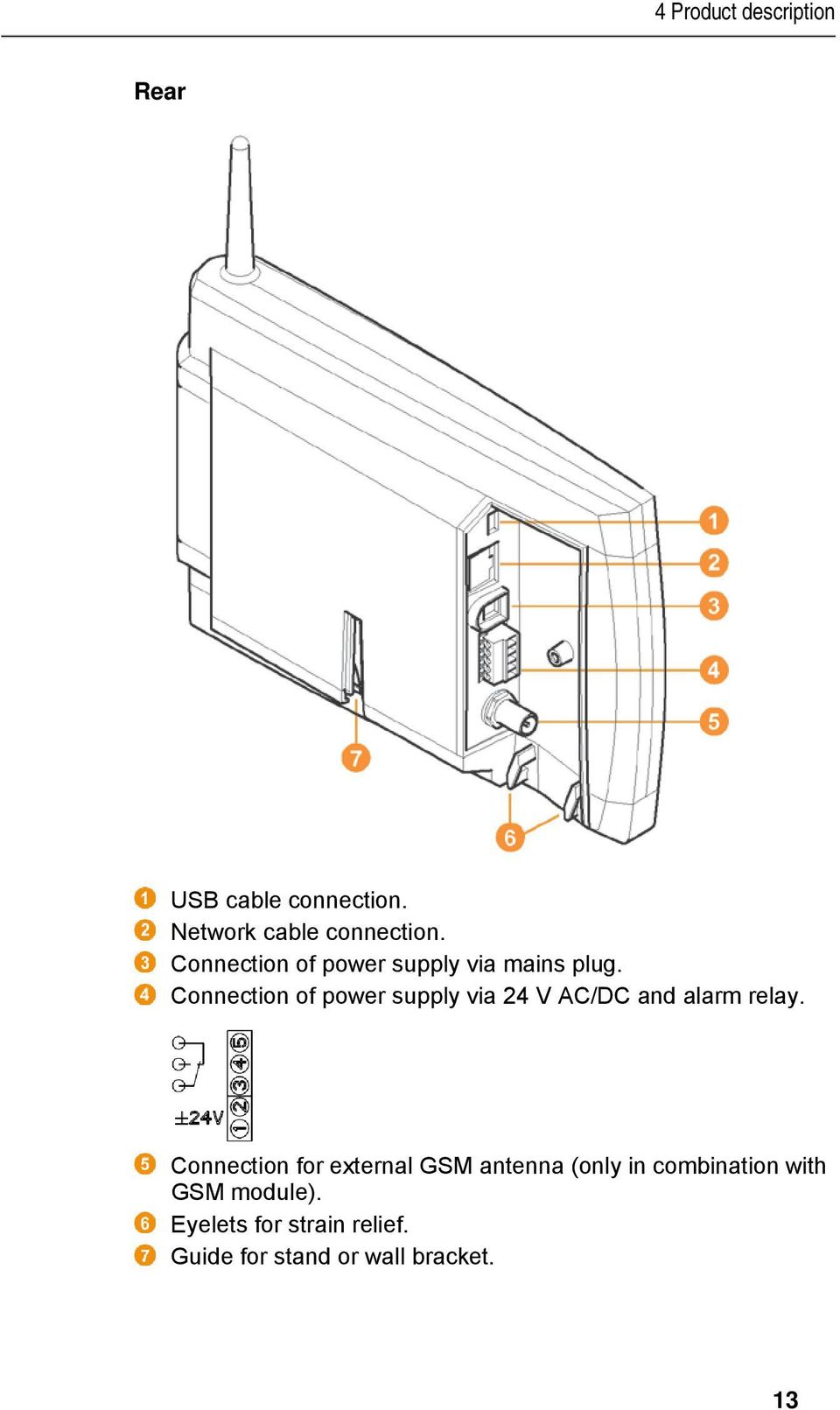
13 4 Product description Rear USB cable connection. Network cable connection. Connection of power supply via mains plug. Connection of power supply via 24 V AC/DC and alarm relay. Connection for external GSM antenna (only in combination with GSM module). Eyelets for strain relief. Guide for stand or wall bracket. 13
14 4 Product description 4.2. Saveris base GSM module (optional) Control keys Key [Esc] Insertion slot for the SIM card. Explanation Switches from the Login menu to the Info System menu. In the Info Base menu, press [Esc] briefly 2x: shuts down the Saveris base Press and hold [Esc]: starts up the Saveris base [Enter] In the Info System menu starts up the login status for the probe. [ ], [ ] Navigation buttons for changing the menus. 14

15 4 Product description Displays Info Base menu IP address of the Saveris base. The IP address is the unique identification number of the Saveris base within the network. Netmask that is saved in the Saveris base. The netmask is the basic address of the network in which the Saveris base is integrated. Address of the gateway that is saved in the Saveris base. A gateway is a transfer point between networks that work with different protocols or data formats. A "translation" into the respective other protocol or data format is then performed by the gateway. Fill level of the internal rechargeable battery in the event of power failure. The display is only shown with an interrupted power supply. Fill level of the memory of the Saveris base. Keys that are assigned functions in this menu. 15

16 4 Product description Info Alarm menu Number of the newly triggered alarms. Keys that are assigned functions in this menu. New alarms have to be checked and acknowledged at regular intervals. A large number (>100) of unacknowledged alarms will impair the system performance. The system automatically acknowledges unacknowledged alarms once these number 200 or more. Alarm detail menu 16

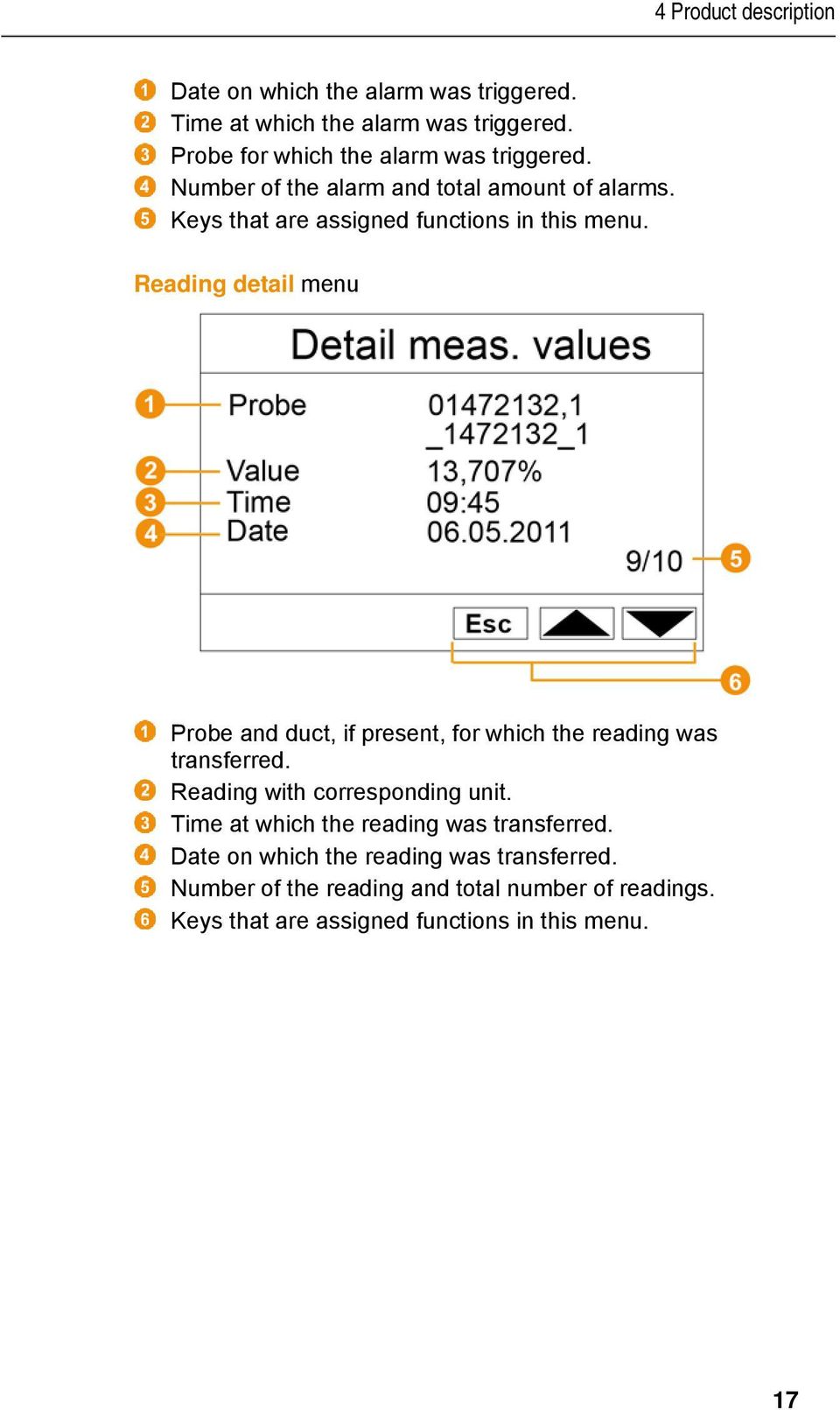
17 4 Product description Date on which the alarm was triggered. Time at which the alarm was triggered. Probe for which the alarm was triggered. Number of the alarm and total amount of alarms. Keys that are assigned functions in this menu. Reading detail menu Probe and duct, if present, for which the reading was transferred. Reading with corresponding unit. Time at which the reading was transferred. Date on which the reading was transferred. Number of the reading and total number of readings. Keys that are assigned functions in this menu. 17
18 4 Product description Info GSM menu Name of the network operator. Display of the reception quality. Telephone number that is saved on the SIM card. Keys that are assigned functions in this menu. Version number of the internal GSM module. Instrument detail menu 18 Serial number of the connected instrument. Firmware version of the connected instrument. Type designation of the connected instrument. Radio quality of the connected instrument (omitted for Ethernet probes). Battery status of the instrument (omitted for Ethernet probes).

19 4 Product description Startup indicates whether the device has been configured by the startup wizard. Number of successful devices. Keys that are assigned functions in this menu. Info System menu Number of connected radio probes. Number of connected Ethernet probes. Number of connected routers. Number of connected converters. Keys that are assigned functions in this menu. Login 1/2 menu Status display when probes are connected. 19

20 4 Product description Login 2/2 menu Keys that are assigned functions in this menu. This display is shown if no login signal was received from a probe within approx. 30 seconds. 20

21 4 Product description 4.3. Save radio probe Radio probe without display LED for status display. Antenna for radio transmission of measurement data to the Saveris base. Guide rails for the wall bracket. Catch for the wall bracket. Ports, depending on type. Connect button for connecting the probe to the Saveris base and for a status request during operation. 21
22 4 Product description Radio probe with display Display for showing reading, battery and connection status as well as the field strength of the radio link. LED for status display. Antenna for radio transmission of measurement data to the Saveris base. Guide rails for the wall bracket. Catch for the wall bracket. Ports, depending on type. Connect button for connecting the probe to the Saveris base and for a status request during operation. 22
23 4 Product description Displays Quality of the radio link. Indicator as to whether a communication with the Saveris base or a router or converter is performed. Battery status. Unit of the reading: % for humidity measurement ma for current measurement Ctd or Ftd for dewpoint measurement. Reading. Indicator as to whether the reading has exceeded the upper ( ) limit value or undershot the lower ( ) limit value. Number of the channel. Display for a second sensor in the probe Meaning of the LED displays at the probes Connecting to the Saveris base Hold the connect button on the rear of the probe until the LED begins to flash orange. Representation Explanation Flashing orange An attempt to establish the connection to the Saveris base. Lit up green The connection to the Saveris base was performed successfully. Lit up red The connection to the Saveris base failed. 23
24 4 Product description Status displays during operation Briefly press the connect button on the rear of the probe once and the LED shows the status of the connection to the Saveris base. Representation Explanation Flashing 3 x green A very good connection to the Saveris base exists. Flashing 2 x green A good connection to the Saveris base exists. Flashing 1 x green A borderline connection to the Saveris base exists. Flashing 3 x red No connection to the Saveris base exists Saveris Ethernet probes Display for showing the reading and transmission information. LED for status display. Connect button. Catch for the wall bracket. Guide rails for the wall bracket. Input for external probes. Input for external 24 V AC/DC power supply. M1.6 x 1.5 cable coupling 24
25 4 Product description Input for Ethernet interface. Input for service interface. Input for power supply via mains unit. Displays Quality of the connection. Battery status. Indicator as to whether a communication with the Saveris base is performed. Unit of the reading: % for humidity measurement ma for current measurement Ctd or Ftd for dewpoint measurement. Reading. Indicator as to whether the reading has exceeded the upper ( ) limit value or undershot the lower ( ) limit value. Number of the channel. Display for a second sensor in the probe. 25
26 4 Product description 4.5. Saveris router Antenna for the radio transmission of the measurement data LED for status display Connect button for connecting the router to the Saveris base and for a status request during operation Catch for the wall bracket Guide rails for the wall bracket Input for external 24 V AC/DC power supply. M1.6 x 1.5 cable coupling Input for service interface Input for power supply via mains unit 26
27 4 Product description 4.6. Saveris converter Antenna for receiving the measurement data. LED for status display. Connect button for connecting the converter to the Saveris base and for a status request during operation. Catch for the wall bracket. Guide rails for the wall bracket. Input for external 24 V AC/DC power supply. M1.6 x 1.5 cable coupling Input for connecting the network cable (optional power supply via PoE). Input for service interface. Input for power supply via mains unit. 27
28 4 Product description 4.7. Saveris analog coupler Only with radio analog coupler U1: Antenna for sending the measurement data. LED for status display. Connect button for connecting the analog coupler to the Saveris base and for a status request during operation. Catch for the wall bracket. Guide rails for the wall bracket. Cable coupling M16 x 1.5 for connecting to the transmitter. Only with Ethernet analog coupler U1E: Input for connecting the network cable. Input for service interface. Input for power supply via mains unit. 28
29 5 First steps 5 First steps 5.1. Flowchart Start Base with GSM module? Yes Inserting SIM card No Connecting USB cable and power supply to base Inserting batteries in probe Connecting USB cable and power supply to base Connecting GSM antenna Connecting probe to Saveris base Inserting batteries in probe Connecting probe to Saveris base Use router? Yes Integrating router No 29
30 5 First steps Installing software Use Ethernet probes? Yes Integrating Ethernet probe No Use converter? Yes Integrating converter No Start up hardware with the help of the startup wizard. Creating zones Configuring the alarms Performing the test run Starting software Mounting the hardware End 30
31 5 First steps 5.2. Inserting SIM card (optional) With a Saveris base with integrated GSM module, you must insert the SIM card. The SIM card for sending SMS messages is not included in the delivery and must be purchased separately from a mobile phone provider. It is recommended that you use a contract card instead of a so-called prepaid card, as no alarm messages can be sent if you use up your credit. 1. Switch off Saveris base (with Info Base view selected, briefly press [ESC] twice). 2. Loosen screw connection and remove base plate from the Saveris base. 3. Insert SIM card in the card slot as shown. When inserting, the SIM card pushes the catch to the side. If the card is inserted, a spring pushes the catch back and the SIM card is thus secured in the card slot. 4. Place the base plate on the base and screw it down. 31
32 5 First steps 5.3. Connecting USB cable to the Saveris base (optional) 1. Loosen and remove screw connection. 2. Remove cover from Saveris Base. 3. Plug the USB cable into the Saveris base. 32
33 5 First steps 5.4. Connecting GSM antenna (optional) > Place antenna cable on the coaxial connection and screw on Connecting Saveris base with power supply You can connect the Saveris base to the power supply via the included mains unit or via the 24 V AC/DC plug-in/screw terminal. 33
34 5 First steps Power supply via mains unit 1. Connect mains cable to the Saveris base. 2. Ensure that cabling cannot be pulled out using a cable tie at the eyelets for strain relief. 3. Place the cover on the Saveris base and screw it down. 4. Connect mains plug to the power supply. - The Saveris base automatically switches on after selecting the language at the base and is ready for operation. 34
35 5 First steps Power supply via plug-in/screw connection (optional) 1. Loosen clamping screws no. 1 and no Insert cable in the terminals as shown. Observe permissible operating voltage! 3. Tighten clamping screws. 4. Ensure that cabling cannot be pulled out using a cable tie at the eyelets for strain relief. 5. Place the cover on the Saveris base and screw it down. - The Saveris base automatically switches on after selecting the language at the base and is ready for operation. 35
36 5 First steps 5.6. Inserting batteries in the probes 1. Loosen screws on the rear of the probe. 2. Remove housing cover of probe. 3. Insert batteries. Ensure that you insert the batteries correctly. The correct polarity is illustrated in the respective battery compartment. 4. Place housing cover on probe housing. 5. Screw cover down close to the housing. A control switch is located in the housing that is actuated through the cover. To do so, the cover must be screwed to the probe housing without a gap. If the cover is not screwed on without a gap, the probe cannot be operated. Transport note: If the probe is to be sent via air freight, the batteries must be removed beforehand to avoid unintended radio communication. 36
37 5 First steps 5.7. Connecting radio probe You can connect a maximum of 15 probes to the Saveris base directly via radio. In addition, you can operate 15 probes per converter and 5 more probes per router or router cascade at the Saveris base. Note that a maximum of 450 channels can be processed by the Saveris software. 1. Change to the Info System menu at the Saveris base with the [ ] button. 2. Press [Enter] to call up the Login function. - The status bar in the display shows that the Saveris base is ready for probe detection. 37
38 5 First steps With Saveris H2D/H4D radio probes, the external humidity probe must be connected. 3. Hold down the connect key on the rear of the probe until the LED at the probe begins to flash orange. - The LED at the probe briefly turns green if this was detected by the Saveris base. The LED at the Saveris base briefly flashes green and a prompt appears in the display of the base for the connection of more probes or routers. Multiple probes cannot be connected at the Saveris base simultaneously. Multiple probes can only be connected one after the other. 4. At the Saveris base, press the [Esc] key if no more components are to be connected. - A note on the required performance of the startup assistant is shown on the display for about ten seconds. Then the Saveris base changes to the Info System menu in which the number of connected components is now shown. Press [Enter] if further components are to be connected; see previous step. 38
39 5 First steps 5. Position the probes precisely at their measurement points to check the radio link. 6. Briefly press the connect key on the rear of the probe. If the LED at the probe flashes green, a radio link exists. red, no radio link exists. If no radio link to the Saveris base exists even after a change of location of the probe, connect a router to the Saveris base; see Integrating a Saveris router (optional), page Installing Saveris software > Before the installation: End all running programs, deactivate all entries in the Autostart program group and restart PC. Administrator rights are required for installation. Log in directly as an administrator, not via Perform as. 1. Insert CD with Saveris software in the CD-ROM drive. If the installation program does not start automatically, open Windows Explorer and start the Setup.exe file on the CD. Once you have received the installation file, e.g. via , use the file Setup.exe at the highest level of the installation disk. 2. Follow the directions of the installation wizard. > After completing the installation, restart the computer and log in with the same user name as before. The USB driver for the connection of the Saveris base is installed with the Saveris software. If the Saveris base is not recognized as new hardware when connected to the computer, the USB driver must be manually installed Starting up hardware Use the installation instructions when starting up the system for the first time. The following requirements must be fulfilled for the rest of the startup process for the hardware: the Saveris base is ready for operation, 39
40 5 First steps all probes are registered on the Saveris base, the Saveris software is installed, a project has already been created and measurement operation has been ended. 1. Connect the Saveris base via the USB or network cable to the computer on which the Saveris client is installed. For continuous operation of the system, it is recommended that the Saveris base be connected to the computer via an Ethernet cable. - The startup wizard starts. 2. Click on [Continue >]. - The configuration data of the Saveris base are shown. 40
41 5 First steps 3. Enter the project name in the Name field. 4. Determine which configuration data are to be used: Click on [Cancel] to reconfigure the project without using predefined configuration data. - Refer to installation instructions for information on reconfiguring a project. Mark an existing project and click on [OK] to adopt the configuration data of the marked project for the new project. - The system settings of the Saveris base that are based on the marked project are shown. 41
42 5 First steps 5. Click on [Units] to change the temperature unit for the system. 6. Click on [OK]. 7. Make any further changes to the existing system settings as required (see installation instructions) Starting Saveris software Ensure that the Saveris software is not already open, for example in multi-user operation under Windows Vista. 1. Select [Start] All Programs Testo Saveris. - The Testo Saveris software program window is opened with the Select project dialogue. 42
43 5 First steps If the software will not start, check whether the testo tdassvcs service is started in the service management of the operating system and restart it, if needed. 2. Select the Only active projects option if the data from a running project should be opened All projects option if the data from a completed project should be opened. 3. Select the project that is to be opened in the tree structure. 4. Confirm with [OK]. - The Testo Saveris software program window is shown with the selected data record in the foreground Expand measuring system In this chapter, you learn how to integrate the Saveris router, converter, Ethernet probes and analog coupler into the measuring system. 43
44 5 First steps Integrating a Saveris router (optional) You can use a Saveris router to optimize radio communication under poor structural conditions or to extend the radio path. The router receives the signals of the radio probes and forwards them to the Saveris base. Maximum extension of the radio path can be achieved by connecting three routers in series. The measurement data of up to five radio probes can be transmitted per router or router cascade to the Saveris base. Up to 30 routers can be incorporated into the measurement system. The Saveris base can communicate directly with a maximum of 15 routers. The integration of a router is performed in three steps: 1. Connecting the router to the power supply. 2. Registering the router on the Saveris base. 3. Assigning the radio probe to the router. When positioning a router, please note the following points: When integrating several probes via a router, the probe with the weakest radio link determines the position of the router. Mount the router in such a way that this probe has an ideal radio link. Probes and router should be mounted so that the antennas are pointing upwards. The radio link between probes and the router, as well as the router and the Saveris base, should not be strongly influenced by structural conditions (walls, shelves, etc.). Mount the router and probe so that "visual contact" exists with as many radio links as possible. 44
45 5 First steps Connecting router with power supply (mains unit) 1. Open cover. 2. Insert mains cable. 3. Insert mains plug into a socket. The wall mounting of a router is performed in the same ways as for a probe; see "Mounting the probe on the wall". 45
46 5 First steps Connecting router with power supply (AC/DC) 1 Remove protection caps. 2. Loosen screws on the rear of the router. 3. Remove housing cover of router. 4. Unscrew and remove cover cap of cable opening. 46
47 5 First steps 5. Loosen clamping screws. 6. Route cabling through the cable opening and insert in the terminals. It is not necessary to note the polarity. 7. Tighten clamping screws. 47
48 5 First steps 8. Place housing cover on the router. 9. Screw on housing cover. 10. Insert protection caps. The wall mounting of a router is performed in the same ways as for a probe; see "Mounting the probe on the wall". 48
49 5 First steps Connecting router You can connect a maximum of 30 routers to the Saveris base. The Saveris base can communicate directly with a maximum of 15 routers. 1. Change to the Info System menu at the Saveris base with the [ ] button. 2. Press [Enter] to call up the Login function. - The status bar in the display shows that the Saveris base is ready for router detection. 49
50 5 First steps 3. Hold down the connect key on the rear of the router until the LED at the router begins to flash orange. - The LED at the router briefly turns green if this was detected by the Saveris base. The LED at the Saveris base briefly flashes green and a prompt appears in the display of the base for the connection of more probes or routers. Multiple routers cannot be connected at the Saveris base simultaneously. Multiple routers can only be connected one after the other. 4. At the Saveris base, press the [Esc] key if no more components are to be connected. - A note on the required performance of the startup assistant is shown on the display for about ten seconds. Then the Saveris base changes to the Info System menu in which the number of connected components is now shown. Press [Enter] if further components are to be connected; see previous step. 50
51 5 First steps Assigning probes To assign a probe to a router, both must be connected in the Saveris base. 1. Under Start All Programs Testo click on Saveris Startup Wizard. - The welcome dialogue of the startup assistant is shown. 2. Click on [Continue >]. - The System status dialogue with the General tab is shown. 51
52 5 First steps 3. Change to Router tab. The Direct connection type means that the probe is connected directly in the Saveris base or a converter. 4. Click in the Connection type cell of the probe which is to be assigned to a router. - The cell is shown as a selection list. 5. Open the selection list via the button and select the router to which the probe is to be assigned. > Perform steps 4 to 5 for all remaining probes whose measurement data is to be transmitted to the Saveris base via a router. 6. Position the probes and router at their mounting locations to check the radio links. 52
53 5 First steps 7. Briefly press the connect key on the rear of the probe. If the LED on the front of the probe flashes green, a radio link to the router exists. red, no radio link to the router exists. 8. Briefly press the connect key on the rear of the router. If the LED on the front of the router flashes green, a radio link to the Saveris base exists. red, no radio link to the Saveris base exists. If no radio link exists after changing the location of the probe and/or router, introduce a converter; see "Integrating Saveris converter (optional)". If you want to use probes in a router cascade, see Starting up Ethernet probes, page 65 see Connecting routers in series, page Connecting routers in series Max. three routers can be cascaded in series. The measurement data of up to five radio probes can be transmitted per router cascade to the Saveris base. The wireless probes can be connected to any router in the cascade. A converter can be connected upstream of the router cascade. All routers are connected to the power supply and registered on the Saveris base. 1. Under Start All Programs Testo, click on Testo Saveris Startup Wizard. - The welcome dialogue box for the startup wizard is displayed. 53
54 5 First steps 2. Click on [Next >]. - The System status dialogue box is displayed with the tab General. 54
55 5 First steps 3. Switch to the Router tab. 4. Click on [Cascade routers]. - The Cascade routers window is opened. 5. Select routers in the order in which they should be connected in series starting at the base (from left to right). 55
56 5 First steps 6. Click on [Ok]. 7. Check assignment in the structure diagram and click on [Next >]. 8. Place the routers in their installation locations to check the radio connections. 9. Briefly press Connect on the back of the router that is next in the series after the Saveris base (router 1 in the diagram). If the LED on the front of the router flashes green, a radio link to the Saveris base exists. red, no radio link to the Saveris base exists. 10. Briefly press Connect on the back of the router that comes after the first router in the series (router 2 in the diagram). If the LED on the front of the router flashes green, a radio link to the router connected upstream of it in the series exists. red, no radio link to the router connected upstream of it in the series exists. 11. Briefly press Connect on the back of the router that comes after the second router in the series and is therefore the furthest from the base (router 3 in the diagram). If the LED on the front of the router flashes green, a radio link to the router connected upstream of it in the series exists. red, no radio link to the router connected upstream of it in the series exists. If no radio link exists after changing the location of the router, introduce a converter; see "Integrating Saveris converter (optional)". If you want to integrate probes into the router cascade, see Assigning probes, see Assigning probes, page
57 5 First steps Assigning an IP address to the Saveris base (optional) If an Ethernet probe, converter and/or extender is integrated into the Saveris system, a static IP address should first be assigned for the Saveris base. For assignment of an IP address, the software must be installed () and the programming adapter must be used. 1. Undo the screw connection 1 and remove the base plate 2 from the Saveris base. 2. Plug the USB cable into the Testo programming adapter ( ) and connect to the service interface for the base. 57
58 5 First steps 3. Connect the USB cable to the computer. 4. Via Start All Programs Testo Testo Saveris Ethernet Wizard, open the wizard for entering the connection settings. 5. Follow the wizard's instructions and assign the IP address for the Saveris base. see Installing Saveris software, page Integrating Saveris Ethernet probe (optional) In addition to the Saveris radio probes, you can use probes that are connected to the Ethernet interface of the Saveris base. This also enables the data transfer from the probe to the base over long stretches if you do not wish to use a router or converter. All Ethernet components (Ethernet probe, converter, extender, base where applicable) must be assigned IP addresses through the programming adapter ( ) via the Ethernet wizard. If your computer has the Dynamic Host Configuration Protocol (DHCP), the Ethernet components automatically retrieve the IP address. Because the DHCP address changes as standard following a certain period of time, the base should be assigned a fixed IP address. The IP address of the base must be manually assigned to the probes, extenders and converters through the adapter. This chapter contains all required information for this. You can connect several Ethernet probes to the Saveris base using a so-called switch. In this context, note that a maximum of 150 probes can be connected or 450 measurement channels recorded at the Saveris base. 58
59 5 First steps Connecting the network cable. Only use high-quality network cables with a diameter between 5.8 mm and 6.8 mm to ensure the leaktightness of the probe housing. Only use cables with an intact clip end. 1. Loosen screws on the rear of the probe and remove the housing cover. 59
60 5 First steps 2. Loosen screws at the panel for the network cable and remove panel. 3. Slide network cable with the tongue pointing up into the Ethernet jack until it engages. If you wish to connect the Saveris Ethernet probe to the power supply via the 24 V AC/DC plug-in/screw terminal and not via the mains adapter, do not screw on the housing cover until after connecting the power supply. The connection for the power supply via plug-in/screw terminal is performed as with the Saveris router; see Connecting router with power supply (AC/DC), page Place the housing cover on the probe and screw it down. You can connect the probe to the network via a network hub or directly at the Saveris base via the Ethernet jack. 60
61 5 First steps Connecting Ethernet probe with power supply (mains unit) The connection for the power supply via 24 V AC/DC plug-in/screw terminal is performed as with the Saveris router; see Connecting router with power supply (AC/DC), page Open the cover for the power supply. 2. Insert mains cable. 3. Insert mains plug into a socket Connecting USB cable and installing driver (optional) 1. Open the cover of the service interface at the Saveris Ethernet probe. 2. Connect the USB cable to the testo adapter ( ) and insert into the service interface. 61
62 5 First steps With Saveris H4E Ethernet probes, the external humidity probe must be connected. 3. Connect the USB cable to the computer. - The wizard for the installation of the driver is started. 4. Follow the directions of the installation wizard Assigning connection data You must now enter the connection settings for the Ethernet probes. 1. Open the wizard for entering the connection settings via Start All Programs Testo Testo Saveris Ethernet Wizard. - The wizard is started with the welcome dialogue. 2. Click on [Continue >]. - The Instrument address allocation dialogue is shown. 62
63 5 First steps 3. Enter IP address, Netmask and Gateway. The first two blocks of the IP address must match those from the Saveris base in this example. The last two blocks can be selected freely, but must differ from the Saveris base. The IP address, the netmask and the gateway can be read off at the Saveris base in the Info Base menu; see Displays, page Click on [Continue >]. - The dialogue for the entry of the connection data for the base is shown. 5. Enter IP address or DNS entry of the Saveris base. The IP address can be read off at the Saveris base in the Info Base menu; see Displays, page 15. You can determine the DNS entry using the label on the back of your Saveris base. The DNS entry consists of the word "testo" and the last six digits of the "MAC address" on the label excluding spaces and hyphens (e.g. testo00081b). 6. Click on [Finish]. - The Ethernet probe is restarted, synchronized with the Saveris base and the number of connected Ethernet probes in the display of the base is increased by 1; see Displays, page Connecting the network cable to the Saveris base You can integrate the Saveris base into a network via a network hub or connect the Ethernet probe directly via a 63
64 5 First steps network cable. 1. Loosen and remove screw connection. 2. Remove cover from Saveris Base. 3. Plug the network cable into the Saveris base. 64
65 5 First steps Starting up Ethernet probes 1. Via Start All Programs Testo Startup Wizard, start the wizard to start up new hardware components. - The wizard opens with the welcome screen. 2. Click on [Next >]. - The Commission new probe dialogue box is displayed. 65
66 5 First steps 3. Leave default setting and click on [Next >]. - The list of probes newly registered in the Saveris base is displayed. 66
67 5 First steps 4. Click on [Add stationary zone]. 5. Open the selection list via button and select the zone to which the probe should be assigned. 6. Click on [Next >]. 7. Click in the TE type field and enter the thermocouple element type (K, J, T or S) if this information is necessary for the device. 8. If required, change the default values in fields Probe name and Channel name. Assign channel names that are not longer than 20 characters. 9. If required, import adjustment data for the individual probes: Click on [Import adjustment data]. 10. Click on [Next >]. - The settings for the measuring cycle are displayed. 67
68 5 First steps 11. Enter Measuring cycle and define its Unit. The measuring cycle determines the intervals at which a new measured value is saved in the Saveris base. Possible settings for the unit: sec (second) min (minute) h (hour). 12. Click on [Next >]. - The wizard is displayed with the start of measurement configuration and the list of newly registered probes. 68
69 5 First steps 13. Postpone the start of measurement if necessary. 14. Click on [Finish] to end the hardware startup. - A message about the successful configuration of the hardware is displayed. 15. Confirm the message by clicking [OK]. - The new hardware is now ready to be used Integrating Saveris converter (optional) If the distance between the radio probe or router is too large for a radio transmission, you can integrate a Saveris converter into the measuring system. The converter is connected to the Saveris base by means of an Ethernet cable and converts the radio signals to Ethernet signals. The measurement data of up to 15 radio probes/routers can be transmitted with the converter to the Saveris base. You can connect several converters to the Saveris base using a so-called switch. In this context, note that a maximum of 150 probes can be connected or 450 measurement channels recorded at the Saveris base. 69
70 5 First steps The preparation for the commissioning of a converter is performed as with a Saveris Ethernet probe; see Connecting the network cable., page 59 up to and including see Starting up Ethernet probes, page 65 Connecting probe or router to converter 1. Briefly press the connect button on the rear of the converter. - The LED at the converter lights green and the converter is ready for probe detection. 2. Press the connect key on the rear of the probe/router until the LED at the probe/router begins to flash orange. - The LED at the probe/router briefly turns green if this was detected by the Saveris converter. The probe/router is connected at the converter and this transmits the measurement data to the Saveris base Integrating Saveris analog coupler (optional) Using a Saveris analog coupler, you can integrate a transmitter with standardized current/voltage interfaces into the Saveris measuring system and monitor it. The Saveris analog coupler thereby enables the integration of additional parameters other than temperature and humidity into the Saveris measuring system. The integration of an analog coupler is performed in three steps: 1. Connect transmitter to analog coupler. 2. Connect analog coupler to the Saveris base. 3. Parameterize analog coupler. Connecting transmitter to analog coupler You can supply the transmitter with power via the analog coupler or select a separate power supply. The circuit diagrams can be found in the analog coupler startup instructions which are delivered together with the analog coupler. Connecting analog coupler to the Saveris base. The analog coupler U1 is connected to the Saveris base like a Saveris radio probe (see Connecting radio probe page 37) The analog coupler U1E is started up and connected to the Saveris base like a Saveris Ethernet probe (see Integrating Saveris Ethernet probe (optional) page 58) 70
71 5 First steps Parameterizing analog coupler with Startup Wizard 1. Under Start All Programs Testo click on Testo Saveris Startup Wizard. - The welcome dialogue of the startup wizard is shown. 2. Click on [Next >]. - The Commission new probe dialogue is shown. 71
72 5 First steps 3. Leave default setting and click on [Next >]. Analog couplers can always only be additionally included in the configuration and cannot be used as a replacement for ones that are already present. - The Scale dialogue is displayed. 72
73 5 First steps The fields of the Scale, Display from, to, Unit and Decimal places columns are preassigned. These fields can be changed individually. 4. Select Scale (see type plate/transmitter operating instructions). 5. Enter Display from and to (see type plate/transmitter operating instructions). 6. Select Unit. If the desired unit is not available in the selection list: Add via [User-defined unit]. 7. Select number of Decimal places. 8. Click on [Set up sum channel] if the summation of a particular unit is required. 9. Click on [Next >]. - The list of the probes newly registered in the Saveris base is shown. 73
74 5 First steps 10. Click on [New stationary zone]. 11. Open the selection list via button and select the zone to which the probe should be assigned. 12. Click on [Next >]. 13. Click in the TE type field and enter the thermocouple element type (K, J, T or S) if this information is necessary for the device. 14. If required, change the default values in fields Probe name and Channel name. Assign channel names that are not longer than 20 characters. 15. If required, import adjustment data for the individual probes: Click on [Import adjustment data]. 16. Click on [Next >]. - The settings for the measuring cycle are displayed. 74
75 5 First steps 17. Enter Measuring cycle and define its Unit. The measuring cycle determines the intervals at which a new measured value is saved in the Saveris base. Possible settings for the unit: sec (second) min (minute) h (hour). 18. Click on [Next >]. - If a router is registered on the Saveris base, the configuration of the connection type for the probes is shown. If you have not registered a router, continue with step
76 5 First steps 19. Click in the Connection type cell of the probe to be assigned to a router. - The cell is shown as a selection list. 20. Use button to open the selection list and select the router to which the probe should be assigned. Probes in a mobile zone cannot be assigned to a router. 21. Perform steps 21 and 22 for any other probes with measurement data to be transmitted to the Saveris base via a router. 22. Click on [Next >]. - The wizard is displayed with the start of measurement configuration and the list of newly registered probes. 76
77 5 First steps 23. Postpone the start of measurement if necessary. 24. Click on [Finish] to end the hardware startup. - A message about the successful configuration of the hardware is displayed. 25. Confirm the message by clicking [OK]. - The new hardware is now ready to be used Performing the test run The test run must be performed to ensure proper operation of the measuring system Checking system availability Wait for the first connection between the Saveris base and the probes to check the system availability. 77
78 5 First steps > Click on System in the navigation area. - The following entries are shown in the tree structure in the data window: Base Radio probe Ethernet probe Router Converter. 1. Open the Radio probe entry. - The active channels of the probes connected in the system are shown. 2 Click on a channel to open the settings and check the Radio quality. > Repeat step 2 for all other probes. If no values have accumulated for a probe for a while, check whether a connection exists between the probe and the Saveris base by briefly pressing the connect button at the probe. The LED at the probe shows the connection status; also see "Meaning of the LED displays at the probes " for this Testing the system For a simple system test: In the System main menu: All probes are visible, synchronisation of the probes is complete (none have an asterisk * after their name) All components have the current firmware version Under operating data: the last probe data transfer was recently The communication statistics of the individual probes are good In the data view of the zones: No noticeable alarms occurred during maintenance In the diagram (selecting individual measuring points), the measuring point selections are regularly incorporated in the measuring cycle - without gaps. Generate and acknowledge at least one SMS or alarm Wait for an automatic report or create it for test purposes under Options System test No open alarms in the overview window 78
79 5 First steps After a successful system test, a base backup is recommended, see Saving data in the Saveris base, page Checking alarm chain You can trigger an alarm and control the sending of the messages without having to bring about a real alarm situation. > In the navigation area, click on Alarm management. - In the data window, the Basic setting and Alarm overview submenus as well as the probes connected in the Saveris base are shown. 1. Click on Basic setting. - The basic setting for the alarms is shown in the display range. 2. Click on the [SMS test report] button. - A test report is sent to the mobile phone number entered Mounting the hardware The notes in chapter "Ensure safety" must absolutely be observed when mounting the Saveris components. Do not mount the Saveris base and the probes at their locations until the measuring system functions as expected. At sub-zero temperatures, the Li-ion rechargeable batteries in the base and in the Ethernet probes are not charged. Avoid assembly sites for these components 79
80 5 First steps with long-lasting, prevalent sub-zero temperatures. After mounting, perform another test run of the system; also see "Performing the test run" Mounting the Saveris base on the wall When selecting the location for the Saveris base, please take into account that this must be positioned close enough to the computer used and a possible power supply in accordance with the cabling provided. The mounting materials (screws, anchor plugs etc.) are not included in the delivery. 1. Position wall bracket at the desired location. 2. Using a pen, mark the locations for the fastening screws. The distance between the fastening screws is 25 mm. 3. Prepare the fastening location for the attachment in accordance with the material (e.g. drill hole, insert anchor plug). 4. Fasten wall bracket using appropriate screws. 80
81 5 First steps 5. Place Saveris base on the wall bracket and secure with screw Setting up Saveris base with stand When selecting the location for the Saveris base, take into account the following points: The Saveris base must stand on a level, non-slip surface. 81
82 5 First steps The Saveris base must be positioned close enough to the computer used and a possible power supply in accordance with the cabling provided. 1. Place the Saveris base on the stand. 2. Set up the Saveris base at the desired location. 82
83 5 First steps Mounting the probe on the wall When selecting the location, take into account the following points: The range of the probe may not be exceeded; see Connecting radio probe, page 37 and see Performing the test run, page 77 Attach the probe in such a way that the readings cannot be distorted, e.g. by exposure to direct sunlight The mounting materials (screws, anchor plugs etc.) are not included in the delivery. 1. Position wall bracket at the desired location. 2. Using a pen, mark the locations for the fastening screws. The distance between the fastening screws is 30 mm. 3. Prepare the fastening location for the attachment in accordance with the material (e.g. drill hole, insert anchor plug). 4. Fasten wall bracket using appropriate screws. The wall bracket must be screwed down with the smooth surface facing the wall. 83
84 5 First steps 5. Place probe on the wall bracket until it engages. Please refer to "Removing probe from wall bracket" for removing the probe from the wall bracket Checking the measuring system again > Perform another test run at the measuring system; see "Performing the test run". After mounting the hardware, perform another check of the system to test the proper function of the measuring system. You can thus recognize whether probes are located outside of the range of the Saveris base, where applicable, or the radio link is interfered with by structural conditions. 84
85 6 Using the product 6 Using the product 6.1. User interface In this chapter, you learn how the user interface of the Saveris software is designed. Menu Start Menu bar Explanation All functions that you require to open, close, save, delete and print. The recently used files are also available as a list for opening. Using this menu, the program can also be ended. With the Send command, you can send measurement results by . Saves the current selection in a file. Prints the current view. Setting options for the menu bar. Functions for the clipboard, editing the measurement data records, the evaluation, the view and the font in the tables and diagrams. 85
86 6 Using the product Menu Edit Options Explanation Functions for evaluating the diagrams or tables and possible settings for the curves and axes in the diagram view. Setting options for the display of curves and the display of service data. Templates Selection of the report heads and editing functions for the templates. Select project Selection of all projects already created. Data range The measurement data are managed in the data range. You can create new groups of readings and copy the data from individual channels within the groups. Display range In the display range, the readings are represented as diagrams and tables and the alarms received are listed. Calendar and acknowledging alarms The Calendar tab is used for fast navigation within the data records. Open the data records in the display range by clicking on a certain day in the calendar or marking a period of several days in the calendar with the mouse button pressed. In the Acknowledgement tab, confirm the alarms received. Navigation area In the navigation area, change to the display of Data and the settings for the Alarms, the System and the Reports. Status bar Shows the status information for the software Menus and commands In this chapter, you learn which menus and commands are available to you and what you can use these commands for. 86
87 6 Using the product Start Start Clipboard menu Menu Description function Copy Copies the marked element onto the clipboard. Menu Start Edit zones Menu function Edit zone New zone Delete Rename Description Changes the allocation of the channels to the selected zone. Creates a new measured value group. Deletes the selected element. Renames the selected zone. Menu Start Create reports Menu function One-off report Description Define report contents and create a one-off report. Start Evaluation menu Menu Description function Day Shows the calendar for the selection of the day in order to call up the data from the corresponding day or days from the database. Month Shows the calendar for the selection of the month in order to call up the data from the corresponding month from the database. Start View menu Menu Description function Diagram Changes to the presentation of the data in a diagram. Table Changes to the presentation of the data in a table. 87
88 6 Using the product Menu function Alarms Description Opens or closes the alarm overview and acknowledgement. Start Search menu Menu function Search Description Opens a search window in the Data and System navigation areas in which zones and channels can be searched through via textual word search Edit Edit in the diagram view The Edit (diagram) menu is only shown if the diagram is activated by clicking in the window. Edit Tools (diagram) menu Menu function Zoom in Crosshairs Regression curve Description Drag to form a rectangle in the diagram window to zoom in on the highlighted area. Click on [Original size] to display the diagram in its total size again. Crosshairs with which the curve can be followed are shown by clicking on a point of the measurement curve. The date, time, reading number and reading are shown in the process. Regression curves are an aid for being better able to assess large, unclear amounts of data. In this process, "outliers" are suppressed and the actual course of the curve is reproduced using a theoretical, mathematical function. The regression curve is shown by clicking on a measurement curve. The regression coefficients are shown in the status bar. 88
89 6 Using the product Edit Curves (diagram) menu Menu Description function C:1, C:n Legend for the diagram. Click on the entry of a curve and the dialogue for the characteristics of the curve is opened. Edit Value axis (diagram) menu Menu Description function Upper limit Maximum of the shown range of values. range of values Lower limit Minimum of the shown range of values. range of values Grid Scaling of the value axis. Edit Time axis (diagram) menu Menu Description function Grid Scaling of the time axis. Edit in the table view The Edit (table) menu is only shown if the table is activated by clicking in the window. Edit Tools (table) menu Menu Description function Mark Mark data over a definable time period or definable lines (index range). Drop marking Drops the marking. Extra lines (minimum, maximum, mean value) Inserts a row with the corresponding value for the overall table at the end of the table. The min, max and average values cannot be calculated via a period/index range defined in the table. 89
90 6 Using the product Menu function Compress Drop compression Description Compresses the table to definable intervals. Only the first and the last value are shown for the individual intervals. The other readings are hidden. Drops the compression. Edit Find (table) menu Menu Description function Minimum Shows the smallest reading of the selected channel within the table. Maximum Shows the largest reading of the selected channel within the table Options Menu Options Administration Menu function Projects Measurement records System test Database backup Description Opens the dialogue box for selecting a project. Opens a log file that you can send to Customer Service in the event of a problem. With this function, you can test individual functions of the Saveris system. Please contact Testo Customer Service. Contact details can be found under Creates a backup file for all projects. Administrator rights are required and the directory to which the backup file is to be saved must be activated for the network service. 90
91 6 Using the product Menu function Restore database Backup settings Description Loads the previously saved backup file and thereby enables access to the saved project data. Administrator rights and re-installation of the system are required. The startup wizard must not be started before restoring the database. 1. Open Saveris Client. 2. Select Project on the dialogue box and click on [Cancel]. 3. Click on Options Administration Restore database. 4. Select the *bak file containing the database backup. 5. In the Find folder dialogue box, select the directory for the backup (e.g. c:\programs\microsoft SQL Server\MSSQL.1\MSSQL\Data\ ). 6. Confirm the following messages with [OK]. The overview window of the projects is simply a source of information. - The database is restored. 7. Close Saveris Client. Opens the dialogue box for setting the automatic protection. For security reasons, backup files should be saved on a different PC to the Saveris database. Menu Options Edit Menu Description function Undo Undoes the last action. Paste into a new file Pastes the content on the clipboard into a new file. 91
92 6 Using the product Menu function Delete preferences Description The relevant scale can be set individually by the user by double-clicking on the time or value axis. With Set as preference, these settings are saved here. Delete preferences resets the settings. Extras Font menu Menu Description function Font Setting the font for the tables and diagrams. Font size Setting the font size for the tables and diagrams. When selecting the font and font size, take into account the legibility of the diagrams and tables. Use sans-serif fonts such as Arial or Verdana. Extras Service menu Menu Description function Display service data Creates a text file with the required information for Customer Service if servicing is required. If the service data cannot be displayed under Windows Vista, start the WordPad program and save, for example, an empty file of your choice in *.wri format. To do so, manually enter the file extension behind the file name. A link is thus formed between the file and the service data and WordPad. 92
93 6 Using the product Axes Menu Axes Axes In this menu you can configure the value and time axis. Menu Axes Value axis Menu function Division Template Description Input of upper and lower limits and division adjustment (finer/coarser). Menu Axes Time axis Menu function Description Division Division adjustment (finer/coarser). Template Template menu Select a standard template in this menu into which the data that are to be saved or printed are integrated. The templates differ in the protocol header, meaning in the company logo, the address field or the specification of statistical values. Template Edit menu Menu Description function Edit template Enables the editing of an existing template. Create new Enables the creation of a new template. template Selecting projects The project data for all projects already created can be displayed using the selection menu without having to restart the software Style template Selection of the colour scheme for the program window Creating, editing and deleting zones After you have familiarized yourself with the menus of the Saveris software, you can now turn to creating zones, for example to 93
94 6 Using the product separate the probes according to location. You could perhaps combine probes that are located in store rooms into one zone and probes that are in cold rooms into another. Changing or deleting zones during operation will affect subsequent generation of PDF reports. As these changes also apply retroactively, old zone configuration data is overwritten. If a PDF report is generated retroactively from the past, only the most recent zone configuration is used for report generation. Without a database backup, complete retraceability of the changed or deleted zones cannot be guaranteed Creating zones 1. Click on Data in the navigation area. - The available zones are shown in the data range. 2. Select the New zone command in the Start Edit Organizing menu. - The New zone dialogue is shown. 3. If necessary, deactivate an unneeded channel. At least one channel must be activated. When you create a new zone, create a copy with one or more channels from the Zone0 standard group. 4. In the field of the same name, enter the name of the new zone, e.g. "Store rooms". Assign names for the zones that are not longer than 15 characters. 5. Confirm the entries with [OK]. - The New zone dialogue is closed and the new zone is listed in the tree structure in the data range. 94
95 6 Using the product Change zones You can add channels to an existing zone. You can delete channels that you no longer require in a zone from this zone. You can also change the name of the zone. 1. Click on Data in the navigation area. - The available zones are shown in the data range. 2. Mark the zone that is to be changed in the tree structure of the data range. 3. In the Start Edit menu, select the Change zone command. - The Change zone window opens. 4. Click on the checkboxes in front of the channels that are to be added to the zone or deactivate them if the channel is to be removed from the zone. 5. Overwrite the zone name in the Name field. 6. Confirm the entry with [OK] Deleting zones The Zone1 standard group should not be deleted. 1. Click on Data in the navigation area. - The available zones are shown in the data range. 2. Mark the zone that is to be deleted in the tree structure. 3. Select the Erase command in the Start Edit menu. - The zone is deleted following confirmation Configuring the alarms The testo Saveris measurement system differentiates between two types of alarm, which can be configured independent of one another: System alarms, meaning alarms that come from the Saveris base, the GSM modem or the relay at the Saveris base, and Probe alarms, which report a fault or that a limit value was exceeded at a probe. Information on the alarm function The alarms occurring in the Saveris system are primarily used to notify the user in good time that problems have occurred which jeopardise the continuous availability of the data on the database. Generally, action is required. 95
96 6 Using the product Alarms indicate a one-off, but possibly also regular, malfunction. The aim must be to minimise the number of alarms that occur during operation and eliminate such alarms wherever possible. Several hundred unacknowledged alarms not only make troubleshooting in serious cases more difficult, but also slow the system response during operation Basic settings for the SMS messages The Basic settings submenu is only shown if the Saveris base is equipped with a GSM module. 1. Click on Alarm settings in the navigation area. - In the data window, the Basic setting and Alarm overview submenus as well as the probes connected in the Saveris base are shown. 2. Click on Basic setting. - The basic settings for the alarm messages via SMS are shown in the display range. If no recipient was defined with clear text beforehand, the telephone number is used alternatively as the recipient name. 96
97 6 Using the product Designation Receiver 1 Description Telephone number of the employee who is to receive the alarm message. Enter with country code, network or area code and local number: To acknowledge an alarm message, send the received message with the same text back to the mobile number of the Saveris base. Receiver 2 Checkbox and input field for the telephone number of the employee who is to receive the alarm message if Receiver 1 cannot be reached. Enter with country code, network or area code and local number: To acknowledge an alarm message, send the received message with the same text back to the mobile number of the Saveris base. Forward after... min Additional text If Receiver 1 does not react within this time span, the message is forwarded to Receiver 2. Additional text that is attached to the alarm message. The system alarms are above all used for pointing out irregularities in the measurement system. If no reaction follows the system alarms, uninterrupted data recording is not guaranteed. If a system alarm is issued via SMS or time delays may occur. The notification function via SMS is only available if the Saveris base is equipped with a GSM module. 3. Perform the required settings. When exiting the basic settings the settings are saved. 97
98 6 Using the product Setting up base alarms Any configuration changes are only transferred to the probe/base once you have exited the Alarm management menu! You should therefore exit the Alarm management menu after editing. 1. Click on Alarm management in the navigation area. - The data area shows the sub-menus Base alarm settings, Component alarm settings, Channel alarm settings. 2. Click on Base alarm settings. - The Base alarm settings are shown in the display area. Display Device alarm Saveris Base Explanation Setting options for the base alarms Missing PC connection: no response from the PC Memory almost full: alarm when the base memory overflows. No GSM network: alarm when there is no GSM connection. SMS overflow: alarm when an error occurs in SMS transmission. Power failure: alarm when the base power supply fails. 98
99 6 Using the product Alarm output Saveris Base Relay Audible signal Light signal Advanced settings Radio interference (stationary) [min] Network interference [min] Radio interference (mobile) [h] Apply settings Activate/deactivate all Saves the alarm settings. Activates all available alarm settings. 3. Carry out alarm settings for the base. 4. Click on Apply Entries. 5. Exit Alarm Management menu. - Alarm settings are transferred to the devices Setting up alarm groups Components Any configuration changes are only transferred to the probe/base once you have exited the Alarm management menu! You should therefore exit the Alarm management menu after editing. 1. Click on Alarm management in the navigation area. - The data area shows the sub-menus Base alarm settings, Component alarm settings, Channel alarm settings. 2. Click on Component alarm settings. - The probe alarm settings are shown in the display area. 99
100 6 Using the product Designation [Insert into new group] [Move to] [Remove from group] Description Creates a new alarm group. Move components/channel to another alarm group. Removes the components/channel from the specified alarm group. [Delete this group] Deletes the entire alarm group. [Apply to all] Applies an alarm group to all components/channels. Component list List of the available components and their affiliation to the selected alarm group. Group alarm Enter the group name. settings System settings Output of system alarms: alarm activation for notification when there is a connection problem, LoBat and power failure Alarm conditions: trigger acknowledged alarms after [min] Alarm output Saveris Base: settings for relays, audible signal and light signal. [Apply entries] Saves the alarm settings of an alarm group. Activate/deactivate all Activates all available alarm settings. 100
101 6 Using the product Channels Creating a new group 1. Right-click on component, then click on [Insert into new group]. - A new alarm group is created. 2. Overwrite the default names in Group alarm settings. Move to 1. Right-click on component, then click on [Move to ]. - A selection of available alarm groups is displayed. 2. Click on required alarm group. - The component is assigned to the selected alarm group. Remove from group 1. Right-click on component, then click on [Remove from group]. - The component is removed from the assigned alarm group. Delete group 1. Right-click on component, then click on [Delete this group]. - The assigned alarm group is deleted, all components that were assigned to this group are now without an alarm group. Apply to all 1. Right-click on component, then click on [Apply to all]. - The alarm group assigned to this component is applied to all other components. Any configuration changes are only transferred to the probe/base once you have exited the Alarm management menu! You should therefore exit the Alarm management menu after editing. 1. Click on Alarm management in the navigation area. - The data area shows the sub-menus Base alarm settings, Component alarm settings, Channel alarm settings. 2. Click on Channel alarm settings. - The probe alarm settings are shown in the display area. 101
102 6 Using the product Designation [Insert into new group] Description Creates a new alarm group, with a distinction between alarm, warning and trend alarm group. [Move to] [Remove from group] A trend alarm is used to monitor temporal changes or the stability of measurement parameters. The change in the measurement parameter is determined over four measurement cycles and projected onto the change per hour. To this end an alarm is useful unless the absolute value of the measurement parameter is supposed to be within specified limits, but rapid changes must be avoided. Move components/channel to another alarm group. Removes the components/channel from the specified alarm group. [Delete this group] Deletes the entire alarm group. [Apply to all] Applies an alarm group to all components/channels. Channel list List of the available channels and their affiliation to the selected alarm group. 102
103 6 Using the product Designation Group alarm settings System settings [Apply entries] [Print] Activate/deactivate all Description Enter the group name. Alarm conditions: settings for lower limit delay [Measurements], upper limit delay [Measurements] and trigger acknowledged alarms after [min] Alarm output Saveris Base: settings for relays, audible signal and light signal. Saves the alarm settings of an alarm group. Creates a file containing a summary of the alarm settings for probes and the base. Activates all available alarm settings. Creating a new group 1. Right-click on component, then click on [Insert into new group]. - A new alarm group is created. 2. Overwrite the default names in Group alarm settings Group selection list. Move to 1. Right-click on component, then click on [Move to ]. - A selection of available alarm groups is displayed. 2. Click on required alarm group. - The component is assigned to the selected alarm group. Remove from group 1. Right-click on component, then click on [Remove from group]. - The component is removed from the assigned alarm group. Delete group 1. Right-click on component, then click on [Delete this group]. - The assigned alarm group is deleted, all components that were assigned to this group are now without an alarm group. Apply to all 1. Right-click on component, then click on [Apply to all]. 103
104 6 Using the product - The alarm group assigned to this component is applied to all other components Analyzing series of measurements You can represent series of measurements as a diagram or a table. > In the Start View menu, select the Activate Graphic if the data is to be displayed graphically or Activate Table if the data is to be displayed in tabular form Diagram view In this view, the readings are shown as line diagrams. In the Start View menu, the Diagram command is activated. Now you have to select the data record that you wish to display. 1. Select the day or time period in the calendar that should be evaluated. 2. In the tree structure of the data range, open the group that contains the data to be displayed. - The diagram for the selected data is shown. > If necessary, deactivate channels via the checkboxes for the display. You can show or hide the gridlines for the corresponding axis by clicking on the time axis or the value axis Enlarging the view Zoom in on a detail of the diagram to check the behavior of the readings within a specific time span, for example. 1. Click on Edit Tools Zoom in. 2. In the diagram, use the left mouse button, pressed and held, to highlight the area that should be shown enlarged. Click on [Original size] and the entire diagram is shown again Information on a reading (crosshairs) If you move your crosshairs along a curve, you will quickly receive detailed information on the individual readings. 1. Click on Edit Tools Crosshairs. 104
105 6 Using the product 2. In the diagram, click on the point for which the details should be shown. - A dialogue with the following information on the reading is shown: date on which the reading was recorded, time at which the reading was recorded, number of the reading and reading. You can move along the curve with the left mouse button pressed and held and thereby see the individual information for the readings. In doing this, it is not necessary to exactly follow the course of the curve; the crosshairs does this automatically if you move the mouse to the right or left Showing regression curve Place the regression curve over the diagram to show the course that the measurement series tends to take. 1. Click on Edit Tools Regression curve. 2. Click on the reading curve for which the regression curve should be shown. - The regression curve is shown and displayed in the status bar of its regression coefficients. If you click on the curve again, the regression curve is hidden again Text field Insert a text field to enter comments and additional information in the curve. Insert text field The text field may potentially cover parts of the curve. In this event, the text field must be positioned in such a way to ensure that the curve is not concealed. 1. Click on Edit Tools Insert text. - A text field is displayed in the diagram. 2. Fill the text field with the required content. 3. Click on the border of the text field and move it so that the curve is not concealed. 105
106 6 Using the product Delete text field 1. Click on the text field and remove all the contents. - The text field is deleted Characteristics of a curve You can adapt the representation of a measurement series to your requirements. For example, you can change the line weight of a curve or the representation of the limit values in the diagram. 1. Change to the diagram view of the measurement series, the characteristics of which are to be displayed. 2. Click in the Edit Curves menu on the entry of the curve, the characteristics of which are to be displayed. - The Characteristics of (name of curve) dialogue is opened. The following tabs are available in the dialogue: Curve tab Range limits tab Statistical computation tab. Data sequence tab Buttons of the dialogue Button Explanation [OK] Applies the changed settings. The dialogue is closed. [Cancel] Closes the dialogue without applying the changes. 106
107 6 Using the product Curve tab Designation Smooth Mark measuring points Explanation The measurement points are connected by an interpolated curve; the plot-points on the curve between two measurement points are estimated mathematically. The individual measurement points are represented by a symbol. The value shown only corresponds to the exact measured value at these points. The measurement points are connected with straight lines during the measurement. When the measurement is paused the curve can be smoothed. Colour Width Style Line colour of curve. Line weight of curve. Line pattern of curve. 107
108 6 Using the product Designation Marker Degree of regression Explanation Symbol for the measurement points. Possible values "0" to "7". The "0" degree represents a pure mean calculation, the "1" degree of regression the linear trend, a higher value helps in the event of curves with several extreme values. Range limits tab Designation Display area limit Add limit labels Area fill Selection list for area fill Explanation Specification as to whether the limit values should be shown in the diagram. Specification as to whether the limit values should be labelled (Upper/Lower limit value: name of curve). Specification as to whether the areas outside of the limit values should be marked by means of an area fill. Selection of the fill. 108
109 6 Using the product Designation Line fill Selection lists for line fill Overshoot Undershoot Explanation Specification as to whether the limit values should by means of horizontal lines. Selection lists for line type and line thickness. Colour selection for the fill of the area above the upper limit value. Colour selection for the fill of the area below the lower limit value. Statistical computation tab Designation Min. value Max. value Mean value Std. deviation Explanation Smallest reading of the curve. Largest reading of the curve. Arithmetically-determined average value. Measure of the scattering of the readings around the average. 109
110 6 Using the product Designation Criteria Recalculate Explanation Display criteria setting: all, date/time and index range. Recalculates the curve Settings for the axes in the diagram Change the settings of the axes in the diagram to adapt the representation to your requirements. Settings for the value axis - > Click on the required value axis in the diagram by doubleclicking or using the right mouse button. - The Change axis [unit of the readings] dialogue is shown. Designation Division linear Division logarithmic [OK] [Cancel] Explanation Specification that the axles are divided in a linear manner. Specification that the axes are divided logarithmically, meaning the increments represent powers of ten. Applies the settings until other data are called up. The dialogue is closed. Closes the dialogue without applying any changes. 110
111 6 Using the product Designation Automatic scale Range of values from... to Explanation Specification as to whether the program should perform the scaling of the value axis. Manual entry of the range of values if the Automatic scale is deactivated. Division Automat. Specification that the program should perform the division of the axis. Division Manual Specification that the division of the axis should be performed manually. Grid [<], [>] (if Decrease or increase the division of the automatic division is axis by clicking on [<] or [>]. activated) Interval (if manual Manual entry of the grid. division is activated) Settings for the time axis > With the right mouse button, click on the time axis in the diagram. - The Adjust time axis dialogue is shown. 111
112 6 Using the product Designation Explanation [OK] Applies the settings until other data are called up. The dialogue is closed. [Cancel] Closes the dialogue without applying any changes. Position Shows a freely-definable extract of the diagram. Autom. scaling... Shows the entire diagram in the window. Extract Shows a fixed, defined extract that can be moved over the time axis. Limits from... to (if Limits for the Position view. Position view is activated) Minimum time cycle (if Extract view is activated) Selection list for the unit (if Extract view is activated) Specification of which time period should at least be shown. Unit of the time axis in the minimum time cycle: sec (second) min (minute) h (hour) d (day). Absolute All times are the real times at which the readings were recorded. Relative Sets the starting time to 00:00; the time the runs relative to this starting point. Paging enabled The function associated with this is not available in the Small Business Edition. Division Automat. Specification that the program should perform the division of the axis. Division Manual Specification that the division of the axis should be performed manually. Grid [<], [>] (if Decrease or increase the division of the automatic division is axis by clicking on [<] or [>]. activated) Interval (if manual Manual entry of the grid. division is activated) 112
113 6 Using the product Designation Explanation Selection list for Unit of the time axis: the unit (if manual sec (second) division is activated) min (minute) h (hour) d (day) Table view The readings are listed in table form in this view. In the Start View menu, the Table command is activated. Now you have to select the data record that you wish to display. 1. Select the day or time period in the calendar that should be evaluated. 2. In the tree structure of the data range, open the zone that contains the data to be displayed. - The table view of the selected data is shown. > If necessary, deactivate channels via the checkboxes for the display Marking readings Mark specific readings to perform a statistical computation for part of the measurement series, for example. The min, max and average values cannot be calculated via a period/index range defined in the table. 1. Click on Edit Tools Mark. - A dialogue for determining the criteria is shown. 2. Select the Select Date/time if the readings for a particular time period are to be marked. - The selection lists are enabled for the determination of the time period. 113
114 6 Using the product Select the Index range if the readings in particular rows in the table are to be marked. - The selection lists are enabled for the determination of the index range. 3. Determine time period or index range. 4. Click on [OK]. - The dialogue is closed and the corresponding readings are marked in the table. The selected readings can be copied and further edited using suitable software (e.g. with Microsoft Excel ) Dropping the marking > Click on Edit Tools Drop marking. - The marking of the readings is deleted Inserting extreme values or mean in the table Insert the minimum/maximum reading as well as the mean from the whole table at the end of the table. 1. Click on Edit Tools Extra lines Minimum, Maximum or Mean value. - A row with the corresponding value for all readings is inserted at the end of the table. > Repeat step 1 to insert another value in the table. To erase a value from the table again, click in the Extra lines menu again on the corresponding entry Compressing readings Compress the table to definable intervals to maintain the clarity of the table with large amounts of data. Only the first and the last value are shown for the individual intervals. The other readings are hidden. In addition, the minimum, maximum and/or average value can be shown for the respective time period. 1. Click on Edit Tools Compress. - The dialogue for determining the options is opened. 114
115 6 Using the product > Use the checkboxes to determine whether the respective minimum reading (Min), maximum reading (Max) and/or average value (Mean) should be calculated for the individual time spans. At least one of these values must be activated to be able to perform the compression of the table. 2. Enter the time span under Extract and determine its unit. Possible settings for the unit: sec (second) min (minute) h (hour) d (day). 3. Click on [OK]. - The dialogue is closed and the table is shown compressed Dropping compression > Click on Edit Tools Drop compression. - The table is shown again in its uncompressed form Determining largest reading > In the Edit Find Maximum menu click on the curve for which the largest reading should be determined. - The largest reading is shown marked in the table Determining the smallest reading > In the Edit Find Minimum menu click on the curve for which the smallest reading should be determined. - The smallest reading is shown marked in the table Add rows > In the Edit Tools Add rows menu, activate the selection that is to be displayed in extra rows. - The extra rows are displayed in the table. 115
116 > 6 Using the product Compress Tabular values are displayed in compressed format. The limits for the compression range and the additional Min, Max and Mean values are displayed. > Click in the Edit Tools Compress menu, a selection window appears. > Set the calculation and extract and confirm with OK. - The table display is reduced to the selected Min, Max and Mean values, and the entered time period Drop compression The table compression is removed. > Click in the Edit Tools Drop compression menu. - The table is displayed with all the individual values once again Analyzing alarms If system or probe alarms were triggered by the Saveris base, you can check the alarms and subsequently confirm (acknowledge) them Checking alarms > In the diagram or table view under Start View mark the Alarms option. - The alarms received are shown in the Overview below the diagram or the table. Designation Source Explanation Probes on which the breach of the limit value has occurred. Time Condition Date and time at which the message is received. Condition that was fulfilled so that the alarm was triggered; e.g. Limit value overrun. 116
117 6 Using the product Designation Explanation Status Date and time, when the alarm was triggered. Comments Any comments on the alarm. Tel. number/name Telephone number or recipient for the alarm message > If needed, enter Comments on an alarm in the column of the same name Acknowledge the alarm If you acknowledge an alarm at the Saveris base, this is carried over into the software. If you have received an alarm message by SMS, you can acknowledge the alarm by sending the received SMS with the same text back to the mobile number of the Saveris base. > Switch to the Acknowledgement tab in the calendar and acknowledgement section. - The list of the registered channels is shown. Designation Source Time Explanation Designation of the individual channels of the registered probes. The channel delivers measurement data within the limit values. A limit value has been breached and the Saveris base has triggered an alarm. Date and time, when the alarm was triggered. 117
118 6 Using the product Designation Condition Explanation Condition that was fulfilled so that the alarm was triggered. 4. Click with the right mouse button on the alarm entry that is to be confirmed and select the Acknowledge command in the context menu. - The Acknowledgement dialogue is opened. 5. Mark the entry of the alarm that should be acknowledged. 6. If needed, enter Comments on the alarm in the field of the same name and confirm the alarm with [OK]. - The symbol shows that the alarm was confirmed and the comments are carried over in the alarm list in the display range. The confirmation of the alarm is transmitted to the Saveris base. As soon as the confirmation is received in the Saveris base, the alarm relay stops flashing and the alarm is deleted Creating evaluations You can print out series of measurements or have reports on the data automatically created by the software in definable intervals. 118
119 6 Using the product Printing measurement data Measurement data can be printed in diagram or table form. 1. Select the day or time period in the calendar for which the report should be created. - The data for the day or the time period are shown as a diagram or table, depending on the setting. > In the Start View menu, select the Diagram command if the table view is activated but the diagram view should be printed. Table command if the diagram view is activated but the table view should be printed. 2. Select the type of report head in the Template Template menu. Open the preview of the report using the File (Testo logo) Print preview command. Use portrait format for printing a table and landscape format for printing a diagram. You can determine the format under File Page Setup Select the Print command in the File menu. - The Print dialogue for selecting the printing options is shown. 4. Change printing options, if needed, and click on [OK]. - The report is printed Archiving with automatic reports A simple and secure option for archiving your data is the automatic creation of reports. The reports are created by the software and recorded on a daily, weekly or monthly basis at a specified location on the computer or a server; also see the chapter "Report settings" for this. The reports are saved as PDF files so that they can easily be read or sent per but without being able to change the data stock. 119
120 6 Using the product 6.8. Checking the database capacity The free database system Microsoft SQL Server 2008 R2 Express is installed as standard with the testo Saveris software. The Microsoft SQL Server 2008 R2 Express can manage databases up to a size of 10 GB. The possible duration of the recording is primarily determined by the measuring rate with a constant number of channels. If the Saveris base, for example, records the data from 20 channels with a measuring cycle of 2 minutes, the database can save data for longer than ten years in this configuration. 1. Under Start All Programs Testo, click on Testo Saveris Startup Wizard. - The welcome dialogue box for the startup wizard is displayed. 120
121 6 Using the product 2. Click on [Next >]. - The System status dialogue box is displayed with the tab General. 3. Switch to the Projects tab. 4. Select the project you want to end and click on [End measurement]. - A notification is displayed for you to confirm the reset of the Saveris base to the basic configuration. 5. Select whether the system components should be logged out from the Saveris base or remain logged on. - The project is completed in the Saveris software. Once the measurement has ended, the radio probe should continue to run for a further two communication cycles for data synchronisation before another measurement can be started again. To start a new project, you must register all components on the Saveris base again and then restart the hardware System settings In this menu, determine the settings for the Saveris base, the radio probes and if installed in the measuring system the Ethernet probes, router, converter and analog coupler. > Click on System in the navigation area. - The following entries are shown in the tree structure in the data range: Base with the general settings of the Saveris base and the SMS module (if present) as well as the operating data of the probes. Radio probe with the settings for the radio probes or radio analog couplers connected to the Saveris base. Ethernet probe with the settings for the Ethernet probes or Ethernet analog couplers attached to the Saveris base. Router with the settings for the routers connected to the Saveris base. Converter with the settings for the converters connected to the Saveris base. 121
122 6 Using the product General settings for the Saveris base Via this menu item, you can for example synchronize the date and time of the Saveris base with the values of the computer. 1. Open the Base entry. - The submenu items General and Operating data are shown below the entry. 2. Click on General to open the basic settings for the Saveris base. - The settings of the Saveris base are shown in the display range. Designation Serial number Firmware Date and time Explanation Serial number of the Saveris base. Version number of the instrument software in the Saveris base. Date and time of the Saveris base. 122
123 6 Using the product Show operating data of the probes. Using this menu item, you can check when the last data were received from a probe, for example, and the duration until the next readings can be expected. 1. Open the Base entry. - The submenu items General and Operating data are shown under the entry. 2. Click on Operating data to look at the connection data. - The connection data are listed in the display range according to probe Settings for the radio probe Using this menu item you can, for example, check the battery status of the probe or the quality of the radio transmission. 1. Open the Radio probe entry. - The radio probes connected in the Saveris base are listed under the entry. 2. Click on one of the probe names to open the information on the probe. - The settings of the selected radio probe are shown in the display range. 123
124 6 Using the product Designation Serial number SN humidity module Explanation Serial number of the probe. Serial number of the connected external humidity probe. The serial number of the humidity probe that was connected at the time of the connection of the humidity probe to the base is shown. When changing the external humidity probe: Briefly press the connect key on the corresponding humidity probe. 124
125 6 Using the product Designation Firmware Radio quality Communication statistics Meas. cycle Battery status Battery type Type Import adjustment data Display adjustment data Explanation Version number of the probe's instrument software. Field strength of the last radio link to the Saveris base. successfully transferred data in total or current Interval in which the measurements should be performed. Remaining capacity of the batteries in the probe.. Selection list for specifying the battery type (AlMn or Energizer) Specification of the probe type. Button for importing the adjustment data of the probe. Button for displaying the adjustment data of the probe that has already been imported Ethernet probes Using this menu item, you can check the version of the instrument software of an Ethernet probe, for example. 1. Open the Ethernet probe entry. 2. Click on one of the probe names to open the information on the probe. - The settings of the selected probe are shown in the display range. 125
126 6 Using the product Designation Serial number SN humidity module Explanation Serial number of the probe. Serial number of the connected external humidity probe. The serial number of the humidity probe that was connected at the time of the connection of the Ethernet probe to the base is shown. Firmware Communication statistics Meas. cycle Type When changing the external humidity probe: Briefly press the connect key on the corresponding Ethernet probe. Version number of the probe's instrument software. successfully transferred data in total or current Interval in which the measurements should be performed. Specification of the probe type. 126
127 6 Using the product Designation Import adjustment data Display adjustment data Explanation Button for importing the adjustment data of the probe from the adjustment software. Button for displaying the adjustment data of the probe that has already been imported Analog coupler Via this menu item you can change the power supply of the analog coupler or reset a sum channel, for example. With the radio analog coupler U1 the same information is shown under the Radio probe setting entry as with the radio probe (see Settings for the radio probe page 123). With the Ethernet analog coupler U1E the same information is shown under the Ethernet probe setting entry as with the Ethernet probe (see Ethernet probes page 125). 1. Open the Radio probe Ethernet probe > Scaling entry. - The settings of the selected probe are shown in the display range. Designation Connection Explanation Output signal of the transmitter. 127
128 6 Using the product Designation Display Unit Voltage output [Reset sum channel] Explanation Display range of the physical unit. Specified or user-specific unit. Selection option of whether the power is to be supplied to the transmitter via the analog coupler (on) or separately (off). Button for resetting the sum channel. The sum channel is reset to Report settings In the report settings, you can determine how the automatic reporting should take place. > In the navigation area, click on Automatic reports. - In the data window, the Settings for automatic reports submenu is displayed. Designation [New report] List of the reporting tasks Zones Explanation Adds a new reporting task to the list. List of the created reporting tasks. Selection list of the group for which the report should be generated. 128
129 6 Using the product Designation Explanation Group box Content When option is enabled, the corresponding data sheet is attached to the report Detailed Compact Brief Custom Insert logo Insert signature line Timing of the report generation Specify whether the report is to be generated daily, weekly, monthly or at a custom time. Daily: The report is created daily at 1 a.m. Weekly: The report is created every Sunday at 1 a.m. Monthly: The report is created on the last day of the month at 1 a.m. Custom: A future time period can be set (start date/time, end date/time), upon which a report is to be created one time only. The report is created after the time period has elapsed. Options Specify how the report is to be used: Store as file, Send per , Store as file and send per mail. Store as file: The report is saved on the PC. Send per mail: The report is sent to an address entered. Store as file and send per mail: The report is saved on the PC and sent to an address entered. Recipient input field Input field for the address of the employee to whom the report is to be sent. 129
130 6 Using the product Designation Create report Apply settings Explanation Creates a report, thus testing the configured report functions. Saves the report configurations. The storage location for the reports was determined during the installation of the Saveris software. The path specification is shown below the Determine folder field. 130
131 7 Maintaining the product 7 Maintaining the product 7.1. Maintenance If possible, create a database backup of the current system before carrying out any system maintenance, see Testing the system, page 78. The stored Saveris base data can only be imported to a Saveris base with the same firmware status. The memory capacity of the target base must be larger than or equal to the source base. For the memory size, see the Select language window. Maintenance includes: Registering/deregistering components (calibration outside the current system) System reboot Firmware and software update Changes in alarm management. The larger a Saveris system, the more important it is to carry out a random system test after any maintenance/major intervention or configuration, see Testing the system, page Replacement of components You can shut down a component probe, converter or router at any time because this is temporarily not in use or to replace it with a new component, for example, in the event of a defect. In the event of a replacement of the Saveris base, a new project must be created. Please contact our software hotline if required ([email protected]) Deleting components 1. Under Start All Programs Testo click on Testo Saveris Startup Wizard. - The welcome dialogue of the startup wizard is shown. 131
132 7 Maintaining the product 2. Click on [Continue >]. - The System status dialogue with the General tab is shown. 132
133 7 Maintaining the product 3. Change to Projects tab. 4. Click on [De-register component]. - The De-register component dialogue is shown. 5. Activate the checkbox in front of the component that is to be deregistered from the system. Before deleting a router, you should assign the relevant assigned probes directly to the base to ensure data availability. 6. Click on [OK]. - A query to erase the component from the configuration is shown. 133
134 7 Maintaining the product 7. Confirm the query with [Yes]. - The component is deleted from the configuration. > After deleting a probe, briefly press the Connect button on the rear of the probe so that the probe no longer attempts to send measurement data Adding new components With the subsequent addition of a new component, it is possible that the measuring cycle is not synchronous with that of the components already present. This results in the readings seeming to be missing in the table view if readings are not input from all probes at a point in time. 1. Register new probe on the Saveris base; see Connecting radio probe, page Start the testo Saveris startup wizard. - The startup wizard is opened. 134
135 7 Maintaining the product 3. Click on [Next >]. - The Commission new probe dialogue box is displayed. 4. Leave default setting and click on [Next >]. - The list of probes newly registered in the Saveris base is displayed. 135
136 7 Maintaining the product 5. Click on [Add stationary zone]. 6. Open the selection list via button and select the zone to which the probe should be assigned. 7. Click on [Next >]. 8. Click in the TE type field and enter the thermocouple element type (K, J, T or S) if this information is necessary for the device. 9. If required, change the default values in fields Probe name and Channel name. 10. If required, import adjustment data for the individual probes: Click on [Import adjustment data]. 11. Click on [Next >]. - The settings for the measuring cycle are displayed. 136
137 7 Maintaining the product 12. Enter Measuring cycle and define its Unit. The measuring cycle determines the intervals at which a new measured value is saved in the Saveris base. Possible settings for the unit: sec (second) min (minute) h (hour). The smallest transfer rate for radio probes is one minute. 13. Click on [Next >]. - If a router is connected at the Saveris base the configuration of the connection type for the probes is shown. If you have not registered a router, continue with step
138 7 Maintaining the product 14. Click in the Connection type cell of the probe to be assigned to a router. - The cell is shown as a selection list. 15. Use button to open the selection list and select the router to which the probe should be assigned. 16. Perform steps 14 and 15 for any other probes with measurement data to be transmitted to the Saveris base via a router. 17. Click on [Next >]. - The wizard is displayed with the start of measurement configuration. 138
139 7 Maintaining the product 18. Postpone the start of measurement if necessary. 19. Click on [Finish] to end the hardware startup. - A message about the successful configuration of the hardware is displayed. 20. Confirm the message by clicking [OK]. - The new hardware is now ready to be used Logging components back in When logging components already logged into the current project back in, measuring values can be updated in the existing data column of the measuring value table or a new measuring value column can be set up. 1. Log the new probe into the Saveris base; see Connecting radio probe, page Start the testo Saveris startup wizard. - The startup wizard is opened. 139
140 7 Maintaining the product 3. Click on [Next >]. - The software automatically detects whether the probe was already logged in and opens the Commission New Probe dialogue box. 4. In the Connect [To] column, select if the probe measuring values should be updated in the existing data column or 5. [Off] should be selected if the probe measuring values should be displayed in a separate data column. 6. Click on [Next >]. - The Configure New Probe dialogue box is displayed. 140
141 7 Maintaining the product 7. Click on [Next >] if the probe should also be included in the configuration or 8. Select Replace Existing Probe if the probe should replace another probe. 9. Click on [Next] and follow the instructions of the startup wizard. Note Further configuration is carried out in the same way as Add New Component, see Adding new components, page Calibration and adjustment Calibration The comparison of a measured value with the correct value under specified conditions. This includes documentation of the deviation, correction of the measurement uncertainty and creation of the certificate. Calibration does not include adjustment of the measuring instrument. Adjustment A measuring instrument is used to measure a correct, known value (confirmed by a superordinate body). The 141
142 7 Maintaining the product instrument is then adjusted to this value. All testo Saveris probes are adjusted in the factory, which is confirmed by the corresponding adjustment report. Calibration certificates can be ordered separately, see Accessories and spare parts page 174. For consistently reliable data, we recommend carrying out probe calibration and any necessary adjustment at regular intervals, e.g. every year. This can be implemented on or off site On-site calibration and adjustment The Saveris adjustment software (article no ) is required for this. Advantages: calibration while the system is running and simple documentation by adding an annotation, plus the importing of adjustment data Disadvantages: accuracy or comparability of the reference system measurement data. After successful adjustment, the current adjustment data is stored in the probe. At the same time, the adjustment software generates an adjustment file that can be imported into the Saveris software, see Settings for the radio probe page 123 and Ethernet probes page 125. Ensure that an external humidity probe always remains attached to the radio or Ethernet probe with which it was adjusted External calibration and adjustment Advantages: accuracy, via separate measurement as per a suitable calibration standard, e.g. in an air-conditioning cabinet. Disadvantages: probe must be removed from running system. Two different procedures may be used to carry out external calibration and adjustment. Procedure 1 Here the probe removed from the system is not replaced, no measurement data is recorded during the calibration and adjustment. 1. Press the connect key on the probe once to enforce one last data transmission. 2. Send the probe to the calibration laboratory, without removing it as a component in the startup wizard. 142
143 7 Maintaining the product 3. When the system alarm Missing probe connection appears, acknowledge this once. 4. Once the probe comes back following calibration, link it back up with the base or the converter. 5. The probe automatically acquires its former configuration data and continues measuring. Procedure 2 Here the probe removed from the system is temporarily replaced with another probe in order to retain measurement data even during the calibration and adjustment. 1. Register the replacement probe on the base. 2. Configure the replacement probe using the startup wizard. Here choose the option Use as a replacement. 3. Take replacement probe to the measuring point and wait for acclimatisation. 4. Press the connect key on both probes, one after the other. - Replacement is now complete (measurement data is supplied to the system via the replacement probe). 5. Carry out calibration and adjustment. 6. Register the probe on the base again. 7. Configure the probe using the startup wizard. Here, at Connect select the option Off and subsequently select the option Use as a replacement. 8. Take probe back to the measuring point and wait for acclimatisation. 9. Press the connect key on both probes, one after the other. - Replacement is now complete (measurement data is supplied to the system via the original probe once again) Saving data in the Saveris base Saveris base is started up and connected to the PC. 1. Launch testo startup wizard. 2. Enter IP address of the Saveris base. 3. Click on [Base backup] on the Projects tab. - Message For backup, the base must be restarted is displayed. Do not confirm the message. 4. Shut down the Saveris base: in the Info Base menu, press [Esc] briefly twice. 5. Start up the Saveris base: press and hold down [Esc]. - Menu Select language appears. 143
144 Saveris 7 Maintaining the product Do not press any other keys on the Saveris base. 6. Confirm software message For backup, the base must be restarted with [OK]. 7. Select the directory to which the backup file should be saved. 8. Click on [Save]. - *bi2 file with backup data is saved. The stored data can only be imported to a Saveris base with the same firmware status. The memory capacity of the target base must be larger than or equal to the source base. For the memory size, see the Select language window. To transfer the saved data to a Saveris base, please contact Customer Service Restarting the Saveris base Only carry out these steps if they will resolve the problem indicated by the relevant alarm message, see Saveris base alarm messages, page 173. The Saveris base display shows Info Base. 1. Press [ESC] twice in rapid succession. - Shutdown appears on the display and the Saveris base switches off. 2. Press [ESC]. - The Saveris base is started. 144
145 7 Maintaining the product 7.6. Removing probe from wall bracket 1. Using a narrow flat tip screwdriver release the probe from the wall bracket. 2. Remove probe from wall bracket towards top, as shown Changing batteries at probe Replace the batteries after 3 years of operation at the very latest. The battery life is (with a measuring cycle of 15 minutes) 3 years with standard AlMn batteries at +25 C and 3 years with Energizer L91 Photo lithium batteries 145
146 7 Maintaining the product for freezer applications (for operation below -10 C). You can check the battery status of the probes via the Saveris software. Under System Radio probe, select the probe you want to test. The current charge status is displayed in the Battery status field. 146 > Remove probe from the wall mount; see "Removing probe from wall bracket". The probe must be at room temperature when the battery is changed, otherwise a build-up of moisture may impair the measuring accuracy. 1. Undo screws on the back of the probe. 2. Remove the probe housing cover. 3. Change batteries. Ensure that you insert the batteries correctly. The correct polarity is illustrated in the respective battery compartment. 4. Refit the probe housing cover. 5. Screw the cover tightly on to the housing. A control switch is located in the housing that is actuated through the cover. To do so, the cover must be
147 7 Maintaining the product screwed to the probe housing without a gap. If the control switch is not actuated through the cover, the probe cannot be operated. Caution! Unwanted residual discharge when disposing of old batteries. > Mask the poles of the old batteries in order to prevent unwanted residual discharge caused by short circuits during disposal. Transport note: If the probe is to be sent via air freight, the batteries must be removed beforehand to avoid inadvertent radio communication Changing a battery The battery in the Saveris base, the Ethernet probes and the analog coupler is a wearing part, which has to be replaced after approx. 2 years. If a battery is faulty, it is not possible to guarantee full operability of the GSM module. In the event of a power failure, data loss cannot be ruled out for all components. When a component's battery is no longer fully functional, it triggers a system alarm Battery faulty. The battery (article no ) should then be replaced immediately to ensure full functionality and data security. Saveris base 1. Switch off the Saveris base (with the Info Base view selected, press [ESC] briefly twice). 2. Isolate the Saveris base from the power supply. 3. Undo the screw connection and remove the base plate from the Saveris base. 147
148 7 Maintaining the product 4. Replace the battery. 5. Place the base plate on the Saveris base and screw it down. 6. Plug the Saveris base into the power supply. 7. Switch on the Saveris base (hold down [ESC]). - Select language appears. 8. Select the required language (press [Enter]). - Saveris base starts up and is ready for operation. Ethernet probe/analog coupler While the battery is being replaced, no measured values can be recorded. > Remove the component from the wall mount; see "Removing probe from wall bracket". The component must be at room temperature when the battery is changed, otherwise a build-up of moisture may impair the measuring accuracy. 1. Isolate the component from the power supply (mains plug/plugin or screw terminal 24 V AC/DC/Ethernet cable (PoE)). 2. Undo screws on the back. 3. Remove the housing cover. 148
149 7 Maintaining the product 4. Replace the battery. 5. Refit the housing cover. 6. Screw the cover tightly on to the housing. 7. Restore the power supply to the component (mains plug/plug-in or screw terminal 24 V AC/DC/Ethernet cable (PoE)). - Component is ready for operation. A control switch is located in the housing that is actuated through the cover. The cover must be screwed to the housing without a gap. If the control switch is not actuated through the cover, the component cannot be operated Carrying out a software and firmware system update - To make the most of the Saveris system performance, the system should be updated regularly. - Software and firmware updates should always be carried 149
150 7 Maintaining the product out together. For updates to versions up to 4.2 always begin with the software update. For updates to versions 4.3 and above always begin with the firmware update. - All software and firmware updates are available on the Testo website in the download centre or from our software hotline ([email protected]). - For further help carrying out the updates, contact our software hotline [email protected] Carrying out a software update The Saveris measuring and configuration data is retained during the software update, as it is stored on the SQL Server. If SMTP Mail is installed, the settings should be documented in the registry under HKeylokalmachine\software\testo\comsoft\tdasmail before software uninstallation and the components should be uninstalled. Once the software has been installed, the components should be reinstalled. Uninstall the older version of the Saveris Small Business Edition (SBE) software without uninstalling the database and then install the current server Uninstalling software 1. In Windows, switch over to Start (Settings) System Control - Software (Windows XP). 2. In Software, click on Testo Saveris Small Business Edition and then Edit/Remove. 3. Select Remove Program and click on Next. - Software is uninstalled 4. Restart the PC Software installation 1. On the Saveris CD, switch to the TestoSaveris Small Business Edition directory. 2. Run the setup.exe file. 3. Restart the PC - Software has been updated 150
151 7 Maintaining the product If you are carrying out the update not from a CD but rather from a downloaded directory, copy the TestoSaverisPrerequisites directly under a root directory (e.g. C:\ or D:\) so that the call-up path of the setup file is as follows: C:\ TestoSaverisPrerequisites or D:\TestoSaverisPrerequisites Carrying out a firmware system update With the firmware system update, all Saveris components in your system are updated automatically to the latest firmware status. This ensures that all components in your system show the current firmware version. Important information on the firmware system update Please note that, with the testo Saveris data monitoring system, two firmware system updates (V1.X and V2.X) are available. First check exactly which firmware update is valid for your system. You can check the compatibility of the firmware versions via the order number on your Saveris base's type plate Firmware System Update V1.X valid for Saveris systems with base article no , , , Firmware System-Update V2.X valid for Saveris systems with base article no , , , How long the firmware system update takes depends on the number of Saveris components in the system. Automatic distribution of the firmware to: Converter and extender requires at least 3 minutes + 2 minutes per component for the standard communication cycle. Ethernet probe requires at least 3 minutes + 2 minutes per component for the standard communication cycle. Router requires at least 6.5 hours (all logged-in routers are updated in parallel). Radio probe in stationary use requires at least 16 hours (all logged-in radio probes are updated in parallel). The Saveris base must be connected to the computer via USB or Ethernet cable. All Saveris components must have at least firmware version 1.12 for the update. System components with firmware version < V 1.12 can only be updated via service interface. 151
152 7 Maintaining the product For an update to version 4.3, the components must be equipped with the following firmware version as a minimum requirement: For V1.x systems: software 4.2 SP3, base and radio probe V1.90, router, converter and extender V2.59, Ethernet probe V1.47 For V2.x systems: software 4.2 SP3, base and radio probe V2.59, router, converter and extender V2.59, Ethernet probe V1.47 All outstanding alarms must be acknowledged by you before a firmware system update. ATTENTION: During the firmware update process, never disconnect the power supply/network supply and the PC connection. During the update, measurements, data storage and data communication are continued so there is no data loss. Configuration changes during the firmware system update should not be carried out to ensure that the process is not slowed. As there is heavy radio traffic during the update, alarms relating to interrupted radio links may occur temporarily. The reboot phase once a probe has been updated takes approx. 1-2 minutes. During this brief time, no measuring values can be recorded. Carrying out an update Please note that the entire update process may take several hours. During this time, no configuration changes or network/power supply interruptions should occur. 1. Unpack the firmware file folder and save it to your PC. 2. Open Saveris Startup Wizard and click in the Projects tab on System Update. - A Windows Explorer window Search folder is opened. 152
153 7 Maintaining the product 1 Select the destination directory to which you saved the downloaded folder. 2 Confirm with OK. - The information The process has been completed successfully is displayed after approx. 1 min. 3. Confirm with OK. - The Saveris startup wizard is closed automatically. - The firmware update for the Saveris base is imported. - The update process is completed as soon as the base starts up again and appears in the Select language. 4 Select the language on the base and confirm with ENTER or 5. Wait approx. 10 minutes until the Saveris base starts automatically. - The Saveris base firmware has been updated. - The update process for all other Saveris components in the system begins. After the system update, the new firmware version is shown for each component in the Saveris software under the System menu item. The firmware version is only updated when the software is restarted. 153
154 7 Maintaining the product Technical data Saveris base Characteristic Values Memory 40,000 values per channel (total max. 18,000,000 values) Dimensions 225 x 150 x 49 mm Weight approx g Protection class IP42 Housing material Die-cast zinc/plastic Radio frequency 868 MHz/2.4 GHz Power supply 6.3 V DC mains unit; alternatively via 24 V AC/DC plug-in/screw terminals, power consumption < 4 W. Rech. batt. 1 Li-ion battery The rechargeable battery is used only for backing up data and for emergency SMS in the event of failure of the power supply, not for the power supply during operation. Operating temperature Storage temperature Display Interfaces Number of radio probes Alarm relay GSM module C C Graphical LCD display USB, radio, Ethernet Max. 15 probes can be connected directly via radio interface, max. 150 total via radio/router/converter and Ethernet, max. 450 channels. max. 1 A, max. 30 W, max. 60/25 V DC/AC, NC or NO contact 850/900/1800/1900 MHz 1 Wearing part 154
155 7 Maintaining the product Characteristic Installation Warranty Values Table base and wall bracket included 2 years, for warranty conditions see web page Saveris radio probe General The technical data listed in the following table are valid for all Saveris radio probes. Special data for the individual probe types can be found in the following sections. Feature Housing dimensions (W x H x D) Length of antenna Weight Battery type Battery life Housing material Radio frequency Measuring cycle Storage temperature Display (optional) Transmission distance Wall holder Warranty Values 80 x 85 x 38 mm 81 mm Approx. 220 g 4 AA batteries Typical values with a measuring cycle of 15 min: 3 years at +25 C 3 years with Energizer L91 Photo lithium batteries for freezer applications Plastic 868 MHz/2.4 GHz Standard 15 min (can be set from 1 min up to 24 h) -40 to +55 C (incl. batteries) 2-line LCD; 7 segments with symbols approx. 300 m free field at 868 MHz approx. 100 m free field at 2.4 GHz Included 2 years, for warranty conditions see web page 155
156 7 Maintaining the product Saveris T1/T1D radio probe Feature Probe type Values NTC Measuring range -35 to +50 C Accuracy Resolution 0.1 C Protection class Conformity with standards Operating temperature ± 0.4 C (-25 to +50 C) ± 0.8 C (remaining measuring range) IP68 DIN EN to +50 C 156
157 7 Maintaining the product Saveris T2/T2D radio probe Radio probe with external probe connection and internal NTC, door contact Feature Probe type (internal) Measuring range (internal) Accuracy (internal) Resolution (internal) Probe type (external) Measuring range (external) Accuracy (external) Resolution (external) Connection Protection class Conformity with standards Operating temperature Values NTC -35 to +50 C ± 0.4 C (-25 to +50 C) ± 0.8 C (remaining measuring range) 0.1 C NTC -50 to +150 C ± 0.2 C (-25 to +70 C) ± 0.4 C (remaining measuring range) 0.1 C NTC via mini-din socket, door contact connection cable included in delivery (1.80 m). The setting of the door contact switch effects the life. IP68 (with probe inserted or port sealed with rubber plug) DIN EN to +50 C 157
158 7 Maintaining the product Saveris T3/T3D radio probe 2-channel radio probe with 2 external TC probe connections (TC characteristics can be selected) Feature Probe type Measuring range TC type J TC type K TC type S TC type T Values TC -100 to +750 C -195 to C 0 to C -200 to +400 C Accuracy ±0.5 C or 0.5% of measured value (25 C) Resolution 0.1 C/TC type S 1 C Connection 2 TCs via TC socket, max. difference in potential 2 V Protection class IP54 (with probe inserted or port sealed with rubber plug) Operating -20 to +50 C temperature The probe inputs are not isolated from one another. Take this into account when using probes with nonisolated thermocouple. 158
159 7 Maintaining the product Saveris Pt/PtD radio probe Radio probe with an external Pt100 probe connection Feature Probe type Values Pt100 Measuring range -200 to +600 C Accuracy Resolution 0.01 C Connection ±0.1 C (0 to +60 C) ±0.2 C (-100 to +200 C) ±0.5 C (remaining measuring range) at 25 C 1 Pt100 via mini-din socket Protection class IP 68 Operating -20 to +50 C temperature 159
160 7 Maintaining the product Saveris H3/H3D radio probe Humidity radio probe Feature Values Probe type NTC Humidity sensor Measuring range -20 to +50 C 0 to 100%RH 2 Accuracy ± 0.5 C ± 3%RH at +25 C ± 0.03%RH/K ±1 digit Resolution 0.1 C/0.1 Ctd 0.1% Protection class IP 42 Operating -20 to +50 C temperature Saveris H2D radio probe Humidity radio probe Feature Values Probe type Humidity sensor NTC Measuring range 0 to 100%RH 3-20 to +50 C 2 Not for non-dewing atmosphere. For constant use in high humidity (> 80%RH at 30 C for > 12 h, > 60%RH at > 30 C for > 12 h), please contact us via 160
161 7 Maintaining the product Feature Values Accuracy < 90%RH: ± 2%RH ± 0.5 C at +25 C > 90%RH: ± 3%RH at +25 C ± 0.03%RH/K ± 1 digit Resolution 0.1%/0.1 Ctd 0.1 C Protection class IP 54 Weight Approx. 256 g Saveris H4D radio probe Humidity radio probe Feature Values Probe type Humidity sensor NTC Measuring 0 to 100%RH 4-20 to +70 C range Accuracy see external probes ± 0.2 C Resolution 0.1%/0.1 Ctd 0.1 C Protection IP 54 class Weight Approx. 254 g 3 Not for non-dewing atmosphere. For constant use in high humidity (> 80%RH at 30 C for > 12 h, > 60%RH at > 30 C for > 12 h), please contact us via 4 Not for non-dewing atmosphere. For constant use in high humidity (> 80%RH at 30 C for > 12 h, > 60%RH at > 30 C for > 12 h), please contact us via 161
162 7 Maintaining the product Feature Connection Values 1x humidity/temperature probe ( 12 mm or 4 mm) via mini-din socket External probes Feature Probe type Measuring range Values Humidity/temperature probe 12 mm -20 to +70 C 0 to +100%RH Humidity/temperature probe 4 mm 0 to +40 C 0 to +100%RH Accuracy ± 0.3 C ± 2%RH at+25 C (2 to 98%RH) ± 0.03%RH/K ±1 digit ± 0.3 C ± 2%RH at+25 C (2 to 98%RH) ± 0.08%RH/K ±1 digit Saveris router Characteristic Values Housing dimensions (W x H x D) 80 x 100 x 38 mm Length of antenna 81 mm Weight approx. 180 g Power supply 6.3 V DC mains unit; alternatively via 24 V AC/DC plug-in/screw terminals, power consumption < 5 W Housing material Plastic 162
163 7 Maintaining the product Protection class Operating temperature Storage temperature Interfaces Number of radio probes Wall mount IP C C Radio max. 5; in a router cascade, max. 3 included Saveris Ethernet probes The technical data listed in the following table are valid for all Saveris Ethernet probes. Special data for the individual probe types can be found in the following sections. Feature Values Housing dimensions 85 x 100 x 38 mm (W x H x D) Power supply 6.3 V DC mains unit; alternatively via 24 V AC/DC plugin/screw terminals, PoE Buffer battery 5 Li-ion Housing material Plastic Protection class IP54 Measuring cycle 2 sec - 24 h Operating C temperature Storage C temperature Display (optional) 2-line LCD; 7 segments with symbols Wall holder Included Power consumption PoE class 0 (typically 3 W) Warranty 2 years, for warranty conditions see web page 5 Wearing part 163
164 7 Maintaining the product Saveris PtE Ethernet probe Ethernet probe with external Pt100 probe connection Feature Probe type Values Pt100 Measuring range -200 to +600 C Accuracy Resolution 0.01 C Connection Weight ± 0.1 C (0 to +60 C) ± 0.2 C (-100 to +200 C) ± 0.5 C (remaining measuring range) at 25 C Mini-DIN service interface is accessible externally 1 Pt100 via mini-din socket Approx. 220 g Saveris T1E Ethernet probe Ethernet probe with external NTC probe connection Feature Probe type Values NTC Measuring range -50 to +150 C Accuracy Resolution 0.1 C Connection ± 0.2 C (-25 to +70 C) ± 0.4 C (remaining measuring range) Mini-DIN service interface is accessible externally 1 NTC via mini-din socket 164
165 7 Maintaining the product Weight Approx. 220 g Saveris H4E Ethernet probe Humidity Ethernet probe Feature Values Probe type Humidity sensor NTC Measuring 0 to 100%RH 6-20 to +70 C range Accuracy see external probe ± 0.2 C Resolution 0.1%/0.1 Ctd 0.1 C Protection IP 54 class Weight Approx. 254 g Connection 1x humidity/temperature probe ( 12 mm or 4 mm) via mini-din socket External probes Feature Probe type Measuring range Values Humidity/temperature probe 12 mm -20 to +70 C 0 to +100%RH Humidity/temperature probe 4 mm 0 to +40 C 0 to +100%RH Accuracy ± 0.3 C ± 2%RH at+25 C (2 to 98%RH) ± 0.03%RH/K ±1 digit ± 0.3 C ± 2%RH at+25 C (2 to 98%RH) ± 0.08%RH/K ±1 digit 6 Not for non-dewing atmosphere. For constant use in high humidity (> 80%RH at 30 C for > 12 h, > 60%RH at > 30 C for > 12 h), please contact us via 165
166 7 Maintaining the product Saveris T4E Ethernet probe 4-channel Ethernet probe with 4 external TC probe connections Feature Probe type Measuring range TC type S TC type T TC type J TC type K Accuracy Values TC 0 to C -200 to +400 C -100 to +750 C -195 to C ±0.5 C or 0.5% of measured value Resolution 0.1 C/TC type S 1 C Connection Weight Mini-DIN service interface is accessible externally 4 TCs via TC socket, max. difference in potential 50 V Approx. 220 g The technical data refer to the probe in a stable, stationary operating mode. To receive a stable measurement the probe must be in operation for one to two hours. The usage of isolate thermocouples is recommended for supplying the Ethernet probe. Otherwise discrepancies in readings of up to 0.6 C may occur due to leakage currents. 166
167 7 Maintaining the product H2E Ethernet probe Humidity Ethernet probe, 2% Feature Values Probe type Humidity sensor NTC Measuring range 0 to 100%RH 7-20 to +70 C Accuracy < 90%RH: ± 2%RH at ± 0.5 C +25 C > 90%RH: ± 3%RH at +25 C ± 0.03%RH/K ± 1 digit Resolution 0.1%RH/0.1 Ctd 0.1 C Connection Mini-DIN service interface is accessible externally Weight Approx. 230 g 7 Not for non-dewing atmosphere. For constant use in high humidity (> 80%RH at 30 C for > 12 h, > 60%RH at > 30 C for > 12 h), please contact us via 167
168 7 Maintaining the product H1E Ethernet probes Humidity Ethernet probe, 1% Feature Values Probe type Humidity sensor NTC Measuring range 0 to 100%RH 8-20 to +70 C Accuracy < 90%RH: ± 1%RH (+0.7% of measuring value) at 25 C > 90%RH: ± 1.4%RH (+0.7% of measuring value) at 25 C ± 0.03%RH/K ±1 digit ±0.2 C (0 to +30 C) ±0.5 C (remaining measuring range) Resolution 0.1%RH/0.1 Ctd 0.1 C Connection Mini-DIN service interface is accessible externally Weight Approx. 230 g 8 Not for non-dewing atmosphere. For constant use in high humidity (> 80%RH at 30 C for > 12 h, > 60%RH at > 30 C for > 12 h), please contact us via 168
169 7 Maintaining the product Saveris converter Characteristic Values Housing dimensions (W x H x D) 80 x 100 x 35 mm Length of antenna 81 mm Weight approx. 190 g Power supply 6.3 V DC mains unit; alternatively via 24 V AC/DC plugin/screw terminals, PoE, power consumption < 2 W Housing material Plastic Protection class IP54 Operating -20 to +50 C temperature Storage -40 to +60 C temperature Interfaces Radio, Ethernet Number of radio max. 15 probes Wall mount included 169
170 7 Maintaining the product Saveris analog coupler Saveris U1 radio analog coupler Characteristic Measuring range Accuracy/resolution (max. 15 bit/typ. 12 bit) Input Channels Max. load (24 V DC) Protection class Power supply Buffer battery 9 Operating temperature Values 2-wire: 4 to 20 ma 4-wire: 0/4 to 20 ma, 0 to 1/5/10 V Current accuracy: ± 0.03 ma (min µa/typ. 5 µa) Voltage 0 to 1 V ± 1.5 mv (min. 39 µv/typ. 250 µv) Voltage 0 to 5 V ± 7.5 mv (min mv/typ mv) Voltage 0 to 10 V ± 15 mv (min mv/typ mv) ± 0.02 % of reading/k (deviation from nominal temperature 22 C) 2 or 4-conductor current/voltage input 1-channel 160 Ω Housing dimensions (W x H x D) 85 x 100 x 38 mm IP54 Mains unit 6.3 V DC, 20 to 30 V DC max. 25 V AC Li-ion C 9 Wearing part 170
171 7 Maintaining the product Characteristic Weight Housing material Radio frequency Meas. cycle Warranty Values approx. 240 g Plastic 868 MHz/2.4 GHz Can be set from 1 min to 24 h 2 years, for warranty conditions see web page Saveris U1E Ethernet analog coupler Characteristic Measuring range Accuracy/resolution (max. 15 bit/typ. 12 bit) Input Channels Max. load (24 V DC) Protection class Power supply Operating temperature Values 2-wire: 4 to 20 ma 4-wire: 0/4 to 20 ma, 0 to 1/5/10 V Current accuracy: ± 0.03 ma (min µa/typ. 5 µa) Voltage 0 to 1 V ± 1.5 mv (min. 39 µv/typ. 250 µv) Voltage 0 to 5 V ± 7.5 mv (min mv/typ mv) Voltage 0 to 10 V ± 15 mv (min mv/typ mv) ± 0.02 % of reading/k (deviation from nominal temperature 22 C) 2 or 4-conductor current/voltage input 1-channel 160 Ω IP54 Mains unit 6.3 V DC, PoE, 20 to 30 V DC max. 25 V AC, PoE C 171
172 7 Maintaining the product Characteristic Housing dimensions (W x H x D) Weight Housing material Meas. cycle Warranty Values 85 x 100 x 38 mm approx. 240 g Plastic Can be set from 2 sec to 24 h 2 years, for warranty conditions see web page 172
173 8 Tips and assistance 8 Tips and assistance 8.1. Questions and answers Question The converter does not transfer any data to the base. Possible causes / solution The cable connection to the converter is faulty. > Remove the power supply and check whether the Ethernet cable is connected correctly. > Reconnect the power supply. - The converter checks its configuration and if it detects an error, it resets all values to the factory settings Saveris base alarm messages Alarm message L_CommUp L_CommApp L_GSM L_GSMMenue L_RF2010Server L_RF2010IO L_RF2010MemPool L_RF2010StreamRip L_UDPRF2010 L_UIPrio L_DispDrvUI, Possible causes/solution Error during USB or Ethernet initialisation. > Disconnect all links to the base. > Reconnect all links. > Restart the base. Error during GSM modem initialisation. > Check the GSM module's battery power. > Restart the base. Error during radio module initialisation. Reboot the base. If the problem persists, contact the Service team. > Restart the base. If the problem persists, please contact testo Service. Error loading the UI/display. Reboot the base. > Restart the base. 173
174 8 Tips and assistance Alarm message L_MemoryMgmt L_AlarmCtrl L_AlarmCfg L_FileSysChk L_FileSys L_AccelFileSys L_EventLog L_AlarmLog L_TourLog L_ErrorLog L_GsmStatLog L_RFTest2010 L_BaseConf L_LowElement L_UppElement L_Group L_TourCard Possible causes/solution Error loading memory management. > Contact testo Service. Error loading the alarm controller. > Contact testo Service. Error loading the mass storage device. > Contact testo Service. Error loading a log. > Contact testo Service. Error testing the radio module. > Contact testo Service. Error loading basic functionality. > Contact testo Service. Error loading the fundamentals for mobile zones. > Contact testo Service Accessories and spare parts Description Spare batteries for radio probes (4 x AA alkali manganese mignon batteries) Spare batteries for radio probes for operation below -10 C (Energizer L91 Photo lithium) Replacement battery for Saveris base, Ethernet probe and analog coupler Mains unit V DC; for Saveris base, router, converter, Ethernet probe Article no
175 8 Tips and assistance Description Mains unit (top-hat rail mounting) 90 to 240 V AC/24 V DC (2.5 A) Article no Mains unit (desktop instrument) 90 to V AC/24 V DC (350 ma) Programming adapter (from mini-din to USB) for base, Ethernet probe and converter for the configuration of IP addresses and for the adjustment of the wireless and Ethernet probes. Antenna with magnetic base with 3 m cable for base with GSM module Quad-band antenna Alarm module (optical & acoustic), can be connected to alarm relay, Ø 700 x 164 mm, 24 V AC/DC/320 ma, steady on: red, steady tone: buzzer approx. 2.4 khz Saveris protective housing for protection from high-pressure cleaning and impact, IP 69 K suitable for wireless probes T1/T1D/T2/T2D/Pt/PtD/H4D testo Saveris SBE software, incl. USB cable for connection of the Saveris base to the computer testo Saveris PROF software, incl. USB cable for connection of the Saveris base to the computer Saveris adjustment software Saveris CFR software, incl. Ethernet connecting cable PC - base ISO temperature calibration certificate; temperature probe; calibration points - 8 C; 0 C; +40 C per channel/device (suitable for Saveris T1/T2) ISO temperature calibration certificate; temperature probe; calibration points - 18 C, 0 C, +60 C; per channel/device (not suitable for Saveris T1/T2) 175
176 8 Tips and assistance Description DAkks 10 temperature calibration certificate; temperature probe; calibration points -20 C, 0 C, +60 C; per channel/device ISO humidity calibration certificate; humidity probe; calibration points 11.3% RH and 75.3% RH at +25 C; per channel/device DAkks humidity calibration certificate; humidity probe; calibration points 11.3% RH and 75.3% RH at +25 C; per channel/device Article no Successor organisation of the DKD (German calibration service) 176
177 8 Tips and assistance 177
178 8 Tips and assistance 178
179
180 en 12 V02.65 V en-gb
testo Saveris 21CFR Part 11 Software Instruction manual
 testo Saveris 21CFR Part 11 Software Instruction manual 2 1 Contents 1 Contents 1 Contents... 3 2 Specifications... 4 2.1. Intended purpose... 4 2.2. 21 CFR Part 11 and terminology used... 5 3 First steps...
testo EasyClimate Software Instruction manual
 testo EasyClimate Software Instruction manual 2 1 Contents 1 Contents 1 Contents... 3 1.1. About this document... 5 2 Specifications... 5 2.1. Use... 5 2.2. System requirements... 6 3 First steps... 6
Networking. General networking. Networking overview. Common home network configurations. Wired network example. Wireless network examples
 Networking General networking Networking overview A network is a collection of devices such as computers, printers, Ethernet hubs, wireless access points, and routers connected together for communication
T3 Mux M13 Multiplexer
 T3 Mux M13 Multiplexer User Manual [Type the abstract of the document here. The abstract is typically a short summary of the contents of the document. Type the abstract of the document here. The abstract
SA-9600 Surface Area Software Manual
 SA-9600 Surface Area Software Manual Version 4.0 Introduction The operation and data Presentation of the SA-9600 Surface Area analyzer is performed using a Microsoft Windows based software package. The
Firmware version: 1.10 Issue: 7 AUTODIALER GD30.2. Instruction Manual
 Firmware version: 1.10 Issue: 7 AUTODIALER GD30.2 Instruction Manual Firmware version: 2.0.1 Issue: 0.6 Version of the GPRS transmitters configurator: 1.3.6.3 Date of issue: 07.03.2012 TABLE OF CONTENTS
Quick Start Guide. RV 120W Wireless-N VPN Firewall. Cisco Small Business
 Quick Start Guide Cisco Small Business RV 120W Wireless-N VPN Firewall Package Contents Wireless-N VPN Firewall Ethernet Cable Power Adapter Quick Start Guide Documentation and Software on CD-ROM Welcome
WAMLocal. Wireless Asset Monitoring - Local Food Safety Software. Software Installation and User Guide BA/WAM-L-F
 Wireless Asset Monitoring - Local Food Safety Software BA/WAM-L-F Software Installation and User Guide System Overview The BAPI Wireless Asset Monitoring Local (WAM Local) Software receives temperature
Wireless Router Setup Manual
 Wireless Router Setup Manual NETGEAR, Inc. 4500 Great America Parkway Santa Clara, CA 95054 USA 208-10082-02 2006-04 2006 by NETGEAR, Inc. All rights reserved. Trademarks NETGEAR is a trademark of Netgear,
3.5 EXTERNAL NETWORK HDD. User s Manual
 3.5 EXTERNAL NETWORK HDD User s Manual Table of Content Before You Use Key Features H/W Installation Illustration of Product LED Definition NETWORK HDD Assembly Setup the Network HDD Home Disk Utility
GSM HOME SECURITY SYSTEM
 Cell /Mobile phone home security system GSM HOME SECURITY SYSTEM Model : GSM-120 TABLE OF CONTENTS 1. FEATURES... 1 2. APPLICATION... 2 3. SPECIFICATIONS... 3 4. FRONT PANEL & LAYOUT DESCRIPTION...6 5.
mysensors mysensors Wireless Sensors and Ethernet Gateway Quick Start Guide Information to Users Inside the Box mysensors Ethernet Gateway Quick Start
 mysensors Information to Users mysensors Wireless Sensors and Ethernet Gateway Quick Start Guide This equipment has been tested and found to comply with the limits for a Class B digital devices, pursuant
Ericsson W25. Mobile Networks. Quick Installation Guide
 Ericsson W25 Fixed Wireless Terminal for WCDMA/HSDPA Mobile Networks Quick Installation Guide Table of Contents INTRODUCTION... 3 Package Contents... 3 Requirements... 3 INSTALLATION... 4 Unit Preparation...
Chapter 1 Installing the Gateway
 Chapter 1 Installing the Gateway This chapter describes how to set up the wireless voice gateway on your Local Area Network (LAN), connect to the Internet, and perform basic configuration. For information
PCS300 Universal IP Reporting Module V1.0
 PCS300 Universal IP Reporting Module V1.0 Reference and Installation Manual Patents: One or more of the following US patents may apply: 7046142, 6215399, 6111256, 6104319, 5920259, 5886632, 5721542, 5287111,
Instruction manual. testo easyheat Configuration and Analysis software
 Instruction manual testo easyheat Configuration and Analysis software en 2 General Information General Information This documentation includes important information about the features and application of
BEC 6200WZL. 4G/LTE Cellular Broadband Router. Quick Start Guide
 BEC 6200WZL 4G/LTE Cellular Broadband Router Quick Start Guide 1 BEC 6200WZL 4G/LTE Cellular Broadband Router PLEASE READ THE QUICK START GUIDE AND FOLLOW THE STEPS CAREFULLY. THIS QUICK START GUIDE WILL
How To Set Up A Firewall Enterprise, Multi Firewall Edition And Virtual Firewall
 Quick Start Guide McAfee Firewall Enterprise, Multi-Firewall Edition model S7032 This quick start guide provides high-level instructions for setting up McAfee Firewall Enterprise, Multi-Firewall Edition
BiPAC 7404V series. VoIP/(802.11g) ADSL2+ (VPN) Firewall Router. Quick Start Guide
 BiPAC 7404V series VoIP/(802.11g) ADSL2+ (VPN) Firewall Router Quick Start Guide VoIP/(802.11g) ADSL2+ (VPN) Firewall Router For more detailed instructions on configuring and using the Billion VoIP/(802.11g)
Chapter 6 Using Network Monitoring Tools
 Chapter 6 Using Network Monitoring Tools This chapter describes how to use the maintenance features of your Wireless-G Router Model WGR614v9. You can access these features by selecting the items under
EM6230 e-camview HD outdoor IP camera
 EM6230 e-camview HD outdoor IP camera 2 ENGLISH EM6230 e-camview HD outdoor IP camera Table of contents 1.0 Introduction... 3 1.1 Packing contents... 3 1.2 Requirements to access the camera.... 3 1.3 Major
Software Installation Guide
 Software Installation Guide This manual explains how to install the software over a USB or network connection. Network connection is not available for models SP 200/200S/203S/203SF/204SF. Flowchart The
Connecting to the Internet. LAN Hardware Requirements. Computer Requirements. LAN Configuration Requirements
 Connecting to the Internet LAN Hardware Requirements Computer Requirements LAN Configuration Requirements Installation Performed by Time Warner Cable Technician Connecting via Ethernet Connecting via USB
Quick Start Guide. Cisco SPA100 Series Analog Telephone Adapters. SPA112 Two Port Phone Adapter SPA122 ATA with Router
 Quick Start Guide Cisco SPA100 Series Analog Telephone Adapters SPA112 Two Port Phone Adapter SPA122 ATA with Router Package Contents Analog Telephone Adapter Ethernet Cable Power Adapter Quick Start Guide
Manual. CANcaseXL CANcaseXL log. Version 5.1 English
 Manual CANcaseXL CANcaseXL log Version 5.1 English Imprint Vector Informatik GmbH Ingersheimer Straße 24 D-70499 Stuttgart The information and data given in this user manual can be changed without prior
1 Minimum system requirements
 Metrohm AG CH-9101 Herisau Switzerland Phone +41 71 353 85 85 Fax +41 71 353 89 01 [email protected] www.metrohm.com Installation MagIC Net 2.x 1 Minimum system requirements Operating system RAM Memory
Infinity C Reference Guide
 1 2! Infinity C Reference Guide Table of Contents Components... 1 Hardware Setup... 5 SmartDrive Configuration... 12 Startup... 15 Login... 16 System Configuration... 19 DICOM Setup... 20 Monitoring Status...
PM1122 INT DIGITAL INTERFACE REMOTE
 PM1122 INT DIGITAL INTERFACE REMOTE PM1122 INT front panel description: 1. Clear wireless remotes knob: push this button for more than 2 seconds to clear the list of all assigned wireless remote settings
UNICORN 7.0. Administration and Technical Manual
 UNICORN 7.0 Administration and Technical Manual Page intentionally left blank Table of Contents Table of Contents 1 Introduction... 1.1 Administrator functions overview... 1.2 Network terms and concepts...
testo Saveris Update Instruction to Version testo Saveris 4.5
 1/7 General information before updating your testo Saveris system This document describes how to update your testo Saveris system to the latest version 4.5 / build number 906. Generally an update of your
Chapter 6 Using Network Monitoring Tools
 Chapter 6 Using Network Monitoring Tools This chapter describes how to use the maintenance features of your RangeMax Wireless-N Gigabit Router WNR3500. You can access these features by selecting the items
Honeywell Internet Connection Module
 Honeywell Internet Connection Module Setup Guide Version 1.0 - Page 1 of 18 - ICM Setup Guide Technical Support Setup - Guide Table of Contents Introduction... 3 Network Setup and Configuration... 4 Setting
Linksys Gateway SPA2100-SU Manual
 Linksys Gateway SPA2100-SU Manual Manuel de l'utilisateur Table of Contents Looking for Basic Setup Instructions?... 3 Most Recent Version of this Manual... 3 Advanced Setup Instructions... 4 Wiring Your
User Guide - English. FUJITSU Software ServerView Suite. Local Service Panels. Local Service Concept (LSC)
 User Guide - English FUJITSU Software ServerView Suite Local Service Panels Local Service Concept (LSC) Edition February 2013 Comments Suggestions Corrections The User Documentation Department would like
Frontier DSL SelfConnect Guide
 Frontier DSL SelfConnect Guide Frontier DSL Self-Installation Guide Table of Contents Getting Started...2 Customer and Computer Requirements...2...3 STEP 1: Install Microfilters...3 STEP 2: Install Your
This document is intended to make you familiar with the ServersCheck Monitoring Appliance
 ServersCheck Monitoring Appliance Quick Overview This document is intended to make you familiar with the ServersCheck Monitoring Appliance Although it is possible, we highly recommend not to install other
Software Installation Guide
 Software Installation Guide This manual explains how to install the software over a USB or network connection. Network connection is not available for models SP 200/200S/203S/203SF/204SF. To manually configure
Additional Requirements for ARES-G2 / RSA-G2. One Ethernet 10 Base T/100 Base TX network card required for communication with the instrument.
 TA Instruments TRIOS Software Installation Instructions Installation Requirements Your TRIOS Instrument Control software includes all the components necessary to install or update the TRIOS software, as
EPSON Scan Server & EPSON TWAIN Pro Network
 EPSON Scan Server & EPSON TWAIN Pro Network EPSON Scan Server & EPSON TWAIN Pro Network SCANNER UTILITY PROGRAMS All rights reserved. No part of this publication may be reproduced, stored in a retrieval
Network Management Card. User Manual
 User Manual 1 Contents Contents 2 Chapter 1 Overview 3 1.1 NMC package contents 4 1.2 NMC CD Resources 4 1.3 Features 4 1.4 NMC Applications 5 Chapter 2 NMC parameters setting via serial COM port 6 2.1
GETTING TO KNOW YOUR PRE-PAID TELSTRA WI-FI 4G
 GETTING TO KNOW YOUR PRE-PAID TELSTRA WI-FI 4G LET S GET THIS SHOW ON THE ROAD You must be excited about your brand new Pre-Paid Telstra Wi-Fi 4G. This guide will help you get connected as quickly and
Current Monitoring Kit QUICK START GUIDE
 Current Monitoring Kit QUICK START GUIDE Pico Technology EL040 Current Monitoring Kit Quick Start Guide CONTENTS 1 Introduction... 1 2 Kit contents... 3 3 Installation... 3 3.1 Connecting the system together...
Voice Over Internet Protocol (VoIP) Configuration
 (VoIP) Configuration ENGINEERING REPORT No: 02-003 Introduction This report describes interfacing the IPCS VoIP Gateway Model EGW-902 to an ESTeem Model 192E Wireless Ethernet radio modem in a demonstration
TO-PASS. TO-PASS -FAQ- Remote Monitoring. What is TO-PASS used for? What are the special functions of TO-PASS?
 TO-PASS -FAQ- Remote Monitoring What is TO-PASS used for? TO-PASS modules are used as/for: Permanent online connection Fault detectors Remote data polling Data storage Telecontrol module What are the special
BiPAC 7800NL. Wireless-N ADSL2+ Firewall Router. Quick Start Guide
 BiPAC 7800NL Wireless-N ADSL2+ Firewall Router Quick Start Guide BiPAC 7800NL Wireless-N ADSL2+ Firewall Router Billion BiPAC 7800NL Wireless-N ADSL2+ Firewall Router PLEASE READ THE QUICK START GUIDE
LabelWriter. Print Server. User Guide
 LabelWriter Print Server User Guide Copyright 2010 Sanford, L.P. All rights reserved. 08/10 No part of this document or the software may be reproduced or transmitted in any form or by any means or translated
testo easyheat Configuration and Analysis software Instruction manual
 testo easyheat Configuration and Analysis software Instruction manual en 2 General Information General Information This documentation includes important information about the features and application of
Getting started with
 PART NO. CMA113 MADE IN CHINA 1. Measuring CAT II 2. Max. voltage 250V ~ 3. Max. current 71 Amp Getting started with Electricity consumption monitoring single phase for homes and some smaller light commercial
125 8880 telstra.com/ppmbb visit a telstra store or partner GETTING TO KNOW YOUR
 FOR MORE INFORMATIoN: 125 8880 telstra.com/ppmbb visit a telstra store or partner GETTING TO KNOW YOUR Telstra PRE-paid 4G wi-fi LET S GET THIS SHOW ON THE ROad WHAT S INSIDE Your Telstra Pre-Paid 4G Wi-Fi
WA Manager Alarming System Management Software Windows 98, NT, XP, 2000 User Guide
 WA Manager Alarming System Management Software Windows 98, NT, XP, 2000 User Guide Version 2.1, 4/2010 Disclaimer While every effort has been made to ensure that the information in this guide is accurate
Prestige 623R-T. Quick Start Guide. ADSL Dual-link Router. Version 3.40
 Prestige 623R-T ADSL Dual-link Router Quick Start Guide Version 3.40 February 2004 Introducing the Prestige The Prestige 623R-T ADSL Dual-link Router is the ideal all-in-one device for small networks connecting
Current Monitoring Kit
 Current Monitoring Kit QUICK START GUIDE DO090-6 CONTENTS Issues: 1) 2.10.02 WP A4 format 2) 2.10.02 Added safety warning 3) 17.3.06 Word A5 format. S1: Removed relay modules. S2: Added MI010. S4.1: added
EPM110 Field Strength Measuring Instrument
 EPM110 Field Strength Measuring Instrument Sensortechnik GmbH EN Data Sheet Subject to technical alteration Issue date 2009/07/08 The content of this manual is exclusively determined for your own information
AXIS Camera Station Quick Installation Guide
 AXIS Camera Station Quick Installation Guide Copyright Axis Communications AB April 2005 Rev. 3.5 Part Number 23997 1 Table of Contents Regulatory Information.................................. 3 AXIS Camera
LockView 4.3.1 CompX Database & Network Configuration & Installation Manual
 LockView 4.3.1 CompX Database & Network Configuration & Installation Manual Table of Contents CompX Database & Network Configuration & Installation Manual Introduction... 4 Installation Requirements...
PTPhoneManager II. User guide
 COMMUNICATION AT ITS BEST PTPhoneManager II User guide Communications A member of PEIKER group DOCUMENT PEI TEL Communications GmbH - PTPhoneManager II - 2 - T ABLE OF CONTENTS Table of contents Table
SNMP Web card. User s Manual. Management Software for Uninterruptible Power Supply Systems
 SNMP Web card User s Manual Management Software for Uninterruptible Power Supply Systems Table of Contents 1. Overview... 3 1.1 Introduction... 3 1.2 Features... 3 1.3 Overlook... 3 1.4 Installation and
GETTING TO KNOW YOUR TELSTRA PRE-PAID 3G USB + WI-FI
 FOR MORE INFORMATION CALL 125 8880 or FROM A NON-TELSTRA PHONE, CALL 13 2200 AND SAY PRE-PAID VISIT telstra.com/ppmbb VISIT A TELSTRA STORE OR PARTNER GETTING TO KNOW YOUR TELSTRA PRE-PAID 3G USB + WI-FI
2 Setting Up the Hardware for a Wired Ethernet Network... 13. 3 Setting Up the Software for an Ethernet Network... 21
 Contents 1 Networking Basics............................................... 1 Selecting a network connection........................................ 2 Wired Ethernet network...........................................
Phone Adapter. with 2 Ports for Voice-over-IP. Installation and Troubleshooting Guide. Model No. PAP2 Ver. 2. Voice
 Phone Adapter with 2 Ports for Voice-over-IP Voice Installation and Troubleshooting Guide Model No. PAP2 Ver. 2 Copyright and Trademarks Specifications are subject to change without notice. Linksys is
UNICORN 6.4. Administration and Technical Manual
 UNICORN 6.4 Administration and Technical Manual Page intentionally left blank Table of Contents Table of Contents 1 Introduction... 1.1 Administrator functions overview... 1.2 Network terms and concepts...
IX Support Tool Setting Manual
 IX System IP network-compatible intercom IX Support Tool Setting Manual Software version 2.0.0.0 or later Before configuring and using the system, read Setting Manual and Operation Manual (PDF) carefully.
GE Healthcare Life Sciences UNICORN 5.31. Administration and Technical Manual
 GE Healthcare Life Sciences UNICORN 5.31 Administration and Technical Manual Table of Contents Table of Contents 1 Network setup... 1.1 Network terms and concepts... 1.2 Network environment... 1.3 UNICORN
Instruction manual. testo easyemission Software
 Instruction manual testo easyemission Software en 2 General Information General Information This documentation includes important information about the features and application of the product. Please read
GETTING TO KNOW YOUR TELSTRA PRE-PAID 3G WI-FI
 GETTING TO KNOW YOUR TELSTRA PRE-PAID 3G WI-FI LET S GET THIS SHOW ON THE ROAD You must be excited about your brand new Telstra Pre-Paid 3G Wi-Fi. This guide will help you get connected as quickly and
Taurus Super-S3 LCM. Dual-Bay RAID Storage Enclosure for two 3.5-inch Serial ATA Hard Drives. User Manual March 31, 2014 v1.2 www.akitio.
 Dual-Bay RAID Storage Enclosure for two 3.5-inch Serial ATA Hard Drives User Manual March 31, 2014 v1.2 www.akitio.com EN Table of Contents Table of Contents 1 Introduction... 1 1.1 Technical Specifications...
LockView 4.2 CompX Database & Network Configuration & Installation Manual
 LockView 4.2 CompX Database & Network Configuration & Installation Manual Table of Contents CompX Database & Network Configuration & Installation Manual Introduction... 4 Installation Requirements... 5
StruxureWare Power Monitoring 7.0.1
 StruxureWare Power Monitoring 7.0.1 Installation Guide 7EN02-0308-01 07/2012 Contents Safety information 5 Introduction 7 Summary of topics in this guide 7 Supported operating systems and SQL Server editions
Quick Start Guide. WAP371 Wireless AC/N Dual Radio Access Point with Single Point Setup Quick Start Guide. Cisco Small Business
 Quick Start Guide Cisco Small Business WAP371 Wireless AC/N Dual Radio Access Point with Single Point Setup Quick Start Guide Versión en Español para México en el CD Version en français sur CD Versione
Amcrest 960H DVR Quick Start Guide
 Amcrest 960H DVR Quick Start Guide Welcome Thank you for purchasing our Amcrest 960H DVR! This quick start guide will help you become familiar with our DVR in a very short time. Before installation and
Table of Contents. 1. Overview... 3. 1.1 Materials Required. 3 1.2 System Requirements. 3 1.3 User Mode 3. 2. Installation Instructions..
 Table of Contents 1. Overview..... 3 1.1 Materials Required. 3 1.2 System Requirements. 3 1.3 User Mode 3 2. Installation Instructions.. 4 2.1 Installing the On Call Diabetes Management Software. 4 2.2
How To Check If Your Router Is Working Properly
 Chapter 6 Using Network Monitoring Tools This chapter describes how to use the maintenance features of your RangeMax Dual Band Wireless-N Router WNDR3300. You can access these features by selecting the
Ultra Thin Client TC-401 TC-402. Users s Guide
 Ultra Thin Client TC-401 TC-402 Users s Guide CONTENT 1. OVERVIEW... 3 1.1 HARDWARE SPECIFICATION... 3 1.2 SOFTWARE OVERVIEW... 4 1.3 HARDWARE OVERVIEW...5 1.4 NETWORK CONNECTION... 7 2. INSTALLING THE
c. Securely insert the Ethernet cable from your cable or DSL modem into the Internet port (B) on the WGT634U. Broadband modem
 Start Here Follow these instructions to set up your router. Verify That Basic Requirements Are Met Assure that the following requirements are met: You have your broadband Internet service settings handy.
testo 6651 Humidity transmitters testo 6600 Probes P2A software Parameterizing, adjusting and analyzing software Instruction manual Volume 2
 testo 6651 Humidity transmitters testo 6600 Probes P2A software Parameterizing, adjusting and analyzing software Instruction manual Volume 2 en Contents 63 Contents 2 TESTO 6600 PROBES...64 2.1 Specifications...64
Setting Up the Cisco Unified IP Phone
 CHAPTER 3 This chapter includes the following topics, which help you install the Cisco Unified IP Phone on an IP telephony network: Before You Begin, page 3-1 Understanding the Cisco Unified IP Phone 7962G
* DISCLAIMER: Contents. How to Use This Guide: COMMERCIAL INSTALL GUIDE 2
 COMMERCIAL INSTALL GUIDE 2 Contents How to Use This Guide: The first section of this guide is designed to assist you with the installation of your DECK Monitoring hardware. The revenue grade meter and
Installation Instruction STATISTICA Enterprise Small Business
 Installation Instruction STATISTICA Enterprise Small Business Notes: ❶ The installation of STATISTICA Enterprise Small Business entails two parts: a) a server installation, and b) workstation installations
Quick Start Guide. RV0xx Series Routers
 Quick Start Guide RV0xx Series Routers RV042 Dual WAN VPN Router RV042G Gigabit Dual WAN VPN Router RV082 Dual WAN VPN Router RV016 Multi-WAN VPN Router Package Contents VPN Router Power Adapter (Cisco
Network Setup Guide. Introduction. Setting up for use over LAN
 Network Setup Guide This manual contains the setup information required to use the machine over wired LAN. If you use the machine with USB connection, refer to your setup sheet. Introduction To use the
IPThermo206G. Offline/online data collector, SMS alarm sender, watchdog terminal for IPThermo Pro network
 IPThermo206G Offline/online data collector, SMS alarm sender, watchdog terminal for IPThermo Pro network IPThermo 206G is the central data handling terminal of the IPThermo Pro measurement network. This
UsbCom Standard / Professional Software
 Operating instructions UsbCom Standard / Professional Software 3759562 Version 2.1 0612 Contents Introduction...3 Installation...3 Start program...4 Menu bar and configuration...5 1. Program...5 1.1 Close
MyPBX U510 Installation Guide
 MyPBX U510 Installation Guide Version 1.1 Date: 9th, Aug, 2013 Yeastar Information Technology Co. Ltd Contents 1. PREPARATION BEFORE INSTALLATION... 4 2. HARDWARE SPECIFICATIONS... 5 2.1 Overview... 5
Quick Installation Guide of WLAN Broadband Router
 To avoid users without access right through your WLAN Broadband Router, suggest that use security mechanism like WEP, WPA or set ID/password for web configuration login IP address 192.168.1.254. Preparation
How To Check If Your Router Is Working Properly On A Nr854T Router (Wnr854) On A Pc Or Mac) On Your Computer Or Ipad (Netbook) On An Ipad Or Ipa (Networking
 Chapter 7 Using Network Monitoring Tools This chapter describes how to use the maintenance features of your RangeMax NEXT Wireless Router WNR854T. These features can be found by clicking on the Maintenance
MyPBX U100 & U200 Installation Guide
 MyPBX U100 & U200 Installation Guide Version: V1.0 Yeastar Technology Co., Ltd Date: 25 th February, 2013 http://www.yeastar.com 1/14 Contents MyPBX U100 & U200 Installation Guide 1. PREPARATION BEFORE
Energy Communication Unit (ECU)
 Altenergy Power System Energy Communication Unit (ECU) Installation and User Manual (For ECU-3 V3.8) ALTENERGY POWER SYSTEM INC. All rights reserved TABLE OF CONTENTS 1.0 Introduction... 2 2.0 Installation...
GSM Desktop phone DPH101. User manual v1.00
 GSM Desktop phone DPH101 User manual v1.00 LEGAL NOTICE Copyright 2011 TELTONIKA Ltd. All rights reserved. Reproduction, transfer, distribution or storage of part or all of the contents in this document
Maintaining the Content Server
 CHAPTER 7 This chapter includes the following Content Server maintenance procedures: Backing Up the Content Server, page 7-1 Restoring Files, page 7-3 Upgrading the Content Server, page 7-5 Shutting Down
NeoGate TG Series Installation Guide
 NeoGate TG Series Installation Guide Version: V1.1 Yeastar Technology Co., Ltd. Date: Sept. 2, 2014 http://www.yeastar.com 1/14 Contents NeoGate TG Series Installation Guide 1. Preparation before Installation...
QUICK INSTALLATION GUIDE. VEBAR Battman Monitoring Software
 QUICK INSTALLATION GUIDE VEBAR Battman Monitoring Software For Microsoft operating systems XP, VISTA, WINDOWS 7 For Linux OS install, please contact customer service and refer to document: VEBAR Software
StrikeRisk v6.0 IEC/EN 62305-2 Risk Management Software Getting Started
 StrikeRisk v6.0 IEC/EN 62305-2 Risk Management Software Getting Started Contents StrikeRisk v6.0 Introduction 1/1 1 Installing StrikeRisk System requirements Installing StrikeRisk Installation troubleshooting
Ethernet Radio Configuration Guide
 Ethernet Radio Configuration Guide for Gateway, Endpoint, and Repeater Radio Units April 20, 2015 Customer Service 1-866-294-5847 Baseline Inc. www.baselinesystems.com Phone 208-323-1634 FAX 208-323-1834
Important. Please read this User s Manual carefully to familiarize yourself with safe and effective usage.
 Important Please read this User s Manual carefully to familiarize yourself with safe and effective usage. About This Manual This manual describes how to install and configure RadiNET Pro Gateway and RadiCS
User s Manual. Management Software for ATS
 ATS Monitor User s Manual Management Software for ATS Table of Contents 1. ATS Monitor Overview... 2 2. ATS Monitor Install and Uninstall... 2 2.1. System Requirement... 2 2.2. Software Install... 2 2.3.
Alarm over IP. IRIS Touch Home Installation Manual. Version 1.0 ENGLISH. Now certified and compliant with EN50131, EN50136 Security Grade 4 ATS6
 Alarm over IP IRIS Touch Home Installation Manual Version 1.0 ENGLISH Now certified and compliant with EN50131, EN50136 Security Grade 4 ATS6 1. Introduction No more bulky batteries, just one sleek unit
Quick Start Guide NVR DS-7104NI-SL/W NVR. www.hikvision.com. First Choice For Security Professionals
 Quick Start Guide NVR DS-7104NI-SL/W NVR NOTE: For more detailed information, refer to the User s Manual on the CD-ROM. You must use your PC or MAC to access the files. www.hikvision.com Quick Start 1.
Prestige 202H Plus. Quick Start Guide. ISDN Internet Access Router. Version 3.40 12/2004
 Prestige 202H Plus ISDN Internet Access Router Quick Start Guide Version 3.40 12/2004 Table of Contents 1 Introducing the Prestige...3 2 Hardware Installation...4 2.1 Rear Panel...4 2.2 The Front Panel
User Manual Software for DSL Digital Speed Switch
 User Manual Software for DSL Digital Speed Switch Software version from 1.0.1 Baumer Hübner GmbH Max-Dohrn-Str. 2+4 D-10589 Berlin Phone +49 (0)30 690 03-0 Fax +49 (0)30 690 03-104 [email protected]
Option nv, Gaston Geenslaan 14, B-3001 Leuven Tel +32 16 317 411 Fax +32 16 207 164 http://www.option.com Page 1 of 14
 Page 1 of 14 ! " #!"#$ % &&' Page 2 of 14 1 INTRODUCTION One of the highly desirable features of the GlobeSurfer III device is the ability to network together Printers and External Hard Disk drives (aka