
Feature and Technical
|
|
|
- Todd Dennis
- 10 years ago
- Views:
Transcription
1 BlackBerry Mobile Voice System for SIP Gateways and the Avaya Aura Session Manager Version: 5.3 Feature and Technical Overview

2 Published: SWD

3 Contents 1 Overview Features...5 Features for managing user accounts and BlackBerry devices... 5 Security features...9 Phone features Architecture: BlackBerry MVS with SIP intermediary BlackBerry Domain...16 BlackBerry MVS configuration...17 Architecture: BlackBerry MVS high availability BlackBerry MVS and call recording Architecture: Call recording...20 Restricting users to the BlackBerry MVS line Call flows: SIP Gateway with the Avaya Aura Session Manager Call flow: Making a PBX-initiated call from a BlackBerry device to an internal number Call flow: Making a BlackBerry device initiated call to an internal number Call flow: Making a call from a BlackBerry device using Voice over Wi-Fi to an internal number Call flow: Receiving a PBX-initiated call on a BlackBerry device from an external number Call flow: Receiving a BlackBerry device initiated call on a device from an external number Call flow: Receiving a call on a BlackBerry device using Voice over Wi-Fi...33 Call flow: Holding and resuming a call on a BlackBerry device...35 Call flow: Transferring a call on a BlackBerry device using Voice over Mobile System requirements...39 System requirements: BlackBerry MVS System requirements: Telephony environment System requirements: SIP gateway Glossary Provide feedback Legal notice...49

4 Overview Overview 1 The BlackBerry Mobile Voice System integrates your organization's PBX environment with a BlackBerry Enterprise Server instance or a BlackBerry Enterprise Service 10 instance to extend desk phone features to BlackBerry devices. The BlackBerry MVS is designed to do the following: Integrate with the phone application on BlackBerry devices so that users can make calls from and receive calls to your organization's work numbers Extend commonly used PBX features that are available from users' desk phones to their BlackBerry devices Provide Voice over Wi-Fi access to desk phone features for users of Wi-Fi enabled BlackBerry devices Extend the security features of the BlackBerry Enterprise Server and BlackBerry Enterprise Service 10 to authenticate BlackBerry device users to the BlackBerry MVS and your organization's PBX environment Permit you to manage the BlackBerry MVS from a single web administration console Incorporate the use of templates and classes of service to manage users' access to their work numbers and phone features Permit you to configure the BlackBerry MVS to support high availability to help enhance the consistency and reliability of your organization's BlackBerry MVS implementation 4

5 Features Features 2 Features for managing user accounts and BlackBerry devices You can use the MVS Console to configure and manage BlackBerry Mobile Voice System user accounts. You create templates and classes of service that define the features and configuration properties that are available to BlackBerry device users. Feature Description User account activation You associate existing BlackBerry Enterprise Server and BlackBerry Enterprise Service 10 user accounts with the BlackBerry MVS. When users' devices connect to the wireless network, the BlackBerry MVS performs the following actions: Associates devices with BlackBerry MVS user accounts Registers devices, on behalf of BlackBerry MVS users, to your organization's PBX environment (Devices must be registered before users can make BlackBerry MVS calls.) Controls the features of the BlackBerry MVS Client, based on the configuration properties of the BlackBerry MVS user accounts Templates You use templates to define the configuration properties of new BlackBerry MVS user accounts. When you assign a template to new user accounts, the BlackBerry MVS assigns the template settings to the user accounts. If necessary, you can change the settings for individual user accounts. Changes to templates affect settings for new user accounts only, not existing user accounts. You can use templates to configure the following features: The phone number that users call to access voice mail Allowed caller list and blocked caller list Schedule of when users can receive calls to the work number on their devices Default network for work calls (Voice over Mobile or Voice over Wi-Fi) Automatically move active calls between Voice over Mobile and Voice over Wi-Fi Sounds that play when the BlackBerry MVS is setting up an outgoing call 5

6 Features Feature Classes of service Description You use classes of service to permit users to configure the BlackBerry MVS Client on their devices. A class of service defines the values for all administration fields that are not specific to a BlackBerry MVS user account. When you make a configuration change to a class of service, the BlackBerry MVS Server sends the change to the BlackBerry device where the change is saved locally. If a user makes a configuration change to the class of service settings on a device, the device sends the change to the BlackBerry MVS Server. A class of service can permit users to perform the following actions: Transfer calls Move calls to their desk numbers. (In an Avaya integration, users do not have to use the BlackBerry MVS Client to move calls; they can pick up the desk phone, enter their password, and proceed with the call.) Move calls to their mobile numbers. Users can only move calls to the mobile number if the following options are set in the user's template: Default Line for outgoing calls: BlackBerry MVSLine When the BlackBerry MVS Line is unavailable, use the Mobile Line: Never Default Network for BlackBerry MVScalls: Wi-Fi When Wi-Fi is unavailable, use Mobile: No Move calls to one-time numbers Manually move calls from Voice over Wi-Fi to Voice over Mobile (When you move a call from Voice over Wi-Fi to Voice over Mobile, the call is always a PBX-initiated call regardless of the call direction setting that is configured in the class of service.) Manually move calls from Voice over Mobile to Voice over Wi-Fi Configure a call schedule Automatically move active calls between Voice over Mobile and Voice over Wi-Fi Set the mobile numbers from a device Forward incoming BlackBerry MVS calls to an internal extension or another phone Allow the device to use the no data coverage number to make calls when the network is experiencing congestion. If you select the "Device can use the no data coverage number to make calls when the network is experiencing congestion" option, you must also type a phone number in the No Data Coverage Number field on the BlackBerry MVS Server page in the MVS Console. During times of network congestion, if an outgoing call takes too long to initiate, the BlackBerry device will use the no data coverage number to initiate the call. The no data coverage number must be unique and dedicated to the BlackBerry MVS. The no data coverage number must also be different than the number that you use for the Telephony Connector DID/DDI Number and the number that you use for the PBX Initiated Calling Caller Identification Number. This option is enabled by default, however your organization might not need to use it for several reasons: 6

7 Features Feature Description Your organization's data calls set up successfully You do not want to enable no data calling across the entire product suite BlackBerry device-initiated calling charges are not acceptable You do not want your organization's users to fallback to a no data call Use only the BlackBerry MVS line for making and taking calls Change the call move to desk phone number Change the BlackBerry MVS line label Change the default line for outgoing calls Change the sound that plays when the BlackBerry MVS is setting up an outgoing call Change the phone number used to access voice mail Change caller restrictions Change the default network for BlackBerry MVS calls Select the automatic handoff method Enable and disable automatic handoff In a class of service, you can configure the following actions: Control access to Voice over Wi-Fi calling for pushed Wi-Fi profiles and user-defined Wi- Fi profiles on the Class of Service screen Configure the call direction for incoming calls and outgoing calls. You can specify whether calls are initiated by the PBX or by the devices. See below for more details on call direction. Turn off BlackBerry MVS Only Calling based on call direction in combination with roaming Ignore the caller identification number of the calling party in PBX-initiated calls. During normal call setup some wireless networks might alter the caller identification number. If the BlackBerry MVS Client does not recognize the number, the BlackBerry MVS Client rejects the call. To avoid this, you can permit the BlackBerry MVS Client to ignore the number. When you do this, the BlackBerry MVS Client accepts the call. Even if you have not enabled this feature, when the BlackBerry MVS Client detects that the user is roaming, and the user receives a call that has an altered caller identification number, the BlackBerry MVS Client will still accept the call. When you change a class of service, the BlackBerry MVS updates the affected user accounts and devices over the wireless network. User management If you delete or deactivate user accounts, users cannot access their work numbers or use the BlackBerry MVS Client on their devices. 7

8 Features Feature Description The BlackBerry MVS automatically sends updates to the BlackBerry Enterprise Server, which sends the updates to the users over the wireless network. User licensing Management of administrative roles In the MVS Console, you can view the number of BlackBerry MVS Client Access Licenses that your organization's users are using and the expiration date of the licenses. If you exceed the number of user accounts that can exist on a BlackBerry MVS, the BlackBerry MVS informs you that you require more BlackBerry MVS Client Access Licenses. You use administrative roles to permit multiple administrators to access the MVS Console. Administrative roles permit administrators to perform the following actions: Configure BlackBerry MVS Server instances, telephony connectors, voice mail connectors, templates, and classes of service Create or delete BlackBerry MVS user accounts (If you delete a BlackBerry MVS user account, the associated BlackBerry Enterprise Server user account is not deleted.) View or configure user accounts Call direction, Caller Identification Number, Optional ANI numbers, DID/DDI Number Call direction determines how the setup of the media path between the PBX and the BlackBerry device is initiated for Voice over Mobile calls. Call direction can be PBX-initiated or device-initiated and can be configured for incoming and outgoing calls. For call direction, incoming and outgoing are with respect to the BlackBerry device. With PBX-initiated call direction, the PBX must send the Caller Identification Number as the calling party number when it initiates call setup. The Caller Identification Number tells the BlackBerry MVS Client that this is a BlackBerry MVS call. The BlackBerry MVS Client compares the last six digits of the calling party number with the last six digits of the Caller Identification Number to determine a match. You configure the Caller Identification Number on the Telephony Connector page of the MVS Console. During normal call setup some wireless networks might alter the caller identification number. If the BlackBerry MVS Client does not recognize the number, the BlackBerry MVS Client rejects the call. To avoid this, you can permit the BlackBerry MVS Client to ignore the number. When you do this, the BlackBerry MVS Client accepts the call. If the wireless network alters the number in the calling party number field, the optional ANI numbers allow the BlackBerry MVS Client to identify a call as a BlackBerry MVS call. Part of the BlackBerry MVS provisioning information that the BlackBerry MVS Server sends to the BlackBerry MVS Client includes the optional ANI numbers so that the BlackBerry MVS Client has a record of the numbers that can call. You configure the optional ANI numbers on the Telephony Connector page of the MVS Console. With device-initiated call direction, the BlackBerry MVS Client sends the DID/DDI Number as the called party number when it initiates call setup. The DID/DDI Number tells the PBX that this is a BlackBerry MVS call. You configure the DID/DDI Number on the MVS Server page of the MVS Console. If your organization uses devices that operate on GSM networks, PBX-initiated calling offers optimal performance and reliability for BlackBerry MVS calls. 8
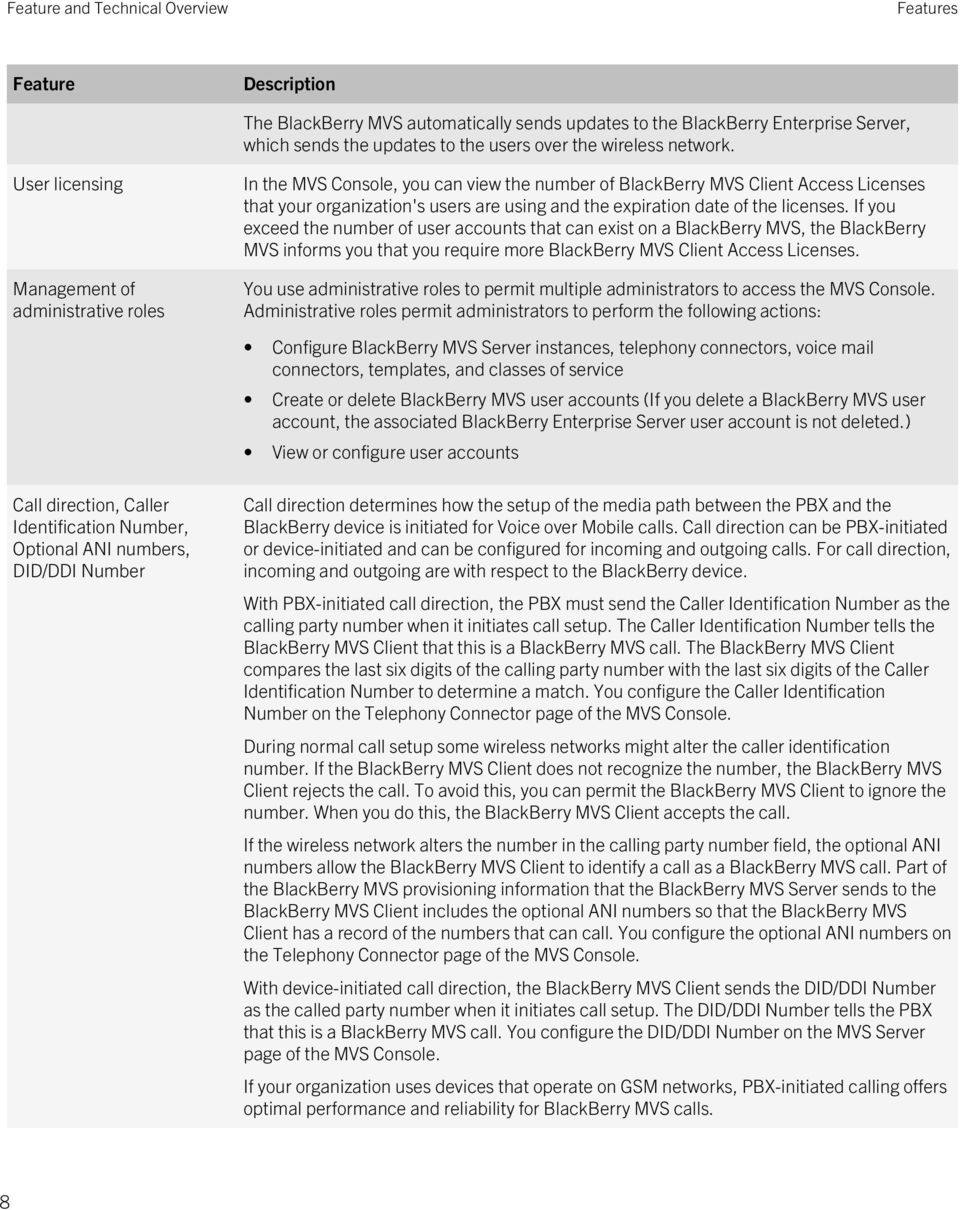
9 Features Feature Description If your organization uses devices that operate on CDMA networks, device-initiated calling offers optimal performance and reliability for BlackBerry MVS calls. Phone number translation Provisioning Input validation rules The Location feature provides phone number normalization. The feature translates the globally unique E.164 number starting with a plus sign (+) to a locally significant number by stripping the plus sign (+) and adding International Direct Dial (IDD) or National Direct Dial (NDD) access codes corresponding to the PSTN dial plan for the selected location. Normalization is applied to the called number of outgoing external calls that start with a plus sign. The 'called number' refers to a called number sent from the MVS Session Manager to the PBX. 'Outgoing' means from the enterprise to the external network. Use this feature when your organization's PBX does not support the plus sign or does not add the prefixes automatically. Provisioning data for BlackBerry MVS users is stored in the BlackBerry Configuration Database. The BlackBerry Configuration Database sends the data to the user's devices over the wireless network when you add a user to the BlackBerry MVS, or when you enable or disable a user in the MVS Console. The data includes user settings, and preferences. The input validation rules for the MVS Console are restrictive to help you recognize data entry errors. If you make an error when adding data, a tool tip message displays an explanation of the error. Security features Feature Authentication of BlackBerry Mobile Voice System users Standard message encryption Description The BlackBerry Enterprise Server and BlackBerry Enterprise Service 10 are designed to authenticate BlackBerry device users to the BlackBerry MVS and your organization's PBX phone system. When users connect to the wireless network, the BlackBerry MVS Client is designed to register with the BlackBerry MVS Server. Only an authenticated BlackBerry device can access the work phone number and phone features. Only authenticated BlackBerry MVS users can use their BlackBerry devices to extend the capabilities of their desk phones. The BlackBerry MVS is designed to use the security features of the BlackBerry Enterprise Solution. The BlackBerry Enterprise Solution uses a symmetric key encryption algorithm that is designed to protect data that is in transit between a BlackBerry device and the BlackBerry MVS. For more information, see the BlackBerry Enterprise Solution Security Technical Overview. 9
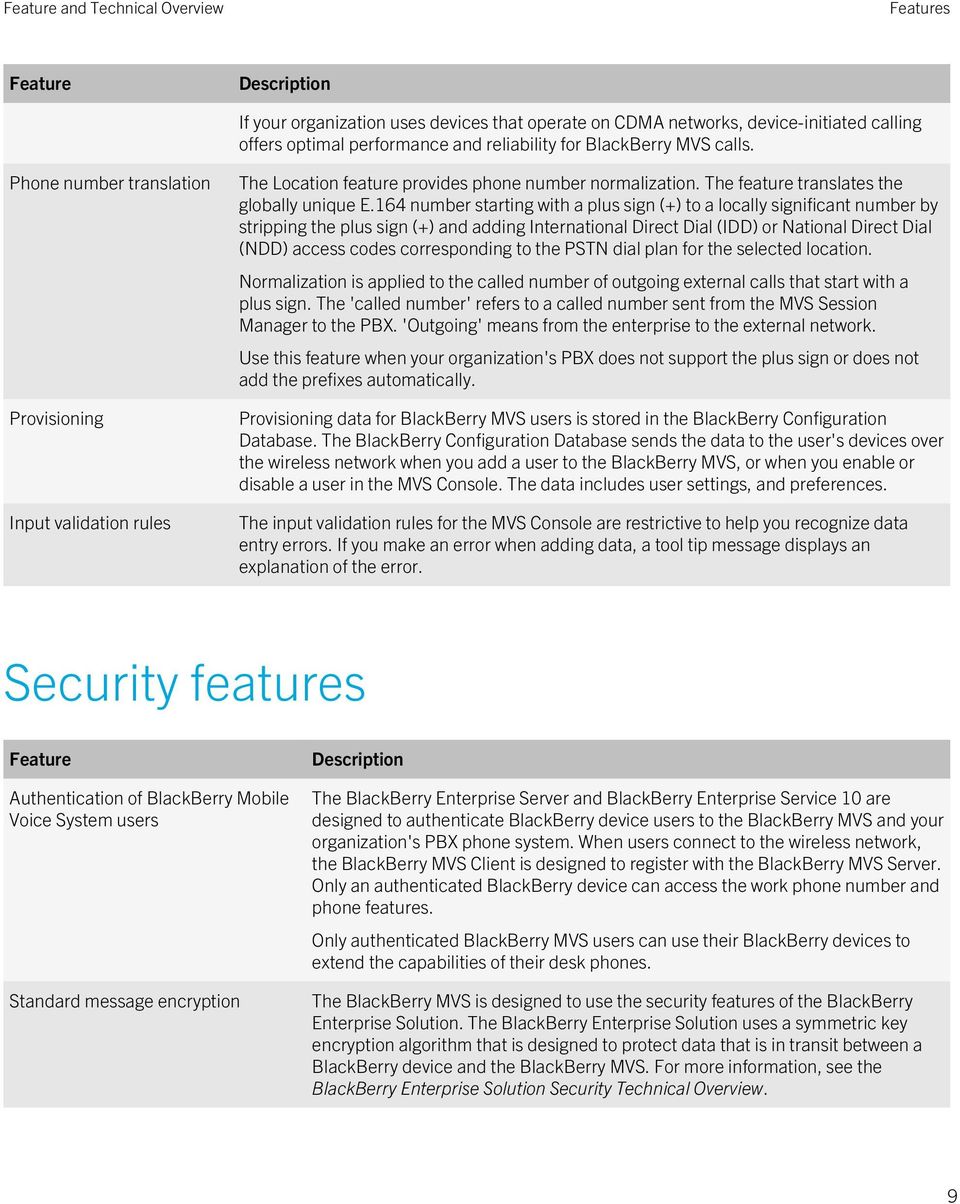
10 Features Feature Call and diagnostic logging Description The BlackBerry MVS call logs provide information about the call activity of BlackBerry device users. They also include information about error messages, warnings, information that you can use to troubleshoot issues, and other events that are related to the BlackBerry MVS. Phone features To use the following phone features, appropriate data coverage and voice coverage are required. For example, appropriate coverage includes GPRS, EDGE, or 3G for devices that operate on GSM networks; 1XEV for devices that operate on CDMA networks; or a Wi-Fi network for Wi-Fi enabled BlackBerry devices. Feature Default phone number selection Description BlackBerry Mobile Voice System users have two phone numbers that are associated with their BlackBerry devices: a phone number that is provided by their wireless service providers and a work number that is provided by your organization. To configure which phone number to use by default, the following options are available: Default line for outgoing calls: Users can select the mobile number or the work number as the default phone line for making outgoing calls. When users click Last selected, the next outgoing call uses the most recently selected line. When the BlackBerry MVS Line is unavailable, use the Mobile line (appears when you choose BlackBerry MVS Line or Last selected): Always: Users can use the work number to make outgoing calls. If the work number is not available, outgoing calls use the mobile number. Ask: Users can use the work number to make outgoing calls if the work number is available. If the work number is not available, users can use the mobile number, if they accept a prompt to do so. Never: Users can use only the work number to make outgoing calls. This option does not appear if Last selected is configured as the default line for outgoing calls. Default network selection Users of Wi-Fi enabled BlackBerry devices can use Voice over Wi-Fi to access desk phone features. Users can select either Voice over Mobile or Voice over Wi- Fi as the default network to make and receive calls. To configure the default network, the following options are available: 10
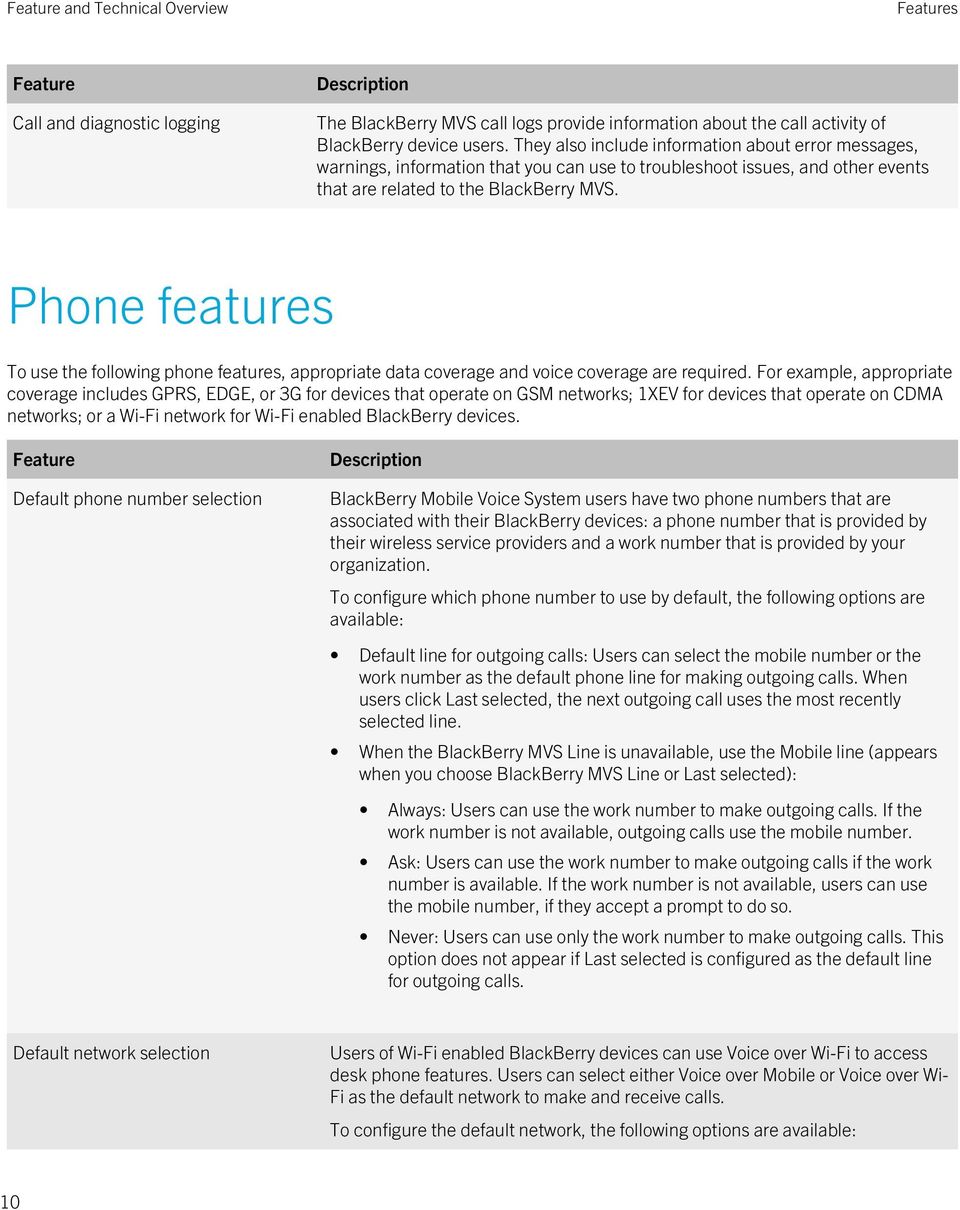
11 Features Feature Description Default network for work calls: Choose Wi-Fi or Mobile. When Wi-Fi is unavailable, use mobile (appears when Wi-Fi is selected): Yes: When a user is connected to a Wi-Fi network, the BlackBerry MVS uses Voice over Wi-Fi to make and receive work calls; however, the user can use the work number regardless of Wi-Fi network availability. When the user is outside a Wi-Fi coverage area, the BlackBerry MVS uses Voice over Mobile. No: A user must be connected to a Wi-Fi network to use the work number. When mobile is unavailable, use Wi-Fi (appears when Mobile is selected): Yes: The BlackBerry MVS uses Voice over Mobile for work calls, even if a user is connected to a Wi-Fi network. The user can manually move calls to Voice over Wi-Fi if the user is connected to a Wi-Fi network. No: The BlackBerry MVS uses only Voice over Mobile for work calls. A user cannot use Voice over Wi-Fi for work calls. Network handoff You can permit BlackBerry MVS users to automatically move an active call from Voice over Wi-Fi to Voice over Mobile or from Voice over Mobile to Voice over Wi- Fi. This action can occur only one time per call. To configure network handoff, the following options are available: Automatic handoff with user notification: A message and an audible alert notifies the user when an active call moves between Voice over Wi-Fi and Voice over Mobile. During automatic handoff with user notification, the user can cancel the handoff of a Voice over Mobile call moving to a Wi-Fi network. Automatic handoff with user prompt: A message and an audible alert asks the users if they want to move an active call between Voice over Wi-Fi and Voice over Mobile. If the user does not confirm the request, the call does not move. Automatic handoff is not available: Automatic network handoff is not available. Scheduling Access to desk phone features You can schedule when BlackBerry MVS users can answer calls that are made to their work numbers. You can also configure whether users can change the schedules on their BlackBerry devices. You can permit users to schedule when they receive calls for each day of the week. BlackBerry MVS users can use the phone application on their BlackBerry devices to access the desk phone features on their BlackBerry devices. BlackBerry MVS users can use desk phone features to perform the following actions: 11
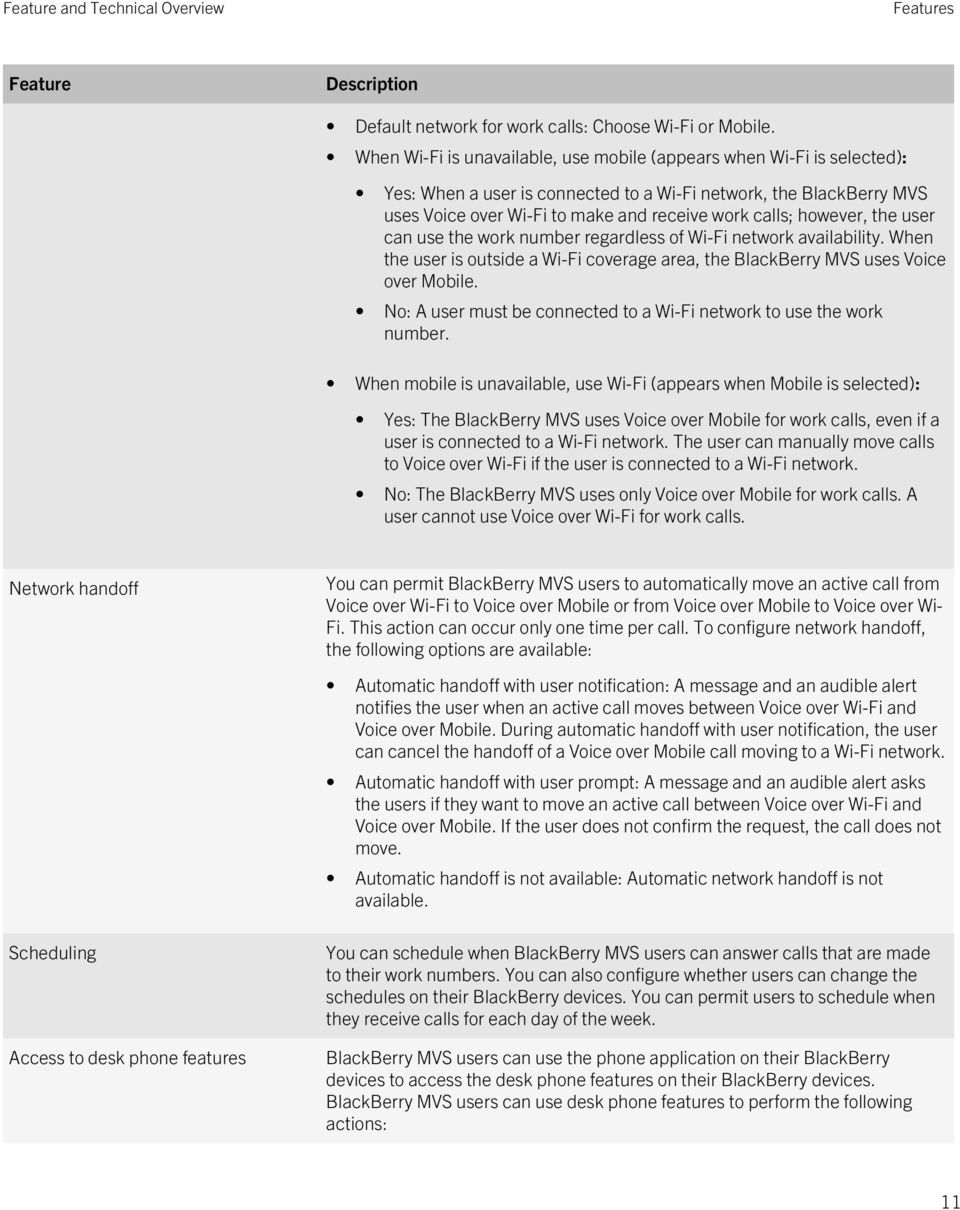
12 Features Feature Description Hold and resume calls Transfer calls Make and receive a second call (if the users are using a device that operates on a GSM network and is running BlackBerry Device Software 5.0 or 6.0, or the users are using a BlackBerry Curve 9360 smartphone or a BlackBerry Bold 9790 smartphone) Move calls to their desk phones. (In an Avaya integration, users do not have to use the BlackBerry MVS Client to move calls; they can pick up the desk phone, enter their password, and proceed with the call.) Move calls to one-time numbers Move work calls from Voice over Mobile to Voice over Wi-Fi Move work calls from Voice over Wi-Fi to Voice over Mobile (When you move a call from Voice over Wi-Fi to Voice over Mobile, the call is always a PBXinitiated call regardless of the call direction setting that is configured in the class of service.) Move calls from the work number to the mobile number Switch active calls Forward incoming BlackBerry MVS calls to an internal extension or another phone Voice mail integration Corporate directory Caller restrictions You can integrate the BlackBerry MVS with your organization's voice mail system to provide BlackBerry device users with access to the voice mail messages for their work numbers. BlackBerry MVS users can look up names in their organization's corporate directory. You can filter incoming calls to work numbers on BlackBerry devices. When the BlackBerry MVS Server receives a BlackBerry MVS call from the PBX, before the BlackBerry MVS Server rings a BlackBerry device, it filters the incoming number through the blocked caller list and allowed caller list. If the BlackBerry MVS Server finds an incoming number in the allowed caller list, and the user did not select No Callers Allowed, the BlackBerry MVS Server rings the BlackBerry device. If the BlackBerry MVS Server finds the incoming number in the blocked caller list, the BlackBerry MVS Server does not ring the BlackBerry device. If the user does not answer the call on the desk phone, the PBX sends the call to the user's voice mail, if voice mail is configured. If the user's voice mail is not configured, the blocked caller receives a busy signal. You can select one of the following caller restriction options: All Callers Allowed 12

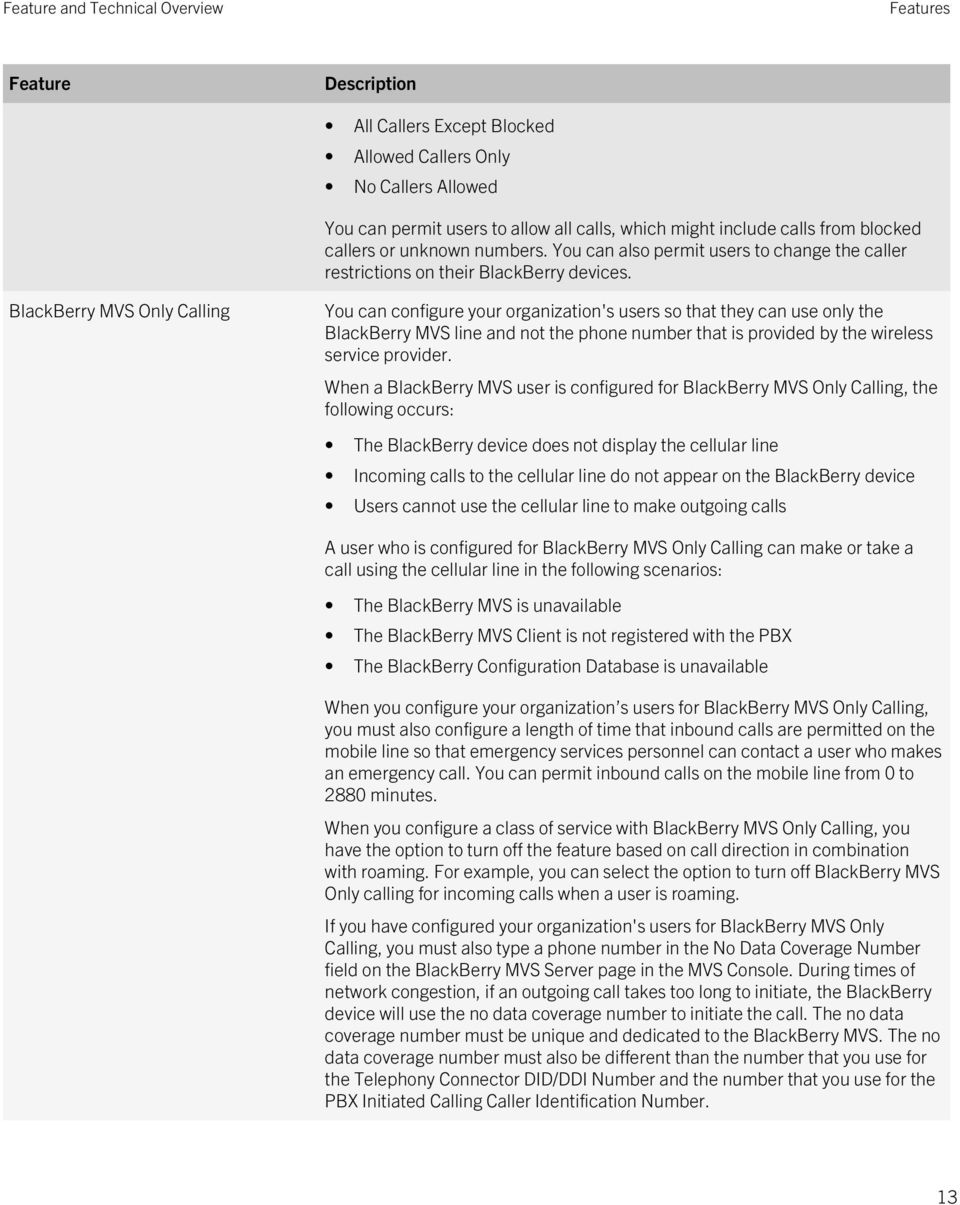
13 Features Feature Description All Callers Except Blocked Allowed Callers Only No Callers Allowed You can permit users to allow all calls, which might include calls from blocked callers or unknown numbers. You can also permit users to change the caller restrictions on their BlackBerry devices. BlackBerry MVS Only Calling You can configure your organization's users so that they can use only the BlackBerry MVS line and not the phone number that is provided by the wireless service provider. When a BlackBerry MVS user is configured for BlackBerry MVS Only Calling, the following occurs: The BlackBerry device does not display the cellular line Incoming calls to the cellular line do not appear on the BlackBerry device Users cannot use the cellular line to make outgoing calls A user who is configured for BlackBerry MVS Only Calling can make or take a call using the cellular line in the following scenarios: The BlackBerry MVS is unavailable The BlackBerry MVS Client is not registered with the PBX The BlackBerry Configuration Database is unavailable When you configure your organization s users for BlackBerry MVS Only Calling, you must also configure a length of time that inbound calls are permitted on the mobile line so that emergency services personnel can contact a user who makes an emergency call. You can permit inbound calls on the mobile line from 0 to 2880 minutes. When you configure a class of service with BlackBerry MVS Only Calling, you have the option to turn off the feature based on call direction in combination with roaming. For example, you can select the option to turn off BlackBerry MVS Only calling for incoming calls when a user is roaming. If you have configured your organization's users for BlackBerry MVS Only Calling, you must also type a phone number in the No Data Coverage Number field on the BlackBerry MVS Server page in the MVS Console. During times of network congestion, if an outgoing call takes too long to initiate, the BlackBerry device will use the no data coverage number to initiate the call. The no data coverage number must be unique and dedicated to the BlackBerry MVS. The no data coverage number must also be different than the number that you use for the Telephony Connector DID/DDI Number and the number that you use for the PBX Initiated Calling Caller Identification Number. 13
14 Architecture: BlackBerry MVS with SIP intermediary Architecture: BlackBerry MVS with SIP intermediary 3 The basic BlackBerry Mobile Voice System includes a standalone BlackBerry MVS Server instance that is integrated with a BlackBerry Enterprise Server instance and one SIP gateway, or a BlackBerry Enterprise Service 10 instance and one SIP gateway, or a BlackBerry Enterprise Server and a BlackBerry Enterprise Service 10 instance connected to one SIP gateway. You can use the SIP gateway implementation to translate DTMF tones from RFC2833 to SIP INFO for incoming BlackBerry MVS calls and from SIP INFO to RFC2833 for outgoing BlackBerry MVS calls. The SIP intermediary in the following diagrams can be either an Avaya Aura Session Manager or an Acme Packet Session Border Controller. The following architecture diagram shows the BlackBerry MVS installed with a BlackBerry Enterprise Server. The BlackBerry MVS includes one of each of the following components: 14

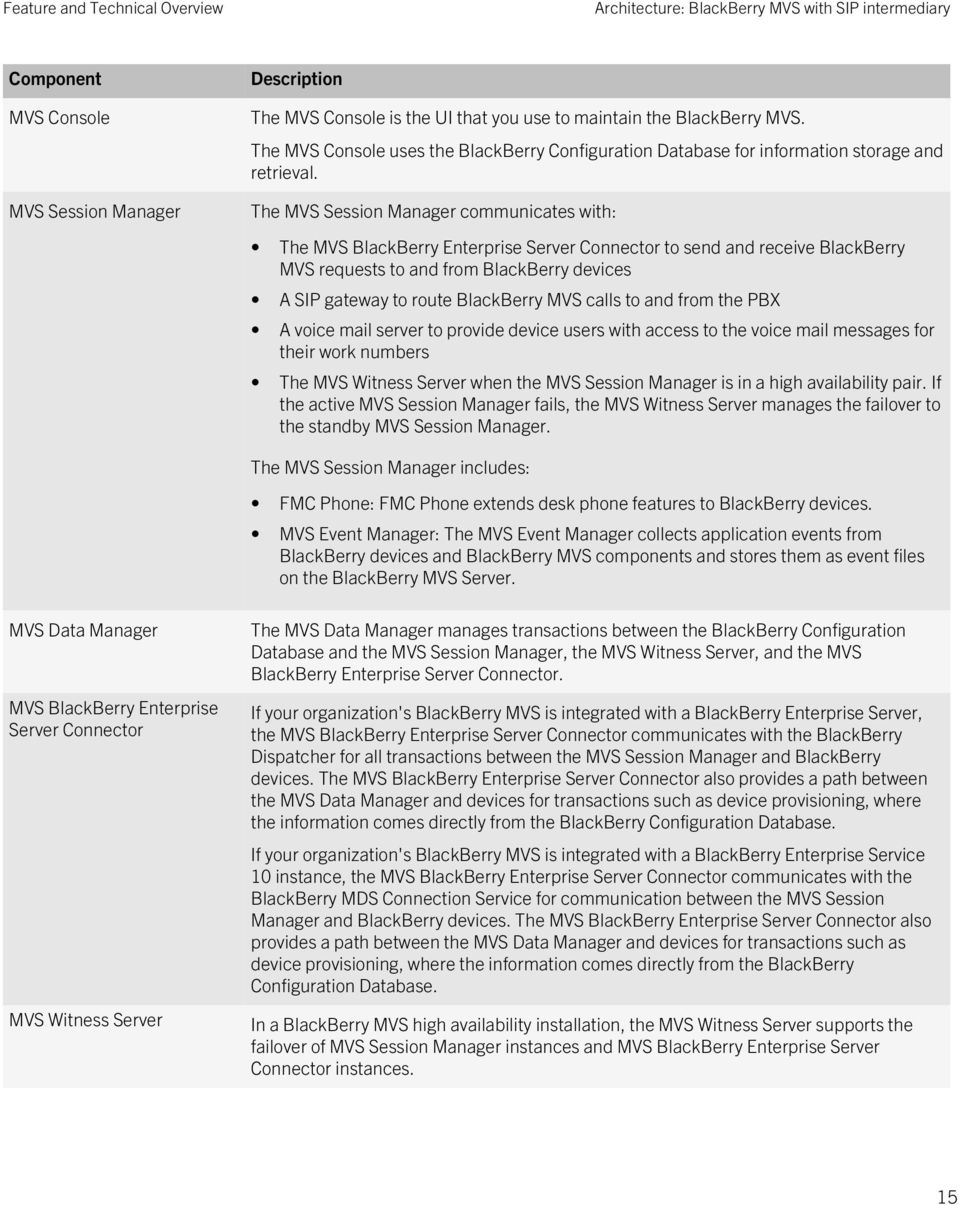
15 Architecture: BlackBerry MVS with SIP intermediary Component MVS Console MVS Session Manager Description The MVS Console is the UI that you use to maintain the BlackBerry MVS. The MVS Console uses the BlackBerry Configuration Database for information storage and retrieval. The MVS Session Manager communicates with: The MVS BlackBerry Enterprise Server Connector to send and receive BlackBerry MVS requests to and from BlackBerry devices A SIP gateway to route BlackBerry MVS calls to and from the PBX A voice mail server to provide device users with access to the voice mail messages for their work numbers The MVS Witness Server when the MVS Session Manager is in a high availability pair. If the active MVS Session Manager fails, the MVS Witness Server manages the failover to the standby MVS Session Manager. The MVS Session Manager includes: FMC Phone: FMC Phone extends desk phone features to BlackBerry devices. MVS Event Manager: The MVS Event Manager collects application events from BlackBerry devices and BlackBerry MVS components and stores them as event files on the BlackBerry MVS Server. MVS Data Manager MVS BlackBerry Enterprise Server Connector MVS Witness Server The MVS Data Manager manages transactions between the BlackBerry Configuration Database and the MVS Session Manager, the MVS Witness Server, and the MVS BlackBerry Enterprise Server Connector. If your organization's BlackBerry MVS is integrated with a BlackBerry Enterprise Server, the MVS BlackBerry Enterprise Server Connector communicates with the BlackBerry Dispatcher for all transactions between the MVS Session Manager and BlackBerry devices. The MVS BlackBerry Enterprise Server Connector also provides a path between the MVS Data Manager and devices for transactions such as device provisioning, where the information comes directly from the BlackBerry Configuration Database. If your organization's BlackBerry MVS is integrated with a BlackBerry Enterprise Service 10 instance, the MVS BlackBerry Enterprise Server Connector communicates with the BlackBerry MDS Connection Service for communication between the MVS Session Manager and BlackBerry devices. The MVS BlackBerry Enterprise Server Connector also provides a path between the MVS Data Manager and devices for transactions such as device provisioning, where the information comes directly from the BlackBerry Configuration Database. In a BlackBerry MVS high availability installation, the MVS Witness Server supports the failover of MVS Session Manager instances and MVS BlackBerry Enterprise Server Connector instances. 15
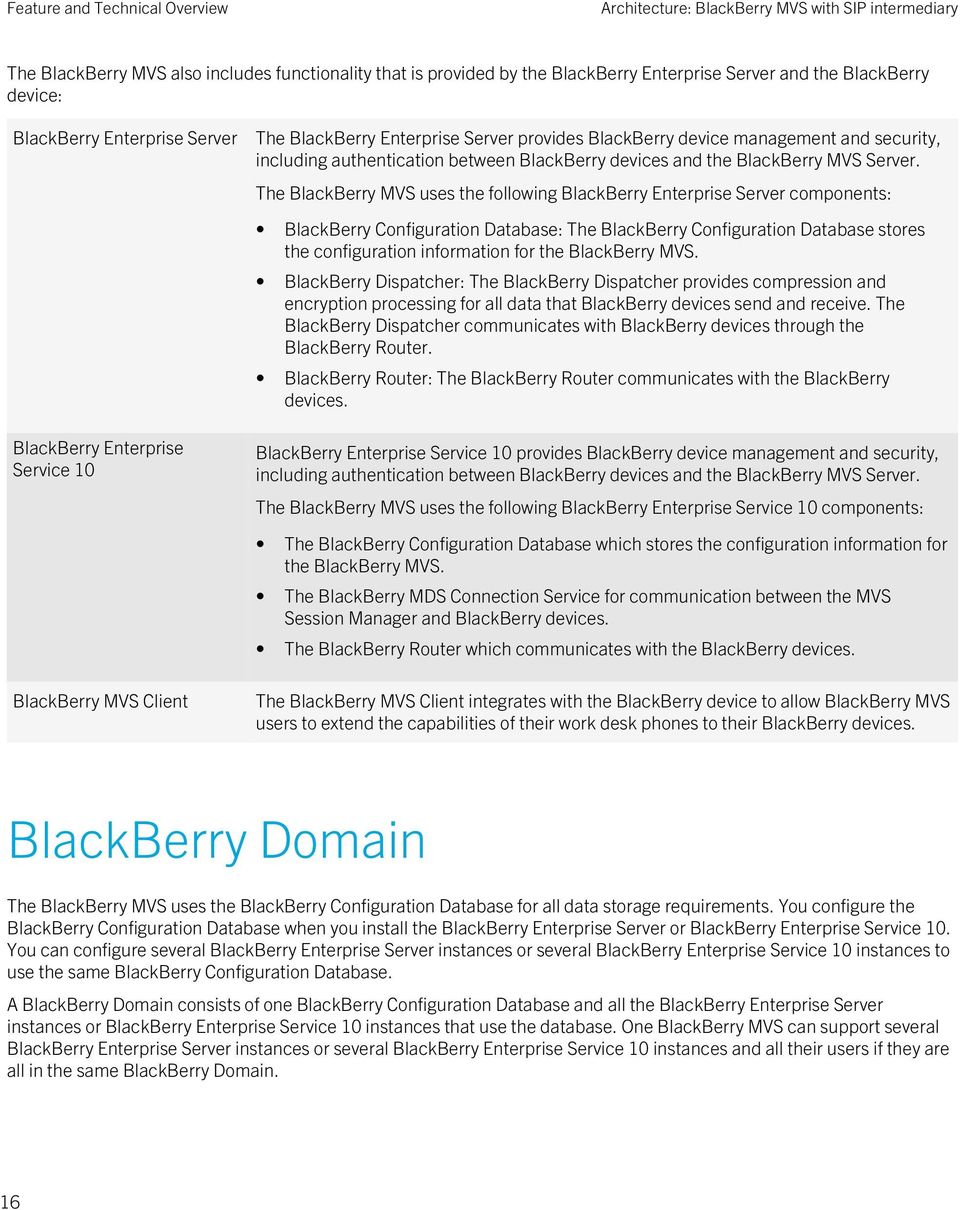
16 Architecture: BlackBerry MVS with SIP intermediary The BlackBerry MVS also includes functionality that is provided by the BlackBerry Enterprise Server and the BlackBerry device: BlackBerry Enterprise Server The BlackBerry Enterprise Server provides BlackBerry device management and security, including authentication between BlackBerry devices and the BlackBerry MVS Server. The BlackBerry MVS uses the following BlackBerry Enterprise Server components: BlackBerry Configuration Database: The BlackBerry Configuration Database stores the configuration information for the BlackBerry MVS. BlackBerry Dispatcher: The BlackBerry Dispatcher provides compression and encryption processing for all data that BlackBerry devices send and receive. The BlackBerry Dispatcher communicates with BlackBerry devices through the BlackBerry Router. BlackBerry Router: The BlackBerry Router communicates with the BlackBerry devices. BlackBerry Enterprise Service 10 BlackBerry Enterprise Service 10 provides BlackBerry device management and security, including authentication between BlackBerry devices and the BlackBerry MVS Server. The BlackBerry MVS uses the following BlackBerry Enterprise Service 10 components: The BlackBerry Configuration Database which stores the configuration information for the BlackBerry MVS. The BlackBerry MDS Connection Service for communication between the MVS Session Manager and BlackBerry devices. The BlackBerry Router which communicates with the BlackBerry devices. BlackBerry MVS Client The BlackBerry MVS Client integrates with the BlackBerry device to allow BlackBerry MVS users to extend the capabilities of their work desk phones to their BlackBerry devices. BlackBerry Domain The BlackBerry MVS uses the BlackBerry Configuration Database for all data storage requirements. You configure the BlackBerry Configuration Database when you install the BlackBerry Enterprise Server or BlackBerry Enterprise Service 10. You can configure several BlackBerry Enterprise Server instances or several BlackBerry Enterprise Service 10 instances to use the same BlackBerry Configuration Database. A BlackBerry Domain consists of one BlackBerry Configuration Database and all the BlackBerry Enterprise Server instances or BlackBerry Enterprise Service 10 instances that use the database. One BlackBerry MVS can support several BlackBerry Enterprise Server instances or several BlackBerry Enterprise Service 10 instances and all their users if they are all in the same BlackBerry Domain. 16
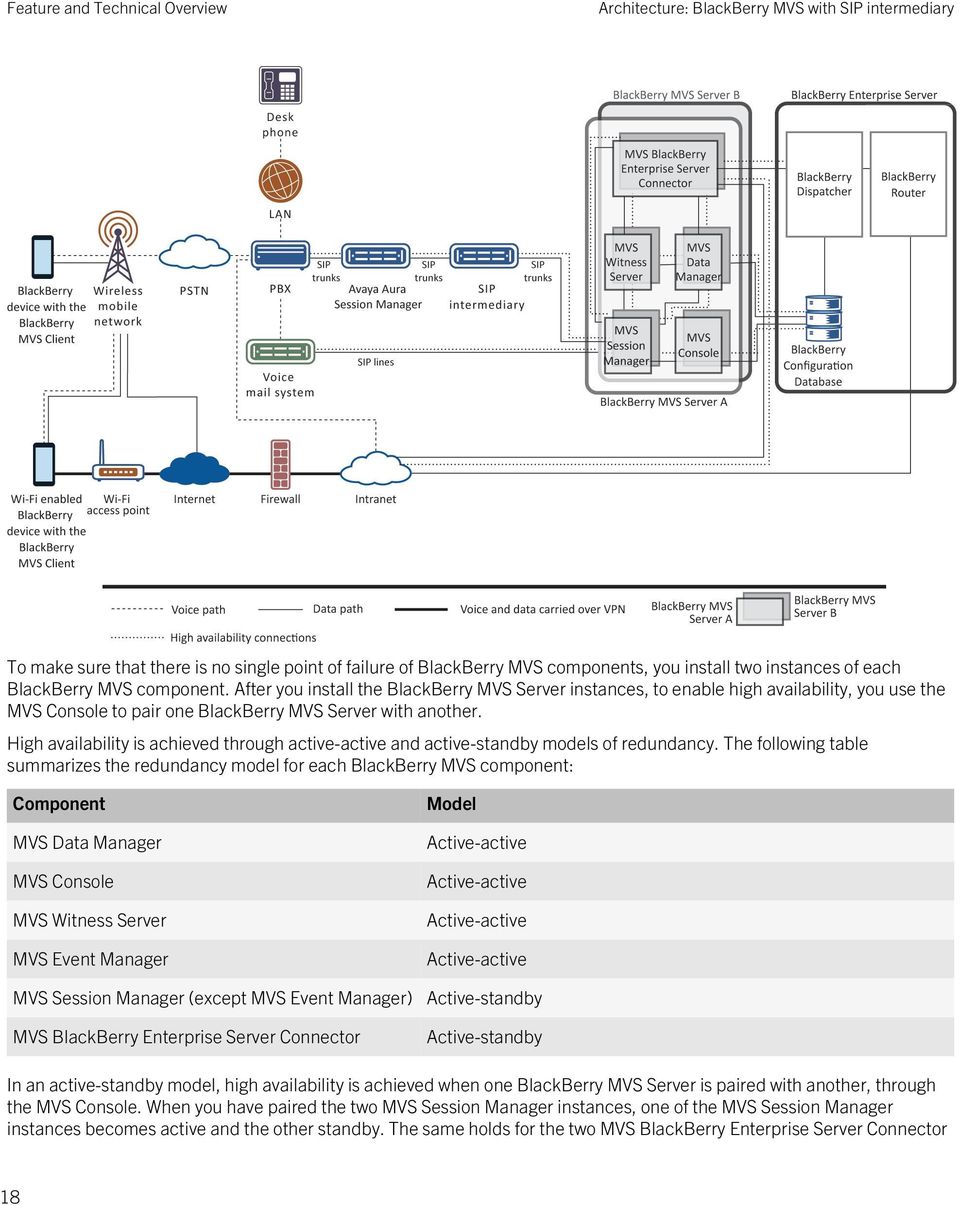
17 Architecture: BlackBerry MVS with SIP intermediary BlackBerry MVS configuration The BlackBerry MVS components communicate with each other and the BlackBerry Configuration Database to create a 'map' of all BlackBerry MVS Server instances, their components, and their associations. This map is referred to as the BlackBerry MVS configuration. A BlackBerry MVS Server and its components are added to the BlackBerry MVS configuration when you install a BlackBerry MVS Server. You can use the MVS Console to disable a BlackBerry MVS component from the BlackBerry MVS configuration. For more information on adding or removing a BlackBerry MVS Server component, see the BlackBerry MVS Administration Guide. Architecture: BlackBerry MVS high availability The BlackBerry Mobile Voice System high availability installation with a BlackBerry Enterprise Server is illustrated below. The SIP intermediary in the following diagrams can be either an Avaya Aura Session Manager or an Acme Packet Session Border Controller. 17

18 Architecture: BlackBerry MVS with SIP intermediary To make sure that there is no single point of failure of BlackBerry MVS components, you install two instances of each BlackBerry MVS component. After you install the BlackBerry MVS Server instances, to enable high availability, you use the MVS Console to pair one BlackBerry MVS Server with another. High availability is achieved through active-active and active-standby models of redundancy. The following table summarizes the redundancy model for each BlackBerry MVS component: Component MVS Data Manager MVS Console MVS Witness Server MVS Event Manager MVS Session Manager (except MVS Event Manager) MVS BlackBerry Enterprise Server Connector Model Active-active Active-active Active-active Active-active Active-standby Active-standby In an active-standby model, high availability is achieved when one BlackBerry MVS Server is paired with another, through the MVS Console. When you have paired the two MVS Session Manager instances, one of the MVS Session Manager instances becomes active and the other standby. The same holds for the two MVS BlackBerry Enterprise Server Connector 18
19 Architecture: BlackBerry MVS with SIP intermediary instances: One becomes active, one standby. The components themselves determine which one becomes active and which one standby. If the active component fails, failover from the active component to the standby component is managed by the components in conjunction with the MVS Witness Server. In an active-active model, components are always active. If a component fails, the BlackBerry MVS automatically stops using that component. High availability is achieved by providing two components of the same type at the BlackBerry Domain level, and not for every high availability pair. For example, because MVS Data Manager instances use an active-active model, two MVS Data Manager instances provide redundancy for all BlackBerry MVS Server instances in the BlackBerry Domain. By comparison, there must be one active and one standby MVS Session Manager for every high availability pair. 19
20 BlackBerry MVS and call recording BlackBerry MVS and call recording 4 The BlackBerry Mobile Voice System does not record calls. However, you can use a third-party call recording solution to record BlackBerry MVS calls. The BlackBerry MVS was tested using a passive mode of recording, where the recording solution monitors specific network connections to capture the necessary call signaling messages and related media. Architecture: Call recording If you connect the BlackBerry Mobile Voice System directly to a SIP gateway, the recording solution monitors (or spans) the switch port that is connected to the SIP gateway. This spanning mechanism copies all messages and media to the recording solution that is destined to or that originates from the SIP gateway. The recording solution then captures, tags and archives the messages and media appropriately. 20

21 BlackBerry MVS and call recording Restricting users to the BlackBerry MVS line If your organization's users are using BlackBerry 6.x or BlackBerry 7.x devices, you can configure the users to use only the BlackBerry Mobile Voice System line and not the phone number that is provided by the wireless service provider. In the MVS Console, you must configure a class of service for the users that you will record calls for. In the class of service, you must select the Restrict calls to use only the BlackBerry MVS line check box, and clear the User can transfer a call check box and the User can move a call to a one time number check box. There are also parameters set through a BlackBerry Enterprise Server IT policy that can block all incoming non-blackberry MVS calls from reaching the user's mobile line. For more information about restricting calls to the BlackBerry MVS line, refer to the following KB article: 21
22 BlackBerry MVS and call recording A user who is configured for BlackBerry MVS Only calling can make or take a call using the mobile line in the following scenarios: The BlackBerry MVS is unavailable The BlackBerry MVS Client is not registered with the PBX The BlackBerry Configuration Database is unavailable 22
23 Call flows: SIP Gateway with the Avaya Aura Session Manager Call flows: SIP Gateway with the Avaya Aura Session Manager 5 Call flow: Making a PBX-initiated call from a BlackBerry device to an internal number 23
24 Call flows: SIP Gateway with the Avaya Aura Session Manager 1. A BlackBerry Mobile Voice System user makes a call from a BlackBerry device to an extension number in the user's organization. 2. The BlackBerry MVS Client creates a call establishment request, which includes the destination extension number. The BlackBerry MVS Client compresses, encrypts, and sends the request to the BlackBerry Enterprise Server over the wireless network. 3. The BlackBerry Enterprise Server decrypts, decompresses, and sends the request to the MVS BlackBerry Enterprise Server Connector. 4. The MVS BlackBerry Enterprise Server Connector sends the request to the MVS Session Manager. 5. The MVS Session Manager sends a confirmation response to the BlackBerry device and, using the SIP trunk, requests that the SIP gateway establish a call through the Avaya Aura Session Manager and the PBX to the BlackBerry device using the mobile number. 6. The PBX sends the call to the BlackBerry device over the PSTN and wireless network using the caller ID number of the telephony connector as the ANI. 7. The BlackBerry MVS Client receives a call. If the ANI in the incoming call matches the ANI that are specified in the Telephony Connector Caller Identification Number field or the Telephony Connector Optional ANI numbers available for identifying BlackBerry MVS calls fields of the MVS Console, or if no ANI exists, the BlackBerry MVS Client accepts the call. 8. The BlackBerry MVS Client sends a verification code request to the MVS Session Manager using DTMF tones. 9. If the ANI in the incoming call is empty, the MVS Session Manager sends a verification code response to the BlackBerry device using DTMF tones. The MVS Session Manager, using the SIP trunk, requests that the SIP gateway establish a call through the Avaya Aura Session Manager and the PBX to the internal number using the extension number. 10. The PBX determines that the extension number is internal to the organization and rings the extension number over the organization's LAN. 11. The recipient answers the call. 12. The MVS Session Manager uses DTMF tones to indicate that the call is connected to the BlackBerry device. The MVS Session Manager instructs the SIP gateway to connect the two call legs, and voice communication can occur. 24
25 Call flows: SIP Gateway with the Avaya Aura Session Manager Call flow: Making a BlackBerry device initiated call to an internal number 1. A BlackBerry Mobile Voice System user makes a call from a BlackBerry device to an extension number in the user's organization. 25
26 Call flows: SIP Gateway with the Avaya Aura Session Manager 2. The BlackBerry MVS Client creates a call establishment request, which includes the destination extension number. The BlackBerry MVS Client compresses, encrypts, and sends the request to the BlackBerry Enterprise Server over the wireless data network. 3. The BlackBerry Enterprise Server decrypts, decompresses, and sends the request to the MVS BlackBerry Enterprise Server Connector. 4. The MVS BlackBerry Enterprise Server Connector sends the request to the MVS Session Manager. 5. The MVS Session Manager sends a confirmation request to the device. The confirmation request includes the DID/DDI number that the BlackBerry MVS Client uses to communicate with the MVS Session Manager. 6. The BlackBerry MVS Client uses the wireless voice network to make a call to the PBX using the DID/DDI number. 7. The PBX sends the call through the Avaya Aura Session Manager to the SIP gateway. 8. The SIP gateway sends the call to the MVS Session Manager over the SIP trunk using the DID/DDI number. 9. The MVS Session Manager answers the incoming call. The MVS Session Manager sends a message to the BlackBerry MVS Client to indicate that it answered the call. 10. The MVS Session Manager and the BlackBerry MVS Client use a two-way protocol to authenticate the call. 11. The MVS Session Manager verifies the call and requests that the SIP gateway establish a call through the Avaya Aura Session Manager and the PBX to the extension number using the SIP trunk. 12. The PBX determines that the extension number is internal to the organization and rings the extension number over the organization's LAN. 13. The recipient answers the call at the desk phone. 14. The MVS Session Manager uses DTMF tones to indicate to the device that the call is connected to the extension number. The MVS Session Manager instructs the SIP gateway to connect the two call legs, and voice communication can occur. 26
27 Call flows: SIP Gateway with the Avaya Aura Session Manager Call flow: Making a call from a BlackBerry device using Voice over Wi-Fi to an internal number 1. A BlackBerry Mobile Voice System user connects to a Wi-Fi network and authenticates with the BlackBerry MVS. The user makes a call from a BlackBerry device to an internal number. 27
28 Call flows: SIP Gateway with the Avaya Aura Session Manager 2. The device starts a call establishment request, which includes the destination extension number. The device compresses, encrypts, and sends the request to the BlackBerry Enterprise Server over the Wi-Fi network. 3. The BlackBerry Enterprise Server decrypts, decompresses, and sends the request to the MVS BlackBerry Enterprise Server Connector over a TCP connection. 4. The MVS BlackBerry Enterprise Server Connector sends the request to the MVS Session Manager. 5. The MVS Session Manager sends the request using SIP to the SIP gateway over a UDP port. 6. The SIP gateway sends the call through the Avaya Aura Session Manager to the PBX. 7. The PBX determines that the extension number is internal to the organization and rings the extension number over the organization's LAN. 8. The recipient answers the call at a desk phone and voice communication occurs over an RTP connection between the BlackBerry device and the SIP gateway. 28
29 Call flows: SIP Gateway with the Avaya Aura Session Manager Call flow: Receiving a PBX-initiated call on a BlackBerry device from an external number 1. An external user dials the work number of a BlackBerry Mobile Voice System user. 2. The PBX sends the call through the Avaya Aura Session Manager to the SIP gateway. 3. The SIP gateway creates a call establishment request and sends it to the MVS Session Manager over the SIP trunk. 29
30 Call flows: SIP Gateway with the Avaya Aura Session Manager 4. The MVS Session Manager filters the call establishment request through the BlackBerry MVS user's settings: unknown caller ID, call scheduling, allowed caller list, and blocked caller list. If the call is permitted, the MVS Session Manager sends the call establishment request to the BlackBerry Enterprise Server. 5. The BlackBerry Enterprise Server compresses and encrypts the call establishment request, and sends it to the wireless network. The call establishment request contains the caller identification information and the phone number of the caller. 6. One of the following events occurs: If the BlackBerry device receives the incoming call request, the BlackBerry device decrypts and decompresses it. The BlackBerry device then encrypts and compresses a call establishment response, and sends the call establishment response to the BlackBerry Enterprise Server. The BlackBerry Enterprise Server decrypts and decompresses the call establishment response, and sends it to the MVS BlackBerry Enterprise Server Connector. If the BlackBerry device does not receive the incoming call request, the MVS BlackBerry Enterprise Server Connector stops responding while it waits for the call establishment response. 7. The MVS BlackBerry Enterprise Server Connector sends the request to the MVS Session Manager. 8. The MVS Session Manager using the SIP trunk, requests that the SIP gateway establish a call through the Avaya Aura Session Manager to the PBX to the BlackBerry device using the mobile number. 9. The PBX sends the call request to the BlackBerry device over the PSTN and wireless network. 10. The BlackBerry device receives the call. The following events can occur: If the BlackBerry device receives the call establishment request, the caller ID from the call establishment request appears on the BlackBerry device. If the ANI matches the ANI in the Telephony Connector Caller Identification Number field of the MVS Console, the call appears on the BlackBerry device as a BlackBerry MVS call. If the ANI matches an ANI in the Telephony Connector Optional ANI numbers available for identifying BlackBerry MVS calls fields of the MVS Console, the call appears on the BlackBerry device as a BlackBerry MVS call. If the BlackBerry device does not receive the call establishment request, the call appears on the BlackBerry device as an unknown call. 11. The BlackBerry MVS user accepts the call on the BlackBerry device. 12. The BlackBerry MVS Client sends a verification code request to the MVS Session Manager using DTMF tones. 13. If the incoming call has an empty ANI, the MVS Session Manager sends a verification code response to the BlackBerry device using DTMF tones. One of the following events occurs: If no ANI exists in the received call, and the BlackBerry device receives the call establishment request, the call appears on the BlackBerry device as a BlackBerry MVS call with the caller ID from the call establishment request. If no ANI exists in the received call, and the BlackBerry device did not receive the call establishment request, the call appears on the BlackBerry device as a wireless network call. 14. If the incoming call has an empty ANI, and the BlackBerry MVS Client receives the verification code response from the MVS Session Manager, the BlackBerry MVS Client switches the call so that it appears as a BlackBerry MVS call. 15. The MVS Session Manager instructs the SIP gateway to connect the two call legs, and voice communication can occur. 30
31 Call flows: SIP Gateway with the Avaya Aura Session Manager Call flow: Receiving a BlackBerry device initiated call on a device from an external number 1. An external user dials the work number of a BlackBerry Mobile Voice System user. 2. The PBX routes the call through the Avaya Aura Session Manager to the SIP gateway. 31
32 Call flows: SIP Gateway with the Avaya Aura Session Manager 3. The SIP gateway creates a call establishment request and sends it to the MVS Session Manager over the SIP trunk. 4. The MVS Session Manager filters the call establishment request through the BlackBerry MVS user's settings: unknown caller ID, call scheduling, allowed caller list, and blocked caller list. If the call is permitted, the MVS Session Manager sends the call establishment request to the BlackBerry Enterprise Server. 5. The BlackBerry Enterprise Server compresses, encrypts, and sends the request to the wireless data network. The call establishment request includes the caller ID information, the phone number of the incoming caller, and the DID/DDI number that the BlackBerry MVS Client uses to communicate with the MVS Session Manager. 6. The BlackBerry device decrypts and decompresses the incoming call request, compresses and encrypts a call establishment response, and sends the call establishment response to the BlackBerry Enterprise Server. 7. The BlackBerry Enterprise Server decrypts, decompresses, and sends the request to the MVS BlackBerry Enterprise Server Connector. 8. The MVS BlackBerry Enterprise Server Connector sends the request to the MVS Session Manager. 9. The BlackBerry MVS Client uses the wireless voice network to make a call to the PBX. 10. The PBX routes the call through the Avaya Aura Session Manager to the SIP gateway. 11. The SIP gateway routes the call to the MVS Session Manager over the SIP trunk using the DID/DDI number. 12. The MVS Session Manager answers the call and sends a message to the BlackBerry MVS Client to indicate that it answered the call. 13. The MVS Session Manager and the BlackBerry MVS Client use a two-way protocol to authenticate the call. 14. The MVS Session Manager verifies that the call is a BlackBerry MVS call. 15. The device rings and the BlackBerry MVS user accepts the call on the device. 16. The BlackBerry MVS Client sends a connection request to the MVS Session Manager. 17. The MVS Session Manager connects the two call legs, and voice communication can occur. 32
33 Call flows: SIP Gateway with the Avaya Aura Session Manager Call flow: Receiving a call on a BlackBerry device using Voice over Wi-Fi 1. A BlackBerry Mobile Voice System user connects to an organization's Wi-Fi network and authenticates with the BlackBerry MVS. 2. From a desk phone, another user within the organization dials the extension number of the BlackBerry MVS user. 3. The PBX routes the call through the Avaya Aura Session Manager to the SIP gateway. 33
34 Call flows: SIP Gateway with the Avaya Aura Session Manager 4. The SIP gateway creates a call establishment request and sends the request to the MVS Session Manager over a UDP port. 5. The MVS Session Manager filters the request through the allowed caller list, blocked caller list, and BlackBerry MVS user's schedule, and sends the request to the BlackBerry Enterprise Server. 6. The BlackBerry Enterprise Server compresses, encrypts, and sends the request to the BlackBerry device over the Wi-Fi network. 7. The device decrypts and decompresses the request and accepts the call. 8. The BlackBerry MVS user answers the call and voice communication occurs over an RTP connection between the BlackBerry device and the SIP gateway. 34
35 Call flows: SIP Gateway with the Avaya Aura Session Manager Call flow: Holding and resuming a call on a BlackBerry device 1. A BlackBerry Mobile Voice System user is on a call that uses the SIP trunk. On the BlackBerry device, the user presses the Menu key and clicks Hold. 2. The BlackBerry MVS Client creates a hold request. One of the following events occurs: 35
36 Call flows: SIP Gateway with the Avaya Aura Session Manager If the user is in a wireless coverage area where data services are not available, the BlackBerry MVS Client sends a hold request as a DTMF tone sequence to the PBX. The PBX forwards it through the Avaya Aura Session Manager to the SIP gateway and the SIP gateway converts the DTMF tones to SIP INFO method. The SIP INFO method carries the text translation in digit format of the tone. The SIP gateway sends it to the MVS Session Manager. If the user is in a wireless coverage area where data services are available, the BlackBerry MVS Client compresses, encrypts, and sends the request to the wireless network. The BlackBerry Enterprise Server decrypts, decompresses, and sends the request to the MVS BlackBerry Enterprise Server Connector. The MVS BlackBerry Enterprise Server Connector sends the request to the MVS Session Manager. 3. The MVS Session Manager places the SIP trunk call leg into a hold state through the SIP gateway. The hold state includes music on hold if your organization's telephony infrastructure is configured for music on hold. If the BlackBerry MVS user makes another call, the MVS Session Manager reuses the cellular leg to make the call. 4. On the BlackBerry device, the BlackBerry MVS user presses the Menu key and clicks Resume. 5. The BlackBerry MVS Client creates a resume request. One of the following events occurs: If the user is in a wireless coverage area where data services are not available, the BlackBerry MVS Client uses DTMF tones to send the resume request to the SIP gateway over the wireless network. The SIP gateway converts the DTMF tones to SIP INFO and sends the SIP INFO to the MVS Session Manager. The MVS Session Manager, through the SIP gateway, removes the hold state from the SIP trunk call leg, and the call can continue. If the user is in a wireless coverage area where data services are available, the BlackBerry MVS Client compresses, encrypts, and sends the request to the BlackBerry Enterprise Server over the wireless network. The BlackBerry Enterprise Server decrypts, decompresses, and sends the request to the MVS BlackBerry Enterprise Server Connector. The MVS BlackBerry Enterprise Server Connector sends the request to the MVS Session Manager. The MVS Session Manager, through the SIP gateway, removes the hold state from the SIP trunk call leg, and the call can continue. 36
37 Call flows: SIP Gateway with the Avaya Aura Session Manager Call flow: Transferring a call on a BlackBerry device using Voice over Mobile 1. A BlackBerry Mobile Voice System user is on a BlackBerry device call with Party A using Voice over Mobile. To transfer the call, the BlackBerry MVS user presses the Menu key, clicks Transfer, and clicks the phone number of Party B. When the transfer process starts, the BlackBerry MVS puts Party A on hold. 37
38 Call flows: SIP Gateway with the Avaya Aura Session Manager 2. The BlackBerry MVS Client creates a transfer request, which includes the destination number. One of the following events occurs: If the user is in a wireless coverage area where data services are not available, the BlackBerry MVS Client uses DTMF tones to create the transfer request and sends it to the MVS Session Manager. If the user is in a wireless coverage area where data services are available, the BlackBerry MVS Client compresses, encrypts, and sends the request to the BlackBerry Enterprise Server over the wireless network. The BlackBerry Enterprise Server decrypts, decompresses, and sends the request to the MVS BlackBerry Enterprise Server Connector. The MVS BlackBerry Enterprise Server Connector sends the request to the MVS Session Manager. 3. The MVS Session Manager sends the transfer request to the SIP gateway to create a new call through the PBX using the SIP trunk to Party B. 4. When Party B answers, the MVS Session Manager instructs the SIP gateway to connect the two call legs. The BlackBerry MVS user and Party B can communicate. 5. The BlackBerry MVS Client creates a complete transfer request. One of the following events occurs: If the user is in a wireless coverage area where data services are not available, the BlackBerry MVS Client uses DTMF tones to create the complete transfer request and send it to the MVS Session Manager. If the user is in a wireless coverage area where data services are available, the BlackBerry MVS Client compresses, encrypts, and sends the request to the BlackBerry Enterprise Server over the wireless network. The BlackBerry Enterprise Server decrypts, decompresses, and sends the request to the MVS BlackBerry Enterprise Server Connector. The MVS BlackBerry Enterprise Server Connector sends the request to the MVS Session Manager. 6. The MVS Session Manager instructs the SIP gateway to connect Party A to Party B and end the call with the BlackBerry MVS user's extension number. Party A can now speak with Party B. 7. The MVS Session Manager instructs the SIP gateway to release the SIP trunk call leg to the mobile number of the BlackBerry MVS user. 38
39 System requirements System requirements 6 System requirements: BlackBerry MVS Item Requirement Hardware Two Intel Xeon 2.0 GHz processors 250 GB disk space 4 GB RAM Two drives that are configured as RAID 1 or better Operating system Any of the following operating systems: Windows Server 2008 SP1 (32-bit or 64-bit) Windows Server 2008 SP2 (32-bit or 64-bit) Windows Server 2008 R2 (64-bit) Windows Server 2008 R2 SP1 (64-bit) BlackBerry Enterprise Server Any of the following BlackBerry Enterprise Server software: BlackBerry Enterprise Server 5.0.2, 5.0.3, or for Microsoft Exchange BlackBerry Enterprise Server 5.0.2, 5.0.3, or for IBM Domino BlackBerry Enterprise Server 5.0.2, 5.0.3, or for Novell GroupWise BlackBerry Enterprise Service 10.1 for Microsoft Exchange BlackBerry Enterprise Service 10.1 for IBM Domino BlackBerry Enterprise Service 10.1 for for Novell GroupWise Data management system The required data management system depends on the version of the BlackBerry Enterprise Server that your organizations uses. All data management systems must have named pipes turned off and TCP/IP network protocols turned on. 39
40 System requirements Item Requirement BlackBerry Enterprise Server or BlackBerry Enterprise Server 5.0.3: Microsoft SQL Server 2005 SP3 (32-bit or 64-bit) Microsoft SQL Server 2005 SP4 (32-bit or 64-bit) Microsoft SQL Server 2005 Express Edition SP3 (32-bit) Microsoft SQL Server 2008 SP1 (32-bit or 64-bit) Microsoft SQL Server 2008 SP2 (32-bit or 64-bit) Microsoft SQL Server 2008 SP3 (32-bit or 64-bit) Microsoft SQL Server 2008 R2 (32-bit or 64-bit) Microsoft SQL Server 2008 R2 SP1 (32-bit or 64-bit) Microsoft SQL Server 2008 Express Edition SP1 (32-bit or 64-bit) Microsoft SQL Server 2008 Express Edition SP3 (32-bit or 64-bit) Microsoft SQL Server 2008 Express Edition R2 (32-bit or 64-bit) Microsoft SQL Server 2008 Express Edition R2 SP1 (32-bit or 64-bit) Microsoft SQL Server 2008 Express Edition R2 SP2 (32-bit or 64-bit) BlackBerry Enterprise Server 5.0.4: Microsoft SQL Server 2005 SP3 (32-bit or 64-bit) Microsoft SQL Server 2005 SP4 (32-bit or 64-bit) Microsoft SQL Server 2005 Express Edition SP3 (32-bit) Microsoft SQL Server 2008 SP2 (32-bit or 64-bit) Microsoft SQL Server 2008 SP3 (32-bit or 64-bit) Microsoft SQL Server 2008 R2 (32-bit or 64-bit) Microsoft SQL Server 2008 R2 SP1 (32-bit or 64-bit) Microsoft SQL Server 2008 Express Edition SP1 (32-bit or 64-bit) Microsoft SQL Server 2008 Express Edition SP3 (32-bit or 64-bit) Microsoft SQL Server 2008 Express Edition R2 SP1 (32-bit or 64-bit) Microsoft SQL Server 2008 Express Edition R2 SP2 (32-bit or 64-bit) BlackBerry Enterprise Service 10.1 Microsoft SQL Server 2008 SP3 (32-bit or 64-bit) Microsoft SQL Server 2008 Express Edition SP3 (32-bit or 64-bit) 40
41 System requirements Item Requirement Microsoft SQL Server 2008 R2 (32-bit or 64-bit) Microsoft SQL Server 2008 R2 SP1 (32-bit or 64-bit) Microsoft SQL Server 2008 R2 SP2 (32-bit or 64-bit) Microsoft SQL Server 2008 Express Edition R2 SP1 (32-bit or 64-bit) Microsoft SQL Server 2008 Express Edition R2 SP2 (32-bit or 64-bit) Microsoft SQL Server (32-bit or 64-bit) Microsoft SQL Server 2012 SP1 (32-bit or 64-bit) Java platform Version 1.6 update 16 Browser Any of the following browsers: Windows Internet Explorer 8 with JavaScript turned on Windows Internet Explorer 9 with JavaScript turned on Mozilla Firefox Google Chrome Corporate telephony infrastructure Any of the following PBXs: Avaya Aura Communication Manager Avaya Aura Communication Manager 6.0 (with or without the Avaya Aura Session Manager 6.1) Siemens OpenScape Voice Siemens OpenScape Voice 6.0 Siemens HiPath 4000 (V6 R1.12.3) SIP gateway Any of the following SIP gateways: Mediant 1000 (running version 6.6 of the AudioCodes software) AudioCodes Mediant 2000 (running version 6.6 of the AudioCodes software) AudioCodes Mediant 3000 (running version 6.6 of the AudioCodes software) BlackBerry Device Software Any of the following BlackBerry Device Software versions: BlackBerry Device Software 6.0 to
42 System requirements Item Requirement Make sure that the organization's devices are running the latest carrier accepted build of the BlackBerry Device Software. BlackBerry device The BlackBerry devices should be on the latest carrier accepted handheld build. The following devices with BlackBerry Device Software 6.0: BlackBerry Bold 9650 smartphone BlackBerry Bold 9700 smartphone BlackBerry Curve 9300 smartphone BlackBerry Curve 9330 smartphone BlackBerry Pearl 9100 smartphone BlackBerry Style 9670 smartphone BlackBerry Torch 9800 smartphone The following devices with BlackBerry Device Software 7.0 to 7.1 BlackBerry Bold 9790 smartphone BlackBerry Bold 9900 smartphone BlackBerry Bold 9930 smartphone BlackBerry Curve 9360 smartphone BlackBerry Curve 9380 smartphone BlackBerry Torch 9810 smartphone BlackBerry Torch 9850 smartphone BlackBerry Torch 9860 smartphone Porsche Design P'9981 smartphone Wireless service plan Any of the following features: data and voice (Voice is not required if you use only Wi-Fi to make and take BlackBerry MVS calls.) caller ID (not required if you use only Wi-Fi to make and take BlackBerry MVS calls) 42
43 System requirements System requirements: Telephony environment Item SIP gateway Requirement The SIP gateway must support the following: ISDN/QSIG signaling or SIP signaling RFC 2833 standards in-band media PBX Your organization's TDM PBX must support the following: QSIG signaling T1/E1 ISDN-PRI board T1/E1 cross-over cable sufficient licensing for your organization's BlackBerry Mobile Voice System users Your organization's IP PBX must support the following: sufficient licensing for your organization's BlackBerry MVS users If your organization's telephony environment includes components, such as a voice mail server, that receive DTMF tones from the BlackBerry MVS, the telephony environment must be able to present the DTMF tones in the correct format (for example, RFC 2833, and in-band media). Caller Identification Number, ANI number (Calling party) When you use PBX-initiated call direction, you must configure a Caller Identification Number for each telephony connector. This number must be unique and dedicated to the BlackBerry MVS. The PBX must use the Caller Identification Number as the calling party number when the PBX calls the device. The BlackBerry MVS Client compares the last six digits of the calling party number with the last six digits of the Caller Identification Number. If they match, the BlackBerry MVS Client treats the call as a BlackBerry MVS call. Ensure that any digit manipulation of the Caller Identification Number preserves the last six digits in the calling party number sent to the device. You can specify additional ANI numbers for identifying BlackBerry MVS calls. Part of the BlackBerry MVS provisioning information that the BlackBerry MVS Server sends to the BlackBerry MVS Client includes the optional ANI numbers so 43
44 System requirements Item Requirement that the BlackBerry MVS Client has a record of the numbers that can call. The BlackBerry MVS Client uses a combination of the caller identification number and the numbers in the Optional ANI numbers list to identify BlackBerry MVS calls. If your organization has a hunt group that is configured in the PBX with multiple outgoing trunks, and each trunk has its own ANI number, you must type each ANI number in the MVS Console. DID/DDI number (Called party) If you configure your organization's BlackBerry MVS for BlackBerry device initiated calling, you must configure a DID/DDI number in your organization's telephony environment. This number must be unique and dedicated to the BlackBerry MVS. You configure the DID/DDI number in the MVS Console for each BlackBerry MVS Server. The DID/DDI number is used to provision the user accounts that you configured for the device. In the class of service, make sure that you choose BlackBerry Smartphone > PBX for users that you want to use BlackBerry device initiated calling. You must verify that a call that arrives at the DID/DDI number prompts the telephony environment to send a SIP invitation to the BlackBerry MVS over the SIP connection that has been configured between the telephony environment and the BlackBerry MVS. DID/DDI number (No Data Coverage number) If you configure a no data coverage number, you must configure a corresponding DID/ DDI number on your organization's PBX. The BlackBerry MVS Client uses the no data coverage number to connect to the MVS Session Manager when the BlackBerry MVS user is using a wireless network that is experiencing congestion. If your organization's BlackBerry MVS is configured for high availability, you must make sure that you use a unique no data number for each instance of the BlackBerry MVS Server. System requirements: SIP gateway Item SIP INFO DTMF Requirement The SIP gateway must support SIP INFO for the exchange of DTMF tones between the PBX and the BlackBerry Mobile Voice System. Your organization's SIP gateway must be able to perform the following actions: 44
45 System requirements Item Requirement Detect and intercept DTMF tones from the cellular call leg between the PBX and BlackBerry devices Notify the BlackBerry MVS Server of the DTMF tones using SIP INFO notification Emit DTMF tones into the audio path when the BlackBerry MVS requests them Send DTMF tones that are at least 100 milliseconds in duration to devices SIP trunk Call routing patterns for internal numbers and external numbers The BlackBerry MVS requires that a SIP trunk be connected to the SIP gateway so that the SIP gateway can send calls to the mobile numbers on devices. When you configure the SIP trunk, you must provide the IP address and port number of the MVS Session Manager. If you configure the BlackBerry MVS for high availability, you must configure a SIP trunk on each MVS Session Manager. The phone numbers that the BlackBerry MVS sends to the PBX are E.164 formatted numbers and might not contain leading digits to indicate how the PBX should route the call. You might need to configure the PBX so that the call routing patterns add or remove leading digits for routing to internal numbers or external numbers. For example, you should consider creating the following call routing patterns: One that permits BlackBerry MVS users to make calls from the call log or contact list on their devices without adding 9 before a phone number One that removes an NDD number from phone numbers that are dialed from devices if the BlackBerry MVS user is in the same geographic location as the PBX. The PBX should be configured to manage calls from devices if the user types (519) or (1) (519) One for regions or countries that your organization's users frequently travel to Ensure the Class of Service setting of "User may change the mobile phone number" is checked. When your organization's users are roaming internationally, it might be necessary for the users to manually change the mobile number on their SIMunlocked devices to reflect what the PBX must dial to contact the user. For example, if the user is from the United Kingdom the mobile number on the user's device should be changed to include the IDD (00), the home country code (44), and the user's area code and local phone number. For more information on changing the mobile phone number on the device, visit to read article KB DID/DDI number To configure device-initiated calling, you must configure your organization's call routing patterns so that the PBX can route the device-initiated calls that use a DID/DDI number through the SIP Gateway, so the SIP Gateway can translate DTMF authentication into SIP INFO messages, to the MVS Session Manager that is associated with the DID/DDI number. For example, if the DID/DDI number that you configure in the MVS Console for the MVS Session Manager is , for any device-initiated calls that arrive at the PBX using a DID/DDI number of 45
46 System requirements Item Requirement , the PBX must route the calls to the MVS Session Manager that is associated with the DID/DDI number of You require one DID/DDI number for each MVS Session Manager in your organization s environment. High availability If your organization has configured the BlackBerry MVS for high availability, on the SIP gateway, you should configure the following parameters: In a proxy sets table, configure the two IP addresses of the computers that host the two MVS Session Manager instances A keep alive time of 60 seconds The options parameter. The SIP gateway uses this parameter to ping the active MVS Session Manager every 60 seconds. If the SIP gateway does not receive a response to the ping, it will start to route calls to the standby MVS Session Manager. 46
47 Glossary Glossary 7 ANI BlackBerry MVS CDMA DTMF EDGE GPRS GSM KPML LAN MAC PBX PSTN SIP TCP Automatic Number Identification BlackBerry Mobile Voice System Code Division Multiple Access Dual Tone Multi-Frequency Enhanced Data Rates for Global Evolution General Packet Radio Service Global System for Mobile Communications Key Press Markup Language local area network Media Access Control Private Branch Exchange Public Switched Telephone Network Session Initiation Protocol Transmission Control Protocol 47
48 Provide feedback Provide feedback 8 To provide feedback on this deliverable, visit To verify that you are using the most recent documentation, refer to 48
49 Legal notice Legal notice Research In Motion Limited. All rights reserved. BlackBerry, RIM, Research In Motion, and related trademarks, names, and logos are the property of Research In Motion Limited and are registered and/or used in the U.S. and countries around the world. IBM, Lotus, and Domino are trademarks of International Business Machines Corporation. Mozilla and Firefox are trademarks of Mozilla Foundation. Intel and Xeon are trademarks of Intel Corporation. JavaScript is a trademark of Oracle and/or its affiliates. Microsoft, Hyper-V, Internet Explorer, SQL Server, Windows, and Windows Server are trademarks of Microsoft Corporation. Novell and GroupWise are trademarks of Novell, Inc. VMware is a trademark of VMware, Inc. Wi-Fi is a trademark of the Wi-Fi Alliance. All other trademarks are the property of their respective owners. This documentation including all documentation incorporated by reference herein such as documentation provided or made available at is provided or made accessible "AS IS" and "AS AVAILABLE" and without condition, endorsement, guarantee, representation, or warranty of any kind by Research In Motion Limited and its affiliated companies ("RIM") and RIM assumes no responsibility for any typographical, technical, or other inaccuracies, errors, or omissions in this documentation. In order to protect RIM proprietary and confidential information and/or trade secrets, this documentation may describe some aspects of RIM technology in generalized terms. RIM reserves the right to periodically change information that is contained in this documentation; however, RIM makes no commitment to provide any such changes, updates, enhancements, or other additions to this documentation to you in a timely manner or at all. This documentation might contain references to third-party sources of information, hardware or software, products or services including components and content such as content protected by copyright and/or third-party websites (collectively the "Third Party Products and Services"). RIM does not control, and is not responsible for, any Third Party Products and Services including, without limitation the content, accuracy, copyright compliance, compatibility, performance, trustworthiness, legality, decency, links, or any other aspect of Third Party Products and Services. The inclusion of a reference to Third Party Products and Services in this documentation does not imply endorsement by RIM of the Third Party Products and Services or the third party in any way. EXCEPT TO THE EXTENT SPECIFICALLY PROHIBITED BY APPLICABLE LAW IN YOUR JURISDICTION, ALL CONDITIONS, ENDORSEMENTS, GUARANTEES, REPRESENTATIONS, OR WARRANTIES OF ANY KIND, EXPRESS OR IMPLIED, INCLUDING WITHOUT LIMITATION, ANY CONDITIONS, ENDORSEMENTS, GUARANTEES, REPRESENTATIONS OR WARRANTIES OF DURABILITY, FITNESS FOR A PARTICULAR PURPOSE OR USE, MERCHANTABILITY, MERCHANTABLE QUALITY, NON-INFRINGEMENT, SATISFACTORY QUALITY, OR TITLE, OR ARISING FROM A STATUTE OR CUSTOM OR A COURSE OF DEALING OR USAGE OF TRADE, OR RELATED TO THE DOCUMENTATION OR ITS USE, OR PERFORMANCE OR NON-PERFORMANCE OF ANY SOFTWARE, HARDWARE, SERVICE, OR ANY THIRD PARTY PRODUCTS AND SERVICES REFERENCED HEREIN, ARE HEREBY EXCLUDED. YOU MAY ALSO HAVE OTHER RIGHTS THAT VARY BY STATE OR PROVINCE. SOME JURISDICTIONS MAY NOT ALLOW THE EXCLUSION OR LIMITATION OF IMPLIED WARRANTIES AND CONDITIONS. TO THE EXTENT PERMITTED BY LAW, ANY IMPLIED WARRANTIES OR CONDITIONS RELATING TO THE DOCUMENTATION TO THE EXTENT THEY CANNOT BE EXCLUDED AS SET OUT ABOVE, BUT CAN BE LIMITED, ARE HEREBY LIMITED TO NINETY (90) DAYS FROM THE DATE YOU FIRST ACQUIRED THE DOCUMENTATION OR THE ITEM THAT IS THE SUBJECT OF THE CLAIM. 49
50 Legal notice TO THE MAXIMUM EXTENT PERMITTED BY APPLICABLE LAW IN YOUR JURISDICTION, IN NO EVENT SHALL RIM BE LIABLE FOR ANY TYPE OF DAMAGES RELATED TO THIS DOCUMENTATION OR ITS USE, OR PERFORMANCE OR NON- PERFORMANCE OF ANY SOFTWARE, HARDWARE, SERVICE, OR ANY THIRD PARTY PRODUCTS AND SERVICES REFERENCED HEREIN INCLUDING WITHOUT LIMITATION ANY OF THE FOLLOWING DAMAGES: DIRECT, CONSEQUENTIAL, EXEMPLARY, INCIDENTAL, INDIRECT, SPECIAL, PUNITIVE, OR AGGRAVATED DAMAGES, DAMAGES FOR LOSS OF PROFITS OR REVENUES, FAILURE TO REALIZE ANY EXPECTED SAVINGS, BUSINESS INTERRUPTION, LOSS OF BUSINESS INFORMATION, LOSS OF BUSINESS OPPORTUNITY, OR CORRUPTION OR LOSS OF DATA, FAILURES TO TRANSMIT OR RECEIVE ANY DATA, PROBLEMS ASSOCIATED WITH ANY APPLICATIONS USED IN CONJUNCTION WITH RIM PRODUCTS OR SERVICES, DOWNTIME COSTS, LOSS OF THE USE OF RIM PRODUCTS OR SERVICES OR ANY PORTION THEREOF OR OF ANY AIRTIME SERVICES, COST OF SUBSTITUTE GOODS, COSTS OF COVER, FACILITIES OR SERVICES, COST OF CAPITAL, OR OTHER SIMILAR PECUNIARY LOSSES, WHETHER OR NOT SUCH DAMAGES WERE FORESEEN OR UNFORESEEN, AND EVEN IF RIM HAS BEEN ADVISED OF THE POSSIBILITY OF SUCH DAMAGES. TO THE MAXIMUM EXTENT PERMITTED BY APPLICABLE LAW IN YOUR JURISDICTION, RIM SHALL HAVE NO OTHER OBLIGATION, DUTY, OR LIABILITY WHATSOEVER IN CONTRACT, TORT, OR OTHERWISE TO YOU INCLUDING ANY LIABILITY FOR NEGLIGENCE OR STRICT LIABILITY. THE LIMITATIONS, EXCLUSIONS, AND DISCLAIMERS HEREIN SHALL APPLY: (A) IRRESPECTIVE OF THE NATURE OF THE CAUSE OF ACTION, DEMAND, OR ACTION BY YOU INCLUDING BUT NOT LIMITED TO BREACH OF CONTRACT, NEGLIGENCE, TORT, STRICT LIABILITY OR ANY OTHER LEGAL THEORY AND SHALL SURVIVE A FUNDAMENTAL BREACH OR BREACHES OR THE FAILURE OF THE ESSENTIAL PURPOSE OF THIS AGREEMENT OR OF ANY REMEDY CONTAINED HEREIN; AND (B) TO RIM AND ITS AFFILIATED COMPANIES, THEIR SUCCESSORS, ASSIGNS, AGENTS, SUPPLIERS (INCLUDING AIRTIME SERVICE PROVIDERS), AUTHORIZED RIM DISTRIBUTORS (ALSO INCLUDING AIRTIME SERVICE PROVIDERS) AND THEIR RESPECTIVE DIRECTORS, EMPLOYEES, AND INDEPENDENT CONTRACTORS. IN ADDITION TO THE LIMITATIONS AND EXCLUSIONS SET OUT ABOVE, IN NO EVENT SHALL ANY DIRECTOR, EMPLOYEE, AGENT, DISTRIBUTOR, SUPPLIER, INDEPENDENT CONTRACTOR OF RIM OR ANY AFFILIATES OF RIM HAVE ANY LIABILITY ARISING FROM OR RELATED TO THE DOCUMENTATION. Prior to subscribing for, installing, or using any Third Party Products and Services, it is your responsibility to ensure that your airtime service provider has agreed to support all of their features. Some airtime service providers might not offer Internet browsing functionality with a subscription to the BlackBerry Internet Service. Check with your service provider for availability, roaming arrangements, service plans and features. Installation or use of Third Party Products and Services with RIM's products and services may require one or more patent, trademark, copyright, or other licenses in order to avoid infringement or violation of third party rights. You are solely responsible for determining whether to use Third Party Products and Services and if any third party licenses are required to do so. If required you are responsible for acquiring them. You should not install or use Third Party Products and Services until all necessary licenses have been acquired. Any Third Party Products and Services that are provided with RIM's products and services are provided as a convenience to you and are provided "AS IS" with no express or implied conditions, endorsements, guarantees, representations, or warranties of any kind by RIM and RIM assumes no liability whatsoever, in relation thereto. Your use of Third Party Products and Services shall be governed by and subject to you agreeing to the terms of separate licenses and other agreements applicable thereto with third parties, except to the extent expressly covered by a license or other agreement with RIM. Certain features outlined in this documentation require a minimum version of BlackBerry Enterprise Server, BlackBerry Desktop Software, and/or BlackBerry Device Software. 50
51 Legal notice The terms of use of any RIM product or service are set out in a separate license or other agreement with RIM applicable thereto. NOTHING IN THIS DOCUMENTATION IS INTENDED TO SUPERSEDE ANY EXPRESS WRITTEN AGREEMENTS OR WARRANTIES PROVIDED BY RIM FOR PORTIONS OF ANY RIM PRODUCT OR SERVICE OTHER THAN THIS DOCUMENTATION. Research In Motion Limited 295 Phillip Street Waterloo, ON N2L 3W8 Canada Research In Motion UK Limited 200 Bath Road Slough, Berkshire SL1 3XE United Kingdom Published in Canada 51
BlackBerry Mobile Voice System. Version: 5.3. Administration Guide
 BlackBerry Mobile Voice System Version: 5.3 Administration Guide Published: 2013-06-27 SWD-20130627112233808 Contents 1 Overview...7 2 Preparing to manage BlackBerry MVS user accounts... 8 3 Managing user
Feature and Technical
 BlackBerry Enterprise Server for Microsoft Exchange Version: 5.0 Service Pack: 4 Feature and Technical Overview Published: 2013-11-07 SWD-20131107160132924 Contents 1 Document revision history...6 2 What's
IP PBX. SD Card Slot. FXO Ports. PBX WAN port. FXO Ports LED, RED means online
 1 IP PBX SD Card Slot FXO Ports PBX LAN port PBX WAN port FXO Ports LED, RED means online 2 Connect the IP PBX to Your LAN Internet PSTN Router Ethernet Switch FXO Ports 3 Access the PBX s WEB GUI The
Architecture and Data Flow Overview. BlackBerry Enterprise Service 10 721-08877-123 Version: 10.2. Quick Reference
 Architecture and Data Flow Overview BlackBerry Enterprise Service 10 721-08877-123 Version: Quick Reference Published: 2013-11-28 SWD-20131128130321045 Contents Key components of BlackBerry Enterprise
Nokia Call Connect v1.1 for Cisco User s Guide. Part Number: N450000431 Rev 003 Issue 1
 Nokia Call Connect v1.1 for Cisco User s Guide Part Number: N450000431 Rev 003 Issue 1 Reproduction, transfer, distribution or storage of part or all of the contents in this document in any form without
Avaya IP Office 8.1 Configuration Guide
 Avaya IP Office 8.1 Configuration Guide Performed By tekvizion PVS, Inc. Contact: 214-242-5900 www.tekvizion.com Revision: 1.1 Date: 10/14/2013 Copyright 2013 by tekvizion PVS, Inc. All Rights Reserved.
BlackBerry Mobile Voice System
 BlackBerry Mobile Voice System BlackBerry Mobile Voice System Mobile Unified Communications BlackBerry Mobile Voice System (BlackBerry MVS) brings desk phone features to BlackBerry smartphones. Work with
BlackBerry Mobile Voice System
 BlackBerry Mobile Voice System Mobile Unified Communications BlackBerry Mobile Voice System (BlackBerry MVS) brings desk phone features to BlackBerry smartphones. Work with one business number at the office
BlackBerry Enterprise Server for Microsoft Exchange Version: 5.0 Service Pack: 2. Feature and Technical Overview
 BlackBerry Enterprise Server for Microsoft Exchange Version: 5.0 Service Pack: 2 Feature and Technical Overview Published: 2010-06-16 SWDT305802-1108946-0615123042-001 Contents 1 Overview: BlackBerry Enterprise
How to Configure the Avaya IP Office 6.1 for use with Integra Telecom SIP Solutions
 How to Configure the Avaya IP Office 6.1 for use with Integra Telecom SIP Solutions Overview This document provides a reference for configuration of the Avaya IP Office to connect to Integra Telecom SIP
Application Notes for Avaya IP Office 7.0 Integration with Skype Connect R2.0 Issue 1.0
 Avaya Solution & Interoperability Test Lab Application Notes for Avaya IP Office 7.0 Integration with Skype Connect R2.0 Issue 1.0 Abstract These Application Notes describe the steps to configure an Avaya
Application Notes for Configuring Cablevision Optimum Voice SIP Trunking with Avaya IP Office - Issue 1.1
 Avaya Solution & Interoperability Test Lab Application Notes for Configuring Cablevision Optimum Voice SIP Trunking with Avaya IP Office - Issue 1.1 Abstract These Application Notes describe the procedures
9236245 Issue 2EN. Nokia and Nokia Connecting People are registered trademarks of Nokia Corporation
 9236245 Issue 2EN Nokia and Nokia Connecting People are registered trademarks of Nokia Corporation Nokia 9300 Configuring connection settings Legal Notice Copyright Nokia 2005. All rights reserved. Reproduction,
IP Office Technical Tip
 IP Office Technical Tip Tip no: 188 Release Date: September 27, 2007 Region: GLOBAL Verifying IP Office SIP Trunk Operation IP Office back-to-back SIP Line testing IP Office Release 4.0 supports SIP trunking.
Application Notes for Configuring Microsoft Office Communications Server 2007 R2 and Avaya IP Office PSTN Call Routing - Issue 1.0
 Avaya Solution & Interoperability Test Lab Application Notes for Configuring Microsoft Office Communications Server 2007 R2 and Avaya IP Office PSTN Call Routing - Issue 1.0 Abstract These Application
Application Notes for Configuring Intelepeer SIP Trunking with Avaya IP Office 7.0 - Issue 1.0
 Avaya Solution & Interoperability Test Lab Application Notes for Configuring Intelepeer SIP Trunking with Avaya IP Office 7.0 - Issue 1.0 Abstract These Application Notes describe the procedures for configuring
How To Use Blackberry Mobile Voice System On A Blackberry Phone
 B l a c k B e r r y M o b i l e Vo i c e S y s t e m BlackBerry Mobile Voice System Mobile Unified Communications Mobile Voice System ( MVS) is designed to unify desk phone features on smartphones and
Troubleshooting BlackBerry Enterprise Service 10 version 10.1.1 726-08745-123. Instructor Manual
 Troubleshooting BlackBerry Enterprise Service 10 version 10.1.1 726-08745-123 Instructor Manual Published: 2013-07-02 SWD-20130702091645092 Contents Advance preparation...7 Required materials...7 Topics
Intermedia Cloud Softphone. User Guide
 Intermedia Cloud Softphone User Guide FOR MORE INFO VISIT: CALL US EMAIL US intermedia.net +1.800.379.7729 [email protected] 1 Contents 1 Introduction... 3 1.1 Cloud Softphone Features... 3 2 Installation...
Session Manager Overview. Seattle IAUG Chapter Meeting
 Session Manager Overview Seattle IAUG Chapter Meeting Agenda Session Manager continues to evolve.. Flexibility BYOD Soft Clients Endpoints SIPenablement 3 rd Party Adjuncts Centralized SIP Trunking Redundancy
Connecting with Vonage
 Connecting with Vonage Vonage (http://www.vonage.com/) offers telephone service using the VoIP (Voice over Internet Protocol) standard SIP (Session Initiation Protocol). The service allow users making
Optimum Business SIP Trunk Set-up Guide
 Optimum Business SIP Trunk Set-up Guide For use with IP PBX only. SIPSetup 07.13 FOR USE WITH IP PBX ONLY Important: If your PBX is configured to use a PRI connection, do not use this guide. If you need
To ensure you successfully install Timico VoIP for Business you must follow the steps in sequence:
 To ensure you successfully install Timico VoIP for Business you must follow the steps in sequence: Firewall Settings - you may need to check with your technical department Step 1 Install Hardware Step
Application Notes for BT Wholesale/HIPCOM SIP Trunk Service and Avaya IP Office 8.0 Issue 1.0
 Avaya Solution & Interoperability Test Lab Application Notes for BT Wholesale/HIPCOM SIP Trunk Service and Avaya IP Office 8.0 Issue 1.0 Abstract These Application Notes describe the procedures for configuring
ADTRAN SBC and Avaya IP Office PBX SIP Trunk Interoperability
 6AOSSG001-42B March 2014 Interoperability Guide ADTRAN SBC and Avaya IP Office PBX SIP Trunk Interoperability This guide describes an example configuration used in testing the interoperability of an ADTRAN
AT&T IP Flex Reach/ IP Toll Free Configuration Guide IC 3.0 with Interaction SIP Proxy
 INTERACTIVE INTELLIGENCE AT&T IP Flex Reach/ IP Toll Free Configuration Guide IC 3.0 with Interaction SIP Proxy Version 1.7 9/2/2009 TABLE OF CONTENTS 1 AT&T... 5 1.1 Introduction... 5 1.2 Product Descriptions...
Avaya, Trapeze and Nokia Mobility Solution Abstract
 Avaya, Trapeze and Nokia Mobility Solution Abstract This application note describes the Avaya, Trapeze and Nokia mobility solution. This document is not a user guide or sales brochure. It is a how-to/tips
Configuration Guide. BES12 Cloud
 Configuration Guide BES12 Cloud Published: 2016-04-08 SWD-20160408113328879 Contents About this guide... 6 Getting started... 7 Configuring BES12 for the first time...7 Administrator permissions you need
Configuration Guide BES12. Version 12.3
 Configuration Guide BES12 Version 12.3 Published: 2016-01-19 SWD-20160119132230232 Contents About this guide... 7 Getting started... 8 Configuring BES12 for the first time...8 Configuration tasks for managing
Integrating a Hitachi IP5000 Wireless IP Phone
 November, 2007 Avaya Quick Edition Integrating a Hitachi IP5000 Wireless IP Phone This application note explains how to configure the Hitachi IP5000 wireless IP telephone to connect with Avaya Quick Edition
nexvortex Setup Template
 nexvortex Setup Template ZULTYS, INC. April 2013 5 1 0 S P R I N G S T R E E T H E R N D O N V A 2 0 1 7 0 + 1 8 5 5. 6 3 9. 8 8 8 8 Introduction This document is intended only for nexvortex customers
Configuration Guide. BlackBerry Enterprise Service 12. Version 12.0
 Configuration Guide BlackBerry Enterprise Service 12 Version 12.0 Published: 2014-12-19 SWD-20141219132902639 Contents Introduction... 7 About this guide...7 What is BES12?...7 Key features of BES12...
Whitepaper: Microsoft Office Communications Server 2007 R2 and Cisco Unified Communications Manager Integration Options
 Whitepaper: Microsoft Office Communications Server 2007 R2 and Cisco Unified Communications Manager Integration Options Document Summary This document provides information on several integration scenarios
Application Notes for Configuring Yealink T-22 SIP Phones to interoperate with Avaya IP Office - Issue 1.0
 Avaya Solution & Interoperability Test Lab Application Notes for Configuring Yealink T-22 SIP Phones to interoperate with Avaya IP Office - Issue 1.0 Abstract These Application Notes describe the configuration
ADTRAN SBC and Cisco Unified Call Manager SIP Trunk Interoperability
 6AOSSG0004-42A April 2013 Interoperability Guide ADTRAN SBC and Cisco Unified Call Manager SIP Trunk Interoperability This guide describes an example configuration used in testing the interoperability
WorkTime UC Mobile Admin Guide
 WorkTime UC Mobile Admin Guide Release: 20.1.1 Android 20.1.2 ios Document Version 1.0 Table of Contents 1 About XO Hosted PBX UC Mobile Client...1 2 Use Cases...2 2.1 Placing Outbound Calls... 2 2.2 Receiving
Configuring NET SatisFAXtion with Avaya IP Office
 Configuring NET SatisFAXtion with Avaya IP Office Documentation provided by Kristian Guntzelman - G&C Interconnects - 3-15-2010 Summary: This document will provide an example of how to connect the FaxBack
Evolution PBX User Guide for SIP Generic Devices
 Evolution PBX User Guide for SIP Generic Devices Table of contents Introduction... 1 Voicemail... Using Voicemail... Voicemail Menu... Voicemail to Email... 3 Voicemail Web Interface... 4 Find Me Rules...
Integrating Avaya Aura Presence Services with Microsoft OCS
 Integrating Avaya Aura Presence Services with Microsoft OCS 6.1 Service Pack 5 December 2012 Contents Chapter 1: Introduction... 5 Overview - OCS/Lync integration... 5 The Presence Services server and
Features Phone Access... 1. Features Web Access... 3. emta Quick Reference Guide...14. Troubleshooting...15. Quick Reference Guide...
 Phone TABLE OF CONTENTS Features Phone Access... 1 Features Web Access... 3 emta Quick Reference Guide...14 Troubleshooting...15 Quick Reference Guide...16 Features Phone Access Caller ID Feature that
Application Notes for Configuring SIP Trunking between Metaswitch MetaSphere CFS and Avaya IP Office Issue 1.0
 Avaya Solution & Interoperability Test Lab Application Notes for Configuring SIP Trunking between Metaswitch MetaSphere CFS and Avaya IP Office Issue 1.0 Abstract These Application Notes describe the steps
BlackBerry Mobile Voice System - BlackBerry MVS Client
 BlackBerry Mobile Voice System - BlackBerry MVS Client BlackBerry Device Software 5.0 User Guide Version: 5.2 SWD-1249531-0316085151-001 Contents Basics... 2 About the BlackBerry MVS Client... 2... 3 basics...
Configuration Guide BES12. Version 12.2
 Configuration Guide BES12 Version 12.2 Published: 2015-07-07 SWD-20150630131852557 Contents About this guide... 8 Getting started... 9 Administrator permissions you need to configure BES12... 9 Obtaining
Connecting with Free IP Call
 Connecting with Free IP Call Free IP Call (http://www.freeipcall.com/) offers telephone service using the VoIP standard SIP. The service allow users making/receiving VoIP calls to/from VoIP telephone numbers
SIP Trunking using Optimum Business Sip Trunk Adaptor and the Zultys MX250 IP PBX
 SIP Trunking using Optimum Business Sip Trunk Adaptor and the Zultys MX250 IP PBX Table of Contents Goal 3 Prerequisites 3 Zultys MX250 Configuration 4 Network Settings 4 Phone Registration and Assignment
Application Notes for Configuring Broadvox SIP Trunking with Avaya IP Office - Issue 1.0
 Avaya Solution & Interoperability Test Lab Application Notes for Configuring Broadvox SIP Trunking with Avaya IP Office - Issue 1.0 Abstract These Application Notes describe the procedures for configuring
WE VoIP User Guide For OfficeServ 7000 Series
 WE VoIP User Guide For OfficeServ 7000 Series WE-VoIP Client V3.5.0.3 WE VoIP User Guide for OfficeServ November 2013 1 Disclaimer Every effort has been made to eliminate errors and ambiguities in the
IP Office 7.0 and BCM 6.0 SIP Interoperability Configuration Notes
 IP Office 7.0 and BCM 6.0 SIP Interoperability Configuration Notes Abstract: This document provides information on how to configure a network solution with IP Office 7.0 and BCM 6.0 using SIP trunks. 2011
User Guide. BlackBerry Storm 9530 Smartphone. Version: 4.7
 BlackBerry Storm 9530 Smartphone Version: 4.7 SWD-490426-0909090640-001 Contents Shortcuts... 9 BlackBerry basics shortcuts... 9 Phone shortcuts... 9 Camera shortcuts... 9 Media shortcuts... 9 Typing shortcuts...
Application Notes for Configuring SIP Trunking between McLeodUSA SIP Trunking Solution and an Avaya IP Office Telephony Solution 1.
 Avaya Solution & Interoperability Test Lab Application Notes for Configuring SIP Trunking between McLeodUSA SIP Trunking Solution and an Avaya IP Office Telephony Solution 1.0 Abstract These Application
SIP Trunking using Optimum Business SIP Trunk Adaptor and ShoreTel IP PBX Phone System
 SHORETEL SIP Trunking using Optimum Business SIP Trunk Adaptor and ShoreTel IP PBX Phone System Goal The purpose of this configuration guide is to describe the steps needed to configure the ShoreTel IP
Fonality. Optimum Business Trunking and the Fonality Trixbox Pro IP PBX Standard Edition V4.1.2- p13 Configuration Guide
 Fonality Optimum Business Trunking and the Fonality Trixbox Pro IP PBX Standard Edition V4.1.2- p13 Configuration Guide Fonality Table of Contents 1. Overview 2. SIP Trunk Adaptor Set-up Instructions 3.
Application Notes for Configuring Avaya IP Office 9.0 with HIPCOM SIP Trunk Issue 1.0
 Avaya Solution & Interoperability Test Lab Application Notes for Configuring Avaya IP Office 9.0 with HIPCOM SIP Trunk Issue 1.0 Abstract These Application Notes describe the procedures for configuring
ACCELERATOR 6.3 ASTERISK LINES INTEGRATION GUIDE
 ACCELERATOR 6.3 ASTERISK LINES INTEGRATION GUIDE January 2014 Tango Networks, Inc. phone: +1 469-229-6000 3801 Parkwood Blvd, Suite 500 fax: +1 469-467-9840 Frisco, Texas 75034 USA www.tango-networks.com
UNITY MOBILE FOR ANDROID END USER GUIDE
 UNITY MOBILE FOR ANDROID END USER GUIDE Contents 1. Introduction... 3 2. How It Works... 3 3. Getting Started... 4 3.1 Login... 4 3.2 Linking Unity to the Mobile Device... 4 3.3 Specifying the Outgoing
Administration. Avaya Business Communications Manager Find Me/Follow Me. Introduction. Find Me/Follow Me Fundamentals
 Avaya Business Communications Manager Find Me/Follow Me Administration Introduction Find Me/Follow Me allows simultaneous ringing on up to five different external destinations. Users and administrators
Vocia MS-1 Voice-over-IP Interface. Avaya System Verification. Configuring Avaya Aura Session Manager system with Biamp s Vocia MS-1
 Configuring Avaya Aura Session Manager system with Biamp s Vocia MS-1 Vocia MS-1 Voice-over-IP Interface The Biamp Vocia Message Server (MS-1) includes functionality to allow pages to be initiated over
MyIC setup and configuration (with sample configuration for Alcatel Lucent test environment)
 MyIC setup and configuration (with sample configuration for Alcatel Lucent test environment) N.B. Goto MyIC Preferences in the System Toolbar. Description: this may be any appropriate description of the
Configuration Guide BES12. Version 12.1
 Configuration Guide BES12 Version 12.1 Published: 2015-04-22 SWD-20150422113638568 Contents Introduction... 7 About this guide...7 What is BES12?...7 Key features of BES12... 8 Product documentation...
MAXCS Release 7.0. Application Note: Remote MultiVoIP Gateway Configuration. Intended audience: AltiGen Authorized Partners
 MAXCS Release 7.0 Application Note: Remote MultiVoIP Gateway Configuration Intended audience: AltiGen Authorized Partners March 4, 2014 Contents Introduction... 3 Requirements... 3 MultiVoIP Gateway Configuration...
BlackBerry Enterprise Service 10. Version: 10.2. Configuration Guide
 BlackBerry Enterprise Service 10 Version: 10.2 Configuration Guide Published: 2015-02-27 SWD-20150227164548686 Contents 1 Introduction...7 About this guide...8 What is BlackBerry Enterprise Service 10?...9
Configuring SIP Trunking and Networking for the NetVanta 7000 Series
 61200796L1-29.4E July 2011 Configuration Guide Configuring for the NetVanta 7000 Series This configuration guide describes the configuration and implementation of Session Initiation Protocol (SIP) trunking
mobile uc client End user guide
 mobile uc client End user guide 1 Mobile Unified Communications User Guide About Mobile UC Currently, the following five Droid Phones are supported for Mobile UC: + Droid X + Droid X2 + Droid 2 Global
Integrating VoIP Phones and IP PBX s with VidyoGateway
 Integrating VoIP Phones and IP PBX s with VidyoGateway Updated February 2011 INDEX: I. ABSTRACT.1 II. III. IV. VIDYOGATEWAY OVERVIEW.. 1 NETWORK TOPOLOGIES AND DEFINITIONS...2 CONNECTING TO VIDYOCONFERENCES
2N VoiceBlue Next. 2N VoiceBlue Next & Siemens HiPath (series 3000) connected via SIP trunk. Quick guide. www.2n.cz. Version 1.00
 2N VoiceBlue Next 2N VoiceBlue Next & Siemens HiPath (series 3000) connected via SIP trunk Quick guide Version 1.00 www.2n.cz 1 2N VoiceBlue Next has these parameters: IP address 192.168.1.120 Incoming
Table of Contents GETTING STARTED... 3. Enter Password Dialog...3 Using Online Help...3 System Configuration Menu...4
 Table of Contents DV2000 Configuration - Service Release 3.0 GETTING STARTED... 3 Enter Password Dialog...3 Using Online Help...3 System Configuration Menu...4 SYSTEM CONFIGURATION OVERVIEW... 5 Using
MiVoice Integration for Salesforce
 MiVoice Integration for Salesforce USER GUIDE MiVoice Integration for Salesforce User Guide, Version 1, April 2014. Part number 58014124 Mitel is a registered trademark of Mitel Networks Corporation. Salesforce
Avaya Solution & Interoperability Test Lab
 Avaya Solution & Interoperability Test Lab Application Notes for Configuring Ascom Wireless IP-DECT SIP Solution with Avaya IP Office 9.0 in a Converged Voice over IP and Data Network - Issue 1.0 Abstract
Configuration Notes 283
 Mediatrix 4400 Digital Gateway VoIP Trunking with a Legacy PBX June 21, 2011 Proprietary 2011 Media5 Corporation Table of Contents Table of Contents... 2 Introduction... 3 Mediatrix 4400 Digital Gateway
Cisco Unified Communications Manager SIP Trunk Configuration Guide for the VIP-821, VIP-822 and VIP-824
 Valcom Network Trunk Ports, models, are compatible with Cisco Unified Communications Manager as either a Third-party SIP Device (Basic or Advanced) or as a SIP Trunk. To preserve the Caller ID information
SIP Trunking using Optimum Business SIP Trunk Adaptor and the Allworx 6x IP PBX 7.1.6.1
 ALLWORX SIP Trunking using Optimum Business SIP Trunk Adaptor and the Allworx 6x IP PBX 7.1.6.1 Goal The purpose of this configuration guide is to describe the steps needed to configure the Allworx 6x
EarthLink Business SIP Trunking. Switchvox SMB 5.5 & Adtran SIP Proxy Implementation Guide
 EarthLink Business SIP Trunking Switchvox SMB 5.5 & Adtran SIP Proxy Implementation Guide Publication History First Release: Version 1.0 April 20, 2012 CHANGE HISTORY Version Date Change Details Changed
SIP Trunking. Service Guide. www.megapath.com. Learn More: Call us at 877.634.2728.
 Service Guide Learn More: Call us at 877.634.2728. www.megapath.com What is MegaPath SIP Trunking? SIP Trunking enables your business to reduce costs and simplify IT management by combining voice and Internet
2N OfficeRoute. 2N OfficeRoute & Siemens HiPath (series 3000) connected via SIP trunk. Quick guide. www.2n.cz. Version 1.00
 2N OfficeRoute 2N OfficeRoute & Siemens HiPath (series 3000) connected via SIP trunk Quick guide Version 1.00 www.2n.cz 1 2N OfficeRoute has these parameters: IP address 192.168.1.120 Incoming port: 5060
How To Use A 9608 Phone On A Cell Phone On Sim Sims 2 (Satellite) On A Sims 3 (Cell Phone) On An Iphone Or Ipad Or Ipa 2 (Cellphone) On Sims 4
 AVAYA 9608 SIP DESKPHONE INSTRUCTIONS MESSAGE WAITING INDICATOR YOUR PHONE 9608 PHONE INSTRUCTIONS If there are messages in your Avaya Voice Mailbox, the light on the top right corner of your telephone
Technical Configuration Notes
 MITEL SIPCoE Technical Configuration Notes Configure Inn-Phone SIP Phone for use with MCD SIP CoE NOTICE The information contained in this document is believed to be accurate in all respects but is not
Release Notes for NeoGate TA410/TA810 41.18.0.X
 Release Notes for NeoGate TA410/TA810 41.18.0.X ===Firmware Version: V41.18.0.11==== Applicable Model: NeoGate TA410/TA810 Release Date: January 15th, 2015 http://www.yeastar.com1/6 1. New Features 1.
OfficeServ 7100 IP-PBX. SIP Trunking using the Optimum Business Sip Trunk Adaptor and the Samsung
 SIP Trunking using the Optimum Business Sip Trunk Adaptor and the Samsung OfficeServ 7100 IP-PBX 1 Table of Contents 1. Overview 3 2. Prerequisites 3 3. OfficeServ 7100 PBX Configuration 3 3.1 Network
Avaya IP Office SIP Trunk Configuration Guide
 Valcom Session Initiation Protocol (SIP) VIP devices are compatible with SIP-enabled versions of Avaya IP Office (5.0 and higher). The Valcom device can be added to the IP Office system as a SIP Trunk.
Wave SIP Trunk Configuration Guide FOR BROADVOX
 Wave SIP Trunk Configuration Guide FOR BROADVOX Last updated 1/7/2014 Contents Overview... 1 Special Notes... 1 Before you begin... 1 Required SIP trunk provisioning and configuration information... 1
Configuring a Mediatrix 500 / 600 Enterprise SIP Trunk SBC June 28, 2011
 Configuring a Mediatrix 500 / 600 Enterprise SIP Trunk SBC June 28, 2011 Proprietary 2011 Media5 Corporation Table of Contents Introduction... 3 Solution Overview... 3 Network Topology... 4 Network Configuration...
1.1.3 Versions Verified SIP Carrier status as of 18 Sep 2014 : validated on CIC 4.0 SU6.
 1 SIP Carriers 1.1 Telstra 1.1.1 Warnings Check the SIP 3 rd Party SIP Carrier Matrix for certification status, and supported features. More info about the SIP 3 rd Party SIP Carrier Matrix can be found
Allo PRI Gateway and Elastix Server
 Allo PRI Gateway and Elastix Server Setup Guide http://www.elastix.org 1.0 Setup Diagram Figure 1-1 is a setup diagram for a single Allo PRI Gateway configuration. We re going to configure a SIP Trunk
ACCELERATOR 6.3 ASTERISK 1.4 INTEGRATION GUIDE
 ACCELERATOR 6.3 ASTERISK 1.4 INTEGRATION GUIDE October 2014 Tango Networks, Inc. phone: +1 469-229-6000 3801 Parkwood Blvd, Suite 500 fax: +1 469-467-9840 Frisco, Texas 75034 USA www.tango-networks.com
Functional Specifications Document
 Functional Specifications Document VOIP SOFT PBX Project Code: SPBX Project Advisor : Aftab Alam Project Team: Umair Ashraf 03-1853 (Team Lead) Imran Bashir 02-1658 Khadija Akram 04-0080 Submission Date:19-10-2007
FMC VoIP. User Manual. OfficeServ 7000
 FMC VoIP User Manual OfficeServ 7000 COPYRIGHT This manual is proprietary to SAMSUNG Electronics Co., Ltd. and is protected by copyright. No information contained herein may be copied, translated, transcribed
Abstract. Avaya Solution & Interoperability Test Lab
 Avaya Solution & Interoperability Test Lab Application Notes for Configuring SIP Trunking Using Verizon Business IP Contact Center VoIP Inbound and Avaya IP Office Release 8 with Avaya Session Border Controller
Technical Configuration Notes
 MITEL SIP CoE Technical Configuration Notes Configure MCD for use with OpenIP SIP Trunking service SIP CoE 11-4940-00186 NOTICE The information contained in this document is believed to be accurate in
Wave 4.5. Wave ViewPoint Mobile 2.0. User Guide
 Wave 4.5 Wave ViewPoint Mobile 2.0 User Guide 2014 by Vertical Communications, Inc. All rights reserved. Vertical Communications and the Vertical Communications logo and combinations thereof and Applications
Nokia E65 Internet calls
 Nokia E65 Internet calls Nokia E65 Internet calls Legal Notice Copyright Nokia 2007. All rights reserved. Reproduction, transfer, distribution or storage of part or all of the contents in this document
SIP Trunking Quick Reference Document
 SIP Trunking Quick Reference Document Publication Information SAMSUNG TELECOMMUNICATIONS AMERICA reserves the right without prior notice to revise information in this publication for any reason. SAMSUNG
Sample Configuration for SIP Trunking between Avaya IP Office R8.0 and Cisco Unified Communications Manager 8.6.2 Issue 1.0
 Avaya Solution & Interoperability Test Lab Sample Configuration for SIP Trunking between Avaya IP Office R8.0 and Cisco Unified Communications Manager 8.6.2 Issue 1.0 Abstract These Application Notes describe
BlackBerry Enterprise Server Version: 5.0. Monitoring Guide
 BlackBerry Enterprise Server Version: 5.0 Monitoring Guide SWD-567890-0331093029-001 Contents 1 BlackBerry Enterprise Server monitoring solution... 5 BlackBerry Monitoring Service... 5 Web address and
Configuration guide for Switchvox and Cbeyond.
 Configuration guide for Switchvox and Cbeyond. This document will guide a Switchvox administrator through configuring the system to utilize Cbeyond s BeyondVoice with SIPconnect service. After you have
Application Notes for configuring Avaya IP Office IP500 R7.0 with 2Ring NetFAX R3.0 Issue 1.0
 Avaya Solution & Interoperability Test Lab Application Notes for configuring Avaya IP Office IP500 R7.0 with 2Ring NetFAX R3.0 Issue 1.0 Abstract These Application Notes describe the configuration steps
CISCO UNIFIED COMMUNICATIONS MANAGER SIP INTEGRATION
 CISCO UNIFIED COMMUNICATIONS MANAGER SIP INTEGRATION Validated Integrations: 8.5 with xic version 3.0 SU-10 and greater INTEGRATION DOCUMENT Version 2.03 7601 Interactive Way Indianapolis, IN 46278 Telephone/Fax:
Configuring Positron s V114 as a VoIP gateway for a 3cx system
 Assumptions: Configuring Positron s V114 as a VoIP gateway for a 3cx system The IP address of the V114 is 192.168.1.2 The IP address of the 3CX PBX System is 192.168.1.110 3CX already has some IP phones