
INTRODUCTION TO CHAPTER 3 WIRING METHODS AND MATERIALS
|
|
|
- Ashlee Paul
- 10 years ago
- Views:
Transcription
1 CHAPTER 3 WIRING METHODS AND MATERIALS INTRODUCTION TO CHAPTER 3 WIRING METHODS AND MATERIALS Chapter 2 provided the general rules for wiring and protection of conductors, and was primarily concerned with the correct sizing of circuits and the means of protecting them. This differs from the purpose of Chapter 3, which is to correctly install the conductors that make up those circuits. Chapter 2 was a bit of an uphill climb, because many rules had a kind of abstract quality to them. Chapter 3, on the other hand, gets very specifi c about conductors, cables, boxes, raceways, and fi ttings. It s also highly detailed about the installation and restrictions involved with wiring methods. It s because of that detail that many people incorrectly apply the Chapter 3 wiring methods rules. Be sure to pay careful attention to the details, rather than making the mistake of glossing over something. This is especially true when it comes to applying the Tables. The type of wiring method you ll use depends on several factors: Code requirements, the environment, need, and cost are among them. Power quality is a major concern today. The cost of poor power quality runs into the millions of dollars each month in the United States alone. Grounding and bonding defi ciencies (refer back to Article 250) constitute the number one cause of power quality problems. Violations of the Chapter 3 wiring methods rules constitute the number two cause of power quality problems. Code violations can also lead to fi re, shock, and other hazards. This is particularly true of Chapter 3 violations. Chapter 3 Wiring Methods and Materials Chapter 3 is really a modular assembly of articles, each detailing a specifi c area of an electrical installation. It starts with wiring methods [Article 300], covers conductors [Article 310], and then enclosures [Articles 312 and 314]. The next series [Articles 320 through 340] addresses specifi c types of cables, with Articles 342 through 390 covering specifi c types of raceways. We close with Article 392, a support system, and the last string [Articles 394 through 398] for open wiring. Notice as you read through the various wiring methods that, for the most part, the section numbering remains the same in each article. This makes it very easy to locate specifi c requirements in a particular article. For example, the rules for securing and supporting can be found in 3xx.30 of each article. In addition to this, you ll fi nd a uses permitted and uses not permitted section in nearly every article. Wiring Method Articles Article 300. Wiring Methods. Article 300 contains the general requirements for all wiring methods included in the NEC, except for signaling and communications systems, which are covered in Chapters 7 and 8. Mike Holt Enterprises, Inc NEC.CODE ( ) 99
2 Chapter 3 Introduction Article 310. Conductors for General Wiring. This article contains the general requirements for conductors, such as insulation markings, ampacity ratings, and conductor use. Article 310 doesn t apply to conductors that are part of fl exible cords, fi xture wires, or conductors that are an integral part of equipment [90.6 and 300.1(B)]. Article 312. Cabinets, Cutout Boxes, and Meter Socket Enclosures. Article 312 covers the installation and construction specifi cations for cabinets, cutout boxes, and meter socket enclosures. Article 314. Outlet, Device, Pull and Junction Boxes, Conduit Bodies, Fittings, and Handhole Enclosures. Installation requirements for outlet boxes, pull and junction boxes, as well as conduit bodies, and handhole enclosures are contained in this article. Cable Articles Article 320. Armored Cable (Type AC). Armored cable is an assembly of insulated conductors, 14 AWG through 1 AWG, individually wrapped with waxed paper. The conductors are contained within a fl exible spiral metal (steel or aluminum) sheath that interlocks at the edges. Armored cable looks like fl exible metal conduit. Many electricians call this metal cable BX. Article 330. Metal-Clad Cable (Type MC). Metal-clad cable encloses insulated conductors in a metal sheath of either corrugated or smooth copper or aluminum tubing, or spiral interlocked steel or aluminum. The physical characteristics of Type MC cable make it a versatile wiring method permitted in almost any location and for almost any application. The most commonly used Type MC cable is the interlocking type, which looks similar to armored cable or fl exible metal conduit. Article 334. Nonmetallic-Sheathed Cable (Type NM). Nonmetallic-sheathed cable encloses two, three, or four insulated conductors, 14 AWG through 2 AWG, within a nonmetallic outer jacket. Because this cable is nonmetallic, it contains a separate equipment grounding conductor. Nonmetallic-sheathed cable is a common wiring method used for residential and commercial branch circuits. Many electricians call this plastic cable Romex. Article 338. Service-Entrance Cable (Types SE and USE). Service-entrance cable can be a single-conductor or a multiconductor assembly within an overall nonmetallic covering. This cable is used primarily for services not over 600V, but is also permitted for feeders and branch circuits. Raceway Articles Article 362. Electrical Nonmetallic Tubing (ENT). Electrical nonmetallic tubing is a pliable, corrugated, circular raceway made of PVC. It s often called Smurf Pipe or Smurf Tube, because it was available only in blue when it originally came out at the time the children s cartoon characters The Smurfs, were most popular. Article 376. Metal Wireways. This article covers the use, installation, and construction specifi cations for metal wireways and associated fi ttings. A metal wireway is a sheet metal trough with hinged or removable covers for housing and protecting electric conductors and cable, in which conductors are placed after the wireway has been installed as a complete system. 100 Mike Holt s Illustrated Guide to 101 Essential NEC Rules

3 ARTICLE 300 Wiring Methods INTRODUCTION TO ARTICLE 300 WIRING METHODS Article 300 contains the general requirements for all wiring methods included in the NEC. However, this article doesn t apply to communications systems, which is covered in Chapter 8, except when Article 300 is specifi cally referenced in Chapter 8. This article is primarily concerned with how to install, route, splice, protect, and secure conductors and raceways. How well you conform to the requirements of Article 300 will generally be evident in the fi nished work, because many of the requirements tend to determine the appearance of the installation. Because of this, it s often easy to spot Article 300 problems if you re looking for Code violations. For example, you can easily see when someone runs an equipment grounding conductor outside a raceway instead of grouping all conductors of a circuit together, as required by 300.3(B). This is just one of the common points of confusion your studies here will clear up for you. To help achieve that end, be sure to carefully consider the accompanying illustrations, and also refer to Article 100 as needed Conductors. (A) Conductors. Conductors must be installed within a Chapter 3 wiring method, such as a raceway, cable, or enclosure. Exception: Overhead conductors can be installed in accordance with (B) Circuit Conductors Grouped Together. All conductors of a circuit must be installed in the same raceway, cable, trench, cord, or cable tray, except as permitted by (1) through (4). Figure Author s Comment: All conductors of a circuit must be installed in the same raceway, cable, trench, cord, or cable tray to minimize induction heating of ferrous metal raceways and enclosures, and to maintain a low-impedance ground-fault current path [250.4(A)(3)]. (1) Paralleled Installations. Conductors can be run in parallel, in accordance with 310.4, and must have all circuit conductors within the same raceway, cable tray, trench, or cable. Figure Figure Exception: Parallel conductors run underground can be run in different raceways (Phase A in raceway 1, Phase B in raceway 2, etc.) if, in order to reduce or eliminate inductive heating, the raceway is nonmetallic or nonmagnetic and the installation complies with (B). See 300.3(B)(3) and 300.5(I) Ex 2. Mike Holt Enterprises, Inc NEC.CODE ( ) 101

4 Rule (3) Nonferrous Wiring Methods. Circuit conductors can be run in different raceways (Phase A in raceway 1, Phase B in raceway 2, etc.) if, in order to reduce or eliminate inductive heating, the raceway is nonmetallic or nonmagnetic and the installation complies with (B). See 300.3(B)(1) and 300.5(I) Ex 2. (C) Conductors of Different Systems. (1) Mixing. Power conductors of ac and dc systems rated 600V or less can occupy the same raceway, cable, or enclosure if all conductors have an insulation voltage rating not less than the maximum circuit voltage. Figure Figure (2) Grounding and Bonding Conductors. Equipment grounding conductors can be installed outside of a raceway or cable assembly for certain existing installations. See (C). Equipment grounding jumpers can be located outside of a flexible raceway if the bonding jumper is installed in accordance with (E). Figure Figure FPN: See (A) for Class 2 and Class 3 circuit conductors. Author s Comments: Figure Control, signal, and communications wiring must be separated from power and lighting circuits so the higher-voltage conductors don t accidentally energize the control, signal, or communications wiring: CATV Coaxial Cable, (A) Class 1, Class 2, and Class 3 Control Circuits, and (A). Figure Communications Circuits, (A)(1)(c) Fire Alarm Circuits, (A) Instrumentation Tray Cable, Sound Circuits, 640.9(C) 102 Mike Holt s Illustrated Guide to 101 Essential NEC Rules

5 Rule Underground Installations. (A) Minimum Burial Depths. When cables or raceways are run underground, they must have a minimum cover in accordance with Table Figure Figure A Class 2 circuit that has been reclassified as a Class 1 circuit [ (A) Ex 2] can be run with associated power conductors [725.48(B)(1)] if all conductors have an insulation voltage rating not less than the maximum circuit voltage [300.3(C)(1)]. Figure Figure Author s Comment: Note 1 to Table defines Cover as the distance from the top of the underground cable or raceway to the surface of finish grade. Figure Figure Figure Mike Holt Enterprises, Inc NEC.CODE ( ) 103

6 Rule Location Table Minimum Cover Requirements in Inches Buried Cables Metal Raceway Nonmetallic Raceway Under Building Dwelling Unit 24/12* 6 18 Dwelling Unit Driveway 18/12* 6 18/12* Under Roadway Other Locations *Residential branch circuits rated 120V or less with GFCI protection and maximum overcurrent protection of 20A. Note: This is a summary of NEC Table See the table in the NEC for full details. wet locations according to 310.8(C). Splices within an underground enclosure must be listed as suitable for wet locations [110.14(B)]. Figure Author s Comment: The cover requirements contained in don t apply to the following signaling, communications and other power limited wiring: Figure CATV, 90.3 Class 2 and 3 Circuits, Communications Cables and Raceways, 90.3 Fire Alarm Circuits, Optical Fiber Cables and Raceways, Figure Author s Comment: The definition of a Wet Location, as contained in Article 100, includes installations underground, in concrete slabs in direct contact with the earth, locations subject to saturation with water, and unprotected locations exposed to weather. Where raceways are installed in wet locations above grade, the interior of these raceways is also considered to be a wet location [300.9]. (C) Cables Under Buildings. Cables run under a building must be installed in a raceway that extends past the outside walls of the building. (D) Protecting Underground Cables and Conductors. Directburied conductors and cables such as Types MC, UF and USE must be protected from damage in accordance with (1) through (4). Figure (B) Wet Locations. The interior of enclosures or raceways installed in an underground installation are considered to be a wet location. Cables and insulated conductors installed in underground enclosures or raceways must be listed for use in (1) Emerging from Grade. Direct-buried cables or conductors that emerge from grade must be installed in an enclosure or raceway to protect against physical damage. Protection isn t required to extend more than 18 in. below grade, and protection above ground must extend to a height not less than 8 ft. Figure (2) Conductors Entering Buildings. Conductors that enter a building must be protected to the point of entrance. 104 Mike Holt s Illustrated Guide to 101 Essential NEC Rules

7 Rule (4) Enclosure or Raceway Damage. Where direct-buried cables, enclosures, or raceways are subject to physical damage, the conductors must be installed in rigid metal conduit, intermediate metal conduit, or Schedule 80 PVC conduit. (E) Underground Splices and Taps. Direct-buried conductors or cables can be spliced or tapped underground without a splice box [300.15(G)], if the splice or tap is made in accordance with (B). Figure Figure (3) Service Lateral Conductors. Direct-buried service-lateral conductors that aren t under the exclusive control of the electric utility, and are buried 18 in. or more below grade, must have their location identified by a warning ribbon placed in the trench not less than 1 ft above the underground installation. Figure Figure (F) Backfill. Backfill material for underground wiring must not damage the underground cable or raceway, or contribute to the corrosion of the metal raceway. Author s Comment: Large rocks, chunks of concrete, steel rods, mesh, and other sharp-edged objects must not be used for backfill material, because they can damage the underground conductors, cables, or raceways. (G) Raceway Seals. Where moisture could enter a raceway and contact energized live parts, a seal must be installed at one or both ends of the raceway. Figure Author s Comment: This is a common problem for equipment located downhill from the supply, or in underground equipment rooms. See for service raceway seals and 300.7(A) for different temperature area seals. Mike Holt Enterprises, Inc NEC.CODE ( ) 105
![(E) Underground Splices and Taps. Direct-buried conductors or cables can be spliced or tapped underground without a splice box [300.15(G)], if the splice or tap is made in accordance with 110.14(B).](/docs-images/45/10833784/images/page_7.jpg "Figure 300 13 Figure 300 11 (3) Service Lateral Conductors. Direct-buried service-lateral conductors that aren t under the exclusive control of the electric utility, and are buried 18 in.")
8 Rule FPN: Hazardous explosive gases or vapors make it necessary to seal underground conduits or raceways that enter the building in accordance with Author s Comment: It isn t the intent of this FPN to imply that sealing fittings of the types required in hazardous (classified) locations be installed in unclassified locations, except as required in Chapter 5. This also doesn t imply that the sealing material provides a watertight seal, but only that it prevents moisture from entering the conduits or raceways. (H) Bushing. Raceways that terminate underground must have a bushing or fitting at the end of the raceway to protect emerging cables or conductors. (I) Conductors Grouped Together. All conductors of the same circuit, including the equipment grounding conductor, must be inside the same raceway, or in close proximity to each other. See 300.3(B). Figure Figure Author s Comment: Installing ungrounded and neutral conductors in different PVC conduits makes it easier to terminate larger parallel sets of conductors, but it will result in higher levels of electromagnetic fields (EMF), which can cause computer monitors to flicker in a distracting manner. (J) Earth Movement. Direct-buried conductors, cables, or raceways that are subject to movement by settlement or frost must be arranged to prevent damage to conductors or equipment connected to the wiring. (K) Directional Boring. Cables or raceways installed using directional boring equipment must be approved by the authority having jurisdiction for this purpose. Figure Exception No. 1: Conductors can be installed in parallel in accordance with Exception No. 2: Individual sets of parallel circuit conductors can be installed in underground PVC conduits, if inductive heating at raceway terminations is reduced by complying with (B) [300.3(B)(1) and 300.3(B)(3)]. Figure Author s Comment: Directional boring technology uses a directional drill, which is steered continuously from point A to point B. When the drill head comes out of the earth at point B, it s replaced with a back-reamer and the duct or conduit being installed is attached to it. The size of the boring rig (hp, torque, and pull-back power) comes into play, along with the types of soil, in determining the type of raceways required. For telecom work, multiple poly innerducts are pulled in at one time. At major crossings, such as expressways, railroads, or rivers, outerduct may be installed to create a permanent sleeve for the innerducts. Innerduct and outerduct are terms usually associated with optical fiber cable installations, while unitduct comes with conductors factory installed. All of these come in various sizes. Galvanized rigid metal conduit, schedule 40 and schedule 80 PVC, HDPE conduit and nonmetallic underground conduit with conductors (NUCC) are common wiring methods used with directional boring installations. 106 Mike Holt s Illustrated Guide to 101 Essential NEC Rules

9 Rule Electrical Continuity. Metal raceways, cables, boxes, fittings, cabinets, and enclosures for conductors must be metallically joined together to form a continuous, low-impedance fault current path capable of carrying any fault current likely to be imposed on it [110.10, 250.4(A)(3), and ]. Figure Figure Figure Metal raceways and cable assemblies must be mechanically secured to boxes, fittings, cabinets, and other enclosures. Exception No. 1: Short lengths of metal raceways used for the support or protection of cables aren t required to be electrically continuous, nor are they required to be connected to an equipment grounding conductor of a type recognized in [ Ex 2 and Ex]. Figure Securing and Supporting. (A) Secured in Place. Raceways, cable assemblies, boxes, cabinets, and fittings must be securely fastened in place. The ceiling-support wires or ceiling grid must not be used to support raceways and cables (power, signaling, or communications). However, independent support wires that are secured at both ends and provide secure support are permitted. Figure Figure Author s Comment: Outlet boxes [314.23(D)] and luminaires can be secured to the suspended-ceiling grid if securely fastened to the ceiling-framing member by mechanical means such as bolts, screws, or rivets, or by the use of clips or other securing means identified for use with the type of ceiling-framing member(s) [410.36(B)]. Mike Holt Enterprises, Inc NEC.CODE ( ) 107
![fault current likely to be imposed on it [110.10, 250.4(A)(3), and 250.122].](/docs-images/45/10833784/images/page_9.jpg "Figure 300 16 Figure 300 17 Figure 300 16 Metal raceways and cable assemblies must be mechanically secured to boxes, fittings, cabinets, and other enclosures. Exception No.")
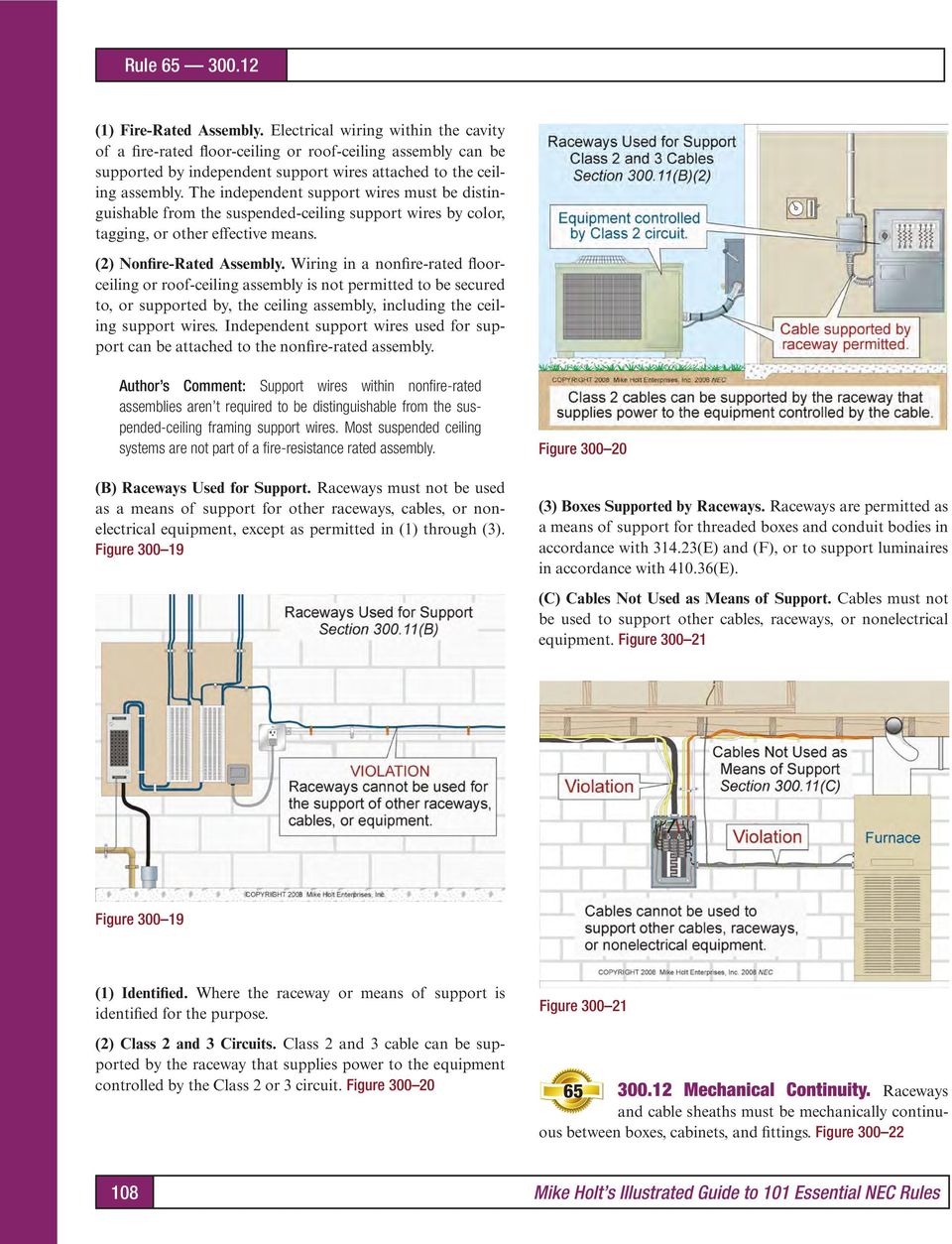
10 Rule (1) Fire-Rated Assembly. Electrical wiring within the cavity of a fire-rated floor-ceiling or roof-ceiling assembly can be supported by independent support wires attached to the ceiling assembly. The independent support wires must be distinguishable from the suspended-ceiling support wires by color, tagging, or other effective means. (2) Nonfire-Rated Assembly. Wiring in a nonfire-rated floorceiling or roof-ceiling assembly is not permitted to be secured to, or supported by, the ceiling assembly, including the ceiling support wires. Independent support wires used for support can be attached to the nonfire-rated assembly. Author s Comment: Support wires within nonfire-rated assemblies aren t required to be distinguishable from the suspended-ceiling framing support wires. Most suspended ceiling systems are not part of a fire-resistance rated assembly. (B) Raceways Used for Support. Raceways must not be used as a means of support for other raceways, cables, or nonelectrical equipment, except as permitted in (1) through (3). Figure Figure (3) Boxes Supported by Raceways. Raceways are permitted as a means of support for threaded boxes and conduit bodies in accordance with (E) and (F), or to support luminaires in accordance with (E). (C) Cables Not Used as Means of Support. Cables must not be used to support other cables, raceways, or nonelectrical equipment. Figure Figure (1) Identified. Where the raceway or means of support is identified for the purpose. (2) Class 2 and 3 Circuits. Class 2 and 3 cable can be supported by the raceway that supplies power to the equipment controlled by the Class 2 or 3 circuit. Figure Figure Mechanical Continuity. Raceways and cable sheaths must be mechanically continuous between boxes, cabinets, and fittings. Figure Mike Holt s Illustrated Guide to 101 Essential NEC Rules
11 Rule Figure Exception No. 1: Short sections of raceways used to provide support or protection of cable from physical damage aren t required to be mechanically continuous [ Ex 2 and Ex 1]. Figure Figure Author s Comment: When raceways are stubbed into an openbottom switchboard or other apparatus, the raceway, including the end fitting, can t rise more than 3 in. above the bottom of the switchboard enclosure [408.5] Splices and Pigtails. (A) Conductor Splices. Conductors in raceways must be continuous between all points of the system, which means splices must not be made in raceways, except as permitted by , , , , or See Figure Figure Exception No. 2: Raceways at the bottom of open-bottom equipment, such as switchboards, motor control centers, and transformers, are not required to be mechanically secured to the equipment. Figure Figure Mike Holt Enterprises, Inc NEC.CODE ( ) 109

12 Rule (B) Conductor Continuity. Continuity of the neutral conductor of a multiwire branch circuit must not be interrupted by the removal of a wiring device. In these applications the neutral conductors must be spliced together, and a pigtail must be provided for the wiring device. Figure Step 2: Determine the current of the circuit, I = E/R. E = 240V R = 36 ohms (12 ohms + 24 ohms) I = 240V/36 ohms I = 6.70A Step 3: Determine the operating voltage for each appliance, E = I x R. I 6.70A R = 12 ohms for dryer and 24 ohms for TV Voltage of hair dryer = 6.70A x 12 ohms Voltage of hair dryer = 80V Voltage of television = 6.70A x 24 ohms Voltage of Television = 160V Figure Author s Comment: The opening of the ungrounded conductors, or the neutral conductor of a 2-wire circuit during the replacement of a device, doesn t cause a safety hazard, so pigtailing of these conductors isn t required [110.14(B)]. CaUTIOn: If the continuity of the neutral conductor of a multiwire circuit is interrupted (open), the resultant over- or undervoltage can cause a fire and/or destruction of electrical equipment. Example: A 3-wire, single-phase, 120/240V multiwire circuit supplies a 1,200W, 120V hair dryer and a 600W, 120V television. If the neutral conductor of the multiwire circuit is interrupted, it will cause the 120V television to operate at 160V and consume 1,067W of power (instead of 600W) for only a few seconds before it burns up. Figure Step 1: Determine the resistance of each appliance, R = E 2 /P. R of the hair dryer = 120V 2 /1,200W R of the hair dryer = 12 ohms R of the television = 120V 2 /600W R of the television = 24 ohms Figure WaRnIng: Failure to terminate the ungrounded conductors to separate phases can cause the neutral conductor to become overloaded, and the insulation can be damaged or destroyed by excessive heat. Conductor overheating is known 110 Mike Holt s Illustrated Guide to 101 Essential NEC Rules

13 Rule to decrease the service life of insulating materials, which creates the potential for arcing faults in hidden locations, and could ultimately lead to fires. It isn t known just how long conductor insulation lasts, but heat does decrease its life span. Figure Cabinet or Cutout Boxes, Conduit Bodies, (C) Figure Luminaires, Surface Raceways, and Wireways, Figure Figure Boxes or Conduit Bodies. A box must be installed at each splice or termination point, except as permitted for: Figure Author s Comment: Boxes aren t required for the following signaling and communications cables or raceways: Figure CATV, 90.3 Class 2 and 3 Control and Signaling, Communications, 90.3 Optical Fiber, Figure Figure Mike Holt Enterprises, Inc NEC.CODE ( ) 111

14 Rule Fittings and Connectors. Fittings can only be used with the specific wiring methods for which they are listed and designed. For example, Type NM cable connectors must not be used with Type AC cable, and electrical metallic tubing fittings must not be used with rigid metal conduit or intermediate metal conduit, unless listed for the purpose. Figure Figure Figure Author s Comment: PVC conduit couplings and connectors are permitted with electrical nonmetallic tubing if the proper glue is used in accordance with manufacturer s instructions [110.3(B)]. See (C) Raceways for Support or Protection. When a raceway is used for the support or protection of cables, a fitting to reduce the potential for abrasion must be placed at the location the cables enter the raceway. Figure (F) Fitting. A fitting is permitted in lieu of a box or conduit body where conductors are not spliced or terminated within the fitting if it s accessible after installation. Figure (G) Underground Splices. A box or conduit body isn t required where a splice is made underground if the conductors are spliced with a splicing device listed for direct burial. See (B) and 300.5(E). Author s Comment: See the definition of Conduit Body in Article 100. Figure (I) Enclosures. A box or conduit body isn t required where a splice is made in a cabinet or in cutout boxes containing switches or overcurrent devices if the splices or taps don t fill the wiring space at any cross section to more than 75 percent, and the wiring at any cross section doesn t exceed 40 percent. See and 404.3(B). Figure Author s Comment: See the definitions of Cabinet and Cutout Box in Article 100. (J) Luminaires. A box or conduit body isn t required where a luminaire is used as a raceway as permitted in and Mike Holt s Illustrated Guide to 101 Essential NEC Rules

15 Rule Induced Currents in Ferrous Metal Enclosures and Raceways. (A) Conductors Grouped Together. To minimize induction heating of ferrous metal raceways and ferrous metal enclosures for alternating-current circuits, and to maintain an effective ground-fault current path, all conductors of a circuit must be installed in the same raceway, cable, trench, cord, or cable tray. See (E), 300.3(B), 300.5(I), and 392.8(D). Figure Figure (L) Handhole Enclosures. A box or conduit body isn t required for conductors installed in a handhole enclosure. Splices must be made in accordance with Figure Figure Figure Author s Comment: Splices or terminations within a handhole must be accomplished by the use of fittings listed as suitable for wet locations [110.14(B) and (C)]. Author s Comment: When alternating current (ac) flows through a conductor, a pulsating or varying magnetic field is created around the conductor. This magnetic field is constantly expanding and contracting with the amplitude of the ac current. In the United States, the frequency is 60 cycles per second (Hz). Since ac reverses polarity 120 times per second, the magnetic field that surrounds the conductor also reverses its direction 120 times per second. This expanding and collapsing magnetic field induces eddy currents in the ferrous metal parts that surround the conductors, causing the metal parts to heat up from hysteresis. Magnetic materials naturally resist the rapidly changing magnetic fields. The resulting friction produces its own additional heat - hysteresis heating - in addition to eddy current heating. A metal which offers high resistance is said to have high magnetic permeability. Permeability can vary on a scale of 100 to 500 for magnetic materials; nonmagnetic materials have a permeability of one. Mike Holt Enterprises, Inc NEC.CODE ( ) 113

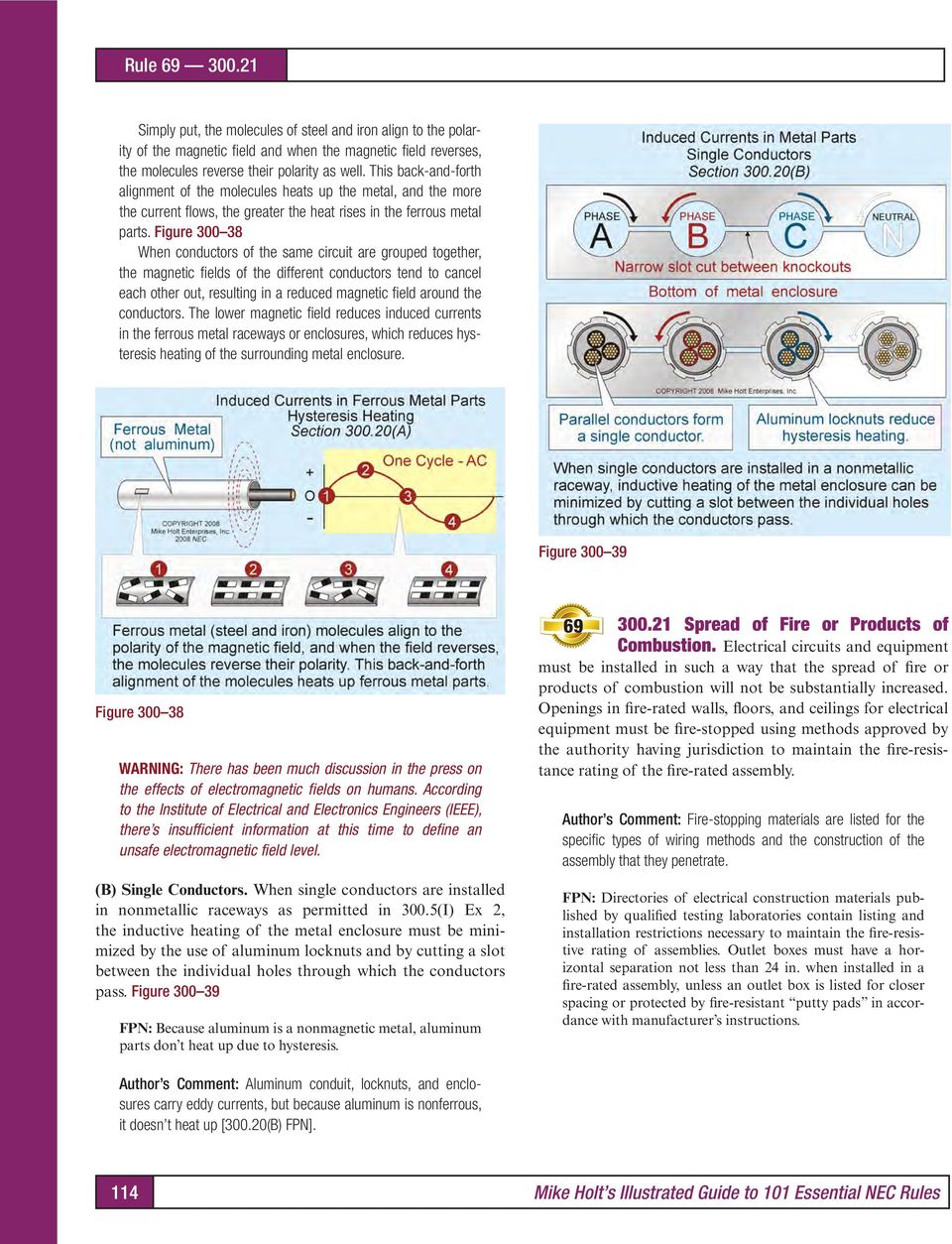
16 Rule Simply put, the molecules of steel and iron align to the polarity of the magnetic field and when the magnetic field reverses, the molecules reverse their polarity as well. This back-and-forth alignment of the molecules heats up the metal, and the more the current flows, the greater the heat rises in the ferrous metal parts. Figure When conductors of the same circuit are grouped together, the magnetic fields of the different conductors tend to cancel each other out, resulting in a reduced magnetic field around the conductors. The lower magnetic field reduces induced currents in the ferrous metal raceways or enclosures, which reduces hysteresis heating of the surrounding metal enclosure. Figure Figure Warning: There has been much discussion in the press on the effects of electromagnetic fields on humans. According to the Institute of Electrical and Electronics Engineers (IEEE), there s insufficient information at this time to define an unsafe electromagnetic field level. (B) Single Conductors. When single conductors are installed in nonmetallic raceways as permitted in 300.5(I) Ex 2, the inductive heating of the metal enclosure must be minimized by the use of aluminum locknuts and by cutting a slot between the individual holes through which the conductors pass. Figure FPN: Because aluminum is a nonmagnetic metal, aluminum parts don t heat up due to hysteresis Spread of Fire or Products of Combustion. Electrical circuits and equipment must be installed in such a way that the spread of fire or products of combustion will not be substantially increased. Openings in fire-rated walls, floors, and ceilings for electrical equipment must be fire-stopped using methods approved by the authority having jurisdiction to maintain the fire-resistance rating of the fire-rated assembly. Author s Comment: Fire-stopping materials are listed for the specific types of wiring methods and the construction of the assembly that they penetrate. FPN: Directories of electrical construction materials published by qualified testing laboratories contain listing and installation restrictions necessary to maintain the fire-resistive rating of assemblies. Outlet boxes must have a horizontal separation not less than 24 in. when installed in a fire-rated assembly, unless an outlet box is listed for closer spacing or protected by fire-resistant putty pads in accordance with manufacturer s instructions. Author s Comment: Aluminum conduit, locknuts, and enclosures carry eddy currents, but because aluminum is nonferrous, it doesn t heat up [300.20(B) FPN]. 114 Mike Holt s Illustrated Guide to 101 Essential NEC Rules
17 Rule Author s Comments: Boxes installed in fire-resistance rated assemblies must be listed for the purpose. Where steel boxes are used, they must be secured to the framing member, so cut-in type boxes are not allowed (UL White Book, product category QCIT). This rule also applies to control, signal, and communications cables or raceways. Figure CATV, Communications, Control and Signaling, Fire Alarm, 760.3(A) Optical Fiber, Sound Systems, 640.3(A) Figure (B) Ducts or Plenums Used for Environmental Air. Where necessary for direct action upon, or sensing of, the contained air, Type MI cable, Type MC cable that has a smooth or corrugated impervious metal sheath without an overall nonmetallic covering, electrical metallic tubing, flexible metallic tubing, intermediate metal conduit, or rigid metal conduit without an overall nonmetallic covering can be installed in ducts or plenums specifically fabricated to transport environmental air. Figure Figure Ducts, Plenums, and Other Air- Handling Spaces. (A) Ducts Used for Dust, Loose Stock, or Vapor. Ducts that transport dust, loose stock, or vapors must not have any wiring method installed within them. Figure Figure Author s Comment: See the definition of Plenum in Article 100. Mike Holt Enterprises, Inc NEC.CODE ( ) 115

18 Rule Flexible metal conduit in lengths not exceeding 4 ft can be used to connect physically adjustable equipment and devices, provided any openings are effectively closed. Where equipment or devices are installed and illumination is necessary to facilitate maintenance and repair, enclosed gasketed-type luminaires are permitted. (C) Other Space Used for Environmental Air Space. Wiring and equipment in spaces used for environmental air-handling purposes must comply with (1) and (2). This requirement doesn t apply to habitable rooms or areas of buildings, the prime purpose of which isn t air handling. FPN: The spaces above a suspended ceiling or below a raised floor used for environmental air are examples of the type of space to which this section applies. Figure Author s Comments: PVC conduit [Article 352], electrical nonmetallic tubing [Article 362], liquidtight flexible conduit, and nonmetallic cables are not permitted to be installed in spaces used for environmental air because they give off deadly toxic fumes when burned or superheated. Control, signaling, and communications cables installed in spaces used for environmental air must be suitable for plenum use. Figure CATV, (A) Communications, Control and Signaling, (A) Fire Alarm, Optical Fiber Cables and Raceways, (A) Sound Systems, 640.9(C) and (A) Figure (1) Wiring Methods Permitted. Electrical metallic tubing, rigid metal conduit, intermediate metal conduit, armored cable, metal-clad cable without a nonmetallic cover, and flexible metal conduit can be installed in environmental air spaces. Where accessible, surface metal raceways, metal wireways with metal covers, or solid bottom metal cable tray with solid metal covers can be installed in environmental air spaces. Figure Any wiring method suitable for the condition can be used in a space not used for environmental air-handling purposes. Figure Mike Holt s Illustrated Guide to 101 Essential NEC Rules

19 Rule (D) Information Technology Equipment Rooms. Wiring in airhandling areas under a raised floor in an information technology room must comply with 645.5(D). Figure Figure Figure (2) Equipment. Electrical equipment constructed with a metal enclosure is permitted in a space used for environmental air. Author s Comment: Dry-type transformers with a metal enclosure, rated not over 50 kva, can be installed above suspended ceilings used for environmental air [450.13(B)]. Figure Author s Comment: Signal and communications cables under a raised floor are not required to be suitable for plenum use [645.5(D)(6)(c)], because ventilation is restricted to that room/ space, and the space is not normally occupied [645.5(D)(4)]. Figure Mike Holt Enterprises, Inc NEC.CODE ( ) 117
![Author s Comment: Dry-type transformers with a metal enclosure, rated not over 50 kva, can be installed above suspended ceilings used for environmental air [450.13(B)].](/docs-images/45/10833784/images/page_19.jpg "Figure 300 46 Author s Comment: Signal and communications cables under a raised floor are not required to be suitable for plenum use [645.")
20 ARTICLE 310 Conductors for General Wiring INTRODUCTION TO ARTICLE 310 CONDUCTORS FOR GENERAL WIRING This article contains the general requirements for conductors, such as insulation markings, ampacity ratings, and conditions of use. Article 310 doesn t apply to conductors that are part of fl exible cords, fi xture wires, or to conductors that are an integral part of equipment [90.7 and 300.1(B)]. People often make errors in applying the ampacity tables contained in Article 310. If you study the explanations carefully, you ll avoid common errors such as applying Table when you should be applying Table Why so many tables? Why does Table list the ampacity of 6 THHN as 105 amperes, yet Table lists the same conductor as having an ampacity of only 75 amperes? To answer that, go back to Article 100 and review the defi nition of ampacity. Notice the phrase conditions of use. What these tables do is set a maximum current value at which you can ensure the installation won t undergo premature failure of the conductor insulation in normal use, in the conditions described in the tables. The designations THHN, THHW, RHH, and so on, are insulation types. Every type of insulation has a heat withstand limit. When current fl ows through a conductor, it creates heat. How well the insulation around a conductor can dissipate that heat depends on factors such as whether that conductor is in free air or not. Think what happens to you if you put on a sweater, a jacket, and then a coat all at the same time. You heat up. Your skin can t dissipate heat with all that clothing on nearly as well as it dissipates heat in free air. The same principal applies to conductors. Conductor insulation also fails with age. That s why we conduct cable testing and take other measures to predict failure and replace certain conductors (for example, feeders or critical equipment conductors) while they re still within design specifi cations. But conductor insulation failure takes decades under normal use and it s a maintenance issue. However, if a conductor is forced to exceed the ampacity listed in the appropriate table, and as a result its design temperature is exceeded, insulation failure happens much more rapidly often catastrophically. Exceeding the allowable ampacity is a serious safety issue Conductors in Parallel. (A) General. Ungrounded and neutral conductors sized 1/0 AWG and larger can be connected in parallel. (B) Conductor Characteristics. When circuit conductors are run in parallel, the current must be evenly distributed between the individual parallel conductors by requiring all circuit conductors within a parallel set to: Figure (1) Be the same length. (2) Be made of the same conductor material (copper/ aluminum). Figure Mike Holt s Illustrated Guide to 101 Essential NEC Rules
![7 and 300.1(B)]. People often make errors in applying the ampacity tables contained in Article 310. If you study the explanations carefully, you ll avoid common errors such as applying Table 310.](/docs-images/45/10833784/images/page_20.jpg "17 when you should be applying Table 310.16. Why so many tables? Why does Table 310.17 list the ampacity of 6 THHN as 105 amperes, yet Table 310.")
21 Rule (3) Be the same size in circular mil area (minimum 1/0 AWG). (4) Have the same insulation (like THHN). (5) Terminate in the same method (set screw versus compression). Author s Comment: Conductors aren t required to have the same physical characteristics as those of another phase or neutral conductor to achieve balance [310.14(C)]. (C) Separate Raceways or Cables. Raceways or cables containing parallel conductors must have the same electrical characteristics and the same number of conductors. Figure Figure Neutral, Two 1/0 THHN aluminum, 103 ft Equipment Grounding Conductor, Two 3 AWG copper, 101 ft* *The minimum 1/0 AWG size requirement doesn t apply to equipment grounding conductors [310.4(E)]. Figure (D) Conductor Ampacity Adjustment. Each current-carrying conductor of a paralleled set of conductors must be counted as a current-carrying conductor for the purpose of conductor ampacity adjustment, in accordance with Table (B)(2)(a). Figure Author s Comment: If one set of parallel conductors is run in a metallic raceway and the other conductors are run in PVC conduit, the conductors in the metallic raceway will have an increased opposition to current flow (impedance) as compared to the conductors in the nonmetallic raceway. This results in an unbalanced distribution of current between the parallel conductors. Paralleling is done in sets. Parallel sets of conductors aren t required to have the same physical characteristics as those of another set to achieve balance. Author s Comment: For example, a 400A feeder with a neutral load of 240A can be paralleled as follows. Figure Phase A, Two 250 kcmil THHN aluminum, 100 ft Phase B, Two 3/0 THHN copper, 104 ft Phase C, Two 3/0 THHN copper, 102 ft Figure Mike Holt Enterprises, Inc NEC.CODE ( ) 119
22 Rule (E) Equipment Grounding Conductors. The equipment grounding conductors for circuits in parallel must be identical to each other in length, material, size, insulation, and termination. In addition, each raceway, where required, must have an equipment grounding conductor sized in accordance with The minimum 1/0 AWG rule of doesn t apply to equipment grounding conductors. See (F)(1) for more information on equipment grounding conductors installed in parallel. Figure Figure Exception: When different ampacities apply to a length of conductor, the higher ampacity is permitted for the entire circuit if the reduced ampacity length doesn t exceed 10 ft and its length doesn t exceed 10 percent of the length of the higher ampacity. Figure Figure Conductor Ampacity. (A) General Requirements. (1) Tables for Engineering Supervision. The ampacity of a conductor can be determined either by using the tables in accordance with (B), or under engineering supervision as provided in (C). FPN No. 1: Ampacities provided by this section don t take voltage drop into consideration. See (A) FPN No. 4, for branch circuits and 215.2(D) FPN No. 2, for feeders. (2) Conductor Ampacity Lower Rating. If a single length of conductor is routed in a manner that two or more ampacity ratings apply to a single conductor length, the lower ampacity must be used for the entire circuit. See (B). Figure Figure Mike Holt s Illustrated Guide to 101 Essential NEC Rules
23 Rule (B) Ampacity Table. The allowable conductor ampacities listed in Table are based on conditions where the ambient temperature isn t over 86 F, and no more than three current-carrying conductors are bundled together. Figure Author s Comment: When correcting conductor ampacity for elevated ambient temperature, the correction factor used for THHN conductors is based on the 90 C rating of the conductor in a dry location and 75 C rating of the conductor in a wet location, based on the conductor ampacity listed in Table [110.14(C) and Table (A)]. Question: What is the corrected ampacity of 3/0 THHN/THWN conductors in a dry location if the ambient temperature is 108 F? (a) 173A (b) 196A (c) 213A (d) 241A Answer: (b) 196A Conductor Ampacity [90 C] = 225A Correction Factor [Table ] = 0.87 Corrected Ampacity = 225A x 0.87 Corrected Ampacity = 196A Figure Author s Comment: When conductors are installed in an ambient temperature other than 78 F to 86 F, ampacities listed in Table must be corrected in accordance with the multipliers listed in Table Table ambient Temperature Correction Ambient Temperature F Ambient Temperature C Correction Factor 75 C Conductors Correction Factor 90 C Conductors F C F C F C F C F C F C F C F C F C F C Question: What is the corrected ampacity of 3/0 THHN/THWN conductors in a wet location if the ambient temperature is 108 F? (a) 164A (b) 196A (c) 213A (d) 241A Answer: (a) 164A Conductor Ampacity [75 C] = 200A Correction Factor [Table ] = 0.82 Corrected Ampacity = 200A x 0.82 Corrected Ampacity = 164A Author s Comment: When adjusting conductor ampacity, the ampacity is based on the temperature insulation rating of the conductor as listed in Table , not the temperature rating of the terminal [110.14(C)]. (2) Adjustment Factors. (a) Conductor Bundle. Where the number of current-carrying conductors in a raceway or cable exceeds three, or where single conductors or multiconductor cables are installed without maintaining spacing for a continuous length longer than 24 in., the allowable ampacity of each conductor, as listed in Table , must be adjusted in accordance with the adjustment factors contained in Table (B)(2)(a). Figure Mike Holt Enterprises, Inc NEC.CODE ( ) 121
24 Rule Author s Comment: The neutral conductor might be a currentcarrying conductor, but only under the conditions specified in (B)(4). Equipment grounding conductors are never considered current carrying [310.15(B)(5)]. Question: What is the adjusted ampacity of 3/0 THHN/THWN conductors in a dry location if the raceway contains a total of four current-carrying conductors? Figure (a) 180A (b) 196A (c) 213A (d) 241A Figure Answer: (a) 180A Table ampacity if 3/0 THHN/THWN in a dry location is 225A Adjustment Factor [Table (B)(2)(a)] = 0.80 Adjusted Ampacity = 225A x 0.80 Adjusted Ampacity = 180A Each current-carrying conductor of a paralleled set of conductors must be counted as a current-carrying conductor. Figure Figure Figure Table (B)(2)(a) Number of Current Carrying Adjustment Factor 1 3 Conductors Conductors Conductors 0.70* Conductors Mike Holt s Illustrated Guide to 101 Essential NEC Rules
25 Rule Question: What is the adjusted ampacity of 3/0 THHN/THWN conductors in a wet location if the raceway contains a total of four current-carrying conductors? (a) 160A (b) 196A (c) 213A (d) 241A Answer: (a) 160A Table ampacity if 3/0 THHN/THWN in a wet location is 200A Adjustment Factor [Table (B)(2)(a)] = 0.80 Adjusted Ampacity = 200A x 0.80 Adjusted Ampacity = 160A Author s Comments: When correcting or adjusting conductor ampacity, the ampacity is based on the temperature insulation rating of the conductor as listed in Table , not the temperature rating of the terminal [110.14(C)]. Where more than three current-carrying conductors are present and the ambient temperature isn t between 78 and 86 F, the ampacity listed in Table must be corrected and adjusted for both conditions. Question: What is the ampacity of 3/0 THHN/THWN conductors in a dry location at an ambient temperature of 108 F if the raceway contains four current-carrying conductors? (a) 157A (b) 176A (c) 199A (d) 214A Answer: (a) 157A Table ampacity if 3/0 THHN/THWN in a dry location is 225A Ambient Temperature Correction [Table ] = 0.87 Conductor Bundle Adjustment [310.15(B)(2)(a)] = 0.80 Adjusted Ampacity = 225A x 0.87 x 0.80 Adjusted Ampacity = 157A Question: What is the ampacity of 3/0 THHN/THWN conductors in a wet location at an ambient temperature of 108 F if the raceway contains four current-carrying conductors? (a) 131A (b) 176A (c) 199A (d) 214A Answer: (a) 131A Table ampacity if 3/0 THHN/THWN in a wet location is 200A Ambient Temperature Correction [Table ] = 0.82 Conductor Bundle Adjustment [310.15(B)(2)(a)] = 0.80 Adjusted Ampacity = 200A x 0.82 x 0.80 Adjusted Ampacity = A Author s Comment: When adjusting or correcting conductor ampacity, the ampacity of THHN/THWN conductors in a wet location is based on the 75 C rating of the conductor [110.14(C) and Table (A)]. FPN No. 2: See (B) for conductor ampacity adjustment factors for conductors in metal wireways. Author s Comment: Conductor ampacity adjustment only applies when more than 30 current-carrying conductors are installed in any cross-sectional area of a metal wireway. Exception No. 3: The conductor ampacity adjustment factors of Table (B)(2)(a) don t apply to conductors installed in raceways not exceeding 24 in. in length. Figure Author s Comment: When adjusting or correcting conductor ampacity, the ampacity of THHN/THWN conductors in a dry location is based on the 90 C rating of the conductor [110.14(C) and Table (A)]. Figure Mike Holt Enterprises, Inc NEC.CODE ( ) 123
26 Rule Exception No. 5: The conductor ampacity adjustment factors of Table (B)(2)(a) don t apply to Type AC or Type MC cable when: Figure Table (B)(2)(c) Ambient Temperature Adder for Raceways On or Above Rooftops Distance of Raceway Above Roof C F 0 to ½ in Above ½ in. to 3 ½ in Above 3 ½ in. to 12 in Above 12 in. to 36 in Figure (1) Each cable has not more than three current-carrying conductors, (2) The conductors are 12 AWG copper, and (3) No more than 20 current-carrying conductors (ten 2-wire cables or six 3-wire cables) are bundled. Author s Comment: This section requires the ambient temperature used for ampacity correction to be adjusted where conductors or cables are installed in conduit on or above a rooftop and the conduit is exposed to direct sunlight. The reasoning is that the air inside conduits in direct sunlight is significantly hotter than the surrounding air, and appropriate ampacity corrections must be made in order to comply with For example, a conduit with three 6 THWN-2 conductors with direct sunlight exposure that is 3/4 in. above the roof will require 40 F to be added to the correction factors at the bottom of Table Assuming an ambient temperature of 90 F, the temperature to use for conductor correction will be 130 F (90 F + 40 F), the 6 THWN-2 conductor ampacity after correction will be 57A (75A x 0.76). Figure Author s Comment: When eleven or more 2-wire cables or seven or more 3-wire cables (more than 20 current-carrying conductors) are bundled or stacked for more than 24 in., an ampacity adjustment factor of 60 percent must be applied. (c) Raceways Exposed to Sunlight on Rooftops. The ambient temperature adjustment contained in Table (B)(2)(c) is added to the outdoor ambient temperature for conductors or cables that are installed in raceways exposed to direct sunlight on or above rooftops when applying ampacity adjustment correction factors contained in Table FPN No. 1: See ASHRAE Handbook Fundamentals ( as a source for the average ambient temperatures in various locations. FPN No. 2: The temperature adders in Table (B) (2)(c) are based on the results of averaging the ambient temperatures. Figure When adjusting conductor ampacity, use the conductor ampacity as listed in Table based on the conductors insulation rating; in this case, it s 75A at 90 F. Conductor ampacity adjustment is not based on the temperature terminal rating as per (C). 124 Mike Holt s Illustrated Guide to 101 Essential NEC Rules
27 Rule (4) Neutral Conductors. (a) Balanced Circuits. The neutral conductor of a 3-wire, single-phase, 120/240V system, or 4-wire, three-phase, 120/208V or 277/480V wye-connected system, isn t considered a current-carrying conductor. Figure Figure Figure (b) 3-Wire Circuits. The neutral conductor of a 3-wire circuit from a 4-wire, three-phase, 120/208V or 277/480V wye-connected system is considered a current-carrying conductor. Author s Comment: When a 3-wire circuit is supplied from a 4-wire, three-phase, 120/208V or 277/480V wye-connected system, the neutral conductor carries approximately the same current as the ungrounded conductors. Figure (c) Wye 4-Wire Circuits That Supply Nonlinear Loads. The neutral conductor of a 4-wire, three-phase, 120/208V or 277/480V wye-connected system is considered a current-carrying conductor where more than 50 percent of the neutral load consists of nonlinear loads. This is because harmonic currents will be present in the neutral conductor, even if the loads on each of the three phases are balanced. Figure Figure Author s Comment: Nonlinear loads supplied by a 4-wire, three-phase, 120/208V or 277/480V wye-connected system can produce unwanted and potentially hazardous odd triplen harmonic currents (3rd, 9th, 15th, etc.) that can add on the neutral conductor. To prevent fire or equipment damage from excessive harmonic neutral current, the designer should consider increasing the size of the neutral conductor or installing a separate neutral for each phase. For more information, visit click on the Technical link, then the Power Quality link. Also see 210.4(A) FPN, FPN No. 2, and FPN No. 2. Mike Holt Enterprises, Inc NEC.CODE ( ) 125
28 Rule (5) Grounding Conductors. Grounding and bonding conductors aren t considered current carrying. (6) Dwelling Unit Feeder/Service Conductors. For individual dwelling units of one-family, two-family, and multifamily dwellings, Table (B)(6) can be used to size 3-wire, single-phase, 120/240V service or feeder conductors that supply all loads that are part of, or associated with, the dwelling unit. Figure Figure Table (B)(6) Conductor Sizes for 120/240V, 3-Wire, Single-Phase Dwelling Services and Feeders Figure Author s Comment: Table (B)(6) cannot be used for service conductors for two-family or multifamily buildings. Figure Feeder conductors are not required to have an ampacity rating more than the service conductors [215.2(A)(3)]. Amperes Copper Aluminum AWG 2 AWG AWG 1 AWG AWG 1/0 AWG AWG 2/0 AWG 175 1/0 AWG 3/0 AWG 200 2/0 AWG 4/0 AWG 225 3/0 AWG 250 kcmil 250 4/0 AWG 300 kcmil kcmil 350 kcmil kcmil 500 kcmil kcmil 600 kcmil Warning: Table (B)(6) doesn t apply to 3-wire feeder/ service conductors connected to a three-phase, 120/208V system, because the neutral conductor in these systems always carries neutral current, even when the load on the phases is balanced [310.15(B)(4)(b)]. For more information on this topic, see (C)(1). Figure Mike Holt s Illustrated Guide to 101 Essential NEC Rules
29 Rule Question: What size service conductors are required if the calculated load for a dwelling unit equals 195A, and the maximum unbalanced neutral load is 100A? Figure (a) 1/0 AWG and 6 AWG (c) 3/0 AWG and 2 AWG (b) 2/0 AWG and 4 AWG (d) 4/0 AWG and 1 AWG Answer: (b) 2/0 AWG and 4 AWG Service Conductor: 2/0 AWG rated 200A [Table (B)(6)] Neutral Conductor: 4 AWG is rated 100A in accordance with Table (B)(6). In addition, (C) requires the neutral conductor to be sized no smaller than 4 AWG based on 2/0 AWG service conductors in accordance with Table Figure Neutral Conductor Sizing. Table (B)(6) can be used to size the neutral conductor of a 3-wire, single-phase, 120/240V service or feeder that carries all loads associated with the dwelling unit, based on the calculated load in accordance with CaUTIOn: Because the service neutral conductor is required to serve as the effective ground-fault current path, it must be sized so it can safely carry the maximum fault current likely to be imposed on it [ and 250.4(A)(5)]. This is accomplished by sizing the neutral conductor in accordance with Table , based on the area of the largest ungrounded service conductor [250.24(C)(1)]. Figure Mike Holt Enterprises, Inc NEC.CODE ( ) 127
30 ARTICLE 312 Cabinets, Cutout Boxes, and Meter Socket Enclosures INTRODUCTION TO ARTICLE 312 CABINETS, CUTOUT BOXES, AND METER SOCKET ENCLOSURES This article addresses the installation and construction specifi cations for the items mentioned in its title. In Article 310, we observed that you need different ampacities for the same conductor, depending on conditions of use. The same thing applies to these items just in a different way. For example, you can t use just any enclosure in a wet location or in a hazardous (classifi ed) location. The conditions of use impose special requirements for these situations. For all such enclosures, certain requirements apply regardless of the use. For example, you must cover any openings, protect conductors from abrasion, and allow suffi cient bending room for conductors. Part I is where you ll fi nd the requirements most useful to the electrician in the fi eld. Part II applies to manufacturers. If you use name brand components that are listed or labeled, you don t need to be concerned with Part II. However, if you are specifying custom enclosures, you need to be familiar with these requirements to help ensure that the authority having jurisdiction approves the enclosures Used for Raceway and Splices. Cabinets, cutout boxes, and meter socket enclosures can be used as a raceway for conductors that feed through if the conductors don t fill the wiring space at any cross section to more than 40 percent. Figure Author s Comment: Service conductors and other conductors can be installed in the same enclosure [230.7]. Splices and taps can be installed in cabinets, cutout boxes, or meter socket enclosures if the splices or taps don t fill the wiring space at any cross section to more than 75 percent. Figure Figure Figure Mike Holt s Illustrated Guide to 101 Essential NEC Rules
31 ARTICLE Outlet, Device, Pull, 314 and Junction Boxes; Conduit Bodies; and Handhole Enclosures INTRODUCTION TO ARTICLE 314 OUTLET, DEVICE, PULL, AND JUNCTION BOXES; CONDUIT BODIES; AND HANDHOLE ENCLOSURES Article 314 contains installation requirements for outlet boxes, pull and junction boxes, conduit bodies, and handhole enclosures. As with Article 312, conditions of use apply. If you re running a raceway in a hazardous (classifi ed) location, for example, you must use the correct fi ttings and the proper installation methods. But consider something as simple as a splice. It makes sense you wouldn t put a splice in the middle of a raceway doing so means you can t get to it. But if you put a splice in a conduit body, you re fi ne, right? Not necessarily. Suppose the conduit body is a short radius version (think of it as an elbow with the bend chopped off). You don t have much room inside such an enclosure, and for that reason you can t put a splice inside a short-radius conduit body. Properly applying Article 314 means you ll need to account for the internal volume of all boxes and fi ttings, and then determine the maximum conductor fi ll. You ll also need to understand many other requirements, which we ll cover. If you start to get confused, take a break. Look carefully at the illustrations, and you ll learn more quickly and with more retention Number of 6 AWG and Smaller Conductors in Boxes and Conduit Bodies. Boxes containing 6 AWG and smaller conductors must be sized to provide sufficient free space for all conductors, devices, and fittings. In no case can the volume of the box, as calculated in (A), be less than the volume requirement as calculated in (B). Conduit bodies must be sized according to (C). Author s Comment: The requirements for sizing boxes and conduit bodies containing conductors 4 AWG and larger are contained in The requirements for sizing handhole enclosures are contained in (A). (A) Box Volume Calculations. The volume of a box includes the total volume of its assembled parts, including plaster rings, extension rings, and domed covers that are either marked with their volume in cubic inches (cu in.), or are made from boxes listed in Table (A). Figure Figure Mike Holt Enterprises, Inc NEC.CODE ( ) 129
32 Rule (B) Box Fill Calculations. The calculated conductor volume determined by (1) through (5) and Table (B) are added together to determine the total volume of the conductors, devices, and fittings. Raceway and cable fittings, including locknuts and bushings, are not counted for box fill calculations. Figure Figure Conductors that originate and terminate within the box, such as pigtails, aren t counted at all. Figure Figure Table (B) Volume Allowance Required per Conductor Conductor AWG Volume cu in (1) Conductor Volume. Each unbroken conductor that runs through a box, and each conductor that terminates in a box, is counted as a single conductor volume in accordance with Table (B). Figure Each loop or coil of unbroken conductor having a length of at least twice the minimum length required for free conductors in must be counted as two conductor volumes. Figure Author s Comment: According to , at least 6 in. of free conductor, measured from the point in the box where the conductors enter the enclosure, must be left at each outlet, junction, and switch point for splices or terminations of luminaires or devices. 130 Mike Holt s Illustrated Guide to 101 Essential NEC Rules
33 Rule Exception: Equipment grounding conductors, and up to four 16 AWG and smaller fixture wires, can be omitted from box fill calculations if they enter the box from a domed luminaire or similar canopy, such as a ceiling paddle fan canopy. Figure (3) Support Fitting Volume. Each luminaire stud or luminaire hickey counts as a single conductor volume in accordance with Table (B), based on the largest conductor that enters the box. Figure Figure Figure (2) Cable Clamp Volume. One or more internal cable clamps count as a single conductor volume in accordance with Table (B), based on the largest conductor that enters the box. Cable connectors that have their clamping mechanism outside of the box aren t counted. Figure Author s Comment: Luminaire stems do not need to be counted as a conductor volume. (4) Device Yoke Volume. Each single gang device yoke (regardless of the ampere rating of the device) counts as two conductor volumes, based on the largest conductor that terminates on the device in accordance with Table (B). Figure Figure Figure Mike Holt Enterprises, Inc NEC.CODE ( ) 131
34 Rule Each multigang device yoke counts as two conductor volumes for each gang, based on the largest conductor that terminates on the device in accordance with Table (B). Figure Figure Figure Author s Comment: A device that is too wide for mounting in a single gang box, as described in Table (A), is counted based on the number of gangs required for the device. (5) Equipment Grounding Conductor Volume. All equipment grounding conductors in a box count as a single conductor volume in accordance with Table (B), based on the largest equipment grounding conductor that enters the box. Insulated equipment grounding conductors for receptacles having insulated grounding terminals (isolated ground receptacles) [ (D)] count as a single conductor volume in accordance with Table (B). Figure Author s Comment: Conductor insulation is not a factor considered when determining box volume calculations. Question: How many 14 AWG conductors can be pulled through a 4 in. square x 2 1/8 in. deep box with a plaster ring with a marking of 3.60 cu in.? The box contains two receptacles, five 12 AWG conductors, and two 12 AWG equipment grounding conductors. Figure (a) 3 (b) 5 (c) 7 (d) 9 Answer: (b) 5 Step 1: Determine the volume of the box assembly [314.16(A)]: Box cu in cu in. plaster ring = cu in. A 4 x 4 x 2 1/8 in. box will have a gross volume of 34 cu in., but the interior volume is cu in., as listed in Table (A). Step 2: Determine the volume of the devices and conductors in the box: Two receptacles 4 12 AWG Five 12 AWG 5 12 AWG Two 12 AWG Grounds 1 12 AWG Total AWG x 2.25 cu in. = cu in. Step 3: Determine the remaining volume permitted for the 14 AWG conductors: cu in cu in. = cu in. Step 4: Determine the number of 14 AWG conductors permitted in the remaining volume: 14 AWG = 2.00 cu in. each [Table (B)] cu in./2.00 cu in. = 5 conductors 132 Mike Holt s Illustrated Guide to 101 Essential NEC Rules
35 Rule Support of Boxes and Conduit Bodies. Boxes must be securely supported by one of the following methods: (A) Surface. Boxes can be fastened to any surface that provides adequate support. (B) Structural Mounting. Boxes can be supported from a structural member of a building or supported from grade by a metal, plastic, or wood brace. (1) Nails and Screws. Nails or screws can be used to fasten boxes, provided the exposed threads of screws are protected to prevent abrasion of conductor insulation. Figure (C) Conduit Bodies. (2) Splices. Splices are only permitted in conduit bodies that are legibly marked, by the manufacturer, with their volume. The maximum number of conductors permitted in a conduit body is limited in accordance with (B). (2) Braces. Metal braces no less than in. thick and wood braces not less than a nominal 1 x 2 in. can support a box. (C) Finished Surface Support. Boxes can be secured to a finished surface (drywall or plaster walls or ceilings) by clamps, anchors, or fittings identified for the purpose. Figure Question: How many 12 AWG conductors can be spliced in a 15 cu in. conduit body? Figure (a) 4 (b) 6 (c) 8 (d) 10 Answer: (b) 6 conductors (15 cu in./2.25 cu in.) 12 AWG = 2.25 cu in. [Table (B)] 15 cu in./2.25 cu in. = 6 Figure (D) Suspended-Ceiling Support. Outlet boxes can be supported to the structural or supporting elements of a suspended ceiling, if securely fastened by one of the following methods: Figure (1) Ceiling-Framing Members. An outlet box can be secured to suspended-ceiling framing members by bolts, screws, rivets, clips, or other means identified for the suspended-ceiling framing member(s). Figure Mike Holt Enterprises, Inc NEC.CODE ( ) 133
36 Rule Author s Comment: See (A) on the use of independent support wires to support raceways and cables. (E) Raceway Boxes and Conduit Bodies Without Devices or Luminaires. Two intermediate metal or rigid metal conduits, threaded wrenchtight into the enclosure, can be used to support an outlet box that doesn t contain a device or luminaire, if each raceway is supported within 36 in. of the box or within 18 in. if all conduit entries are on the same side. Figure Figure Author s Comment: Where framing members of suspended ceiling systems are used to support luminaires, they must be securely fastened to each other and must be securely attached to the building structure at appropriate intervals. In addition, luminaires must be attached to the suspended-ceiling framing members with screws, bolts, rivets, or clips listed and identified for such use [410.36(B)]. (2) Independent Support Wires. Outlet boxes can be secured, with fittings identified for the purpose, to the ceiling support wires. Where independent support wires are used for outlet box support, they must be taut and secured at both ends [300.11(A)]. Figure Figure (F) Raceway Boxes and Conduit Bodies with Devices or Luminaires. Two intermediate metal or rigid metal conduits, threaded wrenchtight into the enclosure, can be used to support an outlet box containing devices or luminaires, if each raceway is supported within 18 in. of the box. Figure (H) Pendant Boxes. (1) Flexible Cord. Boxes containing a hub can be supported from a cord connected to fittings that prevent tension from being transmitted to joints or terminals [400.10]. Figure Figure Mike Holt s Illustrated Guide to 101 Essential NEC Rules
37 Rule Figure Figure Author s Comment: Metal switch faceplates [404.9(B)] and metal receptacle faceplates [406.5(A)] must be connected to an equipment grounding conductor Boxes and Conduit Bodies for Conductors 4 AWG and Larger. Boxes and conduit bodies containing conductors 4 AWG and larger that are required to be insulated must be sized so the conductor insulation will not be damaged. Author s Comments: Figure Covers and Canopies. When the installation is complete, each outlet box must be provided with a cover or faceplate, unless covered by a fixture canopy, lampholder, or similar device. Figure (A) Nonmetallic or Metallic. Nonmetallic covers are permitted on any box, but metal covers are only permitted where they can be connected to an equipment grounding conductor of a type recognized in , in accordance with [250.4(A)(3)]. The requirements for sizing boxes and conduit bodies containing conductors 6 AWG and smaller are contained in Where conductors 4 AWG or larger enter a box or other enclosure, a fitting that provides a smooth, rounded, insulating surface, such as a bushing or adapter, is required to protect the conductors from abrasion during and after installation [300.4(G)]. (A) Minimum Size. For raceways containing conductors 4 AWG or larger, the minimum dimensions of boxes and conduit bodies must comply with the following: (1) Straight Pulls. The minimum distance from where the conductors enter to the opposite wall must not be less than eight times the trade size of the largest raceway. Figure Mike Holt Enterprises, Inc NEC.CODE ( ) 135
38 Rule U Pulls. When a conductor enters and leaves from the same wall, the distance from where the raceways enter to the opposite wall must not be less than six times the trade size of the largest raceway, plus the sum of the trade sizes of the remaining raceways on the same wall and row. Figure Figure (2) Angle Pulls, U Pulls, or Splices. Angle Pulls. The distance from the raceway entry to the opposite wall must not be less than six times the trade size of the largest raceway, plus the sum of the trade sizes of the remaining raceways on the same wall and row. Figure Figure Splices. When conductors are spliced, the distance from where the raceways enter to the opposite wall must not be less than six times the trade size of the largest raceway, plus the sum of the trade sizes of the remaining raceways on the same wall and row. Figure Figure Figure Mike Holt s Illustrated Guide to 101 Essential NEC Rules
39 Rule Rows. Where there are multiple rows of raceway entries, each row is calculated individually and the row with the largest distance must be used. Distance Between Raceways. The distance between raceways enclosing the same conductor must not be less than six times the trade size of the largest raceway, measured from the raceways nearest edge-to-nearest edge. Exception: When conductors enter an enclosure with a removable cover, such as a conduit body or wireway, the distance from where the conductors enter to the removable cover must not be less than the bending distance as listed in Table 312.6(A) for one conductor per terminal. Figure Figure Wiring to be Accessible. Boxes, conduit bodies, and handhole enclosures must be installed so that the wiring is accessible without removing any part of the building, sidewalks, paving, or earth. Figure Exception: Listed boxes and handhole enclosures can be buried if covered by gravel, light aggregate, or noncohesive granulated soil, and their location is effectively identified and accessible for excavation. Figure (3) Smaller Dimensions. Boxes or conduit bodies smaller than those required in (A)(1) and (A)(2) are permitted, if the enclosure is permanently marked with the maximum number and maximum size of conductors. (C) Covers. Pull boxes, junction boxes, and conduit bodies must have a cover suitable for the conditions. Nonmetallic covers are permitted on any box, but metal covers are only permitted where they can be connected to an equipment grounding conductor of a type recognized in , in accordance with [250.4(A)(3)]. Figure Figure Mike Holt Enterprises, Inc NEC.CODE ( ) 137
40 ARTICLE 320 Armored Cable (Type AC) INTRODUCTION TO ARTICLE 320 ARMORED CABLE (TYPE AC) Armored cable is an assembly of insulated conductors, 14 AWG through 1 AWG, individually wrapped within waxed paper and contained within a fl exible spiral metal sheath. The outside appearance of armored cable looks like fl exible metal conduit as well as metal-clad cable to the casual observer Uses Permitted. Type AC cable is permitted only where not subject to physical damage in the following locations, and in other locations and conditions not prohibited by or elsewhere in the Code: (1) For feeders and branch circuits in both exposed and concealed work. (2) Cable trays. (3) Dry locations. (4) Embedded in plaster or brick, except in damp or wet locations. (5) Air voids where not exposed to excessive moisture or dampness Uses Not Permitted. Type AC cable must not be installed in any of the following locations: (1) Where subject to physical damage. (2) In damp or wet locations. (3) In air voids of masonry block or tile walls where such walls are exposed or subject to excessive moisture or dampness. FPN: The Uses Permitted is not an all-inclusive list, which indicates that other suitable uses are permitted if approved by the authority having jurisdiction. Author s Comment: Type AC cable is also permitted to be installed above a suspended ceiling used for environmental air [300.22(C)(1)]. 138 Mike Holt s Illustrated Guide to 101 Essential NEC Rules
41 ARTICLE 330 Metal-Clad Cable (Type MC) INTRODUCTION TO ARTICLE 330 METAL-CLAD CABLE (TYPE MC) Metal-clad cable encloses insulated conductors in a metal sheath of either corrugated or smooth copper or aluminum tubing, or spiral interlocked steel or aluminum. The physical characteristics of Type MC cable make it a versatile wiring method that you can use in almost any location, and for almost any application. The most common Type MC cable is the interlocking type, which looks similar to armored cable or fl exible metal conduit Uses Permitted. (A) General Uses. Type MC cable is permitted only where not subject to physical damage, and in other locations and conditions not prohibited by , or elsewhere in the Code: (1) In branch circuits, feeders and services. (2) In power, lighting, control, and signal circuits. (3) Indoors or outdoors. (4) Exposed or concealed. (5) Directly buried (if identified for the purpose). (6) In a cable tray. (7) In a raceway. (8) As aerial cable on a messenger. (9) In hazardous (classified) locations as permitted in (B), (B), and (10) Embedded in plaster or brick. (11) In wet locations, if any the following are met: a. The metallic covering is impervious to moisture. b. A lead sheath or moisture-impervious jacket is provided under the metal covering. c. The insulated conductors under the metallic covering are listed for use in wet locations and a corrosion-resistant jacket is provided over the metallic sheath. (12) Where single-conductor cables are used, all ungrounded conductors and, where used, the neutral conductor must be grouped together to minimize induced voltage on the sheath [300.3(B)]. (B) Specific Uses. Type MC cable can be installed in compliance with Parts II and III of Article 725 and as applicable, and in accordance with (1) through (4). (1) Cable Tray. Type MC cable installed in a cable tray must comply with 392.3, 392.4, 392.6, and through (2) Direct Buried. Direct-buried cables must be protected in accordance with (3) Installed as Service-Entrance Cable. Type MC cable is permitted for service entrances, when installed in accordance with (4) Installed Outside of Buildings or Structures. Type MC cable installed outside of buildings or structures must comply with , , and FPN: The Uses Permitted is not an all-inclusive list, which indicates that other suitable uses are permitted if approved by the authority having jurisdiction. Author s Comment: Type MC cable is also permitted to be installed above a suspended ceiling used for environmental air [300.22(C)(1)]. Mike Holt Enterprises, Inc NEC.CODE ( ) 139
42 Rule Uses Not Permitted. Type MC cable must not be used where: (1) Subject to physical damage. (2) Exposed to the destructive corrosive conditions in (a) or (b), unless the metallic sheath or armor is resistant or protected by material resistant to the conditions: (a) Direct burial in the earth or embedded in concrete unless identified for the application. (b) Exposed to cinder fills, strong chlorides, caustic alkalis, or vapors of chlorine or of hydrochloric acids. 140 Mike Holt s Illustrated Guide to 101 Essential NEC Rules
43 ARTICLE 334 Nonmetallic- Sheathed Cable (Types NM and NMC) INTRODUCTION TO ARTICLE 334 NONMETALLIC-SHEATHED CABLE (TYPES NM AND NMC) Nonmetallic-sheathed cable is fl exible, inexpensive, and easily installed. It provides very limited physical protection of the conductors, so the installation restrictions are strict. Its low cost and relative ease of installation make it a common wiring method for residential and commercial branch circuits Uses Permitted. Type NM and Type NMC cables can be used in the following: (1) One- and two-family dwellings. Figure Figure (3) Other structures permitted to be of Types III, IV, and V construction, except as prohibited in Cables must be concealed within walls, floors, or ceilings that provide a thermal barrier of material with at least a 15-minute finish rating, as identified in listings of fire-rated assemblies. Figure Figure (2) Multifamily dwellings permitted to be of Types III, IV, and V construction. Figure Author s Comment: See the definition of Concealed in Article 100. FPN No. 1: Building constructions are defined in NFPA 220, Standard on Types of Building Construction, the applicable building code, or both. Mike Holt Enterprises, Inc NEC.CODE ( ) 141
44 Rule Figure FPN No. 2: See Annex E for the determination of building types [NFPA 220, Table 3-1]. (4) Cable trays, where the cables are identified for this use. FPN: See for temperature limitation of conductors Uses Not Permitted. (A) Types NM, NMC, and NMS. (1) In any dwelling or structure not specifically permitted in (1), (2), and (3). Exception: NM, NMC, and NMS cable is permitted in Type I and II construction when installed within a raceway. (2) Exposed in dropped or suspended ceilings in other than one- and two-family and multifamily dwellings. Figure (3) As service-entrance cable. (4) In commercial garages having hazardous (classified) locations, as defined in (5) In theaters and similar locations, except where permitted in 518.4(B). (6) In motion picture studios. (7) In storage battery rooms. (8) In hoistways, or on elevators or escalators. (9) Embedded in poured cement, concrete, or aggregate. Figure (10) In any hazardous (classified) location, except where permitted by the following: a (B)(3) b (B)(3) c (B) Type NM. Type NM cables must not be used under the following conditions, or in the following locations: (1) Where exposed to corrosive fumes or vapors. (2) Where embedded in masonry, concrete, adobe, fill, or plaster. (3) In a shallow chase in masonry, concrete, or adobe and covered with plaster, adobe, or similar finish. (4) In wet or damp locations. Author s Comment: Type NM cable isn t permitted in ducts, plenums, or other environmental air spaces [300.22], or for wiring in patient care areas [517.13]. 142 Mike Holt s Illustrated Guide to 101 Essential NEC Rules
45 ARTICLE 338 Service-Entrance Cable (Types SE and USE) INTRODUCTION TO ARTICLE 338 SERVICE-ENTRANCE CABLE (TYPES SE AND USE) Service-entrance cable is a single conductor or multiconductor assembly with or without an overall moisture-resistant covering. This cable is used primarily for services not over 600V, but can also be used for feeders and branch circuits as limited by this article Uses Permitted. (A) Service-Entrance Conductors. Service-entrance cable used as service-entrance conductors must be installed in accordance with Article 230. (B) Branch Circuits or Feeders. (2) Uninsulated Conductor. SE cable is permitted for use where the insulated conductors are used for circuit wiring, and the uninsulated conductor is only used for equipment grounding. Figure (a) Interior Installations. SE cable used for interior branch circuit or feeder wiring must be installed in accordance with the same requirements as Type NM Cable Article 334. Figure Figure Author s Comment: Where Type SE cable is used for interior wiring, its ampacity is limited to the 60 C insulation rating listed in Table [334.80]. Figure (3) Temperature Limitations. SE cable must not be subjected to conductor temperatures exceeding its insulation rating. (4) Installation Methods for Branch Circuits and Feeders. SE cable used for branch circuits or feeders must comply with (a) and (b). CaUTIOn: Underground service-entrance cable (USE) must not be used for interior wiring because it doesn t have flameretardant insulation. (b) Exterior Installations. Service-entrance cable used for exterior branch circuits or feeders must be installed in accordance with Part I of Article 225. Mike Holt Enterprises, Inc NEC.CODE ( ) 143
46 ARTICLE 362 Electrical Nonmetallic Tubing (Type ENT) INTRODUCTION TO ARTICLE 362 ELECTRICAL NONMETALLIC TUBING (TYPE ENT) Electrical nonmetallic tubing is a pliable, corrugated, circular raceway made of polyvinyl chloride. In some parts of the country, the fi eld name for electrical nonmetallic tubing is Smurf Pipe or Smurf Tube, because it was only available in blue when it originally came out at the time the children s cartoon characters The Smurfs were most popular. Today, the raceway is available in a rainbow of colors such as white, yellow, red, green, and orange, and is sold in both fi xed lengths and on reels Uses Not Permitted. (1) In any hazardous (classified) location, except as permitted by and (A)(1). (2) For the support of luminaires or equipment. See (3) Where the ambient temperature exceeds 50 C (122 F). (4) Where conductors operate at a temperature above the temperature rating of the raceway. Figure Exception: Conductors rated at a temperature above the electrical nonmetallic tubing temperature rating are permitted, provided the conductors don t operate at a temperature above the electrical nonmetallic tubing s listed temperature rating. (5) For direct earth burial. Author s Comment: Electrical nonmetallic tubing can be encased in concrete [362.10(6)]. (6) As a wiring method for systems over 600V. (7) Exposed in buildings over three floors, except as permitted by (2) and (5) Ex. (8) In assembly occupancies or theaters, except as permitted by and (9) Exposed to the direct rays of the sun for an extended period, unless listed as sunlight resistant. Author s Comment: Exposing electrical nonmetallic tubing exposed to the direct rays of the sun for an extended time may result in the product becoming brittle, unless it is listed to resist the effects of ultraviolet (UV) radiation. Figure (10) Where subject to physical damage. Figure Author s Comment: Electrical nonmetallic tubing is prohibited in ducts, plenums, other environmental air-handling spaces [300.22], and patient care area circuits in health care facilities [517.13(A)]. 144 Mike Holt s Illustrated Guide to 101 Essential NEC Rules
47 Rule Figure Mike Holt Enterprises, Inc NEC.CODE ( ) 145
48 ARTICLE 376 Metal Wireways INTRODUCTION TO ARTICLE 376 METAL WIREWAYS Metal wireways are commonly used where access to the conductors within the raceway is required to make terminations, splices, or taps to several devices at a single location. High cost precludes their use for other than short distances, except in some commercial or industrial occupancies where the wiring is frequently revised. Author s Comment: Both metal wireways and nonmetallic wireways are often called troughs or gutters in the field Uses Not Permitted. (1) Subject to severe physical damage. (2) Subject to corrosive environments. 146 Mike Holt s Illustrated Guide to 101 Essential NEC Rules
The National Armored Cable Manufacturers Association Presents. Installation Standard for Types AC and MC Cables
 The National Armored Cable Manufacturers Association Presents Installation Standard for Types AC and MC Cables An ANSI Standard Original document jointly produced by NECA and NACMA as Standard for Installing
800 Communications Circuits
 ARTICLE 800 Communications Circuits INTRODUCTION TO ARTICLE 800 COMMUNICATIONS CIRCUITS This article has its roots in telephone technology. Consequently, it addresses telephone and related systems that
Requirements for Electrical Installations
 ARTICLE 110 Requirements for Electrical Installations INTRODUCTION TO ARTICLE 110 REQUIREMENTS FOR ELECTRICAL INSTALLATIONS Article 110 sets the stage for how you ll implement the rest of the NEC. This
Electrical for Detached Garages: Updated Feb 19, 2016 for 2015 CE Code in force Jan. 1, 2016. Underground branch circuit feeding a detached garage:
 Electrical for Detached Garages: Updated Feb 19, 2016 for 2015 CE Code in force Jan. 1, 2016 * Garage construction requires permits (electrical, building) * Permits must be applied for at the time. * Dial
2014 NEC Guide Lines for Home Owner Doing Electrical Work on their Property
 2014 NEC Guide Lines for Home Owner Doing Electrical Work on their Property A brief summary of the most used code references for residential wiring State of Idaho Division of Building Safety Electrical
RESIDENTIAL ELECTRICAL REQUIREMENTS (REVISED 3/28/2008) PERMIT REQUIREMENTS:
 RESIDENTIAL ELECTRICAL REQUIREMENTS (REVISED 3/28/2008) PERMIT REQUIREMENTS: Signed completed Electrical Permit application form. Minnesota law requires all electrical work is to be performed by licensed,
Entrances to and from Electrical Equipment Rooms
 Electrical Code Requirements for Commercial and Residential Buildings Presented by Bob Nuzzi State Electrical Inspector Entrances to and from Electrical Equipment Rooms 2005 NEC Section 110.26(C)(2) Large
CHAPTER 2 EXAMPLES AND TABLES
 CHAPTER 2 EXAMPLES AND TABLES COMMENTARY AT 210.20(A) EXCEPTION An overcurrent device that supplies continuous and noncontinuous loads must have a rating that is not less than the sum of 100 percent of
Code Compliance for Spring Steel Fasteners Based on the 2005 NEC
 Code Compliance for Spring Steel Fasteners Based on the 2005 NEC B-Line has recognized the need for a reference source, detailing the National Electrical Code requirements for Spring Steel Fasteners. The
All work must conform to the National Electric Code, latest edition, and all other applicable codes and regulations.
 DIVISION 16 ELECTRICAL SECTION 16100 - ELECTRICAL PART 1 - GENERAL SCOPE All electrical work as shown on the drawings and as necessary to provide a complete electrical system. Include primary service,
INSPECTION GUDELINES
 GENERAL REQUIREMENTS Building permit and approved set of plans Building permit on the card is the same as on the route "If this is not the first inspection, read inspection records and notes on permit
ELECTRICAL GUIDELINES FOR SINGLE-FAMILY HOME OWNERS:
 ELECTRICAL GUIDELINES FOR SINGLE-FAMILY HOME OWNERS: Chapter 12 of the Burlington Code of ordinances allows owner occupants of single family homes to do their own wiring if they choose. If you choose to
Direction of current flow through conductor. Fig. 1 Magnetic field generated by current flow
 ingle Conductor Cable Copper heathed Cable heath Currents ingle conductor cables present certain application considerations that do not arise in multiconductor cable installations. These considerations
Electrical Code (NEC) Snake Tray Cable Management Solutions
 Cable Pathway Use and Selection and the National Electrical Code (NEC) By Eric J. Sadler, BSME MIT Snake Tray Cable Management Solutions References: All references to the NEC in this presentation are taken
Grounding & Bonding Why it is done And How to Install Properly
 Grounding & Bonding Why it is done And How to Install Properly The technical information provided herein is to assist qualifi ed persons in planning and installing electric service to farms and residences.
Safely Installing, Maintaining and Inspecting Cable Trays
 Purpose U.S. Department of Labor Occupational Safety and Health Administration Directorate of Technical Support & Emergency Management Office of Technical Programs and Coordination Activities Safely Installing,
ELECTRICAL - WIRING DESIGN AND PROTECTION SELF INSPECTION CHECKLIST
 Name of School: OPTIONAL INFORMATION Date of Inspection: Vocational Program/Course/Room: Signature of Inspector: ELECTRICAL - WIRING DESIGN AND PROTECTION SELF INSPECTION CHECKLIST Guidelines: This checklist
GROWTH MANAGEMENT DEPARTMENT 201 SE 3 rd ST, (Second Floor), Ocala, FL 34471 (352) 629-8421; FAX: (352) 629-8264
 BUILDING CODE GUIDELINES FOR ELECTRICAL INSPECTIONS Building Code compliance is the obligation of design professionals and/or contractors. Plan Review and Inspection Guidelines are intended to be used
PALM BEACH COUNTY AMENDMENTS TO THE NATIONAL ELECTRICAL CODE, 1999 EDITION
 PALM BEACH COUNTY AMENDMENTS TO THE NATIONAL ELECTRICAL CODE, 1999 EDITION CODING: Words underlined are additions to the 1999 NEC Words stricken are deletions to the 1999 NEC Adopted by Ordinance 99-73
Errata NFPA 70. Proposed 2014 Edition
 Errata NFPA 70 National Electrical Code (Report on Proposals) Reference: 12-109 (Log #1618) Panel Meeting Action Proposed 2014 Edition The National Electrical Code Technical Correlating Committee notes
Electrical Code Regulation
 Electrical Code Regulation St. Clair County has adopted the 2005 National Electrical Code in its entirety for the unincorporated areas of the county and all communities that have contracted with the county
Conductor Sizing and the National Electrical Code
 Conductor Sizing and the National Electrical Code The National Electrical Code requirements for conductor sizing and overcurrent protection have always been confusing and complex. Factors that must be
Residential Electrical Inspection Checklist
 Residential Electrical Inspection Checklist Based on the 2008 National Electrical Code Generally, Minnesota law requires all electrical work to be performed by licensed, bonded and insured electrical contractors
Residential Electrical Inspection. Checklist
 443 Lafayette Road N. St. Paul, Minnesota 55155 www.doli.state.mn.us Residential Electrical Inspection (651) 284-5064 1-800-DIAL-DLI Fax: (651) 284-5743 TTY: (651) 297-4198 Checklist Generally, Minnesota
NEC 2014 Code Changes
 NEC 2014 Code Changes Articles 400-408.55 CHANGES FROM 2011 TO 2014 CODE ARE IN RED Chapter 4 Equipment for General Use ARTICLE 400 Flexible Cords and Cables 400.4 Types Flexible cords and flexible cables
Electrical Grounding. Appendix C
 Appendix C Electrical Grounding Low-Voltage Equipment Grounding The most frequently cited Office of Safety and Health Administration (OSHA) electrical violation is improper occupational grounding of equipment
BRANCH CIRCUIT AND FEEDER REQUIREMENTS
 CHAPTER 36 BRANCH CIRCUIT AND FEEDER REQUIREMENTS SECTION E3601 GENERAL E3601.1 Scope. This chapter covers branch circuits and feeders and specifies the minimum required branch circuits, the allowable
SOLAR PV STANDARD ELECTRICAL PLAN Microinverter Systems for Single Family Dwellings
 *** Provide this document to the inspector along with ALL system installation instructions *** Project Address: Scope: Standard plan for the installation of grounded microinverter solar PV systems, not
Top Commercial / Residential Electrical Requirements *
 Department of Community Development Building Division 4800 West 92 nd Avenue Westminster, Colorado 80031 For Information call (303) 658-2075 Fax (303) 706-3922 www.westminsterpermits.com Top Commercial
Solar Photovoltaic (PV) Systems
 ARTICLE 690 Solar Photovoltaic (PV) Systems INTRODUCTION TO ARTICLE 690 SOLAR PHOTOVOLTAIC (PV) SYSTEMS You ve seen, or maybe own, photocell-powered devices such as night lights, car coolers, and toys.
2011/2008/2005 NATIONAL ELECTRICAL CODE SOLAR PV CODE COMPLIANCE REFERENCE
 2011/2008/2005 NATIONAL ELECTRICAL CODE SOLAR PV CODE COMPLIANCE REFERENCE PAGE 1 OF 5 This Reference provides a very comprehensive list of aspects of a solar PV installation that could be reviewed, clarifying
Chapter 9. Bonding and Grounding
 Chapter 9 Bonding and Grounding Objectives Describe why the cable should be bonded Describe bonding and grounding procedures Define Bonding and Grounding Explain Safety Benefits and intent of bonding and
2012 Electrical Code Changes Module 2 Sections 6-16
 2012 Electrical Code Changes Module 2 Sections 6-16 ETEL-11(02)-00 (2012-03-26) Table of Contents Section 6 Services and Service Equipment... 2 Section 8 Circuit Loading and Demand Factors... 6 Section
Common Electrical Hazards in the Workplace Including Arc Flash. Presented by Ken Cohen, PhD, PE & CIH (Ret.)
 Common Electrical Hazards in the Workplace Including Arc Flash Presented by Ken Cohen, PhD, PE & CIH (Ret.) 1 What s New In February 1972, OSHA incorporated the 1971 edition of the National Fire Protection
Presenters Brett Weiss, Gabe Martinez, Brian Kroeger.
 1 Presenters Brett Weiss, Gabe Martinez, Brian Kroeger. Topics to be covered: Cable identification Purpose of the various cable types Installation techniques Building Infrastructure Overview of networking
SYSTEM 1850-SE SERVICE ENTRANCE CABLE SYSTEM
 Pyrotenax SYSTEM 1850-SE SERVICE ENTRANCE CABLE SYSTEM Contents Introduction This section provides an overview of general circuit design considerations and installation guidelines for a Pyrotenax System
Residential Electrical Inspection. Checklist
 Electrical Licensing and Inspection 443 Lafayette Road North St. Paul, Minnesota 55155-4342 www.doli.state.mn.us 651-284-5064 Fax: 651-284-5743 TTY: 651-297-4198 1-800-DIAL-DLI Residential Electrical Inspection
Significant Changes in the 2011 NEC Prepared by Bryan Holland City of North Port
 Significant Changes in the 2011 NEC Prepared by Bryan Holland City of North Port Code-Wide Code Change Section 90.5(C). Fine Print Notes are now referred to as "Informational Notes." The purpose, intent,
AN IN-DEPTH LOOK AT 2011 NEC ARTICLE 392 - CABLE TRAY. (The following code explanations are to be used with a copy of the 2011 NEC.
 AN IN-DEPTH LOOK AT 2011 NEC ARTICLE 392 - CABLE TRAY (The following code explanations are to be used with a copy of the 2011 NEC.) To obtain a copy of the NEC contact: National Fire Protection Association
SECTION 26 05 19 - LOW-VOLTAGE ELECTRICAL POWER CONDUCTORS AND CABLES
 SECTION 26 05 19 - PART 1 - GENERAL 1.1 RELATED DOCUMENTS A. Drawings and general provisions of the Contract, including General and Supplementary Conditions and Division 01 Specification Sections, apply
4 Installation Requirements
 4 Installation Requirements 9 4.1 Code Reference The authority having jurisdiction should be referenced to determine what law, ordinance or code shall apply in the use of flexible duct. Ducts conforming
Mike Holt s Illustrated Guide to. Rule 220.87, Articles 445, 700, 701, and 702. Based on the 2011 NEC
 Mike Holt s Illustrated Guide to NEC Requirements for Generators and Standby Power Systems Rule 220.87, Articles 445, 700, 701, and 702 Based on the 2011 NEC Extracted from Mike Holt s Illustrated Guides
What are the basic electrical safety issues and remedies in solar photovoltaic installations?
 What are the basic electrical safety issues and remedies in solar photovoltaic installations? Presented by: Behzad Eghtesady City of Los Angeles Department of Building and Safety Topics Covered Photovoltaic
How to Install Modular Wiring, Cabling and Air Distribution Devices beneath a Access Floor without a Fire Suppression System
 How to Install Modular Wiring, Cabling and Air Distribution Devices beneath a Access Floor without a Fire Suppression System July 28, 2003 We are pleased to provide the following joint statement by CII,
GUIDELINES FOR WIRING SINGLE FAMILY DWELLING UNITS
 GUIDELINES FOR WIRING SINGLE FAMILY DWELLING UNITS This guideline has been prepared to assist the owner/occupant of a single family dwelling with compliance to the requirements of the National Electrical
INDUSTRY WIDE LABOR-MANAGEMENT SAFETY COMMITTEE SAFETY BULLETIN #23
 INDUSTRY WIDE LABOR-MANAGEMENT SAFETY COMMITTEE SAFETY BULLETIN #23 GUIDELINES FOR WORKING WITH PORTABLE POWER DISTRIBUTION SYSTEMS AND OTHER ELECTRICAL EQUIPMENT "ADDENDUM C" WORKING WITH 480 VOLT SYSTEMS
Standards. www.nordx.com 5 ANSI/TIA/EIA-569-A (CSA T530)
 The primary focus of this standard is to provide design specifications and guidance for all building facilities relating to telecommunications cabling systems and components. This standard identifies and
SECTION 18370 SIGNAL WIRE AND CABLE
 SECTION 18370 PART 1 - GENERAL 1.01 DESCRIPTION A. Section includes requirements for all cable and wire required for signal and signal power system wiring to wayside shelters, junction boxes, and factory
Extension Cord Safety Policy
 NATIONAL HIGH MAGNETIC FIELD LABORATORY Operated by Florida State University, University of Florida, Los Alamos National Laboratory Florida State University, 1800 East Paul Dirac Drive, Tallahassee, Florida
Title: Grounding and Bonding Rev-01
 Procedure No.: BMEHS-002-012 Page: 1 of 12 Preparer: Owner: Approver: EHS Team Member S/H Manager Site Manager Signed Copy on File Signed Copy on File Signed Copy on File Document Revision Change Table
City of Riverside Building & Safety Division Phone: (951) 826-5697 www.riversideca.gov
 City of Riverside Building & Safety Division Phone: (951) 826-5697 www.riversideca.gov PHOTOVOLTAIC PERMITTING GUIDELINES The information provided in this document is general and is intended only as a
Recommended Practices for Designing and Installing Copper Building Wire Systems
 Recommended Practices for Designing and Installing Copper Building Wire Systems CDA - CWIS Committee December 3, 2013 Developed by the Copper Development Association Inc. www.copper.org Foreword This document
SUBJECT: NO MORE 300 VOLTS IN PLTC PRINT LEGEND
 Belden Electronics Division P.O. Box 1980 Richmond, Indiana 47375-1980 2200 U.S. Highway 27 South Richmond, Indiana 47374-7279 Telephone: 765 983 5200 Facsimile: 765 983 5825 SUBJECT: NO MORE 300 VOLTS
IRRIGATION PUMPING Table of Contents - Section 900
 IRRIGATION PUMPING Table of Contents - Section 900 PARAGRAPH 900.1 GENERAL 1 900.2 METERING REQUIREMENTS 1 900.3 CUSTOMER S CONTROL EQUIPMENT 2 900.4 SERVICE CONDUCTOR REQUIREMENTS 2 900.5 RECOMMENDATIONS
Department of Labor and Industry Electrical Licensing
 Department of Labor and Industry Electrical Licensing License Examination Guide The information in this guide is provided by the Licensing Unit of the Department of Labor and Industry to ensure that applicants
Homeowner Information Guide Electrical Safety. British Columbia Safety Authority
 Homeowner Information Guide Electrical Safety British Columbia Safety Authority The following information should be carefully reviewed before performing any electrical work. The information contained in
DEPARTMENT OF LICENSING AND REGULATORY AFFAIRS DIRECTOR S OFFICE CONSTRUCTION SAFETY STANDARDS
 MIOSHA-STD-1313 (10/15) 6 Pages For further information Ph: 517-284-7740 www.michigan.gov/mioshastandards DEPARTMENT OF LICENSING AND REGULATORY AFFAIRS DIRECTOR S OFFICE CONSTRUCTION SAFETY STANDARDS
Short Circuit Current Calculations
 Introduction Several sections of the National Electrical Code relate to proper overcurrent protection. Safe and reliable application of overcurrent protective devices based on these sections mandate that
LEAD FREE FIREX. Interlock Armored Cables TECK90 and MC Industrial Cables. w w w. n e x a n s e n e r g y. c o m
 FIREX Interlock Armored Cables TECK90 and MC Industrial Cables LEAD FREE O V E R 1 8 0 Y E A R S O F E X P E R I E N C E 866-663-9267 w w w. n e x a n s e n e r g y. c o m Interlock Armored Cables Introduction....2
BASIC NEC CODE RULES AND DESIGN PRACTICE
 BASIC NEC CODE RULES AND DESIGN PRACTICE Wire Ampacity and Size Circuit Breaker Size 1. Maximum loading for any branch circuit is 80% of rating of circuit for ampacity of wire for any load. NEC 220-2,
Voltage Drop. Voltage Drop 1
 Voltage Drop The technical information provided herein is to assist qualifi ed persons in planning and installing electric service to farms and residences. Qualified person is defi ned in Article 100 of
MONTGOMERY COUNTY EXECUTIVE REGULATION Offices of the County Executive. 101 Monroe Street. Rockville, Maryland 20850
 Montgomery County Regulation on: ADOPTION OF THE 2008 NATIONAL ELECTRICAL CODE DEPARTMENT OF PERMITTING SERVICES Issued by County Executive Regulation # 15-09 Authority: Code Section 17-2 and 17-3 Supersedes:
CTI TECHNICAL BULLETIN Number 9: A publication of the Cable Tray Institute
 CTI TECHNICAL BULLETIN Number 9: A publication of the Cable Tray Institute Cable Tray Wiring Systems Have Many Cost Advantages Cost is usually a major consideration in the selection of a wiring system.
East Central College 14434.03 HANSEN HALL LEVEL 300/400 RENOVATIONS PACKAGE
 SECTION 260519 - BUILDING WIRE AND CABLE PART 1 - GENERAL 1.1 WORK INCLUDES A. Base and Alternate Bids: 1. Contractor Provide: a. Building wire and cable as shown on drawings or specified including feeders,
INSTALLATION GUIDELINES for SOLAR PHOTOVOLTAIC SYSTEMS 1
 City of Cotati Building Division 201 W. Sierra Ave. Cotati, CA 94931 707 665-3637 Fax 792-4604 INSTALLATION GUIDELINES for SOLAR PHOTOVOLTAIC SYSTEMS 1 Any PV system on a new structures should be included
Questions and Answers for Heating and A/C Contractors
 1. How do we accomplish grounding of furnaces and / or water heaters on two wire circuits? 250.134 Equipment Fastened in Place or Connected by Permanent Wiring Methods (Fixed) Grounding. Unless grounded
PRIMARY SERVICE LINE: The Company's conductors which connect the supply line with a transformer located on private property.
 INTRODUCTION These rules are issued for use by Customers, builders, electrical contractors, architects, engineers, etc. The rules require the installation of safe and adequate wiring and electrical equipment,
A. Shop Drawing submittals shall include, but not be limited to, the following:
 SECTION 26 05 53 IDENTIFICATION FOR ELECTRICAL SYSTEMS PART 1 - GENERAL 1.1 RELATED DOCUMENTS: A. The Conditions of the Contract and applicable requirements of Divisions 0 and 1 and Section 26 00 01, Electrical
STREETLIGHT SYSTEM GROUNDING AND BONDING
 Page: 1 of 8 STREETLIGHT SYSTEM GROUNDING AND BONDING 1. Scope This Construction Standard covers the grounding and bonding requirements for single phase streetlight systems served by the Looped Radial
ELECTRICAL REQUIREMENTS Specific Information for Electrical Work Installers
 ELECTRICAL REQUIREMENTS Specific Information for Electrical Work Installers This handout is intended to be a general overview of residential electrical requirements as noted in the 2014 National Electrical
READ THIS MANUAL BEFORE PROCEEDING WITH THE INSTALLATION. FAILURE TO FOLLOW THE INSTALLATION INSTRUCTIONS MAY VOID YOUR WARRANTY!
 READ THIS MANUAL BEFORE PROCEEDING WITH THE INSTALLATION. FAILURE TO FOLLOW THE INSTALLATION INSTRUCTIONS MAY VOID YOUR WARRANTY! The main power to any existing system must be disconnected prior to the
METER REQUIREMENTS GENERAL REQUIREMENTS SECTION D
 12 - ELECTRIC SERVICE HANDBOOK SECTION D METER REQUIREMENTS This chapter gives you information on Central Lincoln s metering requirements. It's divided into three sections: General requirements This section
ELECTRIC METERING COMMERCIAL & INDUSTRIAL
 ELECTRIC METERING COMMERCIAL & 1.0 INDEX 1.0 INDEX 2.0 SCOPE 3.0 GENERAL REQUIREMENTS 4.0 METER LOCATIONS 5.0 UNDERGROUND TERMINATIONS 6.0 METERING TRANSFORMER ENCLOSURES 7.0 SINGLE CUSTOMER METER INSTALLATIONS
Report. Analysis of Cablofil Cable Tray for Power Circuits. Reference: RP10002
 AC Z Kimball Power Electronics 503 Mustang Drive Mahomet, IL 61853 Report Reference: Issue: 003 Status: Issued Author: Jonathan Kimball Created: 13 June, 2004 Copyright Jonathan Kimball 2004. All Rights
GENERAL ELECTRICAL REQUIREMENTS
 GENERAL ELECTRICAL REQUIREMENTS RECEPTACLE SPACING Within 6-feet of the edge of any door HABITABLE Not more than 12-feet apart along wall ROOMS: At all wall spaces 24 or more wide Within 24 of edge of
MOBILE HOME SERVICE REQUIREMENTS GAS
 ELECTRIC AND GAS 1.0 INDEX 1.0 INDEX 2.0 PURPOSE 3.0 GENERAL 4.0 REFERENCE MATERIAL 5.0 TYPICAL UNDERGROUND UTILITY LAYOUT 6.0 METER PAD DETAILS 7.0 GENERAL INSTALLATION PROCEDURES 8.0 PEDESTAL SPECIFICATIONS
2011 NEC Summary of Changes. Chapter 1 2011 Summary of Changes. Article Section Summary of Change
 Chapter 1 2011 Summary of Changes 90 90.2(b)(5)(c) Section 90.2(B)(5) was revised to clarify which utility installations are outside the scope of the NEC. New text has been added to specify what types
County of Riverside Building and Safety Department
 County of Riverside Building and Safety Department Mike Lara Director Photovoltaic Permitting Guidelines The information provided in this document is general and is intended only as a guide. Each project
CABLE TRAY MANUAL Based on the 2011 National Electrical Code
 2011 CABLE TRAY MANUAL Based on the 2011 National Electrical Code MAN-1 Table of Contents Page No. Introduction... MAN-3 Why Cable Tray? Safety... MAN-4 Dependability... MAN-4 MAN-5 Space Savings... MAN-5
**ATTENTION** WE DO NOT PROMOTE OR ENCOURAGE YOU TO DO YOUR OWN ELECTRICAL WIRING!!! IT IS BY FAR THE MOST DANGEROUS THING YOU CAN ATTEMPT
 **ATTENTION** WE DO NOT PROMOTE OR ENCOURAGE YOU TO DO YOUR OWN ELECTRICAL WIRING!!! IT IS BY FAR THE MOST DANGEROUS THING YOU CAN ATTEMPT. YOU COULD PUT YOUR FAMILY AND WORLDLY POSSESSIONS IN DANGER!!!
WHY CABLE TRAY? BECAUSE A CABLE TRAY WIRING SYSTEM PROVIDES SAFE AND DEPENDABLE WAYS TO SAVE NOW AND LATER
 Large numbers of electrical engineers have limited detail knowledge concerning wiring systems. There is the tendency by engineers to avoid becoming involved in the details of wiring systems, leaving the
Excerpts from the Canadian National Building Code (NBC)
 Excerpts from the Canadian National Building Code (NBC) Reproduced here with Permission of the Copyright Owner, the National Research Council of Canada, Institute for Research in Construction. For more
Trial Exams C. Standards and Regulations. Examination No: GH-08-C- 1 hour and 5 minutes plus 10 minutes reading time
 Trial Exams C Standards and Regulations Examination No: GH-08-C- This test is intended to gauge your knowledge of essential information contained within AS/CA S009:2013. To qualify for an allpication to
Power Separation Guidelines for SYSTIMAX Installations
 SYSTIMAX Solutions Power Separation Guidelines for SYSTIMAX Installations Design and installation guidelines August 2011 www.commscope.com 1.0 General These guidelines are based on extensive testing and
DIVISION 26 - ELECTRICAL SECTION 26 05 20 CABLES FOR INSTRUMENTATION
 DIVISION 26 - ELECTRICAL PART 1 - GENERAL 1.01 SUMMARY A. Section Includes 1. Instrumentation Cables 1.02 SUBMITTALS A. Submit in accordance with requirements of Section 01 33 00. B. Product Data: Submit
Application Bulletin 103 - NEC Reference Guide for SolarBridge-Enabled AC Module Installers
 9229 Waterford Centre Dr. Bldg C, Suite 110 Austin, Tx 78758 Application Bulletin 103 - NEC Reference Guide for SolarBridge-Enabled AC Module Installers Current Version: 13 AC Modules are a new product
2011 National Electrical Code
 2011 National Electrical Code Changes of Interest to Data/Comm Cabling Contractors, Users and Code Enforcement Officials The National Electrical Code is published by the National Fire Protection Association
ELECTRICAL SAFETY Information Bulletin
 ELECTRICAL SAFETY Information Bulletin January 2016 CEC-10 [rev-9] Page 1 of 8 CANADIAN ELECTRICAL CODE SUBJECT: Section 10 Grounding and Bonding Rule 10-204 Grounding Connections for Alternating-Current
ELECTRICAL SERVICE REQUIREMENTS FOR MOBILE HOME DEVELOPMENTS
 Prepared by: ABB1 ELECTRICAL SERVICE REQUIREMENTS FOR MOBILE HOME DEVELOPMENTS 052521 Asset Type: Electric Metering Function: Construction Issued by: Quoc Hoang (QxH1) Date: 07-01-16 Rev. #06: This document
ELECTRIC SERVICE HANDBOOK
 ELECTRIC SERVICE HANDBOOK Revised July 2006 Table of Contents Electric Construction Title: Electric Service Handbook Page No. TOC Rev. July-06 Section 1: Introduction...1-010 Section 2: DP&L Offices...2-010
Unarmored Variable Frequency Drive (VFD) Cable Termination Guide
 Authorized Distributor Unarmored Variable Frequency Drive (VFD) Cable Termination Guide Be Certain with Belden A Step-by-Step Look at the Connection/Termination of Unarmored VFD Cables Terminating Unarmored
Union County Public Schools. Facilities Department. Electrical. Safe Work Practices
 1 Union County Public Schools Facilities Department Electrical Safe Work Practices 2 Purpose In accordance with OSHA Standards 1910.331-335, safety-related work practices shall be used by Union County
Please check with your local inspection authority for any additional requirements before installation.
 Specifications for Residential Overhead Electric Service Installation This brochure addresses most typical residential overhead service installations. Variances for the following specifications must be
GUIDELINES FOR UTILITY INSTALLATIONS Part 1 - Wire Lines and Communications Cables
 Engineering Department SEPTEMBER, 2007 GUIDELINES FOR UTILITY INSTALLATIONS Part 1 - Wire Lines and Communications Cables General Requirements This section applies to all public and private utilities,
White Paper SolarEdge Three Phase Inverter System Design and the National Electrical Code. June 2015 Revision 1.5
 White Paper SolarEdge Three Phase Inverter System Design and the National Electrical Code June 2015 Revision 1.5 Shalhevet Bar-Asher; SolarEdge Technologies, Inc. Bill Brooks, PE; Brooks Engineering LLC
Commercial/Industrial Electricity
 1 ELC 210 Commercial/Industrial Electricity Course Package Presented and Approved July 31, 2008 2 Contact person(s) DAVE WHITE Date of proposal to JULY 31, 2008 Curriculum Committee NEW COURSE PACKAGE
PREFACE. Your comments or suggestions are welcome and appreciated. They should be sent to:
 PREFACE UL developed the Dead-Front Switchboard Marking Guide for code authorities, electric utilities, contractors, installers, users, designers, and other interested parties to aid in understanding deadfront
WHITE PAPER Fire & safety performance standards
 WHITE PAPER Fire & safety performance standards Terminologies describing Fire Performance Terminologies describing Fire Performance often present a challenge to understand as how they apply to a cable