
UniSA LBCP Transition for 2015
|
|
|
- Norman Brooks
- 10 years ago
- Views:
Transcription
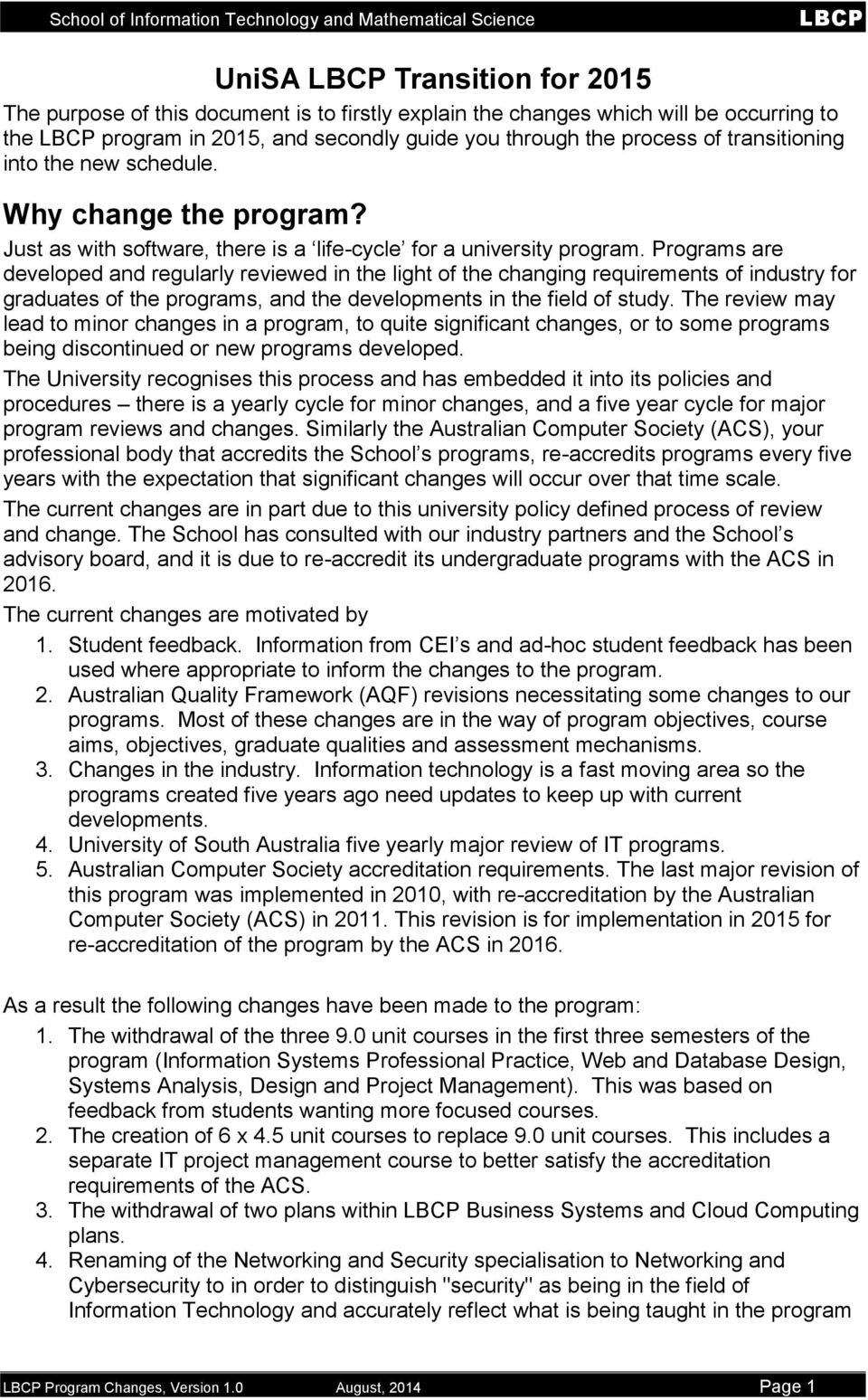
1 UniSA Transition for 2015 The purpose of this document is to firstly explain the changes which will be occurring to the program in 2015, and secondly guide you through the process of transitioning into the new schedule. Why change the program? Just as with software, there is a life-cycle for a university program. Programs are developed and regularly reviewed in the light of the changing requirements of industry for graduates of the programs, and the developments in the field of study. The review may lead to minor changes in a program, to quite significant changes, or to some programs being discontinued or new programs developed. The University recognises this process and has embedded it into its policies and procedures there is a yearly cycle for minor changes, and a five year cycle for major program reviews and changes. Similarly the Australian Computer Society (ACS), your professional body that accredits the School s programs, re-accredits programs every five years with the expectation that significant changes will occur over that time scale. The current changes are in part due to this university policy defined process of review and change. The School has consulted with our industry partners and the School s advisory board, and it is due to re-accredit its undergraduate programs with the ACS in The current changes are motivated by 1. Student feedback. Information from CEI s and ad-hoc student feedback has been used where appropriate to inform the changes to the program. 2. Australian Quality Framework (AQF) revisions necessitating some changes to our programs. Most of these changes are in the way of program objectives, course aims, objectives, graduate qualities and assessment mechanisms. 3. Changes in the industry. Information technology is a fast moving area so the programs created five years ago need updates to keep up with current developments. 4. University of South Australia five yearly major review of IT programs. 5. Australian Computer Society accreditation requirements. The last major revision of this program was implemented in 2010, with re-accreditation by the Australian Computer Society (ACS) in This revision is for implementation in 2015 for re-accreditation of the program by the ACS in As a result the following changes have been made to the program: 1. The withdrawal of the three 9.0 unit courses in the first three semesters of the program (Information Systems Professional Practice, Web and Database Design, Systems Analysis, Design and Project Management). This was based on feedback from students wanting more focused courses. 2. The creation of 6 x 4.5 unit courses to replace 9.0 unit courses. This includes a separate IT project management course to better satisfy the accreditation requirements of the ACS. 3. The withdrawal of two plans within Business Systems and Cloud Computing plans. 4. Renaming of the Networking and Security specialisation to Networking and Cybersecurity to in order to distinguish "security" as being in the field of Information Technology and accurately reflect what is being taught in the program Program Changes, Version 1.0 August, 2014 Page 1
2 5. The introduction of a new Mobile Application Development plan to meet student demand to enter this rapidly growing sector of IT. 6. The withdrawal of some existing courses and the creation of a number of new courses across all plans of, to reflect new and emerging technologies in IT, and to better prepare our graduates to meet the changing needs of industry. The number of core courses (42) remains the same. 7. A revision of the minors available to students taking the generic plan of, to reflect the changes to courses within the other plans of. The School has made changes to the content of the restructured programs and to the way they will be taught. Many new courses have been introduced. The most significant changes are: 1. New courses in each program that reflect changes in the ICT industry and also the core skills expected of future graduates of an ICT program. Exciting and innovative courses have been introduced in each of the new program schedules. 2. A greater emphasis on experiential learning and participation by student in the learning process. This constitutes a major changes to the way in which the School will present its courses. 3. The continuation of a common set of first year courses across the School s programs allowing you to transfer to any plan after the first year. The changes the School has made to its programs are all aimed at providing a set of quality programs that will prepare graduates with the knowledge and skills required to thrive in a career in the constantly changing ICT industry. A summary of the important facts you should know regarding the changes to the program All courses apart from the ICT project are 4.5 units From 2015, will have 5 plans; Games and Entertainment Design, Networking and Cybersecurity, Software Development, Mobile Application Development, and System Administration. If you haven t chosen one of the specified plans, you will complete with two minors (each consisting of 4 courses) and graduate with a generic degree (with no named major in brackets). Note: one but not both of these minors can be taken from outside the School of Information Technology and Mathematical Science A new set of minors have been put together and these can be found on the course website. will consist of 13 core courses in Information Technology, one 9.0 unit ICT project, an eight course (36 units) major or two 4-course minors (36 units), and one elective course (4.5 units) that can be selected from any school in the University. The schedule for this program is shown in appendix B. Any credit that you have already received as part of the program will count towards the new degree schedule. Any course you have studied at UniSA that is or was part of the old schedule or was approved by the Program Director will count towards the new program. A course equivalence table is provided in appendix C. Program Changes, Version 1.0 August, 2014 Page 2

3 The Transition Process Design Your Study Plan The first step you must complete in this transition is to determine what your study plan (or schedule) will be for the remainder of your degree. This document assumes all students are FULL TIME; if you are completing the degree part-time, you are still required to complete the same number of courses but you will just take them over a longer period and you should adjust the schedule to suit. Study plans for students who have completed one to four study periods (4 to 16 courses) have been specified. If you don t fit into any of these categories or have taken courses out of the standard order, use the course equivalence table appendix C to determine which courses are being replaced with new ones. With this table and the new program schedule, you should be able to work out your own study plan. If in doubt, please contact your program director for further assistance. Program Changes, Version 1.0 August, 2014 Page 3

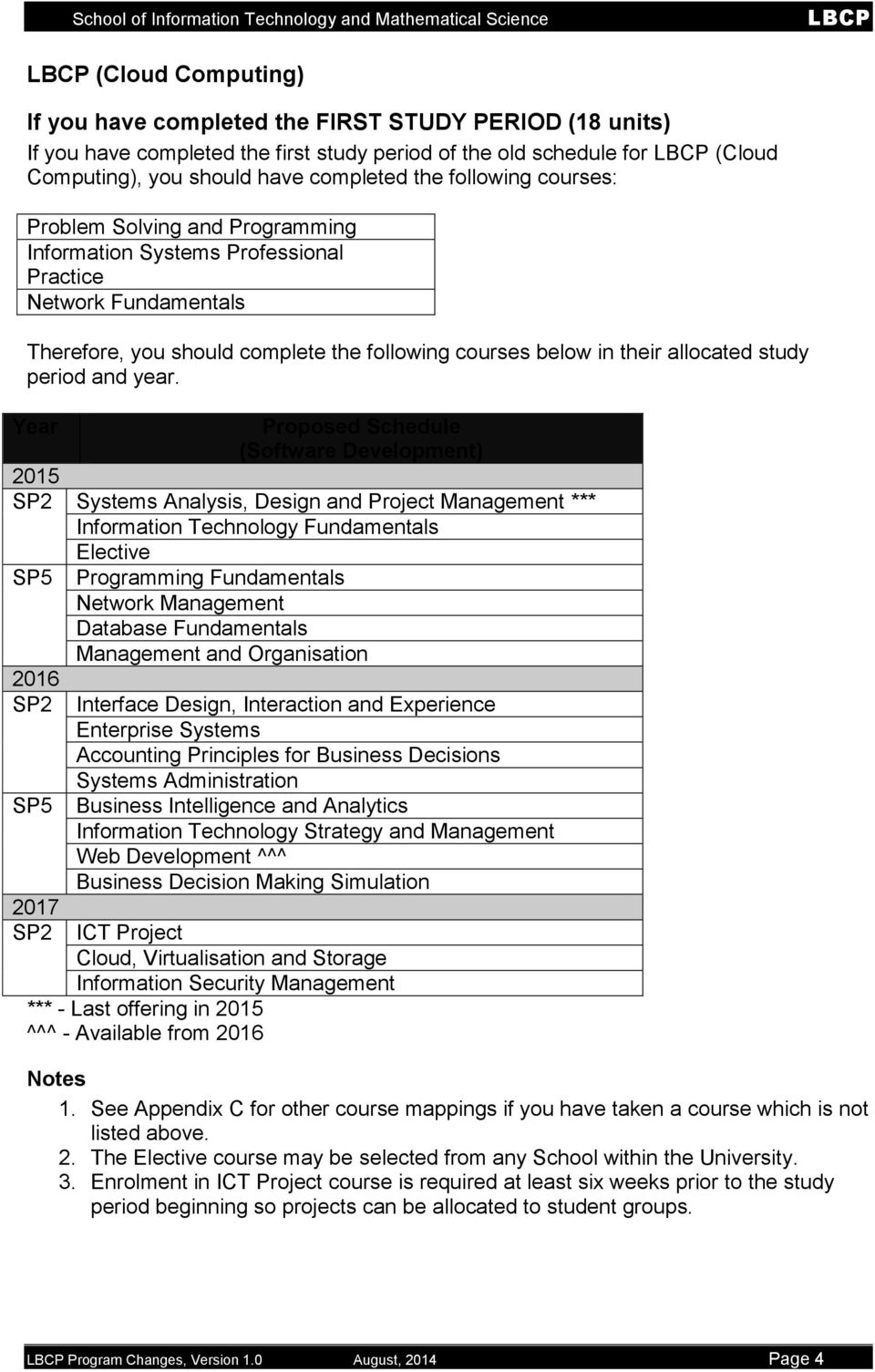
4 (Cloud Computing) If you have completed the FIRST STUDY PERIOD (18 units) If you have completed the first study period of the old schedule for (Cloud Computing), you should have completed the following courses: Problem Solving and Programming Information Systems Professional Practice Network Fundamentals Therefore, you should complete the following courses below in their allocated study period and year. Year Proposed Schedule (Software Development) 2015 SP2 Systems Analysis, Design and Project Management *** Information Technology Fundamentals 2016 SP SP2 Elective Programming Fundamentals Network Management Database Fundamentals Management and Organisation Interface Design, Interaction and Experience Enterprise Systems Accounting Principles for Business Decisions Systems Administration Business Intelligence and Analytics Information Technology Strategy and Management Web Development ^^^ Business Decision Making Simulation ICT Project Cloud, Virtualisation and Storage Information Security Management *** - Last offering in 2015 ^^^ - Available from See Appendix C for other course mappings if you have taken a course which is not listed above. 2. The Elective course may be selected from any School within the University. 3. Enrolment in ICT Project course is required at least six weeks prior to the study period beginning so projects can be allocated to student groups. Program Changes, Version 1.0 August, 2014 Page 4
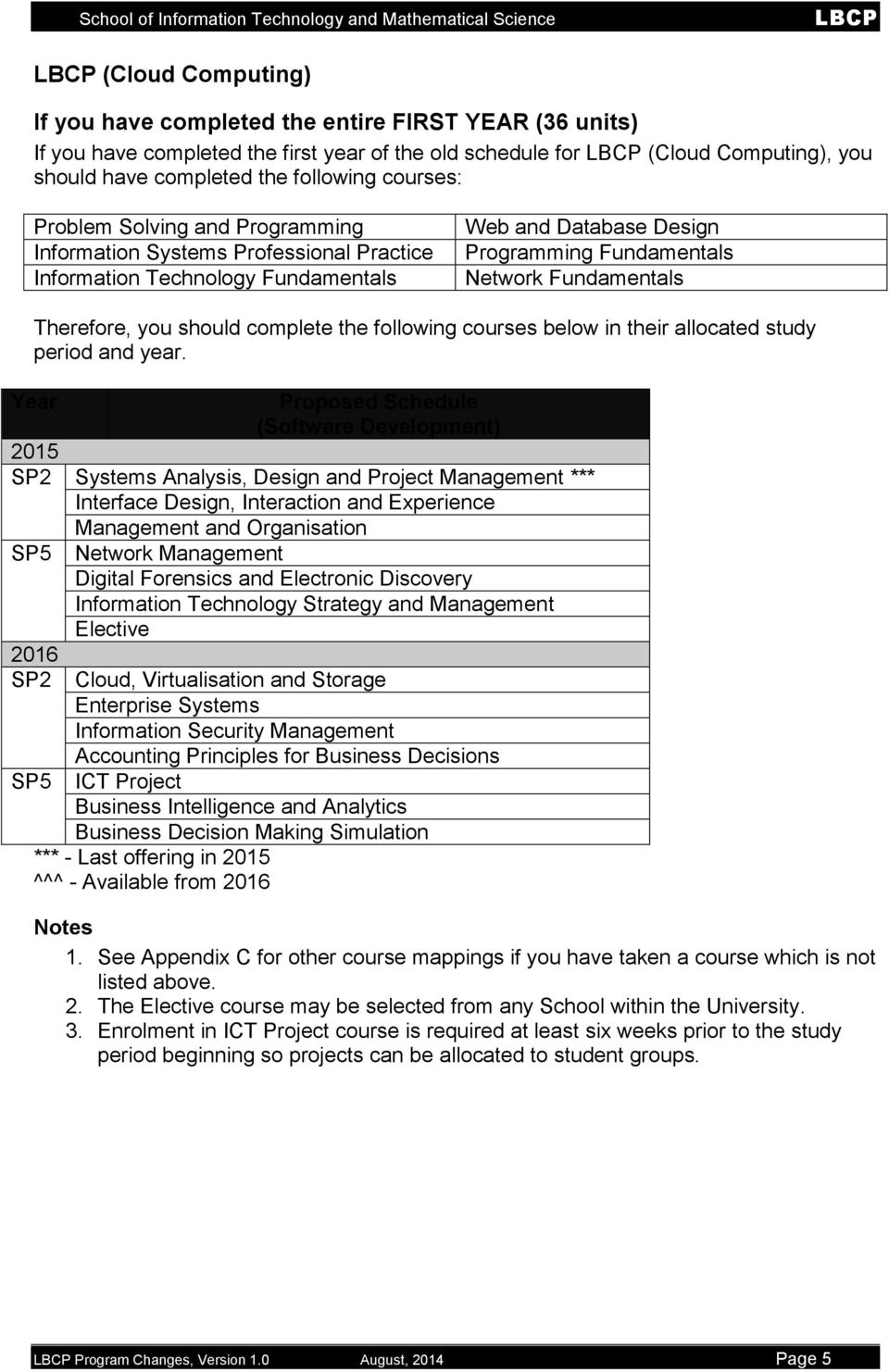
5 (Cloud Computing) If you have completed the entire FIRST YEAR (36 units) If you have completed the first year of the old schedule for (Cloud Computing), you should have completed the following courses: Problem Solving and Programming Information Systems Professional Practice Information Technology Fundamentals Web and Database Design Programming Fundamentals Network Fundamentals Therefore, you should complete the following courses below in their allocated study period and year. Year Proposed Schedule (Software Development) 2015 SP2 Systems Analysis, Design and Project Management *** Interface Design, Interaction and Experience 2016 SP2 Management and Organisation Network Management Digital Forensics and Electronic Discovery Information Technology Strategy and Management Elective Cloud, Virtualisation and Storage Enterprise Systems Information Security Management Accounting Principles for Business Decisions ICT Project Business Intelligence and Analytics Business Decision Making Simulation *** - Last offering in 2015 ^^^ - Available from See Appendix C for other course mappings if you have taken a course which is not listed above. 2. The Elective course may be selected from any School within the University. 3. Enrolment in ICT Project course is required at least six weeks prior to the study period beginning so projects can be allocated to student groups. Program Changes, Version 1.0 August, 2014 Page 5
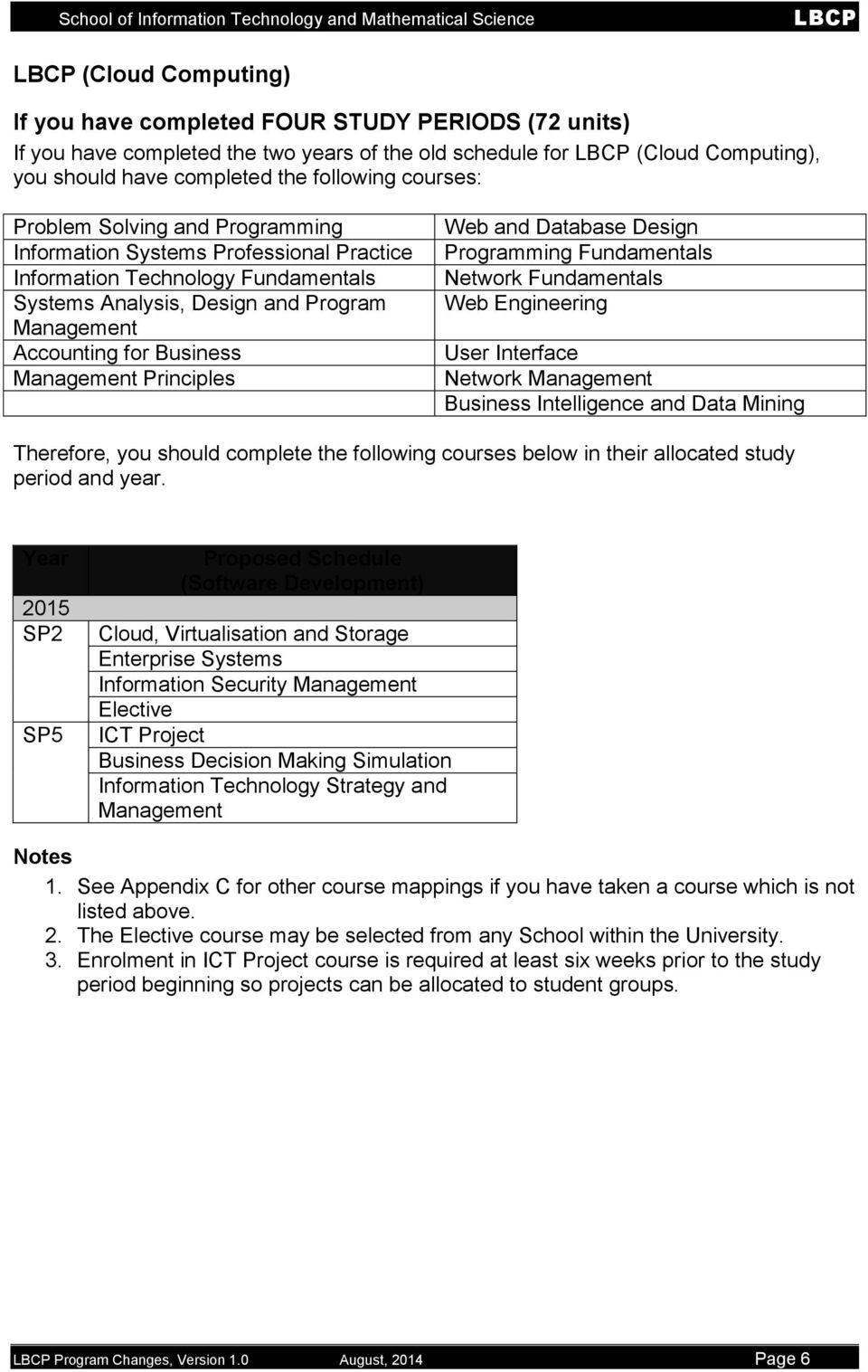
6 (Cloud Computing) If you have completed FOUR STUDY PERIODS (72 units) If you have completed the two years of the old schedule for (Cloud Computing), you should have completed the following courses: Problem Solving and Programming Information Systems Professional Practice Information Technology Fundamentals Systems Analysis, Design and Program Management Accounting for Business Management Principles Web and Database Design Programming Fundamentals Network Fundamentals Web Engineering User Interface Network Management Business Intelligence and Data Mining Therefore, you should complete the following courses below in their allocated study period and year. Year 2015 SP2 Proposed Schedule (Software Development) Cloud, Virtualisation and Storage Enterprise Systems Information Security Management Elective ICT Project Business Decision Making Simulation Information Technology Strategy and Management 1. See Appendix C for other course mappings if you have taken a course which is not listed above. 2. The Elective course may be selected from any School within the University. 3. Enrolment in ICT Project course is required at least six weeks prior to the study period beginning so projects can be allocated to student groups. Program Changes, Version 1.0 August, 2014 Page 6
7 Appendix A Old Study Plan 2014 Bachelor of Information Technology (Cloud Computing) Study Plan for Commencement in Units UniSA Courses Area + Cat No. YEAR 1 Information Systems Professional Practice 9.0 INFS 1014 Problem Solving and Programming 4.5 COMP 1039 Information Technology Fundamentals 4.5 INFT 1016 YEAR 1 Web and Database Development 9.0 INFS 1019 Network Fundamentals 4.5 INFT 1012 Programming Fundamentals 4.5 COMP 1040 YEAR 2 Systems Analysis, Design and Project Management 9.0 INFS 2035 Accounting for Business 4.5 ACCT 1008 Management Principles 4.5 BUSS 1054 YEAR 2 Web Engineering 4.5 INFT 2061 User Interfaces 4.5 INFT 1004 Network Management 4.5 INFT 3020 Business Intelligence and Enterprise Data Mining 4.5 INFS 4018 YEAR 3 Elective 4.5 Information Technology Strategy and Management 4.5 INFS 3065 Cloud Computing and Virtualisation 4.5 INFT 4028 Enterprise Systems 4.5 INFT 3024 YEAR 3 ICT Project 9.0 INFT 3025 OR ICT Specialist Industry Project 9.0 INFT 4026 Account for Business 4.5 ACCT 1008 System Architecture 4.5 COMP 3024 Program Changes, Version 1.0 August, 2014 Page 7

8 Appendix B Study Plan 2015 onwards Bachelor of Information Technology (Cloud Computing) Study Plan for Commencement in Units UniSA Courses Area + Cat No. YEAR 1 Study Period 2 Network Fundamentals 4.5 INFT 1012 Problem Solving and Programming 4.5 COMP 1039 Design Thinking and Digital Innovation 4.5 INFS 1020 Information Technology Fundamentals 4.5 INFT 1016 YEAR 1 Study Period 5 Systems Analysis 4.5 INFS 1021 Database Fundamentals 4.5 INFT 1020 Programming Fundamentals 4.5 COMP 1040 IT Project Management 4.5 INFT 1021 YEAR 2 Study Period 2 Interface Design, Interaction and Experience 4.5 INFT 1004 Web Development 4.5 INFT 2064 Elective (see note 2) 4.5 Account Principles for Business Decisions 4.5 ACCT 1009 YEAR 2 Study Period 5 Systems Design 4.5 INFS 2037 Information Technology Strategy and INFS 3065 Management 4.5 Network Management 4.5 INFT 3020 Business Intelligence and Analytics 4.5 INFS 4018 YEAR 3 Study Period 2 Information Security Management 4.5 INFS 3070 Enterprise Systems 4.5 INFT 3024 Cloud Computing and Virtualisation 4.5 INFT 4028 Management and Organisation 4.5 BUSS 2068 YEAR 3 Study Period 5 ICT Project 4.5 INFT 3025 Digital Forensics and Electronic Discovery 4.5 INFT 3031 Business Decision Making Simulation 4.5 BUSS The majority of the courses are delivered at the Mawson Lakes Campus with the remainder taught at City West or Magill. Please check the timetable to confirm the location and possible external mode offering. 2. The University elective is a course from any school or program within the University of South Australia that is freely chosen by students, subject to pre-requisite requirements and availability. 3. Enrolment in this course is required at least six weeks prior to the study period beginning so projects can be allocated to student groups. Program Changes, Version 1.0 August, 2014 Page 8

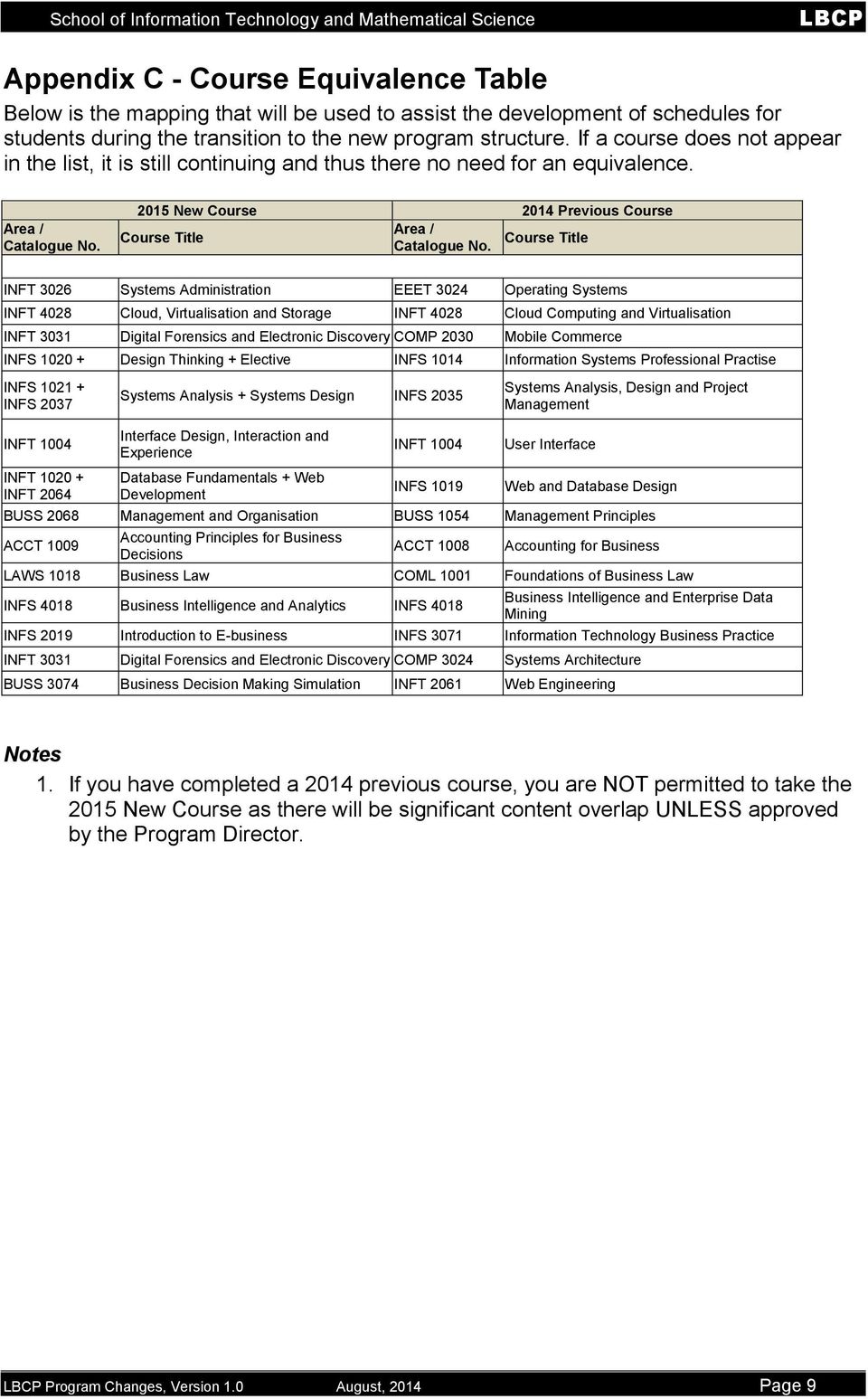
9 Appendix C - Course Equivalence Table Below is the mapping that will be used to assist the development of schedules for students during the transition to the new program structure. If a course does not appear in the list, it is still continuing and thus there no need for an equivalence. Area / Catalogue No New Course 2014 Previous Course Course Title Area / Catalogue No. Course Title INFT 3026 Systems Administration EEET 3024 Operating Systems INFT 4028 Cloud, Virtualisation and Storage INFT 4028 Cloud Computing and Virtualisation INFT 3031 Digital Forensics and Electronic Discovery COMP 2030 Mobile Commerce INFS Design Thinking + Elective INFS 1014 Information Systems Professional Practise INFS INFS 2037 INFT 1004 INFT INFT 2064 Systems Analysis + Systems Design INFS 2035 Interface Design, Interaction and Experience Database Fundamentals + Web Development INFT 1004 INFS 1019 Systems Analysis, Design and Project Management User Interface Web and Database Design BUSS 2068 Management and Organisation BUSS 1054 Management Principles ACCT 1009 Accounting Principles for Business Decisions ACCT 1008 Accounting for Business LAWS 1018 Business Law COML 1001 Foundations of Business Law INFS 4018 Business Intelligence and Analytics INFS 4018 Business Intelligence and Enterprise Data Mining INFS 2019 Introduction to E-business INFS 3071 Information Technology Business Practice INFT 3031 Digital Forensics and Electronic Discovery COMP 3024 Systems Architecture BUSS 3074 Business Decision Making Simulation INFT 2061 Web Engineering 1. If you have completed a 2014 previous course, you are NOT permitted to take the 2015 New Course as there will be significant content overlap UNLESS approved by the Program Director. Program Changes, Version 1.0 August, 2014 Page 9
A summary of the important facts you should know regarding the changes to the LBCP program
 UniSA Transition for 2015 The purpose of this document is to firstly explain the changes which will be occurring to the program in 2015, and secondly guide you through the process of transitioning into
IESP / ISAS Graduate Courses SP2 and SP5 2014. Course Code Course Title Study Period
 IESP / ISAS Graduate Courses SP2 and SP5 2014 The courses listed below do not have prerequisites and can be recommended to IESP and ISAS students as part of their study exchange in 2014 Course Code Course
COURSE REGULATIONS SCHOOL OF BUSINESS. BACHELOR OF MARKETING AND PUBLIC RELATIONS / BACHELOR OF BEHAVIOURAL SCIENCE BMktg&PR/BBehSc COURSE CODE: 3505
 COURSE REGULATIONS SCHOOL OF BUSINESS BACHELOR OF MARKETING AND PUBLIC RELATIONS / BACHELOR OF BEHAVIOURAL SCIENCE BMktg&PR/BBehSc COURSE CODE: 3505 THESE COURSE REGULATIONS ARE EFFECTIVE FROM 1.1.2016
Bachelor of Information Technology
 Bachelor of Information Technology Detailed Course Requirements The 2016 Monash University Handbook will be available from October 2015. This document contains interim 2016 course requirements information.
COURSE REGULATIONS SCHOOL OF EDUCATION. MASTER OF TEACHING CONVERSION (KINDERGARTEN YEAR 7) MTeach(K-7) COURSE CODE: 5086
 COURSE REGULATIONS SCHOOL OF EDUCATION MASTER OF TEACHING CONVERSION (KINDERGARTEN YEAR 7) MTeach(K-7) COURSE CODE: 5086 THESE COURSE REGULATIONS ARE EFFECTIVE FROM 1 January 2014. SCHOOL OF EDUCATION
COURSE REGULATIONS SCHOOL OF BUSINESS. BACHELOR OF COMMERCE (HOSPITALITY MANAGEMENT) BComm(HospMgt) COURSE CODE: 3433
 COURSE REGULATIONS SCHOOL OF BUSINESS BACHELOR OF COMMERCE (HOSPITALITY MANAGEMENT) BComm(HospMgt) COURSE CODE: 3433 THESE COURSE REGULATIONS ARE EFFECTIVE FROM 1.1.2014 SCHOOL OF BUSINESS 1. These Course
FACULTY OF ENGINEERING AND INFORMATION SCIENCES
 FACULTY OF ENGINEERING AND INFORMATION SCIENCES ENGINEERING INFORMATION & COMMUNICATION TECHNOLOGY MATHEMATICS & STATISTICS PHYSICS ENGINEERING Master of Engineering go.uow.edu.au/meng 083844B ENTRY REQUIREMENTS
COURSE REGULATIONS SCHOOL OF EDUCATION. GRADUATE CERTIFICATE IN EDUCATION (LEADERSHIP AND MANAGEMENT) GradCertEd(L&M) COURSE CODE: 4071
 COURSE REGULATIONS SCHOOL OF EDUCATION GRADUATE CERTIFICATE IN EDUCATION (LEADERSHIP AND MANAGEMENT) GradCertEd(L&M) COURSE CODE: 4071 THESE COURSE REGULATIONS ARE EFFECTIVE FROM 1.1.2014. SCHOOL OF EDUCATION
COURSE REGULATIONS SCHOOL OF BUSINESS. Graduate Diploma of Business (Children s Services MANAGEMENT) GDipBus(ChildServMgt) Course Code: 4140
 COURSE REGULATIONS SCHOOL OF BUSINESS Graduate Diploma of Business (Children s Services MANAGEMENT) GDipBus(ChildServMgt) Course Code: 4140 THESE COURSE REGULATIONS ARE EFFECTIVE FROM 1.1.2014 SCHOOL OF
COURSE REGULATIONS SCHOOL OF MEDICINE. PRE-MEDICINE CERTIFICATE PreMedCert COURSE CODE: 0096
 COURSE REGULATIONS SCHOOL OF MEDICINE PRE-MEDICINE CERTIFICATE PreMedCert COURSE CODE: 0096 THESE COURSE REGULATIONS ARE EFFECTIVE FROM 1.1.2015 SCHOOL OF MEDICINE 1. These Course Regulations apply to
COURSE REGULATIONS: GRADUATE CERTIFICATE IN CLINICAL NURSING
 COURSE REGULATIONS: GRADUATE CERTIFICATE IN CLINICAL NURSING (GRADCERTCLINNURS) (SYDNEY CAMPUS) COURSE CODE: 4128 These Course Regulations apply to all students who are enrolled in this course. Dean School
COURSE REGULATIONS SCHOOL OF NURSING AND MIDWIFERY. MASTER OF NURSING (COURSEWORK) MNurs COURSE CODE: 5114
 COURSE REGULATIONS SCHOOL OF NURSING AND MIDWIFERY MASTER OF NURSING (COURSEWORK) MNurs COURSE CODE: 5114 THESE COURSE REGULATIONS ARE EFFECTIVE FROM 1.1.2014 SCHOOL OF NURSING AND MIDWIFERY 1. These Course
COURSE REGULATIONS SCHOOL OF EDUCATION. GRADUATE CERTIFICATE IN EARLY CHILDHOOD EDUCATION GCertEaChEd COURSE CODE: 4147
 COURSE REGULATIONS SCHOOL OF EDUCATION GRADUATE CERTIFICATE IN EARLY CHILDHOOD EDUCATION GCertEaChEd COURSE CODE: 4147 THESE COURSE REGULATIONS ARE EFFECTIVE FROM 1.7.2016 SCHOOL OF EDUCATION 1. These
COURSE REGULATIONS SCHOOL OF BUSINESS MASTER OF PROFESSIONAL ACCOUNTING MPA COURSE CODE: 5105
 COURSE REGULATIONS SCHOOL OF BUSINESS MASTER OF PROFESSIONAL ACCOUNTING MPA COURSE CODE: 5105 THESE COURSE REGULATIONS ARE EFFECTIVE FROM 1.1.2014 SCHOOL OF BUSINESS 1. These Course Regulations apply to
COURSE REGULATIONS SCHOOL OF BUSINESS. MASTER OF BUSINESS MBus COURSE CODE: 5016
 COURSE REGULATIONS SCHOOL OF BUSINESS MASTER OF BUSINESS MBus COURSE CODE: 5016 THESE COURSE REGULATIONS ARE EFFECTIVE FROM 1.1.2014 SCHOOL OF BUSINESS 1. These Course Regulations apply to all students
COURSE REGULATIONS SCHOOL OF EDUCATION. GRADUATE CERTIFICATE IN EDUCATION (EARLY CHILDHOOD) GradCertEd(ECE) COURSE CODE: 4069
 ` COURSE REGULATIONS SCHOOL OF EDUCATION GRADUATE CERTIFICATE IN EDUCATION (EARLY CHILDHOOD) GradCertEd(ECE) COURSE CODE: 4069 THESE COURSE REGULATIONS ARE EFFECTIVE FROM 1.1.2015. SCHOOL OF EDUCATION
COURSE REGULATIONS SCHOOL OF ARTS AND SCIENCES. BACHELOR OF COMMUNICATIONS AND MEDIA/BACHELOR OF MARKETING AND PUBLIC RELATIONS BComnMedBMktg&PR
 COURSE REGULATIONS SCHOOL OF ARTS AND SCIENCES BACHELOR OF COMMUNICATIONS AND MEDIA/BACHELOR OF MARKETING AND PUBLIC RELATIONS BComnMedBMktg&PR COURSE CODE: 3365 THESE COURSE REGULATIONS ARE EFFECTIVE
COURSE REGULATIONS SCHOOL OF EDUCATION. MASTER OF EDUCATION (SPECIAL LEARNING NEEDS) MEd(SN) COURSE CODE: 5032
 COURSE REGULATIONS SCHOOL OF EDUCATION MASTER OF EDUCATION (SPECIAL LEARNING NEEDS) MEd(SN) COURSE CODE: 5032 THESE COURSE REGULATIONS ARE EFFECTIVE FROM 1.1.2014 SCHOOL OF EDUCATION 1. These Course Regulations
UniSA College Pathways to degrees 2015
 UniSA College Pathways to degrees 2015 Benjamin Van Loggem Foundation Studies, Bachelor of Architectural Studies I embarked on a holiday overseas, and during this time I had an opportunity to reflect on
School of Natural and Built Environments
 School of Natural and Built Environments The School of Natural and Built Environments (NBE) focuses on the unique relationships and synergies between natural and built environments, with a particular interest
THE SCHOOL OF NURSING, MIDWIFERY AND NUTRITION BACHELOR OF NURSING SCIENCE CURRICULUM
 THE SCHOOL OF NURSING, MIDWIFERY AND NUTRITION BACHELOR OF NURSING SCIENCE CURRICULUM MAJORS: What is a major, and what does it mean to my future practice? A major is a specific stream of nursing that
Master of Information Technology and Systems
 School of Computing and Information Systems Master of Information Technology and Systems UNIVERSITY OF TASMANIA www.utas.edu.au/cis master of Information Technology and systems The Master of Information
COURSE REGULATIONS SCHOOL OF BUSINESS. BACHELOR OF HUMAN RESOURCE MANAGEMENT / BACHELOR OF BEHAVIOURAL SCIENCE BHRM/BBehSc COURSE CODE: 3170
 COURSE REGULATIONS SCHOOL OF BUSINESS BACHELOR OF HUMAN RESOURCE MANAGEMENT / BACHELOR OF BEHAVIOURAL SCIENCE BHRM/BBehSc COURSE CODE: 3170 THESE COURSE REGULATIONS ARE EFFECTIVE FROM 1.1.2015 SCHOOL OF
College of Science, Engineering and Technology. School of Computing. college of science, engineering and technology. Learn without limits.
 College of Science, Engineering and Technology School of Computing Learn without limits. college of science, engineering and technology WELCOME TO THE SCHOOL OF COMPUTING The vision of the school is to
BACHELOR OF BUSINESS. 1 P age
 BACHELOR OF BUSINESS WHY STUDY BUSINESS AT AVONDALE?... 2 BACHELOR OF BUSINESS... 2 Details... 2 Overview... 2 Entry Requirements... 3 Where it could take you... 3 Textbook and Other Costs... 3 Professional
Postgraduate Information Technology Business Analysis
 Postgraduate Information Technology Business Analysis swinburne.edu.au/postgrad }Information } technology business analysis Swinburne s postgraduate program in information technology business analysis
COURSE REGULATIONS SCHOOL OF HEALTH SCIENCES BACHELOR OF HEALTH AND PHYSICAL EDUCATION (SECONDARY)
 COURSE REGULATIONS SCHOOL OF HEALTH SCIENCES BACHELOR OF HEALTH AND PHYSICAL EDUCATION (SECONDARY) BHPE (Sec) COURSE CODE: 3288 BACHELOR OF HEALTH AND PHYSICAL EDUCATION (SECONDARY) (Honours) BHPE(Sec)(Hons)
Bachelor of Business Administration
 Bachelor of Business Administration (Specialisation) Presenter: Patrick Wille Program Director Who is this guy in the suit? "Hi, I'm Patrick". Program Director (PD) of the Bachelor of Business Administration
Faculty of Information Technology
 Faculty of 71 Faculty of Formal establishment of the Faculty of is subject to Council approval Faculty officers Academic Dean tba Prior to the election of the Academic Dean, contact Dr CB Hallam (Bachelor
MASTER OF FINANCIAL PLANNING COURSE BROCHURE. Your success is how we measure our own
 MASTER OF FINANCIAL PLANNING COURSE BROCHURE Your success is how we measure our own Contents Master of Financial Planning 4 Graduate Diploma of Financial Planning 5 Graduate Certificate of Financial Planning
Doctor of Information Technology Management
 Doctor of Information Technology Management The challenge facing IT today is its rapid advance offers both opportunities and challenges for all organisations. To successfully navigate through such an evolving
Le Cordon Bleu MASTERS DEGREES
 Masters Degrees 2010 MASTERS DEGREES Combining innovation with tradition, the Le Cordon Bleu Masters degrees are setting new benchmarks in the industry by grooming today s hospitality managers for the
How To Become A Successful Information System Consultant
 Information Systems Vision The School of Information Systems strives to become a reputable and leading information system school for developing world-class professionals with excellent skills in both business
COURSE REGULATIONS SCHOOL OF BUSINESS BACHELOR OF SPORT AND RECREATION MANAGEMENT / BACHELOR OF SCIENCE BSPRECMGMT/BSC COURSE CODE: 3332
 COURSE REGULATIONS SCHOOL OF BUSINESS BACHELOR OF SPORT AND RECREATION MANAGEMENT / BACHELOR OF SCIENCE BSPRECMGMT/BSC COURSE CODE: 3332 THESE COURSE REGULATIONS ARE EFFECTIVE FROM 1.1.2015 SCHOOL OF BUSINESS
MC-MGMTACT Master of Management (Accounting)
 MC-MGMTACT Master of Management (Accounting) Year and Campus: 2016 - Parkville CRICOS Code: Fees Information: Level: Duration & Credit Coordinator: 064499E Subject EFTSL, Level, Discipline & Census Date,
Information Technology Project Management
 n Postgraduate Information Technology Project Management swinburne.edu.au/postgrad Program details Master of Information Technology Project Management Graduate Diploma of Information Technology Project
COURSE REGULATIONS SCHOOL OF EDUCATION. BACHELOR OF EDUCATION (EARLY CHILDHOOD AND CARE: 0-8 YEARS) BEd(ECE) COURSE CODE: 3382
 COURSE REGULATIONS SCHOOL OF EDUCATION BACHELOR OF EDUCATION (EARLY CHILDHOOD AND CARE: 0-8 YEARS) BEd(ECE) COURSE CODE: 3382 THESE COURSE REGULATIONS ARE EFFECTIVE FROM 1.1.2015 SCHOOL OF EDUCATION 1.
Information Technology
 Information Technology Bachelor of Information Technology Master of Information Technology Joint Degree: Master of Information Technology - Master of Business Administration 1 university 2 countries 3
COURSE REGULATIONS SCHOOL OF BUSINESS MASTER OF BUSINESS ADMINISTRATION MBA COURSE CODE: 5018
 COURSE REGULATIONS SCHOOL OF BUSINESS MASTER OF BUSINESS ADMINISTRATION MBA COURSE CODE: 5018 THESE COURSE REGULATIONS ARE EFFECTIVE FROM 1.1.2015 SCHOOL OF BUSINESS 1. These Course Regulations apply to
k. p.142-146 MIS program section is replaced with following content.
 j. p.12: Following seven new specializations in MIS are added to the programs list. Knowledge Management Data Management Business Intelligence and Data Analytics Cybersecurity Enterprise Project Management
Enrolment. Step by Step Guide
 Enrolment Step by Step Guide ENROLMENT PROCESS FLOWCHART... 3 STEP 1: RECEIVE YOUR OFFER EMAIL... 4 DOMESTIC STUDENTS SATAC (UNDERGRADUATE)... 4 DOMESTIC STUDENTS GRADSTART (POSTGRADUATE)... 4 INTERNATIONAL
2015 Course Enrolment Guide
 2015 Course Enrolment Guide School of Business North Sydney, NSW Bachelor of Business Information Systems Bachelor of Business Information Systems (Honours) Continuing Student only This Guide is provided
Information Technology
 Information Technology Bachelor of Information Technology Master of Information Technology Joint Masters of Information Technology and Business Administration 1 university 2 countries 3 tropical locations
RMIT UNIVERSITY PROGRAM AMENDMENT
 Faculty: School/Department: Amendment: Related programs: RMIT UNIVERSITY PROGRAM AMENDMENT RMIT Business BP129 Bachelor of Business (Accountancy) Schools of Accounting and Law, Business Information Technology,
Bachelor of Bachelor of Computer Science
 Bachelor of Bachelor of Computer Science Detailed Course Requirements The 2016 Monash University Handbook will be available from October 2015. This document contains interim 2016 course requirements information.
Programme Specification: MA Education: Leadership, Management and Change
 Programme Specification and Curriculum Map Programme Specification: MA Education: Leadership, Management and Change 1. Awarding institution Middlesex University 2. Teaching institution Middlesex University
Computer Forensics and Security Management PGDip/MSc
 SCHOOL OF COMPUTING & MATHEMATICAL SCIENCES Computer Forensics and Security Management PGDip/MSc Greenwich Campus www.gre.ac.uk/cms Why study this programme? This programme is designed for graduates with
COURSE REGULATIONS RESEARCH OFFICE DOCTOR OF BUSINESS ADMINISTRATION DBA COURSE CODE: 6100
 COURSE REGULATIONS RESEARCH OFFICE DOCTOR OF BUSINESS ADMINISTRATION DBA COURSE CODE: 6100 THESE COURSE REGULATIONS ARE EFFECTIVE FROM 1.1.2014 RESEARCH OFFICE 1. These Course Regulations apply to all
Department of Finance Honours in Finance
 Department of Finance Honours in Finance 2016 www.unimelb.edu.au 1 welcome 2 contents Message from the Honours Coordinator 4 Admission requirements 4 Honours year in Finance 5 Duration 6 Combined Honours
MSc in Applied Informatics For students entering in 2007
 MSc in Applied Informatics For students entering in 2007 Awarding Institution: The University of Reading Teaching Institution: The University of Reading Programme length: 12 months full time, 36 months
International Skills Institute COURSE OUTLINE. BSB51315 Diploma of Work Health and Safety RTO 40541
 International Skills Institute COURSE OUTLINE BSB51315 Diploma of Work Health and Safety RTO 40541 Contents International Skills Institute (ISI) BSB51315 Diploma of Work Health and Safety Information about
2015 Course Enrolment Guide
 2015 Course Enrolment Guide School of Business Strathfield, NSW Bachelor of Commerce This Guide is provided to assist you to select your units for the 2015 academic year. Specific information regarding
Faculty Contact person and/or: Ms Jane Gamble Ext. No: 19203. Academic Proponent Dr Joanne Callen Email: [email protected]
 SECTION 1: ACADEMIC BOARD COURSE PROPOSAL PART 1: OVERVIEW OF PROPOSAL Faculty: Health Sciences Department/School presenting the proposal: Discipline of Health Information Management Faculty Contact person
Why postgraduate study at ICMS?
 POSTGRADUATE PROGRAMS International College of Management, Sydney 2014-2015 WELCOME Why postgraduate study at? Sydney city 15 minute fast ferry Work Integrated Learning In of every Masters program is a
Launch Your Career! Launch Your Career! Master of Business Degree Programs Administration (MBA) Graduate Diploma in Business. Administration (MBA)
 Formerly Formerly UIC UIC SYDNEY SYDNEY Launch Your Career! Launch Your Career! Master of Business Degree Programs Administration (MBA) Master of Business Discipline of Accounting Administration (MBA)
Information Systems CATALOG 2015/2016 BINUS UNIVERSITY
 Information Systems Vision The Program of Information Systems strives to become a reputable and leading Information System program for developing world-class professionals with excellent skills in both
Accounting. Faculty of Business and Economics. Postgraduate Courses in Accounting 2014
 Faculty of Business and Economics Postgraduate Courses in Accounting 2014 Accounting Graduate Diploma in Accounting Master of Professional Accounting Master of Professional Accounting (Advanced) Master
UNIVERSITY OF WOLLONGONG www.uow.edu.au
 82 LAW A UOW Bachelor of Laws (LLB) degree provides an excellent foundation for a career in legal practice, and it also opens up a diverse range of other career options as well (see Graduate Destinations,
MASSEY UNIVERSITY BACHELOR OF ENGINEERING with HONOURS TELECOMMUNICATIONS AND NETWORK ENGINEERING. Major Profile Description and Competency Framework
 Appendix 3.13 Telecommunications & Network Engineering Major Profile MASSEY UNIVERSITY BACHELOR OF ENGINEERING with HONOURS TELECOMMUNICATIONS AND NETWORK ENGINEERING Major Profile Description and Competency
COURSE REGULATIONS SCHOOL OF MEDICINE BACHELOR OF MEDICINE/BACHELOR OF SURGERY MBBS. BACHELOR OF MEDICINE/BACHELOR OF SURGERY (HONOURS) MBBS(Hons)
 COURSE REGULATIONS SCHOOL OF MEDICINE BACHELOR OF MEDICINE/BACHELOR OF SURGERY MBBS BACHELOR OF MEDICINE/BACHELOR OF SURGERY (HONOURS) MBBS(Hons) COURSE CODE: 3342 & 3314 THESE COURSE REGULATIONS ARE EFFECTIVE
MC-MGMTHRE Master of Management (Human Resources)
 MC-MGMTHRE Master of Management (Human Resources) Year and Campus: 2016 - Parkville CRICOS Code: Fees Information: Level: Duration & Credit Coordinator: 064496G Subject EFTSL, Level, Discipline & Census
Programme Specification (Postgraduate)
 Programme Specification (Postgraduate) 1. Programme Title(s): MSc/PGDip*/PGCert* Data Analysis for Business Intelligence *Exit awards only 2. Awarding body or institution: University of Leicester 3. a)
MASTER OF INFORMATION TECHNOLOGY
 Information for International applicants The Master of Information Technology (MIT) enables students who have completed a bachelors degree in information technology/computing to achieve a postgraduate
APAC Accreditation Assessment Summary Report
 APAC Accreditation Assessment Summary Report Higher Education Provider Australian Catholic University, Name of School Date of determination 8 December 2014 s version June 2010 ver 10 Programs of Study
Bachelor of Commerce Specialist
 Bachelor of Commerce Specialist Detailed Course Requirements The 2016 Monash University Handbook will be available from October 2015. This document contains interim 2016 course requirements information.
2014 Course Enrolment Guide
 2014 Course Enrolment Guide School of Business North Sydney, NSW Melbourne, VIC Brisbane, QLD Bachelor of Accounting and Finance This Guide is provided to assist you to select your units for the 2014 academic
METROPOLITAN PLACEMENT
 Australian College of Health Service Executives Management Residency Program Position Description 2009 METROPOLITAN PLACEMENT PART ONE 1. Management Residency Program 1.0 Background 1.1 Introduction 1.2
THE VOCATIONAL GRADUATE CERTIFICATE IN LOCAL GOVERNMENT MANAGEMENT
 THE VOCATIONAL GRADUATE CERTIFICATE IN LOCAL GOVERNMENT MANAGEMENT IT S THE CAREER ACCELERATOR FOR COUNCIL MANAGERS SUBJECT CHOICES Govern councils Manage the human resources process in local government
electrical and computer engineering AT CURTIN
 Bachelor of in: Electrical Power Electronic and Communication Computer Systems Double Degrees degrees with Computer Science degrees with Physics degrees with Commerce electrical and computer engineering
Structure of Postgraduate Programs (2005)
 Computing and Information Technology Structure of Postgraduate Programs (2005) Entry Point 1: Program 7342 Graduate Certificate in Computing (NEW) GradCert 24 units of credit 24uc (4 courses) over 1 or
Language, Literacy and Numeracy (LLN) Practitioner Scholarships Programme (the Programme) Round Five
 Language, Literacy and Numeracy (LLN) Practitioner Scholarships Programme (the Programme) Round Five Frequently Asked Questions (FAQs) The information provided in this document is designed to answer common
Sydney city 15 minute fast ferry ICMS. Manly Beach
 POSTGRADUATE PROGRAMS International College of Management, Sydney 2014-2015 WELCOME ICMS Sydney city 15 minute fast ferry Manly Beach 5 minute walk The International College of Management, Sydney (ICMS)
Faculty of Education: Masters Degrees Regulations
 Made by the Academic Board of Monash University Version incorporating amendments as at 12 July 2013 Part I - General 1. Degrees 1.1 The masters degrees listed in Schedule 1 may be undertaken in the faculty
Master Business Intelligence and Process Management
 Hochschule für Wirtschaft und Recht Berlin Berlin School of Economics and Law Department of Business and Economics Master Business Intelligence and Process Management Business Intelligence and Process
With prior approval, subjects from other Chifley Business School postgraduate courses may be included in the elective component of the degree.
 Summary The following Course Structures encompass the Chifley Business School Postgraduate Courses being offered to new students in the September 2015 intake. With prior approval, subjects from other Chifley
Guidelines for the Presentation of the Australian Higher Education Graduation Statement
 Guidelines for the Presentation of the Australian Higher Education Graduation Statement November 2013 Introduction The Australian Higher Education Graduation Statement (AHEGS) is the Australian equivalent
Nottingham Trent University Programme Specification
 Nottingham Trent University Programme Specification Basic Programme Information 1 Awarding Institution: Nottingham Trent University 2 School/Campus: School of Education/ Clifton campus/ Offsite 3 Final
Electrical Engineering Postgraduate coursework programs
 Electrical Engineering Postgraduate coursework programs Never Stand Still Engineering Electrical Engineering and Telecommunications Your future. Your choice. Postgraduate study in electrical engineering
Articulation Pathways Guide
 Articulation Pathways Guide This Articulation Pathways Guide is for anyone interested in applying to an undergraduate degree at Holmesglen after post-secondary studies either at Holmesglen or another Australian
ASSOCIATE DEGREE OF BUSINESS COURSE OUTLINE 2015. Information correct as of August 2014. Provider CRICOS Code 00020G Higher Education Provider
 GOVERNMENT OF WESTERN AUSTRALIA ASSOCIATE DEGREE OF BUSINESS COURSE OUTLINE 2015 Information correct as of August 2014. Provider CRICOS Code 00020G Higher Education Provider The Administrative Information
BUSINESS SCHOOL. Master of Commerce A WORLD CLASS BUSINESS EDUCATION
 BUSINESS SCHOOL Master of Commerce A WORLD CLASS BUSINESS EDUCATION Advance your career A Master of Commerce from the internationally accredited can boost your employment opportunities around the world.
Monash Update Special Issue: 2016 Course Portfolio
 Special Issue/2015 Monash Update Special Issue: 2016 Course Portfolio Welcome Over the past year we have reviewed our course portfolio. Our commitment at Monash is to provide students with choice and empowering
INFORMATION AND LIBRARY STUDIES
 INFORMATION AND LIBRARY STUDIES WELCOME TO OPEN POLYTECHNIC Whether you are looking to improve your career prospects or learn something new, we can help you achieve your goal. We specialise in open learning