
Math of Finance. Texas Association of Counties January 2014
|
|
|
- Jonah Owen
- 10 years ago
- Views:
Transcription
1 Math of Finance Texas Association of Counties January 2014
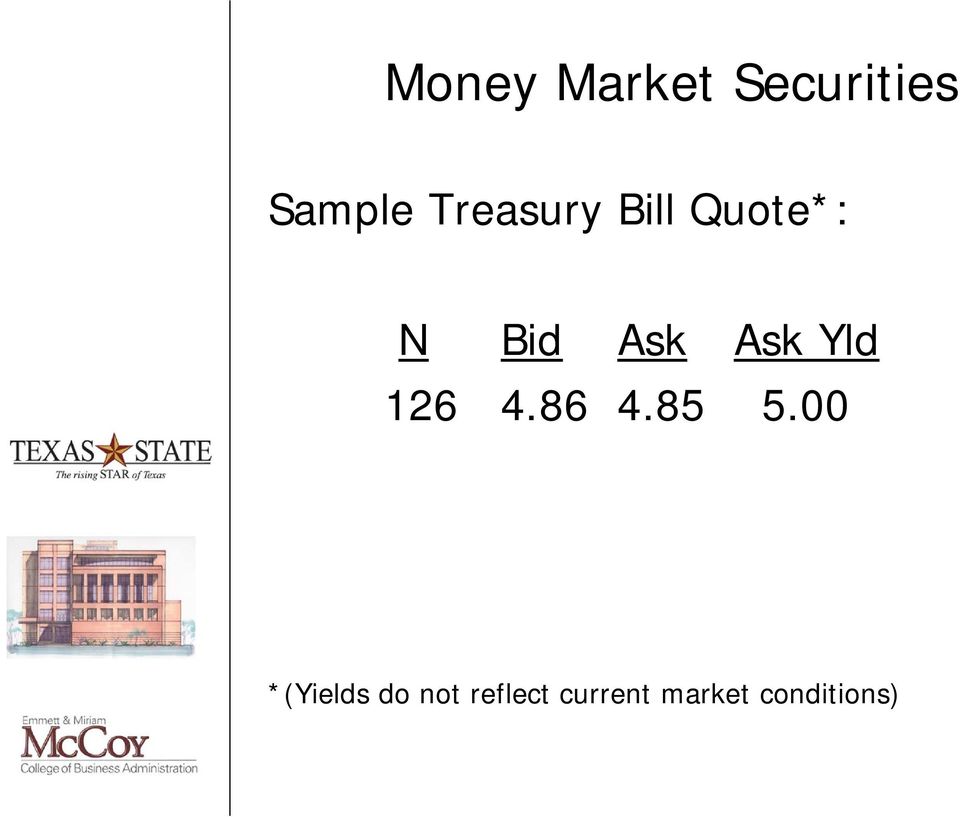
2 Money Market Securities Sample Treasury Bill Quote*: N Bid Ask Ask Yld *(Yields do not reflect current market conditions)
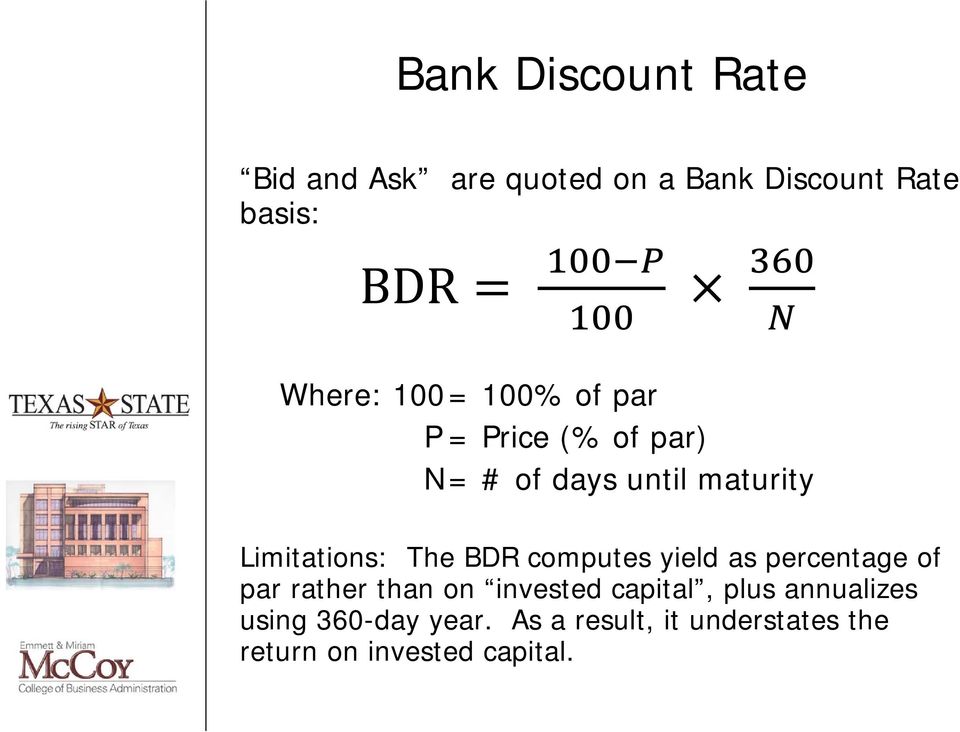
3 Bank Discount Rate Bid and Ask are quoted on a Bank Discount Rate basis: Where: 100= 100% of par P = Price (% of par) N= # of days until maturity Limitations: The BDR computes yield as percentage of par rather than on invested capital, plus annualizes using 360-day year. As a result, it understates the return on invested capital.
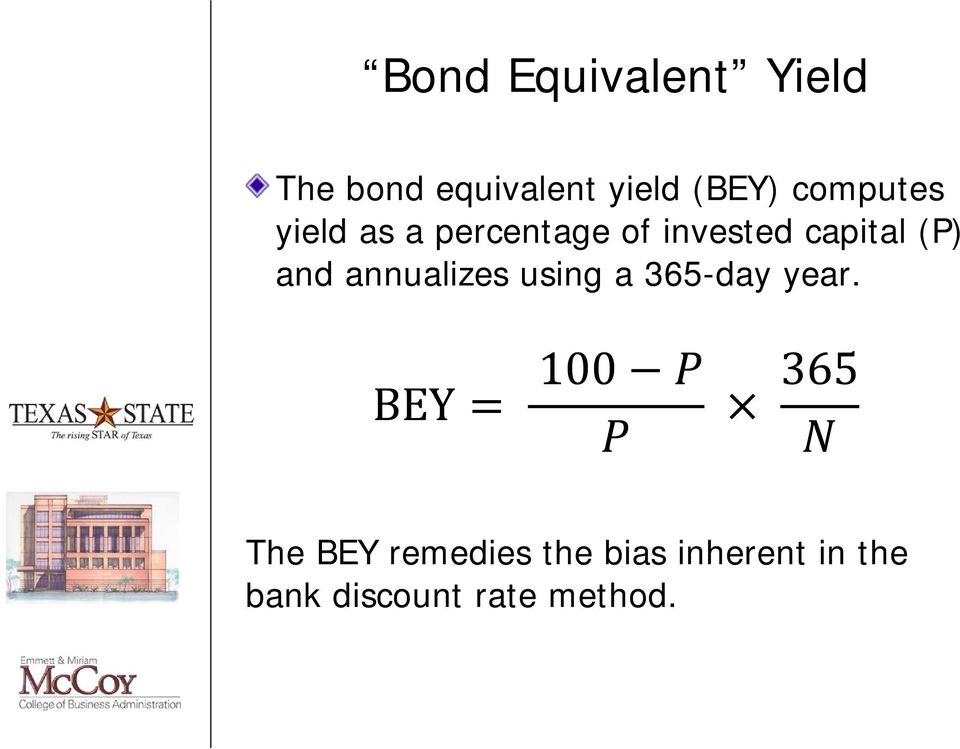
4 Bond Equivalent Yield The bond equivalent yield (BEY) computes yield as a percentage of invested capital (P) and annualizes using a 365-day year. The BEY remedies the bias inherent in the bank discount rate method.
5 Use BDR to Compute Price Computing the Price: Use BDR equation solve for P : P = 100 x [1 (BDR)(N/360)] = 100 x [1 (.0485)(126/360)] = 100 x = (% of par)
![100 x [1 (BDR)(N/360)] = 100 x [1 (.](/docs-images/54/10410857/images/page_5.jpg "0485)(126/360)] = 100 x.983025 = 98.")
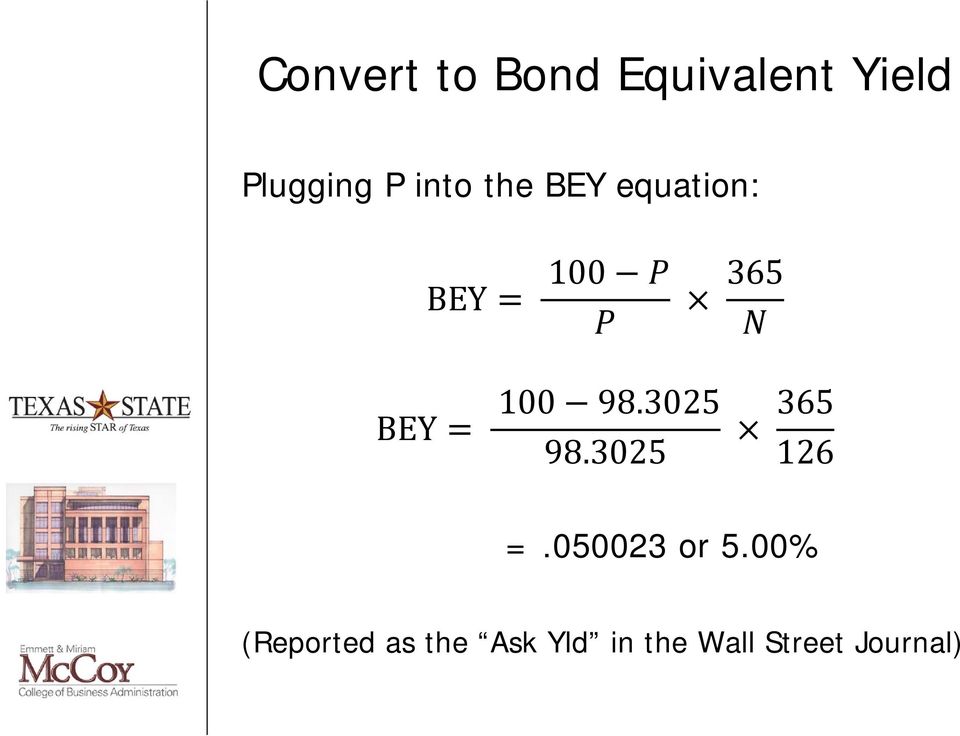
6 Convert to Bond Equivalent Yield Plugging P into the BEY equation: BEY BEY = or 5.00% (Reported as the Ask Yld in the Wall Street Journal)
7 Effective Annual Yield The bond-equivalent yield (BEY) ignores interest-on-interest that can be earned by reinvesting cash flows during the year. ] The effective annual yield assumes that the interim proceeds are reinvested at the current BEY. The compounding of interest-oninterest can add several basis points to your realized rate of return.
![] The effective annual yield assumes that the interim proceeds are reinvested at the](/docs-images/54/10410857/images/page_7.jpg "current BEY.")
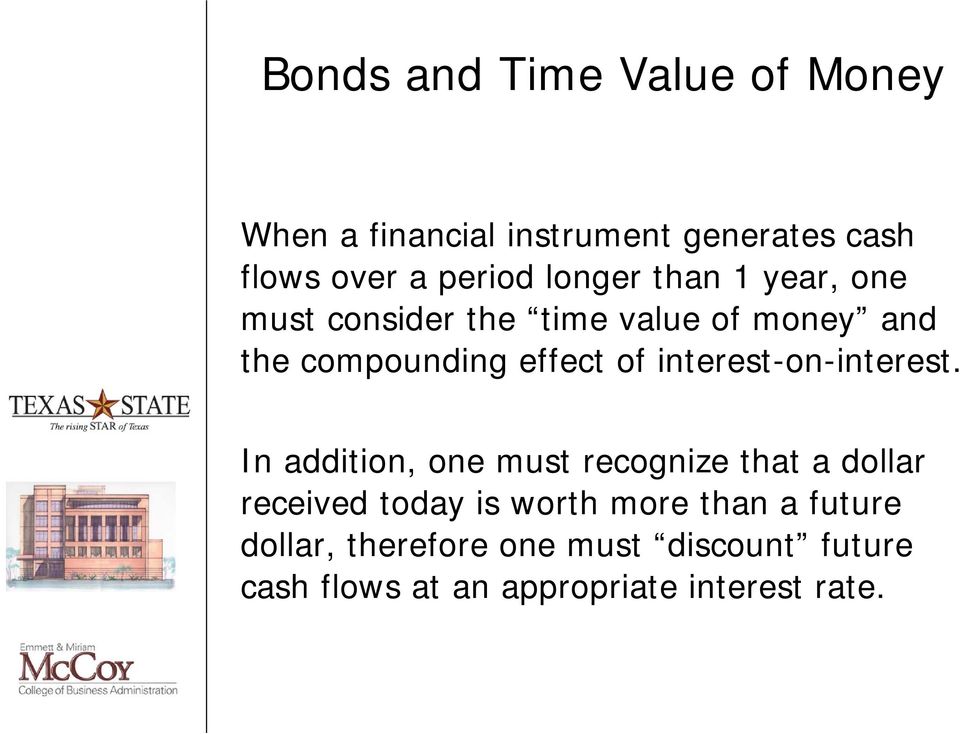
8 Bonds and Time Value of Money When a financial instrument generates cash flows over a period longer than 1 year, one must consider the time value of money and the compounding effect of interest-on-interest. In addition, one must recognize that a dollar received today is worth more than a future dollar, therefore one must discount future cash flows at an appropriate interest rate.
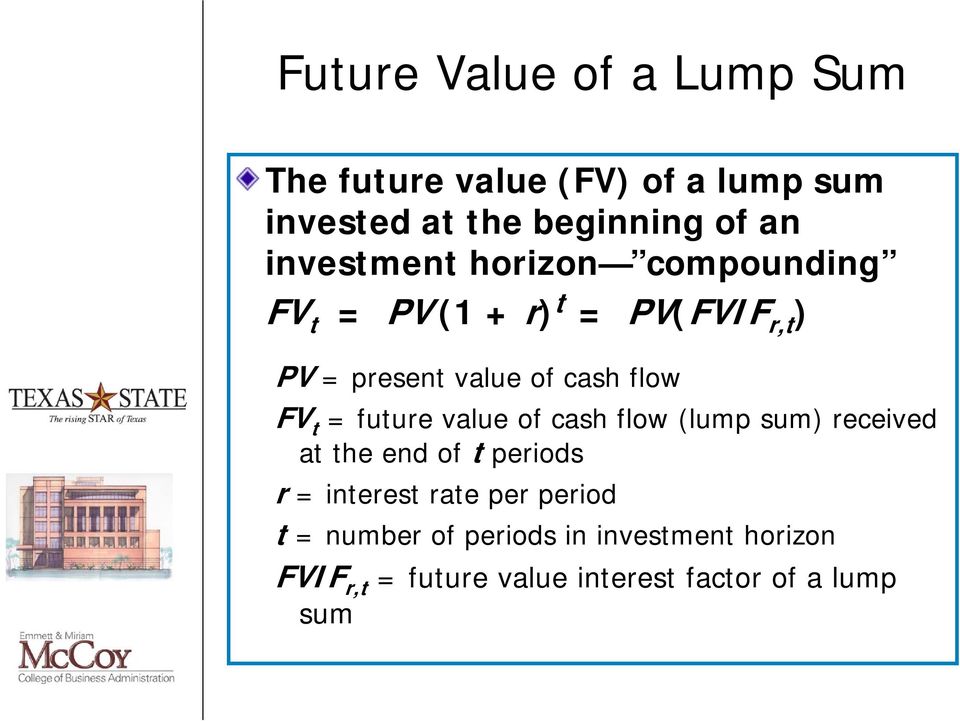
9 Future Value of a Lump Sum The future value (FV) of a lump sum invested at the beginning of an investment horizon compounding FV t = PV (1 + r) t = PV(FVIF r,t ) PV = present value of cash flow FV t = future value of cash flow (lump sum) received at the end of t periods r = interest rate per period t = number of periods in investment horizon FVIF r,t = future value interest factor of a lump sum
10 Present Value of a Lump Sum Discounting a future lump sum using current interest rates to find its present value (PV) PV = FV t [1/(1 + r)] t = FV t (PVIF r,t ) PVIF r,t = present value interest factor of a lump sum
![value (PV) PV = FV t [1/(1 + r)] t = FV t (PVIF r,t )](/docs-images/54/10410857/images/page_10.jpg "PVIF r,t = present value interest factor of a lump")
11 Present Value of an Annuity The present value of a finite series of equal cash flows received on the last day of equal intervals throughout the investment horizon PV PMT t j 1 [1/(1 r)] t j ) PMT = periodic annuity payment t = number of annuity payments PVIFA r,t = present value interest factor of an annuity 1 (1 r PMT r
![horizon PV PMT t j 1 [1/(1 r)] t j ) PMT = periodic annuity payment t = number](/docs-images/54/10410857/images/page_11.jpg "of annuity payments PVIFA r,t = present value interest factor of an annuity 1 (1")
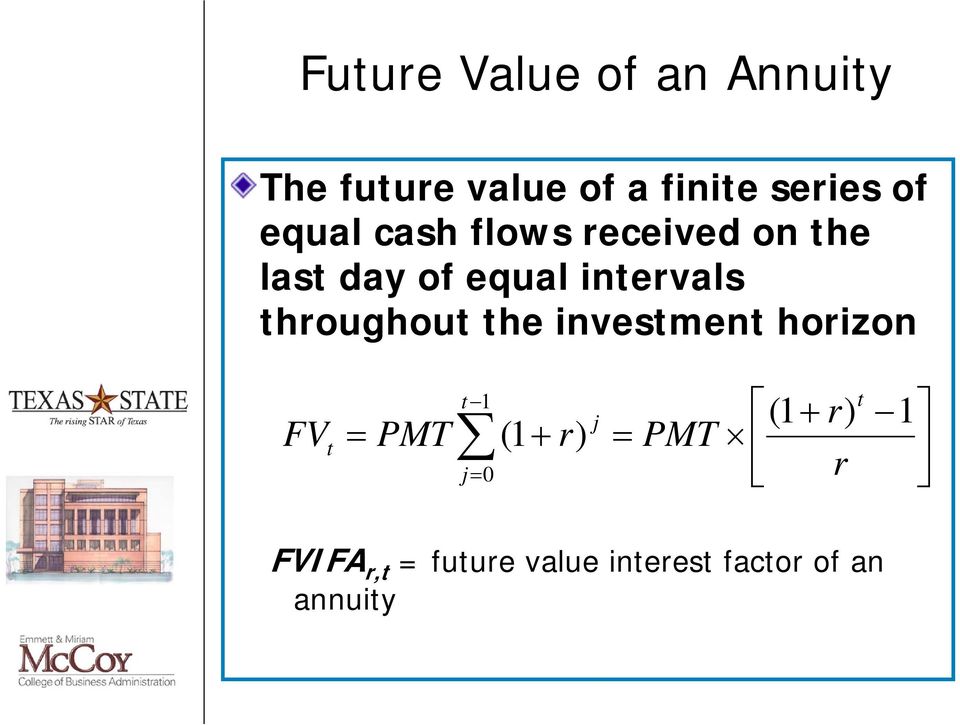
12 Future Value of an Annuity The future value of a finite series of equal cash flows received on the last day of equal intervals throughout the investment horizon FV t t 1 j (1 r) PMT (1 r) PMT j 0 r t 1 FVIFA r,t = future value interest factor of an annuity
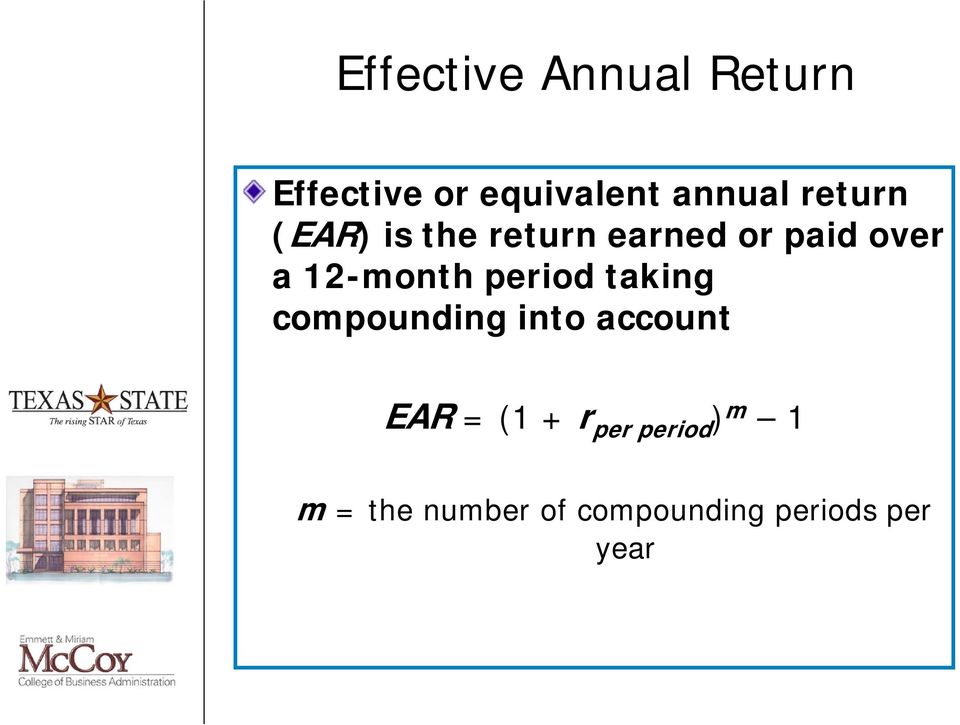
13 Effective Annual Return Effective or equivalent annual return (EAR) is the return earned or paid over a 12-month period taking compounding into account EAR = (1 + r per period ) m 1 m = the number of compounding periods per year
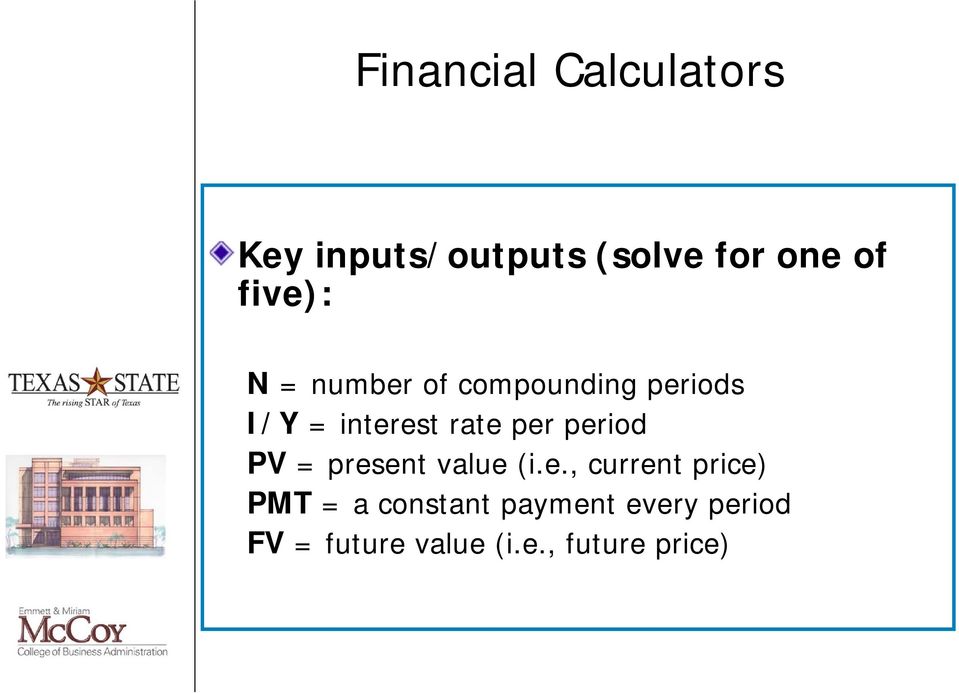
14 Financial Calculators Key inputs/outputs (solve for one of five): N = number of compounding periods I/Y = interest rate per period PV = present value (i.e., current price) PMT = a constant payment every period FV = future value (i.e., future price)
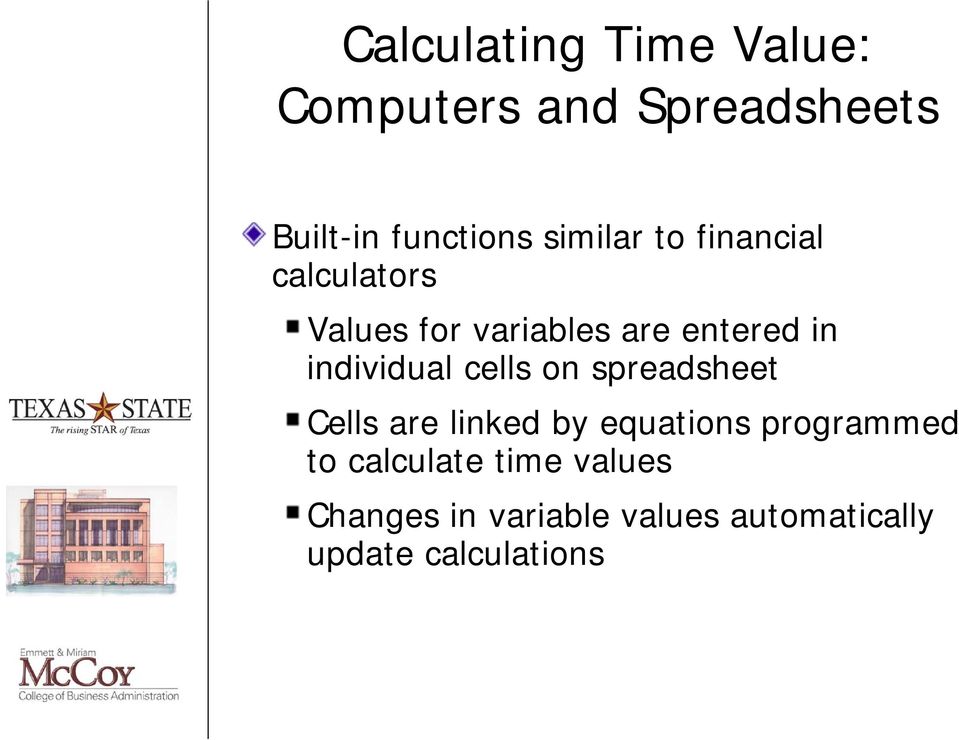
15 Calculating Time Value: Computers and Spreadsheets Built-in functions similar to financial calculators Values for variables are entered in individual cells on spreadsheet Cells are linked by equations programmed to calculate time values Changes in variable values automatically update calculations
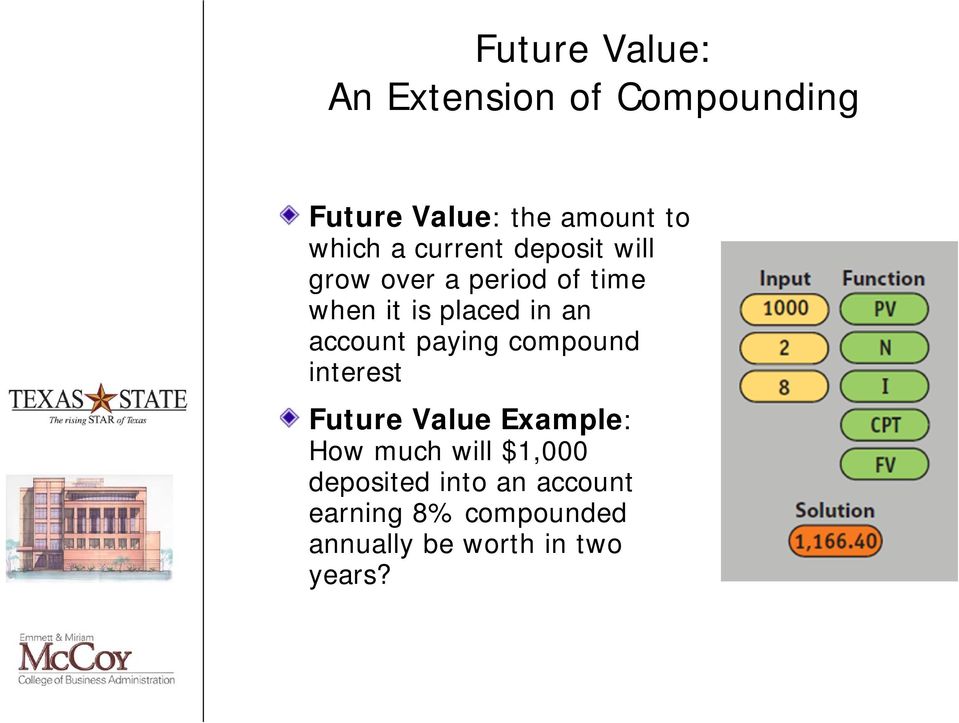
16 Future Value: An Extension of Compounding Future Value: the amount to which a current deposit will grow over a period of time when it is placed in an account paying compound interest Future Value Example: How much will $1,000 deposited into an account earning 8% compounded annually be worth in two years?
17 Future Value: Using an Excel Spreadsheet
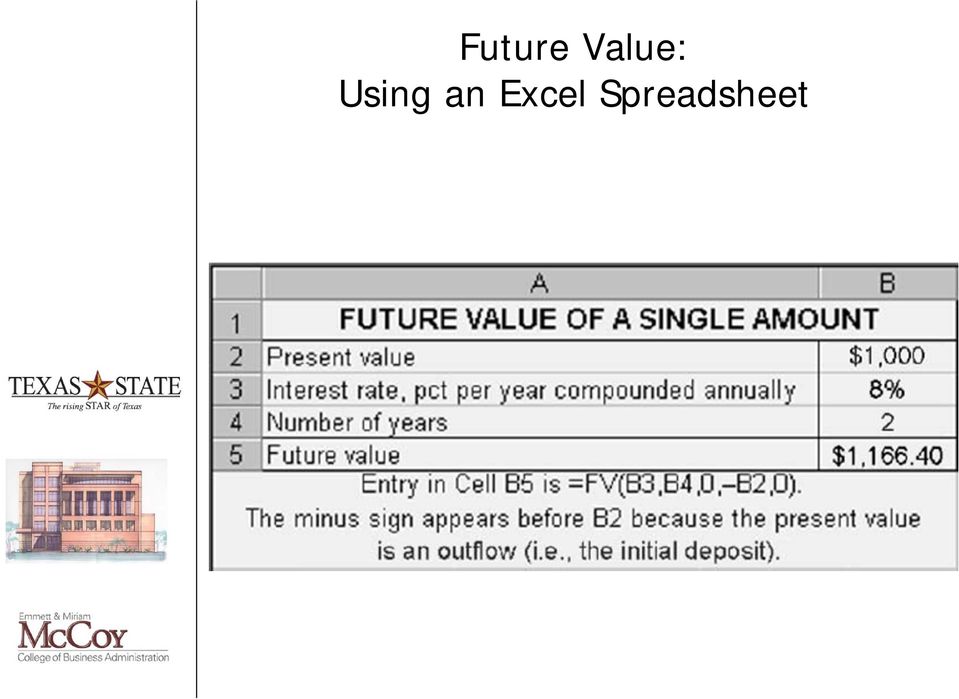
18 Future Value of an Annuity Annuity: a stream of equal cash flows that occur at equal intervals over time Ordinary Annuity: an annuity where cash flows occur at the end of each period Future Value of an Annuity Example: What is the future value of $1,000 deposited at the end of each year for 8 years in an account earning 6% compounded annually?

19 Future Value of an Annuity: Using an Excel Spreadsheet
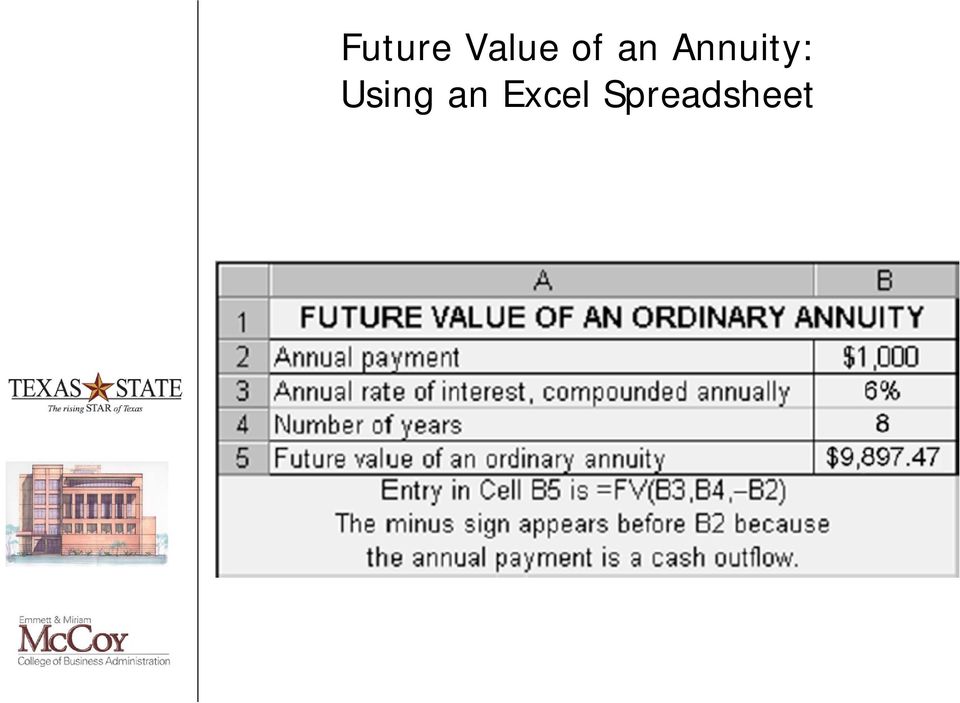
20 Present Value: An Extension of Future Value Present Value: the value today of a sum to be received at some future date Present Value Example: How much would need to be deposited today into an accounting earning 6% compounded annually to grow to $500 in 7 years?

21 Present Value: Using an Excel Spreadsheet
22 Present Value of an Annuity Annuity: a stream of equal cash flows that occur at equal intervals over time Present Value of an Annuity Example: What is the present value of $50 deposited at the end of each year for 5 years in an account earning 9% compounded annually?
23 Present Value of an Annuity: Using an Excel Spreadsheet
24 Bond Valuation The present value of a bond (V b ) can be written as (with semi-annual coupon payments): V b C 2 C 2 2N t 1 1 (1 ( r / 2)) 1 1 (1 (r (r 2) 2)) t 2N (1 ( Par r / 2)) 2N Par (1 (r/2)) 2N Par = the par or face value, usually $1,000 C = the annual interest (or coupon) payment (coupon rate x par) fixed for the life of the bond N = the number of years until the bond matures r = the annual interest rate (often called yield to maturity (ytm)) YTM changes with market interest rates.
25 Bond Valuation The key point to take from above equation: On a fixed-rate coupon bond: -When the required interest rate (YTM) increases (denominator), the bond price falls. -When the required interest rate (YTM) falls, the bond price increases.
26 The Pricing of Bonds (cont d) Bond Pricing Example: What is the market price of a $1,000 par value 20 year bond that pays 9.5 % compounded annually when the market rate is 10%? Since the required YTM is greater than the coupon rate, the bond trades at a discount.
27 Bond Pricing Rules A bond trades at a premium to par when the YTM is less than the coupon rate and the fair present value of the bond (V b ) is greater than the face or par value (Par) Premium bond: If YTM <C%, then V b > Par Discount bond: if YTM > C%, then V b < Par Par bond: if YTM = YTM, then V b = Par
28 Relation between Interest Rates and Bond Values (10% semi-annual coupon, 12 years to maturity, $1000 par) Yield to Maturity 12% 10% 8% ,000 1, Bond Value
29 Price at YTM = 12% (10% semi-annual, 12 years to maturity, $1000 par) Computing Price at required interest rate of 12% using a financial calculator: Inputs: N = 24 (12x2), I = 6 (12/2), PMT = 50 (100/2), FV = 1000 Output: PV = (negative number indicates you must pay to buy the bond)
30 Price Behavior of a Bond
31 Ways to Measure Bond Yield Current Yield Yield-to-Maturity Yield-to-Call (for bonds with call feature)
32 Current Yield Simplest yield calculation Only looks at current income Ignores difference between price and par
33 Yield-to-Maturity Most important and widely used yield calculation Accounts for difference between Price and Par Assumes all interest income is reinvested at rate equal to market rate at time of YTM calculation (realized return may differ due to interest rate risk price risk and reinvestment risk) Calculates value based upon PV of interest received and the appreciation/depreciation of the bond if held until maturity Difficult to calculate without a financial calculator (requires several iterations of trial-and-error)
34 Yield-to-Maturity (cont d) Yield-to-Maturity Example: Find the yield-to-maturity on a 7.5 % ($1,000 par value) bond that has 15 years remaining to maturity and is currently trading in the market at $809.50? Solution: YTM = 10% Concept Check: Since the bond is trading at a discount to par, we know that the YTM is greater than 7.5%.
35 Interest Rates and Bond Price Risk When interest rates change, bond prices change in the opposite direction. Interest rate price risk can seriously impact realized rate of return over short holding periods. What are the factors that determine how much price risk that a bond could suffer?
36 Impact of Maturity on Price Volatility (a) Absolute Value of Percent Change in a Bond s Price for a Given Change in Interest Rates Time to Maturity
37 Impact of Maturity on Price Volatility (b) Coupon 6.00% Par $ 1,000 yield rate old 7.00% yield rate change 0.50% yield rate new 7.50% Absolute Maturity Price old Price new Rate of change 1 $ $ % 5 $ $ % 10 $ $ % 15 $ $ % 20 $ $ % 25 $ $ % 30 $ $ % 35 $ $ % 40 $ $ % 45 $ $ % 50 $ $ % 55 $ $ % 60 $ $ % 65 $ $ % 70 $ $ % 75 $ $ % 80 $ $ % 85 $ $ % 90 $ $ % 95 $ $ % 100 $ $ % 105 $ $ % Predicted limit price change = 1 - (r old / r new) 6.67%
38 Impact of Coupon Rates on Price Volatility (a) Bond Value High-Coupon Bond Low-Coupon Bond Interest Rate
39 Impact of Coupon on Price Volatility (b) Coupon Varies Maturity Par $1, years rate old 7.00 % rate change % rate new 6.50% Absolute Coupon rate Price old Price new Rate of change 6.00% $ $ % 5.50% $ $ % 5.00% $ $ % 4.50% $ $ % 4.00% $ $ % 3.50% $ $ % 3.00% $ $ % 2.50% $ $ % 2.00% $ $ % 1.50% $ $ % 1.00% $ $ % 0.50% $ $ % 0.00% $ $ %
40 Duration Duration (Dur) for a fixed-income security that pays interest annually can be written as: Dur CF N t t t 1 (1 r) P P 0 = Current price of the security t = 1 to T, the period in which a cash flow is received T = the number of years to maturity CF t = cash flow received at end of period t r = yield to maturity or required rate of return PV t = present value of cash flow received at end of period t 0 t
41 What is Bond Duration? Duration measures the sensitivity of a fixedincome security s price to small interest rate changes. Duration captures the coupon and maturity effects on volatility.
42 Duration as a Measure of Price Risk Duration measures the interest rate elasticity of a bond s price: % Longer duration bonds exhibit greater price risk.
43 Duration and Volatility 9% Coupon, 4 year maturity annual payment bond with a 8% ytm Dur T t 1 CF t 0 t (1 r) P t Year (T) Cash Flow CF T /(1+r) T % of Value PV/Price Weighted % of Value (PV/Price)*T 1 $ 90 $ % % % $1090 $ % Totals $ % Duration = years
44 The Concept of Duration Generally speaking, bond duration possesses the following properties: Bonds with higher coupon rates have shorter durations Bonds with longer maturities have longer durations Bonds with higher YTM have shorter durations (see previous examples) Coupon-bearing bonds: D < #yrs. to maturity Zero-coupon bonds: D = # yrs. to maturity
45 Which Bonds Exhibit the Most Price Sensitivity? Long Maturity, Low Coupon
46 Bonds Between Coupon Dates Purchaser will pay accrued interest (portion of coupon due to seller for portion of coupon period. INT Accrued Interest 2 Actual# of days fromlast coupon payment Actual numberof daysin coupon period T-bonds Actual/Actual Corporates 30/360
47 MS Excel Example settlement 5/15/2014 maturity 11/15/2043 rate 0.04 yield 0.04 redemption 100 frequency 2 basis 0 price 100
48 Sample Treasury Bond Quote Maturity Coupon Bid Asked Chg Asked Yld 2017 Nov :26 112: Price = 112 and 27/32 % of Par YTM is % (YTM < 4.250%), so the bond trades at a premium to par.
49 Questions?
Analysis of Deterministic Cash Flows and the Term Structure of Interest Rates
 Analysis of Deterministic Cash Flows and the Term Structure of Interest Rates Cash Flow Financial transactions and investment opportunities are described by cash flows they generate. Cash flow: payment
The Time Value of Money
 The Time Value of Money Time Value Terminology 0 1 2 3 4 PV FV Future value (FV) is the amount an investment is worth after one or more periods. Present value (PV) is the current value of one or more future
Chapter 3. Understanding The Time Value of Money. Prentice-Hall, Inc. 1
 Chapter 3 Understanding The Time Value of Money Prentice-Hall, Inc. 1 Time Value of Money A dollar received today is worth more than a dollar received in the future. The sooner your money can earn interest,
Chapter 6 Valuing Bonds. (1) coupon payment - interest payment (coupon rate * principal) - usually paid every 6 months.
 Chapter 6 Valuing Bonds Bond Valuation - value the cash flows (1) coupon payment - interest payment (coupon rate * principal) - usually paid every 6 months. (2) maturity value = principal or par value
Chapter 7 SOLUTIONS TO END-OF-CHAPTER PROBLEMS
 Chapter 7 SOLUTIONS TO END-OF-CHAPTER PROBLEMS 7-1 0 1 2 3 4 5 10% PV 10,000 FV 5? FV 5 $10,000(1.10) 5 $10,000(FVIF 10%, 5 ) $10,000(1.6105) $16,105. Alternatively, with a financial calculator enter the
DISCOUNTED CASH FLOW VALUATION and MULTIPLE CASH FLOWS
 Chapter 5 DISCOUNTED CASH FLOW VALUATION and MULTIPLE CASH FLOWS The basic PV and FV techniques can be extended to handle any number of cash flows. PV with multiple cash flows: Suppose you need $500 one
Chapter 11. Bond Pricing - 1. Bond Valuation: Part I. Several Assumptions: To simplify the analysis, we make the following assumptions.
 Bond Pricing - 1 Chapter 11 Several Assumptions: To simplify the analysis, we make the following assumptions. 1. The coupon payments are made every six months. 2. The next coupon payment for the bond is
Chapter 6. Discounted Cash Flow Valuation. Key Concepts and Skills. Multiple Cash Flows Future Value Example 6.1. Answer 6.1
 Chapter 6 Key Concepts and Skills Be able to compute: the future value of multiple cash flows the present value of multiple cash flows the future and present value of annuities Discounted Cash Flow Valuation
Bond valuation. Present value of a bond = present value of interest payments + present value of maturity value
 Bond valuation A reading prepared by Pamela Peterson Drake O U T L I N E 1. Valuation of long-term debt securities 2. Issues 3. Summary 1. Valuation of long-term debt securities Debt securities are obligations
Chapter 6 Interest Rates and Bond Valuation
 Chapter 6 Interest Rates and Bond Valuation Solutions to Problems P6-1. P6-2. LG 1: Interest Rate Fundamentals: The Real Rate of Return Basic Real rate of return = 5.5% 2.0% = 3.5% LG 1: Real Rate of Interest
CHAPTER 5 HOW TO VALUE STOCKS AND BONDS
 CHAPTER 5 HOW TO VALUE STOCKS AND BONDS Answers to Concepts Review and Critical Thinking Questions 1. Bond issuers look at outstanding bonds of similar maturity and risk. The yields on such bonds are used
CHAPTER 14: BOND PRICES AND YIELDS
 CHAPTER 14: BOND PRICES AND YIELDS 1. a. Effective annual rate on 3-month T-bill: ( 100,000 97,645 )4 1 = 1.02412 4 1 =.10 or 10% b. Effective annual interest rate on coupon bond paying 5% semiannually:
CHAPTER 8 INTEREST RATES AND BOND VALUATION
 CHAPTER 8 INTEREST RATES AND BOND VALUATION Answers to Concept Questions 1. No. As interest rates fluctuate, the value of a Treasury security will fluctuate. Long-term Treasury securities have substantial
Bond Valuation. Chapter 7. Example (coupon rate = r d ) Bonds, Bond Valuation, and Interest Rates. Valuing the cash flows
 Bond Valuation Chapter 7 Bonds, Bond Valuation, and Interest Rates Valuing the cash flows (1) coupon payment (interest payment) = (coupon rate * principal) usually paid every 6 months (2) maturity value
Bond Price Arithmetic
 1 Bond Price Arithmetic The purpose of this chapter is: To review the basics of the time value of money. This involves reviewing discounting guaranteed future cash flows at annual, semiannual and continuously
Excel Financial Functions
 Excel Financial Functions PV() Effect() Nominal() FV() PMT() Payment Amortization Table Payment Array Table NPer() Rate() NPV() IRR() MIRR() Yield() Price() Accrint() Future Value How much will your money
Chapter 4 Valuing Bonds
 Chapter 4 Valuing Bonds MULTIPLE CHOICE 1. A 15 year, 8%, $1000 face value bond is currently trading at $958. The yield to maturity of this bond must be a. less than 8%. b. equal to 8%. c. greater than
TIME VALUE OF MONEY #6: TREASURY BOND. Professor Peter Harris Mathematics by Dr. Sharon Petrushka. Introduction
 TIME VALUE OF MONEY #6: TREASURY BOND Professor Peter Harris Mathematics by Dr. Sharon Petrushka Introduction This problem assumes that you have mastered problems 1-5, which are prerequisites. In this
Discounted Cash Flow Valuation
 6 Formulas Discounted Cash Flow Valuation McGraw-Hill/Irwin Copyright 2008 by The McGraw-Hill Companies, Inc. All rights reserved. Chapter Outline Future and Present Values of Multiple Cash Flows Valuing
Fixed Income: Practice Problems with Solutions
 Fixed Income: Practice Problems with Solutions Directions: Unless otherwise stated, assume semi-annual payment on bonds.. A 6.0 percent bond matures in exactly 8 years and has a par value of 000 dollars.
LOS 56.a: Explain steps in the bond valuation process.
 The following is a review of the Analysis of Fixed Income Investments principles designed to address the learning outcome statements set forth by CFA Institute. This topic is also covered in: Introduction
PRESENT VALUE ANALYSIS. Time value of money equal dollar amounts have different values at different points in time.
 PRESENT VALUE ANALYSIS Time value of money equal dollar amounts have different values at different points in time. Present value analysis tool to convert CFs at different points in time to comparable values
Chapter 4. The Time Value of Money
 Chapter 4 The Time Value of Money 4-2 Topics Covered Future Values and Compound Interest Present Values Multiple Cash Flows Perpetuities and Annuities Inflation and Time Value Effective Annual Interest
Chapter 4. The Time Value of Money
 Chapter 4 The Time Value of Money 1 Learning Outcomes Chapter 4 Identify various types of cash flow patterns Compute the future value and the present value of different cash flow streams Compute the return
Basic Financial Tools: A Review. 3 n 1 n. PV FV 1 FV 2 FV 3 FV n 1 FV n 1 (1 i)
 Chapter 28 Basic Financial Tools: A Review The building blocks of finance include the time value of money, risk and its relationship with rates of return, and stock and bond valuation models. These topics
Time Value of Money. If you deposit $100 in an account that pays 6% annual interest, what amount will you expect to have in
 Time Value of Money Future value Present value Rates of return 1 If you deposit $100 in an account that pays 6% annual interest, what amount will you expect to have in the account at the end of the year.
CHAPTER 14: BOND PRICES AND YIELDS
 CHAPTER 14: BOND PRICES AND YIELDS PROBLEM SETS 1. The bond callable at 105 should sell at a lower price because the call provision is more valuable to the firm. Therefore, its yield to maturity should
Chapter 6. Learning Objectives Principles Used in This Chapter 1. Annuities 2. Perpetuities 3. Complex Cash Flow Streams
 Chapter 6 Learning Objectives Principles Used in This Chapter 1. Annuities 2. Perpetuities 3. Complex Cash Flow Streams 1. Distinguish between an ordinary annuity and an annuity due, and calculate present
Click Here to Buy the Tutorial
 FIN 534 Week 4 Quiz 3 (Str) Click Here to Buy the Tutorial http://www.tutorialoutlet.com/fin-534/fin-534-week-4-quiz-3- str/ For more course tutorials visit www.tutorialoutlet.com Which of the following
Chapter. Bond Prices and Yields. McGraw-Hill/Irwin. Copyright 2008 by The McGraw-Hill Companies, Inc. All rights reserved.
 Chapter Bond Prices and Yields McGraw-Hill/Irwin Copyright 2008 by The McGraw-Hill Companies, Inc. All rights reserved. Bond Prices and Yields Our goal in this chapter is to understand the relationship
MODULE: PRINCIPLES OF FINANCE
 Programme: BSc (Hons) Financial Services with Law BSc (Hons) Accounting with Finance BSc (Hons) Banking and International Finance BSc (Hons) Management Cohort: BFSL/13/FT Aug BACF/13/PT Aug BACF/13/FT
Financial-Institutions Management. Solutions 1. 6. A financial institution has the following market value balance sheet structure:
 FIN 683 Professor Robert Hauswald Financial-Institutions Management Kogod School of Business, AU Solutions 1 Chapter 7: Bank Risks - Interest Rate Risks 6. A financial institution has the following market
CHAPTER 7: FIXED-INCOME SECURITIES: PRICING AND TRADING
 CHAPTER 7: FIXED-INCOME SECURITIES: PRICING AND TRADING Topic One: Bond Pricing Principles 1. Present Value. A. The present-value calculation is used to estimate how much an investor should pay for a bond;
CHAPTER 5 INTRODUCTION TO VALUATION: THE TIME VALUE OF MONEY
 CHAPTER 5 INTRODUCTION TO VALUATION: THE TIME VALUE OF MONEY Answers to Concepts Review and Critical Thinking Questions 1. The four parts are the present value (PV), the future value (FV), the discount
Real estate investment & Appraisal Dr. Ahmed Y. Dashti. Sample Exam Questions
 Real estate investment & Appraisal Dr. Ahmed Y. Dashti Sample Exam Questions Problem 3-1 a) Future Value = $12,000 (FVIF, 9%, 7 years) = $12,000 (1.82804) = $21,936 (annual compounding) b) Future Value
CHAPTER 8 INTEREST RATES AND BOND VALUATION
 CHAPTER 8 INTEREST RATES AND BOND VALUATION Solutions to Questions and Problems 1. The price of a pure discount (zero coupon) bond is the present value of the par value. Remember, even though there are
Key Concepts and Skills. Multiple Cash Flows Future Value Example 6.1. Chapter Outline. Multiple Cash Flows Example 2 Continued
 6 Calculators Discounted Cash Flow Valuation Key Concepts and Skills Be able to compute the future value of multiple cash flows Be able to compute the present value of multiple cash flows Be able to compute
CALCULATOR TUTORIAL. Because most students that use Understanding Healthcare Financial Management will be conducting time
 CALCULATOR TUTORIAL INTRODUCTION Because most students that use Understanding Healthcare Financial Management will be conducting time value analyses on spreadsheets, most of the text discussion focuses
CHAPTER 2. Time Value of Money 2-1
 CHAPTER 2 Time Value of Money 2-1 Time Value of Money (TVM) Time Lines Future value & Present value Rates of return Annuities & Perpetuities Uneven cash Flow Streams Amortization 2-2 Time lines 0 1 2 3
How To Calculate Bond Price And Yield To Maturity
 CHAPTER 10 Bond Prices and Yields Interest rates go up and bond prices go down. But which bonds go up the most and which go up the least? Interest rates go down and bond prices go up. But which bonds go
CHAPTER 9 Time Value Analysis
 Copyright 2008 by the Foundation of the American College of Healthcare Executives 6/11/07 Version 9-1 CHAPTER 9 Time Value Analysis Future and present values Lump sums Annuities Uneven cash flow streams
Week 4. Chonga Zangpo, DFB
 Week 4 Time Value of Money Chonga Zangpo, DFB What is time value of money? It is based on the belief that people have a positive time preference for consumption. It reflects the notion that people prefer
Chapter 5: Valuing Bonds
 FIN 302 Class Notes Chapter 5: Valuing Bonds What is a bond? A long-term debt instrument A contract where a borrower agrees to make interest and principal payments on specific dates Corporate Bond Quotations
Chapter 4. Time Value of Money. Copyright 2009 Pearson Prentice Hall. All rights reserved.
 Chapter 4 Time Value of Money Learning Goals 1. Discuss the role of time value in finance, the use of computational aids, and the basic patterns of cash flow. 2. Understand the concept of future value
Chapter 4. Time Value of Money. Learning Goals. Learning Goals (cont.)
 Chapter 4 Time Value of Money Learning Goals 1. Discuss the role of time value in finance, the use of computational aids, and the basic patterns of cash flow. 2. Understand the concept of future value
Asset Valuation Debt Investments: Analysis and Valuation
 Asset Valuation Debt Investments: Analysis and Valuation Joel M. Shulman, Ph.D, CFA Study Session # 15 Level I CFA CANDIDATE READINGS: Fixed Income Analysis for the Chartered Financial Analyst Program:
Exam 1 Morning Session
 91. A high yield bond fund states that through active management, the fund s return has outperformed an index of Treasury securities by 4% on average over the past five years. As a performance benchmark
PowerPoint. to accompany. Chapter 5. Interest Rates
 PowerPoint to accompany Chapter 5 Interest Rates 5.1 Interest Rate Quotes and Adjustments To understand interest rates, it s important to think of interest rates as a price the price of using money. When
THE TIME VALUE OF MONEY
 QUANTITATIVE METHODS THE TIME VALUE OF MONEY Reading 5 http://proschool.imsindia.com/ 1 Learning Objective Statements (LOS) a. Interest Rates as Required rate of return, Discount Rate and Opportunity Cost
You just paid $350,000 for a policy that will pay you and your heirs $12,000 a year forever. What rate of return are you earning on this policy?
 1 You estimate that you will have $24,500 in student loans by the time you graduate. The interest rate is 6.5%. If you want to have this debt paid in full within five years, how much must you pay each
Solutions to Problems: Chapter 5
 Solutions to Problems: Chapter 5 P5-1. Using a time line LG 1; Basic a, b, and c d. Financial managers rely more on present value than future value because they typically make decisions before the start
How to calculate present values
 How to calculate present values Back to the future Chapter 3 Discounted Cash Flow Analysis (Time Value of Money) Discounted Cash Flow (DCF) analysis is the foundation of valuation in corporate finance
Problems and Solutions
 Problems and Solutions CHAPTER Problems. Problems on onds Exercise. On /04/0, consider a fixed-coupon bond whose features are the following: face value: $,000 coupon rate: 8% coupon frequency: semiannual
Solutions to Problems
 Solutions to Problems P4-1. LG 1: Using a time line Basic a. b. and c. d. Financial managers rely more on present value than future value because they typically make decisions before the start of a project,
FNCE 301, Financial Management H Guy Williams, 2006
 REVIEW We ve used the DCF method to find present value. We also know shortcut methods to solve these problems such as perpetuity present value = C/r. These tools allow us to value any cash flow including
Bond Valuation. What is a bond?
 Lecture: III 1 What is a bond? Bond Valuation When a corporation wishes to borrow money from the public on a long-term basis, it usually does so by issuing or selling debt securities called bonds. A bond
Principles of Managerial Finance INTEREST RATE FACTOR SUPPLEMENT
 Principles of Managerial Finance INTEREST RATE FACTOR SUPPLEMENT 1 5 Time Value of Money FINANCIAL TABLES Financial tables include various future and present value interest factors that simplify time value
CHAPTER 6 DISCOUNTED CASH FLOW VALUATION
 CHAPTER 6 DISCOUNTED CASH FLOW VALUATION Answers to Concepts Review and Critical Thinking Questions 1. The four pieces are the present value (PV), the periodic cash flow (C), the discount rate (r), and
Chapter Two. Determinants of Interest Rates. McGraw-Hill /Irwin. Copyright 2001 by The McGraw-Hill Companies, Inc. All rights reserved.
 Chapter Two Determinants of Interest Rates Interest Rate Fundamentals Nominal interest rates - the interest rate actually observed in financial markets directly affect the value (price) of most securities
Chapter 8. Present Value Mathematics for Real Estate
 Chapter 8 Present Value Mathematics for Real Estate Real estate deals almost always involve cash amounts at different points in time. Examples: Buy a property now, sell it later. Sign a lease now, pay
Chapter 2 Applying Time Value Concepts
 Chapter 2 Applying Time Value Concepts Chapter Overview Albert Einstein, the renowned physicist whose theories of relativity formed the theoretical base for the utilization of atomic energy, called the
Solutions 2. 1. For the benchmark maturity sectors in the United States Treasury bill markets,
 FIN 472 Professor Robert Hauswald Fixed-Income Securities Kogod School of Business, AU Solutions 2 1. For the benchmark maturity sectors in the United States Treasury bill markets, Bloomberg reported the
CHAPTER 5 INTRODUCTION TO VALUATION: THE TIME VALUE OF MONEY
 CHAPTER 5 INTRODUCTION TO VALUATION: THE TIME VALUE OF MONEY 1. The simple interest per year is: $5,000.08 = $400 So after 10 years you will have: $400 10 = $4,000 in interest. The total balance will be
CHAPTER 15: THE TERM STRUCTURE OF INTEREST RATES
 CHAPTER : THE TERM STRUCTURE OF INTEREST RATES CHAPTER : THE TERM STRUCTURE OF INTEREST RATES PROBLEM SETS.. In general, the forward rate can be viewed as the sum of the market s expectation of the future
Bond Market Overview and Bond Pricing
 Bond Market Overview and Bond Pricing. Overview of Bond Market 2. Basics of Bond Pricing 3. Complications 4. Pricing Floater and Inverse Floater 5. Pricing Quotes and Accrued Interest What is A Bond? Bond:
2. Determine the appropriate discount rate based on the risk of the security
 Fixed Income Instruments III Intro to the Valuation of Debt Securities LOS 64.a Explain the steps in the bond valuation process 1. Estimate the cash flows coupons and return of principal 2. Determine the
2. How would (a) a decrease in the interest rate or (b) an increase in the holding period of a deposit affect its future value? Why?
 CHAPTER 3 CONCEPT REVIEW QUESTIONS 1. Will a deposit made into an account paying compound interest (assuming compounding occurs once per year) yield a higher future value after one period than an equal-sized
Chapter Nine Selected Solutions
 Chapter Nine Selected Solutions 1. What is the difference between book value accounting and market value accounting? How do interest rate changes affect the value of bank assets and liabilities under the
Discounted Cash Flow Valuation
 Discounted Cash Flow Valuation Chapter 5 Key Concepts and Skills Be able to compute the future value of multiple cash flows Be able to compute the present value of multiple cash flows Be able to compute
Interest Rates and Bond Valuation
 Interest Rates and Bond Valuation Chapter 6 Key Concepts and Skills Know the important bond features and bond types Understand bond values and why they fluctuate Understand bond ratings and what they mean
Topics. Chapter 5. Future Value. Future Value - Compounding. Time Value of Money. 0 r = 5% 1
 Chapter 5 Time Value of Money Topics 1. Future Value of a Lump Sum 2. Present Value of a Lump Sum 3. Future Value of Cash Flow Streams 4. Present Value of Cash Flow Streams 5. Perpetuities 6. Uneven Series
Chapter 4. Time Value of Money
 Chapter 4 Time Value of Money Learning Goals 1. Discuss the role of time value in finance, the use of computational aids, and the basic patterns of cash flow. 2. Understand the concept of future value
Alliance Consulting BOND YIELDS & DURATION ANALYSIS. Bond Yields & Duration Analysis Page 1
 BOND YIELDS & DURATION ANALYSIS Bond Yields & Duration Analysis Page 1 COMPUTING BOND YIELDS Sources of returns on bond investments The returns from investment in bonds come from the following: 1. Periodic
Future Value. Basic TVM Concepts. Chapter 2 Time Value of Money. $500 cash flow. On a time line for 3 years: $100. FV 15%, 10 yr.
 Chapter Time Value of Money Future Value Present Value Annuities Effective Annual Rate Uneven Cash Flows Growing Annuities Loan Amortization Summary and Conclusions Basic TVM Concepts Interest rate: abbreviated
VALUATION OF DEBT CONTRACTS AND THEIR PRICE VOLATILITY CHARACTERISTICS QUESTIONS See answers below
 VALUATION OF DEBT CONTRACTS AND THEIR PRICE VOLATILITY CHARACTERISTICS QUESTIONS See answers below 1. Determine the value of the following risk-free debt instrument, which promises to make the respective
Topics in Chapter. Key features of bonds Bond valuation Measuring yield Assessing risk
 Bond Valuation 1 Topics in Chapter Key features of bonds Bond valuation Measuring yield Assessing risk 2 Determinants of Intrinsic Value: The Cost of Debt Net operating profit after taxes Free cash flow
Bond Pricing Fundamentals
 Bond Pricing Fundamentals Valuation What determines the price of a bond? Contract features: coupon, face value (FV), maturity Risk-free interest rates in the economy (US treasury yield curve) Credit risk
Time Value of Money Problems
 Time Value of Money Problems 1. What will a deposit of $4,500 at 10% compounded semiannually be worth if left in the bank for six years? a. $8,020.22 b. $7,959.55 c. $8,081.55 d. $8,181.55 2. What will
Module 5: Interest concepts of future and present value
 Page 1 of 23 Module 5: Interest concepts of future and present value Overview In this module, you learn about the fundamental concepts of interest and present and future values, as well as ordinary annuities
Discounted Cash Flow Valuation
 BUAD 100x Foundations of Finance Discounted Cash Flow Valuation September 28, 2009 Review Introduction to corporate finance What is corporate finance? What is a corporation? What decision do managers make?
CHAPTER 15: THE TERM STRUCTURE OF INTEREST RATES
 Chapter - The Term Structure of Interest Rates CHAPTER : THE TERM STRUCTURE OF INTEREST RATES PROBLEM SETS.. In general, the forward rate can be viewed as the sum of the market s expectation of the future
CHAPTER 16: MANAGING BOND PORTFOLIOS
 CHAPTER 16: MANAGING BOND PORTFOLIOS PROBLEM SETS 1. While it is true that short-term rates are more volatile than long-term rates, the longer duration of the longer-term bonds makes their prices and their
Review for Exam 1. Instructions: Please read carefully
 Review for Exam 1 Instructions: Please read carefully The exam will have 25 multiple choice questions and 5 work problems covering chapter 1, 2, 3, 4, 14, 16. Questions in the multiple choice section will
In this chapter we will learn about. Treasury Notes and Bonds, Treasury Inflation Protected Securities,
 2 Treasury Securities In this chapter we will learn about Treasury Bills, Treasury Notes and Bonds, Strips, Treasury Inflation Protected Securities, and a few other products including Eurodollar deposits.
TIME VALUE OF MONEY. In following we will introduce one of the most important and powerful concepts you will learn in your study of finance;
 In following we will introduce one of the most important and powerful concepts you will learn in your study of finance; the time value of money. It is generally acknowledged that money has a time value.
Exercise 1 for Time Value of Money
 Exercise 1 for Time Value of Money MULTIPLE CHOICE 1. Which of the following statements is CORRECT? a. A time line is not meaningful unless all cash flows occur annually. b. Time lines are useful for visualizing
Chapter 6 Contents. Principles Used in Chapter 6 Principle 1: Money Has a Time Value.
 Chapter 6 The Time Value of Money: Annuities and Other Topics Chapter 6 Contents Learning Objectives 1. Distinguish between an ordinary annuity and an annuity due, and calculate present and future values
Important Financial Concepts
 Part 2 Important Financial Concepts Chapter 4 Time Value of Money Chapter 5 Risk and Return Chapter 6 Interest Rates and Bond Valuation Chapter 7 Stock Valuation 130 LG1 LG2 LG3 LG4 LG5 LG6 Chapter 4 Time
Prepared by: Dalia A. Marafi Version 2.0
 Kuwait University College of Business Administration Department of Finance and Financial Institutions Using )Casio FC-200V( for Fundamentals of Financial Management (220) Prepared by: Dalia A. Marafi Version
NATIONAL STOCK EXCHANGE OF INDIA LIMITED
 NATIONAL STOCK EXCHANGE OF INDIA LIMITED Capital Market FAQ on Corporate Bond Date : September 29, 2011 1. What are securities? Securities are financial instruments that represent a creditor relationship
Chapter 4 Bonds and Their Valuation ANSWERS TO END-OF-CHAPTER QUESTIONS
 Chapter 4 Bonds and Their Valuation ANSWERS TO END-OF-CHAPTER QUESTIONS 4-1 a. A bond is a promissory note issued by a business or a governmental unit. Treasury bonds, sometimes referred to as government
Chapter 4 Time Value of Money ANSWERS TO END-OF-CHAPTER QUESTIONS
 Chapter 4 Time Value of Money ANSWERS TO END-OF-CHAPTER QUESTIONS 4-1 a. PV (present value) is the value today of a future payment, or stream of payments, discounted at the appropriate rate of interest.
Ordinary Annuities Chapter 10
 Ordinary Annuities Chapter 10 Learning Objectives After completing this chapter, you will be able to: > Define and distinguish between ordinary simple annuities and ordinary general annuities. > Calculate
Question 2 [Part I and IIare separate - 20 marks]: Part II
![Question 2 [Part I and IIare separate - 20 marks]: Part II](/thumbs/23/2075992.jpg "Question 2 [Part I and IIare separate - 20 marks]: Part II") Question 1 [20 marks, maximum one page single space] : a. Explain the di erence between a market-value balance sheet and a book-value balance sheet. b. What is meant by over-the-counter trading? c. Distinguish
Question 1 [20 marks, maximum one page single space] : a. Explain the di erence between a market-value balance sheet and a book-value balance sheet. b. What is meant by over-the-counter trading? c. Distinguish
How To Read The Book \"Financial Planning\"
 Time Value of Money Reading 5 IFT Notes for the 2015 Level 1 CFA exam Contents 1. Introduction... 2 2. Interest Rates: Interpretation... 2 3. The Future Value of a Single Cash Flow... 4 4. The Future Value
Time Value Conepts & Applications. Prof. Raad Jassim
 Time Value Conepts & Applications Prof. Raad Jassim Chapter Outline Introduction to Valuation: The Time Value of Money 1 2 3 4 5 6 7 8 Future Value and Compounding Present Value and Discounting More on
CHAPTER 15: THE TERM STRUCTURE OF INTEREST RATES
 CHAPTER 15: THE TERM STRUCTURE OF INTEREST RATES 1. Expectations hypothesis. The yields on long-term bonds are geometric averages of present and expected future short rates. An upward sloping curve is
The Time Value of Money
 The following is a review of the Quantitative Methods: Basic Concepts principles designed to address the learning outcome statements set forth by CFA Institute. This topic is also covered in: The Time