
Problems and Solutions
|
|
|
- Helen Garrett
- 9 years ago
- Views:
Transcription
1 Problems and Solutions CHAPTER Problems. Problems on onds Exercise. On /04/0, consider a fixed-coupon bond whose features are the following: face value: $,000 coupon rate: 8% coupon frequency: semiannual maturity: 0/06/04 What are the future cash flows delivered by this bond? Solution.. The coupon cash flow is equal to $40 8% $,000 Coupon = = $40 It is delivered on the following future dates: 0/06/0, /06/0, 0/06/03, /06/03 and 0/06/04. The redemption value is equal to the face value $,000 and is delivered on maturity date 0/06/04. Exercise. Consider the same bond as in the previous exercise. We are still on /04/0.. Compute the accrued interest taking into account the Actual/Actual day-count basis.. Same question if we are now on 09/06/0. Solution.. The last coupon has been delivered on /06/0. There are 8 days between /06/0 and /04/0, and 8 days between the last coupon date /06/0 and the next coupon date 0/06/0. Hence, the accrued interest is equal to $6.88 Accrued Interest = 8 $40 = $ The last coupon has been delivered on 0/06/0. There are 3 days between 0/06/0 and 09/06/0, and 84 days between the last coupon date 0/06/0 and the next coupon date /06/0. Hence, the accrued interest is equal to $6.739 Accrued Interest = 3 $40 = $

2 Problems and Solutions Exercise.3 Solution.3 Exercise.4 Solution.4 An investor has a cash of $0,000,000 at disposal. He wants to invest in a bond with $,000 nominal value and whose dirty price is equal to 07.47%.. What is the number of bonds he will buy?. Same question if the nominal value and the dirty price of the bond are respectively $00 and 98.43%.. The number of bonds he will buy is given by the following formula Cash Number of bonds bought = Nominal Value of the bond dirty price Here, the number of bonds is equal to 9,306. n is equal to 0,6 n = 0,000,000, % = 9, n = 0,000, % = 0,7.3 On 0//99, consider a fixed-coupon bond whose features are the following: face value: Eur 00 coupon rate: 0% coupon frequency: annual maturity: 04//08 Compute the accrued interest taking into account the four different day-count bases: Actual/Actual, Actual/36, Actual/360 and 30/360. The last coupon has been delivered on 04//99. There are 93 days between 04//99 and 0//99, and 366 days between the last coupon date 04//99 and the next coupon date 04//00. The accrued interest with the Actual/Actual day-count basis is equal to Eur % Eur 00 = Eur The accrued interest with the Actual/36 day-count basis is equal to Eur % Eur 00 = Eur The accrued interest with the Actual/360 day-count basis is equal to Eur % Eur 00 = Eur There are days between 04//99 and 04/30/99, months between May and September, and days between 09/30/99 and 0//99, so that there

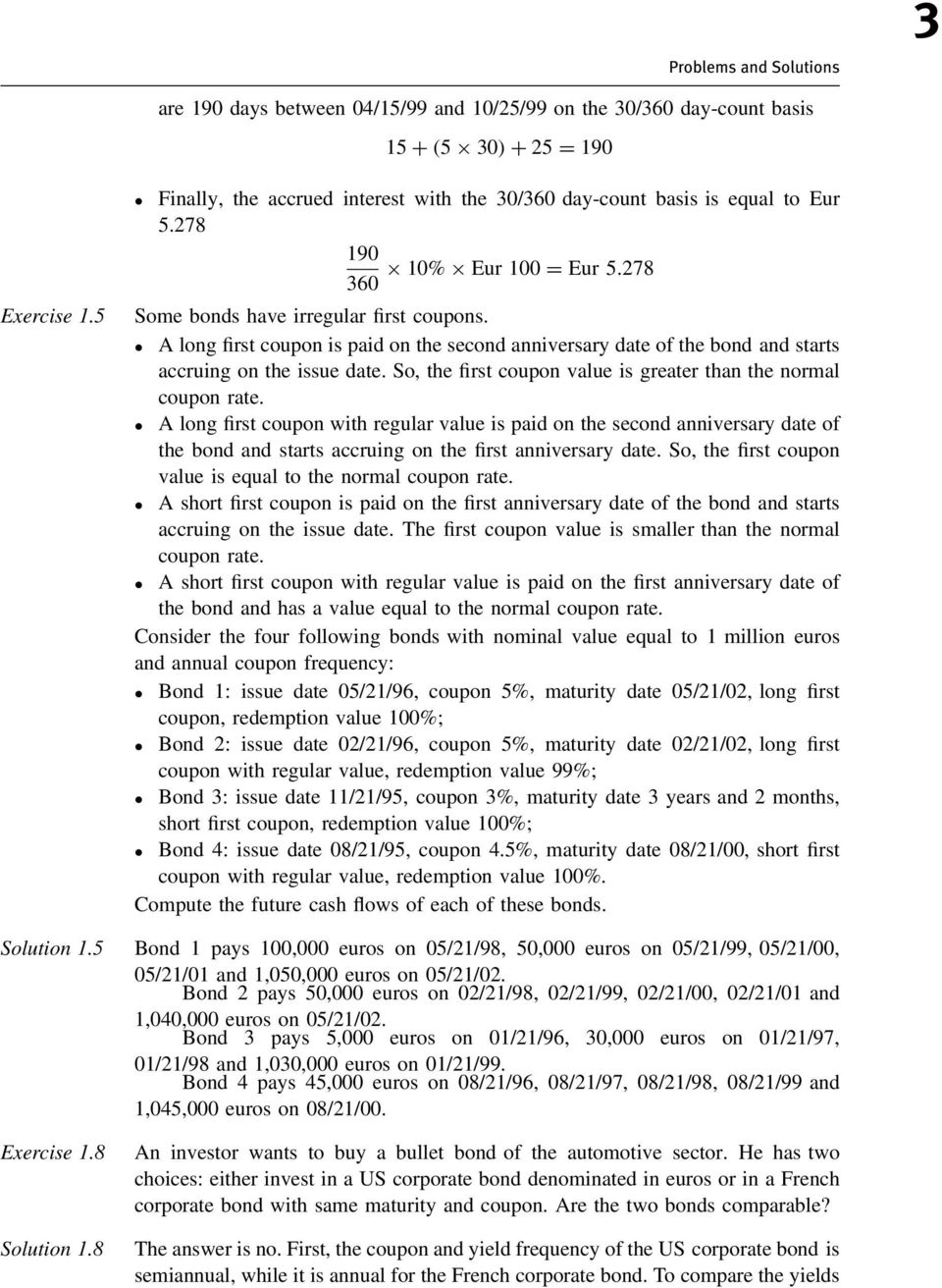
3 Problems and Solutions 3 are 90 days between 04//99 and 0//99 on the 30/360 day-count basis = 90 Exercise. inally, the accrued interest with the 30/360 day-count basis is equal to Eur % Eur 00 = Eur Some bonds have irregular first coupons. A long first coupon is paid on the second anniversary date of the bond and starts accruing on the issue date. So, the first coupon value is greater than the normal coupon rate. A long first coupon with regular value is paid on the second anniversary date of the bond and starts accruing on the first anniversary date. So, the first coupon value is equal to the normal coupon rate. A short first coupon is paid on the first anniversary date of the bond and starts accruing on the issue date. The first coupon value is smaller than the normal coupon rate. A short first coupon with regular value is paid on the first anniversary date of the bond and has a value equal to the normal coupon rate. Consider the four following bonds with nominal value equal to million euros and annual coupon frequency: ond : issue date 0//96, coupon %, maturity date 0//0, long first coupon, redemption value 00%; ond : issue date 0//96, coupon %, maturity date 0//0, long first coupon with regular value, redemption value 99%; ond 3: issue date //9, coupon 3%, maturity date 3 years and months, short first coupon, redemption value 00%; ond 4: issue date 08//9, coupon 4.%, maturity date 08//00, short first coupon with regular value, redemption value 00%. Compute the future cash flows of each of these bonds. Solution. ond pays 00,000 euros on 0//98, 0,000 euros on 0//99, 0//00, 0//0 and,00,000 euros on 0//0. ond pays 0,000 euros on 0//98, 0//99, 0//00, 0//0 and,040,000 euros on 0//0. ond 3 pays,000 euros on 0//96, 30,000 euros on 0//97, 0//98 and,030,000 euros on 0//99. ond 4 pays 4,000 euros on 08//96, 08//97, 08//98, 08//99 and,04,000 euros on 08//00. Exercise.8 Solution.8 An investor wants to buy a bullet bond of the automotive sector. He has two choices: either invest in a US corporate bond denominated in euros or in a rench corporate bond with same maturity and coupon. Are the two bonds comparable? The answer is no. irst, the coupon and yield frequency of the US corporate bond is semiannual, while it is annual for the rench corporate bond. To compare the yields
4 4 Problems and Solutions on the two instruments, you have to convert either the semiannual yield of the US bond into an equivalently annual yield or the annual yield of the rench bond into an equivalently semiannual yield. Second, the two bonds do not necessarily have the same rating, that is, the same credit risk. Third, they do not necessarily have the same liquidity. Exercise.3 Treasury bills are quoted using the yield on a discount basis or on a moneymarket basis.. The yield on a discount basis denoted by y d is computed as y d = P n where is the face value, P the price, the year-basis 36 or 360 and n is the number of calendar days remaining to maturity. Prove in this case that the price of the T-bill is obtained using the equation P = n y d. The yield on a money-market basis denoted by y m is computed as y m = y d n y d Prove in this case that the price of the T-bill is obtained using the equation 3. Show that P = + n y m y d = y m + n y m Solution.3. rom the equation we find and finally, we obtain. rom the equation y d = P n y d P = n = P n y d y m = y d n y d

5 Problems and Solutions we find Then, we have inally, we obtain 3. rom the equation y m = n y m P n P = P P n n = = P P P = + n y m n P P = P we find Then, we have y m = y d n y d y m n y d y d = 0 y d n y m = y m inally, we obtain y d = y m + n y m Exercise. What is the price P of the certificate of deposit issued by bank X on 06/06/00, with maturity 08//00, face value $0,000,000, an interest rate at issuance of % falling at maturity and a yield of 4.% as of 07/3/00? Solution. Recall that the price P of such a product is given by + c n c P = + ym n m where is the face value, c the interest rate at issuance, n c is the number of days between issue and maturity, is the year-basis 360 or 36, y m is the yield on a money-market basis and n m is the number of days between settlement and maturity. Then, the price P of the certificate of deposit issued by bank X is equal to + % P = $0,000,000 = $0,079, % 360 Indeed, there are 80 calendar days between 06/06/00 and 08//00, and calendar days between 07/3/00 and 08//00

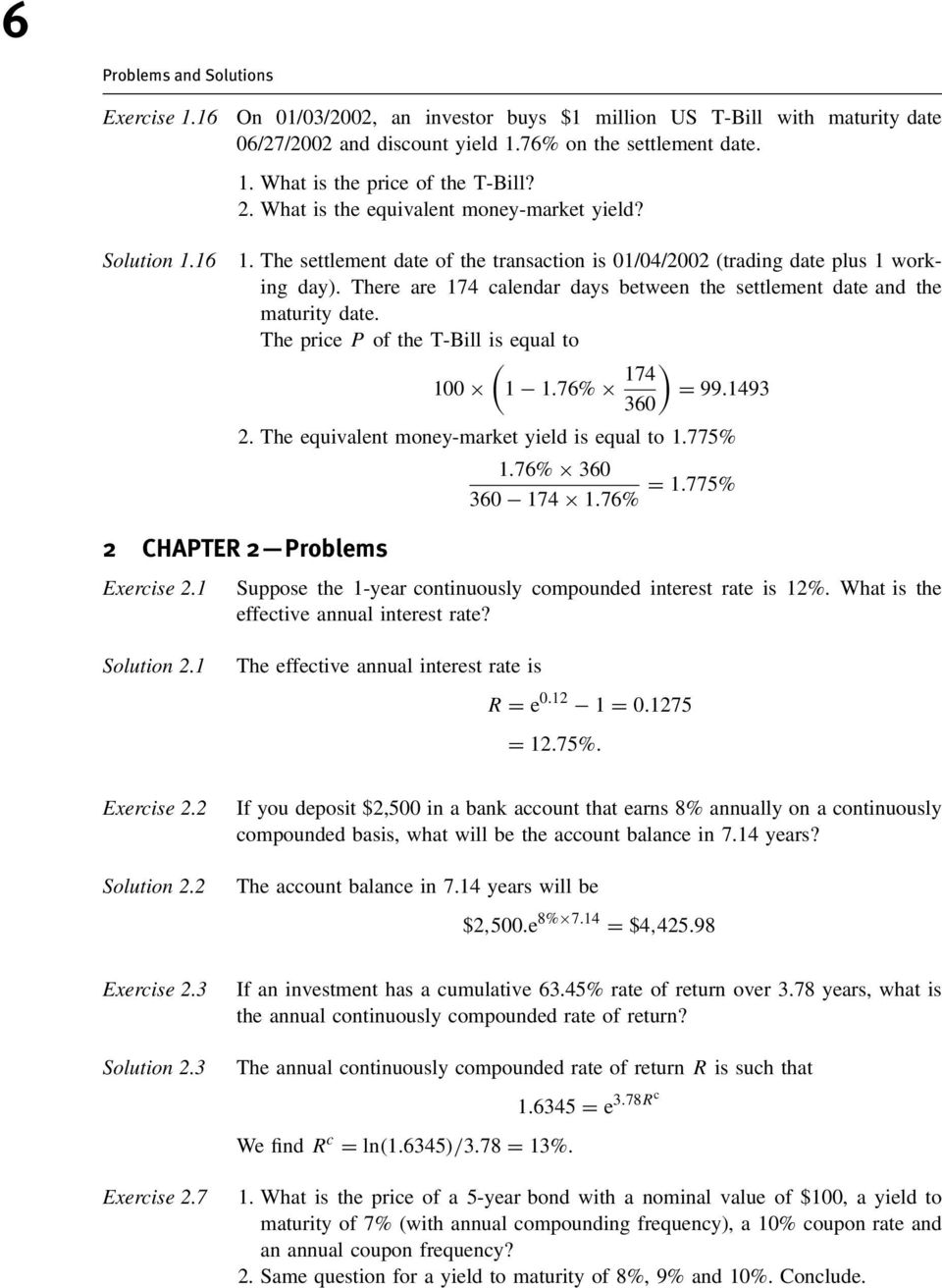
6 6 Problems and Solutions Exercise.6 Solution.6 On 0/03/00, an investor buys $ million US T-ill with maturity date 06/7/00 and discount yield.76% on the settlement date.. What is the price of the T-ill?. What is the equivalent money-market yield?. The settlement date of the transaction is 0/04/00 trading date plus working day. There are 74 calendar days between the settlement date and the maturity date. The price P of the T-ill is equal to 00.76% 74 = The equivalent money-market yield is equal to.77%.76% % =.77% CHAPTER Problems Exercise. Suppose the -year continuously compounded interest rate is %. What is the effective annual interest rate? Solution. The effective annual interest rate is R = e 0. = 0.7 =.7%. Exercise. Solution. If you deposit $,00 in a bank account that earns 8% annually on a continuously compounded basis, what will be the account balance in 7.4 years? The account balance in 7.4 years will be $,00.e 8% 7.4 = $4,4.98 Exercise.3 Solution.3 Exercise.7 If an investment has a cumulative 63.4% rate of return over 3.78 years, what is the annual continuously compounded rate of return? The annual continuously compounded rate of return R is such that We find R c = ln.634/3.78 = 3%..634 = e 3.78Rc. What is the price of a -year bond with a nominal value of $00, a yield to maturity of 7% with annual compounding frequency, a 0% coupon rate and an annual coupon frequency?. Same question for a yield to maturity of 8%, 9% and 0%. Conclude.
7 Problems and Solutions 7 Solution.7. The price P of a bond is given by the formula n N c P = + y i + N + y n which simplifies into P = N c y i= [ ] + y n + N + y n where N, c, y and n are respectively the nominal value, the coupon rate, the yield to maturity and the number of years to maturity of the bond. Here, we obtain for P P = 0 7% [ ] + 7% % P is then equal to.30% of the nominal value or $.30. Note that we can also use the Excel function Price to obtain P.. Prices of the bond for different yields to maturity YTM are given in the following table YTM % Price $ ond prices decrease as rates increase. Exercise.0 Solution.0. What is the yield to maturity of a -year bond with a nominal value of $00, a 0% coupon rate, an annual coupon frequency and a price of 97.86?. Same question for a price of 00 and The yield to maturity y of this bond is the solution to the following equation [ ] + P = N c y + y n N + y n where N, c, P and n are respectively the nominal value, the coupon rate, the price and the number of years to maturity of the bond. Here, y is solution to = 0 y [ ] + y y Using, for example, Newton s three points method or the Solver function in Excel, we obtain 0.74%. Note that we can also use the Excel function Yield to obtain y.. Yields to maturity YTM of the bond for different prices are given in the following table
![The price P of a bond is given by the formula n N c P = + y i + N + y n which simplifies into P = N c y i= [ ] + y n + N + y n where N, c, y and n are respectively the nominal value, the coupon rate,](/docs-images/46/21164720/images/page_7.jpg "the yield to maturity and the number of years to maturity of the bond. Here, we obtain for P P = 0 7% [ ] + 7% + 00 + 7% P is then equal to.30%")
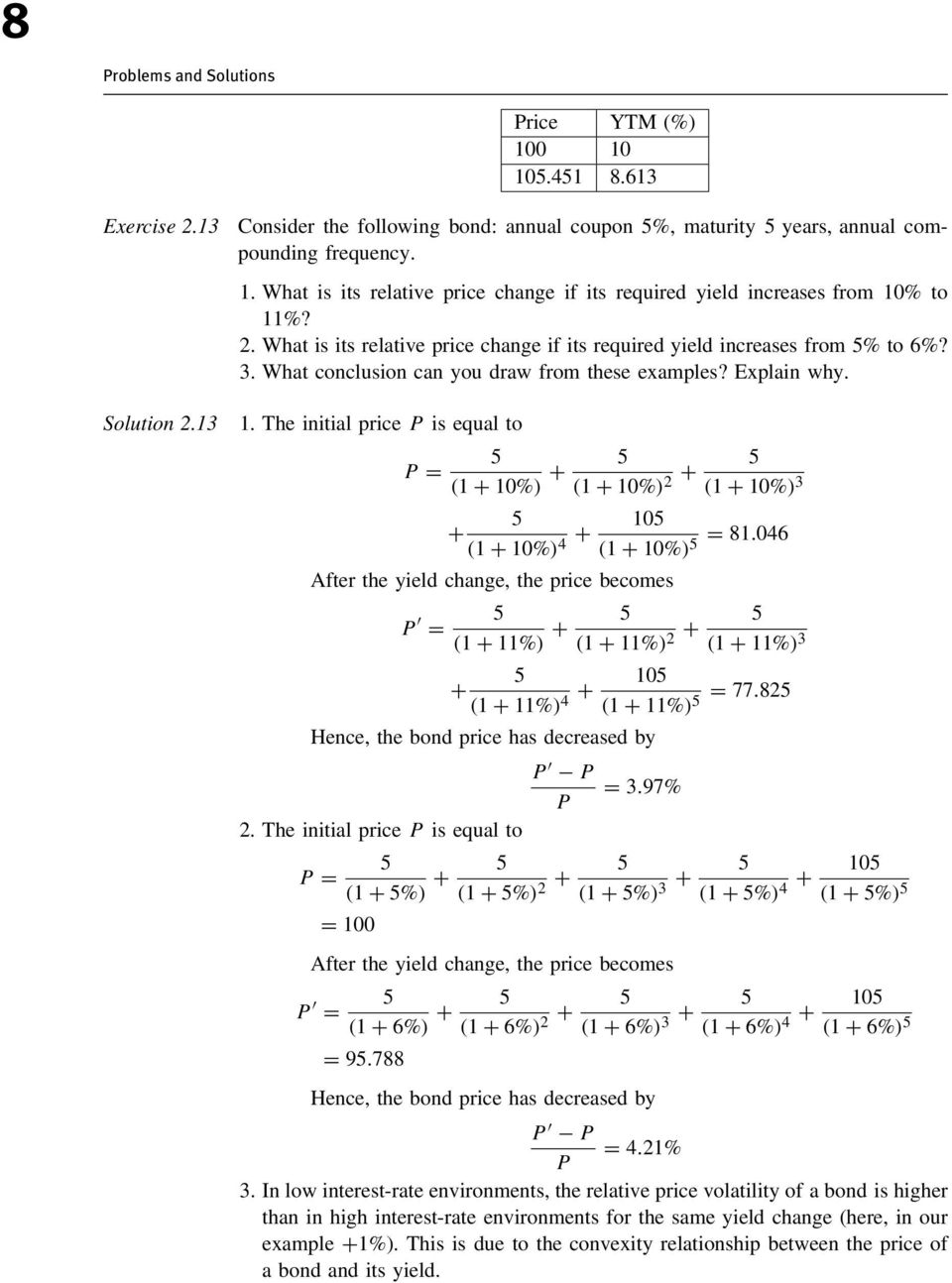
8 8 Problems and Solutions Price YTM % Exercise.3 Solution.3 Consider the following bond: annual coupon %, maturity years, annual compounding frequency.. What is its relative price change if its required yield increases from 0% to %?. What is its relative price change if its required yield increases from % to 6%? 3. What conclusion can you draw from these examples? Explain why.. The initial price P is equal to P = + 0% + + 0% + + 0% % % = After the yield change, the price becomes P = + % + + % + + % % % = 77.8 Hence, the bond price has decreased by P P = 3.97% P. The initial price P is equal to P = + % + + % + + % % % = 00 After the yield change, the price becomes P = + 6% + + 6% + + 6% % % = Hence, the bond price has decreased by P P = 4.% P 3. In low interest-rate environments, the relative price volatility of a bond is higher than in high interest-rate environments for the same yield change here, in our example +%. This is due to the convexity relationship between the price of a bond and its yield.
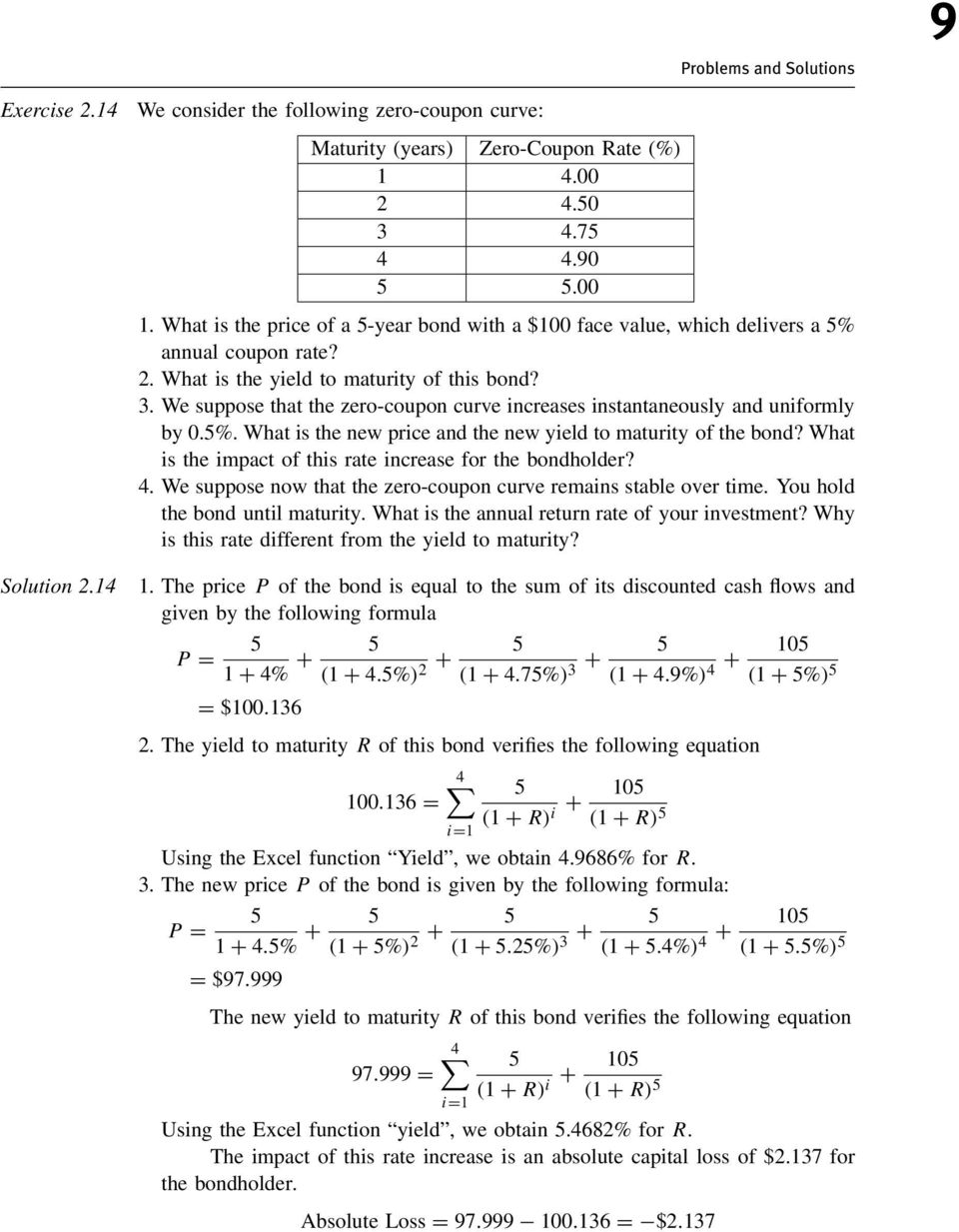
9 Problems and Solutions 9 Exercise.4 Solution.4 We consider the following zero-coupon curve: Maturity years Zero-Coupon Rate % What is the price of a -year bond with a $00 face value, which delivers a % annual coupon rate?. What is the yield to maturity of this bond? 3. We suppose that the zero-coupon curve increases instantaneously and uniformly by 0.%. What is the new price and the new yield to maturity of the bond? What is the impact of this rate increase for the bondholder? 4. We suppose now that the zero-coupon curve remains stable over time. You hold the bond until maturity. What is the annual return rate of your investment? Why is this rate different from the yield to maturity?. The price P of the bond is equal to the sum of its discounted cash flows and given by the following formula P = + 4% % % % % = $ The yield to maturity R of this bond verifies the following equation = + R i R Using the Excel function Yield, we obtain % for R. 3. The new price P of the bond is given by the following formula: P = i= + 4.% + + % + +.% % % = $ The new yield to maturity R of this bond verifies the following equation = + R i R i= Using the Excel function yield, we obtain.468% for R. The impact of this rate increase is an absolute capital loss of $.37 for the bondholder. Absolute Loss = = $.37
10 0 Problems and Solutions and a relative capital loss of.34% Relative Loss = =.34% 4. efore maturity, the bondholder receives intermediate coupons that he reinvests in the market: after one year, he receives $ that he reinvests for 4 years at the 4-year zerocoupon rate to obtain on the maturity date of the bond + 4.9% 4 = $6.044 after two years, he receives $ that he reinvests for 3 years at the 3-year zerocoupon rate to obtain on the maturity date of the bond + 4.7% 3 = $.7469 after three years, he receives $ that he reinvests for years at the -year zero-coupon rate to obtain on the maturity date of the bond + 4.% = $.460 after four years, he receives $ that he reinvests for year at the -year zerocoupon rate to obtain on the maturity date of the bond + 4% = $. after five years, he receives the final cash flow equal to $0. The bondholder finally obtains $7.464 five years later = $7.464 which corresponds to a 4.944% annual return rate / = 4.944% This return rate is different from the yield to maturity of this bond % because the curve is not flat at a % level. With a flat curve at a % level, we obtain $7.608 five years later = $7.608 which corresponds exactly to a % annual return rate / = % Exercise. Let us consider the two following rench Treasury bonds whose characteristics are the following:
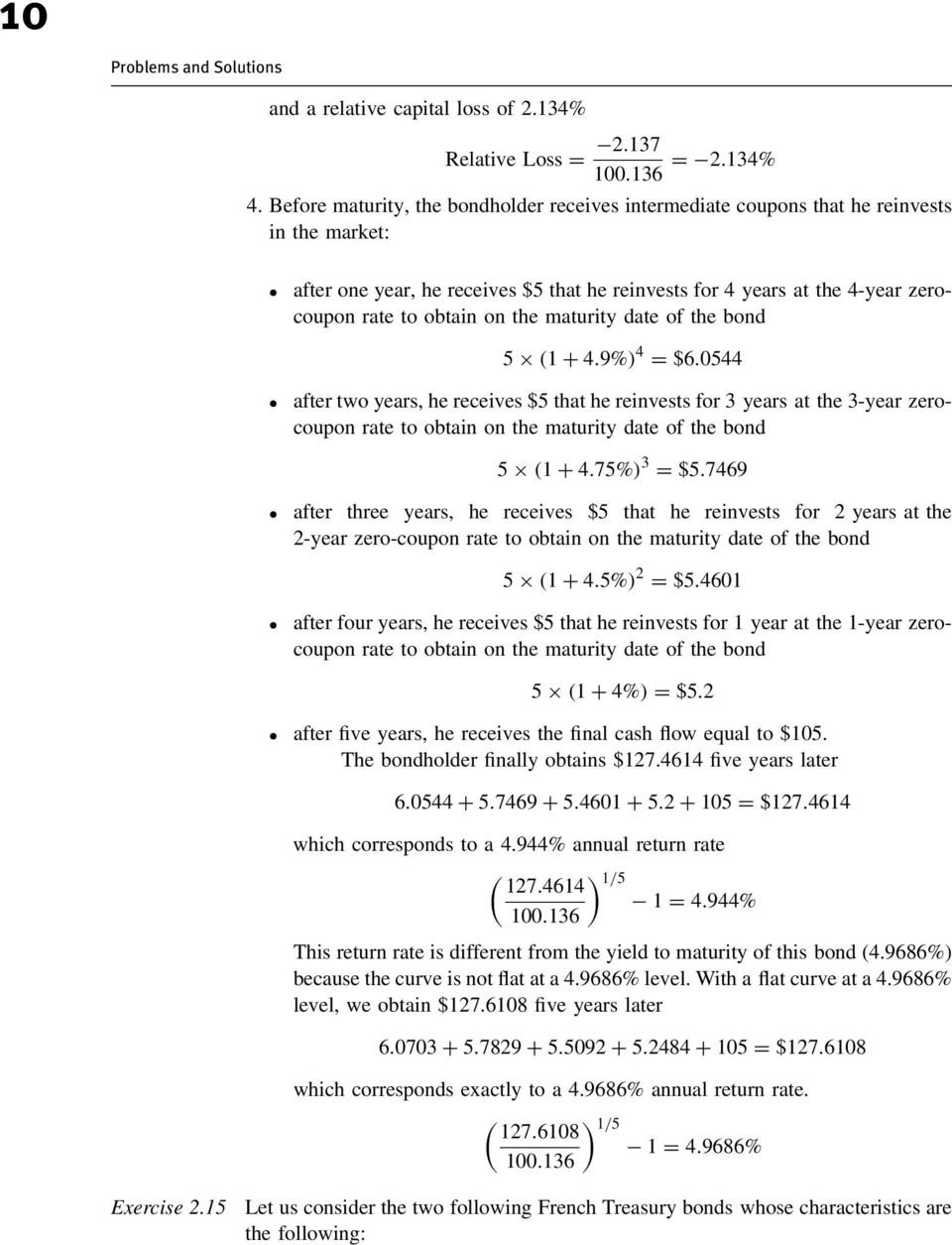
11 Problems and Solutions Name Maturity Coupon Price years Rate % ond 6 00 ond Your investment horizon is 6 years. Which of the two bonds will you select? Solution. Exercise.8 It depends on the level of the reinvestment rate, at which you can reinvest the coupons of ond, as well as on the yield to maturity of ond at horizon. If you suppose, for example, that the reinvestment rate is equal to the yield to maturity of ond at horizon, then the total return of ond will decrease as the reinvestment rate increases, as opposed to ond. Indeed, while the unique source of return for ond is its reinvested coupons, it lies for ond in its price appreciation. ond and ond will yield nearly the same annualized return.% for a reinvestment rate of 6.36%. We consider three bonds with the following features ond Maturity years Annual Coupon Price ond ond ond ind the -year, -year and 3-year zero-coupon rates from the table above.. We consider another bond with the following features ond Maturity Annual Coupon Price ond 4 3 years Use the zero-coupon curve to price this bond. 3. ind an arbitrage strategy. Solution.8. The -year zero-coupon rate denoted by R0,, verifies 0 + R0, = 06.6 We find the expression R0, = = 3.8% The -year zero-coupon rate denoted by R0,, verifies % R0, = 06.0 We find the expression / 08 R0, = = 4.738% %
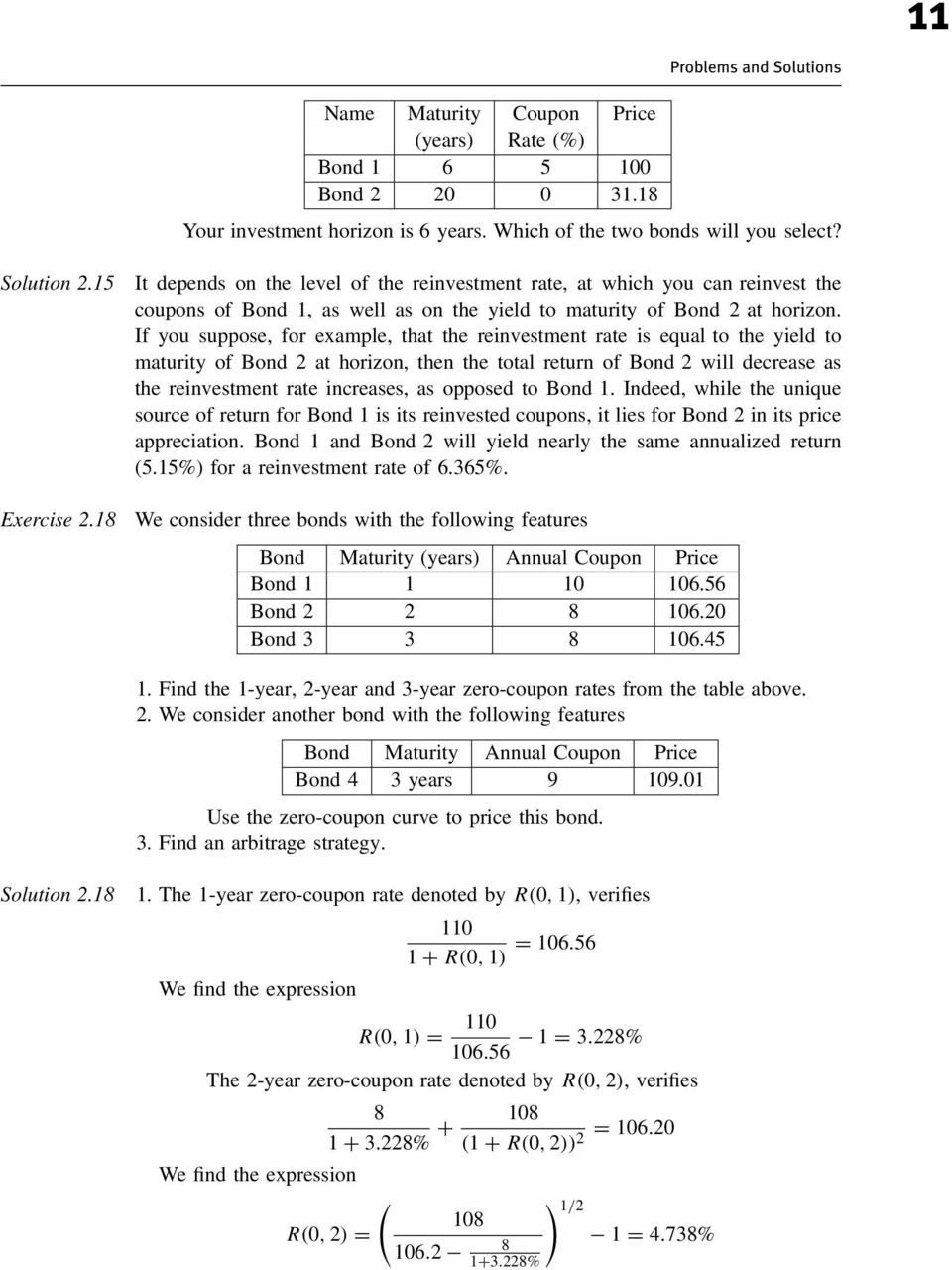
12 Problems and Solutions The 3-year zero-coupon rate denoted by R0, 3, verifies % % R0, 3 3 = 06.4 We find the expression /3 08 R0, 3 = % =.78% %. The price P of ond 4 using the zero-coupon curve is given by the following formula: 9 P = + 3.8% % % 3 = This bond is underpriced by the market compared to its theoretical value. There is an arbitrage if the market price of this bond reverts to the theoretical value. We have to simply buy the bond at a $09.0 price and hope that it is mispriced by the market and will soon revert to around $ Exercise.0 We consider two bonds with the following features ond Maturity years Coupon Rate % Price YTM % ond 0 0,3..39 ond YTM stands for yield to maturity. These two bonds have a $,000 face value, and an annual coupon frequency.. An investor buys these two bonds and holds them until maturity. Compute the annual return rate over the period, supposing that the yield curve becomes instantaneously flat at a.4% level and remains stable at this level during 0 years.. What is the rate level such that these two bonds provide the same annual return rate? In this case, what is the annual return rate of the two bonds? Solution.0. We consider that the investor reinvests its intermediate cash flows at a unique.4% rate. or ond, the investor obtains the following sum at the maturity of the bond % i +,00 =,8. i= which corresponds exactly to a.3703% annual return rate.,8. /0 =.3703%,3.
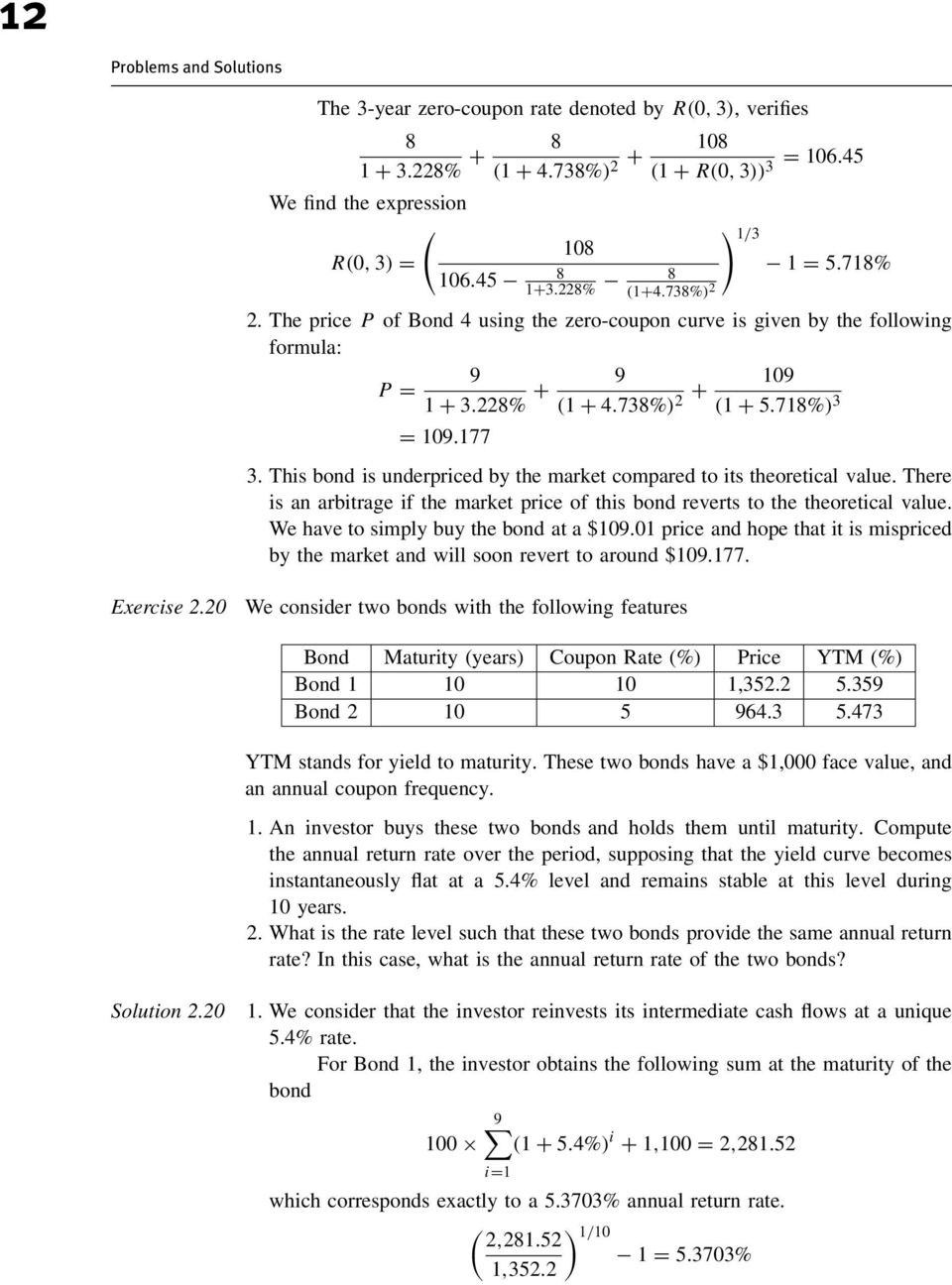
13 Problems and Solutions 3 or ond, the investor obtains the following sum at the maturity of the bond % i +,00 =, i= which corresponds exactly to a.489% annual return rate., /0 =.489% We have to find the value R, such that 00 9 i= + R i +,00,3. = 0 9 i= + R i +, Using the Excel solver, we finally obtain % for R. The annual return rate of the two bonds is equal to.664% 00 9i= i /0 +,00 =.664%,3. Exercise.4 Assume that the following bond yields, compounded semiannually: 6-month Treasury Strip:.00%; -year Treasury Strip:.%; 8-month Treasury Strip:.7%.. What is the 6-month forward rate in six months?. What is the -year forward rate in six months? 3. What is the price of a semiannual 0% coupon Treasury bond that matures in exactly 8 months? Solution R 0, = + R 0, =.0 + 0, 0., 0. 0, 0., 0. =.003% + R 0,. 3 = + R 0, =.0 + 0, 0., ,0., + 0, 0., 0, 0., = 6.60% 3. The cash flows are coupons of % in six months and a year, and coupon plus principal payment of 0% in 8 months. We can discount using the spot rates

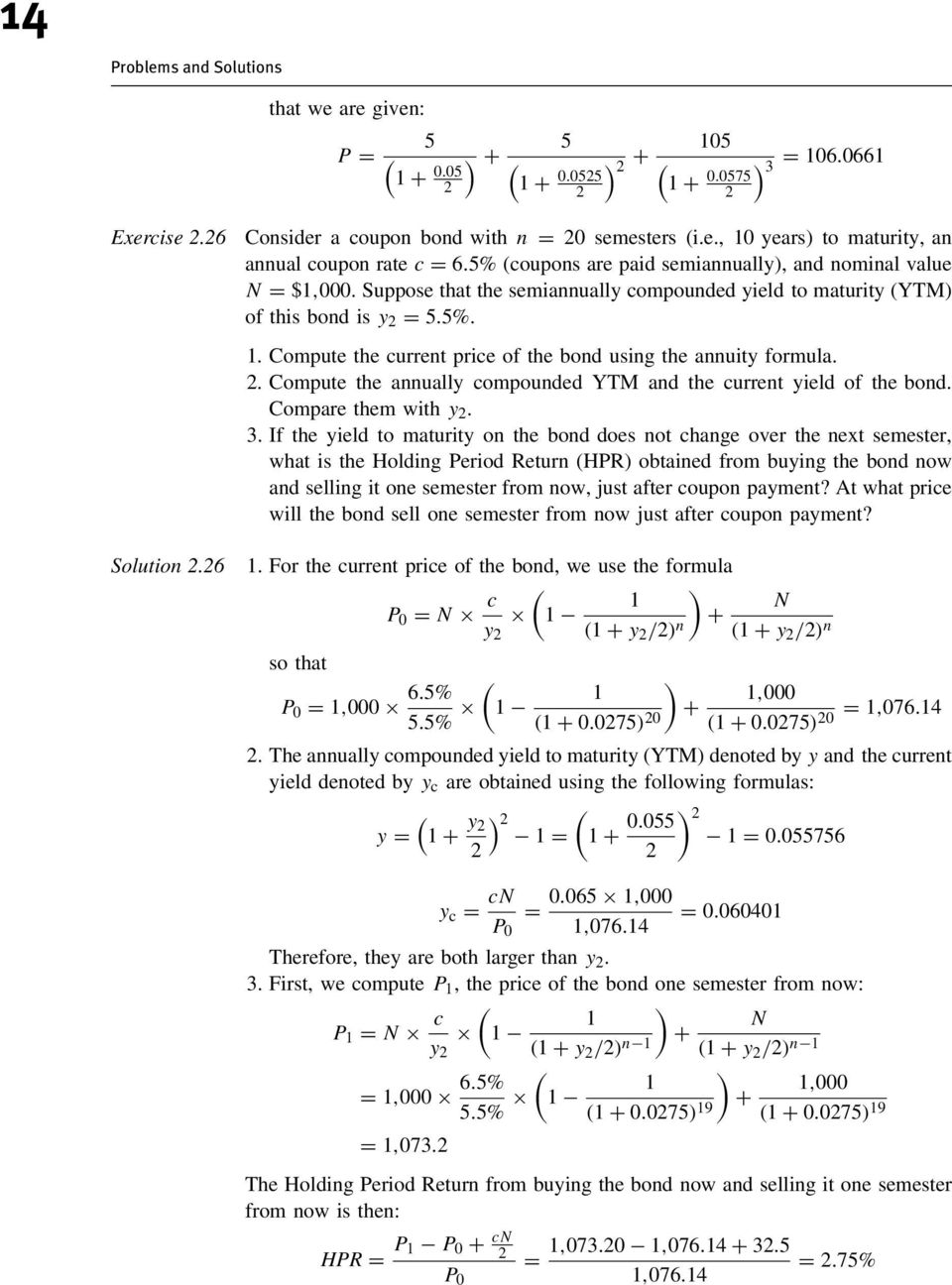
14 4 Problems and Solutions that we are given: 0 P = = Exercise.6 Solution.6 Consider a coupon bond with n = 0 semesters i.e., 0 years to maturity, an annual coupon rate c = 6.% coupons are paid semiannually, and nominal value N = $,000. Suppose that the semiannually compounded yield to maturity YTM of this bond is y =.%.. Compute the current price of the bond using the annuity formula.. Compute the annually compounded YTM and the current yield of the bond. Compare them with y. 3. If the yield to maturity on the bond does not change over the next semester, what is the Holding Period Return HPR obtained from buying the bond now and selling it one semester from now, just after coupon payment? At what price will the bond sell one semester from now just after coupon payment?. or the current price of the bond, we use the formula P 0 = N c + y so that P 0 =,000 6.%.% + y / n N + y / n,000 =, The annually compounded yield to maturity YTM denoted by y and the current yield denoted by y c are obtained using the following formulas: y = + y = = y c = cn 0.06,000 = = P 0,076.4 Therefore, they are both larger than y. 3. irst, we compute P, the price of the bond one semester from now: P = N c N + y =,000 6.%.% =, y / n y / n +, The Holding Period Return from buying the bond now and selling it one semester from now is then: HPR = P P 0 + cn,073.0, = =.7% P 0,076.4
Problems and Solutions
 1 CHAPTER 1 Problems 1.1 Problems on Bonds Exercise 1.1 On 12/04/01, consider a fixed-coupon bond whose features are the following: face value: $1,000 coupon rate: 8% coupon frequency: semiannual maturity:
Bond Pricing Fundamentals
 Bond Pricing Fundamentals Valuation What determines the price of a bond? Contract features: coupon, face value (FV), maturity Risk-free interest rates in the economy (US treasury yield curve) Credit risk
CHAPTER 7: FIXED-INCOME SECURITIES: PRICING AND TRADING
 CHAPTER 7: FIXED-INCOME SECURITIES: PRICING AND TRADING Topic One: Bond Pricing Principles 1. Present Value. A. The present-value calculation is used to estimate how much an investor should pay for a bond;
Analysis of Deterministic Cash Flows and the Term Structure of Interest Rates
 Analysis of Deterministic Cash Flows and the Term Structure of Interest Rates Cash Flow Financial transactions and investment opportunities are described by cash flows they generate. Cash flow: payment
FINANCE 1. DESS Gestion des Risques/Ingéniérie Mathématique Université d EVRY VAL D ESSONNE EXERCICES CORRIGES. Philippe PRIAULET
 FINANCE 1 DESS Gestion des Risques/Ingéniérie Mathématique Université d EVRY VAL D ESSONNE EXERCICES CORRIGES Philippe PRIAULET 1 Exercise 1 On 12/04/01 consider a fixed coupon bond whose features are
NATIONAL STOCK EXCHANGE OF INDIA LIMITED
 NATIONAL STOCK EXCHANGE OF INDIA LIMITED Capital Market FAQ on Corporate Bond Date : September 29, 2011 1. What are securities? Securities are financial instruments that represent a creditor relationship
ACI THE FINANCIAL MARKETS ASSOCIATION
 ACI THE FINANCIAL MARKETS ASSOCIATION EXAMINATION FORMULAE 2009 VERSION page number INTEREST RATE..2 MONEY MARKET..... 3 FORWARD-FORWARDS & FORWARD RATE AGREEMENTS..4 FIXED INCOME.....5 FOREIGN EXCHANGE
Introduction to Fixed Income (IFI) Course Syllabus
 Introduction to Fixed Income (IFI) Course Syllabus 1. Fixed income markets 1.1 Understand the function of fixed income markets 1.2 Know the main fixed income market products: Loans Bonds Money market instruments
Money Market and Debt Instruments
 Prof. Alex Shapiro Lecture Notes 3 Money Market and Debt Instruments I. Readings and Suggested Practice Problems II. Bid and Ask III. Money Market IV. Long Term Credit Markets V. Additional Readings Buzz
CHAPTER 15: THE TERM STRUCTURE OF INTEREST RATES
 CHAPTER 15: THE TERM STRUCTURE OF INTEREST RATES 1. Expectations hypothesis. The yields on long-term bonds are geometric averages of present and expected future short rates. An upward sloping curve is
Solutions 2. 1. For the benchmark maturity sectors in the United States Treasury bill markets,
 FIN 472 Professor Robert Hauswald Fixed-Income Securities Kogod School of Business, AU Solutions 2 1. For the benchmark maturity sectors in the United States Treasury bill markets, Bloomberg reported the
CHAPTER 15: THE TERM STRUCTURE OF INTEREST RATES
 CHAPTER : THE TERM STRUCTURE OF INTEREST RATES CHAPTER : THE TERM STRUCTURE OF INTEREST RATES PROBLEM SETS.. In general, the forward rate can be viewed as the sum of the market s expectation of the future
Bond Return Calculation Methodology
 Bond Return Calculation Methodology Morningstar Methodology Paper June 30, 2013 2013 Morningstar, Inc. All rights reserved. The information in this document is the property of Morningstar, Inc. Reproduction
LOS 56.a: Explain steps in the bond valuation process.
 The following is a review of the Analysis of Fixed Income Investments principles designed to address the learning outcome statements set forth by CFA Institute. This topic is also covered in: Introduction
Chapter 11. Bond Pricing - 1. Bond Valuation: Part I. Several Assumptions: To simplify the analysis, we make the following assumptions.
 Bond Pricing - 1 Chapter 11 Several Assumptions: To simplify the analysis, we make the following assumptions. 1. The coupon payments are made every six months. 2. The next coupon payment for the bond is
Chapter 8. Step 2: Find prices of the bonds today: n i PV FV PMT Result Coupon = 4% 29.5 5? 100 4 84.74 Zero coupon 29.5 5? 100 0 23.
 Chapter 8 Bond Valuation with a Flat Term Structure 1. Suppose you want to know the price of a 10-year 7% coupon Treasury bond that pays interest annually. a. You have been told that the yield to maturity
I. Readings and Suggested Practice Problems. II. Risks Associated with Default-Free Bonds
 Prof. Alex Shapiro Lecture Notes 13 Bond Portfolio Management I. Readings and Suggested Practice Problems II. Risks Associated with Default-Free Bonds III. Duration: Details and Examples IV. Immunization
CHAPTER 15: THE TERM STRUCTURE OF INTEREST RATES
 Chapter - The Term Structure of Interest Rates CHAPTER : THE TERM STRUCTURE OF INTEREST RATES PROBLEM SETS.. In general, the forward rate can be viewed as the sum of the market s expectation of the future
Math of Finance. Texas Association of Counties January 2014
 Math of Finance Texas Association of Counties January 2014 Money Market Securities Sample Treasury Bill Quote*: N Bid Ask Ask Yld 126 4.86 4.85 5.00 *(Yields do not reflect current market conditions) Bank
Interest Rate and Credit Risk Derivatives
 Interest Rate and Credit Risk Derivatives Interest Rate and Credit Risk Derivatives Peter Ritchken Kenneth Walter Haber Professor of Finance Weatherhead School of Management Case Western Reserve University
Chapter. Bond Prices and Yields. McGraw-Hill/Irwin. Copyright 2008 by The McGraw-Hill Companies, Inc. All rights reserved.
 Chapter Bond Prices and Yields McGraw-Hill/Irwin Copyright 2008 by The McGraw-Hill Companies, Inc. All rights reserved. Bond Prices and Yields Our goal in this chapter is to understand the relationship
VALUATION OF FIXED INCOME SECURITIES. Presented By Sade Odunaiya Partner, Risk Management Alliance Consulting
 VALUATION OF FIXED INCOME SECURITIES Presented By Sade Odunaiya Partner, Risk Management Alliance Consulting OUTLINE Introduction Valuation Principles Day Count Conventions Duration Covexity Exercises
ANALYSIS OF FIXED INCOME SECURITIES
 ANALYSIS OF FIXED INCOME SECURITIES Valuation of Fixed Income Securities Page 1 VALUATION Valuation is the process of determining the fair value of a financial asset. The fair value of an asset is its
YIELD CURVE GENERATION
 1 YIELD CURVE GENERATION Dr Philip Symes Agenda 2 I. INTRODUCTION II. YIELD CURVES III. TYPES OF YIELD CURVES IV. USES OF YIELD CURVES V. YIELD TO MATURITY VI. BOND PRICING & VALUATION Introduction 3 A
In this chapter we will learn about. Treasury Notes and Bonds, Treasury Inflation Protected Securities,
 2 Treasury Securities In this chapter we will learn about Treasury Bills, Treasury Notes and Bonds, Strips, Treasury Inflation Protected Securities, and a few other products including Eurodollar deposits.
Global Financial Management
 Global Financial Management Bond Valuation Copyright 999 by Alon Brav, Campbell R. Harvey, Stephen Gray and Ernst Maug. All rights reserved. No part of this lecture may be reproduced without the permission
Bonds and the Term Structure of Interest Rates: Pricing, Yields, and (No) Arbitrage
 Prof. Alex Shapiro Lecture Notes 12 Bonds and the Term Structure of Interest Rates: Pricing, Yields, and (No) Arbitrage I. Readings and Suggested Practice Problems II. Bonds Prices and Yields (Revisited)
Fixed Income: Practice Problems with Solutions
 Fixed Income: Practice Problems with Solutions Directions: Unless otherwise stated, assume semi-annual payment on bonds.. A 6.0 percent bond matures in exactly 8 years and has a par value of 000 dollars.
Zero-Coupon Bonds (Pure Discount Bonds)
 Zero-Coupon Bonds (Pure Discount Bonds) The price of a zero-coupon bond that pays F dollars in n periods is F/(1 + r) n, where r is the interest rate per period. Can meet future obligations without reinvestment
FNCE 301, Financial Management H Guy Williams, 2006
 REVIEW We ve used the DCF method to find present value. We also know shortcut methods to solve these problems such as perpetuity present value = C/r. These tools allow us to value any cash flow including
Review for Exam 1. Instructions: Please read carefully
 Review for Exam 1 Instructions: Please read carefully The exam will have 20 multiple choice questions and 5 work problems. Questions in the multiple choice section will be either concept or calculation
Interest Rate Futures. Chapter 6
 Interest Rate Futures Chapter 6 1 Day Count Convention The day count convention defines: The period of time to which the interest rate applies. The period of time used to calculate accrued interest (relevant
CHAPTER 8 INTEREST RATES AND BOND VALUATION
 CHAPTER 8 INTEREST RATES AND BOND VALUATION Solutions to Questions and Problems 1. The price of a pure discount (zero coupon) bond is the present value of the par value. Remember, even though there are
CHAPTER 14: BOND PRICES AND YIELDS
 CHAPTER 14: BOND PRICES AND YIELDS PROBLEM SETS 1. The bond callable at 105 should sell at a lower price because the call provision is more valuable to the firm. Therefore, its yield to maturity should
Chapter Nine Selected Solutions
 Chapter Nine Selected Solutions 1. What is the difference between book value accounting and market value accounting? How do interest rate changes affect the value of bank assets and liabilities under the
Bond Price Arithmetic
 1 Bond Price Arithmetic The purpose of this chapter is: To review the basics of the time value of money. This involves reviewing discounting guaranteed future cash flows at annual, semiannual and continuously
1.2 Structured notes
 1.2 Structured notes Structured notes are financial products that appear to be fixed income instruments, but contain embedded options and do not necessarily reflect the risk of the issuing credit. Used
Alliance Consulting BOND YIELDS & DURATION ANALYSIS. Bond Yields & Duration Analysis Page 1
 BOND YIELDS & DURATION ANALYSIS Bond Yields & Duration Analysis Page 1 COMPUTING BOND YIELDS Sources of returns on bond investments The returns from investment in bonds come from the following: 1. Periodic
2. Determine the appropriate discount rate based on the risk of the security
 Fixed Income Instruments III Intro to the Valuation of Debt Securities LOS 64.a Explain the steps in the bond valuation process 1. Estimate the cash flows coupons and return of principal 2. Determine the
US TREASURY SECURITIES - Issued by the U.S. Treasury Department and guaranteed by the full faith and credit of the United States Government.
 Member NASD/SIPC Bond Basics TYPES OF ISSUERS There are essentially five entities that issue bonds: US TREASURY SECURITIES - Issued by the U.S. Treasury Department and guaranteed by the full faith and
Practice Set #2 and Solutions.
 FIN-672 Securities Analysis & Portfolio Management Professor Michel A. Robe Practice Set #2 and Solutions. What to do with this practice set? To help MBA students prepare for the assignment and the exams,
CHAPTER 14: BOND PRICES AND YIELDS
 CHAPTER 14: BOND PRICES AND YIELDS 1. a. Effective annual rate on 3-month T-bill: ( 100,000 97,645 )4 1 = 1.02412 4 1 =.10 or 10% b. Effective annual interest rate on coupon bond paying 5% semiannually:
CHAPTER 16: MANAGING BOND PORTFOLIOS
 CHAPTER 16: MANAGING BOND PORTFOLIOS PROBLEM SETS 1. While it is true that short-term rates are more volatile than long-term rates, the longer duration of the longer-term bonds makes their prices and their
FINANCIAL MATHEMATICS MONEY MARKET
 FINANCIAL MATHEMATICS MONEY MARKET 1. Methods of Interest Calculation, Yield Curve and Quotation... 2 1.1 Methods to Calculate Interest... 2 1.2 The Yield Curve... 6 1.3 Interpolation... 8 1.4 Quotation...
Bond Market Overview and Bond Pricing
 Bond Market Overview and Bond Pricing. Overview of Bond Market 2. Basics of Bond Pricing 3. Complications 4. Pricing Floater and Inverse Floater 5. Pricing Quotes and Accrued Interest What is A Bond? Bond:
Duration and convexity
 Duration and convexity Prepared by Pamela Peterson Drake, Ph.D., CFA Contents 1. Overview... 1 A. Calculating the yield on a bond... 4 B. The yield curve... 6 C. Option-like features... 8 D. Bond ratings...
Mathematics. Rosella Castellano. Rome, University of Tor Vergata
 and Loans Mathematics Rome, University of Tor Vergata and Loans Future Value for Simple Interest Present Value for Simple Interest You deposit E. 1,000, called the principal or present value, into a savings
How To Value Bonds
 Chapter 6 Interest Rates And Bond Valuation Learning Goals 1. Describe interest rate fundamentals, the term structure of interest rates, and risk premiums. 2. Review the legal aspects of bond financing
CONSUMER PRICE INDEX (CPI) INDEXED GOVERNMENT BONDS
 REPUBLIC OF TURKEY PRIME MINISTRY UNDERSECRETARIAT OF TREASURY CONSUMER PRICE INDEX (CPI) INDEXED GOVERNMENT BONDS INVESTORS GUIDE DECEMBER 2009 TABLE OF CONTENTS I. GENERAL ISSUES... 1 II. TERMS OF THE
Excel Financial Functions
 Excel Financial Functions PV() Effect() Nominal() FV() PMT() Payment Amortization Table Payment Array Table NPer() Rate() NPV() IRR() MIRR() Yield() Price() Accrint() Future Value How much will your money
Investments Analysis
 Investments Analysis Last 2 Lectures: Fixed Income Securities Bond Prices and Yields Term Structure of Interest Rates This Lecture (#7): Fixed Income Securities Term Structure of Interest Rates Interest
Yield to Maturity Outline and Suggested Reading
 Yield to Maturity Outline Outline and Suggested Reading Yield to maturity on bonds Coupon effects Par rates Buzzwords Internal rate of return, Yield curve Term structure of interest rates Suggested reading
Chapter Review Problems
 Chapter Review Problems State all stock and bond prices in dollars and cents. Unit 14.1 Stocks 1. When a corporation earns a profit, the board of directors is obligated by law to immediately distribute
BOND ANALYSIS AND VALUATION
 BOND ANALYSIS AND VALUATION CEFA 003/004 LECTURE NOTES Mats Hansson Svenska handelshögskolan Institutionen för finansiell ekonomi och ekonomisk statistik TU1.UT TUFIXED TU.UT TUBOND TU3.UT TUDAY i Contents
Examination II. Fixed income valuation and analysis. Economics
 Examination II Fixed income valuation and analysis Economics Questions Foundation examination March 2008 FIRST PART: Multiple Choice Questions (48 points) Hereafter you must answer all 12 multiple choice
Asset Valuation Debt Investments: Analysis and Valuation
 Asset Valuation Debt Investments: Analysis and Valuation Joel M. Shulman, Ph.D, CFA Study Session # 15 Level I CFA CANDIDATE READINGS: Fixed Income Analysis for the Chartered Financial Analyst Program:
Understanding duration and convexity of fixed income securities. Vinod Kothari
 Understanding duration and convexity of fixed income securities Vinod Kothari Notation y : yield p: price of the bond T: total maturity of the bond t: any given time during T C t : D m : Cashflow from
Trading the Yield Curve. Copyright 1999-2006 Investment Analytics
 Trading the Yield Curve Copyright 1999-2006 Investment Analytics 1 Trading the Yield Curve Repos Riding the Curve Yield Spread Trades Coupon Rolls Yield Curve Steepeners & Flatteners Butterfly Trading
Click Here to Buy the Tutorial
 FIN 534 Week 4 Quiz 3 (Str) Click Here to Buy the Tutorial http://www.tutorialoutlet.com/fin-534/fin-534-week-4-quiz-3- str/ For more course tutorials visit www.tutorialoutlet.com Which of the following
Debt Instruments Set 2
 Debt Instruments Set 2 Backus/October 29, 1998 Bond Arithmetic 0. Overview Zeros and coupon bonds Spot rates and yields Day count conventions Replication and arbitrage Forward rates Yields and returns
Practice Set #1 and Solutions.
 Bo Sjö 14-05-03 Practice Set #1 and Solutions. What to do with this practice set? Practice sets are handed out to help students master the material of the course and prepare for the final exam. These sets
VALUE 11.125%. $100,000 2003 (=MATURITY
 NOTES H IX. How to Read Financial Bond Pages Understanding of the previously discussed interest rate measures will permit you to make sense out of the tables found in the financial sections of newspapers
CHAPTER 4. Definition 4.1 Bond A bond is an interest-bearing certificate of public (government) or private (corporate) indebtedness.
 CHAPTER 4 BOND VALUATION Gentlemen prefer bonds. Andrew Mellon, 1855-1937 It is often necessary for corporations and governments to raise funds to cover planned expenditures. Corporations have two main
CHAPTER 10 BOND PRICES AND YIELDS
 CHAPTER 10 BOND PRICES AND YIELDS 1. a. Catastrophe bond. Typically issued by an insurance company. They are similar to an insurance policy in that the investor receives coupons and par value, but takes
FINANCIAL MATHEMATICS FIXED INCOME
 FINANCIAL MATHEMATICS FIXED INCOME 1. Converting from Money Market Basis to Bond Basis and vice versa 2 2. Calculating the Effective Interest Rate (Non-annual Payments)... 4 3. Conversion of Annual into
Solutions to Supplementary Questions for HP Chapter 5 and Sections 1 and 2 of the Supplementary Material. i = 0.75 1 for six months.
 Solutions to Supplementary Questions for HP Chapter 5 and Sections 1 and 2 of the Supplementary Material 1. a) Let P be the recommended retail price of the toy. Then the retailer may purchase the toy at
Exam 1 Morning Session
 91. A high yield bond fund states that through active management, the fund s return has outperformed an index of Treasury securities by 4% on average over the past five years. As a performance benchmark
Lecture 11 Fixed-Income Securities: An Overview
 1 Lecture 11 Fixed-Income Securities: An Overview Alexander K. Koch Department of Economics, Royal Holloway, University of London January 11, 2008 In addition to learning the material covered in the reading
Bond valuation and bond yields
 RELEVANT TO ACCA QUALIFICATION PAPER P4 AND PERFORMANCE OBJECTIVES 15 AND 16 Bond valuation and bond yields Bonds and their variants such as loan notes, debentures and loan stock, are IOUs issued by governments
Fundamentals of Finance
 Euribor rates, forward rates and swap rates University of Oulu - Department of Finance Fall 2015 What next Euribor rates, forward rates and swap rates In the following we consider Euribor spot rate, Euribor
MBA Finance Part-Time Present Value
 MBA Finance Part-Time Present Value Professor Hugues Pirotte Spéder Solvay Business School Université Libre de Bruxelles Fall 2002 1 1 Present Value Objectives for this session : 1. Introduce present value
Relative value analysis: calculating bond spreads Moorad Choudhry January 2006
 Relative value analysis: calculating bond spreads Moorad Choudhry January 2006 Relative value analysis: bond spreads Moorad Choudhry Investors measure the perceived market value, or relative value, of
Finding the Payment $20,000 = C[1 1 / 1.0066667 48 ] /.0066667 C = $488.26
![Finding the Payment $20,000 = C[1 1 / 1.0066667 48 ] /.0066667 C = $488.26](/thumbs/17/134163.jpg "Finding the Payment $20,000 = C[1 1 / 1.0066667 48 ] /.0066667 C = $488.26") Quick Quiz: Part 2 You know the payment amount for a loan and you want to know how much was borrowed. Do you compute a present value or a future value? You want to receive $5,000 per month in retirement.
Quick Quiz: Part 2 You know the payment amount for a loan and you want to know how much was borrowed. Do you compute a present value or a future value? You want to receive $5,000 per month in retirement.
CHAPTER 23: FUTURES, SWAPS, AND RISK MANAGEMENT
 CHAPTER 23: FUTURES, SWAPS, AND RISK MANAGEMENT PROBLEM SETS 1. In formulating a hedge position, a stock s beta and a bond s duration are used similarly to determine the expected percentage gain or loss
Tax rules for bond investors
 Tax rules for bond investors Understand the treatment of different bonds Paying taxes is an inevitable part of investing for most bondholders, and understanding the tax rules, and procedures can be difficult
Fixed-Income Securities. Assignment
 FIN 472 Professor Robert B.H. Hauswald Fixed-Income Securities Kogod School of Business, AU Assignment Please be reminded that you are expected to use contemporary computer software to solve the following
Financial Mathematics for Actuaries. Chapter 8 Bond Management
 Financial Mathematics for Actuaries Chapter 8 Bond Management Learning Objectives 1. Macaulay duration and modified duration 2. Duration and interest-rate sensitivity 3. Convexity 4. Some rules for duration
Derivatives Interest Rate Futures. Professor André Farber Solvay Brussels School of Economics and Management Université Libre de Bruxelles
 Derivatives Interest Rate Futures Professor André Farber Solvay Brussels School of Economics and Management Université Libre de Bruxelles Interest Rate Derivatives Forward rate agreement (FRA): OTC contract
n(n + 1) 2 1 + 2 + + n = 1 r (iii) infinite geometric series: if r < 1 then 1 + 2r + 3r 2 1 e x = 1 + x + x2 3! + for x < 1 ln(1 + x) = x x2 2 + x3 3
 ACTS 4308 FORMULA SUMMARY Section 1: Calculus review and effective rates of interest and discount 1 Some useful finite and infinite series: (i) sum of the first n positive integers: (ii) finite geometric
Instructions and Guide for Bond Yield and Total Return
 Instructions and Guide for Bond Yield and Total Return FINC413 Lab c 2014 Paul Laux and Huiming Zhang 1 Introduction 1.1 Overview In lab, you will use Bloomberg to explore topics of bond total return,
Chapter 6 APPENDIX B. The Yield Curve and the Law of One Price. Valuing a Coupon Bond with Zero-Coupon Prices
 196 Part Interest Rates and Valuing Cash Flows Chapter 6 APPENDIX B The Yield Curve and the Law of One Price Thus far, we have focused on the relationship between the price of an individual bond and its
, plus the present value of the $1,000 received in 15 years, which is 1, 000(1 + i) 30. Hence the present value of the bond is = 1000 ;
 2 Bond Prices A bond is a security which offers semi-annual* interest payments, at a rate r, for a fixed period of time, followed by a return of capital Suppose you purchase a $,000 utility bond, freshly
FIN 472 Fixed-Income Securities Forward Rates
 FIN 472 Fixed-Income Securities Forward Rates Professor Robert B.H. Hauswald Kogod School of Business, AU Interest-Rate Forwards Review of yield curve analysis Forwards yet another use of yield curve forward
Financial-Institutions Management. Solutions 1. 6. A financial institution has the following market value balance sheet structure:
 FIN 683 Professor Robert Hauswald Financial-Institutions Management Kogod School of Business, AU Solutions 1 Chapter 7: Bank Risks - Interest Rate Risks 6. A financial institution has the following market
Solutions to Practice Questions (Bonds)
 Fuqua Business School Duke University FIN 350 Global Financial Management Solutions to Practice Questions (Bonds). These practice questions are a suplement to the problem sets, and are intended for those
Coupon Bonds and Zeroes
 Coupon Bonds and Zeroes Concepts and Buzzwords Coupon bonds Zero-coupon bonds Bond replication No-arbitrage price relationships Zero rates Zeroes STRIPS Dedication Implied zeroes Semi-annual compounding
We first solve for the present value of the cost per two barrels: (1.065) 2 = 41.033 (1.07) 3 = 55.341. x = 20.9519
 Chapter 8 Swaps Question 8.1. We first solve for the present value of the cost per two barrels: $22 1.06 + $23 (1.065) 2 = 41.033. We then obtain the swap price per barrel by solving: which was to be shown.
Bonds and Yield to Maturity
 Bonds and Yield to Maturity Bonds A bond is a debt instrument requiring the issuer to repay to the lender/investor the amount borrowed (par or face value) plus interest over a specified period of time.
Caput Derivatives: October 30, 2003
 Caput Derivatives: October 30, 2003 Exam + Answers Total time: 2 hours and 30 minutes. Note 1: You are allowed to use books, course notes, and a calculator. Question 1. [20 points] Consider an investor
LOCKING IN TREASURY RATES WITH TREASURY LOCKS
 LOCKING IN TREASURY RATES WITH TREASURY LOCKS Interest-rate sensitive financial decisions often involve a waiting period before they can be implemen-ted. This delay exposes institutions to the risk that
Chapter. Interest Rates. McGraw-Hill/Irwin. Copyright 2008 by The McGraw-Hill Companies, Inc. All rights reserved.
 Chapter Interest Rates McGraw-Hill/Irwin Copyright 2008 by The McGraw-Hill Companies, Inc. All rights reserved. Interest Rates Our goal in this chapter is to discuss the many different interest rates that
Bond Valuation. Capital Budgeting and Corporate Objectives
 Bond Valuation Capital Budgeting and Corporate Objectives Professor Ron Kaniel Simon School of Business University of Rochester 1 Bond Valuation An Overview Introduction to bonds and bond markets» What
You just paid $350,000 for a policy that will pay you and your heirs $12,000 a year forever. What rate of return are you earning on this policy?
 1 You estimate that you will have $24,500 in student loans by the time you graduate. The interest rate is 6.5%. If you want to have this debt paid in full within five years, how much must you pay each
SOCIETY OF ACTUARIES FINANCIAL MATHEMATICS EXAM FM SAMPLE QUESTIONS
 SOCIETY OF ACTUARIES EXAM FM FINANCIAL MATHEMATICS EXAM FM SAMPLE QUESTIONS This page indicates changes made to Study Note FM-09-05. April 28, 2014: Question and solutions 61 were added. January 14, 2014:
Estimating Risk free Rates. Aswath Damodaran. Stern School of Business. 44 West Fourth Street. New York, NY 10012. [email protected].
 Estimating Risk free Rates Aswath Damodaran Stern School of Business 44 West Fourth Street New York, NY 10012 [email protected] Estimating Risk free Rates Models of risk and return in finance start
Financial Mathematics for Actuaries. Chapter 1 Interest Accumulation and Time Value of Money
 Financial Mathematics for Actuaries Chapter 1 Interest Accumulation and Time Value of Money 1 Learning Objectives 1. Basic principles in calculation of interest accumulation 2. Simple and compound interest
550.444 Introduction to Financial Derivatives
 550.444 Introduction to Financial Derivatives Week of October 7, 2013 Interest Rate Futures Where we are Last week: Forward & Futures Prices/Value (Chapter 5, OFOD) This week: Interest Rate Futures (Chapter
Rate of Return. Reading: Veronesi, Chapter 7. Investment over a Holding Period
 Rate of Return Reading: Veronesi, Chapter 7 Investment over a Holding Period Consider an investment in any asset over a holding period from time 0 to time T. Suppose the amount invested at time 0 is P