
How To Calculate Bond Price And Yield To Maturity
|
|
|
- Ashley Hopkins
- 5 years ago
- Views:
Transcription
1 CHAPTER 10 Bond Prices and Yields Interest rates go up and bond prices go down. But which bonds go up the most and which go up the least? Interest rates go down and bond prices go up. But which bonds go down the most and which go down the least? For bond portfolio managers, these are very important questions about interest rate risk. An understanding of interest rate risk rests on an understanding of the relationship between bond prices and yields In the preceding chapter on interest rates, we introduced the subject of bond yields. As we promised there, we now return to this subject and discuss bond prices and yields in some detail. We first describe how bond yields are determined and how they are interpreted. We then go on to examine what happens to bond prices as yields change. Finally, once we have a good understanding of the relation between bond prices and yields, we examine some of the fundamental tools of bond risk analysis used by fixed-income portfolio managers Bond Basics A bond essentially is a security that offers the investor a series of fixed interest payments during its life, along with a fixed payment of principal when it matures. So long as the bond issuer does not default, the schedule of payments does not change. When originally issued, bonds normally have maturities ranging from 2 years to 30 years, but bonds with maturities of 50 or 100 years also exist. Bonds issued with maturities of less than 10 years are usually called notes. A very small number of bond issues have no stated maturity, and these are referred to as perpetuities or consols.

2 2 Chapter 10 Straight Bonds The most common type of bond is the so-called straight bond. By definition, a straight bond is an IOU that obligates the issuer to pay to the bondholder a fixed sum of money at the bond's maturity along with constant, periodic interest payments during the life of the bond. The fixed sum paid at maturity is referred to as bond principal, par value, stated value, or face value. The periodic interest payments are called coupons. Perhaps the best example of straight bonds are U.S. Treasury bonds issued by the federal government to finance the national debt. However, business corporations and municipal governments also routinely issue debt in the form of straight bonds. In addition to a straight bond component, many bonds have additional special features. These features are sometimes designed to enhance a bond s appeal to investors. For example, convertible bonds have a conversion feature that grants bondholders the right to convert their bonds into shares of common stock of the issuing corporation. As another example, putable bonds have a put feature that grants bondholders the right to sell their bonds back to the issuer at a special put price. These and other special features are attached to many bond issues, but we defer discussion of special bond features until later chapters. For now, it is only important to know that when a bond is issued with one or more special features, strictly speaking it is no longer a straight bond. However, bonds with attached special features will normally have a straight bond component, namely, the periodic coupon payments and fixed principal payment at maturity. For this reason, straight bonds are important as the basic unit of bond analysis. The prototypical example of a straight bond pays a series of constant semiannual coupons, along with a face value of $1,000 payable at maturity. This example is used in this chapter because

3 Bond Prices and Yields 3 it is common and realistic. For example, most corporate bonds are sold with a face value of $1,000 per bond, and most bonds (in the United States at least) pay constant semiannual coupons. (marg. def. coupon rate A bond s annual coupon divided by its price. Also called coupon yield or nominal yield) Coupon Rate and Current Yield A familiarity with bond yield measures is important for understanding the financial characteristics of bonds. As we briefly discussed in Chapter 3, two basic yield measures for a bond are its coupon rate and current yield. A bond's coupon rate is defined as its annual coupon amount divided by its par value or, in other words, its annual coupon expressed as a percentage of face value: Coupon rate = Annual coupon / Par value [1] For example, suppose a $1,000 par value bond pays semiannual coupons of $40. The annual coupon is then $80, and stated as a percentage of par value the bond's coupon rate is $80 / $1,000 = 8%. A coupon rate is often referred to as the coupon yield or the nominal yield. Notice that the word nominal here has nothing to do with inflation. (marg. def. current yield A bond s annual coupon divided by its market price.) A bond's current yield is its annual coupon payment divided by its current market price: Current yield = Annual coupon / Bond price [2] For example, suppose a $1,000 par value bond paying an $80 annual coupon has a price of $1, The current yield is $80 / $1, = 7.75%. Similarly, a price of $ implies a current yield of $80 / $ = 8.25%. Notice that whenever there is a change in the bond's price, the coupon rate

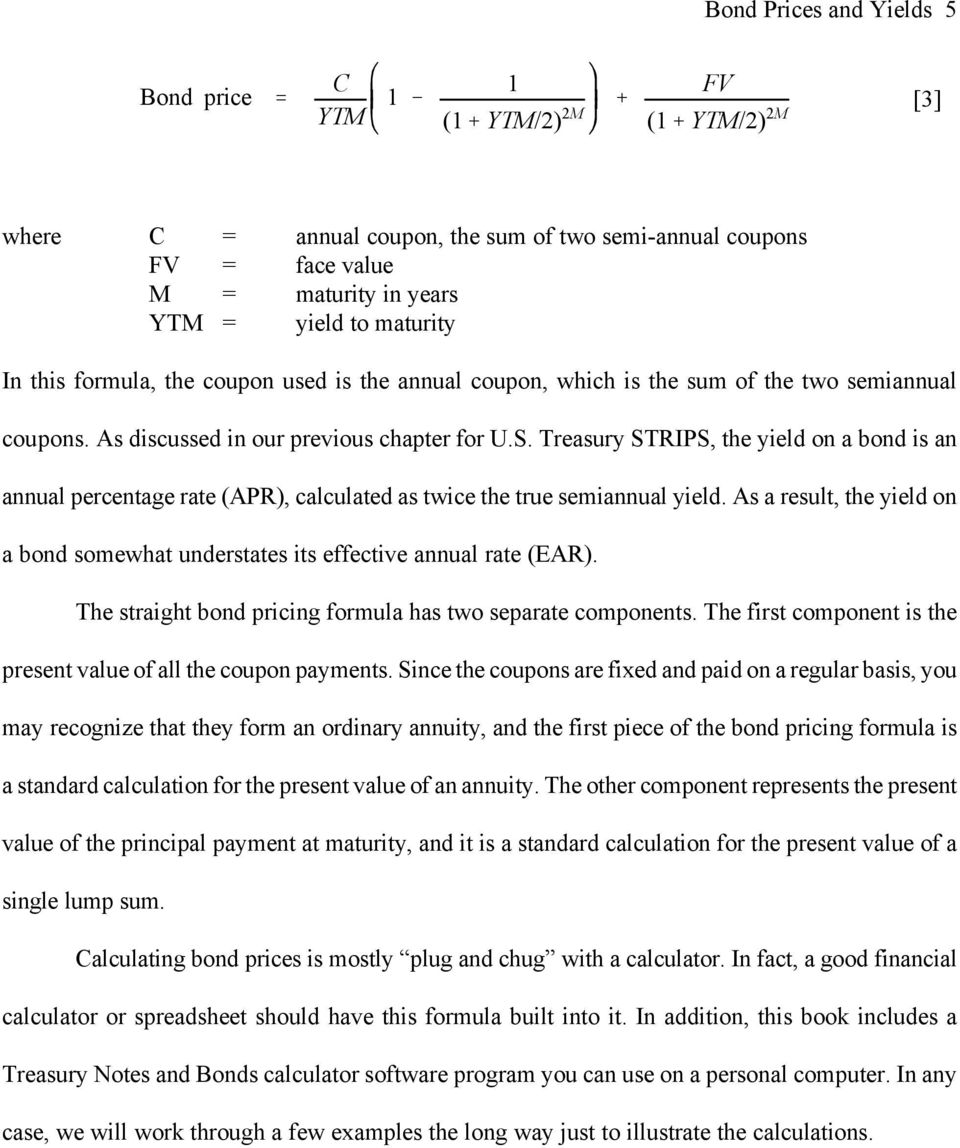
4 4 Chapter 10 remains constant. However, a bond's current yield is inversely related to its price, and changes whenever the bond's price changes. CHECK THIS 10.1a What is a straight bond? 10.1b What is a bond s coupon rate? Its current yield? (marg. def. yield to maturity (YTM) The discount rate that equates a bond s price with the present value of its future cash flows. Also called promised yield or just yield.) 10.2 Straight Bond Prices and Yield to Maturity The single most important yield measure for a bond is its yield to maturity, commonly abbreviated as YTM. By definition, a bond s yield to maturity is the discount rate that equates the bond s price with the computed present value of its future cash flows. A bond's yield to maturity is sometimes called its promised yield, but, more commonly, the yield to maturity of a bond is simply referred to as its yield. In general, if the term yield is being used with no qualification, it means yield to maturity. Straight Bond Prices its yield: For straight bonds, the following standard formula is used to calculate a bond s price given

5 Bond Prices and Yields 5 Bond price ' C YTM 1 & 1 % (1%YTM/2) 2M FV (1%YTM/2) 2M [3] where C = annual coupon, the sum of two semi-annual coupons FV = face value M = maturity in years YTM = yield to maturity In this formula, the coupon used is the annual coupon, which is the sum of the two semiannual coupons. As discussed in our previous chapter for U.S. Treasury STRIPS, the yield on a bond is an annual percentage rate (APR), calculated as twice the true semiannual yield. As a result, the yield on a bond somewhat understates its effective annual rate (EAR). The straight bond pricing formula has two separate components. The first component is the present value of all the coupon payments. Since the coupons are fixed and paid on a regular basis, you may recognize that they form an ordinary annuity, and the first piece of the bond pricing formula is a standard calculation for the present value of an annuity. The other component represents the present value of the principal payment at maturity, and it is a standard calculation for the present value of a single lump sum. Calculating bond prices is mostly plug and chug with a calculator. In fact, a good financial calculator or spreadsheet should have this formula built into it. In addition, this book includes a Treasury Notes and Bonds calculator software program you can use on a personal computer. In any case, we will work through a few examples the long way just to illustrate the calculations.
6 6 Chapter 10 Suppose a bond has a $1,000 face value, 20 years to maturity, an 8 percent coupon rate, and a yield of 9 percent. What s the price? Using the straight bond pricing formula, the price of this bond is calculated as follows: 1. Present value of semiannual coupons: $ & 1 ' $ (1.045) Present value of $1,000 principal: $1,000 (1.045) 40 ' $ The price of the bond is the sum of the present values of coupons and principal: Bond price = $ $ = $ So, this bond sells for $ Example 10.1: Calculating Straight Bond Prices. Suppose a bond has 20 years to maturity and a coupon rate of 8 percent. The bond's yield to maturity is 7 percent. What s the price? In this case, the coupon rate is 8 percent and the face value is $1,000, so the annual coupon is $80. The bond's price is calculated as follows: 1. Present value of semiannual coupons: $ & 1 ' $ (1.035) Present value of $1,000 principal: $1,000 (1.035) 40 ' $

7 Bond Prices and Yields 7 The bond's price is the sum of coupon and principal present values: Bond price = $ $ = $1, This bond sells for $1, Premium and Discount Bonds Bonds are commonly distinguished according to whether they are selling at par value or at a discount or premium relative to par value. These three relative price descriptions - premium, discount, and par bonds - are defined as follows: 1. Premium bonds: Bonds with a price greater than par value are said to be selling at a premium. The yield to maturity of a premium bond is less than its coupon rate. 2. Discount bonds: Bonds with a price less than par value are said to be selling at a discount. The yield to maturity of a discount bond is greater than its coupon rate. 3. Par bonds: Bonds with a price equal to par value are said to be selling at par. The yield to maturity of a par bond is equal to its coupon rate. The important thing to notice is that whether a bond sells at a premium or discount depends on the relation between its coupon rate and its yield. If the coupon rate exceeds the yield, then the bond will sell at a premium. If the coupon is less than the yield, the bond will sell at a discount. Example 10.2: Premium and Discount Bonds. Consider a bond with eight years to maturity and a 7 percent coupon rate. If its yield to maturity is 9 percent, does this bond sell at a premium or discount? Verify your answer by calculating the bond s price. Since the coupon rate is smaller than the yield, this is a discount bond. Check that its price is $

8 8 Chapter 10 The relationship between bond prices and bond maturities for premium and discount bonds is graphically illustrated in Figure 10.1 for bonds with an 8 percent coupon rate. The vertical axis measures bond prices and the horizontal axis measures bond maturities. Figure 10.1 about here. Figure 10.1 also describes the paths of premium and discount bond prices as their maturities shorten with the passage of time, assuming no changes in yield to maturity. As shown, the time paths of premium and discount bond prices follow smooth curves. Over time, the price of a premium bond declines and the price of a discount bond rises. At maturity, the price of each bond converges to its par value. Figure 10.1 illustrates the general result that, for discount bonds, holding the coupon rate and yield to maturity constant, the longer the term to maturity of the bond the greater is the discount from par value. For premium bonds, holding the coupon rate and yield to maturity constant, the longer the term to maturity of the bond the greater is the premium over par value. Example 10.3: Premium Bonds Consider two bonds, both with a 9 percent coupon rate and the same yield to maturity of 7 percent, but with different maturities of 5 and 10 years. Which has the higher price? Verify your answer by calculating the prices. First, since both bonds have a 9 percent coupon and a 7 percent yield, both bonds sell at a premium. Based on what we know, the one with the longer maturity will have a higher price. We can check these conclusions by calculating the prices as follows:

9 Bond Prices and Yields 9 5-year maturity premium bond price: $ & 1 (1.035) 10 % $1,000 (1.035) 10 ' $1, year maturity premium bond price: $ & 1 (1.035) 20 % $1,000 (1.035) 20 ' $1, Notice that the longer maturity premium bond has a higher price, as we predicted. Example 10.4: Discount Bonds Now consider two bonds, both with a 9 percent coupon rate and the same yield to maturity of 11 percent, but with different maturities of 5 and 10 years. Which has the higher price? Verify your answer by calculating prices. These are both discount bonds. (Why?) The one with the shorter maturity will have a higher price. To check, the prices can be calculated as follows: 5-year maturity discount bond price: $ & 1 (1.055) 10 % $1,000 (1.055) 10 ' $ year maturity discount bond price: $ & 1 (1.055) 20 % $1,000 (1.055) 20 ' $ In this case, the shorter maturity discount bond has the higher price. Relationships among Yield Measures We have discussed three different bond rates or yields in this chapter - the coupon rate, the current rate, and the yield to maturity. We ve seen the relationship between coupon rates and yields for discount and premium bonds. We can extend this to include current yields by simply noting that

10 10 Chapter 10 the current yield is always between the coupon rate and the yield to maturity (unless the bond is selling at par, in which case all three are equal). Putting together our observations about yield measures, we have the following: Premium bonds: Discount bonds: Par value bonds: Coupon rate > Current yield > Yield to maturity Coupon rate < Current yield < Yield to maturity Coupon rate = Current yield = Yield to maturity Thus when a premium bond and a discount bond both have the same yield to maturity, the premium bond has a higher current yield than the discount bond. However, as shown in Figure 10.1, the advantage of a high current yield for a premium bond is offset by the fact that the price of a premium bond must ultimately fall to its face value when the bond matures. Similarly, the disadvantage of a low current yield for a discount bond is offset by the fact that the price of a discount bond must ultimately rise to its face value at maturity. For these reasons, current yield is not a reliable guide to what an actual yield will be. CHECK THIS 10.2a A straight bond s price has two components. What are they? 10.2b What do you call a bond that sells for more than its face value? 10.2c What is the relationship between a bond's price and its term to maturity when the bond's coupon rate is equal to its yield to maturity? 10.2d Does current yield more strongly overstate yield to maturity for long maturity or shortmaturity premium bonds?

11 Bond Prices and Yields More on Yields In the previous section, we focused on finding a straight bond s price given its yield. In this section, we reverse direction to find a bond s yield given its price. We then discuss the relationship among the various yield measures we have seen. We finish the section with some additional yield calculations. Calculating Yields To calculate a bond s yield given its price, we use the same straight bond formula used above. The only way to find the yield is by trial and error. Financial calculators and spreadsheets do it this way at very high speeds. To illustrate, suppose we have a 6 percent bond with 10 years to maturity. Its price is 90, meaning 90 percent of face value. Assuming a $1,000 face value, the price is $900 and the coupon is $60 per year. What s the yield? To find out, all we can do is try different yields until we come across the one that produces a price of $900. However, we can speed things up quite a bit by making an educated guess using what we know about bond prices and yields. We know the yield on this bond is greater than its 6 percent coupon rate because it is a discount bond. So let s first try 8 percent in the straight bond pricing formula: $ & 1 % $1,000 ' $ (1.04) 20 (1.04) 20

12 12 Chapter 10 The price with an 8 percent yield is $864.10, which is somewhat less than the $900 price, but not too far off. To finish, we need to ask whether the 8 percent we used was too high or too low. We know that the higher the yield, the lower is the price, this 8 percent is a little too high. So let s try 7.5 percent: $ & 1 % (1.0375) 20 $1,000 (1.0375) 20 ' $ Now we re very close. We re still a little too high on the yield (since the price is a little low). If you try 7.4 percent, you ll see that the resulting price is $902.29, so the yield is between 7.4 and 7.5 percent (it s actually percent). Of course, these calculations are done much faster using a calculator like the Treasury Notes and Bonds software calculator included with this textbook. Example 10.5: Calculating YTM Suppose a bond has eight years to maturity, a price of 110, and a coupon rate of 8 percent. What is its yield? This is a premium bond, so its yield is less than the 8 percent coupon. If we try 6 percent, we get (check this) $1, The yield is therefore a little bigger than 6 percent. If we try 6.5 percent, we get (check this) $ , so the answer is slightly less than 6.5 percent. Check that 6.4 percent is almost exact (the exact yield is percent).

13 Yield to Call Bond Prices and Yields 13 (marg. def. callable bond A bond is callable if the issuer can buy it back before it matures.) (marg. def. call price The price the issuer of a callable bond must pay to buy it back.) The discussion in this chapter so far has assumed that a bond will have an actual maturity equal to its originally stated maturity. However, this is not always so since most bonds are callable bonds. When a bond issue is callable, the issuer can buy back outstanding bonds before the bonds mature. In exchange, bondholders receive a special call price, which is often equal to face value, although it may be slightly higher. When a call price is equal to face value, the bond is said to be callable at par. (marg. def. call protection period The period during which a callable bond cannot be called. Also called a call deferment period.) Bonds are called at the convenience of the issuer, and a call usually occurs after a fall in market interest rates allows issuers to refinance outstanding debt with new bonds paying lower coupons. However, an issuer's call privilege is often restricted so that outstanding bonds cannot be called until the end of a specified call protection period, also termed a call deferment period. As a typical example, a bond issued with a 20-year maturity may be sold to investors subject to the restriction that it is callable anytime after an initial five-year call protection period. (marg. def. yield to call (YTC) Measure of return that assumes a bond will be redeemed at the earliet call date.) If a bond is callable, its yield to maturity may no longer be a useful number. Instead, the yield to call, commonly abbreviated YTC, may be more meaningful. Yield to call is a yield measure that assumes a bond issue will be called at its earliest possible call date.

14 14 Chapter 10 We calculate a bond s yield to call using the straight bond pricing formula we have been using with two changes. First, instead of time to maturity, we use time to the first possible call date. Second, instead of face value, we use the call price. The resulting formula is thus Callable bond price ' C YTC 1 & 1 % (1%YTC/2) 2T CP (1%YTC/2) 2T [4] where C = Constant annual coupon CP = Call price of the bond T = Time in years until earliest possible call date YTC = Yield to call assuming semiannual coupons Calculating a yield to call requires the same trial-and-error procedure as calculating a yield to maturity. Most financial calculators will either handle the calculation directly or can be tricked into it by just changing the face value to the call price and the time to maturity to time to call. To give a trial-and-error example, suppose a 20-year bond has a coupon of 8 percent, a price of 98, and is callable in 10 years. The call price is 105. What are its yield to maturity and yield to call? Based on our earlier discussion, we know the yield to maturity is slightly bigger than the coupon rate. (Why?) After some calculation, we find it to be 8.2 percent. To find the bond s yield to call, we pretend it has a face value of 105 instead of 100 ($1,050 versus $1,000) and will mature in 10 years. With these two changes, the procedure is exactly the same. We can try 8.5 percent, for example: $ & 1 % (1.0425) 20 $1,050 (1.0425) 20 ' $988.51
![The resulting formula is thus Callable bond price ' C YTC 1 & 1 % (1%YTC/2) 2T CP (1%YTC/2) 2T [4] where C = Constant annual coupon CP = Call price of the bond T = Time in years until earliest](/docs-images/40/6699471/images/page_14.jpg "possible call date YTC = Yield to call assuming semiannual coupons Calculating a yield to call requires the same trial-and-error procedure as calculating a yield to maturity.")
15 Bond Prices and Yields 15 Since this $ is a little too high, the yield to call is slightly bigger than 8.5 percent. If we try 8.6, we find that the price is $981.83, so the yield to call is about 8.6 percent (it s percent). Again, the calculations are faster using a calculator like the Treasury Notes and Bonds software calculator included with this textbook. A natural question comes up in this context. Which is bigger, the yield to maturity or the yield to call? The answer depends on the call price. However, if the bond is callable at par (as many are), then, for a premium bond, the yield to maturity is greater. For a discount bond, the reverse is true. Example 10.6: Yield to Call An 8.5 percent, 30-year bond is callable at par in 10 years. If the price is 105, which is bigger, the yield to call or maturity? Since this is a premium bond callable at par, the yield to maturity is bigger. We can verify this by calculating both yields. Check that the yield to maturity is 8.06 percent, whereas the yield to call is 7.77 percent. CHECK THIS 10.3a What does it mean for a bond to be callable? 10.3b What is the difference between yield to maturity and yield to call? 10.3c Yield to call is calculated just like yield to maturity except for two changes. What are the changes?

16 16 Chapter 10 (marg. def. interest rate risk The possibility that changes in interest rates will result in losses in a bond s value.) 10.4 Interest Rate Risk and Malkiel's Theorems Bond yields are essentially interest rates, and, like interest rates, they fluctuate through time. When interest rates change, bond prices change. This is called interest rate risk. The term interest rate risk refers to the possibility of losses on a bond from changes in interest rates. (marg. def. realized yield The yield actually earned or realized on a bond.) Promised Yield and Realized Yield The terms yield to maturity and promised yield both seem to imply that the yield originally stated when a bond is purchased is what you will actually earn if you hold the bond until it matures. Actually, this is not generally correct. The return or yield you actually earn on a bond is called the realized yield, and an originally stated yield to maturity is almost never exactly equal to the realized yield. The reason a realized yield will almost always differ from a promised yield is that interest rates fluctuate, causing bond prices to rise or fall. One consequence is that if a bond is sold before maturity, its price may be higher or lower than originally anticipated, and, as a result, the actually realized yield will be different from the promised yield. Another important reason why realized yields generally differ from promised yields relates to the bond s coupons. We will get to this in the next section. For now, you should know that, for the most part, a bond s realized yield will equal its promised yield only if its yield doesn t change at all over the life of the bond, an unlikely event.

17 Bond Prices and Yields 17 Interest Rate Risk and Maturity While changing interest rates systematically affect all bond prices, it is important to realize that the impact of changing interest rates is not the same for all bonds. Some bonds are more sensitive to interest rate changes than others. To illustrate, Figure 10.2 shows how two bonds with different maturities can have different price sensitivities to changes in bond yields. Figure 10.2 about here. In Figure 10.2, bond prices are measured on the vertical axis and bond yields are measured on the horizontal axis. Both bonds have the same 8 percent coupon rate, but one bond has a 5-year maturity while the other bond has a 20-year maturity. Both bonds display the inverse relationship between bond prices and bond yields. Since both bonds have the same 8 percent coupon rate, and both sell for par, their yields are 8 percent. However, when bond yields are greater than 8 percent, the 20-year maturity bond has a lower price than the 5-year maturity bond. In contrast, when bond yields are less than 8 percent, the 20-year maturity bond has a higher price than the 5-year maturity bond. Essentially, falling yields cause both bond prices to rise, but the longer maturity bond experiences a larger price increase than the shorter maturity bond. Similarly, rising yields cause both bond prices to fall, but the price of the longer maturity bond falls by more than the price of the shorter maturity bond.

18 18 Chapter 10 Malkiel s Theorems The effect illustrated in Figure 10.2, along with some other important relationships among bond prices, maturities, coupon rates, and yields, is succinctly described by Burton Malkiel's five bond price theorems. 1 These five theorems are: 1. Bond prices and bond yields move in opposite directions. As a bond's yield increases, its price decreases. Conversely, as a bond's yield decreases, its price increases. 2. For a given change in a bond's yield to maturity, the longer the term to maturity of the bond, the greater will be the magnitude of the change in the bond's price. 3. For a given change in a bond's yield to maturity, the size of the change in the bond's price increases at a diminishing rate as the bond's term to maturity lengthens. 4. For a given change in a bond's yield to maturity, the absolute magnitude of the resulting change in the bond's price is inversely related to the bond's coupon rate. 5. For a given absolute change in a bond's yield to maturity, the magnitude of the price increase caused by a decrease in yield is greater than the price decrease caused by an increase in yield. The first, second, and fourth of these theorems are the simplest and most important. The first one says that bond prices and yields move in opposite directions. The second one says that longer term bonds are more sensitive to changes in yields than shorter term bonds. The fourth one says that lower coupon bonds are more sensitive to changes in yields than higher coupon bonds. The third theorem says that a bond s sensitivity to interest rate changes increases as its maturity grows, but at a diminishing rate. In other words, a 10-year bond is much more sensitive to changes in yield than a 1-year bond. However a 30-year bond is only slightly more sensitive than a 1 Burton C. Malkiel, "Expectations, Bond Prices, and the Term Structure of Interest Rates," Quarterly Journal of Economics, May 1962, pp

19 Bond Prices and Yields year bond. Finally, the fifth theorem says essentially that the loss you would suffer from, say, a 1 percent increase in yields is less than the gain you would enjoy from a 1 percent decrease in yields. Table 10.1 Bond Prices and Yields Time to Maturity Yields 5 Years 10 years 20 years 7% $1, $1, $1, % Price difference $81.14 $ $ Table 10.1 illustrates the first three of these theorems by providing prices for 8 percent coupon bonds with maturities of 5, 10, and 20 years and yields to maturity of 7 percent and 9 percent. Be sure to check these for practice. As the first theorem says, bond prices are lower when yields are higher (9 percent versus 7 percent). As the second theorem indicates, the differences in bond prices between yields of 7 percent and 9 percent are greater for bonds with a longer term to maturity. However, as the third theorem states, the effect increases at a diminishing rate as the maturity lengthens. To see this, notice that $ is 67.7 percent larger than $81.14, while $ is only 46.1 percent larger than $

20 20 Chapter 10 Table Year Bond Prices and Yields Coupon Rates Yields 6 percent 8 percent 10 percent 6 percent $1, $1, $1, percent , , percent , To illustrate the last two theorems, we present prices for 20-year maturity bonds with coupon rates and yields to maturity of 6 percent, 8 percent, and 10 percent (again, calculate these for practice) in Table To illustrate the fourth theorem, compare the loss on the 6 percent and the 8 percent bonds as yields move from 8 percent to 10 percent. The 6 percent bond loses ($ $802.07) / $ = -18.1%. The 8 percent bond loses ($ $1,000)/$1,000 = -17.2%, showing that the bond with the lower coupon is more sensitive to a change in yields. You can (and should) verify that the same is true for a yield increase. Finally, to illustrate the fifth theorem, take a look at the 8 percent coupon bond in Table As yields decrease by 2 percent from 8 percent to 6 percent, its price climbs by $ As yields rise by 2 percent, the bond s price falls by $ As we have discussed, bond maturity is an important factor determining the sensitivity of a bond's price to changes in interest rates. However, bond maturity is an incomplete measure of bond price sensitivity to yield changes. For example, we have seen that a bond s coupon rate is also important. An improved measure of interest rate risk for bonds that accounts both for differences in maturity and differences in coupon rates is our next subject.

21 Bond Prices and Yields 21 CHECK THIS 10.4a True or false: A bond price s sensitivity to interest rate changes increases at an increasing rate as maturity lengthens. 10.4b Which is more sensitive to an interest rate shift: a low-coupon bond or a high-coupon bond? (marg. def. Duration A widely used measure of a bond's sensitivity to changes in bond yields.) 10.5 Duration To account for differences in interest rate risk across bonds with different coupon rates and maturities, the concept of duration is widely applied. As we will explore in some detail, duration measures a bond s sensitivity to interest rate changes. The idea behind duration was first presented by Frederick Macaulay in an early study of U.S. financial markets. 2 Today, duration is a very widely used measure of a bond's price sensitivity to changes in bond yields. Macaulay Duration There are several duration measures. The original version is called Macaulay duration. The usefulness of Macaulay duration stems from the fact that it satisfies the following approximate relationship between percentage changes in bond prices and changes in bond yields: Percentage change in bond price. Duration Change in YTM (1%YTM/2) [5] 2 Frederick Macaulay, Some Theoretical Problems Suggested by the Movements of Interest Rates, Bond Yields, and Stock Prices in the United States Since 1856, New York (National Bureau of Economic Research, 1938).
22 22 Chapter 10 As a consequence, two bonds with the same duration, but not necessarily the same maturity, have approximately the same price sensitivity to a change in bond yields. This approximation is quite accurate for relatively small changes in yields but it becomes less accurate when large changes are considered. To see how we use this result, suppose a bond has a Macaulay duration of six years, and its yield decreases from 10 percent to 9.5 percent. The resulting percentage change in the price of the bond is calculated as follows: 6.10 & % Thus the bond s price rises by 2.86 percent in response to a yield decrease of 50 basis points. Example 10.7: Macaulay Duration. A bond has a Macaulay duration of 11 years, and its yield increases from 8 percent to 8.5 percent. What will happen to the price of the bond? The resulting percentage change in the price of the bond can be calculated as follows: & &5.29% The bond s price declines by approximately 5.29 percent in response to a 50 basis point increase in yields. Modified Duration Some analysts prefer to use a variation of Macaulay's duration called modified duration. The relationship between Macaulay duration and modified duration for bonds paying semiannual coupons is simply Modified duration ' Macaulay duration (1%YTM/2) [6]
23 Bond Prices and Yields 23 As a result, based on modified duration, the approximate relationship between percentage changes in bond prices and changes in bond yields is just Percentage change in bond price = Modified duration Change in YTM [7] In other words, to calculate the percentage change in the bond s price, we just multiply the modified duration by the change in yields. Example 10.8: Modified Duration. A bond has a Macaulay duration of 8.5 years and a yield to maturity of 9 percent. What is its modified duration? The bond s modified duration is calculated as follows: ' Notice that we divided the yield by 2 to get the semiannual yield. Example 10.9: Modified Duration. A bond has a modified duration of seven years. Suppose its yield increases from 8 percent to 8.5 percent. What happens to its price? We can very easily determine the resulting percentage change in the price of the bond using its modified duration: 7 (.08 &.085). &3.5% The bond s price declines by about 3.5 percent. Calculating Macaulay's Duration Macaulay's duration is often described as a bond's effective maturity. For this reason, duration values are conventionally stated in years. The first fundamental principle for calculating the duration of a bond concerns the duration of a zero coupon bond. Specifically, the duration of a zero coupon
24 24 Chapter 10 bond is equal to its maturity. Thus on a pure discount instrument, such as the U.S. Treasury STRIPS we discussed in Chapter 9, no calculation is necessary to come up with Macaulay duration. The second fundamental principle for calculating duration concerns the duration of a coupon bond with multiple cash flows. The duration of a coupon bond is a weighted average of individual maturities of all the bond's separate cash flows. The weights attached to the maturity of each cash flow are proportionate to the present values of each cash flow. Figure 10.3 about here. A sample duration calculation for a bond with three years until maturity is illustrated in Figure 10.3 The bond sells at par value. It has an 8 percent coupon rate and an 8 percent yield to maturity. As shown in Figure 10.3, calculating a bond's duration can be laborious especially if the bond has a large number of separate cash flows. Fortunately, relatively simple formulas are available for many of the important cases. For example, if a bond is selling for par value, its duration can be calculated easily using the following formula: Par value bond duration ' (1%YTM/2) YTM 1 & 1 (1%YTM/2) 2M [8] where M = Bond maturity in years YTM = Yield to maturity assuming semi-annual coupons
25 Bond Prices and Yields 25 Example 10.10: Duration for a Par Value Bond Suppose a par value bond has a 6 percent coupon and 10 years to maturity. What is its duration? Since the bond sells for par, its yield is equal to its coupon rate, 6 percent. Plugging this into the par value bond duration formula, we have Par value bond duration ' (1%.06/2).06 1 & 1 (1%.06/2) 20 After a little work on a calculator, we find that the duration is 7.66 years. The par value bond duration formula is useful for calculating the duration of a bond that is actually selling at par value. Unfortunately, the general formula for bonds not necessarily selling at par value is somewhat more complicated. The general duration formula for a bond paying constant semiannual coupons is Duration ' 1 % YTM/2 YTM & (1 % YTM/2) % M(C & YTM) YTM % C[(1 % YTM/2) 2M & 1] [9] where C = Constant annual coupon rate M = Bond maturity in years YTM = Yield to maturity assuming semiannual coupons Although somewhat tedious for manual calculations, this formula is used in many computer programs that calculate bond durations. For example, the Treasury Notes and Bonds calculator program included with this book uses this duration formula. Some popular personal computer spreadsheet packages also have a built-in function to perform this calculation. Example 10.11: Duration for a Discount Bond A bond has a yield to maturity of 7 percent. It matures in 12 years. Its coupon rate is 6 percent. What is its modified duration? We first must calculate the Macaulay duration using the unpleasant-looking formula just above. We finish by converting the Macaulay duration to modified duration. Plugging into the duration formula, we have
26 26 Chapter 10 Duration ' 1 %.07/2.07 & (1 %.07/2) % 12(0.06 &.07).07 %.06[(1 %.07/2) 24 & 1] ' & % 12(&.01).07 %.06( & 1) After a little button pushing, we find that the duration is 8.56 years. Finally, converting to modified duration, we find that the modified duration is equal to 8.56/1.035 = 8.27 years. Properties of Duration Macaulay duration has a number of important properties. For straight bonds, the basic properties of Macaulay duration can be summarized as follows: 1. All else the same, the longer a bond s maturity, the longer is its duration. 2. All else the same, a bond s duration increases at a decreasing rate as maturity lengthens. 3. All else the same, the higher a bond s coupon, the shorter is its duration. 4. All else the same, a higher yield to maturity implies a shorter duration, and a lower yield to maturity implies a longer duration. As we saw earlier, a zero coupon bond has a duration equal to its maturity. The duration on a bond with coupons is always less than its maturity. Because of the second principle, durations much longer than 10 or 15 years are rarely seen. There is an exception to some of these principles that involves very long maturity bonds selling at a very steep discount. This exception rarely occurs in practice, so these principles are generally correct. Figure 10.4 about here.
27 Bond Prices and Yields 27 A graphical illustration of the relationship between duration and maturity is presented in Figure 10.4, where duration is measured on the vertical axis and maturity is measured on the horizontal axis. In Figure 10.4, the yield to maturity for all bonds is 10 percent. Bonds with coupon rates of 0 percent, 5 percent, 10 percent, and 15 percent are presented. As the figure shows, the duration of a zero-coupon bond rises step-for-step with maturity. For the coupon bonds, however, the duration initially moves closely with maturity, as our first duration principle suggests, but, consistent with the second principle, the lines begin to flatten out after four or five years. Also, consistent with our third principle, the lower coupon bonds have higher durations. CHECK THIS 10.5a What does duration measure? 10.5b What is the duration of a zero-coupon bond? 10.5c What happens to a bond s duration as its maturity grows? 10.6 Dedicated Portfolios and Reinvestment Risk Duration has another property that makes it a vital tool in bond portfolio management. To explore this subject, we first need to introduce two important concepts, dedicated portfolios and reinvestment risk.
28 28 Chapter 10 (marg. def. dedicated portfolio A bond portfolio created to prepare for a future cash outlay.) Dedicated Portfolios Bond portfolios are often created for the purpose of preparing for a future liability payment or other cash outlay. Portfolios formed for such a specific purpose are called dedicated portfolios. When the future liability payment of a dedicated portfolio is due on a known date, that date is commonly called the portfolio's target date. Pension funds provide a good example of dedicated portfolio management. A pension fund normally knows years in advance the amount of benefit payments it must make to its beneficiaries. The fund then purchases bonds in the amount needed to prepare for these payments. To illustrate, suppose the Safety First pension fund estimates that it must pay benefits of about $100 million in five years. Using semiannual discounting, and assuming that bonds currently yield 8 percent, the present value of Safety First's future liability is calculated as follows: $100,000,000 (1.04) 10. $67,556,417 This amount, about $67.5 million, represents the investment necessary for Safety First to construct a dedicated bond portfolio to fund a future liability of $100 million. Next, suppose the Safety First pension fund creates a dedicated portfolio by investing exactly $67.5 million in bonds selling at par value with a coupon rate of 8 percent to prepare for the $100 million payout in five years. The Safety First fund decides to follow a maturity matching strategy whereby it invests only in bonds with maturities that match the portfolio's 5-year target date.
29 Bond Prices and Yields 29 Since Safety First is investing $67.5 million in bonds that pay an 8 percent annual coupon, the fund receives $5.4 million in coupons each year, along with $67.5 million of principal at the bonds' 5-year maturity. As the coupons come in, Safety First reinvests them. If all coupons are reinvested at an 8 percent yield, the fund's portfolio will grow to about $ million on its target date. This is the future value of $67.5 million compounded at 4 percent semiannually for 5 years: $67.5 million (1.04) 10. $100 million This amount is also equal to the future value of all coupons reinvested at 8 percent, plus the $67.5 million of bond principal received at maturity. To see this, we calculate the future value of the coupons (using the standard formula for the future value of an annuity) and then add the $67.5 million: $5.4 million.08 (1.04) 10 & 1 % $67.5 million. $100 million Thus as long the annual coupons are reinvested at 8 percent, Safety First s bond fund will grow to the amount needed. Reinvestment Rate Risk As we have seen, the bond investment strategy of the Safety First pension fund will be successful if all coupons received during the life of the investment can be reinvested at a constant 8 percent yield. However, in reality, yields at which coupons can be reinvested are uncertain, and a target date surplus or shortfall is therefore likely to occur.
30 30 Chapter 10 (marg. def. reinvestment rate risk The uncertainty about future or target date portfolio value that results from the need to reinvest bond coupons at yields not known in advance.) The uncertainty about future or target date portfolio value that results from the need to reinvest bond coupons at yields that cannot be predicted in advance is called reinvestment rate risk. Thus the uncertain portfolio value on the target date represents reinvestment risk. In general, more distant target dates entail greater uncertainty and reinvestment risk. To examine the impact of reinvestment risk, we continue with the example of the Safety First pension fund's dedicated bond portfolio. We will consider two cases, one in which all bond coupons are reinvested at a higher 9 percent yield, and one which all coupons are reinvested at a lower 7 percent yield. In this case, the payment of the fixed $67.5 million principal plus the future value of the 10 semiannual coupons compounded at an uncertain rate, either 9 percent or 7 percent, comprise the total five-year target date portfolio value. For 9 percent and 7 percent yields, these target date portfolio values are calculated as follows: $5.4 million.09 (1.045) 10 & 1 % $67.5 million ' $ million $5.4 million.07 (1.035) 10 & 1 % $67.5 million ' $ million As shown, a target date portfolio value of $ million is realized through a 9 percent reinvestment rate, and a value of $ million is realized by a 7 percent reinvestment rate. The difference between these two amounts, about $1.5 million, represents reinvestment risk. As this example illustrates, a maturity matching strategy for a dedicated bond portfolio entails substantial reinvestment risk. Indeed, this example understates a pension fund's total reinvestment risk
31 Bond Prices and Yields 31 since it considers only a single target date. In reality, pension funds have a series of target dates, and a shortfall at one target date typically coincides with shortfalls at other target dates as well. A simple solution for reinvestment risk is to purchase zero coupon bonds that pay a fixed principal at a maturity chosen to match a dedicated portfolio's target date. Since there are no coupons to reinvest, there is no reinvestment risk! However, a zero coupon bond strategy has its drawbacks. As a practical matter, U.S. Treasury STRIPS are the only zero coupon bonds issued in sufficient quantity to even begin to satisfy the dedicated portfolio needs of pension funds, insurance companies, and other institutional investors. However, U.S. Treasury securities have lower yields than even the highest quality corporate bonds. A yield difference of only.25 percent between Treasury securities and corporate bonds can make a substantial difference in the initial cost of a dedicated bond portfolio. For example, suppose that Treasury STRIPS have a yield of 7.75 percent. Using semiannual compounding, the present value of these zero coupon bonds providing a principal payment of $100 million at a 5-year maturity is calculated as follows: $100 million ( ) 10. $ million This cost of $ million based on a 7.75 percent yield is significantly higher than the previously stated cost of $ million based on an 8 percent yield. From the perspective of the Safety First pension fund, this represents a hefty premium to pay to eliminate reinvestment risk. Fortunately, as we discuss in the next section, other methods are available at lower cost.
32 32 Chapter 10 CHECK THIS 10.6a What is a dedicated portfolio? 10.6b What is reinvestment rate risk? (marg. def. immunization Constructing a portfolio to minimize the uncertainty surrounding its target date value.) 10.7 Immunization Constructing a dedicated portfolio to minimize the uncertainty in its target date value is called immunization. In this section, we show how duration can be used to immunize a bond portfolio against reinvestment risk. Price Risk versus Reinvestment Rate Risk To understand how immunization is accomplished, suppose you own a bond with eight years to maturity. However, your target date is actually just six years from now. If interest rates rise, are you happy or unhappy? (marg. def. price risk The risk that bond prices will decrease which arises in dedicated portfolios when the target date value of a bond or bond portfolio is not known with certainty.) Your initial reaction is probably unhappy because you know that as interest rates rise, bond values fall. However, things are not so simple. Clearly, if interest rates rise, then, in six years, your bond will be worth less than it would have been at a lower rate. This is called price risk. However, it is also true that you will be able to reinvest the coupons you receive at a higher interest rate. As a
33 Bond Prices and Yields 33 result, your reinvested coupons will be worth more. In fact, the net effect of an interest rate increase might be to make you better off. As our simple example illustrates, for a dedicated portfolio, interest rate changes have two effects. Interest rate increases act to decrease bond prices (price risk) but increase the future value of reinvested coupons (reinvestment rate risk). In the other direction, interest rate decreases act to increase bond values but decrease the future value of reinvested coupons. The key observation is that these two effects price risk and reinvestment rate risk tend to offset each other. You might wonder if it is possible to engineer a portfolio in which these two effects offset each other more or less precisely. As we illustrate next, the answer is most definitely yes. Immunization by Duration Matching The key to immunizing a dedicated portfolio is to match its duration to its target date. If this is done, then the impacts of price and reinvestment rate risk will almost exactly offset, and interest rate changes will have a minimal impact on the target date value of the portfolio. In fact, immunization is often simply referred to as duration matching. To see how a duration matching strategy can be applied to reduce target date uncertainty, suppose the Safety First pension fund initially purchases $67.5 million of par value bonds paying 8 percent coupons with a maturity of 6.2 years. From the par value duration formula we discussed earlier, a maturity of 6.2 years corresponds to a duration of 5 years. Thus the duration of Safety First's dedicated bond portfolio is now matched to its five-year portfolio target date.
34 34 Chapter 10 Suppose that immediately after the bonds are purchased, a one-time shock causes bond yields to either jump up to 10 percent or jump down to 6 percent. As a result, all coupons are reinvested at either a 10 percent yield or a 6 percent yield, depending on which way rates jump. Figure 10.5 about here. This example is illustrated in Figure 10.5, where the left vertical axis measures initial bond portfolio values, and the right vertical axis measures bond portfolio values realized by holding the portfolio until the bonds mature in 6.2 years. The horizontal axis measures the passage of time from initial investment to bond maturity. The positively sloped lines plot bond portfolio values through time for bond yields that have jumped to either 10 percent or 6 percent immediately after the initial investment of $67.5 million in par value 8 percent coupon bonds. This example assumes that after their initial jump, bond yields remain unchanged. As shown in Figure 10.5, the initial jump in yields causes the value of Safety First's bond portfolio to jump in the opposite direction. If yields increase, bond prices fall but coupons are reinvested at a higher interest rate, thereby leading to a higher portfolio value at maturity. In contrast, if yields decrease, bond prices rise but a lower reinvestment rate reduces the value of the portfolio at maturity. However, what is remarkable is that regardless of whether yields rise or fall, there is almost no difference in Safety First's portfolio value at the duration-matched five-year target date. Thus the immunization strategy of matching the duration of Safety First's dedicated portfolio to its portfolio target date has almost entirely eliminated reinvestment risk.
35 Bond Prices and Yields 35 Dynamic Immunization The example of the Safety First pension fund immunizing a dedicated bond portfolio by a duration matching strategy assumed that the bond portfolio was subject to a single yield shock. In reality, bond yields change constantly. Therefore, successful immunization requires that a dedicated portfolio be rebalanced frequently to maintain a portfolio duration equal to the portfolio's target date. For example, by purchasing bonds with a maturity of 6.2 years, the Safety First pension fund had matched the duration of the dedicated portfolio to the fund s 5-year target date. One year later, however, the target date is 4 years away, and bonds with a duration of 4 years are required to maintain a duration matching strategy. Assuming interest rates haven t changed, the par value duration formula shows that a maturity of 4.7 years corresponds to a duration of 4 years. Thus to maintain a duration-matched target date, the Safety First fund must sell its originally purchased bonds now with a maturity of 5.2 years and replace them with bonds having a maturity of 4.7 years. (marg. def. dynamic immunization Periodic rebalancing of a dedicated bond portfolio to maintain a duration that matches the target maturity date.) The strategy of periodically rebalancing a dedicated bond portfolio to maintain a portfolio duration matched to a specific target date is called dynamic immunization. The advantage of dynamic immunization is that reinvestment risk caused by continually changing bond yields is greatly reduced. The drawback of dynamic immunization is that each portfolio rebalancing incurs management and transaction costs. Therefore, portfolios should not be rebalanced too frequently. In practice, rebalancing on an intermittent basis, say, each quarter, is a reasonable compromise between the costs of rebalancing and the benefits of dynamic immunization.
36 36 Chapter 10 CHECK THIS 10.7a What are the two effects on the target date value of a dedicated portfolio of a shift in yields? Explain why they tend to offset. 10.7b How can a dedicated portfolio be immunized against shifts in yields? 10.7c Why is rebalancing necessary to maintain immunization? 10.8 Summary and Conclusions This chapter covers the basics of bonds, bond yields, duration, and immunization. In this chapter we saw that: 1. Bonds are commonly distinguished according to whether they are selling at par value or at a discount or premium relative to par value. Bonds with a price greater than par value are said to be selling at a premium; bonds with a price less than par value are said to be selling at a discount. 2. There are three different yield measures: coupon yield or rate, current yield, and yield to maturity. Each is calculated using a specific equation, which is the biggest or smallest depends on whether the bond is selling at a discount or premium. 3. Important relationships among bond prices, maturities, coupon rates, and yields are described by Malkiel's five bond price theorems. 4. A stated yield to maturity is almost never equal to an actually realized yield because yields are subject to bond price risk and coupon reinvestment rate risk. Bond price risk is the risk that a bond sold before maturity must be sold at a price different from the price predicted by an originally stated yield to maturity. Coupon reinvestment risk is the risk that bond coupons must be reinvested at yields different from an originally stated yield to maturity. 5. To account for differences in interest rate risk across bonds with different coupon rates and maturities, the concept of duration is widely applied. Duration is a direct measure of a bond's price sensitivity to changes in bond yields.
37 Bond Prices and Yields Bond portfolios are often created for the purpose of preparing for a future liability payment. Portfolios formed for such a specific purpose are called dedicated portfolios. When the future liability payment of a dedicated portfolio is due on a known date, that date is called the portfolio's target date. 7. Minimizing the uncertainty of the value of a dedicated portfolio s future target date value is called immunization. A strategy of matching a bond portfolio s duration to the target maturity date accomplishes this goal. Key terms coupon rate current yield yield to maturity (YTM) callable bond call price call protection period yield to call (YTC) realized yield duration dedicated portfolio reinvestment rate risk price risk immunization dynamic immunization interest rate risk
38 38 Chapter 10 Get Real! This chapter covered bond basics. How should you, as an investor or investment manager, put this information to work? Now that you ve been exposed to basic facts about bonds, their prices, and their yields, the next thing to do is to examine some real bonds and see how the various principles we have discussed work out in the real world. The easiest way to do this is to buy some bonds and then observe the behavior of their prices and yields as time goes by. The best place to start is Treasury bonds because they are, for the most part, fairly generic straight bonds. With a simulated brokerage account (such as Stock-Trak), try putting equal (or approximately equal) dollar amounts into two Treasury bonds with the same maturity but different coupons. This position will let you see the impact of coupon rates on price volatility. Similarly, buy two bonds (in approximately equal dollar amounts) with very different maturities but the same (or nearly the same) coupon rates. You ll see firsthand how maturity plays a key role in the riskiness of bond investing. While you re at it, calculate the durations of the bonds you buy. As their yields fluctuate, check that the percentage change in price is very close to what your calculated duration suggests it should be.
39 Bond Prices and Yields 39 STOCK-TRAK FAST TRACK USING DURATION WHEN TRADING INTEREST RATES WITH STOCK-TRAK Duration is an effective measure of interest rate risk and can be usefully applied to strategies for trading interest rates. In the preceding chapter, we recommended using U.S. Treasury STRIPS as a vehicle for trading interest rates with Stock-Trak. In this chapter, we pointed out that the duration of a STRIPS is equal to its maturity and thereefore requires no special calculations. This implies this simple relationship between STRIPS price changes and STRIPS yield changes: Percentage change in STRIPS price. & STRIPS Maturity Change in YTM (1%YTM/2) Suppose you are holding 20-year STRIPS with a yield of 6 percent and believe that the yield on these STRIPS could fall by 50 basis points over the next few weeks. If this occurs, it will cause 20-year STRIPS prices to rise by about 9.7 percent. But if instead the yield rose by 50 basis points it would cause 20-year STRIPS prices to fall by about 9.7 percent. STOCK-TRAK EXERCISES 1. Buy a STRIPS security and record its price, maturity, and yield. After a week or two, calculate the percentage change in price and change in yield for your STRIPS. Plug in the original yield, change in yield, and maturity into the right-hand-side of the above equation to compute the predicted percentage change in the STRIPS price. How closely does this predicted percentage change in the STRIPS price compare with the actual percentage change in the STRIPS price?
40 40 Chapter 10 Review Problems and Self-Test Chapter 10 Bond Prices and Yields Questions and problems 1. Straight Bond Prices Suppose a bond has 10 years to maturity and a coupon rate of 6 percent. The bond's yield to maturity is 8 percent. What s the price? 2. Premium Bonds Suppose we have two bonds, both with a 6 percent coupon rate and the same yield to maturity of 4 percent, but with different maturities of 5 and 15 years. Which has the higher price? Verify your answer by calculating the prices. 3. Macaulay Duration A bond has a Macaulay duration of nine years, and its yield increases from 6 percent to 6.25 percent. What will happen to the price of the bond? Answers to Self-Test Problems 1. Here, the coupon rate is 6 percent and the face value is $1,000, so the annual coupon is $60. The bond's price is calculated as follows: 1. Present value of semiannual coupons: $ & 1 (1.04) 20 ' $ Present value of $1,000 principal: $1,000 (1.04) 20 ' $ The bond's price is the sum of coupon and principal present values: Bond price = $ $ = $ Because both bonds have a 6 percent coupon and a 4 percent yield, both bonds sell at a premium, and the one with the longer maturity will have a higher price. We can verify these conclusions by calculating the prices as follows:
41 Bond Prices and Yields 41 5-year maturity premium bond price: $ & 1 % $1,000 ' $1, (1.02) 10 (1.02) year maturity premium bond price: $ & 1 % $1,000 ' $1, (1.02) 30 (1.02) 30 Notice that the longer maturity premium bond has a higher price, just as we thought. 3. The resulting percentage change in the price of the bond can be calculated as follows: 9.06 & &2.18% The bond s price declines by approximately 2.18 percent in response to a 25 basis point increase in yields.
42 42 Chapter 10 Test Your IQ (Investment Quotient) 1. Yield-to-maturity The yield to maturity on a bond is: (1993 CFA exam) a. below the coupon rate when the bond sells at a discount and above the coupon rate when the bond sells at a premium b. the interest rate that makes the present value of the payments equal to the bond price c. based on the assumption that all future payments received are reinvested at the coupon rate d. based on the assumption that all future payments received are reinvested at future market rates 2. Bond yields In which one of the following cases is the bond selling at a discount? (1989 CFA exam) a. coupon rate is greater than current yield, which is greater than yield-to-maturity b. coupon rate, current yield and yield-to-maturity are all the same c. coupon rate is less than current yield, which is less than yield-to-maturity d. coupon rate is less than current yield, which is greater than yield-to-maturity 3. Bond yields When are yield-to-maturity and current yield on a bond equal? (1992 CFA exam) a. when market interest rates begin to level off b. if the bond sells at a price in excess of its par value c. when the expected holding period is greater than one year d. if the coupon and market interest rate are equal 4. Bond prices Consider a five-year bond with a 10 percent coupon that is presently trading at a yield-to-maturity of 8 percent. If market interest rates do not change, one year from now the price of this bond (1991 CFA exam) a. will be higher b. will be lower c. will be the same d. cannot be determined
43 Bond Prices and Yields Bond prices Using semiannual compounding, what would the price of a 15-year, zero coupon bond that has a par value of $1,000 and a required return of 8 percent be? (1991 CFA exam) a. $308 b. $315 c. $464 d. $ Duration Another term for bond duration is: (1992 CFA exam) a. actual maturity b. effective maturity c. calculated maturity d. near-term maturity 7. Duration Which statement is true for the Macaulay duration of a zero-coupon bond? (1994 CFA exam) a. it is equal to the bond s maturity in years b. it is equal to one-half the bond s maturity in years c. it is equal to the bond s maturity in years divided by its yield to maturity d. it cannot be calculated because of the lack of coupons 8. Duration Which one of the following bonds has the shortest duration? (1988 CFA exam) a. zero coupon, 10-year maturity b. zero coupon, 13-year maturity c. 8 percent coupon, 10-year maturity d. 8 percent coupon, 13-year maturity 9. Duration Identify the bond that has the longest duration (no calculations necessary). (1990 CFA exam) a. 20-year maturity with an 8 percent coupon b. 20-year maturity with a 12 percent coupon c. 15-year maturity with a 0 percent coupon d. 10-year maturity with a 15 percent coupon
44 44 Chapter Duration Which bond has the longest duration? (1992 CFA exam) a. 8-year maturity, 6 percent coupon b. 8-year maturity, 11 percent coupon c. 15-year maturity, 6 percent coupon d. 15-year maturity, 11 percent coupon 11. Duration The duration of a bond normally increases with an increase in: (1991 CFA exam) a. term-to-maturity b. yield-to-maturity c. coupon rate d. all of the above 12. Duration When interest rates decline, what happens to the duration of a 30-year bond selling at a premium? (1992 CFA exam) a. it increases b. it decreases c. it remains the same d. it increases at first, then declines 13. Duration An 8 percent, 20-year corporate bond is priced to yield 9 percent. The Macaulay duration for this bond is 8.85 years. Given this information, how many years is the bond's modified duration? (1992 CFA exam) a b c d Using duration A nine-year bond has a yield-to-maturity of 10 percent and a modified duration of 6.54 years. If the market yield changes by 50 basis points, what is the change in the bond's price? (1992 CFA exam) a percent b percent c percent d percent
45 Bond Prices and Yields Using duration A 6 percent coupon bond paying interest semiannually has a modified duration of 10 years, sells for $800, and is priced at a yield-to-maturity (YTM) of 8 percent. If the YTM increases to 9 percent, the predicted change in price, using the duration concept, decreases by which of the following amounts? (1994 CFA exam) a. $76.56 b. $76.92 c. $77.67 d. $80.00 Questions and Problems Core Questions 1. Bond Prices What are premium, discount, and par bonds? 2. Bond Features In the United States, what is the normal face value for corporate and U.S. government bond? How are coupons calculated? How often are coupons paid? 3. Coupon Rates and Current Yields What are the coupon rate and current yield on a bond? What happens to these if a bond s price rises? 4. Interest Rate Risk What is interest rate risk? What are the roles of a bond s coupon and maturity in determining its level of interest rate risk. 5. Bond Yields For a premium bond, which is greater, the coupon rate or the yield to maturity? Why? For a discount bond? Why? 6. Bond Yields What is difference between a bond s promised yield and its realized yield? Which is more relevant? When we calculate a bond s yield to maturity, which of these are we calculating? 7. Interpreting Bond Yields Is the yield to maturity (YTM) on a bond the same thing as the required return? Is YTM the same thing as the coupon rate? Suppose that today a 10 percent coupon bond sells at par. Two years from now, the required return on the same bond is 8 percent. What is the coupon rate on the bond now? The YTM? 8. Interpreting Bond Yields Suppose you buy a 9 percent coupon, 15-year bond today when it s first issued. If interest rates suddenly rise to 15 percent, what happens to the value of your bond? Why?
46 46 Chapter Bond Prices CIR Inc. has 7 percent coupon bonds on the market that have 11 years left to maturity. If the YTM on these bonds is 8.5 percent, what is the current bond price? 10. Bond Yields Trincor Company bonds have a coupon rate of percent, 14 years to maturity, and a current price of $1,225. What is the YTM? The current yield? Intermediate Questions 11. Coupon Rates Dunbar Corporation has bonds on the market with 10.5 years to maturity, a YTM of 10 percent, and a current price of $860. What must the coupon rate be on Dunbar s bonds? 12. Bond Prices Jane s Pizzeria issued 10-year bonds one year ago at a coupon rate of 8.75 percent. If the YTM on these bonds is 7.25 percent, what is the current bond price? 13. Bond Yields Jerry s Spaghetti Factory issued 12-year bonds two years ago at a coupon rate of 9.5 percent. If these bonds currently sell for 96 percent of par value, what is the YTM? 14. Bond Prices versus Yields (a) What is the relationship between the price of a bond and its YTM? (b) Explain why some bonds sell at a premium to par value, and other bonds sell at a discount. What do you know about the relationship between the coupon rate and the YTM for premium bonds? What about discount bonds? For bonds selling at par value? (c) What is the relationship between the current yield and YTM for premium bonds? For discount bonds? For bonds selling at par value? 15. Yield to Call For callable bonds, the financial press generally reports either the yield to maturity or the yield to call. Often yield to call is reported for premium bonds, and yield to maturity is reported for discount bonds. What is the reasoning behind this convention? 16. Bond Price Movements Bond X is a premium bond with a 9 percent coupon, a YTM of 7 percent, and 15 years to maturity. Bond Y is a discount bond with a 6 percent coupon, a YTM of 9 percent, and also 15 years to maturity. If interest rates remain unchanged, what do you expect the price of these bonds to be 1 year from now? In 5 years? In 10 years? In 14 years? In 15 years? What s going on here? 17. Interest Rate Risk Both bond A and bond B have 8 percent coupons and are priced at par value. Bond A has 2 years to maturity, while bond B has 15 years to maturity. If interest rates suddenly rise by 2 percent, what is the percentage change in price of bond A? Of bond B? If rates were to suddenly fall by 2 percent instead, what would the percentage change in price of bond A be now? Of bond B? Illustrate your answers by graphing bond prices versus YTM. What does this problem tell you about the interest rate risk of longer term bonds?
47 Bond Prices and Yields Interest Rate Risk Bond J is a 4 percent coupon bond. Bond K is a 10 percent coupon bond. Both bonds have 10 years to maturity and have a YTM of 9 percent. If interest rates suddenly rise by 2 percent, what is the percentage price change of these bonds? What if rates suddenly fall by 2 percent instead? What does this problem tell you about the interest rate risk of lower-coupon bonds? 19. Finding the Bond Maturity ABC Co. has 10 percent coupon bonds with a YTM of 8.5 percent. The current yield on these bonds is 9.01 percent. How many years do these bonds have left until they mature? 20. Finding the Maturity You ve just found a 10 percent coupon bond on the market that sells for par value. What is the maturity on this bond? 21. Realized Yields Suppose you buy a 10 percent coupon bond today for $1,100. The bond has 10 years to maturity. What rate of return do you expect to earn on your investment? Two years from now, the YTM on your bond has declined by 2.5 percent, and you decide to sell. What price will your bond sell for? What is the realized yield on your investment? Compare this yield to the YTM when you first bought the bond. Why are they different? 22. Yield to Call XYZ Company has a 9 percent callable bond outstanding on the market with 12 years to maturity, call protection for the next 5 years, and a call premium of $100. What is the yield to call (YTC) for this bond if the current price is 120 percent of par value? 23. Calculating Duration What is the Macaulay duration of an 8 percent coupon bond with three years to maturity and a current price of $937.10? What is the modified duration? 24. Using Duration In the previous problem, suppose the yield on the bond suddenly decreases by 2 percent. Use duration to estimate the new price of the bond. Compare your answer to the new bond price calculated from the usual bond pricing formula. What do your results tell you about the accuracy of duration?
48 48 Chapter 10 Answers to Multiple Choice Questions 1. D 2. C 3. D 4. C 5. A 6. B 7. A 8. A 9. B 10. C 11. A 12. A 13. C 14. C 15. C Chapter 10 Bond Prices and Yields Answers and solutions Answers to Questions and Problems Core Questions 1. Premium (par, discount) bonds are bonds that sell for more (the same as, less) than their face or par value. 2. The face value is normally $1,000 per bond. The coupon is expressed as a percentage of face value (the coupon rate), so the annual dollar coupon is calculated by multiplying the coupon rate by $1,000. Coupons are paid semi-annually; the semi-annual coupon is equal to the annual coupon divided by two. 3. The coupon rate is the annual dollar coupon expressed as percentage of face value. The current yield is the annual dollar coupon divided by the current price. If a bond s price rises, the coupon rate won t change, but the current yield will fall. 4. Interest rate risk refers to the fact that bond prices fluctuate as interest rates change. Lower coupon and longer maturity bonds have greater interest rate risk.
49 Bond Prices and Yields For a premium bond, the coupon rate is higher than the yield. The reason is simply that the bonds sells at a premium because it offers a coupon rate that is high relative to current market required yields. The reverse is true for a discount bond: it sells at a discount because its coupon rate is too low. 6. A bond s promised yield is an indicator of what an investor can expect to earn if (1) all of the bond s promised payments are made, and (2) market conditions do change. The realized The realized yield is the actual, after-the-fact return the investor receives. The realized yield is more relevant, of course, but it is not knowable ahead of time. A bond s calculated yield to maturity is the promised yield. 7. The yield to maturity is the required rate of return on a bond expressed as a nominal annual interest rate. For noncallable bonds, the yield to maturity and required rate of return are interchangeable terms. Unlike YTM and required return, the coupon rate is not a return used as the interest rate in bond cash flow valuation, but is a fixed percentage of par over the life of the bond used to set the coupon payment amount. For the example given, the coupon rate on the bond is still 10 percent, and the YTM is 8 percent. 8. Price and yield move in opposite directions; if interest rates rise, the price of the bond will fall. This is because the fixed coupon payments determined by the fixed coupon rate are not as valuable when interest rates rise hence, the price of the bond decreases. 9. P = $35(PVIFA4.25%,22) + $1000(PVIF4.25%,22) = $ P = $1,225 = $51.25(PVIFAr%,28) + $1000(PVIFr%,28) ; r = 3.805%, YTM = 7.61%. current yield = $102.50/$1,225 = 8.37% Intermediate Questions 11. P=$860 = $C(PVIFA5%,21) + $1000(PVIF5%,21) ; C=$39.08, coupon rate=2(3.908) = 7.82% 12. P = $43.75(PVIFA7.25%/2,18) + $1000(PVIF7.25%/2,18) = $1, P=$960 = $47.50(PVIFAr%,20) + $1000(PVIFr%,20) ; r = 5.073%; YTM = 10.15%
50 50 Chapter a. Bond price is the present value term when valuing the cash flows from a bond; YTM is the interest rate used in valuing the cash flows from a bond. b. If the coupon rate is higher than the required return on a bond, the bond will sell at a premium, since it provides periodic income in the form of coupon payments in excess of that required by investors on other similar bonds. If the coupon rate is lower than the required return on a bond, the bond will sell at a discount, since it provides insufficient coupon payments compared to that required by investors on other similar bonds. For premium bonds, the coupon rate exceeds the YTM; for discount bonds, the YTM exceeds the coupon rate, and for bonds selling at par, the YTM is equal to the coupon rate. c. Current yield is defined as the annual coupon payment divided by the current bond price. For premium bonds, the current yield exceeds the YTM, for discount bonds the current yield is less than the YTM, and for bonds selling at par value, the current yield is equal to the YTM. In all cases, the current yield plus the expected one-period capital gains yield of the bond must be equal to the required return. 15. A premium bond is one with a relatively high coupon, and, in particular, a coupon that is higher than current market yields. These are precisely the bonds that the issuer would like to call, so a yield to call is probably a better indicator of what is likely to happen than the yield to maturity (the opposite is true for discount bonds). It is also the case that the yield to call is likely to be lower than the yield to maturity for a premium bond, but this can depend on the call price. A better convention would be to report the yield to maturity or yield to call, whichever is smaller. 16. X: P0 = $45(PVIFA3.5%,30) + $1000(PVIF3.5%,30) = $1, P1 = $45(PVIFA3.5%,28) + $1000(PVIF3.5%,28) = $1, P5 = $45(PVIFA3.5%,20) + $1000(PVIF3.5%,20) = $1, P10 = $45(PVIFA3.5%,10) + $1000(PVIF3.5%,10) = $1, P14 = $45(PVIFA3.5%,2) + $1000(PVIF3.5%,2) = $1, P15 = $1,000 Y: P0 = $30(PVIFA4.5%,30) + $1000(PVIF4.5%,30) = $ P1 = $30(PVIFA4.5%,28) + $1000(PVIF4.5%,28) = $ P5 = $30(PVIFA4.5%,20) + $1000(PVIF4.5%,20) = $ P10 = $30(PVIFA4.5%,10) + $1000(PVIF4.5%,10) = $ P14 = $30(PVIFA4.5%,2) + $1000(PVIF4.5%,2) = $ P15 = $1,000 All else held equal, the premium over par value for a premium bond declines as maturity is approached, and the discount from par value for a discount bond declines as maturity is approached. This is sometimes called the pull to par.
51 Bond Prices and Yields If both bonds sell at par, the initial YTM on both bonds is the coupon rate, 8 percent. If the YTM suddenly rises to 10 percent: PA = $40(PVIFA5%,4) + $1000(PVIF5%,4) = $ PB = $40(PVIFA5%,30) + $1000(PVIF5%,30) = $846.28?PA% = ( )/1000 = 3.55%?PB% = ( )/1000 = 15.37% If the YTM suddenly falls to 6 percent: PA = $40(PVIFA3%,4) + $1000(PVIF3%,4) = $1, PB = $40(PVIFA3%,30) + $1000(PVIF3%,30) = $1,196.00?PA% = (1, )/1000 = %?PB% = (1, )/1000 = % All else the same, the longer the maturity of a bond, the greater is its price sensitivity to changes in interest rates. 18. Initially, at a YTM of 9 percent, the prices of the two bonds are: PJ = $20(PVIFA4.5%,20) + $1000(PVIF4.5%,20) = $ PK = $50(PVIFA4.5%,20) + $1000(PVIF4.5%,20) = $1, If the YTM rises from 9 percent to 11 percent: PJ = $20(PVIFA5.5%,20) + $1000(PVIF5.5%,20) = $ PK = $50(PVIFA5.5%,20) + $1000(PVIF5.5%,20) = $940.25?PJ% = ( )/ = 13.79%?PK% = ( ,065.04)/1, = 11.72% If the YTM declines from 9 percent to 7 percent: PJ = $20(PVIFA3.5%,20) + $1000(PVIF3.5%,20) = $ PK = $50(PVIFA3.5%,20) + $1000(PVIF3.5%,20) = $1,213.19?PJ% = ( )/ = %?PK% = (1, ,065.04)/1, = % All else the same, the lower the coupon rate on a bond, the greater is its price sensitivity to changes in interest rates.
52 52 Chapter Current yield =.0901 = $100/P0 ; P0 = $100/.0901 = $1, P0 = $1, = $50[ (1 (1/1.0425)N ) /.0425 ] + $1,000/1.0425N 1,109.88(1.0425)N = 1,176.47(1.0425)N 1, , = 66.59(1.0425)N; 2.65 = N ; N = log 2.65 / log = = yrs 20. The maturity is indeterminate; a bond selling at par can have any maturity length. 21. a. P0 = $1,100 = $50(PVIFAr%,20) + $1000(PVIFr%,20) ; r = 4.248%, YTM = 8.50% This is the rate of return you expect to earn on your investment when you purchase the bond. b. P2 = $50(PVIFA3%,16) + $1000(PVIF3%,16) = $1, P0 = $1,100 = $50(PVIFAr%,4) + $1,251.22(PVIFr%,4) ; r = 7.614%, yield = 15.23% The realized yield is greater than the expected yield when the bond was bought because interest rates have dropped by 2.5 percent; bond prices rise when yields fall. 22. The yield to call can be computed as: P = $1,200 = $45(PVIFAr%,10) + $1,100(PVIFr%,10) ; r = 3.024%, YTC = 6.05% Since the bond sells at a premium to par value, you know the coupon rate must be greater than the yield. Thus, if interest rates remain at current levels, the bond issuer will likely call the bonds to refinance (at lower coupon rates) at the earliest possible time, which is the date when call protection ends. The yield computed to this date is the YTC, and it will always be less than the YTM for premium bonds with a zero call premium. In the present example, P = $1,200 = $45(PVIFAr%,24) + $1,000(PVIFr%,24) ; r = 3.283%, YTM = 6.57% where if the bond is held until maturity, no call premium must be paid. Note that using the same analysis, a break-even call premium can also be computed: P = $1,200 = $45(PVIFA3.283%,10) + ($1,000 + X)(PVIF3.283%,10) ; X = $ Thus, if interest rates remain unchanged, the bond will not be called if the call premium is greater than $
53 Bond Prices and Yields P = $ = $40(PVIFAr%,6) + $1,000(PVIFr%,6) ; r = 5.249%, YTM = % Duration = ( /.10498) [ ( ( )) / ( ( )) ] = years Modified duration = 2.715/( ) = 2.58 years 24. Estimated?P% = 2.58(.02) =.0516 = (P1/P0) 1 ; P1 = ($937.10) = $ Actual P1 = $40(PVIFA4.249%,6) + $1,000(PVIF4.249%,6) = $987.05
54 Figure 10.1 Premium, par, and discount bond prices Bond prices (% of par) Time to maturity (years)
55 Figure 10.2 Bond prices and yields Bond prices ($) Bond yields (%)
56 Figure 10.3 Calculating bond duration Discount Present Years x Present value Years Cash flow factor value / Bond price $1, Bond price Bond duration
57 Figure 10.4 Bond duration and maturity Bond duration (years) Bond maturity (years)
58 Figure 10.5 Bond price and reinvestment risk Portfolio value ($ millions) Time (years)
Chapter. Bond Prices and Yields. McGraw-Hill/Irwin. Copyright 2008 by The McGraw-Hill Companies, Inc. All rights reserved.
 Chapter Bond Prices and Yields McGraw-Hill/Irwin Copyright 2008 by The McGraw-Hill Companies, Inc. All rights reserved. Bond Prices and Yields Our goal in this chapter is to understand the relationship
Bond valuation. Present value of a bond = present value of interest payments + present value of maturity value
 Bond valuation A reading prepared by Pamela Peterson Drake O U T L I N E 1. Valuation of long-term debt securities 2. Issues 3. Summary 1. Valuation of long-term debt securities Debt securities are obligations
LOS 56.a: Explain steps in the bond valuation process.
 The following is a review of the Analysis of Fixed Income Investments principles designed to address the learning outcome statements set forth by CFA Institute. This topic is also covered in: Introduction
CALCULATOR TUTORIAL. Because most students that use Understanding Healthcare Financial Management will be conducting time
 CALCULATOR TUTORIAL INTRODUCTION Because most students that use Understanding Healthcare Financial Management will be conducting time value analyses on spreadsheets, most of the text discussion focuses
I. Readings and Suggested Practice Problems. II. Risks Associated with Default-Free Bonds
 Prof. Alex Shapiro Lecture Notes 13 Bond Portfolio Management I. Readings and Suggested Practice Problems II. Risks Associated with Default-Free Bonds III. Duration: Details and Examples IV. Immunization
Click Here to Buy the Tutorial
 FIN 534 Week 4 Quiz 3 (Str) Click Here to Buy the Tutorial http://www.tutorialoutlet.com/fin-534/fin-534-week-4-quiz-3- str/ For more course tutorials visit www.tutorialoutlet.com Which of the following
CHAPTER 8 INTEREST RATES AND BOND VALUATION
 CHAPTER 8 INTEREST RATES AND BOND VALUATION Answers to Concept Questions 1. No. As interest rates fluctuate, the value of a Treasury security will fluctuate. Long-term Treasury securities have substantial
FNCE 301, Financial Management H Guy Williams, 2006
 REVIEW We ve used the DCF method to find present value. We also know shortcut methods to solve these problems such as perpetuity present value = C/r. These tools allow us to value any cash flow including
CHAPTER 15: THE TERM STRUCTURE OF INTEREST RATES
 Chapter - The Term Structure of Interest Rates CHAPTER : THE TERM STRUCTURE OF INTEREST RATES PROBLEM SETS.. In general, the forward rate can be viewed as the sum of the market s expectation of the future
U.S. Treasury Securities
 U.S. Treasury Securities U.S. Treasury Securities 4.6 Nonmarketable To help finance its operations, the U.S. government from time to time borrows money by selling investors a variety of debt securities
CHAPTER 15: THE TERM STRUCTURE OF INTEREST RATES
 CHAPTER : THE TERM STRUCTURE OF INTEREST RATES CHAPTER : THE TERM STRUCTURE OF INTEREST RATES PROBLEM SETS.. In general, the forward rate can be viewed as the sum of the market s expectation of the future
Alliance Consulting BOND YIELDS & DURATION ANALYSIS. Bond Yields & Duration Analysis Page 1
 BOND YIELDS & DURATION ANALYSIS Bond Yields & Duration Analysis Page 1 COMPUTING BOND YIELDS Sources of returns on bond investments The returns from investment in bonds come from the following: 1. Periodic
CHAPTER 5 HOW TO VALUE STOCKS AND BONDS
 CHAPTER 5 HOW TO VALUE STOCKS AND BONDS Answers to Concepts Review and Critical Thinking Questions 1. Bond issuers look at outstanding bonds of similar maturity and risk. The yields on such bonds are used
Chapter 9 Bonds and Their Valuation ANSWERS TO SELECTED END-OF-CHAPTER QUESTIONS
 Chapter 9 Bonds and Their Valuation ANSWERS TO SELECTED END-OF-CHAPTER QUESTIONS 9-1 a. A bond is a promissory note issued by a business or a governmental unit. Treasury bonds, sometimes referred to as
CHAPTER 14: BOND PRICES AND YIELDS
 CHAPTER 14: BOND PRICES AND YIELDS PROBLEM SETS 1. The bond callable at 105 should sell at a lower price because the call provision is more valuable to the firm. Therefore, its yield to maturity should
CHAPTER 15: THE TERM STRUCTURE OF INTEREST RATES
 CHAPTER 15: THE TERM STRUCTURE OF INTEREST RATES 1. Expectations hypothesis. The yields on long-term bonds are geometric averages of present and expected future short rates. An upward sloping curve is
Chapter 8. Step 2: Find prices of the bonds today: n i PV FV PMT Result Coupon = 4% 29.5 5? 100 4 84.74 Zero coupon 29.5 5? 100 0 23.
 Chapter 8 Bond Valuation with a Flat Term Structure 1. Suppose you want to know the price of a 10-year 7% coupon Treasury bond that pays interest annually. a. You have been told that the yield to maturity
Tax rules for bond investors
 Tax rules for bond investors Understand the treatment of different bonds Paying taxes is an inevitable part of investing for most bondholders, and understanding the tax rules, and procedures can be difficult
CHAPTER 16: MANAGING BOND PORTFOLIOS
 CHAPTER 16: MANAGING BOND PORTFOLIOS PROBLEM SETS 1. While it is true that short-term rates are more volatile than long-term rates, the longer duration of the longer-term bonds makes their prices and their
CHAPTER 14: BOND PRICES AND YIELDS
 CHAPTER 14: BOND PRICES AND YIELDS 1. a. Effective annual rate on 3-month T-bill: ( 100,000 97,645 )4 1 = 1.02412 4 1 =.10 or 10% b. Effective annual interest rate on coupon bond paying 5% semiannually:
Chapter 4 Bonds and Their Valuation ANSWERS TO END-OF-CHAPTER QUESTIONS
 Chapter 4 Bonds and Their Valuation ANSWERS TO END-OF-CHAPTER QUESTIONS 4-1 a. A bond is a promissory note issued by a business or a governmental unit. Treasury bonds, sometimes referred to as government
SOCIETY OF ACTUARIES FINANCIAL MATHEMATICS. EXAM FM SAMPLE QUESTIONS Interest Theory
 SOCIETY OF ACTUARIES EXAM FM FINANCIAL MATHEMATICS EXAM FM SAMPLE QUESTIONS Interest Theory This page indicates changes made to Study Note FM-09-05. January 14, 2014: Questions and solutions 58 60 were
CHAPTER 5 INTRODUCTION TO VALUATION: THE TIME VALUE OF MONEY
 CHAPTER 5 INTRODUCTION TO VALUATION: THE TIME VALUE OF MONEY Answers to Concepts Review and Critical Thinking Questions 1. The four parts are the present value (PV), the future value (FV), the discount
2. Determine the appropriate discount rate based on the risk of the security
 Fixed Income Instruments III Intro to the Valuation of Debt Securities LOS 64.a Explain the steps in the bond valuation process 1. Estimate the cash flows coupons and return of principal 2. Determine the
Bonds, in the most generic sense, are issued with three essential components.
 Page 1 of 5 Bond Basics Often considered to be one of the most conservative of all investments, bonds actually provide benefits to both conservative and more aggressive investors alike. The variety of
Chapter 5: Valuing Bonds
 FIN 302 Class Notes Chapter 5: Valuing Bonds What is a bond? A long-term debt instrument A contract where a borrower agrees to make interest and principal payments on specific dates Corporate Bond Quotations
Fixed Income: Practice Problems with Solutions
 Fixed Income: Practice Problems with Solutions Directions: Unless otherwise stated, assume semi-annual payment on bonds.. A 6.0 percent bond matures in exactly 8 years and has a par value of 000 dollars.
CHAPTER 10 BOND PRICES AND YIELDS
 CHAPTER 10 BOND PRICES AND YIELDS 1. a. Catastrophe bond. Typically issued by an insurance company. They are similar to an insurance policy in that the investor receives coupons and par value, but takes
Bonds and Yield to Maturity
 Bonds and Yield to Maturity Bonds A bond is a debt instrument requiring the issuer to repay to the lender/investor the amount borrowed (par or face value) plus interest over a specified period of time.
CHAPTER 8 INTEREST RATES AND BOND VALUATION
 CHAPTER 8 INTEREST RATES AND BOND VALUATION Solutions to Questions and Problems 1. The price of a pure discount (zero coupon) bond is the present value of the par value. Remember, even though there are
Math of Finance. Texas Association of Counties January 2014
 Math of Finance Texas Association of Counties January 2014 Money Market Securities Sample Treasury Bill Quote*: N Bid Ask Ask Yld 126 4.86 4.85 5.00 *(Yields do not reflect current market conditions) Bank
Practice Set #1 and Solutions.
 Bo Sjö 14-05-03 Practice Set #1 and Solutions. What to do with this practice set? Practice sets are handed out to help students master the material of the course and prepare for the final exam. These sets
C(t) (1 + y) 4. t=1. For the 4 year bond considered above, assume that the price today is 900$. The yield to maturity will then be the y that solves
 Economics 7344, Spring 2013 Bent E. Sørensen INTEREST RATE THEORY We will cover fixed income securities. The major categories of long-term fixed income securities are federal government bonds, corporate
Global Financial Management
 Global Financial Management Bond Valuation Copyright 999 by Alon Brav, Campbell R. Harvey, Stephen Gray and Ernst Maug. All rights reserved. No part of this lecture may be reproduced without the permission
You just paid $350,000 for a policy that will pay you and your heirs $12,000 a year forever. What rate of return are you earning on this policy?
 1 You estimate that you will have $24,500 in student loans by the time you graduate. The interest rate is 6.5%. If you want to have this debt paid in full within five years, how much must you pay each
CHAPTER 22: FUTURES MARKETS
 CHAPTER 22: FUTURES MARKETS PROBLEM SETS 1. There is little hedging or speculative demand for cement futures, since cement prices are fairly stable and predictable. The trading activity necessary to support
Chapter 6 Interest rates and Bond Valuation. 2012 Pearson Prentice Hall. All rights reserved. 4-1
 Chapter 6 Interest rates and Bond Valuation 2012 Pearson Prentice Hall. All rights reserved. 4-1 Interest Rates and Required Returns: Interest Rate Fundamentals The interest rate is usually applied to
Bond Valuation. What is a bond?
 Lecture: III 1 What is a bond? Bond Valuation When a corporation wishes to borrow money from the public on a long-term basis, it usually does so by issuing or selling debt securities called bonds. A bond
Understanding duration and convexity of fixed income securities. Vinod Kothari
 Understanding duration and convexity of fixed income securities Vinod Kothari Notation y : yield p: price of the bond T: total maturity of the bond t: any given time during T C t : D m : Cashflow from
VALUATION OF DEBT CONTRACTS AND THEIR PRICE VOLATILITY CHARACTERISTICS QUESTIONS See answers below
 VALUATION OF DEBT CONTRACTS AND THEIR PRICE VOLATILITY CHARACTERISTICS QUESTIONS See answers below 1. Determine the value of the following risk-free debt instrument, which promises to make the respective
Interest Rates and Bond Valuation
 Interest Rates and Bond Valuation Chapter 6 Key Concepts and Skills Know the important bond features and bond types Understand bond values and why they fluctuate Understand bond ratings and what they mean
Exam 1 Morning Session
 91. A high yield bond fund states that through active management, the fund s return has outperformed an index of Treasury securities by 4% on average over the past five years. As a performance benchmark
Mathematics. Rosella Castellano. Rome, University of Tor Vergata
 and Loans Mathematics Rome, University of Tor Vergata and Loans Future Value for Simple Interest Present Value for Simple Interest You deposit E. 1,000, called the principal or present value, into a savings
Understanding Fixed Income
 Understanding Fixed Income 2014 AMP Capital Investors Limited ABN 59 001 777 591 AFSL 232497 Understanding Fixed Income About fixed income at AMP Capital Our global presence helps us deliver outstanding
Answers to Review Questions
 Answers to Review Questions 1. The real rate of interest is the rate that creates an equilibrium between the supply of savings and demand for investment funds. The nominal rate of interest is the actual
Practice Set #2 and Solutions.
 FIN-672 Securities Analysis & Portfolio Management Professor Michel A. Robe Practice Set #2 and Solutions. What to do with this practice set? To help MBA students prepare for the assignment and the exams,
Asset Valuation Debt Investments: Analysis and Valuation
 Asset Valuation Debt Investments: Analysis and Valuation Joel M. Shulman, Ph.D, CFA Study Session # 15 Level I CFA CANDIDATE READINGS: Fixed Income Analysis for the Chartered Financial Analyst Program:
Topics in Chapter. Key features of bonds Bond valuation Measuring yield Assessing risk
 Bond Valuation 1 Topics in Chapter Key features of bonds Bond valuation Measuring yield Assessing risk 2 Determinants of Intrinsic Value: The Cost of Debt Net operating profit after taxes Free cash flow
Time Value of Money Dallas Brozik, Marshall University
 Time Value of Money Dallas Brozik, Marshall University There are few times in any discipline when one topic is so important that it is absolutely fundamental in the understanding of the discipline. The
Present Value Concepts
 Present Value Concepts Present value concepts are widely used by accountants in the preparation of financial statements. In fact, under International Financial Reporting Standards (IFRS), these concepts
Chapter 6 APPENDIX B. The Yield Curve and the Law of One Price. Valuing a Coupon Bond with Zero-Coupon Prices
 196 Part Interest Rates and Valuing Cash Flows Chapter 6 APPENDIX B The Yield Curve and the Law of One Price Thus far, we have focused on the relationship between the price of an individual bond and its
Bond Valuation. FINANCE 350 Global Financial Management. Professor Alon Brav Fuqua School of Business Duke University. Bond Valuation: An Overview
 Bond Valuation FINANCE 350 Global Financial Management Professor Alon Brav Fuqua School of Business Duke University 1 Bond Valuation: An Overview Bond Markets What are they? How big? How important? Valuation
10. Fixed-Income Securities. Basic Concepts
 0. Fixed-Income Securities Fixed-income securities (FIS) are bonds that have no default risk and their payments are fully determined in advance. Sometimes corporate bonds that do not necessarily have certain
The Basics of Interest Theory
 Contents Preface 3 The Basics of Interest Theory 9 1 The Meaning of Interest................................... 10 2 Accumulation and Amount Functions............................ 14 3 Effective Interest
Bonds. Describe Bonds. Define Key Words. Created 2007 By Michael Worthington Elizabeth City State University
 Bonds OBJECTIVES Describe bonds Define key words Explain why bond prices fluctuate Compute interest payments Calculate the price of bonds Created 2007 By Michael Worthington Elizabeth City State University
Bond Price Arithmetic
 1 Bond Price Arithmetic The purpose of this chapter is: To review the basics of the time value of money. This involves reviewing discounting guaranteed future cash flows at annual, semiannual and continuously
Bond Mutual Funds. a guide to. A bond mutual fund is an investment company. that pools money from shareholders and invests
 a guide to Bond Mutual Funds A bond mutual fund is an investment company that pools money from shareholders and invests primarily in a diversified portfolio of bonds. Table of Contents What Is a Bond?...
Fixed Income Portfolio Management. Interest rate sensitivity, duration, and convexity
 Fixed Income ortfolio Management Interest rate sensitivity, duration, and convexity assive bond portfolio management Active bond portfolio management Interest rate swaps 1 Interest rate sensitivity, duration,
CHAPTER 5. Interest Rates. Chapter Synopsis
 CHAPTER 5 Interest Rates Chapter Synopsis 5.1 Interest Rate Quotes and Adjustments Interest rates can compound more than once per year, such as monthly or semiannually. An annual percentage rate (APR)
CHAPTER 6 DISCOUNTED CASH FLOW VALUATION
 CHAPTER 6 DISCOUNTED CASH FLOW VALUATION Answers to Concepts Review and Critical Thinking Questions 1. The four pieces are the present value (PV), the periodic cash flow (C), the discount rate (r), and
Chapter 11. Bond Pricing - 1. Bond Valuation: Part I. Several Assumptions: To simplify the analysis, we make the following assumptions.
 Bond Pricing - 1 Chapter 11 Several Assumptions: To simplify the analysis, we make the following assumptions. 1. The coupon payments are made every six months. 2. The next coupon payment for the bond is
Module 5: Interest concepts of future and present value
 Page 1 of 23 Module 5: Interest concepts of future and present value Overview In this module, you learn about the fundamental concepts of interest and present and future values, as well as ordinary annuities
CHAPTER 11 INTRODUCTION TO SECURITY VALUATION TRUE/FALSE QUESTIONS
 1 CHAPTER 11 INTRODUCTION TO SECURITY VALUATION TRUE/FALSE QUESTIONS (f) 1 The three step valuation process consists of 1) analysis of alternative economies and markets, 2) analysis of alternative industries
Bond Valuation. Capital Budgeting and Corporate Objectives
 Bond Valuation Capital Budgeting and Corporate Objectives Professor Ron Kaniel Simon School of Business University of Rochester 1 Bond Valuation An Overview Introduction to bonds and bond markets» What
Econ 330 Exam 1 Name ID Section Number
 Econ 330 Exam 1 Name ID Section Number MULTIPLE CHOICE. Choose the one alternative that best completes the statement or answers the question. 1) If during the past decade the average rate of monetary growth
Bonds are IOUs. Just like shares you can buy bonds on the world s stock exchanges.
 Investing in bonds Despite their names, ShareScope and SharePad are not just all about shares. They can help you with other investments as well. In this article I m going to tell you how you can use the
Investments Analysis
 Investments Analysis Last 2 Lectures: Fixed Income Securities Bond Prices and Yields Term Structure of Interest Rates This Lecture (#7): Fixed Income Securities Term Structure of Interest Rates Interest
SOCIETY OF ACTUARIES FINANCIAL MATHEMATICS EXAM FM SAMPLE QUESTIONS
 SOCIETY OF ACTUARIES EXAM FM FINANCIAL MATHEMATICS EXAM FM SAMPLE QUESTIONS This page indicates changes made to Study Note FM-09-05. April 28, 2014: Question and solutions 61 were added. January 14, 2014:
Yield Curve September 2004
 Yield Curve Basics The yield curve, a graph that depicts the relationship between bond yields and maturities, is an important tool in fixed-income investing. Investors use the yield curve as a reference
CHAPTER 7: FIXED-INCOME SECURITIES: PRICING AND TRADING
 CHAPTER 7: FIXED-INCOME SECURITIES: PRICING AND TRADING Topic One: Bond Pricing Principles 1. Present Value. A. The present-value calculation is used to estimate how much an investor should pay for a bond;
Chapter 10. Fixed Income Markets. Fixed-Income Securities
 Chapter 10 Fixed-Income Securities Bond: Tradable security that promises to make a pre-specified series of payments over time. Straight bond makes fixed coupon and principal payment. Bonds are traded mainly
Practice Questions for Midterm II
 Finance 333 Investments Practice Questions for Midterm II Winter 2004 Professor Yan 1. The market portfolio has a beta of a. 0. *b. 1. c. -1. d. 0.5. By definition, the beta of the market portfolio is
The Time Value of Money
 The following is a review of the Quantitative Methods: Basic Concepts principles designed to address the learning outcome statements set forth by CFA Institute. This topic is also covered in: The Time
Chapter 4 Valuing Bonds
 Chapter 4 Valuing Bonds MULTIPLE CHOICE 1. A 15 year, 8%, $1000 face value bond is currently trading at $958. The yield to maturity of this bond must be a. less than 8%. b. equal to 8%. c. greater than
Management Accounting Financial Strategy
 PAPER P9 Management Accounting Financial Strategy The Examiner provides a short study guide, for all candidates revising for this paper, to some first principles of finance and financial management Based
CHAPTER 5 INTRODUCTION TO VALUATION: THE TIME VALUE OF MONEY
 CHAPTER 5 INTRODUCTION TO VALUATION: THE TIME VALUE OF MONEY 1. The simple interest per year is: $5,000.08 = $400 So after 10 years you will have: $400 10 = $4,000 in interest. The total balance will be
ANALYSIS OF FIXED INCOME SECURITIES
 ANALYSIS OF FIXED INCOME SECURITIES Valuation of Fixed Income Securities Page 1 VALUATION Valuation is the process of determining the fair value of a financial asset. The fair value of an asset is its
Chapter 19. Web Extension: Rights Offerings and Zero Coupon Bonds. Rights Offerings
 Chapter 19 Web Extension: Rights Offerings and Zero Coupon Bonds T his Web Extension discusses two additional topics in financial restructuring: rights offerings and zero coupon bonds. Rights Offerings
January 2008. Bonds. An introduction to bond basics
 January 2008 Bonds An introduction to bond basics The information contained in this publication is for general information purposes only and is not intended by the Investment Industry Association of Canada
INTRODUCTION. DONALD DUVAL Director of Research AON Consulting, United Kingdom
 DONALD DUVAL Director of Research AON Consulting, United Kingdom INTRODUCTION I have a rather narrower subject matter than David and inevitably some of what I am going to say actually goes over the grounds
A) 1.8% B) 1.9% C) 2.0% D) 2.1% E) 2.2%
 1 Exam FM Questions Practice Exam 1 1. Consider the following yield curve: Year Spot Rate 1 5.5% 2 5.0% 3 5.0% 4 4.5% 5 4.0% Find the four year forward rate. A) 1.8% B) 1.9% C) 2.0% D) 2.1% E) 2.2% 2.
FI 302, Business Finance Exam 2, Fall 2000 versions 1 & 8 KEYKEYKEYKEYKEYKEYKEYKEYKEYKEYKEYKEYKEY
 FI 302, Business Finance Exam 2, Fall 2000 versions 1 & 8 KEYKEYKEYKEYKEYKEYKEYKEYKEYKEYKEYKEYKEY 1. (3 points) BS16 What is a 401k plan Most U.S. households single largest lifetime source of savings is
Exercise 1 for Time Value of Money
 Exercise 1 for Time Value of Money MULTIPLE CHOICE 1. Which of the following statements is CORRECT? a. A time line is not meaningful unless all cash flows occur annually. b. Time lines are useful for visualizing
Zero-Coupon Bonds (Pure Discount Bonds)
 Zero-Coupon Bonds (Pure Discount Bonds) The price of a zero-coupon bond that pays F dollars in n periods is F/(1 + r) n, where r is the interest rate per period. Can meet future obligations without reinvestment
Principles of Managerial Finance INTEREST RATE FACTOR SUPPLEMENT
 Principles of Managerial Finance INTEREST RATE FACTOR SUPPLEMENT 1 5 Time Value of Money FINANCIAL TABLES Financial tables include various future and present value interest factors that simplify time value
How To Sell A Callable Bond
 1.1 Callable bonds A callable bond is a fixed rate bond where the issuer has the right but not the obligation to repay the face value of the security at a pre-agreed value prior to the final original maturity
CREATING A CORPORATE BOND SPOT YIELD CURVE FOR PENSION DISCOUNTING DEPARTMENT OF THE TREASURY OFFICE OF ECONOMIC POLICY WHITE PAPER FEBRUARY 7, 2005
 CREATING A CORPORATE BOND SPOT YIELD CURVE FOR PENSION DISCOUNTING I. Introduction DEPARTMENT OF THE TREASURY OFFICE OF ECONOMIC POLICY WHITE PAPER FEBRUARY 7, 2005 Plan sponsors, plan participants and
Lecture 12/13 Bond Pricing and the Term Structure of Interest Rates
 1 Lecture 1/13 Bond Pricing and the Term Structure of Interest Rates Alexander K. Koch Department of Economics, Royal Holloway, University of London January 14 and 1, 008 In addition to learning the material
American Options and Callable Bonds
 American Options and Callable Bonds American Options Valuing an American Call on a Coupon Bond Valuing a Callable Bond Concepts and Buzzwords Interest Rate Sensitivity of a Callable Bond exercise policy
CHAPTER 4 DISCOUNTED CASH FLOW VALUATION
 CHAPTER 4 DISCOUNTED CASH FLOW VALUATION Answers to Concepts Review and Critical Thinking Questions 1. Assuming positive cash flows and interest rates, the future value increases and the present value
Take-Home Problem Set
 Georgia State University Department of Finance MBA 8622 Fall 2001 MBA 8622: Corporation Finance Take-Home Problem Set Instructors: Lalitha Naveen, N. Daniel, C.Hodges, A. Mettler, R. Morin, M. Shrikhande,
International Money and Banking: 12. The Term Structure of Interest Rates
 International Money and Banking: 12. The Term Structure of Interest Rates Karl Whelan School of Economics, UCD Spring 2015 Karl Whelan (UCD) Term Structure of Interest Rates Spring 2015 1 / 35 Beyond Interbank
3 More on Accumulation and Discount Functions
 3 More on Accumulation and Discount Functions 3.1 Introduction In previous section, we used 1.03) # of years as the accumulation factor. This section looks at other accumulation factors, including various
CHAPTER 1. Compound Interest
 CHAPTER 1 Compound Interest 1. Compound Interest The simplest example of interest is a loan agreement two children might make: I will lend you a dollar, but every day you keep it, you owe me one more penny.
CDIAC provides information, education and technical assistance on public debt and investments to local public agencies and other public finance
 CDIAC provides information, education and technical assistance on public debt and investments to local public agencies and other public finance professionals. 1 The California Debt and Investment Advisory
Financial Math on Spreadsheet and Calculator Version 4.0
 Financial Math on Spreadsheet and Calculator Version 4.0 2002 Kent L. Womack and Andrew Brownell Tuck School of Business Dartmouth College Table of Contents INTRODUCTION...1 PERFORMING TVM CALCULATIONS
BOND - Security that obligates the issuer to make specified payments to the bondholder.
 Bond Valuation BOND - Security that obligates the issuer to make specified payments to the bondholder. COUPON - The interest payments paid to the bondholder. FACE VALUE - Payment at the maturity of the
Basic Financial Tools: A Review. 3 n 1 n. PV FV 1 FV 2 FV 3 FV n 1 FV n 1 (1 i)
 Chapter 28 Basic Financial Tools: A Review The building blocks of finance include the time value of money, risk and its relationship with rates of return, and stock and bond valuation models. These topics
5. Time value of money
 1 Simple interest 2 5. Time value of money With simple interest, the amount earned each period is always the same: i = rp o We will review some tools for discounting cash flows. where i = interest earned