
THE RUBENSTEIN SCHOOL DEGREE REQUIREMENTS UVM CATALOGUE
|
|
|
- Kelly Nichols
- 10 years ago
- Views:
Transcription
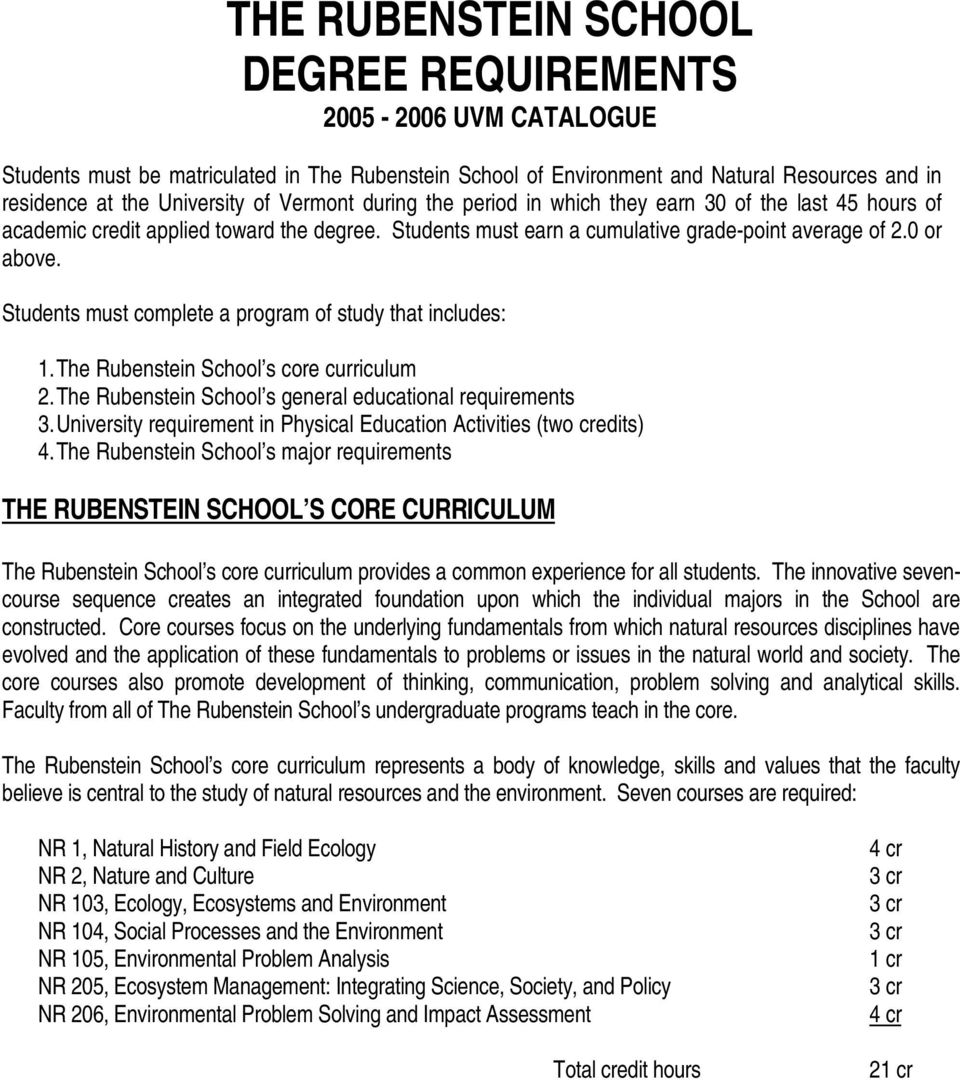
1 THE RUBENSTEIN SCHOOL DEGREE REQUIREMENTS UVM CATALOGUE Students must be matriculated in The Rubenstein School of Environment and Natural Resources and in residence at the University of Vermont during the period in which they earn 30 of the last 45 hours of academic credit applied toward the degree. Students must earn a cumulative grade-point average of 2.0 or above. Students must complete a program of study that includes: 1. The Rubenstein School s core curriculum 2. The Rubenstein School s general educational requirements 3. University requirement in Physical Education Activities (two credits) 4. The Rubenstein School s major requirements THE RUBENSTEIN SCHOOL S CORE CURRICULUM The Rubenstein School s core curriculum provides a common experience for all students. The innovative sevencourse sequence creates an integrated foundation upon which the individual majors in the School are constructed. Core courses focus on the underlying fundamentals from which natural resources disciplines have evolved and the application of these fundamentals to problems or issues in the natural world and society. The core courses also promote development of thinking, communication, problem solving and analytical skills. Faculty from all of The Rubenstein School s undergraduate programs teach in the core. The Rubenstein School s core curriculum represents a body of knowledge, skills and values that the faculty believe is central to the study of natural resources and the environment. Seven courses are required: NR 1, Natural History and Field Ecology NR 2, Nature and Culture NR 103, Ecology, Ecosystems and Environment NR 104, Social Processes and the Environment NR 105, Environmental Problem Analysis NR 205, Ecosystem Management: Integrating Science, Society, and Policy NR 206, Environmental Problem Solving and Impact Assessment Total credit hours 4 cr 3 cr 3 cr 3 cr 1 cr 3 cr 4 cr 21 cr
2 GENERAL EDUCATION COURSES The Rubenstein School s general education requirements are designed to enhance a student's ability to assimilate and analyze information, to think and communicate clearly, and to respect multiple perspectives. These requirements are flexible in order to encourage creativity in meeting educational goals. Two sets of courses are stipulated: Five courses in required areas WRITING English 1, 50 or 53 SPEAKING Speech 11, Theatre 5, AGRI 183, or NR 185 (Speaking and Listening) RACE AND CULTURE NR 6 or EDSS 11 MATHEMATICS Mathematics 9 or higher (but not MATH 17) *Requirement varies depending on major choice STATISTICS NR 140, Statistics 111, Statistics 141 or Statistics 211 *Requirement varies depending on major choice Three courses in a self-design sequence -- Student defines a learning objective and selects at least 9 credits from departments outside The Rubenstein School to meet that objective. This sequence of courses must be approved in advance.* *Before completion of four semesters or 60 credit hours; timeframe may be extended for transfer students.

3 ENVIRONMENTAL SCIENCES All students who enroll in the Environmental Sciences major in The Rubenstein School must fulfill the following requirements for graduation: 1. Completion of The Rubenstein School s core curriculum. 3. Completion of the Environmental Sciences minimal basic science/quantitative coursework: BCOR 11 and 12, Exploring Biology CHEM 31 and 32, Introductory Chemistry CHEM 42, Organic Chemistry* GEOL 55, Environmental Geology -or- PSS 161, Introduction to Soil Science MATH 19 and 20, Calculus** NR 140, Natural Resources Biostatistics or STAT 141, Basic Statistics** *Students interested in areas such as environmental analysis and assessment should consider taking more advanced courses such as CHEM 141/142. ** Also fulfills a Rubenstein School general education requirement. 4. Completion of Environmental Sciences foundation courses: ENSC 1, Introduction to Environmental Sciences ENSC 185, Orientation to the Environmental Sciences* ENSC 101, Pollutant Movement through Air, Land, and Water ENSC 130, Global Environmental Assessment (foundation courses cont. on pg. 26) ENSC 201, Recovery and Restoration of Altered Ecosystems ENSC 202, Ecological Risk Assessment *Internal and External Transfer students to ENSC are exempt from ENSC Completion of advising track requirements (14 credits) in Agriculture and the Environment, Conservation Biology and Biodiversity, Ecological Design, Environmental Analysis and Assessment, Environmental Resources, and Water Resources. A list of courses approved for each track is available from the Program Director or Dean's Office. Students may also elect a self-designed track in a particular area of interest. 6. Completion of a minimum of 122 credit hours of courses, including two credits of physical education ENVIRONMENTAL STUDIES All students who enroll in the Environmental Studies major in The Rubenstein School must fulfill the following requirements for graduation: 1. Completion of The Rubenstein School s core curriculum courses.

4 3. Completion of the Environmental Studies major core courses: ENVS 1, Introduction to Environmental Studies ENVS 2, International Environmental Studies ENVS 151, Intermediate Environmental Studies* ENVS 201, Research Methods ENVS 202, Senior Project and Thesis (6-12 credits) * Requires application to Director for evaluation of qualifications to continue as a major in Environmental Studies. 4. Completion of individually-designed program: Thirty hours of approved environmentally-related courses at the 100- or 200-level, including three hours at the 200-level, with at least one environmentally-related course in each of these areas: natural sciences, humanities, social sciences, and international studies (may be fulfilled by a Study Abroad experience). These courses are in addition to The Rubenstein School s core and general education requirements. 4. Completion of a minimum of 122 semester hours of courses, including two credits of physical education Environmental Studies MINOR requirements A minimum of 17 credit hours is required. Courses required are: ENVS 1, Introduction to Environmental Studies ENVS 2, International Environmental Studies 9 hours of ENVS at the 100-level or above, including 3 hours at the 200-level. Of the 9 hours, one non- ENVS course at the appropriate level may be substituted with the approval of the student's advisor and the Environmental Program. FORESTRY All students who enroll in the Forestry curriculum must fulfill the following requirements for graduation: 1. Completion of The Rubenstein School s core curriculum courses. 3. Completion of Forestry required courses: BOT 4, Introduction to Botany CHEM 23, General Chemistry MATH 18, Basic Mathematics* NR 25, Natural Resources Measurements and Mapping NR 140, Natural Resources Biostatistics* NR 224, Conservation Biology PSS 161, Introduction to Soil Science

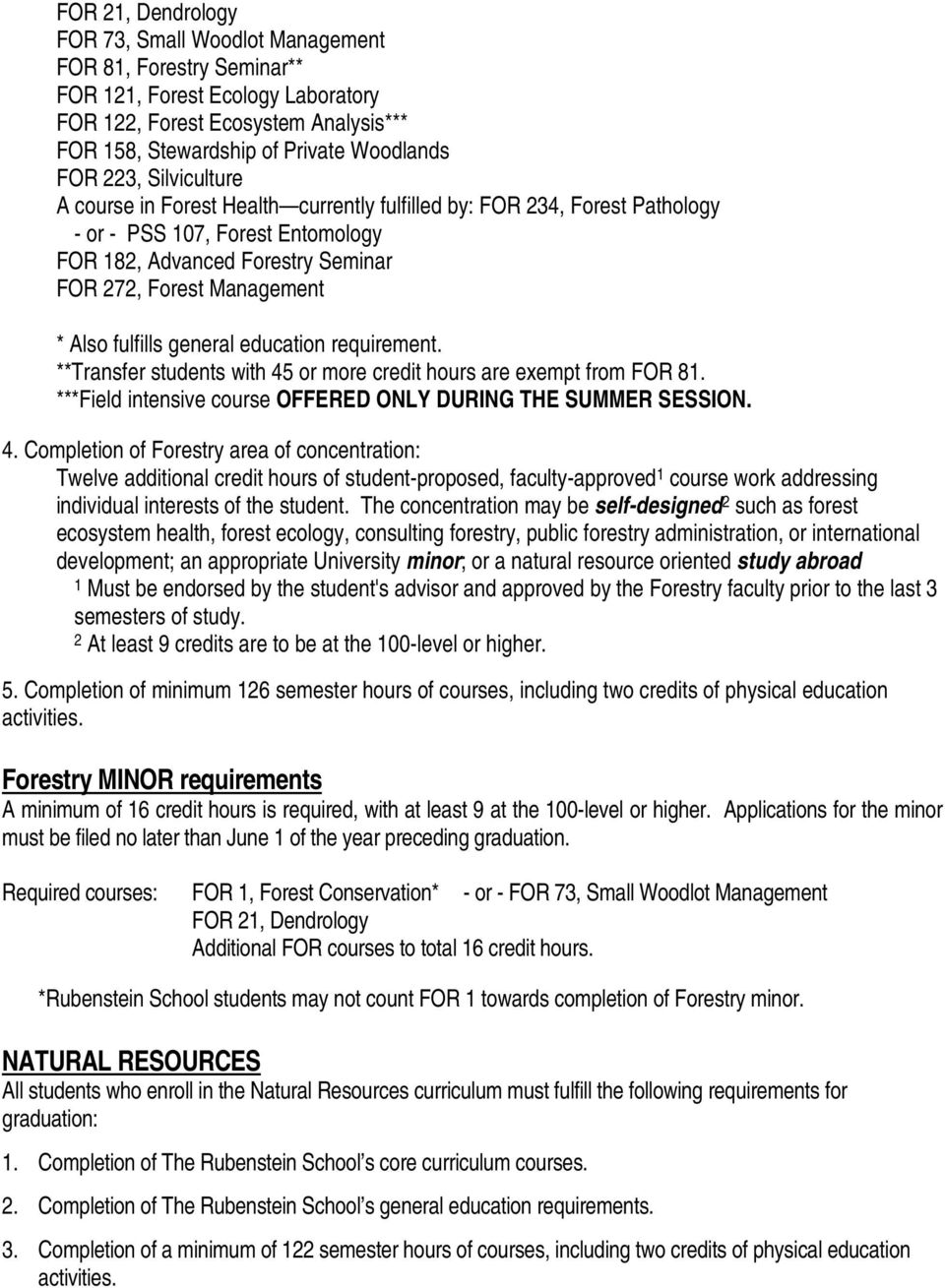
5 FOR 21, Dendrology FOR 73, Small Woodlot Management FOR 81, Forestry Seminar** FOR 121, Forest Ecology Laboratory FOR 122, Forest Ecosystem Analysis*** FOR 158, Stewardship of Private Woodlands FOR 223, Silviculture A course in Forest Health currently fulfilled by: FOR 234, Forest Pathology - or - PSS 107, Forest Entomology FOR 182, Advanced Forestry Seminar FOR 272, Forest Management * Also fulfills general education requirement. **Transfer students with 45 or more credit hours are exempt from FOR 81. ***Field intensive course OFFERED ONLY DURING THE SUMMER SESSION. 4. Completion of Forestry area of concentration: Twelve additional credit hours of student-proposed, faculty-approved 1 course work addressing individual interests of the student. The concentration may be self-designed 2 such as forest ecosystem health, forest ecology, consulting forestry, public forestry administration, or international development; an appropriate University minor; or a natural resource oriented study abroad 1 Must be endorsed by the student's advisor and approved by the Forestry faculty prior to the last 3 semesters of study. 2 At least 9 credits are to be at the 100-level or higher. 5. Completion of minimum 126 semester hours of courses, including two credits of physical education Forestry MINOR requirements A minimum of 16 credit hours is required, with at least 9 at the 100-level or higher. Applications for the minor must be filed no later than June 1 of the year preceding graduation. Required courses: FOR 1, Forest Conservation* - or - FOR 73, Small Woodlot Management FOR 21, Dendrology Additional FOR courses to total 16 credit hours. *Rubenstein School students may not count FOR 1 towards completion of Forestry minor. NATURAL RESOURCES All students who enroll in the Natural Resources curriculum must fulfill the following requirements for graduation: 1. Completion of The Rubenstein School s core curriculum courses. 3. Completion of a minimum of 122 semester hours of courses, including two credits of physical education
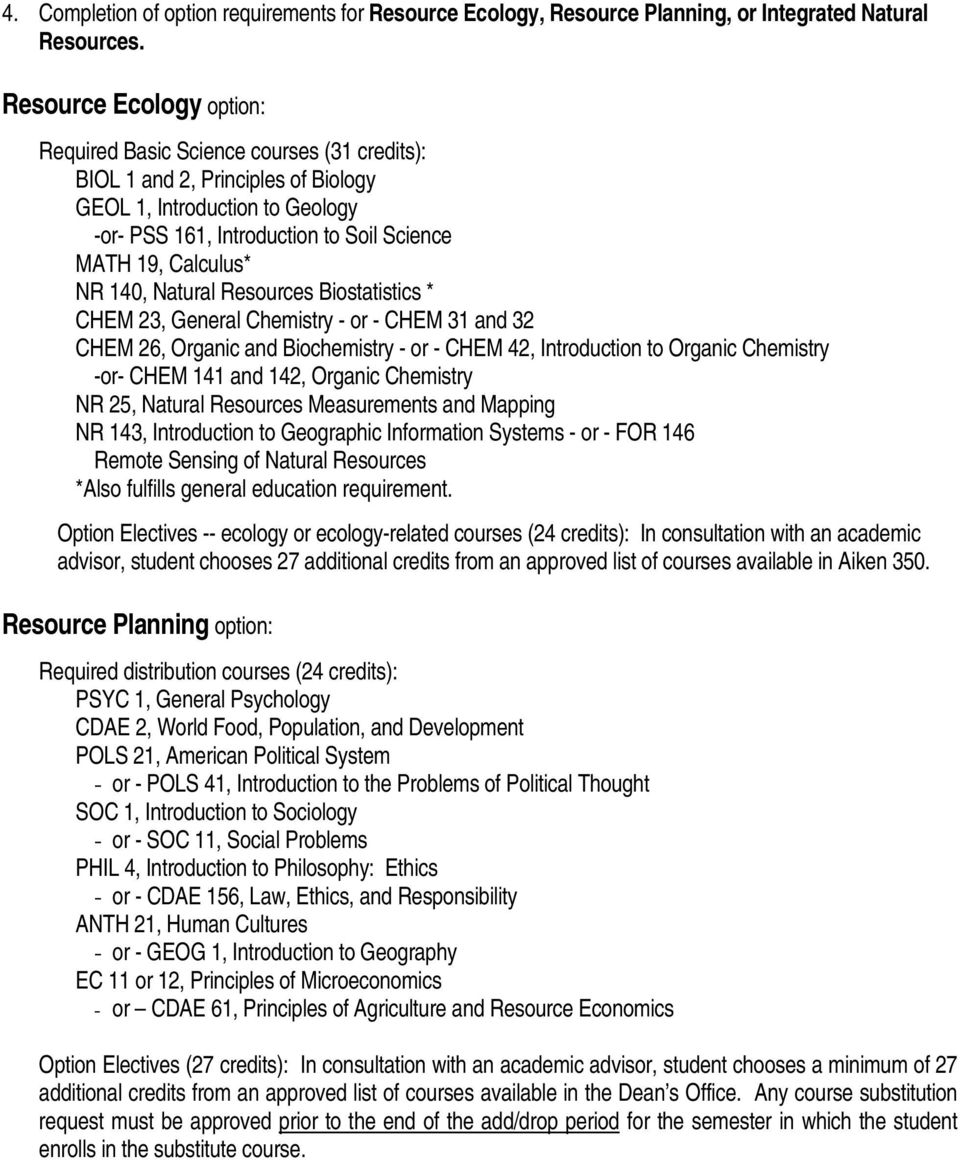
6 4. Completion of option requirements for Resource Ecology, Resource Planning, or Integrated Natural Resources. Resource Ecology option: Required Basic Science courses (31 credits): BIOL 1 and 2, Principles of Biology GEOL 1, Introduction to Geology -or- PSS 161, Introduction to Soil Science MATH 19, Calculus* NR 140, Natural Resources Biostatistics * CHEM 23, General Chemistry - or - CHEM 31 and 32 CHEM 26, Organic and Biochemistry - or - CHEM 42, Introduction to Organic Chemistry -or- CHEM 141 and 142, Organic Chemistry NR 25, Natural Resources Measurements and Mapping NR 143, Introduction to Geographic Information Systems - or - FOR 146 Remote Sensing of Natural Resources *Also fulfills general education requirement. Option Electives -- ecology or ecology-related courses (24 credits): In consultation with an academic advisor, student chooses 27 additional credits from an approved list of courses available in Aiken 350. Resource Planning option: Required distribution courses (24 credits): PSYC 1, General Psychology CDAE 2, World Food, Population, and Development POLS 21, American Political System - or - POLS 41, Introduction to the Problems of Political Thought SOC 1, Introduction to Sociology - or - SOC 11, Social Problems PHIL 4, Introduction to Philosophy: Ethics - or - CDAE 156, Law, Ethics, and Responsibility ANTH 21, Human Cultures - or - GEOG 1, Introduction to Geography EC 11 or 12, Principles of Microeconomics - or CDAE 61, Principles of Agriculture and Resource Economics Option Electives (27 credits): In consultation with an academic advisor, student chooses a minimum of 27 additional credits from an approved list of courses available in the Dean s Office. Any course substitution request must be approved prior to the end of the add/drop period for the semester in which the student enrolls in the substitute course.
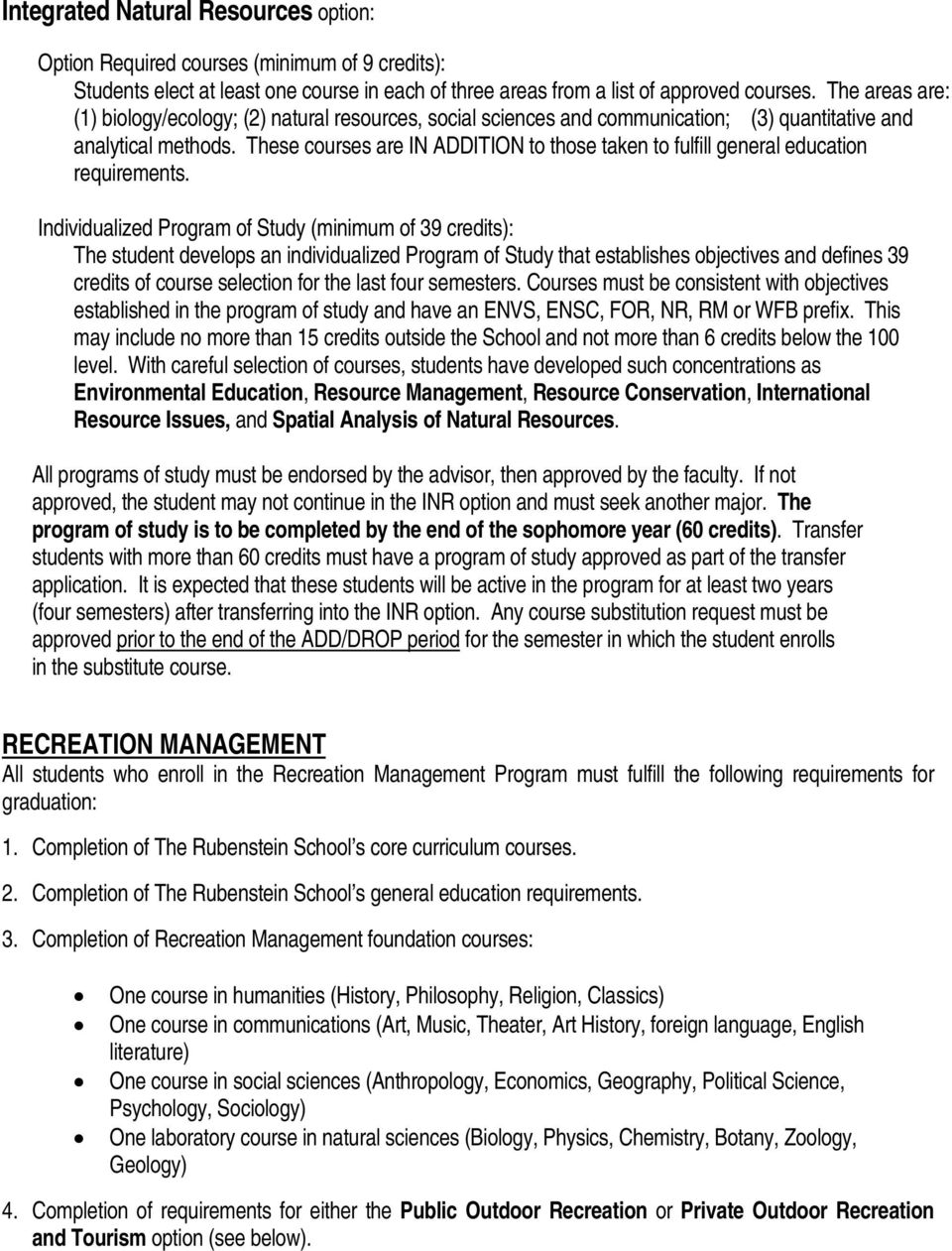
7 Integrated Natural Resources option: Option Required courses (minimum of 9 credits): Students elect at least one course in each of three areas from a list of approved courses. The areas are: (1) biology/ecology; (2) natural resources, social sciences and communication; (3) quantitative and analytical methods. These courses are IN ADDITION to those taken to fulfill general education requirements. Individualized Program of Study (minimum of 39 credits): The student develops an individualized Program of Study that establishes objectives and defines 39 credits of course selection for the last four semesters. Courses must be consistent with objectives established in the program of study and have an ENVS, ENSC, FOR, NR, RM or WFB prefix. This may include no more than 15 credits outside the School and not more than 6 credits below the 100 level. With careful selection of courses, students have developed such concentrations as Environmental Education, Resource Management, Resource Conservation, International Resource Issues, and Spatial Analysis of Natural Resources. All programs of study must be endorsed by the advisor, then approved by the faculty. If not approved, the student may not continue in the INR option and must seek another major. The program of study is to be completed by the end of the sophomore year (60 credits). Transfer students with more than 60 credits must have a program of study approved as part of the transfer application. It is expected that these students will be active in the program for at least two years (four semesters) after transferring into the INR option. Any course substitution request must be approved prior to the end of the ADD/DROP period for the semester in which the student enrolls in the substitute course. RECREATION MANAGEMENT All students who enroll in the Recreation Management Program must fulfill the following requirements for graduation: 1. Completion of The Rubenstein School s core curriculum courses. 3. Completion of Recreation Management foundation courses: One course in humanities (History, Philosophy, Religion, Classics) One course in communications (Art, Music, Theater, Art History, foreign language, English literature) One course in social sciences (Anthropology, Economics, Geography, Political Science, Psychology, Sociology) One laboratory course in natural sciences (Biology, Physics, Chemistry, Botany, Zoology, Geology) 4. Completion of requirements for either the Public Outdoor Recreation or Private Outdoor Recreation and Tourism option (see below).
8 5. Completion of a minimum of 126 semester hours of courses, including two credits of physical education Public Outdoor Recreation option requirements: Completion of Public Outdoor Recreation core courses: RM 1, Introduction to Recreation Management RM 138, Park and Recreation Design RM 153, Recreation Administration and Operation RM 191, Recreation Management Practicum RM 235, Outdoor Recreation Planning RM 240, Park and Wilderness Management RM 255, Environmental Interpretation Completion of 3 courses selected from the following list: RM 50, Tourism Planning RM 157, Ski Area Management RM 158, Resort Marketing and Management RM 230, Ecotourism RM 258, Entrepreneurship in Recreation and Tourism Completion of nine credits of professional electives chosen in consultation with an advisor. Private Outdoor Recreation and Tourism option requirements: Completion of Private Outdoor Recreation and Tourism core courses: RM 1, Introduction to Recreation Management RM 50, Tourism Planning RM 157, Ski Area Management RM 158, Resort Marketing and Management RM 191, Recreation Management Practicum RM 230, Ecotourism RM 258, Entrepreneurship in Recreation and Tourism Completion of 3 courses from the following list: RM 138, Park and Recreation Design RM 153, Recreation Administration and Operations RM 235, Outdoor Recreation Planning RM 240, Park and Wilderness Management RM 255, Environmental Interpretation Completion of nine credits of professional electives chosen in consultation with an advisor. Recreation Management MINOR requirements A minimum of 15 credit hours is required, including: - at least 9 semester hours to be selected from RM 1, 50, 138, 153, 157, 158; and - at least 6 semester hours to be selected from RM 230, 235, 240, 255, 258.

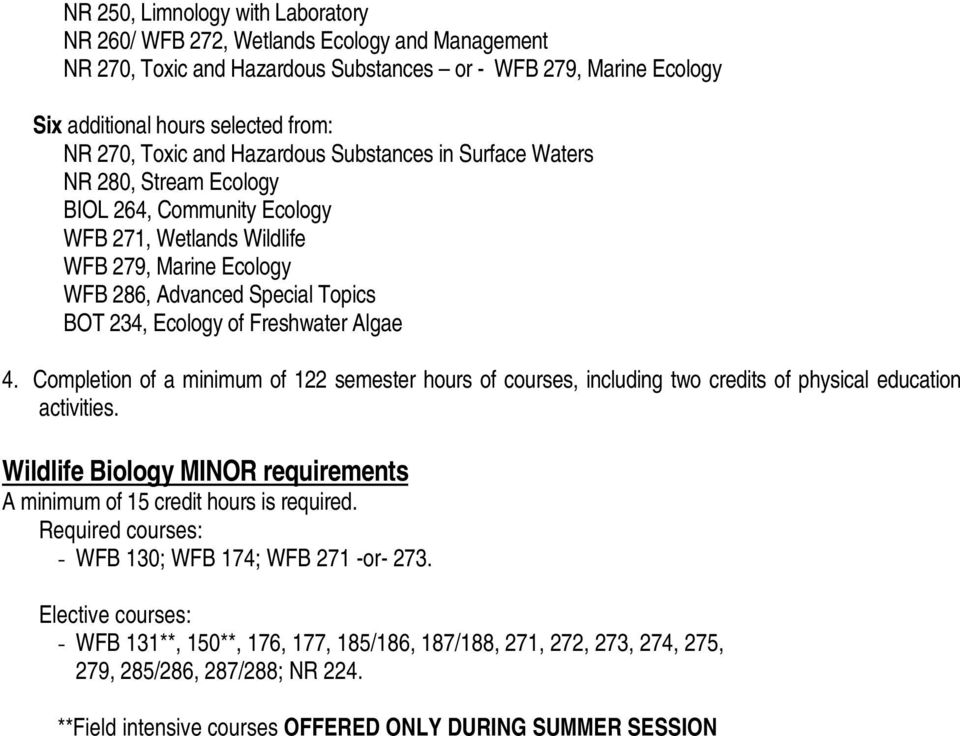
9 WILDLIFE AND FISHERIES BIOLOGY All students who enroll in the Wildlife and Fisheries Biology curriculum must fulfill the following requirements for graduation: 1. Completion of The Rubenstein School s core curriculum courses. 3. Completion of the Wildlife and Fisheries Biology professional core courses: MATH 19 or 21, Calculus* NR 140, Natural Resources Biostatistics* BIOL 1 and 2, Principles of Biology CHEM 23, General Chemistry CHEM 26 or 42, Organic Chemistry BIOL 101 or Botany 132, Genetics NR 25, Natural Resources Measurements and Mapping FOR 121, Forest Ecology Laboratory GEOL 1, Introduction to Geology, PSS 161, Introduction to Soil Science, - or - FOR 185, Reading the Forested Landscape WFB 161, Fisheries Biology WFB 174, Principles of Wildlife Management *Also fulfills general education requirement. 4. Completion of option requirements in Wildlife Biology or Fisheries Biology. Wildlife Biology option courses: FOR 21, Dendrology WFB 130, Ornithology WFB 131, Field Ornithology** WFB 150, Wildlife Habitat and Population Measurements** BOT 109, Plant Taxonomy BIOL 217, Mammalogy **Field intensive courses offered ONLY DURING THE SUMMER SESSION Three courses (one must have a lab) selected from: WFB 186, Field Herpetology NR 224, Conservation Biology WFB 271/272, Wetlands Wildlife, Wetlands Ecology and Management Lab WFB 273/274, Terrestrial Wildlife, Terrestrial Wildlife Lab WFB 275, Wildlife Behavior WFB 279, Marine Ecology Fisheries Biology option courses: PHYS 11/21 - or - PHYS 12/22 - or PHYS 96, Green Mountain Physics WFB 232, Ichthyology

10 NR 250, Limnology with Laboratory NR 260/ WFB 272, Wetlands Ecology and Management NR 270, Toxic and Hazardous Substances or - WFB 279, Marine Ecology Six additional hours selected from: NR 270, Toxic and Hazardous Substances in Surface Waters NR 280, Stream Ecology BIOL 264, Community Ecology WFB 271, Wetlands Wildlife WFB 279, Marine Ecology WFB 286, Advanced Special Topics BOT 234, Ecology of Freshwater Algae 4. Completion of a minimum of 122 semester hours of courses, including two credits of physical education Wildlife Biology MINOR requirements A minimum of 15 credit hours is required. Required courses: - WFB 130; WFB 174; WFB 271 -or Elective courses: - WFB 131**, 150**, 176, 177, 185/186, 187/188, 271, 272, 273, 274, 275, 279, 285/286, 287/288; NR 224. **Field intensive courses OFFERED ONLY DURING SUMMER SESSION
Transfer Guide CCV Environmental Science to UVM s Rubenstein School
 Transfer Guide CCV al Science to UVM s Rubenstein School CCV al Science AS General Education ENG-1070 ENG-1061 English Comp MAT-1230 College Algebra MAT-1531 ECO-2020 or ECO- 2030 Macroeconomics or Microeconomics
ANIMAL and VETERINARY SCIENCES DEPARTMENT 2015-2016 ADVISING GUIDELINES (revised May 2015)
 ANIMAL and VETERINARY SCIENCES DEPARTMENT 2015-2016 ADVISING GUIDELINES (revised May 2015) Students need to complete the following University, College, and Department requirements ASCI Department/Major
ECS COURSE CREDITS SUMMARY M.S. Ph.D.
 Environmental and Conservation Sciences Program Course Requirements North Dakota State University, May, 2013 Requirements for M.S. Degree in Environmental and Conservation Sciences Each M.S. student will
Minimum credits required for graduation is 120. Core Degree Requirements (57 credits)
 COLLEGE OF NATURAL RESOURCES AND ENVIRONMENT B.S. Degree in Water: Resources, Policy, and Management Major: Water: Resources, Policy, and Management For Students Graduating in Calendar Year 2016 Department
Associate in Arts to BA in Music: Liberal Arts. Students will complete the following courses through their Associate in Arts Degree at Metropolitan:
 Associate in Arts to BA in Music: Liberal Arts Students will complete the following courses through their Associate in Arts Degree at Metropolitan: American Institutions 6 credits HIST 120 HIST 121 POLS
2008-2009 Camilla Bustamonte (505) 747-5454. Northern New Mexico College Bachelor of Science ENVIRONMENTAL SCIENCE
 2008-2009 Camilla Bustamonte (505) 747-5454 Northern New Mexico College Bachelor of Science ENVIRONMENTAL SCIENCE In order to be considered for acceptance to this major, you must first have been admitted
Overview of the Environmental Science (CSES) B.S. Degree Program at Virginia Tech THE Environmental Science Program at Virginia Tech!
 Overview of the Environmental Science (CSES) B.S. Degree Program at Virginia Tech THE Environmental Science Program at Virginia Tech! The Environmental Science curriculum is science and technology oriented.
MANAGEMENT, MARKETING & OPERATIONS MANAGEMENT
 MANAGEMENT, MARKETING & OPERATIONS MANAGEMENT FOR STUDENTS ADMITTED TO THE UNIVERSITY AS OF SEPTEMBER 2006 CURRICULUM - Suggested Sequence First Semester Credits Second Semester Credits FRESHMAN YEAR Microeconomics,
The University of Vermont: Degrees Awarded by Degree Program, 2007-8
 Degree Programs: Bachelor's Degrees Degree College or School # 2007-08 Degrees AIS: Asian Studies BA College of Arts and Sciences 10 AIS: European Studies BA College of Arts and Sciences 3 AIS: Latin America
Biology Department Admission Requirements
 PLANT BIOLOGY BACHELOR OF SCIENCE IN BIOLOGY The Plant Biology option provides students with strong and broad training in plant biology, ranging from the cellular, physiological and systematic levels to
Associate of Arts and Sciences Degree in Business Administration
 Associate of Arts and Sciences Degree in Business Administration AREA: Business Administration DEGREE: Associate of Arts and Sciences Degree LENGTH: Four semesters (two- year) program PURPOSE: There is
Core Curriculum 2013-2014
 Introduction College Core Curriculum Associates and baccalaureate programs at the have as a requirement the satisfactory completion of 60 semester credit hours comprising the six areas of the core curriculum
BSc in Environmental and Conservation Sciences Wildlife and Rangeland Resources Management Major
 Faculty of Agricultural, Life & Environmental Sciences Undergraduate Student Services 2-31 General Services Building www.ales.ualberta.ca Tel: 780.492.4933 Edmonton, Alberta, Canada T6G 2H1 [email protected]
College Transfer Two-Year Degree Programs
 College Transfer Two-Year Degree Programs Fairfax Community College http://www.lfcc.edu 55 Associate of Arts and Sciences Degree in Business Administration AREA: Business Administration PURPOSE: There
Degree Type Bachelor of Science (BS) Degree Title Biology. Focus: Biological Science
 Degree Type Bachelor of Science (BS) Degree Title Biology 09-23-15 Focus: Biological Science The Department of Biology is committed to excellence in instruction, scholarly accomplishment, research, professional
How To Get A B.S. In History
 Associate in Arts to BA/BS in Sociology/Anthropology Students will complete the following courses through their Associate in Arts Degree at Metropolitan: American Institutions 6 credits HIST 120 HIST 121
ASSOCIATE OF SCIENCE DEGREES AND CERTIFICATES
 DEGREES AND CERTIFICATES For students who intend to continue their education at a four-year degree granting institution To receive the A.S. degree, students must satisfactorily complete Program requirements.
DEPARTMENT OF PSYCHOLOGY, SOCIOLOGY, AND CRIMINAL JUSTICE SCHOOL OF LIBERAL ARTS
 School of Liberal Arts DEPARTMENT OF PSYCHOLOGY, SOCIOLOGY, AND CRIMINAL JUSTICE SCHOOL OF LIBERAL ARTS Dr. Abe Marrero, Department Head Dr. Brian Andrews Dr. Diana Clayton Ms. Christian Mackey Ms. Cheri
Detailed Curriculum Guide for the B.S. degree in Natural Resources Online
 Detailed Curriculum Guide for the B.S. degree in Natural Resources Online Overview: This detailed curriculum checklist is an overview of Natural Resources coursework for prospective students. An updated
Liberal Arts Requirements (all students): B.A. (Bachelor of Arts):
 Barton Community College Transfer Program to the University of Kansas College of Liberal Arts and Science B.A. and B.G.S. Majors included in the College of Liberal Arts & Sciences are listed below tables.
Tier 1 General Education Requirements
 Ohio University has a three tiered General Education Requirement that all baccalaureate degree students must fulfill. Tier 1 course requirements build your quantitative and English composition skills;
ARTICULATION AGREEMENT BETWEEN THREE RIVERS COMMUNITY COLLEGE AND THE UNIVERSITY OF MISSOURI
 ARTICULATION AGREEMENT BETWEEN THREE RIVERS COMMUNITY COLLEGE AND THE UNIVERSITY OF MISSOURI Associate of Arts to a Bachelor of Health Science in Health Sciences OVERVIEW: This formal program articulation
BA Environmental Studies 10/09
 BA Environmental Studies 10/09 Curriculum The interdepartmental and interdisciplinary Bachelor of Arts in Environmental Studies at Rowan University achieves both breadth and focus in its curriculum in
Required Courses for all degrees General Education Requirements: 42 CHEM 1412 [shared] College Chemistry II
![Required Courses for all degrees General Education Requirements: 42 CHEM 1412 [shared] College Chemistry II](/thumbs/29/13456474.jpg "Required Courses for all degrees General Education Requirements: 42 CHEM 1412 [shared] College Chemistry II") General Education Requirements: 42 Total Hours 49 Environmental Science WSES 3401 Soils 4 WSES 3402 Soils, Land Use, and The Environment 4 or WSES 3412 Soil Genesis, Morphology, and Classification GEOL
General Education Requirements: 42 Total Hours 49 Environmental Science WSES 3401 Soils 4 WSES 3402 Soils, Land Use, and The Environment 4 or WSES 3412 Soil Genesis, Morphology, and Classification GEOL
Bachelor's Degree Minors Accounting School of Business Administration. College of Agriculture & Life Sciences. College of Arts & Sciences
 Bachelor's Degree Majors Animal Science BS Anthropology BA Art - Studio BA Art Education BSAE College of Education & Social Services Art History BA Athletic Training Education BS College of Nursing & Health
Bachelor of Environmental Studies Degree Program Published on Programs and Courses (http://www.upei.ca/programsandcourses)
 Make a positive impact toward sustainability. Overview "Acquire the knowledge to create a sustainable future. The reasons why are all around you." With the new Bachelor of Environmental Studies program
BACHELOR OF BUSINESS ADMINISTRATION
 2009-2010 Robert Behrendt (505) 747-2182 Northern New Mexico College BACHELOR OF BUSINESS ADMINISTRATION Students in Northern s Business Administration program develop competency in applying technology
Environmental Science & Management College of the Environment and Life Sciences (CELS) Revised April 2012
 Department: Natural Resources Science, 401-874-2495, http://www.nrs.uri.edu University College Advisor: Dr. Jose Amador, 401-874-2902; [email protected] Credits: 120 The Major: Environmental Science and
BACHELOR OF BUSINESS ADMINISTRATION
 2010-2011 Administrative Assistant (505) 747-2184 Northern New Mexico College BACHELOR OF BUSINESS ADMINISTRATION Students in Northern s Business Administration program develop competency in applying technology
Environmental Studies (ES)
 Environmental Studies (ES) The Environmental Studies program prepares students to understand and critically examine environmental issues from an interdisciplinary perspective, to teach in various outdoor
Biology Department Competitive Admission Requirements
 PHYSIOLOGY BACHELOR OF SCIENCE IN BIOLOGY The Physiology option emphasizes physiological processes from cellular to organismal levels. This is an attractive option for students interested in the internal
DISCIPLINES LIST DIVISION 2
 DISCIPLINES LIST DIVISION 2 DISCIPLINE: AGRICULTURE MASTERS DEGRE REQUIRED Master s in agriculture, agriculture sciences or education with a specialization In agriculture or other agriculture area (including
DEPARTMENT OF HISTORY AND POLITICAL SCIENCE SCHOOL OF LIBERAL ARTS
 DEPARTMENT OF HISTORY AND POLITICAL SCIENCE SCHOOL OF LIBERAL ARTS Dr. Kenneth Hicks, Department Head Dr. Michael Beauchamp Dr. Paul Hatley Dr. Steve Housel Dr. Jane Johansson Dr. Quentin Taylor Dr. David
B.F.A. ART EDUCATION MAJOR DEGREE REQUIREMENTS 2014 10/24/13
 B.F.A. ART EDUCATION MAJOR DEGREE REQUIREMENTS 2014 10/24/1 All students initially apply and enroll at the University of Arkansas for the B.A. degree. After completion of the Foundations Core I courses,
How to Become a College Or University Student in India
 2009-2010 Administrative Assistant 747-2184 Northern Associate of Arts BUSINESS ADMINISTRATION This program is a transfer degree designed for students who want to major in the field of business or accounting
SUPPLEMENTAL QUALIFICATION STANDARD FOR THE U.S. DEPARTMENT OF AGRICULTURE, FOREST SERVICE AND THE U.S. DEPARTMENT OF THE INTERIOR
 SUPPLEMENTAL QUALIFICATION STANDARD FOR THE U.S. DEPARTMENT OF AGRICULTURE, FOREST SERVICE AND THE U.S. DEPARTMENT OF THE INTERIOR GS-0401 FIRE MANAGEMENT SPECIALIST This document supplements the requirements
BIOLOGY MAJOR (2015-2016)
 FLORIDA ATLANTIC UNIVERSITY INTELLECTUAL FOUNDATION PROGRAM 2015 2016 All courses are three (3) credits unless otherwise indicated. Course selections should be made in consultation with an academic advisor.
TEMPLE UNIVERSITY GENERAL EDUCATION REQUIREMENT OPTIONS
 TEMPLE UNIVERSITY GENERAL EDUCATION REQUIREMENT OPTIONS 1. Students who earn an A.A. or A.S. degree from CCP 1 Gen Ed to Gen Ed All of Temple s General Education requirement categories are satisfied by
Undergraduate Degree Map for Completion in Four Years
 Page 1 of 5 Undergraduate Degree Map for Completion in Four Years College: College of Science, Engineering & Technology Department: Biological Sciences Name of Program: BIOLOGY Degree Designation: BS Emphasis/Concentration:
ARTICULATION AGREEMENT IN ENVIRONMENTAL STUDIES BETWEEN JAMESTOWN COMMUNITY COLLEGE AND ALFRED UNIVERSITY
 ARTICULATION AGREEMENT IN ENVIRONMENTAL STUDIES BETWEEN JAMESTOWN COMMUNITY COLLEGE AND ALFRED UNIVERSITY PURPOSE OF AGREEMENT This document establishes a transfer articulation agreement between Jamestown
MILLS COLLEGE General Education Articulation Agreement with College of Marin (based on 2012-13 College of Marin ASSIST)
 MILLS COLLEGE General Education Articulation Agreement with (based on 2012-13 ASSIST) Eight of the nine general education requirements at Mills College can be met in a number of ways, including transfer
MASTER OF SCIENCE IN ENVIRONMENTAL SCIENCE
 MASTER OF SCIENCE IN ENVIRONMENTAL SCIENCE Introduction Environmental degradation is a glaring feature in the biosphere in the Twenty -first Century, and must be addressed seriously before the worst effects
Accelerated Master of Geographic Information Science. School of Forest Resources and Environmental Science
 Accelerated Master of Geographic Information Science School of Forest Resources and Environmental Science Contacts: Andrew J. Storer, Associate Dean Michael D. Hyslop, MGIS Coordinator Overview The accelerated
The Bachelor of Science program in Environmental Science is a broad, science-based
 The Bachelor of Science program in Environmental Science is a broad, science-based curriculum designed to prepare students for a variety of environmentally-related technical careers, as well as for graduate
Chemistry (BA or BS) MATH 243 Calculus III 5 PHYS 220 Engineering Physics I 5 PHYS 221 Engineering Physics II 5
 JOHNSON COUNTY COMMUNITY COLLEGE Transfer Program to Wichita State University General Education Requirements College of Liberal Arts and Sciences 2014-15 Catalog 11/14 CONTACT: LAS Advising Center PHONE:
Undergraduate Degree Map for Completion in Four Years
 Page 1 of 5 Undergraduate Degree Map for Completion in Four Years College: College of Social & Behavioral Sciences Department: Geography Name of Program: EARTH SCIENCE Degree Designation: BS Emphasis/Concentration:
ENVIRONMENTAL STUDIES (ENS) Spring 2016
 Environmental Studies (ENS) Interdisciplinary Major and Undergraduate College Academy Minor in Environmental Studies School of Marine and Atmospheric Sciences (SoMAS) Dean and Director: Minghua Zhang Director
How To Pass The Cnnu Test
 Policy for CLEP and Procedures for Course Challenges Updated by the Provost -Fall 2015 General Policy for the College-Level Examination Program (CLEP) Through College-Level Examination Program (CLEP),
DEPARTMENT OF FINE ARTS
 DEPARTMENT OF FINE ARTS SCHOOL OF LIBERAL ARTS Mr. Gary Moeller, Interim Department Head Mr. Bryce Brimer Dr. Hugh Foley Dr. Michael McKeon Ms. Anh-Thuy Nguyen Dr. Kirk Weller THE MISSION AND GOALS OF
Associate of Applied Science
 Johnson County Community College 2015-2016 1 Associate of Applied Science The associate of applied science degree from JCCC is designed with an emphasis in a specific career program. requires completion
HOW TO USE THE ES MAJOR TO CREATE YOUR OWN ENVIRONMENTAL EMPHASIS
 HOW TO USE THE ES MAJOR TO CREATE YOUR OWN ENVIRONMENTAL EMPHASIS 2011 Because of the interdisciplinary design of the Environmental Studies majors (B.A. and B.S.) students are afforded the opportunity
Bachelor of Engineering (BEng) Information Engineering Technology
 2015-2016 / Jorge Crichigno 505.747.5429 Bachelor of Engineering (BEng) Information Engineering Technology The curriculum of the BEng in Information Engineering Technology is designed for those engineering
Undergraduate Curriculum Committee Proposal Summary 9/24/2015 Meeting. (Revised: 9/18/15)
 Undergraduate Curriculum Committee Proposal Summary 9/24/2015 Meeting (Revised: 9/18/15) Department: Biological Sciences Course Addition: BIOL 336L Credit Hours 1 Course Title: Abbreviated Title: Contact
for the Associate Degree 2014-2015
 2014 2015 catalog college of the Redwoods General Education Requirements for the Associate Degree 2014-2015 OPTION I: Associate of Science in a Specific Program Only courses with course numbers 1-199 may
LAREDO COMMUNITY COLLEGE TEXAS A&M INTERNATIONAL UNIVERSITY 2+2 PROGRAM 2012-2013
 College of Arts and Sciences 2012-2013 Bachelor of Applied Arts and Sciences... 1 BA with a Double Major... 2 BA with a major in Art... 3 BA with a major in Art with All Level Certification... 4 BA with
Philosophy - Humanities Associate in Arts Degree Plan 2015-2016
 Philosophy - Humanities Associate in Arts Degree Plan 2015-2016 Total Degree Credits 62-64 Note: Curricula listed on degree plan are suggested. Students should consult with their advisor concerning their
Department of Physical Sciences. Chemistry
 92 Eastern New Mexico University Department of Physical Sciences Professor: Associate Professors: Assistant Professors: Robert W. Pierce William Andersen James Constantopoulos Newton Hilliard, Jr James
School of Business Administration and Economics
 School of Business Administration and Economics Accreditation Business programs are accredited by The Association to Advance Collegiate Schools of Business (AACSB International). Vision The vision of the
First Cycle (Undergraduate) Degree Programme in Environmental Science, Cl. L-32
 First Cycle (Undergraduate) Degree Programme in Environmental Science, Cl. L-32 DURATION 3 years 180 CAMPUS Udine ADMISSION REQUIREMENTS High school graduate students are allowed to be admitted to the
B.F.A. STUDIO ART MAJOR DEGREE REQUIREMENTS 7/31/2013
 B.F.A. STUDIO ART MAJOR DEGREE REQUIREMENTS 7/1/201 All students initially apply and enroll at the University of Arkansas for the B.A. degree. After completion of the Foundations Core I courses, or their
General Education Guidelines for Normandale Community College Students Transferring to the University of St. Thomas
 General Education Guidelines for Normandale Community College Students Transferring to the University of St. Thomas UST General Education Requirements Normandale Community College Courses Which Fulfill
CURRICULUM FOR THE BACHELOR OF SCIENCE IN CRIMINAL JUSTICE CORRECTIONS EMPHASIS
 The University of Mississippi at Tupelo CURRICULUM FOR THE BACHELOR OF SCIENCE IN CRIMINAL JUSTICE CORRECTIONS EMPHASIS This curriculum reflects course suggestions to fulfill requirements for the Bachelor
Degree Requirements. Students who have already earned a baccalaureate degree are only eligible for an AAS degree, not an AA, AS or AGS degree.
 Degree Requirements A student may select a concentration program under one of four Associate Degrees: Associate in Applied Science Associate in Arts Associate in General Studies Associate in Science The
General Education Guidelines for Century College Students Transferring to the University of St. Thomas
 General Education Guidelines for Century College Students Transferring to the University of St. Thomas UST General Education Requirements Century College Courses Which Fulfill UST General Education Requirements
COURSES FOR TRANSFER ASSOCIATE OF SCIENCE DEGREE PROGRAMS
 SOCIAL WORK (0071) Social Science Division ASSOCIATE OF SCIENCE DEGREE PROGRAMS This degree program is also available as an online degree program. See the description of the online program of study at
New EPAP curriculum, open to all students
 New EPAP curriculum, open to all students Environmental Policy Analysis & Planning University of California, Davis Department Contact: Melissa Whaley [email protected], 530-752-7183 Website: http://des.ucdavis.edu/
BIOLOGY DEPARTMENT BIOLOGY 2013-2014 CATALOG DIXIE STATE UNIVERSITY
 BIOLOGY DEPARTMENT 0 Science Bldg. (35) 652-7760 http://dixie.edu/biology/ To find faculty & staff phone numbers and email addresses, please consult the University Directory at http://www.dixie.edu/directory/
NATURAL RESOURCES DEGREES AND CERTIFICATES. Environmental Conservation A.S. Degree (formerly Natural Resources)
 Area: Science and Engineering Dean: Dr. Rina Roy Phone: (916) 484-8107 Counseling: (916) 484-8572 DEGREES AND CERTIFICATES Environmental Conservation A.S. Degree (formerly Natural Resources) Environmental
Fort Valley State University Bachelor of Science in Organizational Leadership
 Fort Valley State University Bachelor of Science in Organizational Leadership Student Name: Program Advisor: Dr. Ian Toppin Address: Email: [email protected] City & State: Phone: (478) 822-6991 Fully Online:
UNIVERSITY FACULTY SENATE FORMS
 UNIVERSITY FACULTY SENATE FORMS Academic Program Approval This form is a routing document for the approval of new and revised academic programs. Proposing department should complete this form. For more
Animation Program Articulation
 Memorandum of Understanding (2015-2016) Santa Monica College This document is intended both as a memorandum of understanding for college counselors and as a guide for students transferring into Woodbury
Graphic Design Program Articulation
 Memorandum of Understanding (2015-2016) Southwestern College This document is intended both as a memorandum of understanding for college counselors and as a guide for students transferring into Woodbury
Graduate Degree Granting Units and Programs at Michigan State University Accounting - Master of Science Advertising - Master of Arts African American
 Accounting - Master of Science Advertising - Master of Arts African American and African Studies - Doctor of Philosophy African American and African Studies - Master of Arts Agricultural, Food and Resource
General Education Transfer Credit Agreement 2014-2015 Catalog
 General Education Transfer Credit Agreement 2014-2015 Catalog Las Positas College L I V E R M O R E, C A L I F O R N I A This articulation agreement describes how courses taken at Las Positas College will
CURRICULUM FOR THE BACHELOR OF SCIENCE IN CRIMINAL JUSTICE HOMELAND SECURITY EMPHASIS 2014-2015
 The University of Mississippi A Great American Public University The University of Mississippi Fall 2014 Catalog Information CURRICULUM FOR THE BACHELOR OF SCIENCE IN CRIMINAL JUSTICE HOMELAND SECURITY
Biology. Faculty. Careers in Biology. Programs Offered. Biology Degree Concentrations
 Biology Department Office Darwin Hall 200 (707) 664-2189 www.sonoma.edu/biology/ Department Chair Richard Whitkus Administrative Coordinator Kathleen Hardy, Lakin Khan Faculty Thomas N. Buckley James L.
Bachelor of Science in Chemistry
 Bachelor of Science in Chemistry Chemistry Courses Chemistry Course Credit Course Chosen Semester Grade 1000, 2000 2 1017 and 1007 4 1018 and 1008 4 2117 3 2025 3 2217 and 2017 4 2218 and 2018 4 3027 3
Degrees Offered with Enrollment and Degrees Awarded - 2012-13 All plans, programs, and degrees 2012-13
 Offered with and - 2012-13 All plans, programs, and degrees 2012-13 2012-13 AAS Agribusiness Management Associate of Applied Science 20 166 64 AAS Field Crops Technology Associate of Applied Science 9
All-University Core Curriculum (AUCC) Courses Effective Fall 2009 (Last updated 2/29/2008)
 All-University Core Curriculum (AUCC) s Effective Fall 2009 (Last updated 2/29/2008) Category 1 Basic Competencies 1A Intermediate Writing (3 credits) CO 150 College Composition 3 GT-CO2 HONR 193 Honors
Political Science - Social & Behavioral Sciences Associate in Arts Degree Plan 2015-2016
 Political Science - Social & Behavioral Sciences Associate in Arts Degree Plan 2015-2016 Total Degree Credits 60 Note: Curricula listed on degree plan are suggested. Students should consult with their
General Education Guidelines for Saint Paul College Students Transferring to the University of St. Thomas
 General Education Guidelines for Saint Paul College Students Transferring to the University of St. Thomas UST General Education Requirements Saint Paul College Courses Which Fulfill UST General Education
General Education Requirements
 General Education Requirements Philosophy of General Education All Keystone College curricula reflect institutional student learning outcomes which are grounded in the mission and shape institutional culture.
Biology (BL) WHY STUDY BIOLOGY AT MONTREAT COLLEGE?
 Biology (BL) The Biology program of study prepares students to understand the fundamental concepts and methodologies of the biological sciences, to engage in scientific research, and to investigate the