
The Bachelor of Science program in Environmental Science is a broad, science-based
|
|
|
- Emery Williams
- 10 years ago
- Views:
Transcription
1 The Bachelor of Science program in Environmental Science is a broad, science-based curriculum designed to prepare students for a variety of environmentally-related technical careers, as well as for graduate programs in allied fields. The mission of the program includes: broadening the scientific literacy of Environmental Science majors and increasing their understanding of the scientific context of environmental problems and solutions to enable them to become informed participants and leaders in the current and future debates on the state of the environment. The program also seeks to provide a supportive environment which stimulates analytical thinking and encourages a broad perspective in learning for our majors and those taking our courses, challenging them to get the maximum benefit from their talents and skills. The Program requires 193 credit hours and draws upon the faculty and resources of the Program and several other departments. Majors take a core of Biology, Chemistry, Environmental Science, Mathematics, Physics and other courses, four courses in an Area of Emphasis, three electives related to Environmental Science, and two University-wide electives. The Area of Emphasis enables the student to take a concentration in the area of environmental science most interesting to them, most suited to their talents, and most appropriate for their career goals. FACULTY PROGRAM COMMITTEE THOMAS J. MURPHY, PH.D., Professor and Director (Chemistry) Iowa State University NANCY J. CLUM, PH. D., Assistant Professor (Environmental Cornell University LIAM J. HENEGHAN, PH. D., Assistant Professor (Environmental University College Dublin JAMES A. MONTGOMERY, PH.D., Associate Professor (Environmental Washington State University JOHN V. DEAN, PH.D., Associate Professor (Biology) University of Illinois KATHLEEN HELM-BYCHOWSKI, PH.D. Assistant Professor (Chemistry) University of California, Berkeley NINA HEWITT, PH. D. Assistant Professor (Geography) York University SARA J. MELFORD, PH.D., Associate Professor (Chemistry) Northwestern University TIMOTHY E. SPARKES, PH.D., Assistant Professor (Biology) University of Kentucky JOHN R. THOMPSON, PH. D. Associate Professor (Physics) Georgia Institute of Technology BACHELOR OF SCIENCE LIBERAL STUDIES PROGRAM In addition to the 28 quarter hours required in the liberal studies core, students are required to complete 48 quarter hours distributed through five learning domains as part of their Bachelor of Science degree in environmental science. The number and distribution of courses in each of the areas are as follows: Core: 28 quarter hours required First Year Program: (16 quarter hours required) Discover Chicago or Explore Chicago, Focal Point Seminar, and Composition and Rhetoric I and II. Sophomore Seminar: (4 quarter hours required) Sophomore Seminar on Multiculturalism in the United States 163

2 Junior Year Experiential Learning: (4 quarter hours required) If your junior year experiential learning requirement also fulfills a major field requirement, you may substitute a liberal studies domain elective (from outside your major field area) or the third course in the modern language option for this requirement. Senior Capstone: (4 quarter hours required) Environmental Sciences requires that all students majoring in Environmental Sciences complete the senior capstone in Environmental Sciences. If you are double majoring and/or in the Honors program you must also follow the capstone guidelines for that area. Arts and Literature: 12 quarter hours required. At most 2 courses from the same department or program. Philosophical Inquiry: 8 quarter hours required. Religious Dimensions: 8 quarter hours required; 4 quarter hours in patterns and problems, and 4 quarter hours in traditions in context. Scientific Inquiry: not required. Self, Society and the Modern World: 12 quarter hours required. At most 2 courses from the same department or program. Understanding the Past: 8 quarter hours required; 4 quarter hours of history pre-1800 and 4 quarter hours of history primarily between In addition, courses must be from two different categories: 1) Asia, 2) Latin America, 3) Africa, 4) North America or Europe and 5) intercontinental or comparative. Courses offered by the Environmental Sciences Program are not applied towards liberal studies requirements for the Environmental Science major. Exceptions to this rule can be the junior experiential learning and the senior capstone requirements. DEPARTMENTAL PROGRAM REQUIREMENTS CORE Students must take the following 23 courses (81 quarter hours): Biology: Biology 101, 102 and 103 General Biology I, II and III; and 215 Ecology. Chemistry: Chemistry 111, 113 and 115 General and Analytical Chemistry I, II and III; 171, 173 and 175 Organic Chemistry I, II and III. Environmental Sciences: 216 Earth System Science; 217 Human Impacts on the Environment; 260 Environmental Data Analysis; 294 Second Year Seminar; 360 Research Methods; 362 Senior Thesis; and 394 Environmental Seminar. Mathematics: 150, 151 and 152 Calculus I, II and III. Physics: 150, 151 and 152 General Physics I, II and III. ADDITIONAL COURSES Students must take two courses from the following, but not courses from the student s chosen area of emphasis: Biology 365 Toxicology; Economics 105 Principles of Microeconomics; Public Policy Studies 202 Public Policy and Environmental Issues; Chemistry 240 Introduction to Biochemistry; Geography 242 Geographic Information Systems; English 204 Technical Writing. AREAS OF EMPHASIS Students must take four courses from one of the following Areas of Emphasis. Biology: 210 Microbiology; 250 Cell Biology; 260 Genetics; 309 Plant Physiology; 317* Aquatic Biology; 365 Toxicology; Environment Science 320* Conservation Biology. Chemistry: 127 Quantitative Analysis; 210 Physical Chemistry I; 240 Introduction to Biochemistry; 261 Instrumental Analysis; 265 Air Chemistry; 267 Water Chemistry; 269 Solid Waste Chemistry. Earth Science: Physics 201 The Atmosphere and the Oceans, or Geography 225 Weather and Climate; Environmental Science 115 Environmental Geology or 220 Soil Science; Envi- 164

3 ronmental Science 224 Environment of the Chicago River; 330 Field Methods; Geography 242 Geographic Information Systems; or 243 Remote Sensing. Ecology and Conservation Biology: Environmental Science 250 Applied Ecology; 270 Tropical Biology and Conservation; Biology 317* Aquatic Biology; Environmental Science 320; Conservation Biology; 330 Field Methods. Geography: Geography 210 Environmental Conservation; 225 Weather & Climate; 241 Computer Cartography; 242 Geographic Information Systems; 243 Remote Sensing; Environmental Science 200 Cities and the Environment. Public Policy: Public Policy 201 Public Policy and Urban Issues; 202 Public Policy and Environmental Issues; 320 Public Policy in Production and Use of Energy and Pollution Control; 324 Public Policy and Natural Resources. Urban Forestry: Environmental Science 250 Applied Ecology; 320 Conservation Biology; 322* Ecosystem Ecology; 330 Field Methods; 340* Issues in Urban Forestry; 342 Natural History of Forests; Biology 309 Plant Physiology. SPECIAL PROGRAMS OR REQUIREMENTS INTERNSHIP CREDIT An internship program (Env 395) is available so that students may gain credit for career-related experience in environmental science. Internships consist of working for approximately three months in a real job situation. Internships can be arranged for any time following the sophomore year. The normal internship is a carefully structured program which provides a valuable experience for the student. Prospective agencies will be monitored so that the student will gain professional experience. A written agreement will be required that is prepared by the intern and employer, and states the duties, responsibilities and goals of both parties. Interns will be required to prepare a written report that describes their experiences and professional development during the internship. Students will be allowed to seek either a letter grade or a pass/fail grade. Arrangements need to be made more than a quarter in advance. COURSES All courses carry 4 quarter hours of credit unless otherwise specified. ENV 102 INTRODUCTION TO ENVIRONMENTAL SCIENCE A general introduction to the scientific background of some of the important environmental problems facing urban areas, the nation and the world. Its purpose is to make the student aware of these major problems, their causes, and their interrelationships as background for the student as he or she encounters these problems in other courses. The course includes a three-hour lab. ENV 115 ENVIRONMENTAL GEOLOGY An examination of the earth's materials and structures, and the processes responsible for their formation; how geologic processes and hazards influence human activities (and vice versa); and a discussion of geologic resources and the geological aspects of waste disposal and pollution. The course includes a three-hour lab and a mandatory Saturday field trip. ENV 200 CITIES AND THE ENVIRONMENT This course focuses on the interactions between urban areas and the environment. It is a discussion of the physical setting of cities; the water, energy, air and waste disposal needs of urban areas; and the effects of urban areas on the air, water and land environment. ENV 202 RESOURCES, POPULATION, AND THE ENVIRONMENT A course on the relationship between the exploitation of the biological, mineral and energy resources of the earth to support an increasing population, and the environmental effects of this development. 165

4 ENV 216 EARTH SYSTEM SCIENCE This course uses a systems approach, to investigate the fundamental structure of functions, processes and changes within, and dynamic interactions (cycling) among Earth's living and non-living systems. This course is designed for students with fundamental grounding in biology, chemistry, ecology, and mathematics. ENV 217 HUMAN IMPACTS ON THE ENVIRONMENT A science-based course that examines the interface between humans and the living and non-living environment, the consequences of these interactions, and options for mitigating environmental impacts. ENV 220 ENVIRONMENTAL SOIL SCIENCE An examination of the physical, chemical, biological and engineering properties of soils, their genesis and classification, how they function as sites of waste disposal, and their role in global agricultural production. The course includes a three-hour lab and a mandatory Saturday field trip. ENV 224 ENVIRONMENT OF THE CHICAGO RIVER This course focuses on the natural environment of the Chicago River watershed. It is a discussion of the physical geography, geology, ecology, and water quality of the river. The course includes a three-hour laboratory. ENV 250 APPLIED ECOLOGY An examination of how ecological principles are applied in order to understand and improve the relationship between humans and the natural environment. ENV 260 ENVIRONMENTAL DATA ANALYSIS This course provides an overview of the biometrical techniques employed in the analysis of environmental data. Topics include: handling of data, experimental designs, testing for differences between an experimental and a control group, testing for differences among many groups, and determining trends in data. Data from the environmental sciences is used throughout, and students are introduced to appropriate software for data analysis. PREREQUISITE(S): MAT 150 or permission. ENV 270 TROPICAL BIOLOGY AND CONSERVATION This field-oriented course examines the ecology of tropical terrestrial and marine ecosystems in the Bahamas and the history and impact of human use of these environments. December Quarter course. ENV 294 SECOND YEAR SEMINAR (1 credit hour) The purpose of this course is to improve the environmental literacy of our students, and to begin to introduce them to the department and their fellow students. This class will meet once per week. Readings and articles on environmental science and the environment will be assigned and discussed in class. ENV 320 CONSERVATION BIOLOGY The purpose of this course is to provide a thorough understanding of biodiversity, human impacts on biodiversity, and the theory and practice of maintaining biodiversity in a developing world. PREREQUISITE(S): BIO 215 or permission. 166

5 ENV 322 ECOSYSTEM ECOLOGY This course will introduce students to the conceptual and methodological tools of ecosystem ecology. The course will focus on understanding the fundamental structure and function of ecosystems but will also address very recent debates on the economic value of ecosystem services, the role of biological diversity in maintaining ecosystem processes, and the consequences of stressed and degraded ecosystems for human welfare. The course includes a weekly lab. ENV 324 FOREST ECOLOGY Forest ecology. ENV 330 FIELD METHODS A laboratory course designed to educate students in the execution and application of field techniques used in environmental science. Emphasis on the areas of ecology, earth science, and urban forestry. ENV 340 ISSUES IN URBAN FORESTRY There is a growing awareness of the functional importance of trees contributing to improved air quality, minimizing noise pollution, protecting rivers from nutrient pollutant runoff, and in maintaining biodiversity. This course will discuss this broad spectrum of notions concerning urban forestry. The class will include some field days. ENV 342 NATURAL HISTORY OF FORESTS This course is designed to give a comprehensive introduction to the natural history of one particular biome, namely forests. It will provide a comprehensive overview of world forests from both a botanical and zoological perspective. Objectives will be: 1) to provide a systems level understanding of the physical and biological forces which determine the structure of forest plant and animal communities; and 2) to survey the natural history of selected biological groups. It will include a field component and trips to areas of botanical interest in Chicago. ENV 350 ENVIRONMENTAL IMPACT ANALYSIS: CAPSTONE Students are introduced to the public policy-making process, with particular emphasis on the evolution of the National Environmental Policy Act (NEPA) of The students conduct an environmental analysis and then prepare an environmental impact statement (EIS) following NEPA guidelines. There is a mandatory two-hour discussion section. ENV 360 RESEARCH METHODS (1 credit hour) The purpose of this course is to improve the skills of environmental science majors in using various forms of information technology (e.g., indexes and databases, journals, Internet, WWW, etc.), and in writing research proposals. Students will select a topic and then write a thorough and detailed research proposal. ENV 362 SENIOR THESIS The student will choose a faculty mentor and a project. The project may be based on lab, field, or library research. The grade for the thesis will be based on the thesis and on a seminar on the thesis presented to the ES students and faculty. This course may be taken more than one time for credit. PREREQ- UISITE(S): ENV 360. Variable credit. ENV 390 SPECIAL TOPICS IN ENVIRONMENTAL SCIENCE Variable topics. Consult schedule or our web-site for offering. ENV 394 THIRD YEAR SEMINAR (1 credit hour) Students enrolled in the course will present a seminar on an environmental topic. 167

ENVIRONMENTAL STUDIES (ENS) Spring 2016
 Environmental Studies (ENS) Interdisciplinary Major and Undergraduate College Academy Minor in Environmental Studies School of Marine and Atmospheric Sciences (SoMAS) Dean and Director: Minghua Zhang Director
First Cycle (Undergraduate) Degree Programme in Environmental Science, Cl. L-32
 First Cycle (Undergraduate) Degree Programme in Environmental Science, Cl. L-32 DURATION 3 years 180 CAMPUS Udine ADMISSION REQUIREMENTS High school graduate students are allowed to be admitted to the
Environmental Studies (ES)
 Environmental Studies (ES) The Environmental Studies program prepares students to understand and critically examine environmental issues from an interdisciplinary perspective, to teach in various outdoor
Environmental Science & Management College of the Environment and Life Sciences (CELS) Revised April 2012
 Department: Natural Resources Science, 401-874-2495, http://www.nrs.uri.edu University College Advisor: Dr. Jose Amador, 401-874-2902; [email protected] Credits: 120 The Major: Environmental Science and
Minimum credits required for graduation is 120. Core Degree Requirements (57 credits)
 COLLEGE OF NATURAL RESOURCES AND ENVIRONMENT B.S. Degree in Water: Resources, Policy, and Management Major: Water: Resources, Policy, and Management For Students Graduating in Calendar Year 2016 Department
Biology Department Admission Requirements
 PLANT BIOLOGY BACHELOR OF SCIENCE IN BIOLOGY The Plant Biology option provides students with strong and broad training in plant biology, ranging from the cellular, physiological and systematic levels to
THE RUBENSTEIN SCHOOL DEGREE REQUIREMENTS 2005-2006 UVM CATALOGUE
 THE RUBENSTEIN SCHOOL DEGREE REQUIREMENTS 2005-2006 UVM CATALOGUE Students must be matriculated in The Rubenstein School of Environment and Natural Resources and in residence at the University of Vermont
BA Environmental Studies 10/09
 BA Environmental Studies 10/09 Curriculum The interdepartmental and interdisciplinary Bachelor of Arts in Environmental Studies at Rowan University achieves both breadth and focus in its curriculum in
HOW TO USE THE ES MAJOR TO CREATE YOUR OWN ENVIRONMENTAL EMPHASIS
 HOW TO USE THE ES MAJOR TO CREATE YOUR OWN ENVIRONMENTAL EMPHASIS 2011 Because of the interdisciplinary design of the Environmental Studies majors (B.A. and B.S.) students are afforded the opportunity
Biology Department Competitive Admission Requirements
 PHYSIOLOGY BACHELOR OF SCIENCE IN BIOLOGY The Physiology option emphasizes physiological processes from cellular to organismal levels. This is an attractive option for students interested in the internal
Biology (BL) WHY STUDY BIOLOGY AT MONTREAT COLLEGE?
 Biology (BL) The Biology program of study prepares students to understand the fundamental concepts and methodologies of the biological sciences, to engage in scientific research, and to investigate the
Diablo Valley College Catalog 2014-2015
 Biological science BIOSC Diablo Valley College is approved by the California Board of Registered Nurses for continuing education credits. Biological Science courses which can be used are BIOSC-119, 120,
Bachelor of Environmental Studies Degree Program Published on Programs and Courses (http://www.upei.ca/programsandcourses)
 Make a positive impact toward sustainability. Overview "Acquire the knowledge to create a sustainable future. The reasons why are all around you." With the new Bachelor of Environmental Studies program
Wildlife, Fish, & Conservation Biology Checklist of Requirements 2014-2015
 Wildlife, Fish, & Conservation Biology Checklist of Requirements 2014-2015 Name: Email: Catalog year of entry to WFCB: Area of Specialization: Faculty Adviser: ID#: Welcome to the WFCB major! The following
YOU WILL BE W E L C O M E D.
 YOU WILL BE W E L C O M E D. DE PAUL UNIVERSITY MATH AND SCIENCE DEGREES FOR TRANSFER STUDENTS College of Liberal Arts and Sciences MATH AND SCIENCE DEGREES FOR TRANSFER STUDENTS You ll feel right at home
How To Study Geoscience At Johnson Hopkins University
 Major and Minor in Global Environmental Change and Sustainability (GECS) Department of Earth and Planetary Sciences, Johns Hopkins University August 2015 Overview The interdisciplinary, interdepartmental
Degree Type Bachelor of Science (BS) Degree Title Biology. Focus: Biological Science
 Degree Type Bachelor of Science (BS) Degree Title Biology 09-23-15 Focus: Biological Science The Department of Biology is committed to excellence in instruction, scholarly accomplishment, research, professional
New EPAP curriculum, open to all students
 New EPAP curriculum, open to all students Environmental Policy Analysis & Planning University of California, Davis Department Contact: Melissa Whaley [email protected], 530-752-7183 Website: http://des.ucdavis.edu/
City Colleges of Chicago (CCC) Transfer Guide Bachelor of Science in Biology
 Page 1 of 5 City Colleges of Chicago (CCC) Transfer Guide Bachelor of Science in Biology Available at: NEIU Main Campus (Chicago, IL) Program Description The Bachelor of Science degree in Biology prepares
Bachelor of Science Degree in Biology
 B.S. Degree in Biology / 1 Bachelor of Science Degree in Biology The Bachelor of Science degree in Biology is designed to prepare students for professional careers in the biological sciences, medical and
How To Get A Bachelor Degree In Chemistry
 ENVIRONMENTAL STUDIES AND PLANNING DEPARTMENT OFFICE Rachel Carson Hall 18 (707) 664-2306 www.sonoma.edu/ensp/ DEPARTMENT CHAIR Laura A. Watt enjoy small class sizes and personalized teaching by distinguished
Marine Science (MS) - Marine Conservation
 UNIVERSITY OF SOUTH ALABAMA MARINE SCIENCE (MS) - MARINE CONSERVATION 1 Marine Science (MS) - Marine Conservation Degree Requirements Master Of Science (M.S.) In Marine Conservation And Resource Management
Cover Sheet. Geography B.A. via UF Online for Fall 2015. Info Program Modify Platform Ugrad/Pro
 Cover Sheet Geography B.A. via UF Online for Fall 2015 Info Process Status Submitter Created Updated Description Program Modify Platform Ugrad/Pro Pending Collis,Lynne N [email protected] 10/8/2014 3:41:08
The Program in Environmental Studies. http://www.princeton.edu/pei
 The Program in Environmental Studies http://www.princeton.edu/pei Vibrant, Multidisciplinary, and Experiential The Program in Environmental Studies (ENV) offers a vibrant, multidisciplinary forum for engaging
SCIENCE. The Wayzata School District requires students to take 8 credits in science.
 Course offerings are designed to appeal to a wide range of interests and skills. All courses involve laboratory work. Some courses require advanced reading and math skills; these usually have a challenge
Degrees Offered with Enrollment and Degrees Awarded - 2012-13 All plans, programs, and degrees 2012-13
 Offered with and - 2012-13 All plans, programs, and degrees 2012-13 2012-13 AAS Agribusiness Management Associate of Applied Science 20 166 64 AAS Field Crops Technology Associate of Applied Science 9
Overview of the Environmental Science (CSES) B.S. Degree Program at Virginia Tech THE Environmental Science Program at Virginia Tech!
 Overview of the Environmental Science (CSES) B.S. Degree Program at Virginia Tech THE Environmental Science Program at Virginia Tech! The Environmental Science curriculum is science and technology oriented.
Academic Offerings. Agriculture
 Academic Offerings This section contains descriptions of programs, majors, minors, areas of concentration, fields of specialization, and courses. Semesters following course titles indicate when each course
DEPARTMENT OF BIOLOGY
 DEPARTMENT OF BIOLOGY Visit the Department of Biology website for updated News and Information http://www.rider.edu/biology GENERAL INFORMATION FOR BIOLOGY & BEHAVIORAL NEUROSCIENCE MAJORS 2014-2015 DEPARTMENT
Department of Geology
 Department of Geology Faculty of Science Brandon University This document is meant as a planning guide only. Students are advised to consult with the Chair of the Department if they have specific questions
Detailed Curriculum Guide for the B.S. degree in Natural Resources Online
 Detailed Curriculum Guide for the B.S. degree in Natural Resources Online Overview: This detailed curriculum checklist is an overview of Natural Resources coursework for prospective students. An updated
ECS COURSE CREDITS SUMMARY M.S. Ph.D.
 Environmental and Conservation Sciences Program Course Requirements North Dakota State University, May, 2013 Requirements for M.S. Degree in Environmental and Conservation Sciences Each M.S. student will
GEOSPATIAL SCIENCE. Program Guide
 MASTER OF SCIENCE GEOSPATIAL SCIENCE Program Guide 2012-2013 Department of Geography University of North Alabama Page 1 MASTER OF SCIENCE IN GEOSPATIAL SCIENCE Department of Geography University of North
Certification Requirements by Discipline. Allied Health Sciences
 Certification Requirements by Discipline Allied Health Sciences The minimum degree requirement for instructors wishing to teach UConn ECE Allied Health courses can be met by either of the following options:
Biology Major and Minor (from the 2007-2008 College Catalog)
 Biology Major and Minor (from the 2007-2008 College Catalog) Biology (BI) Science and Mathematics Bachelor of Science R. Scot Duncan, Andrew Gannon, Megan Gibbons, Pamela Hanson, Leo Pezzementi, Gretchen
MASTER OF SCIENCE IN ENVIRONMENTAL SCIENCE
 MASTER OF SCIENCE IN ENVIRONMENTAL SCIENCE Introduction Environmental degradation is a glaring feature in the biosphere in the Twenty -first Century, and must be addressed seriously before the worst effects
DISCIPLINES LIST DIVISION 2
 DISCIPLINES LIST DIVISION 2 DISCIPLINE: AGRICULTURE MASTERS DEGRE REQUIRED Master s in agriculture, agriculture sciences or education with a specialization In agriculture or other agriculture area (including
ENVIRONMENTAL STUDIES/SCIENCE What can I do with this degree?
 ENVIRONMENTAL STUDIES/SCIENCE What can I do with this degree? AREAS EMPLOYERS STRATEGIES SOIL SCIENCE Soil and Water Conservation Land Use Waste Disposal Environmental Reclamation of Contaminated Lands
How To Get A Bachelor Of Liberal Arts And Science
 Bachelor of Liberal Arts & Science (BLAS) Presented by Associate Dean (Science): Professor Fiona White Degree Co-Director (Arts): Dr Benjamin Miller Bachelor of Liberal Arts and Science (BLAS) Students
Department of Geography and Environmental Studies Department of Geography and Environmental Studies Geography Bachelor of Arts Minor
 California State University, San Bernardino 1 Department of Geography and Environmental Studies Department of Geography and Environmental Studies Social and Behavioral Sciences Building, Room 327J (909)
Oakton Community College Transfer Guide Bachelor of Science in Biology
 Page 1 of 5 Oakton Community College Transfer Guide Bachelor of Science in Biology Available at: NEIU Main Campus (Chicago, IL) Program Description The Bachelor of Science degree in Biology prepares students
2. EXPLAIN CHANGE TO DEGREE PROGRAM AND GIVE A DETAILED RATIONALE FOR EACH INDIVIDUAL CHANGE:
 PROPOSED CHANGES TO THE BACHELOR OF SCIENCE IN ENVIRONMENTAL SCIENCES IN CONTENT COMMON TO JACKSON SCHOOL OF GEOSCIENCE, COLLEGE OF LIBERAL ARTS, AND COLLEGE OF NATURAL SCIENCES IN THE UNDERGRADUATE CATALOG
X Degree Programs, Bachelor of Science in Engineering
 182 Program Information Objectives of the Program Students in this program obtain a liberal engineering education, which enables them to undertake the solution of engineering problems of the biological
Broken Arrow Public Schools AP Environmental Science Objectives Revised 11-19-08
 1 st six weeks 1 Identify questions and problems that can be answered through scientific investigation. 2 Design and conduct scientific investigations to answer questions about the world by creating hypotheses;
CHEMISTRY. Real. Amazing. Program Goals and Learning Outcomes. Preparation for Graduate School. Requirements for the Chemistry Major (71-72 credits)
 CHEMISTRY UW-PARKSIDE 2015-17 CATALOG Greenquist 344 262-595-2326 College: Natural and Health Sciences Degree and Programs Offered: Bachelor of Science Major - Chemistry Minor - Chemistry Certificate -
College of Arts and Sciences http://www.slu.edu/x12557.xml
 College of Arts and Sciences http://www.slu.edu/x12557.xml Michael D. Barber, S.J. Interim Dean Reinhard G. Andress, Ph.D. Associate Dean for Graduate Education Stephen J. Dina, Ph.D. Associate Dean for
ISA Engineering Program. Catalog of Courses. Academic year 2012-2013. First year (all classes are all year long)
 ISA Engineering Program Catalog of Courses Academic year 2012-2013 First year (all classes are all year long) Courses Number of hours ECTS Credits Language Exact Sciences Mathematics 59 4.5 French Physics
Pharmacology (BCP) Pharmacology (BCP) Requirements for the Major in Pharmacology (BCP) PHARMACOLOGY (BCP) Spring 2016. Major in Pharmacology
 Pharmacology (BCP) Major in Pharmacology Department of Pharmacological Sciences, College of Arts and Sciences Chairperson: Michael Frohman Director of Undergraduate Studies: Robert Watson Phone: (631)
2013-2014 UW-Madison All Degrees Awarded (Source: https://registrar.wisc.edu/documents/stats_degcntsbydeglvlandgenderwndegmjrandfy.
 2013-2014 UW-Madison All Degrees Awarded (Source: https://registrar.wisc.edu/documents/stats_degcntsbydeglvlandgenderwndegmjrandfy.pdf) Program Baccalaureate Masters Doctorate Professional Total Consumer
Chemistry and Biochemistry
 Chemistry Biochemistry Chair, Professor D. Hammond Professor D. King, L. Kroll Associate Professor P. Stan Assistant Professor B. Magers The department of chemistry biochemistry provides high-quality training
Bachelor of Science Advanced Research (Honours)
 Bachelor of Science Advanced Research (Honours) Detailed Course Requirements The 2016 Monash University Handbook will be available from October 2015. This document contains interim 2016 course requirements
City University of Hong Kong
 City University of Hong Kong Curriculum Information Sheet for a Major/Degree Department of Biology and Chemistry Effective from Catalogue Term of Semester A in 2013 / 2014 The information provided on this
DIFFERENCES AMONG the B.S. IN FISHERIES AND WILDLIFE SCIENCE (FW), ENVIRONMENTAL SCIENCES (ES) and NATURAL RESOURCES (NR)
 DIFFERENCES AMONG the B.S. IN FISHERIES AND WILDLIFE SCIENCE (FW), ENVIRONMENTAL SCIENCES (ES) and NATURAL RESOURCES (NR) This document was designed to help you understand the differences among the FW,
2008-2009 Camilla Bustamonte (505) 747-5454. Northern New Mexico College Bachelor of Science ENVIRONMENTAL SCIENCE
 2008-2009 Camilla Bustamonte (505) 747-5454 Northern New Mexico College Bachelor of Science ENVIRONMENTAL SCIENCE In order to be considered for acceptance to this major, you must first have been admitted
Major/Specialization. B.Sc. Degree
 B.Sc. Degree Extension and Extension and Forestry and Forest Reclamation of Arid & Mountainous Regions Agronomy & with two specializations Landscape Design Aquatic Ecology Fish Processing Forestry and
Graduate Degree Granting Units and Programs at Michigan State University Accounting - Master of Science Advertising - Master of Arts African American
 Accounting - Master of Science Advertising - Master of Arts African American and African Studies - Doctor of Philosophy African American and African Studies - Master of Arts Agricultural, Food and Resource
Undergraduate Curriculum Committee Proposal Summary 9/24/2015 Meeting. (Revised: 9/18/15)
 Undergraduate Curriculum Committee Proposal Summary 9/24/2015 Meeting (Revised: 9/18/15) Department: Biological Sciences Course Addition: BIOL 336L Credit Hours 1 Course Title: Abbreviated Title: Contact
Bard Center for Environmental Policy
 Bard Center for Environmental Policy Education. Leadership. Change. 2011 2012 Master of Science (M.S) in Climate Science and Policy Master of Science in Climate Science and Policy The Bard Center for Environmental
ENVIRONMENTAL SCIENCE MANAGEMENT
 2009-2010 Graduate Bulletin 206 ENVIRONMENTAL SCIENCE MANAGEMENT The Department of Physical and Earth Sciences offers core courses and an area of concentration in environmental science management within
BIOLOGICAL SCIENCES REQUIREMENTS [63 75 UNITS]
![BIOLOGICAL SCIENCES REQUIREMENTS [63 75 UNITS]](/thumbs/24/2707224.jpg "BIOLOGICAL SCIENCES REQUIREMENTS [63 75 UNITS]") Biological Sciences Major The Biological Sciences address many of the most important and fundamental questions about our world: What is life? How does our brain produce our ideas and emotions? What are
Biological Sciences Major The Biological Sciences address many of the most important and fundamental questions about our world: What is life? How does our brain produce our ideas and emotions? What are
Associate of Arts and Sciences Degree in Business Administration
 Associate of Arts and Sciences Degree in Business Administration AREA: Business Administration DEGREE: Associate of Arts and Sciences Degree LENGTH: Four semesters (two- year) program PURPOSE: There is
Syllabus Example - CCU
 Colorado Christian University Science Department Semester/Year Class Syllabus Course Title: Course Number: Instructor: Environmental Science BIO-103 Dr. Bob Smith, Ph.D. Office location: Leprino 110 Office
Campus Landau. Environmental Sciences Master of Science (M.Sc.) INSTITUTE FOR ENVIRONMENTAL SCIENCES
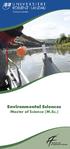 Campus Landau Environmental Sciences Master of Science (M.Sc.) INSTITUTE FOR ENVIRONMENTAL SCIENCES Hands-on: taking water samples to to assess the ecological and chemical quality. Environmental Sciences
Department of Physical Sciences. Chemistry
 92 Eastern New Mexico University Department of Physical Sciences Professor: Associate Professors: Assistant Professors: Robert W. Pierce William Andersen James Constantopoulos Newton Hilliard, Jr James
Environmental Science Science Curriculum Framework. Revised 2005
 Environmental Science Science Curriculum Framework Revised 2005 Course Title: Environmental Science Course/Unit Credit: 1 Course Number: 424020 Teacher Licensure: Please refer to the Course Code Management
STATE UNIVERSITY OF NEW YORK COLLEGE OF ENVIRONMENTAL SCIENCE AND FORESTRY FACULTY OF CHEMISTRY GRADUATE PROGRAM DESCRIPTION
 December, 2006 STATE UNIVERSITY OF NEW YORK COLLEGE OF ENVIRONMENTAL SCIENCE AND FORESTRY FACULTY OF CHEMISTRY GRADUATE PROGRAM DESCRIPTION I Statement of Objectives The objective of the graduate program
SUPPLEMENTAL QUALIFICATION STANDARD FOR THE U.S. DEPARTMENT OF AGRICULTURE, FOREST SERVICE AND THE U.S. DEPARTMENT OF THE INTERIOR
 SUPPLEMENTAL QUALIFICATION STANDARD FOR THE U.S. DEPARTMENT OF AGRICULTURE, FOREST SERVICE AND THE U.S. DEPARTMENT OF THE INTERIOR GS-0401 FIRE MANAGEMENT SPECIALIST This document supplements the requirements
Department of Integrative Physiology Bachelor of Arts http://www.colorado.edu/intphys/ Mission of the Department. Prospective Majors:
 Department of Integrative Physiology Bachelor of Arts http://www.colorado.edu/intphys/ Mission of the Department Physiology is the field of biology that deals with function in living organisms. The Department
The College of Liberal Arts and Sciences
 The College of Liberal Arts and Sciences Proposal for a Biomedical Sciences Major (BS) Professor Bernd Fritzsch, DEO, Department of Biology Associate Professor Bryant McAllister, DUS, Department of Biology
Sustainability courses available at Florida State University
 Sustainability courses available at Florida State University (Please note be sure to consult the online course catalog each semester for course availability) Department Course Course Name Number BOT 3015
BERKELEY CITY COLLEGE COLLEGE OF ALAMEDA LANEY COLLEGE MERRITT COLLEGE
 Biology and Programs Biology Program The Associate of Science Degree for Transfer (AST) in Biology is designed for students who plan to transfer to CSU as biology majors. In this program, they gain exposure
Marine Science (MS) - Marine Conservation
 UNIVERSITY OF SOUTH ALABAMA MARINE SCIENCE (MS) - MARINE CONSERVATION 1 Marine Science (MS) - Marine Conservation Degree Requirements Master Of Science (M.S.) In Marine Conservation And Resource Management
2013-14. Student Guide for Environmental Science and Studies. Department of Environmental Science and Studies. DePaul University.
 Student Guide for Environmental Science and Studies 2013-14 Department of Environmental Science and Studies DePaul University 1110 W Belden Ave McGowan South, Suite 203 Chicago, IL 60618 (773) 325-7447
Department of Biology College of Arts and Sciences
 Department of Biology College of Arts and Sciences Faculty James A. Huggins (1987). University Professor of Biology, Department Chair and Director of the Center for Scientific Studies. B.S.A. and M.S.,
MARINE SCIENCE. What can I do with this major?
 MARINE SCIENCE What can I do with this major? BIOLOGICAL OCEANOGRAPHY Ecology and Evolution Conservation Consulting Environmental Protection/Regulation Environmental Remediation/Compliance Fisheries Management
Bachelor of Science in Chemistry
 Bachelor of Science in Chemistry Chemistry Courses Chemistry Course Credit Course Chosen Semester Grade 1000, 2000 2 1017 and 1007 4 1018 and 1008 4 2117 3 2025 3 2217 and 2017 4 2218 and 2018 4 3027 3
Dr. Michael D. Meyer, Chair Forbes Hall 1021B (757) 594-7126 [email protected]
 D O E B Dr. Michael D. Meyer, Chair Forbes Hall 1021B (757) 594-7126 [email protected] Faculty Professor: Atkinson, Whiting Associate Professor: M. Meyer, Ruane, Sherwin, J.S. Thompson Assistant Professor:
Categories of Study: Curriculum Goals and Requirements
 Philosophy and Requirements Educational Goals The purpose of the UT Martin undergraduate educational experience is to prepare all students for the opportunities and challenges of a dynamic world. The combination
College of Liberal Arts. Dr. Christina Murphy, Dean Dr. Samuel L. Dameron, Associate Dean www.marshall.edu/cola [email protected]
 College of Liberal Arts Dr. Christina Murphy, Dean Dr. Samuel L. Dameron, Associate Dean www.marshall.edu/cola [email protected] MISSION OF THE COLLEGE The College of Liberal Arts is committed to excellence
CALIFORNIA STATE UNIVERSITY, EAST BAY. Committee on Academic Planning & Review (CAPR)
 CALIFORNIA STATE UNIVERSITY, EAST BAY Designation Code: 2009-10 CAPR 7 Date Submitted: December 3, 2009 TO: FROM: SUBJECT: PURPOSE: The Academic Senate Committee on Academic Planning & Review (CAPR) New