
Undergraduate Curriculum Committee Proposal Summary 9/24/2015 Meeting. (Revised: 9/18/15)
|
|
|
- Buck Horton
- 10 years ago
- Views:
Transcription
1 Undergraduate Curriculum Committee Proposal Summary 9/24/2015 Meeting (Revised: 9/18/15)

2 Department: Biological Sciences Course Addition: BIOL 336L Credit Hours 1 Course Title: Abbreviated Title: Contact hours per week: Type of Instructional Activity: Fish Biology Laboratory Fish Biology Lab Lecture Lab 3 Field Studio Other Laboratory: Academic/Clinical Academic engagement minutes: 2250 Student preparation minutes: 1125 Intended semesters for offering this course: Essential Learning Course: Prerequisites: BIOL 106 Prerequisite for other course(s): Co-requisites: BIOL 336 Fall J-Term Spring Summer Requirement or listed choice for any program of study: Biology BS, Biological Sciences-Biology: 3410 Biology BS, Biological Sciences-Ecology, Evolution and Organismal Biology: 3409 Biology BS, Biological Sciences-Cellular, Molecular, and Developmental Biology: 3414 Overlapping content with present courses offered on campus: Additional faculty FTE required: Additional equipment required: Additional lab facilities required: Course description for catalog: Study of the anatomy and physiology of fish. Topics include ecology, fish diseases, and marine and freshwater fishery techniques. Field trips may be offered. Justification: Hands on experience learning fish anatomy, morphometric, meristics, and identification are essential for understanding the material. The other organismal courses taught in biology such as herpetology, mammalogy, and ornithology all include labs. Topical course outline: Anatomy, morphometrics and meristics, physiology, behavior, species identification Student Learning Outcomes: Departmental: 1) Students will demonstrate a broad, comprehensive knowledge of the main areas of biology (including evolution, diversity, ecology, cell biology and genetics) and the ability to apply this knowledge to address new questions. Course specific: Upon completion of this course, a student should be able to: 1) identify the anatomical structures of fish, 2) identify fish species using dichotomous keys, morphometrics, and meristics, and 3) apply techniques for studying fishes in the laboratory and field setting. Proposed by: Eriek S. Hansen Expected Implementation: Spring 2016

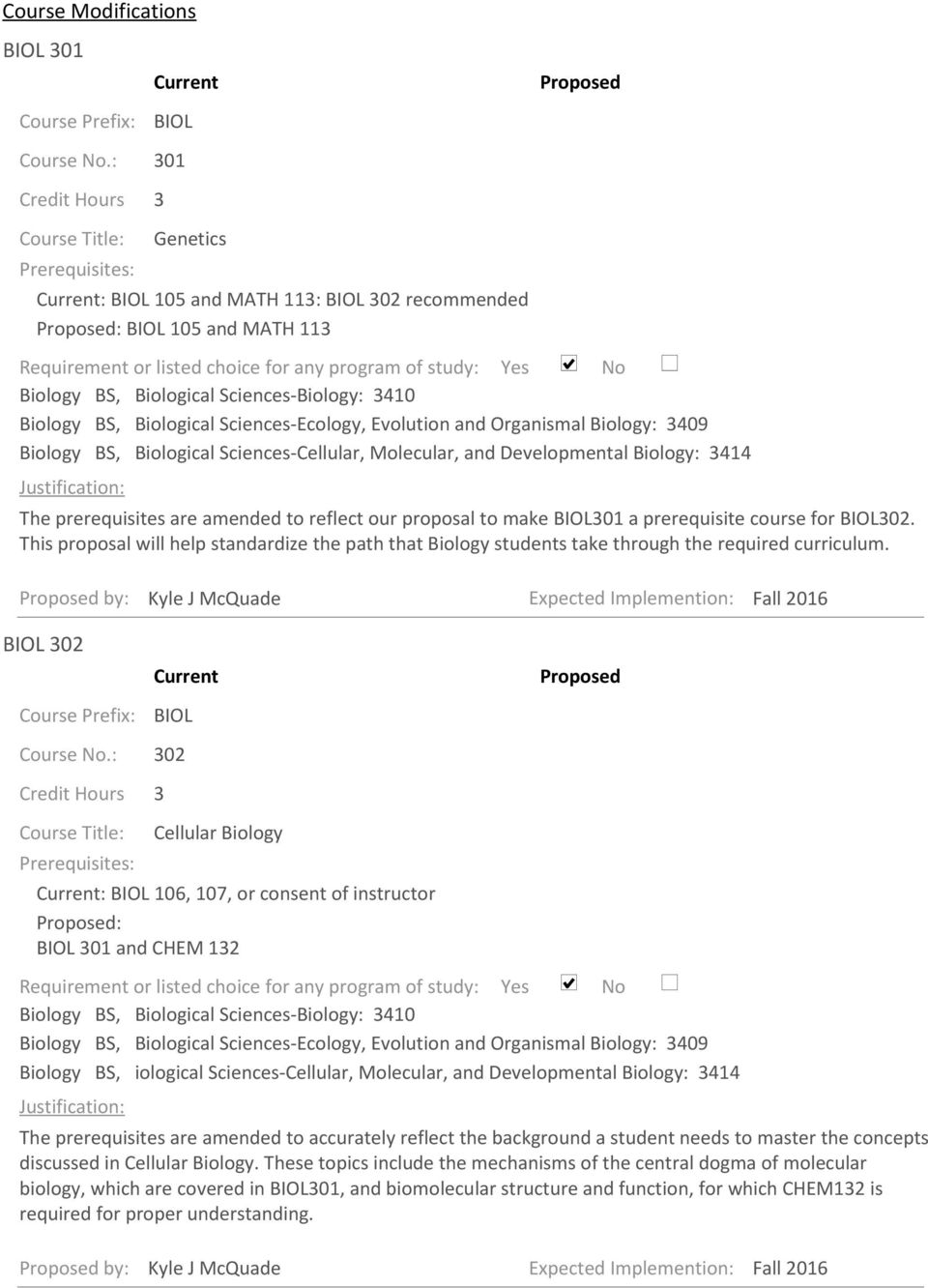
3 Course Modifications BIOL 301 Current Course Prefix: BIOL Course.: 301 Proposed Credit Hours 3 Course Title: Prerequisites: Genetics Current: BIOL 105 and MATH 113: BIOL 302 recommended Proposed: BIOL 105 and MATH 113 Requirement or listed choice for any program of study: Biology BS, Biological Sciences-Biology: 3410 Biology BS, Biological Sciences-Ecology, Evolution and Organismal Biology: 3409 Biology BS, Biological Sciences-Cellular, Molecular, and Developmental Biology: 3414 Justification: The prerequisites are amended to reflect our proposal to make BIOL301 a prerequisite course for BIOL302. This proposal will help standardize the path that Biology students take through the required curriculum. Proposed by: Kyle J McQuade Expected Implemention: Fall 2016 BIOL 302 Course Prefix: BIOL Course.: 302 Credit Hours 3 Course Title: Prerequisites: Cellular Biology Current: BIOL 106, 107, or consent of instructor Proposed: BIOL 301 and CHEM 132 Requirement or listed choice for any program of study: Biology BS, Biological Sciences-Biology: 3410 Biology BS, Biological Sciences-Ecology, Evolution and Organismal Biology: 3409 Biology BS, iological Sciences-Cellular, Molecular, and Developmental Biology: 3414 Justification: Current Proposed The prerequisites are amended to accurately reflect the background a student needs to master the concepts discussed in Cellular Biology. These topics include the mechanisms of the central dogma of molecular biology, which are covered in BIOL301, and biomolecular structure and function, for which CHEM132 is required for proper understanding. Proposed by: Kyle J McQuade Expected Implemention: Fall 2016
4 BIOL 336 Course Prefix: BIOL Course.: 336 Credit Hours 3 Course Title: Fish Biology Co-requisites: Current: ne Proposed: BIOL 336L Requirement or listed choice for any program of study: Biology BS, Biological Sciences-Biology: 3410 Biology BS, Biological Sciences-Ecology, Evolution and Organismal Biology: 3409 Biology BS, Biological Sciences-Cellular, Molecular, and Developmental Biology: 3414 Justification: Current Proposed The addition of a laboratory will provide hands-on experience learning fish anatomy, morphometric, meristics, and identification, which are essential for understanding the material. The other organismal courses taught in biology, such as herpetology, mammalogy, and ornithology, all include labs. Proposed by: Eriek S. Hansen Expected Implemention: Spring 2016 BIOL 441 Course Prefix: BIOL Course.: 441 Credit Hours 3 Course Title: Prerequisites: Endocrinology Current: BIOL 106 or consent of instructor Proposed: BIOL 105, CHEM 132 and junior or senior standing Requirement or listed choice for any program of study: Biology BS, Biological Sciences-Cellular, Molecular, and Developmental Biology: 3414 Justification: Current Proposed The prerequisites are amended to reflect that BIOL106 will no longer be taken by all Biology students due to curricular changes passed last year. CHEM132 is added as a prerequisite because the course discusses cellular communication at the molecular level, so an introduction to chemistry is essential. The modification to require Junior or Senior standing reflects the fact that this is a 400 level course that will likely be too advanced for students who have not built a solid base in the sciences. Proposed by: Kyle J McQuade Expected Implemention: Spring 2016

5 Program Modification Biological Sciences-Biology: 3410 Degree Type: BS Revision to program sheet: Description of modification: Add BIOL 336 lab to restricted electives (Biology "categories"). Justification: A lab is concurrently being added to BIOL 336 Fish Biology. Students will be able to use the lecture and lab as part of their upper-division Biology options. Revision to SLOs: Other changes: The BIOL 336L Fish Biology Laboratory will enhance and reinforce the learning experience provided by BIOL 336 Fish Biology, thereby strengthening the Biology program. Proposed by: Susan Longest Director of Teacher Education Signature: N/A Expected Implementation: Fall 2016

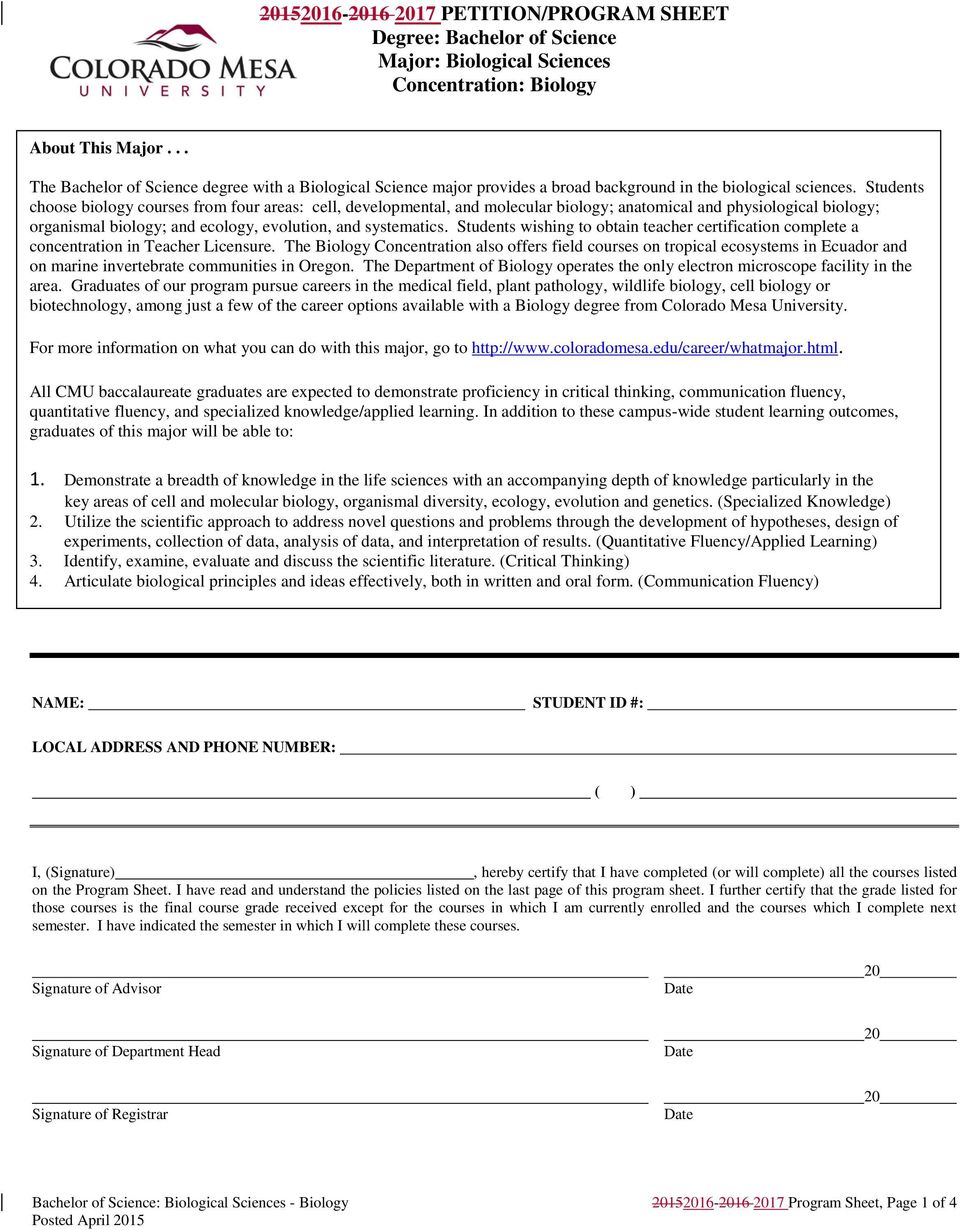
6 PETITION/PROGRAM SHEET Degree: Bachelor of Science Major: Biological Sciences Concentration: Biology About This Major... The Bachelor of Science degree with a Biological Science major provides a broad background in the biological sciences. Students choose biology courses from four areas: cell, developmental, and molecular biology; anatomical and physiological biology; organismal biology; and ecology, evolution, and systematics. Students wishing to obtain teacher certification complete a concentration in Teacher Licensure. The Biology Concentration also offers field courses on tropical ecosystems in Ecuador and on marine invertebrate communities in Oregon. The Department of Biology operates the only electron microscope facility in the area. Graduates of our program pursue careers in the medical field, plant pathology, wildlife biology, cell biology or biotechnology, among just a few of the career options available with a Biology degree from Colorado Mesa University. For more information on what you can do with this major, go to All CMU baccalaureate graduates are expected to demonstrate proficiency in critical thinking, communication fluency, quantitative fluency, and specialized knowledge/applied learning. In addition to these campus-wide student learning outcomes, graduates of this major will be able to: 1. Demonstrate a breadth of knowledge in the life sciences with an accompanying depth of knowledge particularly in the key areas of cell and molecular biology, organismal diversity, ecology, evolution and genetics. (Specialized Knowledge) 2. Utilize the scientific approach to address novel questions and problems through the development of hypotheses, design of experiments, collection of data, analysis of data, and interpretation of results. (Quantitative Fluency/Applied Learning) 3. Identify, examine, evaluate and discuss the scientific literature. (Critical Thinking) 4. Articulate biological principles and ideas effectively, both in written and oral form. (Communication Fluency) NAME: STUDENT ID #: LOCAL ADDRESS AND PHONE NUMBER: ( ) I, (Signature), hereby certify that I have completed (or will complete) all the courses listed on the Program Sheet. I have read and understand the policies listed on the last page of this program sheet. I further certify that the grade listed for those courses is the final course grade received except for the courses in which I am currently enrolled and the courses which I complete next semester. I have indicated the semester in which I will complete these courses. Signature of Advisor Date 20 Signature of Department Head Date 20 Signature of Registrar Date 20 Bachelor of Science: Biological Sciences - Biology Program Sheet, Page 1 of 4 Posted April 2015
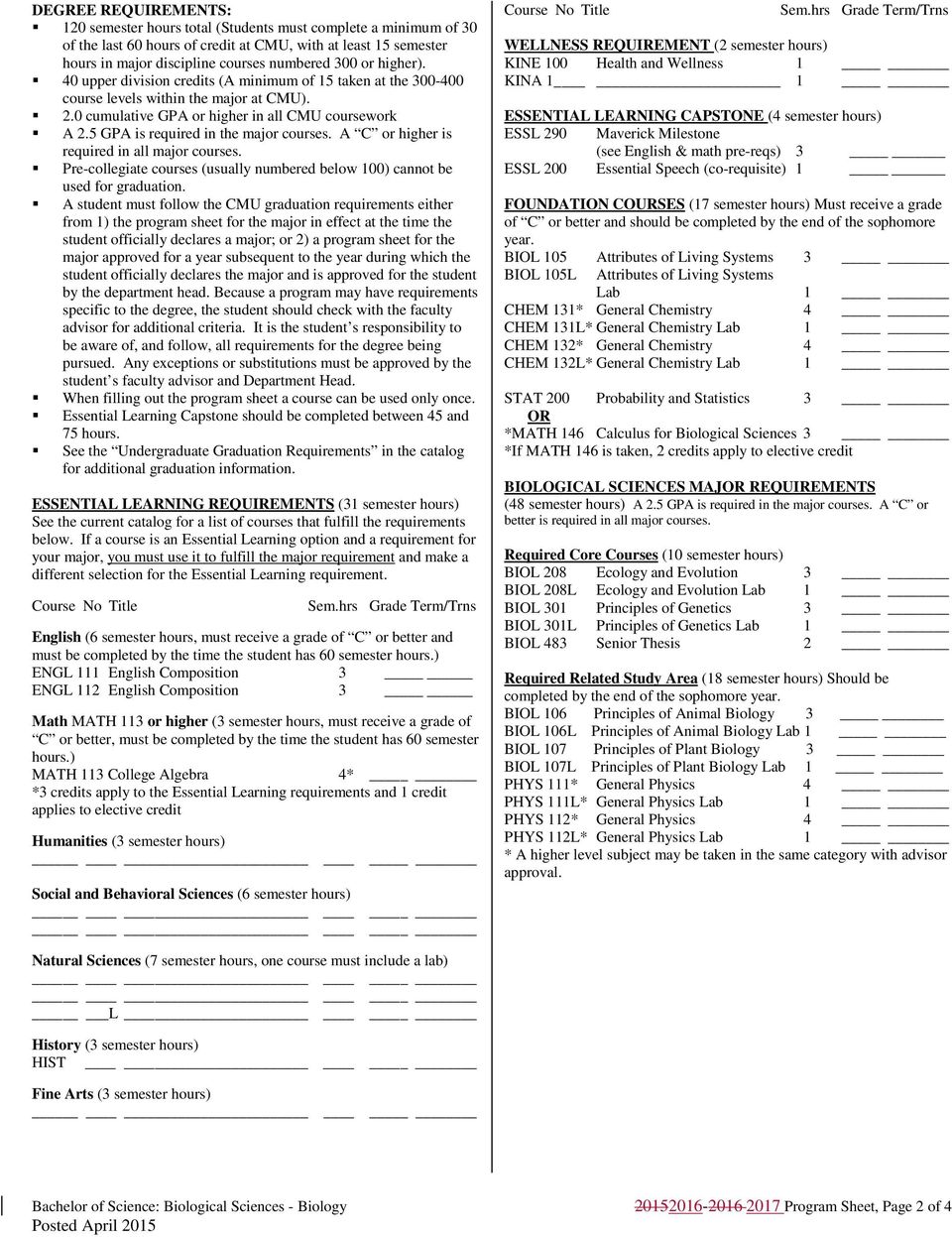
7 DEGREE REQUIREMENTS: 120 semester hours total (Students must complete a minimum of 30 of the last 60 hours of credit at CMU, with at least 15 semester hours in major discipline courses numbered 300 or higher). 40 upper division credits (A minimum of 15 taken at the course levels within the major at CMU). 2.0 cumulative GPA or higher in all CMU coursework A 2.5 GPA is required in the major courses. A C or higher is required in all major courses. Pre-collegiate courses (usually numbered below 100) cannot be used for graduation. A student must follow the CMU graduation requirements either from 1) the program sheet for the major in effect at the time the student officially declares a major; or 2) a program sheet for the major approved for a year subsequent to the year during which the student officially declares the major and is approved for the student by the department head. Because a program may have requirements specific to the degree, the student should check with the faculty advisor for additional criteria. It is the student s responsibility to be aware of, and follow, all requirements for the degree being pursued. Any exceptions or substitutions must be approved by the student s faculty advisor and Department Head. When filling out the program sheet a course can be used only once. Essential Learning Capstone should be completed between 45 and 75 hours. See the Undergraduate Graduation Requirements in the catalog for additional graduation information. ESSENTIAL LEARNING REQUIREMENTS (31 semester hours) See the current catalog for a list of courses that fulfill the requirements below. If a course is an Essential Learning option and a requirement for your major, you must use it to fulfill the major requirement and make a different selection for the Essential Learning requirement. Course Title Sem.hrs Grade Term/Trns English (6 semester hours, must receive a grade of C or better and must be completed by the time the student has 60 semester hours.) ENGL 111 English Composition 3 ENGL 112 English Composition 3 Math MATH 113 or higher (3 semester hours, must receive a grade of C or better, must be completed by the time the student has 60 semester hours.) MATH 113 College Algebra 4* *3 credits apply to the Essential Learning requirements and 1 credit applies to elective credit Humanities (3 semester hours) Social and Behavioral Sciences (6 semester hours) Course Title Sem.hrs Grade Term/Trns WELLNESS REQUIREMENT (2 semester hours) KINE 100 Health and Wellness 1 KINA 1 1 ESSENTIAL LEARNING CAPSTONE (4 semester hours) ESSL 290 Maverick Milestone (see English & math pre-reqs) 3 ESSL 200 Essential Speech (co-requisite) 1 FOUNDATION COURSES (17 semester hours) Must receive a grade of C or better and should be completed by the end of the sophomore year. BIOL 105 Attributes of Living Systems 3 BIOL 105L Attributes of Living Systems Lab 1 CHEM 131* General Chemistry 4 CHEM 131L* General Chemistry Lab 1 CHEM 132* General Chemistry 4 CHEM 132L* General Chemistry Lab 1 STAT 200 Probability and Statistics 3 OR *MATH 146 Calculus for Biological Sciences 3 *If MATH 146 is taken, 2 credits apply to elective credit BIOLOGICAL SCIENCES MAJOR REQUIREMENTS (48 semester hours) A 2.5 GPA is required in the major courses. A C or better is required in all major courses. Required Core Courses (10 semester hours) BIOL 208 Ecology and Evolution 3 BIOL 208L Ecology and Evolution Lab 1 BIOL 301 Principles of Genetics 3 BIOL 301L Principles of Genetics Lab 1 BIOL 483 Senior Thesis 2 Required Related Study Area (18 semester hours) Should be completed by the end of the sophomore year. BIOL 106 Principles of Animal Biology 3 BIOL 106L Principles of Animal Biology Lab 1 BIOL 107 Principles of Plant Biology 3 BIOL 107L Principles of Plant Biology Lab 1 PHYS 111* General Physics 4 PHYS 111L* General Physics Lab 1 PHYS 112* General Physics 4 PHYS 112L* General Physics Lab 1 * A higher level subject may be taken in the same category with advisor approval. Natural Sciences (7 semester hours, one course must include a lab) L History (3 semester hours) HIST Fine Arts (3 semester hours) Bachelor of Science: Biological Sciences - Biology Program Sheet, Page 2 of 4 Posted April 2015
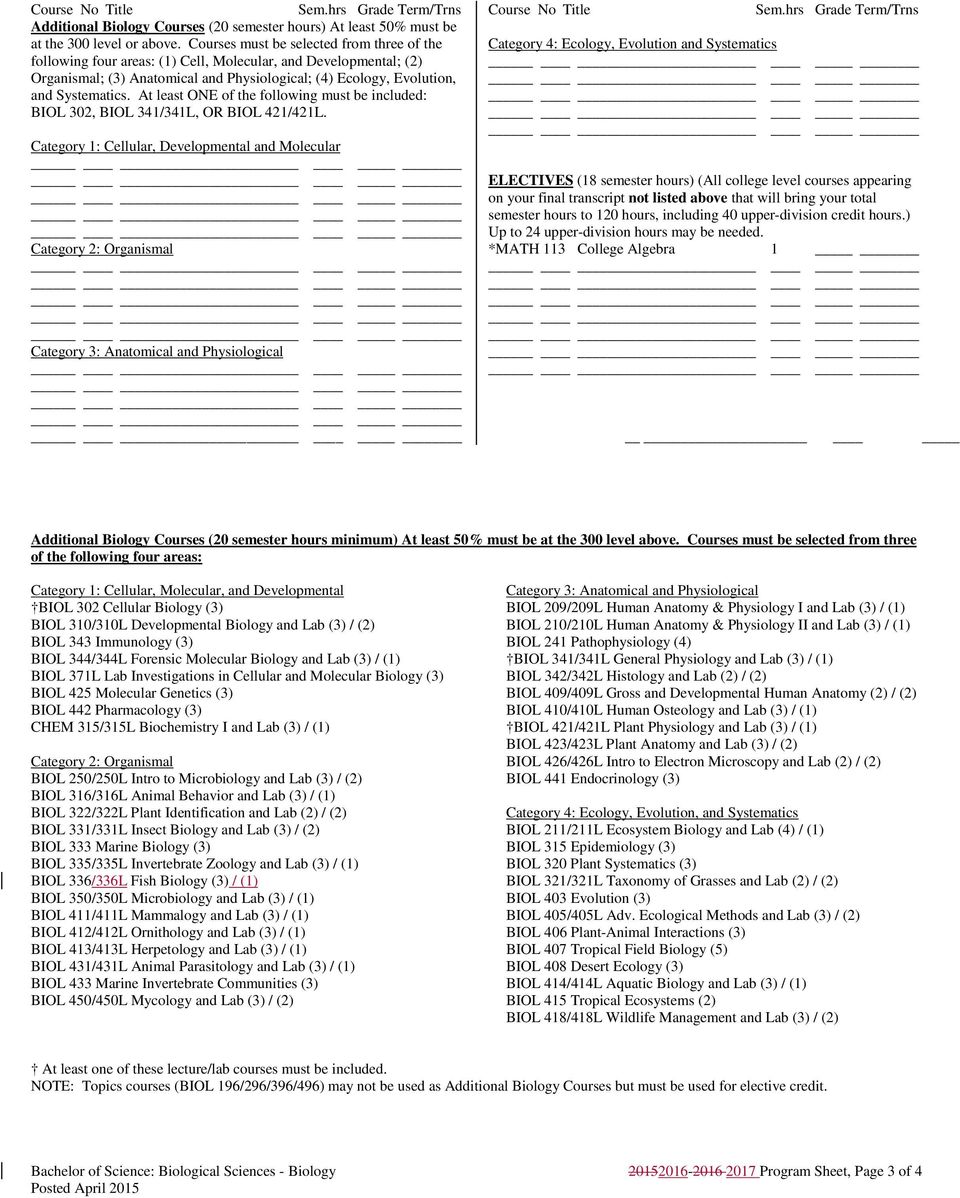
8 Course Title Sem.hrs Grade Term/Trns Additional Biology Courses (20 semester hours) At least 50% must be at the 300 level or above. Courses must be selected from three of the following four areas: (1) Cell, Molecular, and Developmental; (2) Organismal; (3) Anatomical and Physiological; (4) Ecology, Evolution, and Systematics. At least ONE of the following must be included: BIOL 302, BIOL 341/341L, OR BIOL 421/421L. Course Title Sem.hrs Grade Term/Trns Category 4: Ecology, Evolution and Systematics Category 1: Cellular, Developmental and Molecular ELECTIVES (18 semester hours) (All college level courses appearing on your final transcript not listed above that will bring your total semester hours to 120 hours, including 40 upper-division credit hours.) Up to 24 upper-division hours may be needed. Category 2: Organismal *MATH 113 College Algebra 1 Category 3: Anatomical and Physiological _ Additional Biology Courses (20 semester hours minimum) At least 50% must be at the 300 level above. Courses must be selected from three of the following four areas: Category 1: Cellular, Molecular, and Developmental BIOL 302 Cellular Biology (3) BIOL 310/310L Developmental Biology and Lab (3) / (2) BIOL 343 Immunology (3) BIOL 344/344L Forensic Molecular Biology and Lab (3) / (1) BIOL 371L Lab Investigations in Cellular and Molecular Biology (3) BIOL 425 Molecular Genetics (3) BIOL 442 Pharmacology (3) CHEM 315/315L Biochemistry I and Lab (3) / (1) Category 2: Organismal BIOL 250/250L Intro to Microbiology and Lab (3) / (2) BIOL 316/316L Animal Behavior and Lab (3) / (1) BIOL 322/322L Plant Identification and Lab (2) / (2) BIOL 331/331L Insect Biology and Lab (3) / (2) BIOL 333 Marine Biology (3) BIOL 335/335L Invertebrate Zoology and Lab (3) / (1) BIOL 336/336L Fish Biology (3) / (1) BIOL 350/350L Microbiology and Lab (3) / (1) BIOL 411/411L Mammalogy and Lab (3) / (1) BIOL 412/412L Ornithology and Lab (3) / (1) BIOL 413/413L Herpetology and Lab (3) / (1) BIOL 431/431L Animal Parasitology and Lab (3) / (1) BIOL 433 Marine Invertebrate Communities (3) BIOL 450/450L Mycology and Lab (3) / (2) Category 3: Anatomical and Physiological BIOL 209/209L Human Anatomy & Physiology I and Lab (3) / (1) BIOL 210/210L Human Anatomy & Physiology II and Lab (3) / (1) BIOL 241 Pathophysiology (4) BIOL 341/341L General Physiology and Lab (3) / (1) BIOL 342/342L Histology and Lab (2) / (2) BIOL 409/409L Gross and Developmental Human Anatomy (2) / (2) BIOL 410/410L Human Osteology and Lab (3) / (1) BIOL 421/421L Plant Physiology and Lab (3) / (1) BIOL 423/423L Plant Anatomy and Lab (3) / (2) BIOL 426/426L Intro to Electron Microscopy and Lab (2) / (2) BIOL 441 Endocrinology (3) Category 4: Ecology, Evolution, and Systematics BIOL 211/211L Ecosystem Biology and Lab (4) / (1) BIOL 315 Epidemiology (3) BIOL 320 Plant Systematics (3) BIOL 321/321L Taxonomy of Grasses and Lab (2) / (2) BIOL 403 Evolution (3) BIOL 405/405L Adv. Ecological Methods and Lab (3) / (2) BIOL 406 Plant-Animal Interactions (3) BIOL 407 Tropical Field Biology (5) BIOL 408 Desert Ecology (3) BIOL 414/414L Aquatic Biology and Lab (3) / (1) BIOL 415 Tropical Ecosystems (2) BIOL 418/418L Wildlife Management and Lab (3) / (2) At least one of these lecture/lab courses must be included. NOTE: Topics courses (BIOL 196/296/396/496) may not be used as Additional Biology Courses but must be used for elective credit. Bachelor of Science: Biological Sciences - Biology Program Sheet, Page 3 of 4 Posted April 2015
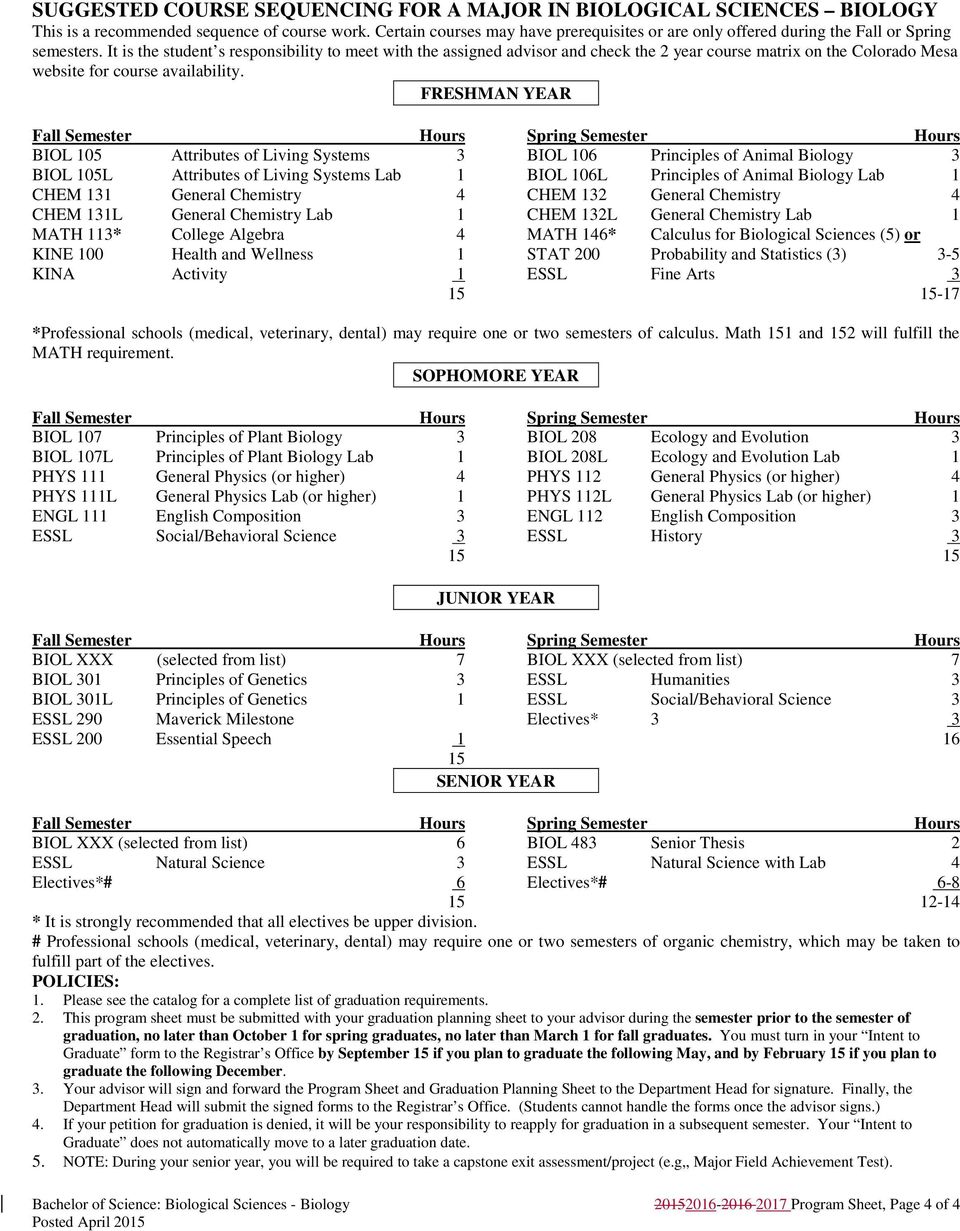
9 SUGGESTED COURSE SEQUENCING FOR A MAJOR IN BIOLOGICAL SCIENCES BIOLOGY This is a recommended sequence of course work. Certain courses may have prerequisites or are only offered during the Fall or Spring semesters. It is the student s responsibility to meet with the assigned advisor and check the 2 year course matrix on the Colorado Mesa website for course availability. FRESHMAN YEAR Fall Semester Hours BIOL 105 Attributes of Living Systems 3 BIOL 105L Attributes of Living Systems Lab 1 CHEM 131 General Chemistry 4 CHEM 131L General Chemistry Lab 1 MATH 113* College Algebra 4 KINE 100 Health and Wellness 1 KINA Activity 1 15 Spring Semester Hours BIOL 106 Principles of Animal Biology 3 BIOL 106L Principles of Animal Biology Lab 1 CHEM 132 General Chemistry 4 CHEM 132L General Chemistry Lab 1 MATH 146* Calculus for Biological Sciences (5) or STAT 200 Probability and Statistics (3) 3-5 ESSL Fine Arts *Professional schools (medical, veterinary, dental) may require one or two semesters of calculus. Math 151 and 152 will fulfill the MATH requirement. SOPHOMORE YEAR Fall Semester Hours BIOL 107 Principles of Plant Biology 3 BIOL 107L Principles of Plant Biology Lab 1 PHYS 111 General Physics (or higher) 4 PHYS 111L General Physics Lab (or higher) 1 ENGL 111 English Composition 3 ESSL Social/Behavioral Science 3 15 Spring Semester Hours BIOL 208 Ecology and Evolution 3 BIOL 208L Ecology and Evolution Lab 1 PHYS 112 General Physics (or higher) 4 PHYS 112L General Physics Lab (or higher) 1 ENGL 112 English Composition 3 ESSL History 3 15 JUNIOR YEAR Fall Semester Hours Spring Semester Hours BIOL XXX (selected from list) 7 BIOL XXX (selected from list) 7 BIOL 301 Principles of Genetics 3 ESSL Humanities 3 BIOL 301L Principles of Genetics 1 ESSL Social/Behavioral Science 3 ESSL 290 Maverick Milestone Electives* 3 3 ESSL 200 Essential Speech SENIOR YEAR Fall Semester Hours Spring Semester Hours BIOL XXX (selected from list) 6 BIOL 483 Senior Thesis 2 ESSL Natural Science 3 ESSL Natural Science with Lab 4 Electives*# 6 15 Electives*# * It is strongly recommended that all electives be upper division. # Professional schools (medical, veterinary, dental) may require one or two semesters of organic chemistry, which may be taken to fulfill part of the electives. POLICIES: 1. Please see the catalog for a complete list of graduation requirements. 2. This program sheet must be submitted with your graduation planning sheet to your advisor during the semester prior to the semester of graduation, no later than October 1 for spring graduates, no later than March 1 for fall graduates. You must turn in your Intent to Graduate form to the Registrar s Office by September 15 if you plan to graduate the following May, and by February 15 if you plan to graduate the following December. 3. Your advisor will sign and forward the Program Sheet and Graduation Planning Sheet to the Department Head for signature. Finally, the Department Head will submit the signed forms to the Registrar s Office. (Students cannot handle the forms once the advisor signs.) 4. If your petition for graduation is denied, it will be your responsibility to reapply for graduation in a subsequent semester. Your Intent to Graduate does not automatically move to a later graduation date. 5. NOTE: During your senior year, you will be required to take a capstone exit assessment/project (e.g,, Major Field Achievement Test). Bachelor of Science: Biological Sciences - Biology Program Sheet, Page 4 of 4 Posted April 2015
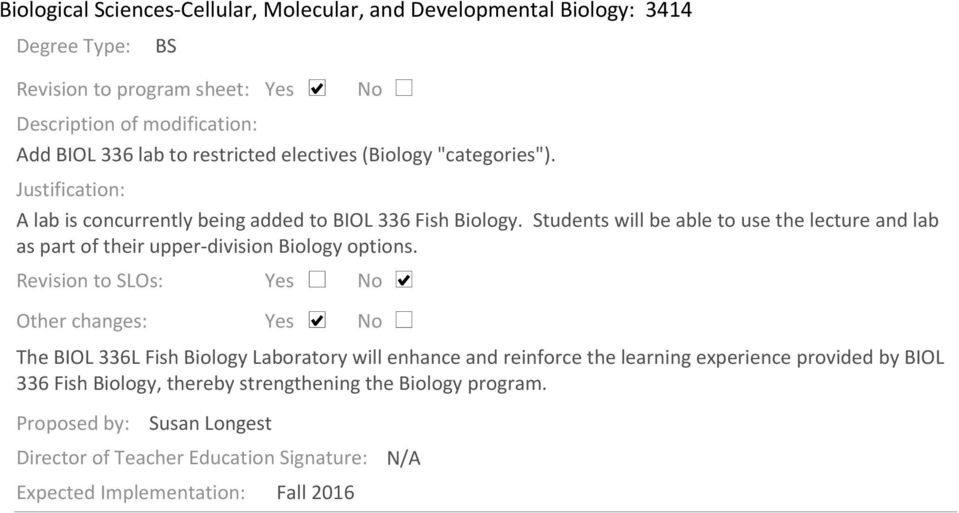
10 Biological Sciences-Cellular, Molecular, and Developmental Biology: 3414 Degree Type: BS Revision to program sheet: Justification: Description of modification: Add BIOL 336 lab to restricted electives (Biology "categories"). A lab is concurrently being added to BIOL 336 Fish Biology. Students will be able to use the lecture and lab as part of their upper-division Biology options. Revision to SLOs: Other changes: The BIOL 336L Fish Biology Laboratory will enhance and reinforce the learning experience provided by BIOL 336 Fish Biology, thereby strengthening the Biology program. Proposed by: Susan Longest Director of Teacher Education Signature: Expected Implementation: Fall 2016 N/A
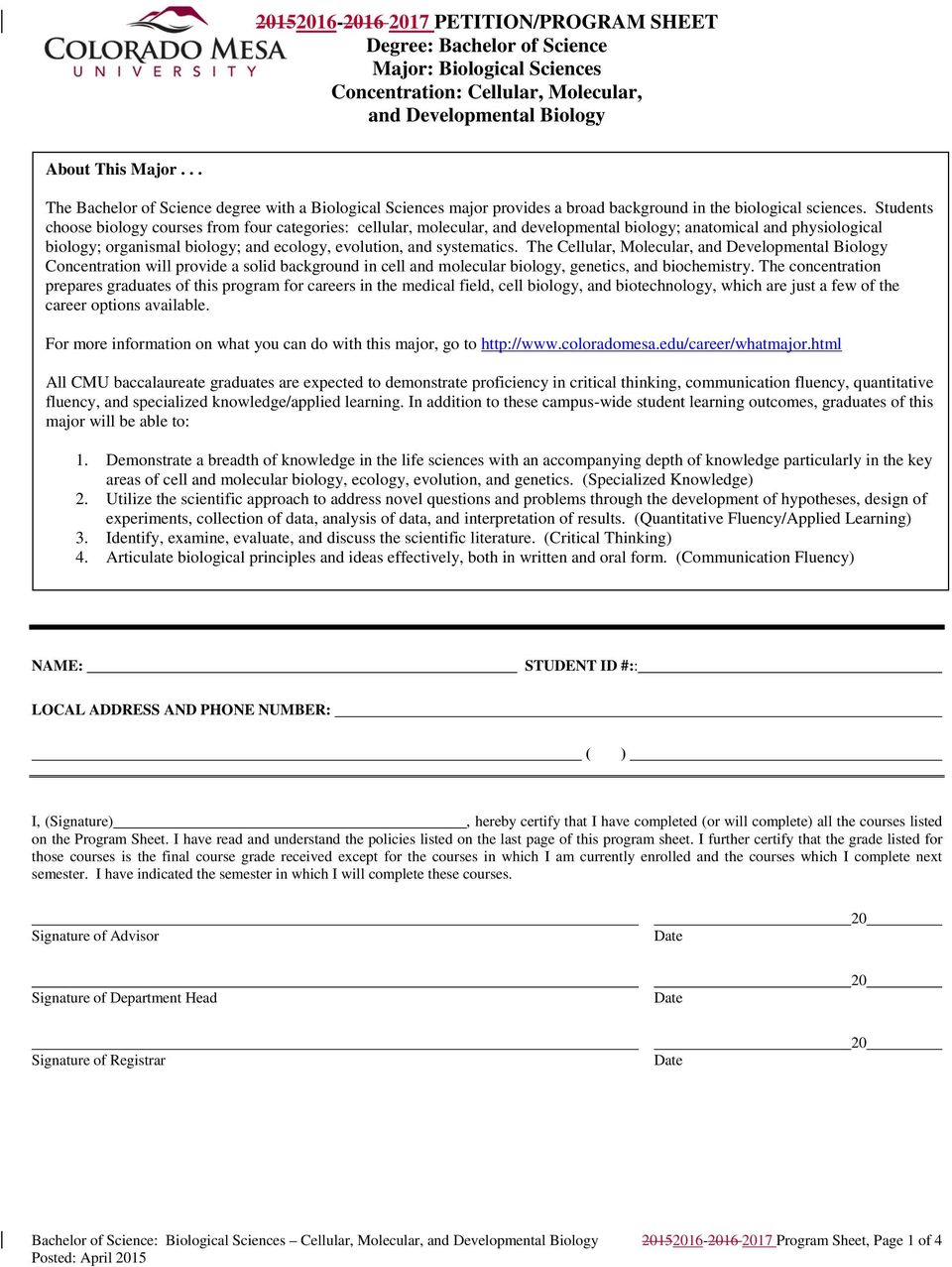
11 PETITION/PROGRAM SHEET Degree: Bachelor of Science Major: Biological Sciences Concentration: Cellular, Molecular, and Developmental Biology About This Major... The Bachelor of Science degree with a Biological Sciences major provides a broad background in the biological sciences. Students choose biology courses from four categories: cellular, molecular, and developmental biology; anatomical and physiological biology; organismal biology; and ecology, evolution, and systematics. The Cellular, Molecular, and Developmental Biology Concentration will provide a solid background in cell and molecular biology, genetics, and biochemistry. The concentration prepares graduates of this program for careers in the medical field, cell biology, and biotechnology, which are just a few of the career options available. For more information on what you can do with this major, go to All CMU baccalaureate graduates are expected to demonstrate proficiency in critical thinking, communication fluency, quantitative fluency, and specialized knowledge/applied learning. In addition to these campus-wide student learning outcomes, graduates of this major will be able to: 1. Demonstrate a breadth of knowledge in the life sciences with an accompanying depth of knowledge particularly in the key areas of cell and molecular biology, ecology, evolution, and genetics. (Specialized Knowledge) 2. Utilize the scientific approach to address novel questions and problems through the development of hypotheses, design of experiments, collection of data, analysis of data, and interpretation of results. (Quantitative Fluency/Applied Learning) 3. Identify, examine, evaluate, and discuss the scientific literature. (Critical Thinking) 4. Articulate biological principles and ideas effectively, both in written and oral form. (Communication Fluency) NAME: STUDENT ID #:: LOCAL ADDRESS AND PHONE NUMBER: ( ) I, (Signature), hereby certify that I have completed (or will complete) all the courses listed on the Program Sheet. I have read and understand the policies listed on the last page of this program sheet. I further certify that the grade listed for those courses is the final course grade received except for the courses in which I am currently enrolled and the courses which I complete next semester. I have indicated the semester in which I will complete these courses. Signature of Advisor Date 20 Signature of Department Head Date 20 Signature of Registrar Date 20 Bachelor of Science: Biological Sciences Cellular, Molecular, and Developmental Biology Program Sheet, Page 1 of 4 Posted: April 2015
12 DEGREE REQUIREMENTS: 120 semester hours total (Students must complete a minimum of 30 of the last 60 hours of credit at CMU, with at least 15 semester hours in major discipline courses numbered 300 or higher). 40 upper division credits (A minimum of 15 taken at the course levels within the major at CMU) cumulative GPA or higher in all CMU coursework. A 2.5 GPA is required in the major courses. A C or higher is required in all major courses. Pre-collegiate courses (usually numbered below 100) cannot be used for graduation. A student must follow the CMU graduation requirements either from 1) the program sheet for the major in effect at the time the student officially declares a major; or 2) a program sheet for the major approved for a year subsequent to the year during which the student officially declares the major and is approved for the student by the department head. Because a program may have requirements specific to the degree, the student should check with the faculty advisor for additional criteria. It is the student s responsibility to be aware of, and follow, all requirements for the degree being pursued. Any exceptions or substitutions must be approved by the student s faculty advisor and Department Head. When filling out the program sheet a course can be used only once. Essential Learning Capstone should be completed between 45 and 75 hours. See the Undergraduate Graduation Requirements in the catalog for additional graduation information. ESSENTIAL LEARNING REQUIREMENTS (31 semester hours) See the current catalog for a list of courses that fulfill the requirements below. If a course is an Essential Learning option and a requirement for your major, you must use it to fulfill the major requirement and make a different selection for the Essential Learning requirement. Course Title Sem.hrs Grade Term/Trns English (6 semester hours, must receive a grade of C or better and must be completed by the time the student has 60 semester hours.) ENGL 111 English Composition 3 ENGL 112 English Composition 3 Math (3 semester hours, must receive a grade of C or better and must be completed by the time the student has 60 semester hours.) MATH 151 Calculus I 5* *3 credits apply to the Essential Learning requirements and 2 credits apply to electives Humanities (3 semester hours) Social and Behavioral Sciences (6 semester hours) Natural Sciences (7 semester hours, one course must include a lab.) CHEM 131/131L and CHEM 132/132L are recommended. Both are prerequisites for upper level chemistry. If chosen, 7 credits apply to the Essential Learning requirement and 3 credits apply to electives. L History (3 semester hours) HIST WELLNESS REQUIREMENT (2 semester hours) KINE 100 Health and Wellness 1 KINA 1 1 ESSENTIAL LEARNING CAPSTONE (4 semester hours) ESSL 290 Maverick Milestone (see English & math pre-reqs) 3 ESSL 200 Essential Speech (co-requisite) 1 FOUNDATION COURSES (17-19 semester hours) Must receive a grade of C or better and should be completed by the end of the sophomore year. BIOL 105 Attributes of Living Systems 3 BIOL 105L Attributes of Living Systems Lab 1 PHYS 111* General Physics I 4 PHYS 111L* General Physics I Lab 1 PHYS 112* General Physics II 4 PHYS 112L* General Physics II Lab 1 STAT 200 Probability and Statistics 3 OR MATH 152 Calculus II 5 *A higher level subject can be taken in the same category with advisor approval. BIOLOGICAL SCIENCES MAJOR REQUIREMENTS (53 semester hours) A 2.5 GPA is required in the major courses. A C or better is required in all major courses. Required Core Courses (10 semester hours) BIOL 208 Fundamentals of Ecology and Evolution 3 BIOL 208L Fundamentals of Ecology and Evolution Lab 1 BIOL 301 Principles of Genetics 3 BIOL 301L Principles of Genetics Lab 1 BIOL 483 Senior Thesis 2 Required Related Study Area (31 semester hours) BIOL 102 Plant & Animal Biodiversity 3 BIOL 102L Plant & Animal Biodiversity Lab 1 OR BIOL 108 Diversity of Organisms 3 BIOL 108L Diversity of Organisms Lab 1 BIOL 302 Cellular Biology 3 BIOL 310 Developmental Biology 3 BIOL 310L Developmental Biology Lab 2 BIOL 371L Laboratory Investigations in Cellular & Molecular Biology I 3 CHEM 315 Biochemistry I 3 BIOL 425 Molecular Genetics 3 CHEM 311 Organic Chemistry I 4 CHEM 311L Organic Chemistry I Lab 1 CHEM 312 Organic Chemistry II 4 CHEM 312L Organic Chemistry II Lab 1 CHEM 311/311L and 312/312 require CHEM 131/131L and 132/132L as prerequisites. Students should take CHEM 131/131L and 132/132L for the Essential Learning Natural Sciences. Fine Arts (3 semester hours) Bachelor of Science: Biological Sciences Cellular, Molecular, and Developmental Biology Program Sheet, Page 2 of 4 Posted April 2015

13 Course Title Sem.hrs Grade Term/Trns Additional Biology Courses (12 semester hours chosen from the lists below) Course Title Sem.hrs Grade Term/Trns Electives (11-13 semester hours) (All college level courses appearing on your final transcript, not listed above, that will bring your total semester hours to 120 hours, including 40 upper division hours.) Up to 7 upper division hours may be needed. Research courses are recommended. MATH 151 Calculus I 2* CHEM 131/131L/132/132L 3* Category1: Cellular, Molecular, and Developmental BIOL 343 Immunology (3) BIOL 344/344L Forensic Molecular Biology and Lab (3) / (1) BIOL 442 Pharmacology (3) CHEM 315L Biochemistry I Lab (1) CHEM 316 Biochemistry II (3) Category 2: Organismal BIOL 250/250L Intro to Microbiology and Lab (3) / (2) BIOL 316/316L Animal Behavior and Lab (3) / (1) BIOL 322/322L Plant Identification and Lab (2) / (2) BIOL 331/331L Insect Biology and Lab (3) / (2) BIOL 333 Marine Biology (3) BIOL 335/335L Invertebrate Zoology and Lab (3) / (1) BIOL 336/336L Fish Biology (3) / (1) BIOL 350/350L Microbiology and Lab (3) / (1) BIOL 411/411L Mammalogy and Lab (3) / (1) BIOL 412/412L Ornithology and Lab (3) / (1) BIOL 413/413L Herpetology and Lab (3) / (1) BIOL 421 Plant Physiology and Lab (3) / (1) BIOL 431/431L Animal Parasitology and Lab (3) / (1) BIOL 433 Marine Invertebrate Communities (3) BIOL 450/450L Mycology and Lab (3) / (2) Category 4: Ecology, Evolution, and Systematics BIOL 211/211L Ecosystem Biology and Lab (4) / (1) BIOL 315 Epidemiology (3) BIOL 320 Plant Systematics (3) BIOL 321/321L Taxonomy of Grasses and Lab (2) / (2) BIOL 403 Evolution (3) BIOL 405/405L Adv. Ecological Methods and Lab (3) / (2) BIOL 406 Plant-Animal Interactions (3) BIOL 407 Tropical Field Biology (5) BIOL 408 Desert Ecology (3) BIOL 414/414L Aquatic Biology and Lab (3) / (1) BIOL 415 Tropical Ecosystems (2) BIOL 418/418L Wildlife Management and Lab (3) / (2) NOTE: Topics courses (BIOL 196/296/396/496) as well as research courses (BIOL 387/487), internships (BIOL 499), teaching practicum (BIOL 493), and independent study (BIOL 495) may not be used as Additional Biology Courses but must be used for elective credit. Category 3: Anatomical and Physiological BIOL 209/209L Human Anatomy & Physiology I and Lab (3) / (1) BIOL 210/210L Human Anatomy & Physiology II and Lab (3) / (1) BIOL 241 Pathophysiology (4) BIOL 341/341L General Physiology and Lab (3) / (1) BIOL 342/342L Histology and Lab (2) / (2) BIOL 409/409L Gross and Developmental Human Anatomy (2) / (2) BIOL 410/410L Human Osteology and Lab (3) / (1) BIOL 421/421L Plant Physiology and Lab (3) / (1) BIOL 423/423L Plant Anatomy and Lab (3) / (2) BIOL 426/426L Intro to Electron Microscopy and Lab (2) / (2) BIOL 441 Endocrinology (3) Bachelor of Science: Biological Sciences Cellular, Molecular, and Developmental Biology Program Sheet, Page 3 of 4 Posted: April 2015

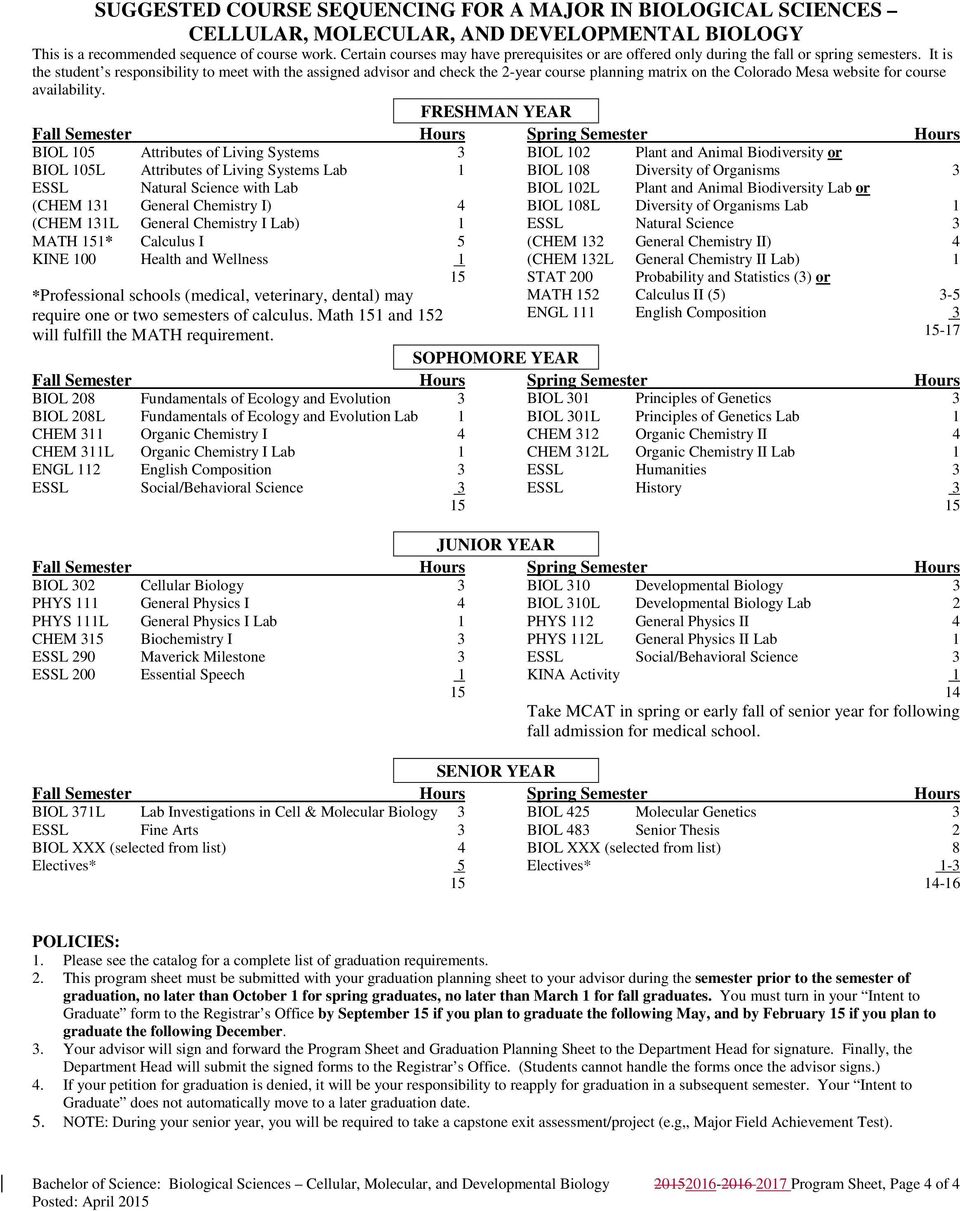
14 SUGGESTED COURSE SEQUENCING FOR A MAJOR IN BIOLOGICAL SCIENCES CELLULAR, MOLECULAR, AND DEVELOPMENTAL BIOLOGY This is a recommended sequence of course work. Certain courses may have prerequisites or are offered only during the fall or spring semesters. It is the student s responsibility to meet with the assigned advisor and check the 2-year course planning matrix on the Colorado Mesa website for course availability. FRESHMAN YEAR Fall Semester Hours Spring Semester Hours BIOL 105 Attributes of Living Systems 3 BIOL 102 Plant and Animal Biodiversity or BIOL 105L Attributes of Living Systems Lab 1 BIOL 108 Diversity of Organisms 3 ESSL Natural Science with Lab BIOL 102L Plant and Animal Biodiversity Lab or (CHEM 131 General Chemistry I) 4 BIOL 108L Diversity of Organisms Lab 1 (CHEM 131L General Chemistry I Lab) 1 ESSL Natural Science 3 MATH 151* Calculus I 5 (CHEM 132 General Chemistry II) 4 KINE 100 Health and Wellness 1 (CHEM 132L General Chemistry II Lab) 1 15 STAT 200 Probability and Statistics (3) or *Professional schools (medical, veterinary, dental) may MATH 152 Calculus II (5) 3-5 require one or two semesters of calculus. Math 151 and 152 will fulfill the MATH requirement. ENGL 111 English Composition SOPHOMORE YEAR Fall Semester Hours Spring Semester Hours BIOL 208 Fundamentals of Ecology and Evolution 3 BIOL 301 Principles of Genetics 3 BIOL 208L Fundamentals of Ecology and Evolution Lab 1 BIOL 301L Principles of Genetics Lab 1 CHEM 311 Organic Chemistry I 4 CHEM 312 Organic Chemistry II 4 CHEM 311L Organic Chemistry I Lab 1 CHEM 312L Organic Chemistry II Lab 1 ENGL 112 English Composition 3 ESSL Humanities 3 ESSL Social/Behavioral Science 3 15 ESSL History 3 15 Fall Semester BIOL 302 Cellular Biology 3 PHYS 111 General Physics I 4 PHYS 111L General Physics I Lab 1 CHEM 315 Biochemistry I 3 ESSL 290 Maverick Milestone 3 ESSL 200 Essential Speech 1 15 Fall Semester BIOL 371L Lab Investigations in Cell & Molecular Biology 3 ESSL Fine Arts 3 BIOL XXX (selected from list) 4 Electives* 5 15 JUNIOR YEAR Hours Spring Semester Hours BIOL 310 Developmental Biology 3 BIOL 310L Developmental Biology Lab 2 PHYS 112 General Physics II 4 PHYS 112L General Physics II Lab 1 ESSL Social/Behavioral Science 3 KINA Activity 1 14 Take MCAT in spring or early fall of senior year for following fall admission for medical school. SENIOR YEAR Hours Spring Semester Hours BIOL 425 Molecular Genetics 3 BIOL 483 Senior Thesis 2 BIOL XXX (selected from list) 8 Electives* POLICIES: 1. Please see the catalog for a complete list of graduation requirements. 2. This program sheet must be submitted with your graduation planning sheet to your advisor during the semester prior to the semester of graduation, no later than October 1 for spring graduates, no later than March 1 for fall graduates. You must turn in your Intent to Graduate form to the Registrar s Office by September 15 if you plan to graduate the following May, and by February 15 if you plan to graduate the following December. 3. Your advisor will sign and forward the Program Sheet and Graduation Planning Sheet to the Department Head for signature. Finally, the Department Head will submit the signed forms to the Registrar s Office. (Students cannot handle the forms once the advisor signs.) 4. If your petition for graduation is denied, it will be your responsibility to reapply for graduation in a subsequent semester. Your Intent to Graduate does not automatically move to a later graduation date. 5. NOTE: During your senior year, you will be required to take a capstone exit assessment/project (e.g,, Major Field Achievement Test). Bachelor of Science: Biological Sciences Cellular, Molecular, and Developmental Biology Program Sheet, Page 4 of 4 Posted: April 2015
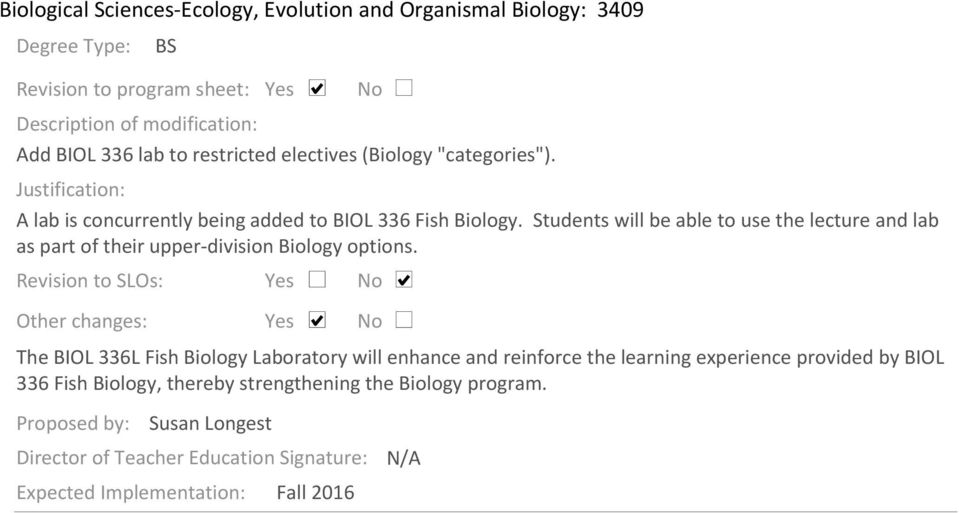
15 Biological Sciences-Ecology, Evolution and Organismal Biology: 3409 Degree Type: BS Revision to program sheet: Justification: Description of modification: Add BIOL 336 lab to restricted electives (Biology "categories"). A lab is concurrently being added to BIOL 336 Fish Biology. Students will be able to use the lecture and lab as part of their upper-division Biology options. Revision to SLOs: Other changes: The BIOL 336L Fish Biology Laboratory will enhance and reinforce the learning experience provided by BIOL 336 Fish Biology, thereby strengthening the Biology program. Proposed by: Susan Longest Director of Teacher Education Signature: Expected Implementation: Fall 2016 N/A
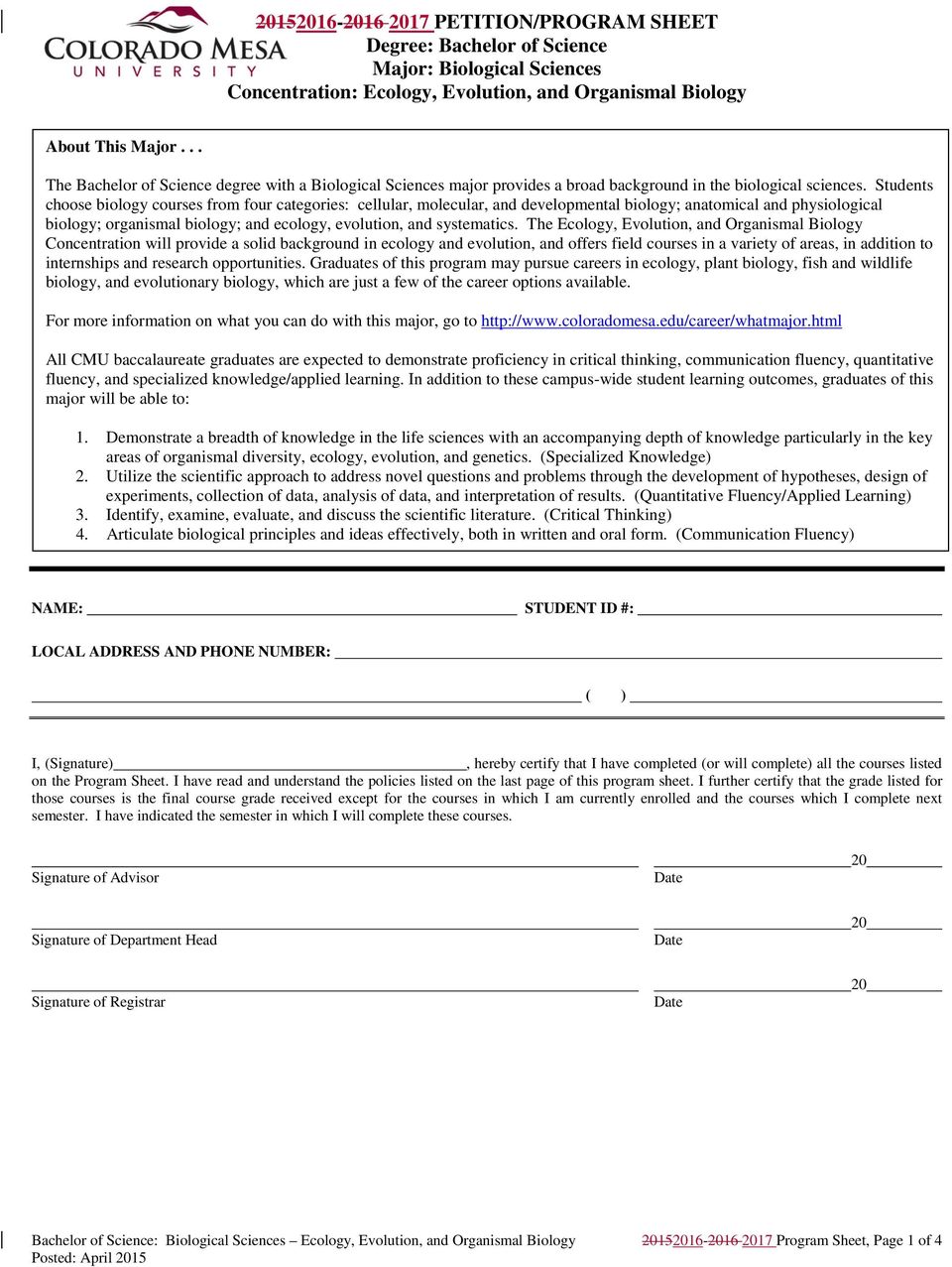
16 PETITION/PROGRAM SHEET Degree: Bachelor of Science Major: Biological Sciences Concentration: Ecology, Evolution, and Organismal Biology About This Major... The Bachelor of Science degree with a Biological Sciences major provides a broad background in the biological sciences. Students choose biology courses from four categories: cellular, molecular, and developmental biology; anatomical and physiological biology; organismal biology; and ecology, evolution, and systematics. The Ecology, Evolution, and Organismal Biology Concentration will provide a solid background in ecology and evolution, and offers field courses in a variety of areas, in addition to internships and research opportunities. Graduates of this program may pursue careers in ecology, plant biology, fish and wildlife biology, and evolutionary biology, which are just a few of the career options available. For more information on what you can do with this major, go to All CMU baccalaureate graduates are expected to demonstrate proficiency in critical thinking, communication fluency, quantitative fluency, and specialized knowledge/applied learning. In addition to these campus-wide student learning outcomes, graduates of this major will be able to: 1. Demonstrate a breadth of knowledge in the life sciences with an accompanying depth of knowledge particularly in the key areas of organismal diversity, ecology, evolution, and genetics. (Specialized Knowledge) 2. Utilize the scientific approach to address novel questions and problems through the development of hypotheses, design of experiments, collection of data, analysis of data, and interpretation of results. (Quantitative Fluency/Applied Learning) 3. Identify, examine, evaluate, and discuss the scientific literature. (Critical Thinking) 4. Articulate biological principles and ideas effectively, both in written and oral form. (Communication Fluency) NAME: STUDENT ID #: LOCAL ADDRESS AND PHONE NUMBER: ( ) I, (Signature), hereby certify that I have completed (or will complete) all the courses listed on the Program Sheet. I have read and understand the policies listed on the last page of this program sheet. I further certify that the grade listed for those courses is the final course grade received except for the courses in which I am currently enrolled and the courses which I complete next semester. I have indicated the semester in which I will complete these courses. Signature of Advisor Date 20 Signature of Department Head Date 20 Signature of Registrar Date 20 Bachelor of Science: Biological Sciences Ecology, Evolution, and Organismal Biology Program Sheet, Page 1 of 4 Posted: April 2015
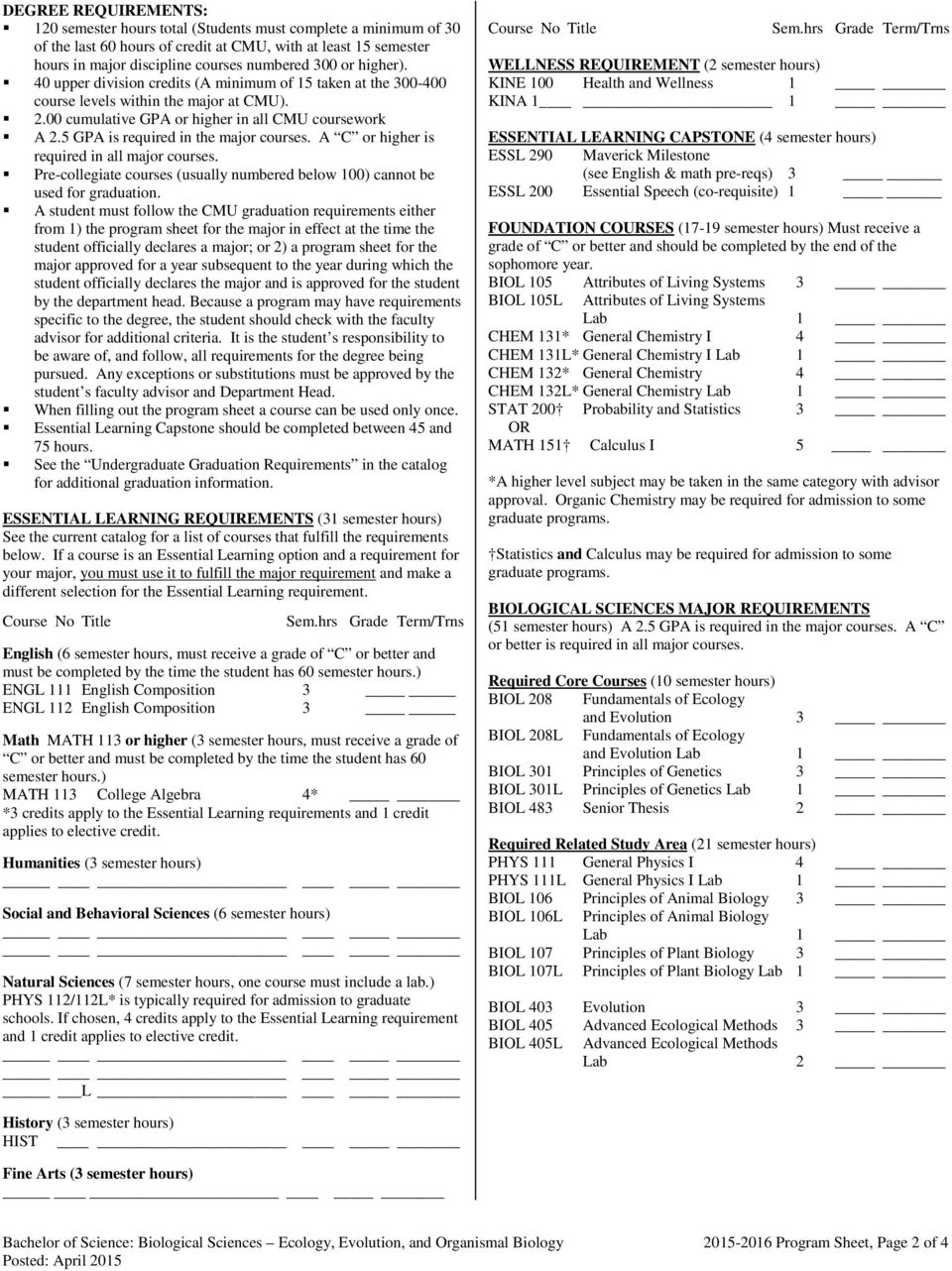
17 DEGREE REQUIREMENTS: 120 semester hours total (Students must complete a minimum of 30 of the last 60 hours of credit at CMU, with at least 15 semester hours in major discipline courses numbered 300 or higher). 40 upper division credits (A minimum of 15 taken at the course levels within the major at CMU) cumulative GPA or higher in all CMU coursework A 2.5 GPA is required in the major courses. A C or higher is required in all major courses. Pre-collegiate courses (usually numbered below 100) cannot be used for graduation. A student must follow the CMU graduation requirements either from 1) the program sheet for the major in effect at the time the student officially declares a major; or 2) a program sheet for the major approved for a year subsequent to the year during which the student officially declares the major and is approved for the student by the department head. Because a program may have requirements specific to the degree, the student should check with the faculty advisor for additional criteria. It is the student s responsibility to be aware of, and follow, all requirements for the degree being pursued. Any exceptions or substitutions must be approved by the student s faculty advisor and Department Head. When filling out the program sheet a course can be used only once. Essential Learning Capstone should be completed between 45 and 75 hours. See the Undergraduate Graduation Requirements in the catalog for additional graduation information. ESSENTIAL LEARNING REQUIREMENTS (31 semester hours) See the current catalog for a list of courses that fulfill the requirements below. If a course is an Essential Learning option and a requirement for your major, you must use it to fulfill the major requirement and make a different selection for the Essential Learning requirement. Course Title Sem.hrs Grade Term/Trns English (6 semester hours, must receive a grade of C or better and must be completed by the time the student has 60 semester hours.) ENGL 111 English Composition 3 ENGL 112 English Composition 3 Math MATH 113 or higher (3 semester hours, must receive a grade of C or better and must be completed by the time the student has 60 semester hours.) MATH 113 College Algebra 4* *3 credits apply to the Essential Learning requirements and 1 credit applies to elective credit. Humanities (3 semester hours) Social and Behavioral Sciences (6 semester hours) Natural Sciences (7 semester hours, one course must include a lab.) PHYS 112/112L* is typically required for admission to graduate schools. If chosen, 4 credits apply to the Essential Learning requirement and 1 credit applies to elective credit. L Course Title Sem.hrs Grade Term/Trns WELLNESS REQUIREMENT (2 semester hours) KINE 100 Health and Wellness 1 KINA 1 1 ESSENTIAL LEARNING CAPSTONE (4 semester hours) ESSL 290 Maverick Milestone (see English & math pre-reqs) 3 ESSL 200 Essential Speech (co-requisite) 1 FOUNDATION COURSES (17-19 semester hours) Must receive a grade of C or better and should be completed by the end of the sophomore year. BIOL 105 Attributes of Living Systems 3 BIOL 105L Attributes of Living Systems Lab 1 CHEM 131* General Chemistry I 4 CHEM 131L* General Chemistry I Lab 1 CHEM 132* General Chemistry 4 CHEM 132L* General Chemistry Lab 1 STAT 200 Probability and Statistics 3 OR MATH 151 Calculus I 5 *A higher level subject may be taken in the same category with advisor approval. Organic Chemistry may be required for admission to some graduate programs. Statistics and Calculus may be required for admission to some graduate programs. BIOLOGICAL SCIENCES MAJOR REQUIREMENTS (51 semester hours) A 2.5 GPA is required in the major courses. A C or better is required in all major courses. Required Core Courses (10 semester hours) BIOL 208 Fundamentals of Ecology and Evolution 3 BIOL 208L Fundamentals of Ecology and Evolution Lab 1 BIOL 301 Principles of Genetics 3 BIOL 301L Principles of Genetics Lab 1 BIOL 483 Senior Thesis 2 Required Related Study Area (21 semester hours) PHYS 111 General Physics I 4 PHYS 111L General Physics I Lab 1 BIOL 106 Principles of Animal Biology 3 BIOL 106L Principles of Animal Biology Lab 1 BIOL 107 Principles of Plant Biology 3 BIOL 107L Principles of Plant Biology Lab 1 BIOL 403 Evolution 3 BIOL 405 Advanced Ecological Methods 3 BIOL 405L Advanced Ecological Methods Lab 2 History (3 semester hours) HIST Fine Arts (3 semester hours) Bachelor of Science: Biological Sciences Ecology, Evolution, and Organismal Biology Program Sheet, Page 2 of 4 Posted: April 2015
18 Course Title Sem.hrs Grade Term/Trns Course Title Sem.hrs Grade Term/Trns Additional Biology Courses (20 semester hours, chosen from the lists below) At least 16 of the credit hours must be 300 level or above. Electives (13-15 credit hours) (All college level courses, not listed above, that will bring your total semester hours to 120 hours, including 40 upper division hours.) Up to 10 upper division hours may be needed. BIOL 499 Internship or research courses are recommended. MATH 113 College Algebra 1* PHYS112/112L General Physics 1* Category 1: Cellular, Molecular, and Developmental BIOL 302 Cellular Biology (3) BIOL 310/310L Developmental Biology and Lab (3) / (2) BIOL 343 Immunology (3) BIOL 344/344L Forensic Molecular Biology and Lab (3) / (1) BIOL 371L Lab Investigations in Cellular and Molecular Biology (3) BIOL 425 Molecular Genetics (3) BIOL 442 Pharmacology (3) CHEM 315/315L Biochemistry I and Lab (3) / (1) CHEM 316 Biochemistry II (3) Category 2: Organismal BIOL 250/250L Intro to Microbiology and Lab (3) / (2) BIOL 316/316L Animal Behavior and Lab (3) / (1) BIOL 322/322L Plant Identification and Lab (2) / (2) BIOL 331/331L Insect Biology and Lab (3) / (2) BIOL 333 Marine Biology (3) BIOL 335/335L Invertebrate Zoology and Lab (3) / (1) BIOL 336/336L Fish Biology (3) / (1) BIOL 350/350L Microbiology and Lab (3) / (1) BIOL 411/411L Mammalogy and Lab (3) / (1) BIOL 412/412L Ornithology and Lab (3) / (1) BIOL 413/413L Herpetology and Lab (3) / (1) BIOL 431/431L Animal Parasitology and Lab (3) / (1) BIOL 433 Marine Invertebrate Communities (3) BIOL 450/450L Mycology and Lab (3) / (2) Category 3: Anatomical and Physiological BIOL 209/209L Human Anatomy & Physiology I and Lab (3) / (1) BIOL 210/210L Human Anatomy & Physiology II and Lab (3) / (1) BIOL 241 Pathophysiology (4) BIOL 341/341L General Physiology and Lab (3) / (1) BIOL 342/342L Histology and Lab (2) / (2) BIOL 409/409L Gross and Developmental Human Anatomy (2) / (2) BIOL 410/410L Human Osteology and Lab (3) / (1) BIOL 421/421L Plant Physiology and Lab (3) / (1) BIOL 423/423L Plant Anatomy and Lab (3) / (2) BIOL 426/426L Intro to Electron Microscopy and Lab (2) / (2) BIOL 441 Endocrinology (3) Category 4: Ecology, Evolution, and Systematics BIOL 211/211L Ecosystem Biology and Lab (4) / (1) BIOL 315 Epidemiology (3) BIOL 320 Plant Systematics (3) BIOL 321/321L Taxonomy of Grasses and Lab (2) / (2) BIOL 332/332L Introduction to GIS (2) / (1) BIOL 406 Plant-Animal Interactions (3) BIOL 407 Tropical Field Biology (5) BIOL 408 Desert Ecology (3) BIOL 414/414L Aquatic Biology and Lab (3) / (1) BIOL 415 Tropical Ecosystems (2) BIOL 418/418L Wildlife Management and Lab (3) / (2) GEOL 305 Cartography for GIS (1) GEOG 131 Introduction to Cartography (3) NOTE: Topics courses (BIOL 196/296/396/496) as well as research courses (BIOL 387/487), internships (BIOL 499), teaching practicum (BIOL 493), and independent study (BIOL 495) may not be used as Additional Biology Courses but must be used for elective credit. Bachelor of Science: Biological Sciences Ecology, Evolution, and Organismal Biology Program Sheet, Page 3 of 4 Posted: April 2015

19 SUGGESTED COURSE SEQUENCING FOR A MAJOR IN BIOLOGICAL SCIENCES ECOLOGY, EVOLUTION, AND ORGANISMAL BIOLOGY This is a recommended sequence of course work. Certain courses may have prerequisites or are offered only during the Fall or Spring semesters. It is the student s responsibility to meet with the assigned advisor and check the 2 year course matrix on the Colorado Mesa website for course availability. FRESHMAN YEAR Fall Semester Hours BIOL 105 Attributes of Living Systems 3 BIOL 105L Attributes of Living Systems Lab 1 CHEM 131 General Chemistry 4 CHEM 131L General Chemistry Lab 1 MATH 113 College Algebra 4 KINE 100 Health and Wellness 1 14 Spring Semester Hours BIOL 106 Principles of Animal Biology 3 BIOL 106L Principles of Animal Biology Lab 1 CHEM 132 General Chemistry 4 CHEM 132L General Chemistry Lab 1 STAT 200 Probability and Statistics (3) or 3-5 MATH 151 Calculus I (5) ENGL 111 English Composition SOPHOMORE YEAR Fall Semester Hours BIOL 107 Principles of Plant Biology 3 BIOL 107L Principles of Plant Biology Lab 1 PHYS 111 General Physics I 4 PHYS 111L General Physics I Lab 1 ENGL 112 English Composition 3 ESSL Social/Behavioral Science 3 15 Spring Semester Hours BIOL 208 Fundamentals of Ecology and Evolution 3 BIOL 208L Fundamentals of Ecology and Evolution Lab 1 BIOL 301 Principles of Genetics 3 BIOL 301L Principles of Genetics Lab 1 ESSL Natural Science with Lab 5 (PHYS 112/112L recommended) KINA Activity 1 14 JUNIOR YEAR Fall Semester Hours BIOL 403 Evolution 3 BIOL XXX (selected from list) 6 ESSL History 3 ESSL 290 Maverick Milestone 3 ESSL 200 Essential Speech 1 16 Spring Semester Hours BIOL 405 Ecological Methods 3 BIOL 405L Ecological Methods Lab 2 ESSL Humanities 3 ESSL Social/Behavioral Science 3 Electives 4 15 SENIOR YEAR Fall Semester Hours BIOL XXX (selected from list) 7 Electives 3 ESSL Natural Science 3 ESSL Fine Arts 3 16 Spring Semester BIOL 483 Senior Thesis 2 BIOL XXX (selected from list) 7 Electives POLICIES: 1. Please see the catalog for a complete list of graduation requirements. 2. This program sheet must be submitted with your graduation planning sheet to your advisor during the semester prior to the semester of graduation, no later than October 1 for spring graduates, no later than March 1 for fall graduates. You must turn in your Intent to Graduate form to the Registrar s Office by September 15 if you plan to graduate the following May, and by February 15 if you plan to graduate the following December. 3. Your advisor will sign and forward the Program Sheet and Graduation Planning Sheet to the Department Head for signature. Finally, the Department Head will submit the signed forms to the Registrar s Office. (Students cannot handle the forms once the advisor signs.) 4. If your petition for graduation is denied, it will be your responsibility to reapply for graduation in a subsequent semester. Your Intent to Graduate does not automatically move to a later graduation date. 5. NOTE: During your senior year, you will be required to take a capstone exit assessment/project (e.g,, Major Field Achievement Test). Bachelor of Science: Biological Sciences Ecology, Evolution, and Organismal Biology Program Sheet, Page 4 of 4 Posted: April 2015

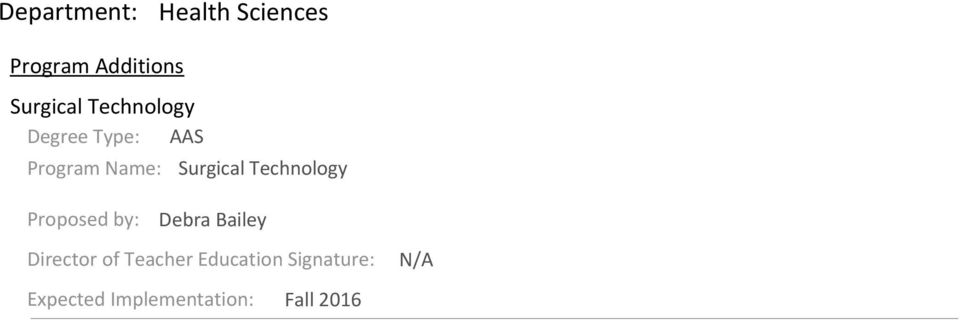
20 Department: Health Sciences Program Additions Surgical Technology Degree Type: AAS Program Name: Surgical Technology Proposed by: Debra Bailey Director of Teacher Education Signature: N/A Expected Implementation: Fall 2016
21 a. Identifying information DEPARTMENT WORKSHEET FOR PROGRAM ADDITION Colorado Mesa University Curriculum Committees NOTE: All related course changes must be submitted on separate forms. Department: Health Sciences If new department, please enter name: Program: Degree type: AAS Program/concentration Name: Surgical Technology Abbreviated program/concentration (max 30 characters ): Surgical Technology PROPOSED AND PREPARED BY: Name: Debra Bailey Date: 8/25/ Phone: Additional required information for each proposal for a program addition: (see Section IV.F of Curriculum Manual) 1. Complete items b through m on the following pages. 2. Complete the three CDHE tables at the end of this document. These tables MUST be included for all new program proposals. If any of the fields do not apply, please enter NA or other explanation. 3. Discuss the proposal with all departments affected by the program. Enter NA or dates/outcomes of such discussions Discussion with Denise Mckenney ;That sounds good! Those courses are already required by most of the Health Sciences majors and pre-majors, so it shouldn t be a problem, Denise that is fine with me you PSYC 150 is used as an essential learning course for the surgical tech program, Jessica 4. Submit complete program sheet. The most up-to-date program sheet templates are available as Word documents at R:\Curriculum\Program Sheets for Curriculum Program Modifications. 5. Submit this completed form to the Library s Curriculum Committee representative and the Director of Financial Aid a week prior to the published proposal submission deadline. 6. Obtain departmental approval according to department-specific procedures. Implementation Deadlines Program additions and modifications approved at the September-February curriculum meetings are generally implemented the following academic year. See Section II.D of the Curriculum Manual. Exceptions are rare and granted only in extenuating circumstances. To request a different effective date, the academic department head should contact the curriculum committee chair. (te: in the approval process only the VPAA will ultimately approve or deny the request.) REVIEWED BY DEPARTMENT S CURRICULUM COMMITTEE REPRESENTATIVE: Name: Diana Bailey Date: 9/1/2015 APPROVED BY DEPARTMENT HEAD: Name: Debra Bailey Date: APPROVED BY DIRECTOR OF TEACHER EDUCATION (REQUIRED FOR TEACHING PROGRAMS) Name: N/A Date: Posted: August 2015
22 Health Sciences Surgical Technology Program b. Demonstration of compliance with CMU requirements related to student learning outcomes (SLOs): 1) Identify program student learning outcomes (SLOs) 2) Identify linkage of program SLOs to institutional SLOs 3) Illustrate relationship of SLOs to proposed curriculum using curriculum map format 4) Identify planned assessments for the program SLO. CMU Student Learning Outcomes: Vision, Values and Mission: Colorado Mesa University was founded, not as an end in itself, but to enable its students and the residents of Western Colorado to create their own future and not simply enter a future that's been created for them. Within its resource constraints, the university has an obligation to offer the highest quality academic programs and services to those whom it serves to enable them to prepare for their future. Because the environment in which it functions is in a constant state of change, the university, like its students, must recognize that growth and change are an integral part of our collective future. University stakeholders must embrace the notion that change and innovation within the institution should be the norm rather than a necessity in response to crises. In this context, then, our goals are built around the theme of "Achieving a Higher Degree." This theme reflects a key element of the university s strategic plan: the philosophy that as the institution adapts to its changing world, it does so with the overarching goal of supporting the residents of Western Colorado to achieve a higher degree of educational attainment by preparing students to function successfully in the future. Colorado Mesa University values: high quality education in a student-centered environment; small class sizes and a high level of student/faculty interaction; a learning environment that develops and promotes the skills of inquiry, reflection, critical thinking, problemsolving, innovation, teamwork, and communication in students; student choice in academic programming that prepares future leaders to function as productive and responsible members of a global society; opportunities that engage students in applied learning; a faculty recognized for their professional expertise and quality of instruction; a staff committed to the highest quality of service to the College community; an attainable, accessible post-secondary experience for students in and outside of Western Colorado that emphasizes continuous improvement; a vibrant and varied campus setting that values diversity and diverse activities, and encourages involvement and interaction outside the classroom; a culture committed to integrity and academic and intellectual freedom; a community and region that supports the College in multiple ways; state-of-the-art facilities and technologies that enhance the learning environment; and a diversity of students, faculty, staff that promotes a balanced exchange of ideas. Colorado Mesa University Student Learning Outcomes CMU Institutional statement: Committed to a personal approach, Colorado Mesa Associate of Science degree graduate: Student Learning Outcomes locate, gather and organize evidence on an assigned topic Surgical Technology Program. 1. Apply knowledge and skills from the biological sciences to safely perform during the pre- operative, intra- Posted: August 2015
23 University is a dynamic learning environment that offers abundant opportunities for students and the larger community to grow intellectually, professionally, and personally. By celebrating exceptional teaching, academic excellence, scholarly and creative activities, and by encouraging diversity, critical thinking, and social responsibility, CMU advances the common good of Colorado and beyond. addressing a course or discipline-related question or a question of practice in a work or community setting (Specialized Knowledge/Applied Learning); Use program-level mathematical concepts and methods to understand, analyze, and explain issues in quantitative terms (Intellectual Skills: Quantitative Fluency); Make and defend claims in a well-organized, professional document and/or oral presentation that is appropriate for a specific audience (Intellectual Skills: Communication Fluency); Identify and gather the information/data relevant to the essential question, issue and/or problem and develop informed conclusions (Intellectual Skills: Critical Thinking). operative, and post-operative phases of patient care. (Specialized Knowledge/Applied Learning) 2. Demonstrate an understanding of the ethical, legal, moral, and medical values related to the patient and the surgical team. (Specialized Knowledge/Applied Learning) 3. Integrate knowledge gained in core surgical technology courses to prepare for the role of a surgical technologist, working with surgical interventions. (Specialized Knowledge/Applied Learning) 4. Correlate the elements, action, and use of medications and anesthetic agents used during the peri-operative experience. 5. Utilize appropriate medical terminology to communicate clearly, professionally and effectively with patients, physicians, and co-workers and provide for accurate documentation. (Communication Fluency) 6. Employ appropriate ethical, professional, and respectful values while providing care to diverse populations within the healthcare system. (Communication Fluency) 7. Utilize learned competencies to assemble and operate instruments, equipment and supplies for the delivery of patient care as an entry-level practitioner during basic surgical procedures. (Intellectual Skills: Critical Thinking). 8. Demonstrate the ability to prioritize and organize the surgical field, while considering the physiology and urgency of patient care needs.(intellectual Skills: Critical Thinking). Posted: August 2015
24 Program goals Course Mapping Assessment Outcomes Surgical Technology Program. 1. Apply knowledge and skills from the biological sciences to safely perform during the preoperative, intra-operative, and post-operative phases of patient care. (Specialized Knowledge/Applied Learning) BIOL 209; BIOL 209L; BIOL 210, BIOL 210L BIOL 241, SUTE 204 Tests Quizzes Projects 2. Demonstrate an understanding of the ethical, legal, moral, and medical values related to the patient and the surgical team. (Specialized Knowledge/Applied Learning) 3. Integrate knowledge gained in core surgical technology courses to prepare for the role of a surgical technologist, working with surgical interventions. (Specialized Knowledge/Applied Learning) 4. Correlate the elements, action, and use of medications and anesthetic agents used during the peri-operative experience. 5. Utilize appropriate medical terminology to communicate clearly, professionally and effectively with patients, physicians, and co-workers and provide for accurate documentation. (Communication Fluency) 6. Employ appropriate ethical, professional, and respectful values while providing care to diverse populations within the healthcare system. (Communication Fluency) 7. Utilize learned competencies to assemble and operate instruments, equipment and supplies for the delivery of patient care as an SUTE 202 Surgical Technology Practicum SUTE 220; SUTE 230; SUTE 240 SUTE 206 SUTE 200; SUTE 202: SUTE 206: SUTE 210; SUTE 212; SUTE 214; SUTE 220; SUTE 230; SUTE 240 SUTE 200; SUTE 202: SUTE 206: SUTE 210; SUTE 212; SUTE 214; SUTE 220; SUTE 230; SUTE 240 SUTE 220; SUTE 230; SUTE 240 Tests Surgical Lab experience Clinical evaluation Surgical case reviews, Competency tests Tests Quizzes Tests Surgical Lab experience Clinical evaluation Surgical case reviews, Competency tests Tests Surgical Lab experience Clinical evaluation Surgical case reviews, Competency tests Tests Surgical Lab experience Clinical evaluation Posted: August 2015
25 entry-level practitioner during basic surgical procedures. (Intellectual Skills: Critical Thinking). 8. Demonstrate the ability to prioritize and organize the surgical field, while considering the physiology and urgency of patient care needs. (Intellectual Skills: Critical Thinking). SUTE 220; SUTE 230; SUTE 240 Surgical case reviews, Competency tests c. Program goals as they pertain to Colorado Mesa University s goals and objectives and Colorado Mesa University s Role and Mission. The CMU mission is to serve the 14 county regional area in higher education. There is not a surgical technology program within 250 miles of CMU. Based on community need and support, the program will align with the goals of CMU. SURGICAL TECHNOLOGISTS: COLORADO Work in surgical operations areas under the supervision of surgeons, registered nurses, or other surgical personnel. They may help set up operating room, prepare and transport patients for surgery, adjust lights and equipment, pass instruments and other supplies to surgeons and surgeon's assistants, hold retractors, cut sutures, and help count sponges, needles, supplies, and instruments. d. Program strengths, special features, innovations, and/or unique elements. The challenges of meeting the demands for expert operating room surgical technologists in western Colorado has challenged multiple surgical sites. The training in the past has been nine to twelve month technical training programs. The needs to work with surgeons in the sterile field has reached a point requiring a more robust from of instruction to meet the needs of the more acute surgical cases. An associate degree in Surgical Technology meets the increasing more challenging technological advance being seen and utilized in the surgical setting on a dally bases. The use of complex equipment such as lasers and robotics requires the education that can be obtained in the surgical technology program at CMU. e. External agencies, such as program accreditations, professional associations, as well as licensing requirements that have helped shape the program s curriculum (i.e., effects such as length of the program, on program content or mode of delivery, etc.). Do faculty members anticipate seeking program accreditation at appropriate date? Posted: August 2015
26 Currently all Surgical Technologists are required to obtain licensure in the state of Colorado The Association of Surgical Technologist (AST) does provide guidelines for developing core curriculums to assist in the development of programs such as the proposed Surgical Technology program at CMU. It is anticipated that the faculty members involved in the program will seek accreditation when the program meets the criteria. f. Program admissions requirements (if any beyond admission to institution). 1. Admission to Colorado Mesa University 2. Admission to Surgical Technology Program in Health Sciences 3. Recommendation letter from Director of Surgical Center or Hospital 4. Criminal Background Check, Immunizations, CPR card, student Malpractice documents required. 5. Interview with Program Director 6. Confirmation of Essential Skills: The following are essential program Requirements for students enrolled at Colorado Mesa University Surgical Technology Program. The ability to meet all of these requirements, with or without accommodation, is necessary to be able to demonstrate clinical competency and to meet program outcomes required for graduation. For information regarding disabilities accommodations, please contact the EAS office at CMU. Initial beside each statement you understand and able to comply with the statement: 1. Intact gross and fine motor skills; precise hand/eye coordination and dexterity and the ability to discriminate tactile sensations. 2. Clear speech. 3. Congruent verbal/nonverbal behavior; emotional stability; cooperative; no signs of impaired judgment. 4. Able to walk, bend, stoop, kneel, stand, twist, sit, carry, lift, reach hands overhead. 5. Able to evacuate a 4-story building in less than 3 minutes. 6. Able to sit and stand long periods of time (4-7 hours in class; 8-12 hours in clinical). 7.Able to pull 75 lbs; lift 35 lbs; push 100 lbs. 8. Able to travel independently to clinical sites as assigned. 9. Intact short and long-term memory. 10. Visual color discrimination and depth perception; near and far vision 20/20 (may be corrected with lenses). 11. Able to hear and discriminate alarms (may be corrected with hearing aid). 12. Able to detect odors sufficient to maintain environmental safety, including smoke and noxious odors. 13. Frequent exposure to electricity, electromagnetic fields, electronic media and latex; chemical hazards including but not limited to disinfecting solutions, dyes, acetone, bleach, and alcohol. 14. Possible exposure to toxic drugs; anesthetic gases; ionizing radiation; infectious agents (blood, urine, mucus, saliva, etc.) 15. MEDICATION MANAGEMENT: The use of medication/substances that may cause drowsiness or otherwise impair mental or physical functioning, whether prescribed, over-the-counter, or illegal, is prohibited during class, lab and clinical experiences because of the potential safety hazards to self, co-workers, and patients. g. Rationale and justification for the program demonstrating the demand, as evidenced by: (1) Employer need/demand as demonstrated by evidence such as: Posted: August 2015
27 (a) identification of several potential employers of program graduates; (b) projected regional and/or statewide need for graduates from current labor market analyses and/or future workforce projections/studies (potential source: (c) surveys made by external agencies; (d) letters of direct employer support may be used. Include letters indicating the availability of positions for graduates of the proposed programs, signed by individual in a senior position of authority.page 27 of 41 (2) Student demand as demonstrated by evidence such as surveys of potential students to answer the question: what is the student population served by program implementation? In 2014, St. Mary s Hospital asked for a partnership with CMU Health Sciences to start a Surgical Technology Program. The need for surgical Technologists in western Colorado has steadily increased in the last several years. Currently there are ten surgical sites that have formed a working group, with St. Mary s Hospital taking the lead, to start a Surgical Technologist program through CMU. Currently the need is filled with traveling surgical technologists, leading to high turnover rates. St. Mary s Hospital has two surgical suites that are not in use after the renovation of new surgical areas. The partnership allows an expensive health care program to be started, with resources available through partnering hospitals. Surgical supplies and equipment are readily available through the 10 partnering clinical sites. The closest surgical Technologist programs are in Denver and Salt Lake City. Below are the trends for expected job openings in Colorado for the next 7 years to be at 36 % growth. High paying salaries for these jobs exceeds the average salary in Colorado for a person with an associate degree. State and National Trends United States Employment Percent Change Projected Annual Job Openings 1 Surgical Technologists 98, , % 3,910 Colorado Employment Percent Change Projected Annual Job Openings 1 Surgical Technologists 1,700 2, % 80 1 Projected Annual Job Openings refers to the average annual Location United States Colorado Pay Period % 25% Median 75% 90% Hourly $14.80 $17.11 $20.84 $25.43 $29.89 Yearly $30,800 $35,600 $43,300 $52,900 $62,200 Hourly $16.46 $19.63 $24.17 $28.50 $33.09 Yearly $34,200 $40,800 $50,300 $59,300 $68,800 & Colorado The Current representatives meeting are from the surgical areas of St. Mary s Hospital, Grand Valley Surgical Center, Community Hospital, Delta Memorial Hospital, Montrose Hospital, Telluride Medical Center, Craig Hospital, Meeker, Hospital, Rangely Hospital, Valley View Hospital, Aspen Valley Hospital, Durango and San Juan Hospital. Posted: August 2015
28 h. Relationship of the proposed program to existing programs on campus and to similar programs within the state, with a rationale reflecting that proposed program demand cannot be met by another program (i.e., program implementation is not an unnecessary duplication). The Surgical Technology programs in the State of Colorado are in the Denver Metro and eastern Colorado. Beyond the geographical issues of accessing these programs, it is known in the research literature that students tend to stay where they are trained especially in rural areas. Unsuccessful recruitment from the programs over the last several years has led to the dearth of available well trained and experienced Surgical Technologists in the western Colorado Region. i. Curriculum, including identification of new courses and the numbers, names, and sequencing of all courses, as well as demonstration of compliance with CMU's Credit Hour Policy as required by the U.S. Department of Education and articulated by the Higher Learning Commission; Program Sheet attached. Course Additions attached Core Curriculum from Accreditation agency CORE CURRICULUM FOR SURGICAL TECHNOLOGY: I. Healthcare sciences A. Anatomy and physiology B. Pharmacology and anesthesia C. Medical terminology D. Microbiology E. Pathophysiology II. Technological sciences A. Electricity B. Information technology C. Robotics III. Patient care concepts A. Biopsychosocial needs of the patient B. Death and dying IV. Surgical technology A. Preoperative 1. n-sterile a. Attire b. Preoperative physical preparation of the patient c. Patient identification d. Transportation e. Review of the chart f. Surgical consent g. Transfer h. Positioning i. Urinary catheterization j. Skin preparation k. Equipment l. Instrumentation 2. Sterile a. Asepsis and sterile technique b. Hand hygiene and surgical scrub Posted: August 2015
29 c. Gowning and gloving d. Surgical counts e. Draping B. Intra-operative: Sterile 1. Specimen care 2. Abdominal incisions 3. Hemostasis 4. Exposure 5. Catheters and drains 6. Wound closure 7. Surgical Dressings 8. Wound healing 9. Tissue replacement materials 10. Emergency patient situations C. Postanesthesia care unit 1. Methods of disinfection and sterilization 2. Sterile storage & distribution 3. Environmental disinfection of the OR D. Perioperative case management E. Assistant circulator role F. Surgical procedures 1. Surgical specialties a. General b. Obstetric and gynecology c. Genitourinary d. Otorhinolaryngology e. Orthopedic f. Oral and maxillofacial g. Plastic and reconstructive h. Ophthalmic i. Cardiothoracic j. Peripheral vascular k. Neurosurgery G. Surgical rotation 1. Surgical rotation case requirements 2. First and second scrub role and observation V. Professional Practice A. Professionalism 1. Professional management 2. Employability skills 3. Communication skills and teamwork 4. Ethical and moral issues 5. Legal issues, documentation and risk management B. Health care facility information 1. Health care facility organization and management 2. Physical environment 3. All-hazards preparation Posted: August 2015
30 j. List of faculty and their qualifications. (Is there a need for additional faculty?) The program will initially require the addition of one faculty member. The individual can perform the duties of both the program Director and faculty for the initial first cohort. The second cohort will need a second faculty as the program director will be required to meet specific roles of the Program Director and apply and prepare for the accreditation of the new program. k. Description of learning resources needed for implementation. Scope and quality of library holdings, laboratories, clinical facilities, and technological support as applicable. Department s recommendations for additions to the Library s collection. Library resources will need to be added, however with this type of program most resources will come from the clinical sites. Students will purchase online clinical resources as study aids for specific classes. Surgical Technology/Principles and Practice. 6 th Edition/ Joanna Kotcher Fuller; Prepared by: Surgical Technology Program Director; Virginia College; Macon, Georgia Julie Armistead, CST, CRCST, BA l. Intended delivery mode for program. For programs delivering any of its coursework via 1) alternative formats, 2) outsourcing, and/or 3) a consortial relationship, the program proposal must demonstrate compliance with requirements as specified by the U.S. Department of Education and articulated in the Higher Learning Commission's policies. To demonstrate this compliance, the proposing department must submit a statement from the VPAA s office. The program will be delivered by classroom time and clinical time consistent with the Curriculum Policy Handbook. Please see time commitments for each course addition. Clinical placements wil be at surgical site affiliations in western Colorado. The program will initially require the addition of one faculty member. The individual can perform the duties of both the program Director and faculty for the initial first cohort. The second cohort will need a second faculty as the program director will be required to meet specific roles of the Program Director and apply and prepare for the accreditation of the new program. m. For Professional, Technical or Other Programs, the justification must include: (1) Rationale for program to be in the PTO category. (2) Statement as to how the curriculum aligns to the requirements or recommendations of the nationally recognized accrediting, licensing, certifying or professional organization. (3) Rationale for the program to exceed 60 credit hours, if applicable. (4) Rationale for prescribing Applied Studies courses, if applicable. (5) Explanation as to how a transfer student with an AA degree in the discipline of that program can graduate by completing only an additional 60 hours. Most Health Sciences programs are in the PTO category due to the length of the programs and the need for accreditation. The Surgical Technology Program will work towards accreditation in the second year of its operation. The Program follows the Association of Surgical Technologists (AST) curriculum. Posted: August 2015
31 Name of Program: Surgical Technology Program TABLE 1: ENROLLMENT PROJECTIONS Degree Title AAS in Surgical Technology Name of Institution: Colorado Mesa University AAS degree DEFINITIONS: Academic year is the period beginning July 1 and concluding June 30. Headcount projections represent an unduplicated count of those students officially admitted to the program and enrolled at the institution during the academic year. FTE is defined as the full-time equivalent number of those students majoring in the program, regardless of the classes enrolled, during the academic year. Program graduate is defined as a student who finishes all academic program requirements and graduates with a formal award within a particular academic year. SPECIAL NOTES: To calculate the annual headcount enrollment, add new enrollees to the previous year headcount and subtract the number who graduated in the preceding year. Adjust by the anticipated attrition rate. To calculate FTE, multiply the number of students times the projected number of credit hours degree seeking students will be typically enrolled in per year and divide by 30. The data in each column is the annual unduplicated number of declared program majors. Since this table documents program demand, course enrollments are not relevant and shall not be included in the headcount or FTE data. Yr 1 Yr 2 Yr 3 Yr 4 Yr 5 Full Implementation 1-a In-state Headcount 1-b Out-of-State Headcount Program Headcount 3-a In-state FTE b Out-of-State FTE Program FTE Program Graduates Signature of Governing Board Officer Date Posted: August 2015
32 TABLE 2: PHYSICAL CAPACITY ESTIMATES Name of Program: Surgical Technology Program AAS Name of Institution: _Colorado Mesa University Health Sciences Surgical Technology Program Purpose: This table documents the physical capacity of the institution to offer the program and/or the plan for achieving the capacity. Complete A or B. Part A I certify that this proposed degree program can be fully implemented and accommodate the enrollment projections provided in this proposal without requiring additional space or renovating existing space during the first five years. Governing Board Capital Construction Officer Date Part B ASSIGNABL E SQUARE FEET Column 1 Column 2 Column 3 Column 4 Colu mn 5 TOTAL NEEDED AVAILABLE RENOVATION NEW CONSTRUCTION LEAS E/ REN T TYPE OF Immed Future Immed Future SPACE Classroom St. Mary s Hospi tal 2 surgic al suites in kind space Instructional Lab 1 if at future time St. Mary s Surgical suites is designate d for reuse 2 Surgical Suites available at St. Mary s Hospital Offices 2 2 DHS is planning renovatio n in 2016 At DHS new building in Communit y Hospital if St. Mary s becomes unavailable ne anticipated new DHS Center north of Orchard Ave future space in Communit y Hospital to become a Column 6 REVENU E SOURCE* Tuition Posted: August 2015
33 Study ne ne Planned study area for Health Science Students Special/ General Use Other TOTAL permanent lab. * Capital Construction Fund (CCF), Research Building Revolving Fund (RBRF), Gift (GIFT), Grant (GR), Auxiliary Fund (AUX) Attach a narrative describing the institutional contingency plan that addresses the space requirements of the proposed program or alternative delivery options, in the event that the request for capital construction or renovation is not approved. Governing Board Capital Construction Officer Date Approved Policy I-B-10 June 5, 2003 Posted: August 2015
34 TABLE 3 PROJECTED EXPENSE AND REVENUE ESTIMATES All cost and revenue projections should be in constant dollars (do not include an inflation factor). ESTIMATED AMOUNT IN DOLLARS (PV) Year 1 Year 2 Year 3 Year 4 Year 5 Operating Expenses: 1 Faculty 50, ,000 56,000 60,000 60,000 2 Financial Aid specific to program 3 Instructional Materials Program Administration Current DHS will cover Current DHS will cover Current DHS will cover Current DHS will cover Current DHS will cover 5 Rent/Lease In kind from Renovation St. Mary s of Community Hospital surgical suite 6 Other Operating Costs Faculty Faculty Total Operating 52,000 53,000 56,000 60,000 60,000 Expenses Program Start-Up Expenses 8 Capital Construction Equipment Acquisitions Donated By western Health Alliance Library Acquisitions Total Program Start-Up Exp. Unknown depending on equipment from St. Mary s TOTAL PROGRAM EXPENSES To be determined Enrollment Revenue 12 General Fund: State Support 13 Cash Revenue: Tuition 68 credit hours (8 in state, 2 out of state) 14 Cash Revenue: Fees per course x 11 courses per student Depending on student enrollment and need for expansion To be determined 56,000 60,000 60, credit hours (8 in state, 2 out of state) per course x 11 courses per student 68 credit hours (8 in state, 2 out of state) per course x 11 courses per student 68 credit hours (8 in state, 2 out of state) per course x 11 courses per student Other Revenue 15 Federal Grants Corporate 10, Grants/Donations 17 Other fund sources * In kind for clinical practicum sites for In kind for clinical practicum sites for credit hours (8 in state, 2 out of state) per course x 11 courses per student Posted: August 2015
35 training training 18 Institutional Reallocation ** TOTAL PROGRAM 144, , , , , REVENUE ** If revenues are projected in this line, please attach an explanation of the specific source of the funds. If reallocated, the specific departments and the impact the dollars will have on the departments that will provide the reallocated dollars. Signature of Governing Board Financial Officer Title Date Approved Policy I-B-12 June 5, 2003 Posted: August 2015
36 PETITION/PROGRAM SHEET Degree: Associate of Applied Science Major: Surgical Technology About This Degree... The Associates of Applied Science Surgical Technology Program is designed to cover both the academic and clinical skills necessary to perform as a surgical technologist. The program begins fall semester of each year. Certain prerequisite courses must be completed prior to admission to the professional portion, the 2nd year, of this program. Students will complete this Associate Degree program in sequence with prerequisites and Essential Learning courses the first year. The application process will occur in the second semester or their first year. Once accepted to the program, the second year will prepare students to work as operating room technologists and assist in surgical operations. Surgical technologists work as members of a healthcare team alongside surgeons, registered nurses, and other health care workers. They prepare operating rooms, arrange equipment, and help doctors during surgeries. Students will be prepared to work in many areas of the surgery setting including preparing patients for surgery by washing and disinfecting incision sites, positioning patients on the operating table, covering patients with sterile drapes, and taking patients to and from the operating room. Surgical technologists prepare sterile solutions and medications used in surgery and check that all surgical equipment is working properly. They help the surgical team put on sterile gowns and gloves. During an operation, surgical technologists pass instruments and supplies to surgeons and first assistants. They also hold retractors and may hold internal organs in place during the procedure. Technologists also may handle specimens taken for laboratory analysis. Surgical technologists who take and pass the certifying examination offered by the NBSTSA (National Board for Surgical Technology and Surgical Assisting) are certified and authorized to use the initials CST to designate their status as a Certified Surgical Technologist. Certification can be a means of upward mobility, a condition of employment, a route to higher salary, or a source of national recognition. For more information on what you can do with this major, go to All CMU associate graduates are expected to demonstrate proficiency in critical thinking, communication fluency, quantitative fluency, and specialized knowledge/applied learning. In addition to these campus-wide student-learning outcomes, graduates of this major will be able to: 1. Apply knowledge and skills from the biological sciences to safely perform during the pre- operative, intra-operative, and postoperative phases of patient care. (Specialized Knowledge/Applied Learning) 2. Demonstrate an understanding of the ethical, legal, moral, and medical values related to the patient and the surgical team. (Specialized Knowledge/Applied Learning) 3. Integrate knowledge gained in core surgical technology courses to prepare for the role of a surgical technologist, working with surgical interventions. Specialized Knowledge/Applied Learning) 4. Correlate the elements, action, and use of medications and anesthetic agents used during the peri-operative experience. (Intellectual Skills Quantitative fluency) 5. Utilize appropriate medical terminology to communicate clearly, professionally, and effectively with patients, physicians, and coworkers and provide for accurate documentation. (Communication Fluency) 6. Employ appropriate ethical, professional, and respectful values while providing care to diverse populations within the healthcare system. (Communication Fluency) 7. Utilize learned competencies to assemble and operate instruments, equipment, and supplies for the delivery of patient care as an entry-level practitioner during basic surgical procedures. (Intellectual Skills: Critical Thinking). 8. Demonstrate the ability to prioritize and organize the surgical field, while considering the physiology and urgency of patient care needs. (Intellectual Skills: Critical Thinking). NAME: STUDENT ID #: LOCAL ADDRESS AND PHONE NUMBER: ( ) I, (Signature), hereby certify that I have completed (or will complete) all the courses listed on the Program Sheet. I have read and understand the policies listed on the last page of this program sheet. I further certify that the grade listed for those courses is the final course grade received except for the courses in which I am currently enrolled and the courses which I complete next semester. I have indicated the semester in which I will complete these courses. Signature of Advisor Signature of Department Head Date Date Signature of Registrar Associate of Applied Science: Surgical Technology Program Sheet, Page 1 of 3 Posted: Date 20
37 Course Title Sem.hrs Grade Term/Trns DEGREE REQUIREMENTS: 68 semester hours total (A minimum of 15 of the final 30 semester hours of credit at CMU) cumulative GPA or higher in all CMU coursework and in coursework toward major content. Pre-collegiate courses (usually numbered below 100) cannot be used for graduation. A student must follow the CMU graduation requirements either from 1) the program sheet for the major in effect at the time the student officially declares a major; or 2) a program sheet for the major approved for a year subsequent to the year during which the student officially declares the major and is approved for the student by the department head. Because a program may have requirements specific to the degree, the student should check with the faculty advisor for additional criteria. It is the student s responsibility to be aware of, and follow, all requirements for the degree being pursued. Any exceptions or substitutions must be approved by the student s faculty advisor and Department Head. When filling out the program sheet a course can be used only once. See the Undergraduate Graduation Requirements in the catalog for additional graduation information. ESSENTIAL LEARNING REQUIREMENTS (Minimum 15 semester hours) See the current catalog for a list of courses that fulfill the requirements below. If a course is on the Essential Learning list of options and a requirement for your major, you must use it to fulfill the major requirement and make a different selection within the Essential Learning requirement. The Essential Learning capstone course and co-requisite Essential Speech course (required for bachelor s degrees) cannot be used as options for the below requirements. Course Title Sem.hrs Grade Term/Trns Communication (6 semester hours) ENGL 111 English Composition 3 *ENGL 112 English Composition 3 Social Sciences, Natural Science, Fine Arts, or Humanities (6 semester hours) *PSYC 150 General Psychology 3 3 WELLNESS REQUIREMENT (2 semester hours) KINE 100 Health and Wellness 1 KINA 1 1 FOUNDATION PREREQUISITE COURSES (12 semester hours) *BIOL 209 Human Anat & Physiology 3 *BIOL 209L Human Anat & Physiology Lab 1 *BIOL 210 Human Anat & Physiology 3 *BIOL 210L Human Anat & Physiology Lab 1 *BIOL 241 Pathophysiology 4 ASSOCIATE OF APPLIED SCIENCE: SURGICAL TECHNOLOGY COURSE REQUIREMENTS (39 semester hours) These courses must be completed in sequence and may only be taken after acceptance into the Program. Core Courses (38 semester hours) SUTE 200 Medical Term in Surg Tech 3 SUTE 202 Fundamentals in Surg Tech 4 SUTE 204 Basic Surg Tech Skills Lab 4 SUTE 206 Pharmacology for Surg Tech 2 SUTE 210 Safety in Surgical Technology 3 SUTE 212 Surgical Procedures I 3 SUTE 214 Surgical Procedures II 3 SUTE 218 Specialty Surgical Procedures 4 SUTE 220 Surgical Practicum I 4 SUTE 230 Surgical Practicum II 4 SUTE 240 Surgical Practicum III 4 Elective Credit (1 semester hour) MATH 113 College Algebra+ 1 Math (3 semester hours) *MATH 113 College Algebra or higher+ 3 *Required by this program +MATH 113 is a 4 credit course. 3 credits count towards the Essential Learning requirement and 1 credit counts as Elective credit. Associate of Applied Science: Surgical Technology Program Sheet, Page 2 of 3 Posted:
38 SUGGESTED COURSE SEQUENCING FOR A MAJOR IN SURGICAL TECHNOLOGY This is a recommended sequence of course work. Certain courses may only be offered during the Fall or Spring semesters. It is the student s responsibility to meet with the assigned advisor and check the two year course matrix on the Colorado Mesa website for course availability. FIRST YEAR Fall Semester Hours ENGL 111 English Composition 3 MATH 113 College Algebra 4 BIOL 209 Human Anat & Physiology 3 BIOL 209L Human Anat & Physiology Lab 1 KINE 100 Health and Wellness 1 Essential Learning (Natural Sci, Fine Arts, or Humanities) 3 15 Spring Semester Hours ENGL 112 English Composition 3 BIOL 210 Human Anat & Physiology 3 BIOL 210L Human Anat & Physiology Lab 1 BIOL 241 Pathophysiology 4 PSYC 150 General Psychology 3 KINA Activity 1 15 SECOND YEAR Fall Semester Hours SUTE 200 Medical Terminology in Surgical Technology 3 SUTE 202 Fundamentals in Surgical Technology 4 SUTE 204 Basis Surgical Technology Skills Lab 4 SUTE 206 Pharmacology for Surgical Technology 2 13 Spring Semester Hours SUTE 210 Safety in Surgical Technology 3 SUTE 212 Surgical Procedures I 3 SUTE 214 Surgical Procedures II 3 SUTE 218 Specialty Surgical Procedures 4 13 Summer Semester (summer following 2 nd Year) Hours SUTE 220 Surgical Practicum I 4 SUTE 230 Surgical Practicum II 4 SUTE 240 Surgical Practicum III 4 12 POLICIES: 1. Please see the catalog for a complete list of graduation requirements. 2. This program sheet must be submitted with your graduation-planning sheet to your advisor during the semester prior to the semester of graduation, no later than October 1 for spring graduates, no later than March 1 for fall graduates. You must turn in your Intent to Graduate form to the Registrar s Office by September 15 if you plan to graduate the following May, and by February 15 if you plan to graduate the following December. 3. Your advisor will sign and forward the Program Sheet and Graduation Planning Sheet to the Department Head for signature. Finally, the Department Head will submit the signed forms to the Registrar s Office. (Students cannot handle the forms once the advisor signs.) 4. If your petition for graduation is denied, it will be your responsibility to reapply for graduation in a subsequent semester. Your Intent to Graduate does not automatically move to a later graduation date. 5. NOTE: The semester before graduation, you may be required to take a Major Field Achievement Test (exit exam). Associate of Applied Science: Surgical Technology Program Sheet, Page 3 of 3 Posted
39 Course Additions SUTE 200 Course Title: Abbreviated Title: Contact hours per week: Type of Instructional Activity: Credit Hours 3 Medical Terminology in Surgical Technology Medical Term Surg Tech Lecture 3 Lab Field Studio Other Lecture Academic engagement minutes: 2250 Student preparation minutes: 4500 Intended semesters for offering this course: Essential Learning Course: Prerequisites: Admission to the Surgical Technology Program; Completion of Surgical Technology Foundation courses BIOL 209/209L; BIOL 210/210L; BIOL 241; PSYC 150 Prerequisite for other course(s): Co-requisites: SUTE 202, SUTE 204, SUTE 206 Requirement or listed choice for any program of study: Health Sciences New Program - AAS, Surgical Technology Additional faculty FTE required: One new FTE for teaching Surgical Technology that is accredited and certified in the field. Additional equipment required: Surgical equipment that is located at St. Mary's Hospital. Additional equipment will be purchased with a grant from the Western Colorado Health Alliance Additional lab facilities required: Surgical Lab that will be located at St. Mary's Hospital Fall J-Term Spring Summer Overlapping content with present courses offered on campus: Course description for catalog: Exploration of word roots, prefixes, and suffixes used in medical language today. Students will learn to combine words to create appropriate medical conditions. Students will learn medical terms, spelling, and definitions related to major body systems, surgical procedures, and conditions associated with the operating room. Justification: See justification for the Surgical Technology Program AAS. Topical course outline: Outline: Introduction to Medical Terminology The Human Body in Health and Disease The Skeletal System The Muscular system The Cardiovascular System The Lymphatic and Immune System The Respiratory System The Endocrine System The Genito urinary System
40 Reproductive Organs The Nervous System Surgical Instrument Terminology Surgical Environment Terminology OSHA Terminology CDC Terminology Sterilization Terminology Student Learning Outcomes: Define Terms used in medical physiology and pathophysiology Identify instruments used in surgical operations Define terms used in surgical procedures Describe infectious agents, hazardous agents Define protective equipment used in the operating arena Discussions with affected departments: See Surgical Technology program addition form. Proposed by: Debra Bailey Expected Implementation: Fall 2016
41 SUTE 202 Credit Hours 4 Course Title: Abbreviated Title: Contact hours per week: Type of Instructional Activity: Fundamentals in Surgical Technology Fundamentals Surg Tech Lecture 4 Lab Field Studio Other Lecture Academic engagement minutes: 3000 Student preparation minutes: 6000 Intended semesters for offering this course: Essential Learning Course: Prerequisites: Admission to the Surgical Technology Program; Completion of Surgical Technology Foundation courses BIOL 209/209L; BIOL 210/210L; BIOL 241; PSYC 150 Prerequisite for other course(s): Co-requisites: SUTE 200, SUTE 204, SUTE 206 Requirement or listed choice for any program of study: Health Sciences New Program - AAS, Surgical Technology Additional faculty FTE required: One new FTE for teaching Surgical Technology that is accredited and certified in the field. Additional equipment required: Surgical equipment that is located at St. Mary's Hospital. Additional equipment will be purchased with a grant from the Western Colorado Health Alliance Additional lab facilities required: Surgical Lab that will be located at St. Mary's Hospital Fall J-Term Spring Summer Overlapping content with present courses offered on campus: Course description for catalog: Approaches to surgical technology. Students will learn tasks and responsibilities of the surgical technologist including the practice of sterile technique, surgical scrub, gown and glove, patient positioning, draping, and surgical prep on patients. Students will learn the practice of standard precautions in surgery. Skills will be practiced in a clinical setting. Justification: See justification for the Surgical Technology Program AAS. Topical course outline: 1. Tasks of the Surgical Technologist: a. Team work b. Communication c. Environment d. Personal Protection e. Sterilization, aseptic technique, disinfection d. Surgical Scrub, gown, glove don for self and team members. 2. Vulnerable patient populations 3. Psychosocial needs. 4. Learn the concept of surgical conscience.
42 5. Patient a. Consent b. Physical, physiological, psychological, social, spiritual and cultural needs c. Special populations d. Transfer e. Positioning f. Skin preparation for surgery g. Draping 6. Environment: a. Pre-operative b. Peri-operative c. Instruments 7. Equipment: a. Surgical supplies b. needle and suture types c. Set up for a variety of surgical cases d. Safety with equipment, sharps, body fluids, prevention of injury to patient and team e. Sterile equipment 8. Anesthesia 9. Sterile Field 10 Labeling medications 11. Electrocautery a. Prevention of burns 12. Hemeostatsis in surgery Student Learning Outcomes: 1. Explain the role and responsibilities of the surgical technologist 2. Demonstrate surgical scrub, gown and glove, patient positioning, draping and surgical prep of patients. 3. Differentiate the specific needs of surgical patients by recognizing physical, biological, psychological, spiritual, and cultural requirements. 4. Correlate the impact of microbiology in relationship to the practice of sterile technique and infection control in the operative setting. 5. Compare and contrast the structure and characteristics of different microorganisms 6. Differentiate various immune responses that occur in the body as defenses against invasion by pathogens 7. Demonstrate differences in disinfection, sterilization, and aseptic technique 8. Demonstrate patient safety in obtaining consent, preoperative procedures, transfers of patients, and patient positioning during and after surgical procedures. 9. Locate and evaluate patient information using technology. 10. Demonstrate surgical equipment set up, instrumentation uses, and disposal of hazardous materials and equipment. 12. Demonstrate the procedure for counting instruments, sponges, sharps, and other items in the field. 13. Describe legal responsibilities of a surgical technologist. Discussions with affected departments: See Surgical Technology program addition form. Proposed by: Debra Bailey Expected Implementation: Fall 2016
43 SUTE 204 Credit Hours 4 Course Title: Abbreviated Title: Contact hours per week: Type of Instructional Activity: Basic Surgical Technology Skills Lab Basic Surgical Lab Lecture Lab 4 Field Studio Other Laboratory: Academic/Clinical Academic engagement minutes: 6000 Student preparation minutes: 3000 Intended semesters for offering this course: Essential Learning Course: Prerequisites: Admission to the Surgical Technology Program; Completion of Surgical Technology Foundation courses BIOL 209/209L; BIOL 210/210L; BIOL 241; PSYC 150 Prerequisite for other course(s): Co-requisites: SUTE 200, SUTE 202, SUTE 206 Requirement or listed choice for any program of study: Health Sciences New Program - AAS, Surgical Technology Additional faculty FTE required: One new FTE for teaching Surgical Technology that is accredited and certified in the field. Additional equipment required: Surgical equipment that is located at St. Mary's Hospital. Additional equipment will be purchased with from the Health Alliance Additional lab facilities required: Surgical Lab that will be located at St. Mary's Hospital Fall J-Term Spring Summer Overlapping content with present courses offered on campus: Course description for catalog: Clinical approaches to surgical technology. Students will demonstrate the use of electrocautery and laser equipment, as well as endoscopic instruments. They will describe commonly used lab and x-ray tests, as well as instrumentation used for abdominal and laparoscopic procedures. Students will demonstrate basic set up for urology, and ear, nose, throat and eye procedures. Justification: See justification for the Surgical Technology Program AAS. Topical course outline: 1. Electricity and Electrocautery A. Patient responses B. Safety Precautions 2. Endoscopy procedures, equipment and sterilization 3. Laboratory basic tests, indications and values 4. Radiological basic tests, indications and values 5. Characteristics of tissue 6. Abdominal Surgeries 7. Laproscopic Surgeries 8. Gynocological sureries Hysteroscopic procedures 9. Primary Procedures of
44 A. Ears B. se C. Mouth D.Throat 10. Asepsis, clean, disinfection procedures 11. Tracheostomy Student Learning Outcomes: 1. Describe Electricity flow in a patient receiving Elecrocautery procedures 2. Identify Instuments used in Ears, se Throat, Mouth, Endoscopic, Laproscopic, Abdominal and gynocological surgeries. 3. Explain primary procedures in Ears, se Throat, Mouth, Endoscopic, Laproscopic, Abdominal and gynocological surgeries. 4. List compiications of basic surgical procedures 5. Demonstrate breakdown and cleaning of insturments used in basic surgical procedures. 6. Describe disinfection and sterilization of surgical insturments 7. Describe basic laboratory and radiological tests used in basic surgeries. 8. Demonstrate Sterile technique and barriers 9. Describe protocal for contamination of surgical site, instuments, and handling of the contamination materials. Discussions with affected departments: See Surgical Technology program addition form. Proposed by: Debra Bailey Expected Implementation: Fall 2016
45 SUTE 206 Credit Hours 2 Course Title: Abbreviated Title: Contact hours per week: Type of Instructional Activity: Pharmacology for Surgical Technology Pharm for Surg Tech Lecture 2 Lab Field Studio Other Lecture Academic engagement minutes: 1500 Student preparation minutes: 3000 Intended semesters for offering this course: Essential Learning Course: Prerequisites: Admission to the Surgical Technology Program; Completion of Surgical Technology Foundation courses BIOL 209/209L; BIOL 210/210L; BIOL 241; PSYC 150 Prerequisite for other course(s): Co-requisites: SUTE 200, SUTE 202, SUTE 204 Requirement or listed choice for any program of study: Health Sciences New Program - AAS, Surgical Technology Overlapping content with present courses offered on campus: There are four pharmacology classes on campus. One for biology students that is physiological based. Three for nursing that are specific for nursing and all presented at different levels with requirements from the State Board of Nursing for each program. Additional faculty FTE required: One FTE will be needed. Part time budget will be used to start the program; Partnership with St. Mary's Hospital and Western Health Alliance Additional equipment required: Surgical equipment that is located at St. Mary's Hospital. Additional equipment will be purchased with from the Health Alliance Additional lab facilities required: Surgical Lab that will be located at St. Mary's Hospital Course description for catalog: Fall J-Term Spring Summer Exploration of safe use of prescription and nonprescription drugs. Emphasis will be placed on the impact of safe drug use in promoting and maintaining health. The course will examine how drugs affect the body by changing many of its normal mechanisms and thereby contributing to potential health problems during surgery. Justification: See justification for the Surgical Technology Program AAS. Topical course outline: Pharmacokinetics a. absorption b.metabolism c.distribution d. elimination Routes of Medicines Administration Terminology in Pharmacology:
46 Actions Indications Abbreviations Measurements Federal, State-regulating roles Drug Testing Dosage Calculation Pre Operative medications Blood Administration Fluid administration Types of Anesthesia Administration techniques for anesthetic agents General Anesthesia Monitoring during anesthesia Emergency situations and anesthesia Response of the surgical team in Emergency situations Antibiotic use in peri-operative surgery Pain Management Contrast Media, dyes staining agents Purpose of antibiotic use during the peri-operative period. Drugs effecting coagulation Ophthalmic medications in surgical patients Diuretics, chemotherapeutics and hormones in surgical patients. Student Learning Outcomes: 1. Demonstrate care and handling of medications and solutions. 2. Compare and contrast methods, agents, and techniques of anesthesia administration and preparation. 3. Identify preoperative medications used in the care of the surgical patient. 4. Identify potential harmful preoperative medications for surgical patients. 4. Identify basic drug classifications. 5. Identify concepts of drug administration, assessment used to determine anesthesia choice, pharmacology math and medication measurements. 6. Identify drug categories, general and local anesthesia and alternative anesthesia methods. 7. Discuss pre-operative, intra-operative and post-operative anesthesia agents. Discuss the assessments used to determine anesthesia choice for surgical intervention. Discussions with affected departments: See Surgical Technology program addition form. Proposed by: Debra Bailey Expected Implementation: Fall 2016
47 SUTE 210 Credit Hours 3 Course Title: Abbreviated Title: Contact hours per week: Type of Instructional Activity: Safety in Surgical Technology Safety in Surg Tech Lecture 3 Lab Field Studio Other Lecture Academic engagement minutes: 2250 Student preparation minutes: 4500 Intended semesters for offering this course: Essential Learning Course: Prerequisites: SUTE 200, SUTE 202, SUTE 204, SUTE 206 Prerequisite for other course(s): Co-requisites: SUTE 212, SUTE 214, SUTE 218 Requirement or listed choice for any program of study: Health Sciences New Program - AAS, Surgical Technology Additional faculty FTE required: One new FTE for teaching Surgical Technology that is accredited and certified in the field. Additional equipment required: Surgical equipment that is located at St. Mary's Hospital. Additional equipment will be purchased with from the Health Alliance Additional lab facilities required: Surgical Lab that will be located at St. Mary's Hospital Fall J-Term Spring Summer Overlapping content with present courses offered on campus: Course description for catalog: Exploration of information to prepare, plan, detect and communicate safety and security in the surgical arena. Students will learn tasks and responsibilities of incident-management, all- hazard preparation, and components for personal, community, and institutional disaster planning. They will learn OSHA, CDC, and environmental safety and protection for their practice. Justification: Justification is in the program proposal. The courses follow the curriculum guidelines of the Association of Surgical Technology. Need for Surgical Technologists in ten regional hospitals are requesting this program. Topical course outline: I. Hazards A. Bioterrorism B. Chemical C. Natural D. Radiation II. Personal disaster plan A. Family B. Community C. Triage 1. Contacts 2. Go bags
48 3. Designated meeting places 4. Protocol from local emergency organizations III. Environmental Safety A. Radiation precautions B. Surgical plume C. Electrical Hazards D. OSHA guidelines E. Materials Safety Data Sheet (MSDS) IV. CDC guidelines A. Post- exposure protocols V. Environmental control A. temperature B. Humidity C. Ventilation Systems D. Gases E. Suction VI. Legal Issues A. Documentation B. Professional Standards C. Risk reduction D. Legal issues Student Learning Outcomes: 1. Demonstrate an understanding of putting the plan into action in preparation for a disaster. 2. Analyze the legal issues involved in disasters as it relates to surgical assistants. 3. Assess the physical and mental stresses that can occur as a caregiver both during disaster and post-disaster. 4. Describe the role(s) of the surgical Technologist in a surgical setting during a disaster. 5. Define environmental safety in the surgical area. 6. Define potential hazards in the operating room enrvironment 7. Describe the principles of environmental safety controls and guidelines. 8. Interpret prevention, correction and documentation techniques that may positively impact risk management issues in the surgical setting 9. Analyze the recommended practices and legal elements of proper documentation, concepts of the law, and professional standards of conduct. Proposed by: Debra Bailey Expected Implementation: Fall 2016
49 SUTE 212 Credit Hours 3 Course Title: Abbreviated Title: Contact hours per week: Type of Instructional Activity: Surgical Procedures I Surgical Procedures 1 Lecture Lab 3 Field Studio Other Laboratory: Academic/Clinical Academic engagement minutes: 4500 Student preparation minutes: 2250 Intended semesters for offering this course: Essential Learning Course: Prerequisites: SUTE 200, SUTE 202, SUTE 204, SUTE 206 Prerequisite for other course(s): Co-requisites: SUTE 210, SUTE 214, SUTE 218 Requirement or listed choice for any program of study: Health Sciences New Program - AAS, Surgical Technology Additional faculty FTE required: One full time FTE will be needed; funds from part time budget to start the program are available; Partnership with St. Mary's Hospital and Western Health Alliance Additional equipment required: Surgical equipment that is located at St. Mary's Hospital. Additional equipment will be purchased with from the Western Health Alliance Additional lab facilities required: Surgical Lab that will be located at St. Mary's Hospital Fall J-Term Spring Summer Overlapping content with present courses offered on campus: Course description for catalog: Exploration of specific surgical specialties including General Surgery, Obstetrics and Gynecologic, Genitourinary, Orthopedics, and Neurosurgical. This course introduces the student to the surgical specialties with a focus on a systems review of pathology in conjunction with specific procedures performed, specialized instrumentation, and surgical modalities of each surgical specialty. Justification: Justification is in the program proposal. The courses follow the curriculum guidelines of the Association of Surgical Technology. Topical course outline: 1. Patient care concepts a. Biopsychosocial needs of the patient b. Death and dying 2. Surgical procedures a. General surgery i. Appendectomy - open and laparoscopic ii. Breast biopsy - sentinel node biopsy and needle localization iii. Modified radical mastectomy with axillary node dissection iv. Cholecystectomy - open, laparoscopic, and with cholangiogram v. Colon resection - with and without colostomy vi. Gastrectomy - with and without gastrostomy vii. Hemorrhoidectomy
50 viii. Herniorrhaphy - open and laparoscopic inguinal, open and laparoscopic incisional, open and laparoscopic umbilical ix. Laparoscopic Nissen Fundoplication x. Liver resection xi. Splenectomy - open and laparoscopic xii. Thryoidectomy xiii. Pancreaticoduodenoectomy (Whipple procedure) b. Obstetrics and gynecologic i. Cervical biopsy ii. Cervical cerclage (Shirodkar's procedure) iii. Dilation and curettage (D&C) iv. Hysteroscopy v. Cesarean section vi. Endometrial ablation vii. Hysterectomy - laparoscopic, robotic assisted, total abdominal, and vaginal viii. Myomectomy ix. Radiation seeding x. Oophorectomy xi. Ectopic pregnancy xii. Salpingectomy xiii. Sterilization procedures xiv. Tuboplasty xv. Labioplasty xvi. Perineal laceration xvii. Vulvectomy xviii. Ablation of condylomata xix. Marsupialization of Bartholin's cyst (cystectomy) xx. Anterior and posterior repair (colporrhaphy) xxi. Diagnostic laparoscopy xxii. Total pelvic exenteration xxiii. Wertheim procedure c. Genitourinary i. Nephrectomy ii. Kidney transplant iii. Wilm's tumor excision (adrenalectomy) iv. Ureteroscopy v. Ureteropyelithotomy vi. TUR-BT vii. Cystectomy with creation of ileal conduit viii. Suspencion (TVT/ sling) ix. TURP x. Prostatectomy - laparoscopic with robot, suprapubic xi. Prostate seeding xii. Circumcision xiii. Epispadius repair xiv. Hypospadias repair xv. Penile implant insertion xvi. Penectomy xvii. Hydrocelectomy xviii. Orchiopexy xix. Orchiectomy d. Orthopedics i. Acromioplasty - open and arthroscopic ii. Shoulder arthroscopy
51 iii. Bankart procedure - open and arthroscopic iv. Shoulder total arthroplasty v. Radius ORIF vi. Radius external fixator vii. Hip total arthroplasty viii. Hip ORIF ix. Femur - femoral shaft fracture x. Knee arthroscopy xi. Anterior cruciate ligament repair (ACL) xii. Amputation - above the knee and below the knee xiii. Knee total arthroplasty xiv. Achilles tendon repair xv. Triple arthrodesis xvi. Bunionectomy e. Neurosurgical i. Carpal tunnel release ii. Laminectomy - anterior and posterior cervical, thoracic, lumbar spinal fusion and minimally invasive iii. Craniotomy - aneurysm repair, cranioplasty, craniosynostosis repair iv. Rhizotomy v. Stereotactic procedures vi. Transphenoidalhypophysectomy vii. Ulnar nerve transposition viii. Ventriculoperitoneal shunt placement ix. Ventriculoscopy Student Learning Outcomes: 1. Explain surgical case management in individual surgical procedures. 2. Demonstrate principles of asepsis and sterile technique throughout the peri-operative experience. 3. Distinquish between the significance of anatomy, physiology, and pathophysiology when preparing for the surgical procedure. 4. Describe legal-ethical principles with alternative strategies utilized during surgical procedures. 5. Demonstrate professional verbal and non-verbal techniques to support effective communication. 6. Model professional standards through acceptance of accountability and seeking professional growth. Proposed by: Debra Bailey Expected Implementation: Fall 2016
52 SUTE 214 Credit Hours 3 Course Title: Abbreviated Title: Contact hours per week: Type of Instructional Activity: Surgical Procedures II Surgical Procedures II Lecture Lab 3 Field Studio Other Laboratory: Academic/Clinical Academic engagement minutes: 4500 Student preparation minutes: 2250 Intended semesters for offering this course: Essential Learning Course: Prerequisites: SUTE 200, SUTE 202, SUTE 204, SUTE 206 Prerequisite for other course(s): Co-requisites: SUTE 210, SUTE 212, SUTE 218 Requirement or listed choice for any program of study: Health Sciences New Program - AAS, Surgical Technology Additional faculty FTE required: One FTE will be needed, supplementation for the start of classes may come from part time budget to start the program; Partnership with St. Mary's Hospital and Western Health Alliance Additional equipment required: Surgical equipment that is located at St. Mary's Hospital. Additional equipment will be purchased with from the Western Health Alliance Additional lab facilities required: Surgical Lab that will be located at St. Mary's Hospital Fall J-Term Spring Summer Overlapping content with present courses offered on campus: Course description for catalog: Exploration of specific surgical specialties including Otorhinolaryngologic, Oral and Maxillofacial, Plastic and Reconstructive, Ophthalmic, Cardiothoracic, and Peripheral Vascular. Students will learn the surgical specialties with a focus on a systems review of pathology in conjunction with specific procedures performed, specialized instrumentation, and surgical modalities of each surgical specialty. Justification: Justification is in the program proprosal. The courses follow the curriculum guidelines of the Association of Surgical Technology. Topical course outline: 1. Surgical procedures a. Otorhinolaryngologic i. Cochlear implant ii. Mastoidectomy iii. Myringotomy iv. Stapedectomy v. Tympanoplasty vi. Choanal atresia vii. Endoscopic sinus surgery (FESS) viii. Nasal antrostomy ix. Nasal polypectomy x. Septoplasty
53 xi. Turbinectomy xii. Laryngectomy xiii. Parotidectomy xiv. Radical neck dissection - glossectomy and mandibulectomy xv. Temporomandibular joint arthroplasty (TMJ) xvi. Tonsillectomy and adenoidectomy xvii. Tracheotomy and tracheostomy xviii. Uvulopalatopharyngoplasty (UPPP) b. Oral and maxillofacial i. Maxillary and mandibular fractures - ORIF and arch bar application ii. Cleft repair - lip and palate iii. Odontectomy tooth extraction iv. Maxillary fractures - LeForte I, II, and III v. ORIF orbital fracture c. Plastic and reconstructive i. Blepharoplasty ii. Brow lift iii. Cheiloplasty/ palatoplasty iv. Malar implants v. Mentoplasty vi. Otoplasty vii. Rhinoplasty viii. Rhytidectomy ix. Breast augmentation x. Mastopexy xi. Mammoplasty - nipple reconstruction and TRAM flap xii. Abdominoplasty xiii. Suction lipectomy xiv. Superficial lesion/ neoplasm xv. Skin graft - full thickness (FTSG) and split thickness (STSG) xvi. Microvascular pedicle graft xvii. Scar revision xviii. Dupuytren's contracture xix. Traumatic injury repair xx. Radial dysplasia xxi. Release of polydactyly and syndactyly d. Ophthalmic i. Chalazion excision ii. Dacryocystorhinostomy iii. Entropian/ ectropian repair iv. Enucleation v. Extracapsular cataract excision vi. Iridectomy vii. Keratoplasty viii. Laceration repairs ix. Scleral buckle x. Strabismus correction - recession and resection xi. Vitrectomy e. Cardiothoracic i. Bronchoscopy ii. Mediastinoscopy - lymph node biopsy iii. Thoracoscopy - video assisted thoracoscopy iv. Thoracotomy - lobectomy, pneumonectomy, decortication of the lung, lung transplant, pectusexcavatum repair, pulmonary embolism v. Aortic/ mitral valve replacement
54 vi. Atrial/ ventricular septal defect repair vii. Closure of patent ductusarteriosus viii. Coronary artery bypass graft (CABG) - intraaortic balloon pump, minimally invasive direct (MID- CABG), off pump CABG, Ventricular assistive device (VAD) insertion ix. Heart transplant x. Repair of coarctation of the aorta xi. Tetralogy of fallot repair xii. Ventricular aneurysm repair f. Peripheral vascular i. Abdominal aortic aneurysm with graft insertion ii. Angioplasty - endograft placement and endostent insertion iii. Angioscopy iv. AV shunts and bypass - aortofemoral bypass, arteriovenous fistula and shunt, and femoropopliteal bypass v. Carotid endarterectomy vi. Emboloectomy vii. Vena cava device viii. Vein ligation and stripping ix. Venous access device Student Learning Outcomes: 1. Demonstrate surgical case management, sterile technique and principles of asepsis to provide safe patient care. 2. Differentiate the needs of the patient and surgical team members by incorporating knowledge of anatomy, physiology and pathophysiology. 3. Interpret critical thinking skills to prioritize actions in the role of the surgical technologist that are consistent with legal and ethical standards. 4. Model communication techniques that reflect caring and promote professionalism. 5. Apply professional standards in the care of the surgical patient. Proposed by: Debra Bailey Expected Implementation: Fall 2016
55 SUTE 218 Credit Hours 4 Course Title: Abbreviated Title: Contact hours per week: Type of Instructional Activity: Specialty Surgical Procedures Specialty Surgical Proc Lecture Lab 4 Field Studio Other Laboratory: Academic/Clinical Academic engagement minutes: 6000 Student preparation minutes: 3000 Intended semesters for offering this course: Essential Learning Course: Prerequisites: SUTE 200, SUTE 202, SUTE 204, STUE 206 Prerequisite for other course(s): Co-requisites: SUTE 210, SUTE 212, SUTE 218 Requirement or listed choice for any program of study: Health Sciences New Program - AAS, Surgical Technology Additional faculty FTE required: One new FTE will be needed. Supplement from part time budget may be used to start the program; Partnership with St. Mary's Hospital and Western Health Alliance Additional equipment required: Surgical equipment that is at St. Mary's Hospital. Additional equipment will be purchased with from the Health Alliance Additional lab facilities required: Surgical Lab that will be at St. Mary's Hospital Fall J-Term Spring Summer Overlapping content with present courses offered on campus: Course description for catalog: Exploration of specific surgical specialties including plastic, pediatric, ophthalmic, vascular, orthopedic, neurosurgery, thoracic, and cardiac surgery. The student will focus on a systems review of pathology in conjunction with specific procedures performed, specialized instrumentation, and surgical modalities of each surgical specialty. Justification: See justification for the Surgical Technology Program AAS. Topical course outline: A. Anatomy of plastic, pediatric, opthalmic, vasuclar, orthopedic, neurosurgery, thoracic and cardiac stuctures B. Pathology of plastic, pediatric, opthalmic, vasuclar, orthopedic, neurosurgery, thoracic and cardiac stuctures C. List Pre-Operative Diagnostic tests and preparations for plastic, pediatric, opthalmic, vasuclar, orthopedic, neurosurgery, thoracic and cardiac stuctures D.Names, Instruments, supplies drugs used in the following surgeries: 1 - Plastic and Hand Surgery 2 - Pediatric Surgery 3 - Ophthalmic Surgery 4 - Neurosurgery 5 - Orthopedics 6 - Vascular Surgery
56 7 - Thoracic Surgery 8 - Cardiac Surgery 9 - Trauma Surgery 10 - Transplant Surgery 11 - Emergency Procedures E. Advanced Surgical Procedures F. Outcomes in specialty Surgery G. Postoperative care H. Complications in speciality surgeries Student Learning Outcomes: 1. Describe the relevant anatomy related to plastic, pediatric, ophthalmic, vascular, orthopedic, neurosurgery, thoracic and cardiac surgery. 2. Describe the pathology that prompts surgical intervention. 3. List preoperative diagnostic tests and preparations. 4. Demonstrate the names and uses of instruments, supplies and drugs pertinent to the body system being operated upon. 5. Identify the names and uses of specialized equipment for that system. 6. Explain advanced surgical procedures. 7. Discuss the expected outcomes of the surgical intervention. 8. Outline the postoperative care and possible complications. Proposed by: Debra Bailey Expected Implementation: Fall 2016
57 SUTE 220 Credit Hours 4 Course Title: Abbreviated Title: Contact hours per week: Type of Instructional Activity: Surgical Practicum I Surg Practicum I Lecture Lab 4 Field Studio Other Laboratory: Academic/Clinical Academic engagement minutes: 6000 Student preparation minutes: 3000 Intended semesters for offering this course: Essential Learning Course: Prerequisites: SUTE 210, SUTE 212, SUTE 214, SUTE 218 Prerequisite for other course(s): Co-requisites: SUTE 230, SUTE 240 Requirement or listed choice for any program of study: Health Sciences New Program - AAS, Surgical Technology Additional faculty FTE required: One new FTE will be needed. Supplement from part time budget may be used to start the program; Partnership with St. Mary's Hospital and Western Health Alliance Additional equipment required: Surgical equipment that is located at St. Mary's Hospital. Additional equipment will be purchaged with from the Health Alliance Additional lab facilities required: Surgical Lab that will be located at St. Mary's Hospital Fall J-Term Spring Summer Overlapping content with present courses offered on campus: Course description for catalog: Development of the student's individualized experience via practice in the field. Emphasis is placed on demonstrating proficiency in skills necessary for participation in basic surgical procedures. This course will afford the student the opportunity to build on skills learned and actively participate in selected surgical procedures in the basic surgical specialties learned in Surgical Procedures 1. Justification: See justification for the Surgical Technology Program AAS. Topical course outline: a. General surgery i. Appendectomy - open and laparoscopic ii. Breast biopsy - sentinel node biopsy and needle localization iii. Modified radical mastectomy with axillary node dissection iv. Cholecystectomy - open, laparoscopic, and with cholangiogram v. Colon resection - with and without colostomy vi. Gastrectomy - with and without gastrostomy vii. Hemorrhoidectomy viii. Herniorrhaphy - open and laparoscopic inguinal, open and laparoscopic incisional, open and laparoscopic umbilical ix. Laparoscopic Nissen Fundoplication x. Liver resection xi. Splenectomy - open and laparoscopic
58 xii. Thryoidectomy xiii. Pancreaticoduodenoectomy (Whipple procedure) b. Obstetrics and gynecologic i. Cervical biopsy ii. Cervical cerclage (Shirodkar's procedure) iii. Dilation and curettage (D&C) iv. Hysteroscopy v. Cesarean section vi. Endometrial ablation vii. Hysterectomy - laparoscopic, robotic assisted, total abdominal, and vaginal viii. Myomectomy ix. Radiation seeding x. Oophorectomy xi. Ectopic pregnancy xii. Salpingectomy xiii. Sterilization procedures xiv. Tuboplasty xv. Labioplasty xvi. Perineal laceration xvii. Vulvectomy xviii. Ablation of condylomata xix. Marsupialization of Bartholin's cyst (cystectomy) xx. Anterior and posterior repair (colporrhaphy) xxi. Diagnostic laparoscopy xxii. Total pelvic exenteration xxiii. Wertheim procedure c. Genitourinary i. Nephrectomy ii. Kidney transplant iii. Wilm's tumor excision (adrenalectomy) iv. Ureteroscopy v. Ureteropyelithotomy vi. TUR-BT vii. Cystectomy with creation of ileal conduit viii. Suspencion (TVT/ sling) ix. TURP x. Prostatectomy - laparoscopic with robot, suprapubic xi. Prostate seeding xii. Circumcision xiii. Epispadius repair xiv. Hypospadias repair xv. Penile implant insertion xvi. Penectomy xvii. Hydrocelectomy xviii. Orchiopexy xix. Orchiectomy d. Orthopedics i. Acromioplasty - open and arthroscopic ii. Shoulder arthroscopy iii. Bankart procedure - open and arthroscopic iv. Shoulder total arthroplasty v. Radius ORIF vi. Radius external fixator vii. Hip total arthroplasty
59 viii. Hip ORIF ix. Femur - femoral shaft fracture x. Knee arthroscopy xi. Anterior cruciate ligament repair (ACL) xii. Amputation - above the knee and below the knee xiii. Knee total arthroplasty xiv. Achilles tendon repair xv. Triple arthrodesis xvi. Bunionectomy e. Neurosurgical i. Carpal tunnel release ii. Laminectomy - anterior and posterior cervical, thoracic, lumbar spinal fusion and minimally invasive iii. Craniotomy - aneurysm repair, cranioplasty, craniosynostosis repair iv. Rhizotomy v. Stereotactic procedures vi. Transphenoidalhypophysectomy vii. Ulnar nerve transposition viii. Ventriculoperitoneal shunt placement ix. Ventriculoscopy Student Learning Outcomes: 1. Prepare the operating room for general, gastrointestinal, biliary, gynecological, ear, nose & throat, urological surgery. 2. Identify and secure the supplies and equipment needed for procedures in the basic specialties. 3. Demonstrate the set-up for basic operative procedures in described specialties. 4. Assist with the preoperative preparation as defined by the Surgical Technologist's role; i.e. positioning equipment, skin prep equipment and draping supplies. 5. Participate in the surgical procedures by passing instruments, sutures and supplies to the surgeon and assistants for the basic specialties. Proposed by: Debra Bailey Expected Implementation: Fall 2016
60 SUTE 230 Credit Hours 4 Course Title: Abbreviated Title: Contact hours per week: Type of Instructional Activity: Surgical Practicum II Surg Practicum II Lecture Lab 4 Field Studio Other Laboratory: Academic/Clinical Academic engagement minutes: 6000 Student preparation minutes: 3000 Intended semesters for offering this course: Essential Learning Course: Prerequisites: SUTE 210, SUTE 212, SUTE 214, SUTE 218 Prerequisite for other course(s): Co-requisites: SUTE 220, SUTE 240 Requirement or listed choice for any program of study: Health Sciences New Program - AAS, Surgical Technology Additional faculty FTE required: One new FTE will be needed, Part time budget will be used if needed to start the program; Partnership with St. Mary's Hospital and Western Health Alliance Additional equipment required: Surgical equipment that is located at St. Mary's Hospital. Additional equipment will be purchased with from the Health Alliance Additional lab facilities required: Surgical Lab that will be located at St. Mary's Hospital Fall J-Term Spring Summer Overlapping content with present courses offered on campus: Course description for catalog: Development of the student's individualized experience via practice in the field. Emphasis is placed on demonstrating proficiency in skills necessary for participation in basic surgical procedures learned in Surgical Procedures 2. Justification: See justification for the Surgical Technology Program AAS. Topical course outline: a. Otorhinolaryngologic i. Cochlear implant ii. Mastoidectomy iii. Myringotomy iv. Stapedectomy v. Tympanoplasty vi. Choanal atresia vii. Endoscopic sinus surgery (FESS) viii. Nasal antrostomy ix. Nasal polypectomy x. Septoplasty xi. Turbinectomy xii. Laryngectomy xiii. Parotidectomy
61 xiv. Radical neck dissection - glossectomy and mandibulectomy xv. Temporomandibular joint arthroplasty (TMJ) xvi. Tonsillectomy and adenoidectomy xvii. Tracheotomy and tracheostomy xviii. Uvulopalatopharyngoplasty (UPPP) b. Oral and maxillofacial i. Maxillary and mandibular fractures - ORIF and arch bar application ii. Cleft repair - lip and palate iii. Odontectomy tooth extraction iv. Maxillary fractures - LeForte I, II, and III v. ORIF orbital fracture c. Plastic and reconstructive i. Blepharoplasty ii. Brow lift iii. Cheiloplasty/ palatoplasty iv. Malar implants v. Mentoplasty vi. Otoplasty vii. Rhinoplasty viii. Rhytidectomy ix. Breast augmentation x. Mastopexy xi. Mammoplasty - nipple reconstruction and TRAM flap xii. Abdominoplasty xiii. Suction lipectomy xiv. Superficial lesion/ neoplasm xv. Skin graft - full thickness (FTSG) and split thickness (STSG) xvi. Microvascular pedicle graft xvii. Scar revision xviii. Dupuytren's contracture xix. Traumatic injury repair xx. Radial dysplasia xxi. Release of polydactyly and syndactyly d. Ophthalmic i. Chalazion excision ii. Dacryocystorhinostomy iii. Entropian/ ectropian repair iv. Enucleation v. Extracapsular cataract excision vi. Iridectomy vii. Keratoplasty viii. Laceration repairs ix. Scleral buckle x. Strabismus correction - recession and resection xi. Vitrectomy e. Cardiothoracic i. Bronchoscopy ii. Mediastinoscopy - lymph node biopsy iii. Thoracoscopy - video assisted thoracoscopy iv. Thoracotomy - lobectomy, pneumonectomy, decortication of the lung, lung transplant, pectusexcavatum repair, pulmonary embolism v. Aortic/ mitral valve replacement vi. Atrial/ ventricular septal defect repair vii. Closure of patent ductusarteriosus viii. Coronary artery bypass graft (CABG) - intraaortic balloon pump, minimally invasive direct (MID-
62 CABG), off pump CABG, Ventricular assistive device (VAD) insertion ix. Heart transplant x. Repair of coarctation of the aorta xi. Tetralogy of fallot repair xii. Ventricular aneurysm repair f. Peripheral vascular i. Abdominal aortic aneurysm with graft insertion ii. Angioplasty - endograft placement and endostent insertion iii. Angioscopy iv. AV shunts and bypass - aortofemoral bypass, arteriovenous fistula and shunt, and femoropopliteal bypass v. Carotid endarterectomy vi. Emboloectomy vii. Vena cava device viii. Vein ligation and stripping ix. Venous access device Student Learning Outcomes: 1. Demonstrate the preparation of the operating room for general, gastrointestinal, biliary, gynecological, ear, nose & throat, urological surgery. 2. Identify and secure the supplies and equipment needed for procedures in the basic specialties. 3. Set up basic operative procedures in the specified surgical specialties. 4. Demonstrate the preoperative preparation as defined by the Surgical Technologist's role; i.e. positioning equipment, skin prep equipment and draping supplies. 5. Describe the surgical procedures of passing instruments, sutures and supplies to the surgeon and assistants for the basic specialties. Proposed by: Debra Bailey Expected Implementation: Fall 2016
63 SUTE 240 Credit Hours 4 Course Title: Abbreviated Title: Contact hours per week: Type of Instructional Activity: Surgical Practicum III Surg Practicum III Lecture Lab 4 Field Studio Other Laboratory: Academic/Clinical Academic engagement minutes: 6000 Student preparation minutes: 3000 Intended semesters for offering this course: Essential Learning Course: Prerequisites: SUTE 210, SUTE 212, SUTE 214, SUTE 218 Prerequisite for other course(s): Co-requisites: SUTE 220, SUTE 230 Requirement or listed choice for any program of study: Health Sciences New Program - AAS, Surgical Technology Additional faculty FTE required: One new FTE will be needed; Part time budget can supplement the start the program; in partnership with St. Mary's Hospital and Western Health Alliance Additional equipment required: Surgical equipment that is located at St. Mary's Hospital. Additional equipment will be purchaged with from the Health Alliance Additional lab facilities required: Surgical Lab that will be located at St. Mary's Hospital Fall J-Term Spring Summer Overlapping content with present courses offered on campus: Course description for catalog: Development of the student's individualized experience via practice in the field. Emphasis is placed on demonstrating proficiency in skills necessary for participation in basic surgical procedures in specialty areas learned in Specialty Surgical Procedures. The student will prepare for the final competencies and prepare for transition to the work environment. Justification: See justification for the Surgical Technology Program AAS. Topical course outline: 1. Plastic and Hand Surgery 2. Pediatric Surgery 3. Ophthalmic Surgery 4. Neurosurgery 5. Orthopedic Surgery 6. Vascular Surgery 7. Thoracic Surgery 8. Cardiac Surgery 9. Trauma Surgery 10. Transplant Surgery 11. Emergency Procedures
64 Student Learning Outcomes: 1. Demonstrate the preparation of the operating room for plastic, pediatric, ophthalmic, vascular, orthopedic, neurosurgery, thoracic, cardiac, trauma and transplant surgery. 2. Identify and secure the supplies and equipment needed for procedures in the basic specialties. 3. Describe the basic operative procedures in the plastic, pediatric, ophthalmic, vascular, orthopedic, neurosurgery, thoracic, cardiac, trauma and transplant specialties. 4. Describe the preoperative preparation as defined by the Surgical Technologist's role; i.e. positioning equipment, skin prep equipment and draping supplies. 5. Demonstrate the surgical procedures used in surgeries ie. passing instruments, sutures and supplies to the surgeon and assistants for the advanced specialties. Proposed by: Debra Bailey Expected Implementation: Fall 2016
65 Department: Kinesiology Course Addition: KINA 181R Credit Hours 1 Course Title: Abbreviated Title: Varsity Women's Sand Volleyball Varsity Women's Sand VB Contact hours per week: Lecture Lab Field Studio Other 1.5 Type of Instructional Activity: Physical Education: Recreation Courses Academic engagement minutes: 1125 Student preparation minutes: 1125 Intended semesters for offering this course: Essential Learning Course: Fall J-Term Spring Summer Prerequisites: Prerequisite for other course(s): Co-requisites: Requirement or listed choice for any program of study: Overlapping content with present courses offered on campus: Additional faculty FTE required: Additional equipment required: Additional lab facilities required: Course description for catalog: NA - Catalog descriptions are not needed for activity courses. Justification: The Department of Athletics has added women's sand volleyball as a varsity sport. The addition of this course makes it possible for the athletes participating in that sport to receive academic credit. Topical course outline: t applicable. Student Learning Outcomes: t applicable. Discussions with affected departments: Department of Athletics - 31 March They were in support of the course addition. Proposed by: Jeremy Hawkins Expected Implementation: Spring 2016
66 Course Modifications KINE 320 Current Course Prefix: KINE Course.: 320 Proposed Credit Hours 3 Course Title: Prerequisites: Methods of Teaching Physical Education in Elementary Schools Current: KINE 256 or consent of instructor. Proposed: EDUC 115, EDUC 215, and KINE 256. Requirement or listed choice for any program of study: Kinesiology BA, Kinesiology-K-12 Education: 3137 Justification: EDUC 211 was deleted as a course and replaced by EDUC 115 and EDUC 215. EDUC 211 had previously been a prerequisite for KINE 320. This change reflects the need for the two courses that replaced EDUC 211 to continue as prerequisites for KINE 320 and to update the catalog to read the same as the program sheet with regards to this. Proposed by: Jeremy Hawkins Expected Implemention: Fall 2016 KINE 408 Course Prefix: KINE Course.: 408 Credit Hours 3 Course Title: Prerequisites: Methods of Teaching Physical Education in Secondary Schools Current: KINE 256 or consent of instructor. Proposed: EDUC 115, EDUC 215, and KINE 214. Requirement or listed choice for any program of study: Kinesiology BA, Kinesiology-K-12 Education: 3137 Justification: Current Proposed EDUC 211 was deleted as a course and replaced by EDUC 115 and EDUC 215. EDUC 211 had previously been a prerequisite for KINE 408. This change reflects the need for the two courses that replaced EDUC 211 to continue as prerequisites for KINE 408 and to update the catalog to read the same as the program sheet with regards to this. KINE 214 replaced KINE 256 because it is a more appropriate prerequisite. Proposed by: Jeremy Hawkins Expected Implemention: Fall 2016
67 Department: Physical and Environmental Sciences Program Modification Degree Type: BS Physics: 3471 Revision to program sheet: Description of modification: We propose to require that our students take CSCI 111. We also propose to remove the requirement that our students take PHYS Quantum Physics II and PHYS Modern Optics. These courses will be replaced by any 2 of a number of restricted, upper-level physics electives. We are also allowing students to take MATH 236 in place of MATH 260. Justification: After conducting a survey of jobs or graduate programs our alumni are in we find that we need to require a basic fluency in computer skills to better prepare our students for their post baccalaureate careers. We also find that the two courses we are removing from the required list are generally only suitable for students on a graduate school track. By allowing more flexibility in our upper level degree requirements we are able to allow students to more appropriately prepare themselves for either a terminal bachelors degree employment seeking track OR a graduate school seeking track. The addition of an alternate course in differential equations is to allow those students who have taken MATH 236 (which has suitable content to replace MATH 260) to become physics majors without the need for them to repeat a similar course. Revision to SLOs: Other changes: As described above, the inclusion of a required computer course will make our students better prepared for both employment and graduate school The added flexibility in creating a pool of (already offered) upper level electives will allow the students to tailor their own education to pursue whatever path is most suitable for them. Discussions with affected departments: Computer Science will be effected as we will be requiring our students to take CSCI 111. I spoke with Lori Payne last May and she amenable to the idea. Proposed by: Jared Workman Director of Teacher Education Signature: Expected Implementation: Fall 2016 N/A
68 PETITION/PROGRAM SHEET Degree: Bachelor of Science Major: Physics About This Major... Physics is the study of the universe: what it is made of and how it works, ranging from stars and galaxies to atoms and nuclei and everything in between. Physics forms the foundation of many technical fields including electronics and optics. Physics also features prominently in many of the hottest areas of current research and innovation, such as the multidisciplinary fields of nanotechnology and biophysics. The physics program serves as a foundation for a wide array of careers. Physics majors from Colorado Mesa University have gone on to graduate programs in physics, astrophysics, chemistry, materials science, aerospace engineering, electrical engineering, and to medical school. They have also gone directly into jobs in engineering, business, and research. Over the last ten years Colorado Mesa physics majors have gone to graduate schools at the University of Colorado Boulder, University of Utah, Purdue University, and Washington State University. For more information on what you can do with this major, go to All CMU baccalaureate graduates are expected to demonstrate proficiency in critical thinking, communication fluency, quantitative fluency, and specialized knowledge/applied learning. In addition to these campus-wide student learning outcomes, graduates of this major will be able to: 1. Show fluency with the major fields of physics (classical mechanics, electromagnetism, statistical physics, and quantum theory). (Specialized Knowledge) 2. Use mathematical representations to analyze physical scenarios. (Quantitative Fluency) 3. Use laboratory techniques to investigate experimentally physical phenomena. (Applied Learning) 4. Communicate effectively about topics in physics. (Communication Fluency) 5. Execute a project which addresses a significant and complex issue in physics. This project will integrate knowledge and techniques from different areas of physics. (Specialized Knowledge/Applied Learning) NAME: STUDENT ID #: LOCAL ADDRESS AND PHONE NUMBER: ( ) I, (Signature), hereby certify that I have completed (or will complete) all the courses listed on the Program Sheet. I have read and understand the policies listed on the last page of this program sheet. I further certify that the grade listed for those courses is the final course grade received except for the courses in which I am currently enrolled and the courses which I complete next semester. I have indicated the semester in which I will complete these courses. Signature of Advisor Date 20 Signature of Department Head Date 20 Signature of Registrar Date 20 Bachelor of Science: Physics Program Sheet, Page 1 of 5 Posted April 2015
69 DEGREE REQUIREMENTS: 120 semester hours total (Students must complete a minimum of 30 of the last 60 hours of credit at CMU, with at least 15 semester hours in major discipline courses numbered 300 or higher). 40 upper division credits (A minimum of 15 taken at the course levels within the major at CMU) cumulative GPA or higher in all CMU coursework cumulative GPA or higher in coursework toward the major content area. A C or higher is required in all major courses. Pre-collegiate courses (usually numbered below 100) cannot be used for graduation. When filling out the program sheet a course can be used only once. A student must follow the CMU graduation requirements either from 1) the program sheet for the major in effect at the time the student officially declares a major; or 2) a program sheet for the major approved for a year subsequent to the year during which the student officially declares the major and is approved for the student by the department head. Because a program may have requirements specific to the degree, the student should check with the faculty advisor for additional criteria. It is the student s responsibility to be aware of, and follow, all requirements for the degree being pursued. Any exceptions or substitutions must be approved by the student s faculty advisor and Department Head. See the Undergraduate Graduation Requirements in the for additional graduation information. Essential Learning Capstone should be completed between 45 and 75 hours. See the Undergraduate Graduation Requirements in the catalog for additional graduation information. ESSENTIAL LEARNING REQUIREMENTS (31 semester hours) See the current catalog for a list of courses that fulfill the requirements below. If a course is an Essential Learning option and a requirement for your major, you must use it to fulfill the major requirement and make a different selection for the Essential Learning requirement. Course Title Sem.hrs Grade Term/Trns English (6 semester hours, must receive a grade of C or better and must be completed by the time the student has 60 semester hours.) ENGL 111 English Composition 3 ENGL 112 English Composition 3 Math (3 semester hours, must receive a grade of C or better, must be completed by the time the student has 60 semester hours.) MATH 151 Calculus I 5* *3 credits apply to the Essential Learning requirements and 2 credits apply to elective credit Humanities (3 semester hours) Social and Behavioral Sciences (6 semester hours) Natural Sciences (7 semester hours, one course must include a lab) L History (3 semester hours) HIST Fine Arts (3 semester hours) Course Title Sem.hrs Grade Term/Trns WELLNESS REQUIREMENT (2 semester hours) KINE 100 Health and Wellness 1 KINA 1 1 ESSENTIAL LEARNING CAPSTONE (4 semester hours) ESSL 290 Maverick Milestone (see English & math pre-reqs) 3 ESSL 200 Essential Speech (co-requisite) 1 FOUNDATION COURSES (14 semester hours) A C or higher is required in all foundation courses. CSCI 111 Foundations of Computer Science 4 PHYS 131 Fundamental Mechanics 4 PHYS 131L Fundamental Mechanics Lab 1 PHYS 132 Electromagnetism & Optics 4 PHYS 132L Electromagnetism & Optics Lab 1 PHYSICS MAJOR REQUIREMENTS (50/5160 semester hours) Must pass all courses with a grade of C or higher. PHYS 131 Fundamental Mechanics 4 PHYS 131L Fundamental Mechanics Lab 1 PHYS 132 Electromagnetism and Optics 4 PHYS 132L Electromagnetism and Optics Lab 1 PHYS 230 Intermediate Dynamics 3 PHYS 231 Modern Physics 3 PHYS 251 Electronics for Scientists 3 PHYS 252 Intermediate Lab 2 PHYS 311 Electromagnetic Theory I 3 PHYS 321 Quantum Theory 3 PHYS 331 Advanced Laboratory I 2 PHYS 342 Advanced Dynamics 3 PHYS 362 Statistical & Thermal Physics 3 PHYS 422 Quantum Theory II 3 PHYS 473 Modern Optics 3 PHYS 482 Senior Research 1 PHYS 482 Senior Research 1 PHYS 494 Seminar 1 PHYS 494 Seminar 1 (PHYS 482 and 494 are taken twice) MATH 152 Calculus II 5 MATH 253 Calculus III 4 MATH 260 Differential Equations 3 OR MATH 236 MATH 360 Differential Equations and Linear Algebra 4 Methods of Applied Mathematics 3 Restricted Electives (6 semester hours) Courses are to be chosen from the list on page 3 ELECTIVES (All college level courses appearing on your final transcript, not listed above that will bring your total semester hours to 120 hours.) (18/1923 semester hours; 12/13 hours upper division may be needed.) *MATH 151 Calculus I 2 Bachelor of Science: Physics Program Sheet, Page 2 of 5 Posted April 2015
70 RESTRICTED ELECTIVES: PHYS 312 Electromagnetic Theory II (3) PHYS 396 Topics (3) May be taken more than once so long as the same topic is not repeated PHYS 422 Quantum Theory II (3) PHYS 441 Solid State Physics (3) PHYS 471 Computational Physics I (3) PHYS 472 Computational Physics II (3) PHYS 473 Modern Optics (3) PHYS 496 Topics (3) Bachelor of Science: Physics Program Sheet, Page 3 of 5 Posted April 2015
71 SUGGESTED COURSE SEQUENCING FOR A MAJOR IN PHYSICS This is a suggested sequence of course work. Certain courses may have prerequisites or are only offered during the Fall or Spring semesters. It is the student s responsibility to meet with the assigned advisor and check the 2 year course matrix on the Colorado Mesa website for course availability. FRESHMAN YEAR Fall Semester Hours PHYS 131 Fundamental Mechanics 4 PHYS 131L Fundamental Mechanics Lab 1 MATH 151 Calculus I 5 ENGL 111 English Composition 3 ESSL Humanities 3 ESSL Humanities Spring Semester Hours PHYS 132 Electromagnetism and Optics 4 PHYS 132L Electromagnetism and Optics Lab 1 MATH 152 Calculus II 5 ENGL 112 English Composition 3 ESSL History 3 16 SOPHOMORE YEAR Fall Semester Hours PHYS 230 Intermediate Dynamics 3 PHYS 251 Electronics for Scientists 3 MATH 253 Calculus III 4 ESSL Natural Science 3 KINE 100 Health and Wellness 1 KINA Activity 1 CSCI Spring Semester Hours PHYS 231 Modern Physics 3 PHYS 252 Intermediate Lab 2 MATH 260/236 Differential Equations 3/4 ESSL Social/Behavioral Science 3 ESSL 200 Essential Speech 1 ESSL 290 Maverick Milestone 3 15/16 JUNIOR YEAR Fall Semester Hours PHYS 311 Electromagnetic Theory I 3 PHYS Advanced DynamicsQuantum Theory I 3 PHYS 331 Advanced Laboratory 2 MATH 360 Methods of Applied Mathematics 3 ESSL Social/Behavioral ScienceFine Arts 3 14 Spring Semester Hours PHYS Advanced DynamicsQuantum Theory 1 3 PHYS 362 Statistical and Thermal Physics 3 ESSL Fine Arts 3 ESSL Social/Behavioral Science 3 ESSL Natural Science with lab 4 Electives (unrestricted) 3 16 SENIOR YEAR Fall Semester Hours Restricted Elective 3 PHYS 473 Modern Optics 3 PHYS 482 Senior Research 1 PHYS 494 Seminar 1 Electives (unrestricted) 99 13/ Spring Semester Hours Restricted Elective 3 PHYS 422 Quantum Theory II 3 PHYS 482 Senior Research 1 PHYS 494 Seminar 1 ESSL Natural Science 3 KINE 100 Health and Wellness 1 Electives (unrestricted) 4/59 POLICIES: 1. Please see the catalog for a complete list of graduation requirements. 2. This program sheet must be submitted with your graduation planning sheet to your advisor during the semester prior to the semester of graduation, no later than October 1 for spring graduates, no later than March 1 for fall graduates. You must turn in your Intent to Bachelor of Science: Physics Program Sheet, Page 4 of 5 Posted April 2015
72 Graduate form to the Registrar s Office by September 15 if you plan to graduate the following May, and by February 15 if you plan to graduate the following December. 3. Your advisor will sign and forward the Program Sheet and Graduation Planning Sheet to the Department Head for signature. Finally, the Department Head will submit the signed forms to the Registrar s Office. (Students cannot handle the forms once the advisor signs.) 4. If your petition for graduation is denied, it will be your responsibility to reapply for graduation in a subsequent semester. Your Intent to Graduate does not automatically move to a later graduation date. 5. NOTE: During your senior year, you will be required to take a capstone exit assessment/project (e.g,, Major Field Achievement Test). Bachelor of Science: Physics Program Sheet, Page 5 of 5 Posted April 2015
73 Department: Social and Behavioral Sciences Course Deletions SOWK 330 Credit Hours 3 Type of Change Deletion Course Title: Social Work for Diverse Populations Essential Learning Course: Requirement or listed choice for any program of study: Prerequisite for other course(s): Co-requisite for other course(s): Justification: This course was approved by Curriculum Committee to be changed to its current course numbering of SOWK 210 Social Work for Diverse Populations, at its September 2013 meeting. An addition form and narrative for the new SOWK 210 Social Work for Diverse Populations was completed and approved by CC; however, a deletion form for the old course, SOWK 330, was never completed or approved by CC. This course needs to be officially deleted so it can be removed from the CMU catalog. Proposed by: Kymberly Owens Expected Implementation: Fall 2016
Fine Arts (3 semester hours) WELLNESS REQUIREMENT (3 semester hours) KINE 100 Health and Wellness 1 KINA 1 1 KINA 1 1
 15-16 PETITION/PROGRAM SHEET Degree: Bachelor of Science Major: Exercise Science About This Major... Students enrolled in this concentration should have a strong interest in the sciences as this program
2015-2016 PETITION/PROGRAM SHEET Degree: Bachelor of Fine Arts Major: Dance
 -16 PETITION/PROGRAM SHEET Degree: Bachelor of Fine Arts Major: Dance About This Major... The Department of Theatre Arts offers one of the most successful training degree programs in Colorado. The Bachelor
2014-2015 PETITION/PROGRAM SHEET Degree: Bachelor of Arts Major: Criminal Justice
 14-15 PETITION/PROGRAM SHEET Degree: Bachelor of Arts Major: Criminal Justice About This Major... The Bachelor of Arts in Criminal Justice is designed to provide students interested in careers in the justice
2014-2015 PETITION/PROGRAM SHEET Degree: Bachelor of Arts Major: Liberal Arts, Elementary Teaching Concentration: Social Science
 14-15 PETITION/PROGRAM SHEET Degree: Bachelor of Arts Major: Liberal Arts, Elementary Teaching Concentration: Social Science About This Major... The Center for Teacher Education offers a comprehensive
Bachelor of Arts: Theatre Arts Design/Technology 2013-2014 Program Sheet, Page 2 of 5 Posted 3/6/14
 13-14 PETITION/PROGRAM SHEET Degree: Bachelor of Arts Major: Theatre Arts Concentration: Design/Technology About This Major... The Department of Theatre offers one of the most successful theatre training
Surgical Technology Program
 Department of Health Sciences Surgical Technology Program (Associate of Applied Science Degree) Colorado Mesa University Surgical Technology Program General Information About the Surgical Technology Program:
Degree Type Bachelor of Science (BS) Degree Title Biology. Focus: Biological Science
 Degree Type Bachelor of Science (BS) Degree Title Biology 09-23-15 Focus: Biological Science The Department of Biology is committed to excellence in instruction, scholarly accomplishment, research, professional
2013-2014 PETITION/PROGRAM SHEET Degree: Bachelor of Arts Major: Criminal Justice Concentration: Law Enforcement
 13-14 PETITION/PROGRAM SHEET Degree: Bachelor of Arts Major: Criminal Justice Concentration: Law Enforcement About This Major... The Bachelor of Arts in Criminal Justice with a concentration in law enforcement
Biology Department Competitive Admission Requirements
 PHYSIOLOGY BACHELOR OF SCIENCE IN BIOLOGY The Physiology option emphasizes physiological processes from cellular to organismal levels. This is an attractive option for students interested in the internal
Bachelor of Science Degree in Biology
 B.S. Degree in Biology / 1 Bachelor of Science Degree in Biology The Bachelor of Science degree in Biology is designed to prepare students for professional careers in the biological sciences, medical and
Biology Department Admission Requirements
 PLANT BIOLOGY BACHELOR OF SCIENCE IN BIOLOGY The Plant Biology option provides students with strong and broad training in plant biology, ranging from the cellular, physiological and systematic levels to
About This Major... Bachelor of Arts: English Technical and Professional Writing 2006-2007 Program Sheet, Page 1 of 5 Posted 5/31/06
 06 07 PETITION/PROGRAM SHEET Degree: Bachelor of Arts Major: English Concentration: Technical and Professional Writing www.mesastate.edu/schools/shss/llc/english About This Major... The English Department
Program Approval Form
 Program Approval Form For approval of new programs and deletions or modifications to an existing program. Action Requested: Type (Check one): Create New (SCHEV approval required except for minors) B.A.
BIOLOGY DEPARTMENT BIOLOGY 2013-2014 CATALOG DIXIE STATE UNIVERSITY
 BIOLOGY DEPARTMENT 0 Science Bldg. (35) 652-7760 http://dixie.edu/biology/ To find faculty & staff phone numbers and email addresses, please consult the University Directory at http://www.dixie.edu/directory/
2006 07 PETITION/PROGRAM SHEET Degree: Bachelor of Science Major: Computer Science www.mesastate.edu/schools/snsm/csms
 06 07 PETITION/PROGRAM SHEET Degree: Bachelor of Science Major: Computer Science www.mesastate.edu/schools/snsm/csms About This Major... Computer science is the study of algorithms and the issues involved
Biology. Faculty. Careers in Biology. Programs Offered. Biology Degree Concentrations
 Biology Department Office Darwin Hall 200 (707) 664-2189 www.sonoma.edu/biology/ Department Chair Richard Whitkus Administrative Coordinator Kathleen Hardy, Lakin Khan Faculty Thomas N. Buckley James L.
2006 07 PETITION/PROGRAM SHEET Degree: Bachelor of Arts Major: Psychology www.mesastate.edu/schools/shss/sbs/psy/psy.htm
 06 07 PETITION/PROGRAM SHEET Degree: Bachelor of Arts Major: Psychology www.mesastate.edu/schools/shss/sbs/psy/psy.htm About This Major... Students may pursue the Psychology B.A. degree or the Psychology
Last Name First Name: Term of graduation Departmental Approval
 Biochemistry - Pre-Health Science Track BS Degree Completion Checklist Last Name First Name: _ GT ID #_ Catalog Year Date Term of graduation Departmental Approval _ Total Semester Credit Hours Required
ASSOCIATE OF SCIENCE DEGREES AND CERTIFICATES
 DEGREES AND CERTIFICATES For students who intend to continue their education at a four-year degree granting institution To receive the A.S. degree, students must satisfactorily complete Program requirements.
Medical Laboratory Technology Program
 Department of Health Sciences Medical Laboratory Technology Program (Associate of Applied Science Degree) Colorado Mesa University Medical Laboratory Technology Program Career entry description of a Medical
Department of Integrative Physiology Bachelor of Arts http://www.colorado.edu/intphys/ Mission of the Department. Prospective Majors:
 Department of Integrative Physiology Bachelor of Arts http://www.colorado.edu/intphys/ Mission of the Department Physiology is the field of biology that deals with function in living organisms. The Department
Biology Department Admission Requirements
 GENERAL BIOLOGY BACHELOR OF SCIENCE IN BIOLOGY The General Biology option emphasizes breadth of training in Biology. As the most flexible among the options leading to a Science degree in Biology, students
City Colleges of Chicago (CCC) Transfer Guide Bachelor of Science in Biology
 Page 1 of 5 City Colleges of Chicago (CCC) Transfer Guide Bachelor of Science in Biology Available at: NEIU Main Campus (Chicago, IL) Program Description The Bachelor of Science degree in Biology prepares
Dr. Michael D. Meyer, Chair Forbes Hall 1021B (757) 594-7126 [email protected]
 D O E B Dr. Michael D. Meyer, Chair Forbes Hall 1021B (757) 594-7126 [email protected] Faculty Professor: Atkinson, Whiting Associate Professor: M. Meyer, Ruane, Sherwin, J.S. Thompson Assistant Professor:
1. The student shall be a student enrolled at McMurry University
 3 + 4 DUAL DEGREE AND DENTAL EARLY ADMISSION PROGRAM (DEAP) JOINT AGREEMENT BETWEEN McMURRY UNIVERSITY AND THE UNIVERSITY OF TEXAS HEALTH SCIENCE CENTER AT SAN ANTONIO DENTAL SCHOOL PURPOSE OF THE PROGRAM
Biology Department Competitive Admission Requirements
 GENERAL BIOLOGY BACHELOR OF SCIENCE IN BIOLOGY The General Biology option emphasizes breadth of training in Biology. As the most flexible among the options leading to a Science degree in Biology, students
DEPARTMENT OF BIOLOGICAL SCIENCES These sheets are for advisement & tracking progress only. Official requirements can be found in the College Catalog.
 RECORD OF PROGRESS Zoology BA, BS (for students entering Fall 2007 or after) DEPARTMENT OF BIOLOGICAL SCIENCES These sheets are for advisement & tracking progress only. Official requirements can be found
Undergraduate Degree Map for Completion in Four Years
 Page 1 of 5 Undergraduate Degree Map for Completion in Four Years College: College of Science, Engineering & Technology Department: Biological Sciences Name of Program: BIOLOGY Degree Designation: BS Emphasis/Concentration:
Humanities Complete 3 credit hours from options
 Central New Mexico Community College Associate of Arts in Early Childhood Multicultural Education, Birth- 3 rd Grade Teacher Concentration and New Mexico Highlands University Bachelor of Arts in Early
Department of Physical Sciences. Chemistry
 92 Eastern New Mexico University Department of Physical Sciences Professor: Associate Professors: Assistant Professors: Robert W. Pierce William Andersen James Constantopoulos Newton Hilliard, Jr James
BIOLOGICAL SCIENCES REQUIREMENTS [63 75 UNITS]
![BIOLOGICAL SCIENCES REQUIREMENTS [63 75 UNITS]](/thumbs/24/2707224.jpg "BIOLOGICAL SCIENCES REQUIREMENTS [63 75 UNITS]") Biological Sciences Major The Biological Sciences address many of the most important and fundamental questions about our world: What is life? How does our brain produce our ideas and emotions? What are
Biological Sciences Major The Biological Sciences address many of the most important and fundamental questions about our world: What is life? How does our brain produce our ideas and emotions? What are
Oakton Community College Transfer Guide Bachelor of Science in Biology
 Page 1 of 5 Oakton Community College Transfer Guide Bachelor of Science in Biology Available at: NEIU Main Campus (Chicago, IL) Program Description The Bachelor of Science degree in Biology prepares students
BIOLOGY. Douglas P. Henderson, Ph.D. Associate Professor of Biology
 BIOLOGY Douglas P. Henderson, Ph.D. Associate Professor of Biology Dr. Henderson is microbiologist who studies two intestinal pathogens, Vibrio cholenrae and Plesiomonas shigelloides. His research concerns
2006 07 PETITION/PROGRAM SHEET Degree: Bachelor of Science in Nursing www.mesastate.edu/schools/sbps/nars/bsn%20nursing
 06 07 PETITION/PROGRAM SHEET Degree: Bachelor of Science in Nursing www.mesastate.edu/schools/sbps/nars/bsn%nursing About This Major... The Baccalaureate of Science in Nursing (BSN) Program is accredited
Wildlife, Fish, & Conservation Biology Checklist of Requirements 2014-2015
 Wildlife, Fish, & Conservation Biology Checklist of Requirements 2014-2015 Name: Email: Catalog year of entry to WFCB: Area of Specialization: Faculty Adviser: ID#: Welcome to the WFCB major! The following
Transfer Agreement Fall 2015 Summer 2016
 Central New Mexico Community College Associate of Arts in Teacher Education, Elementary Concentration and New Mexico Highlands University Bachelor of Arts in Elementary Education Transfer Agreement Fall
CRIMINAL JUSTICE, FORENSIC SCIENCE, and PUBLIC ADMINISTRATION DEPARTMENT FORENSIC SCIENCE PROGRAM EMAIL ADVISEMENT
 CRIMINAL JUSTICE, FORENSIC SCIENCE, and PUBLIC ADMINISTRATION DEPARTMENT EMAIL ADVISEMENT Students interested in being advised by email may do so by completing this packet. Correspondence must be through
The University of Connecticut. School of Engineering COMPUTER SCIENCE GUIDE TO COURSE SELECTION AY 2013-2014. Revised May 23, 2013.
 The University of Connecticut School of Engineering COMPUTER SCIENCE GUIDE TO COURSE SELECTION AY 2013-2014 Revised May 23, 2013 for Computer Science (CSci) Majors in the School of Engineering Table of
School Department Subject Course #
 SB CSC-PHLSC BIOL 121 SLO 6 HUMAN BIOLOGY 1 1 1 1 SB CSC-PHLSC BIOL 121L SLO 6 HUMAN BIOLOGY LABORATORY 1 1 1 1 SB CSC-PHLSC BIOL 132 MEDICAL TERMINOLOGY 2 2 2 2 2 2 2 2 SB CSC-PHLSC BIOL 136 SLO 6 BIOLOGICAL
The College of Liberal Arts and Sciences
 The College of Liberal Arts and Sciences Proposal for a Biomedical Sciences Major (BS) Professor Bernd Fritzsch, DEO, Department of Biology Associate Professor Bryant McAllister, DUS, Department of Biology
CALIFORNIA STATE UNIVERSITY, EAST BAY. Committee on Academic Planning & Review (CAPR)
 CALIFORNIA STATE UNIVERSITY, EAST BAY Designation Code: 2009-10 CAPR 7 Date Submitted: December 3, 2009 TO: FROM: SUBJECT: PURPOSE: The Academic Senate Committee on Academic Planning & Review (CAPR) New
ARTICULATION AGREEMENT BETWEEN THE METROPOLITAN COMMUNITY COLLEGES AND AVILA UNIVERSITY
 ARTICULATION AGREEMENT BETWEEN THE METROPOLITAN COMMUNITY COLLEGES AND AVILA UNIVERSITY OVERVIEW: This formal program articulation agreement is made and entered into by Avila University, hereinafter referred
The Department of Psychology
 The Department of Psychology 313 Life Science Bldg. Box 19528 817-272-2281 www.uta.edu/psychology Academic Advising: 320 Life Science Bldg. 817-272-0858 Overview The Department of Psychology offers two
Undergraduate Degree Map for Completion in Four Years
 Page 1 of 5 Undergraduate Degree Map for Completion in Four Years College: College of Science, Engineering & Technology Department: Physics & Astronomy Name of Program: PHYSICS EDUCATION Degree Designation:
For additional information on the program, see the current university catalog.
 For information call: Tel: (818) 77-81 Fax: (818) 77-08 E-mail: [email protected] Website: http://www.csun.edu/chemistry Or write: Department of Chemistry and Biochemistry California State University,
Diablo Valley College Catalog 2014-2015
 Biological science BIOSC Diablo Valley College is approved by the California Board of Registered Nurses for continuing education credits. Biological Science courses which can be used are BIOSC-119, 120,
Biochemistry, B.S. Bachelor of Science. Summary of Requirements for the Degree. Biochemistry, B.S. 1
 Biochemistry, B.S. 1 Biochemistry, B.S. Dr. Allen Nicholson, Chair Biology-Life Sciences Building, Room 255 215-204-8851 Dr. Robert Levis, Chair Beury Hall, Room 130 215-204-7118 Dr. Spiridoula Matsika,
2014-2015 PETITION/PROGRAM SHEET Degree: Master of Business Administration
 14- PETITION/PROGRAM SHEET Degree: Master of Business Administration About This Major... The Colorado Mesa University Master of Business Administration degree is a challenging program designed to prepare
DEPARTMENT OF ORGANISMAL AND ENVIRONMENTAL BIOLOGY Dr. Edward Weiss, Chair Forbes Hall, Room 1021B (757) 594-7126 [email protected]
 DEPARTMENT OF ORGANISMAL AND ENVIRONMENTAL BIOLOGY Dr. Edward Weiss, Chair Forbes Hall, Room 1021B (757) 594-7126 [email protected] Faculty Professors: Atkinson, Cheney, Weiss, Whiting Associate Professors:
Geology. Administered by the Department of Physical Sciences within the College of Arts and Sciences.
 Geology Administered by the Department of Physical Sciences within the College of Arts and Sciences. The Bachelor of Science degree in Geology prepares students for entry-level positions in Earth- Science-related
Revised 12/2012. Handbook for Advisors 2012-2013
 Handbook for Advisors 2012-2013 Pre-Professional Health Studies 3634 Lindell Verhaegen Hall, Room 314 St. Louis, MO 63108 Phone: 314-977-2840 Fax: 314-977-3660 Email:[email protected] http://www.slu.edu/prehealth.xml
Minimum credits required for graduation is 120. Core Degree Requirements (57 credits)
 COLLEGE OF NATURAL RESOURCES AND ENVIRONMENT B.S. Degree in Water: Resources, Policy, and Management Major: Water: Resources, Policy, and Management For Students Graduating in Calendar Year 2016 Department
DEPARTMENT OF PHYSICS 65-30 KISSENA BOULEVARD FLUSHING, NEW YORK 11367-1597 TEL.: (718) 997-3174/FAX: (718) 997-3349 E-MAIL: [email protected].
 DEPARTMENT OF 65-30 KISSENA BOULEVARD FLUSHING, NEW YORK 11367-1597 TEL.: (718) 997-3174/FAX: (718) 997-3349 E-MAIL: [email protected] August 1, 2015 Subject: Pre-Engineering Program Dear Prospective
ARTICULATION AGREEMENT BETWEEN THE METROPOLITAN COMMUNITY COLLEGES AND AVILA UNIVERSITY
 ARTICULATION AGREEMENT BETWEEN THE METROPOLITAN COMMUNITY COLLEGES AND AVILA UNIVERSITY OVERVIEW: This formal program articulation agreement is made and entered into by Avila University, hereinafter referred
B.F.A. ART EDUCATION MAJOR DEGREE REQUIREMENTS 2014 10/24/13
 B.F.A. ART EDUCATION MAJOR DEGREE REQUIREMENTS 2014 10/24/1 All students initially apply and enroll at the University of Arkansas for the B.A. degree. After completion of the Foundations Core I courses,
BERKELEY CITY COLLEGE COLLEGE OF ALAMEDA LANEY COLLEGE MERRITT COLLEGE
 Biology and Programs Biology Program The Associate of Science Degree for Transfer (AST) in Biology is designed for students who plan to transfer to CSU as biology majors. In this program, they gain exposure
Proposing New CSU Degree Programs Bachelor s and Master s Levels. Offered through Self-Support and State-Support Modes
 Proposing New CSU Degree Programs Bachelor s and Master s Levels Offered through Self-Support and State-Support Modes This document presents the format, criteria, and submission procedures for CSU bachelor
Biology Program Health Sciences Program Assessment Report 2009-2010
 Biology Program Health Sciences Program Assessment Report 2009-2010 I. Introduction The Biology program serves all OIT students wishing to major or minor in the biological sciences, including those entering
2011 2012 GENERAL EDUCATION REQUIREMENTS (CORE CURRICULUM) TEXAS A&M UNIVERSITY-CORPUS CHRISTI & LAREDO COMMUNITY COLLEGE
 GENERAL EDUCATION REQUIREMENTS (CORE CURRICULUM) TEXAS A&M UNIVERSITY-CORPUS CHRISTI & LAREDO COMMUNITY COLLEGE ENGL 0 (Composition I) HIST 0(US History I) Natural Science (w/ Lab) MATH (College Algebra)
University of Colorado, Boulder Fall 2014 Department of Chemistry and Biochemistry Web Page: http://chem.colorado.edu
 CHEMISTRY B.A. Degree Programs BIOCHEMISTRY University of Colorado, Boulder Fall 2014 Department of Chemistry and Biochemistry Web Page: http://chem.colorado.edu Introduction. There are two ways for a
City Colleges of Chicago Transfer Guide Bachelor of Arts in Psychology
 Page 1 of 5 City Colleges of Chicago Transfer Guide Bachelor of Arts in Psychology Available at: NEIU Main Campus (Chicago, IL) Program Description The Bachelor of Arts degree in Psychology prepares students
MCTC-BIOTECHNOLOGY A.S. Degree 60-Credit Full Curriculum
 MCTC-BIOTECHNOLOGY A.S. Degree 60-Credit Full Curriculum Admission Requirements: CHEM 1020 or high school chemistry; completion of MATH 80 or placement into MATH 1110; Completion of READ 0200 or ESOL 0052
B.F.A. STUDIO ART MAJOR DEGREE REQUIREMENTS 7/31/2013
 B.F.A. STUDIO ART MAJOR DEGREE REQUIREMENTS 7/1/201 All students initially apply and enroll at the University of Arkansas for the B.A. degree. After completion of the Foundations Core I courses, or their
Undergraduate Degree Map for Completion in Four Years
 Page 1 of 5 Undergraduate Degree Map for Completion in Four Years College: College of Science, Engineering & Technology Department: Physics & Astronomy Name of Program: PHYSICS EDUCATION Degree Designation:
INFORMATION FOR UNDERGRADUATE STUDENTS majoring in PATHOBIOLOGY and VETERINARY SCIENCE
 INFORMATION FOR UNDERGRADUATE STUDENTS majoring in PATHOBIOLOGY and VETERINARY SCIENCE Welcome to the Department of Pathobiology and Veterinary Science, College of Agriculture and Natural Resources, University
Undergraduate Degree Map for Completion in Four Years
 Page 1 of 6 Undergraduate Degree Map for Completion in Four Years College: College of Allied Health and Nursing Department: School of Nursing Name of Program: NURSING Degree Designation: BS Emphasis/Concentration:
Department of Health and Exercise Science Sports Medicine Concentration
 Department of Health and Exercise Science Sports Medicine Concentration Student Name Career Planning: This concentration provides a pre-professional degree only and does not prepare the student to enter
University of Colorado Boulder NEUROSCIENCE Major
 University of Colorado Boulder NEUROSCIENCE Major DEPARTMENT OF PSYCHOLOGY & NEUROSCIENCE Guide for Undergraduate Majors For those declaring the major Spring 201 and forward The neuroscience degree offers
BIOLOGICAL SCIENCES. Real. Amazing. Department Overview. Program Level Objectives for Biological Sciences
 BIOLOGICAL SCIENCES UW-PARKSIDE 2015-17 CATALOG Greenquist 344 262-595-2744 College: Natural and Health Sciences Degrees and Programs Offered: Bachelor of Science and Master of Science Majors - Biological
BACHELOR OF SCIENCE IN MICROBIOLOGY
 BACHELOR OF SCIENCE IN MICROBIOLOGY The goal of the B.S. Microbiology program at Albany College of Pharmacy and Health Sciences is to prepare graduates for employment or advanced study in fields requiring
Molecular Biology & Bio-MCB majors meeting, February 2015
 Molecular Biology & Bio-MCB majors meeting, February 2015 Table of Contents New Molecular Biology Major, as of February 2015... 1 Table 1. Department of Molecular Biology courses... 3 Timeline for choosing
ANIMAL and VETERINARY SCIENCES DEPARTMENT 2015-2016 ADVISING GUIDELINES (revised May 2015)
 ANIMAL and VETERINARY SCIENCES DEPARTMENT 2015-2016 ADVISING GUIDELINES (revised May 2015) Students need to complete the following University, College, and Department requirements ASCI Department/Major
http://www.vetmed.lsu.edu/admissions/min_prereqs.asp
 Page 1 of 5 Baton Rouge, Louisiana Sunday, April 11, 2010 Search lsu.edu APPLY ONLINE SVM A-Z QUICK LINKS Admissions - Professional DVM Program Search this site Admissions Homepage Online Status Check
College of Pharmacy & Pharmaceutical Sciences Graduate Catalog 2015-2016
 College of Pharmacy & Pharmaceutical Sciences Graduate Catalog 2015-2016 Degrees Offered Doctor of Philosophy in Experimental Therapeutics Doctor of Philosophy in Medicinal Chemistry Master of Science
Old Dominion University Gene W. Hirschfeld School of Dental Hygiene Health Sciences Building, Room 2011 4608 Hampton Blvd Norfolk, VA 23529
 Application Packet for Bachelor of Science in Dental Hygiene Entry-Level Degree Program Old Dominion University Gene W. Hirschfeld School of Dental Hygiene Health Sciences Building, Room 2011 4608 Hampton
HANDBOOK FOR PRE VETERINARY STUDENTS AT NORTHERN MICHIGAN UNIVERSITY
 HANDBOOK FOR PRE VETERINARY STUDENTS AT NORTHERN MICHIGAN UNIVERSITY This document has been developed for students at Northern Michigan University who are interested in the field of veterinary medicine.
COURSES FOR TRANSFER ASSOCIATE OF SCIENCE DEGREE PROGRAMS
 SOCIAL WORK (0071) Social Science Division ASSOCIATE OF SCIENCE DEGREE PROGRAMS This degree program is also available as an online degree program. See the description of the online program of study at
Build Your Schedule. Concentration: Biochemistry. Sophomore Year. Freshman Year Fall Spring Summer Course CHEM 1211K (4) Principles of Chemistry I
 Build Your Schedule Freshman Year CHEM 1211K (4) Principles of Chemistry I CHEM 1212K (4) Principles of Chemistry II MATH 1113 (3) Pre-Calculus MATH 2201 or 2211 (4) Calculus for Life Sciences I or Calculus
THE RUBENSTEIN SCHOOL DEGREE REQUIREMENTS 2005-2006 UVM CATALOGUE
 THE RUBENSTEIN SCHOOL DEGREE REQUIREMENTS 2005-2006 UVM CATALOGUE Students must be matriculated in The Rubenstein School of Environment and Natural Resources and in residence at the University of Vermont
66 BIOLOGY BIOLOGY. Bachelor of Science with a Major in Biology Major Codes BI01-BI10. Reynolds Hall 210 417.625.9376
 66 BIOLOGY BIOLOGY Reynolds Hall 210 417.625.9376 Faculty Lemmons - Head, Bay, Creamer, Davis, Dennis, Fletcher, Fraser, Heth, Johnson, Kennedy, Lawson, Messick, Peters, Plucinski, Roettger, Schlink, Wells
Memorandum of Agreement
 Between the Cornell University Department of Education and the State University of New York at Cobleskill School of Agricultural and Natural Resources For the Professional Preparation of Teachers of Agricultural