
OpenScape DECT Phone SL5 on HiPath Cordless Office. User Manual A31003-D1000-U
|
|
|
- Lisa Houston
- 10 years ago
- Views:
Transcription
1 OpenScape DECT Phone SL5 on HiPath Cordless Office User Manual A31003-D1000-U

2 Our Quality and Environmental Management Systems are implemented according to the requirements of the ISO9001 and ISO14001 standards and are certified by an external certification company. Copyright Unify GmbH & Co. KG 09/2015 Hofmannstr. 63, Munich/Germany All rights reserved. Reference No.: A31003-D1000-U The information provided in this document contains merely general descriptions or characteristics of performance which in case of actual use do not always apply as described or which may change as a result of further development of the products. An obligation to provide the respective characteristics shall only exist if expressly agreed in the terms of contract. Availability and technical specifications are subject to change without notice. Unify, OpenScape, OpenStage and HiPath are registered trademarks of Unify GmbH & Co. KG. All other company, brand, product and service names are trademarks or registered trademarks of their respective holders. unify.com

3 Contents 3 Contents Overview Using the user guide effectively Safety notes Getting started Installing the charging cradle Connecting the charger Setting up the handset for use Starting up the telephone Changing the display language Registering the handset Setting the date and time Adjusting the handset settings Connecting the headset Connecting a USB data cable Getting to know your telephone Control key guidance Entering text Incoming calls Adjusting the microphone sensitivity Message lists Handset directory Opening the directory Directory entries vcard Acoustic profile Calendar Saving appointments to the calendar Notification of appointments/anniversaries Displaying missed (unacknowledged) appointments/anniversaries Displaying/changing/deleting stored appointments Alarm clock Activating/deactivating the alarm clock and setting the wake-up time Alarm Switching off / repeating the alarm after an interval (snooze mode)

4 4 Contents Protecting against unwanted calls Time control for external calls Switching off the ringtone when in the charging cradle Resource Directory Bluetooth Additional functions using the PC interface Adjusting the handset settings Display and keypad Activating/deactivating automatic call answering Changing the earpiece and speaker volume Adjusting the microphone sensitivity Ringtones Activating/deactivating the alerting tone (beep) Activating/deactivating the vibration alarm Activating/deactivating advisory tones Assigning a number to digit keys (quick dial) Own area code Resetting the handset to the default settings Extending the handset Registering a handset to multiple base stations Network mailbox Listening to messages Entering a number for the network mailbox Questions and answers Disclaimer Manufacturer's advice Authorization Protecting our environment Disposal Care Contact with liquid Technical data Character charts Standard characters Central Europe Cyrillic Greek Turkish Arabic

5 Contents 5 Display icons overview System functions Calling functions via the menu Calling functions via codes Functions and codes Making calls to multiple parties Consultation Call waiting Call waiting tone off/on Disabling/enabling automatic call waiting Override Placing a call on hold Transferring a call Toggling (switching between calls) Conducting a conference Using the second call feature Central directories (group directory) System phonebook Telephone database (LDAP) System speed dialing System speed dialing, individual Team functions Activating/deactivating group calls Group ringing UCD (Universal Call Distribution) Mulap group (Multiple Line Application) Message functions Leaving a message/advisory message Sending/calling text messages

6 6 Contents Answering a message or voic message More features Callback Answering or rejecting a call Picking up a call in a call pickup group Forwarding calls Directed assignment of an MSN (multiple subscriber number) Making calls using identification codes Using the handset as a second line Deactivating the phone number display Directed call transfer Activating/deactivating do not disturb Call charge display Tracing a call Entrance telephone Activating control relays External call forwarding with a multiple subscriber number Using night service Using DTMF dialing Parking/activating calls System appointment function Telephone lock code programming Locking/unlocking the handset Index

7 Overview 7 Overview Base Display 2 Status bar ( S. 42) Icons display current settings and operating status of the phone 3 Display keys ( S. 13) 4 Message key ( S. 20) Access to calls and message lists; Flashes: new message or new call 5 End call key, On/Off key End call; cancel function; Go back one menu level Press briefly Return to idle status Press and hold Switch the handset on/off (in idle status) Press and hold Calls Hash key Toggles between upper/lowercase Press briefly and digits (when inputting text): Lock/unlock the keypad Press and hold (in idle status) 7 Microphone 8 R key Consultation (flash) Press briefly (during a call:) Enter dial pause Press and hold 9 USB port For exchanging data between the handset and PC 10 Star key 10 6 Switch from pulse dialing to tone dialing (for the existing connection) Open table of special characters (when inputting text): Press briefly Press briefly Switch ion/off all ringtones 11 Headset port (2.5 mm jack) 12 Key 1 Dial network mailbox Press and hold Press and hold 13 Talk key / Handsfree key Accept call; dial number displayed; switch between receiver and handsfree mode Open redial list Press briefly Start dialing Press and hold 14 Profile key Switch between sound profiles (in idle status) Press briefly Mute call (in call state Press briefly Switch microphone Press and hold 15 Control key/ key ( S. 13)

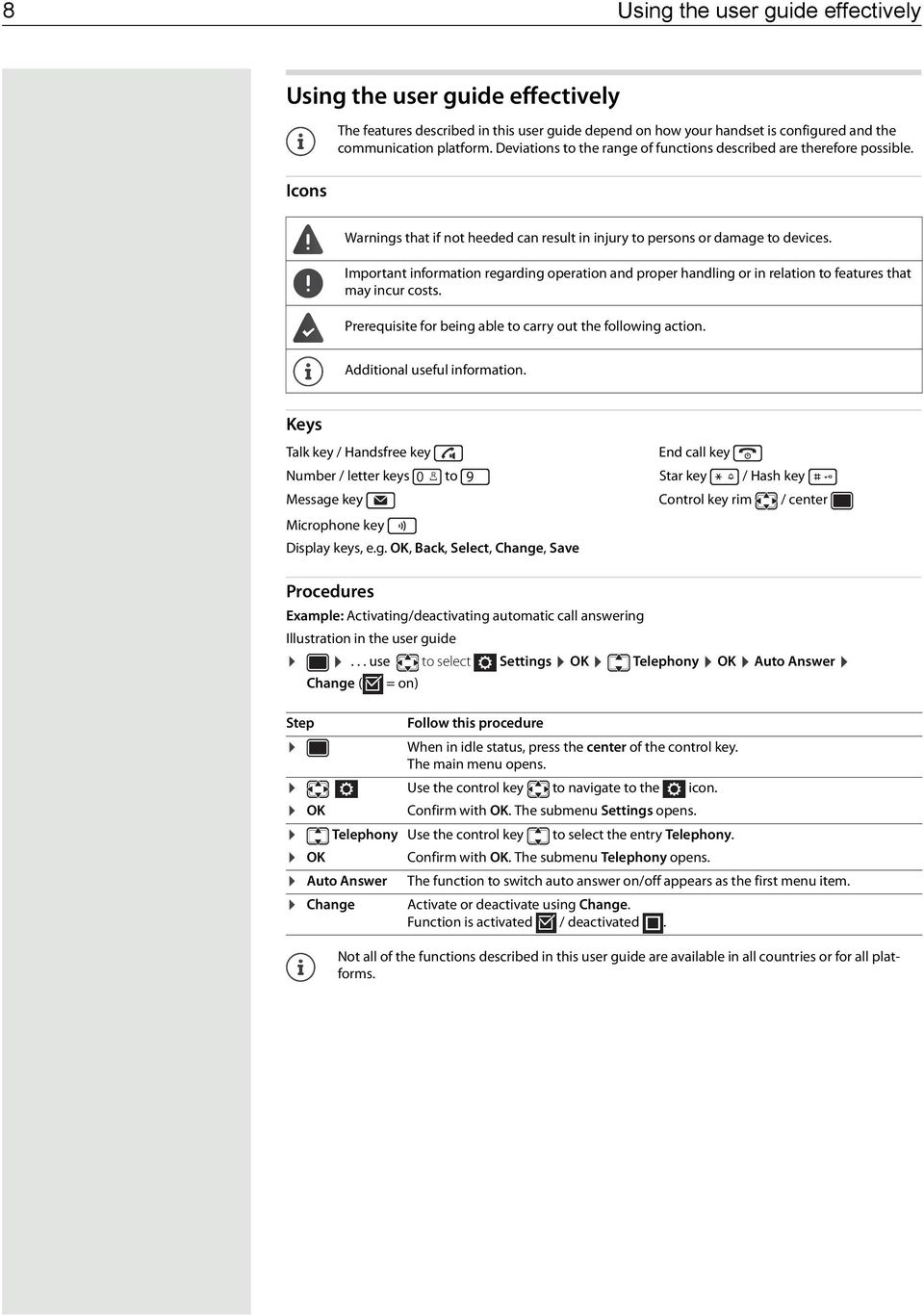
8 8 Using the user guide effectively Using the user guide effectively Icons The features described in this user guide depend on how your handset is configured and the communication platform. Deviations to the range of functions described are therefore possible. Warnings that if not heeded can result in injury to persons or damage to devices. Important information regarding operation and proper handling or in relation to features that may incur costs. Prerequisite for being able to carry out the following action. Additional useful information. Keys Talk key / Handsfree key End call key Number / letter keys to Star key / Hash key Message key Control key rim / center Microphone key Display keys, e.g. OK, Back, Select, Change, Save Procedures Example: Activating/deactivating automatic call answering Illustration in the user guide... use to select Settings OK Telephony OK Auto Answer Change ( =on) Step Follow this procedure When in idle status, press the center of the control key. The main menu opens. Use the control key to navigate to the icon. OK Confirm with OK. The submenu Settings opens. Telephony Use the control key to select the entry Telephony. OK Confirm with OK. The submenu Telephony opens. Auto Answer The function to switch auto answer on/off appears as the first menu item. Change Activate or deactivate using Change. Function is activated / deactivated. Not all of the functions described in this user guide are available in all countries or for all platforms.
9 Safety notes 9 Safety notes Be sure to read this user guide and the safety precautions before using your telephone. Explain their content and the potential hazards associated with using the device to your children. The device cannot be used in the event of a power failure. It is not possible either to make emergency calls. It is not possible to call emergency numbers either when the keypad lock is activated. Do not use the device in environments with a potential explosion hazard (e.g. paint shops). The devices are not splash-proof. For this reason, do not install them in a damp environment such as bathrooms or shower rooms. Use only the power adapter indicated on the device. Use only rechargeable batteries that correspond to the specification (see "Technical data"), as this could otherwise result in significant health risks and personal injury. Rechargeable batteries that are noticeably damaged must be replaced. If you give your handset to a third party, make sure you also give them the user guide. Remove faulty devices from use or have them repaired by our Service team, as they could interfere with other wireless services. Do not use the device if the display is cracked or broken. Broken glass or plastic can cause injury to the hands or face. Send the device to our Service department to be repaired. Do not hold the rear of the handset to your ear when it is ringing or when speaker mode is activated. Otherwise you may seriously and permanently impair your hearing. Your handset is compatible with the majority of digital hearing aids on the market. However, perfect function with all hearing aids cannot be guaranteed. The telephone may cause interference in analog hearing aids (humming or whistling) or cause them to overload. If you require assistance, please contact the hearing aid supplier. Using your telephone may affect nearby medical equipment. Be aware of the technical conditions in your particular environment, e.g. doctor's surgery. If you use a medical device (e.g. a pacemaker), please contact the device manufacturer. They will be able to advise you regarding the susceptibility of the device to external sources of high frequency energy (for the specifications of your handset, see "Technical data").

10 10 Getting started Getting started Contents of the package One handset, One battery cover (rear cover of handset), One battery, One belt clip, One user guide. Installing the charging cradle The charging cradle is designed for operation in closed, dry rooms within a temperature range of +5 C to +45 C. The phone's feet do not usually leave any marks on surfaces. However, due to the multitude of different varnishes and polishes used on today's furnishings, the occurrence of marks on the surfaces cannot be completely ruled out. Never expose the telephone to the influence of heat sources, direct sunlight or other electrical devices. Protect the telephone from moisture, dust, corrosive liquids and fumes. Connecting the charger Connect the flat plug of the AC adapter 1. Insert the AC adapter into the power socket 2. To remove the plug from the charging cradle again: Disconnect the AC adapter from the mains power supply. Press the release button 3. Pull out the plug Setting up the handset for use The display is protected by a plastic film. Please remove the protective film! 3 Inserting the battery Only use a rechargeable battery as this could otherwise result in significant health risks and personal injury. For example, the outer casing of the batteries could be destroyed or the battery could explode. The phone could also malfunction or be damaged as a result of using batteries that are not of the recommended type Insert battery with the contact surface facing down 1. Then press the battery downwards until it clicks into place 2. Align the protrusions on the side of the battery cover with the notches on the inside of the casing 3.

11 Getting started 11 Re-opening the battery cover 2 1 Remove the belt clip (if attached). Insert your fingernail into the notch at the bottom of the casing and pull the battery cover upwards 1. To change the battery, insert your fingernail into the notch in the casing and pull the battery upwards 2. Charging the batteries Charge the batteries fully prior to first use in the charging cradle or using a standard USB power supply ( S. 12). The batteries are fully charged when the power icon disappears from the display. 3 h Only place the handset in the designated charger. The battery may heat up during charging. This is not dangerous. After a while, the charge capacity of the battery will decrease for technical reasons. Attaching the belt clip The handset has notches on each side for attaching the belt clip. Attaching the belt clip: Press the belt clip onto the back of the handset until the tabs on the clip engage in the notches. Removing the belt clip: Press the center of the belt clip firmly with your thumb. Press the nail of the thumb on your other hand up between the clip and the casing. Slide the clip upwards to remove. Starting up the telephone Changing the display language You can change the display language if the telephone is set to a different language than that required. Press the middle of the control key. Press the keys and slowly in succession... the language settings display appears and the set language (e.g. English) is highlighted ( Deutsch = selected). English Select a different language: Press the control key until the desired Francais language is marked in the display, e.g. Francais press the key on the right directly below the display to activate the language. To revert to idle status: Press the End call key and hold Registering the handset A handset can be registered to up to four base stations. The registration procedure depends on the base station. On the handset... use to select Settings OK Registration OK Register Handset OK... use to select the base station (if the handset is already registered to one or more base stations) OK... Enter the registration PIN (8-position) OK Once the registration process has been completed successfully, the handset returns to idle status.

12 12 Getting started Setting the date and time Set the date and time so that the date and time can be assigned correctly to incoming calls and to enable the alarm to be used. Press the display key Time or, if the date and time have already been set: Calls Time... use to select Settings OK Date/Time OK The active cursor position flashes... use to change the cursor position... use to switch between cursor positions Enter date:... use to enter the day, month and year in 8-digit format, e.g. for 15/08/2015. Enter the time.... use to enter hours and minutes in 4-digit format, e.g. for 07:15. Save setting: Press the display key Save... the message Saved is shown on the display and a confirmation tone is issued Return to idle status: Press the End call key and hold The phone is now ready for use! Date: 8/15/2015 Time: 12:00 AM Back Date/Time Save Adjusting the handset settings You can adjust the handset to suit your requirements in the Settings menu, for example you can select a different screensaver, a different color scheme for the display or different ringtones.... use to select Settings OK... use to select the submenu, for example Display & Keypad OK... navigate to the required function... select the setting Save To set tones and signals : Audio Settings confirm with OK... navigate to the required function... select the setting Save Connecting the headset Connect a headset with a 2.5 mm jack to the left side of the handset 1. You will find headset recommendations on the product page at wiki.unify.com/ wiki/openscape_dect_phone_sl5. The headset volume corresponds to the setting for the earpiece volume ( S. 31). 1 Connecting a USB data cable For exchanging data between the handset and PC: Connect the USB data cable with micro-usb plug into the USB socket at the bottom of the handset 1. Connect the handset directly to the PC, not via a USB hub. 1

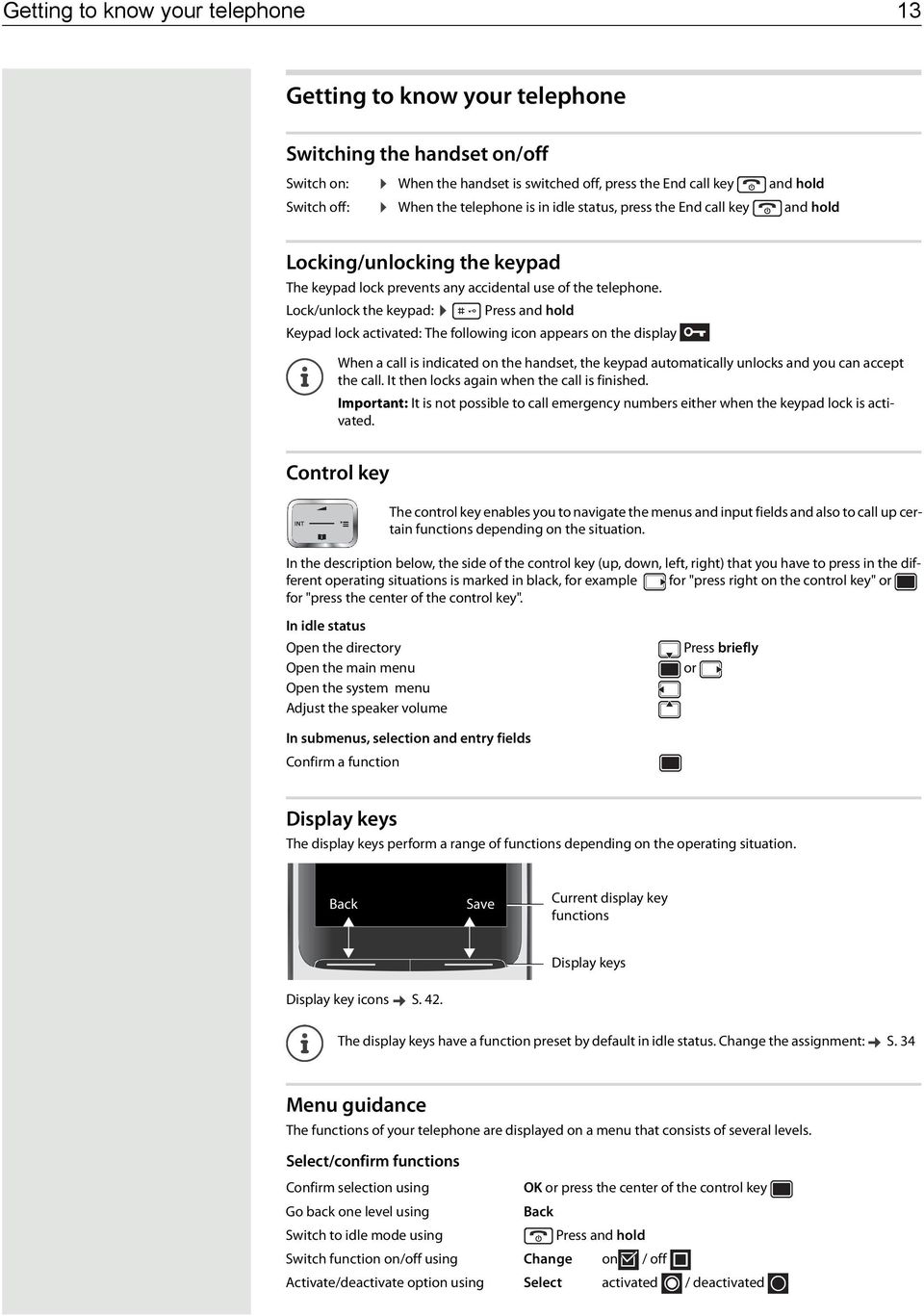
13 Getting to know your telephone 13 Getting to know your telephone Switching the handset on/off Switch on: When the handset is switched off, press the End call key and hold Switch off: When the telephone is in idle status, press the End call key and hold Locking/unlocking the keypad The keypad lock prevents any accidental use of the telephone. Lock/unlock the keypad: Press and hold Keypad lock activated: The following icon appears on the display When a call is indicated on the handset, the keypad automatically unlocks and you can accept the call. It then locks again when the call is finished. Important: It is not possible to call emergency numbers either when the keypad lock is activated. Control key The control key enables you to navigate the menus and input fields and also to call up certain functions depending on the situation. In the description below, the side of the control key (up, down, left, right) that you have to press in the different operating situations is marked in black, for example for "press right on the control key" or for "press the center of the control key". In idle status Open the directory Press briefly Open the main menu or Open the system menu Adjust the speaker volume In submenus, selection and entry fields Confirm a function Display keys The display keys perform a range of functions depending on the operating situation. Back Save Current display key functions Display key icons S. 42. Display keys The display keys have a function preset by default in idle status. Change the assignment: S. 34 guidance The functions of your telephone are displayed on a menu that consists of several levels. Select/confirm functions Confirm selection using OK or press the center of the control key Go back one level using Back Switch to idle mode using Press and hold Switch function on/off using Change on / off Activate/deactivate option using Select activated / deactivated
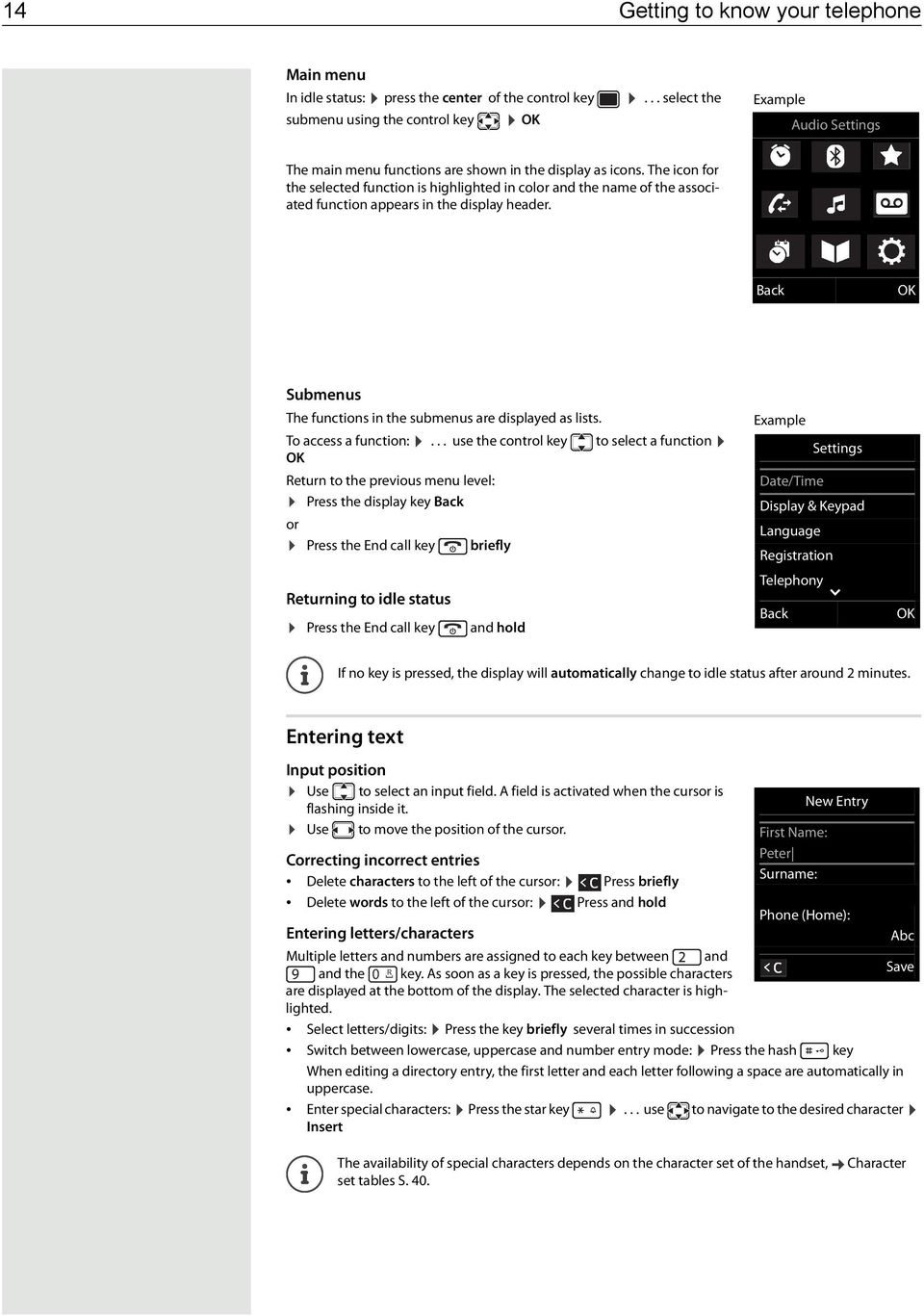
14 14 Getting to know your telephone Main menu In idle status: press the center of the control key... select the submenu using the control key OK Example Audio Settings The main menu functions are shown in the display as icons. The icon for the selected function is highlighted in color and the name of the associated function appears in the display header. Back OK Submenus The functions in the submenus are displayed as lists. To access a function:... use the control key to select a function OK Return to the previous menu level: Press the display key Back or Press the End call key briefly Returning to idle status Press the End call key and hold Example Settings Date/Time Display & Keypad Language Registration Telephony Back OK If no key is pressed, the display will automatically change to idle status after around 2 minutes. Entering text Input position Use to select an input field. A field is activated when the cursor is flashing inside it. Use to move the position of the cursor. Correcting incorrect entries Delete characters to the left of the cursor: Press briefly Delete words to the left of the cursor: Press and hold First Name: Peter Surname: New Entry Phone (Home): Entering letters/characters Multiple letters and numbers are assigned to each key between and and the key. As soon as a key is pressed, the possible characters Abc Save are displayed at the bottom of the display. The selected character is highlighted. Select letters/digits: Press the key briefly several times in succession Switch between lowercase, uppercase and number entry mode: Press the hash key When editing a directory entry, the first letter and each letter following a space are automatically in uppercase. Enter special characters: Press the star key... use to navigate to the desired character Insert The availability of special characters depends on the character set of the handset, set tables S. 40. Character
15 Making calls 15 Making calls Making calls... use to enter a number press the Talk key briefly or Press the Talk key and hold... use to enter a number The connection is established using the send line configured for the handset. Cancel dialing: Press the End call key When the display backlight is disabled, the display lights up again the next time any key is pressed. Digit keys appear on the display for pre-dialing, other keys have no further function. Dialing from the directory... use to open the directory... use to select an entry press the Talk key If several numbers are defined for a directory entry:... use to view entries select number press the Talk key... the number is dialed If uppercase is activated:... use to select a number press the Talk key... the number is dialed Dialing from the redial list The redial list contains the 20 numbers last dialed with the handset. Press the Talk key briefly or press the display key... the redial list opens... use to select an entry press the Talk key If a name is displayed: View... the number is displayed... use to browse numbers if required... when the desired number is reached, press the Talk key Managing entries in the redial list Press the Talk key briefly or press the display key... the redial list opens... use to select an entry Options... possible options: Copy an entry to the directory: Copy to Directory OK Copy the number to the display: Display number OK... use to amend or add numbers if necessary... use to save as an entry in the directory Delete the selected entry: Delete entry OK Delete all entries: Delete all OK Set automatic line seizure: Automatic Redial... The selected number is automatically dialed at fixed intervals (at least every 20 seconds). The handsfree key flashes; "open listening" is activated. The participant answers: Press the Talk key... the function is terminated The participant does not answer: The call is terminated after approx. 30 seconds. The function is terminated after pressing any key or after ten unsuccessful attempts.

16 16 Making calls Dialing from a call list The call lists ( S. 20) contain the last answered, outgoing and missed calls (assuming this is configured in the telephone system, consult your administrator).... use to select Call Lists OK... use to select Example the list OK... use to select an entry press the Talk key All calls The call lists can be accessed directly using the display key Calls, assuming the display key is assigned accordingly The list of Missed calls can also be opened using the messages key. Frank 2/14/2015 3:40 PM /13/2015 3:32 PM Susan Black 2/11/2015 1:20 PM Dialing in to extension systems (Delayed Extension Dialing) When dialing in to a large corporate network (PBX systems), it is possible to dial an extension number directly after dialing the dial-up number. View Options The telephone number is saved in the directory as follows: Dial-in number, 2 stars, extension number (e.g **128). Open the directory... use to select an entry press the Talk key... the phone dials the number before the **... possible options: Dial a saved extension: Dial Ext.... the phone dials the number after ** Dial a different extension:... use to enter an extension number... the phone dials the number entered Dial Number **128 Dial Ext. Options Inserting a dial pause when dialing Press the hash key and hold... the following letter is shown on the display P. Incoming calls An incoming call is indicated by ringing, by a display on the screen and by the flashing Talk key. Accepting a call: Press the Talk key If Auto Answer is activated: Remove the handset from the charging cradle Accept the call on the headset Changes are only saved permanently in the Profile Personal. Information about the caller The caller's phone number is displayed. If the caller's phone number is saved in the directory, the name is displayed. The caller's number is transmitted.

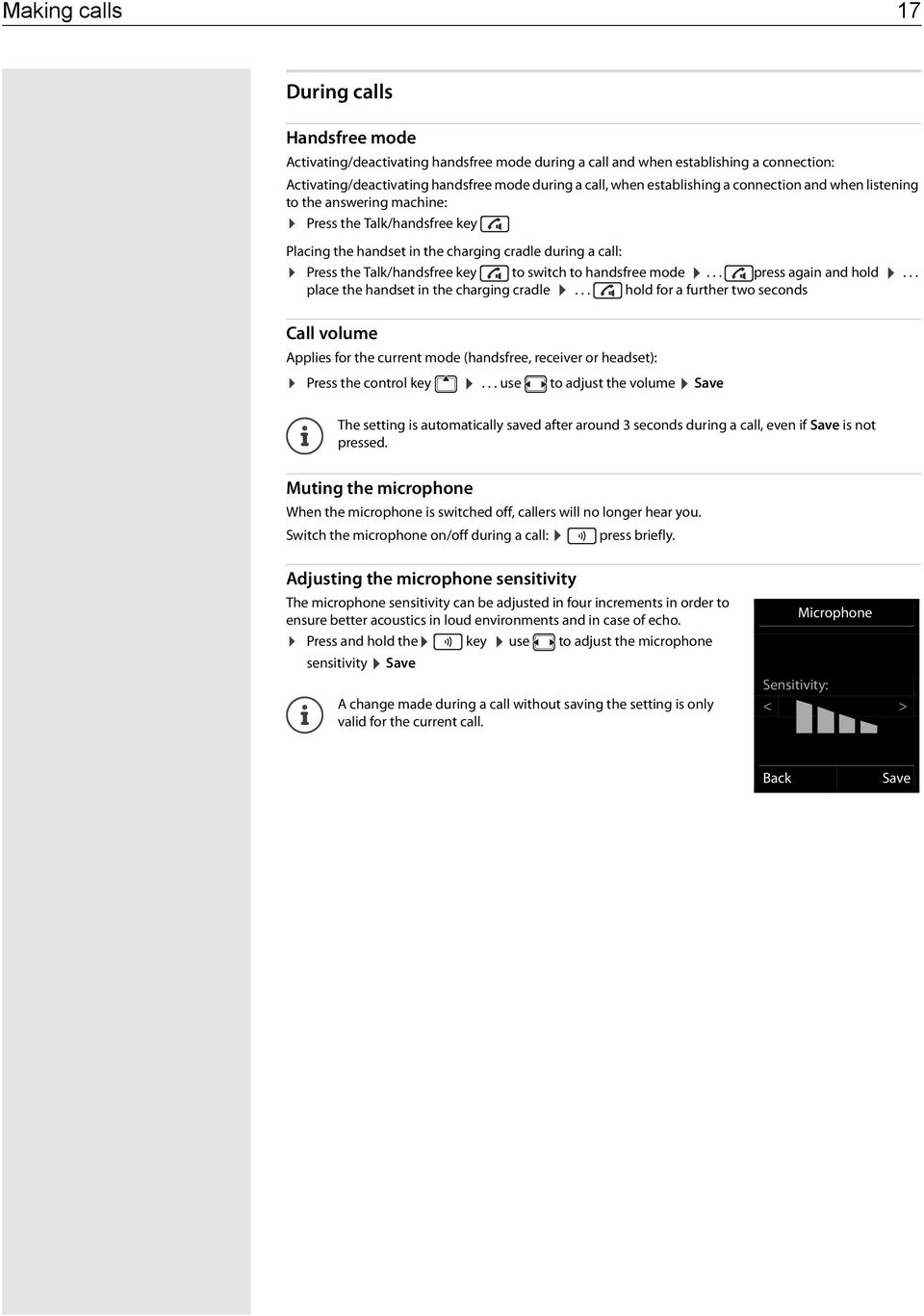
17 Making calls 17 During calls Handsfree mode Activating/deactivating handsfree mode during a call and when establishing a connection: Activating/deactivating handsfree mode during a call, when establishing a connection and when listening to the answering machine: Press the Talk/handsfree key Placing the handset in the charging cradle during a call: Press the Talk/handsfree key to switch to handsfree mode... press again and hold... place the handset in the charging cradle... hold for a further two seconds Call volume Applies for the current mode (handsfree, receiver or headset): Press the control key... use to adjust the volume Save The setting is automatically saved after around 3 seconds during a call, even if Save is not pressed. Muting the microphone When the microphone is switched off, callers will no longer hear you. Switch the microphone on/off during a call: press briefly. Adjusting the microphone sensitivity The microphone sensitivity can be adjusted in four increments in order to ensure better acoustics in loud environments and in case of echo. Press and hold the key use to adjust the microphone sensitivity Save A change made during a call without saving the setting is only valid for the current call. Microphone Sensitivity: < > Back Save
18 18 Making calls

19 Message lists 19 Message lists Notifications of missed calls, messages on the network mailbox and missed appointments are saved in the message lists. An advisory tone sounds as soon as a new message arrives. The message key Example also flashes. Icons for the message type and the number of new messages are displayed in idle mode. Notification available for the following message types: on the answering machine/network mailbox in the missed calls list in the list of missed appointments and missed anniversaries INT 1 7:15 14 Oct Displaying messages: Press the message key... Message lists that contain messages are displayed. Entry highlighted in bold: new messages available. The number of new messages is shown in brackets. Entry not highlighted in bold: no new messages. The number of old messages is shown in brackets.... use to select the list OK... the calls and/or messages are listed Network mailbox: The number of the network mailbox is dialed ( S. 37) Calls Example Calendar Messages & Calls Missed Calls: (5) Mailbox: Answer Mach.: 1 (1) Missed SMS: Alarms: (4) Missed Alarms: (2) Back OK

20 20 Call lists Call lists The phone saves a number of different call types (missed, accepted and outgoing calls) in lists (assuming they are set up in the telephone system, consult your administrator). Activating/deactivating the local call lists... then to... activate: deactivate: List entry The following information is displayed in the list entries: The list type (in the header) Icon for the entry type: Missed calls, Accepted calls, Outgoing calls, Call on the answering machine Number of the caller. If the number is saved in the phonebook, the name and number type are displayed instead ( Phone (Home), Phone (Office), Phone (Mobile)). The number of calls from this number is displayed additionally in square brackets in the case of missed calls. Number of the caller CNIP information Line on which the call was incoming/outgoing Date and time of call (if set). Opening the call list Via the display key: Calls... use to select the list OK Via the menu:... use to select Call Lists OK... use to select the list OK Via the message key (missed calls): Press the message key Missed Calls: OK Calling back a caller on the call list... use to select Call Lists OK... use to select the list OK... use to select an entry press the Talk key Additional options... use to select Call Lists OK... use to select the list OK... possible options: View an entry:... use to select an entry View Copy number to the phonebook:... use to select an entry Options Copy to Directory Delete the entry:... use to select an entry Options Delete entry OK Delete the list: Options Delete List OK Yes Other options are possible. Example View All calls Frank. Today, :40 PM [3] Smith, Frank 2/18/2011 5/13/2014 6:32 03:40pm PM Susan Black 5/12/2014 1:12 Options

21 Handset directory 21 Handset directory The local directory is unique to the handset. Opening the directory Press briefly in idle status or... use to select Directory OK Directory entries Number of entries: up to 500 Information: First name and surname, up to three telephone numbers, address, anniversary with alert, VIP ringtone with VIP icon,, CLIP picture Length of the entries: Numbers: max. 32 digits. First name, surname: max. 16 characters address: max. 64 characters. Creating an entry <New Entry> OK... use to switch between the entry fields and enter data for the entry:. Example First Name: Robert Surname: I New Entry Phone (Home): Names / numbers:... use to enter first names and/or surnames, at least one number (personal, office or mobile) and an address, if applicable Anniversary:... use to activate/deactivate Anniversary... use to enter the date and time... use to select the type of alert (Visual only or a ringtone) Caller Melody (VIP):... use to select the ringtone that will indicate a call from the participant... if a Caller Melody (VIP) has been assigned, the entry will appear in the directory with the icon. Caller Picture:... use to select a picture that is to be displayed during a call from the participant ( Resource Directory). Save entry: Save Abc Save An entry is only valid if it contains at least one number. Searching for/selecting a directory entry... use to browse searched names or... use to enter initial letters (max. 8 letters)... the display jumps to the first name starting with these initial letters... use to continue browsing to the desired entry, if needed Scroll through directory: Press and hold Displaying/changing an entry... use to select an entry View... use to select the field to be changed Edit or... use to select an entry Options Edit entry OK Deleting entries Delete the selected entry:... use to select an entry Options Delete entry OK Delete all entries: Options Delete all OK Yes Setting the order of the directory entries Directory entries can be sorted by first name or surname.
22 22 Handset directory Options Sort by Surname / Sort by First Name If no name was entered, the default telephone number is shown in the surname field. These entries appear at the beginning of the list, regardless of how the entries are sorted. The sort order is as follows: Space Digits (0-9) Letters (alphabetically) Other characters. Displaying the number of entries available in the directory Options Available Memory OK Copying number to the directory Copy a numbers to the directory: From a list, e.g. the call list or the redial list When dialing a number The number is displayed or highlighted. Press the display key or Options Copy to Directory OK... possible options: Create a new entry: <New Entry> OK... use to select a number type OK complete entry Save Add number to an existing entry:... use to select an entry OK... use to select a number type OK... the number is entered or a prompt to overwrite an existing number is displayed... if required, answer the prompt with Yes/No Save Synchronizing the directory with the PC address book (Gigaset QuickSync) The Gigaset QuickSync program has been installed on the computer. The handset is connected to the computer via Bluetooth or via a USB data cable. Free to download at wiki.unify.com/wiki/openscape_dect_phone_sl5 vcard Copying a vcard using Bluetooth Copy directory entries in vcard format, for example to exchange entries with a mobile phone. Bluetooth mode is activated. The other handset/mobile phone supports Bluetooth.... use to select an entry if needed Options Copy Entry / Copy All vcard via Bluetooth... the Known Devices list is displayed... use to select the device OK Receiving a vcard using Bluetooth If a device in the Known Devices list sends a vcard to your handset, a directory entry is automatically created and a message is shown on the display. If the sending device is not in the list:... use to enter the PIN of the sending Bluetooth device OK... the copied vcard is available as a directory entry
23 Acoustic profile 23 Acoustic profile The phone has three acoustic profiles for adapting the handset to the environmental conditions: Profile Loud, Profile Silent, Profile Personal Press the key briefly in idle mode to switch between the profiles. The profile is switched immediately without prompting. The profiles are defined as follows in their default state: Default state Profile Loud Profile Silent Profile Personal Vibration alarm On How Profile Personal Off Ringtone On Off On Ringtone volume Internal 5 Off 5 External 5 Off 5 Handset volume Earpiece Handsfree mode Advisory tones Key click Yes No Yes Confirmation Yes No Yes tone Battery tone Yes Yes Yes Activate the alerting tone for incoming calls for Profile Silent: after switching to Profile Silent press the display key Beep... the following icon appears in the status line Changes to the settings listed in the table only apply in the Loud and Silent profiles as long as the profile is not switched. are saved permanently for this profile in the Profile Personal. The selected profile is retained when the handset is switched off and on again. Calendar You can remind yourself of up to 30 appointments. The current day is outlined in white in the calendar, while numbers are highlighted in color on days with appointments. When a day is selected, it will be outlined in color. July 2015 Mo Tu We Th Fr Sa Su Back OK Saving appointments to the calendar The date and time have been set.... use to select Organiser OK Calendar OK... use to select the desired day OK... then Switch on/off: Activation:... use to select On or Off Enter the date: Date... the selected date is set by default... use to enter a new date Enter the time: Time... use to enter the hours and minutes of the appointment Set the name: Text... use to enter a description of the appointment (e.g. evening meal, meeting) Set alarm tone: Signal... use to select the melody of the reminder alarm or deactivate acoustic signaling Enter information for the appointment:
24 24 Alarm clock... use to select Date, Time, Text and Signal in succession... adjust the value in each case with or Save Save appointment: Save If an appointment has already been entered: <New Entry> OK... then enter information for the appointment. Notification of appointments/anniversaries Anniversaries are transferred from the directory and displayed as an appointment. An appointment/anniversary is displayed in idle status and the selected ringtone plays for 60 seconds as a notification. Acknowledge and stop the reminder: Press the display key OFF During a call, a reminder is indicated once with an advisory tone on the handset. Displaying missed (unacknowledged) appointments/anniversaries The following appointments and anniversaries are saved in the Missed Alarms list: The appointment/anniversary call was not acknowledged. The appointment/anniversary was notified during a call. The handset was switched off at the time of the appointment/anniversary. The last 10 entries are stored. The icon and the number of new entries are shown on the display. The most recent entry appears at the top of the list. Opening the list Press the message key Missed Alarms: OK... use to browse through the list of any appointments or... use to select Organiser OK Missed Alarms OK Every entry is displayed with number or name, date and time. The most recent entry appears at the top of the list. Delete an appointment/anniversary: Delete Displaying/changing/deleting stored appointments... use to select Organiser OK Calendar OK... use to select the day OK... the appointment list is displayed... use to select the date... possible options: Display appointment details: View... The appointment settings are displayed Change appoint-ment: View Edit or Options Edit entry OK Activate/deactivate appointment: Options Activate/Deactivate OK Delete appointment: Options Delete entry OK Delete all appointments for a day: Options Delete all Appoints. OK Yes Alarm clock The date and time have been set. Activating/deactivating the alarm clock and setting the wake-up time... use to select Alarm Clock OK... then Switch on/off: Activation:... use to select On or Off Set wake-up time: Time... use to enter hours and minutes
25 Protecting against unwanted calls 25 Set days: Occurrence... use to switch between Monday-Friday and Daily Set volume: Volume... use to set the volume in 5 increments or select crescendo (increasing volume) Set alarm: Melody... use to select a ringtone for the alarm Enter the wake-up details: Save setting:... use to select Time, Occurrence, Volume and Melody in succession... adjust the value in each case with or Save Save The icon and the wake-up time are displayed on the idle display when the alarm clock is activated. Alarm An alarm is shown on the display and indicated by the selected ringtone melody. The alarm sounds for 60 seconds. It is then repeated after 5 minutes if no key is pressed. The alarm is disabled for 24 hours after the second retry. During a call, the alarm is only indicated by a short tone. Switching off / repeating the alarm after an interval (snooze mode) Deactivate the alarm: OFF Repeat the alarm (snooze mode): Snooze Press or any key... the alarm is switched off and repeated after 5 minutes. Protecting against unwanted calls Time control for external calls The date and time have been set. Enter a time period during which the handset is not to ring to indicate external calls, for example during the night.... use to select Audio Settings Ringtones (Handset) OK Time Control OK... then Switch on/off: use to select On or Off Enter the time: use to switch between Suspend ring. from and Suspend ring. until... use to enter the start and end of the period in 4-digit format Save: Save Example Time Control For external calls: On Suspend ring. from: 10:00 PM Suspend ring. until: 7:00 AM Back Save Time control only applies to the handset for which the setting is configured. The telephone will continue to ring for numbers that have been assigned to a VIP group in the directory. Switching off the ringtone when in the charging cradle The handset will not ring when placed in the charging cradle. A call is only indicated on the display. Audio Settings OK Ringtones (Handset) OK Silent Charging Change ( = Ringtone is switched off when in the charging cradle
26 26 Resource Directory Resource Directory Sounds for ringtones and images that can be used as caller images (CLIP pictures) or as screensavers are saved in the handset's resource directory. A range of monophonic and polyphonic sounds and pictures have been pre-set but further images and sounds can be downloaded using a PC ( Gigaset QuickSync). Media types: Type Sound Picture Ringtones Monophonic Polyphonic Imported sounds CLIP image Screensaver Format Internal Internal Internal WMA, MP3, WAV BMP, JPG, GIF 128 x 86 pixels 128 x 160 pixels If there is not enough memory available, you must first delete one or more pictures or sounds before others can be saved. Managing CLIP images, screensavers and sounds... use to select Additional Features OK Resource Directory OK... possible options: View Screensavers OK... use to select picture View... the screensaver: selected picture is displayed View CLIP picture: Caller Pictures OK... use to select picture View... the selected picture is displayed Play sound: Sounds OK... use to select sound... the selected sound is played Set volume: Options Volume OK... use to select the volume Save Rename picture/sound: Screensavers Select / Caller Pictures / Sounds OK... use to select sound/image Options Rename... use to delete name, use to enter a new name Save... the entry is saved with the new name Delete picture/ sound: Select Caller Pictures / Sounds OK... use to select sound/image Options Delete entry... the selected entry is deleted The relevant options are not available if a picture/sound cannot be deleted. Checking the memory Display the available memory for screensavers and CLIP pictures.... use to select Additional Features OK Resource Directory OK Capacity OK... the percentage of available memory is displayed Bluetooth The handset is able to use Bluetooth to communicate wirelessly with other devices that also use this technology, for example for exchanging directory entries. Bluetooth is activated and the devices have been registered to the handset. The following devices can be connected: A Bluetooth headset The headset features the Headset or Handsfree Profile. If both profiles are available, the handsfree profile is used to communicate. It may take 5 seconds to establish a connection, whether a call is accepted using the headset or transferred to the headset, or a call is made from the headset. Up to 5 data devices (PCs, PDAs or mobile telephones) for the transmission of address book entries as a vcard or for the exchange of data with the computer.
27 Bluetooth 27 To use the phone numbers, dialing codes (international and local area code) must be saved to the telephone. Operating Bluetooth devices User guides for devices Activating/deactivating Bluetooth mode... use to select Bluetooth OK Activation Change ( = activated) If the local area code is still not saved:... use to enter the local area code OK When in idle status, the activated Bluetooth mode is indicated on the handset by the icon. Registering Bluetooth devices The distance between the handset in Bluetooth mode and the activated Bluetooth device (headset or data device) should be no more than 10 m. The registration of a headset overwrites a previously registered headset. If a headset is to be registered that is already registered with a different device, this connection must be deactivated before registering.... use to select Bluetooth OK Search for Headset / Search Data Device OK... the search starts (may take up to 30 seconds)... the names of found devices are displayed... possible options: Register device: Options Trust Device OK... use to enter the PIN of the Bluetooth device to be registered OK... the device is added to the list of known devices Display information about a device:... use if necessary to select a device View... the device name and device address are displayed Repeat search: Options Repeat Search OK Cancel search: Cancel Editing the list of known (trusted) devices Opening the list... use to select Bluetooth OK Known Devices OK... the known devices are listed, an icon indicates the type of device Bluetooth headset Bluetooth data device If a device is connected, the corresponding icon is shown in the display header instead of. Editing entries... use to select Bluetooth OK Known Devices OK... use to select an entry... possible options: View an entry: View... the device name and device address are displayed To go back, press OK De-register a Bluetooth device: Options Delete entry OK Edit name: Options Edit Name OK... use to edit the name Save If an active Bluetooth device is de-registered, it may try to re-connect as a "non-registered device". Rejecting/accepting a non-registered Bluetooth device If a Bluetooth device that is not registered in the list of known devices tries to connect with the handset, you will be prompted on the display to enter the PIN for the Bluetooth device (bonding). Reject: Press the End call key briefly. Accept:... use to enter the PIN of the Bluetooth device to be accepted OK... wait for PIN confirmation... then Add the device to the list of known devices: Yes Use the device temporarily: No... the Bluetooth connection can be used as long as the device is located within the transmission range or until it is switched off
28 28 Additional functions using the PC interface Changing the Bluetooth name of the handset The handset is shown by this name on another Bluetooth device.... use to select Bluetooth OK Own Device OK... the name and the device address are shown Change... use to change the name Save Additional functions using the PC interface The Gigaset QuickSync program has been installed on the computer. The handset is connected to the computer via Bluetooth or via a USB data cable. QuickSync functions: Sync the handset's directory with Microsoft Outlook Upload CLIP pictures (.bmp) from the computer to the handset Upload pictures (.bmp) as screensavers from the computer to the handset Upload sounds (ringtone melodies) from the computer to the handset Update the firmware Cloud synchronization with Google Connect the handset to the computer via Bluetooth or via a USB data cableconnect the handset to the computer via a USB data cable. Connect the handset directly to the PC, not via a USB hub. Transferring data Data transfer using Bluetooth: The computer has Bluetooth capability. A USB data cable is not plugged in. If a USB data cable is plugged in during an existing Bluetooth connection, the Bluetooth connection is interrupted. Launch the Gigaset QuickSync program on the computer. The message Data transfer in progress is shown on the display while data is being transferred between the handset and PC. During this time, it is not possible to enter any data using the keypad and incoming calls are ignored. Carrying out a firmware update Always save own pictures and sounds uploaded onto the handset on the PC also, as they may be lost during an update. Connect the telephone and PC using a USB data cable Launch Gigaset QuickSync Establish the connection to the handset Start the firmware update in Gigaset QuickSync... Information about this can be found in the Gigaset QuickSync help The update process may take up to 10 minutes (not including the download time). Do not interrupt the process and do not remove the USB data cable. The data is first downloaded from the online update server. The amount of time this takes depends on the speed of the Internet connection. The display on your phone is switched off and the Message key and the Talk key start flashing. Once the update is complete, your phone will automatically restart. Procedure in the event of an error If the update procedure fails or the phone does not work properly following the update, repeat the update procedure: End the "Gigaset QuickSync" program on the PC Remove the USB data cable from the phone Remove the battery Reinsert the battery
29 Additional functions using the PC interface 29 Carry out the firmware update again as described above If the update procedure fails several times or you can no longer connect to the PC, consult your administrator:
30 30 Adjusting the handset settings Adjusting the handset settings Display and keypad Screensaver A dialog or analog clock, Info Services and a range of pictures can be selected to be displayed as a screensaver when in idle status.... use to select Settings OK Display & Keypad OK Screensaver Edit ( = on)... then Switch on/off: Activation:... use to select On or Off Select screensaver: Selection... use to select a screensaver (Digital Clock / Analog Clock / Info Services / <Pictures> / Slideshow) View screensaver: Save selection: View Save The screensaver is activated approx. 10 seconds after the display has changed to idle status. All pictures from the Screensaver folder of the Resource Directory are available for selection. End screensaver Press the End call key briefly... the idle display appears Large font The font size of text and icons in call lists and in the directory can be increased in order to improve legibility. Only one entry is shown in the display and names are abbreviated if necessary.... use to select Settings OK Display & Keypad OK Large Font Change ( = on) Color scheme The display may appear in a range of color combinations.... use to select Settings OK Display & Keypad OK Colour Schemes OK... use to select the desired color scheme Select ( = selected)
31 Adjusting the handset settings 31 Display backlight The display backlight always illuminates when the handset is taken out of the base station/charging cradle or a key is pressed. Any digit keys that are pressed appear on the display for pre-dialing. Switch the display backlight on/off when in idle status:... use to select Settings OK Display & Keypad OK Display Backlight OK... then Backlight in the charging cradle: In Charger:... use to select On or Off Backlight when not in the charging cradle: Out of Charger... use to select On or Off Save selection: Save The handset's standby time may be significantly reduced if the display backlight is activated. Switching the keypad illumination on/off... use to select Settings OK Display & Keypad OK Key Illumination Change... use to set the brightness in 5 levels. Activating/deactivating automatic keypad lock Automatically lock the keypad when the handset has been in idle status for around 15 seconds.... use to select Settings OK Display & Keypad OK Auto Keypadlock Change ( = on) Activating/deactivating automatic call answering When set to auto answer, the handset accepts an incoming call as soon as it is removed from the charging cradle.... use to select Settings OK Telephony OK Auto Answer Change ( =on) Regardless of the Auto Answer setting, the connection ends as soon as you place the handset back in the charging cradle. Exception: Press and hold the Talk key for a further 2 seconds while placing the handset in the charging cradle. Changing the earpiece and speaker volume You can set the volume of the earpiece and speaker at 5 levels independently of each other. During a call Handset Volume... use to select the volume Save... the setting is saved The setting will be saved automatically after approx. 3 seconds without saving. In idle status Audio Settings OK Handset Volume OK... then For the earpiece: Earpiece:... use to set the volume For the speaker: Speaker... use to set the volume Save setting: Save Changes are only saved permanently in the Profile Personal.
32 32 Adjusting the handset settings Adjusting the microphone sensitivity The microphone sensitivity can be adjusted in four increments in order to ensure better acoustics in loud environments and in case of echo. Press and hold the key use to adjust the microphone sensitivity Save Microphone : Sensitivity: < > Back Save Ringtones Ringtone volume Audio Settings OK Ringtones (Handset) OK Volume OK... use to select For internal calls and alarms or External Calls... use to set the volume in 5 increments or select crescendo (increasing volume) Save Example Volume For internal calls and alarms: < > External Calls: Back Save Ringtone melody Set a variety of ringtones for internal and external calls on all of the phone's available receiving lines (Landline, IP1, Gigaset.net) or the same ringtone for All calls. Audio Settings OK Ringtones (Handset) OK Melodies OK... use to select the connection... use to select the ringtone/melody in each case Save Activating/deactivating the ringtone Deactivating the ringtone permanently Use the key to set the Profile Silent... the following icon appears in the status bar Activating the ringtone permanently Use the key to set the Profile Loud or Profile Personal Activating/deactivating the alerting tone (beep) Activate an alerting tone (beep) instead of the ringtone: Press the asterisk key and hold within three seconds press Beep... the following icon appears in the status bar Deactivate the alerting tone again: Press the asterisk key and hold Activating/deactivating the vibration alarm Incoming calls and other messages are indicated by a vibration.... use Audio Settings OK Silent Alert Change ( = on) Activating/deactivating advisory tones The handset notifies acoustically about different activities and statuses. These advisory tones can be activated/deactivated independently of each other. Audio Settings OK Advisory Tones OK... then Tone when keys are pressed: Key Tones:... use to select On or Off
33 Adjusting the handset settings 33 Confirmation/error tone after making entries, advisory tone when a new message has been received: Confirmation... use to select On or Off Warning tone when there are fewer than 10 minutes of talktime remaining (every 60 seconds): Battery... use to select On or Off Warning tone when the handset is moved out of range of the base station: Save setting: Out of Range:... use to select On or Off Save
34 34 Adjusting the handset settings Fast access to numbers and functions Number keys: The keys to can each be assigned a number from the directory. Display keys: The left and right display keys have a function preset by default, but the keys can be reassigned. The number is then dialed or the function started by simply pressing a key. Assigning a number to digit keys (quick dial) You have to assign a number to the digit key. Press and hold the digit key or Press the digit key briefly press the display key Quick Dial The directory opens.... use to select an entry OK... use to select a number if required OK... the entry is saved to the digit key If the entry is subsequently deleted in the directory, this will not affect the assignment to the number key. Dialing a number Press and hold the digit key... the number is dialed immediately or Press the digit key briefly... the number/name (possibly in abbreviated form) is shown on the left display key... press the display key... the number is dialed Changing the digit key assignment Press the digit key briefly Change... the directory is opened... possible options: Change the assignment:... use to select an entry OK... select a number if required OK Delete the assignment: Clear Key Assigning display keys, changing assignments Press and hold the left or right display key in idle status... the list of possible key assignments is opened... use to select a function OK... possible options: Call Lists INT Quick Dial Alarm Clock Calendar Bluetooth Redial Starting a function With the telephone in idle status: Show the call list Open the internal menu Assign a number from the directory to the display key Set and activate/deactivate the alarm clock Open the calendar Open the Bluetooth menu Show the redial list Press the display key briefly... the assigned function is executed
35 Adjusting the handset settings 35 Changing the handset PIN The handset is PIN-protected to prevent unauthorized use (default setting: 0000). The PIN is requested each time you turn on the handset, assuming it has been changed and does not correspond to the default state Change the handset's 4-digit PIN (default setting: 0000):... use to select Settings OK System OK Handset PIN OK... use to enter the current handset PIN OK... use to enter the new handset PIN OK Own area code The area code (international and local area code) must be saved on the phone in order to transfer phone numbers (e.g. in vcards) Some of these numbers are already preset.... use to select Settings OK Telephony OK Area Codes OK Check (pre-)set area code Edit the number:... use to select/switch entry field... use to change entry position... delete digit if appropriate... use to enter digit Save Example Area Codes International code: Local area code: 0 - [8 ] Save Resetting the handset to the default settings Reset any individual settings and changes that you have made.... use to select Settings OK System OK Handset Reset OK Yes... the handset's settings are reset The following settings are not affected by the reset: Registration of the handset to the base station Date and time Directory entries and call lists
36 36 Extending the handset Extending the handset Registering a handset to multiple base stations The handset can be registered to up to four base stations. The active base station is the base station to which the handset was last registered. The other base stations remain saved in the list of available base stations.... use to select Settings OK Registration OK Select Base OK... pos- Change active base station: Best Base: The handset chooses the base station with the best reception as soon as it loses connection to the current base station. Change name of a base station:... use to select a base station Select ( = selected) Name change name Save sible options:... use to select the base station or Best Base Select ( = selected)
37 Network mailbox 37 Network mailbox Activating and deactivating the network mailbox Every handset can manage the network mailboxes belonging to one of its receiving lines.... use to select the Answer Machine OK Network Mailbox OK... use if appropriate to select the connection OK... then For fixed network connection... use to enter or change the number of the network mailbox Save Listening to messages Press and hold the key The network mailbox is assigned to Key 1. If not,instructions regarding input will follow. Listen to announcement aloud: Press the handsfree key Entering a number for the network mailbox If a number is not yet saved for the network mailbox:... enter the number of the network mailbox with Save press and hold the End call (idle status)
38 38 Questions and answers Questions and answers Troubleshooting steps The display is blank. The handset is not switched on. Press and hold The battery is empty. Charge the battery or replace it ( S. 10) "No Base" flashes on the display. The handset is outside the range of the base. Reduce the distance between the handset and the base. Your settings are not transferred. An incorrect profile is selected. Profile Personal should be selected... and then the device settings changed. The handset does not ring. The ringtone is deactivated. Activate the ringtone ( S. 32) The other party cannot hear you. The handset is "muted". Reactivate the microphone ( S. 17) You hear an error tone when keying in (descending tone sequence). Action has failed/invalid input. Repeat the process. Read the display and refer to the user guide if necessary. No time is specified for a message in the call list. The date/time are not set. Set the date and time. Registration or connection problems with a Bluetooth headset. Reset the Bluetooth headset (see the user guide for the headset). Delete the registration data on the handset by de-registering the device. Repeat the registration process. Answering machine ( S. 37): No time is specified for a message in the call list. The date/time are not set. Disclaimer Your handset display is made up of pixels. Each pixel consists of three sub-pixels (red, green, blue). It may happen that a sub-pixel fails or a color deviation occurs. A warranty case exists only if the maximum number of permitted pixel errors is exceeded. Description Max. number of permitted pixel errors Color illuminated sub-pixels 1 Dark sub-pixels 1 Total number of colored and dark sub-pixels 1 Traces of usage on the display and housing are excluded from the warranty. Manufacturer's advice Authorization We, Unify GmbH & Co. KG, declare that this device meets the essential requirements and other relevant regulations laid down in Directive 1999/5/EC. The EU declaration of conformity under 1999/5/EC can be found at: wiki.unify.com/wiki/declarations_of_conformity#cordless_phones.
39 Manufacturer's advice 39 Protecting our environment Disposal Batteries should not be disposed of in general household waste. Observe the local waste disposal regulations, details of which can be obtained from your local authority. Dispose of batteries in the green boxes designated as "common collection system for batteries" at specialist retailers. All electrical and electronic products should be disposed of separately from the municipal waste stream via designated collection facilities appointed by the government or the local authorities. This crossed-out wheeled bin symbol on the product means the product is covered by the European Directive 2002/96/EC. The correct disposal and separate collection of your old appliance will help prevent potential negative consequences for the environment and human health. It is a precondition for reuse and recycling of used electrical and electronic equipment. For more detailed information about disposal of your old appliance, please contact your local authority refuse center or waste disposal service. Care Always use a damp or antistatic cloth to clean the device. Do not use solvents or microfiber cloths. Never use a dry cloth as this can cause a static charge. In rare cases, contact with chemical substances can cause changes to the device's exterior. Not all substances have been tested due to the wide variety of chemical products available on the market. Impairments to high-gloss finishes can be carefully removed using display polishes for mobile phones. Contact with liquid If the device comes into contact with liquid: 1. Disconnect it from the power supply. 2. Remove the batteries and leave the battery compartment open. 3. Allow the liquid to drain from the device. 4. Dab all components dry. 5. Place the handset in a dry, warm place for at least 72 hours with the battery compartment open and keypad (if applicable) facing down (not in a microwave, oven, etc...). 6. Do not switch on the device again until it is completely dry. When it has fully dried out, you will usually be able to use it again.
40 40 Technical data Technical data Batteries Technology: Voltage: Capacity: Lithium ion (Li-Ion) 3.7 V 750 mah Handset operating times/charging times The operating time of your handset depends on the capacity and age of the battery and the way it is used. (All times are maximum possible times). Standby time (hours) * 250 Talktime (hours) 12 Charging time in charging cradle (hours) 2.5 * Without display backlight in idle mode (Setting the display backlight S. 31) The operating times of the phone can be extended by using a more powerful battery. General specifications DECT standard GAP standard No. of channels Radio frequency range Duplex mode Pulse repetition rate Pulse transmission length Channel grid Bit rate Modulation Language code Transmission power Range Base station power supply Environmental conditions for operation Dialing mode Bluetooth Radio frequency range Transmission power Supported Supported 60 duplex channels MHz Time division multiplexing, 10 ms frame length 100 Hz 370 μs 1728 khz 1152 kbit/s GFSK 32 kbit/s 10 mw, average power per channel, 250 mw pulse power Up to 50 m indoors, up to 300 m outdoors 230 V ~/50 Hz +5 C to +45 C; 20 % to 75 % relative humidity DTMF (tone dialing)/ PD (pulse dialing) MHz 4 mw pulse power Character charts Standard characters Press the relevant key the indicated number of times. 1x 2x 3x 4x 5x 6x 7x 8x 9x 10x 1 a b c 2 ä á à â ã ç d e f 3 ë é è ê g h i 4 ï í ì î j k l 5 m n o 6 ö ñ ó ò ô õ p q r s 7 ß t u v 8 ü ú ù û w x y z 9 ÿ ý æ ø å 1) 2).,?! 0 1) Space 2) Line break
41 Technical data 41 Central Europe Press the relevant key the indicated number of times. Cyrillic Press the relevant key the indicated number of times. Greek Press the relevant key the indicated number of times. Turkish Press the relevant key the indicated number of times. Arabic Press the relevant key the indicated number of times. 1x 2x 3x 4x 5x 6x 7x 8x 9x 10x 1 $ a b c 2 ą ä á â ć ç d e f 3 ď ę ë é ě g h i 4 í î j k l 5 ł m n o 6 ń ň ó ö ő ô p q r s 7 ř ß ś š t u v 8 t' ű ü ú ů w x y z 9 ý ź ż ž 1) ) Space 1x 2x 3x 4x 5x 6x 7x 8x 9x 10x 1 a б в г 2 a b c д е ë ж з 3 d e f и й к л 4 g h i м н о 5 j k l п р с 6 m n o т y ф x 7 p q r s ц ч ш щ ъ 8 t u v ьl ь э ю я 9 w x y z 1) 2).,?! 0 1) Space 2) Line break 1x 2x 3x 4x 5x 6x 7x 8x 9x 10x 11x 12x 1 α β ά 2 a b c δ ε φ έ 3 d e f γ η ι ή ί ϊ ΐ 4 g h i κ λ 5 j k l μ ν ο ω ό ώ 6 m n o π ρ ς σ ψ 7 p q r s θ τ 8 t u v ζ ξ υ χ ύ ϋ ΰ 9 w x y z 1) 2).,?! 0 1) Space 2) Line break 1x 2x 3x 4x 5x 6x 7x 8x 9x 10x 1 a b c ç 2 ä á à â ã d e f 3 ë é è ê g ğ h ı i 4 ï í ì î j k l 5 m n o ö 6 ñ ó ò ô õ p r s ş 7 q ß t u ü v 8 ú ù û y z 9 w x ÿ æ ø å 1) 2).,?! 0 1) Space 2) Line break 1x 2x 3x 4x 5x 6x 7x 8x 9x 10x 11x 1 a b c 2 d e f 3 g h i 4 j k l 5 m n o 6 p q r s t u v w x y z 1) 2).,! 0 1) Space 2) Line break
42 42 Display icons Display icons The following icons are displayed dependent on the settings and the operating status of your telephone. Icons in the status bar Signal strength 1 % -100 % white if Maximum Range is on; green if Maximum Range is off Red: no connection to the base station white if Maximum Range is on; green if Maximum Range is off Profile Silent activated (ringtone switched off ) "Beep" ringtone activated Keypad lock activated Battery charge status (white): between 11% and 100% charged Red: less than 11% charged Flashing: battery almost empty (approx. 5 minutes of talktime remaining) Battery is charging (current charge status): 0% - 100% Display key icons Last number redial Delete text Open the directory Copy number to the directory Î Back, cancel Display icons to indicate Establishing a call (outgoing call) Connection established No connection established/connection terminated Call Reminder for anniversary Reminder for appointment Wake-up call Other display icons Alarm clock is on, display with alarm time
43 Display icons 43 Action complete (green) Action failed (red) Information (Confirmation) prompt Please wait...
44 44 overview overview Not all of the functions described in this user guide are available in all countries or from all network providers. Open the main menu: press this key when the handset is in idle mode Audio Settings Handset Volume p. 31 Advisory Tones p. 32 Silent Alert p. 32 Ringtones (Handset) Volume p. 32 Melodies p. 32 Time Control p. 25 Silent Charging p. 25 Bluetooth Activation p. 27 Search for Headset p. 27 Search Data Device p. 27 Known Devices p. 27 Own Device p. 28 Additional Features Resource Directory Screensavers p. 26 Caller Pictures Sounds Capacity Call Lists p. 20 All calls Outgoing calls Accepted calls Missed calls Alarm Clock p. 24 Answer Machine Play Messages p. 37 Network Mailbox p. 37 Organiser Calendar p. 23 Missed Alarms p. 24 Directory p. 21
45 overview 45 Settings Date/Time p. 12 Display & Keypad Screensaver p. 30 Large Font p. 30 Colour Schemes p. 30 Display Backlight p. 31 Key Illumination p. 31 Auto Keypadlock p. 31 Language p. 11 Registration Register Handset p. 36 Select Base p. 36 Telephony Auto Answer p. 31 Area Codes p. 35 System Handset Reset p. 35 Handset PIN p. 35 Base Reset -
46 46 System functions System functions The system functions can be called up via the menu or directly by entering codes. Either: Calling functions via the menu Using the Service menu The Service menu can be used both by means of the control key and the display keys. Operation using the control key is shown below. s t Suppress call ID? w Select and confirm the function. Or: s t Service? w Select the menu item and confirm. s t *41=Temporary MNS? w Select and confirm the function. Or: Control key Function Alternative usage u Open Service menu or Left display key One level higher v One level lower Right display key During a call: Adjust call volume and open local phonebook t Scroll Previous - s Scroll Next - w Confirm your selection - s t Service? w Select the menu item and confirm. s t More functions? w Select the menu item and confirm. s t #58=View callbacks? w Select and confirm the function. a Press the End call key to end the operation.
47 System functions 47 Calling functions via codes Either: * o Enter code according to table page 48. Or: # o Enter code according to table page 48. then: a Press the End call key to end the operation.
48 48 System functions Functions and codes Note: The following functions and codes are standard on the HiPath 3000 / OpenScape Business. However, they could also be changed in your system. Please consult your system administrator. Functions Codes Automatic call wait.term.on * 490 Automatic call wait.trm.off # 490 Waiting tone off * 87 Waiting tone on # 87 Accept call waiting (camp-on) * 55 Caller list - Call # 82 - Saving a number * 82 Advisory msg. on * 69 Advisory msg. off # 69 DND on * 97 DND off # 97 UCD: - Log on * Log off # Work on * Work off # Available * Not available # UCD night on * UCD night off # Calls in queue * 405 Override (authorized telephone only) * 62 FWD for MULAP on * 501 FWD for MULAP off # 501 Speaker call * 80 Trace call * 84 Temporary phone * 508 Messages - Sending * 68 - View sent message # 68 Conference: - on * 3 - off # 3 Show call charges * 65 Use speed dialing * 7 Change speed dial * 92 Toggle/connect * 2 DTMF dialing * 53 Night answer on * 44 Night answer off # 44
49 System functions 49 Functions Codes Park: - Parking a call * 56 - Retrieve call # 56 Account code * 60 Callback * 58 View callbacks # 58 Suppress phone number * 86 Temporary phone number (MSN) * 41 Restore phone number # 86 Ringing group on * 81 Ringing group off # 81 Hunt group/join hunt group * 85 Hunt group/leave hunt group # 85 Control Relay On * 90 Control Relay Off # 90 Change PIN * 93 Language selection * 48 Locking the phone * 66 Unlocking the phone # 66 Directory (system, LDAP) * 54 Telephone data service * 42 Timed reminder on * 46 Timed reminder off # 46 Door opener on * 89 Door opener off # 89 Door opener *61 Pickup group * 57 Pickup, directed * 59 Forwarding on * 1 Forwarding off # 1 Trunk FWD on * 64 Trunk FWD off # 64 CFNR off # 495 CFNR on * 495 Return to held call * 0 Note for service personnel: If the handset's local call list is activated (see Seite 20), control of the call list by OpenScape Business has to be deactivated (OpenScape Business menu option "Display caller list"). This allows duplicate entries in the call list to be avoided. It is generally recommended to deactivate the call list on the telephone in the case of a team configuration (MULAP, see Seite 73). It is recommended to activate the call list in the case of a single device configuration.
50 50 Making calls to multiple parties Making calls to multiple parties Consultation p You interrupt your call to consult with a user (including external users) and then resume the original call. You are conducting a call. S or Enquiry o p Î Activating and conducting an inquiry/consultation call Activate inquiry. The current call is placed "on hold", so that the first user waits. Enter the phone number for the consultation call. The number is dialed. The station answers. The consultation starts. The second user is busy or does not answer Press the display key to cancel the consultation. You are reconnected with the first party. During the consultation you can Book a callback page 79, Activate call waiting page 51 or Busy override page 54. The consultation is ended and you return to the waiting call Either: The second user hangs up. You are reconnected with the first party. Or: s t Quit and return? w Select the menu item and confirm. You are reconnected with the first party. The second partner hears the busy tone and hangs up; a handset hangs up automatically. However, you can also Toggle between the partners page 56, Set up a conference page 57 or Transfer the waiting partner to the second partner page 55.
51 Making calls to multiple parties 51 Call waiting You need to speak to a user in your communications system urgently, even though this user's line is busy. You can send a call waiting signal during the call to let the user know you want to talk to him or her. The user either answers immediately or you will be automatically connected when he or she has finished his call. This function is only available if it has been configured by the service engineer. The user is busy. You want to use call waiting. p p Wait until the message "Camp-on" appears on the display (ringing tone). You receive a call waiting signal (second call) You are still available to other callers, even though you are on the telephone. The call waiting signal informs you of the second call while you are conducting a call. You can answer this call without ending the first call. You are on a call and hear a call waiting signal. If you want to answer the second call, you can either place the first call on hold (the first caller waits) or end the first call. Placing the first call on hold and answering the second call 2ndCall Answer the second call. Talk to the second caller. The first caller waits. His or her call is on hold. You can now: Toggle between the two callers page 56 or Set up a conference page 57. Ending the second call Either: s t Quit and return? w Select the menu item and confirm. Or: a Toggle a Press the End call key. The following message appears on the display: "Recalling". Your phone rings. Press the Talk key to talk to the first caller again. Ending the first call Press the display key to switch to the first caller. Press the End call key. The first call is ended. Your phone rings. Press the Talk key and answer the second call.
52 52 Making calls to multiple parties Call waiting tone off/on You can suppress the call waiting tone for external calls. Deactivating the call waiting tone s t Waiting tone off? w Select the menu item and confirm. a Press the End call key to end the operation. Activating the call waiting tone s t Waiting tone on? w Select the menu item and confirm. a Press the End call key to end the operation.
53 Making calls to multiple parties 53 Disabling/enabling automatic call waiting You can disable/ enable automatic call waiting signaling for a second call during a telephone conversation. Disabling the call waiting tone s t Service? w Select the menu item and confirm. Note: This function is only available if call waiting is activated for you in the system (consult your administrator). s t More functions? w Select the menu item and confirm. s t Call wait. term. off? w Select the menu item and confirm. a Press the End call key to end the operation. Enabling the call waiting tone s t Service? w Select the menu item and confirm. s t More functions? w Select the menu item and confirm. s t Call wait. term. on? w Select the menu item and confirm. a Press the End call key to end the operation.
54 54 Making calls to multiple parties Override <Name> p * L2? You need to speak to an internal user urgently, even though his or her line is busy. The "Override" function allows you to interrupt the ongoing call to pass on a message. This function is only available when the code has been input and if it has been configured by the service engineer. The user is busy. Call the function. The override is established. The user name or phone number, to whom/which the call has been transferred, is displayed. Override is ended when you replace the handset. Note: During override all users hear an override tone and everything that is said, all users see the following message on the display "Override:...:.. Placing a call on hold S or p Enquiry You can interrupt a call temporarily if, for example, you want to talk to someone else in the room. The line is placed "on hold". You are conducting a call. Press the R key or Display key. The current call is placed "on hold", the user waits. Resuming the call with the waiting user Either: s t Return to held call? w Select the menu item and confirm. You are reconnected to the partner. Or: S Press the R key.
55 Making calls to multiple parties 55 Transferring a call Transferring a call means that you wish to hand over a call you are conducting on your handset to another user. Transfer (without announcing the transfer) p You can use this function to forward a call you answered to another user. s t Start transfer? w Select the menu item and confirm. or S o p Either: a Or: Press the key shown. The current call is placed "on hold", so that the first user waits. Enter the phone number of the user to whom the call is to be transferred. The number is dialed. Press the End call key. The target user's phone rings. He or she picks up the call by lifting the handset. s t Transfer? w Select the menu item and confirm. a Press the End call key. The target user's phone rings. He or she picks up the call by lifting the handset. You receive a recall: immediately if you have made a mistake, 45 seconds after the transfer if the required user does not answer. If you do not answer recalls, another telephone defined by the service engineer is called (intercept station).
56 56 Making calls to multiple parties p Transfer (announcing the transfer) You can use this function to forward a call you answered to another user. s t Start transfer? w Select the menu item and confirm. or S o p Either: a Or: Press the key shown. The current call is placed "on hold", so that the first user waits. Enter the phone number of the user to whom the call is to be transferred. The number is dialed. The station answers. You announce the call presently on hold. Press the End call key. The user takes the call. s t Transfer? w Select the menu item and confirm. Toggling (switching between calls) p Enquiry o p Toggle The Toggle function allows you to switch between two users without allowing them to speak to each other directly. The two users can be either external or internal users. You can also withdraw from the calls and connect the two users with each other. You can also start a conference. You are conducting a call. Press the display key. The current call is placed "on hold", the user waits. Enter the phone number of the second user. The second user answers. Press the display key to switch between the two calls. When you end a call, the two users are connected with each other (not possible when both users are external).
57 Making calls to multiple parties 57 p Conducting a conference You can connect up to 5 internal or external partners with each other in a telephone conference. You can include up to 4 external users in the conference. For information purposes, you will hear an alerting tone every 30 seconds during a conference call (can be disabled - ask your service engineer). Setting up a conference You decide to set up a conference while talking to a user. You are on a call and wish to start a conference. s t Start conference? w Select the menu item and confirm. o p Enter the phone number of the new user. The user is free and answers the phone. You announce the conference. s t Conference? w Select the menu item and confirm. You and your two partners are connected in a conference call. p Forming a conference A conference has not yet been set up. However, you are already connected to two users and are toggling between them. You now want to form a conference involving all partners. You are talking to one user. s t Conference? w Select the menu item and confirm. You and your two partners are connected in a conference call. p Expanding a conference You can expand an existing conference to include up to five users. You are connected with two or more partners in a conference call. s t Add party? w Select the menu item and confirm. The conference is placed "on hold", the users wait. o p Enter the phone number of the new user. The user is free and answers the phone. You announce the conference. s t Conference? w Select the menu item and confirm. The new user is included in the conference call.
58 58 Making calls to multiple parties p Ending a conference You are connected with two or more partners in a conference call. s t End conference? w Select the menu item and confirm. The conference is ended. a Leaving a conference Press the End call key. You exit the conference. When one user leaves the conference, the other two users remain connected. If the party who convenes the conference leaves the conference, all calls are ended. Mnu p Viewing the names of conference parties As the convener of the conference, you can view the names of all conference parties. You are connected with two or more partners in a conference call. Viewing the conference parties list Open the additional menu. s t View conf parties? w Select the menu item and confirm. The first party is displayed. Mnu s View other parties. Closing the conference party list Open the additional menu. s t Exit list? w Select the menu item and confirm. The conference party list is closed. p Disconnecting a party from the conference As the convener of the conference, you can disconnect users from the conference. You are connected with two or more partners in a conference call. s t View conf parties? w Select the menu item and confirm. The first party is displayed. Mnu s Display the required party. Select the menu item and confirm. s t Remove party? w Select the menu item and confirm. The relevant party is disconnected from the conference.
59 Making calls to multiple parties 59 Connecting parties As the conference convener, you can leave the conference and thereby connect the other parties with each other. If you were previously connected with two or more parties, the other parties remain in a conference. Otherwise, the remaining two users conduct a one-to-one call. p You are connected with two or more partners in a conference call. s t Withdraw? w Select the menu item and confirm. The first party is displayed. a Press the End call key. You leave the conference; the remaining parties are connected with each other. Using the second call feature The second call is an incoming call that is signaled on your handset during a call and that can be queried by you (for example, page 51). A second call can be answered in the following call states: You are on a single call, You are on a consultation call, You are holding a conference, You are on a call which you intend to add to a conference, You are toggling between two partners. Note: A second call is not signaled on the Bluetooth headset.
60 60 Central directories (group directory) Phonebk If applicable: Central directories (group directory) System phonebook If the system administrator has entered a name for at least one internal user or system speed dialing destination, then you can use the system phonebook for dialing. Opening the system phonebook Open the system phonebook. The first entry is displayed on the screen. s t 1=intnl w If several phonebooks have been configured: Select the menu item and confirm. Finding an entry o s t Enter the first letters of the name you are looking for. The name is searched for. The search result becomes more precise as each letter is entered, i.e. the number of names found is reduced. Select the user you want. Dialing an entry w Confirm your selection. The selected number is called. Quitting the phonebook Î Press the display key. Note: Phone numbers dialed from the system phonebook are not stored in the redial list.
61 Central directories (group directory) 61 Phonebk If applicable: Telephone database (LDAP) If your company has an LDAP telephone database and access to it is configured in your communications system, you can query it with your handset. This LDAP telephone database can contain far more entries than the phonebook on your communications system or your handset. The LDAP telephone database is installed on an LDAP server. This telephone database is accessed over the LDAP Internet protocol (Lightweight Directory Access Protocol). This function can also be called directly by entering the code page 46. Activating the LDAP telephone database Press the display key. s t 2=LDAP w If several phonebooks have been configured: Select the menu item and confirm. o If applicable: Mnu Entering a name and finding an entry You can now enter the name via the handset's keypad. Each key is assigned several letters and each letter is selected by pressing the key an appropriate number of times. For example, you have to press the "7" key three times to enter an "r". Enter the name you want to find (maximum 16 characters). You can enter an incomplete name, e.g. "mei" for "Meier". The more characters entered, the more precise the search result. If configured, you can search for first and last names. First and last names must be separated by a space. Do this by pressing the "0" key. You can enter incomplete names, e.g. "mei p" for "Meier Peter". If you wish to delete an incorrect letter entered by mistake: Open the additional menu. s t Delete Character? w Select the menu item and confirm. or X Press the display key. then: s t Search? w Select the menu item and confirm. Search or Press the display key. The system starts to search for the entry. This can take a few seconds. The entries found are then displayed.
62 62 Central directories (group directory) Selecting an entry Call? Either: w Or: s t w If a single entry is found, it is displayed. Select the menu item and confirm. The user is called. If more than one entry is found, the first entry is displayed. A maximum of 50 hits can be displayed. Scroll through the entries. Confirm the entry. The user is called. If no entries were found If no entries were found, you can extend the search range by deleting some of the characters entered. Mnu Open the additional menu. s t Change search w Select the menu item and confirm. You can now change your search entry. string? If too many entries were found The hit list is not displayed in full if more than 50 entries matching your search query were found. We recommend narrowing down the search by entering more characters. However, even if you do not do this, you can still display the entire hit list, select the required entry and call the selected party. Mnu Open the additional menu. Either: s t Change search w Select the menu item and confirm. You can now change your search entry. string? Or: s t Show results? w Select the menu item and confirm. The hit list is displayed.
63 Central directories (group directory) 63 Sending a list/entry s st Options Open the phonebook. Select the entry you want. Press the display key. Either: st Copy All w Select the menu item and confirm. Or: st Copy Entry w Select the menu item and confirm. Either: st to Internal w Select the menu item and confirm. Or: st vcard via Bluetooth w Select the menu item and confirm. then: o w Enter the phone number. The following phone numbers are possible: the list or entry is sent directly to the recipient's handset. 00 the list or entry is sent to the communications system and can then be downloaded by any handset. 99 the list or entry is sent to the communications system and can then only be downloaded by your handset. Confirm your entry. The list or entry is sent. If a phone number from 1 to 98 was dialed, the list or the entry is automatically received by the recipient's handset. Loading a list or entry from the communication system Prerequisite: You sent an entry or list to the communications system by dialing the phone number 00 or 99. s t Service? w Select the menu item and confirm. s t Load list buffer? w Select the menu item and confirm. Please replace handset. w Replace handset. The phone rings and the transfer starts automatically.
64 64 Central directories (group directory) Deleting a list or entry in the communication system Prerequisite: A currently unused list or entry is saved on the communications system. If the handset with phone number 00 was used to send the list or entry to the communications system, any handset can be used to delete this list or entry. If the list or entry was sent by the handset with the phone number 99, the list or entry can only be deleted by the handset that sent it. s t Service? w Select the menu item and confirm. s t Erase list buffer? w Select the menu item and confirm. The handset starts to delete the list/entry. a Press the End call key to end the operation. System speed dialing Your system administrator can save up to 8000 external phone numbers as system speed dialing destinations in your communications system. You can dial these speed dialing destinations with a three-digit code ( ). Dialing a system speed dialing destination s t Service? w Select the menu item and confirm. s t * 7=Use speed w Select the menu item and confirm. This function can also be activated directly dialing? by entering the appropriate code page 46. o Enter the required code (4 digits, ). Note: The saved speed dialing destinations and the associated codes can be obtained from the organizational unit responsible for administering the communications system.
65 Central directories (group directory) 65 Dialing a system speed dialing destination with suffix-dialing or a DID number System speed dialing destinations can be saved in your communications system and then dialed by means of suffix-dialing or DDIA. These speed dialing destinations let you enter an additional suffix-dialing or DID number up to five seconds after entering the three-digit service code. If you do not make an entry within this time frame, the default suffix-dialing number, for example, "0" for the exchange, is dialed. s t Service? w Select the menu item and confirm. s t * 7=Use speed dialing? w Select the menu item and confirm. o Enter the required code (3 digits, ). o Within five seconds: enter the suffix-dialing or DID number. System speed dialing, individual You can save up to ten external phone numbers as speed dialing destinations for your handset in your communications system. These speed dialing destinations are dialed using a 2-digit code (*0 to *9). Please note that you may need to save an external code in front of the phone number. This function can also be called directly by entering the code page 46. Setting up an individual speed dialing destination s t Service? w Select the menu item and confirm. s t * 92=Change Speed w Select the menu item and confirm. Dial? Abb. dial no: > Call the first destination. > Call the next destination. Open the additional menu. Mnu s t Change entry? w Select the menu item and confirm. Save o a Enter the external phone number (with external code). Save the settings. Press the End call key to end the operation.
66 66 Central directories (group directory) Dialing an individual speed dialing destination s t Service? w Select the menu item and confirm. s t * 7=Use speed w Select the menu item and confirm. dialing? Abb. dial no: * o Enter the code for the speed dialing destination (*0 - *9).
67 Team functions 67 Either: Team functions Activating/deactivating group calls If this has been configured by the service engineer, you belong to one or more groups of internal users that can be reached at a hunt group or group call phone number. Calls are signaled on all telephones in the group either in succession (=hunt group) or simultaneously (=group call), until a member of the group answers the call. Every user in the group can also remain available under his own phone number. You can leave and re-join specific groups or leave and re-join all groups. These functions can also be called directly by entering the relevant code page 47. You belong to a hunt group or group call group Use this function to leave or re-join the hunt group or group. s t Leave hunt group? w Select the menu item and confirm. You have now left the hunt group or group. Or: s t Join hunt group? w Select the menu item and confirm. You have now re-joined the hunt group or group. then: a Press the End call key to end the operation.
68 68 Team functions Leave hunt group? Either: w Or: You belong to multiple groups Leaving and re-joining individual groups Select the menu item and confirm. s t Join hunt group? w Select the menu item and confirm. then: > Group 1 Mnu Select the required group and call the additional menu. Group 2 Either: s t Leave hunt group? w Select the menu item and confirm. You have now left the selected group. Or: s t Join hunt group? w Select the menu item and confirm. You have now joined the selected group. then: a Press the End call key to end the operation. Either: Leaving and re-joining all groups s t Leave hunt group? w Select the menu item and confirm. Or: s t Join hunt group? w Select the menu item and confirm. Group 1 Group 2 then: The list of groups is displayed. # Press the hash key. You have now left all groups. Or: * Press the star key. You have now joined all groups. then: a Press the End call key to end the operation.
69 Team functions 69 Group ringing You can have calls to your handset signaled acoustically on up to five other telephones. The call is received by the person who answers the call first. Adding users to a group First user s t Service? w Select the menu item and confirm. s t * 81= w Select the menu item and confirm. Ringing group on? Add ext to group? Mnu Save Mnu w o Open the additional menu. Confirm the option shown. Enter the required internal phone number. Save the settings. Other users: Open the additional menu. s t Add another ext? w Select the menu item and confirm. o Enter the required internal phone number. Save a Save the settings. Press the End call key to end the operation. Deleting users s t Service? w Select the menu item and confirm. s t *81= w Select the menu item and confirm. Ringing group on? <x> in group Mnu The number of parties added is displayed. Open the additional menu. s t Display/Clear? w Select the menu item and confirm. The first user added is displayed. > Scroll to the required user. Mnu Open the additional menu. s t Delete? w Select the menu item and confirm. The addition of the first user is cleared. a Press the End call key to end the operation.
70 70 Team functions UCD (Universal Call Distribution) This function enables calls to be distributed in a team. An incoming call is always delivered to the team member who has been idle longest. Team members can also work in separate rooms, for example, on the company's premises and at a teleworking station. The teams (call distribution groups) and team members are set up by the service engineer. Logging on/off You must log on and off at the system when you start/finish work. Logging on s t Service? w Select the menu item and confirm. s t UCD? w Select the menu item and confirm. s t * 401=Log on? w Select the menu item and confirm. Processed by: o Enter your identifier number (assigned by the service engineer). a Press the End call key to end the operation. Logging off s t Service? w Select the menu item and confirm. s t UCD? w Select the menu item and confirm. s t #401=Log off? w Select the menu item and confirm. a Press the End call key to end the operation. Logging on/off temporarily (availability) You can log on or off at the system temporarily, for example, during break times. Logging off (not available) s t Service? w Select the menu item and confirm. s t UCD? w Select the menu item and confirm. s t #402=Not available? w Select the menu item and confirm. a Press the End call key to end the operation.
71 Team functions 71 Logging on (available) s t Service? w Select the menu item and confirm. s t UCD? w Select the menu item and confirm. s t * 402=Available? w Select the menu item and confirm. a Press the End call key to end the operation. Wrap-up time If you need more time than the actual call lasts, you can request/activate a wrapup time for the last call. This can be a fixed length of time or, alternatively, you must deactivate the wrap-up time yourself (log back on). Requesting time s t Service? w Select the menu item and confirm. s t UCD? w Select the menu item and confirm. s t * 403= w Select the menu item and confirm. Work on? a Press the End call key to end the operation. Logging back on s t Service? w Select the menu item and confirm. s t UCD? w Select the menu item and confirm. s t #403= w Select the menu item and confirm. Work off? a Press the End call key to end the operation.
72 72 Team functions UCD night service UCD night service is a separate night service for call distribution. It is not affected by the system night service. All incoming calls are forwarded to a special call distribution destination. Night destination on s t Service? w Select the menu item and confirm. s t UCD? w Select the menu item and confirm. s t * 404=UCD night on? w Select the menu item and confirm. o Enter required night destination. Save Mnu or Save the settings. Call the menu. s t *=Standard? w Select the menu item and confirm. a Press the End call key to end the operation. Night destination off s t Service? w Select the menu item and confirm. s t UCD? w Select the menu item and confirm. s t #404=UCD night off? w Select the menu item and confirm. a Press the End call key to end the operation. Display the number of waiting calls You can check the number of waiting calls for the group. s t Service? w Select the menu item and confirm. s t UCD? w Select the menu item and confirm. 405=Calls in queue? * s t w Select the menu item and confirm. a Press the End call key to end the operation.
73 Team functions 73 Mulap group (Multiple Line Application) If your handset's line belongs to a Mulap group (Multiple Line Application), then you can answer calls for the group (press the Talk key in group calls) make external telephone calls under the group phone number (the group phone number is stored in the called party's caller list, for example) activate and deactivate the group call function for your handset's line forward the lines of the Mulap group to internal or external destinations Activating/deactivating group calls s t Service? w Select the menu item and confirm. s t More functions? w Select the menu item and confirm. Either: s t #85=Leave hunt group? w Select the menu item and confirm. Or: s t * 85=Join hunt group? w Select the menu item and confirm. then: a Press the End call key to end the operation. Forwarding a Mulap line You can immediately forward internal and/or external calls to your lines to different internal or external telephones (destinations) (external destinations are also possible if the system is configured accordingly). If you activate call forwarding for a line, this shall apply to all line keys of your group for this line.
74 74 Team functions Forwarding on s t Service? w Select the menu item and confirm. s t * 501=Forward Line: ON? w Select the menu item and confirm. o Enter the trunk number. Either: s t 1=all calls? w Select the menu item and confirm. Or: s t 2=external calls only? w Select the menu item and confirm. Or: s t 3=internal calls only? w Select the menu item and confirm. o Enter the destination number. Save a Save the settings. Press the End call key to end the operation. Forwarding off s t Service? w Select the menu item and confirm. s t #501=Forward Line: Off?< w Select the menu item and confirm. o a Enter the trunk number. Press the End call key to end the operation.
75 Message functions 75 Message functions The message functions enable you to react to voic /callback services of the communication system or of other users or to initiate information features yourself. Leaving a message/advisory message A number of advisory messages are stored in your communication system that can be automatically sent to the caller when an internal call is not answered (in the case of handsets and telephones with display). These advisory messages can be selected and supplemented in part by you: 0 = Will return at: 1 = On vacation until: 2 = On trip until: 3 = Out all day 4 = Out to lunch 5 = Not available 6 = Home phone: 7 = Contact: 8 = Avail at: 9= In room no.: These advisory messages are standard texts and may have been changed in your communication system. Activating an advisory message s t Advisory msg. on? w Select the menu item and confirm. Either: s t 0 = Will return at: w Select the required advisory message. 1 = On vacation until: If necessary o Add text if appropriate, e.g. time or date (use the Star key to create the period sign). Save Save the settings. Or: s t Enter message text w Select the menu item and confirm. o Enter the required advisory message. Typing errors can be corrected: activate delete mode by double-clicking the hash key and then use the hash key to delete a character. Note: For example, if you want to enter the third character on a key: press the relevant key three times in succession. Save Save the message. a Press the End call key to end the operation.
76 76 Message functions Deactivating an advisory message s t Absence Text OFF? w Select the menu item and confirm. a Press the End call key to end the operation. Sending/calling text messages You can send short messages to individual internal users or to groups of internal users. These must have a handset or telephone with display. These text messages can be selected and supplemented in part by you: 0 = Please call back 1 = Someone is waiting 2 = Appointment 3 = Urgent call 4 = Do not disturb 5 = FAX waiting 6 = Dictation please 7 = Please come see me 8 = Please make coffee 9 = Ready to depart These text messages are standard texts and may have been changed in your communication system. Sending a text message s t Send Message? w Select the menu item and confirm. Message to: o Enter the phone number for the required internal user or the group. Either: s t 0 = Please callback 1 = Someone is waiting w Select the required advisory message. Or: s t Enter message text w Select the menu item and confirm. o Enter the required text message. Typing errors can be corrected: activate delete mode by double-clicking the hash key and then use the hash key to delete a character. Note: For example, if you want to enter the third character on a key: press the relevant key three times in succession. Press the Start key first to switch to upper-case input.
77 Message functions 77 then: Send a Press the display key. Press the End call key to end the operation. Opening an incoming text message f An advisory message appears and the message key flashes when one or more text messages have been received for you. The date and time of incoming text messages are based on your communication system's clock. Press the "message list" key. Msg. from:... Mnu Open the additional menu. s t Text w Select the menu item and confirm. The text message is displayed. a Press the End call key to end the operation. Answering a message or voic message An advisory message appears and the message key flashes when one or more information messages or voic s have been received for you. Viewing a new message Either: f Press the message key. Or: s t Display Messages? w Select the menu item and confirm. > w Select the required message and confirm your selection. then: Msg. from:... Mnu Open the additional menu. s t Text? w Select the menu item and confirm. Mnu Open the additional menu. s t Time/date sent? w Select the menu item and confirm. The time of the message is displayed.
78 78 Message functions Either: Mnu Open the additional menu. s t Call Sender? w Select the menu item and confirm. You call back the sender. Or: s t Delete? w Select the menu item and confirm. The entry is deleted. then: a Press the End call key to end the operation. Checking for a new voic message Either: f Or: Press the message key. s t Display Messages? w Select the menu item and confirm. o a Follow the user guidance system from this point onwards. Press the End call key to end the operation. Checking for an old text message Old messages that have not been deleted cannot be displayed using the message key f. To view these messages, proceed as follows: s t Display Messages? w Select the menu item and confirm. Msg. from: >... Mnu Select the required message and call the additional menu. s t Text? w Select the menu item and confirm. s t <Text> Mnu Open the additional menu. Time/date sent? w Select the menu item and confirm. The time of the message is displayed. s t at:... Mnu Open the additional menu. Either: s t Call Sender? w Select the menu item and confirm. You call back the sender. Or: s t Delete? w Select the menu item and confirm. The entry is deleted. then: a Press the End call key to end the operation.
79 More features 79 More features Callback This function enables you to call a user who does not answer or whose line is busy. The Callback function enables you to contact this user as soon as he or she hangs up or re-uses his or her telephone. Please note that a line is signaled as busy when it is being called by another user. You can continue to use your handset without restriction when a callback has been booked. You can also send a callback request as a message page 76. This function can also be called directly by entering the code page 46. Booking a callback p Callbck a The number is dialed. You hear the busy tone or the user does not answer. Save the callback request. Press the End call key to end the operation. You receive a callback You will receive the callback as soon as the user you want has hung up or the first time the user uses his or her telephone. The following appears on your handset display "Callback:...". Press the Talk key briefly. The connection is set up. Deleting a callback request s t Service? w Select the menu item and confirm. s t More functions? w Select the menu item and confirm. s t #58=View callbacks? w Select the menu item and confirm. s t Note: Callbacks are repeated until a connection is established or until the callback is deleted. A handset can initiate up to five callbacks and can be the destination for up to five callback requests. If these conditions are met, any further callbacks are rejected. Select the entry. Open the additional menu. s t Delete? w Select the menu item and confirm. a Press the End call key to end the operation.
80 80 More features Answering or rejecting a call Accepting a call Your handset rings. The caller information appears on the display. The name and/or telephone number of the caller can be displayed. You have the following options for answering a call: k The handset is in the charging shell: Remove the handset from the charging cradle (only works if "Auto Answer" is active). The handset is not in the charging cradle. Press the Talk key. When you have accepted the call you can: Transfer the call page 55, Place the call on hold and consult with someone else in the room page 54, Place the call on hold and call a second partner page 54 in order to forward page 55 or toggle the call page 56 or to set up a conference page 57. Rejecting a call If you do not wish to be disturbed, you can reject the call. Reject call Confirm the message displayed with one of the two display keys. The call is rejected and the caller hears the busy tone. You are routed to the other party's mailbox (if configured) or can program a callback request page 79. Picking up a call in a call pickup group You can use your handset to pick up calls to telephones within your call pickup group (set by the service engineer). This is also possible when you are conducting a call. Prerequisite: You hear that a telephone in your call pickup group is ringing. The message "Call for:" appears on the display. s t Group Pickup? w Select the menu item and confirm. p You are conducting the call.
81 More features 81 Forwarding calls This function is for when you leave your desk for a while and want certain calls to be forwarded to your new location. The forwarding destination for internal calls can be any internal or external phone number. The destination number is usually an external phone number because you can be reached internally anytime by means of your handset. Activating call forwarding s t Forwarding on? w Select the menu item and confirm. Either: s t 1=all calls? w Select the menu item and confirm. Or: s t 2=external calls only? w Select the menu item and confirm. Or: s t 3=internal calls only? w Select the menu item and confirm. then: o Save a Enter the destination number. Save the settings. Press the End call key to end the operation. Note: The external code must be entered before external phone numbers. Deactivating call forwarding Prerequisite: The call forwarding function is activated. s t Divert cancelled? w Select the menu item and confirm. a Press the End call key briefly to end the operation.
82 82 More features Directed assignment of an MSN (multiple subscriber number) Multiple subscriber numbers are phone numbers belonging to an ISDN multiple device line. They are used for the directed addressing of terminals, for example when a fax machine has a separate number. Before selecting an external connection, you can directly assign a configured multiple subscriber number. The assigned number then appears on the called party's display. This function can also be called directly by entering the code page 46. s t Service? w Select the menu item and confirm. s t * 41=Temporary w Select the menu item and confirm. MNS? MSN no.111 o Enter the required MSN (for example111). 111: o Enter the required external phone number. The phone number is dialed. Making calls using identification codes In the case of calls you make to external partners, you can enter and charge the call costs on the basis of individuals, customers, accounts and private calls, for example, by means of account codes. The account code (ACCT) can contain up to 11 characters and is included in the data printout. The ACCT is only transferred after a call has been completed. The ACCT can be entered before and during the external call. This function can also be called directly by entering the code page 46. s t Service? w Select the menu item and confirm. s t *60= w Select the menu item and confirm. Account code? Project Code: Please dial. Save o o Enter the required account code (optional). Save the settings. Enter the external phone number. The phone number is dialed. Note: If a call is transferred, the costs are still assigned to the ACCT entered. Using the handset as a second line You can use your mobile phone for an outgoing call as if it were another line (temporary phone).
83 More features 83 This function can also be called directly by entering the code page 46. s t Service? w Select the menu item and confirm. s t * 508=Temporary w Select the menu item and confirm. Phone? Home Extn. no.: PIN no: <Name> <Name>:... o o o Enter the internal phone number for the relevant line. Enter the code (lock code) for the relevant line. Do not use the default phone code (00000) for the user. If there is no personal code for the relevant line, the system will prompt you to enter the code. Enter the number you wish to dial. The phone number is dialed. The "Temporary phone" function is discontinued again after the call is complete. Deactivating the phone number display Your service engineer can deactivate the display of your phone number and name on the called party s display for external outgoing calls. You can also activate and deactivate the phone number display on your own handset yourself. Deactivating the phone number display s t Suppress call ID? w Select the menu item and confirm. Call ID suppressed a Press the End call key to end the operation. Activating the phone number display s t Restore caller ID? w Select the menu item and confirm. Call ID restored a Press the End call key to end the operation.
84 84 More features Directed call transfer You can transfer calls to other telephones to your handset. This is also possible when you are conducting a call. This function can also be called directly by entering the code page 46. Another telephone rings. s t Service? w Select the menu item and confirm. s t * 59=Pickup - directed? w Select the menu item and confirm. The called user is displayed. Mnu Open the additional menu. Either: s t Accept call? w Select the menu item and confirm. Or: s t Select w Select the menu item and confirm. extension? then: p Note: If several users are called simultaneously, only the first user called is displayed. However, you can transfer by entering the phone number of any of the users called. You are conducting the call. Activating/deactivating do not disturb You can block calls to your handset on a temporary basis, while still being able to make calls yourself. Internal callers hear the busy tone, while external callers reach another telephone defined by the service engineer (intercept position). Authorized internal callers automatically override the DND feature after five seconds. Activating do not disturb s t Do Not Disturb ON? w Select the menu item and confirm. a Press the End call key to end the operation.
85 More features 85 Deactivating do not disturb s t Do Not Disturb OFF? w Select the menu item and confirm. a Press the End call key to end the operation. Call charge display After a call has ended, the display shows the connection charges for the current call as standard. If the costs are to be displayed continuously during an outgoing call, this function must be requested from the carrier. You can check and display the call charges for your phone number as a total for a period that can be set by the service engineer. First the call charges for the last charged call are displayed. The total call charges are displayed after five seconds. This function can also be called directly by entering the code page 46. s t Service? w Select the menu item and confirm. Note: If a call is transferred, the costs are assigned to the telephone to which the call was transferred from this point onwards. s t * 65=Show call charg- w Select the menu item and confirm. es? a Press the End call key to end the operation.
86 86 More features p Tracing a call You can apply to your carrier for "call tracing" on malicious calls. An authorized extension is then in a position to request the identification of the phone number. This also works for 30 seconds after the malicious caller has hung up. However, you should not hang up. This function can also be called directly by entering the code page 46. You receive a malicious call. Do not hang up. s t Service? w Select the menu item and confirm. s t *84=Trace call? w Select the menu item and confirm. The caller is identified in the attendant console. a Press the End call key to end the operation. Entrance telephone If the service engineer has set up an entrance telephone, you can speak to the door intercom and activate the door opener from your handset. If you are authorized to release a door, then a user can open the door by entering a five-digit code (for example, by means of a DTMF transmitter or installed keypads). Some of the functions described below can also be called directly by entering the relevant code page 46. Talking to a visitor by means of the door opener equipment Either: Or: o Your handset rings. Press the Talk key within 30 seconds. You are connected to the entrance telephone immediately. If more than 30 seconds have passed: Enter the internal phone number for the door opener. You are connected to the door opener.
87 More features 87 Using the handset to open the door opener during a call s t Open door? w Select the menu item and confirm. Using the handset to open the door opener without holding a conversation s t Service? w Select the menu item and confirm. s t * 61=Open door? w Select the menu item and confirm. o a Enter the internal phone number for the door opener. The door is opened. Press the End call key to end the operation. Activating the door release This function only works if it has been configured by the service engineer. s t Service? w Select the menu item and confirm. s t *89=Door release w Select the menu item and confirm. ON? o Follow the user guidance system from this point onwards. Enter the internal phone number of the door opener, as well as the code and type of door release: 1=enable with ring, 2=enable w/o ring, 3=change password. w a Confirm your entries. Press the End call key to end the operation. Deactivating the door opener s t Service? w Select the menu item and confirm. Note: Standard code "00000". To change the code, confirm option "3=change password". Follow the user guidance system. s t * 89=Door release w Select the menu item and confirm. OFF? a Press the End call key to end the operation. Activating control relays
88 88 More features The service engineer can set up a maximum of 4 control relays that enable various equipment (for example, door opener) to be activated and deactivated. It is possible to access a specific control relay. Depending on the configuration, the control relays can be activated and deactivated automatically, or activated and deactivated automatically on the basis of a timer. Prerequisite: The service engineer has set up at least one switch. This function can also be called directly by entering the code page 46. Activating a control relay s t Service? w Select the menu item and confirm. s t * 90=Control Relay w Select the menu item and confirm. On? o a Follow the user guidance system from this point onwards. Enter the required switch code (1... 4). Press the End call key to end the operation.
89 More features 89 Deactivating a control relay s t Service? w Select the menu item and confirm. s t #90=Control Relay w Select the menu item and confirm. Off? o a Follow the user guidance system from this point onwards. Enter the required switch code (1... 4). Press the End call key to end the operation.
90 90 More features External call forwarding with a multiple subscriber number If your communications system is connected to an ISDN multiple device line, then you can forward all incoming calls from the public network through your multiple subscriber number (MSN) to an external destination. There are three types of forwarding: Calls are forwarded immediately (1=immediate call forwarding). Calls are forwarded after a certain time (2=unanswered calls). Calls are only forwarded when the line is busy (3=when busy). Activating call forwarding to a "trunk" s t Service? w Select the menu item and confirm. s t Trunk FWD on? w Select the menu item and confirm. o w Either: Enter and confirm your own multiple subscriber number. s t 1=immediate? w Select the menu item and confirm. Or: s t 2=on no answer? w Select the menu item and confirm. Or: s t 3=on busy? w Select the menu item and confirm. then: o Enter the destination number (without the external code). Save the settings. Deactivating call forwarding to a "trunk" s t Service? w Select the menu item and confirm. s t Forward by Network w Select the menu item and confirm. OFF? Save o w a Follow the user guidance system from this point onwards (enter a multiple subscriber number or DID and forwarding type). Confirm your entries. Press the End call key to end the operation.
91 More features 91 Using night service In night service mode, for example, during lunch breaks or after office hours, all external calls are forwarded to a particular internal telephone (night station). The night station can be defined by the service engineer (= standard night service) or by you (= temporary night service). When night service is active, the night station assumes the function of the intercept station. Activating night service s t Night answer on? w Select the menu item and confirm. Either: s t *=default? w Select the menu item and confirm. "Standard night service" is configured. Or: Save o a Note: You have to have the appropriate COS to activate night service. Enter your internal station number. Save the settings. "Temporary night service" is configured. Press the End call key to end the operation. Deactivating night service s t Night Service - OFF? w Select the menu item and confirm. a Press the End call key to end the operation.
92 92 More features p Using DTMF dialing Your handset operates on the basis of digital information transmission. However, certain applications, for example answering machines, can only be operated using analogue technology. For this you have to send signals using the dual-tone multifrequency signaling (DTMF) process. Depending on how your system is configured (automatic tone dialing on or off - to be configured by the service engineer) you must first switch to DTMF dialing. This means, for example, that you can communicate with a variety of voice storage systems. You will find further details in the operating instructions for the relevant applications. Automatic tone dialing is not active During a connection you have to first switch to dual-tone multifrequency signaling. You are conducting a call. s t Service? w Select the menu item and confirm. s t * 53=Tone dialling? w Select the menu item and confirm. o Enter the numbers. All entries are sent as DTMF signals. Automatic tone dialing is active o Enter the numbers. All entries are sent as DTMF signals.
93 More features 93 p Parking/activating calls You can park up to ten calls (i.e. place them on hold) and then reactivate them at other telephones in your communication system. Parking a call You are on a call you wish to park. s t Service? w Select the menu item and confirm. s t * 56=Park a call? w Select the menu item and confirm. o Enter the parking position number (0... 9) and note it down. If the parking position number entered is already in use, you have to enter another one. Picking up a specific parked call Prerequisite: One or more calls have been parked. Your handset is in stand-by status. s t Service? w Select the menu item and confirm. s t #56=Retrieve call? w Select the menu item and confirm. o Enter the parking position number you have noted. Note: If a parked call is not picked up, it returns to the station from which it was parked after a certain time (= recall). The following appears on the display "Recalling: (phone no. or name)" or "recalling from (phone no. or name)".
94 94 More features System appointment function You can use your handset to enter a single appointment for the next 24 hours or an appointment that recurs on a daily basis. When the appointment is due, your handset rings for approx. 20 seconds to remind you of your appointment. The entered appointment appears on the display. This appointment call is deleted when you confirm it. Alternatively it is deleted automatically after it has been repeated 5 times at one-minute intervals. This function can also be called directly by entering the code page 46. Saving an appointment s t Service? w Select the menu item and confirm. s t * 46=Timed reminder on?? w Select the menu item and confirm. Remind at (HHMM): o Either: s t One time only? w Select the menu item. Or: Enter the required time. Note the required data format: Appointment at (HHMM); HH = two-digit hour setting mm = minutes, two digits Example: 0905 for 9.05 (= 9.05 a.m.) or 1430 for (= 2.30 p.m.). s t Daily? w Select the menu item and confirm. then: Save a Save the settings. Press the End call key to end the operation.
95 More features 95 Deleting/checking entered appointments s t Service? w Select the menu item and confirm. s t #46=Timed reminder off? w Select the menu item and confirm. Reminder at... Mnu Open the additional menu. Either: s t Delete? w Select the menu item and confirm. Or: s t End? w Select the menu item and confirm. a Press the End call key to end the operation. Confirming an appointment a The handset rings and the appointment is displayed. Press the Talk key. Press the End call key. The appointment is confirmed. Telephone lock code programming You can protect your handset against unauthorized access (thereby safeguarding personal data) by entering a 5-position code to lock and unlock it. To change a code, first enter the old code and then key in the new code twice. s t Service? w Select the menu item and confirm. s t * 93=Change PIN? w Select the menu item and confirm. o Enter the old code (5 digits, default "00000"). o Enter the new PIN, for example, (5 digits). o Re-enter the new code. a Press the End call key to end the operation. Note: If you have forgotten your PIN, contact your service engineer for help. He or she will be able to reset your PIN to "00000". It is also possible to open your handset from a central station, for example, from the attendant terminal. Locking/unlocking the handset
96 96 More features You can lock your handset to prevent external dialing and programming, thereby preventing unauthorized use in your absence, for example. Prerequisite: You have defined a personal code or use the default code "00000". Locking the handset s t Changeover on? w Select the menu item and confirm. o Enter the PIN code (5 digits, default "00000"). a Press the End call key to end the operation. Unlocking the handset s t Changeover off? w Select the menu item and confirm. o Enter the PIN code (5 digits, default "00000"). a Note: Even though it is locked, you can still use your handset to answer external calls and make internal calls. When an external connection is established, the following message appears on the display "Telephone Lock Active". Your handset can also be locked from a central station page 95. Press the End call key to end the operation.
97 Index 97 Index A Absence text Account code Acoustic profile Activating/deactivating group calls Advisory tones Alarm Alarm clock switching on/off Alerting tone Alerting tone (beep)...23, 32 Allocating Anniversary, see Appointment Answering a voic Answering calls Answering machine listening to messages Appointment displaying missed missed notification setting Appointments ~ in system confirming deleting entering viewing Assigning number key Authorization Automatic answer redial Automatic call waiting B Base station changing changing the name Battery charging inserting Beep (alerting tone)...23, 32 Best Base Bluetooth activating changing device name copying directory (vcard)...22 de-registering devices list of known devices registering devices C Calendar Call accepting... 16, 80 anonymous ~ directed call transfer directed transfer external picking up rejecting Call answering Call answering group Call charges... 82, 85 Call forwarding... 81, 90 Call forwarding to a fixed destination Call list calling back a caller copying the number to the phonebook deleting deleting an entry dialing from the entry opening Call lists Call number suppression Call pickup group Call waiting automatic ~ Call waiting tone off/on Callback Caller Melody (VIP) Calling external Calls rejecting Caring for your device Changing display language earpiece volume handset PIN speaker volume Changing device names (Bluetooth) Character charts... 40
98 98 Index Charging cradle (handset) connecting installing CLIP picture viewing in resource directory CLIP picture, in directory Code programming Code table Color scheme Conference adding a party connecting parties disconnecting ending leaving setting up viewing Connect with base station Connecting a USB data cable Connecting parties Consultation (second connection) Contact with liquid Control key... 7, 13 Control relays Correcting incorrect entries D DDIA with speed dialing Delayed extension dialing De-registering devices (Bluetooth) Dialing from a call list from the directory from the redial list using quick dial Directed answering of calls Directed assignment of an MSN Directed transfer of calls Directory copying numbers copying vcard (Bluetooth) creating an entry dialing numbers entry LDAP memory opening order of entries searching selecting an entry Disclaimer Display backlight... 30, 31 changing display language color scheme memory in the directory...22 missed appointment/anniversary screensaver setting Display icons Display keys... 7, 13 assigning icons Displaying new messages Do not disturb switching off ringtone when in charging cradle time control Door release activating deactivating DTMF dialing E Earpiece volume End call key... 7, 15 Entering codes Entering numbers Entering special characters Entering special letters Entering text Entering umlauts Entrance telephone Environment Extension systems, dialing in (delayed extension dialing) F Fast access Firmware update Functions and codes G Getting started Gigaset QuickSync Group ringing... 69
99 Index 99 H Handset automatic keypad lock...31 changing the PIN changing to a different base station changing to best reception color scheme connecting the charging cradle display backlight...30, 31 display language earpiece volume... 17, 31 idle status keypad illumination large font locking/unlocking muting overview... 7 registering registering to another base station restoring to default setting setting up for use speaker volume... 17, 31 switching on/off Handset charging time Handset operating time Handsfree key Handsfree mode Hash key... 7 Headset (Bluetooth) Headset port... 7, 11, 12 Hearing aids... 9 Help Holding Holding a call Hunt group I Icons alarm clock displaying new messages indications on display keys status bar Identification code Idle status returning to Illumination, keypad Indications, icons Individual system speed dialing Information message, viewing K Key 1 (fast access)... 7 Key, assigning Keypad illumination Keypad lock, automatic Keys control key... 7, 13 display keys... 7, 13 end call key... 7, 15 fast access... 7 handsfree key hash key... 7 menu message key... 7 on/off key... 7 profile profile key... 7 R key... 7 star key... 7 talk key... 7 L Language, display Large font LDAP telephone database Liquids List known devices (Bluetooth) Locking/unlocking the keypad Locking/unlocking the telephone Lower/uppercase M Mailbox function Making anonymous calls Making calls accepting a call external Medical equipment... 9 Melody ringtone for internal/external calls Memory in the directory Memory, resource directory...26 key Message leaving viewing Message functions Message key... 7
100 100 Index Message lists Messages... 75, 76 Microphone switching on/off Missed appointments/anniversaries MSN... 82, 90 Mulap group activating/deactivating group calls forwarding activating deactivating forwarding a line Multiple subscriber number... 82, 90 Muting the handset N Network mailbox activating/deactivating entering number Network MB, see Network mailbox Night answer Number copying to the directory entering the number of the network mailbox saving in the directory O On/off key... 7 Override Overview handset... 7 P Package contents Parking a call PC interface Phonebook ~ system Picking up a call Picture as CLIP image as screensaver deleting formats renaming PIN Power adapter... 9 Profile Profile key... 7, 23 Q Questions and answers QuickSync... 22, 28 R R key... 7 Recall... 55, 93 Redial list Registering (handset) Registering devices (Bluetooth) Rejecting a call Resource directory memory viewing CLIP picture Ringtone changing melody for internal/external calls switching off when in charging cradle time control volume Ringtones S Safety notes... 9 Screensaver Searching in directory Second call Second connection (consultation) Second line Service code groups Setting the date... 12, 45 Setting the time... 12, 45 Setting up for use, handset Show call charges Signal strength SMS Snooze mode (alarm clock) Sound deleting format playback renaming Sounds for ringtones Speaker Speaker volume Speed dialing suffix-dialing/ddia system system (individual) Star key... 7
101 Index 101 Status bar... 7 icons Suffix-dialing with speed dialing Switching between calling partners System speed dialing System speed dialing, individual T Talk key... 7 Team functions Technical data Telephone blocking Telephone conference Telephone lock Temporary phone Text message Time control for external calls Toggle/connect Tracing a call Transfer Transferring Transferring a call... 55, 80 Troubleshooting general U UCD night service Universal Call Distribution Update Upper/lowercase USB port... 7 V Vibration alarm Viewing a message VIP group, classify directory entry VIP ringtone Volume earpiece handset speaker volume handset speaker/earpiece volume speaker W Wrap-up time... 71
Overview INT 1. Overview
 Contents Contents Overview..............................................................................2 Safety precautions.....................................................................4 Getting
Gigaset S4 professional HiPath Cordless Office. User Guide A31003-G2100-U113-2-7619
 Gigaset S4 professional HiPath Cordless Office User Guide A31003-G2100-U113-2-7619 Our Quality and Environmental Management Systems are implemented according to the requirements of the ISO9001 and ISO14001
Gigaset C610/610A IP your perfect companion
 Congratulations By purchasing a Gigaset, you have chosen a brand that is fully committed to sustainability. This product s packaging is eco-friendly! To learn more, visit www.gigaset.com. Gigaset C610/610A
General notes: To avoid problems, always use:
 Questions and answers If you have any questions about the use of your phone, you can contact us at www.gigaset.com/service at any time. For more information about combining different Gigaset devices, visit:
Gigaset DX800A all in one New and updated functions
 Gigaset DX800A all in one / en / A31008-xxxx-xxxx-x-xxxx / DX800A-aio-III-ReleaseNotesIVZ.fm / 08.11.2011 Gigaset DX800A all in one New and updated functions Gigaset DX800A all in one New and updated functions
Home Phone with Answering Machine Sonus 1500. Quick set-up and user guide
 Home Phone with Answering Machine Sonus 1500 Quick set-up and user guide 2 Important please read first Only use the line cord, power supply and rechargeable batteries supplied with your phone. Make sure
Motorola C12A. Digital Cordless Telephone with Digital Answering Machine. For C1211A, C1212A, C1213A and C1214A
 Digital Cordless Telephone with Digital Answering Machine Motorola C12A For C1211A, C1212A, C1213A and C1214A Warning: Charge the handset for 24 hours before use. Welcome... to your new Motorola C12A Digital
BT Freestyle 750. User Guide
 BT Freestyle 750 User Guide Welcome to your BT Freestyle 750 Digital Cordless Telephone Answering Machine Answering machine with up to 15 minutes digital recording time and helpful voice prompts. 50 Name
UK s best selling phone brand. Quick Set-up and User Guide. BT3510 Digital Cordless Phone with Answering Machine
 UK s best selling phone brand Quick Set-up and User Guide BT3510 Digital Cordless Phone with Answering Machine 2 Important please read first Only use the line cord, power supply and rechargeable batteries
Gigaset DX800A all in one New and updated functions
 Gigaset DX800A all in one New and updated functions Gigaset DX800A all in one New and updated functions This document is a supplement to the user guide (full version) and the user guide for the Web configurator
BUSINESS COMMUNICATIONS DIVISION. IP4100 SIP DECT User Guide
 BUSINESS COMMUNICATIONS DIVISION IP4100 SIP DECT User Guide TOSHIBA IP4100 DECT HANDSET END USER GUIDE FEATURES Toshiba IP4100 DECT Handset Features 2.0 inch colour TFT back-lit display Li-ion battery
Gigaset. Gigaset C470 IP / C475 IP. VoIPon www.voipon.co.uk [email protected] Tel: +44 (0)1245 808195 Fax: +44 (0)1245 808299
 s Issued by Siemens Home and Office Communication Devices GmbH & Co. KG Schlavenhorst 66 D-46395 Bocholt Gigaset C470 IP / C475 IP Siemens Home and Office Communication Devices GmbH & Co. KG 2007 All rights
BT Synergy 5500 User Guide
 BT Synergy 5500 User Guide Welcome to your BT Synergy 5500 Digital Cordless Telephone Answering Machine Display with blue backlight. 250 Name and number phonebook. Copy phonebook entries between other
Model No. KX-TGP500. Model No. KX-TGP550
 User Guide SIP Cordless Phone Model No. KX-TGP500 Model No. KX-TGP550 Model shown is KX-TGP500. Model shown is KX-TGP550. Thank you for purchasing a Panasonic product. You can configure some of the features
Gigaset PRO IP DECT Phones
 The Gigaset SL610H PRO handset is used here to describe how to make calls from a DECT base station Gigaset N510 IP PRO or a Gigaset N720 DECT IP Multicell System. We also recommend the following handsets
UK s best selling phone brand. User Guide. BT3710 Digital Cordless Phone With Answering Machine
 UK s best selling phone brand User Guide BT3710 Digital Cordless Phone With Answering Machine 2 This User Guide provides you with all the information you need to get the most from your phone You must set
Home Phone with Answering Machine Aura 1500. Quick set-up and user guide
 Home Phone with Answering Machine Aura 1500 Quick set-up and user guide 2 Important please read first Only use the line cord, power supply and rechargeable batteries supplied with your phone. Make sure
Model No. KX-TGP500. Model No. KX-TGP550
 Panasonic Telephone Systems KX-TGP500/KX-TGP550 KX-TGP500, KXTGP500, TGP500, KX-TGP550, KXTGP550, TGP550 www.voicesonic.com Phone 877-289-2829 User Guide SIP Cordless Phone Model No. KX-TGP500 Model No.
s mobile Gigaset C1/C2/S1colour/SL1colour Issued by Information and Communication mobile Haidenauplatz 1 D-81667 Munich
 BA Gigaset C1_C2_S1_SL1 15.06.2004 12:47 Uhr Seite 1 s mobile Issued by Information and Communication mobile Haidenauplatz 1 D-81667 Munich Siemens AG 2004 All rights reserved. Subject to availability.
OpenScape DECT mobile handsets
 OpenScape DECT mobile handsets Cordless handsets for HiPath and OpenScape systems. In addition to the system-specific desktop telephones, cordless phones can also be operated with HiPath and OpenScape
User s manual. TL86109 DECT 6.0 2-line corded/cordless telephone/ answering system with BLUETOOTH wireless technology
 User s manual TL86109 DECT 6.0 2-line corded/cordless telephone/ answering system with BLUETOOTH wireless technology Congratulations on purchasing your new AT&T product. Before using this AT&T product,
Information. Siemens Enterprise Communications www.siemens-enterprise.com
 Information Gigaset professional and OpenStage Mobile Cordless phones for HiPath and OpenScape systems. Alongside the system-specific table-top telephones, it is also possible to operate cordless phones
Information. Communication for the open minded. Siemens Enterprise Communications www.siemens.com/open
 Information Cordless Telephones for HiPath Systems Alongside the system-specific HiPath telephones, Siemens offers additional cordless phones for operation with HiPath systems. These cordless phones will
Gigaset C450 IP. Issued by Siemens Home and Office Communication Devices GmbH & Co. KG Schlavenhorst 66 D-46395 Bocholt
 s Issued by Siemens Home and Office Communication Devices GmbH & Co. KG Schlavenhorst 66 D-46395 Bocholt Siemens Home and Office Communication Devices GmbH & Co. KG 2005 All rights reserved. Subject to
User Guide. BT Graphite 2500. Think before you print!
 BT Graphite 2500 User Guide This new interactive user guide lets you navigate easily through the pages and allows you to be directed straight to any websites or email addresses that are referenced Simply
Information Gigaset professional Cordless Telephones for HiPath Systems
 Information Gigaset professional Cordless Telephones for HiPath Systems Alongside the system-specific HiPath telephones, it is also possible to operate cordless phones with HiPath systems. These cordless
Designed to block nuisance calls. Quick Set-up and User Guide. BT6500 Digital Cordless Phone with Answering Machine
 Designed to block nuisance calls Quick Set-up and User Guide BT6500 Digital Cordless Phone with Answering Machine 2 Important please read first Only use the line cord, power supply and rechargeable batteries
Gigaset N300/N300A IP Your powerful housemate
 Congratulations By purchasing a Gigaset, you have chosen a brand that is fully committed to sustainability. This product s packaging is eco-friendly! To learn more, visit www.gigaset.com. Gigaset N300/N300A
2.4 GHz Dual Handset Cordless Telephone Answering System 2255 with Caller ID/Call Waiting
 USER S MANUAL Part 2 2.4 GHz Dual Handset Cordless Telephone Answering System 2255 with Caller ID/Call Waiting Please also read Part 1 Important Product Information AT&T and the globe symbol are registered
Quick Set-up and User Guide. BT8500 Advanced Call Blocker Digital Cordless Phone with Answering Machine 100% Block. Nuisance Calls
 Block up to 100% Nuisance Calls Call Guardian Block up to 100% of Nuisance Calls Quick Set-up and User Guide BT8500 Advanced Call Blocker Digital Cordless Phone with Answering Machine PQ RS PQ RS Volume
System Phone. User Guide. System DECT 35
 System Phone User Guide System User Instructions The AGFEO Cordless System Phone is designed for the connection / registration to an AGFEO DECT S0 Base or an AGFEO DECT S0-Base plus. The AGFEO will be
Panasonic DECT KX-TGP600 User Guide for 8x8 PBX Service
 Panasonic DECT KX-TGP600 User Guide for 8x8 PBX Service August, 2015 Contents Basic Calling... 4 Calling by Dialing...4 Making an Intercom Call...4 Easy Dialing... 5 Making a Call Using the Redial List...5
KX-TD7695. Operating Instructions. DECT 6.0 Portable Station. Model No.
 Operating Instructions DECT 6.0 Portable Station Model No. KX-TD7695 Thank you for purchasing a Panasonic DECT 6.0 Portable Station. Please read this manual carefully before using this product and save
Phone & Features Guide. Edition Eleven
 Phone & Features Guide Edition Eleven Contents Introduction To The Guide... 11 1. Star2Star Supported Phones... 12 2. Polycom Phones... 15 a). Answering a Call... 15 b). Making a Call... 15 c). Microphone
Gigaset C470 IP / C475 IP. Gigaset
 s Gigaset C470 IP / C475 IP Gigaset The handset at a glance 18 17 16 15 14 13 12 11 10 9 8 Ð ½Ã V INT 1 15.01.08 09:45 INT SMS Handset keys 1 Display in idle status (example) 2 Charge status of the batteries
User Guide. BT Diverse 7150 Plus. Think before you print!
 BT Diverse 7150 Plus User Guide This new interactive user guide lets you navigate easily through the pages and allows you to be directed straight to any websites or email addresses that are referenced.
8200/8200a. Cordless telephone User Guide
 8200/8200a Cordless telephone User Guide This telephone has been designed for ease of use. Please read the instructions and keep it handy for future reference. If you have any problems with your phone,
Information. Siemens Enterprise Communications www.siemens-enterprise.com
 Information Gigaset professional and OpenStage Mobile Cordless phones for HiPath and OpenScape systems. Alongside the system-specific desktop telephones, it is also possible to operate cordless phones
BT Paragon 550. User Guide
 BT Paragon 550 User Guide Section Welcome to your BT Paragon 550 corded digital telephone and answering machine Directory lets you store up to 100 names and numbers for easy dialling. Send and receive
Polycom SoundPoint IP 550
 Polycom SoundPoint IP 550 User Guide For training/documentation, please visit us @ http://customertraining.verizonbusiness.com or call 1 800 662 1049 2009 Verizon. All Rights Reserved. The Verizon and
How To Use A Telephone In European Europe
 ISDN-Telephone Integral TS 13 connected to Integral 33 systems Operating Instructions We give you the edge. Familiarise yourself with your telephone Important notes What you should definitely read -- Your
INTRODUCTION TO YOUR BT MICRO... 2 WELCOME... 2 BT MICRO FEATUREPHONE... 2 HOW TO USE YOUR BT MICRO FEATURE PHONE... 3
 Table of Contents INTRODUCTION TO YOUR BT MICRO... 2 WELCOME... 2 BT MICRO FEATUREPHONE... 2 HOW TO USE YOUR BT MICRO FEATURE PHONE... 3 Phone setup... 3 Answering and making calls... 3 Transferring calls...
Professional answering machine with time control, SMS service and message transfer. Retell 540 office
 Manual (UK) Professional answering machine with time control, SMS service and message transfer Retell 540 office Safety instructions Safety instructions When installing, connecting and operating the Retell
SIP-T22P User s Guide
 SIP-T22P User s Guide Thank you for choosing this T-22 Enterprise IP Phone. This phone is especially designed for active users in the office environment. It features fashionable and sleek design, and abundant
Digital Cordless Telephone. Motorola S3. For S3001, S3002, S3003 and S3004. Warning: Charge the handset for 24 hours before use.
 Digital Cordless Telephone Motorola S3 For S3001, S3002, S3003 and S3004 Warning: Charge the handset for 24 hours before use. Welcome... to your new Motorola S3000 Digital Cordless Telephone! All handsets
User Guide for the Orchid Key Phones KP416 & KP832
 User Guide for the Orchid Key Phones KP416 & KP832 Contents Page Introduction 2 Setting Up 2 Setting Date & Time 2 Making & Answering Calls 2 Call Pick 3 Call Transfer 3 Calls On Hold 3 Caller Display
Cisco SPA302D Mobility Enhanced Cordless Handset
 USER GUIDE Cisco SPA30D Mobility Enhanced Cordless Handset Contents Chapter 1: Getting Started 1 Overview 1 Understanding Your Cisco SPA30D Cisco SPA30D Display Screen 4 Turning the Handset On and Off
User Guide. BT Graphite 2100. Think before you print!
 BT Graphite 2100 User Guide This new interactive user guide lets you navigate easily through the pages and allows you to be directed straight to any websites or email addresses that are referenced Simply
Dialog 4220 Lite/Dialog 4222 Office
 Dialog 4220 Lite/Dialog 4222 Office System telephones for MD110 Communication System User Guide Flinders University Table of Contents Description 2 Incoming Calls... 10 Outgoing Calls... 12 During Calls
Polycom SoundPoint IP 650
 Polycom SoundPoint IP 650 User Guide For training/documentation, please visit us @ http://customertraining.verizonbusiness.com or call 1 800 662 1049 2009 Verizon. All Rights Reserved. The Verizon and
Cisco Unified IP Phone 6945 User Guide for Cisco Unified Communications Manager Express Version 8.8 (SCCP)
 Cisco Unified IP Phone 6945 User Guide for Cisco Unified Communications Manager Express Version 8.8 (SCCP) First Published: July 22, 2011 Last Modified: July 22, 2011 Americas Headquarters Cisco Systems,
OpenScape Desk Phone IP 55G OpenScape Key Module 55 OpenScape Voice. User Guide A31003-S2030-U107-5-7619
 OpenScape Desk Phone IP 55G OpenScape Key Module 55 OpenScape Voice User Guide A31003-S2030-U107-5-7619 Our Quality and Environmental Management Systems are implemented according to the requirements of
Models: CS6449/CS6449-2/ CS6449-3. User s manual. w w w.v t e c h c a n a d a. c o m
 Models: CS6449/CS6449-2/ CS6449-3 User s manual w w w.v t e c h c a n a d a. c o m Congratulations on purchasing your new VTech product. Before using this telephone, please read Important safety instructions
OpenScape DECT mobile handsets
 OpenScape DECT mobile handsets Cordless phones for HiPath and OpenScape systems. In addition to the system-specific desktop telephones, it is also possible to operate cordless phones with HiPath and OpenScape
GSM Desktop phone DPH101. User manual v1.00
 GSM Desktop phone DPH101 User manual v1.00 LEGAL NOTICE Copyright 2011 TELTONIKA Ltd. All rights reserved. Reproduction, transfer, distribution or storage of part or all of the contents in this document
User Guide. BT Concero 1500. Think before you print!
 BT Concero 1500 User Guide This new interactive user guide lets you navigate easily through the pages and allows you to be directed straight to any websites or email addresses that are referenced. Simply
TABLE OF CONTENTS CHAPTER 2. BASIC OPERATION TURNING THE PHONE ON / OFF...16. DO s...14 DON Ts...14
 TABLE OF CONTENTS CHAPTER 1. BEFORE USING YOUR PHONE PACKAGE CONTENTS...6 HANDSET DESCRIPTION...7 BATTERY USAGE...11 POWER CONNECTION...13 BATTERY HANDLING INFORMATION...14 DO s...14 DON Ts...14 CHAPTER
BT Granite User Guide
 BT Granite User Guide Think before you print! This new interactive user guide lets you navigate easily through the pages and allows you to be directed straight to any websites or email addresses that are
The Konftel 300W User Guide
 The Konftel 300W User Guide ENGLISH OmniSound HD Optimal sound By incorporating full duplex audio, the patented audio technology OmniSound guarantees the audio conference an impressive and crystal clear
WiFi Phone WP589 User Guide
 WiFi Phone WP589 User Guide 001.001.024 2010/06/22 1 n CONTENTS For your safety...5 Getting Started...6 Phone Overview...6 To insert the battery...6 Charging the battery...7 Turn on and turn off the phone...7
Nortel IP Phone 1140E User Guide
 Nortel IP Phone 1140E User Guide NN10300-023 Document status: Standard Document version: 0103 Document date: 13 April 2007 All Rights Reserved The information in this document is sourced in Canada, the
User s manual. w w w. v t e c h p h o n e s. c o m. Models: mi6885/mi6889/mi6890
 User s manual w w w. v t e c h p h o n e s. c o m Models: mi6885/mi6889/mi6890 Table of contents Getting started...................... 5 Parts checklist for mi6885............... 5 Parts checklist for
User Guide. BT Inspire 1500. Think before you print!
 BT Inspire 1500 User Guide This new interactive user guide lets you navigate easily through the pages and allows you to be directed straight to any websites or email addresses that are referenced. Simply
Documentation. HiPath 500, HiPath 2000, HiPath 3000, HiPath 5000 HiPath 4000, HiPath OpenOffice ME OpenStage 20 OpenStage 20 T
 Documentation HiPath 500, HiPath 2000, HiPath 3000, HiPath 5000 HiPath 4000, HiPath OpenOffice ME OpenStage 20 OpenStage 20 T Quick Reference Guide Communication for the open minded Siemens Enterprise
DIVERTING CALLS: EXTENSION DIVERT... 36 Diverting all calls from your extension... 36 Diverting your calls while you are at another extension (Follow
 Contents WELCOME...1 USING THIS DOCUMENT...1 BT CONTACT DETAILS...1 ABOUT YOUR BT QUANTUM TELEPHONES...2 BT QUANTUM SYSTEMPHONES...2 BT 8568 Digital Systemphone...2 BT 8528 Digital Systemphone...5 BT 5360
Documentation. HiPath 500, HiPath 2000, HiPath 3000, HiPath 5000 HiPath OpenOffice EE, HiPath OpenOffice ME HiPath 4000 OpenStage 15 OpenStage 15 T
 Documentation HiPath 500, HiPath 2000, HiPath 3000, HiPath 5000 HiPath OpenOffice EE, HiPath OpenOffice ME HiPath 4000 OpenStage 15 OpenStage 15 T Quick start guide Communication for the open minded Siemens
Motorola C2. Digital Cordless Telephone with Digital Answering Machine. For C2011, C2012, C2013 and C2014
 Digital Cordless Telephone with Digital Answering Machine Motorola C2 For C2011, C2012, C2013 and C2014 Warning: Charge the handset for 24 hours before use. Welcome... to your new Motorola C2010 Digital
User Manual Ascom d62 DECT Handset
 User Manual Contents 1 Introduction... 1 1.1 Abbreviations and Glossary... 1 1.2 Functions and Accessories... 2 2 Descriptions... 4 2.1 The...5 2.2 Chargers... 6 2.2.1 Desktop Charger... 6 2.2.2 Charging
UK s best selling phone brand. User Guide. BT Decor 2200 Corded Phone
 UK s best selling phone brand User Guide BT Decor 2200 Corded Phone 2 This User Guide provides you with all the information you need to get the most from your phone. Before you make your first call you
Documentation. HiPath 500, HiPath 2000, HiPath 3000, HiPath 5000 HiPath 4000, HiPath OpenOffice ME OpenStage 40 OpenStage 40 T
 Documentation HiPath 500, HiPath 2000, HiPath 3000, HiPath 5000 HiPath 4000, HiPath OpenOffice ME OpenStage 40 OpenStage 40 T Quick Reference Guide Communication for the open minded Siemens Enterprise
Polycom KIRK 5020 for 8x8 Virtual Office User Guide
 Polycom KIRK 5020 for 8x8 Virtual Office User Guide PM465/1211 January, 2012 Rev B Trademark Information Polycom, the Triangles logo, ReadiManager, SoundPoint, SoundStation, ViaVideo, VoiceStation, Vortex,
User s Guide EKT-824
 User s Guide EKT-824 The Communiqué Telephone Station Table of Contents Introduction 3 About This Guide 3 The Basics Answering and Making Calls 4 Answering an External Call 4 Answering an Internal Call
Ascotel IntelliGate Communications Systems A150 A300 2025 2045 2065. Office 60IP User s Guide
 Ascotel IntelliGate Communications Systems A150 A300 2025 2045 2065 Office 60IP User s Guide Operating and Display Elements Operating and Display Elements 1 4 5 6 7 2 8 9 10 16 11 12 13 17 14 15 3 Operating
How To Use Your Cell Phone On A Cell Phone In A Cellphone In 2010 (Windows) On A Iphone Or Ipad Or Ipod Or Ipo (For A Cell) On An Iphon Or Ipro (For An
 USER GUIDE Version 5.0.0 August 2013 1725-49089-001 Rev C Polycom VVX 300 and 310 Business Media Phones Polycom, Inc. 1 Copyright 2013, Polycom, Inc. All rights reserved. No part of this document may be
USER GUIDE. Cisco Small Business Pro. SPA 500 Series IP Phones Models 504G, 508G, and 509G. Provided by
 USER GUIDE Cisco Small Business Pro SPA 500 Series IP Phones Models 504G, 508G, and 509G Provided by Understanding Your Phoneʼs Lines and Buttons Use the following graphic and table to identify the parts
Operating Manual IP110 IP200 IP230
 Operating Manual IP110 IP200 IP230 PURE IP - TELEPHONY Release 6.0, 1st edition, March 2007 Brand names are used with no guarantee that they may be freely employed. Almost all hardware and software designations
User's Manual. Professional telephone with USB interface, SMS function and answering machine. tiptel 274. tiptel
 User's Manual (UK) Professional telephone with USB interface, SMS function and answering machine tiptel 274 tiptel Safety instructions Safety instructions When installing, connecting and operating the
User s manual. TL92278/TL92328/TL92378 DECT 6.0 cordless telephone/answering system with BLUETOOTH wireless technology
 User s manual TL92278/TL92328/TL92378 DECT 6.0 cordless telephone/answering system with BLUETOOTH wireless technology Congratulations on your purchase of this AT&T product. Before using this AT&T product,
Documentation. HiPath 8000 OpenStage 40. Quick Reference Guide. Communication for the open minded
 Documentation HiPath 8000 OpenStage 40 Quick Reference Guide Communication for the open minded Siemens Enterprise Communications www.siemens-enterprise.com Using Your Telephone Using Your Telephone Function
2nd generation Cordless digital telephone (DECT) User manual
 2nd generation Cordless digital telephone (DECT) User manual Welcome to Swissvoice The epure 2nd generation is a cordless telephone designed for connection to an analog telephone network. International
Four-Line Intercom Speakerphone 944
 1 USER S MANUAL Part 2 Four-Line Intercom Speakerphone 944 Please also read Part 1 Important Product Information AT&T and the globe symbol are registered trademarks of AT&T Corp. licensed to Advanced American
FRITZ!Fon M2. Configuration and Operation
 FRITZ!Fon M2 Configuration and Operation FRITZ!Fon M2 Table of Contents Important Instructions..................... 6 1 FRITZ!Fon M2 at a Glance................... 8 1.1 Package Contents.................................
Avaya one-x Deskphone Edition 9620 IP Telephone User Guide for University of North Dakota users
 Avaya one-x Deskphone Edition 9620 IP Telephone User Guide for University of North Dakota users 16-300699 Issue 5 February 2009 1 9620 User Guide 2 9620 User Guide Blank Page Contents Chapter 1: Introduction
Product Name and Version
 Product Name and Version Gigaset SL2 professional Product Image Brief Product Overview Handset for HiPath Cordless Systems Standards: DECT, GAP Gigaset SL2 professional Equipment The following table merely
Aastra 673xi / 675xi. Telephony with SIP Phones at the Aastra 800/OpenCom 100 Communications System User Guide
 Aastra 673xi / 675xi Telephony with SIP Phones at the Aastra 800/OpenCom 100 Communications System User Guide Welcome to Aastra Thank you for choosing this Aastra product. Our product meets the strictest
TELEPHONE BUTTONS & ICONS TOUCHSCREEN OVERVIEW
 This Telephone Guide describes the various features available to you. Telephone Buttons and Icons describe the physical buttons and keys on the phone, the Touchscreen Overview outlines basic functions,
All Rights Reserved. Copyright 2009
 IMPORTANT NOTICE CONCERNING EMERGENCY 911 SERVICES Your service provider, not the manufacturer of the equipment, is responsible for the provision of phone services through this equipment. Any services
OfficeSuite Cloud-Based Phone System Mitel IP Phone User Reference Guide Release 5.0 Final
 OfficeSuite Cloud-Based Phone System Mitel IP Phone User Reference Guide Release 5.0 Final Note: The information contained in this document is the property of Broadview Networks Inc. and is disclosed to
User s Guide. DECT 6.0 Cordless / Corded Phones with Answering System. Warning
 User s Guide L702C / L703C / L704C / L705C / L706C L702CM / L703CM / L704CM / L705CM / L706CM DECT 6.0 Cordless / Corded Phones with Answering System Warning Use only the adapter and telephone line cord
OfficeSuite Mitel IP Phone User Reference Guide Release 4.1
 OfficeSuite Mitel IP Phone User Reference Guide Release 4.1 2004-2009 Broadview Networks & Natural Convergence Inc. All rights reserved. Table of Contents TABLE OF CONTENTS...I INTRODUCTION...4 WHAT'S
Information. Siemens Enterprise Communications www.siemens-enterprise.com
 Information HiPath 500 V9 The Professional Communications System for Small Businesses and Offices HiPath 500, the classic phone system, is based on reliable ISDN technology and delivers the highest possible
2 Session buttons. 1 Phone Screen
 1 Phone Screen 2 Session buttons Shows information about your phone, including directory number (extension), call information (for example caller ID, icons for an active call or call on hold) and available
User's Manual (EN) tiptel Ergophone 6010/6011 GSM. tiptel
 User's Manual (EN) tiptel Ergophone 6010/6011 GSM tiptel Table of contents Table of contents Table of contents... 3 Safety notes... 6 First operation... 8 Checking the contents of the gift box... 8 Installing
TABLE OF CONTENTS. Legend:
 user guide Android Ed. 1.1 TABLE OF CONTENTS 1 INTRODUCTION... 4 1.1 Indicators on the top tool bar... 5 1.2 First control bar... 7 1.3 Second control bar... 7 1.4 Description of the icons in the main
Mitel IP Phone User Reference Guide Release 5.0
 830 Parkview Drive North, El Segundo, CA 90245 Tel: 310 747 3232 Fax: 310 747 3233 WWW.UNIVOIP.COM OfficeConnect Mitel IP Phone User Reference Guide Release 5.0 Note: The information contained in this
Polycom VVX 400 and 410 Business Media Phones
 USER GUIDE Software 5.0.0 August 2013 1725-49090-001 Rev C Polycom VVX 400 and 410 Business Media Phones Polycom, Inc. 1 Copyright 2013, Polycom, Inc. All rights reserved. No part of this document may
General Instructions... 1. User Controls...
 Contents General Instructions... 1. User Controls... 2. Setting Up... 2.1 Important information... 2.2 Contents of package... 2.3 Connecting the base station and charging base... 2.4 Replacing the batteries...