
WFR-28D / WFR-28. GB Revision 2
|
|
|
- Frederica Clark
- 10 years ago
- Views:
Transcription
1 WFR-28D / WFR-28 Revision 2

2 Contents Introduction Before you can use this product Controls and connections Navigation controls... 6 Network configuration Connecting your radio to your computer network Network remote control options... 5 Internet Radio mode Internet Radio-the basics... 6 Selecting a radio station by location and genre Searching for a radio station by name Searching a new or popular station... 2 Selecting a podcast/ BBC Listen Again Presetting stations Display modes Customizing your radio Selecting favorite stations Music Player mode Use with Windows, Apple Mac and Linux Accessing your files via UPnP Locating and playing media files using UPnP Media selection Controlling playback Display modes Playlists Wake On LAN Prune servers Windows 7 Play to function (UPnP renderer) Using USB memory devices DAB mode Selecting a DAB radio station Display modes Finding new DAB radio stations Manual Tuning Dynamic Range Control Settings Station order setup... 5 Prune stations FM mode Manual tuning Scan setting Stereo/ Mono switching Presetting stations in DAB and FM modes Clock and Alarms Automatically updating the clock Setting the clock format Manually setting the clock Setting the alarm clock Snooze timer Disabling alarms Sleep timer Display and Auto Equalizer function Brightness control and Contrast/ viewing angle control Headphone socket and Line out socket Auxiliary input socket Information Factory reset Software update Network profiles Software version display and Audio FAQ Accessing your audio files via a UPnP server using Windows Vista and XP Audio codecs Cautions and Specifications

3 Before you can use this product Before you can use your internet radio, you must have the following: A broadband Internet connection (not required for DAB, FM or Music Player functions). A wireless access point (WiFi) connection connected to your broadband Internet Service Provider, preferably via a router. In many cases the broadband modem, router and wireless access point will be a single combined unit supplied by your Internet Service Provider or bought from a computer store. If your wireless network is configured to use Wired Equivalent Privacy (WEP) or WiFi Protected Access (WPA/WPA2) data encryption then you either need to know the WEP, WPA or WPA2 key used for encryption so you can get the internet radio to communicate with the network, or your router needs to offer WiFi Protected Setup (WPS). If connecting using WiFi, the internet radio will typically work within a 0-20 metre radio from your wireless access point. The actual range achieved will depend upon the building type, other nearby wireless network, and possible interference sources. DAB and FM radio functions can operate wherever the internet radio is able to receive a suitable broadcast signal. IMPORTANT: Before you continue, make sure that your wireless access point or router is powered up and working with your broadband Internet service (use your computer to verify this). To get this part of the system working you must read the instructions supplied with the wireless access point or router. Battery operation Battery operation using alkaline batteries. Remove the battery cover on the rear of the unit by pressing the catch. Note: Before you insert the batteries, if you use non-rechargeable batteries, make sure the NiMH/Alkaline switch which located inside the battery compartment is switched to Alkaline position. If you use rechargeable batteries, make sure to switch NiMH/Alkaline switch to NiMH position. 2. Insert four UM- (D size) batteries into the spaces in the compartment. 3. Take care to ensure all batteries are inserted with correct polarity as shown on the rear cabinet. Replace the battery cover. 4. Reduced power, distortion and a stuttering sound are all signs that the batteries need replacing. 5. If the radio is not to be used for any extended period of time, it is recommended that the batteries are removed from the radio.

4 Battery operation using rechargeable batteries. Slide the battery switch to the NiHM position. 2. Insert 4 UM- batteries into spaces in the compartment. Make sure all batteries are inserted with the correct polarity as shown on the rear cabinet. The radio is also designed to be used with NiMH rechargeable batteries. Note: Do not use a mix of old and new rechargeable batteries. Do not use a mix of full and empty rechargeable batteries. Do not use batteries that have a different mah capacity Do not use damaged or leaking batteries Using the AC power adaptor The AC power adaptor required for this unit should be 7.5 volts DC at.6 A center pin positve. Insert the adaptor plug into the DC socket on the left side of the radio. Plug the adaptor into a standard mains socket outlet. Whenever the adaptor is used, the batteries are automatically disconnected. The AC adaptor should be disconnected from the main supply when not in use. 3. Make sure the radio is switched off and connected to the AC adaptor. When the charge indicator flashes yellow indicating batteries are charging. Batteries will be fully charged in around 0 hours. The battery shows steady yellow light when the battery charging is complete. Note: Duration for charging your battery fully can be varied according to the mah capacity of a battery. Higher mah batteries required longer charging time.

5 Controls and connections. USB memory socket 2. Mode button 3. LCD display 4. Info button 5. Menu button 6. Back button 7. Forward button 8. Standby button 9. Battery charge indicator / Low battery indicator 0. Tuning Control Rotary/ Select knob. Volume button 2. Mute button 3. Preset 5/ Stop button 4. Preset 4/ play/ pause button 5. Preset 3 6. Preset 2/ Rewind button 7. Preset / Fast-forward button 8. Loud speaker

6 5 9. FM telescopic aerial 20. Auxiliary input jack 2. Line out jack 22. Headphone jack 23. DC in jack 24. Battery compartment 25. Alkaline/NiMH/NiCad rechargeable battery switch

7 Navigation controls This page describes the basic means of controlling your WFR-28D internet radio. Instructions for each operating mode are given in the later section of this book.. Pressing the Standby button brings your radio out of Standby mode. Pressing Standby while the radio is in use will cause it to return to the Standby mode with the clock display. MODE Main menu Internet radio Music player DAB FM 2. Pressing the Mode button gives you access to each of the operating modes in turn: Internet Radio, DAB+ radio, Music player, FM radio and Auxiliary Input. 3. Pressing the Menu button will access the menu system, whereas the Info button allows the display of information relating to the radio station or music file being played. MENU 2 INFO 4. Many operations require the user to make a selection from the menu. Highlight the menu item using the Tuning Control Rotary on the right side of the radio. Press the Tuning Control Rotary to select that item. If there are more than five items in a menu, then the display will automatically scroll up or down so that the additional items become visible. A sliding bar on the right will give an indication showing the current portion of the menu that is displayed. If there are many items in a menu, then the radio allows the menu to wrap around in either direction. This can make it easier to reach items at the end of a long menu, such as a list of countries or Internet radio stations If an error is made when navigating the menus, it is generally possible to go back to a higher level menu by pressing the Back button. BACK 5 6

8 Configuration Connecting your radio to your computer network. Place your radio on a flat surface and plug the mains lead into the mains socket located on the left side of your radio ensuring that the plug is pushed fully into the socket. 2. Plug the other end of the mains lead into the wall socket and switch on the wall socket. IMPORTANT: The mains plug is used as the means of connecting the radio to the mains supply. The mains socket used for the radio must remain accessible during normal use. In order to disconnect the radio from the mains completely, the mains plug should be removed from the mains socket outlet completely. 3. When you apply power, the display on the radio will light up and say: SANGEAN and STARTING with a progress indicator. The first time that you use your radio (or after Factory Reset) the display will show Setup wizard and YES will be highlighted on the screen. Press the Tuning Control Rotary to start the setup wizard. The screen will ask if you wish to run the setup wizard again at the next start up. This will lead to the main menu. SANGEAN 4. Rotate the Tuning Control Rotary on the right hand side of the unit to highlight the desired clock format (either 2 or 24 hour) then press the Tuning Control Rotary to enter your selection. A menu allowing you to specify the auto update option for the clock will appear on the display. The default of Update from Network will be the best option for most users. 3,4 7

9 5. Rotate the Tuning Control Rotary to choose an auto-update option for the clock. This can be updated from DAB or FM radio, from the Network, or not updated. The default is to auto update from the network. If you choose any other option, go to step 8. Otherwise you will first need to select the correct time zone and daylight savings setting, see steps 6 and 7. If you choose No update you will need to set the clock manually later( see the section of Manually setting the clock ). Press the Tuning Control Rotary to confirm your choice. 6. Rotate the Tuning Control Rotary to highlight the time zone which is applicable to your location. Press the Tuning Control Rotary to enter the setting. 7. You will then need to set the Daylight Savings option according to your location (Daylight Savings is also known as Summer/Winter time ). Rotate the Tuning Control Rotary to highlight YES to turn on daylight savings if required or NO if you do not wish to use daylight savings then press the Tuning Control Rotary to confirm the setting. 8. The display will then show a list of WiFi regional options for the network set up. Rotate the Tuning Control Rotary to highlight the required region and then press the Tuning Control Rotary to select it. Your radio will then scan for available WiFi networks. 9. The radio will enter the Network Settings Wizard and will display Scanning. After a short while the display will show a list of the available WiFi networks. [Manual config] 5-8

10 0. You will first need to identify your network in the list of network names presented by the Network Wizard. If no networks are found then you may have to get your wireless router working (please see the instructions supplied with it) or you may be too far from the router. When the radio finds your wireless network, it displays the Network Name (SSID) for the wireless access point on the screen. This is a name that is allocated to the access point in your router by the person who set up the network for example: Jones family or Paul s network. If the router supports WiFi Proteced Setup, then [WPS] will be shown in front of the SSID. It is possible, and in some locations highly likely, that your radio will find more than one wireless network, in which case you should choose which one you need to connect to.. Rotate the Tuning Control Rotary to see the SSID for each wireless network that has been found. If your network is shown proceed to step 4. If it is not shown then proceed to step 2. If you make a mistake at any point, use the Back button to go back to the previous screen. BACK, If your network is not found, it may be because the router is configured not to broadcast the SSID. You should then use the Tuning Control Rotary to highlight and select the [Manual config] option in order to enter the network details manually. This is described in Manual Network Configuration. If your network name is being broadcast, and it was not found, then try re-scanning press the Back button), and if necessary try moving your radio to a location closer to your access point / router. 3. When the SSID for the wireless network you wish to connect to is highlighted on the screen, press the Tuning Control Rotary. If WiFi Pretected Setup (WPS) was indicated, you will see an additional menu at this point, otherwise proceed to step 4. choose one of the WPS menu options as required for your router (WPS may be via push button, or using an identification number). Push Button the display prompts you to press the WPS button on your router and then the Select button on the radio. The two devices should then connect with the encryption key sent automatically to the radio. PIN the display shows an identification number which you must enter into your router using a web browser (refer to your router s user documentation). You should then press the Select button on the radio. Skip WPS if you wish to enter the encryption key yourself (or if it was previously Entered). If you choose Push Button or PIN the screen will then show Connecting and then Setup wizard completed. Press the Tuning Control Rotary to exit setup wizard.
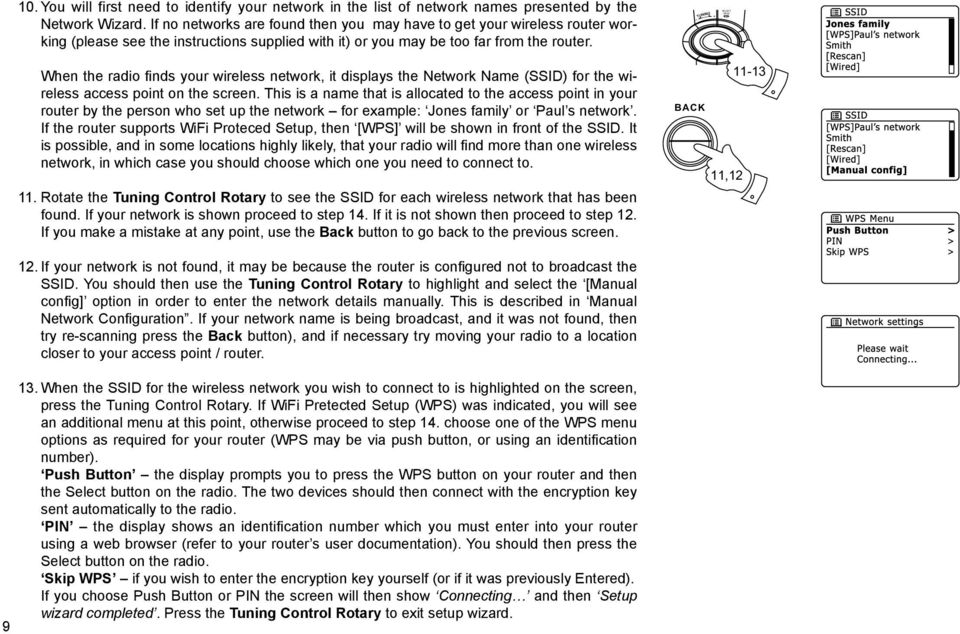
11 4. If your network is configured without an encryption key, the screen should say Connecting, and then Setup wizard completed. Press the Tuning Control Rotary to exit the setup wizard and show the main menu. If this is the case then you have successfully connected your radio to your network. 5. If the screen displays Key, it is because the network is using one of the encryption systems: Wired Equivalent Privacy (WEP) or WiFi Protected Access (WPA). You will need to enter the correct WEP or WPA key into the radio to allow it to communicate with your wireless network. If you do not have the WEP or WPA key, then you should obtain it from the person who set up your network. Some wireless routers may come with an encryption key already set up by the supplier, in which case you should refer to the documentation provided with it. WPA is used here to also include WPA2. WEP keys are 0 or 26 characters long (using 0 9, and A F). Some wireless Routers can also use pass-phrases for WEP but these are not supported. WPA keys are usually set up using a pass-phrase of between 8 and 63 characters. Your radio accepts pass-phrases for WPA keys. DAB 6. To enter the WEP or WPA key, characters are selected and entered using the Tuning Control Rotary. The highlight scrolls through the available characters as well as the three controls on the right. The character currently highlighted will be entered when you press the Tuning Control Rotary. Do this as needed until the complete key has been entered. Remember, WEP keys only use the numbers 0-9 and letters A-F. WPA keys are sensitive to upper and lower case characters. You must enter the key exactly or the radio will not connect to the network. The three controls on the right-hand side of the screen have special functions. You can quickly access these by pressing the Info button and then use the Up or Down and Select buttons as needed: select to erase a character just entered select when the complete key has been entered select to cancel an re-run the Network Wizard If a WEP or WPA key has previously been entered for the selected SSID then the display will show Key: [Set]. If you have previously entered a different key, you must clear this by selecting the symbol. This will remove the [Set] indication. After the final character of the WEP or WPA key has been entered, highlight the symbol and press the Tuning Control Rotary. Then screen will show Connecting and then Setup wizard completed. Press the Tuning Control Rotary to exit setup wizard. The radio should now be able to connect to the network. 0

12 7. Once you have connected your radio to the network (and therefore also to the Internet) it will display the main menu. Press the Tuning Control Rotary to put the radio in Standby mode. It should then display the time as obtained from the Internet. If the time display is not correct for any reason, it can easily be adjusted later, see Manually setting the clock. If you have followed the steps on the preceding pages successfully, your radio will have connected to your router, and then made a connection to the Internet and set its clock. If this is the case, then you can try listening to radio stations via the Internet. Note: To save the radio power consumption while your radio is powered with battery, the radio will turn off fully when put into standby mode. As a result, if you switch off your radio when your WFR-28D is power supplied with battery, next time when your radio is switched on, the time on the screen will be reset and show as 00:00. However, as soon as the radio connects with WiFi, the time will update automatically from the network.

13 Changing the network connection In the sections above, you chose how your radio would be connected to your network, using a WiFi connection. From time to time, you may find that you need to connect to different computer networks. The Internet setup menu allows you to change your radio s network settings, scan for an alternative wireless network, or to manually configure the network parameters. The steps outlined below describe how you can do this see also the section Network Profiles. Configuring the radio to use an alternative WiFi connection From the Network settings menu select Network wizard. This will present you with details of any WiFi networks that are found. Scroll down the list using the Tuning Control Rotary to the desired network name. Press Tuning Control Rotary to select this network. The radio will then use its WiFi system to communicate with the network. Depending on the settings for the new network you may need to enter an encryption key. By default the radio will then acquire an IP address and other network settings from your router using DHCP. Manual network configuration If you do not wish to use DHCP for automatic configuration, or if your network is configured with a hidden SSID, then you will need to enter some network settings manually. (Note a hidden SSID may prevent casual observers from detecting your network, but is not recommended as a means of network security.). From the radio Network settings menu, select Manual settings. You must then choose to connect using Wireless connections. Entering this option, there are as many as nine settings screens, shown by the of 9 progress marker in the top right corner of the display. 2. The next menu asks whether you wish to use DHCP to configure your network parameters (IP address, subnet mask, gateway address, etc). Unless you are familiar with networking and related terminology, we recommend that you allow the use of DHCP. Choose DHCP enable unless you need to specify the network details manually. If you chose DHCP enable, please skip to step 6 in order to set up the wireless connection details. If you chose DHCP disable for either connection method, the next step is to set up the IP address. 2
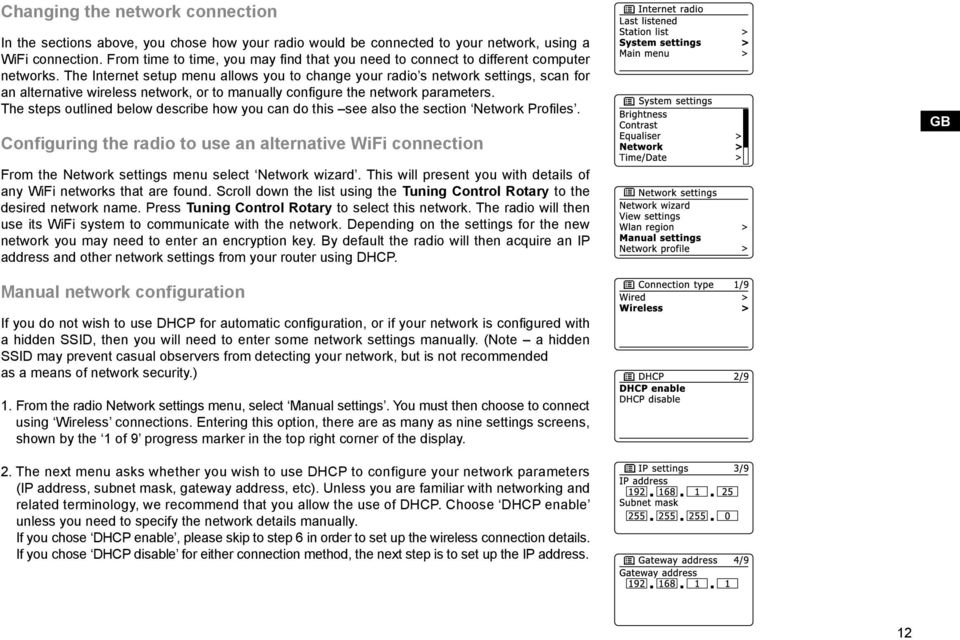
14 3. The manually specified IP address should be chosen to be compatible with the settings in your router and must be a unique address on your network. If you are using DHCP for some devices and static (manually configured) IP addresses for others, the IP address used should fall outside the range that the router may allocate using DHCP. Typically, the first three groups of digits will be the same for all devices on your network. To enter the IP address, rotate the Tuning Control Rotary to set the value for each group of digits and then press the Tuning Control Rotary to enter the value and to move on to the next group. When the IP address has been entered, the subnet mask should be entered. The subnet mask defines which parts of the IP address are common across your network. For most small networks the subnet mask will be and this is entered in the same way. 4. The Gateway address is normally the IP address of the router through which the radio connects to the internet and is entered in the same way as the previous addresses. 5. In most installations the DNS settings (DNS = Domain Name Server) will be set to the same IP address as your router. In this case the secondary DNS may be left at zero. To enter the DNS address, rotate the Tuning Control Rotary to set the value for each group of digits and then press the Tuning Control Rotary to enter the value and to move on to the next group. Repeat this until all eight groups of digits have been entered. 6. The next step is to set up the WiFi connection, starting with the name of the wireless network (SSID) followed by the encryption options and password. To enter the SSID, characters are selected and entered using the Tuning Control Rotary The radio scrolls through the available characters as well as the three controls on the right. The character currently highlighted will be entered when you press the Tuning Control Rotary. Do this as needed until the complete network name has been entered. The SSID setting is sensitive to upper and lower case characters and symbols. You must enter it exactly as set up in your router. The three controls on the right-hand side of the screen have special functions: select to erase a character just entered select when the complete SSID has been entered select to cancel and go back to the DNS settings screen 7. Having entered the SSID, you must enter details of the encryption system used on your wireless network. This should be the same as specified in your router settings. If your network does not use encryption, then select the Open option. Your radio should then connect to the network, so skip to step. If your network uses WEP (Wired Equivalent Privacy) select the Pre-Shared Key option then go to step 8. The remaining options are for WPA or WPA2 (WiFi Protected Access) see step 9. 3
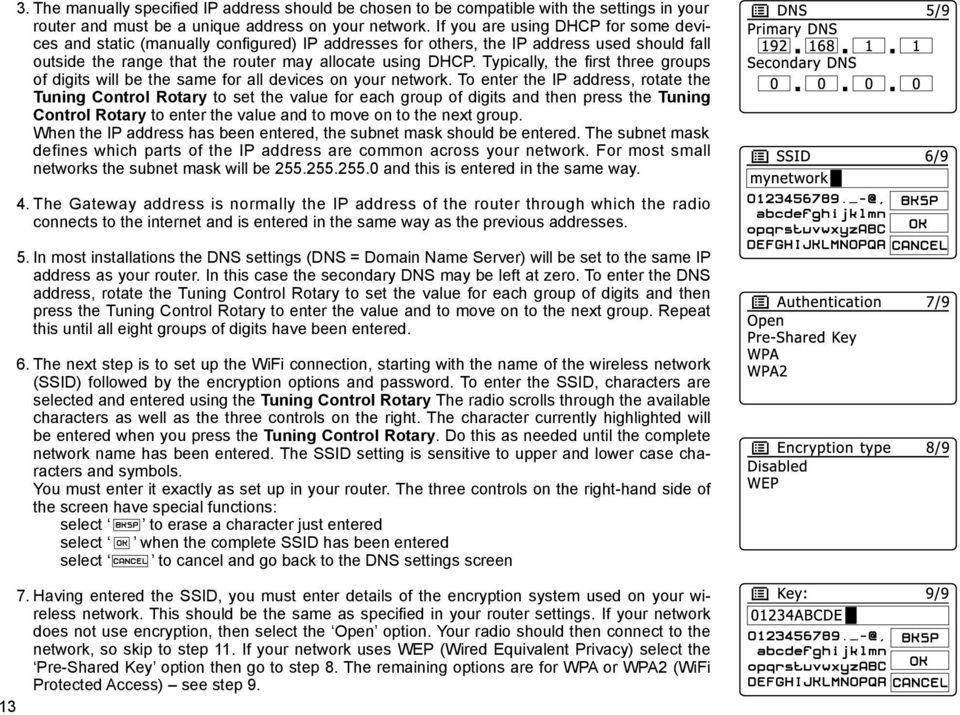
15 8. If you chose Pre-Shared Key in step 7, you should then choose the WEP option. The key should be entered using only the numbers 0-9 and the letters A-F. The key will be 0 characters long for 64-bit encryption and 26 characters long for 28-bit encryption. The radio will accept lower-case letters a-f as equivalent to upper-case A-F. Spaces or special symbols are not permitted in WEP keys. The three controls on the right-hand side of the screen have special functions: select to erase a character just entered (long press to clear); Info again to continue select when the complete encryption key has been entered select to cancel and go back to the SSID settings screen Once the key is entered the radio should connect to your network. Please skip to step. 9. WPA and WPA2 are similar, although WPA2 offers a higher level of security. Whichever you selected in step 7, you then have to specify the variant used. They are TKIP (Temporal Key Integrity Protocol) and AES (Advanced Encryption Standard). As previously, the setting should match that used by your router. Some routers allow both to be specified, and the router will use whichever variant is supported by the connected device. AES is regarded as the more secure option if it is available. 0. The radio will then require you to enter the encryption key. This must be a string of between 8 and 63 characters and must be identical to the key which has been entered into your router. Note the encryption key is sensitive to the use of upper and lower case letters and symbols. Take care to enter the key exactly, or the radio will not be able to connect to your router. The three controls on the right-hand side of the screen have special functions. You can access these by rotating the Tuning Control Rotary and then press the Tuning Control Rotary to select as you needed: select to erase a character just entered (long press to clear ); Info again to continue select when the complete encryption key has been entered select to cancel and go back to the TKIP / AES options screen Once the key is entered the radio should connect to the network.. While the radio is trying to connect to the network, it will display Processing when checking the encryption key and then Connecting. If the connection is made successfully, the radio will return to the Network settings menu. If the unit cannot connect, then it will display a Failed to connect message and will return to the SSID entry screen (step 6). Once connected, the network settings are stored in the radio. The settings are retained when the radio is disconnected from the mains. You may now use the Back and Mode buttons to access the functions of your radio. 4

16 Network remote control options Network Pin setup (Pin number) Your radio has the option of being controlled by an application installed on an Apple iphone, ipod touch or ipod. The Pin number facility allows you to ensure that your radio can only be controlled by your own Apple device rather than someone else s. Details of how this feature can be used with your iphone or ipod touch are explained in the separate section in this manual called Using isangean app for controlling your WFR-28 internet radio. Keep network connected By default, your radio will shut down its WiFi connection when it is in standby. This minimizes power consumption but it does mean that you will need to switch that radio on manually in order to use either the Play to function or any other remote control software. If you need to be able to remotely control the radio even when it has been put into standby, then you can choose to keep the network connected by using the Keep connected option in the network setting menu. In the standby mode display either the WiFi signal indicator is shown with or without a cross through it according to the chosen network settings. 06/04/20 Network settings Wlan region > Manual settings Network PIN Setup Network profile > Keep network connect Network settings Wlan region > Manual settings Network PIN Setup Network profile > Keep network connect 06/04/20 5

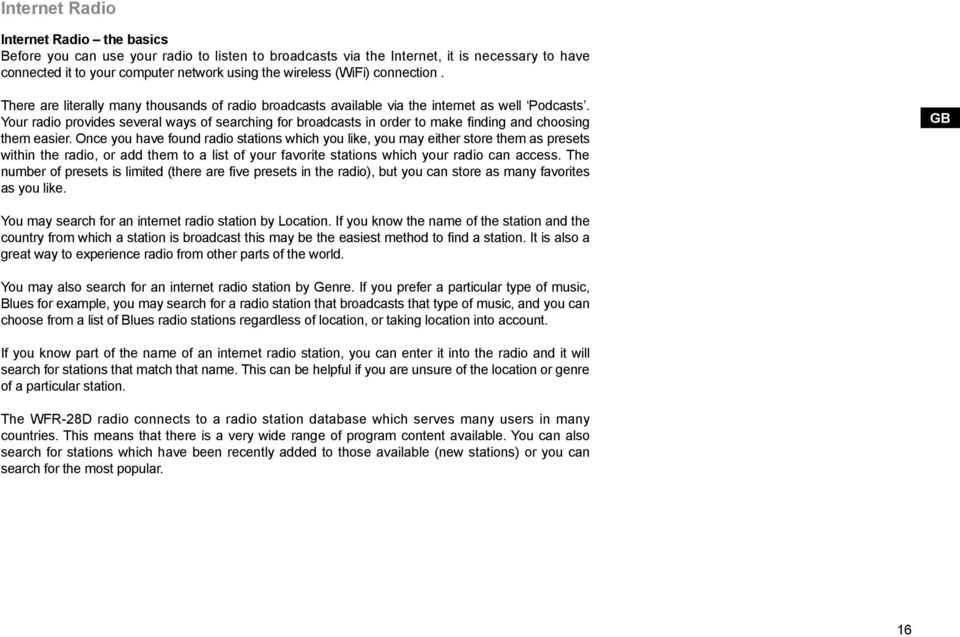
17 Internet Radio Internet Radio the basics Before you can use your radio to listen to broadcasts via the Internet, it is necessary to have connected it to your computer network using the wireless (WiFi) connection. There are literally many thousands of radio broadcasts available via the internet as well Podcasts. Your radio provides several ways of searching for broadcasts in order to make finding and choosing them easier. Once you have found radio stations which you like, you may either store them as presets within the radio, or add them to a list of your favorite stations which your radio can access. The number of presets is limited (there are five presets in the radio), but you can store as many favorites as you like. You may search for an internet radio station by Location. If you know the name of the station and the country from which a station is broadcast this may be the easiest method to find a station. It is also a great way to experience radio from other parts of the world. You may also search for an internet radio station by Genre. If you prefer a particular type of music, Blues for example, you may search for a radio station that broadcasts that type of music, and you can choose from a list of Blues radio stations regardless of location, or taking location into account. If you know part of the name of an internet radio station, you can enter it into the radio and it will search for stations that match that name. This can be helpful if you are unsure of the location or genre of a particular station. The WFR-28D radio connects to a radio station database which serves many users in many countries. This means that there is a very wide range of program content available. You can also search for stations which have been recently added to those available (new stations) or you can search for the most popular. 6
18 Selecting a radio station by location. Press the Standby button to switch the radio on. Then press the Mode button to select the internet radio mode display. 2. Press the Menu button to enter the main Internet radio menu. Rotate the Tuning Control Rotary until Station list is highlighted on the display and then press the Tuning Control Rotary to select the option. 3. Rotate the Tuning Control Rotary until Stations is highlighted on the display and then press the Tuning Control Rotary. MODE MENU 2 Note that the menu may offer one or more local selections based upon the country in which the unit is being used, according to your internet IP address ( United Kingdom and BBC stations, for example) Rotate the Tuning Control Rotary until Location is highlighted on the display and then press the Tuning Control Rotary to select. 5. Rotate the Tuning Control Rotary to scroll through the list of continents. When the desired continent is highlighted press the Tuning Control Rotary to enter your selection. 6. The display will show a list of countries within the chosen continent. If there are many countries shown you can scroll through the list continually in either direction. For example, if the chosen continent was Europe, then to find the United Kingdom scroll up from the top of the list to the bottom by rotating the Tuning Control Rotary. Press the Tuning Control Rotary to choose the desired country. 7. You will typically find that you then have the option to select either All Stations or one of a number of categories. The lists are always sorted alphabetically, and long lists will wrap around from top to bottom or bottom to top. 7

19 8. Rotate the Tuning Control Rotary to highlight your chosen radio station and then press the Tuning Control Rotary to enter your selection. The display will show Connecting while the radio connects to the new station. The station should then start playing. Adjust the volume as needed. 9. If the station has on-demand content, that is, it gives the option of listening to programs which have already been broadcast or to Podcasts, there will be an additional screen showing the radio station name as well as a Podcasts option. These are selected using additional menus, determined by the radio station and the content. There may simply be a list of programs, or there may also be options to choose from broadcasts on particular dates or days of the week. The examples shown here are typical. Podcasts and Listen Again content can also be accessed separately from the main Internet Radio menu. If your radio cannot connect to a radio station Note: If your radio is unable to connect to an internet radio station it will generally either display Network Error or Stopped. This can be for many reasons, but typically will be due to one of the following: The radio station may not be broadcasting at the present time. The radio station may not be able to accommodate any more connections from internet listeners. The broadcaster may limit listening to specific countries or regions. There may be network congestion (either locally or at a distance) which is affecting the reliability of the connection. If your radio can connect, but the audio is not continuous and the radio keeps having to reconnect, this may be due to the radio station only having limited connection capacity. 8

20 Selecting a radio station by genre. Press the Menu button to enter the main Internet radio menu. MENU 2. Rotate the Tuning Control Rotary until Stations is highlighted on the display and then press the Tuning Control Rotary to select. 3. Rotate the Tuning Control Rotary until Genre is highlighted on the display and then press the Tuning Control Rotary. 4. Rotate the Tuning Control Rotary to scroll through the list of content types. This menu is normally cyclic you can scroll the list continually in either direction. When the chosen genre is highlighted, press the Tuning Control Rotary You then have the choice of All Stations of the chosen genre, or a list of countries. Note if a country is not shown then the station may still appear in the All Stations list. Rotate the Tuning Control Rotary and the Tuning Control Rotary to choose as needed. 6. A list of radio stations is then shown. Rotate the Tuning Control Rotary until the desired station name is highlighted on the display. 7. Press the Tuning Control Rotary to select the station. The display will show Connecting while it finds the new station. If the radio is unable to connect this may be for one of the reasons explained previously. 8. Adjust the Volume as needed to set the listening level. 9

21 Searching for a radio station by name There may be occasions when you know the name of a radio station but you do not know the location or genre. This facility allows you to search for the station using a part (or parts) of the radio station name.. Press the Menu button to enter the main Internet radio menu. Rotate the Tuning Control Rotary until Station list is highlighted on the display and then press the Tuning Control Rotary. MENU 2. Rotate the Tuning Control Rotary until Stations is highlighted on the display and then press the Tuning Control Rotary. INFO 3. Rotate the Tuning Control Rotary until Search stations is highlighted on the display and then press the Tuning Control Rotary To enter the search word(s) press the Tuning Control Rotary on the remote control to highlight each character for the search in turn, and press the Tuning Control Rotary to enter. If you make an error press the Info button to access the delete character on the screen and the character selection. After the final character of the search has been entered, use the Info button and then the Tuning Control Rotary to highlight the symbol on the screen and then press the Tuning Control Rotary to finish. 5. The radio will search for radio stations that match your search data. If you include a space between two search items the radio will look for station names which include both items. Thus a search for ROCK 00 could find a station called 00 Classic Rock Hits as well as a station called 00.FM Rocks Rotate the Tuning Control Rotary to highlight the station that you wish to listen to and press the Tuning Control Rotary to confirm your choice. The display will show Connecting while it finds a new station. 20
22 Selecting a new or popular station As described in the section Internet Radio the basics, your radio connects via the the Internet to a database of radio stations. This option is provided to highlight stations which are newly added to the list of those available, or stations which are particularly popular with listeners around the world. Your radio allows you to easily choose stations from these two categories, using menus very similar to those used when finding stations by location and genre. MENU. Press the Menu button to enter the main Internet radio menu. Rotate the Tuning Control Rotary until Station list is highlighted on the display and then press the Tuning Control Rotary. 2. Rotate the Tuning Control Rotary until Stations is highlighted on the display and then press the Tuning Control Rotary. 3. Rotate the Tuning Control Rotary until Popular stations or New stations is highlighted on the display. Press the Tuning Control Rotary to enter your choice Rotate the Tuning Control Rotary to highlight the station that you wish to listen to and then press the Tuning Control Rotary to enter your choice. The display will show Connecting while the new station is found. 2
23 Selecting a podcast / BBC Listen Again Some radio stations allow you to listen to programs that have already been broadcast. The BBC s Listen Again service is an example of this. In addition, radio broadcasters and individuals may make programs which are intended normally to be downloaded into a computer or copied onto a portable media player. These are commonly known as Podcasts. On your radio, both Listen Again programs and Podcasts are grouped together as Podcasts, and the same menu is used to access and listen to both types of programming. Listen Again programs are also accessible via the Stations menu. MENU. Press the Menu button to enter the main Internet radio menu. Rotate the Tuning Control Rotary until Station list is highlighted on the display and then press the Tuning Control Rotary. 2. Rotate the Tuning Control Rotary until Podcasts is highlighted on the display and press the Tuning Control Rotary You may then search by location, genre, or using part of the name of the podcast. The searches operate in exactly the same way as when searching for a conventional radio station. Searching by location is done first by continent, then by country. You may then list All shows or search within a country by genre. Searching by genre is more direct, since once the genre is chosen the next menu display shows a list of available podcasts. Searching by name operates in the same way as when searching for a named radio station, selecting the symbol when you have entered the text. You may enter one or more pieces of text which will be used for the search. 4. Rotate the Tuning Control Rotary and then press the Tuning Control Rotary to confirm your chosen podcast. The display will show Connecting while it finds the new program. 22
24 Presetting stations With so many Internet radio stations available, it is desirable to have a means of rapidly selecting the stations that you listen to most frequently. Your radio has five memory presets which can easily be set to store the details of any Internet radio station. The radio station presets are retained in memory even when the radio is switched off. Please see also the section Last Listened and Configuring My Favorite Stations. Storing a preset. Press the Standby button to switch on your radio. Tune to the required station using one of the methods described on the preceding pages. 2. To store the currently playing radio station as a preset, press and hold the required Preset button ( 5) on the panel until the display shows Preset stored. The station will be stored using the chosen preset button. Repeat this procedure as needed for the remaining presets. 3. Stations which are already stored in the presets may be over-written by following the above procedure. Recalling a preset. Press the Standby button to switch on your radio. Select the Internet radio mode using the Mode button. 2. Momentarily press the required Preset button on the remote control. Your radio will then connect to the station stored in preset memory. The preset used will be shown at the bottom of the display screen. Last Listened It is often helpful to be able to go back to a station that you have already listened to. Your radio has a Last Listened feature which provides you with quick access to the ten most recently listened to radio stations or podcasts. As each new radio station is listened to the oldest item is deleted from the list. The Last Listened list is stored when the radio is disconnected from the mains.. With the radio switched on and in Internet radio mode, press the Menu button. The first item on the menu is Last listened. With this item highlighted press the Tuning Control Rotary. 2. The display will then show a list of the last ten Internet radio stations or podcasts. Rotate the Tuning Control Rotary to highlight whichever you wish to listen to and then press the Tuning Control Rotary to cause your radio to reconnect to that radio station or podcast MODE MENU 2,2
25 Display modes Your radio has a range of display options when in Internet Radio mode. Note that not all information may be available for all Internet radio stations.. Press the Info button to cycle through the different options. INFO a. Description Displays information about the radio station or scrolling text messages such as artist/track name, phone number etc. b. Genre Displays program type information e.g. Pop, Classic, News, etc. and the location of the current radio station. c. Reliability Displays the reliability of the data stream from the station currently being received. d. Format Displays the bit rate and format of the station being received. e. Playback buffer Displays status when connecting to and playing a radio station. This indicates the reliability of the data stream to your radio. If there are no bars shown to the right of the dividing line then the data stream reliability may be poor and you may find that there are many breaks in the audio (this is not always the case for REAL audio streams). f. Date Displays the current date. Additional or alternative information may be displayed when listening to Podcasts, Categories displayable can include Episode name Show genre Episode URL Codec Show description Show language Bit rate Sampling rate Whenever the radio is displaying an information screen (as opposed to a menu screen), the time is displayed in the top-right corner of the display, and a WiFi strength indicator is shown in the bottom-right corner. 24
26 Customizing your radio In addition to storing your favourite radio stations in the radio presets, your radio allows you to create customised lists of stations which can appear in two special menus on the radio called 'My Favourites' and 'My Added Stations'. Your radio uses a database which is accessed via the Internet in order to find out which radio stations are available and how it should connect to them. You are able to add your personal selections to this database. These will only be accessible by you using your PC or your radio. You can choose the stations which will appear in the 'My Favourites' menu from the large selection already listed. Additionally, if you find a radio station that is not listed then you may also add the Internet address (URL) of the station's audio stream to your selection. It will then appear on your radio via the 'My Added Stations' menu item. Registering an account. Open the web site using the Internet browser on your computer. Click on the Register here link and follow the on-screen instructions to register an account. During the registration process the web site asks for an access code. This allows it to uniquely identify your internet radio from the many others that it also provides data for. To obtain the access code, please followthese steps. 2. With your radio switched on and in Internet radio mode, press the Menu button, then select 'Station list' using the Tuning Control Rotary. 3. Scroll down the Station list menu to the item called 'Help'. Press the Tuning Control Rotary to enter the Help menu. 4. In the Help menu, select the menu item Get access code. Provided that the radio is connected to the Internet, a code will be displayed of typically seven characters (Upper case letters and numbers). Make a note of this code for the next step. If you need to re-register late you must repeat this process to get a fresh access code. 5. You should then use the code displayed by the radio to fill in the Access Code field on the web page when you set up your account. Once you have your account set up, if you have other radios which use the same data base, you may also add them to your account. You will need to get an access code from each radio in order to add it to the account. They may then share your favorite and added radio station details. 25
27 Configuring My Favorite Stations. Using the website at it is possible to search among the many radio stations that are available by location, genre, or language. You may also choose from new or popular stations. 2. When the radio stations that you have found are shown on your computer screen, they are shown with a 'Play' icon and an 'Add to favourites' icon (the plus symbol and heart). Clicking on the 'Play' icon will allow you to hear the radio station via your computer. Clicking on the 'Add to favourites' icon will cause the radio station to be added to the list accessible via your radio. 3. To help you organise your favourites, and since you may have a many after a while, the website will allow you to specify the name for a category or group under which the radio station will be listed on your radio. Suitable names might be 'Rock', 'Smooth', 'Mum's stations', and so on. Whenever you add another radio station to your favourites you can either add it to an existing. 4. Once you have Internet radio stations available in your My Favorite Stations list, you may play these stations from your radio. These stations will be available on your radio from the Internet radio menu item 'My Favourites'. 5. To look at, modify or delete your favourite stations lists on the website, use the link 'My favourites' in the 'My account' area. To delete a favourite radio station, click on the icon with a heart and minus symbol. Configuring My Added Stations. If you wish to listen to a radio which is not a currently held in the database at it is possible to add the details yourself. You will need to obtain the internet address (URL) for the audio system for the station that you wish to add. This may be information provided by the radio station itself, via its website, or perhaps passed to you from another listener. 2. Use the My added stations link in the My account area on the website. This allows you to add details of new stations or to modify those already added. You can provide a name for the radio station which will be shown on your radio. You must also provide the web address, location and format details. 3. Once you have Internet radio stations available in your My Added Stations list, you may play these stations from your radio. These will be available on your radio from the Internet radio menu item called My added Stations. 4. It is possible to add the web addresses for audio streams which may not be playable by your radio. If you attempt to play such a stream, your radio will normally display an error message of some kind. The Sangean WFR-28D can only play MP3, WMA, AAC and Real Audio internet radio streams. 5. To look at, modify or delete your added stations list on the website, use the link My added stations in the My account area. To delete an added radio station, click on the icon with a heart and minus symbol. 26
28 Selecting your favorite stations. Press the Menu button to enter the main Internet radio menu. MENU 2. Press the Tuning Control Rotary until 'Station list' is highlighted on the display. Press the Tuning Control Rotary to enter the menu. 3. Rotate the Tuning Control Rotary until 'My Favourites' is highlighted on the display. Press the Tuning Control Rotary and your favorite stations list will appear on the display (set up as described on the preceding page). 4. Press the Tuning Control Rotary to highlight the required station and then press Tuning Control Rotary to confirm your selection. The display will show 'Connecting...' while it finds the new station. If the station has on-demand content (that is, it gives the option of listening to programs which have already been broadcast), 'Selecting a podcast / BBC Listen again'. Should you be unable to connect to a particular station, please note that some radio stations do not broadcast 24 hours per day, and some stations are not always on-line
29 Selecting your added stations. Press the Menu button to enter the main Internet radio menu. Rotate the Tuning Control Rotary until 'Station list' is highlighted on the display and then press the Tuning Control Rotary to select. 2. Rotate the Tuning Control Rotary until 'My Added Stations' is highlighted on the display and then press the Tuning Control Rotary to select. MENU 3. Rotate the Tuning Control Rotary to highlight the required station and then press the Tuning Control Rotary to confirm your selection. The display will show 'Connecting...' while it finds the new station. Should you be unable to connect to a particular station, please note that some radio stations do not broadcast 24 hours per day, and some stations are not always on-line. In addition, as mentioned in the previous section, it is possible to specify audio streams for 'My added stations' which are not compatible with your radio. In this event the station will not be playable. The Sangean WFR-28D can only play MP3, WMA, AAC and Real Audio internet radio streams. -3 Note that the audio coding formats listed are generic terms. There are many variations of each format, as well a variety of streaming protocols in use by different radio broadcasters. Your radio has been designed to play the vast majority of coding and streaming formats in current use by broadcasters. 28
30 Music player Use with Windows, Apple Mac and Linux The Music Player allows you to play audio files which are stored on computer in your network. In order to play files from a computer on your network, your radio must connect to a file server application which uses the Universal Plug and Play (UPnP) protocol. If your computer uses Windows 7, Vista or XP, then it is likely that your computer already has a UPnP server application available. Windows Media Player (versions and 2) has this capability, and it is able to make your files available to your radio. It also allows you to select files by Album, Artist, and so on. Windows Media Player 2 can serve MP3, WMA, AAC and WAV files to your radio. Windows Media Player is only able to serve MP3 and WMA files to your radio. If you are an Apple Mac or Linux user, there are other UPnP server applications which you may use with your radio. The Music Player on the radio can playback audio files in MP3, WMA, AAC and WAV formats. WMA Lossless files can also be played when using Windows Media Player as it will convert these to a compatible format before streaming them to the radio. Note that the playback of files encoded using WMA Voice, WMA 0 Professional, and for files which have DRM protection are not supported. Many UPnP server applications are also capable of sharing pictures and video files to other network connected devices. if this is the case (as it is with Windows Media Player and 2) you may see the option of choosing between Music, Video and Pictures on the Music Player s Menu. You should only select the Music option. Content offered via the alternative options will not be playable on your radio. Some third part server application allow customization of the search criteria and indexing methods. This can useful of you have a very large collection of store music files. Here is a short selection of alternative UPnP server applications, although many other are available. Twonky Media Server (Windows, Apple Mac, Linux) TVersity (Windows) Elgato EyeConnect (for Apple Mac OS X) Media Tomb (Linux, MAC OS X) Please refer to the documentation for your chosen server application for full details of its configuration and usage. When using a UPnP server, the search and selection criteria are determined by the server software, but typically include Artist, Album and Genre. Many server applications also allow you to access your files according to the folders within which they are stored as well as other criteria. Windows Media Player is less flexible than some other UPnP servers, but is generally easier to set up. It is supplied as a standard component of windows 7, Vista or XP. 29
31 Accessing your audio files via a UPnP server If your computer is running Windows 7, then Windows Media Player version 2 includes a UPnP server which will make your files available to your radio. If you have Windows Vista or XP (Please refer to the section of Accessing your audio files via a UPnP server using Windows Vista and XP ). There are other UPnP server solutions available for non-windows users and for Windows users who may wish to use an alternative (see the preceding section).it is beyond the scope of this instruction book to cover all possible options for UPnP. We explain the use of Microsoft's Windows Media Player here since that will be the first choice for the majority of users. Set up UPnP access with Windows Media Player 2. Windows Media Player 2 (referred to here as WMP 2) can create a library from all the media files available on your PC. To add new media files to the library, select 'Library', then 'Music', then 'All music' or 'Artist', 'Album' etc. This will show you the current library contents. You may then simply drag and drop files from other locations into the library. Alternatively, with media files or folders on the screen, you may right-click on the file or folder and select 'Include in library' and then select 'Music'. In this way you can quickly add additional content to your music library. 2. In WMP 2, click on 'Stream' (see picture at right) and then select 'Automatically allow devices to play my media'. Then accept the 'Automatically allow all computer and media devices' option. There are other options (see overleaf) but this is the simplest if you just wish to quickly enable media streaming to your radio. 3. Press the Standby button to switch the unit on. Then press the Mode button as needed until the Music Player mode display is shown. The main 'Music Player' menu will then be displayed. 3 MODE 3 30
32 4. Rotate the Tuning Control Rotary until 'Shared media' is highlighted and press the Tuning Control Rotary to select. The radio will scan for all available UPnP servers. It may take a few seconds for the radio to complete its scan. The radio will display '<Empty>' if no UPnP servers are found. 5. After scanning, select your UPnP server using the Tuning Control Rotary on the panel. If you allowed automatic connection previously, your radio should now connect and you may skip to the next page. If you did not permit automatic connections, your radio will then normally display 'Unauthorized' at this stage Your PC may prompt you that there has been a connection to your UPnP server. Whether prompted or not, in order that the radio may access the music files, you will need to click the 'Library' tab in WMP 2 and select the 'Stream...' item to open the 'Media Streaming' window. Select 'Automatically allow devices to play my media' then select 'Automatically allow all computer and media devices'. Alternatively select 'More Streaming options' to enable sharing on a 'per device' basis. 7. In the 'More streaming options' window, the radio will be listed as a blocked device. Click on the button shown to select 'Allowed'. Note: If you are using Microsoft Windows' firewall software, this should be correctly configured by WMP 2. If you are using third party firewall software you may need to manually configure it to allow your unit and WMP 2 to communicate. 8. On the radio, select the named server again using the Tuning Control Rotary. If WMP 2 is now able to communicate with your radio you will be presented with some media selection options on the display. 3
33 Locating and playing media files using UPnP Once the UPnP server has been configured to share media files with your radio, you may select the files that you wish to play as follows:-. Press the Standby button to switch on the unit. Press the Mode button as needed until the Music Player mode display is shown. The main Music Player menu will then be displayed. 2. Rotate the Tuning Control Rotary until 'Shared media' is highlighted on the display and then press the Tuning Control Rotary to cause the radio to scan for UPnP servers. Note that it may take a few seconds for the radio to complete its scan. The display will return to the Music Player menu if no UPnP servers are found. MODE 3. After a successful scan, rotate the Tuning Control Rotary to highlight your UPnP server and then press the Tuning Control Rotary. If the display shows multiple media types, select 'Music'. (Some UPnP servers can serve pictures and video content to suitable devices.) 4. The radio will now list the media categories which are made available by the UPnP server - for example, 'Album', 'Artist' and 'Genre'. Rotate the Tuning Control Rotary to highlight which category you wish to browse, then press the Tuning Control Rotary to confirm your choice. 2-4 If you wish to use the search function rotate the Tuning Control Rotary until 'Search' is selected on the display. You may select characters to build a keyword for searching for content to play. When you first set up sharing with a UPnP server, not all of your files will be available immediately. The UPnP server must look inside each file to identify the artist and album information from 'tags' embedded in them. The server may also need time to access the Internet to obtain additional information such as 'album art' which it can display when you examine your music library on your PC. For a library of many files this can take some time. 32
34 Media selection When searching via UPnP you will have a selection of search criteria as determined by the UPnP server software on your computer. This allows you to search by a given information type (Album, Artist, Genre, etc.) and then to narrow the search to an album or to a particular track within an album. Some UPnP server applications allow the search options to be customized. The searches described here are just examples of the possibilities. Listening to a complete album. Rotate the Tuning Control Rotary to choose content by Artist, Album, Genre, etc. according to your needs then press the Tuning Control Rotary to enter your choice. 2. When you reach the album or folder the menu will then switch to showing the tracks in that album or folder. When searching by UPnP they will normally be listed in track number order (but as with the search criteria, this can vary according to the server application used) With the first track in the album indicated, press the Tuning Control Rotary. The album will then begin playing. While the radio is playing from your media library, you may use the menus as described above to choose a different selection. When you select the track from which to play, the radio will then immediately begin playing the new selection. 33
35 Listening to a particular track. If you wish to play only a particular track from an album or folder, first choose the album or folder as described on the preceding pages. 2. Rotate the Tuning Control Rotary until the required track is highlighted. 2,3 3. Press and release the Tuning Control Rotary. The track will begin playing. The radio will then play subsequent tracks from the same album or folder. Controlling playback. Press the Play/Pause button to pause playback of the current track. 2. If you press the Play/Pause button, playback will resume from the point where it was paused. 3. Press the Rewind button to start playback of the previous track in the list. 4. Press the Fast-forward button to start playback of the next track in the list. 5. Press and hold the Fast-forward or Rewind button to move through the current track. The longer the button is pressed, the greater the speed at which the player will move through the track. Release the button when the desired point is reached. (Note that this feature is not supported when playing files encoded using the FLAC format.)
36 SELECT Repeat tracks. When a track is playing, press the Menu button to enter the main Music player menu. MENU 2. Rotate the Tuning Control Rotary until Repeat play is highlighted on the display. Press the Tuning Control Rotary to turn on the repeat function. Your selected track will be played repeatedly and the repeat indicator will show on the display. 3. To turn off the repeat option, select the Repeat Play again. Shuffle tracks. When a track is playing, press the Menu button to enter the main Music player menu. Rotate the Tuning Control Rotary until Shuffle play is highlighted on the display. Press the Tuning Control Rotary to turn on the shuffle function. Your selected track will be shuffled and the shuffle indicator will show on the display. MENU 2 2. To turn off shuffle select the Shuffle play again. If both Repeat and Shuffle playback options are activated then both Repeat and Shuffle icons will be shown in the display. Note: The shuffle play function may only be used if the current selection comprises fewer than 52 tracks
37 Display modes Your radio has a range of display options when in Music Player mode. Note that the availability of information depends on the specific media files, their format and upon the server capability. (Not all UPnP servers make information from the media files available in the same way.) INFO. Press the Info button to cycle through the different options. a. Progress bar Displays the playback progress for the track currently playing. b. Artist Displays the artist information for the track currently playing. c. Album Displays the album information for the track currently playing. d. Format Displays the bit rate and format of the track currently playing. e. Buffer Displays the radios internal buffer status during media playback. Whenever the Music Player is displaying an information screen (as opposed to a menu screen), the time is displayed in the top-right corner of the display, and a WiFi strength indicator is shown in the bottom-right corner together with an indicator showing the radio is obtaining the media from a UPnP server. 36
38 Playlists Sometimes you may wish to set up a list of music tracks or albums which can then be played without further action - as background music for a party, for example. Your radio can be configured to hold a queue of up to 500 tracks in a playlist menu. The tracks or albums for the playlist can be selected from your UPnP server. The playlist is held in memory in your radio until external power is removed, or until the playlist is cleared from the menu. Adding a single track to your playlist. When selecting (or when playing) a track using a UPnP server press and hold the Tuning Control Rotary and the display will show 'Added to My playlist'. 2. The track will be added to the playlist for playback later.,3 Adding an entire album or folder 3. When using a UPnP server highlight the chosen album, artist or folder and press and hold the Tuning Control Rotary. The display will show 'Added to My playlist'. 4. Each of the tracks within the album, artist or folder selection will be added to the playlist individually. This allows any unwanted tracks to be removed from the playlist if needed (see the following sections). 37
39 SELECT Viewing your playlist MODE. Press the Standby button to switch on the unit. Press the Mode button as needed until the Music Player mode display is shown. The Music Player menu will then be shown on the display. 2. Rotate the Tuning Control Rotary until 'My Playlist' is highlighted on the display. Press the Tuning Control Rotary button to enter the playlist. 3. Rotate the Tuning Control Rotary to scroll through the playlist. Tracks which are served via UPnP will show their track name. Erasing a track from the playlist. Press the Menu button to enter the main Music Player menu. 2,3 2. Rotate the Tuning Control Rotary until 'My Playlist' is highlighted on the display. Press the Tuning Control Rotary button to enter the playlist. MENU 3. Rotate the Tuning Control Rotary until the track you wish to erase is highlighted. Press the Tuning Control Rotary. 4. You will be asked to confirm the deletion. To delete the track rotate the Tuning Control Rotary buttons until 'YES' is highlighted on the display. Press the Tuning Control Rotary to cause the track to be deleted. 5. If you do not wish to delete the track highlight 'NO' and press the Tuning Control Rotary to cancel the operation
40 Clearing the playlist. Press the Menu button to enter the main Music Player menu. 2. To clear the whole playlist press the Tuning Control Rotary until 'Clear My playlist' is highlighted on the display. Press the Tuning Control Rotary. 3. To clear the whole playlist rotate the Tuning Control until 'YES' is highlighted on the display. Press the Tuning Control Rotary to cause the playlist to be cleared. MENU 4. If you do not wish to clear the playlist highlight 'NO' and press the Tuning Control Rotary to confirm. Playing your playlists. Press the Menu button to enter the main Music Player menu. 2. Press the Tuning Control Rotary until 'My playlist' is highlighted on the display. Press the Tuning Control Rotary button To play the playlist from a particular track, rotate the Tuning Control Rotary until the desired track is highlighted then press the Tuning Control Rotary to start play. 4. While playing from the playlist, you can use this function to jump to a particular track within the playlist. While playing from the playlist, you may add additional tracks or albums or remove specific tracks (please see the preceding sections). 39
41 Wake On LAN If you use a computer as a UPnP server for playing your music files via your radio, you may not wish to keep that computer running when you are not using the radio. If your computer is suitably configured, it can either shut down, or enter a standby or hibernation state when it is not being used. Your radio can wake up a computer which has shut down using a Wake On LAN command via the network provided that the radio has previously connected to a UPnP server application on that computer. A computer which is not currently active will be shown with a question mark in the list of UPnP servers. Many computers will not respond to Wake On LAN commands from the radio in all modes, and may require software, device driver, BIOS, hardware or router configuration changes for this function to operate. Failure of a computer to respond to Wale On Lan is not considered a fault of the radio. Prune servers Shared media?dad: LES:?JENNY: Jenny s music HOME_PC: Mum s music > > > > Your radio stores details of the UPnP servers that it has seen via its network connection in its internal memory. If you use the radio at different locations you may find that there are servers listed by the radio that are no longer available. The prune servers functions allows the list to be reinitialized so that only active UPnP servers on the currently connected network are shown when selecting Shared Media from the Music Player menu.. Press the Menu button to enter the main Music Player menu. 2. Rotate the Tuning Control Rotary until Prune servers is highlighted on the display. Press the control. 3. To remove servers that are no longer required rotate the Tuning Control Rotary until Yes is highlighted on the display. Press the control to cause the servers to be removed. 4. If you do not wish to prune servers rotate the Tuning Control Rotary to highlight No and press the control to confirm. My Playlist Repeat play: Off Shuffle play: Off Clear My playlist Prune servers Prune servers Prune shared media wake on LAN servers? > 40
42 Keep network connected Keep network connected By default, your radio will shut down its WiFi connection when it is in standby. This minimizes power consumption but it does mean that you will need to switch that radio on manually in order to use either the Play to function or any other remote control software. 06/04/20 06/04/20 If you need to be able to remotely control the radio even when it has been put into standby, then you can choose to keep the network connected by using the Keep connected option in the network setting menu. In the standby mode display either the WiFi signal indicator is shown with or without a cross through it according to the chosen network settings. 4 Windows 7 Play to function (UPnP renderer) If your use Window 7, it is possible to choose a music album, track or playlist at the computer and then tell Windows that this should be played on the radio using the Play to function. Using suitable software (sometimes known as a UPnP Control Point), similar functionality is available for other computer types and for handheld devices using Apple s ios or Android operating systems. In this mode the radio acts as a UPnP Renderer.. In order to use the Play to function, the radio must be actively connected to the network. The first time that you use the Play to function you will need to allow Windows to recognize your radio. To do this, please go to step 2. If you have previously used Play to so that Windows remembers your radio and you have configured your radio to keep its network connection in standby mode (see Keep network connected at left), then go to step If your radio is not currently running, or does not have an active connection to your network, then should first switch on your radio and select the Music player mode using the Mode button. Then select Shared media from the menu so that the radio establishes a connection with Windows Media Player on your PC. After this step, all other functions may be performed from your computer. 3. At your Windows 7 PC, locate the file, album or playlist that you wish to play on the radio. 4. Use the right-hand mouse button to pop-up a menu of option for the chosen item and select the Play to option. 5. Windows should show you one or more devices, including your radio, to which you may choose to send the music. Highlight the radio item and click with the left mouse button.
43 6. Windows will then open a Play to window showing the track or tracks to be played. Your computer will then take control of your radio. Your radio will then enter the Digital Media Renderer mode (DMR) and after a few seconds the radio will start playing. The display on the radio will show that it is in DMR mode. 7. While the radio is playing in DMR mode you can use the controls in the Play to window on your computer to skip tracks, fast-forward or rewind, to pause or restart, and to change the volume on the radio. You may also use the controls on your radio to adjust volume, display track information (press the Info button) or to change operating mode. It is not possible to skip tracks or pause playback using the radio s controls while it is in DMR mode. 8. While playing, you may select additional content within Windows and again use the Play to function (see step 3-5). The additional tracks will be added to the playlist in the current Play to window. You may also delete or change the order of tracks within the Play to window. 9. When you wish to exit DMR mode, simply either switch off your radio or press the mode button to select a different operating mode. Don t forget that in order to reselect the DMR mode and to be able to use Play to from Windows you must first ensure that your radio has an active connection to your network (see step and 2 above). Note: Some Windows security software can prevent correct operation of the Play to function. Such software may have updates or configuration options which will permit Play to to operate correctly-please consult your anti-virus software supplier. The Play to function in Windows 7 has been tested successfully with the WFR-28 radio when using Microsoft s security Essentials software without problems. DMR 2:34 Would You Be Happ Playback buffer DMR 2:34 Would You Be Happ Album: The Best of the Corrs DMR 2:34 Would You Be Happ Artist: The Corrs DMR 2:34 Would You Be Happ Bit rate: 92 kbps Codec: WMA Sampling rate: 44. khz 42
44 Using USB memory devices This section describes how to use your radio to access and playback your audio files via USB memory devices. USB slots are located on top of the unit. This is opened by lifting the rubber cover on top of the radio. Important: Your radio is only designed to work with USB memory flash memory devices. It is not intended to be connected to hard disk drives or any other type of USB device. It is possible to use SD or SDHC cards for media storage and playback when held in a suitable USB adaptor. However, due to the wide variation of such adaptors, it is not possible to guarantee that al adaptor/ card combinations will work with the radio. The WFR-28D has been tested with a range of USB memory devices of up to 64 capacity. USB memory must use the FAT or FAT 32 filing system in order to operate with the sound system. However, there are many different card variants available and not all cards can be guaranteed to work in the WFR-28D. USB memory must use the FAT or FAT 32 filing system in order to operate in the WFR-28D. Audio formats supported for playback are MP3, WMA AAC and WAV. Playback does not support files encoded using WMA lossless, WMA Voice, WMA 0 professional, nor files of any format which have DRM protection. Cautions: In order to minimize the risk of damage to your radio, your USB Memory, please place the unit such that the device cannot easily be knocked while it is inserted in the socket. Remove the USB before carrying the unit or if not using the USB feature for a prolonged period. Place the unit in Standby mode removing your USB memory device. The USB connection is intended only for flash memory devices. The use of hard disk storage media is not supported. Play back via USB files stored on MP3 players is not guarantee. 43
45 Inserting and removing memory devices. Plug the USB memory devices into the rectangular slot on the top of the unit. Note: the USB socket is upside down compared to those commonly found on PCs. MODE 2. To select USB mode press the Mode button until the Music Player mode is shown on the display. 2 Playing files from USB memory devices. Carefully insert the USB memory device into the USB slot. Press the Standby button to switch on the radio. The radio may detect the memory has been connected in which case it will ask whether you wish to open the folder view of the memory contents. Press the Tuning Control Rotary to select Yes and skip to step 4 below. If the USB memory was not automatically detected, proceed as follows. 2. To select USB playback mode press the Mode button as needed until Music Player mode is selected. 3. Rotate the Tuning Control Rotary until USB playback is highlighted on the display and press the control. Your radio will now list the content stored on the USB memory device. If there are many files or folders this may take a few seconds. 4. Rotate the Tuning Control Rotary to highlight the required folder and press the control to enter the current folder. The list of tracks in the current folder will be displayed. Alternatively, if you have nested folders (such as album folders within an artist folder) then you will simply step to the next folder level. 5. Rotate the Tuning Control Rotary to select the track and press the control to begin playing from the highlighted track. All files in the current folder will then be played in turn. Files are played in the order in which they exist in the filing system of the USB memory (they are not sorted by file name or track number). 6. Controlling playback from the USB memory device including shuffle and Repeat functions is explained in the section of Music player. 44
46 DAB Radio (not available in WFR-28 sold in the US) Using DAB mode for the first time. Carefully extend the telescopic aerial. 2. Press the Standby button to switch on the radio. If the radio has been used before the last used mode will be selected Press the Mode button as needed so that DAB radio mode is selected on the display. 4. If this is the first time that DAB mode is used a quick scan of the Band III DAB channels will be carried out. The display will show 'Scanning'. (If the radio has been used before the last used station will be selected instead.) During the scanning process, as new stations are detected the station counter will increase and the stations will be added to the list which is stored in the radio. The bar graph indicates the progress of the scan. MODE 3 5. When scanning is completed the radio will list the stations found (in numeric-alpha order A...Z), unless it has previously been tuned to a DAB station. Rotate the Tuning Control Rotary to scroll through the list of available DAB radio stations. Press the Tuning Control Rotary to select the highlighted station. The display may show 'Connecting...' while the radio re-tunes. Use the Volume buttons to set the sound level as needed. 6. If the station list is still empty after the scan the display will show 'Service not available'. If no stations are found it may be necessary to relocate your radio to a position giving better reception
47 SELECT Selecting a DAB radio station. When playing a DAB radio station, the display normally shows the name of the current station with other related information. 2. Rotate the Tuning Control Rotary to access the radio station list and to scroll through the available stations. 3. Press the Tuning Control Rotary to select the highlighted station. The display may show 'Connecting...' while the radio re-tunes. 2,3 4. Use the Volume buttons to set the sound level as needed. Note: If the display shows 'Station Not Available' it may be necessary to relocate your radio to a position giving better reception. A question-mark in front of the station name merely indicates that the station has not recently been detected by the radio. It may still be available. 4 Secondary services Some DAB radio stations can have one or more secondary stations associated with them. Typically these are not broadcast continually. If a station has a secondary station available then the secondary will appear in the list of station names beneath the main (or primary) station. Examples are the programs 'Daily Service' and 'Parliament' on BBC Radio 4.. To listen to a secondary service, rotate the Tuning Control Rotary to scroll to the chosen station, and press the Tuning Control Rotary to tune to the station. If the secondary service is not available (off-air) then the primary service will be selected. 46
48 Display modes Your radio has a range of display options when in DAB mode:- INFO. Press the Info button to cycle through the different options. a. Text Displays text messages such as the artist or track name, phone in number, traffic alerts, etc. b. Program Type Displays the type of station being listened to such as Pop, Classic, News etc. c. Multiplex Name / Frequency Displays the name of the DAB multiplex to which the current station belongs as well as its broadcast frequency. d. Signal error / strength Displays the signal error and strength for the station being listened to. A lower error number indicates a better quality of radio signal. The signal strength graph can be used when positioning the radio or its antenna. For good reception the graph should occupy three or more blocks. e. Bit rate and audio type Displays the digital bit rate and audio coding information for the station being listened to. f. Date Displays the current date. A signal strength indicator is always shown in the lower area of the display on the right hand side. If the broadcast being received is in stereo, then the stereo speaker symbol will be shown. If the currently tuned station has been stored as a preset, then the preset number will also be shown. 47
49 Finding new DAB radio stations Should you wish to use your radio for DAB reception in a new location, or if no stations were detected during the initial scan, you can follow this procedure to allow your radio to find out which DAB radio stations are available. MODE. Ensure that the telescopic antenna is extended, and then press the Mode button as needed to select DAB radio mode. MENU 2. Once in DAB mode press the Menu button. 3. Rotate the Tuning Control Rotary until 'Scan' is highlighted on the display. 4. Press the Tuning Control Rotary to initiate the scan. The display will show 'Scanning' and your radio will perform a scan of the DAB Band III frequencies. As new stations are found the station counter will increase and stations will be added to the list. The bar graph indicates the progress of the scan. 2 3,4 48
50 Manual Tuning Manual tuning allows you to tune directly to the various Band III DAB channels (5A to 3F). MENU. When in DAB mode press the Menu button so that the display shows the DAB menu. 2. Rotate the Tuning Control Rotary until 'Manual tune' is highlighted.,7 3. Press the Tuning Control Rotary to enter manual tune option. 4. Rotate the Tuning Control Rotary to choose the required DAB channel. 5. Press the Tuning Control Rotary to cause the radio to tune to the chosen channel. When the radio has tuned, the display shows the channel number and frequency, and the name of the DAB multiplex found (if any). A bar graph shows the signal strength and is useful if you need to reposition the radio or its aerial. The minimum signal marker 'I' which separates the left and right parts of the signal graph shows the minimum signal level required for satisfactory reception. Any new radio stations found on the tuned DAB multiplex will be added to the list stored in the radio. BACK Press the Back button to choose a different frequency. 7. Press the Menu button a second time to access the main DAB menu then select 'Station list' to return to normal tuning. 49
51 Dynamic Range Control setting Dynamic Range Control (also known as DRC) can make quieter sounds easier to hear when your radio is used in a noisy environment by reducing the dynamic range of the audio signal.. Press the Standby button to switch on your radio. 2. Press the Mode button as needed to select DAB radio mode. MODE 3. Press the Menu button to enter the DAB menu Rotate the Tuning Control Rotary until 'DRC' is highlighted on the display. MENU 5. Press the Tuning Control Rotary to enter the DRC adjustment mode. The current DRC setting will be indicated with an asterisk. 6. Rotate the Tuning Control Rotary to highlight the required DRC setting (the default is Off). 'DRC Off' - DRC is switched off, Broadcast DRC will be ignored. 'DRC high' - DRC is set as sent by broadcaster. 'DRC low' - DRC level is set to /2 that sent by broadcaster. 7. Press the Tuning Control Rotary to confirm the setting Note: Not all DAB broadcasts use the DRC function. If the broadcast does not provide DRC information, then the DRC setting in the radio will have no effect. 50
52 Station order setup Your radio has 3 station order settings from which you can choose. The station order settings are, alphanumeric, ensemble and valid. Note: The default station order on your radio is alphanumeric.. Press the Standby button to switch on your radio. MODE 2. Press the Mode button as needed to select DAB radio mode. 3. Press the Menu button to enter the DAB menu list. 4. Rotate the Tuning Control Rotary until 'Station order' is highlighted. Press the Tuning Control Rotary to enter the station order adjustment mode. 5. Rotate the Tuning Control Rotary to choose between 'Alphanumeric', 'Ensemble' and 'Valid'. 'Alphanumeric' - sorts the station list alpha-numerically A...Z. 'Ensemble' - organizes the station list by DAB multiplex. 'Valid' - shows only those stations for which a signal can be found. The current setting is indicated by an asterisk. MENU Press the Tuning Control Rotary to select the required station order. BACK 7. Press the Back button as needed to return to the DAB menu or to the stations list. 7 5
53 Prune stations If you move to a different part of the country, some of the stations which were listed may no longer be available. Also, from time to time, some DAB services may stop broadcasting, or may change location or frequency. Stations which cannot be found, or which have not been received for a very long time are shown in the station list with a question mark. The Prune stations function will delete the marked DAB stations from your station list. MODE. Press the Standby button to switch on your radio Press the Mode button as needed to select DAB radio mode. MENU 3. Press the Menu button to enter the DAB menu. 4. Press the Tuning Control Rotary until 'Prune invalid' is highlighted. Press the Tuning Control Rotary To cause the stations list to be pruned, eliminating unavailable stations rotate the Tuning Control Rotary until 'YES' is highlighted on the display. 6. Press the Tuning Control Rotary to cause the invalid station names to be removed from the station list. If you do not wish to prune stations, highlight 'NO' and then press the Tuning Control Rotary. The display will revert to the previous menu. 4-6 Note: If you have moved your radio to a different part of the country you should also carry out a search for new stations (please see the section 'Finding new stations'). 52
54 FM Radio Operating your radio in FM mode. Carefully extend the telescopic aerial and press the Standby button to switch on your radio. 2. Press the Mode button as needed to select FM radio mode. 3. Rotate the Tuning Control Rotary and then press the Tuning Control Rotary. The displayed frequency will increase. Your radio will scan up the FM band from the currently displayed frequency and will stop scanning when it finds a station of sufficient strength. MODE 4. The display will show the frequency of the signal which has been found. If RDS information is available, after a few seconds the display will show the radio station name. If you only hear hiss or interference, simply press the Tuning Control Rotary to scan further. Your radio may have found a spurious interference signal. 5. To find more FM stations press the Tuning Control Rotary to repeat the scan operation. To scan down in frequency, rotate the Tuning Control Rotary and then press the Tuning Control Rotary. Your radio will scan down the FM band from the currently displayed frequency and will stop scanning when it finds a signal of sufficient strength. 6. When the end of the waveband is reached your radio will recommence tuning from the opposite end of the waveband. Use the Volume buttons to adjust the sound level as needed
55 Manual tuning. Carefully extend the telescopic aerial and press the Standby button to switch on your radio. 2. Press the Mode button as needed to select FM radio mode. 3. Rotate the Tuning Control Rotary to control the frequency that the radio will tune to. The frequency will change in steps of 50kHz. When the end of the waveband is reached the radio will recommence tuning from the opposite end of the waveband. MODE 2 4. Use the Volume buttons to adjust the sound level as needed. 4 54
56 Display modes Your radio has a range of display options when in FM mode:- INFO. Press the Info button to cycle through the different options. a. Text Displays text messages such as the artist or track name, phone in number, traffic alerts, etc. b. Program Type Displays the type of station being listened to such as Pop, Classic, News etc. c. Frequency Displays the frequency of the FM signal. d. Date Displays the current date. Note: If no RDS information is available, then the radio will only be able to display the frequency. There will be no text or program type information available under these conditions. The radio only provides displays when there is information available. So if there is no text, for example, that display is not available. The RDS indicator at the bottom of the display shows that there is some RDS data present in the broadcast being received. The stereo speaker display shows that the radio is receiving a stereo broadcast (please see also 'Stereo/Mono switching'). 55
57 Scan setting When using the FM mode your radio can be set to either scan local stations or to scan all stations including distant radio stations. MODE. Press the Mode button as needed to select FM radio mode. 2. Press the Menu button to enter the FM menu. MENU 3. Rotate the Tuning Control Rotary until 'Scan setting' is highlighted and then press the Tuning Control Rotary to enter the scan adjustment mode. The current scan setting is indicated with an asterisk To set your radio so that only the stations with the strongest signals are found during scanning rotate Tuning Control Rotary until 'YES' is highlighted. Press the Tuning Control Rotary to confirm the setting. (Normally this will restrict scanning to local transmissions.) 3,4 Alternatively, to set your radio so that all available stations are found during scanning (local and distant transmissions) rotate the Tuning Control Rotary until 'NO' is highlighted. Press the Tuning Control Rotary to confirm the setting. 56
58 Stereo / Mono switching If the FM radio station being listened to has a weak signal, some hiss may be audible. It is possible to reduce this hiss by forcing the radio to play the station in mono rather than stereo.. Press the Mode button as needed to select the FM radio mode display and tune to the required FM station as previously described. 2. Press the Menu button to enter the FM menu. 3. Rotate the Tuning Control Rotary until 'Audio setting' is highlighted on the display. Press the Tuning Control Rotary to enter the audio setting mode. The current setting is indicated with an asterisk. 4. To switch to mono in order to reduce the hiss from a weak FM signal rotate the Tuning Control Rotary until 'YES' is highlighted. Press the Tuning Control Rotary to confirm the setting. Alternatively, to return to the normal automatic 'stereo or mono' mode press the Tuning Control Rotary until 'NO' is highlighted. Press the Tuning Control rotary to confirm the setting. MODE MENU 2 3,4 57
59 Presetting stations in DAB and FM modes There are 5 memory presets each for DAB and FM radio. They are used in the same way for each operating mode.. Press the Standby button to switch on your radio. 2. Tune to the required radio station as previously described. 3. To store the station as a preset, press and hold the required Preset button ( - 0) until the display shows 'Preset stored'. The station will be stored under the chosen preset button. Repeat this procedure as needed for the remaining presets. 4. Stations which are already stored in the presets may be over written by following the above procedure. Note: The radio station presets are retained in memory when the radio is switched off and disconnected from the mains supply. Recalling a preset in DAB and FM modes. Press the Standby button to switch on your radio MODE 2. Select the required operating mode using the Mode button Momentarily press the required Preset button. Your radio will then tune to the station stored in the selected preset memory. The chosen preset number is also shown in the lower area of the radio display, e.g. 'P2'
60 Clock and Alarms Automatically updating the clock Your radio will normally update the clock automatically when connected to the internet. If you enter a time setting manually, the radio will calculate a local time offset which is then stored in memory. Whenever it synchronizes the clock using the internet, including after a power failure, your radio will then set the clock automatically using this information. You may wish to use the radio away from the internet, in which case you may specify that the unit sets its clock from DAB or FM radio broadcasts. After a power failure the radio will then set its clock the next time that you turn on the radio in DAB or FM mode. Alternatively you may specify that the time is not automatically updated. In this case the clock must always be set manually after a power interruption.. With your radio switched on, press the Menu button to access the menu for the current mode. MENU 2. Rotate the Tuning Control Rotary until 'System settings' is highlighted on the display. Press the Tuning Control Rotary to enter the system settings menu. 3. Rotate the Tuning Control Rotary until 'Time/Date' is highlighted on the display. Press the Tuning Control Rotary to enter the time setup. 4. Rotate Tuning Control Rotary until 'Auto update' is highlighted on the display. Press Tuning Control Rotary to enter the auto-update menu. 5. Rotate the Tuning Control Rotary to choose an update option from 'Update from DAB', 'Update from FM', 'Update from Network' or 'No update' as required. Press the Tuning Control Rotary to confirm your choice. The radio will then exit to the previous menu display
61 Setting the clock format The clock display used in standby mode and on the playing mode screens can be set to 2 or 24 hour format. The selected format is then also used when setting the alarms.. With your radio switched on, press the Menu button to access the menu for the current mode. MENU 2. Rotate the Tuning Control Rotary until 'System settings' is highlighted on the display. Press the Tuning Control Rotary to enter the system settings menu. 3. Rotate the Tuning Control Rotary until 'Time/Date' is highlighted on the display. Press the Tuning Control Rotary to enter the time setup. 4. Rotate the Tuning Control Rotary until 'Set format' is highlighted on the display. Press the Tuning Control Rotary to enter the clock format menu. The current clock display format is marked with an asterisk Rotate the Tuning Control Rotary to select either 2 or 24 hour format. Press the Tuning Control Rotary to confirm your choice of clock format. The display will then revert to the previous menu. If the 2 hour clock format is chosen, the radio will then use the 2 hour clock for the setting of alarms, and will display a 2 hour clock with an AM or PM indicator when in standby mode. 60
62 Manually setting the clock The WFR-28D radio will normally set its clock automatically to UK time after a connection to the Internet has been established. Should you need to set the time manually, change the time zone, or manually switch from winter to summer time (GMT to BST - also known outside the UK as daylight savings time), then please follow this procedure.. Press the Standby button to switch on your radio. 2. To set all time settings press the Menu button to access the menu for the current mode. 3. Rotate the Tuning Control Rotary until 'System settings' is highlighted on the display. Press the Tuning Control Rotary to enter the system settings menu. MENU 4. To change the time zone setting go to step. To change from winter to summer time go to step 3. To change the current time or date setting rotate the Tuning Control Rotary until 'Time/Date' is highlighted on the display, then press the Tuning Control Rotary to enter the time and date setting screen. 5. Rotate the Tuning Control Rotary until 'Set Time/Date' is highlighted on the display. Press the Tuning Control Rotary to enter the clock setup. The day digits will flash Rotate the Tuning Control Rotary until the correct day is shown on the display. Press the Tuning Control Rotary to enter the selection. The month digits will then flash. 7. Rotate the Tuning Control Rotary to select the correct month. Press the Tuning Control Rotary. The year digits will then flash. 6
63 8. Rotate the Tuning Control Rotary to select the correct year. Press the Tuning Control Rotary to enter the selection. The hour digits will then flash. 9. Rotate the Tuning Control Rotary to select the correct hour. Press the Tuning Control Rotary to enter the selection. The minute digits will then flash. 0. Rotate the Tuning Control Rotary to select the correct minutes. Press the Tuning Control Rotary to enter the selection. The display will then return to the previous menu.. Rotate the Tuning Control Rotary until 'Set time zone' is highlighted on the display then press the Tuning Control Rotary. 2. Rotate the Tuning Control Rotary to highlight the time zone which is applicable to your location, then press the Tuning Control Rotary to confirm the setting. 3. Rotate the Tuning Control Rotary until 'Daylight savings' is highlighted on the display then press the Tuning Control Rotary. The asterisk shows the current setting. (In the UK, ON is equivalent to British Summer Time, OFF is equivalent to Greenwich Mean Time.) 4. Rotate the Tuning Control Rotary to highlight 'ON' or 'OFF' as required then press the Tuning Control Rotary to confirm the setting
64 Setting the alarm clock Your radio has two separate alarms which can be set to wake you to either the radio, USB or a buzzer alarm. In the event of a power interruption your radio has built in memory that will retain your alarm settings. Ensure that the time is set correctly before setting the alarms.. Press the Menu button and rotate the Tuning Control Rotary until Main menu is highlighted. Press the Tuning Control Rotary to enter the menu. MENU 2. Rotate the Tuning Control Rotary until Alarms is highlighted and the press the Tuning Control Rotary to enter the selection. 3. Rotate the Tuning Control Rotary until the desired alarm ( or 2) is highlighted on the display. Press the Tuning Control Rotary to enter alarm setup. 4. Rotate the Tuning Control Rotary until 'Time' is highlighted on the display. Press the Tuning Control Rotary to adjust the alarm time Rotate the Tuning Control Rotary to choose the alarm hour. Press the Tuning Control Rotary to confirm the setting. 6. Rotate the Tuning Control Rotary to choose the alarm minute. Press the Tuning Control Rotary to confirm the setting. The display will then return to the alarm setting menu. If the radio has been set to use a 2 hour clock format, there will also be an option here for setting AM or PM for the alarm time. 63
65 Setting the alarm clock - cont. 7. Rotate the Tuning Control Rotary to highlight 'Enable' and press the Tuning Control Rotary. The display will show the Frequency options for the alarm. The alarm frequency options are as follows: 'Off' - the alarm will be disabled 'Daily' - the alarm will sound everyday 'Once' - the alarm will sound once 'Weekends' - the alarm will sound only at weekends 'Weekdays' - the alarm will sound on weekdays only Rotate the Tuning Control Rotary to choose the required alarm frequency option. Choosing Off will disable the alarm. Press the Tuning Control Rotary to confirm the selection. If you choose to set the alarm to Once you will also need to set the date using the Tuning Control Rotary. 8. The alarm can be set to buzzer, Internet radio, DAB radio, FM radio. For whichever radio mode is selected, the radio alarm may be set to any of the stations which have been stored as presets or to the station most recently listened to. Rotate the Tuning Control Rotary to highlight the current 'Mode' option for the alarm, then press the Tuning Control Rotary if you wish to change it. Rotate the Tuning Control Rotary to highlight either 'Buzzer' or the required mode. Press the Tuning Control Rotary to confirm the selection. 9. If setting the alarm to a radio option, rotate the Tuning Control Rotary to highlight the 'Preset:' option then press the Tuning Control Rotary if you wish to change it. Choose from either the radio station 'Last listened' to, or from the presets - 5. Scroll to the chosen option and press the Tuning Control Rotary to confirm the selection. Note that you can only set the alarm to use a preset which has already been stored
66 Setting the alarm clock - cont. 0. Rotate the Tuning Control Rotary until the 'Volume:' option is highlighted on the display and press the Tuning Control Rotary if you wish to change it. The radio uses the saved volume setting for each alarm when it sounds. Set the required volume using the Tuning Control Rotary to confirm the setting.. In order to store the alarm settings rotate the Tuning Control Rotary until 'Save' is highlighted. Press the Tuning Control Rotary to store the alarm settings. Your radio will show 'Alarm saved' and will then go back to the list of alarms with the new alarm setting shown in the display. If you decide not to save the settings, press the Back button. The display will show 'Save changes' with a 'YES' or 'NO' option. Rotate the Tuning Control Rotary to choose 'NO' and then press the Tuning Control Rotary. 'Alarm not saved' will show on the display. Active alarms are shown using small alarm indicators at the bottom of the playing displays and on the clock display when in standby. BACK 0, Note: If you make a mistake at any point while setting the alarms, use the Back button to go back to the previous screen. 65
67 When the alarm sounds The buzzer or radio alarm will sound at the selected times for up to 60 minutes unless cancelled. The volume used for the alarm will be as specified during the alarm setting procedure. If the radio cannot connect to the specified radio station, the buzzer alarm will be used instead. To cancel an alarm, press the Standby button to return to standby mode. The alarm icon will flash at the bottom of the playing mode displays, and the radio will automatically switch back to standby mode when the 60 minutes have elapsed. Note: If you have your earphone insert while the alarm is sounding, the sound of the alarm will come out from your earphone. Disabling alarms. To disable a single alarm enter the alarm setup menu and rotate the Tuning Control Rotary until the desired alarm is highlighted on the display. Press the Tuning Control Rotary to confirm. 2. Rotate the Tuning Control Rotary until the 'Enable:' option is highlighted on the display. Press the Tuning Control Rotary Rotate the Tuning Control Rotary to highlight 'Off' and press the Tuning Control Rotary. 4. Rotate the Tuning Control Rotary until the 'Save' option is highlighted on the display then press the Tuning Control Rotary to save the new setting. The chosen alarm will now be disabled. Snooze timer. The buzzer or radio alarm can be silenced for 5 minutes by pressing the Alarm button. Should you wish for a longer snooze duration this can be extended. Pressing the Alarm button again while the radio is snoozed will set the available snooze time to 5, 0, 5 or 30 minutes. 2. While the snooze timer is active the remaining snooze time is shown next to the flashing alarm icon on the clock display. 3. In order to cancel the Snooze timer while the alarm is suspended, press the Standby button. The display will briefly show an 'Alarm Off' message. 66
68 Sleep timer Your radio can be set to turn off after a preset time has elapsed. The sleep timer setting can be adjusted between 5 and 20 minutes in 5 minute increments.. Press the Menu button and rotate the Tuning Control Rotary until Main menu is highlighted. Press the Tuning Control Rotary to enter the menu. 2. Rotate the Tuning Control Rotary until Sleep is highlighted. Press the Tuning Control Rotary to enter the setup. 'Sleep off' will appear on the display. MENU 3. Rotate the Tuning Control Rotary to select the desired sleep time. The options are 5 to 20 minutes in 5 minutes increment. Use the OFF option to cancel the sleep function. 4. Your radio will switch off after the preset sleep time has elapsed. 5. Your radio will switch into standby mode after the preset time has elapsed. An active sleep timer is shown using a small timer indicator at the bottom of the playing displays. This indicator also shows the sleep time remaining before the radio switches itself into standby mode. 6. To cancel the sleep time before the preset time has elapsed and to turn off the radio, press the Standby button to turn the unit off manually. To cancel the sleep timer and leave the radio playing, go back into the sleep timer settings (steps to 3 above) and select the Off option in step 3. Alternatively, simply press the Standby button twice in succession to cancel the timer and switch the radio back on again.,2 6 67
69 Display and Audio Equalizer function The sound on your radio can be adjusted to suit your personal taste for the material that you are listening to. The WFR-28D has a range of equalizer modes. Alternatively you may set the treble and bass levels to your own preferences which can be accessed from the My EQ menu item.. Press the Menu button and rotate the Tuning Control Rotary until System settings is highlighted. Press the Tuning Control Rotary to enter the setup. MENU 2. Rotate the Tuning Control Rotary until 'Equalizer' is highlighted on the display. Press the Tuning Control Rotary to confirm. 3. Rotate the Tuning Control Rotary to cycle through and highlight the various modes. Press the Tuning Control Rotary to confirm your selection. a - 'Normal ' b - 'Flat' c - 'Jazz' d - 'Rock' e - 'Movie' f - 'Classic' g - 'Pop' h - 'News' i - My EQ The currently selected mode is marked with an asterisk. -3 Normal Flat Jazz Rock Movie 68
70 Setting up your My EQ profile If you find the preset equalizer functions not to your liking, you may set up a custom treble and bass setting as follows:. Follow steps -2 in the previous section in order to enter the Equalizer menu. 2. Rotate the Tuning Control Rotary until 'My EQ profile setup' is highlighted on the display. Press the Tuning Control Rotary to enter the adjustment mode. 3. To adjust the bass level rotate the Tuning Control Rotary until 'Bass' is highlighted on the display. Press the Tuning Control Rotary to enter the adjustment mode and rotate the Tuning Control Rotary until the desired level (between -4 and +4) is displayed. The sound will change as you adjust the level. Press the Tuning Control Rotary when you are happy with the bass setting To adjust the treble level rotate the Tuning Control Rotary until 'Treble' is highlighted on the display. Press the Tuning Control Rotary to enter the adjustment mode and rotate the Tuning Control Rotary until the desired level (between -4 and +4) is displayed. The sound will change as you adjust the level. Press the Tuning Control Rotary when you are happy with the treble setting. 5. Press the Back button and the display will prompt you to save the changes. If you wish to save the changes highlight 'YES'. If you do not wish to save the changes highlight 'NO'. Press the Tuning Control Rotary to enter the selection. BACK 6. To use the 'My EQ' profile rotate the Tuning Control Rotary until 'My EQ' is highlighted, and then press the Tuning Control Rotary to make the selection. 5 To quickly cancel the effect of the 'My EQ' profile rotate the Tuning Control Rotary until 'Normal 'is highlighted on the display and press the Tuning Control Rotary to select. The treble and bass settings will be remembered for the next time that you wish to use the 'My EQ' setting. 69
71 Brightness control The brightness of the display can be adjusted for when the radio is in standby and for when it is in use. If you use the unit in the bedroom, you may prefer a lower standby brightness level than the standard setting. There are three brightness levels and an almost off 'night-time' setting.. Press the Standby button to switch on your radio. Access the menu for the current mode by pressing the Menu button. 2. Rotate the Tuning Control Rotary until 'System settings' is highlighted on the display. Press the Tuning Control Rotary to enter the system settings menu. Rotate the Tuning Control Rotary until 'Brightness' is highlighted on the display. Press the Tuning Control Rotary to confirm the setting. 3. To adjust the display brightness when the radio is switched on rotate the Tuning Control Rotary until 'Normal' is highlighted on the display. To adjust the display brightness when the radio is in standby rotate the Tuning Control until 'Standby' is highlighted. Press the Tuning Control Rotary to enter the selected brightness adjustment mode. MENU 4. To adjust the brightness level rotate the Tuning Control Rotary on the radio to increase the brightness level and the Tuning Control Rotary to decrease it. The backlight level will change so that you can see the effect of each setting. Note that the backlight is almost completely off at the zero setting. Press the Tuning Control Rotary to set the level. 2-4 When the radio is in Standby mode, pressing a button will cause the radio to switch to the Normal brightness level for a few seconds. This is so that even if the Standby brightness level is set to zero (almost off), it is still possible to see the time by quickly pressing a button. 70
72 Contrast / viewing angle control The contrast of the display can be adjusted. The adjustment also changes the angle from which the display can best be seen.. Access the menu for the current mode by pressing the Menu button. Rotate the Tuning Control Rotary until 'System settings' is highlighted on the display. Press the Tuning Control Rotary to enter the settings menu. 2. Rotate the Tuning Control Rotary until 'Contrast' is highlighted on the display and press the Tuning Control Rotary to confirm the setting. MENU 3. Rotate the Tuning Control Rotary to adjust the contrast and viewing angle. The contrast level indication on the screen will change at the same time. When you find the setting that gives the best legibility for the location in which the radio is used, press the Tuning Control Rotary to save the setting. -3 Mute function Pressing the Mute button will mute the output from the loudspeakers.. Press the Mute button to mute the sound output. 2. Press the Mute button again or one of the Volume buttons to un-mute the sound output.,2 2 7
73 Headphone socket A 3.5mm Headphone Socket located on the left hand side of your radio is provided for use with headphones. Inserting a plug automatically mutes the internal loudspeaker. Please be aware that the sensitivity of headphones can vary widely. We therefore recommend setting volume to a low level before connecting headphones to the radio. It is also recommended to reduce the volume before unplugging your headphones. IMPORTANT: Excessive sound pressure from earphones and headphones can cause hearing loss. Line out socket (3.5mm Jack) A 3.5mm Line Out socket located on the left hand side of your radio is provided for connecting the audio signal to an external amplifier. Inserting an audio cable into this socket will not mute the internal loudspeaker. Set the volume control on the radio to minimum if desired. 72
74 Auxiliary input socket A 3.5mm Auxiliary Input socket located on the left hand side of your radio is provided for connecting the audio signal from an external audio source such as an MP3 or CD player.. Connect a stereo lead from the headphone output of your MP3 or CD player to the Aux In socket located on the left hand side of your radio. Typically this lead will have a 3.5mm stereo plug at both ends. 2. Switch on your radio. 3. Press the Mode button until 'AUX in' mode is shown on the display. 4. Press the 'play' on the connected audio device. If you are using its headphone output for the connection, set its volume control to a level of somewhere between two-thirds and maximum (the objective is to get a strong audio signal but without too much distortion). Then adjust the volume on the radio as required. Note: if using an ipod as the sound source, you may need to set its output to maximum to get an adequate audio signal level. 5. After use, disconnect your player in order to listen to your radio conventionally. MODE 3 73
75 Information Factory reset If you wish to completely reset your radio to its initial state this may be performed by following this procedure. By performing a factory reset, all user entered settings will be erased.. Access the menu for the current mode by pressing the Menu button. Rotate the Tuning Control Rotary to highlight the 'Main menu' option, then press the Tuning Control Rotary to confirm. 2. Rotate the Tuning Control Rotary until 'System settings' is highlighted and then press the Tuning Control Rotary to confirm the setting. 3. Rotate the Tuning Control Rotary until 'Factory Reset' is highlighted and then press the Tuning Control Rotary to confirm the setting. Rotate the Tuning Control Rotary to highlight 'YES' to proceed. If you do not wish to carry out a system reset, highlight 'NO' and then press the Tuning Control Rotary to confirm the setting. The display will revert to the previous menu. MENU With 'YES' highlighted, a full reset will be performed and the radio will restart as if first plugged in. The DAB stations list together with any preset stations will be erased and your wireless network connection details will be lost. All configuration settings will be restored to their defaults, the clock and alarms will be reset. SANGEAN In case of malfunction for any reason, reset the product as described above to resume normal operation. It may be necessary in some cases to disconnect the mains power, then reconnect power after 0 seconds. In case of malfunction due to electrical fast transient (burst), reset the product as above (reconnection of the power source may be required) to resume normal operation. 74
76 Software update From time to time, new software features for your radio may be developed. Your radio has therefore been designed to allow its internal software to be updated using your Internet connection. You should not attempt to update your radio unless it is recommended to you by Sangean Customer Services. Updating the software may remove all network settings, radio station presets and alarm settings from your radio. It is important that you do not attempt this procedure unless you have a good Internet connection and a reliable mains power supply. If the radio connects to your router using a WiFi connection, make sure that this is also reliable before proceeding.. The 'Software update' option is accessed via the 'System settings' menu. When you select 'Software update' the menu will display 'Auto check setting' and 'Check now'. If you want your radio to check periodically for new software versions rotate the Tuning Control Rotary to highlight 'Auto check settings'. Then press the Tuning Control Rotary and select 'YES'. If you do not want your radio to check for updates select the 'NO' option. 2. To check if there are any software updates available currently, press the Tuning Control Rotary to highlight 'Check now' and then press the Tuning Control Rotary to confirm the setting. The radio will check to see if an update is available. The display will show 'Checking for new versions'. If there are no updates then the display will show 'Software up to date'. If a software update is available your radio will then offer the choice of updating the software or not, displaying 'New version available. Update software?'. Select the 'YES' option if you wish to go through the update process. 3. If you choose to update your radio it will first download the new software and will then reprogram its internal memory. This may take a few minutes depending on the speed of your internet connection. 4. Once the software update is completed, the radio will prompt you to press select to restart. Press the Tuning Control Rotary and your radio will then restart. You may find that you will need to reconfigure your network connection following an update. You may also need to re-enter all radio station presets, alarm settings, and configuration options. VERY IMPORTANT: Do not switch off the power to the radio until the update operation is complete and the radio has restarted, otherwise the unit may become permanently damaged. 75
77 Network profiles Each time that you connect your radio to a WiFi network, the radio will store the details of that connection (SSID, security key, DHCP/IP address settings) as a profile. Up to four such profiles are stored in the radio so that if the unit is used in multiple locations there is no need to enter the network settings when returning to a location previously visited. The radios stores the four most recent profiles in memory identified by their SSID. Normally the radio will attempt to connect to one of the stored profiles and only if it is unable to do so will you need to use the Network Wizard. In the event that you visit a location only once you may wish to delete the profile for the network in that location to avoid losing other profiles.. Access the menu for the current mode by pressing the Menu button. Rotate the Tuning Control Rotary until 'System settings' is highlighted on the display. Press the Tuning Control Rotary to enter the settings menu. 2. Rotate the Tuning Control Rotary until 'Network' is highlighted on the display. Press the Tuning Control Rotary to enter the Network settings menu. 3. Rotate the Tuning Control Rotary until 'Network profile' is highlighted on the display. Press the Tuning Control Rotary to see the stored profiles. The profile which is currently in use (if any) is marked with an asterisk. 4. To remove a profile from memory, rotate the Tuning Control Rotary to highlight the profile to be deleted and then press the Tuning Control Rotary to confirm the setting. 5. The radio will offer a 'YES' or 'NO' selection. Rotate the Tuning Control Rotary to select 'YES' and then press the Tuning Control Rotary to confirm the setting. The selected profile will be deleted. Note: that it is not possible to delete a profile which is currently in use. 76
78 Software version display The software version display is provided for reference and customer support purposes and cannot be changed.. Access the menu for the current mode by pressing the Menu button. Rotate the Tuning Control Rotary until 'System settings' is highlighted on the display. Press the Tuning Control Rotary to enter the System settings menu. 2. Rotate the Tuning Control Rotary until 'Info' is highlighted on the display. Press the Tuning Control Rotary to display the software version and radio ID. Audio FAQ Your radio can access some audio help for Internet Radio use.. With your radio switched on and in the Internet Radio mode, press the Mode button. Rotate the Tuning Control Rotary until 'Station list' is highlighted on the display. Press the Tuning Control Rotary. 2. Rotate the Tuning Control Rotary until 'Help' is highlighted on the display. Press the Tuning Control Rotary to enter the Help menu. 3. Rotate the Tuning Control Rotary until 'FAQ' is highlighted. Press the Tuning Control Rotary to display some frequently asked questions. 4. Rotate the Tuning Control Rotary to choose a question that suits your requirements and press the Tuning Control Rotary to listen to the answer. Adjust the volume as needed. 77
79 Accessing your audio files via a UPnP server using Windows Vista and XP If your computer is running Windows Vista or XP, then Windows Media Player version includes a UPnP server which will make your files available to your radio. There are other UPnP server solutions available for non-windows users and for Windows users who may wish to use an alternative (see the section of Use with Windows, Apple Mac and Linux). It is beyond the scope of this instruction book to cover all possible options for UPnP. We explain the use of Microsoft's Windows Media Player here since that will be the first choice for the majority of users. Set up UPnP access on a Windows PC. If your PC is running Microsoft Windows Vista or Windows XP then you can use Microsoft's Windows Media Player version to act as your UPnP (Universal Plug and Play) media server. If not already installed on your PC, Windows Media Player may be downloaded from Microsoft s web site and installed by following the instructions detailed in its installation wizard, or by using Microsoft's Windows Update facility. 2. Once installed, Windows Media Player can create a library from all the media files available to it on your PC. To add new media files to the library, select the 'Library' tab, then 'Add to Library > Advanced Options', click 'Add', choose the files you wish to add and click OK. The next step is to connect your radio to Windows Media Player and to configure the program to allow the radio to access your media library. 3. Press the Standby button to switch the unit on. Then press the Mode button as needed until the Music Player mode display is shown. The main 'Music Player' menu will then be displayed. 78
80 Set up UPnP access on a Windows PC - cont. 4. Rotate the Tuning Control Rotary until 'Shared media' is highlighted and press the Tuning Control Rotary. The radio will scan for all available UPnP servers. It may take a few seconds for the radio to complete its scan. The radio will display '<Empty>' if no UPnP servers are found. 5. After scanning, select your UPnP server using the Tuning Control Rotary. If you are using WMP as the server, your radio will then normally display 'Unauthorized - Select to retry' at this stage. 6. Your PC may prompt you that there has been a connection to your UPnP server. Whether prompted or not, in order that the radio may access the music files, you will need to click the 'Library' tab in WMP and select the 'Media Sharing ' item to open the 'Media Sharing' window. Make sure the box 'Share my media to:' is ticked. 7. In the 'Media Sharing' window, the radio will be listed as an unknown device. Click on the unknown device shown to select it, then click the 'Allow' button and then click 'OK'. Note: If you are using Microsoft Windows' firewall software, this should be correctly configured by WMP. If you are using third party firewall software you may need to manually configure it to allow your unit and WMP to communicate. 8. On the radio, select the named server again using the Tuning Control Rotary. If WMP is now able to communicate with your radio you will be presented with some media selection options on the display. 79
81 Audio codecs Your radio supports a range of audio codecs which provide compatibility with a wide range of Internet Radio stations. These also allow users to stream music from their computers or to play directly from USB and SD/SDHC fl ash memory devices. Note that for any given audio codec, there are many streaming protocols available, and thus even if an Internet Radio station uses a supported format, this does not guarantee that every such station will work with your radio. The radio stations database to which your radio connects is checked for compatibility so that most stations should be playable without problems. Similarly when streaming media from a computer, while a codec may be supported, there can be many subtle variations in formats, tagging schemes and protocols (even within UPnP). In general your radio will play the supported formats with most common UPnP servers. Bit-Rates The following table summarizes the maximum supported bit-rates for the various audio formats that are playable on your radio. Higher rates may be playable in some cases but performance of the product may be affected. Codec AAC (LC) MP3 Real Audio WAV WMA (3) Maximum supported rate 320 kbits/sec 320 kbits/sec 64 kbits/sec.536 Mbits/sec 320 kbits/sec All codecs support 2-channel (stereo) coded files only. All codecs support sample rates up to 48 kbits/sec (includes 32 and 44. kbits/sec). USB and SD/SDHC playback supports MP3 and WMA formats only. Files which have Digital Rights Management (DRM) protection applied will not be playable on your radio. () The maximum supported bit-rate is for a 48 khz sampling, 2 channels and 6-bits per sample. (2) WMA Lossless, WMA Voice, WMA 0 Professional, and files which have DRM protection are not supported. 80
82 Cautions Do not allow your radio to be exposed to water, steam or sand. Do not leave your radio where excessive heat could cause damage. The name plate is located on the rear of the radio. The radio shall not be exposed to dripping or splashing and no objects filled with liquids, such as vases, shall be placed on the radio. It is recommended to operate the product such that there is a minimum distance (0cm recommended) to adjacent objects in order to ensure good ventilation. The ventilation of the product should not be restricted by covering it with items such as newspapers, tablecloths, curtains etc. No naked flame sources such as lighted candles should be placed on the product. It is recommended to avoid using or storing the product at extremes of temperature. Avoid leaving the unit in cars, on windows sills, in direct sunlight etc. The radio must be used in a moderate climate. 8
83 Specifications Power Requirements Mains Power Supply Frequency Coverage FM DAB WiFi Circuit features AC V/ 50/60 Hz/2W MHz MHz 802.b and 802.g supported with WEP and WPA/WPA2 encryption Compatible with 802.n routers which offer mixed mode support for 802.b/g Output power Headphone socket Aux In socket Line Out socket Aerial System DAB FM 2 Watts 3.5 mm diameter, stereo 3.5mm diameter, stereo 3.5mm diameter, stereo Telescopic aerial Telescopic aeria Different model names are applied according to various market areas. If at any time in the future you should need to dispose of this product please note that: Waste electrical products should not be disposed of with household waste. Please recycle where facilities exist. Check with your Local Authority or retailer for recycling advice. (Waste Electrical and Electronic Equipment Directive) 82
DAB / FM and WiFi Internet Radio with Music Player and Last.fm Please read this manual before use
 Enjoy Listening ROBERTS DAB / FM and WiFi Internet Radio with Music Player and Last.fm Please read this manual before use Contents Introduction... 2-9 istream internet radio features... 2 Before you can
ROBERTS. Enjoy Listening. DAB/FM WiFi Sound System with Internet Radio, Music Player and Last.fm. Please read this manual before use
 ROBERTS Enjoy Listening DAB/FM WiFi Sound System with Internet Radio, Music Player and Last.fm Now supports remote control from iphone or ipod touch and Windows 7 'Play to' function Please read this manual
ROBERTS. DAB/FM/WiFi Sound System with Internet Radio, Music Player and Spotify Connect. Please read this manual before use
 ROBERTS DAB/FM/WiFi Sound System with Internet Radio, Music Player and Spotify Connect and remote control from ConnectR app for iphone and Android Please read this manual before use Contents Introduction...
UK - USER MANUAL. Contents
 1 UK - USER MANUAL Contents Internet Radio Quickstart Guide 7 What you need before you can use your Internet radio 7 Controls 8 Connections 9 Steps for connecting your radio to your wireless network 10
IMPORTANT SAFETY INSTRUCTIONS. When using this electronic device, basic precautions should always be taken, including the following:
 IMPORTANT SAFETY INSTRUCTIONS When using this electronic device, basic precautions should always be taken, including the following: 1. Read all instructions before using the product. 2. Do not use this
H203D 中文 GB Version 1
 H203D 中 GB文 Version 1 Contents Installing batteries... 4 Using the AC adapter (not supplied)... 5 Setting the clock... 6-7 Updating your radio - DAB... 8 Selecting a station - DAB... 9 Secondary services
Controls (front) 1. Loudspeaker 2. Light button 3. Band button 4. Auto tune button 5. Alarm button 6. LCD display
 GB Contents Controls... 2-4 Mains operation... 5 Operating your radio... 6 Selecting a station DAB... 7 Display modes DAB... 8 Finding new stations - DAB... 9 Secondary services DAB... 9 Manual tuning
Controls. LCD Display. Tuning Up Time Set and Station Scan
 PR-D8 GB Revision 3 1 1 2 4 5 7 9 10 12 14 16 18 20 22 24 25 26 27 29 31 33 35 36 37 38 Controls Stereo Built-in Microphone (Left Channel) LCD Display Stereo Built-in Microphone (Right channel) Power/Auto
DATA PROJECTOR XJ-A147/XJ-A247/XJ-A257 XJ-M146/XJ-M156 XJ-M246/XJ-M256. XJ-A Series. XJ-M Series. Network Function Guide
 DATA PROJECTOR EN XJ-A Series XJ-A147/XJ-A247/XJ-A257 XJ-M Series XJ-M146/XJ-M156 XJ-M246/XJ-M256 Network Function Guide In this manual, XJ-A Series and XJ-M Series refer only to the specific models listed
USING YOUR DMX PROFUSION
 Set Up Guide USING YOUR DMX PROFUSION io FOR 1 Connect 2 Set Up 3 Listen SIMPLE PERSONALIZED UNLIMITED ECONOMICAL LICENSED Welcome Thank you for choosing DMX to provide your Pandora listening experience
Digital Radio/DAB+/FM RDS digital clock radio with dual alarm Operating instruction
 381SE1D-A Digital Radio/DAB+/FM RDS digital clock radio with dual alarm Operating instruction GB Contents Controls... 2-3 Using the clock radio for the first time... 4 Operating your clock radio... 5 Selecting
How To Use Internet Radio On A Iphone Or Ipod Or Ipad Or Ipo Or Ipode Or Ipon Or Ipot Or Ipro Or Ipor Or Ipob Or Ipow Or Ipop Or Ipos Or Ipok
 M7 Internet, DAB/DAB+ and FM Receiver I n s t r u c t i o n M a n u a l Safety Precautions To achieve the utmost in enjoyment and performance, and in order to become familiar with its features, please
Register your radio at iradio.gracedigitalaudio.com for additional features.
 USER GUIDE GDI-IR1000 Register your radio at iradio.gracedigitalaudio.com for additional features. Grace Wireless Internet Radio 1 Table Of Contents Safety Warnings... 4 Internet Radio Quickstart Guide...
Albrecht DR315. Internet / DAB / DAB+ / FM Radio. User Manual -1-
 Albrecht DR315 Internet / DAB / DAB+ / FM Radio User Manual -1- Important Safety Notes TO PREVENT FIRE OR SHOCK HAZARD, DO NOT USE THIS PLUG WITH AN EXTENSION CORD, RECEPTACLE OR OTHER OUTLET UNLESS THE
Parrot Zikmu by Starck. User guide
 Parrot Zikmu by Starck User guide Contents Getting started... 4 Installation... 4 Installation... 4 Maintenance and precautions... 5 Commands... 5 Turning the speakers on / off... 5 Selecting an audio
Portable INTERNET & FM RADIO
 Portable INTERNET & FM RADIO DR 410 User Manual Functional Modes and Features The product is a small, lightweight and stylish design battery operated Internet Radio. This radio incorporates an Internet
English version. LW320/LW321 Sweex Wireless 300N Router. Package Contents. Terminology list
 LW320/LW321 Sweex Wireless 300N Router Do not expose the Sweex Wireless 300N Router to extreme temperatures. Do not place the device in direct sunlight or in the direct vicinity of heating elements. Do
Wireless VoIP Phone. Table of Contents. User s Manual
 Wireless VoIP Phone User s Manual Table of Contents Chapter 1 Overview the WiFi Phone... 6 1.1 Front Panel and Keypad... 6 1.2 Removing and Installing the Battery... 8 1.4 Powering the WiFi Phone On and
Wireless VoIP Phone User s Manual
 Wireless VoIP Phone User s Manual Table of Contents Chapter 1 Overview of the WiFi phone... 5 1.1 Front Panel and Keypad...5 1.2 Removing and Installing the Battery...7 1.3 Charging the WIFI PHONE...8
MobileLite Wireless G2 5-in-1 Mobile Companion User Manual
 MobileLite Wireless G2 5-in-1 Mobile Companion User Manual Document No. 480-MLWG2-021315.A00 Kingston MobileLite Wireless Page 1 of 21 Table of Contents Introduction... 3 What s Included:... 3 Getting
PR-D9W. GB Version 1
 PR-D9W Version 1 Table of contents Important safety instructions... 2-3 Introduction... 4 Controls... 5-8 Using your weather alert radio for the first time... 9 Operating your radio Search tuning AM/FM...
Before operating this system
 Before operating this system Malfunctions that occur during the normal use of the system will be repaired by Sony in accordance with the conditions defined in the limited warranty for this system. However,
Business Music System: Internet Radio Player. by Grace Digital Audio. User Guide. Model No. GDI-IRBM20
 Business Music System: Internet Radio Player by Grace Digital Audio User Guide Model No. GDI-IRBM20 User Guide Contents page Introduction 2 Safety & General Use Information 2 Features 4 Set Up & Operation
BRAVADO-X WiFi Internet Radio by Grace Digital Audio
 BRAVADO-X WiFi Internet Radio by Grace Digital Audio USER GUIDE GDI-IRD4500M BRAVADO-X Internet Radio and Network Media Player 1 Table of Contents Safety Warnings...4 Internet Radio and Network Music Player
Internet Radio INSTRUCTION MANUAL
 Internet Radio INSTRUCTION MANUAL Rev. 2-2015 CAUTION Before turning the unit on, set your volume control to a low setting. Slowly increase the sound until you can hear it comfortably and clearly without
Networking. General networking. Networking overview. Common home network configurations. Wired network example. Wireless network examples
 Networking General networking Networking overview A network is a collection of devices such as computers, printers, Ethernet hubs, wireless access points, and routers connected together for communication
DATA PROJECTOR XJ-A146/XJ-A246/XJ-A256
 DATA PROJECTOR XJ-A146/XJ-A246/XJ-A256 E Data Projector Wireless Function Guide Be sure to read the precautions in the Setup Guide that comes with the Data Projector. Be sure to keep all user documentation
System requirements for computers connected to the HDD AUDIO PLAYER [5] What you need to do before starting to use the HDD AUDIO PLAYER [11]
![System requirements for computers connected to the HDD AUDIO PLAYER [5] What you need to do before starting to use the HDD AUDIO PLAYER [11]](/thumbs/37/17792174.jpg "System requirements for computers connected to the HDD AUDIO PLAYER [5] What you need to do before starting to use the HDD AUDIO PLAYER [11]") HDD AUDIO PLAYER HAP-Z1ES About the HDD AUDIO PLAYER Features of the HDD AUDIO PLAYER [1] Playable audio file formats [2] How to make and enter selections [3] How to input characters [4] System requirements
HDD AUDIO PLAYER HAP-Z1ES About the HDD AUDIO PLAYER Features of the HDD AUDIO PLAYER [1] Playable audio file formats [2] How to make and enter selections [3] How to input characters [4] System requirements
Software and Settings Instructions
 SoelTech Automation Inc. Software and Settings Instructions Select the blue disclosure button that is associated with the network name you want to connect the Mobile GDO to (Blue >). It would normally
A Division of Cisco Systems, Inc. GHz 2.4 802.11g. Wireless-G. USB Network Adapter with RangeBooster. User Guide WIRELESS WUSB54GR. Model No.
 A Division of Cisco Systems, Inc. GHz 2.4 802.11g WIRELESS Wireless-G USB Network Adapter with RangeBooster User Guide Model No. WUSB54GR Copyright and Trademarks Specifications are subject to change without
Movie Cube. User s Guide to Wireless Function
 Movie Cube User s Guide to Wireless Function Table of Contents 1. WLAN USB Adapter Connection...3 2. Wireless Setup...4 2.1 Infrastructure (AP)...5 2.2 Peer to Peer (Ad Hoc)...7 2.3 Settings for PC...8
DATA PROJECTOR XJ-A135/XJ-A145/XJ-A235/ XJ-A245
 DATA PROJECTOR XJ-A135/XJ-A145/XJ-A235/ XJ-A245 E Data Projector Wireless Function Guide Be sure to read the precautions in the User s Guide (Basic Operations) that comes with the Data Projector. Be sure
Home Wi-Fi Gateway Instructions
 Home Wi-Fi Gateway Instructions 1. Connect the gateway. Use the coaxial cable provided by BendBroadband to connect the cable port (A) to your cable outlet. 2. Connect your computer to the cable modem gateway
Getting to know Logitech Squeezebox Touch Wi-Fi Music Player. Features Guide
 Getting to know Logitech Squeezebox Touch Wi-Fi Music Player Features Guide Contents Thank you!........................................................................................... 5 Getting Help....
Internet Radio RM50. User Guide. English
 Internet Radio RM50 User Guide English Introduction WELCOME Dear customer: Thank you for purchasing a SAGEMCOM WiFi IP Radio; we appreciate your trust in us. This product was manufactured with the upmost
Quick Connection and Setup Guide
 3-300-262-13(1) Read this first Quick Connection and Setup Guide Quick start guide to main features GB HDD Network Audio System NAS-SC55PKE 2008 Sony Corporation Printed in Malaysia Table of Contents Checking
Nighthawk AC1900 WiF Range Extender
 Nighthawk AC1900 WiF Range Extender Model EX7000 User Manual December 2014 202-11469-01 350 East Plumeria Drive San Jose, CA 95134 USA Nighthawk AC1900 WiF Range Extender Support Thank you for selecting
Hi, let s get started. Sound Rise Wireless Speaker & Alarm Clock
 Hi, let s get started. Sound Rise Wireless Speaker & Alarm Clock Welcome to your new Sound Rise! We created Sound Rise for music lovers like you. Start the day with your favorite tunes, rock out while
NOTICE. All brand and product names are the trademarks of their respective owners. Copyright 2011 All rights reserved.
 X7N USER MANUAL NOTICE This document contains proprietary information protected by copyright, and this Manual and all the accompanying hardware, software, and documentation are copyrighted. No part of
Configuring the wireless security of your Linksys Wireless-N router through the web-based setup page
 Contents Configuring the wireless security of your Linksys Wireless-N router through the web-based setup page.. 2 Checking the Linksys router s wireless settings through the web-based setup page and adding
High Power Internet Radio
 High Power Internet Radio User Manual Safety Warnings Internet Radio Quick Start Guide 1 1. What you need before you can use your Internet radio...1 2. Controls...1 3. Connecting your radio to your wireless
PG-01instruction manual
 PG-01instruction manual DIGITAL RADIO fairbank house ashley road altrincham WA14 2DP united kingdom t: +44 (0)161 924 0300 f: +44 (0)161 924 0319 e: [email protected] www.intempodigital.com PG-01
LW310V2 Sweex Wireless 300N Router
 LW310V2 Sweex Wireless 300N Router Please notice! On the included CD-ROM you will find the Setup Wizard. This easy install procedure will show you how to setup the router step-by-step. Do not expose the
Quick Start Guide NVR DS-7104NI-SL/W NVR. www.hikvision.com. First Choice For Security Professionals
 Quick Start Guide NVR DS-7104NI-SL/W NVR NOTE: For more detailed information, refer to the User s Manual on the CD-ROM. You must use your PC or MAC to access the files. www.hikvision.com Quick Start 1.
Fibe Internet Connection Hub Reference Guide
 Fibe Internet Connection Hub Reference Guide FibeInternet_ConnectionHub_ReferenceGuide_Eng_V7 1 Bell Internet Service Agreement Use of the Bell Internet service is subject to the terms and conditions of
AC750 WiFi Range Extender
 Model EX6100 User Manual April 2014 202-11307-03 350 East Plumeria Drive San Jose, CA 95134 USA Support Thank you for selecting NETGEAR products. After installing your device, locate the serial number
DAB / FM RDS / SD Digital Radio Recorder with PausePlus
 ROBERTS Enjoy Listening DAB / FM RDS / SD Digital Radio Recorder with PausePlus Please read this manual before use Contents Controls... 2-3 Battery operation...4 Using the AC adaptor...5 Operating your
Connecting your Blu-ray Disc / DVD Player to your Wi-Fi Network
 4-151-271-11(1) Connecting your Blu-ray Disc / DVD Player to your Wi-Fi Network 2009 Sony Corporation Welcome This guide illustrates how to connect the player to your Wi-Fi network (wireless network).
Introduction. Overview. Contents. Linksys AC1200 Max Wi-Fi Range Extender. Front
 User Guide RE6500 Linksys AC1200 Max Wi-Fi Range Extender Introduction This User Guide can help you connect the extender to your network and solve common setup issues. You can find more help from our award-winning,
COPY EOS 70D (W) Wi-Fi Function Instruction Manual INSTRUCTION MANUAL
 EOS 70D (W) Wi-Fi Function Instruction Manual E INSTRUCTION MANUAL What You Can Do Using the Wireless LAN Functions This camera s wireless LAN functions let you perform a range of tasks wirelessly, from
Kvaser BlackBird Getting Started Guide
 Kvaser BlackBird Getting Started Guide Copyright 2007-2011 Kvaser AB, Mölndal, Sweden http://www.kvaser.com Last updated Wednesday, 18 September 2013 We believe that the information contained herein was
SATO Network Interface Card Configuration Instructions
 SATO Network Interface Card Configuration Instructions Table of Contents 1. Reset of wired/wireless interface card... 3 2. Installing the All-In-One Utility (recommended)... 4 3. Configuring wired/wireless
WiFi Phone WP589 User Guide
 WiFi Phone WP589 User Guide 001.001.024 2010/06/22 1 n CONTENTS For your safety...5 Getting Started...6 Phone Overview...6 To insert the battery...6 Charging the battery...7 Turn on and turn off the phone...7
Link Link sys E3000 sys RE1000
 User Guide High Performance Extender Wireless-N Router Linksys Linksys RE1000 E3000Wireless-N Table of Contents Contents Chapter 1: Product Overview 1 Front 1 Top 1 Bottom 1 Back 2 Chapter 2: Advanced
Mondo. By Grace Digital. User s Guide Model No. GDI-IRC6000
 Mondo By Grace Digital User s Guide Model No. GDI-IRC6000 2 User s Guide Table of Contents IMPORTANT Safety Instructions and Warnings... 4 QUICKSTART Guide... 7 What you need before you can use your Internet
Pinell Supersound II. DAB+/DAB/FM/Internet Radio. Instruction Menu
 Pinell Supersound II DAB+/DAB/FM/Internet Radio Instruction Menu Safety Information 9. Do not defeat the safety purpose of the polarized or grounding - type plug. a polarized plug has two blades with one
INNOVATOR X Wi-Fi Internet Radio by Grace Digital. User s Guide Model No. GDI-IR2600
 INNOVATOR X Wi-Fi Internet Radio by Grace Digital User s Guide Model No. GDI-IR2600 2 QUICKSTART GUIDE - 1 st time set up What you need before you can use your Internet Radio: A broadband internet connection.
User Guide. E-Series Routers
 User Guide E-Series Routers Table of Contents Table of Contents Product overview E900/E1200/E1500/E2500/E3200 1 Back view 1 Bottom view 1 E4200 2 Top view 2 Back view 2 Setting Up Your E-Series Router
N300 WiFi Range Extender WN2000RPT User Manual
 N300 WiFi Range Extender WN2000RPT User Manual December 2013 202-11333-01 350 East Plumeria Drive San Jose, CA 95134 USA Support Thank you for selecting NETGEAR products. After installing your device,
USER GUIDE AC2400. DUAL BAND GIGABIT Wi Fi ROUTER. Model# E8350
 USER GUIDE AC2400 DUAL BAND GIGABIT Wi Fi ROUTER Model# E8350 Table of Contents Product overview E8350..................................... 1 Setting Up Your E-Series Router Where to find more help.........................
Mondo. By Grace Digital. User s Guide Model No.: GDI-IRC6000 GDI-IRC6000W
 Mondo By Grace Digital User s Guide Model No.: GDI-IRC6000 GDI-IRC6000W 2 User s Guide Table of Contents IMPORTANT Safety Instructions and Warnings... 4 QUICKSTART Guide... 7 What you need before you can
AC1900, N900, and N450 WiFi Cable Data Gateways
 AC1900, N900, and N450 WiFi Cable Data Gateways Models C6300BD, CG4500BD, and CG3000Dv2 User Manual March 2015 202-11434-03 350 East Plumeria Drive San Jose, CA 95134 USA Support Thank you for selecting
How To Set Up A Computer With A Network Connection On A Cdrom 2.5 (For A Pc) Or Ipad (For Mac) On A Pc Or Mac Or Ipa (For Pc) On An Ipad Or Ipro (
 Connect the supplied power-adapter to the power inlet port and connect it to a wall outlet. Then, the router automatically enters the self-test phase. During self-test phase, RNX-EasyN400 s Power LED will
MN-700 Base Station Configuration Guide
 MN-700 Base Station Configuration Guide Contents pen the Base Station Management Tool...3 Log ff the Base Station Management Tool...3 Navigate the Base Station Management Tool...4 Current Base Station
N600 WiFi USB Adapter
 Model WNDA3100v3 User Manual December 2014 202-11470-01 350 East Plumeria Drive San Jose, CA 95134 USA Support Thank you for selecting NETGEAR products. After installing your device, locate the serial
DAR-101. GB Version 1
 DAR-101 Version 1 Table of contents Important security notice... 2-3 Introduction... 4 Controls and connections... 5-9 Battery operation... 10 Using the AC adaptor / Charging the batteries... 11 Setting
Frequently Asked Questions
 FAQs Frequently Asked Questions Connecting your Linksys router to the Internet 1 What computer operating systems does my Linksys router support? 1 Why can t I connect my computer or device to my router?
SPH-DA120. English. Operation Manual. Smartphone Receiver
 Operation Manual Smartphone Receiver SPH-DA120 Notice to all users: This software requires that the product is properly connected to your vehicle s parking brake and depending on your vehicle, additional
Stream 83i Trouble shooting Guide
 Stream 83i Trouble shooting Guide Important Note: For any unusual problem Factory reset your radio as explained on page85. For Mac users, to make life easier, to listen to itunes on your radio, download
Quick Start Guide. WRV210 Wireless-G VPN Router with RangeBooster. Cisco Small Business
 Quick Start Guide Cisco Small Business WRV210 Wireless-G VPN Router with RangeBooster Package Contents WRV210 Router Ethernet Cable Power Adapter Product CD-ROM Quick Start Guide Welcome Thank you for
The range of Wi-Fi coverage and usage. Hub Computers which can
 300Mbps Wireless LAN Repeater Quick Start Guide Version:MZK-EX300N_QIG-A_V1.1 In order to guarantee the correct usage of our products, this guide gives instructions on how to set and use our products.
FI8910W Quick Installation Guide. Indoor MJPEG Pan/Tilt Wireless IP Camera
 Model: FI8910W Quick Installation Guide (For Windows OS) (For MAC OS please go to page 17) Indoor MJPEG Pan/Tilt Wireless IP Camera Black White Package Contents IP Camera FI8910W with IR-Cut.x 1 DC Power
Quick Installation Guide of WLAN Broadband Router
 To avoid users without access right through your WLAN Broadband Router, suggest that use security mechanism like WEP, WPA or set ID/password for web configuration login IP address 192.168.1.254. Preparation
Quick Installation Guide DAP-1360. Wireless N 300 Access Point & Router
 DAP-1360 Wireless N 300 Access Point & Router BEFORE YOU BEGIN Delivery Package Access point DAP-1360 Power adapter DC 12V Ethernet cable (CAT 5E) (brochure). If any of the items are missing, please contact
You may refer the Quick Installation Guide in the package box for more information.
 Hardware Installation: 1. Turn off your modem. 2. Use one Ethernet cable to connect your modem to WAN port (Blue) port of BR-6228nC. 3. Use another Ethernet cable to connect your PC to one LAN Port (Yellow)
P-2302HWUDL-P1. Quick Start Guide. 802.11g Wireless VoIP Station Gateway. with Built-in DECT Base Station
 P-2302HWUDL-P1 802.11g Wireless VoIP Station Gateway with Built-in DECT Base Station Quick Start Guide Version 3.60 Edition 1 3/2007 Overview The P-2302HWUDL-P1 model is a router with IEEE 802.11g wireless
BlackBerry Desktop Software User Guide
 BlackBerry Desktop Software User Guide Version: 2.4 SWD-1905381-0426093716-001 Contents Basics... 3 About the BlackBerry Desktop Software... 3 Set up your smartphone with the BlackBerry Desktop Software...
Quick Start Guide. RV 120W Wireless-N VPN Firewall. Cisco Small Business
 Quick Start Guide Cisco Small Business RV 120W Wireless-N VPN Firewall Package Contents Wireless-N VPN Firewall Ethernet Cable Power Adapter Quick Start Guide Documentation and Software on CD-ROM Welcome
Internet Radio New Style Edition 5 21.09.06 7690. BT Internet Radio. User Guide
 BT Internet Radio User Guide Welcome to your BT Internet Radio Listen to thousands of radio stations from around the world, with every type of music you can imagine. Stations checked and updated daily.
Linksys WAP300N. User Guide
 User Guide Contents Contents Overview Package contents 1 Back view 1 Bottom view 2 How to expand your home network 3 What is a network? 3 How to expand your home network 3 Where to find more help 3 Operating
Figure 1 Sample WiseLink screens, showing MP3 music files (left) and photos (right) available as shared files from your networked PC or media server
 SAMSUNG S GUIDE TO DLNA Welcome to the era of 21 st -century television! Samsung s added a new level of functionality to its HDTVs with DLNA CERTIFIED connectivity. Now, your compatible Samsung HDTV can
CD / DAB / FM Digital Sound System with dock for ipod and iphone
 Enjoy Listening ROBERTS CD / DAB / FM Digital Sound System with dock for ipod and iphone Please read this manual before use Contents Introduction...2-9 Sound 00 Sound System features...3 Controls and connections...4-5
Contents. Squeezebox Boom User Guide 1
 Logitech User Guide Squeezebox Boom User Guide 1 Contents Thank You!...3 Getting Help...3 Package Contents...3 System Requirements...4 Boom Hardware At A Glance...5 Remote Control...5 Front Panel Controls...6
N300 WiFi Range Extender
 Model EX2700 User Manual July 2014 202-11395-01 350 East Plumeria Drive San Jose, CA 95134 USA Support Thank you for selecting NETGEAR products. After installing your device, locate the serial number on
TECHNICAL BULLETIN. Configuring Wireless Settings in an i-stat 1 Wireless Analyzer
 i-stat TECHNICAL BULLETIN Configuring Wireless Settings in an i-stat 1 Wireless Analyzer Before configuring wireless settings, please enable the wireless functionality by referring to the Technical Bulletin
HANTZ + PARTNER The Upgrade Company! www.hantz.com
 Quick Start Guide X3000 HD Network Media Player X3000 HD NETWORK MEDIA PLAYER POWER HANTZ + PARTNER The Upgrade Company! www.hantz.com A Get to know your HELIOS X3000 Thank you for purchasing the HELIOS
ROBERTS. Enjoy Listening. DAB / FM RDS Digital Clock Radio with large display. Please read this manual before use
 ROBERTS Enjoy Listening DAB / FM RDS Digital Clock Radio with large display Please read this manual before use Contents Controls... -3 Using the clock radio for the fi rst time...4 Operating your clock
1 Center Key / Navigation Pad Use Center key to start a Wi-Fi connection, or for the quick access to Open Homepage.in the stand-by mode Use Center
 1 Center Key / Navigation Pad Use Center key to start a Wi-Fi connection, or for the quick access to Open Homepage.in the stand-by mode Use Center key to activate a selected item or confirm an entry. Use
1 Your wireless setup guide
 1 Your wireless setup guide Perform each of these step-by-step procedures to set up your wireless Kodak digital picture frame. Then view and share pictures and videos from your computer on your frame wirelessly!
Quick Installation Guide
 V2.01 IP Wired / Wireless Camera Quick Installation Guide (For Windows OS) Model: FI8602/FI8602W ShenZhen Foscam Intelligent Technology Co., Ltd Packing List Quick Installation Guide 1) IP CAMERA X 1 2)
WAP3205 v2. User s Guide. Quick Start Guide. Wireless N300 Access Point. Default Login Details. Version 1.00 Edition 2, 10/2015
 WAP3205 v2 Wireless N300 Access Point Version 1.00 Edition 2, 10/2015 Quick Start Guide User s Guide Default Login Details Web Address http://zyxelsetup Password www.zyxel.com 1234 Copyright 2014 ZyXEL
2 Setting Up the Hardware for a Wired Ethernet Network... 13. 3 Setting Up the Software for an Ethernet Network... 21
 Contents 1 Networking Basics............................................... 1 Selecting a network connection........................................ 2 Wired Ethernet network...........................................
DMA-1000 Series. User s Guide. Digital Media Adapter. www.zyxel.com. Version 1.00 3/2007 Edition 2
 DMA-1000 Series Digital Media Adapter User s Guide Version 1.00 3/2007 Edition 2 www.zyxel.com About This User's Guide About This User's Guide Intended Audience This manual is intended for people who
ShareLink 200 Setup Guide
 ShareLink 00 Setup Guide This guide provides instructions for installing and connecting the Extron ShareLink 00. The ShareLink USB 00 Wireless Collaboration Gateway allows anyone to present content from
Almond. Quick Setup Guide
 Almond Quick Setup Guide 2 Contents 1 Introduction 1.1 Getting to know your Almond 2 Connecting your Almond as a Range Extender (Repeater) 3 Connecting your Almond as a Router 3.1 Using your Almond with
SwannEye HD Plug & Play Wi-Fi Security Camera Quick Start Guide Welcome! Lets get started.
 EN SwannEye HD Plug & Play Wi-Fi Security Camera Quick Start Guide Welcome! Lets get started. QHADS453080414E Swann 2014 1 1 Introduction Congratulations on your purchase of this SwannEye HD Plug & Play
Exploring the world of Canon EOS photography. EOSmagazineQ. from July-September 2009. Wireless world Communication without cables
 Exploring the world of Canon EOS photography EOSmagazineQ from July-September 2009 Wireless world Communication without cables Technique Wireless Transmitters DIGITAL 00-00 Wireless world Canon s wireless
Version 1.01 28/08/2014. User Manual. DAP-1665 Wireless AC1200 Dual Band Access Point DAP-1665
 Version 1.01 28/08/2014 User Manual DAP-1665 Wireless AC1200 Dual Band Access Point DAP-1665 Preface D-Link reserves the right to revise this publication and to make changes in the content hereof without
THE NEW GENERATION IN TECHNOLOGY. NI-3103A Alarm Clock w/fm Radio ipod & iphone Docking. Operating Instructions
 THE NEW GENERATION IN TECHNOLOGY NI-3103A Alarm Clock w/fm Radio ipod & iphone Docking Operating Instructions Table of Contents Important Safeguards... 3 Parts... 6 Controls... 6 To Set Up... 7 ipod/iphone
Preparing the Computers for TCP/IP Networking
 Configuration Preparing the Computers for TCP/IP Networking Configuring Windows 98, and ME for TCP/IP Networking Verifying TCP/IP Properties Configuring Windows 2000 or XP for IP Networking Install or