
APPLE VALLEY HIGH SCHOOL
|
|
|
- Imogen Bryant
- 10 years ago
- Views:
Transcription
1 APPLE VALLEY HIGH SCHOOL Registration Guide National School of Excellence Award A Nationally Recognized Blue Ribbon School of Excellence Number 1 in MSHSL State Championships - combined Arts and Athletics National Endowment of the Arts Special Commendation for Distinctive Programming in the Performing and Visual Arts Youth CareerConnect grant recipient, U.S. Department of Labor 140 Best High Schools in the U.S. Award for Redbook Magazine Named One of 12 Schools That Succeed Phi Delta Kappa One of the Top 8 Athletic Programs in the U.S.A. Scholastic Coach and Athletic Journal Minnesota Model Music School Grammy Signature School National School of Excellence Speech and Debate Newsweek Top 5% of all High Schools in America A Top High School in America Washington Post and U.S. News & World Report 12/17/2014

2 District 196 STEM Corridor Cedar Park Elementary STEM School Valley Middle School of STEM Apple Valley High School Fab Lab Create almost anything using 3-D printers, vinyl cutters, laser engravers and other technology. STEM Habits of Mind AVHS will embed STEM Habits of Mind into classrooms across the curriculum: Solve problems Collaborate Adapt content knowledge use for real-world applications STEM for All Students Cisco Lab Work towards highly-valued IT industry certifications in Cisco Networking classes. STEM Classes Project Lead the Way engineering, technology & design classes Cisco and AP Comp. Sci. IT & programming classes Tech-based communication in Writing for the Digital Age & EaglEye 2 Career and College Pathways Support to make connections between classes and future careers. Cocurricular Activities Robotics Math Team Rocket Club Chess Eagle Media Crew Science Olympiad Speech & Debate..and more! Contact your guidance counselor and see for more information. E3 STEM: Exploration, Education & Employment in STEM Fields STEM Cohorts are only for grades 11 & 12; interested 10 th graders should apply NOW. Earn free college credits in high school while exploring career opportunities in in-demand fields: Engineering, IT, Medical Careers, Energy Tech, Nanoscience and Biomedical Tech Applications being accepted now from 10 th grade students going into 11 th grade at: Funded by a grant from the U.S. Dept of Labor. Activities, internships & mentorships with local business partners: Dakota Electric, Delta Airlines, Frontier Communications, Lockheed Martin, Thomson Reuters, Uponor & others Individualized academic and career counseling and tutoring in math and science with the option to stay in the program through two years of college.

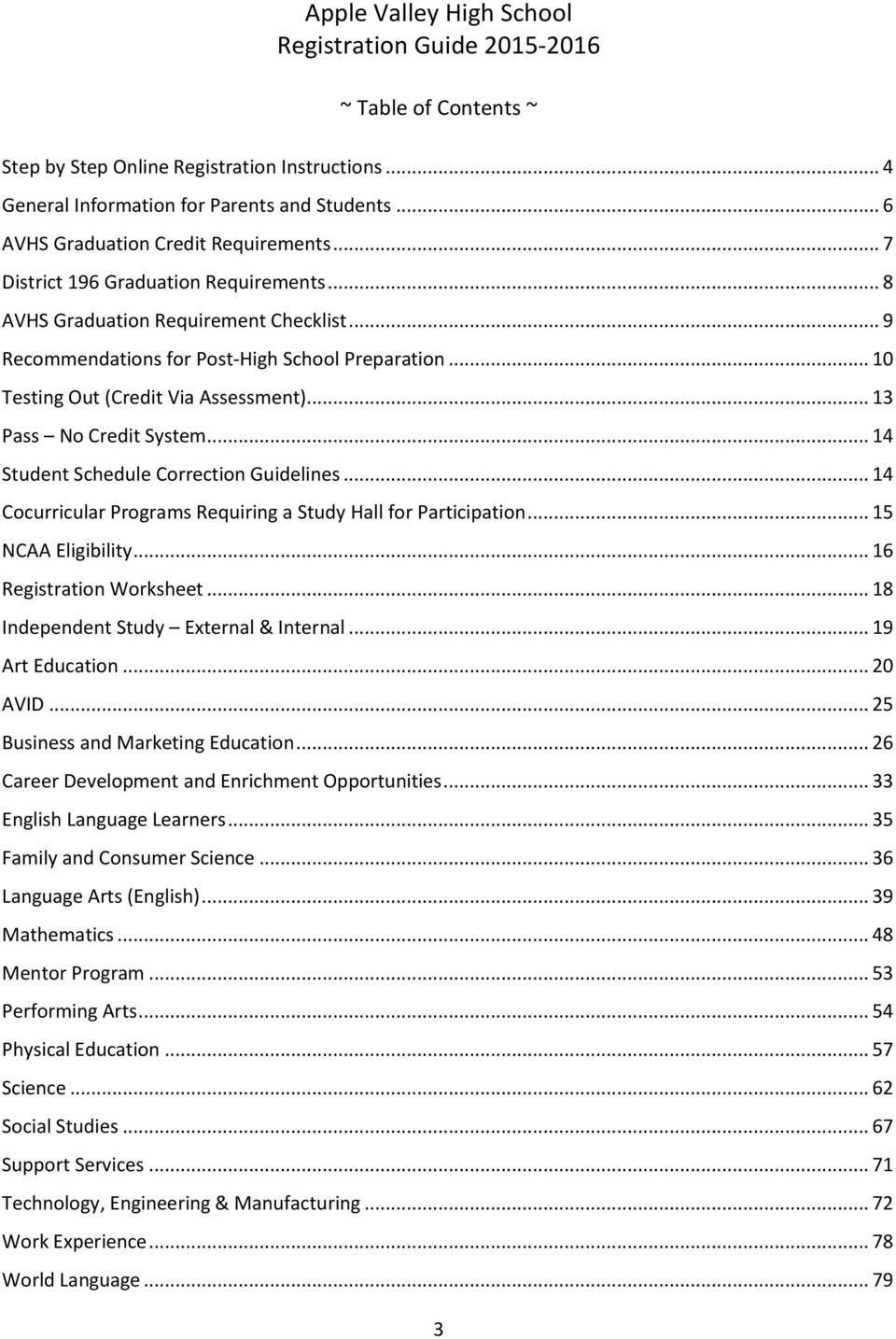
3 Apple Valley High School Registration Guide ~ Table of Contents ~ Step by Step Online Registration Instructions... 4 General Information for Parents and Students... 6 AVHS Graduation Credit Requirements... 7 District 196 Graduation Requirements... 8 AVHS Graduation Requirement Checklist... 9 Recommendations for Post-High School Preparation Testing Out (Credit Via Assessment) Pass No Credit System Student Schedule Correction Guidelines Cocurricular Programs Requiring a Study Hall for Participation NCAA Eligibility Registration Worksheet Independent Study External & Internal Art Education AVID Business and Marketing Education Career Development and Enrichment Opportunities English Language Learners Family and Consumer Science Language Arts (English) Mathematics Mentor Program Performing Arts Physical Education Science Social Studies Support Services Technology, Engineering & Manufacturing Work Experience World Language
4 Apple Valley High School Online Registration Students may complete online registration after they have reviewed the registration guide and completed the registration sheet. Students will have the opportunity to select courses and make changes online through January 27, Any changes needed after January 27 must be submitted by a school counselor. SELECTING ACADEMIC COURSES STEP BY STEP ONLINE REGISTRATION INSTRUCTIONS 1. Go to 2. Click on Click here for Online Registration link (available January 16 through January 27). 3. Type in your user name (student number - available on student I.D. card). 4. Type in your password. If you have never reset your password, the default password is the first six letters of your last name followed by your two-digit birth day. For example, if your name is Steve Degenaar and your birth date is March 4, 1996, then your password would be: degena Select the option to LOGIN. 6. Click on Registration: 16-AVHS from the menu on the left. 7. At the top of the registration page you have the option to COURSE SEARCH or PRINT REQUEST SUMMARY. Click on COURSE SEARCH. 8. Type the course number in the second box by using the 4-digit course number listed on your registration form (e.g. 2000, Eng. 9). Click on the GO button. (DO NOT type course name.) 9. Click on the course listed under the column Select a course to view to view course information. 10. Click on REQUEST THIS COURSE to select the request. 11. The top left corner of the page will display Units: (0/24). Disregard the 24 as this number represents the number of courses selected and students may not select more than 21. DO NOT input alternate electives. 12. If you would like to DROP a course you have selected, click on the course under your list of REQUESTED COURSES and click on DROP THIS COURSE. 13. After you have completed selecting your academic courses, you may print a summary of the courses you have selected by clicking on PRINT REQUEST SUMMARY. Your requests will then be displayed on your screen. You may now PRINT this list. 14. Log Out 9th and 10th Grades: Must have at least 6 classes and cannot have more than one study hall per trimester. 11th and 12th Grades: Must have at least 5 classes and cannot have more than two study halls per trimester. Students may not choose which period they have a study hall. 4

5 Apple Valley High School To the Students of Apple Valley High School: This Student Registration Guide is designed to aid you in planning your course selection at Apple Valley High School. This guide is a catalog of all the subjects taught that will be offered for the school year. Listed alphabetically by department, you will find a brief description of each course including the prerequisites so you will know if you qualify to study a specific course. Also included in this guide, you will find information about the requirements for graduation, the maximum and minimum number of courses which you may take, and other general information that will help you to get the most out of your high school years. During December and January, this guide will be used by your counselor in helping you and your parents select the courses that you will be studying for the upcoming academic year. Our staff and administration wish you the best of success in the pursuit of your educational program at Apple Valley High School. Sincerely, Steve Degenaar Principal To the Parents of Students entering Apple Valley High School: We are very excited to have the class of 2019 coming to Apple Valley High School! Registration is completed online at The registration guide is also online. If you would like to meet with your AVHS counselor, please call to schedule an appointment. If I can assist you with your registration give me a call at The registration process is an exciting time of the year. Please take this time to consider all the academic opportunities offered at Apple Valley High School. Sincerely, Michael Bolsoni Assistant Principal 5

6 GENERAL INFORMATION FOR STUDENTS AND PARENTS This information has been prepared to help families understand the senior high school curriculum and the various educational opportunities available to each student. It is of utmost importance for each student to plan his/her own future educational program. Many critical decisions must be made during this period. Parents, current teachers and counselors can help students consider the many options available. Considerations may include past and current academic performance, attitudes and ambitions, standardized test scores, and interests. District 196 teaches students human sexuality curriculum and HIV/AIDS prevention curriculum. Course descriptions in this guide identify where this curriculum is taught. For specific information about what is taught in these areas, please contact the school principal. Parents who are uncomfortable with the curriculum after talking with the principal may withhold their student from specific class sessions in which these curricula are taught. As students select the courses which will make up their next year s program, they should consider: 1. Graduation requirements 2. Career plans 3. College entrance requirements 4. Those courses which have value, meaning and appeal to each individual student. How to Use this Registration Guide: 1. The major part of this guide consists of course descriptions. The courses are organized by department, i.e., Social Studies, Business Education, Technology Engineering & Manufacturing, etc. 2. Each individual course is one trimester (12 weeks) in length, has its own course number, and is worth one credit unless otherwise stated. The time of the year the course is offered is designated by F (Fall trimester), W (Winter trimester), and S (Spring trimester). 3. Although each course is one trimester in length, some courses are intended to follow a sequence in order to take a full year of that course. Example: Biology F-W-S. 4. Advanced, Honors and Advanced Placement courses are listed in several departments. An Advanced level course is the second year programming of a particular class (Example: Accounting and Advanced Accounting). An Honors course is a course taught at a higher level or faster pace - students would choose either the regular level or the honors level (Example: Chemistry or Honors Chemistry). An Advanced Placement course is a full year course taught at a rigorous level. College credit is awarded at some colleges provided the student successfully completes the A.P. exam in May with a score of 3 or higher. Please check with the individual college for specific details involving granting of college credit. 5. Some classes are offered for specific grade levels. 6. A prerequisite is a course that is required before taking another course. Some courses have prerequisites. Example: Drawing Course Title: Drawing W-1043 Prerequisite: Art 1 and Art 2 Who is allowed to take the class? Students in 10th, 11th and 12th grades. Prerequisite? You must have Art 1 and Art 2 before you take Drawing. When Offered? Winter. (If you select this course, you must take it in the winter and the course number is 1043). 7. Be sure to read the course descriptions carefully before a class is selected at When registering online students are to register by inputting course number only. 6

7 Apple Valley High School Graduation Credit Requirements To be eligible for graduation each student shall have completed 66 credits in Grades 9, 10, 11, and 12. Grade 12 Requirements*: 3 Language Arts (English) courses - Minimum of one each trimester, including a literature class and a writing class during junior or senior year. 3 12th Grade Social Studies courses - Minimum of one each trimester one trimester of economics is required Total of at least 5 credits each trimester, totaling 15 trimester credits for the year. However, students are encouraged to take more. Grade 11 Requirements*: 3 Language Arts (English) courses - Minimum of one each trimester. Must take American Literature and Composition AND World Literature and Composition during junior or senior year. 3 World History courses - Minimum of one each trimester. AP European History also meets all World History requirements. 3 Mathematics courses 3 Science courses * Humanities meets all World History requirements and the 11th grade Language Arts (English) requirement Total of at least 5 trimester credits each trimester, totaling 15 trimester credits for the year. However, students are encouraged to take more. (Usually math and science are taken in grade 11.) Grade 10 Requirements*: 1 Safety Education (Can also be taken in 9th - age 15 requirement) 1 Wellness 2 - A full schedule may necessitate leaving this course for Grade Physical Education courses - (may be delayed until Junior or Senior year with approval of counselor and parent). 3 Language Arts (English) courses Speech, Lit 10 and Comp 10 - Check the Language Arts (English) section for exact courses required Minimum of one course each trimester. 3 U.S. History courses Minimum of one each trimester. * AP U.S. History fulfills the 10th grade U.S. History requirement. 3 Mathematics courses 3 Science courses (encouraging Biological Science) Total of at least 6 trimester credits each trimester totaling at least 18 trimester credits for the year. Grade 9 Requirements*: 1 Wellness 1 2 Physical Education classes. (Including Fitness for Life) 3 Language Arts (English) 9 courses - Minimum of one each trimester. 3 Social Studies 9 courses - Minimum of one each trimester. 3 Earth Science 9 courses - Minimum of one each trimester. 3 Mathematics 9 courses - Minimum of one each trimester. 3 Courses in Electives of Art, Technology Engineering & Manufacturing, Family and Consumer Science, Music, World Language, Business, Dance, Theatre and Physical Education. Total of at least 6 trimester credits each trimester totaling at least 18 trimester credits for the year. Additional Requirement: *In addition to the above requirements, each student will be required to complete in their 9th, 10th, 11th or 12th grade year: 1 Art Elective To be taken in grade 9, 10, 11, or 12. Any art course, Choir, Band, Dance, Interior Design, Marketing 1 A/Advertising, Architecture A, or Computer Imagery, Intro to Engineering, Principles of Engineering, Engineering Design & Principles, Civil Engineering Architecture & Digital Electronics. 7

8 DISTRICT 196 GRADUATION REQUIREMENTS Satisfactorily complete 66 credits of coursework at the high school level, grades 9-12 inclusively, as specified below: Language Arts (English) four years (12 credits) Social Studies four years (12 credits) encompassing U.S. history, geography, world history, government/citizenship and economics Science three years (nine credits) encompassing biology Mathematics three years (nine credits) encompassing algebra, geometry, and statistics and probability Arts one course (one credit) from the Art, Choir, Band, Dance, Interior Design, Marketing A: Advertising or Architecture A, Intro to Engineering, Principles of Engineering, Engineering Design & Principles, Civil Engineering & Digital Electronics, Computer Imagery Health (Wellness) two courses (two credits) Physical education four courses (four credits) Safety Education one course (one credit) Other 16 credits, of which not more than 12 credits of instrumental and/or vocal music may be applied toward fulfillment of the graduation requirements Minnesota Graduation Assessment Requirements In order to be eligible for a diploma from any Minnesota public high school, all students must fulfill graduation assessment requirements in writing, reading and mathematics. The requirements for students are different based upon the date they first entered grade 8. To view the specific requirements for students, please visit the Minnesota Department of Education website at 8

9 9

10 RECOMMENDATIONS FOR POST-HIGH SCHOOL PREPARATION Individual admissions criteria varies so please check with your post-secondary schools of interest Courses for Entering Colleges, Universities, Military Academies Community and Technical Colleges Language Arts Four Year Four Year (English) Science Three to four years One to three years Earth Science Biology Chemistry Physics Math Three to four years Two to four years Algebra (2 years) AP Computer Science Geometry Calculus CAPS Social Studies Four years Four years World Language Two to four years of same language Two to four years of same language Visual Arts One year One to four years Family & Consumer Science Mentor Program Technology Engineering & Manufacturing Performing Arts (Recommended but not required) Business One year (Recommended but not required) One to four years Honors Rank This is another way of ranking students who take a significant number of Honors and Advanced Placement (AP) classes. Within the Honors Ranking system, the current system (regular ranking system) would be maintained along with a dual track Honors Ranking system. To qualify for an Honors Rank at AVHS, students must meet the following criteria: 1. Take at least 23 trimester courses during grades 9, 10, 11 and 12 of the Honors/Accelerated/AP courses listed. In general, students need to average 2 honors classes each trimester during grades 9, 10, 11 and Students must earn a grade of "B-" or better for an Accelerated/Honors/AP course to count toward the total grade level minimums of 6, 12, 18 and 23 trimester courses. (Note: Taking a class Pass/No Credit does NOT count as a qualifying class!) Advanced Level Courses Students who are currently in or plan to take advanced level courses in one or more areas might consider the following courses/programs. 1. ADVANCED LEVEL BUSINESS College in the Schools Microeconomics 10

11 2. ADVANCED LEVEL LANGUAGE ARTS (ENGLISH) Honors English 9 Honors Literature 10 Honors Composition 10 Honors Speech College in the Schools Public Speaking College in the Schools Writing Studio 3. ADVANCED LEVEL MATH Honors Geometry Honors Algebra 2 Honors Precalculus College Linear Algebra & Differential Equations 4. ADVANCED LEVEL SCIENCE Honors Earth Science 9 Honors Biology Honors Chemistry Honors Physics 5. ADVANCED LEVEL SOCIAL STUDIES Honors Civics & Citizenship 9 6. ADVANCED WORLD LANGUAGE Honors Spanish 2 Honors Spanish 3 Honors Spanish 4 College in the Schools Spanish 5 College in the Schools German 4 7. ADVANCED PLACEMENT COURSES These courses will help students prepare for the optional advanced placement examination. Advanced Placement U.S. History Advanced Placement European History Advanced Placement Macroeconomics Advanced Placement Psychology Advanced Placement U.S. Government/Politics Advanced Placement Language and Composition (11) Advanced Placement Literature and Composition (12) Advanced Placement Studio Art Advanced Placement Calculus AB Advanced Placement Calculus BC Advanced Placement Computer Science Advanced Placement Statistics Advanced Placement Chemistry 11

12 8. CIS (College in the Schools) College in the Schools Spanish 5 College in the Schools German 4 College in the Schools Japanese 4 College in the Schools Anatomy & Physiology College in the Schools Microeconomics College in the Schools Writing Studio College in the Schools Public Speaking 9. INDEPENDENT STUDY OPPORTUNITIES IN ALL DEPARTMENTS 10. MENTOR PROGRAM a. This program is designed for college bound juniors and seniors who are interested in exploring college and career options suited to their personal interests, talents and goals. Students who successfully complete Mentor Seminar are eligible for Mentor Field Experience where they are placed with a professional mentor to gain insights and experience in the career. 11. THE MINNESOTA POST-SECONDARY ENROLLMENT OPTION Eligible juniors and seniors at Apple Valley High School may enroll at Minnesota post- secondary institutions. Students may take classes for secondary and post-secondary credit. The purposes of the program are as follows: a. To promote rigorous educational pursuits. b. To provide a wider variety of options for students. Contact with your counselor is advised if you are qualified and interested in the above opportunities. 12

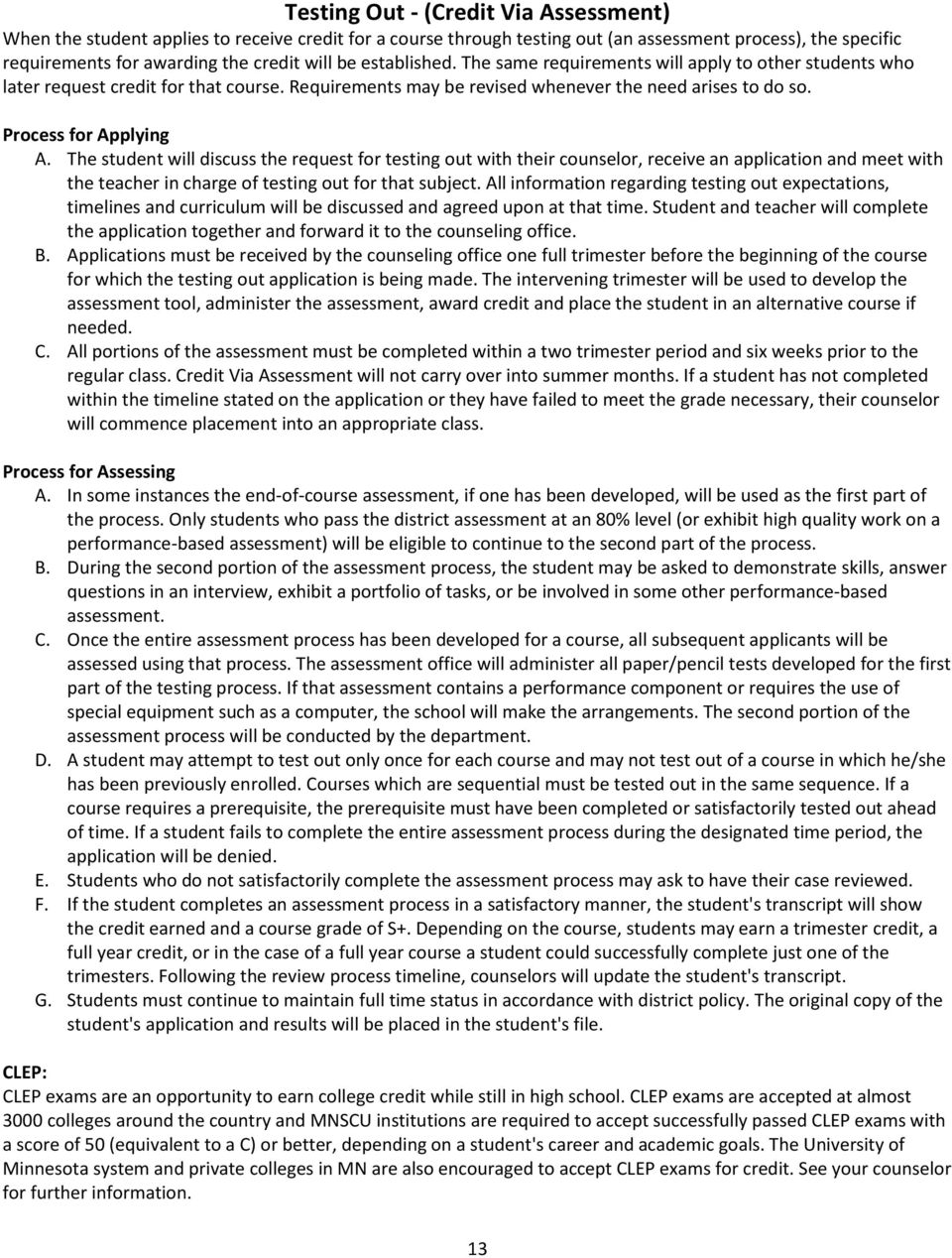
13 Testing Out - (Credit Via Assessment) When the student applies to receive credit for a course through testing out (an assessment process), the specific requirements for awarding the credit will be established. The same requirements will apply to other students who later request credit for that course. Requirements may be revised whenever the need arises to do so. Process for Applying A. The student will discuss the request for testing out with their counselor, receive an application and meet with the teacher in charge of testing out for that subject. All information regarding testing out expectations, timelines and curriculum will be discussed and agreed upon at that time. Student and teacher will complete the application together and forward it to the counseling office. B. Applications must be received by the counseling office one full trimester before the beginning of the course for which the testing out application is being made. The intervening trimester will be used to develop the assessment tool, administer the assessment, award credit and place the student in an alternative course if needed. C. All portions of the assessment must be completed within a two trimester period and six weeks prior to the regular class. Credit Via Assessment will not carry over into summer months. If a student has not completed within the timeline stated on the application or they have failed to meet the grade necessary, their counselor will commence placement into an appropriate class. Process for Assessing A. In some instances the end-of-course assessment, if one has been developed, will be used as the first part of the process. Only students who pass the district assessment at an 80% level (or exhibit high quality work on a performance-based assessment) will be eligible to continue to the second part of the process. B. During the second portion of the assessment process, the student may be asked to demonstrate skills, answer questions in an interview, exhibit a portfolio of tasks, or be involved in some other performance-based assessment. C. Once the entire assessment process has been developed for a course, all subsequent applicants will be assessed using that process. The assessment office will administer all paper/pencil tests developed for the first part of the testing process. If that assessment contains a performance component or requires the use of special equipment such as a computer, the school will make the arrangements. The second portion of the assessment process will be conducted by the department. D. A student may attempt to test out only once for each course and may not test out of a course in which he/she has been previously enrolled. Courses which are sequential must be tested out in the same sequence. If a course requires a prerequisite, the prerequisite must have been completed or satisfactorily tested out ahead of time. If a student fails to complete the entire assessment process during the designated time period, the application will be denied. E. Students who do not satisfactorily complete the assessment process may ask to have their case reviewed. F. If the student completes an assessment process in a satisfactory manner, the student's transcript will show the credit earned and a course grade of S+. Depending on the course, students may earn a trimester credit, a full year credit, or in the case of a full year course a student could successfully complete just one of the trimesters. Following the review process timeline, counselors will update the student's transcript. G. Students must continue to maintain full time status in accordance with district policy. The original copy of the student's application and results will be placed in the student's file. CLEP: CLEP exams are an opportunity to earn college credit while still in high school. CLEP exams are accepted at almost 3000 colleges around the country and MNSCU institutions are required to accept successfully passed CLEP exams with a score of 50 (equivalent to a C) or better, depending on a student's career and academic goals. The University of Minnesota system and private colleges in MN are also encouraged to accept CLEP exams for credit. See your counselor for further information. 13
14 Pass No Credit System Students may take one class each trimester on a Pass-No Credit basis whether he/she is taking five, six or seven subjects. This option may encourage students to explore interests in a subject in which they may not be willing to risk getting a low grade. The many course offerings at the senior high level may be more willingly explored under such a program. Procedure: Students registering for the courses during registration need not make a decision to take a course on a Pass-No Credit basis but may select a course with that in mind. Within the first 20 days of each trimester, the student picks up a Pass-No Credit form from the Guidance Office, presents it to the teacher of the class for signature, has one of their parents sign it, and returns it to the office by the deadline, which is the 20th day of the trimester. All Pass-No Credit students in any course will take all tests, turn in all regular class work, and receive grades along with other students. Only the final mark is a Pass-No Credit mark. A subject taken on a Pass-No Credit basis will not affect a student s class rank or honor roll standing. If the student passes the class the student will receive a P and one credit on his/her report card for that class. If the student fails the class, the student would then receive an NC (no credit) on the report card. At the end of the trimester, the student still has the option of taking the class for the grade (A or B) even though the student signed up for a Pass-No Credit. All the student has to do is inform the teacher that a grade is preferred. Student Schedule Correction Guidelines Before winter trimester, a four day schedule correction period will be held. Students will be able to examine their classes for both winter and spring trimesters and request changes. This will be the final opportunity to request changes for the remaining school year. Schedule Correction Request Forms are available in the AVHS Guidance Office and must be turned in by the specified deadline. Much time and effort has been spent on meeting the initial scheduling selections which students and parents requested. Schedule corrections, therefore, must be for definite educational reasons. There will be no schedule corrections after the designated week. All schedule corrections are subject to parent approval and class availability. Student requests for class changes during schedule corrections will not be able to be honored for the following reasons: 1. Requests for a specific teacher 2. Requests for specific study hall periods 3. Requests for changing classes to different periods. During the 1st week of a trimester, students may drop a class to go to a study hall without penalty. Students must keep a minimum of 6 classes as freshmen and sophomores, and a minimum of 5 classes as juniors and seniors. Classes are NOT added once a trimester starts. Students who drop a class after the first week will receive an F. 14

15 COCURRICULAR PROGRAMS REQUIRING A STUDY HALL FOR PARTICIPATION These cocurricular study halls receive no credit. They are listed in this guide only because they require that a student have a particular study hall which will be used for practice. Students may not sign up for these activities without a written permission slip from the appropriate coach. BOYS HOCKEY - (W-0258) Prerequisite: Written permission from the head hockey coach GIRLS HOCKEY - (W-0259) Prerequisite: Written permission from the head hockey coach BOYS GOLF - (S-0260) Gr Prerequisite: Written permission from the head boys golf coach. With only a few exceptions, 9th and 10th graders will have golf after school they won t need to sign up. GIRLS GOLF - (S-0261) Gr Prerequisite: Written permission from the head girls golf coach. With only a few exceptions, 9th and 10th graders will have golf after school they won t need to sign up. 15

16 NCAA ELIGIBILITY CENTER QUICK REFERENCE GUIDE NCAA Division I Initial-Eligibility Requirements Core Courses: (16) Initial full-time collegiate enrollment before August 1, 2016: o Sixteen (16) core courses are required (see chart below for subject-area requirements). Initial full-time collegiate enrollment on or after August 1, 2016: o Sixteen (16) core courses are required (see chart below for subject-area requirements). Ten (10) core courses completed before the seventh semester; seven (7) of the 10 must be in English, math or natural/physical science. These courses/grades are "locked in" at start of the seventh semester (cannot be repeated for grade-point average [GPA] improvement to meet initial-eligibility requirements for competition). o Students who do not meet core-course progression requirements may still be eligible to receive athletics aid and practice in the initial year of enrollment by meeting academic redshirt requirements (see below). Test Scores: (ACT/SAT) Students must present a corresponding test score and core-course GPA on the sliding scale (see Page No. 2). o SAT: critical reading and math sections. Best subscore from each section is used to determine the SAT combined score for initial eligibility. o ACT: English, math, reading and science sections. Best subscore from each section is used to determine the ACT sum score for initial eligibility. All ACT and SAT attempts before initial full-time collegiate enrollment may be used for initial eligibility. Enter 9999 during ACT or SAT registration to ensure the testing agency reports your score directly to the NCAA Eligibility Center. Test scores on transcripts will not be used. Core Grade-Point Average: Only core courses that appear on the high school's List of NCAA Courses on the NCAA Eligibility Center's website ( will be used to calculate your core-course GPA. Use this list as a guide. Initial full-time collegiate enrollment before August 1, 2016: o Students must present a corresponding test score (ACT sum score or SAT combined score) and core-course GPA (minimum 2.000) on Sliding Scale A (see Page No. 2). o Core-course GPA is calculated using the best 16 core courses that meet subject-area requirements. Initial full-time collegiate enrollment on or after August 1, 2016: o Students must present a corresponding test score (ACT sum score or SAT combined score) and core-course GPA (minimum 2.300) on Sliding Scale B (see Page No. 2). o Core-course GPA is calculated using the best 16 core courses that meet both progression (10 before seventh semester; seven in English, math or science; "locked in") and subject-area requirements. DIVISION I Core-Course Requirement (16) 4 yrs of English 3 years of math (Algebra I or higher) 2 years of natural/physical science (1 year of lab if offered) 1 year of additional English, math or natural/physical science 2 years of social science 4 years of additional courses (any area above, foreign language or comparative religion/philosophy) DIVISION I Qualifier Requirements *Athletics aid, practice, and competition 16 core courses o Ten (10) core courses completed before the start of seventh semester. Seven (7) of the 10 must be in English, math or natural/physical science. "Locked in" for corecourse GPA calculation. Corresponding test score (ACT sum score or SAT combined score) and core-course GPA (minimum 2.300) 16 on Sliding Scale B (see Page No. 2). Graduate from high school. DIVISION I Academic Redshirt Requirements *Athletics aid and practice (no competition) 16 core courses o No grades/credits "locked in" (repeated courses after the seventh semester begins may be used for initial eligibility). Corresponding test score (ACT sum score or SAT combined score) and core-course GPA (minimum 2.000) on Sliding Scale B (see Page No. 2). Graduate from high school.

17 NCAA ELIGIBILITY CENTER QUICK REFERENCE GUIDE Division II Initial-Eligibility Requirements Core Courses Division II currently requires 16 core courses. See the chart below. Beginning August 1, 2018, to become a full or partial qualifier for Division II, all college-bound student-athletes must complete the 16 core-course requirement. Test Scores Division II currently requires a minimum SAT score of 820 or an ACT sum score of 68. Beginning August 1, 2018, Division II will use a sliding scale to match test scores and core-course grade-point averages (GPA). The sliding scale for those requirements is shown on Page No. 2 of this sheet. The SAT score used for NCAA purposes includes only the critical reading and math sections. The writing section of the SAT is not used. The ACT score used for NCAA purposes is a sum of the following four sections: English, mathematics, reading and science. When you register for the SAT or ACT, use the NCAA Eligibility Center code of 9999 to ensure all SAT and ACT scores are reported directly to the NCAA Eligibility Center from the testing agency. Test scores that appear on transcripts will not be used. Grade-Point Average Be sure to look at your high school s List of NCAA Courses on the NCAA Eligibility Center's website ( Only courses that appear on your school's approved List of NCAA Courses will be used in the calculation of the core GPA. Use the list as a guide. The current Division II core GPA requirement is a minimum of Division II core GPA required to be eligible for competition on or after August 1, 2018, is (corresponding test-score requirements are listed on the Sliding Scale on Page No. 2 of this sheet). The minimum Division II core GPA required to receive athletics aid and practice as a partial qualifier on or after August 1, 2018, is (corresponding test-score requirements are listed on the Sliding Scale on Page No. 2 of this sheet). Remember, the NCAA core GPA is calculated using NCAA core courses only. 3 years of English DIVISION II 16 Core Courses 2 years of mathematics (Algebra I or higher) 2 years of natural/physical science (1 year of lab if offered by high school) 3 years of additional English, mathematics or natural/physical science 2 years of social science 4 years of additional courses (from any area above, foreign language or comparative religion/philosophy) 17

18 REGISTRATION WORKSHEET List classes that you will be taking for the coming school year so that you will know what classes you signed up for. DON T FORGET YOUR REQUIRED COURSES! FALL TRIMESTER WINTER TRIMESTER SPRING TRIMESTER 18

19 INDEPENDENT STUDY EXTERNAL & INTERNAL Alternative Methods of Earning Credits at AVHS Independent Study Outside of AVHS (External) Sometimes students wish to enroll in programs outside of AVHS for which they want to receive credit toward graduation. These are usually organized programs offered by recognized educational institutions that help students expand their education and experience. An example of a program already recognized is the Concordia Language Villages (world language summer camps offered by Concordia College). Any student wishing to earn Independent Study credit toward graduation other than from the above mentioned programs or from a program not currently recognized by AVHS must complete the following process prior to enrolling. 1. Student obtains the external Independent Study form from his/her counselor. 2. The student discusses the specifics of his/her plan with their counselor. 3. Student completes the form and obtains signatures of parent, counselor and assistant principal. 4. The counselor brings the plan to a committee for approval, revision and determination of credit value. 5. Upon successful completion of the Independent Study project, the committee notifies the counselor who enters the credits onto the student s permanent record. Independent Study Within AVHS Departments (Internal) Students wishing to earn Independent Study credit by conducting an independent project, study or activity under the supervision of an AVHS staff member should complete the following process: 1. Student obtains an Internal Independent Study form from his/her counselor or the department coordinator. The form is to be returned to the counselor prior to schedule changes of the trimester for which the Independent Study is requested. Students may do one Independent Study for credit per trimester. 2. Student completes the form and obtains signatures of parent, department coordinator and counselor. Completed forms are returned to the counselor. 3. Student conducts the Independent Study project/activity under the supervision of the supervising teacher. 4. The Independent Study program must include a minimum of 60 hours of work to receive 1 trimester credit. Partial credit is not awarded. 5. Upon successful completion of the Independent Study project, the supervising teacher completes the grade sheet. 6. The grade for the Independent Study activity is entered onto the student's permanent record. 19

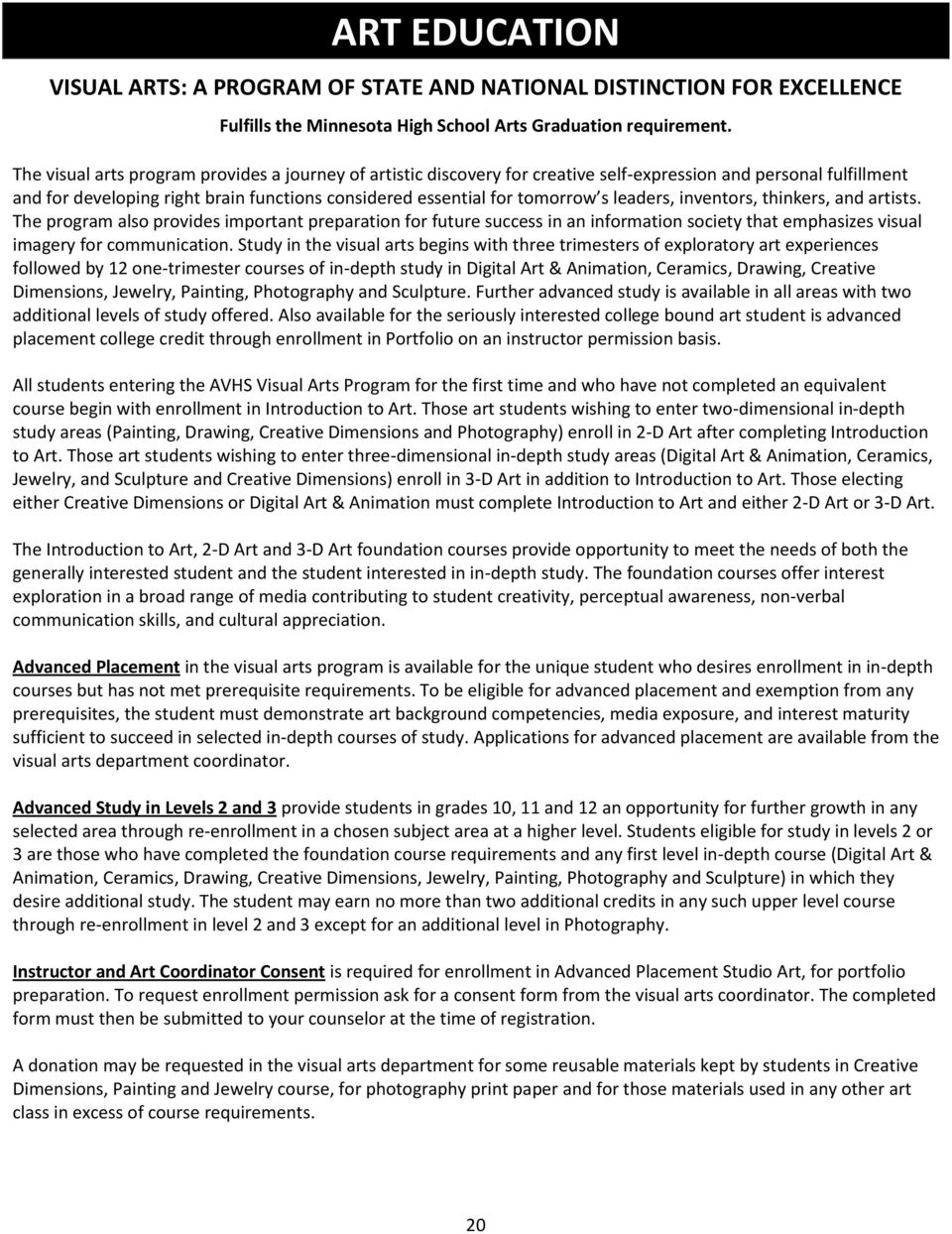
20 ART EDUCATION VISUAL ARTS: A PROGRAM OF STATE AND NATIONAL DISTINCTION FOR EXCELLENCE Fulfills the Minnesota High School Arts Graduation requirement. The visual arts program provides a journey of artistic discovery for creative self-expression and personal fulfillment and for developing right brain functions considered essential for tomorrow s leaders, inventors, thinkers, and artists. The program also provides important preparation for future success in an information society that emphasizes visual imagery for communication. Study in the visual arts begins with three trimesters of exploratory art experiences followed by 12 one-trimester courses of in-depth study in Digital Art & Animation, Ceramics, Drawing, Creative Dimensions, Jewelry, Painting, Photography and Sculpture. Further advanced study is available in all areas with two additional levels of study offered. Also available for the seriously interested college bound art student is advanced placement college credit through enrollment in Portfolio on an instructor permission basis. All students entering the AVHS Visual Arts Program for the first time and who have not completed an equivalent course begin with enrollment in Introduction to Art. Those art students wishing to enter two-dimensional in-depth study areas (Painting, Drawing, Creative Dimensions and Photography) enroll in 2-D Art after completing Introduction to Art. Those art students wishing to enter three-dimensional in-depth study areas (Digital Art & Animation, Ceramics, Jewelry, and Sculpture and Creative Dimensions) enroll in 3-D Art in addition to Introduction to Art. Those electing either Creative Dimensions or Digital Art & Animation must complete Introduction to Art and either 2-D Art or 3-D Art. The Introduction to Art, 2-D Art and 3-D Art foundation courses provide opportunity to meet the needs of both the generally interested student and the student interested in in-depth study. The foundation courses offer interest exploration in a broad range of media contributing to student creativity, perceptual awareness, non-verbal communication skills, and cultural appreciation. Advanced Placement in the visual arts program is available for the unique student who desires enrollment in in-depth courses but has not met prerequisite requirements. To be eligible for advanced placement and exemption from any prerequisites, the student must demonstrate art background competencies, media exposure, and interest maturity sufficient to succeed in selected in-depth courses of study. Applications for advanced placement are available from the visual arts department coordinator. Advanced Study in Levels 2 and 3 provide students in grades 10, 11 and 12 an opportunity for further growth in any selected area through re-enrollment in a chosen subject area at a higher level. Students eligible for study in levels 2 or 3 are those who have completed the foundation course requirements and any first level in-depth course (Digital Art & Animation, Ceramics, Drawing, Creative Dimensions, Jewelry, Painting, Photography and Sculpture) in which they desire additional study. The student may earn no more than two additional credits in any such upper level course through re-enrollment in level 2 and 3 except for an additional level in Photography. Instructor and Art Coordinator Consent is required for enrollment in Advanced Placement Studio Art, for portfolio preparation. To request enrollment permission ask for a consent form from the visual arts coordinator. The completed form must then be submitted to your counselor at the time of registration. A donation may be requested in the visual arts department for some reusable materials kept by students in Creative Dimensions, Painting and Jewelry course, for photography print paper and for those materials used in any other art class in excess of course requirements. 20
21 Introduction to Art 1001 Introduction to Art is required of all students entering the high school visual arts program for the first time and is recommended for the student with both a general or in-depth interest in visual arts communication. Emphasis is placed on creative design problem solving, exploration of student artistic interests and on understanding design through study of abstract, natural and man-made forms. Media directions of study may include drawing, painting, sculpting, calligraphy, three dimensional studies and the history of art. This course significantly contributes to the development of student creative imagination, art appreciation and visual communication skills. 2-D Art 1006 Prerequisite: Introduction to Art 2-D Art is required of all art students preparing to enroll in Painting, Drawing, Photography, Digital Arts or wish to continue development of their creative imagination and visual communication skills. Emphasis is placed on the development and creative application of graphic and compositional skills through two-dimensional art experiences in media areas that may include pencil, charcoal, scratchboard, ink, water color, printmaking and the history of art. Forms under study cover still life, portraiture, human figures, landscape elements, perspective and man-made environments. 3-D Art 1009 Prerequisite: Introduction to Art Art is required of all art students preparing to enroll in Ceramics, Sculpture, Jewelry and Creative Dimensions or wish to further develop their ability to creatively create or conceptualize in three-dimensional form. Emphasis is placed on the creative application of design to three-dimensional art forms that may include realistic and abstract sculpture, ceramic relief sculpture and pottery, and plaster and wax sculpture. Digital Art and Animation Prerequisite: 2-D Art or 3-D Art Digital Art introduces students to a variety of creative projects using professional imaging software. Projects will include a combination of graphic design and digital drawing: designing logos, converting handmade illustrations into electronic graphics, animating digital images and photographs, and for advanced students, using 3D animation programs to build and animate objects. Digital Art and Animation Prerequisite: Digital Art and Animation 1 Digital Art introduces students to a variety of creative projects using professional imaging software. Projects will include a combination of graphic design and digital drawing: designing logos, converting handmade illustrations into electronic graphics, animating digital images and photographs, and for advanced students, using 3D animation programs to build and animate objects. Digital Art and Animation Prerequisite: Digital Art and Animation 2 Digital Art introduces students to a variety of creative projects using professional imaging software. Projects will include a combination of graphic design and digital drawing: designing logos, converting handmade illustrations into electronic graphics, animating digital images and photographs, and for advanced students, using 3D animation programs to build and animate objects. 21
22 Ceramics Prerequisite: 3-D Art Ceramics offers an in-depth opportunity to explore clay as a creative and expressive medium from hand-built to wheel thrown vessels. The course emphasizes creative and personal solutions to merging vessel function and visual quality together in vessel design. The study includes experimentation with slip casting, raku firing, varied clays from stoneware to porcelain, varied glazes from underglazes to overglazes, and review of ceramic design from the past to the present. Ceramics Prerequisite: Ceramics 1 A more intense study of ceramics techniques and materials. Ceramics Prerequisite: Ceramics 2 A more intense study of ceramics techniques and materials. Drawing Prerequisite: 2-D Art This course will explore right brain drawing techniques building student graphic ability to creatively express their ideas and feelings through line and varied media. Materials used will include pencil, chalk, charcoal, water color, ink, crayons and colored pencils. A wide range of subject matter will be studied including the human portrait and figure, architectural and landscape perspective, wildlife, natural forms, man-made forms, still life, and study of the great masters of drawing past and present. Drawing Prerequisite: Drawing 1 A more intense study of drawing techniques and materials. Drawing Prerequisite: Drawing 2 A more intense study of drawing techniques and materials. Creative Dimensions Prerequisite: 2-D Art or 3-D Art Creative Dimensions provides a hands-on exploration, not offered in other visual arts courses, of varied media, techniques, and ideas of the world's greatest dreamers and artists of yesterday and today. Experimental creative expression choices will include work with tie die, fabric painting, batik, weaving, soft sculpture, paper marbling, papermaking, book making, printmaking, and mosaic and glasswork. *A student fee for some materials used may be requested. Creative Dimensions Prerequisite: Creative Dimensions 1 A more intense study of glass techniques and other fibrous materials. 22
23 Creative Dimensions Prerequisite: Creative Dimensions 2 A more intense study of glass techniques and other fibrous materials. Jewelry Prerequisite: 3-D Art This metal smithing course will involve the creative design and construction of functional and ornamental jewelry and related sculptural forms. Areas to be studied include: hot soldering fabrication, casting, cold fabrication, glass fusing, copper enameling, and bent wire. Metals used will include brass, copper, nickel silver, and sterling silver. A student fee for some materials may be requested. Jewelry Prerequisite: Jewelry 1 Jewelry 2 is an extension of Jewelry 1. Students will work to master the techniques learned in the first level, as well as learn stone setting in a box bezel and glass fusing. Jewelry Prerequisite: Jewelry 2 Jewelry 3 is an extension of Jewelry 1 and 2. As students master the techniques learned in the previous levels they will work with more complex designs, explore varied techniques and alternative ways of forging and stone setting. Painting Prerequisite: 2-D Art This painting studio course will explore watercolor, egg tempera & acrylic painting as well as a variety of other creative painting materials and techniques. Subject matter will cover landscape, still life, portrait, and abstraction, along with study of painting styles and artists from the past and present. Painting Prerequisite: Painting 1 Painting 2 provides exploration of oil painting and an opportunity to improve acrylic and/or watercolor painting skills as well as develop one s own painting style. Subject matter of study will be open for student choice. Painting Prerequisite: Painting 2 Painting 3 offers students the opportunity to continue breadth and depth of study in painting, as well as explore their own style through studies of historical painting styles and new and mixed media. 23
24 Photography 1 (Black/White) 1067 Prerequisite: 2-D Art This basic black and white photography course offers a foundation study of 35mm camera operation, film development, and negative enlargement printing. Expressive photographic decision making and creative darkroom techniques will be emphasized through photography of varied subject matter including human interest candids at all age levels, still lifes, architecture and cityscapes, wild life, landscape, portraiture, and action photography. Photography 2 (Digital) 1070 Prerequisite: Photography 1 This course gives students the opportunity to explore the rapidly growing world of digital photography. Students will learn how to use the functions of a digital camera to create their own professional looking images as well as how to enhance them and create unique effects using the premier digital imaging software program, Adobe Photoshop. Photography 3 (Film & Digital) 1075 Prerequisite: Photography 2 Photographic Techniques (Advanced B/W & Digital) 1078 Prerequisite: Photography 3 This course offers an additional level of advanced study for the seriously interested photographic student. Students will be introduced to new photographic accessories, techniques, and processes through study of commercial and photojournalism photography, photo silkscreen printing, photo etching, large format poster printmaking, digital photography and Photoshop image manipulation. Sculpture Prerequisite: 3-D Art This study explores the creative and expressive limitations and possibilities of a wide range of sculptural materials and techniques in building three-dimensional art forms. Materials used may include stone, wood, metal, clay, plaster, fiber glass, and wax. Modeling, carving, and waste-mold casting are some of the processes experimented with. Past and contemporary sculptors and their work are also part of the study. Sculpture Prerequisite: Sculpture 1 A more intense study of sculptural styles and materials. Sculpture Prerequisite: Sculpture 2 A more intense study of sculptural styles and materials. Available on an independent-study format only. 24
25 AVID AVID (Advancement Via Individual Determination) is a full-year course devoted to preparing students for the college experience. Mondays and Wednesdays, students work on organization and study skills; critical thinking and discussion; and WICOR methodologies (Writing, Inquiry, Collaboration, Organization and Reading). On Tuesdays and Thursdays, students work in Collaborative Study Groups with an adult facilitator. On Fridays, students go on field trips (college visits, cultural field experiences, and/or work experience), listen to guest speakers, or participate in team building activities. This course is for elective credit. An application and interview process is required of students who are not already part of the program. AVID 9 F-7311, W-7312, S-7313 Grade: 9 Prerequisite: Application, Interview, Teacher Recommendation AVID 10 F-7314, W-7315, S-7316 Grade: 10 Prerequisite: Application, Interview, Teacher Recommendation AVID 11 F-7317, W-7318, S-7319 Grade: 11 Prerequisite: Application, Interview, Teacher Recommendation AVID 12 F-7320, W-7321, S-7322 Grade: 12 Prerequisite: Application, Interview, Teacher Recommendation 25
26 Keyboarding Computer Applications Intro to Business Personal Money Management Accounting Advanced Accounting Marketing Marketing 2 Sports Marketing Business Management BUSINESS AND MARKETING EDUCATION BUSINESS and MARKETING EDUCATION Class Name Grade Level Inver Hills Community College Credits Available Meets Art Standard All Students attending AVHS should take All students planning to work full time after high school should take: All students planning on attending a 4 year college as a nonbusiness major should take: All students planning to attending a four year college with possible plans as a business major should take: X X X X X X X X X X X X BUSINESS SPECIFIC MAJORS X Highly Recommended Accounting X X X X X X X Advertising X X X X X X X Entrepreneurship X X X X X X X Finance X X X X X X Human Resources X X X X X X International Business X X X X X X Management X X X X X X X X Marketing X X X X X X X X Sports Marketing X X X X X X X X We are in the business of preparing students for their future. All of our courses are beneficial to all students, college bound or not. Successful completion of Marketing A (Fall) satisfies the 1 credit "Art" requirement Students have the opportunity to earn Advanced Standing Credit through a local post-secondary institution by successfully completing the following full year AVHS Business Classes: Keyboarding Computer Applications, Accounting and Marketing. 26
27 Business and Marketing Courses that fulfill the STEM Business and Administration Path are found in the Business Department. These courses also provide the skills and curriculum needed for high school, post -secondary education, employment and for personal use. Business education provides ALL students with skills required to perform everyday tasks in today s world. Whether a student goes to college, technical school or gets a job after graduation, the Business Education courses provide the skills for success. A student can earn college credit by enrolling in Keyboard Computer Applications, Accounting and Marketing. The BUSINESS classes prepare all students for the future. KEYBOARDING COMPUTER APPLICATIONS THIS IS AN ESSENTIAL CLASS FOR ALL STUDENTS. ENROLLING IN THREE TRIMESTERS OF KEYBOARDING COMPUTER APPLICATIONS PROVIDES STUDENTS WITH SUCCESSFUL LIFELONG KEYBOARD SKILLS AND the ability to use all components of Microsoft Office, a key component for life usage and in every profession a student chooses. Students successfully completing Keyboard Computer Applications 1-3 can earn Advanced Standing Credit from a local post-secondary institution. Students should contact the course instructor for more information on articulation agreements and participating post-secondary institutions. Keyboarding Computer Applications (One trimester course) This is the first step in learning proper and successful keyboarding and computer skills essential for so STEM curriculum and lifelong usage. Proper touch method of keyboarding is a necessary skill to master and the class emphasizes proper technique to develop skill and accuracy. Students learn how to format memorandums, letters, brochures and PowerPoint. Students will also learn how to apply proofreading skills and be able to correct document that goes beyond the limited functions of spell check. At least two trimesters are needed to provide valuable life skills for post high school pursuits and accurately prepare documents for high school. Keyboarding Computer Applications (One trimester course) Prerequisite: Passing grade in Keyboarding Computer Applications 1 Keyboarding Computer Applications continue the development of speed and accuracy through creating tables, outlines, and reports. Students will learn the functions of Microsoft Word and Excel as well. Completing a second trimester of Keyboarding Computer Applications assures the student of having adequate skills for preparing high school and college papers. Keyboarding Computer Applications (One trimester course) Prerequisite: Passing grade in Keyboarding Applications 1, 2 Keyboarding Computer Applications 3 focuses on how information is process by computers in the world of business. The course offers basic knowledge in programs such as Microsoft Access, Photoshop, and video editing. Along with these programs we will continue the use of more advanced Microsoft Excel applications and using all Microsoft Office features in completing a business simulation. 27
28 Introduction to Business 1527 (One trimester course) What is business? Why study business? This one trimester course introduces you to the world of business and marketing and prepares them for the economic roles of the consumer, worker, and citizen. This course also serves as a background for other business and marketing courses offered in high school and beyond. Areas to be researched are careers, ethics, sales and marketing, banking and finance, computers, and technology, management and communications (presentations). Business Management Students will gain an understanding of the characteristics and organization of business and entrepreneurship. Topics will include types of business, business organization, marketing, purchasing, and the global economy. Operating a business today in the global market place, whether the local gift shop or a widget factory, with different and changing economic structure and technology will be examined. Guest speakers from related fields will add to classroom curriculum and discussion. Business Management Prerequisite: Business Management 1 This course will examine business management operations and management styles. Units will include finance, information systems, personnel management, human relations, decision-making and business leadership. Students will solve case problems involving business situations working in management groups, and address issues in business today. Guest speakers will address related issues and add to curriculum materials. Sports and Entertainment Marketing 1543 Students will have a unique opportunity to learn the behind-the-scenes careers involved in Sports/Entertainment Marketing. The course will involve studying the 5 P's of marketing, market research techniques, the promotional mix, advertising, sales promotion, personal selling, publicity and new product development. Students will do hands-on marketing projects such as fantasy sports or development of a new franchise/business. Students will also have the opportunity to participate in DECA. **Students successfully completing Accounting 1A-1C may be able to earn Advanced Standing Credit from a local post-secondary institution. Students should contact the course instructor for more information regarding articulation agreements and participating post-secondary institutions. Accounting F-1521, W-1522, S-1523 Begin your journey as one of the highest paid entry level positions out there in business today. Think about where you shop most often Dick s Sporting Goods, Buckle, Chipotle they all have a score card that tells you how they are doing. Do you know if your favorite store is actually successful or not. In this hands-on class you will discover which businesses are going to make it and which ones are not. If you ever wanted to be pursue a career in advertising, sales, fashion, finance or sports marketing you need to have an understanding of where the company s money is being spent as well as how much it really earns. No matter what other types of businesses rise and fall, there will always be a need for accountants and this class will only make you more marketable. 28
29 Today s accountant is a key member of the management team for all private, public, non-profit and governmental organizations. Accounting provides excellent career opportunities and a strong foundation for upward, career mobility. If you want to rise through the ranks of the business world, a working knowledge of accounting is a requirement. Advanced Accounting F-1524, W-1525, S-1526 Prerequisite: Accounting This course will allow the advanced accounting students the opportunity to continue into partnerships, corporations, income taxes, payroll, inventory, managerial and cost accounting. One component of the course will be participation in the Stock Market Game in which students learn how to monitor the stock market, make investments, and study how the stock market impacts national and world economics. The course will continue the basic principles of accounting which will prepare the student for an accounting course in college with increased utilization of the computer. The use of the computer plays an integral part of the course with hands-on applications of accounting problems. Areas covered in this course are general ledger, accounts receivable, accounts payable, business decisionmaking and spreadsheet applications. There will be an emphasis on computer simulations to aid the learning process. **Personal and Money Management is HIGHLY RECOMMENDED for all Apple Valley High School students in Grades 10, 11 and 12. Personal Money Management Careers, Investing, Consumer Education F-1532, W-1533, S-1534 Careers - This course is designed to prepare students for life outside of high school and increase awareness of the challenges associated with the working world. Topics covered include the assessment of aptitudes and interests, goal setting, career research, planning for a career, resumes, cover letters, interviews, thank-you letters, getting the job, keeping the job, employee rights and responsibilities, paychecks, and checkbooks. Investing - This part of the course is designed to prepare students for life outside of high school and increase awareness of the challenges associated with managing personal finance. Topics covered include banking services, saving for the future, planning for retirement, investing, and the basics of the stock market. Consumer Education -This course is designed to prepare students for life outside of high school and increase awareness of the challenges associated with consumer decision making. Topics covered include mortgages, housing, buying a car, financing options, consumer protection, insurance, taxes, credit, and other topics associated with consumer decision making. Personal and Money Management is HIGHLY RECOMMENDED for all Apple Valley High School students in grades 10, 11 and 12. **Students successfully completing Marketing Education 1A-1C may be able to earn Advanced Standing Credit from a local post-secondary institution. Students should contact the course instructor for more information regarding articulation agreements and participating post-secondary institutions. Marketing Education 1A - Advertising & Visual Merchandising F-1552 Have you ever caught yourself humming an annoying jingle for a company? Why do some companies insist on creating advertisements that you believe are so bad? Do you ever wonder why a company would spend upwards of $3 million dollars for advertising space during the Super Bowl? Join us to discover how advertising works and how easy it is to create effective advertisements. Be a part of this fun, energetic, current events based class and you will start to learn how to communicate effectively while having the right product at the right time, the right place, and the right price. Note: Successful completion of this course satisfies the 1 credit "Arts" requirement. 29
30 Marketing Education 1B - Introduction to Sales and Marketing W-1553 Would you like to get what you want more often? Are you ready to earn more money and be more successful? Isn t it fun when you are able to convince others of your ideas? Could you see yourself getting a better job because you know how easy it is to sell? If you answered yes to any of these questions then this class is a must take for you. Preparation in basic selling is vital to anyone considering a career in business. Participate in informative activities that show you the steps of the sale as well as how to implement them in your everyday life. This course will provide computer-based learning applications for students while teaching important marketing and business concepts. Students will become business owners as they participate in a visual computer simulation in retailing. Marketing Education 1C S-1554 Students will learn first-hand about the knowledge and skills necessary to own and operate a business as they make decisions about pricing, promotion, location, merchandising, marketing research, and much more. Students will then be responsible for creating a marketing plan for their business. This course will provide computer-based learning applications as well for students while teaching important marketing and business concepts. Students will become business owners as they participate in a visual computer simulation in restaurant management. Marketing Education 2A - Sales, Marketing and Management F-1562 Grade: 12 Prerequisite: Marketing Education 1A, 1B, 1C Ever dream of owning your own business? Learn hands on what it takes to develop a new product and bring it to market. Gain a real world corporate perspective with a mentoring opportunity from employees at companies such as General Mills. Unleash your creativity with real life, hands on activities such as creating a product from scratch and developing your own business plan. Marketing Education 2B - Sales, Marketing and Management W-1563 Grade: 12 Prerequisite: Marketing Education 1A, 1B, 1C Discover why customers keep coming back for more. This class is full of intriguing activities on how the brain, brands and emotions drive consumer behavior. Uncover how businesses give back to the community in order to bring you into the store more often. This entertaining hands-on class provides you with valuable information to become a better leader alongside with the business knowledge and business skills you will need for the rest of your life. Marketing Education 2C - Sales, Marketing and Management S-1564 Grade: 12 Prerequisite: Marketing Education. 1A, 1B, 1C Showcase your marketing and business knowledge by working with a local business in a unique opportunity to help them grow their business. This course is a valuable experience where your creativity and insight will be put to use in a meaningful activity. 30
31 Business Internship F-1565, W-1567, S-1569 (2 credit class) Prerequisite: One of the following - Marketing Education 1, Marketing Education 2, Personal Money Management, or Accounting. This is the on-the-job training phase of the Business Program. In order to maximize the benefit and value of the training experience, the student must select his/her job on the basis of individual abilities and job interests in the field of marketing and distribution. Students enrolled in this course receive classroom instruction in five periods in the morning and then are released for two periods in the afternoon to work. Credits may be earned through evening and weekend work. To earn two credits a student must complete the following two steps: 1. Maintain an acceptable job in the field of marketing and distribution with the approval of the teacher. 2. Develop a training plan with the guidance of parents, employer, and coordinator that outlines those learning experiences directly related to the job, plus those experiences that are related to future interests. YEARBOOK 1 F-1591/W-1592/S-1593 Prerequisite: Permission of Instructor Students learn journalistic copy writing for a yearbook, apply photo journalism techniques, page layout and design, ability to edit both copy and page components. Each student works independently on their separate assignments after practice copy writing and page assignments. Essential to writing a good story is the ability to interview for in-depth information. Taking photographs of the unique and exciting moments of activities and sports make stories come to life the yearbook pages. Students learn proper format and design for a good yearbook, understand the importance of planning pages, and meeting deadlines. The yearbook staff prepares pages using an online program provided by the publisher. Real life deadlines established by the publisher determine due dates for each step of completing the entire yearbook so it can be distributed in the spring. Cocurricular activity time is needed to complete assignments, and especially, to attend events outside of the school day. Yearbook 2 F-1594, W-1595, S-1596 Prerequisite: Permission of Instructor Second year Yearbook students have assigned positions on the staff with specific responsibilities in the production process. These will include marketing and sales, layout and design, copy, photography coordination, develop, read, and edit, set up specifications on the computer programs, schedule and maintain deadlines, and contacting past and potential advertisers. Time outside of class as a cocurricular activity is required. During the second trimester, the Yearbook 2 emphasis will be on management within one area of responsibility and on teamwork. Coordinating assignments with copy and photography in a customized layout will require knowing each staff member's role, and meeting deadlines. Students will organize and prepare for publication of student portraits, research and complete five features for the Academic Division, and part of the Sports Division. Grad ads will be compiled and processed for publication. Time outside of class as a cocurricular activity is required. The final emphasis during trimester 2 will focus on meeting two Yearbook deadlines including proofing and editing the Index section. Business staff will work with advertisers to create and publish approved ads. The final project will be to create an appropriate cover design and theme and develop it on the Division, Section and page folios. Students will organize and coordinate the distribution of the yearbook in late May and work on the Spring Supplement. Time outside of class as a cocurricular activity is required. 31
32 Yearbook 3 F-1597, W-1598, S-1599 Prerequisite: Permission of Instructor This course is designed for third year Yearbook students/staff with the responsibility of an Editor. Work outside of school as a cocurricular activity is required. Budget and personnel management is a major focus along with final responsibility for completion of pages for deadlines. Students will proof and edit, and ship pages from computer work done by staff members. During trimester 2, they will meet with the publisher's representative and coordinate assignments with staff. Students will work with staff in their editorial positions and meet two publication deadlines. When the proof sheets from the first deadline are returned by the publisher, the editors will proofread them and return them to the publisher. Cocurricular work outside of the class is required. The final trimester will have students will team with the teacher/advisor in training and evaluating for promotion second and/or first year staff members. In addition to their editorial responsibilities, editors will work in a mentor role with other staff. They will complete the final pages for the current book, assist in developing the following year's theme and cover design and oversee the distribution of the yearbook in late May. Cocurricular work outside of class is required. College in the Schools Microeconomics - CIS Economics F-1691, W-1692 Grade: 12 (Counts for social studies graduation credit.) CIS Microeconomics is a course that deals with consumer behavior, production decisions of business firms, and markets, environmental economics and the economic roll of the government. The major emphasis of the course will be on economic concepts and their application to current issues. This course will also provide high school students who are in the top 20% of their class with a college course within the high school setting that will also meet the standards established for a mandated economics course. Provides curricula written in direct response to the economic standards and allows the students and instructor to enjoy the benefits of a relationship with the University of Minnesota, while remaining in the high school. Students will have dual registration for the course through the University of Minnesota as well as AVHS. Students receive their grade for this course from the University of Minnesota as well as their own high school, without having to take a test at the end. The three college credits for this course can be transferred to another college or university that the student chooses to attend in the future. CISCO: IT Essentials 5.0 F-1571, W-1572, S-1573 Grade: The Cisco Networking Academy IT Essentials Curriculum provides an introduction to the technical skills needed to help meet the growing demand for entry-level ICT professionals. The curriculum covers the fundamentals of computer hardware and software as well as advanced concepts such as security, networking, and the responsibilities of an ICT professional. The Cisco IT Essentials (ITE) curriculum offers a hands-on, career-oriented learning experience with an emphasis on practical activities to help students develop fundamental computer and career skills. IT Essentials helps students prepare for entry-level ICT career opportunities and the CompITA A+ certifications, which helps students to differentiate themselves in the marketplace and advance their careers. 32
33 CAREER DEVELOPMENT AND ENRICHMENT OPPORTUNITIES PROGRAM The District 196 Career Development and Enrichment Opportunities Program offers a variety of courses designed to expose you to possibilities available in today s and tomorrow s workforce. Business and community leaders across the nation indicate that you must have a sound academic background combined with the ability to apply what you learn to succeed in a global economy. The Career Development and Enrichment Opportunities Program courses can help you understand your interests and talents, select potential career fields for the future, and decide upon appropriate post-secondary learning and training opportunities. The courses listed in this registration guide provide opportunities for you to reach your full potential. The courses incorporate strong academic preparation, unique field trip opportunities, and partnerships within the community. We encourage you to take advantage of these offerings and the expanded opportunities they provide. Registration The Career Development and Enrichment Opportunities Program is offered to juniors and seniors enrolled at any of the district s high schools. Courses are filled on a space available basis unless otherwise noted in the registration guide. Priority registration is given to seniors, followed by juniors. You may register for any of the Career Development and Enrichment Opportunities Program courses through the regular registration process at your high school. See the ISD 196 Career Development Registration Guide for complete course descriptions. The guide may be obtained in the Guidance office or viewed online at Transportation Transportation is NOT provided by the district. Students must purchase a parking permit from their home school in order to park on the campus where the course is taught. Students are required to turn in a Release of Liability for Students Transporting Themselves Between School Sites During the School Day (707.13P). Concurrent Enrollment and Articulation Agreements By successfully completing courses that are articulated with post-secondary institutions, you may earn college credit or a course waiver to enable you to enroll in the next level of a college program. Ask your instructor about concurrent enrollment credits and articulation agreements that may be offered in your class. Introduction to Animal Science: College in Schools A, B and C 7701, 7702, 7703 Zoo University: Animal Care A, B and C 7707, 7708, 7709 Aviation and Ground School A, B and C 7710, 7711, 7712 Computer Hardware, Software and Game Design A, B and C 7731, 7732, 7733 Computer Networking Technology: CISCO A, B and C 7734, 7735, 7736 Electronic Technology Careers A, B and C 7737, 7738, 7739 Emergency Services Emergency Services A, Law Enforcement B and Fire Fighting C 7746, 7747,
34 Advanced Emergency Services C 7749 Forensic Science A, B and C 7750, 7751, 7752 Advanced Forensic Science A, B and C 7753, 7754, 7755 Hospitality Management Travel and Tourism A, Restaurant and Lodging Management B, and Sports Marketing, Event Planning and Gaming Management C 7756, 7757, 7758 Advanced Hospitality Management Advanced Hospitality and Tourism A, Advanced Food Services and Lodging Administration B and Advanced Leadership in Event Planning C 7759, 7760, 7761 Medical and Health Care A, B and C 7762, 7763, 7764 Advanced Medical and Health Care A, B and C 7765, 7766, 7767 Music Production 1A, 1B and 1C 7768, 7769, 7770 Music Production 2A, 2B and 2C 7771, 7772, 7773 Vehicle Services A, B and C 7774, 7775, 7776 Advanced Vehicle Services A, B and C 7777, 7778, 7779 Mentor Seminar 8001, 8002, 8003 Mentor Field Experience 8005, 8006,
35 English Language Learners (ELL) ENGLISH LANGUAGE LEARNERS ELL Courses have not been approved by the NCAA Clearinghouse. English Language Learner (ELL) Courses Prerequisite: English language assessment and permission from the ELL Department for all courses. The English Language Learner (ELL) program is a series of courses designed to help students whose first language is not English improve their proficiency in listening, speaking, reading, and writing. Depending on their level, students take one to three ELL classes. In addition, students at lower levels of proficiency may earn social studies credits in sheltered Civics and U.S. History classes. They may also gain basic math skills in Math Skills Development. An ELL study hall is available for any student enrolled in ELL, or with department permission. Student level, and exiting from the program, is based on test scores, success in other classes, and teacher judgment. The goal is for students to be able to compete academically with native speakers of English. All AVHS ELL students will be expected to earn a minimum of 6 Language Arts (English) Department credits, in addition to the Language Arts (English) credits earned in the AVHS ELL program. ELL CORE COURSES ELL 1 Language Development F-7211, W-7212, S-7213 ELL 1 Reading F-7214, W-7215, S-7216 ELL 1/2 Writing F-7217, W-7218, S-7219 ELL 2 Language/Composition F-7221, W-7222, S-7223 ELL 2/3 Reading F-7224, W-7225, S-7226 ELL 3 Writing Through Content F-7234, W-7235, S-7236 ELL 4 Literature and Composition F-7241, W-7242, S-7243 ELL SHELTERED CONTENT COURSES ELL Civics F-7261, W-7262, S-7263 ELL U.S. History F-7264, W-7265, S-7266 ELL Math Skills Development F-3642, W-3643, S-3644 OTHER ELL Study Hall (no credit) F-7201, W-7202, S
36 FAMILY AND CONSUMER SCIENCE The unique focus of Family and Consumer Science is the role of the family as it relates to the individual, family, employment and community. This is a program designed to provide active participation and hands-on activities for young men and women to develop the knowledge, skills and behaviors needed for: Strengthening the well-being of individuals and families. Becoming responsible citizens and leaders. Promoting optimal nutrition and wellness. Managing resources for individuals and families. Balancing personal, home, family and work lives. Successful life management, employment and career development. Functioning as providers and consumers of goods and services. Appreciating human worth and accepting responsibility. Using critical and creative thinking skills to address problems in diverse family, community and work environments. Exploring career opportunities related to FACS. Favorite Foods 2501 Suggested donation of $20 to offset materials cost. Are your cooking skills limited to macaroni and cheese from a box or putting a frozen pizza in the oven? Learn to cook from more than just a box by gaining up-to-date information about healthy eating, food preparation, and food safety and sanitation. Through hands-on involvement, basic cooking skills will be put into practice as you prepare and eat healthy snacks; quick breads including pizza bubble bread and homemade waffles; dairy foods including enchiladas; as well as cookies, salads, and pies. More Favorite Foods 2504 Suggested donation of $20 to offset materials cost. What is there to eat? Using basic cooking principles and hands-on cooking experiences, this class is designed to explore the relationship of food to health and changing lifestyles. You will make a variety of foods including appetizers, yeast breads i.e. cinnamon rolls and calzones, homemade jams and jellies, beef jerky, eggs, holiday cookies, and fajitas. Pizza, Pasta and More! 2508 Prerequisite: Favorite Foods and/or More Favorite Foods Suggested donation of $20 to offset materials cost. Make Emeril proud as you "kick it up" a level in this advanced cooking class! Students will learn advanced skills and concepts on selecting, storing, preparing and serving foods. Creative approaches will be used as different types of pizza and a variety of pasta dishes are prepared. In addition, students will prepare a variety of other foods including garlic mashed potatoes, bread maker breads and chicken stir-fry. 36
37 Global Gourmet 2506 Prerequisite: Favorite Foods and/or More Favorite Foods Suggested donation of $20 to offset materials cost. Do you love to cook and entertain? This class takes your cooking skills to a more advanced level. Explore the everchanging world of multicultural cuisine as you prepare new and exciting foods. Cooking experiences will include appetizers, garnishes, assorted cheesecakes, a variety of ethnic foods such as Italian, German, Thai, Mexican, French, Scandinavian, Asian, and more. ** Students successfully completing Interior Design 1 and Interior Design 2 may be able to earn Advanced Standing Credit from a local post-secondary institution. Students should contact the course instructor for more information regarding articulation agreements and participating post-secondary institutions. Interior Design Information gained in this class will enable you to plan and decorate a home or apartment to meet today's lifestyle needs. Activities will focus on housing needs, design elements and principals, floor plans, furniture selection, window treatments, and accessories. Hands on learning activities are a big part of this course. A final project will consist of planning and decorating an apartment. This class meets the Arts Standard Requirement. Interior Design Prerequisite: Interior Design 1 This class is designed to give you a broad overview of information needed to plan, build, and decorate a home. The content explains how and why the intended functions of a home are used to determine the home's construction and decoration. Interior and exterior construction, decoration, and landscaping are explored. Participation through individual projects, design teams, resource people, and a field trip are an important part of this class. ** Students successfully completing Child Development 1 and Child Development 2 may be able to earn Advanced Standing Credit from a local post-secondary institution. Students should contact the course instructor for more information regarding articulation agreements and participating post-secondary institutions. Child Development If you enjoy working with children, this is the class for you. This course offers you the opportunity to have fun and experience the unique relationship of working with three, four, and five-year-old children in an actual play school setting. The knowledge of the development of preschoolers will be used to plan, develop, and implement a safe, creative, child-centered environment for the children attending. This is an excellent class for those considering a career working with children. 37
38 Child Development Prerequisite: Child Development Make a difference in the lives of children. If you are considering a profession related to children, this class is for you! You will learn about child development theory and increase your understanding of children's needs. Your skills with children will further be developed by observing and working with children in real life settings. Child related professions will be explored through research and a job shadowing experience outside of the school day. The job shadowing experience may include a kindergarten or elementary classroom, Montessori school, children's hospital, YMCA/YWCA program, day care center, or a children's museum. A field trip to observe children and a professional at work is planned. Students will be required to provide transportation to the job shadowing site. Parenting 2510 In this class you will examine the decision to parent and important issues related to raising healthy children and building positive relationships with them. The healthy growth and development of children from the prenatal stage through birth will be explored. Guest speakers, a panel discussion, projects, and the "Real Care Baby" simulation experience are a part of this class. Whether you become a parent or pursue a child related career, the Parenting class offers valuable information. Infant and Toddler Development 2532 If you are interested or puzzled by babies and toddlers, this class is for you. Infant and Toddler Development will start with the birth of the newborn and continue with infant care and development through the toddler years. Multiple births and children with special needs will also be studied. Project options include the Real Care Parenting program. Independent Living 2521 Ready to live on your own? This class explores situations you may encounter and the realities of living on your own. Topics included are money management, the use and responsibilities of credit, finding a place to live, dorm life, apartment living and leases, insurance options, and buying and maintaining a car. Developing skills to secure and maintain employment, cooking for one or two people, and other concerns of living on your own are units of study that may be covered in this class. Exploring Relationships 2524 Develop the skills needed to establish and maintain healthy relationships. Topics covered in this course will include interpersonal communication skills, dating, violence free relationships, readiness for the responsibility of marriage, and the elements of successful relationships. Issues facing family relationships will also be explored such as divorce, single parent families, family stress, child/spouse abuse, and neglect. The skills developed in this class will help you understand and improve relationships and enable you to better understand and recognize challenging issues many families face. 38
39 LANGUAGE ARTS (ENGLISH) The Language Arts (English) program provides a variety of course offerings in literature, media, writing, and speaking. Each student is required to pass 12 trimester credits of Language Arts (English) by completing one Language Arts (English) course each trimester of grades 9, 10, 11, and 12. Students may choose to take additional Language Arts (English) classes for elective credit during their sophomore, junior, or senior year. Required Language Arts (English) Courses NINTH GRADE All year English 9 or Honors English 9 ELEVENTH GRADE TENTH GRADE One trimester of each Literature 10 or Honors Literature Composition 10 or Honors Composition Speech Dynamics or Honors Speech TWELFTH GRADE One trimester of each American Literature & Composition (Either in 11 th or 12 th grade) World Literature & Composition (Either in 11 th or 12 th grade) Language Arts (English) Elective(s) (See list below) or All Year AP Language & Composition Language Arts (English) Electives One trimester of each American Lit and Comp & World Lit and Comp required unless successfully completed in 11 th grade Language Arts (English) Elective(s) (See list below) or All year AP Literature & Composition * Although only 4 Electives are required for graduation--students are welcome to take additional classes for elective credit. Literature Electives Communications Electives Writing Electives Interdisciplinary Electives Best Selling Novels British Literature Contemporary American Literature Literature of Dissent Modern American Literature Mythology Shakespeare Comedies Science Fiction Topics in Literature: War Topics in Literature: Tragedy College in the Schools: Public Speaking Competitive Speaking EaglEye: Broadcast Journalism Interpersonal Communications Journalism Media Studies Narratives & Literacy in Gaming Academic Writing College in the Schools: Writing Studio Creative Writing SAU-Comp Research Paper Writing for the 21 st Century Writing for the Digital Age Blog Writing Humanities 39
40 In registering for next year s Language Arts (English) classes, students are encouraged to seek the advice of their current Language Arts (English) teacher. It is strongly recommended that the student balance his/her electives taking some writing, some literature and some speaking courses within his/her high school years. Because some colleges and universities are not accepting certain Language Arts (English) courses, it is very important that students and parents consult with the student s prospective school. English 9 F-2000, W-2001, S-2002 Grade: 9 The goals of English 9 are to establish a foundation of literary concepts and to review and refine composition, communication, and grammar skills. The language skills of reading, writing, speaking and listening are strengthened through interdisciplinary, real-life applications. Units include: short story, poetry, novels, drama, various types of composition, public speaking, the research process, vocabulary enrichment and listening skills. Honors English 9 F-2003, W-2004, S-2005 Grade: 9 The Honors English 9 course will examine the same content areas as the English 9 course. However, major emphasis will be placed on the in-depth study of literary techniques, devices, and their practical application. In addition, a strong, continuing emphasis will be placed on writing, abstract thinking, analysis and critical reading. The Honors program offers a more challenging curriculum in both volume and depth for the highly motivated student. Speech Dynamics F-2015 In this public speaking class, students will prepare and deliver several informative and persuasive speeches for an audience. Course content will provide a review of fundamental speech preparation methods and will then focus on research, delivery, use of visual aids, and persuasion. Honors Speech Dynamics 2137 The ability to speak to groups is vital for academic, business, and community life. This course is designed for students who are generally comfortable with the basics of speaking and would like to develop informative and persuasive speaking skills at an accelerated rate and to a more advanced level. Composition Students in this course will develop writing abilities necessary for clear, effective communication. Each student will work on his/her writing process including prewriting, drafting, revising, editing, and publishing. Honors Composition Honors Composition emphasizes the writing styles used in upper level Language Arts (English) classes including literary analysis, creative non-fiction, and media criticism. This class is designed for students who are prepared for a rigorous writing experience. 40
41 Literature Units in poetry, drama, novels and short stories are used to help students learn to read more closely and to get more out of their reading. It is assumed that students are able to decode words. Emphasis is, therefore, on meaning of words and analysis of text. Responsive writing is incorporated into each unit. Honors Literature This course is an advanced course that examines literature in all its forms. The course emphasizes a close reading of literature, and students should be strong readers who are ready for challenging assignments. Reading Enhancement 2030 Grade: 10 Prerequisite: Teacher Recommendation and Parent Conference This course is intended for those students who have demonstrated a need to improve their reading ability and desire to do so. The course will focus on fluency and vocabulary development, study skills, comprehension strategies, and reading for enjoyment. This course is offered for a Language Arts (English) elective credit. This course has not been approved by the NCAA Clearinghouse. Bestselling Novels 2047 This is a course where students will read high interest fiction similar to what readers find on The New York Times Bestseller list. Since most of the reading will be done during class time, students must be independent readers willing to read silently for 45 minute blocks. Students are evaluated through tests, analytical papers, group discussion, and individual projects. An average high school reading ability is required. British Literature 2038 An advanced English course, British Literature gives students a chance to develop and improve their ability to read and interpret literature. Students are required to closely read, analyze, and respond to British plays, novels, poetry, and short stories. Students progress will be evaluated by written assignments and in-class presentations. This course will help provide students with the analytical skills needed in college. Modern American Literature 2044 This literature course studies American writers from mid-19th century to mid-20th century. The focus of the curriculum will be on how these writers responded to and helped shape the events, values, and ideas of "the American century." Major writers to be studied may include Ernest Hemingway, F. Scott Fitzgerald, John Steinbeck, Richard Wright, Langston Hughes, William Faulkner, C.P. Gilman, Sinclair Lewis, and others. 41
42 Contemporary American Literature 2049 This course will concentrate on the literature of the Americas written after mid-20th century. The authors studied will reflect the cultural diversity of the Americas. The course will focus on themes such as: the effects of war on nations and their people; the struggle of women in society; and the strength and courage of ethnic groups in this part of the world. Students will be challenged to respond and reflect to how people face the unique challenges of their lives to rise above adversity and gain knowledge and understanding of how all people are a product of their histories and communities. Throughout the class, students will be encouraged to relate their real life experiences to the literature being read and discussed. Mythology 2052 This course emphasizes the classical mythology of Greece through the study of its poetry, prose, and drama. The creation myths, the gods, the heroes, and the Trojan War are examined. Comparisons are made with other mythologies such as Native American, Oriental, Norse, and Egyptian. This class is an excellent elective for the collegebound student, as well as those who are vocationally oriented. Topics in Literature: Tragedy 2177 Grades This elective course will explore a literary genre that has endured through the ages as a communicator of deep human truths. Students will study the traditions and history of the genre. Texts will include dramatic works from the ancient Greeks through Shakespeare to contemporary times. The course will provide a strong academic background for those interested in pursuing liberal arts studies in college. Topics in Literature: War 2178 Grades This elective course will study the literary depiction of and reaction to war from throughout history. A major focus will be on discerning what military historian John Keegan has termed the face of battle. Texts will range from the Iliad of ancient Greece to accounts representative of more modern conflicts. Science Fiction 2056 This course is designed for the student who already has a special interest in the area of science fiction or who wants to learn more about it. Short stories and novels as well as nonfiction articles about the future are the required readings. Shakespeare Comedies 2058 Concentrating on the early style of Shakespeare, this course will include three to four major comedies. When possible, full-length films and live performances will supplement the oral reading by students in class. 42
43 American Literature and Composition 2066 This course is required for graduation unless a student successfully completes all three trimesters of either Advanced Placement Language and Composition or Advanced Placement Literature and Composition. This course will provide students with integrated instruction in both literature and writing. The study of literature will include the reading of a variety of American literary texts and the analysis of seminal American documents. Composition studies will focus on research, rhetoric, and argumentation. World Literature and Composition 2067 This course is required for graduation unless a student successfully completes all three trimesters of either Advanced Placement Language and Composition or Advanced Placement Literature and Composition. This course will provide students with a rich literary experience using texts from around the world. Students will study short fiction, poetry, a novel, and Shakespeare s Macbeth. Composition studies will include writing in the narrative and informative modes. Students, as well, will be expected to produce a multi-media project. College in the Schools Writing Studio 2068 Grade: Prerequisite: Students should have a GPA of 3.0 or better This course introduces general writing strategies encountered at the college level. Through frequent practice and feedback, students will learn to see writing as a tool for learning and a vehicle for expression of ideas and informed views. Students will also learn a working vocabulary for discussing writing. Typical assignments will include informal writing derived from personal experience, response to readings, analysis and evaluation of sources on the web and in print, and formal papers that increasingly make use of sources as well as close reading of texts. The course emphasizes the active practice of writing, from gathering ideas for a paper, through the drafting of papers, to careful editing. Literature of Dissent 2065 Individuals often challenge the philosophy, methods, and values of the society in which they live. This is dissent. It is a function of democracy and a responsibility of the people. This too is a function of the writer, musician and other artists. In this course, students will explore the writings, actions, and philosophies of poets, novelists, journalists, activists, musicians, artists, rebels and dissident voices of counterculture movements throughout the world. Course readings will include fiction and nonfiction (with an emphasis on nonfiction). Students will be expected to read, write, and discuss various topics associated with literature of dissent. Narratives and Literacy in Gaming 2124 Grades: Narratives and Literacy in Gaming will focus on the playing, analysis and creating of video games. Students will be exposed to a number of games and genres, including both some commercially popular games and some that have more of an educational focus. Additionally, students will learn about how to critique games using a number of analytical tools, including an evaluation of what the game might be saying about race, class, and gender. Finally, the class will give students the opportunity to design an idea for their own game. This course has not been approved by the NCAA Clearinghouse. 43
44 Interpersonal Communication 2090 Prerequisite: Speech Dynamics Interpersonal communication centers upon the communication skills that are key to maintaining successful personal relationships. Whether it involves parent-child, teacher-student, or friend-friend, knowing how to deal with problems, share ideas, carry on conversations, and work well with others is central to life. Special units, including listening skills, gender differences in communication, and problem solving, help students to deal with interpersonal relationships more effectively. This course has not been approved by the NCAA Clearinghouse. Media Studies 2081 The course is the study of Mass and Multi Media (magazines, newspapers, radio, film, television, and computer-based electronic media) and their influence upon our lives. Media Studies gives the student the opportunity to critically evaluate the forms of communication that control as well as reflect the beliefs, values, and actions of the public. Through study of the media and their methods, the ability to become discerning consumers is developed. This course will help provide students with critical skills to become objective and independent thinkers. Evaluation will be through written assignments, in-class projects, and a production segment. This course has not been approved by the NCAA Clearinghouse. Writing for the 21st Century 2104 Prerequisite: Composition 10 Writing for the 21st Century is designed for all students who want to improve their ability to write clearly and effectively for the modern work place. Units covered will include such things as: Business and Electronic Communications; Journals, Manuals, and Policy Development; Employment and Personnel Evaluation; and Technical Writing with Graph and Chart Integration. This course has not been approved by the NCAA Clearinghouse. Writing for the Digital Age - Blog Writing 2112 In this course students will author a blog page on the topic of their choice, conduct the research necessary to gain expertise of the topic, and write in a variety of modes including expository, persuasive and editorial. This course is designed for the college or career-bound student who seeks to improve his/her writing, research, and communication skills. The course will focus on the critical process of writing, synthesis of sources, and analysis and construction of effective argument considering topic, purpose, audience, and tactics. This course may also be taken as a blended hybrid course wherein students would communicate with the teacher and students online, complete the coursework at home online, and attend class one day per week. College in the Schools: Public Speaking 2140 Prerequisite: B+ or above in Speech 10, teacher recommendation This is a college course open to students in the top 50% of their class. This course is performance based with writing and research skills as a major component. As college students, the class members will be held to the same rigor found in an introductory college course in public speaking. The students will demonstrate skills in impromptu speaking, informative speaking, and persuasive speaking. The rules and expectations of the University of Minnesota govern this course. This College in the School: Public Speaking course will provide the opportunity for students to engage in a college experience while remaining at Apple Valley High School. Students who complete the course successfully earn three semester credits from the University of Minnesota. Students completing this course with a grade of "B-" or higher, may use the credit to qualify for an honors ranking. 44
45 The Research Paper 2116 Grade: 12 Prerequisite: American Literature and Composition, Humanities, or AP Language The course, strongly recommended for all college-bound students, will demonstrate how to investigate a topic and how to construct a research paper. All areas of the research paper will be covered from choosing a topic to completing the final paper. Students will also create a PowerPoint presentation. This course is for 12th grade students only. Creative Writing 2120 This writing course is for students with an interest in studying the creative process and in applying their own creative abilities to writing. By writing fiction and poetry, students will develop a more acute sense of observation, hone their analytic skills, and expand their imagination. Creative Writing stresses the use of alternative writing formats for expressing ideas. This course demands a commitment to writing as well as a willingness to use one's imagination. Journalism 2125 Prerequisite: Composition 10 or Honors Composition 10 Print media is slowly becoming an anomaly in our highly technical electro-media world. This course addresses the evolution of the news media from its roots in print journalism to the newest hybrid forms of electronic mass media. Topics to be addressed include print journalism, mass media ethics, the convergence of print and electronic media, and the social implications of media convergence. This is not a survey course. Students will have the opportunity to write and create various forms of print and electronic media. SAU-Comp 2157 Grade Prerequisite: Teacher Recommendation This course is intended for those students who have demonstrated a need to improve their writing skills. This course is offered for an English elective credit. Students should not register for this course, but will be placed into the course if warranted. This course has not been approved by the NCAA Clearinghouse. Humanities F-2070, W-2072, S-2074 Grades: 11 Humanities is an exciting interdisciplinary course that integrates music, art, history, literature, religion, philosophy, and architecture in a unique approach to the study of civilization and how human beings find meaning in life. The course will meet for two regular fifty-minute class periods, one in Social Studies and the other in Language Arts (English). The instructors in these classes will work to coordinate lessons so that students can more easily make connections between humanities subjects. For example, Language Arts (English) classes may be reading a Greek play and examining Greek art and architecture while social studies classes are studying Greek wars, the Olympic Games and Greek philosophers. Students taking this course must register for all three trimesters. 45
46 Advanced Placement Language and Composition F-2161, W-2162, S-2163 Grade: 11 Advanced Placement Language and Composition is a course designed to train students to become skilled readers of prose written in a variety of historical periods, academic disciplines, and rhetorical contexts. The course will also give students the practice and helpful criticism necessary to become flexible writers who can compose in a variety of modes for a variety of purposes. The course assumes that students have already developed a command of standard English grammar, and emphasizes expository, analytical, and argumentative essays, all of which should contribute to making participants more mature thinkers and writers. The course will prepare students for the optional Advanced Placement Exam in Language and Composition. Students taking the course must register for all three trimesters. Advanced Placement Literature and Composition F-2076, W-2078, S-2080 Grade: 12 Advanced Placement Literature and Composition is a course designed for students with special interest and ability in reading, analyzing, and writing about literature. Students will study selected poems, short stories, plays, and novels in depth. Emphasis will be placed on developing the critical reading, thinking, and writing skills used in college and on the Advanced Placement Exam in Literature and Composition. Students will be expected to discuss the selected works, write critical essays, and complete a research paper. Students taking this course must register for all three trimesters. EaglEye 1 F-2174, W-2175, S-2176 Prerequisite: Journalism or Media Studies recommended. If numbers require, there may be an application process. This class will create broadcast productions to be televised throughout AVHS. Students will write news stories, edit copy, and deliver for the camera. Students will gain technical skills needed to create a quality program. This class receives one Language Arts (English) credit per trimester. This course has not been approved by the NCAA Clearinghouse. Academic Writing 2101 Prerequisite: Teacher Recommendation This course will assist with the development of academic literacy skills in order to better prepare students for success in school. Students will be placed in this course if warranted. This course has not been approved by the NCAA Clearinghouse. Academic Literacy 9 th F-2008, W-2009, S-2010 Prerequisite: Teacher Recommendation The purpose of this course is to offer 9th grade students the chance to develop their academic literacy skills in order to better prepare them for success in school. In addition to learning about the process and mechanics of reading (vocabulary, comprehension, and fluency), the class will foster student engagement and inquiry through independent reading and cooperative learning activities. Students will not register for this class. Students will be placed in this class if warranted. Academic Literacy 11th/12th (Reading) F-2011, W-2012 Prerequisite: Teacher Recommendation The purpose of this course is to offer 11th and 12th grade students the chance to develop their academic literacy skills in order to better prepare them for success in school. In addition to learning about the process and mechanics of reading (vocabulary, comprehension, and fluency), the class will foster student engagement and inquiry through independent reading and cooperative learning activities. Students will not register for this class. Students will be placed in this class if warranted. 46
47 Competitive Speaking 2094 Grades: 9-12 Competitive Speaking will provide students with an introduction and overview of the different competitive events in interpretation and public address. Through the study of oral interpretation and public address, students will gain performance skills and research skills order to write an original speech or present an interpretation for competition. Students enrolled in this course will be given the opportunity to compete with selections from class on the Apple Valley Speech Team. Given the nature of this course, students will be expected to participate in outside activities such as competitive tournaments as part of their grade. This course has not been approved by the NCAA Clearinghouse. 47
48 MATHEMATICS MATHEMATICS CURRICULUM 9th Grade 10th Grade 11th Grade 12th Grade Intermediate Algebra Geometry Algebra 2 Algebra 2 & AP Computer Science * (If A's in Geometry) Honors Geometry Honors Algebra 2 Honors Algebra 2 & AP Statistics Honors Algebra 2 & AP Computer Science * Honors Algebra 2 Honors Precalculus Honors Precalculus & AP Statistics Honors Precalculus & AP Computer Science * Honors Precalculus AP Statistics Honors Precalulus & AP Statistics Honors Precalculus & AP Computer Science AP Statistics SP Calculus AB AP Calculus BC AP Computer Science * *AP Computer Science is an elective course and does not qualify as one of the math credits required for graduation. College Algebra, Probability & Statistics (CAPS) Precalculus AP Statistics AP Computer Science * Honors Precalculus AP Statistics AP Calculus AB AP Calculus BC AP Computer Science * AP Statistics AP Calculus AB AP Calculus BC AP Computer Science * CLA/Diff Eq Multivariable Calculus Characteristics of a Student Well-Suited for Honors Math Courses 1. Has experienced high achievement in past courses without undue stress. Has not depended on rote learning or tutoring. 2. Is creative. Can think of things to try, or use original methods, when faced with a problem situation. 3. Readily applies learned principles to new situations. Can solve novel problems. Responds well to guided discovery. 4. Responds positively to challenging situations. Shows persistence in searching for solutions. Finds satisfaction in independently solving a problem rather than accepting another person's solution or help. 5. Likes to analyze, generalize, derive, prove, abstract; to investigate relationships and alternative solutions. 6. Has a strong intuitive sense for the subject matter. Sorts out key relationships quickly. 7. Shows a high degree of interest and motivation. Is intellectually curious and a critical thinker. 8. Works well independently. Seeks help only when necessary. Does not require detailed or repeated teacher directions in order to proceed. 9. Shows above average ability in oral and written expressions. National and state reports from mathematics and education organizations recommend that all students take four years of mathematics in grades Colleges and universities require three or four years of high school level mathematics. Many vocational and technical school programs require a math background. To prepare for postsecondary studies, students benefit from a sequential plan of mathematical coursework that is appropriate for them. With this in mind, the mathematics department offers sequential courses differentiated by student abilities. The District 196 mathematics curriculum addresses the concerns that have been identified in mathematics education. The textbook series provides materials that use current technology and real-life applications, incorporates reading, integrates with other subjects, and presents material needed by all students in the future. Success in any mathematics course requires a solid background from previous coursework, proper study skills, and a commitment to daily work. To fulfill graduation requirements all students are required to earn nine trimester credits, three of which are earned in grade nine. Students entering Apple Valley High School as 9th graders and who are currently enrolled in a middle school in the district will be enrolled in one of three levels based on the recommendation of the Mathematics Department: Intermediate Algebra, Honors Geometry or Honors Algebra 2. This recommendation includes input from a grade eight mathematics teacher, mathematics grades and standardized test scores. 48
49 Students who will be in 10th, 11th, or 12th grade next year will enroll in courses based upon the student s mathematics teacher s recommendation and mathematics achievement. Note: Students enrolled in the following courses are required to have a graphing calculator. The TI83 or 84 series is strongly recommended. Algebra 2 Honors Algebra 2 Technical Mathematics Precalculus Honors Precalculus College Algebra, Probability + Stats (CAPS) Advanced Placement Statistics Advanced Placement Calculus AB Advanced Placement Calculus BC Geometry and Honors Geometry (recommended, but not required) College Linear Algebra and Differential Equations Intermediate Algebra F-3505, W-3506, S-3507 Grades: 9-10 Prerequisite: Algebra 1 Intermediate Algebra is a study beyond the linear topics found in Algebra 1. Topics include systems of equations, quadratic equations, polynomials, data and statistics, probability and simulation, transformations and connections to geometry. Students must have a scientific calculator. We recommend the TI-30XIIS. (Graphing calculators are NOT needed.) *This is a year-long course. Students should register for all three courses. Note: Any student who fails Intermediate Algebra fall trimester will remain in the class winter trimester, however, an elective class (or study hall) will be dropped and the student will be placed in a supplemental math class. The supplemental math class will be an elective credit; it will not count as a required math credit. This scenario will repeat itself spring trimester for those who fail the winter Intermediate Algebra course. Students in the supplemental class T2 who earn a C- grade or higher in the mainstream math class, can opt out of the supplemental class in the spring. If two or more trimesters of Intermediate Algebra (regular or concepts) result in F grades, then Intermediate Algebra will be taken over in grade 10, along with Geometry. To take Algebra 2 in grade 11, every student must have passed at least two trimesters of Intermediate Algebra in either 9th or 10th grade. Geometry F-3521, W-3522, S-3523 Prerequisite: Intermediate Algebra Geometry integrates standard approaches, coordinates, transformations and real-world applications making use throughout of the algebra students know. Other topics include: measurement, formulas, similarity, logic, and trigonometry. Students must have a scientific calculator. We recommend the TI-30XIIS. (Graphing calculators are not required for this course, but are strongly encouraged.) *This is a year-long course. Students should register for all three courses. Honors Geometry F-3525, W-3526, S-3527 Grades: 9-10 Prerequisite: A- or higher in Intermediate Algebra Geometry integrates standard approaches, coordinates, transformations and real-world applications making use throughout of the algebra students know. Other topics include: measurement, formulas, similarity, logic, and trigonometry. This course moves than the geometry course. Students must have a scientific calculator. We recommend the TI-30XIIS. (Graphing calculators are not required for this course, but are strongly encouraged.) *This is a year-long course. Students should register for all three courses. 49
50 Algebra 2 F-3529, W-3530, S-3531 Prerequisite: Intermediate Algebra and Geometry This second year of algebra will emphasize reading, problem solving and real-world applications. Topics include: linear, exponential, quadratic, logarithmic and trigonometric functions and matrices. Technology will be integrated throughout the course. A graphing calculator is required for the course. The TI83 or 84 series is recommended. *This is a year-long course. Students should register for all three courses. Note: Any student who fails Algebra 2 fall trimester will remain in the class winter trimester, however, an elective class (or study hall) will be dropped and the student will be placed in a supplemental math class. The supplemental math class will be an elective credit; it will not count as a required math credit. This scenario will repeat itself spring trimester for those who fail the winter trimester Algebra 2 class. Students in the supplemental class T2 who earn a C- grade or higher in the mainstream math class, can opt out of the supplemental class in the spring. Honors Algebra 2 F-3539, W-3540, S-3541 Grades: Prerequisite: Intermediate Algebra and Geometry with an A- or higher or Honors Geometry This second year of algebra will emphasize reading, problem solving and real-world applications. Topics include: linear, exponential, quadratic, logarithmic and trigonometric functions and matrices. Technology will be integrated throughout the course. This course moves faster than the Algebra 2 course. A graphing calculator is required for the course. The TI83 or 84 series is recommended. *This is a year-long course. Students should register for all three courses. Technical Mathematics F-3601, W-3602, S-3603 Grades: 12 Prerequisite: Algebra 2 Technical Mathematics will begin by building estimation and problem solving skills. The course will cover topics of number theory, algebra, geometry, consumer mathematics, financial management, measurement, probability, statistics, and trigonometry. This is a year-long course. Students should register for A, B, C. A graphing calculator is required for this course. The TI83 or 84 series is recommended. This course has not been approved by the NCAA Clearinghouse. College Algebra, Probability, and Statistics (CAPS) F-3617, W-3618, S-3619 Prerequisite: Algebra 2 with a C or higher College Algebra, Probability, and Statistics (CAPS) have been designed to meet the needs of seniors who have demonstrated an interest in continuing their mathematics study beyond Algebra 2, but are not intending to pursue a post-secondary course of study with a math/science focus. Topics covered will be an overview of college algebra and an introduction to elementary statistics including data analysis and displaying procedures, normal distributions, and probability and hypothesis testing. A graphing calculator is required for the course. The TI83 or 84 series is recommended. *This is a year-long course. Students should register for all three courses. Precalculus F-3587, W-3588, S-3589 Prerequisite: Algebra 2 with a C or higher Precalculus topics include a review of the elementary functions, advanced properties of functions, polar coordinates, complex numbers and introductions to the derivative and integral. Recursion, combinatorics and vectors are also included. A graphing calculator is required for the course. The TI83 or 84 series is recommended. *This is a year-long course. Students should register for all three courses. 50
51 Honors Precalculus F-3583, W-3584, S-3585 Prerequisite: Honors Algebra 2 with a B- or higher Precalculus topics include a review of the elementary functions, advanced properties of functions, polar coordinates, complex numbers and introductions to the derivative and integral. Vectors are also included. This course moves faster than the Precalculus course. A graphing calculator is required for the course. The TI83 or 84 series is recommended. *This is a year-long course. Students should register for all three courses. Advanced Placement Calculus AB F-3591, W-3592, S-3593 Grade: 12 Prerequisite: Honors Precalculus with a B- or higher or Precalculus with teacher approval only. In this course, students will study rates of change, along with limits of functions. Formal differentiation and its application to real-world problems will be included. Students will study integration to find the area under a curve and its applications. The calculus of trigonometric, exponential and logarithmic functions will also be studied. This course is equivalent to one semester of college calculus. Many majors in postsecondary education require some mathematics and the AB exam credit would satisfy the requirement. A graphing calculator is required for the course. The TI83 or 84 series is recommended. *This is a year-long course. Students should register for all three courses and are expected to take the Advanced Placement exam at the end of the year. Advanced Placement Calculus BC F-3608, W-3609, S-3610 Grade: 12 Prerequisite: Honors Precalculus only with a B or higher Students pursuing careers in engineering or the physical sciences would benefit from the BC level course. Topics include those in Calculus AB in addition to parametric, polar and vector functions, polynomial approximations and series. This course is equivalent to two semesters of college calculus. A graphing calculator is required for the course. The TI83 or 84 series is recommended. *This is a year-long course. Students should register for all three courses and are expected to take the Advanced Placement exam at the end of the year. Advanced Placement Statistics F-3611, W-3612, S-3613 Prerequisite: Completed Honors Algebra 2 or dual enrollment with Honors Algebra 2 or Completed Algebra 2 with B or higher and teacher approval This course is an introduction to the practice of statistics. This advanced placement class covers data collection, analysis and displaying procedures, simulations, probability, distributions as well as surveys and census taking methods. A graphing calculator is required for the course. The TI83 or 84 series is recommended. *This is a year-long course. Students should register for all three courses and are expected to take the advanced placement exam at the end of the year. Multivariable Calculus F-3651, W-3652, S-3653 Grade: 12 Prerequisites: Successful completion of AP Calculus BC and AP exam or instructor recommendation. This course is designed for the gifted math student. It covers the same material as a college-level Multivariable Calculus class, including the same rigor, expectations, and special technological skills found in many 2nd and 3rd year college courses. Topics covered include a brief review of infinite series and parametric and polar coordinates, vector geometry and 3-dimensional graphing techniques, vector-valued functions, differentiation of several variables, multiple integration, line and surface integrals, and fundamental theorems of vector analysis. Students will also learn to use the mathematical software package Maple to aid in their understanding of the material and to complete assignments and projects. We will use graphing calculators extensively. The TI-83 or TI-84 series is strongly recommended. The TI-89 may be used in this class. Students pursuing careers in engineering and the physical sciences would benefit from selecting this course. This is a year-long course. This course is shared with EVHS students and will be taught at either AVHS or EVHS as determined by enrollment. 51
52 College Linear Algebra and Differential Equations (CLA/Diff Eq) F-3657, W-3658, S-3659 Prerequisite: AP Calculus BC or equivalent This course is an introduction to college linear algebra and to differential equations and is intended for students who have successfully completed Calculus BC or an equivalent course. Linear Algebra topics include systems of linear equations, matrices, determinants, vector spaces, linear transformations and eigenvalues, eigenvectors, etc. Selected applications and use of technology will be included. Coverage in the area of differential equations include basic definitions, ideas, and terminology of ordinary differential equations, as well as problem solving techniques. Specific topics covered include solutions and applications of first-order differential equations, solutions of linear differential equations of higher order, second-order differential equations, and systems of linear differential equations. A graphing calculator is required for the course. The TI83 or 84 series is recommended. *This is a year-long course. Students should register for all three courses. Advanced Placement Computer Science F-3654, W-3655, S-3656 Prerequisite: Honors Geometry or Geometry with a minimum grade of A AP Computer Science is similar to an introductory computer programming course that you would find at many colleges. The course is taught with an emphasis on program design and the Java programming language. The primary topics include: basics of computer architecture; binary representations; use of variable; line=oriented input/output; assignment statements; conditional statements; looping constructs; arrays; methods and parameter use; using the Java Standard Library; object oriented construct (instantiation inheritance, interfaces); simple searching, simple sorting; basics of recursion. Students will spend the majority of their time designing, coding and testing their own applications. Several student projects will be assigned throughout the school year. This course prepares the student for the Advanced Placement exam for possible college credit. This is a year-long course students should register for all three trimesters of the course. Success in this course requires the ability to think abstractly and in an organized fashion, and have a strong personal work ethic. Note: This course is an elective and does not qualify as one of the math credits required for graduation. Note: This course is not an NCAA core academic class. 52
53 MENTOR PROGRAM Partnership with Professionals" Beyond the classroom, learning opportunities are boundless. This premier program offers two courses for college bound students. The Mentor Program provides students the opportunity to explore the college selection process, their potential careers of interest, their aptitude for those careers, and to eventually be mentored by a professional in a selected field of interest. Students can opt to only take the first course, Seminar, or both Seminar and Field Experience. Seminar is an opportunity to explore the college and career options best suited for each individual. Seminar must be successfully completed in order for a student to advance to Field Experience which is designed to shadow with a professional in the field. A partial listing of the many potential fields is listed below. Accounting Advertising Architecture Biotechnology Business Management Chemistry Communications Computer Science Economics Education Engineering Financial Management Fine Arts Genetics Geology Human Resources Interior Design Journalism Law Law Enforcement Marketing Medicine Meteorology Performing Arts Photography Physical Therapy Psychology Public Relations Social Work Veterinary Medicine **Students successfully completing Mentor Seminar may be able to earn Advanced Standing Credit from a local post-secondary institution. Students should contact the course instructor for more information regarding articulated credits and participating post-secondary institutions. Mentor Seminar F-8001, W-8002, S-8003 Prerequisite: Application and Mentor Program Coordinator Approval Length: One Period, One Trimester Fall, Winter, Spring* Credits: 1* Mentor Seminar is a college and career prep course which gives you the advantage over your peers needed to prepare for your future. Students will identify personal interests and skills to guide them while exploring college options and researching career opportunities. Students will develop professional skills, including interviewing, networking and interpersonal communication. The opportunity to meet with a professional in your chosen career field brings the real world to the classroom. Students are strongly encouraged to enroll in Mentor Field Experience to complete the Mentor Program. Students may also take Mentor Seminar as a stand-alone course. Mentor Field Experience F-8005, W-8006, S-8007 Prerequisite: Mentor Seminar and Mentor Program Coordinator Approval Length: Two Periods, One Trimester - Fall, Winter, Spring* Credits: 2* Mentorship in the workplace with a career professional is a blueprint for high performance. This course is experiencebased. Leave the classroom behind as you enter into the professional s world to gain exposure in the career field of your choice. In addition to a weekly class session with instructors and peers, you will be released from school to work with your career professional and learn first-hand what your career is all about. You will select and design an individual project under the guidance of your mentor and instructor. This course targets advanced level learners and requires a high level of student independence and responsibility. Students must provide their own transportation to their mentor site. If scheduling is an issue, this course may be taken for one period instead of the two hour block. Students generally select the trimester with the fewest cocurricular conflicts to allow greater scheduling and travel flexibility with their mentorship. Discuss options with your guidance counselor and/or with the program coordinator. 53
54 PERFORMING ARTS The department of PERFORMING ARTS offers a wide variety of courses in music theory, dance, choir, band and theatre. These courses are offered for elective credit. All performing arts courses fulfill the Minnesota Arts Standards requirement. INSTRUMENTAL MUSIC Instrumental Music at AVHS is a full-year activity. Students must register for all three trimesters. Eagle Choraliers (Women's Chorus) F-4151, W-4152, S-4153 Grade: 9 This choir is offered to 9th grade women entering the AVHS Choir program. Singing technique, music sight-reading, plus exciting literature from popular, Broadway, seasonal, and classical music will be studied and performed. The choir will perform at four public concerts each year. Participating during the fall trimester will result in expecting the student to continue winter and spring trimesters. Students will be expected to purchase individual performance attire. Full time enrollment in a curricular choir class is a prerequisite for auditioned cocurricular ensemble membership. Eagle Troubadours (Men's Chorus) F-4161, W-4162, S-4163 Grade: 9 This choir is offered to 9th grade men entering the AVHS Choir program. Beginning singing technique, music sightreading, plus exciting literature from popular, Broadway, seasonal, and classical music will be studied and performed. The choir will perform at four public concerts each year, as well as exchange programs with other district schools. Participating during the fall trimester will result in expecting the student to continue winter and spring trimester. The students are expected to purchase a uniform for performances. Full time enrollment in a curricular choir class is a prerequisite for auditioned cocurricular ensemble membership Ragazze Cantanti (Women's Chorus) F-4171, W-4172, S-4173 Grade: Prerequisite: Audition/placement by director This choir is designed for select voices who wish to develop or continue developing their singing skills on the high school level. Advanced singing technique, music sight-reading, plus literature from classical, seasonal, Broadway, and popular music sources will be studied and performed at four public concerts each year. Choir festivals and exchange programs with other schools and Region Solo-Ensemble Contest participation will also be scheduled. Students will be expected to purchase a uniform for performances. Full time enrollment in a curricular choir class is a pre-requisite for auditioned cocurricular ensemble membership. Ragazzo Cantanti (Men's Chorus) F-4175, W-4176, S-4177 Grade: Prerequisite: Audition/placement by director This choir is designed for select voices who wish to develop or continue developing their singing skills on the high school level. Advanced singing technique, music sight-reading, plus literature from classical, seasonal, Broadway, and popular music sources will be studied and performed at four public concerts each year. Choir festivals and exchange programs with other schools and Region Solo-Ensemble Contest participation will also be scheduled. Students will be expected to purchase a uniform for performances. Full time enrollment in a curricular choir class is a pre-requisite for auditioned cocurricular ensemble membership. 54
55 Valley Select Chorale F-4191, W-4192, S-4193 Prerequisite: Audition/placement by director Students in this mixed voice ensemble are selected for their advanced vocal ability and musical skills. Students will be expected to strive for perfection in choral music performance and continue to increase their singing technique and musical skills. A wide variety of a capella and accompanied choral literature is studied and performed. Choir members participate in four public concerts, fall choral festival, South Suburban Conference Choir Festival, and other statewide choral festival experiences. Enrolled students will be expected to commit themselves to an annual spring performance tour each year. Students will be expected to purchase a uniform for performances. Full time enrollment in a curricular choir class is a prerequisite for auditioned cocurricular ensemble membership. Concert Band F-4054, W-4055, S-4056 Grade: 9 Prerequisite: Previous enrollment in band, new students by audition. The AVHS Concert Band is open to all 9 th graders who wish to continue learning music through performance on their band instrument. Students in this class will rehearse various styles of wind music and perform at several required concerts and events. All members also receive individual lessons for the duration of the school year. Enrolled students are eligible to participate in instrumental music cocurricular activities: Jazz Ensemble, Pit Orchestra, Solo & Ensemble Festival, Percussion Ensemble, Flute Ensemble, Clarinet Ensemble, Heavy Metal Tuba/Euphonium Ensemble, and Athletic Band. Symphonic Band F-4050, W-4061, S-4062 Prerequisite: Previous enrollment in band, new students by audition. The Symphonic Band is an advanced instrumental performance course focused on developing student instrumental skills and musical knowledge through the performance of wind literature of a high caliber from a variety of musical periods and styles. Throughout the course of the school year students are required to attend several concerts and events. All members also receive individual lessons for all three trimesters. Enrolled students are eligible to participate in instrumental music cocurricular activities Jazz Ensemble, Pit Orchestra, Solo & Ensemble Festival, Percussion Ensemble, Flute Ensemble, Clarinet Ensemble, Heavy Metal Tuba/Euphonium Ensemble, and Athletic Band. For part of the fall trimester, Symphonic Band and Wind Ensemble combine to form the AVHS Marching Band. During the first portion of the trimester students perform at all home football games, including tournament games and special events. Wind Ensemble F-4050, W-4065, S-4066 Prerequisite: Previous enrollment in band, new students by audition. The Wind Ensemble is a select group of wind and percussion musicians intent on studying and performing the highest caliber of wind literature available at several required concerts and events. Students in this advanced ensemble are selected by audition in the spring of the previous year. All members also receive individual lessons for the duration of the school year. Enrolled students are eligible to participate in instrumental music cocurricular activities: Jazz Ensemble, Pit Orchestra, Solo & Ensemble Festival, Percussion Ensemble, Flute Ensemble, Clarinet Ensemble, Heavy Metal Tuba/Euphonium Ensemble, and Athletic Band. For part of the fall trimester, Symphonic Band and Wind Ensemble combine to form the AVHS Marching Band. During the first portion of the trimester students perform at all home football games, including tournament games and special events. 55
56 Dance Tech 1 F-4301, W-4302, S-4303 (full year) Prerequisite: No Students will be introduced to Modern, Jazz, and Ballet techniques along with other popular dance styles such as African, Hip Hop, and Social dances. This course is a movement class on a daily basis and no prior experience is necessary. Dance history, written work, and performance criticism are also part of this course as well as the introduction of the dance elements and student choreography. The Fall Dance Show and Spring show Danceworks are a part of the class. Students are expected to sign up for all three trimesters. Dance Tech 2 F-4304, W-4305, S-4306 (full year) Prerequisite: Dance Tech 1 Students will continue studying Modern, Jazz, and Ballet techniques along with other popular dance styles such as African, Hip Hop, and Social dances. This course is a movement class on a daily basis and follows Dance Tech 1. A more in-depth exploration of dance history, performance criticism, and written work is expected. The elements of dance as well as student choreography become a stronger focus. Participation in both the Fall dance show and Spring show Danceworks are a part of this class. Choreography & Media F-4241, W-4242, S-4243(full-year) Prerequisite: Dance Tech 1 and Dance Tech 2 Choreography & Media is a class that distinguishes the AVHS dance department from all other programs in the state! It is a course that expands upon the elements of Modern dance and composition skills through choreography, improvisation, and media projects. Students will use a variety of techniques and creative skills with props, video projections, music editing, and slide shows to assess their own choreography. Group work, improvisation, performance, and self-motivation are crucial for this class and it is a prerequisite for Advanced Dance Company. Participation in both the Fall dance show and Spring show Danceworks are a part of this class. Advanced Dance Company F-4287, W-4288, S-4289 Prerequisite: Choreography & Media/Instructor Permission Advanced Dance Company is a year-long course designed for students who are very serious about dance and in pursuing dance post-high school. Students will explore and experience multiple styles of dance at an advanced level as well as demonstrating advanced level skill in choreography, teaching, performing, composition, and proficiency in all media elements. Dancers will perform in several venues throughout the year including both the Fall and Spring shows. 56
57 PHYSICAL EDUCATION The physical education program is designed to offer the student a variety of physical activities. These offerings include: team sports, individual sports, physical fitness, and leisure time activities. In a given elective class, a student will study an activity's history and strategy and practice drills necessary to perform the activity. The following courses are required to graduate: 1. Fitness for Life 2. Safety Education 3. Wellness 1 4. Wellness Physical Education Electives 9th GRADE REGISTRATION Students in ninth grade will either take: Fitness for Life, Wellness 1 and Safety Education (includes driver s education) OR Fitness for Life, Wellness 1 and one of physical education electives listed: Total Body Fitness (4730) Cardio Fitness (4731) Strength and Speed Training for Men (4733) Strength Training and Conditioning for Women (4734) Note: The above courses can be scheduled in any order. 10th GRADE REGISTRATION Students in tenth grade usually take: Wellness 2 and two physical education electives or Wellness 2, Safety Education and one physical education elective Note: Students must have permission from their counselor to delay courses until their junior or senior year. 9th and 10th GRADE Safety Education and Behind the Wheel Students must be 15 or older to take Safety Education. Students registering for Safety Education will choose the course number that represents their birthday month. Ninth grade students will register for ONE of the following: th birthday August or earlier in September in October in November in December in January in February in March in April in May in June 57
58 Behind The Wheel Students have the option to sign up for Behind the Wheel for $302. Speak with your Safety Ed. teacher for more information. Fitness for Life 4521 Grade: 9 (This class is a prerequisite for all other P.E. Classes) Length: Trimester This introductory course will lay the foundation for students to engage in a lifetime of physical activity. This course will include an introduction to the Fitness Center including cardiovascular exercise, strength training and flexibility exercises. This course also includes the development of fundamental skills, team playing techniques and basic game strategies for sport activities. Units will vary by season and trimester. Units soccer, disc golf, touch football, lacrosse, basketball, volleyball, floor hockey, team handball and softball. Safety Education 4511 Grades: 9-10 In Safety Education the first nine weeks will be in Driver Education. After approximately four weeks of preparation, the students will receive their blue cards to take the permit test at the Eagan Exam Station. The last three weeks of this course will involve CPR (Cardio Pulmonary Resuscitation) with each student being trained in CPR. Students will have an opportunity for behind-the-wheel instruction during the trimester; this training takes place outside the Safety Education class. The cost for Behind the Wheel is $302.00, is separate from Safety Education, and is NOT required for school credit. Wellness Grade: 9 Wellness I incorporates goal setting, decision-making, and refusal skills in the areas of fitness/nutrition, human sexuality, communicable disease, and cardiovascular wellness. This course includes HIV/AIDS and human sexuality curriculum. Wellness Prerequisite: Wellness I Wellness 2 incorporates the skills of goal setting, decision-making, and refusal techniques into the areas of mental health, stress and stress management, mental illness, and tobacco, alcohol and other chemicals. Online Wellness Prerequisite: Wellness I Wellness 2 incorporates knowledge into goal setting, decision-making, and refusal skills in the areas of mental health; stress and stress management; tobacco, alcohol and other chemicals. This is an online hybrid course in which most of the work is done on-line. This class meets Wednesdays throughout the trimester at 6:30 a.m. Cardio Fitness 1 (Step Aerobics) 4591 This course will focus on enhancing personal cardiovascular fitness levels through high and low intensity training, circuits, and muscle conditioning. Components of instruction will include exercise physiology, cardiovascular conditioning, and cardiovascular anatomy. 58
59 Cardio Fitness 2 (Step Aerobics) 4594 Prerequisite: Cardio Fitness 1 This course will continue to develop the complexity and of their conditioning and of their routines. The course will continue to focus on increased fitness through depth stepping and muscular resistance training. Basic Self Defense and Kickboxing 4597 This course will provide basic instruction in personal defense and its legal aspects, body control, coordination, defense maneuvers and self-confidence. Self-defense punches and kicks will be implemented into a kickboxing cardiovascular unit. Fall Team Sports 4531 Prerequisite: Fitness for Life Units: Touch/Flag Football, Soccer, Lacrosse, Broomball, Disc Golf These activities will cover rules, strategies, and fundamentals of each game. Advanced skills and strategies of team play are emphasized. Fall Team Sports Zero Hour 4532 Prerequisite: Fitness for Life This course in physical education will include a variety of sports and activities with emphasis on teamwork, sportsmanship and physical conditioning. Activities will vary but may include strength and conditioning activities, racquet sports, basketball, team handball and indoor games. The class meets from 6:30 AM to 7:20 AM, each school day beginning on day 2 of the fall trimester. Students must provide their own transportation for a class start time at 6:30 AM. Bus transportation will not be available for this class. This class will earn one physical education credit. All attendance policy rules, physical education dress code, and class expectations will be enforced. This course will only be offered in the fall trimester. Enrollment priority will be given to students who do not take any study halls and have difficulty getting the 7 th Physical Education/Safety Ed/Wellness class completed because it requires them to drop a full year class. However, this class is currently open to all students in grades 10, 11 and 12. Fall Racquet Sports Prerequisite: Fitness for Life Units: Tennis, Badminton, Pickle Ball, Table Tennis The course will include fundamental strokes, rules, and game strategy for each activity. There will be singles and doubles tournaments in each class. Students must furnish their own tennis racquets. Students may purchase a badminton racquet from AVHS. Table tennis and pickle ball paddles will be supplied. Fall Racquet Sports Prerequisite: Fitness for Life Units: Tennis, Badminton, Pickle Ball, Table Tennis The course will include fundamental strokes, rules, and game strategy for each activity. There will be singles and doubles tournaments in each class. Students must furnish their own tennis racquets. Students may purchase a badminton racquet from AVHS. Table tennis and pickle ball paddles will be supplied. 59
60 Prevention and Care of Athletic Injuries 4554 Prerequisite: Fitness for Life This course provides instruction, demonstration and hands-on-training in the basic principles of first aid and athletic training. It also provides instruction in anatomy and physiology of the human body. The course includes developing the ability to deal with common medical problems, common injuries occurring in sports activities, and athletic taping techniques. Time is also devoted to research of sports medicine careers. Students who are interested in becoming student athletic trainers are provided with the background to perform this role. Strength and Speed Training for Men 1, 2, , 4563, 4564 and New Students Prerequisite: Fitness for Life Note: Strength and Speed Training 1 must be taken before Advanced Speed and Strength Training 2 and 3. Strength and Speed Training 1 may be taken only once. This course will use a variety of techniques and skills for enhancing physical fitness levels for men. Students will participate in a supervised program of basic weight training activities based on an individual s needs. Muscular Strength, Muscular Endurance, Speed Development, Flexibility Exercises, and Conditioning Drills will be incorporated into the class activities. Strength Training and Conditioning for Women 4584 Prerequisite: Fitness for Life This course will use a variety of techniques and skills for enhancing physical fitness levels for women. In this course students will use proper stretching techniques, free weights, weight machines, plyometrics, cardio training and speed development as effective training methods. Emphasis will be on overall fitness. Advanced Individual Fitness 4587 Grades Prerequisite Fitness for Life In this course, students will plan, implement, and evaluate their own specialized strength training program on a contract basis. The emphasis will be on workout intensity and attainment of specific goals. Total Body Fitness 1 (Pilates) 4627 This course will concentrate on increasing muscular conditioning and overall body fitness through tabata training, circuit training, Pilates, yoga and isolated muscle strengthening with knowledge of various equipment use. Total Body Fitness 2 (Pilates) 4630 This course will concentrate on increasing muscular conditioning and overall body fitness through tabata training, circuit training, Pilates, yoga and isolated muscle strengthening with knowledge of various equipment use. Winter Team Sports Basketball, Floor Hockey, Volleyball, Team Handball Prerequisite: Fitness for Life This course will include the development of fundamental skills, team playing techniques, and basic game strategies of basketball, volleyball, floor hockey and team handball. The students will also assist in officiating games and participate in round robin tournaments. 60
61 Winter Team Sports Basketball, Floor Hockey, Volleyball, Team Handball Prerequisite: Fitness for Life This course will include playing time and strategies in basketball, volleyball, floor hockey and team handball. Students will also assist in officiating games and participate in round robin tournaments. Hockey/Broomball 1, 2, Students must furnish their own hockey sticks and skates. This class will deal with advanced broomball and hockey skills. The rules, skills, and strategies will be covered. Spring Team Sports 4621 Prerequisite: Fitness for Life This course will emphasize physical fitness through participation in a variety of activities and sports. Units included in the course will be: ultimate frisbee, softball, rec games, dodge ball and disc golf. Spring Racquet Sports Prerequisite: Fitness For Life Units: Badminton, Table Tennis, Pickle Ball and Tennis This course will include game strategies for each activity. There will be single and double tournaments in each class. Students must furnish their own tennis racquets. Students may purchase a badminton racquet from AVHS. Table tennis and pickle ball paddles will be supplied. Spring Racquet Sports Prerequisite: Fitness For Life Units: Badminton, Table Tennis, Pickle Ball and Tennis This course will include game strategies for each activity. There will be single and double tournaments in each class. Students must furnish their own tennis racquets. Students may purchase a badminton racquet from AVHS. Table tennis and pickle ball paddles will be supplied. Lacrosse/Soccer 4625 Prerequisite: Fitness for Life This course will provide students with an opportunity to experience Lacrosse and Soccer at a level which any student enrolled will have success. Lacrosse is a game played with a netted stick and a ball which involves stick handling using the upper body. Soccer, on the other hand, involves ball handling skills with the legs. The combination of the two activities will provide an excellent means of attaining a high level of physical fitness while enjoying great activities. 61
62 SCIENCE Students are required to take 3 years of science with one year in Earth Science (Regular or Honors) and one year in a biology course (Fundamentals, Regular or Honors). Apple Valley High School science staff recommend that students intending to enroll in college consider taking four years of science, preferably earth science, biology, chemistry and physics. In addition, electives such as Honors Biology, Advanced Placement Chemistry and Honors Physics are designed to broaden the background of students who are interested in science or who might be planning on a career in science. Upon completion of these classes, students will be eligible to take the Advanced Placement Tests in biology, chemistry and/or physics. Additional study outside of the course work will be needed for AP Physics test and the AP Biology test. Other electives designed to enrich or enhance the interest of particular students include several classes in Ecology. These classes are generally one trimester long and are open to all students of the appropriate grade level. Earth Science F-5010, W-5011, S-5012 Grade: 9 This class is a year-long course required of all ninth grade students. The course is an activity-centered approach to the study of the earth and space. It includes hands-on activities, cooperative learning groups, lectures, videos and a variety of other methods to help students learn about the earth that we live on and the objects in space around us. The topics for the year include: astronomy, geology, meteorology, water resources, physical science and engineering. Honors Earth Science F-5013, W-5014, S-5015 Grade: 9 Prerequisite: "A" or "A-" grades in M.S. Science The Honors Earth Science 9 course is a year-long course that will examine the same content areas as the regular earth science 9 course but will study the content areas with more depth and breadth. This advanced program is for the science motivated student and will be more challenging than the regular earth science course. Biological Fundamentals F-5048, W-5049, S-5050 Prerequisite: Need to have Science teacher approval to register for this course. The goal of this activity-centered course is to introduce students to the concepts of life science. Topics addressed are: scientific method, cells, heredity, evolution, genetics, populations, ecology, and survey of kingdoms of life. This course has not been approved by the NCAA Clearinghouse. Biology F-5051, W-5052, S-5053 Grades The goal of the Biology course is to have students develop an understanding of living organisms. This class is recommended by the Science Department for most 10 th grade students. Laboratory activities are an integral part of each topic studied. The state standards for Biological Science will be covered in this course. Those students wishing to take an accelerated version of this course should consider Honors Biology. Topics covered during first trimester include: scientific method, chemistry of life, cells, cells and energy, mitosis, and meiosis. Winter Trimester: Topics include: genetics, protein synthesis, evolution, classification, and ecology. Spring Trimester: Topics include: ecology, homeostasis, immune system, nervous system, respiratory system, circulatory system, and plant/animal kingdom. 62
63 Honors Biology F-5061, W-5062, S-5063 Grade: 10 Prerequisite: It is highly recommended that the student earned an A all 3 trimesters of Earth Science or Honors Earth Science. This course will focus on an in-depth study of biology. This course provides students with an advanced understanding of the fundamental processes of all living things. Topics include biological molecules, enzymes, respiration, photosynthesis, and the molecular basis of inheritance and human systems. Students are expected to take an active role in class discussions as well as demonstrate critical thinking in conducting their own investigations. With additional study, students may choose to take the Advanced Placement Biology Examination. During Spring Trimester, students are expected to participate in the fetal pig dissection lab. Chemistry F-5071,W-5072,S-5073 Prerequisite: A strong background in Algebra is recommended. This class is a year-long course and is an appropriate chemistry course for college bound students. Chemistry is a sequential course investigating the composition of matter, the properties and reactions of elements and compounds, the structure of the atom and the arrangement of the Periodic Table. Lab work is an integral part of the course. Honors Chemistry F-5077, W-5078, S-5079 Prerequisite: A or B average in science and math is highly recommended. Students with a high interest and ability in science and mathematics who are planning on a science major in college should consider taking this course in place of chemistry. Topics covered are similar to those covered in chemistry. The approach, however, is math intensive, and the topics are discussed in more detail. In the fall trimester, the introductory principals of chemistry are presented in lab work and follow-up discussions. Topics include formula writing, the development and use of the Periodic Table, a study of chemical reactions, and stoichiometry. The winter trimester includes the study of the composition of the atom, chemical bonding, the Periodic Table, a study of chemical reactions, and stoichiometry. The winter trimester includes the study of the composition of the atom, chemical bonding, nuclear chemistry and the states of matter. The spring topics include chemical equilibrium, acids and bases, electrochemistry, solution chemistry. Advanced Placement Chemistry F-5081, W-5082, S-5083 Prerequisite: Chemistry or Honors Chemistry with an average of B- or above This course is designed to be the equivalent of a general chemistry course taken during the first year of college and should be taken as a second year chemistry course at the high school. Students attain a depth of understanding of fundamentals and a reasonable competence in dealing with chemical problems. Lab work is also emphasized. Upon completion, students may elect to take the Advanced Placement Test administered by the College Entrance Examination Board. Performance on this exam may make the student eligible for waiver of college course work. Students investigate the structure of matter and chemical bonding theory in the first trimester. During trimester two, students study reactions in detail: acid-base, precipitation, oxidation reduction. They also study electrochemistry, equilibrium, kinetics, and thermodynamics. Third trimester students will study reactions, organic chemistry and prepare for AP exams. 63
64 General Physics F-5087, W-5088, S-5089 General Physics is a year-long, hands-on course that focuses on learning physics concepts and how they relate to everyday life. Extensive knowledge of math is not required. Students who are high achievers in their math classes (Algebra 2 and higher) should consider taking Physics or Honors Physics. The main topics of study will be sound, light, electricity, magnetism, forces, motion and energy. Highlights of the year include an annual egg drop competition, rocket launching and a field trip to Valleyfair. Physics F-5091, W-5092, S-5093 P Strongly recommend: Geometry, Algebra 2 Physics A, B and C is a sequence of courses in which the students investigate everyday phenomena in an attempt to explain and describe these phenomena. We will investigate such topics as freefall (sky diving), living in space, electricity (you ll get a charge out of this!), rainbows, optics, and how Einstein changed our perceptions of our universe. It is recommended that you take all three trimesters to gain the greatest understanding of the world you live in. Scientific methods and models will be used. The fall trimester topics include waves, sound, light, color, reflection, refraction and optics. Winter semester the topics are electricity, magnetism and straight line motion. Topics for the third trimester include motion, forces, gravity, energy, momentum, and relativity. Honors Physics F-5097, W-5098, S-5099 Prerequisite: Should be enrolled in Precalculus or Calculus This course will cover the same general topics as Physics A, B, C, but in a much more intensive manner. Honors Physics will offer a more extensive mathematical approach to physics for the students with a strong math background. Students will have the option of taking the advanced placement test for college credit in general physics, however, extra studying would be required. This course is highly recommended for students planning on enrolling in an engineering program in college. Topics covered: light, waves, vectors, static electricity, electricity and magnetism, straight-line motion, force, energy, momentum, gravity, rotational motion and relativity. College in the Schools (CIS) - Anatomy and Physiology F-5064/W-5065/S-5066 Prerequisite: Minimum B+ in Biology and Chemistry (chemistry is recommended but not required) This course uses a college text. Human Anatomy and Physiology is the study of the organization, structure, function, and interrelationships of the major systems of the human body and their response to disease. This course is a lab and activity based course that requires memorization, reading, and note taking skills. Students should be prepared to dissect preserved specimens. This course is recommended for students with an interest in pursuing a medically oriented or health career. The fall trimester will cover body orientation and nomenclature, histology, the integumentary system, bones, the skeletal system and joints. The winter trimester will cover muscle anatomy and physiology, and the muscle system. The spring trimester covers the nervous system and nerve physiology, blood, and the cardiovascular system. 64
65 General Science of Earth F-5031, W-5032, S-5033 Prerequisite: Earth Science teacher recommendation only. Students may not self-enroll General Science of Earth is a year-long class designed to help certain 10th through 12th grade students meet the second year of their science requirement. Students will be exposed to the major concepts in biology, chemistry and physics in an integrated manner. Student learning experiences will be at a practical level with a minimum of mathematics. Topics in the first trimester deal with the scientific method, phenology, and basic concepts in environmental science. Topics also include the concepts of chemistry, chemistry in the environment, environmental issues and phenology. Meteorology 5041 Prerequisite: Earth Science In this class the student will gain a better understanding of the components that make up weather and climate. They will study the atmosphere, weather phenomena, how weather forms climate, and how climates are classified. This class is a good choice for students interested in weather or aviation, or those planning to go into the field of meteorology. Solar System 5045 Prerequisite: Earth Science As a student in this class you will study our solar system in greater detail than you did in Earth Science. You will learn how telescopes work, study about early astronomy, the moon, planets, sun, and we will examine the NASA manned space program in detail. Some writing will be required. Stellar Astronomy 5047 Prerequisite: Earth Science This course will study the universe. You will find out how astronomers use light to learn about stars and galaxies, learn to tell star time, and study deep space objects. In addition, we will discuss ideas about the nature and origin of the universe and extraterrestrial life. Some writing will be required. Aquatic Ecology 5055 This course is designed to study aquatic ecosystems including ponds, lakes, streams, and salt water. Topics include physical and chemical properties of water, collection and identification of aquatic organisms, aquatic food chains, and human effect on aquatic ecosystems. Field trips will be taken to the AVHS pond, a lake and a stream where students will be wading, collecting, observing and handling organisms, and to the Minnesota Zoo to observe the ocean ecosystem. Environmental Studies 5057 This course is designed to introduce the student to the problems humans have created on earth as a result of technical development and ever increasing population growth. Sources, types and effects of pollutants, as well as climate change will be examined. Classroom discussions, problem solving techniques, critical thinking, and classroom projects will be utilized to analyze possible causes and solutions to these environmental problems. 65
66 Terrestrial Ecology 5059 Basic ecological concepts are studied using lab exercises, one field trip, population studies and class discussions. Food webs, food chains, biomes, and energy cycles are included. Topics of ecological change and the evolution of populations are also studied. Principles of Biomedical Sciences 5100, 5101, 5102 Grades: 9-10 Students investigate various health conditions including heart disease, diabetes, sickle-cell disease, hypercholesterolemia, and infectious diseases. They determine the factors that led to the death of a fictional person, and investigate lifestyle choices and medical treatments that might have prolonged the person s life. The activities and projects introduce students to human physiology, medicine, and research processes. This Project Lead the Way (PLTW) course provides an overview of all the courses in the Biomedical Sciences program and the scientific foundation for subsequent courses. Medical Interventions 5103, 5104, 5105 Students investigate a variety of interventions involved in the prevention, diagnosis and treatment of disease as they follow the life of a fictitious family. This Project Lead the Way (PLTW) course is a How-To manual for maintaining overall health and homeostasis in the body. Students explore how to prevent and fight infection; screen and evaluate the code in human DNA; prevent, diagnose and treat cancer; and prevail when the organs of the body begin to fail. Through these scenarios, students are exposed to a range of interventions related to immunology, surgery, genetics, pharmacology, medical devices, and diagnostics. 66
67 SOCIAL STUDIES Civics and Citizenship 9 F-6010, W-6011, S-6012 Grade: 9 This course is a general survey course that studies the three levels of government: local (including city, village, township), state, and federal. Emphasis is placed on the practical aspects so as to enable students to better understand the democratic system. Students will also understand their rights, duties and privileges that citizenship in such a system provides. This course is designed to give students a better understanding of themselves by evaluating their interests, aptitudes and scholastic ability. With this information students will explore the world of work and develop a technique to research occupations and their varying qualifications, requirements, and economic impact. Honors Civics & Citizenship 9 F-6013, W-6014, S-6015 Grade: 9 Prerequisite: B Average in M.S. Social Studies Honors Civics and Citizenship is a yearlong course that will examine the same content areas as the regular Civics and Citizenship course sequence but will study the content areas with more depth and breadth. This advanced program is for the motivated student and will be more challenging than the regular Civics and Citizenship course with its increased amount of independent work and use of a college level textbook in addition to the regular text. Honors Civics and Citizenship students will be asked to complete supplemental readings over the summer months. Survey of US History F-6024, W-6025, S-6026 Grade: 10 Prerequisite: Need teacher permission. US History F-6027, W-6028, S-6029 Grade: 10 United States History is a chronological approach to the various time periods of our past. This investigation will look at the social, political, cultural and international aspects of various periods. Trimester 1 involves an overview of the United States from prehistory through 1860, trimester 2 includes the US Civil War to the Jazz Age, and trimester 3 covers World War I to the present. Advanced Placement US History F-6047, W-6048, S-6049 Grade: (Grade 11 and 12 elective credits only) Prerequisite: It is highly recommended that the student has earned an A or B in his/her 9th grade Social Studies class. Advanced Placement US History is a course designed for eligible college-bound sophomores who have special skills in historical study. It may be taken in lieu of the regular 10th grade US History curriculum. It is also open to interested juniors and seniors, who wish to take this course in addition to the regular junior and senior curriculum. Students will do intensive note taking, essay writing and reading in a college-level text. This course will help students prepare to take an optional Advanced Placement exam by which they could earn college credit. World Civilizations F-6054, W-6055, S-6056 Grade: 11 Prerequisite: Need teacher permission. 67
68 World History F-6064, W-6065, S-6066 Grade: 11 This class enlightens students to the events that have shaped our modern world. In this course students will explore a history of early ideas and cultures. Trimester 1 involves an overview of the world from prehistory through 1500, trimester 2 includes the Renaissance through the Latin American Revolutions, and trimester 3 will cover the period from 1800 through the present. The class finishes with a look at the regions and events that have influenced today s global world. Advanced Placement European History F-6071, W-6072, S-6073 (12 grade elective credit only) Advanced Placement European History is a course designed for eligible college-bound juniors who have special skills in historical study. It may be taken in lieu of the regular 11th grade World History curriculum. It is also open to interested seniors, who wish to take this course in addition to regular senior curriculum. Students will do extensive note taking, essay writing, reading in a college-level text. This course will help students prepare to take an optional Advanced Placement Exam by which they could earn college credit. Humanities F-6067, W-6068, S-6069 Grade: 11 (Students are expected to register for all three trimesters of the course as well as English Humanities 2070, 2072 and 2074.) Humanities is an interdisciplinary course that integrates music, art, history, literature, religion, philosophy and architecture in a unique approach to the study of civilization and how human beings find meaning in life. The course will usually meet for regular fifty minute class periods, one in social studies and the other in Language Arts (English). The instructors in these classes will work to coordinate lessons so that students can more easily make connections between humanities subjects. For example, Language Arts (English) classes may be reading a Greek play and examining Greek art and architecture while Social Studies classes are studying Greek wars, the Olympic Games and Greek philosophers. On special occasions, the classes may be blocked for a guest speaker, a film or a field trip. Humanities meets the junior social studies requirement and satisfies the Language Arts (English) literature and writing requirement as well as providing a Language Arts (English) elective. Dissent Challenging History and Organizational Structures 6100 Grades Individuals challenge the society in which they live, but what are their reasons and circumstances for their rebellion in the first place? There are myriad reasons for dissent social, political, religious, intellectual, technological, and economic all of which change people s lives forever. We will explore various rebellions and revolutions both in and outside of the US, including areas rarely discussed in Western history (Iran, Venezuela, and Nigeria). A desire to voice your opinion and an open mind will be necessary, as is an increasing understanding that history is not always written by white people from the 'developed' world. This course counts as a Social Studies elective credit. It can be taken in addition to, but does not replace the junior World History requirement or the senior Economics requirement for graduation. This course has not been approved by the NCAA Clearinghouse. American Economics 6116 Grade: 12 Prerequisite: Teacher Permission (one trimester course) This activity course introduces students to the economic process. The roles of the consumer, labor, industry, and government in the economy of the United States are explored. Specific attention is given to sound consumer decision making. 68
69 Economics 6113 Grade: 12 (one trimester course) This course introduces students to the basic concepts of economics. Topics within Microeconomics and Macroeconomics will be explored such as the role of the consumer, businesses, supply and demand, employment, money and globalization. Attention will also be given to personal finance and credit decisions. Advanced Placement U.S. Government and Politics W-6162, S-6163 Grade: 12 (two-trimester course) This course is designed for college-bound seniors who are interested in an analytical perspective on government and politics in the United States. The course will focus on the following six themes: 1. Constitutional Underpinnings of United States Government; 2. Political Beliefs and Behaviors; 3. Political Parties, Interest Groups and Mass Media; 4. Institutions of National Government; 5. Public Policy; 6. Civil Rights and Civil Liberties. This is a two-trimester course beginning in the winter and fulfills the social studies requirement for both winter and spring. Criminology 6103 Grade: 12 A study of the aspects of deviant behavior and the role of the government. Topics will include crime, juvenile delinquency, correctional institutions, police enforcement, FBI, the court system and the prevention of deviant behavior. Sociology 6106 Grade: 12 A course of study to gain an understanding of the human person and his/her relationship to others. Emphasis will be placed upon human relations, institutions, in particular the family, and groups in our society. Psychology 6111 Grade: 12 This introductory course in Psychology will attempt to help you better understand yourself and others. Personality development, mental health and how we learn will be emphasized topics. Students will be involved in activities and experiments to further the learning process. Advanced Placement Psychology F-6142, W-6143, S-6144 Grade: 12 Prerequsite: None This year-long course is an in-depth investigation into the scientific study of the behavior and mental processes of the mind. Students will conduct experiments, study psychological principles, phenomena, ethics, and methods within this field as a way of better understanding, amongst other things, behavior, perception, and the mind. The course will also focus on preparing the students to take the AP Psychology exam in the Spring which may allow them to earn college credit. 69
70 Developmental Psychology F-6121, W-6131, S-6141 Grade: 12 Prerequisite: instructor approval This is a unique class that involves a very high level of commitment and responsibility, and offers a wide variety of benefits. The course concentrates on the following areas: Learning about the psychology of growth and development (this is done by studying various approaches to understanding growth and by applying these approaches to your own personal life). Learning about the process of group growth, and working within this group process to create an atmosphere of openness, trust, and commitment that will help group members grow and learn about themselves and others. Learning about the systems of the human body and the effects of drugs on the body. Students will use this knowledge to teach the drug education program to sixth grade students in our district. If you re interested in taking Developmental Psychology, keep in mind when arranging your schedule that this class is a two (2) hour blocked class. Enrollment is limited. Advanced Placement Macroeconomics W-6118, S-6119 Grade: 12 This course is aimed at helping you understand the workings of the larger U.S. and global economy. Topics include basic economic concepts, measuring economic growth and recession, inflation, international trade, currency exchange, the Federal Reserve, and money. This class also prepares students for the optional AP Macroeconomics exam where post-secondary credit may be earned. This class fulfills the social studies requirement for both the winter and spring and should not be taken in conjunction with regular economics. College in the Schools Microeconomics - CIS Economics F-1691, W-1692 Grade: 12 (Counts for social studies graduation credit.) CIS Microeconomics is a course that deals with consumer behavior, production decisions of business firms, and markets, environmental economics and the economic roll of the government. The major emphasis of the course will be on economic concepts and their application to current issues. This course will also provide high school students who are in the top 20% of their class with a college course within the high school setting that will also meet the standards established for a mandated economics course. Provides curricula written in direct response to the economic standards and allows the students and instructor to enjoy the benefits of a relationship with the University of Minnesota, while remaining in the high school. Students will have dual registration for the course through the University of Minnesota as well as AVHS. Students receive their grade for this course from the University of Minnesota as well as their own high school, without having to take a test at the end. The three college credits for this course can be transferred to another college or university that the student chooses to attend in the future. 70
71 SUPPORT SERVICES SUPPORT SERVICES Support Courses have not been approved by the NCAA Clearinghouse. These courses are available to students who need support in their educational program above and beyond what might be available to them in the regular curriculum. It is important to note these programs are Special Education programs and require recommendation by a Child Study Team. Admission to these classes would be based on the determination of a disabling condition in which the student's educational needs would best be served in this manner. If you have questions concerning these programs, contact your son's or daughter's counselor or case manager. Communication Intervention Disorder (CID Center Based) Prerequisite: Child Study Team Recommendation Functional Life Skills: F-0910, W-0911, S-0912 Communication Intervention Program (CIP Center Based) Prerequisite: Child Study Team Recommendation English: F-0992, W-0993, S-0994 Math: F-0983, W-0984, S-0985 Social Studies: F-0989, W-0990, S-0991 Communications Skills: F-0980, W-0981, S-0982 Academic Prep: F-0977, W-0978, S-0979 Transition Life Skills: F-0995, W-0996, S-0997 Deaf and Hard of Hearing (DHOH) Prerequisite: Child Study Team Recommendation English: F-0895, W-0896, S-0897 Academic Prep 1: F-0883, W-0884, S-0885 Developmental and Adaptive Physical Education (D/APE) Prerequisite: Child Study Team Recommendation Physical Education: F-0880, W-0881, S-0882 Developmental Cognitive Disability (DCD) Prerequisite: Child Study Team Recommendation English Essentials: F-0830, W-0831, S-0832 Social Studies Essentials: F-0834, W-0835, Math Essentials: F-0838, W-0839, S-0840 Academic Prep I: F-0851, W-0852, S-0853 Developmental Cognitive Disability (DCD Center Based) Prerequisite: Child Study Team Recommendation Basic English: F-0804, W-0805, S-0806 Basic Math: F-0801, W-0802, S-0803 Work Training: F-0810, W-0811, S-0812 Electives: F-0816, W-0817, S-0818 Life Skills: F-0813, W-0814, S-0815 Basic Social Studies: F-0819, W-0820, S-0821 Basic Science: F-0822, W-0823, S-0824 Art/Music/Dance: F-0950, W-0951, S-0952 Emotional Behavioral Disability (EBD) Prerequisite: Child Study Team Recommendation English: F-0860, W-0861, S-0862 Social Studies: F-0864, W-0865, S-0866 Academic Prep 2: F-0872, W-0873, S-0874 Specific Learning Disability (SLD) Prerequisite: Child Study Team Recommendation SLD Math Fundamental Math Skills 0838, 0839, 0840 Pre-Algebra 0933, 0934, 0935 Algebra Essentials 0971, 0972, 0973 Geometry Essentials 0938, 0939, 0940 Algebra 2 Essentials 0974, 0975, 0976 Consumer Math Skills 0953, 0954, 0955 Academic Prep 1: F- 0961, W-0962, S-0963 Reading Academy 1: F- 0901, W-0902, S-0903 Reading Academy 2: F-0904, W-0905, S-0906 Reading Academy 3: F-0907, W-0908, S-0909 Math Fundamentals: F- 0953, W-0954, S-0955 Speech and Language Therapy Prerequisite: Child Study Team Recommendation Communications: F-0886, W-0887, S-0888 Communication Skills: F-0980, W-0981, S-0982 Academic Prep 3: F-0889, W-0890, S-0891 WES SE Seminar 0671, 0672, 0673 Prerequisite: Child Study Team Recommendation 71
72 TECHNOLOGY, ENGINEERING & MANUFACTURING Introduction to Woods Technology 3024 Length: One Trimester Suggested donation of $50 to offset materials cost. This course is an introduction and orientation to the field of woods manufacturing and fabrication. The course covers the safe operation of both hand and power tools in the woods lab. Students who have little or no knowledge of woods technology are encouraged to register for this class. Specific areas to be covered in the class include pricing projects, furniture construction, gluing, laminating and finishing techniques. Emphasis in this class will be on development of fundamental skills and knowledge along with the study of related technical information in manufacturing and fabrication. Each student will construct an oak chest lined with cedar to bring home at the end of the course. When this class becomes overloaded, preferences will be given to students registered for a full year of Woods Technology courses. Woods Design Lab 3025 Prerequisite: Introduction to Woods Technology Length: One or More Trimesters Suggested donation of $50 to offset materials cost. Students will further develop and challenge their skills and knowledge of woods technology. Advanced techniques for wood joinery and design will be incorporated. Students could possibly incorporate designs created in the FABLAB and produced on the Shopbot 3D machine in the FABLAB. Projects could include night stands, wall cabinets, coffee tables and stools/chairs. Students who wish to further develop and challenge their skills and knowledge of woodworking will want to pursue this course. This course can be taken multiple times in different trimesters for credit. Woods Design Lab: Sports Equipment 3026 Prerequisite: Introduction to Woods Technology Length: One Trimester Suggested donation of $30 to offset materials cost. This Woods Technology course will provide students with the opportunity to construct sports equipment using the Technology & Engineering facilities. Equipment may include baseball bats, canoe paddle, boomerang, ping pong paddle, lacrosse/hockey stick or other sports related projects. This course is aimed towards students who wish to construct sports-centered, non-traditional, Technology & Engineering projects. Introduction to Metals Technology 3044 Grades: Length: One Trimester This course is an introduction and orientation to the field of metals manufacturing and fabrication. The course covers the safe operation of both hand and power tools in the metals lab. Development of individual skills will be emphasized with participation in individual and/or class projects. Students will experience hands on exploratory exercises in Brazing/Soldering, Arc welding, Wire Feed welding, Lathe machining, Mill machining and Drilling. Emphasis in this class will be on exercises and development of fundamental skills and knowledge along with the study of related technical information in manufacturing and fabrication. When this course becomes overloaded, preferences will be given to students registered for a full year of Metals Technology courses.
73 Metals Design Lab 3046 Grades: Prerequisite: Introduction to Metals Technology Length: One or More Trimesters Suggested donation per project to offset materials cost. Students will expand their personal development of fundamental skills in metal machining areas and in welding. Students will be expected to select, design, plan, and complete manufacturing/fabrication projects, or work on assigned tasks selected by the instructor. Students could possibly incorporate designs created in the FABLAB and produced on the 3D Plasma cutting machine. Students who wish to further develop and challenge their skills and knowledge of metalworking will want to pursue this course. This course can be taken multiple times in different trimesters for credit. Home Repair and Problem Solving 3027 Technology and Engineering creates human-made products that are prone to malfunction or breakage. Students will gain confidence in troubleshooting and problem solving in order to be well prepared for future events. Concepts such as troubleshooting, redesign, retrofitting, process implementation, tool usage, system analysis and safety will be used to answer the ultimate engineering question: "How does this work?" This course will demonstrate the investigative nature of repair work, and promote confidence in troubleshooting by utilizing a problem-solving process to determine the problem, research the options for correction, utilize the proper tools/techniques and safety standards to achieve a successful result. Additionally, knowing how to perform these repairs can save people thousands of dollars over a lifetime. Possible repair problems will be those found around the house, car, and campus. Small Engines 3023 Prerequisite: Intro to Metals This course will cover theory of operation and component design of small gas engines. Students will disassemble, measure, clean and reassemble an internal combustion engine. In addition, troubleshooting and repair of two and four cycle engines will be covered. Drafting Grades: This is a survey course in drafting and shows the integrated relationship of drafting and the world of graphic communications and human everyday life. An introduction of drafting instruments, dimensioning, sketching, orthographic projection, isometric, pattern development, architecture, drafting, Computer Aided Drafting (CAD) systems. Drafting Grades: Prerequisite: Drafting 1 This course will concentrate on the study of orthographic drawing of machine parts, sheet metal layout, screws, bolts and threads. Students will expand their knowledge of Computer Aided Drafting (CAD) techniques. Students will also be introduced to Digital STEAM (Science Technology Engineering Art Math) curriculum through AutoDesk.com. 73
74 Drafting Grades: Prerequisite: Drafting 1 & 2 A guided independent exploration of Drafting or Computer Aided Design problems. Students will continue to use the Computer Aided Drafting (CAD) systems to develop their project drawings. The students will use various AutoDesk software applications to develop their independent projects. Architecture An introduction to architecture, covering types and styles of Architecture and the basic concepts of house design. Concepts learned will involve creating hard drawn floor plans, foundation and elevation drawings of a predetermined house design. Architecture Prerequisite: Architecture 1 This course encompasses the advances study of residential interior and exterior architectural design standards. The perspective style of drawing will be explored with one and two point perspective drawings. This course will also introduce the latest version of AutoDesk Revit, a Computer Aided Design CAD application. Architecture Prerequisite: Architecture 2 This course presents methods of implementing architectural design through the use of pictorial drawings generated by CAD software. Students will create a one story house design of their own choice by making a complete set of working drawings. This course will utilize the latest version of Autodesk Revit in order to create the working drawings. Computer Generated Imagery This is a hands-on introduction to 3-D Studio Max a 3-D modeling, rendering and animation program. (3-D Studio Max is used professionally to produce graphics for most video games and introductions to sports programs such as Monday Night Football and the World Series.) Topics include basic geometry construction, materials, mapping, extended primitives, patch grids, model editing, and compound objects. Computer Generated Imagery Prerequisite: Computer Generated Imagery 1 Continuation of Computer Generated Imagery 1. Students will learn to work with lights, cameras, hierarchy and linking, animating, animation rendering, inverse kinematics, particle system, space warps, and nurbs. Computer Generated Imagery Prerequisite: Computer Generated Imagery 1 & 2 This is the third hands-on class using the concepts learned in 3-D Media Technology 1 and 2 to produce an animated and rendered final project. 74
75 Introduction to Engineering Design (IED) F-3013, W-3014, S-3015 Length: Full Year Designed for 9th-12th grade students, the major focus of IED is the design process and its application. Through handson projects, students apply engineering standards and document their work. Students use industry standard 3D modeling software to help them design solutions to solve proposed problems, document their work using an engineer s notebook, and communicate solutions to peers and members of the professional community. This course will follow The Project Lead the Way (PLTW) curriculum from the Introduction to Engineering Design (IED) course which is a STEM (Science-Technology-Engineering-Math) courses. It is a pre-college engineering level course and a strong background in science and math is recommended. Students successfully completing Introduction to Engineering Design (IED) may be able to earn college credit from the University of Minnesota, CSE Students should contact the course instructor for more information. Principles of Engineering (POE) F-3016, W-3017, S-3018 Length: Full Year Designed for 10th-12th grade students, this survey course exposes students to major concepts they ll encounter in a post-secondary engineering course of study. Topics include mechanisms, energy, statics, materials, and kinematics. They develop problem-solving skills and apply their knowledge of research and design to create solutions to various challenges, document their work and communicate solutions. This course will follow The Project Lead the Way (PLTW) curriculum from the Principles of Engineering (POE) course which is a STEM (Science-Technology-Engineering-Math) courses. It is a pre-college engineering level course and a strong background in science and math is recommended. Students successfully completing Principles of Engineering (POE) may be able to earn college credit from the University of Minnesota, CSE Students should contact the course instructor for more information. Civil Engineering & Architecture F-3019, W-3020, S-3021 Prerequisite: Introduction to Engineering Design Length: Full Year Civil Engineering & Architecture (CEA) is a Project Lead the Way (PLTW) specialization course designed for 11th-12th grade students. Students learn about various aspects of civil engineering and architecture and apply their knowledge to the design and development of residential and commercial properties and structures. In addition, students use 3D design software to design and document solutions for major course projects. Students communicate and present solutions to their peers and members of a professional community of engineers and architects. This course will follow the PLTW curriculum from the Civil Engineering & Architecture (CEA) course which is part the STEM (Science-Technology-Engineering-Math) program. It is a pre-college engineering level course and a strong background in science and math is recommended. Students successfully completing Civil Engineering & Architecture may be able to earn college credit from the University of Minnesota, CSE Students should contact the course instructor for more information. 75
76 Digital Electronics Engineering F-3007, W-3008, S-3009 Prerequisite: Introduction to Engineering Design Length: Full Year Digital Electronics (DE) is a PLTW specialization course designed for 10th-12th grade students. Digital electronics is the foundation of all modern electronic devices such as mobile phones, portable media players, laptop computers, digital cameras and high-definition televisions. Students are introduced to the design process of combinational and sequential logic design, microcontroller robotics, teamwork, communication methods, engineering standards, and technical documentation. This course will follow The Project Lead the Way (PLTW) curriculum from the Digital Electronics (DE) course which is part the STEM (Science-Technology-Engineering-Math) program. It is a pre-college engineering level course and a strong background in science and math is recommended. Students successfully completing Digital Electronics may be able to earn college credit from the University of Minnesota, CSE Students should contact the course instructor for more information. Prototype Engineering 3022 Length: One Trimester There is uncertainty about new designs in industry. Prototypes are used in the design process that enable engineers and designers to explore design alternatives, test solutions and observe performance prior to production of new products. Engineers can build prototypes specifically to address unknowns present in intended designs. In the Prototype Engineering course, students will learn the design process implemented in engineering, design virtually with 3D CAD applications, utilize 3D rapid prototyping equipment (3D Printer), learn metal lab safety, use metal fabricating equipment including welders and create new designs from metal. This course is part the STEM (Science-Technology-Engineering-Math) program. It is an engineering focused course and a strong background in science and math is recommended. Introduction to Graphics 3006 This course introduces the basics of graphic communications. Students learn to meet the client s needs through use of computer illustration, digital photography, animation, video, and multimedia presentations. Projects provide students with valuable computer, artistic and communication skills. These skills can be applied immediately to personal projects in and out of high school. Fab Lab Essentials 3001 Be one of the first to explore the new Fab Lab and all that it has to offer! This course will be an introduction to the 2D, 3D and CNC controlled machines in the Fab Lab. Students will also be introduced to the design process and documentation used in engineering related fields. Students will be expected to complete rudimentary tasks necessary for basic operation of the Fab Lab equipment. Basic hands-on projects will be designed and created throughout the course to demonstrate mastery of the equipment operations. 76
77 Fab Lab How to Make Almost Anything 3002 Prerequisite: Fab Lab Essentials This course provides a more in depth exploration of the hands-on resources for designing and fabricating smart systems, including CAD/CAM/CAE; NC machining, 3-D printing, injection molding, laser cutting; PCB layout and fabrication; sensors and actuators; analog instrumentation; embedded digital processing; wired and wireless communications. This course also puts emphasis on learning how to use the tools as well as understanding how they work. There will be a number of projects that will require group teamwork and the design process in order to achieve a final product. 77
78 WORK EXPERIENCE Work Experience offers special support to students while promoting the goals of increasing employability skills, developing vocational training and awareness, and promoting student success at Apple Valley High School. The goal of the program is to teach and support positive attitudes and behaviors towards school and work. This includes developing communication, personal awareness, self-advocacy and leadership skills needed for successful school experiences and entry-level employment. Work Experience Seminar F-0668, W-0669, S-0670 Prerequisites: Completion of the Work Experience Application Recommendation of Counselor or Child Study Team Permission of Work Experience Coordinator The Work Experience Seminar is classroom-based instruction focusing on the issues surrounding employment and occupational awareness. (Maximum of 1 credit per trimester/3 credits per year) Work-Based Learning 6th Hour F-0646, W-0656, S th Hour F-0647, W-0657, S-0667 Prerequisites: Completion of the Work Experience Application Recommendation of Counselor or Child Study Team Permission of Work Experience Coordinator Work-Based Learning is community-based employment in which the student evaluation is based on their work performance as reported by their employer and coordinator. Students must be enrolled is WES to be in WBL. (Maximum of 2 credits per trimester/6 credits per year) Work Experience/Career Exploration Program (WE/CEP) Grade 9 - F-0674, W-0675, S-0676 Grade 10 - F-0677, W-0678, S-0679 Prerequisites: Recommendation of Counselor Permission of Work Experience Coordinator The Work Experience/Career Exploration Program (WE/CEP) is a one or two-year program designed to help 9th and 10th grade students develop positive attitudes towards school and work, develop leadership skills, improve selfesteem and gain skills needed for entry-level employment and life-long careers. Students participating in this seminar will be responsible for maintaining a daily planner and use the supervised study time to complete and turn in daily academic assignments. Reading and writing strategies along with self-management skills of self-respect, responsibility, resourcefulness and initiative will be emphasized. 78
79 WORLD LANGUAGE French 1 F-7001, 7002, 7003 Beginning French The first year of French emphasizes the basics of speaking, listening, reading and writing in French. Whenever possible, attention will be given to French culture, geography and history. At the end of their first year of French, students should be able to provide basic information about themselves, their friends and family, talk about their interests and count fluently. French 2 F-7005, W-7006, S-7007 Prerequisite: French 1 This course will build on the reading, speaking, listening and writing skills developed in French 1. The past tense is introduced, as well as new topics such as clothing, travel, home, shopping, entertainments and health. An optional summer trip to France is offered. French 3 F-7009, W-7010, S-7011 Prerequisite: French 2 This course will focus heavily on written and oral expression. Students learn a few new advanced tenses to further their knowledge of grammar. French history and art are explored. Reading skills are developed through authentic materials. Students participate in a presentation at the Minnesota Zoo during French Language Day. French 4 F-7013, W-7014, S-7015 Prerequisite: French 3 French 4 picks up where French 3 left off, building on vocabulary and expanding grammar concepts to include several advanced tenses. Oral and written expression are emphasized. German 1 F-7021, W-7022, S-7023 In Beginning German, students will work on the basics of speaking, listening, reading and writing in German. Some attention will also be given to German culture and history. By the end of the year, you should be able to talk about your interests, your family, and provide basic information about yourself and your friends. German 2 F-7025, W-7026, S-7027 Prerequisite: German 1 In German 2, students will build on the speaking, listening, reading and writing skills developed in level one. The past tense will be introduced, as well as new topics including travel, animals, clothing, houses and celebrations. We will continue to use group and partner work to improve speaking and listening skills, with an additional focus on German culture and geography. GAPP trip to Germany is available! 79
80 German 3 F-7029, W-7030, S-7031 Prerequisite: German 2 German 3 students will continue to work on their skills using authentic German materials, including songs, short stories and magazine articles. Further study of grammar will allow students to be more expressive in their speaking and writing. Students will be able to carry on longer conversations in German. A major project is an oral presentation for German Language Day at the Minnesota Zoo. A GAPP trip to Germany is available! College in the Schools (CIS) German 4 F-7033, W-7034, S-7035 Prerequisite: German 3 Students will continue to develop their German skills with an emphasis on discussion and speaking. Students will use and develop their skills as they learn about German culture and different periods of German history through films and texts in German. Additional grammar and vocabulary will be taught as needed to facilitate discussion. Students in German 4 will earn credits for German 1003 and 1004 at the University of Minnesota through the College in the Schools program. Japanese 1 F-7041, W-7042, S-7043 In beginning Japanese, students learn the basics in reading, writing, speaking and listening. While learning about the Japanese people and culture, the basic grammatical structure of the language is introduced. Starting the first week, students will learn to read and write using Japanese script, Hiragana, Katakana and some basic Kanji, or Chinese characters. By the end of the year, students will be able to talk about themselves, their family and interests in Japanese. Japanese 2 F-7045, W-7046, S-7047 Prerequisite: Successful completion of Japanese 1 Students study and use Japanese within its cultural context. Lessons deal with learning how to function adequately within a circle of Japanese friends. Verbs are given close attention, and students strengthen their language skills by learning more complicated sentence patterns, vocabulary, and kanji (Chinese characters) which help them to perform ordinary functions while visiting Japan. Lessons deal with expressions, sentence structures and vocabulary that center around shopping for food and clothes, working a part-time job, talking about pastimes, hobbies and personal skills. Emphasis is placed on all four aspects of language learning: listening, speaking, reading and writing. Reading and writing exercises become more extensive. Japanese 3 F-7049, W-7050, S-7051 Prerequisite: Successful completion of Japanese 2 Students study and use Japanese within its cultural context. Emphasis is placed on speaking skills and on narrative skills in writing. New verb forms are introduced. Plain speech is introduced and practiced extensively as students learn vocabulary and expressions centered around the topics of self, family and friends, school, driving in Japan, Japanese food and restaurants, personal health, using the telephone, household chores, and New Years in Japan. Students continue to add Kanji (Chinese characters) to their reading and writing vocabulary. Speaking and listening skills are strengthened by participation in class discussions. 80
81 College in the Schools (CIS) Japanese 4 F-7053, W-7054, S-7055 Grade: 12 Prerequisite: Students must have a B or better in Japanese 3C in order to register for the college portion of this course. Please contact the instructor for approval prior to registration. CIS Japanese 4 is a year-long six credit college course offered through the University of Minnesota. This course focuses on the advancement of students' proficiency in the four language areas: reading, writing, listening and speaking. Successful completion ensures a smooth transition to college. The course is governed by the rules and expectations of the University of Minnesota. Special note: students are reminded that a year-long commitment is required and students must register for all three trimesters. The course will be conducted in Japanese. Spanish 1 F-7081, W-7082, S-7083 The student begins to learn the four skills of listening, reading, writing and speaking Spanish. The basic grammatical structure of the language is introduced. There is a concentration in areas of listening, speaking and memorization of basic sentence structure, phrases, and vocabulary. Students learn about the geography and diversity of Hispanic culture. This course is for beginners. Spanish 2 F-7085, W-7086, S-7087 Prerequisite: Successful completion of Spanish 1 In Spanish 2, the student increases his/her ability to speak, read and write Spanish. Emphasis is placed on mastery of communicative skills in present and past tenses. Students will expand their knowledge of culture and geography. Honors Spanish 2 F-7089, W-7090, S-7091 Prerequisite: Teacher recommendation and superior performance in Spanish 1 Honors Spanish 2 will study the same general topics as Spanish 2, but at an accelerated pace with additional readings and course material. Major emphasis is on oral participation. Spanish 3 F-7093, W-7094, S-7095 Prerequisite: Successful completion of Spanish 2 There is a greater emphasis on creative verbal and written expression. This class is taught predominately in Spanish Honors Spanish 3 F-7097, W-7098, S-7099 Prerequisite: Honors Spanish 2 and instructor approval Honors Spanish 3 will study the same general topics as Spanish 3, but at an accelerated pace with additional corresponding authentic materials. Spanish 4 F-7101, W-7102, S-7103 Prerequisite: Success in Spanish 3 Fourth level students continue to study the complexities of the language and expand their vocabulary through real-life situations. Oral presentations and written compositions are required. Speaking Spanish is highly encouraged. Travel opportunities may be available. This class prepares students for CIS Spanish 5. 81
82 Honors Spanish 4 F-7105, W-7106, S-7107 Prerequisite: Honors Spanish 3 or instructor approval Honors Spanish 4 will study the same topics as Spanish 4, but at an accelerated pace with additional corresponding authentic material and students are required to speak only Spanish in the classroom. College in the Schools (CIS) Spanish 5 F-7113, W-7114, S-7115 Grade: 12 Prerequisite: This course is open to students in the top 30% of their class with a minimum B average in Spanish 4, and with instructor approval. This course is equivalent to Spanish 1003 and 1004 at the University of Minnesota and students may earn 10 semester credits through the University of Minnesota. The focus of the course is communicative, working with all four modalities: reading, writing, speaking, and listening. 82
83 Apple Valley High School Hayes Road Apple Valley, MN Telephone Number: (952) Web Site: Counseling Staff (Grades ) Michelle Gustafson - Students A-Er Val Fogolin - Students Es-Lau Ellen Perkins - Students Lav-Re Scott Osthus - Students Rf-Z Department Coordinators Business and Work Program - John Christiansen Language Arts (English) Bob Helgeson Mathematics - Kristin Peterson Performing Arts Corey Desens Physical Education Carla Christiansen Science Mike Otto Social Studies - Brett Melton Special Education Herb Harvey, Michelle Thompson Visual Arts, FACS, and Tech Ed - Kerry Blaine World Languages - David Swanson Administration Jane K. Berenz, Superintendent Steve Degenaar, Principal Michael Bolsoni, Assistant Principal School Board Joel Albright Art Coulson Rob Duchscher Gary Huusko Jackie Magnuson Mike Roseen Bob Schutte District 196 does not engage in unlawful discrimination on the basis of race, color, creed, religion, national origin, sex, marital status, disability, status with regard to public assistance, sexual orientation or age. The School District Attorney, rd Street West, Rosemount, MN 55068, , has been designated to respond to inquiries regarding the non-discrimination policies, including inquiries under Title IX. 83
APPLE VALLEY HIGH SCHOOL
 APPLE VALLEY HIGH SCHOOL Registration Guide 2016-2017 National School of Excellence Award A Nationally Recognized Blue Ribbon School of Excellence Number 1 in MSHSL State Championships - combined Arts
FINE ARTS: ART, DRAMA, MUSIC
 FINE ARTS: ART, DRAMA, MUSIC ART F56150 Introduction to 2-Dimensional Art (1 st Semester Only) 9, 10, 11, 12 F56160 Introduction to 2-Dimensional Art (Any Semester) 9, 10, 11, 12 F56000 Ceramics I 9, 10,
WWHS Visual Arts Program Tips
 WWHS Visual Arts Program Tips Visualize a school that has a passion for the arts and the academics and you will see Walt Whitman HS. We offer a wide range of visual art experiences and the Art Department
COURSE SELECTION PROCESS
 COURSE SELECTION PROCESS Franklin Central High School Our vision is to have the most sought after graduates by colleges, universities, and the world of work! Diploma Options Class of 2016+ Core 40 Requirements
EDEN PRAIRIE HIGH SCHOOL REGISTRATION GUIDE. 2015-2016 School Year
 EDEN PRAIRIE HIGH SCHOOL REGISTRATION GUIDE 2015-2016 School Year INTRODUCTION This registration packet and the annual Course Offerings Guide have been prepared to assist students with making important
EDEN PRAIRIE HIGH SCHOOL REGISTRATION GUIDE for the 2013-2014 School Year
 EDEN PRAIRIE HIGH SCHOOL REGISTRATION GUIDE for the 2013-2014 School Year Class of 2015/2016/2017 INTRODUCTION This registration packet and the annual Course Offerings Guide have been prepared to assist
2015 2016 Course Description Guide Central High School Eastern High School Northern High School
 Established 1956 2015 2016 Course Description Guide Central High School Eastern High School Northern High School GUIDING PRINCIPLES FOR FOREST HILLS PUBLIC SCHOOLS Vision Forest Hills Public Schools...all
t^iqebo=`eofpqf^k=^`^abjv=
 t^iqebo=`eofpqf^k=^`^abjv= FOUR YEAR CURRICULUM REQUIREMENTS AND ELECTIVES - 2015-2016 Revised 3/11/15 The following requirements have been adopted in order to ensure that our students are prepared for
Fine Arts at Collin College
 Associate of Arts Degree in Art - 60 Credit Hours Department Chair: Carter Scaggs SCC-A249 972.881.5867 Academic Advisors: John Ciccia SCC-G148 972.881.5563 Torrey West PRC-F132 972.377.1513 The Visual
SHAKOPEE HIGH SCHOOL. Registration Guide 2015 2016
 SHAKOPEE PUBLIC SCHOOLS SHAKOPEE HIGH SCHOOL Registration Guide 2015 2016 100-17th Avenue West Shakopee, MN 55379 COMPLIANCE STATEMENT The following are brief descriptions of Shakopee School District policies
ADVANCED PLACEMENT ART HISTORY 1: PREHISTORIC GOTHIC
 ART DEPARTMENT Arts & Business, Management Health Engineering/Manufacturing Human Natural Resources Communications Marketing & Technology Science & Industrial Technology Services & Agriscience VPAA Meets
VAPA (Visual Arts) VISUAL ARTS
 VISUAL ARTS VAPA (Visual Arts) ART 1-2 This course will introduce the student to the various ways of producing artistic pieces in the areas of drawing, design, color, painting, three-dimensional, and printmaking.
2015-2016 Articulation Manual
 2015-2016 Articulation Manual Ringling College of Art and Design For more information please visit: www.ringling.edu Mission Ringling College of Art and Design recognizes that artists and designers play
Review your plan of study each year after adjusting to the current course schedule.
 Develop a Four-Year Plan of Study Your School Counselor will help you plan your four years of high school in such a manner that your course selections will meet graduation requirements and help you in
The following courses are required for all seventh grade students.
 7TH GRADE REGISTRATION SHEET PORTAGE JUNIOR HIGH SCHOOL STUDENT'S NAME The following courses are required for all seventh grade students. Full year courses: Semester courses: Nine Week Class: English,
Welcome to the Sioux Falls School District High Schools!
 Welcome to the Sioux Falls School District High Schools! Dear Students, We welcome you and your parents/guardians to the Sioux Falls School District High Schools. We believe that high school can be full
GRADUATION REQUIREMENTS EARNING A HIGH SCHOOL DIPLOMA!
 Welcome Parents! GRADUATION REQUIREMENTS EARNING A HIGH SCHOOL DIPLOMA! Earning Credits What is a credit? - a unit earned per class passed - determined by hours in class 1 = full year ½ = semester ¼ =
High School Academic Guide. 2015-16 Shelby County Schools. updated 12-16-15
 High School Academic Guide 2015-16 Shelby County Schools updated 12-16-15 FOREWORD This publication is designed as a guide for parents, students, counselors, teachers and administrators to assist in planning
ROADMAP TO INITIAL ELIGIBILITY FOR GUIDANCE COUNSELORS. NCAA Eligibility Center Expires September 1, 2010
 ROADMAP TO INITIAL ELIGIBILITY FOR GUIDANCE COUNSELORS NCAA Eligibility Center Expires September 1, 2010 Eligibility Center Responsibilities The NCAA Eligibility Center is responsible for determining the
ASSOCIATE IN ARTS DEGREE GENERAL EDUCATION 2010-2011
 ASSOCIATE IN ARTS DEGREE GENERAL EDUCATION 2010-2011 Revised 2.23.11 Graduation from Santa Monica College with the Associate in Arts degree is granted upon successful completion of a program of study of
DIABLO VALLEY COLLEGE CATALOG 2015-2016
 ART ART Michael Almaguer, Dean Applied and Fine Arts Division Business and Foreign Language Building, Room 204 Possible career opportunities Career options include professions engaged in creating works
Art Advanced Placement Studio Art Ceramics 1, 2 & 3 Design 1, 2 & 3 Drawing and Painting 1, 2, 3, & 4 Glass Art 1, 2 & 3 History of Art
 Art Advanced Placement Studio Art Ceramics 1, 2 & 3 Design 1, 2 & 3 Drawing and Painting 1, 2, 3, & 4 Glass Art 1, 2 & 3 History of Art IGSS Art: History, Theory and Practice Photography 1, 2, 3 & 4 Sculpture
Course Selection for 2016-17
 Course Selection for 2016-17 You can access Course Planner through the district website www.slcs.us select South Lyon East High School. The link Career Cruising/Course Planner is under Career Cruising
Class of 2016. Finding Success at Hellgate
 Class of 2016 Finding Success at Hellgate Learning Goals Understand graduation requirements and number of credits needed Learn about classes offered through Hellgate Learn about Q (formerly Zangle) Understand
SCHEDULING PRESENTATION
 SCHEDULING PRESENTATION Class of 2017 Credits Earn 1 credit for every semester class you pass. Passing is a D- Should have 20 by end of soph. year to be on track for Core 40 Need to make up credits? Summer
SOUTH DAKOTA OPPORTUNITY SCHOLARSHIP
 1 APPROVED COURSES 4 UNITS OF ENGLISH English s that Meet the SD Opportunity Scholarship Criteria (s with major emphasis upon grammar, composition, or literary analysis. One year of debate instruction
Art-ART (ART) Courses. Colorado State University 1
 Colorado State University 1 Art-ART (ART) Courses ART 100 Introduction to the Visual Arts (GT-AH1) Credits: Exploration of the development of visual arts. Additional Information: Arts & Humanities 3B,
ONLINE up in the library February 27 28 during THEOLOGY class. This is only 3 weeks away!!
 Sophomore Year Students will request sophomore classes ONLINE up in the library on Thursday or Friday, February 27 or 28 during THEOLOGY class. This is only 3 weeks away!! Registration Fee Reserves one
A R T D E P A R T M E N T: VISUAL ARTS AND THEATRE
 A R T D E P A R T M E N T: VISUAL ARTS AND THEATRE Welcome to the Monroe-Woodbury High School Visual Arts and Theatre Department. Our program is designed to awaken and unleash creativity. The diverse coursework
NEW NCAA Division I Initial-Eligibility Academic Requirements
 NEW NCAA Division I Initial-Eligibility Academic Requirements New NCAA Division I Initial- Eligibility Academic Requirements There are new requirements for college-bound studentathletes enrolling full
Corrections - 3130 Art and Design GSU Online and PDF Catalogue Art and Design Section Page: 1
 Page: 1 3130 Art and Design Programs Offered: 1. Bachelor of Arts in Art o Concentration in Studio o Concentration in Art History 2. Bachelor of Fine Arts in Art Education 3. Bachelor of Fine Arts in Studio
Virtual School Option TWO RIVERS VIRTUAL SCHOOL HANDBOOK
 Virtual School Option TWO RIVERS VIRTUAL SCHOOL HANDBOOK 2014-2015 Overview The Two Rivers Virtual School Option was implemented in the 2011-2012 school year for students in grades 9-12. Providing students
8 th Grade Parent Meeting
 8 th Grade Parent Meeting Indiana s Graduation Requirements (Class of 2016 & Beyond) Rigorous Preparation Core 40 with Academic Honors Core 40 Core 40 with Technical Honors Postsecondary Success College
Michigan Merit Curriculum
 Michigan Merit Curriculum East Grand Rapids Public Schools Educating and inspiring each student to navigate successfully in a global community East Grand Rapids Public Schools 2915 Hall Street SE Grand
WELCOME TO WASHINGTON HIGH SCHOOL
 WELCOME TO WASHINGTON HIGH SCHOOL CLASS OF 2019 [email protected] remember to update parent email info 1 Choices Are you ready for all of the choices that you have to make? The things you do in high
ONLINE up in the library February 27 28 during THEOLOGY class. This is only 3 weeks away!!
 Sophomore Year You will request sophomore classes ONLINE up in the library on Thursday or Friday, February 27 or 28 during THEOLOGY class. This is only 3 weeks away!! Registration Fee Reserves your spot
STUDENT-ATHLETES: ADMISSIONS
 502B:1 STUDENT-ATHLETES: ADMISSIONS The Department of Athletics adheres to the University's admission policy, as defined in the current LSU General Catalog. Entering freshmen and transfer student-athletes
Godley High School Class of 2019 Course Selection Guide
 Godley High School Class of 09 Course Selection Guide 0-06 Plan for the future because that s where you are going to spend the rest of your life. ~Mark Twain~ TO THE STUDENTS Students: This Course Catalog
Iowa Valley Community College District. Dual Credit Student Manual Policies & Procedures 2015-2016
 Iowa Valley Community College District Dual Credit Student Manual Policies & Procedures 2015-2016 Introduction Welcome to Iowa Valley Community College District, which operates Marshalltown Community College,
Art. Basic Art II. 2-D Mixed Media. Painting Drawing Digital Photography. Metal Smithing. Advanced Workshop
 Art Basic Art I Graphic Design Basic Art II Ceramics Jewelry & Metal Smithing Painting Drawing Digital Photography 2-D Mixed Media Textiles Sculpture Advanced Workshop Business Computer Applications Introduction
ASSOCIATE DEGREE General Education 2013-2014
 ASSOCIATE DEGREE General Education 2013-2014 Graduation from Santa Monica College with an Associate degree is granted upon successful completion of a program of study of a minimum of 60 semester units
SPRING LAKE PARK HIGH SCHOOL 2015-2016 Registration Guide
 SPRING LAKE PARK HIGH SCHOOL 2015-2016 Registration Guide INSIDE: Registration Information Requirements for Graduation Academic Options Course Descriptions Spring Lake Park High School 1100-81st Avenue
INDIANA S NEW HIGH SCHOOL COURSE AND CREDIT REQUIREMENTS
 Updated 6/15/06 Indiana State Board of Education FREQUENTLY ASKED QUESTIONS REGARDING INDIANA S NEW HIGH SCHOOL COURSE AND CREDIT REQUIREMENTS June 2006 TABLE OF CONTENTS General Information and Brief
PINE CREEK HIGH SCHOOL
 PINE CREEK HIGH SCHOOL 2015-2016 COURSE GUIDE Pine Creek High School Home of the Eagles 10750 Thunder Mountain Avenue Colorado Springs, CO 80908 719-234-2600 www.asd20.org/pchs Mrs. Kolette Back, Principal
CONCURRENT ENROLLMENT LOS ANGELES COMMUNITY COLLEGE DISTRICT ARTICULATION AGREEMENT
 CONCURRENT ENROLLMENT LOS ANGELES COMMUNITY COLLEGE DISTRICT ARTICULATION AGREEMENT *Course titles and descriptions may vary among campuses. The community college course must align with the high school
GRADUATION REQUIREMENTS
 SOUTH LYON COMMUNITY SCHOOLS 5460/page 1 of 8 GRADUATION REQUIREMENTS Credits Twenty-three (23) credits in grades 9-12 are required for graduation. One-half (1/2) credit will be awarded for successful
WELCOME INCOMING FRESHMEN CLASS OF 2019!
 WELCOME INCOMING FRESHMEN CLASS OF 2019! Signature Programs Dysart Automotive Tech AVID Cambridge JROTC Photo Imaging Willow Canyon Valley Vista Shadow Ridge Allied Health Cambridge Academy International
TENNESSEE STATE BOARD OF EDUCATION
 TENNESSEE STATE BOARD OF EDUCATION HIGH SCHOOL POLICY 2.103 ELEMENTS OF SCHOOL-WIDE REFORM The following policy will be effective beginning with the ninth grade class entering high school during the 2009-2010
Twelfth Grade Student Intervention and Support Courses AP Courses: AP Independent Study: Concurrent Enrollment Courses GTI Career Courses
 Cyprus High School As a 12 th grade student, you are almost ready to graduate! It s time to review your first three years and make sure you are online to graduate and prepared for college and/or a career
Envision Visual Arts (EVA) Classes. Drawing and Design is the foundation course for all other Digital and Fine Art courses,
 Envision Visual Arts (EVA) Classes Drawing and Design is the foundation course for all other Digital and Fine Art courses, and is a wonderful class for those just getting starting in arts classes or for
OFFERINGS GUIDE HIGH SCHOOL COURSE SPOTSYLVANIA COUNTY PUBLIC SCHOOLS CHANCELLOR HIGH 2015-2016 COURTLAND HIGH MASSAPONAX HIGH RIVERBEND HIGH
 SPOTSYLVANIA COUNTY PUBLIC SCHOOLS HIGH SCHOOL COURSE 2015-2016 OFFERINGS GUIDE CHANCELLOR HIGH COURTLAND HIGH MASSAPONAX HIGH RIVERBEND HIGH SPOTSYLVANIA HIGH CAREER & TECH CENTER WWW.SPOTSYLVANIA.K12.VA.US
ART PROGRAM ART 82 2013-2014 CATALOG DIXIE STATE UNIVERSITY
 ART PROGRAM North Plaza (435) 652-7790 http://www.dixie.edu/finearts/art2.php To find faculty & staff phone numbers and email addresses, please consult the University Directory http://www.dixie.edu/directory/directory.php.
THE WORLD IS YOUR CLASSROOM.
 THE WORLD IS YOUR CLASSROOM. GO AHEAD. WHAT IS FLVS? Florida Virtual School (FLVS ) is a fully accredited public school district with an established history of successfully educating students. An award-winning,
The BCHS Advanced Academics Options. For current 10 th graders as they prepare to select courses for 2016-2017
 The BCHS Advanced Academics Options For current 10 th graders as they prepare to select courses for 2016-2017 Why: Why Are You Here and What Is Our Objective Today? You are selected to be here because
ART. Art. Art Computer Graphic Art Photography
 Art Art Computer Graphic Art Photography 93 CERTIFICATE OF ACHIEVEMENT Computer Graphic Art Certificate of Achievement The program is designed to prepare students for entry level positions in various graphic
Iowa Valley Community College District. Dual Credit Student Manual Policies & Procedures 2015-2016
 Iowa Valley Community College District Dual Credit Student Manual Policies & Procedures 2015-2016 Introduction Welcome to Iowa Valley Community College District, which operates Marshalltown Community College,
GRADUATION REQUIREMENTS
 GRADUATION REQUIREMENTS The Virginia Board of Education of the Commonwealth of Virginia establishes graduation requirements for all Virginia public schools. The Board of Education of the Chesapeake Public
THE ROLLINS COLLEGE PRE-ENGINEERING PROGRAM
 THE ROLLINS COLLEGE PRE-ENGINEERING PROGRAM A GUIDE FOR STUDENTS AND ADVISORS 2014-2015 COOPERATIVE AGREEMENTS WITH AUBURN UNIVERSITY COLUMBIA UNIVERSITY WASHINGTON UNIVERSITY IN ST. LOUIS Christopher
High School Registration Graduation Requirements
 High School Registration Graduation Requirements Beginning with the class of 2013, students will complete the Future-Ready course of study. These courses are designed so that all students graduate prepared
South Brunswick High School PATHWAYS TO GRADUATION. Understanding Option II: A Guide for Students and Parents
 South Brunswick High School PATHWAYS TO GRADUATION Understanding Option II: A Guide for Students and Parents Table of Contents Graduation Requirements. Page 2 Options. Page 2 Option II: Course Registration.
UNIVERSITY, TECHNICAL COLLEGE/ APPRENTICESHIP, AND MILITARY ENTRANCE REQUIREMENTS. University of Wisconsin System: Preparing for College
 UNIVERSITY, TECHNICAL COLLEGE/ APPRENTICESHIP, AND MILITARY ENTRANCE REQUIREMENTS University of Wisconsin System: Preparing for College UW-Colleges (13 WI freshman/sophomore campuses) offer smaller classes
What is the fee to register? The registration fee for U.S. students is $65; and $95 for international students.
 Academic Eligibility Frequently Asked Questions When should a student register with the NCAA Eligibility Center? Students should register with the NCAA Eligibility Center at the beginning of their junior
THE HALSTROM DIFFERENCE
 WHAT S SO DIFFERENT ABOUT HALSTROM? THE HALSTROM DIFFERENCE 1 ONE-TO-ONE INSTRUCTION s classrooms consist of only one student and one teacher. At, you will benefit from quality, personalized one-to-one
Art (ART) Contact the Art Department for further information. (760) 744-1150, ext. 2302 Office: D-14
 Architecture-Art ARCH 202 Introduction to Revit Architecture (3) Preparation of basic 3D architectural information models and (BIM). Manipulation for preparation of individual architectural working drawings,
ASSOCIATE DEGREE General Education 2015-2016
 ASSOCIATE DEGREE General Education 2015-2016 Graduation from Santa Monica College with an Associate degree is granted upon successful completion of a program of study of a minimum of 60 degree applicable
2012-13 Indian Creek High School Curriculum Guide
 2012-13 Indian Creek High School Curriculum Guide March 1, 2012 Prepared for Indian Creek High School Students, Parents, and Family by Mr. Steve N. Cowser, Principal Table of Contents A Letter to Parents...
OFFERINGS GUIDE HIGH SCHOOL COURSE SPOTSYLVANIA COUNTY PUBLIC SCHOOLS CHANCELLOR HIGH 2014-2015 COURTLAND HIGH MASSAPONAX HIGH RIVERBEND HIGH
 SPOTSYLVANIA COUNTY PUBLIC SCHOOLS HIGH SCHOOL COURSE 2014-2015 OFFERINGS GUIDE CHANCELLOR HIGH COURTLAND HIGH MASSAPONAX HIGH RIVERBEND HIGH SPOTSYLVANIA HIGH CAREER & TECH CENTER WWW.SPOTSYLVANIA.K12.VA.US
QUESTIONS AND ANSWERS MassCore Updated October 16, 2015
 GENERAL QUESTIONS 1. What is? is a recommended, rigorous course of study based on standards in Massachusetts s curriculum frameworks that aligns high school coursework with college and career expectations.
SEVEN LAKES HIGH SCHOOL. Course Selection Process
 SEVEN LAKES HIGH SCHOOL Course Selection Process CALENDAR: SLHS COURSE SELECTION PROCESS Jan 30: Feb.4: Students receive course selection information during Spartan time. Completed course selection worksheet
LBHS COLLEGE AND CAREER ACADEMIES 2015-16
 LBHS COLLEGE AND CAREER ACADEMIES 2015-16 Lemon Bay High School offers College and Career Academies (CCA s) that offer students the opportunity to advance their studies in a chosen career cluster through
Minimum College Admission Standards (Revised 09/2014) College Academic Distribution Requirements
 English Distribution Requirements (CADR) Meeting the CADRs, if taken in high school Meeting the CADRs through college coursework College Academic Distribution Requirements (CADRs) coursework NOTE: Previous
INTERNATIONAL BACCALAUREATE MAGNET PROGRAM
 INTERNATIONAL BACCALAUREATE MAGNET PROGRAM Course Selection Guidelines for 2015-2016 Grades 10-12 Richard Montgomery High School 1 MAGNET COURSE SEQUENCE Grade 9 Grade 10 Grade 11 Grade 12 English Magnet
8 th Grade Student/Parent High School Registration Information Night
 8 th Grade Student/Parent High School Registration Information Night 1 TCHS COUNSELING DEPARTMENT Mrs. Frances David, Director of Counseling personal counseling college advising scholarships academic counseling
Bexley High School College Credit Plus 2015-16
 Dear Parent/Guardian, I hope you are having a wonderful spring. It s difficult to believe that we are more than 75% through this school year, and before we know it, your student will be a senior at BHS!
TABLE OF CONTENTS DEPARTMENT COURSES:
 TABLE OF CONTENTS Mission Statement of Educational Apostolate 02 Beckman System Exit Standards 03 Semester Hour Credit 04 Graduation Requirements 04 Graduation Ceremony Participation 04 Postsecondary Requirements
Pope High School Inspiring students to achieve extraordinary success!
 Pope High School Inspiring students to achieve extraordinary success! Career Academies at Pope High School Pope STEM Academy, Technology, Engineering & Math Pope Culinary Arts Academy Pope Globalization
Graduation Requirements
 Senior Registration Graduation Requirements College Entrance Requirements Course Offerings TITLE A-G YR SEM 1 SEM 2 GR TITLE A-G YR SEM 1 SEM 2 GR ART ENGLISH Draw ing/painting + Y 0154 1154 9-12 English
RICH TOWNSHIP HIGH SCHOOL DISTRICT 227 CURRICULUM HANDBOOK. Revised 3.6.2014
 RICH TOWNSHIP HIGH SCHOOL DISTRICT 227 CURRICULUM HANDBOOK 2014 2015 Revised 3.6.2014 RICH TOWNSHIP HIGH SCHOOL DISTRICT 227 VISION STATEMENT Rich Township High School District 227 is committed to a community-driven
SHAWNEE HIGH SCHOOL COLLEGE CREDIT PLUS PROGRAM GUIDELINES 2015-2016
 SHAWNEE HIGH SCHOOL COLLEGE CREDIT PLUS PROGRAM GUIDELINES 2015-2016 Prepared by: The Shawnee High School College Credit Plus Committee The Shawnee High School Guidance Department The Shawnee High School
Requirements for Admission
 Requirements for Admission 25 Requirements for Admission Admissions Office Cope Administration Building 208 Application Filing Deadlines The deadline for Fall Semester applications is July 1. The deadline
Regents Scholarship Program Guide for the 2013-14 Academic Year
 Regents Scholarship Program Guide for the 2013-14 Academic Year Scholarship Introduction The Regents' Scholarship is a voluntary statewide scholarship aligned with the Utah Scholars Curriculum. The courses
FULTON COUNTY BOARD OF EDUCATION
 FULTON COUNTY BOARD OF EDUCATION Alpharetta High School 3595 Webb Bridge Road, Alpharetta, GA 30005 Phone: 470-254-7640 FAX: 470-254-7653 http://school.fultonschools.org/hs/alpharetta Home of the Raiders
Joint School District No. 2, Meridian. EDUCATIONAL PROGRAM Series 600. Policy Title: High School Credits & Graduation Code No. 603.
 1 2 3 4 5 6 7 8 9 10 11 12 13 14 15 16 17 18 19 20 21 22 23 24 25 26 27 28 29 30 31 32 33 34 35 36 37 38 39 40 41 42 43 44 45 46 47 48 49 50 51 52 53 54 55 Joint School District No. 2, Meridian EDUCATIONAL
AP & Honors Parent and Student Night. Presented by the Woodbridge High School Counseling Department
 AP & Honors Parent and Student Night Presented by the Woodbridge High School Counseling Department Schedule changes In fall 2014, 832 schedule changes were made to accommodate students requests after the
Campuses shall follow the current NCA Higher Learning Commission guidelines in awarding prior learning credit.
 Student Policy - Credit for Military Training State Board Policy: Institutions may allow students to earn course credits without enrolling in the course offering by evaluating their competency with locally
SOPHOMORE GUIDE to Successful College Planning
 SOPHOMORE GUIDE to Successful College Planning Artwork by: Jose O. Vigil Bell Multicultural Senior High School Class of 2000 Graduate COPYRIGHT 2003 DISTRICT OF COLUMBIA COLLEGE ACCESS PROGRAM. ALL RIGHTS
Welcome to Tools for Working with Your High School Athletes Webinar
 Welcome to Tools for Working with Your High School Athletes Webinar The webinar will start at 1 EST You will hear the audio at that time. We will have a very large number of participants in the webinar
How To Help Your Child With College Preparation
 DMS Preparing for College Parent Meeting What are some of the program options at DCHS? November 18, 2014 Welcome Thank you for coming tonight. We have several things on our agenda to accomplish tonight.
Glendale Unified School District Course Catalog
 Glendale Unified School District Course Catalog PLEASE NOTE: NOT ALL CLASSES ARE TAUGHT IN EVERY SCHOOL, EVERY SEMESTER. CHECK WITH COUNSELOR FOR CURRENT OFFERINGS. ADULT EDUCATION or COLLEGE CLASS Prerequisite: