
Educational Psychology Services (England):
|
|
|
- Maximilian Melton
- 10 years ago
- Views:
Transcription
1 Educational Psychology Services (England): Current Role, Good Practice and Future Directions The Research Report Diana Kelly Consultant and Lead Researcher and Carol Gray Department for Education and Employment July 2000

2 FOREWORD This research contributed to the findings summarised in a document being published in parallel: Educational Psychology Services (England): Current Role, Good Practice and Future Directions Report of the Working Group.There is therefore material which is common to both documents. The Department for Education and Employment gratefully acknowledges the assistance provided by all those who participated in the research. i

3

4 INDEX Pages Executive summary Background 1 Aims of the research 2 Methodology 2 Key findings 3 Current range of educational psychology services 3 Future priorities 6 Opportunities and barriers 8 Principles to underpin future directions emerging from the research findings 8 Good practice 9 Conclusion 10 Section 1: Introduction 1.1 Background Context Aims and objectives of the research The scope of this research report 13 Section 2: Methodology 2.1 Postal questionnaires LEA case studies Submissions from interested parties Seminars and conferences 19 Section 3: Current role of the educational psychology service 3.1 Structure of an educational psychology service and staffing levels Time spent by educational psychologists on school premises The school perspective The LEA perspective Time spent on Stages 4 and 5 of the Code of Practice Strengths and limitations of the current role in the light of Government priorities 42 iii

5 Section 4: Outcome of research into the future role of the educational psychology service 4.1 Early years perspective Schools perspective Parents perspective LEA perspective Multi-agency perspective A) Health 63 B) Social Services Educational psychologists perspective Work currently carried out by the educational psychology service which is not seen as a priority for the future Work not carried out by the educational psychology service which is seen as priority for the future 76 Section 5: Opportunities and barriers 5.1 LEA policies and structures User expectations of an educational psychology service Disposition of the LEA towards the educational psychology service and its work Model of service delivery adopted by the educational psychology service Leadership Clarity of service Clarity of role in relation to other support services The attitude and perception of schools towards the educational psychology service and its role The availability of resources to support a wider role Training and skills to support a wider role 85 References 86 Annexes Annex A: Membership of the working group 87 Annex B: LEAs who participated in the case studies 88 Annex C: Roles of interviewees 89 Annex D: Number of educational psychologists in LEAs in England (full time equivalent) January Annex E: Postal questionnaires 97 iv

6 Figures Figure 1 LEAs participating in educational psychology service survey 14 Figure 2 LEAs participating in case studies 16 Figure 3 Number of educational psychologists (fte) per LEA in England: April 1998-March Figure 4 Pupils per educational psychologist ratio 22 Figure 5 Children aged 0 19 per educational psychologist ratio 23 Figure 6 Main responsibilities of educational psychologists 23 Figure 7 Average educational psychologist time funded by the LEA received on school premises from April 1998-March Figure 8 Time spent by educational psychologists on various areas of work 25 Figure 9 Planning Individual Education Plans with the SEN co-ordinator/teacher 28 Figure 10 Hours of educational psychology services training to schools funded by the LEA 30 Figure 11 Range of work with parents 34 Figure 12 Range of training services provided by educational psychology services per LEA 37 Figure 13 Range of services provided at LEA level by educational psychology services 38 Figure 14 Attendance at annual reviews 39 v

7

8 EXECUTIVE SUMMARY Background This research was undertaken by the Department for Education and Employment (DfEE) during It is the first major study of the current work and future direction of educational psychology services in England since the Summerfield Report in 1968 which reviewed the role and training of educational psychologists. Quantitative and qualitative data were collected from all Local Education Authorities (LEAs), a sample of mainstream and special schools and groups of parents, health and social services professionals and educational psychologists. A working group (Annex A), established to consider the future role and training of educational psychologists in the context of the Government s vision for raising achievement of children with special educational needs (SEN), has drawn upon the research to publish a report in July 2000 to Ministers: Educational Psychology Services (England) Current Role, Good Practice and Future Directions Report of the Working Group. In recent years educational psychologists have become increasingly involved in the process of statutory assessment of children s special educational needs, although their training is to apply psychology to promote the attainment and healthy emotional development of all children and young people from 0-19 years.this was recognised in the Green Paper, October 1997 Excellence for all children: meeting special educational needs, where the Government made a commitment to exploring ways of changing the balance of work of educational psychologists towards earlier intervention and support when the child s needs are first identified so that their expertise is used more effectively. In its follow up report to the Green Paper, Meeting Special Educational Needs: A Programme of Action published in November 1998, the Government recognised that educational psychologists work on statutory assessments is a necessary and key function, but they also have a crucial role in improving provision for children with special educational needs and that training must reflect this evolving role.the working group undertook to examine the current nature and balance of educational psychologists work across the LEAs in England, to explore how educational psychologists might be used more creatively and to determine future priority areas for educational psychology services (Terms of reference: Section 1.1). This had to be seen within the changing context of key initiatives introduced by the Government in support of its education agenda to improve school and LEA effectiveness e.g. Education Development Plans; Early Years Development and Childcare Plans; Behaviour Support Plans; Literacy and Numeracy Strategies; the new SEN Code of Practice and policies to promote inclusion of SEN pupils and wider social inclusion. 1

9 In completing the first phase of work, the group has also set a forward agenda: To map the linkages between educational psychology services and local and national strategies such as behaviour support plans, learning mentor schemes and the emerging Connexions Service for youth support. In the light of this, to review educational psychology training. Aims of the Research To: 1) Determine the current scope and balance of work of educational psychology services in England. 2) Elicit views on future priorities and directions for the educational psychology service (in the light of the changing context of SEN and key Government initiatives to improve LEA and school effectiveness). 3) Identify barriers to effecting a shift in the balance of educational psychologists work. Methodology To meet the research objectives, both quantitative and qualitative data needed to be collected from a wide group of representatives who use the educational psychology service as well as educational psychologists themselves. Following the initial task of considering the responses to the Green Paper consultation, the research involved three major elements: i) Postal questionnaires. ii) LEA case studies. iii) Submissions from interested parties. Two postal questionnaires were drawn up, one for all LEAs for a combined response from the LEA/educational psychology service and one for a random sample of 500 schools which included 100 special schools. The questionnaires were followed up with case studies in 12 LEAs focusing on groups from the LEA/educational psychology service; parents with children with special educational needs; health and social services.the case studies were selected from the LEA responses to the questionnaire on the basis of criteria drawn up by the working group to reflect the range of educational psychology services across the country and to help identify good practice.topic guidelines were used as a basis of the discussions to explore the qualitative areas of educational psychology work and to enhance the quantitative information that came from the postal 2

10 questionnaires. 234 people were interviewed during 87 group interviews over a period of 8 weeks. Educational psychologists, training providers and other interested parties were invited to send in submissions on both the future role and training of educational psychologists. Other sources of data collection also contributed: Information from seminars on the work and training of educational psychologists at three DfEE regional SEN conferences. Responses from issues discussed at the Association of Educational Psychologists regional meetings. A summary of discussions held at the national conference of Principal Educational Psychologists. Findings from all the sources were analysed by the researchers and Analytical Services at the DfEE. Key findings Current range of educational psychology services. Future priorities. Opportunities and Barriers. Principles to underpin future directions emerging from the research findings. Good practice. Current range of educational psychology services 1) For the most part, educational psychologists knowledge and skills are highly regarded by users of the service. Schools value the advice and support they receive, particularly at the earlier stages of intervention and for children with emotional and behavioural difficulties.they recognise that educational psychologists have a complementary knowledge base together with an understanding of school organisation and how schools work. However, some educational psychologists feel they do not have the necessary skills or training to adopt a wider role or to undertake specialist work. 3
11 2) All educational psychology services in England are part of the LEA and are managed by a Principal Educational Psychologist who reports to a second or third tier LEA officer.a few LEAs do not have an educational psychology service of their own as such, but instead buy into a neighbouring LEA s service. In some LEAs the educational psychology service is part of a wider LEA support service which includes other advisory and support staff.where educational psychology services see themselves as operating independently of the LEA, there are tensions with LEA officers and this tends to lead to educational psychologists finding themselves marginalised from the wider LEA strategy. 3) Many educational psychology services are already involved in work which contributes to raising standards of achievement and supporting Government policies on inclusion and social inclusion. However, much depends on LEA policies and structures in determining how clearly educational psychology services are linked to the LEA wider strategy.where the Principal Educational Psychologist is respected as an individual across the LEA and has a broader management role within the LEA, this tends to result in the service having a higher profile and being involved in wider LEA policy and initiatives. 4) There is a wide variation in staffing levels across educational psychology services and whilst there is some correlation between staffing ratio and service delivery, it is clear that services with similar resources can vary significantly in terms of the quality and range of provision.the areas of work which did appear to be influenced by the staffing ratio were training, research and development and to a lesser extent working at the level of the LEA. 5) There is some mismatch between what educational psychology services think they should be doing and what users perceive as their role. Some educational psychology services have developed Service Level Statements in consultation with users of the service to provide schools and other users with a clear statement of the service they can expect.these include a mechanism for regular evaluation of the service to avoid educational psychologists working autonomously and to achieve consistency within service. 6) Similarly, it is worth noting that educational psychology services reported providing a wider range of services to schools than schools reported receiving. Whilst the service as a whole may have provided the full range, individual schools may have only received a limited number determined by the needs of the school and the skills and experience of their educational psychologist. 4

12 7) There is common concern over the lack of clarity of the respective roles of the LEA advisory service; support services; educational psychology service; schools and agencies in the locality and the extent to which they are willing to work collaboratively. Schools feel there is an unnecessary duplication of roles of different support services within the LEA.Where the services of educational psychologists, advisory teachers, assessment teachers and behaviour support teachers are combined into one service, there is clarity over respective roles and distinctive contribution. 8) Many educational psychology services are engaged in multi-agency work but there are wide variations in their activities and a lack of clarity about their prime function amongst some users of the service. Whilst there are some services which have developed their work with other agencies, others do not see this as a priority.this has led to inconsistencies of service across the educational psychology service. 9) LEAs see educational psychologists as key agents for change. There are many creative projects and developments which have been initiated and driven forward by educational psychology services. However, there are some educational psychology services who continue to see themselves as reactive and focused on statutory assessment work and the DfEE as the key to a change to more proactive work. 10) Educational psychologists want to see a greater emphasis on their role in problem solving and preventative work at a range of levels but, on the whole, they do not market the functions they could undertake.this limits school and agency perspective of the breadth of their service. There are many positive reports on the value of educational psychologists but services need to have and promulgate a clear view about where and how they can add value. 11) Where educational psychology services work with schools to empower teachers and develop their knowledge and skills this helps to free up educational psychologists to undertake more preventative work. However, lack of educational psychologist time available militates against schools involving them in more preventative work at the earlier stages of the Code as envisaged by the SEN Programme of Action. 12) Time spent on stages 4 and 5 of the Code of Practice by educational psychologists can be reduced where the LEA and the educational psychology service work together on strategies, e.g the LEA establishing clear expectations in terms of schools provision and funding for children with special educational needs and providing criteria for initiating a statutory assessment; the educational psychology service moving from a referral to a consultation and problem solving approach; the establishment of specialisms and the empowerment of school staff. 5

13 13) Parents value educational psychologists and see them as a key link to schools and other agencies. They appreciate home visits and the time spent with them explaining their child s needs and how they, as parents, might help to support their child at home. Unfortunately, parents do not always understand the role of the educational psychologists and this has led to a reluctance to agree to their child being seen by an educational psychologist.where educational psychology services work with the local Parent Partnership Service to provide parent workshops these are well regarded and help parents understand the role of an educational psychologist. 14) There are recruitment difficulties in many parts of the country which affect service delivery. One educational psychology service has been proactive in setting up a scheme for appointing assistant educational psychologists as part of a training pathway to a full qualification. Future priorities 1) There was a great deal of consensus between LEAs, educational psychologists and users of the service about future priorities. All agree that there is a need for educational psychologists to have a continuing role in working with children with special educational needs and in supporting schools in their work with these children. 2) All users are committed to a greater focus on preventative rather than reactive work whilst recognising that statutory assessment targets have to continue to be met. Not surprisingly, LEAs see educational psychologists work related to the LEA statutory functions as a continuing priority. 3) Consultation and problem solving is seen as an important aspect of educational psychology services work in the future and a key in helping them to shift the balance of their work. 4) Early years work is regarded as high priority. Without exception, users of the service were committed to further developing these areas of work with the educational psychology service. Primary schools want to see a greater focus of educational psychologists on early years preventative work and more advice on pupils prior to their admission. 5) Parents want direct access to educational psychologists and readily available information on their role. 6) Service Level Statements for all LEA support services including the educational psychology service should clarify roles and demonstrate mechanisms for monitoring the quality of the service on a regular basis. This should feed into a measure of performance. 6

14 7) Users continue to see it is appropriate for educational psychology services to be part of the LEA. Educational psychologists have an important role in supporting the Government s education agenda and can make a more effective contribution if they are working within the LEA structure and remain as a central service funded by the LEA. 8) Schools are also clear that they want more support from their educational psychology service at the early stages of intervention when a child s needs are first identified but not at the expense of advice and support for children with the most complex needs. 9) Schools generally want access to a range of educational psychology services which are available on an ad hoc basis although predictably they want regular services relating to supporting schools in the assessment and intervention at different stages of the Code of Practice. 10) Special schools and health professionals are strong advocates of educational psychologists developing specialisms, particularly where the LEA s policy for inclusion has led to mainstream schools supporting children with increasingly complex needs. 11) Almost all schools said they want more educational psychologist time and that they would buy more support if they could. Schools also want consistency in the service, and the same quality of support from individual psychologists irrespective of personalities. 12) Almost all schools see behaviour management and support as a priority. Health professionals also see a greater need for school based counselling services to support children s emotional development. 13) Where schools and agencies have seen the benefits of collaborative working between clinical psychologists, child psychiatrists and educational psychologists they value it and want it to increase and be formalised rather than rely on the initiative of individuals. 14) Social Services and Health want to see a formalised structure for enabling joint assessments, planning, provision and training with educational psychology services. In particular, there is a need for educational psychologists to work alongside health and social service professionals as part of child development co-ordination teams in child development centres, and child and adolescent mental health services (CAMHS).There is more scope to do this where there are jointly funded specialist posts. Health professionals value the psychological perspective that educational psychologists can bring which they feel complements the clinical perspective they can offer. Ideally they would like a central data base for sharing information across agencies but this is hampered by the lack of coterminous geographical boundaries between agencies. 7

15 15) Social Services see a key role for educational psychologists in working with a wider cross section of looked after children to ensure that there are closer links between a child s education and care plans. Opportunities and barriers Several key issues that can operate as either opportunities or barriers in moving towards a shift in the balance of their work were identified by educational psychology services and their users during the research, such as: The extent to which users have different expectations of the service. The attitudes and perceptions of schools towards the educational psychology service and its role. LEA policies and structures. Models of service delivery adopted by individual services. The training and skills needed to support a wider role in the LEA. The nature of other support services and agencies in each area and their enthusiasm for collaborative working. Variations in the availability of resources to local authorities through Standard Spending Assessment (SSA) to support a broadening of the educational psychologist role. The response of individual LEAs to the enhanced freedom under Fair Funding regulations to delegate resources for educational psychology services to schools. Principles to underpin future directions emerging from the research findings. 1) The service should focus upon those tasks requiring the particular expertise of educational psychologists. 2) The service should have clear aims and objectives and a method for evaluating performance. 3) The educational psychology service should have a published service level statement which takes into account the views of service users. 4) There should be safeguards for ensuring consistency, equity and transparency in the service provided to schools, pupils and their parents both within a service and across services. 5) There should be increased emphasis on early intervention in pre-school and primary school and a reduced emphasis on statutory assessment and the production of statements. 8
16 6) Statutory assessment work should be retained centrally by the LEA and kept separate from buy-in arrangements. 7) There should be mechanisms to give schools greater influence over the services they receive from an educational psychology service. 8) There should be continued scope for educational psychology services to challenge school practice if circumstances warrant it. 9) Parents and other agencies should continue to have direct access to educational psychology services. 10) Individual educational psychologists should develop particular specialisms to support schools, parents, early years providers and LEA officers in specific multi-agency initiatives and casework. 11) LEAs/educational psychology services should seek to formalise a structure with health and social services for co-ordinating joint planning and provision including mult-agency assessment. 12) The educational psychology service should seek to empower other professionals in the education service e.g. through training to reduce reliance on educational psychologists and thereby maximise use of their professional skills. 13) The service should keep up to date with applied psychology, developing new techniques and approaches to meet emerging local needs. Good practice Educational psychology services were invited via the questionnaire and case studies to provide examples of good practice (see good practice examples in Section 4), including the type of work they had been able to undertake as a result of achieving a reduction in the amount of time spent on work at stages 4 and 5. Work at the level of the LEA included: Multi-agency lead roles. Increased collaboration with other agencies. Action research and evaluation of the quality and effectiveness of provision. Strategic work across the LEA. Project based work. Early years work. 9
17 At school level these had resulted in more time available for: Preventative work. Problem solving. INSET. Work in promoting inclusion and social inclusion. Project work targeted towards school issues and concerns. Work with parents. Conclusion It is clear from the postal survey and case studies that the contribution of educational psychology services is valued but the range of services provided very much depends on the individual educational psychologists, their location and how they respond to opportunities for change. Many educational psychologists were singled out for particular praise. Some educational psychology services have already anticipated the need to shift the balance of their work from reactive assessment and support of individually referred children with special educational needs to proactive early intervention and prevention and users are benefiting from some innovative practices. If the educational psychology service is to undertake an enhanced role in local and national strategies, it will need to have a clear service statement to clarify roles and functions, work collaboratively with other support services and agencies, and demonstrate the added value of their contribution beyond their core functions. Educational psychologists have some major changes to face in the future which is why their training should be reviewed and required skills and knowledge identified to meet these changes. 10
18 1. INTRODUCTION 1.1 Background In July 1997 the Government published its education White Paper Excellence in schools which focused on raising standards and working in partnership to improve the quality of education and help pupils to achieve. In October 1997, the Green Paper Excellence for all children: meeting special educational needs set out the Government s vision for raising the achievement of children with special educational needs (SEN).The Green Paper recognised the wide ranging responsibilities of educational psychologists. In doing so it observed that the growing pressure for statements has led to educational psychologists spending more of their time carrying out statutory assessments at the expense of providing early intervention and support when the child s needs are first identified. The Green Paper made a commitment to explore ways of changing the balance of educational psychologists work to ensure their expertise is used more effectively. In its follow up report to the Green Paper, Meeting Special Educational Needs: A Programme of Action published in November 1998, the Government established a working group to consider the future role and training of educational psychologists. The working group s terms of reference are set out below. Terms of reference To advise Ministers on the future role and training of educational psychologists, taking account of the outcome of the consultation on the Green Paper, Excellence for all children: meeting special educational needs, and the current and likely future context within which educational psychologists will be working. To that end: To produce a draft agreed description of the future role of educational psychology services for consultation, and advise on best practice by: surveying current research and collecting evidence, seeking widely the views of educational psychologists, on the current and possible future role of educational psychologists; examining the interface between the educational psychologist s role and that of others who work closely with them, including classroom teachers, SEN co-ordinators and LEA support services; identifying what educational psychologists stakeholders and service users (pre-school, school and post 16 provision, ie schools, LEAs, parents and other agencies) want from an educational psychology service. 11

19 To consider future training needs of educational psychologists in order to fulfil the requirements of the role and to advise on future training developments, both initial training and continuing professional development. This report describes the research and outcomes of data collection that supported the working group s consideration of the first of these objectives. The focus of this research is on the role of an educational psychology service rather than the role of an individual educational psychologist, and the range of functions that stakeholders and service users expect from an educational psychology service, recognising that not every individual educational psychologist within a service will be expected or be able to provide that full range of functions. 1.2 Context In carrying out this research, it was important to explore the possible future role of educational psychologists not only within the changing context of SEN but within the changing context of key initiatives introduced by the Government in support of its education agenda to improve school and LEA effectiveness and policies to promote inclusion of SEN pupils and wider social inclusion. These include: a) Education Development Plans. b) Early Years Development and Childcare Plans. c) Behaviour Support Plans. d) Literacy and Numeracy Strategies. e) New Code of Practice. At the same time it is important to see educational psychology services in the context of new Government strategies such as Learning Mentors and Connexions Service. There is also a range of health and social services initiatives which impact on the work of the educational psychology services notably children s services plans and child and adolescent mental health services. 1.3 Aims and objectives of the research Aim To: i) Determine the current scope and balance of work of educational psychology services. 12
20 ii) Elicit views on future priorities and directions (in the light of the changing context of SEN and key Government initiatives to improve LEA and school effectiveness). iii) Identify barriers to effecting a shift in the balance of educational psychologists work. Objectives i) To establish the current range of educational psychology services; the relative proportions of time educational psychology services are engaged in each aspect of their service; which of the functions LEAs and schools find most valuable and what educational psychology services are already doing to provide the type of services envisaged for the future. ii) To establish LEA, educational psychologist and schools views on additional activities educational psychology services might undertake in the future to support both the Government s objectives for SEN and the wider standards agenda and how far these activities are already being undertaken. iii) To identify what factors are associated with the variation across LEAs in the range of work undertaken by educational psychologists; what barriers there are to effective local provision; what scope there is currently for local flexibility/creativity and, where this exists, how this has been effected. iv) Specifically where educational psychology services have been successful in reducing the proportion of time spent on statutory assessments, how this has been achieved. The working group were keen to ensure that a full range of views was considered from educational psychology service users; educational establishments; LEA officers; parents; health and social services, and that these should be set alongside the views of educational psychologists. 1.4 The scope of this research report The research report highlights the main findings on the current and future role of educational psychology services which are contained within the Executive Summary. Following the introduction, the report describes the methodology used for the research, provides information about the range and numbers of interviews which took place and statistical information on questionnaire returns. Section 3 and 4 present and integrate the main findings from the interviews, questionnaires and supplementary material in a way that attempts to illustrate the current educational psychology service practice and the range of thinking about future directions for the service.vignettes from the research sampling highlight examples of good practice, although these are not necessarily unique to the educational psychology service named.there are a number of factors which can help or hinder educational 13
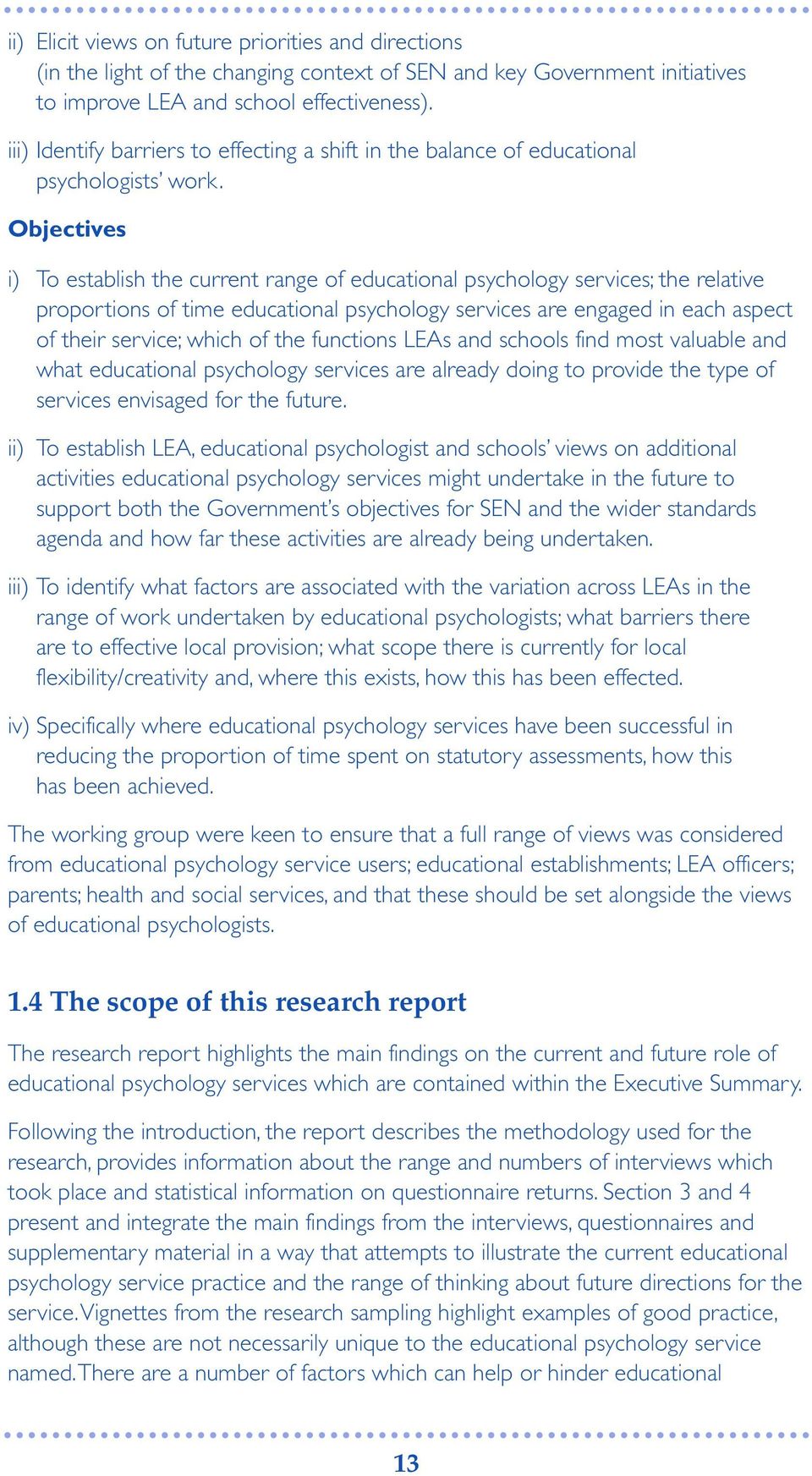
21 psychology services as they attempt to shift the nature of their work and these are considered in Section 5. Figure 1: Map of England showing LEAs participating in the Educational Psychology Services Survey 14
22 2 METHODOLOGY To meet the research objectives, both quantitative and qualitative data needed to be collected. The initial task was to consider the responses to the Green Paper consultation which specifically addressed the issue of the future role and training of educational psychologists.whilst these gave a broad insight into the current work being carried out by educational psychologists, they showed little in the way of detail on the nature and range of services currently provided across the country or on future work priorities. It was proposed, therefore, that there should be three main elements to the research: i) Postal questionnaires. ii) LEA case studies. iii) Submissions from interested parties. 2.1 Postal Questionnaires Two postal questionnaires were drawn up (Annex E); one for all LEAs (150 in total) for a combined response from the LEA/educational psychology service; and one for a random sample of 500 schools (200 primary, 200 secondary and 100 special schools). In the interests of reducing the burden on LEAs and schools, most of the questions required only a tick although there were sections for respondents to provide further comments and attach relevant key documentation.the school questionnaire was piloted in 8 schools and the LEA questionnaire piloted in a London borough. Both were revised to take account of comments made by respondents before they went out. 144 LEA/educational psychology services responded a response rate of 96% and 348 schools responded to the school questionnaire a response rate of 70%. The DfEE s Analytical Services Division analysed the responses and produced: i) a set of charts from responses to the school questionnaire showing the cross tabulation of frequency of receiving services from April 1998 to March 1999 with the priority the school attached to the services in the same period; this data was based on completed questionnaires from 348 schools (128 primary, 152 secondary, 68 special) ii) a set of charts from responses by LEA/educational psychology services showing the frequency and range of different activities undertaken by educational psychology services; and iii) comparisons of LEA/school responses. 15
23 Figure 2: Map of England showing LEAs participating in case studies 16
24 2.2 LEA Case Studies The questionnaires were followed up by 12 LEA case studies comprising interviews with groups from the LEA/educational psychology service, schools, parents with children with special educational needs, Health and Social Services to explore the qualitative areas of educational psychology work to enhance the quantitative information that came from their responses. LEAs were selected for case studies from their responses to the postal questionnaire based on criteria drawn up by the working group to reflect the range of educational psychology services that exist across the country and to help identify good practice in provision, particularly in the areas of social inclusion; raising standards and multi agency working. Particular care was taken to include a breadth of regions to ensure that the data represented a cultural mix of the population supported nationally by educational psychology services. (Annex B: LEAs who participated in the case studies). Interviews took place between May and July 1999 and took approximately 2 days to complete per LEA.The case study arrangements and topic guidelines were developed in consultation with the working group.the topic guidelines were divided into subheadings with key questions followed by a number of prompts to enable the researchers to probe further into those areas which might not be addressed by the interviewees initial response. Questions were also customised according to the information made available by the LEA prior to the interviews. Before each LEA visit the following documents were studied by the researchers: Education Development Plan. Early Years Development and Childcare Plans. Social Inclusion and Behaviour Support Plans. The LEA was also invited to send additional information that they wished the researchers to read before the interviews and every LEA did this.the following are examples of the additional literature provided: Educational psychology services Service Level Statement. Educational psychology services Training and Development Plans. Educational psychology services Business Plan. SEN Handbook. Educational psychologist pamphlets to schools. Educational psychologist initiatives within the LEA. OFSTED information. Children s Services Plans. 17
25 Interviews were timed and tape recorded.the interviewers also took detailed notes. Feedback was offered at the end of each visit and on most occasions this was taken up. In the majority of case study visits the principal educational psychologist was the point of contact for all the arrangements which involved setting up the interviews; arranging rooms and providing maps. In some cases they even provided transport and meals.they also co-ordinated the despatch of additional literature to the interviewers. Interview schedules were arranged with the following groups: LEA officers: Educational Psychology Service: Schools: Health: Social Services: Parents: usually the Director or Assistant Director of Education plus another LEA officer eg. the Education Officer for SEN represented by the Principal Educational Psychologist and all or some of the educational psychologists two schools per LEA a primary/secondary/special school selected by the DfEE random process Headteacher SEN co-ordinator or another member of staff (where appropriate) usually a community paediatrician from the Child Health Service and a senior paediatric therapist eg. speech and language therapist, school nurse, psychotherapist usually represented by the Assistant Director Children and Families and Team Managers Children with Disabilities Team or Looked after Children having the following a child with a statement of special educational needs a child at stage 3 of the Code of Practice (fair amount of contact with an educational psychologist) experience of an SEN Tribunal a child who is going through the statementing process now experience of other contact with the educational psychology service over a period of time eg for training The interview procedure and topic guidelines were piloted in the first LEA study and amendments made to timings and groupings in the light of the feedback from this LEA. 87 interviews were conducted over a period of 8 weeks. 234 people were interviewed representing a range of roles. (Annex C) Health and Social Services 18
26 were interviewed in 8 of the 12 LEAs (67%). A total of 27 LEA officers, 21 Health representatives, 20 Social Service representatives, 23 school staff, 68 parents and 75 educational psychologists were interviewed. The recorded interviews were analysed by the researchers. 2.3 Submissions from interested parties Educational psychologists, training providers and other interested parties were invited to send in submissions on both the future role and training of educational psychologists.the Association of Educational Psychologists (AEP) and the British Psychological Society encouraged members to submit their views. A total of 80 submissions were received. 5I of these, which arrived before the 21 April 1999, were analysed by the School of Education at the University of Birmingham. All submissions received after this date were considered by the researchers at the DfEE and taken into account in the report. 2.4 Seminars and conferences There were other sources of data collection which contributed to the research: i) The DfEE organised three SEN regional conferences in March 1999 at Bristol, London and Leeds to promote the SEN Programme of Action. One workshop at each of these conferences focused on the work and training of educational psychologists. ii) The AEP held a number of regional meetings across the country to discuss the issues facing the profession and submitted a formal response to the group on the basis of these discussions. iii) The Principal Educational Psychologists national conference also focused on the future role of educational psychologists and the organisers submitted a summary of the discussions held. 19
27 3 CURRENT ROLE OF THE EDUCATIONAL PSYCHOLOGY SERVICE Information in this section is drawn from the postal questionnaires, the case study interviews and DfEE statistics to determine: The structure and staffing levels of educational psychology services across England. Time spent by educational psychologists on school premises. Schools perspective on the current role of the educational psychology service. LEAs perspective on the current role of the educational psychology service. The proportion of time spent by educational psychologists on stage 4 and 5 of the Code of Practice. Strengths and limitations of the current role in the light of Government priorities. 3.1 Structure of an educational psychology service and staffing levels All educational psychology services across the country are part of the LEA, although some services are bought in from neighbouring authorities. A Principal Educational Psychologist manages the service and is, in most cases, accountable to either a second or third tier officer within the LEA management structure. In the significant majority of cases, educational psychology services comprise educational psychologists with some administrative support. However, Essex LEA has appointed assistant educational psychologists prior to their transition to training, to work in partnership with qualified educational psychologists focusing on stage three level of intervention in schools. In some LEAs the educational psychology service is part of a wider LEA support service which includes other advisory and support staff. Statistics collected by the DfEE on the number of educational psychologists show that as at January 1999 there were 1817 full time equivalent (fte) educational psychologists employed by LEAs in England (Annex D). There are wide variations in staffing levels across the country. From the questionnaire returns: 23 LEAs employed fewer than 6 educational psychologists; 60 LEAs employed between 6 and 12 educational psychologists; 37 employed between 12 and 18 educational psychologists and 24 services employed 18 or more. 20
28 Figure 3 Number of EPs (fte) per LEA in England, April 1998 March Number of LEAs <6 6<12 12<18 18 & over Number of EPs (fte) Staffing Ratio An analysis was made of the number of educational psychologists in a service by: a) the location of the Service (London, North, Midlands or South) b) the school population c) the population aged 0-19 years. a) The location of the Service London LEAs had a more generous staffing ratio than LEAs located in other parts of the country. For example, London LEAs had an average of 3,200 pupils in mainstream schools per educational psychologist compared with an average of 4,700 pupils per educational psychologist in the North and Midlands and 4, 400 pupils per educational psychologist in the Southern LEAs. b) School population The ratio of educational psychologists to pupil population varied from 2,628 to 7,785.The case study LEAs were reasonably well distributed across the range but with a slightly stronger emphasis on those with a more generous staffing ratio. 21
29 Figure 4 60 Pupils per EP ratio 50 Number of LEAs :< :< :<5000 Pupils per EP 5000:< :> Analysis of the questionnaire responses show that there was some correlation between the range of services provided and the staffing ratio but only in certain areas of work.there was very little difference in the number of services provided within schools across different sized services.whilst those services with a lower than average ratio of educational psychologists were slightly less likely to be working with parents of pre-school children or school age children, there was no significant difference between those services with an average and above average staffing ratio. Similarly the staffing ratio did not appear to have any influence on the extent to which services were working at a multi agency level.the areas of work which did appear to be influenced by the staffing ratio were training, research and development including project work and to a lesser extent, working at the level of the LEA (see 3.4.4). c) 0-19 years staffing ratio Analysis of the staffing ratio in relation to the population of those aged 0-19 years shows a similar pattern to that of the school population.the ratio of educational psychologists to the number of children aged 0-19 years ranged from 4,041 to 11,171, with 14 LEAs having a ratio below one educational psychologist per 5,000 children aged 0-19.The Warnock Report recommended a staffing ratio of 1: 5000 children aged 2-19 as the minimum likely to be adequate. However, it should be acknowledged that the data only allows an analysis of the staffing ratios and does not allow for any analysis of the quality of services provided. 22
30 Figure 5 45 Children aged 0-19 per EP ratio Number of LEAs :< :< :< :< :< :> Number of children aged 0-19 per EP Main responsibilities of educational psychologists Services responding to the questionnaire said that 85% of their educational psychologists were working mainly in a generic role and around 7% were working in a mainly specialist role. A further 6% reported working primarily in a managerial role. 2% came under other. Figure 6 Main Responsibilities of EPs 7% 6% 2% Mainly in a generic role Mainly in a specialist role Mainly in a management role Other 85% Within the 2% categorised as other was an inseparable mix of responsibilities which included tutoring; standard fund projects; education action zone roles; portage; and joint appointments with other agencies. 23
31 Those working in a generic role tend to support a patch of schools, usually organised on the basis of the pyramid model (a secondary school plus its feeder primary/nursery schools).the number of schools per patch varied considerably across the case studies, from around 8 to 30 schools Management structure The majority of educational psychology services employ both main grade and senior educational psychologists.the role of the senior educational psychologist varies, but they will usually have managerial responsibility for main grade educational psychologists or a specialist role which is sometimes jointly funded eg with social services for looked after children, or in some cases both responsibilities. A principal educational psychologist manages the service and may be assisted by an assistant principal educational psychologist.there did not appear to be any key factor, such as size that determined whether a service employed an assistant principal.the role of the principal educational psychologist and its impact on service provision is discussed in Section 4. In many LEAs, senior educational psychologists provide professional support to more junior colleagues on a regular basis in acknowledgement of the sometimes stressful nature of their work. 3.2 Time spent by educational psychologists on school premises 48% of educational psychologists time is spent on school premises on the basis of an average of 12 educational psychologists per service working 37 hours per week for 36 weeks per year (the time when schools welcome visits ie. most schools do not want visits in the first or last weeks of term).this is comparable with a recent study of time allocation undertaken by Imich (1999) which concluded that 47% of educational psychologist time available for school visits was spent in schools. It should be acknowledged that this does not represent the full amount of time that services spend on school related work as report writing, home visits and liaison with other agencies will often be school related but take place away from school premises.those educational psychology services which spent a greater proportion of time on school premises during the last year were contributing to wider school development to a greater extent than those which spent less time in schools. Primary schools reported that within the last year they received an average of 16 hours support on school premises from their educational psychology service. This compares with an average of 30 hours for secondary schools and 33 hours for special schools. 24
32 Figure 7 35 Average EP time funded by the LEA received on school premises from April 1998 to March Hours Primary Secondary Special Type of school Of the total time spent on school premises, about 90% is spent on work related to children on the SEN Code of Practice stages 1-5.The remaining 10% of educational psychologists time on school premises is devoted to other school work which contributes to raising standards. In special schools this includes attending reviews and undertaking assessments. Figure 8 Time spent by EPs on various areas of work Code of practice Stages 1-3 Code of practice Stages 4 Code of practice Stages 5 Maintained primary schools Maintained secondary schools Special schools Contribution to other school work to help raise standards Other areas 0% 10% 20% 30% 40% 50% 60% 70% Percentage 25
33 Visits to schools are usually organised on a sessional basis, with one session equating to half a day. For primary schools this equates to fewer than two visits per term and for secondary and special schools, equates to just over three visits per term, but there are considerable variations according to schools individual circumstances. Across the case studies, the number of school visits per term varied significantly from one visit to six or seven. In part, this also relates to: i) the ratio of educational psychologists to school population; ii) the way in which the service chooses to allocate their time to schools; and iii) the model of service delivery. This will be discussed in Section The school perspective In considering the data, it is important to note that responses to the school questionnaire were based on schools experiences of individual educational psychologists within a service; responses are not necessarily indicative of the range of services provided across an educational psychology service. Case studies revealed that on the whole educational psychology services were not active in marketing the functions they could undertake, which limited school and agency perspective of the breadth of their service. In some cases this was because educational psychologists were concerned that marketing would create a demand for help beyond their resources. Services received by schools: April 1998 March 1999 i) Early intervention work with parents ii) Code of Practice work observation and assessment advice and support for pupils at COP 1 3 planning Individual Education Plans (IEPs) work with teachers iii) Behaviour support counselling and therapeutic work iv) Wider school development v) Training consultation and problem solving with school staff contribution to school development 26
34 3.3.1 Early intervention Work with parents Over 50% of primary and secondary schools said that, in their knowledge, their educational psychologist had worked with parents during the past year, but the majority said that this had happened less frequently than once a term. (It should be noted that all educational psychologists are bound by professional codes of ethics to consult with parents whenever they are involved with a child.) Liaison and work with parents was far less likely to have taken place where the pupils were in special schools than where they were in mainstream schools. Almost all schools said that their educational psychologist had not run parent workshops or carried out community based work to promote family involvement in the last year. However in some of the case study areas the educational psychology service had been involved in parents workshops through the Parent Partnership Service and it may be that elsewhere this service was being provided but schools were not aware of it Code of Practice Work The areas where schools reported receiving educational psychologist support in the last year were those related to work with children at the stages of the SEN Code of Practice. a) Observation and Assessment Over 80% of primary and secondary schools said they had received support from their educational psychologist in relation to the assessment of children at stages 4 and 5 of the Code of Practice. Around 50% of schools said that they had received this service either termly or more than once a term. Observation and assessment of children with learning and communication or behavioural difficulties was also one of the more commonly reported functions carried out by educational psychology services in schools, with 85% of the total of all primary, secondary and special schools saying that they had received this service. b) Advice and support for pupils at COP 1 3 It is interesting to note that despite there being a general perception that educational psychologists work in schools is predominantly related to statutory assessments, 75% of primary and secondary schools said that they had received advice and support from their educational psychologist for pupils at stages 1-3 of the Code. Of those 25% said that they had received this support less frequently than once a term. However, 25% of schools said that they had not received this 27
35 service in the past year.the survey indicated that more secondary than primary schools receive this support. c) Planning IEPs 50% of all schools said that they had received educational psychologist input to planning IEPs, although for many this was infrequent, whilst 50% said they had not. It may be that five years on from the introduction of the Code of Practice, teachers and SEN co-ordinators are sufficiently proficient at planning IEPs for them not to require advice and support from their educational psychologist, particularly for children with less complex needs.there is some evidence from the case studies to support this, although from the questionnaire responses about 45% of schools said they wanted this support on an ad hoc basis and about 45% on a regular basis. Figure 9 Planning Individual Education Plans with the SENCO/teacher: All schools 100% Percentage 50% 0% Frequency of receiving service Priority school attached Future wishes of schools d) Working with teachers Over 50% of schools said that their educational psychologist had worked with teachers to devise appropriate strategies for addressing individual pupils needs Behaviour support Counselling and therapeutic work Whilst the majority of primary schools (85%) said that they had not received any support from their educational psychologist in relation to counselling and therapeutic work with identified pupils, around 50% of secondary schools said they had received this service.almost all schools (90%), whether primary, secondary or special schools, said that their educational psychologist had not, in the past year, 28
36 undertaken direct work within the classroom with individual pupils or groups of pupils. However, over 50% of schools said that their educational psychologist had worked with teachers to devise appropriate strategies for addressing individual pupil needs Wider school development a) Consultation and problem solving with school staff SEN co-ordinators were much more likely to have received this support than headteachers. Over 50% of primary and secondary schools said that their educational psychologist had not engaged in consultation and problem solving work with the headteacher over whole school issues but this may have been for a variety of reasons some of which were identified in the case studies eg. other LEA services available to do this. The majority of schools said that their educational psychologist had engaged in consultation and problem solving work with the SEN co-ordinator over the past year. Secondary schools had received this support more frequently than primary schools with 50% saying they had received it more than once a term compared to 30% of primary schools.the vast majority of schools said that the educational psychology service had not provided guidance and support to Learning Support Assistants (LSAs) on pupil learning or targeted teaching. b) Contribution to school development Secondary schools were more likely than either primary or special schools to have had educational psychologist input to school policies and development plans. Few schools reported having assistance from their educational psychologist in bringing about organisational change. A small minority of schools reported educational psychologist involvement in target setting beyond the individual level; project work on school inclusion; developing pastoral schemes or curriculum development initiatives.the main area where schools said that educational psychologists had been involved in wider school work was in the development of behaviour management techniques. Around 50% of all schools said they had received this service from their educational psychologist working with other agencies to provide a unified service to the school Training Questionnaire responses indicated that over 80% of all types of schools received less than one hour of training or none at all from their educational psychology service during the year April 1998 March
37 Figure 10 Hours of EPS training to schools funded by the LEA 100% 80% Percentage 60% 40% 20% 0:<1 hour 0:<5 hours 5 & over hours 0% Primary schools Secondary schools Special schools School type Very few schools had reported seeking or receiving training directly funded from their school budget. 3.4 The LEA perspective LEA responses to questions on the current role of the educational psychology service fell within the following five areas: Early Years. Services to schools. Research and Development. Working at the level of the LEA. Working with council services and other agencies. Services less frequently reported included: running parent workshops; community based work to promote family involvement; direct intervention/modelling demonstrated in class with a pupil or groups of pupils; involvement in literacy programmes, and crisis support following a traumatic incident. However, between half and three quarters of educational psychology services reported providing at least one of these services between April 1998 and March
38 3.4.1 Early years Working with and for parents of pre-school children Almost all educational psychology services said that they had worked with parents of pre-school children in the last year in the following ways: consultation and developmental assessment of children, including multi-agency assessment and intervention; consultation over diagnosis and implications for children with complex SEN; advising on behaviour management; giving advice and support towards securing an appropriate school placement; and working with therapists and early years providers. A large number of educational psychology services were involved in work with playgroups, nurseries, portage services and child development centres Services to schools It is worth noting that educational psychology services reported providing a somewhat wider range of services to schools than schools reported receiving. This will be because the range of services provided by an individual educational psychologist to a school will be largely determined by the particular issues and circumstances facing that school and by the competence and experience of the educational psychologist. So, whilst the service as a whole may have provided this range of services in the past year, individual schools may have only received a limited number of these services. All or almost all LEAs/educational psychology services reported having provided the following services to schools during the year
39 Services to schools: April 1998 March 1999 i) Early intervention early years preventative work; advice to school staff prior to pupil s admission; advice to school staff on early intervention; and liaison and working with parents in school. ii) Code of Practice work advice and support to teachers on COP stages of support 1-3; observation and assessment of children with learning and communication difficulties; consultation on curriculum planning and differentiation for individual or groups of pupils; planning IEPs with the SEN co-ordinators and teachers; working with teachers to devise appropriate strategies for addressing individual pupil needs; and assessment of Code of Practice stages 4 and 5. iii) Behaviour support reviews with school staff working with children at risk of exclusion; observation and assessment of children with behavioural difficulties; counselling and therapeutic work. iv) Wider school development v) Training vi) Other consultation and problem solving with the Headteacher over whole school issues; consultation and problem solving with the SEN co-ordinator over groups of pupils; and contribution to multi-agency planning. guiding Learning Support Assistants on pupil learning and targeted teaching. assessment of exam conditions; and critical incident response. 32
40 i) Early intervention a) Early years preventative work Around 90% of educational psychology services reported providing this support as part of their service to schools. However, 80% of primary schools and 75% of special schools said that they did not receive support in early years preventative work between April 1998 and March 1999.This may have been because schools had to prioritise need and this was not negotiated within their time allocation. b) Advice to school staff prior to pupil s admission The majority of educational psychology services reported providing advice to school staff prior to the admission of pupils with special educational needs. However, 75% of schools said they had not received this service during the year under review. Of those who did receive it, 50% were secondary schools, 40% were special schools and 10% primary schools. In one LEA, the educational psychologist with the brief for an early years service was reviewing the most effective way of handing over from early years to school as there was no formal mechanism for doing so or who should be doing it: At the moment I would say that I would do that certainly with children at stage 3 but there have been some discussions with the pre-school teaching service about their potential role in that respect. c) Advice to school staff on early intervention 95% of educational psychology services said that they provided this service although less than 40% of schools reported receiving this support. Of these, more secondary schools than primary or special schools reported receiving this service. d) Working with parents of children of school age The majority of educational psychology services said they had responded to parental requests for advice on children s learning and development, had been involved in family/schools consultations and had worked with families to effect change. Just over 50% of educational psychology services said they had been involved in running parent workshops and had worked with Parent Partnership Services to provide training and support to parents of children with SEN. Only 33% of services said they had been involved in community based work to promote family involvement in children s education. 33
41 Figure 11 Running parent workshops Range of EPS work with parents Percentage of LEAs providing service 0% 10% 20% 30% 40% 50% 60% 70% 80% 90% 100% Service provided Working with families Community based work Working with Parent Partnership Schemes Family/School consultation Responding to parental requests for advice ii) Code of Practice a) Advice and support to teachers on COP stages of support % of educational psychology services said they had provided advice to teachers in support of pupils at COP stages 1 or stage 2 either through direct contact on an ad hoc basis when the teacher requested it or through termly planning meetings where individual children were brought to the attention of the education psychologist. However, there were concerns from some educational psychologists: there are cases coming through at stage 4 which have had very little intervention from us and being brutally honest they have had very little from school. Responses highlighted that where the LEA had a clear policy on the expectations of school intervention and a service level statement on LEA/educational psychology service intervention combined with a high delegation of SEN funding there was less incentive to proceed through to COP stages 4 and 5 and more emphasis on higher quality intervention at stages 1-3. b) Observation and assessment All LEAs, both in their responses to the questionnaire and at interviews, said they currently undertook observation and assessment of children with learning and communication difficulties but many of the case study LEAs said they placed less reliance nowadays on psychometric testing.... relatively few of the psychometric assessment skills that I learnt as a trainee am I using now. 34
42 c) Consultation on curriculum planning 90% of LEA/educational psychology services reported the service had worked with school staff on planning curriculum differentiation for individual or groups of pupils including work with very able pupils. d) Planning IEPs Almost all the LEAs/educational psychology services (99%) reported that they had worked with SEN co-ordinators and/or teachers in planning IEPs although 50% of schools said they had not received this support. Neither the LEA or schools attached high priority to this direct input although SEN co-ordinators did involve educational psychologists in contributing to training sessions for staff in school. e) Working with teachers to devise appropriate strategies f) Assessment of pupils at COP stages 4 and 5 All the LEAs/educational psychology services said that they had provided this support during the year April 98 March 99. Not surprisingly, the LEA attached high priority to the educational psychology service input to the assessment of pupils at COP stages 4 and 5. However, around 25% of schools reported receiving this input less than once a term and 20% of schools said that they had not received this service at all during the year reviewed as they did not have children in need of this service. iii) Behaviour support a) Reviews with school staff working with children at the risk of exclusion Almost all educational psychology services (95%) said that they had worked with schools on the development of behaviour management techniques whilst 75% of services reported working with schools on projects focusing on increasing social inclusion. b) Observation and assessment All LEAs/educational psychology services reported on working with school staff in observing and assessing children with emotional and behavioural difficulties. Around 90% of schools corroborate this although about 60% said they had received this input only termly or less than once a term. 35
43 c) Counselling and Therapeutic work 90% of eduacal psychology services had provided this service during the year under review. Some educational psychologists worked as part of a multi disciplinary team to provide a counselling service to secondary schools whilst others provided this as part of their general service to schools. 75% of LEAs said that they considered this service to be medium to high priority. iv) Wider school development a) Consultation and problem solving with Headteacher over whole school issues b) Consultation and problem solving with the SEN co-ordinator Although 95% of educational psychology services reported undertaking these functions, the majority of schools said that it was the SEN co-ordinator rather than the headteacher who had received this support particularly in response to the needs of groups of pupils. The majority of educational psychology services reported assisting schools with organisational change and working with staff to design policies and development plans. Fewer than 50% of services reported carrying out work related to target setting beyond the individual pupil level and working with schools on curriculum development initiatives. c) Contribution to multi agency planning All the LEAs/educational psychology services said that they had contributed to multi agency planning and reviews with school staff and almost all (98%) attached a high priority to this input. v) Training Educational psychology services reported providing an average of 25 hours of LEA funded training in the year April 1998 March 1999.This covered the range indicated in Figure 12, including training for health authorities and social services. Fewer than 33% of educational psychology services said they had provided training to schools which was directly funded by the school.the majority of services said they had provided training to teachers on specific educational needs and strategies to meet those needs, on classroom management and also training aimed specifically at SEN co-ordinators. Over 50% of educational psychology services said they had been involved in providing training to Health Authorities/Trusts and/or Social Services Departments. The majority of services had also provided training to early years providers. 36
44 Figure 12 Range of training services provided by the EPS per LEA Percentage of LEAs providing service 0% 10% 20% 30% 40% 50% 60% 70% 80% 90% 100% Service provided To teachers on specific educational needs To teachers on classroom management etc. To teachers on specific strategies To parents on specific strategies To governors on school SEN management etc. To LSAs To schools staff development days To schools senior management To SENCOs To the Health Authority and Trusts To Social Services vi) Other a) Assessment of exam concessions Almost all (98%) of educational psychology services reported carrying out assessment of examination concessions, mainly in secondary schools (80%) although some were in special schools (18%). 2% of primary schools had reported receiving this support less than once a term (see 4.7 for further comments on this). b) Critical incident response About 80% of educational psychology services reported providing crisis support to the headteacher, pupils and staff following a traumatic incident during the year from April 1998 March It is difficult to get a true picture of the impact of this service due to the range of incidents and the ad hoc nature of need. However, where schools had required support from the LEA following a traumatic incident involving the school (either as a whole or individual pupils), it was clear that an educational psychologist had been considered a key member of the team. 37
45 Research and Development Around 50% of services said they had undertaken research projects between April 1998 and March 1999, either to assess the effectiveness of SEN provision or evaluate school or LEA initiatives. Just over 50% of services said they had initiated LEA research projects.the majority of services also reported being involved in developing and implementing LEA policies on pupil achievement and working with other LEA officers to evaluate and develop provision. 66% of services said they had been involved in reviewing cross-lea provision and in planning provision to support inclusion. Some of these projects had been funded through the Government s Standards Fund programme Working at the level of the LEA Figure 13 Range of services provided at LEA level by the EPS Policy advice to the CEO committee Contributing to authoritywide service review Assisting in LEA organisational change Percentage of LEAs providing service 0% 20% 40% 60% 80% 100% 120% Service provided Training for departmental staff Training for teachers and SENCOs Training for school governors Attendance at annual reviews Providing evidence at SEN tribunals Supporting LEA in local conciliation Critical incident/ crisis response Almost all services said they had provided policy advice to the Chief Education Officer or Education Committee and had contributed to an authority wide review of the service, whilst only 50% of services said they had assisted the LEA in organisational change. Over 50% of educational psychology services had been involved in some way in supporting local conciliation arrangements and in providing critical incident support. 38
46 In line with guidance in the Code of Practice. Almost all services said they had been involved in annual reviews and SEN Tribunals. Figure % Attendance at Annual Reviews 100% 50% 0% Provided service High Medium Low Not needed Priority LEA attached Provide Provide Not on a on an needed regular ad hoc basis basis Future Wishes of LEAs Working with council services and other agencies Most services said they had worked with social services between April 1998 and March 1999 on child protection issues and issues around looked after children, but fewer than 50% said they had been involved in work with youth justice teams or family centres. In terms of work with health services, the majority of services said they had worked with health authorities and trusts on child development issues, speech and language work and child and adolescent mental health services. Around 75% of services said they had worked with early years partnerships and 50% of services had worked with the further or higher education sectors to support students. 3.5 Time spent on Stages 4 and 5 of the Code of Practice Around 40% of educational psychology services said that the proportion of time spent working with children at stages 4 and 5 of the SEN Code of Practice had increased over the last 5 years; 25% said work at stages 4 and 5 had remained relatively stable and 35% said that the time spent on stages 4 and 5 work had decreased. Where services reported that the proportion of educational psychologists time spent on stages 4 and 5 had reduced, they were asked for information on how this had been achieved. 39
47 Responses fell under two headings: i) as a result of LEA action; or ii) as a result of action by the educational psychology service. i) LEA action This included: establishing clear expectations in terms of school provision and funding for children with special needs and providing criteria for initiating a statutory assessment. Evidence from case studies shows that where schools have a clear understanding and expectation of the general level of need and support required by a child at each stage of the Code of Practice, this helps to reduce school and parental demands for statutory assessment work.there is less incentive for schools to request a statutory assessment where the LEA has already delegated a significant element of stage 4 and 5 funding to schools and additional resources are therefore not so available. Putting significant resources into non statutory support through the provision of enhanced support services, which in some cases, but not all, has included an enhanced educational psychology service. Again, it was clear from the case studies that where additional resources had been put into non statutory support, including educational psychology services, schools felt that they had more support available to help them with children at the earlier stages of the Code and this resulted in fewer requests for statutory assessments. LEA policies in respect of educational psychologist working practices to reduce the amount of educational psychologist time devoted to stage 4 and 5 work. For example where there is a policy to reduce the involvement of the educational psychology service in drafting statements and increase its involvement in wider preventative work, there has been a reduction in the need for statutory assessment or a statement. ii) action by educational psychology services Where the reduction in stage 4 and 5 was attributable to action by educational psychology services, this was related to changes in the service s working practices. Those cited include: the introduction of a time allocation system which provides greater clarity concerning the educational psychology service s role and practice; the move from a referral system to a consultation problem solving approach to service delivery; 40
48 a reduction in the amount of educational psychologist s work with special schools; more project based work focusing support where it is most needed; a greater emphasis on early intervention and preventative work; empowering teachers and SEN co-ordinators through training and support; using the Standards Fund to increase educational psychologist involvement in key LEA initiatives eg. social inclusion at earlier stages of intervention; and the establishment of specialisms within the service. A proportion of the 35% of services who said that they had achieved a reduction in the amount of educational psychologist s time devoted to stage 4 and 5 work had done so by: establishing greater clarity in the role of the service, for example, through the development of a service level statement for service users; the publication of guidelines on educational psychologist practice at stages 1-3; and the provision of information to schools on the role of the educational psychology service. Educational psychology services were also asked to provide examples of the type of work that they had been able to undertake as a result of achieving a reduction in the amount of time spent on work at stages 4 and 5.Work at the level of the LEA included: multi-agency lead roles; increased collaboration with other services; action research and evaluation of the quality and effectiveness of provision; strategic work across the LEA; project based work; and early years work. In schools, this had resulted in more time for schools and therefore more time for: preventative work; problem solving; INSET; work in promoting inclusion and social inclusion; project work targeted towards school issues and concerns; work with parents; 41
49 3.6 Strengths and limitations of the current role in the light of Government priorities Strengths It is clear from the responses to the postal questionnaire and the case study visits that many educational psychology services are already engaged in work which contributes to the raising of standards of achievement and supports Government s policies on inclusion and social inclusion. Many services are also engaged in multi agency work which helps to support this wider agenda. Educational psychologists and their stakeholders recognise that there are key areas of work where the application of psychology can make a difference and, in general, stakeholders value the work of educational psychologists. Where educational psychology services have been involved in wider school development work, this is highly valued. Where the educational psychology service is clearly linked in to the LEA wider strategy and there is a co-ordinated approach to service delivery across LEA support services, this leads to the delivery of a comprehensive service and clarity about respective roles. Parents value educational psychologists and see them as a key link to schools and other agencies. There are many creative projects and developments which have been initiated and driven forward by educational psychology services. Educational psychology services can and do play a key role in supporting inclusion and in helping to support children in mainstream schools. Where educational psychology services work with schools to empower the teachers and develop their knowledge and skills this helps to free up educational psychologists to undertake more preventative work. Educational psychologists have a complimentary knowledge base; they have a substantial understanding of child development; thinking and learning; school organisation and how schools work; the social dynamics of the classroom and playground and; of behaviour, its causes and consequences. 42
50 Limitations LEA policies can act as a barrier to the educational psychology service adopting a wider role. There are wide variations in the functions carried out by educational psychology services and a lack of clarity about their prime function amongst some stakeholders.whilst some services have developed their work with other agencies, others do not see this as a priority. There is also a wide variation in staffing levels across educational psychology services and whilst there is some correlation between staffing ratio and service delivery, it is clear that services with similar resources can vary significantly in terms of the quality and range of services they provide. Schools feel that the lack of educational psychologist time available, militates against them involving their educational psychologist in more preventative work with children with special educational needs at the earlier stages of the Code, as envisaged by the SEN Action Programme. There is some mismatch between what educational psychology services think they should be doing and what stakeholders perceive as their role.this can result in educational psychology services being spread too thinly. Where educational psychologists are seen by schools as the gatekeeper to resources, this contributes to a narrow perception of their work. Educational psychology services do not sell themselves as well as they might. There are many positive reports on the value of educational psychologists but services need to have a clear view about where and how they can add value and should market themselves to users accordingly. In some educational psychology services the educational psychologists work autonomously and this means that customers expectations are driven by their experience of individuals rather than LEA and educational psychology service priorities. There are recruitment difficulties in many parts of the country which affect service delivery. Some educational psychologists feel that they do not have the necessary skills or training to adopt a wider role or undertake specialist work. 43
51 4 OUTCOME OF RESEARCH INTO THE FUTURE ROLE OF THE EDUCATIONAL PSYCHOLOGY SERVICE Introduction As part of our discussions, users of the educational psychology service were asked to look beyond the services they were already getting and to think creatively about priorities for future functions in the context of wider Government priorities. Respondents to the postal questionnaires were also encouraged to consider, in broad terms, the educational psychology services they want in the future and, where there are other support services involved, to describe what they see as the respective roles for each service. Outcomes from this part of the research identify how users of the educational psychology service would like to see services develop and illustrate this with examples of good practice gleaned from the case studies. 4.1 Early years perspective Early years providers want the following from an educational psychology service in support of early years provision: access to an educational psychologist to discuss concerns about a child s development and learning; identification of a child s needs through observation, assessment and consultation as appropriate; advice on intervention; support for complex casework; support in working with parents either on the premises or home visits; educational psychologists to work as part of a multi-agency team to provide: joint assessments; joint planning and monitoring; advice on intervention; educational psychologists to work with groups of children e.g. on social and friendship skills; clear and accessible information about the service; and training. 44
52 This research identified the following example of educational psychology service involvement in pre-school provision: 365 PROJECT Bexley Educational Psychology and Assessment Service (EPAS) In 1997 a pre-school project, known as the 365 Project was funded by Bexley County Council in two areas of the Borough to encourage healthy relationships between parents and toddlers.this was as a result of research undertaken by the Principal Educational Psychologist. A review of provision for children in Bexley experiencing emotional and behavioural difficulties recognised the need for early intervention at a pre-school level. In addition the Children s Services Plan had identified support for families and preventative measures as areas for development. A project was commissioned to facilitate the development of play, language and parent-infant interaction. The project is based in Erith and North Cray and available to all families with children up to 3 years old. A pre-school project educational psychologist, appointed to implement and review the project, manages the team which now has additional pre-school educational psychologist time enhancing and developing early intervention, pre-school assessment and resources.within each locality, a weekly Funtime session is held which allows opportunities for interactive play between parents and children as well as discussion on aspects of bringing up children and preparation for nursery. A loan scheme for toys and books is also available. Weekly home-based visiting programmes are available for a small number of families where concerns have been recognised by health visitors and it is agreed that the child can best be supported within the home environment. Play Roadshows for wider audiences, such as health clinics and voluntary groups, are arranged to promote the message that parents can make a difference. 45
53 4.2 Schools perspective Schools want the following from their educational psychology service: i) Early intervention in schools early years work; advice to schools on pupils prior to admission; and joint home visits/liaison with parents. ii) Code of Practice work advice on pupils prior to admission; more support at the early stages of identification of a child s special educational need; assessment of pupils at COP stages 4 and 5; more opportunities for school staff to discuss issues arising from observation and intervention; regular open sessions; surgeries; helplines; advice on writing Individual Education Plans (for pupils with complex needs); advice on strategies for working with individual pupils; more practical in-class involvement; and work with groups of pupils as well as with individuals. iii) Wider school development target setting at group or school level; and school based multi-agency planning meetings. iv) Behaviour support v) Training school based project work particularly in behaviour management and social inclusion. more involvement in INSET. vi) Specialisms the development of specialisms (particularly in support of special schools and fully inclusive schools). vii) Access to educational psychologists consultation and solution focused approach; flexibility within a regular service; access to a range of educational psychology services on an ad hoc basis eg. for bereavement support; and consistency and quality. 46
54 4.2.1 Early intervention in schools a) Early Years work b) Advice on pupils prior to admission Primary schools want to see a greater focus within educational psychology services on early years work. 50% of primary schools responding to the questionnaire said they want but don t currently receive early years preventative work. On a related point, schools said they want more advice from educational psychology services on pupils prior to admission, to enable them to be aware of and plan for their arrival. c) Joint home visits/liaison with parents Schools see educational psychologists as the key link between school and home. 66% of schools responding to the questionnaire said they saw liaison work with parents as priority for the future. In comparison 66% of special schools said their educational psychologist had spent insufficient time with parents of children with statements of special educational needs and saw this as a priority in the future. Some mainstream schools in the case studies said that they wanted more home visits and some suggested joint visits by the SEN co-ordinator or class teacher and educational psychologist Code of Practice work a) Early identification and intervention Schools are clear that they want more support from their educational psychology service at the early stages when a child s needs are first identified. 50% of the schools responding to the questionnaire said they wanted this support in the future but are not currently receiving it.this is supported by the case study interviews where schools, due to lack of educational psychologist time, reported having to prioritise which children the educational psychologist would observe/discuss. we are often holding pupils in a queue until they can be seen. Consequently, schools prioritise children with the most severe problems at the later stages of the Code. If there were to be more educational psychologist time available, schools would want their work in schools to have a greater focus on earlier identification and intervention. b) Advice and support at the earlier stages of the Code of Practice It is also clear from both the questionnaire data and the case study interviews that schools continue to see an important role for educational psychologists in advising on and supporting children with special educational needs. For example, 75% of all primary and secondary schools responding to the questionnaire said that they currently get advice and support from educational psychologists on children at the 47
55 early stages of the Code and they want this service to continue in the future. It is worth noting that the 25% of schools who said that they hadn t received this support in the past year also saw this as a future priority. c) Assessment of pupils at Code of Practice stages 4 and 5 Similarly, the significant majority of mainstream schools said that they currently get educational psychologist input to the assessment of pupils at stages 4 and 5 and they want to continue to receive this service. In addition, statutory assessments remain a priority because schools and educational psychology services have a duty to respond. d) Opportunities for discussion Schools want some mechanism for enabling teachers and SEN co-ordinators to have earlier discussions with an educational psychologist about children causing concern before their needs require a statutory assessment.they also want more support in relation to children at the school based stages of the Code and, in particular, more educational psychologist time for observation and intervention work with class teachers.therefore, whilst schools clearly see a role for the educational psychology service which goes beyond carrying out statutory assessments, that role remains a priority within current resource constraints. In some of the case study authorities, the educational psychology service to schools has been restructured to allow more opportunity for teachers to discuss issues around particular children, and for the educational psychologist to work with children either at an early stage of the Code or with children not yet formally on the SEN register.where schools have had experience of educational psychologists doing early intervention work they are very supportive of this approach and have organised staff timetabling to make available the SEN co-ordinators and other school support staff for regular discussions with the educational psychologist. 48
56 SUPPORT IN A COMPREHENSIVE SCHOOL Kensington and Chelsea Educational Psychology Service In one comprehensive school of 1,450 pupils with 500 pupils on the SEN register and 2.6% with statements, the educational psychology service has arranged the following consultation model of service delivery. Three educational psychologists link with the school and visit on a fortnightly basis which enables each SEN co-ordinator to see their particular educational psychologist on a monthly basis. (There is one lead SEN co-ordinator and each year group tutor also acts as an SEN co-ordinator for their year group.) The Headteacher has an annual review with the educational psychologists and this is followed by a meeting with the SEN co-ordinators to fix dates for visits which usually take place on a Thursday morning as the SEN co-ordinators are released from their teaching commitments that day. Priorities for these visits are fixed at this annual meeting and termly meetings. A manual sets out what the service can provide and this is used as the basis of their discussions. At every visit the SEN co-ordinators and educational psychologists meet for 15 minutes to discuss issues arising from previous interventions to identify additional demands and to re-prioritise where necessary.this meeting was instigated by the service and it has improved communication and allowed for flexibility in how the educational psychologists are used. The educational psychologists work at a range of levels: individual work especially at an earlier stage of intervention with a student; group work involving tutors e.g. in PSHE and at an organisational level such as on issues of attendance, provision and EBD. The school s relationship with the educational psychology service has changed radically over the last few years since the introduction of the consultation model and the associated introduction of the Year Group SEN co-ordinators in the school. Solutions are context based, expertise is shared (SEN co-ordinators provide training to school staff whilst the educational psychologists train the SEN co-ordinators) and the educational psychologists have a higher profile because more teachers and tutors see them at work and have opportunities to discuss strategies for supporting the individual student, some of which have wider implications for the class and school as a whole. 49
57 e) Regular open sessions or surgeries A number of schools said they wanted regular open sessions or surgeries in schools or an educational psychologist helpline, where teachers can have direct access to educational psychologists to discuss particular children or issues.they feel that this would help to provide a more responsive service. In general, schools value educational psychologists knowledge and skills and wish to be able to draw more widely on their expertise. In one LEA, however, where Open Access meetings were offered, the use of the service had not been high; both teachers and educational psychologists thought that this was because the surgeries were being held at the LEA rather than in schools. However, one school had organised a drop in service with a previous educational psychologist which allowed for early intervention without them necessarily seeing every child causing concern: (It was) basically a drop in session which was wonderful.teachers could go and talk. If they had a problem with a child that needed looking at Sometimes it actually helped to pacify us because we were actually jumping to the wrong conclusion which is so often the case But also sometimes you picked them up much earlier. f) Advice on writing IEPs Many schools value help and support from educational psychologists in writing IEPs and setting targets for individual pupils and therefore see this as a continuing priority. However, the educational psychology service in one of the case study areas had provided training and worked with SEN co-ordinators and class teachers to improve their skills in writing IEPs, thus freeing their dependence on educational psychologists to undertake this work.the schools representatives said that they now have the confidence to write IEPs and acknowledged that this allows them to use their allocated time with educational psychologists for other more preventative work which specifically requires an educational psychologist s expertise. g) Advice on working with individual pupils h) More practical in-class involvement Schools want more advice and support from educational psychologists on how to deal with individual pupils.whilst some feel that they are getting this support, others feel that they are just getting an assessment of the child s needs but no advice on strategies for working with the child in the classroom: Our main need is for practical advice/strategies once we have exhausted our own resources within Code of Practice stages 1-2.Teachers and SEN co-ordinators value educational psychologists advising on strategies in the classroom and providing practical demonstrations. More than 50% of those responding to the questionnaire said they want, but don t get, educational psychologists undertaking direct intervention and modelling of strategies in the classroom. there needs to be more practical/in- class involvement and less talk and up-dating. 50
58 i) Work with groups of pupils However, where schools have experience of educational psychologists working with groups rather than individual pupils, they value this input, and see this approach can be a more effective use of time. Individual pupil s needs are seen within the context of their peer group and whole school approaches can be identified to inform and guide school policies and practice e.g. on behaviour management. For example, in one LEA the educational psychology service is running an anger management group focusing on a number of pupils who have been identified as having difficulties in controlling their temper Wider school development Schools generally see less of a role for educational psychologists in wider school development work, often because they see others, such as the LEA advisory and inspection service, providing this support. It was clear, for example, from the case studies and supported by 66% of school questionnaire responses, that generally schools do not see a role for the educational psychology service in the implementation of the National Literacy and Numeracy strategies as this support comes from other sources from within the LEA. Schools are looking for clarification of the role of the educational psychology service at both a local and national level as some feel that there is an unnecessary duplication of roles across different support services within an LEA. However, schools do see a role for educational psychology services in the following: a) Target setting Schools are keen to see more input from educational psychologists in relation to target setting beyond the level of the individual pupil. Around 50% of the schools responding to the questionnaire said that they want but do not currently receive help from an educational psychology service in terms of target setting at a group or school level. b) School-based project work School-based project work is seen as another important area for future educational psychologist input. For example, 50% of all secondary and special schools responding to the questionnaire said they want but do not currently receive educational psychologist involvement in project work to increase social inclusion. 51
59 THE YOU CAN DO IT PROJECT Bristol Educational Psychology Service The project was proposed as one of the outcomes of discussion by Bristol LEA s Emotional Curriculum Planning Group.The You Can Do It is a scheme of teaching materials and practical methods that help children become achievers. Research in 1994 in Tampa, Florida, had shown that achievers and non-achievers can be distinguished by the way they think about themselves and about learning about their habits of mind. The approach was identified by the educational psychology service as having potential for Bristol schools in December 1997.An educational psychologist was seconded as co-ordinator of the project a day a week for two terms to develop a pilot scheme using materials in schools. Initially six primary schools agreed to participate in the project which involved releasing staff for training, the purchase of teaching materials, planning and implementing lessons and homework assignments and involving parents. Teachers and pupils have evaluated the pilot scheme very positively and it is intended to extend the work to more schools in the next academic year. c) School-based multi-agency planning meetings Over 80% of schools surveyed said that they want and get an educational psychologist contribution to multi-agency planning and reviews with school staff. Experience from the case study interviews did not tend to support this with schools saying that only in extreme cases is there genuine multi-agency working with schools.where there are mechanisms for multi-agency working such as regular school based multi-agency planning meetings, schools find these extremely valuable and see these as an integral part of future work of educational psychology services Behaviour support Almost all schools see behaviour management and support as a priority. Around 50% of schools responding to the questionnaire are already receiving this as part of their educational psychology service and the majority of those who are not, see this as a priority area for the future.there did not appear from the case studies to be any relation between the role that schools see for educational psychologists in supporting behaviour and the existence or otherwise of an LEA Behavioural Support Service.The majority of case study LEAs had a separate behaviour support service and schools were generally clear about the distinction between the support that they received from the two services. A large number of schools have received support and training from their educational psychologist to help them develop behavioural management techniques and some have involved the educational psychologist in the development of the school behaviour plan. In one of the schools involved in the case studies, the educational psychology service is providing monthly 52
60 training and discussion sessions for Year Heads in behaviour management. In some authorities educational psychology services work in partnership with the behaviour support services. FRAMEWORK FOR INTERVENTION Birmingham Educational Psychology Service In 1996 the LEA commissioned a senior educational psychologist to conduct a study of pupils behaviour causing problems in schools. During the study, which involved all departments of the LEA and other services such as health, social services, police, housing and voluntary agencies, a new approach, now known as the Framework for Intervention was piloted in 20 schools. This approach has been developed with a Standards Fund grant and now adopted by over 140 schools.the plan is to extend it to all Birmingham s 420 schools by It provides a structure that encourages professional development and problem solving in the classroom whilst helping to alert managers to potential problems. It involves treating problems in a way that encourages teachers to take into account the whole environment. In addition to the advice offered to schools, the Framework offers a clear structure for determining the roles of support services especially at the earlier stages of intervention before situations become critical. Staff become involved in school development and the Framework is therefore seen as a vital contributor to working with schools in special measures. It describes a common approach to problems and the basis of understanding between the LEA and schools when the two come into contact over issues surrounding statements or exclusions. The project is now led by a senior educational psychologist and involves teachers from the Birmingham Behaviour Support Service. Several psychologists have contributed to the writing of materials, the background research and to the development and delivery of training. All educational psychologists are supporting their schools in the project Training Whilst the majority of schools responding to the questionnaire said that they had not received any training from their educational psychology service between April 1998 and March 1999, around 50% said that they want this service in the future. Special schools, in particular, want more in-service training. Priority areas include, behaviour management and counselling, developing teachers skills, for example in writing Individual Educational Plans, and training staff to deal with children with more complex special needs, such as autism. Schools also see a role for the educational psychologists to provide training in wider school issues, for example, in tutoring and counselling skills and in sharing their skills with school staff. 53
61 CIRCLE TIME TRAINING FOR TEACHERS Newcastle Upon Tyne Educational Psychology Service Circle Time is promoted in schools as an effective way of developing selfesteem, increasing children s ability to work and play co-operatively and decreasing unsociable behaviour.the educational psychology service has offered Circle Time training to schools since 1996 and this has taken various forms: Initial introduction enabling schools to start using Circle work. Training in the use of Circle work as a vehicle to address issues of particular concern in the classroom e.g. managing change; gender issues; group cohesion. Further training enabling schools to develop and refine existing Circle work. Training has taken place in one infant school, two first schools, four primary schools and two special schools and an introductory lesson has been available to a wide range of primary and secondary schools through LEA conferences. Schools have noted the value of Circle Time in developing speaking and listening skills. Future training may now incorporate the development of thinking skills into the Circle Time model Specialisms Special schools want more specialist advice to enable them to function in an effective way.they need educational psychologists to develop particular specialisms so that they can use them as a source of knowledge and expertise. At present, they often feel that their own staff have more specialist knowledge than individual educational psychologists about particular types of special needs, because they work with children with these needs on a daily basis. Special schools also want more access to specialist educational psychologists and more focused intervention work. They value and want more educational psychologist time with parents noting that parents rarely see an educational psychologist once they have a statement but are often in need of focused advice and support Access to educational psychologists a) Consultation and solution focused approach The services that schools want available on a regular basis are predictably those directly related to support in the assessment of and intervention at the different stages of the Code of Practice.Where this has been provided as part of a consultation problem solving approach, it is greatly valued: (The) educational 54
62 psychologist now has consultancy time with each year team (form tutor, classroom assistant and care officer). He observes the group in class, attends the class meeting and then meets with the year team for 2-3 hours. (This has) enabled the year teams to be reflective about the need of their pupils and about ways to help implement behaviour strategies.this in turn helps pupils stay on task in lesson, achieve targets and raise self esteem. All this feeds into raising standards. b) Flexibility within a regular service The majority of educational psychology services involved in the case studies operate a time allocation model whereby schools are allocated a set number of visits per term. In many cases this is determined by a formula designed to reflect the needs of the schools. In all cases schools welcome this because they know at the beginning of the year what level of support they are to receive and they are able to plan accordingly. It also helps to give schools a greater awareness of the wider work in which educational psychologists are involved that goes beyond schools. However, whilst schools welcome regular visits, they also want greater flexibility from their educational psychology service with access to advice and support when they feel they need it, in addition to the set visits. c) Access on an ad hoc basis As might be expected, schools generally want access to a range of educational psychology services which are available on an ad hoc basis. Some educational psychology services have built in time within their time allocation model to respond to school emergencies or demands which fall outside of their regular visits.this is welcomed by schools who acknowledge that they must not abuse this facility. In other LEAs there is no additional time built in for emergencies and then schools either just cope until the next visit or, the educational psychologist finds additional time to respond perhaps by using time allocated to report writing or administration and then working additional hours to catch up. It is worth noting that school demands for flexibility are not always about securing additional educational psychologist time. One headteacher acknowledged that she did not always need her two visits per term, but said that she was loathe to give them up in case she did not get them back. Almost all schools in the case studies said that they want more educational psychologist time and that they would buy more support if they could. d) Consistency and quality Schools also want: cover for educational psychologists who are ill; consistency in the service they receive from individual educational psychologists; and the same quality of support from individual educational psychologists irrespective of personalities. 55
63 4.3 Parents perspective Parents want the following from their educational psychology service: i) Clarity on the role of the educational psychologist information on the role of the educational psychologist; and clarity about the role of the educational psychology service in relation to other services that might be involved in supporting their child. ii) Early intervention earlier intervention and immediate educational psychologist involvement when a child s needs are first diagnosed, especially where the child has severe and complex needs; and opportunities to discuss their child s needs with an educational psychologist at an early stage e.g. helpline or drop-in centre. iii) Home-based support more home visits and help with home based problems e.g. behaviour management. iv) Direct Access v) Continuity seeing the same educational psychologist every time. vi) Parent workshops increased working between educational psychology services and parent partnership services. vii) Access to continuing support and advice a key link/co-ordinator with other services; more follow up on their child s progress post statement; and advice and information on particular areas of special educational needs Clarity on the role of the educational psychologist a) Information on the role of the educational psychologist Parents said that they wanted more information available at an early stage on what educational psychologists can do and how parents can access educational psychologist support.almost all parents said that at the outset they did not understand what an educational psychologist was and what they could do for their child.this often led to a reluctance to agree to their child being seen by an educational psychologist. In some cases, the school had explained to the parent what the role of the educational psychologist would be, but in other cases this information was not forthcoming. 56
64 b) Clarity about the role of the educational psychology service in relation to other support services. Many parents in the case studies had not understood the difference between the role of an educational psychologist and a child psychiatrist prior to their child needing support. Neither did they have information on the roles of other support services and this had led to some confusion over whom they should approach if they needed to ask questions about the identification of and provision for the special educational needs of their child Early Intervention Parents want earlier intervention and immediate psychologist involvement when a child s problems are first identified, especially where the child has severe and complex needs. Parents also wanted the opportunity to discuss any problems about their child s needs at an early stage before they became too severe and suggested that in the future there might be some form of drop-in centre or helpline for parents to access Home-based support Parents value educational psychologists involvement with their child. In particular, they appreciate home visits and time spent with them explaining their child s needs and how they, as parents, might help to support their child at home, as they often feel isolated and do not know how to handle their child s needs and problems effectively. Some parents with children with behavioural difficulties said they had valued discussions with their educational psychologist about strategies for managing their child s behaviour, including reassurances that the strategies they were already trying were appropriate. Where these discussions had also involved the school and the schools were supportive, parents felt that they had been able to tackle behavioural issues through adopting a consistent approach to the child s behaviour at both home and school Direct access Parents see educational psychologists as an important source of advice and support. Where parents have direct telephone access to an educational psychologist they value it, although for the most part they rarely use it, but say that knowing the educational psychologist is at the end of a telephone if they have problems is very reassuring.where parents either did not have access to an educational psychologist or did not know that direct access was available, they felt this would have been helpful. Where parents had received an educational psychologist s report on their child and the educational psychologist had taken time to explain it with them, this was welcomed. It allowed the parent the opportunity to ask questions and the educational psychologist to explain any technical terms or jargon included in the report. In a number of cases parents said the educational psychologist s report was easy to read and understand but they still valued the opportunity to discuss it with them. 57
65 4.3.5 Continuity Parents strongly value continuity, and like to see the same educational psychologist. This gives them confidence that someone else knows their child and is acting on their child s behalf.where they feel that the educational psychologist knows their child and their needs, they are keen for them to be involved in annual reviews but equally see little point in them being involved where they do not know their child Parent workshops Where educational psychology services work with the local parent partnership service to provide parent workshops these are well regarded and help parents to understand the role of an educational psychologist. In one case study area, where the service had been involved in running parent workshops, parents described how prior to the workshops they did not really understand what educational psychologists were and therefore did not see how they could support them.the workshops had helped them to focus on how they as parents could support their child s learning and development. I spoke to (the Principal Educational Psychologist) the other day we re having some drop-ins at the child development clinic and we re asking him if he will do one on emotional development and children s behaviour. Give information to parents on how parents can help their children.we were at one time thinking about doing something on literacy as well; how parents can help their children at home Access to continuing support and advice a) Key link/co-ordinator Where more than one agency is involved with the child, parents tend to see the educational psychologist as the key link and very much welcome this role.where they had experience of Portage services and multi-agency assessment centres, they praised these services and the contribution of the educational psychology service. They also saw the educational psychologist as a key link between the LEA and school and as having great influence: schools listen to educational psychologists and therefore parents regard them as the child s advocate. b) Post statement follow up Parents of children with special educational needs want more follow up during the course of their child s education. A number of parents said that the educational psychologist had been supportive up to and during the statutory assessment process and the subsequent issuing of a statement of special educational needs for their child, but that once the statement had been made there was little follow up. 58
66 c) Advice and information Parents also see educational psychologists as a key source of advice and information on particular areas of special educational needs and value their knowledge.they find it reassuring that the educational psychologist is aware of and has come across other children with similar needs.they see the educational psychologist as a useful source of advice on parents support groups and voluntary organisations and a key point of access to other sources of knowledge and information. 4.4 LEA perspective Not surprisingly, LEAs see educational psychologists work related to the LEA statutory functions as a continuing priority.almost all LEAs/educational psychology services responding to the questionnaire see the work the service currently undertakes in schools, working with staff, pupils and parents, as a priority for the future.this includes: providing advice and support at Code of Practice stages 1-3 including advice on early intervention; consultation and problem solving with the Headteacher and SEN co-ordinator; observation of children with learning, communication and/or behavioural difficulties; assessment at Code of Practice stages 4 and 5; giving general advice and training on how to write IEPs; working with teachers on curriculum planning and devising appropriate strategies; working with parents in school; contributing to multi-agency planning and reviews; providing training for school staff. LEAs/educational psychology services would also like to see a greater role for educational psychology services in the following areas: i) Creating opportunities for more preventative work work with families, including home visits, where appropriate; an increasing role in working with early years providers; and work with schools on social inclusion. ii) Involvement in wider LEA work action research leading to innovative policy developments eg early years work; project work; cross directorate teams; reducing demands for statements; multi-agency assessments; and joint working with health and social services. 59
67 4.4.1 Creating opportunities for more preventative work The responses to the postal questionnaire were reinforced by the case studies where the LEA and educational psychology service were interviewed separately. Almost all LEA officers and educational psychologists acknowledged that whilst the current areas of work are a continuing priority, there is a parallel need for LEAs with the educational psychology service to find ways of increasing the scope for educational psychologists to become engaged in more preventative work with: Families, including home visits. Early years providers. Schools, particularly focusing on social inclusion. Many educational psychology services had already started to explore such options which included initiatives aimed at reducing the demand for statements, identifying scope for generating additional resources and initiatives aimed at re-focusing the educational psychology service s work by using other resources to carry out some of the work that educational psychologists traditionally undertake. Services which had achieved a reduction in the amount of time that educational psychologists spend working with children on stages 4-5 said this had been achieved in a number of ways (see 3.5) Involvement in wider LEA work a) Action research leading to innovative policy developments eg early years Where educational psychologists are able to undertake action research on behalf of the LEA such as within the area of early years work, the findings often led to innovative policy developments. However, research takes time and LEAs have to consider the impact of the outcome before it can be regarded as high priority. Where educational psychology services in the case studies were involved in initiatives, the LEAs were committed to developing these areas of work further. 60
68 PARENTS OF AUTISTIC CHILDREN TRAINING AND SUPPORT (PACT) Bexley Educational Psychology and Assessment Service This initiative, which began in March 1999, offers an early intervention package to parents and carers of pre-school children who have been diagnosed with an autistic spectrum disorder. It is a home based programme for children between 2 and 5 years using current approaches to autism and early intervention techniques. The programme employs one full-time assistant psychologist and a number of trained learning support assistants.they are all under the direction of a senior educational psychologist and the advisory teacher for autism.the assistant psychologist sets up each child s programme, supervises the learning support assistants, monitors progress and sets targets. Each learning support assistant supports three families by giving the individual child two hours a day intensive teaching which it is hoped the parents will be able to continue reinforcing on a daily basis. It is intended that the programme should run for a one or two year period until the child is settled in the most appropriate full time education. b) Project work Project work with schools is seen as an important component of educational psychology services work.this helps to contribute to more focused preventative work in schools. One LEA has allocated 20% of its educational psychologist resource to project work on promoting inclusion and schools are able to bid for these additional resources. PROMOTING INCLUSION THROUGH PROJECT WORK Southampton Psychology Service In addition to routine allocated visits and service delivery, which takes up 50% of the educational psychology service s time, schools are encouraged either individually or in a cluster, to bid into a further time allocation for work specifically targeted on promoting inclusion.the service responds to a wide range of bids covering activities such as therapeutic intervention, staff support and training, policy development, reintegration, preventing exclusion and promoting parental involvement. Bids are considered by the Principal Educational Psychologist, and headteacher representatives from primary, secondary and special schools at a termly meeting.the success of the bid is determined by its clarity; expected outcomes (which are measurable); evidence of commitment (e.g. teacher time) its clear link to promoting inclusion and an indication of how the project can be sustained beyond the official end date of the time allocation. 20% of educational psychology time is dedicated to promoting inclusion through this initiative. 61
69 Another LEA is planning to allocate a proportion of educational psychologists time across a group of schools for more intensive project work. c) Cross-directorate teams Where the Principal Educational Psychologist has a wider role within the LEA beyond the management of the educational psychology service, this helps to raise the service s profile and tends to result in the service having a broad role within the LEA. For example, in one case study area the Principal Educational Psychologist has management responsibility for the SEN assessment service, the behaviour support service and the educational psychology service, as part of the LEA strategy to create cross directorate teams and break down barriers within the LEA. d) Reducing demands for statements A number of LEAs both in the case studies and in the questionnaires reported pursuing ways of reducing the demand for statements. However there was a minority of LEA officers who took the view that the service s core function was to undertake statutory assessments and whilst acknowledging that educational psychologists had the skills to engage in other work, including preventative work, believed that until the LEA could find a way to break the link between resources and statements, this should remain their core role. However, almost all LEAs see a need for greater clarity in the role of educational psychology services and service priorities but acknowledge that this has to recognise the tension between the LEA s requirement to meet the Government s national agenda and the demands of educational psychology services day to day work with schools. e) Multi-Agency work All LEAs see an increasing value in multi-agency assessments and want to move towards a formal structure with other agencies to ensure that this is a regular part of the process of identifying a child s needs, especially in the early years. Educational psychologists in some LEAs are already working as a multi-agency team, in facilities provided by one of the agencies. LEAs would like to see more educational psychologist involvement with health and social services through child development centres; over child protection issues; with the education of looked after children and through work with child and adolescent mental health services. 62
70 4.5 MULTI-AGENCY PERSPECTIVE A) Health Health professionals want the following from an educational psychology service: i) Multi-agency assessment and intervention earlier intervention; educational psychologists working alongside health professionals in child assessment centres with pre-school children; and a more formalised structure for the co-ordination of joint planning and provision, including multi-agency assessment. ii) Counselling services in schools input into child and adolescent mental health services; and more counselling services to support children s emotional development. iii) Direct access direct access to educational psychologists; educational psychologists to act as key contact for other non-education agencies. iv) Work with families greater focus on educational psychologists work with parents e.g. parenting skills; and input into work with non-attenders (particularly those with mental health problems). v) Specialisms specialist knowledge e.g. autism; ADHD (Attention Deficit Hyperactivity Disorder); behaviour management; and opportunities for joint training. A key issue that affects joint working between health professionals and educational psychology services is the lack of geographical coterminous boundaries. Health professionals reported that this causes problems and often results in a patchy service across the Health Authority, where they work with more than one educational psychology service. 63
71 4.5.1 Multi-agency assessment and intervention Health professionals want to see educational psychologists working with children at earlier stages of the Code of Practice and see a greater role for them in working alongside health professionals in child assessment centres with pre-school children. In one LEA where there are good links between the educational psychology service and the Consultant Community Paediatrician, the educational psychology service works with health and social service professionals as part of the Child Development Co-ordination Team to provide pre-school services for children at stage 3 of the Code.The team includes: an educational psychologist; a representative from the Portage Service; a representative from the Social Services Disability Team; a health visitor and a paediatrician.this provides the forum for carrying out multi-agency assessment and sharing information across agencies, via a central database. In the same LEA they have established a joint assessment service for health and education to work together and carry out combined diagnostic assessments of children on the autistic spectrum.this involves the establishment of a core team around the child involving: an educational psychologist; a paediatrician; a speech and language therapist and a clinical psychologist to work with the child and parents. The team comes together to carry out a full assessment. Initially, they are focusing on children with the most severe needs. In many LEAs, links with the Health Authority/NHS Trust are largely on an ad hoc case by case basis. In these areas, health representatives feel that there needs to be a more formalised structure for the co-ordination of joint planning and provision. In almost all areas, health professionals value educational psychologist input and the psychological perspective they can bring which they feel complements the clinical perspective they can offer Counselling services for schools In particular, health professionals want a greater input by educational psychology service to the provision of child and adolescent mental health services. Health professionals also see a greater need for school-based counselling services to support children s emotional development.this is seen as a key area for future educational psychologist work, although it was acknowledged that this service could be provided by others such as trained school counsellors (and in a few cases is being so provided). 64
72 EDUCATIONAL PSYCHOLOGISTS WORKING IN THE CHILD AND FAMILY CONSULTATION SERVICE (CFCS) Essex Psychological and Assessment Service The service employs four full-time senior educational psychologists.they work for half of their time in a generic post and the other half with the CFCS where they work jointly with psychiatric social workers, psychotherapists, psychiatrists and clinical psychologists.together they focus on casework with families and young people and provide a consultation and training service. All the work undertaken by the CFCS educational psychologists has an educational component. There have been direct benefits for young people and their families/carers who have received co-ordinated multi-agency support.the Child and Adolescent Mental Health Service and the LEA have gained from joint working, planning and information sharing and there is a greater understanding of the roles of each agency.the CFCS educational psychologists ensure that colleagues in both services are kept up to date with relevant policies and practice. Schools perceive a more coherent approach to complex problems and see multi-agency liaison in practice. A COUNSELLING SERVICE FOR SCHOOLS Newham Educational Psychological Service Following a one year pilot project, two educational psychologists are now based at the community Child and Family Consultation Service to provide a counselling service and manage school-based counsellors appointed to the educational psychology service. The project was developed in response to growing schools and community concerns about adolescent mental health.this coincided with concerns about the increasing incidence of self-injury and suicide attempts in the secondary age group and the number of pupils being excluded or at risk of exclusion. The senior educational psychologist contributes to service planning, development and provision within the clinic which provides a multi-agency service.the counsellors provide an early intervention service to schools and act as a link person to facilitate speedy intervention by more highly qualified personnel in those cases which demand a more intensive multi-discplinary input. The service has been evaluated as highly successful by pupils, parents and schools who want to buy more counsellor time. Increasingly more and more of them are signing up.a couple of them are saying they want double time and this could lead to an increase in counsellors. 65
73 4.5.3 Direct access In some areas health professionals said that they do not have direct access to educational psychologists and therefore cannot refer individual cases to the educational psychology service.they find this frustrating, especially when educational psychologists can and do refer cases to them.they want more direct access to educational psychologists and for them to have the capacity to work with them with particular children, where the health professional feels that the child s needs are of an educational nature. Health professionals particularly value psychometric assessments undertaken by educational psychologists and expressed concerns that there has been a change in the way educational psychologists assessed children, with more educational psychologists moving away from standardised tests. Health professionals find standardised test results valuable as they highlight cognitive deficit areas which can help to inform the clinical diagnosis. Health professionals see educational psychologists as important in facilitating a more co-ordinated approach to meeting children s needs and see the educational psychology service providing the key contact with schools for other non-education agencies. In one area, health professionals suggested that individual educational psychologists might act as the multi-agency link to clusters of schools Work with families Educational psychologists are also seen by health professionals as an important link with the child s family and they want to see a greater focus on work with parents, particularly on parenting skills and a more family orientated assessment of children. It was felt that there should be a greater role for educational psychologists in working with children not attending school as many non-attenders are children with mental health problems.they currently slip through the net because they are not in school and therefore are not the school s priority Specialisms Health professionals are strong advocates of educational psychologists developing specialisms.where they have experience of working with educational psychologists with a particular specialism, for example, in ADHD, their knowledge and skills are highly valued. Additionally they see a key role for educational psychologists in behaviour management and working with children with emotional and behavioural difficulties.they also see much greater scope for increased collaboration between health and education over the provision of speech and language therapy. It was thought that more joint training could facilitate a better understanding of respective roles and could foster the development of closer working relationships between health and education services. In one case study authority this had led to a more open line of communication between individuals from the two professions. 66
74 B) Social services Social services want the following from an educational psychology service: i) Joint working and jointly funded posts a formalised structure for joint planning and provision; jointly funded educational psychology/social service posts; and greater involvement in social services day care nurseries and family centres ii) Effective support for looked after children co-ordinated systems for tracking children being cared for and educated outside the LEA; more proactive and preventative joint working focusing on children in need (not only those with SEN); and greater input in support of looked after children (not just those with statements) to effect closer links between care and education plans As with health services, links between the educational psychology service and social services in many LEAs are limited and are usually on a case by case basis. It was also noted that where there is collaboration and joint intervention this tends to be crisis intervention. Current educational psychologist work with looked after children tends to focus only on those with statements of SEN. However, social services see a key role for educational psychologists in working with a wider cross section of looked after children to ensure that there are closer links between their education and care plans Joint working and jointly funded posts a) A formalised structure for joint working At case study interviews, social services said they felt there is benefit to be gained from a formalised structure for joint planning and provision.within the case studies there were also two good examples of joint working between health, social services and education where all three agencies are working together on particular initiatives. In one LEA. 0.4 fte of an educational psychologist is allocated to a multi-disciplinary clinical team involving educational psychologists, social workers, therapists and psychiatrists.the team work together on referrals which need a multi-agency perspective and work with both the child and parents. In another LEA, termly multi-agency planning meetings are held in every school. 67
75 MULTI-AGENCY SEN PLANNING MEETINGS: Bury Educational Psychology Service A termly joint planning meeting is held in every school in the LEA to determine priorities for school support and development in relation to individual pupil s special educational needs.this meeting is chaired by an educational psychologist and attended by appropriate education, health and social service representatives.the agenda is drawn up by the school and covers discussions about the children on the SEN register, the roles of each support service in meeting their needs and the training needs of some or all of the staff. It enables the school to plan the delivery of services, avoids duplication of action and ensures consistency and collaboration in work with schools. Feedback from schools is very positive. The planning meeting also provides a framework for information sharing with schools, for example, on changes in personnel, new ways of working, new criteria, changes in funding levels etc. b) Joint working and jointly funded posts A number of LEAs have at least 0.5 full time equivalent of an educational psychologist post dedicated to either working directly with social services or in multi-agency teams involving health and social services. In some cases these are directly funded by the Social Service Department, elsewhere they are either jointly funded or the LEA bears the cost. 68
76 THE ROLE OF THE SENIOR EDUCATIONAL PSYCHOLOGIST SOCIAL SERVICES Nottinghamshire Educational Psychology Service Social services currently fund a 0.5 senior educational psychologist to undertake a strategic role, case work responsibilities and liaison with other educational psychologists. The post was established by a specialist committee in 1981 to focus initially on four residential units (CHEs) but since the closure of these units the post has evolved into one which entails: liaising with identified unit staff and the education welfare officer at regular meetings to discuss the status and progress of young people who are looked after; circulating information to all local educational psychologists to ensure that they are aware that young people on their patch are looked after and where they have been excluded from school; liaising with behaviour support managers to ensure that they are aware of the needs of looked after young people and are providing the necessary support; liaising with social services team managers and service managers to ensure that the post and role of the senior educational psychologist are fully understood; liaising with education and social services departments regarding implementation of the service level agreement; providing joint INSET; and strategic planning. The senior educational psychologist has a service level agreement with objectives relating to social services objectives and the Education Development Plan and sits on a fortnightly panel with health to determine joint funding using agreed criteria. The senior educational psychologist s understanding of both agencies and their different perspectives and priorities, as well as their developmental perspective and professional challenging of policy, is greatly valued by senior officers in social services and they are looking to double the time available. 69
77 Where these posts have been established they are highly valued as they provide the capacity for educational psychologists to support social services in their work with looked after children and to work with health and social services on the provision of Child and Adolescent Mental Health Services.They also provide a key link into both LEA and schools and a mechanism for a more co-ordinated approach to multi agency working. c) Greater involvement in Social Services provision At case study interviews Social Services also expressed a need for greater educational psychologist involvement in social service day care nurseries and Family Centres, with particular reference to children with behavioural difficulties to ensure early intervention by staff who receive early provision of advice and support to work with these children prior to starting school Effective support for looked after children Co-ordinated systems for tracking children In one area, social services identified a problem with getting educational psychologist input where children are placed with foster parents and subsequently attend schools outside of the LEA. However, the Education (Areas to which Pupils and Students Belong) Regulations 1996 make clear that a child shall be considered as belonging to the education authority area which coincides with or includes the area of the local authority which looks after him.this can put a considerable strain upon educational psychology services in small authorities and boroughs where social services have to consider foster parents outside of their area. In one case study borough this had influenced the distribution of educational psychologists patches in an attempt to reduce their time travelling within and out of borough. Where educational psychology services have systems for tracking children there are also set procedures for reviewing and following up children placed in schools outside of the LEA. 70
78 4.6 Educational psychologists perspective Educational psychologists views on priority areas for a future educational psychology service include: i) Applying psychology opportunities to apply psychology in an educational context; and more preventative work particularly at earlier stages of the Code of Practice. ii) Early Years work greater participation in early years work. iii) Consultation and problem solving more use of consultation and solution focused approaches; a greater focus on empowering teachers and SEN co-ordinators; and opportunities to effect an appropriate balance between individual and wider group work and school work. iv) Project work greater emphasis on project work. v) Specialisms more scope for developing specialist roles; increased involvement with individual children with complex needs; and a greater role in working with children and schools on behavioural issues. vi) Multi-agency support services greater involvement in multi-agency work. vii) Research more opportunities for research and the application of research. viii) Educational psychologists as change agents opportunities to be key agents for change. ix) Consistency of education psychology practice consistency across and within educational psychology services in working practice. Where LEA officers and educational psychologists have a shared view of future priorities for educational psychology services, the service is already working at a strategic level within the LEA and is involved in a number of key initiatives across the authority. Both the LEA and educational psychology service see a continuing and developing role for the educational psychology service in the wider work of the LEA.Where there are notable differences in the perspectives of the LEA 71
79 and the educational psychology service, the work of the educational psychology service is heavily focused on assessment work and the educational psychologists feel that they do not have a role in developing and contributing to the wider LEA strategy although they see this as a key element of their future role Applying psychology Educational psychologists want a future role which enables them to apply their knowledge and skills.they feel that their current role with a predominant focus on school based statutory assessment work does not allow them to fully utilise their skills or apply psychology in an educational context: what I would like to see is people accepting that we can offer unique psychological insight into the problems that the children are presenting. Educational psychologists want to see a greater emphasis on problem solving and preventative work at a range of levels and a recognition that they have a role in supporting the raising of achievement of all children not just those with special educational needs Early years work Educational psychologists see an important role for their service in working with pre-school children. Early years work is seen as a key to achieving earlier identification of children with special needs and therefore early intervention to address these needs.this intervention may be through: support to portage services; early years projects which specifically focus on multi agency assessment and intervention; and working with early years providers to ensure they have the skills to identify and work with children in need of additional support.where there is no formal structure in place, educational psychologists are keen to see the establishment of an Early Years Forum to provide a mechanism for the development of a shared approach to early years provision Consultation and problem solving Consultation and problem solving is seen as an important aspect of educational psychology services work in the future. A number of services in the case studies had recently adopted the consultation approach to service delivery and saw this as a key factor in achieving a shift in the balance of their work.those that have not formally adopted the consultation model, nevertheless see consultation and problem solving as key skills for educational psychologists. Consultative problem solving is about working with the school to help them think through the issue, clarify the problem and then come up with solutions to the problem. Ownership of the problem remains with the key person raising the concern.the educational psychologist works to empower them with the skills and knowledge they need to be part of the solution. 72
80 This approach makes more effective use of educational psychologists time. Rather than assessing and working with one child, the educational psychologist might instead consult and problem solve with three or four teachers over three or four individuals or groups of children. It also enables teachers to discuss individual cases with the educational psychologists at a much earlier stage. Proponents of the approach stress that it does not mean that educational psychologists end up spending less time working with individual children, but rather it allows educational psychologists and teachers to work through particular issues, in some cases without the need for a formal assessment of the child, thus freeing up more time for them to work with those children with more complex needs. Whilst a number of educational psychology services are adopting a consultation approach, there are some aspects of this approach which attract criticism.the primary focus of the approach on children in school can result in particular groups of children falling outside the net, for example, children in early years provision and children who are out of school, particularly those looked after children who might be placed outside the authority. In addition, it was acknowledged by services operating this approach that to operate the model effectively required a staffing level which could support at least three visits per term. It was also acknowledged that where an educational psychology service moves towards this problem solving approach, this impacts on the role of other support services and therefore needs to be discussed at LEA and agency level Project work Educational psychologists see project work as one means of undertaking more preventative work with a wider group of children. I see the development of the whole educational psychology service as actually working towards project based work rather than working with cases. Project work enables educational psychologists to work on particular issues or concerns with schools, parents, health and social services and they therefore see it as an important part of their future role Specialisms Most, although not all educational psychologists thought that educational psychology services should be able to offer a range of specialisms.whilst some educational psychologists already do have specialist areas of work such as behaviour management, it was felt that educational psychologists should have more focused training to enable them to both research and develop particular specialisms.these might include specialisms in particular areas in special educational needs, for example, autism, and may also include specialisms focusing on particular groups of children with complex needs such as looked after children. Educational psychology services see greater scope in the future for developing specialist posts to liaise with, for example, health and social services. 73
81 4.6.6 Multi-agency support services Educational psychologists involved in working in multi-disciplinary teams with advisory and support teachers believe that this is the future for the provision of support services.whilst this is not a key priority, a number of educational psychologists made reference to the need for less duplication of effort between themselves and various support services that exist within an LEA Research Educational psychologists were much more likely than LEA officers to cite research as a key future priority.they are keen to stress their research skills and describe how they could be used more effectively to inform and develop professional thinking and the application of psychology in a more rigorous way. Research is seen as an essential way of monitoring and evaluating the outcome of particular strategies and interventions.whilst a number of LEA officers did acknowledge the research skills that educational psychologists have and the fact that they are under utilised, they also noted that research time meant other work not being done and within these constraints did not see research as key priority Educational psychologists as change agents What was striking was the extent to which LEAs and educational psychology services see educational psychologists as key agents for change.those services working in an environment where some shift in the balance of educational psychologists work had occurred, tend to see it as part of their remit to work with the LEA to effect this change.therefore, when asked about future services they described a number of initiatives internal to the LEA that they wanted to bring about.those working in an environment where there had been little change and therefore where educational psychologist work is more reactive and focused on statutory assessment work, tended to see the educational psychologists working group and the DfEE as the key agents for change and therefore wanted to see external changes. For example, they felt that change would only be possible if there were more educational psychologists, changes to the Code of Practice to remove the gatekeeper role and educational psychologists being taken out of the LEA structure Consistency across and within educational psychology services in working practice All educational psychologists said that there are too many demands upon their time and therefore feel that there is a need for more educational psychologists in the system. Many noted that there are significant variations across the country in the ratio of educational psychologists to school population (Figure 4) and feel this is a significant factor in determining the range of work in which educational psychology 74
82 services are involved. Linked to this, the majority of services talked about recruitment difficulties which they said exacerbated work pressures. Educational psychologists also said that that much of their time is tied up in administration work and therefore feel that they could make more effective use of their time if they had more administrative support. It was also acknowledged that there is a huge degree of diversity not only across educational psychology services, as demonstrated by the case studies and the many written submissions received from educational psychology services, but also within services with individual educational psychologists in some LEAs operating in entirely different ways.this means that perspectives on the service provided were significantly influence by individual personalities. One LEA which is working hard to ensure consistency across the service noted that in other educational psychology services across the country individual educational psychologists are doing really very different things with their time and with their practice Because we clearly define what we want to do and what we are allowed, I think the LEA can see itself making use of what we are trying to deliver and then it will also try and support us in that delivery Work currently carried out by the educational psychology service which is not seen as a priority for the future A key area of work which is not a priority for the future with users of the service is examination assessments. 33% of LEAs said that this service is currently provided but is not needed in the future. Now that teachers with the requisite qualifications can carry out some aspects of assessment of candidates eligibility for special arrangements, LEAs and educational psychology services see this as an area for a reduced role in the future.this is supported by discussions with educational psychologists and schools in the case studies where there was a fairly consistent view that this is an area of work which does not require educational psychologist input. Around 33% of LEAs do not see a future role for educational psychology services in target setting and curriculum development work. As teachers and schools become more experienced in meeting the requirements of the Code of Practice, the educational psychologist s role in writing IEPs, curriculum planning and target planning for individual pupils with less complex needs at the early stages of the Code should reduce. Whilst most LEA/educational psychology services did see a role for educational psychologists in literacy planning, whether they were currently involved or not in this area of work, around 10% see this as an area where educational psychologists input would not be needed in the future. At a wider level, only a small proportion of LEAs see a key role for educational psychologists in contributing to work with students in further education, although this could increase as a result of current proposals for post 16 education. 75
83 4. 8 Work not carried out by the educational psychology service which is seen as priority for the future LEAs and educational psychology services vary from area to area in the service functions which are considered priority for the particular needs of the location. Generally, priorities are for educational psychologists to adopt a different weighting on functions within their role rather than to undertake new functions. For example, users of the service want more preventative work and an increased proactive role in multi-agency work. In responding to the questionnaire, LEAs and educational psychology services see a greater role rather than an entirely new role for the service in the following areas: work with families, including home visits; an increasing role in working with early years providers; a greater emphasis on early intervention; scope for more work focusing on social inclusion; an increased partnership in multi agency assessments and planning of provision; scope for better links with health and social services e.g. through child development centres, over child protection issues, the education of looked after children, child and adolescent mental health services and speech and language therapy; and provision of training beyond the school base, for example to parents and health and social services staff. 76
84 5 OPPORTUNITIES AND BARRIERS There are a number of educational psychology services which are already working towards the future agenda that they and users of their service want to see for all services.whilst there is clearly a number of barriers to LEA s educational psychology services moving towards this agenda, it is apparent that by no means all educational psychology services feel constrained by their continuing role in statutory assessment. A number of factors can either help or hinder educational psychology services as they attempt to shift the nature of their work.these include: i) LEA policies and structures; ii) the extent to which users have different expectations of an educational psychology service; iii) the disposition of the LEA towards the educational psychology service and its work; iv) the model of service delivery adopted by the educational psychological service; v) leadership; vi) clarity of service; vii) clarity of role in relation to other support services; viii) the attitude and perception of schools towards the educational psychology service and its role; ix) the availability of resources to support a wider role; and x) the training and skills needed to support a wider role. 5.1 LEA policies and structures LEA policies and structures can be a key in determining the nature and role of the educational psychology service.where the LEA policy is to involve the service in developing and determining the LEA wider strategy, then this provides a clear strategy for the educational psychology service for their work both within and beyond schools. LEA funding structures can also support or work against educational psychology services in their attempts to shift the balance of their work. Funding arrangements which break the link between statements and additional resources can, for example, help to remove the educational psychologist from the gatekeeper role and thus free then up for more preventative work directly linked to school improvement. 77
85 5. 2 User expectations of an educational psychology service a) Consensus There is a great deal of consensus between LEAs, educational psychologists and users of their service about future priorities.whilst individual users inevitably focus on the areas of work most relevant to them, it is clear that there is nevertheless a significant degree of consensus about the broad areas of work in which educational psychology service should be involved. All agree that there is a need for them to have a continuing role in: working with children with special educational needs; and in supporting schools in their work with these children. All are committed to a greater focus on preventative rather than reactive work whilst recognising that statutory assessment targets have to continue to be met. b) Within schools Within schools, there is a high level of consensus over the need for more educational psychologist time to be devoted to behavioural issues, both at the level of the individual child and at a group and organisational level. Social inclusion work, in particular work on behaviour, and emotional literacy is also a key priority, as it is for educational psychology services themselves, LEA officers, health professionals and parents. c) Within the LEA The majority of LEA officers and educational psychologists see an increasing case for the educational psychology service: to be part of the wider LEA strategy; to be involved in a more co-ordinated approach to work across education, health and social services boundaries; in developing a multi-agency agenda; to have a greater role in working with pre-school children; and to be involved in early assessment and intervention with very young children and their families. 78
86 5.3 Disposition of the LEA towards the educational psychology service and its work The relationship between the educational psychology service and LEA officers is a key factor in determining the role of the service, either current or future.where there is mutual respect and understanding of each other s role and contribution this tends to result in collaborative working and the involvement of the educational psychology service in the wider LEA strategy. 5.4 Model of service delivery adopted by the educational psychology service Case study interviews, supplementary material and discussions at the SEN conferences showed there is much confusion nationally about the notion of educational psychologist independence.where educational psychology services see themselves as operating independently of the LEA, there are tensions between LEA officers and educational psychology services and this tends to result in the educational psychology services finding themselves marginalised from the wider LEA strategy. In one LEA, educational psychologists explained that they had not been consulted on the development of the LEA policy, they disagreed with it and therefore did not feel any ownership of it. Had they been involved in discussions at the outset, they may have had some influence over the development of the policy and therefore may have been more likely to own the policy. In another LEA, the educational psychology service was involved in the process of planning and developing policies and practices and issues of independence did not arise as the educational psychology service felt part of the wider system: You don t have a problem with divided loyalty between the client and the employer if you value a system What you are trying to do is the best for the client within the framework of the system. One LEA officer citing another LEA as an example said: the educational psychologists became a service that said we determine what we do and the pace we do it at because we re independent.we re not an LEA service, we re independent. He noted that this had caused all manner of tensions between the LEA officers and educational psychology service concerned. He explained that in his service the advice that the educational psychologists provide is independent and cannot be adjusted, but that LEA officers have the right to accept or reject that advice: The educational psychology service themselves are not independent.we employ them and we pay them therefore they are not independent, only their advice is. 5.5 Leadership Leadership of the educational psychology service is also a key factor in determining the nature of the service.where the Principal Educational Psychologist provides strong leadership and a clear agenda for the work of the service this helps to build understanding of and respect for the service across the LEA. However, where only the Principal Educational Psychologist is involved in working with the LEA 79
87 directorate, other members of the service do not feel part of it and the team may feel distanced from the Principal Educational Psychologist and therefore distanced from the decisions that they are taking on their behalf. Where the Principal Educational Psychologist is respected as an individual across the LEA, this tends to result in the educational psychology service having a high profile and being involved in wider LEA policy and initiatives.we came across a number of principal educational psychologists who had worked hard to change LEA officers views of an educational psychology service resulting in a much better understanding of the role of the service and hence a better understanding of areas where educational psychology services can add value. 5.6 Clarity of service Users of the service raised the issue of educational psychologists working autonomously both within and across services which led to inconsistencies in the service provided.there were some examples where schools described the service they were receiving from their current educational psychologist as significantly different from the service they received from their predecessor.they recognised that individual educational psychologists will have particular specialisms and expertise. However, they felt that all users should have a clear view about the generic services to which they are entitled and they expected educational psychology services to ensure that individual educational psychologists provided these generic services. A number of educational psychology services have developed Service Level Statements which provide schools and other users with a clear statement of the service they can expect and sets out mechanisms for regular evaluation of the service. 80
88 SERVICE LEVEL STATEMENT Southampton Psychology Service A Service Level Statement (SLS) was introduced in September 1998, the content and specification of which were agreed in consultation with major stakeholders. Several surveys of schools had shown that whilst many wished to continue with assessment as their primary service, they also required other services from the educational psychology service.the nature of these services was developed in consultation with representative headteachers from primary, secondary and special schools, through discussions with all schools through their link educational psychologist and at headteacher conferences. The SLS is available to all schools, agencies, LEA officers and members and parents and provides clarity and transparency about the breadth and potential of the educational psychology service. It covers: The service available and to whom (groups of children, parents, carers, teachers, LEA, courts, social services and health). Service delivery: method, geographical distribution, deployment and specialisms. Promoting Inclusion: additional time allocation through bids for specifically targeted work. Time allocation: a brief guide to likely time allocation for specific activities. Quality Assurance: values and mission statement; statutory service; mechanisms for ensuring quality; standards, targets and performance indicators. The educational psychology service s contribution to LEA OFSTED. Priorities for e.g. promoting emotional literacy. Service time allocation; time allocation to schools (in days per year by school). Section Plan: activities; performance measures and resource costs. 81
89 5.7 Clarity of role in relation to other support services There is common concern over the lack of clarity over the respective roles of the LEA advisory service; support services; the educational psychology service; schools and agencies in the locality and the extent to which they are willing and able to work collaboratively.where roles have not been clarified this can lead to duplication of service. One educational psychologist described an unco-ordinated service within the LEA in the following way: We ve got SENCOs doing similar things that we re doing and now we ve got some behaviour support teachers going into schools looking at behaviour. At the moment it is crazy. Often three agencies all involved at once. The educational psychologist went on to say that because of the lack of clarity and the lack of boundaries between the different services, schools are adopting a scatter gun approach and making multiple referrals in the hope of getting some support, without necessarily being concerned about which service provides it. In contrast, where the service is co-ordinated, in some cases by bringing together all the LEA support services as one service, there is clarity over the respective roles and a genuine commitment to working collaboratively to the benefit of the child and school.where they are part of the same team, all those working in the service, both educational psychologists and support teachers, value the benefits of working together as part of a team and being able to draw on each other s knowledge and skills. Furthermore, where services are working collaboratively, support services are taking on some of the tasks that would traditionally be associated with the educational psychology service, for example, carrying out school-based assessment, providing advice and support for teachers and working with teachers on practical teaching strategies. Two of the LEAs in the case studies had identified particular ways in which others can support the work of the educational psychologist and thereby free up their time. One service combines educational psychologists, assessment teachers and advisory teachers.the advisory teachers have a similar role to advisory teachers in other LEAs, primarily supporting children with statements of SEN.The assessment teachers are seen as complimentary to the educational psychologists and provide schools with targeted support for children at the early stages of the Code primarily but not exclusively at stage 3.The assessment teachers carry out school based assessments and provide advice and support to class teachers on appropriate intervention strategies.this in turn frees up the educational psychologist to work with children with more complex needs in schools and for wider work beyond the school base.whilst educational psychologists still retain responsibility for statutory assessment work, assessment teachers will contribute to this assessment.the provision of support at stage 3 has also led to a reduced demand for statutory assessments but more demand for school-based assessment and intervention at an earlier stage. Because the assessment teachers and educational psychologists work together as part of one team there is clarity over their respective roles and distinctive contribution. Both attend joint planning meetings in schools and work together to provide a comprehensive package of support to the school. 82
90 The other educational psychology service in the case studies that has introduced a different working practice to support their educational psychologists has appointed Assistant Educational Psychologists. ASSISTANT EDUCATIONAL PSYCHOLOGISTS Essex Psychology and Assessment Service As part of the Essex Framework of Educational Psychologist Practice, assistant educational psychologists support the work of educational psychologists in schools.there are currently twelve assistant educational psychologists, each of whom has a recognised psychology degree, an appropriate teaching qualification and a minimum of two years teaching experience.there is a clear delineation of the roles and responsibilities of the educational psychologist and the assistant educational psychologist which schools understand, which means that the assistants are only involved in tasks they are trained to do.the assistant educational psychologists work predominantly on stage 3 interventions, undertake direct work with groups or individual pupils in schools and advise teachers about Code of Practice stages of assessment and IEPs.They are part of the school s annual SEN planning process, work alongside educational psychologists in schools and gather information on their behalf. Support from the assistant educational psychologist is intended to free up educational psychologists to undertake whole-school development work and more complex casework. An extensive training and support package is provided for the assistant to further develop their skills, prepare them for their role and support them subsequently in making the transition to educational psychologists in training. An 18 month evaluation of the Essex Framework concluded that it has had a positive impact on the quality of intervention at stage 3 and has been well received by schools and educational psychologists within the service.the majority of schools welcome the regular and practical input and the improved communication links with the service. Introducing the role of assistant educational psychologists has enabled the service to increase the total number of visits to schools and has added value to support for the individual child and to school improvement.the scheme has also attempted to address local and national recruitment difficulties and aims to attract high quality staff into the profession. 83
91 5.8 The attitude and perception of schools towards the educational psychology service and its role Another barrier to achieving a shift in the balance of educational psychology services work is around the perceptions and expectations that schools have of the service. a) Schools often see themselves as the only users of the educational psychology service as its work in schools is the limit of their experience of the service. b) The school may regard the role of the educational psychologist as primarily to assess individual children and may not be aware of the benefits of wider school based work with groups of children and school staff. It was clear from the case studies that where the SEN co-ordinator and the educational psychologist respected each other s role this helped to foster good working relationships. Many schools acknowledge the importance of an educational psychologist adopting the role of critical friend although educational psychologists expressed concern at maintaining the right balance between this role and that of gaining the trust and respect of the school.this balance seems to be most effective where there is clarity over the educational psychologist s role within the school and it is understood that they are there to challenge schools but at the same time provide advice and support to help bring about that improvement.this was summed up by one educational psychologist in the following way: You don t commiserate with schools; you actually challenge them to do better. 5.9 The availability of resources to support a wider role a) Numbers Almost all users said that there are insufficient educational psychologist resources available.whilst some LEAs have found creative ways of funding additional educational psychologist posts, for example, through Standard Fund projects, through collaboration with other agencies and using Education Action Zone resources, there are some concerns about the short term nature and unreliability of these sources of funding. b) Recruitment Linked to this are issues of recruitment. Many educational psychology services are currently carrying vacancies and a large number report difficulties in filling these posts, especially where a particular specialism is required.this results in greater pressures on existing resources and again limits the scope for educational psychologist involvement in non school based work. 84
92 c) Working conditions Educational psychologists also raised issues around working conditions.where these were poor they tended to see this as a reflection of the lack of value attached to their role by the LEA. From the case study visits there was evidence of significant differences in working conditions.the availability of parking facilities was a key issue as educational psychologists spend large parts of their day in and out of the office. In one LEA the lack of parking spaces had resulted in the educational psychologists coming into the office only once a week.they acknowledged that this militated against team working and collaborative working with other LEA services Training and skills needed to support a wider role For the most part, educational psychologists knowledge and skills are highly regarded by users of the service.the majority of respondents to the questionnaires said they want more educational psychologist time to help them make use of this expertise and more training from educational psychologists to enable them to develop their own knowledge and skills base. However, educational psychologists in several case study interviews expressed concerns about the extent to which they have the requisite knowledge and skills to enable them to work in this wider context. Many feel that whilst their initial training has prepared them for this wider role, the increasing focus of their work on assessments mean that they either lack confidence and/or need additional training to ensure they are able to fulfil the new role expected of them. Where services have already moved towards new models of service delivery they echoed this.those services which had adopted a consultation and problem solving approach found that they had to invest in a significant amount of training for educational psychologists before they moved to the new model.there are also concerns that a number of educational psychologists in the system are just not appropriately skilled to undertake the sort of work that might be expected of them. Lack of confidence in the abilities of some of those in the system was one of the acknowledged factors which contributed to recruitment problems. A number of principal educational psychologists noted that whilst they had received applications for advertised posts they had not made an appointment because they did not feel that the applicants had the appropriate knowledge and skills to enable them to meet the requirements of the job. Educational psychologists and users of the service welcomed the next stage of the working group s brief which is to consider the training needs of educational psychologists in order to fulfil the requirements of their future role. 85
93 REFERENCES British Psychological Society: Division of Educational and Child Psychology (3rd draft 1999): Quality Standards for Educational Psychology Services; Guidelines for Professional Practice DES: HM Inspectorate ( ): Educational Psychology Services in England. Ref 119/90/NS DES:The Summerfield Report (1968): Psychologists in Education Services. London HMSO DfEE: (1994): Code of Practice on the Identification and Assessment of Special Educational Needs. London. Central Office of Information DfEE (1997) July: Excellence in schools: London The Stationery Office DfEE (1997) October: Excellence For All Children: Meeting Special Educational Needs. London:The Stationery Office DfEE (1997) November: Meeting Special Educational Needs: A Programme of Action. London DfEE Publications DfEE (1998): Teachers, meeting the challenge of change. London.The Stationery Office Imich, A. (1998): Educational Psychologists and the allocation of time. Educational Psychology in Practice Journal, September. Imich, A. (1999): Delivering Educational Psychology. Educational Psychology in Practice. Volume 15, No.1, April. Scottish Executive Education Department (1999): Quality Assurance in Education. Psychological Services: Self-evaluation Using Performance Indicators. Tactica Solutions TTA (1998): National Standards for Special Educational Needs Co-ordinators National Standards for Qualified Teacher Status The Teacher Training Agency Wagner, P. (1995): School Consultation frameworks for the practising Educational Psychologist. Kensington and Chelsea Educational Service 86
94 ANNEX A Membership of the working group (Titles/role at the time the group was established) Chair Stephen Crowne, Head of Special Educational Needs Division, DfEE, succeeded by Chris Wells Anne Chan Assistant Director, Southwark Social Services Department Pat Chick Lancashire Parent Partnership Project Leader Dawn Cox Headteacher, Caversham Park Primary School, Reading Glenys Fox Principal Educational Psychologist, Poole Dr Irvine Gersch Principal Educational Psychologist,Waltham Forrest Roy Howarth Headteacher, Northern House School, Oxford Max Hunt Chief Education Officer, Stockport Jackie Lown Educational Psychologist,York City Chris Marshall Head of SEN, OfSTED Sue Morris Educational Psychology Tutors Group, School of Education, University of Birmingham Dr Jackie Nicholson Consultant Community Paediatrician, Community Health Services NHS Trust (South Derbyshire) Caroline Roaf SEN co-ordinator, Lord Williams s School, Oxford Rob Stoker Chair, Division of Education and Child Psychology, British Psychological Society and Principal Educational Psychologist, London Borough of Hammersmith and Fulham John Wallis President, Association of Educational Psychologists Christine Webb Improvement and Development Agency for Local Government (formerly Local Government Management Board) John Whiteman Association of Educational Psychologists (observer,wales) Mike Wilson Assistant Director of Education (Pupil Services),West Sussex DfEE Special Educational Needs Division Carol Gray Secretary to the Working Group Kevin Aitchison David Pilling Stephen Dance (report stage) Consultant and lead researcher Diana Kelly With thanks to Eva Holmes who contributed to half the case study visits 87
95 ANNEX B Local education authorities who participated in the case studies (in order of visits) SOUTHAMPTON First case study and Pilot ESSEX NOTTINGHAMSHIRE CITY OF BRISTOL NEWCASTLE-UPON -TYNE CITY OF KINGSTON UPON HULL KENSINGTON AND CHELSEA NEWHAM BURY ST HELENS BIRMINGHAM CITY BEXLEY 88
96 ANNEX C Roles of interviewees: case study interviews: May 1999 July 1999 Contributors from 82 sets of interviews covering 12 authorities Health Representatives CONSULTANT PSYCHIATRIST: CHILD AND FAMILY GUIDANCE GENERAL MANAGER: NHS TRUST CONSULTANT PAEDIATRICIAN: CHILDREN S CENTRE CONSULTANT PAEDIATRICIAN: EARLY LEARNING CENTRE COMMUNITY PAEDIATRICIAN SENIOR SPEECH THERAPIST CONSULTANT PAEDIATRICIAN: INSTITUTE OF CHILD HEALTH CONSULTANT PAEDIATRICIAN: EARLY YEARS CENTRE CONSULTANT PAEDIATRICIAN: EARLY YEARS CENTRE SPEECH AND LANGUAGE THERAPIST COMMUNITY PAEDIATRICIAN: CHILDREN S CENTRE FAMILY THERAPY WORKER COMMUNITY LEARNING DISABILITY TEAM MEMBER SENIOR SPEECH THERAPIST COMMISSIONING MANAGER MENTAL HEALTH DISTRICT PSYCHOTHERAPIST HEAD OF PAEDIATRIC SERVICES CONSULTANT AND ADOLESCENT PSYCHIATRIST AND CLINIC LEAD/CHILD AND FAMILY CONSULTATION SERVICE MANAGER OF SPEECH AND LANGUAGE THERAPY SERVICE FOR SCHOOLS SCHOOL NURSE TEAM LEADER CONSULTANT COMMUNITY PAEDIATRICIAN 89
97 Social Services POLICY DEVELOPMENT OFFICER SUPPORT SERVICE MANAGER COUNTY MANAGER: CHILDREN S PLANS AND REVIEW COUNTY MANAGER: CHILDREN S PLACEMENT SERVICES ASSISTANT DIRECTOR DISTRICT MANAGER SOCIAL SERVICES SPECIALIST SENIOR EDUCATIONAL PSYCHOLOGIST DEPARTMENT MANAGER (LOOKED AFTER CHILDREN) BARNARDOS TEAM MANAGER FAMILY RESOURCE TEAM MEMBER SERVICE MANAGER FOR UNDER EIGHTS REVIEWING OFFICER: CHILDREN LOOKED AFTER ACTING ASSISTANT DIRECTOR: CHILDREN AND FAMILIES TEAM LEADER: CHILDREN WITH DISABILITIES TEAM SERVICE MANAGER FOR PREVENTATIVE CENTRES; CAMHS; FAMILY CENTRES: EAZ TEAM TEAM MANAGER: EDUCATION OTHERWISE PROJECTS TEAM MANAGER: CHILDREN WITH DISABILITIES TEAM MEMBER: SPECIAL CHILD CARE TEAM; LOOKED AFTER CHILDREN ASSISTANT DIRECTOR: CHILDREN AND FAMILIES TEAM LEADER: CHILDREN WITH DISABILITIES TEAM 90
98 Parents 68 PARENTS Schools 1 HEADTEACHER; SECONDARY COMPREHENSIVE; GM 5 SENCOs: SECONDARY SCHOOLS 1 HEADTEACHER: RC COMPREHENSIVE 1 HEADTEACHER: SECONDARY GIRLS SCHOOL 2 HEADTEACHERS: SPECIAL SCHOOLS PD AND SLD 1 HEADTEACHER: COMMUNITY SCHOOL 3 HEADTEACHERS: PRIMARY SCHOOLS 1 HEADTEACHER/SENCO: PRIMARY SCHOOL 3 SENCOs: PRIMARY SCHOOLS 2 HEADTEACHERS: INFANT SCHOOLS 1 SENCO AND CONVENOR OF PRIMARY CONFERENCE SENCO GROUP 1 HEADTEACHER: COLLEGE 1 SENCO: COLLEGE Educational Psychology Services 12 PRINCIPAL EDUCATIONAL PSYCHOLOGISTS (PEPs) 5 ASSISTANT PEPs 10 SENIOR EDUCATIONAL PSYCHOLOGISTS 4 SPECIALIST EDUCATIONAL PSYCHOLOGISTS SENIOR PRACTITIONERS 42 EDUCATIONAL PSYCHOLOGISTS 2 ASSISTANT EDUCATIONAL PSYCHOLOGISTS TOTAL 75 91
99 LEA EXECUTIVE DIRECTOR OF EDUCATION ASSISTANT DIRECTOR SEN OFFICER DIRECTOR OF LEARNING SUPPORT SERVICES HEAD OF SCHOOL IMPROVEMENT AND LEARNING SUPPORT SERVICES ASSISTANT CHIEF EDUCATION SERVICES OFFICER HEAD OF SPECIAL EDUCATIONAL NEEDS AND SUPPORT SERVICE ADVISORY TEACHER HEARING IMPAIRED ASSESSMENT ADVISORY TEACHER ASSISTANT DIRECTOR OPERATIONS AND COMMUNITY SERVICES HEAD OF CHILDREN AND FAMILY SERVICES DIRECTOR OF EDUCATION DIVISIONAL DIRECTOR OF EDUCATION DIRECTOR OF EDUCATION AND LIBRARIES ASSISTANT EDUCATION OFFICER (SPECIAL NEEDS) HEAD OF SPECIAL EDUCATIONAL NEEDS SUPPORT SERVICE UNDER 5s DEVELOPMENT OFFICER TEAM LEADER: PUPIL SERVICES DEPUTY DIRECTOR OF EDUCATION DIRECTOR OF SCHOOLS HEAD OF PUPIL SUPPORT HEAD OF CLIENT AND COMMUNITY SERVICES EDUCATION OFFICER: PUPIL SUPPORT SERVICES HEAD OF SEN ASSESSMENT TEAM SENIOR ADVISER/INSPECTOR SEN: HEAD OF QA. ASSISTANT DIRECTOR: SPECIAL NEEDS HEAD OF SEN CASEWORK SECTION EDUCATION OFFICER: CASEWORK SECTION 92
100 ANNEX D Number of educational psychologists in England full time equivalent (FTE): January 1999 LEA fte 201 City of London Camden Greenwich Hackney Hammersmith and Fulham Islington Kensington and Chelsea Lambeth Lewisham Southwark Tower Hamlets Wandsworth City of Westminster Barking and Dagenham Barnet Bexley Brent Bromley Croydon Ealing Enfield Haringey Harrow Havering Hillingdon Hounslow Kingston Merton Newham Redbridge Richmond Sutton Waltham Forest
101 LEA fte 330 Birmingham Coventry Dudley Sandwell Solihull Walsall Wolverhampton Knowsley Liverpool St Helens Sefton Wirral Bolton Bury Manchester Oldham Rochdale Salford Stockport Tameside Trafford Wigan Barnsley Doncaster Rotherham Sheffield Bradford Calderdale Kirklees Leeds Wakefield Gateshead Newcastle Upon Tyne North Tyneside South Tyneside Sunderland 12.5 Isles Of Scilly Bath and North East Somerset City of Bristol North Somerset South Gloucestershire Hartlepool Middlesbrough Redcar and Cleveland
102 LEA fte 808 Stockton on Tees City of Kingston-upon-Hull East Riding of Yorkshire North East Lincolnshire North Lincolnshire North Yorkshire York Bedfordshire Luton Buckinghamshire Milton Keynes Derbyshire Derby Dorset Poole Bournemouth Durham Darlington East Sussex Brighton and Hove Hampshire Portsmouth Southampton Leicester Leicester City Rutland Staffordshire 20.0 Stoke Wiltshire Swindon Bracknell Forest Windsor and Maidenhead 6.6 West Berkshire Reading Slough Wokingham Cambridgeshire Peterborough Cheshire Halton Warrington Devon Plymouth Torbay
103 LEA fte 881 Essex Southend Thurrock Hereford Worcester Kent Medway Lancashire Blackburn with Darwen Blackpool Nottinghamshire City of Nottingham Shropshire 0.0 Telford and Wrekin Cornwall Cumbria Gloucestershire Hertfordshire Isle of Wight Lincolnshire Norfolk Northamptonshire Northumberland Oxfordshire Somerset Suffolk Surrey Warwickshire West Sussex 21.5 England Source: Form 618G January
104 ANNEX E LEA and School Questionnaires 97
105 Copies of this publication can be obtained from: DfEE Publications PO Box 5050 Sherwood Park Annesley Nottingham NG15 0DJ Tel: Fax: Textphone: Please quote reference number: DfEE: 0133/2000 Crown copyright 2000 Produced by the Department for Education and Employment Extracts from this document may be reproduced for non-commercial or training purposes on the condition that the source is acknowledged PP3D16/700/73
POLICY FOR THOSE STUDENTS WITH SPECIAL EDUCATIONAL NEEDS OR LEARNING DIFFICULTIES OR DISABILITIES
 POLICY FOR THOSE STUDENTS WITH SPECIAL EDUCATIONAL NEEDS OR LEARNING DIFFICULTIES OR DISABILITIES Rooted in Christ and Catholic tradition and under the guidance of its patron, St Edmund s aims to realise
The Ashwood Academy. Special Educational Needs Policy
 The Ashwood Academy Special Educational Needs Policy The Special Needs Coordinator Is Thomas Laugharne. Thomas completed the National Award for Special Educational Needs in 2014 This policy should be viewed
Special Educational Needs
 Special Educational Needs Code of Practice LEAs, Head Teachers and Governors of Schools, early education practitioners and other interested parties. Date of Issue: November 2001 Ref: DfES/581/2001 Related
SPECIAL EDUCATIONAL NEEDS and DISABILITY POLICY
 SPECIAL EDUCATIONAL NEEDS and DISABILITY POLICY September 2015 Person responsible: SENCO Date approved: Review date: July 2016 Approved by: Buile Hill Visual Arts College Special Educational Needs and
Service Level Agreement (terms, conditions and operational protocols) between Real Psychology and Purchasing / Commissioning Organisation:
 www.realgroup.co.uk Innovative psychology services for all Service Level Agreement (terms, conditions and operational protocols) between Real Psychology and Purchasing / Commissioning Organisation: This
Special Educational Needs
 Special Educational Needs Code of Practice LEAs, Head Teachers and Governors of Schools, early education practitioners and other interested parties. Date of Issue: November 2001 Ref: DfES/581/2001 Related
National Standards for Headteachers
 Guidance Organisation & Management National Standards for Headteachers Staff Management Status: Information Date of issue: 10/2004 Ref: DfES/0083/2004 Contents Introduction 2 Shaping the Future 6 Leading
Special Educational Needs and Disability (SEND) Policy
 Special Educational Needs and Disability (SEND) Policy Aims and Objectives of this Policy The aims of SEND policy and practice in this College are: to enable all students to fulfil their potential to work
Planning and Developing Special Educational Provision
 Planning and Developing Special Educational Provision A Guide for Local Authorities and Other Proposers For further information: SEN and Disability Division Department for Education Caxton House 6-12 Tothill
SPECIAL EDUCATIONAL NEEDS POLICY AND PROVISION
 Children, Young People & Learning SPECIAL EDUCATIONAL NEEDS POLICY AND PROVISION Version 5 August 2010 Bracknell Forest Council www.bracknell-forest.gov.uk Document name & file location Document Author
REFLECTING ON EXPERIENCES OF THE TEACHER INDUCTION SCHEME
 REFLECTING ON EXPERIENCES OF THE TEACHER INDUCTION SCHEME September 2005 Myra A Pearson, Depute Registrar (Education) Dr Dean Robson, Professional Officer First Published 2005 The General Teaching Council
Minsthorpe Community College Local Offer
 Minsthorpe Community College Local Offer Vision / mission statement Minsthorpe Community College is an inclusive school with a strong belief that all students needs should be met as fully as possible irrespective
Educational psychology in Scotland: making a difference
 Educational psychology in Scotland: making a difference An aspect report on the findings of inspections of local authority educational psychology services 2006-10 Contents Page Foreword 1. Introduction
THE PSYCHOLOGICAL SOCIETY OF IRELAND CUMANN SÍCEOLAITHE ÉIREANN ACCREDITATION CRITERIA FOR POSTGRADUATE PROFESSIONAL TRAINING
 THE PSYCHOLOGICAL SOCIETY OF IRELAND CUMANN SÍCEOLAITHE ÉIREANN ACCREDITATION CRITERIA FOR POSTGRADUATE PROFESSIONAL TRAINING IN EDUCATIONAL PSYCHOLOGY DATE: 22 ND FEBRUARY 2010 Date for review: February
Looked after children good practice in schools
 Looked after children good practice in schools This is a short report based on a small-scale survey of good practice in schools in relation to looked after children. It does not cover all aspects of looked
TUNBRIDGE WELLS GIRLS GRAMMAR SCHOOL Adopted: March 2015 Review: March 2016
 TUNBRIDGE WELLS GIRLS GRAMMAR SCHOOL Adopted: March 2015 Review: March 2016 SPECIAL EDUCATIONAL NEEDS AND DISABILITY (SEND) POLICY RATIONALE This policy document is a statement of the aims, principles
Special Educational Needs Policy
 Hayle Community School Special Educational Needs Policy Ref: SEND Code of Practice 0-25 years Contents: Page 1. Aims and Objectives 1 2. Definition of Special Educational Need 2 3. Responsible Persons
Early education practitioners, SENCOs, teachers and head teachers in mainstream and special schools
 Section 1: Principles and Policies 1 Who is this Toolkit for? 1. This Toolkit is designed to help everyone working with children and young people with special educational needs (SEN). It provides practical
WESTERN EDUCATION AND LIBRARY BOARD
 WESTERN EDUCATION AND LIBRARY BOARD Post Title: Department: Division: Reports to: Salary: Base: Educational Psychologist Early Years Capacity Building Programme Children and Young People s Services Learning
LEARNING SUPPORT POLICY 2015 to 2016 THE INTERNATIONAL SCHOOL OF LONDON - LONDON
 Last reviewed Wednesday 25 th November 2015 Mission Statement Diversity Passion Identity Understanding LEARNING SUPPORT POLICY 2015 to 2016 THE INTERNATIONAL SCHOOL OF LONDON - LONDON The International
PROGRAMME SPECIFICATION MSc Speech, Language and Communication Needs in Schools: Advanced Practice
 PROGRAMME SPECIFICATION MSc Speech, Language and Communication Needs in Schools: Advanced Practice Awarding body: Institute of Education, University of London / City University London Teaching Institutions:
Resource document for school governors and schools. Summary of Special Educational Needs (SEN) Code of Practice for Wales
 Resource document for school governors and schools Summary of Special Educational Needs (SEN) Code of Practice for Wales Teifion Rees SEN Governor Cwrt Sart Comprehensive School April 2004 1 Acknowledgements
INVITATION TO BECOME AN ASSOCIATE OF THE EDUCATION AND TRAINING FOUNDATION
 INVITATION TO BECOME AN ASSOCIATE OF THE EDUCATION AND TRAINING FOUNDATION Table of Contents 1. Introduction... 2 2. The Education and Training Foundation... 2 3. The Role of Associates in the Foundation...4
Additional Educational Needs and Inclusion Policy and Procedures
 Additional Educational Needs and Inclusion Policy and Procedures Date of issue: February 2013 Review date: February 2014 This policy was discussed, agreed and formally accepted on 5 February 2013 by the
Nursing & Midwifery Learning Disability Liaison Nurse Acute Services Band 7 subject to job evaluation. Trustwide
 PLYMOUTH HOSPITALS NHS TRUST JOB DESCRIPTION Job Group: Job Title: Existing Grade: Directorate/Division: Unit: E.g., Department, Area, District Location: Reports to: Accountable to: Job Description last
Partnership working in child protection: improving liaison between acute paediatric and child protection services
 At a glance 63 October 2013 Partnership working in child protection: improving liaison between acute paediatric and child protection services Key messages Both in-hospital and communitybased social work
January 2015 Special Educational Needs Report/ Local Offer
 January 2015 Special Educational Needs Report/ Local Offer How will school / college staff support my child? Peacehaven Community School (PCS) is an inclusive school with a strong commitment to meeting
The Role of the Psychologist Working with People with Intellectual Disability
 The Role of the Psychologist Working with People with Intellectual Disability A Brothers of Charity Guidelines Document for Psychologists working in the Southern Services (Rosemary O Connell, Seamas Feehan,
4. Proposed changes to Mental Health Nursing Pre-Registration Nursing
 Developments in nurse education in England Summary BSMHFT employs 1319 registered nurses and 641 health care assistants 53% of the total workforce. BSMHFT works in partnership with Birmingham City University
Summary of the revised SEND Code of Practice: 0-25 years April 2014 Introduction
 Summary of the revised SEND Code of Practice: 0-25 years April 2014 Introduction The Code of Practice is statutory guidance on duties, policies and procedures relating to Part 3 of the Children and Families
JOB PROFILE For a Special Education Needs Coordinator (SENCO)
 SAINT CECILIA S, WANDSWORTH JOB PROFILE For a Special Education Needs Coordinator (SENCO) DATE September 2013 JOB CONTEXT Saint Cecilia's, Wandsworth is a co-educational voluntary aided Church of England
GORDON S SCHOOL POLICY AND PROGRAMME ON MEETING SPECIAL EDUCATIONAL NEEDS
 GORDON S SCHOOL POLICY AND PROGRAMME ON MEETING SPECIAL EDUCATIONAL NEEDS 1. INTRODUCTION This policy is based on the recommendations contained in the Code of Practice and provides the information required
Westminster Health & Wellbeing Board
 Westminster Health & Wellbeing Board Date: 20 November 2014 Classification: Title: Report of: Wards Involved: Policy Context: Financial Summary: Report Author and Contact Details: General Release School
Head of Business & Social Sciences Job Description. Leadership Spine L1 8
 Head of Business & Social Sciences Job Description Leadership Spine L1 8 This job description forms part of the contract of employment of the successful applicant. The appointment is subject to the conditions
Evaluation of Careers Provision in Schools and Colleges in England
 Evaluation of Careers Provision in Schools and Colleges in England Introduction This report provides insight into how state funded, mainstream 11 to 19 education providers in England evaluate the careers
Assessment of children s educational achievements in early childhood education
 Assessment of children s educational achievements in early childhood education purpose pedagogic and managerial of such assessments. This paper outlines the evaluation of a national pilot baseline assessment
The Education Psychology Service will as part of the Service:
 Education Pyschology 1. Service Summary We offer a specialist advice and support service from our Education Psychologists that will support your school and your staff to promote positive outcomes for pupils
PROPOSAL TO ESTABLISH A CITY ACADEMY - BRENT
 PROPOSAL TO ESTABLISH A CITY ACADEMY - BRENT Need for new school places It is proposed that Willesden High School be closed and immediately replaced by a City Academy. There are currently less than 600
Educational Psychology and Behaviour Support Service. Service and Performance Plan Children, Family and Adult Services 2008/09
 Educational Psychology and Behaviour Support Service Service and Performance Plan Children, Family and Adult Services 2008/09 Head of Service: Denise Shaw Critical Friends: Cllr G Mathieson Service Manager:
Section 2 Parent or Carer s views This form should be sent out by the Social Worker to all carers and to parents as appropriate.
 Personal Education Plans Guidance for Social Workers What are Personal Educational Plans (PEPs)? All looked after children have a care plan, which is drawn up and reviewed by the Local Authority that looks
Salary The postholder will be paid on the appropriate point of the pay scale with the addition of the TLR 2B.
 JOB DESCRIPTION ASSISTANT CURRICULUM LEADER FOR SCIENCE (TLR 2B) Salary The postholder will be paid on the appropriate point of the pay scale with the addition of the TLR 2B. Line of Responsibility The
LONDON BOROUGH OF TOWER HAMLETS St Paul s Way Trust School JOB DESCRIPTION. Inner London Pay Spine Range: L18-L22
 LONDON BOROUGH OF TOWER HAMLETS St Paul s Way Trust School JOB DESCRIPTION Post Title: Director of the Teaching School and School of Education (SoE Director) Grade: Inner London Pay Spine Range: L18-L22
THE PSYCHOLOGICAL SOCIETY OF IRELAND
 THE PSYCHOLOGICAL SOCIETY OF IRELAND CUMANN SÍCEOLAITHE ÉIREANN GUIDELINES FOR THE ASSESSMENT OF POSTGRADUATE PROFESSIONAL PROGRAMMES IN CLINICAL PSYCHOLOGY DATE: 31 ST OF JANUARY 2009 1 TABLE OF CONTENTS
November 2014 March 2015
 November 2014 March 2015 April 2015 1 Executive Summary & Acknowledgements Background Aims Objectives National context Local context - Trafford School Nurse Service Methodology Project Outline Firs Primary
SENCo (Special Education Needs Coordinator):
 Special Educational Needs and Disabilities (SEND) Offer At St Columba's Head Teacher: SENCo (Special Education Needs Coordinator): Mr N Fisher Mrs K Kallend The following is a summary of the changes to
Building Equality, Diversity and Inclusion into the NHS Board Selection Process for Non Executives and Independent Directors March 2012 Edition
 Building Equality, Diversity and Inclusion into the NHS Board Selection Process for Non Executives and Independent Directors March 2012 Edition The NHS Leadership Academy s purpose is to develop outstanding
Harbour School. Performance Management Policy. Version: 2.01. Learning & Achieving Together
 Harbour School Learning & Achieving Together Performance Management Policy Version: 2.01 Date Released: 28 th November 2012 1 Please note: This is a model policy for the effective appraisal staff in schools
BUILDING A HIGH PERFORMING SYSTEM. A business improvement plan for the Department for Education and Child Development
 BUILDING A HIGH PERFORMING SYSTEM A business improvement plan for the Department for Education and Child Development BUILDING A HIGH PERFORMING SYSTEM 1 Contents Executive summary 3 Increasing local decision-making
Eaton Bank Academy. Special Educational Needs and Disabilities. Approved by FGB February 2015 Next review due February 2017
 Eaton Bank Academy Special Educational Needs and Disabilities Approved by FGB February 2015 Next review due February 2017 1 SEND Policy December 2014 COMPLIANCE This policy complies with the statutory
Senior Leadership Team and Class Teacher Job Description & Person Specification
 Senior Leadership Team and Class Teacher Job Description & Person Specification SCHOOL Queen Eleanor s C of E Junior School TITLE Senior Leadership Team & Class Teacher JOB PURPOSE As part of the Leadership
Children s Trust Board Sponsor: Dr Kate Allen, Consultant in Public Health
 Report to Children s Trust Board 6 th November 2014 Agenda Item: 4 Children s Trust Board Sponsor: Dr Kate Allen, Consultant in Public Health NOTTINGHAMSHIRE SCHOOL NURSING SERVICE REVIEW IMPLICATIONS
How To Help Your Educational Psychology Service Self Evaluate
 Quality Management in Local Authority Educational Psychology Services Self-evaluation for quality improvement Quality Management in Local Authority Educational Psychology Services Self-evaluation for quality
Leeds Local Offer: The specialist education offer (2-16) What is the specialist education offer and where has it come from?
 Leeds Local Offer: The specialist education offer (2-16) What is the specialist education offer and where has it come from? The Children and Families Act became law in March 2014. The Act aims to improve
Middlesbrough Manager Competency Framework. Behaviours Business Skills Middlesbrough Manager
 Middlesbrough Manager Competency Framework + = Behaviours Business Skills Middlesbrough Manager Middlesbrough Manager Competency Framework Background Middlesbrough Council is going through significant
W E S T E R N E D U C A T I O N A N D L I B R A R Y B O A R D PERMANENT EDUCATIONAL PSYCHOLOGIST MAYDOWN HOUSE, LONDONDERRY
 W E S T E R N E D U C A T I O N A N D L I B R A R Y B O A R D PERMANENT EDUCATIONAL PSYCHOLOGIST MAYDOWN HOUSE, LONDONDERRY TEMPORARY EDUCATIONAL PSYCHOLOGIST BOARD HEADQUARTERS, OMAGH (REQUIRED UNTIL
Educational Psychologists and therapeutic intervention: findings
 Educational Psychologists and therapeutic intervention: findings from a UK wide study Dr Cathy Atkinson 1 Context for the study Funded ddby RSF Seedcorn grant approved August 2011 Duration of project Sept
Communication Capability Review: Department for Business, Innovation & Skills
 Communication Capability Review: Department for Business, Innovation & Skills 1 1 Management summary 1.1 The Communication Capability Review of the Department for Business, Innovation and Skills (BIS)
SO1 P29-31 Term time only 37 hours per week Actual salary 21,107 to 22,504
 JOB DESCRIPTION Job Title: School: Pay Range: Responsible to: Responsible for: Behaviour Support Manager Woodlands Primary SO1 P29-31 Term time only 37 hours per week Actual salary 21,107 to 22,504 Inclusion
Senior CAMHS Educational Psychologist (Child and Adolescent Mental Health Service)
 Job Title: Job Grade: Directorate: Job Reference Number: Senior CAMHS Educational Psychologist (Child and Adolescent Mental Health Service) Soulbury Salary Range (B) Points 1 4 plus up to 3 SPA Schools,
Whinney Banks Primary School Disability Equality Scheme And Accessibility Plan 2010 2012. April 2010 updated
 Whinney Banks Primary School Disability Equality Scheme And Accessibility Plan 2010 2012 April 2010 updated Contents Page Section 1 Introduction 3 Disability Discrimination Act Disability Equality Duty
Inspection of the London Borough of Barking and Dagenham s arrangements for supporting school improvement
 Tribal Kings Orchard 1 Queen Street Bristol, BS2 0HQ T 0300 123 1231 Textphone 0161 618 8524 [email protected] www.ofsted.gov.uk Direct T 0117 3115407 Direct email [email protected] 1
SPECIAL EDUCATIONAL NEEDS POLICY
 SPECIAL EDUCATIONAL NEEDS POLICY Basic Information about the school s special education provision The College s policy is to integrate students with Special Educational Needs, thereby giving them access
The Quality Initiative in Scottish Schools
 The Quality Initiative in Scottish Schools Working together to achieve excellence For dissemination and use by teaching and education authority staff The Quality Initiative in Scottish Schools Working
Special Educational Needs Code of Practice for Wales
 Special Educational Needs Code of Practice for Wales ISBN 0 7504 2757 4 Reprinted January 2004 Crown copyright 2004 Designed by CartoGraphics G/420/03-04 INA-15-07-106/2 Typesetting by Text Processing
Job description: Occupational Therapist
 Job description: Occupational Therapist Organisational Chart Responsible to: Therapeutic Services Manager Salary: PURPOSE OF THE JOB: To ensure that you fulfil your role as an Academy Occupational Therapist,
St George Catholic College. SEN Information Report 2015-2016
 St George Catholic College SEN Information Report 2015-2016 The SEN Information Report complies with section 69(2) of the Children and Family Act 2014, regulations 51 and schedule 1 of the Special Needs
SEN Information Report. Our Mission Statement Haymerle School is a safe, caring and stimulating environment where all are empowered:
 SEN Information Report Our Mission Statement Haymerle School is a safe, caring and stimulating environment where all are empowered: To have high expectations and celebrate achievements; To develop lifelong
Helen Featherstone, Visitor Studies Group and University of the West of England, Bristol
 AUDIENCE RESEARCH AS A STRATEGIC MANAGEMENT TOOL Sofie Davis, Natural History Museum Helen Featherstone, Visitor Studies Group and University of the West of England, Bristol Acknowledgements: The authors
An evaluation of the Victorian Secondary School Nursing Program Executive summary
 An evaluation of the Victorian Secondary School Nursing Program Executive summary State Government of Victoria Primary and Community Health Branch An evaluation of the Victorian Secondary School Nursing
Inquiry into teenage pregnancy. Lanarkshire Sexual Health Strategy Group
 Inquiry into teenage pregnancy Lanarkshire Sexual Health Strategy Group A. Do you have any views on the current policy direction being taken at the national level in Scotland to reduce rates of teenage
St Mary s College Crosby. Special Educational Needs and Disability Policy (P46) Date of Policy September 2014. Date of Review September 2015
 St Mary s College Crosby Special Educational Needs and Disability Policy (P46) Date of Policy September 2014 Date of Review September 2015 Introduction The College is committed to giving all pupils the
POLICY TITLE:- CHILD LOOKED AFTER
 POLICY TITLE:- CHILD LOOKED AFTER DATE REVIEW COMPLETED September 2015 DATE OF NEXT REVIEW September 2016 PERSON(S) RESPONSIBLE FOR POLICY Mrs G Westwood MONITORING AND EVALUATION Monitoring and Evaluation
Special Educational Needs& Disability Policy Revised in line with the new Code of Practice 2014-2015
 Cranbury College Special Educational Needs& Disability Policy Revised in line with the new Code of Practice 2014-2015 Created by: Sheila Honeybourne Assistant Head teacher/sen Manager working in partnership
Lecturer in Psychology and Anthropology. A C 20,899-30,948 per annum, pro rata. Head of Sixth Form/ Director of Academic Studies
 Post number: K139 Closing date: 10.00 pm, Sunday 20 th May 2012 Interview date: 28 th May 2012 We are committed to ensuring all individuals are valued and work in a safe environment, promoting the ethos
If yes, in what capacity? Have you worked together before? Yes
 Regional adoption agencies 2015-16 Expression of Interest Form If you have any problems editing this form, please email [email protected] 1.1 Contact details Section 1 Lead contact TBC
The importance of nurse leadership in securing quality, safety and patient experience in CCGs
 Briefing note: July 2012 The importance of nurse leadership in securing quality, safety and patient experience in CCGs Introduction For the NHS to meet the challenges ahead, decisions about health services
1. Basic information about the school s special educational provision
 KNOTTINGLEY HIGH SCHOOL & SPORTS COLLEGE SPECIAL EDUCATION NEEDS POLICY Reviewed and Revised: September 2009 1. Basic information about the school s special educational provision a) Objectives To enable
www.focuspsychology.com [email protected]
 The main emphasis of our approach is to empower and enhance the environments around the children and young people we strive to support. However, we understand that direct work also has a role to play and
Department of Education and Early Childhood Development. Review of the Secondary School Nursing program. Final report - Executive Summary
 Department of Education and Early Childhood Development Review of the Secondary School Nursing program Final report - Executive Summary This report contains 28 pages 6878416_1.DOC Contents 1 Executive
Draft Special Educational Needs (SEN) Code of Practice: for 0 to 25 years
 Draft Special Educational Needs (SEN) Code of Practice: for 0 to 25 years Statutory guidance for organisations who work with and support children and young people with SEN October 2013 Contents 1 Introduction
2. the competencies required
 2. the competencies required of finance professionals As we have seen in Section 1, finance s increasing focus on value creation and a higher level of business collaboration and partnering are achieved
Headteacher Performance Review: Practical guidance and activities for governors and headteachers
 Headteacher Performance Review: Practical guidance and activities for governors and headteachers 4. Reviewing the head's performance against last year's objectives The pre-review meetings with the external
Phoenix College. 40 Christchurch Road, Reading, RG2 7AY. Inspection dates 15 16 October 2014
 Phoenix College 40 Christchurch Road, Reading, RG2 7AY Inspection dates 15 16 October 2014 Overall effectiveness Previous inspection: Good 2 This inspection: Good 2 Leadership and management Good 2 Behaviour
ANNUAL PERFORMANCE ASSESSMENT OF NORTH YORKSHIRE COUNTY COUNCIL S EDUCATION AND CHILDREN S SOCIAL CARE SERVICES 2005
 Alexandra House 33 Kingsway London WC2B 6SE T 08456 404045 email: [email protected] Miss Cynthia Welbourn Corporate Director Educational Services North Yorkshire County Council County Hall Northallerton
TEACHER/HIGHER EDUCATION INSPECTION
 TEACHER/HIGHER EDUCATION INSPECTION Education and Training Inspectorate An Inspection Report on the PGCE Early Years Programme, with a focus on Literacy and Numeracy, Stranmillis University College Inspected:
Principal Job Description
 Anfield School Anfield International Kindergarten Anfield International Kindergarten & Nursery Principal Job Description RESPONSIBLE TO: The School Board INTRODUCTION: This job description is based on
St. George s College Special Educational Needs and Disability Policy (SEND)- Academic Support
 St. George s College Special Educational Needs and Disability Policy (SEND)- Academic Support Mission Statement We are an independent Roman Catholic co-educational school which welcomes those of other
CONTINUING PROFESSIONAL DEVELOPMENT FOR EDUCATIONAL LEADERS
 CONTINUING PROFESSIONAL DEVELOPMENT FOR EDUCATIONAL LEADERS 1 When the best leader s work is done, the people say, We did it ourselves. Lao-tsu 2 Context A Teaching Profession for the 21 st Century, the
Evaluation Case Study. Kimberley Region Support Centre
 Australian Government Department of Education More Support for Students with Disabilities 2012-2014 Evaluation Case Study Kimberley Region Support Centre MSSD Output 3: Developing support centres Catholic
How Good is Our Council?
 A guide to evaluating Council Services using quality indicators Securing the future... l Improving services l Enhancing quality of life l Making the best use of public resources Foreword Perth & Kinross
JOB DESCRIPTION & PERSON SPECIFICATION. Grade:
 JOB DESCRIPTION & PERSON SPECIFICATION Joint MBA Course Leader (Birkbeck, University of London and UAL) Accountable to Course Committee (50:50 at each institution) Contract Length: Permanent Hours/ FTE:
Professional Standards for Teachers in England from September 2007 1
 Professional Standards for Teachers in England from September 2007 1 Introduction Bringing coherence to the professional and occupational standards for the whole school workforce 1. The framework of professional