
TCO Certified Smartphones 1.0
|
|
|
- Gillian Walton
- 10 years ago
- Views:
Transcription
1 TCO Certified Smartphones 1.0 March (78)
2 Contents - TCO Certified Smartphones SUPPORT (ON THIS DOCUMENT AND TCO CERTIFICATION)... 4 INTRODUCTION... 5 A CRITERIA... 6 A.1 GENERAL INFORMATION... 6 A.1.1 TCO CERTIFIED DOCUMENT... 7 A.2 VISUAL ERGONOMICS... 8 A.2.2 LUMINANCE CHARACTERISTICS... 9 A Luminance level... 9 A Luminance uniformity A Greyscale gamma curve A.2.5 SCREEN COLOUR CHARACTERISTICS A Correlated colour temperature, CCT variation A Colour uniformity A RGB settings A.3 WORK LOAD ERGONOMICS A.3.1 MATERIAL CHARACTERISTICS A.3.2 HEADSET A.5 ELECTRICAL SAFETY A.5.1 ELECTRICAL SAFETY A.6 ENVIRONMENTAL REQUIREMENTS A.6.1 PRODUCT DESCRIPTION A.6.2 ORGANISATION A Environmental management system certification A.6.3 CLIMATE A Energy consumption A.6.4 ENVIRONMENTALLY HAZARDOUS SUBSTANCES A Mercury (Hg) free product A Cadmium (Cd), lead (Pb) and hexavalent chromium (Cr6) A Halogenated substances A Non-halogenated substances A Plastics with chlorine and bromine as part of the polymer A Information regarding plastics and flame retarding agents A Phthalates A Beryllium and compounds A Batteries A.6.5 PRODUCT LIFETIME A Warranty and spare parts A.6.6 PREPARATION FOR RECYCLING A Material coding of plastics A Take back system A.6.7 PRODUCT PACKAGING A Hazardous substances in product packaging A Preparation for recycling of product packaging material A.7 CORPORATE SOCIAL RESPONSIBILITY A.7.1 CORPORATE SOCIAL RESPONSIBILITY A.7.2 SENIOR MANAGEMENT REPRESENTATIVE R REFERENCES B TEST METHODS AND CLARIFICATIONS B.0 GENERAL TEST CONDITIONS (76)

3 B.0.1 DEFINITION OF A TEST OBJECT B.0.2 REQUIRED TEST OBJECT INFORMATION B.0.3 CONDITIONS FOR THE EQUIPMENT UNDER TEST B.0.4 SMARTPHONE ALIGNMENT FOR TESTING B.0.5 INSTRUMENTS USED FOR TESTING B.0.6 SETTINGS OF THE SMARTPHONE B.0.7 TEST IMAGE/TEST CHARACTER B.0.8 TEST IMAGE AND TEST LUMINANCE SETTING B.0.9 TEST REPORT B.1 GENERAL INFORMATION B.1.1 TCO CERTIFIED DOCUMENT B.2 VISUAL ERGONOMICS B.2.0 GENERAL TEST CONDITIONS FOR VISUAL ERGONOMICS B Basic test requirements B Photometric laboratory general requirements B Power supply and test room climate requirements for testing B Photometric and spectrometric measurements B Measurement distance B Stray light B Overall uncertainty B.2.2 LUMINANCE CHARACTERISTICS B Luminance level B Luminance uniformity B Greyscale gamma curve B.2.5 SCREEN COLOUR CHARACTERISTICS B Correlated colour temperature (CCT) variation B Colour uniformity B RGB settings B.6 ENVIRONMENTAL REQUIREMENTS B.6.0 GENERAL CLARIFICATION B Signatures B.6.1 PRODUCT DESCRIPTION B.6.2 ORGANISATION B Environmental management system certification B.6.3 CLIMATE B Energy consumption external power supply B.6.4 ENVIRONMENTALLY HAZARDOUS SUBSTANCES B Mercury (Hg) free B Cadmium (Cd), lead (Pb) and hexavalent chromium (CrVI) B Halogenated substances B Non-halogenated substances B Plastics with chlorine and bromine as part of the polymer B Information regarding plastics and flame retarding agents B Phthalates B Beryllium and compounds B Batteries B.6.5 PRODUCT LIFETIME B Warranty and spare parts B.6.6 PREPARATION FOR RECYCLING B Material coding of plastics B Take back system B.6.7 PRODUCT PACKAGING B Hazardous substances in product packaging B.7 CORPORATE SOCIAL RESPONSIBILITY B General Clarifications (76)

4 Support (on this document and TCO Certification) If you would like to certify your products and need support in understanding this document and the certification process, then TCO Development has partners that have laboratories around the world that can clarify this document and assist you with certification in your native language. Please contact TCO Development for a list of partner laboratories and verifiers: [email protected] Or visit the TCO Development webpage for a list of partner laboratories: 4 (76)

5 Introduction We at TCO Development have, since the end of the 1980s, influenced the development of IT equipment, particularly Visual Display Units (VDUs). Today, our (TCO Development s) international certification system TCO Certified makes it easy to choose sustainably designed and produced IT and office equipment. It is a sustainability certification and follows guidelines of a third party certification, Type 1 eco label according to ISO The point of departure for this product group s criteria is the commitment to sustainability, whereby long term economic gains are dependent on social and environmental considerations. The criteria for TCO Certified include environmental and social aspects, and have been broadened from product focus to also include the production phase. This is a result of increased expectations around the world to respect human rights in the production and development of the products. The social responsibility criteria also cover quality aspects of the product, such as ergonomics, emissions and electrical safety. The criteria related to the environment include, for both product and production, aspects, such as energy consumption, content of hazardous materials, preparation for recycling and environmental management system at production sites. With every major update of the criteria the aim is to extend and tighten the certification in order to keep in pace with technology innovation and development. All updates are a result of cooperation between key stakeholders, such as purchasers, users, producers, and researchers. This criteria document TCO Certified Smartphones 1.0, is the first version of our (TCO Development s) certification of Smartphones. Going forward, subsequent versions, 1.1, 1.2 etc., might be released. However, these are to be considered only as updates within the first version with improved precision of the mandates and test methods. It is permitted to quote from these criteria (e.g. in procurements), provided that the source is disclosed and the extent of the quotation is consistent with sound copyright practice. For further information, please visit Stockholm, March 27, 2013 TCO Development Niclas Rydell Director, Product Development and Certification 5 (76)

6 A Criteria A.1 General information Smartphone definition This document contains requirements, test methods and references for Smartphones for display sizes 3 to 6. The intended use of a Smartphones is portable computing and mobile communication. For the purpose of this document a Smartphone is an electronic device used for long-range communication over a cellular network of specialized base stations known as cell sites. It must also have functionality similar to a wireless, portable computer that is primarily for battery mode usage and has a touch screen interface. Connection to mains via an external power supply is considered to be mainly for battery charging purposes and an onscreen virtual keyboard or a digital pen is in place of a physical keyboard. The criteria document setup The aim of this criteria document is to provide relevant test methods and criteria for the actual use of the product. This criteria document has an A- and a B-part. The A- part includes the mandated criteria and the B-part clarifications and test methods. Some paragraph numbers in this criteria document can be missing and this might seem illogical. The reason is to keep the same paragraph numbers consistent across several criteria documents of different product groups as this simplifies the testing procedure. (For example, because of this a certain environmental declaration will always have the same paragraph number.) Mandate compliance Compliance to the mandates in this criteria document can be achieved in one of two ways. Those ways are either through a test report or through a verification report. 1. A test report is defined as a report based on: Testing conducted by the laboratory issuing the test report on the product identified in the report. 2. A verification report is defined as a report based on: A test report issued by a different laboratory. Declarations from the Company applying for the certificate. The alternatives accepted by TCO Development for each criterion can be found under each mandate respectively. 6 (76)

7 A.1.1 TCO Certified Document Background It is necessary that the purchaser of a product that has been certified in accordance with this TCO Certified Smartphones criteria document receives information concerning the quality, the features and capabilities of the product. This information is based on the viewpoint from the user s perspective that TCO Development represents. Applicability All Smartphones. References The contract between TCO Development and the Applicant/Brand owner. Mandate A.1.1: A TCO Certified Document written in English or the native language where the product is to be sold shall accompany the product. The document shall describe why these particular requirements have been chosen for the products within the program of TCO Certified Smartphones and what is expected to be achieved by them. The document may be provided as an electronic file. An English version of the text can be obtained from TCO Development. Examples of how the document can accompany the product are presented below: - A separate printed document. - As an electronic file or in the user s manual. - At the manufacturers web site, together with information about the product. A reference to the web site shall accompany the product. The following information shall be submitted to the verifier at the test laboratory: A written guarantee that the above mandate is fulfilled. The document shall be signed by the responsible person at the applicant company. The following information shall be submitted with the application to TCO Development: A copy of a verification report from a test laboratory approved by TCO Development. We hereby guarantee that the above mandate is fulfilled... Product brand name and model/type Signature Name and title in block capitals Date Company 7 (76)

8 A.2 Visual ergonomics Today displays are an essential tool for users in all kinds of environments. Good visual ergonomics is a very important aspect of quality that can also have a direct effect on the health, comfort and performance of the user. In developing requirements for visual ergonomics, the possible health effects of various parameters have been taken into account. Other features that characterise good quality displays have also been in focus for developing these criteria. TCO Development used three main methodologies to determine the suitable level for each requirement and the test methods for the visual ergonomics part of the TCO Certified program. One is based on acceptable visual levels, as determined by scientific research. The second is based on statistics from tests carried out in accordance with TCO Development, ISO, MPR regulations and from specialized VDU tests. The third way is based on manufacturers knowledge and experience, which is invaluable. Manufacturers, consumer groups and other organisations with interests in the visual ergonomics field have contributed with a great deal of valuable information and ideas throughout the development process. 8 (76)

9 A.2.2 A Luminance characteristics Luminance level Background It shall be possible to set the luminance level according to the lighting conditions of the surroundings. Poor luminance can lead to low contrast and consequently affect legibility and colour discrimination and thus lead to misinterpretations. It shall be possible to set a sufficiently high luminance level with respect to the ambient lighting in order to present a comfortable viewing situation and to avoid eyestrain. Definition Luminance being emitted from a particular area is a measure of the luminous intensity per unit area of light travelling in a given direction and falls within a given solid angle. The unit of luminance is cd/m 2. Applicability All Smartphones. Test procedure See B References 1, 2, 18, 22, 28 and 32. Mandate A.2.2.1: 1. The maximum white luminance shall be 200 cd/m 2 at 80% image loading. 2. The minimum white luminance shall be 100 cd/m 2 at 80% image loading The following information shall be submitted with the application to TCO Development: A copy of a test report from a test laboratory approved by TCO Development. 9 (76)

10 A Luminance uniformity Background Image quality is badly affected by non-uniform luminance. When poor luminance uniformity is visible, it can locally affect the contrast and consequently the legibility of information on the display. The areas of deviating luminance can have different sizes and cause varying contour sharpness. Definition Luminance uniformity is the capacity of the display to maintain the same luminance level over the whole active screen area. The luminance uniformity is defined as the ratio of maximum to minimum luminance within the fully active screen area. Applicability All Smartphones. Test procedure See B References 1, 2, 16, 18, 22, 23, 28, 33 and 34. Mandate A.2.2.2: Luminance variation across the active screen, the L max to L min ratio, shall be The following information shall be submitted with the application to TCO Development: A copy of a test report from a test laboratory approved by TCO Development. 10 (76)

11 A Greyscale gamma curve Background A TCO certified Smartphone shall be delivered with a sufficiently accurate calibrated gamma curve in default preset since it makes it easier to distinguish between different light levels in the display image. A well-tuned greyscale is the basis for accurate detail rendering of any imaging device. The greyscale rendering is measured via a number of steps in a greyscale in the test image. Each greyscale step, regardless of grey level, shall have a relative luminance close to what is specified by common video standards srgb and ITU Rec709 in order to give accurate rendering of the greyscale of the original image. Definition Greyscale gamma curve is the capability of the imaging device to maintain the original greyscale luminance of a greyscale pattern at all tested greyscale levels. Applicability All Smartphones. Test procedure See B References 11, 12, 13 and 14. Mandate A.2.2.3: The different grey scale luminance levels shall be within the Max- and Min levels according to the table below, where 100% means the luminance level measured for white, RGB 255, 255, 255. Grey level L srgb L max L min % % % The following information shall be submitted with the application to TCO Development: A copy of a test report from a test laboratory approved by TCO Development. 11 (76)

12 A.2.5 A Screen colour characteristics Correlated colour temperature, CCT variation Background The colour of a white area in nature could be neutral, warmer or colder dependent of e.g. the weather and lighting conditions. This is called the colour temperature of the white. The colour temperature of the display should be about the same as of the ambient lighting conditions. This makes it possible to more accurately evaluate the colour of an image on the display compared to real scenes or prints. Normal daylight has a correlated colour temperature in the range K. Definition The correlated colour temperature (CCT) is the temperature of the Planckian radiator whose perceived colour most closely resembles that of a given stimulus at the same brightness and under specified viewing conditions. It is expressed in kelvin (K). Applicability All Smartphones. Test procedure See B References 2, 3, 4, 8, 9, 10, 11, 14, 15, 25, 26, 27, 29, 31 and 35. Mandate A.2.5.1: The default correlated colour temperature of the active display shall be in the range 5000K to 10000K. The following information shall be submitted with the application to TCO Development: A copy of a test report from a test laboratory approved by TCO Development. 12 (76)
13 A Colour uniformity Background The human visual system is very sensitive to changes in colour hue in white and grey areas. Since the white or grey colour hues are the background on which most colours are judged, the white or grey areas are the reference colours on the screen. Patches of colour variation on an active white or grey screen could reduce the contrast locally, be disturbing and affect the legibility, colour rendering and colour differentiation. Definition The colour uniformity of a display is the capability to maintain the same colour in any part of the screen. Applicability All Smartphones. Test procedure See B References 2, 8, 14, 15, 24, 26, 30 and 36. Mandate A.2.5.2: The maximum colour deviation between measured active areas on the screen that are intended to maintain the same colour shall be u'v' The following information shall be submitted with the application to TCO Development: A copy of a test report from a test laboratory approved by TCO Development. 13 (76)

14 A RGB settings Background Accurate colour rendering is important when realistic colour images or colour presentations are presented on the display. Poor colour rendering can lead to poor legibility and misinterpretation. The u' and v' chromaticity co-ordinates of the primary colours red (R), green (G) and blue (B) of the screen shall aim at values given in international IEC, EBU and ITU standards. The u' and v' chromaticity coordinates of the primary colours R, G and B form a triangle in the CIE 1976 uniform chromaticity scale diagram. The larger the area of the triangle, the wider the range of colours the screen is capable of presenting. The colour characteristics of a display are based on the visual appearance of the displays primary colour stimuli, the R, G, B-stimuli. Definition The RGB colour model is an additive colour model in which red, green, and blue light are added together in various ways to reproduce a broad array of colours. Applicability All Smartphones. Test procedure See B References 3, 4, 8, 9, 10, 11, 12, 13, 14, 15, 26, 27, 29, 31 and 35. Mandate A.2.5.3: The minimum colour triangle shall have the following co-ordinates: Red Green Blue Co-ordinate u' v' u' v' u' v' Requirement The following information shall be submitted with the application to TCO Development: A copy of a test report from a test laboratory approved by TCO Development. 14 (76)

15 A.3 Work load ergonomics A.3.1 Material Characteristics Background Skin allergy, in the form of rash or inflammation, may happen when the skin comes in contact with substance which irritates the skin. It is medically termed as contact dermatitis. Nickel is a well-known contact allergen and irritant which may create skin reactions if the skin gets exposed to it. Then there is a risk to get one s skin feeling itching or irritated and get appearance of rashes or inflammation. Definition Normal use is considered as the operation descriptions given in the product s user manual/guides. Applicability All Smartphones. References European Directive 94/27/EC of 15 December 2004 Commission Directive 2009/2/EC of 15 January Mandate A.3.1: Surfaces of the Smartphone that come in contact with user s skin during normal use shall not contain nickel as part of the material or as a surface treatment. The following information shall be submitted to the verifier at the test laboratory: A written guarantee that the above mandate is fulfilled. The guarantee shall be signed by the responsible person at the applicant company information shall be submitted: The following information shall be submitted with the application to TCO Development: A copy of a verification report from a test laboratory approved by TCO Development. We hereby guarantee that the above mandatory requirement is fulfilled..... Signature.. Name and title in block capitals Date.. Company 15 (76)

16 A.3.2 Headset Background A headsets provide hands-free operation of the smartphone communication. This have many uses especially in call centers and other telephone-intensive jobs and for anybody wishing to have both hands free during a telephone conversation. It also reduces the emissions from the smartphone towards the head as the smartphone may be placed further away from the head while making a phone call. Definition A headset is headphones combined with a microphone, or one headphone with a microphone. Applicability All Smartphones with the possibility of audio communication. Mandate A.3.2: The Smartphone shall be delivered with a headset to be used for audio communication over the cellular network. The following information shall be submitted to the verifier at the test laboratory: A written guarantee that the above mandate is fulfilled. The guarantee shall be signed by the responsible person at the applicant companyinformation shall be submitted: The following information shall be submitted with the application to TCO Development: A copy of a verification report from a test laboratory approved by TCO Development. We hereby guarantee that the above mandatory requirement is fulfilled..... Signature.. Name and title in block capitals Date.. Company 16 (76)

17 A.5 Electrical safety A.5.1 Electrical safety Background Electrical safety concerns the electrical design of apparatus with respect to its electrical insulation and other arrangements that are intended to prevent accidents resulting from contact with live components, and the risk of fire or explosion as a result of electrical flash-over due to inadequate or faulty electrical insulation. Applicability All Smartphones with built-in power supplies as well as any separate power supply intended to be used together with the Smartphone. Mandate A.5.1: The Smartphone and the internal or external power supply/supplies shall be certified in accordance with EN/IEC or EN/EIC The following information shall be submitted with the application to TCO Development: A copy of the CB certificate or a national certificate from a CB member (NCB) 17 (76)

18 A.6 Environmental requirements The TCO Certified requirements combine a unique integrated balance of indoor and outdoor environmental issues. Achieving a good working environment should not be at the expense of the natural environment. This document details the environmental requirements of the TCO Certified criteria. The Environmental requirements are divided into the following sections: 1. Organisation requirements focusing on the production phase, environmental management and Corporate Social Responsibility (CSR). 2. Climate energy consumption, one of the most important issues in the environmental impact of IT products. 3. Hazardous Substances heavy metals, flame retardants, plastics. 4. Product Lifetime factors to extend the life of the product. 5. Preparation for Recycling factors to stimulate recycling. 6. Packaging hazardous substance content and recycling. Potential environmental effects are evident at each stage of the product life cycle. Due to the complexity of the production of ICT products, it is often most effective to refer to indirect requirements on the production such as requirements for an environmental management system. Should a more direct quality-assured system for manufacturing processes become possible, then TCO Development would consider that option for future requirements. The environmental requirements TCO Development has focused on are those that we consider most relevant to the product group. They have also proved to be attainable in volume production and are verifiable. Future updates of the criteria will likely focus on hazardous substances, CSR and climate issues. All requirements except section A.6.3 Climate shall be verified by sending the requested information to an environmental verifier at a test laboratory approved by TCO Development. The energy consumption requirements in section A.6.3 shall be tested at a test laboratory approved by TCO Development. 18 (76)

19 A.6.1 Product description Background The aim of this product description is to provide information about the product that is to be reviewed for compliance with the environmentally related requirements of Section A.6 and also for information collection. Definitions Marking plate /Marking label is the label that contains the product s electrical rating in terms of voltage, frequency, current and the manufacturer s name, trademark or identification mark together with the manufacturer s model or type reference. The label shall be in accordance with IEC :1 clause Applicability All Smartphones and the equipment specified in requirement A.1.1 supplied with them. Clarification B.6.1 References 44 Mandate A.6.1: A product declaration shall be provided for the Smartphone. The following information shall be submitted to an approved verifier: 1. The declaration below, completed where applicable. 2. A copy of the marking plate for the Smartphone and external power supply. The information submitted shall be signed by the responsible person at the applicant company. The following information shall be submitted with the application to TCO Development: A copy of a verification report from a verifier approved by TCO Development and a copy of the marking label. 19 (76)
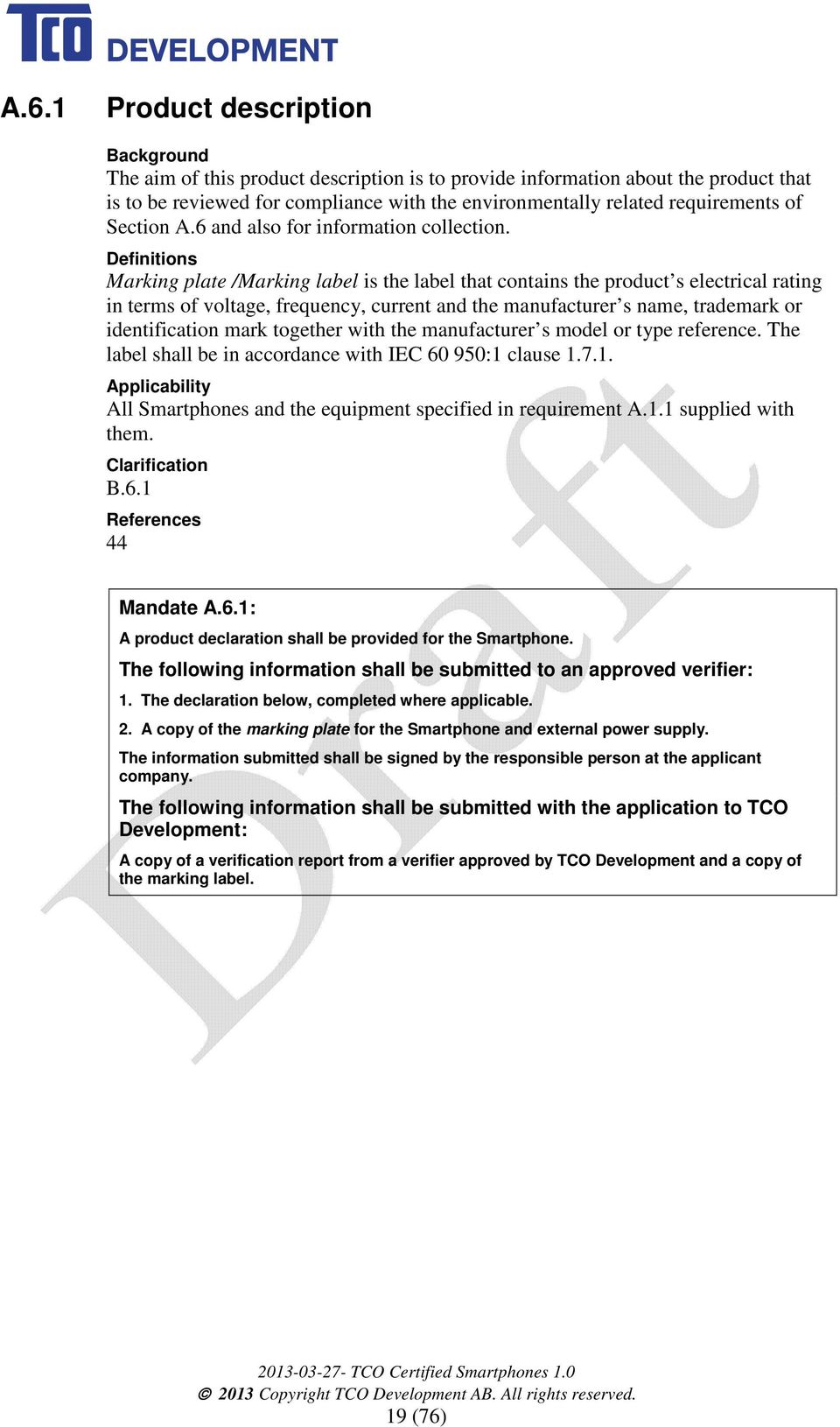
20 Declaration of a Smartphone. Smartphone Information Manufacturer Brand name Brand Owner Type/Model name Product Family name All possible options of the parts of the Smartphone stated below shall be declared in the table below. (Please increase the number of rows when necessary). Panel Brand name Model name Size and technology (e.g. TN type) External power supply: Brand & model name Information Rating and Class Battery: Brand & model name Technology (e.g. Li-ion), rating & characteristics TCO Certified Certificate Holder We hereby guarantee that the above mandate is fulfilled... Product brand name and model name Signature Name and title in block capitals Date Company 20 (76)
21 A.6.2 A Organisation Environmental management system certification Background A certified environmental management system is proof that the company shows concern for the environment and has chosen to work in a systematic way with constant improvement of the environmental performance of the company and its products in focus. A certified environmental management system includes external independent reviews. Definitions Manufacturing plant is the site where the final assembly of the product is taking place. Applicability Company or companies manufacturing the Smartphone. Clarification B References 45 and (76)
22 Mandate A.6.2.1: Each manufacturing plant must be certified in accordance with ISO 14001, or EMAS registered. If the product is manufactured by a third party, it is this company that shall be certified or registered. If the manufacturing plant does not have an ISO certificate or EMAS registration at the time of application, the manufacturing plant is given a 12-month grace period to obtain ISO14001 certification or EMAS registration. The following information shall be submitted to an approved verifier: 1. A document showing the names and addresses of the manufacturing plants. 2. Copy of the ISO certificate or EMAS registration or, when not available, an estimated date of certification/registration. 3. A written guarantee that the certificate/registration is valid and that the mandate above is fulfilled, signed by the responsible person at the applicant company. The following information shall be submitted with the application to TCO Development: A copy of a verification report from a verifier approved by TCO Development. We hereby guarantee that the above mandate is fulfilled... Product brand name and model name Signature Name and title in block capitals Date Company 22 (76)
23 A.6.3 A Climate Energy consumption Background Energy is the single most important topic in the issue of climate change. Energy efficient equipment is an important and effective way to fight climate change. With an ever-increasing volume of IT equipment in use, the efficiency of each product is vital. To reduce energy consumption from the Smartphone the external power supply (also referred to as power adapter) shall comply with the International Efficiency Marking Protocol for External Power Supplies. Applicability All external power supplies Clarification B References 52. Mandate A.6.3.1: The external power supply shall meet at least the International Efficiency Protocol requirement for level V The following information shall be submitted to the verifier at the test laboratory: A copy of the marking plate for the external power supply The following information shall be submitted with the application to TCO Development: A copy of the marking plate for the external power supply 23 (76)
24 A.6.4 A Environmentally hazardous substances Mercury (Hg) free product Background The effects of mercury (Hg) are well documented as an environmental hazardous substance. EU regulates mercury in the RoHS directive, however exempting the use of mercury in the backlighting of FPDs. Today the LED backlight technology for FPDs makes it possible to go beyond the RoHS Directive and ban the use of mercury altogether. Applicability All Smartphones. Clarification B References 54, 55. Mandate A.6.4.1: The Smartphone shall not contain mercury. For maximum concentration values: see B The following information shall be submitted to an approved verifier: A written guarantee that the above mandate is fulfilled. The guarantee shall be signed by the responsible person at the applicant company. The following information shall be submitted with the application to TCO Development: A copy of a verification report from a verifier approved by TCO Development. We hereby guarantee that the above mandate is fulfilled... Product brand name and model name Signature Name and title in block capitals Date Company 24 (76)
25 A Cadmium (Cd), lead (Pb) and hexavalent chromium (Cr6) Background The effects of the listed substances are well documented as environmental hazardous substances. EU regulated these substances in the RoHS directive (2002/95/EC). Applicability All Smartphones. Clarification B References 54 and 55. Mandate A.6.4.2: The Smartphone shall not contain cadmium, lead and hexavalent chromium. Note: This applies to components, parts, and raw materials in all assemblies and subassemblies of the product e.g. paint, surface treatment, plastics and electronic components. For maximum concentration values: See B The following information shall be submitted to an approved verifier: A written guarantee that the mandate above is fulfilled. The guarantee shall be signed by the responsible person at the applicant company. The following information shall be submitted with the application to TCO Development: A copy of a verification report from a verifier approved by TCO Development. We hereby guarantee that the above mandate is fulfilled... Product brand name and model name Signature Name and title in block capitals Date Company 25 (76)
26 A Halogenated substances Background Brominated and chlorinated flame retardants and other halogenated substances are often persistent, can bioaccumulate in living organisms and have been detected in flora and fauna. A series of international elimination activities in respect to brominated and chlorinated flame retardants is currently in progress within several national and international bodies, e.g. EU, OECD, North Sea Conference. Definitions Plastic parts are parts made mainly of plastics, e.g. the housing. Parts containing other materials in any significant amounts, e.g. cables with metal conductors, are not included in the definition. Printed wiring board laminate is a printed board that provides point-to-point connections but not printed components in a predetermined configuration on a common base. Applicability All Smartphones. Clarification B References (76)
27 Mandate A.6.4.3: 1. Plastic parts weighing more than 5 grams shall not contain flame retardants or plasticizers that contain organically bound bromine or chlorine. Note: The requirement applies to plastic parts in all assemblies and sub-assemblies. Exempted are printed wiring board laminates, electronic components and all kinds of cable insulation. 2. The Smartphone shall not contain PBB, PBDE and HBCDD. Note: The requirements apply to components, parts and raw materials in all assemblies and sub-assemblies of the product e.g. batteries, paint, surface treatment, plastics and electronic components. For maximum concentration values: See B The following information shall be submitted to an approved verifier: A written guarantee that the above mandate is fulfilled. The guarantee shall be signed by the responsible person at the applicant company. The following information shall be submitted with the application to TCO Development: A copy of a verification report from a verifier approved by TCO Development. We hereby guarantee that the above mandate is fulfilled... Product brand name and model name Signature Name and title in block capitals Date Company 27 (76)
28 A Non-halogenated substances Background The purpose of this mandate is to ensure that the phase out of halogenated flame retardants not risk a shift towards substances with other known hazardous effects. The mandate focuses on 14 hazardous statements. All substances relevant for the IT industry that have been assigned a hazardous statement and where there are less hazardous commercially available alternatives will be restricted from TCO Certified products. The list of these substances is evaluated and revised in each new version of the criteria document. To date in this version, only harmonized substances found on the European chemical Substance Information System (ESIS) at: have been restricted. In the future version of the criteria document TCO Development have the ambition to also restrict substances that are not at this time harmonized. An example of such not yet harmonized substances may be found in B Definitions Plastic parts are parts made mainly of plastics, e.g. the housing. Parts containing other materials in any significant amounts, e.g. cables with metal conductors, are not included in the definition. Printed wiring board laminate is a printed board that provides point-to-point connections but not printed components in a predetermined configuration on a common base. Hazardous statements (Risk phrases) according to EU Regulation 1272/2008 (EU Directive 67/548/EEC) H340 (R46) (may cause heritable genetic damage) H341 (R68) (suspected of causing genetic defects) H350 (R45) (may cause cancer) H350i (R49) (may cause cancer by inhalation) H351 (R40) (limited evidence of a carcinogenic effect) H360F (R60) (may impair fertility) H360D (R61) (may cause harm to the unborn child) H361d (R63) (suspected of damaging the unborn child) H361f (R62) (suspected of damaging fertility) H362 (R64) (may cause harm to breast-fed children) H372 (R48/25/24/23) (danger of serious damage by prolonged exposure) H373 (R48/20/21/22) (may cause damage to organs through prolonged exposure) H400 and H410 (R50/R53) (very toxic to aquatic organisms / may cause long-term adverse effects in the aquatic environment) H411 (R51/53) (Toxic to aquatic life with long-lasting effects) Applicability All Smartphones. Clarification B References: 56 and (76)
29 Mandate A.6.4.4: The following non halogenated flame retardants shall not be used in plastic parts weighing more than 5 grams: - Antimony(III) oxide (Sb2O3), CAS: Tri-o-cresyl phosphate, CAS: Exempted are printed wiring board laminates, electronic components and all kinds of cable insulation. For maximum concentration values: See B The following information shall be submitted to an approved verifier: A written guarantee that the above mandate is fulfilled. The guarantee shall be signed by the responsible person at the applicant company. The following information shall be submitted with the application to TCO Development: A copy of a verification report from a verifier approved by TCO Development. We hereby guarantee that the above mandate is fulfilled... Product brand name and model name Signature Name and title in block capitals Date Company 29 (76)
30 A Plastics with chlorine and bromine as part of the polymer Background PVC is by far the most common halogen containing plastic. There are however other plastics that contain chlorine or bromine in the plastic itself. As the requirement concerning permissible flame retardants tightens, the risk increases that halogenated plastics will become more common. TCO Development sees a future environmental risk with such a development. PVC is a much-debated plastic that can pose environmental problems in most parts of its life cycle. The magnitude of the environmental problems relating to PVC differs depending on the environmental status of a particular manufacturing facility and the uses of additives. At present there are very limited possibilities to distinguish between harmful and less harmful production facilities for PVC. Definitions Plastic parts are parts made mainly of plastics, e.g. the housing. Parts containing other materials in any significant amounts, e.g. cables with metal conductors, are not included in the definition. Printed wiring board laminate is a printed board that provides point-to-point connections but not printed components in a predetermined configuration on a common base. Applicability All Smartphones. Clarification B References 54 and (76)
31 Mandate A.6.4.5: Plastic parts in the Smartphone weighing more than 5 grams shall not contain chlorine or bromine as a part of the polymer. Note that printed wiring board laminates, and all kinds of internal and external cable insulation are not considered to be part of plastic parts and are therefore not included in the mandate. The following information shall be submitted to an approved verifier: A written guarantee that the above mandate is fulfilled. The guarantee shall be signed by the responsible person at the applicant company. The following information shall be submitted with the application to TCO Development: A copy of a verification report from a verifier approved by TCO Development. We hereby guarantee that the above mandate is fulfilled... Product brand name and model name Signature Name and title in block capitals Date Company 31 (76)
32 A Information regarding plastics and flame retarding agents Background This requirement is intended to give information about the plastics and flame retarding agents in the product to be reviewed for compliance with the environment requirements in this criteria document. Definitions Plastic parts are parts made mainly of plastics, e.g. the housing. Parts containing other materials in any significant amounts, e.g. cables with metal conductors, are not included in the definition. Printed wiring board laminate is a printed board that provides point-to-point connections but not printed components in a predetermined configuration on a common base. Applicability All Smartphones. References 55 and (76)
33 Mandate A.6.4.6: The material specifications shall be provided for plastic parts and printed wiring board laminates weighing more than 5 grams. Plasticizers or flame retardants that have concentrations above 1% by weight in the plastic part shall be stated, in accordance with ISO or ISO The following information shall be submitted to an approved verifier: The table below shall be completed and the guarantee signed by the responsible person at the applicant company. Manufacturers of plastic materials who consider such information confidential may submit the information to a verifier approved by TCO Development. The following information shall be submitted with the application to TCO Development: A copy of a verification report from a verifier approved by TCO Development. Plastic part and PWB name Weight in grams Type of plastic Plastic manufacturer name Plastic model name Flame retardant/ plasticizer type Flame retardant/plast icizer CAS number*) Plastic label code **) *) Chemical Abstract Service number **) Labelling according to ISO We hereby guarantee that the above mandate is fulfilled... Product brand name and model name Signature Name and title in block capitals Date Company 33 (76)
34 A Phthalates Background Phthalates are esters of phthalic acid and are mainly used as plasticizers (substances added to plastics to increase their flexibility, transparency, durability, and longevity). They are used primarily to soften polyvinyl chloride (PVC). Phthalates are being phased out of many products in the United States, Canada, and European Union over health concerns. Phthalates are easily released into the environment because there is no covalent bond between the phthalates and plastics in which they are mixed. As plastics age and break down, the release of phthalates accelerates. Diet is believed to be the main source of (DEHP) and other phthalates in the general population. Fatty foods such as milk, butter, and meats are a major source. Applicability All Smartphones. References 7 and 11 Mandate A.6.4.7: The Smartphone shall not contain diethylhexyl phthalate (DEHP, CAS no ), butyl benzyl phthalate (BBP, CAS no ) dibutyl phthalate (DBP, CAS no ). Also diisononyl phthalate (DINP, CAS no ), diisodecyl phthalate (DIDP, CAS no ) and di-n-octyl phthalate (DNOP, CAS no )? For maximum concentration values: see B The following information shall be submitted to an approved verifier: A written guarantee that the above mandate is fulfilled. The guarantee shall be signed by the responsible person at the applicant company. The following information shall be submitted with the application to TCO Development: A copy of a verification report from a verifier approved by TCO Development. We hereby guarantee that the above mandate is fulfilled... Product brand name and model name Signature Name and title in block capitals Date Company 34 (76)
35 A Beryllium and compounds Background In critical electronic applications, beryllium is both an electrical insulator, structural support and heat sink. The commercial use of beryllium metal presents technical challenges due to the toxicity (especially by inhalation) of beryllium-containing dusts. Beryllium is corrosive to tissue, and can cause a chronic life-threatening allergic disease called berylliosis in some people. The International Agency for Research on Cancer (IARC) lists beryllium and beryllium compounds as Category 1 carcinogens. Applicability All Smartphones. References 5 and 6 Mandate A.6.4.8: The product shall not contain beryllium and beryllium compounds. For maximum concentration values: see B The following information shall be submitted to an approved verifier: A written guarantee that the above mandate is fulfilled. The guarantee shall be signed by the responsible person at the applicant company. The following information shall be submitted with the application to TCO Development: A copy of a verification report from a verifier approved by TCO Development. We hereby guarantee that the above mandate is fulfilled... Product brand name and model name Signature Name and title in block capitals Date Company 35 (76)
36 A Batteries Background The widespread use of batteries has created many environmental concerns, such as toxic metal pollution as they may have very high amounts of lead, cadmium and mercury. Used batteries also contribute to electronic waste. In the United States, the Mercury-Containing and Rechargeable Battery Management Act of 1996 banned the sale of mercury-containing batteries, enacted uniform labeling requirements for rechargeable batteries, and required that rechargeable batteries be easily removable. The Battery Directive of the European Union has similar requirements, in addition to requiring increased recycling of batteries. Batteries shall be easy to exchange by the end user when they lose performance to increase product lifetime. Applicability All Smartphones. References 54 Mandate A.6.4.9: 1. Batteries shall be free from lead, cadmium and mercury For maximum concentration values: see B Batteries shall be rechargeable and easily replacable by the end user when necessary. The following information shall be submitted to an approved verifier: A written guarantee that the above mandate is fulfilled. The guarantee shall be signed by the responsible person at the applicant company. The following information shall be submitted with the application to TCO Development: A copy of a verification report from a verifier approved by TCO Development. We hereby guarantee that the above mandate is fulfilled... Product brand name and model name Signature Name and title in block capitals Date Company 36 (76)
37 A.6.5 A Product lifetime Warranty and spare parts Background A longer product lifetime has a significant positive contribution to resource use as well as the reduction of air and water pollution. A pre-condition for prolonged lifetime is that the product is of high quality, which is supported by good guarantees. Another requirement is the availability of spare parts for the product once it is taken out of production. Definitions Brand owner is the company that owns the brand name visible on the product. Spare parts are those parts which have the potential to fail during the normal use of the product. Product parts whose life cycle usually exceeds the average usual life of the product need not be provisioned as spare parts. Applicability All Smartphones. Clarification B Mandate A.6.5.1: The brand owner shall provide a product warranty for a period of at least one year. The brand owner shall guarantee the availability of spare parts for at least three years from the time that production ceases. The following information shall be submitted to an approved verifier: A written guarantee that the above mandate is fulfilled. The guarantee shall be signed by the responsible person at the brand owner company. The following information shall be submitted with the application to TCO Development: A copy of a verification report from a verifier approved by TCO Development. We hereby guarantee that the above mandate is fulfilled. Product brand name Model name(s) or All products Signature Name and title in block capitals Date (Declaration valid 1 year from date) Brand Owner Company 37 (76)
38 A.6.6 A Preparation for Recycling Material coding of plastics Background Recycling of used electronic products is an important environmental issue. Material recycling and reuse are the best options from an environmental point of view. With material coding there is a better possibility for plastics to be recycled and used in new IT equipment. Definitions Plastic parts are parts made mainly of plastics, e.g. the housing. Parts containing other materials in any significant amounts, e.g. cables with metal conductors, are not included in the definition. Printed wiring board laminate is a printed board that provides point-to-point connections but not printed components in a predetermined configuration on a common base. Applicability All Smartphones. Clarification B References 56, 59 and (76)
39 Mandate A.6.6.1: Plastic parts weighing more than 5 grams shall be material coded in accordance with ISO and ISO , -2, -3, -4. Such parts shall be listed in the table at Section A Exempted are printed wiring board laminates. The following information shall be submitted to an approved verifier: A written guarantee that the above mandate is fulfilled. The guarantee shall be signed by the responsible person at the applicant company. The following information shall be submitted with the application to TCO Development: A copy of a verification report from a verifier approved by TCO Development. We hereby guarantee that the above mandate is fulfilled... Product brand name and model name Signature Name and title in block capitals Date Company 39 (76)
40 A Take back system Background The amount of electronic waste in the world today is enormous and a growing environmental problem. It is important that manufacturers provide mechanisms to take back their equipment at end-of-life under the principle of individual producer responsibility wherein each producer must be financially responsible for managing its own brand products at end-of-life. Currently much electronic waste is being exported to developing countries where it is managed unsustainably and disproportionately burdens developing countries with this global environmental burden. The Basel Convention and its decisions govern the export of many types of electronic waste. However not all countries have properly implemented these decisions. With this mandate TCO Development aims to put more influence into spreading better electronic waste management practice to more countries. Definition Brand owner is the company that owns the brand name visible on the product. Take back system is a system that makes sure that the customer can return used products to be recycled. The system can be with or without a fee. Environmentally acceptable recycling methods are: Product and component reuse Material recycling with secured handling of hazardous chemicals and heavy metals Pollution-controlled energy recovery of parts of the product Applicability All Smartphones. Clarification B References (76)
41 Mandate A The brand owner (or its representative, associated company or affiliate) shall offer their customers the option to return used products for environmentally acceptable recycling methods in at least one market where the product is sold and where electronics take back regulation is not in practice at the date of application. The following information shall be submitted to an approved verifier: The information stated in the list below shall be submitted and the guarantee signed by the responsible person at the brand owner company. The following information shall be submitted with the application to TCO Development: A copy of a verification report from a verifier approved by TCO Development. The requirement can be fulfilled by one of the following options (to be verified): 1. Product only sold on markets with WEEE legislation or similar 2. World-wide product take back* 3. Take back is offered on one additional market where the product is sold and lacks WEEE legislation* Name of market. *The brand owner shall also submit a short description, to an approved eco-verifier, of the take back system or reference to the representative, associated company or affiliate taking care of the take-back system We hereby guarantee that the above mandate is fulfilled. Product brand name Model name(s) or All products Signature Name and title in block capitals Date (Declaration valid 1 year from date) Brand Owner Company 41 (76)
42 A.6.7 A Product packaging Hazardous substances in product packaging Background Packaging constitutes a well-known environmental problem and is regulated in many countries worldwide. Packaging material has a short lifetime and generates large volumes of waste. There are three main areas of concern, content of hazardous substances, use of resources and transport volume. Applicability All packaging material. Definition Brand owner is the company that owns the brand name visible on the product. Clarification B References 62. Mandate A.6.7.1: The packaging material shall not contain lead (Pb), cadmium (Cd), mercury (Hg) or hexavalent chromium (Cr6). Plastic packaging material shall not contain organically bound halogens. The following information shall be submitted to an approved verifier: A written guarantee that the mandate above is fulfilled. The guarantee shall be signed by the responsible person at the brand owner company. The following information shall be submitted with the application to TCO Development: A copy of a verification report from a verifier approved by TCO Development. We hereby guarantee that the above mandate is fulfilled. Product brand name Model name(s) or All products Signature Name and title in block capitals Date (Declaration valid 1 year from date) Brand Owner Company 42 (76)
43 A Preparation for recycling of product packaging material Background Packaging constitutes a well-known environmental problem and is regulated in many countries worldwide. Packaging material has a short lifetime and generates large volumes of waste. There are three main areas of concern, content of hazardous substances, use of resources and transport volume. Applicability All packaging material. Definition Brand owner is the company that owns the brand name visible on the product. Mandate A.6.7.2: Non-reusable packaging components weighing more than 5 grams shall be possible to separate into single material types without the use of tools. Exempted is reusable packaging. The following information shall be submitted to an approved verifier: A written guarantee that the mandate above is fulfilled. The guarantee shall be signed by the responsible person at the brand owner company. The following information shall be submitted with the application to TCO Development: A copy of a verification report from a verifier approved by TCO Development. We hereby guarantee that the above mandate is fulfilled. Product brand name Model name(s) or All products Signature Name and title in block capitals Date (Declaration valid 1 year from date) Brand Owner Company 43 (76)
44 A.7 Corporate Social Responsibility A.7.1 Corporate Social Responsibility Background Expectations for Corporate Social Responsibility (CSR) performance are increasing from customers and institutions. As part of the development towards being a true sustainability label, TCO Development is now introducing an extended mandate regarding supply chain responsibility. TCO Development is supporting the OECD Guidelines for Multinational Enterprises ISO as references for working with social responsibility. The CSR component of the TCO standard focuses on working conditions in the production of the TCO certified products. TCO Development is primarily verifying the Brand owner s procedures for promoting legal and human labour standards in the supply chain as specified in the mandate but reserves the right to conduct supplier audits at production facilities. Also, the Brand owner should demonstrate commitment to corporate social responsibility. Definitions Brand owner: The company or organization owning or controlling the Brand Name. Brand Name: The name or sign, including but not limited to a trademark or company name, used to identify, amongst users and customers, the manufacturer or seller of a Product. 1 st tier production facility: Manufacturing plant where the final assembly of the TCO certified product is taking place. Applicability The Brand owner. Clarification B B References 48, 49 and (76)
45 Mandate A.7.1: The Brand owner shall demonstrate the TCO Certified product is manufactured under working practices that promote good labour relations and working conditions by proving accordance with the following: - ILO:s eight core conventions 29, 87, 98, 100, 105, 111, 138 and UN Convention on the Rights of the Child, Article the health and safety legislation in force in the country of manufacture, and - the labour law, including rules on minimum wage and the social security protection in the manufacturing country. In situations where the right to freedom of association and collective bargaining are restricted under law, workers shall be permitted to freely elect their own representatives. Reasonable effort shall be made to ensure that the requirements of this standard are being met by suppliers and subcontractors throughout the supply chain. The brand owner accepts that TCO Development may conduct/commission on-site inspections and receive full audit reports as part of the application to verify that the Brand owner is fulfilling its obligations according to this Mandate. For the social audit reports and on-site-inspections, the requirement is limited to the 1st tier production facility. The following information shall be submitted to an approved verifier: 1. The requirement is fulfilled by one of the following options (a-d): a) The Brand owner is a member of EICC and provides documented proof of third party audits conducted at production facilities of TCO certified products. b) The Brand owner is SA8000 certified or carrying out the production at SA8000 certified facilities and provides documented proof of third party audits conducted at production facilities of TCO certified products. c) The Brand owner shall complete the Self-documentation according to a questionnaire provided by TCO Development and provide documented proof of third party audits conducted at production facilities of TCO certified products. 2. A written guarantee that the above mandate is fulfilled. The guarantee shall be signed by the responsible person at the Brand owner company. The following information shall be submitted with the application to TCO Development: A copy of a verification report from an approved verifier Option (to be verified): a. Member of EICC b. SA8000 certified c. Self-documentation/TCO Development questionnaire We hereby guarantee that the above mandate is fulfilled. Product brand name Model name(s) or All products Signature Name and title in block capitals Date (Declaration valid 1 year from date) Brand Owner Company 45 (76)
46 A.7.2 Senior Management Representative Background It is extremely beneficial that an open and transparent dialogue between the brand owner and TCO Development exist for the monitoring of the standards or when it is otherwise necessary to discuss issues concerning working conditions at manufacturing sites. A contact person responsible for the organization's efforts to enforce the CSR requirements needs to be consistently available for dialogue with TCO Development. Definitions Brand owner: The company or organization owning or controlling the Brand Name. Brand Name: The name or sign, including but not limited to a trademark or company name, used to identify, amongst users and customers, the manufacturer or seller of a Product. Applicability The Brand owner. Clarification B.7.2 Mandate A.7.2: The Brand owner shall have an appointed senior management representative who, irrespective of other responsibilities, shall ensure that the requirements of this mandate are met. The contact details of this person shall be submitted and the person shall be available for dialogue in English with TCO Development throughout the certification period. The following information shall be submitted to a verifier approved by TCO Development: 1. Name, Title, Telephone Number and Address of the senior management representative available for dialogue in English with TCO Development around CSR issues. 2. A written guarantee that the above mandate is fulfilled. The guarantee shall be signed by the responsible person at the Brand owner company The following information shall be submitted with the application to TCO Development: A copy of a verification report from a verifier approved by TCO Development. We hereby guarantee that the above mandate is fulfilled. Product brand name Model name(s) or All products Signature Name and title in block capitals Date (Declaration valid 1 year from date) Brand Owner Company 46 (76)
47 R References International standard organisations referred to in the reference list below and their Web sites. ASTM, American Society for Testing and Materials, CIE, Commission Internationale de l'eclairage, International Commission on Illumination, DIN, Deutsches Institut für Normung e. V., www2.din.de EBU, European Broadcasting Union, IEC, International Electrotechnical Commission, ISO, International Organization for Standardization, ITU, International Telcommunication Union SMTPE, Society of Motion Picture Television Engineers, VESA, Video Electronics Standards Association, 1. CIE Publication 69 (1987), Methods of characterizing illuminance meters and luminance meters: performance characteristics and specifications. 2. Flat Panel Display Measurements Standard, (M), Version 2.0, VESA - Video Electronics Standards Association Display Metrology Committee. June 1, 2001, CA 95035, Milpitas SMPTE RP : SMPTE C Colour Monitor Colourimetry 5. "IARC Monograph, Volume 58". International Agency for Research on Cancer Retrieved 18 September International Programme On Chemical Safety (1990). "Beryllium: ENVIRONMENTAL HEALTH CRITERIA 106". World Health Organization. Retrieved 10 April GovTrack.us. "H.R th Congress (2007): Consumer Product Safety Improvement Act of 2008, GovTrack.us (database of federal legislation). Retrieved 14 August CIE Publication 15.2 (1986), Colourimetry, p. 11, p and p , table 1.3). 9. IEC ( ) Multimedia systems and equipment - Colour measurement and management - Part 2-1: Colour management - Default RGB colour space srgb. 10. E.B.U. Standard for chromaticity tolerances for studio monitors Tech E August ECHA Website - Proposal for identification of Substances of Very High Concern Hunt, R.W.G. Measuring colour. 3rd edition (1998), Kingsley-Upon-Thames: Fountain Press. 47 (76)
48 16. ISO TC130 WD p. 5 Section 4.7 Chromaticity and luminance of the white and black points and tracking. 17. ISO 3664:2009, Viewing conditions for graphic technology and photography, p. 9 Uniformity of screen luminance ISO 3664:2009. Viewing conditions for graphic technology and photography, p. 10 Monitor luminance. 20. ISO :1998/Cor 1:2000) 21. Barten, P.G.J., (1999) Contrast sensitivity of the human eye and its effects on image quality, SPIE Optical Engineering Press Barten, P.G.J., (1999) Contrast sensitivity of the human eye and its effects on image quality, SPIE Optical Engineering Press p Barten, P.G.J., (1999) Contrast sensitivity of the human eye and its effects on image quality, SPIE Optical Engineering Press p Kokoschka S. (1986). Visibility aspects of VDUs in terms of contrast and luminance. Behaviour and information technology. vol.5, No. 4, pp Schenkman, B., and Kjelldahl, L. (1999). Preferred colour temperature on a colour screen. Displays, 20, Roberts, A., Eng, B., (1995) "A method for the calculation of tolerances for display primary chromaticity coordinates" Research and development Department, Technical Resources, The British Broadcasting Corporation Wyszecki, G., Stiles, W.S., (1982) Colour Science: Concepts and methods, quantitative data and formula, Second Edition, John Wiley & Sons, Inc. Chapter 7, Visual thresholds, pp Wyszecki, G., Stiles, W.S., (1982) Colour Science: Concepts and methods, quantitative data and formula, Second Edition, John Wiley & Sons, Inc. Chapter 7, Visual thresholds, pp Le Grand, Y. (1957). Light, colour and vision. Chapman and Hall, pp Le Grand, Y. (1957). Light, colour and vision. Chapman and Hall. 33. Le Grand, Y. (1957). Light, colour and vision. Chapman and Hall, p Le Grand, Y. (1957). Light, colour and vision. Chapman and Hall, Chapter 11, Luminance difference thresholds, p Le Grand, Y. (1957). Light, colour and vision. Chapman and Hall, Chapter 11, Luminance difference thresholds. 36. Le Grand, Y. (1957). Light, colour and vision. Chapman and Hall, Chapter 12, Colour difference thresholds p Fairchild M. D. (1995), "Considering the surround in device-independent colour imaging" (76)
49 38. ISO 7779:2010, Acoustics Measurements of airborne noise emitted by computer and business equipment. This international standard is based on ECMA ISO 3741:2010, Acoustics Determination of sound power levels of noise sources using sound pressure Precision methods for reverberation rooms. 40. ISO 3744:2010, Acoustics Determination of sound power levels of noise sources using sound pressure - Engineering method in an essentially free-field condition over a reflecting plane. 41. ISO 3745:2003, Acoustics Determination of sound power levels of noise sources Precision methods for anechoic and semi anechoic rooms. 42. ISO 11201:2010, Acoustics Noise emitted by machinery and equipment Measurement of emission sound pressure levels at a work station and other specified positions Engineering method in an essentially free field over a reflecting plane. 43. ISO 9296:1998, Acoustics Declared noise emission values of computer and business equipment. 44. Standard ECMA-74 8 th edition, Measurement of Airborne Noise Emitted by Information Technology and Telecommunications Equipment. 45. EN (IEC ). Safety of information technology equipment including business equipment. 46. EMAS EU regulation no 761/2001 concerning the voluntary participation of industrial companies in the Union s environmental control and review structure. 47. ISO Environmental management systems - Specification with guidance for use TCO Certified Own Work questionnaire and assessment guidlines 50. Electronic Industry Citizenship Coalition (EICC), SA8000, and ( 53. International Efficiency Marking Protocol for External Power Supplies. 54. EU Directive 2006/66/EC on batteries and accumulators containing certain dangerous substances 55. EU Directive 2002/95/EC on the restriction of the use of certain hazardous substances in electrical and electronic equipment 56. Regulation concerning Registration, Evaluation, Authorisation and Restriction of Chemicals (REACH), EC 1907/ EU Directive 67/548/EEC on the approximation of laws, regulations and administrative provisions relating to the classification, packaging and labelling of dangerous substances 58. EU Directive EC 1272/2008 on classification, labelling and packaging of substances and mixtures 59. The EU Green Paper Environmental questions concerning PVC KOM (2000) ISO 11469:2000 Plastics - Generic identification and marking of plastics products 61. ISO , -2, -3, -4 Plastics - Symbols and abbreviated terms 62. EU Directive 2002/96/EC on waste electrical and electronic equipment (WEEE) 63. Directive 94/62/EC on packaging and packaging waste. 49 (76)
50 B Test Methods and clarifications The following definitions, test conditions, requested specifications from clients, and other information apply to the test methods described in this document. Test results are valid only for the presentation form(s) and configuration(s) tested. B.0 General test conditions B.0.1 B.0.2 B.0.3 Definition of a test object Test objects covered by this document are Smartphones with visual displays with fixed positions of the pixels. A test object with all necessary information for its operation shall be delivered to the test laboratory in test ready condition including any required accessories. All necessary information about how to operate and adjust the test object shall be provided. The performance of the test object shall in all aspects be fully in accordance with the performance of the final product. Required test object information The client shall specify the name(s), type designation(s) and manufacturer for all different exchangeable parts of the test object. The client shall specify the operating system and version used. The client shall specify the display resolution of the Smartphone display. The client shall specify the display panel type, e.g. LCD, OLED The client shall specify the default viewing direction if any (portrait or landscape). If no direction is specified the default viewing/testing direction shall be portrait mode. The client shall specify the colour depth of the display. Conditions for the equipment under test The Smartphone being tested shall be physically prepared for testing and shall be warmed up (switched on and plugged into the mains supply) for at least 15 min to stabilise the Smartphone at room temperature. The Smartphone screen surface shall be clean when tested. The Smartphone shall be tested in battery mode unless otherwise specified in the test procedure and may be recharged in between the tests if necessary. The Smartphone shall be tested without load on any peripheral interface such as USB, memory card slot, headphones or similar unless otherwise specified in the test procedure. 50 (76)
51 B.0.4 Smartphone alignment for testing The Smartphone display front shall be aligned vertically through the centre-point of the display front. B.0.5 Instruments used for testing All instruments used for testing of a Smartphone shall be of good quality and validated by a recent test certificate from a certified testing laboratory. Any necessary instrument calibration shall be done before the tests are performed. Calibrations shall be traceable to national standards. B.0.6 Settings of the Smartphone If present, the standard controls of the Smartphone shall be used to configure and adjust the display, e.g. brightness, contrast. If possible the Smartphone resolution shall be set to the native resolution and be used for all test parameters. The measurement shall be taken with the Smartphone in default CCT. If no default CCT is given or available the colour temperature presented by the recall function (or equivalent function) in the OSD (On Screen Display). If no OSD exists the default CCT on start-up shall be used All measurements shall be taken with no adjustments made between the measurements, if not otherwise specified in the test procedure. An external control unit that is not a standard part of the Smartphone is not allowed. The colour depth (6 or 8 bits per colour channel) of the testing program shall be at least as high as for the sample tested. The operating system most likely to be used by an end user should be used for testing. All settings in the operating system shall be the default ones as delivered to the end user or the default as it appears directly after the installation of the operating system unless otherwise specified in the criteria. (The easiest way to achieve this is to reset the phone prior to testing) Any picture enhancement or energy saving sensors reacting on ambient light shall be switched off during testing. 51 (76)
52 B.0.7 B.0.8 Test image/test character All test images can be found on the home page of TCO Development, A possibility is to use a testing program that shall consist of software commonly used for Smartphones. The program shall be able to produce the text or graphics or pictures required for the test procedures. All parts of the tests for a test object shall be conducted using the same font, character size, correlated colour temperature, resolution, operating system and other settings of the Smartphone controls etc., unless otherwise stated in the test procedure. Test Image and Test Luminance setting The test image in Figure B.0.8.1, referred to as the TCO Certified Smartphone default test image, has an 80 % image loading. The test image shall fill the whole usable screen that represents the full screen mode for photo viewing or movies. If a toolbar always consumes a part of the screen during full screen photo viewing and movies then the toolbar may also consume a part of the screen during test. This image shall be used for testing unless otherwise specified in the test procedure. Figure B The TCO Certified Smartphone default test image with an 18-step greyscale. Procedure: The white area in the centre shall be 25% of the longer side of the screen and 30% of the shorter side. The background colour shall be set to RGB 185, 185, 185 (i.e. equal to 80 % image loading). An 18 step greyscale may be present to visually evaluate the setting of the display. (The greyscale will almost not affect the image loading as it contains both bright and dark areas). 52 (76)
53 B.0.9 Test Luminance setting: The test luminance of the Smartphone shall be the highest luminance setting. This setting must be 125 cd/m 2 with at least 15 of the 18-step greyscale visible. If this is fulfilled the Smartphone may be tested in this mode. This setting shall be written in the test report. If the display does not reach 125 cd/m 2 or does not achieve 15 of the 18-step greyscales, other settings may be used. The chosen setting must be written in the test report. If no setting fulfils the requirement of 125 cd/m2 and 15 of the 18-step greyscales visible the testing is stopped and the engineer shall request a replacement sample. Test report The test results are valid only for the presentation form(s) and configuration(s) tested. If other configurations are accepted by the laboratory based on the results of the tested ones it shall be clearly specified in the test report that these configurations have not been tested. The test report shall include the following information: Any changes to the test methods. The manufacturer, brand name, model type and serial number (if available). The panel brand, full panel number. The mode(s) (i.e. horizontal and vertical scan frequency and resolution) used during the test and the aspect ratio. The external power supply brand, model number and class shall be stated. The degree of uncertainty for each given measurement result. The default or chosen display setting If present, the setting of contrast, brightness and CCT pre-set used during the test. Photographs of the product showing: Front, rear, open panel, a legible panel marking plate and the external power supply with legible marking plate. 53 (76)
54 B.1 General information B.1.1 TCO Certified Document The TCO Certified Document shall accompany the product as provided by TCO Development. No editorial changes without TCO Development s consent are accepted. The Document is available at If the TCO Certified Document is part of a User s Manual or is provided as an electronic file then it must be separated from other text portions so it is obvious that the Document text is not accountable for the content of the other texts. The brand name owner may post the TCO Certified Document on its web site, e.g. by showing TCO Certified logos or icons that redirect the visitor by links to the TCO Certified Document If the product that is to be TCO Certified labelled is branded differently from the applicant name, the applicant company signing the guarantee shall be sure that the brand name holder agrees with the requirement. 54 (76)
55 B.2 Visual ergonomics B.2.0 General test conditions for visual ergonomics B Basic test requirements As described in section B.0. For all tests, the Smartphone screen shall be clean. B Photometric laboratory general requirements Photometric measurements shall be performed under darkroom conditions. This means that measurement data shall in no way be affected by direct light from sources or light reflected from interiors, equipment, clothes etc. The laboratory shall have a routine for the control of the stray-light level at the Smartphone screen (see also B.2.0.6). B Power supply and test room climate requirements for testing AC mains voltage* 230 VAC RMS, tolerance 1 % AC mains frequency* 50 Hz, tolerance 2 % Test room temperature 23±3 ºC Humidity % RH (non condensing) * or other voltage and frequency combination specified by the client. B Photometric and spectrometric measurements Several instruments are to be used when carrying out measurements for visual ergonomics. All instruments shall be recently calibrated and carry a calibration certificate from a certified testing laboratory. The following instrument types are to be used for testing: 55 (76)
56 Luminance meter. A luminance meter shall have a sufficiently good V(λ)- sensitivity (Requirements for luminance meters are covered by CIE Publication 69 (1987). Luminance meters of CIE Class L(aboratory) with a combined performance characteristic 3 % shall be used.) and integrate luminance over a finite measuring field during a finite time. The meter shall be equipped with adjustable optics and always be focused on the measured area. The luminance meter must incorporate a sufficiently long time constant of integration in order to ensure averaging of the pulsation of the light emitted by Smartphones. The sensitivity shall be independent of the polarization of the measured light (often referred to as f 8 error). The luminance meter measuring field shall be one degree for all measurements, except for the micro-photometric luminance measurements, see below. An automated instrument using collimating optics may be used for testing although the measurement area might differ somewhat from the area covered by the luminance meter. The laboratory shall verify that the measurement area by the instrument has the correct size regardless of the instrument used. Spectro-radiometer. An instrument for the measurement of radiant flux as a function of wavelength shall be used. A spectro-radiometer for the measurement of light and colour is normally equipped with a microprocessor that makes it possible to obtain luminance and colour co-ordinates directly from raw measurement data. A spectro-radiometer can replace the luminance meter when suitable. The wavelength resolution shall be 4nm for attaining accurate colour measurements. The sensitivity shall be independent of the polarization of the measured light (often referred to as f 8 error). 56 (76)
57 B Measurement distance If possible all measurements shall be carried out through a point, simulating the eye position of the operator. This means 400mm. Eyes are corrected for reading at a close range of 400 mm which could be considered as an absolute minimum viewing distance for comfortable viewing. However, even if the comfortable viewing distance should not be shorter than 400mm, a measuring distance at a shorter distance for Smartphones in order to measure small objects or using a collimated automatic measurement system is acceptable as long as the measurement is made perpendicular to the screen surface and the measurement area is correct. The instrument shall be focused on the presented test image for all measurements. Independent of the luminance meter and spectroradiometer used and also the measuring distance, the diameter of the measuring area on the screen shall be 1/10 of the screen diagonal. The instrument shall be focused on the presented test image for all measurements. B Stray light Stray light may cause errors which can negatively affect measurement of luminance, contrast and chromaticity coordinates. It is therefore necessary to make an evaluation of stray light influence for the different measurement procedures described in this document. If it is verified that stray light affect the measurement result it is necessary to take actions to eliminate the source of error. Two possible ways to solve the problem are to equip the luminance meter with a well-designed screening attachment, a frustum or to use a black screening sheet at the Smartphone screen surface. B Overall uncertainty The overall uncertainty of the test laboratory shall be calculated for each measurement procedure in this document and presented in the test report. The uncertainty shall be within the required levels for each criterion. All measurement uncertainties claimed for used instruments shall be referred to traceable calibration reports. About combining overall uncertainty values during test measurements: Criteria are fulfilled without adding or subtracting the overall measurement uncertainty. Report the value shown on the instrument without adding or subtracting the overall measurement uncertainty. The overall measurement uncertainty of the laboratory is printed in the test report together with the reported value. For a Laboratory that has an overall measurement uncertainty higher than the one allowed by TCO Development for a certain criteria, then the test report for that criteria is not valid for TCO certification and the test results will not be accepted by TCO Development. 57 (76)
58 B.2.2 Luminance characteristics B B Luminance level Preparation of the Smartphone for testing All necessary preparations described in B.0 and B.2.0 shall be done. The TCO Certified Smartphone default test image with an 18-step greyscale as shown in Figure B shall be used for luminance level measurement. Figure B Simulation of the measurement area (yellow) on the TCO Certified Smartphone default test image with the 18-step greyscale inserted Independent of the used luminance meter, spectroradiometer and also the measuring distance, the diameter of the measuring area on the screen shall be 1/10 of the screen diagonal. The instrument shall be focused on the presented test image for all measurements. The test image shall be as Figure B The yellow circular area in the centre represents the measuring area of the luminance meter or spectroradiometer. The following evaluation shall be carried out orthogonally to the screen surface To achieve the maximum luminance proceed as follows: Adjust the controls for the display to achieve as high luminance as possible with an acceptable image quality. The image quality is considered acceptable when at least 15 of the 18 greyscale steps are visible. At this maximum luminance, test that the display has a luminance 200 cd/m (76)
59 To achieve the minimum luminance proceed as follows: Adjust the controls for the display to achieve as low luminance as possible with an acceptable image quality. The image quality is considered acceptable if at least 15 of the 18 grey scale steps are visible. At this minimum luminance check that the display has a luminance 100 cd/m 2. If it difficult to visually determine if 15 of the 18 grey scale steps are visible, then the display shall comply with the gamma curve criteria (A.2.2.3) in the max and min luminance setting. When this test is completed the display shall be adjusted back to the test luminance setting as describe under B.0.8. Allow the display to stabilize before other test measurements are made. B B B Equipment Luminance meter. Test method The luminance at the centre of the white test area shall be measured with the luminance meter directed orthogonally to the test area as described in B Test evaluation The measured luminance is the required value. The luminance shall be reported with no decimal places. The measured Luminance, and display setting shall be noted in the test report. The CCT in default setting shall also be noted. B Overall uncertainty ± 10 % in luminance. See B (76)
60 B B B B Luminance uniformity Preparation of the Smartphone for testing All necessary preparations described in B.0 and B.2.0 shall be done. The entire active area of the screen shall be white and the Smartphone colour setting shall be RGB 255, 255, 255. Equipment: Luminance meter. Test method: The luminance shall be measured orthogonally to the Smartphone screen plane at the 9 points indicated in Figure B The luminance uniformity shall also be evaluated visually by the technician in order to find any dark or bright areas except from the 9 default positions. If a significantly bright or dark area is found these measuring points shall also be measured and used to evaluate the luminance uniformity. The conditions for luminance measurement in the corner positions and the distribution of other measurement points are illustrated in figure B H/6 W/ Figure B Measurement positions for the measurement of luminance and colour uniformity. B B Test evaluation The luminance uniformity shall be reported as the ratio between the highest and the lowest measured luminance values. The result shall be presented to 2 decimal places. Overall uncertainty ± 10 % in luminance. ± 0.1 unit in luminance uniformity. See B (76)
61 B B B B B Greyscale gamma curve Preparation of the Smartphone for testing All necessary preparations described in B.0 and B.2.0 shall be done. A TCO Certified Smartphone default test image, as shown in Figure B.0.8.1, shall be used for this measurement. The centre square area according to B shall have each of the following RGB settings: R=G=B= 255, 225, 195, 165, 135, 105, 75 and 45 for each measurement. Equipment Luminance meter or Spectroradiometer. Test method The instrument shall be directed orthogonally towards the different test square centres at the measurement distance described in B Measurement distance and area for each greyscale step specified above. Change the greyscale of the square for each measurement. Test evaluation The evaluation task is to convert each measured luminance into relative luminance where 100% corresponds to the white luminance in the centre of the displays and make a table corresponding to the example table below. Each row in the table must show how the luminance is decreasing with darker grey levels. L Measured shall be the percentage of the measured luminance for the grey level at that row in relation to the luminance measured at 255 (white). Table 1 Example of grey level table Grey level L Measured % B Overall uncertainty ± 10% in luminance. See B (76)
62 B.2.5 B B B B B B Screen colour characteristics Correlated colour temperature (CCT) variation Preparation of the Smartphone for testing All necessary preparations described in B.0 and B.2.0 shall be done. A TCO Certified Smartphone default test image, as shown in Figure B.0.8.1, shall be used for this measurement. Equipment Spectro-radiometer capable of presenting CIE u' and v' chromaticity co-ordinates with at least three decimals. Test method The spectral properties at the centre of the white test square shown in Figure B shall be measured with a spectro-radiometer. The spectral data shall then be processed, which is normally done directly in the instrument microprocessor, to give chromaticity co-ordinates. In this case the CIE co-ordinates u' and v' are needed for the test evaluation and are often presented directly by the spectro-radiometer used. Test evaluation The default CCT stated in the report shall be given in Kelvin (K). Overall uncertainty ± in u' and v'. See B (76)
63 B B B B B Colour uniformity Preparation of the Smartphone for testing All necessary preparations described in B.0 and B.2.0 shall be done. The entire active area of the screen shall be white with the Smartphone s colour setting at RGB 255, 255, 255. Equipment Spectro-radiometer with a capacity to present u' and v' co-ordinates with at least 3 decimals. Test method The colour uniformity shall be measured orthogonally to the Smartphone screen plane at 9 points as for Figure B The colour uniformity shall also be evaluated visually by the technician in order to find those areas where the colour varies the most except from the 9 default positions. The conditions for colour measurement in the corner positions and the distribution of other measurement points are illustrated in Figure B Test evaluation u'v' in accordance with the CIE (1976) uniform chromaticity scale diagram shall be calculated for each measured position using the formula u' v' = ( u' u' ) 2 + ( v' v' ) 2 A B A B where A and B are the two points found to have the largest colour difference between them. The largest difference in u'v' value shall be reported. The result shall be presented to 3 decimal places. (The evaluation procedure is exemplified below Make a table of colour chromaticity values for each measured position Measurement position no. u 1 v n N Largest difference in this example in this example 63 (76)
64 The largest u' difference, u', is (between and 0.185) at measurement positions 1 and n-1. The largest v' difference, v', is (between and 0.432) at measurement positions 1 and n. Since v' (= 0.015) is much larger than u' (= 0.005), the v' value shall be used for the calculation of u'v'. The corresponding two pairs of u' and v' to be used for the calculation are thus the values found at position 1 and position n and thus become the values used for points A and B such that u' 1 = u' A = and v' 1 = v' A = for point A in this example and u' n = u' B = and v' n = v' B = for point B in this example Hence u'v' = = , which shall be reported as ) B Overall uncertainty ± in u' and v'. See B (76)
65 B B RGB settings Preparation of the Smartphone for testing All necessary preparations described in B.0 and B.2.0 shall be done. A TCO Certified Smartphone default test image, as shown in Figure B.0.8.1, shall be used for this measurement with the following modification: The centre squares (see B.2.0.5) shall be changed to have each of the following RGB settings: (255, 0, 0) for red, (0, 255, 0) for green, (0, 0, 255) for blue. Figure B Test image for red with measurement area showing (yellow) The yellow circular area in the centre of the above picture represents the measuring area of the spectroradiometer and is not a part of the test image that shall be used. The red area is changed to green and blue when these colours are measured. If the laboratory can prove in the test report that the display is insensitive to image loading it is ok to fill the whole screen with 100% red, green and blue respectively. (OLED will be affected by image loading). B Equipment Spectro-radiometer with a capacity to present u' and v' co-ordinates with at least 3 decimals. 65 (76)
66 B B B Test method The instrument shall be directed orthogonally towards the different test square centres at the measurement distance and area described in B Measure the chromaticity co-ordinates at the centre of the square for each colour setting specified above. Change the colour of the square for each measurement. Test evaluation The recorded chromaticity co-ordinates u' and v' for the red, green and blue squares shall be reported. The u' and v' shall be presented to 3 decimal places. Overall uncertainty ± in u' and v' for red and green. ± in u' and v' for blue. See B (76)
67 B.6 Environmental requirements B.6.0 B General Clarification Signatures The templates in the ecological declaration shall be sent either with original signatures or as copies of original documents with original signatures. Copies are for example telefaxes or pdf-files of scanned signed documents. TCO Development and/or the responsible laboratory may later request the original signed document. However, copies will not be accepted where the signature has been scanned and pasted into the document. TCO accepts digital signature as an alternative to traditional signature on test reports and declarations submitted as pdf files. To approve a digital signature it is necessary to also submit a digital key to the eco-verifier to facilitate identification. B.6.1 Product description The A.6.1 template shall be completed with the requested information about the Smartphone. This includes the display, panel and external power supply. The type key that includes an Asterisk (*) for unidentified characters, if any, in the model name and panel identification name shall be submitted to the eco-verifier. Only two * may be used in the model type key and each * must include two or more options. For the most up-to-date information about type keys, see the appropriate product Application Process at B.6.2 B Organisation Environmental management system certification The certificate shall be issued by a certification body that is accredited by an accreditation body covered by the International Accreditation Forum, Multilateral Arrangement on Environmental Management Systems. For applicants submitting several applications, it is enough to attach an ISO certificate or EMAS registration with the first application. The certificate or an appendix to the certificate shall show the scope of the certification. 67 (76)
68 B.6.3 B Climate Energy consumption external power supply TCO Development has decided that energy consumption of the external power supply shall follow the U.S. Environmental Protection Agency s (EPA) demands for compliance with The International Efficiency Protocol requirement for level V, equivalent to the Energy Star version 2.0 for external power supplies, also covering battery chargers. The international efficiency mark consists of a Roman numeral (I VI) that corresponds to specific minimum Active and No-Load efficiency levels (as well as a power factor requirement for level V) and is printed/applied by the manufacturer on the external power supply marking plate. A TCO Development laboratory will require to see a copy of the Smartphone s external power supply marking plate there The International Efficiency Protocol requirement for level V symbol is visible as proof of compliance. B.6.4 B Environmentally hazardous substances Mercury (Hg) free The TCO Development mandate includes FPD lamps which are exempted in RoHs. The maximum concentration value for mercury is 0.1% by weight in homogeneous materials, in accordance with EU Directive 2002/95/EC (RoHS). B B Cadmium (Cd), lead (Pb) and hexavalent chromium (CrVI) Exemptions for cadmium, lead and hexavalent chromium are according to EU Directive 2002/95/EC (RoHS) and the documents supporting the directive. The maximum concentration values tolerated by weight in homogeneous materials for cadmium, mercury, lead and hexavalent chromium are according to EU Directive 2011/65/EU (RoHS) and the documents supporting the directive. TCO Development supports the use of recycled plastic. To avoid making it more difficult to use recycled plastic, exceptions to this requirement can be accepted. If recycled plastic is used in the product please contact TCO Development for further instructions. Halogenated substances Mandate 1 applies to plastic components weighing more than 5 g shall not contain flame retardants or plasticizers that contain organically bound chlorine or bromine. LCD panels are included in the requirement. Exempted are printed wiring board laminates, electronic components and all kinds of cable insulation. Mandate 2 applies to the whole Notebook computer. Printed Wiring Boards are also included in the requirement. HBCDD has been identified as a Substance of Very High Concern in accordance with EU REACH criteria. The main application of HBCDD in EEE is as a flame retardant in HIPS plastic being used for closures and structural parts of different types of EEE. TCO Development considers that the use of HBCDD in EEE is not 68 (76)
69 B deemed essential as technically suitable alternative substances and materials are available and already used extensively today. Maximum concentration values tolerated for a restricted substance (including decabde) is 0.1 % by weight in homogeneous materials. TCO Development supports the use of recycled plastic. To avoid making it more difficult to use recycled plastic, exceptions to this requirement can be accepted. If recycled plastic is used in the product please contact TCO Development for further instructions. Non-halogenated substances Classification, Labelling and Packaging of Substances and Mixtures, known as the CLP Regulation, EC 1272/2008 came into force January The new regulation will eventually replace the Dangerous Substances Directive 67/548/EEC and Dangerous Preparations Directive 1999/45/EC. The transitional dates from which substance classification & labelling must be consistent with the new rules is 1 December 2010 (2012 if the substance is already on the shelves) and 1 June 2015 (2017) for mixtures (preparations). Maximum concentration values tolerated for a restricted substance is 0.1 % by weight in homogeneous materials. TCO Development supports the use of recycled plastic. To avoid making it more difficult to use recycled plastic, exceptions to this requirement can be accepted. If recycled plastic is used in the product please contact TCO Development for further instructions. It takes time for the industry to phase hazardous substances out of productions. To give some preparation for that, the following list of substances are planned to be restricted in the next version of TCO Certified.The complete table with references and further information can be provided by TCO Development upon request. Likely banned substances in the next version TCO Certified English name CAS Hazard statements Antimony(III) oxide (Sb2O3) H351 Tri-o-cresyl phosphate H411, H370 Triethyl phosphate H341, H350, H302, H319 Magnesium hydroxide H372, H315, H319, H335, H302, H332, H318, H410, H400 Zinc borates (2ZnO.3B2O3 ) H410, H400, H319 Triphenyl phosphate (TPP) H411, H400, H410, H413, H319 H341, H351, H400, H301, H312, H317, H319, H332, H315, H335, H302, H318 Sodium toluene-4-sulphonate Impure products of: Bis phenola bis (biphenyl) phosphate (BDP) Technical grade contains high amount of TPP Impure products of: (1-methylethylidene)di-4,1- phenylenetetraphenyl diphosphate Tri-cresyl phospate Cresyl diphenyl phosphate H410, H400, H302 Resorcinol bis (diphenyl diphosphate) (RDP) H411, H412 Constituent of BDP, Technical grade contains high amount of TPP H411, H400, H410, H413, H319, H317, H361, H373, H312, H302, H (76)
70 B B B Plastics with chlorine and bromine as part of the polymer TCO Development supports the use of recycled plastic. To avoid making it more difficult to use recycled plastic, exceptions to this requirement can be accepted. If recycled plastic is used in the product please contact TCO Development for further instructions. Information regarding plastics and flame retarding agents PWB laminates contained in LCD panels shall be listed if the conditions set out by the mandate are met. Phthalates The maximum concentration values are 0.1% by weight in homogeneous materials. B Beryllium and compounds The maximum concentration values are 0.1% by weight in homogeneous materials. B Batteries The maximum concentration values for batteries are % cadmium and % mercury by weight, according to EU Directive 2006/66/EC. The maximum concentration value is % lead by weight. B.6.5 B Product lifetime Warranty and spare parts That spare parts shall be available for three years from the time that production ceases is only applicable to the production of the specific Smartphone, certified by the brand owner. Regarding spare parts: 1. If a part of a product is broken (e.g. cover) the end user shall not need to replace the whole product, only the broken part. The broken part shall be possible to replace with an equivalent part (this part does not have to be identical to the broken part). 2. When the cost for replacing a broken part (e.g. panel) exceeds the cost of replacing the whole product, then that part need not be considered as a spare part under this mandate. 70 (76)
71 B.6.6 B Preparation for Recycling Material coding of plastics If the amount of flame retardant exceeds 1 % by weight the coding shall be complemented in accordance with ISO The requirements also apply to plastics in the LCD panel, however labelling of the light guide may instead consist of the application of a label in close proximity, for example PLASTIC LIGHT GUIDE:>plastic type(s)< or >PLASTIC LIGHT GUIDE:plastic type(s)<. Labelling of Plate diffuser (not thin plastic film diffuser) shall follow the same rules as for the light guide. The requirement does not cover other thin plastic films in the panel due to difficulties in labelling these. B Take back system Tick the box of the option chosen. If the applicant chooses option 1 (Product only sold on markets with WEEE legislation or similar) and signs the declaration, the requirement is fulfilled. If option 2 or 3 (World-wide product take back or One additional market lacking WEEE legislation where product take back is offered) is chosen, the declaration must be signed and the applicant must provide a short description of how the takeback system on that market works. This can also be done by giving a reference (for example a link to a website) to the representative, associated company or affiliate taking care of the take-back system on that market. In case of option 3 the applicant must also provide the name of the market (country) where a take back system is provided. TCO Development has no requirement on the take-back system being free of charge. It is important to point out that any recycling and waste export control legislation in countries where the applicant company operates must always be met. B.6.7 B Product packaging Hazardous substances in product packaging Limit values are according to Directive 94/62/EC on packaging and packaging waste. 71 (76)
72 B.7 Corporate Social Responsibility B General Clarifications TCO Development is from this version of the criteria taking the next step in relation to Corporate Social Responsibility (CSR) by introducing an extended mandate regarding supply chain responsibility, since the way in which products are produced is gaining importance for consumers as well as professional buyers. Within the ICT industry supply chain responsibility is increasingly seen as a hygiene determinant. We aim to be a sustainability label that assures good products in three relevant areas environmental, social and ergonomics. We want the label to be proof for compliance with public procurement ethical criteria as well as with private sector CSR polices. The Social performance criteria are based on the eight ILO core conventions and local legislation. This stipulates minimum standards as for the situation in the production facilities. ILO (International Labour Organization) is a United Nations specialized agency with the aim to promote social justice and humane working conditions. The organization consists of representatives of national states, corporations and labour unions. It is also important the Brand owner has an appointed senior management representative who, irrespective of other responsibilities, ensures that the requirements of this mandate are met. The contact details of this person shall be submitted and shall be available for dialogue in English with TCO Development throughout the certification period. This aims to create an open and transparent dialogue between TCO Development and the brand owner company. 72 (76)
73 B Electronic Industry Citizenship Coalition (EICC) The Electronic Industry Citizenship Coalition (EICC) is a group of companies working together to create a comprehensive set of tools and methods that support credible implementation of the Electronic Industry Code of Conduct throughout the Electronics and Information and Communications Technology (ICT) supply chain. The Electronic Industry Code of Conduct is a code of best practices adopted and implemented by some of the world s major electronics brands and their suppliers. The goal is to improve conditions in the electronics supply chain. Development of the Code was a multi-stakeholder effort, influenced by internationally-recognized standards. By consolidating and standardizing compliance, audit and reporting efforts, suppliers can focus on achieving the high standards of performance set forth by the Code. This approach is also conducive to fostering a culture of social responsibility throughout the global electronics supply chain. EICC sets forth performance, compliance, auditing and reporting guidelines across five areas of social responsibility: Labour Health and Safety Environmental Management System Ethics As documented proof we require: 1. An EICC membership document 2. An annual list (that is not older than 12 months) of all third party audits of compliance with the EICC code of conduct, conducted at the first tier production facilities of TCO certified products. 3. One full report of a third party audit (that is not older than 12 months) conducted at a first tier production facility of TCO certified products. More information: 73 (76)
74 B SA8000 SA8000 is a global social accountability standard for decent working conditions, developed and overseen by Social Accountability International (SAI). SAI contracts with a global accreditation agency, Social Accountability Accreditation Services (SAAS) that licences and oversees auditing organisations to award certification to employers that comply with SA8000. SA8000 is based on the UN Universal Declaration of Human Rights, Convention on the Rights of the Child and various International Labour Organization (ILO) conventions. SA8000 covers the following areas of accountability: Child labour: No workers under the age of 15; minimum lowered to 14 for countries operating under the ILO Convention 138 developing-country exception; remediation of any child found to be working. Forced labour: No forced labour, including prison or debt bondage labour; no lodging of deposits or identity papers by employers or outside recruiters. Workplace safety and health: Provide a safe and healthy work environment; take steps to prevent injuries; regular health and safety worker training; system to detect threats to health and safety; access to bathrooms and potable water. Freedom of Association and Right to Collective Bargaining: Respect the right to form and join trade unions and bargain collectively. Discrimination: No discrimination based on race, caste, origin, religion, disability, gender, sexual orientation, union or political affiliation, or age; no sexual harassment. Discipline: No corporal punishment, mental or physical coercion or verbal abuse. Working hours: Comply with the applicable law but, in any event, no more than 48 hours per week with at least one day off for every seven day period; voluntary overtime paid at a premium rate and not to exceed 12 hours per week on a regular basis; overtime may be mandatory if part of a collective bargaining agreement. Remuneration: Wages paid for a standard work week must meet the legal and industry standards and be sufficient to meet the basic need of workers and their families; no disciplinary deductions. Management system for Human Resources: Facilities seeking to gain and maintain certification must go beyond simple compliance to integrate the standard into their management systems and practices. As documented proof we require: 1. A valid SA8000 certificate documenting compliance with the standard. The Brand owner shall be SA8000 certified or carrying out production at first tier production facilities that are SA8000 certified. 2. An annual list (that is not older than 12 months) of all third party audits conducted at the first tier production facilities of TCO certified products. 74 (76)
75 3. If the SA8000 certificate is not from a production facility, then one full report of a third party audit (that is not older than 12 months) conducted at a first tier production facility of TCO certified products. If the Production facility has a valid SA8000 certificate, then no audit report need be submitted More information: B Self-documentation Verification is made through completing a questionnaire provided by TCO Development. There are 10 questions concerning the brand owner s company work with implementing the minimum requirements on working conditions in the production of TCO Certified products. The answers shall be signed by the senior management representative and as far as possible supported by documentation. To be accepted as fulfilling the TCO Development social criteria the brand owner company shall provide proof of having implemented structured CSR work with their first tier production facilities and make reasonable efforts with respects to suppliers. Our ambition is to ensure that the risk of the production not being in compliance with the requirements is minimized. The questions cover such areas as the implementation and content of a code of conduct or similar demands on first tier production facilities, auditing and follow up of social criteria, trade union rights and representation, activities to avoid discrimination and the dialogue with suppliers. As documented proof we require: 1. A completed and by CSR verifier approved TCO Development questionnaire. The Questionnaire and Guidelines for the assessment are public and can be downloaded at: 2. An annual list (that is not older than 12 months) of all third party audits conducted at the first tier production facilities of TCO certified products. 3. One full report of a third party audit (that is not older than 12 months) conducted at a first tier production facility of TCO certified products. 75 (76)
76 B Brand owners not yet having the required CSR process in place (Grace Period). TCO Development does not automatically accept any grace period for smartphone certification. If the brand owner needs a grace period it is necessary to contact TCO Development to agree on the conditions and if it is possible. B On-site inspection instigated by the Brand owner (Social revision) In accordance with the compliance options of a, b or c under A.7.1 is the need for the Brand owner to provide a third party conducted audit carried out at one of their 1 st tier facilities providing TCO Certified products. A third party is considered to be a person or body that is recognised as being independent of the parties involved, as concerns the issue in question. Parties involved are normally the supplier (first party) and purchaser (second party). The third party auditors used by the brand to carry out the factory inspection and deliver the report shall have documented experience of carrying out social auditing. The auditor should have undergone the SA8000 Advanced Auditor Training or an equivalent training course Central to the compliance alternatives a, b and c is the review of the factory audit report. The review of the Factory Audit report is conducted by a 3rd party CSR Reviewer approved by TCO Development. The need of an independent control confirming compliance with TCO Development s A.7.1 criteria is a prerequisite for becoming TCO certified. The Factory audit reports sent for review shall not be more than 12 months old. Also, if there were findings during the Factory inspection that violate the TCO Certified A.7.1 criteria then there shall also exist a Corrective action plan (CAP) to rectify the violations. Therefore, both the Audit report and Corrective action plan (CAP) shall be sent to the CSR reviewer (the list of approved CSR reviewers is found at: It is the CSR reviewers responsibility to review; Audit reports, CAPs and if option c) is applied by the brand; the self-documentation/tco Development questionnaire. After the review they will issue an Audit Report Verification to the brand. The brand shall use this document as supporting evidence to TCO Development for the certification application. An Audit Report Verification issued by the CSR reviewer is valid for 12 months from the date of the TCO Certified application. For Smartphone certifications, there no grace period is given, the brand owner shall,before the end of every 12 month validity of the Audit report verification, submit a new factory audit, CAP (and questionnaire if option c) is applied) to the TCO development accepted reviewer, so they can issue a new Audit report verification with an additional 12 month validity. B On-site inspection instigated by TCO Development (Social revision) TCO Development reserves the right to require full audit reports and conduct or commission on-site inspections at first tier production facilities to verify that the Brand owner is fulfilling the obligations according to this mandate. The planning of social audits will be done in cooperation with the Senior Management Representative appointed by the brand owner. Audits will be implemented by TCO Developments partner organisation for the actual geographic region. On factory level, inspections should be able to be unannounced visits. Social audits initiated by TCO Development will be realized on a judgement sample basis, in each case decided by and financed by TCO Development. 76 (76)
TCO Certified Displays 6.0
 TCO Certified Displays 6.0 5 March 2012 2012 Copyright TCO Development AB. All rights reserved. 1 (123) Contents - TCO Certified Displays SUPPORT (ON THIS DOCUMENT AND TCO CERTIFICATION)... 5 INTRODUCTION...
A Guide to TCO and FPD
 TCO Certified Displays 5.2 8 February 2011 Contents - TCO Displays 2011-02-08 INTRODUCTION... 4 A CRITERIA... 5 A.1 GENERAL INFORMATION... 5 A.1.1 TCO DOCUMENT... 6 A.2 VISUAL ERGONOMICS... 7 A.2.1 IMAGE
TCO Certified Edge Displays 1.2
 TCO Certified Edge Displays 1.2 15 November 2012 1 (12) Contents - TCO Certified Edge Displays 1.2 INTRODUCTION... 3 A CRITERIA... 4 A.1. MINIMUM 65% RECYCLED PLASTIC CONTENT... 5 A.2. HALOGEN FREE DISPLAY...
TCO Certified Edge Displays 2.0
 TCO Certified Edge Displays 2.0 2 April 2014 1 (12) Contents - TCO Certified Edge Displays 2.0 INTRODUCTION... 3 A CRITERIA... 4 A.1. MINIMUM 85% RECYCLED PLASTIC CONTENT... 5 A.2. HALOGEN FREE DISPLAY...
Hong Kong Green Label Scheme Product Environmental Criteria for Copying Machines, Printers, Fax Machines and Multifunctional Devices (GL-006-003)
 BACKGROUND Hong Kong Green Label Scheme The Hong Kong Green Label Scheme (HKGLS) is an independent and voluntary scheme, which aims to identify products that are, based on life cycle analysis consideration,
Properties criteria - BETA
 Properties criteria - BETA - according to Regulation (EC) No. 1272/2008 VALID FROM 01/06/2015 Introduction The BETA register is a part of the BASTA system. Products that are registered in the BETA register
Product Environmental Profile Step Down Transformers
 Product Environmental Profile Step Down Transformers Product overview Step-down transformers are used to convert a higher input voltage (208-200 V) to a lower output voltage (120-100 V). They are used
Product Regulatory Compliance Datasheet ediscovery 8200
 Product Regulatory Compliance Datasheet ediscovery 8200 TABLE OF CONTENTS I. GLOBAL ENVIRONMENTAL INFORMATION...1 II. SYSTEM DIMENSION AND WEIGHT...1 III. BATTERIES....2 IV. POWER CORDS AND USER DOCUMENTATION.....2
Product Regulatory Compliance Datasheet NBU 5330
 Product Regulatory Compliance Datasheet NBU 5330 TABLE OF CONTENTS I. GLOBAL ENVIRONMENTAL INFORMATION...1 II. BATTERIES....1 III. POWER CORDS AND USER DOCUMENTATION.....2 IV. DATASHEET RESPONSIBLE PARTY
TEST REPORT 26 October, 2005 Page 1 of 8
 TEST REPORT 26 October, 2005 Page 1 of 8 ANADOLU KİMYA S.S. Bakır ve Pirinç San. Sit. Leylak Cad. No:15 Beylikduzu/İstanbul FAX NO: 0 212 875 08 22 For the attention of Gurkan Kaya([email protected])
Product environmental attributes THE ECO DECLARATION
 Product environmental attributes THE ECO DECLARATION The declaration may be published only when all rows and/or fields marked with an * are filled-in (n.a. for not applicable). Additional information regarding
Directive 2002/95/EC
 European Community legislation is reproduced from the EUR-Lex website. Only European Community's legislation printed in the Official Journal of the European Communities is deemed to be authentic. 302L0095
Product Regulatory Compliance Datasheet ediscovery 8100
 Date: August 2014 Product Regulatory Compliance Datasheet ediscovery 8100 TABLE OF CONTENTS I. GLOBAL ENVIRONMENTAL INFORMATION...1 II. SYSTEM DIMENSION AND WEIGHT...1 III. BATTERIES....2 IV. POWER CORDS
Product Regulatory Compliance Datasheet BE3600
 Product Regulatory Compliance Datasheet BE3600 TABLE OF CONTENTS I. GLOBAL ENVIRONMENTAL INFORMATION...1 II. BATTERIES...1 III. POWER CORDS AND USER DOCUMENTATION.....2 IV. DATASHEET RESPONSIBLE PARTY
Globally Harmonized System Pictogram Reference Table
 The following summarizes new label elements per the GHS classification guidelines. Each summary describes the previous label element compared to the new, and may include examples of the new elements. The
Hand Dishwashing Detergents
 Good Environmental Choice Australia Managers of the Australian Ecolabel Program Final Standard No: GECA 15-2006 Issued: January 2006 The Australian Ecolabel Program Australian Voluntary Environmental Labelling
Safety Data Sheet Aluminium profiles Apply for alloys Sapa EN AW 6060, 6063, 6005, 6005A, 6082, yellow chromated, with or without powder coating.
 Apply for alloys Sapa EN AW 6060, 6063, 6005, 6005A, 6082, yellow chromated, with or without powder coating. 1. Identification of the Substance/Preparation and Company Product name: (Alloys, Sapa EN AW
Latest from EU and global perspective Policy update for hazardous substances. Eliisa Irpola Ministry of the Environment, Finland
 Latest from EU and global perspective Policy update for hazardous substances Eliisa Irpola Ministry of the Environment, Finland About the presentation EU-activities REACH authorisation REACH restriction
Fujitsu Group s Environmental Management: Outline of Environmental Protection Program (Stage IV)
 Fujitsu Group s Environmental Management: Outline of Environmental Protection Program (Stage IV) V Hideru Yamaguchi (Manuscript received March 9, 2005) Environmental activities are an important element
Environmentally Sound Management of E- waste: Emerging Issues, Challenges and Opportunities for Material Recovery and Recycling
 Environmentally Sound Management of E- waste: Emerging Issues, Challenges and Opportunities for Material Recovery and Recycling Dr Sunil Herat Senior Lecturer in Waste Management & Project Leader Griffith
SANEM MATBAACILIK VE ULUSLARARASI TAŞ A.Ş.
 TEST REPOR Page 1 of 7 REPORT NUMBER : APPLICANT NAME ADDRESS SAMPLE DESCRIPTION : BUYER : TURA110081714 SANEM MATBAACILIK VE ULUSLARARASI TAŞ A.Ş. Başkent Organize Sanayi Bölgesi 19 C No: 85 Maliköy Temelli
Samsung WEEE Management Policy (US and Canada)
 Samsung WEEE Management Policy (US and Canada) 1. Purpose These requirements aim to minimize environmental impacts caused by all Electronic Waste generated by Samsung's US and Canadian operations and programs,
17 FREE : A New Class of Halogen-Free Cables
 DATACOM CABLE SOLUTIONS 7 FREE : A New Class of Halogen-Free Cables Written by: Alice Albrinck, Chemical Applications Engineer, General Cable July 00 TABLE OF CONTENTS INTRODUCTION What is a Halogen? Why
GPS Safety Summary. Dodecane-12-lactam
 GPS Safety Summary Substance Name: Dodecane-12-lactam 1. General Statement Dodecane-12-lactam is used as a monomer in polymerisation or copolymerisation processes resulting in the manufacture of polyamides.
Work Health and Safety Regulations: Classification and labelling for workplace hazardous chemicals
 code* word Class Category Code* Text Unstable explosive H200 Unstable explosive Division 1.1 H201 Explosive; mass explosion hazard Division 1.2 H202 Explosive; severe projection hazard Explosives Division
Health and Safety Guidance
 Health and Safety Guidance Guidance on the Classification, Labelling and Packaging (CLP) Regulations GUIDANCE/29/CLP/11 This guidance is aimed at those handling hazardous chemicals; from single substances
Birmingham City University / Students Union Aspects and Impacts Register. Waste. Impacts description
 Birmingham City University / Students Union and Impacts Register Waste Production of non - hazardous waste Production of hazardous waste Storage of non - hazardous waste Potential for waste to be disposed
Safety Data Sheet according to (EG)1907/2006
 Page 1 to 5 Version 01/ 13 1. description of item production and manufacture Trade name: Use: laminating film manufacturer Orafol Europe GmbH Orafolstrasse 2 D - 16515 Oranienburg Tel.: + 49 03301 864
VG2435Sm. 24 16:10 Ergonomic Multimedia Display. Overview. See More, Work More with a 16:10 Aspect Ratio Display
 VG2435Sm 24 16:10 Ergonomic Multimedia Display 24 16:10 Ergonomic Multimedia Display Overview ViewSonic s VG2435Sm high-performance multimedia display features 1920 x 1200 resolution with 16:10 aspect
IdeaTab A1000L-F 60041,Z0A1 Issue date * 2013-7-23 Intended market * Global Europe Asia, Pacific & Japan Americas Other Additional information
 Product environmental attributes THE ECO DECLARATION The declaration may be published only when all rows and/or fields marked with an * are filled-in (n.a. for not applicable). Additional information regarding
ThinkCentre M91/M91p Tower/SFF Model number * Tower: 7049, 4468, 4473,4476, 4479, 7052, 7053, 4495, 7136, 7178, 4497,
 Product environmental attributes THE ECO DECLARATION The declaration may be published only when all rows and/or fields marked with an * are filled-in (n.a. for not applicable). Additional information regarding
Apples & Pears, a CELMA guiding paper: Why standardisation of performance criteria for LED luminaires is important
 Apples & Pears, a CELMA guiding paper: Why standardisation of performance criteria for LED luminaires is important Enabling like-for-like comparison of LED luminaire performance starts with published initial
22 (21.5 viewable), 16:9 FHD LED multimedia monitor with SuperClear VA technology. VA2265Sm-3
 22 (21.5 viewable), 16:9 FHD LED multimedia monitor with SuperClear VA technology VA2265Sm-3 The ViewSonic VA2265Sm-3 is a 22 (21.5 viewable) widescreen monitor with an LED backlight and glossy, thin-bezel
110108047* TEST REPOR. TETAŞ Đç Ve Dış Ticaret A.Ş. Page 1 of 26 APPLICANT NAME
 TEST REPOR Page 1 of 26 REPORT NUMBER : TURA110108047 APPLICANT NAME ADDRESS TETAŞ Đç Ve Dış Ticaret A.Ş. Çakmaklı Mah. Hadımköy Yolu 50. Sokak No: 2 Kıraç Büyükçekmece - Đstanbul FAX NO : 0212 381 63
Product Sheet Sustainable Procurement Guidelines for Cleaning Products
 Product Sheet Sustainable Procurement Guidelines for Cleaning Products Basic sustainability criteria and verification instructions Basic sustainability criteria: these address the most significant environmental
T5 Watt-Miser Linear Fluorescent lamps
 GE Lighting T5 Watt-Miser Linear Fluorescent lamps DATA SHEET T5 Watt-Miser High Efficiency 13W, 20W, 26W, 33W T5 Watt-Miser High Output 21W, 36W, 46W, 51W, 76W Product information T5 Watt-Miser lamps
EU GPP criteria for Hard Floor Coverings
 EU GPP criteria for Hard Floor Coverings Green Public Procurement (GPP) is a voluntary instrument. This document provides the EU GPP criteria developed for the Hard Floor Coverings product group. The accompanying
USER MANUAL FOR THE EU ECOLABEL
 USER MANUAL FOR THE EU ECOLABEL Guidance document and Application forms For Imaging Equipment July 2014 Commission Decision 2013/806/EU of 17 December 2013 establishing the ecological criteria for the
Mechanical Systems Competency 1.20
 Competency 1.20 Mechanical systems personnel shall demonstrate a working level knowledge of the safety and health fundamentals of mechanical systems and/or components. 1. Supporting Knowledge and Skills
T5 LongLast. GE Lighting DATA SHEET
 GE Lighting T5 LongLast DATA SHEET Linear Fluorescent Lamps T5 LongLast High Efficiency 14W, 21W, 28W, 35W T5 LongLast High Output 24W, 39W, 49W, 54W, 8W Product information T5 LongLast lamps are triphosphor
GREEN CHOICE PHILIPPINES
 GREEN CHOICE PHILIPPINES NELP-GCP 20080024 COMPUTER MONITOR 1. ENVIRONMENTAL SCENARIO Information and communication technologies which include computers are widely used across any kind of business sector
Directive 2000/53/EU on End-of-life vehicles (ELV) Screening SERBIA
 Directive 2000/53/EU on End-of-life vehicles (ELV) Screening SERBIA Brussels, 16 September 2014 Outline 1. The E.L.V Directive 2. Extended Producer Responsibility in ELV 3. The importance of car recycling
(Text with EEA relevance)
 L 174/88 Official Journal of the European Union 1.7.2011 DIRECTIVE 2011/65/EU OF THE EUROPEAN PARLIAMENT AND OF THE COUNCIL of 8 June 2011 on the restriction of the use of certain hazardous substances
22 (21.5 viewable), 16:9 FHD LED monitor with SuperClear VA technology and HDMI input. VA2265Sh
 22 (21.5 viewable), 16:9 FHD LED monitor with SuperClear VA technology and HDMI input VA2265Sh The ViewSonic VA2265Sh is a 22 (21.5 viewable) widescreen monitor with an LED backlight and glossy, thinbezel
TEST REPORT Page 1 of 9 TEXTILE LABORATORY MANAGER
 TEST REPORT Page 1 of 9 REPORT NUMBER : APPLICANT NAME ADDRESS BUYER TURT120060386-REVISED I Erpa Oyuncak San. ve Dış Tic. Ltd. Şti. Ramazanoğlu Mah. Şeyhli San. Sit. Mimar Sinan Cad. Gül Sk. No:8 Kurtköy
Analysis of Phthalate Esters in Children's Toys Using GC-MS
 C146-E152 Analysis of Phthalate Esters in Children's Toys Using GC-MS GC/MS Technical Report No.4 Yuki Sakamoto, Katsuhiro Nakagawa, Haruhiko Miyagawa Abstract As of February 29, the US Consumer Product
Hitachi Metals, Limited Cable Materials Company
 For Distribution to Suppliers Document No. HKS01 Revised on March 31, 2014 Cable Materials Company Green Procurement Standards (Version 2) Hitachi Metals, Limited Cable Materials Company Contents 1. Cable
Infrarot-Bewegungsmelder IP44
 Infrarot-Bewegungsmelder IP44 infrared motion sensors IP44 ODA (weiß) slim ODA (schwarz) slim 95174 96000 ODA (weiß) ODA (schwarz) 95175 96001 Betriebsanleitung User s Manual User s Manual infrared motion
Focus. Impact of the
 Focus Impact of the Energy-using Products (EuP) Directive on SMEs In recent years, the European Union (EU) has tightened its environmental regulations on imported products. The Industrialist reports the
RoHS RIA November 2003
 PARTIAL REGULATORY IMPACT ASSESSMENT ON DIRECTIVE 2002/95/EC OF THE EUROPEAN PARLIAMENT AND OF THE COUNCIL ON THE RESTRICTION OF THE USE OF CERTAIN HAZARDOUS SUBSTANCES IN ELECTRICAL AND ELECTRONIC EQUIPMENT
Solar Home System Kit Quality Standards
 Solar Home System Kit Quality Standards Version 1 December 2015 Lighting Global has expanded the quality assurance framework to cover solar home system kits. This document describes the Quality Standards
PCB RoHS Update OCT08 ELECTRONICS MANUFACTURING SERVICES
 PCB RoHS Update CT08 ELECTRNICS MANUFACTURING SERVICES 2006 Sanmina-SCI Corporation. Sanmina-SCI is a trademark of Sanmina-SCI Corporation. All trademarks and registered trademarks are the property of
Revealing the costs of air pollution from industrial facilities in Europe a summary for policymakers
 Revealing the costs of air pollution from industrial facilities in Europe a summary for policymakers A new European Environment Agency (EEA report, Revealing the costs of air pollution from industrial
Product Environmental Data Management System: ECODUCE
 Product Environmental Data Management System: ECODUCE V Masaaki Takemae (Manuscript received January 7, 2005) Environmental problems have become important topics in corporate management. The regulations
Inorganic mercury/ elemental mercury General information
 Inorganic mercury/ elemental mercury General information Key Points Fire Does not easily burn under normal conditions Reacts with nitric acid and hot concentrated sulphuric acid. May react explosively
19" 5:4, Flicker Free IPS LED Monitor with VGA and DVI VA951S
 19" 5:4, Flicker Free IPS LED Monitor with VGA and DVI VA951S The ViewSonic VA951S is a viewer-friendly, high-performance 19 LED display with 5:4 aspect ratio that is perfect for legacy or customised applications
PRODUCT SAFETY DATA SHEET
 Page 1/5 Date of Submitted: January 21, 2014 This product is a consumer product which is used in a hermetically sealed state. So, it is not an object of the SDS system. This document is provided to customers
WHITE PAPER Fire & safety performance standards
 WHITE PAPER Fire & safety performance standards Terminologies describing Fire Performance Terminologies describing Fire Performance often present a challenge to understand as how they apply to a cable
Plug-In to ecycling Guidelines for Materials Management
 United States Environmental Protection Agency May 2004 EPA530-K-04-004 www.epa.gov/osw Plug-In to ecycling Guidelines for Materials Management 1 Purpose As part of an effort by EPA to develop national
Published in "Official Gazette of the Republic of Macedonia" No. 67/2004 LAW ON AMBIENT AIR QUALITY I. GENERAL PROVISIONS
 Published in "Official Gazette of the Republic of Macedonia" No. 67/2004 LAW ON AMBIENT AIR QUALITY I. GENERAL PROVISIONS Article 1 Subject of regulation (1) This Law shall regulate the measures for avoidance,
Asbestos. General information
 Asbestos General information Key Points Fire Non flammable and non combustible under normal conditions Chemically inert under normal conditions. Resistant to most solvents, acids and alkalis In the event
Hazardous Waste Procedures. Faculty of Science University of Ottawa
 Hazardous Waste Procedures University of Ottawa Contents Hazardous Materials Waste Overview:... 3 Regulations:... 3 General requirements related to packaging waste:... 4 Table 1: List of Appropriate Waste
The EU-GHS Hazard statements in English (Precautionary statements: from page 5)
 REACH Compliance GmbH Route des Chevallets 7 CH-1658 Rossinière Switzerland Expert advice in Chemical safety, Safety at work and Industrial hygiene Phone 0041 26 924 32 10 Fax 0041 26 924 32 11 [email protected]
Keskin Color Kartpostalcılık A.Ş. Neslihan Sözer Chemical Laboratory Manager
 TEST REPORT Page 1 of 6 REPORT NUMBER : TURA120090308 APPLICANT NAME ADDRESS Keskin Color Kartpostalcılık A.Ş. Bağlar Mah. Çeşmealtı Sk.No:23 Istanbul FAX NO : 0212 550 12 66 Attention : Muhiddin Keskin
The Health and Environmental Impacts of e-waste
 The Health and Environmental Impacts of e-waste Presenter: Susanne Dittke Chemical Engineer/Environmental Consultant Tel: 0027-21-7069829 Email:[email protected] Skype: envirosense www.envirosensecc.co.za
White Paper Product Quality Fujitsu ESPRIMO PCs, Fujitsu CELSIUS workstations, Fujitsu FUTRO thin clients
 White Paper Product Quality Fujitsu ESPRIMO PCs, Fujitsu CELSIUS workstations, Fujitsu FUTRO thin clients Quality from beginning to end is the principle that guides Fujitsu from the design and planning
LED light engine / OLED LED linear / area. Umodule STARK QLE G3 lens 270-1250 CLASSIC umodule QLE
 Umodule STARK QLE G3 lens 27-125 CLASSIC umodule QLE Product description Ideal for linear and panel lights Luminous flux range from 1, 1,21 lm LED system solution with outstanding system efficacy up to
Video Camera Image Quality in Physical Electronic Security Systems
 Video Camera Image Quality in Physical Electronic Security Systems Video Camera Image Quality in Physical Electronic Security Systems In the second decade of the 21st century, annual revenue for the global
Biax S and S/E. Compact Fluorescent Lamps Non-Integrated 5W, 7W, 9W and 11W. GE Lighting DATA SHEET. Product information. Features.
 GE Lighting Biax S and S/E Compact Fluorescent Lamps Non-Integrated 5W, 7W, 9W and 11W DATA SHEET information Biax S compact fluorescent lamps can provide savings of up to 73% in energy costs compared
Data Sheet FUJITSU Display E19-7 LED
 Data Sheet FUJITSU Display E19-7 LED Data Sheet FUJITSU Display E19-7 LED Advanced display 48.3 cm (19-inch) Best energy saving solutions for office applications The FUJITSU Display E19-7 LED combines
Costs of air pollution from European industrial facilities 2008 2012 an updated assessment
 Costs of air pollution from European industrial facilities 2008 2012 an updated assessment Summary In 2012, air pollution from European industrial facilities cost at least EUR 59 billion (and up to EUR
ENERGY. TECSUN DUO (PV) Twin Cables for Photovoltaics
 ENERGY TECSUN DUO (PV) Twin Cables for Photovoltaics Auswahlkriterien Manufacturer Trademark Approvals Application Prysmian Kabel und Systeme GmbH Kabel- und Leitungswerk Neustadt bei Coburg / Germany
Comp-AC. ENVIRONMENTAL INFORMATION Recycling instructions for drive of type ACS 200. ABB Oy Product Support 12.11.1998 TLC/Ari Niskanen
 1 ABB Oy Product Support 12.11.1998 TLC/Ari Niskanen Comp-AC ENVIRONMENTAL INFORMATION Recycling instructions for drive of type ACS 200 Table of contents 1. Introduction 2. Product package 3. Product materials
One sample of Lineplus Powerline 2300 Highlighter (Orange-Blue-Yellow-Green-Pink) BUYER :
 Page 1 of 28 TEST REPOR REPORT NUMBER : TURA110108041 APPLICANT NAME TETAŞ Đç Ve Dış Ticaret A.Ş. ADDRESS Çakmaklı Mah. Hadımköy Yolu 50. Sokak No: 2 Kıraç Büyükçekmece - Đstanbul FAX NO : 0212 381 63
TEST REPORT Job No./Report No TR699846 Date:5 January 2015 Page 1 of 11
 TEST REPORT Job No./Report No TR699846 Date:5 January 2015 Page 1 of 11 DIOR İÇ VE DIŞ TIC LTD ŞTI 29 EKIM CD VIZYON PRK MERKEZ PLZ C2 BLOK KT:8 NO:244-245 YENIBOSN BHÇELIEVLER İSTNBUL TEL: 02125037780
Lemnis public lighting BETTER VISIBILITY WITH LESS ENERGY
 Lemnis public lighting BETTER VISIBILITY WITH LESS ENERGY INDEX Index Company Profile... 03 Benefits of Public Lighting... 04 Lighting concepts... 05 Sustainable... 07 Nicole & Oprah... 08 Dimming... 10
Dental amalgams & alternative materials
 page 1/8 Source document: Tooth filling materials SCENIHR / SCHER (2008) Dental amalgams & alternative materials Summary & Details: GreenFacts Context - Amalgam is a combination of mercury with other metals
GPS Safety Summary. ELATUR CH (Cyclohexane-1,2-dicarboxylic acid, diisononyl ester) Cyclohexane-1,2-dicarboxylic acid, diisononyl ester
 Technical information GPS Safety Summary ELATUR CH (Cyclohexane-1,2-dicarboxylic acid, diisononyl ester) Substance name Cyclohexane-1,2-dicarboxylic acid, diisononyl ester CAS-No. 166412-78-8 General Statement
Guidance for Suppliers of Articles
 Guidance for Suppliers of Articles The REACH duties to inform about Candidate List substances This guidance is aimed to help suppliers of articles i.e. producers, importers, wholesalers and retailers of
R.C.C.B. s two-pole LEXIC
 87045 LIMOGES Cedex Telephone : (+33) 05 55 06 87 87 Fax : (+ 33) 05 55 06 88 88 R.C.C.B. s two-pole LEXIC 089 06/09/10/11/12/15/16/17/18/ 27/28/29/30/35, CONTENTS PAGES 1. Electrical and mechanical characteristics...
Nokia Bluetooth Headset BH-607. Issue 2. 1
 Nokia Bluetooth Headset BH-607 2 3 1 4 5 6 7 8 9 11 10 Issue 2. 1 12 13 14 DECLARATION OF CONFORMITY Hereby, NOKIA CORPORATION declares that this BH-607 product is in compliance with the essential requirements
aseries A13B Mini Bullet Camera User Manual
 aseries A13B Mini Bullet Camera User Manual Thank you for purchasing our product. If there are any questions, or requests, please do not hesitate to contact the dealer. This manual applies to the MicroView
ADDENDUM. Product Category Rules for preparing an environmental product declaration (EPD) for PCR:
 l ADDENDUM Product Category Rules for preparing an environmental product declaration (EPD) for PCR: Taiwan Electric Wire and Cable Association Product Category Rules Wire and Cable PCR 2013:1.0 July 2014
110108044* TEST REPOR. TETAŞ Đç Ve Dış Ticaret A.Ş. Page 1 of 19 APPLICANT NAME
 TEST REPOR Page 1 of 19 REPORT NUMBER : APPLICANT NAME ADDRESS SAMPLE DESCRIPTION : BUYER : TURA110108044 TETAŞ Đç Ve Dış Ticaret A.Ş. Çakmaklı Mah. Hadımköy Yolu 50. Sokak No: 2 Kıraç Büyükçekmece - Đstanbul
LED light engine / OLED LED compact. Umodule STARK CLE 120-2000 CLASSIC / CLE 130-2500 CLASSIC umodule CLE
 Umodule STARK CLE 12-2 CLASSIC / CLE 13-25 CLASSIC umodule CLE Product description Designed for diffuser downlights and wallmounted luminaires Ideal to realise simple luminarie designs For easy adaptation
WAVE BLUETOOTH MUSIC ADAPTER
 WAVE BLUETOOTH MUSIC ADAPTER FOR WAVE SYSTEMS Owner s Guide Bedienungsanleitung Guía de usuario Notice d utilisation Manuale di istruzioni Gebruiksaanwijzing Tab 8, 16 Tab 7, 15 Tab 6, 14 Tab 5, 13 Tab
2,2,2 trifluoroethanol
 GPS Safety Summary 2,2,2 trifluoroethanol Chemical Identity Brand names 2,2,2 trifluoroethanol CAS number 75 89 8 Chemical name (IUPAC) 2,2,2 trifluoroethanol Molecular formula CF 3 CH 2 OH Synonyms TFE;
TEST REPORT Job No./Report No TR624947 R1 Date:9 July 2014 Page 1 of 12
 TEST REPORT Job No./Report No TR624947 R1 Date:9 July 2014 Page 1 of 12 YAYGAN SARACIYE KIRTASIYE VE OYUNCAK AÜLLERI SAN TIC LTD ŞTI İSTOÇ 16 ADA ASLAN PLAZA KAT 6 7 8 BAĞCıLAR İSTANBUL TEL: 6597824 FAX:
ECLIPSE MX. Motorized Fader Control Surface. Users Manual
 ECLIPSE MX Motorized Fader Control Surface Users Manual Eclipse MX is a trademark of JLCooper Electronics. All other brand names are the property of their respective owners. Eclipse MX User s Manual, First
Sustainability in Global Supply Chains Information and Guidance for Companies
 Sustainability in Global Supply Chains Information and Guidance for Companies econsense Discussion Paper Publisher/Editor: econsense Forum for Sustainable Development of German Business Oberwallstraße
MATERIAL SAFETY DATA SHEET Description: SAF DRAIN Revision Number: 00
 GRANULAR, ALKALINE DRAIN CLEANER GENERAL SAF-DRAIN is a powerful alkaline drain cleaner designed so that the product reaches the problem area before the reaction takes place. It effectively cleans organic