
Outline Investment Roadmap
|
|
|
- Shanna Cox
- 10 years ago
- Views:
Transcription
1 Journey to a Smart City? Outline Investment Roadmap Smart Cities Readiness Assessment Date: May 2015 In partnership with: FINAL REPORT

2 Scottish Cities Alliance Operational Plan Infrastructure Low Carbon Smart Cities *Scottish Cities Alliance Operational Plan
3 Smart Cities Readiness Assessment Project Remit Outline Investment Roadmap That the Scottish Cities Alliance can advance collaboratively and that will inform a funding application for the European Structural Funds Programme in the first half of 2015 *Smart Cities Maturity Model and Self-Assessment Tool Guidance Note, Urban Tide & Scottish Government 2014
4 Funding opportunities ERDF: 15M Funding (requires match funding) Wider EU Funding, for example: Horizon 2020 ( 80Bn from with focus in particular on the sectors of low carbon and efficient built environment, sustainable urban mobility and integrated infrastructures (energy, ICT and transport)) Interreg V ( 9Bn from for smaller scale local projects which are part of a wider programme) Life+ (next call for proposals in May 2015 and particularly relevant to climate/ low carbon, municipal waste and mobility) ELENA (large energy efficiency and renewables project grants with technical assistance up to c 5M per project) Economic and Social Research Council (ESRC) Innovate UK (previously Technology Strategy Board) Specific funding opportunities are highlighted where relevant; these have been identified with assistance from Scottish Cities Alliance and Scotland Europa Private sector opportunities


5 Urban Tide Commission Smart Cities Maturity Model & Guidance Note City Engagement & Self-Assessment Analysis & Outline Investment Roadmap
6 Definition of a Smart City The Smart City can be defined as the integration of data and digital technologies into a strategic approach to sustainability, citizen well-being and economic development. Quality of Life Economic Growth Sustainability
7 What is a Smart City? The prospect is of cities and their regions using data and digital technologies to manage urban congestion, maximise energy efficiency through smart grid technology, enhance public security and resilience, allocate scarce resources based on real-time evidence and turn operational data into insight, information and knowledge. *Smart Cities Maturity Model and Self-Assessment Tool Guidance Note, Urban Tide & Scottish Government 2014 Examples include: Intelligent street lights with dimming control and sensor capability that can detect motion and gather information Bins with sensor capability that notify a control centre when they are full Parking sensors detecting availability of spaces in real-time to prevent the build-up of traffic as motorists look for spaces Technology in the home to support independent living, for example, sensing a lack of movement or alerting if the kettle isn t switched on by a certain time in the morning Businesses developing products and services based on the publication of open data, for example, transport apps, energy apps Citizens providing data to enhance the efficient running of the city, for example: cycle routes taken, home/ business energy meter readings, fault reporting, about how they use services Citizens adopting street furniture and notifying the local authority when repairs are required, for example, street lamps that need replaced, adopt a hydrant in New York, playground equipment that is damaged and unsafe
8 Benefits of a Smart Cities Approach Benefits Cities that are adopting a Smart City strategy are making city services more effective and cities more attractive to investors, residents, visitors and the business community *Smart Cities Maturity Model and Self-Assessment Tool Guidance Note, Urban Tide & Scottish Government 2014

9 Benefits of a Smart Cities Approach *Solutions for Cities: An analysis of the Feasibility Studies from the Future Cities Demonstrator Programme, ARUP Report

10 Methodology: Smart Cities Maturity Model Dimension Strategic Intent Data Technology Governance & Service Delivery Models Outline Successful smart cities have a strategy and roadmap setting out how investment in data & digital technologies enables service reform and partner collaboration. An effective strategy focuses on delivering improved outcomes aligned to the city s strategic priorities. Successful smart cities make effective use of their data assets to secure better outcomes. They invest in system-wide data capture, integration and analytics capabilities. Open data underpins their commitment to transparency and innovation. Successful smart cities invest in open, flexible, integrated and scalable ICT architectures that enable accelerated service innovation such as provision of automated and real-time dynamic response capabilities. Successful smart cities adapt traditional organisational models of delivery to realise the opportunities of data and digital technologies. They invest in system-wide partnership models focused on shared outcomes. Citizen & Business Engagement Successful smart cities make best use of data and digital technologies to invest in enhanced openness and transparency. Citizen & business engagement and stakeholder ownership of service reform is central within a smart city. Smart cities are proactive in improving take up of digital services while supporting the digitally excluded.
11 Methodology: Smart Cities Maturity Model Optimised 5 City Mgt Status: Sustainable and Open System of Systems Smart City Status: Continuously adaptive city-wide smart deployment Outcome: City-wide open system of systems approach drives innovation that enhances city competitiveness Managed 4 City Mgt Status: Managed System Smart City Status: Technology and data enabled dynamic sense and response systems Outcome: Improved prediction, prevention and real-time response delivers improved outcomes Repeatable 3 City Mgt Status: System Integration Smart City Status: Strategy led and outcome driven, enabled by system wide technology investment Outcome: Shared accountability for outcomes and joint systemwide investment programme Opportunistic 2 City Mgt Status: System Collaboration Smart City Status: Holistic system thinking and emergent sharing of data Outcome: Cross boundary partnerships emerging to focus on shared outcomes Ad Hoc 1 City Mgt Status: Siloed Smart City Status: Operation focused digital and data driven service improvement Outcome: Capturing evidence and building business case
12 Methodology 1. City Self Assessments were collated to identify: Common priorities & opportunities across domains (transport, health etc) Existing capabilities & opportunities across dimensions of maturity (data, technology etc) 2. Ambition levels & investments were reviewed across cities to identify: Where further investments are needed to reach ambition levels Where there are potential benefits from collaborative approach 3. Collaborative Outline Investment Roadmap tested with City Representatives at Workshop on 16th December Final Report prepared incorporating feedback from colleagues
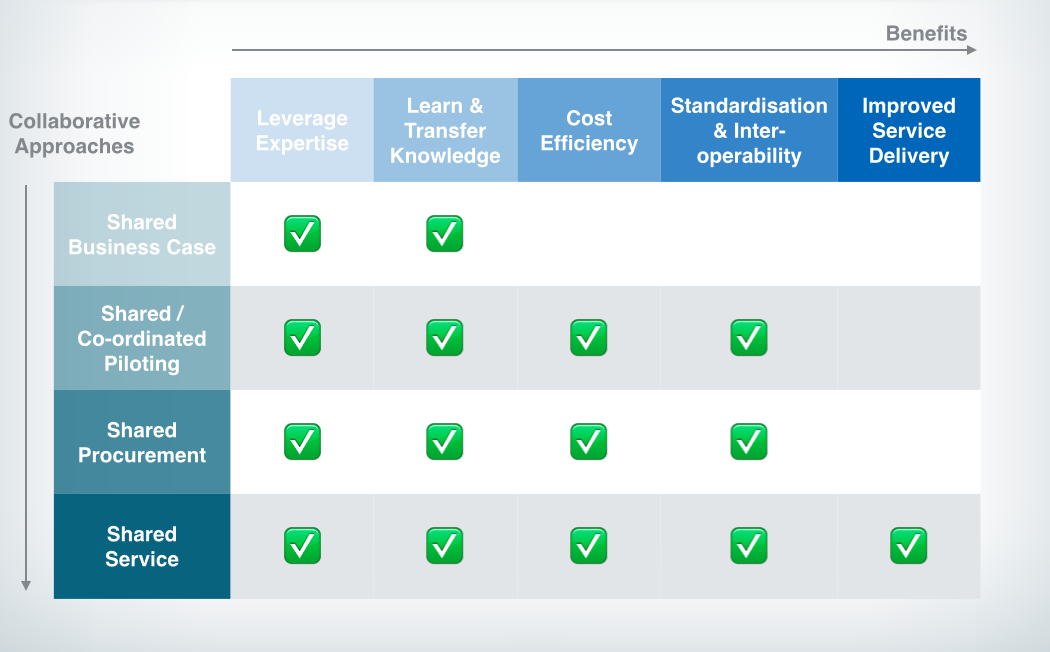
13 Methodology: Benefits of Collaborative Approaches Methodology: Benefits of Collaborative Approaches
14 Overview: Scotland s Smart Cities Maturity Ad Hoc Opportunistic Repeatable Managed Optimised
15 Overview: Investments Overview: Investments Current/ Committed Investments that have been made or programmes established which are already in place or being implemented at this time (procured and with budget secured). Planned Investments which have either secured or can be assumed to have secured local funding over the next three years (or longer planning period if that is available) but where delivery and procurement have not yet started. Ambition Opportunities for investment and potential programmes and actions to secure [the identified smart cities] ambition. *Smart Cities Maturity Model and Self-Assessment Tool Guidance Note, Urban Tide & Scottish Government 2014

16 Maturity Dimension Cross-Domain Shared Vision & Management of Outcomes Transport/ Mobility Digital Health Energy Parking Street Lighting Waste Strategic Intent R M1 Data Technology Governance & Service Delivery Models Citizen & Business Engagement R M2 M3 M4 M5 C1 C2 City Operations Citizen s Account C3 C4 C5 R Smart Ticketing/ Smartcard Data Publication & Innovation Ecosystem Capacity Building R Outline Investments Recommendations Domain R R R D1 D2 D3 D4 D5 D6
17 Outline Investments ( ) M2 M3 M5 C1 C2 C4 C5 D4 D5 D6 Data Technology Citizen & Business Engagement City Operations Citizen s Account Data Publication & Innovation Ecosystem Capacity Building Parking Street Lighting Waste
18 Outline Investments ( ) Smart City Maturity Model Dimension M2 M3 M5 Data Develop an investment proposition for, and invest in, data platforms that give cities the technical capability to capture, integrate and analyse data (can be used by multiple partners and should consider building on what already exists i.e. the Glasgow City Technology Platform & other systems). Technology Develop a programme to: map, make best use of, and invest in enhanced connected assets across the built environment (air quality, energy use in buildings, transport data re: journey times, parking, lighting, waste, etc). Support a national approach to investment in open, flexible, integrated and scalable ICT architectures across the public sector. Citizen & Business Engagement Invest in data analytics from social media, and particular crowd sourced data, to engage citizens in improving service delivery - working with partners across private sector and academia.
19 Outline Investments ( ) Cross-Domain C1 C2 C4 C5 City Operations Develop an investment proposition to create/ enhance real time city operations across Scotland s cities (by reviewing opportunities to build on and develop existing capabilities). Citizen s Account Develop shared approach to ensure that every citizen has access to a secure environment where they can register for and access services online and where every city has the capability to manage a Citizen s Account that helps organisations keep accurate, up-to-date records of their customers and customer contact. Data Publication & Innovation Ecosystem Support publication of open data specifically in relation to Education, Transport, Visitor Information & Waste, and its exploitation through national hackathons that seek to improve service delivery in these areas. Capacity Building Consider development of shared and multi-disciplinary teams to manage collaborative programme and build smart cities capacity.
20 Outline Investments ( ) Domain-specific D4 D5 D6 Parking Implement smart parking applications that use data and connected assets to manage and control spaces - including coach parking for events and visitor attractions. Street Lighting Implement street lighting programmes that use data and connected assets for the delivery of benefits such as energy efficiency and improved operational control. Waste Implement smart waste programmes that use data and connected assets for the delivery of benefits including cost savings and achievement of environmental targets and improved service delivery.
21 Outline Investments ( ) Smart City Maturity Model Dimensions The next slides provide detail of proposed outline investments within the following maturity dimensions: M2 Data M3 Technology M5 Citizen & Business Engagement
22 Data Platform 28 out of 29 cities taking part in the TSB Future Cities Demonstrator Competition outlined the vision to have a Data Platform *Solutions for Cities: An analysis of the Feasibility Studies from the Future Cities Demonstrator Programme, ARUP Report
23 M2 Data Successful smart cities make effective use of their assets to secure better outcomes. They invest in system-wide data capture, integration and analytics capabilities. Open data underpins their commitment to transparency and innovation [Smart Cities Maturity Model 2014] Desired Outcome Cities have the technical capability to capture, integrate and analyse data across multiple organisations in a flexible and scalable solution. This will lead to improved decision making, cost reduction and resource efficiency. Cities Overview All cities outlined an ambition to improve their smart cities maturity within the dimension of data over time - to Level 3 or Level 4. Improvements to capability through extended data capture, improved data integration across city-wide organisations and, in particular, the development of shared analytical capacity were identified. Smart Cities Maturity Impact >Data (Level 4) - data assets used to provide actionable information - extended data capture & analytics leads to improved decision making and service design >Technology (Level 4) - cross-organisational ICT architectures are in place. These are being scaled and adapted. Outline of Potential Investment and Next Steps Development of this capability should build on existing investments and identify synergies with committed and planned investments. >Review potential for wider exploitation of the technology that currently exists for data capture, integration and analytics that may be extendable to wider application (for example, systems listed in Existing Capability below) >Preparation of a system-wide business case to support the development of shared technical capability for data capture, integration and analytics across Scotland s cities. Existing Capability >Dundee: Data Platform that supports the NEC with potential for integration and inter-operability >Glasgow: City Technology Platform provides a cross-organisation ICT architecture based upon cloudcomputing which provides scalability and adaptability for opening (and in the future, sharing) data >Transport Scotland & a number of Local Authorities: advanced Urban Traffic Management & Control (UTMC) Data Platform Potential Future Investments >Aberdeen: Master Data Management beyond records management >Dundee: upgrading K2 system within Health & Social Care >Inverness: noted interest in data sharing & analytics platform (especially relating to Transport but with the opportunity to extend across other domains) >Perth & Stirling: initial interest in city-wide data sharing platform Added Value of Collaboration >Shared Business Case >Shared Service - leverage expertise - learn & transfer knowledge - cost efficiency - ensure standardisation & inter-operability - improved service delivery Gaps and Barriers to be addressed >Identification of additional synergies & opportunities in this area >Cultural barriers to optimising data sharing >Appetite for data sharing platforms still at early stages in some cities >Capacity building required to fully exploit analytical capacity >Business case and budget needs to be developed on a system-wide basis >Legal restrictions are making the advancement of data maturity a challenge Other Funding Opportunities and Wider Links >Innovate UK Integrated Future of Cities SBRI Competition >Innovate UK Solving Urban Challenges with Data >Horizon 2020 ICT Collective Awareness Platforms for Sustainability and Social Innovation >DataLab Innovation Centre, Urban Big Data Centre
24 Internet of Things By 2020 we will be hopelessly outnumbered - some 50 billion networked objects will prowl the reaches of cyberspace, with a few billion humans merely mingling among them *Anthony M. Townsend, Smart Cities (2013) anthonymobile.com
25 M3 Technology Successful smart cities invest in open, flexible, integrated and scalable ICT architectures that enables accelerated service innovation such as provision of automated and real-time dynamic response capabilities [Smart Cities Maturity Model 2014] Desired Outcome Cities are investing in the co-ordinated deployment of connected assets (Internet of Things) to create a system-of-systems that provides opportunities for management across the city in real-time. Investments in open, flexible, integrated and scalable ICT architecture are taking place across organisations. Cities Overview All cities outlined an ambition to improve their smart cities maturity within the dimension of technology over time - to Level 3 or Level 4. Dundee in particular chose Telecommunications as a domain, and Glasgow has identified Connected Assets as a key dimension. All cities already have significant connected assets in place together with planned investments and ambitions in this area but the investments to realise city-wide deployment of connected assets (Level 4) are not clear. The infrastructure to support ICT (such as broadband, 4G, city wifi networks) was highlighted as a key area for investment across a number of cities - connectivity improvements in these areas will support the further deployment of connected assets. Smart Cities Maturity Impact >Data (Level 4) - data assets used to provide actionable information - extended data capture & analytics leads to improved decision making and service design >Technology (Level 4) - city-wide deployment of connected assets >Technology (Level 3) - investment in integrating architectures between organisations is taking place. Outline of Investment and Next Steps - Connected Assets Development of this capability should build on existing investments and identify synergies with committed and planned investments. It is critical to sweat the existing connected assets in place for multiple purposes. >Feasibility studies to be undertaken within each of Scotland s cities to map the current network, compile an asset register and identify future opportunities for shared use. >Agree a programme to enhance capacity of connected assets on a city-wide basis; across domains and accessible by multiple partners. Explore opportunities for shared procurement of sensors (air quality, energy use, journey time, parking, lighting, waste etc). Outline of Investment and Next Steps - ICT Architecture >Support a national approach (eg High-Level Operating Framework, Policy & Guidance) to investment in open, flexible, integrated and scalable ICT architectures across the public sector. Existing Capability >Scotland Wide Area Network (SWAN) and planned value added services >Many existing systems of connected assets currently exist, eg: SCOOT Urban Traffic Control System (Inverness, Perth), Stratos Traffic Solutions System (Perth), Bus Information and Signalling (BIAS) Potential Future Investments There are significant planned and ambition investments within broadband, 4G and wifi infrastructure that would support city-wide rollout of connected assets, including: >Aberdeen: Strategic Infrastructure Plan, Inverness: broadband infrastructure, 4G and extending use of SWAN, Perth: city wifi, wifi hotspots, wifi in public buildings, Stirling: 4G availability from street lighting >Stirling: ambition for more data collection technologies available across Stirling Added Value of Collaboration >Shared Business Case >Shared/ Co-ordinated Piloting >Shared Procurement - leverage expertise - learn & transfer knowledge - cost efficiency - ensure standardisation & interoperability Gaps and Barriers to be addressed >Different ICT arrangements within each city and some cities currently undertaking contracting out (Edinburgh) or investigating this further (Stirling) >Existing connected assets not mapped across domains within cities >Lack of digital strategy in some cities >Lack of investments identified to move towards shared ICT architecture Other Funding Opportunities and Wider Links >Horizon 2020 Smart City Lighthouse Demonstrators >European Innovation Partnership (EIP) on Smart Cities and Communities - Integrated Infrastructures & Processes (including Open Data)
26 Engagement Smart cities seek to engage with citizens and businesses as owners of and participants in the creation and delivery of city services, not passive recipients *British Standards Institution (BSI) PAS 181 Smart City Framework
27 M5 Citizen & Business Engagement Successful smart cities make best use of data and digital technologies to invest in enhanced openness and transparency. Citizen & business engagement and stakeholder ownership of service reform is central within a smart city. Smart cities are proactive in improving take-up of digital services while supporting the digitally excluded [Smart Cities Maturity Model 2014] Desired Outcome That cities are ensuring the views of citizens, businesses and visitors are systematically captured through multiple channels. Social media, mobile apps and crowd-sourced data are increasingly used to enable public participation, gather opinion and inform service design. For example, the Glasgow TSB Future Cities Demonstrator Active Travel App will enable crowd-sourced data to inform cycling infrastructure within the city. Cities Overview All cities outlined an ambition to improve their smart cities maturity within the dimension of citizen & business engagement over time - to Level 3, Level 4 and Level 5 (Dundee, Perth). However, there were very few areas of investment identified which specifically focused on citizen & business engagement. In particular, it is recommended that there is a more targeted approach to the use of social media channels, mobile apps and crowd-sourced data to enhance the value of engagement that already takes place through more traditional means (face-to-face, telephone, webforms etc) and with the specific outcome of improving service delivery. This would ensure that digital and non-digital channels are integrated and opens up opportunities for co-design & cocreation of services. It could also lead to the cessation of some more expensive, traditional non-digital data collections. Smart Cities Maturity Impact > Citizen & Business Engagement (Level 4) - city uses multiple channels to engage with citizens tailored to their needs - views and ideas of citizens and businesses systematically captured through multiple channels to improve services >Data (Level 4) - extending data capture leads to improved decision-making and service design Outline of Potential Investment and Next Steps >Work with academic partners and private sector providers to invest in the following: >Data analytics from social media activity across a range of city organisations (including public, private and voluntary sector). >Development of a targeted city-wide approach to social media, specifically in relation to improving service delivery. >Identification of opportunities to obtain crowd-sourced data to provide ideas and insight into service delivery. >Testing integration of data from digital channels with data from non-digital channels to inform service design. Existing Capability >Aberdeen: regular use of social media highlighted specifically in Waste domain >Dundee: Digital Dundee Observatory and Digital on the Move (aimed at social inclusion) >Edinburgh: Budget Challenge, crowd-sourced ideas generation (Dialogue App) >OPEN Glasgow & Connected Communities Domain (Glasgow) >Inverness: use of social media channels Potential Future Investments >Dundee: more targeted approach to the use of social media including guidance & training Added Value of Collaboration >Shared Business Case >Shared/ Co-ordinated Piloting >Shared Procurement - leverage expertise - learn & transfer knowledge - cost efficiency - ensure standardisation & inter-operability Gaps and Barriers to be addressed >Different social media arrangements and approaches currently in place across the organisations within cities, and across Scotland >Cultural shift to reliance on social media data and crowd-sourced data may be required >Citizen & business engagement often seen as one-way >Integration of data from digital and non-digital sources Other Funding Opportunities and Wider Links >Horizon 2020 ICT Collective Awareness Platforms for Sustainability and Social Innovation
28 Outline Investments ( ) Cross-Domain The next slides provide detail of proposed outline investments which cut across multiple domains: C1 C2 C4 C5 City Operations Citizen s Account Data Publication & Innovation Ecosystem Capacity Building
29 Command & Control Enabling insight into how the city operates to enable more efficient city operations and inform longer term policy decision making *Department for Business,Innovation & Skills (BIS) Research Paper No 135 International Case Studies on Smart Cities
30 C1 City Operations Desired Outcome Every city has the capability for cross-organisational intelligent command-control-response of city operations. This supports the better management of city resources, communication across the city and design of city services together with improved decision-making through predictive and preventative action. Cities Overview There has been substantial investment in the state-of-the-art integrated 24/7 Glasgow Operations Centre control room providing operational management and control across the different services of traffic, community safety, public space CCTV, and emergency & resilience functions across the city. This has the capacity for significant expanded use and further innovation. Additional capability and capacity may also be available via other operations centres that exist within Scotland - including Transport Scotland National Traffic Control Centre and the Scottish Water National Operations Control Centre. Smart Cities Maturity Impact >Governance & Service Delivery (Level 3) -Leadership and governance models evolve to share accountability for delivering system-wide outcomes >Data (Level 4) -data assets used to provide actionable information >Technology (Level 3) - investment in integrating architectures between organisations is taking place Outline of Investment and Next Steps Development of this capability should build on existing investments and identify synergies with committed and planned investments. >Review potential for wider exploitation of the technology that exists for intelligent management and control of city services across but not limited to the following: Glasgow Operations Centre, Transport Scotland Operations Centre and Scottish Water Operations Centre. >Preparation of a system-wide business case to support the development of capability for the management & control of city services. Existing Capability >Glasgow Operations Centre >Transport Scotland Operations Centre >Scottish Water National Operations Control Centre Potential Future Investments >Glasgow: potential opportunities grouped around the themes of: Command and Control; Security of Assets and Event Management; Extended use of Operation Centre to other city partners. Added Value of Collaboration >Shared Business Case >Shared Service - leverage expertise - learn & transfer knowledge - cost efficiency - ensure standardisation & inter-operability - improved service delivery Gaps and Barriers to be addressed >Identification of additional synergies & opportunities in this area >Cultural barriers exist to data sharing across services or organisations within a city, and across cities >Consensus and commitment of internal and external partners/ stakeholders to integration needs to be secured >Development of leadership and governance models for shared accountability >Development of shared service agreements Other Funding Opportunities and Wider Links
31 Citizen s Account The Citizen's Account provides a secure environment for citizens to register for and have access to, services, which also helps organisations keep accurate, up-todate records of their customers *The Improvement Service
32 C2 Citizen s Account Desired Outcome Every citizen has access to a secure environment where they can register for and access services online (myaccount) and every city has the capability to manage a Citizen s Account that helps organisations keep accurate, up-to-date records of their customers and customer contact. Personal shared data is secure and lower transaction costs are achieved through online self-service. Cities Overview Edinburgh specifically highlighted Citizen Account as a domain and both Dundee (link to Telehealthcare) and Glasgow (Connected Citizen & Connected Data domains) have noted further ambitions in this area. Edinburgh specifically highlighted the extension of their Citizen s Account to additional services beyond the City of Edinburgh Council. They also wish to explore the development of a similar Business Account (also mentioned by Glasgow within the Connected Data domain). Smart Cities Maturity Impact >Data (Level 3) - data management & optimisation strategy agreed between partners >Governance & Service Delivery (Level 3) - leadership and governance models evolve to share accountability for delivering system-wide outcomes >Citizen & Business Engagement (Level 4) - citizens benefit from integrated services across organisations using the best digital technology for them Outline of Investment and Next Steps Development of this capability should build on existing investments and identify synergies with committed and planned investments. >Wider application of the Citizen s Account to specifically demonstrate integration with public services beyond the local authority. >Preparation of a system-wide business case to support the wider application of the Citizen s Account. >Further consideration to be given to the development of a similar Business Account. Existing Capability >mygovscot myaccount identity authentication (integrated and scalable ICT component) already a national initiative that has been leveraged at city level >Edinburgh Citizen s Account (as part of ICT Transformation Programme and Channel Shift) - Council Tax, Non-Domestic Rates, Council Tax Reduction and/or Housing Benefit, and Landlords services >Dundee Citizen Account linked to National Entitlement Card (NEC) >Glasgow ecitizen (as above for Edinburgh plus Registration to Vote) Potential Future Investments >Further use of a Citizen s Account and the National Entitlement Card (NEC) >Dundee ambition to develop Citizen s Account as per their TSB Future Cities Demonstrator Gaps and Barriers to be addressed >Identification of additional synergies & opportunities in this area >Data owner uncertainty about security of sharing personal data >Legislation on sharing of personal data and understanding of it >Organisational buy-in to service design from the customer perspective required >Some systems not designed from service orientated architecture principles >Support for iterative and agile development required Added Value of Collaboration >Shared Business Case >Shared/ Co-ordinated Piloting >Shared Service - leverage expertise - learn & transfer knowledge - cost efficiency - ensure standardisation & inter-operability - improved service delivery Other Funding Opportunities and Wider Links >Scottish Government Working Group on Business Authentication
33 Data Publication and Innovation Ecosystem Open data is data that can be freely used, re-used and redistributed by anyone - subject only, at most, to the requirement to attribute and share alike *Open Knowledge Foundation
34 C4 Data Publication & Innovation Ecosystem Desired Outcome That every city has an extensive range of open data published with the strategic intent to leverage innovation. Activity to develop an ecosystem takes place that empowers stakeholders (citizens, entrepreneurs, social enterprises, public service providers, businesses etc) to create new sorts of services and value. Cities Overview A number of cities expressed an existing commitment to open data and ambitions to improve capability in this area. Several cities identified areas of current challenge (Education, Transport, Visitor Information, Waste, Freedom of Information Requests) where providing information in a smarter way would help meet an existing need or reduce current resource levels - for example through new services including apps, dashboards, visualisations, improved websites with information joined up across multiple services etc. Smart Cities Maturity Impact >Data (Level 4) - established open data community is building new services valued by users >Governance & Service Delivery (Level 3) -greater input to problem solving and service design from providers/ suppliers & users Outline of Investment and Next Steps >Support publication of open data in general and specifically within Education, Transport, Visitor Information and Waste. >Deliver four national challenge-led Hackathons to collaborate intensively around software projects within Education, Transport, Visitor Information and Waste - ensuring that these build on work already being undertaken to improve information provision (eg: TACTRAN improved travel information interface). >Engage with students, universities, startups, SME community to attract developers, designers, ethnographers and other interested users to participate in the national challenge-led Hackathons. >Facilitate that the winners work with local authorities to fully develop solutions (treat as pre-procurement similar to Edinburgh Apps). >Explore the national Open Data Strategy can support open publication of Freedom of Information (FOI) Requests. Existing Capability >Code for Aberdeen, Dundee Observatory, OPEN Glasgow, Edinburgh Apps Potential Future Investments >Aberdeen, Glasgow, Inverness, Perth & Stirling: Travel & Transport Information >Aberdeen: Waste (for example smartphone apps for reporting; use of technology to communicate to households about recycling in their area) >Dundee: hackathon promotion and incubation services >Glasgow: plans to develop Visitor attractions & amenities app >Inverness: future delivery of Visitor Information >Perth: Education highlighted as area for improved information provision Added Value of Collaboration >Shared/ Co-ordinated Piloting >Shared Service - leverage expertise - learn & transfer knowledge - cost efficiency - ensure standardisation & inter-operability - improved service delivery Gaps and Barriers to be addressed >Securing commitment of stakeholders to the principle of open data >Need to ensure data is up-to-date and accurate >Different data suppliers use different technologies >Ensure link to ongoing support through, for example, Business Gateway or physical innovation/ incubation spaces Other Funding Opportunities and Wider Links >European Innovation Partnership (EIP) on Smart Cities and Communities - Integrated Infrastructures & Processes (including Open Data)
35 Capacity Building We have mapped out the skills we need to deliver the smart city programme, and have established clear plans for acquiring and maintaining them *British Standards Institution (BSI) PAS 181 Smart City Framework
36 C5 Capacity Building Desired Outcome That every city has the skills required at leadership, management and operational levels to deliver the smart city programme. Overview PAS 181 Smart City Framework published by the British Standards Institution (BSI) particularly refers to the following as critical success factors in building and supporting a smart city: >the right skills mix in the leadership team to drive ICT-enabled business transformation at a city-wide level including strategy development skills, stakeholder engagement skills, marketing skills, commercial skills and technology management skills >skills to deliver the transition to a new operating model >mapping out the skills needed to deliver the smart city programme with clear plans for acquiring and maintaining them >effective mechanisms in place to maximise value from all the skills available across the partners involved in delivery of the smart city roadmap Cities Overview Cities raised concerns about the resources required to support smart city development and the incompatibility of existing skills. It is critical that adequate capacity is built to ensure success - specifically in relation to the investments outlined and the recommendations made here but more significantly to support the longer term smart city ambitions across all Scottish cities. Smart Cities Maturity Impact >Strategic Intent (Level 4) - vision, strategy and roadmap established at city-wide level >Governance & Service Delivery (Level 3) - leadership and governance models evolve to share accountability for delivering system-wide outcomes Outline of Investment and Next Steps >Skills mapping to take place once outline investments finalised. >Clear plans to be established for acquiring and maintaining skills. >Consideration given to skills sharing throughout partner organisations and across cities, including possibility of shared resource pool >Deployment of a formal competency framework, such as Skills Framework for the Information Age (SFIA), to be investigated as support for identifying and building the right skill sets. Existing Capability >Existing resources across all Scotland s cities including throughout partner organisations Potential Future Investments >Range of talent and skills available across public, private and voluntary sector Added Value of Collaboration >Shared Business Case >Shared/ Co-ordinated Piloting >Shared Procurement >Shared Service Gaps and Barriers to be addressed >Leadership, management and operational resource buy-in >Time taken to build capacity >Costs involved to build capacity >Skill sets fragmented across different organisations and cities Other Funding Opportunities and Wider Links >Horizon 2020 >European Commission Marie Curie Actions FP7 Call >Scottish Cities Alliance National Development Manager & wider Scottish Cities Alliance Team
37 Outline Investments ( ) Domain-specific The next slides provide detail of proposed outline investments identified within individual domains: D4 D5 D6 Parking Street Lighting Waste
38 Parking With around 29 million cars owned by a population of over 60 million people, it s no wonder that the UK is one of the busiest places in the world to drive and park *Smart Parking
39 D4 Parking Desired Outcome Cities implement smart parking applications that use data and connected assets for the delivery of benefits to the management & control of spaces and improved service delivery to users. Cities Overview Transport and the movement of good and services was highlighted as a key area of focus within five of the seven cities. Inverness, Perth and Stirling in particular all raised the potential of smart parking projects as an application of data, technology and citizen & business engagement. There are some committed and planned investments in this area and an ambition to do more. Smart Cities Maturity Impact >Data (Level 4) - data assets used to provide actionable information >Technology (Level 2) - some shared use of sensor networks >Citizen & Business Engagement (Level 4) - city uses multiple channels to engage with citizens tailored to their needs Outline of Investment and Next Steps >It is recommended that a number of smart parking projects are supported as demonstrators of data, connected assets and digital technology application. These could include: >data capture and use of smart technology in car parks >data capture and use of smart technology for on-street parking >integration of data with other traffic management systems >management of coach parking and transport to visitor attractions >Projects in this area should build on existing investments and identify synergies with committed and planned investments. Existing Capability >Glasgow - open data feed listing the occupancy and status of council car parks in Glasgow >Edinburgh - contactless meter pilot to notify when meter time running out Potential Future Investments >Inverness - specific issues with coach parking and transport to visitor attractions; smart technologies could assist in matching visiting coaches with spaces >Perth - VMS Displays, payment on foot, automatic number plate recognition (ANPR) and integration of data with other traffic management systems for more effective use of parking resources, improved space utilisation and public information >Stirling - parking management and availability Added Value of Collaboration >Shared/ Co-ordinated Piloting >Shared Procurement - leverage expertise - learn & transfer knowledge - cost efficiency - ensure standardisation & inter-operability Gaps and Barriers to be addressed >Resources >Commitment is there but stronger delivery partnerships need to be developed >Conflicting views from stakeholders around best solution Other Funding Opportunities and Wider Links European Innovation Partnership (EIP) on Smart Cities and Communities - Integrated Infrastructures & Processes (including Open Data)
40 Street Lighting Understanding the operational details of networked LEDs and comparing those benefits and costs to traditional lighting lays the foundation for building a business case to upgrade street lights *Silver Spring Networks
41 D5 Street Lighting Desired Outcome Cities implement intelligent street lighting demonstrators that use data and connected assets for the delivery of benefits including energy efficiency, reduced cost of asset management and maintenance, improved operational control and increased city data through sensors. Cities Overview Glasgow have undertaken an Intelligent Street Lighting Demonstrator in 3 locations as part of the TSB Future Cities Demonstrator Programme and are actively looking at how they can use street lights as wifi provision within a Transformational Regeneration Area (TRA) through the ECCI (Edinburgh Centre for Carbon Innovation) Smart Accelerator Programme. Aberdeen, Dundee, Inverness and Stirling all specifically referenced project investments relating to intelligent street lighting. Smart Cities Maturity Impact >Data (Level 4) - data assets used to provide actionable information - extended data capture & analytics leads to improved decision making and service design. >Technology (Level 2) - some shared use of sensor networks Outline of Investment and Next Steps >It is recommended that a number of intelligent street lighting projects are supported as demonstrators of data, connected assets and digital technology application - building on expertise from the Glasgow TSB Intelligent Street Lighting Demonstrator. >Projects in this area should build on existing investments and identify synergies with committed and planned investments. >Apply leverage towards/ link with EU European Innovation Partnership Humble Lamppost project. >Review outcome of Glasgow TSB Intelligent Street Lighting Demonstrator following demonstrator period to August Existing Capability >Glasgow TSB Intelligent Street Lighting Demonstrator within 3 locations across Glasgow Potential Future Investments >Aberdeen: linked to energy efficiency, real-time journey monitoring, traffic monitoring and air quality monitoring >Dundee: linked to V&A Waterfront Development >Inverness: LED street lighting pilot (investigate opportunity to make smart) >Stirling: linked to energy use, need for central management system (CMS) Added Value of Collaboration >Shared/ Co-ordinated Piloting >Shared Procurement - leverage expertise - learn & transfer knowledge - cost efficiency - ensure standardisation & inter-operability Gaps and Barriers to be addressed >Resources, finance and planning >Stronger delivery partnerships need to be developed to work better with the private sector Other Funding Opportunities and Wider Links European Innovation Partnership (EIP) The Humble Lamppost Commitment (1Million intelligent street lights by 2020) European Innovation Partnership (EIP) on Smart Cities and Communities - Integrated Infrastructures & Processes (including Open Data)
42 Waste Waste is a by-product of economic activity and the smart management of waste will have economic implications which will influence productivity, government expenditure and the environment *Department for Business,Innovation & Skills (BIS) Research Paper No 136 Smart Cities Market: Opportunities for the UK
43 D6 Waste Desired Outcome Cities implement smart waste demonstrators that use data and connected assets for the delivery of benefits including cost savings, achievement of environmental targets and improved quality of life for citizens. Cities Overview Only Aberdeen included waste as a specific domain within the Smart Cities Readiness Assessment but we are aware that there is a significant amount of infrastructure and technology investment taking place across Scotland s cities - for example, smart bins pilot via Essential Edinburgh with swipe card access for recording volume of business waste and charging accordingly; bin also communicates when 80% full. Smart Cities Maturity Impact >Data (Level 4) - data assets used to provide actionable information - extended data capture & analytics leads to improved decision making and service design. >Technology (Level 2) - some shared use of sensor networks >Citizen & Business Engagement (Level 4) - city uses multiple channels to engage with citizens tailored to their needs Outline of Investment and Next Steps >It is recommended that a number of smart waste projects are supported as demonstrators of data, connected assets and digital technology application. These could include: >bin notification capability (ie sending of signal when full) >integration with in-cab GPS systems to alert and re-route drivers in real-time >on-board weighing of bins >integration with existing customer relationship management (CRM) systems >Projects in this area should build on existing investments and identify synergies with committed and planned investments. Existing Capability >All cities undertake waste collection (some are organised on a regional basis) and are reviewing the potential of data and technology application Potential Future Investments >Aberdeen are undertaking waste infrastructure investment over the next 3 years and plan for more over the subsequent 3-6 year period including bin notifications and integration with in-cab GPS systems >Dundee investigating bin sensor networks >Opportunity for further integration with CRM systems Added Value of Collaboration >Shared/ Co-ordinated Piloting >Shared Procurement - leverage expertise - learn & transfer knowledge - cost efficiency - ensure standardisation & inter-operability Gaps and Barriers to be addressed >Resources, finance and planning >System integration challenges with back office of CRM systems Other Funding Opportunities and Wider Links >Circular Economy ERDF application - Zero Waste Scotland >LIFE+ (Municipal Waste) (May/ June 2015)
44 Recommendations - which could lead to further Outline Investments ( ) D1 D2 D3 C3 M1 M4 Transport/ Mobility Digital Health Energy Smart Ticketing/ Smartcard Strategic Intent Governance & Service Delivery Models
45 Recommendations There are 3 specific policy areas where we think significant benefits can be derived from a strategic and collaborative approach: D1 D2 D3 Transport/ Mobility Digital Health Energy Further work with the policy leads and stakeholders at a national/ partnership level is required to identify how to add most value. We are recommending that this is undertaken early in 2015 to assess these areas in terms of their smart maturity at a national rather than city level. There is also one service area where we think significant benefits can be derived from a strategic and collaborative approach on a national level and we are recommending that this is aligned with existing work that the Scottish Cities Alliance are leading in this area: C3 Smart Ticketing/ Smartcard The proposed collaborative investment plan will require strong commitment and will benefit from further strategy development and new governance approaches. We are recommending that smart cities maturity in the following areas is developed further through implementation of this outline investment roadmap: M1 M4 Strategic Intent Governance & Service Delivery Models
46 D1 D2 D3 Transport/ Mobility Digital Health Energy Desired Outcome That each of these domains have an overarching smart vision, strategy and roadmap established at national level and that smart investments identified have a clear impact on national and city s strategic priorities. Cities Overview These are all significant multi-partner domains that have the potential for significant transformational impact on a system-wide basis and were selected by a number of cities [Transport/ Smart Mobility (5 cities), Digital Health (2 cities) and Energy (2 cities)]. They all have strong existing capability and an ambition to improve smart cities maturity - ranging from Level 3 to 5. A lot of smart activity and investment is already taking place and this was highlighted in the self-assessment returns. Delivery within these sectors is multi-partner and activity is often not led by the city local authorities. Recommendation >Arrange a summit to use the Smart Cities Maturity Model with national & local partners in each domain. >Identify synergies and opportunities that exist across transport/ smart mobility, digital health and energy domains. >Identify specific areas where the Scottish Cities Alliance or local authorities can add most value. >Work closely with Scotland Europa as there is a strong focus on these areas within European Funding calls but there is a need for collaboration, aggregation and scale to attract significant European Funding.
47 C3 Smart Ticketing/ Smartcard Desired Outcome That the implementation of Smart Ticketing/ Smartcard is taken forward on a cross-domain basis within cities and on a national basis where appropriate. This could include transport, health, education, leisure and many other areas of service delivery within a city. Cities Overview Smart Ticketing/ Smartcard investments were highlighted in a number of city returns including Dundee (link with extended use of the National Entitlement Card (NEC), ShareMore mobility product across all modes of transport and the SmartSat transport integration project), Edinburgh (link with Citizen s Account), Inverness (link between bus and ferry services) and Perth (educational attendance at school & college with link to public transport). The Scottish Cities Alliance and Transport Scotland are already undertaking work in this area. Recommendation >Discuss potential investments in the context of the work that the Scottish Cities Alliance is already undertaking in this area. >Identify synergies and opportunities that exist across different domains within a city and on a national basis as appropriate. >Link to the proposed investments within Citizen s Account (C2). >Leverage the existing capability of the National Entitlement Card (NEC) as appropriate.

48 M1 M4 Strategic Intent Governance & Service Delivery Successful smart cities have a strategy and roadmap setting out how investment in data & digital technologies enables service reform and partner collaboration. An effective strategy focuses on delivering improved outcomes aligned to the city s strategic priorities [Smart Cities Maturity Model 2014] Successful smart cities adapt traditional organisational models of delivery to realise the opportunities of data & digital technologies. They invest in systemwide partnership models focussed on shared outcomes [Smart Cities Maturity Model 2014] Desired Outcome To improve maturity in strategic intent and governance & service delivery models through the implementation of this outline investment roadmap. This is a real opportunity to pilot/ test different models and ways of working. Cities Overview All cities outlined an ambition to improve their smart cities maturity within the dimensions of strategic intent and governance & service delivery models over time - mostly to Level 4. Strong strategic intent and multipartner governance models will be required in order to maximise the effectiveness of the outline investments identified and fully enable service reform. The smart approach is not pain-free and requires strong leadership and buy-in across multiple partners to succeed. Good examples where collaborative approaches in the digital sector have been successful at a national level include the superfast broadband infrastructure and Scotland Wide Area Network (SWAN). Recommendation >To put in place appropriate leadership, governance & service delivery models for the successful implementation of this outline investment roadmap.

49 Outline Investment Roadmap ( )
50 Annex of Additional Information
51 Smart Cities Maturity Model: Strategic Intent Level Level 1 Ad-hoc Level 2 Opportunistic Level 3 Purposeful & Repeatable Level 4 Operationalised Level 5 Optimised Outline No overall roadmap for digital transformation exists yet. Investment in discrete areas only, with view to establishing evidence & business case. Strategy and investment largely at departmental level. Emerging sharing of strategic intent and business case with partners. Some initial shared service transformation between partners. A shared vision, strategy and roadmap for the smart city in place with multiple partners across multiple domains. Business case established & shared investments in place to secure scalable improvements to agreed outcomes. Vision, strategy and roadmap established at city-wide level. Improved service outcomes evidenced and underpinning future service improvements at scale. Strategy is optimised and evolves based on clear evidence of impact on city competiveness. Smart investments have clear impact on city s strategic priorities.
52 Smart Cities Maturity Model: Data Level Level 1 Ad-hoc Level 2 Opportunistic Level 3 Purposeful & Repeatable Level 4 Operationalised Level 5 Optimised Outline Data re-use and integration is limited by the range of disparate systems in use for different operations. Issues with data integrity, quality, privacy and security. Data is used primarily for the delivery of a particular service. Barriers to optimising data assets being discussed between partners and solutions emerging. Some advanced data sharing and analytics applications in place. Some data sets are opened to the public. Data management & optimisation strategy agreed between partners. Investing in advanced data management, capture, analytics and big data applications. Extensive range of open data published with strategic intent to leverage innovation. Citizens sharing data in key areas. Data assets used to provide actionable information. Extended data capture & analytics leads to improved decision making and service design. Established open data community is building new services valued by users. Citizen willingness to share data is widespread. Data analytics used for dynamic & automated predictive and preventative improvements to service delivery and real-time response capabilities for non-predictable events. Open data community generating new market opportunities and building alternatives to public service provision.
53 Smart Cities Maturity Model: Technology Level Level 1 Ad-hoc Level 2 Opportunistic Level 3 Purposeful & Repeatable Level 4 Operationalised Level 5 Optimised Outline ICT architectures are predominantly designed to support each line of business application. Limited investment in sensor networks for particular service applications. Some shared or integrated architectures exist but deployed on a limited set of services. Barriers are understood and being addressed between partners. Some shared use of sensor networks. Investment in integrating architectures between organisations is taking place. Joint investment plans in city-wide deployment of connected assets. Cross-organisational ICT architectures are in place. These are being scaled and adapted. The architecture enables accelerated service innovation. City-wide deployment of connected assets. Organisations are continuously reviewing, adapting and investing in ICT architecture to drive service transformation. A networked built environment across the city.
54 Smart Cities Maturity Model: Governance & Service Delivery Models Level Level 1 Ad-hoc Level 2 Opportunistic Level 3 Purposeful & Repeatable Level 4 Operationalised Level 5 Optimised Outline Leadership, governance and budgeting focuses on service transformation primarily within the boundaries of traditional organisational models. Traditional client-provider-supplier-user relationships exist and are often managed separately. Leadership and governance models test new ways of engaging with wider partners (including the private sector) to address cross department /organisation service transformation. Shared budget accountability for some discrete initiatives. Leadership and governance models evolve to share accountability for delivering system-wide outcomes. Greater input to problem solving and service design from providers/ suppliers & users. Organisational budgets and structures adapt to ensure effective and transparent delivery of system-wide approach. Transparent multi-partner governance model firmly embedded and delivering improved decision-making and outcomes at city-wide level. Service users are strong influencers. Traditional supplier / contractor relationships evolve to include gain sharing, codevelopment & performance contracting. Leadership and governance model stimulates an innovation system that promotes new combinations of service delivery and greater effectiveness at impacting on city-wide strategic priorities.
55 Smart Cities Maturity Model: Citizen & Business Engagement Level Level 1 Ad-hoc Level 2 Opportunistic Level 3 Purposeful & Repeatable Level 4 Operationalised Level 5 Optimised Outline Stakeholder participation in reform is focused on particular services and is limited by the lack of clear and accessible information on the performance of city services. Opportunities to enhance participation using web-based and social network channels is recognised and discrete initiatives are underway. Departmental-level commitment to investing in digital channels to enhance citizen engagement. The approach predominantly focuses on using digital means to provide improved information and transparency to stimulate engagement. Approaches to address digital exclusion in specific service areas underway. System-wide/ multi partner strategies for enhanced citizen engagement in place that make effective use of digital technologies and address digital inclusion. The engagement tools and approaches adopted enhance the voice of stakeholders and citizens across a range of city services. City uses multiple channels to engage with citizens tailored to their needs. Views and ideas of citizens and stakeholders systematically captured through multiple channels to improve services. Citizens benefit from integrated services across organisations using the best digital technology for them. City has embedded inclusive & personalised engagement models that stimulate innovation and collaborative approaches across the public and private sectors. Digital literacy across the population is high and support or alternative provision is in place for those that need it.
56 Potential Examples of Measurements of Success Suggested Input Measures Volume of data captured Number of datasets shared Number of datasets integrated Number of datasets published as open data Number of datasets analysed Number of data standards set Number of sensors installed Number of variables measured by sensors Level of data interoperability Suggested Output Measures Efficiency savings Improved response times Increased number of automated real-time responses Increased citizen input to service design Number of integrated services Enhanced innovation measured by: number of new products/ services delivered (including based on open data) number of start-ups achieved based on smart cities innovation system Level of engagement achieved
57 M2 Data Summary Develop an investment proposition for, and invest in, data platforms that give cities the technical capability to capture, integrate and analyse data (can be used by multiple partners and should consider building on what already exists i.e. the Glasgow City Technology Platform & other systems). Investment Required >Professional Services >Enterprise Architects >Developers & Testers >Data Scientists >Technology Products >Licensing or Software-as-a- Service (SaaS) Payments Measurements of Success >Volume of data captured >Number of datasets shared >Number of datasets integrated >Number of datasets published >Number of datasets analysed >Level of data standardisation >Service delivery improvements Benefits >Avoids multiple systems and multiple investments >Supports data sharing and data analytics across organisational and geographical boundaries >Supports data interoperability and the potential of big data integration >Encourages innovative use of data analytics to support targeted service delivery Potential Investments >Aberdeen: Common Transport Database System and Master Data Management >Dundee: National Entitlement Card (NEC) >Glasgow: Targeted Service Delivery enabled by innovative use of Data Analytics
58 M3 Technology Summary Develop a programme to: map, make best use of, and invest in enhanced connected assets across the built environment (air quality, energy use in buildings, transport data re journey times, parking, lighting, waste, etc). Support a national approach to investment in open, flexible, integrated and scalable ICT architectures across the public sector. Investment Required >Professional Services >Technology Products >Sensors >Centralised management systems (CMS) >Network infrastructure >Further discussion & debate about appropriate national future approach to ICT architecture Measurements of Success >Number of sensors installed >Integration capability of sensors installed >Number of variables measured >Volume of data captured >Service delivery improvements Benefits >Improves use of connected assets as a medium to provide command & control in addition to real-time data >Ensures standardisation of deployment on a national basis Potential Investments >Aberdeen: Strategic Infrastructure Plan, SWAN Connectivity services & Accelerate Aberdeen >Dundee: City-wide Digital Strategy & City Wifi >Glasgow: Expansion and further innovation of the Glasgow Operations Centre, LED Lighting Programme & Humble Lamp-post Project >Inverness: 4G infrastructure, extended use of SWAN & Next Generation Broadband Network >Perth: Wireless enhancement in schools and smart technology in car parks >Stirling: Transport data collection & centralised management system for street lighting
59 M5 Citizen & Business Engagement Summary Invest in data analytics from social media, and particular crowd sourced data, to engage citizens in improving service delivery - working with partners across private sector and academia. Investment Required >Professional Services >Engagement Specialists >Data Scientists Technology Products >Social Media analytic tools >Crowd-sourced data tools >Licensing or Software-as-a- Service (SaaS) Payments Measurements of Success >Volume of data captured >Number of datasets analysed >Level of engagement achieved (representation across different stakeholder groups and over time) >Service delivery improvements Benefits >Makes best use of data available through social media channels >Opens up opportunities for co-design and co-creation of services >Could identify opportunities to stop collecting data in more traditional and resource inefficient ways Potential Investments >Dundee: Digital Strategy (including Dundee Observatory and Digital on the Move) >Edinburgh: work already taking place within ICT Transformation Programme >Glasgow: Targeted Service Delivery enabled by innovative use of Data Analytics
60 C1 City Operations Summary Develop an investment proposition to create/ enhance real time city operations across Scotland s cities (by reviewing opportunities to build on and develop existing capabilities). Investment Required >Professional Services >System Operators >Data Scientists >Technology Products >Communication systems >Analytic tools >Network Infrastructure >Accommodation >Licensing or Software-as-a- Service (SaaS) Payments Measurements of Success >Efficiency savings achieved >Volume of data captured, shared and integrated >Level of data interoperability >Service delivery improvements Benefits >Avoids multiple systems and multiple investments >Supports data interoperability and the potential of big data integration >Centralised operational management facility provides consolidated view of the city >Encourages innovative use of data analytics to support targeted service delivery Potential Investments >Aberdeen: potential to link with Waste Collection Management System >Dundee: potential to link with Technology Enabled Care, ShareMore, SmartSAT >Glasgow: Expansion and further innovation of the Glasgow Operations Centre ( TBC) >Stirling: potential to link with Central management system for street lighting ( TBC)
61 C2 Citizen s Account Summary Develop shared approach to ensure that every citizen has access to a secure environment where they can register for and access services online and where every city has the capability to manage a Citizen s Account that helps organisations keep accurate, up-to-date records of their customers and customer contact. Investment Required >Professional Services >Developers & Testers >Data Scientists >Technology Products >Integration with other public service ICT systems >Integration with existing back office processes >Licensing or Software-as-a- Service (SaaS) Payments Measurements of Success >Number of services integrated >Number of users registered > Level of engagement achieved (representation across different stakeholder groups and over time) >Service delivery improvements Benefits >mygovscotland myaccount identity authentication already a national initiative that has been leveraged at city level >Supports channel shift to an increased number of transactions moving online >Improved information about customer contact with multiple organisations for analysis and service improvement >Integration with national digital initiatives >Personalisation and lower transaction costs through online self-service Potential Investments >Edinburgh: ICT Transformation Programme & Channel Shift >Dundee: National Entitlement Card (NEC) Smart & Integrated Ticketing
62 C4 Data Publication and Innovation Ecosystem Summary Support publication of open data specifically in relation to Education, Transport, Visitor Information & Waste, and its exploitation through national hackathons that seek to improve service delivery in these areas. Investment Required >Professional Services >Engagement Specialists >Data Scientists >Event Organisers >Post-Event Support Providers Measurements of Success >Volume of data published >Number of attendees >Level of post-event involvement >Number of data products delivered >Service delivery improvements Benefits >Supports data sharing and data analytics across organisational and geographical boundaries >Creates and supports a national innovation ecosystem on - stimulating innovation that can drive public sector reform & provide opportunities for economic growth >Demonstrates a commitment to open data >Supports development of common data standards >Provides ease of access to appropriate data on a Scotlandwide basis by stakeholders >Ideas can be taken forward and supported collaboratively on a national basis Potential Investments >Aberdeen: potential to link with Waste Collection Services, Handheld Devices, In-cab devices >Inverness: wider use and development of information for visitors >Other: further ambition and activity mentioned in narrative in this area but not highlighted as specific potential planned investments - further review required
63 C5 Capacity Building Summary Consider development of shared and multi-disciplinary teams to manage collaborative programme and build smart cities capacity. Investment Required Strategies and investment required to attract and develop skills including the following: >Smart Cities Leadership >Programme/ Project Managers >Data Scientists >Enterprise Architects >Developer Resource >Test Resource >Product Managers >Designers >Engagement Specialists >Procurement Specialists >Legal Advisers >Communication Specialists Measurements of Success >Skills capacity developed >Level of recruitment >Level of retention Benefits >Adaptable and skilled workforce >Smart Cities Maturity Development >Skills transfer opportunities Potential Investments >Level of detail specifically identifying capacity building investments not included within potential planned investments - further work required
64 D4 Parking Summary Implement smart parking applications that use data and connected assets to manage and control spaces - including coach parking for events and visitor attractions. Investment Required >Professional Services >System Operators >Data Scientists >Technology Products >Sensors >Communication systems >Network Infrastructure >Licensing or Software-as-a- Service (SaaS) payments Measurements of Success >Volume of data captured >Integrated use of sensor technology >Number of datasets analysed >Service delivery improvements Benefits >Improves citizen or visitor experience >Improves utilisation of assets >Generates data that can feed into service improvement >Improves sustainability of transport network Potential Investments >Dundee: potential to link with ShareMore, SmartSAT >Inverness: Bus investment >Perth: Smart technology in car parks, TACTRAN Connect integrated platform >Stirling: Parking management & maintenance, TACTRAN Connect
65 D5 Street Lighting Summary Implement street lighting programmes that use data and connected assets for the delivery of benefits such as energy efficiency and improved operational control. Investment Required >Professional Services >System Operators >Data Scientists >Technology Products >Sensors >Communication systems >Network Infrastructure >Licensing or Software-as-a- Service (SaaS) payments Measurements of Success >Volume of data captured >Integrated use of sensor technology >Efficiency savings achieved >Number of datasets analysed >Service delivery improvements Benefits >Efficiency savings (energy use & asset management) >Demand responsive service delivery >Opportunity to integrate with other connected assets, for example, environmental sensors, parking meters Potential Investments >Aberdeen: Street Lighting Lanterns Replacement >Glasgow: LED Lighting Proposal, European Innovation Partnership Humble Lamppost Project >Stirling: Central Management System for street lighting
66 D6 Waste Summary Implement smart waste programmes that use data and connected assets for the delivery of benefits including cost savings and achievement of environmental targets and improved service delivery. Investment Required >Professional Services >System Operators >Data Scientists >Technology Products >Sensors >Communication systems >Network Infrastructure >Licensing or Software-as-a- Service (SaaS) payments Measurements of Success >Volume of data captured >Integrated use of sensor technology >Efficiency savings achieved >Level of engagement achieved (representation across different stakeholder groups and over time) >Service delivery improvements Benefits >Joint procurement opportunity (Aberdeen already working with Aberdeenshire & Moray Council; Edinburgh also organise waste on a regional partnership basis) >Joint development of capability - especially data & digital technology application >Opportunity for data integration (operational data and crowd-sourced data) Potential Investments >Aberdeen: Waste Collection Services, Underground Bins Collection System, Handheld Devices, Collection Management System, In-cab Devices >Glasgow: Targeted Service Delivery enabled by innovative use of Data Analytics
67 END OF REPORT
Technology Strategy Board (TSB) Future Cities Demonstrator
 Technology Strategy Board (TSB) Future Cities Demonstrator The Technology Strategy Board (TSB) Future Cities Demonstrator is a UK government initiative, which started in January 2013 and is due to conclude
Smart City Live! 9-10 May 2016, Nice
 Monday, May 9, 2016 Smart City Live! 9-10 May 2016, Nice Draft agenda as of November 20, 2015 SMART LIVING SMART CITY SERVICES 9:00 AM CASE STUDY: Developing Smart Energy communities Understanding the
Digital Strategy. Digital Strategy. 2015 CGI IT UK Ltd. Digital Innovation. Enablement Services
 Digital Strategy Digital Strategy Digital Innovation Enablement Services 2015 CGI IT UK Ltd. Contents Digital strategy overview Business drivers Anatomy of a solution Digital strategy in practice Delivery
Connect Renfrewshire
 How the council will use its information and technology assets to achieve successful change Contents Strategy Context 2 Digital Delivery and Citizen Engagement 4 Operational Excellence and Transformation
Making cities smarter
 bsigroup.com Making cities smarter Guide for city leaders: Summary of PD 8100 There is no better way to improve the lives of billions of people around the world than to improve the way cities work. Michael
The Scottish Wide Area Network Programme
 The Scottish Wide Area Network Release: Issued Version: 1.0 Date: 16/03/2015 Author: Andy Williamson Manager Owner: Anne Moises SRO Client: Board Version: Issued 1.0 Page 1 of 8 16/04/2015 Document Location
NetVision. NetVision: Smart Energy Smart Grids and Smart Meters - Towards Smarter Energy Management. Solution Datasheet
 Version 2.0 - October 2014 NetVision Solution Datasheet NetVision: Smart Energy Smart Grids and Smart Meters - Towards Smarter Energy Management According to analyst firm Berg Insight, the installed base
Procurement Strategy 2013-2017 Delivering Social Value for our Community
 Procurement Strategy 2013-2017 Delivering Social Value for our Community Making Bath & North East Somerset an even better place to live, work and visit 1 Picture courtesy of Bath & News Media Group Our
Appendix A: ICT and Information Management Strategy
 Appendix A: ICT and Information Management 2014 2019 Head of Information and Business Change Sarah Caulkin October 2014 1 Version Control: Date Version Author Comments 04/08/14 0.1 Jo Harley First draft
Strategic Guidance for Community Planning Partnerships: Community Learning and Development
 Strategic Guidance for Community Planning Partnerships: Community Learning and Development COMMUNITY LEARNING AND DEVELOPMENT: STRATEGIC GUIDANCE FOR COMMUNITY PLANNING PARTNERSHIPS EXECUTIVE SUMMARY This
DIGITAL STRATEGY 2014-2017
 DIGITAL STRATEGY 2014-2017 Digital Strategy CONTENTS Introduction 1 Our Vision 3 Benefits 5 Our Digital Design Principles 6 Our Strategy 8 Our Key Enablers 11 INTRODUCTION SFRS uses digital technology
Smart Cities Stakeholder Platform. Public Procurement for Smart Cities
 Smart Cities Stakeholder Platform Public Procurement for Smart Cities SMART CITIES STAKEHOLDER PLATFORM FINANCE WORKING GROUP GUIDANCE DOCUMENT PUBLIC PROCUREMENT FOR SMART CITIES Document information
The South Staffordshire and Shropshire Health Care NHS Foundation Trust Digital Strategy 2014 2019
 The South Staffordshire and Shropshire Health Care NHS Foundation Trust Digital Strategy 2014 2019 Peter Kendal Associate Director for Information Management and Technology Development 01/12/2014 1 Page
Smart Cambridge. Smart Cambridge
 1 Contents Smart Cambridge What is a smart city? 3 How smart is Cambridge already? 4 What does it mean for residents? 5 Smart City Management Platform 6 What are our next steps? 7 World-class innovation
Frequently Asked Questions regarding European Innovation Partnerships
 May 2012 Frequently Asked Questions regarding European Innovation Partnerships 6 December 2010 FAQs 1. What are the objectives behind European innovation partnerships? 2. What concrete benefits can be
, Head of IT Strategy and Architecture. Application and Integration Strategy
 IT Strategy and Architecture Application DOCUMENT CONTROL Document Owner Document Author, Head of IT Strategy and Architecture, Enterprise Architect Current Version 1.2 Issue Date 01/03/2013 VERSION CONTROL
Empowering Edinburgh. Our ICT and Digital Strategy
 Empowering Edinburgh Our ICT and Digital Strategy Empowering Edinburgh Our ICT and Digital Strategy Purpose of this document The new Information and Communication Technology (ICT) and Digital strategy
Crea&ng an Internet of Things Ecosystem for Transport Dr Alistair Duke, BT Research and Innova&on
 Crea&ng an Internet of Things Ecosystem for Transport Dr Alistair Duke, BT Research and Innova&on Smart Systems Summit 2014 London at the IoD 1-2 October 2014, London, UK www.hvm-uk.com Stride project
KPMG Advisory. Microsoft Dynamics CRM. Advisory, Design & Delivery Services. A KPMG Service for G-Cloud V. April 2014
 KPMG Advisory Microsoft Dynamics CRM Advisory, Design & Delivery Services A KPMG Service for G-Cloud V April 2014 Table of Contents Service Definition Summary (What s the challenge?)... 3 Service Definition
The butterfly effect. How smart technology is set to completely transform utilities
 How smart technology is set to completely transform utilities An era of unprecedented change Utility companies operate in one of the most complex, high profile, regulated and politically charged sectors.
The Role of Standards in Smart Cities
 The Role of Standards in Smart Cities Page 1 of 19 Acknowledgements BSI acknowledges the Smart City Advisory Group for its input into the smart city standards strategy and in particular the co-chairs of
UK Government Information Economy Strategy
 Industrial Strategy: government and industry in partnership UK Government Information Economy Strategy A Call for Views and Evidence February 2013 Contents Overview of Industrial Strategy... 3 How to respond...
1 Executive Summary... 3. 2 Document Structure... 5. 3 Business Context... 6
 Contents 1 Executive Summary... 3 2 Document Structure... 5 3 Business Context... 6 4 Strategic Response... 8 4.1 Platform... 8 4.2 Network... 10 4.3 Unified Communications... 11 5 Implementation status...
Information and technology for better care. Health and Social Care Information Centre Strategy 2015 2020
 Information and technology for better care Health and Social Care Information Centre Strategy 2015 2020 Information and technology for better care Information and technology for better care Health and
Digital Hume a digital strategy for a smart region. Executive Summary
 a Digital Hume a digital strategy for a smart region Executive Summary ii Digital Hume: a digital strategy for a smart region Introduction As the National Broadband Network arrives in the Hume Region there
Customer centric transformation for next generation customer service CUSTOMER CENTRICITY
 Social Mobile Data CUSTOMER CENTRICITY Cyber security Cloud Customer centric transformation for next generation customer service Solutions and services for improving customer focus and satisfaction across
Smart Cities Solution Overview Innovation Center Network, Research & Innovation. SAP SE Reiner Bildmayer
 Smart Cities Solution Overview Innovation Center Network, Research & Innovation SAP SE Reiner Bildmayer Why Cities need to be Run Better Challenges and Opportunities ~50% of the world s population currently
Smarter Transportation Management
 Smarter Transportation Management Smarter Transportation Management An Opportunity for Government to Think and Act in New Ways: Smarter Transportation and Traffic Safety Cate Richards NA Smarter Cities
Middlesbrough Manager Competency Framework. Behaviours Business Skills Middlesbrough Manager
 Middlesbrough Manager Competency Framework + = Behaviours Business Skills Middlesbrough Manager Middlesbrough Manager Competency Framework Background Middlesbrough Council is going through significant
Digital Strategy 2015-2020. Newport - Digital City
 Digital Strategy 2015-2020 Newport - Digital City Foreword In 2013 the council set a vision to improve people s lives through the provision of the best affordable services. To do this we need to ensure
Call to Action on Smart Sustainable Cities
 Call to Action on Smart Sustainable Cities 1. Introduction Achieving sustainable urbanization, along with the preservation of our planet, has been recognized as one of the major challenges of our society
A guide to ICT-related activities in WP2014-15
 A guide to ICT-related activities in WP2014-15 ICT in H2020 an Overview As a generic technology, ICT is present in many of the H2020 areas. This guide is designed to help potential proposers find ICT-related
04 Executive Summary. 08 What is a BI Strategy. 10 BI Strategy Overview. 24 Getting Started. 28 How SAP Can Help. 33 More Information
 1 BI STRATEGY 3 04 Executive Summary 08 What is a BI Strategy 10 BI Strategy Overview 24 Getting Started 28 How SAP Can Help 33 More Information 5 EXECUTIVE SUMMARY EXECUTIVE SUMMARY TOP 10 BUSINESS PRIORITIES
Craig McWilliams Craig Burrell. Bringing Smarter, Safer Transport to NZ
 Craig McWilliams Craig Burrell Bringing Smarter, Safer Transport to NZ World Class Transport. Smarter, Stronger, Safer. Bringing Smarter Safer Transport to NZ Craig Burrell Infrastructure Advisory Director
The firm. of the future. Accelerating sustainable progress. Your business technologists. Powering progress
 The firm of the future Accelerating sustainable progress Your business technologists. Powering progress At Atos we strive to create the firm of the future. We believe that bringing together people, technology
University of Strathclyde: Information Services Directorate Operational Plan for 2014/15
 University of Strathclyde: Information Services Directorate Operational Plan for 2014/15 Enabling the future: transforming our information systems and technology 2014/15 2014/2015 CONTENTS 1 DRIVERS, STRATEGIC
Job No. (Office Use) Directorate Corporate Services Department Programme Management Office Reports to (Job Title) If No state reason
 ROLE PROFILE Transformation Programmes Manager Role Profile Job Title Transformation Programme Manager Job No. (Office Use) C6074 Grade (Office Use) Directorate Corporate Services Department Programme
NATIONAL INFORMATION BOARD. WORK STREAM 1.2 ROADMAP Enable me to make the right health and care choices
 NATIONAL INFORMATION BOARD Personalised Health and Care 2020 WORK STREAM 1.2 ROADMAP Enable me to make the right health and care choices Providing citizens with access to an assessed set of NHS and social
Smart Cities: Emerging Technologies and Innovations in Local Government
 Smart Cities: Emerging Technologies and Innovations in Local Government Thom Rubel, Research Vice President, IDC Government Insights Ruthbea Yesner Clarke, Director, Smart Cities Strategies Today s Agenda
Information and Communications Technology Strategy 2014-2017
 Contents 1 Background ICT in Geoscience Australia... 2 1.1 Introduction... 2 1.2 Purpose... 2 1.3 Geoscience Australia and the Role of ICT... 2 1.4 Stakeholders... 4 2 Strategic drivers, vision and principles...
Digitalising Enterprise Asset Management
 CSIC Workshop on Big Data The Art of the Possible d-eam Digitalising Enterprise Asset Management Dr Navil Shetty PhD, DIC Atkins Fellow and Technical Chair for Asset Management 10 September 2015 1 Outline
Technology Review Feedback Vale of Glamorgan Council
 Technology Review Feedback Vale of Glamorgan Council Audit year: Annual Improvement Assessment 2011 Issued: October 2011 Document reference: 538A2011 Status of report The person who delivered the work
Asset Management Policy March 2014
 Asset Management Policy March 2014 In February 2011, we published our current Asset Management Policy. This is the first update incorporating further developments in our thinking on capacity planning and
Customer requirements. Asset management planning Inspection and assessment Route asset planning Annual work plans Contracting strategy
 Section 8 Output monitoring Inputs Customer requirements Safety standards Outputs and funding SRA and Government Policy Network stewardship strategy Asset and operational policies Maintenance & renewal
Board of Member States ERN implementation strategies
 Board of Member States ERN implementation strategies January 2016 As a result of discussions at the Board of Member States (BoMS) meeting in Lisbon on 7 October 2015, the BoMS set up a Strategy Working
ITC 19 th November 2015 Creation of Enterprise Architecture Practice
 ITC 19.11.15 ITC 19 th November 2015 Creation of Enterprise Architecture Practice C Description of paper 1. As part of a wider strategy of Digital Transformation of the University s core services, ISG
People & Organisational Development Strategy
 2013-2018 People & Organisational Development Strategy Delivering excellent research Delivering an excellent student experience Enhancing global reach and reputation 1. Introduction Glasgow 2020: A global
Data Center Infrastructure Management. optimize. your data center with our. DCIM weather station. Your business technologists.
 Data Center Infrastructure Management optimize your data center with our DCIM weather station Your business technologists. Powering progress Are you feeling the heat of your data center operations? Data
ISA Work Programme SECTION I
 ISA Work Programme SECTION I TABLE OF CONTENTS INTRODUCTION...4 1. THE CONTEXT...4 1.1. The need for the ISA programme...4 1.2. The political context...4 2. THE ISA PROGRAMME...5 3. THE EUROPEAN INTEROPERABILITY
How To Be A Responsible Corporate Social Responsibility (Csr) Organisation
 CORPORATE SOCIAL RESPONSIBILITY STRATEGY 2013-2018 1 Contents Introduction...3 Our CSR Vision...5 Our CSR Objectives...7 Challenges and barriers...10 Implementation Framework...11 Communication Framework...13
Asset Factory is a software service that allows you to manage the value, costs, risks and performance of your property, people and supply chain
 Asset Factory is a software service that allows you to manage the value, costs, risks and performance of your property, people and supply chain assets. It is simple to use and provides instant reporting
Urban Mobility India 2011 The IBM Smarter Cities Solutions: Opportunities for Intelligent Transportation
 Urban Mobility India 2011 The IBM Smarter Cities Solutions: Opportunities for Intelligent Transportation Himanshu Bhatt Global Program Director, Market Strategy IBM Software Group Innovative leaders are
Data for the Public Good. The Government Statistical Service Data Strategy
 Data for the Public Good The Government Statistical Service Data Strategy November 2013 1 Foreword by the National Statistician When I launched Building the Community - The Strategy for the Government
Wales Procurement Policy Statement
 Wales Procurement Policy Statement In December 2012 I launched the Wales Procurement Policy Statement (WPPS) setting out the principles by which I expect public sector procurement to be delivered in Wales.
Role Description Enterprise Architect and Solutions Delivery Manager
 Role Description Enterprise Architect and Solutions Delivery Manager Cluster Agency Division Location Classification/Grade/Band Kind of Employment NSW Health Cancer Institute NSW Information Technology
8970/15 FMA/AFG/cb 1 DG G 3 C
 Council of the European Union Brussels, 19 May 2015 (OR. en) 8970/15 NOTE RECH 141 TELECOM 119 COMPET 228 IND 80 From: Permanent Representatives Committee (Part 1) To: Council No. prev. doc.: 8583/15 RECH
Anthony Price Swanbarton Limited, Dairy Farm, Pinkney, Malmesbury, Wiltshire, SN16 0NX Telephone +44 1666 840948
 SMARTER GRID AND SMARTER STORAGE HOW DO BUSINESS AND TECHNOLOGY MEET? Anthony Price Swanbarton Limited, Dairy Farm, Pinkney, Malmesbury, Wiltshire, SN16 0NX Telephone +44 1666 840948 Introduction The technical
Digital Customer Experience
 Digital Customer Experience Digital. Two steps ahead Digital. Two steps ahead Organizations are challenged to deliver a digital promise to their customers. The move to digital is led by customers who are
BT Payments and Transactions Professional Services Package for Merchant Acquiring
 Bringing it all together BT Payments and Transactions Professional Services Package for Merchant Acquiring The payments landscape is a changing one, characterised by globalisation, regulation, new technology
Shared services. Getting IT right. A report by Eduserv
 Shared services Getting IT right A report by Eduserv Contents Introduction 3 The role of IT in supporting shared services 4 What are the benefits? 6 What are the areas to consider? 6 Where to start? 7
B2C, B2B and B2E:! Leveraging IAM to Achieve Real Business Value
 B2C, B2B and B2E:! Leveraging IAM to Achieve Real Business Value IDM, 12 th November 2014 Colin Miles Chief Technology Officer, Pirean Copyright 2014 Pirean Limited. All rights reserved. Safe Harbor All
How To Listen To Social Media
 WHITE PAPER Turning Insight Into Action The Journey to Social Media Intelligence Turning Insight Into Action The Journey to Social Media Intelligence From Data to Decisions Social media generates an enormous
Asset Management Strategy (2013-2017) Doing things Differently A New Approach for a sustainable future
 Asset Management Strategy (2013-2017) A New Approach for a sustainable future Contents Introduction... 2 The Asset Management Vision, Policy Statement & Strategic Themes... 5 Part B The Asset Management
Delivering Quality in Primary Care National Action Plan. implementing the Healthcare Quality Strategy for NHSScotland
 Delivering Quality in Primary Care National Action Plan implementing the Healthcare Quality Strategy for NHSScotland Delivering Quality in Primary Care National Action Plan implementing the Healthcare
Smart Cities. Opportunities for Service Providers
 Smart Cities Opportunities for Service Providers By Zach Cohen Smart cities will use technology to transform urban environments. Cities are leveraging internet pervasiveness, data analytics, and networked
ARCHITECTURE SERVICES. G-CLOUD SERVICE DEFINITION.
 ARCHITECTURE SERVICES. G-CLOUD SERVICE DEFINITION. Table of contents 1 Introduction...3 2 Architecture Services...4 2.1 Enterprise Architecture Services...5 2.2 Solution Architecture Services...6 2.3 Service
Annex 5. Planning ICT Infrastructure
 Annex 5 Planning ICT Infrastructure Introduction and Summary: This annex focuses on the rising importance and the changing ways in which information and communications technology (ICT) is being used to
Improving Financial Advisor Productivity through Automation
 Wealth Managment the way we see it Improving Financial Advisor Productivity through Automation How wealth management firms are embracing change by developing next generation advisor platforms Contents
Sustainable Development Strategy
 Sustainable Development Strategy Our vision and strategy: A railway fit for the future 2013 2024 Document Ref: SBPT204 Version 0.71 Executive summary Network Rail exists to generate outstanding value for
Smart Energy / Grids. ehealth / Healthy Living. Smart Agriculture. Smart Content. egovernment. Smart Mobility. Smart City / Living
 PPP-Future Internet Input to Use Case workshop Erik Fledderus Senior Strategist, program manager TNO ICT Professor TU Eindhoven Smart Energy / Grids ehealth / Healthy Living Smart Agriculture Smart Content
Appendix 10: Improving the customer experience
 Appendix 10: Improving the customer experience Scottish Water is committed to delivering leading customer service to all of our customers. This means we deliver the following activities: We will ensure
Role Description Enterprise Architect
 Role Description Enterprise Architect Classification/Grade/Band Band 1 Senior Executive Work Level Standards Work Contribution Stream: Professional/Specialist www.psc.nsw.gov.au/wls ANZSCO Code 261313
Global Headquarters: 5 Speen Street Framingham, MA 01701 USA P.508.872.8200 F.508.935.4015 www.idc.com
 Global Headquarters: 5 Speen Street Framingham, MA 01701 USA P.508.872.8200 F.508.935.4015 www.idc.com E X C E R P T I D C M a r k e t S c a p e : U. S. B u s i n e s s C o n s u l t i n g S e r v i c
Digital Hampshire A strategy for Hampshire County Council and its partners
 Digital Hampshire A strategy for Hampshire County Council and its partners Helping everyone in Hampshire to benefit from the digital age www.hants.gov.uk 2 CONTENTS Foreword 3 What is Digital Hampshire?
Science and Engineering Professional Framework
 Contents: Introduction... 2 Who is the professional framework for?... 2 Using the science and engineering professional framework... 2 Summary of the Science and Engineering Professional Framework... 3
Solution Overview SPECIALIST WAT SPECIALIST WA ER TER BILLING BILLING & CRM CRM
 Solution Overview SPECIALIST WATER BILLING & CRM SPECIALIST SOFTWARE FOR SMARTER INVESTMENT DECISIONS Gentrack Velocity: Powerful tools for water utilities Water utilities are under constant pressure from
9360/15 FMA/AFG/cb 1 DG G 3 C
 Council of the European Union Brussels, 29 May 2015 (OR. en) 9360/15 OUTCOME OF PROCEEDINGS From: To: Council Delegations RECH 183 TELECOM 134 COMPET 288 IND 92 No. prev. doc.: 8970/15 RECH 141 TELECOM
Introduction to the 2015 Horizon 2020 Energy Call for Proposals. 14 July 2014
 Introduction to the 2015 Horizon 2020 Energy Call for Proposals 14 July 2014 Overview Horizon 2020 Overview Energy Challenge Work Programme and Calls for Proposals Horizon 2020 opportunities outside the
Asset Management. Enabling effective estates strategies >
 Asset Management Enabling effective estates strategies Enabling effective estates strategies In these challenging times, we help our clients deliver strategies that contribute to the overall performance
HORIZON 2020. Energy Efficiency and market uptake of energy innovations. Linn Johnsen DG ENER C3 Policy Officer
 THE EU FRAMEWORK PROGRAMME FOR RESEARCH AND INNOVATION HORIZON 2020 Energy Efficiency and market uptake of energy innovations Linn Johnsen DG ENER C3 Policy Officer EU 2020 Targets Energy Efficiency Energy
03. Leveraging the Relationship between BIM and Asset Management
 03. Leveraging the Relationship between BIM and Asset Management Current Situation Purpose What is Asset Management? What is BIM? The purpose of this paper is to explain the mutually-supportive relationship
Corporate Director Environment & Community Services
 CABINET Meeting date: 23 July 2015 From: Corporate Director Environment & Community Services DIGITAL STRATEGY 1.0 EXECUTIVE SUMMARY 1.1 This paper presents Cabinet with a draft Digital Strategy for approval.
G-Cloud Service Definition. Atos SI Oracle CRM and CX Services
 G-Cloud Service Definition Atos SI Oracle CRM and CX Services Atos SI Oracle CRM and CX Services SCS Atos provides a range of expert Customer Relationship Management (CRM) and Customer Experience (CX)
Digital Dacorum: A New Vision and Strategy
 Digital Dacorum: A New Vision and Strategy Working in partnership, to create a Borough which enables the communities of Dacorum to thrive and prosper Affordable Housing Regeneration Building Community
Investing in Smart Cities
 Investing in Smart Cities The European Investment Bank (EIB) is the financial arm of the European Union (EU) and is owned by its 28 Member States. Founded in 1958, it operates in the 28 EU Member States
Managing ICT contracts in central government. An update
 Managing ICT contracts in central government An update Prepared by Audit Scotland June 2015 Auditor General for Scotland The Auditor General s role is to: appoint auditors to Scotland s central government