
Construction Performance Guidelines for the Ontario Home Building Industry THIRD EDITION
|
|
|
- Alyson Rogers
- 10 years ago
- Views:
Transcription
1 Construction Performance Guidelines for the Ontario Home Building Industry

2 TABLE OF CONTENTS User Tip: To facilitate the use of the Guidelines, hyperlinks have been included throughout this document. The following Table of Contents is linked to specific items/pages. ACKNOWLEDGEMENTS... 9 INTRODUCTION PURPOSE OF THIS DOCUMENT BACKGROUND REVIEW SCOPE OF GUIDELINES Applicability: Interpretation: Building Code, Industry References & Manufacturers Warranties: SCOPE OF WARRANTY RESPONSIBILITIES Parties Involved: STATUTORY WARRANTY COVERAGE The One-Year The Two-Year Seven-Year Major Structural Defect Coverage S NOT COVERED UNDER WARRANTY INCOMPLETE, MISSING OR DAMAGED ITEMS HOW TO USE THIS DOCUMENT MEASUREMENTS TERMINOLOGY COMMENTS WELCOME FOUNDATION/BASEMENT EFFLORESCENCE (TYPICALLY A WHITE POWDERY FILM) IS PRESENT ON CONCRETE OR MASONRY FOUNDATION SURFACES INTERIOR CONCRETE SURFACES ARE POWDERY CONCRETE SURFACE IS FLAKING OFF OR SCALING CONCRETE BASEMENT FLOOR IS CRACKED CONCRETE FLOOR SLAB-ON-GROUND HAS SETTLED IN A FINISHED AREA NO REINFORCEMENT IN BASEMENT CONCRETE SLAB CONCRETE BLOCK FOUNDATION WALL IS CRACKED PARGING (NOT BRUSH COATING) IS FALLING OFF ABOVE GRADE EXPOSED CAST-IN-PLACE CONCRETE FOUNDATION WALL HAS HOLES IN THE SURFACE CAST-IN-PLACE CONCRETE FOUNDATION WALL IS CRACKED CONDENSATION IN CRAWL SPACE BASEMENT WALL OR FLOOR IS DAMP FOUNDATION WALL LEAKS WATER LEAKAGE THROUGH BASEMENT FLOOR SLAB BRUSH COATING ON ABOVE GRADE POURED CONCRETE FOUNDATION WALL IS FALLING OFF BASEMENT FLOOR DRAIN IS TOO HIGH CONDENSATION IN COLD ROOM/CANTINA WATER/SNOW ACCUMULATION IN BASEMENT WINDOW WELLS FLOOR FRAMING WOOD JOIST, BEAM OR POST IS SPLIT, CHECKED OR CUPPED FLOOR FRAMING DAMAGED BY WEATHER DURING CONSTRUCTION LOOSE SUBFLOOR Page 2 of 297

3 2.4 FLOOR SQUEAKS FINISHED FLOOR ABOVE GRADE IS OUT OF LEVEL SPRINGINESS, BOUNCE, VISIBLE SAG WHEN LOADED, OR SHAKING IS OBSERVED IN THE FLOOR WALL FRAMING WALL IS OUT OF PLUMB WALL IS BOWED MALFUNCTION OF WINDOWS WINDOW GLASS AND/OR SCREEN IS DAMAGED GLASS IS SCRATCHED GLASS IS CRACKED WINDOW UNIT LEAKS DURING RAIN CONDENSATION FORMING BETWEEN INSULATING (FACTORY SEALED) GLASS UNIT EXTERIOR DOOR IS WARPED EXTERIOR METAL DOOR IS DENTED SHRINKAGE OF INSERTED PANELS SHOWS RAW WOOD EDGES ON EXTERIOR WOOD DOORS CRACKS AND SPLITS IN EXTERIOR WOOD DOORS EXTERIOR DOOR STICKS EXTERIOR DOOR WILL NOT CLOSE COMPLETELY PLASTIC MOULDING ON EXTERIOR DOOR IS DEFORMED EXTERIOR DOOR SWINGS OPEN OR CLOSED BY ITSELF EXTERIOR DOOR IS CROOKED IN THE FRAME EXTERIOR DOOR HARDWARE OR DECORATIVE METAL TRIM HAS DISCOLOURED SLIDING DOOR SCREEN WILL NOT STAY ON TRACK OR SLIDING DOOR DOES NOT ROLL SMOOTHLY EXTERIOR FINISHING WOOD OR HARDBOARD OR PANEL-TYPE SIDING IS BOWED OR WAVY WOOD OR HARDBOARD OR PANEL-TYPE SIDING - JOINTS NOT TIGHT WOOD OR HARDBOARD OR PANEL-TYPE SIDING - FASTENERS ARE EXCESSIVELY COUNTERSUNK INTO FINISHED SURFACE LAP SIDING (WOOD, HARDBOARD, VINYL, ETC.) IS NOT INSTALLED ON A STRAIGHT LINE TONGUE-AND-GROOVE WOOD SIDING HAS BUCKLED WOOD SIDING - FASTENER HAS STAINED SIDING CEDAR SHAKES OR SHINGLES HAVE BLED THROUGH PAINT OR STAIN APPLIED BY BUILDER PLYWOOD OR VENEER SIDING HAS DELAMINATED ALUMINUM/VINYL SIDING IS BOWED OR WAVY ALUMINUM OR VINYL SIDING - COLOUR IS FADED ALUMINUM OR VINYL SIDING, TRIM OR ACCESSORY IS LOOSE ALUMINUM OR VINYL SIDING TRIM AND ACCESSORIES - FASTENERS DON T MATCH SIDING COLOUR ABOVE-GRADE MASONRY VENEER CLADDING (INCLUDING MORTAR) IS CRACKED CUT BRICKS ARE OF DIFFERENT THICKNESS IN RELATION TO ONE ANOTHER HORIZONTAL MASONRY JOINT ALIGNMENT IS NOT UNIFORM MORTAR SPLATTERS AND STAINS ON EXTERIOR MASONRY EFFLORESCENCE (TYPICALLY A WHITE POWDERY FILM) IS PRESENT ON MASONRY EXTERIOR FINISHES DETERIORATING MASONRY WATER LEAKAGE AT DOORS AND WINDOWS OR AT THE TOP OF THE FOUNDATION Page 3 of 297

4 4.20 CLAY BRICKS ARE CHIPPED BRICKS ARE DIFFERENT COLOURS CRACKS IN EXTERIOR STUCCO WALL SURFACES EXTERIOR STUCCO IS PEELING OR BUBBLING UNSEALED GAPS BETWEEN DISSIMILAR CLADDING MATERIALS AND PENETRATIONS THROUGH CLADDING EXTERIOR WOOD TRIM IS SPLIT EXTERIOR WOOD TRIM IS BOWED, TWISTED OR CUPPED PAINT ON REPAIRED AREAS DOESN T MATCH EXTERIOR PAINT, STAIN OR CLEAR FINISH BLISTERS AND PEELS EXTERIOR PAINT OR STAIN HAS FADED MOULD OR MILDEW IS VISIBLE ON EXTERIOR PAINTED SURFACES LEAK IN EXTERIOR WALL THICKNESS OF VERTICAL MORTAR JOINTS ARE NOT UNIFORM IN BRICK OR MASONRY UNITS ROOFS ROOF TRUSSES, RIDGES OR RAFTERS ARE BOWED ROOF APPEARS WAVY LEAKS DUE TO SNOW OR RAIN DRIVEN INTO THE ATTIC THROUGH LOUVRES OR VENTS ROOF OR FLASHING LEAKS INADEQUATE ATTIC VENTILATION ICE BUILDUP ON THE ROOF ROOF SHINGLES HAVE BLOWN OFF TABS ON ASPHALT SHINGLES ARE NOT LINED UP ASPHALT SHINGLES NOT SEALED ASPHALT SHINGLE EDGES ARE CURLED OR CUPPED ASPHALT SHINGLES EITHER DO NOT OVERHANG THE EDGE OF THE ROOF OR HANG OVER TOO FAR SHADING PATTERN IS VISIBLE ON AN ASPHALT SHINGLE ROOF VARIATION IN COLOUR AFTER REPAIRS UNEVEN ROOF SHEATHING CAUSING VISIBLE IRREGULARITIES IN THE ROOF SURFACE ROOFING NAILS ARE EXPOSED TEMPORARY SAFETY STRAPS LEFT ON ROOF WATER IS TRAPPED UNDER ROOFING MEMBRANE ASPHALT ROLL ROOFING IS BLISTERED BUT DOES NOT ADMIT WATER STANDING WATER ON A FLAT ROOF EAVESTROUGHS OR DOWNSPOUTS LEAK EAVESTROUGHS OVERFLOW DURING NORMAL RAIN EAVESTROUGHS OR DOWNSPOUTS NOT PERFORMING PROPERLY EAVESTROUGHS DON T DRAIN COMPLETELY SKYLIGHT LEAKS PLUMBING INADEQUATE WATER SUPPLY THE DOMESTIC WATER SUPPLY SYSTEM DOES NOT DELIVER WATER PIPES ARE LEAKING FAUCET OR FIXTURE IS LEAKING PLUMBING PIPES ARE FROZEN AND/OR BURST BATHTUB OR SHOWER LEAKS CONDENSATION APPEARS ON WATER SUPPLY PIPES AND TOILETS NOISY WATER PIPES OR WATER HAMMER DEFECTIVE PLUMBING FIXTURES, APPLIANCES OR TRIM FITTINGS CRACKING OR CHIPPING OF PORCELAIN, ENAMEL OR FIBREGLASS SURFACES Page 4 of 297

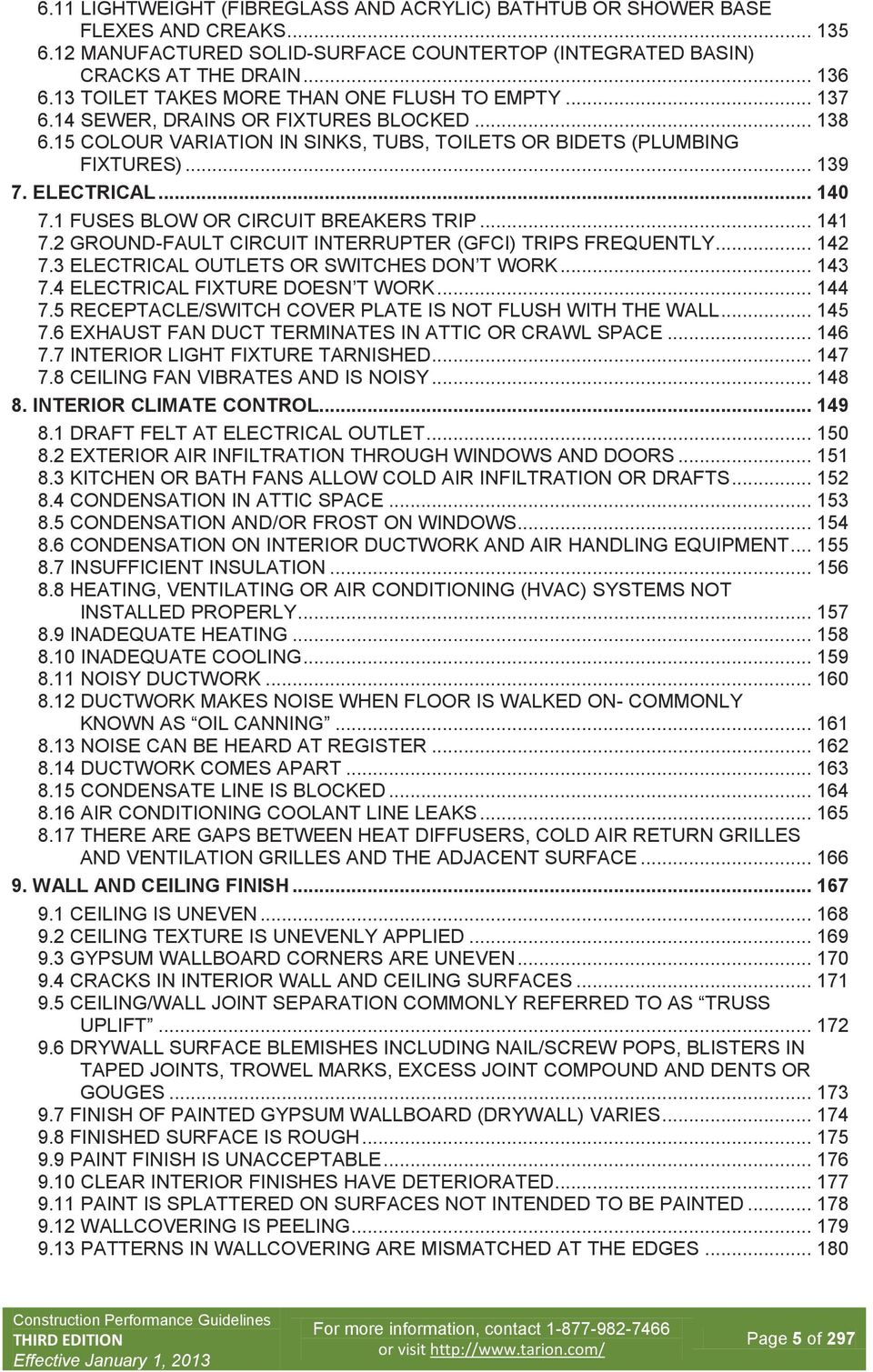
5 6.11 LIGHTWEIGHT (FIBREGLASS AND ACRYLIC) BATHTUB OR SHOWER BASE FLEXES AND CREAKS MANUFACTURED SOLID-SURFACE COUNTERTOP (INTEGRATED BASIN) CRACKS AT THE DRAIN TOILET TAKES MORE THAN ONE FLUSH TO EMPTY SEWER, DRAINS OR FIXTURES BLOCKED COLOUR VARIATION IN SINKS, TUBS, TOILETS OR BIDETS (PLUMBING FIXTURES) ELECTRICAL FUSES BLOW OR CIRCUIT BREAKERS TRIP GROUND-FAULT CIRCUIT INTERRUPTER (GFCI) TRIPS FREQUENTLY ELECTRICAL OUTLETS OR SWITCHES DON T WORK ELECTRICAL FIXTURE DOESN T WORK RECEPTACLE/SWITCH COVER PLATE IS NOT FLUSH WITH THE WALL EXHAUST FAN DUCT TERMINATES IN ATTIC OR CRAWL SPACE INTERIOR LIGHT FIXTURE TARNISHED CEILING FAN VIBRATES AND IS NOISY INTERIOR CLIMATE CONTROL DRAFT FELT AT ELECTRICAL OUTLET EXTERIOR AIR INFILTRATION THROUGH WINDOWS AND DOORS KITCHEN OR BATH FANS ALLOW COLD AIR INFILTRATION OR DRAFTS CONDENSATION IN ATTIC SPACE CONDENSATION AND/OR FROST ON WINDOWS CONDENSATION ON INTERIOR DUCTWORK AND AIR HANDLING EQUIPMENT INSUFFICIENT INSULATION HEATING, VENTILATING OR AIR ING (HVAC) SYSTEMS NOT INSTALLED PROPERLY INADEQUATE HEATING INADEQUATE COOLING NOISY DUCTWORK DUCTWORK MAKES NOISE WHEN FLOOR IS WALKED ON- COMMONLY KNOWN AS OIL CANNING NOISE CAN BE HEARD AT REGISTER DUCTWORK COMES APART CONDENSATE LINE IS BLOCKED AIR ING COOLANT LINE LEAKS THERE ARE GAPS BETWEEN HEAT DIFFUSERS, COLD AIR RETURN GRILLES AND VENTILATION GRILLES AND THE ADJACENT SURFACE WALL AND CEILING FINISH CEILING IS UNEVEN CEILING TEXTURE IS UNEVENLY APPLIED GYPSUM WALLBOARD CORNERS ARE UNEVEN CRACKS IN INTERIOR WALL AND CEILING SURFACES CEILING/WALL JOINT SEPARATION COMMONLY REFERRED TO AS TRUSS UPLIFT DRYWALL SURFACE BLEMISHES INCLUDING NAIL/SCREW POPS, BLISTERS IN TAPED JOINTS, TROWEL MARKS, EXCESS JOINT COMPOUND AND DENTS OR GOUGES FINISH OF PAINTED GYPSUM WALLBOARD (DRYWALL) VARIES FINISHED SURFACE IS ROUGH PAINT FINISH IS UNACCEPTABLE CLEAR INTERIOR FINISHES HAVE DETERIORATED PAINT IS SPLATTERED ON SURFACES NOT INTENDED TO BE PAINTED WALLCOVERING IS PEELING PATTERNS IN WALLCOVERING ARE MISMATCHED AT THE EDGES Page 5 of 297
6 9.14 WATER PENETRATION BEHIND CERAMIC TILE AND BATHTUB OR SHOWER ENCLOSURES MILDEW OR FUNGUS IS VISIBLE ON INTERIOR SURFACES INTERIOR FINISH INTERIOR DOOR IS WARPED BI-FOLD AND SLIDING DOORS COME OFF TRACKS POCKET DOOR RUBS DOOR RUBS ON THE DOORJAMB OR DOES NOT LATCH WOOD DOOR PANEL HAS SPLIT DOOR DRAGS ON THE FLOOR GAP BETWEEN THE DOOR AND THE DOORJAMB IS NOT UNIFORM INTERIOR DOOR SWINGS OPEN OR CLOSES BY ITSELF DOORS BIND FROM IMPROPERLY INSTALLED HINGES HINGES ARE PAINTED GAPS EXIST BETWEEN STAIR PARTS SQUEAKING STAIR RISER OR TREAD GAPS EXIST BETWEEN RAILING PARTS STAIR RAILINGS LACK RIGIDITY JOINT QUALITY OF INTERIOR TRIM AND MOULDING WORK NAILHEADS AND FASTENERS ARE NOT PROPERLY SET OR FILLED INTERIOR TRIM IS SPLIT HAMMER MARKS ARE VISIBLE ON TRIM RESIN BLEEDING THROUGH PAINTED FINISH WALL AREA AROUND COLD ROOM DOOR IS UNFINISHED INTERIOR DOOR EDGE IS NOT PAINTED STAIRS, TREADS AND/OR LANDINGS ARE OUT OF LEVEL CABINETS AND COUNTERTOPS GAP BETWEEN CABINETS AND CEILINGS OR WALLS CABINETS DO NOT LINE UP WITH EACH OTHER CABINET DOORS AND DRAWER FACES ARE WARPED CABINET DOOR OR DRAWER BINDS OR RUBS CABINET DOORS WILL NOT STAY CLOSED LAMINATED COUNTERTOP (INCLUDING SEAMS, JOINTS OR EDGES) HAS SWELLED LAMINATED COUNTERTOP IS DELAMINATED CRACKS IN COUNTERTOP SURFACES SCRATCHES/CHIPS ON COUNTERTOPS SEAMS (JOINTS) IN STONE COUNTERTOPS ARE TOO WIDE OR OPEN SURFACE PITS, FISSURES OR VEINS IN NATURAL STONE COUNTERTOPS FLOORING TRANSITION BETWEEN DIFFERENT TYPES OF FLOORING IS NOT FLUSH FINISHED FLOOR IS UNEVEN PATTERN OF FINISHED FLOORING IS OUT OF ALIGNMENT WITH ADJACENT WALL SURFACES CARPET SEAM IS VISIBLE CARPET IS LOOSE OR STRETCHING HAS OCCURRED SPOTS OR FADING ON CARPET CARPET NOT UNIFORM IN COLOUR CARPET HAS DARK STAINS AROUND PERIMETER OF ROOMS AND AT HEATING REGISTERS HOLLOW AREAS IN UNDERPAD BELOW CARPET SURFACE PROTRUSIONS APPEAR ON THE SURFACE OF RESILIENT FLOORING WITHOUT BREAKING THROUGH RESILIENT SHEET FLOORING IS LOOSE RESILIENT FLOORING JOINTS NOT TIGHT Page 6 of 297

7 12.13 BUBBLES APPEAR ON VINYL FLOORING SURFACE PATTERNS ON SHEET VINYL FLOORING ARE NOT ALIGNED ACROSS SEAMS RESILIENT (FLEXIBLE) FLOOR TILE IS LOOSE PATTERNS OR CORNERS OF RESILIENT FLOOR TILE ARE MISALIGNED YELLOWING APPEARS ON SURFACE OF VINYL FLOORING DYE LOT VARIATIONS IN VINYL FLOORING VARIATION IN COLOUR OCCURRING DURING REPAIR OF VINYL FLOORING CRACKS DEVELOPING BETWEEN STRIPS OF HARDWOOD OR PARQUET FLOORING STRIP HARDWOOD FLOORING IS CUPPED (HIGH EDGES) THE SURFACE OF ONE STRIP OF HARDWOOD OR PARQUET FLOORING IS HIGHER THAN ANOTHER FLOOR FINISH ON WOOD FLOORING IS NOT UNIFORM FINISH ON WOOD FLOORING HAS CRACKED, BLISTERED, BUBBLED, OR PEELED RESULTING IN DETACHMENT OF FINISH CROWNING OF STRIP HARDWOOD FLOORING HAS OCCURRED (CENTRE OF STRIP IS HIGHER THAN EDGES) WOOD FLOORING BUCKLES AND DETACHES FROM SUBSTRATE KNOTS AND COLOUR VARIATION IN STRIP WOOD FLOORING SPLINTERS OCCUR IN STRIP WOOD FLOORING STICKER BURN APPEARS ON SURFACE OF STRIP FLOORING CERAMIC/PORCELAIN TILE, MARBLE OR STONE FLOORING IS BROKEN OR LOOSE (INCLUDING MARBLE TRANSITIONS) CRACKS APPEARING IN GROUTING OF CERAMIC TILE JOINTS OR AT JUNCTIONS WITH OTHER MATERIALS SUCH AS BATHTUBS ADJACENT MARBLE UNITS OR CERAMIC TILE SURFACES INSTALLED AT DIFFERENT ELEVATIONS GROUT IS NOT A UNIFORM COLOUR DYE LOT VARIATIONS IN CERAMIC FLOOR TILES VARIATION IN COLOUR IN NATURAL STONE TILE INSTALLATIONS (GRANITE, MARBLE, TRAVERTINE, SLATE AND LIMESTONE) GAPS DEVELOPING AT ENDS OR ALONG STRIPS OF LAMINATE FLOORING LAMINATE FLOORING IS CUPPED (HIGH EDGES) LAMINATE FLOORING BUCKLES LAMINATE FLOORING STRIPS ARE DENTED, SCRATCHED AND/OR CHIPPED CHIMNEYS AND FIREPLACES JOINT OR CRACK IN CHIMNEY CAP ALLOWS WATER LEAK ROOF FLASHING LEAKS AT CHIMNEY BRICKS BREAKING UP ON SURFACE OF CHIMNEY CHIMNEY SERVING SOLID-FUEL-BURNING (WOOD, PELLET, ETC.) APPLIANCE DOES NOT DRAW PROPERLY FIREPLACE FIREBOX PAINT COLOUR CHANGED FIREBRICK IS BROKEN GARAGES AND EXTERIORS GARAGE FLOOR HAS HEAVED OR SETTLED CONCRETE GARAGE FLOOR IS CRACKED NO REINFORCEMENT IN GARAGE SLAB GARAGE DOORS DO NOT OPERATE PROPERLY GARAGE DOORS (VEHICULAR AND MAN-DOORS) ALLOW ENTRANCE OF SNOW OR WATER WATER ACCUMULATES ON GARAGE FLOOR ASPHALT OR CONCRETE DRIVEWAY HAS CRACKED DRIVEWAY HAS SETTLED SOD/SEEDING NOT COMPLETED THE SHRUBS, TREE(S), PLANTS, OR SOD HAVE DIED Page 7 of 297

8 14.11 TREE STUMPS HAVE BEEN LEFT ON THE PROPERTY WATER PONDING IN SURFACE GRADING OF THE SITE SETTLING, HEAVING OR SEPARATING OF LANDINGS OR STEPS EXTERIOR DECK IS SPRINGY OR SHAKY EXTERIOR DECK RAILING IS SHAKY DECK BOARD SPACING IS NOT UNIFORM EXTERIOR WOOD HANDRAILS HAVE SLIVERS EXTERIOR DECK IS OUT OF LEVEL FLOOR DECKING BOARDS ARE SPLIT, WARPED OR CUPPED STAIN COLOUR VARIATIONS ON WOOD DECK NAILHEADS STICK UP ON DECK SURFACE STAINS ON EXTERIOR DECKING FROM NAILHEADS TWISTING OF OPEN-END BEAMS APPENDICES A1 Sources A2 Moisture in Wood and Laminate Floors A3 Moisture and Windows A4 Measuring Variation from the Specified Plane Using a Plane of Reference To measure the variation Approximate width measurements specified in this document A5 How to Conduct a Water Test Above Grade Below Grade A6 Chipped Clay Bricks Using a representative sample to determine the percentages of affected bricks in Table Illustrating Brick Chippage A7 Construction Performance Guidelines Comments/Suggestion Form Page 8 of 297

9 Acknowledgements (Back to Table of Contents) Tarion Corporation greatly appreciates the commitment and contributions to this document by the following individuals and organizations: Review Committee: Bernie Torchia Bob Ridley Bob Thoburn Bob Waldron Brian Couperthwaite Corey Libfeld Dave Henderson Doug Tarry Gabriela Levrero Hitesh Doshi Vice President, High Rise Construction, Monarch Group President, Building Better Home Builders Inc. Director, Builder Relations, Tarion Chief Building Official, City of Peterborough Vice President Construction, Brookfield Homes (Ontario) Ltd. Director, Conservatory Group Director, Industry Relations, Ontario Home Builders Association Director, Doug Tarry Homes Research & Development Analyst, Claims, Tarion Professor, Department of Architectural Science, Ryerson University Director, Building Standards, City of Vaughan Executive Director, Homeowner Protection Centre Vice President, Builder Relations, Tarion President, Professional Home and Property Inspectors of Canada Leo J. Grellette Michael Lio Mike Cote Paul Wilson Peter Balasubramanian Vice President, Claims, Tarion Peter Saturno President, Midhaven Homes Writing Group: Dave Henderson Gabriela Levrero Hitesh Doshi Director, Industry Relations, Ontario Home Builders Association Research & Development Analyst, Claims, Tarion Professor, Department of Architectural Science, Ryerson University The following agencies were consulted and/or provided feedback during the research and/or review of the topics covered in this document. Industry Agencies: Canadian Association of Home & Property Inspectors Canadian Carpet Institute Canadian Kitchen Cabinet Association Canadian Plywood Association Canadian Window and Door Manufacturers Association Cement Association of Canada Concrete Forming Association of Ontario Heating, Refrigeration & Air Conditioning Institute Independent Plumbing & Heating Contractors Association Low Rise Forming Association Mechanical Contractors Association of Ontario Ministry of Municipal Affairs and Housing Page 9 of 297

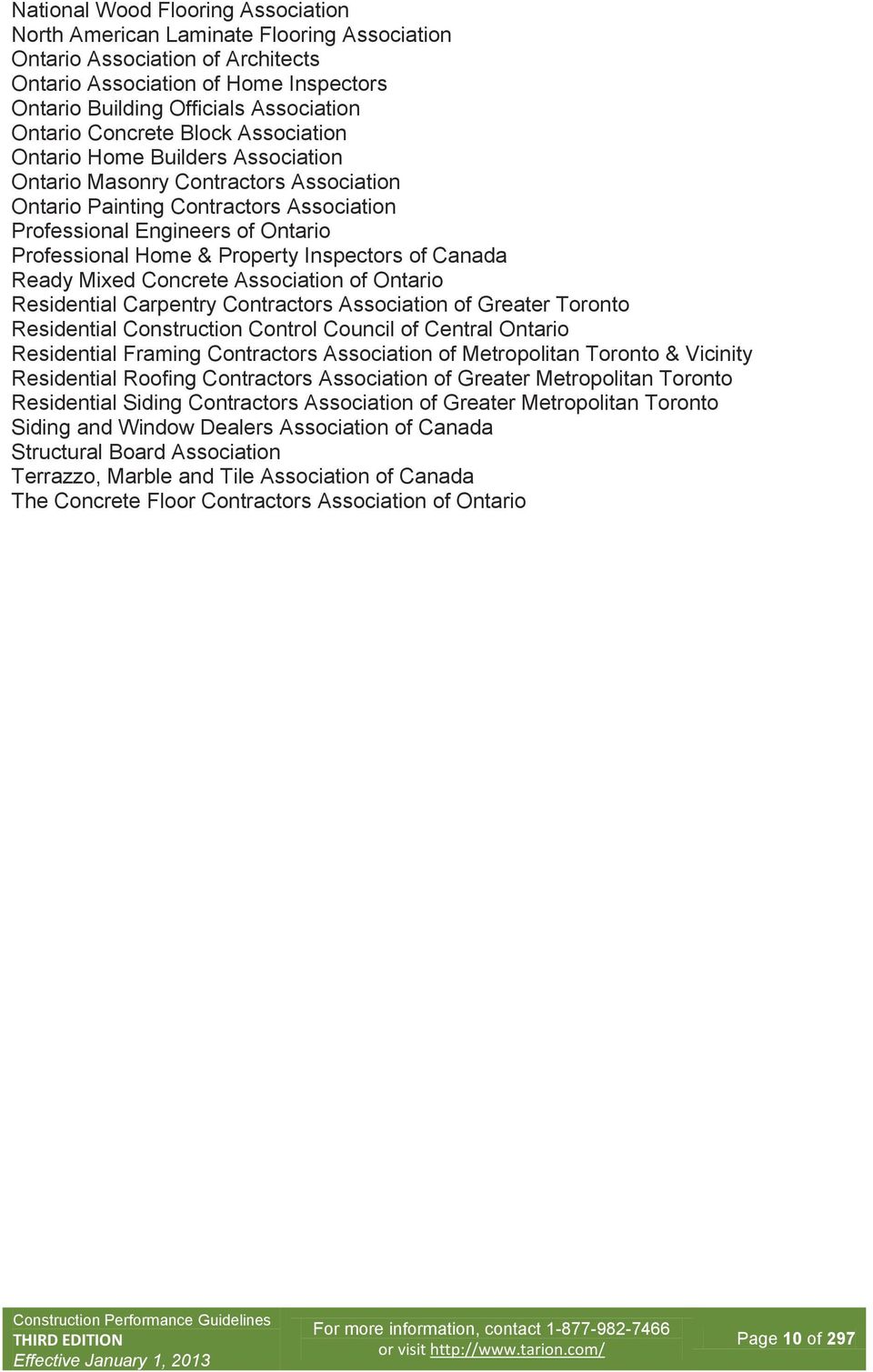
10 National Wood Flooring Association North American Laminate Flooring Association Ontario Association of Architects Ontario Association of Home Inspectors Ontario Building Officials Association Ontario Concrete Block Association Ontario Home Builders Association Ontario Masonry Contractors Association Ontario Painting Contractors Association Professional Engineers of Ontario Professional Home & Property Inspectors of Canada Ready Mixed Concrete Association of Ontario Residential Carpentry Contractors Association of Greater Toronto Residential Construction Control Council of Central Ontario Residential Framing Contractors Association of Metropolitan Toronto & Vicinity Residential Roofing Contractors Association of Greater Metropolitan Toronto Residential Siding Contractors Association of Greater Metropolitan Toronto Siding and Window Dealers Association of Canada Structural Board Association Terrazzo, Marble and Tile Association of Canada The Concrete Floor Contractors Association of Ontario Page 10 of 297
11 INTRODUCTION (Back to Table of Contents) This document provides measurable benchmarks to assist homeowners and builders with performance related issues arising from workmanship and material deficiencies in new residential construction. PURPOSE OF THIS DOCUMENT The Construction Performance Guidelines (Guidelines) will be used by Tarion Corporation (Tarion) when determining whether or not a condition is covered by the statutory warranty. The purpose of the Guidelines is to provide advance information as to how Tarion will decide disputes between homeowners and builders about defects in work or materials. The Guidelines are intended to complement the Building Code and are supplemented by any applicable guidelines or standards produced by industry associations. They do not replace manufacturer warranties. The Guidelines have been prepared in consultation with various industry volunteers, Tarion employees and the general public. BACKGROUND The first edition of the Guidelines was published on April 2, 2003, to provide measureable benchmarks on the most common issues encountered by new homeowners and builders in Ontario. The second edition of the Guidelines was released on December 1, The parameters and criteria used in this current version were initially established under the previous documents. REVIEW Since the last revision of the Guidelines in 2003, Tarion has collected suggestions/feedback on the most common issues encountered by homeowners, builders and employees who use this document. In 2008, a Committee was organized with volunteers from the construction industry to review all suggestions regarding revisions to the current Guidelines and possible new items. For a list of participants, please see the Acknowledgements section on page 9. At the end of 2010, the Committee completed the review of all suggestions and proposed revisions to the Guidelines. A public consultation phase followed: December 2010 to January 2011, where the public and industry organizations/agencies were invited to review and comment. The proposed revisions were published on Tarion s website and all comments received were considered in the final Guidelines. During the review process, the Committee deliberated on all submissions from the various stakeholders. Tarion welcomes suggestions for future versions of this document. Page 11 of 297

12 (Back to Table of Contents) Please refer to COMMENTS WELCOME on page 19 to make a submission for future consideration. SCOPE OF GUIDELINES Applicability: The Guidelines are designed primarily for conventional low-rise buildings, of wood frame construction, which is the predominant method of low-rise residential construction in Ontario. Some items may also apply to performance related issues encountered within Condominium units; however, this document excludes Common Elements. For information on Common Elements, see the definition in the Terminology section on page 17, or refer to Types of New Homes on our website at Interpretation: The Guidelines should be interpreted with common sense. They deal only with the most frequent and typical items of concern to homeowners. The Guidelines describe the minimum acceptable performance or condition that homeowners should expect and builders must meet to satisfy the requirements of the warranties described in the Ontario New Home Warranties Plan Act ( the Act ). Construction is not an exact science and generally, the materials used have natural properties and faults that must be considered when applying the Construction Performance Guidelines. For example: Colours of all materials will be as close to samples as possible, but may not be identical to samples due to variances among manufacturers or differences in the manufacturing process; Wood grains and colours may not necessarily match in all cases; Shrinkage of natural materials may result in squeaks and creaks. Some items in this document refer to specific dimensions to determine what is acceptable. These dimensions are used to evaluate the identified conditions. If the variation is minor, Tarion may consider whether the variation significantly affects the performance of the item in determining whether the particular guideline has been met. Tarion will make its decisions based on the edition of the Guidelines that is in effect at the time a conciliation, warranty review or claim inspection is conducted. The effective date is indicated on both the cover of the Guidelines and on the bottom of each page. Building Code, Industry References & Manufacturers Warranties: The Guidelines are intended to complement the Building Code, which addresses structural integrity and health and safety matters. In the event where a guideline is in contradiction with the Building Code, the Building Code will prevail. When addressing Building Code issues, it is necessary to consider the construction approval year of the home by the Municipality, Town or Region. The construction approval year will determine the applicable Building Code requirements to your home. The Guidelines are designed to be supplemented by any applicable documentation or standards produced by industry associations. They do not replace manufacturer Page 12 of 297

13 (Back to Table of Contents) warranties. Issues related to extended warranties must be resolved directly with the manufacturer or distributor. SCOPE OF WARRANTY RESPONSIBILITIES Parties Involved: Typically there may be a number of parties involved in a residential construction warranty issue in Ontario. The general responsibilities of the main parties are outlined below: The Homeowner 1 : Before signing an Agreement of Purchase and Sale or construction contract, the prospective homeowner should carefully review the document to ensure that it expressly includes all the features agreed upon or to be selected during construction. Before signing a contract, the homeowner should seek legal advice, particularly if any aspect of the contract is unclear. Homeowners also have certain preand post-possession responsibilities to fulfill in order to preserve and exercise their statutory warranty rights. These responsibilities are briefly outlined in the section titled INCOMPLETE, MISSING OR DAMAGED ITEMS on page 15, and are explained in more detail in the Homeowner Information Package 2. Builder/Vendor³: The builder is responsible for honouring all warranties set out in the Act and Regulations. The builder may at times have to go back to the manufacturer to obtain a solution for a possible defect, which may delay the repair. For homes with a date of possession on or after October 1, 2003, builders must also follow the Customer Service Standard, which is explained in detail in Builder Bulletin #42. Tarion Corporation: Tarion is responsible for administering the Ontario New Home Warranties Plan Act. As part of this responsibility, Tarion makes decisions when builders and homeowners disagree about an item covered under the statutory warranties. Tarion also guarantees builders statutory warranties, and provides extended major structural defect coverage for years three through seven after a home s date of possession. 1 The term owner is defined in the Ontario New Home Warranties Plan Act - see the definition in the Terminology section on page 17. Throughout this document the term homeowner will be used to refer to owners. 2 The information contained in the Homeowner Information Package applies only to new freehold homes and condominium units with a date of possession on or after October 1, ³ The terms builder and vendor are defined in the Ontario New Home Warranties Plan Act - see the definitions included in the Terminology section on page 17. Throughout this document the term builder will be used to refer to builders and vendors. STATUTORY WARRANTY COVERAGE coverage is set out in the Act and takes effect from the date a homeowner takes possession of a new home from the builder (the date of possession ). It remains in effect even if the home is sold or otherwise transferred before the end of the warranty period. There are three types of statutory warranty protection or coverages, including: Page 13 of 297

14 (Back to Table of Contents) The One-Year A builder warrants that, for one year from the date of possession, the home: is free from defects in work and materials; is fit to live in, and; meets Ontario Building Code requirements Builders should provide homeowners with all warranties provided by manufacturers, suppliers and subcontractors that may extend beyond the first year. Homeowners must make claims on these extended warranties directly to the manufacturer or distributor. A builder is also required to provide a warranty against delayed closings (or delayed occupancy for condominium units) that occur without prescribed notice, and the homeowner may make a claim under this warranty within one year after the date of possession. For more information on delayed closings, homeowners should refer to the Homeowner Information Package or visit Tarion s website at The Two-Year A builder warrants that, for two years from the date of possession, the home is free from: Water penetration through the basement or foundation walls; Defects in materials or work (including windows, doors and caulking) that result in water penetration into the building envelope; Defects in materials and work in the electrical, plumbing and heating delivery and distribution systems; Defects in materials and work which result in detachment, displacement or deterioration of exterior cladding (such as brickwork, aluminum or vinyl siding); Violations of Ontario Building Code regulations under which the Building Permit was issued, affecting health and safety, including, but not limited to, fire safety, insulation, air and vapour barriers, ventilation, heating and structural adequacy; Major structural defects. For a definition of major structural defect, see the Terminology section on page 17. Seven-Year Major Structural Defect Coverage 4 In addition to the builder s two-year warranty against major structural defects, Tarion provides coverage for major structural defects in years three through seven. 4 The term major structural defect is defined in Regulation 892, Section 1, made under the Ontario New Home Warranties Plan Act. See the definitions included in the Terminology section on page 17. Page 14 of 297

15 S NOT COVERED UNDER WARRANTY (Back to Table of Contents) It is important for homeowners to note what is not covered by the statutory warranty. The Act sets out the following exclusions from warranty coverage: Defects in materials, design and work supplied by the homeowner; Secondary damage caused by defects under warranty, such as property damage and personal injury; Normal wear and tear; Normal shrinkage of materials caused by drying after construction; Damage caused by dampness or condensation due to failure by the homeowner to maintain adequate ventilation or proper operation of moisture-producing devices such as humidifiers; Damage caused by the homeowner or visitors; Alterations, deletions or additions made by the homeowner; Settling of land around the building or along utility lines, other than beneath the footings of the building; Damage resulting from acts of God; Contractual warranties which lie outside the Ontario New Home Warranties Plan Act; Damage caused by insects or rodents, except where construction does not meet specifications of the Ontario Building Code; Damage caused by municipal services or other utilities; Surface defects in work and materials specified and accepted in writing by the homeowner at the date of possession. is also not applicable to: Temporary or seasonal homes not built on permanent foundations and not insulated sufficiently to enable year-round living (i.e., cottages); Homes built on pre-existing footings and/or foundations where the existing part exceeds 40% of the footings as determined by linear measurement (footprint). For further information, please refer to Homes Built on Existing Foundations, or visit Tarion s website at Homes that have been lived in or rented prior to sale; Homes built in converted buildings; Homes purchased from a receiver or trustee may not have warranty coverage in certain circumstances. If there is any conflict between this publication and the Act or Regulations, the latter prevail. Tarion assumes no liability for any error or omission in this publication. INCOMPLETE, MISSING OR DAMAGED ITEMS At Pre-Delivery Inspection (PDI) A pre-delivery inspection (PDI) is conducted by the builder and the prospective homeowner (or the homeowner s designate), on or before the date of possession. The PDI provides an important opportunity for the prospective homeowner to observe and record any items in the home that are incomplete, missing, damaged or non-operational. Page 15 of 297

16 (Back to Table of Contents) If the item is covered by a statutory warranty, the builder must repair the damaged or non-operational item, or install the missing or incomplete item. For homes with a date of possession before October 1, 2003, these items should be recorded on the Certificate of Completion and Possession (CCP) or in an attachment to the CCP. For homes with a date of possession on or after October 1, 2003, these items must be recorded on a Pre-Delivery Inspection Form (PDI Form) that has been approved by Tarion. Listing an incomplete, missing, damaged or non-operational item on the CCP or the PDI Form will provide a formal record of the existence of the condition before the homeowner took possession. Without this record it may be impossible for Tarion to determine whether the item is covered under warranty if a dispute arises as it may not be clear who caused the damage or malfunction in question or whether an item was missing before the date of possession. After the PDI, any PDI items not rectified by the builder and any new defects that have emerged should be reported in writing to both the builder and Tarion within the applicable warranty period. For homes with a date of possession on or after October 1, 2003, the homeowner must report these items on standard Service Request Forms and submit them within the time periods set out in the Services Rules. For more information on the PDI and the Service Rules, homeowners should refer to the Homeowner Information Package. HOW TO USE THIS DOCUMENT The Construction Performance Guidelines are divided into articles based on construction sequence. The information is organized according to types of conditions, and in each case, the following is described: Condition: A brief description of the identified situation. What is acceptable: The acceptable performance standard of the condition. Which warranty applies: The statutory warranty that applies and any exclusions. Required action: A description of the action that the builder or homeowner must take to rectify the identified condition. : Information to help users understand and solve the problem. : Other items in this document that may be similar to the condition and/or provide further information related to the condition. MEASUREMENTS For instructions on how to measure variations from a specified plane, or for other acceptable measuring tools, please see A4 in the Appendix. Page 16 of 297

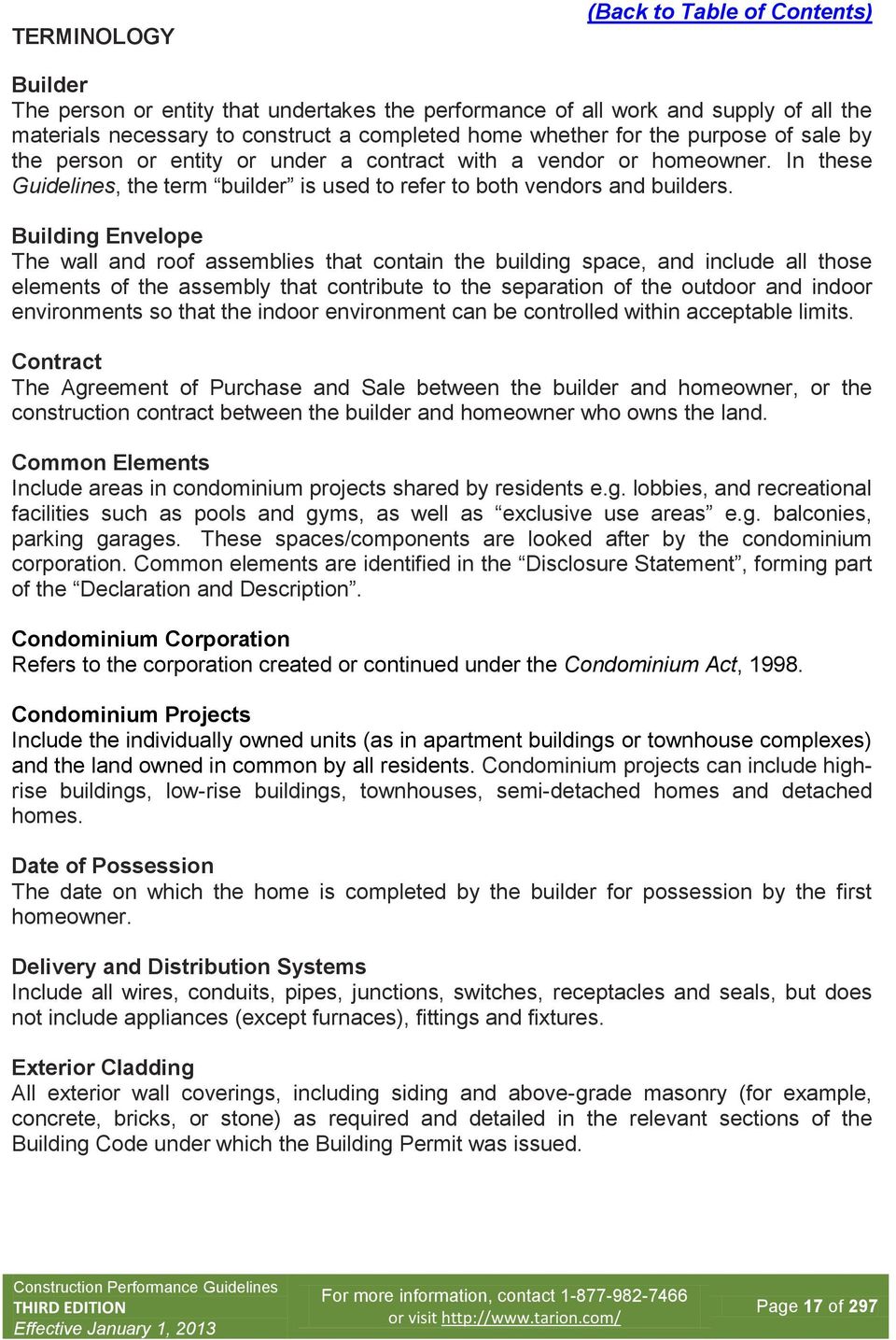
17 TERMINOLOGY (Back to Table of Contents) Builder The person or entity that undertakes the performance of all work and supply of all the materials necessary to construct a completed home whether for the purpose of sale by the person or entity or under a contract with a vendor or homeowner. In these Guidelines, the term builder is used to refer to both vendors and builders. Building Envelope The wall and roof assemblies that contain the building space, and include all those elements of the assembly that contribute to the separation of the outdoor and indoor environments so that the indoor environment can be controlled within acceptable limits. Contract The Agreement of Purchase and Sale between the builder and homeowner, or the construction contract between the builder and homeowner who owns the land. Common Elements Include areas in condominium projects shared by residents e.g. lobbies, and recreational facilities such as pools and gyms, as well as exclusive use areas e.g. balconies, parking garages. These spaces/components are looked after by the condominium corporation. Common elements are identified in the Disclosure Statement, forming part of the Declaration and Description. Condominium Corporation Refers to the corporation created or continued under the Condominium Act, Condominium Projects Include the individually owned units (as in apartment buildings or townhouse complexes) and the land owned in common by all residents. Condominium projects can include highrise buildings, low-rise buildings, townhouses, semi-detached homes and detached homes. Date of Possession The date on which the home is completed by the builder for possession by the first homeowner. Delivery and Distribution Systems Include all wires, conduits, pipes, junctions, switches, receptacles and seals, but does not include appliances (except furnaces), fittings and fixtures. Exterior Cladding All exterior wall coverings, including siding and above-grade masonry (for example, concrete, bricks, or stone) as required and detailed in the relevant sections of the Building Code under which the Building Permit was issued. Page 17 of 297
18 (Back to Table of Contents) Home Includes self-contained one-family dwellings, whether attached or detached; buildings consisting of two or less self-contained one-family dwellings under common ownership; or a condominium dwelling unit, including the common elements. Also includes any structure used in conjunction with the home, but does not include a building built and sold for temporary occupancy or for seasonal purposes. Homeowner The person who first acquires the home from a builder for occupancy, and the person s successor in title. Major Structural Defect Any defect in work or materials: a) that results in failure of a load-bearing element of a building; b) that materially and adversely affects the ability of a structural load-bearing element of the building to carry, bear and resist applicable structural loads for the usual and ordinary service life of the element; or c) that materially and adversely affects the use of a significant portion of the building for usual and ordinary purposes of a residential dwelling and having regard to any specific use provisions set out in the Purchase Agreement for the home. but excluding any defect attributable in whole or in part to: any elevating device as opposed to the surrounding structure of the building housing the device, any appliances that form part of the heating or cooling apparatus, equipment or system, whether the water, air or other substances, including furnaces, air conditioners, chillers and heat recover ventilators, dampness not arising from failure of a structural load-bearing element of the building, acts or omissions of an owner, a tenant, a licensee or invitee, acts of civil or military authorities or acts of war, riot, insurrection or civil commotion, a flood not caused by the builder, and other exclusions set out in subsection 13(2) of the ONHWP Act. Normal Typical, usual, ordinary or reasonably expected. PDI Pre-Delivery Inspection of the home, which is conducted by the builder together with the purchaser or their designate. Properly painted surface Uniform in appearance, colour and sheen, free of foreign material, lumps, skins, runs, sags, insufficient coverage, drips, spatter, spills and over spray. Repair Activity to be undertaken by the builder as referred to under for conditions included in the Construction Performance Guidelines. The method of repair may involve restoration, alteration, or partial or full replacement of materials or equipment. The builder must choose a repair method that will satisfy the acceptable performance/ condition specified in the applicable guideline. Page 18 of 297

19 (Back to Table of Contents) Generally, where repairs are necessary, colour and/or texture may not match exactly the surrounding original material. Smooth An even surface that is free from bumps, projections, foreign material, etc. Specified plane A flat, invisible line between two points on the surface of a wall, ceiling or floor which defines the intended flat surface. The points shall be located as far apart as possible, e.g. opposite sides of a room or opposite ends of a wall. Such a plane of reference is used to measure the variation between the specified plane and the actual surface. See Appendix A4 Measuring Variation from the Specified Plane Using a Plane of Reference. Vendor The person or entity who sells on its own behalf a home not previously occupied to a homeowner. Visible Easily seen when viewed from a position that is normal to the use of the room or area - e.g., hallway - standing position; living room - standing or sitting. COMMENTS WELCOME Tarion encourages readers to submit comments regarding their experiences with the Guidelines. For submission details, please see A7 Construction Performance Guidelines Comments/Suggestion Form. All information will be used to improve future versions of this document. Page 19 of 297

20 1. FOUNDATION/BASEMENT (Back to Table of Contents) Page 20 of 297
21 1.1 (Back to Table of Contents) 1.1 EFFLORESCENCE (TYPICALLY A WHITE POWDERY FILM) IS PRESENT ON CONCRETE OR MASONRY FOUNDATION SURFACES Efflorescence can occur on concrete and masonry foundation surfaces. None. The builder is not required to take any action. Efflorescence is the formation of a typically white crystalline deposit on the surface of concrete or masonry foundation surfaces when moisture evaporates from the surface. Efflorescence can be removed using a stiff bristle brush and water EFFLORESCENCE (TYPICALLY A WHITE POWDERY FILM) IS PRESENT ON MASONRY EXTERIOR FINISHES Page 21 of 297
22 1.2 (Back to Table of Contents) 1.2 INTERIOR CONCRETE SURFACES ARE POWDERY Concrete surfaces shall be sufficiently hard to prevent powdering which results in exposure of the aggregate. Surface deterioration due to owner-applied substances is excluded from the statutory warranty. Where powdering occurs exposing the aggregate the concrete surface shall be repaired to provide a hardened surface. Some dusting of the concrete surface may normally occur; however, where the aggregate becomes exposed the condition is considered excessive. The colour and texture of a repaired area may not match the surrounding concrete. n/a Page 22 of 297
23 1.3 (Back to Table of Contents) 1.3 CONCRETE SURFACE IS FLAKING OFF OR SCALING Concrete surfaces shall not disintegrate to the extent that the aggregate is exposed under normal conditions of weathering and use. One-Year. Work and Materials Surface deterioration due to owner-applied substances, improper maintenance, or normal wear and tear is excluded from the statutory warranty. Where defective installation or product is determined, the concrete surface shall be repaired. Scaling of exterior concrete surfaces including concrete porches, walkways, garage floor slabs, steps (including precast), etc, most often results from salts and de-icers being applied to the concrete surface, e.g. either intentionally for ice melting or unintentionally from road slush deposits. Cleaning salt deposits off concrete surfaces is normal home maintenance. Where repairs are necessary, colour and/or texture may not match the surrounding concrete. n/a Page 23 of 297
24 1.4 (Back to Table of Contents) 1.4 CONCRETE BASEMENT FLOOR IS CRACKED Cracks resulting from normal shrinkage are acceptable; however, cracks in excess of 4 mm in width are not acceptable. Cracks resulting from normal shrinkage of materials caused by drying after construction are excluded from the statutory warranty. Cracks in excess of the acceptable condition shall be repaired. Generally, concrete floor slabs are not structural. Concrete floors naturally crack during curing due to shrinkage. Actual crack widths shall be determined using a wire feeler gauge* inserted inside the crack. Since the concrete floor slabs do not have to carry the load of the building, shrinkage cracks are generally considered aesthetic. Where vertical or lateral movement is evident, further investigation may be required. Where repairs are necessary, colour and/or texture will not match the surrounding concrete CONCRETE GARAGE FLOOR IS CRACKED. * Because it is of a manufactured, set size, an Allen Wrench/Key may be used as a wire feeler gauge. Page 24 of 297
25 1.5 (Back to Table of Contents) 1.5 CONCRETE FLOOR SLAB-ON-GROUND HAS SETTLED IN A FINISHED AREA At the perimeter of rooms, concrete floor slabs shall not settle more than 12 mm from their original position. Slabs that settle more than the acceptable condition shall be repaired. None. n/a Page 25 of 297
26 1.6 (Back to Table of Contents) 1.6 NO REINFORCEMENT IN BASEMENT CONCRETE SLAB Unless the slab is specifically intended and designed to be a structural slab, reinforcing or mesh is not required. Seven-Year - Major Structural Defect Where a structural slab is not reinforced as required by the design, repairs shall be made; otherwise no action is required. Concrete slabs in basements shall conform to the Building Code. Reinforcing of concrete slabs is not usually necessary unless unusual design or construction conditions are encountered NO REINFORCEMENT IN GARAGE SLAB. Page 26 of 297
27 1.7 (Back to Table of Contents) 1.7 CONCRETE BLOCK FOUNDATION WALL IS CRACKED Cracks resulting from normal shrinkage are acceptable; cracks in excess of 2 mm in width are not acceptable. Cracks resulting from normal shrinkage of materials caused by drying after construction are excluded from the statutory warranty. Cracks in excess of the acceptable condition shall be repaired. Where crack width exceeds the acceptable condition, or where lateral or vertical movement is evident, further investigation may be required. The colour and texture of a repaired area may not match the surrounding concrete CAST-IN-PLACE CONCRETE FOUNDATION WALL IS CRACKED 1.13 FOUNDATION WALL LEAKS Page 27 of 297
28 1.8 (Back to Table of Contents) 1.8 PARGING (NOT BRUSH COATING) IS FALLING OFF ABOVE GRADE Hairline cracks are normal in parged surfaces; parging that is separating from the concrete block base is not acceptable. Cracks resulting from normal shrinkage of materials due to normal drying after construction are not covered by the statutory warranty. Parging not meeting the acceptable condition shall be repaired. The Building Code only requires parging (a cement-based layer) on concrete block foundation walls below grade. Brush coating, however, is only a cosmetic application over poured concrete foundation walls and is covered by item 1.15 Brush coating on above grade poured concrete foundation wall is falling off. Slight variation in the colour or texture of repaired areas is acceptable. n/a Page 28 of 297
29 1.9 (Back to Table of Contents) 1.9 EXPOSED CAST-IN-PLACE CONCRETE FOUNDATION WALL HAS HOLES IN THE SURFACE The exterior portion of foundation walls exposed to view above grade shall have no holes (including honeycombing ) larger than 50 mm in diameter or 25 mm deep. One-Year Work and Materials Walls with holes exceeding the acceptable condition shall be repaired. It is impossible to completely eliminate all surface voids. At the builder s discretion a brush coat may be applied. The colour and texture of a repaired area may not match the surrounding concrete. See item 1.15 Brush coating on above grade poured concrete foundation wall is falling off n/a Page 29 of 297
30 1.10 (Back to Table of Contents) 1.10 CAST-IN-PLACE CONCRETE FOUNDATION WALL IS CRACKED Cracks resulting from normal shrinkage are acceptable; cracks in excess of 6 mm in width are not acceptable. Cracks resulting from normal shrinkage of materials caused by drying after construction are excluded from the statutory warranty. Walls with cracks exceeding the acceptable condition shall be repaired. Concrete walls naturally crack during curing due to shrinkage. Where lateral or vertical movement is evident, further investigation may be required. The colour and texture of a repaired area may not match the surrounding concrete. 1.7 CONCRETE BLOCK FOUNDATION WALL IS CRACKED Page 30 of 297
31 1.11 (Back to Table of Contents) 1.11 CONDENSATION IN CRAWL SPACE Condensation shall not accumulate on crawl space interior surfaces. Two-Year - Ontario Building Code Health & Safety Violations Damage caused by dampness or condensation due to failure by the homeowner to maintain adequate ventilation is excluded from the statutory warranty. Adequate ventilation equipment shall be installed in accordance with the Building Code. Crawl spaces shall be ventilated in accordance with the Building Code. Crawl space ventilation requires careful management by the homeowner to maintain acceptable moisture levels. Typical temporary conditions that may contribute to condensation are: a) at night in unheated crawl spaces, air entering the crawl space gradually cools the interior surfaces of the space. When outdoor temperatures rise the next day moisture picked up by the warm air is carried into the crawl space and condenses on the cool surfaces. b) at night in heated crawl spaces, outside air may rapidly cool foundation walls and provide a cool surface on which moisture in the crawl space can condense. c) if the house is left unheated in the winter, the floors and walls may provide cold surfaces on which moisture in the warmer crawl space may condense. d) stored materials obstruct ventilation airflow. These conditions may not be covered under the statutory warranty. n/a Page 31 of 297
32 1.12 (Back to Table of Contents) 1.12 BASEMENT WALL OR FLOOR IS DAMP Dampness on wall or floor surfaces caused by capillary transport or condensation of water vapour may occur. Only actual water penetration through an opening in the wall or floor may be covered by the statutory warranty. None. Damage caused by dampness or condensation due to failure by the homeowner to maintain adequate ventilation is excluded from the statutory warranty. No action by the builder is required. Condensation can occur during peak seasonal weather patterns. The homeowner should immediately reduce the moisture levels to prevent harm to property. Dampness can be reduced by using a dehumidifier or by increasing the amount of ventilation to the area FOUNDATION WALL LEAKS 1.14 WATER LEAKAGE THROUGH BASEMENT FLOOR SLAB Page 32 of 297
33 1.13 (Back to Table of Contents) 1.13 FOUNDATION WALL LEAKS Foundation walls shall allow no water penetration. Two-Year - Basement Water Penetration Water leakage resulting from improper maintenance, exterior grade alterations made by the homeowner, an act of God or failure of municipal services or other utilities is excluded from the statutory warranty. Secondary damage to property or any personal injury resulting from the water penetration is also excluded from the statutory warranty. Defects resulting in water penetration through the basement or foundation shall be repaired. Only actual trickling water leakage is warranted; dampness or condensation is not considered a warranted condition. The homeowner must take immediate steps to prevent damage to their property and report any losses to their home insurance provider. See Appendix A5 How to Conduct a Water Test for more information. 1.7 CONCRETE BLOCK FOUNDATION WALL IS CRACKED 1.10 CAST-IN-PLACE CONCRETE FOUNDATION WALL IS CRACKED 1.12 BASEMENT WALL OR FLOOR IS DAMP Page 33 of 297
34 1.14 (Back to Table of Contents) 1.14 WATER LEAKAGE THROUGH BASEMENT FLOOR SLAB Basement floor slabs shall allow no water penetration. Two-Year - Basement Water Penetration Water leakage resulting from improper maintenance, exterior grade alterations made by the homeowner, an act of God or failure of municipal services or other utilities is excluded from the statutory warranty. Secondary damage to property or any personal injury resulting from the water penetration is also excluded from the statutory warranty. Defects resulting in water penetration through the basement floor slab shall be repaired. Subsurface investigation may be required. Only actual water leakage through the floor slab resulting in an accumulation of water is warranted; dampness or condensation is not considered a warranted condition. The homeowner must take immediate steps to prevent damage to their property and report any losses to their home insurance provider. A thorough site investigation prior to construction and during excavation will assist in determining whether groundwater levels may adversely affect the use of the building BASEMENT WALL OR FLOOR IS DAMP Page 34 of 297
35 1.15 (Back to Table of Contents) 1.15 BRUSH COATING ON ABOVE GRADE POURED CONCRETE FOUNDATION WALL IS FALLING OFF Hairline cracks are normal in brush coated surfaces; brush coating that is separating from the concrete foundation is not acceptable. One-Year. Work and Materials Cracks resulting from normal shrinkage of materials due to normal drying after construction are not covered by the statutory warranty. Brush coating not meeting the acceptable condition shall be repaired. Brush coating is not an OBC requirement and absence of brush coating is not a warranted issue. Brush coating is a concrete slurry sometimes applied over poured concrete foundation walls to provide a more uniform finish. Some variation in the colour or texture is acceptable. For surface finishes of exposed cast-in-place concrete foundation wall refer to PARGING (NOT BRUSH COATING) IS FALLING OFF ABOVE GRADE Page 35 of 297
36 1.16 (Back to Table of Contents) 1.16 BASEMENT FLOOR DRAIN IS TOO HIGH Basement floor drains shall facilitate water drainage. One-Year Work and Materials One-Year Ontario Building Code Defects in materials, design and work supplied by the owner, secondary damage caused by defects such as property damage and personal injury, damage resulting from improper maintenance, alteration, deletions or additions made by the owner, or damage caused by municipal services or other utilities are excluded from the statutory warranty. Basement floor drains not meeting the acceptable condition shall be repaired. Basement concrete floors (slabs) are generally sloped towards a floor drain in order to facilitate water drainage in the event of accidental flooding. The location of the floor drain should be at the lowest point, but may not necessarily be located conveniently to facilitate drainage over the entire floor area. Localized ponding is acceptable. Basement floor drains and grates shall remain clear and unobstructed at all times, and should be inspected and cleaned of obstructions as part of regular home maintenance. n/a Page 36 of 297
37 1.17 (Back to Table of Contents) 1.17 CONDENSATION IN COLD ROOM/CANTINA Cold rooms shall be built in accordance with the Building Code, and shall be adequately ventilated to reduce the likelihood of condensation on interior surfaces. One-Year Ontario Building Code Violations Damage caused by dampness or condensation due to failure by the homeowner to maintain adequate ventilation is excluded from the statutory warranty. Cold rooms not meeting the acceptable condition shall be repaired. Condensation in cold rooms occurs when warm moist air comes into contact with a cold surface. The frequency of condensation may increase under the following conditions which are not warranted: Ventilation openings are blocked by homeowner; The door to the cold room has not been fully closed; The cold room is exposed to sun. n/a Page 37 of 297
38 1.18 (Back to Table of Contents) 1.18 WATER/SNOW ACCUMULATION IN BASEMENT WINDOW WELLS Basement window wells shall provide adequate drainage for rain water in accordance with the Building Code, and shall be kept clear of debris and snow accumulation as part of regular home maintenance. One-Year Work and Materials Two-Year Building Envelope Water Penetration Damage resulting from improper home maintenance is excluded from the statutory warranty. Additions/deletions or alterations by homeowner are excluded from the statutory warranty. Window wells not meeting the acceptable performance shall be repaired. Window wells shall be kept clear of debris and snow accumulation to prevent water penetration into basements. n/a Page 38 of 297
39 2. FLOOR FRAMING (Back to Table of Contents) Page 39 of 297
40 2.1 (Back To Table of Contents) 2.1 WOOD JOIST, BEAM OR POST IS SPLIT, CHECKED OR CUPPED Load-bearing wood framing members that have splits checks, or are cupped due to normal drying are acceptable if the beams and posts have been sized according to the Building Code and no structural deficiency exists. Where wood beams or posts are also intended to be decorative, splits and checks resulting from normal shrinkage are acceptable. Seven-Year - Major Structural Defect Splits checks, and cupping resulting from normal shrinkage caused by drying after construction are excluded from the statutory warranty. Splits and checks not meeting the acceptable performance shall be repaired. Wood beams and posts are timbers that are solid-sawn and at least 114 mm (41/2") in their smallest dimension. Some characteristics of drying wood, such as splitting and checking, are beyond the control of the builder and cannot be prevented. Splitting and checking may be an aesthetic issue rather than a structural problem TWISTING OF OPEN-END BEAMS Page 40 of 297
41 2.2 (Back To Table of Contents) 2.2 FLOOR FRAMING DAMAGED BY WEATHER DURING CONSTRUCTION The joists and subfloor shall be sound and free from damage caused by weathering and must provide a suitable base for finished flooring. Seven-Year - Major Structural Defect Joists and subfloors damaged by weathering to the extent that they cannot carry the anticipated loads or are made unsuitable for finished flooring shall be repaired. Materials that can be significantly damaged by weather should be protected during storage and construction. Composite panels such as oriented strandboard and plywood used for subfloors and webs of manufactured joists require more protection than solidsawn lumber and can swell or delaminate if saturated over lengthy periods. Discolouration alone does not necessarily indicate a warrantable condition. n/a Page 41 of 297
42 2.3 (Back To Table of Contents) 2.3 LOOSE SUBFLOOR Subfloors shall not become loose and no movement (other than acceptable deflection) shall be felt underfoot under normal loading conditions. Subfloors shall be fastened in accordance with the Building Code. One-Year - Ontario Building Code violation Normal shrinkage of materials caused by drying after construction is excluded from the statutory warranty. Where unacceptable movement of the subfloor is confirmed, repairs shall be made. Delamination of plywood subfloors is considered a warranted defect in material. 2.6 SPRINGNESS, BOUNCE, VISIBLE SAG WHEN LOADED, OR SHAKING IS OBSERVED IN THE FLOOR Page 42 of 297
43 2.4 (Back To Table of Contents) 2.4 FLOOR SQUEAKS Some squeaking resulting from normal shrinkage of materials after construction is acceptable however; floors shall be reasonably free from squeaks caused by movement in the floor system connections under normal seasonal indoor humidity and loading conditions. Squeaks resulting from normal shrinkage of materials caused by drying after construction are excluded from the statutory warranty. Loose connections causing floor squeaks shall be repaired. Extended low-humidity indoor environments can cause excessive shrinkage in the wood resulting in loose floor connections. Excessive high-humidity indoor environment can cause expansion in the wood resulting in pressure-related floor squeaks. The homeowner must maintain indoor humidity levels to prevent excessive drying or expansion of materials. A permanent squeak-free floor may not be attainable. 2.3 LOOSE SUBFLOOR Appendix A2 Moisture in Wood and Laminate Floors Page 43 of 297
44 2.5 (Back To Table of Contents) 2.5 FINISHED FLOOR ABOVE GRADE IS OUT OF LEVEL Within a room, floors shall appear level when viewed from a normal viewing position. Where a floor framed with dimensional lumber appears sloped, a maximum tolerance ratio of 25 mm in 3600 mm applies, when measured between the opposite walls or defined limits of the room or area. Minor slope variance caused by normal shrinkage of materials due to drying after construction is excluded from the statutory warranty. Floors in rooms sloped greater than the acceptable performance shall be repaired. This item refers to the entire floor surface in rooms. (For visible ridges or depressions in floor see item 12.2 Finished Floor is Uneven ). Floors are framed taking into account minor sloped variations caused by required camber in the long-spanned joists supporting the floors. This condition is normal. In open concept rooms or areas, it is not always possible to measure to an opposite wall in the room or space. In this instance, the measurement should be taken to the edge of the visually defined space. For uneven areas in floors see section 12.2 Finished Floor is Uneven. 2.2 FLOOR FRAMING DAMAGED BY WEATHER DURING CONSTRUCTION Page 44 of 297
45 2.6 (Back to Table of Contents) 2.6 SPRINGINESS, BOUNCE, VISIBLE SAG WHEN LOADED, OR SHAKING IS OBSERVED IN THE FLOOR These conditions are acceptable when all structural members including beams and joists are sized, installed and fastened in accordance with the Building Code. Two-Year - Ontario Building Code Health & Safety Violations Floors not meeting the performance condition shall be repaired. Long-spanned floor joists will normally move more than short-spanned joists under design loads. The conditions can be assessed by determining the performance under loading conditions; measuring the length of the structural member and dividing by 360 will give the maximum deflection allowed. 2.2 FLOOR FRAMING DAMAGED BY WEATHER DURING CONSTRUCTION 2.3 LOOSE SUBFLOOR Page 45 of 297
46 3. WALL FRAMING (Back to Table of Contents) Page 46 of 297
47 3.1 (Back to Table of Contents) 3.1 WALL IS OUT OF PLUMB Where the condition is visible from a normal viewing position, walls shall not be out of plumb more than 19 mm in 2,400 mm vertical measurement. Walls not meeting the acceptable condition shall be repaired. It is reasonable to expect minor variation from plumb. Fitment of furnishings is not considered to be the test for plumb. 3.2 WALL IS BOWED 9.3 GYPSUM WALLBOARD CORNERS ARE UNEVEN Page 47 of 297
48 3.2 (Back to Table of Contents) 3.2 WALL IS BOWED On the interior of a home, where bowed framing causes local distortion, the variation shall not be more than 15 mm from the specified plane. Distortion due to shrinkage caused by normal drying after construction is not covered by the statutory warranty. Bows exceeding the acceptable condition shall be repaired. It is reasonable to expect walls to have variances in their finished surface. Varying light conditions can exaggerate minor variations in appearance. 3.1 WALL IS OUT OF PLUMB 9.3 GYPSUM WALLBOARD CORNERS ARE UNEVEN Page 48 of 297
49 3.3 (Back to Table of Contents) 3.3 MALFUNCTION OF WINDOWS Windows shall be installed to operate with reasonable ease. Damage resulting from improper maintenance, or alterations, deletions or additions made by the homeowner is not covered by the statutory warranty. Windows not meeting the acceptable performance shall be repaired. Confirm proper operation of windows during the PDI and record any malfunction on the PDI Form to avoid any dispute about whether the damage was caused by the builder. Window operation varies with different window designs. Windows require regular maintenance for optimum performance. n/a Page 49 of 297
50 3.4 (Back to Table of Contents) 3.4 WINDOW GLASS AND/OR SCREEN IS DAMAGED Window glass and screens shall be free from damage at the time of the PDI. Damaged window glass and screens reported on the PDI Form shall be repaired. If not noted, the homeowner must establish that the damage was caused by the builder. Note any damaged windows or damaged/missing screens on the PDI Form. If not noted, it will be difficult to establish that the damage was caused by the builder. If you cannot assess damage because the surface of the windows has been obscured from view, this should also be noted on the PDI Form. 3.5 GLASS IS SCRATCHED 3.6 GLASS IS CRACKED 3.8 CONDENSATION FORMING BETWEEN INSULATING (FACTORY SEALED) GLASS UNIT 8.5 CONDENSATION AND/OR FROST ON WINDOWS Page 50 of 297
51 3.5 (Back to Table of Contents) 3.5 GLASS IS SCRATCHED Glass surfaces shall not have scratches visible from a distance of 1,500 mm at the time of the PDI. Damage due to improper maintenance and normal wear and tear is not covered by the statutory warranty. Scratched glass not meeting the acceptable condition and reported on the PDI Form shall be repaired. If not noted, the homeowner must establish that the damage was caused by the builder. Note any damage on windows on the PDI Form. If not noted, it will be difficult to establish that the damage was caused by the builder. If you cannot assess damage because the surface of the windows has been obscured from view, this should also be noted on the PDI Form. 3.4 WINDOW GLASS AND/OR SCREEN IS DAMAGED 3.6 GLASS IS CRACKED 3.8 CONDENSATION FORMING BETWEEN INSULATING (FACTORY SEALED) UNITS 8.5 CONDENSATION AND/OR FROST ON WINDOWS Page 51 of 297
52 3.6 (Back to Table of Contents) 3.6 GLASS IS CRACKED Windows shall be installed so that the glass does not crack due to unusual stress caused by movement or settlement of the building frame. Damage resulting from normal wear and tear is not covered by the statutory warranty. Windows with glass showing stress cracks shall be repaired. Stress cracks occur across corners of glass as a result of pressure being applied to the edge of the glass. If there is evidence of an impact, and the condition was not recorded on the PDI Form, it will be difficult to establish that the damage was caused by the builder. 3.4 WINDOW GLASS AND/OR SCREEN IS DAMAGED 3.5 GLASS IS SCRATCHED 3.8 CONDENSATION FORMING BETWEEN INSULATING (FACTORY SEALED) UNITS 8.5 CONDENSATION AND/OR FROST ON WINDOWS Page 52 of 297
53 3.7 (Back to Table of Contents) 3.7 WINDOW UNIT LEAKS DURING RAIN Windows, when properly closed, shall not allow water penetration under conditions for which they were designed. Two-Year - Building Envelope Water Penetration Damage caused by improper maintenance or an act of God is excluded from the statutory warranty. Defective windows that leak shall be repaired or replaced. The homeowner must ensure operable windows are properly closed, weatherstripping and caulking is maintained and drain ports are not obstructed. The window manufacturer may provide extended warranty coverage. For window water penetration, see specifications in CAN/CSA-A440-M, Windows. See Appendix A5 How to Conduct a Water Test for more information. 3.8 CONDENSATION FORMING BETWEEN INSULATING (FACTORY SEALED) GLASS UNIT 4.19 WATER LEAKAGE AT DOORS OR WINDOWS OR AT THE TOP OF THE FOUNDATION 8.5 CONDENSATION AND/OR FROST ON WINDOWS Appendix A5 How to Conduct a Water Test Page 53 of 297
54 3.8 (Back to Table of Contents) 3.8 CONDENSATION FORMING BETWEEN INSULATING (FACTORY SEALED) GLASS UNIT Insulating glass units shall be free from condensation between the panes. Insulating glass units with condensation between the panes shall be replaced. Condensation between panes indicates the airtight seal around the edge of the glass is broken. An extended warranty may be available through the window manufacturer. 3.7 WINDOW UNIT LEAKS DURING RAIN 8.5 CONDENSATION AND/OR FROST ON WINDOWS Page 54 of 297
55 3.9 (Back to Table of Contents) 3.9 EXTERIOR DOOR IS WARPED Doors shall not warp to the extent that they become inoperable or cease to be weather resistant. Doors between a home and an attached garage must be maintained to be gasproof. Two-Year - Ontario Building Code Health & Safety Violation for doors requiring gasproofing. Damage resulting from improper maintenance or alterations, deletions or additions made by the homeowner is not covered by the statutory warranty. Doors not meeting the acceptable performance shall be replaced. Confirm proper operation of exterior doors during the PDI and record any malfunction on the PDI Form to avoid any dispute about whether the damage was caused by the builder. Exterior doors can warp to some degree due to temperature differential between inside and outside surfaces. Garage doors between the garage space and the outdoors are not required to be weatherstripped EXTERIOR DOOR STICKS 3.14 EXTERIOR DOOR WILL NOT CLOSE COMPLETELY 3.15 PLASTIC MOULDING ON EXTERIOR DOOR IS DEFORMED 3.17 EXTERIOR DOOR IS CROOKED IN THE FRAME Page 55 of 297
56 3.10 (Back to Table of Contents) 3.10 EXTERIOR METAL DOOR IS DENTED Exterior doors shall not be dented at the time of the PDI. Dented exterior metal doors noted on the PDI Form shall be repaired. If not noted, the homeowner must establish that the damage was caused by the builder. Identify damaged doors on the PDI Form to avoid any dispute about whether the damage was caused by the builder. Filling the dent is an acceptable repair (e.g. spot putty). n/a Page 56 of 297
57 3.11 (Back to Table of Contents) 3.11 SHRINKAGE OF INSERTED PANELS SHOWS RAW WOOD EDGES ON EXTERIOR WOOD DOORS Wooden panels will shrink and expand because of temperature and/or humidity changes, and may expose unpainted surfaces; this is acceptable. However, gaps between the edge of an inserted panel and the rest of the door caused by shrinkage are not normal and not acceptable. Normal shrinkage of materials caused by drying after construction is not covered by the statutory warranty. Doors not meeting the acceptable condition shall be repaired. None. n/a Page 57 of 297
58 3.12 (Back to Table of Contents) 3.12 CRACKS AND SPLITS IN EXTERIOR WOOD DOORS Cracks penetrating through the door are not acceptable. Doors not meeting the acceptable condition shall be repaired. None. n/a Page 58 of 297
59 3.13 (Back to Table of Contents) 3.13 EXTERIOR DOOR STICKS Exterior doors and their hardware shall be installed to operate with minimal binding taking into account the weatherstripping seal and seasonal periods of high humidity. Alterations, deletions and additions made by the homeowner are not covered by the statutory warranty. Doors and hardware not meeting the acceptable performance shall be repaired. Confirm proper operation of exterior doors during the PDI and record any malfunction on the PDI Form to avoid any dispute about whether the damage was caused by the builder. Exterior doors can warp to some degree because of the difference in the temperature between inside and outside surfaces. 3.9 EXTERIOR DOOR IS WARPED 3.14 EXTERIOR DOOR WILL NOT CLOSE COMPLETELY 3.17 EXTERIOR DOOR IS CROOKED IN THE FRAME Page 59 of 297
60 3.14 (Back to Table of Contents) 3.14 EXTERIOR DOOR WILL NOT CLOSE COMPLETELY Exterior doors shall close completely and latch securely. Doors not meeting the acceptable performance shall be repaired. Confirm proper operation of exterior doors during the PDI and record any malfunction on the PDI Form to avoid any dispute about whether the damage was caused by the builder. Slight pressure may be required during latching to compress the weatherstripping. Exterior doors can warp to some degree because of the difference in the temperature between inside and outside surfaces. 3.9 EXTERIOR DOOR IS WARPED 3.13 EXTERIOR DOOR STICKS 3.17 EXTERIOR DOOR IS CROOKED IN THE FRAME Page 60 of 297
61 3.15 (Back to Table of Contents) 3.15 PLASTIC MOULDING ON EXTERIOR DOOR IS DEFORMED The plastic mouldings on exterior doors shall not deform when the door is installed in accordance with the manufacturer s installation instructions. Damage caused by improper maintenance or material, design or work supplied by the homeowner is not covered by the statutory warranty. Exterior doors not meeting the acceptable condition shall be repaired. Generally, exterior door manufacturers indicate storm doors are not to be installed over metal exterior doors. Heat buildup between a storm door and the exterior door can increase significantly, damaging any heat-susceptible parts such as plastic mouldings around a window insert or decorative surface-applied mouldings. The homeowner is also cautioned to follow manufacturer s recommendations on maintenance and painting the mouldings a dark colour, with or without the use of a storm door; dark-coloured moulding is likely to deform and should be avoided. n/a Page 61 of 297
62 3.16 (Back to Table of Contents) 3.16 EXTERIOR DOOR SWINGS OPEN OR CLOSED BY ITSELF Exterior doors shall be installed sufficiently plumb and square so they do not swing by themselves due to the force of gravity alone Alterations, deletions or additions by the homeowner are not covered by the statutory warranty. Exterior doors not meeting the acceptable performance shall be repaired. Confirm proper operation of exterior doors during the PDI and record any malfunction on the PDI Form to avoid any dispute about whether the damage was caused by the builder. Doors will swing open or closed by the force of gravity if the hinges are not aligned plumb. 3.9 EXTERIOR DOOR IS WARPED 3.17 EXTERIOR DOOR IS CROOKED IN THE FRAME Page 62 of 297
63 3.17 (Back to Table of Contents) 3.17 EXTERIOR DOOR IS CROOKED IN THE FRAME Exterior doors must have a proper weather seal when closed. The weatherstripping must contact the perimeter of the door. Damage resulting from normal wear and tear or improper maintenance is not covered by the statutory warranty. Exterior doors not meeting the acceptable condition shall be repaired. Confirm proper operation of exterior doors during the PDI and record any malfunction on the PDI Form to avoid any dispute about whether the damage was caused by the builder. Variance in the width of the gap between the door and the frame is acceptable unless the proper operation of the door is affected. 3.9 EXTERIOR DOOR IS WARPED 3.13 EXTERIOR DOOR STICKS 3.14 EXTERIOR DOOR WILL NOT CLOSE COMPLETELY Page 63 of 297
64 3.18 (Back to Table of Contents) 3.18 EXTERIOR DOOR HARDWARE OR DECORATIVE METAL TRIM HAS DISCOLOURED Finishes on door hardware and fixtures may discolour. None. No action by the builder is required. Some hardware may have a coating to inhibit discolouration. Maintaining protective coatings or removing discolouration is part of effective home maintenance. Oxidation and environmental pollutants can accelerate discolouration. n/a Page 64 of 297
65 3.19 (Back to Table of Contents) 3.19 SLIDING DOOR SCREEN WILL NOT STAY ON TRACK OR SLIDING DOOR DOES NOT ROLL SMOOTHLY Sliding doors and their screens shall move freely on their tracks and latch securely. Damage resulting from normal wear and tear or improper maintenance is not covered by the statutory warranty. Sliding doors and their screens not meeting the acceptable condition shall be repaired. Normal home maintenance for sliding doors and screens may involve adjustment from time to time and the tracks and hardware may need to be cleaned and lubricated. Confirm proper operation of the door and screen during the PDI and record any malfunction on the PDI Form to avoid any dispute about whether the damage was caused by the builder EXTERIOR DOOR STICKS 3.14 EXTERIOR DOOR WILL NOT CLOSE COMPLETELY 3.17 EXTERIOR DOOR IS CROOKED IN THE FRAME Page 65 of 297
66 4. EXTERIOR FINISHING (Back to Table of Content) Page 66 of 297
67 4.1 (Back to Table of Contents) 4.1 WOOD OR HARDBOARD OR PANEL-TYPE SIDING IS BOWED OR WAVY Siding shall be installed to accommodate thermal movement and anticipated shrinkage of the structure to which it is attached. Siding shall be free from bows and waviness when installed in accordance with the manufacturer s specifications. Where local distortion is caused by bowed framing, the deviation of the bow shall not exceed 20 mm from the specified plane. Two-Year - Cladding Detachment, Displacement or Deterioration Defects in materials, work or design supplied by the homeowner or damage resulting from improper maintenance are excluded from the statutory warranty. Bowed or wavy siding exceeding the acceptable condition shall be repaired. Siding that is intended to have paint and/or sealer requires regular inspection and maintenance to ensure continuity of the protective layer. Elevated moisture levels can cause wood or hardboard siding to bow. Varying lighting conditions can exaggerate minor variations in siding profile and texture. Minor waviness due to normal fluctuations in humidity is acceptable. 3.2 WALL IS BOWED Page 67 of 297
68 4.2 (Back to Table of Contents) 4.2 WOOD OR HARDBOARD OR PANEL-TYPE SIDING - JOINTS NOT TIGHT Wood or hardboard or panel-type siding shall be installed in accordance with the manufacturer s specifications and the Building Code with gaps at joints to allow for expansion. Joints shall be suitably protected to prevent water penetration. Two-Year - Building Envelope Water Penetration Normal shrinkage of materials caused by drying after construction is excluded from the statutory warranty. Defects in materials, work or design supplied by the homeowner and damage resulting from improper maintenance are excluded from the statutory warranty. Wood or hardboard or panel-type siding joints that do not meet the acceptable condition shall be repaired. Siding that is intended to have paint and/or sealer requires regular inspection and maintenance to ensure continuity of the protective layer. Wood, hardboard or panel-type siding can be expected to expand and contract with fluctuations in outdoor temperature and humidity; gaps in joints may be required to prevent buckling. Caulking or attaching battens over the joints are ways to protect the joints from water penetration. Where rain screen principles are used in the cladding design, the sealing may be behind the surface of the cladding. n/a Page 68 of 297
69 4.3 (Back to Table of Contents) 4.3 WOOD OR HARDBOARD OR PANEL-TYPE SIDING - FASTENERS ARE EXCESSIVELY COUNTERSUNK INTO FINISHED SURFACE Siding fasteners shall be installed in accordance with the manufacturer s specifications, where applicable, and shall not expose hardboard siding fibre. Siding with nails not meeting the acceptable condition shall be repaired. Nails that have been excessively countersunk detract from the overall appearance of the finished surface. This condition can lead to premature deterioration of the product by allowing water to accumulate in the holes left by the nailheads. n/a Page 69 of 297
70 4.4 (Back to Table of Contents) 4.4 LAP SIDING (WOOD, HARDBOARD, VINYL, ETC.) IS NOT INSTALLED ON A STRAIGHT LINE Lap siding shall be installed with individual pieces in general, visible parallel alignment. Defects in materials, work or design supplied by the homeowner are excluded from the statutory warranty. Lap siding that does not meet the acceptable condition shall be repaired. With any type of siding or cladding such as lap siding that requires repetitive parallel alignment from one course to the next, the installer must make minor adjustments to keep the entire elevation in general alignment. Adjustments of this nature are normal. Wavy-edged siding is more tolerant of adjustments while maintaining an acceptable appearance. 3.2 WALL IS BOWED 4.1 WOOD OR HARDWOOD OR PANEL-TYPE SIDING IS BOWED OR WAVY 4.9 ALUMINUM/VINYL SIDING IS BOWED OR WAVY Page 70 of 297
71 4.5 (Back to Table of Contents) 4.5 TONGUE-AND-GROOVE WOOD SIDING HAS BUCKLED Tongue-and-groove wood siding shall be installed to prevent buckling and in accordance with manufacturer s installation instructions, where applicable. Two-Year - Cladding Detachment, Displacement or Deterioration Siding that does not meet the acceptable condition shall be repaired. None. n/a Page 71 of 297
72 4.6 (Back to Table of Contents) 4.6 WOOD SIDING - FASTENER HAS STAINED SIDING Fasteners shall be corrosion resistant and compatible with the siding in accordance with the Building Code. One-Year - Ontario Building Code Violations Damage resulting from normal wear and tear or damage resulting from improper maintenance is excluded from the statutory warranty. Siding and fasteners not meeting the acceptable condition shall be repaired. Fasteners can be expected to weather, oxidize and discolour with exposure to the elements. Some localized staining of adjacent materials may occur. n/a Page 72 of 297
73 4.7 (Back to Table of Contents) 4.7 CEDAR SHAKES OR SHINGLES HAVE BLED THROUGH PAINT OR STAIN APPLIED BY BUILDER Where full-covering or opaque stains are used over cedar shakes or shingles, bleedthrough of resins or extractives shall not be visible when viewed, without magnification, from a minimum perpendicular distance of 6 m under normal lighting conditions and from a normal viewing position. Damage resulting from normal wear and tear is excluded from the statutory warranty. Cedar shakes and shingles that do not meet the acceptable condition shall be repaired. Some bleed-through of knots or other naturally occurring features can be expected in cedar shakes over time. The reoccurrence of these features through full-covering or opaque stains may be dependent on the direction the roof faces and/or exposure to sunlight. n/a Page 73 of 297
74 4.8 (Back to Table of Contents) 4.8 PLYWOOD OR VENEER SIDING HAS DELAMINATED Plywood or veneer siding shall not delaminate when installed in accordance with the manufacturer s installation instructions. Two-Year - Cladding Detachment, Displacement or Deterioration Damage resulting from normal wear and tear is excluded from the statutory warranty. Plywood/veneer siding that does not meet the acceptable condition shall be repaired. Siding that is intended to have paint and/or sealer requires regular inspection and maintenance to ensure continuity of the protective layer ALUMINUM OR VINYL SIDING, TRIM OR ACCESSORY IS LOOSE 4.23 EXTERIOR STUCCO IS PEELING OR BUBBLING Page 74 of 297
75 4.9 (Back to Table of Contents) 4.9 ALUMINUM/VINYL SIDING IS BOWED OR WAVY Siding shall be installed to accommodate thermal movement and anticipated shrinkage of the structure to which it is attached. Siding shall be free from bows and waviness when installed in accordance with the manufacturer s specifications. Local distortion from the specified plane shall not exceed 20 mm. Two-Year - Cladding Detachment, Displacement or Deterioration Bowed or wavy siding exceeding the acceptable condition shall be repaired. Varying lighting conditions can exaggerate minor variations in siding profile, texture and colour. Minor waviness due to normal sheathing movements is acceptable. 3.2 WALL IS BOWED Page 75 of 297
76 4.10 (Back to Table of Contents) 4.10 ALUMINUM OR VINYL SIDING - COLOUR IS FADED Aluminum or vinyl siding shall not fade or discolour in an uneven or random manner. Two-Year - Cladding Detachment, Displacement or Deterioration. Damage resulting from normal wear and tear is excluded from the statutory warranty. Aluminum or vinyl siding that does not meet the acceptable performance shall be repaired. Aluminum or vinyl siding may fade with time and exposure to sunlight. Areas of intense, direct sunlight exposure will tend to fade faster than other more shaded areas. Repaired areas shall match the existing material for colour and textures as closely as possible; variation between dye lots is acceptable EXTERIOR PAINT OR STAIN HAS FADED Page 76 of 297
77 4.11 (Back to Table of Contents) 4.11 ALUMINUM OR VINYL SIDING, TRIM OR ACCESSORY IS LOOSE Aluminum or vinyl siding and associated trim and accessories shall not become displaced or detached from the substrate. Two-Year - Cladding Detachment, Displacement or Deterioration Damage resulting from an act of God is excluded from the statutory warranty. Aluminum or vinyl siding that does not meet the acceptable condition shall be repaired. Aluminum or vinyl siding is intentionally not installed tight to the substrate to allow for thermal movement; however, it should not displace or detach under normal weather conditions. n/a Page 77 of 297
78 4.12 (Back to Table of Contents) 4.12 ALUMINUM OR VINYL SIDING TRIM AND ACCESSORIES - FASTENERS DON T MATCH SIDING COLOUR Fasteners that are used to secure aluminum or vinyl siding or trim may not match the siding or trim colour due to manufacturing limitations. None. The builder is not required to take any action. Fasteners are generally made in fewer standard colours than siding products PAINT ON REPAIRED AREAS DOESN T MATCH 4.28 EXTERIOR PAINT, STAIN OR CLEAR FINISH BLISTERS AND PEELS 4.29 EXTERIOR PAINT OR STAIN HAS FADED 5.14 VARIATION IN COLOUR AFTER REPAIRS Page 78 of 297
79 4.13 (Back to Table of Contents) 4.13 ABOVE-GRADE MASONRY VENEER CLADDING (INCLUDING MORTAR) IS CRACKED Cracks resulting from normal shrinkage are acceptable; crack width in excess of 2 mm is not acceptable. Cracks resulting from normal shrinkage of materials caused by drying after construction or normal wear and tear is excluded from the statutory warranty. Cracks in excess of the acceptable condition shall be repaired. Shrinkage during curing of the masonry is natural. Also, regular outdoor temperature fluctuations cause masonry cladding to expand and contract. The resulting thermal stress can also cause cracking; this is considered normal wear and tear. The colour/texture of repaired areas shall match the existing as closely as possible when dry. Variation in colour may be noticeable when wet. n/a Page 79 of 297
80 4.14 (Back to Table of Contents) 4.14 CUT BRICKS ARE OF DIFFERENT THICKNESS IN RELATION TO ONE ANOTHER Cut bricks used in the same course shall appear uniform from a normal viewing position; the variance in thickness between two immediately adjacent bricks shall not exceed 8 mm. Bricks not meeting the acceptable condition shall be repaired. Even with proper coursing bricks will need to be cut to fit site conditions. It is common that cut bricks may vary in thickness. Uncut bricks may also vary in thickness depending on the style selected (e.g. tumbled bricks). n/a Page 80 of 297
81 4.15 (Back to Table of Contents) 4.15 HORIZONTAL MASONRY JOINT ALIGNMENT IS NOT UNIFORM Horizontal masonry joint work shall appear uniform when viewed from a distance of 6 m. Where the horizontal (bed) joint appears out of alignment, the variance shall not be more than 12 mm from the specified plane. This does not apply to randomly sized masonry products. Masonry with joints not meeting the acceptable condition shall be repaired. Dimensional variations of the courses are affected by the variations in the brick selected and the bond pattern. n/a Page 81 of 297
82 4.16 (Back to Table of Contents) 4.16 MORTAR SPLATTERS AND STAINS ON EXTERIOR MASONRY Exterior masonry shall not have mortar splatters and stains detracting from the appearance of the finished wall when viewed from a distance of 6 m under natural lighting conditions when dry. Masonry not meeting the acceptable condition shall be repaired. Care must be used in cleaning masonry. Although pressure washing and chemical cleaners are the normal way of cleaning masonry, they must be used properly and in accordance with brick manufacturer s specifications. Professional brick tinting methods are acceptable to adjust colour. n/a Page 82 of 297
83 4.17 (Back to Table of Contents) 4.17 EFFLORESCENCE (TYPICALLY A WHITE POWDERY FILM) IS PRESENT ON MASONRY EXTERIOR FINISHES Efflorescence commonly occurs on masonry surfaces and is normal. Localized concentrations of efflorescence on above grade masonry veneer walls visible from no less than 6 m may not be acceptable and may require further investigation. Efflorescence resulting from additions, deletions or alterations made by the homeowner or improper maintenance is not covered by the statutory warranty. If it is determined that a defect in work or material is the cause of the efflorescence, repairs shall be made. Efflorescence is the formation of a typically white crystalline deposit on the surface of masonry when moisture evaporates from the surface. Efflorescence can be removed using a stiff bristle brush and water. Dark-coloured bricks tend to exaggerate the appearance of efflorescence. Localized areas of efflorescence may be linked to abnormal sources of moisture. Salt and de-icers may also contribute to efflorescence and in that case the item is not warrantable. 1.1 EFFLORESCENCE (TYPICALLY A WHITE POWDERY FILM) IS PRESENT ON CONCRETE OR MASONRY FOUNDATION SURFACES Page 83 of 297
84 4.18 (Back to Table of Contents) 4.18 DETERIORATING MASONRY Masonry shall be manufactured and installed to prevent premature deterioration. Two-Year - Cladding Detachment, Displacement or Deterioration Damage resulting from normal wear and tear, improper maintenance or additions, alterations and deletions made by the homeowner is not covered by the statutory warranty. Masonry that is deteriorated, detached, or displaced shall be repaired. Durability is dependent on the type of masonry and the conditions that the masonry is exposed to (e.g. salt, soil). The colour/texture of repaired areas shall match the existing as closely as possible when dry. Variation in colour may be noticeable when wet. Where colour variation of the repaired area is visible under normal lighting and dry conditions from 6 m, the colour shall be adjusted. Professional brick tinting methods are acceptable to adjust colour. n/a Page 84 of 297
85 4.19 (Back to Table of Contents) 4.19 WATER LEAKAGE AT DOORS AND WINDOWS OR AT THE TOP OF THE FOUNDATION Openings in exterior walls such as windows and doors, and junctions between cladding materials, shall not allow water penetration. One-Year - Ontario Building Code Violations Two-Year - Building Envelope Water Penetration Water penetration due to improper maintenance is excluded from the statutory warranty. Defects resulting in water penetration around windows, doors, and over the top of the foundation shall be repaired. Flashings must be installed above exterior wall openings and at the top of the foundation (masonry veneer) to direct water to the exterior. Perforations in flashing due to physical damage or chemical incompatibility, deterioration, improper termination and lack of weep holes in masonry veneer can allow water to drain to the interior FOUNDATION WALL LEAKS Appendix A5 How to Conduct a Water Test Page 85 of 297
86 4.20 (Back to Table of Contents) 4.20 CLAY BRICKS ARE CHIPPED Clay brick veneer shall be installed in accordance with the Building Code. Installed clay bricks that are visible as part of the cladding shall not be chipped in excess of the limits described in Appendix A6 Chipped Clay Bricks. One-Year - Ontario Building Code Violations Damage resulting from normal wear and tear, improper maintenance or additions, alterations and deletions made by the homeowner is not covered by the statutory warranty. Brick veneer not meeting the acceptable condition shall be repaired. There are certain brick types that are designed to be tumbled or chipped in appearance. Professional brick tinting methods are acceptable to repair the appearance of chipped bricks. The colour/texture of repaired areas shall match the existing as closely as possible when dry. Variation in colour may be noticeable when wet. n/a Page 86 of 297
87 4.21 (Back to Table of Contents) 4.21 BRICKS ARE DIFFERENT COLOURS Brickwork may contain bricks from different dye lots, provided they are dispersed throughout the wall to produce a generally uniform appearance when viewed from 6 m under normal lighting conditions. Where a generally uniform appearance is not achieved the wall shall be repaired. Uniform appearance includes colour and texture. Professional brick tinting methods are acceptable to adjust colour. n/a Page 87 of 297
88 4.22 (Back to Table of Contents) 4.22 CRACKS IN EXTERIOR STUCCO WALL SURFACES Stucco that relies on face-sealing to shed water shall have no cracks or gaps that will allow water penetration. Stucco on a drained cladding system shall not have unintentional gaps or cracks visible from a distance of not less than 6 m. Two-Year - Cladding Detachment, Displacement or Deterioration Damage resulting from improper maintenance is not covered by the statutory warranty. Stucco finish not meeting the acceptable condition shall be repaired. Stucco includes traditional Portland cement-based stucco as well as synthetic stucco whether forming part of an exterior insulation and finish system (EIFS) or not. Caulking and sealants require regular maintenance to ensure effectiveness. The colour or texture of repaired areas shall match the existing so as not to be visible from a distance of 6 m under normal lighting conditions EXTERIOR STUCCO IS PEELING OR BUBBLING Page 88 of 297
89 4.23 (Back to Table of Contents) 4.23 EXTERIOR STUCCO IS PEELING OR BUBBLING Stucco on exterior walls shall not separate from its base. Two-Year - Cladding Detachment, Displacement or Deterioration Damage resulting from improper maintenance is not covered by the statutory warranty. Stucco not meeting the acceptable condition shall be repaired. Stucco separating from its base may indicate a problem with trapped moisture. Caulking and sealants require regular maintenance to ensure effectiveness. The colour or texture of repaired areas shall match the existing so as not to be visible from a distance of 6 m under normal lighting conditions CRACKS IN EXTERIOR STUCCO WALL SURFACES Page 89 of 297
90 4.24 (Back to Table of Contents) 4.24 UNSEALED GAPS BETWEEN DISSIMILAR CLADDING MATERIALS AND PENETRATIONS THROUGH CLADDING Gaps allowing water penetration into the building envelope shall be sealed in accordance with the Building Code. One-Year - Ontario Building Code Violations Two-Year - Building Envelope Water Penetration Two-Year - Cladding Detachment, Displacement or Deterioration Damage resulting from improper maintenance is not covered by the statutory warranty. Cladding not meeting the acceptable condition shall be repaired. Space between different cladding materials and between penetrations is required to allow for movement but must be weathertight. Where rain screen principles are used in the cladding design, the sealing may be behind the surface of the cladding. n/a Page 90 of 297
91 4.25 (Back to Table of Contents) 4.25 EXTERIOR WOOD TRIM IS SPLIT Exterior wood trim may split; cracks visible from 6 m under normal lighting conditions, or cracks resulting in displacement or detachment, are not acceptable. Two-Year - Cladding Detachment, Displacement or Deterioration Cracks resulting from normal shrinkage of materials caused by drying after construction, or normal wear and tear are not covered by the statutory warranty. Trim not meeting the acceptable condition shall be repaired. Some manufactured products may have intentional splits for aesthetic purposes EXTERIOR WOOD TRIM IS BOWED, TWISTED OR CUPPED Page 91 of 297
92 4.26 (Back to Table of Contents) 4.26 EXTERIOR WOOD TRIM IS BOWED, TWISTED OR CUPPED Exterior wood trim may warp, twist or cup. Loose trim or trim that falls off is not acceptable. Two-Year - Cladding Detachment, Displacement or Deterioration Warping, twisting or cupping resulting from normal shrinkage of materials caused by drying after construction, or normal wear and tear are not covered by the statutory warranty. Trim not meeting the acceptable condition shall be repaired. None EXTERIOR WOOD TRIM IS SPLIT Page 92 of 297
93 4.27 (Back to Table of Contents) 4.27 PAINT ON REPAIRED AREAS DOESN T MATCH Repainted areas shall match the original finished surface for colour, sheen and texture as closely as possible and be a properly painted surface. The repainted area shall be assessed by viewing, without magnification, from a minimum perpendicular distance of 1,500 mm under normal lighting conditions and from a normal viewing position. Repainted areas not meeting the acceptable condition shall be repaired. Exact matches cannot be reasonably expected due to aging and environmental soiling. The extent of the repainting may have to be considered to ensure the match is as close as possible. 4.7 CEDAR SHAKES OR SHINGLES HAVE BLED THROUGH PAINT OR STAIN APPLIED BY BUILDER 4.10 ALUMINUM OR VINYL SIDING - COLOUR IS FADED 4.29 EXTERIOR PAINT OR STAIN HAS FADED 4.30 MOULD OR MILDEW IS VISIBLE ON EXTERIOR PAINTED SURFACES Page 93 of 297
94 4.28 (Back to Table of Contents) 4.28 EXTERIOR PAINT, STAIN OR CLEAR FINISH BLISTERS AND PEELS Exterior paint, stain or clear finishes shall not deteriorate to the extent of exposing the substrate beneath; surfaces subject to foot traffic are exempt from this requirement. Damage resulting from normal wear and tear is not covered by the statutory warranty. Paint or stain not meeting the acceptable performance shall be repaired. Weathering of painted, stained or clear-coated exterior surfaces is normal. Discolouration of the wood beneath is evidence of failed clear finish. Excessive moisture in the substrate can contribute to premature finish deterioration. n/a Page 94 of 297
95 4.29 (Back to Table of Contents) 4.29 EXTERIOR PAINT OR STAIN HAS FADED Exterior paints and stains shall not fade or discolour in an uneven or random manner. Damage resulting from normal wear and tear, improper maintenance, or alterations, deletions or additions by the homeowner is not covered by the statutory warranty. Exterior paints and stains not meeting the acceptable condition shall be repaired. Fading of exterior paints and stains is normal and the degree of fading depends on environmental conditions, e.g. southern exposures. Exact matches of repainted areas cannot be expected due to aging and environmental soiling of the original finish ALUMINUM OR VINYL SIDING - COLOUR IS FADED 4.27 PAINT ON REPAIRED AREAS DOESN T MATCH 4.30 MOULD OR MILDEW IS VISIBLE ON EXTERIOR PAINTED SURFACES Page 95 of 297
96 4.30 (Back to Table of Contents) 4.30 MOULD OR MILDEW IS VISIBLE ON EXTERIOR PAINTED SURFACES When viewed from a perpendicular distance of 1,500 mm, painted or finished surfaces shall be free of visible mould and mildew. Damage resulting from improper maintenance or normal wear and tear is not covered by the statutory warranty. Exterior painted surfaces not meeting the acceptable performance shall be repaired. Mould or mildew is common in the natural environment. It can often form on painted surfaces and can usually be removed during normal home maintenance. n/a Page 96 of 297
97 4.31 (Back to Table of Contents) 4.31 LEAK IN EXTERIOR WALL The building envelope shall be constructed to prevent water entry. Two-Year - Building Envelope Water Penetration Two-Year - Cladding Detachment, Displacement or Deterioration Water penetration resulting from improper maintenance or normal wear and tear is not covered by the statutory warranty. Building envelopes not meeting the acceptable condition shall be repaired. Joints and cracks in exterior wall surfaces and around openings shall be properly sealed to prevent the entry of water. Caulking and sealants deteriorate under normal weather conditions and should be checked regularly FOUNDATION WALL LEAKS Page 97 of 297
98 4.32 (Back to Table of Contents) 4.32 THICKNESS OF VERTICAL MORTAR JOINTS ARE NOT UNIFORM IN BRICK OR MASONRY UNITS Vertical mortar joint thickness shall appear uniform when viewed from a distance of no less than 6 m, and shall be 10 mm with a tolerance of -5 mm to +10 mm in accordance with the Building Code. Masonry with joints not meeting the acceptable condition shall be repaired. Unintentional Dimensional variations of the courses are affected by the variations in the brick selected and the bond pattern. Non-uniform joints may be a feature of the wall and may be acceptable. Weep holes and/or vent holes are necessary in a masonry wall and shall not be blocked. This does not apply to randomly sized or designed masonry products such as (but not limited to) specialty brick products; tumbled or aged bricks, beveled-edged bricks or cultured stone or stone products. n/a Page 98 of 297
99 5. ROOFS (Back to Table of Contents) Page 99 of 297
100 5.1 (Back to Table of Contents) 5.1 ROOF TRUSSES, RIDGES OR RAFTERS ARE BOWED Roof framing members shall be sized and installed in accordance with the Building Code. Two-Year - Ontario Building Code Health & Safety Violations Damage resulting from improper maintenance or additions, deletions or alterations made by the homeowner is excluded from the statutory warranty. Roof framing members not meeting the acceptable performance shall be repaired. Deflection due to normal loading and bowing due to normal drying of wood framing materials is acceptable. Heavy loads of ice and snow can damage a roof. Normal home maintenance should include professional removal of heavy buildups of ice and snow. 5.2 ROOF APPEARS WAVY 5.14 UNEVEN ROOF SHEATHING CAUSING VISIBLE IRREGULARITIES IN THE ROOF SURFACE Page 100 of 297
101 5.2 (Back to Table of Contents) 5.2 ROOF APPEARS WAVY Roof sheathing shall be sized and installed in accordance with the Building Code. Two-Year - Ontario Building Code Violations Roof sheathing not meeting the acceptable performance shall be repaired. Despite the roof being sized and installed in accordance with the Building Code, waviness between framing members may occur. This will not affect the performance of the roof. Frost patterns on a roof can give the appearance of waviness without the condition existing (e.g. frost outline on sheathing joints and over roof framing members). 5.1 ROOF TRUSSES OR RAFTERS ARE BOWED 5.14 UNEVEN ROOF SHEATHING CAUSING VISIBLE IRREGULARITIES IN THE ROOF SURFACE Page 101 of 297
102 5.3 (Back to Table of Contents) 5.3 LEAKS DUE TO SNOW OR RAIN DRIVEN INTO THE ATTIC THROUGH LOUVRES OR VENTS Attic vents shall be installed in accordance with the Building Code, and prevent the entry of rain, snow and insects. One-Year - Ontario Building Code Violations Two-Year - Building Envelope Water Penetration Water penetration resulting from improper maintenance or an act of God is excluded from the statutory warranty. Defective material or improper vent installation resulting in water penetration shall be repaired. During high wind pressures, precipitation may be driven into roof vents. This condition is warranted only where there is a demonstrated defect in work or material supplied by the builder. n/a Page 102 of 297
103 5.4 (Back to Table of Contents) 5.4 ROOF OR FLASHING LEAKS Roofs and their flashings at intersections shall prevent water penetration and shall be installed in accordance with the Building Code. One-Year - Ontario Building Code Violations Two-Year - Building Envelope Water Penetration Water leakage resulting from improper maintenance or an act of God is excluded from the statutory warranty. Secondary damage to property or any personal injury resulting from the water penetration is also excluded from the statutory warranty. Water penetration may occur during extreme weather conditions. Defects allowing water penetration through the roof or any associated flashings shall be repaired. Ice dams can cause water leakage during the winter. This condition is warranted only if the ice dam results from a demonstrated defect in work or material supplied by the builder. The homeowner must take immediate steps to prevent damage to their property and report any losses to their home insurance provider. 5.3 LEAKS DUE TO SNOW OR RAIN DRIVEN INTO THE ATTIC THROUGH LOUVRES OR VENTS 13.2 ROOF FLASHING LEAKS AT CHIMNEY Page 103 of 297
104 5.5 (Back to Table of Contents) 5.5 INADEQUATE ATTIC VENTILATION Attics shall be ventilated in accordance with the Building Code. Two-Year - Ontario Building Code Health & Safety Violations Damage caused by dampness or condensation due to failure by the homeowner to maintain adequate ventilation is excluded from the statutory warranty. Attics not meeting the acceptable condition shall be repaired. Roof vents should be kept free of obstructions. Inadequate attic ventilation can lead to heat and moisture problems. Snow covering roof vents can obstruct ventilation. 8.4 CONDENSATION IN ATTIC SPACE Page 104 of 297
105 5.6 (Back to Table of Contents) 5.6 ICE BUILDUP ON THE ROOF Ice and icicles are a natural occurrence on roofs. None. Damage caused by improper maintenance is not covered by the statutory warranty. The builder is not required to take any action. Ice dams and icicles occur when the roof surface is warm enough to melt the snow but the air temperature is cold enough to re-freeze the melt water. Natural weather patterns, building exposure, roof design and elevated attic temperatures, due to both the insulating effects of snow accumulation on the roof and air leakage from the interior of the building, can contribute to ice forming on roofs. Professional removal of buildups of ice and snow can help reduce the likelihood of water leaks. See section 5.4 Roof or Flashing Leaks for water leakage resulting from ice dams. This condition is warranted only where there is a demonstrated Building Code violation or a defect in work or material supplied by the builder. 5.4 ROOF OR FLASHING LEAKS Page 105 of 297
106 5.7 (Back to Table of Contents) 5.7 ROOF SHINGLES HAVE BLOWN OFF Roof shingles shall be installed according to the Building Code and the manufacturer s specifications. Damage resulting from acts of God is not covered by the statutory warranty. Roof shingles not meeting the acceptable performance shall be repaired. Severe weather and wind gusts can sometimes exceed the design limitations of the shingles. Different shingle types and materials have varying abilities to resist these forces. n/a Page 106 of 297
107 5.8 (Back to Table of Contents) 5.8 TABS ON ASPHALT SHINGLES ARE NOT LINED UP Shingles shall be installed to provide a generally uniform pattern when viewed from a normal viewing position on the ground from any given location. Shingles not meeting the acceptable condition shall be repaired. The primary role of roofing is to protect the building from the weather. Slight variation in the appearance of the roof is acceptable. n/a Page 107 of 297
108 5.9 (Back to Table of Contents) 5.9 ASPHALT SHINGLES NOT SEALED Asphalt shingles and self-sealing asphalt shingles shall be secured according to the Building Code. Shingles not meeting the acceptable condition shall be repaired. Asphalt shingles installed in temperatures below 5 C will seal when warmer temperatures return. In the short term, unsealed shingles should not affect the weather protection provided by the roof. Where asphalt shingles intersect metal flashing, shingles may not seal. This condition is not a defect in work and materials. n/a Page 108 of 297
109 5.10 (Back to Table of Contents) 5.10 ASPHALT SHINGLE EDGES ARE CURLED OR CUPPED Asphalt shingle edges and corners need not be completely flat. Edges and corners that curl or cup to expose the uncoloured portion of the shingle below are not acceptable. Damage resulting from normal wear and tear is not covered by the statutory warranty. Shingles not meeting the acceptable condition shall be repaired. Adequate attic ventilation is necessary to prevent excessive solar heat buildup in the attic that can contribute to curling and cupping. Shingles on top of flashing may not adhere and can lift. 5.5 INADEQUATE ATTIC VENTILATION Page 109 of 297
110 5.11 (Back to Table of Contents) 5.11 ASPHALT SHINGLES EITHER DO NOT OVERHANG THE EDGE OF THE ROOF OR HANG OVER TOO FAR Asphalt shingles shall overhang roof edges by not less than 12 mm according to the Building Code; they shall not overhang the roof edge to the extent that they curl. Shingle overhangs not meeting the acceptable condition shall be repaired. The edge of the roof includes the entire perimeter of the roof including gables. n/a Page 110 of 297
111 5.12 (Back to Table of Contents) 5.12 SHADING PATTERN IS VISIBLE ON AN ASPHALT SHINGLE ROOF At installation, asphalt shingle roofs shall be installed so that any dye lot difference is minimized to provide a uniform roof appearance, when viewed from a normal viewing position on the ground without magnification by reflected light. Shingles not meeting the acceptable condition shall be repaired. Shading variations resulting from dye lot difference are acceptable VARIATION IN COLOUR AFTER REPAIRS (for colour and shading of local repairs). Page 111 of 297
112 5.13 (Back to Table of Contents) 5.13 VARIATION IN COLOUR AFTER REPAIRS Shingles used in local repairs shall be of similar type, texture and colour. Variation resulting from fading or different dye lot is acceptable. Shingles not meeting the acceptable condition shall be repaired. The primary role of roofing is to protect the building from the weather. Slight variation in the colour of the roof after a local repair may be unavoidable SHADING PATTERN IS VISIBLE ON AN ASPHALT SHINGLE ROOF Page 112 of 297
113 5.14 (Back to Table of Contents) 5.14 UNEVEN ROOF SHEATHING CAUSING VISIBLE IRREGULARITIES IN THE ROOF SURFACE Asphalt shingle surfaces need not be completely flat. The roof sheathing shall provide an even surface free from thickness variations, holes, and debris that produce visible irregularities in the finished roof. The roof shall be viewed from a normal viewing position on the ground without magnification by reflected light. Roofs not meeting the acceptable condition shall be repaired. Visible irregularities shall be significant enough to suggest a defective condition. 5.1 ROOF TRUSSES OR RAFTERS ARE BOWED 5.2 ROOF APPEARS WAVY Page 113 of 297
114 5.15 (Back to Table of Contents) 5.15 ROOFING NAILS ARE EXPOSED Roofing nails shall be covered by overlapping shingles or by sealing. Roofs with nails not meeting the acceptable condition shall be repaired. The overlying shingle must cover the nails to ensure adequate weather protection. Sealant applied to nails shall not detract from the overall uniform roof appearance. n/a Page 114 of 297
115 5.16 (Back to Table of Contents) 5.16 TEMPORARY SAFETY STRAPS LEFT ON ROOF Safety straps intended to be used only during construction shall not be left on the roof. Temporary safety straps shall be removed. Temporary safety straps are used during construction and there is no need for them to remain on the roof after construction, unless required by other authorities. n/a Page 115 of 297
116 5.17 (Back to Table of Contents) 5.17 WATER IS TRAPPED UNDER ROOFING MEMBRANE Water shall not become trapped under built-up or single-ply roofing membranes. Two-Year - Building Envelope Water Penetration Roofing not meeting the acceptable condition shall be repaired. None. n/a Page 116 of 297
117 5.18 (Back to Table of Contents) 5.18 ASPHALT ROLL ROOFING IS BLISTERED BUT DOES NOT ADMIT WATER Roll roofing may blister under normal weather conditions. Blisters that result in water penetration are not acceptable. Roofing not meeting the acceptable condition shall be repaired. Surface blistering of roll roofing may be caused by solar heating and humidity. n/a Page 117 of 297
118 5.19 (Back to Table of Contents) 5.19 STANDING WATER ON A FLAT ROOF Flat roofs shall be installed to drain water. Standing water on roofs designed for water retention is acceptable. Roofs not meeting the acceptable condition shall be repaired. Flat roofs typically are slow to drain and should be constructed to handle exposure to standing water over short terms. Municipalities can require flow control devices to be installed on roof drains. Some standing water is normal and should generally dissipate after a few days. n/a Page 118 of 297
119 5.20 (Back to Table of Contents) 5.20 EAVESTROUGHS OR DOWNSPOUTS LEAK Eavestroughs and downspouts shall not leak at joints. Eavestroughs and downspouts not meeting the acceptable performance shall be repaired. Water hitting and dripping off the outside of eavestroughs and downspouts should not be mistaken for leakage. Seasonal conditions may affect the timing of repairs. n/a Page 119 of 297
120 5.21 (Back to Table of Contents) 5.21 EAVESTROUGHS OVERFLOW DURING NORMAL RAIN Eavestroughs shall be installed in accordance with municipal requirements (where applicable) with a slope to downspouts or drains. Eavestroughs may overflow during a rain as a result of converging water flows. Damage resulting from normal wear and tear or an act of God is excluded from the statutory warranty. Eavestroughs not meeting the acceptable condition shall be repaired. Overflow resulting from inadequate slope or non-conformance with municipal requirements is subject to the statutory warranty. The homeowner shall keep eavestroughs and downspouts free from environmental debris or physical damage that could cause blockage or restrict water flow. n/a Page 120 of 297
121 5.22 (Back to Table of Contents) 5.22 EAVESTROUGHS OR DOWNSPOUTS NOT PERFORMING PROPERLY Where provided, eavestroughs and downspouts shall collect water from the roof and drain it to grade. Where downspouts are not connected to a sewer, extensions shall be provided to carry rainwater away from the building in a manner that will prevent soil erosion. Eavestroughs and downspouts not meeting the acceptable performance shall be repaired. Normal home maintenance includes keeping the eavestroughs and downspouts free of debris that can clog the system. Extensions may include splash pads set on the ground EAVESTROUGHS DON T DRAIN COMPLETELY Page 121 of 297
122 5.23 (Back to Table of Contents) 5.23 EAVESTROUGHS DON T DRAIN COMPLETELY Eavestroughs shall generally slope to drains. Damage resulting from improper maintenance is not covered by the statutory warranty. Eavestroughs not meeting the acceptable condition shall be repaired. Some minimal amount of standing water is normal. Normal home maintenance includes keeping the eavestroughs and downspouts free of debris that can clog the system EAVESTROUGHS OR DOWNSPOUTS NOT PERFORMING PROPERLY Page 122 of 297
123 5.24 (Back to Table of Contents) 5.24 SKYLIGHT LEAKS Skylights shall be installed in accordance with the manufacturer s specifications and shall not allow water penetration. Two-Year - Building Envelope Water Penetration Damage resulting from dampness or condensation due to failure by the homeowner to maintain adequate ventilation is not covered by the statutory warranty. Skylights not meeting the acceptable performance shall be repaired. Condensation on the interior surfaces of a skylight may occur if indoor relative humidity is high. Condensation is not considered indicative of a defective condition. To test for water penetration, see Appendix A5 How to Conduct a Water Test 5.4 ROOF OR FLASHING LEAKS Page 123 of 297
124 6. PLUMBING (Back to Table of Contents) Page 124 of 297
125 6.1 (Back to Table of Contents) 6.1 INADEQUATE WATER SUPPLY Water supply from private water sources (e.g. wells) may fluctuate from time to time. Water supply from municipal water sources may vary with the supplied pressure. None. None. Confirm proper operation of faucets and fixtures during the PDI and record any malfunction on the PDI Form, to avoid any dispute about whether the damage was caused by the builder. The Building Code requires flow control devices on faucets, showerheads, and fixtures for water conservation purposes, which can affect the water flow. After occupancy, the builder is not responsible for contamination or reduced water capacity from private water sources provided it can be shown there was a supply of potable water at the time of occupancy. Variations in pressure from municipal services can occur during peak usage times, from burst water mains or fire protection services using the system. 6.2 THE DOMESTIC WATER SUPPLY SYSTEM DOES NOT DELIVER WATER 6.3 PIPES ARE LEAKING Page 125 of 297
126 6.2 (Back to Table of Contents) 6.2 THE DOMESTIC WATER SUPPLY SYSTEM DOES NOT DELIVER WATER The domestic water supply system supplied and installed by the builder shall be capable of delivering water from a municipal or private (well) source throughout the home. on pumps supplying water from a private well Two-Year - Delivery and Distribution Systems Damage resulting from improper maintenance or additions, deletions or alterations made by a homeowner is excluded from the statutory warranty. Damage caused by municipal services or other utilities is excluded from the statutory warranty. Domestic water supply systems not meeting the acceptable performance shall be repaired. Conditions beyond the control of the builder, such as burst water mains and periods of drought affecting groundwater levels that disrupt or eliminate the water supply, are not covered by the statutory warranty. See 6.1 for Inadequate Water Supply. 6.1 INADEQUATE WATER SUPPLY 6.3 PIPES ARE LEAKING Page 126 of 297
127 6.3 (Back to Table of Contents) 6.3 PIPES ARE LEAKING Domestic water supply and drainpipes shall not leak. Two-Year - Delivery and Distribution Systems Damage resulting from improper maintenance or additions, deletions or alterations made by the homeowner is excluded from the statutory warranty. Secondary damage caused by defects, such as property damage or personal injury, is excluded from the statutory warranty. Pipes not meeting the acceptable performance shall be repaired. Condensation on piping should not be mistaken for a leaking pipe. Condensation on cold-water supply pipes is not covered by the statutory warranty. High indoor humidity is the main cause of condensation on pipes. If a leak is detected in a water supply pipe, the main water supply valve should be turned off immediately until the builder s representative can assess the condition. For more information on emergency situations, please refer to the Homeowner Information Package. n/a Page 127 of 297
128 6.4 (Back to Table of Contents) 6.4 FAUCET OR FIXTURE IS LEAKING Faucets or plumbing fixtures shall not leak, drip or run on when fully closed or shut off. Damage resulting from improper maintenance, normal wear and tear, or additions, deletions or alterations made by the homeowner is excluded from the statutory warranty. Secondary damage caused by defects, such as property damage or personal injury, is excluded from the statutory warranty. Faucets or fixtures not meeting the acceptable performance shall be repaired. Confirm proper operation of faucets and fixtures during the PDI and record any malfunction on the PDI Form, to avoid any dispute about whether the damage was caused by the builder. Some manufacturers of plumbing products offer warranties on their products that extend beyond the one-year statutory warranty. If a leak occurs after the one-year statutory warranty, service may be available from the manufacturer. 6.6 BATHTUB OR SHOWER LEAKS 6.9 DEFECTIVE PLUMBING FIXTURES, APPLIANCES OR TRIM FITTINGS Page 128 of 297
129 6.5 (Back to Table of Contents) 6.5 PLUMBING PIPES ARE FROZEN AND/OR BURST Plumbing pipes shall be protected from freezing in accordance with the Building Code. Two-Year - Delivery and Distribution Systems Damage resulting from improper maintenance or additions, deletions or alterations made by the homeowner is excluded from the statutory warranty. Secondary damage caused by defects, such as property damage or personal injury, is excluded from the statutory warranty. Plumbing pipes not meeting the acceptable condition shall be repaired. Homes must be kept at temperatures to prevent freezing at all times. If this is not possible, proper precautions should be taken to prevent freezing such as shutting off and draining the water supply system. For exterior hose bibs, shut off any associated interior valves and leave the exterior valve open as part of a regular seasonal maintenance program. Garden hoses must also be disconnected from the exterior hose bib. If a burst pipe is detected in a water supply pipe, the main water supply valve should be turned off immediately until the builder s representative can assess the condition. For more information on emergency situations, please refer to the Homeowner Information Package. n/a Page 129 of 297
130 6.6 (Back to Table of Contents) 6.6 BATHTUB OR SHOWER LEAKS Bathtubs and showers shall be installed in accordance with manufacturer s specifications so they do not leak. Damage resulting from improper maintenance or additions, deletions or alterations made by the homeowner is excluded from the statutory warranty. Secondary damage caused by defects, such as property damage or personal injury, is excluded from the statutory warranty. Bathtubs or showers not meeting the acceptable performance shall be repaired. Caulking and seals around bathtubs and shower enclosures and entry door seals require regular homeowner inspection and maintenance to prevent leaks. If a leak is detected in a water supply pipe, the main water supply valve should be turned off immediately until the builder s representative can assess the condition. For more information on emergency situations, please refer to the Homeowner Information Package. 6.4 FAUCET OR FIXTURE IS LEAKING 6.9 DEFECTIVE PLUMBING FIXTURES, APPLIANCES OR TRIM FITTINGS Page 130 of 297
131 6.7 (Back to Table of Contents) 6.7 CONDENSATION APPEARS ON WATER SUPPLY PIPES AND TOILETS Condensation on water supply pipes and toilets may occur when indoor relative humidity is high. None. None. Condensation may appear on water supply lines and toilets from time to time and is normal. n/a Page 131 of 297
132 6.8 (Back to Table of Contents) 6.8 NOISY WATER PIPES OR WATER HAMMER Water supply pipes shall be installed to minimize the effects of water hammer and in accordance with the Building Code. Drainage pipes shall be installed in accordance with the Building Code. Two-Year - Delivery and Distribution Systems Damage resulting from improper maintenance or additions, deletions or alterations made by the homeowner is excluded from the statutory warranty. Secondary damage caused by defects, such as property damage or personal injury, is excluded from the statutory warranty. Plumbing pipes not meeting the acceptable performance shall be repaired. Repetitive hammering of water supply pipes during normal operation may indicate a problem and should be investigated. A sudden thump or bang of water supply pipes when a faucet or fixture is closed abruptly is normal and not covered by the statutory warranty. Slight ticking sounds coming from pipes as they expand are normal and are not covered by the statutory warranty. The sound of water flowing through drainage pipes is normal and not covered by the statutory warranty. Anti-siphon valves on exterior hose bibs may make a high pitch sound or contribute to water hammer. This does not necessarily represent a defect. The anti-siphon valve may need to be cleaned and/or replaced as part of normal home maintenance. n/a Page 132 of 297
133 6.9 (Back to Table of Contents) 6.9 DEFECTIVE PLUMBING FIXTURES, APPLIANCES OR TRIM FITTINGS Plumbing fixtures, appliances or trim fittings shall be free of both visual and performance defects. Damage resulting from improper maintenance is excluded from the statutory warranty. Defective products shall be repaired or replaced. Confirm proper operation of plumbing fixtures during the PDI and record any malfunction on the PDI Form. Plumbing fixtures, appliances or trim fittings must be maintained in accordance with the manufacturer s instructions. 6.4 FAUCET OR FIXTURE IS LEAKING 6.6 BATHTUB OR SHOWER LEAKS Page 133 of 297
134 6.10 (Back to Table of Contents) 6.10 CRACKING OR CHIPPING OF PORCELAIN, ENAMEL OR FIBREGLASS SURFACES Surfaces exposed to view shall be free from visible damage at the time of the PDI. Damage not recorded on the PDI Form is excluded from the statutory warranty. Damage resulting from normal wear and tear is excluded from the statutory warranty. Visible damage shall be repaired. Only identified damages recorded on the PDI form are eligible for warranty coverage. Maintain porcelain, enamel or fiberglass surfaces in accordance with the manufacturer s instructions. Professional re-finishing of porcelain, enamel or fiberglass surfaces are acceptable repairs. The colour/texture of repaired areas shall match the existing as closely as possible. n/a Page 134 of 297
135 6.11 (Back to Table of Contents) 6.11 LIGHTWEIGHT (FIBREGLASS AND ACRYLIC) BATHTUB OR SHOWER BASE FLEXES AND CREAKS Lightweight bathtubs and showers may flex and creak when installed in accordance with Manufacturer s specifications. Bathtubs or showers not meeting the acceptable condition shall be repaired. Fibreglass and acrylic bathtubs and shower enclosures are lightweight yet strong. Flexing or creaking sounds can often be heard especially in large soaker-type tubs as they are filled and emptied. These fixtures are designed to withstand this type of flexing; it does not generally represent a manufacturing or installation defect. n/a Page 135 of 297
136 6.12 (Back to Table of Contents) 6.12 MANUFACTURED SOLID-SURFACE COUNTERTOP (INTEGRATED BASIN) CRACKS AT THE DRAIN Manufactured solid-surface countertops shall be installed to prevent stress cracking and in accordance with the manufacturer s specifications. Damage resulting from improper maintenance or additions, deletions or alterations made by the homeowner is excluded from the statutory warranty. Manufactured solid-surface countertops not meeting the acceptable performance shall be repaired. Identify any damaged countertops during the PDI and record any damage on the PDI Form, to avoid any dispute about whether the damage was caused by the builder. Manufactured solid-surface countertops can be brittle and damaged by impact. Overtightening of drains or fasteners may cause stress cracks. Care should be taken when cleaning or servicing to prevent cracking or chipping SCRATCHES/CHIPS ON COUNTERTOPS Page 136 of 297
137 6.13 (Back to Table of Contents) 6.13 TOILET TAKES MORE THAN ONE FLUSH TO EMPTY Toilets (water closets) shall flush waste into the drainage system. Drain restrictions due to improper maintenance are excluded from the statutory warranty. Where defective installation or product is determined repairs shall be made. Newer low-volume toilets, which are required for new homes by the Building Code, use less water to flush waste than older models, making their operation more sensitive to the effects of the: amount of waste amount of paper volume of water in the tank As a result, multiple flushes may be required. n/a Page 137 of 297
138 6.14 (Back to Table of Contents) 6.14 SEWER, DRAINS OR FIXTURES BLOCKED Sanitary drainage systems and fixtures shall drain waste products to a public sanitary sewer or private sewage disposal system without interruption. Two-Year - Delivery and Distribution Systems Seven-Year - Major Structural Defect (private sewage disposal systems only) Damage caused by blocked sanitary drainage systems resulting from vegetation (e.g., tree roots), alterations made by the homeowner, improper maintenance or use, or caused by municipal services or other utilities is excluded from the warranty. Complete failure of sanitary drainage systems is considered to be an emergency. The builder shall effect repairs within 24 hours of receiving notice from the homeowner. If the homeowner cannot contact the builder, the homeowner must follow the Emergency Situations rules in the Homeowner Information Package. If the homeowner expects to be reimbursed for repairs, the repairs must be documented to clearly identify the nature of the problem and repair and be illustrated with photographs. The builder is only responsible for reimbursement where the cause of failure results from work or material supplied by the builder. In all other cases, the homeowner is responsible for the cost of repairs. With respect to septic systems, improper maintenance by the homeowner includes: Connection of sump pump, roof drains, or backwash from a water conditioner into the system. Placement of non-biodegradable items into the system. Use of a food waste disposal. Placement of surfaces not permeable to water over the disposal area of the system. Allowing vehicles to drive or park over the disposal area of the system. Failure to pump out the septic tank periodically, as required. Use that exceeds the system s design standards 6.9 DEFECTIVE PLUMBING FIXTURES, APPLIANCES OR TRIM FITTINGS Page 138 of 297
139 6.15 (Back to Table of Contents) 6.15 COLOUR VARIATION IN SINKS, TUBS, TOILETS OR BIDETS (PLUMBING FIXTURES) Colour shall be consistent within a fixture. However, slight colour variation from one fixture to another is acceptable. One-Year Work and Materials Fixtures not meeting the acceptable condition shall be repaired. Colours from different manufacturers and/or colours between different materials may vary (fiberglass, porcelain, plastic). n/a Page 139 of 297
140 7. ELECTRICAL (Back to Table of Contents) Page 140 of 297
141 7.1 (Back to Table of Contents) 7.1 FUSES BLOW OR CIRCUIT BREAKERS TRIP Electrical circuits shall be installed in accordance with the Ontario Electrical Safety Code. Two-Year - Delivery and Distribution Systems Damage resulting from improper maintenance or additions, deletions or alterations made by the homeowner is excluded from the statutory warranty. Secondary damage caused by defects, such as property damage or personal injury, is excluded from the statutory warranty. Electrical circuits not meeting the acceptable performance shall be repaired. Circuit breakers protect electrical wiring from overloading. Frequent tripping of circuit breakers or blown fuses could result from faulty appliances and should be investigated. Some appliances have special power requirements. Care should be taken not to overload or bypass electrical circuits. Personal injury or fire can result. Typical household wiring is installed to accommodate residential electrical loads. Specific requirements should be discussed with the builder prior to installation. n/a Page 141 of 297
142 7.2 (Back to Table of Contents) 7.2 GROUND-FAULT CIRCUIT INTERRUPTER (GFCI) TRIPS FREQUENTLY GFCIs shall be installed in accordance with the Ontario Electrical Safety Code. Two-Year - Delivery and Distribution Systems Damage resulting from improper maintenance or additions, deletions or alterations made by the homeowner is excluded from the statutory warranty. Electrical circuits protected by a GFCI not meeting the acceptable condition shall be repaired. GFCIs are sensitive safety devices installed to provide protection against electrical shock, especially in wet areas. These devices can be tripped and reset easily. Frequent tripping may indicate an appliance fault and should be investigated. GFCIs are often interconnected with plain receptacles to protect an entire circuit. n/a Page 142 of 297
143 7.3 (Back to Table of Contents) 7.3 ELECTRICAL OUTLETS OR SWITCHES DON T WORK Electrical outlets and switches shall be installed in accordance with manufacturer s specifications and the Ontario Electrical Safety Code. Two-Year - Delivery and Distribution Systems Damage resulting from improper maintenance or additions, deletions or alterations made by the homeowner is excluded from the statutory warranty. Secondary damage caused by defects, such as property damage or personal injury, is excluded from the statutory warranty. Electrical outlets and switches not meeting the acceptable performance shall be repaired. Test the operation of electrical outlets and switches during the PDI and record damage on the PDI Form, to avoid any dispute about whether the damage was caused by the builder. Check the electrical circuit panel when a receptacle or switch fails to work. 7.2 GROUND-FAULT CIRCUIT INTERRUPTER (GFCI) TRIPS FREQUENTLY Page 143 of 297
144 7.4 (Back to Table of Contents) 7.4 ELECTRICAL FIXTURE DOESN T WORK Electrical fixtures supplied and installed by the builder shall be installed in accordance with the manufacturer s specifications and the Ontario Electrical Safety Code. Damage resulting from improper maintenance or additions, deletions or alterations made by the homeowner is excluded from the statutory warranty. Secondary damage caused by defects, such as property damage or personal injury, is excluded from the statutory warranty. Electrical fixtures not meeting the acceptable performance shall be repaired. Identify damaged electrical fixtures on the PDI Form to avoid any dispute about whether the damage was caused by the builder. Check the electrical circuit panel when a receptacle or switch fails to work. 7.2 GROUND-FAULT CIRCUIT INTERRUPTER (GFCI) TRIPS FREQUENTLY 7.3 ELECTRICAL OUTLETS OR SWITCHES DON T WORK Page 144 of 297
145 7.5 (Back to Table of Contents) 7.5 RECEPTACLE/SWITCH COVER PLATE IS NOT FLUSH WITH THE WALL Electrical receptacles/switches shall be installed so that the cover plate sits generally flush with the adjacent wall surface. Damage resulting from improper maintenance or additions, deletions or alterations made by the homeowner is excluded from the statutory warranty. Receptacles/switch cover plates not meeting the acceptable condition shall be repaired. n/a Page 145 of 297
146 7.6 (Back to Table of Contents) 7.6 EXHAUST FAN DUCT TERMINATES IN ATTIC OR CRAWL SPACE Exhaust fans shall be ducted to the exterior in accordance with the Building Code. Two-Year - Ontario Building Code Health and Safety Violations Damage resulting from improper maintenance or additions, deletions or alterations made by the homeowner is excluded from the statutory warranty. Exhaust fans not meeting the acceptable performance shall be repaired. Exhaust fans and clothes dryers should never be ducted into heated or unheated enclosed spaces such as basements, attics and soffits, or attached garages. Moisture buildup in these areas can cause damage. n/a Page 146 of 297
147 7.7 (Back to Table of Contents) 7.7 INTERIOR LIGHT FIXTURE TARNISHED Interior light fixtures supplied and installed by the builder shall not tarnish. Damage resulting from improper maintenance or additions, deletions or alterations made by the homeowner is excluded from the statutory warranty. Light fixtures not meeting the acceptable condition shall be repaired. Discolouration may occur due to the normal operation of the fixture. Exceeding the manufacturer s specification for bulb wattage may also cause discolouration, which is not covered by the statutory warranty. n/a Page 147 of 297
148 7.8 (Back to Table of Contents) 7.8 CEILING FAN VIBRATES AND IS NOISY Ceiling fans shall be installed and maintained in accordance with the manufacturer s installation instructions. Damage resulting from improper maintenance, normal wear and tear, or additions, deletions or alterations made by the homeowner is excluded from the statutory warranty. Ceiling fans not meeting the acceptable performance shall be repaired. Some vibration is normal. Ceiling fans can operate at high speeds and can become unbalanced, resulting in excessive vibration. Ceiling fans require regular maintenance. n/a Page 148 of 297
149 8. INTERIOR CLIMATE CONTROL (Back to Table of Contents) Page 149 of 297
150 8.1 (Back to Table of Contents) 8.1 DRAFT FELT AT ELECTRICAL OUTLET Electrical boxes on exterior walls that penetrate the air barrier system shall be installed to prevent air infiltration. Electrical boxes not meeting the acceptable condition shall be repaired. Some drafts may occur around electrical outlets or receptacles on exterior walls, particularly when it is cold or windy. Convection air movement may simulate draft conditions. 8.7 INSUFFICIENT INSULATION Page 150 of 297
151 8.2 (Back to Table of Contents) 8.2 EXTERIOR AIR INFILTRATION THROUGH WINDOWS AND DOORS Windows and doors shall meet the rating for weather tightness required by the Building Code. Ensure the window or door has been tested to meet the required weather tightness rating. Adjust weather stripping and/or hardware to reduce air leakage by ensuring positive contact along the weather seal. Doors and windows must be properly closed to ensure positive contact with weather stripping. Doors and windows are manufactured to meet specifications for weather tightness and are designed to withstand reasonable wind loads. Minor exterior air infiltration may occur during very windy conditions. Weatherstripping becomes worn with use and should be inspected and replaced by the homeowner on a regular basis. Interior air movement caused by convection should not be confused with actual air leakage through the window and doors. 8.7 INSUFFICIENT INSULATION Page 151 of 297
152 8.3 (Back to Table of Contents) 8.3 KITCHEN OR BATH FANS ALLOW COLD AIR INFILTRATION OR DRAFTS Kitchen and bath exhaust fans shall be installed with back draft dampers as per manufacturer s specifications. Damage resulting from improper maintenance or additions, deletions or alterations made by the homeowner is excluded from the statutory warranty. Kitchen and/or bath exhaust fans not meeting the acceptable condition shall be repaired. Because they are connected to the exterior by a duct, ventilation fans are indirectly open to outside air. Even though these types of fans come equipped with dampers, they are not completely effective at eliminating cold air infiltration. Sometimes they can become obstructed and not close fully. As part of regular home maintenance, vent terminations on exterior walls should be inspected periodically to ensure the openings are not obstructed (e.g. by birds or other animals). 8.7 INSUFFICIENT INSULATION Page 152 of 297
153 8.4 (Back to Table of Contents) 8.4 CONDENSATION IN ATTIC SPACE Condensation may occur in attics but these occurrences should be infrequent and without any adverse effect on the building. Two-Year - Ontario Building Code Health & Safety Violations Damage caused by dampness or condensation due to failure by the homeowner to maintain adequate ventilation is excluded from the statutory warranty. Adequate ventilation equipment shall be installed in accordance with the Building Code. Attic spaces shall be ventilated in accordance with the Building Code. Condensation in attics may indicate either a lack of ventilation through the attic or a source of moisture within the attic space. 8.7 INSUFFICIENT INSULATION Page 153 of 297
154 8.5 (Back to Table of Contents) 8.5 CONDENSATION AND/OR FROST ON WINDOWS Condensation may occur on interior window surfaces. None. Damage caused by dampness or condensation due to failure by the homeowner to maintain adequate ventilation is excluded from the statutory warranty. None. Condensation occurs when water vapour in indoor air contacts cool surfaces such as window glass. Condensation on interior window surfaces is common during cold seasons. When outdoor temperatures are well below freezing, ice may form at the bottom of the window. Since it is important for homeowners to maintain proper humidity levels within the home to prevent damage to other components such as hardwood flooring and for physical health, some condensation on windows may be expected. Indoor humidity levels may be controlled by dehumidification, ventilation or air conditioning. Interior air moving over the windows can help control condensation. Heavy draperies or window coverings that cover windows and block heat diffusers can prevent air flow. Running the furnace fan continuously in conjunction with the principal exhaust fan, can also help to control condensation on windows. See Appendix A3 Moisture and Windows 3.4 WINDOW GLASS AND/OR SCREEN IS DAMAGED 3.5 GLASS IS SCRATCHED 3.6 GLASS IS CRACKED 3.8 CONDENSATION FORMING BETWEEN INSULATING (FACTORY SEALED) GLASS UNIT Page 154 of 297
155 8.6 (Back to Table of Contents) 8.6 CONDENSATION ON INTERIOR DUCTWORK AND AIR HANDLING EQUIPMENT Condensation may occur on indoor ductwork and air handling equipment. None. Damage caused by dampness or condensation due to failure by the homeowner to maintain adequate ventilation is excluded from the statutory warranty. None. This condition may occur in the summer when air conditioning equipment is operating or in winter when ducts are chilled by incoming outdoor air. For example, condensation may occur on range hood exhaust ducts during cold outdoor temperatures. n/a Page 155 of 297
156 8.7 (Back to Table of Contents) 8.7 INSUFFICIENT INSULATION Insulation shall be installed in accordance with the Building Code. Two-Year - Ontario Building Code Health & Safety Violations Insulation levels not meeting the acceptable condition shall be repaired. Several factors affect living space temperatures: a) Proper installation of insulation shall include correct placement behind electrical boxes, backing studs, corner framing and wiring, and around window and door openings. b) Directional orientation - north-facing rooms are generally cooler than south-facing rooms. c) Windows - glass has little insulating value and allows more heat to escape from the room. d) Rooms over garages - have insulated floors that lose heat to the unheated garage below. e) Airflow - free airflow from the supply outlet in a room to a return inlet or undercut door is essential. Generally, a minimum 25 mm space under interior doors above the finished floor covering should be provided. n/a Page 156 of 297
157 8.8 (Back to Table of Contents) 8.8 HEATING, VENTILATING OR AIR ING (HVAC) SYSTEMS NOT INSTALLED PROPERLY HVAC appliances shall be installed to meet the manufacturer s specifications and the Building Code. Ductwork and piping shall be joined and supported to maintain joint integrity. Two-Year - Ontario Building Code Health & Safety Violations Two-Year - Heating Delivery and Distribution Systems Damage resulting from alterations, deletions or additions by the homeowner, or improper maintenance, is excluded from the statutory warranty. Where builder-supplied and installed appliances, ductwork and piping do not meet the acceptable performance, repairs shall be made. Confirm proper operation of the HVAC system during the PDI. Defects discovered after the PDI will be covered by the statutory warranty if they result from the builder s work. Appliances such as the furnace and water heater are located at the discretion of the builder within the requirements of the governing authority. Duct tape is not generally required. 8.9 INADEQUATE HEATING 8.10 INADEQUATE COOLING Page 157 of 297
158 8.9 (Back to Table of Contents) 8.9 INADEQUATE HEATING Heating systems shall be capable of maintaining an indoor air temperature of: a) 22 C in living spaces and unfinished basements b) 15 C in crawl spaces; at the design temperature for the geographical location. Two-Year - Delivery and Distribution Systems Damage resulting from alterations, deletions or additions made by the homeowner and from improper maintenance is excluded from the statutory warranty. Where the heating system is not capable of maintaining the prescribed temperature, repairs shall be made. Several factors affect living space temperatures: a) Directional orientation - north-facing rooms are generally cooler than south-facing rooms. b) Windows - glass has little insulating value and allows more heat to escape from the room. c) Rooms over garages - have insulated floors that lose heat to the unheated garage below. d) Airflow - free airflow from the supply outlet in a room to a return inlet or undercut door is essential. Generally, a minimum 25 mm space under interior doors above the finished floor covering should be provided. e) Personal preference - personal comfort differs between individuals. f) Use of programmable thermostats. Balancing the air delivery system may not completely compensate for the effects of these factors. In determining the temperature of a room, measurements shall be taken in the center of the room at 1,500 mm above the floor. Heat loss calculations and duct designs assist in determining the furnace size and adequacy of the heating system. 8.8 HEATING, VENTILATING OR AIR ING (HVAC) SYSTEMS NOT INSTALLED PROPERLY Page 158 of 297
159 8.10 (Back to Table of Contents) 8.10 INADEQUATE COOLING Cooling systems shall be capable of maintaining an indoor air temperature of 24 C at the design temperature for the geographical location. Two-Year - Delivery and Distribution Systems Defects in materials, design and work supplied by the homeowner, and damage resulting from improper maintenance, or from alterations, deletions or additions made by the homeowner are excluded from the statutory warranty. Where builder-supplied and installed appliances, ductwork and piping do not meet the acceptable performance, repairs shall be made. Sustained high outdoor temperatures exert large loads on cooling equipment; indoor temperatures will rise until outdoor temperatures return to design levels. Skylights and large window areas can allow sunlight and heat to transfer easily into the home. Temperatures tend to vary in a multi-storey home due to normal air movement patterns. Heat gain calculations and duct designs assist in determining the equipment size and adequacy of the cooling system. Cooling is not a requirement of the Building Code. 8.8 HEATING, VENTILATING OR AIR ING (HVAC) SYSTEMS NOT INSTALLED PROPERLY 8.16 AIR ING COOLANT LINE LEAKS Page 159 of 297
160 8.11 (Back to Table of Contents) 8.11 NOISY DUCTWORK Ductwork may make noise as it expands and contracts during heating and cooling cycles. None. None. None. n/a Page 160 of 297
161 8.12 (Back to Table of Contents) 8.12 DUCTWORK MAKES NOISE WHEN FLOOR IS WALKED ON- COMMONLY KNOWN AS OIL CANNING Ductwork shall be constructed and installed to prevent "oil canning". Damage due to normal shrinkage of materials caused by drying after construction is not covered by the statutory warranty. Ductwork not meeting the acceptable performance shall be repaired. Weight transfer on floors over metal ductwork can sometimes result in a temporary deflection of the metal ductwork. Shrinkage of floor joists may cause oil canning. n/a Page 161 of 297
162 8.13 (Back to Table of Contents) 8.13 NOISE CAN BE HEARD AT REGISTER Floor registers and cold air return grilles shall be installed to prevent rattling. Damage resulting from improper maintenance, or from additions, deletions or alterations made by the homeowner is excluded from the statutory warranty. Floor registers or cold air return grilles not meeting the acceptable condition shall be repaired. The sound of air movement at floor registers or cold air return grilles is normal, but they should not rattle under normal use NOISY DUCTWORK Page 162 of 297
163 8.14 (Back to Table of Contents) 8.14 DUCTWORK COMES APART Ductwork shall be joined and supported to prevent separation or detachment and maintain joint integrity. Two-Year - Delivery and Distribution Systems Damage resulting from improper maintenance, or from additions, deletions or alterations made by the homeowner is excluded from the statutory warranty. Ductwork not meeting the acceptable condition shall be repaired. None. n/a Page 163 of 297
164 8.15 (Back to Table of Contents) 8.15 CONDENSATE LINE IS BLOCKED Condensate lines from furnaces, air conditioning condenser coils and heat recovery ventilators shall be free from blockage. Damage resulting from normal wear and tear or improper maintenance is excluded from the statutory warranty. Condensate lines not meeting the acceptable condition shall be repaired. Where conditions permit, confirm the proper operation of the furnace, air conditioner and heat recovery ventilators during the PDI and record any malfunction on the PDI Form, to avoid any dispute about whether the damage was caused by the builder. Condensate lines should be inspected and cleaned as part of regular home maintenance. n/a Page 164 of 297
165 8.16 (Back to Table of Contents) 8.16 AIR ING COOLANT LINE LEAKS Air conditioning systems supplied and installed by the builder shall not leak. Damage resulting from improper maintenance, or from additions, deletions or alterations made by the homeowner is excluded from the statutory warranty. Air conditioning systems not meeting the acceptable condition shall be repaired. None INADEQUATE COOLING Page 165 of 297
166 8.17 (Back to Table of Contents) 8.17 THERE ARE GAPS BETWEEN HEAT DIFFUSERS, COLD AIR RETURN GRILLES AND VENTILATION GRILLES AND THE ADJACENT SURFACE Heat diffusers, cold air return grilles and ventilation intake grilles shall be installed securely and be generally flush with the adjacent surface. Minor gaps between the diffuser or grille and the adjacent surface are acceptable. Damage resulting from improper maintenance, or from additions, deletions or alterations made by the homeowner is excluded from the statutory warranty. Heat diffusers, cold air return grilles and ventilation grilles not meeting the acceptable condition shall be repaired. None. n/a Page 166 of 297
167 9. WALL AND CEILING FINISH (Back to Table of Contents) Page 167 of 297
168 9.1 (Back to Table of Contents) 9.1 CEILING IS UNEVEN Within a room or space, ceilings shall appear uniform when viewed from a normal viewing position under normal lighting conditions. Where an isolated sag, bulge or area of waviness appears and is not a structural problem, the variation from the specified plane shall not exceed 12 mm. Undulations caused by normal shrinkage of materials due to drying after construction are excluded from the statutory warranty. Sags or waves in ceilings greater than the acceptable performance shall be repaired. Even when installed according to the Building Code, it is not unusual to see undulation in drywalled ceilings due to joint finishing. This occurrence can be exaggerated by particular or critical lighting conditions and glossy finishes. Spray-applied textures and matte finishes minimize this condition. Some undulations may also be caused by truss uplift and applying ceiling drywall over major structural components such as beams. See section 9.5 Ceiling/Wall Joint Separation Commonly Referred to as Truss Uplift. 9.2 CEILING TEXTURE IS UNEVENLY APPLIED 9.3 GYPSUM WALLBOARD CORNERS ARE UNEVEN 9.5 CEILING/WALL JOINT SEPARATION COMMONLY REFERRED TO AS TRUSS UPLIFT Page 168 of 297
169 9.2 (Back to Table of Contents) 9.2 CEILING TEXTURE IS UNEVENLY APPLIED In a room or area, applied ceiling texture (i.e. stipple) shall appear generally uniform when viewed from a normal viewing position under normal lighting conditions. Ceiling texture not meeting the acceptable condition shall be repaired. Minor variation in texture is normal with randomly applied finishing materials. 9.1 CEILING IS UNEVEN Page 169 of 297
170 9.3 (Back to Table of Contents) 9.3 GYPSUM WALLBOARD CORNERS ARE UNEVEN Gypsum wallboard corners shall appear generally even and uniform when viewed under normal lighting conditions from a normal viewing position. Joints not meeting the condition shall be repaired. Minor waviness may be more apparent in corners that are not right-angled and is acceptable. 3.1 WALL IS OUT OF PLUMB 3.2 WALL IS BOWED Page 170 of 297
171 9.4 (Back to Table of Contents) 9.4 CRACKS IN INTERIOR WALL AND CEILING SURFACES Interior drywall shall be installed to minimize cracking of joints, corners and corner beads. Cracks resulting from normal shrinkage of materials due to drying after construction are excluded from the statutory warranty. Only warranted cracks shall be repaired and refinished to match original builder-applied finish as closely as possible. Cracks are not unusual in drywall compound at joints, particularly at corners. Most cracks are a result of normal shrinkage and are generally not warranted. The repair of normal shrinkage cracks is at the builder s discretion and sanding and repainting is not required. Builder s specific policies with respect to drywall repair will vary. These repairs are best left until the framing has settled. 9.5 CEILING/WALL JOINT SEPARATION COMMONLY REFERRED TO AS TRUSS UPLIFT Page 171 of 297
172 9.5 (Back to Table of Contents) 9.5 CEILING/WALL JOINT SEPARATION COMMONLY REFERRED TO AS TRUSS UPLIFT Cracks resulting from normal shrinkage are acceptable; crack width in excess of 4 mm is not acceptable. Cracks resulting from normal shrinkage of materials caused by drying after construction are excluded from the statutory warranty. Cracks in excess of the acceptable condition shall be repaired. Truss uplift may occur when outdoor temperatures are considerably colder than indoor temperatures. It can appear as a minor crack or a larger gap. Repairs should be deferred until such time as the truss returns to its original position. 9.4 CRACKS IN INTERIOR WALL AND CEILING SURFACES Page 172 of 297
173 9.6 (Back to Table of Contents) 9.6 DRYWALL SURFACE BLEMISHES INCLUDING NAIL/SCREW POPS, BLISTERS IN TAPED JOINTS, TROWEL MARKS, EXCESS JOINT COMPOUND AND DENTS OR GOUGES Interior finished drywall (excluding garages and unfinished areas) shall be free from damage (dents and gouges) at the time of the PDI and be installed according to the Building Code. Blemishes readily noticeable when viewed under normal lighting conditions from a normal viewing position 1,800 mm perpendicular distance from the wall surface are unacceptable. Nail pops resulting from normal shrinkage of materials due to drying after construction are excluded from the statutory warranty. Damaged areas of drywall not recorded on the PDI Form are excluded from the statutory warranty unless the homeowner is able to establish that the damage was caused by the builder. Only warranted drywall surface blemishes shall be repaired and refinished to match original builder-applied finish as closely as possible. Identify any damaged drywall surfaces (dents and gouges) on the PDI Form to avoid any dispute about whether the damage was caused by the builder. Surface blemishes in drywall are not unusual at joints and at corners. The repair of surface blemishes resulting from normal shrinkage is at the builder s discretion and sanding and repainting is not required. Builder s specific policies with respect to drywall repairs will vary. Often these repairs are best left until the framing has settled. 9.4 CRACKS IN INTERIOR WALL AND CEILING SURFACES 9.5 CEILING/WALL JOINT SEPARATION COMMONLY REFERRED TO AS TRUSS UPLIFT Page 173 of 297
174 9.7 (Back to Table of Contents) 9.7 FINISH OF PAINTED GYPSUM WALLBOARD (DRYWALL) VARIES Variations in the surface texture of finished gypsum wallboard (drywall) are normal. None. None. Wall and ceiling surfaces of gypsum wallboard consist of paper and joint compound. These materials accept paint finishes differently. Variations in texture of the final paint finish in the area of joints and fasteners may result and are normal. 9.2 CEILING TEXTURE IS UNEVENLY APPLIED 9.8 FINISHED SURFACE IS ROUGH Page 174 of 297
175 9.8 (Back to Table of Contents) 9.8 FINISHED SURFACE IS ROUGH Surfaces that are touched during normal use shall be uniformly smooth. Surfaces not touched during normal use shall appear smooth when viewed without magnification, from a minimum distance of 1,500 mm under normal lighting conditions and from a normal viewing position. Surfaces not meeting the acceptable condition shall be made smooth and refinished. The open grain in some wood surfaces tends to show a rough appearance yet feel smooth; this is a natural property of wood and is acceptable. 9.7 FINISH OF PAINTED GYPSUM WALLBOARD (DRYWALL) VARIES Page 175 of 297
176 9.9 (Back to Table of Contents) 9.9 PAINT FINISH IS UNACCEPTABLE A properly painted surface shall be produced on every exposed surface where a painted finish is specified. A properly painted surface shall be assessed by viewing, without magnification, from a minimum perpendicular distance of 1,500 mm under normal lighting conditions and from a normal viewing position. Damage resulting from normal wear and tear are excluded from the statutory warranty. Where a properly painted surface is not achieved repairs shall be made. Natural lighting conditions throughout the day may change the appearance of the properly painted surface. Brush marks are acceptable in cut-in areas and on trim and may vary in appearance with paint type. Repainted areas shall match the original finished surface for colour, sheen and texture as closely as possible. 9.7 FINISH OF PAINTED GYPSUM WALLBOARD (DRYWALL) VARIES 9.8 FINISHED SURFACE IS ROUGH INTERIOR DOOR EDGE IS NOT PAINTED Page 176 of 297
177 9.10 (Back to Table of Contents) 9.10 CLEAR INTERIOR FINISHES HAVE DETERIORATED Clear interior finishes shall not deteriorate to the extent that they expose the substrate beneath. Damage resulting from normal wear and tear is excluded from the statutory warranty. Clear finishes not meeting the acceptable performance shall be repaired. Use of inappropriate household cleaners can sometimes contribute to discolouration and premature deterioration of finishes WALL COVERING IS PEELING Page 177 of 297
178 9.11 (Back to Table of Contents) 9.11 PAINT IS SPLATTERED ON SURFACES NOT INTENDED TO BE PAINTED Interior surfaces not intended to be painted shall not have paint splatters when viewed under normal lighting conditions from a normal viewing position. Surfaces not meeting acceptable condition shall be repaired. None. n/a Page 178 of 297
179 9.12 (Back to Table of Contents) 9.12 WALLCOVERING IS PEELING Wallcoverings shall not be peeling at the time of the PDI. This condition is warranted only where a defect in work or material is demonstrated. Damage caused by dampness or condensation due to failure by the homeowner to maintain adequate ventilation is excluded from the statutory warranty. Additions, deletions or alterations by the homeowner are not covered by the statutory warranty. Wallcoverings not meeting the acceptable condition shall be repaired. High humidity levels can create conditions that can cause wallcoverings to peel. Ventilation of rooms and spaces can help control indoor humidity CLEAR INTERIOR FINISHES HAVE DETERIORATED Page 179 of 297
180 9.13 (Back to Table of Contents) 9.13 PATTERNS IN WALLCOVERING ARE MISMATCHED AT THE EDGES Wallcoverings shall be installed to achieve a generally uniform appearance when viewed under normal lighting conditions and from a normal viewing position, within the manufacturer s tolerances. Additions, deletions or alterations by the homeowner are not covered by the statutory warranty. Wall coverings not meeting the acceptable condition shall be repaired. Some wall coverings are more difficult to match than others due to pattern, colour and texture. 9.7 FINISH OF PAINTED GYPSUM WALLBOARD (DRYWALL) VARIES 9.8 FINISHED SURFACE IS ROUGH 9.9 PAINT FINISH IS UNACCEPTABLE Page 180 of 297
181 9.14 (Back to Table of Contents) 9.14 WATER PENETRATION BEHIND CERAMIC TILE AND BATHTUB OR SHOWER ENCLOSURES Joints between ceramic tiles and adjacent surfaces shall prevent water penetration. Damage resulting from improper maintenance and normal wear and tear is excluded from the statutory warranty. Ceramic tile installation not meeting the acceptable performance shall be repaired. The owner must regularly inspect and maintain the soft caulked joints between the ceramic tiles and adjacent surfaces. Grout joints between individual ceramic tiles may deteriorate over time under normal use; periodic maintenance is required. 6.6 BATHTUB OR SHOWER LEAKS Page 181 of 297
182 9.15 (Back to Table of Contents) 9.15 MILDEW OR FUNGUS IS VISIBLE ON INTERIOR SURFACES Interior surfaces shall be free of visible mildew and fungus at the time of the PDI. This condition is warranted where there is a demonstrated Building Code violation or defect in work or material supplied by the builder. Two-Year - Ontario Building Code Health & Safety Violations Mildew and fungus resulting from improper maintenance and normal wear and tear are excluded from the statutory warranty. Interior surfaces not meeting the acceptable condition shall be repaired. Note any concerns about visible mildew or fungus on the PDI Form to avoid any dispute about whether the condition was caused by improper maintenance or normal wear and tear. Mildew and fungus often occur when indoor humidity levels are high. Ventilation of rooms and spaces can help control indoor humidity. n/a Page 182 of 297
183 10. INTERIOR FINISH (Back to Table of Contents) Page 183 of 297
184 10.1 (Back to Table of Contents) 10.1 INTERIOR DOOR IS WARPED Interior doors leading to rooms or spaces shall not permanently warp more than 6 mm beyond the edge of the doorjamb when the door is closed. In the case of double doors, one leaf shall not permanently warp more than 6 mm beyond the face of the adjacent door leaf. Damage caused by normal shrinkage of materials due to drying after construction is excluded from the statutory warranty. Doors not meeting the acceptable condition shall be repaired. Minor warping is normal. Interior wood doors are a natural product and are affected by changes in indoor relative humidity, which may contribute to the warping of the door. Normal home maintenance includes controlling indoor humidity levels to prevent permanent warping POCKET DOOR RUBS 10.6 DOOR DRAGS ON THE FLOOR Page 184 of 297
185 10.2 (Back to Table of Contents) 10.2 BI-FOLD AND SLIDING DOORS COME OFF TRACKS Bi-fold and sliding doors shall operate freely and remain on their tracks during normal operation. Damage resulting from normal wear and tear or improper maintenance is excluded from the statutory warranty. Doors not meeting the acceptable performance shall be repaired. Confirm proper operation of the doors during the PDI. Defects discovered after the PDI will be covered under the warranty if they result from the Builder s work. However, bi-fold and sliding doors may require adjustment from time to time to maintain alignment and hardware may need to be cleaned and lubricated as part of normal home maintenance SLIDING DOOR SCREEN WILL NOT STAY ON TRACK OR SLIDING DOOR DOES NOT ROLL SMOOTHLY Page 185 of 297
186 10.3 (Back to Table of Contents) 10.3 POCKET DOOR RUBS The face of a pocket door shall not rub against the surrounding framing, doorjamb or casing during normal operation. Damage resulting from normal wear and tear and improper maintenance is excluded from the statutory warranty. Doors not meeting the acceptable performance shall be repaired. Confirm proper operation of interior doors during the PDI. Defects discovered after the PDI will be covered under the statutory warranty if they result from the builder s work. Some pocket doors require the use of guides that are designed to rub across the face of the door during normal operation and may mark the door; this is acceptable. Pocket doors may require adjustment from time to time and hardware may need to be cleaned and lubricated INTERIOR DOOR IS WARPED 10.6 DOOR DRAGS ON THE FLOOR Page 186 of 297
187 10.4 (Back to Table of Contents) 10.4 DOOR RUBS ON THE DOORJAMB OR DOES NOT LATCH Doors shall operate without rubbing on the doorjamb and latches shall engage with relative ease. Damage resulting from normal wear and tear and improper maintenance is excluded from the statutory warranty. Doors and latches not meeting the acceptable performance shall be repaired. Confirm proper operation of the doors during the PDI. Defects discovered after the PDI will be covered under the statutory warranty if they result from the builder s work. Slight pressure may be required to engage the latch. Seasonal humidity levels may cause doors and jambs to swell, resulting in temporary rubbing; this is acceptable INTERIOR DOOR IS WARPED 10.3 POCKET DOOR RUBS Page 187 of 297
188 10.5 (Back to Table of Contents) 10.5 WOOD DOOR PANEL HAS SPLIT Cracks, where normal light is visible through the door, are not acceptable. Minor cracks that do not allow light through the door are acceptable. Damage resulting from normal shrinkage due to drying after construction is excluded from the statutory warranty. Door panels not meeting the acceptable performance shall be repaired. None. n/a Page 188 of 297
189 10.6 (Back to Table of Contents) 10.6 DOOR DRAGS ON THE FLOOR Doors shall not contact the floor unless the door is specifically designed to do so. Defects in materials, design and work supplied by the homeowner are excluded from the statutory warranty. Doors not meeting the acceptable performance shall be repaired. Confirm proper operation of the doors during the PDI. Defects discovered after the PDI will be covered under the warranty if they result from the builder s work. Interior doors are typically undercut to facilitate air movement through the house. See section 8.9 Inadequate Heating for space under interior doors INTERIOR DOOR IS WARPED 10.4 DOOR RUBS ON THE DOORJAMB OR DOES NOT LATCH Page 189 of 297
190 10.7 (Back to Table of Contents) 10.7 GAP BETWEEN THE DOOR AND THE DOORJAMB IS NOT UNIFORM The width of the gap may vary on different sides or edges of the door. On any specific side or edge of the door, the door and jamb shall be in general visual alignment; variance in the gap shall not exceed double the narrowest dimension along that side or edge. Damage resulting from normal shrinkage of materials due to drying after construction is excluded from the statutory warranty. Doors not meeting the acceptable performance shall be repaired. None INTERIOR DOOR IS WARPED 10.4 DOOR RUBS ON THE DOORJAMB OR DOES NOT LATCH Page 190 of 297
191 10.8 (Back to Table of Contents) 10.8 INTERIOR DOOR SWINGS OPEN OR CLOSES BY ITSELF Interior doors shall be installed sufficiently plumb and square so they do not swing by themselves due to the force of gravity alone. Damage resulting from alterations, deletions or additions by the homeowner is excluded from the statutory warranty. Doors not meeting the acceptable performance shall be repaired. Confirm proper operation of interior doors during the PDI. Defects discovered after the PDI will be covered under the warranty if they result from the builder s work. Doors will swing open or closed by the force of gravity if the hinges are not aligned plumb INTERIOR DOOR IS WARPED Page 191 of 297
192 10.9 (Back to Table of Contents) 10.9 DOORS BIND FROM IMPROPERLY INSTALLED HINGES Doors shall not bind on their hinges. Doors not meeting the acceptable performance shall be repaired. Confirm proper operation of the doors during the PDI. Defects discovered after the PDI will be covered under the warranty if they result from the builder s work. Hinges that are not aligned or are excessively recessed into the jamb or door may cause the door to bind; this is not acceptable DOOR RUBS ON THE DOORJAMB OR DOES NOT LATCH Page 192 of 297
193 10.10 (Back to Table of Contents) HINGES ARE PAINTED Unless specified in the Agreement of Purchase and Sale or contract, hinges may be painted. Paint shall not interfere with the proper operation of the hinges. Damage resulting from alterations, deletions or additions by the homeowner is excluded from the statutory warranty. Hinges not meeting the acceptable performance shall be repaired. It is common to paint hinges the same colour as the doorjamb. n/a Page 193 of 297
194 10.11 (Back to Table of Contents) GAPS EXIST BETWEEN STAIR PARTS Stair parts (risers, treads, and stringers), where exposed to view in finished areas, shall be fitted to minimize gaps, having aligned surfaces or be filled with a compatible material to achieve the same result. Damage caused by normal shrinkage of materials due to drying after construction is excluded from the statutory warranty. Stairs not meeting the acceptable condition shall be repaired. Stair parts do not include applied trim and moulding. See section Joint Quality of Interior Trim and Moulding Work JOINT QUALITY OF INTERIOR TRIM AND MOULDING WORK Page 194 of 297
195 10.12 (Back to Table of Contents) SQUEAKING STAIR RISER OR TREAD Stair risers and treads shall be free of squeaks caused by loose/inadequately fastened joints. Squeaks caused by normal shrinkage of materials due to drying after construction, improper maintenance or normal wear and tear to the stair are excluded from the statutory warranty. Loose/inadequately fastened risers and treads shall be repaired. Extended low-humidity indoor environments can cause excessive shrinkage in the wood resulting in loose stair connections. The homeowner must maintain indoor humidity levels to prevent excessive drying of materials. A squeak-free stair may not be attainable. n/a Page 195 of 297
196 10.13 (Back to Table of Contents) GAPS EXIST BETWEEN RAILING PARTS Railing parts shall be fitted to minimize gaps; structural integrity of the joint shall not be affected by minor gaps. Gaps resulting from normal shrinkage of materials due to drying after construction are excluded from the statutory warranty. Railings not meeting the acceptable condition shall be repaired. Minor gaps may exist due to different methods of fabrication of the railing. n/a Page 196 of 297
197 10.14 (Back to Table of Contents) STAIR RAILINGS LACK RIGIDITY Stair railings shall be securely constructed in accordance with the Building Code. Two-Year - Ontario Building Code Health & Safety Violations Stair railings not meeting the acceptable condition shall be repaired. Even when installed in accordance with the Building Code, slight movement in stair railings may occur under normal use and is acceptable. The selection of materials and the design of the stair railing can affect rigidity. n/a Page 197 of 297
198 10.15 (Back to Table of Contents) JOINT QUALITY OF INTERIOR TRIM AND MOULDING WORK Joints in trim, where exposed to view, shall be tightly fitted and have aligned surfaces or be filled with a compatible material to achieve the same result; cracks in excess of 1.5 mm are not acceptable. Minor gaps caused by normal shrinkage of materials due to drying after construction are excluded from the statutory warranty. Joints not meeting the acceptable condition shall be repaired. None GAPS EXIST BETWEEN STAIR PARTS INTERIOR TRIM IS SPLIT HAMMER MARKS ARE VISIBLE ON TRIM Page 198 of 297
199 10.16 (Back to Table of Contents) NAILHEADS AND FASTENERS ARE NOT PROPERLY SET OR FILLED Nailheads and fasteners shall not protrude above the surface. Where nailheads and fasteners have been set below the surface they shall be filled with compatible filler unless designed otherwise. Filler may be noticeable under normal lighting conditions. Nailheads and fasteners not meeting the acceptable condition shall be repaired. This does not apply in unfinished rooms or spaces. n/a Page 199 of 297
200 10.17 (Back to Table of Contents) INTERIOR TRIM IS SPLIT Trim shall not have visible splits. Damage caused by normal shrinkage of materials due to drying after construction is excluded from the statutory warranty. Trim not meeting the acceptable condition shall be repaired. Filler may be used to repair splits JOINT QUALITY OF INTERIOR TRIM AND MOULDING WORK Page 200 of 297
201 10.18 (Back to Table of Contents) HAMMER MARKS ARE VISIBLE ON TRIM Interior finished trim shall be free from visible hammer marks at the time of the PDI. Trim not meeting the acceptable condition shall be repaired. Damaged interior finished trim not identified on the PDI Form may be excluded from the statutory warranty, unless the homeowner is able to establish that the damage was caused by the builder. Repaired areas shall match the original finished surface for colour, sheen and texture as closely as possible JOINT QUALITY OF INTERIOR TRIM AND MOULDING WORK Page 201 of 297
202 10.19 (Back to Table of Contents) RESIN BLEEDING THROUGH PAINTED FINISH Resin shall not bleed through painted finish on trim. Painted finishes not meeting the acceptable condition shall be repaired. The extent of resin bleeding, while a natural characteristic of wood, can be controlled. n/a Page 202 of 297
203 10.20 (Back to Table of Contents) WALL AREA AROUND COLD ROOM DOOR IS UNFINISHED Where the cold room is located in an unfinished basement, wall finish around the door is not required. Two-Year - Ontario Building Code Health & Safety Violations Damage resulting from alterations, deletions or additions made by the homeowner is excluded from the statutory warranty. Where the wall finish is not installed, no action is required. The door frame must be secured to operate properly and be installed to meet the Building Code requirements for insulation, air and vapour barriers and weatherstripping. n/a Page 203 of 297
204 10.21 (Back to Table of Contents) INTERIOR DOOR EDGE IS NOT PAINTED Where an interior door is intended to be painted and the door edges are visible, they shall also be painted. Where visible door edges are not painted they shall be repaired. Where doors can be viewed from other levels (e.g. landings, platforms, stairs), all visible surfaces shall be painted. This condition does not apply to situations relating to custom finishes. For more information on properly painted surfaces, refer to 9.9 Paint Finish is Unacceptable. 9.9 PAINT FINISH IS UNACCEPTABLE. Page 204 of 297
205 10.22 (Back to Table of Contents) STAIRS, TREADS AND/OR LANDINGS ARE OUT OF LEVEL Stairs shall be installed in accordance with the Building Code. Two-Year - Ontario Building Code - Health and Safety Stairs not meeting the acceptable performance condition shall be repaired. None. n/a Page 205 of 297
206 11. CABINETS AND COUNTERTOPS (Back to Table of Contents) Page 206 of 297
207 11.1 (Back to Table of Contents) 11.1 GAP BETWEEN CABINETS AND CEILINGS OR WALLS Cabinets shall be fitted to each other. Where cabinets abut walls and ceilings, visible gaps in excess of 3 mm are not acceptable. Damage resulting from normal shrinkage of materials due to drying after construction is excluded from the statutory warranty. Cabinets not meeting the acceptable condition shall be repaired. It is common to have gaps where cabinets meet different materials. n/a Page 207 of 297
208 11.2 (Back to Table of Contents) 11.2 CABINETS DO NOT LINE UP WITH EACH OTHER Cabinets shall be aligned with adjacent cabinets and filler panels on the same level to provide a generally uniform appearance when viewed from a normal viewing position. Damage due to normal wear and tear is excluded from the statutory warranty. Cabinets not meeting the acceptable condition shall be repaired. Cabinet doors can become misaligned through normal use; normal home maintenance includes adjusting the cabinet doors from time to time. n/a Page 208 of 297
209 11.3 (Back to Table of Contents) 11.3 CABINET DOORS AND DRAWER FACES ARE WARPED Cabinet doors and drawer faces shall not permanently warp. Cabinet doors and drawer faces not meeting the acceptable condition shall be repaired. Humidity levels in the home affect cabinet doors and drawer faces made from natural wood products. Some movement can be expected. n/a Page 209 of 297
210 11.4 (Back to Table of Contents) 11.4 CABINET DOOR OR DRAWER BINDS OR RUBS Cabinet doors and drawers shall be installed so they don t bind or rub under normal use. Damage resulting from normal wear and tear or improper maintenance is excluded from the statutory warranty. Doors and drawers not meeting the acceptable condition shall be repaired. Cabinet doors and drawers can become misaligned through normal use; normal home maintenance includes adjusting the cabinet doors and drawers from time to time CABINET DOORS AND DRAWER FACES ARE WARPED Page 210 of 297
211 11.5 (Back to Table of Contents) 11.5 CABINET DOORS WILL NOT STAY CLOSED Doors shall stay in position when closed. Damage resulting from normal wear and tear or improper maintenance is excluded from the statutory warranty. Doors not meeting the acceptable condition shall be repaired. Cabinet doors can become misaligned through normal use; normal home maintenance includes adjusting the cabinet doors from time to time CABINET DOORS AND DRAWER FACES ARE WARPED 11.4 CABINET DOOR OR DRAWER BINDS OR RUBS Page 211 of 297
212 11.6 (Back to Table of Contents) 11.6 LAMINATED COUNTERTOP (INCLUDING SEAMS, JOINTS OR EDGES) HAS SWELLED Laminated countertops shall not have localized bumps or swells at the time of the PDI. Damage resulting from improper maintenance is excluded from the statutory warranty. Countertops not meeting the acceptable condition shall be repaired. Damaged countertops not identified on the PDI Form may be excluded from the statutory warranty, unless the homeowner is able to establish that the damage was caused by the builder. Countertops are susceptible to damage from standing water. Care must be taken to ensure that countertops are kept free of standing water at joints and openings at sinks and faucets LAMINATED COUNTERTOP IS DELAMINATED 11.8 CRACKS IN COUNTERTOP SURFACES Page 212 of 297
213 11.7 (Back to Table of Contents) 11.7 LAMINATED COUNTERTOP IS DELAMINATED The surface of laminated countertops shall not delaminate. Damage resulting from normal wear and tear and improper maintenance is excluded from the statutory warranty. Countertops not meeting the acceptable condition shall be repaired. Delamination can be caused by excessive heat from appliances and cooking equipment LAMINATED COUNTERTOP (INCLUDING SEAMS, JOINTS OR EDGES) HAS SWELLED 11.8 CRACKS IN COUNTERTOP SURFACES Page 213 of 297
214 11.8 (Back to Table of Contents) 11.8 CRACKS IN COUNTERTOP SURFACES Countertop surfaces exposed to view shall be free from cracks at the time of the PDI. Joints and naturally occurring fissures in natural material are not considered to be cracks. Damage resulting from normal wear and tear is excluded from the statutory warranty. Countertops not meeting the acceptable condition shall be repaired. Damaged countertops not identified on the PDI Form may be excluded from the statutory warranty, unless the homeowner is able to establish that the damage was caused by the builder. Solid-surface countertops can be brittle and damaged by impact. Care should be taken when cleaning or servicing to prevent cracking or chipping. Sitting or dropping heavy objects on the countertop can create excessive loads that can cause cracking LAMINATED COUNTERTOP (INCLUDING SEAMS, JOINTS OR EDGES) HAS SWELLED 11.7 LAMINATED COUNTERTOP IS DELAMINATED SEAMS (JOINTS) IN STONE COUNTETOPS ARE TOO WIDE OR OPEN SURFACE PITS, FISSURES OR VEINS IN NATURAL STONE COUNTERTOPS Page 214 of 297
215 11.9 (Back to Table of Contents) 11.9 SCRATCHES/CHIPS ON COUNTERTOPS Countertop surfaces exposed to view shall be free from visible damage at the time of the PDI. Damage resulting from normal wear and tear is excluded from the statutory warranty. Visible damage shall be repaired. Damaged countertops not identified on the PDI Form may be excluded from the statutory warranty, unless the homeowner is able to establish that the damage was caused by the builder. Maintain countertop surfaces in accordance with the manufacturer s instructions. n/a Page 215 of 297
216 11.10 (Back to Table of Contents) SEAMS (JOINTS) IN STONE COUNTERTOPS ARE TOO WIDE OR OPEN Joints in stone countertops shall be filled and sealed to provide a continuous finished surface. Loose or missing filler is unacceptable. Cracks resulting from normal shrinkage of materials caused by drying after construction are excluded from the statutory warranty. Countertops not meeting the acceptable condition shall be repaired. Joints in stone countertops can be factory made (pre-assembled) or loose joints (siteassembled). Both types of joints can be found in single installations and may be necessary due to access or transportation restrictions, countertop layout, weight and slab size limitations. Seams are a common occurrence in the manufacturing process. Manufacturers try to incorporate seams in locations suitable to the cabinetry layout or based on best use of the natural material determined by the installer. Loose joints can be filled with epoxy or other suitable material in a matching colour to the stone. The visibility of joints will depend on the stone s granularity, colour and pattern, as well as the lighting conditions in the room. Stone countertops are sealed at the time of installation and require regular reapplications as part of home maintenance. Sealers are applied to prevent deep stains within the stone, which are difficult and sometimes impossible to remove, but do not necessarily protect the countertop from surface stains. Stones are porous materials; therefore, any spilled substances require immediate attention CRACKS IN COUNTERTOP SURFACES SURFACE PITS, FISSURES OR VEINS IN NATURAL STONE COUNTERTOPS Page 216 of 297
217 11.11 (Back to Table of Contents) SURFACE PITS, FISSURES OR VEINS IN NATURAL STONE COUNTERTOPS Surface pits, fissures or veins in stone countertops are typical characteristics of quarried materials and are acceptable. None. None. Quarried stone is a product of nature and is not subject to the rules of consistency that apply to manufactured materials. Pits and fissures as well as variations in tonal qualities, veining and shading are all natural characteristics and generally desirable. Stone countertops are sealed at the time of installation and require regular reapplications as part of home maintenance. Sealers are applied to prevent deep stains within the stone, which are difficult and sometimes impossible to remove, but do not necessarily protect the countertop from surface stains. Stones are porous materials; therefore, any spilled substances require immediate attention CRACKS IN COUNTERTOP SURFACES SEAMS (JOINTS) IN STONE COUNTETOPS ARE TOO WIDE OR OPEN Page 217 of 297
218 12. FLOORING (Back to Table of Content) Page 218 of 297
219 12.1 (Back to Table of Contents) 12.1 TRANSITION BETWEEN DIFFERENT TYPES OF FLOORING IS NOT FLUSH An abrupt change in height where different floor finishes abut is acceptable provided the transition is suitably eased (see ). Where the acceptable performance has not been met, repairs shall be made. The subfloor provides the even base on which all finished flooring materials are installed. Changes in height between different flooring materials are caused by material thickness and/or installation methods. Standard practice (unless discussed prior to construction and specified in the Agreement of Purchase and Sale or contract) is to install a transition strip of a material such as wood, metal or marble to ease the change in height. These transition strips do not constitute a tripping hazard and may be used at the builder s discretion. Transition strips may vary in material, colour, grain and/or dimension FINISHED FLOOR IS UNEVEN Page 219 of 297
220 12.2 (Back to Table of Contents) 12.2 FINISHED FLOOR IS UNEVEN Applied finished flooring shall be installed without visible ridges or depressions. Where visible ridges or depressions occur, the variation shall not exceed_6 mm from the specified plane. Ridges and depressions caused by normal shrinkage of materials are excluded from the statutory warranty. Visible ridges or depressions exceeding the acceptable condition shall be repaired. The homeowner must maintain finished flooring in accordance with manufacturer s recommendations and prevent the accumulation of water on flooring. When evaluating texture finishes in natural or manufactured floor tiles, the compared tiles shall be from the same room or defined area. Surface variations in natural or manufactured stone tiles are considered to be desirable characteristics of the product. However, when used on a floor or walking surface the variations should not be greater than 6 mm where they would constitute a trip hazard. Variations in grout and/or flooring colour are to be expected when making repairs. For dye lot variations in ceramic floor tiles see Item For variations in colour in natural stone tile installations (granite, marble, travertine, slate and limestone) see Item TRANSITION BETWEEN DIFFERENT TYPES OF FLOORING IS NOT FLUSHED DYE LOT VARIATIONS IN CERAMIC FLOOR TILES VARIATION IN COLOUR IN NATURAL STONE TILE INSTALLATIONS (GRANITE, MARBLE, TRAVERTINE, SLATE AND LIMESTONE) Page 220 of 297
221 12.3 (Back to Table of Contents) 12.3 PATTERN OF FINISHED FLOORING IS OUT OF ALIGNMENT WITH ADJACENT WALL SURFACES Finished flooring shall be installed in general visual alignment with adjacent wall surfaces. Variation greater than 12.5 mm in 1,800 mm is not acceptable when visible in a room used for its intended purpose. Finished flooring not meeting the acceptable condition shall be repaired. This does not apply to angled or curved walls or flooring not designed to be aligned. The method of repair will vary with the type of finished flooring installed. n/a Page 221 of 297
222 12.4 (Back to Table of Contents) 12.4 CARPET SEAM IS VISIBLE Carpet seams shall be installed with the backing tightly fitted in accordance with the manufacturer s specifications. Damaged carpet seams resulting from normal wear and tear or improper maintenance are excluded from the statutory warranty. Carpet seams not meeting the acceptable condition shall be repaired. Identify any concerns about visible carpet seams on the PDI Form to avoid any suggestion that the problem is one of normal wear and tear. Visibility of carpet seams will vary with type of carpet and varying lighting conditions. Although the backing may be tightly fitted, a seam may remain visible; this is acceptable. Where carpets must be cut to execute floor repairs, seams in the repair area may be more visible. Location of carpet seams may vary due to predetermined manufactured widths and installation restrictions and are discretionary. Seams around pickets and end caps on stairs are often visible CARPET IS LOOSE OR STRECTHING HAS OCCURED Page 222 of 297
223 12.5 (Back to Table of Contents) 12.5 CARPET IS LOOSE OR STRETCHING HAS OCCURRED Carpeting shall be installed in accordance with the manufacturer s specifications to prevent loosening at edges, separation from its point of attachment and to minimize stretching under normal use. Damage resulting from improper maintenance, normal wear and tear, or dampness or condensation due to failure of the homeowner to maintain adequate ventilation is excluded from the statutory warranty. Carpet not meeting the acceptable condition shall be repaired. Carpets should be maintained in accordance with manufacturer s recommendations. The use of inappropriate cleaning equipment can damage carpet material. n/a Page 223 of 297
224 12.6 (Back to Table of Contents) 12.6 SPOTS OR FADING ON CARPET Carpet shall be free from spots and faded areas. Spots or faded areas in carpet resulting from normal wear and tear or improper maintenance are excluded from the statutory warranty. Spotted or faded carpet recorded on the PDI Form will be repaired. If not noted on the PDI Form, the homeowner must establish that the damage was caused by the builder. Identify any damaged carpeting at the PDI to avoid any dispute about whether the damage was caused by the builder. Repaired area may be visible as a result of variable lighting conditions or different material dye lot CARPET NOT UNIFORM IN COLOUR 12.8 CARPET HAS DARK STAINS AROUND PERIMTER OF ROOMS AND AT HEATING REGISTERS Page 224 of 297
225 12.7 (Back to Table of Contents) 12.7 CARPET NOT UNIFORM IN COLOUR Within a room or defined area, carpet shall be uniform in colour, texture and pattern when viewed under normal lighting conditions. Carpet pieces in the same room or defined area shall be installed with the pile oriented in the same direction. Minor variation between dye lots is acceptable. Carpet not meeting the acceptable condition shall be repaired. Slight variation in colour may occur due to different lighting effects and at transitions between rooms or areas. Doorways and thresholds are acceptable locations where pile direction may change SPOTS OR FADING ON CARPET 12.8 CARPET HAS DARK STAINS AROUND PERIMTER OF ROOMS AND AT HEATING REGISTERS Page 225 of 297
226 12.8 (Back to Table of Contents) 12.8 CARPET HAS DARK STAINS AROUND PERIMETER OF ROOMS AND AT HEATING REGISTERS Dark stains on carpet around room perimeters and at heating registers, commonly called carbon black, are an occupant use and house location issue. Sources of carbon rarely relate to work and material supplied by the builder. None. Stains resulting from normal wear and tear or improper maintenance are excluded from the statutory warranty. The homeowner shall ensure that furnaces, fireplaces, and other combustion appliances within the home are not leaking products of combustion. Dark staining often results from airborne carbon material settling out on synthetic or magnetic surfaces such as televisions screens, carpets and magnetic seals on refrigerators. Burning scented candles contributes to carpet staining. Light-coloured synthetic carpets accentuate this condition SPOTS OR FADING ON CARPET 12.7 CARPET NOT UNIFORM IN COLOUR Page 226 of 297
227 12.9 (Back to Table of Contents) 12.9 HOLLOW AREAS IN UNDERPAD BELOW CARPET SURFACE Carpet underpad shall provide a continuous surface of support for the carpet. Damage resulting from normal wear and tear, such as furniture loads that may cause local depressions, is excluded from the statutory warranty. Hollow areas in underpad shall be repaired. Carpet underpad is often omitted at the base of stair pickets and nosings. n/a Page 227 of 297
228 12.10 (Back to Table of Contents) PROTRUSIONS APPEAR ON THE SURFACE OF RESILIENT FLOORING WITHOUT BREAKING THROUGH Finished surface of flooring shall be free of visible protrusions (bumps, fasteners, telegraphing) that deform the surface of the flooring when viewed under normal lighting conditions (not reflected light) from a normal standing position. Visible protrusions in the flooring shall be repaired. Reflected light, particularly from large windows, exaggerates any irregularity in the floors and should not be considered normal lighting BUBBLES APPEAR ON VINYL FLOORING SURFACE Page 228 of 297
229 12.11 (Back to Table of Contents) RESILIENT SHEET FLOORING IS LOOSE Resilient sheet flooring shall not come unglued from the substrate. Damage resulting from improper maintenance is excluded from the statutory warranty. Flooring not meeting the acceptable condition shall be repaired. The homeowner must maintain the flooring in accordance with the manufacturer s instructions. Excessive water or heat can adversely affect the glue joint RESILIENT FLOORING JOINTS NOT TIGHT Page 229 of 297
230 12.12 (Back to Table of Contents) RESILIENT FLOORING JOINTS NOT TIGHT Resilient flooring shall be installed with no visible gaps in the joints when viewed under normal lighting conditions in a standing position. Gaps in joints resulting from inappropriate use or maintenance procedures cannot be considered for the statutory warranty. Visible gaps not meeting the acceptable condition shall be repaired in accordance with the manufacturer s specifications. The visibility of gaps is dependent on a number of factors including texture, pattern, colour, type of resilient material, and lighting. Reflected light, particularly from large windows, exaggerates any irregularity in the floors and should not be considered normal lighting. Joint filler recommended by the flooring manufacturer may be used to fill gaps between seams of sheet flooring RESILIENT SHEET FLOORING IS LOOSE Page 230 of 297
231 12.13 (Back to Table of Contents) BUBBLES APPEAR ON VINYL FLOORING SURFACE Vinyl flooring shall be free from bubbles that cause surface deformities visible from a normal viewing position, under normal lighting conditions without magnification by reflected light. Bubbles caused by normal wear and tear or improper maintenance are excluded from the statutory warranty. Vinyl flooring not meeting the acceptable condition shall be repaired. As part of repair procedures, vinyl material may be punctured to remove the trapped air PROTRUSIONS APPEAR ON THE SURFACE OF RESILIENT FLOORING WITHOUT BREAKING THROUGH Page 231 of 297
232 12.14 (Back to Table of Contents) PATTERNS ON SHEET VINYL FLOORING ARE NOT ALIGNED ACROSS SEAMS Flooring shall be installed to achieve pattern alignment within the manufacturer s tolerance. Flooring not meeting the acceptable condition shall be repaired. Manufacturer s tolerances for alignment may vary with patterns, textures and colour of material RESILIENT FLOORING JOINTS NOT TIGHT Page 232 of 297
233 12.15 (Back to Table of Contents) RESILIENT (FLEXIBLE) FLOOR TILE IS LOOSE Resilient floor tiles shall be securely bonded to the substrate. Tiles that become detached as a result of improper maintenance, physical damage or moisture, normal wear and tear and chemical contamination cannot be considered for the statutory warranty. Only warranted floor tiles that become loose shall be repaired. The homeowner must maintain tiles in accordance with manufacturer s written instructions. Shade variations within specified colours in replacement tiles are acceptable. n/a Page 233 of 297
234 12.16 (Back to Table of Contents) PATTERNS OR CORNERS OF RESILIENT FLOOR TILE ARE MISALIGNED Resilient floor tiles shall be installed with tight joints to provide a generally uniform appearance throughout the room or defined area when viewed under normal lighting conditions from a normal viewing position. Flooring not meeting the acceptable condition shall be repaired. Alignment of patterns or corners may vary with tile dimensions, shape, texture and colour of material. n/a Page 234 of 297
235 12.17 (Back to Table of Contents) YELLOWING APPEARS ON SURFACE OF VINYL FLOORING Sheet vinyl flooring shall be installed in accordance with the manufacturer s specifications. Yellowing due to improper maintenance or to additions, deletions, or alterations by the homeowner is excluded from the statutory warranty. Vinyl flooring not meeting the acceptable condition shall be repaired. The use of inappropriate cleaning materials or coverings, such as latex-backed carpets, may cause discolouration of the flooring. Direct sunlight naturally causes general yellowing over time and is normal DYE LOT VARIATIONS IN VINYL FLOORING Page 235 of 297
236 12.18 (Back to Table of Contents) DYE LOT VARIATIONS IN VINYL FLOORING Within a room or defined area, resilient flooring shall be uniform in colour, texture and pattern when viewed under normal lighting conditions. Minor variation between dye lots is acceptable. Resilient flooring not meeting the acceptable condition shall be repaired. Slight variation in colour may occur due to different lighting effects and pattern VARIATIONS IN COLOUR OCCURRING DURING REPAIRS OF VINYL FLOORING Page 236 of 297
237 12.19 (Back to Table of Contents) VARIATION IN COLOUR OCCURRING DURING REPAIR OF VINYL FLOORING Shade variations between existing material and repaired areas are acceptable within specified colours when viewed from a normal viewing position. Shade variations greater than the acceptable condition shall be repaired. Variation between dye lots within a specified colour or pattern is normal. Spare original material may be left in the residence for future repairs at the builder s discretion. Where a dye lot match is unavailable, material may be removed and used for repair from another inconspicuous location. Builder s policies may vary DYE LOT VARIATIONS IN VINYL FLOORING Page 237 of 297
238 12.20 (Back to Table of Contents) CRACKS DEVELOPING BETWEEN STRIPS OF HARDWOOD OR PARQUET FLOORING Cracks resulting from joints that remain open in excess of 2 mm over the length of the strip are not acceptable. Cracks resulting from normal shrinkage of materials due to drying after construction, damage caused by normal wear and tear or improper maintenance is excluded from the statutory warranty. Cracks greater than the acceptable condition shall be repaired. Hardwood and parquet flooring are natural wood products and therefore are highly susceptible to changes in indoor relative humidity, which may cause dimensional changes in the flooring material. To determine warrantability, the width of the crack should be measured during both the heating and cooling seasons. The homeowner has a responsibility to maintain indoor humidity levels through humidification, ventilation, air conditioning or dehumidification to prevent permanent, irreversible damage. A hygrometer can be used to monitor indoor humidity levels. Areas around heat registers and those exposed to concentrated sunlight may be more susceptible. Wood filler may be used for repairs. n/a Page 238 of 297
239 12.21 (Back to Table of Contents) STRIP HARDWOOD FLOORING IS CUPPED (HIGH EDGES) Strip hardwood flooring shall be installed without cupping. Damage caused by improper maintenance is excluded from the statutory warranty. Cupping caused by excessive humidity due to failure by the homeowner to maintain adequate ventilation is excluded from the statutory warranty. One complete heating and cooling season should be allowed as the problem may remedy itself. Cupping identified at the time of the PDI shall be repaired. Cupping that occurs after the PDI and is proven to result from defective work or materials shall be repaired. Identify any damaged hardwood flooring on the PDI Form to avoid any dispute about whether the damage was caused by the builder. Cupping of hardwood strip flooring results from excessive moisture when the humidity below the finished flooring material is substantially higher than above. The homeowner has a responsibility to maintain indoor humidity levels through humidification, ventilation, air conditioning or dehumidification to prevent permanent, irreversible damage. A hygrometer can be used to monitor indoor humidity levels. The immediate sanding of a cupped floor without first allowing it to correct itself may cause even more damage. This condition commonly occurs when houses do not have adequate ventilation and can, under certain circumstances, result from defects in work or materials. See Appendix A2 Moisture in Wood and Laminate Floors for more information THE SURFACE OF ONE STRIP OF HARDWOOD OR PARQUET FLOORING IS HIGHER THAN ANOTHER Appendix A2 Moisture in Wood and Laminate Floors Page 239 of 297
240 12.22 (Back to Table of Contents) THE SURFACE OF ONE STRIP OF HARDWOOD OR PARQUET FLOORING IS HIGHER THAN ANOTHER Strip hardwood flooring or parquet flooring shall be installed to provide a surface where adjacent strips have no more than a 2 mm difference in elevation. Flooring not meeting the acceptable performance shall be repaired. Wood is a natural product and variation in colour and grain pattern from one piece of flooring to another is normal and may exaggerate the appearance of the condition STRIP HARDWOOD FLOORING IS CUPPED (HIGH EDGES) Page 240 of 297
241 12.23 (Back to Table of Contents) FLOOR FINISH ON WOOD FLOORING IS NOT UNIFORM Floor finish shall provide a visible uniform surface when viewed without magnification from a normal viewing position. Damage resulting from normal wear and tear is excluded from the statutory warranty. Hardwood flooring surfaces not uniform in appearance shall be repaired. Wood is a natural product and variation in colour and grain pattern from one piece of flooring to another is normal. The open grain in some wood surfaces tends to show a rough appearance, however this is a natural property of wood and is acceptable. Reflected light, particularly from large windows, magnifies any irregularity in the floors and should not determine acceptance. This applies to both pre-finished and site-applied wood flooring KNOTS AND COLOUR VARIATION IS STRIP WOOD FLOORING Page 241 of 297
242 12.24 (Back to Table of Contents) FINISH ON WOOD FLOORING HAS CRACKED, BLISTERED, BUBBLED, OR PEELED RESULTING IN DETACHMENT OF FINISH Site-applied or factory-applied finish on hardwood flooring shall not crack, blister, bubble or peel when properly maintained and used under normal conditions. Damage noted on the PDI Form will be repaired. If not noted, the homeowner must establish that the damage was caused by the builder. Damage caused by normal wear and tear or improper maintenance is excluded from the statutory warranty. Defective finished surfaces shall be repaired. Identify any damaged hardwood flooring on the PDI Form to avoid any dispute about whether the damage was caused by the builder. Isolated air bubbles not resulting in detachment of the finish are acceptable. Colour variation in the wood may cause the area of repair to be visible under normal lighting conditions, even when the repair is undertaken in accordance with a manufacturer s recommendations. Wood is a natural product and variation in colour and grain pattern from one piece of flooring to another is normal WOOD FLOORING BUCKLES AND DETACHES FROM SUBSTRATE Page 242 of 297
243 12.25 (Back to Table of Contents) CROWNING OF STRIP HARDWOOD FLOORING HAS OCCURRED (CENTRE OF STRIP IS HIGHER THAN EDGES) Strip hardwood flooring shall be installed without crowning. Damage caused by improper maintenance and excessive humidity due to failure by the homeowner to maintain adequate ventilation is excluded from the statutory warranty. Crowning of hardwood flooring identified on the PDI shall be repaired. If not identified, the homeowner must establish that the damage was caused by the builder. Identify any damaged hardwood flooring on the PDI Form to avoid any dispute about whether the damage was caused by the builder. Crowning of hardwood strip flooring results from the surface of the flooring being exposed to excessive moisture. This condition commonly develops when houses do not have adequate ventilation or the surface is exposed to water. The homeowner has a responsibility to maintain indoor humidity levels through humidification, ventilation, air conditioning or dehumidification to prevent permanent, irreversible damage. A hygrometer can be used to monitor indoor humidity levels. Never damp mop hardwood flooring. See Appendix A2 Moisture in Wood and Laminate Floors for more information THE SURFACE OF ONE STRIP OF HARDWOOD OR PARQUET FLOORING IS HIGHER THAN ANOTHER Appendix A2 Moisture in Wood and Laminate Floors Page 243 of 297
244 12.26 (Back to Table of Contents) WOOD FLOORING BUCKLES AND DETACHES FROM SUBSTRATE Hardwood flooring shall be firmly fastened to the substrate in accordance with manufacturer s specifications. Buckling caused by excessive humidity due to failure by the homeowner to maintain adequate ventilation or improper maintenance is excluded from the statutory warranty. Only warranted loose hardwood flooring shall be repaired. The homeowner has a responsibility to maintain indoor humidity levels through humidification, ventilation, air conditioning or dehumidification to prevent permanent, irreversible damage. A hygrometer can be used to monitor indoor humidity levels. Wood flooring shall be installed to accommodate normal expansion and contraction. See Appendix A2 Moisture in Wood and Laminate Floors for more information FINISH ON WOOD FLOORING HAS CRACKED, BLISTERED, BUBBLED, OR PEELED RESULTING IN DETACHMENT OF FINISH Appendix A2 Moisture in Wood and Laminate Floors Page 244 of 297
245 12.27 (Back to Table of Contents) KNOTS AND COLOUR VARIATION IN STRIP WOOD FLOORING Knots or colour variation are acceptable within different grades of flooring. Flooring not meeting the acceptable condition shall be replaced. Knots and colour variation are natural characteristics of wood and are acceptable within the specified grade. The homeowner s area rugs, latex-backed material or any coverings over floors may result in colour variation of the floor. Natural lighting will also cause discolouration FLOOR FINISH ON WOOD FLOORING IS NOT UNIFORM Page 245 of 297
246 12.28 (Back to Table of Contents) SPLINTERS OCCUR IN STRIP WOOD FLOORING Finished flooring shall have a surface that is smooth, even and free from splinters. Splinters resulting from improper maintenance are excluded from the statutory warranty. Splintered flooring shall be repaired. Splinters should not occur under normal usage conditions FINISH ON WOOD FLOORING HAS CRACKED, BLISTERED, BUBBLED, OR PEELED RESULTING IN DETACHMENT OF FINISH Page 246 of 297
247 12.29 (Back to Table of Contents) STICKER BURN APPEARS ON SURFACE OF STRIP FLOORING The surface of strip wood flooring shall be free from discolouration caused by manufacturing or storage procedures within the different grade of flooring specified. Discoloured pieces of flooring shall be repaired or replaced where disallowed by the grade. Sticker burn is discolouration across the width of the board caused by the sticks used between the lumber during the drying process. Sticker burn is acceptable within some different specified grades FINISH ON WOOD FLOORING HAS CRACKED, BLISTERED, BUBBLED, OR PEELED RESULTING IN DETACHMENT OF FINISH Page 247 of 297
248 12.30 (Back to Table of Contents) CERAMIC/PORCELAIN TILE, MARBLE OR STONE FLOORING IS BROKEN OR LOOSE (INCLUDING MARBLE TRANSITIONS) Ceramic/porcelain tile, marble or stone flooring shall be installed to prevent it from cracking or coming loose from the substrate. In rooms or areas where the flooring must provide a degree of water resistance required by the Building Code, cracked or loose flooring allowing water to penetrate is not acceptable. Where floors are not required to provide water resistance, cracked or loose tiles resulting from normal shrinkage of materials due to drying after construction are excluded from the statutory warranty. Damage caused by normal wear and tear or improper maintenance is excluded from the statutory warranty. Flooring not meeting the acceptable condition shall be repaired. Identify any damaged ceramic/porcelain tile on the PDI Form to avoid any dispute about whether the damage was caused by the builder. Variations between dye lots of similar materials within a specified colour or pattern are normal and acceptable provided they are not readily visible. Slight variations in grout colour are to be expected when making repairs. n/a Page 248 of 297
249 12.31 (Back to Table of Contents) CRACKS APPEARING IN GROUTING OF CERAMIC TILE JOINTS OR AT JUNCTIONS WITH OTHER MATERIALS SUCH AS BATHTUBS Hairline cracks in grout are common, however, loose or missing grout is unacceptable. Cracks resulting from normal shrinkage of materials due to drying after construction are excluded from the statutory warranty. Cracks not meeting the acceptable condition shall be repaired. Slight variations in grout colour are to be expected when making repairs GROUT IS NOT A UNIFORM COLOUR Page 249 of 297
250 12.32 (Back to Table of Contents) ADJACENT MARBLE UNITS OR CERAMIC TILE SURFACES INSTALLED AT DIFFERENT ELEVATIONS Adjacent marble units and/or adjacent ceramic tiles shall be installed generally flush, taking into account the texture and intended aesthetic application of the finished surface. Tile installations not meeting the acceptable performance shall be repaired. Some floor tiles are designed with irregular finished surfaces, which may exaggerate the aesthetic appearance of the condition. Slight variations in colour may occur due to different lighting effects and patterns. Variations in grout and tile colour are to be expected when making repairs. Variation between dye lots of similar materials within a specified colour or pattern is normal. The way in which people perceive colour, tones and hues will vary from one person to another and can be very subjective. n/a Page 250 of 297
251 12.33 (Back to Table of Contents) GROUT IS NOT A UNIFORM COLOUR In a room or defined area the colour of grouted joints between ceramic tiles shall appear generally uniform under normal lighting conditions and from a normal viewing position. Damage resulting from improper maintenance and normal wear and tear is excluded from the statutory warranty. Grout joints not meeting the acceptable condition shall be repaired. Minor variation in grout joint colour is normal CRACKS APPEARING IN GROUTING OF CERAMIC TILE JOINTS OR AT JUNCTIONS WITH OTHER MATERIALS SUCH AS BATHTUBS Page 251 of 297
252 12.34 (Back to Table of Contents) DYE LOT VARIATIONS IN CERAMIC FLOOR TILES Within a room or defined area, the ceramic floor tiles shall be uniform in colour, texture and pattern when viewed under normal lighting conditions. Minor variation between dye lots is acceptable. Floor tiles not meeting the acceptable condition shall be repaired. Some floor tiles are designed with irregular finished surfaces, which may exaggerate the aesthetic appearance of the condition. Slight variations in colour may occur due to different lighting effects and patterns. Variations in grout and tile colour are to be expected when making repairs. Variation between dye lots of similar materials within a specified colour or pattern is normal. n/a Page 252 of 297
253 12.35 (Back to Table of Contents) VARIATION IN COLOUR IN NATURAL STONE TILE INSTALLATIONS (GRANITE, MARBLE, TRAVERTINE, SLATE AND LIMESTONE) Colour variation is acceptable in natural stone tiles. None. None. Natural stone is a product of nature and is not subject to the rules of consistency that apply to manufactured materials. Natural stone tiles are subject to variations in tonal qualities, veining and shading. n/a Page 253 of 297
254 12.36 (Back to Table of Contents) GAPS DEVELOPING AT ENDS OR ALONG STRIPS OF LAMINATE FLOORING Gaps resulting from joints that remain open permanently in excess of 1 mm in laminate flooring are not acceptable. Gaps resulting from damage caused by normal wear and tear or improper maintenance are excluded from the statutory warranty. Gaps resulting from failure by the homeowner to maintain adequate ventilation is excluded from the statutory warranty Gaps identified at the time of the PDI shall be repaired. Gaps that occurs after the PDI and are proven to result from defective work or materials shall be repaired. Laminate flooring is made up of individual layers (wood particles/paste) pressed and bonded together, with an image on the surface of the substrate or underlying core layer. If the environmental conditions are too dry, the laminate flooring layers may contract, leaving permanent gaps between the strips or at the perimeter of the room or the area. One complete heating and cooling season should be allowed as the problem may remedy itself. The homeowner has a responsibility to maintain indoor humidity levels through humidification, ventilation, air conditioning or dehumidification to prevent permanent, irreversible damage. A hygrometer can be used to monitor indoor humidity levels. Areas around heat registers and those exposed to concentrated sunlight may be more susceptible. Slight variances in colour and/or pattern are to be expected when making repairs. See Appendix A2 Moisture in Wood and Laminate Floors" for more information. n/a Page 254 of 297
255 12.37 (Back to Table of Contents) LAMINATE FLOORING IS CUPPED (HIGH EDGES) Laminate flooring shall be installed without cupping. Damage caused by improper maintenance is excluded from the statutory warranty. Cupping caused by excessive humidity due to failure by the homeowner to maintain adequate ventilation is excluded from the statutory warranty. Cupping identified at the time of the PDI shall be repaired. Cupping that occurs after the PDI and is proven to result from defective work or materials shall be repaired. Laminate flooring is made up of individual layers (wood particles/paste) pressed and bonded together, with an image on the surface of the substrate or underlying core layer. If the environmental conditions are too humid, the laminate flooring may expand causing all edges (side and ends of boards) to press against each other and curl upwards. Identify any damaged laminate flooring on the PDI Form to avoid any dispute about whether the damage was caused by the builder. Cupping of laminate strip flooring results from excessive moisture when the humidity below the finished flooring material is substantially higher than above. One complete heating and cooling season should be allowed as the problem may remedy itself. The homeowner has a responsibility to maintain indoor humidity levels through humidification, ventilation, air conditioning or dehumidification to prevent permanent, irreversible damage. A hygrometer can be used to monitor indoor humidity levels. This condition commonly occurs when houses do not have adequate ventilation and can, under certain circumstances, result from defects in work or materials. Only cupped flooring strips require replacement at the time of repair. Slight variances in colour and/or pattern are to be expected when making repairs. See Appendix A2 Moisture in Wood and Laminate Floors" for more information. n/a Page 255 of 297
256 12.38 (Back to Table of Contents) LAMINATE FLOORING BUCKLES Laminate flooring shall be installed to prevent buckling. Buckling caused by excessive humidity due to failure by the homeowner to maintain adequate ventilation or improper maintenance is excluded from the statutory warranty. Buckling identified at the time of the PDI shall be repaired. Buckling that occurs after the PDI and is proven to result from defective work or materials shall be repaired. Laminate flooring is made up of individual layers (wood particles/paste) pressed and bonded together, with an image on the surface of the substrate or underlying core layer. If the environmental conditions are too humid, the laminate flooring may expand causing the laminate strips to lift up (bulge upwards) in one or more areas in the room. The homeowner has a responsibility to maintain indoor humidity levels through humidification, ventilation, air conditioning or dehumidification to prevent permanent, irreversible damage. A hygrometer can be used to monitor indoor humidity levels. Laminate flooring shall be installed to accommodate normal expansion and contraction. Slight variations in colour and/or pattern are to be expected when making repairs. See Appendix A2 Moisture in Wood and Laminate Floors" for more information. n/a Page 256 of 297
257 12.39 (Back to Table of Contents) LAMINATE FLOORING STRIPS ARE DENTED, SCRATCHED AND/OR CHIPPED Laminate flooring shall be free of damage such as dents, scratches and/or chips at the time of the PDI. One-Year - Work and materials Damages resulting from normal wear and tear are excluded from the statutory warranty. Laminate flooring not meeting the acceptable condition shall be repaired. Laminate flooring is made up of individual layers (wood particles/paste) pressed and bonded together, with an image on the surface of the substrate or underlying core layer. Identify any damaged laminate flooring on the PDI Form to avoid any dispute about whether the damage was caused by the builder. Only damaged flooring strips require replacement at the time of repair. Slight variances in colour and/or pattern are to be expected when making repairs. For maintenance requirements see manufacturer s specifications. Distressed or specifically finished laminate flooring may have features resembling dents or chips and are not defects. See Appendix A2 Moisture in Wood and Laminate Floors" for more information. n/a Page 257 of 297
258 13. CHIMNEYS AND FIREPLACES (Back to Table of Contents) Page 258 of 297
259 13.1 (Back to Table of Contents) 13.1 JOINT OR CRACK IN CHIMNEY CAP ALLOWS WATER LEAK Chimney caps shall be waterproof. Two-Year - Building Envelope Water Penetration Chimney caps not meeting the acceptable performance shall be repaired. Masonry chimney cap cracks may develop due to the severe conditions caps must endure. n/a Page 259 of 297
260 13.2 (Back to Table of Contents) 13.2 ROOF FLASHING LEAKS AT CHIMNEY Roof flashings at chimneys shall not leak under normal weather conditions. Two-Year - Building Envelope Water Penetration Damage resulting from improper maintenance is not covered by the statutory warranty. Roof flashings not meeting the acceptable performance shall be repaired. Ice buildup around chimneys can contribute to water penetration. Keeping roofs clear of heavy snow and ice is important to help prevent ice buildup. Normal home maintenance should include professional removal of heavy buildups of ice and snow. 5.4 ROOF OR FLASHING LEAKS Page 260 of 297
261 13.3 (Back to Table of Contents) 13.3 BRICKS BREAKING UP ON SURFACE OF CHIMNEY Bricks used for chimneys shall not deteriorate or become displaced. Two-Year - Cladding Detachment, Displacement or Deterioration Bricks not meeting the acceptable performance shall be repaired. Moisture migration into the chimney brick can contribute to premature deterioration. Chimney cap overhangs are critical to protect the chimney from weather CLAY BRICKS ARE CHIPPED Page 261 of 297
262 13.4 (Back to Table of Contents) 13.4 CHIMNEY SERVING SOLID-FUEL-BURNING (WOOD, PELLET, ETC.) APPLIANCE DOES NOT DRAW PROPERLY Chimneys serving solid-fuel-burning appliances shall be installed in accordance with the Building Code. Two-Year - Ontario Building Code Health & Safety Violations Damage resulting from improper maintenance or additions, deletions or alterations made by a homeowner is excluded from the statutory warranty. Chimneys not meeting the acceptable performance shall be repaired. Chimneys may not draw properly if: adjacent buildings, trees or high winds create downdrafts the chimney is plugged the chimney is cold the combustion air supply for the appliance is restricted. Opening a window may help the chimney draw properly. Inspecting and cleaning the chimney is part of regular home maintenance. n/a Page 262 of 297
263 13.5 (Back to Table of Contents) 13.5 FIREPLACE FIREBOX PAINT COLOUR CHANGED Fireplace firebox paint colour may change with time and use. None. None. Even though the firebox paint is designed for high temperatures, the paint may change colour. n/a Page 263 of 297
264 13.6 (Back to Table of Contents) 13.6 FIREBRICK IS BROKEN Firebrick shall not break during the statutory warranty period. This condition is warranted only where a defect in work or material is demonstrated. Damage resulting from improper maintenance or normal wear and tear is not covered by the statutory warranty. Firebricks not meeting the acceptable performance shall be repaired. Firebrick provides the primary heat protection in the firebox. Overheating can cause premature cracking. Firebricks can be damaged by impact. n/a Page 264 of 297
265 14. GARAGES AND EXTERIORS (Back to Table of Contents) Page 265 of 297
266 14.1 (Back to Table of Contents) 14.1 GARAGE FLOOR HAS HEAVED OR SETTLED Non-structural poured concrete garage floors supported by grade shall not heave or settle to produce a negative slope into the garage. Repair slab to provide drainage in accordance with the Building Code. Repair may involve modifications to either the garage floor or supporting sub-grade CONCRETE GARAGE FLOOR IS CRACKED Page 266 of 297
267 14.2 (Back to Table of Contents) 14.2 CONCRETE GARAGE FLOOR IS CRACKED Cracks resulting from normal shrinkage are acceptable; crack width in excess of 6 mm is not acceptable. Cracks resulting from normal shrinkage of materials caused by drying after construction are excluded from the statutory warranty. Cracks in excess of the acceptable condition shall be repaired. Concrete floors naturally crack during curing due to shrinkage. Actual crack width shall be determined using a wire feeler gauge* inserted inside the crack. Where repairs are necessary, colour and/or texture of repair materials may not match the surrounding concrete. * Because it is of a manufactured, set size, an Allen Wrench/Key may be used as a wire feeler gauge GARAGE FLOOR HAS HEAVED OR SETTLED Page 267 of 297
268 14.3 (Back to Table of Contents) 14.3 NO REINFORCEMENT IN GARAGE SLAB Unless the slab is specifically intended and designed to be a structural slab, reinforcing or mesh is not required. Seven-Year - Major Structural Defect Where a structural slab is not reinforced as required by the design, repairs shall be made; otherwise no action is required. Concrete slabs in garages shall conform with the Building Code. Reinforcing of concrete slabs is not usually necessary unless abnormal design or construction conditions are encountered. n/a Page 268 of 297
269 14.4 (Back to Table of Contents) 14.4 GARAGE DOORS DO NOT OPERATE PROPERLY Overhead garage doors shall manually operate with relative ease without binding. An automatic garage door opener supplied and installed by the builder shall not interfere with the emergency manual operation of the door. Damage caused by improper maintenance or additions, deletions or alterations by the homeowner is not covered by the statutory warranty. Garage doors not meeting the acceptable performance shall be repaired. Proper operation of overhead garage doors should be confirmed at the PDI and any malfunction should be noted on the PDI Form to avoid any dispute about whether the damage was caused by the builder. The builder is not responsible for the door operation if the homeowner has installed a garage door opener. n/a Page 269 of 297
270 14.5 (Back to Table of Contents) 14.5 GARAGE DOORS (VEHICULAR AND MAN-DOORS) ALLOW ENTRANCE OF SNOW OR WATER Garage doors are not required to be weatherstripped and may allow snow and water to enter the garage. None. None. Unless a garage is constructed by the builder to be used for habitable space, garage doors are not required to be weathertight WATER ACCUMULATES ON GARAGE FLOOR Page 270 of 297
271 14.6 (Back to Table of Contents) 14.6 WATER ACCUMULATES ON GARAGE FLOOR Provided garage floors are sloped to drain to the exterior, localized variations in the surface of the floor may impede immediate drainage and are acceptable. One-Year - Ontario Building Code Violations Garage floors not meeting the acceptable condition shall be repaired. Closed overhead garage doors, stored materials and debris on the floor may impede drainage to the exterior. Winter conditions may also impede drainage and homeowner should ensure proper maintenance by removing any slush or snow that falls from vehicles GARAGE DOORS (VEHICULAR AND MAN-DOORS) ALLOW ENTRANCE OF SNOW OR WATER Page 271 of 297
272 14.7 (Back to Table of Contents) 14.7 ASPHALT OR CONCRETE DRIVEWAY HAS CRACKED Cracks are acceptable if caused by factors other than a defect in work or materials provided by the builder. Damage resulting from normal shrinkage of materials caused by drying after construction, improper maintenance, normal wear and tear, subsidence of the land around the building, or alterations, deletions, or additions made by the homeowner is not covered by the statutory warranty. Cracks not meeting the acceptable condition shall be repaired. The condition is warranted where there is a demonstrated defect in work or material supplied by the builder. Cracks may develop in driveways due to environmental conditions, soil settlement, de-icing chemicals, or shrinkage of the asphalt or concrete, and are not warranted in those situations. Heavy loads from large vehicles can damage driveways DRIVEWAY HAS SETTLED Page 272 of 297
273 14.8 (Back to Table of Contents) 14.8 DRIVEWAY HAS SETTLED Driveways shall be graded so that water does not accumulate at or near the building. Subsidence in other parts of a driveway is not covered by the statutory warranty. Subsidence of the land around the building or along utility lines, alterations by the homeowner such as landscaping or improper maintenance is excluded from the statutory warranty. Driveways not meeting the acceptable condition shall be repaired. Disturbed soil will naturally consolidate and cannot practically be prevented from moving. Frost heaves may also produce seasonal movement where the driveway meets the garage. Heavy loads imposed on a driveway can cause local depressions ASPHALT OR CONCRETE DRIVEWAY HAS CRACKED Page 273 of 297
274 14.9 (Back to Table of Contents) 14.9 SOD/SEEDING NOT COMPLETED Sod/seeding shall be installed in conditions conducive to growth, generally within one year of the occupancy of the home or within the time period required by governing municipal agreements or the phasing of the subdivision. One-Year - Incomplete Work Sod/seeding that fails due to improper maintenance is excluded from the statutory warranty. Builder shall complete sod/seeding installation when conditions conducive to growth exist. The installation of sod/seeding can coincide with subdivision phasing. Identify any incomplete landscaping (that is the responsibility of the builder) at the PDI. Sod/seeding should only be installed when conditions are conducive to growth, typically mid-spring through mid-fall. The homeowner is responsible to maintain sod/seeding after installation is complete; maintenance requirements may vary. The installation of sod/seeding may be delayed as a result of: Homes occupied when conditions are not conducive to growth Phasing of sub-division work Final grading related to municipal agreements Growing conditions vary according to geographic location THE SHRUBS, TREE(S), PLANTS, OR SOD HAVE DIED Page 274 of 297
275 14.10 (Back to Table of Contents) THE SHRUBS, TREE(S), PLANTS, OR SOD HAVE DIED Landscaping plants supplied and installed by the builder shall be alive at the time of the PDI or when installed, whichever is later. Landscape planting not meeting the acceptable condition shall be replaced. Homeowners must water and nurture landscaping plants after installation to ensure growth. Plants that are alive when installed and subsequently die are not the responsibility of the builder. Plants on municipal property such as boulevards and walkways are not covered by the statutory warranty SOD/SEEDING NOT COMPLETED Page 275 of 297
276 14.11 (Back to Table of Contents) TREE STUMPS HAVE BEEN LEFT ON THE PROPERTY Where the builder is responsible for final grading under the contract and trees have been cut down as part of the construction process, stumps shall be removed. Tree stumps not meeting the acceptable condition shall be removed. Identify any incomplete landscaping (that is the responsibility of the builder) at the PDI. Reference must be made to the Agreement of Purchase and Sale or construction contract in order to determine the scope of the builder s responsibilities. n/a Page 276 of 297
277 14.12 (Back to Table of Contents) WATER PONDING IN SURFACE GRADING OF THE SITE The site shall be graded so that water does not generally accumulate adjacent to the building. Backfill against a foundation shall be graded to prevent drainage towards the building after settling. Where no grade is specified for a slope, a minimum gradient of 2% is considered acceptable; sodded or graveled areas may have a minimum gradient of 1%. One-Year - Ontario Building Code Violations Subsidence of the land around the building or along utility lines, alterations by the homeowner such as landscaping or improper maintenance is excluded from the statutory warranty. Site grading shall meet the acceptable condition by conforming to a municipally approved grading plan, or equivalent, where applicable. After the first year, the homeowner is responsible for maintaining the finished site grading to ensure ponding water does not adversely affect their premises. Ponding may occur because grading may not always be finished at occupancy. Generally, municipalities control the grading patterns of building sites and builders must comply with approved grading plans for the installation of swales and slopes. Disturbed soil will naturally consolidate and cannot practically be prevented from settling; i.e., settlement of walkways and driveways is not covered by warranty. However, sufficient soil must be placed around the building to ensure acceptable drainage is maintained during the first year after occupancy SETTLING, HEAVING OR SEPARATING OF LANDINGS OR STEPS Page 277 of 297
278 14.13 (Back to Table of Contents) SETTLING, HEAVING OR SEPARATING OF LANDINGS OR STEPS Stairs and landings supported by a foundation shall not heave, settle or separate from the main building more than 25 mm. Stairs and landings not requiring a foundation are not restricted from movement. Two-Year - Ontario Building Code Health & Safety Violations Settlement and subsidence of the land around the building or along utility lines, other than subsidence beneath the footings of the building, is excluded from the statutory warranty. Damage resulting from normal shrinkage of materials due to drying after construction is not covered by the statutory warranty. Stairs, landings and decks not meeting the acceptable performance shall be repaired. Concrete stairs having not more than two risers, and small wood stairs not attached to the building do not require foundations and are often affected by the settlement of supporting backfill; this is not covered by the statutory warranty. n/a Page 278 of 297
279 14.14 (Back to Table of Contents) EXTERIOR DECK IS SPRINGY OR SHAKY Exterior decks shall be designed and installed in accordance with the Building Code. Two-Year - Ontario Building Code Health & Safety Violations Decks not meeting the acceptable performance shall be repaired. None DECK BOARD SPACING IS NOT UNIFORM Page 279 of 297
280 14.15 (Back to Table of Contents) EXTERIOR DECK RAILING IS SHAKY Exterior deck guards shall be designed and installed in accordance with the Building Code. Two-Year - Ontario Building Code Health & Safety Violations Damage resulting from improper maintenance or additions, deletions or alterations made by the homeowner is excluded from the statutory warranty. Exterior deck railings and guards not meeting the acceptable performance shall be repaired. None. n/a Page 280 of 297
281 14.16 (Back to Table of Contents) DECK BOARD SPACING IS NOT UNIFORM Deck boards forming the walking surface shall be spaced to provide a generally uniform appearance. Normal shrinkage of materials due to drying after construction is not covered by warranty. Deck boards not meeting the acceptable condition shall be repaired. Spacing between boards may be adjusted during installation to allow for construction variances EXTERIOR DECK IS SPRINGY OR SHAKY Page 281 of 297
282 14.17 (Back to Table of Contents) EXTERIOR WOOD HANDRAILS HAVE SLIVERS Handrail surfaces meant to be touched shall not have slivers that prevent the handrails from being grasped. Damage resulting from normal wear and tear is excluded from warranty. Handrails not meeting the acceptable condition shall be repaired. This condition is warranted only where there is a demonstrated defect in work or material supplied by the builder. Small slivers can develop from weathering and can be easily removed by sanding as part of normal home maintenance EXTERIOR DECK RAILING IS SHAKY Page 282 of 297
283 14.18 (Back to Table of Contents) EXTERIOR DECK IS OUT OF LEVEL Exterior decks may slope away from the building a maximum ratio of 50 mm in 3,600 mm to shed water. Exterior decks not meeting the acceptable condition shall be repaired. None. n/a Page 283 of 297
284 14.19 (Back to Table of Contents) FLOOR DECKING BOARDS ARE SPLIT, WARPED OR CUPPED Floor decking boards may split with exposure to the natural environment. Floor decking boards shall be fastened securely to minimize warping and cupping. Damage resulting from improper maintenance, normal shrinkage of materials due to drying after construction, or additions, deletions or alterations made by the homeowner is excluded from the statutory warranty. Floor decking boards not meeting the acceptable condition shall be repaired. Floor decking boards may naturally split with exposure to the elements - the condition cannot reasonably be prevented. The characteristics of some manufactured materials may vary. n/a Page 284 of 297
285 14.20 (Back to Table of Contents) STAIN COLOUR VARIATIONS ON WOOD DECK Stain on a wood deck shall appear generally uniform in colour. Colour variations are acceptable when changing from the horizontal plane to the vertical plane (i.e., from a vertical guard or fence to a horizontal deck). Damage resulting from improper maintenance or additions, deletions or alterations made by the homeowner is excluded from the statutory warranty. Stain colour not meeting the acceptable performance shall be repaired. Stain colour will fade with exposure to the elements. Stain colour in areas with intense sun exposure will vary more than areas that have some protection. Wood is a natural material and stain penetration may vary with wood type and grain patterns STAINS ON EXTERIOR DECKING FROM NAILHEADS Page 285 of 297
286 14.21 (Back to Table of Contents) NAILHEADS STICK UP ON DECK SURFACE Nailheads shall be set generally flush with the adjacent deck surface. Damage resulting from shrinkage of materials is excluded from the statutory warranty. Nailheads not meeting the acceptable performance shall be repaired. Nailheads on decks will protrude from the surface over time and can be easily reset as part of regular home maintenance. n/a Page 286 of 297
287 14.22 (Back to Table of Contents) STAINS ON EXTERIOR DECKING FROM NAILHEADS Nails will discolour or rust with exposure to the natural environment. None. None. Even galvanized nails can discolour over time and may stain adjacent deck surfaces STAIN COLOUR VARIATIONS ON WOOD DECK Page 287 of 297
288 14.23 (Back to Table of Contents) TWISTING OF OPEN-END BEAMS Twisting of visible open-end beams in excess of 13 mm from plumb is not acceptable. Twisting resulting from normal shrinkage caused by drying after construction is excluded from warranty. Open-ended beams twisted more than the acceptable condition shall be repaired. An open-end beam is a wood beam whose end does not abut another framing member or that terminates in open air. Minor twisting is primarily an aesthetic concern rather than a structural problem. n/a Page 288 of 297
289 APPENDICES (Back to Table of Contents) Page 289 of 297
290 A1 Sources (Back to Table of Contents) The following publications were consulted in the development of the Guidelines. For a list of contributors, please see the section titled Acknowledgements at the beginning of this document Building Code Compendium, Ministry of Municipal Affairs and Housing, ServiceOntario Publications. 2. Canadian Building Digest, National Research Council Canada. 3. Best Practice Guide Building Technology, Canada Mortgage and Housing Corporation. 4. Characteristics of Concrete, Poured Concrete Association/Cement Association of Canada. 5. Ontario New Home Warranties Plan Act and Regulations. 6. Focus: Concrete Masonry Units, Ontario Concrete Block Association Ontario Code and Construction Guide for Housing, Ministry of Municipal Affairs and Housing, ServiceOntario Publications. 8. Residential Air System Design Manual, Heating, Refrigeration and Air Conditioning Institute of Canada. 9. Architectural Painting Specification Manual, Ontario Painting Contractors Association. 10. Problems, Causes, Cures, National Wood Flooring Association. 11. CAN/CSA-A82-06, Fired Masonry Brick made from Clay or Shale, Canadian Standards Association. 12. CAN/CSA-A371-04, Masonry Construction for Buildings, Canadian Standards Association Specification Guide Tile Installation Manual, Terrazzo, Tile and Marble Association of Canada. Page 290 of 297
291 A2 Moisture in Wood and Laminate Floors The National Wood Flooring Association and the North American Laminate Flooring Association reference the following relative humidity readings for their products. This information is intended as a guide only. WOOD AND LAMINATE FLOORING COMFORT LEVELS Wood and laminate flooring will perform best when the interior environment is controlled to stay within a relative humidity range of 30 to 50 per cent and a temperature range between 15 C and 27 C. Fortunately, that s about the same comfort range most humans enjoy. The chart below indicates the moisture content at any given combination of temperature and humidity. Note that equilibrium moisture contents in the recommended temperature/humidity range (shaded area) coincide with the 6 to 9 per cent range within which most hardwood/laminate flooring is manufactured. Although some movement can be expected even between 6 and 9 per cent, wood/laminate can expand and shrink dramatically outside that range. Table 1 MOISTURE CONTENT OF WOOD At various temperatures and relative humidity readings Temperature (Celsius) Relative Humidity (per cent) Information taken from NWFA s Technical Publication No. A100 & as per NALFA s recommendation. Page 291 of 297
292 A3 Moisture and Windows (Back to Table of Contents) This chart identifies the maximum relative humidity for a given inside temperature above which condensation will form on windows. For additional information, see the following guides: Moisture and Air, Problems and Remedies by Canada Mortgage and Housing Corporation, or Fenestration Products: Condensation and Humidity by Natural Resources Canada. Table 2 Outside Temperature ( o C) Inside Temperature 20 o C 22 o C 24 o C MAXIMUM RELATIVE HUMIDITY (%) SINGLE GLASS DOUBLE GLASS SINGLE GLASS DOUBLE GLASS SINGLE GLASS DOUBLE GLASS Page 292 of 297
293 (Back to Table of Contents) A4 Measuring Variation from the Specified Plane Using a Plane of Reference 4.1 To measure the variation: 1) Place two blocks of equal thickness on either side of the surface you are considering. 2) Stretch a string across the top of the blocks so the string doesn t sag; the blocks may have to be secured from moving. 3) Measure the difference between the string and the actual surface and subtract the thickness of the blocks. 4) Compare the result with the allowable variation in the Guidelines. Block Reference Plane (string) Block Actual Surface Specified Plane Figure 1. Measuring actual surface variation from a specified plane using a plane of reference. 4.2 Approximate width measurements specified in this document: In order to quickly assess whether a defect is within the specified tolerances, the following Canadian coins may be used to approximate measurements of variation. Table 3 Specified dimensions in CPG: For an approximate measurement use thickness/edge of: 1 mm One dime 1.5 mm One quarter 2 mm One loonie Source: Royal Canadian Mint Page 293 of 297
294 A5 How to Conduct a Water Test (Back to Table of Contents) A water test shall be performed to confirm water leaks, both above and below grade. Above grade the intent is to simulate an average, wind-driven rainfall but should never be done using full pressure in a single-stream or pressure-altering device such as a pressure washer. This can force water through building assemblies and flashings not intended for high-volume or high-pressure water saturation. Below grade the intent is to simulate natural water flow around a foundation caused by rain or snow melting where the water may inadvertently be directed towards the foundation wall. Water penetration is considered to be bulk water coming into the basement or accumulating near the point of entry, or dampness on the wall appearing as a result of the test, but excludes dampness caused by condensation or other causes. 5.1 Above Grade Use a standard garden hose and sprayer attachment. The sprayer attachment should be set on shower or other similar dispersal pattern. Spray the area to be tested for not more than 10 minutes from a minimum distance of 2 m. Have another person checking inside for the point of origin and the length of time it takes for water to appear. Areas to be investigated should be kept dry prior to the test. 5.2 Below Grade Use a standard garden hose with no attachments. The hose bib should be set at about half flow to simulate melting snow or rainfall. The water from the hose is to be directed along the face of the foundation to allow the water to run parallel to the wall, at grade, finding its own way down the exterior of the wall to the perimeter foundation drains. Run the water for not more than 20 minutes checking periodically for water penetration. Identify the location and the point of entry of any water (crack, tie rod, snap tie, honeycombing) and the length of time it takes for water to appear. Page 294 of 297
295 A6 Chipped Clay Bricks (Back to Table of Contents) The following table is from Canadian Standards Association, CSA-A82-06, Fired Masonry Brick made from Clay or Shale. Table 4 Fired Masonry Brick made from Clay or Shale Maximum Permissible Extent 1 of Chippage from the Edges and Corners of the Finished Face or Faces onto the Surface Brick Type (1) Maximum % allowed* (2) Chippage (in millimetres) in from: Remaining % Edge (3) Corner (4) allowed* (5) Chippage (in millimetres) in from: Edge (6) Corner (7) S 2 (plain) 10% or less % S 2 (textured) 15% or less % Plain brick are dry-pressed brick or extruded brick with an unbroken natural die finish. Texture brick are moulded brick or extruded brick with the face sanded, combed, engobed, scratched, or scarified, or the die skin on the face entirely broken by mechanical means such as wire cutting or wire brushing. * Percentage of exposed brick in the wall permitted to have chippage extending from an edge or corner to the dimensions in this Table. Of all the brick units that will be exposed in the wall, a small percentage of the units may have chips that range in size greater than that allowed for the majority of the units. This special allowed percentage, as shown in the Maximum % allowed column (2), ranges up to 10% for S (plain), and up to 15% for S (textured). The remainder of the brick units that will be exposed in the wall, as shown in the Remaining % allowed column (5), shall conform to the maximum allowed chippage shown in columns (6) and (7) of this Table. Example: The brick units to be placed in to the wall should be inspected prior to being placed. The S (plain) units will then conform to the requirements of this Table if not more that 10% of the units have edge chips greater than 6.5 mm but less than 8.0 mm and the remainder of the units, in this example 90% (100% - 10%), do not have edge chips greater than 6.5 mm in from the edge or 9.5 mm in from the corner. : 1. The aggregate length of chips shall not exceed 10% of the perimeter of the face of the brick (CAN/CSA- A82-06, s.7.3). 2. Type S brick are for general use in masonry (CAN/CSA-A82-06, s.5.(1)) With the permission of Canadian Standards Association, material is reproduced from CSA Standard CAN/CSA-A82-06, which is copyrighted by Canadian Standards Association, 5060 Spectrum Way, Suite 100 Mississauga, Ontario, L4W 5N6, While use of this material has been authorized, CSA shall not be responsible for the manner in which the information is presented, nor for any interpretations thereof. Page 295 of 297
296 (Back to Table of Contents) 6.1 Using a representative sample to determine the percentages of affected bricks in Table 4. A representative sample may be used to determine the percentage of bricks (Columns (2) and (5) in Table 4) that have chips of specified sizes. The representative sample (versus an isolated section of the wall with the chipped brick problem) shall be 1 m x 1 m in size with the centre of the sample located 1.5 m above the foundation in the middle of the wall. If the sample lands on an opening (window, door, etc), it shall be moved horizontally in the direction of the most brick in the sample so a full square metre of brick is sampled. Individual bricks must still meet the maximum chip dimensions in Table Illustrating Brick Chippage These illustrations are colour-coded to help describe the information in Table 4. 90%-100% of the bricks can have chips up to 9.5 mm in from the corner. Column (7) 85%-100% of the bricks can have chips up to 13 mm in from the corner. Column (7) S (plain) Bricks Not more than 10% of the bricks can have chips between mm in from the corner. Column (4) S (textured) Bricks Not more than 15% of the bricks can have chips mm in from the corner. Column (4) Not more than10% of the bricks can have chips that are between mm in from the edge. Column (3) 90%-100% of the bricks can have chips up to 6.5 mm in from the edge. Column (6) Not more than 15% of the bricks can have chips that are between mm in from the edge. Column (3) 85%-100% of the bricks can have chips up to 8.0 mm in from the edge. Column (6) Page 296 of 297
297 (Back to Table of Contents) A7 Construction Performance Guidelines Comments/Suggestion Form Submission methods: Electronic Form: please follow link: Builders/Policies-and-Guidelines/Pages/CPGFeedback.aspx Fax: (416) or , or Regular Mail: Tarion Corporation, 5160 Yonge St. 12 Floor, M2N 6L9 CPG Third Edition Comments/Suggestions Attn: Technical Resources, Services, Tarion Corporation Contact Information: Name: Telephone: I am submitting this on behalf of: Individual, or Organization: Comments/Suggestions: Page 297 of 297
PERFORMANCE GUIDELINES
 1. Foundation/Basement 17 PERFORMANCE GUIDELINES 1. FOUNDATION/BASEMENT 1.1 Efflorescence on concrete or masonry surfaces Efflorescence is the formation of a white crystalline or powdery deposit on the
New Home Warranty Program of Manitoba Inc. Construction Performance Standards
 New Home Program of Manitoba Inc. Table of Contents Introduction Purpose of this document Scope of the construction performance standards...... 1 coverage....... 2 Conditions not covered under warranty......
AUGUST 2014. Residential Construction Performance Guide
 AUGUST 2014 F o r N e w H o m e s Cov e r e d b y H o m e Wa r r a n t y I n s u r a nc e in B r i t i s h Co l u m b i a Message from the Honourable Rich Coleman British Columbia is recognized for the
Lux Performance Standard Guidelines
 Lux Performance Standard Guidelines INTRODUCTION The "Lux Performance Standard Guidelines" will be used by the Lux Residential Warranty Program in order to define the minimum warranty coverage for common
Texas Premier Homes LIMITED BUILDER S WARRANTY COVERAGE
 Texas Premier Homes LIMITED BUILDER S WARRANTY COVERAGE AIR CONDITIONING LIMITED WARRANTY: Performance When air conditioning is included in the home, the system should be capable of maintaining a temperature
Building Quality Standards Section
 Building Quality Standards Section Addendum 1 to Limited Warranty Agreement I Site Work A. Site Grading (1) Possible Defect Settling of ground around foundation, utility trenches or other areas. Settling
Construction Performance Guide for New Home Warranty in Alberta
 Construction Performance Guide for New Home Warranty in Alberta December 2014 Disclaimer and Copyright This document was produced for information purposes only. The users of this information are solely
Performance Standards INTRODUCTION
 Performance Standards INTRODUCTION The Performance Standards referred to herein are intended to specify the performance standards for construction of Residential Units and their common property, if any,
Self-Home Inspection Checklist
 To be used as a first home visit for note taking. Visit www.homeinspectiondirect.com for more tips and information about buying a home and hiring a home inspector. This form in no way replaces a professional
HOME INSPECTION CHECKLIST
 CLOSING.COM LEARNING CENTER HOME INSPECTION CHECKLIST CONTENTS Attic 1 Balconies 1 Basement 1 Bathroom 2 Ceiling, Floors and Walls 2 Crawlspace 3 Decks and Porches 3 Doors and Windows 4 Drainage 4 Driveways
Workmanship & Material
 The Alberta New Home Warranty Program September 2011 The Alberta New Home Warranty Program Workmanship & Material Reference Guide THE HOME SMART ADVANTAGE 1 Introduction For most homebuyers a new home
Total Home Inspection Checklist
 Total Home Inspection Checklist Use a checklist like this to make sure that you are looking at all parts of the house. Check off those items that are in good condition and make notes about those that are
LIMITED ONE-YEAR WARRANTY SELLER S RESPONSIBILITY
 LIMITED ONE-YEAR WARRANTY SELLER S RESPONSIBILITY Except as covered by a manufacturers limited warranty, the Seller hereby provides a Limited Warranty for the dwelling against defects in the original material
3 Masonry and Manufactured Stone (Interior and Exterior)
 3 Masonry and Manufactured Stone (Interior and Exterior) 3.1 Efflorescence (a whitish crystalline powder) is present on masonry surfaces. Efflorescence commonly occurs on masonry surfaces. This is not
Homeowner Information Package
 READ NOW to find out about your important statutory warranty process dates Homeowner Information Package A Guide to Your New Home Warranty For all homes with a date of possession on or after September
SINGLE FAMILY HOUSING WARRANTY TOLERANCES for 1- year and 10-year warranty evaluation
 MO RH Guide 1 Position 6 Rev 12/17/2009 sl UNITED STATES DEPARTMENT OF AGRICULTURE RURAL DEVELOPMENT SINGLE FAMILY HOUSING WARRANTY TOLERANCES for 1- year and 10-year warranty evaluation 1. SITE WORK 1.1
New Home Walk-Through Package
 New Home Walk-Through Package Carrying out a Successful Walk-through Before Closing John MacDonald Architect inc. The Courtyard @ Bonnie Stuart, 141 Whitney Place Suite 101, Kitchener, ON. N2G 2X8 New
Inspection Item COMMENTS
 APPENDIX 9 AFFORDABLE HOUSING PROGRAM INSPECTION CHECKLIST Participating Jurisdiction: Homeowner Name: Assisted Property Address: Date of Physical Inspection of Property: Total Square Footage of Property:
Your Warranty Guide. ...bringing community to life
 Your Warranty Guide...bringing community to life Contents Warranty Coverage...4 Pre-Delivery Inspection...6 30 Day Warranty Request...6 Year-End Warranty Service Request...6 Requesting Emergency Service...6
Vision Home Inspection
 Vision Home Inspection 324 Rams Run Shepherdsville KY 40165-7877 Inspector: James McFadden Property Inspection Report Client(s): Property address: Inspection date: View report summary This report is the
WARRANTIES AND PERFORMANCE STANDARDS T A B L E O F C O N T E N T S General Provisions Introduction Warranties Effective Date of Warranties Exclusive
 WARRANTIES AND PERFORMANCE STANDARDS T A B L E O F C O N T E N T S General Provisions Introduction Warranties Effective Date of Warranties Exclusive Warranties Time Limits for Reporting Manufacturer s
Homeowner Information Package
 READ NOW to find out about your important statutory warranty process dates Manage your warranty online through our new homeowner portal called MyHome Register at www.tarion.com Homeowner Information Package
www.citiesinspection.com October 5, 2015 Dear Client,
 www.citiesinspection.com October 5, 2015 Dear Client, On 9/14/2015, Cities Inspection Service, Inc. completed a building inspection of the property located at 123 Oak Street, Someplace, Minnesota for you.
CITY OF WHITE BEAR LAKE BUILDING INSPECTION DEPARTMENT 4701 Highway 61 White Bear Lake, MN 55110 Fax: 651-429-8503. Re-Roofing: Asphalt Shingles
 CITY OF WHITE BEAR LAKE BUILDING INSPECTION DEPARTMENT 4701 Highway 61 White Bear Lake, MN 55110 Fax: 651-429-8503 Re-Roofing: Asphalt Shingles This is a summary of the standard requirements based on the
Metropolitan Builders Association Masonry & Concrete Standard
 Metropolitan Builders Association Masonry & Concrete Standard Background Masonry and concrete work in residential construction often provides the base structure upon which the house is built or as a veneer.
2012 Ontario Building Code Requirements for New Construction. Bradford West Gwillimbury Building Division March 5, 2012
 2012 Ontario Building Code Requirements for New Construction Bradford West Gwillimbury Building Division March 5, 2012 1 Ontario Building Code changes Applicable to permits applied for after December 31,
bout your HOUSE before you start Repairing And Replacing Materials Exterior Walls
 A bout your HOUSE before you start Repairing And Replacing Materials Exterior Walls CE 28 h Exterior finish materials are expected to protect the house from the elements while providing an attractive appearance.
INSPECTION PROPERTY ADDRESS: Fort Bend County, Texas
 5006 Cherry Ridge Road Richmond, Texas 77406 281-342-9944 [email protected] INSPECTION PROPERTY ADDRESS: INSPECTION PERFORMED FOR: XXXX Drive Fort Bend County, Texas Mr. and Mrs. New Construction
Estimating Database Checklist
 Estimating Database Checklist If you are creating a new estimating database for projects, the following list offers a thorough listing of Main and Sub Categories. You can also use it as a checklist to
159 Morningside Avenue, Toronto
 159 Morningside Avenue, Toronto Inspection Report February 6, 2013 159 Morningside Avenue, Toronto Inspection Report Overall Condition: This 60±-year-old home was extensively renovated and extended in
PEPPER VINER HOMES WARRANTY GUIDELINES
 PEPPER VINER HOMES WARRANTY GUIDELINES All non-emergency warranty and customer service requests MUST be made in writing. This provides you with documentation and allows Pepper Viner to operate efficiently.
Asphalt Shingle Application Requirements
 Alberta Allied Roofing Association Asphalt Shingle Application Requirements Section 1 Roof Decks 1.1 General Asphalt Shingles are not permitted to be installed directly over rigid insulation. When Asphalt
CONDITION OF QUALITY ITEMS
 CONDITION OF QUALITY ITEMS FOUNDATION Always look for moisture problems and any bulges or irregularities in the walls. Lines on the walls or floors may indicate water problems. Have these been cured? If
Harval Homes Custom Built Home Series TABLE OF CONTENTS
 Harval Homes Custom Built Home Series TABLE OF CONTENTS Page 2 : Introduction Page 3 8 : Service Periods Page 9 : Owner s Responsibilities Page 10 : Scheduling A Repair Page 10 : Repairs After Warranty
Building Condition Assessment Report
 Building Condition Assessment Report Asset C3c - Oak Terrace Cottage 121 Address Riverview Lands, 2601 Lougheed Highway, Coquitlam, BC. V5C 4J2 Construction Year Size (Gross Floor Area) 1920. 2,553 Sq.Ft.
Inspecting to a higher standard.
 Inspecting to a higher standard. Rob Hopkin Silver Spring, MD 20902 Monday, June 2, 2014 ProTec Inspection Services Inc. 19736 Selby Ave Poolesville, MD 20837 301-972-8531 www.protec-inspections.com [email protected]
Structure Survey Findings:
 Structure Survey Findings: Visible portions of the following were observed: foundations; structure to walls, columns, floors, roofs, overhang posts, and columns; attached or firmly abutting decks, balconies,
CONSERVATION MAINTENANCE WORKSHEET Universal Checklist
 3.1 SITE 1 Concrete curbs Check for cracks, spalling, growth from joints X 2 Stone curbs Check for cracks, spalling, growth from joints X 3 Concrete walkways Look for uneven surfaces, ponding, growth from
NEW HOME LIMITED WARRANTY. Healy Homes LLC 11020 KINGSTON PIKE SUITE 250 KNOXVILLE TN 37934 865.679.0780 office 865.675.2344 fax
 NEW HOME LIMITED WARRANTY Healy Homes LLC 11020 KINGSTON PIKE SUITE 250 KNOXVILLE TN 37934 865.679.0780 office 865.675.2344 fax TABLE OF CONTENTS I. POLICY AND PROCEDURES PAGE Warranty Statement 3 Warranty
A.C.E. Home Inspection Service www.acehomeweb.com St. Peters, MO 63376 (636) 978-9111
 A.C.E. Home Inspection Service www.acehomeweb.com St. Peters, MO 63376 (636) 978-9111 Inspector Name: Tim Knight, ASHI Member 202490 Inspection No: 12121212 Inspection Date: 1/1/2012 Client: Address: John
GUIDELINES FOR NEW HOME BUILDERS AND RENOVATORS TO ASSIST THEM IN MEETING REALISTIC BUYER EXPECTATIONS. Canadian Home Builders Association
 GUIDELINES FOR NEW HOME BUILDERS AND RENOVATORS TO ASSIST THEM IN MEETING REALISTIC BUYER EXPECTATIONS Canadian Home Builders Association February 2007 TABLE OF CONTENTS Page INTRODUCTION... 1 Background...
Home Inspection Report
 4949 Brownsboro Rd Suite 293 Louisville, KY 40223 (502) 414-1440 [email protected] Inspected By: William Carter, HI-1956 Home Inspection Report Prepared For: Edward Cullen Property Address:
Report for. Dick and Jane Homeowner. 1234 Lovers Lane, Houston, Texas 77000
 Report for Dick and Jane Homeowner 1234 Lovers Lane, Houston, Texas 77000 March 17, 2004 I NI NP R Inspection Item I. STRUCTURAL SYSTEMS o o o A. Foundations (If all crawl space areas are not inspected,
WOODLAND HOMES BUILDING PROCESS A STEP BY STEP CONSTRUCTION GUIDE TO YOUR NEW HOME
 WOODLAND HOMES BUILDING PROCESS A STEP BY STEP CONSTRUCTION GUIDE TO YOUR NEW HOME 1 THE BUILDING PROCESS The focus of Woodland Homes building department is Quality, Service and Predictability. Through
201 WATER STREET FORWARDERS MUSEUM AND VISITORS INFORMATION CENTRE
 STRUCTURAL INSPECTION REPORT DRAFT 201 WATER STREET FORWARDERS MUSEUM AND VISITORS INFORMATION CENTRE TOWN OF PRESCOTT Date: November 2013 GENIVAR No.: 131-20617-00 2611 Queensview Drive, Suite 300, Ottawa,
Mark Cramer Inspection Services, Inc.
 Mark Cramer Inspection Services, Inc. 492 Twentieth Avenue, Indian Rocks Beach, FL 34635-2970 (727) 595-4211 Fax (727) 596-7583 Certified Member #12085 American Society of Home Inspectors Construction
2. What building projects are exempted? (permit not required)
 BUILDING AND SAFETY DEPARTMENT 1. What building projects require a permit? Following is a list of projects that require building permits based on Appendix chapter 1 of the California Building Code and
Simplify. Homeownership
 Simplify Homeownership Home Pulse An Innovative Program To Maintain Your Home. The Home Pulse Preventive Maintenance Plan will keep your home looking great, dramatically slow the deterioration process
U.S. Department of Housing and Urban Development Office of Public and Indian Housing. A Good Place to Live!
 U.S. Department of Housing and Urban Development Office of Public and Indian Housing A Good Place to Live! Introduction Having a good place to live is important. Through your Public Housing Agency (or
Georgia Home Inspection Services
 Cover Page Property Inspection Report My street, Anytown GA, 30000 Inspection prepared for: John Doe Inspection Date: 7/18/2011 Time: 5pm Age: 25+ Size: >1500 Weather: Clear This ranch style home is in
Before You Start an Energy Efficiency Retrofit The Building Envelope
 ABOUT YOUR HOUSE Before You Start an Energy Efficiency Retrofit The Building Envelope The building envelope is the outer layer of the building that separates the indoor living space from the outdoor environment,
Home Maintenance Checklist
 Regular maintenance keeps your home functioning efficiently and safely and helps protect its value. We're happy to offer this checklist of ongoing and seasonal maintenance steps to help you safeguard your
Vari Inspection Services
 Cover Page Vari Inspection Services Property Inspection Report Inspection prepared for: Sample Real Estate Agent: None - Date of Inspection: 5/13/2015 Inspector: Tony Vari License # HI8047 23110 STRD 54
Foundation Experts, LLC Specializes in Foundation Repair and Waterproofing
 1 Most basements show some signs of leaking and cracking. Through the years, problems with water, poor soils, grading, drainage and possible settling affect the integrity of a basement. Being able to recognize
Crawford Inspection Services C.C.B. # 76914 www.crawfordinspections.com
 Crawford Inspection Services C.C.B. # 76914 www.crawfordinspections.com Portland Area PO Box 665 West Linn, OR 97068 Ph: (503) 650-6957 Salem Area 5434 River Rd. N; #192 Keizer, OR 97303 Ph: (503) 362-5809
COMPREHENSIVE PROPERTY INSPECTIONS
 COMPREHENSIVE PROPERTY INSPECTIONS Thank you for selecting CPI for your Deficiency Observation. A full home inspection was not performed on this property at the buyers request. This inspection is a limited
Foundation Evaluation Report for PROPERTY ADDRESS Houston, Texas 77089. August 30, 2012. Prepared for:
 A Full Service Real Estate Inspection & Engineering Firm for Houston, Texas 77089 August 30, 2012 Prepared for: CLIENT S NAME MAILING ADDRESS Houston, Texas 77089 Prepared by: Charles J. Jenkins, P.E.
Inspection Tech. (330) 310-6559 http://www.inspectiontech.us [email protected] Inspected By: Aaron Westerburg
 Inspection Tech (330) 310-6559 http://www.inspectiontech.us [email protected] Inspected By: Aaron Westerburg Inspection Tech Home Inspection Report Prepared For: Mr. & Mrs. Homebuyer Property
COST OF WORK FORM. Abbreviations: ea = each, LF = linear feet, SF = square feet, HSF = square feet of living area (including garage conversion space)
 COST OF WORK FORM All costs shown are estimates using base grade materials, taxes, and labor. For houses where a higher quality is indicated, the costs should be increased for work requiring upgraded materials.
RRIO Checklist. Use of checklist: Definitions: Limitations
 CITY OF SEATTLE RENTAL REGISTRATION AND INSPECTION ORDINANCE (RRIO) RRIO Checklist Use of checklist: Property owners will use the RRIO Checklist to confirm that their rental housing properties and units
Sun Windows General Information Sun New Construction Window Installation Instructions
 Sun Windows General Information Section 1 G F H H H A. Apply Weather Resistive Barrier B. Apply Sill Flashing Tape C. Place Waterproof Sill Shims D. Caulk Back of Nail Fin Sides & Top, Set Window, Fasten
Limited Home Warranty and Service Procedures
 Limited Home Warranty and Service Procedures Issued to: Property Address: Subdivision & lot no: Walk through and Home Warranty Prior to closing Square 1 Builders, Inc. will conduct a Homeowner(s) orientation
bout your HOUSE before you start Renovating Your Basement Structural Issues And Soil conditions
 A bout your HOUSE before you start Renovating Your Basement Structural Issues And Soil conditions CE 28 b Ground slopes towards window well No granular fill or connection to footing drain Ground floor
BOROUGH OF NATIONAL PARK APPLICATION FOR A CERTIFICATE OF OCCUPANCY FOR CHANGE OF OCCUPANCY ADDRESS OF PROPERTY FOR INSPECTION CURRENT OWNER
 BOROUGH OF NATIONAL PARK APPLICATION FOR A CERTIFICATE OF OCCUPANCY FOR CHANGE OF OCCUPANCY ADDRESS OF PROPERTY FOR INSPECTION # BLOCK LOT VACANT YES NO CURRENT OWNER NAME ADDRESS TELEPHONE # PROSPECTIVE
ELIGIBLE REPAIR PROJECT PARAMETERS
 THE DISTRICT MUNICIPALITY OF MUSKOKA ONTARIO RENOVATES PROGRAM FOR HOMEOWNERS ELIGIBLE REPAIR PROJECT PARAMETERS 1. To have your project considered and payment processed, all projects requiring a Building
BUILDER LIMITED WARRANTY COVERAGE
 BUILDER LIMITED WARRANTY COVERAGE BUYER(S): PROPERTY: **Please Note that all warranty inquiries have to be in writing and on the appropriate form to be considered by the builder. Any verbal requests for
Foundation. Foundation
 Moisture Aside from structural concerns, the most important consideration for foundation design is moisture. No client wants a wet basement. No client wants a damp basement. No client wants mold in their
Accurate Home Inspection of Illinois. Property Inspection Report For Steve & Jenny Hynek 210 W.Chicago Ave., Westmont, Illinois
 Accurate Home Inspection of Illinois 815-260-1727 1213 Norley st. Joliet, illinois 60435 [email protected] We Inspect to Protect!!! Property Inspection Report For Steve & Jenny Hynek 210 W.Chicago Ave.,
Home Warranty Inspection Report
 Scope of the Inspection 1111 Sample Dr. home warranty inspection 2/30/2006 Home Warranty Inspection Report 1111 Sample Dr., Detroit, MI 48223 Inspection Date: February 30, 2006 Client: Alfred E. Neumann
Housing Quality Standards Inspection Checklist
 Housing Quality Standards Inspection Checklist To prevent delays, the R.T.A. must be complete and upon submission the unit must be in move in condition or an inspection will not be conducted. A Fair Housing
Name of course: Residential Construction Site Management (RCSM) Level 1
 Name of course: Residential Construction Site Management (RCSM) Level 1 Core (required courses) or Optional (elective course): Required Delivery Method: This is an online course only with no classroom
Water Management & Damage Prevention:
 Water Management & Damage Prevention: A Guide for Homeowners This article provides homeowners with basic information to make these decisions and take the appropriate actions to keep their homes dry and
bout your HOUSE before you start Renovating Your Basement Moisture Problems
 A bout your HOUSE before you start Renovating Your Basement Moisture Problems CE 28 c Condensation of cold surfaces, efflorescence Water leak in corner on floor Mold and decay on floor joists and sill
State of Connecticut Department of Public Health RADON PROGRAM
 State of Connecticut Department of Public Health RADON PROGRAM Scope The Connecticut Department of Public Health (DPH) Radon Program is providing this information for contractors who decide to build radon
Residential Roofing Guide
 Residential Roofing Guide TABLE OF CONTENTS Building Detail and Accessories...... 1 Panel Introduction and Handling...... 2 Cutting and Trimming.... 3 Roof Preparation..... 3 Roof Slope..... 3 Re-roofing...
Home Inspection Report
 Report# 21009 Page 1 of 24 Home Inspection Report Property Address: 123 Maple Lane, St. Augustine, FL 32092 Prepared For: Mr. Smith Prepared By: EDGE Inspections www.edgeinspections.com PO Box 601055 Jacksonville,
Comment Form on Proposed Gut Rehabilitation Alternatives
 Comment Form on Gut Rehabilitation Alternatives Name: Organization: Email: Instructions Submission: Please submit this form to [email protected] by October 10 th, 2012 with the subject line
Frontier Custom Builders, Inc.
 Frontier Custom Builders, Inc. 10-Year Builder Limited Home Warranty Buyer : Address : Date : Table of Contents General Provisions of the...2 Scope of One Year Limited Warranty...3 Thirty (30) Day Move-In
Home Energy Evaluation Report for Fritz Kreiss and Catherine McQueen
 Home Energy Evaluation Report for Fritz Kreiss and Catherine McQueen May 2008 Wisconsin Area PO BOX 115 Lake Geneva, WI 53147 CELL (414) 550-4765 Home Performance with ENERGY STAR Evaluation Report Customer
If there are any further questions with regards to the report or inspection, please call.
 National Home Inspection Ltd. 1055 Woodbine Avenue Toronto, Ontario M4C 4C2 TEL: (416) 467-7809 FAX: (416) 429-5443 April 15, 2014 SUMMARY INSPECTION REPORT PROPERTY: 75 Fairlawn Avenue, Toronto, Ontario
NCMA TEK CONCRETE MASONRY FOUNDATION WALL DETAILS. TEK 5-3A Details (2003)
 NCMA TEK National Concrete Masonry Association an information series from the national authority on concrete masonry technology CONCRETE MASONRY FOUNDATION WALL DETAILS TEK 5-3A Details (2003) Keywords:
HomeSpec REPORT SUMMARY
 HomeSpec 04/25/2007 Ms. Rachel Trujeque Re: 13038 West Plum Road Lot #1225 - Peoria, AZ. 85383 - Pre Drywall Inspection Dear Ms. Trujeque, At your request, a visual pre drywall inspection of the above
Building Condition Assessment Report
 C2 - Nurses Resident (aka Administration) Building Condition Assessment Report Asset Address Address Construction Year Size (Gross Floor Area) Asset Type Floors Above Ground Inspection Date C2 - Nurses
Water Leak 1: Intrusion Policy
 Water Leak 1: Intrusion Policy {Non-Casualty) 1. Determine Source of Leak Roof Leak- 11 See roof leak" Pressured Pipe leak- 11 See pressured pipe leak" Water Intrusion- See 11 see Water Intrusion leak"
EAST STROUDSBURG BOROUGH RESIDENTIAL RENTAL INSPECTION CHECK LIST
 DATE TIME EAST STROUDSBURG BOROUGH RESIDENTIAL RENTAL INSPECTION CHECK LIST INSPECTOR: LICENSE # ADDRESS: PROPERTY OWNER: SINGLE: DOUBLE: MULTI-UNIT # OF UNITS POINT OF INSPECTION Sanitation IPMC 302.1
How does this affect the Construction Performance Guide for New Home Warranty in Alberta?
 1 2 The New Home Warranty Landscape How the landscape has changed? How the new legislation has changed traditional coverage s? How does this affect the Construction Performance Guide for New Home Warranty
Pre-Drywall Inspection Report
 SM MEDALLION INSPECTIONS helping people make informed decisions Pre-Drywall Inspection Report 5657 Garden Valley Place Milton, Georgia 30024 Prepared for Betsy and Paul Dougherty January12, 2015 Medallion
Basement & Foundation Damage
 Basement & Foundation Damage Please note-this presentation is only intended to be used as a basic educational tool and is by no means all encompassing. Each property should be treated on a case by case
A comfortable house is a great source of happiness. - Sydney Smith. Home Maintenance Guide
 A comfortable house is a great source of happiness. - Sydney Smith Home Maintenance Guide HOME GUIDE By conducting regular maintenance checks, you can prevent small inexpensive repairs from becoming more
CLIENT. Inspection Report. 271 Front St. Alert Bay, B.C. Island Building Inspections V ANCOUVER I SLAND B. C.
 CLIENT Inspection Report 271 Front St. Alert Bay, B.C. Island Building Inspections 2013 V ANCOUVER I SLAND B. C. Elevation Photos For the Property at 271 Front Street Alert Bay, BC ELEVATION PICTURES Front
McKee Homes. Dear Valued Homeowner,
 Dear Valued Homeowner, First, we would again like to thank you for purchasing a McKee home. Your home was built with quality craftsmanship and meticulous attention to detail, and we are sure you are enjoying
Sub-Bid Contractor Update Statement. Tab A - Invitation for Bids. Tab B - Instructions to Bidders
 INTRODUCTORY INFORMATION TABLE OF CONTENTS 00 0101 PROJECT TITLE PAGE PROCUREMENT REQUIREMENTS (PROJECT MANUAL) Tab A - Invitation for Bids Tab B - Instructions to Bidders Tab C Bid Form for General Bids