
Efficient Recovery of Secrets
|
|
|
- Evan Dwayne Randall
- 10 years ago
- Views:
Transcription

1 Efficient Recovery of Secrets Marcel Fernandez Miguel Soriano, IEEE Senior Member Department of Telematics Engineering. Universitat Politècnica de Catalunya. C/ Jordi Girona 1 i 3. Campus Nord, Mod C3, UPC Barcelona. Spain. Abstract In the guessing secrets game defined by Chung, Graham and Leighton [3], player has to unveil a set of ½ secrets that player has chosen from a pool of Æ values. To discover the secrets, player is allowed to ask a series of boolean questions. For each question asked, can adversarially choose one of the secrets but once he has made his choice he must answer truthfully. In this paper we present a solution to the guessing secrets game consisting in an error correcting code equipped with a tracing algorithm that, using the Viterbi algorithm as its underlying routine, efficiently recovers the secrets. 1. Introduction In the original I ve got a secret TV game show [1] a contestant with a secret was questioned by four panelists. The questions were directed towards guessing the secret. A prize money was given to the contestant if the secret could not be guessed by the panel. In this paper we consider a variant of the game, as defined by Chung, Graham and Leighton [3]. In this variant, called guessing secrets, there are two players and. Player draws a subset of secrets from a set of Æ values. Player asks a series of questions in order discover the secrets. Using the same approach as Alon, Guruswami, Kaufman and Sudan discussed in [2], we present a solution to the guessing secrets problem consisting in a (2,2)-separating code. We also design a tracing algorithm that, from the trellis representation of a block code, recovers the secrets using the Viterbi algorithm [6] as its underlying routine. The algorithm discussed is a parallel list decoding Viterbi algorithm [8] that corrects (in terms of list decoding) ½ ½errors, which is one more error than the error correcting bound of the code. This work has been supported in part by the Spanish Research Council (CICYT) Project TIC (DISQET). The problem of guessing secrets is related to several topics in computer science such as separating systems [7], efficient delivery of Internet content [3] and the construction of schemes for the copyright protection of digital data [2]. As a matter of fact, our results can be used as a tracing algorithm for the fingerprinting code in [5]. The paper is organized as follows. In Section 2 a formal description of the game of guessing secrets for the case of secrets is presented. Section 3 gives an overview of the coding theory concepts used throughout the paper and defines (2,2)-separating codes. A first approach to solve the guessing secrets problem using a (2,2)-separating parity check code is given in Section 4. In Section 5, a tracing algorithm that allows to recovers the secrets, using the Viterbi algorithm as its underlying routine, is discussed. Finally, our conclusions are given in Section Guessing two secrets with binary answers In this section we present a formal description of the game of guessing secrets for the case of secrets. In the first part of the game, player draws exactly two secrets Ë ½, from a set of Æ values. Then, player asks a series of boolean questions in order discover the secrets. For each question asked, can adversarially choose a secret among the secrets, but once the choice is made he must answer truthfully. We first note that there s no way to guarantee that player can learn both secrets, since if all replies apply to just one of the two secrets, then cannot learn nothing about the other. Note also, that can never assert that a certain secret is one of s secrets, since can always take three secrets ½ and answer using a majority strategy. In this case, the answer that provides will be feasible for the three sets of secrets ½, ½ and. Using the above reasoning, we see that for a given answer we have the following possible configurations for the sets of secrets: A star configuration, when all pairs of secrets share a common element. A degenerated star configu- 1
![es Abstract In the guessing secrets game defined by Chung, Graham and Leighton [3], player has to unveil a set of ½ secrets that player has chosen from a pool of Æ values.](/docs-images/56/7371494/images/page_1.jpg "To discover the secrets, player is allowed to ask a series of boolean questions.")
2 ration, when there is a single pair of secrets. And a triangle configuration, when there are three possible disjoint pairs secrets. The solution for the secrets problem will then consist, in finding the appropriate star or triangle configuration for a given sequence of answers Explicit construction of the strategy Following the discussion in [2], we denote the questions in a given strategy as a sequence of Ò boolean functions ½ Æ ¼ ½. For a given secret Ü the sequence of answers to the questions will then be ܵ ½ ܵ ܵ Ò Üµ. Without loss of generality we suppose that ÐÓ Æ is an integer. In this case, using the binary representation for ½ Æ we can redefine as the mapping ¼ ½ ÐÓ Æ ¼ ½ Ò. From this point of view can be seen as an error-correcting code. From now on we will refer to a given strategy using its associated code, and to the sequence of answers to a given secret using its associated codeword. The question now is: which properties an errorcorrecting code must possess in order to solve the guessing secrets problem?. Depending on the sequence of answers, player needs to recover a triangle or a star configuration. In either case, he can use the following strategy. Use the Æ secrets as vertices to construct a complete graph à Æ. The pair of secrets ½ µ can then be seen as an edge of à Æ. Since we are considering each question as function ½ Æ ¼ ½, the answer induces a partition ½ ¼µ ½ ½µ. If the answer of player to question is ¼ ½ and the pair of secrets chosen by is ½ µ,wehavethat ½ µ ½ µ. Now player can remove all edges within the subgraph of Ã Æ spanned by ½ ½ µ. It follows that from the questions ½ Òµ, that asks, he must be able to remove all edges until he is left with a subgraph that contains no pair of disjoint edges [2]. We now show how the strategy described in the previous paragraph can be accomplished using a certain code. Let ½ µ µ µ and µ be the sequence of answers associated with four distinct secrets ½ and. Note that each sequence will correspond to a codeword of. The questions that asks, should have the following property: for every two disjoint pairs of secrets, there is a question that allows to rule out at least one of the pairs. This implies that there should exist at least one value, ½ Ò, called the discriminating index for which ½ µ µ µ µ. A code with a discriminating index for every two disjoint pairs of codewords, is called a (2,2)-separating code [7]. and will be defined more precisely in Section 3. Moreover, such a code gives a strategy that solves the guessing secrets game. 3. Background on coding theory 3.1. Binary (2,2)-separating codes In this section we give a description of binary (2,2)- separating codes. Let Á Ò be the vector space over Á,then Á Ò is called a code. The field, Á is called the code alphabet. A code is called a linear code if it forms a subspace of Á Ò. The number of nonzero coordinates in Ü is called the weight of Ü and is commonly denoted by Û Üµ. TheHamming distance µ between two words Á Ò Õ is the number of positions where and differ. The minimum distance of, is defined as the smallest distance between two different codewords. If the dimension of the subspace is, and its minimum Hamming distance is, then we call an [n,k,d]-code. A Ò µ Ò matrix H,isaparity check matrix for the code, if is the set of codewords for which H ¼, where ¼ is the all-zero Ò µ tuple. Each row of the matrix is called a parity check equation. A code whose codewords satisfy all the parity check equations of a parity check matrix is called a parity check code. we define the of For any two words a, b in Á Ò Õ descendants µ as µ Ü Á Ò Õ Ü ½ Ò For a code, thedescendant code is defined as: Ë µ If c is a descendant of a and b, then we call a and b parents of c. A code is µ- Ô Ö Ò [7], if for any two disjoint subsets of codewords of size two, and,where, their respective sets of descendants are also disjoint, µ µ. Next corollary from [4] gives a sufficient condition for a linear code to be (2,2)-separating. Corollary 1 ([4]) All linear, equidistant codes are (2,2)- separating. Next proposition, given without proof, shows that the minimum distance of a linear binary equidistant code, is an even number. Proposition 1 Let be an equidistant binary linear parity check code. The minimum distance of is an even number Trellis representation of block codes The contents of this section are based on [9]. For a binary linear block code, a trellis is defined as a graph in which the nodes represent states, and the edges represent transitions between these states. The nodes are 2
![Explicit construction of the strategy Following the discussion in [2], we denote the questions in a given strategy as a sequence of Ò boolean functions ½ Æ ¼ ½.](/docs-images/56/7371494/images/page_2.jpg "For a given secret Ü the sequence of answers to the questions will then be ܵ ½ ܵ ܵ Ò Üµ. Without loss of generality we suppose that ÐÓ Æ is an integer.")
3 grouped into sets Ë, indexed by a time parameter, ¼ Ò. The parameter indicates the depth of the node. The edges are unidirectional, with the direction of the edge going from the node at depth, to the node at depth ½. Each edge is labeled using an element of Á. In any depth, the number of states in the set Ë is at most Ò µ. The states at depth are denoted by,for µ certain values of, ¼ ½ Ò ½. The states will be identified by binary Ò µ-tuples. In other words, if we order all the binary Ò µ-tuples from ¼ to Ò µ ½, then corresponds to the th tuple in the list. Using this order, for each set of nodes Ë, we can associate the set Á that consists of all the integers, such that Ë.Theset of edges incident to node is denoted by Á µ. In the trellis representation of a code, each distinct path corresponds to a different codeword, in which the labels of the edges in the path are precisely the codeword symbols. The correspondence between paths and codewords is one to one, and it is readily seen from the construction process of the trellis, that we now present. The construction algorithm of the trellis of a linear block code, uses the fact that every code word of must satisfy all the parity check equations imposed by the parity check matrix H. In this case, the codewords are precisely the coefficients ½ Ò of the linear combinations of the columns of H, that satisfy ½ ½ Ò Ò ¼ (1) where ¼ is the all zero Ò µ-tuple. Intuitively, the algorithm first constructs a graph, in which all linear combinations of the columns of H are represented by a distinct path. Then removes all paths corresponding to the linear combinations that do not not satisfy (1). 1. Initialization (depth ¼): Ë ¼ ¼ ¼,where ¼ ¼ ¼µ. ¼ 2. Iterate for each depth ¼ ½ Ò ½µ. (a) Construct Ë ½ ¼ ½ ½ Á,using ½ ½ Ð ½ Á and Ð ¼ ½ (b) For every Á, according to 2a: Draw a connecting edge between the node and the nodes it generates at depth ½µ, according to 2a. Label each edge, with the value of Á that generated from ½. 3. Remove all nodes that do not have a path to the all-zero state at depth Ò, and also remove all edges incident to these nodes. According to the convention in 2b, for every edge, we can define the function Ð Ð Ó µ that, given a codeword ½ Ò µ, returns the that generated from ½ There are different paths in the trellis starting at depth 0 and ending at depth Ò, each path corresponding to a codeword. Since the nodes (states) are generated by adding linear combinations of Ò µ-tuples of elements of Á,the number of nodes (states) at each depth is at most Ò µ The Viterbi Algorithm This section provides a brief overview of the Viterbi algorithm. The Viterbi algorithm is a recursive optimal solution to the problem of estimating the state sequence of a discretetime finite-state Markov process observed in memoryless noise [6]. In this scenario, given a sequence of observations, each path of the trellis has an associated length. The VA identifies the state sequence corresponding to the minimum length path from time ¼ to time Ò. The incremental length metric associated with moving from state to state ½,isgivenbyÐ denotes the edge that goes from to. ½ We consider time to be discrete. Using the notation of Section 3.2, the state at time is one of a finite number Á of states, since Ë. In the trellises we deal with in this paper, there is only a single initial state ¼ ¼,anda single final state ¼ Ò. Since the process runs from time 0 to time Ò, the state sequence can be represented by a vector ¼ ¼ ¼ Ò., where Among all paths starting at node ¼ ¼ and terminating at the node, we denote by the path segment with the shortest length. For a given node, the path, is called the survivor path, and its length is denoted by Ä.Note that, Ä Ñ Ò Ä ½ Ð. ½ ½ Due to the structure of the trellis, at any time ½ there are at most Ë ½ survivors, one for each ½.Thekey observation is the following one [6]: the shortest complete path Ò ¼ must begin with one of these survivors, if it did not, but passed through state Ð ½ at time ½, then we could replace its initial segment by Ð ½ to get a shorter path, which is a contradiction. With the previous observation in mind, we see that for any time ½µ, we only need to mantain Ñ survivors Ñ ½ (½ Ñ Á ½, one survivor for each node), and their lengths Ä Ñ ½. In order to move from time ½ to time : we extend the time ½µ survivors, one time unit along their edges in the trellis, this is denoted by ½ µ. ½ 3

4 compute the new length Ä, of the new extended paths, and for each node (state) we select as the time survivor the extended path with the shortest length. The algorithm proceeds by extending paths and selecting survivors until time Ò is reached, where there is only one survivor left. Viterbi Algorithm. Variables: time index., Á Survivor terminating at. Ä, Á Survivor length. Ä ½ Length of the path ½ µ. ½ Initialization: ¼; ¼ ; ¼ ¼ ¼ arbitrary, ¼, Á ; Ä ¼ ¼; ¼ Ä ½, ¼, Á. Recursion: ½ Òµ for every Ë do for every, such that ½ is defined, do ½ Compute Ä Ä ½ Ð ½ ½ Find Ä Ñ Ò Ä ½ ½ Store the tuple Ä µ Termination: At time Ò the shortest complete path is stored as the survivor ¼ Ò. 4. A strategy using (2,2)-separating codes In this section we give an explicit strategy to solve the guessing secrets game. In Section 2.1, it was shown that that the problem of guessing secrets is reduced to constructing (2,2)-separating codes. This is stated formally in the the following lemma. Lemma 1 ([2]) There exists a (2,2)-separating code ¼ ½ ÐÓ Æ ¼ ½ Ò if and only if there exists a strategy for to solve the 2-secrets guessing problem for a universe size of Æ that uses Ò questions. From Corollary 1, it follows that to construct a (2,2)- separating code, it suffices to construct an equidistant code. Nevertheless, we do not only want an strategy to solve that problem, but one that is invertible. An invertible strategy allows for an efficient algorithm to recover the secrets. The problem of constructing a code with an efficient decoding algorithm is usually solved by giving some (algebraic) structure to the code. Therefore, we impose that our code, besides being equidistant, also satisfies all the parity check equations of a parity check matrix. As it will be shown in Section 5, this will allow to recover the secrets, with a simple algorithm that uses a modified version of the Viterbi algorithm. 5. Efficient recovery of the secrets We now tackle the problem of how to efficiently recover the secrets, when the strategy used is an equidistant parity check matrix Ò code. To recover the secrets we first need a way to relate the word associated to a sequence of answers, given by, with the codewords corresponding to these secrets. This is done in the following lemma. Lemma 2 Suppose an equidistant parity check Ò code is used as the strategy to solve the guessing secrets problem. Let ½ and be a pair of secrets and let Ü ½ and Ü be its associated codewords. The set of possible sequences of answers of according to the secrets ½ and is precisely Ü ½,Ü µ, the descendant set of Ü ½ and Ü. Using the previous lemma, if we denote by Þ the word corresponding to the sequence of answers given by player, then according to Section 2 we have that: 1. In a star configuration, for the common secret, say Ù, we have that Ù Þµ µ ½. 2. In a degenerated star configuration, for the single pair of secrets, say Ù Ú, wehavethat Ù Þµ Ú Þµ. 3. In a triangle configuration, for the three possible pairs of secrets, say Ù Ú, Ù Û and Ú Û, wehave that Ù Þµ Ú Þµ Û Þµ. Note that, from Proposition 1 it follows that is an even number. Therefore, we need an algorithm that outputs all codewords of a (2,2)-separating code within distance of Þ. Since the error correcting bound of the code is ½ we have that in both cases, degenerated star and triangle, we need to correct one more than the error correcting bound of the code. As it is shown below, this can be done by modifying the Viterbi algorithm Recovering secrets with the VA In [9] it is shown that maximum likelihood decoding of any Ò block code can be accomplished by applying the VA to a trellis representing the code. However, the algorithm discussed in [9] falls into the category of unique decoding algorithms since it outputs a single codeword, and 4

5 is therefore not fully adequate for our purposes. In this section we present a modified version of the Viterbi algorithm that when applied to the guessing secrets problem, given a sequence of answers, outputs a list that contains the codewords corresponding to the appropriate triangle or star configuration. The algorithm we present falls into the category of list Viterbi decoding algorithms [8]. We first give an intuitive description of the algorithm. Recall that given a sequence of answers Þ we need to find, either the unique codeword at a distance less or equal than ½ of Þ, or the codeword, or the two or three codewords at a distance of Þ. Let Þ Þ ½ Þ Þ Ò µ be a descendant. Let ¼ ¼ Ð ½ ¼ Ò ½ the sequence of edges in the path associated with codeword ½ Ò µ. As defined in Section 3.2, we have that Ð Ð Ó ½ µ. Each distinct path of the trellis corresponds to a distinct codeword, and since we need to search for codewords within a given distance of Þ, it seems natural to define the length of the edge ½, Ð ½,asÐ ½ Þ µ Þ Ð Ð Ó ½ µµ Since we expect the algorithm to return all codewords within distance of Þ, we can have more than one survivor for each node. For node, we denote the lth survivor as Ð. Using the above length definition for Ð ½,wedefine the length of the path associated with codeword, as the Hamming distance between Þ and, both truncated in the first symbols, Ä Þ µ È Ñ ½ Þ Ñ Ð Ð Ó Ñ ½ µµ Then, whenever Ä Ö we can remove the path from consideration. Note that, for a given node the different survivors do not necessarily need to have the same length. For each node (state), in the trellis, we maintain a list of tuples Ä µ, ½, where is a path passing through and Ä is its corresponding length. Tracing Viterbi Algorithm. (TVA) Variables: time index. Ñ, Á Ñth survivor terminating at. Ä Ñ, Á Ñth survivor length. Ä Ñ ½ Length of the path ½ ½ µ., Á List of survivors terminating at. Initialization: ¼; ¼ ¼ ½ ¼ ; Ä ¼ ½ ¼ ¼; ¼ ¼ ¼ ½ ¼ Ä ¼ ½ ¼ ¼ µ ; Recursion: ½ Òµ for every Ë do Ñ ¼ for every ½ such that for every ½ Compute Ä Ñ if Ä Ñ add Ñ Ñ Ñ ½ end if Termination: ½ is defined do ½ Ä ½ Ð ½ Ö Ä Ñ µ to The codewords associated with each path Ò ¼ Ñ are all within distance Ö of Þ. 6. Conclusions ¼ Ò This paper discusses an explicit set of questions that solves the guessing secrets game together with an efficient algorithm to recover the secrets. The explicit set of questions is based on a (2,2)-separating separating code, that is also a parity check code, and the recovery of the secrets consists in the decoding of a block code beyond its error correction bound, using a modification of the Viterbi algorithm, that in a single pass through the trellis representing the block code, returns all the codewords of the (2,2)- separating code within distance of a given descendant. References [1] I ve got a secret. A classic tv gameshow. [2] N. Alon, V. Guruswami, T. Kaufman, and M. Sudan. Guessing secrets efficiently via list-decoding. In Proc. of the 13th Annual ACM-SIAM SODA, pages , [3] F. Chung, R. Graham, and T. Leighton. Guessing secrets. The Electronic Journal of Combinatorics, 8:R13, [4] G. Cohen, S. Encheva, and H. G. Schaathun. On separating codes. Technical report, ENST, Paris, [5] J. Domingo-Ferrer and J. Herrera-Joancomartí. Simple collusion-secure fingerprinting schemes for images. In ITCC 00, pages IEEE Computer Society, [6] G. D. Forney. The Viterbi algorithm. Proc. IEEE, 61: , [7] Y. L. Sagalovich. Separating systems. Probl. Inform. Trans., 30(2):14 35, [8] N. Seshadri and C.-E. W. Sundberg. List Viterbi decoding algorithms with applications. IEEE Trans. Comm., 42: , [9] J. K. Wolf. Efficient maximum likelihood decoding of linear block codes using a trellis. IEEE Trans. Inform. Theory, 24:76 80,
![corresponding to the appropriate triangle or star configuration. The algorithm we present falls into the category of list Viterbi decoding algorithms [8].](/docs-images/56/7371494/images/page_5.jpg "We first give an intuitive description of the algorithm.")
Linear Codes. Chapter 3. 3.1 Basics
 Chapter 3 Linear Codes In order to define codes that we can encode and decode efficiently, we add more structure to the codespace. We shall be mainly interested in linear codes. A linear code of length
136 CHAPTER 4. INDUCTION, GRAPHS AND TREES
 136 TER 4. INDUCTION, GRHS ND TREES 4.3 Graphs In this chapter we introduce a fundamental structural idea of discrete mathematics, that of a graph. Many situations in the applications of discrete mathematics
Mathematics Course 111: Algebra I Part IV: Vector Spaces
 Mathematics Course 111: Algebra I Part IV: Vector Spaces D. R. Wilkins Academic Year 1996-7 9 Vector Spaces A vector space over some field K is an algebraic structure consisting of a set V on which are
Notes 11: List Decoding Folded Reed-Solomon Codes
 Introduction to Coding Theory CMU: Spring 2010 Notes 11: List Decoding Folded Reed-Solomon Codes April 2010 Lecturer: Venkatesan Guruswami Scribe: Venkatesan Guruswami At the end of the previous notes,
COMBINATORIAL PROPERTIES OF THE HIGMAN-SIMS GRAPH. 1. Introduction
 COMBINATORIAL PROPERTIES OF THE HIGMAN-SIMS GRAPH ZACHARY ABEL 1. Introduction In this survey we discuss properties of the Higman-Sims graph, which has 100 vertices, 1100 edges, and is 22 regular. In fact
Coding and decoding with convolutional codes. The Viterbi Algor
 Coding and decoding with convolutional codes. The Viterbi Algorithm. 8 Block codes: main ideas Principles st point of view: infinite length block code nd point of view: convolutions Some examples Repetition
Lecture 3: Finding integer solutions to systems of linear equations
 Lecture 3: Finding integer solutions to systems of linear equations Algorithmic Number Theory (Fall 2014) Rutgers University Swastik Kopparty Scribe: Abhishek Bhrushundi 1 Overview The goal of this lecture
SECRET sharing schemes were introduced by Blakley [5]
![SECRET sharing schemes were introduced by Blakley [5]](/thumbs/24/4404980.jpg "SECRET sharing schemes were introduced by Blakley [5]") 206 IEEE TRANSACTIONS ON INFORMATION THEORY, VOL. 52, NO. 1, JANUARY 2006 Secret Sharing Schemes From Three Classes of Linear Codes Jin Yuan Cunsheng Ding, Senior Member, IEEE Abstract Secret sharing has
206 IEEE TRANSACTIONS ON INFORMATION THEORY, VOL. 52, NO. 1, JANUARY 2006 Secret Sharing Schemes From Three Classes of Linear Codes Jin Yuan Cunsheng Ding, Senior Member, IEEE Abstract Secret sharing has
Continued Fractions and the Euclidean Algorithm
 Continued Fractions and the Euclidean Algorithm Lecture notes prepared for MATH 326, Spring 997 Department of Mathematics and Statistics University at Albany William F Hammond Table of Contents Introduction
Lecture 15 An Arithmetic Circuit Lowerbound and Flows in Graphs
 CSE599s: Extremal Combinatorics November 21, 2011 Lecture 15 An Arithmetic Circuit Lowerbound and Flows in Graphs Lecturer: Anup Rao 1 An Arithmetic Circuit Lower Bound An arithmetic circuit is just like
The Goldberg Rao Algorithm for the Maximum Flow Problem
 The Goldberg Rao Algorithm for the Maximum Flow Problem COS 528 class notes October 18, 2006 Scribe: Dávid Papp Main idea: use of the blocking flow paradigm to achieve essentially O(min{m 2/3, n 1/2 }
Applied Algorithm Design Lecture 5
 Applied Algorithm Design Lecture 5 Pietro Michiardi Eurecom Pietro Michiardi (Eurecom) Applied Algorithm Design Lecture 5 1 / 86 Approximation Algorithms Pietro Michiardi (Eurecom) Applied Algorithm Design
α = u v. In other words, Orthogonal Projection
 Orthogonal Projection Given any nonzero vector v, it is possible to decompose an arbitrary vector u into a component that points in the direction of v and one that points in a direction orthogonal to v
COUNTING INDEPENDENT SETS IN SOME CLASSES OF (ALMOST) REGULAR GRAPHS
 COUNTING INDEPENDENT SETS IN SOME CLASSES OF (ALMOST) REGULAR GRAPHS Alexander Burstein Department of Mathematics Howard University Washington, DC 259, USA [email protected] Sergey Kitaev Mathematics
= 2 + 1 2 2 = 3 4, Now assume that P (k) is true for some fixed k 2. This means that
 Instructions. Answer each of the questions on your own paper, and be sure to show your work so that partial credit can be adequately assessed. Credit will not be given for answers (even correct ones) without
Linear Programming I
 Linear Programming I November 30, 2003 1 Introduction In the VCR/guns/nuclear bombs/napkins/star wars/professors/butter/mice problem, the benevolent dictator, Bigus Piguinus, of south Antarctica penguins
Two classes of ternary codes and their weight distributions
 Two classes of ternary codes and their weight distributions Cunsheng Ding, Torleiv Kløve, and Francesco Sica Abstract In this paper we describe two classes of ternary codes, determine their minimum weight
CONTINUED FRACTIONS AND FACTORING. Niels Lauritzen
 CONTINUED FRACTIONS AND FACTORING Niels Lauritzen ii NIELS LAURITZEN DEPARTMENT OF MATHEMATICAL SCIENCES UNIVERSITY OF AARHUS, DENMARK EMAIL: [email protected] URL: http://home.imf.au.dk/niels/ Contents
Secure Network Coding on a Wiretap Network
 IEEE TRANSACTIONS ON INFORMATION THEORY 1 Secure Network Coding on a Wiretap Network Ning Cai, Senior Member, IEEE, and Raymond W. Yeung, Fellow, IEEE Abstract In the paradigm of network coding, the nodes
NOTES ON LINEAR TRANSFORMATIONS
 NOTES ON LINEAR TRANSFORMATIONS Definition 1. Let V and W be vector spaces. A function T : V W is a linear transformation from V to W if the following two properties hold. i T v + v = T v + T v for all
1 Sets and Set Notation.
 LINEAR ALGEBRA MATH 27.6 SPRING 23 (COHEN) LECTURE NOTES Sets and Set Notation. Definition (Naive Definition of a Set). A set is any collection of objects, called the elements of that set. We will most
Approximation Algorithms
 Approximation Algorithms or: How I Learned to Stop Worrying and Deal with NP-Completeness Ong Jit Sheng, Jonathan (A0073924B) March, 2012 Overview Key Results (I) General techniques: Greedy algorithms
These axioms must hold for all vectors ū, v, and w in V and all scalars c and d.
 DEFINITION: A vector space is a nonempty set V of objects, called vectors, on which are defined two operations, called addition and multiplication by scalars (real numbers), subject to the following axioms
GRAPH THEORY LECTURE 4: TREES
 GRAPH THEORY LECTURE 4: TREES Abstract. 3.1 presents some standard characterizations and properties of trees. 3.2 presents several different types of trees. 3.7 develops a counting method based on a bijection
A 2-factor in which each cycle has long length in claw-free graphs
 A -factor in which each cycle has long length in claw-free graphs Roman Čada Shuya Chiba Kiyoshi Yoshimoto 3 Department of Mathematics University of West Bohemia and Institute of Theoretical Computer Science
Graphs without proper subgraphs of minimum degree 3 and short cycles
 Graphs without proper subgraphs of minimum degree 3 and short cycles Lothar Narins, Alexey Pokrovskiy, Tibor Szabó Department of Mathematics, Freie Universität, Berlin, Germany. August 22, 2014 Abstract
On the representability of the bi-uniform matroid
 On the representability of the bi-uniform matroid Simeon Ball, Carles Padró, Zsuzsa Weiner and Chaoping Xing August 3, 2012 Abstract Every bi-uniform matroid is representable over all sufficiently large
Social Media Mining. Graph Essentials
 Graph Essentials Graph Basics Measures Graph and Essentials Metrics 2 2 Nodes and Edges A network is a graph nodes, actors, or vertices (plural of vertex) Connections, edges or ties Edge Node Measures
Design of LDPC codes
 Design of LDPC codes Codes from finite geometries Random codes: Determine the connections of the bipartite Tanner graph by using a (pseudo)random algorithm observing the degree distribution of the code
Offline sorting buffers on Line
 Offline sorting buffers on Line Rohit Khandekar 1 and Vinayaka Pandit 2 1 University of Waterloo, ON, Canada. email: [email protected] 2 IBM India Research Lab, New Delhi. email: [email protected]
Notes on Factoring. MA 206 Kurt Bryan
 The General Approach Notes on Factoring MA 26 Kurt Bryan Suppose I hand you n, a 2 digit integer and tell you that n is composite, with smallest prime factor around 5 digits. Finding a nontrivial factor
Secure Network Coding via Filtered Secret Sharing
 Secure Network Coding via Filtered Secret Sharing Jon Feldman, Tal Malkin, Rocco Servedio, Cliff Stein (Columbia University) jonfeld@ieor, tal@cs, rocco@cs, cliff@ieor columbiaedu Feldman, Malkin, Servedio,
Information Theory and Coding Prof. S. N. Merchant Department of Electrical Engineering Indian Institute of Technology, Bombay
 Information Theory and Coding Prof. S. N. Merchant Department of Electrical Engineering Indian Institute of Technology, Bombay Lecture - 17 Shannon-Fano-Elias Coding and Introduction to Arithmetic Coding
DATA ANALYSIS II. Matrix Algorithms
 DATA ANALYSIS II Matrix Algorithms Similarity Matrix Given a dataset D = {x i }, i=1,..,n consisting of n points in R d, let A denote the n n symmetric similarity matrix between the points, given as where
Similarity and Diagonalization. Similar Matrices
 MATH022 Linear Algebra Brief lecture notes 48 Similarity and Diagonalization Similar Matrices Let A and B be n n matrices. We say that A is similar to B if there is an invertible n n matrix P such that
On the independence number of graphs with maximum degree 3
 On the independence number of graphs with maximum degree 3 Iyad A. Kanj Fenghui Zhang Abstract Let G be an undirected graph with maximum degree at most 3 such that G does not contain any of the three graphs
3. Linear Programming and Polyhedral Combinatorics
 Massachusetts Institute of Technology Handout 6 18.433: Combinatorial Optimization February 20th, 2009 Michel X. Goemans 3. Linear Programming and Polyhedral Combinatorics Summary of what was seen in the
I. INTRODUCTION. of the biometric measurements is stored in the database
 122 IEEE TRANSACTIONS ON INFORMATION FORENSICS AND SECURITY, VOL 6, NO 1, MARCH 2011 Privacy Security Trade-Offs in Biometric Security Systems Part I: Single Use Case Lifeng Lai, Member, IEEE, Siu-Wai
Zachary Monaco Georgia College Olympic Coloring: Go For The Gold
 Zachary Monaco Georgia College Olympic Coloring: Go For The Gold Coloring the vertices or edges of a graph leads to a variety of interesting applications in graph theory These applications include various
THE DIMENSION OF A VECTOR SPACE
 THE DIMENSION OF A VECTOR SPACE KEITH CONRAD This handout is a supplementary discussion leading up to the definition of dimension and some of its basic properties. Let V be a vector space over a field
LEARNING OBJECTIVES FOR THIS CHAPTER
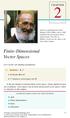 CHAPTER 2 American mathematician Paul Halmos (1916 2006), who in 1942 published the first modern linear algebra book. The title of Halmos s book was the same as the title of this chapter. Finite-Dimensional
Reading 13 : Finite State Automata and Regular Expressions
 CS/Math 24: Introduction to Discrete Mathematics Fall 25 Reading 3 : Finite State Automata and Regular Expressions Instructors: Beck Hasti, Gautam Prakriya In this reading we study a mathematical model
11 Ideals. 11.1 Revisiting Z
 11 Ideals The presentation here is somewhat different than the text. In particular, the sections do not match up. We have seen issues with the failure of unique factorization already, e.g., Z[ 5] = O Q(
A Piggybacking Design Framework for Read-and Download-efficient Distributed Storage Codes
 A Piggybacing Design Framewor for Read-and Download-efficient Distributed Storage Codes K V Rashmi, Nihar B Shah, Kannan Ramchandran, Fellow, IEEE Department of Electrical Engineering and Computer Sciences
How To Prove The Dirichlet Unit Theorem
 Chapter 6 The Dirichlet Unit Theorem As usual, we will be working in the ring B of algebraic integers of a number field L. Two factorizations of an element of B are regarded as essentially the same if
Exponential time algorithms for graph coloring
 Exponential time algorithms for graph coloring Uriel Feige Lecture notes, March 14, 2011 1 Introduction Let [n] denote the set {1,..., k}. A k-labeling of vertices of a graph G(V, E) is a function V [k].
Nimble Algorithms for Cloud Computing. Ravi Kannan, Santosh Vempala and David Woodruff
 Nimble Algorithms for Cloud Computing Ravi Kannan, Santosh Vempala and David Woodruff Cloud computing Data is distributed arbitrarily on many servers Parallel algorithms: time Streaming algorithms: sublinear
A Practical Scheme for Wireless Network Operation
 A Practical Scheme for Wireless Network Operation Radhika Gowaikar, Amir F. Dana, Babak Hassibi, Michelle Effros June 21, 2004 Abstract In many problems in wireline networks, it is known that achieving
The Characteristic Polynomial
 Physics 116A Winter 2011 The Characteristic Polynomial 1 Coefficients of the characteristic polynomial Consider the eigenvalue problem for an n n matrix A, A v = λ v, v 0 (1) The solution to this problem
The Open University s repository of research publications and other research outputs
 Open Research Online The Open University s repository of research publications and other research outputs The degree-diameter problem for circulant graphs of degree 8 and 9 Journal Article How to cite:
Systems of Linear Equations
 Systems of Linear Equations Beifang Chen Systems of linear equations Linear systems A linear equation in variables x, x,, x n is an equation of the form a x + a x + + a n x n = b, where a, a,, a n and
How To Know If A Domain Is Unique In An Octempo (Euclidean) Or Not (Ecl)
 Subsets of Euclidean domains possessing a unique division algorithm Andrew D. Lewis 2009/03/16 Abstract Subsets of a Euclidean domain are characterised with the following objectives: (1) ensuring uniqueness
Section 1.1. Introduction to R n
 The Calculus of Functions of Several Variables Section. Introduction to R n Calculus is the study of functional relationships and how related quantities change with each other. In your first exposure to
Introduction to Algebraic Coding Theory
 Introduction to Algebraic Coding Theory Supplementary material for Math 336 Cornell University Sarah A. Spence Contents 1 Introduction 1 2 Basics 2 2.1 Important code parameters..................... 4
Lecture 7: NP-Complete Problems
 IAS/PCMI Summer Session 2000 Clay Mathematics Undergraduate Program Basic Course on Computational Complexity Lecture 7: NP-Complete Problems David Mix Barrington and Alexis Maciel July 25, 2000 1. Circuit
Math 215 HW #6 Solutions
 Math 5 HW #6 Solutions Problem 34 Show that x y is orthogonal to x + y if and only if x = y Proof First, suppose x y is orthogonal to x + y Then since x, y = y, x In other words, = x y, x + y = (x y) T
Factor Graphs and the Sum-Product Algorithm
 498 IEEE TRANSACTIONS ON INFORMATION THEORY, VOL. 47, NO. 2, FEBRUARY 2001 Factor Graphs and the Sum-Product Algorithm Frank R. Kschischang, Senior Member, IEEE, Brendan J. Frey, Member, IEEE, and Hans-Andrea
Degree Hypergroupoids Associated with Hypergraphs
 Filomat 8:1 (014), 119 19 DOI 10.98/FIL1401119F Published by Faculty of Sciences and Mathematics, University of Niš, Serbia Available at: http://www.pmf.ni.ac.rs/filomat Degree Hypergroupoids Associated
Why? A central concept in Computer Science. Algorithms are ubiquitous.
 Analysis of Algorithms: A Brief Introduction Why? A central concept in Computer Science. Algorithms are ubiquitous. Using the Internet (sending email, transferring files, use of search engines, online
Codes for Network Switches
 Codes for Network Switches Zhiying Wang, Omer Shaked, Yuval Cassuto, and Jehoshua Bruck Electrical Engineering Department, California Institute of Technology, Pasadena, CA 91125, USA Electrical Engineering
Fairness in Routing and Load Balancing
 Fairness in Routing and Load Balancing Jon Kleinberg Yuval Rabani Éva Tardos Abstract We consider the issue of network routing subject to explicit fairness conditions. The optimization of fairness criteria
LINEAR ALGEBRA W W L CHEN
 LINEAR ALGEBRA W W L CHEN c W W L Chen, 1997, 2008 This chapter is available free to all individuals, on understanding that it is not to be used for financial gain, and may be downloaded and/or photocopied,
OPRE 6201 : 2. Simplex Method
 OPRE 6201 : 2. Simplex Method 1 The Graphical Method: An Example Consider the following linear program: Max 4x 1 +3x 2 Subject to: 2x 1 +3x 2 6 (1) 3x 1 +2x 2 3 (2) 2x 2 5 (3) 2x 1 +x 2 4 (4) x 1, x 2
SHARP BOUNDS FOR THE SUM OF THE SQUARES OF THE DEGREES OF A GRAPH
 31 Kragujevac J. Math. 25 (2003) 31 49. SHARP BOUNDS FOR THE SUM OF THE SQUARES OF THE DEGREES OF A GRAPH Kinkar Ch. Das Department of Mathematics, Indian Institute of Technology, Kharagpur 721302, W.B.,
Notes on Determinant
 ENGG2012B Advanced Engineering Mathematics Notes on Determinant Lecturer: Kenneth Shum Lecture 9-18/02/2013 The determinant of a system of linear equations determines whether the solution is unique, without
1 VECTOR SPACES AND SUBSPACES
 1 VECTOR SPACES AND SUBSPACES What is a vector? Many are familiar with the concept of a vector as: Something which has magnitude and direction. an ordered pair or triple. a description for quantities such
Ph.D. Thesis. Judit Nagy-György. Supervisor: Péter Hajnal Associate Professor
 Online algorithms for combinatorial problems Ph.D. Thesis by Judit Nagy-György Supervisor: Péter Hajnal Associate Professor Doctoral School in Mathematics and Computer Science University of Szeged Bolyai
DEGREES OF ORDERS ON TORSION-FREE ABELIAN GROUPS
 DEGREES OF ORDERS ON TORSION-FREE ABELIAN GROUPS ASHER M. KACH, KAREN LANGE, AND REED SOLOMON Abstract. We construct two computable presentations of computable torsion-free abelian groups, one of isomorphism
Network (Tree) Topology Inference Based on Prüfer Sequence
 Network (Tree) Topology Inference Based on Prüfer Sequence C. Vanniarajan and Kamala Krithivasan Department of Computer Science and Engineering Indian Institute of Technology Madras Chennai 600036 [email protected],
Lecture 1: Course overview, circuits, and formulas
 Lecture 1: Course overview, circuits, and formulas Topics in Complexity Theory and Pseudorandomness (Spring 2013) Rutgers University Swastik Kopparty Scribes: John Kim, Ben Lund 1 Course Information Swastik
INDISTINGUISHABILITY OF ABSOLUTELY CONTINUOUS AND SINGULAR DISTRIBUTIONS
 INDISTINGUISHABILITY OF ABSOLUTELY CONTINUOUS AND SINGULAR DISTRIBUTIONS STEVEN P. LALLEY AND ANDREW NOBEL Abstract. It is shown that there are no consistent decision rules for the hypothesis testing problem
6.852: Distributed Algorithms Fall, 2009. Class 2
 .8: Distributed Algorithms Fall, 009 Class Today s plan Leader election in a synchronous ring: Lower bound for comparison-based algorithms. Basic computation in general synchronous networks: Leader election
I. GROUPS: BASIC DEFINITIONS AND EXAMPLES
 I GROUPS: BASIC DEFINITIONS AND EXAMPLES Definition 1: An operation on a set G is a function : G G G Definition 2: A group is a set G which is equipped with an operation and a special element e G, called
! Solve problem to optimality. ! Solve problem in poly-time. ! Solve arbitrary instances of the problem. !-approximation algorithm.
 Approximation Algorithms Chapter Approximation Algorithms Q Suppose I need to solve an NP-hard problem What should I do? A Theory says you're unlikely to find a poly-time algorithm Must sacrifice one of
by the matrix A results in a vector which is a reflection of the given
 Eigenvalues & Eigenvectors Example Suppose Then So, geometrically, multiplying a vector in by the matrix A results in a vector which is a reflection of the given vector about the y-axis We observe that
Classification of Cartan matrices
 Chapter 7 Classification of Cartan matrices In this chapter we describe a classification of generalised Cartan matrices This classification can be compared as the rough classification of varieties in terms
Network Coding for Security and Error Correction
 Network Coding for Security and Error Correction NGAI, Chi Kin A Thesis Submitted in Partial Fulfilment of the Requirements for the Degree of Doctor of Philosophy in Information Engineering c The Chinese
1 if 1 x 0 1 if 0 x 1
 Chapter 3 Continuity In this chapter we begin by defining the fundamental notion of continuity for real valued functions of a single real variable. When trying to decide whether a given function is or
A Note on Maximum Independent Sets in Rectangle Intersection Graphs
 A Note on Maximum Independent Sets in Rectangle Intersection Graphs Timothy M. Chan School of Computer Science University of Waterloo Waterloo, Ontario N2L 3G1, Canada [email protected] September 12,
Discrete Mathematics. Hans Cuypers. October 11, 2007
 Hans Cuypers October 11, 2007 1 Contents 1. Relations 4 1.1. Binary relations................................ 4 1.2. Equivalence relations............................. 6 1.3. Relations and Directed Graphs.......................
Orthogonal Projections
 Orthogonal Projections and Reflections (with exercises) by D. Klain Version.. Corrections and comments are welcome! Orthogonal Projections Let X,..., X k be a family of linearly independent (column) vectors
Breaking The Code. Ryan Lowe. Ryan Lowe is currently a Ball State senior with a double major in Computer Science and Mathematics and
 Breaking The Code Ryan Lowe Ryan Lowe is currently a Ball State senior with a double major in Computer Science and Mathematics and a minor in Applied Physics. As a sophomore, he took an independent study
December 4, 2013 MATH 171 BASIC LINEAR ALGEBRA B. KITCHENS
 December 4, 2013 MATH 171 BASIC LINEAR ALGEBRA B KITCHENS The equation 1 Lines in two-dimensional space (1) 2x y = 3 describes a line in two-dimensional space The coefficients of x and y in the equation
All trees contain a large induced subgraph having all degrees 1 (mod k)
 All trees contain a large induced subgraph having all degrees 1 (mod k) David M. Berman, A.J. Radcliffe, A.D. Scott, Hong Wang, and Larry Wargo *Department of Mathematics University of New Orleans New
Catalan Numbers. Thomas A. Dowling, Department of Mathematics, Ohio State Uni- versity.
 7 Catalan Numbers Thomas A. Dowling, Department of Mathematics, Ohio State Uni- Author: versity. Prerequisites: The prerequisites for this chapter are recursive definitions, basic counting principles,
1 Introduction. Dr. T. Srinivas Department of Mathematics Kakatiya University Warangal 506009, AP, INDIA [email protected]
 A New Allgoriitthm for Miiniimum Costt Liinkiing M. Sreenivas Alluri Institute of Management Sciences Hanamkonda 506001, AP, INDIA [email protected] Dr. T. Srinivas Department of Mathematics Kakatiya
Alok Gupta. Dmitry Zhdanov
 RESEARCH ARTICLE GROWTH AND SUSTAINABILITY OF MANAGED SECURITY SERVICES NETWORKS: AN ECONOMIC PERSPECTIVE Alok Gupta Department of Information and Decision Sciences, Carlson School of Management, University
CSC2420 Fall 2012: Algorithm Design, Analysis and Theory
 CSC2420 Fall 2012: Algorithm Design, Analysis and Theory Allan Borodin November 15, 2012; Lecture 10 1 / 27 Randomized online bipartite matching and the adwords problem. We briefly return to online algorithms
! Solve problem to optimality. ! Solve problem in poly-time. ! Solve arbitrary instances of the problem. #-approximation algorithm.
 Approximation Algorithms 11 Approximation Algorithms Q Suppose I need to solve an NP-hard problem What should I do? A Theory says you're unlikely to find a poly-time algorithm Must sacrifice one of three
Secure Network Coding for Wiretap Networks of Type II
 1 Secure Network Coding for Wiretap Networks of Type II Salim El Rouayheb, Emina Soljanin, Alex Sprintson Abstract We consider the problem of securing a multicast network against a wiretapper that can
Algebra 2 Chapter 1 Vocabulary. identity - A statement that equates two equivalent expressions.
 Chapter 1 Vocabulary identity - A statement that equates two equivalent expressions. verbal model- A word equation that represents a real-life problem. algebraic expression - An expression with variables.
Joint Message-Passing Decoding of LDPC Codes and Partial-Response Channels
 1410 IEEE TRANSACTIONS ON INFORMATION THEORY, VOL. 48, NO. 6, JUNE 2002 Joint Message-Passing Decoding of LDPC Codes Partial-Response Channels Brian M. Kurkoski, Student Member, IEEE, Paul H. Siegel, Fellow,
The last three chapters introduced three major proof techniques: direct,
 CHAPTER 7 Proving Non-Conditional Statements The last three chapters introduced three major proof techniques: direct, contrapositive and contradiction. These three techniques are used to prove statements