
How To Track Animals Via Their Dna
|
|
|
- Hannah Agnes Carroll
- 5 years ago
- Views:
Transcription
1 No place left to hide Tracking animals via their DNA Arjen de Groot Animal Ecology, Alterra Wageningen UR Kennisnetwerk Milieu, 27 september2013

2 Contents 1. Making the invisible visible 2. Genetic approaches for population ecology The Dutch otter population 3. Species identification via DNA barcoding A wolf in the Netherlands? 4. (e)dna-based species inventories Early detection of invasive crayfish Screening for soil diversity 5. Conclusions

3 1. Making the invisible visible: why? Conventional animal ecology often involves visual and manual contact: Observations Capturing of animals But what to do in case the study species: Occurs in extremely low densities Is covered by water, soil or vegetation Hides in unreachable places Has a nocturnal and/or solitary life style

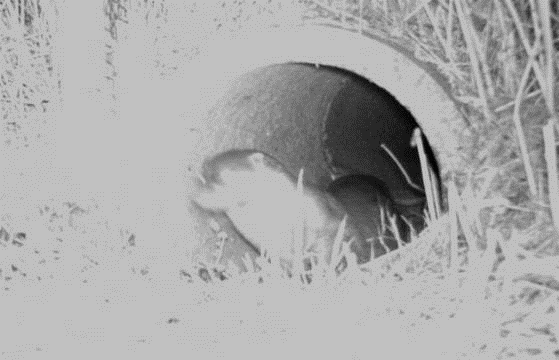

4 1. Making the invisible visible: why? Many smart tricks available: Camera traps Telemetry Track searching Extracting animals from their environment But this results in: High effort and costs Disturbance Often anecdotic / incomplete data

5 1. Making the invisible visible: how? Nowadays, DNA-based analyses provide excellent alternatives: Succesful extraction of small amounts of DNA from indirect evidence : Faeces, hairs, feathers, egg shells, etc., left in the field Environmental samples that contain traces of (e)dna Increasing amounts of data, reducing costs Simultanous information on many parameters But extraction of low quality and quantity DNA requires: Specialized protocols and laboratory facilities Proper method validation and replication to detect false information
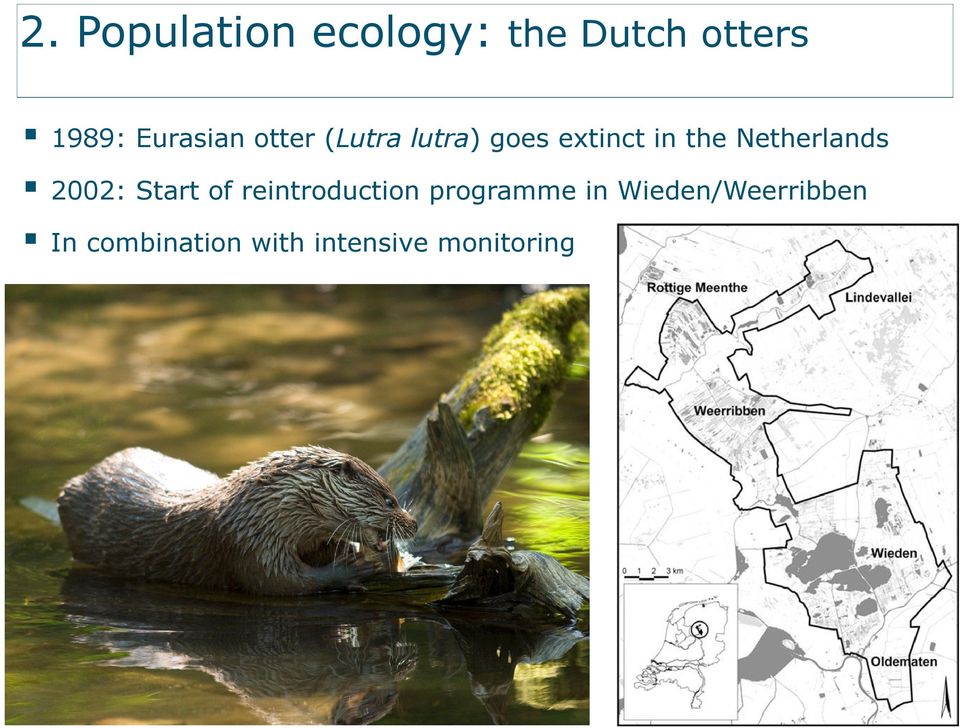
6 2. Population ecology: the Dutch otters 1989: Eurasian otter (Lutra lutra) goes extinct in the Netherlands 2002: Start of reintroduction programme in Wieden/Weerribben In combination with intensive monitoring
7 Dental status

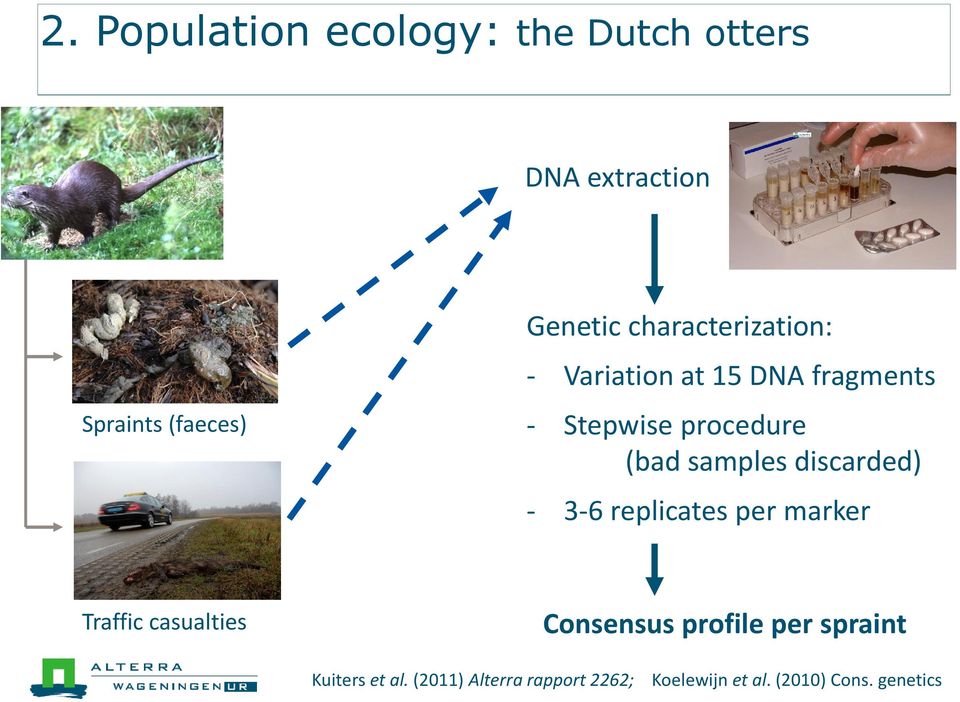
8 2. Population ecology: the Dutch otters DNA extraction Spraints (faeces) Genetic characterization: - Variation at 15 DNA fragments - Stepwise procedure (bad samples discarded) replicates per marker Traffic casualties Consensus profile per spraint Kuiters et al. (2011) Alterra rapport 2262; Koelewijn et al. (2010) Cons. genetics
9 2. Population ecology: population dynamics Koelewijn et al. 2010, Conservation Genetics


10 2. Population ecology: pedigree Female parent Male parent

11 Number of identified individuals 2. Population ecology: population expansion 84 Released New recruits Cumm. nr. of releases Koelewijn et al. 2010; De Groot et al /13

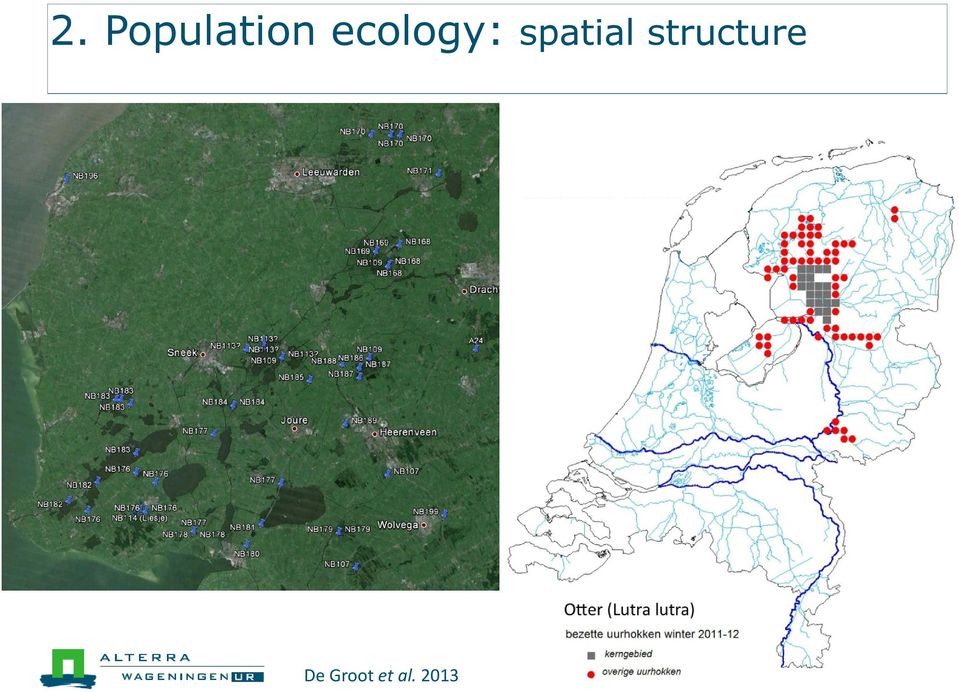
12 2. Population ecology: spatial structure De Groot et al. 2013
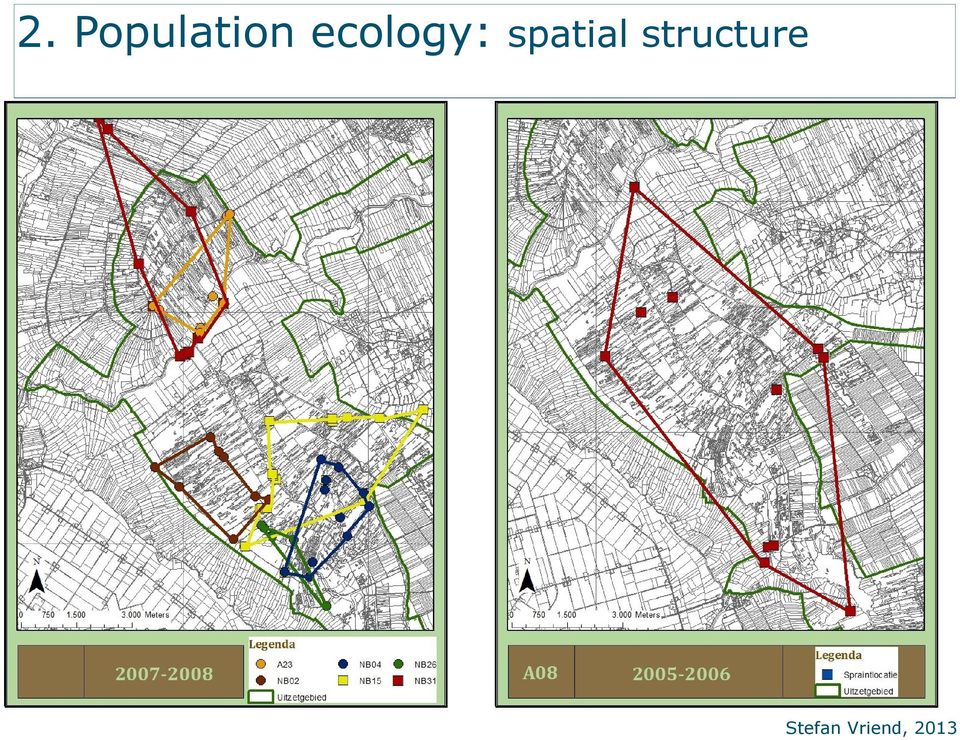
13 2. Population ecology: spatial structure Stefan Vriend, 2013
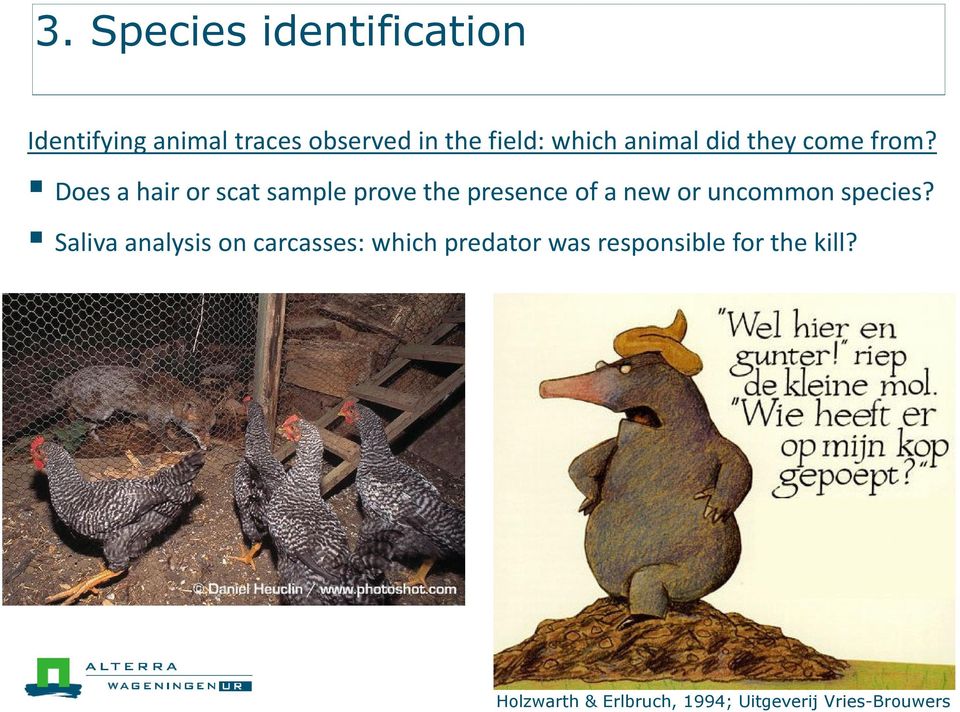
14 3. Species identification Identifying animal traces observed in the field: which animal did they come from? Does a hair or scat sample prove the presence of a new or uncommon species? Saliva analysis on carcasses: which predator was responsible for the kill? Holzwarth & Erlbruch, 1994; Uitgeverij Vries-Brouwers

15 3. Species identification: DNA barcoding Species identification based on the variation in the sequence of a standard DNA fragment (=DNA barcode) 1. Selecting a fragment that varies among, but not within species 2. Create a reference database with all potentially encountered species 3. Obtain the DNA barcode of the unknown sample 3.Bepaal de DNA barcode van het onbekende monster 4. Compare with reference set and find best match 1.Keuze van fragment met variatie tussen, maar niet binnen soorten 2.Maak een referentieset met DNA barcodes van alle mogelijk aan te treffen soorten Database Unknown specimen DNA extract DNA barcode

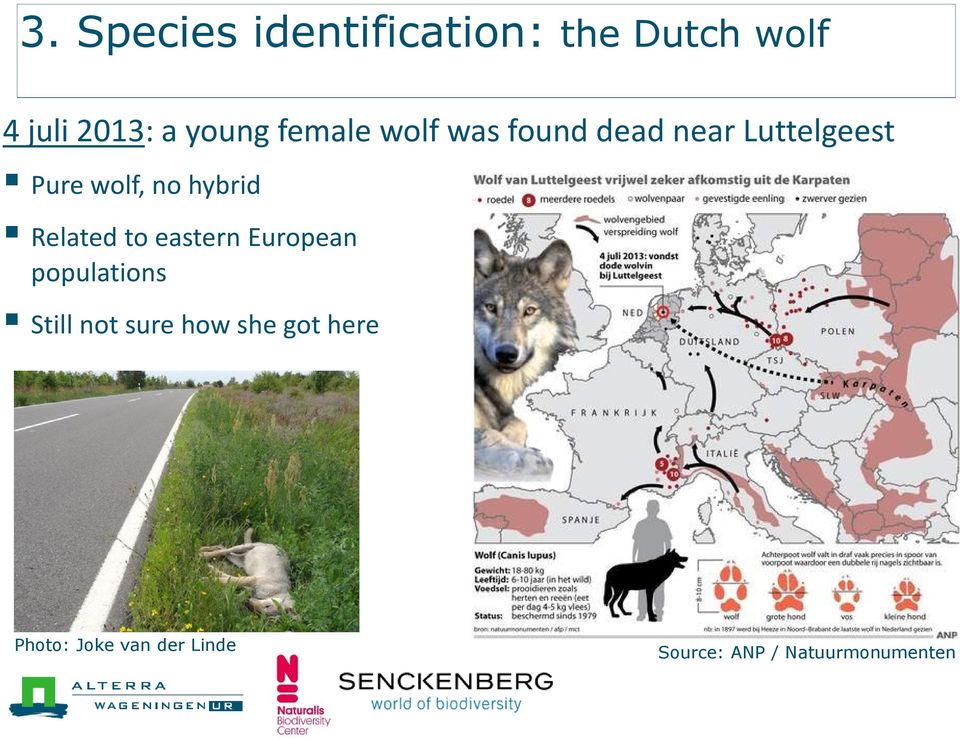
16 3. Species identification: the Dutch wolf 4 juli 2013: a young female wolf was found dead near Luttelgeest Pure wolf, no hybrid Related to eastern European populations Still not sure how she got here Photo: Joke van der Linde Source: ANP / Natuurmonumenten
17 4. (e)dna-based species inventories Demand for proper monitoring of specific aquatic species: Species conservation policies Early detection of invasive species to prevent damage to ecosystem and/or infrastructure Kaderrichtlijn Water (KRW) But low densities: conventional detection difficult New alternative: environmental DNA (edna) free DNA that animals leave behind in their environment Detection via a simple water sample Presence/absence assays for specific species
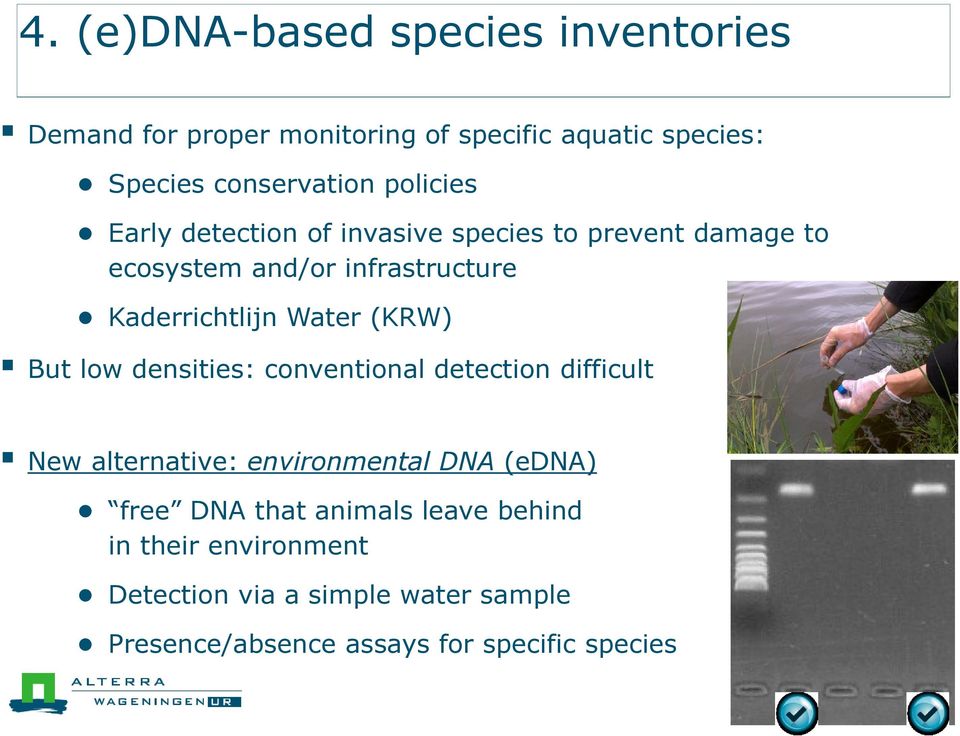
18 4. Environmental DNA: state of the art First results are promising: Ficetola et al. 2008: higher detection rates based on edna Methods are now available for several aquatic species More research needed: more species & better validation under varying circumstances Lithobates catesbeianus Lodge et al. (2012) Thompson et al. (2012)

19 4. Environmental DNA: crayfish 8 Example: Invasive crayfish in the Netherlands Damage to ecosystems: endemic European crayfish (Astacus astacus) riparian / aquatic vegetation Damage to infrastructure: burrowing Procambarus clarkii (Red swamp crayfish) Roessink et al. 2010, Alterra-report 2052


20 4. Environmental DNA: invasive crayfish Development of a detection method for Procambarus clarkii: 1. Marker development finding a discriminating barcode fragment 2. Optimizing qpcr (quantitative PCR) protocols 3. Testing sensitivity what is the detection limit? 4. Tests on other crustaceae (Astacus, Gammarus, etc) false positives? 5. Tests with field samples with known presence / absence Promising results: succesful detection in ditch systems Work in progress: Finetuning of method for P. clarkii Development of a more general assay for all invasive crayfish in NL Future: towards quantitative methods for population size estimation


21 3. (e)dna-based species inventories DNA metabarcoding = determining total biodiversity for multiple taxonomic groups via high-throughput DNA barcoding Goal: faster processing of high numbers of samples Currently under development (e.g. EcoFINDERS) Reference Requires large reference datasets Requires complex bioinformatics What about relative abundances? Soil sample DNA extraction Mass sequencing Bioinformatics Species composition
22 Conclusions DNA-based methods ready to be applied in ecological studies: New techniques allow the use of traces of DNA left behind in the environment no need for visual or manual contact no need for disturbance allows new types of questions to be answered DNA sample can simultanously yield many types of information Methods become cheaper and simpler But working with low quality samples requires: Proper validation of the methods Proper sample replication both in the field and in the lab De Groot & Laros, 2013, Vakblad NBL
23 Thanks to: Hugh Jansman Ivo Laros Jan Bovenschen Dennis Lammertsma Geert Groot Bruinderink Loek Kuiters Ivo Roessink Hans Peter Koelewijn Questions: Arjen de Groot: / Hugh Jansman: /
Species-of-the-Week. Blanding s Turtle (Emydoidea blandingii) Species of Special Concern in Michigan
 Species-of-the-Week Blanding s Turtle (Emydoidea blandingii) Habitat Productive & clean shallow water (soft substrates) = ponds, marshes, swamps, bogs, wet prairies, slow rivers Spring & summer = terrestrial
NORTH PACIFIC RESEARCH BOARD SEMIANNUAL PROGRESS REPORT
 1. PROJECT INFORMATION NPRB Project Number: 1303 Title: Assessing benthic meiofaunal community structure in the Alaskan Arctic: A high-throughput DNA sequencing approach Subaward period July 1, 2013 Jun
Lesson Overview. Biodiversity. Lesson Overview. 6.3 Biodiversity
 Lesson Overview 6.3 6.3 Objectives Define biodiversity and explain its value. Identify current threats to biodiversity. Describe how biodiversity can be preserved. THINK ABOUT IT From multicolored coral
An introduction to bioinformatic tools for population genomic and metagenetic data analysis, 2.5 higher education credits Third Cycle
 An introduction to bioinformatic tools for population genomic and metagenetic data analysis, 2.5 higher education credits Third Cycle Faculty of Science; Department of Marine Sciences The Swedish Royal
PRACTICAL APPROACH TO ECOTOXICOGENOMICS
 ANNOUNCEMENT PRACTICAL APPROACH TO ECOTOXICOGENOMICS Advanced Workshop Studies in Biology and Applied Biosciences Department of Biology University of Aveiro, 30 April- 4 May 2007 This one-week post-graduate
Monitoring of animal species and source tracking of fecal bacteria in surface water by detection of e(nvironmental)dna
 Monitoring of animal species and source tracking of fecal bacteria in surface water by detection of e(nvironmental)dna Bart Wullings, Leo Heijnen en Edwin Kardinaal Kennisnetwerk Milieu, 27 September 2013,
Life in the Bay Getting to know the Bay s plants and animals
 Life in the Bay Getting to know the Bay s plants and animals Over erview iew In this activity students will become acquainted with a plant or animal that lives in the San Francisco Bay. Students will research
Note on Draft Progress Report Template
 Note on Draft Progress Report Template The Draft Progress Report template is provided as a guide to applicants on possible reporting requirements for the Biodiversity Fund. This actual report will be provided
Mobilising Vegetation Plot Data: the National Vegetation Survey Databank. Susan Wiser April 2016 http://nvs.landcareresearch.co.nz
 Mobilising Vegetation Plot Data: the National Vegetation Survey Databank Susan Wiser April 2016 http://nvs.landcareresearch.co.nz Nationally Significant Databases and Collections http://natsigdc.landcareresearch.co.nz/natsigdc_list.html
RESTORATION & REVITALIZATION
 RESTORATION & REVITALIZATION Legal preservation has not proved to be sufficient to preserve natural communities. Restoration activities are diverse and includes revitalization of natural communities which
Robert G. Young & Sarah Adamowicz University of Guelph Cathryn Abbott & Tom Therriault Department of Fisheries and Oceans
 Evaluating Canadian zooplankton biodiversity through DNA barcodes: assessing non-indigenous species presence to provide a framework for future monitoring Robert G. Young & Sarah Adamowicz University of
Monitoring the Critically Endangered Bird Species (White-shouldered Ibis) in Western Siem Pang Important Bird and Biodiversity Area (IBA)
 Monitoring the Critically Endangered Bird Species (White-shouldered Ibis) in Western Siem Pang Important Bird and Biodiversity Area (IBA) Transboundary Biodiversity Landscapes (TBLs) Knowledge Meeting
Studbook breeding programme Manouria emys (Asian brown tortoise)
 Studbook breeding programme Manouria emys (Asian brown tortoise) Annual report 2008 Martin van Wees, studbook keeper Henk Zwartepoorte, co studbook keeper KvK nr. 41136106 www.studbooks.eu ESF Studbook/Breeding

Molecular and Cell Biology Laboratory (BIOL-UA 223) Instructor: Ignatius Tan Phone: 212-998-8295 Office: 764 Brown Email: ignatius.tan@nyu.
 Molecular and Cell Biology Laboratory (BIOL-UA 223) Instructor: Ignatius Tan Phone: 212-998-8295 Office: 764 Brown Email: [email protected] Course Hours: Section 1: Mon: 12:30-3:15 Section 2: Wed: 12:30-3:15
Wildlife Ecologist. Mount Gibson Wildlife Sanctuary
 Wildlife Ecologist Mount Gibson Wildlife Sanctuary Australian Wildlife Conservancy is a non profit organisation dedicated to the conservation of Australia s threatened wildlife and their habitats. AWC
Lecture 13: DNA Technology. DNA Sequencing. DNA Sequencing Genetic Markers - RFLPs polymerase chain reaction (PCR) products of biotechnology
 Lecture 13: DNA Technology DNA Sequencing Genetic Markers - RFLPs polymerase chain reaction (PCR) products of biotechnology DNA Sequencing determine order of nucleotides in a strand of DNA > bases = A,
Genomics Services @ GENterprise
 Genomics Services @ GENterprise since 1998 Mainz University spin-off privately financed 6-10 employees since 2006 Genomics Services @ GENterprise Sequencing Service (Sanger/3730, 454) Genome Projects (Bacteria,
Introduction to Integrated Pest Management. John C. Wise, Ph.D. Michigan State University MSU Trevor Nichols Research Complex
 Introduction to Integrated Pest Management John C. Wise, Ph.D. Michigan State University MSU Trevor Nichols Research Complex What is Integrated Pest Management? Integrated Pest Management (IPM) New concept;
Past and Current Research on Natural Resource Issues in the Blue Mountains
 Past and Current Research on Natural Resource Issues in the Blue Mountains Recreation, Hunting, Access Livestock Production (and Wild Ungulate Ecology) Restoration Timber Harvest, Production Biodiversity,
Spatial Technology Supporting Collaboration in Endangered Species Recovery Efforts. Presenter: Martin Slimin New Zealand Department of Conservation
 Spatial Technology Supporting Collaboration in Endangered Species Recovery Efforts Presenter: Martin Slimin New Zealand Department of Conservation New Zealand Last major landmass to be colonised by
excerpted from Reducing Pandemic Risk, Promoting Global Health For the full report go to http://report.predict.global
 excerpted from Reducing Pandemic Risk, Promoting Global Health For the full report go to http://report.predict.global FUTURE DIRECTIONS Historically, attempts to control deadly viruses, such as SARS and
Introduction to protection goals, ecosystem services and roles of risk management and risk assessment. Lorraine Maltby
 Introduction to protection goals, ecosystem services and roles of risk management and risk assessment. Lorraine Maltby Problem formulation Risk assessment Risk management Robust and efficient environmental
Non-consumptive use of wildlife. Non-consumptive Use. Non-consumptive Use
 Non-consumptive use of wildlife Non-consumptive Use Any non-hunting or non-extractive use Examples: wildlife feeding & photography, bird watching, whale watching Non-consumptive Use Sources of information
MIRDINEC - Management of the invasive Raccoon Dog (Nyctereutes procyonoides) in the north-european countries LIFE09 NAT/SE/000344
 MIRDINEC - Management of the invasive Raccoon Dog (Nyctereutes procyonoides) in the north-european countries LIFE09 NAT/SE/000344 Project description Environmental issues Beneficiaries Administrative data
Farming of the black tiger prawn Challenges and Opportunities
 Farming of the black tiger prawn Challenges and Opportunities Dean R Jerry Director ARC Research Hub for Advanced Prawn Breeding James Cook University Australia Presentation overview Global production
Mapping Biotope and Sociotope for Green Infrastructure Planning in Urban Areas Wan-yu Shih, John Handley, Iain White
 Wan-yu Shih, John Handley, Iain White (PhD Student Wan-yu Shih, School of Environment and Development, the University of Manchester, Manchester, United Kingdom, [email protected]) (Professor
Appendix C. Municipal Planning and Site Restoration Considerations
 Appendix C Municipal Planning and Site Restoration Considerations 67 68 Appendix C - Municipal Planning and Site Restoration Considerations This appendix contains best practice standards for site planning
14.3 Studying the Human Genome
 14.3 Studying the Human Genome Lesson Objectives Summarize the methods of DNA analysis. State the goals of the Human Genome Project and explain what we have learned so far. Lesson Summary Manipulating
Camp. plan template. elements. This section that need to. identify the. vegetation. of flying-fox. also
 Camp management plan template Introduction The following templatee guides local government in compiling a Camp Management Plan that will facilitate licensing of camp management actions for a five-year
College of Agriculture
 100 INTRODUCTION TO ESTRY. (3) A brief coverage of the general fields of forestry; development and importance; tree growth; principal forest regions and important timber species; forest management practices;
MONITORING OF HABITATS AT THE LEVEL OF A NATURA 2000 SITE MOHANA MOBILE AND WEB APP. Francisco Gutierres 1. May of 2016
 MONITORING OF HABITATS AT THE LEVEL OF A NATURA 2000 SITE MOHANA MOBILE AND WEB APP Francisco Gutierres 1 May of 2016 1 Ph.D. in Physical Geography, Institute of Geography Spatial Planning of the University
Class Insecta - The insects
 A Introduction 1. Very species rich 2. Characteristics a. 3 pairs of legs b. 2 pairs of wings (most) except flies (1 pair of wings - Diptera) B. Distribution 1. All habitats except saltwater - replaced
FORENSIC SCIENCE COURSE DESCRIPTION
 FORENSIC SCIENCE COURSE DESCRIPTION This course is an overview of how science is applied to solving crimes. Topics include history of forensic sciences, collecting of evidence, analyzing results and hands-on
Visitor management strategy
 Visitor management strategy Introduction Protected areas attract people. Sometimes the protected area management is glad about people who are interested in their work and activities, sometimes protected
Kakapo Recovery Plan 1996-2005
 Kakapo Recovery Plan 1996-2005 Threatened Species Recovery Plan No.21 Kakapo Management Group Department of Conservation P.O. Box 10-420 Wellington New Zealand CONTENTS 1. Background 5 2. Distribution
American Forest Foundation (AFF) 2010-2015 Standards of Sustainability for Forest Certification
 American Forest Foundation (AFF) 2010-2015 Standards of Sustainability for Forest Certification Standards Prologue The American Forest Foundation s (AFF) 2010-2015 Standards of Sustainability for Forest
Environmental Science
 Environmental Science UNIT I: Introduction to Environmental Science The student will demonstrate the ability to use scientific skills necessary to identify and analyze environmental issues. a. Define environmental
Development of two Novel DNA Analysis methods to Improve Workflow Efficiency for Challenging Forensic Samples
 Development of two Novel DNA Analysis methods to Improve Workflow Efficiency for Challenging Forensic Samples Sudhir K. Sinha, Ph.D.*, Anne H. Montgomery, M.S., Gina Pineda, M.S., and Hiromi Brown, Ph.D.
Assessing risks to ecosystems - a new global standard
 Assessing risks to ecosystems - a new global standard IUCN Ecosystem Red List Working Group David Keith et al. Major scientific challenges I. What is an ecosystem? II. When is an ecosystem extinct? disappearance
LESSON 2 Carrying Capacity: What is a Viable Population? A Lesson on Numbers and Space
 Ï MATH LESSON 2 Carrying Capacity: What is a Viable Population? A Lesson on Numbers and Space Objectives: Students will: list at least 3 components which determine the carrying capacity of an area for
BEIPH Final Report. QCMD 2010 Hepatitis B Virus DNA (HBVDNA10A) EQA Programme. William G MacKay on behalf of QCMD and its Scientific Council July 2010
 QUALITY CONTROL for MOLECULAR DIAGNOSTICS The Altum Building, Todd Campus, West of Scotland Science Park, Glasgow, G20 0XA Scotland Tel: +44 (0) 141 945 6474 Fax: +44 (0) 141 945 5795 www.qcmd.org [email protected]
Activity 1.6: Food for Thought: Climate Change and Trophic Cascades
 Activity 1.6: Food for Thought: Climate Change and Trophic Cascades Grades 7 9 Description: Students will read an article about the impact of melting ice on the Arctic food web. Students will diagram food
Real-time PCR: Understanding C t
 APPLICATION NOTE Real-Time PCR Real-time PCR: Understanding C t Real-time PCR, also called quantitative PCR or qpcr, can provide a simple and elegant method for determining the amount of a target sequence
The Techniques of Molecular Biology: Forensic DNA Fingerprinting
 Revised Fall 2011 The Techniques of Molecular Biology: Forensic DNA Fingerprinting The techniques of molecular biology are used to manipulate the structure and function of molecules such as DNA and proteins
Biodiversity and Ecosystem Services: Arguments for our Future Environment
 Biodiversity and Ecosystem Services: Arguments for our Future Environment How have we advanced our understanding of the links between biodiversity, ecosystem functions and ecosystem services? The issue
PATHOGEN DETECTION SYSTEMS BY REAL TIME PCR. Results Interpretation Guide
 PATHOGEN DETECTION SYSTEMS BY REAL TIME PCR Results Interpretation Guide Pathogen Detection Systems by Real Time PCR Microbial offers real time PCR based systems for the detection of pathogenic bacteria
NATURAL RESOURCES DEGREES AND CERTIFICATES. Environmental Conservation A.S. Degree (formerly Natural Resources)
 Area: Science and Engineering Dean: Dr. Rina Roy Phone: (916) 484-8107 Counseling: (916) 484-8572 DEGREES AND CERTIFICATES Environmental Conservation A.S. Degree (formerly Natural Resources) Environmental
Mitochondrial DNA Analysis
 Mitochondrial DNA Analysis Lineage Markers Lineage markers are passed down from generation to generation without changing Except for rare mutation events They can help determine the lineage (family tree)
DNA Barcoding: A New Tool for Identifying Biological Specimens and Managing Species Diversity
 DNA Barcoding: A New Tool for Identifying Biological Specimens and Managing Species Diversity DNA barcoding has inspired a global initiative dedicated to: Creating a library of new knowledge about species
SCIENCE ADVICE FROM THE RISK ASSESSMENT OF THE INVASIVE BLOODY RED SHRIMP (HEMIMYSIS ANOMALA) IN CANADA
 Canadian Science Advisory Secretariat Science Advisory Report 2009/078 SCIENCE ADVICE FROM THE RISK ASSESSMENT OF THE INVASIVE BLOODY RED SHRIMP (HEMIMYSIS ANOMALA) IN CANADA Photo credit: Kelly Bowen,
Broken Arrow Public Schools AP Environmental Science Objectives Revised 11-19-08
 1 st six weeks 1 Identify questions and problems that can be answered through scientific investigation. 2 Design and conduct scientific investigations to answer questions about the world by creating hypotheses;
Special issue Grazing and Grazing animals
 41 e jaargang may 2002 vakblad NATUURBEHEER Informatie voor beheerders van natuur, bos en landschap Information for managers of nature, forest and landscape Special issue Grazing and Grazing animals P
CONNECTIVITY CONSERVATION AND ECOLOGICAL RESTORATION ADVENTURES IN A GLOBAL BIODIVERSITY HOTSPOT
 CONNECTIVITY CONSERVATION AND ECOLOGICAL RESTORATION ADVENTURES IN A GLOBAL BIODIVERSITY HOTSPOT A presentation addressing Aichi Targets: 5 By 2020, the rate of loss of all natural habitats, including
Acceleration for Personalized Medicine Big Data Applications
 Acceleration for Personalized Medicine Big Data Applications Zaid Al-Ars Computer Engineering (CE) Lab Delft Data Science Delft University of Technology 1" Introduction Definition & relevance Personalized
RESPONSE FROM GBIF TO QUESTIONS FOR FURTHER CONSIDERATION
 RESPONSE FROM GBIF TO QUESTIONS FOR FURTHER CONSIDERATION A. Policy support tools and methodologies developed or used under the Convention and their adequacy, impact and obstacles to their uptake, as well
Weed Survey and Mapping
 Weed Survey and Mapping The primary objective of weed surveying and mapping is to accurately identify and delineate land with populations of invasive plants or noxious weeds. These surveys allow land managers
Global Ecology and Wildlife Conservation
 Vaughan Centre for Lifelong Learning Part-Time Certificate of Higher Education in Global Ecology and Wildlife Conservation Delivered via Distance Learning FAQs What are the aims of the course? This course
P. ramorum diagnostics - update. USDA APHIS PPQ CPHST March, 2006
 P. ramorum diagnostics - update USDA APHIS PPQ CPHST March, 2006 The Times (UK) 11/17/05 Provisional Approval Process Protocol still evolving and improving > 20 labs in system 7 approved: CDFA, ODA, Oregon
Influence of the skin mechanical and microbial properties on hair growth
 Call for Interdisciplinary Projects Sevres 2014 A General Information Project title Influence of the skin mechanical and microbial properties on hair growth Acronym TADDEI: The Ambiguous Dupond and Dupont
Center for Urban Ecology Strategic Plan
 January 2004 1 Center for Urban Ecology Strategic Plan Science and Service through Partnerships Mission The Center for Urban Ecology is an interdisciplinary team that provides scientific guidance, technical
Patterns of Bat Fatality at Wind Development Facilities. Edward B. Arnett, Bat Conservation International
 Patterns of Bat Fatality at Wind Development Facilities Edward B. Arnett, Bat Conservation International Biological Diversity: over 1,100 species identified >one-quarter of the world s mammals Broad and
2015 2016 Environmental Science Scope & Sequence
 2015 2016 Environmental Science Scope & Sequence The suggested time frames in this document are for a year long environmental science class with approximately 45 minute class periods. All of the material
Biology Behind the Crime Scene Week 4: Lab #4 Genetics Exercise (Meiosis) and RFLP Analysis of DNA
 Page 1 of 5 Biology Behind the Crime Scene Week 4: Lab #4 Genetics Exercise (Meiosis) and RFLP Analysis of DNA Genetics Exercise: Understanding how meiosis affects genetic inheritance and DNA patterns
"Fingerprinting" Vegetables DNA-based Marker Assisted Selection
 "Fingerprinting" Vegetables DNA-based Marker Assisted Selection Faster, Cheaper, More Reliable; These are some of the goals that vegetable breeders at seed companies and public institutions desire for
The Nature of Evidence
 The Nature of Evidence Chapter 3 Mrs. Svedstrup What is Evidence? Legal definition: That which tends to support something or show that something is the case Relevance of evidence- admissibility of evidence
Detection of PepMV and ringtest results
 Detection of PepMV and ringtest results HJ (Joe) Vetten (on behalf of the PEPEIRA consortium) JKI, Institute for Epidemiology and Pathogen Diagnostics, Braunschweig, Germany www.jki.bund.de Outline Ringtest
A wildlife monitoring network. for De Hoge Veluwe National Park: Baseline measurements and design
 A wildlife monitoring network for De Hoge Veluwe National Park: Baseline measurements and design Wageningen University and Research Centre Wageningen, November 2012 Yorick Liefting Bsc Dr Ir Patrick A.
Review of the Late Pleistocene Soricidae (Mammalia) fauna of the Vaskapu Cave (North Hungary)
 Hantkeniana 8, 163 169, Budapest, 2013 Review of the Late Pleistocene Soricidae (Mammalia) fauna of the Vaskapu Cave (North Hungary) Lukács MÉSZÁROS 1 (with 2 figures, 2 tables and 1 plate) The summary
TOOLS FOR T-RFLP DATA ANALYSIS USING EXCEL
 TOOLS FOR T-RFLP DATA ANALYSIS USING EXCEL A collection of Visual Basic macros for the analysis of terminal restriction fragment length polymorphism data Nils Johan Fredriksson TOOLS FOR T-RFLP DATA ANALYSIS
Interactive Science Grade 5 2012
 A Correlation of Interactive Science Grade 5 2012 To the New Jersey Science Standards Grade 5 Introduction This document demonstrates the close alignment between Interactive Science, 2012, and the for
Definition of Minimum Performance Requirements for Analytical Methods of GMO Testing European Network of GMO Laboratories (ENGL)
 Definition of Minimum Performance Requirements for Analytical Methods of GMO Testing European Network of GMO Laboratories (ENGL) 13 October 2008 Date of application: 13 April 2009 INTRODUCTION The scope
Enhancing Biodiversity. Proactive management of biodiversity in intensive agriculture
 Enhancing Biodiversity Proactive management of biodiversity in intensive agriculture Contents Introduction Increasing food security in a sustainable way 3 The importance of biodiversity The vitality and
How do we build and refine models that describe and explain the natural and designed world?
 Strand: A. Understand Scientific Explanations : Students understand core concepts and principles of science and use measurement and observation tools to assist in categorizing, representing, and interpreting
The importance of biodiversity monitoring
 The importance of biodiversity monitoring Sebastian Winkler IUCN Save Biodiversity! Regional Office for Europe 18 June 2009, London The 2010 Biodiversity Target: There are limits is hard to measure fails
Department of Forest and
 Colorado State University 1 Department of Forest and Rangeland Stewardship Office in Forestry Building, Room 123 (970) 491-6911 warnercnr.colostate.edu/frs-home (http://warnercnr.colostate.edu/ frws-home)
observation: the future Professor Ian Boyd, Chief Scientific Adviser, Defra
 Biodiversity and earth observation: the future for big data in the UK Professor Ian Boyd, Chief Scientific Adviser, Defra Introduction: Structure of presentation 1. Defra-network priorities iti for biodiversity
Wildlife Conflict : Restoration of Asiatic Black Bears in Jirisan National Park
 Wildlife Conflict : Restoration of Asiatic Black Bears in Jirisan National Park 2013. 11. Kim Seondu Researcher Species Restoration Center of Korea National Park Service I Status, Purpose and Background
Standards: Human activity has consequences on living organisms and ecosystems. (94412, 94211 )
 Minnehaha Creek Restoration Project A Place- Based Environmental Water Study Course: 9 th grade Biology Adapted from Kent Piccott, Minneapolis Public Schools Background: This study was designed with the
REVIEW UNIT 10: ECOLOGY SAMPLE QUESTIONS
 Period Date REVIEW UNIT 10: ECOLOGY SAMPLE QUESTIONS A. Sample Multiple Choice Questions Complete the multiple choice questions to review this unit. 1. All of the following are density-dependent factors
Facts on Biodiversity A Summary of the Millenium Ecosystem Assessment Biodiversity Synthesis
 Facts on Biodiversity A Summary of the Millenium Ecosystem Assessment Biodiversity Synthesis EUROPEAN COMMISSION DIRECTORATE GENERAL ENVIRONMENT BIODIVERSITY contributes to many aspects of human well-being,
GENOMIC SELECTION: THE FUTURE OF MARKER ASSISTED SELECTION AND ANIMAL BREEDING
 GENOMIC SELECTION: THE FUTURE OF MARKER ASSISTED SELECTION AND ANIMAL BREEDING Theo Meuwissen Institute for Animal Science and Aquaculture, Box 5025, 1432 Ås, Norway, [email protected] Summary