
Tracing IP Addresses Through the Internet
|
|
|
- Erick Hensley
- 10 years ago
- Views:
Transcription
1 CHAPTER Tracing IP Addresses Through the Internet 8 Everybody should want to make sure that we have the cyber tools necessary to investigate cyber crimes, and to be prepared to defend against them and to bring people to justice who commit it. Janet Reno, Former Attorney General of the United States Tracing IP addresses Internet Protocol (IP) addresses provide the basis for online communication, allowing devices to interface and communicate with one another as they are connected to the Internet. As was noted in Chapter 3, IP addresses provide investigators a trail to discover and follow, which hopefully leads to the person(s) responsible for some online malfeasance. In Chapter 5 and 6, we discussed different tools that investigators can use to examine various parts of the Internet, including identifying the owners of domains and IP addresses. In this chapter, we are going to discuss tracing an IP address and the investigative advantages of this process. We have covered the tools to help us trace IP addresses in previous chapters, but here we want to walk through the process of identifying the IP to trace and who is behind that address. Online tools for tracing an IP address Tracing IP addresses and domains is a fundamental skill for any Internet investigator. There are many resources available on the Internet to assist in this process. Of primary importance are the entities responsible for the addressing system, namely, the Internet Assigned Number Authority (IANA) and its subordinate bodies the Regional Internet Registries (RIR). In addition to IANA and RIR, there are a multitude of other independent online resources that can assist the investigator in conducting basic IP identification. IANA and RIR Starting at the top is IANA. According to their website they are...responsible for the global coordination of the DNS Root, IP addressing and other Internet protocol resources. What this means to the investigator is that they manage and Investigating Internet Crimes Elsevier Inc. All rights reserved. 171

2 172 CHAPTER 8 Tracing IP Addresses Through the Internet assign the top level domains, that is,.com, org, mil, edu. (see Table 3.6 for additional examples) and coordinate the IP addresses and their allocation to the RIR. IANA established the RIR to allocate IP address in geographical regions. The RIR system evolved over time, eventually dividing the world into the following five regions: 1. African Network Information Centre (AfriNIC) for Africa, net/ 2. American Registry for Internet Numbers (ARIN) for the United States, Canada, several parts of the Caribbean region, and Antarctica, arin.net/ 3. Asia-Pacific Network Information Centre (APNIC) for Asia, Australia, New Zealand, and neighboring countries, 4. Latin America and Caribbean Network Information Centre (LACNIC) for Latin America and parts of the Caribbean region, web/lacnic/inicio 5. Réseaux IP Européens Network Coordination Centre (RIPE NCC) for Europe, Russia, Each site has a search Whois function that allows the investigator to identify IP registration information. IANA and the RIR are the official registrars and owners of the domain records and IP addresses. An investigator wishing to verify the owner of an IP can use the RIR to locate the records. Internet commercial and freeware tools There are also many Internet sites to look up IP and Domain registrations. Some provide the basic registration information and other sites combine additional tools that enable the investigator to identify an IP s physical location. The following websites, mentioned in Chapter 6, are easily accessible from the Vere Software Internet Investigators Toolbar, and are important utilities for the investigator: DNS Stuff ( This website has been around for a number of years. It offers both free and pay options for assisting in IP addresses identification and other online information. Network-Tools.com ( Another website with a simple user interface to assist in IP tracing. CentralOps.net ( This is another website that assists with your IP tracing. One of its features, Domain Dossier, does multiple lookups on an IP address or domain. In some circumstances, the investigator may look up a domain or and IP address with these commercial tools and find the address concealed by the commercial registrar. In these cases, the investigator may need to go to the commercial registrar s site and use the Whois search located there to determine the domain registration records. Each of the mentioned websites presents the domain
3 Tracing IP addresses 173 FIGURE 8.1 Maxmind demo search for IP address. registration information in a slightly different manner and may have additional tools useful to the investigator. Experience with each will provide the investigator with a better understanding of each site s features. Geolocation of an IP address Geolocation in general refers to the identification of the real geographical area of an electronic device, such as a cell phone, IP addresses, WiFi, and MAC addresses. Now that being said that does not mean an IP address can be traced directly to a house. Geolocation particularly for IP addresses is not an exact science. Unlike cell phones that can be traced via their GPS coordinates or cell tower triangulation, IP addresses use a common database of address locations maintained by different companies. One of the most commonly used databases is maintained by Maxmind, Inc. which can be found at Maxmind provides a free service to geolocate an IP address to a state or city. Purchasing their services can give the Internet investigator access to a more precise location, up to and including physical addresses. There are other online services that provide geolocation identification of IP addresses such as IP2Location.com. Some investigative tools, such as Vere Software s WebCase, include access to the Maxmind database as a feature of its domain lookup. On Maxmind s website you can use their demo function to identify an IP addresses location. An example of a Maxmind search for the geolocation of IP address is shown in Figure 8.1. Along with identifying the geolocation of the address as Scottsdale, Arizona, website provides the latitude and longitude based on this location and the Internet Service Provider (ISP) hosting the IP address, in this case GoDaddy.com LLC.

4 174 CHAPTER 8 Tracing IP Addresses Through the Internet FIGURE 8.2 Bing Maps search for specific latitude and longitude. TOOLS AND TIPS Map the IP Address With the latitude and longitude of an IP address provided through Maxmind, you can enter data into Google Maps, Bing Maps, or any of the online mapping programs to translate those coordinates into a physical location on a map (Figure 8.2). Using geolocation to identify an IP address may get you close or it may not. What the geolocation will tell you is the identified location of the IP address. The databases get this information from a variety of sources including ISP) and self-reported data. Most often, the Geolocation will give you a general idea of the server location hosting the IP address and not the physical location of anyone committing a crime. However, this information does provide verification of ISP ownership of an IP address, which can further the investigation, including referrals to the appropriate local agency for assistance. Be aware that geolocation can identify an IP address if known, but this address may be to an ISP or could be a Tor exit node (see Chapter 9 for further information on Tor) and not actually related to the target. Digging deeper into IP tracing what the DNS tells us The basics of IP tracing are finding out who owns a domain or who is registered to an IP address. Once that is found out, you contact the ISP for further information (usually through some means of legal service). But what other things can you find out about an IP address online without an attorney? Let s take a look at some of the things available to us that can be traced from a domain or an IP address through the DNS records. DNS records The Domain Name System (DNS) is a service on the Internet that translates the Uniform Resource Locators (URLs) or domain names into an IP address. Domain

5 Digging deeper into IP tracing what the DNS tells us 175 names are alphabetic making them easier to remember. The Internet, however, is based on IP addresses and communicates using that number sequence. The DNS in its simplest form is a big telephone book. Computers use it to look up the location of the server to which the IP address is located. So what other potential information is available to the investigators on the DNS? Using the online website CentralOps.net, we can identify additional information about a domain. As an example we have used to search under Domain Dossier and selected the DNS records search. With that search, we are returned with a variety of additional information on the domain and the records contained on the DNS server (Table 8.1). The type of record gives us certain additional information on the domain: CNAME stands for Canonical Name record: CNAME is a type of DNS record that identifies the domain name as an alias of another. This tells the investigator whether or not there are other services running on that domain (such as an FTP or a web server running on different ports) on a single IP address. Each of these services will have its own entry on DNS (such as ftp.veresoftware.com and www. veresoftware.com). SOA stands for start of authority record: This DNS entry specifies authoritative information about a DNS zone (DNS zones may be a single domain or several), including the primary name server, the of the domain administrator, the domain serial number, and several timers relating to refreshing the zone. Table 8.1 CentralOps.net DNS Records Search for Name Class Type Data IN CNAME veresoftware.com veresoftware.com IN SOA server: ns43.domaincontrol.com dns.jomax.net serial: refresh: retry: 7200 expire: minimum ttl: veresoftware.com IN MX preference: 0 exchange: smtp.secureserver.net veresoftware.com IN NS ns43.domaincontrol.com veresoftware.com IN NS ns44.domaincontrol.com veresoftware.com IN A
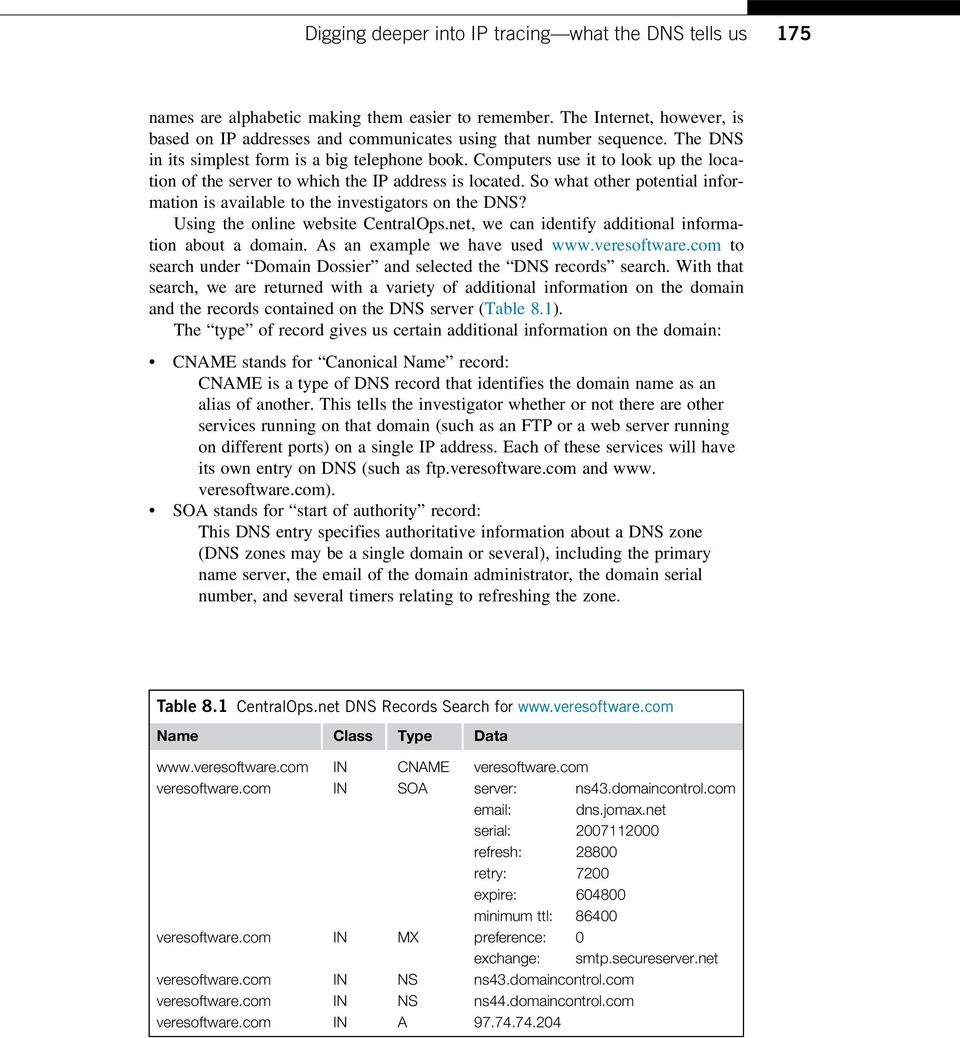
6 176 CHAPTER 8 Tracing IP Addresses Through the Internet MX stands for mail exchange record: The DNS record maps the domain researched to the mail exchange servers registered to that domain. NS stands for name server record: This record identifies the authoritative name servers for the domain. A stands for address record: This DNS record identifies the IP address assigned to the domain researched. So how can that be useful in your investigations? With the DNS records, we can identify the server that provides service to the domain. This is the MX record. This record can provide us a lead to additional domains used or operated by the domain of interest. The CNAME can give potentially additional services running on an IP address. The NS record can give you further information about the upstream ISP that services the domain being researched. TOOLS AND TIPS So How Do We Ultimately Determine IP Address Assignment? Search the IP address through a domain identifying tool, such as Network Tools. Upon identifying the company that is assigned the IP address, determine the proper legal compulsion method to obtain the records being sought prior to contacting them (see Chapter 4). Beware the ISP may attempt to notify the target about your actions without an order from a court stating not to identify the account holder. Additionally, if the ISP believes that the account is being used for criminal activity, they may close the account. If you have an ongoing investigation, this may hinder your ability to track the suspect. Use the legal contact information available from the SEARCH.org website, or, click the ISP button on the Internet Investigators Toolbar. Contact the company that is assigned the IP address in question and obtain records, with appropriate legal procedures. From their records, determine the identity of the person using the IP address at the date and time in question. Tracing s is as ubiquitous as any of the IPs we have discussed. Other than the World Wide Web, this is one of the most used tools for communication. It is commonly employed for everything from personal communications to business use. Unfortunately, it is also a favorite tool for threats and harassment by criminals and stalkers. This section will explain the basic parts of an and how to effectively identify the sender or identify the pieces of the that can further the investigation through additional follow-up. We previously discussed the protocol in Chapter 3 that routes , the Simple Mail Transfer Protocol (SMTP). The itself has several features that are unique and make identification possible. These features provide initial

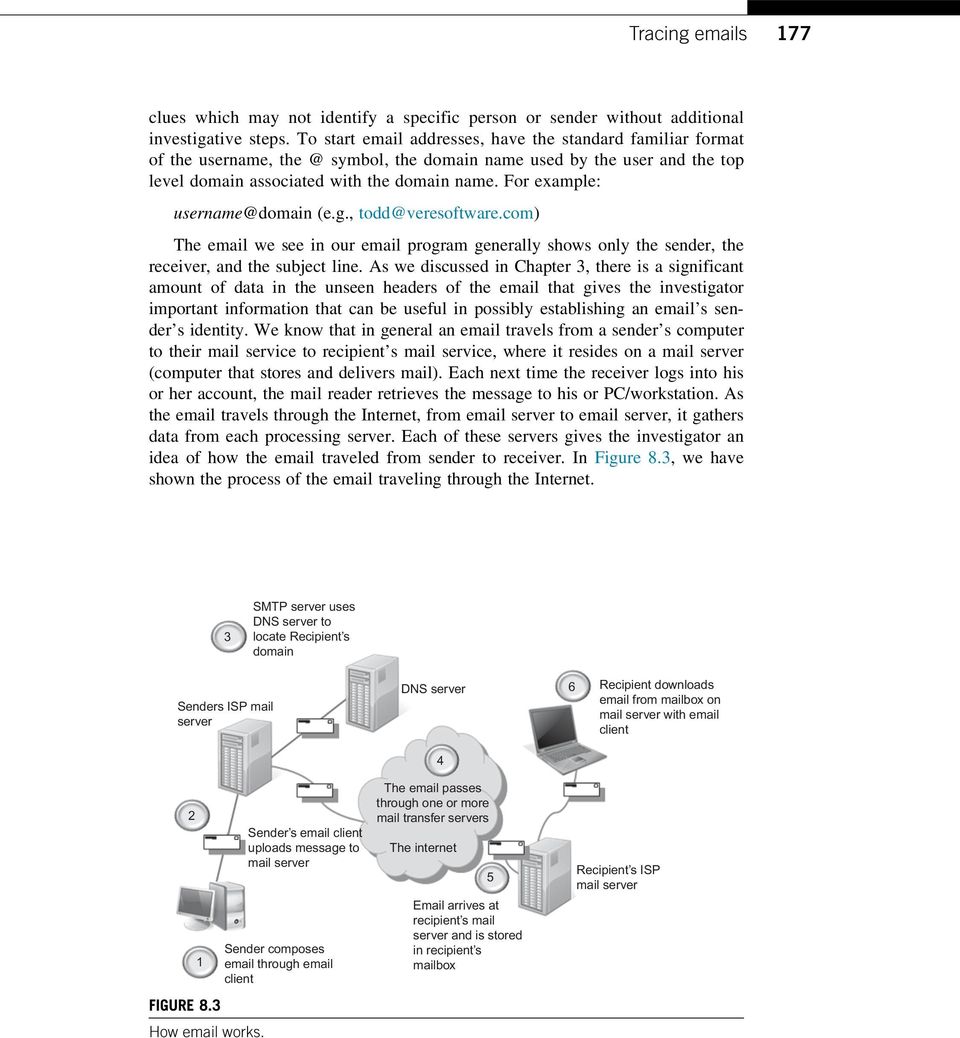
7 Tracing s 177 clues which may not identify a specific person or sender without additional investigative steps. To start addresses, have the standard familiar format of the username, symbol, the domain name used by the user and the top level domain associated with the domain name. For example: username@domain (e.g., [email protected]) The we see in our program generally shows only the sender, the receiver, and the subject line. As we discussed in Chapter 3, there is a significant amount of data in the unseen headers of the that gives the investigator important information that can be useful in possibly establishing an s sender s identity. We know that in general an travels from a sender s computer to their mail service to recipient s mail service, where it resides on a mail server (computer that stores and delivers mail). Each next time the receiver logs into his or her account, the mail reader retrieves the message to his or PC/workstation. As the travels through the Internet, from server to server, it gathers data from each processing server. Each of these servers gives the investigator an idea of how the traveled from sender to receiver. In Figure 8.3, we have shown the process of the traveling through the Internet. 3 SMTP server uses DNS server to locate Recipient s domain Senders ISP mail server DNS server 6 Recipient downloads from mailbox on mail server with client FIGURE 8.3 How works. Sender s client uploads message to mail server Sender composes through client The passes through one or more mail transfer servers The internet 5 arrives at recipient s mail server and is stored in recipient s mailbox Recipient s ISP mail server
8 178 CHAPTER 8 Tracing IP Addresses Through the Internet Where is the evidence? So if we are talking in general about where evidence could be, it could be in numerous places along that path (Figure 8.4). However, that does not mean a copy of the will exist on each location when you attempt to locate it. Depending on the jurisdiction, records of the transfer may not be required to be kept by government regulations. In the United States, there are no specific record retention requirements for tracking . Each service provider sets its own standards for logging information. What we can generally identify are the copies of a previously sent messages that may be stored at accessible locations. Those accessible locations include: The sender s device 1 The sender s mail server The recipient s mail server The recipient s device. A record of the transmission (date, time, source, and destination) can resideinthesesamelocations. Accessing these records can be done through the sender s device or through a forensic examination of the device. Before 3 System backup Receipient s hard drive 9 2 ISP mail server 5 7 ISP mail server 4 1 Internet mail transfer agents 6 Sender s hard drive 8 System backup FIGURE 8.4 Where is the evidence? 1 Devices can be computers, tablets, or cell phones, or anything that can be used to send or receive .
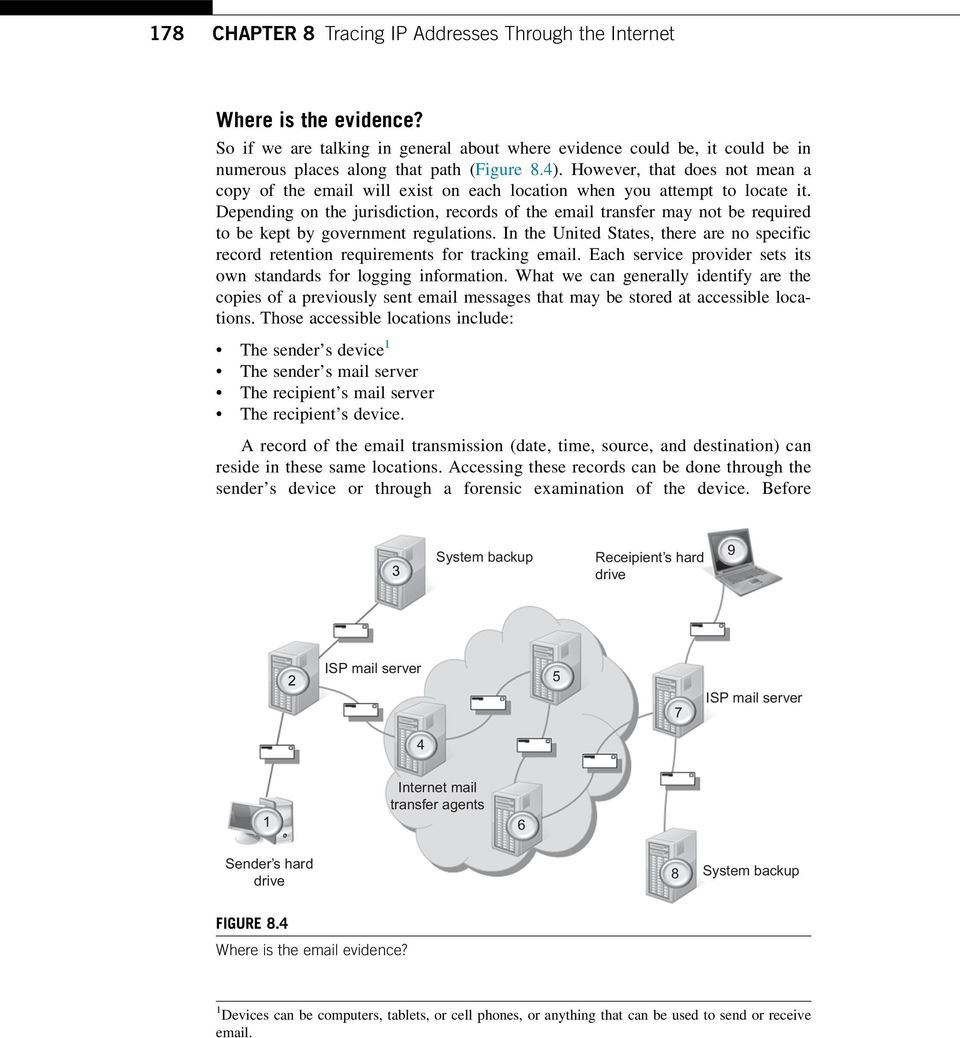
9 Tracing s 179 accessing data, be aware there are different legal requirements in play. Accessing data that resides on the sender s device requires consent or a traditional search warrant. However, in the United States, data that resides on a server requires compliance with the Stored Communications Act (SCA) (see Chapter 4). Of course, accessing any of the records requires the proper legal authority which can include consent, a subpoena, or search warrant. Additionally, depending on the laws in the investigator s country, other legal options for access may be available. Viewing headers To determine the sender of an , an investigator needs the s header information. An header is the information added to the beginning/top of the electronic message. Normally, clients and web services only show an abbreviated form of the header. headers are created by the servers that process the messages. Adding information depends on the protocol used. Not every server adds detailed information to the header as it passes through the server. Viewing the headers is different for each program or service. In Chapter 4, we discussed using Spamcop from the Internet Investigators Toolbar to identify the specifics of accessing headers for different services and tools. From the Spamcop website, we can easily identify how to access full headers to be reviewed for identifying information. The information commonly displayed are the abbreviated headers. We normally see in an From: To: CC: Subject: Date: For the investigator, the identifying information is the From line which is the address the message purportedly came from, the To line which is where the message was sent, and the CC line is where other addresses receiving the message are included. Is this information enough to properly trace an ? The answer is it certainly no. There is more information which can be used to effectively identify movement through the Internet. The full header provides the investigator with significantly more data with which to determine the veracity of the as well as its origin. What the full headers can help the investigator identify are: Who sent the Which network it originated from Which servers processed it

10 180 CHAPTER 8 Tracing IP Addresses Through the Internet INVESTIGATIVE TIPS Accessing Headers in Common Web Mail Services Google Mail 1. Open the message you want to view the headers. 2. Click the down arrow next to the Reply link. 3. Select Show Original and a new window will open with the full headers. Windows Live Mail 1. Right click on the message. 2. Select View Source. 3. A new window with the full headers and HTML source of the will open. Yahoo! Mail 1. Click Actions dropdown. 2. Select View Full Headers. 3. A new window with the full headers will open. Miscellaneous information: Time stamps client Encoding information. The investigator needs to also understand that not all the information in the header is useful to the investigation. Let s take a look at what the typical full header can contain: The originator fields: From:, Sender:, Reply-To: Date: Received: X-Originating-IP: Message-ID: X-Mailer: X-MIMEOLE: Headers are comprised of lines of information called header fields. Each field contains a field label, followed by a colon : and then the field body. The headers are generally layered bottom-to-top. For the investigator this means we start at the bottom of the full header and read up to determine how it traveled through the Internet mail services. The first field is on the bottom and subsequent fields added on top, in the order they are written by the mail server they were transferred through (Figures 8.2 and 8.3). In the full header, there are several header fields we can use to trace s: 1. Sender s address. 2. server information which includes the Message-ID. The SMTP relay information, which includes the sender s IP address or initial SMTP server s IP address.

11 Tracing s Common in SMTP servers is the additional information not standard in the protocol. These fields are added to the header by the SMTP server and are unique to the server. They are easily identified as any field starting with an X. In the SMTP standard, anything beginning with a X is nonstandard and has no direct translation in the standard. A commonly used nonstandard field has been one called X-Originating-IP. The X-Originating-IP has been used by SMTP servers to store the originating IP address of the s sender. This field can identify the IP address assigned to the sender by their ISP for that session. Another field of interest is the Message-ID. Every sent through an SMTP server is assigned a unique ID by the originating SMTP server. This Message-ID can identify the originating SMTP server from which the investigator can obtain logs (of course thisisanissueoftimelinessastheserver may not retain the records for long periods of time). If the investigator provides this message-id to the corresponding ISP, it can aid in locating the records needed to identify the sender. For the ISP it is easier, and usually faster, to search server logs for the Message-ID then to find IP addresses associated with the . The Message-IDs look very similar to addresses, for example: cardhu_decombobulator_blackberry.rim.net @bxe1280.bisx.prod.on.blackberry The information to the left of symbol is the unique identifier and the server it came through. The information to the right of identifies the domain to which the server assigning the Message-ID belongs. The Date Field in an can come from different sources. The date and time can be from the sender s computer, or the date and time can be from the initial server the message was sent through. These dates and times can possibly determine the sender s general location by time zone if the information comes from their system clock. However, this must be interpreted cautiously, because this depends on the service used. Time differences We mentioned briefly earlier that strict reliance on dates and times stamps should be done at the investigator s peril. Knowing where the time stamp came from is sometimes difficult and should not be totally relied on as coming from the sender. The reason is the investigator will rarely have all the information required to know what program was used to send the and the SMTP server settings that passed the on through the Internet. The sender could employ a Send Later feature to throw the receiver off and make them believe the was written and sent at a time different than when it actually was composed.
12 182 CHAPTER 8 Tracing IP Addresses Through the Internet Even Microsoft recognizes that differences in time stamps can occur within Outlook. On Office.com, they have the following reference about this fact: How time stamps appear in messages: NOTE: You might notice cases where the sent time is after the received time. This delay might be caused by a difference between the system clocks on the sender s computer and on your server. Header information translation Every header is different and has its own unique identification. In the following tables, we take a look at an sent from a Yahoo account to a Google (Gmail) account. We first have to login to and access the receiving Gmail account. Once we open the received in Gmail, we click on the dropdown arrow on the right side of the nest to the reply arrow. This opens up several options including Show original. Selecting Show original opens the header in another window (Figure 8.5). Table 8.2 has the complete header we extracted from the sent to the test Gmail account. Table 8.3 provides a detailed explanation of the header information reflected in Table 8.2. The complete header has several areas of interest to the investigator. We can break the header into five areas of interest: 1. The servers the passed through 2. Encrypted mail header 3. The traditional To, From, Subject, and Date lines 4. Mail transfer program information 5. Nonstandard information added by servers and programs Remember that the servers stamp the received information from the bottomupintheheader.intable 8.4, we break out the raw data in Table 8.2 FIGURE 8.5 Gmail account accessing full headers.

13 Tracing s 183 Table 8.2 Example Header from Yahoo to Gmail Delivered-To: Received: by with SMTP id z5csp55241qec; Sun, 24 Feb :24: (PST) X-Received: by with SMTP id y45mr yhk ; Sun, 24 Feb :24: (PST) Received: from nm26.access.bullet.mail.mud.yahoo.com (nm26.access.bullet.mail.mud. yahoo.com. [ ]) by mx.google.com with ESMTPS id a27si yhn (version 5 TLSv1 cipher 5 RC4-SHA bits 5 128/128); Sun, 24 Feb :24: (PST) Received-SPF: neutral (google.com: is neither permitted nor denied by best guess record for domain of [email protected]) client-ip ; Authentication-Results: mx.google.com; spf 5 neutral (google.com: is neither permitted nor denied by best guess record for domain of [email protected]) smtp. mail 5 [email protected]; dkim 5 pass header.i Received: from [ ] by nm26.access.bullet.mail.mud.yahoo.com with NNFMP; 24 Feb :24: Received: from [ ] by tm2.access.bullet.mail.mud.yahoo.com with NNFMP; 24 Feb :24: Received: from [ ] by omp1026.access.mail.mud.yahoo.com with NNFMP; 24 Feb :24: X-Yahoo-Newman-Property: ymail-3 X-Yahoo-Newman-Id: [email protected] Received: (qmail invoked by uid 60001); 24 Feb :24: DKIM-Signature: v 5 1; a 5 rsa-sha256; c 5 relaxed/relaxed; d 5 yahoo.com; s 5 s1024; t ; bh 5 qwi0 1 QrpLlhGpEVETzboOXvvDxVGRXmYMTrUSv0peL8 5 ; h 5 X-YMail-OSG:Received:X-Rocket-MIMEInfo:X-Mailer:Message-ID:Date:From:Subject: To:MIME-Version:Content-Type; b 5 13CKqrHzBlBA17dE7 1 2T/ HS1QEk0sDAHBlO1NQ1FCNIuDZYYsVFTktrzyHV/3/ QSOeNnk8gLqofZj0 1 MBzKzlAG 1 4oPUKrYGwqsiF2ufhj/ krldorz 1 hf 1 j56lnpv 1 e1ulunr4i2is2ei3sck 1 yrtfkjivjby76ji2hsdl9jlqk 5 DomainKey-Signature:a 5 rsa-sha1; q 5 dns; c 5 nofws; s 5 s1024; d 5 yahoo.com; h 5 X-YMail-OSG:Received:X-Rocket-MIMEInfo:X- Mailer:Message-ID:Date:From:Subject:To:MIME-Version:Content-Type;b 5 RiLBl0Box/ DViNyFivNHcESpQunKLGEYtJUG0vhpW1F18nXcLSc4Y4oNmF/ Ko4I0 1 oxonoeoqahxa2coz7hnc1rinsklxkommdom6sxg/ gkjtkahrzewryyjkxqzmb3do 1 epaobbj4g50as65j/dyttiotqbctknksltee9hhgk 5 ;X- YMail-OSG: 7cqc6isVM1kJzx4Iey5DeT1ZT.xzbruV5C.MlBV9T28FYZh mmmqcah_nyq_a.qjw4hom8m35yydpvdnwpxyjhdlrttzyhepgav8cbmln.yx ZsjUW9jHBTRIAyZBts52CF_RcL9Q_aOabKIQbc3y0jYQzNjexZXuVSdDkWnA vh8go3grcxdjm4u2hjaqeqsqbxxfykhcksz7ukrb4gkx57a7lztbsukrp4pc (Continued)

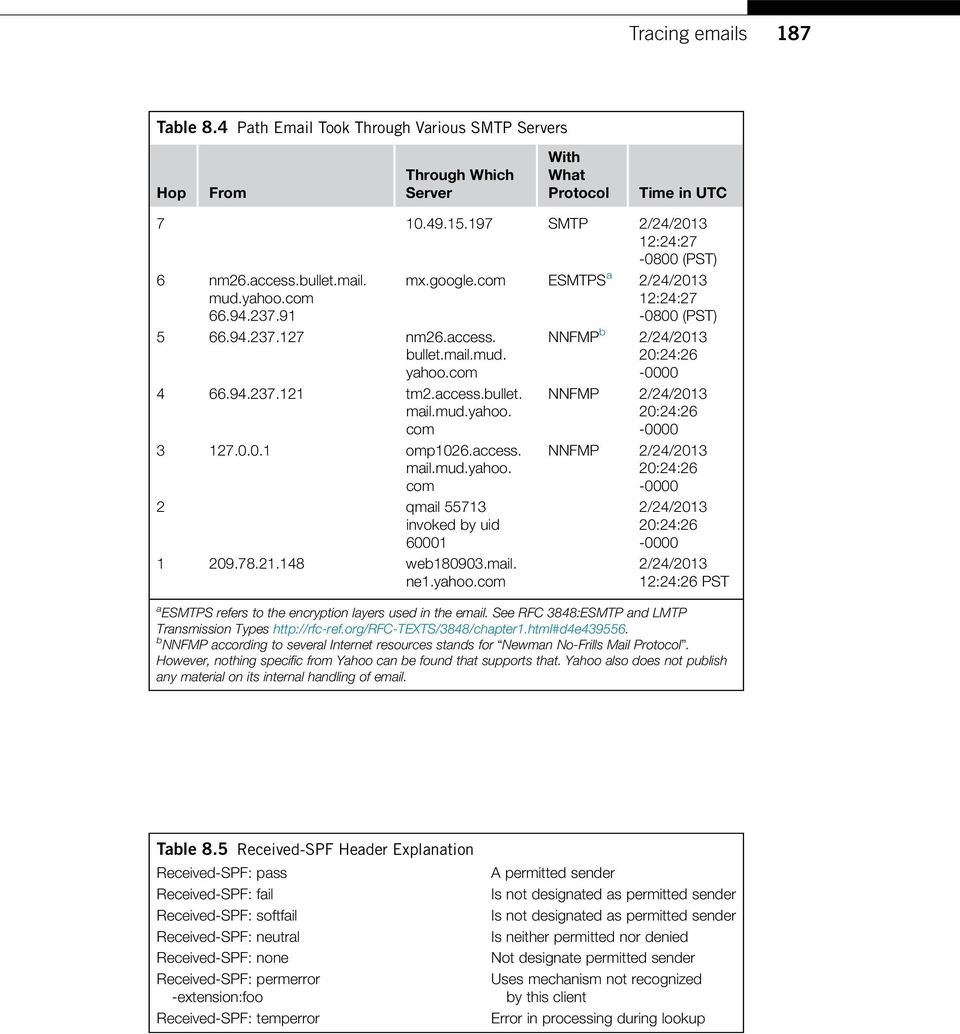
14 184 CHAPTER 8 Tracing IP Addresses Through the Internet Table 8.2 (Continued) SMWQho3fNIH5RtBbEAmppqMdcQhIJwUofuXGKFdqTaA_07p4.K7lcasK_yo6 93z6qCrlMVvvou6H7_3RW5DV5DGgsdQLpnZavRc.SYWrRbFmc1iW.4MkiREq 5GLkMNaYHxZHuo2FgWiVWMoUk51rf8BDtb2VqAdgLDebVfN.E_KzQBOk5CBK EVWdq_S0aSmOu5.xJUQ15n4Uu.lD7A7Wywxg5ihR7Ejqrgau_zzJhMg--Received: from [ ] by web mail.ne1.yahoo.com via HTTP; Sun, 24 Feb :24:26 PST X-Rocket-MIMEInfo: ,VGVzdCBFbWFpbAEwAQEBAQ-- X-Mailer: YahooMailClassic/ YahooMailWebService/ Message-ID:, YahooMailClassic@web mail.ne1.yahoo.com. Date: Sun, 24 Feb :24: (PST) From: Todd Shipley,[email protected]. Subject: Test from Yahoo to Gmail To: [email protected] MIME-Version: 1.0 Content-Type: multipart/alternative; boundary :90408 and provide the path the message took through various SMTP servers (Table 8.5). One can see that the first documented record of our example moving through an server is by a Yahoo server in line #1. Of particular note is that the sender s IP address in line #1 is correctly identified and belongs to the ISP used by the sender to log into their online account. Escalating through the hops the paths shown in numbers 2 5, Yahoo hands off the message amongst its ownserversandinhop#6passesthe off to Google. In the last hop #7, Google passes the off to the user s account. Looking at the time stamps this all occurs in a matter of seconds. In that short period of time, seven servers touched the , passing it on to the recipient. Note that the Yahoo servers are using UTC time (old Greenwich Mean Time) to stamp the ; however, Google translates the time into the local Pacific Standard Time. When the user looks at the at the receiving or sending end, their program translates the time into the local time zone. Table 8.3 breaks down the additional elements found in the header. Another header If we look at another header, this time one sent through Yahoo to Gmail, but via the user s desktop application Microsoft Outlook, we see similar actions through the Mail Transfer Agents (MTAs) (Table 8.6).

15 Table 8.3 Header Explanation from Yahoo to Gmail Header Name Header Value Explanation Delivered-To Account sent to X-Received by with SMTP id y45mr yhk ; Sun, 24 Feb :24: (PST) Server in Google Mail system that received the address of sender Received-SPF Authentication- Results neutral (google.com: is neither permitted nor denied by best guess record for domain of client-ip ; mx.google.com; spf 5 neutral (google.com: is neither permitted nor denied by best guess record for domain of [email protected]) smtp.mail 5 [email protected]; dkim 5 pass header.i X-Yahoo-Newman- ymail-3 Property X-Yahoo-Newman [email protected] Id DKIM-Signature v 5 1; a 5 rsa-sha256; c 5 relaxed/relaxed; d 5 yahoo.com; s 5 s1024; t ; bh 5 qwi0 1 QrpLlhGpEVETzboOXvvDxVGRXm YMTrUSv0peL8 5 ;h5 X-YMail-OSG:Received: X-Rocket-MIMEInfo:X-Mailer:MessageID:Date:From: Subject:To: MIME-Version:ContentType;b 5 13CKqrHzBlBA17dE7 1 2T/HS1QEk0sDAHBlO1NQ1FCNIuDZYYsVFTktrzyHV/3/ QSOeNnk8gLqofZj0 1 MBzKzlAG 1 4oPUKrYGwqsiF2ufhj/ krldorz 1 hf 1 j56lnpv 1 e1ulunr4i2is2ei3sck 1 yrtfkjivjby76ji2hsdl9jlqk 5 X-YMail-OSG 7cqc6isVM1kJzx4Iey5DeT1ZT.xzbruV5C.MlBV9T28FYZh mmmqcah_nyq_a. QJW4Hom8M35yydPvDNwPXyjHDlRtTzyHepGAV8cBmlN. yxzsjuw9jhbtriayzbts52cf_rcl9q_aoabkiqbc Refers to Sender Policy Framework (SPF), an validation system to prevent spam by attempting to verify sender IP (Table 8.4) server checked DKIM header and correctly identified sender s service as valid Yahoo mail server version Yahoo mail assigned ID number for this Encrypted DKIM header Unidentified Yahoo YMail function (Continued)

16 Table 8.3 (Continued) Header Name Header Value Explanation 3y0jYQzNjexZXuVSdDkWnAvH8go3GRcXdJM4U2HJaQEqSQbxXFYKHCksZ7uKr B4Gkx57a7LZTBsUkrp4pCSMWQho3fNIH5RtBbEAmppqMdcQhIJwUofuXGKFdq TaA_07p4.K7lcasK_yo693z6qCrlMVvvou6H7_3RW5DV5DGgsdQLpnZavRc. SYWrRbFmc1iW.4MkiREq5GLkMNaYHxZHuo2FgWiVWMoUk51rf 8BDtb2VqAdgLDebVfN.E_KzQBOk5CBKEVWdq_S0aSmOu5.xJUQ15n4Uu. ld7a7wywxg5ihr7ejqrgau_zzjhmg-- X-Rocket ,VGVzdCBFbWFpbAEwAQEBAQ-- Explanation Unknown MIMEInfo X-Mailer YahooMailClassic/ YahooMailWebService/ program used to send ; in this case, Yahoo s classic mail service Message-ID, YahooMailClassic@web mail.ne1.yahoo.com. Message-ID added by Yahoo Date Sun, 24 Feb :24: (PST) Date of the From Todd Shipley,[email protected]. Sender s address Subject Test from Yahoo to Gmail Subject line of the To [email protected] Recipient s address MIME-Version 1.0 Multipurpose Internet Mail Extensions (MIME) version Content-Type multipart/alternative; boundary :90408 Content type of which is used by the program to know how to understand and display the

17 Tracing s 187 Table 8.4 Path Took Through Various SMTP Servers Hop From Through Which Server With What Protocol Time in UTC SMTP 2/24/ :24: (PST) 6 nm26.access.bullet.mail. mud.yahoo.com nm26.access. bullet.mail.mud. yahoo.com tm2.access.bullet. mail.mud.yahoo. com omp1026.access. mail.mud.yahoo. com 2 qmail invoked by uid web mail. ne1.yahoo.com mx.google.com ESMTPS a 2/24/ :24: (PST) NNFMP b 2/24/ :24: NNFMP 2/24/ :24: NNFMP 2/24/ :24: /24/ :24: /24/ :24:26 PST a ESMTPS refers to the encryption layers used in the . See RFC 3848:ESMTP and LMTP Transmission Types b NNFMP according to several Internet resources stands for Newman No-Frills Mail Protocol. However, nothing specific from Yahoo can be found that supports that. Yahoo also does not publish any material on its internal handling of . Table 8.5 Received-SPF Header Explanation Received-SPF: pass Received-SPF: fail Received-SPF: softfail Received-SPF: neutral Received-SPF: none Received-SPF: permerror -extension:foo Received-SPF: temperror A permitted sender Is not designated as permitted sender Is not designated as permitted sender Is neither permitted nor denied Not designate permitted sender Uses mechanism not recognized by this client Error in processing during lookup
18 188 CHAPTER 8 Tracing IP Addresses Through the Internet Table 8.6 Example Header from Yahoo to Gmail Using Outlook Delivered-To: [email protected] Received: by with SMTP id z5csp127114qec; Mon, 18 Feb :50: (PST) X-Received: by with SMTP id r15mr pao ; Mon, 18 Feb :50: (PST) Return-Path:,[email protected]. Received: from nm6.access.bullet.mail.sp2.yahoo.com (nm6.access.bullet.mail.sp2. yahoo.com. [ ]) by mx.google.com with ESMTPS id o3si paz (version 5 TLSv1 cipher 5 RC4-SHA bits 5 128/128); Mon, 18 Feb :50: (PST) Received-SPF: neutral (google.com: is neither permitted nor denied by best guess record for domain of [email protected]) clientip ;Authentication-Results: mx.google.com; spf 5 neutral (google.com: is neither permitted nor denied by best guess record for domain of [email protected]) smtp. mail 5 [email protected]; dkim 5 pass header.i Received: from [ ] by nm6.access.bullet.mail.sp2.yahoo.com with NNFMP; 19 Feb :50: Received: from [ ] by tm1.access.bullet.mail.sp2.yahoo.com with NNFMP; 19 Feb :50: Received: from [ ] by smtp113.sbc.mail.gq1.yahoo.com with NNFMP; 19 Feb :50: DKIM-Signature: v 5 1; a 5 rsa-sha256; c 5 relaxed/relaxed; d 5 att.net; s 5 s1024; t ; bh 5 zdr8vzusnpalpi2oe0w4idejfwbqmvnufwuuop1dpk0 5 ; h 5 X-Yahoo-Newman-Id:X-Yahoo-Newman-Property:X-YMail-OSG:X-Yahoo-SMTP: Received:From:To:Subject:Date:Message-ID:MIME-Version:Content-Type:X-Mailer: Thread-Index:Content-Language; b 5 zj6iwouhenqzlrpkxzazh25v/ 6hiSU5MQSoB5MRNBOatvsCJEYRFMegqEEXMM8TxQmhEQp/ BvRBTykTjZ 1 avgvczyzbrj9owg/hsrxmoi9jgic 1 1VOqDP0rQkpk/ TruVIkp5i4LQLIXcwMxzm6VD 1 QDekG3CkS3uk4Jua3LrSHQ 5 X-Yahoo-Newman-Id: [email protected] X-Yahoo-Newman-Property: ymail-3 X-YMail-OSG: JLThjqoVM1lOm4wlt7jk.KDJFl0WnQIXguxMhWNboTRHyEQ 1J8yrK68QHDPUdtpDaJ8rhi_6Lm6RiT8qZmyN5u0LxSobBgQLCmOXpsuG.VW H05DsSSQTMF6vJmQA5DoPhvKw0oOyUc7h9f18rDo5BESykTCdd2IpRCquoRx rdx9h16_fggb9okkodksmhahplotoxgf0t9wq_fana8qxlh3rbrkjvnavk1r O0pU_GxpX9tJuaAolBehXj3C2bVVMB0t8sZIa08felznFdrmHJiSHq3eWLlp _jbhwtnnsputhledggenwyz1se6ycfn0hxudwgjcvx_cezpaaoaclwbkmmcp K9qxZPG4xQWWZthxd7RJFfQ2KgjBmtj3LOD4cEhsVi35pnaNOFHAWwmJ5p2R S.tg0zT3aZZgmMR_DxLki9.oC9FWy9Fhr6A-- X-Yahoo-SMTP: epbfhb6swbdqeduyvn.lxjxg.wq.d6_tll6cmny3 Received: from Laptop testyahooaccount(toddshipley@ with login) by smtp113.sbc.mail.gq1.yahoo.com with SMTP; 18 Feb :50: PST (Continued)

19 Tracing s 189 Table 8.6 (Continued) From: To: Todd Subject: Yahoo to Google Date: Mon, 18 Feb :50: MIME-Version: 1.0 Content-Type: multipart/alternative; boundary _NextPart_000_002E_01CE0E08.D854B3C0 X-Mailer: Microsoft Outlook 14.0 Thread-Index: Ac4OS9/suTp1w2JJS/Krzk1m1OaP3w 55 Content-Language: en-us X-Antivirus: avast! (VPS , 2/18/2013), Inbound message X-Antivirus-Status: Clean INVESTIGATIVE TIPS Why a Server Hop Matters When investigating headers, the investigator identifies various MTAs that handle the and pass it to the next server. Each of these is a potential source of information and evidence of the s movement through the Internet. However, the evidence may not reside there long. Additionally, the evidence in the hops indicates something useful for possibly fulfilling the statutory requirements of some crimes. For instance, some crimes, particularly federal statutes, need an interstate nexus. A Threatening Interstate Communications, 18 U.S.C. y 875 violation requires that the communication crossed state lines. Identifying each of the server IP addresses and their associated owners may go a long way to establishing such legal elements. In Table 8.8, we can see that the first record of anything through our servers is by Yahoo in line #1. What is different in this example is the sender s IP address is correctly identified as well as the name of the computer sending, which is Laptop. The name of the computer used to prepare the example as given in Tables 8.6 and 8.7 is verified by the system information page from that computer as shown in Figure 8.6. Looking at Table 8.8, we can escalate through the hops the paths show in numbers 2 4. It shows Yahoo passing the amongst its own servers, and in hop #5, Yahoo finally passes the off to Google. In the last hop #6, Google passes the off to the user s account. Looking at the time stamps this all occurs in a matter of seconds. In that short period of time, six servers touched the , passing it on to the recipient. The investigator should be aware that the servers either stamp the times with the local time of the server or use UTC time (old Greenwich Mean Time) as the time used to stamp the

20 Table 8.7 Header Explanation from Yahoo to Gmail Through Outlook Header Name Header Value Explanation Delivered-To Account sent to Received by with SMTP id z5csp127114qec; Google server Mon, 18 Feb :50: (PST) passing X-Received by with SMTP id r15mr pao ; Mon, 18 Feb :50: (PST) Server in Google mail system that received the address of sender Received from nm6.access.bullet.mail.sp2.yahoo.com (nm6.access.bullet.mail.sp2.yahoo.com. [ ]) by mx.google.com with ESMTPS id o3si paz (version 5 TLSv1 cipher 5 RC4-SHA bits 5 128/128); Mon, 18 Feb :50: (PST) Received-SPF neutral (google.com: is neither permitted nor denied by best guess record for domain of [email protected]) client-ip ;Authentication- Results: mx.google.com; spf 5 neutral (google.com: is neither permitted nor denied by best guess record for domain of [email protected]) smtp. mail 5 [email protected]; dkim 5 pass header.i Received from [ ] by nm6.access.bullet.mail.sp2.yahoo.com with NNFMP; 19 Feb :50: Received from [ ] by tm1.access.bullet.mail.sp2.yahoo.com with NNFMP; 19 Feb :50: Received from [ ] by smtp113.sbc.mail.gq1.yahoo.com with NNFMP; 19 Feb :50: DKIM-Signature Yahoo server passing Refers to SPF, an validation system, to prevent spam by attempting to verify sender IP (see Table 8.5) Yahoo server passing Yahoo server passing Yahoo server passing

21 X-Yahoo- Newman-Id X-Yahoo- Newman-Property X-YMail-OSG v 5 1; a 5 rsa-sha256; c 5 relaxed/relaxed; d 5 att.net; s 5 s1024; t ; h 5 zdr8 VzuSnPALPI2Oe0w4idEjFWb QmVNUfwUuop1dpk0 5 ;h5 X-Yahoo-Newman-Id:X- Yahoo-Newman-Property:X-YMail-OSG:X-Yahoo- MTP:Received: From:To:Subject:Date: Message-ID:MIME-Version:Content-Type:X-Mailer:Thread-Index:Content-Language; b 5 zj6iwouhenqzlrpkxzazh25v/6hisu5mqsob5mrnboatvscjeyrfme gqeexmm8txqmheqp/bvrbtyktjz 1 avgvczyzbrj9owg/hsrxmoi9jgic 1 1VOqDP0rQkpk/TruVIkp5i4LQLIXcwMxzm6VD 1 QDekG3CkS3uk4Jua3LrSHQ [email protected] ymail-3 JLThjqoVM1lOm4wlt7jk.KDJFl0WnQIXguxMhWNboTRHyEQ1J8yrK68QHDPUdtpDaJ8rhi_ 6Lm6RiT8qZmyN5u0LxSobBgQLCmOXpsuG.VWH05DsSSQTMF6vJmQA5DoPhvKw 0oOyUc7h9f18rDo5BESykTCdd2IpRCquoRxrDX9h16_fggb9okkodkSMhaHpLOTOX gf0t9wq_fana8qxlh3rbrkjvnavk1ro0pu_gxpx9tjuaaolbehxj3c2bvvmb0t8 szia08felznfdrmhjishq3ewllp_jbhwtnnsputhledggenwyz1se6ycfn0hxudwgjcvx _CeZPAaoacLwBkMmcPK9qxZPG4xQWWZthxd7RJFfQ2KgjBmtj3LOD 4cEhsVi35pnaNOFHAWwmJ5p2RS.tg0zT3aZZgmMR_DxLki9.oC9FW y9fhr6a-- Encrypted DKIM header Yahoo mail assigned ID number for this Yahoo mail server version Unidentified Yahoo YMail function X-Yahoo-SMTP epbfhb6swbdqeduyvn.lxjxg.wq.d6_tll6cmny3 Unidentified Yahoo SMTP function Received from Laptop testyahooaccount(toddshipley@ with login) by smtp113.sbc. mail.gq1.yahoo.com with SMTP; 18 Feb :50: PST Yahoo server receiving the from the login IP address of and the device name used to send the Laptop From ATT,[email protected]. Sender s address To Todd Shipley,[email protected]. (Continued)
22 Table 8.7 (Continued) Header Name Header Value Explanation Recipient s address Subject Yahoo to Google Subject line of the Date Mon, 18 Feb :50: Date of the Message-ID,[email protected]. Message ID added by AT&T (Yahoo) MIME-Version 1.0 MIME version Content-Type multipart/alternative; boundary _NextPart_000_002E_01CE0E08.D854B3C0 Content type of which is used by the program to know how to understand and display the X-Mailer Microsoft Outlook 14.0 Identifies program used to receive the at the user s desktop Thread-Index Ac4OS9/suTp1w2JJS/Krzk1m1OaP3w 55 Microsoft Outlook Message-ID Content- Language en-us Language used in X-Antivirus avast! (VPS , 2/18/2013), Inbound message Antivirus program Avast used to scan inbound messages X-Antivirus-Status Clean Antivirus program declaration that is Clean of any malware
23 Tracing s 193 Table 8.8 Path Took Through Various SMTP Servers Hop From Through Which Server With What Protocol Time in UTC SMTP 2/19/2013 2:50:36 AM 5 nm6.access.bullet.mail.sp2. yahoo.com nm6.access.bullet. mail.sp2.yahoo.com tm1.access.bullet. mail.sp2.yahoo.com smtp113.sbc.mail. gq1.yahoo.com 1 Laptop smtp113.sbc.mail. gq1.yahoo.com mx.google.com ESMTPS 2/19/2013 2:50:36 AM NNFMP 2/19/2013 2:50:35 AM NNFMP 2/19/2013 2:50:35 AM NNFMP 2/19/2013 2:50:35 AM Login 2/19/2013 2:50:35 AM FIGURE 8.6 System page in Windows 7 showing computer name.
24 194 CHAPTER 8 Tracing IP Addresses Through the Internet Table 8.9 Standard Internal Header Information from an Microsoft Exchange Server Microsoft Mail Internet Headers Version 2.0 Received: from exchfe02.ad.xxx ([10.10.xxx.xx]) by exch10.ad.xxxi with Microsoft SMTPSVC( ); Fri, 22 Nov :29: Received: from KMBT59C636.ad.agi ([10.10.x.xx]) by exchfe02.ad.xxx with Microsoft SMTPSVC( ); Fri, 22 Nov :29: To:[email protected] Subject:Message Sender:[email protected] From:[email protected] Reply- To:[email protected] X-Mailer:KONICA C550 Date: Fri, 22 Nov :29: Message-Id:,4 7 A [email protected]. MIME-Version: 1.0 Content-Type:multipartlmixed; boundary 5 KONICA_MINOLTA_Internet_Fax_Boundary Content-Transfer-Encoding:7 bit Return-Path: hxxx@ xxxx.com . When the user looks at the at the receiving or sending end, their program will generally translate the time into the local time zone, that is, Mon, 18 Feb :50: (-0800 is 8 h after UTC or Pacific Standard Time). A Microsoft Outlook header translation through an exchange server Not all headers we may need to look at go through the Internet. headers are found internally in popular networks such as Microsoft Exchange servers. If we take a look at the header fields from a common Microsoft Exchange Outlook , we can identify other interesting information about the . Table 8.9 reflects a unique situation. The chain starts from a printer. A document is scanned on the printer that is attached to the systems network (and has an assigned address on the network), and gets processed by the Microsoft Exchange server. As a result, this contains a separate header based on the IP from RFC 5322 Internet Message Format. This header was produced by the Konica printer, which sent the . Table 8.10 lists the definition of the Outlook header information as defined by Microsoft from their website. Ultimately, the message ends up in the user s mailbox that it was addressed to and where it is transferred to the local storage of the user. Our header is found in the Microsoft Outlook Personal Storage File (PST) on the user s computer. Table 8.11 provides a listing of standard header information translation for definitions found in RFC s 5321, 5322, and Multipurpose Internet Mail Extensions We previously discussed the mail transfer program protocol SMTP in Chapter 3. It is the standard protocol for sending through the Internet. However, it does have limitations. The largest limitations are due to the size of the that
25 Tracing s 195 Table 8.10 Outlook Header Information Translation Conversation Topic: Sender Name: Received By: Delivery Time: Creation Time: Modification Time: Submit Time: Importance: Sensitivity: Flags: Size: The topic of the conversation thread of the Outlook item The display name of the sender for the Outlook item The display name of the true recipient for the mail message No definition found The creation time for the Outlook item A Date specifying the date and time that the Outlook item was last modified Read-only No definition found The relative importance level for the Outlook item Indicates the sensitivity for the Outlook item A mail item with a flag marked through the user interface Indicates the size (in bytes) of the Outlook item Table 8.11 Translation of Standard Header Information Standard Header Information Translation Microsoft Mail Internet Headers Version 2.0 Received: from exchfe02.ad.xxxi ([ xxx.xx]) by exch10.ad.xxxi with Microsoft SMTPSVC( ); Fri, 22 Nov :29: Received: from KMBT59C636.ad.xxx ([10.10.x.xx]) by exchfe02.ad.xxx with Microsoft SMTPSVC( ); Fri, 1 Feb :40: To:[email protected] Subject:Message Field Explanation from RFC 5322 and 2045 This header is added by Microsoft Outlook. The Received: field contains a (possibly empty) list of tokens followed by a semicolon and a date-time specification. Each token must be a word, angle-addr, addr-spec, or a domain. Further restrictions are applied to the syntax of the trace fields by specifications that provide for their use, such as [RFC5321]. When the SMTP server accepts a message either for relaying or forfinal delivery, it inserts a trace record (also referred to interchangeably as a time stamp line or Received line) at the topof the mail data. This trace record indicates the identity of the host that sent the message, the identity of the host that received the message (and is inserting this time stamp), and the date and time the message was received. The To: field contains the address(es) of the primary recipient(s)of the message. The Subject: field is the most common and contains a short string identifying the topic of the message. (Continued)
26 196 CHAPTER 8 Tracing IP Addresses Through the Internet Table 8.11 (Continued) Standard Header Information Translation Sender:[email protected] From:[email protected] Reply-To: [email protected] X-Mailer: KONICA C550 Date: Fri, 22 Nov :29: Message-Id:,4 7 A [email protected]. MIME-Version: 1.0 Content-Type: multipartlmixed; boundary 5 KONICA_MINOLTA_ Internet_Fax_Boundary Field Explanation from RFC 5322 and 2045 The Sender: field specifies the mailbox of the agent responsible for the actual transmission of the message. The From: field specifies the author(s) of the message, that is, the mailbox(es) of the person(s) or system(s) responsible for the writing of the message. When the Reply-To: field is present, it indicates the address(es) to which the author of the message suggests that replies be sent. Implementors may, if necessary, define private Content-Transfer-Encoding values, but must use an x-token, which is a name prefixed by X-, to indicate its nonstandard status, for example, Content-Transfer- Encoding: x-my-new-encoding. The origination date specifies the date and time at which the creator of the message indicated that the message was complete and ready to enter the mail delivery system. The Message-ID: field provides a unique message identifier that refers to a particular version of a particular message. The uniqueness of the message identifier is guaranteed by the host that generates it (see below). This message identifier is intended to be machine readable and not necessarily meaningful to humans. A message identifier pertains to exactly one version of a particular message; subsequent revisions to the message each receive new message identifiers. A MIME-Version header field, which uses a version number to declare a message to be conformant with MIME and allows mail processing agents to distinguish between such messages and those generated by older or nonconformant software, which are presumed to lack such a field. A Content-Type header field, generalized from RFC 1049, which can be used to specify the media type and subtype of data in the body of a message and to fully specify the native representation (canonical form) of such data. (Continued)
27 Tracing s 197 Table 8.11 (Continued) Standard Header Information Translation Content-Transfer-Encoding: 7 bit Return-Path: [email protected] Field Explanation from RFC 5322 and 2045 A Content-Transfer-Encoding header field, which can be used to specify both the encoding transformation that was applied to the body and the domain of the result. Encoding transformations other than the identity transformation are usually applied to data in order to allow it to pass through mail transport mechanisms which may have data or character set limitations. The Return-Path: header field contains a pair of angle brackets that enclose an optional addr-spec. can be sent and its inability to deal with non-ascii characters. This has been overcome with an additional set of protocols that describe how to send larger messages and attachments. This protocol is commonly referred to as MIME. MIME stands for Multipurpose Internet Mail Extensions. MIME allows the inclusion of non-ascii characters and non-english languages, multiple fonts, and of course multimedia objects such as images, audio, and video (Brodkin, 2011). MIME has become the standard protocol for allowing the addition of media as in pictures and video into an . How does this occur you might ask? Well, the protocol uses an encoding method known as base64 to convert the nontext items, binary data, such as videos, or pictures into text. This then allows the standard SMTP to more easily transmit the data. Upon receipt, your program unencodes the base64 data into a file we can understand again. MIME uses the Content-Type field to help it determine if the data needs to be encoded. Table 8.12 provides an explanation for common MIME Content-Types (Figure 8.7). Looking at little X We already mentioned that header entries beginning with an X are nonstandard and applied by a user s program or an server or MTA that it passes through. The X lines in the header are intended to provide additional information to aid in the sending of the through various servers. To understand some of the X lines in an header, we have put together a short list in Table 8.13 of commonly encountered X lines you might see when tracing an header. Many of these can be found in various RFCs including RFC 2076.
28 198 CHAPTER 8 Tracing IP Addresses Through the Internet Table 8.12 Content-Type Explanation Content-Type application/octetstream application/xml x-type image/jpeg multipart/related multipart/signed multipart/mixed Description Used where the message is an unknown type and contains any kind of data as bytes Used for application-specific xml data Used for nonstandard content type Used for images Used for multiple related parts in a message Used for multiple related parts in a message including signature Used for multiple independent parts in a message From: To: Subject: Content-Type: Multipart/mixed: Header of Content-Type: text/plain Here is a message. Text of message Content-Type: Multipart/alternative Content-Type: image/jpg Content-Transfer-Encoding: base64 Multi part container **Encoded base64 data** Content-Type: image/jpg Content-Transfer-Encoding: base64 Base64 encoded message parts **Encoded base64 data** Content-Type: video Trasfer0Encoding: base64 **Encoded base64 data** FIGURE 8.7 MIME analysis.
29 Tracing s 199 Table 8.13 Common X Header Explanations Header X-Apparently-To X-Antivirus X-Antivirus-Status X-Complaints-To X-Confirm-Reading- To X-Errors-To X-Ymail-ISG X-Mailer X-Notifications X-Originating-IP X-PMFLAGS X-Priority X-Received X-Sender X-Spam-zzz X-UIDL X-Yahoo-Newman- Property X-Yahoo-Newman-Id X-Ymail-OSG Explanation Intended receiver of the Antivirus tool used to check Status of the according to the antivirus tool as Clean or Spam Where to direct your complaints you have about an you received Create an automatic response for read messages The address to send an to for any errors encountered Yahoo Incoming Spam Guard Program used to send the Explanation Unknown IP address of ISP used by sender Additional information used with Pegasus Mail Priority of being sent MTA receiving (does not necessarily mean the last server in the line Additional information about the sender of the Where zzz is any number of different spam tags relating to the Spam filter on the server. Some of these include Checker- Version, Level, Report, and Status Used with s distributed over POP Explanation Unknown Yahoo internal mail transfer protocol ID Yahoo Outgoing Spam Guard THINGS TO KNOW Sender IP information in an header is often controlled by the MTAs first processing the . Historically to prevent spam, these MTAs would pass through the sender s IP address. This assisted the receivers of an trace back the to the sender. This was commonly added as the header X-Originating-IP. Changes to the way some of the large ISP companies process have started to appear. Google no longer adds the sender s IP address in their headers. As of mid-december 2012, Microsoft has started adding a new line to its headers titled X-EIP and has removed the X-Originating header. The X-EIP header appears to be an encoded IP address, but to date has not been translated. Controlling spam has become a significant issue and one that has affected the method by which the investigator traces an .
30 200 CHAPTER 8 Tracing IP Addresses Through the Internet INVESTIGATIVE TIPS from Other Sources is such a prolific tool that it is available not just on computers but also on cell phones, gaming devices, tablet devices, and social media sites. Headers sent from these devices can also provide the investigator with specific header information about the sender and the location or device sent from. This can provide another potential source of digital evidence for later collection and review by digital forensic investigators. Android Phone sent from an Android phone can be potentially identified through the headers through the Content-Type header. The Content-Type header may have com.andriod. in the text. The Message-ID may contain .android.com. The first Received: line will most likely contain an IP address assigned to the cell phone s service provider. iphone sent from an iphone can be potentially identified through the headers through the Content-Type header. The Content-Type header may have text/plain; charset 5 us-ascii. An X header X-Mailer may contain the text iphone Mail. The first Received: line will most likely contain an IP address assigned to the cell phone s service provider. Nook Tablet devices: sent from a Nook Tablet can potentially be identified through the headers Message-ID which may contain .android.com. Facebook s sent from a Facebook account may be identified from the account sender which will be the Facebook account followed The first received line may also include the text helo 5 and the DKIM header may have a reference to facebook.com also. There may possibly be an X-Originating-IP header containing an IP belonging to facebook.com. Faking an and hiding its sender So we have looked at the real header, but what can be done to hide the real sender of an . There are several things the sender can do to hide their location from the receiver. A few of those methods include: 1. Anonymous r ers/ open relays: SMTP mail servers on the Internet that allow anyone on the Internet to forward . These have become increasingly difficult to find because most of them have been closed due to their misuse by spammers. 2. on anonymous networks: Anonymous sent through the Tor or I2P networks. Tor and I2P both offer access to through their anonymized networks ( and 3. Forging headers: Sender uses controlled SMTP server to send with altered Anonymous accounts: accounts with no requirement for inputting real identifying information about the sender. Most of the larger services including Google, Yahoo, and Microsoft Live allow the suspect or the investigator to create fictious accounts.
31 Collecting from a web-based system Fake mail generators/disposable and temporary accounts: Web-based services that let the sender input any return address. Searching the Internet will find numerous sites that provide this service. Most of these advertise they keep no records of the IP addresses connecting with the server as a way to assure their customer s privacy. Each of these methods adds to the difficulty the investigator will have in identifying the IP address of the suspect or possibly make it entirely impossible to trace. Identifying the actual IP address may include legal service on multiple IP addresses or undercover contact with the target. Collecting from a web-based system collection from a web-based service can be an effective evidence collection technique for the investigator. Both criminal investigators and civil investigators can properly collect the web-based in support of their investigations. Examples of collection possibilities include documentation of a victim s threatening s or a civil investigator conducting client collection of s in response to a litigation hold request. Regardless of the reason given to the proper authority for the investigator to collect the , such as permission or by court order, the investigator can collect s stored on a remote server belonging to a web-based provider. Collecting from web-based accounts can be accomplished fairly easily with a proper understanding of the mail protocols used. from a web mail account can be done by using a local client (one installed on the investigator s workstation or laptop) like Outlook from Microsoft or a free client like Zimbra from VMWare. Using one of these local clients, the investigator can set up his connection to the web-based service and synch his client with the web-based service. Each of the web-based services has slightly different connection parameters. The investigator needs to research the connection parameters prior to conducting the collection. This will ensure the collection is conducted without issues. Prior to the collection, the investigator needs to have the proper legal authority established and obtain the login usernames and passwords for the account to be acquired. Logging into the web-based service, such as Google, may also require compliance with certain security features like their notification of an unrecognized computer. This can require the collection of a text message from the account holder s cell phone. Mail protocols SMTP is the protocol used for transmitting across the Internet. We discussed this protocol in Chapter 3. Along with the SMTP protocol are the protocols for accessing the user s mail transfer servers. These protocols are: Post Office Protocol (POP) Internet Message Access Protocol (IMAP)
32 202 CHAPTER 8 Tracing IP Addresses Through the Internet Both POP and IMAP are used for communication between a user s program and the user s mail transfer server. Each protocol allows the user to download their to a local device for later or off-line review. The functions of the protocols are different and require specific setup on the mail transfer server as well as the local device to accept the mail through these processes. Conducting collection from web-based services should be done through the use of IMAP and not POP. While POP is an effective tool for personal synchronization of and access to that , it does not effectively allow for complete collection of web-based . IMAP was designed to allow for complete control and synchronization of SMTP accounts on an server. While IMAP is the best method for collecting the , POP may be the only alternative depending on the service. Yahoo as an example does not allow desktop access through IMAP. We discuss how each method is accomplished below. Investigator s collection options The investigator has several options available to collect from a MTA. The investigator can provide legal service to the mail hosting company and wait for their response. This may be the only option if access externally from the web is not available. If the investigator has external access to the account with the appropriate permission and account access information, there are some other options for collecting the . Each option requires an understanding of the protocol and the requirements of the MTAs (the MTA in these cases usually refers to a web-based accessible service, that is, Gmail, Yahoo mail, or Live mail). We are going to discuss two of the easiest options for the investigator to access the mail account externally or from the user point of view. The first is a free method, Zimbra by VMware, and the other uses a reasonably common program, Outlook by Microsoft. Both of these tools provide the investigator the ability to collect from mail transfer services. Both programs are desktop tools that give the user the ability to collect the s from a specific account that the investigator has access to. The access requires that the investigator has the legal authority and the username and password to the account. To accurately collect the from the MTA, the investigator in most cases will have to login to the account and set up the account to allow for the transfer of the mail using either POP access or IMAP. Depending on the accessed service, additional features may need to be invoked to allow for the collection of all folders. In Gmail, additional steps are required to collect the chats saved in the account. The investigator needs to change the setting to have the chat viewable in the mailbox. Also in Gmail, contacts and calendar events require a separate export of those items as they are not in the mailbox which has an IMAP access connection. The investigator can document the settings of the account and any changes he makes by taking screen shots of the access process, using the tools noted in Chapter 5. Each of the Internet programs have different settings and should
33 Collecting from a web-based system 203 be researched prior to conducting the collections. Common with any of the collection methods is that they are using the Internet and any latency it may have as well as the servers containing the data to be collected. What this means to the investigator is that when the synchronization of the account begins between the method selected and the account, the time involved in the collection can be a few minutes with small amounts of data to hours for accounts with large numbers of s. INVESTIGATIVE TIPS Always there are exceptions to every rule. In the case of downloading from web-based services, it is Yahoo. Yahoo mail collection can be a little different depending on the service being provided by Yahoo. Yahoo has free access accounts and paid accounts. The free services are generally only accessible by the POP3 protocol. The pay accounts have the option of accessing the account through IMAP. Some reports by Yahoo users on the Internet have related they have accessed their free accounts by IMAP access, but Yahoo states they do not support that protocol for free accounts. There are third party utilities that purport to connect through the IMAP protocol, but validation by the investigator should occur prior to implementing any utility during an investigation. Zimbra Desktop collections Zimbra Desktop is an program from VMWare, the makers of virtual machine technology. Zimbra Desktop is part of a suite of service programs provided as Open Source and pay for products. The Zimbra family of products includes server-based programs as well as the desktop program we are going to discuss here. Zimbra Desktop is a simple to use and install program that allows the investigator to easily capture from an online mail service. Here are the steps: Zimbra Desktop installation: 1. Download Zimbra Desktop from the Zimbra website 2. Install Zimbra Desktop on local machine. 3. The first screen will ask for the investigator to add an account. Select the type of to collect. 4. Under Add New Account add the account name, address, and password. Select Check Messages: to manually and check Sychronize all calendars and Synchronize all contacts and groups. 5. Click Validate and Save. Some additional notes for setting up specific accounts: a. Setting up a Yahoo account may require additional validation processes. b. Gmail accounts require you to change the Gmail account settings to accept IMAP connections. In addition, the folders within the Gmail account need to be made visible to the IMAP function. Under the Label tab in the settings function select the Show in IMAP for each folder to collect and select
34 204 CHAPTER 8 Tracing IP Addresses Through the Internet FIGURE 8.8 Adding new account to Zimbra. show. This makes the folders visible in the folder tree on the left side of the screen and downloadable. Setting up new accounts in Zimbra Desktop: (Figure 8.8). The Add New Accounts function in Zimbra Desktop allows you to easily add new accounts. The selections include: Yahoo! Mail: You can set up Yahoo! Mail, Yahoo! Mail Plus, Yahoo! Small Business, Ymail, or Rocketmail accounts. Gmail: Your Gmail account must be set up to allow IMAP access. You must log into the target Gmail account and enable IMAP in the Labels tab under the settings. Check all the items to Show and check the box for each item to Show in IMAP. Other POP/IMAP accounts: You must have complete settings information in order to set up POP/IMAP access. You can obtain such information from the target s service provider or research it on the Internet. Once the account is added select the account and right click to select Send/ Receive. Once the synchronization is complete, the investigator can verify that the was collected by comparing the number of s in the online account to the number held in the synchronized account in Zimbra. The investigator can then use the Zimbra client to export the messages out in a compressed file as an evidence container. In Zimbra click on the Preferences tab and an option under the targeted user account will appear called Import/Export. Click this and a new field will appear on the right. Under Export select Advanced Settings
35 Collecting from a web-based system 205 FIGURE 8.9 Zimbra Desktop saving from online account. and include all the data types required. Set the data range and leave the other box blank. Click the Export button and a box to save the data will appear. Zimbra saves the data in a compressed.tgz file to the location you select. This evidence container can then be hashed to provide a unique identifier for the file. After collection is completed, the investigator needs to access the account and return the settings to their original state. The investigator can use Zimbra to review the after the s are saved separately as an evidence item (Figure 8.9). Using Outlook for collections Using Microsoft Outlook for web-based collections requires setting up Outlook to access the account. The investigator needs to research online the exact account access settings prior to conducting the collection. Simply doing a Google or Bing search on the server and IMAP Account Settings will provide the setting information needed. The following steps can be used in Outlook to set up a new account for collection: 1. Create a new account by clicking on Tools, then Accounts. 2. Add a new account and click Next. 3. Select IMAP and click Next. 4. This window asks for specific connection information. The investigator should have already researched the specific connection requirements for the service to be accessed including: a. Your name: This is the user s account to be accessed. b. address: The user account s complete address.
36 206 CHAPTER 8 Tracing IP Addresses Through the Internet c. Incoming mail server: The incoming mail server for the service. d. Outgoing mail server: The outgoing mail server for the service. e. Username: The user s account username. f. Password: The user s password. 5. At this point, don t click on the Next button; click on the More Settings button to compete the proper setup of the account to allow for the collection. 6. Under the More Settings box, there are specific options unique to the web-based service from which the investigator will be collecting . The prior research should indicate what exactly will be required for the particular service you are collecting from. As an example, under the Outgoing Server tab the box titled My outgoing server (SMTP) requires authentication may be required to be checked. Additionally, under the Advanced tab, the setting for the incoming server and the outgoing server ports may need to be changed to meet the service access requirements. 7. Once the settings are correctly input, the investigator can click OK and Outlook will test the connection. If the connection is good two green check marks will appear, if not an error notice will appear advising the investigator to correct the settings. 8. Outlook will connect to the service with the input account information and settings and begin to download the folder structure and then the s. This however is not the end of the setup process for the collections using Outlook. Because the services are online and the is accessible through the Internet Outlook does not automatically download complete files and their attachments. Depending on the version of Outlook, the investigator is using the investigator needs to go to Send/Receive Groups and go to the account and select Edit. 9. In the All Accounts window, each folder option needs to be changed. The investigator needs to be selected and the Download complete item including attachments radio button selected individually for the folders to be collected. Select OK when completed. This will allow all the to be saved into the Outlook account previously setup by the investigator. 10. Once the downloading of the account information is complete (this can take several hours even for small accounts), the investigator can go to the Outlook storage location for the version used during the collection and copy the Outlook PST file into evidence. Once the synchronization is complete, the investigator can verify that the was collected by comparing the number of s in the online account to the number held in the synchronized account in Outlook. The investigator can then use the Outlook client to export the messages out in a Microsoft Windows PST file as an evidence container. The PST file is the common storage file for in Outlook. This PST can then be hashed to provide a unique identifier for the file.
37 Relevant RFCs related to IP tracing 207 After the collection is completed, the investigator needs to access the account and return the settings to their original state. The investigator can use Outlook to review the after the PST is saved separately as an evidence item. INVESTIGATIVE TIPS Other Investigative Techniques for Identifying Targets on the Internet Identifying the target of an investigation through IP addresses is a standard tool of the Internet investigator. But, if one can t get the correct IP address, or identify the target s ISP, what can the investigator do? Well the investigation doesn t end just because the target has hidden himself. Granted it makes it much more difficult, but finding them can occur. Remember, the more often the suspect(s) engages or interacts with their victim(s) or repeats their illegal conduct the more likely you as the investigator will be given additional clues that will lead to their identification and apprehension. In later chapters, we will discuss proactive investigations and specific things the investigator can employee to identify targets. IP addresses are still the corner stone of any of these processes. Relevant RFCs related to IP tracing The following Request for Comments (RFCs) reflects the standard protocols that guide the formation, sending, movement through the Internet, and receiving of s. Each of the references provide the investigator with a variety of information that is unique to s and the use. Becoming familiar with the underlying protocols will provide the investigator with a solid foundation of how the system works. It will also enable the investigator to easily identify and parse through an s header to identify where and when it was produced. To locate the RFCs, the investigator can go the Internet Engineering Task Force (IETF) website at and using the search function can find the listed RFC. Message Format RFC 2822 Internet Message Format RFC 3464 Extensible Message Format for Delivery Status Notifications SMTP Simple Mail Transfer Protocol RFC 821 RFC 1652 SMTP Service Extension for 8 bit-mimetransport RFC 1869 SMTP Service Extensions RFC 1870 SMTP Service Extension for Message Size Declaration RFC 1985 SMTP Service Extension for Remote Message Queue Starting RFC 2034 SMTP Service Extension for Returning Enhanced Error Codes RFC 2476 Message Submission RFC 2554 SMTP Service Extension for Authentication RFC 2821 Simple Mail Transfer Protocol
38 208 CHAPTER 8 Tracing IP Addresses Through the Internet RFC 2920 SMTP Service Extension for Command Pipelining RFC 3030 SMTP Service Extensions for Transmission of Large and Binary MIME Messages RFC 2645 ON-DEMAND MAIL RELAY (ODMR) SMTP with Dynamic IP Addresses RFC 2852 Deliver By SMTP Service Extension MIME RFC 822 Standard for the Format of ARPA Internet Text Messages RFC 2045 Multipurpose Internet Mail Extensions (MIME) Part One: Format of Internet Message Bodies RFC 046 Multipurpose Internet Mail Extensions (MIME) Part Two: Media Types RFC 2047 Multipurpose Internet Mail Extensions (MIME) Part Three: Message Header Extensions for Non-ASCII Text RFC 2048 Multipurpose Internet Mail Extensions (MIME) Part Four: Registration Procedures RFC 2049 Multipurpose Internet Mail Extensions (MIME) Part Five: Conformance Criteria and Examples POP3 Post Office Protocol, Version 3 RFC 1939 Post Office Protocol Version 3 IMAP4 Internet Message Access Protocol, Version 4 RFC 2683 IMAP4 Implementation Recommendations RFC 3501 Internet Message Access Protocol Version 4rev1 CONCLUSIONS This chapter provided methods by which one can trace an IP address and s. Tracing an IP address is a basic function of the Internet investigator. Understanding the process required to locate the IP address and determine its origin is fundamental to the successful completion of an investigation. We have attempted to cover the basic skills necessary to accomplish these basic processes. Familiarity with the information in this chapter will give the investigator a solid foundation for investigating crimes committed on the Internet, particularly in how to identify those responsible for their commission. Further reading AFRINIC (n.d.). African network information centre. Retrieved from, net/..
39 Further reading 209 APNIC Home. (n.d.). Asia-Pacific Network Information Centre (APNIC). Retrieved from, ARIN. (n.d.). American Registry for Internet Numbers (ARIN). Retrieved from, Brodkin, J. (n.d.). The MIME guys: How two internet gurus changed forever. Network World Network World. Retrieved from, news/2011/ mime-internet- .html?page51.. Common Internet Message Header Fields. (n.d.). People.dsv.su.se. Retrieved from, people.dsv.su.se/bjpalme/ietf/mail-headers/mail-headers.html/.. DNSstuff. (n.d.). DNS tools, manage monitor analyze, DNSstuff. Retrieved from, FortÃ. (n.d.). Internet message headers quick reference. Tieto- ja sa hka ztekniikka Tampereen Teknillinen Yliopisto. Retrieved from, Free Online Network tools Traceroute, Nslookup, Dig, Whois lookup, Ping IPv6. (n.d.). Free online network tools. Retrieved from, How Base64 Encoding Works About . About find free , program support, spam help and tips. Retrieved from, base64_encoding.htm/.. Internet Assigned Numbers Authority. (n.d.). Internet Assigned Numbers Authority. Retrieved from, IP Address Geolocation to Identify Website Visitor s Geographical Location. (n.d.). IP address geolocation. Retrieved from, LACNIC. (n.d.). Latin America and Caribbean Network Information Centre (LACNIC). Retrieved from, MaxMind IP Geolocation and Online Fraud Prevention. (n.d.). MaxMind IP geolocation and online fraud prevention. Retrieved from, Reno, J. (n.d.). BrainyQuote.com. Retrieved from, quotes/j/janetreno html/.. Request for Comments (RFC) Pages. (n.d.). Request for comments (RFC) Pages. Retrieved from, RIPE Network Coordination Centre. (n.d.). Réseaux IP Européens Network Coordination Centre. Retrieved from, Setting Up POP/IMAP Accounts. (n.d.). Zimbra. Retrieved from, desktop/help/en_us/zdesktop/z-setting_up_pop_imap_accounts.htm/.. SPF: RFC 4408 (n.d.). SPF: Project overview. Retrieved from, RFC_4408#header-field/.. Traceroute, Ping, Domain Name Server (DNS) Lookup, WHOIS. (n.d.). Traceroute. Retrieved from, Understanding the Information Contained in an Header. (n.d.). Computer hope s free computer help. Retrieved from,
40 This page intentionally left blank
Email. MIME is the protocol that was devised to allow non-ascii encoded content in an email and attached files to an email.
 Email Basics: Email protocols were developed even before there was an Internet, at a time when no one was anticipating widespread use of digital graphics or even rich text format (fonts, colors, etc.),
2- Electronic Mail (SMTP), File Transfer (FTP), & Remote Logging (TELNET)
 2- Electronic Mail (SMTP), File Transfer (FTP), & Remote Logging (TELNET) There are three popular applications for exchanging information. Electronic mail exchanges information between people and file
Internet Technology 2/13/2013
 Internet Technology 03r. Application layer protocols: email Email: Paul Krzyzanowski Rutgers University Spring 2013 1 2 Simple Mail Transfer Protocol () Defined in RFC 2821 (April 2001) Original definition
SMTP Information gathering
 Lluis Mora, Neutralbit [email protected] Black Hat Europe Amsterdam, NL // March 2007 securityinnovation Introduction E-mail is present in nearly every organization We all understand how it works How
Email Management CSCU9B2 CSCU9B2 1
 Email Management CSCU9B2 CSCU9B2 1 Contents Email clients choosing and using Email message header and content Emailing to lists of people In and out message management Mime attachments and HTML email SMTP,
Distributed Systems. 09. Naming. Paul Krzyzanowski. Rutgers University. Fall 2015
 Distributed Systems 09. Naming Paul Krzyzanowski Rutgers University Fall 2015 October 7, 2015 2014-2015 Paul Krzyzanowski 1 Naming things Naming: map names to objects Helps with using, sharing, and communicating
MailEnable Web Mail End User Manual V 2.x
 MailEnable Web Mail End User Manual V 2.x MailEnable Messaging Services for Microsoft Windows NT/2000/2003 MailEnable Pty. Ltd. 486 Neerim Road Murrumbeena VIC 3163 Australia t: +61 3 9569 0772 f: +61
DNS and E-mail Interface User Guide
 DNS and E-mail Interface User Guide Document Revision 04 // 2012 www.twcbc.com back back to TOC to TOC Header Text and Info Table of Contents 1. Introduction 3 2. Accessing the Application 4 3. Working
Domain Name System (DNS)
 Application Layer Domain Name System Domain Name System (DNS) Problem Want to go to www.google.com, but don t know the IP address Solution DNS queries Name Servers to get correct IP address Essentially
The basic groups of components are described below. Fig X- 1 shows the relationship between components on a network.
 Elements of Email Email Components There are a number of software components used to produce, send and transfer email. These components can be broken down as clients or servers, although some components
2- Electronic Mail (SMTP), File Transfer (FTP), & Remote Logging (TELNET)
 2- Electronic Mail (SMTP), File Transfer (FTP), & Remote Logging (TELNET) There are three popular applications for exchanging information. Electronic mail exchanges information between people and file
Libra Esva. Whitepaper. Glossary. How Email Really Works. Email Security Virtual Appliance. May, 2010. It's So Simple...or Is It?
 Libra Esva Email Security Virtual Appliance Whitepaper May, 2010 How Email Really Works Glossary 1 2 SMTP is a protocol for sending email messages between servers. DNS (Domain Name System) is an internet
MailEnable Connector for Microsoft Outlook
 MailEnable Connector for Microsoft Outlook Version 2.23 This guide describes the installation and functionality of the MailEnable Connector for Microsoft Outlook. Features The MailEnable Connector for
Table of Contents Chapter 1 INTRODUCTION TO MAILENABLE SOFTWARE... 3 MailEnable Webmail Introduction MailEnable Requirements and Getting Started
 Webmail User Manual Table of Contents Chapter 1 INTRODUCTION TO MAILENABLE SOFTWARE... 3 MailEnable Webmail Introduction MailEnable Requirements and Getting Started Chapter 2 MAILENABLE KEY FEATURES OVERVIEW...
Glossary of Technical Terms Related to IPv6
 AAAA Record An AAAA record stores a 128-bit Internet Protocol version 6 (IPv6) address, which does not fit the standard A record format. For example, 2007:0db6:85a3:0000:0000:6a2e:0371:7234 is a valid
Computer Networks 1 (Mạng Máy Tính 1) Lectured by: Dr. Phạm Trần Vũ MEng. Nguyễn CaoĐạt
 Computer Networks 1 (Mạng Máy Tính 1) Lectured by: Dr. Phạm Trần Vũ MEng. Nguyễn CaoĐạt 1 Lecture 10: Application Layer 2 Application Layer Where our applications are running Using services provided by
Transferring Your Internet Services
 Page 1 of 6 Transferring Your Internet Services Below you will find the instructions necessary to move your web hosting, email, and DNS services to NuVox. The Basics Transferring your domain name Preparing
BOTTOM UP THINKING EMAIL SETUP INSTRUCTIONS. Unique businesses require unique solutions CLIENT GUIDE
 BOTTOM UP THINKING Unique businesses require unique solutions EMAIL SETUP INSTRUCTIONS CLIENT GUIDE INDEX How to connect a. Deciding on best method (POP or IMAP) Setting up email on devices Webmail a.
Introduction... 2. Configuration & Spam Detection... 2. WinWare Webmail... 3. Email Accounts... 3. Email Account Notes... 4. Definitions...
 Page 1 Table of Contents Introduction... 2 Configuration & Spam Detection... 2 WinWare Webmail... 3 Email Accounts... 3 Email Account Notes... 4 Definitions... 5 Sender Policy Framework (SPF)... 5 Email
An overview of IT Security Forensics
 An overview of IT Security Forensics Manu Malek, Ph.D. Stevens Institute of Technology [email protected] www.cs.stevens.edu/~mmalek April 2008 IEEE Calif. 1 Outline Growing Threats/Attacks Need for Security
Internet Technologies Internet Protocols and Services
 QAFQAZ UNIVERSITY Computer Engineering Department Internet Technologies Internet Protocols and Services Dr. Abzetdin ADAMOV Chair of Computer Engineering Department [email protected] http://ce.qu.edu.az/~aadamov
1. The Web: HTTP; file transfer: FTP; remote login: Telnet; Network News: NNTP; e-mail: SMTP.
 Chapter 2 Review Questions 1. The Web: HTTP; file transfer: FTP; remote login: Telnet; Network News: NNTP; e-mail: SMTP. 2. Network architecture refers to the organization of the communication process
Email Electronic Mail
 Email Electronic Mail Electronic mail paradigm Most heavily used application on any network Electronic version of paper-based office memo Quick, low-overhead written communication Dates back to time-sharing
EE 7376: Introduction to Computer Networks. Homework #3: Network Security, Email, Web, DNS, and Network Management. Maximum Points: 60
 EE 7376: Introduction to Computer Networks Homework #3: Network Security, Email, Web, DNS, and Network Management Maximum Points: 60 1. Network security attacks that have to do with eavesdropping on, or
Email Migration Project Plan for Cisco Cloud Email Security
 Sales Tool Email Migration Project Plan for Cisco Cloud Email Security 2014 Cisco and/or its affiliates. All rights reserv ed. This document is Cisco Conf idential. For Channel Partner use only. Not f
Configuration Information
 Configuration Information Email Security Gateway Version 7.7 This chapter describes some basic Email Security Gateway configuration settings, some of which can be set in the first-time Configuration Wizard.
Networking Applications
 Networking Dr. Ayman A. Abdel-Hamid College of Computing and Information Technology Arab Academy for Science & Technology and Maritime Transport Electronic Mail 1 Outline Introduction SMTP MIME Mail Access
Guardian Digital Secure Mail Suite Quick Start Guide
 Guardian Digital Secure Mail Suite Quick Start Guide Copyright c 2004 Guardian Digital, Inc. Contents 1 Introduction 1 2 Contacting Guardian Digital 2 3 Purpose of This Document 3 3.1 Terminology...............................
Using Your New Webmail
 1 Using Your New Webmail Contents Compose a New Message... 3 Add an Attachment... 5 Insert a Hyperlink... 6 Forward an Email... 7 Search Email... 8 Download Email from an existing POP3 Account... 9 Move
Ref: A. Leon Garcia and I. Widjaja, Communication Networks, 2 nd Ed. McGraw Hill, 2006 Latest update of this lecture was on 16 10 2010
 IPv4 Addressing There are several non-profit organizations in the world that have the authority for assigning IP addresses to institutions that need access to the Internet. These organizations are (for
GREEN HOUSE DATA. E-Mail Services Guide. Built right. Just for you. greenhousedata.com. Green House Data 340 Progress Circle Cheyenne, WY 82007
 GREEN HOUSE DATA Built right. Just for you. E-Mail Services Guide greenhousedata.com 1 Green House Data 340 Progress Circle Cheyenne, WY 82007 Table of Contents Getting Started on Business Class Email
FTP Service Reference
 IceWarp Unified Communications Reference Version 11.3 Published on 1/6/2015 Contents... 3 About... 4 Reference... 5 General Tab... 5 Dialog... 6 FTP Site... 6 Users... 7 Groups... 11 Options... 14 Access...
Using Your New Webmail
 Using Your New Webmail Table of Contents Composing a New Message... 2 Adding Attachments to a Message... 4 Inserting a Hyperlink... 6 Searching For Messages... 8 Downloading Email from a POP3 Account...
Talk-101 User Guide. DNSGate
 Talk-101 User Guide DNSGate What is DNSGate? DNSGate is a management interface to allow you to make DNS changes to your domain. The interface supports A, CNAME, MX and TXT records. What is DNS? DNS stands
WEBMAIL USER MANUAL AN INTRODUCTION TO WLINK WEBMAIL. Table of content:
 WEBMAIL USER MANUAL Table of content: An introduction to Wlink WebMail Interface guide Read/Delete Email Compose/Send Email Attachment Searching Email Message filter Spam setting Whitelist/Blacklist Email
Portal Administration. Administrator Guide
 Portal Administration Administrator Guide Portal Administration Guide Documentation version: 1.0 Legal Notice Legal Notice Copyright 2013 Symantec Corporation. All rights reserved. Symantec, the Symantec
Configuration Information
 This chapter describes some basic Email Security Gateway configuration settings, some of which can be set in the first-time Configuration Wizard. Other topics covered include Email Security interface navigation,
Motivation. Domain Name System (DNS) Flat Namespace. Hierarchical Namespace
 Motivation Domain Name System (DNS) IP addresses hard to remember Meaningful names easier to use Assign names to IP addresses Name resolution map names to IP addresses when needed Namespace set of all
Configuring a Domain to work with your Server
 Configuring a Domain to work with your Server If you have a domain name registered with a third party and would like to use that domain with your Tagadab server (Virtual or Dedicated) then you have several
Configuring your email client to connect to your Exchange mailbox
 Configuring your email client to connect to your Exchange mailbox Contents Use Outlook Web Access (OWA) to access your Exchange mailbox... 2 Use Outlook 2003 to connect to your Exchange mailbox... 3 Add
Hosted Email Security 2.0 Quick Start Guide
 Hosted Email Security 2.0 Quick Start Guide 1 Notes, Cautions, and Warnings NOTE: A NOTE indicates important information that helps you make better use of your system. CAUTION: A CAUTION indicates potential
Email. Daniel Zappala. CS 460 Computer Networking Brigham Young University
 Email Daniel Zappala CS 460 Computer Networking Brigham Young University How Email Works 3/25 Major Components user agents POP, IMAP, or HTTP to exchange mail mail transfer agents (MTAs) mailbox to hold
Quick Start Guide. Your New Email Account
 Quick Start Guide Your New Email Account http://www.names.co.uk/support/ Table of Contents Adding a new email account... 3 Adding a new email address... 5 Adding a mail group... 6 How to check your emails...
Merak Outlook Connector User Guide
 IceWarp Server Merak Outlook Connector User Guide Version 9.0 Printed on 21 August, 2007 i Contents Introduction 1 Installation 2 Pre-requisites... 2 Running the install... 2 Add Account Wizard... 6 Finalizing
Web Hosting Getting Started Guide
 Web Hosting Getting Started Guide This guide describes: - Hosting Terms and Definitions - How to sync a domain with your hosting account - How to change your domain s nameservers - How to use FTP to upload
Applications and Services. DNS (Domain Name System)
 Applications and Services DNS (Domain Name Service) File Transfer Protocol (FTP) Simple Mail Transfer Protocol (SMTP) Malathi Veeraraghavan Distributed database used to: DNS (Domain Name System) map between
Mail agents. Introduction to Internet Mail. Message format (2) Authenticating senders
 Mail agents Introduction to Internet Mail Philip Hazel University of Cambridge MUA = Mail User Agent Interacts directly with the end user Pine, MH, Elm, mutt, mail, Eudora, Marcel, Mailstrom, Mulberry,
Email Getting Started Guide Unix Platform
 Edition/Issue Email Getting Started Guide Unix Platform One of the most important features of your new Web Hosting account is access to a personalized Email solution that includes individual Email addresses
Quick Start Guide Sendio Hosted
 Sendio Email System Protection Appliance Quick Start Guide Sendio Hosted Sendio 6.x and 7.x Sendio, Inc. 4911 Birch St, Suite 150 Newport Beach, CA 92660 USA +1.949.274.4375 www.sendio.com QUICK START
Djigzo S/MIME setup guide
 Author: Martijn Brinkers Table of Contents...1 Introduction...3 Quick setup...4 Create a CA...4 Fill in the form:...5 Add certificates for internal users...5 Add certificates for external recipients...7
Emailing from The E2 Shop System EMail address Server Name Server Port, Encryption Protocol, Encryption Type, SMTP User ID SMTP Password
 Emailing from The E2 Shop System With recent releases of E2SS (at least 7.2.7.23), we will be allowing two protocols for EMail delivery. A new protocol for EMail delivery Simple Mail Transfer Protocol
OpenSRS Email Service DNS Configuration Guide
 OpenSRS Email Service DNS Configuration Guide September 18, 2008 Table of Contents DNS Configuration...3 Types of DNS records...3 Email Exchange (MX) records...3 Canonical Name (CNAME) records...4 Example
FAQ (Frequently Asked Questions)
 FAQ (Frequently Asked Questions) Specific Questions about Afilias Managed DNS What is the Afilias DNS network? How long has Afilias been working within the DNS market? What are the names of the Afilias
Remote login (Telnet):
 SFWR 4C03: Computer Networks and Computer Security Feb 23-26 2004 Lecturer: Kartik Krishnan Lectures 19-21 Remote login (Telnet): Telnet permits a user to connect to an account on a remote machine. A client
Sending an Encrypted/Unencrypted Message. Let's Begin: Log In and Set Up Security Questions. Create Additional ProMailSource Accounts:
 Let's Begin: Log In and Set Up Security Questions To start, you can log in from the ProMailSource home page. Sending an Encrypted/Unencrypted Message Every message you send through ProMailSource is automatically
Simple Mail Transfer Protocol
 Page 1 of 6 Home : Network Programming Simple Mail Transfer Protocol Contents What is SMTP? Basics of SMTP SMTP Commands Relaying of Messages Time Stamps and Return Path in Message Header Mail Exchangers
E-mail Encryption. How do I send my e-mail encryption key?
 E-mail Encryption SecurenCrypt e-mail encryption was designed to work as a plug-in with Microsoft Outlook. The following instructions are geared toward users encrypting e-mail with Outlook. However, throughout
Talk Internet User Guides Controlgate Administrative User Guide
 Talk Internet User Guides Controlgate Administrative User Guide Contents Contents (This Page) 2 Accessing the Controlgate Interface 3 Adding a new domain 4 Setup Website Hosting 5 Setup FTP Users 6 Setup
How to Configure the Windows DNS Server
 Windows 2003 How to Configure the Windows DNS Server How to Configure the Windows DNS Server Objective This document demonstrates how to configure domains and record on the Windows 2003 DNS Server. Windows
How To Use The Policy Patrol Archiver Server
 POLICY PATROL ARCHIVER FOR ADMINISTRATORS Manual MANUAL Policy Patrol Archiver For Administrators This manual, and the software described in this manual, are copyrighted. No part of this manual or the
The Application Layer. CS158a Chris Pollett May 9, 2007.
 The Application Layer CS158a Chris Pollett May 9, 2007. Outline DNS E-mail More on HTTP The Domain Name System (DNS) To refer to a process on the internet we need to give an IP address and a port. These
Email AntiSpam. Administrator Guide and Spam Manager Deployment Guide
 Email AntiSpam Administrator Guide and Spam Manager Deployment Guide AntiSpam Administration and Spam Manager Deployment Guide Documentation version: 1.0 Legal Notice Legal Notice Copyright 2013 Symantec
User Guide for the VersaMail Application
 User Guide for the VersaMail Application Copyright and Trademark 2004 palmone, Inc. All rights reserved. palmone, HotSync, the HotSync logo, Palm, Palm OS, the Palm logo, and VersaMail are among the trademarks
1 Introduction: Network Applications
 1 Introduction: Network Applications Some Network Apps E-mail Web Instant messaging Remote login P2P file sharing Multi-user network games Streaming stored video clips Internet telephone Real-time video
Class Outline. Part 1 - Introduction Explaining email Parts of an email address Types of email services Acquiring an email account
 EMAIL Basics Class Outline Part 1 - Introduction Explaining email Parts of an email address Types of email services Acquiring an email account Part 3 Managing Your Messages Deleting messages The Trash
aprompt User Guide Setting up a Standard mailbox in Windows Mail
 aprompt User Guide Setting up a Standard mailbox in Windows Mail Setting up a Standard mailbox in Windows Mail In order to be able to send and receive emails from and to your new email acocunt you will
Outlook XP Email Only
 Outlook XP Email Only Table of Contents OUTLOOK XP EMAIL 5 HOW EMAIL WORKS: 5 POP AND SMTP: 5 TO SET UP THE POP AND SMTP ADDRESSES: 6 TO SET THE DELIVERY PROPERTY: 8 STARTING OUTLOOK: 10 THE OUTLOOK BAR:
CS3250 Distributed Systems
 CS3250 Distributed Systems Lecture 4 More on Network Addresses Domain Name System DNS Human beings (apart from network administrators and hackers) rarely use IP addresses even in their human-readable dotted
Application Protocols in the TCP/IP Reference Model. Application Protocols in the TCP/IP Reference Model. DNS - Concept. DNS - Domain Name System
 Application Protocols in the TCP/IP Reference Model Application Protocols in the TCP/IP Reference Model File Transfer E-Mail Network Management Protocols of the application layer are common communication
Application Protocols in the TCP/IP Reference Model
 Application Protocols in the TCP/IP Reference Model File Transfer E-Mail Network Management WWW Virtual Terminal Name Service File Transfer HTTP FTP Telnet SMTP DNS SNMP TFTP Internet protocols TCP UDP
Sage 300 ERP Online. Mac Resource Guide. (Formerly Sage ERP Accpac Online) Updated June 1, 2012. Page 1
 Sage 300 ERP Online (Formerly Sage ERP Accpac Online) Mac Resource Guide Updated June 1, 2012 Page 1 Table of Contents 1.0 Introduction... 3 2.0 Getting Started with Sage 300 ERP Online using a Mac....
Sage ERP Accpac Online
 Sage ERP Accpac Online Mac Resource Guide Thank you for choosing Sage ERP Accpac Online. This Resource Guide will provide important information and instructions on how you can get started using your Mac
Email Message-IDs helpful for forensic analysis?
 Email Message-IDs helpful for forensic analysis? Satheesaan Pasupatheeswaran School of Computer and Information Science Edith Cowan University Perth, Western Australia [email protected] [email protected]
DATA COMMUNICATOIN NETWORKING
 DATA COMMUNICATOIN NETWORKING Instructor: Ouldooz Baghban Karimi Course Book: Computer Networking, A Top-Down Approach By: Kurose, Ross Introduction Course Overview Basics of Computer Networks Internet
Simplicity Itself. User Guide
 Simplicity Itself User Guide TekEx 2013 Contents WELCOME... 3 TEKEX OVERVIEW... 3 DOWNLOAD OUTLOOK... 4 CONFIGURE OUTLOOK... 5 CONFIGURE MAC EMAIL CLIENT... 10 SMARTPHONE SETUP... 12 IPHONE SETUP... 12
What browsers can I use to view my mail?
 How to use webmail. This tutorial is our how-to guide for using Webmail. It does not cover every aspect of Webmail; What browsers can I use to view my mail? Webmail supports the following browsers: Microsoft
CS43: Computer Networks Email. Kevin Webb Swarthmore College September 24, 2015
 CS43: Computer Networks Email Kevin Webb Swarthmore College September 24, 2015 Three major components: mail (MUA) mail transfer (MTA) simple mail transfer protocol: SMTP User Agent a.k.a. mail reader composing,
Migration Technical Guide
 Documentation OneNet Hosted Exchange Page 1 of 21 Contents Introduction... 3 Target Audience... 3 Section Overview... 3 Migration Planning... 4 Pre-Migration Planning Form... 5 Client Site Preparation...
Configuring, Customizing, and Troubleshooting Outlook Express
 3 Configuring, Customizing, and Troubleshooting Outlook Express............................................... Terms you ll need to understand: Outlook Express Newsgroups Address book Email Preview pane
Networks and the Internet A Primer for Prosecutors and Investigators
 Computer Crime & Intellectual Property Section Networks and the Internet A Primer for Prosecutors and Investigators Michael J. Stawasz Senior Counsel Computer Crime and Intellectual Property Section ()
Lecture 2 CS 3311. An example of a middleware service: DNS Domain Name System
 Lecture 2 CS 3311 An example of a middleware service: DNS Domain Name System The problem Networked computers have names and IP addresses. Applications use names; IP uses for routing purposes IP addresses.
IceWarp Outlook Connector 4 User Guide
 IceWarp Unified Communications IceWarp Outlook Connector 4 User Guide Version 10.3 Printed on 23 February, 2011 Contents IceWarp Outlook Connector 4 1 Installing IceWarp Connector... 2 Pre-Installation
Hacking Techniques & Intrusion Detection
 Hacking Techniques & Intrusion Detection Winter Semester 2012/2013 Dr. Ali Al-Shemery aka: B!n@ry Footprinting Walking the trails to a target Outline External Footprinting Identify External Ranges Passive,
Hosted Email Security Quick Start Guide
 Hosted Email Security Quick Start Guide 1 Notes, Cautions, and Warnings NOTE: A NOTE indicates important information that helps you make better use of your system. CAUTION: A CAUTION indicates potential
Evolution of the WWW. Communication in the WWW. WWW, HTML, URL and HTTP. HTTP Abstract Message Format. The Client/Server model is used:
 Evolution of the WWW Communication in the WWW World Wide Web (WWW) Access to linked documents, which are distributed over several computers in the History of the WWW Origin 1989 in the nuclear research
EV Multi-Domain Certificate Enrollment Guide
 Entrust Cloud EV Multi-Domain Certificate Enrollment Guide Software release: 11.8 Date of Issue: December 2015 EV Multi-Domain Certificate 11.8 Enrollment Guide Copyright 2015 Entrust. All rights reserved.
FTP Service Reference
 IceWarp Server FTP Service Reference Version 10 Printed on 12 August, 2009 i Contents FTP Service 1 V10 New Features... 2 FTP Access Mode... 2 FTP Synchronization... 2 FTP Service Node... 3 FTP Service
Using WinGate 6 Email. Concepts, Features, and Configurations.
 WinGate Feature Guide Using WinGate 6 Email Concepts, Features, and Configurations. Neil Gooden Qbik New Zealand Limited Rev 1.0 December 2004 2 Introduction...3 Basic Email Concepts... 3 Differences in
Customer Tips. Basic E-mail Configuration and Troubleshooting. for the user. Overview. Basic Configuration. Xerox Multifunction Devices.
 Xerox Multifunction Devices Customer Tips November 24, 2003 This document applies to these Xerox products: x WC Pro 32/40 Color x WC Pro 65/75/90 x WC Pro 35/45/55 WC M35/M45/M55 x DC 555/545/535 x DC
CREATING YOUR ONLINE PRESENCE
 CREATING YOUR ONLINE PRESENCE Congratulations on signing up for your webhosting package, you ve just completed the first and most important step in establishing your online presence. There are just a few
CipherMail Gateway Quick Setup Guide
 CIPHERMAIL EMAIL ENCRYPTION CipherMail Gateway Quick Setup Guide October 10, 2015, Rev: 9537 Copyright 2015, ciphermail.com. CONTENTS CONTENTS Contents 1 Introduction 4 2 Typical setups 4 2.1 Direct delivery............................
 Additional details >>> HERE
 You can attach email accounts to this domain name (eg. [email protected] or [email protected]) which also increases your corporate branding.
 EMAIL SET UP 1 Your website is placed on the Internet using a domain name (eg. www.acme.com.au). This is your virtual address and it allows people to find your website amongst the millions of websites