
How To Improve Your Crew
|
|
|
- Collin Burke
- 5 years ago
- Views:
Transcription
1 Faking CRM: Talking the Walk Brent Hayward Andrew Lowe & Kate Branford Dédale Asia Pacific PACDEFF 2013 September 2013

2 CRM Evolution CRM emerged in the late 1970 s as Cockpit resource management training This was an industry-generated response to a number of accidents viewed as due to mismanagement of available resources (NASA Workshops 1979 & 1986: Cooper, White & Lauber, 1980; Orlady & Foushee, 1987). Extended from cockpit to Cabin, ATC (TRM), Maintenance (MRM) (Fotos, 1991; Vandermark 1991, Barberino & Isaac, 2000; Patankar & Taylor, 2004). Eventually migrated to other domains, including maritime, space, healthcare, offshore oil & gas, and the rail industry (Wiener, Kanki & Helrmeich, 1993; Hayward & Lowe, 2010). CRM has evolved considerably (see Helmreich, Merritt & Wilhelm, 1999), is now mandated under most aviation regulatory regimes, and is widely practiced in some form in most corners of the aviation world
3 CRM Research Over the past 30 years there have many conference papers, journal articles and book chapters written about CRM: Design Content Application Culture Evolution TEM Effectiveness Assessment Adaptation Migration Future Cooper, White & Lauber, 1980 Orlady & Foushee, 1987 Helmreich, Chidester, Foushee, Gregorich & Wilhelm, 1990 Helmreich & Foushee, 1993 Wiener, Kanki & Helmreich, 1993 Helmreich & Merritt, 1998 Helmreich, Merritt & Wilhelm, 1999 Klampfer, Flin, Helmreich, Hausler et al., 2001 Merritt, 1993, 1998, 2003, 2004 Goeters, 2002 Salas, Wilson, Burke & Wightman, 2006 Kanki, Helmreich & Anca, 2010 Hayward & Lowe, 2010 Suffler, Salas & Xavier, 2010

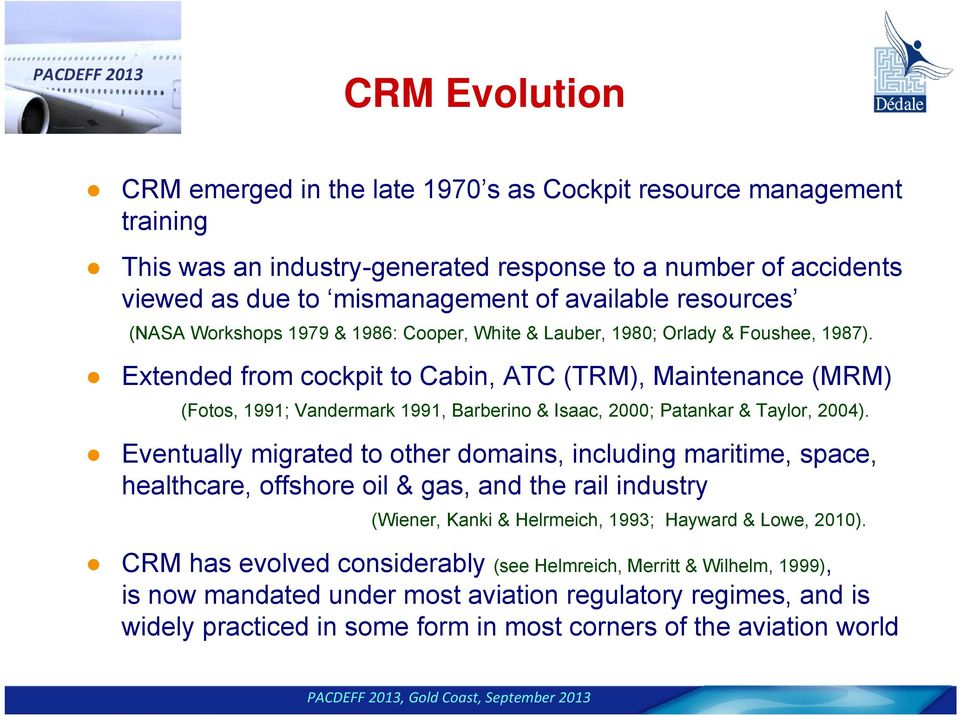
4 CRM Effectiveness An aspect that has received insufficient attention so far is examination of the behaviour that CRM training actually produces and its impact on flight safety While CRM enjoys strong face validity, empirical evaluation and validation has been patchy One of the key benefits of CRM is believed to be improved functioning of flight deck crew due to better communication and cooperation on everyday tasks, and in particular when faced by anomalies and high threat situations A number of well-managed accidents are cited as examples of the positive effects of CRM training
5 Effective CRM A number of well-managed accidents are cited as examples of the positive effects of CRM training: United 232 Sioux City, July fatalities 185 survivors

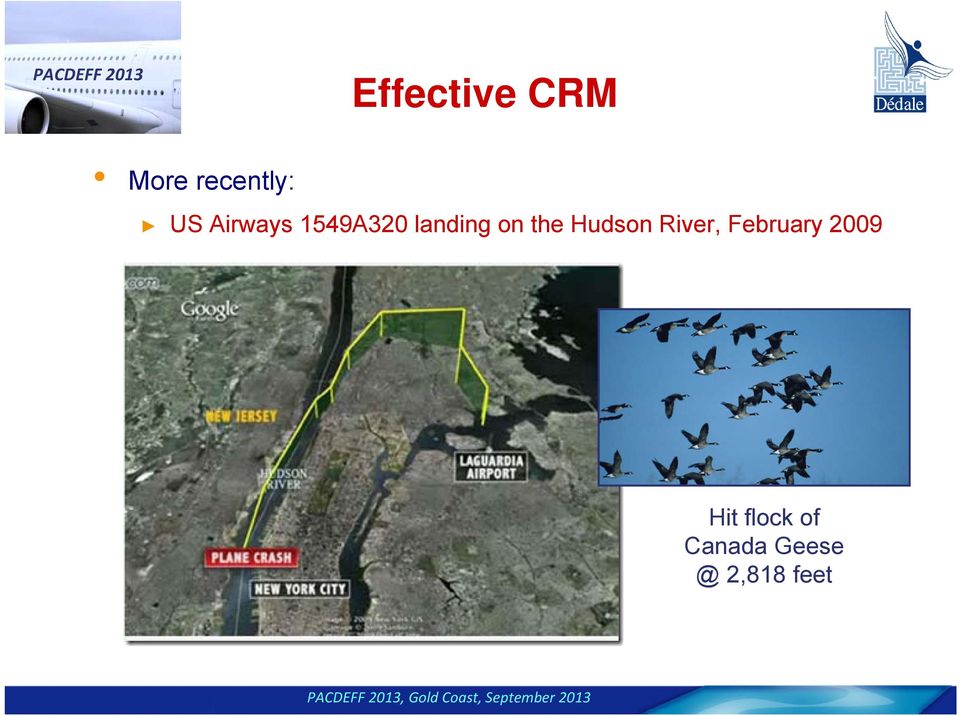
6 Effective CRM More recently: US Airways 1549A320 landing on the Hudson River, February 2009 Hit flock of Canada 2,818 feet
7 Effective CRM And more recently still: November 2010: QF32 A380 uncontained engine Singapore

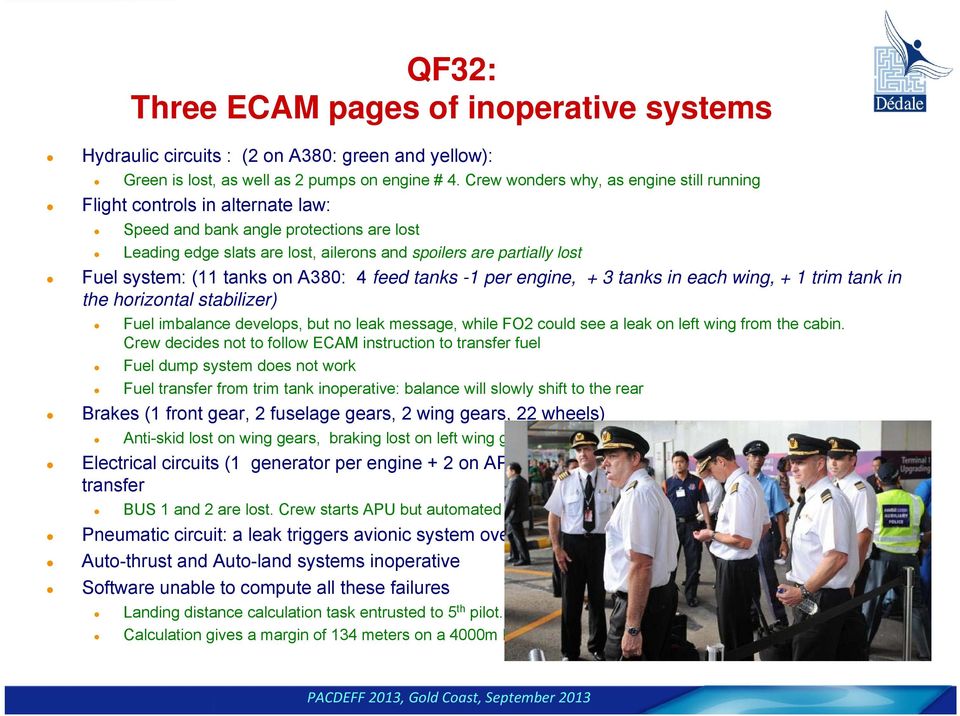
8 QF32: Three ECAM pages of inoperative systems Hydraulic circuits : (2 on A380: green and yellow): Green is lost, as well as 2 pumps on engine # 4. Crew wonders why, as engine still running Flight controls in alternate law: Speed and bank angle protections are lost Leading edge slats are lost, ailerons and spoilers are partially lost Fuel system: (11 tanks on A380: 4 feed tanks -1 per engine, + 3 tanks in each wing, + 1 trim tank in the horizontal stabilizer) Fuel imbalance develops, but no leak message, while FO2 could see a leak on left wing from the cabin. Crew decides not to follow ECAM instruction to transfer fuel Fuel dump system does not work Fuel transfer from trim tank inoperative: balance will slowly shift to the rear Brakes (1 front gear, 2 fuselage gears, 2 wing gears, 22 wheels) Anti-skid lost on wing gears, braking lost on left wing gear Electrical circuits (1 generator per engine + 2 on APU). Each one feeds a BUS with automated transfer BUS 1 and 2 are lost. Crew starts APU but automated transfer fails Pneumatic circuit: a leak triggers avionic system overheat Auto-thrust and Auto-land systems inoperative Software unable to compute all these failures Landing distance calculation task entrusted to 5 th pilot. Only most relevant failures are retained. Calculation gives a margin of 134 meters on a 4000m long dry runway!
9 Reality: Our people create safety
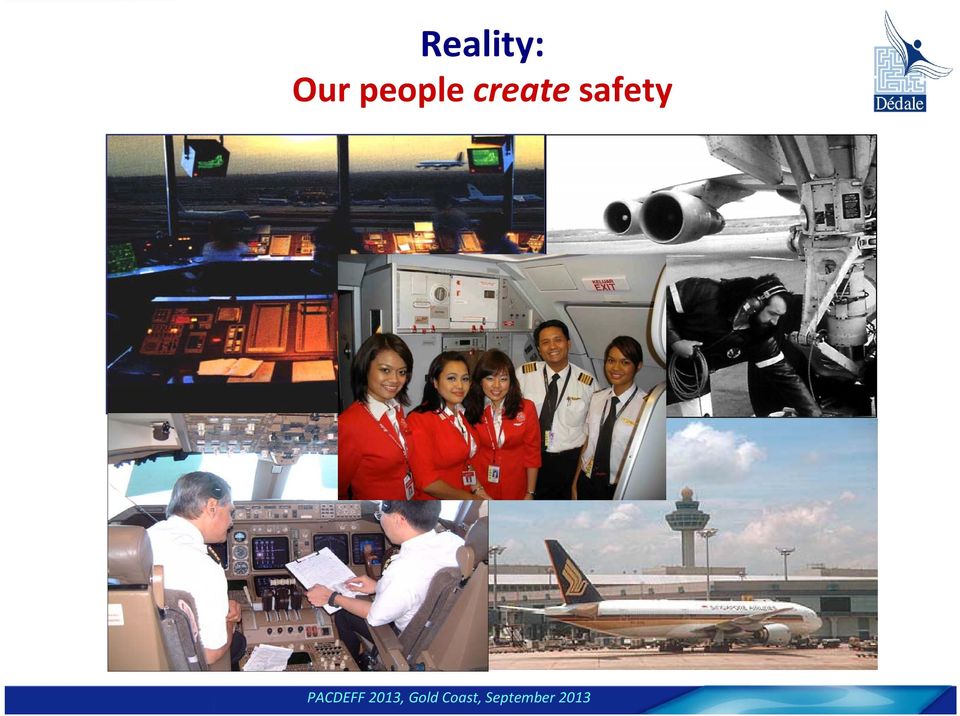
10 CRM Failures The flip side of this is that when airlines have incidents involving human performance problems (most events), these are frequently regarded / cited as CRM Failures. But they ve done the CRM course ( and obviously it s not working ) Just because something regarded / taught as a CRM skill or behaviour is identified as a contributing factor to a safety occurrence does not mean this is a failure of CRM training Is every successful sector / sortie a proof of CRM success?

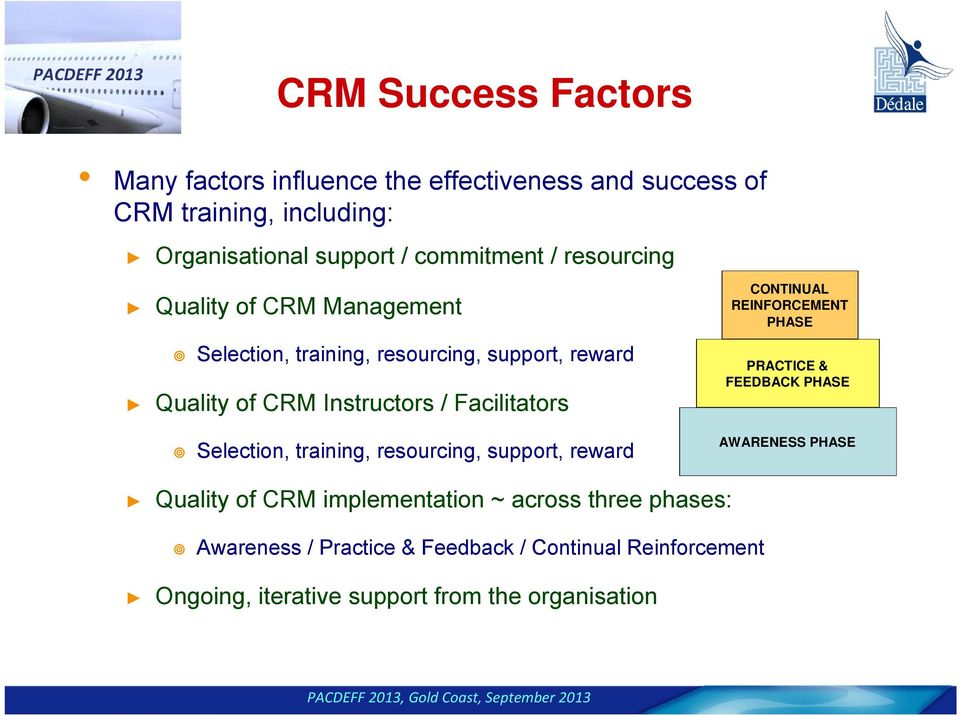
11 CRM Success Factors Many factors influence the effectiveness and success of CRM training, including: Organisational support / commitment / resourcing Quality of CRM Management Selection, training, resourcing, support, reward Quality of CRM Instructors / Facilitators Selection, training, resourcing, support, reward CONTINUAL REINFORCEMENT PHASE PRACTICE & FEEDBACK PHASE AWARENESS PHASE Quality of CRM implementation ~ across three phases: Awareness / Practice & Feedback / Continual Reinforcement Ongoing, iterative support from the organisation
12 CRM Implementation CRM concepts should be integrated into every stage of training and be continually reinforced in line operations Effective CRM programs include three phases: Awareness / Practice & Feedback / Continual Reinforcement GAIN Operator s Flight Safety Handbook:... for a CRM program to be successful it must be embedded in the total training programme, it must be continuously reinforced and it must become an inseparable part of the organisation s culture. CRM should thus be instituted as a regular part of periodical training and should include practice and feedback exercises such as complete crew LOFT Global Aviation Information Network. (2001). Operator s Flight Safety Handbook, Issue 2, Section 4, Human Factors, pp 4-8. December Montreal: Author.
13 CRM Evaluation Most airline and military pilots today are expected / required to demonstrate appropriate CRM behaviours if they are to succeed A variety of CRM skill assessment systems are in play, including NOTECHS, NTS, NTCs, [Inter]Personal Competencies, etc. Can produce significant benefits for the training and evaluation of CRM skills, feedback to design of CRM training This introduces / encourages thinking about what pilots need to do to receive a good score
![NTCs, [Inter]Personal Competencies, etc.](/docs-images/41/5550921/images/page_13.jpg "Can produce significant benefits for the training and evaluation of CRM skills, feedback to design of CRM training")
14 Faking The secret of success is sincerity. Once you can fake that you ve got it made. An issue of serious concern: The evolution of faux CRM Jean Giraudoux French Diplomat, dramatist, & novelist ( ).

15 Faking CRM Faux CRM: A form of false or inappropriate CRM behaviour Playing the CRM game Paying lip service to CRM, with behaviours that are not constructive or safety enhancing may in fact have the opposite effect Playing the nice guy, unnecessarily polite but in ways that are inconsequential / may threaten safety or crew harmony Using excessive, unnecessary communication Showing trivial or obsequious forms of support for other crew.
16 Faking CRM Faux CRM: A distortion of proper CRM that inhibits, if not precludes, effective CRM being practiced Distracts crew from more important operational issues Interferes with effective crew cooperation & communication For example, the focus is moved from TEM and Operational Risk Assessment to minor / largely irrelevant aspects of crew interpersonal interaction Keeping things friendly / nice / harmonious

17 Faking CRM Faux CRM: Any pilot can be involved in role playing behaviour that they believe equates to good CRM The faux CRM problem mainly concerns junior pilots who perceive they have something to gain by demonstrating what they believe to be appropriate CRM behaviours where in fact the behaviours equate more to point scoring in relation to assessments. Faux CRM appears to have evolved because crew discovered that this behaviour has been accepted, and may be rewarded, both in training, and on the line.
18 Faking CRM Culture: Culture is, of course, an issue, particularly national / ethnographic culture Some cultures more disposed towards presenting a favourable image / considerations of face However, it is evident that faking behaviour is present across varied cultures and global regions Faking can also be dependent on the culture of the organisation / department / training system / assessment system. The impact of culture on CRM performance: Ooi, 1991; Johnston, 1993; Merritt, 1993; Pidgeon & O Leary, 1994; Helmreich, 1994; Maurino, 1994; Merritt & Helmreich, 1996; Orasanu, Fischer & Davison, 1997; Helmreich & Merritt, 1998; Mjøs, 2004;
19 Faking good Origins: Common to many professions We learn it when we prepare for and attend selection interviews ( Impression Management ) Airline pilot candidates are among the most practiced of fakers A simple Thank you would suffice Once at the airline this continues Behaviours that are perceived as appropriate are modelled More prevalent where promotion is based on merit / assessment / PQs Not necessarily intentionally dishonest or deceptive

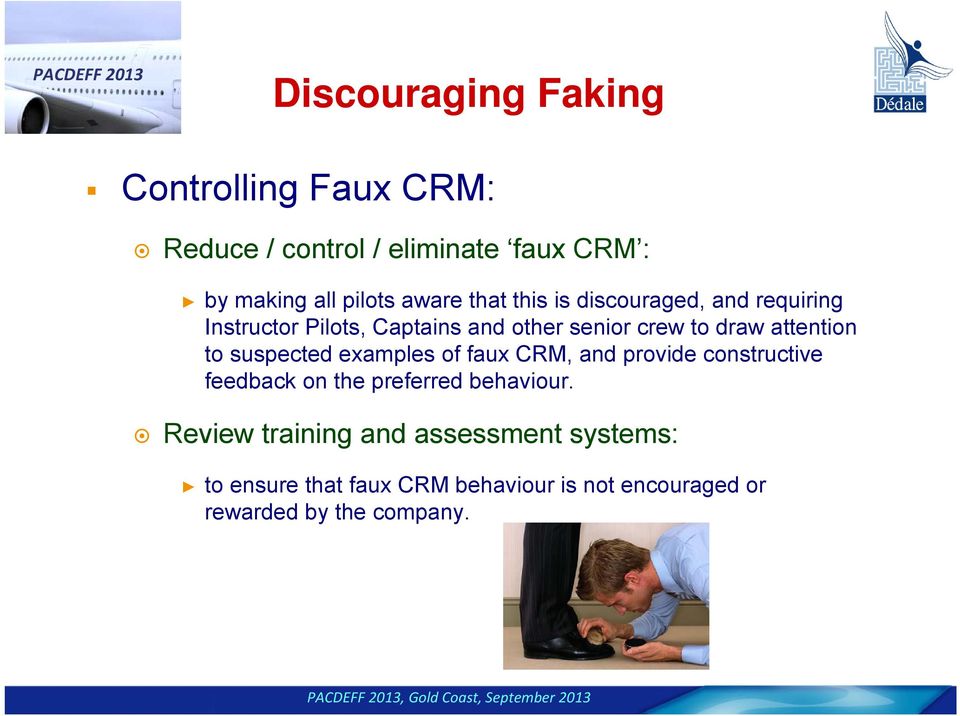
20 Discouraging Faking Controlling Faux CRM: Reduce / control / eliminate faux CRM : by making all pilots aware that this is discouraged, and requiring Instructor Pilots, Captains and other senior crew to draw attention to suspected examples of faux CRM, and provide constructive feedback on the preferred behaviour. Review training and assessment systems: to ensure that faux CRM behaviour is not encouraged or rewarded by the company.
21 Promoting Effective CRM CRM has been misunderstood / misinterpreted by some organisations / some pilots Yet it is sometimes intentionally distorted to meet personal assessment goals. So, it may be useful to re-emphasise the primary objective of CRM ~ to improve flight safety. This can be achieved by distinguishing between: Team-enhancing behaviours that have an indirect safety benefit Type 1 CRM actions, and Hard CRM skills that address safety-critical behaviour Type 2 CRM actions.
22 Promoting Effective CRM Distinguish between two fundamental types of CRM behaviours: Type 1 CRM are desired CRM behaviours : Team enhancement goal, with indirect safety benefits ~ but not faux CRM; & Type 2 CRM are essential / safety critical CRM behaviours : With direct / immediate safety benefits or implications Type 2 CRM behaviours appear to be lacking in many incidents /accidents, possibly because they are not adequately encouraged, taught and tested in training.
23 Promoting Effective CRM Examples of Type 1 team-enhancing CRM behaviours (likely to have an indirect safety benefit): flight deck ambience, supporting, informing, de/briefing Examples of Type 2 safety critical CRM behaviours (those that, in context, can have an immediate safety benefit): cross-checking, questioning, clarifying when unclear, challenging when uncertain, clear communication
24 Promoting Effective CRM The goal is to make this distinction in all crew training, and in the evaluation of CRM skills emphasising that artificial displays of team-enhancing behaviours ( faux CRM ) are not sufficient to be assessed as demonstrating good CRM Crew evaluation processes must be consistent in rewarding expected CRM behaviours and in discouraging / eradicating inappropriate behaviours ~ including faux CRM.
25 Promoting Effective CRM This process can be assisted by ensuring that crewmembers have adequate support for effective safety critical CRM behaviours and interventions within the organisation For example for a junior pilot to effectively monitor and challenge the performance of a senior pilot Provide an effective assertiveness tool (eg., The Support Process ) Support this with: Policy Procedures Practice via role play scenarios in CRM Recurrent Alignment with & evaluation (reinforcement) via NTC markers
26 Thank you Dédale Asia Pacific
Building Safety on the Three Cultures of Aviation
 Building Safety on the Three Cultures of Aviation Robert L. Helmreich, Ph.D. Professor and Director University of Texas Aerospace Crew Research Project Austin, Texas, USA Effective efforts to achieve safety
Garuda Indonesia Airlines CRM Training Program Overview. Capt. Prita Widjaja
 Garuda Indonesia Airlines CRM Training Program Overview Capt. Prita Widjaja Aviation s Safety History & Human Factors Threats No defined recognition or training in human factors pre- 1980 Mishaps reach
The Development and Testing of NOTECHS: Non-Technical Skills for Airline Pilots
 The Development and Testing of NOTECHS: Non-Technical Skills for Airline Pilots Rhona Flin Industrial Psychology Research Centre University of Aberdeen This paper provides back ground information on the
Threat & Error Management (TEM) SafeSkies Presentation. Ian Banks Section Head, Human Factors 27 Aug 2011
 Threat & Error Management (TEM) SafeSkies Presentation Ian Banks Section Head, Human Factors 27 Aug 2011 Objectives Definition Discuss Brief history of TEM The Original University of Texas TEM Model Threats
Crew Resource Management in CRIOP from 2004
 Crew Resource Management in CRIOP from 2004 [email protected] 1 Agenda Why CRM focus in CRIOP in 2004? Experiences of use Suggested use of CRM 1 Human Factors and CRM Human Factors (in short) a
Subject: CREW RESOURCE MANAGEMENT TRAINING PROGRAMME
 ADVISORY CIRCULAR FOR AIR OPERATORS Subject: CREW RESOURCE MANAGEMENT TRAINING PROGRAMME Date: xx.xx.2013 Initiated By: Republic of Korea AC No: 1. PURPOSE This advisory circular (AC) presents guidelines
Title & Image NATIONAL CIVIL AVIATION ADMINSTRATION. Advisory Circular
 Title & Image NATIONAL CIVIL AVIATION ADMINSTRATION Advisory Circular Subject: CREW RESOURCE MANAGEMENT TRAINING PROGRAMME Issuing Office: [Identity of Office of NCAA issuing ] Document No.: [NCAA AC #]
for teams in the offshore oil industry
 for teams in the offshore oil industry Rhona H. Flin Professor of Industrial Psychology, Offshore Management Centre, Aberdeen Business School, The Robert Gordon University, Aberdeen, Scotland, UK 121 Introduction
MODELS OF THREAT, ERROR, AND CRM IN FLIGHT OPERATIONS
 MODELS OF THREAT, ERROR, AND CRM IN FLIGHT OPERATIONS Robert L. Helmreich 1, James R. Klinect, & John A. Wilhelm University of Texas Team Research Project The University of Texas at Austin Department of
Crew Resource Management
 Crew Resource Management DR TIMOTHY BRAKE, SENIOR MEDICAL OFFICER, UNITED CHRISTIAN HOSPITAL HONORARY SECRETARY HKSSIH Crew Resource Management 1 Crew Resource Management I am not an expert in CRM CRM
Going from Hindsight to Foresight Crew Resource Management
 Going from Hindsight to Foresight Crew Resource Management PSA, Stavanger, 27 November, 2013 Rhona Flin Industrial Psychology Research Centre University of Aberdeen Safe and Efficient Performance Individual
International Journal of Professional Aviation Training & Testing Research
 International Journal of Professional Aviation Training & Testing Research Volume 1, Issue 1 2007 Article 3 CRM Vectors 2007 Theodore Beneigh Todd P. Hubbard Embry-Riddle Aeronautical University, [email protected]
Human variability: Two aspects (Reason, 2000)
 Safe and Efficient Job Performance Non-Technical Skills in Industry and Medicine Rhona Flin Industrial Psychology Research Centre The Royal College of Pathologists, London, 28 November, 2013 Latent Conditions
General... 1. Applicability... 1 Cancellation... 1 References... 1 Effective Date... 1 Background...1. Components of CRM... 3
 AC AOC-34( (0) 17 April 2014 Advisory Circular TRAINING PROGRAMME ON CREW RESOURCE MANAGEMENT General... 1 Purpose... 1 Applicability... 1 Cancellation... 1 References... 1 Effective Date... 1 Background....1
The Evolution of Crew Resource Management Training in Commercial Aviation
 The Evolution of Crew Resource Management Training in Commercial Aviation Robert L. Helmreich, Ashleigh C. Merritt & John A. Wilhelm Department of Psychology Aerospace Crew Research Project The University
Crew Resource Management: Initial 1
 CRM: Initial 1 The effective utilisation of all available resources of, hardware, software, and liveware to achieve efficient, safe flight operations WikiofScience Crew Resource Management: Refresher 2
CANADIAN AVIATION REGULATION ADVISORY COUNCIL (CARAC) NOTICE OF PROPOSED AMENDMENT (NPA) CREW RESOURCE MANAGEMENT
 EXECUTIVE SUMMARY CARAC ACTIVITY REPORTING NOTICE #: 2014-021 Contemporary Crew Resource Management (CRM) concepts and training programs have been proven by aviation human factors experts to be effective
Threat and Error Management
 Threat and Error Management Society of Experimental Test Pilots April 28, 2009 Robert Sumwalt, Board Member NTSB Threat and Error Management: A Practical Perspective Building a wall How do we improve safety?
The Evolution of Crew Resource Management Training in Commercial Aviation 1
 The Evolution of Crew Resource Management Training in Commercial Aviation 1 Robert L. Helmreich, Ashleigh C. Merritt & John A. Wilhelm Department of Psychology Aerospace Crew Research Project The University
PRELIMINARY INVENTORY K0567 (KA1706, KA2285) DAN REX CORNWELL (1930- ) PAPERS [TWA]
![PRELIMINARY INVENTORY K0567 (KA1706, KA2285) DAN REX CORNWELL (1930- ) PAPERS [TWA]](/thumbs/33/15981195.jpg "PRELIMINARY INVENTORY K0567 (KA1706, KA2285) DAN REX CORNWELL (1930- ) PAPERS [TWA]") PRELIMINARY INVENTORY K0567 (KA1706, KA2285) DAN REX CORNWELL (1930- ) PAPERS [TWA] This collection is available at The State Historical Society of Missouri Research Center- Kansas City. If you would like
PRELIMINARY INVENTORY K0567 (KA1706, KA2285) DAN REX CORNWELL (1930- ) PAPERS [TWA] This collection is available at The State Historical Society of Missouri Research Center- Kansas City. If you would like
Safety and error management: The role of Crew Resource Management
 Safety and error management: The role Crew Resource Management Robert L. Helmreich and Ashleigh C. Merritt 1 University Texas Aerospace Crew Research Project Department Psychology The University Texas
06 HYDRAULICS, FLIGHT CONTROLS, LANDING GEAR, BRAKES
 Course overview N E X T G E N E R A T I O N Airplane General Air Systems Warning Systems, Communications, Ice & Rain Protection Electrical Engines, APU, Fuel System Hydraulics, Flight Controls, Landing
Why assess operational behaviour? Seeing is Believing. Drift into Failure. The Problem with Learning. What to assess?
 Why assess operational behaviour? Seeing is Believing Assessing CRM Competencies Dr. Nicklas Dahlstrom Human Factors Manager The Problem with Learning Drift into Failure Normal people doing normal work
Flight Operations Briefing Notes
 Flight Operations Briefing Notes I Introduction Strict adherence to suitable standard operating procedures (SOPs) and normal checklists is an effective method to : Prevent or mitigate crew errors; Anticipate
DRAFT. Advisory Circular. AC 121A-09(0) December 2003 HUMAN FACTORS AND CREW RESOURCE MANAGEMENT TRAINING
 Advisory Circular AC 121A-09(0) December 2003 HUMAN FACTORS AND CREW RESOURCE MANAGEMENT TRAINING CONTENTS 1. References 2. Purpose 3. Status of this AC 4. Introduction 5. Definitions 6. CRM Training Course
CULTURE, THREAT, AND ERROR: ASSESSING SYSTEM SAFETY
 CULTURE, THREAT, AND ERROR: ASSESSING SYSTEM SAFETY Robert L. Helmreich 1 University of Texas Human Factors Research Project The University of Texas at Austin Austin, Texas USA 1 Research supporting this
CRM Training. UK AltMOC. 3.1 Acceptable Means of Compliance (AMC) and Guidance Material (GM) (Draft EASA Decisions)
 UK CAA Flight Operations CRM Training UK AltMOC 3.1 Acceptable Means of Compliance (AMC) and Guidance Material (GM) (Draft EASA Decisions) 3.1.2 Air operations Decision 2012/017/R (Part-ORO) SUBPART FC
Mauro Calvano. About Aviation Safety Management Systems
 Mauro Calvano About Aviation Safety Management Systems January 2003 1 INTRODUCTION In order to be aware of the factors that are driving the accident rate during the last decade, we must identify the hazards
Flight Operations Briefing Notes
 Flight Operations Briefing Notes I Introduction Interruptions and distractions are the main threat facing flight crews. Note : A threat is a condition that affects or complicates the performance of a task
Flight Operations Information Leaflet
 State of Qatar Civil Aviation Authority Air Safety Department Flight Operations Information Leaflet FOIL No. 06/03 Issue No. 1 22 May 2003 CREW RESOURCE MANAGEMENT CABIN CREW 1 Introduction 1.1 In order
AIRCRAFT RESCUE AND FIRE FIGHTING GUIDE REVISION 0. AA Flight Safety Department.4601 Hwy 360; MD 849 GSWFA.Fort Worth Texas 76155. Phone 817-967-1829
 AIRCRAFT RESCUE AND FIRE FIGHTING GUIDE REVISION 0 AA Flight Safety Department.4601 Hwy 360; MD 849 GSWFA.Fort Worth Texas 76155. Phone 817-967-1829 Copyright 2013 by American Airlines Book design by Ted
Safety Risk. Aligning perception with reality
 Safety Risk Aligning perception with reality Operating instructions Perception a person s recognition of the nature and degree of risk affecting an activity Reality accurate assessment of risk based on
Chapter 2. Basic Airplane Anatomy. 2008 Delmar, Cengage Learning
 Chapter 2 Basic Airplane Anatomy Objectives Identify components of basic aircraft anatomy Understand aircraft size and weight categories List different types and examples of General aviation aircraft Military
ERROR MANAGEMENT TRAINING
 ERROR MANAGEMENT TRAINING Defining Best Practice ATSB Aviation Safety Research Grant Scheme Project 2004/0050 Matthew J W Thomas Centre for Applied Behavioural Science University of South Australia Error
Update on Current Corporate Aviation Accidents. Robert L. Sumwalt NTSB Board Member April 20, 2011
 Update on Current Corporate Aviation Accidents Robert L. Sumwalt NTSB Board Member April 20, 2011 The Board The investigators Corporate Aviation / Part 135 Fatal Accidents since last CASS Accident Date
2. CANCELLATION. AC 120-51D, Crew Resource Management Training, dated 2/8/01, is cancelled.
 Subject: CREW RESOURCE MANAGEMENT TRAINING Date: 1/22/04 Initiated By: AFS-210 AC No: 120-51E Change: 1. PURPOSE. This Advisory Circular (AC) presents guidelines for developing, implementing, reinforcing,
Development of the NOTECHS (non-technical skills) system for assessing pilots CRM skills
 Human Factors and Aerospace Safety 3(2), 95-117 2003, Ashgate Publishing POSITION PAPER Development of the NOTECHS (non-technical skills) system for assessing pilots CRM skills Rhona Flin*, Lynne Martin*,
Michel TREMAUD Retired, Airbus / Aerotour / Air Martinique / Bureau Veritas. Crew Coordination. Highlighting the Monitoring Role of the PNF
 Michel TREMAUD Retired, Airbus / Aerotour / Air Martinique / Bureau Veritas Crew Coordination Highlighting the Monitoring Role of the PNF Contents Statistics Golden Rules Airmanship Operations Crew Coordination
The Effects of Joint Flight Attendant. and Flight Crew CRM Training. Programmes on Intergroup. Teamwork and Communication
 The Effects of Joint Flight Attendant and Flight Crew CRM Training Programmes on Intergroup Teamwork and Communication Jane Rosemary Ford A thesis submitted for the Degree of Doctor of Philosophy at the
Guidelines for implementing Well Operations Crew Resource Management training
 REPORT 502 DECEMBER 2014 Guidelines for implementing Well Operations Crew Resource Management training communication teamwork Disclaimer Whilst every effort has been made to ensure the accuracy of the
A Framework for Understanding Crew Performance Assessment Issues
 THE INTERNATIONAL JOURNAL OF AVIATION PSYCHOLOGY, 12(3), 205 222 Copyright 2002, Lawrence Erlbaum Associates, Inc. FORMAL PAPERS A Framework for Understanding Crew Performance Assessment Issues David P.
The Assessment of Non-technical Skills in JAR-OPS and JAR-FCL
 The Assessment of Non-technical Skills in JAR-OPS and JAR-FCL Captain Paul Field British Airways Plc Abstract Safety research has shown that human error is a primal contributing factor in the majority
CULTURE AND ERROR IN SPACE: IMPLICATIONS FROM ANALOG ENVIRONMENTS
 CULTURE AND ERROR IN SPACE: IMPLICATIONS FROM ANALOG ENVIRONMENTS Robert L. Helmreich University of Texas Aerospace Crew Research Project The University of Texas at Austin Research reported in this paper
Personality in Aviation. (adapted from The Achievement Paradox, by Ronald Warren)
 Personality in Aviation (adapted from The Achievement Paradox, by Ronald Warren) This paper explores the relationships between personality and performance in commercial airline pilots. In no other industry
A promising future. TRM benefits
 A promising future! 2 A promising future It is with pleasure that we offer you this brochure about Team Resource Management (TRM) as developed by the EUROCONTROL TRM User Group. Over the last few years,
Dr. Madeline Wu Human Factors Specialist / Industrial Psychologist
 Dr. Madeline Wu Human Factors Specialist / Industrial Psychologist Objectives What is Crew Resource Management (CRM)? Why do we need Well Operations CRM (WOCRM) training? How do we achieve WOCRM Competency?
Flight Safety Foundation. Approach-and-landing Accident Reduction. Tool Kit. FSF ALAR Briefing Note 8.3 Landing Distances
 Flight Safety Foundation Approach-and-landing Accident Reduction Tool Kit FSF ALAR Briefing Note 8.3 Landing Distances When discussing landing distance, two categories must be considered: Actual landing
Flight Safety Foundation. Approach-and-landing Accident Reduction. Tool Kit. FSF ALAR Briefing Note 2.2 Crew Resource Management. Leadership.
 Flight Safety Foundation Approach-and-landing Accident Reduction Tool Kit FSF ALAR Briefing Note 2.2 Crew Resource Management Minimum required crew resource management (CRM) training is defined by regulations,
Crew Resource Management (CRM)
 King Schools Online Internet Learning Programs Crew Resource Management (CRM) Syllabus King Schools, Inc. 3840 Calle Fortunada San Diego, CA 92123 800-854-1001 (USA) 858-541-2200 (Worldwide) www.kingschoolsonline.com
Maritime Resource Management
 Maritime Resource Management John Garner, Fleet Director Interferry Conference Vancouver 7 th October 2014 Key issues in the Human Element - Safety culture - Just culture - Learning culture driving continuous
Guide to Performance Standards for Instructors of Crew Resource Management (CRM) Training in Commercial Aviation
 Guide to Performance Standards for Instructors of Crew Resource Management (CRM) Training in Commercial Aviation Published jointly by RAeS, CAA and ATA Printed by Riverprint, England Intellectual Property
SERIOUS INCIDENT. Aircraft Type and Registration: No & Type of Engines: 2 SNECMA CFM 56-7B turbofan engines. Year of Manufacture: 1999
 SERIOUS INCIDENT Aircraft Type and Registration: No & Type of Engines: Boeing 737-86N, SE-RHX 2 SNECMA CFM 56-7B turbofan engines Year of Manufacture: 1999 Date & Time (UTC): Location: Type of Flight:
b) Describe the concept of ERROR CHAIN in aviation.
 1. Crew Resource Management (CRM) was celebrated as the convergence ofa concept, an attitude and a practical approach to pilot training. a) What is the CRM all about and how this program could improve
AVIATION INVESTIGATION REPORT A06F0014 MISALIGNED TAKE-OFF
 AVIATION INVESTIGATION REPORT A06F0014 MISALIGNED TAKE-OFF AIR CANADA AIRBUS A319-114 C-FYKR LAS VEGAS, NEVADA 30 JANUARY 2006 The Transportation Safety Board of Canada (TSB) investigated this occurrence
The Life of Aviation Training
 Chapter 1 The Life of Aviation Training Life is a culmination of the past, an awareness of the present, an indication of a future beyond knowledge, the quality that gives a touch of divinity to matter.
MPL. 15POS03 17 June 2014. Introduction. MPL Workshop Conclusions. Basic Flying Skills. Airmanship CRM
 15POS03 17 June 2014 Introduction MPL Worldwide, in 2014, there are more than 22 certified MPL training programmes graduating new co-pilots who have earned the Multi-Crew Pilot License (MPL). These pilots
Annex II to Decision 2015/022/R. The text of the amendment is arranged to show deleted, new or amended text as shown below:
 Annex II to ED Decision 2015/022/R Annex II to Decision 2015/022/R The Annex to Decision 2014/017/R 1 is hereby amended as follows: The text of the amendment is arranged to show deleted, new or amended
Flight Operations Briefing Notes
 Flight Operations Briefing Note I Introduction Operations in crosswind conditions require strict adherence to applicable crosswind limitations or maximum recommended crosswind values, operational recommendations
Introduction to Aircraft Design and Aviation Systems (ENG3005)
 Chapter 3 Emergency power generation 1. Power distribution 1.1 The power source for many civil aircraft: a.main aircraft generator : through a Generator Control Breaker (GCB). Controlled by Generator Control
How To Understand The Behavior Of A Flight Crew
 Chapter 1 Why CRM? Empirical and Theoretical Bases of Human Factors Training Robert L. Helmreich Department of Psychology University of Texas at Austin Austin, Texas 78712 H. Clayton Foushee y Senior Professional
Automation at Odds. A 737 stalled when a radio altimeter malfunction caused the autothrottle and autopilot to diverge during an approach to Schiphol.
 Automation at Odds The pilots of a Boeing 737-800 did not heed indications of a significant decrease in airspeed until the stick shaker activated on final approach to Runway 18R at Amsterdam (Netherlands)
Bryant 1. Janet L. Bryant Donald D. Davis Department of Psychology Old Dominion University Norfolk, VA 23529
 CULTURAL DIFFERENCES IN SITUATIONAL AWARENESS, SHARED MENTAL MODEL, AND WORKLOAD PERCEPTIONS: AN ANALYSIS OF AMERICAN AND CHINESE SIMULATED FLIGHTCREWS Janet L. Bryant Donald D. Davis Department of Psychology
Emirates - Nicklas Dahlstrom
 2011-07-06 CRM in Airline Operations CRM in Airline Operations Dr. Nicklas Dahlstrom Human Factors Manager Content Background and Regulations Working with CRM in practice The story of a CRM course in practice
NOTECHS: Non-technical skill evaluation in JAR-FCL
 NOTECHS: Non-technical skill evaluation in JAR-FCL J.A.G. van Avermaete 07 - Evaluating CRM 25 NOTECHS: Non-technical skill evaluation in JAR-FCL J.A.G. van Avermaete This investigation has been carried
Flight Operations Briefing Notes
 Flight Operations Briefing Notes I Introduction This Flight Operations Briefing Note presents a definition of situational awareness. It explains the complex process of gaining and maintaining situational
Ministry of Civil Aviation Egyptian Advisory Circular Number 00-3 Egyptian Civil Aviation Authority. EAC No.00_3
 Ministry of Civil Aviation Egyptian Advisory Circular Number 00-3 EAC No.00_3 Issue 5, Rev. 0 Dated May, 2012 Page 1 2B 1T11T Egyptian Advisory Circular Number 00-3 Ministry of Civil Aviation UTABLE of
Although this article presents many viewpoints previously made, it seems
 C OCKPIT L EADERSHIP THE P ILOT'S H ANDBOOK Pilot In Command Authority Responsibility Accountability by Robert M. Jenney Although this article presents many viewpoints previously made, it seems appropriate
INITIAL TEST RESULTS OF PATHPROX A RUNWAY INCURSION ALERTING SYSTEM
 INITIAL TEST RESULTS OF PATHPROX A RUNWAY INCURSION ALERTING SYSTEM Rick Cassell, Carl Evers, Ben Sleep and Jeff Esche Rannoch Corporation, 1800 Diagonal Rd. Suite 430, Alexandria, VA 22314 Abstract This
Notice of Proposed Amendment 2014-17. Crew resource management (CRM) training
 European Aviation Safety Agency Rulemaking Directorate Notice of Proposed Amendment 2014-17 Crew resource management (CRM) training RMT.0411 (OPS.094) 26.6.2014 EXECUTIVE SUMMARY This Notice of Proposed
Airline Pilots Perceptions of and Experiences in Crew Resource Management (CRM) Training
 Copyright 2001 Society of Automotive Engineers, Inc. 2002-01-2963 Airline Pilots Perceptions of and Experiences in Crew Resource Management (CRM) Training J. Matthew Beaubien and David P. Baker American
Behavioral Markers for Crew Resource Management: A Review of Current Practice
 THE INTERNATIONAL JOURNAL OF AVIATION PSYCHOLOGY, 11(1), 95 118 Copyright 2001, Lawrence Erlbaum Associates, Inc. Behavioral Markers for Crew Resource Management: A Review of Current Practice Rhona Flin
ARTICLE IN PRESS. Crew Resource Management training for offshore oil production teams. Paul O Connor, Rhona Flin*
 Safety Science 41 (2003) 111 129 www.elsevier.com/locate/ssci Crew Resource Management training for offshore oil production teams Paul O Connor, Rhona Flin* Department of Psychology, University of Aberdeen,
Micro. Pitts Special for the RFFS-100 by Chris O Riley
 Micro Pitts Special for the RFFS-100 by Chris O Riley F1 F2 F3 F4 1 2 3 4 All wood 1/32 inch sheet unless otherwise stated. F1 F2 F3 F4 Small balsa blocks for LG reinforcement Small balsa blocks for LG
Accident Bulletin 1/2010. Date and time of accident: 13 April 2010 at 1343 hours local time (0543 UTC)
 Chief Inspector of Accidents Accident Investigation Division Civil Aviation Department 46 th Floor Queensway Government Offices 66 Queensway Hong Kong Accident Bulletin 1/2010 Aircraft type: Airbus A330-342
Importance of MRM Training
 The pilot community has been aware of the importance of human factors for a long time. Since 1978 Cockpit Resource Management or Crew Resource Management (CRM) training has become a valuable asset to aviation
MODULE 11B. PISTON AEROPLANE AERODYNAMICS, STRUCTURES AND SYSTEMS
 MODULE 11B. PISTON AEROPLANE AERODYNAMICS, STRUCTURES AND SYSTEMS Note: The scope of this Module should reflect the technology of aeroplanes pertinent to the A2 and B1.2 subcategory. 11.1 Theory of Flight
ENGINE FIRE / SEVERE DAMAGE / SEPARATION ON TAKEOFF
 ENGINE FIRE / SEVERE DAMAGE / SEPARATION ON TAKEOFF According to RYANAIR Procedures PF PM REMARKS Control the aircraft (FULL T/O thrust can be manually selected) Announce «ENGINE FAILURE» or «ENGINE FIRE»
Defensive Flying for Pilots: An Introduction to Threat and Error Management
 Defensive Flying for Pilots: An Introduction to Threat and Error Management Ashleigh Merritt, Ph.D. & James Klinect, Ph.D. The University of Texas Human Factors Research Project 1 The LOSA Collaborative
Interim Statement IN-004/2013
 Interim Statement IN-004/2013 Incident involving an Airbus A-340-313 aircraft, registration CC-CQE operated by LAN Airlines, on 6 February 2013 at the Madrid-Barajas airport (Madrid, Spain). GOBIERNO DE
Running Head: TAXONOMIES, REPORTING SYSTEMS, AND DATA COLLECTION TOOLS. A Review of Selected Aviation Human Factors Taxonomies,
 Taxonomies, Reporting Systems, and Data Collection Tools 1 Running Head: TAXONOMIES, REPORTING SYSTEMS, AND DATA COLLECTION TOOLS A Review of Selected Aviation Human Factors Taxonomies, Accident/Incident
The Effect of Culture on Human Factors
 The Effect of Culture on Human Factors Lex Rock Heemstra Human Factors Specialist Flight Training Discussion Definitions of Culture Hofstede s National Culture Traits FMAQ - Helmreich/Merrit Pilot study
Flight Operations Briefing Notes
 Flight Operations Briefing Notes I Introduction Overall, incidents and accidents involve the entire range of CRM and Human Factors aspects. In incident and accident reports, the flight crew s contribution
Helisim is operating 4 Full Flight Simulators, manufactured by Thales. We look forward to welcome your pilots, Yours faithfully,
 As a former EUROCOPTER Chief Test Pilot, I was always aware of the key importance of training to improve safety in Helicopter operations. HELISIM goals and objectives are to assist helicopter operators
Global PPC Proposal. Proposal: Presented by: Peter J. Wolfe
 Global PPC Proposal Professional Pilot Certification Proposal: Global l Professional Pilot Certification Presented by: Peter J. Wolfe PABC Executive Director ICAO NGAP Conference ICAO NGAP Conference Montreal,