
Suggestions for Using Crash Facts
|
|
|
- Sylvia Craig
- 10 years ago
- Views:
Transcription
1 Suggestions for Using Crash Facts Crash Facts is designed to meet the needs of different audiences. If you are unfamiliar with this report, here are some suggestions that may make it easier for you to find the information you are seeking. Legislators: Section II though IX focus on particular traffic safety sub-areas (alcohol, seat belts, crashes involving motorcycles, pedestrians, and so on). Each section begins with a narrative that provides background, mentions highlights for the years, and discusses some legislative history (where appropriate). The first table in each section gives a ten-year history outlining key parameters of the problem. Students studying traffic safety issues: Of all age groups, teenagers and young adults pay the heaviest price in traffic safety (in terms of deaths and injuries). Each section contains tables focusing on age of drivers and victims in crashes. Law enforcement community: There are over 500 city, county, and state law enforcement agencies in Minnesota. Each agency has access to its own reports on traffic crashes, but the data are brought together here. Table 1.24 shows statistical information arranged by county. Table 1.25 reports on the traffic crash experience of almost 200 cities with populations over 2,500. Public health: Traffic crashes cause deaths and injuries; they are the leading cause of death to people from age 1 to 34 (people generally thought of as too young to die ). Crash Facts contains many tables that show age and gender of drivers and victims, and many tables focus on the contributing factors in crashes. Section II contains tables relevant to chemical dependency issues, in particular, alcohol use and crash involvement. City and county government agencies: Information about your county will be found in Tables 1.24; your city s statistics may be listed in Table The Office of Traffic Safety can provide additional information on traffic crashes in your county or city; just contact us at the address shown below. Data availability: This report presents a wide spectrum of information in more than 100 tables and figures, but it may not answer every question. You may request additional data. Each response usually requires from one day to two weeks, depending on the complexity of the request. Such requests should be directed to: Department of Public Safety Office of Traffic Safety 445 Minnesota Street, Suite 150 St. Paul, MN (651)

2 MINNESOTA MOTOR VEHICLE CRASH FACTS 2013 A summary of crashes occurring on Minnesota roadways based on crash reports submitted to the Minnesota Department of Public Safety by investigating police officers and drivers. Produced by: Minnesota Department of Public Safety 445 Minnesota Street, Suite 150 St. Paul, MN (651) [TTY (651) ] dps.mn.gov 2014, Office of Traffic Safety For additional copies contact: Office of Communications Phone (651) Acknowledgements: Many thanks to the Crash Records Section of the Driver and Vehicle Services Division at the Department of Public Safety for their excellent data quality control work. Thanks also to the State Patrol, the Bureau of Criminal Apprehension, Sheriffs, Police Chiefs, and Medical Examiners for their assistance regarding alcohol-related crashes. And many thanks to all law enforcement officers who were on the scene of these traffic crashes. Their hard work and data reporting skills make this book a valuable document to traffic safety researchers, legislators, the media, and the public. Note: The Minnesota Department of Public Safety is working to create an accessible electronic version of this document that meets the State of Minnesota Accessibility Standard and Minnesota State Statutes Section 16E.03. The most up-to-date version of this document is posted on the Minnesota Department of Public Safety Website: Click on the Reports and Statistics tab. This site also includes yearly archived Crash Facts reports back to 2004.


3 MINNESOTA DEPARTMENT OF PUBLIC SAFETY Office of the Commissioner 445 Minnesota Street Suite 1000 Saint Paul, Minnesota Phone: Fax: TTY: June 2014 Alcohol and Gambling Enforcement Bureau of Criminal Apprehension Driver and Vehicle Services Emergency Communication Networks Homeland Security and Emergency Management Minnesota State Patrol Office of Communications Office of Justice Programs Office of Traffic Safety State Fire Marshal This edition of Minnesota Motor Vehicle Crash Facts contains statistics and information that will be used by our traffic safety partners, legislators, media and the motoring public. It is derived from law enforcement reports and describes how and why crashes happened, where they occurred in our state and who was involved. These numbers represent people. In 2013, there were 387 traffic fatalities, compared to 395 in While we recognize the decline last year and the downward trend during the last decade, we can t overlook the fact that far too many of our friends, neighbors and loved ones were involved in crashes that resulted in death or life-altering injuries last year. As we ve seen in past years, the four top contributing factors were: Speed 76 deaths were attributed to illegal/unsafe speed. Distractions 68 fatalities were caused by inattention. Impaired driving 95 traffic deaths were attributed to drunk driving. Not buckling up 94 motor vehicle occupants who were killed weren t belted. The Minnesota Department of Public Safety (DPS) will use this information to determine future traffic safety initiatives that will lead to safer roads, more efficient safety programs and changed driver behavior. We are making progress, but we have work to do. It starts with our own behavior slow down, pay attention, don t drink and drive and always buckle up. Then it drives us to work steadily, strategically and steadfastly to keep every person on our roads safe. Sincerely, Mona Dohman Commissioner, Department of Public Safety EQUAL OPPORTUNITY EMPLOYER

4 Minnesota Traffic in 2013 OVERVIEW This edition of Minnesota Motor Vehicle Crash Facts summarizes the crashes, deaths, and injuries that occurred on Minnesota roadways during The information provided in this book will assist you in traveling our roadways safely. In 2013: 77,707 traffic crashes were reported to the Minnesota Department of Public Safety (DPS) 140,769 motor vehicles and 186,854 people were involved in these crashes 387 people died and 30,653 people were injured Estimated economic cost to Minnesota: $1,588,124,400 On an average day in 2013: 213 crashes 1 death and 84 injuries Average daily cost: $4,351, known alcohol-related statistics: 3,669 crashes 117 deaths and 2,300 injuries Estimated economic cost: $235,411,700 Highlights from the 2013 Crash Facts edition Traffic fatalities decrease In 2013, Minnesota experienced a total of 387 traffic fatalities, a two percent decrease from the previous year. This low percentage decrease is disappointing considering the fact that traffic fatalities in Minnesota have decreased sharply during the past decade. It indicates that traffic fatalities in Minnesota remain at epidemic levels - serving as a call-to-action for all motorists to buckle up, drive at safe speeds, pay attention, and never drive impaired. Safety belt use in Minnesota is 95 percent An observational study in June, 2013 showed that belt use by front seat drivers and passengers was 95%. Seat belts save lives. All motor vehicle occupants are urged to buckle up, every seat, and every ride. The fatality rate in Minnesota per 100 million vehicle miles traveled (VMT) remains low The VMT-based fatality rate for 2013 is 0.68, one of the lowest in the nation. The VMT fatality rate has shown dramatic improvement in the last five decades (it was 5.52 in 1966). CRASH FACTS ORGANIZATION Crash Facts has a wealth of statistical information about traffic crashes in Minnesota. Follow this basic user s guide to navigate the book. Introduction Beginning on page 1, you will find introductory information including the history, societal costs, and general cause of crashes. You can use this information to find: Minnesota Motor Vehicle Crash Facts, 2013 page i Department of Public Safety, Office of Traffic Safety
5 How crash costs are estimated Contributing factors in crashes Historical analysis of traffic deaths over the last 35 to 40 years Licensed drivers by age (Table 2) Registered motor vehicles by category (Table 3) Section I: All Beginning on page 7, you will find the aggregate of all traffic crashes that occurred in Minnesota in Information provided includes: Historical information dating back to 1965 (Table 1.01) Contributing factors to crashes (Tables 1.09, 1.10 and 1.17) Holiday crashes, deaths and injuries (Table 1.28) Section II: Alcohol-Related Beginning on page 38, you will find data about impaired driving and traffic crashes. This section focuses on crashes involving alcohol and spells out answers to commonly-raised questions, including: Historical overview since 1980 (Table 2.01) DWI arrest statistics (Tables 2.02, 2.03, and 2.04) Persons killed and injured in alcohol-related crashes by age (Table 2.05) Section III: Safety Equipment Use by Vehicle Occupants in Beginning on page 51, you will find information on belt use by people in cars and trucks. This section includes a table showing observational seat belt use rates since 1986 (Table 3.01) Section IV: Motorcycle Beginning on page 60, you will find information on crashes involving motorcycles. involving all-terrain vehicles or mopeds are not included in this section Section V: Truck Beginning on page 69, you will find information on crashes that involved a heavy commercial vehicle. involving pickup trucks are not included in this section Section VI: Pedestrian Beginning on page 77, you will find information on motor-vehicle/pedestrian crashes. involving a pedestrian/train or pedestrian/bicycle are not included in this section Section VII: Bicycle Beginning on page 86, you will find information on motor-vehicle/bicycle crashes. Bicycle crashes not on public highways and roadways are not included in this section Bicycle crashes not involving a motor vehicle are not included in this section Section VIII: School Bus Beginning on page 91, you will find information pertaining to school bus crashes. This section focuses on crashes that involved a school bus as a contact vehicle where a school bus was indirectly involved are not included in this section (Note: this data collection began in 2003; please see narrative for discussion) Section IX: Motor Vehicle/Train Beginning on page 96, you will find information pertaining to train crashes. that do not involve a motor vehicle are not included in this section Section X: Motor Vehicle Teen Beginning on page 100, you will find information pertaining to teen-involved traffic crashes. This section focuses on drivers aged 15 through 19 Section XI: Motor Vehicle Senior Beginning on page 105, you will find information pertaining to senior-involved traffic crashes. This section focuses on drivers aged 65 and older Minnesota Motor Vehicle Crash Facts, 2013 page ii Department of Public Safety, Office of Traffic Safety

6 TABLE OF CONTENTS INTRODUCTION... 1 FIGURE 1 VEHICLES, DRIVERS AND FATALITY RATE, TABLE 1 MINNESOTA TRAFFIC FATALITIES, FIGURE 2 MINNESOTA TRAFFIC FATALITIES, TABLE 2 DRIVER LICENSE * SUMMARY BY AGE, TABLE 3 MOTOR VEHICLE REGISTRATIONS, I. ALL CRASHES... 7 TABLE 1.01 TRAFFIC SAFETY STATISTICS SUMMARY, TABLE 1.02 TRAFFIC CRASH TRENDS TABLE FATALITIES BY TRAFFIC ROLE, GENDER, AND AGE TABLE 1.04 AGE AND GENDER OF PERSONS KILLED OR INJURED IN 2013 CRASHES TABLE 1.05 AGE AND GENDER OF DRIVERS IN 2013 CRASHES TABLE 1.06 LICENSED VS. CRASH-INVOLVED DRIVERS BY AGE, FIGURE 1.01 AGE AND GENDER OF PERSONS KILLED OR INJURED, FIGURE 1.02 LICENSED VS CRASH-INVOLVED DRIVERS BY AGE, TABLE 1.07 PERCENTAGE OF DRIVERS IN 2013 CRASHES BY AGE AND FIRST HARMFUL EVENT TABLE 1.08 DRIVERS IN 2013 CRASHES BY PHYSICAL CONDITION* TABLE 1.09 SINGLE-VEHICLE CRASHES: CONTRIBUTING FACTORS, BY PERCENT, WITHIN DRIVER AGE GROUPS, TABLE 1.10 MULTIPLE-VEHICLE CRASHES: CONTRIBUTING FACTORS, BY PERCENT, WITHIN DRIVER AGE GROUPS, TABLE 1.11 PERSONS INVOLVED IN CRASHES BY TYPE OF VEHICLE OCCUPIED AND INJURY SEVERITY, TABLE 1.12 TYPES OF MOTOR VEHICLES IN 2013 CRASHES TABLE CRASHES BY FIRST HARMFUL EVENT TABLE "HIT-AND-RUN" CRASHES BY FIRST HARMFUL EVENT Minnesota Motor Vehicle Crash Facts, 2013 page iii Department of Public Safety, Office of Traffic Safety
7 TABLE CRASHES BY TRAFFIC CONTROL DEVICE TABLE CRASHES BY WEATHER CONDITION TABLE 1.17 CONTRIBUTING FACTORS IN 2013 CRASHES TABLE CRASHES BY LIGHT CONDITION TABLE CRASHES BY ROAD SURFACE CONDITION TABLE CRASHES BY ROAD DESIGN TABLE CRASHES BY DIAGRAM TABLE CRASHES BY POPULATION OF AREA TABLE CRASHES BY TYPE OF ROADWAY TABLE COUNTY CRASH REPORT TABLE 1.24 CONTINUED 2013 COUNTY CRASH REPORT TABLE 1.24 CONTINUED 2013 COUNTY CRASH REPORT TABLE CRASHES IN CITIES OF 2,500 OR MORE POPULATION TABLE 1.25 CONTINUED 2013 CRASHES IN CITIES OF 2,500 OR MORE POPULATION TABLE 1.25 CONTINUED 2013 CRASHES IN CITIES OF 2,500 OR MORE POPULATION TABLE 1.25 CONTINUED 2013 CRASHES IN CITIES OF 2,500 OR MORE POPULATION TABLE 1.25 CONTINUED 2013 CRASHES IN CITIES OF 2,500 OR MORE POPULATION TABLE CRASHES BY TIME AND DAY FIGURE 1.03 TOTAL CRASHES VS FATAL CRASHES, BY TIME, TABLE CRASHES, FATALITIES, AND INJURIES BY MONTH TABLE 1.28 HOLIDAY CRASH SUMMARY, II: ALCOHOL - RELATED CRASHES TABLE 2.01 ALCOHOL-RELATED FATAL CRASH SUMMARY, ALCOHOL-RELATED FATAL CRASH SUMMARY, TABLE 2.02 IMPAIRED DRIVING INCIDENTS ( DWIs ) BY GENDER AND BY AREA OF STATE WHERE ARREST WAS MADE, Minnesota Motor Vehicle Crash Facts, 2013 page iv Department of Public Safety, Office of Traffic Safety

8 TABLE 2.03 IMPAIRED DRIVING INCIDENTS ( DWIs ) FOR SELECTED AGE GROUPS, FIGURE 2.01 PERCENT OF IMPAIRED DRIVING INCIDENTS ( DWIs ) COMMITTED BY OFFENDERS IN FOUR AGE GROUPS, TABLE 2.04 IMPAIRED DRIVING INCIDENTS ( DWIs ) BY AGE, TABLE 2.05 AGE OF PERSONS KILLED AND INJURED IN ALL CRASHES AND IN ALCOHOL - RELATED CRASHES, TABLE ALCOHOL - RELATED FATALITIES' LEVEL OF ALCOHOL CONCENTRATION BY TRAFFIC ROLE TABLE 2.07 PERCENT OF DEATHS, INJURIES, AND PROPERTY DAMAGE CRASHES DETERMINED TO BE ALCOHOL - RELATED, TABLE 2.08 FIRST HARMFUL EVENT IN ALCOHOL-RELATED FATAL CRASHES AND ALL FATAL CRASHES, TABLE 2.09 TEST RESULTS OF DRIVERS KILLED, TABLE 2.10 DRIVERS KILLED WHO TESTED.01 OR HIGHER, TABLE 2.11 DRIVERS KILLED WHO TESTED OVER THE LEGAL LIMIT, FIGURE 2.02 KILLED DRIVERS TESTED FOR ALCOHOL: FIGURE 2.03 PERCENT OF DRIVERS KILLED WHO HAD BEEN DRINKING, BY AGE, TABLE DRIVER FATALITIES' LEVEL OF ALCOHOL CONCENTRATION BY AGE TABLE ALCOHOL - RELATED CRASHES BY MONTH TABLE ALCOHOL - RELATED CRASHES BY ROADWAY TYPE FIGURE ALCOHOL-RELATED CRASHES BY TIME OF DAY FIGURE ALCOHOL-RELATED CRASHES BY DAY OF WEEK TABLE ALCOHOL-RELATED CRASHES BY TIME OF DAY AND DAY OF WEEK III: SAFETY EQUIPMENT USE BY VEHICLE OCCUPANTS IN 2013 CRASHES TABLE 3.01 PERCENT OF FRONT SEAT OCCUPANTS WEARING SAFETY BELTS, BY DATE OF OBSERVATION STUDY TABLE 3.02 MOTOR VEHICLE OCCUPANTS KILLED OR INJURED BY EJECTION STATUS AND INJURY SEVERITY, Minnesota Motor Vehicle Crash Facts, 2013 page v Department of Public Safety, Office of Traffic Safety

9 TABLE 3.03 MOTOR VEHICLE OCCUPANTS KILLED/INJURED, BY AGE & INJURY SEVERITY, FIGURE 3.01 SAFETY EQUIPMENT USE AMONG MOTOR VEHICLE OCCUPANTS KILLED OR INJURED, BY AGE, TABLE 3.04 SAFETY EQUIP.USE BY VEHICLE OCCUPANTS, BY GENDER & INJURY SEVERITY, TABLE 3.05 SAFETY EQUIPMENT USE BY VEHICLE OCCUPANTS KILLED OR INJURED, BY AGE AND INJURY SEVERITY, TABLE 3.05 CONTINUED SAFETY EQUIPMENT USE BY VEHICLE OCCUPANTS KILLED OR INJURED, BY AGE AND INJURY SEVERITY, TABLE 3.06 PERCENT OF KILLED OR INJURED MOTOR VEHICLE OCCUPANTS WHO USED SAFETY EQUIPMENT, BY INJURY SEVERITY AND YEAR, TABLE 3.07 SAFETY EQUIPMENT USE BY MOTOR VEHICLE OCCUPANTS KILLED OR INJURED, BY ROADWAY TYPE, TABLE 3.08 SAFETY EQUIPMENT USE BY MOTOR VEHICLE OCCUPANTS KILLED OR INJURED, BY REGION OF THE STATE, TABLE 3.09 AIRBAG DEPLOYMENTS, IV: MOTORCYCLE CRASHES TABLE 4.01 MOTORCYCLE CRASH SUMMARY, TABLE MOTORCYCLE CRASHES BY FIRST HARMFUL EVENT TABLE MOTORCYCLE CRASHES BY POPULATION OF AREA TABLE MOTORCYCLE CRASHES BY MONTH FIGURE MOTORCYCLE CRASHES BY TIME OF DAY TABLE MOTORCYCLE CRASHES BY TIME AND DAY TABLE 4.06 MOTORCYCLISTS KILLED OR INJURED BY AGE AND GENDER, FIGURE 4.02 MOTORCYCLISTS KILLED OR INJURED BY AGE AND GENDER, TABLE 4.07 HELMET USE BY MOTORCYCLISTS KILLED OR INJURED, TABLE 4.08 ENDORSEMENT STATUS OF MOTORCYCLE OPERATORS INVOLVED IN FATAL CRASHES, TABLE 4.09 ALCOHOL USE BY KILLED MOTORCYCLE DRIVERS, TABLE MOTORCYCLE DRIVER FATALITIES LVL OF ALCOHOL CONCENTRATION BY AGE. 67 Minnesota Motor Vehicle Crash Facts, 2013 page vi Department of Public Safety, Office of Traffic Safety

10 TABLE 4.11 CONTRIBUTING FACTORS IN 2013 MOTORCYCLE CRASHES V. TRUCK CRASHES TABLE 5.01 TRUCK CRASH SUMMARY, TABLE 5.02 PERSONS KILLED OR INJURED IN 2013 TRUCK CRASHES BY VEHICLE OCCUPIED TABLE 5.03 CONTRIBUTING FACTORS IN 2013 TRUCK CRASHES TABLE 5.04 AGE OF TRUCK DRIVERS IN 2013 CRASHES TABLE 5.05 DRIVERS IN 2013 TRUCK CRASHES BY PHYSICAL CONDITION* TABLE TRUCK CRASHES BY FIRST HARMFUL EVENT TABLE TRUCK CRASHES BY MONTH TABLE TRUCK CRASHES BY TIME AND DAY FIGURE TRUCK CRASHES BY TIME OF DAY TABLE TRUCK CRASHES BY ROAD SURFACE CONDITION TABLE TRUCK CRASHES BY WEATHER CONDITION TABLE TRUCK CRASHES BY POPULATION OF AREA TABLE TRUCK CRASHES BY TYPE OF ROADWAY VI: PEDESTRIAN CRASHES TABLE 6.01 PEDESTRIAN CRASH SUMMARY, TABLE 6.02 PEDESTRIANS KILLED OR INJURED BY AGE AND GENDER, FIGURE 6.01 PEDESTRIAN FATALITIES BY AGE GROUP, COMBINED FIGURE 6.02 PEDESTRIANS KILLED OR INJURED BY AGE AND GENDER TABLE PEDESTRIAN CRASHES BY MONTH TABLE PEDESTRIAN CRASHES BY POPULATION OF AREA TABLE PEDESTRIAN CRASHES BY TIME AND DAY FIGURE PEDESTRIAN CRASHES BY TIME OF DAY TABLE 6.06 PRIOR ACTION OF VEHICLES IN 2013 PEDESTRIAN CRASHES Minnesota Motor Vehicle Crash Facts, 2013 page vii Department of Public Safety, Office of Traffic Safety
11 TABLE 6.07 PRIOR ACTION OF PEDESTRIANS KILLED OR INJURED IN TABLE 6.08 CONTRIBUTING FACTORS IN 2013 PEDESTRIAN CRASHES TABLE 6.09 PEDESTRIAN FATALITIES' LEVEL OF ALCOHOL CONCENTRATION, TABLE PEDESTRIAN FATALITIES' LEVEL OF ALCOHOL CONCENTRATION BY AGE TABLE PEDESTRIAN FATALITIES LVL OF ALCOHOL CONCENTRATION BY TIME OF DAY.. 85 VII: BICYCLE CRASHES TABLE 7.01 BICYCLE CRASH SUMMARY, TABLE BICYCLE CRASHES BY MONTH FIGURE BICYCLE CRASHES BY TIME OF DAY TABLE BICYCLE CRASHES BY TIME AND DAY TABLE BICYCLE CRASHES BY POPULATION OF AREA FIGURE 7.02 BICYCLISTS KILLED OR INJURED BY AGE AND GENDER TABLE 7.05 BICYCLISTS KILLED OR INJURED BY AGE AND GENDER, TABLE 7.06 PRIOR ACTION OF BICYCLISTS INVOLVED IN 2013 CRASHES TABLE 7.07 CONTRIBUTING FACTORS IN 2013 BICYCLE CRASHES VIII: SCHOOL BUS CRASHES TABLE 8.01 SCHOOL BUS CRASH SUMMARY, TABLE SCHOOL BUS CRASHES BY TIME OF DAY TABLE SCHOOL BUS CRASHES BY MONTH TABLE 8.04 AGE AND GENDER OF PERSONS INJURED IN 2013 SCHOOL BUS CRASHES TABLE 8.05 PERSONS KILLED/INJURED IN 2013 SCHOOL BUS CRASHES BY POPULATION OF AREA 93 TABLE SCHOOL BUS CRASHES BY FIRST HARMFUL EVENT TABLE SCHOOL BUS CRASHES BY TRAFFIC CONTROL DEVICE TABLE 8.08 CONTRIBUTING FACTORS IN 2013 SCHOOL BUS CRASHES Minnesota Motor Vehicle Crash Facts, 2013 page viii Department of Public Safety, Office of Traffic Safety
12 IX: MOTOR VEHICLE/TRAIN CRASHES TABLE 9.01 MOTOR VEHICLE / TRAIN CRASH SUMMARY, TABLE MOTOR VEHICLE / TRAIN CRASHES BY MONTH TABLE MOTOR VEHICLE / TRAIN CRASHES BY TIME AND DAY TABLE MOTOR VEHICLE / TRAIN CRASHES BY TRAFFIC CONTROL DEVICE TABLE MOTOR VEHICLE / TRAIN CRASHES AGE OF PERSONS KILLED OR INJURED TABLE MOTOR VEHICLE / TRAIN CRASHES BY POPULATION OF AREA TABLE MOTOR VEHICLE / TRAIN CRASHES MOTOR VEHICLE DRIVER CONTRIBUTING FACTORS X: CRASHES INVOLVING TEEN DRIVERS TABLE TEEN CRASH SUMMARY, TABLE TEEN MOTOR VEHICLE OCCUPANT DRIVER CRASH INVOLVEMENT, TABLE TEEN-INVOLVED CRASHES BY MONTH TABLE TEEN-INVOLVED CRASHES BY DAY OF WEEK TABLE TEEN-INVOLVED CRASHES BY TIME OF DAY FIGURE TOTAL TEEN-INVOLVED CRASHES, BY TIME, TABLE CONTRIBUTING FACTORS IN 2013 TEEN-INVOLVED CRASHES XI: CRASHES INVOLVING SENIOR DRIVERS TABLE SENIOR CRASH SUMMARY, TABLE SENIOR MOTOR VEHICLE OCCUPANT DRIVER CRASH INVOLVEMENT, TABLE SENIOR-INVOLVED CRASHES BY MONTH TABLE SENIOR-INVOLVED CRASHES BY DAY OF WEEK TABLE SENIOR-INVOLVED CRASHES BY TIME OF DAY FIGURE TOTAL SENIOR-INVOLVED CRASHES, BY TIME, TABLE CONTRIBUTING FACTORS IN 2013 SENIOR-INVOLVED CRASHES DEFINITIONS Minnesota Motor Vehicle Crash Facts, 2013 page ix Department of Public Safety, Office of Traffic Safety

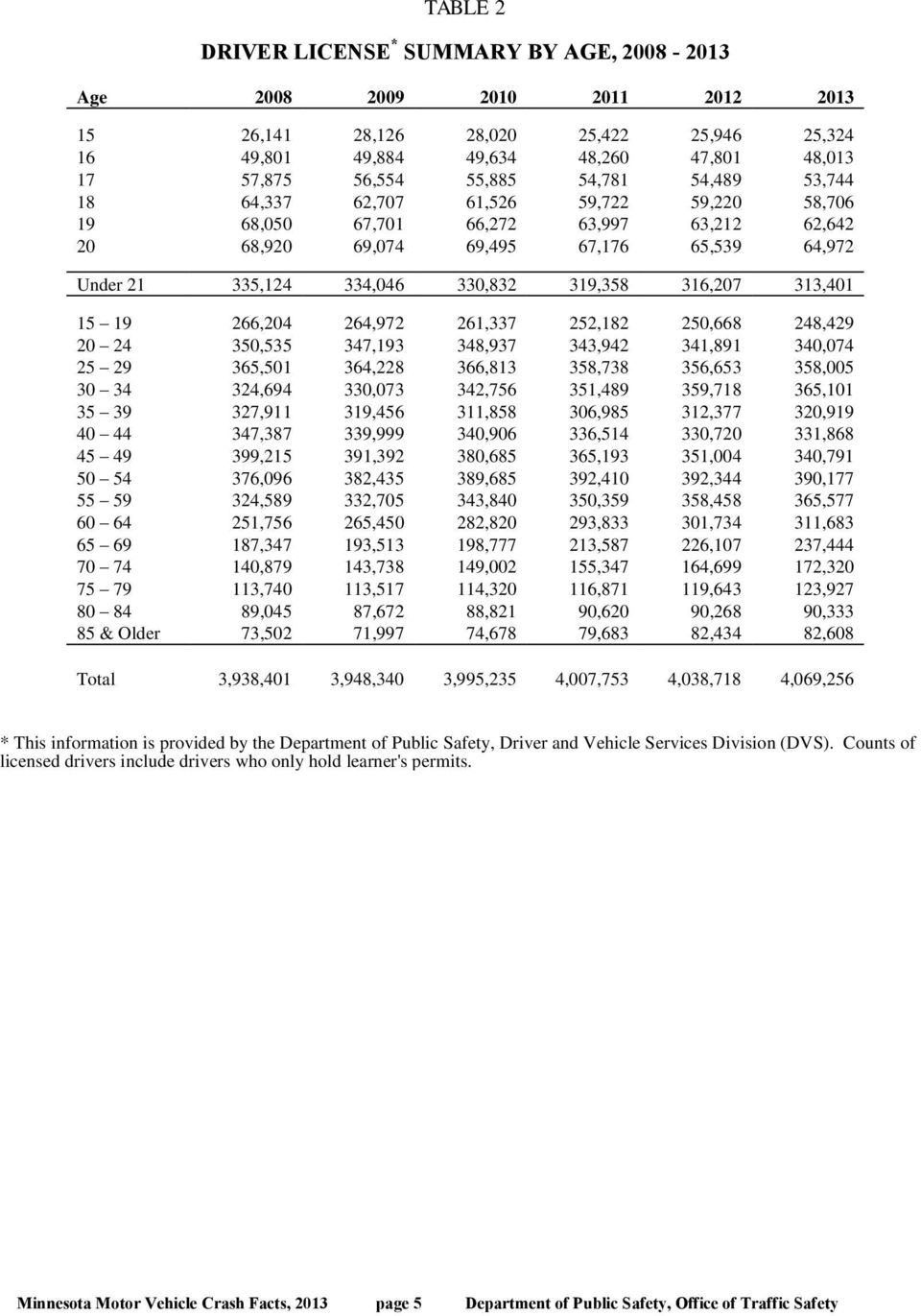
13 Introduction At the end of the 2013 calendar year, 4,079,256 people held Minnesota driver licenses and 5,088,124 motor vehicles were registered in the state. Vehicles traveled over 57 billion miles on public roadways. There were 77,707 traffic crashes; 387 people died and 30,653 people were injured in those crashes. This report provides a statistical summary of those crashes. The purpose of Crash Facts is to provide summary statistical information about the crashes reported to the state each year. The term crash is used in preference to accident. The latter term suggests there is a random, unavoidable quality about the events in question. In fact, the experience of the last three decades strongly demonstrates that advances in engineering and technology, coupled with changes in public policy and individual human behavior, can dramatically reduce the number and severity of traffic crashes. Cost of traffic crashes The necessity of getting from one place to another and the efficiency of motor vehicles for this purpose result in significant costs to society. The National Safety Council reports that crashes (from all causes) are the leading cause of death among persons aged 1 to 34 and the fifth leading cause of death among all persons (Injury Facts, Edition, p ). It is possible to estimate economic costs of traffic crashes, although the results can vary depending on definitions and estimating procedures. Many states use cost figures released by the National Safety Council, the most recent of which use 2011 data. Based upon those, the total economic loss from 2013 traffic crashes in Minnesota was $1,588,124,400, a figure that is calculated as follows: Cost of Motor Vehicle in 2013: 387 $1,410,000 = $ 545,670,000 1,216 severe $72,700 = $ 88,403,200 7,109 moderate $23,400 = $ 166,350,600 22,328 minor $13,200 = $ 294,729,600 55,390 PDO $8,900 = $ 492,971,000 : $ 1,588,124,400 Factors affecting traffic crashes Many factors may contribute to even a single crash. Cell phone use or playing with the radio may lead to driver distraction, which together with wet, slippery pavement and high traffic congestion at an intersection causes a traffic crash. There are a more limited number of factors that significantly affect the aggregate of traffic crashes. These can be organized into logical groups, such as human behavior factors or vehicle safety factors. The following paragraphs outline some of the factors most frequently thought to affect crash incidence and severity. Vehicle Safety Factors: Engineering and design standards for vehicle performance can help prevent crashes from occurring. When there is a crash, vehicles designed for safety can increase survivability. For example, the design of windshield glass and the location and durability of gas tanks can increase safety. The passenger packaging inside a vehicle can reduce injury severity through means such as padded dashboards and collapsible steering wheel columns. Passenger protection systems in vehicles (airbags, safety belts, etc.), if used, can eliminate injuries or reduce their severity. Minnesota Motor Vehicle Crash Facts, 2013 page 1 Department of Public Safety, Office of Traffic Safety

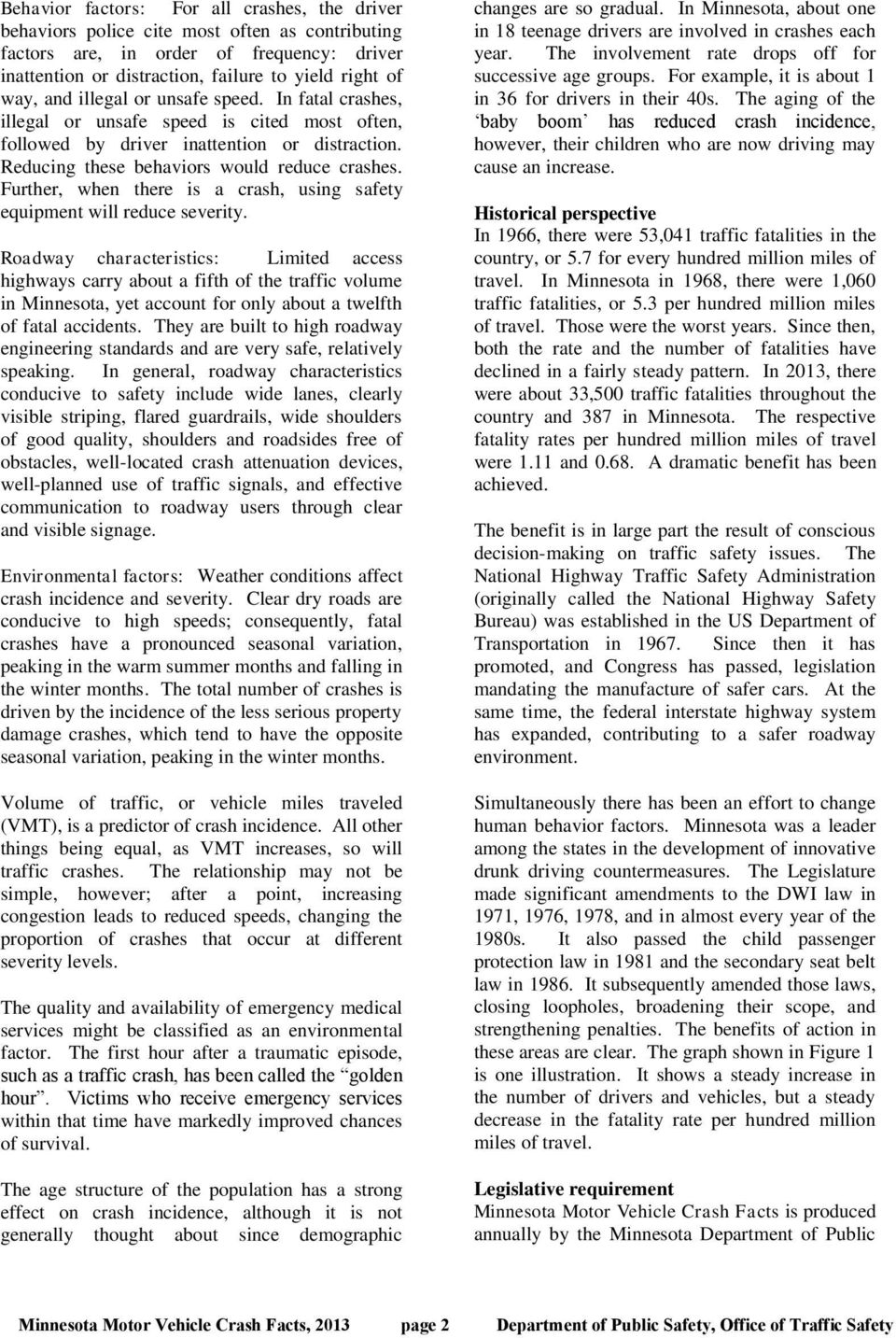
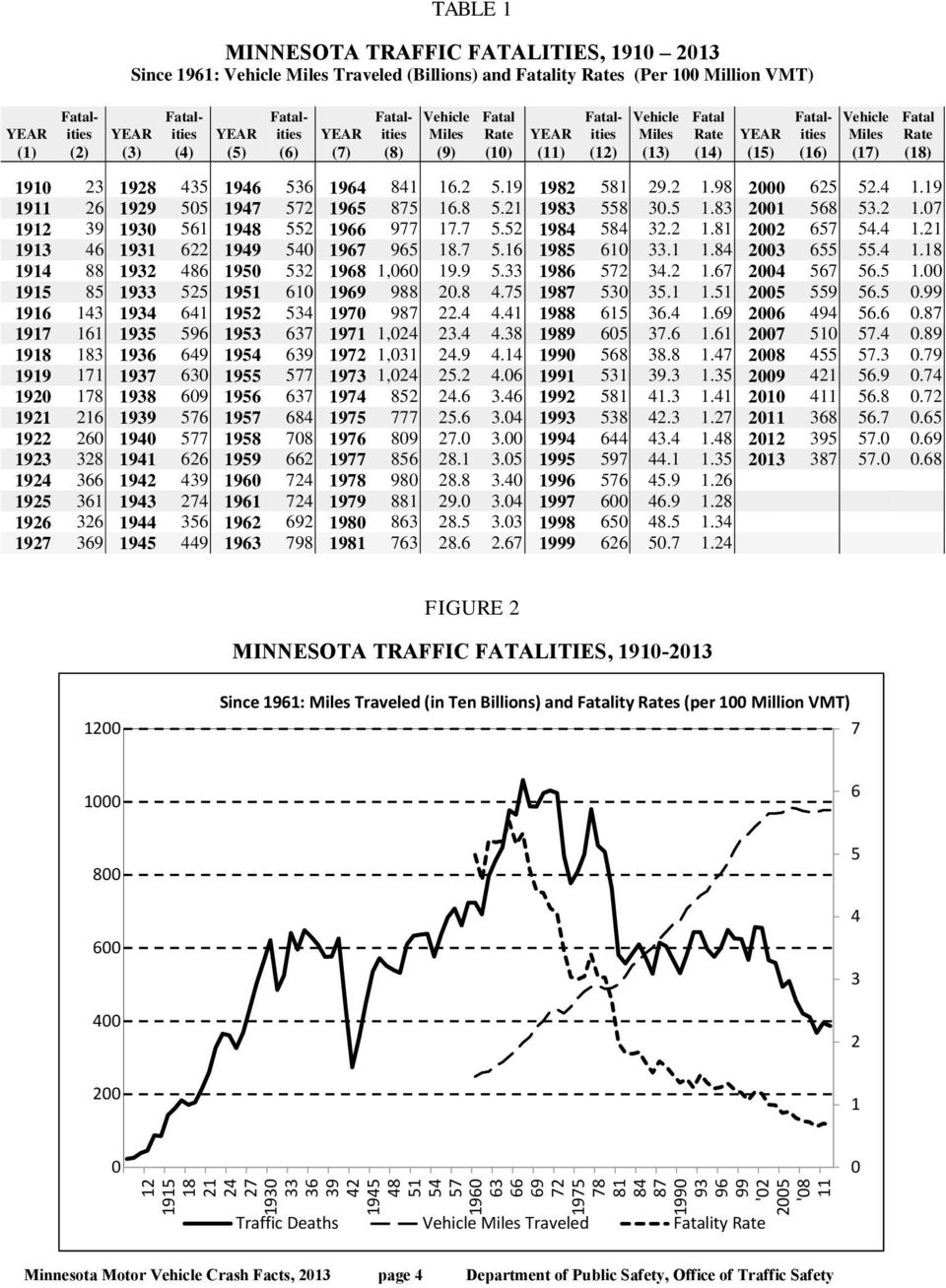
14 Behavior factors: For all crashes, the driver behaviors police cite most often as contributing factors are, in order of frequency: driver inattention or distraction, failure to yield right of way, and illegal or unsafe speed. In fatal crashes, illegal or unsafe speed is cited most often, followed by driver inattention or distraction. Reducing these behaviors would reduce crashes. Further, when there is a crash, using safety equipment will reduce severity. Roadway characteristics: Limited access highways carry about a fifth of the traffic volume in Minnesota, yet account for only about a twelfth of fatal accidents. They are built to high roadway engineering standards and are very safe, relatively speaking. In general, roadway characteristics conducive to safety include wide lanes, clearly visible striping, flared guardrails, wide shoulders of good quality, shoulders and roadsides free of obstacles, well-located crash attenuation devices, well-planned use of traffic signals, and effective communication to roadway users through clear and visible signage. Environmental factors: Weather conditions affect crash incidence and severity. Clear dry roads are conducive to high speeds; consequently, fatal crashes have a pronounced seasonal variation, peaking in the warm summer months and falling in the winter months. The total number of crashes is driven by the incidence of the less serious property damage crashes, which tend to have the opposite seasonal variation, peaking in the winter months. Volume of traffic, or vehicle miles traveled (VMT), is a predictor of crash incidence. All other things being equal, as VMT increases, so will traffic crashes. The relationship may not be simple, however; after a point, increasing congestion leads to reduced speeds, changing the proportion of crashes that occur at different severity levels. The quality and availability of emergency medical services might be classified as an environmental factor. The first hour after a traumatic episode, such as a traffic crash, has been called the golden hour. Victims who receive emergency services within that time have markedly improved chances of survival. The age structure of the population has a strong effect on crash incidence, although it is not generally thought about since demographic changes are so gradual. In Minnesota, about one in 18 teenage drivers are involved in crashes each year. The involvement rate drops off for successive age groups. For example, it is about 1 in 36 for drivers in their 40s. The aging of the baby boom has reduced crash incidence, however, their children who are now driving may cause an increase. Historical perspective In 1966, there were 53,041 traffic fatalities in the country, or 5.7 for every hundred million miles of travel. In Minnesota in 1968, there were 1,060 traffic fatalities, or 5.3 per hundred million miles of travel. Those were the worst years. Since then, both the rate and the number of fatalities have declined in a fairly steady pattern. In 2013, there were about 33,500 traffic fatalities throughout the country and 387 in Minnesota. The respective fatality rates per hundred million miles of travel were 1.11 and A dramatic benefit has been achieved. The benefit is in large part the result of conscious decision-making on traffic safety issues. The National Highway Traffic Safety Administration (originally called the National Highway Safety Bureau) was established in the US Department of Transportation in Since then it has promoted, and Congress has passed, legislation mandating the manufacture of safer cars. At the same time, the federal interstate highway system has expanded, contributing to a safer roadway environment. Simultaneously there has been an effort to change human behavior factors. Minnesota was a leader among the states in the development of innovative drunk driving countermeasures. The Legislature made significant amendments to the DWI law in 1971, 1976, 1978, and in almost every year of the 1980s. It also passed the child passenger protection law in 1981 and the secondary seat belt law in It subsequently amended those laws, closing loopholes, broadening their scope, and strengthening penalties. The benefits of action in these areas are clear. The graph shown in Figure 1 is one illustration. It shows a steady increase in the number of drivers and vehicles, but a steady decrease in the fatality rate per hundred million miles of travel. Legislative requirement Minnesota Motor Vehicle Crash Facts is produced annually by the Minnesota Department of Public Minnesota Motor Vehicle Crash Facts, 2013 page 2 Department of Public Safety, Office of Traffic Safety
15 Safety Office of Traffic Safety, in accordance with state law. Minnesota Statutes, Section , requires that traffic crashes be reported to the Department. Section then requires the Department to tabulate all crash reports and publish annually statistical information based thereon as to the number and circumstances of traffic crashes Section specifies that a driver involved in a crash that results in injury to or death of any person or total property damage of $1,000 or more must submit a report within ten days of the crash. The law enforcement officer who investigates the crash must also submit a report within ten days. The minimum dollar amount for crashes involving only property damage has changed over the years. The first minimum was set at $50 in It was raised to $100 in 1965, to $300 on August 1, 1977, and then to $500 on August 1, The current minimum of $1,000 took effect August 1, Crash Facts is divided into eleven sections. The first section presents information on the aggregate of all crashes reported to the state during the preceding calendar year. The remaining ten sections focus on specific areas of interest to policy makers and the public. Section II deals with alcohol-related crashes. Section III is about the use of safety equipment by occupants of vehicles required to be equipped with passenger protection systems, including child safety seats and safety belts. The following six sections focus on crashes that involved motorcycles (section IV), trucks (section V), pedestrians (section VI), bicycles (section VII), school buses (section VIII), and trains (section IX). Sections X and XI summarize info on crashes involving teen and senior drivers. FIGURE 1 VEHICLES, DRIVERS AND FATALITY RATE, Vehicles (Millions) Drivers (Millions) Fatality Rate (Per 100 Million Vehicle Miles Traveled) Minnesota Motor Vehicle Crash Facts, 2013 page 3 Department of Public Safety, Office of Traffic Safety

16 TABLE 1 MINNESOTA TRAFFIC FATALITIES, Since 1961: Vehicle Miles Traveled (Billions) and Fatality Rates (Per 100 Million VMT) YEAR (1) Fatalities (2) YEAR (3) Fatalities (4) YEAR (5) Fatalities (6) YEAR (7) Fatalities (8) Vehicle Miles (9) Fatal Rate (10) YEAR (11) Fatalities (12) Vehicle Miles (13) Fatal Rate (14) YEAR (15) Fatalities (16) Vehicle Miles (17) Fatal Rate (18) , , , , FIGURE 2 MINNESOTA TRAFFIC FATALITIES, Since 1961: Miles Traveled (in Ten Billions) and Fatality Rates (per 100 Million VMT) ' '08 11 Traffic Deaths Vehicle Miles Traveled Fatality Rate 0 Minnesota Motor Vehicle Crash Facts, 2013 page 4 Department of Public Safety, Office of Traffic Safety
17 TABLE 2 DRIVER LICENSE * SUMMARY BY AGE, Age ,141 28,126 28,020 25,422 25,946 25, ,801 49,884 49,634 48,260 47,801 48, ,875 56,554 55,885 54,781 54,489 53, ,337 62,707 61,526 59,722 59,220 58, ,050 67,701 66,272 63,997 63,212 62, ,920 69,074 69,495 67,176 65,539 64,972 Under , , , , , , , , , , , , , , , , , , , , , , , , , , , , , , , , , , , , , , , , , , , , , , , , , , , , , , , , , , , , , , , , , , , , , , , , , , , , , , , , , , , , ,045 87,672 88,821 90,620 90,268 90, & Older 73,502 71,997 74,678 79,683 82,434 82,608 3,938,401 3,948,340 3,995,235 4,007,753 4,038,718 4,069,256 * This information is provided by the Department of Public Safety, Driver and Vehicle Services Division (DVS). Counts of licensed drivers include drivers who only hold learner's permits. Minnesota Motor Vehicle Crash Facts, 2013 page 5 Department of Public Safety, Office of Traffic Safety
18 TABLE 3 MOTOR VEHICLE REGISTRATIONS, Type of Vehicle* Passenger Vehicles 3,455,451 3,478,218 3,527,503 3,579,033 3,621,291 3,630,245 Pickup Trucks 849, , , , , ,136 Commercial Trucks 215, , , , , ,201 Recreational Vehicles 34,998 35,042 34,797 33,070 32,511 31,349 Motorcycles 224, , , , , ,909 Motorized Bicycles 15,601 15,559 15,682 16,016 16,378 16,035 School Buses 6,766 6,810 6,940 6,951 7,120 7,220 Other Buses 5,076 4,996 5,067 5,161 5,105 5,188 Van Pool Tax Exempt Vehicles 51,045 52,480 52,061 53,420 53,175 54,682 Motor Vehicle Subtotal 4,858,501 4,866,763 4,915,121 4,975,146 5,023,656 5,088,124 Other Registrations* Trailers 1,564,054 1,610,989 1,665,491 1,715,404 1,773,595 1,830,458 Classic Motor Vehicles 166, , , , , ,716 Classic Motorcycles 8,124 8,778 9,487 10,489 11,070 11,993 Other Subtotal 1,738,650 1,792,625 1,854,749 1,912,479 1,977,314 2,041,167 Registrations 6,597,151 6,659,388 6,769,870 6,887,625 7,000,970 7,129,291 * Information provided by Department of Public Safety, Driver and Vehicle Services Division. Minnesota license plates on a vehicle signify that it has been registered with the state and that the owner has paid the registration fee. The vehicle classification used for registration purposes is similar, but not identical, to the vehicle classification (shown in Tables 1.11 and 1.12) police use in reporting accidents. Following are some notes on the registration categories shown above: Passenger Vehicles include cars, SUV s, and Vans (except for a "Van Pool," which is a Van used exclusively for car pooling purposes) Pickup Trucks are rated three-fourths ton or less Motorcycles have engines exceeding 50 cc; otherwise the vehicle is classified as a Motorized Bicycle (Moped) Tax exempt Vehicles are vehicles owned by city, county, or state offices. They have license plates but no registration fees are paid on them. (Police and fire department vehicles are tax exempt but are not included since they do not have state license plates and are not registered.) Trailers (such as utility trailers pulled by cars, or semi or twin trailers pulled by trucks) are pulled by motorized vehicles and do not themselves have motors Classic Motor Vehicles and Classic Motorcycles must be at least 20 years old and cannot be used for normal transportation purposes. They can only be driven, for example, to car shows. Minnesota Motor Vehicle Crash Facts, 2013 page 6 Department of Public Safety, Office of Traffic Safety

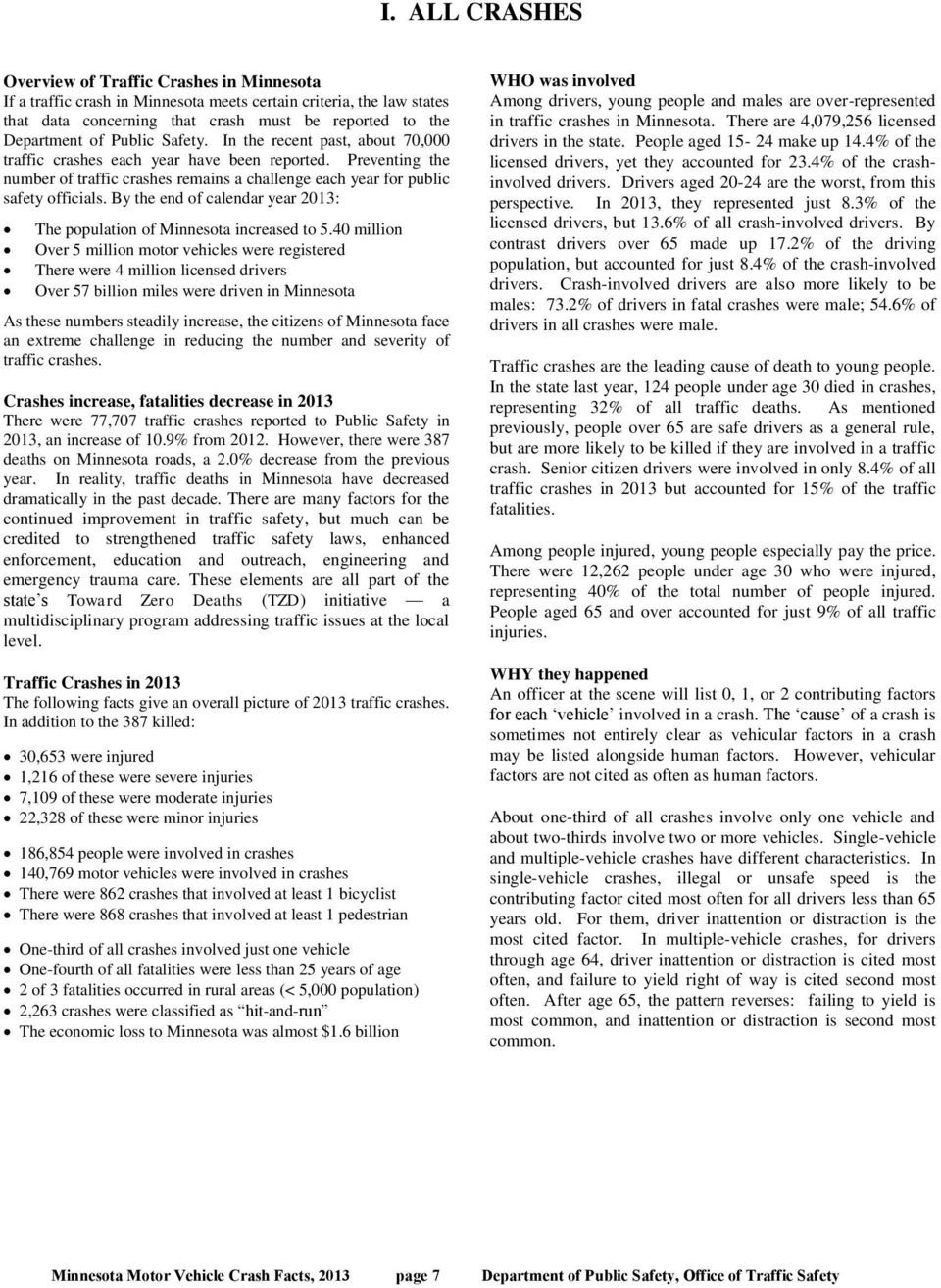
19 I. ALL CRASHES Overview of Traffic in Minnesota If a traffic crash in Minnesota meets certain criteria, the law states that data concerning that crash must be reported to the Department of Public Safety. In the recent past, about 70,000 traffic crashes each year have been reported. Preventing the number of traffic crashes remains a challenge each year for public safety officials. By the end of calendar year 2013: The population of Minnesota increased to 5.40 million Over 5 million motor vehicles were registered There were 4 million licensed drivers Over 57 billion miles were driven in Minnesota As these numbers steadily increase, the citizens of Minnesota face an extreme challenge in reducing the number and severity of traffic crashes. increase, fatalities decrease in 2013 There were 77,707 traffic crashes reported to Public Safety in 2013, an increase of 10.9% from However, there were 387 deaths on Minnesota roads, a 2.0% decrease from the previous year. In reality, traffic deaths in Minnesota have decreased dramatically in the past decade. There are many factors for the continued improvement in traffic safety, but much can be credited to strengthened traffic safety laws, enhanced enforcement, education and outreach, engineering and emergency trauma care. These elements are all part of the state s Toward Zero Deaths (TZD) initiative a multidisciplinary program addressing traffic issues at the local level. Traffic in 2013 The following facts give an overall picture of 2013 traffic crashes. In addition to the 387 killed: 30,653 were injured 1,216 of these were severe injuries 7,109 of these were moderate injuries 22,328 of these were minor injuries 186,854 people were involved in crashes 140,769 motor vehicles were involved in crashes There were 862 crashes that involved at least 1 bicyclist There were 868 crashes that involved at least 1 pedestrian One-third of all crashes involved just one vehicle One-fourth of all fatalities were less than 25 years of age 2 of 3 fatalities occurred in rural areas (< 5,000 population) 2,263 crashes were classified as hit-and-run The economic loss to Minnesota was almost $1.6 billion WHO was involved Among drivers, young people and males are over-represented in traffic crashes in Minnesota. There are 4,079,256 licensed drivers in the state. People aged make up 14.4% of the licensed drivers, yet they accounted for 23.4% of the crashinvolved drivers. Drivers aged are the worst, from this perspective. In 2013, they represented just 8.3% of the licensed drivers, but 13.6% of all crash-involved drivers. By contrast drivers over 65 made up 17.2% of the driving population, but accounted for just 8.4% of the crash-involved drivers. Crash-involved drivers are also more likely to be males: 73.2% of drivers in fatal crashes were male; 54.6% of drivers in all crashes were male. Traffic crashes are the leading cause of death to young people. In the state last year, 124 people under age 30 died in crashes, representing 32% of all traffic deaths. As mentioned previously, people over 65 are safe drivers as a general rule, but are more likely to be killed if they are involved in a traffic crash. Senior citizen drivers were involved in only 8.4% of all traffic crashes in 2013 but accounted for 15% of the traffic fatalities. Among people injured, young people especially pay the price. There were 12,262 people under age 30 who were injured, representing 40% of the total number of people injured. People aged 65 and over accounted for just 9% of all traffic injuries. WHY they happened An officer at the scene will list 0, 1, or 2 contributing factors for each vehicle involved in a crash. The cause of a crash is sometimes not entirely clear as vehicular factors in a crash may be listed alongside human factors. However, vehicular factors are not cited as often as human factors. About one-third of all crashes involve only one vehicle and about two-thirds involve two or more vehicles. Single-vehicle and multiple-vehicle crashes have different characteristics. In single-vehicle crashes, illegal or unsafe speed is the contributing factor cited most often for all drivers less than 65 years old. For them, driver inattention or distraction is the most cited factor. In multiple-vehicle crashes, for drivers through age 64, driver inattention or distraction is cited most often, and failure to yield right of way is cited second most often. After age 65, the pattern reverses: failing to yield is most common, and inattention or distraction is second most common. Minnesota Motor Vehicle Crash Facts, 2013 page 7 Department of Public Safety, Office of Traffic Safety
20 WHAT the conditions were Victims of traffic crashes are mostly car, pickup, sport utility vehicle (SUV) or van occupants. Of the 387 traffic fatalities, 259 (67%) were from these 4 vehicle types. There were also 35 pedestrians, 60 motorcyclists, and 6 bicyclists who died in traffic crashes. There were 7 deaths to ATV riders, 5 deaths among farm equipment and 2 fatalities among snowmobiles. Other vehicle types (e.g., larger trucks and road maintenance vehicles) accounted for 13 fatalities. A collision with another vehicle is the leading crash type. About 47% of the fatal crashes and 65% of all crashes involve one vehicle colliding with another vehicle. In fatal and injury crashes, collisions with fixed objects and overturns are also common. For property damage crashes, the other leading crash types are collision with fixed object, and collision with a parked motor vehicle. Most crashes occur in good driving conditions. Over half of fatal crashes, and two-thirds of nonfatal crashes occurred during daylight hours. A majority of crashes occur also in good weather conditions. Over half of all crashes occur during clear weather. Road surface conditions where crashes occurred were usually good. For fatal crashes, 76% were on dry roads, 10% were on wet roads, and 12% were on snowy or icy roads. WHERE they happened Fatal crashes tend to occur on roads in rural areas that permit high speeds and do not have interstate-type safety designs. Last year, 239 (67%) of all fatal crashes occurred in rural areas, which are defined as having a population of less than 5,000 people. Additionally, 131 (37%) of all fatal crashes occurred on county state aid highways, and 85 of those were in rural areas. Injury and property damage crashes are more common in urban areas. Over two-thirds happened inside cities of 5,000 or more population. The seven county metro area, with over half the state's population, accounted for only 26% of the fatal crashes, but 61% of all crashes. WHEN they occurred A fatal traffic crash is most likely to occur during the morning and afternoon rush-hour time periods (6:00-9:00 a.m. and 3:00-6:00 p.m.). This has changed since the early 1990s when most fatal crashes occurred at night during the time period of 10:00 p.m.-2:00 a.m. This phenomenon may be explained by the smarter deployment of law enforcement, increased seat belt usage, and the public s awareness of the dangers of drinking and driving. As for total crashes, the six hour time period of 12:00-6:00 p.m. had the most. In that time frame, 43% of all crashes occurred. This has not changed over the years. Indeed, Figure 1.03 on page 36 shows that the afternoon time period is truly a dangerous time to be driving. Fridays, Saturdays, and Sundays accounted for 167 of the 357 fatal crashes (47%). crashes are more evenly distributed across days of the week, although Fridays had the most (16%) and Sundays had the least (10%). As a general rule, harsh winter weather results in more traffic crashes. In other words, there are more fenderbenders during icy and snowy conditions. December of 2013 followed this axiom. Because of severe weather, December had the most crashes reported of any month (11,548). As a general rule, warmer weather produces more fatalities. July and September had the most with 49 and 46 respectively. As mentioned earlier, though, factors other than the weather are also involved. These include speeding, drinking and driving, not wearing a seat belt, and not paying attention while driving. Can traffic crashes be prevented? On average over the past decade, about 500 people have been killed and 30,000 injured every year on our roadways. Minnesota is still experiencing a number of traffic crashes that is cause for concern. In a public health sense, epidemics that kill and injure fewer people are usually attacked vigorously until they are no longer a threat to public safety. The Department of Public Safety (DPS) uses the term crash instead of accident. This is because a traffic crash can be prevented. Coupled with enforcement, education, engineering, and emergency trauma solutions, changes in the behavior of all drivers will surely help attack the public threat of tragic roadway fatalities and injuries. DPS implores the reader to spread the word: Driving is a privilege; aggressive driving is not. Buckle up. Drive at safe speeds. Pay attention. Never drive impaired. Minnesota Motor Vehicle Crash Facts, 2013 page 8 Department of Public Safety, Office of Traffic Safety

21 TABLE 1.01 TRAFFIC SAFETY STATISTICS SUMMARY, Year (a) (b) Persons Killed (c) Persons Injured (d) Licensed Drivers (million) (e) Motor Vehicles (MV) (million) (f) State Population (million) (g) Vehicle Miles Traveled (VMT) (billion) (h) Crash Rates Per 100,000 MV (i) Crash Rates Per 100,000 Population (j) Crash Rates Per 100 Mil VMT (k) Fatality Rates Per 100,000 MV (l) Fatality Rates Per 100,000 Population (m) Fatality Rates Per100 Mil VMT (n) , , ,480 2, , , ,438 2, , , ,580 3, , , ,446 2, , , ,163 2, , , ,972 2, , , ,214 2, , , ,995 2, , , ,080 2, , , ,937 2, , , ,840 2, , , ,012 2, , , ,060 2, , , ,817 2, , , ,890 2, , , ,730 2, , , ,899 2, , , ,720 2, , , ,606 2, , , ,845 2, , , ,065 2, , , ,380 1, , , ,470 2, , , ,469 2, , , ,262 1, , , ,115 1, N/A 655 N/A N/A N/A N/A , , ,971 1, , , ,873 1, , , ,654 1, , , ,691 1, , , ,628 1, , , ,510 1, , , ,507 1, , , ,450 1, , , ,378 1, , , ,527 1, Note: (1) By State statute, information on traffic crashes must be reported to the Department of Public Safety if the crashes involve motor vehicles in transport on Minnesota roadways, and have at least $1,000 in property damage, or a motor vehicle occupant, pedestrian, or bicyclist is injured or killed. (2) The numbers shown for licensed drivers includes those who have only permits. (3) Vehicle miles traveled are provided by Minnesota Department of Transportation. (4) Numbers of licensed drivers and registered motor vehicles are provided by the Driver and Vehicle Services Division, Minnesota Department of Public Safety. Minnesota Motor Vehicle Crash Facts, 2013 page 9 Department of Public Safety, Office of Traffic Safety
22 TABLE 1.02 TRAFFIC CRASH TRENDS Record High Fatal (1973) Injury 23,914 22,159 22,013 21,662 20,972 21,960 33,686 (1978) Severe 1,248 1, , ,109 (1984) 1 Moderate 6,493 5,942 5,792 5,581 5,423 5,563 12,326 (1985) 1 Minor 16,173 15,181 15,247 15,127 14,505 15,416 18,578 (1996) 1 PDO 54,761 50,968 51,696 50,121 47,915 55,390 94,810 (1975) 79,095 73,498 74,073 72,117 69,236 77, ,106 (1975) Injuries 33,379 31,074 31,176 30,295 29,314 30,653 50,332 (1978) Severe 1,553 1,271 1,191 1,159 1,268 1,216 6,573 (1984) 1 Moderate 8,334 7,714 7,445 7,110 6,902 7,109 17,670 (1985) 1 Minor 23,492 22,089 22,540 22,026 21,144 22,328 28,631 (1996) 1 Fatalities ,060 (1968) Motor Vehicle Occupant (2002) 1 Motorcycle (1980) Pedestrian (1971) Bicycle (1977) All Terrain Vehicle (2008) Snowmobile (1984) Farm Equipment N/A N/A Other Vehicle Type N/A N/A Minnesota Fatality Rate (1934) U.S. Fatality Rate (1925) Minnesota Economic Loss (millions) $1,480 $1,496 $1,477 $1,481 $1,514 $1,588 $1,769 (2004) 4 1 The available records on which these categories "record highs" are based only go back to Fatalities occurring in motor vehicle/train crashes are included in other categories as well. 3 Rate is based on 100 million vehicle miles of travel. 4 Economic cost estimates are based upon wage and productivity losses, medical expenses, administrative expenses, motor vehicle damage, and employers uninsured costs, among other factors. Minnesota Motor Vehicle Crash Facts, 2013 page 10 Department of Public Safety, Office of Traffic Safety
23 TABLE FATALITIES BY TRAFFIC ROLE, GENDER, AND AGE Type of Vehicle Position in Vehicle Gender Age 0-9 Age Age Age Age Age Age Age 70 and Older Car Driver Male Female Passenger Male Female Pickup Driver Male Female Passenger Male Female SUV Driver Male Female Passenger Male Female Van Driver Male Female Passenger Male Female Truck Driver Male Female Passenger Male Female Motorcycle Driver Male Female Passenger Male Female Other Driver Male Motor Female Vehicle Passenger Male Female Bicyclist Male Female Pedestrian Male Female Male Fatalities Female Note: The vehicle types for the 18 fatalities in the Other Motor Vehicle category consisted of: Seven ATVs, 5 farm equipment, 2 snowmobiles, 1 moped, 1 motorhome, 1 roadway maintenance vehicle, and 1 unknown vehicle type. Minnesota Motor Vehicle Crash Facts, 2013 page 11 Department of Public Safety, Office of Traffic Safety
24 TABLE 1.04 AGE AND GENDER OF PERSONS KILLED OR INJURED IN 2013 CRASHES Age Group Males Killed Females Killed Killed Males Injured Females Injured Unknown Injured Injured < 15: , : ,916 2, ,080 < 21: ,842 3, , ,517 1, , ,865 2, , ,519 1, , ,346 1, , ,059 1, , ,010 1, , ,007 1, , ,075 1, , , , & Older Not Stated : ,356 15, ,653 See Figure 1.01 on page 15 for a graphical depiction of how many persons were killed and injured by age and gender groups. Minnesota Motor Vehicle Crash Facts, 2013 page 12 Department of Public Safety, Office of Traffic Safety
25 Male Drivers in Fatal TABLE 1.05 AGE AND GENDER OF DRIVERS IN 2013 CRASHES Female Drivers in Fatal Drivers Gender Not Stated in Fatal in Fatal Male Drivers in All Female Drivers in All All Where Drivers Gender is Not Stated in All Age Group < ,432 1, , ,711 1, , ,870 1, , ,964 1, , ,998 1, ,721 All < ,092 7, , ,058 6, , ,724 8, , ,323 7, , ,688 5, , ,227 4, , ,080 4, , ,865 4, , ,152 4, , ,291 3, , ,996 2, , ,452 1, , ,600 1, , , , , ,071 Unk ,432 5, ,553 56,234 4, ,694 Most crashes involve more than one driver, causing the total number of drivers to exceed the total number of crashes. (Pedestrians and bicyclists are not counted in this table.) Minnesota Motor Vehicle Crash Facts, 2013 page 13 Department of Public Safety, Office of Traffic Safety
26 TABLE 1.06 LICENSED VS. CRASH-INVOLVED DRIVERS BY AGE, 2013 Percentage of All Licensed Drivers Percentage of Drivers in Fatal Percentage of Drivers in Injury Percentage of Drivers in Property Damage Percentage of Drivers in All Age Group 14 & Younger 0.0% 0.0% 0.1% 0.0% 0.0% < % 8.6% 12.5% 12.7% 12.7% % 6.7% 9.6% 10.0% 9.9% & Older Age Not Stated Percent 100.0% 100.0% 100.0% 100.0% 100.0% Number 4,079,256 See Figure 1.02 on page 15 for a graphical depiction of crash-involved drivers compared to licensed drivers by age group. Minnesota Motor Vehicle Crash Facts, 2013 page 14 Department of Public Safety, Office of Traffic Safety
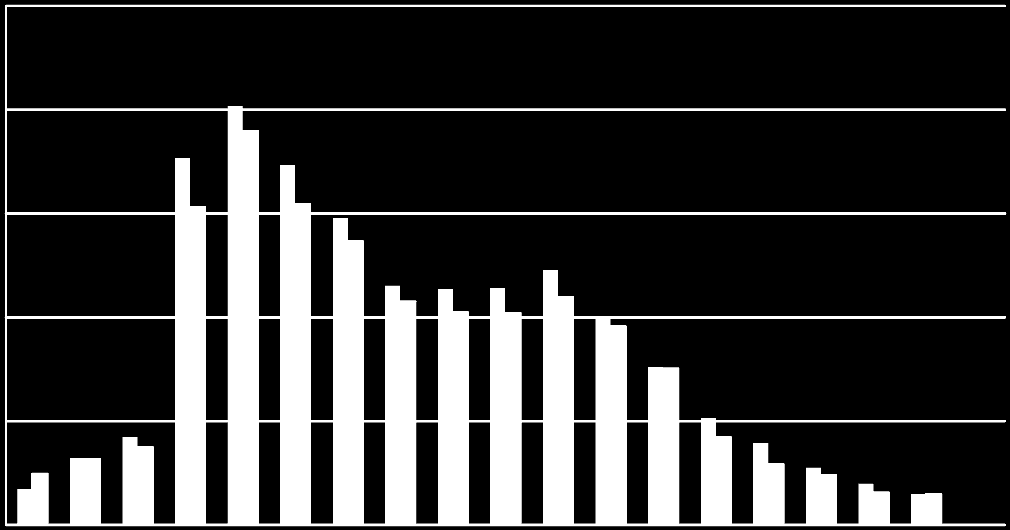
27 FIGURE 1.01 AGE AND GENDER OF PERSONS KILLED OR INJURED, Female Male Number Age Group FIGURE 1.02 LICENSED VS CRASH-INVOLVED DRIVERS BY AGE, Percent of All Drivers in Population Percent of All Drivers in 10.0 Percent Age Group Minnesota Motor Vehicle Crash Facts, 2013 page 15 Department of Public Safety, Office of Traffic Safety
28 TABLE 1.07 PERCENTAGE OF DRIVERS IN 2013 CRASHES BY AGE AND FIRST HARMFUL EVENT Age Group Age Group Age Group Age Group Age Group Age Group Age Group 80 + All Ages First Harmful Event Collision With: Other Motor Vehicle 73.6% 76.0% 79.1% 80.3% 81.8% 82.5% 83.7% 79.7% Parked Motor Vehicle Bicycle Pedestrian Deer Other Animal Railroad Train Fixed Object Other Object Non-Collision: Overturn Other Non-Collision Other or Unknown Percent 100.0% 100.0% 100.0% 100.0% 100.0% 100.0% 100.0% 100.0% Drivers 13,258 18,319 15,453 13,640 57,463 8,825 2, ,694 Percentages are based on the number of crash-involved drivers in each age group (some driver ages are not available). Bicyclists and pedestrians are not counted as drivers in this table. TABLE 1.08 DRIVERS IN 2013 CRASHES BY PHYSICAL CONDITION* Drivers in Fatal Drivers in Injury Drivers in Property Damage Drivers in All Physical Condition Normal ,543 78, ,862 Under the Influence 30 1,086 1,511 2,627 Had Been Drinking Commercial Driver Had Been Using Drugs Aggressive Fatigued/Asleep Physical Disability Ill Other Unknown 127 3,405 13,616 17, ,068 95, ,694 * As noted by police officer on accident report. Note that in the absence of alcohol or drug test results (not usually available at the time the crash report is completed); officers are conservative in reporting impairment. Compare these figures with those from Section II. Pedestrians and bicyclists are excluded from this table. Minnesota Motor Vehicle Crash Facts, 2013 page 16 Department of Public Safety, Office of Traffic Safety
29 TABLE 1.09 SINGLE-VEHICLE CRASHES: CONTRIBUTING FACTORS, BY PERCENT, WITHIN DRIVER AGE GROUPS, 2013 Contributing Factor Age Group Age Group Age Group Age Group Age Group Age Group Age Group 80+ All Ages Human Factors Illegal/Unsafe Speed 24.8% 30.4% 28.9% 27.5% 24.4% 20.0% 15.7% 26.3% Driver Inattention/Distraction Overcorrecting Chemical Impairment Driver Inexperience Improper/Unsafe Lane Use Improper Turn Disregard for Traffic Control Device Following Too Closely Vision Obscured Driving Left of Center-Not Passing Unsafe Backing Improper Passing/Overtaking Failure to Yield Right of Way Driver on Cell Phone or CB Radio Improper Parking, Starting, Stopping Impeding Traffic Other Human Factor Vehicular Factors Skidding Defective Equipment Other Vehicular Factor Miscellaneous Factors Weather Other Percent 100.0% 100.0% 100.0% 100.0% 100.0% 100.0% 100.0% 100.0% Contributing Factors Cited 3,870 4,360 2,937 2,287 7,831 1, ,875 Drivers for Whom There Was "No Clear Contributing Factor" , ,501 Number of Drivers 2,788 3,375 2,415 1,939 7,432 1, ,045 Percentages are based on all contributing factors cited within each age group (some driver ages are not available). Zero, one, or two contributing factors may be associated with each driver. The percentages may not sum to 100% due to rounding. Contributing factors for bicyclists and pedestrians are excluded. For contributing factors in multiple-vehicle crashes, see Table For contributing factors in crashes at different levels of severity, see Table Minnesota Motor Vehicle Crash Facts, 2013 page 17 Department of Public Safety, Office of Traffic Safety
30 TABLE 1.10 MULTIPLE-VEHICLE CRASHES: CONTRIBUTING FACTORS, BY PERCENT, WITHIN DRIVER AGE GROUPS, 2013 Contributing Factor Age Group Age Group Age Group Age Group Age Group Age Group Age Group 80 + All Ages Human Factors Driver Inattention or Distraction 23.8% 24.2% 22.5% 22.2% 21.0% 20.6% 16.6% 21.8% Failure to Yield Right of Way Improper or Unsafe Lane Use Following Too Closely Illegal or Unsafe Speed Improper Passing or Overtaking Disregard for Traffic Control Device Improper Turn Vision Obscured Chemical Impairment Unsafe Backing Driver Inexperience Improper Parking, Starting, Stopping Overcorrecting Driving Left of Center-Not Passing Impeding Traffic Improper or No Signal Driver on Cell Phone or CB Radio Failure to Use Lights Other Human Factor Vehicular Factors Skidding Defective Equipment Other Vehicular Factor Miscellaneous Factors Weather Other Percent 100.0% 100.0% 100.0% 100.0% 100.0% 100.0% 100.0% 100.0% Contributing Factors Cited 9,617 11,608 8,506 6,783 26,196 4,737 1,807 71,669 Drivers for Whom There Was "No Clear Contributing Factor" 3,006 5,362 5,783 5,727 26,233 3, ,735 Number of Drivers 10,469 14,942 13,033 11,689 49,998 7,796 2, ,967 Percentages are based on all contributing factors cited within each age group (some driver ages are not available). Zero, one, or two contributing factors may be associated with each driver. The percentages may not sum to 100% due to rounding. Contributing factors for bicyclists and pedestrians are excluded. For contributing factors in single-vehicle crashes, see Table For contributing factors in crashes at different levels of severity, see Table Minnesota Motor Vehicle Crash Facts, 2013 page 18 Department of Public Safety, Office of Traffic Safety
31 TABLE 1.11 PERSONS INVOLVED IN CRASHES BY TYPE OF VEHICLE OCCUPIED AND INJURY SEVERITY, 2013 Vehicle Type Killed Severely Injured Moderately Injured Minor Injuries Injured Not Injured Persons Automobile ,333 12,003 15,827 78,837 94,818 Pickup Truck ,786 2,573 16,197 18,809 Sport Utility Vehicle ,163 4,349 5,682 31,287 37,012 Van ,946 2,572 13,721 16,315 Motor Home/Camper Limousine Taxi Cab Police Vehicle Fire Department Vehicle School Bus ,826 3,932 Other Bus ,162 1,314 Ambulance Military Vehicle Snowmobile All-Terrain Vehicle Farm Tractor of Equipment Motorcycle , ,353 Motor Scooter/Motorbike* Motorized Bicycle (Moped) Hit and Run Vehicle ,293 2,352 Road Maintenance Vehicle Other Public Owned Vehicle Single Truck (2-axle, 6 tire) Single Truck (3 or more axles) Single Truck with Trailer Truck Tractor with No Trailer Truck Tractor with Semi Trailer ,393 2,556 Truck Tractor with Double Trailers Truck Tractor with Triple Trailers Other or Unknown Truck Type Other Vehicle Type Unknown Vehicle Type ,146 1,164 Bicycle Pedestrian ,216 7,109 22,328 30, , ,854 * On the accident report form, police may show that a vehicle is a "motorcycle," a "motor scooter/motorbike," or a "moped or motorized bicycle." Since 1986, however, the law recognizes just two categories. If the vehicle has an engine capacity of more than 50 cc, it is classified as a motorcycle; if it has 50 cc or smaller engine capacity, it is classified as a motorized bicycle. The term moped is short for motorized pedal cycle, which is the same as motorized bicycle. (Section 4 of this book now combines motorcycle and motor scooter/motorbike ). Minnesota Motor Vehicle Crash Facts, 2013 page 19 Department of Public Safety, Office of Traffic Safety
32 TABLE 1.12 TYPES OF MOTOR VEHICLES IN 2013 CRASHES Vehicles in Fatal Vehicles in Injury Vehicles in Property Damage Vehicles in All Motor Vehicle Type* Automobile ,145 53,744 75,093 Pickup Truck 82 4,091 10,986 15,159 Sport Utility Vehicle 95 7,767 19,104 26,966 Van 43 3,177 7,195 10,415 Motor Home/Camper Limousine Taxi Cab Police Vehicle Fire Department Vehicle School Bus Other Bus Ambulance Military Vehicle Snowmobile All-Terrain Vehicle* Farm Tractor or Equipment Motorcycle 57 1, ,240 Motor scooter/motorbike** Motorized Bicycle (Moped) Hit and Run Vehicle ,926 2,263 Road Maintenance Vehicle Other Public Owned Vehicle Single Truck (2-axle, 6-tire) Single Truck (3 or more axles) Single Truck with Trailer Truck Tractor with No Trailer Truck Tractor with Semi Trailer ,854 2,446 Truck Tractor with Double Trailers Truck Tractor with Triple Trailers Other or Unknown Truck Type Other Vehicle Type Unknown Vehicle Type ,070 1,168 *** , , ,769 * Snowmobiles and ATV s in crashes are not counted in this table unless the crash occurred on a public roadway. ** On the accident report form, police may show that a vehicle is a "motorcycle," a "motor scooter/motorbike," or a "moped or motorized bicycle." Since 1986, however, the law recognizes just two categories. If the vehicle has an engine capacity of more than 50 cc, it is classified as a motorcycle; if it has 50 cc or smaller engine capacity, it is classified as a motorized bicycle. The term moped is short for motorized pedal cycle, which is the same as motorized bicycle. (Section 4 of this book now combines motorcycle and motor scooter/motorbike ). *** Most crashes involve more than one vehicle, causing total vehicles to exceed total crashes. Bicyclists and pedestrians are excluded from this table. Minnesota Motor Vehicle Crash Facts, 2013 page 20 Department of Public Safety, Office of Traffic Safety
33 TABLE CRASHES BY FIRST HARMFUL EVENT Fatal Personal Injury Property Damage Killed Injured Fatality Rate Per 1,000 First Harmful Event Collision With: Another Motor Vehicle ,099 35,974 50, , Parked Motor Vehicle ,669 5, Bicycle Pedestrian Deer ,838 2, Other Animal Railroad Train Fixed Object 55 2,988 9,766 12, , Non-Fixed Object Other Collision Type Unk Collision Type Runaway Car Non-Collision: Overturn 59 1,909 1,946 3, , Submersion Fire/Explosion Other Non-Collision Unknown Crash Type: ,960 55,390 77, , TABLE "HIT-AND-RUN" CRASHES BY FIRST HARMFUL EVENT Fatal Personal Injury Property Damage Killed Injured First Harmful Event Collision With: Other Motor Vehicle ,719 3, Parked Motor Vehicle ,999 2, Bicycle Pedestrian Deer Other Animal Railroad Train Fixed Object Non-Fixed Object Other Collision Type Unk Collision Type Non-Collision: Overturn Submersion Other Non-Collision Unknown Crash Type ,144 5,661 6, ,453 Minnesota Motor Vehicle Crash Facts, 2013 page 21 Department of Public Safety, Office of Traffic Safety
34 TABLE CRASHES BY TRAFFIC CONTROL DEVICE Personal Injury Property Damage Traffic Control Device Fatal Killed Injured Traffic Signal 32 5,763 12,136 17, ,264 Overhead Flashers Stop Sign-All Approaches ,174 1, Other Stop Sign 58 3,112 6,614 9, ,676 Yield Sign , Flagman, Officer, School Patrol School Bus Stop Arm School Zone Sign No Passing Zone RR Crossing Gate RR Flashing Lights RR Crossing Stop Sign RR Overhead Flashing Lights RR Overhead Lights and Gate RR Crossbuck Other Device Not Applicable ,876 33,330 45, ,004 Unknown ,960 55,390 77, ,653 TABLE CRASHES BY WEATHER CONDITION Personal Injury Property Damage Weather Condition Fatal Killed Injured Clear ,948 29,894 43, ,139 Cloudy 95 5,177 12,931 18, ,226 Rain 11 1,028 2,320 3, ,477 Snow 16 1,879 7,155 9, ,588 Sleet/Hail/Freezing Rain ,257 1, Fog/Smog/Smoke Blowing Sand/Dust/Snow , Severe Crosswinds Other Not Stated/Unknown ,960 55,390 77, ,653 Minnesota Motor Vehicle Crash Facts, 2013 page 22 Department of Public Safety, Office of Traffic Safety
35 TABLE 1.17 CONTRIBUTING FACTORS IN 2013 CRASHES Percent of Factors Cited in by Severity of Crash Property Fatal Injury Damage Number of in which the Factor was Cited Property Fatal Injury Damage Number of People Affected Killed Injured Contributing Factors Human Factors Driver Inattention/Distraction ,618 11, ,034 Failure to Yield Right of Way ,379 8, ,640 Illegal/Unsafe Speed ,227 7, ,549 Following Too Closely ,264 6, ,127 Improper/Unsafe Lane Use , ,305 Disregard Traffic Cntl Device ,514 1, ,446 Chemical Impairment ,148 1, ,658 Improper Turn , Driver Inexperience , Overcorrecting , ,025 Unsafe Backing , Vision Obscured Improper Passing/Overtaking Improper Park/Start/Stop Driving Left of Ctr(Not Passing) Impeding Traffic Improper/No Signal Driver on Phone/CB Radio Failure to Use Lights Non-Motorist Error Other Human Factor , ,238 Vehicular Factors Skidding ,082 3, ,435 Defective Equipment Other Vehicular Factor Miscellaneous Factors Weather ,788 5, ,403 Other ,008 2, ,384 Percent 100.0% 100.0% 100.0% Contributing Factors ,299 66,213 Vehicles Where There Was No Clear Contributing Factor" ,552 39,891 Number of Vehicles , ,511 Zero, one, or two contributing factors may be associated with a vehicle, causing the number of factors cited to vary from the number of crashes, vehicles, and persons affected by the factors. Note that in the absence of alcohol or drug test results (not usually available at the time the crash report is completed); officers are conservative in reporting impairment. Compare these figures with those from Section II. Bicyclists and pedestrians are considered as vehicles in this table, and factors associated with them are included. For contributing factors by age of drivers, see tables 1.09 and Minnesota Motor Vehicle Crash Facts, 2013 page 23 Department of Public Safety, Office of Traffic Safety
36 TABLE CRASHES BY LIGHT CONDITION Personal Injury Property Damage Light Condition Fatal Killed Injured Daylight ,524 38,105 53, ,757 Dawn (Morning) ,465 1, Dusk (Evening) ,388 1, Dark/Street Lights On 37 3,545 9,710 13, ,896 Dark/No Street Lights 76 1,742 4,092 5, ,421 Other/Unknown ,960 55,390 77, ,653 TABLE CRASHES BY ROAD SURFACE CONDITION Personal Injury Property Damage Road Surface Condition Fatal Killed Injured Dry ,370 31,189 45, ,328 Wet 34 2,801 6,732 9, ,923 Snow/Slush 14 1,854 7,335 9, ,502 Ice or Packed Snow 29 2,703 9,449 12, ,601 Other Not Stated/Unknown ,960 55,390 77, ,653 TABLE CRASHES BY ROAD DESIGN Personal Injury Property Damage Road Design Fatal Killed Injured Freeway (Including Ramps) 31 3,906 11,797 15, ,312 Other Divided Highway 46 3,244 6,700 9, ,720 One-Way Street ,373 1, Lanes Undivided 26 4,155 9,425 13, ,883 3 Lanes Undivided Lane 1 Each Way 234 8,155 19,368 27, ,391 Alley Other Road Design ,772 2, ,039 Not Stated/Unknown ,183 5, , ,960 55,390 77, ,653 Minnesota Motor Vehicle Crash Facts, 2013 page 24 Department of Public Safety, Office of Traffic Safety
37 TABLE CRASHES BY DIAGRAM Personal Injury Property Damage Diagram Fatal Killed Injured Rear End 24 6,660 16,209 22, ,397 Sideswipe Passing ,740 8, ,237 Left Turn Oncoming Traffic 11 1,116 2,396 3, ,627 Ran Off Road Left 47 1,797 4,427 6, ,270 Right Angle 80 4,545 8,479 13, ,924 Right Turn Cross Street Traffic Ran Off Road Right 59 2,285 5,104 7, ,783 Head On 68 1,386 2,466 3, ,194 Sideswipe Opposing ,262 1, Other Diagram 34 2,001 4,479 6, ,625 Not Applicable ,371 1, Unknown / Incomplete ,960 55,390 77, ,653 Note: It is known that there is significant error in the diagram field on the Police Accident Report. Two specific types of error are most common: First, the field is often left blank. Second, a large proportion (estimated by some traffic engineers to be as high as one-half) of crashes coded as right-angle are not right angle crashes, but are some other type of crash--most frequently left turn into oncoming traffic. TABLE CRASHES BY POPULATION OF AREA Personal Injury Property Damage Population of City or Township Fatal Killed Injured 250,000 & Over 21 4,331 12,900 17, , , , , ,000-99, ,922 10,032 13, ,297 25,000-49, ,820 7,119 9, ,879 10,000-24, ,261 8,712 12, ,561 5,000-9, ,193 3,185 4, ,644 2,500-4, ,923 2, ,000-2, ,025 1, Under 1, ,891 9,521 14, , ,960 55,390 77, ,653 Minnesota Motor Vehicle Crash Facts, 2013 page 25 Department of Public Safety, Office of Traffic Safety
38 TABLE CRASHES BY TYPE OF ROADWAY Fatal Personal Injury Property Damage Killed Injured Type of Roadway Urban Interstate 8 2,494 7,324 9, ,367 US Trunk Hwy 13 1,383 3,652 5, ,966 MN Trunk Hwy 26 2,383 5,775 8, ,327 County State Aid Hwy 46 4,560 9,926 14, ,493 County Road Township Road Municipal State Aid Hwy 14 3,602 9,638 13, ,823 Municipal Street 10 1,407 6,067 7, ,781 Other Road Urban ,963 42,921 59, ,944 Rural Interstate ,919 2, US Trunk Hwy 43 1,174 2,546 3, ,785 MN Trunk Hwy 72 1,478 2,676 4, ,264 County State Aid Hwy 85 1,867 3,224 5, ,586 County Road Township Road , Municipal State Aid Hwy Municipal Street , Other Road Rural 239 5,997 12,469 18, ,709 All Roadways Interstate 20 3,046 9,243 12, ,158 US Trunk Hwy 56 2,557 6,198 8, ,751 MN Trunk Hwy 98 3,861 8,451 12, ,591 County State Aid Hwy 131 6,427 13,150 19, ,079 County Road Township Road , Municipal State Aid Hwy 14 3,603 9,644 13, ,824 Municipal Street 10 1,657 7,047 8, ,119 Other Road ,960 55,390 77, ,653 ("Urban" refers to an area having a population of 5,000 or more; "rural" refers to an area of less than 5,000.) Minnesota Motor Vehicle Crash Facts, 2013 page 26 Department of Public Safety, Office of Traffic Safety
39 TABLE COUNTY CRASH REPORT 2013 Fatal 2013 Injury 2013 Property Damage Number Killed 2013 Number Killed 2012 Number Injured 2013 Number Injured 2012 County Aitkin Anoka 11 1,143 2,101 3,255 2, ,634 1,536 Becker Beltrami Benton Big Stone Blue Earth ,076 1, Brown Carlton Carver , Cass Chippewa Chisago Clay Clearwater Cook Cottonwood Crow Wing Dakota 18 1,465 3,891 5,374 4, ,044 1,877 Dodge Douglas Faribault Fillmore Freeborn Goodhue Grant Hennepin 37 6,394 15,903 22,334 19, ,735 8,205 Houston Hubbard Isanti Itasca Jackson Kanabec Kandiyohi Minnesota Motor Vehicle Crash Facts, 2013 page 27 Department of Public Safety, Office of Traffic Safety
40 TABLE 1.24 CONTINUED 2013 COUNTY CRASH REPORT 2013 Fatal 2013 Injury 2013 Property Damage Number Killed 2013 Number Killed 2012 Number Injured 2013 Number Injured 2012 County Kittson Koochiching Lac Qui Parle Lake Lake of the Woods Le Sueur Lincoln Lyon McLeod Mahnomen Marshall Martin Meeker Mille Lacs Morrison Mower Murray Nicollet Nobles Norman Olmsted ,299 1,930 1, Otter Tail Pennington Pine Pipestone Polk Pope Ramsey 11 2,465 8,734 11,210 10, ,310 3,363 Red Lake Redwood Renville Rice Rock Minnesota Motor Vehicle Crash Facts, 2013 page 28 Department of Public Safety, Office of Traffic Safety
41 TABLE 1.24 CONTINUED 2013 COUNTY CRASH REPORT 2013 Fatal 2013 Injury 2013 Property Damage Number Killed 2013 Number Killed 2012 Number Injured 2013 Number Injured 2012 County Roseau St. Louis ,649 3,485 2, , Scott ,276 1, Sherburne ,182 1, Sibley Stearns ,782 2,570 2, , Steele Stevens Swift Todd Traverse Wabasha Wadena Waseca Washington ,916 2,770 2, ,145 1,062 Watonwan Wilkin Winona Wright ,312 1, Yellow Medicine Unknown Minnesota s ,960 55,390 77,707 69, ,653 29,314 Minnesota Motor Vehicle Crash Facts, 2013 page 29 Department of Public Safety, Office of Traffic Safety
42 TABLE CRASHES IN CITIES OF 2,500 OR MORE POPULATION City Fatal Injury PDO Persons Killed Persons Injured Afton Albany Albert Lea Albertville Alexandria Andover Annandale Anoka Apple Valley Arden Hills Austin Barnesville Baxter Bayport Becker Belle Plaine Bemidji Benson Big Lake Blaine Bloomington ,273 1, Blue Earth Brainerd Breckenridge Brooklyn Center Brooklyn Park Buffalo Burnsville , Byron Caledonia Cambridge Cannon Falls Carver Centerville Champlin Chanhassen Chaska Chatfield Chisago City Chisholm Circle Pines Cloquet Cohasset Cokato Cold Spring Columbia Heights Columbus Coon Rapids Corcoran Cottage Grove Minnesota Motor Vehicle Crash Facts, 2013 page 30 Department of Public Safety, Office of Traffic Safety
43 TABLE 1.25 CONTINUED 2013 CRASHES IN CITIES OF 2,500 OR MORE POPULATION City Fatal Injury PDO Persons Killed Persons Injured Crookston Crystal Dayton Deephaven Delano Detroit Lakes Dilworth Dodge Center Duluth ,704 2, Eagan Eagle Lake East Bethel East Grand Forks Eden Prairie Edina Elko/New Market Elk River Ely Eveleth Fairmont Falcon Heights Faribault Farmington Fergus Falls Foley Forest Lake Fridley Glencoe Glenwood Golden Valley Goodview Grand Rapids Granite Falls Grant Greenfield Ham Lake Hanover Hastings Hermantown Hibbing Hopkins Hugo Hutchinson Independence International Falls Inver Grove Heights Isanti Jackson Jordan Kasson Minnesota Motor Vehicle Crash Facts, 2013 page 31 Department of Public Safety, Office of Traffic Safety
44 TABLE 1.25 CONTINUED 2013 CRASHES IN CITIES OF 2,500 OR MORE POPULATION City Fatal Injury PDO Persons Killed Persons Injured La Crescent Lake City Lake Crystal Lake Elmo Lakeville Le Center Le Sueur Lindstrom Lino Lakes Litchfield Little Canada Little Falls Long Prairie Lonsdale Luverne Mahtomedi Mankato Maple Grove Maplewood Marshall Medina Melrose Mendota Heights Milaca Minneapolis 16 3,021 7,489 10, ,208 Minnetonka Minnetrista Montevideo Montgomery Monticello Montrose Moorhead Moose Lake Mora Morris Mound Mounds View Mountain Iron New Brighton New Hope Newport New Prague New Ulm North Branch Northfield North Mankato North Oaks North St. Paul Norwood Nowthen Minnesota Motor Vehicle Crash Facts, 2013 page 32 Department of Public Safety, Office of Traffic Safety
45 TABLE 1.25 CONTINUED 2013 CRASHES IN CITIES OF 2,500 OR MORE POPULATION City Fatal Injury PDO Persons Killed Persons Injured Oakdale Oak Grove Oak Park Heights Orono Otsego Owatonna Park Rapids Perham Pine City Pine Island Pipestone Plainview Plymouth Princeton Prior Lake Proctor Ramsey Red Wing Redwood Falls Richfield Robbinsdale Rochester , Rockford Rogers Roseau Rosemount Roseville Rush City St. Anthony St. Augusta St. Charles St. Cloud , St. Francis St. James St. Joseph St. Louis Park St. Michael St. Paul 5 1,310 5,411 6, ,749 St. Paul Park St. Peter Sandstone Sartell Sauk Center Sauk Rapids Savage Minnesota Motor Vehicle Crash Facts, 2013 page 33 Department of Public Safety, Office of Traffic Safety
46 TABLE 1.25 CONTINUED 2013 CRASHES IN CITIES OF 2,500 OR MORE POPULATION City Fatal Injury PDO Persons Killed Persons Injured Scandia Shakopee Shoreview Shorewood Sleepy Eye South St. Paul Spring Lake Park Staples Stewartville Stillwater Thief River Falls Two Harbors Vadnais Heights Victoria Virginia Wabasha Waconia Wadena Waite Park Waseca Watertown Wayzata West St. Paul White Bear Lake Willmar Windom Winona Woodbury Worthington Wyoming Zimmerman Zumbrota Minnesota Motor Vehicle Crash Facts, 2013 page 34 Department of Public Safety, Office of Traffic Safety
47 TABLE CRASHES BY TIME AND DAY All All Hour Days Days Sun. Sun. Mon. Mon. Tues. Tues. Wed. Wed. Thurs. Thurs. Fri. Fri. Sat. Sat. Beginning Fatal Fatal Fatal Fatal Fatal Fatal Fatal Fatal Midnight 1, am 1, am am am am 1, am 2, am 5, , am 4, am 3, am 3, am 4, Noon 4, pm 4, pm 5, pm 6, , , , pm 6, , , , , , pm 6, , , , , , pm 4, pm 2, pm 2, pm 2, pm 1, pm 1, Unk , , , , , , , , Minnesota Motor Vehicle Crash Facts, 2013 page 35 Department of Public Safety, Office of Traffic Safety
48 FIGURE 1.03 TOTAL CRASHES VS FATAL CRASHES, BY TIME, , , , ,000 5,000 4,000 3,000 2, Fatal 1, Midnight 1:00 2:00 3:00 4:00 5:00 6:00 7:00 8:00 9:00 10:00 11:00 Noon 1:00 Time of Day 2:00 3:00 4:00 5:00 6:00 7:00 8:00 9:00 10:00 11:00 Fatal TABLE CRASHES, FATALITIES, AND INJURIES BY MONTH Month Fatal Injury Property Damage Killed Injured January 14 1,700 4,922 6, ,336 February 24 1,686 5,278 6, ,341 March 21 1,687 5,096 6, ,336 April 23 1,621 4,126 5, ,303 May 31 1,615 3,521 5, ,251 June 29 1,869 3,734 5, ,675 July 49 1,918 3,554 5, ,694 August 33 1,984 3,657 5, ,735 September 46 1,835 3,806 5, ,581 October 27 1,803 4,276 6, ,563 November 37 1,773 4,364 6, ,488 December 23 2,469 9,056 11, , ,960 55,390 77, ,653 Minnesota Motor Vehicle Crash Facts, 2013 page 36 Department of Public Safety, Office of Traffic Safety
49 TABLE 1.28 HOLIDAY CRASH SUMMARY, Holiday Period Year Hours* Fatal Injury PDO Killed Injured Memorial Day (In 2013, the holiday period was 6 pm Fri, May 24- midnight Monday, May 27) July 4 th (In 2013, the holiday period was 6pm Wednesday, July 3-midnight Sunday, July 7) Labor Day (In 2013, the holiday period was 6 pm Fri, Aug 30-midnight Monday, Sept 2) Thanksgiving (In 2013, the holiday period was 6pm Wed Nov 27- midnight Sunday, Dec 1) Christmas (In 2013, the holiday period was pm Tue, Dec 24-midnight Wed, Dec 25) New Year s 2008/ , (In 2013, the 2009/ holiday period was 2010/ pm Tue, Dec / Midnight Wed, 2012/ January 1, 2014) 2013/ * Holiday period hours vary depending on the day of the week on which the holiday falls. Minnesota Motor Vehicle Crash Facts, 2013 page 37 Department of Public Safety, Office of Traffic Safety
50 II: ALCOHOL-RELATED CRASHES BACKGROUND AND DEFINITIONS 1. Impaired driving incidents. As used here, an impaired driving incident is one where there was an arrest for driving while under the influence of alcohol or drugs and a violation from that incident was subsequently entered on the person s driving record. In prior years, tables in this section reported DWI Arrests. DWI is an older term that usually connotes intoxication by alcohol. Impaired driving is a broader and thus more descriptive term, and it conforms better to current Minnesota law. Law enforcement agencies and courts report violations to Driver Licensing, making driver license records the most complete centralized source of data for statistics on impaired driving. Additionally, since it is almost impossible for a person, once arrested, to evade all of the criminal charges and administrative actions the law calls for, the number of impaired driving incidents on record is almost the same as the number of arrests. (2) Alcohol-related crashes While the term impaired driving covers many possible types of impairment, the term alcohol-related is restrictive: only alcohol-related crashes are counted. For example, if a driver tests positive for cocaine, but negative for alcohol, the crash will not be counted in this section. A crash is classified as alcohol-related if any driver, pedestrian, or bicyclist is shown by a chemical test to be positive for alcohol. Thus, alcohol at the.01- or-higher level or higher makes the crash alcoholrelated. In the absence of test data, if the officer reports that he or she believes the person had been drinking, or was under the influence, the crash is also classified as alcohol-related. Though rare, an officer sometimes reports he or she believed a person had been drinking or was under the influence, but the alcohol test is negative. In these cases, the test result takes priority over the officer s perception, and the crash is not classified as alcohol-related. Alcohol-related fatalities and injuries Once a crash is so classified, no matter whether it was a driver, pedestrian, or bicyclist that was drinking, then every fatality and injury in the crash is classified as alcohol-related. Officers reported perceptions are conservative Officers are conservative in reporting drinking and driving. However, officers cautiousness is less a factor in fatal crashes, because every effort is made to obtain alcohol test results. For less severe crashes, though, the officer s judgment is all that is available. Therefore, alcohol-related non-fatal crashes are almost certain to be considerably underestimated. Important caveats to the definition Not all alcohol-related traffic fatalities are due to driving while intoxicated. If a drinking pedestrian or bicyclist is in a crash, and then he or she (or anyone in the crash) dies, the death is an alcohol-related traffic death. For example, in 2013, 15 drinking pedestrians died after colliding with a vehicle driven by a non-drinking driver. Additionally, the definition given above makes an assumption that the person drinking caused, or contributed significantly to the crash. Experts who study fatal traffic crashes in detail confirm that this is almost always true, but it is important to recognize that the assumption is not invariably true. There will be exceptions to the rule. Sometimes a crash is alcoholrelated, but is not classified as such due to inadequate data. For example, a drunk driver may die in a fiery crash and the body may be incinerated. In this case, there may be no evidence remaining that the crash involved alcohol. Or a driver may die and lose all his or her blood from wounds received in the crash, which likewise prevents alcohol tests from being performed. Known versus estimated alcohol-related deaths. Testing drivers for alcohol is the key to accurately classifying crashes. Minnesota is much better at testing than most states. Because many drivers are still not tested, the National Highway Traffic Safety Administration (NHTSA) developed a sophisticated statistical procedure that estimates how many fatalities really were alcohol-related. The idea that a computerized statistical procedure can accurately make such estimates initially invites skepticism. However, NHTSA developed the procedure with the greatest care over many years. (This procedure was once again improved in 2002). Tests of the procedure, performed by having it make estimates for datasets from which critical data was removed and then comparing the estimates against the true parameters (putting back in the data that has been removed), show that the procedure is accurate to within about plus or minus one percentage point. Tables 2.01 and 2.07 show alcohol-related fatalities for Minnesota using the two procedures (NHTSA s estimating procedure and the state s procedure based on known data). NHTSA s estimate of the true percentage of alcohol-related fatalities is always higher than, but very close to, the state s numbers. The reason the two numbers are so close is that Minnesota does a good job of collecting test results on drivers, pedestrians, and bicyclists in fatal crashes. Minnesota Motor Vehicle Crash Facts, 2013 page 38 Department of Public Safety, Office of Traffic Safety
51 Alcohol-related crashes in Minnesota 2013 Drinking and driving remains a serious problem in Minnesota and across the nation. For 2013, the National Safety Council has made a conservative estimate of $235 million as the cost of alcohol-related crashes in Minnesota. Predictably, there is a strong positive relationship between alcohol use and crash severity. That is, as crash severity increases, alcohol is more likely to have been a factor in the crash. Last year, 6% of minor injuries, 11% of moderate injuries, 20% of severe injuries, and 30% of deaths were alcohol-related. In all, 117 known people died and 2,300 known people were injured in crashes classified as alcohol-related. (NHTSA estimates will be higher). Impaired driving incidents (DWIs) decrease In 2013, there were 25,719 impaired driving incidents in Minnesota. This number represents a 9% decrease from the previous year. Anecdotal evidence suggests many enforcement agencies have had problems filling vacancies due to retirements. This could explain the decrease in arrests. Males and young people When gender is stated, males made up 67% of the DWI offenders last year, however, females are making up a growing percentage of arrests.. In 2013, they accounted for 25% of the offenders. (10 years ago, they were 20% of the offenders.) Impaired driving is especially a problem among young adults. A person can legally buy alcohol at age 21 (raised from 19 in 1986), and drinking and driving too often follows that. Last year, 21-to-34 year-olds committed fully 53% of the incidents on record. Drivers under age 21 accounted for 6%. Drinking drivers themselves pay the price Young people may have better reflexes than their elders, but as drivers they take more risks and have less experience than older people. They pay a clear price for this. Motorists aged accounted for 33% of all traffic deaths, and for fully 51% of the alcohol-related deaths. It is also the drinkers themselves who are more likely to pay the price for their dangerous behavior. Last year, 97 (83%) of the 117 people who died in alcoholrelated crashes were themselves the people whose drinking behavior was a main factor which lead to the crash to be classified as alcohol-related. In short, drinking drivers, pedestrians, and bicyclists mostly kill and injure themselves. The remaining 20 people who died in the alcohol crashes were non-drinking drivers, pedestrians, or bicyclists, or were drinking or nondrinking vehicle passengers. When the crashes occur: weekends, late night Most alcohol-related crashes occur on Fridays, Saturdays, and Sundays. Combined, these three days accounted for 38% of all traffic crashes, but 59% of the alcohol-related crashes. The late night hours 9 p.m.-3 a.m. accounted for 11% of all crashes, but 47% of the alcohol-related crashes. Fatal alcohol crashes usually involve just one vehicle Of the 107 alcohol-related fatal crashes in 2013, 81 (76%) involved just one motor vehicle in transport. Of the 81 single vehicle alcohol-related fatal crashes, 29 involved a single vehicle colliding with a fixed object, and 26 involved a single vehicle losing control and overturning. Test results for killed drivers Minnesota is consistently at or near the top among the states in the proportion of drivers in fatal crashes who are tested for alcohol. Also, NHTSA developed a procedure (explained on page 38) that compensates for missing data. In 2013, there were 259 motor vehicle drivers who were killed. (Note that this total does not include pedestrians or bicyclists). Of the 259 killed drivers, the Department of Public Safety was able to get alcohol test results for 219 (85%). Of the 219 tested, 151 (69%) tested negative, 10 (5%) tested between.01 and.07, 3 (1%) tested between.08 and.09, and 55 (25%) tested.10 or greater. Majority of alcohol-related fatalities test above the legal limit The 117 alcohol-related fatalities in 2013 consisted of 53 car or truck drivers, 20 car or truck passengers, 17 motorcycle drivers, two motorcycle passengers, two snowmobile drivers, three ATV drivers, 16 pedestrians, and two bicyclists. Of the 117, the Department of Public Safety was able to get alcohol test results for 103. Of these, 79 (77%) had a result above the legal limit of.08. Success story in Minnesota In reality, the percentage of alcohol-related traffic fatalities in Minnesota has steadily decreased in the past half century. In the 1960 s, around 60% of all traffic deaths per year were alcohol-related. Today, this percentage hovers around 33% per year. This is a great success story for Minnesota and the nation as a whole. It is also proof that as drivers change their behavior, less tragedy occurs on our roadways. Minnesota Motor Vehicle Crash Facts, 2013 page 39 Department of Public Safety, Office of Traffic Safety
52 TABLE 2.01 ALCOHOL-RELATED FATAL CRASH SUMMARY, Year Alcohol Test Results on Killed Drivers All Traffic Fatalities Drivers Killed Results on Drivers Tested Alcohol-Related Fatalities Tested for Alcohol Negative for Alcohol.01 to.09 Alcohol.10 or Higher Alcohol Known * Estimated ** N % of N % of Tested N % of Tested N % of Tested N % of ALCOHOL-RELATED FATAL CRASH SUMMARY, N % of Year Alcohol Test Results on Killed Drivers All Traffic Fatalities Drivers Killed Results on Drivers Tested Alcohol-Related Fatalities Tested for Alcohol Negative for Alcohol.01 to.07 Alcohol.08 to.09 Alcohol.10 or Higher Alcohol Known * Estimated ** N % of N % of Tested N % of Tested N % of Tested N % of Tested N % of n/a n/a * For explanation of the difference between known and estimated alcohol-related fatalities, see page 38. ** NHTSA recently improved its method of estimating the true percentage of alcohol-related fatalities for each year. The above table reflects these changes back to the year N % of Minnesota Motor Vehicle Crash Facts, 2013 page 40 Department of Public Safety, Office of Traffic Safety
53 TABLE 2.02 IMPAIRED DRIVING INCIDENTS ( DWIs ) BY GENDER AND BY AREA OF STATE WHERE ARREST WAS MADE, Year Male Male % Female Female % Not Stated Not Stated % Area: Metro Area: Metro % Area: Non- Metro Area: Non- Metro % ,515 23, , , , , ,905 23, , , , , ,001 24, , , , , ,529 25, , , , , ,803 27, , , , , ,305 24, , , , , ,948 23, , , , , ,193 23, , , , , ,199 24, , , , , ,870 25, , , , , ,842 28, , , , , ,635 26, , , , , ,736 24, , , , , ,756 22, , , , , ,918 19, , , , , ,257 19, , , , , ,418 19, , , , , ,719 17, , , , , * Note: The table above creates the impression that the proportion of violators with gender not stated is increasing over time. This is not so. If a person arrested for impaired driving does not have a Minnesota driver s license, then a record is created, but the new record does not show the person s gender. As years pass, many of these violators do eventually get a Minnesota driver s license, which does record gender. Thus, as time passes, the gender of more and more past violators becomes known. The table above merely uses current information that was not available at the time of the original violation. TABLE 2.03 IMPAIRED DRIVING INCIDENTS ( DWIs ) FOR SELECTED AGE GROUPS, Year Age 0-14 Age 15 Age 16 Age 17 Age 18 Age 19 Age 20 < 21 Age Age Age , ,672 15,815 9,762 2, , ,661 15,495 10,283 2, , ,892 15,624 10,973 2, , ,004 1,032 3,197 17,100 11,479 2, , ,104 3,248 17,245 11,472 2, , ,030 2,988 16,791 10,740 2, , ,086 3,029 16,594 10,379 2, , ,064 3,077 16,518 9,732 2, , ,012 3,001 17,382 10,185 3, , ,028 1,236 3,443 19,505 10,557 3, , ,274 1,346 4,035 22,465 11,487 3, , ,064 1,209 3,451 20,518 10,743 3, , ,046 2,951 18,933 9,851 4, , ,505 17,165 9,196 3, , ,102 15,727 8,154 3, , ,903 15,489 7,842 4, , ,783 15,122 7,504 4, , ,478 13,658 6,782 3,801 Minnesota Motor Vehicle Crash Facts, 2013 page 41 Department of Public Safety, Office of Traffic Safety
54 FIGURE 2.01 PERCENT OF IMPAIRED DRIVING INCIDENTS ( DWIs ) COMMITTED BY OFFENDERS IN FOUR AGE GROUPS, % Under TABLE 2.04 Year of Incident Age 0-14 IMPAIRED DRIVING INCIDENTS ( DWIs ) BY AGE-GROUP, Age Age Age Age Age Age Age Age Age Age Age Age Age Age Age ,844 5,731 5,507 5,403 4,719 3,144 1, , ,770 5,733 5,651 4,997 4,888 3,295 2,100 1, , ,979 6,176 5,513 4,846 5,160 3,591 2,222 1, , ,161 7,389 5,843 4,900 5,267 3,844 2,368 1, , ,139 7,725 5,819 4,805 5,071 3,922 2,479 1, , ,956 7,839 5,437 4,545 4,408 3,887 2,445 1, , ,937 8,080 5,255 4,345 4,030 3,849 2,500 1, , ,010 8,195 5,394 3,993 3,621 3,646 2,465 1, , ,986 8,689 5,895 4,260 3,660 3,817 2,708 1, , ,202 9,594 6,790 4,360 3,778 3,850 2,929 1, , ,681 11,021 8,043 4,749 4,134 4,011 3,342 1,985 1, , ,238 9,856 7,398 4,473 3,948 3,624 3,171 1,911 1, , ,899 8,609 6,868 4,502 3,579 3,278 2,994 1,937 1, , ,603 7,570 6,394 4,097 3,386 2,937 2,873 1,893 1, , ,294 6,821 5,776 3,934 2,918 2,671 2,565 1,914 1, , ,154 6,505 5,837 3,895 2,778 2,671 2,393 1,904 1, , ,117 6,413 5,421 3,950 2,627 2,665 2,212 1,839 1, , ,478 5,023 3,766 2,596 2,236 1,950 1,779 1, ,719 Minnesota Motor Vehicle Crash Facts, 2013 page 42 Department of Public Safety, Office of Traffic Safety
55 TABLE 2.05 AGE OF PERSONS KILLED AND INJURED IN ALL CRASHES AND IN ALCOHOL-RELATED CRASHES, 2013 Age Alcohol Severe Alcohol Moderate Alcohol Minor Alcohol Alcohol Group Killed Related 1 Injuries Related 2 Injuries Related 2 Injuries Related 2 Injured Related < 21: , , , , , , , , , , , , , , , , , , , , , , , , , Unk , , ,328 1,257 30,653 2,300 1 Based on alcohol test results plus officer's perception of possible alcohol involvement as noted on crash report. 2 Based only on officer's perception of possible alcohol involvement as noted on crash report. * As shown, there were 117 alcohol-related traffic fatalities in the year Sixteen of those deaths were to pedestrians, and all of them were drinking. In the 15 fatal crashes involving the 16 drinking pedestrians who were killed, only one of the motor vehicle drivers involved was drinking. Two bicyclists were also among the alcohol related fatalities in One of the two bicyclists was drinking. Minnesota Motor Vehicle Crash Facts, 2013 page 43 Department of Public Safety, Office of Traffic Safety
56 TABLE ALCOHOL-RELATED FATALITIES' LEVEL OF ALCOHOL CONCENTRATION BY TRAFFIC ROLE Traffic Role Killed Tested Car or Truck Driver Car or Truck Passenger Motorcycle Driver Motorcycle Passenger ATV Driver Snowmobile Driver Pedestrian Bicyclist Other Vehicle TABLE 2.07 PERCENT OF DEATHS, INJURIES, AND PROPERTY DAMAGE CRASHES DETERMINED TO BE ALCOHOL-RELATED, Deaths* (Known) 31% 35% 34% 37% 36% 34% 32% 37% 33% 30% (Estimated) 32% 36% 37% 39% 38% 36% 36% 40% 37% n/a Injuries** 9% 9% 10% 9% 9% 8% 8% 8% 9% 8% PDO ** 3% 4% 4% 4% 4% 4% 4% 4% 4% 4% * Based on alcohol test results plus officer's perception of possible alcohol involvement as noted on crash report. ** Based only on police officer's perception of possible alcohol involvement. (PDO = Property Damage Only). TABLE 2.08 FIRST HARMFUL EVENT IN ALCOHOL-RELATED FATAL CRASHES AND ALL FATAL CRASHES, 2013 All Fatal % of Fatal Number of Alcohol Related Fatal % of Alcohol Related Fatal First Harmful Event Collision with: Another Motor Vehicle % % Parked Motor Vehicle Train Bicyclist Pedestrian Deer/Other Animal Fixed Object Other Collision Type Non-Collision: Overturn Submersion Other Type Non-Collision Unknown % % * Based on alcohol test results plus officer's perception of possible alcohol involvement as noted on crash report. Minnesota Motor Vehicle Crash Facts, 2013 page 44 Department of Public Safety, Office of Traffic Safety
57 TABLE 2.09 TEST RESULTS OF DRIVERS KILLED, Year Killed Tested (65%) 11 (3%) 4 (1%) 103 (31%) (61%) 17 (5%) 5 (1%) 113 (33%) (64%) 15 (5%) 5 (2%) 94 (29%) (62%) 15 (4%) 7 (2%) 107 (32%) (62%) 15 (5%) 6 (2%) 89 (31%) (68%) 13 (5%) 4 (2%) 59 (25%) (66%) 6 (3%) 2 (1%) 73 (31%) (62%) 11 (5%) 6 (3%) 66 (30%) (63%) 5 (2%) 2 (1%) 69 (34%) (69%) 10 (5%) 3 (1%) 55 (25%) * Percents based on drivers tested. TABLE 2.10 DRIVERS KILLED WHO TESTED.01 OR HIGHER, ("Any Alcohol") Year Male Female Occurred Between Midnight - 3 AM Under Legal Age (86%) 17 (14%) 35 (30%) 19 (16%) (89%) 15 (11%) 34 (25%) 11 (8%) (83%) 19 (17%) 34 (30%) 14 (12%) (85%) 19 (15%) 28 (22%) 11 (9%) (83%) 19 (17%) 31 (28%) 9 (8%) (83%) 13 (17%) 12 (16%) 7 (9%) (78%) 18 (22%) 12 (15%) 7 (9%) (84%) 13 (16%) 24 (29%) 9 (11%) (87%) 10 (13%) 13 (17%) 6 (8%) (87%) 9 (13%) 20 (29%) 3 (4%) TABLE 2.11 DRIVERS KILLED WHO TESTED OVER THE LEGAL LIMIT, (The legal limit in Minnesota was lowered to.08 in mid-2005) Year Male Female Occurred Between Midnight - 3 AM Under Legal Age (87%) 13 (13%) 34 (33%) 16 (16%) (89%) 13 (11%) 33 (28%) 9 (8%) (85%) 15 (15%) 32 (32%) 13 (13%) (86%) 16 (14%) 27 (24%) 10 (9%) (85%) 14 (15%) 31 (33%) 8 (8%) (84%) 10 (16%) 11 (17%) 6 (10%) (77%) 17 (23%) 12 (16%) 6 ( 8%) (86%) 10 (14%) 21 (29%) 8 ( 11%) (87%) 9 (13%) 12 (29%) 8 ( 11%) (85%) 9 (16%) 18 (31%) 2 (4%) Minnesota Motor Vehicle Crash Facts, 2013 page 45 Department of Public Safety, Office of Traffic Safety
58 FIGURE 2.02 KILLED DRIVERS TESTED FOR ALCOHOL: Percent Over.01 Alcohol Level and Percent Over Legal Limit (The legal limit in Minnesota was lowered to.08 in 2005) 80% 70% 60% 50% 40% 30% 20% 69% 58% 62% 54% 56% 58% 47% 49% 50% 48% 49% 50% 52% 48% 45% 47% 44% 43% 43% 39% 40% 41% 33% 35% 41% 43% 37% 38% 41% 41% 35% 38% 32% 32% 34% 33% 26% 29% 31% 27% 40% 38% 39% 42% 39% 38% 38% 38% 35% 36% 37% 32% 34% 31% 36% 34% 31% 32% 32% 34% 31% 34% 33% 32% 33% 35% 27% 26% 10% 0% Percent over.01 Percent over legal limit FIGURE 2.03 PERCENT OF DRIVERS KILLED WHO HAD BEEN DRINKING, BY AGE, % Age-Group Minnesota Motor Vehicle Crash Facts, 2013 page 46 Department of Public Safety, Office of Traffic Safety
59 TABLE DRIVER FATALITIES' LEVEL OF ALCOHOL CONCENTRATION BY AGE Age Killed Tested num -ber Alcohol Concentration Alcohol Concentration percenbecenbecenbecent num- per- num- per- num- per < Unk Age * Percents, based on drivers tested, may not add to 100.0% due to rounding. Minnesota Motor Vehicle Crash Facts, 2013 page 47 Department of Public Safety, Office of Traffic Safety
60 TABLE ALCOHOL-RELATED CRASHES BY MONTH Month Fatal Injury Property Damage Killed Injured January February March April May June July August September October November December ,622 1,940 3, ,300 TABLE ALCOHOL-RELATED CRASHES BY ROADWAY TYPE Roadway Type Fatal Injury Property Damage Killed Injured Urban Interstate Rural Interstate Urban US Trunk Hwy Rural US Trunk Hwy Urban MN Trunk Hwy Rural MN Trunk Hwy County State Aid Hwy County Road Township Road Mun State Aid Hwy Municipal Street Other ,622 1,940 3, ,300 Minnesota Motor Vehicle Crash Facts, 2013 page 48 Department of Public Safety, Office of Traffic Safety
61 FIGURE ALCOHOL-RELATED CRASHES BY TIME OF DAY Number of :00 AM 1:00 AM 2:00 AM 3:00 AM 4:00 AM 5:00 AM 6:00 AM 7:00 AM 8:00 AM 9:00 AM 10:00 AM 11:00 AM 12:00 PM 1:00 PM 2:00 PM 3:00 PM 4:00 PM 5:00 PM 6:00 PM 7:00 PM 8:00 PM 9:00 PM 10:00 PM 11:00 PM Time of Day FIGURE ALCOHOL-RELATED CRASHES BY DAY OF WEEK Saturday, 23.6% Sunday, 20.4% Monday, 8.6% Friday, 15.1% Tuesday, 10.5% Thursday, 12.8% Wednesday, 9.2% Minnesota Motor Vehicle Crash Facts, 2013 page 49 Department of Public Safety, Office of Traffic Safety
62 TABLE ALCOHOL-RELATED CRASHES BY TIME OF DAY AND DAY OF WEEK Hour Beginning Sunday Monday Tuesday Wednesday Thursday Friday Saturday Killed Injured Midnight :00 AM :00 AM :00 AM :00 AM :00 AM :00 AM :00 AM :00 AM :00 AM :00 AM :00 AM Noon :00 PM :00 PM :00 PM :00 PM :00 PM :00 PM :00 PM :00 PM :00 PM :00 PM :00 PM Unknown , ,300 Minnesota Motor Vehicle Crash Facts, 2013 page 50 Department of Public Safety, Office of Traffic Safety
63 III: SAFETY EQUIPMENT USE BY VEHICLE OCCUPANTS IN 2013 CRASHES A brief history of restraint legislation Studies estimate that using safety restraint devices reduces the risk of death and serious injury by 40% to 60%. In view of this, the Minnesota Legislature enacted laws mandating safety equipment use. The Child Passenger Protection Act took effect in 1982, and was amended in 1983 and It requires children under the age of four to be properly restrained in a federally approved child car seat. The state's safety belt law went into effect in 1986 and was amended in 1988 and The law requires all front seat occupants (and children ages four through ten, regardless of seating position) to be restrained. The 1986 belt law was Secondary in nature. Thus, an officer could not issue a citation for non-belt use unless there was another moving violation. In 2009 the law was updated to Primary. In addition, children aged 4 through 7 must now be properly restrained in a booster seat. Tables in this section focus on restraint use by people in crashes who were occupants of motor vehicles normally equipped with seat belts. The data pose one problem in that restraint use was reported as unknown for 11.2% of the persons killed and 10.1% of the persons injured in Restraint use responds to legislation Observational surveys of safety belt use conducted annually at random sites around Minnesota show that legislation affects safety belt wearing behavior, thus, saving lives and preventing injuries. In June 1986, before the first safety belt law took effect, 20% of front seat vehicle occupants used belts. The usage rate jumped to 33% after the 1986 law took effect; to 47% after a $10 fine was added in 1988; and to 55% after the fine was increased to $25 in In 1993 the fine for a child safety seat violation was raised to $50 which also helped increase the overall seat belt usage rate. Minnesota s Primary seat belt law took effect on June 9 th, In June, 2013, the observational seat belt study revealed a 94.8% usage rate. Occupant fatalities in 2013 In 2013, 269 motor vehicle occupants were killed in traffic crashes which represents a 3% decrease from the previous year. However, the number of vehicle occupants injured (27,362) increased slightly (6%) from These figures actually reveal a beneficial trend that started in the mid-1980s. Specifically, fatalities and severe injuries have been trading off with moderate and minor injuries. They are steadily declining due to the seat belt legislation of the mid- 1980s. In 1987, 4,176 motor vehicle occupants suffered severe injuries. In 2013, that number decreased to 874. This is encouraging news. By definition, minor (or possible ) and moderate (or non-incapacitating ) injuries do not produce longterm and severe suffering, while severe injuries often cause such suffering, including consequences such as permanent brain damage and dismemberment. Northwest region/township roads Among the motor vehicle occupants that were killed or injured in the Northwest region of Minnesota, only 76% were known to be using a restraint. This is the lowest rate of use of any region, however, it is an increase from 67% in The Southwest and West Central regions were second lowest: 80%. Concerning types of roadway, Township Roads had the lowest percentage of seat belt use (67%). Ejection update: always wear your seat belt Of the 269 occupants killed in 2013, almost one-third were ejected or partially ejected from the vehicles they were riding in. And, 90% of these ejected fatalities were not wearing a seat belt. Airbag deployment update In 2013, airbag deployment was reported 16,445 times when the occupant was also wearing a seat belt. Fifty-five percent of these incidents resulted in no apparent injury. Airbags deployed 782 times when occupants were not wearing seat belts. Only 29% of these cases resulted in no apparent injury. The message is clear, always wear your seat belt. Minnesota Motor Vehicle Crash Facts, 2013 page 51 Department of Public Safety, Office of Traffic Safety
64 TABLE 3.01 PERCENT OF FRONT SEAT OCCUPANTS WEARING SAFETY BELTS, BY DATE OF OBSERVATION STUDY Area of State Class of Roadway Date of Survey Overall Metro Non- Metro Major Roads Local Roads August % 43% 26% 35% 31% August August August August August August August August 1994 * August August August August August August August August Vehicle Type Gender Date of Survey Overall Car SUV Van Pickup Male Female August % 82% 79% 83% 69% 76% 83% August August August August 2007 ** August August August August August August * A new survey design was initiated in August In 2003 the survey was completely redesigned and collected more information on vehicle occupants. ** The 2007 observational study was conducted after the 35W bridge crash Minnesota Motor Vehicle Crash Facts, 2013 page 52 Department of Public Safety, Office of Traffic Safety
65 TABLE 3.02 MOTOR VEHICLE OCCUPANTS KILLED OR INJURED BY EJECTION STATUS AND INJURY SEVERITY, 2013 Ejection Status Killed Row % Severe Injury Row % Moderate Injury Row % Minor Injury Row % Killed or Injured % Not Ejected , , , % Partly Ejected % Ejected % Not Stated , % % % 5, % 20, % 27, % TABLE 3.03 MOTOR VEHICLE OCCUPANTS KILLED OR INJURED, BY AGE AND INJURY SEVERITY, 2013 Age Group Killed Severe Injury Moderate Injury Minor Injury Injuries ,194 2, ,597 3, ,160 2, ,973 2, ,495 1, ,450 1, ,450 1, ,507 2, ,273 1, ,002 1, & Older Not Stated ,896 20,592 27,362 Minnesota Motor Vehicle Crash Facts, 2013 page 53 Department of Public Safety, Office of Traffic Safety
66 FIGURE 3.01 SAFETY EQUIPMENT USE AMONG MOTOR VEHICLE OCCUPANTS KILLED OR INJURED, BY AGE, % 90% 80% 70% 60% 50% 40% 30% Unknown Not Used Used 20% 10% 0% Females Killed TABLE 3.04 SAFETY EQUIPMENT USE BY VEHICLE OCCUPANTS, BY GENDER AND INJURY SEVERITY, 2013 Males Killed Killed Females Severely Injured Males Severely Injured Females Moderately Injured Males Moderately Injured Females- Minor Injuries Males- Minor Injuries Injuries Used ,629 2,131 10,183 7,335 22,945 Not Used ,668 Unknown ,005 2, ,061 2,804 11,544 8,794 27,362 Note: Gender was not reported for 287 persons injured (mostly those with minor injuries), causing the to be 287 greater than the sum of the severe, moderate, and minor injury columns. Minnesota Motor Vehicle Crash Facts, 2013 page 54 Department of Public Safety, Office of Traffic Safety
67 TABLE 3.05 SAFETY EQUIPMENT USE BY VEHICLE OCCUPANTS KILLED OR INJURED, BY AGE AND INJURY SEVERITY, 2013 Age Group Years Years Years Restraint Use Killed % Severe Injuries % Moderate Injuries % Minor Injuries % Injured % Used Not Used Unknown Subtotal Used Not Used Unknown 1 25, Subtotal Used Not Used Unknown Subtotal Years Years Years Years Years Years Years Years Used Not Used Unknown Subtotal Used Not Used Unknown Subtotal Used Not Used Unknown Subtotal Used , , Not Used Unknown Subtotal , , Used , , Not Used Unknown Subtotal , , Used , , Not Used Unknown Subtotal , , Used , , Not Used Unknown Subtotal , , Used , , Not Used Unknown Subtotal , , Minnesota Motor Vehicle Crash Facts, 2013 page 55 Department of Public Safety, Office of Traffic Safety
68 TABLE 3.05 CONTINUED SAFETY EQUIPMENT USE BY VEHICLE OCCUPANTS KILLED OR INJURED, BY AGE AND INJURY SEVERITY, 2013 Age Group Restraint Use Killed % Severe Injuries % Moderate Injuries % Minor Injuries % Injured % Years Years Years Years Years Years Years 75 & Older Age Not Stated All Ages Used , , Not Used Unknown Subtotal , , Used , , Not Used Unknown Subtotal , , Used , , Not Used Unknown Subtotal , , Used , , Not Used Unknown Subtotal , , Used , Not Used Unknown Subtotal , , Used Not Used Unknown Subtotal Used Not Used Unknown Subtotal Used Not Used Unknown Subtotal , Used Not Used Unknown Subtotal Used , , , Not Used , Unknown , , Subtotal , , , Percentages may not sum to 100.0% due to rounding. Persons aged 0 through 3 and 4 through 7 years old are categorized separately because Minnesota law makes special provisions for these age groups. Minnesota Motor Vehicle Crash Facts, 2013 page 56 Department of Public Safety, Office of Traffic Safety
69 TABLE 3.06 PERCENT OF KILLED OR INJURED MOTOR VEHICLE OCCUPANTS WHO USED SAFETY EQUIPMENT, BY INJURY SEVERITY AND YEAR, Killed Used Not Used Unknown Injured Severe Injuries Used Not Used Unknown Moderate Injuries Used Not Used Unknown Minor Injuries Used Not Used Unknown Injured Used Not Used Unknown TABLE 3.07 SAFETY EQUIPMENT USE BY MOTOR VEHICLE OCCUPANTS KILLED OR INJURED, BY ROADWAY TYPE, 2013 Roadway Type Used % Not Used % Unknown % % Interstate 3, , % US Trunk Hwy 3, , % MN Trunk Hwy 4, , % CSAH 6, , % County Road % Township Road % MSAH 3, , % Municipal Street 1, , % Other Road % 23, , , , % CSAH = County State Aid Highway. MSAH = Municipal State Aid Highway Minnesota Motor Vehicle Crash Facts, 2013 page 57 Department of Public Safety, Office of Traffic Safety
70 TABLE 3.08 SAFETY EQUIPMENT USE BY MOTOR VEHICLE OCCUPANTS KILLED OR INJURED, BY REGION OF THE STATE, 2013 EMS Region Percent Used Percent Not Used Percent Unknown Number of People Metropolitan ,832 Central ,815 Northeast ,646 Northwest South Central ,058 Southeast ,315 Southwest ,347 West Central ,012 Statewide ,631 *The regions of the state are shown in the map at right. Minnesota Motor Vehicle Crash Facts, 2013 page 58 Department of Public Safety, Office of Traffic Safety
71 TABLE 3.09 AIRBAG DEPLOYMENTS, Airbag Deployed Belt Used Airbag Deployed Belt Not Used Deployment Not Indicated Belt Used Deployment Not Indicated Belt Not Used Belt Use Unknown Year Injury Severity 2006 Killed Severe Injury ,328 Moderate Injury 1, , ,114 7,838 Minor Injury 4, ,747 1,552 2,504 22,221 No Apparent Injury 7, ,018 3,779 44, ,183 13,459 1, ,723 6,748 48, , Killed Severe Injury ,233 Moderate Injury 2, , ,009 7,730 Minor Injury 4, ,941 1,334 2,417 22,393 No Apparent Injury 7, ,297 3,783 43, ,246 14,298 1, ,153 6,323 46, , Killed Severe Injury ,104 Moderate Injury 1, , ,873 Minor Injury 4, ,504 1,267 2,345 21,690 No Apparent Injury 7, ,417 3,345 36, ,918 14,037 1, ,405 5,650 39, , Killed Severe Injury Moderate Injury 1, , ,423 Minor Injury 4, ,702 1,045 2,111 20,206 No Apparent Injury 7, ,055 3,308 31, ,732 13, ,090 5,141 34, , Killed Severe Injury Moderate Injury 1, , ,195 Minor Injury 4, , ,027 20,758 No Apparent Injury 7, ,735 3,055 30, ,599 14, ,471 4,695 33, , Killed Severe Injury Moderate Injury 1, , ,837 Minor Injury 4, , ,915 20,258 No Apparent Injury 7, ,608 2,716 28, ,505 14, ,687 4,131 30, , Killed Severe Injury Moderate Injury 1, , ,607 Minor Injury 4, , ,904 19,279 No Apparent Injury 8, ,519 2,390 27, ,323 14, ,112 3,673 29, , Killed Severe Injury Moderate Injury 2, , ,896 Minor Injury 4, , ,072 20,592 No Apparent Injury 9, ,392 2,586 30, ,363 16, ,112 3,792 32, ,994 Note: "Belt use" is used as a shorthand term for safety restraint use. Safety restraint devices are normally lap and shoulder belts, but they can also be child safety seats or booster seats. Minnesota Motor Vehicle Crash Facts, 2013 page 59 Department of Public Safety, Office of Traffic Safety
72 IV: MOTORCYCLE CRASHES 2013 motorcycle crash summary In the past decade many older people have returned to motorcycling. By the end of the calendar year 2013, the number of licensed motorcycle operators in Minnesota had reached the highest level in history. As a result, motorcyclist crash involvement remains very worrisome to traffic safety officials. However, in 2013 there were 1,266 crashes that involved at least one motorcycle. This represents a 19% decrease from the previous year. On the other hand, motorcyclist fatalities in 2013 increased 9% from 2012 (from 55 to 60). Of the 60 killed, 53 were drivers and 7 were passengers. Injuries to motorcyclists decreased 21% though (from 1,454 to 1,143). Sixty-eight percent of all motorcyclists killed or injured in 2013 were people aged 40 and over. Alcohol use among drivers remains high State law requires that drivers who die in traffic crashes be tested for blood alcohol level. In 2013, 53 motorcycle drivers were killed and 43 of them were tested. Sixteen (37%) of the 43 drivers tested positive for alcohol, and 14 of the 43 (33%) tested at.08 or greater. Greater crash severity When a motorcycle is involved in a traffic crash, the chances for a fatality are greatly increased. In fact, 4.7 out of every 100 motorcycle crashes in 2013 was a fatal crash. For all crashes in Minnesota, only 0.5 out of every 100 crashes is a fatal crash. Helmet use Currently, Minnesota does not have a mandatory helmet use law for motorcyclists 18 or older. Laws may be debated, but the benefits helmets offer are clear, they protect the head in the event of a crash. In 2013, only 14 (23%) of the 60 motorcycle riders killed were known to be wearing a helmet. Of the 1,143 motorcyclists injured, only 389 (34%) were known to be wearing a helmet. Operator training is essential In addition to the newly endorsed younger drivers each year, a large number of middle-aged people are returning to motorcycling. The crash data indicates that proper operator training is a must. In 2013, 55% of all motorcycle crashes were single vehicle crashes. A majority of these single vehicle crashes were collisions with fixed objects or simply the motorcycle overturning. In addition, 2013 data indicate that one out of every five motorcycle operators that were involved in a fatal crash did not have a valid endorsement to drive a motorcycle. These facts surely indicate that further training is needed for a large segment of the motorcycle driver population. Males are most often victims The motorcycle crash experience in Minnesota remains largely a male one. In 2013, 50 of the 60 motorcyclists killed, and 948 of the 1,143 injured, were male. Males account for 83% of all motorcyclists killed or injured. Contributing factors for motorcyclists As noted, over half of motorcycle crashes are singlevehicle crashes. In these crashes, the factors that reporting officers list most often are illegal or unsafe speed (17%), driver inexperience (12%), and driver inattention or distraction (10%). In crashes that involve another motor vehicle, the reporting officers list following too closely (19%) and driver inattention or distraction most often for the motorcyclists (17%). Contributing factors for the other drivers In motorcycle crashes that involve another vehicle, the reporting officers more often associate contributing factors with the other driver than with the motorcyclist. For the other drivers, failure to yield right of way (39%), and driver inattention or distraction (21%) are listed most frequently. This demonstrates the need for programming to help motor vehicle drivers and motorcyclists share the road safely. Minnesota Motor Vehicle Crash Facts, 2013 page 60 Department of Public Safety, Office of Traffic Safety
73 TABLE 4.01 MOTORCYCLE CRASH SUMMARY, Mcy Motorcycle Killed Injured Licensed Registered Deaths per 10,000 Fatal Crash Rate Per 100 Year Fatal Injury PDO* Mcy Other Mcy Other Operators Motorcycles Reg. Mcy For Mcy For All , , , , , , , , , , , , , , , , , , , , , , , , , , , , , , , , , , , , , , , , , , , , , , , , , , , , , , , , , , , , , , , , , , , , , , , , , , , , , , , , , , , , , , , , , , , , , , , , , , NA NA NA 62 1 NA NA 335, , NA NA , , , , , , , , , , , , , , , , , , , , , , , , , , , , , , , , , , , , , , , , , , , , , , , , , , Record 112 2, , , , , High* (year) (1980) (1980) (1976) (1980) (1980) (1975) (1980) (1984) (2013) (2012) (1980) (2013) (1970) * Notes: The abbreviation PDO stands for property damage only -- a crash in which no one is killed or injured. The abbreviation Mcy stands for motorcyclists or for motorcycle. The record high shown is for the period of time back to year For registered classic motorcycles, see Table 3 on page 6. Minnesota Motor Vehicle Crash Facts, 2013 page 61 Department of Public Safety, Office of Traffic Safety
74 TABLE MOTORCYCLE CRASHES BY FIRST HARMFUL EVENT Fatal Injury Property Damage Motorcyclists Killed Motorcyclists Injured First Harmful Event Collision With: Other Motor Vehicle Parked Vehicle Bicyclist Pedestrian Deer Other Animal Fixed Object Non-Collision: Overturn/Rollover Other / Unknown , , ,143 Population of City or Township TABLE MOTORCYCLE CRASHES BY POPULATION OF AREA Property Damage Fatal Injury Motorcyclists Killed Motorcyclists Injured 250,000 and Over , , ,000-99, ,000-49, ,000-24, ,000-9, ,500-4, ,000-2, Under 1, , , ,143 Minnesota Motor Vehicle Crash Facts, 2013 page 62 Department of Public Safety, Office of Traffic Safety
75 TABLE MOTORCYCLE CRASHES BY MONTH Month Fatal Injury Property Damage Motorcyclists Killed Motorcyclists Injured January February March April May June July August September October November December , , ,143 FIGURE MOTORCYCLE CRASHES BY TIME OF DAY Number Midnight 1:00 2:00 3:00 4:00 5:00 6:00 7:00 8:00 9:00 10:00 11:00 Noon 1:00 2:00 3:00 4:00 5:00 6:00 7:00 8:00 9:00 10:00 11:00 Time of Day Minnesota Motor Vehicle Crash Facts, 2013 page 63 Department of Public Safety, Office of Traffic Safety
76 TABLE MOTORCYCLE CRASHES BY TIME AND DAY Hour Begining Fatal Sun. All Sun. Fatal Mon. All Mon. Fatal Tues. All Tues. Fatal Wed. All Wed. Fatal Thur. All Thur. Fatal Fri. All Fri. Sat. Fatal All Sat. Fatal 12 am : : : : : : : : : : : Noon : : : : : : : : : : : Unk , Minnesota Motor Vehicle Crash Facts, 2013 page 64 Department of Public Safety, Office of Traffic Safety
77 Number TABLE 4.06 MOTORCYCLISTS KILLED OR INJURED BY AGE AND GENDER, 2013 Injured Killed Severe Moderate Minor Injured Age Group M F M F M F M F M F & Older Not Stated ,143 FIGURE 4.02 MOTORCYCLISTS KILLED OR INJURED BY AGE AND GENDER, Male Female Age Group Minnesota Motor Vehicle Crash Facts, 2013 page 65 Department of Public Safety, Office of Traffic Safety
78 TABLE 4.07 HELMET USE BY MOTORCYCLISTS KILLED OR INJURED, Year Helmet Used % Helmet Not Used % Unknown Helmet Use % % Killed Helmet Not Used % Unknown Helmet Use % % Year Helmet Used % Injured , , , , , , , , , , TABLE 4.08 ENDORSEMENT STATUS OF MOTORCYCLE OPERATORS INVOLVED IN FATAL CRASHES, Valid Endorsement Permit Only Canceled, No Endorsement ** for Year Suspended, Revoked Year N % N % N % N % N % * A valid endorsement means that the driver's license has been "endorsed" to permit operation of a motorcycle. ** Rows may not add to total due to the unknown status of some motorcycle operators. Minnesota Motor Vehicle Crash Facts, 2013 page 66 Department of Public Safety, Office of Traffic Safety
79 TABLE 4.09 ALCOHOL USE BY KILLED MOTORCYCLE DRIVERS, Alcohol Concentration (.00) Alcohol Concentration ( ) Alcohol Concentration (.08 09) Alcohol Concentration (.10 or more) Year Killed Tested (73%) 3 (8%) 0 (0%) 7 (19%) (55%) 8 (16%) 1 (2%) 14 (27%) (69%) 1 (2%) 1 (2%) 17 (28%) (65%) 3 (6%) 1 (2%) 14 (27%) (53%) 3 (5%) 2 (3%) 23 (39%) (60%) 6 (14%) 2 (5%) 9 (21%) (63%) 1 (2%) 1 (2%) 13 (32%) (72%) 2 (7%) 1 (3%) 5 (17%) (68%) 2 (5%) 1 (3%) 9 (24%) (63%) 2 (5%) 2 (5%) 12 (28%) Percentages are based on those motorcycle drivers tested. TABLE MOTORCYCLE DRIVER FATALITIES' LEVEL OF ALCOHOL CONCENTRATION BY AGE Alcohol Concentration Age Killed Tested and Over 14 & Younger Under & Younger & Older Unk Age Minnesota Motor Vehicle Crash Facts, 2013 page 67 Department of Public Safety, Office of Traffic Safety
80 TABLE 4.11 CONTRIBUTING FACTORS IN 2013 MOTORCYCLE CRASHES Single Vehicle Multi-Vehicle Attributed to Motorcycle Drivers Attributed to Motorcycle Drivers Attributed to Other Drivers Contributing Factors N % N % N % Human Factors: Illegal/Unsafe Speed % % 7 1.5% Driver Inexperience Driver Inattention/Distraction Chemical Impairment Overcorrecting Following Too Closely Improper/Unsafe Lane Use Improper Park/Start/Stop Failure To Yield Right of Way Disregard Traf Control Device Improper Passing/Overtaking Other Vision Related Factor Driving Left of Center Improper Turn Vision Obscured Sunlight Impeding Traffic Unsafe Backing Improper/No Signal Failure To Use Lights Driver on Phone/CB/Radio Other Human Factor Vehicular Factors: Skidding Defective Tires Defective Brakes Other Vehicular Factors Miscellaneous Factors: Weather Conditions Other % % % Vehicles for Which There Was No Clear Cont. Factor Number of Drivers Zero, one, or two contributing factors may be attributed to a single driver. This may cause the sum of the factors cited to differ from the number of drivers. Percentages are based on all contributing factors cited. They may not sum to 100 due to rounding. Minnesota Motor Vehicle Crash Facts, 2013 page 68 Department of Public Safety, Office of Traffic Safety
81 V. TRUCK CRASHES This section summarizes data on crashes involving trucks, also known as commercial motor vehicles (CMVs). On the crash report form, commercial motor vehicles are identified as any of the following eight types of trucks: (1) two-axle, six-tire single unit truck or stepvan, (2) three-or-more-axle single unit truck, (3) single-unit truck with trailer, (4) truck tractor with no trailer, (5) truck tractor with semitrailer, (6) truck tractor with double trailers, (7) truck tractor with triple trailers, (8) heavy truck of other or unknown type. A crash involving any of these vehicles is classified as a truck crash. Pickup trucks and vans are not counted as trucks in this section. Truck crashes increase In 2013, there were 4,741 truck-involved traffic crashes reported to the Department of Public Safety. This represents a 25% increase from the previous year. There were 62 fatal truck crashes, killing a total of 67 people. In addition, there were 1,425 people injured in truck-related crashes. Fatalities and injuries are mostly in other vehicles In two-vehicle collisions, heavier vehicles have the clear safety advantage. Only nine of the 67 people killed in truck-involved crashes were in trucks. The other 58 deaths included three motorcyclists, one bicyclist, one person riding an ATV, one roadway maintenance vehicle and 52 persons in cars, SUVs, pickups, or vans. Of the 1,425 people injured, only 295 (21%) were truck occupants. Contributing factors in truck crashes Table 5.03 in this Section reveals that contributing factors listed by officers are very similar for truck and non-truck drivers. For example, driver inattention or distraction was most frequently cited for truck drivers (18% of the time) as well as for non-truck drivers (17% of the time). However, non-truck drivers drive too fast and fail to yield more often than truck drivers. Illegal or unsafe speed was reported for 14% of the other vehicles but only 10% of the trucks. And, failure to yield was reported for 14% of the other vehicles but only 9% of the trucks. For the other motorists, and even more so for the truck drivers, it is quite rare that officers report the presence of any type of chemical impairment such as the use of alcohol or drugs. Less than 1% of the truckers and 2% of the drivers of other vehicles were reported as having some such impairment. Truck crashes are workday occurrences Truck crashes are strongly tied to the workday. In 2013, only 440 (9%) of truck crashes occurred on either a Saturday or Sunday. And, Figure 5.01 in this Section reveals that a vast majority of truck crashes occur during daytime work hours. Driving conditions Driving conditions can vary from day to day in Minnesota, but most truck crashes occurred on dry roads in clear weather. However, 31% of the fatal crashes and 35% of the injury crashes occurred on road surfaces reported to be wet, or to be covered with snow or slush, or with ice or packed snow. Crash severity increases in rural areas. For this report, rural is defined as an area that has less than 5,000 population. Probably because high speeds are more often possible in the rural open countryside, crashes there are more severe. 84% of fatal and 43% of truck-related injury crashes occurred in the rural areas of Minnesota. Minnesota Motor Vehicle Crash Facts, 2013 page 69 Department of Public Safety, Office of Traffic Safety
82 TABLE 5.01 TRUCK CRASH SUMMARY, ,521 5,313 4,558 4,631 4,344 3,653 4,181 4,025 3,789 4,741 Fatal Persons Killed Injury 1,401 1,315 1,156 1,144 1, , ,042 Severe Moderate Minor Persons Injured 1,935 1,753 1,544 1,745 1,425 1,162 1,385 1,219 1,178 1,425 Severe Moderate Minor 1,219 1,156 1,025 1, PDO 4,050 3,932 3,340 3,416 3,224 2,717 3,099 3,061 2,869 3,637 TABLE 5.02 PERSONS KILLED OR INJURED IN 2013 TRUCK CRASHES BY VEHICLE OCCUPIED Vehicle Type Killed Severely Injured Moderately Injured Minor Injuries Injured Automobile Pickup Truck SUV Van Pedestrian Bicycle Motorcycle Motorscooter/Motorbike Snowmobile ATV Ambulance Police/Fire Vehicle Roadway Maintenance Vehicle Other Public Owned Vehicle Farm Equipment Motorhome/Camper Taxicab School Bus Bus-Non School Hit and Run Two-Axle, Six-Tire, Single Unit Truck Three or More Axle Single Unit Truck Single Unit Truck with Trailer Truck Tractor with No Trailer Truck Tractor with Semi Trailer Truck Tractor with Twin Trailers Heavy Truck Other or Unknown Type Other or Unknown Vehicle Type ,425 Minnesota Motor Vehicle Crash Facts, 2013 page 70 Department of Public Safety, Office of Traffic Safety
83 TABLE 5.03 CONTRIBUTING FACTORS IN 2013 TRUCK CRASHES Number Attributed to Truck Vehicles Percent Attributed to Truck Vehicles Number Attributed to Non- Truck Vehicles Percent Attributed to Non- Truck Vehicles Contributing Factors Human Factors Driver Inattention/Distraction % % Illegal/Unsafe Speed Failure to Yield Right of Way Improper or Unsafe Lane Use Following Too Closely Improper Turn Unsafe Backing Vision Obscured-Windshield Improper Passing or Overtaking Disregarding Traffic Control Device Driver Inexperience Overcorrecting Improper Parking, Starting, or Stopping Driving Left of Center Chemical Impairment Improper/No Signal Impeding Traffic Driver on Phone/CB/2-Way Radio Failure to Use Lights Non-Motorist Error Other Human Factors Vehicular Factors Skidding Defective Brakes Oversize/Overweight Vehicle Other Vehicular Factor Miscellaneous Factors Weather Other Contributing Factors Cited 3, % 3, % Vehicles for Which There Was "No Clear Contributing Factor" 2,193 1,818 Number of Vehicles 4,956 4,232 Zero, one, or two contributing factors may be associated with each vehicle. This may result in the sum of the factors cited to differ from the number of vehicles. Percentages are based on all contributing factors cited. They may not sum to 100 due to rounding. Bicyclists and pedestrians are included in the "non-truck vehicles" columns in this table. Human factors with a frequency of less than one-tenth of one percent are merged into the category "other human factors." Minnesota Motor Vehicle Crash Facts, 2013 page 71 Department of Public Safety, Office of Traffic Safety
84 TABLE 5.04 AGE OF TRUCK DRIVERS IN 2013 CRASHES Truck or Truck Tractor Truck with Semi- Trailer Truck with Twin Trailer Truck with Driver Age Other Trailer & Older Not Stated * 1,910 2, ,803 * There were 4,956 trucks involved in 2013 crashes. Table 5.04 tabulates the ages of drivers for the remaining 4,803 trucks where it was possible to identify a driver. TABLE 5.05 DRIVERS IN 2013 TRUCK CRASHES BY PHYSICAL CONDITION* Truck Percent Drivers of Truck Number of Drivers Other Drivers Percent of Other Drivers Physical Condition Normal 4, % 3, % Under the Influence Had Been Drinking Commercial Driver >.04 BAC Had Been Using Drugs Fatigued/Asleep Physical Disability Ill Other Unknown ** 4, % 3, % * As noted by police officer on accident report. ** There were 4,956 trucks involved in 2013 crashes. This table tabulates the apparent physical condition of drivers for the remaining 4,803 trucks where it was possible to identify a driver. Similarly, there were 4,204 non-truck motor vehicles involved in 2013 truck crashes. The condition of the identifiable 3,940 non-truck drivers is presented here. Minnesota Motor Vehicle Crash Facts, 2013 page 72 Department of Public Safety, Office of Traffic Safety
85 TABLE TRUCK CRASHES BY FIRST HARMFUL EVENT First Harmful Event Collision With: Fatal Injury Property Damage Killed Injured Other Motor Vehicle ,596 3, ,177 Parked Motor Vehicle Train Bicycle Pedestrian Deer Other Animal Runaway Car Fixed Object Non-Collision: Overturn Fire or Explosion Jackknife Other Non-Collision Other/Unknown ,042 3,637 4, ,425 TABLE TRUCK CRASHES BY MONTH Month Fatal Injury Property Damage Killed Injured January February March April May June July August September October November December ,042 3,637 4, ,425 Minnesota Motor Vehicle Crash Facts, 2013 page 73 Department of Public Safety, Office of Traffic Safety
86 TABLE TRUCK CRASHES BY TIME AND DAY Time of Day Sunday Monday Tuesday Wednesday Thursday Friday Saturday Midnight - 2:59 AM :00-5:59 AM :00-8:59 AM :00-11:59 AM ,133 Noon - 2:59 PM ,050 3:00-5:59 PM :00-8:59 PM :00-11:59 PM Unknown ,741 FIGURE TRUCK CRASHES BY TIME OF DAY Number Midnight 1:00 2:00 3:00 4:00 5:00 6:00 7:00 8:00 9:00 10:00 11:00 Noon 1:00 2:00 3:00 4:00 5:00 6:00 7:00 8:00 9:00 10:00 11:00 Time of Day Minnesota Motor Vehicle Crash Facts, 2013 page 74 Department of Public Safety, Office of Traffic Safety
87 TABLE TRUCK CRASHES BY ROAD SURFACE CONDITION Road Surface Condition Fatal Injury Property Damage Killed Injured Dry ,124 2, Wet Snow Slush Ice or Packed Snow Muddy Debris Other Unknown ,042 3,637 4, ,425 TABLE TRUCK CRASHES BY WEATHER CONDITION Weather Condition Fatal Injury Property Damage Killed Injured Clear ,927 2, Cloudy , Rain Snow Sleet/Hail/Freezing Rain Fog/Smog/Smoke Blowing Sand/Dust/Snow Severe Cross Winds Other Unknown ,042 3,637 4, ,425 Minnesota Motor Vehicle Crash Facts, 2013 page 75 Department of Public Safety, Office of Traffic Safety
88 TABLE TRUCK CRASHES BY POPULATION OF AREA Population of City or Township Fatal Injury Property Damage Killed Injured 250,000 & Over , , ,000-99, ,000-49, ,000-24, ,000-9, ,500-4, ,000-2, Under 1, , ,042 3,637 4, ,425 TABLE TRUCK CRASHES BY TYPE OF ROADWAY Roadway Type Fatal Injury Property Damage Killed Injured Interstate Highway ,046 1, US Trunk Highway State Trunk Highway County State-Aid Highway County Road Township Road Local Street Other Road ,042 3,637 4, ,425 Minnesota Motor Vehicle Crash Facts, 2013 page 76 Department of Public Safety, Office of Traffic Safety
89 VI: PEDESTRIAN CRASHES This section deals with motor vehicle crashes that injure or kill pedestrians. Prior to 1984, a crash was defined as a pedestrian crash only if the pedestrian was the first "object" struck by a motor vehicle. Since 1984, a pedestrian crash is defined as any crash where a pedestrian is struck and injured or killed. Overall, pedestrian crashes decrease In 2013, there were 868 crashes in which at least one pedestrian was injured or killed by a motor vehicle. This represents a 1.1 percent decrease from the previous year. Deaths and injuries decrease In 2013, 35 pedestrians were killed, five fewer than in In addition, 867 pedestrians were injured, a 0.8 percent decrease from the previous year. Four percent of all pedestrian crashes resulted in a death, compared to one-half of 1% of all traffic crashes resulting in a death. Males at greater risk In 2013, persons less than 25 years of age accounted for 29% of the pedestrians killed and 40% of pedestrians injured. Male pedestrians were more likely than females to be killed or injured: males accounted for 71% of all pedestrian fatalities and 52% of all pedestrian injuries. Urban/rural areas and time of day In 2013, 93% of pedestrian crashes occurred in urban areas (defined as areas with populations over 5,000). One-third (32%) of pedestrian crashes occurred during the weekday rush hour driving time periods - the rush hour driving time period is defined as Monday through Friday 6:00-9:00 a.m. and 3:00-6:00 p.m. More than one out of every four (27%) pedestrian fatal crashes occurred during the evening hours 9:00 p.m.-3:00 a.m. Prior actions of vehicles Nearly half (48%) of all motor vehicles involved in pedestrian crashes and over four out of five (82%) involved in fatal pedestrian crashes in 2013 were going straight ahead on the roadway prior to the crash. One-third (32%) of all motor vehicles involved in pedestrian crashes were making a right or left turn. Prior actions of pedestrians Twenty-three percent of pedestrians killed and 24% of pedestrians injured were trying to cross a road at an area with no crosswalk and no signal. However, 15% of pedestrians injured were crossing the road at a signaled intersection and were crossing with the signal. Contributing factors For 35% of all motor vehicle drivers in all pedestrian crashes, the reporting officer indicated that driver failure to yield right of way was a contributing factor. The second most cited contributing factor was driver inattention or distraction (21%). Obscured vision was a factor in 9% of all pedestrian crashes. Drinking pedestrian fatalities Of the 35 pedestrians killed, 31 were tested for the presence of alcohol in their blood system. Of those tested, over half (52%) tested positive for alcohol. Sixty-nine percent of killed pedestrians with BACs.10 or higher were 30 years old or above. Eight (62%) out of the 13 pedestrians killed with BACs of.10 or higher were killed from 9:00pm- 6:00am. Minnesota Motor Vehicle Crash Facts, 2013 page 77 Department of Public Safety, Office of Traffic Safety
90 TABLE 6.01 PEDESTRIAN CRASH SUMMARY, Pedestrian Pedestrians Killed Pedestrians Injured TABLE 6.02 PEDESTRIANS KILLED OR INJURED BY AGE AND GENDER, 2013 Killed Severe Injuries Moderate Injuries Minor Injuries Injuries Age Group M F M F M F M F M F * & Older Not Stated * Within column categories, where rows do not add across, gender was not stated on crash report. Minnesota Motor Vehicle Crash Facts, 2013 page 78 Department of Public Safety, Office of Traffic Safety
91 FIGURE 6.01 PEDESTRIAN FATALITIES BY AGE GROUP, COMBINED Number Age Group FIGURE 6.02 PEDESTRIANS KILLED OR INJURED BY AGE AND GENDER Number Male Female Age Group Minnesota Motor Vehicle Crash Facts, 2013 page 79 Department of Public Safety, Office of Traffic Safety
92 TABLE PEDESTRIAN CRASHES BY MONTH Month Fatal Injury Killed Injured January February March April May June July August September October November December TABLE PEDESTRIAN CRASHES BY POPULATION OF AREA Population of City or Township Fatal Injury Pedestrians Killed Pedestrians Injured 250,000 and Over , , ,000-99, ,000-49, ,000-24, ,000-9, ,500-4, ,000-2, Under 1, Minnesota Motor Vehicle Crash Facts, 2013 page 80 Department of Public Safety, Office of Traffic Safety
93 TABLE PEDESTRIAN CRASHES BY TIME AND DAY Time of Day Fatal Sunday Monday Tuesday Wednesday Thursday Friday Saturday Mid - 2:59 AM :00-5:59 AM :00-8:59 AM :00-11:59 AM Noon - 2:59 PM :00-5:59 PM :00-8:59 PM :00-11:59 PM FIGURE PEDESTRIAN CRASHES BY TIME OF DAY 100 Number Midnight 1:00 2: :00 4:00 5:00 6:00 7:00 8:00 9:00 10:00 11:00 Noon 1:00 2:00 3:00 4: : : :00 8:00 9: : :00 Time of Day Minnesota Motor Vehicle Crash Facts, 2013 page 81 Department of Public Safety, Office of Traffic Safety
94 TABLE 6.06 PRIOR ACTION OF VEHICLES IN 2013 PEDESTRIAN CRASHES Vehicles in Fatal Vehicles in Injury Vehicles in All Action Going Straight Turning Right on Red Turning Right Turning Left Making U Turn Starting From Parked Starting in Traffic Slowing in Traffic Parking Avoiding Object in Road Passing Backing All Others Unknown * The number of vehicles in total crashes exceeds the number of crashes because some crashes involved more than one vehicle. TABLE 6.07 PRIOR ACTION OF PEDESTRIANS KILLED OR INJURED IN 2013 Number Pedestrians Killed Percent Pedestrians Killed Number Pedestrians Injured Percent Pedestrians Injured Action Crossing Road (No Crosswalk and No Signal) % % Crossing Against Signal Crossing With Signal Crossing In Crosswalk (No Signal) Walking In Road With Traffic Walking In Road Against Traffic Standing In Road Emerging Front/Behind Parked Vehicle Pushing/Working on Vehicle Working In Road Getting On/Off Vehicle Playing In Road Not In Road Other Pedestrian Action Unknown * % % * Percent totals may not sum to 100% due to rounding. Minnesota Motor Vehicle Crash Facts, 2013 page 82 Department of Public Safety, Office of Traffic Safety
95 TABLE 6.08 CONTRIBUTING FACTORS IN 2013 PEDESTRIAN CRASHES Number Attributed to Motor Vehicle Drivers Percent Attributed to Motor Vehicle Drivers Contributing Factors Human Factors Failure to Yield Right of Way % Driver Inattention / Distraction Vision Obscured Illegal or Unsafe Speed Improper / Unsafe Lane Use Disregard of Traffic Control Chemical Impairment Unsafe Backing Improper Turn Driver Inexperience Improper Parking/Starting/Stopping Improper Passing / Overtaking Driver on Phone/CB/Radio Following Too Closely Impeding Traffic Driving Left of Center Failure to Use Lights Other Human Factors Vehicular Factors Skidding Defective Brakes Other Vehicular Factors Miscellaneous Factors Weather Conditions Other Contributing Factors Cited % Vehicles for Which There Was No Clear Contributing Factor Number of Drivers Zero, one, or two contributing factors may be attributed to a single driver. This may cause the sum of the factors cited to differ from the number of drivers. Percentages are based on all contributing factors cited. They may not sum to 100 due to rounding. Minnesota Motor Vehicle Crash Facts, 2013 page 83 Department of Public Safety, Office of Traffic Safety
96 TABLE 6.09 PEDESTRIAN FATALITIES' LEVEL OF ALCOHOL CONCENTRATION, Alcohol Concentration* (.00) Alcohol Concentration* ( ) Alcohol Concentration* ( ) Alcohol Concentration* (.10 or more) Year Killed Tested (64%) 0 (0%) 0 (0%) 10 (28%) (66%) 0 (0%) 2 (6%) 10 (28%) (53%) 1 (3%) 2 (6%) 13 (38%) (71%) 1 (3%) 0 (0%) 8 (26%) (50%) 1 (6%) 0 (0%) 8 (44%) (55%) 0 (0%) 0 (0%) 9 (45%) (67%) 0 (0%) 1 (3%) 10 (30%) (66%) 0 (0%) 0 (0%) 10 (34%) (64%) 3 (9%) 0 (0%) 9 (27%) (73%) 0 (0%) 0 (0%) 6 (27%) (48%) 3 (10%) 0 (0%( 13 (42%) * The percentage figures shown are based on the number of fatally injured pedestrians who were tested for alcohol concentration. (The law requires testing of all drivers and pedestrians, 16 years of age or older, who die within four hours as a result of a motor vehicle crash.) TABLE PEDESTRIAN FATALITIES' LEVEL OF ALCOHOL CONCENTRATION BY AGE Alcohol Concentration* (.00) Alcohol Concentration* ( ) Alcohol Concentration* ( ) Alcohol Concentration* (.10 or more) Age Group Killed Tested < & Older Minnesota Motor Vehicle Crash Facts, 2013 page 84 Department of Public Safety, Office of Traffic Safety
97 TABLE PEDESTRIAN FATALITIES' LEVEL OF ALCOHOL CONCENTRATION BY TIME OF DAY Alcohol Concentration * (.00) Alcohol Concentration* ( ) Alcohol Concentration* ( ) Alcohol Concentration* (.10 or more) Time of Day Killed Tested Mid-2:59 AM :00-5:59 AM :00-8:59 AM :00-11:59 AM Noon-2:59 PM :00-5:59 PM :00-8:59 PM :00-11:59 PM Minnesota Motor Vehicle Crash Facts, 2013 page 85 Department of Public Safety, Office of Traffic Safety
98 VII: BICYCLE CRASHES Bicycles are subject to the same traffic laws as motor vehicles, but bicycle crashes are reported to the Minnesota Department of Public Safety only if they involve collision with a motor vehicle. Therefore, this section represents only a portion of the total number of bicycle crashes. Bicycle crashes decrease In 2013, there was a 6.3% decrease in bicycle crashes from the previous year - there were 862 bicycle crashes in 2013, compared to 920 bicycle crashes in Fatalities and Injuries decrease In 2013, 822 bicyclists were injured compared to 875 injured bicyclists in 2012, a 6.1% decrease. There were six bicyclist fatalities in 2013 compared to seven fatalities in 2012, a 14.3% decrease. Warm weather Bicycle crashes are mostly a warm weather occurrence. In 2013, two of the six fatalities (33.3%), and 670 of the 822 injuries (81.5%) occurred during the six-month period April-September. Time of day One-third (32.1%) of all weekday bicycle crashes occurred during the afternoon rush hours 3:00-6:00pm. Almost one out of three (31.1%) of weekend bicycle crashes occurred during the same period. Males killed and injured most often In 2013, four of the six killed bicyclists were male. And, males were nearly three times more likely than females to be injured in a bicycle crash. In 2013, 596 male bicyclists (72.0%) were injured compared to 223 female bicyclists (27.0%). Age Of the 822 bicyclists injured in 2013, nearly half (45.9%) were less than 25 years of age. Prior action of bicyclists Almost half (46.6%) of all bicyclists in all crashes were riding with traffic. Only 6.7% of all crash involved bicyclists were riding against traffic. Contributing factors Failure to yield the right of way was listed most often by officers for both the bicyclists and other motor vehicle drivers. Failure to yield right of way was attributed to (27.8%) of the bicyclists and (42.7%) of the other drivers. For bicyclists, non-motorist error (a violation committed by the bicyclist separate from those listed), and disregard for traffic control device and were listed the next most often. Driver inattention or distraction was the second contributing factor cited most often for other drivers. Big cities Generally, traffic crashes involving a bicycle and a motor vehicle tend to occur in areas with larger populations. Over nine out of ten (93.7%) bicycle crashes and over half (57.1%) of fatal bicycle crashes occurred in cities where the population was over 5,000 people. Minnesota Motor Vehicle Crash Facts, 2013 page 86 Department of Public Safety, Office of Traffic Safety
99 TABLE 7.01 BICYCLE CRASH SUMMARY, Bicycle , Bicyclists Killed Bicyclists Injured TABLE BICYCLE CRASHES BY MONTH Month Fatal Injury Property Damage Killed Injured January February March April May June July August September October November December FIGURE BICYCLE CRASHES BY TIME OF DAY Number Midnight :00 2:00 3:00 4:00 5:00 6:00 7:00 8:00 9:00 10:00 11:00 Noon 1:00 2:00 3:00 4:00 5:00 6:00 7:00 8:00 9:00 Time of Day :00 11:00 unk Minnesota Motor Vehicle Crash Facts, 2013 page 87 Department of Public Safety, Office of Traffic Safety
100 TABLE BICYCLE CRASHES BY TIME AND DAY Time of Day Sunday Monday Tuesday Wednesday Thursday* Friday Saturday** Mid - 2:59 AM :00-5:59 AM :00-8:59 AM :00-11:59 AM Noon - 2:59 PM :00-5:59 PM :00-8:59 PM :00-11:59 PM Unknown TABLE BICYCLE CRASHES BY POPULATION OF AREA Population of City or Township Fatal Injury Property Damage Bicyclists Killed Bicyclists Injured 250,000 and Over , , ,000-99, ,000-49, ,000-24, ,000-9, ,500-4, ,000-2, Under 1, FIGURE 7.02 BICYCLISTS KILLED OR INJURED BY AGE AND GENDER 2013 Male Female Number Age Group Minnesota Motor Vehicle Crash Facts, 2013 page 88 Department of Public Safety, Office of Traffic Safety
101 TABLE 7.05 BICYCLISTS KILLED OR INJURED BY AGE AND GENDER, 2013 Killed Severe Injuries Moderate Injuries Minor Injuries Injuries Age Group M F M F * M F * M F * M F * & Older Not Stated * Within columns, where numbers do not add across to total, gender was not stated on the accident report. Prior Action TABLE 7.06 PRIOR ACTION OF BICYCLISTS INVOLVED IN 2013 CRASHES Bicyclists in Fatal Bicyclists in Injury Bicyclists in Property Damage Bicyclists in All Riding With Traffic Riding Against Traffic Making Right Turn Making Left Turn Making U Turn Riding Across Road Slowing/Stopping/Starting Other/Unknown * The total number of bicyclist actions may exceed the number of bicycle crashes because some crashes involved more than one bicycle. Minnesota Motor Vehicle Crash Facts, 2013 page 89 Department of Public Safety, Office of Traffic Safety
102 TABLE 7.07 CONTRIBUTING FACTORS IN 2013 BICYCLE CRASHES Number Attributed to Bicyclists Percent Attributed to Bicyclists Number Attributed to Motor Vehicle Drivers Percent Attributed to Motor Vehicle Drivers Contributing Factors Human Factors Failure to Yield Right of Way Non-Motorist Error Disregard Traffic Control Device Improper/Unsafe Lane Use Driver Inattention/Distraction Failure to Use Lights Driver Inexperience Illegal/Unsafe Speed Chemical Impairment Vision Obscured Improper Park/Start/Stop Improper Passing/Overtaking Improper Turn Improper/No Signal Driving Left of Center Impeding Traffic Following Too Closely Unsafe Backing Driver On Phone/CB Oversized/Overweight Vehicle Other Human Factors Vehicular Factors Defective Brakes Skidding Other Vehicular Factor Miscellaneous Factors Weather Conditions Other % % Vehicles for Which There Was No Clear Contributing Factor Number of Bicyclists/Drivers Zero, one, or two contributing factors may be attributed to a single driver or bicyclist. This may cause the sum of the factors cited to differ from the number of drivers or bicyclists. Percentages are based on all contributing factors cited. They may not sum to 100 due to rounding. Minnesota Motor Vehicle Crash Facts, 2013 page 90 Department of Public Safety, Office of Traffic Safety
103 VIII: SCHOOL BUS CRASHES As a general rule, school bus travel is very safe. The school bus is a large and heavy vehicle that provides good protection for its occupants. However, since buses can carry many passengers, serious crashes could potentially cause many injuries. included in this section are those in which at least one school bus was physically involved. Note that in some cases, a crash could be seen as involving a school bus (albeit indirectly), yet not be counted as a school bus crash. For example, one such case would be a crash in which a person gets off the bus, crosses a street, and is struck by another vehicle. Such a case could be called an indirect school bus crash. Indirect bus crashes Changes in the crash reporting system in 2003 now make it possible to identify crashes in which a school bus was indirectly involved. In 2013, there were 158 crashes resulting in 75 injuries in which a school bus was indirectly involved. Number of crashes increase In 2013, school bus crashes increased by 32%. There were 732 traffic crashes directly involving at least one school bus, compared to 553 crashes in Three deaths in 2013 In 2013, there were three fatal school bus crashes resulting in three deaths. None of the fatalities were people riding in the school buses. Two drivers and one passenger from the other motor vehicles were killed. Morning and afternoon rush hours Two out of three (68%) school bus crashes and seven out of ten school bus crash injuries (67%) in 2013 occurred during the time periods of 6-9 a.m. and 3-6 p.m. Over nine out of ten (92%) of school bus crashes occurred during school year months September through May. School bus stop arm Less than 2% of all school bus crashes occurred when the school bus stop arm was deployed. Only two injuries occurred in school bus crashes where the school bus stop arm was in use. Contributing factors In 2013, there were 732 traffic crashes where at least one school bus was involved. In all there were 736 school buses directly involved in these crashes. For 50% of the school bus drivers, officer reports showed there was no clear contributing factor. The two contributing factors cited most often were driver inattention or distraction (16%) or failure to yield right of way (13%). The third most frequently cited contributing factor was improper turn (11%). The most commonly cited contributing factors attributed to drivers of other vehicles in school bus crashes were driver inattention or distraction (17%), failure to yield right of way (15%), and following too closely (10%). Minnesota Motor Vehicle Crash Facts, 2013 page 91 Department of Public Safety, Office of Traffic Safety
104 TABLE 8.01 SCHOOL BUS CRASH SUMMARY, Fatal Persons Killed Injury Persons Injured Property Damage School Buses Directly Involved TABLE SCHOOL BUS CRASHES BY TIME OF DAY Property Time of Day Fatal Injury Damage Killed Injured Midnight-2:59 AM :00-5:59 AM :00-8:59 AM :00-11:59 AM Noon - 2:59 PM :00-5:59 PM :00-8:59 PM :00-11:59 PM Unknown TABLE SCHOOL BUS CRASHES BY MONTH Property Month Fatal Injury Damage Killed Injured January February March April May June July August September October November December Minnesota Motor Vehicle Crash Facts, 2013 page 92 Department of Public Safety, Office of Traffic Safety
105 TABLE 8.04 AGE AND GENDER OF PERSONS INJURED IN 2013 SCHOOL BUS CRASHES Age Group In Bus Pedestrian In Other Vehicle Male Female * & Older Unknown *There were 32 cases where the gender of the person was not recorded on the crash form. TABLE 8.05 PERSONS KILLED OR INJURED IN 2013 SCHOOL BUS CRASHES BY POPULATION OF AREA Population of City or Township Killed Severely Injured Moderately Injured Minor Injuries 250,000 and Over , , ,000-99, ,000-49, ,000-24, ,000-9, ,500-4, ,000-2, Under 1, Minnesota Motor Vehicle Crash Facts, 2013 page 93 Department of Public Safety, Office of Traffic Safety
106 TABLE SCHOOL BUS CRASHES BY FIRST HARMFUL EVENT Fatal Injury Property Damage Killed Injured First Harmful Event Collision With: Other Motor Vehicle Parked Motor Vehicle Bicycle Pedestrian Deer Other Animal Fixed Object Overturn Other/Unknown TABLE SCHOOL BUS CRASHES BY TRAFFIC CONTROL DEVICE Traffic Control Device Fatal Injury Property Damage * Killed Injured Traffic Signal Overhead Flashers Stop Sign All Approaches Stop Sign Not All Approaches Yield Sign School Bus Stop Arm School Zone Sign Railroad Crossing Stop Sign Other Not Applicable Unknown *This field left blank on crash report for two school bus crashes Minnesota Motor Vehicle Crash Facts, 2013 page 94 Department of Public Safety, Office of Traffic Safety
107 TABLE 8.08 CONTRIBUTING FACTORS IN 2013 SCHOOL BUS CRASHES Number Attributed to School Bus Drivers Percent Attributed to School Bus Drivers Number Attributed to Drivers of Other Vehicles Percent Attributed to Drivers of Other Vehicles Contributing Factors Human Factors Driver Inattention/Distraction % % Failure to Yield Right of Way Improper Turn Improper/Unsafe Lane Use Following Too Closely Unsafe Backing Illegal/Unsafe Speed Improper Passing/Overtaking Driver Inexperience Disregard of Traffic Control Device Improper Park/Start/Stop Vision Obscured Driving Left of Center Improper/No Signal Overcorrecting Impeding Traffic Chemical Impairment Driver on Phone/CB Radio Other Human Factors Vehicular Factors Skidding Defective Brakes Other Vehicular Factors Miscellaneous Factors Weather Conditions Other % % Vehicles for Which There Was No Clear Contributing Factor Number of Drivers Zero, one, or two contributing factors may be attributed to a single driver. This may cause the sum of the factors cited to differ from the number of drivers. Percentages are based on all contributing factors cited. They may not sum to 100 due to rounding. Bicyclists and pedestrians are included as other drivers in this table. Minnesota Motor Vehicle Crash Facts, 2013 page 95 Department of Public Safety, Office of Traffic Safety
108 IX: MOTOR VEHICLE/TRAIN CRASHES Each crash reported in this section involves a motor vehicle and a train. Train collisions with pedestrians or bicyclists are not counted as traffic crashes in this publication. Statewide, slightly more than one-half of one percent of all motor vehicle crashes result in a fatality. Generally, motor-vehicle/train crashes are few in number, but they are more likely to be serious. In 2013, there were five motor vehicle/train crashes that resulted in a fatality, representing 10% of all motor-vehicle/train crashes in Minnesota. Number of train crashes jump in 2013 In the past decade, the number of motorvehicle/train crashes in Minnesota has been declining. However, in 2013 there were 51 vehicle/train crashes, 26 more crashes than were reported in the previous year. Railroad crossings with flashing lights or gates Railroad crossings without some type of flashing lights or gates are very dangerous. Four fatalities occurred at a railroad crossing without flashing lights or gates. Only seven crashes occurred where there was a railroad crossing gate present. Most crashes occurred in rural areas Motor vehicle crashes involving a train are a predominantly rural phenomenon, defined as an area with less than 5,000 population. In 2013, 32 of the 51 total crashes and four of the fatalities occurred in rural areas. Contributing factors For motor vehicle drivers involved in train crashes, failure to yield right of way, driver inattention or distraction and disregard of traffic control device were the three contributing factors listed most often by officers. Fatalities and Injuries increase Both fatalities and injuries in motor vehicle/train crashes increased. Five people were killed in 2013 compared to three in Twenty people were injured in 2013 compared to 15 in Minnesota Motor Vehicle Crash Facts, 2013 page 96 Department of Public Safety, Office of Traffic Safety
109 TABLE 9.01 MOTOR VEHICLE / TRAIN CRASH SUMMARY, Fatal Persons Killed Injury Persons Injured Property Damage TABLE MOTOR VEHICLE / TRAIN CRASHES BY MONTH Month Fatal Injury PDO Killed Injured January February March April May June July August September October November December TABLE MOTOR VEHICLE / TRAIN CRASHES BY TIME AND DAY Time of Day Sunday Monday Tuesday Wednesday Thursday Friday Saturday Midnight-2:59 AM :00-5:59 AM :00-8:59 AM :00-11:59 AM Noon - 2:59 PM :00-5:59 PM :00-8:59 PM :00-11:59 PM Minnesota Motor Vehicle Crash Facts, 2013 page 97 Department of Public Safety, Office of Traffic Safety
110 TABLE MOTOR VEHICLE / TRAIN CRASHES BY TRAFFIC CONTROL DEVICE Traffic Control Device Fatal Injury Property Damage Killed Injured Stop Sign All Approaches RR Crossing Gate RR Crossing Flashing Lights RR Crossing Stop Sign RR Overhead Flashing Lights RR Overhead Lights/Gate RR Crossbuck Other Device Unknown TABLE MOTOR VEHICLE / TRAIN CRASHES AGE OF PERSONS KILLED OR INJURED Age Group Killed Severe Injuries Moderate Injuries Minor Injuries Injuries & Older Not Stated Minnesota Motor Vehicle Crash Facts, 2013 page 98 Department of Public Safety, Office of Traffic Safety
111 TABLE MOTOR VEHICLE / TRAIN CRASHES BY POPULATION OF AREA Property Population of City or Township Fatal Injury Damage Killed Injured 250,000 and Over , , ,000-99, ,000-49, ,000-24, ,000-9, ,500-4, ,000-2, Under 1, TABLE MOTOR VEHICLE / TRAIN CRASHES MOTOR VEHICLE DRIVER CONTRIBUTING FACTORS Contributing Factor Number Percent Human Factors Failure to Yield Right of Way % Driver Inattention/Distraction Disregard of Traffic Control Illegal/Unsafe Speed Improper Turn Chemical Impairment Improper Parking/Starting/Stopping Driver Inexperience Improper/Unsafe Lane Use Vehicular Factors Skidding Defective Brakes Other Weather Other Contributing Factor % Vehicles for Which There Was No Clear Contributing Factor 5 Number of Drivers 55 Zero, one, or two contributing factors may be attributed to a single driver. This may cause the sum of the factors cited to differ from the number of drivers. Percentages are based on all contributing factors cited. They may not sum to 100 due to rounding. No contributing factors are cited for train operators. Minnesota Motor Vehicle Crash Facts, 2013 page 99 Department of Public Safety, Office of Traffic Safety
112 X: CRASHES INVOLVING TEEN DRIVERS Minnesota teen drivers continue to be overrepresented in traffic crashes due to driver inexperience, distractions, speeding/risk-taking, and seat belt nonuse. The greatest crash risk occurs during the first months of independent driving. The good news is that progress has been made. Laws such as no cell phone use, no texting, primary seat belt, and nighttime and passenger limitations have helped reduce teen traffic deaths and injuries. Parents play a vital role in developing safe teen drivers. Teens need to gain experience in a variety of road types and environments day, night, city, rural, rain, snow while supervised by an experienced licensed driver. Even after a teen is licensed, they continue to need training and monitoring. Programming is available through driver educators to assist parents in learning more about graduated driver licensing, as well as tips for helping their teens become safer drivers. in Minnesota were teen-related. percentage has dropped to 15.9%. In 2013, that Teen (ages 13-19) fatalities have also decreased. In 2004, 15.5% of all traffic fatalities in Minnesota were teens. In 2013, that percentage has dropped to 8.5%. Teen (ages 13-19) injuries have also decreased. In 2004, 17.6% of all traffic injuries in Minnesota were teens. In 2013, that percentage has dropped to 11.9%. Rate per licensed teen driver decreasing Table indicates that the number of teen MVO drivers (ages 15-19) who were involved in crashes has also been decreasing. MVO stands for motor vehicle occupant. That is, only teens that were driving vehicles normally equipped with seat belts are counted in this table. In 2004, 79 teen MVO drivers were involved in crashes for every 1,000 licensed teen drivers. In 2013, that rate has dropped to 53. Teen involvement in traffic crashes This Section provides a short summary regarding teen drivers (ages 15-19) who were involved in crashes. However, more information concerning teens can be found in other Sections of this Crash Facts report: Table 1.04: Age/Gender of teens killed or injured Table 1.05: Age/Gender of teen drivers involved Table 1.06: Licensed vs. Crash involved drivers Table 1.07: Teen driver crash type Table 1.09: Single-vehicle crash contributing factors Table 1.10: Multi-vehicle crash contributing factors Table 2.03: DWI s issued to underage drivers Table 2.05: Alcohol related teens killed or injured Table 2.12: Teen driver alcohol concentration Table 3.03: Teen vehicle occupants killed or injured Table 3.05: Teen occupant seat belt use Table 4.06: Teen motorcyclists killed or injured Table 6.02: Teen pedestrians killed or injured Table 7.05: Teen bicyclists killed or injured Table 8.04: Teen school bus riders killed or injured Improvement seen in the past decade Table indicates that the numbers of teeninvolved traffic crashes have been decreasing. The definition of a teen-involved crash used here is any crash with at least one teen driver (ages 15-19) of any motor vehicle involved (no teen pedestrians or bicyclists used). In 2004, 22.7% of all traffic crashes Colder weather Teen involved crashes are rather evenly distributed throughout the year; however, there is an uptick during the colder months. In 2013, one out of every four (23%) teen-involved crashes occurred during the months of January and December. Afternoons are dangerous As can be seen from Table and Figure 10.01, a large number of teen-involved crashes happen during the afternoon period of 2:00 6:00 p.m. During that four-hour time period in 2013, 43% of all teeninvolved crashes occurred. On the other hand, only 4% of all teen involved crashes occurred during the five-hour nighttime period of 12:00 a.m. 5:00 a.m. Contributing factors For teen drivers of any vehicle who were involved in crashes, driver distraction was listed most often (21%) by officers at the scene. Next was failure to yield the right of way (13%), and then illegal or unsafe speed (13%). For the other motor vehicle drivers involved, failure to yield the right of way was listed most often (21%), next was driver distraction (19%). Only 5% of the other drivers were listed as illegal or unsafe speed. Minnesota Motor Vehicle Crash Facts, 2013 page 100 Department of Public Safety, Office of Traffic Safety
113 TABLE TEEN CRASH SUMMARY, Category with at least one Teen (15-19) Driver* 17,011 15,475 14,142 13,611 12,139 11,804 12,384 All Traffic in Minnesota 81,505 79,095 73,498 74,073 72,117 69,236 77,707 -Teen (15-19) Driver* Crash % 20.9% 19.6% 19.2% 18.4% 16.8% 17.0% 15.9% Teen (13-19) Traffic Fatalities All Traffic Fatalities in Minnesota Teen (13-19) Fatality % 10.4% 8.1% 9.5% 11.4% 10.6% 10.1% 8.5% Teen (13-19) Traffic Injuries 5,723 5,079 4,648 4,391 3,921 3,844 3,662 All Traffic Injuries in Minnesota 35,318 33,379 31,074 31,176 30,295 29,314 30,653 -Teen (13-19) Injury % 16.2% 15.2% 15.0% 14.1% 12.9% 13.1% 11.9% *Driver of any motor vehicle. TABLE TEEN MOTOR VEHICLE OCCUPANT DRIVER CRASH INVOLVEMENT, Age of Teen MVO* Driver Age 15 MVO* Drivers involved in Age 15 Licensed Drivers** 26,029 26,141 28,126 28,020 25,422 25,946 25,324 -Rate per 1,000 Licensed Drivers: Age 16 MVO* Drivers involved in 3,889 3,496 3,160 2,897 2,567 2,645 2,772 Age 16 Licensed Drivers** 51,499 49,801 49,884 49,634 48,260 47,801 48,013 -Rate per 1,000 Licensed Drivers: Age 17 MVO* Drivers involved in 4,793 4,227 3,888 3,580 3,251 3,205 3,268 Age 17 Licensed Drivers** 59,766 57,875 56,554 55,885 54,781 54,489 53,744 -Rate per 1,000 Licensed Drivers: Age 18 MVO* Drivers involved in 4,780 4,527 4,024 4,014 3,504 3,364 3,430 Age 18 Licensed Drivers** 64,910 64,337 62,707 61,526 59,722 59,220 58,706 -Rate per 1,000 Licensed Drivers: Age 19 MVO* Drivers involved in 4,581 4,153 3,971 3,900 3,450 3,261 3,532 Age 19 Licensed Drivers** 67,664 68,050 67,701 66,272 63,997 63,212 62,642 -Rate per 1,000 Licensed Drivers: All MVO* Drivers involved in 18,279 16,598 15,202 14,578 12,953 12,631 13,154 All Licensed Drivers** 269, , , , , , ,429 -Rate per 1,000 Licensed Drivers: *MVO = Motor Vehicle Occupant. Only teen drivers in vehicles equipped with Seat-Belts are included in Table **Licensed Driver totals include Permits. Minnesota Motor Vehicle Crash Facts, 2013 page 101 Department of Public Safety, Office of Traffic Safety
114 TABLE TEEN-INVOLVED CRASHES * BY MONTH (* involving at least one Teen Driver (15-19) of any vehicle) Month Fatal A-Injury B-Injury C-Injury PDO January ,118 February ,109 March ,018 April May June July August September October November ,003 December ,362 1, ,600 8,784 12,384 TABLE TEEN-INVOLVED CRASHES BY DAY OF WEEK (* involving at least one Teen Driver (15-19) of any vehicle) Day Fatal A-Injury B-Injury C-Injury PDO Sunday ,269 Monday ,374 1,903 Tuesday ,319 1,843 Wednesday ,363 1,897 Thursday ,342 1,872 Friday ,512 2,118 Saturday ,007 1, ,600 8,784 12,384 Minnesota Motor Vehicle Crash Facts, 2013 page 102 Department of Public Safety, Office of Traffic Safety
115 TABLE TEEN-INVOLVED CRASHES BY TIME OF DAY (* involving at least one Teen Driver (15-19) of any vehicle) Hour Fatal A-Injury B-Injury C-Injury PDO Midnight : : : : : : : : : : : Noon : : : ,276 4: ,190 5: ,178 6: : : : : : Unknown ,600 8,784 12,384 FIGURE TOTAL TEEN-INVOLVED CRASHES, BY TIME, Teen Midnight 1:00 2:00 3:00 4:00 5:00 6:00 7:00 8:00 9:00 10:00 11:00 Noon 1:00 2:00 Time of Day 3:00 4:00 5:00 6:00 7:00 8:00 9:00 10:00 11:00 Minnesota Motor Vehicle Crash Facts, 2013 page 103 Department of Public Safety, Office of Traffic Safety
116 TABLE CONTRIBUTING FACTORS IN 2013 TEEN-INVOLVED CRASHES Number Attributed to Teen Drivers* Percent Attributed to Teen Drivers* Number Attributed to Other Vehicle Drivers* Percent Attributed to Other Vehicle Drivers* Contributing Factors Human Factors Driver Inattention/Distraction 2, % % Failure to Yield Right of Way 1, Illegal/Unsafe Speed 1, Following Too Closely 1, Driver Inexperience 1, Overcorrecting Disregard Traffic Control Device Improper/Unsafe Lane Use Other Human Factor Improper Turn Vision Obscured Chemical Impairment Unsafe Backing Improper Park/Start/Stop Improper Passing/Overtaking Driving Left of Center Driver On Phone/CB Improper/No Signal Impeding Traffic Failure to Use Lights Non-Motorist Error Vehicular Factors Skidding Defective Brakes Oversize/Overweight Vehicle Other Vehicular Factor Miscellaneous Factors Weather Conditions 1, Other Contributing Factors 13, % 3, % Vehicles for Which There Was No Clear Contributing Factor 3,202 6,313 Number of Drivers 13,258 9,789 *The term Drivers refers to a driver of any motor vehicle. Contributing factor data for the Other Vehicle Drivers includes pedestrians and bicyclists. Pedestrians and bicyclists are not included in the Teen Driver data. Zero, one, or two contributing factors may be attributed to each vehicle, pedestrian, or bicyclist involved in a crash. This may cause the sum of the factors cited to differ from the number of drivers, pedestrians, or bicyclists. Percentages are based on all contributing factors listed. They may not sum to 100 due to rounding. Minnesota Motor Vehicle Crash Facts, 2013 page 104 Department of Public Safety, Office of Traffic Safety
117 XI: CRASHES INVOLVING SENIOR DRIVERS Between 2013 and 2020, the population of Minnesotans aged 65 and older will increase over 28 percent. Age alone does not determine a person s ability to drive safely; each of us ages differently. There are safe and unsafe drivers at every age. National research suggests that crash rates for older drivers are actually decreasing due to better health, vehicles with helpful technologies, more driving experience, and safer roadways. As people get older, their driving schedules change due to retirement, different activities, and fewer required trips. Older drivers generally drive fewer miles than younger ones. In addition, many older drivers self-regulate by avoiding driving at night or on particularly challenging roadways. While the average driver is older than in the past, this has not caused the large increase in crashes and deaths on our roadways that was initially predicted. Senior involvement in traffic crashes This Section provides a short summary regarding senior drivers (ages 65 and above) who were involved in crashes. However, more information concerning seniors can be found in other Sections of this Crash Facts report: Table 1.04: Age/Gender of seniors killed or injured Table 1.05: Age/Gender of senior drivers involved Table 1.06: Licensed vs. Crash involved drivers Table 1.07: Senior driver crash type Table 1.09: Single-vehicle crash contributing factors Table 1.10: Multi-vehicle crash contributing factors Table 2.05: Alcohol related seniors killed or injured Table 2.12: Senior driver alcohol concentration Table 3.03: Senior vehicle occupants killed or injured Table 3.05: Senior occupant seat belt use Table 4.06: Senior motorcyclists killed or injured Table 6.02: Senior pedestrians killed or injured Table 7.05: Senior bicyclists killed or injured Senior crash involvement remains steady Table indicates that the number of seniorinvolved traffic crashes has increased only slightly in the past few years. The definition of a senior-involved crash used here is any crash with at least one senior driver (ages 65 and above) of any motor vehicle (no senior pedestrians or bicyclists used). In 2007, 11.8% of all traffic crashes in Minnesota were senior-related. In 2013, that percentage has risen to 13.7%. As the senior population in Minnesota increases, senior traffic fatalities are expected to increase. In 2007, 20.0% of all traffic fatalities in Minnesota were seniors. In 2013, that percentage has risen to 22.2%. Senior (ages 65 and older) injuries have also increased. In 2007, 7.7% of all traffic injuries in Minnesota were seniors. In 2013, that percentage has risen to 8.8%. MVO rate per licensed senior driver also steady Table indicates that the number of senior MVO drivers who were involved in crashes has decreased slightly. MVO stands for motor vehicle occupant. That is, only seniors that were driving vehicles normally equipped with seat belts are counted in this table. In 2007, 16.7 senior MVO drivers were involved in crashes for every 1,000 licensed senior drivers. In 2013, that rate has dropped to Colder weather Senior-involved crashes are rather evenly distributed throughout the year; however, there is an uptick during the colder months. In 2013, one out of every five (21%) senior involved crashes occurred during the months of January and December. Afternoons are dangerous As can be seen from Table and Figure 11.01, a large number of senior involved crashes happen during the afternoon period of noon 5:00 p.m. During that five-hour time-period in 2013, 47% of all senior involved crashes occurred. On the other hand, only 1% of all senior involved crashes occurred during the five-hour nighttime period of 12:00 a.m. 5:00 a.m. Contributing factors For senior drivers of any vehicle who were involved in crashes, failure to yield right of way was listed most often (26%) by officers at the scene. Next was driver inattention/distraction (19%), and then illegal or unsafe speed (6%). For the other motor vehicle drivers involved, driver inattention/distraction was listed most often (23%), next was failure to yield right of way (19%) and following too closely (14%). Only 7% of the other drivers were listed as illegal or unsafe speed. Minnesota Motor Vehicle Crash Facts, 2013 page 105 Department of Public Safety, Office of Traffic Safety
118 TABLE SENIOR CRASH SUMMARY, Category with at least one Senior (65+) Driver* 9,639 9,646 9,453 9,657 9,511 9,687 10,630 All Traffic in Minnesota 81,505 79,095 73,498 74,073 72,117 69,236 77,707 -Senior (65+) Driver* Crash % 11.8% 12.2% 12.9% 13.0% 13.2% 14.0% 13.7% Senior (65+) Traffic Fatalities All Traffic Fatalities in Minnesota Senior (65+) Fatality % 20.0% 19.1% 20.0% 17.5% 20.7% 20.5% 22.2% Senior (65+) Traffic Injuries 2,724 2,503 2,477 2,523 2,496 2,654 2,712 All Traffic Injuries in Minnesota 35,318 33,379 31,074 31,176 30,295 29,314 30,653 -Senior (65+) Injury % 7.7% 7.5% 8.0% 8.1% 8.2% 9.1% 8.8% *Driver of any motor vehicle. TABLE SENIOR MOTOR VEHICLE OCCUPANT DRIVER CRASH INVOLVEMENT, Age of Senior MVO* Driver Age MVO* Drivers involved in 3,085 3,388 3,345 3,511 3,451 3,630 3,980 Age Licensed Drivers 178, , , , , , ,444 -Rate per 1,000 Licensed Drivers: Age MVO* Drivers involved in 2,307 2,215 2,210 2,326 2,332 2,311 2,616 Age Licensed Drivers 136, , , , , , ,320 -Rate per 1,000 Licensed Drivers: Age MVO* Drivers involved in 2,017 1,929 1,828 1,791 1,743 1,744 1,912 Age Licensed Drivers 114, , , , , , ,927 -Rate per 1,000 Licensed Drivers: Age MVO* Drivers involved in 1,493 1,475 1,389 1,382 1,327 1,392 1,382 Age Licensed Drivers 88,606 89,045 87,672 88,821 90,620 90,268 90,333 -Rate per 1,000 Licensed Drivers: Age 85+ MVO* Drivers involved in ,069 Age 85+ Licensed Drivers 71,373 73,502 71,997 74,678 79,683 82,434 82,608 -Rate per 1,000 Licensed Drivers: All 65+ MVO* Drivers involved in 9,843 9,896 9,703 9,977 9,808 10,032 10,959 All 65+ Licensed Drivers 589, , , , , , ,632 -Rate per 1,000 Licensed Drivers: *MVO = Motor Vehicle Occupant. Only senior drivers in vehicles equipped with Seat-Belts are included in Table Minnesota Motor Vehicle Crash Facts, 2013 page 106 Department of Public Safety, Office of Traffic Safety
119 TABLE SENIOR-INVOLVED CRASHES * BY MONTH (* involving at least one Senior Driver (65+) of any vehicle) Month Fatal A-Injury B-Injury C-Injury PDO January February March April May June July August September October November December ,102 1, ,248 7,288 10,630 TABLE SENIOR-INVOLVED CRASHES BY DAY OF WEEK (* involving at least one Senior (65+) of any vehicle) Day Fatal A-Injury B-Injury C-Injury PDO Sunday Monday ,140 1,646 Tuesday ,203 1,730 Wednesday ,150 1,674 Thursday ,230 1,747 Friday ,246 1,815 Saturday , , ,630 Minnesota Motor Vehicle Crash Facts, 2013 page 107 Department of Public Safety, Office of Traffic Safety
120 TABLE SENIOR-INVOLVED CRASHES BY TIME OF DAY (* involving at least one Senior Driver (65+) of any vehicle) Hour Fatal A-Injury B-Injury C-Injury PDO Midnight : : : : : : : : : : : Noon ,019 1: : : ,000 4: : : : : : : : Unknown ,248 7,288 10,630 FIGURE TOTAL SENIOR-INVOLVED CRASHES, BY TIME, Teen Midnight 1:00 2:00 3:00 4:00 5:00 6:00 7:00 8:00 9:00 10:00 11:00 Noon 1:00 2:00 Time of Day 3:00 4:00 5:00 6:00 7:00 8:00 9:00 10:00 11:00 Minnesota Motor Vehicle Crash Facts, 2013 page 108 Department of Public Safety, Office of Traffic Safety
121 TABLE CONTRIBUTING FACTORS IN 2013 SENIOR-INVOLVED CRASHES Number Attributed to Senior Drivers* Percent Attributed to Senior Drivers* Number Attributed to Other Vehicle Drivers* Percent Attributed to Other Vehicle Drivers* Contributing Factors Human Factors Failure to Yield Right of Way 2, % 1, % Driver Inattention/Distraction 1, , Illegal/Unsafe Speed Improper/Unsafe Lane Use Disregard Traffic Control Device Following Too Closely Other Human Factor Improper Turn Vision Obscured Unsafe Backing Improper Passing/Overtaking Overcorrecting Improper Park/Start/Stop Driving Left of Center Chemical Impairment Impeding Traffic Improper/No Signal Driver Inexperience Failure to Use Lights Driver On Phone/CB Non-Motorist Error Vehicular Factors Skidding Defective Brakes Oversize/Overweight Vehicle Other Vehicular Factor Miscellaneous Factors Weather Conditions Other Contributing Factors 7, % 5, % Vehicles for Which There Was No Clear Contributing Factor 4,312 4,730 Number of Drivers 11,297 9,668 *The term Drivers refers to a driver of any motor vehicle. Contributing factor data for the Other Vehicle Drivers includes pedestrians and bicyclists. Pedestrians and bicyclists are not included in the Senior Driver data. Zero, one, or two contributing factors may be attributed to each vehicle, pedestrian, or bicyclist involved in a crash. This may cause the sum of the factors cited to differ from the number of drivers, pedestrians, or bicyclists. Percentages are based on all contributing factors listed. They may not sum to 100 due to rounding. Minnesota Motor Vehicle Crash Facts, 2013 page 109 Department of Public Safety, Office of Traffic Safety
122 DEFINITIONS Accident -- See motor vehicle crash. Alcohol Concentration -- The level of alcohol in a person's body as measured by blood, breath, or urine. Alcohol-Related Fatal Crash -- A crash that results in one or more deaths and in which the investigating officer suspected alcohol involvement or in which the results of an alcohol concentration test were positive for any driver, pedestrian, or bicyclist involved in the crash. Alcohol-Related Fatality -- A death resulting from an alcohol-related crash. Alcohol-Related Injury Crash -- A non-fatal crash in which one or more persons are injured and in which the investigating officer suspected alcohol involvement for any driver, pedestrian, or bicyclist involved in the crash. (Since only the officer's perception is used in this definition, alcohol-related injury crashes and injuries are probably underestimated.) Alcohol-Related Injury -- A non-fatal injury resulting from an alcohol-related crash. Alcohol-Related Property Damage Crash -- A crash in which no one is killed or injured and the investigating officer suspected alcohol involvement for any driver, pedestrian, or bicyclist involved in the crash. Bicycle Crash -- A motor vehicle crash involving one or more bicycles. Child Safety Seats -- Safety devices designed to fit in motor vehicles that keep children securely in place. The seats are required by law for children less than four years of age. Crash -- See motor vehicle crash. Driver -- The occupant of a motor vehicle who is in actual physical control of the vehicle in transit or, for an out-of-control vehicle, the occupant who was in control before control was lost. Economic Loss -- An approximation of the costs associated with crashes, based upon current National Safety Council estimates of the loss to society for each fatality, injury, and property damage crash. Fatal Crash -- A motor vehicle crash on a public traffic-way in which at least one person dies unintentionally as a result of the crash. The death must occur within 30 days of the crash. First Harmful Event -- The first event during a crash that caused injury or property damage. Injury Severity Fatal Injury -- An injury that results in an unintentional death within 30 days of the crash. Severe or Incapacitating Injury -- An injury (other than fatal) that prevents the injured person from walking, driving or normally continuing the activities he or she was capable of performing before the injury occurred. Includes severe lacerations, broken or distorted limbs, skull fracture, crushed chest, internal injuries, unconsciousness, etc. Hospitalization is usually required. Moderate/Non-Incapacitating injury -- An injury (other than fatal or severe) that is evident to the officer at the scene of the crash. Includes abrasions, minor lacerations, bleeding, etc. May require medical treatment, but hospitalization is usually not required. Minor or Possible Injury -- An injury (other than fatal, severe, or moderate) that is reported by a person involved in the crash. Includes complaint of physical pain when no cause is evident, momentary unconsciousness, limping, nausea, hysteria, etc. Minnesota Motor Vehicle Crash Facts, 2013 page 110 Department of Public Safety, Office of Traffic Safety
123 Motorcycle -- A two-wheeled or three-wheeled motor vehicle having one or more riding saddles and having an engine of more than 50 cc. If it has a 50 cc or smaller engine, it is classified as a motorized bicycle or motor scooter/motorbike. Motorcycle Crash -- A motor vehicle crash involving one or more motorcycles. Motor Vehicle -- A self-propelled vehicle, including attached trailers and semi trailers designed for use with such vehicles. Motor Vehicle Crash -- A crash that involves a motor vehicle in transport on a public traffic-way in Minnesota and results in injury, death, or at least $1, in property damage. Occupant -- Any person who is in or on a vehicle, including the driver, passenger, and persons riding on the outside of the vehicle. Occupant Restraints -- Protective devices used in motor vehicles to keep the driver and passengers in their seats and prevent them from being ejected from the motor vehicle in a crash. Restraint devices include lap belts, lap/shoulder harness combinations, air bags, and child safety seats. Passenger -- Any occupant of a motor vehicle other than the driver. Pedestrian -- Any person not in or on a motor vehicle or other vehicle (e.g., a bicycle). Pedestrian Crash -- A motor vehicle crash involving one or more pedestrians. Restraint Usage -- An occupant's use of available vehicle restraints including lap belt, lap/shoulder combination harness, or child safety seats. Rural -- Having a population of fewer than 5,000. School Bus Crash -- A crash involving one or more school buses. The school bus must collide with another vehicle, or pedestrian, or object, for the crash to be classified as a school bus crash. Trafficway -- Any land way open to the public as a matter of right or custom for moving persons or property from one place to another. Train/Motor Vehicle Crash -- A motor vehicle crash involving a motor vehicle in transport and a railway train. Presently, the only crashes classified as train crashes are those in which the first harmful event is collision with a train. Truck Crash -- A motor vehicle crash involving one or more vehicles of the following types: (1) 2-axle, 6-tire single unit truck or step van, (2) 3-or-more-axle single unit truck, (3) single-unit truck with trailer, (4) truck tractor with no trailer, (5) truck tractor with semi-trailer, (6) truck tractor with double trailers, (7) truck tractor with triple trailers, (8) heavy truck of other or unknown type. Pickup trucks and vans are not counted as trucks. Urban -- Having a population of 5,000 or more. Minnesota Motor Vehicle Crash Facts, 2013 page 111 Department of Public Safety, Office of Traffic Safety
TABLE OF CONTENTS INTRODUCTION ----------------------------------------------------------------------------------- 1
 TABLE OF CONTENTS INTRODUCTION ----------------------------------------------------------------------------------- 1 FIGURE 1 VEHICLES, DRIVERS AND FATALITY RATE, 1966-2010 ---------------------------------------------------
Suggestions for Using Crash Facts
 Suggestions for Using Crash Facts Crash Facts is designed to meet the needs of different audiences. If you are unfamiliar with this report, here are some suggestions that may make it easier for you to
Traffic Collision Statistics Report
 Traffic Collision Statistics Report 2012 EXECUTIVE SUMMARY Executive Summary 2012 Traffic Collision Statistics Report Executive Summary Motor vehicle collisions resulting in a fatality, injury or property
MISSOURI TRAFFIC SAFETY COMPENDIUM
 2010 MISSOURI TRAFFIC SAFETY COMPENDIUM MISSOURI STATE HIGHWAY PATROL STATISTICAL ANALYSIS CENTER 1510 East Elm Jefferson City, Missouri 65101 (573) 751-9000 CONTENTS PAGE EXECUTIVE SUMMARY INTRODUCTION...1
DOT HS 809 360 October 2001
 U.S. Department of Transportation National Highway Traffic Safety Administration DOT HS 809 360 October 2001 Technical Report This document is available to the public from the National Technical Information
New Mexico Traffic Crash Annual Report 2011
 New Mexico Traffic Crash Annual Report 2011 New Mexico Department of Transportation Planning and Traffic Safety Division New Mexico Department of Transportation Planning and Traffic Safety Division P.O.
Year Fatalities Injuries
 MOTORCYCLES, 2013 MAY 2014 ISSUE 14-C02 HIGHLIGHTS In 2013, the 113 Indiana fatal collisions involving motorcycles resulted in 118 fatalities. The 118 fatalities involved 81 motorcycle operators, 23 moped
Characteristics of Motorcycle Crashes in the U.S.
 Characteristics of Motorcycle Crashes in the U.S. Jeya Padmanaban, M.S. JP Research Inc., USA. 7 West El Camino Real, Suite 2 Mountain View, CA, 944 [email protected] Vitaly Eyges, PhD., JP Research,
Montana Traffic Safety Problem Identification FFY 2011
 Montana Traffic Safety Problem Identification FFY 2011 2009 Data State Highway Traffic Safety Office Montana Department of Transportation 2701 Prospect Avenue Helena, Montana 59620-1001 http://www.mdt.mt.gov/safety/safetyprg.shtml
Iowa CODES Fact Sheet 1. Traumatic Brain Injuries Caused by Motor Vehicle Crash (MVC) - 2007-2009
 Iowa CODES Fact Sheet 1 Traumatic Brain Injuries Caused by Motor Vehicle Crash (MVC) - 2007-2009 Of all types of injury, traumatic brain injuries () are among the most likely to cause death or permanent
OREGON TRAFFIC ACCIDENT AND INSURANCE REPORT
 DMV OREGON TRAFFIC ACCIDENT AND INSURANCE REPORT Tear this sheet off your report, read and carefully follow the directions. ONLY drivers involved in an accident resulting in any of the following MUST file
Pedestrian and Bicycle Crash Data Analysis: 2005-2010
 MICHIGAN DEPARTMENT OF TRANSPORTATION Pedestrian and Bicycle Crash Data Analysis: 2005-2010 FINAL REPORT Prepared by: T.Y. Lin International and Western Michigan University 4/3/2012 TABLE OF CONTENTS List
DMV. OREGON TRAFFIC ACCIDENT AND INSURANCE REPORT Tear this sheet off your report, read and carefully follow the directions.
 OREGON TRAFFIC ACCIDENT AND INSURANCE REPORT Tear this sheet off your report, read and carefully follow the directions. ONLY drivers involved in an accident resulting in any of the following MUST file
STATISTICS OF FATAL AND INJURY ROAD ACCIDENTS IN LITHUANIA,
 Vilnius 215 STATISTICS OF FATAL AND INJURY ROAD ACCIDENTS IN LITHUANIA, 211 214 TABLE OF CONTENTS INTRODUCTION... 9 GENERAL INFORMATION... 1 1. VEHICLE FLEET... 11 1.1. Number of vehicles, 1995 214...
For further information contact: Alberta Transportation Office of Traffic Safety Main Floor, Twin Atria Building 4999 98 Avenue Edmonton, Alberta T6B
 Alberta Traffic Collision Statistics 2012 Alberta Traffic Collision Statistics 2012 For further information contact: Alberta Transportation Office of Traffic Safety Main Floor, Twin Atria Building 4999
Strategic Highway Safety Plan
 SAFETY CULTURE CONNECTION INSIDE Motorcycles Crashes Aren t Accidents What s Trending Buckle Up Nevada! Your Decision, but Who Pays? 1 2 3 4 5 Always Buckle Up Don t Drive Impaired Focus on the Road Stop
The total number of traffic collisions in Saskatchewan is up 5% from 51,733 in 2008 to 54,229 in 2009.
 2009 Summary The total number of traffic collisions in Saskatchewan is up 5% from 51,733 in 2008 to 54,229 in 2009. The number of fatal collisions decreased 2% over the past year from 132 in 2008 to 129
Talking Points. About Roadway Users
 General facts regarding the driver: Talking Points About Roadway Users Motor vehicle crashes are the leading cause of death in the U.S. for people ages 6-33. They annually account for more than 1 million
ALCOHOL, 2013 HIGHLIGHTS
 ALCOHOL, 2013 JUNE 2014 ISSUE 14-C08 HIGHLIGHTS During 2013, there were 114 fatal alcohol-impaired collisions in the state (16 percent of all fatal collisions). Alcohol-impaired fatal collisions decreased
FMCSA Webinar Nov.18th to Examine Large Truck Crash Fatalities Involving Pedestrians & Bicyclists. New Technology for Better Fleet Management
 In This Issue: FMCSA Webinar Nov.18th to Examine Large Truck Crash Fatalities Involving Pedestrians & Bicyclists Help Prevent Roadway Accidents involving Pedestrians How to Steer Clear of Accidents with
 June 2006 Dear Traffic Safety Partners: The Wisconsin Department of Transportation, Bureau of Transportation Safety is pleased to provide you with a copy of the 2003 Wisconsin Alcohol Traffic Facts book.
For further information contact: Alberta Transportation Office of Traffic Safety Main Floor, Twin Atria Building 4999 98 Avenue Edmonton, Alberta T6B
 Alberta Traffic Collision Statistics 2013 Alberta Traffic Collision Statistics 2013 For further information contact: Alberta Transportation Office of Traffic Safety Main Floor, Twin Atria Building 4999
Motorcycle Safety & Laws. Stewart Milner Chief Judge, City of Arlington
 Motorcycle Safety & Laws Stewart Milner Chief Judge, City of Arlington 1 1. Safety What percentage of Riders involved in fatal Motorcycle crashes are over 40 years old? A. 25% B. 10% C. 33% D. 47% 2 2.
Safe Transportation System. Tangible Result Driver Leanna Depue, Highway Safety Director
 Tangible Result Driver Leanna Depue, Highway Safety Director MoDOT works closely with other safety advocates to make our roads and work zones safer. The department supports educational programs that encourage
ITSMR Research Note. Cell Phone Use and Other Driver Distractions: A Status Report KEY FINDINGS ABSTRACT INTRODUCTION.
 September 2012 KEY FINDINGS Observational Surveys 15% of the drivers observed in 2012 were engaged in some type of distracted driving behavior, down from in 2007. 4. of the drivers observed in the 2012
Motorcycle Related Crash Victims (What the Statistics Say) Mehdi Nassirpour Illinois Department of Transportation Division of Transportation Safety
 Motorcycle Related Crash Victims (What the Statistics Say) Mehdi Nassirpour Illinois Department of Transportation Division of Transportation Safety Illinois Highway Safety Program Areas Occupant Protection
Drunk Driving Accident Statistics
 Drunk Driving Accident Statistics Drunk Driving Legal Resources Drunk Driving Laws by State Video - Rights of Injured Drivers Defective Car Products & Parts Steps to Take After a Car Crash Auto Accident
Suggestions for Using Crash Facts
 Suggestions for Using Crash Facts Crash Facts is designed to meet the needs of different audiences. If you are unfamiliar with this report, here are some suggestions that may make it easier for you to
How To Know If A Motorcyclist Is Safe
 Motorcyclists CRASH FACTSHEET November 2013 CRASH STATISTICS FOR THE YEAR ENDED 31 DECEMBER 2012 Prepared by the Ministry of Transport In 2012, 50 motorcyclists 1 died and a further 1,138 were injured
Motor Vehicle Collisions in Eastern Ontario. Supplement to the Eastern Ontario Health Unit Injury Report
 Motor Vehicle Collisions in Eastern Ontario Supplement to the Eastern Ontario Health Unit Injury Report September 8, 2009 For more information: Eastern Ontario Health Unit www.eohu.ca Bureau de santé de
Oxfordshire Local Transport Plan 2011-2030 Revised April 2012. Objective 3 Reduce casualties and the dangers associated with travel
 6. Road Safety Objective 3 Reduce casualties and the dangers associated with travel Road safety continues to be a core priority both nationally and locally reflecting the very high human and other costs
FFY 2016 PROPOSAL. Contact Information. Surprise Police Department ADDRESS 14250 W. Statler Plaza, #103
 FFY 2016 PROPOSAL Contact Information AGENCY NAME Surprise Police Department ADDRESS 14250 W. Statler Plaza, #103 CITY Surprise COUNTY Maricopa PHONE (623) 222-4000 FAX (623) 222-4009 WEBSITE www.surpriseaz.gov
North Carolina. Bicycle Crash Facts 2008-2012. Prepared for
 North Carolina Bicycle Crash Facts 2008-2012 Prepared for The North Carolina Department of Transportation Division of Bicycle and Pedestrian Transportation Prepared by The University of North Carolina
Children and road safety: a guide for parents
 Child Safety Week Report Children and road safety: a guide for parents What are the facts? The number of children aged up to 19 years who are killed or seriously injured each year on Britain's roads has
The number of fatalities fell even further last year to below 6,000 for the first time in 54 years since 1953.
 1 Long-term trends The number of fatalities fell even further last year to below 6,000 for the first time in 54 years since 1953. Number of road traffic accidents, fatalities, and injuries Notes: 1. Source:
BACKGROUND. National. Cell Phone Use and Text Messaging
 BACKGROUND National Developing public policies and legislation is an important component of injury and violence prevention. Implementing and enforcing regulations and laws can help reduce injuries, reduce
ITARDAInstitute for Traffic Accident
 ITARDAInstitute for Traffic Accident Research and Data Analysis ( 財 ) 交 通 事 故 総 合 分 析 センター ITARDA INFORMATION No. 211 91NOVEMBER 1, 2, 3, 4, Crossing 3% 4,258 Number of casualties Collisions while turning
Traffic Safety Facts. Children. 2003 Data. Motor vehicle crashes are the leading cause of death for children from 2 to 14 years old.
 Traffic Safety Facts 2003 Data DOT HS 809 762 Children Motor vehicle crashes are the leading cause of death for children from 2 to 14 years old. In 2003, there were more than 60 million children under
Motor Vehicle Deaths Updated: August 2014
 Motor Vehicle Deaths Updated: Motor vehicle death rates rise rapidly during the teen years and remain very high into early adulthood. The rate for teens, however, has followed a downward trend for most
Young Drivers The High-Risk Years
 Chubb Personal Insurance (CPI) is the personal lines property and casualty strategic business unit of Chubb & Son, a division of Federal Insurance Company, as manager and/or agent for the insurers of the
Michigan Traffic Crash Facts
 Michigan Traffic Crash Facts Michigan Department of State Police This material was developed through a project funded by the Michigan Office of Highway Safety Planning and the U.S. Department of Transportation.
DOT HS 812 101 December 2014. 2013 Motor Vehicle Crashes: Overview 6.00 50,000. Fatality Rate per 100M VMT
 TRAFFIC SAFETY FACTS Research Note DOT HS 812 101 December 2014 2013 Motor Vehicle Crashes: Overview After an increase in motor vehicle crash fatalities in 2012, fatalities on U.S. roadways in 2013 resumed
Juha Luoma and Michael Sivak. The University of Michigan Transportation Research Institute Ann Arbor, Michigan 48 109-2150 U.S.A.
 TRAFFIC ACCIDENTS IN FINLAND AND THE U.S.A.: A CROSS-CULTURAL COMPARISON OF ASSOCIATED FACTORS Juha Luoma and Michael Sivak The University of Michigan Transportation Research Institute Ann Arbor, Michigan
The spectrum of motorcycle research in Maryland
 The spectrum of motorcycle research in Maryland Cynthia Burch MPH, Timothy Kerns MS National Study Center for Trauma & EMS, University of Maryland School of Medicine Abstract Motorcycle riders experience
Community Motor Vehicle Collision Priority Setting Toolkit Part One
 Community Motor Vehicle Collision Priority Setting Toolkit Part One Table of Contents Introduction! 3 How to use this resource! 3 The Issue of Injury! 4 General information! 4 Motor Vehicle Collisions!
2007 to 2011. Motor Vehicle Fatalities in British Columbia: Statistics
 Motor Vehicle Fatalities in British Columbia: Statistics 27 to 211 October 212 RAD 212-16 Web www.pssg.gov.bc.ca/osmv/ Twitter http://twitter.com/roadsafetybc You Tube www.youtube.com/roadsafetybcgov Contents
SAMPLE VEHICLE FLEET SAFETY & USAGE POLICY
 SAMPLE VEHICLE FLEET SAFETY & USAGE POLICY Policy The purpose of this policy is to ensure the safety of those individuals who drive company vehicles and to provide guidance on the proper use of company
JUVENILES BEHIND THE WHEEL LAWS FOR YOUNG DRIVERS
 JUVENILES BEHIND THE WHEEL LAWS FOR YOUNG DRIVERS Mara Dudley Llano Municipal Court Where Are We Going? Identify relevant statutes applicable to young drivers Discuss the need for restrictive laws on young
INDIANA TRAFFIC SAFETY QUICK FACTS - 2011
 INDIANA TRAFFIC SAFETY QUICK FACTS - 2011 188,132 traffic collisions resulting in injury or property damage occurred, a 2.5 percent decrease from 2010. There were 674 fatal collisions in 2011 (resulting
Bicycle Safety Enforcement Action Guidelines
 Introduction Bicycle Safety Enforcement Action Guidelines People ride bicycles for many different reasons: fitness, recreation, or for transportation. Regardless of the reason for riding, bicyclists young
How To Know If You Are Distracted By Cell Phones
 TRAFFIC SAFETY FACTS Research Note DOT HS 811 737 Summary of Statistical Findings April 2013 Distracted Driving 2011 Distracted driving is a behavior dangerous to, passengers, and nonoccupants alike. Distraction
Proposal 1. I. M. Writer 520 Safe Drive St. Anytown, Anystate, USA 01000 (555) 555-1212. October 13, 2004
 Proposal 1 Cover letter I. M. Writer 520 Safe Drive St. Anytown, Anystate, USA 01000 (555) 555-1212 October 13, 2004 Mr. David Decider Director, Policy Branch Department of Highways 759 Main Rd. E. Suite
Deaths/injuries in motor vehicle crashes per million hours spent travelling, July 2008 June 2012 (All ages) Mode of travel
 Cyclists CRASH STATISTICS FOR THE YEAR ENDED 31 DECEMBER 212 Prepared by the Ministry of Transport CRASH FACTSHEET November 213 Cyclists have a number of risk factors that do not affect car drivers. The
Program Descriptions:
 Program Descriptions: Alcohol Education Alcohol education programs include underage drinking prevention and diverse community outreach. Underage drinking is America s number one youth drug problem, killing
Traffic Safety Facts. Alcohol-Impaired Driving. 2013 Data. Overview. Key Findings
 Traffic Safety Facts 2013 Data December 2014 DOT HS 812 102 Alcohol-Impaired Driving Key Findings There were 10,076 fatalities in 2013 in crashes involving a driver with a BAC of.08 or higher; this was
DOT HS 811 870 December 2013
 TRAFFIC SAFETY FACTS 2012 Data DOT HS 811 870 December 2013 Alcohol-Impaired Driving Drivers are considered to be alcohol-impaired when their blood alcohol concentration (BAC) is.08 grams per deciliter
How To Understand The Safety Of A Motorcycle
 Disclaimer All reasonable endeavours are made to ensure the accuracy of the information in this report. However, the information is provided without warranties of any kind including accuracy, completeness,
CHAPTER 1 Land Transport
 Section 1 Road Transport - PART I - Summary of the Present Situation 1 Road Traffic Accident Trends 1-1 Long-term trends fell to below 6,000 for the first time in 54 years since 1953 Number of road traffic
Auto Insurance for New Mexico s Young Drivers
 Auto Insurance for New Mexico s Young Drivers Prepared for New Mexico s Young Drivers and Their Parents by: One of the major events in many people s lives is earning the privilege of driving a motor vehicle.
BICYCLE-RELATED INJURIES
 BICYCLE-RELATED INJURIES Injury Prevention Plan of Alabama 3 BICYCLE-RELATED INJURIES THE PROBLEM: An estimated 140,000 children are treated each year in emergency departments for head injuries sustained
Reported road accidents involving young car drivers: Great Britain 2011
 Reported road accidents involving young car drivers: Great Britain 211 Road Accident Statistics Factsheet No. 1 August 212 Introduction This factsheet presents summary information relating to the casualties
the Ministry of Transport is attributed as the source of the material
 Disclaimer All reasonable endeavours are made to ensure the accuracy of the information in this report. However, the information is provided without warranties of any kind including accuracy, completeness,
GEICO produced DVD REAL TEEN DRIVING. 4 real teens in real driving situations in-car cameras no scripts it s all very, very real
 GEICO is: proud to be the nation s fastest growing auto insurer proud to serve more than 10 million policyholders proud to help spread the message on safe driving to new drivers and their families GEICO
Road Safety Authority Provisional Review of Road Crashes 2013
 A review of 2013 fatal collision statistics December 31 st 2013 The following report summarises the main trends that have emerged in 2013. This has been prepared by the Road Safety Authority following
Owner/ Operator Hauling Asphalt Flux Dies After Driving into a Ravine and Striking Trees
 Owner/ Operator Hauling Asphalt Flux Dies After Driving into a Ravine and Striking Trees Incident Number: 11KY072 Photograph of semi involved in this incident. Property of KY FACE. Kentucky Fatality Assessment
Speeding. Probability of death at different impact speeds
 Speeding CRASH FACTSHEET 2012 CRASH STATISTICS FOR THE YEAR ENDED 31 DECEMBER 2011 Prepared by the Ministry of Transport In this fact sheet speeding is defined as driving too fast for the conditions. The
POLICY SEAT BELTS IMPACT{ National Center for Injury Prevention and Control Division of Unintentional Injury Prevention
 IMPACT{ POLICY SEAT BELTS National Center for Injury Prevention and Control Division of Unintentional Injury Prevention What s the Issue? Motor vehicle crashes are the leading cause of death in the first
How To Know If A Cyclist Is Safe
 ATSB ROAD SAFETY REPORT July 2006 Deaths of cyclists due to road crashes ATSB ROAD SAFETY REPORT July 2006 Deaths of cyclists due to road crashes Published by: Australian Transport Safety Bureau Postal
Pedestrian Crash Facts
 North Carolina Pedestrian Crash Facts 2008-2012 Prepared for The North Carolina Department of Transportation Division of Bicycle and Pedestrian Transportation Prepared by The University of North Carolina
Northwest Region Division of Transportation Bureau of Indian Affairs
 Northwest Region Division of Transportation Bureau of Indian Affairs Cinco D. Cronemeyer 911 NE 11 th Avenue Portland, OR 97232-4169 (503) 872-2872 [email protected] Strategic Highway Safety Plan
PEDESTRIAN AND BICYCLE ACCIDENT DATA. Irene Isaksson-Hellman If Insurance Company P&C Ltd.
 PEDESTRIAN AND BICYCLE ACCIDENT DATA Irene Isaksson-Hellman If Insurance Company P&C Ltd. Vulnerable road users 2 Number Number Official accident statistics 45 35 4 3 35 25 3 25 2 2 15 15 1 1 5 5 5 4 5
ATSB RESEARCH AND ANALYSIS REPORT ROAD SAFETY. Characteristics of Fatal Road Crashes During National Holiday Periods
 ATSB RESEARCH AND ANALYSIS REPORT ROAD SAFETY Characteristics of Fatal Road Crashes During National Holiday Periods July 2006 ATSB RESEARCH AND ANALYSIS REPORT ROAD SAFETY Characteristics of Fatal Road
the Ministry of Transport is attributed as the source of the material
 Disclaimer All reasonable endeavours are made to ensure the accuracy of the information in this report. However, the information is provided without warranties of any kind including accuracy, completeness,
FATALITY FACTS 2004: LARGE TRUCKS
 FATALITY FACTS 2004: LARGE TRUCKS Sections: OVERVIEW WHERE AND WHEN LARGE TRUCK CRASHES OCCURRED COMPARISON OF LARGE TRUCK AND PASSENGER VEHICLE CRASHES Based on their numbers on the road and on the amount
OHIO. T r a f f i c C r a s h F a c t s. 01/01/2011 to 12/31/2011. All Counties. for the County(s)
 OHIO T r a f f i c C r a s h F a c t s 01/01/2011 to 12/31/2011 for the County(s) All Counties Ohio Department of Public Safety Traffic Crash Facts List of Tables Chapter 1 - General Statistics Table 1.01
RULES OF THE ROAD BY LWTL Staff Writer
 RULES OF THE ROAD BY LWTL Staff Writer Publisher s Note This is the First of a Three Part Series on Pedestrian and Bicycle Safety. This First Part is made available to all readers. The final two parts
How To Know If You Can Ride A Motorcycle
 Motorcycle Safety Program Initiatives: Achievement and Challenges Mehdi Nassirpour Illinois Department of Transportation Division of Transportation Safety Objectives 1. General Statistics on Motorcycles
Road fatalities in 2012
 Cambodia Source: IRTAD, National Road Safety Committee Inhabitants Vehicles/1 000 inhabitants Road fatalities in 2012 Fatalities /100 000 inhabitants in 2012 14.7 million 148 1 966 13.4 Cambodia joined
Road fatalities in 2012. Road fatality: person killed in a traffic crash or deceased because of an injury within 30 days after the crash.
 Norway Source: IRTAD, Public Roads Administration Inhabitants Vehicles/1 000 inhabitants Road fatalities in 2012 Fatalities /100 000 inhabitants in 2012 5.0 million 703 145 2.9 1. Road safety data collection
DOT HS 810 651 2006 1005 N.
 www.iihs.org Beginning Drivers Crashes Differ Teen drivers have the highest crash risk of any age group. Per mile traveled, they have the highest involvement rates in crashes, from crashes involving property
SAFETY PROCESS. Martin Small
 SAFETY PROCESS Martin Small With a broad transport policy background including extensive work in the maritime sector, Martin Small has been working in road safety for five years, in a variety of roles
GET IT IN WRITING. PARENTS ARE THE KEY TO SAFE TEEN DRIVING. LEARN HOW.
 GET IT IN WRITING. Don t just talk about safe driving; set your family s own driving rules and get your teen to agree to them in writing through a Parent-Teen Driving Agreement. Put a copy of your agreement
SECTION 3.2: MOTOR VEHICLE TRAFFIC CRASHES
 SECTION 3.2: MOTOR VEHICLE TRAFFIC CRASHES 1,155 Deaths* 4,755 Hospitalizations 103,860 ED Visits *SOURCE: OHIO DEPARTMENT OF HEALTH, VITAL STATISTICS SOURCE: OHIO HOSPITAL ASSOCIATION CHAPTER HIGHLIGHTS: