
ON TRAFFIC SAFETY IN JAPAN
|
|
|
- Lynn Payne
- 10 years ago
- Views:
Transcription
1 WHITE PAPER ON TRAFFIC SAFETY 2007 IN JAPAN Abridged Edition CABINET OFFICE This English version of White Paper on Traffic Safety in Japan (Abridged Edition) was compiled under the supervision of Directorate General for Policies on Cohesive Society, Cabinet Office. The International Association of Traffic and Safety Sciences hopes this paper, in conjunction with Statistics of Road Accidents Japan (Abridged Edition), will greatly enhance readers knowledge of traffic accident remedial measures.

2 White Paper on Traffic Safety in Japan 2007 Cabinet Office Under Article 13 of the Traffic Safety Policies Act (Act No. 110 of 1970), the government is required each year to report to the Diet on the status of traffic accidents in the previous year, on measures currently being implemented to promote traffic safety, and on plans for traffic safety measures in the current year. All of this is contained in a report known as the White Paper on Traffic Safety. This, the 37 th White Paper, is organized into the categories of land transport (road and railway), maritime transport, and air transport in line with the structure of the Eighth Fundamental Traffic Safety Program. 6-20, Yaesu 2-chome, Chuo-ku, Tokyo , Japan Tel: Fax: [email protected] URL: Copyright by International Association of Traffic and Safety Sciences October 2007 Printed in Japan

3 CONTENTS PART I TRAFFIC ACCIDENTS AND SAFETY MEASURES IN FY CHAPTER 1 Land Transport... 5 Section 1 Road Transport Road Traffic Accident Trends Long-term trends Road traffic accidents in Focus A New Approach to Regulating On-street Parking Focus Effort to Eradicate Drunk Driving Overview of Current Policies on Road Traffic Safety Improvement of road traffic environment Focus Driving Safety Support Systems Based on the New IT Reform Strategy Dissemination and reinforcement of traffic safety messages Focus Economic Losses Caused by Road Traffic Accidents Ensuring safe driving practices Advancing vehicle safety Improving rescue and emergency medical systems Section 2 Railway Transport Trends in Railway Accidents Operations accidents in recent years Focus Construction of Safety Management Systems at Public Transport Businesses Railway Traffic Safety Measures Improving the railway traffic environment Assuring the safe operations of railways CHAPTER 2 Maritime Transport Maritime Accident Trends Maritime accidents and rescues in Major constituents of 2006 maritime accidents and rescues, including pleasure boats Focus Coast Guard Adopts System to Automatically Locate Callers Current Maritime Traffic Safety Measures Maritime environment enhancements Maritime safety campaigns Ensuring Safe Operation Augmentation of Safety Measures for Small Vessels, etc Focus Prevention of Maritime Accidents from Intensified Low-pressure Systems... 44

4 CHAPTER 3 Air Transport Air Traffic Accident Trends Air traffic accidents in recent years Mishaps Involving Air-traffic Safety in Current Air Traffic Safety Measures Ensuring safe operation of aircraft Ensuring aircraft safety PART II TRAFFIC SAFETY MEASURES FOR IMPLEMENTATION IN FY CHAPTER 1 Land Transport Safety Section 1 Road Transport Safety Road Environment Enhancements Dissemination and Reinforcement of Traffic Safety Messages Ensuring Safe Driving Ensuring Vehicle Safety Improving Rescue and Emergency Systems Section 2 Railway Transport Safety Railway Environment Enhancements Assuring the Safe Operations of Railways CHAPTER 2 Maritime Transport Safety Maritime Environment Enhancements Ensuring Safe Operation of Vessels Improvement of Safety Measures for Small Vessels CHAPTER 3 Air Transport Safety Ensuring Safe Operation of Aircraft Ensuring Aircraft Safety Note: Since the figures in the graphs and tables were rounded to the nearest unit, the totals expressed may slightly differ from the sum of constituent figures.

5 PART I TRAFFIC ACCIDENTS AND SAFETY MEASURES IN FY2006 CHAPTER 1 LAND TRANSPORT 1 Road Traffic Accident Trends 1-1 Long-term trends Section 1 Road Transport Turning points in traffic accident fatalities 1970: Annual fatalities reach all-time peak of 16,765 The Japanese government enacted the Traffic Safety Policies Law in 1970, and has implemented, every five years since FY1971, Fundamental Traffic Safety Programs based on that law in order to comprehensively and systematically improve traffic safety. 1979: Fatalities drop to 8,466 The annual total turned upward in the following year, but entered a new downward trend in Fatalities fall below 6,400 for first time since 1955 Changes in Road Traffic Accidents, Casualties and Fatalities (Persons, accidents) 1,200,000 16,765 ('70) 1,104,551 ( 06) (Persons) 18,000 Traffic accidents and casualties 1,000, , , ,000 6,379 ( 55) 997,861 ( 70) 8,466 ( 79) 604,748 ('79) 886,864 ( 06) 6,352 ( 06) 16,000 14,000 12,000 10,000 8,000 6,000 Fatalities 200,000 4,429 ('51) 35,703 ( 51) Number of accidents Number of casualties Number of fatalities 4,000 2, Notes: 1. Source: National Police Agency 2. Figures after 1966 do not include property-damage-only accidents. 3. Figures for Okinawa Prefecture were not included before PART I Chapter 1. Land Transport 5

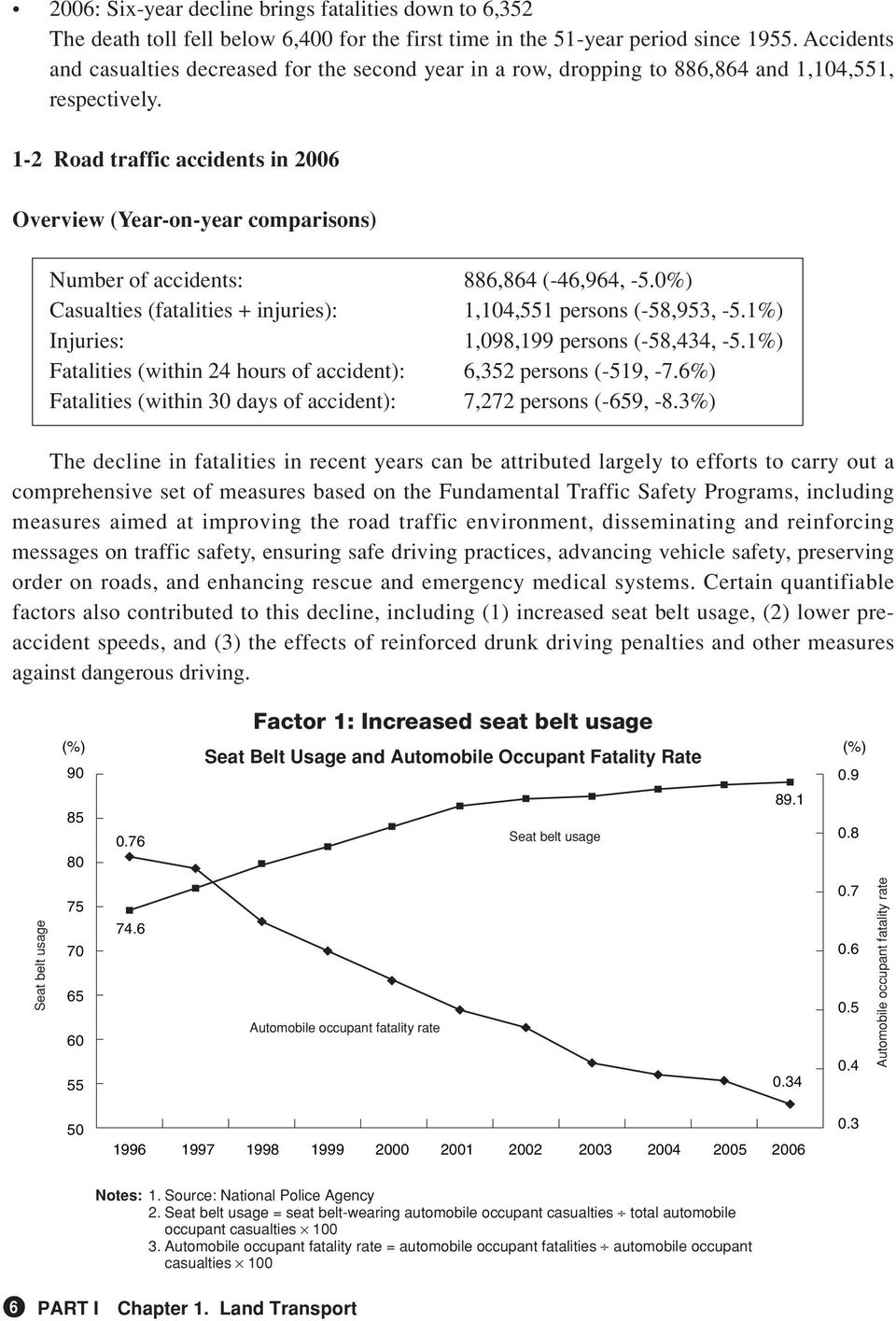
6 2006: Six-year decline brings fatalities down to 6,352 The death toll fell below 6,400 for the first time in the 51-year period since Accidents and casualties decreased for the second year in a row, dropping to 886,864 and 1,104,551, respectively. 1-2 Road traffic accidents in 2006 Overview (Year-on-year comparisons) Number of accidents: 886,864 (-46,964, -5.0%) Casualties (fatalities + injuries): 1,104,551 persons (-58,953, -5.1%) Injuries: 1,098,199 persons (-58,434, -5.1%) Fatalities (within 24 hours of accident): 6,352 persons (-519, -7.6%) Fatalities (within 30 days of accident): 7,272 persons (-659, -8.3%) The decline in fatalities in recent years can be attributed largely to efforts to carry out a comprehensive set of measures based on the Fundamental Traffic Safety Programs, including measures aimed at improving the road traffic environment, disseminating and reinforcing messages on traffic safety, ensuring safe driving practices, advancing vehicle safety, preserving order on roads, and enhancing rescue and emergency medical systems. Certain quantifiable factors also contributed to this decline, including (1) increased seat belt usage, (2) lower preaccident speeds, and (3) the effects of reinforced drunk driving penalties and other measures against dangerous driving. (%) Factor 1: Increased seat belt usage Seat Belt Usage and Automobile Occupant Fatality Rate Seat belt usage 89.1 (%) Seat belt usage Automobile occupant fatality rate Automobile occupant fatality rate Notes: 1. Source: National Police Agency 2. Seat belt usage = seat belt-wearing automobile occupant casualties total automobile occupant casualties Automobile occupant fatality rate = automobile occupant fatalities automobile occupant casualties PART I Chapter 1. Land Transport
7 Factor 2: Lower pre-accident speeds (esp. at high range) Number of General-road Traffic Accidents (by Hazard Recognition Speed) and Fatalities km/h or under Index (1995 = 100) over 50km/h to 80 km/h over 80 km/h Fatalities Notes: 1. Source: National Police Agency 2. Hazard recognition speed refers to the speed at which an automobile or moped is traveling when the driver notices the hazard (moving or parked vehicle, pedestrian, safety barrier, utility pole or other obstacles, etc.). Factor 3: Fewer drunk driving fatalities (down by half from 10 years ago) Number of Fatal Road Accidents (Primary Party), by Alcohol Consumption Alcohol not consumed (Accidents) 8,000 7,000 6,000 5,000 4,000 3,000 2,000 1, ,083 (Accidents) 1,500 Alcohol not consumed 1,400 1,300 1,296 1,200 4,970 1,100 Alcohol consumed 1, Alcohol consumed Notes: 1. Source: National Police Agency 2. Primary party is the party most to blame for the accident, or, when the parties involved share nearly equal fault, the party that suffered the least harm. PART I Chapter 1. Land Transport 7

8 Casualties: By age group (1) For the fourteenth consecutive year, people aged 65 and over accounted for the largest number of road fatalities, 2,809, representing more than 44% of all persons killed in traffic accidents. Deaths declined in all age groups compared to the previous year, particularly among the 65 and older bracket (down 115) and the segment (down 96). (2) Injuries were the highest among year-olds (212,866) and year-olds (200,677). Year-on-year, notable declines were seen among year-olds (down 18,593) and year-olds (down 10,627), but injuries increased among those 65 and older (up 251). (Persons) 3,500 Changes in Traffic Accident Fatalities, by Age Group 3,000 2,809 (44.2) 2,500 2,000 1,500 1, (12.8) 772 (12.2) 547 (8.6) 472 (7.4) 472 (7.4) 306 (4.8) 158 (2.5) Notes: 15 and under and older 1. Source: National Police Agency 2. Figures in parentheses show percentage (%) of fatalities by age group. (Persons) 300,000 Changes in Traffic Accident Injuries, by Age Group 250, , , ,000 50, ,866 (19.4) 200,677 (18.3) 153,547 (14.0) 146,748 (13.4) 129,517 (11.8) 113,588 (10.3) 82,067 (7.5) 59,189 (5.4) and under and older Notes: 1. Source: National Police Agency 2. Figures in parentheses show percentage (%) of injuries by age group PART I Chapter 1. Land Transport

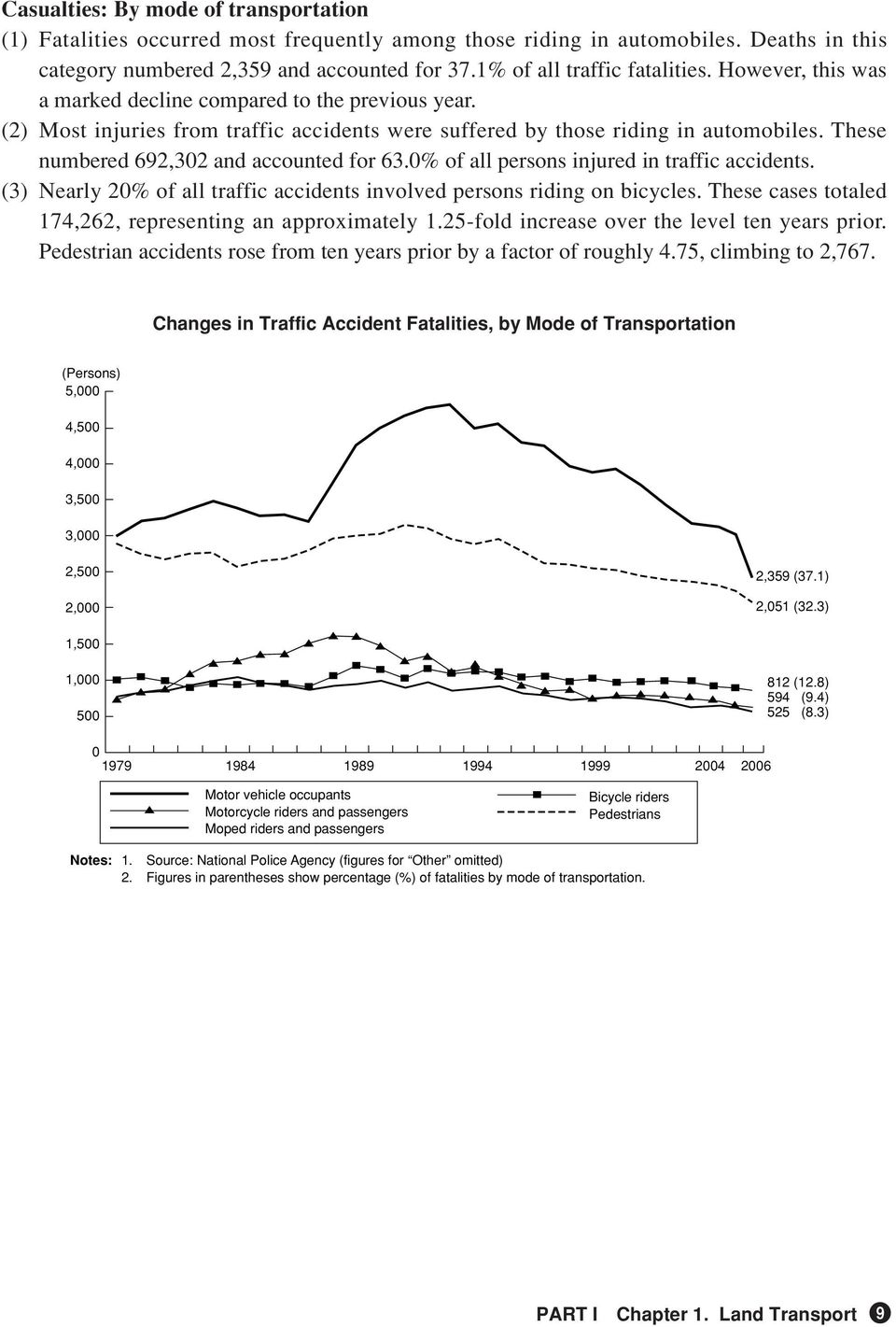
9 Casualties: By mode of transportation (1) Fatalities occurred most frequently among those riding in automobiles. Deaths in this category numbered 2,359 and accounted for 37.1% of all traffic fatalities. However, this was a marked decline compared to the previous year. (2) Most injuries from traffic accidents were suffered by those riding in automobiles. These numbered 692,302 and accounted for 63.0% of all persons injured in traffic accidents. (3) Nearly 20% of all traffic accidents involved persons riding on bicycles. These cases totaled 174,262, representing an approximately 1.25-fold increase over the level ten years prior. Pedestrian accidents rose from ten years prior by a factor of roughly 4.75, climbing to 2,767. Changes in Traffic Accident Fatalities, by Mode of Transportation (Persons) 5,000 4,500 4,000 3,500 3,000 2,500 2,000 2,359 (37.1) 2,051 (32.3) 1,500 1, (12.8) 594 (9.4) 525 (8.3) Motor vehicle occupants Motorcycle riders and passengers Moped riders and passengers Bicycle riders Pedestrians Notes: 1. Source: National Police Agency (figures for Other omitted) 2. Figures in parentheses show percentage (%) of fatalities by mode of transportation. PART I Chapter 1. Land Transport 9
10 Changes in Traffic Accident Injuries, by Mode of Transportation (Persons) 700, ,302 (63.0) 600, , , , , , ,641 (15.9) 93,102 (8.5) 77,888 (7.1) 59,371 (5.4) Motor vehicle occupants Motorcycle riders and passengers Moped riders and passengers Bicycle riders Pedestrians Notes: 1. Source: National Police Agency (figures for Other omitted) 2. Figures in parentheses show percentage (%) of injuries by mode of transportation. Changes in Bicycle Collisions with Pedestrians Index Bicycle collisions with pedestrians Bicycle-related accidents Note: Source: National Police Agency PART I Chapter 1. Land Transport

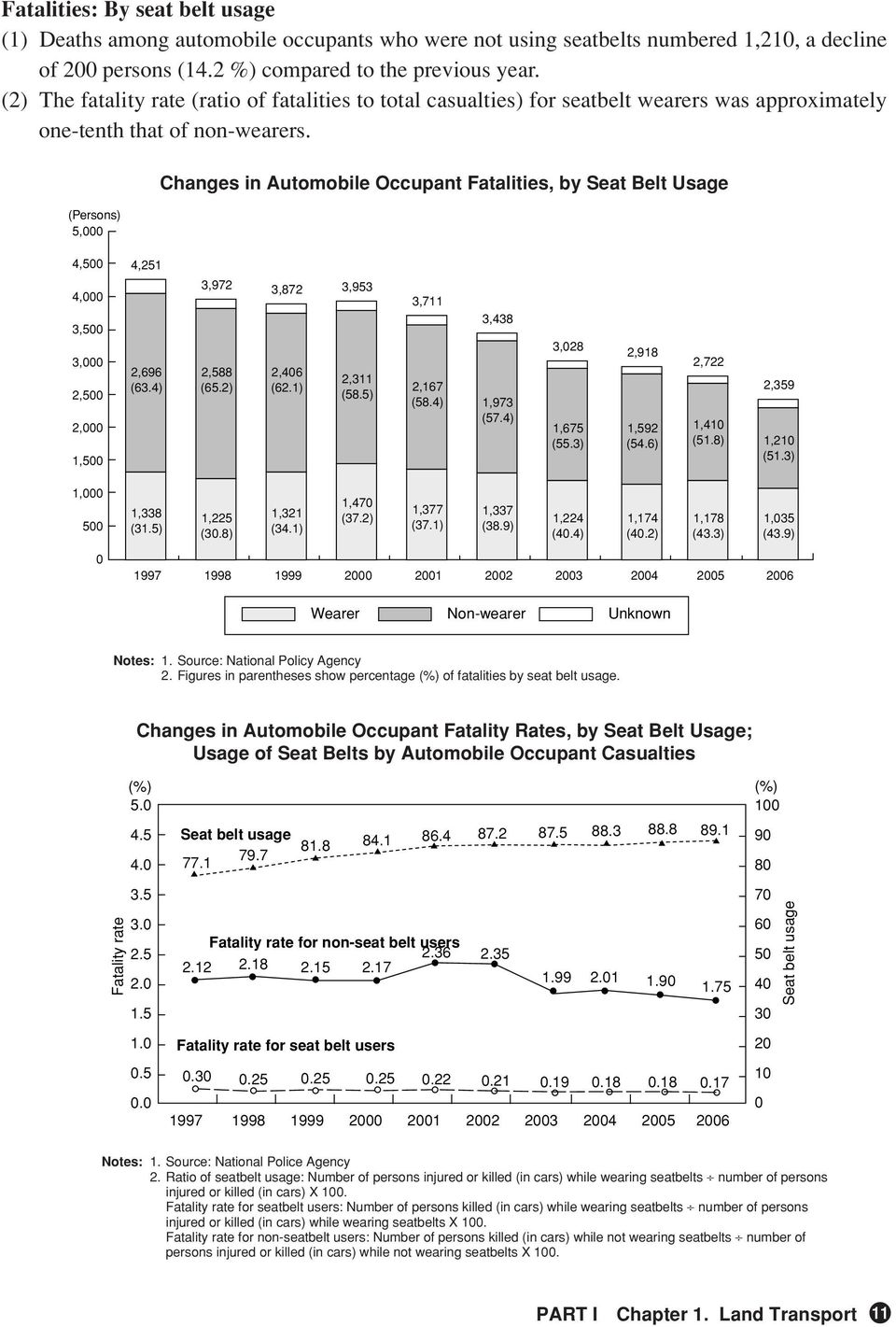
11 Fatalities: By seat belt usage (1) Deaths among automobile occupants who were not using seatbelts numbered 1,210, a decline of 200 persons (14.2 %) compared to the previous year. (2) The fatality rate (ratio of fatalities to total casualties) for seatbelt wearers was approximately one-tenth that of non-wearers. (Persons) 5,000 Changes in Automobile Occupant Fatalities, by Seat Belt Usage 4,500 4,000 3,500 3,000 2,500 2,000 1,500 4,251 2,696 (63.4) 3,972 2,588 (65.2) 3,872 2,406 (62.1) 3,953 2,311 (58.5) 3,711 2,167 (58.4) 3,438 1,973 (57.4) 3,028 1,675 (55.3) 2,918 1,592 (54.6) 2,722 1,410 (51.8) 2,359 1,210 (51.3) 1, ,338 (31.5) 1,225 (30.8) 1,321 (34.1) 1,470 (37.2) 1,377 (37.1) 1,337 (38.9) 1,224 (40.4) 1,174 (40.2) 1,178 (43.3) 1,035 (43.9) Wearer Non-wearer Unknown Notes: 1. Source: National Policy Agency 2. Figures in parentheses show percentage (%) of fatalities by seat belt usage. Changes in Automobile Occupant Fatality Rates, by Seat Belt Usage; Usage of Seat Belts by Automobile Occupant Casualties Fatality rate (%) Seat belt usage Fatality rate for non-seat belt users Fatality rate for seat belt users (%) Seat belt usage Notes: 1. Source: National Police Agency 2. Ratio of seatbelt usage: Number of persons injured or killed (in cars) while wearing seatbelts number of persons injured or killed (in cars) X 100. Fatality rate for seatbelt users: Number of persons killed (in cars) while wearing seatbelts number of persons injured or killed (in cars) while wearing seatbelts X 100. Fatality rate for non-seatbelt users: Number of persons killed (in cars) while not wearing seatbelts number of persons injured or killed (in cars) while not wearing seatbelts X 100. PART I Chapter 1. Land Transport 11
12 Child fatalities and child safety seat usage A total of 21 children under age six were killed, and 162 seriously injured, while riding in automobiles. The fatality rate among children who were not restrained in child safety seats was approximately 9.8 times higher than that of those who were restrained. The rate of fatalities and serious injury among children who were not restrained in child safety seats was approximately 2.0 times higher than those who were restrained. Fatal accidents caused by primary party The number of fatal accidents in which automobile drivers aged 65 and older were the primary party continued to increase. In 2006, this number was approximately 3 times higher than the level in (Index) 4 Changes in Fatal Accidents Caused by Primary-party Automobile Drivers (Young and Elderly) Total Ages and older Notes: 1. Source: National Police Agency 2. Index figures are based on 1989 (= 1) PART I Chapter 1. Land Transport

13 Focus A New Approach to Regulating On-street Parking 1. Overview of new system Greater burden of responsibility placed on the vehicle user In cases where the driver cannot be held responsible, the vehicle user can be ordered to pay the parking fine. Users delinquent in fine payments can be subjected to compulsory collection procedures and denial to provide motor vehicle inspection certificates. Repeat offenders can be subjected to restriction of vehicle use. Privatization of enforcement-related duties Duties pertaining to identification and ticketing of illegally parked vehicles (parking patrol duties) can be outsourced to corporations registered with the relevant public safety commission. A system has been established for certifying private parking patrollers. Duties related to parking fines can also be contracted to private operators. 2. Review of existing regulations In order to facilitate the transition to the new parking regulations, traffic authorities systematically conducted a concentrated review of existing regulations in terms of time and location. As a result, parking regulations were lifted or eased in nearly 26,700 road sections nationwide (totaling roughly 21,700 km) during the period from January 2004 to November Private patrollers in action 3. Parking patroller guidelines Police departments that commission parking patrol duties to private agencies are seeking to promote zealous but fair enforcement of parking regulations by formulating and disseminating patroller guidelines that define the locations and times of focused patrolling. When developing these guidelines, the police take into consideration the local parking situation and the opinions and needs of community members. 4. Impact of new system Since the new regulations went into effect, 270 police departments nationwide have contracted parking patrol duties to 74 corporations employing approximately 1,600 patrollers. During the months from June to December of 2006, 1,592,170 vehicles were ticketed for parking violations (including 703,717 by patrollers), representing a rate of PART I Chapter 1. Land Transport 13

14 nearly 7,400 tickets issued per day. This rate was 30% higher than the preceding year s level of roughly 5,700. The new system has dramatically reduced the number of illegally parked vehicles across the country, most noticeably in large cities. This has not only relieved traffic congestion, but has also diminished the incidence of collisions with parked vehicles, and other road accidents. Impact of new system in Tokyo (Meiji-dori Avenue) Before Examples of successes Decrease in illegally parked vehicles A nationwide survey of 405 road sections (1,694 km) found a decrease of 14.4 vehicles/km (59.5%) between October 2005 and October Reduced congestion (travel time) A nationwide survey of 105 road sections (564 km) found a reduction of 25 seconds/ km (12.2%) between October 2005 and October After Lower incidence of collisions with parked vehicles There were 776 collisions from June to October of 2006, representing an average decrease of 240 (approx. 24%) from the same period in each of the preceding five years PART I Chapter 1. Land Transport

15 Focus Effort to Eradicate Drunk Driving The incidence of traffic accidents caused by drunk driving has been in decline as a result of the June 2002 implementation of the Law for Partial Amendment of the Road Traffic Law (Law No. 51 of 2001), which established heavier penalties for driving while intoxicated (DWI), and provided for anti-drunk driving efforts led by relevant agencies and groups. However, a number of recent high-profile incidents, including a DWI accident in Fukuoka Prefecture that took the lives of three children, have heightened public perception of drunk driving as a serious problem. Against this backdrop, the Task Force on Transportation of the Central Committee on Traffic Safety Measures (Chaired by a minister of state; members include relevant vice ministers) adopted on Sept. 15, 2006 a resolution entitled On Eradicating Drunk Driving (see p.), declaring its intention to stamp out drunk driving by transforming the public s attitudes. The number of DWI-related fatalities had been on the rise in the first half of 2006, but entered a downward trend in September as the result of prevention campaigns conducted over a wide front, as well as crackdowns by the police. However, the problem of drunk driving cannot be eradicated without enhancing public awareness to the point that everyone adopts the norm of refraining from drunk driving, and from allowing others to drive while drunk. Changes in DWI-related Accidents and Fatalities (Accidents) 30,000 (Fatalities) 2,500 26,280 25,400 DWI-related accidents 25,000 20,000 15,000 10,000 21,602 21,628 21,289 21,060 1,296 1,240 1,267 1,257 1,276 1,191 20,328 16,374 15,178 13, , ,404 6,884 6,612 2,000 1,500 1,000 DWI-related fatalities 5,000 0 June 2002 Amended Road Traffic Law goes into effect, creating tougher DWI penalties Dec Reckless driving resulting in injury or death is codified as a crime Jan-Jun Jan-Jun 2005 Jan-Jun Notes: 1. Source: National Police Agency 2. Data are for accidents in which the primary party was operating a motor vehicle of moped class or higher. PART I Chapter 1. Land Transport 15

16 The following is a look at major efforts that were made in FY2006 toward the eradication of drunk driving. 1. Strengthening of eradication efforts (1) Sending the message to businesses, and soliciting their cooperation Working through various partners, governmental agencies distributed leaflets, posters, and other information resources to road transport operators, alcohol manufacturers and distributors, restaurants that serve alcohol, hotels, and other businesses to boost their awareness of the campaign to eliminate drunk driving, and request them to refrain from serving alcohol to drivers, and from allowing inebriated patrons or workers to drive. These efforts, coupled with heightened public concern about drunk driving, have led to the proliferation of diverse voluntary movements aimed at rooting out drunk driving. One such movement is a designated driver campaign co-sponsored by the Japan Traffic Safety Association, the Japan Foodservice Association, and the Japan Automobile Federation to encourage restaurant and bar patrons to select a member of their group to abstain from drinking that day in order to provide the other members with a safe ride home. Police are lending their support to the campaign by calling on alcohol-serving establishments and customers to participate. (2) Awareness raising and traffic safety education During FY 2006, prefectural police departments used their networks of local volunteers, driving safety coordinators, and other supporters to raise the awareness of communities and industries regarding the anti-drunk driving campaign. The Cabinet Office hosted a traffic safety symposium in December 2006 in order to encourage anti-drunk driving efforts in communities and industries, and to generate the momentum necessary for correcting tolerant public attitudes toward drunk driving. The event featured a keynote speech by a relative of a DWI accident victim, and a panel discussion between several experts. In March 2007, the Ministry of Land, Infrastructure and Transport teamed up with the National Agency for Automotive Safety and Victims Aid to hold a symposium focused on the role that public transport operators can play in combating drunk driving. The participants discussed various challenges and possible solutions in the light of case examples of groundbreaking initiatives in other countries, and of communitywide efforts based on collaboration between public transport services and the restaurant industry, etc. Awareness-raising poster PART I Chapter 1. Land Transport

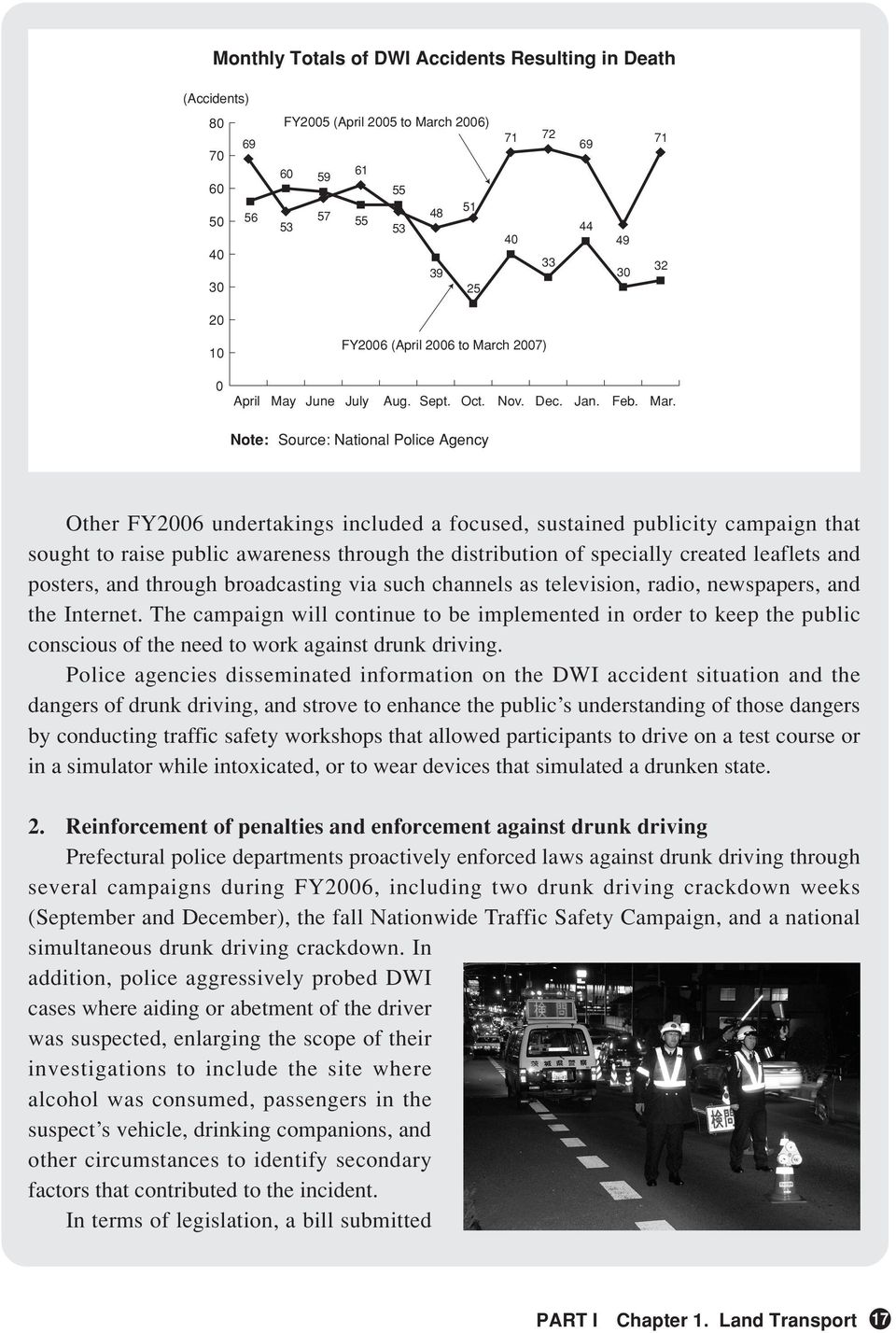
17 Monthly Totals of DWI Accidents Resulting in Death (Accidents) (Accidents) FY2005 (April 2005 to March 2006) FY2006 (April 2006 to March 2007) April May June July Aug. Sept. Oct. Nov. Dec. Jan. Feb. Mar. Note: Source: National Police Agency Other FY2006 undertakings included a focused, sustained publicity campaign that sought to raise public awareness through the distribution of specially created leaflets and posters, and through broadcasting via such channels as television, radio, newspapers, and the Internet. The campaign will continue to be implemented in order to keep the public conscious of the need to work against drunk driving. Police agencies disseminated information on the DWI accident situation and the dangers of drunk driving, and strove to enhance the public s understanding of those dangers by conducting traffic safety workshops that allowed participants to drive on a test course or in a simulator while intoxicated, or to wear devices that simulated a drunken state. 2. Reinforcement of penalties and enforcement against drunk driving Prefectural police departments proactively enforced laws against drunk driving through several campaigns during FY2006, including two drunk driving crackdown weeks (September and December), the fall Nationwide Traffic Safety Campaign, and a national simultaneous drunk driving crackdown. In addition, police aggressively probed DWI cases where aiding or abetment of the driver was suspected, enlarging the scope of their investigations to include the site where alcohol was consumed, passengers in the suspect s vehicle, drinking companions, and other circumstances to identify secondary factors that contributed to the incident. In terms of legislation, a bill submitted PART I Chapter 1. Land Transport 17
18 to the Diet in FY2006 called for partial revision of the Road Traffic Law in order to reinforce measures against drunk driving, such as by toughening penalties against drunk drivers and abettors. 3. Traffic safety guidance at penal institutions As a result of the implementation of the Act on Penal Institutions and the Treatment of Sentenced Inmates (Act No. 50 of 2005) in May 2006, rehabilitation programs have become compulsory for inmates in penal institutions (prisons, juvenile prisons and detention houses) in addition to existing correctional treatment, such as prison work. Rehabilitation programs for inmates who committed drunk driving include traffic safety guidance, education from the victims viewpoint, and education on the negative influences of alcohol, according to the inmates individual needs and problems. The traffic safety guidance is targeted at inmates who caused traffic accidents resulting in death or serious injury, and who repeatedly committed serious traffic violations, and it aims to cultivate a law-abiding spirit, a sense of responsibility, and respect for human life through reflection on the causes of their own traffic violations and accidents. The standardized program of the traffic safety guidance is to be administered as a combination of lectures, discussion, and SST (social skills training), and it includes topics such as 1) drivers responsibilities and obligations, 2) general offenses and traffic offenses, 3) alcohol and lifestyle, 4) impacts of their own offenses, 5) recognition of guilt, 6) compensation for victims and their family, 7) life after release. Education from the victims viewpoint is provided to inmates who caused crimes Public Opinion on Tougher Drunk Driving Penalties (multiple responses) Punishment/treatment of drunk drivers should be toughened Punishment/administrative disposition of hitand-run drivers should be toughened 67.2 Punishment of passengers accompanying drunk drivers should be toughened Punishment of persons who provided alcohol to drunk drivers should be toughened Current level of punishment is satisfactory (no toughening needed) 8.5 Other responses 0.6 Don t know 0.5 Source: Special Public Opinion Survey on Traffic Safety (Oct. 2006), Cabinet Office PART I Chapter 1. Land Transport

19 resulting in deaths or serious physical injuries to victims in order to make them consider how to apologize and compensate victims and their family. This education also incorporates lectures by crime victims or their family members, and group work. Moreover, education on the negative influences of alcohol is provided to inmates in cooperation with private self-help groups in order to facilitate their understanding and to make them consider the impacts of problematic drinking and specific strategies for abstinence. 4. Study of vehicle technology-based solutions Alcohol interlocks, devices that prevent a vehicle from starting if alcohol is detected on the driver s breath, are seen as an effective solution for eradicating drunk driving. These systems are already being deployed in various other countries as a sanction against persons guilty of drunk driving. In response to this trend, the Ministry of Land, Infrastructure and Transport has taken efforts to identify technical issues of alcohol interlock technology with the National Police Agency, the Ministry of Economy, Trade and Industry, and the Japan Automobile Manufacturers Association, and launched the Study Committee on Technical Issues of Alcohol Interlock Devices on January 30 of this year. The committee s meetings have mainly focused on how to overcome such technical issues as the problem of ensuring that the breath sample analyzed is from the driver, the short lifespan of the devices, and the difficulty of preventing tampering. Building on the foundation of this discussion, the panel is working to plot the course for future technological development by formulating technical requirement proposals on the use of alcohol interlocks as a sanction against convicted drunk drivers, and by clarifying technological hurdles with respect to making the devices mandatory for general and/or commercial vehicles. 5. Strengthening of coordinated efforts against habitual offenders The Task Force on Transportation strengthened its coordination with relevant governmental agencies and anti-drunk driving organizations with regard to various measures aimed at deterring drunk driving by alcoholics and others prone to habitual violation. The task force also established in April 2007 the Committee to Promote Measures Concerning Habitual Drunk Drivers in order to ensure effective implementation of those concerted efforts. PART I Chapter 1. Land Transport 19

20 Reference On Eradicating Drunk Driving Sept. 15, 2006 Central Committee on Traffic Safety Measures Resolution of the Task Force on Transportation Amended on April 26, 2007 The incidence of fatal drunk-driving accidents had been in decline in recent years as a result of deterrence efforts by relevant organizations, and amendment of the Road Traffic Act to toughen penalties against drunk driving. However, it has swung upward this year, as highlighted by the recent rash of drunk driving-related deaths and serious accidents. At the same time, there have been many incidents of drunk driving by public servants. Therefore, we have decided to implement the following measures in order to reform public attitudes toward drunk driving and thereby eradicate this scourge. 1. Intensification of efforts to eradicate out drunk driving (1) The national and local governments shall intensify their efforts to stamp out drunk driving, and encourage the public to abide by the following principles: i. Do not operate a vehicle, etc. while intoxicated, and do not allow an intoxicated companion to operate a vehicle, etc. ii. Do not provide alcohol to persons likely to engage in drunk driving, and do not encourage such people to drink alcohol. Furthermore, governmental agencies shall step up their efforts to provide employees with instruction in safe driving practices so that the employees will serve as role models for the public, and shall strictly deal with any employees who drive drunk or ride in a vehicle operated by an intoxicated person. (2) Road transportation service providers, etc. shall be thoroughly informed, via the relevant organizations, etc., concerning the campaign to eradicate drunk driving. Operators of restaurants, etc. that serve alcohol shall be requested, via the relevant organizations, etc., to refrain from providing alcohol to drivers, and to cooperate in efforts to prevent intoxicated persons from driving. (3) Eradication of drunk driving shall be made a focus of the fall 2006 Nationwide Traffic Safety Campaign, and stronger publicity efforts shall be made to instill the public with the attitude of never driving drunk and never allowing others to drive drunk. 2. Reinforcement of penalties and enforcement against drunk driving Authorities shall bolster their efforts in drunk driving-related guidance and enforcement, and thoroughly investigate the accountability of passengers and alcohol providers. They shall also study possibilities for toughening their sanctions against drunk driving PART I Chapter 1. Land Transport

21 3. Study of vehicle technology development for combating drunk driving We shall investigate the current state of development of vehicle technologies for preventing drunk driving, and study strategies of development aimed at solving the technical challenges that stand in the way of practical deployment. 4. Strengthening of coordinated efforts regarding habitual drunk drivers We shall strengthen coordination with relevant governmental agencies and anti-drunk driving organizations with regard to various measures aimed at deterring drunk driving by alcoholics, etc., and shall convene, as specified by the Chair of our task force, meetings of the Committee to Promote Measures Concerning Habitual Drunk Drivers in order to ensure effective implementation of those concerted efforts. PART I Chapter 1. Land Transport 21
22 2 Overview of Current Policies on Road Traffic Safety 2-1 Improvement of road traffic environment Development of people-first walking spaces offering safety and peace of mind The national and local governments pursued the following traffic safety projects in order to actively enhance the sidewalks of school routes, residential roads, urban thoroughfares, and other areas. Designed from a people s perspective, these initiatives were implemented with the cooperation of local community members. (1) Aggressive efforts were made to improve sidewalks in school zones, etc. in order to ensure the safety of children commuting to elementary schools, kindergartens, day care centers, and children s cultural facilities. Furthermore, safety was enhanced in school routes through the installation of push-button traffic signals and pedestrian signals, the construction of pedestrian overpasses, and the establishment of additional crosswalks. (2) Sidewalk construction and other preventive measures against traffic accidents were comprehensively applied on an areawide basis to Safe Pedestrian Areas (designated zones in residential/commercial districts that have a high incidence of casualty-producing accidents and are bordered by thoroughfares) with the cooperation of prefectural public safety commissions and road management agencies. Sidewalks were also proactively built in residential areas not designated for the Safe Pedestrian Area program. In addition, prefectural public safety commissions and road management agencies concertedly implemented accident prevention measures using the Accident Prevention Manual for Residential Roads 1 and other resources. Those measures included efforts to create safe, secure road spaces for both pedestrians and drivers through such improvements as control of vehicle speeds, clear identification of road shapes and intersections to drivers, and clear demarcation of pedestrian and vehicle pathways. (3) Further endeavors were made to ensure the safety and comfort of pedestrians and bicycle riders through concentrated projects in areas with a high risk for accidents involving these road users. The projects included renovation and other improvements of roads, as well as construction of sidewalks and bicycle paths. Wide sidewalks were built where possible in order to provide a comfortable traveling space. In places where sidewalk construction was not feasible, such alternatives as pedestrian and bicycle lanes were created alongside the roads. In order to help the elderly and disabled people to lead independent, socially active lives, wide, even sidewalks based on principles of universal design were actively constructed mainly in areas near train stations, public facilities, welfare centers, and hospitals. Other improvements involved: installation of barrier-free traffic signals and signals that indicate waiting time; construction of elevator-equipped pedestrian overpasses, pedestrian rest areas, bicycle parking lots, and parking lots with spaces for the disabled; 1 The aim of this manual is to illustrate ways of effectively implementing accident prevention measures on residential roads. It systematically presents procedures, methods of improving road traffic environments, etc PART I Chapter 1. Land Transport
23 and elimination of utility poles in road sections under renovation. Moreover, various projects, such as conversion of traffic signals to LED lighting and enhancement of road marker visibility, were implemented to ensure safe passage of seniors and disabled people, and to respond to the growing number of elderly drivers. Application of Intelligent Transport Systems The nation continued to pursue the implementation of intelligent transport systems (ITS), which incorporate advanced information technology to coordinate people, roads, and vehicles under one integrated system. These systems are designed to enhance road safety and transportation efficiency and comfort, as well as to protect the environment by reducing traffic congestion and otherwise streamlining the flow of traffic. Guided by the principles established in 1996 under the Comprehensive ITS Initiative, the government spearheaded research and development projects, field tests 2, infrastructure development, and other efforts that involved collaboration with industry and academia. (1) A key component of ongoing work on ITS has been the Universal Traffic Management Systems (UTMS), whose aim is to ensure traffic safety and comfort through a network of advanced traffic control centers. Using near-infrared beacons 3, the system envisages the creation of control centers that will be able to establish two-way communications with individual vehicles on the road, thus giving the centers the ability to actively and comprehensively manage traffic flows and volumes. Via this means, the UTMS is aiming to provide advanced traffic information, manage vehicular operations, and give priority passage to public vehicles, as well as to reduce traffic pollution, support safe driving, and ensure pedestrian safety. Based on the UTMS concept, the nation took steps to improve its traffic systems and to install facilities for near-infrared beacons, which are the key infrastructural component of the UTMS. (2) The government also worked toward the deployment of diverse ITS services, including smooth transit of various tollgates through the use of electronic toll collection (ETC) systems based on dedicated short-range communications (DSRC) technology, regional guides that are tailored to location and user needs, and timely provision of cruise-assist information. These efforts were pursued with an eye on finding ways to interlink the services with mobile phones, optical communication systems, and other communication media. 2 Field tests: Actual outdoor tests. 3 Near-infrared beacons: Roadside infrared communication devices that measure traffic volume, etc., and relay information between vehicle navigation systems and traffic control centers. PART I Chapter 1. Land Transport 23
24 Focus Driving Safety Support Systems Based on the New IT Reform Strategy The concept of infrastructure cooperative driving safety support systems refers to onboard systems that help drivers respond to traffic situations outside their field of vision by wirelessly receiving data from infrastructural devices (including roadside facilities, onboard systems in other vehicles, and devices carried by pedestrians), and issuing information and warnings to the driver as needed. These systems rely on information technology, which is seen as playing a major role in traffic safety in the years ahead, as it can reduce the incidence of careless errors by filling in gaps in human cognition and judgment. In recent years, governmental agencies and the private sector have worked together toward the development of practical forms of infrastructure cooperative driving safety support systems, but many of those endeavors were limited to the verification test stage, with development either falling short of practical application, or reaching practicality without achieving broad deployment. In order to overcome this barrier, a road map toward practical deployment was incorporated in the New IT Reform Strategy adopted by the government s IT Strategic Headquarters on January 19, Specifically, the plan called for establishment of joint committee of government and private sector representatives in early 2006 in order to seek practical deployment by 2010 through a process of investigating the ideal shape of effective systems and the content of verification tests, conducting largescale verification tests on roads in selected regions by 2008, and quantitatively assessing the systems contribution to accident reduction. The first step was carried out with the April 2006 launch of the ITS Promotion Council, a public-private committee coordinated by the Cabinet Secretariat. In the following August, the council compiled The Ideal Shape of Verification Testing for Practical Application of Driving Safety Support Systems as an outline of the plans for large-scale testing. In this report, the council members organized the systems to be tested according to traffic accident types and causes, and laid out their thoughts regarding the testing areas and the agenda for each fiscal year. Presently, the agencies participating in the project are engaged in the following activities as specified by the report. The National Police Agency (NPA) is working on Driving Safety Support Systems (DSSS; see Figure 1), which are aimed at preventing traffic accidents by providing drivers with visual and auditory information to encourage attentiveness to risk factors, and thereby create a driving environment that facilitates a greater margin of safety. DSSS are being designed for a variety of systems (services) according to traffic accident types, and four of these systems were launched as model programs in Tokyo in FY2006: a system that provides information to prevent rear-end collisions, a system that provides information on PART I Chapter 1. Land Transport
25 Infrared beacon Communication zone On-board VICS compatible with 3 media Collision warning: congestion ahead! Watch out for pedestrian and motorcycle! Figure 1 Overview of DSSS accident conditions, a system that provides information on speed, and a system that provides information on crossing pedestrians. The NPA is also pursuing research and development of advanced DSSS functions, including efforts toward realizing accurate information provision tuned with driving behavior, and is seeking to practically deploy DSSS nationwide as early as possible, with the support of relevant agencies. The Ministry of Internal Affairs and Communications launched in FY2007 a project entitled Research and Testing for Practical Deployment of Driving Safety Support Information and Communication Systems to study the practical application of road-vehicle and vehicle-vehicle driving safety support systems that use various radio-wave media, and to test the effectiveness of those systems in a live environment. In addition to measuring radio-wave transmission and other basic system characteristics, the project team is formulating communications technology specifications for the systems, including for the wireless interfaces and communications protocols used between vehicles, and between roads and vehicles. The schedule calls for the commencement of large-scale verification tests in FY2008. The ministry also plans to initiate live testing of the products of their research and development projects on ubiquitous ITS (ongoing since FY2005) and effective application of radio waves. The testing will mainly focus on the products that have strong potential to PART I Chapter 1. Land Transport 25
26 contribute to the realization of driving safety support. The Ministry of Land, Infrastructure and Transport is constructing the Advanced Cruise-assist Highway System (AHS) as an effective strategy for reducing traffic accidents. The system is designed to keep drivers alert by providing information as needed, and thus can help to realize safe, comfortable travel. As a step toward practical deployment, the ministry began to conduct in FY2007 verification testing of various component systems at different locations on metropolitan expressways and other roads. Specifically, components such as an obstacle information system, a forward information system, and a merging support system are being tested using an on-board ITS unit. The Internet-connectable unit provides audio and visual information received from DRSC-based roadside systems, and is designed to work with a variety of media and services, including such existing services as ETC and VICS (Vehicle Information and Communication System), as well as infrared beacon-based information services. The Japan Electronics and Information Technology Industries Association (JEITA) issued a suite of ITS standards in March Since FY2006 the ministry has been leading the fourth phase of a collaborative project between the government, industry, and academia to promote the development and propagation of Advanced Safety Vehicles (ASV), which incorporate information technology to further enhance safety. The project members are working toward practical ASV deployment as they engage in various vehicle-side efforts for the implementation of large-scale verification testing of infrastructure cooperative driving safety support systems, as called for by the New IT Reform Strategy and later Diverse media Conceptual image of driving safety support based on on-board ITS units Information on obstacles ahead Caution: Congestion ahead Car navigation system Car navigation system 2.4GHz Beacon 5.8GHz DSRC ITS on-board system Merging support Caution: Merging traffic ahead Information provision Services On-board systems Toll collection Two-way communication Increased communication capacity, new services Figure 2 onceptual image of driving safety support based on on-board ITS units PART I Chapter 1. Land Transport
27 2-2 Dissemination and reinforcement of traffic safety messages Traffic safety education for the elderly The government also recognized the need to increase traffic safety awareness of seniors themselves, through mutual edification programs involving seniors. Toward this end, the government supported the establishment of traffic safety clubs within seniors clubs and retirement homes, and promoted training of Silver Leaders, seniors who provide education on traffic safety to other seniors. It also encouraged seniors clubs, etc. to take leadership roles on traffic safety within their communities and households, and provided support for such efforts. This included guidance to help seniors clubs, etc. create Hiyari Maps (maps of near-miss spots) with the cooperation of related organizations. The Cabinet Office launched in FY2006 the Hands-on Program for Promoting Safe Driving by Seniors in order to train Silver Leaders and other seniors with community influence to provide sustained leadership in community-based driving safety education for the elderly. The Cabinet Office also continued to implement two ongoing programs: the Central Training Program for Silver Leaders, which has as one objective the improvement of Silver Leaders ability to educate sub-leaders; the Traffic Safety Awareness Program for Seniors, which encompasses the Cross-generation Sharing Project, in which people from three generations gather to learn about traffic safety, and the Seniors Home Visit Project, in which traffic safety guidance is provided at home to seniors unable to attend traffic safety seminars. PART I Chapter 1. Land Transport 27
28 Focus Economic Losses Caused by Road Traffic Accidents The Cabinet Office s FY2006 Investigative Study for Economic Losses Caused by Road Traffic Accidents quantifies the costs of road traffic accidents and analyzes them in terms of not only financial losses, but also non-financial losses, such as pain, suffering, and inability to enjoy the pleasures of life. By clearly highlighting the costs associated with traffic accidents, the government seeks to raise public awareness concerning the magnitude of these losses, and to encourage the implementation of effective, efficient traffic safety measures. The following is a summary of the study. 1. Scope of accident loss calculation The study calculated the financial losses and non-financial losses resulting from road traffic accidents in a one-year period. Financial losses were defined as: personally borne losses, such as lost earnings, medical expenses, and compensation for pain and suffering; material losses, such as the cost of repairing vehicles and structures; employer-borne losses, such as decreases in value added due to employee s inability to work; and losses incurred by public organizations, etc., such as the cost of ambulance services, the cost of accident handling by the police, court expenses, insurance management expenses, and losses due to accident-related traffic congestion. Non-financial losses comprised accident-related pain, suffering, reduced quality of life, inability to enjoy the pleasures of life, and other non-financial losses where death was involved (hereafter, death-related losses ), and the amount was calculated based on willingness to pay (here meaning the maximum amount that people are willing to pay to reduce the risk of death from traffic accidents). 2. Total road accident loss Road accident losses were computed to total 6,745 billion yen, which translates to 1.4% of the gross domestic product (see Figure 1). (1) Death-related losses As it is impossible to make adequate post-accident assessments of the value of specific people s lives that were lost, the Cabinet Office conducted questionnaire surveys based on the contingent valuation method, and used the results to estimate willingness to pay, which was then applied to the calculation of death-related losses. The total was determined to be 2,330 billion yen. (2) Financial losses Financial losses totaled 4,416 billion yen, with personal losses accounting for 1,484 billion yen (22%), material losses for 1,781 billion yen (26%), employer losses for PART I Chapter 1. Land Transport
29 Figure 1 Losses due to Traffic Accidents (amounts in billion yen) Death-related losses 2,330 (35%) Public organization losses 1,050 (16%) Total loss Personal losses 1,484 (22%) Material losses 1,781 (26%) Financial losses 4,416 (65%) Employer losses 100 (1%) Note: Due to rounding, the total of the component figures does not equal the total listed. billion yen (1%), and public agency losses for 1,050 billion yen (16%). 3. Per-capita road accident losses The per-capita losses pertaining to death, permanent disability, and injury work out to 259 million yen, 9.65 million yen, and 1.77 million yen, respectively (see Figure 2). The per-capita loss pertaining to death is nearly on par with the levels in Finland, the United Kingdom, and Sweden (see Figure 3). Figure 2 Per-capita Road Accident Losses (amounts in 1,000 yen) Material losses 368 (0%) Death 259,170 Personal losses 29,764 (11%) Death-related losses 226,000 (88%) Employer losses 1,075 (0%) Public organization losses 1,957 (1%) Material losses 368 (4%) Employer losses 241 (2%) Public organization losses 969 (10%) Permanent disability 9,650 Personal losses 8,072 (84%) Public organization losses 785 (45%) Employer losses 61 (3%) Injury 1,770 Personal losses 555 (31%) Material losses 368 (21%) Note: Due to rounding, the total of the component figures does not equal the total listed. PART I Chapter 1. Land Transport 29
30 Figure 3 International Comparison of Per-capita Road Accident Losses Traffic accident losses (1,000 yen) 450, , , , , , , ,000 50, , , , , , , , ,165 Death-related losses Traffic congestion costs Property damage Police-related costs Workplace losses Insurance management costs Litigation costs Emergency/ medical costs Material losses Lost earnings 0 USA Finland UK Sweden New Zealand Germany Australia Japan PART I Chapter 1. Land Transport
31 2-3 Ensuring safe driving practices Developing better and more effective measures for elderly drivers Programs for evaluating the competency of senior drivers, which are required for persons aged 70 and older, include tests for competencies that are necessary for safe driving. In these programs, participants may be asked either to drive a vehicle or to use driver-competence testing equipment to arrive at evaluations. The goal is to have elderly drivers become aware of the changes that are occurring in their physical functioning and to offer them advice and guidance based on the results of the findings. Under existing regulations, persons who participate in these programs are not required to take courses that they normally would be required to take when renewing their licenses. In 2006, a total of 1,468,374 persons participated in these programs. Traffic safety agencies also organized classes for drivers aged 65 to 69, which are held in conjunction with license renewals. These classes endeavored to teach seniors about their own driving tendencies and about the characteristics of accidents in which the elderly were commonly involved. Enhancing guidance and supervision of road transport operators Government agencies conducted preventive audits of road transport service operators, including early audits of new entrants and follow-up audits of operators who had been subjected to administrative disposition. Efforts were also made to enhance the cross-notification system between the relevant agencies, and to implement joint auditing and supervision of taxi service operators. At the same time, authorities more aggressively applied administrative disposition against disreputable practices, especially with regard to operators who condone drunk driving or require drivers to work excessively long hours. The government also began requiring transport companies to adopt safety management systems that realize a unified approach to safety for the entire organization, from its top management to its front-line workers. At the same time, the government established the Transport Safety Management Evaluation Program to assess transport operators progress in building such safety management systems. 2-4 Advancing vehicle safety Promotion of vehicle safety measures In 2004, the government responded to defect cover-ups and other illicit practices by automakers by initiating measures to prevent the recurrence of fraudulent recall-related activity by bolstering the various systems for information gathering, auditing, and technical inspection. In 2006, this effort was expanded through amendment of the Road Transport Vehicle Act and other legislation, establishment of a recall technical inspection center at the National Traffic Safety and Environment Laboratory to verify the causes of automobile defects through direct testing of the target vehicle. These accomplishments marked the completion of the government s buildup of systems for preventing further defect-related fraud, and the systems are already being used to steadily implement the government s scheme for vehicle recalls. PART I Chapter 1. Land Transport 31
32 The government also commenced the fourth phase of its project for promoting ASVs, which use smart technology to realize greater safety. Vehicle assessment activities for FY 2006 included collision safety testing of 21 models. In order to prevent bus fires, separation of truck wheels, and other accidents resulting from inadequate inspection and maintenance, the government revised regulations pertaining to vehicle inspection standards. In addition, the government took action against the problem of illegal retrofittings being used for various dishonest practices, such as the padding of maximum loading weights and maximum passenger capacities, by amending the Road Transport Vehicle Act to provide for on-site inspections of retrofitting manufacturers and other entities. 2-5 Improving rescue and emergency medical systems Enhancing the effectiveness of the Doctor-helicopter Program The Doctor-helicopter Program, which deploys specially equipped emergency helicopters to emergency sites with a physician on board, aims at providing better medical care at emergency sites and during patient transportation. Through this program, on-site emergency medical care can be performed more immediately than before and patients can be transferred more rapidly to hospitals. As of the end of FY2006, emergency stations in ten prefectures started operating such helicopters. The government has been making progress in the implementation of the program through enhancement of coordination among related agencies and groups, such as by improving information sharing between the zones and locations where helicopters can safely land, creating a common operational manual, and developing a common-frequency radio system PART I Chapter 1. Land Transport
33 1 Trends in Railway Accidents Section 2 Railway Transport 1-1 Operations accidents in recent years (1) Railway operations accidents 4 have been in a long-term decline, and totaled 821 in 2006, falling 9.3% from the level of the previous year. (2) In 2006, casualties from railway operations accidents numbered 706 (including 304 fatalities), a 48.0% drop. (3) Accidents at railway crossings decreased by 19.6% to 362, of which operations accidents accounted for roughly 44%. Casualties from these accidents numbered 237, which was 22.5% lower than the previous year. (4) There were three major accidents (resulting in at least ten casualties or derailment of at least ten cars) in 2006: a derailment on the Keio Corporation s Keio Line on April 5; a collision between streetcars on the Tokyo Metropolitan Bureau of Transportation s Arakawa Line on June 13; and a derailment on the West Japan Railway Company s Tsuyama Line on November 19. Changes in Railway Operational Accidents and Casualties (Accidents, persons) 2,500 Number of accidents Number of casualties Number of fatalities 2,000 1,500 1, Notes: 1. Source: Ministry of Land, Infrastructure and Transport 2. Fatalities are defined as deaths occurring within 24 hours of an accident. 4 Operations accidents: Train collisions, derailments, train fires, accidents at rail crossings, accidents along other roads, railroad accidents that result in injury or death to persons (other than from the foregoing five types of accidents), and accidents that result in material damage to property (other than from the foregoing six types of accidents). Street rail accidents are defined in the same manner as railway operations accidents. PART I Chapter 1. Land Transport 33
34 Focus Construction of Safety Management Systems at Public Transport Businesses Starting in 2005, the nation was plagued by a rash of transportation accidents and problems resulting from human error, as witnessed in the tragic derailment that occurred on the Japan Railway West Company s (JR West) Fukuchiyama Line. The Ministry of Land, Infrastructure and Transport (MLIT) reacted to this situation by forming the Commission to Study Measures for Preventing Human Error-based Accidents in Public Transportation in June After studying various ways to implement measures that would comprehensively and effectively prevent further public transport accidents stemming from human error, the commission issued in April 2006 a final report that emphasized the need for transport operators to construct safety management systems, and for the deployment of preventive safety technologies. During the Diet s 164th session, lawmakers responded to the commission s recommendations by passing the Act to Partially Revise the Railway Business Act, etc. to Enhance Transportation Safety (hereafter, Safety Enhancement Act ), which provided blanket amendment of the transport business laws concerning rail, automobile, maritime, and air transport. The Safety Enhancement Act, which went into effect in October 2006, includes revisions that require transport businesses to formulate safety management rules, appoint a safety director, and file the rules and the safety director s information with the relevant agency. The law also obliges transport operators and government agencies to disclose information pertaining to transport safety. The aim of these changes is to have transport operators build safety management systems that realize a unified approach to safety for the entire organization, from its top management to its front-line workers. The creation of such systems can revive observance of the principle of safety first and correct gaps in communication between top management and front-line workers, and thereby provide transport operators with a stronger foundation for ensuring safety. Another important feature of the Safety Enhancement Act is that it provides for the Transport Safety Management Evaluation Program, under which the national government tracks the transport operators progress in constructing safety management systems. In this program, government inspectors visit the headquarters of transport businesses and interview the top management, the safety director, and other officers to assess these leaders attitudes toward the safety management system, and examine their decision-making processes. As such, these inspections provide an approach different from traditional safety audits, allowing the government to directly evaluate the safety management efforts of transport business administrators, and provide them with advice on how to further enhance their safety measures. As of March 2007, the Transport Safety Management Evaluation Program had been PART I Chapter 1. Land Transport
35 Overview of the Transport Safety Management Evaluation Program Transport safety management evaluation: Interviews with headquarters leaders, etc. to inspect progress in safety management system construction, and to provide advice as needed. Operator Headquarters Head (president) Transport management units (Transport dept. manager, etc.) Rail Maritime Management Safety director (vice president) The front lines Business planning & other units (Business planning dept. manager, etc.) Automobile Air 1. Basic focus of inspection Does the operator s safety management program adequately function as a system? Inspection methods common to all transport modes 2. Examples of inspection targets Does top management have a solid understanding of the safety management system, and do they receive feedback on issues and other concerns from the front lines? (1) Have appropriate safety policies and objectives been established? (2) Is information on near-misses and other potentially hazardous situations shared throughout the organization? (3) Does the internal auditing system function effectively? (4) Is there a scheme for timely review of the safety management system? 1. Basic focus of inspection What is the state of compliance and accident prevention measures in each element of transport activity (transport facilities, drivers, etc.)? Inspection methods tailored to the characteristics of each transport mode 2. Examples of inspection targets (1) Are safety standards being met with regard to aircraft, railway cars, and facilities? (2) Are the vehicles operated by adequately qualified drivers/pilots? (3) Have on-site operation managers been appointed? (4) Are accident prevention measures being implemented appropriately? Government Government Pre-existing systems of safety auditing: Interviews with managers at headquarters, branches, other offices, and transport activity sites, as well as facility walk-throughs to inspect transport safety efforts (including compliance with technical standards, etc.), and to issue operational improvement orders where necessary. applied to 44 major transport operators, including JR West. Of that number, 16 were rail transport operators, 5 were air transport operators, 14 were automobile transport operators, and 9 were maritime transport operators. MLIT is seeking to further boost safety efforts in public transportation by firmly implementing the new evaluation program through a comprehensive approach that includes enhancement and reinforcement of the pre-existing safety auditing systems. Reference Investigation of the JR West Fukuchiyama Line Derailment An extremely serious accident occurred on April 25, 2005, when a rapid-service train derailed on a curved section of the track between Tsukaguchi Station and Amagasaki Station on the JR West Fukuchiyama Line. The derailment resulted in 107 fatalities and 555 injuries, as reported by police officials. The Aircraft and Railway Accidents Investigation Commission (ARAIC) is continuing to diligently investigate the causes of the accident. The following is a summary of the course of the investigation to date. PART I Chapter 1. Land Transport 35
36 1. Overview of accident On April 25, a 7-car rapid-service train (out of JR West s Takarazuka Station and bound for Doshisha-mae Station) had just passed Tsukaguchi Station and was traveling on a curved section south of the Meishin Expressway when the first five cars derailed, causing the lead car to turn over on its left side. As the lead car continued to slide on its side, the front end rammed into the inner wall of the ground-level parking garage of an apartment building on the east side of the tracks, and the rear end collided with a column at the northwest corner of the building. The second car s center left side struck the same column between the rear end of the first car, and the left side of its rear end hit a column at the building s northeast corner. The third, fourth, and fifth cars also derailed, but the sixth and seventh cars stayed on the tracks. 2. State of investigation ARAIC immediately dispatched a team of commissioners, railroad accident investigators, and other personnel to the accident site in order to launch an investigation of the causes. Recognizing the urgency of considering measures that would prevent the reoccurrence of such accidents, ARAIC issued an interim report on its investigations on September 6, 2005 and made a number of recommendations to MLIT s Minister. Its recommendations touched on such issues as enhancing the performance of ATS devices, making sure that other trains are protected from secondary damage at the time of such accidents, installing and using devices that record the condition of trains in operation, and enhancing the precision of speed sensors. On December 20, 2006, ARAIC released a draft report detailing the facts learned in its investigation, including information on: the chain of events leading up to the accident, fatalities and other human damage, the driver and the conductor, hardware (train cars, railway facilities, automatic train stop systems, etc.), JR West s safety management practices, as well as the results of tests and questionnaire surveys conducted by the commission. ARAIC held a hearing on February 1, 2007 to solicit opinions from a broad range of experts and persons involved in the accident. Currently, the commission is continuing its investigation based on the opinions offered at the hearing, with the aim of drawing up a final report on the accident PART I Chapter 1. Land Transport
37 2 Railway Traffic Safety Measures 2-1 Improving the railway traffic environment Upgrading operational safety devices Trains are being operated at increasingly higher speeds, on increasingly crowded tracks. To ensure the safety of train operations under such conditions, the government promoted the improvement of centralized traffic control (CTC) devices. Also, in accordance with a plan for emergency improvements that was adopted in the wake of the JR West Fukuchiyama Line derailment, railway companies continued to install ATS devices to prevent trains from traveling above allowable speeds on sharply curving sections of tracks. Furthermore, the government revised technical standards to require installation of ATS devices and other safety systems at curves, switches, terminuses, and other rail sections with a risk for major accidents. Strengthening the earthquake resistance of railway structures Based on evaluations made by the Conference on Shinkansen Derailment Countermeasures, the nation implemented measures to strengthen tunnels where reinforcement against earthquakes became necessary following the confirmation of active faults along their routes. The nation also adopted measures to strengthen the earthquake resistance of pillars that are supporting elevated tracks. The problematic pillars have been weakened by above-ground concrete laid near their midway points. The nation also took steps to strengthen pillars for elevated tracks along other sections of the bullet train route and along older commuter and express lines. In preparation for large earthquakes with high probability of occurrence in the near future, authorities urgently implemented measures to reinforce the earthquake resistance of major railway stations, which are expected to play key roles in earthquake-related operations, such as by functioning as staging centers for the transport of emergency personnel. As another earthquake countermeasure, the government promoted the installation of retransmitters that would enable information to be transmitted to subway zones that are otherwise impenetrable to terrestrial broadcasts. 2-2 Assuring the safe operations of railways Improving educational programs for trains crews and safety specialists; enhancing the basic competence of personnel To ensure that those seeking to operate power cars (hereinafter, train operators ) have the temperament and other qualities to perform the job competently, the government implemented a system of exams for train operators. It also convened an evaluation committee that examined the issue of how to enhance the competence of train operators. This committee looked into various methods of educating train operators and of improving their occupational environment. Improving the management of train operations and crews In the area of traffic control systems, regulators directed railway companies to take steps to PART I Chapter 1. Land Transport 37
38 establish rapid and efficient driver command systems. These steps included increasing the number of radios available for operational commands and intra-crew communications, and introducing centralized traffic control (CTC) devices. In terms of personnel management, regulators directed railway companies to foster a greater awareness of the importance of safety among their employees. They also directed train companies to improve their systems of safety management by establishing procedures that enable them to closely monitor the psychological and physical condition of their crews at the time they begin work to enable the crews to perform their jobs competently and to ensure safe driving. Safety auditing of railway companies As a means of ensuring safety in railway operations, the government revised the Railway Business Act to require railway companies to formulate safety management rules, appoint safety directors, and take other steps to build up their safety management systems. In addition, regulators conducted safety audits of railway operators to inspect and provide guidance on the operators transport safety assurance measures, maintenance and management of facilities and rolling stock, train operation procedures, crew training, and other areas of concern. The government also established the Transport Safety Management Evaluation Program to assess railway companies progress in constructing safety management systems that realize a unified approach to safety for the entire organization, from its top management to its front-line workers PART I Chapter 1. Land Transport
39 CHAPTER 2 MARITIME TRANSPORT 1 Maritime Accident Trends 1-1 Maritime accidents and rescues in 2006 (1) A total of 2,544 vessels were involved in maritime accidents, with 843 of them safely returning to port without assistance. Of the remaining 1,701 vessels, 1,404 needed rescuing. A total of 14,577 people were aboard vessels involved in the accidents. Vessels requiring no assistance carried 9,657, while 4,799 of the remaining 4,920 required rescue. (2) There were 121 people who died or became missing in maritime accidents, and 153 people who died or became missing after falling overboard. (3) Fishing vessels reported the largest percentage of total fatalities and missing persons involved in maritime accidents or falling overboard, 60% for the former and 61% for the latter. Changes in Vessels, Fatalities, and Missing Persons (Vessels) 4, ,500 3, Maritime accidents (vessels) Fatalities and missing (people) (People) , ,000 1,500 1, ,253 2,978 2,848 2,680 3,355 3,520 2,753 3,196 2,560 2,490 2,227 2,428 2,710 2,733 2, ,504 3,179 3,245 2,854 2,627 2,568 2,703 2,862 2,512 2,404 2,536 2,251 2,767 2,693 2,883 2, Notes: 1. Source: Japan Coast Guard 2. Figures for fatalities and missing people include those who, due to illness or other reasons, became unable to operate the vessel and died as it drifted. 1-2 Major constituents of 2006 maritime accidents and rescues, including pleasure boats (1) A total of 945 pleasure boats 5 were involved in maritime accidents, 174 of which returned to port without assistance. Of the remaining 771 vessels, 697 required rescue. (2) The number of pleasure boats involved in maritime accidents declined by 40 against the previous year, but pleasure boats accounted for 37% of all vessels in maritime accidents. 5 Pleasure boats is a general term denoting motor boats, sailboats, personal water craft, and other small vessels used by individuals for sports or recreation. PART I Chapter 2. Maritime Transport 39
40 Focus Coast Guard Adopts System to Automatically Locate Callers The Japan Coast Guard (JCG) put into operation on April 1, 2007 a system that rapidly traces the origin of mobile and IP phone calls to 1-1-8, the maritime emergency service number. When any of the nation s eleven Regional Coast Guard Headquarters receives such a call, the system locates the call source as the dispatcher speaks with the caller. The source Overview of JCG s caller position notification system Caller Position identification via GPS* * Via base station if phone is not GPS-enabled Mobile network base station Carrier Voice communication Position data Position data forwarding server NTT s PSTN IP-VPN line Regional Coast Guard Headquarters Dispatcher Map and text display PART I Chapter 2. Maritime Transport
41 is then indicated on an electronic nautical chart on the dispatcher s display. The system is designed to handle calls from mobile phones (3G models) and IP phones (excluding mobile types). In the case of GPS-enabled mobile phones, the system receives information on the caller s location from the GPS. The location of callers using non-gps mobile phones is traced from the base station and sent to the system. In 2006, more than half of the accidents initially notified to the JCG via were called in from mobile phones: 723 of the 956 vessels involved in maritime accidents (75.6%), and 292 of the 543 persons suffering accidents involving injury or death (53.8%). Prior to the system s adoption, considerable time was sometimes required to pinpoint the location of mobile phone callers to 1-1-8, due to the general lack of markers and other reference points to aid the callers in describing their position. Now, however, caller positions can be immediately determined, allowing for speedy, on-target rescues. Accordingly, the new system is seen as a vital tool for achieving a key goal of the Eighth Fundamental Traffic Safety Program (adopted by the Central Committee on Traffic Safety Measures on March 14, 2006): reducing the number of fatalities and missing persons resulting from marine accidents and falling overboard to fewer than 220 per year by PART I Chapter 2. Maritime Transport 41
42 2 Current Maritime Traffic Safety Measures 2-1 Maritime environment enhancements Traffic safety enhancements In accordance with the Priority Plan for Social Infrastructure Development, projects were carried out to develop ports, harbors, and selected waterways, and to enhance the earthquake resistance of ports and harbors. Under the Long-term Development Plan for Fisheries Infrastructure (FY ), improvements were made to fishing-port and area facilities to promote greater safety for fishing vessels. 2-2 Maritime safety campaigns Spreading the principle of prevention An effective approach to reducing maritime accidents is to raise public awareness concerning the importance of accident prevention, and to promote the acquisition and improvement of prevention-related knowledge and skills. Accordingly, authorities worked to spread the principle of prevention through a variety of endeavors, including visiting vessels in port to provide guidance to the crews, and hosting maritime accident prevention seminars at locations across the nation. In addition, Regional Coast Guard Headquarters spearheaded safety campaigns tailored to the characteristics and needs of their respective regions, such as campaigns to prevent accidents resulting from typhoons, accidents during seasons of heavy fog, and accidents due to napping while the self-steering system is in operation. 2-3 Ensuring Safe Operation Enhancement of transport operator guidance and supervision The government conducted audits to investigate compliance by maritime transport companies in their operational management duties, and endeavored to strengthen the effectiveness of the audits by improving and expanding the methods of inspection. Also, the government sought to further ensure maritime transport safety by launching the Transport Safety Management Evaluation Program to assess the progress of transport operators in constructing safety management systems that realize a unified approach to safety for the entire organization, from its top management to its front-line workers. 2-4 Augmentation of Safety Measures for Small Vessels, etc. Safety measures for marine recreation The Japan Coast Guard targeted popular marine recreation areas with a campaign that provided in-depth guidance on accident prevention for each mode of recreation. The activities included safety guidance given by patrol vessel and craft crews, accident prevention workshops, and on-site guidance given to vessel crews PART I Chapter 2. Maritime Transport
43 The police likewise engaged in a number of water safety efforts concentrated on ports and other areas of heavy vessel traffic, popular swimming beaches, and waters frequented by marine leisure sport enthusiasts. The efforts involved providing safety guidance from police boats, patrolling with support from police aircraft, and collaborating with community organizations and relevant agencies (such as the Personal Watercraft Safety Association and the Okinawa Marine Leisure Safety Bureau Foundation) to enhance the marine leisure environment, extend safety guidance to marine recreation providers, and raise the safety awareness of marine recreation users. PART I Chapter 2. Maritime Transport 43
44 Focus Prevention of Maritime Accidents from Intensified Low-pressure Systems I On different occasions in October 2006, strong winds and high waves caused by rapidly developing low-pressure systems resulted in numerous ship accidents off Japan s Pacific coast. A large number of people died or became missing as indicated below. Oct. 6 Oct. 6 Oct. 8 Oct. 24 Seeking to ride out a storm, the Panamanian-registered freighter Giant Step (98,587 tons) left its anchorage outside Ibaraki Prefecture s Kashima Port, and was heading out to deeper waters when it grounded on a reef. As a result, 10 of the 26 crew members died or became missing, and a large amount of fuel oil was spilled. The fishing vessel Chiyo Maru No. 7 (198 tons) capsized due to stormy weather while sailing for Onagawa Port in Miyagi Prefecture. All 16 crew members died or went missing. The leisure fishing boat Akiyoshi Maru No. 3 (16 tons) was capsized by a huge wave while sailing in waters off Shimoda Port of Shizuoka Prefecture. Of the 15 passengers and crew members, seven were killed or became missing. Two freighters that had been anchored in Kashima Port, the Chinese-registered Ocean Victory (88,853 tons) and the Panamanian-flagged Ellida Ace (85,350 tons), ran aground as they attempted to escape the stormy seas. II In each of the occasions listed above, the Japan Meteorological Agency (JMA) had forecasted that the low-pressure system would rapidly develop and produce strong winds, and accordingly issued national/local marine weather warnings and forecasts. In response, the Japan Coast Guard (JCG) widely broadcasted weather information to vessels in waters around Japan and called for them to exercise caution. In addition, shipping agencies and other relevant parties at ports where stormy weather was forecast were requested by JCG to instruct vessels in port to comply with regulations for suspending cargo handling under specific conditions and to take precautions against the expected strong winds. Since the storms resulted in multiple freighter accidents in Kashima Port despite the warnings issued, the Ministry of Land, Infrastructure and Transport (MLIT) and JCG set up a local liaison conference to bring together the relevant organizations, local authorities, and other parties concerned in order to prevent recurrence of similar accidents by re-examining standard storm avoidance procedures and systems of communication. The maritime authorities are also promoting the enhancement of meteorological and oceanographic data observation, and the improvement of port facilities. Due to the significant involvement of flag-of-convenience vessels in the accidents, MLIT conducted hearings to question three maritime shipping companies on their safety PART I Chapter 2. Maritime Transport
45 management systems and accident prevention measures. All three companies are striving to prevent further accidents by building vessel safety management systems based on the International Safety Management (ISM) Code. However, since it is vital for such systems to function fully and accurately, MLIT requested the Japanese Shipowners Association to call upon all major maritime shippers to re-examine their safety management schemes and make every effort to realize adequate safety management of their vessel operations. Another point of concern was the perceived ambiguity of the weather bulletins headers. The headers, such as Information on low-pressure system, did not clearly communicate the nature of the warnings. JMA took action to entitle their forecasts and warnings with disasterassociated terms like strong winds, high waves, and heavy snow (e.g., Information on strong winds and high waves ) so that users could immediately recognize the importance of the messages. JCG is continuing to provide appropriate storm information to vessel crews, fishers, and other parties involved in marine enterprises, and is actively seeking to raise awareness concerning maritime accident prevention measures through a variety of tactics, including seminars and visits to vessels in port. The Fisheries Agency is also playing its part by sponsoring ten-day campaigns every year to encourage the prevention of fishing accidents, and by coordinating efforts with other government agencies to avert fishing vessel accidents. PART I Chapter 2. Maritime Transport 45
46 CHAPTER 3 AIR TRANSPORT 1 Air Traffic Accident Trends 1-1 Air traffic accidents in recent years A total of 18 accidents occurred in 2006, resulting in 4 fatalities and 10 injuries. In recent years, there have been only two or three accidents per year involving large aircraft, mainly as a result of air turbulence. Most accidents involved small aircraft. Changes in Civil Aircraft Fatalities and Injuries Aircraft type Number of accidents Number of casualties Large Small Ultra-light Heli- Gyro- Gliders Airships Total Fatalities Injuries Year aircraft aircraft aircraft copters planes Notes: 1. Source: Ministry of Land, Infrastructure and Transport 2. All figures are as of the end of the given year. 3. Figures include accidents involving Japanese aircraft outside Japan (1 in 2003, 2 in 2004). 4. Figures include accidents involving foreign aircraft in Japan (1 in 2003, 2 in 2004). 5. Figures do not include natural deaths or non-accidental casualties (self-inflicted or otherwise) that occurred on board aircraft. 6. Fatalities include all deaths occurring within 30 days and missing people. 7. Injury figures for 2005 and 2006 are provisional. 1-2 Mishaps Involving Air-traffic Safety in 2006 Safety problems involving air carriers Since January 2005, there has been a series of safety problems and mishaps resulting from human error or aircraft defects among Japanese air carriers. In 2006, Skymark Airlines was reprimanded for having operated several aircraft without conducting required maintenance on time, and the JAL Group was likewise found to have flown a passenger jet without inspecting the main landing gear by the deadline. An accident occurred in March 2007 when an All Nippon Airways Bombardier was forced to make an emergency landing at Kochi Airport because the nose landing gear failed to extend PART I Chapter 3. Air Transport
47 2 Current Air Traffic Safety Measures 2-1 Ensuring safe operation of aircraft Strengthening supervision of air carriers The Ministry of Land, Infrastructure and Transport (MLIT) augmented and strengthened its systems for monitoring and supervising air transport companies by establishing a new full-time audit unit staffed by some 20 officers. The unit engaged in specialized, systematic safety auditing of air carriers. MLIT also launched the Transport Safety Management Evaluation Program to assess the progress of transport operators in constructing safety management systems that realize a unified approach to safety for the entire organization, from its top management to its front-line workers. Shifting to preventive safety The government partially amended the Civil Aeronautics Law with the purpose of preventing human error-based accidents and Troubles by encouraging air carriers to instill safety-minded attitudes and build a climate of safety among their employees. As a result of the Amendments, carriers became obligated to formulate a safety management manual, appoint a safety manager, and fulfill other safety-related requirements. As a means of broadly collecting and analyzing information on air safety, the government also started requiring carriers to report safety-related issues in addition to accidents and serious incidents. 2-2 Ensuring aircraft safety Improving maintenance and examination of aircraft In addition to examinations of manuals and regular safety inspections, MLIT has directed carriers to address ongoing air mishaps by identifying the causes of aircraft defects and preventing recurrences and has introduced random on-the-spot inspections in order to strengthen surveillance and supervision of air carriers. PART I Chapter 3. Air Transport 47
48 PART II TRAFFIC SAFETY MEASURES FOR IMPLEMENTATION IN FY2007 CHAPTER 1 LAND TRANSPORT SAFETY 1 Road Environment Enhancements Section 1 Road Transport Safety Provision of walking space with priority on pedestrian safety With the cooperation of local governments, the national government will promote trafficsafety measures focused on pedestrians by actively implementing initiatives to build and upgrade sidewalks along school roads, residential roads and major roads in urban areas. (1) Sidewalks along school roads To ensure the safety of young children commuting to elementary schools, kindergartens, day care centers, and children s cultural facilities, the government will advance an ambitious program for the development of sidewalks etc., along school routes. (2) Traffic-safety measures for residential roads Working in cooperation with prefectural public safety commissions and road management agencies, the government will implement areawide and comprehensive accident-prevention measures in the Safe Pedestrian Areas of major roads on the edge of residential areas and commercial areas where there is a high incidence of traffic accidents resulting in causalities. It will also implement a vigorous program of sidewalk building alongside residential roads outside of Safe Pedestrian Areas. (3) Provision of barrier free and other walk spaces In order to help seniors and disabled people lead independent, socially active lives, the government will pursue ambitious programs of sidewalk building in areas near train stations, public facilities, welfare facilities, hospitals and so on, basing their plans on universal design concepts and ensuring sufficient width and evenness. 2 Dissemination and Reinforcement of Traffic Safety Messages Traffic safety education for the elderly In an effort to improve community-based traffic safety education for the elderly, the government will run the Hands-on Program for Promoting Safe Driving by Seniors to build the teaching skills of senior traffic instructors (Silver Leaders) and other educators by equipping them with the knowledge necessary for teaching driving safety to fellow seniors. In addition, it will continue to implement the Cross-generation Sharing Project, in which children, parents, and seniors gather to discuss topics in traffic safety, and will operate the Childrearing Families and Seniors Home Visit Project, in which traffic safety guidance is provided at PART II Chapter 1. Land Transport Safety
49 the homes of families with seniors or children unable to attend traffic safety seminars. Promotion of safe use of bicycles One aim of this program will be to instill an understanding among cyclists that bicycles are a form of vehicle and that when using roads, they must comply with the rules applying to all vehicles and observe road manners. To prevent traffic accidents involving cyclists as well as nuisance behavior by bicycles, the government will strengthen educational activities concerning the correct way to ride a bicycle with due regard for pedestrians and other vehicles. Promoting wearing of rear seat belts The government will promote the wearing of rear seatbelts as part of its program to foster understanding of the benefits of seatbelt usage and the correct method of wearing belts. It will actively utilize all opportunities and media to educate the public in cooperation with local public authorities and relevant agencies and organizations. In light of data concerning accidents in which people are thrown from cars, it will promote the wearing of seatbelts by rear-seated passengers on national expressways. 3 Ensuring Safe Driving Developing better and more effective measures for elderly drivers In order to prevent traffic accidents among elderly drivers, the government will utilize lecture programs and classes for elderly drivers at the time of license renewal to advance traffic safety education, including making elderly drivers aware of situations in which elderly drivers become involved in traffic accidents as well as the changes that are occurring in their physical functioning. In particular, it will implement additional physical function tests for senior drivers and prepare to adopt techniques for enhancing these drivers awareness of the significance of the test results. The government will also study measures to improve the relevance of tests by conducting a detailed analysis of the circumstances surrounding traffic accidents involving seniors. It will also endeavor to identify drivers with suspected dementia and to take administrative action to cancel the licenses of persons thought likely to pose a hazard to safe driving. Enhancing guidance and supervision of road transport operators The government will thoroughly audit operators that have caused major accidents, and operators that are new to the industry. The relevant agencies will jointly conduct monitoring and supervision, and will strictly deal with companies responsible for improper or inadequate behavior. The government will also add new functions as it further enhances and strengthens its auditing system so that audits can be performed with greater effectiveness and efficiency. Work will also be done to further encourage transport operators to instill safety-minded attitudes and higher standards of safety across their organizations by building safety management systems that realize a unified approach to safety for the entire organization, from its top PART II Chapter 1. Land Transport Safety 49
50 management to its front-line workers. As another step toward stronger assurance of transport safety, the government will steadily implement the Transport Safety Management Evaluation Program to assess the degree to which operators have built up their safety management systems. 4 Ensuring Vehicle Safety Advancing vehicle safety Efforts to advance vehicle safety will include propagating and promoting preventive safety measures, enhancing measures to mitigate post-collision damage, implementing measures aimed at large vehicles, and carrying out initiatives to protect seniors and pedestrians. The government will also promote the development and popularization of advanced safety vehicles (ASV), actively implement a vehicle assessment program to provide users with comparative information on collision safety and other aspects of vehicles, and further ensure proper functioning of the vehicle recall system by preventing recurrence of manufacturer improprieties through the robust use of strengthened systems for information gathering, etc. 5 Improving Rescue and Emergency Systems Nurturing emergency life-saving technicians, promoting their wide deployment, and promoting the introduction of doctor cars In order to improve pre-hospital care (emergency medical care at emergency sites or during patient transportation to hospital), the government will promote the introduction of doctor cars (ambulances with a doctor aboard), and nurture and train emergency life-saving technicians in order to realize more well-planned deployment of such personnel by staffing them at fire stations nationwide. At the same time, it will support further implementation of lectures or practical training courses that are intended to enable emergency life-saving technicians to perform immediate and efficient tracheal intubation and administration of certain medicines. (As a result of recent revisions to the criteria for emergency medical care, tracheal intubation and administration of certain medicines have been added to the scope of operations that can be performed by emergency lifesaving technicians.) It will also take measures to improve medical control systems so that highquality emergency medical care by emergency medical personnel, including emergency life-saving technicians, can be firmly ensured under the guidance of a doctor PART II Chapter 1. Land Transport Safety
51 Section 2 Railway Transport Safety 1 Railway Environment Enhancements Installation of operational safety devices The government will strive to ensure operational safety by responding to the risks posed by the increasingly higher speeds and congested conditions under which today s train services operate. This response will include promoting the installation of centralized traffic control (CTC) devices, and, in accordance with revisions to technical standards in the wake of the JR West Fukuchiyama Line derailment, advancing the deployment of automatic train stop (ATS) devices and other safety systems at curves, switches, terminuses, and other rail sections with a risk for major accidents. 2 Assuring the Safe Operations of Railways Safety audits of railway companies As a means of ensuring the safe operation of railways, the government will conduct safety audits of railway companies to inspect and provide guidance as needed on the companies transport safety assurance initiatives, maintenance and management of facilities and rolling stock, train operation, training of crews and other employees, and other areas of concern. Another key element of ensuring transport safety is for the company leadership, in accordance with new safety management rules requiring the filing of certain reports, to remain cognizant of the situation at sites where safety may be an issue and to bolster the internal reporting system. Accordingly, transport authorities will use various opportunities to provide railway operators with guidance on how to pursue such efforts. Furthermore, the government will endeavor to ensure the safe operation of railways through a comprehensive strategy of conducting safety audits while steadily implementing the Transport Safety Management Evaluation Program to assess the progress of transport operators in constructing safety management systems that realize a unified approach to safety for the entire organization, from its top management to its front-line workers. PART II Chapter 1. Land Transport Safety 51
52 CHAPTER 2 MARITIME TRANSPORT SAFETY 1 Maritime Environment Enhancements Upgrading of safety facilities In accordance with the Priority Plan for Social Infrastructure Development, projects will be carried out in FY2007 to develop breakwaters, waterways, anchorages, and other infrastructure, in view of the growing size and speed of vessels. Action will also be taken to create emergency refuge harbors for vessels operating in coastal waters to avert imminent danger. 2 Ensuring Safe Operation of Vessels Auditing of transport operations, and promotion of safety management The government will audit maritime transport companies implementation of operational management and other duties, and will seek to strengthen and expand its auditing system, particularly through the enhancement of auditing methods. The government will also continue encouraging transport operators to construct safety management systems that realize a unified approach to safety for the entire organization, from its top management to its front-line workers, and will steadily implement the Transport Safety Management Evaluation Program to track the operators progress in building those systems. Radical reform of the piloting system In conjunction with the April 2007 enforcement of the revised Marine Pilot Law, authorities will steadily implement the new system through a variety of reforms, such as providing pilot training aimed at securing a solid supply of pilots, and, as a measure for ensuring vessel operation safety, requiring pilots to take refresher courses when renewing their licenses. 3 Improvement of Safety Measures for Small Vessels Increasing life jacket usage As a large percentage of fatalities or missing persons resulting from maritime accidents or falls from fishing boats or pleasure boats involve people who were not wearing life jackets, relevant ministries and agencies will collaborate with local governments and related organizations to promote vigorously and effectively a campaign to encourage people to protect themselves and to communicate the effectiveness of wearing a life jacket in order to maximize life jacket use. The authorities will also step up activities to counsel and police persons who violate regulations requiring the wearing of a life jacket and will review regulations covering the wearing of lifejackets in order to increase life jacket usage PART II Chapter 2. Maritime Transport Safety
53 CHAPTER 3 AIR TRANSPORT SAFETY 1 Ensuring Safe Operation of Aircraft Strengthening supervision of air carriers The government will continue to conduct specialized, systematic auditing of the safety of air carrier operations, and will reinforce its auditing system by creating a new unit at MLIT to focus on audits of small and medium-sized operators, increasing the frequency of audits, introducing the inspections without a previous notice, and implementing other such efforts. It will also continue steadily implementing the Transport Safety Management Evaluation Program to assess the progress of transport operators in constructing safety management systems that realize a unified approach to safety for the entire organization, from its top management to its front-line workers. Shifting to preventive safety The government will switch to a prevention-focused approach to safety administration, working to avert accidents and other major problems through diverse efforts. Those efforts include collection and analysis of safety data to re-examine safety standards and to direct air carriers to take safety measures, as well as construction of a system for analyzing the trends of safety problems. The government will also continue to study the systems of training for aviation workers in order to minimize human error. 2 Ensuring Aircraft Safety Improving aircraft maintenance and inspection New carriers are entering the market and the maintenance systems of carriers are becoming more diversified, with some carriers subcontracting the management of maintenance to other companies. In order to enhance auditing function in such an environment, the government will work to improve the quality of Aircarrier Airworthiness Engineer through training programs and revise the operating procedures for safety audits. It will also establish a dedicated auditing unit to strengthen the surveillance and supervision of carriers maintenance systems and, at the same time, improve the maintenance-auditing function in order to address the increase in the number of new carriers. PART II Chapter 3. Air Transport Safety 53
54
55 ON TRAFFIC SAFETY IN JAPAN Abridged Edition 2007 CABINET OFFICE Editorial Supervision: Directorate General for Policies on Cohesive Society, Cabinet Office
CHAPTER 1 Land Transport
 Section 1 Road Transport - PART I - Summary of the Present Situation 1 Road Traffic Accident Trends 1-1 Long-term trends fell to below 6,000 for the first time in 54 years since 1953 Number of road traffic
The number of fatalities fell even further last year to below 6,000 for the first time in 54 years since 1953.
 1 Long-term trends The number of fatalities fell even further last year to below 6,000 for the first time in 54 years since 1953. Number of road traffic accidents, fatalities, and injuries Notes: 1. Source:
Focal Points of the Eighth Fundamental Traffic Safety Program
 Focal Points of the Eighth Fundamental Traffic Safety Program Subtitle Achieving a society with no traffic accidents Term Five years from FY2006 to FY2010 Basic Principles In order to build a truly prosperous
2. Road Traffic Accident Conditions During 2009
 2. Road Traffic Accident Conditions During 2009 In recent years, the factors behind the drop in the number of fatalities is basically a result of comprehensive promotion of countermeasures based on the
Ways to Reduce to Motorcycle Accidents
 4th. Asia Automobile Institute Summit 24-25 September 2015, Chongqing Ways to Reduce to Motorcycle Accidents Yuji Arai Safety Research Division Japan Automobile Research Institute 1 Contents 1. Historical
CONTENTS TRAFFIC ACCIDENTS AND SAFETY POLICIES INTRODUCTION BOOK 1 TRAFFIC ACCIDENTS
 CONTENTS TRAFFIC ACCIDENTS AND SAFETY POLICIES INTRODUCTION 1. General Accident Statistics 3 2. Promotion of Traffic Safety Policy and Accident Trends 3 3. The Future Direction of Traffic Safety Measures
 CONTENTS TRAFFIC ACCIDENTS AND SAFETY POLICIES INTRODUCTION 1. Traffic Accidents in General 1 2. Promotion of Traffic Safety and Accident Trends 3 3. The Future Direction of Traffic Safety Measures 6 BOOK
Road fatalities in 2012. Road fatality: any person killed immediately or dying within 30 days as a result of a road crash.
 Korea, KoRoad Inhabitants Vehicles/1 000 inhabitants Road fatalities in 2012 Fatalities /100 000 inhabitants in 2012 48.9 million 438 5 392 10.8 1. Road safety data collection Definitions: Road fatality:
To Foreign Nationals Who Drive Vehicles in Japan (English Language Version) Chapter 1 Basic Information
 7,1, 2011 License Division Translated by National Police Agency To Foreign Nationals Who Drive Vehicles in Japan (English Language Version) Introduction This booklet is designed to help you understand
House Bill 128, Amendments to
 Utah Commission on Criminal and Juvenile Justice Utah Justice Research Brief October 2004 Child Endangerment and Driving Under the Influence Mike Haddon, Julie Christenson & Jace Garfield House Bill 128,
Oxfordshire Local Transport Plan 2011-2030 Revised April 2012. Objective 3 Reduce casualties and the dangers associated with travel
 6. Road Safety Objective 3 Reduce casualties and the dangers associated with travel Road safety continues to be a core priority both nationally and locally reflecting the very high human and other costs
ROAD SAFETY IN UKRAINE
 ROAD SAFETY IN UKRAINE State Automobile Inspectorate Ministry of Internal Affairs of Ukraine in the system of public authorities. Law of Ukraine "On Road Traffic" Article 2. "Public administration in the
Traffic accidents in Hanoi: data collection and analysis
 Traffic accidents in Hanoi: data collection and analysis Nguyen Hoang Hai Vietnam, Hanoi Department of Transport, [email protected] 1. Introduction Hanoi, the capital and administrative center of Vietnam,
Analysis of Accidents by Older Drivers in Japan
 Analysis of Accidents by Older Drivers in Japan Kazumoto Morita 1, Michiaki Sekine 1 1 National Traffic Safety and Environment Laboratory, Japan Abstract Since Japan is a rapidly aging society, ensuring
Road Traffic Accidents in Japan. October 25, 2012
 New Approaches to Reduce Road Traffic Accidents in Japan October 25, 2012 (1) Current Situation of Traffic Accidents in Japan (2) The Management Approach for Safer Roads (3) New Efforts to Combat
ITARDA INFORMATION. No.102. Special feature
 ITARDA INFORMATION No.102 Special feature Introduction.................................. P2 Number of registered motorcycles............... P2 Characteristics of Class-1 moped accidents...... P3 Key points
SAFETY PROCESS. Martin Small
 SAFETY PROCESS Martin Small With a broad transport policy background including extensive work in the maritime sector, Martin Small has been working in road safety for five years, in a variety of roles
Legislation and Enforcement
 Legislation and Enforcement Legislation and Enforcement INTRODUCTION 6.1 To cultivate a considerate and responsible driving culture, enforcement and public education have to go hand-in-hand. Apart from
Program Descriptions:
 Program Descriptions: Alcohol Education Alcohol education programs include underage drinking prevention and diverse community outreach. Underage drinking is America s number one youth drug problem, killing
Deaths/injuries in motor vehicle crashes per million hours spent travelling, July 2008 June 2012 (All ages) Mode of travel
 Cyclists CRASH STATISTICS FOR THE YEAR ENDED 31 DECEMBER 212 Prepared by the Ministry of Transport CRASH FACTSHEET November 213 Cyclists have a number of risk factors that do not affect car drivers. The
Basic Plan on Measures for Providing Safe and Secure Internet Use for Young People
 Basic Plan on Measures for Providing Safe and Secure Internet Use for Young People June 2009 Council for Promoting Measures Against Content Harmful to Young People on the Internet and Development of an
Road crash and road crash injury data for setting and monitoring targets
 Road crash and road crash injury data for setting and monitoring targets UNECE Seminar on Improving Global Road Safety Bishkek 1-3 December, Gayle Di Pietro, Global Road Safety Partnership GRSP Mission
the Ministry of Transport is attributed as the source of the material
 Disclaimer All reasonable endeavours are made to ensure the accuracy of the information in this report. However, the information is provided without warranties of any kind including accuracy, completeness,
BACKGROUND. National. Cell Phone Use and Text Messaging
 BACKGROUND National Developing public policies and legislation is an important component of injury and violence prevention. Implementing and enforcing regulations and laws can help reduce injuries, reduce
SAFE Streets for CHICAGO
 Overview Each day, hundreds of thousands of Chicagoans walk or drive in the city. Ensuring their safety is the City s top priority. Over the past several years, Chicago has developed many successful strategies
The characteristics of fatal road accidents during the end of year festive period
 The characteristics of fatal road accidents during the end of year festive period 1994-2003 March 2004 Traffic Management and Road Safety Unit Ministry of Public Infrastructure, Land Transport and Shipping
Safe Transportation System. Tangible Result Driver Leanna Depue, Highway Safety Director
 Tangible Result Driver Leanna Depue, Highway Safety Director MoDOT works closely with other safety advocates to make our roads and work zones safer. The department supports educational programs that encourage
Drinking and Driving
 244 East 58 th Street, 4th Floor New York, NY 10022 212-269-7797 212-269-7510 Fax www.ncadd.org NCADD POLICY STATEMENT Drinking and Driving Preamble A significant percentage of drinking drivers are suffering
FFY 2016 PROPOSAL. Contact Information. Surprise Police Department ADDRESS 14250 W. Statler Plaza, #103
 FFY 2016 PROPOSAL Contact Information AGENCY NAME Surprise Police Department ADDRESS 14250 W. Statler Plaza, #103 CITY Surprise COUNTY Maricopa PHONE (623) 222-4000 FAX (623) 222-4009 WEBSITE www.surpriseaz.gov
WHAT SHOULD I DO IF I HAVE AN AUTO ACCIDENT? GET THE L E G A L F A C T S
 T H E S TAT E B A R O F C A L I F O R N I A WHAT SHOULD I DO IF I HAVE AN AUTO ACCIDENT? GET THE L E G A L F A C T S O F L I F E What should I do if I have an 1 a u t o a c c i d e n t? If I have an auto
WHAT SHOULD I DO IF I HAVE AN AUTO ACCIDENT? 1. If I have an auto accident, do I have to stop? 2. What should I do if someone is injured?
 WHAT SHOULD I DO IF I HAVE AN AUTO ACCIDENT? 1. If I have an auto accident, do I have to stop? 2. What should I do if someone is injured? 3. How can I get help? 4. What information should I gather at the
Significant Laws in Oregon Traffic Safety
 Significant Laws in Oregon Traffic Safety 1931 As part of National Model Driver License law, driver licenses could be suspended upon conviction for DUII. 1937 Law passed making driving under the influence
Frequently Asked Questions
 Frequently Asked Questions 1. What do the changes include? These changes will introduce progressive administrative penalties for drivers with blood alcohol levels of.05 or greater, tougher penalties for
Section 3: Measures for Road Traffic Safety I. Viewpoints in Considering Future Measures for Road Traffic Safety
 Section 3: Measures for Road Traffic Safety I. Viewpoints in Considering Future Measures for Road Traffic Safety In view of the recent decreasing trend of road traffic accident fatalities, it can be judged
ITARDAInstitute for Traffic Accident
 ITARDAInstitute for Traffic Accident Research and Data Analysis ( 財 ) 交 通 事 故 総 合 分 析 センター ITARDA INFORMATION No. 211 91NOVEMBER 1, 2, 3, 4, Crossing 3% 4,258 Number of casualties Collisions while turning
Rural Road Safety Policy in Korea: Lesson Learned
 Regional Seminar on Safe, Climate Adaptive and Disaster Resilient Transport for Sustainable Development Nov. 17 th, Seoul Rural Road Safety Policy in Korea: Lesson Learned Sangjin HAN Korea Transport Institute
RULES OF THE ROAD BY LWTL Staff Writer
 RULES OF THE ROAD BY LWTL Staff Writer Publisher s Note This is the First of a Three Part Series on Pedestrian and Bicycle Safety. This First Part is made available to all readers. The final two parts
Road fatalities in 2012
 Cambodia Source: IRTAD, National Road Safety Committee Inhabitants Vehicles/1 000 inhabitants Road fatalities in 2012 Fatalities /100 000 inhabitants in 2012 14.7 million 148 1 966 13.4 Cambodia joined
Strategic targets board as a management tool for Spanish road safety
 Road safety data: collection and analysis for target setting and monitoring performances and progress Strategic targets board as a management tool for Spanish road safety Pilar Zori Bertolin Spain Spanish
Michigan Driving Record Alcohol, Drugs and Consequences
 7 Your Michigan Driving Record Alcohol, Drugs and Consequences Michigan maintains a driving record for every driver. The driving record contains information the Secretary of State is required to maintain,
RESPONSE TO THE DEPARTMENT FOR TRANSPORT CONSULTATION PAPER CHANGES TO THE TREATMENT OF PENALTIES FOR CARELESS DRIVING AND OTHER MOTORING OFFENCES
 RESPONSE TO THE DEPARTMENT FOR TRANSPORT CONSULTATION PAPER CHANGES TO THE TREATMENT OF PENALTIES FOR CARELESS DRIVING AND OTHER MOTORING OFFENCES 4 SEPTEMBER 2012 Introduction This is the response of
East Ayrshire Council Road Safety Plan
 East Ayrshire Council Road Safety Plan Foreword Road crashes are not inevitable - the deaths and injuries which occur each year need not happen. However, in order to reduce these incidents a major effort
THE COST OF ROAD TRAFFIC ACCIDENT IN VIETNAM
 THE COST OF ROAD TRAFFIC ACCIDENT IN VIETNAM Trinh Thuy ANH Lecturer. University of Transport and Communication. Department of Transport - Economics Address: Caugiay, Ha Noi, Vietnam Tel: 84 4 8674702
LAND TRANSPORT (ROAD USER) AMENDMENT RULE 2011
 Chair Cabinet Business Committee Office of the Minister of Transport LAND TRANSPORT (ROAD USER) AMENDMENT RULE 2011 Proposal 1. The purpose of this paper is to notify the Cabinet Business Committee (the
TRAFFIC MANAGEMENT STRATEGY YORK REGIONAL POLICE. Road Safety It s In Your Hands
 TRAFFIC MANAGEMENT STRATEGY YORK REGIONAL POLICE Road Safety It s In Your Hands CONTENTS 2 5 6 8 9 10 11 12 13 14 15 16 17 28 19 20 21 22 EXECUTIVE SUMMARY TRAFFIC MANAGEMENT STRATEGY TARGETS TO 2017
1. The consultation seeks views on the vision, targets and measures for improving road safety in Great Britain for the period beyond 2010.
 Executive Summary 1. The consultation seeks views on the vision, targets and measures for improving road safety in Great Britain for the period beyond 2010. 2. We have made good progress in reducing road
Back to School Car Safety. Direct Buy Warranty Staff September 19, 2014
 Back to School Car Safety Direct Buy Warranty Staff September 19, 2014 It s back to school season, and that means kids are picking out new clothes, putting on their backpacks, and hitting the road to get
PDCA Cycle Based Traffic Accident Countermeasure Management
 PDCA Cycle Based Traffic Accident Countermeasure Management Shinsuke SETOSHITA, Hiroki HASHIMOTO National Institute for Land and Infrastructure Management ABSTRACT: In order to implement traffic accident
Bicycle Safety Enforcement Action Guidelines
 Introduction Bicycle Safety Enforcement Action Guidelines People ride bicycles for many different reasons: fitness, recreation, or for transportation. Regardless of the reason for riding, bicyclists young
Driving Under the Influence of Drugs
 Driving Under the Influence of Drugs Robert L. DuPont, M.D., President, Institute for behavior and Health Testimony on DUID legislation before the Judiciary Committee, Maryland House of Delegates, February
You And The Drinking Driving Laws
 You nd The Drinking Driving Laws WHY RE PENLTIES FOR DRINKING ND DRIVING SO STRICT? Drinking and driving is a hazardous combination. One third of the fatalities in New York State involve impaired or intoxicated
How To Understand The Safety Of A Motorcycle
 Disclaimer All reasonable endeavours are made to ensure the accuracy of the information in this report. However, the information is provided without warranties of any kind including accuracy, completeness,
Safety-conscious Drivers Prevent Crashes. Defensive Driving: Managing Visibility, Time and Space. Improve Your Defensive Driving Skills
 Defensive Driving: Managing Visibility, Time and Space Motor vehicle travel is the primary means of travel in the United States. With all the benefits that come along with mobility, there are thousands
CHAPTER 6 CORRECTIONAL SERVICE
 CHAPTER 6 CORRECTIONAL SERVICE I. INTRODUCTION The administration of penal institutions and the treatment of inmates are regulated by such basic laws and regulations as the Act on Penal Detention Facilities
Candidate Questionnaire
 Candidate Questionnaire District Attorney Elections - November 3, 2015,, On November 3rd, voters in the, and will cast their votes to determine who will be their District Attorney for the next four years.
Road Traffic Management Strategy STRATEGIES OF THE FINNISH TRANSPORT AGENCY
 Road Traffic Management Strategy 03 2010 STRATEGIES OF THE FINNISH TRANSPORT AGENCY Road Traffic Management Strategy Strategies of the Finnish Transport Agency 3/2010 Finnish Transport Agency Helsinki
LEGISLATIVE COUNCIL PANEL ON TRANSPORT. Measures to Combat Drink Driving and the Use of Hand-held Mobile Phone While Driving
 LC Paper No. CB(1)932/05-06(11) For discussion 24 February 2006 LEGISLATIVE COUNCIL PANEL ON TRANSPORT Measures to Combat Drink Driving and the Use of Hand-held Mobile Phone While Driving Purpose This
MISSOURI TRAFFIC SAFETY COMPENDIUM
 2010 MISSOURI TRAFFIC SAFETY COMPENDIUM MISSOURI STATE HIGHWAY PATROL STATISTICAL ANALYSIS CENTER 1510 East Elm Jefferson City, Missouri 65101 (573) 751-9000 CONTENTS PAGE EXECUTIVE SUMMARY INTRODUCTION...1
Drink driving European Commission Guidelines
 Drink driving European Commission Guidelines Roberto FERRAVANTE Rome, 3 April 2014 Deputy Head of the Road Safety Unit Directorate-General for Mobility and European Commission Road fatalities in EU-28
Children and road safety: a guide for parents
 Child Safety Week Report Children and road safety: a guide for parents What are the facts? The number of children aged up to 19 years who are killed or seriously injured each year on Britain's roads has
How to reduce road injuries through best-practice speed management : Learnings from Australia s experience
 How to reduce road injuries through best-practice speed management : Learnings from Australia s experience Associate Professor Jennie Oxley Monash University Accident Research Centre WRI Sao Paulo, 15
Road fatalities in 2012. Road fatality: person killed in a traffic crash or deceased because of an injury within 30 days after the crash.
 Norway Source: IRTAD, Public Roads Administration Inhabitants Vehicles/1 000 inhabitants Road fatalities in 2012 Fatalities /100 000 inhabitants in 2012 5.0 million 703 145 2.9 1. Road safety data collection
STATISTICS OF FATAL AND INJURY ROAD ACCIDENTS IN LITHUANIA,
 Vilnius 215 STATISTICS OF FATAL AND INJURY ROAD ACCIDENTS IN LITHUANIA, 211 214 TABLE OF CONTENTS INTRODUCTION... 9 GENERAL INFORMATION... 1 1. VEHICLE FLEET... 11 1.1. Number of vehicles, 1995 214...
How To Know If A Motorcyclist Is Safe
 Motorcyclists CRASH FACTSHEET November 2013 CRASH STATISTICS FOR THE YEAR ENDED 31 DECEMBER 2012 Prepared by the Ministry of Transport In 2012, 50 motorcyclists 1 died and a further 1,138 were injured
Regulatory Impact Statement
 Regulatory Impact Statement EXECUTIVE SUMMARY Several problems have been identified that contribute to the high crash risk of motorcyclists. With motorcycling increasing in popularity the following package
Relative risk of fatal crash by blood alcohol level. 0 10 20 30 40 50 60 70 80 90 100 110 120 130 140 150 BAC (mg/100ml)
 Alcohol/drugs CRASH FACTSHEET November 2013 CRASH STATISTICS FOR THE YEAR ENDED 31 DECEMBER 2012 Prepared by the Ministry of Transport In 2012 driver alcohol/drugs were a contributing factor 1 in 82 fatal
road safety issues 2001 road toll for the WBOP/Tauranga Police area JULY 2002 Regional crash causes 1997 2001 Major road safety issues:
 WESTERN BAY OF PLENTY/TAURANGA POLICE AREA road safety issues JULY 22 The Land Transport Safety Authority (LTSA) has prepared this Road Safety Issues Report. It is based on reported crash data and trends
JUVENILES BEHIND THE WHEEL LAWS FOR YOUNG DRIVERS
 JUVENILES BEHIND THE WHEEL LAWS FOR YOUNG DRIVERS Mara Dudley Llano Municipal Court Where Are We Going? Identify relevant statutes applicable to young drivers Discuss the need for restrictive laws on young
SUMMARY OF THE IMPACT ASSESSMENT
 EN EN EN COMMISSION OF THE EUROPEAN COMMUNITIES Brussels, SEC(2008) 350/2 COMMISSION STAFF WORKING DOCUMENT accompanying the Proposal for a DIRECTIVE OF THE EUROPEAN PARLIAMENT AND OF THE COUNCIL facilitating
Driving Safety Support Systems Utilizing ITS Radio System
 FEATURED TOPIC Driving Safety Support Systems Utilizing ITS Radio System Yuichi TANIGUCHI*, Toshifumi OOTA, Masafumi KOBAYASHI, Hirofumi URAYAMA and Yoshiteru KOREEDA We are striving to develop the Driving
Automated Driving Activities in Japan
 Automated Driving Activities in Japan Takumi Yamamoto Abstract Industry, government, and academia are collaborating on various projects to develop automated driving technologies in Japan. Major automobile
REDUCING SERIOUS INJURIES AMONG CYCLISTS AND PEDESTRIANS
 REDUCING SERIOUS INJURIES AMONG CYCLISTS AND PEDESTRIANS Dr Jan Garrard, Senior Lecturer, Deakin University, and Active Transport Consultant Phone: 0400 575 586 Email: [email protected] Reducing serious
ITARDAInstitute for Traffic Accident
 ITARDAInstitute for Traffic Accident Research and Data Analysis ( 財 ) 交 通 事 故 総 合 分 析 センター ITARDA INFORMATION No. 2011 88APRIL Fatality rate (%) 0 2 4 6 Head-on 0.70% Rear-end 4.7% Rear-end 0.70% Crossing
Chapter 1: Background
 Chapter 1: Background 1.1 Trends in Bicycle Ridership and Collisions in Toronto Toronto has relatively high levels of bicycle traffic on its downtown streets. On a typical weekday, bicycles make up roughly
THE ENVIRONMENTAL CRIMINAL JUSTICE IN CHINA
 1 THE ENVIRONMENTAL CRIMINAL JUSTICE IN CHINA WANG, SULI Director, Division of Legislation, Office of Policy and Legislation, the National Environmental Protection Agency of China, No. 115, Xizhimennei
Implementation Strategy
 Implementation Strategy 6 The following implementation strategy defines strategic points of intervention for complete streets programming, including visioning, goal-setting, local agency plans, coordination
FMCSA Webinar Nov.18th to Examine Large Truck Crash Fatalities Involving Pedestrians & Bicyclists. New Technology for Better Fleet Management
 In This Issue: FMCSA Webinar Nov.18th to Examine Large Truck Crash Fatalities Involving Pedestrians & Bicyclists Help Prevent Roadway Accidents involving Pedestrians How to Steer Clear of Accidents with
 June 2006 Dear Traffic Safety Partners: The Wisconsin Department of Transportation, Bureau of Transportation Safety is pleased to provide you with a copy of the 2003 Wisconsin Alcohol Traffic Facts book.
Vermont Legislative Council
 Vermont Legislative Council 115 State Street Montpelier, VT 05633-5301 (802) 828-2231 Fax: (802) 828-2424 MEMORANDUM To: From: House Judiciary Committee Erik FitzPatrick Date: February 19, 2015 Subject:
DWI Penalties 1st Offense 2nd Offense 3rd Offense
 DWI Penalties Driving While Intoxicated (DWI) in Texas is a serious offense. Blood Alcohol Content (BAC) over.08% or being under the influence of a controlled substance are grounds for arrest under Texas
INCREASING MOTORCYCLE HELMET USE
 INCREASING MOTORCYCLE HELMET USE Head injuries among motorcyclists are a growing concern Rapid growth in the use of motorized twowheeled vehicles in many countries has been accompanied by increases in
TRANSPORTATION POLICY
 TRANSPORTATION POLICY Contents 1 NQS... 2 2 National Regulations... 2 3 Aim... 2 4 Related Policies... 2 5 Implementation... 2 6 General Transport Guidelines... 4 7 Guidelines for Seatbelts and Restraints...
Who Should Read This? Your Driving Record. The cost of DUI. Bottom line: It s not worth the risk.
 Who Should Read This? Your Driving Record Anyone who thinks a DUI is no big deal All Montana drivers Parents of young drivers Employers Educators Health professionals On average, each year on Montana s
Serious injury to Akshay Fenn and another during Police pursuit
 Serious injury to Akshay Fenn and another during Police pursuit I N T R O D U C T I O N 1. At 5.18pm on Saturday 28 July 2012, a motorcycle ridden by Akshay Fenn collided with another vehicle during a
ALCOHOL A DEADLY MIX AND FACTS ABOUT BOATING. STATE OF CALIFORNIA - THE RESOURCES AGENCY Department of Boating and Waterways. Gray Davis Governor
 S ABOUT BOATING AND ALCOHOL A DEADLY MIX STATEOFCALIFORNIA AYS WDEPARTMENT OF BOATING AND WATER STATE OF CALIFORNIA - THE RESOURCES AGENCY Department of Boating and Waterways Gray Davis Governor Mary D.
the Ministry of Transport is attributed as the source of the material
 Disclaimer All reasonable endeavours are made to ensure the accuracy of the information in this report. However, the information is provided without warranties of any kind including accuracy, completeness,
Senate Bill No. 38 Committee on Transportation and Homeland Security
 Senate Bill No. 38 Committee on Transportation and Homeland Security CHAPTER... AN ACT relating to criminal records; creating the Records and Technology Division of the Department of Public Safety; enumerating
Traffic Safety Milestones A Short History of Traffic Safety Legislation and Public Policy in New Mexico Since Statehood
 Traffic Safety Milestones A Short History of Traffic Safety Legislation and Public Policy in New Mexico Since Statehood Carolyn Johnson, Training and Development Section Transportation Safety Law Center,
DRINK DRIVING AND THE LAW
 This information is general and not a substitute for legal advice. The Legal Services Commission provides free advice for most legal problems. Contact the Legal Helpline 1300 366 424 (TTY 8463 3691) www.lsc.sa.gov.au
The risk of derailment and collision, and safety systems to prevent the risk
 The risk of derailment and collision, and safety systems to prevent the risk Tomohisa NAKAMURA Transport safety department East Japan Railway Company Introduction Since our establishment in 1987, we have
Regional Road Safety Strategy September 2004
 Regional Road Safety Strategy September 2004 Regional Road Safety Strategy September 2004 Cover photo courtesy of St Mark s Church School Executive Summary The vision of the Regional Road Safety Strategy