
Learning with Your Brain. Teaching With the Brain in Mind
|
|
|
- Tobias Douglas
- 10 years ago
- Views:
Transcription
1 Learning with Your Brain Should what (and how) we teach be associated with what we know about the brain and the nervous system? Jonathan Karp, Ph.D. Dept of Biology 5/20/2004 Teaching With the Brain in Mind Over the last 40 years we have learned more about the human brain than in the previous 400+ years Heather Gordon s Brain Graduate Student Cognitive Neuroscience Dartmouth College (Rider University class of 2000) Educators and neuroscientists have been trying to put this knowledge to work by transforming the information of basic and clinical neurosciences into practical insights for the classroom 1

2 How Does the Brain Learn? There are MANY different theories on how people learn Neuroscience learning is based on physical changes in the nervous system Piaget's Developmental Theory - building of cognitive structures based on age Behaviorism learning is the acquisition of a new behavior Constructivism personal reflection leads to learning Learning Styles learning depends on the educational experience Multiple Intelligences different types of learning abilities exist Right Brain/Left Brain Thinking different balances between hemispheres in different people Communities of Practice learning is a social phenomenon Control Theory behavior is inspired by basic human needs Social Learning Theory learning from watching others Social Cognition learning/development depends on experience Adapted from What Types of Things Do Humans & Animals Learn? Some things learned are temporary and some are retained for life What is it about our biology (i.e. brain) that allows us to learn, to recall, and to forget? 2

3 Typical Learning Figure from a Textbook LEARNING consolidation information STM LTM rehearsal Typical Textbook defn: Learning is a change in behavior based on experience What kinds of things is the human brain designed to learn? Real Life Examples 3
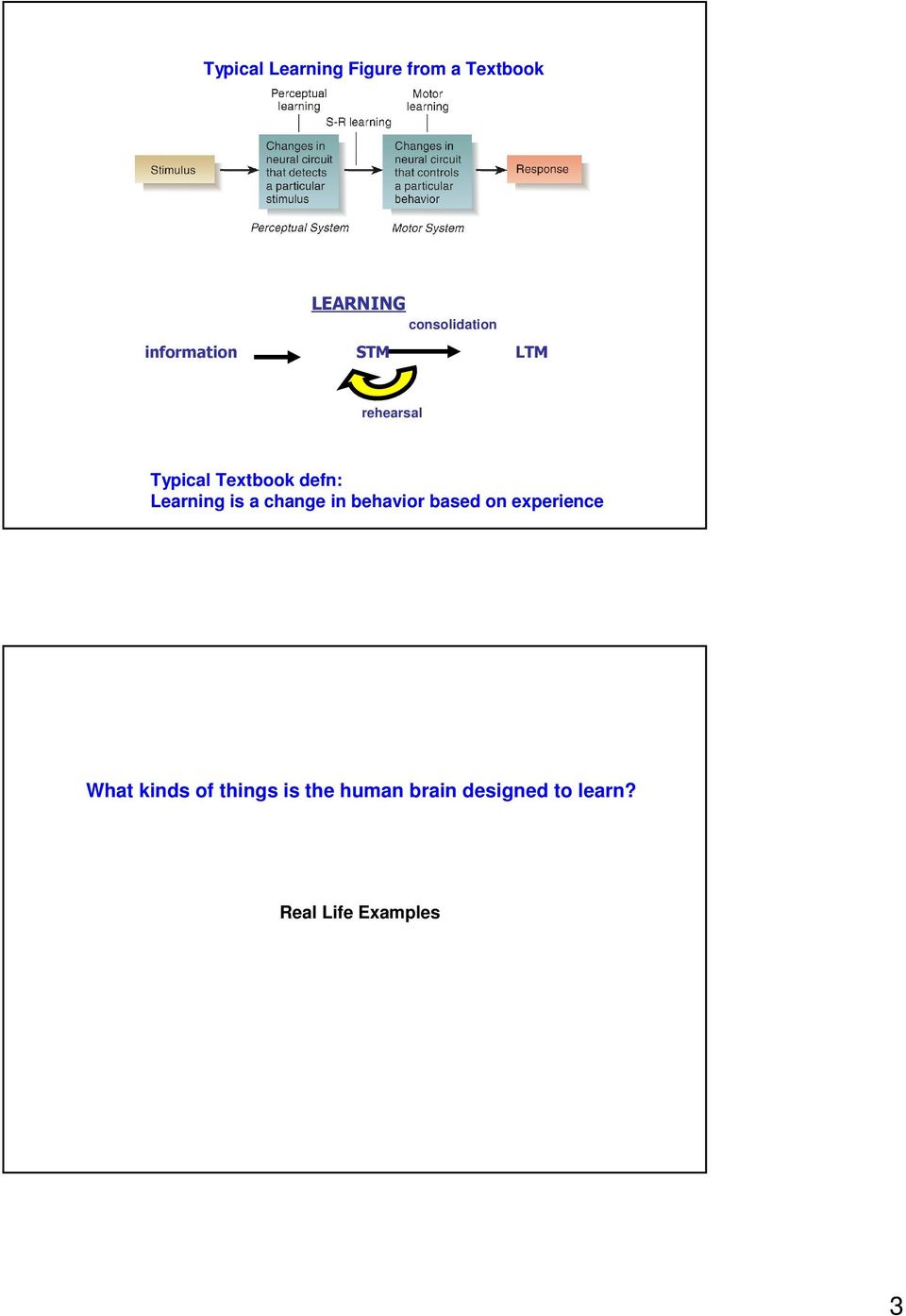
4 What kinds of things is the human brain designed to learn? Some Learning Come Naturally Language milestones are associated with dendritic sprouting Broca s Area Textbook picture adapted from Biological Foundations of Language, 1967 THE BRAIN IS THE SEAT OF ALL LEARNING Brain Physiology The brain is made up of billions of nerve cells called neurons. Information is passed from one neuron to the next by an electrochemical process. Neuron connections are flexible, overlapping, and redundant. Internal and external stimuli stimulate the formation of pathways and patterns of excited neurons. Neuronal Patterns The more frequently pathways or patterns of neurons are used the stronger the pathways and patterns become. The stronger they become the more likely they will be made again. 4
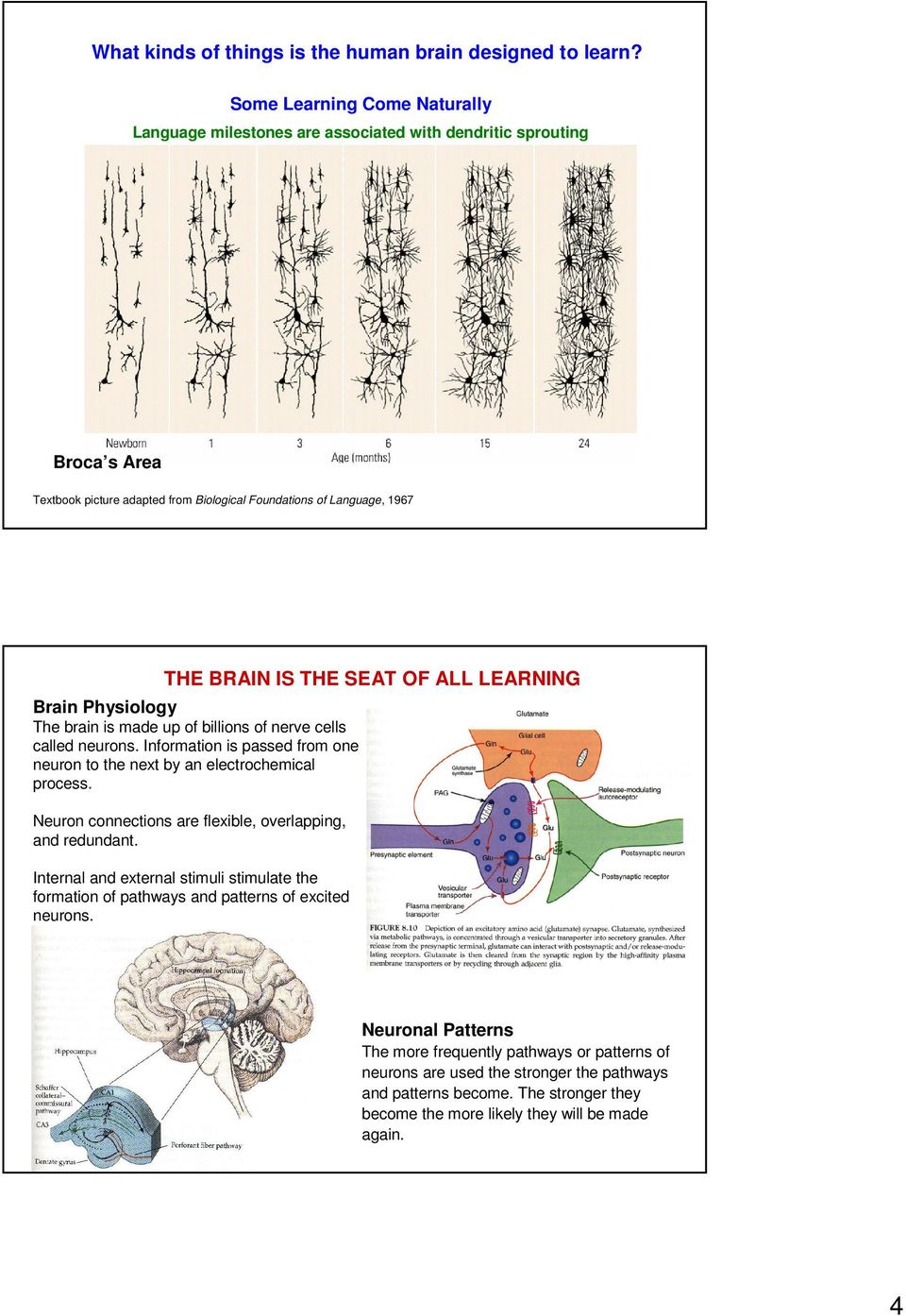
5 Brain Areas Contributing to Learning & Memory Hippocampus consolidation of long-term memories for spatial location Amygdala memory for the emotional significance of experience Inferotemporal cortex storage of long-term visual memories Cerebellum and striatum implicit sensorimotor memory Prefrontal cortex memory for temporal order of events; possible role in the retrieval of memories Mediodorsal nucleus damage leads to memory deficits; the medial diencephalic and medial temporal lobes may be in the same memory circuit Basal forebrain serves a variety of functions with a controversial role in memory (Ach production) What is happening in the brain when you learn something? Diagram of the LTP Procedure High frequency electrical stimulation of the perforant pathway Record from cells within the dentate gyrus: Subsequent perforant pathway stimulation results in progressive increases in population PSP s LTP may not underlie learning but it is the best model available 5

6 LTP is associated with changes in synaptic structure Synaptic Self: How Our Brains Become Who We Are Joseph LeDoux 2002 Designing Brain Compatible Learning Terence Parry & Gayle Gregory 2003 How the Gifted Brain Learns David A. Sousa 2003 Teaching to the Brain's Natural Learning Systems Barbara K. Given 2002 Becoming a "Wiz" at Brain- Based Teaching Marilee Sprenger 2001 We're Born to Learn: Using the Brain's Natural Learning Process to Create Today's Curriculum Rita Smilkstein

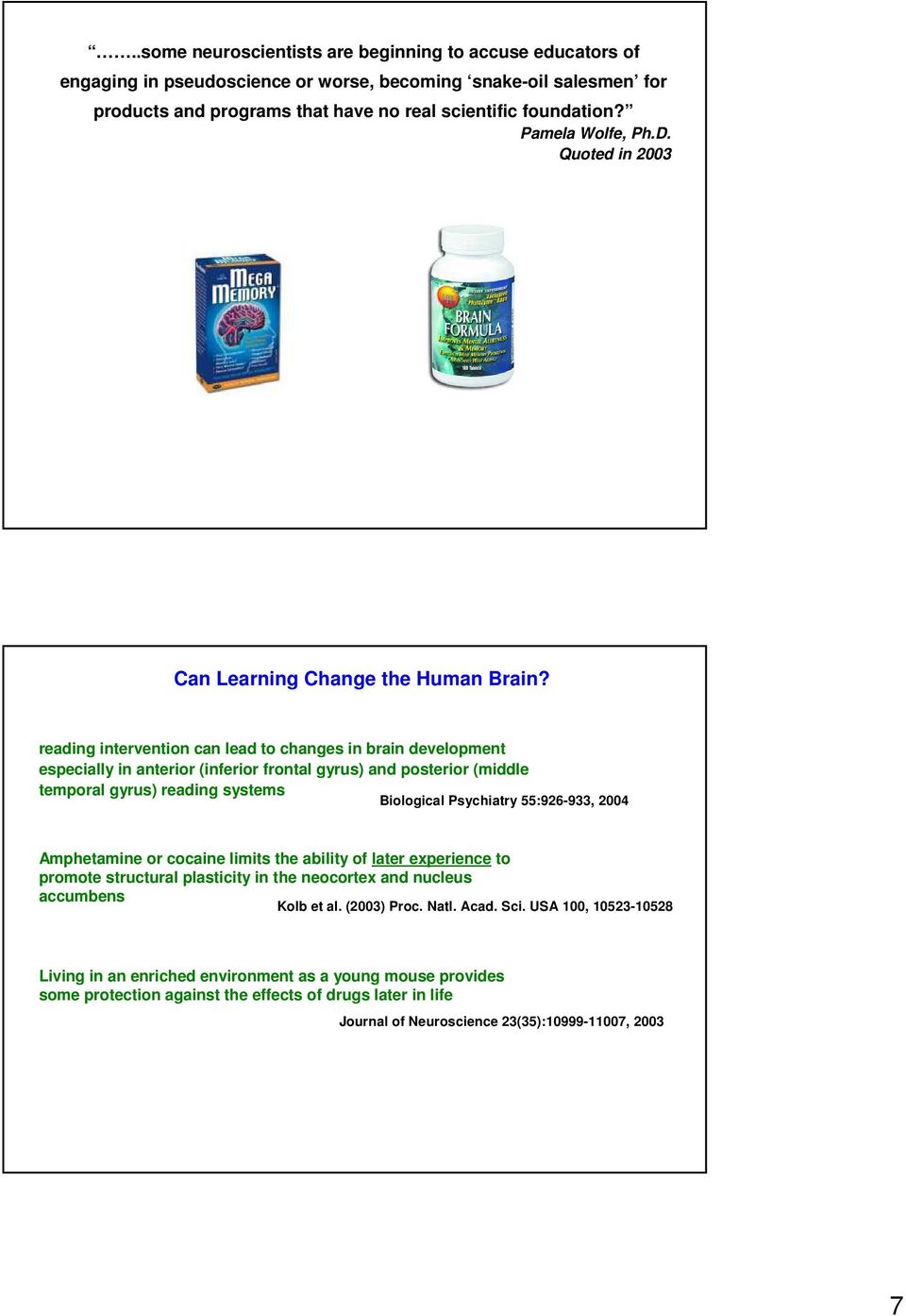
7 ..some neuroscientists are beginning to accuse educators of engaging in pseudoscience or worse, becoming snake-oil salesmen for products and programs that have no real scientific foundation? Pamela Wolfe, Ph.D. Quoted in 2003 Can Learning Change the Human Brain? reading intervention can lead to changes in brain development especially in anterior (inferior frontal gyrus) and posterior (middle temporal gyrus) reading systems Biological Psychiatry 55: , 2004 Amphetamine or cocaine limits the ability of later experience to promote structural plasticity in the neocortex and nucleus accumbens Kolb et al. (2003) Proc. Natl. Acad. Sci. USA 100, Living in an enriched environment as a young mouse provides some protection against the effects of drugs later in life Journal of Neuroscience 23(35): ,
8 It is important to remember that all learning is brain-based Education is practical neuroscience This does not mean that every teacher needs to become a neuroscientist or memorize 100 neurotransmitters and 50 brain areas responsible for cognition. But it does mean that teachers can become more effective with some knowledge of how the brain senses, processes, stores, and retrieves information. 8

It s All in the Brain!
 It s All in the Brain! Presented by: Mari Hubig, M.Ed. 0-3 Outreach Coordinator Educational Resource Center on Deafness What is the Brain? The brain is a muscle In order to grow and flourish, the brain
Executive. Presented by Patti Jenks Principal, ASSETS High School
 Executive Function Presented by Patti Jenks Principal, ASSETS High School 4 Major Lobes of the Brain Another look inside. How does the brain work? Parietal Lobe - orientation, calculation, certain types
UNIVERSITY OF BOLTON EDUCATION & PSYCHOLOGY PSYCHOLOGY SEMESTER 1 EXAMINATIONS 2014/2015 COGNITIVE & BIOLOGICAL PERSPECTIVES MODULE NO: PSC4003
 [EDP 005] UNIVERSITY OF BOLTON EDUCATION & PSYCHOLOGY PSYCHOLOGY SEMESTER 1 EXAMINATIONS 2014/2015 COGNITIVE & BIOLOGICAL PERSPECTIVES MODULE NO: PSC4003 Date: Wednesday 21 st January, 2015 Time: 2.00pm
Slide 4: Forebrain Structures. Slide 5: 4 Lobes of the Cerebral Cortex. Slide 6: The Cerebral Hemispheres (L & R)
 Slide 1: [Film Clip: The Brain #2- Phineas Gage] Integrated Bodily Communications Within Brain (Hemispheres and structures) The remaining Nervous System Endocrine System (Hormonal communication) Our bodies-
The Developing Brain, Adolescence and Vulnerability to Drug Abuse
 Welcome. This presentation is for you to read and to use in your prevention work. We hope you will review it, learn from it and feel comfortable using it in presentations to colleagues that work in prevention,
Brain Structures That are Involved with Memory
 Early Theories of Brain Structures That are Involved with Psychology 372 Sensation Sensory Attention Rehearsal STM Storage Retrieval Physiological Psychology Steven E. Meier, Ph.D. Listen to the audio
Lecture One: Brain Basics
 Lecture One: Brain Basics Brain Fractured Femur Bone Spinal Cord 1 How does pain get from here to here 2 How does the brain work? Every cell in your body is wired to send a signal to your brain The brain
3. The neuron has many branch-like extensions called that receive input from other neurons. a. glia b. dendrites c. axons d.
 Chapter Test 1. A cell that receives information and transmits it to other cells via an electrochemical process is called a(n) a. neuron b. hormone c. glia d. endorphin Answer: A difficulty: 1 factual
MEMORY MODULE A Training Module for Parents and Educators of Children with Traumatic Brain Injury.
 MEMORY MODULE A Training Module for Parents and Educators of Children with Traumatic Brain Injury. Funded by an IDEA Discretionary Grant #2007-9911-22 Wisconsin Department of Public Instruction (http://www.dpi.wi.gov)
ADOLESCENT BRAIN DEVELOPMENT: IMPLICATIONS FOR DRUG USE PREVENTION. Jessie Breyer, B.A. & Ken C. Winters, Ph.D. Center for Substance Abuse Research
 ADOLESCENT BRAIN DEVELOPMENT: IMPLICATIONS FOR DRUG USE PREVENTION Jessie Breyer, B.A. & Ken C. Winters, Ph.D. Center for Substance Abuse Research Department of Psychiatry, University of Minnesota & Mentor
Name: Teacher: Olsen Hour:
 Name: Teacher: Olsen Hour: The Nervous System: Part 1 Textbook p216-225 41 In all exercises, quizzes and tests in this class, always answer in your own words. That is the only way that you can show that
AMPHETAMINE AND COCAINE MECHANISMS AND HAZARDS
 AMPHETAMINE AND COCAINE MECHANISMS AND HAZARDS BARRY J. EVERITT Department of Experimental Psychology, University of Cambridge Stimulant drugs, such as cocaine and amphetamine, interact directly with dopamine
Vocabulary & General Concepts of Brain Organization
 Vocabulary & General Concepts of Brain Organization Jeanette J. Norden, Ph.D. Professor Emerita Vanderbilt University School of Medicine Course Outline Lecture 1: Vocabulary & General Concepts of Brain
Brain Power. Counseling and Mental Health
 Brain Power Counseling and Mental Health TEA COPYRIGHT Copyright Texas Education Agency, 2012. These Materials are copyrighted and trademarked as the property of the Texas Education Agency (TEA) and may
Review Paper Cognitive Neuroscience and Education: Understanding the Teaching Learning Strategies, Learning Disabilities and Neuromyths
 Research Journal of Educational Sciences ISSN 2321-0508 Review Paper Cognitive Neuroscience and Education: Understanding the Teaching Learning Strategies, Learning Disabilities and Neuromyths Abstract
Figure 2 Figure 3 Figure 1
 The brain is organized into three tiers; a lower tier made up by the brainstem and cerebellum, a middle tier containing the thalamus, basal ganglia and many components of the limbic system and an upper
ANIMATED NEUROSCIENCE
 ANIMATED NEUROSCIENCE and the Action of Nicotine, Cocaine, and Marijuana in the Brain Te a c h e r s G u i d e Films for the Humanities & Sciences Background Information This program, made entirely of
Human Neuroanatomy. Grades 9-12. Driving Question: How did the evolution of the human brain impact the structure and function it has today?
 Human Neuroanatomy Grades 9-12 Driving Question: How did the evolution of the human brain impact the structure and function it has today? Objectives: Students will be able to Describe the basic parts and
Function (& other notes)
 LAB 8. ANATOMY OF THE HUMAN BRAIN In this exercise you each will map the human brain both anatomy and function so that you can develop a more accurate picture of what s going on in your head :-) EXTERNAL
LIST OF FIGURES. Figure 1: Diagrammatic representation of electromagnetic wave. Figure 2: A representation of the electromagnetic spectrum.
 LIST OF FIGURES Figure 1: Diagrammatic representation of electromagnetic wave. Figure 2: A representation of the electromagnetic spectrum. Figure 3: Picture depicting the internal circuit of mobile phone
CONTE Summer Lab Experience Application
 CONTE Summer Lab Experience Application When preparing your application for funding from the CONTE Summer Lab Experience through the Undergraduate Program in Neuroscience, please read these instructions
Chapter Fourteen. Emotion, Reward, Aggression, and Stress
 Chapter Fourteen Emotion, Reward, Aggression, and Stress EMOTIONS! Emotions generally include a Physical component, and a Subjective component or quality, and a Valence Emotions a product of Evolution?
BRAIN storming Copyright, Poliakoff and Bee, 2000
 by Ellen Poliakoff and Sally Bee Illustrations by Serena Korda BRAIN storming The 1990 s was hailed as the decade of the brain. We ask, what do we really know about the elusive workings of the grey matter
BIOLOGY STUDY PACKET THE BRAIN
 BIOLOGY STUDY PACKET THE BRAIN SC.912.L.14.26 AA Spring 2012 The intent of this packet is to supplement regular classroom instruction, not to replace it. This also supposes that the students have access
MEDIAL TEMPORAL LOBE (THE LIMBIC SYSTEM)
 MEDIAL TEMPORAL LOBE (THE LIMBIC SYSTEM) On the medial surface of the temporal lobe are three structures critical for normal human functioning. From rostral to caudal, they are the olfactory cortex, the
Overview. Unit 5: How do our choices change our brains?
 Unit 5: How do our choices change our brains? Overview In the previous units, we learned about the neuron, synaptic transmission, and neuronal circuits. In this key culminating unit, we ll bring all of
DRAFT TJ PROGRAM OF STUDIES: AP PSYCHOLOGY
 DRAFT TJ PROGRAM OF STUDIES: AP PSYCHOLOGY COURSE DESCRIPTION AP Psychology engages students in a rigorous appraisal of many facets of our current understanding of psychology. The course is based on the
Auditory neuroanatomy: the Spanish heritage. Santiago Ramón y Cajal, 1852 1934
 Auditory neuroanatomy: the Spanish heritage Santiago Ramón y Cajal, 1852 1934 Rafael Lorente de Nó, 1902 1990 3 The nervous system is made up of cells. Estimates of the number of cells vary from
Homework Help Stroke
 The Brain & Strokes Your brain is the most complex organ in your body. It is the command centre for everything you do, think, sense and say! It has over 100 billion special nerve cells called neurons.
the puzzle packet! Brought to you by
 the puzzle packet! Brought to you by It s Mindboggling! word search The following brain-related words all appear in It s Mindboggling! How many can you find? Words may appear in all directions, including
Sarah Levin Allen, Ph.D., CBIS Executive Director, Brain Behavior Bridge Assistant Professor, Philadelphia College of Osteopathic Medicine Pediatric
 Sarah Levin Allen, Ph.D., CBIS Executive Director, Brain Behavior Bridge Assistant Professor, Philadelphia College of Osteopathic Medicine Pediatric & NJ School Neuropsychologist www.brainbehaviorbridge.com
Brain Development. Genetic make-up... is not the major determiner
 Brain Development Presented by: Linda Alsop SKI-HI Institute Utah State University Genetic make-up... is not the major determiner Early experiences are so powerful that they can completely change the way
Prevention & Recovery Conference November 28, 29 & 30 Norman, Ok
 Prevention & Recovery Conference November 28, 29 & 30 Norman, Ok What is Addiction? The American Society of Addiction Medicine (ASAM) released on August 15, 2011 their latest definition of addiction:
Integration and Coordination of the Human Body. Nervous System
 I. General Info Integration and Coordination of the Human Body A. Both the and system are responsible for maintaining 1. Homeostasis is the process by which organisms keep internal conditions despite changes
ASSIGNMENTS AND GRADING
 Instructor: Janet Menard Office: Craine- 431 Phone: 533-3099 Email: [email protected] Class Hours: Tuesdays 11:30 1:00 Friday 1:00 2:30 Office Hours: Mondays 1:00-2:00 Thursdays 3:30-4:30 (please notify
Education and the Brain: A Bridge Too Far John T. Bruer. Key Concept: the Human Brain and Learning
 Education and the Brain: A Bridge Too Far John T. Bruer Key Concept: the Human Brain and Learning John T. Bruer Scholar in cognitivist approaches to human learning and instruction. His argument refers
The Limbic System Theory of Addiction
 The Limbic System Theory of Addiction The brain controls every aspect of a human being. From breathing to blinking, it runs the show. Most of how it operates, however, is on an automatic and unconscious
The brain structure and function
 The brain structure and function This information is an extract from the booklet Understanding brain tumours. You may find the full booklet helpful. We can send you a copy free see page 5. Contents Introduction
Neurobiology of Depression in Relation to ECT. PJ Cowen Department of Psychiatry, University of Oxford
 Neurobiology of Depression in Relation to ECT PJ Cowen Department of Psychiatry, University of Oxford Causes of Depression Genetic Childhood experience Life Events (particularly losses) Life Difficulties
Whole Brain Parenting. STAR Health
 Whole Brain Parenting STAR Health Objectives Understand basic brain functioning Explore the links between brain functioning and attachment Explore the role of reflective parenting to repair attachment
Autism and the Brain
 Autism and the Brain Jill Bailer and Barbara Behnke Jane Long Middle School, Houston, Texas, and Winamac High School, Winamac, Indiana In collaboration with Julia Whitney 1 and Celene Mulholland 2 1 Battelle
Brain Damage & Recovery: The Resilience of the Brain, Addiction Impact & Therapeutic Repair. Michael Fishman, MD Director of Young Adult Program
 Brain Damage & Recovery: The Resilience of the Brain, Addiction Impact & Therapeutic Repair Michael Fishman, MD Director of Young Adult Program How Addiction Takes Hold Large & rapid upsurges in dopamine
THE TEENAGE BRAIN IN SEARCH OF ITSELF A WEBQUEST FOR THE ADOLESCENT BRAIN RoseMary McClain Londondonderry High School Londonderry, NH
 THE TEENAGE BRAIN IN SEARCH OF ITSELF A WEBQUEST FOR THE ADOLESCENT BRAIN RoseMary McClain Londondonderry High School Londonderry, NH Introduction: Why do you feel like an alien in your body? Why don t
Brains, Ontologies & Virtual Machines
 How Minds Work Brains, Ontologies & Virtual Machines Stan Franklin Computer Science Division & Institute for Intelligent Systems The University of Memphis 1 Question: How do minds work? What would an answer
The Addicted Brain. And what you can do
 The Addicted Brain And what you can do How does addiction happen? Addiction can happen as soon as someone uses a substance The brain releases a neurotransmitter called Dopamine into the system that makes
THE SAULT COLLEGE OF APPLIED ARTS AND TECHNOLOGY SAULT STE. MARIE, ONTARIO COURSE OUTLINE
 THE SAULT COLLEGE OF APPLIED ARTS AND TECHNOLOGY SAULT STE. MARIE, ONTARIO COURSE OUTLINE COURSE TITLE: Introduction to Psychology CODE NO. : PSY102-3 SEMESTER: Fall/Winter PROGRAM: AUTHOR: Various Post-Secondary
American Society of Addiction Medicine
 American Society of Addiction Medicine Public Policy Statement: Definition of Addiction (Long Version) Addiction is a primary, chronic disease of brain reward, motivation, memory and related circuitry.
Functions of the Brain
 Objectives 0 Participants will be able to identify 4 characteristics of a healthy brain. 0 Participants will be able to state the functions of the brain. 0 Participants will be able to identify 3 types
2 Neurons. 4 The Brain: Cortex
 1 Neuroscience 2 Neurons output integration axon cell body, membrane potential Frontal planning control auditory episodes soma motor Temporal Parietal action language objects space vision Occipital inputs
Introduction to Neurophysiological Psychology (PSY 451)
 Portland State University Physiological Psychology Page 1 Introduction to Neurophysiological Psychology (PSY 451) Bill Griesar, Ph.D., Adjunct Instructor, [email protected] OFFICE HOURS: Mondays, 11:30
Appendix 4 Simulation software for neuronal network models
 Appendix 4 Simulation software for neuronal network models D.1 Introduction This Appendix describes the Matlab software that has been made available with Cerebral Cortex: Principles of Operation (Rolls
Drugs and Teens: Current Facts and Recent Trends. Agenda. Adolescent development
 Drugs and Teens: Current Facts and Recent Trends Cheryl Houtekamer Youth Addiction Services Calgary Agenda Adolescent Development Brain Development Adolescent Substance Use - Prevalence How does addiction
Nerve Cell Communication
 Nerve Cell Communication Core Concept: Nerve cells communicate using electrical and chemical signals. Class time required: Approximately 2 forty minute class periods Teacher Provides: For each student
THE COGNITIVE NEUROSCIENCE OF MEMORY
 THE COGNITIVE NEUROSCIENCE OF MEMORY What is memory? It is often associated with the thinking of again or recalling to the mind of something learned at an earlier time. Descriptions of this sort imply
CHAPTER 6 PRINCIPLES OF NEURAL CIRCUITS.
 CHAPTER 6 PRINCIPLES OF NEURAL CIRCUITS. 6.1. CONNECTIONS AMONG NEURONS Neurons are interconnected with one another to form circuits, much as electronic components are wired together to form a functional
ADHD A Focus on the Brain
 ADHD A Focus on the Brain Laurie Hayes Center for Advanced Research and Technology Clovis, California Carrie Newdigger Macksville High School Macksville, Kansas In collaboration with Susanna Visser 1 and
AP Psychology Bishop England High School Course Syllabus: 2015-2016 Teacher: Mrs. Martini
 AP Psychology Bishop England High School Course Syllabus: 2015-2016 Teacher: Mrs. Martini E- mail: [email protected] Room: 252 A Course Description: Voicemail: 843-849- 9599 AP Psychology is a one- year
LESSON 7: LEARNING MODELS
 LESSON 7: LEARNING MODELS INTRODUCTION mobility motivation persistence sociological Think about your favorite class. Does the teacher lecture? Do you do experiments or go on field trips? Does the teacher
Psychology. Draft GCSE subject content
 Psychology Draft GCSE subject content July 2015 Contents The content for psychology GCSE 3 Introduction 3 Aims and objectives 3 Subject content 4 Knowledge, understanding and skills 4 Appendix A mathematical
Vision: Receptors. Modes of Perception. Vision: Summary 9/28/2012. How do we perceive our environment? Sensation and Perception Terminology
 How do we perceive our environment? Complex stimuli are broken into individual features, relayed to the CNS, then reassembled as our perception Sensation and Perception Terminology Stimulus: physical agent
Chapter 3 The Brain and Behavior
 Chapter 3 The Brain and Behavior Learning Goals 1. Discuss the nature and basic functions of the nervous system. 2. Explain what neurons are and how they process information. 3. Identify the brain s levels
www.projectlearnet.org WHAT IS COGNITIVE INTERVENTION/REHABILITATION?
 Tutorial: Cognitive Intervention/Rehabilitation (See Tutorials on Cognition; Transfer/Generalization; Instructional Routines; Attention; Memory and Memory Problems; Organization; Problem Solving; Concrete
Memory Rehabilitation in Early Dementia. Diana Golvers Clinical Psychologist Central Dementia Service
 Memory Rehabilitation in Early Dementia Diana Golvers Clinical Psychologist Central Dementia Service Loss of Memory in AD Memory impairment earliest manifestation of AD and other dementias Major impact
WebQuest: Neurotransmitters, Cravings & Addiction By: Sandra R. Holmes (page 1 of 18 )
 WebQuest: Neurotransmitters, Cravings & Addiction By: Sandra R. Holmes (page 1 of 18 ) Objectives: 1.) The student will be able to explain the structure and the function of each part of the neuron. 2.)
Vanguard University of Southern California Natural Science and Mathematics
 Vanguard University of Southern California Natural Science and Mathematics Course Information Biology Department BIOL 294 Principles of Neuroscience (4 Units) Instructor Information Wentsworth Kennedy,
Principle Two-. Learning Engages the Entire Physiology
 Principle One: The Brain Is a Parallel Processor Principle Two-. Learning Engages the Entire Physiology Photograph by Rosemary Rappoport. Htaleab Florida By providing a stimulating classroom environment,
Addiction and Trauma 3 rd Annual Co-Occurring Disorders Institute June 9, 2011
 Addiction and Trauma 3 rd Annual Co-Occurring Disorders Institute June 9, 2011 John M. O Brien, Ph. D Mental Health Associates of Maine [email protected] Objectives At the completion of
The Cranium Connection
 Your Brain! The brain is the command center of your body. It controls just about everything you do, even when you are sleeping. Weighing about 3 pounds, the brain is made up of many parts that all work
LESSON 4: BRAIN STRUCTURE AND FUNCTION
 LESSON 4: BRAIN STRUCTURE AND FUNCTION THE TRIUNE BRAIN Neo? axon brain stem cerebral hemispheres cortex dendrite limbic system neural plasticity neurons neurotransmitter sensory flooding sensory gating
2401 : Anatomy/Physiology
 Dr. Chris Doumen Week 7 2401 : Anatomy/Physiology The Brain Central Nervous System TextBook Readings Pages 431 through 435 and 463-467 Make use of the figures in your textbook ; a picture is worth a thousand
AP Psychology 2008-2009 Academic Year
 AP Psychology 2008-2009 Academic Year Course Description: The College Board Advanced Placement Program describes Advanced Placement Psychology as a course that is designed to introduce students to the
The Science of Addiction:
 The Science of Addiction: Why it s a bad idea to turn to drugs in times of stress Regina M. Carelli, PhD Stephen B. Baxter Distinguished Professor Department of Psychology & Neuroscience The University
Chapter 4. The Brain
 Chapter 4 The Brain The Nervous System Central Nervous System (CNS) receives, processes, interprets and stores info (taste, sound, smell, color etc.) Sends information to muscles, glands and internal organs
BRAIN TRAINING: THE NEW SCIENCE OF INTELLIGENCE LAUREL SCHOOL ONE LYMAN CIRCLE SHAKER HEIGHTS, OHIO 44122 216.455.3061 WWW.LAURELSCHOOL.
 BRAIN TRAINING: THE NEW SCIENCE OF INTELLIGENCE LAUREL SCHOOL ONE LYMAN CIRCLE SHAKER HEIGHTS, OHIO 44122 216.455.3061 WWW.LAURELSCHOOL.ORG VIEW FROM THE PAST We used to think that brains were a lot like
PSK171 STRESS MANAGEMENT
 PSK171 STRESS MANAGEMENT Chapter 2 Systems that control stress arousal Controlling Stress & Tension Girdano, Dusek & Everly Ligands Ligands (amino acid molecules) Biochemicals that carry information Neurohormones
http://abcnews.go.com/politics/video/obama-says-brain-initiative-will-be-transformative-18861944
 http://abcnews.go.com/politics/video/obama-says-brain-initiative-will-be-transformative-18861944 What are the nervous system s functions? The nervous system organizes and controls an individual s appropriate
Lesson # 5A Workshop: Complex Networks and Graphs (Adapted from Teaching Engineering s It s a Connected World )
 Subject area / course / grade level: Science Grade 7-10 Summary: Students are introduced to networks and systems. The students will use this knowledge to create their own model of a neural network (Lesson
Mind, Brain, and Relationships
 This is a chapter excerpt from Guilford Publications. The Developing Mind: How Relationships and the Brain Interact to Shape Who We Are, Second Edition. By Daniel J. Siegel. Copyright 2012. Purchase this
Department of Psychology
 Department of Psychology Tanner Babb, Mary Ruthi The Psychology Department seeks to provide a curriculum that stimulates the necessary knowledge base and skills for participation in a variety of fields
DISSECTION OF THE SHEEP'S BRAIN
 DISSECTION OF THE SHEEP'S BRAIN Introduction The purpose of the sheep brain dissection is to familiarize you with the threedimensional structure of the brain and teach you one of the great methods of studying
How are Parts of the Brain Related to Brain Function?
 How are Parts of the Brain Related to Brain Function? Scientists have found That the basic anatomical components of brain function are related to brain size and shape. The brain is composed of two hemispheres.
Brain Plasticity and Behavior
 CURRENT DIRECTIONS IN PSYCHOLOGICAL SCIENCE Brain Plasticity and Behavior Bryan Kolb, 1 Robbin Gibb, and Terry E. Robinson Canadian Centre for Behavioural Neuroscience, University of Lethbridge, Lethbridge,
NEUR/PSYC 125 Introduction to Behavioral Neuroscience Fall 15 M-W-F 9:00 9:50 SOBA 162 Page 1
 NEUR/PSYC 125 Introduction to Behavioral Neuroscience Fall 15 M-W-F 9:00 9:50 SOBA 162 Page 1 CONTACT INFORMATION Instructor: Lora A. Becker, Ph.D. Office: Hyde Hall 208 Office phone: 488-2532 Office hours:
Brain-Based Learning
 292 Cercone INFORMATION SCIENCE PUBLISHING 701 E. Chocolate Avenue, Suite 200, Hershey PA 17033, USA Tel: 717/533-8845; Fax 717/533-8661; URL-http://www.idea-group.com This chapter appears in the book,
Department: PSYC. Course No.: 132. Credits: 3. Title: General Psychology I. Contact: David B. Miller. Content Area: CA 3 Science and Technology
 Department: PSYC Course No.: 132 Credits: 3 Title: General Psychology I. Contact: David B. Miller Content Area: CA 3 Science and Technology Catalog Copy: 132. General Psychology I Course Information: (a)
CSE511 Brain & Memory Modeling. Lect04: Brain & Spine Neuroanatomy
 CSE511 Brain & Memory Modeling CSE511 Brain & Memory Modeling Lect02: BOSS Discrete Event Simulator Lect04: Brain & Spine Neuroanatomy Appendix of Purves et al., 4e Larry Wittie Computer Science, StonyBrook
Chapter 3 The Anatomy of the Nervous System
 Chapter 3 The Anatomy of the Nervous System Systems, Structures, and Cells That Make Up Your Nervous System 1 General Layout of the Nervous System Central Nervous System (CNS) Brain (in the skull) Spinal