
Alternative Berthing Improvement and Innovation
|
|
|
- Walter Walton
- 10 years ago
- Views:
Transcription
1 Alternative Berthing Improvement and Innovation Rotterdam Mainport University of Applied Sciences Project 2 HBO Maritime Officer W. van Bodegom J. Bonifacio F. van der Meijden G. Sprenger D. Sprott
2 Foreword This is a project to which the entire project group was looking forward to. The current bething process is a very inefficient process, to which there are great alternatives. The project will state 4 different alternatives with their advantages and disadvantages. The project group has divided the research as follows: Wouter van Bodegom looked into the current berthing methods and is the chief editor of this project. Daniël Sprott looked into the magnetic berthing method. Feijo van der Meijden did research about the vacuum berthing method. Gerrit Sprenger did the research about the composite mooring lines in combination with the quick release hooks. Finally Jonathan Bonfacio did the research regarding the laser guidance. At the start of the project it seemed like the fact that the project members came from different group would cause a problem. However this quickly proved otherwise and the research went very good. During the project there have been several people aiding the project group. Because of this we would like to thank the following people: Mr. P. van Kluijven, Mr. W. Onvlee, Mr F. Textor, Mr S. Nap and Ms. Van der Drift. Project group 2 2

3 Contents 1. Backgrounds Principal Organisation Project members Stakeholders Problem description Problem definition Project objective Research questions Research methodes The current berthing methods Mooring equipment Winches Electric winches Mooring lines Bollards The mooring procedure Disadvantages of this system The overall situation Conclusion Magnetic Mooring The magnetic mooring principle Working principle of the electromagnet Construction of the mooring system Advantages and disadvantages of magnetic mooring Preventing Magnetic Field in the Process of Electronic Mooring Conclusion Vacuum mooring Working principle Applications of the Vacuum pad system The advantages and benefits of the vacuum berthing Conclusion Laser guidance Conclusion Recommendations Epilogue Literature List - Sources Appendix

4 1. Backgrounds 1.1 Principal The principal responsible for this project is Mr. Onvlee, lecturer at the Rotterdam Mainport University of Applied Sciences, engineering department. 1.2 Organisation The STC Group is an education provider, with its headquarters located in the Netherlands. The STC Group offers maritime transport and logistics education at multiple levels. The STC Group is based in various countries, offering both masters/bachelors and vocational diplomas. The project Alternative Berthing has been set up by students of the Rotterdam Mainport University of Applied Sciences (RMU), students of the Maritime Officer. The RMU is a partnership between the STC-Group and Hogeschool Rotterdam. 1.3 Project members The members of project group one will execute this project. The project group consists of the following members: Wouter van Bodegom, Jonathan Bonifacio, Feijo van der Meijden, Daniël Sprott and Gerrit Sprenger. Each and every member of the project group is personally responsible for the execution of this project. 1.4 Stakeholders Every vessel in the world wide fleet will have to berth regularly. The results of this research will improve the current way of berthing. This would mean that everybody involved in transport on water will benefit from this research. However, there are certain parties who will benefit the most. These parties are: insurance companies, shipping companies, port authorities and operational staff onboard of the vessels. The final approval of the plan of approach will be done by Mr. Onvlee. 1.5 Problem description According to the UK P&I club, the largest mutual marine protection and indemnity organization, six percent of the large personal injury claims are due to mooring incidents. 1 Mooring incidents are the 7 th highest in frequency and overall cost, whilst also being the 3 rd most expensive claim by accident value. In 2009 there were 81 claims with a total value of $ 34,650,000. These numbers indicate just how dangerous the current berthing process is. Apart from the high risk associated with the current berthing process, the berthing process is also a very time and labor consuming endeavor. In order for the vessel to safely berth, a large number of personnel is necessary both on the shore and aboard the vessel. This takes up a high amount of time of a large group of personnel, resulting in an obvious loss of time that could be spent on other tasks
5 The high risk and time consuming nature of the berthing process is a problem that needs solving. 1.6 Problem definition The current way of berthing a ship is inefficient. 1.7 Project objective This project will aim to research and improve the current berthing process. The project will dictate and define multiple alternative ways of berthing, focusing on making the process safer and faster. The project aims to provide and describe alternative berthing methods. 1.8 Research questions Main question: How can the efficiency of the berthing process be improved? Sub questions: What are the current berthing methods? How can magnetic mooring be a suitable alternative to the current berthing process? How can vacuum berthing be a suitable alternative to the current berthing process? Are composite mooring lines in combination with quick release hooks a suitable alternative to the current berthing process? How can laser guidance improve the current berthing process? 1.9 Research methodes What are the current berthing methods? o Qualitative research, desk research o The project group has done research using publications on the internet and in books. How can magnetic mooring be a suitable alternative to the current berthing process? o Qualitative research, desk research, field research o The project group has done research using publications on the internet and in books. How can vacuum berthing be a suitable alternative to the current berthing process? o Qualitative research, desk research, field research o The projectgroup has done research using publications on the internet and in books. Also a interview was taken from a representative of the company Cavotec Are composite mooring lines in combination with quick release hooks a suitable alternative to the current berthing process? o Qualitative research, desk research 5

6 o The project group has done research using publications on the internet and in books. Also a interview was taken from a representative of the company Dyneema. How can laser guidance improve the current berthing process? o Qualitative research, desk research o The project group has done research using publications 6

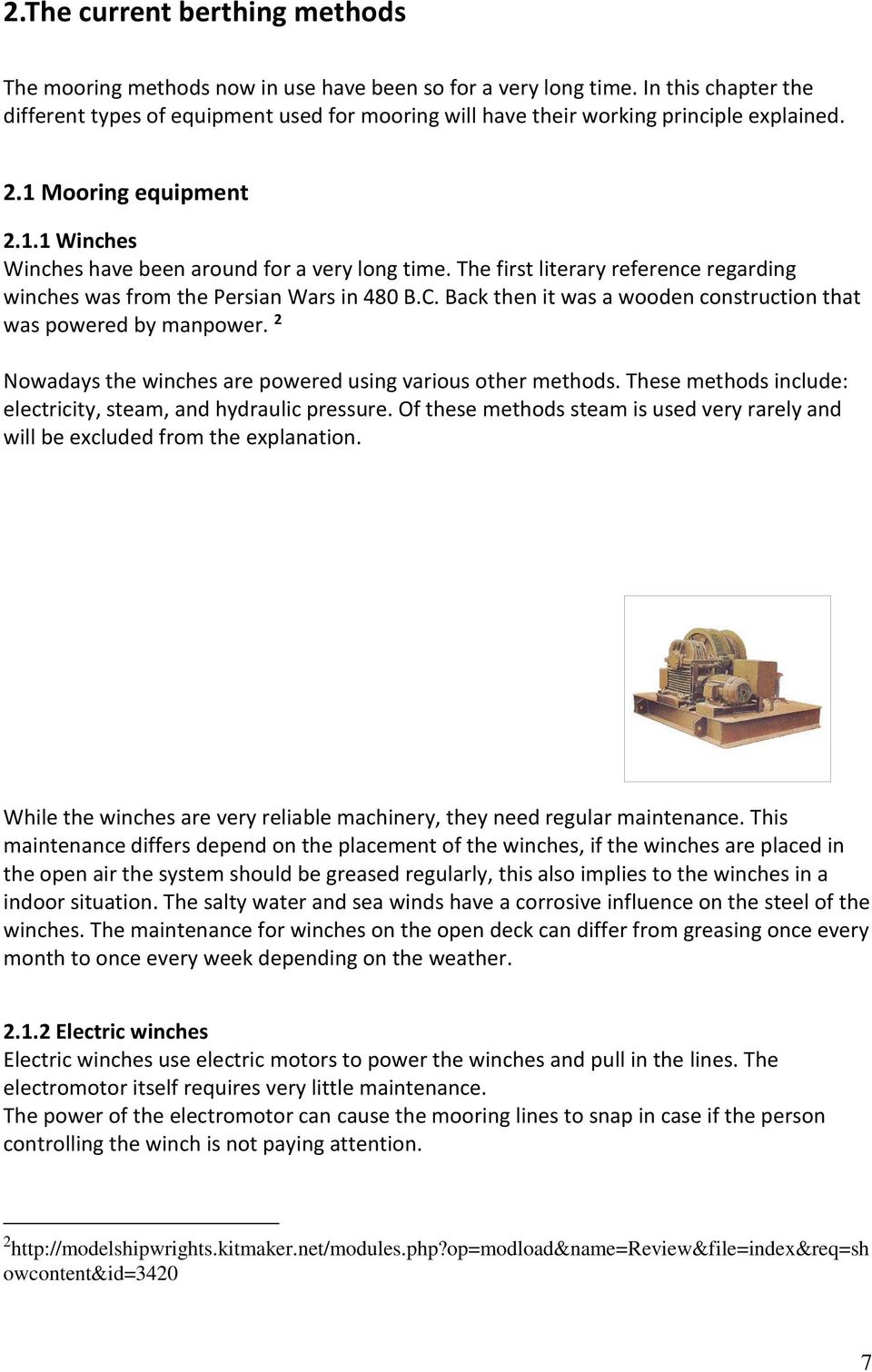
7 2.The current berthing methods The mooring methods now in use have been so for a very long time. In this chapter the different types of equipment used for mooring will have their working principle explained. 2.1 Mooring equipment Winches Winches have been around for a very long time. The first literary reference regarding winches was from the Persian Wars in 480 B.C. Back then it was a wooden construction that was powered by manpower. 2 Nowadays the winches are powered using various other methods. These methods include: electricity, steam, and hydraulic pressure. Of these methods steam is used very rarely and will be excluded from the explanation. While the winches are very reliable machinery, they need regular maintenance. This maintenance differs depend on the placement of the winches, if the winches are placed in the open air the system should be greased regularly, this also implies to the winches in a indoor situation. The salty water and sea winds have a corrosive influence on the steel of the winches. The maintenance for winches on the open deck can differ from greasing once every month to once every week depending on the weather Electric winches Electric winches use electric motors to power the winches and pull in the lines. The electromotor itself requires very little maintenance. The power of the electromotor can cause the mooring lines to snap in case if the person controlling the winch is not paying attention. 2 owcontent&id=3420 7
8 2.1.3 Hydraulic winches Hydraulic winches work using a pump to transfer oil from the designated hydraulic oil tank. This oil is led through a cooler to the hydraulic motor that is attached to the winch. This hydraulic motor will drive the winch. This system is safer than the electrical winch because the system cannot break the lines by pulling because of an installed overpressure valve on the pump Mooring lines To hold the ship alongside mooring lines are used. There are different types of mooring lines. 3 Polyamide mooring lines. Polyamide mooring lines are also called nylon mooring lines. These lines are heavier than water and will sink after they have been given ashore. This can be a disadvantage if a bow thruster is used. These lines also have a very high elastic elongation. This means that when the lines break, the stored up power will make them sweep the entire deck, which is very dangerous for the operational staff. 4 Polyester Polyester has a lower density than water meaning that it will float during the time it is on the water. Polyester also offers higher abrasion resistance than nylon lines. 5 The polyester mooring lines suffer a lower elastic elongation then polyamide mooring lines. Steel rope Mooring lines made of steel are by far the strongest of the wires. Another advantage of these lines is that they are cheap and suffer from very little elastic elongation. The disadvantages of these lines are that they are very heavy, and they can corrode. Both of these disadvantages are very significant considering the work environment. High Modulus Polyethylene Polyethylene lines have, like polyester lines, a lower density than water, meaning they will float, which is of great value during the mooring operations. These lines offer a high resistance against abrasion. While these lines are costly they offer great advantages in terms of resistance to abrasion and handling use Bollards Linesman use bollards are to secure the ships mooring lines ashore. The bollards are usually placed near to the water. Because these bollards are all located very near to the water the risk of a lineman falling into the water due to the heavy mooring lines or a slippery mooring quay 3 Dokmar maritime publishers B.V Scheepskennis, Klaas van Dokkum, third edition Modulus%20PolyEthylene%20(HMPE)%20Fiber%20Lines_2006.pdf 8

9 is very real. Also as seen in the picture there is a possibility of too many mooring lines on one bollard. This can cause delays in departures when the mooring lines are entangled. 2.2 The mooring procedure Before a ship goes alongside the mooring lines have to be prepared. The time this procedure takes is different on every ship, depending on the training and experience of the crew. Taking a small container feeder as example, 2 headlines and one spring are usually prepared. The preparing of these lines usually takes about 5-10 minutes. When the mooring lines are prepared the ship s crew will take their respective positions in the front and aft of the ship. When the ship is nearing the berth the spring line will be given ashore. Here the linesmen will make sure that the line comes on the correct boulder. During this time it is very important that the person controlling the winch keeps the spring line slack. If he/she does not the linemen can be pulled into the water. When the lineman put the spring line on the bollard it is very important that the spring line is kept slack. Should this not be the case the tension of the ship pulling on the spring line will be to great and the line might snap. When the spring line is put out the headlines can be put out. The dangers here are the same when the spring line was given ashore. 2.3 Disadvantages of this system. Preparing the mooring system takes time. An inattentive crew can cause injuries/damages to the ship, linesman and the crew itself. General equipment failure caused 4 accidents in the year 2009 according to the P&I club, which is a number should not satisfy anyone. 2.4 The overall situation The UK P&I club did research 7 regarding the incidents happening during mooring procedures. They found that mooring incidents are: the seventh highest in frequency regarding large personal injury claims. the third most expensive type of claim. Crew errors and equipment failure are the two greatest causes of accidents. An example of these causes can be a crewmember being hit by broken lines. Which can be both a crew error as an equipment failure

10 The current system has to be improved to reduce the personal errors and the equipment failure. 2.5 Conclusion The current mooring systems have room for improvement, especially regarding the safety of the system and the involved operational staff. 10

11 3. Magnetic Mooring Mooring systems are used to secure a ship to a pier, wharf, mooring buoy, or another ship. Mooring systems include the lines, fenders, ship/pier fittings and related machinery that would be used to bring a ship into a moored configuration. In addition, to the standard mooring configurations alongside a pier or wharf, most moorings are provided in harbors to provide a safe haven. This system will reduce exposure to waves, reduce ship motions, and reduce dynamic mooring loads. 3.1 The magnetic mooring principle The mooring system has a fixed dock installation. The main idea is to use the system with electromagnetic on floating pontoons, that can go with the tidal movement Working principle of the electromagnet An electric current can be used for making temporary magnets known as electromagnets. An electromagnet works on the magnetic effect of current. It has been found that if a soft iron rod called core is placed inside a solenoid, then the strength of the magnetic field becomes very large because the iron ore is magnetized by induction. This combination of a solenoid and a soft iron core is called an electromagnet; an electromagnet consists of a long coil of insulated copper wire wound on a soft iron core. The electromagnet acts as a magnet only as long as the current is flowing in the solenoid. The moment the current is switched off the solenoid is demagnetized. The core of the electromagnet must be of soft iron because soft iron loses all of its magnetism when the current in the coil is switched off. Steel is not used in electromagnets, because it does not lose all its magnetism when the current is stopped and becomes a permanent magnet. Electromagnets can be made of different shapes and sizes depending on the purpose for which they are to be used. 3.2 Construction of the mooring system The structure of the magnetic mooring system includes two floating pontoons each containing 18 magnets. The magnets will be turn on using electrical power that will produce electromagnetic fields that will be used for mooring the ship. When a ship lies to the quay, the bow of the ship is guided to the quay landing bridge between two coved slackening structures. Below you can find a comparison between Magnetic mooring and mooring with ropes Table 1: Comparison Magnetic Mooring and Mooring with Ropes Magnetic Mooring Mooring with Ropes Easy to secure the ship Increased Safety Efficient Time Use Percentage of casualties will be reduced A minimum number of individuals will be needed for mooring No need for ropes More individuals are needed during mooring operations Higher risk of casualties More time needed during mooring with ropes Need for ropes 11

12 3.3 Advantages and disadvantages of magnetic mooring Table 2: Advantages and Disadvantages of Magnetic Mooring Advantages of Magnetic Mooring Disadvantages of Magnetic Mooring Easy to secure the ship Increased safety Electricity failure of the system Efficient time use Harmful magnetic field Percentage of casualties will be reduced Causes the ship to become a induced Decrease in manpower. A minimum magnet number of individuals will be needed for A knowledgeable individual is always mooring needed for monitoring the system No need for ropes The advantages of magnetic mooring: -Efficient Time Use. Mooring a big ship is easier because one can begin earlier to unload or load cargo on the ship. -Saving of Cost and Effective Work Process. Mooring ropes will not be used anymore. In addition, there will be no need to invest in buying mooring ropes. But you always have some spare in case of places that don t have an electrical mooring system. -Safety. With the use of magnetic mooring, employees will be working in safer and more efficient work environment. -Less Manpower. A minimum of individuals will be needed to assist during the mooring of a ship. The reason for this is because only the control room needs to be operated where the electromagnetic shield will be activated. In addition, the part of the permanent magnetic will be attached to the ship at the strongest plate of the ship. Electricity failure can be a big problem because if it fails then will the magnets loose and cause an accident in the harbor. The harmful magnetic field will have a big influence on the navigating instrument on board of the vessel it can damage them. There is no need for a lot of man power it can be activate by just pressing one button at the monitor screen and one outside in case off something went wrong. The strong electric magnet used for the mooring process will also, because of the nature of steel (steel is a iron alloy in which induced magnets can be created) used for the vessel, cause the ship to become an induced magnet. This is not something that can be counteracted unless the materials used for shipbuilding are changed Preventing Magnetic Field in the Process of Electronic Mooring One way to prevent magnetic field to damage other systems onboard is by using magnetic stop plate. The magnetic stop plate is plate that can help reducing the magnetic field of the electro magnets. Magnet- Stop Plates are extra thick high-efficiency magnetic alloy (Mumetal ) plates, especially designed to provide superior shielding for electric circuit product, side by side computer users, and any situation where you need a flat shielding material on a wall. For

13 this to be used on steel vessels it will require magnet stop plates on every part of the ship, which is not realistic. 3.5 Conclusion Magnetic mooring can be a suitable because it increases the safety of the work environment for all those involved and makes the workers spend less time on the mooring procedure. However, at the moment the fact that the magnet can induces the ship to become a permanent magnet it is a not a viable solution. 13

14 4. Vacuum mooring The idea behind the vacuum berthing is to use vacuum & hydraulic technology to eliminate mooring lines and increase the efficiency of the berthing process. 9 The captain aligns the ship along the quay and with tugs pushed agains the fenders. Due to the fenders the ship bounces back and this is where the system is activated. The big vacuum pads adhere to the hull and are activated and engaged by a single press on a button on the bridge, or via a remote control on the dock. When the pads are attached it only takes seconds before the vacuum is complete and the ship is attached to the system This means a big reduction of the time necessary to berth a vessel, and allows the loading/discharging operation to start earlier. To release the vacuum pads, only a single press on the detach button is necessary Working principle The system works as follows: the system has multiple vacuum pads which will make a vacuum to the ship in seconds. 10 Large pads adhere to vessels hulls with hydraulic triple axis arm. The system continuously compensates vessel motion and automatically makes adjustments to the position of the vessel. The technology constantly provides information using different sensors within the vacuum pad and within the hydraulic system. The sensors in the vacuum pads give information about the percentage of vacuum and the forces which are being working onto the ship. And the sensors in the hydraulics give information about the movements of the ship. These different sensors give current information and alert users to changing conditions and potential or developing problems 7.Al the information is displayed onto computers on the bridge or on the key side. It also requires a modest, but constant supply of electricity to operate the system. In case there is an unreliable power supply a small backup generator could be installed

15 4.2. Applications of the Vacuum pad system There are two possibilities that could be used for this system, the ship based system and the shore based system. Both these systems have their advantages. Shore based system: Hereby the vacuum pad system with its hydraulics is mounted on the quay. When this system is used to berth a ship, no additional adaptions have to be made to ship. The only requirements are a stable electrical supply and a secure foundation. 11 The big advantage of having the system shore built is that the hydraulic system can be used to its maximum capacity. This makes the system very dynamic, and makes the vacuum pads move vertical/diagonal and horizontal. As a result this system can be used in ports with big tide movements and heavy weather circumstances. 12 Ship based system: The biggest advantage of having the system on the vessel is that you can moor in ports which do not have the infrastructure required (stable electricity supply) for a shore based system. The only need is a stable foundation and a big steel plate on which the vacuum pads from the ship can attach The advantages and benefits of the vacuum berthing The vacuum system has many advantages which can be seen below. Economy - No more rope costs and expensive mooring teams - Loading / discharging can begin earlier - More vessels berthing are possible because of the faster vessel-turnaround. - Reduced use of tug boats and the vessel propulsion system which saves fuel. - Durability, less wear on fenders and the ship hull Safety - No more personnel that can be injured by mooring lines and winches. (system is automated) - Continues load monitoring with alarm functions - Automatic repositioning of the vacuum pads. Environment - Reduced emissions because of the faster berthing process ject 15

16 The disadvantages of the system are: - The high purchase costs of the system, because of the many parties in the ports (shipping companies, port company, mooring teams, terminal operators) who is responsible for the system and which party buys the system. - Inland navigation ships, and sea ships cannot use the same moormaster (due to the size and dimensions of the ships). 4.4 Conclusion Vacuum mooring is a very good alternative to the present moor situation; it offers great advantages and makes the whole process much safer. Only a few people are necessary to monitor the system, but the system does all the dangerous work and so the numbers of accidents will decrease. Another advantage of the system is that it increases efficiency, the system follows the ships movement and no tension is built up. Due to this the vessel will be more stable alongside the quayside and the loading and discharging can be increased. A disadvantage of the system is the higher procurement costs, but these can be earned back within several years. (Depending on how the system is used) 16


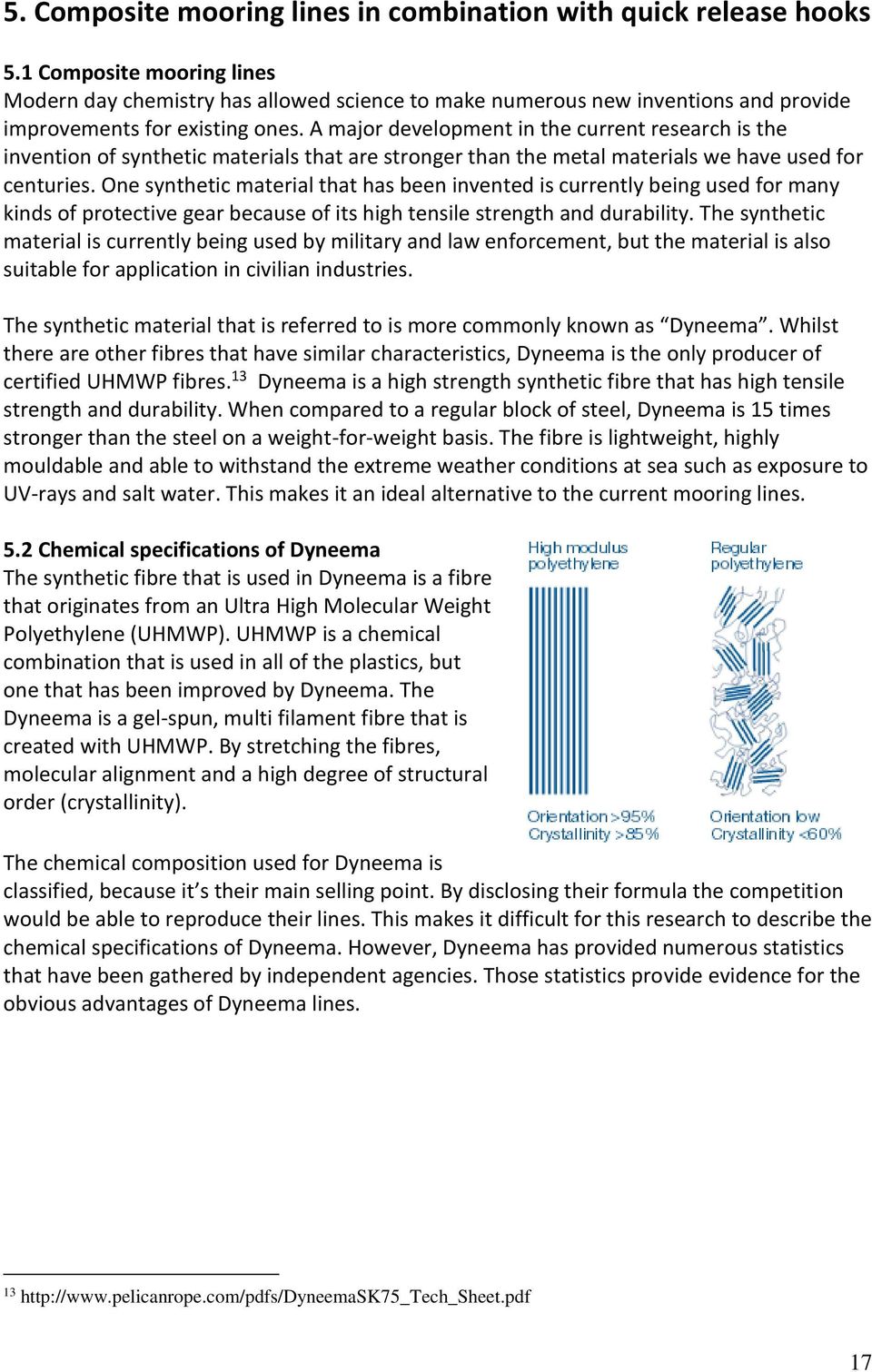
17 5. Composite mooring lines in combination with quick release hooks 5.1 Composite mooring lines Modern day chemistry has allowed science to make numerous new inventions and provide improvements for existing ones. A major development in the current research is the invention of synthetic materials that are stronger than the metal materials we have used for centuries. One synthetic material that has been invented is currently being used for many kinds of protective gear because of its high tensile strength and durability. The synthetic material is currently being used by military and law enforcement, but the material is also suitable for application in civilian industries. The synthetic material that is referred to is more commonly known as Dyneema. Whilst there are other fibres that have similar characteristics, Dyneema is the only producer of certified UHMWP fibres. 13 Dyneema is a high strength synthetic fibre that has high tensile strength and durability. When compared to a regular block of steel, Dyneema is 15 times stronger than the steel on a weight-for-weight basis. The fibre is lightweight, highly mouldable and able to withstand the extreme weather conditions at sea such as exposure to UV-rays and salt water. This makes it an ideal alternative to the current mooring lines. 5.2 Chemical specifications of Dyneema The synthetic fibre that is used in Dyneema is a fibre that originates from an Ultra High Molecular Weight Polyethylene (UHMWP). UHMWP is a chemical combination that is used in all of the plastics, but one that has been improved by Dyneema. The Dyneema is a gel-spun, multi filament fibre that is created with UHMWP. By stretching the fibres, molecular alignment and a high degree of structural order (crystallinity). The chemical composition used for Dyneema is classified, because it s their main selling point. By disclosing their formula the competition would be able to reproduce their lines. This makes it difficult for this research to describe the chemical specifications of Dyneema. However, Dyneema has provided numerous statistics that have been gathered by independent agencies. Those statistics provide evidence for the obvious advantages of Dyneema lines
18 5.3 Characteristics of Dyneema 14 Resistant to most chemicals Low density floats on water Fire resistant and self-extinguishing Able to withstand high temperature changes High electrical resistance Elongation at break is low, energy needed to break is high High strength, even with regular use 5.4 Advantages of using Dyneema as mooring lines The traditional mooring lines that are used nowadays come with disadvantages. These disadvantages vary from risk to personal safety (breaking of the lines) to financial safety (high costs involved with using the lines). By using Dyneema mooring lines, the majority of these problems will be a thing of the past. Dyneema has a density lighter than one, which is the main cause for the light weight and high strength. The light weight and high strength of the lines don t affect the elongation of the line negatively. As stated before, Dyneema lines are just as strong as steel lines whilst having a 15% weight reduction. The mooring lines aboard a vessel are exposed to all kinds of weather, varying from temperatures far below zero to temperatures as high as 80 C when stored below deck. Dyneema has a melting point between 144 C and 152 C. However it is worth to mention that the colder the lines are, the better they work. The tenacity and modulus of the lines decrease at higher temperatures but increase at lower temperatures. The lines can get as cold as -150 C without becoming brittle. Dyneema is willing to guarantee proper functioning of the lines between -150 C and 70 C. These values are well within the temperatures that are found aboard a vessel. Creep is a major point in mooring lines. As mooring lines are loaded with an increasing static load and a rising temperature, the fibres inside the mooring line will elongate irreversibly. The elongation that arises is called creep, and renders mooring lines useless because all the shock absorption is taken away by creep. Lloyd s List has developed a widely accepted model for accurate creep calculations, and Dyneema lines show the lowest creep with the longest creep life. This means that Dyneema lines can be used for longer amounts of time without having to be replaced. Dyneema mooring lines are ideal to be used in the demanding maritime environment. The mooring lines don t take up water when soaked; have less than 1% shrinkage when exposed to boiling waters, excellent salt water resistance and excellent chemical resistance. All these factors are problems for the current mooring lines, so by using Dyneema the entire process before and during the mooring procedure is improved. Modern day ships are the largest of their kind, and the trend towards larger ships for LNG, bulk and containers has had the consequence of the need for mooring lines with a higher breaking load. Before, when strong mooring lines were needed, steel wires were needed. But the steel wires are too heavy to be handled and provide a lot of risk for personal safety

19 The weight reduction of the Dyneema lines provide mooring lines with the same strength as steel wires that are a fraction of the weight of a steel mooring line. Another major advantage of using Dyneema lines is that it requires no changes to the ships equipment. Dyneema lines can be used with the same deck equipment that is used by normal mooring lines, such as winches and fairleads. Deck crew is already familiar with that equipment, so no extra training has to be provided for them and the procedures don t have to be changed. This makes Dyneema lines a cheap solution that yields direct results. 5.5 Statistics provided by Dyneema

20 5.6 Quick release hooks 16 Quick release hooks are alternatives for the traditional bollards that are installed at ports worldwide. Instead of putting the eye of the rope around a bollard for instance, the rope is attached to a quick release mooring hook. Quick release mooring hooks are specifically designed to meet the maritime industry s demand for a safe manual release of mooring lines under full load conditions. No personnel are needed to lift the rope off the hook, removing the human factor from the equation. Now that the success of the quick release hook became clear, an optional remote release of the mooring lines has been developed. The remotely operated quick release hooks placed in the place of the traditional bollard, and can be installed in capacities ranging from 40 to 200 metric tonnes strength 17. The hooks have a range of motion of 180 degrees horizontally and 45 degrees vertically. The release hooks can also be mounted onto concrete or steel deck structures, so it can be used in offshore mooring situations for LNG tankers. It is also possible to install a capstan behind the hook, which is used to haul in the mooring lines with the use of a messenger line. 16 The quick release hooks that are described are the quick release hooks produced by Trelleborg Release-Hooks/QRH/ 20

21 The mooring hooks can be equipped with a remote control system to operate the hooks from distance. The operation can be performed through a remote control panel with pushbuttons or via a computer monitor in the case that a mooring load monitoring system is required. There are two ways to release the hooks: electric-electronic, electric-hydraulic and electric-pneumatic remote control. In electronic-electronic remote control, the release mechanism of the mooring hook is operated by an electric magnet at the hook. Electrichydraulic remote control uses a release mechanism that is operated by a hydraulic cylinder mounted at the hook. A power pack is installed at the mooring unit for hydraulic pressure. The quick release hooks can also be integrated into a system that monitors valuable information such as loads and alarms that will be provided. The mooring load of the vessel is measured by the load cell that has been integrated into the quick release hook. A computer aboard the vessel or a hand-held pager can provide real rime visual representation of the mooring situation, increasing situational awareness. 5.7 Advantages of remotely operated quick release hooks The mooring hooks have many advantages over traditional mooring solutions. The hooks are manufactured from heavy steel plates and castings, providing high strength. The hooks can be released at 100% of the safe working load, with minimum effort. This means that in case of an emergency, a single man could release all the lines and avert a potential disaster. All the hooks can also be reset by a single man after release, shortening the turn-around time. The main advantage of the quick release hooks are the possibility of releasing lines under full load and the removal of the human factor. Lines can simply be winched in and attached to the hook without having to perform backbreaking manoeuvres. 5.8 Conclusion Dyneema is a strong polyethylene fibre that offers all the advantages of maximum strength without the weight. Dyneema lines are up to 15 times stronger than steel, floats on water and are highly durable to the extreme conditions aboard a vessel. Traditional lines should be replaced by Dyneema lines to make for a safer mooring process. By removing the bollards and using quick release hooks, the risks for quay side personnel is also greatly reduced, removing the backbreaking work and dangerous conditions from their work. 21
22 Despite the fact that there are other producers of UHMWP fibres, Dyneema is the only product that has already proven itself in practice. This makes the choice for Dyneema a logical one. 22

23 6. Laser guidance In order to improve the current berthing process, an innovative system that can be adopted is the laser guidance system to navigate more safely and reliably in any weather and also in unfamiliar port. This system is the simplest, safest a can be easily implement. In any port and on any type of vessel. A system that does not take too much space and does not alter the design of the vessel. 18 A similar system is already being used: By NASA- for navigation and berthing on the international space station or landing on airport. Automotive navigation Systems. 6.1 How laser distance works A laser distance works by use measuring the time it takes a pulse of laser light to be reflected off a target and returned to the sender. This method is known as time of light or pulse measurement. Operating Principle A laser distance emits a pulse of laser at a target, the pulse then reflects off the target and back to the sending device. This time of light is based on the fact that laser light travels at a fairly constant speed through the earth s atmosphere. Inside the meter, a computer quickly calculates the distance and heading to target. 19 Calculating distance The distance between the laser sensor and target is given by D=ct/2. C equals the speed of light T equals the amount of time for the round trip between laser sensor to target Given the high speed at which the pulse travels and focus, this rough calculation is very accurate over distance of feet or miles. Considerations The accuracy of a laser distance depends on the original pulse to the sending device. Even though laser beams are very narrow and have high energies, they are subject to the same atmospheric distortions that affect normal light. These atmospheric distortions may decrease little an accurate reading of the distance of an object over long distance of more than one kilometer


24 Why laser? Because it has a wide variety of use, from map making to sports. They can be used to create maps of the ocean floor or topography maps cleared of vegetation. They are used in the military to provide exact distance to target for snipers or artillery, for reconnaissance and for engineering. Engineers and designers use a laser distance to construct 3D models of object. 6.2 Working principle This innovative idea is only an navigational aid to the captain an pilot. The laser sensor placed on the vessel sends a laser beam to the laser target built in the harbor and the reflection of the laser beam return to the sensor, so that the laser sensor can measures the range and bearing of target allowing for the calculation of vessel position and heading. This system is basically the same as the DP(Dynamic Position System). This system does not need to be hooked up to ships propulsion as with a DP system. 24


25 6.3 Harbour plan. This project has a goal to improve the current berthing process with new technology innovation. Laser code The red buttons in the drawing illustrate the laser targets on the harbor. Each laser target in the harbor has a unique code that can be detected by a laser sensor on the vessel. By interconnected all the laser target ashore on a data-link system can the officer on the bridge easily select the laser target on the display control panel of on the ECDIS as a new additional option the designated berthing place for our vessel. The system will activate the laser target ashore by using a data link system to assist the officer safely and easily without stress while navigating in unfamiliar harbor. Marine electronics have become more and more important due to the increasing use of automation & control systems on seafaring vessels. This trend is due to reductions in vessel personnel, increasing safety requirements and the advent of the electronic chart. 25
26 This system will provide the following information such as: Distance Bearing Heading Tide condition The advantages of this system are: Easy to assemble in all types of vessels Operating in any weather condition; Rejects all false reflections; Safe and accurate navigation in unfamiliar port or harbor; Reducing of time consumption Reducing of fuel consumption The disadvantage of this system is: Operating at a maximum range of up to 2500 meter ( nautical miles). 6.4 Conclusion This system improves not only the current berthing process by reducing time consumption, it also gives the captain precise information during the mooring process. 26
27 Conclusion With our research completed we can answer the following questions: What are the current berthing methods? The current berthing methods include using: Winches Different types of mooring ropes Bollards Manual labour from the ship linesman How can magnetic mooring be a suitable alternative to the current berthing process? Magnetic mooring can be a suitable because it increases the safety of the work environment for all those involved and makes the workers spend less time on the mooring procedure. However, at the moment because of the fact that the magnet can induces the ship to become a permanent magnet it is a not a viable solution. How can vacuum mooring be a suitable alternative to the current berthing process Vacuum mooring is a very good alternative to the present moor situation; it offers great advantages and makes the whole process much safer. Only a few people are necessary to monitor the system, but the system does all the dangerous work and so the numbers of accidents will decrease. Another advantage of the system is that it increases efficiency, the system follows the ships movement and no tension is built up. Due to this the vessel will be more stable alongside the quayide and the loading and discharging can be increased. A disadvantage of the system is the higher procurement costs, but these can be earned back within several years. (Depending on how the system is used) Are composite mooring lines in combination with quick release hooks a suitable alternative to the current berthing process? Yes, composite mooring lines in combination with quick release hooks are a suitable alternative to the current berthing process. Dyneema mooring lines offer all advantages of a normal mooring line without the weight. The quick release hooks reduce the risks for the quay side personnel How can laser guidance improve the current berthing process? This system improves not only the current berthing process by reducing time consumption, it also gives the captain precise information during the mooring process. 27
28 Recommendations The current berthing systems have been around for a very long time. While the systems are known to both the harbour personnel as the sea going staff there are a lot of things that can be improved about them. Magnetic mooring can be a suitable alternative to the current berthing system should the involved parties be looking to improve the safety of the berthing process. However the magnetic mooring system is not a system without disadvantages, especially the creation of the magnet on board of the ship and the involved magnetic fields are off great influence. For the successful appliance of the magnetic mooring system a lot of changes have to be made both on shore as on board of the vessel. Research should be done on reducing the effect of the magnetic mooring without having to greatly change the systems on board of ships, or in shore equipment. Vacuum mooring can be used as a suitable alternative to the current berthing systems because it improves the overall efficiency of the berthing process while also reducing the maintenance time. The implantation of this system is easily done and does not need great changes on the shore or the ships. The bigger ports should definitely look at the system. Especially the fast lines (container feeder, ferry s) can greatly benefit because of the reduced time. While composite mooring lines can definitely improve the current berthing process, it also requires the crew to still do maintenance on the winches/lines. Aside from that, this is the alternative berthing method that requires the least change to the shore/ship equipment making it a very interesting alternative for the port companies. The big advantage of this system is that it is not ship shape restricted and can be applied for all kind of vessels. Finally the laser guidance system, while this does require a big change in every port in which it is applied it is a very interesting development. With the aid of the laser guidance system the captain will always have up to date information regarding the ships position. This information can optimize the berthing process and can reduce the time spend in said process. An interesting note should be made when combining the laser guidance system with the earlier mention system, should this be done the mooring can be made almost completely automatized. This is something that the ports definitely be should look into. 28
29 Epilogue Looking back at the project it can be said that while there were some setbacks, it has all-in all been a successful project. Now the project is finished it shows that there are a lot of great alternatives to the current berthing systems. The fact that these alternatives have not been implanted is mostly due to the fact that the industry thinks it is fine with how it is at the moment, and does not want to spend money on something that has not been used yet. However, especially when it comes to the subject of personal safety, this is not sufficient. The current berthing methods are old and definitely ready for improvement. This project group has found 4 different ways to improve the current system. While some of these results have already been used previously without success, with the current technology it is all possible. The industry should definitely not be scared to try new things and look for improvement of the personal safety. We hope that this project is able to get people interested in trying different ways of berthing to improve the general berthing process. Monday, Project Group II 29
30 Literature List - Sources Internet sites: gh%20modulus%20polyethylene%20(hmpe)%20fiber%20lines_2006.pdf ed_mooring_project/ %20d esigns.htm Mooring.jpg Books: Van Dokkum K Scheepskennis, third edition Dokmar maritime publishers B.V 30
31 Appendix Appendix 1: Interview with Cavotec Nederland Interview 4 June 2013 CAVOTEC Nederland BV Technical Manager Fred Textor mobile: [email protected] 1. Wat is Cavotec? Cavotec is opgericht door 3 Zweden in de jaren 70, die een kabeltrommels productiebedrijf overnamen in Italië. Dit bedrijf maakte de kabeltrommels voor de mijn industrie in Zweden, en omdat het goed ging met het bedrijf werd het uitgebreid naar de andere Scandinavische landen (Denemarken & Noorwegen) en daarna na de rest van de wereld (tegenwoordig in 34 landen wereldwijd met circa 1000 werknemers in totaal). Ook is Cavotec toen gaan beginnen met het uitbreiden van het portfolio, en zijn er nieuwe producten op de markt gekomen. Hedendaags is Cavotec in 4 verschillende takken van industrie te vinden namelijk: Haven & maritiem, Mijnbouw, Vliegveld, en de zware industrie. 2. Wie heeft de Moormaster op de markt gebracht? Door de goede contacten in haven is het balletje gaan vallen om de Moormaster te ontwikkelen. Het systeem is bedacht door 2 Kapiteins in Nieuw-Zeeland die na één ongeluk teveel te hebben gezien ontslag namen en besloten een bedrijf op te richten dat de veiligheid van het aanmeren moest verhogen. Door 9 ingenieurs aan zich te binden werd een product ontwikkeld (de Moormaster). Toen kwam vervolgens Cavotec in het spel, de uitvinders van de Cavotec hadden een kabelrups nodig en kwamen toen bij Cavotec waarna er door de internationale allure van Cavotec werd besloten om te fuseren en zo het product aan de man te brengen. Doordat Cavotec bezig was met een groot project in Salala (Oman) en daar een geheel nieuwe haven aan het bouwen was (APM terminals), werd hier ook meteen de Moormaster aan toegevoegd. 3. Waarom is de Moormaster ontwikkeld? En wat is het huidige probleem? De 2 Nieuw-Zeelandse kapiteins die het system ontworpen hebben, zagen in hun carrière vele ongelukken met betrekking tot het aanmeren van schepen. Toen ze een collega in het water zagen vallen nadat deze werd geraakt door een losgeslagen tros en dodelijk tussen de schroef van het schip terechtkwam besloten ze een bedrijfje op te richten om het aanmeren veiliger en betrouwbaarder te maken. 31
32 4. Hoe werkt het systeem? Je meert op dezelfde manier af als voorheen, dus met sleepboten tegen de fender, de fender drukt vervolgens het schip terug. Nu komt de Moormaster in werking, de vacuüm pads komen naar voren en drukken zich tegen de scheepsromp aan (80% vacuüm). Vervolgens wordt het schip op de juiste afstand van de fenders gehouden (ca 10 cm) en het schip ligt helemaal vast. Met behulp van het hydraulische systeem worden alle scheepsbewegingen opgevangen en kan er geen spanning worden opgebouwd zoals bij de traditionele lijnen het geval was en voor gevaarlijke situaties zorgt. 5. Wat zijn de voordelen van het systeem? Het belangrijkste voordeel van het systeem is dat het de veiligheid enorm verhoogd. Al het gevaarlijke werk met de ropes & winches zijn niet meer nodig en er komt alleen maar een persoon aan bod die op de knop drukt. Tevens zorgt het systeem ervoor dat schepen vele malen stabieler langs de kade liggen en de productiviteit omhoog kan. Ook kan er met het systeem geld worden verdiend. (voorbeeld: bij Teso (Texel) wordt er elk half uur gevaren, waarvan men steeds 10 minuten in de haven ligt (waarbij de motor aan blijft). Nu er binnenkort het moormaster systeem komt kan er elk jaar liter brandstof worden bespaard. Hiermee is niet meteen het hele systeem terugverdiend maar wel deels en tevens zorgt het ervoor dat er minder uitstoot van schadelijke gassen in de haven is. 6. Wat zijn de beperkingen aan dit systeem? Het allerbelangrijkste van het systeem is om het aanmeren veiliger te maken, maar om in landen als Nederland het product aan de man te brengen moet je aan kunnen wijzen dat er geld mee kan worden verdiend. Het probleem van het systeem is, dat je te maken krijgt met verschillende partijen in de haven. Voorbeeld: Port of Rotterdam welke zeer geïnteresseerd zijn in het product alleen zegt het HbR dat het niet hun verantwoordelijkheid is. Wij verhuren alleen en zorgen voor de infrastructuur maar de rest is de verantwoordelijkheid van de terminal operator aldus het HbR. Terminal operator krijgt vervolgens te maken met verschillende rederijen wat ook voor moeilijkheden zorgt, en tenslotte heb je nog de KNRVE (roeiers). Verdere limitaties van het systeem is de vorm van het schip, de beste omstandigheden voor de moormaster zijn een korte boog en een korte kont, zodat er veel oppervlak is waaraan de moormaster zich kan vastmaken. 7. Wat zijn/is de benodigde onderhoud kosten/infrastructuur voor dit systeem? De 40 tons systemen die ze nu in Den Helder gaan gebruiken (TESO) gebruiken ongeveer 20 kw, dus 2x 10 minuten elk uur is in totaal 20 minuten elk uur wordt er door het systeem 20 kw gevraagd, wat natuurlijk heel weinig is in verhouding met de dieselmotoren. De onderhoudskosten zijn 1-1,5 % procent van de aanschafprijs. Zie het als een normaal hydraulisch systeem met af en toe wat olie toevoeren. 8. Wat gebeurt er met het system in geval van een black-out? Doordat er een vacuüm is, zal er niet direct gevaar zijn bij een stroomstoring. Desondanks kan er altijd een back-up generator worden aangesloten in het geval van een storing. 32
33 9. Hoe wordt het systeem bewaakt? Door middel van sensoren in de vacuüm pads en in het hydraulisch systeem kan er ten alle tijd alles worden monitored. Het systeem werkt met een vacuüm van 80% 90% en herstelt zich wanneer het systeem onder deze waardes komt. De pads komen dan een voor een los en trekken zich opnieuw vacuüm. Tevens zal er dan een audiovisueel alarm komen. 10. Waarom wordt het Ship to shore systeem niet gebruikt? Hier is een project mee geweest, alleen later is dit systeem van het schip afgehaald en is er een moormaster op de kade gezet. Door een moormaster op de kade te zetten is het systeem veel dynamischer, bij een shore-ship systeem kunnen er heel veel verschillende schepen aanleggen en bij een ship-shore systeem is het slechts voor één schip. Tevens heeft het ship-shore systeem geen voordelen t.o.v. het shore-ship systeem. 11. Wat is er nodig voor het systeem? Een stabiele ondergrond met een stabiel elektriciteitsnetwerk. Waar wel rekening mee moet worden gehouden is dat binnenvaart & zeeschepen niet op dezelfde moormaster kunnen. Voor de rest is het systeem vrijwel overal toepasbaar. 33
34 Appendix 2: Interview with Dyneema representative Q: Vrijwel alle statistieken over Dyneema lijnen worden aangeleverd door Dyneema zelf. Zijn er externe bureaus die onderzoek hebben gedaan naar de prestatie van Dyneema lijnen in vergelijking met traditionele lijnen? Indien dit zo is, zou het mogelijk zijn om deze statistieken in te zien? A: Naast veel onderzoekswerk dat DSM uiteraard zelf heeft gedaan, zijn er ook vele onderzoeken gedaan door onafhankelijke instanties en onderzoeken deel uitmakend van zgn. joint industry projecten. De resultaten hiervan zijn gepubliceerd in het document waar jij gebruik van maakt. Q: In uw Dyneema SK75 Tech Sheet ( wordt de breeksterkte van Dyneema lijnen vergeleken met staaldraad van 180 kp/mm2. Is staaldraad met een breeksterkte van 180 kp/mm2 de standaard staaldraad die gebruikt wordt als meerlijn? Bestaat er een staaldraad met een hogere breeksterkte? A: Dit is standaard staaldraad dat in de maritieme industrie als meerlijn wordt gebruikt. Zwaardere uitvoeringen bestaan wel, maar worden in de praktijk weinig gebruikt aangezien dat alleen maar problemen oplevert met de aanwezige winches en mankracht die benodigd is. De zwaardere staaldraad wordt alleen gebruikt voor sleepboten. Q: Bedrijven zoals Marlow Ropes bieden lijnen met Dyneema vezels aan. Worden deze lijnen volledig geproduceerd door Dyneema, of krijgt Marlow Ropes de Dyneema vezels aangeleverd waarna zij er zelf lijnen van maken? A: DSM Dyneema levert uitsluitend de Dyneema garens en onze klanten fabriceren er bv. afmeerlijnen van. Wij maken dus zelf geen lijnen van, maar leveren alleen de grondstoffen. Dit verklaart ook de meerdere aanbieders van Dyneema producten. Q: Zijn er kunststof lijnen die geen Dyneema gebruiken, maar wel gelijkwaardige prestaties hebben? A: Er zijn lijnen uit bv Spectra, ook een UHMWPE garen net als Dyneema. Maar omdat beide garens een verschillend karakter hebben, kunnen de lijnen hieruit vergelijkbaar sterk zijn maar zijn er andere eigenschappen verschillend. Gelet op de eigenschappen van Dyneema, ons track record en ruime ervaring is Dyneema zeer sterk vertegenwoordigd in bv. de maritieme en offshore industrie. 34
IP-NBM. Copyright Capgemini 2012. All Rights Reserved
 IP-NBM 1 De bescheidenheid van een schaker 2 Maar wat betekent dat nu 3 De drie elementen richting onsterfelijkheid Genomics Artifical Intelligence (nano)robotics 4 De impact van automatisering en robotisering
The information in this report is confidential. So keep this report in a safe place!
 Bram Voorbeeld About this Bridge 360 report 2 CONTENT About this Bridge 360 report... 2 Introduction to the Bridge 360... 3 About the Bridge 360 Profile...4 Bridge Behaviour Profile-Directing...6 Bridge
Verticale tuin maken van een pallet
 Daar krijg je dan je groendakmaterialen geleverd op een pallet. Waar moet je naar toe met zo'n pallet. Retour brengen? Gebruiken in de open haard? Maar je kunt creatiever zijn met pallets. Zo kun je er
Passenger Terminal Amsterdam
 Fact sheet large cruise ships to Passenger Terminal Amsterdam Port of Amsterdam Amsterdam-IJmond Pilot Organization 2009 Version: November 6 th 2009 This fact sheet provides information on the passage
IT-waardeketen management op basis van eeuwenoude supply chain kennis
 IT-waardeketen management op basis van eeuwenoude supply chain kennis Hans van Aken / November 28, 2012 Copyright 2012 Hewlett-Packard Development Company, L.P. The information contained herein is subject
employager 1.0 design challenge
 employager 1.0 design challenge a voyage to employ(ment) EMPLOYAGER 1.0 On the initiative of the City of Eindhoven, the Red Bluejay Foundation organizes a new design challenge around people with a distance
Inhoud. Xclusief Verzekeringen 4. Xclusief Auto 7. Xclusief Wonen 8. Xclusief Jacht 11. Xclusief Evenementen 12. Contact 15
 Inhoud Xclusief Verzekeringen 4 Xclusief Auto 7 Xclusief Wonen 8 Xclusief Jacht 11 Xclusief Evenementen 12 Contact 15 Xclusief Verzekeringen Hebt u exclusief bezit? Dan komt de productlijn Xclusief Verzekeringen
Regulation for the upstream and downstream navigation of 8,000 and more TEU container vessels to the port of Antwerp with a maximum draught of 145 dm
 Regulation for the upstream and downstream navigation of 8,000 and more TEU container vessels to the port of Antwerp with a maximum draught of 145 dm 1. In general In order to gain an insight into the
GMP-Z Annex 15: Kwalificatie en validatie
 -Z Annex 15: Kwalificatie en validatie item Gewijzigd richtsnoer -Z Toelichting Principle 1. This Annex describes the principles of qualification and validation which are applicable to the manufacture
OGH: : 11g in de praktijk
 OGH: : 11g in de praktijk Real Application Testing SPREKER : E-MAIL : PATRICK MUNNE [email protected] DATUM : 14-09-2010 WWW.TRANSFER-SOLUTIONS.COM Real Application Testing Uitleg Real Application
Examen Software Engineering 2010-2011 05/09/2011
 Belangrijk: Schrijf je antwoorden kort en bondig in de daartoe voorziene velden. Elke theorie-vraag staat op 2 punten (totaal op 24). De oefening staan in totaal op 16 punten. Het geheel staat op 40 punten.
IC Rating NPSP Composieten BV. 9 juni 2010 Variopool
 IC Rating NPSP Composieten BV 9 juni 2010 Variopool AGENDA: The future of NPSP Future IC Rating TM NPSP Composieten BV 2 Bottom line 3 Bottom line 4 Definition of Intangibles The factors not shown in the
PROFIBUS & PROFINET Nederland PROFIBUS, PROFINET en IO-Link. Ede, 12 november 2009
 Ede, 12 november 2009 Remote Maintenance voor PROFINET en Ethernet netwerken Ede, 12 november 2009 Voorstellen Cliff van Gellekom Raster Products BV [email protected] 3 Remote Connectivity
Large Personal Injury Claims by Accident Type (Number)
 Mooring Incidents Large Personal Injury Claims by Accident Type (Number) STRUCK BY MOTOR VEHICLE BURNS CHEMICAL EXPOSURE STRAIN BY HOLDING OR CARR BURNS BY STEAM OR FLUIDS CRUISE CANCELLATION EXPLOSION
Maximizer Synergy. [email protected] BE 0415.642.030. Houwaartstraat 200/1 BE 3270 Scherpenheuvel. Tel: +32 495 300612 Fax: +32 13 777372
 Maximizer Synergy Adafi Software is een samenwerking gestart met Advoco Solutions, een Maximizer Business Partner uit Groot Brittannië. Advoco Solutions heeft een technologie ontwikkeld, genaamd Synergy,
Storage in Microsoft Azure Wat moet ik daarmee? Bert Wolters @bertwolters
 Storage in Microsoft Azure Wat moet ik daarmee? Bert Wolters @bertwolters Welk deel van het platform hebben we nu behandeld? Agenda Recap: Storage Account Nieuw! Premium Storage Nieuw! Native backup voor
MOOREX mooring system
 MOOREX mooring system The peace-of-mind mooring system Modern ships are difficult to moor safely Ship sizes grow but berths and mooring arrangements remain the same as before. Operators often face the
CO-BRANDING RICHTLIJNEN
 A minimum margin surrounding the logo keeps CO-BRANDING RICHTLIJNEN 22 Last mei revised, 2013 30 April 2013 The preferred version of the co-branding logo is white on a Magenta background. Depending on
Research Report. Ingelien Poutsma Marnienke van der Maal Sabina Idler
 Research Report Ingelien Poutsma Marnienke van der Maal Sabina Idler Research report ABSTRACT This research investigates what the ideal bank for adolescents (10 16 years) looks like. The research was initiated
Increase Life Cycle and Decrease Cost for Navigation Buoys
 Increase Life Cycle and Decrease Cost for Navigation Buoys -Extension of Life, by Reduction of Maintenance for Mooring Products Authors: Nils Bengtsson Viktor Ekström Introduction There is no mooring that
How To Design A 3D Model In A Computer Program
 Concept Design Gert Landheer Mark van den Brink Koen van Boerdonk Content Richness of Data Concept Design Fast creation of rich data which eventually can be used to create a final model Creo Product Family
Is het nodig risico s te beheersen op basis van een aanname..
 Is het nodig risico s te beheersen op basis van een aanname.. De mens en IT in de Zorg Ngi 19 april 2011 René van Koppen Agenda Er zijn geen feiten, slechts interpretaties. Nietzsche Geen enkele interpretatie
GMP-Z Hoofdstuk 4 Documentatie. Inleiding
 -Z Hoofdstuk 4 Documentatie Inleiding Het hoofdstuk Documentatie uit de -richtsnoeren is in zijn algemeenheid goed toepasbaar in de ziekenhuisapotheek. Verschil met de industriële is dat de bereidingen
MAYORGAME (BURGEMEESTERGAME)
 GATE Pilot Safety MAYORGAME (BURGEMEESTERGAME) Twan Boerenkamp Who is it about? Local council Beleidsteam = GBT or Regional Beleidsteam = RBT Mayor = Chairman Advisors now = Voorlichting? Official context
Curriculum for the Degree of. Bachelor of Science. Nautical Science
 Curriculum for the Degree of Bachelor of Science In Nautical Science 1 1.Name :Bachelor of Science ( Nautical Science ) Abbreviation : B.Sc.( Nautical Science ) 2.Program of Study The Bachelor of Nautical
IJkdijk: June 24 2007 04:33:06
 IJkdijk: June 24 2007 04:33:06 IJkdijk tens of thousends kilometers of dike, next generation internet, Grid & business Robert Meijer De IJkdijk: De samenhang tussen tienduizenden kilometers dijkproblemen,
LP News. Understanding mooring incidents UK P&I CLUB
 UK P&I CLUB LP News JANUARY 2009 Understanding mooring incidents Major accidents involving mooring equipment in the last 20 years have injured many seafarers and have cost the UK Club over US$34 million
A method for assessing the risk of sea transportation: Numerical examples for the Oslofjord
 A method for assessing the risk of sea transportation: Numerical examples for the Oslofjord Håvard J. Thevik*, Eirik Sørgård, and Tim Fowler * Veritasveien 1, N-1322 Høvik, Norway. [email protected]
101 Inspirerende Quotes - Eelco de boer - winst.nl/ebooks/ Inleiding
 Inleiding Elke keer dat ik een uitspraak of een inspirerende quote hoor of zie dan noteer ik deze (iets wat ik iedereen aanraad om te doen). Ik ben hier even doorheen gegaan en het leek me een leuk idee
Electronic Chart Systems the portable approach
 Http://www.pcmaritime.co.uk Electronic Chart Systems the portable approach Paper given at the Safety at Sea ECDIS Conference by Kay Faulkner of PC Maritime Rotterdam, September 2001 http://www.pcmaritime.co.uk
A Proven Barrier System Tested and Installed Worldwide
 ANTI TERRORIST BOAT BARRIER SYSTEM A Proven Barrier System Tested and Installed Worldwide Pneumatic Barrier System, designed and supplied to withstand 1,000,000 ft-lbs of Kinetic energy which represents
Simulating Variable Message Signs Influencing dynamic route choice in microsimulation
 Simulating Variable Message Signs Influencing dynamic route choice in microsimulation N.D. Cohn, Grontmij Traffic & Transport, [email protected] P. Krootjes, International School of Breda, [email protected]
Pilot on the Bridge Role, Authority and Responsibility. Necessity of Bridge Team Management.
 Pilot on the Bridge Role, Authority and Responsibility. Necessity of Bridge Team Management. Captain Ajaz Peermohamed Gard (UK) Limited London, United Kingdom Captain Ajaz Peermohamed Senior Claims Executive
A Contribution to the Analysis of Maritime Accidents with Catastrophic Consequence
 A Contribution to the Analysis of Maritime Accidents with Catastrophic Consequence Lusic Zvonimir M. Sc., Erceg Tonci Faculty of Maritime Studies Split, Croatia Zrinsko-Frankopanska 38, 21000 Split Phone:
LNG as Ship Fuel. Effects on Ship Design, Operations and Supporting Infrastructure
 LNG as Ship Fuel Effects on Ship Design, Operations and Supporting Infrastructure New Technologies for the Marine Highway TRB Marine Highways Committee (AW010(1)) January 14, 2013 LNG as a Ship s Fuel
SharePoint. Microsoft Dynamics. SharePoint
 What is? SHARE Er was eens een bedrijf waar documenten een belangrijke rol spelen. Elke dag werden er vele documenten tussen klanten en leveranciers over en weer gestuurd en ergens opgeslagen. Op een
Load Balancing Lync 2013. Jaap Wesselius
 Load Balancing Lync 2013 Jaap Wesselius Agenda Introductie Interne Load Balancing Externe Load Balancing Reverse Proxy Samenvatting & Best Practices Introductie Load Balancing Lync 2013 Waarom Load Balancing?
Spread. B&R Beurs. March 2010
 B&R Beurs March 2010 Spread Find out about the latest investment proposals of B&R's investment groups. Check the agenda, and the upcoming activities we organized for you! B&R Beurs Website: www.bnrbeurs.nl
If farming becomes surviving! Ton Duffhues Specialist Agriculture and society ZLTO Director Atelier Waarden van het Land 4 juni 2014, Wageningen
 If farming becomes surviving! Ton Duffhues Specialist Agriculture and society ZLTO Director Atelier Waarden van het Land 4 juni 2014, Wageningen About myself Study - Cultural and social Anthropology, specialised
Advanced Metering Infrastructure
 Advanced Metering Infrastructure Research Project 2 Vic Ding SNE, UvA February 8th 2012 Agenda Background Research motivation and questions Research methods Research findings Stakeholders Legislation Smart
Magnets. Electromagnets. and. Thomas Jefferson National Accelerator Facility - Office of Science Education http://education.jlab.
 Magnets and Electromagnets Magnets and Electromagnets Can you make a magnet from a nail, some batteries and some wire? Problems Can the strength of an electromagnet be changed by changing the voltage of
Accident Report. Injury Pacific Way. 26 November 2005 Class A
 Accident Report Injury Pacific Way 26 November 2005 Class A SUMMARY Pacific Way Injury A crewmember suffered an injury to his wrist when the handle connected to the manually powered windlass that he was
CMMI version 1.3. How agile is CMMI?
 CMMI version 1.3 How agile is CMMI? A small poll Who uses CMMI without Agile? Who uses Agile without CMMI? Who combines both? Who is interested in SCAMPI? 2 Agenda Big Picture of CMMI changes Details for
Part 0 - Classification and Surveys Classification and Surveys I-0 2016-01
 Code Edition I - Ship Technology Part 0 - Classification and Surveys Classification and Surveys I-0 2016-01 Part 1 - Seagoing Ships Chapter 1 - Hull Structures I-1-1 2016-01 Chapter 1 - Hull Structures
Safety Study from the DIVISION FOR INVESTIGATION OF MARITIME ACCIDENTS
 from the DIVISION FOR INVESTIGATION OF MARITIME ACCIDENTS Mooring Accidents on board merchant ships 1997-2006 Divsion for Investigation of Maritime Accidents. Danish Maritime Authority, Vermundsgade 38
The state of DIY. Mix Express DIY event Maarssen 14 mei 2014
 The state of DIY!! Mix Express DIY event Maarssen 14 mei 2014 Inleiding Mix press DIY sessie Maarssen 14 mei 2014 Deze presentatie is gemaakt voor het Mix DIY congres en gebaseerd op onze analyse van de
Self-test SQL Workshop
 Self-test SQL Workshop Document: e0087test.fm 07/04/2010 ABIS Training & Consulting P.O. Box 220 B-3000 Leuven Belgium TRAINING & CONSULTING INTRODUCTION TO THE SELF-TEST SQL WORKSHOP Instructions The
understanding medium frequency induction melting furnace and its components
 understanding medium frequency induction melting furnace and its components 9 Spruce Street, Jersey City, NJ 07306 USA [email protected] INDUCTION MELTING FURNACE AND ITS COMPONENTS The purpose
Relationele Databases 2002/2003
 1 Relationele Databases 2002/2003 Hoorcollege 5 22 mei 2003 Jaap Kamps & Maarten de Rijke April Juli 2003 Plan voor Vandaag Praktische dingen 3.8, 3.9, 3.10, 4.1, 4.4 en 4.5 SQL Aantekeningen 3 Meer Queries.
Statistical Summary Marine Occurrences 2013
 Statistical Summary Marine Occurrences 2013 Foreword This document provides Canadians with an annual summary of selected maritime safety data. It covers commercial vessels, which include all vessels registered
~ We are all goddesses, the only problem is that we forget that when we grow up ~
 ~ We are all goddesses, the only problem is that we forget that when we grow up ~ This brochure is Deze brochure is in in English and Dutch het Engels en Nederlands Come and re-discover your divine self
Private Equity Survey 2011
 Private Equity Survey 2011 Success of portfolio companies through quality of management and organization. Herman D. Koning Ron Jansen February 9, 2011 1 This afternoon 14.30 Reception 15.00 Welcome by
Making Leaders Successful Every Day
 Making Leaders Successful Every Day Smart Governments Embrace And Enable Digital Disruption In The Age of the Citizen Forrester Research Jennifer Belissent Principal Analyst March 27, 2014 Those who don
COOLS COOLS. Cools is nominated for the Brains Award! www.brainseindhoven.nl/nl/top_10/&id=507. www.cools-tools.nl. Coen Danckmer Voordouw
 Name Nationality Department Email Address Website Coen Danckmer Voordouw Dutch / Nederlands Man and Activity [email protected] www.danckmer.nl Project: Image: Photographer: Other images: COOLS CoenDVoordouw
Shopper Marketing Model: case Chocomel Hot. Eric van Blanken 20th October 2009
 Shopper Marketing Model: case Chocomel Hot Eric van Blanken 20th October 2009 Introduction Chocomel Hot out-of-home: hot consumption > cold consumption 2004: launch of the Chocomel Hot machine for out-of-home
KAYA COMPANIES MISSION STATEMENT; COMPANY PHILOSOPHY; TO MAKE KAYA THE UNDISPUTED WORLD S STRONGEST, MOST PRESTIGIOUS AND TRUSTED BRAND IN ITS SECTOR.
 KAYA COMPANIES; A LEADER IN ITS FIELD TODAY, THE KAYA GROUP BEGAN BUSINESS IN THE 1980 S AS KAYA CONSTRUCTION. NOW PREPARING TO CELEBRATE ITS 30TH YEAR OF OPERATION, THE KAYA GROUP CONCENTRATES ITS KNOWLEDGE
AlwAys 1000 tonne wire Rope on stock
 left: Installing the boom hoist and hoisting wires on a 1200 ton offshore crane 4 x 1900m 44mm and 1 x 800m 36mm non-spin. right: Installing a 90mm non-spin rope in a 450 ton offshore crane. Based in the
Citrix Access Gateway: Implementing Enterprise Edition Feature 9.0
 coursemonstercom/uk Citrix Access Gateway: Implementing Enterprise Edition Feature 90 View training dates» Overview Nederlands Deze cursus behandelt informatie die beheerders en andere IT-professionals
VIDEO CREATIVE IN A DIGITAL WORLD Digital analytics afternoon. [email protected] [email protected]
 VIDEO CREATIVE IN A DIGITAL WORLD Digital analytics afternoon [email protected] [email protected] AdReaction Video: 42 countries 13,000+ Multiscreen Users 2 3 Screentime is enormous
AUTOMATED MARINE TECHNOLOGIES. ALL RIGHTS RESERVED.
 AUTOMATED MARINE TECHNOLOGIES. ALL RIGHTS RESERVED. Automated Marine Technologies For the last 35 years automated materials handling systems have dominated the way products in warehouses are stored around
Risk-Based Monitoring
 Risk-Based Monitoring Evolutions in monitoring approaches Voorkomen is beter dan genezen! Roelf Zondag 1 wat is Risk-Based Monitoring? en waarom doen we het? en doen we het al? en wat is lastig hieraan?
Proprietary Kroll Ontrack. Data recovery Data management Electronic Evidence
 Data recovery Data management Electronic Evidence Back-up migratie of consolidatie TAPE SERVICES Overview The Legacy Tape Environment Common Legacy Tape Scenarios Available Options Tape Service Components
GAS FLAWLESS - FORM C
 DESCRIPTION OF THE VESSEL 1. GENERAL 1.1 Builder and Yard HIGAKI S/Y Hull No. H/N 595 1.2 Year built 2007 1.3 Flag MALTA 1.4 Signal Letters and Normal Station Watched 9HVB8 1.5 Classification Lloyds 1.6
Integral Engineering
 Integral Engineering Ir. Marcel A.M. Grooten Managing Director FHI High Tech Equipment Engineering 1 februari 2011 Introduction Market Trends Integral Engineering Examples 1-2-2011 2 High Tech Market &
Design methodology and numerical analysis of a cable ferry
 Design methodology and numerical analysis of a cable ferry SNAME Annual Meeting; Nov 6-8, 2013, Bellevue, WA Paper #T35 Author name(s): Dean M. Steinke (M)1, Ryan S. Nicoll1 (V), Tony Thompson2 (M), Bruce
Engineering Natural Lighting Experiences
 Engineering Natural Lighting Experiences Elke den Ouden & Emile Aarts Earth from outer space is beautiful Andre Kuipers during his ISS Expedition 31/32, 2011-2012 Earth in a sun eclipse Nothern polar region
Fourth Generation Modular Construction
 Allianz Global Corporate & Specialty Fourth Generation Modular Construction Marine Insurance Challenges: A technical report. 1 2 3 4 Foreword by Ron Johnson Modular Construction Trends Challenges and common
Cardok Sàrl CP37 CH-1295 Tannay Switzerland Phone: 0041 22 77 66 051 [email protected]
 CARDOK CARLIFT Fast access to underground garages Fast, Silent, Discreet, Design, High-Tech Installation to replace an access ramp on private property Dimensions: (Built to measure, all dimensions can
100 Series Keyboard Tray Pivot
 00 Series Keyboard Tray Pivot INSTALLATION MANUAL USA -800-888-8458 Europe +3 0 3.9.39 A B 3/3" 4x 8-3 x 5/6" Ergonomics Ergonomía Ergonomie Ergonomi 888-99-04 REMOVE PIVOT COVERS IF ALREADY ATTACHED.
FFI. Advances in Medium and Low Voltage Power Distribution ESS Metron Expo and Technical Seminars. Presented By: Greg Pelster & Robert Schmid
 Advances in Medium and Low Voltage Power Distribution ESS Metron Expo and Technical Seminars Presented By: Greg Pelster & Robert Schmid FFI Ferrie, Franzmann Industries LOW VOLTAGE SWITCHGEAR & LOW VOLTAGE
Report of Investigation. into the Crew Fatality Caused. by a Deck Lifter Onboard. M.V. Dyvi Adriatic
 Report of Investigation into the Crew Fatality Caused by a Deck Lifter Onboard M.V. Dyvi Adriatic on 30 June 2005 Purpose of Investigation This incident is investigated, and published in accordance with
THE USE OF HIGH PERFORMANCE SYNTHETIC FIBERS IN ROPES FOR LOGGING APPLICATIONS
 Austro2007/FORMEC 07: Meeting the Needs of Tomorrows Forests New Developments in Forest Engineering, October 7 11, 2007, Vienna and Heiligenkreuz Austria THE USE OF HIGH PERFORMANCE SYNTHETIC FIBERS IN
THE EMOTIONAL VALUE OF PAID FOR MAGAZINES. Intomart GfK 2013 Emotionele Waarde Betaald vs. Gratis Tijdschrift April 2013 1
 THE EMOTIONAL VALUE OF PAID FOR MAGAZINES Intomart GfK 2013 Emotionele Waarde Betaald vs. Gratis Tijdschrift April 2013 1 CONTENT 1. CONCLUSIONS 2. RESULTS Reading behaviour Appreciation Engagement Advertising
Word -Introduction. Contents
 Introduction Everything about tables Mail merge and labels Refreshment of the basics of Word Increasing my efficiency : tips & tricks New in Word 2007 Standard - corporate documents What is new in Word
total dutch speak Dutch instantly no books no writing absolute confi dence
 total dutch speak Dutch instantly no books no writing absolute confi dence d To find out more, please get in touch with us. For general enquiries and for information on Michel Thomas: Call: 020 7873 6400
AGV / Lift AGV. Automated Container Transport Proven Technology from Gottwald
 AGV / Lift AGV Automated Container Transport Proven Technology from Gottwald AGV Automated Guided Vehicles Leading-Edge Technology for Performance-Aware Container Terminals Automated solutions for increasing
Ship Structure Committee Case Study. BULK CARRIERS: Design, Operation, and Maintenance Concerns for Structural Safety of Bulk Carriers
 Member Agencies: American Bureau of Shipping Defence Research and Development Canada Maritime Administration Military Sealift Command Naval Sea Systems Command Society of Naval Architects & Marine Engineers
MINISTRY OF DEFENCE LANGUAGES EXAMINATIONS BOARD
 Name: Candidate Registration Number: Date of Exam: MINISTRY OF DEFENCE LANGUAGES EXAMINATIONS BOARD SURVIVAL SLP1 DUTCH PAPER A Reading Task 1 Task 2 Time allowed Translation Comprehension 15 minutes Candidates
Worldwide network in over 40 countries.
 Worldwide network in over 40 countries. April 2012 56 rue de Neuilly 93136 Noisy le Sec Cedex - France Tel : +33 (0)1 49 42 72 95 Fax : +33 (0)1 48 44 00 02 E-mail : [email protected] PTC s vibrodrivers
Cambridge International Examinations Cambridge International General Certificate of Secondary Education
 Cambridge International Examinations Cambridge International General Certificate of Secondary Education DUTCH 0515/01 Paper 1 Listening For Examination from 2015 SPECIMEN MARK SCHEME Approx. 45 minutes
Good practice. Enclosed lifeboat launching. It s your ship and equipment look after them and they will look after you GOOD PRACTICE
 Enclosed lifeboat launching NUMBER 72 Counterweight rigged correctly, externally All crew aware of operation through drills and lecture Monthly checks as per SMS The brake wire should fall free from the
E S T E L L E M Æ R S K A c c i d e n t t o s e a f a r e r s o n 3 0 O c t o b e r 2 0 0 9
 MARINE ACCIDENT REPORT DIVISION FOR INVESTIGATION OF MARITIME ACCIDENTS E S T E L L E M Æ R S K A c c i d e n t t o s e a f a r e r s o n 3 0 O c t o b e r 2 0 0 9 Divsion for Investigation of Maritime
IMPLEMENTATIE PAL4 DEMENTIE BIJ CLIENTEN VAN ZORGORGANISATIE BEWEGING 3.0
 IMPLEMENTATIE PAL4 DEMENTIE BIJ CLIENTEN VAN ZORGORGANISATIE BEWEGING 3.0 ONDERZOEK NAAR IN HOEVERRE PAL4 ONDERSTEUNING KAN BIEDEN AAN DE ONVERVULDE BEHOEFTEN VAN MENSEN MET DEMENTIE EN HUN MANTELZORGERS
Ultrasound Fantomen. www.pi-medical.nl
 Ultrasound Fantomen bootsen de echografische eigenschappen van menselijk weefsel na. In het weefselequivalente materiaal zijn structuren aangebracht die verschillende kwaliteitscontroles en trainingen
Modern Construction Materials Prof. Ravindra Gettu Department of Civil Engineering Indian Institute of Technology, Madras
 Modern Construction Materials Prof. Ravindra Gettu Department of Civil Engineering Indian Institute of Technology, Madras Module - 2 Lecture - 2 Part 2 of 2 Review of Atomic Bonding II We will continue
DORI in de praktijk Paul van Dooren Sales District Manager
 Paul van Dooren Sales District Manager 1 ST/SEB-SBD 01-06-2015 Robert Bosch GmbH 2015. All rights reserved, also regarding any disposal, exploitation, reproduction, editing, distribution, as well as in
SERVICE AND COMPETENCE YOU CAN RELY ON P&I AND FD&D AND TRADERS CHARTERERS
 SERVICE AND COMPETENCE YOU CAN RELY ON CHARTERERS AND TRADERS P&I AND FD&D CHARTERERS AND TRADERS P&I COVER A charterer is exposed to many of the same risks as a shipowner. As a trader, you may also be
GOLIATH DPIII OFFSHORE SUPPORT VESSEL. Vessel Specification - December 2011
 Vessel Specification - December 2011 GOLIATH DPIII OFFSHORE SUPPORT VESSEL This technical specification sheet is subject to change without notice.whilst every effort has been made to ensure that accuracy
A Comparative Case Study on the Relationship between EU Unity and its Effectiveness in Multilateral Negotiations
 Is the Sum More than its Parts? A Comparative Case Study on the Relationship between EU Unity and its Effectiveness in Multilateral Negotiations PhD thesis by: Louise van Schaik, July 2010 Promoter/ PhD
www.parhelia-bv.com The Art of Cooperation!
 www.parhelia-bv.com The Art of Cooperation! Avionics Bus Analyzers Communication and Networking Embedded Hardware Embedded Systems Graphics Legacy products Storage Telecom Solutions Welkom bij Parhelia
LNG SAFETY MYTHS and LEGENDS
 LNG SAFETY MYTHS and LEGENDS Doug Quillen ChevronTexaco Corp. Natural Gas Technology Investment in a Healthy U.S. Energy Future May 14-15, 2002 Houston Introduction North America is Becoming the Focal
Precision Miniature Load Cell. Models 8431, 8432 with Overload Protection
 w Technical Product Information Precision Miniature Load Cell with Overload Protection 1. Introduction The load cells in the model 8431 and 8432 series are primarily designed for the measurement of force
Use of trademarks with a reputation as Adwords by competitors: Permissible comparative advertising or impermissible coat-tail riding / dilution?
 Use of trademarks with a reputation as Adwords by competitors: Permissible comparative advertising or impermissible coat-tail riding / dilution? On Thursday March 24, 2011 The Trademark Law Institute (TLI)
Met wie moet je als erasmusstudent het eerst contact opnemen als je aankomt?
 Erasmusbestemming: University of Edinburgh, Edinburgh, UK Academiejaar: 2011-2012 Één/twee semester(s) Universiteit Waar is de universiteit ergens gelegen (in het centrum/ ver uit het centrum)? For law