
Biology 5-2: Plant Systems
|
|
|
- Kerrie Chambers
- 9 years ago
- Views:
Transcription
1 Name: Period: Biology 5-2: Plant Systems Assignments: Description Page(s) Due Date 1
2 Biology - 5 th Six Weeks MONDAY TUESDAY WEDNESDAY THURSDAY FRIDAY Feb Test - Animal Systems I Start Animal Systems II DLA 2 Mar Quiz 2: Regulation Spring Break Spring Break Spring Break Spring Break Spring Break Quiz 3: Defense Test - Animal Systems II Begin Botany Quiz Apr English EOC I Quiz HOLIDAY Test - Botany Begin Ecology Early Release 2
3 Botany - Plant Systems Objectives: Compare and examine specialized cells, including roots, stems, and leaves of plants. Describe and compare the interactions that occur among systems that perform the functions of transport in plants. Describe and compare the interactions that occur among systems that perform the functions of reproduction, and response in plants. Analyze the levels of organization in biological systems, such as plants, and relate the levels to each other and to the whole system Describe and explain the role of internal feedback mechanisms in the maintenance of homeostasis in plants. Vocabulary you need to know: Angiosperm Tropisms Sorus Bryophytes Monocot Germination Gymnosperm Dicot Biennials Xylem Cotyledon Perenials Phloem Pollination Annuals Essential Questions How do specialized cells and tissues work together to maintain homeostasis in plants? What differences exist in transport mechanisms between non-vascular and vascular plants, such as a moss and fern? How do plants respond to changes in their environment, such as gravity, light, and touch? How are reproduction methods different between non-flowering and flowering plants? How does the survival of a plant depend on its adaptations? Why is each level of organization important to the organism? How do the structures and characteristics of specialized cells (including roots, stems, and leaves) contribute to the plant s ability to perform specialized functions? What structures of plants are involved in the process of photosynthesis? What affect would damage to particular plant cells have on the process of photosynthesis? 3

4 Photosynthesis: What s in a Leaf? 1. List three things entering the leaf in Model List three substances leaving the leaf. 3. Which substance is both entering and leaving? 4. Veins are important structures that carry materials through the leaf. Label the central vein in the leaf diagram. 5. How is the substance you identified in Question 3 changed between its entry and its exit? 6. Use the general equation for photosynthesis and Model 1 to answer the following questions. a. What are the reactants for photosynthesis? b. Where do these reactants enter the leaf? c. What are the products of photosynthesis? d. From where do the products leave the leaf? 7. Categorize all the components involved in photosynthesis as either matter or energy. 4
5 Introduction to Plants Characteristics of plants Cell Walls made of 4. Carry out the process of using Chlorophyll 5. Most are but a few are parasites and saprobes. 6. Store energy as What do plants need to survive? Minerals 4. Gas Exchange 5. Transport of and throughout the plant body Write the Equation for Photosynthesis Below: How did Plants Evolve? Plants most likely evolved from an organism like the freshwater multicellular green living today. Plants had to overcome as they moved from water to : 1. Adapt to be able to water 2. Adapt features to water 3. Be able to water more. 4 Main Plant Groups
6 3 Classification Features Vascular vs. Non-vascular Plants Vascular plants contain tube-like cells for. Can grow large and away from water source. Examples of vascular plants include,, &. Non-vascular plants does contain cells for transport. Water and nutrients travel in and out of cells by and. and grows to source of water. PART 1: Bryophytes BRYOPHYTES Bryophyte - Non-vascular plants require. Plants draw up water by only a few centimeters above the ground. growing plants that are found in, shaded areas. Bryophytes include, hornworts, and. Rhizoids- A long thin cell that moss to the. Found in mosses and water and minerals from the. Draw an picture of a rhizoid in the box: 6
7 Uses of Moss Dead Moss can be or added to soil to help and. PART 2: Ferns and Gymnosperms Remember Vascular plants have tissue. -Type of tissue specialized to conduct. - Can grow and survive away from their source. Vascular Structures Vascular Tissue is gathered into veins made of: 1. Xylem - Transports and throughout the plant. - When someone cuts an old tree down, they reveal a set of rings. Those rings are the remains of old xylem tissue, one ring for every the tree was alive. 2. Phloem - Transport produced by photosynthesis to the roots of the plant. -Dripping sap (sugars) coming from a tree is usually from the. REMEMBER: Sap (sugar) Phloes out of the tree Vascular Plants Include: 1. (seedless) 2. (cone bearing plants) 3. (flowering plants) Ferns vascular plants Require for sperm to swim to egg. Seed Plants are Divided into Two Groups: 1. -Bear their seeds directly on the of cones. 2. (Flowering Plants) -Bear their seeds within a layer of tissue that the. 7

8 Gymnosperms plants Produce seeds on scales of Gymnospore means Seeds Includes such as pines and spruces. Advantages of Seeds 1. Seeds provide a supply for the plant. 2. by the seed coat. 3. Easily to new areas so not as much competition with parents. 4. Water required for fertilization. - Female gametophyte develops inside the. - Male gametophyte develops inside the grain. Seeds in Gymnosperms Most gymnosperms produce in woody. in gymnosperms takes place in. Conifers: The Largest Group of Gymnosperms Conifers Contain Needles to Help Reduce Water Loss By: 1. The of the needle results in reduced. 2. Thick, layer on the conifer reduces water. 3. Openings of the leaves that allow for gas exchange are located in cavities the of the leaf. Another Adaptation: Branches and needles are so they don t with the weight of the snow. Some Characteristics of Gymnosperms Most conifers are. They retain their leaves the year. Most needles stay on the plant for 2- years. 8

9 Can carry on as soon as spring arrives! A few are deciduous. Deciduous - Lose their at a particular season. Are in the winter. Other Adaptations: 1. Some gymnosperms can grow tall because tubes (tracheids) that transport and dissolved. -Tracheids Key cells in the xylem that are connected end to end like a series of drink 2. reduces water loss. PART 3: Angiosperms What are angiosperms? 1. plants. 2. Produce. 3. Develop in fruits which help protect. Two Classes of Angiosperms Monocots: seed leaf Includes: Grasses, Orchids, Lilies, and Palms Contains veins in leaves Flower parts exist in multiples of. Dicots seed leaves Most are plants Includes: Shrubs, trees, wildflowers, garden flowers, herbs Leaves contain veins Flower parts exist in multiples of or 9
10 Flowers Monocots Dicots Leaves Vascular Tissue Root Pattern Embryo in Seed Life Span of Angiosperms Can either be classified as: Annuals - Live only growing season. Examples: Many garden plants (marigolds, petunias, pansies, and zinnias), wheat, and cucumbers. Perennials - Live for more than years. Examples: Palm trees, sagebrush, trees, honeysuckles, asparagus, many. 10
11 General Vascular Tissue Terms Xylem - Tubes that carry and from the roots of plants to all of the cells. Phloem - Tubes that carry from the leaves of the plants to all of the other cells. Cambium - tissue that makes new and. Root Structures of Angiosperms Two Types of Root Structures: 1. Taproot System - Large root and are usually found in. 2. Fibrous Root System - Highly branched and are usually found in. More About Roots Root Hairs - Increase for absorption. Root Cap - Covers the tip of the root and it. Meristem - Growth area just behind the root cap. Two Kinds of Stems: 1. Herbacous - 2. Woody - Have growth of vascular tissue that determine the of the plant. More About Leaves Simple Leaves leaf blade attached to stem Compound Leaves leaf blade attached to stem Petiole that attaches leaf to stem 11

12 Cross Section of a Leaf The bulk of most leaves consist of a specialized ground tissue full of known as MESOPHYLL. The mesophyll contains two layers: 1. Palisade Layer packed tall columnar cells; located under the upper epidermis and absorb that enters the leaf. 2. Spongy Layer tissue made of spherical cells that contains many air between its cells; the air spaces with the through the stomata (porelike openings that allow to enter and leave the leaf ). How Materials Move Through the Vascular Tissue As water is lost by (the evaporation of water from the leaves), it is pulled upwards through the like a drinking straw. Sugars move by transport and through the phloem from the source to the sink (place that stores or uses sugars). PART 4: REPRODUCTION OF FLOWERING PLANTS Flowers are organs that are composed of four kinds of specialized leaves: Sepals Carpels (also called Pistils) 12

13 Brightly colored structure just inside the sepals; attracts and other pollinators to a. Outermost circle of flower parts that a before it opens and protects the flower while it is developing. Male Part of Flowers Male part of the flower; Made up of an anther and a filament. Anther produces containing sperm. Filament the anther Female Part of Flowers Pistil (or Carpel) part of a plant; Innermost part of a flower that produces the female gametophyte. Stigma- Sticky portion located at the of the style where pollen frequently lands Broad base forms an, which contains one or more ovules (contains eggs inside). The diameter of the carpel narrows into a called a style. A flower has all four organs, and an flower lacks one or more organs. Pollination Pollination Transfer of from the to the pistil. Methods of Pollination: (most are pollinated by animals) 13

14 Pollination Adaptations That Attract Animals: Petal Color Types of Pollination Self-Pollination -. Cross-Pollination -. Reproduction of Flowers Reproduction in flowers is similar to gymnosperms in that both produce and gametophytes are within the of the sporophyte. Fertilization in Flowers 1. Pollen grain lands on the. 2. The pollen tube cell grows a to the. 3. The two sperm cells move through the into the. One sperm joins with the in the ovule. The other joins with the central (2N) to form the endosperm (3N) The process is called. Double Fertilization - Fertilization in angiosperms, in which distinct fertilization take place between the male and female gametophyte. Seed Formation 1. After fertilization occurs, the flower and the seed. 2. Ovule becomes the seed coat which protects the. 3. The zygote becoming the embryo. 4. The 3N central cell develops into the endosperm which is tissue. 14
15 Fruits The develops into a, which can be (nuts and grains) or (oranges, peaches, squash, or tomatoes). Fruits have two main jobs: To the seed and to aide in. Seeds Seeds can remain until conditions are right for development and growth. o -Water,, and favorable temperatures are usually needed. Germination Early plant stage of a plant. o Germination is the of the seed into a new. During growth, appears first, and then the and finally the. Plant Growth and Development Plants respond to stimuli from the environment. This process is called. -Positive Tropism - Growth the stimulus. -Negative Tropism Growth from the stimulus -Phototropism Growth towards -Gravitropism Response to -Thigmotropism- Response to PART 5: PLANT ADAPTATIONS Life in Water Have tissues with large air-filled spaces through which can diffuse down the stem Seeds that float and germination Specialized air roots that allow to get to the down in the mud Salty Conditions Specialized cells in the that pump the salt out of the plant tissue onto the leaf where rain washes it off Desert Plants - To reach far down to obtain water or shallow to obtain water - Cactus needles reduced surface area - To store water 15
16 - Germinate only when enough moisture present. Poor Soil If the soil can t provide, plants trap and digest that release. Plant can be and extract nutrients and water from its host s tissues. Plants without Roots Live on body of plant No roots = live in a environment to retain/store from rainfall. Fighting Insects Make/secrete that are toxic if eaten Need for Pollination Plants will a pollinators mate 16
17 Plant Poster Directions: To prepare for the quiz, add each of the following details to the plant poster on to the picture of the leaf on the next page. 1. Identify the roots, stem, and leaves. 2. Add oxygen and carbon dioxide molecules floating into and out of the leaves. 3. Draw a bryophyte growing on the ground. 4. Write one sentence that describes the bryophytes characteristics. 5. Turn the main plant into an angiosperm by adding a flower to its stem. 6. Label the stomata through which these molecules are flowing. 7. Draw a section of the stem and label the dermal, ground, and vascular tissue. 8. Label the xylem and phloem in your sectional drawing. 9. Write one sentence that describes the differences between the xylem and phloem. 10. Label the male and female parts of the flower. 11. Based on the root structure, decide if the plant is a monocot or dicot. 12. Add 2 mycorrhizae. 17

18 Plant Poster 18

19 Plant Groups Matching: Write the correct letter before each of the following key vocabulary words. 1. Leaves a) cells that strengthen and transport material in plants 2. Stem b) gathers water and nutrients from the soil 3. Roots c) small, non-vascular, seedless, require water 4. Eukaryotic d) organisms that create own food using the sun 5. Autotrophic e) evergreen, seed producing plant with cones 6. Vascular f) creates glucose through photosynthesis 7. Bryophytes g) medium, vascular, seedless plants that produce spores 8. Sporophytes h) flower producing plant, woody, range of climates 9. Gymnosperms i) organisms that contain cells with a nucleus 10. Angiosperms j) transports water and nutrients through a plant Categorize: In the boxes below determine each plants major group and state a reason for that decision. Plant Group (circle one) Reason Bryophyte Sporophyte Gymnosperm Angiosperm Bryophyte Sporophyte Gymnosperm Angiosperm You Choose! Find a specimen in your backyard and bring it to school. Bryophyte Sporophyte Gymnosperm Angiosperm 19
20 Concept Map: Fill in the missing terms in the plant group web below. Apple Tree, Angiosperms, Bryophytes, Fern, Non-Flowering, Gymnosperms, Creates Spores, Pine Tree Plants Flowering Doesn t Create Spores Sporophyte Moss Plant Group Scavenger Hunt This activity is to be completed in the classroom. Find the plant pictures around the room and write the name of the plant group they belong as either bryophyte, sporophyte, gymnosperm, or angiosperm
21 Plant Structure, Function, & Reproduction Matching: Write the correct letter before each of the following key vocabulary words. 1. Dermal k) allow CO2, O2, and H2O to diffuse in and out of the leaf 2. Ground l) group of angiosperms with two cotyledons 3. Vascular m) carries water from the roots up to the leaves 4. Xylem n) process that moves water through the plant 5. Phloem o) tissue that transports water and nutrients through the plant 6. Monocot p) tissue that supports the dermal and vascular tissue 7. Dicot q) used to open and close the stomata 8. Guards cells r) group of angiosperms with one cotyledon 9. Stomata s) carries nutrients from the leaves down to the roots 10. Transpiration t) tissue that protects the outer surface of the plant Concept Map: Fill in the missing terms in the plant structure web below with Collect, Leaf, Glucose, Stem, Oxygen, Transport, or Roots 21
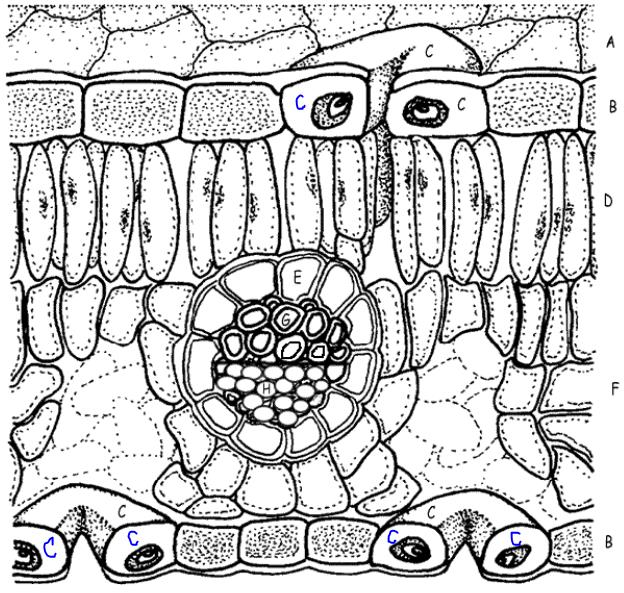
22 Anatomy of the Leaf: Read the following passage about the parts of a leaf. Color the cross section of the leaf. Answer the questions about the passage. The leaf is the primary photosynthetic organ of the plant. The outer surface of the leaf has a thin waxy covering called the cuticle (A), this layer s primary function is to prevent water loss within the leaf. Color the cuticle light green. Directly underneath the cuticle is a layer of cells called the epidermis (B). Color the epidermis yellow. The vascular tissue, xylem (G), which transports water, and phloem (H), which transports sugar, are found within the veins of the leaf. Veins are actually extensions that run from the tips of the roots all the way up to the edges of the leaves. The outer layer of the vein is made of cells called the bundle sheath cells (E), and they create a circle around the xylem and the phloem. Color the bundle sheath cells dark blue, the xylem orange, and the phloem purple. Within the leaf, there is a layer of cells called the mesophyll (D & F). The word mesophyll is greek and means middle leaf. Air spaces in the mesophyll allow for gas exchange. The mesophyll cells are packed with chloroplasts, and this is where photosynthesis actually occurs. Color the mesophyll dark green. The leaf also has tiny holes within the epidermis, called stomata, which allows the exchange of gas. Specialized cells, called guard cells (C) surround the stomata and are shaped like two cupped hands. Changes within water pressure cause the stoma (singular of stomata) to open or close. If the guard cells are full of water, they swell up and bend away from each other which opens the stoma. During dry times, the guard cells close. Color the guard cells pink. 1. What two tissues are found within a vein? 2. What does the word mesophyll mean? 3. What part of the leaf prevents water loss through transpiration? 4. What layer contains chloroplasts? 5. What are the openings that allow for gas exchange? 6. What cells function to open and close the stomata? 7. A stoma in the lower surface of the leaf has a function most similar to the function of which cell structure? A) Cell membrane B) Vacuole C) Ribosome D) Nucleus 22
23 Anatomy of the Flower: Read the following passage, label the parts of the flower using the bold words from the passage, and answer the following questions about the structure and function of the flower. Flowers are the reproductive structures of angiosperms. Flowers are usually both male and female, and are brightly colored to attract insects to help them carry pollen used for sexual reproduction. Not all flowers are colorful, though. These flowers usually use the wind for pollination. The receptacle is the part of the branch on which a flower forms. Color the receptacle brown. Sepals are leaf-like structures that surround and protect the flower before it blooms. Color the sepals green. Petals are colorful parts of the flower that attract insects and even other small animals, such as mice, birds, and bats. Color the petals a bright color of your choice. All angiosperms have flowers, but some are not brightly colored. The petals of these flowers are reduced or absent and the plant relies on the wind or water for pollination. The flower has both male and female reproductive parts. The female reproductive structures are collectively called the pistil. Color the pistil pink. The pistil has 3 parts. The stigma at the top is often sticky and is where the pollen attaches. The style is the long tube that attaches the stigma to the ovary. The ovary houses the ovules or eggs. The male reproductive structures are called the stamens. Each stamen consists of an anther, which produces pollen, and a filament, which supports the anther. Color the anther yellow and leave the filament white. Pollen produced by the anther is carried by insects or other animals to the pistil of another flower where it may fertilize the eggs. Sexual reproduction in plants occurs when the pollen (sperm) from an anther is transferred to the stigma. Plants can fertilize themselves. Self fertilization occurs when the pollen from an anther fertilizes the eggs on the same flower. Cross-fertilization occurs when the pollen is transferred to the stigma of an entirely different plant. When the ovules are fertilized, they will develop into seeds. The petals of the flower fall off leaving only the ovary behind, which will develop into seeds. The petals of the flower fall off leaving only the ovary behind, which will develop into a fruit. A fruit is any structure that encloses and protects a seed. This could be oranges, apples, acorns, or even peanuts. When you eat a fruit, you are actually eating the ovary of the flower. 1. What is an angiosperm? 2. Why are flowers brightly colored? 3. Name two mammals that might pollinate a plant. 4. The female reproductive structures are called the 5. Name 3 parts of the pistil. 6. Where are the ovules or eggs stored? 7. Name two parts of the stamen. 8. What structure does the ovary develop into? 9. Some flowers are not brightly colored at all, but have a very pungent odor that smells like rotting meat. How do you think these flowers are pollinated? 10. In many flowers, the pistils and stamens reach maturity at different times. Considering what you know about pollination, why would this be an advantage to the plant? 23
24 Crosswords Return! You know what to do. Wordbank dermal ground vascular xylem phloem bryophyte sporophyte angiosperm gymnosperm transpiration stomata cuticle stamen pistil fertilization Across 3. In plants, it is the process of transferring pollen to the ovary which results in seeds and a fruit 4. Vascular tissue that transports water from the roots up 5. Tissue that supports dermal and vascular tissue 6. Control the process of transpiration by allowing CO2, O2, and H2O to diffuse in and out of the leaves 11. Process of drawing water through the plant by allowing water to evaporate out of the leaves 13. Vascular tissue that carries nutrients from the leaves down 14. Small non-vascular plants that require water to reproduce Down 1. Tissue that protects the outer surface of the plant 2. Tissue that transports water and nutrients through the plant 5. Medium to large vascular plants that reproduce by creating cones 7. Outer coating of the leaf that limits water loss 8. Small to medium sized vascular plants that reproduce by dropping spores 9. Female reproductive part of a flower (consists of a style, stigma, and ovary) 10. Male reproductive part of a flower (consists of the anther and filament) 12. Medium to large vascular plants that reproduce by creating flowers/fruits 24
25 Name Date Period 1. What are 6 characteristics of all plants? Plant Test Review 2. What are the 3 things a plant needs to make its own food? Think about the photosynthesis equation. 3. What are the differences between vascular and nonvascular plants? 4. What are the 4 different kinds of plants? 5. What is alternation of generations and which plants use this to reproduce? 6. Why are mosses so small? 7. What is the function of the xylem? What is the function of phloem? 8. The pollen grain contains the which travels down the pollen. The sperm unites first with the, then with the. For the following descriptions in #9-25, indicate if they are describing angiosperms (A), gymnosperms (G), ferns (F), or bryophytes (B). Some answers may have more than one plant. 9. Does not have vascular tissue. 10. Does not produce seeds 11. Produces seeds that are protected in a fruit? 12. Produces seeds that are uncovered or naked 13. Cone bearing 14. Flowering plants 15. Seedless 16. Nonvascular 17. Vascular 25
26 18. Bear their seeds directly on cones 19. Produce flowers 20. Must live near water source 21. Require water for sperm to swim to egg 22. Does not require water for fertilization 23. Often small in size 24. Examples include mosses, hornworts, and liverworts 25. Examples include confers such as pines and spruces 26. What are the two classes of angiosperms? 27. What are the differences between monocots and dicots? 28. There are two types of root structures: taproot system and fibrous root system. Draw a picture that represents each root system. 29. What are the 3 functions of a stem? 30. The bulk of most leaves consist of a specialized ground tissue full of chloroplasts known as. 31. The mesophyll consists of which two layers? Describe each layer. 32. Label all the structures in the picture of the cross-section of a leaf. 33. In what two layers of cells in the leaf does most photosynthesis take place? 34. What is a petiole? Draw a picture to represent it also. 26
27 35. What is transpiration? 36. What is the difference between simple and compound leaves? 37. What is phototropism? Draw a plant showing phototropism. 38. What is gravitropism? Draw a plant showing gravitropism. Use the flower drawing to the right: 39. Label B, C, D, E, F, G, J on the picture 40. Identify the male parts and the female parts. 41. What part becomes the fruit and protects the seed? 42. Where is pollen produced? 43. Where does pollen frequently land? 44. The develops into the fruit. 27
28 28
10B Plant Systems Guided Practice
 10B Plant Systems Guided Practice Reproduction Station 1 1. Observe Plant A. Locate the following parts of the flower: stamen, stigma, style, ovary. 2. Draw and label the parts of a flower (listed above)
Flowers; Seeds enclosed in fruit
 Name Class Date Chapter 22 Plant Diversity Section Review 22-1 Reviewing Key Concepts Short Answer On the lines provided, answer the following questions. 1. Describe the main characteristics of plants.
Section 24 1 Reproduction With Cones and Flowers (pages 609 616)
 Chapter 24 Reproduction of Seed Plants Section 24 1 Reproduction With Cones and Flowers (pages 609 616) This section describes the reproductive structures of gymnosperms and angiosperms. It also explains
Plant Classification, Structure, Growth and Hormones
 Biology SAT II Review Sheet Plants Plant Classification, Structure, Growth and Hormones Multicellular autotrophs (organisms that use the energy of inorganic materials to produce organic materials) Utilize
8. Study the cladogram underline the derived characteristics and circle the organisms that developed from them.
 Seed Plants: Gymnosperms and Angiosperms Answer the questions as you go through the power point, there are also paragraphs to read where you will need to hi-lite or underline as you read. 1. What are the
Section 24 1 Reproduction With Cones and Flowers (pages 609 616)
 Chapter 24 Reproduction of Seed Plants Section 24 1 Reproduction With Cones and Flowers (pages 609 616) Key Concepts What are the reproductive structures of gymnosperms and angiosperms? How does pollination
Introduction to Plants
 Introduction to Plants Unity and Diversity of Life Q: What are the five main groups of plants, and how have four of these groups adapted to life on land? 22.1 What are of plants? WHAT I KNOW SAMPLE ANSWER:
Biology 172L General Biology Lab II Lab 03: Plant Life Cycles and Adaptations II: Gymnosperms and Angiosperms
 Biology 172L General Biology Lab II Lab 03: Plant Life Cycles and Adaptations II: Gymnosperms and Angiosperms Introduction Vascular seed-bearing plants, such as gymnosperms (cone-bearing plants) and angiosperms
Biology 213 Angiosperms. Introduction
 Biology 213 Angiosperms Introduction The flowering plants, the angiosperms, are the most recent plants to evolve and quickly became the dominant plant life on this planet. They are also the most diverse
Vascular Plants Bryophytes. Seedless Plants
 plant reproduction The Plants Vascular Plants Bryophytes Liverworts, Hornworts, Mosses lack roots and specialized tissues grow in moist, shady areas All have sieve cells and tracheids Seedless Plants Ferns
Plants have organs composed of different tissues, which in turn are composed of different cell types
 Plant Structure, Growth, & Development Ch. 35 Plants have organs composed of different tissues, which in turn are composed of different cell types A tissue is a group of cells consisting of one or more
Unit 10- Plants /Study Guide KEY
 Plant Diversity Unit 10- Plants /Study Guide KEY Answer Key SECTION 20.1. ORIGINS OF PLANT LIFE 1. eukaryotic, photosynthetic, same types of chlorophyll, starch as storage product, cellulose in cell walls
4th GRADE MINIMUM CONTENTS-NATURAL SCIENCE UNIT 11: PLANTS
 PLANT BITS 4th GRADE MINIMUM CONTENTS-NATURAL SCIENCE UNIT 11: PLANTS There are four main parts to a plant. They are the root, stem, leaf and flower. Each part has an important task to do in the life of
Anatomy and Physiology of Leaves
 I. Leaf Structure and Anatomy Anatomy and Physiology of Leaves A. Structural Features of the Leaf Question: How do plants respire? Plants must take in CO 2 from the atmosphere in order to photosynthesize.
And the Green Grass Grew All Around and Around, the Green Grass Grew All. Evolution of Plants
 And the Green Grass Grew All Around and Around, the Green Grass Grew All Around Evolution of Plants Adapting to Terrestrial Living Plants are complex multicellular organisms that are autotrophs they feed
IGCSE and GCSE Biology. Answers to questions. Section 2. Flowering Plants. Chapters 6-9. Chapter 6 Plant structure and function
 1 IGCSE and GCSE Biology. Answers to questions Section 2. Flowering Plants. Chapters 6-9 Chapter 6 Plant structure and function Page 54 1. a Epidermis. Helps maintain shape, reduces evaporation, resists
Plant Parts. Background Information
 Purpose The purpose of this lesson is for students to learn the six basic plant parts and their functions. Time Teacher Preparation: 30 minutes Student Activity: 60 minutes Materials For the teacher demonstration:
Lecture 7: Plant Structure and Function. I. Background
 Lecture 7: Plant Structure and Function I. Background A. Challenges for terrestrial plants 1. Habitat is divided a. Air is the source of CO2 for photosynthesis i. Sunlight cannot penetrate soil b. Soil
Fungi and plants practice
 Name: Period: Date: Fungi and plants practice Multiple Choice Identify the choice that best completes the statement or answers the question. Indicate your answer choice with an UPPER CASE letter in the
WHAT ARE THE DIFFERENCES BETWEEN VASCULAR AND NON- VASCULAR PLANTS?
 WHAT ARE THE DIFFERENCES BETWEEN VASCULAR AND NON- VASCULAR PLANTS? Let s take a closer look. What makes them different on the outside and inside? Learning Intentions To understand how vascular plant cells
Plant Structure, Growth, and Development. Chapter 35
 Plant Structure, Growth, and Development Chapter 35 PLANTS developmental plasticity = ability of plant to alter form to respond to environment Biological heirarchy Cell basic unit of life Tissue group
Leaf Structure and Transpiration
 10 LESSON Leaf Structure and Transpiration INTRODUCTION Have you wondered what happens to all that water that disappears from the reservoir of your growing system? Although some might have evaporated from
Plant Reproduction. 2. Evolutionarily, floral parts are modified A. stems B. leaves C. roots D. stolons E. suberins
 Plant Reproduction 1. Angiosperms use temporary reproductive structures that are not present in any other group of plants. These structures are called A. cones B. carpels C. receptacles D. flowers E. seeds
CELERY LAB - Structure and Function of a Plant
 CELERY LAB - Structure and Function of a Plant READ ALL INSTRUCTIONS BEFORE BEGINNING! YOU MAY WORK WITH A PARTNER ON THIS ACTIVITY, BUT YOU MUST COMPLETE YOUR OWN LAB SHEET! Look at the back of this paper
Flower Model: Teacher Instructions Sepals Anther Stamens (male) Filament Stigma Pistil Style (female) Ovary Petals sepals petals stamens pistil
 Flower Model: Teacher Instructions In order to better understand the reproductive cycle of a flower, take a look at some flowers and note the male and female parts. Most flowers are different; some have
PLANT EVOLUTION DISPLAY Handout
 PLANT EVOLUTION DISPLAY Handout Name: TA and Section time Welcome to UCSC Greenhouses. This sheet explains a few botanical facts about plant reproduction that will help you through the display and handout.
Kingdom Plantae Plant Diversity II
 Kingdom Plantae Plant Diversity II Professor Andrea Garrison Biology 3A Illustrations 2014 Cengage Learning unless otherwise noted Text 2014 Andrea Garrison Plant Diversity II 2 Plant Classification Bryophytes
CELERY LAB - Structure and Function of a Plant
 CELERY LAB - Structure and Function of a Plant READ ALL INSTRUCTIONS BEFORE BEGINNING! YOU MAY WORK WITH A PARTNER ON THIS ACTIVITY, BUT YOU MUST COMPLETE YOUR OWN LAB SHEET! Plants are incredible organisms!
Photosynthesis. Chemical Energy (e.g. glucose) - They are the ultimate source of chemical energy for all living organisms: directly or indirectly.
 Photosynthesis Light Energy transduction Chemical Energy (e.g. glucose) - Only photosynthetic organisms can do this (e.g. plants) - They are the ultimate source of chemical energy for all living organisms:
Expt. How do flowering plants do it without flagella? The journey to find an egg. What causes pollen grain germination and tube growth?
 1 Expt. How do flowering plants do it without flagella? The journey to find an egg. What causes pollen grain germination and tube growth? File: F12-07_pollen Modified from E. Moctezuma & others for BSCI
Dissect a Flower. Huntington Library, Art Collections, and Botanical Gardens
 Huntington Library, Art Collections, and Botanical Gardens Dissect a Flower Overview Students dissect an Alstroemeria or similar flower to familiarize themselves with the basic parts of a flower. They
2. Fill in the blank. The of a cell is like a leader, directing and telling the different parts of the cell what to do.
 1. Plant and animal cells have some similarities as well as differences. What is one thing that plant and animal cells have in common? A. cell wall B. chlorophyll C. nucleus D. chloroplasts 2. Fill in
PLANT DIVERSITY. EVOLUTION OF LAND PLANTS KINGDOM: Plantae
 PLANT DIVERSITY 1 EVOLUTION OF LAND PLANTS KINGDOM: Plantae Spores Leaf Ancestral green algae Flagellated sperm for reproduction Plenty of water Nutrients and CO 2 diffuse into tissues Holdfast Flagellated
Angiosperm Reproduction: Flowers, Fruits, and Seeds Overview Objectives bold Part I Floral Anatomy . calyx sepals corolla, petals, stamens, filament
 Angiosperm Reproduction: Flowers, Fruits, and Seeds Overview In this lab you will observe assorted flowers, fruits, and seeds to better understand the unique adaptations of and the life cycle of angiosperms.
nucleus cytoplasm membrane wall A cell is the smallest unit that makes up living and nonliving things.
 1 In nature there are living things and nonliving things. Living things depend on three basic life processes: nutrition, sensitivity and reproduction. Living things are made up of cells. 1. Match the two
Transpiration. C should equal D.BUT SOMETIMES. 1. Loss in mass is greater than volume of water added.
 Transpiration Transpiration is the loss of water by evaporation from the leaves through the stomata. The source of water for the plants is soil water. It is taken up by root hair cells by osmosis. Once
Plant Structure and Function Notes
 For plants, when they made the transition from water to land, they had to make adaptations for obtaining water and prevent loss by desiccation (drying out) -water also needed for fertilization of eggs
Chapter 3. Biology of Flowering Plants: Reproduction. Gametophytes, Fruits, Seeds, and Embryos
 BOT 3015L (Sherdan/Outlaw/Aghoram); Page 1 of 13 Chapter 3 Biology of Flowering Plants: Reproduction Gametophytes, Fruits, Seeds, and Embryos Objectives Angiosperms. Understand alternation of generations.
Parts of a Flower and Pollination
 Science Unit: Lesson 3: Soils, Plants, and First Nations Parts of a Flower and Pollination School year: 2007/2008 Developed for: Britannia Elementary School, Vancouver School District Developed by: Catriona
Seed plants are well adapted to the demands of life on land,
 24 1 Reproduction With Cones and Flowers Seed plants are well adapted to the demands of life on land, especially in how they reproduce. The gametes of seedless plants, such as ferns and mosses, need water
What's in a Flower. Ages: 8 to 12. Contributor: Susan Jaquette, Cornell Plantations volunteer
 Ages: 8 to 12 What's in a Flower Contributor: Susan Jauette, Cornell Plantations volunteer Main idea: Flowers are composed of several distinct parts, each of which plays an important role in nature. Objective:
2 nd Grade Science Unit B: Life Sciences Chapter 3: Plants and Animals in Their Environment Lesson 1: How are plants and animals like their parents?
 2 nd Grade Science Unit B: Life Sciences Chapter 3: Plants and Animals in Their Environment Lesson 1: How are plants and animals like their parents? offspring Offspring are young plants and animals. Offspring
Plant Parts and Their Function
 Science Unit: Lesson 6: Plants Plant Parts and Their Function School year: 2004/2005 Developed for: Developed by: Grade level: Duration of lesson: Queen Alexandra Elementary School, Vancouver School District
Chapter 38: Angiosperm Reproduction and Biotechnology
 Name Period Concept 38.1 Flowers, double fertilization, and fruits are unique features of the angiosperm life cycle This may be a good time for you to go back to Chapter 29 and review alternation of generation
Topic 3: Nutrition, Photosynthesis, and Respiration
 1. Base your answer to the following question on the chemical reaction represented below and on your knowledge of biology. If this reaction takes place in an organism that requires sunlight to produce
Roots and Stems and Leaves, Oh My!
 Roots and Stems and Leaves, Oh My! Objectives 1. The student will be able to identify parts of a plant. 2. The student will understand the function of plant parts. Grade Level 1-3 4-6 TEKS: 1.6B, 2.6C;
2. What kind of energy is stored in food? A. chemical energy B. heat energy C. kinetic energy D. light energy
 Assessment Bank Matter and Energy in Living Things SC.8.L.18.4 1. What is energy? A. anything that takes up space B. anything that has mass C. the ability to conduct current D. the ability to do work 2.
Chapter 36: Resource Acquisition & Transport in Vascular Plants
 Chapter 36: Resource Acquisition & Transport in Vascular Plants 1. Overview of Transport in Plants 2. Transport of Water & Minerals 3. Transport of Sugars 1. Overview of Transport in Plants H 2 O CO 2
Laboratory. Leaves: Specialized Plant Organs
 Laboratory 5 Leaves: Specialized Plant Organs 1 Laboratory 1: Leaves OBJECTIVES After completing this lab you will be able to: 1. Describe and name leaf patterns 2. Identify the structural differences
Cells, tissues and organs
 Chapter 8: Cells, tissues and organs Cells: building blocks of life Living things are made of cells. Many of the chemical reactions that keep organisms alive (metabolic functions) take place in cells.
Plant Responses to Environmental Cues Tropisms, Photoperiodism, and Plant Hormones
 Plant Responses to Environmental Cues Tropisms, Photoperiodism, and Plant Hormones Plant Responses to Environmental Cues Phototropism - plant growth response to light shoots bend toward light - positive
Plants, like all other living organisms have basic needs: a source of nutrition (food),
 LEARNING FROM LEAVES: A LOOK AT LEAF SIZE Grades 3 6 I. Introduction Plants, like all other living organisms have basic needs: a source of nutrition (food), water, space in which to live, air, and optimal
GRADE 7: Life science 1. UNIT 7L.1 7 hours. Specialised cells. Resources. About this unit. Previous learning. Key vocabulary and technical terms
 GRADE 7: Life science 1 Specialised cells UNIT 7L.1 7 hours About this unit This unit is the first of six units on life science for Grade 7. This unit is designed to guide your planning and teaching of
Question Bank Five Kingdom Classification
 Question Bank Five Kingdom Classification 1. Who proposed Five Kingdom Classification? Give the bases of classification. Ans. Whittaker in 1969 proposed five kingdom classification based on :- (i) Cell
Functional Biology of Plants
 Brochure More information from http://www.researchandmarkets.com/reports/2252012/ Functional Biology of Plants Description: Functional Biology of Plants provides students and researchers with a clearly
How To Understand Plant Biology
 SECOND GRADE PLANT LIFE 2 weeks LESSON PLANS AND ACTIVITIES LIFE CYCLE OVERVIEW OF SECOND GRADE ORGANISMS WEEK 1. PRE: Distinguishing characteristics of vertebrates. LAB: Discovering characteristics of
3) Transpiration creates a force that pulls water upward in. xylem. 2) Water and minerals transported upward form roots to shoots in.
 3) Transpiration creates a force that pulls water upward in xylem Figure 36.1 An overview of transport in whole plants (Layer 1) Transport in plants 2) Water and minerals transported upward form roots
DID YOU KNOW that the plants most important to
 Flower Anatomy DID YOU KNOW that the plants most important to agriculture all produce flowers? Every major food crop is a flowering plant. We do not think about the flowers of wheat, rice, corn, and soybeans.
4.1 Chemical Energy and ATP. KEY CONCEPT All cells need chemical energy.
 4.1 Chemical Energy and ATP KEY CONCEPT All cells need chemical energy. 4.1 Chemical Energy and ATP Molecules in food store chemical energy in their bonds. Starch molecule Glucose molecule The chemical
Photosynthesis and (Aerobic) Respiration. Photosynthesis
 Photosynthesis and (Aerobic) Respiration These two processes have many things in common. 1. occur in organelles that seem to be descended from bacteria (endosymbiont theory): chloroplasts and mitochondria
TREE STRUCTURE AND BIOLOGY
 TREE STRUCTURE AND BIOLOGY Introduction. Sarasota County lies along a transient tension zone line. In this region, climate cycles cause periods of warmer weather, when normally tropical trees find their
Exchange and transport
 Exchange and transport Examples of things which need to be interchanged between an organism and its environment include: Respiratory gases Nutrients Excretory products Heat This exchange can take place
Water movement in the xylem Water moves from roots to leaves through the xylem. But how? Hypotheses: 1. Capillary action - water will move upward in
 Transport in Plants Two Transport Processes Occur in Plants 1. Carbohydrates carried from leaves (or storage organs) to where they are needed (from sources to sinks) 2. Water transported from roots to
Plants, like all living organisms have basic needs: a source of nutrition (food), water,
 WHAT PLANTS NEED IN ORDER TO SURVIVE AND GROW: LIGHT Grades 3 6 I. Introduction Plants, like all living organisms have basic needs: a source of nutrition (food), water, space in which to live, air, and
Comparing Plant and Animal Cells
 1.2 Comparing Plant and Animal Cells Here is a summary of what you will learn in this section: Plant and animal cell structures are called organelles. Plant and animal cells perform some similar functions,
Virginia Gardener http://www.hort.vt.edu/envirohort
 The Virginia Gardener http://www.hort.vt.edu/envirohort Name Help Sheets: Things Plants Need There are certain things that every living thing needs in order to live and grow. Just like you, plants need
1. The leaf is the main photosynthetic factory (Fig. 36.1, p. 702)
 TRANSPORT IN PLANTS A. Introduction 1. The leaf is the main photosynthetic factory (Fig. 36.1, p. 702) a. This requires a transport system to move water and minerals from the roots to the leaf. This is
Lab 9: The Reproduction of Angiosperms and the Role of the Pollinator
 Lab 9: The Reproduction of Angiosperms and the Role of the Pollinator Understanding the role and structure of a flower Flowers are the reproductive organs of angiosperms. They are not simple structures,
Chapter 14: Page 181
 Chapter 14: Page 181 Chapter 14: Page 182 The plant kingdom contains organisms that can be divided into two separate groups: nonvascular plants (like mosses) that absorb water through their entire body
Transport in Plants. Lab Exercise 25. Introduction. Objectives
 Lab Exercise Transport in Plants Objectives - Become familiar and be able to recognize the different types of cells found in the plant s vascular tissue. - Be able to describe root pressure and transpiration
Plants and Photosynthesis
 Plants and Photosynthesis Original Authors: Jennifer Michnowicz and Lois Kiraly Revision June 2006: Jennifer Michnowicz and Rebecca Shomo Farmington Public Schools 11 th Grade Biology Rebecca Shomo/Jennifer
The Tiny Seed Written and Illustrated by Eric Carle 1987, Aladdin Paperbacks ISBN 0-689-84244-9
 Teacher s Guide to Third and Fourth Grade Reading and Writing Exercises for Written and Illustrated by Eric Carle 1987, Aladdin Paperbacks ISBN 0-689-84244-9 Developed by Jennifer A. Seitz For Florida
Pre-lab homework Lab 2: Reproduction in Protists, Fungi, Moss and Ferns
 Pre-lab homework Lab 2: Reproduction in Protists, Fungi, Moss and Ferns Lab Section: Name: 1. Last week in lab you looked at the reproductive cycle of the animals. This week s lab examines the cycles of
BIOL 1030 TOPIC 5 LECTURE NOTES TOPIC 5: SEEDLESS VASCULAR PLANTS (CH. 29)
 TOPIC 5: SEEDLESS VASCULAR PLANTS (CH. 29) I. Vascular Plants (overview) plants with xylem and phloem 7 or 9 living phyla, depending on who you talk to able to dominate most terrestrial habitats because
Impressions of a Stoma
 Huntington Library, Art Collections, and Botanical Gardens Impressions of a Stoma Overview Students use two different methods to view stomata on the underside of leaves. Introduction Plants exchange the
6.4 Taigas and Tundras
 6.4 Taigas and Tundras In this section, you will learn about the largest and coldest biomes on Earth. The taiga is the largest land biome and the tundra is the coldest. The taiga The largest land biome
3MNN Behavioral Outcomes Eat fruits and veggies, etc. SNAP-Education Nutrition Messages Eat fruits and veggies as healthy snacks, MyPyramid servings
 DRAFT 1 Lesson Plan Title: Phenomenal Plant Parts Grade Level: 3 Content Area: Science Setting: School garden, or classroom Instructional Time: 60 to 90 minutes Grade Level Expectations: Life Science L.OL.E3:
Photosynthesis 6CO 2 + 6H 2 O C 6 H 12 O 6 + 6O 2. An anabolic, endergonic, carbon dioxide (CO 2
 PHOTOSYNTHESIS Photosynthesis An anabolic, endergonic, carbon dioxide (CO 2 ) requiring process that uses light energy (photons) and water (H 2 O) to produce organic macromolecules (glucose). photons SUN
Plant Growth & Development. Growth Stages. Differences in the Developmental Mechanisms of Plants and Animals. Development
 Plant Growth & Development Plant body is unable to move. To survive and grow, plants must be able to alter its growth, development and physiology. Plants are able to produce complex, yet variable forms
Double Fertilization and Post - Fertilization Events: Measuring
 WFP062298 Double Fertilization and Post - Fertilization Events: Measuring Concepts In plants fertilization is the event in sexual reproduction which follows pollination. In higher plants, two sperm are
Making a Terrarium. fairchild tropical botanic garden 1
 Making a Terrarium What is a Terrarium? A terrarium is a collection of small plants growing in a transparent, sealed container. A terrarium is a closed environment, and can actually be used to illustrate
2- The Top and bottom of the leaf is covered by thin layer of cells called epidermis that allow sunlight to easily pass into the middle of the leaf.
 Final exam summary sheet Topic 5, lesson 2 How leaf is adapted to carry on photosynthesis? 1- Waxy layer called the cuticle cover the leaf slow the water loss. 2- The Top and bottom of the leaf is covered
Chapter 1 Structure of Living Things... 1 Chapter 2 Plant Structures and Functions... 21 Chapter 3 Human Body Systems... 41
 Contents Life Science Chapter 1 Structure of Living Things............................. 1 Chapter 2 Plant Structures and Functions........................ 21 Chapter 3 Human Body Systems................................
Plant Anatomy Lab 2: Flowers, Fruits and Seeds
 Plant Anatomy Lab 2: Flowers, Fruits and Seeds Objectives of the Lab: 1) Explore the structure and function of flowering plant reproductive organs from flower development through fruit maturation. 2) Examine
LAB 24 Transpiration
 Name: AP Biology Lab 24 LAB 24 Transpiration Objectives: To understand how water moves from roots to leaves in terms of the physical/chemical properties of water and the forces provided by differences
Photosynthesis Lesson Plan 1. Introduction to Photosynthesis (grade 4) Objectives:
 Photosynthesis Lesson Plan 1 Introduction to Photosynthesis (grade 4) Identify types of living things that use photosynthesis. Understand the concept of photosynthesis. Observe how flowers are grown. First
Lesson 1 Characteristics of Life
 Lesson 1 Student Labs and Activities Page Appropriate For: Launch Lab 8 all students Content Vocabulary ELL 9 all students Lesson Outline ELL 10 all students MiniLab 12 all students Content Practice A
Mighty Oaks From Little Acorns
 Science Process: Observe and Measure / Life Science / Math: Measurement (Length), data Analysis (graphing) / reading: Sequencing / Listening / Writing / Visual Arts expression Background Buds are on the
What is a Terrarium? Supplies Choosing your container Choosing your plants Building Your Terrarium
 What is a Terrarium? A terrarium is a collection of small plants growing in a transparent, sealed container. A terrarium is a closed environment, and can actually be used to illustrate how an ecosystem
PEACH TREE PHYSIOLOGY
 PEACH TREE PHYSIOLOGY David W. Lockwood Department of Plant Sciences & Landscape Systems University of Tennessee Knoxville, TN 37996 D. C. Coston Agricultural Experiment Station Oklahoma State University
Regional Parks Botanic Garden Plant Adaptations to Habitat Tour: Selected Plant Adaptations by Garden Section
 INTRO Regional Parks Botanic Garden Plant Adaptations to Habitat Tour: Selected Plant Adaptations by Garden Section Tools (optional, but nice to use): -Discovery Scope -Spray bottle of water--from the
Exemplar for Internal Achievement Standard. Biology Level 2
 Exemplar for internal assessment resource Biology for Achievement Standard 91160 Exemplar for Internal Achievement Standard Biology Level 2 This exemplar supports assessment against: Achievement Standard
LESSON 4: THE VASCULAR SYSTEM
 LESSON 4: THE VASCULAR SYSTEM LEVEL ONE Without water, plants die very quickly. A plant must have a way to absorb water and distribute it to all its cells. Osmosis works very well for mosses and liverworts
Germination is the process in which a
 The Germination Of a Bean Photographs and article By Lily C. Gerhardt [email protected] Germination is the process in which a seed, spore, or fungi sprouts, or begins growth. Seed germination can occur after
Transport in Plants Notes AP Biology Mrs. Laux 3 levels of transport occur in plants: 1. Uptake of water and solutes by individual cells
 3 levels of transport occur in plants: 1. Uptake of water and solutes by individual cells -for photosynthesis and respiration -ex: absorption of H 2 O /minerals by root hairs 2. Short distance cell-to-cell
Lab: Plant tissue systems and cell types
 Lab: Plant tissue systems and cell types In this lab we will become familiar with the main types of plant cells and tissues. You ll look at cells in the ground tissue, dermal tissue and vascular tissue.
Can you see the difference between wind pollinated and insect pollinated flowers?
 Can you see the difference between wind pollinated and insect pollinated flowers? Age of Students 10 14 years Duration 1 hour Summary Pollination is a very effective factor in the evolution of plants and
The Seed Challenge How Many Seeds Can You Get from a Single Seed?
 The Seed Challenge How Many Seeds Can You Get from a Single Seed? Grade Level: K-4 Catalog Number: 15-8973 Time to pollinate the flowers Time to harvest the seeds True leaves grow Day 3 Day 7 Day 14 Day
Climate, Vegetation, and Landforms
 Climate, Vegetation, and Landforms Definitions Climate is the average weather of a place over many years Geographers discuss five broad types of climates Moderate, dry, tropical, continental, polar Vegetation: