
Activating jobseekers through entrepreneurship:
|
|
|
- Lambert Houston
- 10 years ago
- Views:
Transcription
1 ISSN Activating jobseekers through entrepreneurship: Start-up incentives in Europe EEPO Review Social Europe

2 This publication is based on national articles provided by the EEPO expert network. National articles are the sole responsibility of the author(s). The contents of this publication do not necessarily reflect the position or opinion of the European Commission or ICF International. Neither the European Commission nor any person/organisation acting on behalf of the Commission is responsible for the use that might be made of any information contained in this publication. European Commission Loris Di Pietrantonio, Federico Pancaldi and Monika Kalocinska (Employment, Social Affairs and Inclusion DG, Unit C.1) Belgium: Robert Plasman, DULBEA Université de Bruxelles (University of Brussels) Brussels Bulgaria: Pobeda Loukanova, Economic Research Institute Sofia Czech Republic: Daniel Münich, CERGE-EI Centre for Economic Research & Graduate Education (Charles University) Economics Institute (Czech Academy of Sciences) Prague Denmark: Per Kongshøj Madsen, CARMA Centre for Labour Market Research, Aalborg Universitet (Aalborg University) Aalborg Germany: Nicola Düll, Economix Research & Consulting Munich Estonia: Reelika Leetmaa, Praxis Centre for Policy Studies Tallinn Ireland: Seamus McGuiness, Economic and Social Research Institute Dublin Greece: Dimitris Karantinos, EKKE National Centre of Social Research Athens Spain: Elvira González Gago, CEET Centro de Estudios Económicos Tomillo, SL (Tomillo Centre for Economic Studies) Madrid France: Sandrine Gineste, Bernard Brunhes Consultants Paris Italy: Giuseppe Ciccarone, Fondazione Giacomo Brodolini (Giacomo Brodolini Foundation) Rome Cyprus: Louis N. Christofides, University of Cyprus Nicosia Latvia: Alfreds Vanags, BICEPS Baltic International Centre for Economic Policy Studies Riga Lithuania: Boguslavas Gruževskis and Inga Blaziene, Institute of Labour and Social Research Vilnius Luxembourg: Patrick Thill, CEPS/INSTEAD Centre d Etudes de Populations, de Pauvreté et de Politiques Socio-Economiques (Centre for the Study of Population, Poverty and Socioeconomic Policy)/International Network for Studies in Technology, Environment, Alternatives, Development Differdange Malta: Manwel Debono, Centre for Labour Studies, L-Università ta Malta (University of Malta) Msida Netherlands: Sonja Bekker, ReflecT Institute, Universiteit van Tilburg (University of Tilburg) Tilburg Austria: Ferdinand Lechner, Lechner, Reiter und Riesenfelder Sozialforschung OG Vienna Poland: Łukasz Sienkiewicz, Szkoła Główna Handlowa w Warszawie (Warsaw School of Economics) Warsaw Portugal: Reinhard Naumann, DINÂMIA Centro de Estudos sobre a Mudança Socioeconómica (Research Centre on Socioeconomic Change) Lisbon Romania: Cătălin Ghinăraru, National Labour Research Institute Bucharest Slovenia: Miroljub Ignjatović, Fakulteta za druzbene vede, Univerza v Ljubljani (Faculty of Social Sciences, University of Ljubljana) Ljubljana Slovakia: Luboš Vagač, Centrum pre hospodársky rozvoj (Centre for Economic Development) Bratislava Finland: Robert Arnkil, Työelämän tutkimuskeskus Tampereen yliopisto (Work Research Centre, Tampere University) Helsinki Sweden: Dominique Anxo, CELMS HB Centre for European Labour Market Studies HB Gothenburg United Kingdom: Kenneth Walsh, TERN Training & Employment Research Network Kidderminster Iceland: Sveinn Agnarsson, Viðskiptafræðideild, Háskóli Íslands School of Business, University of Iceland) Reykjavik EEPO Network Services ICF International 30 St Paul s Square Birmingham B3 1QZ UNITED KINGDOM Tel.: Fax: [email protected] Director: Patricia Irving Managers: Caroline Lambert and Anna Manoudi Editors: Anna Manoudi, Joanne Moore, Claire Duchemin, Leona Walker Finlay, David Scott, Lucy Arora, Julie Farrell. About the EEPO This report was produced by the European Employment Policy Observatory (EEPO). The EEPO is a European network, which publishes regular and independent research on a range of topics relating to employment and the labour market. For more information and products, visit the EEPO homepage. Croatia: Zdenko Babić, Faculty of Law, University of Zagreb Zagreb Hungary: Zsombor Cseres-Gergely, Magyar Tudományos Akadémia KRTK, Közgazdaságtudományi Intézet (Institute of Economics, Centre for Economic and Regional Studies of the Hungarian Academy of Sciences) Budapest

3 European Employment Policy Observatory Review Activating jobseekers through entrepreneurship: Start-up incentives in Europe 2014 European Commission Directorate-General for Employment, Social Affairs and Inclusion Unit C.1 Manuscript completed in October 2014

4 Neither the European Commission nor any person/organisation acting on behalf of the Commission is responsible for the use that might be made of any information contained in this publication. The links in this publication were correct at the time the manuscript was completed. Cover photo: Belgaimage For any use or reproduction of photos which are not under European Union copyright, permission must be sought directly from the copyright holder(s). Europe Direct is a service to help you find answers to your questions about the European Union. Freephone number (*): (*) The information given is free, as are most calls (though some operators, phone boxes or hotels may charge you). More information on the European Union is available on the Internet ( Luxembourg: Publications Office of the European Union, 2014 ISBN doi: /23063 (online) ISBN doi: /23442 (epub) ISSN European Union, 2014 Reproduction is authorised provided the source is acknowledged.
5 Abbreviations ACCRE AGEFIPH ALMP APCE ARCE CATI CLO EEPO ESF GDP IEFP ISS NACRE NEA NEET NGO OAED OECD PAECPE PES PEOE SME SUS UIF VET VVT Assistance to the unemployed creating or taking over a business (Aide au Chômeur Créant ou Reprenant une Entreprise), France Foundation for the career development of disabled people (Association Nationale de Gestion du Fonds pour l Insertion Professionnelle des Personnes Handicapées), France Active Labour Market Policy Agency for Business Creation (Agence Pour la Création d Entreprises), France Assistance to the taking over and creation of an enterprise (Aide à la reprise et à la creation d entreprise), France Computer-assisted telephone interview Central Labour Office, Slovakia European Employment Policy Observatory European Social Fund Gross Domestic Product Public Employment Service (Instituto do Emprego e Formação Profissional), Portugal Institute for Social Security (Instituto da Segurança Social), Portugal Renewed Support for the Creation and Take Over of an Enterprise (Nouvel Accompagnement pour la Création et la Reprise), France New Enterprise Allowance, UK Not in Education, Employment or Training Non-governmental Organisation Manpower Employment Organisation, Greece Organisation for Economic Co-operation and Development Support Programme for Entrepreneurship Self-Employment (Programa de Apoio ao Empreendedorismo e à Criação do Próprio Emprego), Portugal Public employment service Stimulus Programme for Job Offers (Programa de Estίmulo à Oferta de Emprego), Portugal Small and medium-sized enterprises Start-up subsidies Unemployment Insurance Fund, Estonia Vocational education and training Support for Entrepreneurship (vállalkózóvá válási támogatás), Hungary 3
6 Summary of key messages This Review paints a picture of how 29 countries in Europe (EU 28 and Iceland) have been supporting unemployed people to set up their own businesses through start-up incentives. The Review explores the available measures investigating whether start-up incentives can help people out of unemployment for the long-term. It looks at the share of people who benefit from such schemes in Europe, as well as the potential biases in the types of individuals and businesses that succeed. Finally, it presents the necessary conditions for successful incentives and proposes recommendations for the successful design of measures and for further research that would be required to support policy-makers that wish to introduce or further develop start-up incentive measures. Start-up incentives include non-repayable monetary incentives, loan programmes offering preferential terms, and tax and social security exemptions. Start-up incentives are often combined with guidance and training, income support, mentoring and other features; they are generally not sector-specific and target the unemployed in general, rather than specific groups of the unemployed. Unemployed people face wide-ranging barriers to starting a business. Experience in Member States shows design features that can help to address these barriers: Unemployed people wanting to start their own business are concerned about lack of income security due to self-employed status, particularly in the initial stages of business creation. Many schemes involve a mixture of financial support comprising help with living costs during the formative stages of business set-up and access to loans for capital equipment. Income security measures in the initial stages of the business are more important than the receipt of block loans or subsidies for investment in the business. However, start-up incentives also need investment in the enterprise s infrastructure or operating costs. Lack of entrepreneurial skills and knowledge are key barriers for the unemployed. Entrepreneurs need business support as well as financial support, and there is also a need to help unemployed people bring the business onto the market, extend their working time as self-employed, and tackle the financial burden involved in running a business. Conditionality in start-up incentives is crucial in designing effective measures. Conditions on participation encompass: length of unemployment for participation; age of recipients; balancing giving sufficient incentives with minimising abuse; preferring business ideas/plans with better chances of viability, lower likelihood of distorting competition or crowding-out other companies; the qualities of individual applicants etc. Start-up incentives can effectively link to a range of other ALMP measures and also need to be seen in the context of the wider frameworks for business support and enterprise development in each national context. Key messages on successful complementarity are as follows: A package of support often features a phased approach (e.g. pre-start-up, start-up, and development). Start-up incentives that are one-off financial supports tend to draw more on complementary measures in order to enhance the support. An approach combining different discrete measures may have limited success. The level of complementarity is reduced when measures cut across policy areas and government departments and when there is a lack of overall strategy on start-up incentives. Wider social inclusion policies and targeted employability interventions should be taken into account when considering the complementarity of start-up measures with other policies. It is useful to link start-up incentives to broader entrepreneurship training. Structures need to be in place for strategic coordination and resourcing: localisation of 4

7 approaches and delivery becomes less efficient if provision is fragmented. Evaluations of the impact of start-up incentives in Member States show that: In some contexts, start-up incentives have been found to be more effective and efficient in reducing unemployment compared to other ALMP policies, particularly for the low-skilled. Start-up incentives support unemployed people both through creating jobs in self-employment and as a stepping stone for progression to regular employment. A proportion of the unemployed receiving start-up support, return to unemployment and may not start a business after the initial period of financial support. Start-up measures also have limited potential for a large-scale impact on the unemployment register since funding allocated to such measures and numbers of beneficiaries are usually small. Rates of start-up depend on the timing of intervention in the business creation process. Some schemes that use early expert mentoring and viability testing have been found to have higher start-up rates, as do schemes involving men, middle-aged participants, and participants with an apprenticeship or secondary education qualification. Start-up participants benefit from having a secure livelihood, including working fulltime, but it is not guaranteed that starters will become better off. The survival rates of businesses supported by start-up schemes are satisfactory, especially due to the benefit of employment creation for at least one job (i.e. the job of the business owner). The number of businesses that employ other people tends to be the minority. Risks and potential dis-benefits to start-up incentives and self-employment include: A large number of jobseekers may have started a company without the incentive (deadweight losses and displacement effects). However, even if the business would have started anyway, (without the support), start-up subsidies for the unemployed can help better sustain the business. The extent of deadweight depends on targeting and monitoring of start-up incentives, but where participants have higher levels of education, higher deadweight effects are more likely. Some dependent self-employment may actually be false self-employment (involving circumvention of labour law, social security contributions, taxes and other employer duties). Many people who are self-employed are inadequately covered by social protection as well as often being rewarded unfavourably compared to people in full-time permanent contracts. Uninsured self-employment increases the risk of poverty compared to that of insured employees. Key lessons: Ensure coherence between the various measures in favour of business creation and the wider environment of business support. Balance social (i.e. employment of individuals disadvantaged in the labour market) and economic targets (i.e. supporting entrepreneurship per se). Develop an appropriate mix of measures in relation to targeting and coordination with other relevant services for entrepreneurs. Develop an appropriate mix of support measures (e.g. combining subsidies with conversion of unemployment benefit, with training and counselling, with complementary loans or subsidies). Provide income security through unemployment benefit or another subsistence allowance. Provide information, advice mentoring, and expertise in the pre-start-up and start-up phase to overcome entrepreneurship deficits, and offer continuing guidance and coaching. 5

8

9 Table of contents 1. Introduction to the review Methodology and scope of this review European policy context Motivations for self-employment The use of start-up incentives across the EU The significance and development of start-up incentives Countries where start-up incentives have increased after the economic crisis Countries where the importance of start-up incentives has decreased overall Countries where start-up incentives have always been a niche measure Mapping of start-up subsidies measures adopted in the EU Non-repayable grants or subsidy measures Low-interest/guaranteed loans Tax or social insurance contribution exemptions Combined financial incentives with additional services (training, coaching, and guidance) Focus on specific target groups Design features of start-up subsidies Addressing barriers to entrepreneurship Risks associated with income uncertainty of entrepreneurship Lack of access to finance/capital resources Lack of entrepreneurial skills Need for business consultancy How to promote successful businesses: the role of conditionality placed on recipients of start-up subsidies Length of unemployment Design and amount of financial support Business idea/business plan Age of recipients Working time Qualities of individual applicants Complementarity with other measures/staged approach to measures Coordinating across schemes within a framework approach Complementarity between start-up incentives Complementarity with labour market policies and facilitating measures Links to social inclusion initiatives Links with adult education and training provision Links with other stakeholders 34 7

10 4. Evaluation of start-up incentives Start-up incentives and unemployment Scale of the effects Start-up incentives and business creation Income prospects Business survival over time Benefits for additional job creation Creaming effects Deadweight and displacement effects of start-up measures Bogus self-employment Lessons from comparative analysis Success factors Mix of support measures Focus on the business idea (and support to develop it) Financial support to cover living expenses in the early stages Business counselling in the pre-start-up and start-up phase Additional services to support secondary employment in newly formed enterprises Constraining factors Procedures for administering start-up incentives PES/job centre capacity Coordination and communication issues Recommendations and further research needs Aspects in scheme design Aspects in the wider environment Need for further research Need for research to estimate the extent of bogus self-employment Evaluation of start-up incentives Targeted measures Annex 1 Key sources Annex 2 Evaluations of start-up subsidy measures and emerging results 54 8
11 1. Introduction to the review The employment crisis has turned the attention of European policymakers to self-employment and entrepreneurship as potential opportunities for job creation among the unemployed. Start-up incentives have recently become a key active labour market measure to activate jobseekers, including young NEETs (not in education, employment or training) under Youth Guarantee programmes, although they normally account for one of the lowest shares of total spending for labour market policy. The European Commission emphasises the importance of promoting and supporting self-employment, social enterprises, and business start-ups as an activation measure for unemployed workers. Start-up incentives are programmes favouring the set-up of a new self-employment or entrepreneurial activity by unemployed workers, including subsidised grants, microfinance opportunities, start-up support services (guidance and training), and the possibility of converting unemployment benefits into start-up grants. The review focuses on start-up incentives for the unemployed or the inactive, and does not cover general policies for the support and development of small and medium-sized enterprises (SMEs), although there are clear connections (especially if SME policy measures include the unemployed in their target group). The review centres on the design of start-up incentives as activation measures, covering targeting, type and amount of incentive, and accompanying services. The design of start-up incentives is crucial, as they need to include capital loans, guidance and training to help people prepare for running their own business, notably in specific sectors such as high-tech or social enterprises, as well as initial income support for the new entrepreneur ( 1 ). On the other hand, start-up incentives bear relevant risks, including deadweight effects, income insecurity in case of business failure (e.g. repaying loans), the possibility of abuses by employers forcing regular employees into bogus self-employment ( 2 ), and more generally the risk ( 1 ) Ecorys and IZA, Analysis of the costs and benefits of active compared to passive measures, March 2012, ec.europa.eu/social/blobservlet?docid=7601andlangid=en ( 2 ) Bogus self-employment refers to self-employment that is induced by employers who wish to circumvent labour law, social security contributions, taxes and other employerspecific duties either by forcing members of staff to continue the work they did as employees on a self-employed basis, or by engaging new people on a self-employed basis instead of an employee basis right from the start. of favouring necessity entrepreneurship instead of genuine entrepreneurship ( 3 ). In this perspective, the Commission suggested that: Support should be targeted at groups with the greatest potential (such as unemployed workers with professional skills, women or young people), and should rely on close cooperation between employment services, business support and finance providers ( 4 ). The objective of this review is to map the detailed design of start-up incentives across EU Member States, to consider how they interact with financial and training assistance services to future self-employed workers or entrepreneurs and with measures aimed at smoothing the risk of income insecurity, as well as to identify good and effective practices in targeting, funding, monitoring, and integrating incentives with other assistance measures Methodology and scope of this review The Review builds on a previous European Employment Observatory (EEO) report The EEO 2010 Review on self-employment ( 5 ), which found that a range of policies and measures were in place to support and encourage self-employment. These included: financial support (probably the most common); support services, training, mentoring and advice; measures to reduce bureaucracy and administrative burdens; favourable conditions for the self-employed in terms of tax and social security regimes; measures to increase motivation for selfemployment (the least reported type of measure in the national articles). ( 3 ) See Brixy, U., The contribution of newly founded firms to job growth, discussion paper for the Mutual Learning Programme thematic event, 25 June 2014, googleusercontent.com/search?q=cache:lupyjxj0_eej:ec. europa.eu/social/blobservlet%3fdocid%3d11928%26langid %3Den+andcd=3andhl=enandct=clnk ( 4 ) European Commission (2012), Towards a job-rich recovery, COM(2012) 173 final, Strasbourg, 18 April ( 5 ) Internet: angid=en&pubid=576&type=2&furtherpubs=no 9

12 EEPO Review Activating jobseekers through entrepreneurship: Start-up incentives in Europe, 2014 The current review summarises the key messages emerging from 29 national articles (EU-28 plus Iceland) prepared by the European Employment Policy Observatory (EEPO) national experts, on the theme of Activating jobseekers through entrepreneurship: Start-up incentives in Europe. The experts articles have been complemented by a review of existing literature. The national experts were asked to consider the following aspects in their national articles, in order to contribute to an overview of Member States measures to activate the unemployed through entrepreneurship: an overview of the use of start-up incentives in their country vis-à-vis other active measures (e.g. hiring incentives) throughout the 2000s; a description of measures for incentivising entrepreneurship and self-employment among unemployed workers currently in place for different target groups and target sectors; a description of measures in place to provide income security to new entrepreneurs and to prevent the risk of bogus self-employment; and an appraisal of the results of evaluation or academic studies testing the effectiveness of existing start-up incentives over time. This review analyses the national articles to provide an overview of the start-up support available to unemployed people, as well as an assessment of the main success factors for the design and implementation of the described measures or, if it is the case, their main shortcomings and risks to the sustainability of outcomes. There are two key policy rationales for startup incentives: Start-up as an activation policy an exit from unemployment through self-employment: here self-employment is considered as only one of the ways to get out of unemployment and is not necessarily preferred over regular employment (i.e. self-employment may be a second route to employment after a period of unemployment). Start-up as entrepreneurship policy the promotion of entrepreneurship among the unemployed: here self-employment is the preferred option. ( 6 ) as entrepreneurship policy (i.e. aimed at not only enhancing self-employment but also favouring those forms of self-employment that more demonstrably contribute to economic growth and job-creation processes) or as an ALMP favouring the disadvantaged unemployed ( 7 ). The present review does not cover broader entrepreneurship and SME policies aiming at promoting self-employment and business creation, which can include awareness-raising initiatives, entrepreneurial training, business incubators, specific loan programmes, reforms aiming at cutting the administrative burden, and improving the business environment for SMEs. While these measures are not activation policies per se, they also play an important role in complementing them and promoting entrepreneurship and self-employment as an exit strategy from unemployment. Indeed, unemployed individuals who are interested in starting their own business also benefit from resources and programmes targeting potential business starters and access training, guidance, and counselling or credit in this context. Unemployed individuals can also take advantage of the existence of simplified status or procedures for starting a business, especially for solo entrepreneurs and micro-businesses or fiscal incentives for business owners. Another type of measure not covered within this overview is guidance and support for potential entrepreneurs uncoupled from financial incentives or offered by the voluntary and community sector and private initiatives European policy context Self-employment has a strong significance for European economies. European firms are typically micro-enterprises (less than 10 people). Micro-enterprises account for more than 90 % of all firms in the EU and 95 % of newly created companies, and they employ almost one-third of the total private labour force. Self-employment also plays a key role in small business creation and job creation; 30 % of the self-employed have employees of their own ( 8 ). In 2014 Q2 ( 9 ), there were 30.6 million selfemployed persons across the EU-28 (15-64 years 10 A key consideration for policy on start-ups is whether the rationale for start-up incentives is ( 6 ) Ecorys/IZA, Analysis of costs and benefits of active compared to passive measures, final report, European Commission, DG Employment, Social Affairs and Inclusion, Rotterdam, ( 7 ) Román, C., Congregado, E., Millán, J.M., Start-up incentives: Entrepreneurship policy or active labour market programme? Journal of Business Venturing, Vol 28, No. 1, 2013, pp ( 8 ) European Commission, Employment in Europe 2010, Directorate-General for Employment, Social Affairs and Equal Opportunities, Brussels, ( 9 ) Eurostat, Self employed LFS series (lfsq_empself).
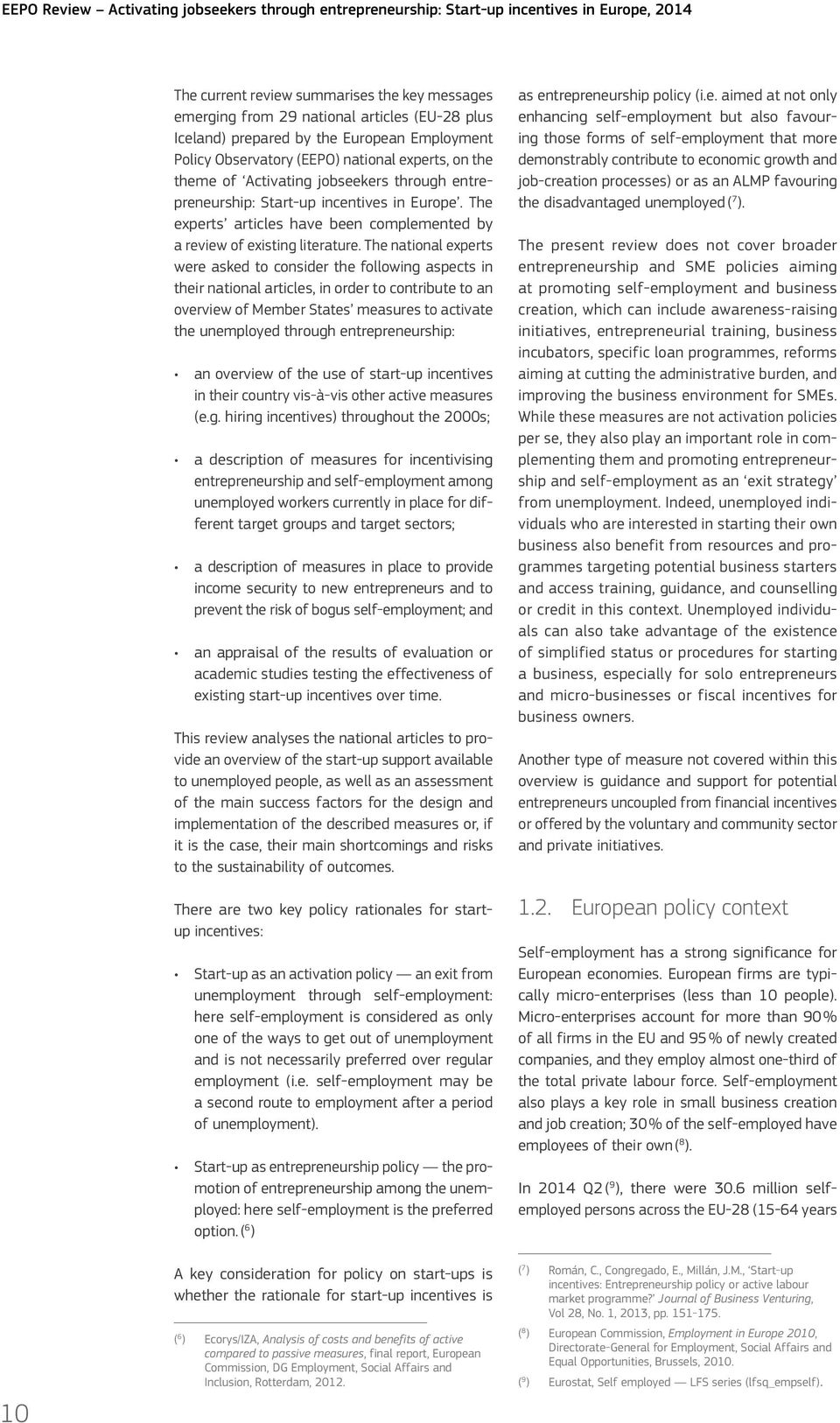
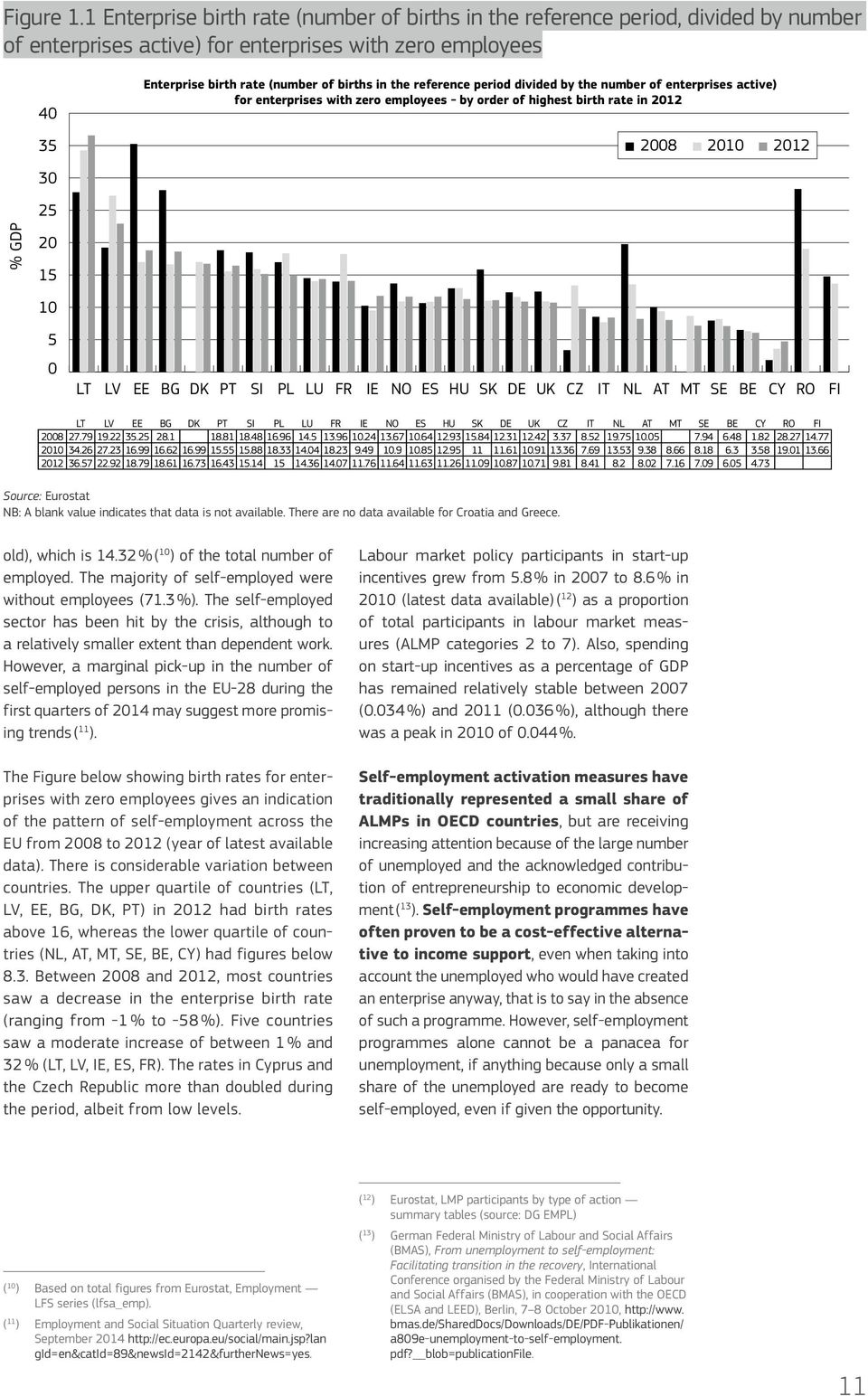
13 Figure 1.1 Enterprise birth rate (number of births in the reference period, divided by number of enterprises active) for enterprises with zero employees 40 Enterprise birth rate (number of births in the reference period divided by the number of enterprises active) for enterprises with zero employees - by order of highest birth rate in % GDP LT LV EE BG DK PT SI PL LU FR IE NO ES HU SK DE UK CZ IT NL AT MT SE BE CY RO FI LT LV EE BG DK PT SI PL LU FR IE NO ES HU SK DE UK CZ IT NL AT MT SE BE CY RO FI Source: Eurostat NB: A blank value indicates that data is not available. There are no data available for Croatia and Greece. old), which is % ( 10 ) of the total number of employed. The majority of self-employed were without employees (71.3 %). The self-employed sector has been hit by the crisis, although to a relatively smaller extent than dependent work. However, a marginal pick-up in the number of self-employed persons in the EU-28 during the first quarters of 2014 may suggest more promising trends ( 11 ). The Figure below showing birth rates for enterprises with zero employees gives an indication of the pattern of self-employment across the EU from 2008 to 2012 (year of latest available data). There is considerable variation between countries. The upper quartile of countries (LT, LV, EE, BG, DK, PT) in 2012 had birth rates above 16, whereas the lower quartile of countries (NL, AT, MT, SE, BE, CY) had figures below 8.3. Between 2008 and 2012, most countries saw a decrease in the enterprise birth rate (ranging from -1 % to -58 %). Five countries saw a moderate increase of between 1 % and 32 % (LT, LV, IE, ES, FR). The rates in Cyprus and the Czech Republic more than doubled during the period, albeit from low levels. Labour market policy participants in start-up incentives grew from 5.8 % in 2007 to 8.6 % in 2010 (latest data available) ( 12 ) as a proportion of total participants in labour market measures (ALMP categories 2 to 7). Also, spending on start-up incentives as a percentage of GDP has remained relatively stable between 2007 (0.034 %) and 2011 (0.036 %), although there was a peak in 2010 of %. Self-employment activation measures have traditionally represented a small share of ALMPs in OECD countries, but are receiving increasing attention because of the large number of unemployed and the acknowledged contribution of entrepreneurship to economic development ( 13 ). Self-employment programmes have often proven to be a cost-effective alternative to income support, even when taking into account the unemployed who would have created an enterprise anyway, that is to say in the absence of such a programme. However, self-employment programmes alone cannot be a panacea for unemployment, if anything because only a small share of the unemployed are ready to become self-employed, even if given the opportunity. ( 10 ) Based on total figures from Eurostat, Employment LFS series (lfsa_emp). ( 11 ) Employment and Social Situation Quarterly review, September gid=en&catid=89&newsid=2142&furthernews=yes. ( 12 ) Eurostat, LMP participants by type of action summary tables (source: DG EMPL) ( 13 ) German Federal Ministry of Labour and Social Affairs (BMAS), From unemployment to self-employment: Facilitating transition in the recovery, International Conference organised by the Federal Ministry of Labour and Social Affairs (BMAS), in cooperation with the OECD (ELSA and LEED), Berlin, 7 8 October 2010, bmas.de/shareddocs/downloads/de/pdf-publikationen/ a809e-unemployment-to-self-employment. pdf? blob=publicationfile. 11
14 EEPO Review Activating jobseekers through entrepreneurship: Start-up incentives in Europe, In the early crisis years, relatively few countries (from 29 OECD countries) introduced job-finding and business start-up incentives ( 14 ). Measures such as job-search assistance and training programmes have been much more prevalent as a means of helping unemployed people to find work. Income support for job losers and measures to support labour demand for jobseekers and vulnerable workers have also been used much more by countries. Nevertheless, the promotion of self-employment and business start-ups was also part of the measures adopted by several Member States between 2008 and 2010 ( 15 ). The establishment of the European Progress Microfinance Facility in 2010 has provided loans to people who have lost their jobs and want to start or further develop their own small business. Those helped under the initiative can benefit from mentoring, training, and coaching as well as assistance in preparing a business plan, in close cooperation with the European Social Fund (ESF). Measures to stimulate self-employment and business start-ups in the early crisis years generally targeted well-defined groups, but promoting selfemployment is a process that creates new jobs primarily in the medium to long term, especially if one takes into consideration the difficulties in starting a business during an economic downturn. Moreover, such start-ups may crowd out existing businesses, leading employees to revert to selfemployment in order to take advantage of the support measures. In the 2012 Employment Package ( 16 ) the European Commission emphasised the importance of promoting and supporting self-employment, social enterprises, and business start-ups as an activation measure for unemployed workers. Jobseekers who are motivated to start up and run businesses may have to overcome considerable barriers, including a lack of professional or business skills, mentoring possibilities, and difficulties in accessing finance. It highlights a number of factors that play an important role in facilitating self-employment and creating new jobs, such as fostering entrepreneurial mindsets and ensuring greater availability of start-up support services and microfinance, as well as schemes converting unemployment benefits into start-up grants. ( 14 ) OECD, OECD Employment Outlook: Tackling the Jobs Crisis, OECD Publications, Paris, ( 15 ) European Commission, Employment in Europe 2010, Directorate-General for Employment, Social Affairs and Equal Opportunities, Brussels, ( 16 ) European Commission, Communication from the Commission to the European Parliament, the Council, the European Economic and Social Committee and the Committee of the Regions: Towards a job-rich recovery, COM(2012) 173 final, Strasbourg, 18 April The Commission advises that support should be targeted at groups with the greatest potential (such as unemployed workers with professional skills, women or young people), and should rely on close cooperation between employment services, business support, and finance providers. Balanced reforms in employment protection legislation can remedy segmentation or halt the excessive use of non-standard contracts and the abuse of bogus self-employment Motivations for self-employment There are broadly two different motivations for self-employment ( 17 ): necessity entrepreneurs: entrepreneurs who would prefer to work in dependent employment, but are unable to find an appropriate job; opportunity entrepreneurs: start-ups by entrepreneurs whose reasons for starting the firm are a need for independence or high income. On the relationship between necessity entrepreneurship and economic impact, the German Federal Ministry of Labour and Social Affairs and OECD report ( 18 ) concludes that: unemployment is not the motivation among the majority of entrepreneurs; necessity entrepreneurship has increased in many countries (in absolute and in relative terms); this potential of necessity entrepreneurship to contribute to economic impact is underexploited (policy might help exploit it); the economic impact of necessity entrepreneurship is significantly smaller than for opportunity entrepreneurship. Necessity entrepreneurs are more likely in conditions of high unemployment. But it ( 17 ) Brixy, U., The contribution of newly founded firms to job growth, thematic paper for Mutual Learning Programme (DG Employment, Social Affairs and Inclusion) event: Job-creation incentives: How to better integrate policies to create sustainable jobs, Brussels (Belgium), 25 June ( 18 ) German Federal Ministry of Labour and Social Affairs (BMAS), From unemployment to self-employment: Facilitating transition in the recovery, International Conference organised by the Federal Ministry of Labour and Social Affairs (BMAS), in cooperation with the OECD (ELSA and LEED), Berlin, 7 8 October 2010, bmas.de/shareddocs/downloads/de/pdf-publikationen/ a809e-unemployment-to-self-employment. pdf? blob=publicationfile.

15 should be noted that the unemployment rate accounts for only 25 % of the variation in the rate of necessity start-ups; other factors are the presence of an administrative burden or the availability of capital ( 19 ). The unemployed in particular usually have problems obtaining financing, and necessity entrepreneurs rarely secure funding of investments. Therefore, both income and social insurance contributions must be secured until the business is up and running. This means that schemes subsidising entrepreneurs out of unemployment are useful. The Brixy paper also highlights that around 25 % of necessity entrepreneurs (that is about 6 % of all new entrepreneurs) are in dependent self-employment ( 20 ), mainly concentrated in labour-intensive industries, such as construction, restaurants/hotels, and transportation, and especially if the required qualification level is rather low. Román et al. ( 21 ) suggest that the coexistence of recession periods, startup incentives, and strict employment protection increases the likelihood of becoming dependent self-employed after unemployment, and may be distorting the occupational choice compared to opportunity entrepreneurs. This presents the possibility of an adverse selection problem in the relative composition of the self-employed when promoting start-ups for the long-term unemployed. The paper argues that the relative weight of opportunity entrepreneurs over necessity entrepreneurs and dependent self-employed would be the key element in evaluating the positive (or negative) impact of start-up incentives. The BMAS/OECD report ( 22 ) argues that competition between government programmes supporting necessity entrepreneurship and those supporting opportunity entrepreneurship (e.g. high-tech start-ups) should be avoided, as both are needed. Furthermore, it might be helpful to support the transfer from necessity motivation into opportunity motivation, so that both motivating factors to become self-employed take effect at the same time. A Commission study ( 23 ) finds that dependent selfemployment has become increasingly important and is part of a general trend towards increasing labour market flexibilisation. It suggests that dependent self-employment may represent a better solution than being unemployed or in irregular employment. Moreover, regular dependent employment may not be a realistic benchmark, and dependent self-employment can be an entry point into the labour market. ( 19 ) Brixy (2014). ( 20 ) Dependent self-employment refers to those workers who do not correspond to the traditional definition of employee because they do not have an employment contract as dependent employees. However, although formally self-employed, they are economically dependent on a single employer for their source of income (Eurofound). ( 21 ) Román, C., Congregado, E., Millán, J.M., Start-up incentives: Entrepreneurship policy or active labour market programme? Journal of Business Venturing, Vol 28, No. 1, 2013, pp ( 22 ) German Federal Ministry of Labour and Social Affairs (BMAS). ( 23 ) DG Internal Polices, Social protection rights of economically dependent self-employed workers, European Commission,

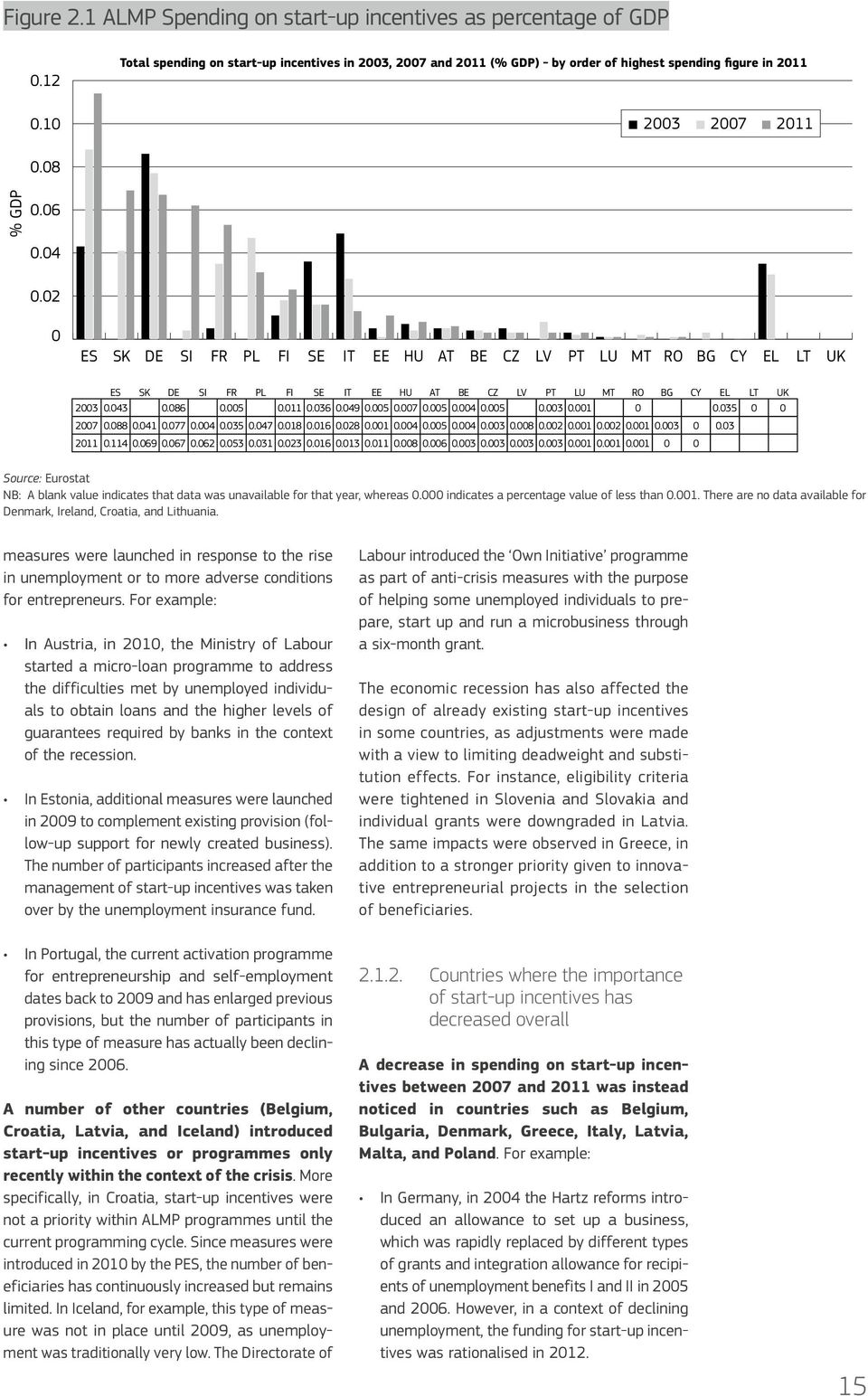
16 EEPO Review Activating jobseekers through entrepreneurship: Start-up incentives in Europe, The use of start-up incentives across the EU The significance and development of start-up incentives All of the 29 countries reviewed currently have some form of start-up incentives for the unemployed at the national and/ or regional/local level. While the importance of such measures varies, across all countries reviewed, they typically account for a small fraction of ALMPs in terms of budget allocation and benefit relatively small numbers of individuals. Eurostat data on total spending on startup incentives (2003, 2007, and 2011) as a percentage of GDP demonstrates the wide variation in spending across countries (see Figure 2.1). Taking an average figure for the years 2003, 2007, and 2011 ( 24 ), the spending on start-up incentives ranges from % of GDP to % of GDP. Cyprus, Lithuania, Luxembourg, Romania, and the United Kingdom have relatively low average levels (0.001 % and below). By contrast, Germany, Greece, Spain, France, Poland, Slovenia, and Slovakia have relatively high levels of spending (0.031 % and above). The remaining 12 countries have values ranging from % to % (the inter-quartile range). Despite their relatively modest role among all types of ALMPs, start-up incentives for the unemployed have a long history since the mid-1980s in over a third of reviewed countries (Denmark, Greece, Spain, France, Hungary, Portugal, Slovenia, Finland, Sweden, United Kingdom). In Estonia and in Lithuania, start-up incentives have been on the policy agenda since 1995, even if they are ALMPs of limited scale. Other examples include: In Spain, the system of capitalisation of unemployment benefits into one sum to support self-employment was introduced in 1984 and is still the main measure today. In Portugal, start-up incentives for unemployed persons were introduced in 1986 as part of local employment initiatives and have since been revised and expanded. In the United Kingdom, at least one programme to help the unemployed move to self-employment has been in place for more ( 24 ) NB: Not all countries have data for all three years. than 20 years. The main policy launched by the current government, with a mix a financial support and advice and guidance, is consistent with previous developments. In turn, other European countries (including Luxembourg, Malta, the Netherlands, Poland, and Slovakia) developed start-up incentives only in the mid-2000s. For example, in Poland, the start-up incentives financed by the National Labour Fund were used scarcely between 2000 and 2004, but their use was promoted after the adoption of the 2004 Act on Employment Promotion and Labour Market Institutions, which introduced the current start-up grant scheme for the unemployed Countries where start-up incentives have increased after the economic crisis Across the countries reviewed, the economic recession did not have a major impact in terms of the number of users and take-up of start-up incentives, but did have an impact on policy formulation. This impact may also have been only at the rhetorical level, for instance in the Czech Republic. Nine countries saw an increase in total spending on start-up incentives as a percentage of GDP between 2007 and 2011: Estonia, Spain, France, Hungary, Austria, Portugal, Slovenia, Slovakia, and Finland ( 25 ). There were relatively large increases, of 50 % or more, in Estonia, France, Hungary, Portugal, Slovenia, and Slovakia. Spain has by far the highest spending on start-up incentives as a percentage of GDP (0.114 % in 2011). This figure is likely to have increased further with the introduction of the system of capitalisation of unemployment benefits into one sum to support self-employment which became the main measure in the area of start-up incentives (EUR 750 million was allocated to this measure in 2013). This is complemented by other types of grants and similar measures designed and implemented at the regional level. The national EEPO articles reveal that in countries such as Bulgaria, Estonia, France, Austria, Portugal, Slovenia, and the UK, additional start-up ( 25 ) Eurostat data.

17 Figure 2.1 ALMP Spending on start-up incentives as percentage of GDP Total spending on start-up incentives in 2003, 2007 and 2011 (% GDP) - by order of highest spending figure in % GDP ES SK DE SI FR PL FI SE IT EE HU AT BE CZ LV PT LU MT RO BG CY EL LT UK ES SK DE SI FR PL FI SE IT EE HU AT BE CZ LV PT LU MT RO BG CY EL LT UK Source: Eurostat NB: A blank value indicates that data was unavailable for that year, whereas indicates a percentage value of less than There are no data available for Denmark, Ireland, Croatia, and Lithuania. measures were launched in response to the rise in unemployment or to more adverse conditions for entrepreneurs. For example: In Austria, in 2010, the Ministry of Labour started a micro-loan programme to address the difficulties met by unemployed individuals to obtain loans and the higher levels of guarantees required by banks in the context of the recession. In Estonia, additional measures were launched in 2009 to complement existing provision (follow-up support for newly created business). The number of participants increased after the management of start-up incentives was taken over by the unemployment insurance fund. In Portugal, the current activation programme for entrepreneurship and self-employment dates back to 2009 and has enlarged previous provisions, but the number of participants in this type of measure has actually been declining since A number of other countries (Belgium, Croatia, Latvia, and Iceland) introduced start-up incentives or programmes only recently within the context of the crisis. More specifically, in Croatia, start-up incentives were not a priority within ALMP programmes until the current programming cycle. Since measures were introduced in 2010 by the PES, the number of beneficiaries has continuously increased but remains limited. In Iceland, for example, this type of measure was not in place until 2009, as unemployment was traditionally very low. The Directorate of Labour introduced the Own Initiative programme as part of anti-crisis measures with the purpose of helping some unemployed individuals to prepare, start up and run a microbusiness through a six-month grant. The economic recession has also affected the design of already existing start-up incentives in some countries, as adjustments were made with a view to limiting deadweight and substitution effects. For instance, eligibility criteria were tightened in Slovenia and Slovakia and individual grants were downgraded in Latvia. The same impacts were observed in Greece, in addition to a stronger priority given to innovative entrepreneurial projects in the selection of beneficiaries Countries where the importance of start-up incentives has decreased overall A decrease in spending on start-up incentives between 2007 and 2011 was instead noticed in countries such as Belgium, Bulgaria, Denmark, Greece, Italy, Latvia, Malta, and Poland. For example: In Germany, in 2004 the Hartz reforms introduced an allowance to set up a business, which was rapidly replaced by different types of grants and integration allowance for recipients of unemployment benefits I and II in 2005 and However, in a context of declining unemployment, the funding for start-up incentives was rationalised in
18 EEPO Review Activating jobseekers through entrepreneurship: Start-up incentives in Europe, 2014 In Denmark, a national programme to support unemployed individuals who wish to start their own business was in place between 1985 and 1998 but has since been discontinued. Despite the lack of current national policy in terms of financial incentives, support for jobseekers who are considering starting a business is still available, in the form of entrepreneurship training (but not as a statutory right). In addition, some municipalities, including Aarhus and Copenhagen, have local programmes offering micro-loans to some non-insured unemployed individuals who have a viable business plan, after a careful screening of applicants. The number of targeted beneficiaries remains low. In Italy, there is no comprehensive national policy on start-up incentives for the unemployed, while a range of relevant measures open to all or at the regional and local levels, some of them co-financed by the ESF, are in place. Existing approaches and measures have been targeted to some regions in southern Italy, where support is provided to new business owners in the form of grants, subsidies, and loans (intermittently financed over time) Countries where start-up incentives have always been a niche measure Expenditure remained at similarly low levels between 2007 and 2011 in six countries (Belgium, Czech Republic, Cyprus, Luxembourg, Malta, and Romania). For example: In Cyprus, resources devoted to start-up incentives for the unemployed are very small in scale; some subsidy programmes for youth and women have been regularly offered by the Ministry of Commerce, Industry and Tourism, but are not a permanent measure. In the Czech Republic, support to unemployed individuals who start their own business is basically provided via general ALMPs, which also support reintegration into salaried employment. The magnitude of measures funded from the national budget and supporting start-ups is not significant. Measures are also funded via the ESF operational programmes, but no comprehensive mapping of such projects is available Mapping of start-up subsidies measures adopted in the EU Start-up incentives may include the following ( 26 ): Guidance and training: to help people prepare to start their own business and to help avoid the pitfalls of early entrepreneurship. The process of business planning may also deter some unemployed people and encourage them to find regular employment; it can also help PES to assess the likelihood of entrepreneurial success. The risk of providing guidance and training is that it can prolong the unemployment spell before business start-up. There is also a question about who should conduct viability assessments and if PES are equipped for this. Income support: where the unemployment benefit or social allowance may be extended to bridge a no-income period. The risk here is that the self-employed are subsidised when they may be receiving adequate income from their business. Subsidisation may also displace regular entrepreneurs because the subsidised self-employed have an unfair competitive advantage. Lending business capital: especially where banks are not willing to provide loans due to unemployed people having poor credit, the higher uncertainty of recovering money from the (long-term) unemployed, the lower profitability of business starters coming out of (longterm) unemployment, and banks stigmatising the long-term unemployed. The risk of providing capital is that unsuccessful starters who fall into unemployment may be subsequently disincentivised to take low-pay employment if this entails repayment conditions. In order to meet the needs for guidance and training, income support and business capital outlined above, start-up incentives include different types of measures used to incentivise jobseekers to set up their own business, classified as follows: non-repayable monetary incentives (grants, subsidies, or allowances), sometimes combined with the continuation, conversion, or replacement of unemployment benefit entitlement; 16 ( 26 ) Ecorys/IZA, Analysis of costs and benefits of active compared to passive measures, final report, European Commission, DG Employment, Social Affairs and Inclusion, Rotterdam, 2012.

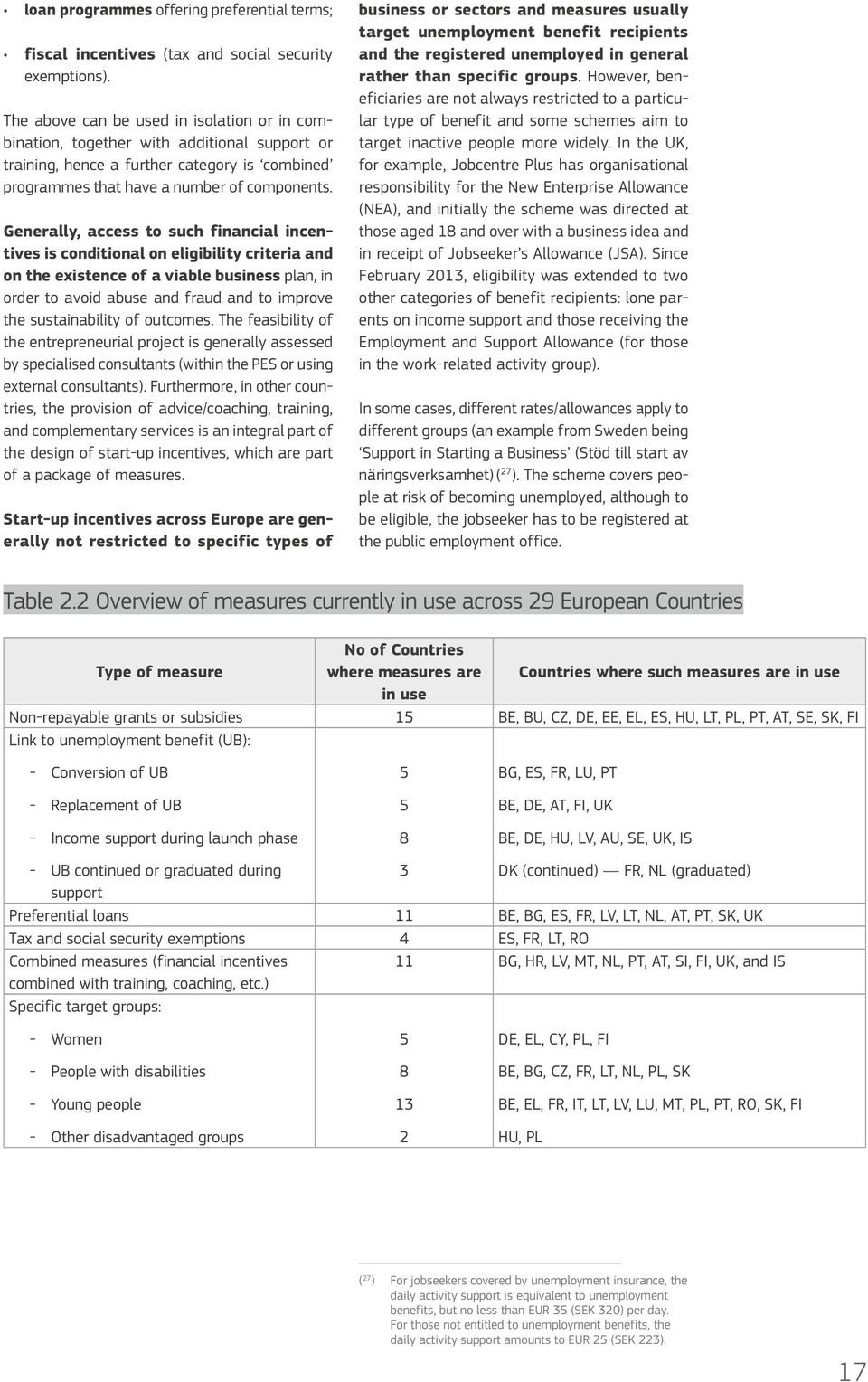
19 loan programmes offering preferential terms; fiscal incentives (tax and social security exemptions). The above can be used in isolation or in combination, together with additional support or training, hence a further category is combined programmes that have a number of components. Generally, access to such financial incentives is conditional on eligibility criteria and on the existence of a viable business plan, in order to avoid abuse and fraud and to improve the sustainability of outcomes. The feasibility of the entrepreneurial project is generally assessed by specialised consultants (within the PES or using external consultants). Furthermore, in other countries, the provision of advice/coaching, training, and complementary services is an integral part of the design of start-up incentives, which are part of a package of measures. Start-up incentives across Europe are generally not restricted to specific types of business or sectors and measures usually target unemployment benefit recipients and the registered unemployed in general rather than specific groups. However, beneficiaries are not always restricted to a particular type of benefit and some schemes aim to target inactive people more widely. In the UK, for example, Jobcentre Plus has organisational responsibility for the New Enterprise Allowance (NEA), and initially the scheme was directed at those aged 18 and over with a business idea and in receipt of Jobseeker s Allowance (JSA). Since February 2013, eligibility was extended to two other categories of benefit recipients: lone parents on income support and those receiving the Employment and Support Allowance (for those in the work-related activity group). In some cases, different rates/allowances apply to different groups (an example from Sweden being Support in Starting a Business (Stöd till start av näringsverksamhet) ( 27 ). The scheme covers people at risk of becoming unemployed, although to be eligible, the jobseeker has to be registered at the public employment office. Table 2.2 Overview of measures currently in use across 29 European Countries Type of measure No of Countries where measures are Countries where such measures are in use in use Non-repayable grants or subsidies 15 BE, BU, CZ, DE, EE, EL, ES, HU, LT, PL, PT, AT, SE, SK, FI Link to unemployment benefit (UB): -- Conversion of UB -- Replacement of UB -- Income support during launch phase BG, ES, FR, LU, PT BE, DE, AT, FI, UK BE, DE, HU, LV, AU, SE, UK, IS -- UB continued or graduated during support 3 DK (continued) FR, NL (graduated) Preferential loans 11 BE, BG, ES, FR, LV, LT, NL, AT, PT, SK, UK Tax and social security exemptions 4 ES, FR, LT, RO Combined measures (financial incentives 11 BG, HR, LV, MT, NL, PT, AT, SI, FI, UK, and IS combined with training, coaching, etc.) Specific target groups: -- Women -- People with disabilities -- Young people -- Other disadvantaged groups DE, EL, CY, PL, FI BE, BG, CZ, FR, LT, NL, PL, SK BE, EL, FR, IT, LT, LV, LU, MT, PL, PT, RO, SK, FI HU, PL ( 27 ) For jobseekers covered by unemployment insurance, the daily activity support is equivalent to unemployment benefits, but no less than EUR 35 (SEK 320) per day. For those not entitled to unemployment benefits, the daily activity support amounts to EUR 25 (SEK 223). 17
20 EEPO Review Activating jobseekers through entrepreneurship: Start-up incentives in Europe, Non-repayable grants or subsidy measures This category of financial incentives includes general activation incentives (i.e. not specific to the transition to self-employment), (one-off) subsidies or grants for business creation, temporary allowances/subsidies serving as income support, and the conversion of unemployment benefit entitlements into monetary incentives. As mentioned above, generally strict eligibility criteria apply. Furthermore, while such incentives are in principle non-repayable, in some cases the beneficiary may be required to repay part of the subsidy if he/she does not maintain his/her activity as self-employed for the specified duration e.g. by taking another job. The incentives vary significantly in terms of amount (and/or duration) and strictness of eligibility criteria. In a few other countries, registered jobseekers moving towards self-employment can receive the same activation incentives as unemployed individuals taking up a job; this can be combined with more specific measures. For instance in Germany since 2005, all unemployed persons who either start a job or their own business receive an activation allowance that can be combined with additional financial incentives for business starters. In Slovakia, jobseekers moving to self-employment, can like any individual leaving the unemployment register before the end of his/her unemployment benefit entitlement receive a one-off payment of 50 % of the remaining sum Subsidy/grant for business creation Several countries (including Greece, Hungary, Lithuania, Poland, Portugal, Slovakia and Finland) typically offer a one-off subsidy, as in the following example. Finland Start-up grant starttiraha Target group: Anyone can access the grant, including unemployed people. The grant duration or value is generally not dependent on the target group, although there are some exceptions (e.g. longer grant periods for young people and women in some cases; some extra support for farmers; as well as some sector-specific grants). Details: Some beneficiaries have received the grant so far in A basic grant plus an add-on is foreseen. The basic grant is EUR per day during the first 6 18 months. The add-on is less than or equal to 60 % of the basic grant. Requires check-up with labour authorities every six months. The total sum varies between EUR per month. Eligibility conditions: Eligibility conditions are not very tight and mostly depend on the feasibility of the business plan. They include that the new business must be in the service sector (not industrial), to start within three months and should not distort competition or increase excess supply. Conditions for recipients include that they should have entrepreneurship experience or receive entrepreneurship training, having no tax liabilities, and perceive no additional salary/ benefit (e.g. pension, allowance). Additionally, the business activity chosen cannot be in the same area of work as the individual was active in previously as an employee, in order to prevent bogus self-employment. Evaluation findings: A range of evaluations are available for start-up grants in Finland. Both entrepreneurs and officials have assessed the measure in question positively. Key findings from the survey of grant recipients ( ) include: of the recipients, 74 % of the unemployed and 80 % of the non-unemployed were still working in their firm in late 2011; Overall, good survival rate of businesses until fifth year; average turnover EUR ; Successful enterprises correlated positively with non-unemployment, high human capital and high education level and full-time employment prospects were better if grant receivers were not previously unemployed. Räisänen (2013) found positive indirect employment effects, but unclear effects on direct employment, that the grant hastened business establishment but also noted some leakage effects. Policy lessons: Start-up grants combined with the manifold policies to develop a favourable environment for enterprises at the same time as developing individuals entrepreneurial skills and motivation, is working well. Increasing the scope of measures can only be done slowly and gradually. Reference: Finland EEPO Article 18

21 Temporary allowances or subsidies can also be paid in several instalments (usually monthly), serving as income support during the initial phase of launching the business (generally replacing unemployment benefit, or complementing it in some countries). For example: In Belgium (Walloon region), a so-called Airbag plan, or a EUR subsidy paid over two years, has been introduced. In Hungary, beneficiaries of the VVT start-up programme receive wage support for the first six months of activity in self-employment, at the level of the minimum wage. In Sweden, there has been a daily activity support equivalent to unemployment benefit since There are also examples in Belgium, Bulgaria, the Czech Republic and Spain of transitional grants offered to those setting up a business to cover specific set-up costs such as fees for external consultant in Belgium and Bulgaria, training costs in Spain, and general operating costs of newly established start-ups (complementing the subsidy offered as part of the Socially Purposeful Jobs programme) in the Czech Republic. Measures to continue, convert or replace unemployment benefits with financial assistance to start a business, can also be considered as sub-categories of start-up incentives, as described below Continuance of unemployment benefits In Denmark, business start-ups are incentivised through the provision of micro-loans to the unemployed, and beneficiaries keep all their usual benefits during the start-up period ( 28 ). This is fairly unusual, however, and usually unemployment benefit is graduated. An interesting example of the issues involved is the case of the Netherlands start-up incentive for unemployment benefit recipients. This involves decreasing unemployment benefit income while a company is being started up, meaning that the support is relatively cost-neutral. Since January 2013, there has been a mandatory period of 26 weeks when starting up a business, during which the unemployment benefit is reduced by a fixed percentage of 29 % (Article 35ab Unemployment Benefit Act, Werkloosheidswet). This percentage is the same for everyone, irrespective of hours spent on the business or profit ( 28 ) Implemented in the municipality of Aarhus (Denmark) as a permanent measure since 2012 and in pilots in other municipalities. gained ( 29 ). In France, there is the possibility of cumulating unemployment benefits (ARE or ASS) with business revenues to enhance income security. Pôle Emploi is responsible for delivering these benefits, which can be combined with other types of aid for business starters in particular situations, such as the ACCRE tax exemption measure (described in Section 2.2.3, below) The conversion of unemployment benefit entitlements into monetary incentives Applicants may receive a part of their total unemployment benefit entitlement in instalments to support their entrepreneurial project. Overall, this is not a common approach across the reviewed countries, as countries rely on different types of income support subsidies to encourage the transition from unemployment towards self-employment. However, the conversion of unemployment benefits is possible in the following countries: Bulgaria (the amounts received are relatively low, as unemployment benefits are restrictive); Spain (this has been the main measure among start-up incentives since 1984); France (as part of a measure called Support for taking over or creating a business, or ARCE); and Luxembourg (only for the registered unemployed over the age of 40 and with professional experience). France provides an example of the approach involving the conversion of unemployment benefits into start-up grants. This has been possible since 2006, with the creation of ARCE. ARCE enables unemployed individuals who wish to create their own business to convert 50 % of their unemployed benefits into start-up grants. If the enterprise collapses the person can still benefit from the unused unemployment benefits, which represent an important guarantee for business creators Replacement of unemployment benefits The Finnish start-up grant replaces benefits but the main idea in the Finnish context has been to keep the start-up grant at the same level as the unemployment benefit, and for it to be paid on a monthly basis (this was considered important in order to avoid major abuse). Similarly, in Austria, the level of support (Gründungsbeihilfe GB) given during the first months of self-employment, corresponds to that of the applicable unemployment benefit or unemployment assistance/subsistence allowance (DLU), including any family supplements. There is ( 29 ) SEO, 2009; see Netherlands national article for further details. 19
22 EEPO Review Activating jobseekers through entrepreneurship: Start-up incentives in Europe, also a supplement to the amount of the current contribution (minimum contribution basis) to the social insurance scheme for the self-employed. Under the NEA in the UK, a weekly allowance is paid for up to 26 weeks, but the amount is graduated (EUR 80 (GBP 65) per week for the first 13 weeks, and EUR 42 (GBP 33) for a further 13 weeks, up to a maximum of EUR (GBP 1 274)). Importantly, receipt of NEA does not affect eligibility to other support such as housing benefit. With the German Integration allowance (Einstiegsgeld), the combination of benefits is possible (housing allowance, unemployment benefit II, and heating allowance, among others). In Belgium, it is possible in some cases ( allowances of establishment ) to maintain an income comparable to receipt of unemployment benefits Low-interest/guaranteed loans In most if not all countries reviewed, the access to loans at preferential rates has been promoted as part of entrepreneurship policies over the last few decades. Such measures may target any candidate entrepreneur and some countries do not have a separate scheme for those who are unemployed at the time of applying for the loan. For instance, in Spain, lowinterest loans provided by national public credit institutions or through regional programmes are available to unemployed individuals among other groups. Similarly, in Latvia, a universal start-up loan programme also serves that purpose. Specific loan programmes targeting (mostly) the unemployed are in place in a few countries, including Belgium, Bulgaria, France, Austria and Lithuania. For example, in France, in addition to loans available to any new entrepreneur, zero-rate loans are offered to unemployed individuals as part of the NACRE measure (new support for the unemployed taking over or creating a business). This measure also includes advisory services for a duration of three years. The allocation of a loan is conditional on a feasible business plan, which is assessed during a clearing procedure Tax or social insurance contribution exemptions Various countries have adopted fiscal measures as part of broader entrepreneurship/sme policies that are of relevance for unemployed individuals who start operating a business. For instance, there are specific fiscal conditions linked to the solo entrepreneur, or auto-entrepreneur, status created in France in A similar scheme is in place in Romania. In Spain, fiscal incentives were introduced by a 2013 law providing support for entrepreneurs. Fiscal advantages for new entrepreneurs who were previously unemployed are not widespread, but exist in at least a few countries. For example, in Lithuania, an unemployed person registered at the PES is able to acquire a preferential business certificate, and municipalities can reduce the amount of income tax levied on income from activities exercised under such a certificate. However, the measure carries a risk of abuse from business owners, who register as unemployed to receive this certificate. In another example from France, unemployed individuals setting up their business are exempted from social security contributions for a year (and up to three years in some cases) as part of the ACCRE measure. The target group includes the unemployed, young people aged 18 26, employees taking over their enterprise. The measure benefited people in There are no eligibility conditions, except to be attached to the PES. An interesting feature of ACCRE, is that it can be combined with accumulating unemployment benefit and revenue measures (such as the NACRE support service or the ARCE unemployment benefit-conversion measure), giving individuals the opportunity to double up business revenues and unemployment benefits for 15 months (or more, for persons over 50 years old). Around 70 % of unemployed persons who create their business benefit from this measure, which makes it the most common start-up incentive for the unemployed. The most recent evaluations show that the ACCRE has had a positive impact on business durability. Yet its impact on economic performance and job creation does not seem to be significant ( 30 ) Combined financial incentives with additional services (training, coaching, and guidance) A range of countries have put in place comprehensive active labour market programmes or packages focusing on entrepreneurship and self-employment. Such programmes can include one or several of the types of financial incentives described above, as well as a compulsory component consisting of training and / or advisory services. These additional services aim at improving the screening of applicants, ensuring the quality of their entrepreneurial projects, and are considered to raise the probability of business survival, hence optimising the impact of financial incentives, as illustrated in the box below. ( 30 ) DARES and the INSEE, See France national article for further details.
23 Austria Unternehmensgründungsprogramm (UGP), the start-up programme for the unemployed Target group: Potential beneficiaries are unemployed people (irrespective of their entitlement to unemployment benefits) and employed individuals at risk of losing their job, who are interested in entering self-employment with a concrete business idea and appropriate qualifications. Details: The business start-up programme for the unemployed (UGP, in German) was implemented in 1997 by the PES and consists of four phases: a clarification phase (assessment of project feasibility); a preparatory stage (during which participants receive specific counselling and training, and income support); an implementation stage (during which participants receive a start-up subsidy); and a follow-up stage (to ensure the stabilisation of newly founded microbusinesses, with up to four appointments with external business consultants within two years). The measure benefited individuals in Eligibility criteria include being registered as unemployed, having a concrete business idea, participation in a preceding counselling and clearing process, obtaining an insurance certificate from the social security institution for self-employed or for farmers. According to evaluations of the measure, the characteristics of the average participant: 38 years old, male, with medium-level vocational skills and education. The average start-up rate of participants was 83 %, while a similar survival rate was noted between UGP set-ups and general set-ups. Policy lessons: Success factors of the measure include sound clearing of the feasibility of the individual business idea and individual conditions during the implementation phase; tailor-made support such as counselling, coaching, advice, and training; and accompanying financial support for business founders during the whole process. Reference: Austria EEPO Article Countries such as Malta, the Netherlands, Austria, Finland, and the UK already had such permanent programmes in place prior to Similar programmes have been introduced after 2008 in countries such as Bulgaria, Croatia, Latvia, Portugal, Slovenia, and Iceland, coupling financial assistance with assistance for business plan development, referral to training sessions, and the provision of information and advice. For example, in Malta, the start-up grant Start your own business, which has been provided by the Education and Training Corporation for over a decade, is a package of counselling, entrepreneurship training, mentoring, and financial assistance. Other complementary measures to the scheme include subsidised childcare and free transport. It should be noted that, in some countries, although there are no such comprehensive programmes in place to date, unemployed individuals can access comprehensive support by combining different measures. For example: In Belgium, the federal measures in place (including the Launch Loan programme) are complemented with additional measures and services provided at the regional level. For instance, the Walloon region offers training vouchers for unemployed individuals interested in starting their own business. In France, different measures are available and are compatible, such as tax exemptions, the conversion of unemployment benefits into a grant, and the NACRE measure for registered jobseekers (access to zero-rate loans and advisory services). In Germany, existing financial incentives (startup grants) can be complemented by coaching services. This type of service was co-funded by the ESF between 2008 and In Luxembourg, individuals who apply for a start-up incentive (conversion of unemployment benefit entitlements) at the PES are referred to support programmes offered by organisations such as the Chamber of Commerce or the Chamber of Crafts Focus on specific target groups An OECD report (31) highlights the value of self-employment promotion measures for the disadvantaged unemployed. The report notes the following barriers for different groups: Women are half as likely as men to start a business. Women may face discrimination in accessing finance and may face challenges ( 31 ) OECD (2013), The Missing Entrepreneurs, Policies for Inclusive Entrepreneurship in Europe. Internet: the-missing-entrepreneurs_ en 21
24 EEPO Review Activating jobseekers through entrepreneurship: Start-up incentives in Europe, in lack of confidence, entrepreneurial experience, and networks. Young people face greater difficulty in raising external finance given their lack of savings and collateral, and often lack skills to run a business. Seniors often have high-level technical skills and access to finance but lack entrepreneurial skills. Ethnic minorities and immigrant entrepreneurs may have difficulty understanding regulatory requirements and may be forced to rely upon non-bank and informal finance. Disabled people have more difficulty gaining entrepreneurial experience and skills, and may be constrained by state welfare policies. The start-up incentives covered in the review national articles and described in the previous sections generally target all unemployed individuals (unless otherwise mentioned); eligibility criteria relate to the level of preparation of participants and their entrepreneurial projects. In addition to these, some countries have measures and schemes with a specific coverage (often complementary to the abovementioned schemes). For example, in Poland, the start-up grants financed from EU funds detail eligibility criteria and targeting that are project-specific. Target groups include the long-term unemployed and women returners to the labour market, people with disabilities, people over 45 years of age, as well as people living in rural communities. A small number of measures have been found to focus on women, disabled individuals, and young people (part of the measures being offered or developed as part of the Youth Guarantee). Except one measure in place in Luxembourg (capitalisation of unemployment benefits for the registered unemployed aged 40 and above), none of the targeted measures in the review focus on age groups other than young people Measures focusing on women There are only a small number of examples of national start-up incentives that have a specific gender focus (e.g. in Croatia, Germany, Greece, and Cyprus), as this objective is addressed as part of universal measures. However, women can be considered as a priority group. For instance, in Austria, as part of the UGP start-up programme managed by the PES, special emphasis is put on supporting female applicants at the initial stage. For instance, they may benefit from a higher training allowance. In addition, there are ESF projects supporting this objective in various countries, as well as other policy initiatives and funds to promote female entrepreneurship more broadly (such as the Fund for women s initiatives FGIF in France and Iceland s Women s Employment Fund created in 1991 to help women regardless of their employment status to carry forward a business project). In some cases, networks and linkages among stakeholders may have been put in place specifically for certain target groups. One example from Germany is the National Agency for Women Start-ups Activities and Services (bga): in order to mobilise the potential of women startups in industry and on the market, Germany supports women entrepreneurs. The bga, which is sponsored by the German Federal Ministry for Education and Research, the Federal Ministry for Family, Senior Citizens, Women and Youth, and the Federal Ministry of Economic Affairs and Energy, represents a first step towards increasing the number of businesses started by women. The bga offers the political, business, academic, and public sectors a platform for information and services related to women entrepreneurship in all areas and phases of company foundation, consolidation, and succession Measures focusing on disabled jobseekers with a reduced work capacity Complementary to other activation measures for jobseekers, the purpose of measures for people with disabilities or reduced capacity to work is to cover for additional costs that they may incur in setting up a business, such as workplace alterations. Such measures can be found in Belgium, the Czech Republic, France, the Netherlands, Slovakia and Sweden. For example: In the Czech Republic, the Job creation support for the disabled measure (directed at creating both employee and self-employed positions for unemployed people with disabilities) is enhanced because support can be topped up by a contribution to operating costs (up to EUR 2 000). In the Netherlands, intervention is focused on start-up incentives for people with a work disability registered at the PES and incorporates a coaching component. In Sweden, there is special financial Support in Starting a Business scheme for jobseekers
25 with a functional impairment to buy specific equipment, following a special assessment delivered by an external consultant to the PES. This can be combined with the regular temporary allowance for jobseekers who create their own business Measures focusing on young people In most of countries, young people are eligible for the start-up measures mentioned above. For instance, in Sweden, young people aged and not in the labour market are eligible to receive the temporary allowance for business starters. In France, young people can also access zero-rate loans and receive additional guidance from the PES. However, in practice young people may be excluded from some measures that require entitlement to unemployment benefits. The examples of specific programmes for young people (often focusing on a larger age cohort than the age group) generally have a greater focus on guidance and counselling. For example, in Romania, a programme has been introduced to encourage young people aged up to 35 to start a limited liability company start-up or (SRL Debutant), including a grant and social security exemptions, though strict requirements apply. This measure is now part of the Youth Guarantee. It is thus clear that policy developments at the EU level with the Youth Guarantee have had a significant impact. A number of countries have recently developed (including Italy, Latvia, Poland, Romania), or are currently developing (including Greece, Luxembourg, Malta, Portugal, and Slovakia), specific entrepreneurship programmes for young people as part of their Youth Guarantee Implementation Plans. This includes, for instance, Greece (where a new scheme targeting the years age group is being designed), Luxembourg, Malta, Portugal, and Slovakia. As recent research points out ( 32 ), in terms of the design and implementation of Youth Guarantee schemes to support start-ups, measures to ease access to financial resources are important as this is a major issue for young entrepreneurs. Measures may include special grants, start-up incentive measures, subsidised credit, capitalisation of unemployment benefits, combining unemployment benefits and a start-up allowance, or temporary exemptions from social security ( 32 ) ICF GHK (2013), Developing supportive measures for labour market integration, thematic paper for Mutual Learning Programme (DG Employment, Social Affairs and Inclusion) event: Practical support for the design and implementation of Youth Guarantee Schemes, Brussels, October contributions. To increase chances of success, the preparation of an entrepreneurial project can typically start at an early stage, while young people are still engaged in vocational education and training (VET) or higher education. When this option is considered by young people who have already left initial education and training and are already registered with the PES, it is important to provide them with comprehensive support, as an isolated start-up incentive is likely to be insufficient on its own. Providing guidance to young people, helping them to set up viable business plans, and putting in place mentoring schemes can increase the success of such programmes What works for whom? The findings of evaluation studies on the impact of start-up incentives show a certain degree of variation across groups of unemployed people. For example, on the basis of the propensity score matching technique as well as regression analysis in Poland, Wiśniewski & Zawadzki (2011) found that those involved in business activities were most likely to be men, aged 25 34, and were more likely than the average not to have children. Results from Sweden (Månsson & Delander, 2011) indicate that women recipients of start-up incentives have a higher start-up success rate than both women and men nonparticipants; however, the impact for women beneficiaries is smaller in comparison with men (compared to a matched sample of men in the start-up scheme, women participants were less successful at retaining self-employment). Women may lack access to finance and face constraints in working hours due to caring responsibilities, which may limit their aspirations to grow their business to the same extent as men. There may be gender differences in the orientation and motivation for business foundation. In Austria, flexible working time and self-fulfilment are the main aspects for women, whereas men strive for higher income and success. The different goals are linked to the different living conditions of men and women. The results from Austria also indicate that women have more restricted access to finance than men, which is another reason why women tend to plan their business start-ups more carefully and on a smaller scale ( 33 ). ( 33 ) Dornmayr and Lenger, See Austria national article for further details. 23
26 EEPO Review Activating jobseekers through entrepreneurship: Start-up incentives in Europe, 2014 The results on business survival in relation to different target groups vary, and this is likely to depend on a range of factors. In Greece, the starter businesses remained active for 27.5 months on average following the termination of the subsidy, with higher than average survival rates reported for the Young scientists and the Female entrepreneurship schemes. ( 34 ) The proportion of beneficiaries not thinking of abandoning their businesses was greatest in the case of women entrepreneurs ( 35 ). However, among the companies established with ESF support under the regional component of the Human Capital operational programme in Poland, more women than men permanently closed down their companies after 12 months (40 % compared to 36 %), among which the cause of closing the company was mainly personal or family reasons. A higher risk of cessation of activity was also attributed to people aged below 25 or above 54 years, and to the previously long-term unemployed. The survival rate of businesses increased when participants were provided with training on the legal aspects of their company (but only if the participant did not have primary or secondary education) and, to a lesser extent, when provided with bridging support. Outcomes may vary between natives and immigrants. The results of an econometric analysis by the Swedish National Audit Office in 2012 suggests that while the start-up grant programme had positive employment effects for both natives and immigrants, the positive employment effects were greater for persons born in Sweden than those born abroad ( 36 ). Approaches to enhancing school-to-work transitions can include efforts to improve self-employment opportunities ( 37 ). This could help to reduce the amount of time a young person spends out of work after leaving education, thereby reducing the risk of the scarring effect that can be incurred by a spell of unemployment at a young age. 24 ( 34 ) The firms that had ended operations at the time of the evaluation (2008). ( 35 ) Gruber, M., Denker, J., Nikiforou, A., Entrepreneurial activities of the unemployed in Greece, Ecole Polytechnique Fédérale de Lausanne/OAED, Athens, See Greece national article for further details. ( 36 ) The Swedish National Audit Office, 2012, confirming earlier results by Carling and Gustafson, ( 37 ) Eurofound, Effectiveness of policy measures to increase the employment participation of young people, 2012.
27 3. Design features of start-up subsidies The national articles have been reviewed in order to assess how the types of measures that are currently being used address the barriers faced by unemployed entrepreneurs. The chapter continues with a discussion of features of start-up schemes that have been identified in evaluations as being important to the development of sustainable businesses by the unemployed, and concludes with ways in which financial incentives are complemented by other forms of support to enhance effectiveness Addressing barriers to entrepreneurship Key policy messages The main concern for unemployed people wanting to start their own business is the lack of income security due to self-employed status, particularly in the initial stages of business creation. Many schemes therefore involve a mixture of financial support comprising help with living costs during the formative stages of setting up the business and access to loans for capital equipment. To ensure income security, financial support must consider the relationship between start-up incentives and recipients benefits entitlement. Income security measures in the initial stages of the business are more important than the receipt of block loans of subsidies for investment in the business. However, start-up incentives may also require financial incentives to support investment in the enterprise s infrastructure or operating costs. Lack of entrepreneurial skills and knowledge are key barriers for the unemployed, although this depends on scheme selection criteria, i.e. the level of qualifications and experience. Entrepreneurs need business support as well as financial support, including assisting with entrepreneurial preparedness in the process of drafting business plans. There is also a need to help unemployed people bring the business onto the market, extend their working time as self-employed, and tackle the financial burden involved in running a business (taxes and social security contributions). Key barriers to unemployed people pursuing entrepreneurship are: financial barriers, lack of technical knowledge and expertise about setting up a business, and the challenges involved in pursuing a viable business idea and putting it into practice. For example, evaluation findings from Austria show that the main challenges or difficulties for unemployed people establishing enterprises are the following: bringing the business onto the market (e.g. acquiring customers); extended working time as self-employed; and financial burden (taxes, social security contributions) ( 38 ) Risks associated with income uncertainty of entrepreneurship The main concern for unemployed people wanting to start their own business is the lack of security due to self-employed status, particularly in the initial stages of business creation. Indeed, some of the measures included in the research in the Member States can be categorised as a revenue complement or as support for business creation. Having resources to invest in the business is also important, due to issues faced by unemployed people and marginalised groups in accessing loans or credit. ( 38 ) Bergmann et al., See Austria national article for further details. 25
28 EEPO Review Activating jobseekers through entrepreneurship: Start-up incentives in Europe, Many schemes involve a mixture of financial support (comprising help with living costs during the formative stages of setting up the business, and access to loans for capital equipment), and are sometimes connected to a wider availability of finance for new business owners. The Internet is a key factor for reducing start-up costs (and risks) substantially. Some groups may have limited expectations for their business model, which do not go beyond ownaccount working. The relationship between start-up incentives and recipients benefits entitlement is an important consideration given that financial support to minimise the risk is a key underlining feature of start-up incentives. In general, national schemes aim to balance the degree of incentive against the possibility for abuse, and at the very minimum to make sure that unemployed recipients are not worse off under the measures. Different approaches can be identified, notably continuance of unemployment benefits and conversion or replacement of unemployment benefits. The possibility of reinstating the unemployment benefits system in the event of failed selfemployment provides an additional warranty. For example, in Finland, workers who have to end entrepreneurship are treated as quitting working with immediate return to the employment services. In Belgium, within the Young Entrepreneurs Plan, if the project fails the person is automatically reinstated to their unemployed status Lack of access to finance/ capital resources Around 80 % of EU citizens find it difficult to start up a business due to a lack of available financial support ( 39 ). Income security measures in the initial stages of the business are considered more important by recipients than the receipt of block loans of subsidies for investment in the business. For example, the New Enterprise Allowance (NEA) weekly allowance paid for 26 weeks was considered crucial to allow UK participants to move from receiving benefits to earning. However, uptake of the EUR (GBP 1 000) loan was less than anticipated, a fact attributed to the reluctance of participants to take on the debt ( 40 ). ( 39 ) DG Enterprise and Industry (2010), Entrepreneurship in the EU and beyond: A survey in the EU, EFTA countries, Croatia, Turkey, the US, Japan, South Korea and China: Analytical report, European Commission, ec.europa.eu/public_opinion/flash/fl_283_en.pdf. ( 40 ) DWP, See UK national article for further details. However, start-up incentives may also require financial incentives to support investment in the enterprise s infrastructure or operating costs, as well as income support during the start-up phase. In Greece, a 2009 evaluation found that for over half of the participants (53 %), the subsidy provided was very important. The subsidy covered approximately 33 % of the total capital invested in the start-up. The remaining capital came from participants own resources (48 %) and from bank loans (15 %). The vast majority of respondents to a 2014 evaluation survey stated that the financial assistance they had received was indispensable, while, on average, the capital invested in the new businesses fluctuated at particularly low levels of between EUR and ( 41 ). There are generally a wide range of financial instruments (microcredit, loans, etc.) for groups considered to be in need of extra financial support. These services tend to be discretionary and potentially difficult to access, ensuring that only those with a viable plan are selected Lack of entrepreneurial skills Lack of technical skills and knowledge are key barriers for the unemployed, although the way these play out may be dependent on the approach to how individuals are selected (i.e. a degree of creaming ) or on targeted support to boost skills. The level of previous qualifications and prior business experience of unemployed start-up incentive recipients appears to vary widely across schemes. In many schemes the majority of recipients have intermediate-level skills. Evaluations from Greece and Portugal point out the entrepreneurshiprelated knowledge gaps among the beneficiaries. For example, an evaluation of participants in start-up incentives in Greece showed that most of the programme participants (61 %) stated they had no previous business experience and the ex post evaluation indicated that the typical beneficiary was aged (73 % of the participants), with intermediate education credentials (ISCED 2 3, 77 % of the total) ( 42 ). Another survey undertaken in the context of a 2014 evaluation ( 43 ) noted a lack of management/marketing skills among the young scientists and lack of ICT skills among the new freelance professionals aged Based on these findings, evaluators proposed a number of suggestions for maximising the future impact of the start-up schemes, including training (technical and general) for the ( 41 ) OAED, 2009, and OAED, See Greece national article for further details. ( 42 ) OAED, See Greece national article for further details. ( 43 ) Ibid.
29 would-be entrepreneurs, and the provision of mentoring/counselling services. They also recommended training for those beneficiaries starting an activity in areas where they had little previous knowledge. The attendance of seminars on entrepreneurship is now a prerequisite for participation in the start-up scheme Need for business consultancy Entrepreneurs need business support as well as financial support, including assistance to draft individual action plans and business plans (e.g. France, Austria, Poland, Slovakia) ( 44 ). This was found in Slovakia where jobseeker s overestimation of his or her own capabilities is the most common cause of business failure. There is also a need to help unemployed people bring the business onto the market, extend their working time as self-employed, and tackle the financial burden involved in running a business (taxes and social security contributions). This was the case in Austria, where improvements could include providing more branch-specific counselling and advice services, improving the possibilities for networking between participants, and offering additional tailor-made counselling for various target groups ( 45 ). Experience in France highlights the need to reduce administrative complexity, in order to help actors concentrate on general support (training, provision of advice and guidance) for business creators. In France, the lack of accompanying support before and after business creation has been the main brake on the growth and durability of new French companies. This is well known, but they are no specific and coherent corrective actions put in place in response to this situation. Poland is one example of an EU Member State that has taken advantage of ESF resources to support targeted temporary measures (realised under ESF ) and consultancy and training in the knowledge necessary to start and conduct a business (e.g. relating to taxes, insurance, labour law, health and safety obligations, commercial law, marketing, etc.), along with bridging financial support payable for up to six months (and in special cases, up to 12 months). Companies established with ESF support under the regional component of the Human Capital operational programme have a greater survival rate over a period of two to three years than open-market start-ups. Business support and signposting between schemes and services becomes important How to promote successful businesses: the role of conditionality placed on recipients of start-up subsidies Key policy messages Conditionality in start-up schemes is crucial in designing start-up incentives. Conditions on participation vary depending on the objectives of different schemes and national factors. Conditions can be based on the following: Length of unemployment: focus on early intervention or prioritisation of the longer term unemployed. The financial support available: schemes must balance offering sufficient incentives with minimisation of the potential for abuse of the incentive. The type and quality of the business idea/plan: in terms of profitability and viability, likelihood of distorting competition or crowding-out other companies, and level of product/service innovation The age of recipients: in countries suffering the effects of the economic crisis, the recent focus has been on assisting the young unemployed, but the criteria on age vary, determined by Member State objectives. Working time: as a rule the business starter must be planning to work for a certain number of hours per week as a minimum. Qualities of individual applicants: an assessment of the ability of the applicant to run a business is often an explicit feature of start up support measures. ( 44 ) Borik and Caban, See Slovakia national article for further details. ( 45 ) Bergmann et al., See Austria national article for further details. 27
30 EEPO Review Activating jobseekers through entrepreneurship: Start-up incentives in Europe, Conditionality in start-up schemes is crucial in designing start-up incentives (and the needs of the target groups will presumably influence the design). Conditions placed on participation in start-up incentives vary depending on the objectives of different schemes and national factors. In general, schemes apply specific criteria, although it cannot be ruled out that some specific criteria are locally determined. An example from Hungary is the Support for entrepreneurship (vállalkózóvá válási támogatás, VVT), a general and restricted programme focused only on disadvantaged workers. This is a start-up incentive with multiple elements ( 46 ), and various restrictions apply based on the preferences of the local labour office. Examples of different conditions across the Member States are given here Length of unemployment In some Member States early intervention is a feature of the initiative. For example, in the UK, a scheme to support unemployed to become self-employed up until July 2012 was initially available only to those claiming unemployment benefit for at least 26 weeks, but the access conditions were then reduced to 13 weeks and, from October 2012, to day one of a benefit claim. Other start-up schemes involve an increase in the qualifying unemployment period. In Germany, start-up grants (Gründungszuschuss) can be allocated to those unemployed below the age of 65 years who are eligible for at least 150 days of unemployment benefit I until they start their business (before 1 January 2012, eligibility was 90 days) ( 47 ) Design and amount of financial support Access to finance is a particular area where fledgling start-up companies appear to struggle, and is a key area for consideration. A common thread in the design of schemes is balancing sufficient incentives with minimisation of the potential for abuse of the incentive, and without distorting the business creation environment through deadweight and displacement effects. ( 46 ) 1) Wage support for six months, 2) refundable or non-refundable cash transfer, 3) co-payment to entrepreneurship training. ( 47 ) Wolff and Stephan, See Germany national article for further details. In some cases, there is a degree of experimentation with innovative design of different financial incentives and variable amounts of subsidy. For example, in Germany if and how much support is granted is in principle decided by the personal contact person at the local labour agencies ( 48 ). Another approach is to set funding levels linked to priorities and objectives for schemes. Under a subsidy programme in Greece for new freelance professionals, implemented in 2009, the amount of funding varied by age (EUR in the case of young people (22 33) and EUR in the case of people aged 33 64) ( 49 ). Evaluations in Greece have suggested the option of differentiating the amount of financial assistance for labour intensive activities ( 50 ). Some Member States have used a staged approach to payment. As an example, under the subsidy programmes implemented in Greece for young professionals, the amount of funding available for each new business was paid in three equal instalments over 12 months and subject to periodical satisfactory auditing of the business. In one scheme, provided that the business survived for 12 months after the termination of the subsidy period (12 months), an extra amount was paid, and an amount was also given for survival beyond 24 months following the termination of the subsidy period. In addition, businesses were able to hire subsidised employees through OAED. In Germany, the grant is paid in two phases: during the first six months (previously nine months) beneficiaries still receive their unemployment benefit supplemented by a monthly grant of EUR 300. If the applicant can demonstrate that he/she puts the money to good use during the start-up phase, they may be granted an additional EUR 300 a month for a further nine-month period (previously six months) ( 51 ) Business idea/business plan Having a business idea is an underlying feature of start-up incentive involvement, and in some cases the quality of the business idea is explicitly part of the selection criteria. This is most clearly seen in the case of start-up incentives involving lump sum financial grants and loans. In Germany, the granting of the allowance is in principle based on the results of profiling and the elaboration of the Individual ( 48 ) See Germany national article for further details. ( 49 ) Total funding could be extended to EUR , provided that the participant was an unemployment benefit recipient and that the business survived one to two years after the termination of the regular subsidy period (12 months). ( 50 ) See Greece national article for further details. ( 51 ) employment/launch/support_programmes/index.php
31 Action Plan. The entrepreneurial activity needs to be profit-oriented ( 52 ). The claimant needs to demonstrate that the business concept is sustainable, and this needs to be certified either by the relevant chamber, or by a bank or an industrial association. In addition to this expertise statement, the claimant needs to provide a description of the planned business, a CV, a financial plan, and capital needs as well as expected turnover and profits. External consultants can help PES caseworkers assess the expected profitability of the proposed business concept and its ability to provide long-lasting employment. This is the case in Sweden with the start-up incentive for jobseekers with reduced work capacity due to a functional impairment in Sweden ( Special support in starting a business Särskilt stöd till start av näringsverksamhet). Support is conditional on approval of the business concept and financing plan by the PES. A further consideration, explicit in Finland and Sweden, is that the financial support should not distort competition or crowd out other companies. Elsewhere, schemes have been focused on specific sectors or activities with a view to targeting areas with potential and to minimise substitution effects. Schemes may also have the requirement for a business plan emphasising new ideas, products, and services as a criterion for the awarding of support, and in order to reduce substitution effects. This was found to be successful in Greece with the Promotion of selfemployment for new entrepreneurs and creation of new enterprises with a focus on innovation, which prioritises innovative business proposals Age of recipients In countries suffering the effects of the economic crisis, the recent focus has been on assisting particularly the young unemployed wishing to start their own business, and promoting employment amid a climate of tight funding constraints and scarcity of salaried employment options. The criteria on age vary depending on the various schemes, as determined by Member State objectives. As an example, the main schemes in Sweden cover individuals of at least 25 years of age, while the youth job programme (Jobgarantin för ungdommar) covers individuals who are at least 20 years old and fulfil the required criteria, and the job and development programme (Jobb and utvecklingsgarantin) covers people who are at least 18 years old and who are far from the labour market for specific reasons (being young and having a functional impairment affecting their job capacity). At the same time, schemes or recommendations have been developed to enable the wider participation of other groups of unemployed people. For example, in Cyprus it was noted that it may be beneficial to repeat a women s entrepreneurship programme, with the maximum age limit of 55 raised, and to think about schemes to target groups of older unemployed such as retirees from the broader public and the banking sector (who have capital through their retirement lump sums and secure monthly pensions) and may be interested in starting up their own business, where skills from their earlier employment can be used and unemployed individuals can be taken on board Working time As a rule the business starter must be planning to work for a certain number of hours per week as a minimum, as only then can the start-up activity be regarded as terminating unemployment. For example, the minimum criterion is 15 hours a week in Germany, and 16 hours in the case of the NEA in the UK Qualities of individual applicants In some cases, an assessment of the ability of the applicant to run a business is an explicit feature of the approval of the allowances provided under start-up schemes. The structures in place to access applicants capabilities is quite sophisticated in some Member States (and linked to the provision of support). For example, in Sweden s Special support in starting a business scheme, assessment of the individuals ability features as a consideration in the approval of their business plan (usually by the PES with the involvement of external consultants). As mentioned above, in start-up grants (Gründungszuschuss) in Germany, not only does the business concept need to be certified either by the relevant chamber, or by a bank or an industrial association, but the claimant also needs to provide their CV, and proof of corresponding qualifications and abilities for running a business. This can be acquired through participation in start-up training. Access to and the amount of support provided by the ACCRE in France is also dependent on the capacity and skills of the beneficiary. ( 52 ) Federal Labour Agency, 2013c. See Germany national article for further details. 29
32 EEPO Review Activating jobseekers through entrepreneurship: Start-up incentives in Europe, 2014 The approach appears to be useful in most cases, with some exceptions. In Bulgaria, a scheme involving start-up incentives after unemployment benefit conversion is focused on those with the capability to develop a business plan and with secondary or higher education, but the scheme has received only low (and furthermore, waning) interest, indicating that the measure as currently formulated is not useful for the unemployed ( 53 ) Complementarity with other measures/staged approach to measures Key policy messages Complementarity between start-up incentives and other measures depends on the formulation of start-up incentives (i.e. a stand-alone comprehensive package of support; a narrow or specific aspect of support to unemployed people; or incentives positioned more loosely within a wider framework of provision). A package of support often features a phased approach (e.g. pre-start-up, start-up, and development). Start-up incentives that are one-off financial supports tend to draw more on complementary measures in order to enhance the support. An approach combining different discrete measures may have limited success. The level of complementarity between start-up incentives is reduced when a range of measures to support emerging entrepreneurs cuts across policy areas and government departments and there is a lack of overall strategy on start-up incentives. It is important to consider the positioning of the start-up incentive within the wider framework of government strategies towards labour market and economic policies. Wider social inclusion policies and targeted employability interventions should be taken into account when considering the complementarity of start-up measures with other policies. The framework of start-up incentives appears to be commonly linked to provision of entrepreneurship training. Entrepreneurship education is often targeted to addressing skills gaps for unemployed people. A key issue may be the structures in place for strategic coordination and resourcing: localisation of approaches and provision/delivery may be unsuccessful, depending on the level of fragmentation in provision. Start-up incentives link to a range of other ALMP measures such as training for unemployed people, and also need to be seen in the context of the wider frameworks for business support and enterprise development in each national context. A key point to note when considering complementarity between start-up incentives and other measures is differences in approach to the formulation of start-up incentives across the Member States. That is, start-up incentives could operate as: 1. Comprehensive packages of support in their own right; 2. A narrow or specific aspect of support to unemployed people that is combined with other measures through the direct matching of start-up incentives to other interventions through the use of direct referral/partnership arrangements; and 3. Incentives positioned more loosely within a wider framework of provision for unemployed people and as part of the wider package of measures relating to those starting a business and becoming self-employed, which participants may or may not access. Measures that are designed to be comprehensive by offering a range of interventions to recipients tend to be designed to be coherent in themselves, while start-up incentives that are essentially one-off financial supports might draw more on complementary measures in order to enhance the support. Start-up incentives vary in terms of content and the scope of measures included within the overall package on offer. Some illustrative examples of how start-up incentives provide or complement support across a range of measures are given below. 30 ( 53 ) See Bulgaria national article for further details.
33 A phased approach often features where a package of support is offered within the start-up incentive measure, such as where financial support to emerging businesses is combined with income security and training/coaching. The type of support is tailored as appropriate to the stage of enterprise creation. A typical approach has three key phases: pre-start-up, start-up, and development. The pre-start-up phase, during which the potential entrepreneur is building their plans and laying the foundations for setting up the business, which could include training, assistance in the form of start-up counselling, and business-related consultancy. Income security may be important in the initial stage. Advice and consultancy is very relevant in this stage and agreement of the business plan may be important in this phase in order to proceed. Business founders are supported in developing the business plan and in acquiring additional vocational skills. Schemes that provide supported income usually begin in this preparatory stage (through continuing receipt of unemployment insurance benefits or through another subsistence allowance). The first stage might also be preceded, as in Austria, by a clarification stage designed to verify the feasibility of the applicant s business idea and suitability. The start-up phase, where the financial structure of the new business is put in place. Start-up loans and subsidies apply in this phase, often with ongoing income security provisions. For example, in Austria during this stage, when participants have entered selfemployment, they receive the start-up subsidy (Gründungsbeihilfe) to help them launch their business. The development phase, after the creation of the business and when trading begins to take place, working up to the end of the period of start-up support (for example, this could be a 12-month period when subsidies and loans need to be repaid). In some cases, mentoring/ coaching applies to the emergent business managers. Some Member States have put in place structures to enable them to undertake checking of how initial loans and subsidies have been used, with the option of recipients who make good use of the support proceeding with further financial support. In some countries a fourth phase is ongoing follow-up to help business owners to meet the requirements and/or grow their businesses, although more generally start-up incentive recipients who proceed in enterprises in the longer term would be captured with the wider business development support frameworks. A range of stakeholders could be involved in delivering support at each stage, as discussed further below, although schemes with most relevance to unemployed people tend to be coordinated through the PES. The length of support varies up to potentially three years for the NACRE measure accompanying service in France (and access to zero-rate loans). Under the Young Entrepreneurs Plan in Belgium, counselling is provided during the introduction of the project for a period of three to six months. After starting the business, this support is extended by a period of 24 months. A comprehensive package of support ensures the sustainability of the most successful enterprises, and to increase efficiency. In some cases this has led to the merger or enhancement of previous measures. Some examples of phased support encompassing a series of measures within the startup incentive include the following: In Austria, a business start-up programme (Unternehmensgründungsprogramm, UGP) was implemented in 1997 and is an encompassing programme that does not only include start-up subsidies but also advice on how to prepare a business plan, training, and follow-up business check-up (i.e. subsidy, training, and counselling are part of the UGP). The last stage of follow-up includes a business check-up to ensure stabilisation of the newly founded microbusiness. Within two years, programme participants are entitled to up to four consultancy appointments. Counselling is provided by external business consultants commissioned by the PES. In France, the NACRE accompanying service is divided into three phases: project building, financial structuration of the new business, and development of the company after its creation. The implementation of the NACRE measure is made by professionals in business creation and business takeover selected by the DIRECCTE (a public organisation attached to the Department of Work). They can be public, private, or third-sector actors. In Hungary, VVT, a general and restricted programme focused only on disadvantaged workers, is a start-up incentive with multiple elements: wage support for six months; refundable or non-refundable cash transfer; and co-payment for entrepreneurship training. The support is offered along with the full 31
34 EEPO Review Activating jobseekers through entrepreneurship: Start-up incentives in Europe, range of services and support available at the PES offices. In the UK, the National Enterprise Allowance (NEA) is based on a first stage in which meetings are held between start-up recipient applicants and mentors, and a proportion of these then go on to claim the NEA allowance in a subsequent stage ( 54 ) Coordinating across schemes within a framework approach Elsewhere the scope of specific measures has sometimes been more limited, but with a view to putting in place an overarching framework designed to support the entrepreneurs pathway through the development stages. Examples worthy of note are described below (however, it is important to stress the low number of beneficiaries concerned): In Belgium, the adaptation of the system of incentives to future self-employed persons has been designed to support the various stages of the creation of the company. Thus, a young jobseeker under 30 years of age benefits from personalised advice, direct financial assistance to ensure financial security (Young Entrepreneurs Plan) but also a second device (Launch Loan), which can amount to a total of EUR to fund businessrelated expenses. Finally, when the company is launched, a new loan (up to EUR ) is possible within four years to develop the business ( Starteo Loan ). The starters are part of an increasingly large number of beneficiaries of the Prêt Lancement (8 % in 2006 and nearly 16 % in 2012). In Bulgaria, there has been a series of temporary measures funded on an ad hoc basis through national and ESF resources. The components of the start-up incentive programme are complementary to each other ( Promotion of projects for the start-up and development of self-employed economic activity ). The first component of the measure ( ) supported free training on management and entrepreneurship skills for unemployed people. In the second phase, the aim was to ensure ongoing consultations and similar services for initiated projects ( ) through securing provision of consulting services to newly established enterprises (via regional labour offices working with specialised consulting companies). The third stage involves ( 54 ) Around one-in-two initial applicants is successful in going forward. DWP, 2014; see UK national article for further details. the provision of grants to start businesses for those who have successfully completed the first phase ( ). At the same time, the efficiency and effectiveness of an approach combining different discrete measures may need to be questioned. In Belgium, the devices target a priori different audiences, namely jobseekers under 30 years, jobseekers in general, and self-employed persons in activity for fewer than four years (although they are related to form a comprehensive system designed to ensure the success of the starter project). In a cost-benefit perspective, the amount of funding and logistics required appear to be particularly high. Moreover, in the case of the Bulgaria approach co-financed by the ESF there appears to have been decreasing interest, despite the complementarity, due to the delay of implementation of the series of measures Complementarity between start-up incentives In Member States with a range of different startup incentives and measures for entrepreneurs in place, the possibility exists for complementarity across the range of schemes. Moreover, specific targeted groups may have the possibility of complementing support across different types of start-up incentives. For example, in Sweden, the Special support in starting a business (Särskilt stöd till start av näringsverksamhet) for jobseekers with reduced work capacity due to a functional impairment might be complemented by the General support in starting a business (Stöd till start av näringsverksamhet), conditional to the same eligibility and conditionality criteria. The range of measures to support emerging entrepreneurs can cut across policy areas and government departments, and lack of overall strategy on start-up incentives can be a problem. The absence of a coherent policy framework makes it more difficult to control the implementation and the coherence of the multiple measures in favour of business creation. The lack of an efficient and overarching evaluation system makes it difficult to set priorities and adjust existing measures. This is the case in France where start-up incentives are part of three distinct public policies: employment policy, aiming at reducing the number of unemployed people; economic development policy, aiming at developing very small businesses; and innovation policy, aiming at encouraging innovative companies and tomorrow s jobs. In Germany, the Federal Labour Agency offers start-up grants, seminars, one-to-one advice from business consultants, as well as support
35 programmes from professional consultancies, and cheap loans from the KfW bank (owned by the German government). While the Labour Agency s programmes are intended primarily for those trying to get off unemployment benefit, the Federal Government itself provides a range of additional support programmes for new business owners. In the regions, the Investment bank of Berlin, the HEI initiative in Hamburg, and the KBG capital investment company for North-Rhine-Westphalia are examples of funding sources at the federal state level Complementarity with labour market policies and facilitating measures The preceding analysis should lead us to consider the positioning of the start-up incentive within the wider framework of government strategies towards labour market and economic policies. In Ireland, as part of the Action Plan for Jobs 2014, entrepreneurship was recently added as a new disruptive reform to the list originally introduced in 2013 to impact on job creation. The stated aim of the 2014 disruptive reform is to transform Ireland s entrepreneurship culture, with the establishment of 31 Local Enterprise Offices to be supported by Enterprise Ireland. The main tasks of the Local Enterprise Offices will be to review tax-based schemes for entrepreneurs, support an increased level of entrepreneurship, and launch a EUR 2 million fund to identity the best entrepreneurs in each county. The example of Italy shows the positioning of start-up incentives within the legislative framework for enterprise support in the national context. The framework includes free grants and subsidised loans for investments and management expenditures of existing companies and for the start-up of small business activities ( 55 ), with training and technical assistance/support ( 56 ), which includes the following: free and online registration at the Chamber of Commerce; favourable labour contracts; variable pay; remuneration with stock options and work for equity; tax credit on the employment cost of highly qualified personnel; tax relief on investments; crowdfunding; fast-track, simplified and free-of-charge access to a government fund providing public guarantees on bank loans; tailored support to internationalisation; and a fail-fast procedure in liquidation procedures. The programme envisages a set of ( 55 ) Legislative Decree 185/2000. ( 56 ) Law Decree 179/2012 converted into Law 221/2012 and Law Decree 76/2013, converted into Law 99/2013. different measures complementing each other. New businesses are required to introduce social or technological innovation. From 1 March 2014 the Minister of Economic Development is required to annually report to the Italian Parliament on the impact of the measures Links to social inclusion initiatives Wider social inclusion policies and targeted initiatives (such as those in rural areas) should also be taken into account when considering the complementarity of start-up measures with other policies. For example, in France, honour loans (zero-rate loans for all business creators) are linked to micro-projects for the labour market integration or reintegration of people facing economic or social difficulties, or to projects addressing social or environmental issues, existing small-scale initiatives with the potential for development, and technological projects. Depending on the targeting, at the micro/individual level there may also be links to provision to address start-up incentive recipients individual employability barriers. The experiences of a pilot in the municipality of Aarhus (Denmark) concluded that the complex social problems that some of the unemployed were facing and the need to take these into account often overshadowed efforts to prepare the unemployed for starting their own business. Therefore, the second pilot project was aimed at the unemployed or recipients of disability pension, which were assessed as a group that, while having some employability barriers, were nevertheless considered relatively close to employment Links with adult education and training provision The framework of start-up incentives appears to be commonly linked to provision of entrepreneurship training. For instance: In Belgium, complementary measures included the training voucher for business creation (for self-employed candidates). In Finland, the Youth Guarantee guides potential entrepreneurs to the Enterprise Agencies. Some vocational and higher education institutes provide partly ESF-funded training enterprises, e.g. Proakatemia. In Denmark, most unemployed people are entitled to six weeks training, and the training can include courses in entrepreneurship 33
36 EEPO Review Activating jobseekers through entrepreneurship: Start-up incentives in Europe, that are offered by a range of approved educational institutions. In addition to this entitlement training, the job centre can offer all unemployed people further training in skills relevant to starting a business, but this is not an automatic right for the unemployed and therefore depends on the judgement and the resources of the job centre. Indeed, statistics suggest that the actual take-up of courses in entrepreneurship by the unemployed is small. In Bulgaria, under a recent scheme unemployed persons submitted applications to labour offices to be included in entrepreneurship training programmes (training on being an assistant in small and medium businesses and an assistant in business services ). According to data for 2013, people took part in training, that is 96 % of the target numbers for the scheme ( 57 ). In Poland, the evaluation of the measures provided under the regional component of the Human Capital operational programme showed that 60 % of grants were accompanied by training, and over 80 % of those participating in entrepreneurship competition projects participated in training. Before receiving the grant the participants were most often trained in basic knowledge of starting and running their own business (87 % of recipients of grants), accounting and settlement of social security (79 %), creating a business plan (71 %), taxation (70 %), and marketing issues (70 %). Out of these issues respondents indicated that the most important and frequently used in everyday business activities were knowledge of bookkeeping, accounting, taxation, settlement of social security (59 %), the legal aspects of doing business (52 %), and the organisation and management of the company (51 %) ( 58 ). Member States often target entrepreneurship education in order to address skills gaps for unemployed people, where it is noted that efficient coordination either at local level or between involved ministerial agencies and available training schemes is a key factor for success. More specifically: In Estonia, registered unemployed applicants for the business start-up subsidy who do not have a minimum of 56 hours of business training, vocational or higher education in economics, or at least one year of experience in business can participate in business training ( 57 ) See Bulgaria national article for further details. ( 58 ) Study of the effectiveness of support provided under the regional component of the Human Capital operational programme , 2011 (in Polish). See Poland national article for further details. provided by the Unemployment Insurance Fund (UIF). Beneficiaries receive follow-up services including training, counselling, and mentoring. Prior to applying for the business start-up subsidy, 59 % of the successful applicants had participated in an ALMP, most often in labour market training programmes or career counselling. Out of all subsidy applicants, 35 % had previously graduated from the business training provided by UIF, while, on average, 38 % of the participants in business training applied for the start-up subsidy ( 59 ). In the Czech Republic (as elsewhere), the general retraining programmes also support retraining, with the aim of preparing registered unemployed persons to start their own business, although the statistics do not differentiate between general and self-employment retraining. Targeting and effectiveness very much depends on implementation at the district labour office level Links with other stakeholders The involvement of other stakeholders, such as Chambers of Commerce, local agencies and NGOs, in the start-up process for unemployed people is often an explicit feature of the approach. For example, in Germany, the Federal Labour Agency recommends that unemployed candidates for start-up incentives receive counselling through the services of other institutions, such as cities start-up counselling centres, Chambers of Commerce, and other types of consultancies. The Federal Labour Agency has published guidance, and coaching can be provided through an ESFfinanced programme ( 60 ). A feature of the landscape in some Member States such as the United Kingdom is the advice and guidance available from various stakeholders including those in the voluntary and community sector, particularly focused on young people from disadvantaged backgrounds. A key issue may be the structures in place for strategic coordination and resourcing. Localisation of approaches and provision/delivery may be viewed less positively, depending on whether fragmentation and lack of consistency in provision becomes a dominant feature. ( 59 ) Villsaar et al., See Estonia national article for further details. ( 60 ) In Germany, the unemployed receiving a start-up grant on the basis of eligibility to unemployment benefit I, as well as beneficiaries of means-tested unemployment benefit II, can participate in the start-up coaching programme for the unemployed (Gründungscoaching Deutschland). The application is made to the local IHK (Chamber of Trade and Industry) or Handwerkskammer (Chamber of Crafts), found in every federal district.
37 In the United Kingdom, support post-nea can be accessed locally, but with variation across the country. In England the support structure is based around local services provided by a range of agencies, from Chambers of Commerce to not-for-profit social enterprises. They tend to focus on the provision of information, advice, and guidance, as well as short training courses, and lack the back-up funding available in other parts of the United Kingdom, where the provision is more coherent (e.g. in Wales, where services are offered by Business Wales). In effect, the services for business start-ups and ongoing support in England have been downgraded over the past few tears, following the abolition of Regional Development Agencies and Business Link, the previous geographical focus for small business support. Such services, while not specifically aimed at the unemployed, do provide a potentially useful follow-up support mechanism that can to some extent take over once the self-employment schemes such as the NEA end. In this way, those becoming self-employed are more likely to develop into sustainable businesses, which may even begin to employ others. The French context is also marked by a multiplicity of actors, including the state and its main operators (Oséo and the Deposit and Consignments Fund for loans; the French social security department for exemptions; Pôle Emploi for implementation of NACRE; and APCE, the French agency for business creation), and foundations and local and regional authorities. A current challenge is to clarify the role of each actor in order to avoid duplication and to facilitate communication with future business creators. The solution is increasing the focus on local actions: with the help of the regions, some territories have put in place an overarching strategy on how to best help local entrepreneurs. This implies coordination between the different local actors: local collective authorities; Pôle Emploi offices; local associations and accompanying networks; and the missions locales, etc. According to the national audit organisation (Cour des Comptes), Nord-Pas de Calais, Picardie, and Lorraine provide good examples of such coordination initiatives. 35
38 EEPO Review Activating jobseekers through entrepreneurship: Start-up incentives in Europe, Evaluation of start-up incentives Key messages from evaluations of the impact of measures In some contexts, start-up incentives have been found to be more effective and efficient in reducing unemployment compared to other ALMP policies, particularly for the low-skilled. Start-up incentives support unemployed people both through creating jobs in self-employment and as a stepping stone for progression to regular employment. A proportion of the unemployed receiving start-up support, return to unemployment and may not start a business after the initial period of financial support. Start-up measures also have limited potential for a large-scale impact on the unemployment register since funding allocated to such measures and numbers of beneficiaries are usually small. Rates of start-up depend on the timing of intervention in the business creation process. Some schemes that use early expert mentoring and viability testing have been found to have higher start-up rates, as do schemes involving men, middle-aged participants, and participants with an apprenticeship or secondary education qualification. Start-up participants benefit from having a secure livelihood, including working full-time, but it is not guaranteed that starters will become better off. The survival rates of businesses supported by start-up schemes are satisfactory, especially due to the benefit of employment creation for at least one job (i.e. the job of the business owner). The number of businesses that employ other people tends to be the minority. The results of the analysis of evaluation findings reported in the 29 national articles are presented here, with some general conclusions emerging about the extent to which start-up incentives have supported employment/labour market developments. Evidence from the evaluation of start-up incentives is quite limited across Europe, and this is likely to be a reflection of their relatively minor role in the broader ALMP landscape. In many of the countries reviewed, start-up incentives have not yet been systematically or regularly evaluated, or the assessment of the outcomes was limited to an administrative monitoring of measures (this includes, for instance, Belgium, the Czech Republic, Croatia, Italy, Cyprus, Hungary, Latvia, Malta, Romania, Slovakia, and Iceland). Furthermore, the difficulty involved in evaluating the actual impact of the measures, evidenced in various countries, is mainly due to the small number of beneficiaries involved in start-up incentives (Belgium, Bulgaria, Denmark, Cyprus, Luxembourg, and Malta). Start-up incentives are more effective in reducing unemployment than other ALMP policies. Moreover, the positive effects seem to be particularly beneficial for the low-skilled ( 61 ). The effect of start-up incentives on the employment rate is also positive, but only significant for the overall population as opposed to the low-skilled in particular. Countries usually spend less on start-up incentives because it is commonly believed that these policies are more beneficial to the higher skilled, who also need less government assistance. Lower expenditure would mean that attaining efficient levels of expenditure in startup incentives per unemployed individual would probably be harder. The current review revealed a number of evaluation studies, varying in scope and method. These include reports of evaluation activity in Lithuania (assessment of some measures, but not systematically), Estonia (three evaluation reports), Poland (some positive evidence of the use of monetary incentives, but shortcomings in the monitoring and evaluation system), Greece (two evaluations, carried out in 2009 and 2014), and France (two evaluations). A more robust and regular assessment of start-up incentives had occurred in a very small number of countries (e.g. Germany, Finland, Austria), but confirms the positive results of the measures. 36 ( 61 ) Escudero, Are active labour market policies effective in activating and integrating low-skilled individuals? An international comparison, Munich Personal RePEc Archive, 2014,
39 4.1. Start-up incentives and unemployment Trends in unemployment appear to have been a direct driver of expenditure on start-up incentives in several of the countries covered by the review. At the macro-level, comparison of data on rates of self-employment relative to national expenditure on start-up incentives suggests that increased expenditure is associated with increased business creation, although the strength of the relationship has not been addressed directly in evaluation studies and the unemployed represent only a small share of those taking up self-employment. Trends in unemployment link to expenditure levels on start-up incentives, as these types of measures tend to be part of a package of measures to tackle worsening labour market prospects (most recently as a result of the economic crisis). At the same time, under poor labour market conditions it is likely that individuals regard business start-ups and self-employment as a way out of unemployment, compensating for low demand for labour among existing companies. Start-up incentives support unemployed people to transition into the labour market both through creating jobs in self-employment, and giving a basis for progression to regular employment (e.g. through building skills and demonstrating capabilities for work). The implications of start-up subsidies for unemployment have been captured through analysis of administrative data (e.g. looking at whether recipients reappear on the unemployment registers), and through research with recipients into their individual outcomes. The strongest evidence of the impact of start-up subsidies on the unemployment register comes from studies using longitudinal register data, and some studies have compared against control groups. One Swedish study found that individuals within the start-up incentive group were more likely to obtain regular, non-subsidised jobs; the participants had been registered as job applicants with the PES for a shorter aggregate period of time and they were less likely to come back to the PES as unemployed ( 62 ). The beneficiaries of the start-up grants were less likely to be registered as unemployed with the PES both two and four years after the end of their support period. The study covered and used a traditional propensity score matching technique. Also, In the Netherlands, 42 % of all Bbz starters find a sustainable source of income in managing their own company within 12 months after the ( 62 ) Swedish National Audit Office, 2008; Behrenz et.al, See Sweden national article for further details. start of the business ( 63 ). At the same time, the scheme is judged as having a positive effect on entrepreneurship because welfare recipients are less likely to have started a company without the Bbz, and because it increases sustainable outflow from social security ( 64 ). A proportion of the unemployed receiving start-up support do return to unemployment and may not start a business after the initial period of financial support. A report from the UK suggests that the transition out of benefits may be considered too risky by a minority of start-up incentive recipients whose income is supported in the initial stages of business startup. The Department for Work and Pensions 2013 assessment of the NEA analysed the benefit status of participants for a 12 month period following their claim of the NEA allowance. In broad terms, around 78 % of those starting the NEA allowance were continuously off benefit for the full year of the analysis, with the corresponding proportions for 13 weeks and 26 weeks at 97 % and 90 % respectively. This study suggests that the crucial time was at 26 weeks, when the NEA allowance ceased and there was a small number simply giving up their attempt at self-employment and switching back to benefit. However, overall around four in five starters continued beyond this point. Not all those who do not continue with the business return to the unemployment register. Evaluation in Poland suggested that although just over half of those in failed enterprises did return to unemployment, some 39 % become employed after closing their own business ( 65 ). In Portugal, assessment of local employment initiative (Iniciativas Locais de Emprego ILEs) found that only a minority (43 %) of the promoters of failed projects return to the status of unemployed ( 66 ). In comparison with other ALMPs, start-up incentives generally come out as more efficient at reducing unemployment than other measures (although studies tend to examine the relative difference between schemes in terms of the rates of return to unemployment rather than cost-efficiency). Several studies in Sweden put start-up subsidies ahead of labour market training or standard hiring subsidies in reducing the unemployment spell and providing regular long-lasting employment ( 67 ). A study conducted ( 63 ) Ecorys, ( 64 ) Ibid. ( 65 ) The national survey of the applicable form of vocational activation of the unemployed, which are grants from the Labour Fund to undertake self-employment, (Badanie ogólnopolskie na temat stosowanej formy aktywizacji zawodowej bezrobotnych jaką jest przyznawanie środków Funduszu Pracy na podjęcie działalności gospodarczej), ( 66 ) Unpublished document, cited in Dias/Varejão 2012, pp ( 67 ) See Sweden national article for further details. 37
40 EEPO Review Activating jobseekers through entrepreneurship: Start-up incentives in Europe, by the Institute for Evaluation of Labour Market and Education Policy (IFAU) ( 68 ) at the end of the 1990s using longitudinal data, a duration model, and controlling for a range of socioeconomic variables found that the risk of becoming unemployed was twice as high in the case of wage subsidies. Around 35 % of the subsidised self-employed and 60 % of the subsidised employees were unemployed again four years after the programmes ended ( 69 ). In Poland, Wiśniewski & Zawadzki (2011) found that people using a start-up grant from the labour office were least likely to seek employment after completing the programme (30 %). According to Finland s regional Pirkanmaa Centre for Economic Development, Transport and Environment, only about 10 % of its receivers return to employment services. The next best measure in terms of return rates to unemployment is wage subsidy (returning rate under 40 %) ( 70 ). Over time the benefits of start-up subsidies for the unemployed tail off. In Estonia, the results of the propensity score matching show that during the first months after the receipt of the subsidy the employment rate of the treatment group was 50 percentage points higher compared to controls. After two years this declined to percentage points (71). A Polish study (72) suggested that with time, the net effects of grants steadily decreased after the end of the programme. The study authors concluded that this form of support does not provide all participants in the programme sustainable employment in the long term. Further evidence on the survival of business is discussed in Section 4.5 below Scale of the effects Start-up measures tend to be small in scale with limited potential for a large-scale impact on the unemployment register, and in some cases may be restricted to a small section of ( 68 ) Carling and Gustafson, See Sweden national article for further details. ( 69 ) The authors found that this positive result was valid only for native Swedish workers. The idea that start-up grants support immigrant workers better than other programmes was therefore not confirmed in this study, and furthermore there were indications of some selection biases. ( 70 ) Aamulehti, See Finland national article for further details. ( 71 ) Villsaar et al., See Estonia national article for further details. ( 72 ) Wiśniewski and Zawadzki, Study of the effectiveness of support provided under the regional component of the Human Capital operational programme , 2011 (in Polish), 2011, pp , pl/analizyraportypodsumowania/documents/raport_ skutecznosc_pag_1_ pdf. These authors suggest that the high-employment effects of start-up grants are achieved with the drawback of high costs for this form of activation. The cost of participation in the programme in 2009 amounted to EUR (PLN ), so in the face of financial constraints in labour market policy the authors did not recommended further expansion of this form of activation. the unemployed usually those with higher-level skills and qualifications. In some Member States where start-up incentives are focused on general business creation untargeted at the unemployed, activating unemployed people through start-ups would require a far greater budgetary commitment than has been provided so far. The scale of schemes varies, and even in countries where there is a well-established tradition of start-up incentives for the unemployed the data suggests that start-up incentives affect at most only 1 or 2 % of people on the unemployment register. In Austria, the share of unemployed people participating in the UGP amounted to only 2 % in 2013 ( 73 ). In the UK, NEA participants, as a proportion of those claiming benefit, represent just 1.4 %, so the scheme makes only a small contribution to reducing unemployment ( 74 ). Some 0.9 % of the registered unemployed annually on average were observed to have applied for a business start-up subsidy during the observation period in a study in Estonia ( 75 ). All other ALMP measures show a significantly higher importance for the reintegration of unemployed people, especially the long-term unemployed Start-up incentives and business creation According to meta-analysis of evaluation studies, rates of start-up are likely to depend on the nature of the scheme, particularly the point at which they intervene in the business creation process. About three quarters of participants in schemes promoting start-ups went on to set up their own business. Results have been even higher in some countries. For example, in Austria, Bergmann et al. (2013) suggested that the start-up rate of businesses by recipients of the UGP amounted to 83 % on average, which represented an increase of 12 percentage points in comparison to the result of an earlier evaluation (71 % on average during the period ). In Portugal, an assessment of ILEs found that only approximately one fifth of the projects do not succeed in setting up a business ( 76 ). ( 73 ) This demonstrates that for unemployed people the UGP is a minority programme for the promotion of reintegration into employment. Evaluations show that the target group mainly comprises unemployed people with at least medium-level qualification and evident occupational aptitude. See Austria national article. ( 74 ) As a proportion of the total unemployed (currently around 2.16 million), the numbers moving into selfemployment via the scheme is a mere 0.7 % of the total. ( 75 ) Villsaar et al., See Estonia national article for further details. ( 76 ) Unpublished document, cited in Dias/Varejão 2012, pp
41 In schemes that use expert mentoring and start by assessing the commitment of the individual and developing a viable business plan that continues into the start-up phase, the proportions that make it to start-up are closer to half of the participants. For example, with the NEA in the United Kingdom, around one in two participants makes it through to startup ( 77 ). In the Netherlands, the Bbz start-up incentive appears to support only around two fifths (42 %) of starters to find a sustainable source of income in managing their own company within 12 months after the start of business ( 78 ). At the same time, the scheme is judged as having a positive effect on entrepreneurship because welfare recipients are less likely to have started a company without the Bbz ( 79 ). The rates of start-up from the Young Entrepreneurs Plan in Belgium show lower but increasing rates for young people starting businesses through this scheme: one out of six succeeded in starting a business in 2012, up from one in nine in Moves to improve the determination of the starters and the support they receive is said to have led to an improvement in their success ( 80 ). Men, middle-aged participants, and participants with an apprenticeship or secondary education showed higher start-up rates, while returners to the labour market and people with disabilities showed a generally lower start-up following participation in the start-up incentive ( 81 ). Generally unemployed people represent only a small share of new business start-ups. National factors may play a role: for example, the start-up rate in international comparison is relatively low in a number of innovation-driven economies, such as Germany. Figures here show that formerly unemployed and inactive people were overrepresented among new entrepreneurs (14 % of all new entrepreneurs and 23 % of starts-ups as a main job were formerly unemployed, while only 5 % of the population was unemployed) ( 82 ). Business environment measures to support business start-ups and the formulation of new forms of enterprise have a significant impact on the forms of employment. As an example, in France with the introduction of the NACRE measure in 2009, the launch of a new ( 77 ) See UK national article for further details. ( 78 ) Ecorys, ( 79 ) Ibid. ( 80 ) Annual report of the Participation Fund, 2012, available at rapport%2012%20fr.pdf. ( 81 ) Bergmann et al., 2013; Wiśniewski and Zawadzki, 2011; Swedish National Audit Office, 2008; Behrenz et al., ( 82 ) KfW 2014a; KfW 2014b. See Germany national article for further details. self-employment status called auto-entrepreneur impacted in a significant way upon business creation, and in 2011, 53 % of business creation was achieved with this new status Income prospects An important consideration is that startup participants enable a secure livelihood, including working full-time. Jürgenson et al. (2010) concluded that the receipt of the business start-up subsidy does not lead to immediate income and employment, because the start-up phase is rather time-consuming. Most of the businesses covered in the study were still in the startup phase one year after they were established. Moreover, Baumgartner & Caliendo (2007) found that even after the start-up phase the employment effects found in the outcome studies might not lead to a clear increase in working income after start-up. A key issue for the income-generation potential of start-up businesses is the extent to which they support full-time employment, taking account of the economic potential of the business together with the constraints and opportunities the unemployed entrepreneurs face in terms of fulltime working. There is little specifically on this issue in the evaluations, although it is likely that a significant proportion of starters end up working part time for personal or business-related reasons. A study in Poland ( 83 ) found that 13 % of paid jobs among grant beneficiaries after the end of the start-up incentive scheme were part-time jobs. In some Member States, start-up support explicitly includes short hours of self-employment, or self-employment as a second income. Parttime entrepreneurship could be fairly extensive. For example, Wiśniewski & Zawadzki (2011) found, on the basis of data from a pilot study, that parttime employment accounted for 13 % of incidents of paid-jobs among grant beneficiaries after the mandatory period. The failure of entrepreneurship to provide full-time employment may have implications for ongoing benefit expenditure associated with supporting entrepreneurs. Having said this, part time entrepreneurship is undoubtedly a step closer to the labour market. In its annual report in 2013, the Netherlands PES reported that of the people who went through the entire preparatory period of becoming an entrepreneur, have flowed out of UB entirely, of which as an entrepreneur people who have gone through the entire 26 weeks period are still receiving UB, yet, 600 of these are part-time entrepreneurs ( 84 ). ( 83 ) Wiśniewski and Zawadzki, ( 84 ) UWV, See Netherlands national article for further details. 39
42 EEPO Review Activating jobseekers through entrepreneurship: Start-up incentives in Europe, Participation in some types of start-up incentive scheme benefits business creation by not only putting in place financial resources for a good chance of success, but also by building the capacity of people and enterprises. Research in Sweden found that male jobseekers who had received a start-up incentive on average performed better in terms of subsequent income level than unsubsidised jobseekers who set up their own business. According to sample survey evidence among recipients of a start-up incentive in Greece, most starters said that as a result of participation in the programme, their income had improved (69 %) ( 85 ). Another survey in Greece found increasing earnings during the second year of business operation, with the economic crisis affecting income generation after 2009 ( 86 ). It is not guaranteed that starters will become better off (compared to the risks associated with entrepreneurship). The results in relation to the income of recipients of start-up subsidies who go on to set up a business are rather contradictory and could depend on a range of factors and Member State circumstances. Indeed, evaluation of the startup subsidy using propensity score matching in Estonia ( 87 ) showed that the impact of participation on earnings was negative for business starters compared to other unemployed people ( 88 ). The authors suggest that this is due to the fact that during the start-up phase the entrepreneurs either do not pay wages to themselves or pay only very low wages. This conclusion is supported also by the previous studies, which show that ensuring adequate income for business starters during the start-up phase is difficult ( 89 ). Although it seems rare across the schemes included in the review, in some countries start-up schemes explicitly support people to become self-employed, but not as a main job. In Germany, in the context of a decline in the share of the formerly unemployed among start-ups over time (and with the falling unemployment rate), the number of start-ups as a main job decreased between 2012 and 2013, while the number of start-ups as a secondary job increased. This could ( 85 ) OAED, ( 86 ) M. Gruber, J. Denker, and A. Nikiforou, See Greece national article for further details. ( 87 ) Villsaar et al., See Estonia national article for further details. ( 88 ) Uses merged data from the business register, tax and customs board and unemployment insurance fund to estimate the impact of the receipt of the business start-up subsidy on the earnings of the recipients (against a matched sample with similar characteristics). ( 89 ) See Jürgenson et al., be a result of the reduced budget spent on business start-ups ( 90 ) Business survival over time Start-up measures have a long-lasting impact on retaining employment (and potential for creating additional jobs). The survival rates of businesses supported by start-up schemes are considered satisfactory, especially due to the benefit they bring for employment creation for at least one job (i.e. the job of the business owner). This may be particularly important in some labour markets and for certain groups. For example, in Portugal the assessment of ILEs in 2006 noted that 62 % of the created companies had one single employee, and concluded that the Stimulus Programme for Job Offers (Programa de Estímulo à Oferta de Emprego PEOE) gives a positive contribution to the reintegration of unemployed individuals into the labour market, namely among those aged 45 years and more, and that the programme helps to vitalise local economies. Generally, the longer-term survival of businesses set up by unemployed people who participate in start-up measures are comparable to general business survival rates. In some countries, business survival demonstrates impressive rates: An evaluation of Austria s UGP in the period ( 91 ) found a striking effect in the stability and growth of the businesses established under the programme. Five years after start-up, 73 % of all business founders were still running their own businesses (6 % were also in other forms of employment). Bergmann et al. (2013) suggest that the survival rate of business start-ups promoted by UGP is similar to the general survival rate of new businesses set-up in Austria: after one year, 89 % of the business start-ups still exist, and after five years 64 % of business start-ups were still trading. Analysis for Estonia ( 92 ) revealed that the survival rates of the businesses created with the subsidy were at 94 % four years after receipt of the subsidy. Among the positive findings of the evaluation of start-up incentives in Greece was the high business survival rate. Almost 90 % of the businesses created in 2004 were still active in ( 90 ) KfW, 2014a; KfW, 2014b. See Germany national article for further details. ( 91 ) Dornmayr and Lenger, ( 92 ) Villsaar et al., 2014.
43 2008 ( 93 ). Evaluation of the targeted subsidy programmes implemented in Greece for new freelance professionals implemented in 2009 found that the vast majority of the new businesses (86 %) were still active at the time of the sample survey. In Slovakia, a study of the gross effects of selected activation programmes by the CLO using a multiple linear regression model showed that 84 % of beneficiaries of the startup subsidy retained their self-employment job on average for 15 months after the mandatory two-year operation of the supported selfemployment activity, and/or entered into paid employment. In Poland, companies established with the support of the ESF under the regional component of the Human Capital operational programme have a better survival rate over two or three years than general business start-ups in Poland. Six months after business creation, more than 99 % survived, while 79 % survived after 18 months and 60 % still existed after 30 months ( 94 ). In other countries, business survival rates for some groups have been found to be significantly lower than the examples above: Results for France showed that only 66 % of new businesses created in 2006 were active by 2009, and that 52 % were still active in 2011 (five years later), meaning that the longevity of nearly half of new enterprises is limited. Reporting on the Young Entrepreneurs Plan ( 95 ) in Belgium suggests success for one beneficiary out of six, after five years. In Poland, the survival rate after the mandatory 12 months for maintaining the business is rather high, but only 30 % of enterprises survive longer than two years, and only a low 4.1 % survive beyond three years. The results may still be considered positive in the national context. In the Netherlands, the recipients of the Bbz start-up incentive generate relatively high sustainability: after four years, 49 % of Bbz startups are still in business, whereas only 41 % of the regular starters (i.e. non-welfare recipients) still run the company they set up four years ( 93 ) These start-up schemes offered by OAED in Greece have targeted female unemployment and the prevention of long-term unemployment, by ear-marking a high proportion of the subsidies for women and for the short-term unemployed, before they enter longterm unemployment. ( 94 ) Wiśniewski and Zawadzki, 2011; Swedish National Audit Office, ( 95 ) Young Entrepreneurs Plan, Annual report, before (however, these are two groups that do not necessarily share similar characteristics or incentives) ( 96 ). In terms of the sustainability of the job created for each business owner, in Slovakia the CLO undertook a pilot evaluation study of the gross effects of selected activation programmes, using administrative data from The results of a multiple linear regression model show that 84 % of beneficiaries of the start-up contribution remained self-employed for 15 months on average after the mandatory two-year operation of the supported self-employment activity, and/or entered into paid employment. The authors conclude that the measure is one of a small number of activation tools that have a long-lasting impact on retaining employment and also have potential for creating additional jobs Benefits for additional job creation Another positive aspect is the creation of new jobs within starter businesses, beyond the job of the business owner. For example, the secondary job-creation effect of UGP set-ups in Austria is seen as particularly encouraging: after five years the new jobs had doubled by virtue of the secondary jobs created by new businesses ( 97 ). However, the number of businesses that go on to employ other people tends to be the minority (around one fifth appears to be the approximate share across several studies). For instance: The start-up schemes implemented by the OAED in Greece have been evaluated in 2009 and in 2014 using the outcome/effect approach and both evaluations found modest employment gains, as of all the businesses still active after four years, only 18 % (in 2008) and 20 % in 2014 were found to be employing at least one other person ( 98 ). In Poland, one business in four went on to employ other (usually one or two) people (based on various forms of employment) ( 99 ). In some countries such as Greece and Poland, younger business starters were found to be more dynamic in taking up incentives, and more likely than older people to go on to employ others. In the case of the youth ( 96 ) Ecorys, ( 97 ) Dornmayr and Lenger, ( 98 ) OAED, 2009; Gruber, M., Denker, J., Nikiforou, A., See Greece national article for further details. ( 99 ) Wiśniewski and Zawadzki,
44 EEPO Review Activating jobseekers through entrepreneurship: Start-up incentives in Europe, 2014 entrepreneurship scheme in Greece, one out of four young entrepreneurs created at least one more work post ( 100 ). However, the evidence is contradictory ( 101 ) and may depend on support available. In Lithuania, a combination of training, consultations, and financial assistance was found to be particularly effective in promoting the success of young entrepreneurs ( 102 ). Start-up incentive evaluations suggest that unemployed recipients consistently overestimate how many people they aim to employ. For example, analysis for Estonia ( 103 ) revealed that on average the recipients of the subsidy planned to create 1.6 jobs. In reality, 46 % of the businesses did not have employees two years after the start-up, while 41 % had just one employee, 8 % had two employees, and only 5 % had more than three employees. In Portugal, just over half (53 %) aimed at single-person companies but, in fact, 62 % ended up employing only one person (the owner) ( 104 ). While most of the businesses created are very small the secondary job-creation benefits are nevertheless still important. Bergmann et al. (2013) calculated that 22 % of the business start-ups are/were employers in Austria (i.e. 78 % remained one-person businesses). An extrapolation of employment effects for all participants in the UGP programme in shows additional jobs for approximately regular full-time employees, marginal employees, free service contract workers, family workers, and 630 apprenticeship places Creaming effects Start-up incentives can benefit some population groups more than others. Positive results might be ascribed to a selection effect, i.e. that the case worker selected the candidates most suited to self-employment, perhaps based on socioeconomic background. This was mentioned in research in Sweden that found that male jobseekers who had received a start-up incentive performed on average better than unsubsidised jobseekers who set up their own business in terms of subsequent number of employees and/or exit rate ( 105 ). Subsidy receivers could represent the more educated population as was the case with Slovenia s self-employment subsidy (ESS) for the period ( 106 ). In Hungary, gross, regression, and matching-adjusted results are available, and the large difference between unadjusted and adjusted numbers shows significant creaming of applicants ( 107 ). Recent anecdotal evidence and non-econometric evaluation also suggest that selection keeps driving the good exit rates. However, while those involved in allocating startup incentives clearly have a motivation to direct participation to those people with the highest chance of business success, in the long term it is not necessarily the case that one group will be favoured over another. Research in Poland into the educational level of applicants and beneficiaries has been balanced and not substantially biased towards lower or higher educational levels ( 108 ) Deadweight and displacement effects of start-up measures It cannot be ruled out that a large number of jobseekers would have started a company without the financial support. Start-up incentives (as with other ALMP measures such as wage subsidy programmes) raise concerns about deadweight losses and displacement effects, implying that the cost-efficiency of these programmes is limited. Survey research in Poland, for example, found that key motivations among the respondents who applied for start-up grants included earlier plans to set up businesses (which might indicate the grants deadweight effect), although the exhaustion of other job opportunities was also an important motive (which might indicate necessity entrepreneurship) ( 109 ). Evaluation of the extent of inefficiency in the application of subsidies (i.e. deadweight) is key to the assessment of the job-creation benefits of start-up incentives, as it is for other types of measures (e.g. hiring subsidies). However, there is a lack of information in the national articles on this point. 42 ( 100 ) Gruber, M., Denker, J., Nikiforou, A., See Greece national article for further details. ( 101 ) In the UK, the proportion of young people moving from the initial mentoring stage to starting the NEA allowance is relatively low, at 41 % compared to 54 % for the 50+ group (see UK national article for more details). ( 102 ) Pricewaterhouse Coopers, See Lithuania national article for further details. ( 103 ) Villsaar et al., See Estonia national article for further details. ( 104 ) Unpublished document, cited in Dias/Varejão 2012, pp ( 105 ) Andersson and Wadensjö, See Sweden national article for further details. ( 106 ) Zavod RS za zaposlovanje, See Slovenia national article for further details. ( 107 ) See Hungary national article for further details. ( 108 ) See Poland national article for further details. ( 109 ) The national survey of the applicable form of vocational activation of the unemployed, which are grants from the Labour Fund to undertake self-employment, (Badanie ogólnopolskie na temat stosowanej formy aktywizacji zawodowej bezrobotnych jaką jest przyznawanie środków Funduszu Pracy na podjęcie działalności gospodarczej), 2011.
45 According to the OECD, start-up incentives are generally associated with high deadweight losses and displacement effects ( 110 ). There are few control group studies to provide a counter-factual scenario against which the deadweight effects can be assessed. Swedish evaluation surveys from the early 2000s found a self-reported deadweight loss associated with start-up grants of around 40 % ( 111 ). Based on a survey of beneficiaries of the grant, the Swedish National Audit Office (2008) also found a self-reported deadweight loss of around 40 %, while Behrenz et al. (2012) estimated the deadweight loss to be around 20 %. A national start-up incentive scheme for the unemployed was closed down in 1998 following rather negative evaluations that pointed to significant deadweight losses (around 27 %), coupled with negative effects for the unemployed who did not succeed as entrepreneurs. Schemes where people with higher levels of education prevailed in the group of beneficiaries have tended to be criticised for higher deadweight effects. Where preliminary preparation for business management and professional experience are key prerequisites, such as in Bulgaria, it has proved difficult to attract representatives of vulnerable groups in the labour market. Innovative and export-oriented activities may limit the higher substitution effects associated with more traditional activities and with low-employment generation. Evaluations of previous schemes in Greece, which favoured traditional forms of self-employment generation, were criticised for strong undesired deadweight and substitution effects. A significant proportion of the assistance provided focused on low-value-adding sectors, typically restaurants, bars, catering, food retail outlets, retail stores, and selling clothes and/or shoes. Prior to the crisis, start-up schemes were modelled on the basis of various target groups rather than on the basis of promising sectors and potential areas for job growth, or on some combination of the two. On the other hand, a recent evaluation in the UK found little evidence of deadweight and most participants had little aspiration beyond sole-trader status (although there were some exceptions where businesses had started to grow). However, start-up subsidies for the unemployed can help sustain their business creation (even if the business would have got ( 110 ) OECD, ( 111 ) Falkenhall et al., See Sweden national article for further details. going without the support). The support helps individuals make the transition to having their own business, in the absence of other employment options. Most evaluation studies that have been conducted over the past few years in Germany indicated that an important share of the unemployed would have set up a business anyway, even without receiving incentives. However, even in this case the start-up incentive could have had a positive impact on the sustainability of the business start-ups. Evaluation results also show a positive employment effect for unemployment benefit II recipients ( 112 ). A further negative effect of start-up incentives schemes could lead to some crowdingout of unsubsidised new companies and the potential distortion of competition, which could be important where start-ups are large in scale. However, regarding the displacement effect, some authors show that while labour demandoriented labour market policy measures, such as hiring subsidies, have on average a statistically significant displacement effect (around 35 %), they did not find any statistically significant displacement effect for the start-up grant ( 113 ). According to the Swedish National Audit Office s survey (2008), about one in four beneficiaries considered that the start-up programme had given them advantages over their competitors, indicating some potential but relatively weak distortion of competition. A key conclusion is that the extent of deadweight may depend on the targeting and monitoring aspects of start-up incentives. In times of inadequate demand for goods and services, traditional self-employment can lead only to substitution effects, and the focus of recent start-up schemes in this context has therefore turned to a thorough assessment of the potential business idea. Furthermore, the reviewed evaluation studies from the Member States show that the deadweight loss, as well as crowding-out and displacement effects, seems to be more acceptable in the case of start-up grants compared to other ALMP measures such as, for example, hiring subsidies. Comparative evidence is rather thin on the ground, probably reflecting the methodological complexity of this type of research, although a small number of studies have compared results across different types of schemes. Swedish surveys from the 2000s ( 114 ) found self-reported deadweight loss associated with start-up grants lower in the case of startup grants, compared to hiring subsidies. Other ( 112 ) Koch et al., See Germany national article for further details. ( 113 ) Behrenz et al., ( 114 ) Falkenhall et al., 2003; Swedish National Audit Office, See Sweden national article for further details. 43
46 EEPO Review Activating jobseekers through entrepreneurship: Start-up incentives in Europe, well-crafted but dated evidence of a scheme in Hungary ( 115 ) suggests rather high deadweight for start-up subsidies, but the performance in terms of reintegration of unemployed people into jobs is better than the significantly negative impact of public works and wage subsidies. Regarding displacement effects, Behrenz et al. (2012) show that while labour demand-oriented labour market policy measures, such as hiring subsidies, have on average a statistically significant displacement effect, they did not find any statistically significant displacement effect for the start-up grant. In general, the extent of deadweight and displacement are likely to depend on scheme design factors such as the size of incentive, targeting, eligibility rules, and procedures for screening. Since many start-up subsidy schemes are relatively small in scale and targeted at participants drawn from the ranks of the unemployed facing labour market disadvantages, this contributes to minimising deadweight effects Bogus self-employment Risks and potential disbenefits to self-employment include: Some dependent self-employment may actually be bogus self-employment ( 116 ) Many people who are self-employed are inadequately covered by social protection (e.g. unemployment benefit) as well as often being rewarded unfavourably (levels of pay, holiday rights, etc.) compared to people in full-time permanent contracts doing the same or similar jobs ( 117 ). ( 118 ) While self-employed and temporary workers have limited access to unemployment insurance, those that benefit may do so at higher replacement rates than permanent workers, because of the lower wages they receive ( 119 ). ( 115 ) O Leary, See Hungary national article for further details. ( 116 ) Brixy, U. (2014), The contribution of newly founded firms to job growth, Thematic paper for Mutual Learning Programme (DG Employment, Social Affairs and Inclusion) event on Job creation incentives: how to better integrate policies to create sustainable jobs, Brussels (Belgium), 25 June ( 117 ) European Commission, Commission Staff Working Document: Open, dynamic and inclusive labour markets, SWD (2012) 97 final, Strasbourg, 18 April ( 118 ) Ecorys/IZA, Analysis of costs and benefits of active compared to passive measures, final report, European Commission, DG Employment, Social Affairs and Inclusion, Rotterdam, ( 119 ) European Commission, Employment in Europe 2010, Directorate-General for Employment, Social Affairs and Equal Opportunities, Brussels, Uninsured self-employment increases the risk of poverty compared to insured employment of employees. A total of 18 % of self-employed people are classified as poor, against 6 % of employees, and their median equivalised disposable income amounts to EUR per year, i.e less than for employees ( 120 ). Self-employed people with employees work, on average, 50 hours per week, i.e. 13 hours more than paid employees and eight more than selfemployed without employees ( 121 ). 41 % of the self-employed say that work has an adverse effect on their health and 25 % consider work stressful, compared with 33 % and 21 % respectively for paid employees ( 122 ). The national articles indicate that debates about bogus self- employment have recently emerged, with concerns that measures supporting entrepreneurship can be abused by employers and give rise to false self-employment. Bogus self-employment refers to the practice of self-employment that is induced by employers who wish to circumvent labour law, social security contributions, taxes, and other employer-specific duties, either by forcing members of staff to continue the work they did as employees on a self-employed basis, or by engaging new people on a self-employed basis instead of an employee basis right from the start. The extent of false self-employment (compared to legitimate self-employment where the business owner depends on a single client for their income) is difficult to measure. There are only a small number of studies examining the phenomenon in different European countries. For example, a recent study by Ranci and Maestripieri, of the Milan Polytechnic, used ISTAT data to estimate that false self-employment in Italy, concerns no more than 12 % of total self-employment, corresponding to around workers, i.e., half of those who are economically dependent on a single employer ( 123 ). The focus on potential violations is linked to rising self-employment as a result of reorganisation within industries and a trend towards increased flexibilisation of employment, resulting in a substitution of dependent employment by self-employment. In this context, the trend towards bogus self-employment ( 120 ) Ibid. ( 121 ) Ibid. ( 122 ) Ibid. ( 123 ) See Di Vico, it/2014/giugno/20/agenti_commercio_edili_medici_ Ecco_co_0_ _adbfccd6-f83e-11e3-a1f0-1d5da7b4b624.shtml
47 in Germany has attracted much attention in the political debate ( 124 ). The problem seems to be concentrated in some industries ( 125 ), but overall, it seems that bogus self-employment plays only a minor role in terms of absolute numbers ( 126 ). The extent of bogus self-employment among unemployed people receiving start-up incentives is even harder to estimate, and is generally unclear. To a limited extent, measures to address the potential for bogus self-employment are part of the emerging framework of ongoing business support to entrepreneurs benefiting from start-up support in France. The new selfemployment status auto-entrepreneur, introduced in France in response to the crisis in 2009, was initially created to facilitate business creation for two kind of creators: people who wanted to have a secondary activity (by, for instance, remaining an employee in a private company, and thus retaining all the social advantages in terms of income security and social protection); and people with significant entrepreneurial ambitions who could benefit from a simplified regime to launch their activity, before entering into the traditional business status (SARL, SAS, EURL, SASU). This regime involves a risk of bogus self-employment: because of the attractive tax conditions of the regime and the large definition of jobs covered, some employers ask their employees to become self-employed while they continue to work for them. Yet, the employees then lose the social security attached to the employee status. The measurement of this phenomenon remains complicated and data are missing to fully understand the extent of bogus self-employment. Nevertheless, the question of reforming the self-employment regime has been much debated and led to a law being voted in June 2014 ( Loi Pinel ). It does not significantly reform the regime and provides no possibility for fighting abuse of the regime by employers. However, every regime beneficiary for whom revenue from one employer represents more than half of their earnings will now have the possibility of receiving specific training to help develop his/her business. This approach is in line with some existing provisions to address the potential for abuse in other Member States. For example, in Finland, monitoring bogus employment in relation to a previous employer is addressed through counselling starters at Employment and Economy Offices and the Enterprise Agency before they start their business, and, after that, every six months for a period of up to 18 months. In Austria some hybrid forms between employment and self-employment exist including the New self-employed (Neue Selbständige): this category was introduced in the General Social Insurance Act in 1998 as a residual category in order to avoid self-employed workers avoiding paying social security contributions. This category contains a heterogeneous group of workers, such as scientists, artists, and journalists. They are executors of clearly defined tasks for clients rather than continual tasks for the same client. They can also subcontract their work, putting them in a middle position, and most labour law regulations do not apply to them, although they are an obligatory part of the sickness, work accident, and pension insurance system. Recent start-up incentives promote the form of new self-employment and self-employment in the liberal professions. In some countries start-up incentives overlap with new provisions to channel unemployed people into different forms of employment. The example here is Hungary: the expressed governmental aim is to channel public works participants into social enterprises. The legal basis for social cooperatives was also amended in 2013 with the introduction of the sui generis status at social cooperatives. This member status is defined outside of the Labour Code in order to formalise contributions from members whose main purpose is self-subsistence. It does not provide insured status from a social security point of view and is thus dependent on also having some other status, such as registered unemployed or public works participant. Overall, although bogus self-employment cannot be discounted as an unwelcome sideeffect of start-up incentives, none of the evaluation studies in the national reviews have analysed whether start-up subsidies have encouraged bogus self-employment. Deductive reasoning suggests that the extent of the problem relates to issues of targeting and the conditionality of schemes. Concerns about the potential for bogus self-employment appear to be highest in relation to schemes that lack conditionality imposed on start-up recipients (often relating to general schemes without the requirement to register in a labour office and take part in associated measures such as screening, businessplanning, training, and follow-up). In particular, the requirement to develop a business plan, to be approved by the competent division at the PES, can support the aim of avoiding cases of bogus self-employment. ( 124 ) Waas, See Germany national article for further details. ( 125 ) Brixy, ( 126 ) Waas,
48 EEPO Review Activating jobseekers through entrepreneurship: Start-up incentives in Europe, Lessons from comparative analysis 46 Start-up incentives cut across different public policy objectives relating to tackling unemployment, developing the economy and businesses, and supporting innovation and technological advancement. This has sometimes led to a multiplicity of measures, raising issues about their clarity and effectiveness. Reading across the piste it is clear that start-up incentives are multiple, dedicated to different types of beneficiaries and of several kinds (direct or indirect support). The discussion here focuses on success in terms of targeting unemployed beneficiaries. It is important to note that more widely startup incentives have tended to work best when there is coherence between the various measures in favour of business creation and the wider environment of business support. Having a coherent approach to supporting entrepreneurship and locating start-up schemes for unemployed people within this wider context is probably most desirable, in so far as business creators need a clear idea of which measures would be most appropriate to different groups and which ones they can apply for. In designing the future start-up schemes, policy planners have the difficult task of balancing social (i.e. employment of individuals disadvantaged in the labour market) and economic targets (i.e. supporting entrepreneurship per se), and to avoid confusion over objectives and target groups. This debate is at the forefront in Member States looking for solutions in the face of and in the aftermath of the economic crisis. It is clear from the review across Member States that most schemes target the general unemployed, with some discretion in on the one hand including the most disadvantaged groups through targeting (often at local level) and on the other hand, favouring less disadvantaged candidates who may have better chances of business success. If the main objective of these schemes is to help create innovative enterprises that will be able to generate additional demand (at a time where the whole economy suffers from inadequate demand) and hence employment, it makes little sense to base the awarding criteria on social considerations. If, on the other hand, the priority is to help people get a job and earn a living, then basing the awarding criteria on the quality of business plans and the credentials of the applicant equally makes little sense. The OECD had suggested governments should strengthen ALMPs to support more jobseekers with a view to limiting the social and economic costs of the jobs crisis and minimising the build-up of long-term joblessness ( 127 ). However, scaling up the role of start-up subsidies as a strategy to tackle unemployment, increases the potential for displacement or crowding-out effects that would be considered undesirable from an economic perspective. This may result in substitution by unemployed start-up recipients from paid to self-employment, which is desirable from the point of view of stimulating entrepreneurship, but also carries risks associated with large-scale interventions that turn unemployed individuals to self-employment, which comes with capital requirements and future income uncertainty Success factors Existing literature ( 128 ), outlines three key issues for successful self-employment activation measures: Training is vital to the success of self-employment schemes. The unemployed tend to lack business skills. Entrepreneurship training in business planning, business financing, and business management will be important for the success of these programmes. Business financing is crucial and goes beyond the start-up subsidy usually offered by the scheme. Access to credit is generally a challenge for small and young businesses, but it is even more challenging for new activities run by people with little business experience and who do not have a strong credit track record, such as the unemployed. The social stigma associated with unemployment may further diminish the likelihood of obtaining bank loans. ( 127 ) OECD, OECD Employment Outlook: Tackling the Jobs Crisis, OECD Publications, Paris, ( 128 ) German Federal Ministry of Labour and Social Affairs (BMAS), From unemployment to self-employment: Facilitating transition in the recovery, International Conference organised by the Federal Ministry of Labour and Social Affairs (BMAS), in cooperation with the OECD (ELSA and LEED), Berlin, 7 8 October 2010, bmas.de/shareddocs/downloads/de/pdf-publikationen/ a809e-unemployment-to-self-employment. pdf? blob=publicationfile
49 Some social groups may be more responsive to self-employment than others, such as women and immigrants. Measures can be used to tackle specific issues in national and local labour markets, such as youth unemployment or the low activity rate of the elderly. These options require that the schemes be tailored to the needs of the main intended beneficiaries, although this may lead to the higher administration costs that excessive targeting may cause. The following success factors of start-up subsidy programmes have been identified through the evaluation of existing schemes, as reported in the review national articles. They are elements of the provision that have been highlighted as being of benefit to unemployed target groups to address the barriers to self-employment faced by these groups, as well as in terms of designing schemes that maximise the entrepreneurial potential within Member States for economic reasons Mix of support measures A key consideration for addressing barriers to entrepreneurship for the unemployed is the appropriateness of the mix of measures in relation to targeting and also wider issues of communication and how schemes work in combination with other relevant services for entrepreneurs. These strategic issues need to be considered in the individual policy framework and national context for entrepreneurial support in each Member State. Successful measure design includes an appropriate mix of support measures: for example, recent schemes combining subsidies plus conversion of unemployment benefit, plus training and counselling plus complementary guaranteed loans or subsidies. The formulation of start-up incentives as a series of measures phased in time is useful in terms of the offer of a range of services to those groups that are facing the most severe and multiple barriers to self-employment. Putting together a coherent mix of measures within a start-up incentive package may be particularly useful for schemes wishing to target specific groups of unemployed workers facing labour market disadvantage. The Way-Out Programme (Kiútprogram) in Hungary showed that an important factor for success is the combination of training, consultations and financial assistance. This approach is particularly effective for young people. The Way-Out Programme is a social microcredit scheme to help the unemployed work in a specific business, i.e. people in deep poverty (the de facto unemployed), with explicit but not exclusive focus on the Roma. The initiative is itself a set of interventions consisting of a microcredit scheme, business model coaching, and comprehensive coaching. The programme offers an integrated approach featuring intensive and long-term counselling of the clients. This is a work method not regularly used in Hungary, but was proven to be applicable to the most difficult cases in other countries. In another example from Lithuania the evaluation of youth entrepreneurship promotion measures the scheme effectively promoted entrepreneurship, particularly for young people who lack capital for start-up or collateral to receive a bank loan ( 129 ). A less positive illustration of the need to consider the mix of measures in the context of the target groups and wider entrepreneurial support systems in place is provided by the example of the NACRE measure, introduced in France in response to the economic crisis. The NACRE measure provides an accompanying service and financial support in the form of zero-rate loans but has been criticised because access to the measure is unclear: despite the fact that it was supposed to target the unemployed and those in great difficulty regarding employment, the two main eligibility criteria are current unemployment and the maturity of the project. Locally, the NACRE measure duplicates other pre-existing measures (such as unsecured loans). In this instance the accompanying service seems to be far less used than the financial support offered by the measure (although it is evaluated as a key to success both before and after business creation). The third phase of the measure is considered too general and to provide irrelevant advice to business creators who necessarily need individualised accompanying support Focus on the business idea (and support to develop it) A key element of success involves taking account of the entrepreneurial potential of unemployed recipients through consideration of their business ideas. It is important here to work with other actors who provide appropriate expertise and support to would-be entrepreneurs in the certification of their business ideas (e.g. Chambers of Commerce and Crafts and the KfW banking group are a factor in the success of programmes in Germany). In the UGP (Austria), one reason for the sustainability of the newly set-up businesses through the UGP is the sound checking of the feasibility ( 129 ) OECD, OECD Employment Outlook: Tackling the Jobs Crisis, OECD Publications, Paris,
50 EEPO Review Activating jobseekers through entrepreneurship: Start-up incentives in Europe, of business start-up ideas in the clarification and preparation phase. Only those unemployed persons who have a clear business idea and prove to have the occupational aptitude have a fair chance to be included. Similarly, in the UK, evaluation of the NEA has highlighted that initial expert mentoring and development of a business plan is essential to filter out the viable ideas. A similar approach is taken in Germany, where schemes are based on careful selection of participants on the basis of business plans that have been certified by qualified external actors ( 130 ). There is also a need to clarify and improve the basis for decision-making where examination of business plans is by special selection committees. This was an issue in Slovakia where there is no clear criteria available for assessing which types of business activities, professions and sectors are demanded in the regions, which reportedly leads to confusion and uncertainty among interested jobseekers ( 131 ) Financial support to cover living expenses in the early stages Schemes which provide income security through unemployment benefit or another subsistence allowance highlight the crucial role played by weekly income support (for example, the UGP in Austria and the NEA in the UK). As noted in Section 3.1 on overcoming barriers to self-employment, the financial support for the founders over the whole foundation phase is seen by start-up incentive recipients as being very important to cover living expenses Business counselling in the prestart-up and start-up phase Provision of information, advice mentoring, and expertise in the pre-start-up and start-up phase can have a positive impact on entrepreneurship deficits. This is borne out in Germany ( 132 ) and elsewhere. For example, the evaluation of UGP (Austria) highlights that tailormade counselling and coaching for various target groups (such as migrants, women returning to the labour market after parental leave, and people with disabilities) proved to be an important prerequisite for a smooth foundation process ( 133 ). Furthermore, continuing guidance and coaching seems to improve the results ( 130 ) See Germany national article for further details. ( 131 ) CLO, See Slovankia national article for further details. ( 132 ) Oberschachtsiek and Scioch, ( 133 ) See Austria national article for further details. of previously unemployed new entrepreneurs and the self-employed in the startup or implementation phase. Positive effects have been shown on further employment and income ( 134 ). The UGP evaluation in Austria suggests that the follow-up counselling after the set-up phase is an important form of support, and in this respect, cooperation between PES and experienced business consultants is necessary in order to secure high-level counselling and advice services ( 135 ). There is an argument to be made for individualised support services, as indicated in the evaluations of UGP in Austria and of NACRE in France. Ongoing support for entrepreneurs is a factor in business survival. For example, in Germany, in the evaluation of the coaching programme for the unemployed, external expertise was calculated to increase the duration of self-employment ( 136 ). As discussed above (in Section 3.1), unemployed entrepreneurs face a range of barriers to succeeding in business, which potentially can be ameliorated through an element of ongoing support, whether within the start-up incentive scheme provision or as part of the wider framework of enterprise support. Indeed, in Slovakia, CLO experience shows that the jobseeker s overestimation of his or her own capabilities is the most common cause for not sustaining the business in the labour market. This could be addressed by paying more attention to the examination of entrepreneurial preparedness in the process of drafting individual action plans and business plans ( 137 ). The need for further training of start-up incentive recipients was also emphasised in a study ( 138 ) in Poland, although this subpopulation quite often undertakes further training in their own (28 %). The need for further training can arise due to changing business circumstances, associated with changes in legislation, business conditions, and the emergence of new technologies Additional services to support secondary employment in newly formed enterprises Some schemes provide specific additional support over time, which may have some merits, as noted here, although there is little detailed evaluation evidence. In Greece, start-up ( 134 ) Caliendo et al., ( 135 ) See Austria national article for further details. ( 136 ) Oberschachtsiek and Scioch, ( 137 ) Borik and Caban, See Slovankia national article for further details. ( 138 ) Wiśniewski and Zawadzki, See Poland national article for further details.
51 companies can benefit from an arrangement with OAED to receive support in taking on other unemployed people. In Austria, there are provisions under UGP to support one-person businesses that wish to expand by hiring additional employees Constraining factors Evaluations of start-up schemes for the unemployed stress weaknesses such as: the lack of support for beneficiaries for income insecurity; unwillingness of unemployed people to get involved in schemes that potentially lead them into high levels of debt; constraints related to the practical implementation of measures, such as the long duration of procedures (approval and payments); insufficient quality of managerial and entrepreneurial counselling by job centres; inability of programmes to address the skills and support needs of unemployed groups; and inadequate targeting. These constraints are discussed below in more detail. Not all the schemes discussed here have been exclusively targeting unemployed people, and indeed in some countries, there are no particular start-up incentives for the unemployed as distinct from the general programme of business support. For example, the review in Cyprus found only measures seemingly directed at stimulating entrepreneurship per se, rather than facilitating exit from unemployment. This has had implications on their design, as for instance, the provision that paid employees are allowed to apply to the entrepreneurship programmes, encouraging substitution effects Procedures for administering start-up incentives The management of start-up schemes has the potential to limit the success of startup incentives. Based on the evaluation of the targeted subsidy programmes implemented in Greece in 2009 for new freelance professionals, evaluators noted that excessive red tape has hindered participation. Delays in implementation of schemes and the time taken to make payment to start-up incentive recipients appear to be the main management risks. Evaluation reports in Greece noted that excessive red tape has hindered participation. In designing the future start-up schemes, policy planners have aimed to cut bureaucracy through IT applications. Specifically, the OAED has made efforts to simplify the application procedures and to keep the requirements for the online application to a minimum, while ensuring at the same time that the tendering procedure is transparent and visible. An assessment of the ILEs in Portugal found that difficulties in the management of the programme (duration of approval of projects and delays in payments) contributed to business failures from the programme (one fifth of businesses failed for a variety of reasons). The IGF demanded an improvement of the management of the programme in order to increase its efficiency, effectiveness, and economy. These improvements should focus on the information system, the period of appreciation/approval of applications, the accompanying of the ILEs, and the monitoring and evaluation of the process ( 139 ) PES/job centre capacity Overcoming constraining factors is limited by the capacity of the job centres to provide economic and financial counselling, and the relatively small amounts of financial support (converted unemployment subsidies and complementary subsidies). In Portugal, an assessment of ILEs pointed to the low qualification level and the low financial capacity of the promoters as the major obstacles to the success of projects ( 140 ). In Slovakia, the CLO acknowledged financial and personnel limitations to provide entrepreneurial training for applying jobseekers ( 141 ). The abovementioned legislative amendment (in force since 1 May 2013) factually abolished the labour offices obligation to provide such training Coordination and communication issues Coordination and communication issues compromise the effectiveness of some startup incentive arrangements, particularly where several labour market institutions are involved. For example, the evaluation of ILEs in Portugal emphasises the problem of coordination between the two institutions involved in the process: the Public Employment Service (IEFP) and the Institute ( 139 ) IGF, The existence of the problem of delays in the procedures was confirmed by a report of the Portuguese Ombudsman based on an investigation carried out in (Provedor de Justiça, 2011). ( 140 ) See Portugal national article for further details. ( 141 ) CLO, See Slovakia national article for further details. 49
52 EEPO Review Activating jobseekers through entrepreneurship: Start-up incentives in Europe, 2014 for Social Security (ISS). Promoters of projects and officials at the IEFP s job centres criticise the fact that the disarticulation between IEFP and ISS results in an excessive duration of the approval of projects and of the realisation of payments ( 142 ). In some cases the take-up of start-up incentives can be put at risk by issues of publicity/ communication with potential beneficiaries. For example, in Belgium, the low usage of the youth scheme strongly limits its effectiveness. To address this problem, better communication appears to be essential. Indeed, the lack of information about this incentive provided during contacts with the competent authorities means the target audience cannot be reached sufficiently. Some start-up schemes have been subject to delays in implementation, where they involve the setting up of training and consulting activities through public procurement. To illustrate this using an example from Bulgaria, an initial target of unemployed persons to be covered by the activities under a start-up scheme had to be revised when it became apparent that delays in setting up contracts and allocating grants were threatening large-scale implementation. Unfulfilled expectations of unemployed persons resulted in a large number of cancellations on behalf of target-group participants ( 143 ). A conclusion specifically for Bulgaria is that shortcomings in legislation and particularly in public procurement legislation have undermined the implementation of start-up incentives. More generally, reports note the need for quality management procedures to assure the quality of delivery of start-up support measures. 50 ( 142 ) Unpublished document, cited in Dias/Varejão 2012, pp ( 143 ) See Bulgaria national article for further details.
53 6. Recommendations and further research needs Start-up schemes appear to be a useful ALMP to tackle unemployment and, in general, evaluations of start-up schemes have concluded that most of the businesses created through subsidies exhibited relatively long survival rates, although their contribution to secondary employment generation is modest. Some undesired effects are deadweight and substitution effects. However, these issues can be addressed to an extent through targeting and scheme design. Evaluation studies of start-up incentives as an ALMP have shown positive results, notwithstanding the small number of participants and a potential creaming effect. In designing start-up schemes, policymakers may have to balance a concern to maximise the social benefit through tackling unemployment and meeting the needs of unemployed people, and the economic concerns of maximising the chances of business success and generating additional demand. Experience in Member States where start-up incentives are considered to be relatively successful, such as Finland, suggests that a successful approach involves combining the start-up grant with the manifold policies of developing a favourable environment for any kind of enterprise, as well as producing entrepreneurial motivation and abilities among individuals. According to evaluations, beneficial social and economic effects can perhaps be maximised through taking a more active approach, i.e. in the selection of candidates before proceeding to the next step, paying more attention to the examination of entrepreneurial preparedness in the process of drafting individual action plans and business plans, reviewing the earnings trend after the start, and in providing ongoing support to help the enterprises grow. Based on the review and evaluation evidence in the Member States, the following aspects maximise success in assisting the unemployed wishing to start their own business, and to promote employment amid a climate of tight funding constraints and scarcity of wage employment options due to the economic crisis Aspects in scheme design Technical support for the development of innovative entrepreneurial projects. Offering support for the establishment of a business plan which maximises competitive advantages and opportunities (perhaps as an award criterion). Opportunity for attendance of training seminars on entrepreneurship (perhaps as a prerequisite for participation in the scheme). Reducing bureaucracy (for example through the use of IT applications) Aspects in the wider environment The existence of a clear-cut legislative framework, enabling the combined use of policy instruments and the coordination of employment policies and social inclusion strategies. Complementary credit schemes that increase disposable amount for the creation of small companies. Reiterating the need for social insurance provisions for self-employed workers. Simple rules and procedures in establishing a company (not excessively burdensome government regulations). The active support of local actors such as professional organisations, trade unions, employers, and NGOs. The integration of entrepreneurship education and training in secondary and tertiary level education curricula, irrespective of field of study or orientation (general/vocational) could also prove beneficial (and has been recommended in some evaluation studies) ( 144 ). More generally, as already mentioned in the introduction, the Employment Package states that support should be targeted at groups with the greatest potential (such as unemployed workers with professional skills, women, or young people), and should rely on close cooperation between employment services, business support, and finance providers. The current review has found a small number of examples in this area, indicating that there is still room for improvement both in ( 144 ) See Greece national article for further details. 51
54 EEPO Review Activating jobseekers through entrepreneurship: Start-up incentives in Europe, terms of more measures tailored to the needs of specific target groups and for increased cooperation between the agencies involved in supporting the diversion of unemployed people towards selfemployment and entrepreneurship Need for further research Need for research to estimate the extent of bogus self-employment Measurement of this phenomenon remains complicated and currently evaluation data is not available to fully understand the extent and implications of bogus self-employment in the context of start-up incentive schemes. Clarification on this issue would be helpful in order to consider the social risks, and if necessary to address questions of reforming self-employment regimes to fight abuses by employers. This is highlighted in the national reports on start-up incentives due to recent changes in some labour markets that have seen increases in the bogus forms of self-employment, spotlighted in public debate. While research into this issue is important in order to consider the role of start-up subsidies, it is likely that addressing the issue will be wider than the purview of start-up subsidies, relating to labour market and tax conditions, the regulatory framework for employment, and the consequences of being recognised as false self-employed under national law. Furthermore, it is likely that the drivers of bogus self-employment relate more to trends by employers towards expecting employees to become self-employed while they continue to work for them, rather than a result of behaviour driven by unemployed target groups Evaluation of start-up incentives Programmes should consider longitudinal research into the impact of start-up studies, and evaluation of their effectiveness as a policy intervention in comparison with other ALMPs. In many countries it is not possible to make any assessment of the relative effectiveness of the programmes, or the displacement and deadweight risks associated with them, due to lack of rigorous evaluation. The lack of regular and ongoing evaluation, and in many cases lack of any attempt to formally evaluate start-up incentive schemes, even where schemes are relatively significant, is particularly worrying from a policy perspective. Considering that much start-up-related activation assistance is targeted towards long-term claimants who tend to have lower levels of educational attainment and labour market experience, there appears to be a significant knowledge gap in the effectiveness of these ALMPs, and their real impact and value for money is unknown. Support may be needed to facilitate evaluation of start-up incentives, given that programme evaluations of these schemes will need to be highly technical, involving rich sources of information at the micro-level and sophisticated econometrics. A range of techniques could be employed, but in either approach, rigorous evaluation of counter-factuals is a demanding set of requirements. Initiatives to develop and share methodologies in this field should be supported. Future evaluations should aim to take a longitudinal perspective since the longer-term success of those moving into self-employment is critical information needed to judge the efficacy of the programme. At the same time, recognised difficulties in time-series research (such as accounting for the state of the economy) would need to be taken into account in evaluating the impact of schemes on self-employment. Longitudinal studies should aim to identify the range of factors implicated in supporting effective interventions. The survival rate of start-up scheme recipients will depend on a range of factors (including availability of support and finance after the initial start-up phase, access to service, and quality of support), and there will be lessons for enterprise support policy as well as PES Targeted measures Given the recent focus on the introduction of startup measures for specific groups such as young people and women, comparative studies are needed that research how different target groups respond to start-up subsidies. The aim should be to assess the responsiveness of different groups to start-up subsidies and for these insights to be used in designing measures tailored to the needs of each group. A conclusion arising from the current practice is that there is a need to stimulate demand for these measures through their diversification for different social groups on the labour market. Targeted schemes highlighted in the national reports forming part of this study should be followed up for evaluation where they appear to offer greatest potential for learning in relation to targeted support (for example, the Belgium system of cooperatives, female entrepreneurship in Finland, innovative start-ups to address youth unemployment in Italy, and the senior jobseekers scheme in Luxembourg, among others; see the conclusions of the national reports for further details).
55 7. Annex 1 Key sources (Please see the national articles for country specific literature) Brixy, U., The contribution of newly founded firms to job growth, discussion paper for the Mutual Learning Programme thematic event, 25 June Internet: com/search?q=cache:lupyjxj0_eej:ec.europa.eu/ social/blobservlet %3FdocId %3D11928 %26langId %3Den+andcd=3andhl=enandct=clnk Román, C., Congregado, E., and Millán, J.M., Start-up incentives: Entrepreneurship policy or active labour market programme? Journal of Business Venturing, Vol. 28, No 1, pp , Ecorys/IZA, Analysis of costs and benefits of active compared to passive measures, final report, European Commission, DG Employment, Social Affairs and Inclusion, Rotterdam, Internet: 1andlangId=en Eurofound, Effectiveness of policy measures to increase the employment participation of young people, European Commission, Employment in Europe 2010, Directorate-General for Employment, Social Affairs and Equal Opportunities, Brussels, European Commission, DG Enterprise and Industry, Entrepreneurship in the EU and beyond: A survey in the EU, EFTA countries, Croatia, Turkey, the US, Japan, South Korea and China: Analytical report, European Commission, Internet: ec.europa.eu/public_opinion/flash/fl_283_en.pdf European Commission, Communication from the Commission to the European Parliament, the Council, the European Economic and Social Committee and the Committee of the Regions: Towards a job-rich recovery, COM(2012) 173 final, Strasbourg, 18 April European Commission, Commission Staff Working Document: Open, dynamic and inclusive labour markets, SWD (2012) 97 final, Strasbourg, 18 April European Commission, DG Internal Polices, Social protection rights of economically dependent selfemployed workers, European Commission, German Federal Ministry of Labour and Social Affairs (BMAS), From unemployment to selfemployment: Facilitating transition in the recovery, International Conference organised by the Federal Ministry of Labour and Social Affairs (BMAS), in cooperation with the OECD (ELSA and LEED), Berlin, 7 8 October Internet: PDF-Publikationen/a809e-unemployment-to-selfemployment.pdf? blob=publicationfile Gruber, M., Denker, J. and Nikiforou, A., Entrepreneurial activities of the unemployed in Greece, Ecole Polytechnique Fédérale de Lausanne/OAED, Athens, ICF GHK, Developing supportive measures for labour market integration, thematic paper for Mutual Learning Programme (DG Employment, Social Affairs and Inclusion) event: Practical support for the design and implementation of Youth Guarantee Schemes, Brussels, October OECD, OECD Employment Outlook: Tackling the Jobs Crisis, OECD Publications, Paris, OECD, The Missing Entrepreneurs, Policies for Inclusive Entrepreneurship in Europe, Internet: the-missing-entrepreneurs_ en 53
56 EEPO Review Activating jobseekers through entrepreneurship: Start-up incentives in Europe, Annex 2 Evaluations of start-up subsidy measures and emerging results Table A2.1 Evaluations of start-up subsidy measures and emerging results Austria Country Methodology Rate of business creation Survival rate Additional job creation Evaluation of the UGP in the period Dornmayr & Lenger (2006) Austria Evaluation of the UGP in the period Bergmann et al. (2013) Belgium Reporting on the Young Entrepreneurs Plan Annual report of the Participation Fund for 2012 and 2013 Denmark National scheme providing start-up grants for unemployed members of the unemployment insurance funds (abolished in 1998) Høgelund et al. (1992) Estonia Evaluation of the start-up subsidy in the period 01/05/ /12/2012 Villsaar et al. (2014) Finland Evaluation of start-up grant system Aamulehti (2014) France ARCE start-up incentive Uses PES data of participants in the UGP and carried out a survey with a sample size of about in order to obtain qualitative information. Statistical analysis of PES data on participants in the UGP and a telephone survey among 900 former participants in the UGP. Uses the merged data from the business register, tax and customs board and unemployment insurance fund to compare the impact of the start-up subsidy on the future employment and earnings of the recipients, compared to a matched control group. About three out of four participants set up their own business. Start-up rate amounted to 83 % on average. One out of nine started as a self-employed worker in 2011, and one out of six in Five years after start-up, 73 % of all business founders were still running their own businesses; 6 % of them were also in other forms of employment. After one year, 89 % of the business start-ups still existed, after five years 64 % of business start-ups were economically active. Success for one beneficiary out of six after five years (2012) n/a After two years 76 % of the new firms were still active. Approximately half of the applicants were successful in obtaining the subsidy. The main reason for the denial of an application was that the business plan involved high risk (88 % of all cases). Only about 10 % of its receivers return to employment services. A study made by Pôle Emploi in 2012 showed that only few beneficiaries became unemployed again. Survival rates of the businesses created with the subsidy were 98.7 % after two years receipt of the subsidy, 96.1 % after three years, and 93.6 % after four years. An average of 1.26 additional full jobs after five years. 22 % of the business startups were employers. n/a n/a n/a n/a n/a On average 0.8 full-time employees in addition to the self-employed. 46 % of the businesses did not have employees two years after the start-up, 41 % had one employee, 8 % had two employees and only 5 % had more than three employees. 54
57 France Country Methodology Rate of business creation Survival rate Additional job creation ACCRE (tax exemption) evaluation bythe DARES and the INSEE (2008). Germany Evaluation of start-up grants (Gründungszuschuss) Caliendo et al. (2012a and 2012b) Germany Start-up subsidies (SUS) and bridging allowance (BA) (Existenzgründungszuschuss and Überbrückungsgeld) (Caliendo et al. (2012a and 2012b; Caliendo and Künn 2010 and 2012)) (Caliendo and Künn 2010 and 2013; Wolff and Nivorozhkin 2008) Greece 2004 scheme Promotion of self-employment for new entrepreneurs and creation of new enterprises (New Freelance Professionals subsidy programme) OAED (2009) Greece Five start-up schemes implemented by OAED since 2008 ( 1 ). Gruber, M., Denker, J., and Nikiforou, A. (2014) Includes cross-checks with the unemployment register and the main social security institutions and a sample survey. A structured questionnaire (4 661 returns representing around 55 % of the contacted persons). Around 70 % of unemployed persons who create their business benefit from the measure. Evaluation shows that the large majority of beneficiaries remain employed roughly one year after the grant. Evaluation shows that both programmes are effective with respect to employment outcomes. The most recent evaluations show that the ACCRE has a positive impact on business durability. n/a n/a Effectiveness of start-up programmes for unemployed women: evaluation shows that % of female participants are self-employed 56 months after start-up, of which on average 90 % were continuously self-employed. This indicates a high and persistent integration into selfemployment. (Caliendo and Künn 2012). n/a 90 % of the businesses created in 2004 were still active in Of participants in 2004, 75 % remained actively involved in some kind of business activity in n/a 86 % of participants were still active at the time of the sample survey. Higher than average survival rates were reported for the Young scientists and the Female entrepreneurship schemes. Impact on job creation does not seem to be significant. Bridging Allowance funding of individuals starting self-employment has helped them to enhance their employment status (Baumgartner and Caliendo 2007). Evaluation studies observe a total labour market integration of participants of % (Caliendo et al. 2012a and 2012b, Caliendo and Künn 2010 and 2012). Of the businesses still active in 2008, 18 % employed at least one more person. The employment multiplier was estimated at Approximately 20 % of the beneficiaries have employed at least one more worker. One in four in the youth entrepreneurship scheme created at least one more work post. 55
58 EEPO Review Activating jobseekers through entrepreneurship: Start-up incentives in Europe, 2014 Hungary Country Methodology Rate of business creation Survival rate Additional job creation Support for entrepreneurship 1 (vállalkózóvá válási támogatás, VVT: a general and restricted programme focused only on disadvantaged workers) O Leary (1998) Galasi, Nagy, and Lázár (1999) Italy Package of innovative start-up measures The first report of the Ministry of Economic Development to the Parliament (2014) Netherlands Start-up incentive for UB SEO (2009) Data collected using a follow-up survey. Gross, regression and matching-adjusted results are available. Analysis of data from the database of the Dutch PES, a survey of starters, and interviews with staff members of the Dutch PES. Large difference between unadjusted and adjusted numbers, revealing significant creaming of applicants. n/a Found positive outcomes for self-employment and additional employment n/a The average lifetime of innovative start-ups is about 18 months. At the end of 2013, almost of participants had not yet reached the end of the 26 week period. They were still in the start-up phase had gone through the entire period, and of those people, had left unemployment benefit entirely, of whom as an entrepreneur. A total of people, who went through the entire 26-week period, were still receiving unemployment benefit, yet 600 of these were part-time entrepreneurs The companies of starters in both groups have the same chance of survival (88 %). Innovative start-ups have 2.6 employees on average. Adds an additional to people who start up a business per annum. The outflow out of unemployment benefit is much lower for people who are developing their own business than for other unemployment benefit recipients. One reason is that new entrepreneurs have relatively secure income from unemployment benefit and can take their time to develop a company, yet another reason might be that only people who have a lower chance of flowing into regular employment opt to become an entrepreneur. 56
59 Country Methodology Rate of business creation Survival rate Additional job creation Netherlands n/a Bbz start-up incentive Ecorys (2011) Uses quantitative data from Statistics Netherlands, interviews with 28 parties that are involved in the implementation, analysis of municipality policy documents, and telephone surveys among starters and pre-starters. Poland Based on desk research of legislation and internal Grants for business startups provided through labour as well as a computer-assisted documents of labour offices offices undertaken in 2011 ( 2 ) telephone interview (CATI) questionnaire in 243 labour offices ( 3 ). Wiśniewski & Zawadzki (2011) Based on data from pilot study, Poland Measures provided under the regional component of the Human Capital operational programme ( 4 ). Internal evaluation of the performance of the PEOE ( ) IEFP in both using a propensity score matching technique as well as regression analysis. Uses CATI interviews, with completed interviews including people who six months earlier completed their participation in the project. The Bbz increases the sustainable outflow from social security from 56 % to 74 % (when the Bbz group is compared with a constructed control group). After four years 49 % of Bbz startups were still in business, whereas 41 % of the regular starters (i.e. non-welfare recipients) still run the company they set up four years before (these, however, are two groups that do not necessarily share similar characteristics or incentives). n/a 30 % of enterprises survive longer People using a start-up grant from the labour office were found least likely to seek employment after completing the programme (30 %), which resulted probably from the stability of the job created. than two years, and this figure is as low as 4 % after three years. Over time after the end of the programme, the net effects of grants steadily decreased. n/a After six months after the business creation the survival rate was more than 99 %, after 18 months it was 79 % and after 30 months it was 60 %. n/a Approximately one fifth of the projects do not succeed, partly due to commercial reasons (lack of demand), but also due to difficulties in the management of the programme (duration of approval of projects and delays in payments) % of the promoters of failed projects return to the status of unemployed. n/a n/a The vast majority of start-up companies created employ only the owner, but every fourth entity employed (based on various forms of employment) additional people (usually one or two). In 2006, 62 % of the created companies had one single employee. 57
60 EEPO Review Activating jobseekers through entrepreneurship: Start-up incentives in Europe, 2014 Portugal Country Methodology Rate of business creation Survival rate Additional job creation Assessment of the ILEs IGF (2008) Relatório de Actividades Slovakia Study of the gross effects of selected activation programmes Central Labour Office (CLO) Sweden Start-up grant Andersson and Wadensjö (2007) Sweden Study of start-up grants commissioned by the National Audit Office Conducted by researchers from Linnaeus University (see Behrenz et al. 2012) Uses administrative data from 2009 to apply a multiple linear regression model. Found that male jobseekers who had received a grant performed on average better than unsubsidised jobseekers who set up their own business regarding subsequent income level, number of employees, and/or exit rate. Uses longitudinal register data for the period , controlling for potential selection bias by creating a control group using a traditional propensity score technique. The authors found that the start-up subsidy has an unequivocally positive employment effect compared to open unemployment and other programmes. n/a The evaluators criticised the fact that the ILEs did not have a mechanism for monitoring the continuation of the jobs created under the programme after the conclusion of the mandatory monitoring period of four years and described the quality of the management of the programme as insufficient. Available administrative data imply that the non-completion rate (share of beneficiaries who discontinue the activity before the lapse of the mandatory period) is relatively low. 84 % of beneficiaries of the start-up contribution retained their selfemployment job on average for 15 months after the mandatory twoyear operation of the supported selfemployment activity, and/or entered into paid employment. n/a The authors stressed, that the positive results found for male jobseekers who benefited, might be ascribed to a selection effect, i.e. that the caseworker selected the candidates most suited to self-employment, implying some form of creaming effect from the caseworkers at the PES. n/a Compared to the control groups, i.e. non-participants having the same observable characteristics as participants, the beneficiaries of the start-up grants were less likely to be registered as unemployed with the PES both two and four years after the end of their support period; they were more likely to obtain regular, non-subsidised jobs; the participants had been registered as job applicants with the PES for a shorter aggregate period of time and they were less likely to come back to the PES as unemployed or non-participants (see Swedish National Audit Office, 2008) and Behrenz et al. 2012) ( 5 ). The IGF indicated that the job centres had a positive perception of the effects of the measure in terms of reducing unemployment and developing local economies and that a comparison with similar programmes in other European countries had not revealed a lower efficiency of the ILEs. n/a n/a n/a 58
61 Sweden Country Methodology Rate of business creation Survival rate Additional job creation n/a Study of start-up grants Månsson & Delander (2011) Sweden Study of start-up grants Swedish National Audit Office (2012) United Kingdom Analysis of benefits status of New Enterprise Allowance recipients Department for Work and Pensions (2013a) Uses the same data and methodological approach as above. Also uses a propensity score approach and the same data set as above. Uses administrative data to track a cohort of individuals (3 200 in total) for a 12-month period following on from when they start to claim the NEA allowance. n/a Women entering the programme have a higher success rate than both female and male non-participants; however, the impact for women beneficiaries is less in comparison with men. Compared to a matched sample of males in the start-up scheme, female participants are therefore less successful. n/a The start-up grant programme had In broad terms around 78 % of those starting the NEA allowance were continuously off benefit for the full year of the analysis, with the corresponding proportions for 13 weeks and 26 weeks at 97 % and 90 % respectively. positive employment effects for both natives and immigrants. The positive employment effects were, however, greater for persons born in Sweden than those born abroad, confirming the results already found by Carling and Gustafson. The crucial time was at 26 weeks when the NEA allowance ceased and there was a small number simply giving up their attempt at selfemployment and switching back to benefit but overall around four in five starts continued beyond this point. n/a n/a ( 1 ) These schemes were: a subsidy programme for new freelance professionals (Youth Entrepreneurship), implemented in 2008; a subsidy programme for new freelance professionals, implemented in 2008; a subsidy programme for new freelance professionals, implemented in 2009; a subsidy programme for new freelance professionals, implemented in 2009, targeting young scientists; a subsidy programme for new freelance professionals, implemented in 2009, targeting female unemployed workers. M. Gruber, J. Denker, and A. Nikiforou, ( 2 ) The national survey of the applicable form of vocational activation of the unemployed, which are grants from the Labour Fund to undertake self-employment, (Badanie ogólnopolskie na temat stosowanej formy aktywizacji zawodowej bezrobotnych jaką jest przyznawanie środków Funduszu Pracy na podjęcie działalności gospodarczej), ( 3 ) Respondents were divided into four groups: people who received grants; people who applied for a grant; employees of the labour offices, who were responsible for carrying out measures related to granting sources for set-up businesses; and career advisors giving advice in the field of setting up a company. ( 4 ) Wiśniewski and Zawadzki, Study of the effectiveness of support provided under the regional component of the Human Capital operational programme , 2011 (in Polish), 2011, ( 5 ) At the end of 2007 the share of matched beneficiaries of the start-up grants still in employment was 13 percentage points higher that the matched non-participants (control group). See Behrenz et al.,
62
63 HOW TO OBTAIN EU PUBLICATIONS Free publications: one copy: via EU Bookshop ( more than one copy or posters/maps: from the European Union s representations ( from the delegations in non-eu countries ( by contacting the Europe Direct service ( or calling (freephone number from anywhere in the EU) (*). (*) The information given is free, as are most calls (though some operators, phone boxes or hotels may charge you). Priced publications: via EU Bookshop ( Priced subscriptions: via one of the sales agents of the Public ations Office of the European Union (
64 KE-AZ EN-N This Review provides a snapshot of how the countries making up the EU-28, and Iceland, have been using start-up incentives to encourage unemployed people to set up their own businesses. It explores whether start-ups represent a long-term solution to keeping people employed and analyses the profiles of some participants to establish possible similarities between successful individuals. The Review also puts forward recommendations on how measures can be designed and areas which should be researched further, to support policy makers. This publication is available in electronic format in English. You can download our publications or subscribe for free at If you would like to receive regular updates about the Directorate-General for Employment, Social Affairs and Inclusion, sign up to receive the free Social Europe e-newsletter at
EUROPEAN AREA OF SKILLS AND QUALIFICATIONS
 EUROPEAN AREA OF SKILLS AND QUALIFICATIONS REPORT Fieldwork: April - May 2014 Publication: June 2014 This survey has been requested by the European Commission, Directorate-General for Education and Culture
The coverage rate of social benefits. Research note 9/2013
 Research note 9/2013 SOCIAL SITUATION OBSERVATORY INCOME DISTRIBUTION AND LIVING CONDITIONS APPLICA (BE), EUROPEAN CENTRE FOR THE EUROPEAN CENTRE FOR SOCIAL WELFARE POLICY AND RESEARCH (AT), ISER UNIVERSITY
EUROPE 2020 TARGET: EARLY LEAVERS FROM EDUCATION AND TRAINING
 EUROPE 2020 TARGET: EARLY LEAVERS FROM EDUCATION AND TRAINING By 2020, the share of early leavers from education and training (aged 18-24) should be less than 10% Early school leaving 1 is an obstacle
EUROPEAN YOUTH: PARTICIPATION IN DEMOCRATIC LIFE
 Flash Eurobarometer EUROPEAN YOUTH: PARTICIPATION IN DEMOCRATIC LIFE REPORT Fieldwork: April 2013 Publication: May 2013 This survey has been requested by the European Commission, Directorate-General for
Monitoring the social impact of the crisis: public perceptions in the European Union (wave 6) REPORT
 Eurobarometer Monitoring the social impact of the crisis: public perceptions in the European Union (wave 6) REPORT Fieldwork: December 2011 Publication: April 2012 This survey has been requested by Directorate-General
INNOBAROMETER 2015 - THE INNOVATION TRENDS AT EU ENTERPRISES
 Eurobarometer INNOBAROMETER 2015 - THE INNOVATION TRENDS AT EU ENTERPRISES REPORT Fieldwork: February 2015 Publication: September 2015 This survey has been requested by the European Commission, Directorate-General
THE ROLE OF PUBLIC SUPPORT IN THE COMMERCIALISATION OF INNOVATIONS
 Flash Eurobarometer THE ROLE OF PUBLIC SUPPORT IN THE COMMERCIALISATION OF INNOVATIONS REPORT Fieldwork: January February 2014 Publication: May 2014 This survey has been requested by the European Commission,
ANALYSIS OF THE STAKEHOLDER CONSULTATION ON
 ANALYSIS OF THE STAKEHOLDER CONSULTATION ON Science and Technology, the key to Europe s future: guidelines for future European policy to support research COM(353)2004 DG Research, European Commission,
European judicial training 2014. Justice
 European judicial training 2014 Justice Europe Direct is a service to help you find answers to your questions about the European Union. Freephone number (*): 00 800 6 7 8 9 10 11 (*) Certain mobile telephone
SURVEY ON THE TRAINING OF GENERAL CARE NURSES IN THE EUROPEAN UNION. The current minimum training requirements for general care nurses
 SURVEY ON THE TRAINING OF GENERAL CARE NURSES IN THE EUROPEAN UNION This survey serves as a background document for the discussion of the Commission's legislative proposal to modernize the minimum requirements
EUROPE 2020 TARGETS: RESEARCH AND DEVELOPMENT
 EUROPE 2020 TARGETS: RESEARCH AND DEVELOPMENT Research, development and innovation are key policy components of the EU strategy for economic growth: Europe 2020. By fostering market take-up of new, innovative
INNOVATION IN THE PUBLIC SECTOR: ITS PERCEPTION IN AND IMPACT ON BUSINESS
 Flash Eurobarometer INNOVATION IN THE PUBLIC SECTOR: ITS PERCEPTION IN AND IMPACT ON BUSINESS REPORT Fieldwork: February-March 22 Publication: June 22 This survey has been requested by the European Commission,
EUROPEAN SEMESTER THEMATIC FICHE ACCESS TO FINANCE
 EUROPEAN SEMESTER THEMATIC FICHE ACCESS TO FINANCE Access to finance is key to business development. Investment and innovation are not possible without adequate financing. A difficulty in getting finance
BUSINESS-TO-BUSINESS ALTERNATIVE DISPUTE RESOLUTION IN THE EU
 Flash Eurobarometer BUSINESS-TO-BUSINESS ALTERNATIVE DISPUTE RESOLUTION IN THE EU REPORT Fieldwork: March-April 22 Publication: November 22 This survey has been requested by Directorate-General for Justice
72/2015-21 April 2015
 72/2015-21 April 2015 Provision of deficit and debt data for 2014 - first notification Euro area and EU28 government deficit at 2.4% and 2.9% of GDP respectively Government debt at 91.9% and 86.8% In 2014,
Adult Education and Training
 Adult Education and Training Widening Access to Learning Opportunities in Europe Eurydice Report Education and Training Adult Education and Training in Europe: Widening Access to Learning Opportunities
EUROPE 2020 TARGET: TERTIARY EDUCATION ATTAINMENT
 EUROPE 2020 TARGET: TERTIARY EDUCATION ATTAINMENT Low tertiary or equivalent education attainment levels create skills bottlenecks in knowledgeintensive economic sectors and hamper productivity, innovation
HOW COMPANIES INFLUENCE OUR SOCIETY: CITIZENS VIEW
 Flash Eurobarometer HOW COMPANIES INFLUENCE OUR SOCIETY: CITIZENS VIEW REPORT Fieldwork: October-November 2012 Publication: April 2013 This survey has been requested by the European Commission, Directorate-General
User language preferences online. Analytical report
 Flash Eurobarometer 313 The Gallup Organization Flash Eurobarometer European Commission User language preferences online Analytical report Fieldwork: January 2011 Publication: May 2011 This survey was
Voluntary health insurance and health care reforms
 Voluntary health insurance and health care reforms Sarah Thomson Senior Research Fellow, European Observatory Deputy Director, LSE Health IMF conference, Paris, 21 st June 2011 Health financing policy
EUROPEAN CITIZENS DIGITAL HEALTH LITERACY
 Flash Eurobarometer EUROPEAN CITIZENS DIGITAL HEALTH LITERACY REPORT Fieldwork: September 2014 Publication: November 2014 This survey has been requested by the European Commission, Directorate-General
Public Debt and Contingent Liabilities: A Cross-Country Comparison
 Public Debt and Contingent Liabilities: A Cross-Country Comparison Melchior Vella and Gevit Duca * 1. Contingent Liabilities 1.1 What are contingent liabilities? Contingent liabilities are obligations
Poverty and Social Exclusion in Central, Eastern and South-Eastern European Member States. Michael Knogler
 Department of Economics Policy Issues No. May 1 Institut für Ost- und Südosteuropaforschung Landshuter Straße, D-937 Regensburg Telefon: ++9 (9 1) 93 5-1 E-Mail: [email protected] Internet: www.ios-regensburg.de
INVESTING IN INTANGIBLES: ECONOMIC ASSETS AND INNOVATION DRIVERS FOR GROWTH
 Flash Eurobarometer INVESTING IN INTANGIBLES: ECONOMIC ASSETS AND INNOVATION DRIVERS FOR GROWTH REPORT Fieldwork: January February 213 Publication: May 213 This survey has been requested by the European
ENTERING THE EU BORDERS & VISAS THE SCHENGEN AREA OF FREE MOVEMENT. EU Schengen States. Non-Schengen EU States. Non-EU Schengen States.
 ENTERING THE EU BORDERS & VISAS THE SCHENGEN AREA OF FREE MOVEMENT An area without internal borders where EU citizens and non-eu nationals may move freely EU Schengen States Non-Schengen EU States IS Azores
Family Law. Analytical Report
 Flash Eurobarometer European Commission Family Law Analytical Report Fieldwork: June 2006 Report: October 2006 Flash Eurobarometer 188 The Gallup Organization This survey was requested by Directorate-General
Social dumping and free movement: Overview of current issues from an economic point of view
 Social dumping and free movement: Overview of current issues from an economic point of view Prof. dr. Jozef Pacolet & Frederic De Wispelaere Design Charles & Ray Eames - Hang it all Vitra Statistics on
RETAIL FINANCIAL SERVICES
 Special Eurobarometer 373 RETAIL FINANCIAL SERVICES REPORT Fieldwork: September 211 Publication: April 212 This survey has been requested by the European Commission, Directorate-General Internal Market
RETAIL FINANCIAL SERVICES
 Special Eurobarometer 373 RETAIL FINANCIAL SERVICES REPORT Fieldwork: September 211 Publication: March 212 This survey has been requested by Directorate-General Internal Market and Services and co-ordinated
WOMEN IN DECISION-MAKING POSITIONS
 Special Eurobarometer 376 WOMEN IN DECISION-MAKING POSITIONS REPORT Fieldwork: September 2011 Publication: March 2012 This survey has been requested by Directorate-General Justice and co-ordinated by Directorate-
Statistical Data on Women Entrepreneurs in Europe
 Statistical Data on Women Entrepreneurs in Europe September 2014 Enterprise and Industry EUROPEAN COMMISSION Directorate-General for Enterprise and Industry Directorate D SMEs and Entrepreneurship Unit
YOUNG PEOPLE AND DRUGS
 Eurobarometer YOUNG PEOPLE AND DRUGS REPORT Fieldwork: June 2014 Publication: August 2014 This survey has been requested by the European Commission, Directorate-General for Justice and co-ordinated by
Implementing the cooperation mechanisms of the RES directive current status and open questions
 Implementing the cooperation mechanisms of the RES directive current status and open questions Corinna Klessmann, Ecofys Germany RE-SHAPING Workshop, Vilnius, 16.05.2011 Supported by Intelligent Energy
DOCTORAL (Ph.D) THESIS
 DOCTORAL (Ph.D) THESIS UNIVERSITY OF KAPOSVÁR FACULTY OF ECONOMIC SCIENCE Department of Finance and Economics Head of Doctors School: DR. GÁBOR UDOVECZ Doctor of the Hungarian Academy of Sciences Supervisor:
I have asked for asylum in the EU which country will handle my claim?
 EN I have asked for asylum in the EU which country will handle my claim? A Information about the Dublin Regulation for applicants for international protection pursuant to article 4 of Regulation (EU) No
Comparison of annuity markets (OECD National Annuity Markets: Features and Implications, Rusconi 2008) Mercer
 May 2009 Retirement Income/Annuities Around the World What US Policy Makers Might Learn Barbara Marder, Baltimore Global Defined Contribution Consulting Leader www.mercer.com 1 Comparison of annuity markets
Special Eurobarometer 390 CYBER SECURITY REPORT
 Special Eurobarometer 390 CYBER SECURITY REPORT Fieldwork: March 2012 Publication: July 2012 This survey has been requested by the European Commission, Directorate-General Home Affairs and co-ordinated
SMES, RESOURCE EFFICIENCY AND GREEN MARKETS
 Eurobarometer SMES, RESOURCE EFFICIENCY AND GREEN MARKETS REPORT Fieldwork: September 2013 Publication: December 2013 This survey has been requested by the European Commission, Directorate-General for
PATIENTS RIGHTS IN CROSS-BORDER HEALTHCARE IN THE EUROPEAN UNION
 Special Eurobarometer 425 PATIENTS RIGHTS IN CROSS-BORDER HEALTHCARE IN THE EUROPEAN UNION REPORT Fieldwork: October 2014 Publication: May 2015 This survey has been requested by the European Commission,
RETAILERS ATTITUDES TOWARDS CROSS- BORDER TRADE AND CONSUMER PROTECTION
 Eurobarometer RETAILERS ATTITUDES TOWARDS CROSS- BORDER TRADE AND CONSUMER PROTECTION REPORT Fieldwork: September - October 2012 Publication: June 2013 This survey has been requested by the European Commission,
Special Eurobarometer 397 CORRUPTION REPORT
 Special Eurobarometer 397 CORRUPTION REPORT Fieldwork: February - March 213 Publication: February 214 This survey has been requested by the European Commission, Directorate-General for Home Affairs and
Beyond the Youth Guarantee Lessons learned in the first year of implementation
 Beyond the Youth Guarantee Lessons learned in the first year of implementation Background document prepared by Eurofound as a contribution to the informal EPSCO meeting 16-17 July 2015, Luxembourg Young
OVERVIEW OF PURCHASE AND TAX INCENTIVES FOR ELECTRIC VEHICLES IN THE EU
 01.04.2014 OVERVIEW OF PURCHASE AND TAX INCENTIVES FOR ELECTRIC VEHICLES IN THE EU This table provides an overview of the incentives that are granted in the Member States of the European Union for the
Attitudes towards vocational education and training
 Special Eurobarometer 369 European Commission Attitudes towards vocational education and training SUMMARY Special Eurobarometer 369 / Wave EB75.4 TNS opinion & social Fieldwork: June 2011 Publication:
Special Eurobarometer 431 DATA PROTECTION REPORT
 Special Eurobarometer 431 DATA PROTECTION REPORT Fieldwork: March 2015 Publication: June 2015 This survey has been requested by the European Commission, Directorate-General for Justice and Consumers and
Minimum Wage Protection Current German and European Debates
 Årskonferanse i Fafo Østforum Fire år etter EU-utvidelsen: Status og framtidsperspektiver Oslo, 3 June 2008 Minimum Wage Protection Current German and European Debates Thorsten Schulten Wirtschafts- und
SURVEY OF SCHOOLS: ICT IN EDUCATION COUNTRY PROFILE: CZECH REPUBLIC
 SURVEY OF SCHOOLS: ICT IN EDUCATION COUNTRY PROFILE: CZECH REPUBLIC November 2012 This report was prepared by the Contractor: European Schoolnet and University of Liège under contract SMART 2010/0039.
Program Proposal: European Network of Young Entrepreneurs Ambassadors
 Program Proposal: European Network of Young Entrepreneurs Ambassadors 1. CONTEXT This is a pilot project which aims to ensure that experiences, good practices and learnt lessons are exchanged and reinforced
Upskilling unemployed adults (aged 25 to 64):
 ISSN 1977-4478 Upskilling unemployed adults (aged 25 to 64): The organisation, profiling and targeting of training provision EEPO Review Social Europe This publication is based on national articles provided
Responsible Research and Innovation (RRI), Science and Technology
 Special Eurobarometer 401 Responsible Research and Innovation (RRI), Science and Technology REPORT Fieldwork: April - May 2013 Publication: November 2013 This survey has been requested by the European
Study on comparison tools and third-party verification schemes
 Justice and Consumers Study on comparison tools and third-party verification schemes ECCG 25/03/2015 Julien Brugerolle JUST E6 Introduction Study objectives Explore consumer behavioural patterns in the
The Helsinki Communiqué
 The Helsinki Communiqué on Enhanced European Cooperation in Vocational Education and Training Communiqué of the European Ministers of Vocational Education and Training 1, the European Social partners 2
Attitudes towards vocational education and training
 Special Eurobarometer 369 European Commission Attitudes towards vocational education and training REPORT Special Eurobarometer 369 / Wave TNS opinion & social Fieldwork: June Publication: September This
ERMInE Database. Presentation by Nils Flatabø SINTEF Energy Research. ERMInE Workshop 2 - Northern Europe Oslo, 1. November 2006
 ERMInE Database Presentation by Nils Flatabø SINTEF Energy Research ERMInE Workshop 2 - Northern Europe Oslo, 1. November 26 Overview Content of the Ermine Database Electronic Questionnaire RTD&D Data
Dublin, March 2013. EPSO Network of Experts in the field of Personnel Selection 14th March 2013
 Dublin, March 2013 EPSO Network of Experts in the field of Personnel Selection 14th March 2013 On-going and upcoming competitions AD2012 by Citizenship AD2012 Citizenship %EU Population validated application
ATTITUDES OF EUROPEANS TOWARDS TOBACCO AND ELECTRONIC CIGARETTES
 Special Eurobarometer 429 ATTITUDES OF EUROPEANS TOWARDS TOBACCO AND ELECTRONIC CIGARETTES REPORT Fieldwork: November-December 2014 Publication: May 2015 This survey has been requested by the European
Digital Inclusion and Skills. Digital Agenda Scoreboard 2014
 Digital Inclusion and Skills Digital Agenda Scoreboard 2014 1 72% of EU population uses the internet weekly and 57% of disadvantaged do so. Most of EU population (62%) uses the internet every day. The
European Research Council
 ERC Starting Grant Outcome: Indicative statistics Reproduction is authorised provided the source ERC is acknowledged ERCEA/JH. ERC Starting Grant: call Submitted and selected proposals by domain Submitted
Family Law. Fieldwork: June 2006 Report: October 2006
 The Gallup Organization Flash EB N o 188 Consular Protection and Family Law Flash Eurobarometer European Commission Family Law Summary Fieldwork: June 06 Report: October 06 Flash Eurobarometer 188 The
Special Eurobarometer 423 CYBER SECURITY REPORT
 Special Eurobarometer 423 CYBER SECURITY REPORT Fieldwork: October 2014 Publication: February 2015 This survey has been requested by the European Commission, Directorate-General for Home Affairs and co-ordinated
Broadband markets Digital Agenda Scoreboard 1 2014
 Broadband markets Digital Agenda Scoreboard 2014 1 Broadband coverage: Basic broadband is available to everyone in the EU, while fixed technologies cover 97% leaving 6 million homes unconnected. Next Generation
Taxation of tobacco products in the European Union. Frank Van Driessche DG Taxation and Customs Union May 2006
 1 Taxation of tobacco products in the European Union Frank Van Driessche DG Taxation and Customs Union May 2006 2 Legislation on taxation Directive 92/79/EEC (Approximation of taxes on cigarettes) Directive
EUROPEANS SATISFACTION WITH RAIL SERVICES
 Flash Eurobarometer 382a EUROPEANS SATISFACTION WITH RAIL SERVICES SUMMARY Fieldwork: September 2013 Publication: December 2013 This survey has been requested by the European Commission, Directorate-General
Report on equality between women and men
 ISSN 1680-2381 Report on equality between women and men 2008 European Commission Report on equality between women and men 2008 European Commission Directorate-General for Employment, Social Affairs and
SMES, RESOURCE EFFICIENCY AND GREEN MARKETS
 Flash Eurobarometer 381 SMES, RESOURCE EFFICIENCY AND GREEN MARKETS SUMMARY Fieldwork: September 2013 Publication: December 2013 This survey has been requested by the European Commission, Directorate-General
Our patent and trade mark attorneys are here to help you protect and profit from your ideas, making sure they re working every bit as hard as you do.
 Our patent and trade mark attorneys are here to help you protect and profit from your ideas, making sure they re working every bit as hard as you do. Our people work with everyone from multi-nationals
ATTITUDES OF EUROPEANS TOWARDS BUILDING THE SINGLE MARKET FOR GREEN PRODUCTS
 Flash Eurobarometer 367 ATTITUDES OF EUROPEANS TOWARDS BUILDING THE SINGLE MARKET FOR GREEN PRODUCTS SUMMARY Fieldwork: December 2012 Publication: July 2013 This survey has been requested by the European
Private Sector Debt Dívida do Sector Privado. dossiers. Economic Outlook Conjuntura Económica. Conjuntura Económica.
 dossiers Economic Outlook Private Sector Debt Dívida do Sector Privado Last Update Última Actualização:12/08/2015 Portugal Economy Probe (PE Probe) Prepared by PE Probe Preparado por PE Probe Copyright
Health and long-term care in the European Union
 Special Eurobarometer European Commission Health and long-term care in the European Union Fieldwork: May June 2007 Publication: December 2007 Report Special Eurobarometer 283/ Wave 67.3 TNS Opinion & Social
PUBLIC ATTITUDES TOWARDS ROBOTS
 Special Eurobarometer 382 PUBLIC ATTITUDES TOWARDS ROBOTS REPORT Fieldwork: February - March 2012 Publication: September 2012 This survey has been requested by Directorate-General for Information Society
OVERVIEW OF RESEARCH PROJECTS IN THE ICT DOMAIN 2012. ICT statistical report for annual monitoring (StReAM)
 OVERVIEW OF RESEARCH PROJECTS IN THE ICT DOMAIN 2012 ICT statistical report for annual monitoring (StReAM) 12 June 2013 ACRONYMS AAL: ACC: ARTEMIS: ASS: BPN: CA: CIP: CP: CSA: EEA: EPO: FP: FET: GBAORD:
Broadband Coverage in Europe Final Report 2009 Survey Data as of 31 December 2008. DG INFSO 80106 December 2009 IDATE 1
 Broadband Coverage in Europe Final Report 2009 Survey Data as of 31 December 2008 DG INFSO 80106 December 2009 IDATE 1 Table of contents 1. Methodological notes...5 2. Executive summary...7 3. European
Investment and Investment Finance in Croatia, how can the EIB contribute? Dario Scannapieco and Debora Revoltella European Investment Bank
 Investment and Investment Finance in Croatia, how can the EIB contribute? Dario Scannapieco and Debora Revoltella European Investment Bank 24 March 2014 Outline EU and Croatia key challenges The Investment
Digital Agenda Targets Progress report. Digital Agenda Scoreboard 2014
 Digital Agenda Targets Progress report Digital Agenda Scoreboard 2014 1 NGA coverage: Fast broadband technologies capable of providing at least 30 Mbps are available to 64%, up from 54% a year ago Among
Flash Eurobarometer 355 SPACE ACTIVITIES REPORT
 Flash Eurobarometer SPACE ACTIVITIES REPORT Fieldwork: July 2012 Publication: September 2012 This survey has been requested by the European Commission, Directorate-General Enterprise and Industry and co-ordinated
European Research Council
 ERC Advanced Grants 2011 Outcome: Indicative Statistics Reproduction is authorised provided that the source ERC is acknowledged NB: In these graphs grantee refers to a candidate selected for ERC funding
SMALL AND MEDIUM-SIZED ENTERPRISES' ACCESS TO FINANCE
 EUROPEAN SEMESTER THEMATIC FICHE SMALL AND MEDIUM-SIZED ENTERPRISES' ACCESS TO FINANCE Thematic fiches are supporting background documents prepared by the services of the Commission in the context of the
Fostering Entrepreneurship among young people through education: a EU perspective. Simone Baldassarri Unit Entrepreneurship
 Fostering Entrepreneurship among young people through education: a EU perspective Simone Baldassarri Unit Entrepreneurship Definition of Entrepreneurship Entrepreneurship refers to an individual s ability
E-COMMUNICATIONS AND TELECOM SINGLE MARKET HOUSEHOLD SURVEY
 Special Eurobarometer 414 E-COMMUNICATIONS AND TELECOM SINGLE MARKET HOUSEHOLD SURVEY REPORT Fieldwork: January 2014 Publication: March 2014 This survey has been requested by the European Commission, Directorate-General
CO-FINANCING SALARIES, BONUSES, TOP-UPS FROM STRUCTURAL FUNDS DURING THE 2007-2013 PERIOD
 CO-FINANCING SALARIES, BONUSES, TOP-UPS FROM STRUCTURAL FUNDS DURING THE 2007-2013 PERIOD FINAL REPORT Regional and Urban Policy Europe Direct is a service to help you find answers to your questions about
Your first EURES job. Progress Summary 2014Q4. March 2015
 Progress Summary 04Q4 March 05 This summary presents an overview of the implementation of Your first Eures job since the start date of activities in June 0 until the end of 04. It highlights in particular
COMPANIES ENGAGED IN ONLINE ACTIVITIES
 Flash Eurobarometer 413 COMPANIES ENGAGED IN ONLINE ACTIVITIES SUMMARY Fieldwork: January-February 2015 Publication: May 2015 This survey has been requested by the European Commission, Directorate-General
The European Entrepreneur Exchange Programme
 The European Entrepreneur Exchange Programme Users Guide 2 Contents 1.0 Introduction... 5 2.0 Objectives... 6 3.0 Structure... 7 3.1 Basic elements... 7 3.2 Four phases... 8 4.0 Implementation... 9 4.1
ECCE Standing Committee Education & Training
 ECCE Standing Committee Education & Training Impact of the Bologna Process on Civil engineering education in Europe Prof. Iacint Manoliu 45 th ECCE meeting Bucharest, 11 May 2007 SCD Civil Engineering
Computing our Future Computer programming and coding in schools in Europe. Anja Balanskat, Senior Manager European Schoolnet
 Computing our Future Computer programming and coding in schools in Europe Anja Balanskat, Senior Manager European Schoolnet ABOUT THE SURVEY What do Ministries currently think about the topic? Curricula
CONSUMERS ATTITUDES TOWARDS CROSS- BORDER TRADE AND CONSUMER PROTECTION
 Eurobarometer CONSUMERS ATTITUDES TOWARDS CROSS- BORDER TRADE AND CONSUMER PROTECTION REPORT Fieldwork: September 2011 Publication: May 2012 This survey has been requested by the European Commission, Directorate-General
COMMISSION STAFF WORKING DOCUMENT STATISTICAL ANNEX. Accompanying the document
 EUROPEAN COMMISSION Brussels, 28.11.2014 SWD(2014) 346 final COMMISSION STAFF WORKING DOCUMENT STATISTICAL ANNEX Accompanying the document REPORT FROM THE COMMISSION TO THE EUROPEAN PARLIAMENT, THE COUNCIL,
ERASMUS FOR YOUNG ENTREPRENEURS : A NEW EXCHANGE PROGRAMME
 PRESS DOSSIER INDEX PRESS DOSSIER...1 INDEX...2 ERASMUS FOR YOUNG ENTREPRENEURS : A NEW EXCHANGE PROGRAMME...3 WHO CAN PARTICIPATE?...5 WHAT BENEFITS AND FOR WHOM?...6 HOW DOES IT WORK? STRUCTURE AND IMPLEMENTATION...7
UNEMPLOYMENT BENEFITS WITH A FOCUS ON MAKING WORK PAY
 EUROPEAN SEMESTER THEMATIC FICHE UNEMPLOYMENT BENEFITS WITH A FOCUS ON MAKING WORK PAY Thematic fiches are supporting background documents prepared by the services of the Commission in the context of the
The education system and lifelong learning in Finland. October 2015 Petri Haltia
 The education system and lifelong learning in Finland October 2015 Petri Haltia FINLAND Population: year 2012: 5,421,827 density: 16/km 2 Area: total 338,424 km 2 water 10 % GDP (nominal) 2011 estimate:
Special Eurobarometer 398 INTERNAL MARKET REPORT
 Special Eurobarometer 398 INTERNAL MARKET REPORT Fieldwork: April - May 2013 Publication: October 2013 This survey has been requested by the European Commission, Directorate-General Internal Market and
ATTITUDES OF EUROPEANS TOWARDS BUILDING THE SINGLE MARKET FOR GREEN PRODUCTS
 Eurobarometer ATTITUDES OF EUROPEANS TOWARDS BUILDING THE SINGLE MARKET FOR GREEN PRODUCTS REPORT Fieldwork: December 2012 Publication: July 2013 This survey has been requested by the European Commission,
CO2 BASED MOTOR VEHICLE TAXES IN THE EU IN 2015
 CO2 BASED MOTOR VEHICLE TAXES IN THE EU IN 2015 COUNTRY AT (AUSTRIA) BE (BELGIUM) BG (BULGARIA) CO2/FUEL CONSUMPTION TAXES A fuel consumption tax (Normverbrauchsabgabe or NoVA) is levied upon the first
Special Eurobarometer 379 FUTURE OF EUROPE REPORT. This survey has been requested by the European Commission, Directorate-General for Communication.
 Special Eurobarometer 379 FUTURE OF EUROPE REPORT Fieldwork: December 2011 Publication: April 2012 This survey has been requested by the European Commission, Directorate-General for Communication. http://ec.europa.eu/public_opinion/index_en.htm