
HEC-FDA Flood Damage Reduction Analysis
|
|
|
- Prudence Stanley
- 10 years ago
- Views:
Transcription
1 US Army Corps of Engineers Hydrologic Engineering Center HEC-FDA Flood Damage Reduction Analysis User s Manual Version November 2008 CPD-72 Approved for Public Release. Distribution Unlimited.

2 REPORT DOCUMENTATION PAGE Form Approved OMB No The public reporting burden for this collection of information is estimated to average 1 hour per response, including the time for reviewing instructions, searching existing data sources, gathering and maintaining the data needed, and completing and reviewing the collection of information. Send comments regarding this burden estimate or any other aspect of this collection of information, including suggestions for reducing this burden, to the Department of Defense, Executive Services and Communications Directorate ( ). Respondents should be aware that notwithstanding any other provision of law, no person shall be subject to any penalty for failing to comply with a collection of information if it does not display a currently valid OMB control number. PLEASE DO NOT RETURN YOUR FORM TO THE ABOVE ORGANIZATION. 1. REPORT DATE (DD-MM-YYYY) 2. REPORT TYPE 3. DATES COVERED (From - To) November TITLE AND SUBTITLE HEC-FDA Flood Damage Reduction Analysis Version Computer Program Documentation 5a. CONTRACT NUMBER 5b. GRANT NUMBER 5c. PROGRAM ELEMENT NUMBER 6. AUTHOR(S) CEIWR-HEC 5d. PROJECT NUMBER 5e. TASK NUMBER 5F. WORK UNIT NUMBER 7. PERFORMING ORGANIZATION NAME(S) AND ADDRESS(ES) US Army Corps of Engineers Institute for Water Resources Hydrologic Engineering Center (HEC) 609 Second Street Davis, CA SPONSORING/MONITORING AGENCY NAME(S) AND ADDRESS(ES) 8. PERFORMING ORGANIZATION REPORT NUMBER CPD SPONSOR/ MONITOR'S ACRONYM(S) 12. DISTRIBUTION / AVAILABILITY STATEMENT Approved for public release; distribution is unlimited. 13. SUPPLEMENTARY NOTES. 11. SPONSOR/ MONITOR'S REPORT NUMBER(S) 14. ABSTRACT The Hydrologic Engineering Center s Flood Damage Reduction Analysis (HEC-FDA) program provides state-of-the-art analysis for formulating and evaluating flood damage reduction plans using risk-based analysis methods. It is one of HEC's "Next Generation" (NexGen) of hydrologic engineering and water resources planning software. The HEC-FDA program replaces HEC's previous PC version Flood Damage Analysis package containing programs SID, SIDEDT, FDA2PO and EAD (April 1994). The new HEC-FDA program contains enhanced versions of all their features plus risk-based analysis procedure for formulating and evaluating flood damage reduction measures. 15. SUBJECT TERMS risk analysis, flood damage reduction analysis, formulation, evaluation, study, economic, hydrologic, analyses, streams, damage reaches, plans, analysis years, structures, structure occupancy types, structure modules, stage-damage functions, levees 16. SECURITY CLASSIFICATION OF: 17. LIMITATION 18. NUMBER 19a. NAME OF RESPONSIBLE PERSON a. REPORT b. ABSTRACT c. THIS PAGE OF OF ABSTRACT PAGES U U U 19b. TELEPHONE NUMBER UU 380 Standard Form 298 (Rev. 8/98) Prescribed by ANSI Std. Z39-18

3 HEC-FDA Flood Damage Reduction Analysis User s Manual Version November 2008 US Army Corps of Engineers Institute for Water Resources Hydrologic Engineering Center 609 Second Street Davis, CA (530) (530) FAX CPD-72
4 Flood Damage Reduction Analysis, HEC-FDAT, User's Manual This Hydrologic Engineering Center (HEC) documentation was developed with U.S. Federal Government resources and is therefore in the public domain. It may be used, copied, distributed, or redistributed freely. However, it is requested that HEC be given appropriate acknowledgment in any subsequent use of this work. Use of the software described by this document is controlled by certain terms and conditions. The user must acknowledge and agree to be bound by the terms and conditions of usage before the software can be installed or used. For reference, a copy of the terms and conditions of usage are included in Appendix? of this document so that they may be examined before obtaining the software. The software described by this document can be downloaded for free from our internet site ( HEC cannot provide technical support for this software to non-corps users. See our software vendor list (on our web page) to locate organizations that provide the program, documentation, and support services for a fee. However, we will respond to all documented instances of program errors. Documented errors are bugs in the software due to programming mistakes not model problems due to user-entered data. This document contains references to product names that are trademarks or registered trademarks of their respective owners. Use of specific product names does not imply official or unofficial endorsement. Product names are used solely for the purpose of identifying products available in the public market place. Microsoft and Windows are registered trademarks of Microsoft Corp. Solaris and Java are trademarks of Sun Microsystems, Inc.
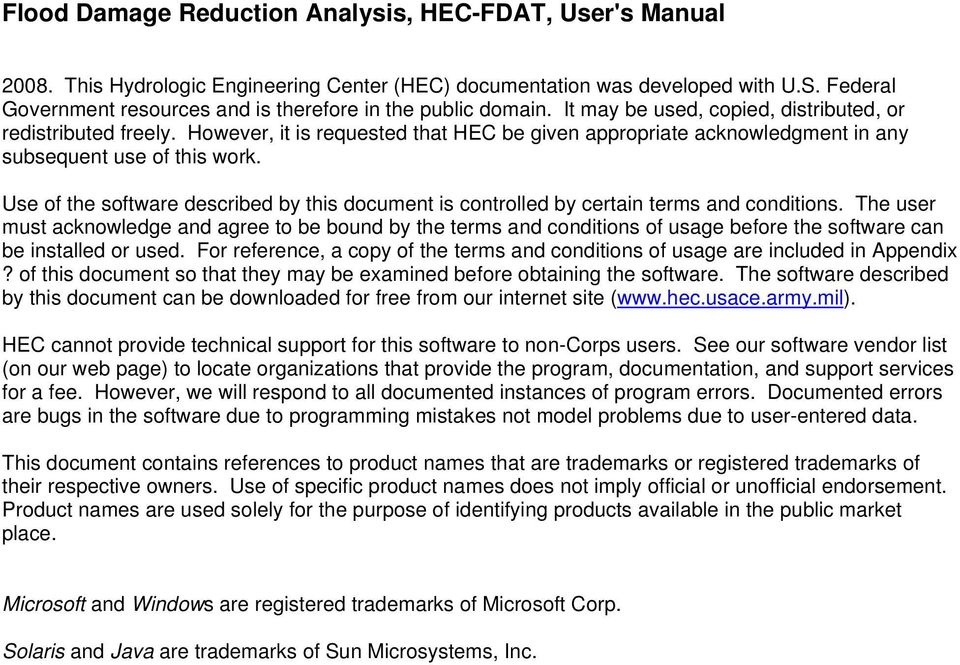
5 HEC-FDA User's Manual Table of Contents Table of Contents List of Figures... xi List of Tables...xix Acknowledgments...xxi Foreword... xxiii Chapters 1 Introduction 1.1 Purpose Program Capabilities Computation Procedures Database User Interface Data Entry Analysis Results User's Manual Layout Working with HEC-FDA - An Overview 2.1 Starting HEC-FDA General Layout Analysis Steps Define a Study Study Configuration Hydrologic Engineering Economics Evaluation Program Concepts/Capabilities Normalized Export Merge Save, Add/Update, Cancel, and Close Navigator Button Assignments Non-Modality Study Backup Help Menu On-line Help Printing Warning Messages Exiting Program Study Configuration 3.1 General Streams Create Streams Edit Streams i

6 Table of Contents HEC-FDA User's Manual Table of Contents (continued) Chapters 3 Study Configuration (continued) Delete Streams List of Streams Data Entry Variables for Streams Damage Reaches Defining Damage Reaches Create Damage Reaches Edit Damage Reaches Delete Damage Reaches List of Damage Reaches Data Entry Variables for Damage Reaches Plans Create Plans Edit Plans Delete Plans List of Plans Data Entry Variables for Plans Analysis Years Create Analysis Years Data Entry Variables for Analysis Years References Hydrologic Engineering (HydEng) 4.1 General Water Surface Profiles Importing Water Surface Profile Sets Edit a Water Surface Profile Set Delete a Water Surface Profile Set List of Water Surface Profile Sets Water Surface Profile Plot Water Surface Profile Report Assigning an Existing Water Surface Profile Set to a Different Plan, Analysis Year, Stream Combination List of Water Surface Profile Set Assignments Entering a Water Surface Profile Set Manually Data Entry Variables for Water Surface Profiles References Exceedance Probability Functions 5.1 General Analytical-Exceedance Probability Method Compute Synthetic Statistics Log Pearson Type III ii
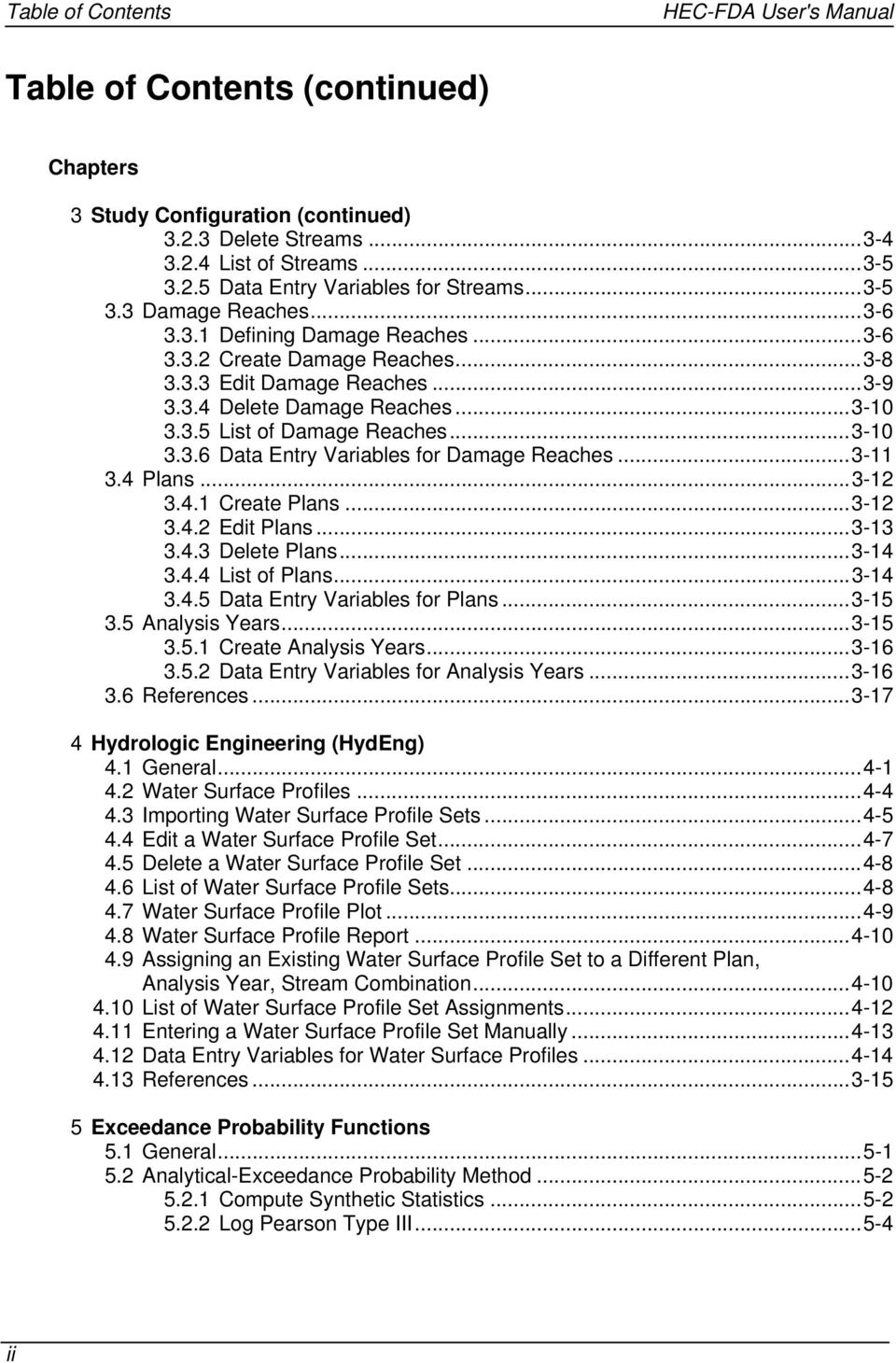
7 HEC-FDA User's Manual Table of Contents Table of Contents (continued) Chapters 5 Exceedance Probability Functions (continued) 5.3 Graphical Exceedance Probability Method Creating a Graphical-Exceedance Probability Function Eight Data Points versus Nine Data Points Transform Flow Relationship Delete an Exceedance Probability Function List of Exceedance Probability Functions Exceedance Probability Function Plot Exceedance Probability Function Report Assigning an Existing Exceedance Probability Function to a Different Plan, Analysis Year, Stream, Damage Reach Combination List of Exceedance Probability Function Assignments Data Entry Variables for Exceedance Probability Functions References Stage-Discharge Functions 6.1 General Creating a Stage-Discharge Function Delete a Stage-Discharge Function List of Stage-Discharge Functions Stage-Discharge Function Plot Stage-Discharge Function Report Assigning an Existing Stage-Discharge Functions to a Different Plan, Analysis Year, Stream, Damage Reach Combination List of Stage-Discharge Function Assignments Data Entry Variables for Stage-Discharge Functions Levee Features 7.1 General Creating a Levee Exterior-Interior Relationship Exterior-Interior Relationship Plot Exterior-Interior Relationship Report Geotechnical Failure Analysis Geotechnical Failure Analysis Plot Geotechnical Failure Analysis Report Wave Overtopping Delete a Levee List of Levees Assigning an Existing Levee to a Different Plan, Analysis Year, Stream, Damage Reach Combination List of Levee Assignments Data Entry Variables for Stage-Discharge Functions iii

8 Table of Contents HEC-FDA User's Manual Table of Contents (continued) Chapters 8 Economics 8.1 General Study Damage Categories Defining Damage Categories Create Damage Categories Edit Damage Categories Delete Damage Categories List of Damage Categories Data Entry Variables for Damage Categories Import/Export Study Data Import HEC-SID Structure Inventory Importing HEC-FDA Study Data Exporting HEC-FDA Study Data Structure Occupancy Types 9.1 General Defining Structure Occupancy Types Create Structure Occupancy Types Depth-Percent Damage Functions Structure Content Other Content to Structure Value Ratio Other to Structure Value Ratio Define Uncertainty Parameters First Floor Stage Structure Value Content/Structure Value Other/Structure Value Edit Structure Occupancy Types Delete Structure Occupancy Types List of All Structure Occupancy Types Description of Structure Occupancy Type Data Entry Variables References Structure Modules 10.1 General Create Structure Modules Edit Structure Modules Delete Structure Modules List of Structure Modules Creating Structure Module Assignments Report of Structure Module Assignments iv

9 HEC-FDA User's Manual Table of Contents Table of Contents (continued) Chapters 11 Structure Inventory 11.1 General Entering Structure Inventory Data Form Values Associated with a Structure Structure Assignments Structure Stages Optional Structure Information Direct-Dollar Information for a Structure Structure Content Other Entering Structure Inventory Data Table Values Associated with a Structure Structure Stages Structure Assignments Optional Structure Information Direct-Dollar Information for a Structure Structure Content Other Deleting Structures Description of Structure Data Entry Variables References Stage-Damage Functions 12.1 General Entering a Stage-Damage Function Manually Delete a Stage-Damage Function List of Stage-Damage Functions Stage-Damage Function Plot Stage-Damage Function Report Assigning an Existing Stage-Damage Function to a Different Plan, Analysis Year, Damage Category, Stream, Damage Reach Combination List of Stage-Damage Function Assignments Rename a Stage-Damage Function Compute Stage-Damage Functions Stage-Damage Compute Options Compute Options by Plans and Analysis Year Global Compute Options Data Entry Variables for Stage-Damage Functions References Evaluation 13.1 Study Status Report Evaluation of Plans by Analysis Year v
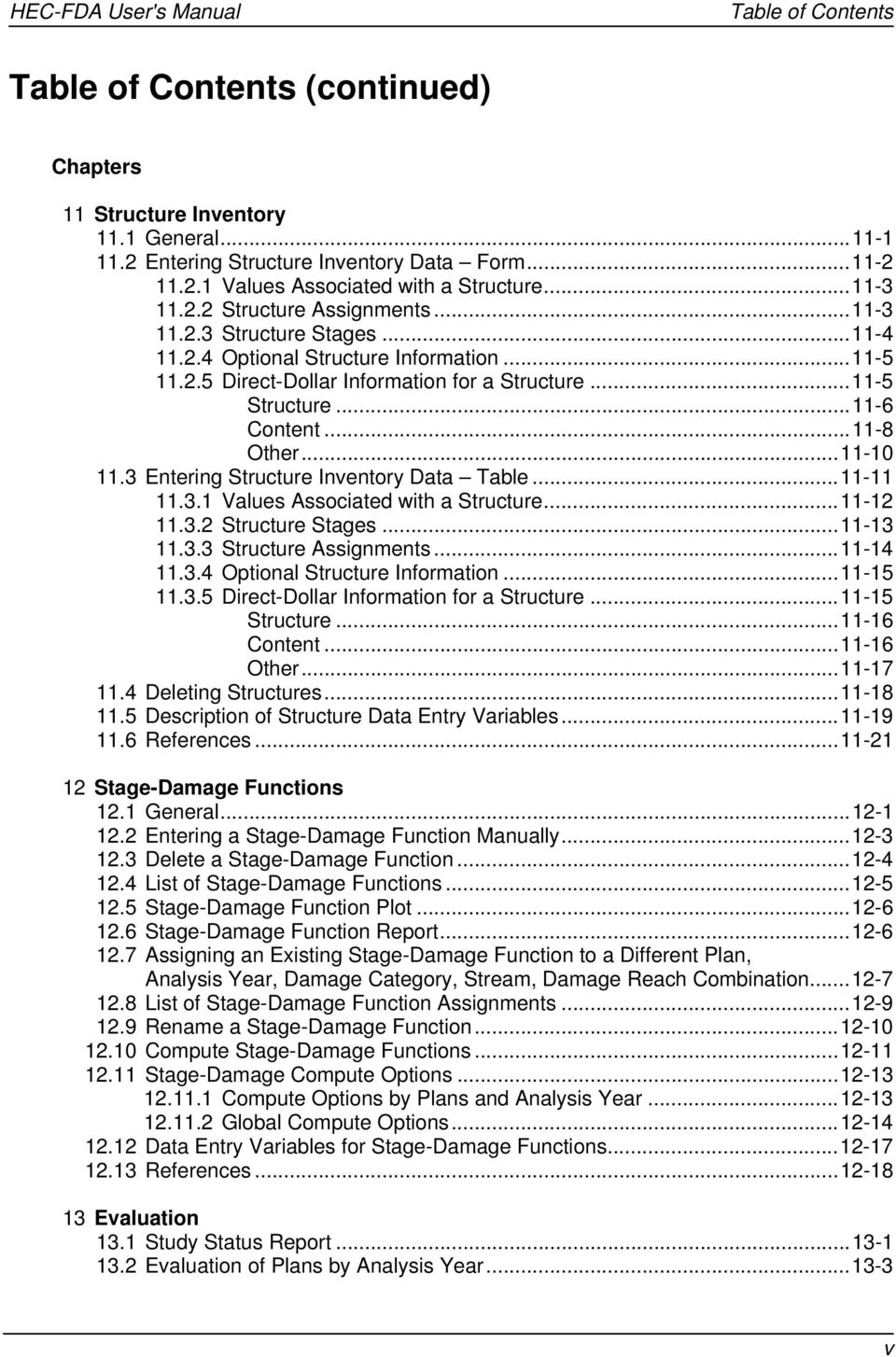
10 Table of Contents HEC-FDA User's Manual Table of Contents (continued) Chapters 13 Evaluation (continued) 13.3 Equivalent Annual Damage Analysis References Damage by Analysis Year Reports 14.1 General Information Reports Data Management Summary Monte Carlo Analysis Summary Warning Message Log Damage Reach Summaries Exceedance Probability Discharge Function Exceedance Probability Stage Function Exceedance Probability Damage Function Exceedance Probability Mean Damage Reduced Expected Annual Damage By Damage Categories - Plans By Damage Categories Damage Reaches Damage Reduced Distribution - Plans Damage Reduced Distribution Damage Reaches By Plan & Analysis Years Analysis Years Other HEC-FDA Results 15.1 Equivalent Annual Damage Analysis Reports Data Management Summary Summary Reports Reduced and Distribution - Plans Reduced and Distribution Damage Reaches By Damage Categories - Plans By Damage Categories Damage Reaches Project Performance Reports Target Stages by Damage Reach Damage Reach Plan & Damage Reach Additional Reports not Available from HEC-FDA Reports Written to a ASCII Tab Delimited File Input and Output Functions Written to an HEC-DSS File Troubleshooting 16.1 Error Messages General Error Messages Codebase Error Messages Diagnosing Problems Missing or Out-of-Date Computation Results Trace Output vi

11 HEC-FDA User's Manual Table of Contents Table of Contents (continued) Appendices Appendix A References A.1 Required Publications... A-1 A.2 Other Publications... A-2 Appendix B Glossary Appendix C Creating Water Surface Profile Data C.1 Creating Water Surface Profile Data from HEC-2... C-1 C.2 Creating Water Surface Profile Data from HEC-RAS... C-2 Appendix D Wave Overtopping Analysis D.1 New Levees and Floodwalls... D-1 D.2 Levees Subject to Geotechnical Failure... D-5 Appendix E Importing HEC-FDA Study Data E.1 HEC-FDA Study Data... E-1 E.2 Requirements for Importing from an ASCII Tab Delimited File... E-2 E.2.1 Types of Study Data and Associated Keywords... E-2 E.2.2 Format of Data and Fieldnames... E-3 E.2.3 Header Record and Fieldnames for Plans... E-4 E.2.4 Header Record and Fieldnames for Analysis Years... E-5 E.2.5 Header Record and Fieldnames for Streams... E-5 E.2.6 Header Record and Fieldnames for Damage Reaches... E-6 E.2.7 Header Record and Fieldnames for Damage Categories... E-7 E.2.8 Header Record and Fieldnames for Structure Occupancy Types... E-8 Structure Occupancy Type Parameter Codes... E-9 E.2.9 Header Record and Fieldnames for Structure Modules... E-11 E.2.10 Header Record and Fieldnames for Structures... E-11 E.2.11 Header Record and Fieldnames for Water Surface Profiles... E-13 First Header Record and Fieldnames for Water Surface Profiles... E-14 Second Header Record and Fieldnames for Water Surface Profiles... E-16 Third Header Record and Fieldnames for Water Surface Profiles... E-16 E.3 Procedures for Updating the Study Data... E-20 E.4 Importing Data from HEC-SID Data Files... E-21 Appendix F Procedures for Computing Stage-Damage Functions F.1 General...F-1 F.2 Introduction...F-3 F.3 Setting Up the Calculation Procedures...F-3 vii
12 Table of Contents HEC-FDA User's Manual Table of Contents (continued) Appendices Appendix F Procedures for Computing Stage-Damage Functions (continued) F.4 Compute Stage-Damage at Individual Structures Without Uncertainty...F-7 F.4.1 Calculating the Assumed Water Surface Profile Elevations at the Structure...F-7 Description of Sample Data Profiles and Structures...F-7 Calculating Sample Aggregation Stages...F-9 Aggregation Methodologies...F-10 Data Requirements for Aggregation...F-10 Selecting the Aggregation Methodology...F-13 F.4.2 Computing Damage for One Aggregation Stage Without Uncertainty...F-13 Overview...F-13 Procedure for Calculating Stage-Damage Without Uncertainty...F-18 F.5 Computing Stage-Damage at One Structure with Uncertainty...F-22 F.5.1 Overview...F-22 F.5.2 Risk Analysis Calculations...F-22 F.5.3 Identical Structures...F-22 F.5.4 Detailed Description of Stage-Damage Calculation with Uncertainty...F-24 F.6 Aggregating the Stage-Damage Functions to the Index Location...F-30 Appendix G Stage-Damage Text Output Files G.1 General... G-1 G.2 FDA_SDmg.out... G-2 G.2.1 Basic Output... G-2 G.2.2 Trace Level Less than Five... G-2 Summary Output for Component... G-2 Summary Output for Component with Uncertainty Error... G-5 G.2.3 Trace Level Greater then Four... G-5 G.2.4 Trace Level Greater than Nine... G-5 G.3 FDA_SdError.out... G-7 G.3.1 Summary Validation Output... G-7 G.3.2 Trace Level Five or Greater... G-8 G.4 FDA_SDev.out... G-11 Trace Level Greater then Forty-Nine... G-11 G.5 FDA_StrucDetail.out... G-12 Detailed Structure Output... G-12 Appendix H HEC-FDA Computation Procedures H.1 Introduction... H-1 H.2 Monte Carlo Simulation... H-1 H.2.1 Overview... H-1 H.2.2 Numerical Integration with Monte Carlo Simulation... H-2 viii

13 HEC-FDA User's Manual Table of Contents Table of Contents (continued) Appendices Appendix H HEC-FDA Computation Procedures (conintued) H.2.3 Computing Expected Annual Damage, Exceedance Probability, and Event Probabilities... H-4 H.2.4 Monte Carlo Simulation Options for Calculating EAD... H-8 H.3 Sampling Algorithm for Numeric Integration... H-9 H.3.1 Overview... H-9 H.3.2 Sampling from the Log-Pearson III Distribution... H-10 H.3.3 Random Sampling of Graphical or Non-Analytic Relationships... H-13 H.3.4 Random Sampling of Uncertainty Relationships Using a Random Number Generator... H-14 H.3.5 Numerical Error Tolerance for Simulations... H-16 H.3.6 Integrating the Damage-Exceedance Probability Function to Obtain EAD... H-17 H.4 Uncertainty Distributions... H-19 H.4.1 General... H-19 H.4.2 Triangular Error Distribution... H-20 H.4.3 Normal and Log-Normal Distributions... H-20 H.4.4 Application to Stage versus Damage Relationships... H-22 H.5 Levee Analysis... H-23 H.6 Project Reliability and Flood Risk Computations... H-24 H.7 Computation of Equivalent Annual Damage... H-24 H.7.1 Inundation Reduction Benefit Computations... H-25 H.8 References... H-25 ix

14 Table of Contents HEC-FDA User's Manual x
15 HEC-FDA User's Manual List of Figures List of Figures Figure Number 2.1 HEC-FDA Main Window File Menu Create New Study Dialog Box Study Information Dialog Box Open Study Dialog Box Configure Menu HydEng Menu Economics Menu Evaluation Menu Evaluation of Plans by Analysis Year Dialog Box Results Submenu Navigation Button Help Menu About FDA Dialog Box Stream and Damage Reach Concepts Study Streams Dialog Box Study Streams Dialog Box - Update Button List of Streams Dialog Box Study Damage Reaches Dialog Box Study Damage Reaches Dialog Box - Update Button List of Damage Reaches Dialog Box Study Plan Definition Dialog Box Study Plan Definition Dialog Box - Update Button List of Plans Dialog Box Analysis Years Study Analysis Years Dialog Box Study Water Surface Profiles Dialog Box Assignment Items for a Water Surface Profile Set Import Water Surface Profiles Dialog Box Notes Dialog Box Edit Probability Values Dialog Box List of Water Surface Profiles Dialog Box Water Surface Profiles Plot Dialog Box Water Surface Profiles Report Dialog Box Copy Water Surface Profiles Dialog Box Global Assignment Copy Dialog Box Water Surface Profiles Assignments Dialog Box Exceedance Probability Functions with Uncertainty Dialog Box Assignment Items for Exceedance Probability Functions Discharge-Probability Function - Type Analytical - Synthetic Statistics Dialog Box xi
16 List of Figures HEC-FDA User's Manual List of Figures (continued) Figure Number 5.4 Discharge-Probability Function - Type Analytical - Log Pearson Type III Dialog Box Probability Function - Type Graphical Dialog Box Probability Function - Type Graphical Equivalent Record Length Dialog Box Exceedance Probability Function Report - Graphical - From Water Surface Profiles - Eight Data Points Exceedance Probability Function Plot - Graphical - From Water Surface Profiles - Eight Data Points Exceedance Probability Function Report - Graphical - Nine Data Points Exceedance Probability Function Plot - Graphical - Nine Data Points Transform Flow Dialog Box Transform Flow Dialog Box - Triangular Distribution List of Exceedance Probability Functions Dialog Box Exceedance Probability Function Plot Dialog Box Exceedance Probability Function Report Dialog Box Copy Exceedance Probability Function Dialog Box Global Assignment Copy Dialog Box Exceedance Probability Function Assignments Dialog Box Stage-Discharge Function with Uncertainty Dialog Box Assignment Items for Stage-Discharge Functions Set Stage for a distribution type Dialog Box List of Stage-Discharge Functions Dialog Box Stage-Discharge Plot Dialog Box Stage-Discharge Report Dialog Box Copy Stage-Discharge Function Dialog Box Global Assignment Copy Dialog Box Stage-Discharge Function Assignment Dialog Box Levee Features Dialog Box Assignment Items for Levees Exterior/Interior Relationship Dialog Box Exterior/Interior Relationship Plot Dialog Box Exterior/Interior Relationship Report Dialog Box Geotechnical Failure Analysis Dialog Box Geotechnical Failure Analysis Plot Dialog Box Geotechnical Failure Analysis Report Dialog Box List of Levees Dialog Box Copy Levee Dialog Box Global Assignment Copy Dialog Box Levee Assignments Dialog Box Study Damage Categories Dialog Box Study Damage Categories Dialog Box - Update Button List of Damage Categories Dialog Box xii
17 HEC-FDA User's Manual List of Figures List of Figures (continued) Figure Number 8.4 Import Structure Inventory Dialog Box Import Structure Inventory Data Browser Import Data Dialog Box Import Data Browser Importing Data Status Dialog Box Export Data Dialog box Export Field Separator(s) Box Export Options Box Export Data Browser Exporting Data Status Dialog Box Study Structure Occupancy Types Dialog Box Depth-Percent Damage Function - Structure Dialog Box Depth-Percent Damage Function Plot - Structure Dialog Box Depth-Percent Damage Function Report - Structure Dialog Box Depth-Percent Damage Function - Content Dialog Box Depth-Percent Damage Function Plot - Content Dialog Box Depth-Percent Damage Function Report - Content Dialog Box Depth-Percent Damage Function - Other Dialog Box Depth-Percent Damage Function Plot - Other Dialog Box Depth-Percent Damage Function Report - Other Dialog Box Error Associated with First Floor Stage Dialog Box Error Associated with Structure Value Dialog Box Error Associated with Content/Structure Value Dialog Box Error Associated with Other/Structure Value Dialog Box Study Structure Occupancy Types Dialog Box - Update Button List of All Structure Occupancy Types Dialog Box Structure Module Dialog Box Structure Module Dialog Box - Add Button Structure Module Dialog Box - Update Button List of Structure Modules Dialog Box Structure Module Assignment Dialog Box Structure Module Assignments Dialog Box Structure Inventory Dialog Box Form Values Associated with a Structure Structure Assignments Structure Stages Dialog Box First Floor Structure Stages Dialog Box Ground Stage Optional Structure Information Dialog Box Define Direct Structure Information Depth-Direct Dollar Damage Function Structure Dialog Box Depth-Direct Dollar Damage Plot Structure Dialog Box Depth-Direct Dollar Damage Function Report Structure Dialog Box xiii
18 List of Figures HEC-FDA User's Manual List of Figures (continued) Figure Number Depth-Direct Dollar Damage Function Content Dialog Box Depth-Direct Dollar Damage Plot Content Dialog Box Depth-Direct Dollar Damage Function Report Content Dialog Box Depth-Direct Dollar Damage Function Other Dialog Box Depth-Direct Dollar Damage Plot Other Dialog Box Depth-Direct Dollar Damage Function Report Other Dialog Box Structure Inventory Dialog Box Table FDA Structure Name Dialog Box Values Associated with a Structure Structure Stages Structure Assignments Direct-Dollar Information Shortcut Menu Error Associated with First Floor Stage Dialog Box Stage-Damage Function at Index Location with Uncertainty Dialog Box Assignment Items for Stage-Damage Functions List of Stage-Damage Functions Dialog Box Stage-Damage Plot Dialog Box Stage-Damage Function Report Dialog Box Copy Aggregate Stage-Damage Function Dialog Box Global Assignment Copy Dialog Box Stage-Damage Function Assignments Dialog Box Renaming an Assigned Stage-Damage Function Warning Message Compute Reach Stage-Damage Function with Uncertainty Dialog Box Aggregate Stage-Damage Computation Status Dialog Box Global Options for Stage-Damage Computation Dialog Box Study Status Report Dialog Box Evaluation of Plans by Analysis Year Dialog Box EAD Computation Status Dialog Box Equivalent Annual Damage Analysis Dialog Box Damage by Analysis Year Dialog Box General Information Reports Box Data Management Summary Print Dialog Box Report Information Box Monte Carlo Analysis Summary with Uncertainty Report Monte Carlo Analysis Summary with Uncertainty Plot Warning Message Log Damage Reach Summaries Box Exceedance Probability-Discharge Function Report Exceedance Probability-Mean Discharge Function - Plot Exceedance Probability-Stage Function Report Exceedance Probability-Mean Stage Function - Plot xiv
19 HEC-FDA User's Manual List of Figures List of Figures (continued) Figure Number Exceedance Probability-Damage Functions Report Exceedance Probability-Mean Damage Function - Plot Exceedance Probability-Mean Damage Reduced Report Exceedance Probability-Mean Damage Reduced - Plot Expected Annual Damage Box Expected Annual Damage by Damage Categories and Plans Report Expected Annual Damage by Damage Categories and Damage Reaches Report Expected Annual Damage Reduced and Distributed by All Plans Report Expected Annual Damage Reduced and Distributed for the Plan Report Expected Annual Damage by Plans and Analysis Years Report Expected Annual Damage by Analysis Years for Plan Report Equivalent Annual Damage Analysis Dialog Box Data Management Summary Report Print Dialog Box Equivalent Annual Damage Reduced and Distributed by Plans Report Equivalent Annual Damage Reduced and Distributed by Damage Reaches Report Equivalent Annual Damage by Damage Categories and Plans Report Equivalent Annual Damage by Damage Categories and Damage Reaches Report Project Performance Dialog Box Project Performance Target Stages by Damage Reaches Report Project Performance by Damage Reaches Report Project Performance by Plans and Damage Reaches Report FdaResults.txt File Example Probability of Exceeding a Given EAD Example Probability-Stage Curves Derived from Input Data Example Probability-Total Damage Curves Derived from Input Data Trace Output File C.1 Partial Listing of SUMPO Water Surface Profile Data... C-2 C.2 HEC-RAS Profile Output Table for HEC-FDA... C-3 C.3 Partial Listing of File from HEC-RAS Profile Output Table HEC-FDA... C-4 D.1 Levee Features Dialog Box... D-1 D.2 Wave Overtopping Analysis Dialog Box Wave Height Functions... D-2 D.3 Wave Overtopping Analysis Dialog Box Overtopping Parameters... D-3 E.1 Example ASCII Tab Delimited for Importing Data... E-3 E.2 Header Record and Data Records for Importing Plans... E-5 E.3 Header Record and Data Records for Importing Analysis Years... E-5 E.4 Header Record and Data Records for Importing Streams... E-6 xv
20 List of Figures HEC-FDA User's Manual List of Figures (continued) Figure Number E.5 Header Record and Data Records for Importing Damage Reaches... E-7 E.6 Header Record and Data Records for Importing Damage Categories... E-7 E.7 Header Record and Data Records for Importing Structure Occupancy Types... E-8 E.8 Header Record and Data Records for Importing Structure Modules... E-11 E.9 Header Record and Data Records for Importing Structures... E-14 E.10 All Three Header Records and Data Records for Importing Water Surface Profiles Sets... E-15 F.1 Discharge-Exceedance Probability Curve for Damage Reach SC 2R...F-5 F.2 Stage-Discharge Function for Damage Reach SC 2R...F-5 F.3 Water Surface Profiles, Without Condition...F-8 F.4 Logic for Testing Data Validity of Aggregation Methodologies...F-11 F.5 Logic for Determining Aggregation Methodology...F-12 F.6 Single Family, Residential, Without Basement Structure Occupancy Type Data Function...F-15 F.7 Calculating Stage-Damage Without Uncertainty, One Ordinate...F-16 F.8 Selected Aggregation and Water Surface Profiles RM F-17 F.9 Selected Aggregation and Water Surface Profiles RM F-17 F.10 Stage-Damage Without Uncertainty for Structure R003...F-19 F.11 Calculating Stage-Damage Without Uncertainty for One Structure...F-23 F.12 Stage-Damage with Uncertainty for Structure R003...F-24 G.1 Trace Output File (FDA_SDmg.out)... G-2 G.2 FDA_SDmg.out Stage-Aggregated Damage by Category... G-3 G.3 FDA_SDmg.out Stage-Aggregated Damage by Category with Uncertainty... G-6 G.4 FDA_SDmg.out Trace Level Greater than Four... G-5 G.5 Example Structure Summary Validation Output... G-7 G.6 FDA_SdErrors.out Trace Level Greater than Nine... G-7 G.7 Example Structure Computation Errors, Frame 1... G-8 G.8 Example Structure Computation Errors, Frame 2... G-8 G.9 Example Structure Computation Errors, Frame 3... G-9 G.10 Example Detailed Monte-Carlo Simulation Results for One Structure... G-12 G.11 Example of FDA_StrucDetail.out Frame 1... G-13 H.1 Numerical Integration of Probability Density Function to Obtain EAD... H-3 H.2 EAD Computation Sensitivity Analysis... H-5 H.3 Monte Carlo Simulation Algorithm for Estimating EAD... H-5 H.4 Adding Computation of Regulated Outflow to Monte Carlo Algorithm for Computing EAD... H-9 H.5 Random Samples of Normal Populations from Population Parameters μ, σ... H-11 H.6 Random Selection of LPIII Distribution from Random Log-Normal Distribution... H-12 H.7 Sampling of Non-Analytic or Graphical Relationships... H-14 H.8 Triangular Distribution Application... H-21 H.9 Normal Distribution of Errors... H-22 H.10 Damage Considering Levee Geotechnical Failure... H-23 xvi

21 HEC-FDA User's Manual List of Tables List of Tables Table Number 2.1 Permitted Functions/Features Copying for Different Assignments Study Plans and Analysis Years Uncertainty-Based on Measurement Methods Structure Inventory Module Concepts HEC-FDA DSS Record Pathname Parts HEC-FDA Data Stored in an HEC-DSS File HEC-FDA Error Messages F.1 List of Damage Reaches for Silver Creek...F-3 F.2 Log Person Type III Statistics for Damage Reach SC 2R...F-4 F.3 Probability Ordinates Damage Reach SC 2R...F-4 F.4 Stage-Discharge Function of Damage Reach SC 2R...F-6 F.5 Stage Water Surface Stage Profiles, Without Condition...F-8 F.6 Structure Characteristics for Aggregation...F-9 F.7 Aggregation Profiles at Selected Locations...F-10 F.8 Single Family, Residential, Without Basement Structure Occupancy Type Damage Function...F-15 F.9 Stage-Damage Without Uncertainty for Structure R003...F-18 F.10 Uncertainty Parameters for Example Problem...F-24 F.11 Stage-Damage Without Uncertainty for Structure R003...F-25 F.12 Total Stage-Aggregated Damage, Damage Reach SC 2R...F-31 H.1 Calculating Event Conditional Stage Exceedance Probability from Monte Carlo Simulation Frequencies... H-8 H.2 Contributing Relationships Used in EAD Calculation... H-8 H.3 Constants for Linear Congruential Method... H-15 xvii
22 List of Tables HEC-FDA User's Manual xviii
23 HEC-FDA User's Manual Acknowledgments Acknowledgments Design and development of the Hydrologic Engineering Center Flood Damage Reduction Analysis (HEC-FDA) computer program has been a team effort over several years. Several past and present members of the Water Resource Systems Division played significant roles. Harry Dotson primarily designed and tested the hydrologic engineering portions of the program. Bob Carl wrote and tested the complex code for the economics procedures. Penni Baker was responsible for much the technical coordination of debugging the code, testing the program, instrumental in the overall design, and oversaw the creation of this user's manual. David Goldman, Hydrology & Hydraulics Technology Division, developed the complex algorithms and code for the Monte Carlo simulation, the primary computations required for risk-based analysis. Several people outside of HEC contributed to the program development. David Moser, from the Corps' Institute for Water Resources contributed significantly to the economics part of HEC-FDA. Wayne Haythorn, private consultant, designed and coded the database aspects of HEC-FDA and provided general consultations on the overall program design. Richard Rachiele and John DeGeorge of Resources Management Associates developed the graphical user interface and assisted with debugging and the overall design. Michael Deering, Chief, Water Resource Systems Division, provided general direction in the program development (past Division chiefs, have been Michael Burnham & Christopher Dunn). HEC software is under the guidance of Christopher N. Dunn, Director, Hydrologic Engineering Center. xix
24 Acknowledgments HEC-FDA User's Manual xx
25 HEC-FDA User's Manual Foreword Foreword The Hydrologic Engineering Center s Flood Damage Reduction Analysis (HEC-FDA) program provides state-of-the-art analysis for formulating and evaluating flood damage reduction plans using risk-based analysis methods. It is one of HEC's "Next Generation" (NexGen) of hydrologic engineering and water resources planning software. The NexGen project encompasses: rainfall-runoff analysis (HEC-HMS), river hydraulics (HEC- RAS), reservoir system analysis (HEC-ResSim), flood damage analysis (HEC-FDA), and real-time river forecasting for reservoir operations. The NexGen software has a windows style user interface and operates on Windows XP and Windows NT. The HEC-FDA program replaces HEC's previous PC version Flood Damage Analysis package containing programs SID, SIDEDT, FDA2PO and EAD (April 1994). The new HEC-FDA program contains enhanced versions of all their features plus risk-based analysis procedure for formulating and evaluating flood damage reduction measures. xxi
26 Foreword HEC-FDA User's Manual xxii
27 HEC-FDA User's Manual Chapter 1 - Introduction CHAPTER 1 Introduction The HEC-FDA program provides the capability to perform an integrated hydrologic engineering and economic analysis during the formulation and evaluation of flood damage reduction plans. The functional elements of a study involving coordinated study layout and configuration, hydrologic engineering analyses, economic analyses, and plan formulation and evaluation are followed. Welcome to the Hydrologic Engineering Center s Flood Damage Reduction Analysis (HEC-FDA) computer program. This program allows you to perform plan formulation and evaluation for flood risk management studies. It includes risk analysis methods that follow Federal and Corps of Engineers policy regulations (ER and ER ). Both economic flood damage and hydrologic engineering analyses are performed using a consistent study configuration (streams, damage reaches, plans, and analysis years). Three types of evaluations are available: analysis of damage, project performance by analysis years; and equivalent annual damage. Many output tables and plots are used for reporting results. Computations and display of results are consistent with technical procedures described in EM This chapter discusses the purpose of FDA, gives a brief overview of the program requirements, capabilities, and the content of this user's manual. Contents Purpose of HEC-FDA Program Capabilities Overview of User's Manual 1.1 Purpose The FDA program provides the capability to perform an integrated hydrologic engineering and economic analysis during the formulation and evaluation of flood risk management plans. The program follows functional elements of a study involving coordinated study layout and configuration, hydrologic engineering analyses, economic analyses, and plan formulation and evaluation. You use it continuously throughout the planning process as the study evolves from the base year without-project condition analysis through the analyses of alternative plans over their project life. Hydrologic engineering and economics (flood inundation damage analyses) are performed separately, in a coordinated manner after 1-1
28 Chapter 1 - Introduction HEC-FDA User's Manual specifying the study configuration and layout, and merged for the formulation and evaluation of the potential flood damage reduction plans. 1.2 Program Capabilities FDA is an integrated system of software that is designed for interactive use. The program consists of a graphical user interface (GUI), hydrologic engineering and economics components, database and management capabilities, graphics and reporting facilities Computation Procedures The Corps of Engineers requires the use of risk analysis procedures for formulating and evaluating flood damage reduction measures (EM , ER ). These documents describe how to quantify uncertainty in discharge-exceedance probability, stage-discharge, and damage-stage functions and incorporate it into economic and engineering performance analyses of alternatives. The process applies Monte Carlo simulation, a numerical-analysis procedure that computes the expected value of damage while explicitly accounting for the uncertainty in the basic parameters used to determine flood inundation damage. HEC has developed the FDA computer program to assist in analyzing flood risk management plans using these procedures. Refer to Appendices E and F for descriptions of the analysis process used by FDA. (EM provides more detailed descriptions of the analysis procedures used by FDA.) FDA performs all the computations that were available in the old FDA batch program plus risk analysis and other enhancements. Inventories of floodplain structures are used to calculate damage-stage-uncertainty information at damage reach index locations. Expected and/or equivalent annual damage are computed in the evaluation portion of the program Database FDA uses a relational database to store data and output for reports and the database is the central part of FDA. The xbase format was chosen for the program because it is: 1) an adopted industry standard; 2) compatible with the file structure found in commercial software; and, 3) functional in the multiple platform environments. The database operations require use of internal identifiers to relate the program's data sets. This presents special design considerations to avoid potential database corruption from affects of multiple users. 1-2
29 HEC-FDA User's Manual Chapter 1 - Introduction User Interface The interface is designed to make the program easy and efficient to use. The interface provides the following functions: File management Data entry and editing Data selection and assignments Hydrologic and economic analyses Tabular and graphical displays of input and output data Reporting facilities On-line help Data Entry You can enter data in a variety of ways using FDA. The most common is using text fields on the program's dialog boxes. This is also called the "form" method. Certain dialog boxes have an alternative data entry called "tables." The same data entered on the form can instead be entered into a spreadsheet-like table. Some dialog boxes have import capabilities. For example, water surface profiles may be imported from the HEC River Analysis System package (HEC-RAS, USACE 2002) or Water Surface Profiles program (HEC-2, USACE 1991). The structure inventory can be imported from the Structure Inventory for Damage Analysis program (HEC-SID, USACE 1989) or from ASCII delimited text files Analysis Results A number of analysis results are available for review of computations and evaluation of results. Project performance, damage by analysis years, and equivalent annual damage are included in the results. Output includes tables and selected graphics of information by plan, analysis year, stream, and damage reach for the entire plan. Plan comparisons may also be performed. 1.3 User's Manual Layout This user's manual is the primary documentation on how to use the FDA program. The manual is organized as follows: 1-3
30 Chapter 1 - Introduction HEC-FDA User's Manual Chapter 1 provides an introduction to FDA. Chapters 2 provides an overview and describes the general layout of the FDA program. Also, provides an overview of the analysis steps in FDA and how to define a study. Chapter 3 describes the Study Configuration portion of FDA. This includes defining the streams, damage reaches, plans, and analysis years for a study in FDA. Chapters 4 through 7 describe the Hydrologic Engineering (HydEng) portion of FDA. Chapter 4 provides an overview of HydEng and describes defining water surface profiles for a study. Chapter 5 provides information on defining exceedance probability functions. Chapter 6 describes defining stage-discharge functions. Chapter 7 provides information on defining levees in FDA. Chapters 8 through 12 describe the Economics portion of FDA. Chapter 8 provides an overview of Economics and describes defining damage categories. Chapter 9 provides information on defining structure occupancy types. Chapter 10 describes defining structure modules. Chapter 11 provides information on the structure inventory for a study. Chapter 12 provides information on stage-damage functions. Chapter 13 provides information on the computation process that is available from the FDA. Chapter 14 describes the available reports in FDA that are a result of the evaluation of plans by analysis years computations. Chapter 15 describes further details on the other available FDA reports. Chapter 16 provides troubleshooting information for FDA. Several appendices are included for assistance. Appendices A and B provide references and a glossary, respectively. Appendix C describes procedures for importing water surface profiles. Appendix D describes the levee wave overtopping analysis procedures. Appendix E provides details on how to import data into an FDA study. Appendix F provides an overview of the economic flood damage procedures. Appendix G provides an overview of ASCII tab delimited files that are available from the economic flood damage procedures. Appendix H describes the Monte Carlo Simulation methodology used for computing expected and equivalent annual damage. 1-4
31 HEC-FDA User's Manual Chapter 2 Working with HEC-FDA An Overview CHAPTER 2 Working with HEC-FDA An Overview HEC-FDA is an interdisciplinary program used to formulate and evaluate flood damage reduction plans. You interact with FDA through a graphical user interface (GUI). The program performs economic (flood inundation damage analysis) and hydrologic engineering performance computations for plan evaluations. A study is a set of data files associated with a planning evaluation. In FDA terminology, a study is a set of data files associated with a planning evaluation. The study includes all streams and damage reaches to be analyzed as part of the study area. You can perform any or all of the analyses available in the FDA program as part of the study. Only one study is open at a time. The files associated with the study contain information on plans, analysis years, streams, damage reaches, damage categories, structures, etc. The files are stored together in one subdirectory as xbase formatted database files. The directory is named when a new study is created. The directory is a subdirectory of the FDA directory (c:\program Files\hec\fda). During the course of a study, you may formulate and evaluate several different plans. The first plan is always the without-project condition. Additional plans may contain levees, reservoirs, channels, non-structural measures, and other measures or combinations thereof. You can easily formulate new plans once the basic data are entered. The results can be compared after the analyses of various plans are performed. This chapter provides an overview of how a study is performed within FDA. Contents Starting HEC-FDA General Layout Analysis Steps Additional Program Concepts Exiting the Program 2-1
32 Chapter 2 Working with HEC-FDA An Overview HEC-FDA User's Manual 2.1 Starting HEC-FDA When starting FDA, double-click the HEC-FDA icon on your desktop, or from the taskbar click Start, point to Programs, point to HEC, and then click FDA. The main window of FDA will appear (Figure 2.1). You are now ready to start using FDA. Figure 2.1 HEC-FDA Main Window 2.2 General Layout The FDA main window is organized to allow you to enter data, review data, edit data, compute, and view results. The Menu Bar contains the following menus: File Configure HydEng Economics This menu is used for file management and contains the following commands: New Study, Open Study, Delete Study, Normalized Export, Merge, Study Info, and Exit. This menu is used to enter information about the study configuration and contains the following commands: Study Streams, Study Damage Reaches, Study Analysis Years, and, Study Plan Definition, This menu is where you enter data needed for hydrologic and hydraulic analyses. Available commands are: Study Water Surface Profiles, Exceedance-Probability Function with Uncertainty, Stage-Discharge Functions with Uncertainty, and, Levee Features. This menu is used to enter the information needed for economic analyses. Available commands are: Study Damage Categories, Study Structure Occupancy Types, Structure Modules, Structure Module Assignments, Structure Inventory Data,Enter/Edit/View Reach Stage-Damage Function 2-2
33 HEC-FDA User's Manual Chapter 2 Working with HEC-FDA An Overview with Uncertainty, Compute Reach Stage-Damage, Import, and Export. View This menu provides results of the input that you have entered. Available commands are: List of Streams, List of Damage Reaches, List of Plans, List of Damage Categories, List of Structure Modules, and, List of Structures Occupancy Types. Evaluation You compute and evaluate economic and engineering performance under this menu item. The computations are performed by plans and analysis year or by plan equivalent annual damage. Hydrologic engineering project performance by plans is also computed. Output reports and selected plots are available for viewing results and comparing plans. Available commands are: Study Status Report, Evaluation of Plans by Analysis Year, Equivalent Annual Damage Analysis, and Results. Help This menu item allows you to get on-line help, as well as display the current version information about FDA. 2.3 Analysis Steps These steps are used in formulating and evaluating plans with FDA: Define a study (File menu) for both with- and without-project conditions. This is a team effort. Enter study configuration data (Configure menu). This is a team effort. Enter hydrology and hydraulics data (HydEng menu). Performed by the hydrologic and hydraulics team members, normally concurrent with the economic analyses. Enter economics data and/or compute aggregated stage-damage functions (Economics menu). Performed by the economics team members, normally concurrent with the hydrology and hydraulics analyses. Perform the expected annual damage/equivalent annual damage calculations (Evaluation menu). Normally performed and reviewed by the study team. 2-3
34 Chapter 2 Working with HEC-FDA An Overview HEC-FDA User's Manual Define a Study You define a new study or open an existing study from the File menu. Once a study is opened, the filename, title, and description of the study will always appear on the main window. Figure 2.2 shows the available command from the File menu. New Study To create a new study, on the File menu, click New Study, the Create New Study dialog box will open (Figure 2.3). The Figure 2.2 File Menu Create New Study dialog box has a default study filename extension (*.sty), directories and drive (c:\program Files\hec\fda). You Figure 2.3 Create New Study Dialog Box can store the study anywhere on the hard disk. However, it is recommend the study be a subdirectory of the program directory. The study filename extension can not be changed. Once the filename is entered, a new subdirectory is created with that name. All database files are then created. After the study information is entered, click Save, the Study Information dialog box will open (see Figure 2.4, page 2-5). From the Study Information dialog box, you provide information about the study including: a title; a description; notes about the study; and price index information. The information is used on various dialog boxes and reports throughout the program. You choose the numeric monetary units to be used for all study data entry and output reports. 2-4
35 HEC-FDA User's Manual Chapter 2 Working with HEC-FDA An Overview Figure 2.4 Study Information Dialog Box The Monetary Units list (Figure 2.4) allows you three choices ($, $1,000's, $1,000,000's) for monetary units. For example, $1,000's (the default) indicates all values will be in $1000's. These are used as labels only. System Units (Figure 2.4) is a flag indicating that all units for the study data entry and output reports will be either SI (metric) or English. These are also used as labels only. No conversions are made in the program. Price information allows you to globally adjust the price data from the year the damage survey data was compiled to an updated year. In the Surveyed Year box (Figure 2.4), enter the year associated with the original structure inventory survey flood damage values. It must be a numeric four digit value greater than It is used as a label only. In the Updated Year box (Figure 2.4) enter the price year associated with the updated price index. It is also a numeric four digit value. It must be greater than or equal to the surveyed year (default is surveyed year). In the Updated Price Index box (Figure 2.4) enter the updated price index used to update all economic (structure damage) values to present (or other) values. It can be any numeric value between 0.00 and If blank, it is assumed to be the same index value as the surveyed year with no adjustments made to the economic data. This value can be overridden by damage category, see Chapter 8 for further information. 2-5
36 Chapter 2 Working with HEC-FDA An Overview HEC-FDA User's Manual Open Study To open an existing study, on the File menu (see Figure 2.2, page 2-4), click Open Study, the Open Study dialog box will open (Figure 2.5). A list of previously defined studies will appear on the dialog box. You double click on the study filename (filenames with the extension "*.sty") to retrieve a study. Figure 2.5 Open Study Dialog Box Delete Study To delete the open study, on the File menu (see Figure 2.2, page 2-4), click Delete Study. A warning message will appear asking you if you really want to delete this study, click Yes. All files stored in the study subdirectory, and the study filename (".sty") above the study subdirectory will be deleted Study Configuration Study Configuration is where you configure the physical study layout and define plans for analysis for the study. This is a team effort. Configure is where you configure the physical study layout and define plans for analysis for the study. The data defined are in common with all analyses. You define the study streams, damage reaches, plans, analysis years as shown in Figure 2.6. When performing a study, it is important that all study members agree on the study configuration. Hydrologic Figure 2.6 Configure Menu engineers, economists, and study managers must work together to develop the configuration. The study configuration consists of those data items that are not likely to change during a study. Chapter 3 contains a more detailed description of the study configuration data. 2-6
37 HEC-FDA User's Manual Chapter 2 Working with HEC-FDA An Overview Hydrologic Engineering Hydrologic Engineering is where you define the hydraulics and hydrology data needed to evaluate plans. Performed by the hydrologic and hydraulics team members, normally concurrent with the economic analyses. Hydrologic Engineering (HydEng) is where you define the hydraulics and hydrology data needed to evaluate plans (Figure 2.7). You can specify sets of water surface profiles by stream for each plan and analysis year to be analyzed. Figure 2.7 HydEng Menu Exceedance probability functions, stagedischarge functions, and levee features are also defined under HydEng. Chapter 4 provides further discussion on the hydrologic and hydraulic information required by FDA Economics Economics (Figure 2.8) is where you define the economic data needed to evaluate the defined plans. The data includes: damage categories; structure occupancy types; structure inventory data, and stage-damage functions. Damage categories and structure occupancy types are defined Economics is where you define the economic data needed to evaluate the defined plans. Performed by the economics team members, normally concurrent with the hydrology and hydraulics analyses. Figure 2.8 Economics Menu for the entire study. You may enter the stage-damage functions with uncertainty directly by plan, year, damage reach, and damage category or you may compute the aggregated values based on the structure inventory data, water surface profiles, and uncertainty specifications. Chapter 8 provides a more detailed description of the economic information required by FDA. 2-7
38 Chapter 2 Working with HEC-FDA An Overview HEC-FDA User's Manual Evaluation Evaluation is where you compute results for expected annual damage, equivalent annual damage, and project performance by plan and analysis year using the risk analysis approach. Normally performed and reviewed by the study team. Evaluation (Figure 2.9) is where you compute results for expected annual damage, equivalent annual damage, and project performance by plan and analysis year using the risk analysis approach. The Figure 2.9 Evaluation Menu Evaluation of Plans by Analysis Year dialog box (Figure 2.10) provides information on the computations of expected annual damage by plan and analysis year. Chapter 13 provides further information about the computational procedures for FDA. Figure 2.10 Evaluation of Plans by Analysis Year Dialog Box A series of output reports are available once the computations are successfully completed. The Results submenu (Figure 2.11) provides commands for viewing the computation results. They include expected annual damage (plans by analysis years), equivalent annual damage, and project performance. You may view the Figure 2.11 Results Submenu results of computational information summaries by specifying analysis reports by plans, years, streams, and damage reaches. Chapter 14 provides further information on the results available from FDA. 2-8
39 HEC-FDA User's Manual Chapter 2 Working with HEC-FDA An Overview 2.4 Program Concepts/Capabilities Normalized Export A procedure which converts data stored in the database memo fields to database tables. This enables the data to be viewed and manipulated with other commercial databases or spreadsheets. A subdirectory named "export" is created under the study subdirectory Merge The Merge option allows you to make copies of the database (base copy), enter/edit data on the copies (incoming copy), and merge the results from the incoming copy back to the base copy. It's designed for the various hydrologic engineering and economics disciplines of the study team to work in parallel on separate work stations and to then merge the data together for analyses. It ensures that the resulting merged database does not have any inconsistencies or redundant data. There are different rules for the two types of merge - Hydrologic Engineering and Economics. HINT: We strongly recommend that you backup your study prior to performing the merge operation. The first step in Merge is to make a copy of the study.sty file (i.e., BearTrng.sty) and the study subdirectory (i.e., BearTrng) which contains the database files. The name that is given to the.sty file must be the same name given to the directory (i.e., xxx.sty and xxx), and both must be in the same parent directory. Copying the study files is performed outside the HEC-FDA package using other utilities. The process is: Create a new directory (xxx), which will store the incoming copy. Copy the entire contents of the base copy (BearTrng) into the directory "xxx". Copy the base copy's study file (BearTrng.sty) to xxx.sty. Copies may be made to CD-ROM or another medium for different study disciplines to use. We recommend that the incoming copy (xxx) be copied to the hard disk when using the study. Changes to the configuration files (items under the Configure Menu) of the incoming copy (xxx) are not allowed and will fail the merge. Only the base copy (BearTrng) can have changes to the configuration files. These changes may be additions only. If deletions are made to the base copy (BearTrng), then the merge will fail. 2-9
40 Chapter 2 Working with HEC-FDA An Overview HEC-FDA User's Manual Changes to hydrology/hydraulics (HydEng) data can only be made to the incoming copy (xxx). If changes are made to the base copy (BearTrng) and a Hydrology Merge is done, the changes to the base copy (BearTrng) will be lost. The Economic Merge works only with structure information, i.e., the structure occupancy type (depth-percent damage functions), structure inventory, and direct depth-dollar damage functions. Additions can be made to both the base (BearTrng) and the incoming (xxx) copies. If the name of a data item is the same for the base (BearTrng) copy and the incoming (xxx) copy, the latter is ignored. Editing should be done to the base (BearTrng) copy. When an Economics Merge is done, the stagedamage functions are cleared from the base (BearTrng) copy. Damage categories are considered a configuration item for Merge and changes should only be made to the base (BearTrng) copy Save, Add/Update, Cancel, and Close You save new data/information to the database by pressing the Add or Save Button. The Add Button converts to the Update Button when returning to a dialog box where existing data are present. After editing existing data, the Update Button is pressed to save the information to the database. The Cancel Button cancels any changes made to the data and returns the dialog box to its original state. You close a dialog box by selecting Close under the File menu Navigator Button The Navigation Button, (Figure 2.12) is available on several dialog boxes to allow Figure 2.12 Navigation Button quick movement through a data entry record list. Examples of data lists are streams, plans, and damage reaches. The << symbol places you at the top (first) record of the list, while the >> symbol places you at the bottom (last record). The < (previous) symbol and the > (next) symbol move you back one record and forward one record in the list, respectively. The center of the navigation button indicates the number of records in the list and which record you are presently accessing. You create a new record (blank out data fields) by pressing on the center of the button. 2-10
41 HEC-FDA User's Manual Chapter 2 Working with HEC-FDA An Overview Assignments An assignment is where a function is defined for each damage reach index location for each stream, plan, and analysis year. The capability to define (assign) functions and information to physical stream locations (streams, damage reaches) and specific plans (plans, analysis years) is an integral part of FDA. Computations for expected and equivalent annual damage and project performance are performed using the exceedance probability, stagedischarge, and stage-damage functions. They must be defined for each damage reach index location for each stream, plan, and analysis year. The definition specification is referred to as an assignment in FDA. The capability to define (assign) functions and information to physical stream locations (streams, damage reaches) and specific plans (plans, analysis years) is an integral part of the program design. Assignment items are located at the top of some of the dialog boxes For most data items or functions that require assignments, there is a report available that list the assignments. An (*) indicates an assignment is made but that some required data are missing. An (****) indicates that no assignment has been made. A (+) means that the data are out-of-date, i.e., the data to generate a function or output report has been changed. Often it is desirable to use the same function for several plans and or analysis years. For example, the without-project condition base year stagedischarge function for damage reach 1 may be used for Plans A and C for both the base year and most likely future year with- and without-project conditions. Table 2.1 lists the possible assignment items and associated copy combinations permitted for multiple assignments. The program filters the copies as shown in the table. Table 2.1 Permitted Functions/Features Copying for Different Assignments HEC-FDA Function/Feature Plan Analysis Year Stream Damage Reach Damage Category Water Surface Profiles Yes Yes No N/A N/A Discharge- or Stage- Yes Yes No Yes N/A Probability Stage-Discharge Yes Yes No Yes N/A Stage-Damage Yes Yes No No No Levee Yes Yes No No N/A Unique functions are copied from one plan to another by the Use Existing Function command. You may use (copy) the entire function assignments of one plan to another by selecting the Global Assignment Copy command. For example, you may wish to use the same exceedance probability functions, or ratings, or stage-damage for different plans that have several damage reaches. You may use the Global Assignment Copy command to perform the assignment operations. 2-11
42 Chapter 2 Working with HEC-FDA An Overview HEC-FDA User's Manual Non-Modality A powerful capability of using a graphical user interface is the ability to view and interact with multiple dialog boxes at a time. Version of FDA is primarily non-modal; meaning many of the dialog boxes can be opened simultaneously. However, FDA dialog boxes under the Study Configuration men (streams, damage reaches, plans, and analysis years), Damage Categories and Structure Occupancy Types under the Economics menu are modal-only, i.e., only one dialog box may be active or viewable at a time. This is due to the potential corruption of the database if certain operations are performed for these dialog boxes when multiple dialog boxes are open Study Backup You should keep a current backup of the study subdirectory containing the study data. The.sty file under the main directory should also be included. If for some reason your database becomes corrupted, you should delete the subdirectory and copy your backup to a new subdirectory of the same or different name Help Menu Help (Figure 2.13) is where you can find information that will help you in using FDA and creating a study. The Contents, Search for Help On, Using Help items are standard help options for FDA. Also, About HEC-FDA (Figure 2.14) provides information on version, office location, and view a license agreement. Figure 2.13 Help Menu Figure 2.14 About FDA Dialog Box 2-12
43 HEC-FDA User's Manual Chapter 2 Working with HEC-FDA An Overview On-line Help On-line or context sensitive help is available throughout the program. By using the Fl key, on several of the FDA dialog boxes you can retrieve specific help on the dialog box or on a data entry item. By clicking on a particular data item of a dialog box, then clicking F1, you will be provided with on-line help for that item Printing You may choose to print lists of data entry information reports, assignments reports, and output reports, and plots. The program uses the operating system printers and printer setup. Although many dialog boxes contain the printer setup menu item, you should modify printer settings from the print menu item. The program does not remember the settings selected from the printer setup dialog boxes Warning Messages Warning messages are invoked throughout the program to assist with data entry and program operations. A log of warning messages associated with program execution is available and recommended for review. 2.5 Exiting Program You exit the program from the File menu. The study data is then stored in a subdirectory under the study file name. 2-13
44 Chapter 2 Working with HEC-FDA An Overview HEC-FDA User's Manual 2-14
45 HEC-FDA User's Manual Chapter 3 Study Configuration CHAPTER 3 Study Configuration 3.1 General Study Configuration contains the data describing the physical layout for the study area and plan definition for analysis. Data includes streams, damage reaches, plans and analysis years. Study Configuration (Config) contains the data describing the physical layout for the study area and plan definition for analysis. Data includes streams, damage reaches, plans and analysis years. Prior to using HEC-FDA, team members must define the physical layout of the study: i.e., study streams and damage reach locations. Next, plans and analysis years for the study area are defined. A study coordinated stream stationing convention is required and must be used by all disciplines. Note: Hydrologic engineers, economists, and study managers must work together to develop the configuration and concur on the information used prior to analysis. Study configuration consists of data items seldom changed during a study. Data changes at a later time, may affect other hydrologic engineering or economic data previously entered. For example, discharge-exceedance probability, stage-discharge and damage-stage functions are required at each damage reach index location for each plan and analysis year to perform the Monte Carlo computations. Adding and deleting study configuration data directly affects the functions previously entered or those that need entering. To define the study configuration, all study team members should meet and agree on the required information. Decisions are made on the system of units and monetary units (defined in Study Information dialog box, see Chapter 2, page 2-5). Then using maps and other available information, team members should decide on the streams, initial damage reach delineations, stream station conventions, index locations, analysis years, plans, and naming conventions. The dialog boxes you will use to input data for the study configuration have a common Menu Bar. The Menu Bar contains the following common menus, for a description of the Help menu see Chapter 2 (Section 2.4.8, page 2-12): File This menu is used for file management and contains the following commands: 3-1
46 Chapter 3 Study Configuration HEC-FDA User's Manual Add/Update: you either update (edit) an existing study configuration data item (stream, damage reach, plan) information or add a new study configuration data item to the study. Close: close the open dialog box; if changes have not been saved a warning message will appear. Edit This menu is used for editing study configuration data items, traversing the records in a study configuration data item list, creating study configuration data items, and deleting study configuration data items. The commands available are: Cut/Copy/Paste: the standard cut/copy/paste commands First Record: places you on the first record of the study configuration data item list Last Record: places you on the last record of the study configuration data item list Next Record: places you on the next record of the study configuration data item list Previous Record: places you on the previous record of the study configuration data item list New Record: creates a new study configuration data item record Delete Record: deletes the selected study configuration data item from the list View This menu is used to review what study configuration data items have been created for the study; there is only one command - List of Study Configuration Data Items. Contents Streams Damage Reaches Plans Analysis Years 3.2 Streams Streams are defined for the study and are therefore common for all plans and analyses. Streams include various water bodies such as rivers, streams, creeks, ditches, canals, bayous, lakes, ponds, etc. Streams are defined for the study and are therefore common for all plans and analyses. A study may include one or more streams. A stream station convention must be adopted for the study. It is used to define damage reach boundaries, damage reach index locations, water surface profiles, cross-sectional 3-2
47 HEC-FDA User's Manual Chapter 3 Study Configuration locations, and structure locations. Figure 3.1 depicts a stream network for a study area. Damage Reach 3 Little Creek Damage Reach 4 Damage Reach 2 Damage Reach 1 Big River Jones Creek Create Streams To create streams: Figure 3.1 Stream and Damage Reach Concepts 1. From the FDA main window (see Chapter 2, Section 2.1, Figure 2.1, page 2-2), on the Configure menu, click Study Streams. 2. The Study Streams dialog box will open (Figure 3.2). Figure 3.2 Study Streams Dialog Box 3. Enter a nam e (required) in the Stream Name list. The maximum length is sixteen (16) characters. 4. Enter a description (optional but recommended) in the Description box. The maximum length is sixty-four (64) characters. 5. Click Add, the stream is added, and you can enter additional streams if you wish. 3-3
48 Chapter 3 Study Configuration HEC-FDA User's Manual 6. When you are finished with entering your streams, on the File menu, click Close, the Study Streams dialog box will close (see Figure 3.2, page 3-3). Additional ways to create streams are provided from the Study Streams dialog box (see Figure 3.2, page 3-3): On the Edit menu, click New Record, you can now enter a new stream from the Study Streams dialog box (see Figure 3.2, page 3-3). -or- From the Navigator Button (see Chapter 2, Section 2.4.4, page 2-10), click the center of the button; you can now enter a new stream from the Study Streams dialog box (see Figure 3.2, page 3-3) Edit Streams Edit streams that have already been defined: 1. From the FDA main window (see Chapter 2, Section 2.1, Figure 2.1, page 2-2), on the Configure menu, click Study Streams. 2. The Study Streams dialog box will open (Figure 3.3). Figure 3.3 Study Streams Dialog Box - Update Button 3. From the Stream Name list select the stream you want to edit and make the necessary updates. 4. Click Update, the changes are saved for the selected stream. 5. When you are finished with editing your streams, on the File menu, click Close, the Study Streams dialog box will close (Figure 3.3) Delete Streams Delete streams that have already been defined: 1. From the FDA main window (see Chapter 2, Section 2.1, Figure 2.1, page 2-2), on the Configure menu, click Study Streams. 3-4
49 HEC-FDA User's Manual Chapter 3 Study Configuration 2. The Study Streams dialog box will open (see Figure 3.3, page 3-4). 3. From the Stream Name list select the stream you want to delete. 4. On the Edit menu, click Delete Record. A warning message will appear asking you if you really want to delete the stream. Click Yes, the stream will no longer be available. 5. When you are finished with deleting streams, on the File menu, click Close, the Study Streams dialog box will close (see Figure 3.3, page 3-4) List of Streams To review the streams that you have entered for your study, FDA provides a report. To access the report do the following: 1. From the FDA main window (see Chapter 2, Section 2.1, Figure 2.1, page 2-2), on the Configure menu, click Study Streams. 2. The Study Streams dialog box will open (see Figure 3.3, page 3-4). 3. On the View menu, click List of Streams, the List of Streams dialog box will open (Figure 3.4). Figure 3.4 List of Streams Dialog Box 4. This report can be printed, on the File menu, click Print. 5. When you are finished reviewing this report, on the File menu, click Close, the List of Streams dialog box will close (Figure 3.4) Data Entry Variables for Streams Stream Name: Name of the stream, which is used in subsequent data entry pick lists, reports, and plots. A new stream name can be added to the database. An existing stream name can be selected, updated, or deleted. The maximum length is sixteen (16) characters. 3-5
50 Chapter 3 Study Configuration HEC-FDA User's Manual Stream Description: Alphanumeric description of the defined stream. The maximum length is sixty-four (64) characters. 3.3 Damage Reaches Damage reaches are specific geographical areas within a floodplain. They are used to define consistent data for plan evaluations and to aggregate structure and other potential flood inundation damage information by stage of flooding. Damage reaches are specific geographical areas within a floodplain. They are used to define consistent data for plan evaluations and to aggregate structure and other potential flood inundation damage information by stage of flooding. A damage reach is delineated by the beginning and ending stations (river mile, kilometer, etc.) along the stream and extends into the floodplain to include the largest flood deemed reasonably possible. Damage reaches are unique to a stream. They are integral to both the hydrologic engineering and economic analyses. A damage reach can be specified for the right or left bank (as looking downstream) or both banks. Delineation of the damage reach must be consistent with flood damage reduction measures. For example, a channel may be analyzed with a damage reach covering both banks, but a levee is analyzed for a damage reach only along one bank (refer to EM for further information on damage reaches). When delineating damage reaches, consider consistent discharge- or stageexceedance probability functions throughout the damage reach, location of flood damage reduction measures, and jurisdiction boundaries for reporting purposes. Normally, damage reach delineations evolve through the analysis of the without-project (base year) condition and become fixed thereafter when the location and magnitude of damage is known and types of flood damage reduction measures to be studied are defined. The same damage reaches are used throughout for all the analyses of without- and with-project conditions. Figure 3.1 (page 3-3) shows the delineation of damage reaches. The index location station for a damage reach is specified for several reasons: 1) To facilitate retrieving discharge and or stage probability ordinates from the water surface profile. 2) To facilitate retrieving stage-discharge rating curves from the water surface profiles. 3) To enable the aggregation of stage-damage functions from individual structures to the index location. The index location station may be located at any stream station in the damage reach Defining Damage Reaches Damage reaches should be defined for the following:
51 HEC-FDA User's Manual Chapter 3 Study Configuration 1) To represent consistent probability and stage-discharge functions along a stream. 2) To provide sufficient detail in the results, and 3) To facilitate the analysis of levees. Although there is no limit to the number of damage reaches, the required calculation time for expected annual damage is directly proportional to the number of damage reaches so it behooves you to define the minimal number that is sufficient. A damage reach containing a levee cannot contain structures that are unprotected by the levee. This may require you to define more damage reaches that what you would otherwise define. The damage reach to which a structure belongs may be defined using one of two methodologies: 1) Let FDA calculate the damage reach using the structure s stream name, station, and bank, or 2) Explicitly define the damage reach using the SID Reach Name option, see Chapter 11, Section 11.5 (page 11-21) for further details. The first method works well if the damage reaches do not overlap from a stream stationing standpoint, however, this is sometimes impossible. For example, levee plans may describe several alignments with different setbacks from the stream. You may wish to define two damage reaches on one bank of the stream - one damage reach containing protected and one damage reach containing unprotected structures. This example actually contains two problems, one, is that the damage reaches overlap; and, the geographic area changes with the plans as a function of the levee alignment. The use of Structure Modules (see Chapter 10) can address the problem of the changing geographic area. The problem of mixed levee protection can be addressed by either: the use of stream bank location; the use of SID Reach Names, or, the addition of pseudo streams. If the levee is proposed for only one side of the stream, the protected structures are entered as if they are located on one bank whereas the unprotected structures are entered as if located on the other bank. The disadvantage of this method is that the structure s bank location is defined based upon levee protection rather than on physical location. If levees of different heights are proposed for each side of the stream, this methodology will not work. The use of pseudo streams requires the duplication of hydraulic and hydrologic engineering data. The use of SID Reach Names requires that you define the damage reach name for each structure which can be tedious but allows the proper definition of stream 3-7
52 Chapter 3 Study Configuration HEC-FDA User's Manual bank, does not require the duplication of hydrologic engineering data, and facilitates the overlap of two or more damage reaches. The stream stations and water surface profiles (or alternatively, the SID Reference Flood Elevation option) are still used to aggregate damage to the index location Create Damage Reaches To create damages reaches, at least one stream has to have been created: 1. From the FDA main window (see Chapter 2, Section 2.1, Figure 2.1, page 2-2), on the Configure menu, click Study Damage Reaches. 2. The Study Damage Reaches dialog box will open (Figure 3.5). Figure 3.5 Study Damage Reaches Dialog Box 3. From the Stream Name list, select the stream where the damage reach is located. Enter a damage reach name (required) in the Reach Name list, the maximum length is sixteen (16) characters. 4. Enter a description (optional but recommended) in the Description box. The maximum length is sixty-four (64) characters. 5. Enter a value (range of 0.00 to 999,999.99) for the beginning station in the Beginning box. This is the downstream end of the damage reach, and must be less than or equal to the ending station. 6. Enter a value (range of 0.00 to 999,999.99) for the ending station in the Ending box. This is the upstream end of the damage reach, and must be greater than or equal to the beginning station. 7. From Bank, select the stream bank (looking downstream) where the damage reach is located. There are three choices: Left, Right, Both, with both being the default selection. 8. Enter a value (range of 0.00 to 999,999.99) for the index location station in the Index Location box. This value must be greater than or equal to the beginning station, and must be less than or equal to the ending station. 9. Click Add, the damage reach for that stream is added. 3-8
53 HEC-FDA User's Manual Chapter 3 Study Configuration 10. When you are finished with entering your damage reaches, on the File menu, click Close, the Study Damage Reaches dialog box will close (see Figure 3.5, page 3-8). Additional ways to create damage reaches are provided from the Study Damage Reaches dialog box (see Figure 3.5, page 3-8): On the Edit menu, click New Record, you can now enter a new damage reach from the Study Damage Reaches dialog box (see Figure 3.5, page 3-8). -or- From the Navigator Button (see Chapter 2, Section 2.4.4, page 2-10), click the center of the button; you can now enter a new damage reach from the Study Damage Reaches dialog box (see Figure 3.5, page 3-8) Edit Damage Reaches Edit damage reaches that have already been defined: 1. From the FDA main window (see Chapter 2, Section 2.1, Figure 2.1, page 2-2), on the Configure menu, click Study Damage Reaches. 2. The Study Damage Reaches dialog box will open (Figure 3.6). Figure 3.6 Study Damage Reaches Dialog Box - Update Button 3. From the Stream Name list, select the stream where the damage reach is located. 4. From the Reach Name list, select the damage reach that you want to update. 5. Make changes to any of the data entry variables, when finished click Update; the changes are saved for the selected damage reach. 3-9
54 Chapter 3 Study Configuration HEC-FDA User's Manual 6. When you are finished with editing your damage reaches, on the File menu, click Close, the Study Damage Reaches dialog box will close (see Figure 3.6, page 3-9) Delete Damage Reaches Delete damage reaches that have already been defined: 1. From the FDA main window (see Chapter 2, Section 2.1, Figure 2.1, page 2-2), on the Configure menu, click Study Damage Reaches. 2. The Study Damage Reaches dialog box will open (see Figure 3.6, page 3-9). 3. From the Stream Name list select the stream where the damage reach is located. 4. From the Reach Name list, select the damage reach you want to delete. 5. From the Edit menu, click Delete Record. A warning message will appear asking you if you really want to delete the damage reach. Click Yes, the damage reach will no longer be available. 5. When you are finished with deleting damage reaches, on the File menu, click Close, the Study Damage Reaches dialog box will close (see Figure 3.6, page 3-9) List of Damage Reaches To review the damage reaches that you have entered for your study, FDA provides a report. To access the report do the following: 1. From the FDA main window (see Chapter 2, Section 2.1, Figure 2.1, page 2-2), on the Configure menu, click Study Damage Reaches. 2. The Study Damage Reaches dialog box will open (see Figure 3.6, page 3-9). 3. On the View menu, click List of Damage Reaches, the List of Damage Reaches dialog box will open (Figure 3.7) Figure 3.7 List of Damage Reaches Dialog Box 4. This report can be printed, on the File menu, click Print.
55 HEC-FDA User's Manual Chapter 3 Study Configuration 5. When you are finished reviewing this report, on the File menu, click Close, the List of Damage Reaches dialog box will close (see Figure 3.7, page 3-10) Data Entry Variables for Damage Reaches Stream Name: Select a previously defined stream name where the damage reach is located. Damage Reach Name: Name of the damage reach, which is used in subsequent data entry pick lists, reports, and plots. A new damage reach name can be added to the database. An existing damage reach name can be selected, updated, or deleted. The maximum length is sixteen (16) characters. Damage Reach Description: Alphanumeric description of the defined damage reach. The maximum length is sixty-four (64) characters. Beginning Station: Beginning station number for downstream end of damage reach. The range of allowable values is from 0.00 to 999, The value must be less than or equal to the ending station. Ending Station: Ending station number for upstream end of damage reach. The range of allowable values is from 0.00 to 999, The value must be greater than or equal to the beginning station. Bank: Stream bank (looking downstream) where the damage reach is located. The delineation of the bank should consider potential local flood damage reduction measures and jurisdictional boundaries. Some measures are typically implemented on only one bank; these include levees and walls, and various nonstructural actions. Channels and upstream storage projects reduce flooding for both banks. There are three hardwired choices (Left, Right, Both), with Both being the default. Left Bank: Indicates that the damage reach is only along the left bank of the stream. The left bank is defined looking downstream or with the current of the stream. Right Bank: Indicator that the damage reach is only along the right bank of the stream. The right bank is defined looking downstream or with the current of the stream. Both Banks: Indicator that the damage reach is delineated spatially over both banks of the stream. The stream cuts through the damage reach. Normally used for ponding or storage area reaches. 3-11
56 Chapter 3 Study Configuration HEC-FDA User's Manual 3.4 Plans Index Location Station: A stream station location within a damage reach is used to specify discharge-probability, stage-discharge, and stagedamage functions with uncertainty data for plan evaluations for that damage reach. Also, the index location station (corresponding stream station) is used for aggregation of stage-damage functions with uncertainty by damage category. The index location station is defined between the beginning and ending station values and where data is normally deemed most reliable, such as a streamgage location. The range of allowable values is from 0.00 to 999, The value must be greater than or equal to the Beginning Station and less than or equal to the Ending Station. The index location does not have to be at a water surface profile cross section location. A plan is a set of one or more flood damage reduction measures or actions designed to operate over a period of time (project life). The plan is inclusive of the entire study area although it may have a flood damage reduction measure for a single damage reach. A plan may represent the with- or without project conditions. The withproject condition plan consists of one or more flood damage reduction measures and actions. It includes all streams and damage reaches within the specified study limits. A plan exists and is evaluated over an analysis period (project life), normally fifty years. It starts with the base year of implementation or operation. Static hydrologic engineering and economic conditions associated with a specified future analysis year are included to evaluate the equivalent economic and engineering performance of the plan over its project life (Table 3.1). For further information, refer to ER , ER , and EM Table 3.1 Study Plans and Analysis Years Analysis Years Most Likely Plan Name Base Year Future Year Without Project Conditions Plan 1 Levees Plan2 Channels Plan 3 Nonstructural Plan 4 Mixed Measures In FDA, the without-project condition is a hardwired plan and is automatically created when a new study is created. It is always listed first and cannot be deleted. The without-project condition is the plan which all subsequent plans are compared against Create Plans To create plans: 3-12
57 HEC-FDA User's Manual Chapter 3 Study Configuration 1. From the FDA main window (see Chapter 2, Section 2.1, Figure 2.1, page 2-2), on the Configure menu, click Study Plan Definition. 2. The Study Plan Definition dialog box will open (Figure 3.8). 3. The Without plan has already been defined. There are two ways to add another plan: Figure 3.8 Study Plan Definition Dialog Box On the Edit menu, click New Record, you can now enter a new plan from the Study Plan Definition dialog box (Figure 3.8). - or - From the Navigator Button (see Chapter 2, Section 2.4.4, page 2-10), click the center of the button; you can now enter a new plan from the Study Plan Definition dialog box (Figure 3.8). 4. Enter a name (required) in the Plan Name list. The maximum length is sixteen (16) characters. 5. Enter a description (optional but recommended) in the Description box. The maximum length is sixty-four (64) characters. 6. Click Add, the plan is added, and you can enter additional plans if you wish. 6. When you are finished with entering your plans, on the File menu, click Close, the Study Plan Definition dialog box will close (Figure 3.8) Edit Plans Edit plans that have already been defined: 1. From the FDA main window (see Chapter 2, Section 2.1, Figure 2.1, page 2-2), on the Configure menu, click Study Plan Definition. 2. The Study Plan Definition dialog box will open (see Figure 3.9, page 3-14). 3. From the Plan Name list, select the plan you want to edit and make the necessary updates. 4. Click Update, the changes are saved for the selected plan. 3-13
58 Chapter 3 Study Configuration HEC-FDA User's Manual Figure 3.9 Study Plan Definition Dialog Box - Update Button 5. When you are finished with editing your plans, from the File menu, click Close, the Study Plan Definition dialog box will close (Figure 3.9) Delete Plans Delete plans that have already been defined: 1. From the FDA main window (see Chapter 2, Section 2.1, Figure 2.1, page 2-2), on the Configure menu, click Study Plan Definition. 2. The Study Plan Definition dialog box will open (Figure 3.9). 3. From the Plan Name list select the plan you want to delete. 4. On the Edit menu, click Delete Record. A warning message will appear asking you if you really want to delete the plan. Click Yes, the plan will no longer be available. 5. The Without plan cannot be deleted. 6. When you are finished with deleting plans, on the File menu, click Close, the Study Plan Definition dialog box will close (Figure 3.9) List of Plans To review the plans that you have entered for your study, FDA provides a report. To access the report do the following: 1. From the FDA main window (see Chapter 2, Section 2.1, Figure 2.1, page 2-2), on the Configure menu, click Study Plan Definition. 2. The Study Plan Definition dialog box will open (Figure 3.9). 3. On the View menu, click List of Plans, the List of Plans dialog box will open (see Figure 3.10, page 3-15). 4. This report can be printed, on the File menu, click Print. 3-14
59 HEC-FDA User's Manual Chapter 3 Study Configuration Figure 3.10 List of Plans Dialog Box 5. When you are finished reviewing this report, on the File menu, click Close, the List of Plans dialog box will close (Figure 3.10) Data Entry Variables for Plans Plan Name: Name of the plan, which is used in subsequent data entry pick lists, reports, and plots. A new plan name can be added to the database. An existing plan name can be selected, updated, or deleted. The maximum length is sixteen (16) characters. Plan Description: Alphanumeric description of the defined plan. The maximum length is sixty-four (64) characters. 3.5 Analysis Years An analysis year represents a static time period or year that the hydrologic engineering and economic data must be developed for analyses. Base year is the first year of the plan operation. Analysis years define damage and project performance information for specific time periods during the project life, such as the base year or most likely future year. The analysis year results are used to compute equivalent annual damage computations for a plan. The same analysis years are used for all study evaluations. An analysis year represents a static time period or year that the hydrologic engineering and economic data must be developed for analyses. Base year is the first year of the plan operation. The most likely future year is normally a development projection for a specific future year, say twenty years out from the base year. The expected annual damage is assumed constant beyond the most likely future condition (future analysis year). The analysis concepts are depicted in Figure 3.11 (page 3-16). The expected annual damage for each year in the analysis period is computed, discounted back to present value at the beginning of the base year and annualized to get the equivalent value over the analysis period (project life). For further information see ER , ER , and EM
60 Chapter 3 Study Configuration HEC-FDA User's Manual The most likely future year is normally a development projection for a specific future year. Expected Annual Damage Base Year 2009 Most Likely Future Years Analysis Period (Project Life) Figure 3.11 Analysis Years Create Analysis Years To create analysis: 1. From the FDA main window (see Chapter 2, Section 2.1, Figure 2.1, page 2-2), on the Configure menu, click Study Analysis Years. 2. The Study Analysis Years dialog box will open (Figure 3.12). 3. Type a value for the first year a plan is implemented and operational in the Base Year box. 4. Type a value for the most likely future condition development projection for a specific future year in the Most Likely Future box. Figure 3.12 Study Analysis Years Dialog Box 5. Click OK, the Study Analysis Years dialog box will close (Figure 3.12), and the analysis years have been added to the study Data Entry Variables for Analysis Years Base Year: First year a plan is implemented and operational. Most Likely Future: The most likely future condition development projection for a specific future year. This variable is used to compute the equivalent annual damage over the analysis period (project life). Normally, the most likely future conditions are projected twenty to thirty 3-16
61 HEC-FDA User's Manual Chapter 3 Study Configuration years out from base year, and it must be greater than base year. FDA does not require you to enter a most likely future year. If you wish to evaluate only the base year, leave the most likely future year blank. You would enter data for only the base year and would not calculate equivalent annual damage. 3.6 References ER Guidance for Conducting Civil Works Planning Studies ER Risk-based Analysis for Evaluation of Hydrology/Hydraulics and Economics in Flood Damage Reduction Studies EM Engineering and Design: Risk-based Analysis for Flood Damage Reduction Studies 3-17
62 Chapter 3 Study Configuration HEC-FDA User's Manual 3-18
63 HEC-FDA User's Manual Chapter 4 Hydrologic Engineering (HydEng) CHAPTER 4 Hydrologic Engineering (HydEng) 4.1 General Hydrologic Engineering is where hydrology, hydraulics, and levee data are entered for analysis. Hydrologic Engineering (HydEng) is where hydrology, hydraulics, and levee data are entered for analysis. The data includes: water surface profiles, exceedance probability functions (see Chapter 5), stage-discharge functions (see Chapter 6), and levee features (see Chapter 7). Although optional, water surface profiles are recommended. The profiles are required when computing aggregated stage-damage uncertainty functions at damage reach index locations as specified under Economics (see Chapter 8). The profiles must be consistent with discharge (stage)- probability and stage-discharge (rating) functions required for each plan, analysis year, stream, and damage reach. The discharge-exceedance probability uncertainty functions can be computed using either analytical or graphical procedures. Stageexceedance probability uncertainty functions can also be computed and applied. The stage-discharge uncertainty function may be entered directly or the uncertainty specified for a stage and scaled for the other ordinates. The typical sequence that you would follow in the hydrologic engineering section is: 1) Import the eight water surface profiles. These can be dischargeprobability profiles from HEC-RAS or HEC-2. Alternatively, import stage-probability (or discharge-probability) profiles from some other source using the import from text file capability in the economics section. Also, you can directly enter all of the water surface profile data directly in the GUI. 2) For each damage reach, either retrieve the graphical probability functions (see Chapter 5, Section 5.3, page 5-6) from the water surface profiles or enter the Log Pearson Type III (see Chapter 5, Section 5.2.2, page 5-4) moments. For discharge-probability profiles, you can retrieve either eight points for a graphical curve or three points for a synthetic analytical curve. For stageprobability profiles, you can retrieve eight points for a graphical curve. You must define the equivalent length of record. For graphical probability functions, you can add additional points to better define the function. By default, the lowest point on a 4-1
64 Chapter 4 Hydrologic Engineering (HydEng) HEC-FDA User's Manual graphical probability function is for an exceedance probability of.50 and you will need to estimate a value for the.999 exceedance probability. If a reach uses Log Pearson Type III, then you would simply enter the moments of the distribution and would not retrieve the probability function from the water surface profiles. As an alternative to retrieving the graphical probability function from the profiles, you can directly enter the function. 3) For each damage reach that has a discharge-probability function, retrieve the stage-discharge function (see Chapter 6) from the water surface profiles. If the reach has a stage-probability function, then you do not enter a stage-discharge function. You can add additional points to better define the curve. By default, the highest point on the function represents stage for exceedance probability. Since HEC-FDA does not extrapolate the stage-discharge function, you should estimate a value or values for discharges (with uncertainty) that correspond to very rare probabilities. As an alternative to retrieving the stage-discharge function from the water surface profiles, you can directly enter the function. Finally, you would need to define the uncertainty about the stage-discharge function. 4) Finally, for damage reaches that have a levee, you would enter the top of levee stage (see Chapter 7) at the index location. You optionally could enter additional data for geotechnical failure analysis or for exterior-interior stage calculations. The dialog boxes you will use to input data for the hydrology and hydraulics data for a study have a common Menu Bar. The Menu Bar contains the following common menus, for a description of the Help menu see Chapter 2 (Section 2.4.8, page 2-12): File Edit This menu is used for file management and contains the following commands: Save: changes are saved for the hydrologic engineering data items (water surface profile sets, exceedance probability functions, stage-discharge functions, levees). Use an Existing Function: allows you to copy the selected hydrologic engineering data item to a selected assignment. That assignment differs for each individual hydrologic engineering data item. Close: close the open dialog box; if changes have not been saved a warning message will appear. This menu is used for editing hydrologic engineering data items, traversing the records in a hydrologic engineering data item list, creating hydrologic engineering data items, and 4-2
65 HEC-FDA User's Manual Chapter 4 Hydrologic Engineering (HydEng) deleting hydrologic engineering data items. The commands available are: Cut/Copy/Paste: the standard cut/copy/paste commands Insert Row: on the dialog boxes that contain tables, this command allows you to insert a row above the selected row. To insert a row, you must highlight the row where you want to insert a row by clicking on the row number at the far left of the table, on the Edit menu, click Insert Row. The new row will be inserted above the selected row. Delete Row: on the dialog boxes that contain tables, this command allows you to delete a row anywhere in the table. To delete a row, you must highlight the entire row by clicking on the row number at the far left of the table, on the Edit menu, click Delete Row. The selected row will be deleted from the table. Delete Assignment: this command deletes the assignment of a hydrologic engineering data item. If you only have one hydrologic engineering data item, then by deleting the assignment you are removing the hydrologic engineering data item from the study. Global Assignment Copy: this command allows you to assign hydrologic engineering data items to multiple plans and analysis years. View This menu is used to review what hydrologic engineering data items have been created for the study; what assignments have been made, display graphically hydrologic engineering data items, and display a report of the hydrologic engineering data items. The commands available are: Hydrologic Engineering Data Item Assignments: this command displays a report that gives you information on assignments that have been made for the hydrologic engineering data items. List of Hydrologic Engineering Data Item: this command displays a report that will give you a list of hydrologic engineering data items that have been defined for the study. Hydrologic Engineering Data Item Plot: this command displays a graphical representation of a hydrologic engineering data item. Hydrologic Engineering Data Item Report: this command displays a report of a hydrologic engineering data item. 4-3
66 Chapter 4 Hydrologic Engineering (HydEng) HEC-FDA User's Manual 4.2 Water Surface Profiles A water surface profile is the stream water surface stage along a stream length associated with discharge values of a hypothetical or observed event. The default set of eight water surface profiles are for the.50-,.20-,.10-,.04-,.02-,.01-,.004-, and.002- exceedance probability flood events. A water surface profile is the stream water surface stage along a stream length associated with discharge values of a hypothetical or observed event. In FDA, a water surface profile set must consist of eight flood events. They may be discharge- or stage-based for each stream. Each water surface profile set has stream stations, invert elevations, and discharge and stage values. Stream stationing must be consistent with the damage reach and structure location stationing. It is normally associated with water surface profile cross-sectional stations. Ponding or storage areas are defined using a stage-exceedance probability water surface profile. Unsteady flow modeling profiles are also normally stageexceedance probability based. The water surface profile data sets may be imported from HEC-RAS (USACE 2002) or HEC-2 (USACE 1991) results (see Appendix C), copy (assign) a previously developed water surface profile data set from one plan to another, or enter manually. The default set of eight water surface profiles are for the.50-,.20-,.10-,.04-,.02-,.01-,.004-, and.002-exceedance probability flood events. The water surface profile stream station values must increase or be equal from downstream to upstream. At the index location, the discharge and stage for each profile must be greater than those from the previous profile. Discharge values of the water surface profile analyses are median values. FDA allows you to change the probability designations from the Study Water Surface Profile dialog box (Figure 4.1). The probability values are used for the graphical or synthetic discharge-exceedance probability functions if retrieved from water surface profile data. Figure 4.1 Study Water Surface Profiles Dialog Box 4-4
67 HEC-FDA User's Manual Chapter 4 Hydrologic Engineering (HydEng) Water surface profile sets may be used to develop without- and withproject condition discharge-probability (synthetic and graphical) functions (see Chapter 5) and stage-discharge functions (see Chapter 6) at an index location station within a damage reach, this ensures consistency of the data. Water surface profiles are also used to aggregate stage-damage functions with uncertainty (see Chapter 12) for individual structures to the damage reach index location station. 4.3 Importing Water Surface Profile Sets To import water surface profile sets from HEC-2 or HEC-RAS: You can import water surface profile sets from HEC-2 or HEC- RAS. 1. From the FDA main window (see Chapter 2, Section 2.1, Figure 2.1, page 2-2), on the HydEng menu, click Study Water Surface Profiles. 2. The Study Water Surface Profiles dialog box will open (see Figure 4.1, page 4-4). 3. For each plan, analysis year, and stream combination a water surface profile set will be assigned, therefore, you need to a select the appropriate plan from the Plan list, the appropriate analysis year from the Analysis Year list, and the appropriate stream from the Stream list (Figure 4.2). Figure 4.2 Assignment Items for a Water Surface Profile Set 4. On the File menu, click Import, the Import Water Surface Profile dialog box will open (Figure 4.3). Figure 4.3 Import Water Surface Profiles Dialog Box 5. By default, the import is expecting an HEC-RAS file (*.wsp). From the Files of type list, you can choose an HEC-2 (SUMPO) file, which has the extension *.smp. 4-5
68 Chapter 4 Hydrologic Engineering (HydEng) HEC-FDA User's Manual 6. After you have chosen the appropriate extension, the files with that extension will be displayed in the Import Water Surface Profile dialog box (see Figure 4.3, page 4-5). Double- click on the file that contains your water surface profile set. 7. The Import Water Surface Profiles dialog box (see Figure 4.3, page 4-5) will close and the table on the Study Water Surface Profiles dialog box (see Figure 4.1, page 4-4) will display your water surface profile set for the selected plan, analysis year, and stream. 8. Enter a name (required) in the Profile box (see Figure 4.1, page 4-4). The maximum length is sixteen (16) characters. 9. Enter a description (optional but recommended) in the Description box (see Figure 4.1, page 4-4). The maximum length is sixty-four (64) characters. Note: If you import a water surface profile set from HEC-RAS, there is a default description. 10. You can enter detailed notes about the water surface profile set. Click Notes, the Notes dialog will open (Figure 4.4). If the water surface profile set was imported the Notes dialog box will contain the filename from where the water surface profile set was imported. When you are finished entering the notes, click OK, the Notes dialog box will close. Figure 4.4 Notes Dialog Box 11. From the Study Water Surface Profiles dialog box (see Figure 4.1, page 4-4), click Save, the water surface profile set is added, and assigned to the selected plan, analysis year, and stream. 12. When you are finished with creating water surface profile sets, from the File menu, click Close, the Study Water Surface Profiles dialog box will close (see Figure 4.1, page 4-4). Appendix C provides information on how to generate the data files you will need from HEC-2 or HEC-RAS for importing into FDA. There is an additional way to import water surface profiles from ASCII text files. For further details on the ASCII import, see Chapter 8, Section (page 8-7). 4-6
69 HEC-FDA User's Manual Chapter 4 Hydrologic Engineering (HydEng) 4.4 Edit a Water Surface Profile Set To edit a water surface profile set: 1. From the FDA main window (see Chapter 2, Section 2.1, Figure 2.1, page 2-2), on the HydEng menu, click Study Water Surface Profiles. 2. The Study Water Surface Profiles dialog box will open (see Figure 4.1, page 4-4). 3. Select the appropriate plan, analysis year, and stream (see Figure 4.2, page 4-5). 4. Make changes to any of the data entry variables, add rows (on Edit menu, click Insert Row), and delete rows (on the Edit menu, click Delete Row). When finished click Save, the changes are saved for the selected water surface profile set. 5. When you are finished with editing your water surface profile sets, on the File menu, click Close, the Study Water Surface Profiles dialog box will close (see Figure 4.1, page 4-4). By default, FDA provides you with a set of eight probabilities (0.5, 0.2, 0.1, 0.04, 0.02, 0.01, 0.004, 0.002). You can change these probability values: 1. On the Edit menu, click Edit Probability Values, the Edit Probability Values dialog box will open (Figure 4.5). Figure 4.5 Edit Probability Values Dialog Box 2. From the Probability Values column, change the probability values. When you are finished, click OK, the Edit Probability Values dialog box will close (Figure 4.5). The table on the Study Water Surface Profiles dialog box (see Figure 4.1, page 4-4) will reflect the changes you have made. 4-7
70 Chapter 4 Hydrologic Engineering (HydEng) HEC-FDA User's Manual 4.5 Delete a Water Surface Profile Set Since water surface profile sets are assigned to a plan, analysis year, and stream, you are deleting the assignment of that particular water surface profile set to a plan, analysis year, and stream. Any water surface profile set that is assigned to only one plan, analysis year, stream, and then deleted, will be removed from the study. To delete a water surface profile set: 1. From the FDA main window (see Chapter 2, Section 2.1, Figure 2.1, page 2-2), on the HydEng menu, click Study Water Surface Profiles. 2. The Study Water Surface Profiles dialog box will open (see Figure 4.1, page 4-4). 3. Select the appropriate plan, analysis year, and stream (see Figure 4.2, page 4-5); this will give you the water surface profile set you wish to delete. 4. On the Edit menu, click Delete Assignment, a warning message will appear asking you if you really wish to delete this water surface profile set assignment. Click Yes, the water surface profile set is no longer assigned to the selected plan, analysis year, and stream. 5. When you are finished, on the File menu, click Close, the Study Water Surface Profiles dialog box will close (see Figure 4.1, page 4-4). 4.6 List of Water Surface Profile Sets To review the water surface profiles sets you have entered for your study, FDA provides a report. To access the report do the following: 1. From the FDA main window (see Chapter 2, Section 2.1, Figure 2.1, page 2-2), on the HydEng menu, click Study Water Surface Profiles. 2. The Study Water Surface Profiles dialog box will open (see Figure 4.1, page 4-4). 3. On the View menu, click List of Water Surface Profiles, the List of Water Surface Profiles dialog box will open (see Figure 4.6, page 4-9). 4. This report can be printed, on the File menu, click Print. 5. When you are finished reviewing this report, on the File menu, click Close, the List Water Surface Profiles dialog box will close (see Figure 4.6, page 4-9). 4-8
71 HEC-FDA User's Manual Chapter 4 Hydrologic Engineering (HydEng) 4.7 Water Surface Profile Plot Figure 4.6 List of Water Surface Profiles Dialog Box To view a water surface profile set graphically: 1. From the FDA main window (see Chapter 2, Section 2.1, Figure 2.1, page 2-2), on the HydEng menu, click Study Water Surface Profiles. 2. The Study Water Surface Profiles dialog box will open (see Figure 4.1, page 4-4). 3. Select the appropriate plan, analysis year, and stream (see Figure 4.2, page 4-5); this will give you the water surface profile set you wish to view graphically. 4. On the View menu, click Water Surface Profile Stream Plot, the Water Surface Profiles Plot dialog box will open (Figure 4.7). Figure 4.7 Water Surface Profiles Plot Dialog Box 5. When you are finished reviewing the plot, from the File menu, click Close, the Water Surface Profiles Plot dialog box will close (Figure 4.7). 4-9
72 Chapter 4 Hydrologic Engineering (HydEng) HEC-FDA User's Manual 4.8 Water Surface Profile Report To view a water surface profile set in a report: 1. From the FDA main window (see Chapter 2, Section 2.1, Figure 2.1, page 2-2), on the HydEng menu, click Study Water Surface Profiles. 2. The Study Water Surface Profiles dialog box will open (see Figure 4.1, page 4-4). 3. Select the appropriate plan, analysis year, and stream (see Figure 4.2, page 4-5); this will give you the water surface profile set you wish to view in a report. 4. On the View menu, click Water Surface Profile Stream Report, the Water Surface Profiles Report dialog box will open (Figure 4.8). Figure 4.8 Water Surface Profiles Report Dialog Box 5. To print this report, on the File menu, click Print. 6. When you are finished reviewing the report, on the File menu, click Close, the Water Surface Profiles Report dialog box will close (Figure 4.8). 4.9 Assigning an Existing Water Surface Profile Set to a Different Plan, Analysis Year, Stream Combination You can assign a water surface profile set to another plan, analysis year, and stream combination. There are two ways to accomplish this assignment. The first way is to assign a water surface profile set individually: 4-10
73 HEC-FDA User's Manual Chapter 4 Hydrologic Engineering (HydEng) 1. From the FDA main window (see Chapter 2, Section 2.1, Figure 2.1, page 2-2), on the HydEng menu, click Study Water Surface Profiles. 2. The Study Water Surface Profiles dialog box will open (see Figure 4.1, page 4-4). 3. Select a plan, analysis year, and stream (see Figure 4.2, page 4-5) that does not have an assigned water surface profile set. 4. Either click Use an Existing Profile, or on the File menu, click Use an Existing Profile, either way, the Copy Water Surface Profiles dialog box will open (Figure 4.9). Figure 4.9 Copy Water Surface Profiles Dialog Box 5. Based on the stream selected, FDA uses an automated filtering system that will only provide a list of water surface profiles sets that are available for the selected stream. From the table select the water surface profile set that you want to assign to the selected plan, analysis year, and stream. Click OK, the Copy Water Surface Profiles dialog box will close. 6. From the Study Water Surface Profiles dialog box (see Figure 4.1, page 4-4), click Save, this will save the assignment of the water surface profile set to the selected plan, analysis year, and stream. 7. You do not need to change the name of the water surface profile set unless you make some other kind of change that is specific to that plan, analysis year, and stream. The other way is to assign the water surface profile set to multiple plans and analysis years: 1. From the FDA main window (see Chapter 2, Section 2.1, Figure 2.1, page 2-2), on the HydEng menu, click Study Water Surface Profiles. 2. The Study Water Surface Profiles dialog box will open (see Figure 4.1, page 4-4). 3. On the Edit menu, click Global Assignment Copy, the Global Assignment Copy dialog box will open (see Figure 4.10, page 4-12). 4. The From box is where you select the plan and analysis year that includes the water surface profile set you want to assign. The To 4-11
74 Chapter 4 Hydrologic Engineering (HydEng) HEC-FDA User's Manual Figure 4.10 Global Assignment Copy Dialog Box box is the plan and analysis year that you are going to assign the water surface profile set to. In the example (Figure 4.10), the water surface profile set for the Without plan and 2009 analysis year, will be assigned to Plan 2 and both analysis years (2009 and 2030). There is also an All options which allows you to make assignments to all plans and all analysis years. 5. Once you have made your selections click Copy (Figure 4.10), a warning message will appear asking you if this is really what you want to do, click Yes, and the warning message closes. Click Close, the Global Assignment Copy dialog box will close (Figure 4.10). The assignments are automatically saved. 6. To verify that the water surface profile set assignments have been made, you need to review the Water Surface Profile Assignments report (see Section 4.10) List of Water Surface Profile Set Assignments To check to see if your assignments have been done and are correct, you need to review the assignment report: 1. From the FDA main window (see Chapter 2, Section 2.1, Figure 2.1, page 2-2), on the HydEng menu, click Study Water Surface Profiles. 2. The Study Water Surface Profiles dialog box will open (see Figure 4.1, page 4-4). 4. On the View menu, click Water Surface Profile Assignments the Water Surface Profiles Assignments dialog box will open (see Figure 4.11, page 4-13). 5. To print this report, on the File menu, click Print. 6. When you are finished reviewing the report, from the File menu, click Close, the Water Surface Profile Assignments dialog box will close (see Figure 4.11, page 4-13). 4-12
75 HEC-FDA User's Manual Chapter 4 Hydrologic Engineering (HydEng) Figure 4.11 Water Surface Profiles Assignments Dialog Box 4.11 Entering a Water Surface Profile Set Manually To enter a water surface profile set manually: 1. From the FDA main window (see Chapter 2, Section 2.1, Figure 2.1, page 2-2), on the HydEng menu, click Study Water Surface Profiles. 2. The Study Water Surface Profiles dialog box will open (see Figure 4.1, page 4-4). 3. For each plan, analysis year, and stream combination a water surface profile set will be assigned, therefore, you need to a select the appropriate plan from the Plan list, the appropriate analysis year from the Analysis Year list, and the appropriate stream from the Stream list (see Figure 4.2, page 4-5). 4. Enter a name (required) in the Profile box (see Figure 4.1, page 4-4). The maximum length is sixteen (16) characters. 5. Enter a description (optional but recommended) in the Description box (see Figure 4.1, page 4-4). The maximum length is sixty-four (64) characters. 6. Depending on the type of water surface profile set click the Discharge-Probability tab (default) or the Stage- Probability tab. 7. Enter the stream stationing in the Station column, these values must increase or be equal from downstream to upstream. 8. The invert stage is the stage associated with zero discharge or the bottom of the channel and is entered in the Invert Stage column. 9. For each probability with will enter a discharge (Q) value and a stage (Stage) value for all eight probabilities. 10. You can enter detailed notes about the water surface profile set. Click Notes (see Figure 4.1, page 4-4), the Notes dialog will open (see Figure 4.4, page 4-6). When you are finished entering the notes, click OK, the Notes dialog box will close. 4-13
76 Chapter 4 Hydrologic Engineering (HydEng) HEC-FDA User's Manual 11. Click Save (see Figure 4.1, page 4-4), the water surface profile set is added, and assigned to the selected plan, analysis year, and stream. 12. When you are finished with creating water surface profile sets, on the File menu, click Close, the Study Water Surface Profiles dialog box will close (see Figure 4.1, page 4-4) Data Entry Variables for Water Surface Profiles Plan Name: Defined in the configuration module of FDA. Analysis Year: Defined in the configuration module of FDA and represents a static time period or year that the hydrologic engineering and economic data must be developed for analyses. Stream Name: Defined in the configuration module of FDA. Water Surface Profile Name: Required name for the defined water surface profile set, which is used in the hydrologic engineering and economic analyses. This name will appear on certain reports and plots. A new water surface profile set can be added, copied, updated, or deleted. The maximum length of the name is sixteen (16) characters. Water Surface Profile Description: Optional short description of the defined water surface profile set will appear on certain reports and plots. The maximum length of the name is sixty-four (64) characters. Water Surface Profile Type: There are two types of water surface profiles. Discharge-Probability is where the profiles are based on discharge values. The discharge and the associated stage values are required for each station and exceedance probability flood event. Stageprobability is where the water surface profiles are based on stage values only. The stage values are required for each station and exceedance probability flood event. Station: Study adopted stations along the stream normally denoted as miles (kilometers) above the mouth of the stream. Must be consistent between damage reach boundaries, damage reach index location, water surface profiles, and structure location. The range of allowable values is from -999, to 999, Invert Stage: Stage associated with zero discharge or the bottom of a channel. The range of allowable values is from to 30,
77 HEC-FDA User's Manual Chapter 4 Hydrologic Engineering (HydEng) Discharge (Q): The volume of water passing a specific point for a given time interval. For example, 2,000 cubic feet per second or 1,000 cubic meters per second. The range of allowable values is from 0 to 9,999,999. Stage: The vertical distance is feet (meters) above or below a local or national datum (N.G.V.D. for elevations). The range of allowable values is from to 30, References USACE 1991 USACE (1991). "HEC 2: Water Surface Profiles, User's Manual." CPD-2A. HEC, Davis, CA. USACE 1997 USACE "HEC-RAS River Analysis System, User s Manual," HEC, Davis, CA. 4-15
78 Chapter 4 Hydrologic Engineering (HydEng) HEC-FDA User's Manual 4-16
79 HEC-FDA User's Manual Chapter 5 Exceedance Probability Functions CHAPTER 5 Exceedance Probability Functions 5.1 General An exceedance probability function is the relationship between flood magnitude and the probability of exceeding that magnitude; also known as a frequency curve. Economics and performance analyses require an exceedance probability function to be defined (assigned) for each plan, analysis year, stream, and damage reach. In order to perform a flood damage analysis that considers flood events of all sizes, a relationship between flood magnitude and the probability of exceeding that magnitude is needed. This relationship is the exceedance probability function, also known as a frequency curve. Flood event magnitude might be defined in terms of discharge (flow) or stage. Exceedance probability functions are edited from the Exceedance Probability Functions with Uncertainty dialog box (Figure 5.1). The same functions may be used for several reaches, plans, and analysis years but not different streams. You may retrieve a synthetic or graphical Figure 5.1 Exceedance Probability Functions with Uncertainty Dialog Box exceedance probability function from the water surface profile, enter the data manually, or copy an existing exceedance probability function. You may also copy the exceedance probabilities from one plan to another plan. An exceedance probability (or frequency) function can be either analytical (discharge-probability) or graphical (discharge- or stage-probability). 5-1
80 Chapter 5 Exceedance Probability Functions HEC-FDA User's Manual 5.2 Analytical-Exceedance Probability Method An analytical exceedance probability function is where a dischargeexceedance probability function can be fitted by a Log Pearson Type III distribution.. If the discharge-exceedance probability function can be fitted by a Log Pearson Type III distribution, FDA considers this to be an analytical exceedance probability function. Analytical methods often apply for unregulated discharge-probability functions derived from stream gaged data or modeling. There are two methods of defining analytical dischargeprobability functions. The default method is to enter the discharges for the.50,.10, and.01 exceedance probability events to compute synthetic statistics. The other method is to enter the Log Pearson Type III statistics which are the mean, standard deviation, skew, and equivalent record length. For analytical methods, the median discharge-exceedance probability functions are used. For further information refer to ER , EM , EM Another additional source is a document from the Interagency Advisory Committee on Water Data, "Guidance for Determining Flood Flow Frequency, Bulletin 17B," U.S. Department of Interior, U.S. Geological Survey, Office of Water Data Coordination, Reston, VA Compute Synthetic Statistics Compute synthetic statistics creates an analytical exceedance probability function based on.50,.10, and.01 exceedance probability discharge values (which can be retrieved from the associated water surface profiles) and equivalent record length. This uses Bulletin 17B procedures for computing the function and uncertainty by defining the function based on the.50,.10, and.01 exceedance probability discharge values and equivalent record length. You can create an analytical exceedance probability function by retrieving the.50,.10, and.01 exceedance probability values from the assigned water surface profile set for the selected plan, analysis year, stream, and damage reach, or you can enter the values manually. To retrieve from the assigned water surface profile set: 1. From the FDA main window (see Chapter 2, Section 2.1, Figure 2.1, page 2-2), on the HydEng menu, click Exceedance Probability Functions with Uncertainty. 2. The Exceedance Probability Functions with Uncertainty dialog box will open (see Figure 5.1, page 5-1). 3. For each plan, analysis year, stream, and damage reach combination an exceedance probability function will be assigned, therefore, you need to a select the appropriate plan from the Plan list, the appropriate analysis year from the Analysis Year list, the appropriate stream from the Stream list, and the appropriate damage reach from the Damage Reach list (see Figure 5.2, page 5-3). 5-2
81 HEC-FDA User's Manual Chapter 5 Exceedance Probability Functions Figure 5.2 Assignment Items for Exceedance Probability Functions 4. On the Edit menu, click Synthetic from WSP, the Discharge- Probability Function - Type Analytical dialog box will open (Figure 5.3). 5. The discharge values for the three (.50,.10,.01) exceedance probabilities have been retrieved from the assigned water surface profile set. 6. You must enter an equivalent record length in the Equivalent Record Length (N) box. 7. Click Save, the Discharge- Probability Function - Type Figure 5.3 Discharge-Probability Function - Type Analytical Compute Synthetic Statistics Dialog Box Analytical dialog box (Figure 5.3) will close and FDA will compute the analytical exceedance probability function with uncertainty, which will display in the table on the Exceedance Probability Functions with Uncertainty dialog box (see Figure 5.1, page 5-1). 8. Enter a name (required) in the Function box (see Figure 5.1, page 5-1). The maximum length is sixteen (16) characters. 9. Enter a description (optional but recommended) in the Description box (see Figure 5.1, page 5-1). The maximum length is sixty-four (64) characters. 10. Click Save, the exceedance probability function is added, and assigned to the selected plan, analysis year, stream, and damage reach. 11. When you are finished with creating exceedance probability functions, on the File menu, click Close, the Exceedance Probability Functions with Uncertainty dialog box will close (see Figure 5.1, page 5-1). To enter an analytical exceedance probability function using synthetic statistics manually: 1. From the FDA main window (see Chapter 2, Section 2.1, Figure 2.1, page 2-2), on the HydEng menu, click Exceedance Probability Functions with Uncertainty. 5-3
82 Chapter 5 Exceedance Probability Functions HEC-FDA User's Manual 2. The Exceedance Probability Functions with Uncertainty dialog box will open (see Figure 5.1, page 5-1). 3. For each plan, analysis year, stream, and damage reach combination an exceedance probability function will be assigned, therefore, you need to a select the appropriate plan from the Plan list, the appropriate analysis year from the Analysis Year list, the appropriate stream from the Stream list, and the appropriate damage reach from the Damage Reach list (see Figure 5.2, page 5-3). 4. Click Analytical, the Discharge-Probability Function - Type Analytical dialog box will open (see Figure 5.3, page 5-3). 5. Click Compute Synthetic Statistics (see Figure 5.3, page 5-3); this option should be selected by default. 6. You will need to enter the discharge values for the three (.50,.10,.01) exceedance probabilities. 7. You must enter an equivalent record length in the Equivalent Record Length (N) box (see Figure 5.3, page 5-3). 8. Click Save, the Discharge-Probability Function - Type Analytical dialog box (see Figure 5.3, page 5-3) will close and FDA will compute the analytical exceedance probability function with uncertainty, which will display in the table on the Exceedance Probability Functions with Uncertainty dialog box (see Figure 5.1, page 5-1). 9. Enter a name (required) in the Function box (see Figure 5.1, page 5-1). The maximum length is sixteen (16) characters. 10. Enter a description (optional but recommended) in the Description box (see Figure 5.1, page 5-1). The maximum length is sixty-four (64) characters. 11. Click Save, the exceedance probability function is added, and assigned to the selected plan, analysis year, stream, and damage reach. 12. When you are finished with creating exceedance probability functions, on the File menu, click Close, the Exceedance Probability Functions with Uncertainty dialog box will close (see Figure 5.1, page 5-1) Log Pearson Type III This uses Bulletin 17B procedures for computing the function and uncertainty (confidence limits) from the mean, standard deviation, skew, and equivalent record length. To enter an analytical exceedance probability function using Log Pearson Type III: 1. From the FDA main window (see Chapter 2, Section 2.1, Figure 2.1, page 2-2), on the HydEng menu, click Exceedance Probability Functions with Uncertainty. 5-4
83 HEC-FDA User's Manual Chapter 5 Exceedance Probability Functions The Log Pearson Type III option allows you to enter the mean, standard deviation, skew, and equivalent record length to create the analytical exceedance probability function. 2. The Exceedance Probability Functions with Uncertainty dialog box will open (see Figure 5.1, page 5-1). 3. For each plan, analysis year, stream, and damage reach combination an exceedance probability function will be assigned, therefore, you need to a select the appropriate plan from the Plan list, the appropriate analysis year from the Analysis Year list, the appropriate stream from the Stream list, and the appropriate damage reach from the Damage Reach list (see Figure 5.2, page 5-3). 4. Click Analytical, the Discharge-Probability Function - Type Analytical dialog box will open (see Figure 5.3, page 5-3). 5. Click Enter Log Pearson Type III Statistics, the appearance of the Discharge-Probability Function - Type Analytical dialog box will change (Figure 5.4). 6. You will need to enter the mean (Mean (M) box), the standard deviation (Standard Deviation (S) box), the skew (Skew (G) box), and an equivalent record length (Equivalent Record Length (N) box). Figure 5.4 Discharge-Probability Function - Type Analytical - Log Pearson Type III Dialog Box 7. Click Save, the Discharge-Probability Function - Type Analytical dialog box (Figure 5.4) will close and FDA will compute the analytical exceedance probability function with uncertainty, which will display in the table on the Exceedance Probability Functions with Uncertainty dialog box (see Figure 5.1, page 5-1) 8. Enter a name (required) in the Function box (see Figure 5.1, page 5-1). The maximum length is sixteen (16) characters. 9. Enter a description (optional but recommended) in the Description box (see Figure 5.1, page 5-1). The maximum length is sixty-four (64) characters. 10. Click Save, the exceedance probability function is added, and assigned to the selected plan, analysis year, stream, and damage reach. 11. When you are finished with creating exceedance probability functions, on the File menu, click Close, the Exceedance 5-5
84 Chapter 5 Exceedance Probability Functions HEC-FDA User's Manual Probability Functions with Uncertainty dialog box will close (see Figure 5.1, page 5-1). 5.3 Graphical Exceedance Probability Method If the function does not fit the Log Person Type III distribution, the graphical approach should be used. The graphical approach is typically applicable for regulated flows, stage-exceedance probabilities (often storage based or UNET (Barkau, 1992) unsteady flow modeling results), and partial duration functions. The graphical method uses an approach termed order statistics. For the graphical method, see ETL , or "Uncertainty, A Guide to Dealing with Uncertainty in Quantitative Risk and Policy Analysis" by Morgan and Henron. Figure 5.5 shows the Probability Function - Type Graphical dialog box, which is where the user will enter the graphical exceedance probability function. A graphical exceedance probability function is defined is by specifying the discharge- or stage-probability ordinates and the equivalent record length. The computation in FDA to create the graphical exceedance probability function is termed order statistics. Figure 5.5 Probability Function - Type Graphical Dialog Box A graphical probability function (discharge- or stage-probability) is defined by specifying the discharge- or stage-probability ordinates and the equivalent record length that describes the known function. Once specified, ordered events are interpolated from the function based on the equivalent record length and error limit curves determined using order statistics. The final graphical discharge- or stage-probability function is based on mean or expected values defined by Weibull plotting positions along the curve. The distribution of errors is assumed to be normal about 5-6
85 HEC-FDA User's Manual Chapter 5 Exceedance Probability Functions the specified function. You may plot or tabulate the function and error limit curves (see ETL ). When entering data to define graphical exceedance-probability functions, a number of data points should be used to describe the full range of the function. The uncertainty of these functions is computed using a statistical method called ordered events (Morgan and Henrion, 1990). The method determines standard errors of points (estimates) along the curve from the relationship of each of the estimates to adjacent points and the slope of the function. The number and distribution of the points affect the uncertainty computation results. For stage-probability functions which have a steep slope in the function followed by a very flat slope for rare exceedance probabilities, FDA Version will use the calculated uncertainty about the flat portion of the function in the expected annual damage (EAD) and project performance computations. However, when viewing stage-probability functions from the FDA graphical user interface (GUI), either graphically or in a report, FDA will incorrectly display greater uncertainty about the flat portion of the function Creating a Graphical-Exceedance Probability Function You can create a graphical exceedance probability function by retrieving the discharge-exceedance-probability data points from the water surface profile set for the selected plan, analysis year, stream, and damage reach, or you can enter the values manually. To retrieve from the assigned water surface profile set: 1. From the FDA main window (see Chapter 2, Section 2.1, Figure 2.1, page 2-2), on the HydEng menu, click Exceedance Probability Functions with Uncertainty. 2. The Exceedance Probability Functions with Uncertainty dialog box will open (see Figure 5.1, page 5-1). 3. For each plan, analysis year, stream, and damage reach combination an exceedance probability function will be assigned, therefore, you need to a select the appropriate plan from the Plan list, the appropriate analysis year from the Analysis Year list, the appropriate stream from the Stream list, and the appropriate damage reach from the Damage Reach list (see Figure 5.2, page 5-3). 4. On the Edit menu, click Graphical from WSP, the Probability Function - Type Graphical dialog box will open (see Figure 5.6, page 5-8). 5-7
86 Chapter 5 Exceedance Probability Functions HEC-FDA User's Manual Figure 5.6 Probability Function - Type Graphical Equivalent Record Length Dialog Box 5. The discharge-exceedance-probability data points have been retrieved from the assigned water surface profile set. Note that this is for eight probability events. The statistics, including the uncertainty of the graphical exceedance-probability function, are influenced by the entire sample. Consequently the entire range of the function should be defined including an annual return 1-year event (0.999) estimated value. 6. You need to add an additional point at the (1-year) event. Select Row 1 (highlighted in blue), click Insert Row (see figure 5.6, page 5-8); Row 1 will now be a blank row. In the Exceedance Probability column, enter 0.999, and in the Discharge column type the discharge value for the 1-year event. 7. You must enter an equivalent record length in the Equivalent Record Length (N) box. 8. Click Save, the Probability Function - Type Graphical dialog box (Figure 5.6) will close and FDA will compute the graphical exceedance probability function with uncertainty, which will display in the table on the Exceedance Probability Functions with Uncertainty dialog box (see Figure 5.1, page 5-1). 9. Enter a name (required) in the Function box (see Figure 5.1, page 5-1). The maximum length is sixteen (16) characters. 5-8
87 HEC-FDA User's Manual Chapter 5 Exceedance Probability Functions 10. Enter a description (optional but recommended) in the Description box (see Figure 5.1, page 5-1). The maximum length is sixty-four (64) characters. 11. Click Save, the exceedance probability function is added, and assigned to the selected plan, analysis year, stream, and damage reach. 12. When you are finished with creating exceedance probability functions, on the File menu, click Close, the Exceedance Probability Functions with Uncertainty dialog box will close (see Figure 5.1, page 5-1). To enter a graphical exceedance probability function manually: 1. From the FDA main window (see Chapter 2, Section 2.1, Figure 2.1, page 2-2), on the HydEng menu, click Exceedance Probability Functions with Uncertainty. 2. The Exceedance Probability Functions with Uncertainty dialog box will open (see Figure 5.1, page 5-1). 3. For each plan, analysis year, stream, and damage reach combination an exceedance probability function will be assigned, therefore, you need to a select the appropriate plan from the Plan list, the appropriate analysis year from the Analysis Year list, the appropriate stream from the Stream list, and the appropriate damage reach from the Damage Reach list (see Figure 5.2, page 5-3). 4. Click Graphical, the Probability Function - Type Graphical dialog box will open (see Figure 5.6, page 5-8). 5. The statistics, including the uncertainty of the graphical exceedance-probability function, are influenced by the entire sample. Consequently the entire range of the function should be defined including an annual return 1-year event (0.999) estimated value. You will need to enter the discharge-exceedance-probability data points in the table. 6. You need to add an additional point at the (1-year) event. Select Row 1 (highlighted in blue), click Insert Row. Row 1 will now be a blank row. In the Exceedance Probability column, enter 0.999, and in the Discharge column type the discharge value for the 1-year event. 7. You must enter an equivalent record length in the Equivalent Record Length (N) box open (see Figure 5.6, page 5-8). 8. Click Save, the Probability Function - Type Graphical dialog box (see Figure 5.6, page 5-8) will close and FDA will compute the graphical exceedance probability function with uncertainty, which will display in the table on the Exceedance Probability Functions with Uncertainty dialog box (see Figure 5.1, page 5-1). 9. Enter a name (required) in the Function box (see Figure 5.1, page 5-1). The maximum length is sixteen (16) characters. 5-9
88 Chapter 5 Exceedance Probability Functions HEC-FDA User's Manual 10. Enter a description (optional but recommended) in the Description box (see Figure 5.1, page 5-1). The maximum length is sixty-four (64) characters. 11. Click Save, the exceedance probability function is added, and assigned to the selected plan, analysis year, stream, and damage reach. 12. When you are finished with creating exceedance probability functions, on the File menu, click Close, the Exceedance Probability Functions with Uncertainty dialog box will close (see Figure 5.1, page 5-1) Eight Data Points versus Nine Data Points A graphical exceedance-probability function can be defined by retrieving the discharge-exceedance-probability data points from the water surface profile data for the eight events and then adding an additional point at the (1-year) event. Figures 5.7 and 5.8 (page 5-10) display the results for the exceedance probability function defined entirely by the water surface profile data only. Figure 5.7 Exceedance Probability Function Report - Graphical - From Water Surface Profiles - Eight Data Points Note from the plot on Figure 5.8 (page 5-10) that the program does not extrapolate beyond the limits of the data, in this case below the 0.5 exceedance or the 2-year event. Note also, from Figure 5.7 (page 5-10); the range of values for the 0.01 exceedance probability event between plus and minus two standard errors is 3,161 to 12,153 cfs. 5-10
89 HEC-FDA User's Manual Chapter 5 Exceedance Probability Functions Figure 5.8 Exceedance Probability Function Plot - Graphical - From Water Surface Profiles - Eight Data Points The statistics, including the uncertainty of the graphical exceedanceprobability function, are influenced by the entire sample. Consequently the entire range of the function should be defined including an annual return 1-year event (0.999) estimated value. Figures 5.9 and 5.10 (page 5-12) display the graphical exceedanceprobability function and error limit values after adding an additional discharge of 900 cfs for the or 1-year event to help define the lower Figure 5.9 Exceedance Probability Function Report - Graphical - Nine Data Points 5-11
90 Chapter 5 Exceedance Probability Functions HEC-FDA User's Manual Figure 5.10 Exceedance Probability Function Plot - Graphical - Nine Data Points end of the function. Note the range of values for the 0.01 exceedance probability event between plus and minus two standard errors is now 3,215 to 11,948 cfs. The example shows that simply adding an additional point on the frequency curve decreases the computed uncertainty substantially. This is because the program assumes nothing is known beyond the most frequent event entered (the 2-year event in the first case). Providing additional information throughout the entire sample decreases the uncertainty. The expected annual damage would change even though it can be assumed that the 0.01 exceedance probability event is well within banks at the reach index location. FDA does extrapolate beyond the least frequent event entered if that event is more frequent than the exceedance probability (500-year) event. However, it is important to provide data to the or greater event to ensure as much accuracy as possible. Note: It is recommended that graphical frequency functions be defined between the 1- and exceedance probability events Transform Flow Relationship A transform flow relationship may be used to define a relationship between unregulated and regulated flow, inflow and outflow, or another relationship to transform the flow defined by the discharge- or stageprobability function. This transform flow relationship could be the result of reservoir or channel routing, channel diversion, etc. Although a 5-12
91 HEC-FDA User's Manual Chapter 5 Exceedance Probability Functions A transform flow relationship may be used to define a relationship between unregulated and regulated flow, inflow and outflow, or another relationship to transform the flow defined by the discharge- or stage-probability function. graphical curve could represent a regulated probability function, it is better to first derive an unregulated curve and use the transform flow function to convert the unregulated into a regulated curve. It specifically allows for the isolation of the uncertainty related to the transforming mechanism, while maintaining the uncertainty of the discharge-probability function. The relationship is entered as x-y paired data. Uncertainty of the dependent variable (regulated flow) is also defined. The distribution type and the distribution parameters are entered for each point on the flow transform function. A transform flow function may describe the unregulated inflow into a reservoir and the regulated outflow via routing, and outlet works and/or spillway releases. The uncertainty of this function could be derived from a sensitivity analysis of the reservoir routing, varying such parameters as the outlet works and spillway ratings, outlet works operation, shape of the inflow hydrograph, assumed initial release time, political influences, safety issues, etc. Given the variety of parameters that have an impact on the outflow, one m ight conclude that the uncertainty distribution for this situation is asymmetric and diminishes in probability at the extremes. The triangular distribution of uncertainty, therefore, may be the most appropriate descriptor of this function. A transform flow function can be entered for either an analytical (if your analytical exceedance probability function is based on synthetic statistics the transform flow option will not be available) or a graphical-exceedance probability function: 1. From the FDA main window (see Chapter 2, Section 2.1, Figure 2.1, page 2-2), on the HydEng menu, click Exceedance Probability Functions with Uncertainty. 2. The Exceedance Probability Functions with Uncertainty dialog box will open (see Figure 5.1, page 5-1). 3. For each plan, analysis year, stream, and damage reach combination an exceedance probability function will be assigned, therefore, you need to a select the appropriate plan from the Plan list, the appropriate analysis year from the Analysis Year list, the appropriate stream from the Stream list, and the appropriate damage reach from the Damage Reach list (see Figure 5.2, page 5-3). 4. Click Analytical or Graphical, the dialog box associated with the exceedance probability function will open. If your analytical exceedance probability function is based on synthetic statistics the transform flow option will not be available 5. Click Transform Flow (Reg vs. Unreg), the Transform Flow (Regulated vs. Unregulated) dialog box will open (see Figure 5.11, page %-14). 5-13
92 Chapter 5 Exceedance Probability Functions HEC-FDA User's Manual Figure 5.11 Transform Flow Dialog Box 6. If there is uncertainty associated with the function, select a distribution type from the Distribution Type box. When you select a distribution type the table will expand. Figure 5.12 shows the table for a triangular distribution. Figure 5.12 Transform Flow Dialog Box - Triangular Distribution 7. Click Save, the Transform Flow (Regulated vs. Unregulated) dialog box (Figure 5.11) will close, and returns you to the analytical or graphical dialog box. 8. From either the analytical or graphical dialog box click Save, that dialog box will close, and return you to the Exceedance Probability Functions with Uncertainty dialog box (see Figure 5.1, page 5-1). 9. Click Save, the transform flow relationship for selected exceedance probability function is saved. 10. When you are finished with creating exceedance probability functions, on the File menu, click Close, the Exceedance Probability Functions with Uncertainty dialog box will close ( see Figure 5.1, page 5-1). 5-14
93 HEC-FDA User's Manual Chapter 5 Exceedance Probability Functions 5.4 Delete an Exceedance Probability Function Since exceedance probability functions are assigned to a plan, analysis year, stream, and damage reach, you are deleting the assignment of that particular exceedance probability function to a plan, analysis year, stream, and damage reach. Any exceedance probability function that is assigned to only one plan, analysis year, stream, damage reach, and then deleted, will be removed from the study. To delete an exceedance probability function: 1. From the FDA main window (see Chapter 2, Section 2.1, Figure 2.1, page 2-2), on the HydEng menu, click Exceedance Probability Functions with Uncertainty. 2. The Exceedance Probability Functions with Uncertainty dialog box will open (see Figure 5.1, page 5-1). 3. Select the appropriate plan, analysis year, stream, and damage reach; this will give you the exceedance probability function you wish to delete (see Figure 5.2, page 5-3). 4. On the Edit menu, click Delete Assignment, a warning message will appear asking you if you really wish to delete this exceedance probability function assignment. Click Yes, the exceedance probability function is no longer assigned to the selected plan, analysis year, stream, and damage reach. 5. When you are finished, on the File menu, click Close, the Exceedance Probability Functions with Uncertainty dialog box will close (see Figure 5.1, page 5-1). 5.5 List of Exceedance Probability Functions To review the exceedance probability functions you have entered for your study, FDA provides a report. To access the report do the following: 1. From the FDA main window (see Chapter 2, Section 2.1, Figure 2.1, page 2-2), on the HydEng menu, click Exceedance Probability Functions with Uncertainty. 2. The Exceedance Probability Functions with Uncertainty dialog box will open (see Figure 5.1, page 5-1). 3. On the View menu, click List of Exceedance Probability Functions, the List of Exceedance Probability Functions dialog box will open (Figure 5.13). 4. This report can be printed, on the File menu, click Print. 5. When you are finished reviewing this report, on the File menu, click Close, the List of Exceedance Probability Functions dialog box will close (see Figure 5.13, page 5-16). 5-15
94 Chapter 5 Exceedance Probability Functions HEC-FDA User's Manual Figure 5.13 List of Exceedance Probability Functions Dialog Box 5.6 Exceedance Probability Function Plot To view an exceedance probability function graphically: 1. From the FDA main window (see Chapter 2, Section 2.1, Figure 2.1, page 2-2), on the HydEng menu, click Exceedance Probability Functions with Uncertainty. 2. The Exceedance Probability Functions with Uncertainty dialog box will open (see Figure 5.1, page 5-1). 3. Select the appropriate plan, analysis year, stream, and damage reach (see Figure 5.2, page 5-3); this will give you the exceedance probability function you wish to view graphically. 4. On the View menu, click Exceedance Probability Function Plot, the Exceedance Probability Function Plot dialog box will open (Figure 5.14). Figure 5.14 Exceedance Probability Function Plot Dialog Box 5-16
95 HEC-FDA User's Manual Chapter 5 Exceedance Probability Functions 5. When you are finished reviewing the plot, on the File menu, click Close, the Exceedance Probability Function Plot dialog box will close (see Figure 5.14, page 5-16). 5.7 Exceedance Probability Function Report To view an exceedance probability function in a report: 1. From the FDA main window (see Chapter 2, Section 2.1, Figure 2.1, page 2-2), on the HydEng menu, click Exceedance Probability Functions with Uncertainty. 2. The Exceedance Probability Functions with Uncertainty dialog box will open (see Figure 5.1, page 5-1). 3. Select the appropriate plan, analysis year, stream, and damage reach (see Figure 5.2, page 5-3); this will give you the exceedance probability function you wish to view in a report. 4. On the View menu, click Exceedance Probability Function Report, the Exceedance Probability Function Report dialog box will open (Figure 5.15). Figure 5.15 Exceedance Probability Function Report Dialog Box 5. To print this report, on the File menu, click Print. 6. When you are finished reviewing the report, on the File menu, click Close, the Exceedance Probability Function Report dialog box will close. 5-17
96 Chapter 5 Exceedance Probability Functions HEC-FDA User's Manual 5.8 Assigning an Existing Exceedance Probability Function to a Different Plan, Analysis Year, Stream, Damage Reach Combination You can assign an exceedance probability function to another plan, analysis year, stream, and damage reach combination. There are two ways to accomplish this assignment. The first way is to assign an exceedance probability function individually: 1. From the FDA main window (see Chapter 2, Section 2.1, Figure 2.1, page 2-2), on the HydEng menu, click Exceedance Probability Functions with Uncertainty. 2. The Exceedance Probability Functions with Uncertainty dialog box will open (see Figure 5.1, page5-1). 3. Select a plan, analysis year, and stream that does not have an assigned exceedance probability function. 4. Either click Use an Existing Function, or from the File menu, click Use an Existing Function, either way, the Copy Exceedance Probability Function dialog box will open (Figure 5.16) Figure 5.16 Copy Exceedance Probability Function Dialog Box 5. Based on the stream selected, FDA uses an automated filtering system that will only provide a list of exceedance probability functions that are available for the selected stream. From the table select the exceedance probability function that you want to assign to the selected plan, analysis year, stream, and damage reach. Click OK, the Copy Exceedance Probability function dialog box will close. 6. From the Exceedance Probability Functions with Uncertainty dialog box (see Figure 5.1, page 5-1) click Save, this will save the assignment of the exceedance probability function to the selected plan, analysis year, stream, and damage reach. 7. You do not need to change the name of the exceedance probability function unless you make some other kind of change that is specifically for that plan, analysis year, stream, and damage reach.
97 HEC-FDA User's Manual Chapter 5 Exceedance Probability Functions The other way is to assign an exceedance probability function to multiple plans and analysis years: 1. From the FDA main window (see Chapter 2, Section 2.1, Figure 2.1, page 2-2), on the HydEng menu, click Exceedance Probability Functions with Uncertainty. 2. The Exceedance Probability Functions with Uncertainty dialog box will open (see Figure 5.1, page 5-1). 3. On the Edit menu, click Global Assignment Copy, the Global Assignment Copy dialog box will open (Figure 5.17). Figure 5.17 Global Assignment Copy Dialog Box 4. The From box is where you select the plan and analysis year that includes the exceedance probability function you want to assign. The To box is the plan and analysis year that you are going to assign the exceedance probability function to. In the example (Figure 5.17), the exceedance probability function for the Without plan and 2009 analysis year, will be assigned to Plan 2 and both analysis years (2009 and 2030). There is also an All options which allows you to make assignments to all plans and all analysis years. 5. Once you have made your selections click Copy, a warning message will appear asking you if this is really what you want to do, click Yes, the warning message closes. Click Close, the Global Assignment Copy dialog box (Figure 5.17) will close. The assignments are automatically saved. 6. To verify that the exceedance probability function assignments have been made, you need to review the Exceedance Probability Function Assignments report (see Section 5.9). 5.9 List o f Exceedance Probability Function Assignments To che ck to see if your assignments have been done and are correct, you need to review the assignment report: 5-19
98 Chapter 5 Exceedance Probability Functions HEC-FDA User's Manual 1. From the FDA main window (see Chapter 2, Section 2.1, Figure 2.1, page 2-2), on the HydEng menu, click Exceedance Probability Functions with Uncertainty. 2. The Exceedance Probability Functions with Uncertainty dialog box will open (see Figure 5.1, page 5-1). 3. On the View menu, click Exceedance Probability Function Assignments the Exceedance Probability Function Assignments dialog box will open (Figure 5.18). Figure 5.18 Exceedance Probability Function Assignments Dialog Box 4. To print this report, on the File menu, click Print. 5. When you are finished reviewing the report, on the File menu, click Close, the Exceedance Probability Function Assignments dialog box will close Data Entry Variables for Exceedance Probability Functions Plan Name: Select a previously defined plan name. Stream Name: Select a previously defined stream name. Analysis Year: Select a previously defined analysis year. Damage Reach: Select a previously defined damage reach. Probability Function Name: Required name for the defined probability function, which is used for subsequent data entry pick lists, and labeling reports and plots. A new probability function can be added to the 5-20
99 HEC-FDA User's Manual Chapter 5 Exceedance Probability Functions database. An existing probability function can be copied, updated, or deleted. The maximum length is sixteen (16) characters. Probability Function Description: Optional description of the defined probability function, maximum length is sixty-four (64) characters. Probability Function Statistics: Reports the statistics entered or compu ted for a probability function. For the Log Pearson Type III distribution, the statistical parameters are mean (first moment), standard deviation (second moment), skew (third moment), and equivalent record length. For synthetic or parameter fitting (Compute Synthetic Statistics), the computed statistical parameters are mean, standard deviation, skew, and equivalent record length. Also, the discharge is computed. The statistic reported for a non-analytical probability function is the equivalent record length. Analytical Discharge-Probability Function: A discharge-probability function that is fit with an analytical (statistical) distribution. The distribution is defined by statistics which are the mean, standard deviation, and skew for the Log Pearson Type III distribution, and the equivalent record length. The function is developed by site specific, hydrologic engineering analysis procedures. A "synthetic" approach defined by discharges associated with the.50,.10, and.01 probability events that fit the Log Pearson Type III distribution through the three points, may also be used. Graphical Discharge- or Stage-Probability Function: A graphical probability function (discharge- or stage-probability) is a non-analytical function that is drawn graphically by an eye-fit curve. This means that the function is not fitted by an analytical distribution. For HEC-FDA, graphical functions should use Weibull's plotting positions (not median) because the normal distribution is used in the order statistics approach to define the error bands. Exceedance Probability Event: The probability that a specific event will b e ex ceeded in any given year. For example, the.01 exceedance probability event has a.01 probability of occurring in any given year. Confi dence Limit Curves: Error limit curves about an analytical discharge-probability function developed using the non-central t distribution. Error limit curves about a graphical discharge-probability or stage-probability functions using a normal distribution. Confidence limit curves are used to define the discharge-probability or stage-probability function's uncertainty. Stage: The vertical distance in feet (meters) above or below a local or national datum (N.G.V.D. for elevations). 5-21
100 Chapter 5 Exceedance Probability Functions HEC-FDA User's Manual Discharge (Q): The volume of water passing a specific point for a given time in terval. For example, 2,000 cubic feet per second or 1,000 cubic meters per second. Log Pearson Type III Statistics: A statistical distribution that defines an analytical discharge-probability function. The distribution has statistical parameters that define the moments of the data about the analytical curve. These statistical parameters are mean (first moment), standard deviation (second moment), and skew (third moment). Also, there is an additional parameter specified, equivalent record length. Mean: The average value of a set of numbers, such as the annual peak discharges that have occurred over a period of time. The first moment statistic of a Log Pearson Type III distribution, representing the average of the logarithms of peak discharge values. Compute Synthetic Statistics: Log Pearson Type III statistics are computed based on the discharges associated with the.50,.10, and.01 exceedance probability events of an adopted probability function. The synthetic statistics are based on equations given in Guidelines for Determining Flood Flow Frequency, Bulletin 17B, USGS, September References ETL Uncertainty Estimates for Non-Analytical Frequency Curves ER Hydrologic Frequency Estimates EM Engineering and Design: Hydrologic Frequency Analysis EM Engineering and Design: Risk-based Analysis for Flood Damage Reduction Studies Barkau 1992 Barkau, Robert L., UNET, One-Dimensional Unsteady Flow Through a Full Network of Open Channels, Computer Program; St. Louis, MO. Morgan and Henrion 1990 Morgan, G. and Henrion, M. (1990). Uncertainty, a Guide to Dealing 5-22
101 HEC-FDA User's Manual Chapter 5 Exceedance Probability Functions with Uncertainty in Quantitative Risk and Policy Analysis. Cambridge University Press, New York, NY. Interagency Advisory Committee on Water Data 1982 Interagency Advisory Committee on Water Data. (1982). "Guidelines for Determining Flood Flow Frequency." Bulletin 17B. US Department of the Interior, U.S. Geological Survey, Office of Water Data Coordination, Reston, VA. 5-23
102 Chapter 5 Exceedance Probability Functions HEC-FDA User's Manual 5-24
103 HEC-FDA User's Manual Chapter 6 Stage-Discharge Functions CHAPTER 6 Stage-Discharge Functions 6.1 General A stage-discharge function (rating function) is the relationship between the discharge (flow) at a river crosssection and the stage (depth) produced by that discharge. A stage-discharge function is the relationship between the discharge (flow) at a river cross-section and the stage (depth) produced by that discharge. This function is needed when the exceedance probability function is defined in terms of discharge, in order to transform the discharge into stage (and subsequently damage) for each probability. From the Stage-Discharge Function with Uncertainty dialog box (Figure 6.1) you will enter the information for your stage-discharge (rating) functions. The stage-discharge (rating) function with uncertainty Figure 6.1 Stage-Discharge Function with Uncertainty Dialog Box is specified for a given plan, analysis year, stream, and damage reach in the evaluation of flood damage reduction measures. Stage-discharge functions are required unless a stage-exceedance probability function is used. The same median stage-discharge functions may be used for several plans, analysis years, and damage reaches but not different streams. 6-1
104 Chapter 6 Stage-Discharge Functions HEC-FDA User's Manual You may specify an uncertainty (probability density function) type as either none (no uncertainty), normal, triangular, or log normal. You may then manually enter the uncertainty by each ordinate or specify "calculate" to define the uncertainty for a specific stage. For this case, the error is proportioned to the invert stage for zero discharge and error. Error values above the specified stage are assumed constant (equal to the error for the specified stage). You may tabulate and plot the stage-discharge uncertainty functions. The highest stage value must extend beyond the highest stage affected by any flood damage reduction measure. We recommend including an ordinate to the.002 or.001 exceedance probability level. FDA will not extrapolate the rating curve beyond the highest coordinate value that you entered. 6.2 Creating a Stage-Discharge Function You can create a stage-discharge function based on the water surface profile set for the selected plan, analysis year, stream, and damage reach, or you can enter the values manually. To create a stage-discharge function based on the assigned water surface profile set: 1. From the FDA main Window (see Chapter 2, Section 2.1, Figure 2.1, page 2.2), on the HydEng menu, click Stage-Discharge Function with Uncertainty. 2. The Stage-Discharge Function with Uncertainty dialog box will open (see Figure 6.1, page 6-1). 3. For each plan, analysis year, stream, and damage reach combination a stage-discharge function will be assigned, therefore, you need to select the appropriate plan from the Plan list, the appropriate analysis year from the Analysis Year list, the appropriate stream from the Stream list, and the appropriate damage reach from the Damage Reach list (Figure 6.2). Figure 6.2 Assignment Items for Stage-Discharge Functions 4. On the Edit menu (see Figure 6.1, page 6-1), click Retrieve from WSP, this will automatically create a nine-point stage discharge function at the damage reach index location based on the water surface profile set for the selected plan, analysis year, stream, and damage reach. The nine ordinates include the invert stage (zero discharge) and the eight stage-discharge values from the water surface profile set. 6-2
105 HEC-FDA User's Manual Chapter 6 Stage-Discharge Functions 5. From the Distribution Type box (see Figure 6.1, page 6-1), select the uncertainty type if your stage-discharge function has uncertainty. 6. If you have selected an uncertainty from the Define Uncertainty box (see Figure 6.1, page 6-1), click Enter by Ordinate to manually enter the uncertainty for each ordinate of the stagedischarge function. -or- From the Define Uncertainty box (see Figure 6.1, page 6-1), click Calculate, the Set Stage Error for a distribution type dialog box will open (Figure 6.3). Error values above the specified stage are assumed constant (equal to the error for the specified stage), this Figure 6.3 Set Stage for a distribution type Dialog Box value is entered in the Stage Where Error Becomes Constant box (Figure 6.3). You will define an uncertainty for a specific stage; the error is proportioned to the invert stage for zero discharge and error, this value is entered in the Standard Deviation of Error for Entered Stage box (Figure 6.3). 7. Click OK, the Set Stage Error for a distribution type dialog box will close (Figure 6.3) and you will return to the Stage-Discharge Function with Uncertainty dialog box (see Figure 6.1, page 6-1). 8. Enter a name (required) in the Function box (see Figure 6.1, page 6-1). The maximum length is sixteen (16) characters. 9. Enter a description (optional but recommended) in the Description box (see Figure 6.1, page 6-1). The maximum length is sixty-four (64) characters. 10. Click Save, the stage-discharge function is added, and assigned to the selected plan, analysis year, stream, and damage reach. 11. When you are finished with creating stage-discharge functions, on the File menu, click Close, the Stage-Discharge Function with Uncertainty dialog box will close (see Figure 6.1, page 6-1). To enter a stage-discharge function manually: 1. From the FDA main Window (see Chapter 2, Section 2.1, Figure 2.1, page 2.2), on the HydEng menu, click Stage-Discharge Function with Uncertainty. 6-3
106 Chapter 6 Stage-Discharge Functions HEC-FDA User's Manual 2. The Stage-Discharge Function with Uncertainty dialog box will open (see Figure 6.1, page 6-1). 3. For each plan, analysis year, stream, and damage reach combination a stage-discharge function will be assigned, therefore, you need to a select the appropriate plan from the Plan list, the appropriate analysis year from the Analysis Year list, the appropriate stream from the Stream list, and the appropriate damage reach from the Damage Reach list (see Figure 6.2, page 6-2). 4. Enter the discharge and stage values for your stage-discharge function in the table on the Stage-Discharge Function with Uncertainty dialog box (see Figure 6.1, page 6-1). Note it is recommended that you include the invert stage (zero discharge) in your stage-discharge function. 5. From the Distribution Type box (see Figure 6.1, page 6-1), select the uncertainty type if your stage-discharge function has uncertainty. 6. If you have selected an uncertainty from the Define Uncertainty box (see Figure 6.1, page 6-1), click Enter by Ordinate to manually enter the uncertainty for each ordinate of the stagedischarge function. -or- From the Define Uncertainty box (see Figure 6.1, page 6-1), click Calculate, the Set Stage Error for a distribution type dialog box will open (see Figure 6.3, page 6-3). Error values above the specified stage are assumed constant (equal to the error for the specified stage), this value is entered in the Stage Where Error Becomes Constant box (see Figure 6.3, page 6-3). You will define an uncertainty for a specific stage; the error is proportioned to the invert stage for zero discharge and error, this value is entered in the Standard Deviation of Error for Entered Stage box (see Figure 6.3, page 6-3). 7. Click OK, the Set Stage Error for a distribution type dialog box will close (see Figure 6.3, page 6-3) and you will return to the Stage-Discharge Function with Uncertainty dialog box (see Figure 6.1, page 6-1). 8. Enter a name (required) in the Function box (see Figure 6.1, page 6-1). The maximum length is sixteen (16) characters. 9. Enter a description (optional but recommended) in the Description box (see Figure 6.1, page 6-1). The maximum length is sixty-four (64) characters. 10. Click Save, the stage-discharge function is added, and assigned to the selected plan, analysis year, stream, and damage reach. 11. When you are finished with creating stage-discharge functions, on the File menu, click Close, the Stage-Discharge Function with Uncertainty dialog box will close (see Figure 6.1, page 6-1). 6-4
107 HEC-FDA User's Manual Chapter 6 Stage-Discharge Functions 6.3 Delete a Stage-Discharge Function Since stage-discharge functions are assigned to a plan, analysis year, stream, and damage reach you are deleting the assignment of that particular stage-discharge function to a plan, analysis year, stream, and damage reach. Any stage-discharge function that is assigned to only one plan, analysis year, stream, damage reach, and then deleted, will be removed from the study. To delete a stage-discharge function: 1. From the FDA main Window (see Chapter 2, Section 2.1, Figure 2.1, page 2.2), on the HydEng menu, click Stage-Discharge Function with Uncertainty. 2. The Stage-Discharge Function with Uncertainty dialog box will open (see Figure 6.1, page 6-1). 3. Select the appropriate plan, analysis year, stream, and damage reach; this will give you the stage-discharge function you wish to delete (see Figure 6.2, page 6-2). 4. On the Edit menu, click Delete Assignment, a warning message will appear asking you if you really wish to delete this stagedischarge function assignment. Click Yes, the stage-discharge function is no longer assigned to the selected plan, analysis year, stream, and damage reach. 5. When you are finished, on the File menu, click Close, the Stage- Discharge Function with Uncertainty dialog box will close (see Figure 6.1, page 6-1). 6.4 List of Stage-Discharge Functions To review the stage-discharge functions you have entered for your study, FDA provides a report. To access the report do the following: 1. From the FDA main Window (see Chapter 2, Section 2.1, Figure 2.1, page 2.2), on the HydEng menu, click Stage-Discharge Function with Uncertainty. 2. The Stage-Discharge Function with Uncertainty dialog box will open (see Figure 6.1, page 6-1). 3. On the View menu, click List of Stage-Discharge Functions, the List of Stage-Discharge Functions dialog box will open (see Figure 6.4, page 6-6). 4. This report can be printed, on the File menu, click Print. 5. When you are finished reviewing this report, on the File menu, click Close, the List of Stage-Discharge Functions dialog box will close (see Figure 6.4, page 6-6). 6-5
108 Chapter 6 Stage-Discharge Functions HEC-FDA User's Manual Figure 6.4 List of Stage-Discharge Functions Dialog Box 6.5 Stage-Discharge Function Plot To view a stage-discharge function graphically: 1. From the FDA main Window (see Chapter 2, Section 2.1, Figure 2.1, page 2.2), on the HydEng menu, click Stage-Discharge Function with Uncertainty. 2. The Stage-Discharge Function with Uncertainty dialog box will open (see Figure 6.1, page 6-1). 3. Select the appropriate plan, analysis year, stream, and damage reach (see Figure 6.2, page 6-2); this will give you the stage-discharge function you wish to view graphically. 4. On the View menu, click Stage-Discharge Function Plot, the Stage-Discharge Plot dialog box will open (Figure 6.5). 5. When you are finished reviewing the plot, on the File menu, click Close, the Stage-Discharge Plot dialog box will close (Figure 6.5). Figure 6.5 Stage-Discharge Plot Dialog Box 6-6
109 HEC-FDA User's Manual Chapter 6 Stage-Discharge Functions 6.6 Stage-Discharge Function Report To view a stage-discharge function in a report: 1. From the FDA main Window (see Chapter 2, Section 2.1, Figure 2.1, page 2.2), on the HydEng menu, click Stage-Discharge Function with Uncertainty. 2. The Stage-Discharge Function with Uncertainty dialog box will open (see Figure 6.1, page 6-2). 3. Select the appropriate plan, analysis year, stream, and damage reach (see Figure 6.2, page 6-2); this will give you the stage-discharge function you wish to view in tabular form. 4. On the View menu, click Stage-Discharge Function Report, the Stage-Discharge Report dialog box will open (Figure 6.6). Figure 6.6 Stage-Discharge Report Dialog Box 5. To print this report, on the File menu, click Print. 6. When you are finished reviewing the report, on the File menu, click Close, the Stage-Discharge Report dialog box will close (Figure 6.6). 6.7 Assigning an Existing Stage-Discharge Function to a Different Plan, Analysis Year, Stream, Damage Reach Combination You can assign a stage-discharge function to another plan, analysis year, stream, and damage reach combination. There are two ways to accomplish this assignment. The first way is to assign a stage-discharge function individually: 6-7
110 Chapter 6 Stage-Discharge Functions HEC-FDA User's Manual 1. From the FDA main Window (see Chapter 2, Section 2.1, Figure 2.1, page 2.2), on the HydEng menu, click Stage-Discharge Function with Uncertainty. 2. The Stage-Discharge Function with Uncertainty dialog box will open (see Figure 6.1, page 6-1). 3. Select a plan, analysis year, stream, and damage reach (see Figure 6.2, page 6-2) that does not have an assigned stage-discharge function. 4. Either click Use an Existing Function (see Figure 6.1, page 6-1), or from the File menu, click Use an Existing Function, either way, the Copy Stage-Discharge Function dialog box will open (Figure 6.7). Figure 6.7 Copy Stage-Discharge Function Dialog Box 5. Based on the stream selected, FDA uses an automated filtering system that will only provide a list of stage-discharge functions that are available for the selected stream. From the table select the stage-discharge function that you want to assign to the selected plan, analysis year, stream, and damage reach. Click OK, the Copy Stage-Discharge Function dialog box will close (Figure 6.7). 6. From the Stage-Discharge Function with Uncertainty dialog box (see Figure 6.1, page 6-1) click Save, this will save the assignment of the stage-discharge function to the selected plan, analysis year, stream, and damage reach. 7. You do not need to change the name of the stage-discharge function unless you make some other kind of change that is specifically for that plan, analysis year, stream, and damage reach. The other way is to assign a stage-discharge function to multiple plans and analysis years: 1. From the FDA main Window (see Chapter 2, Section 2.1, Figure 2.1, page 2.2), on the HydEng menu, click Stage-Discharge Function with Uncertainty. 2. The Stage-Discharge Function with Uncertainty dialog box will open (see Figure 6.1, page 6-1). 3. On the Edit menu (see Figure 6.1, page 6-1), click Global Assignment Copy, the Global Assignment Copy dialog box will open (see Figure 6.8, page 6-9). 6-8
111 HEC-FDA User's Manual Chapter 6 Stage-Discharge Functions Figure 6.8 Global Assignment Copy Dialog Box 4. The From box (Figure 6.8) is where you select the plan and analysis year that includes the stage-discharge function you want to assign. The To box is the plan and analysis year that you are going to assign the stage-discharge function to. In the example (Figure 6.8), the stage-discharge function for the Without plan and 2009 analysis year, will be assigned to Plan 2 and both analysis years (2009 and 2030). There is also an All options which allows you to make assignments to all plans and all analysis years. 5. Once you have made your selections click Copy, a warning message will appear asking you if this is really what you want to do, click Yes, the warning message closes. Click Close, the Global Assignment Copy dialog box will close (Figure 6.8). The assignments are automatically saved. 6. To verify that the stage-discharge function assignments have been made, you need to review the Stage-Discharge Function Assignments report (see Section 6.8). 6.8 List of Stage-Discharge Function Assignments To check to see if your assignments have been done and are correct, you need to review the assignment report: 1. From the FDA main Window (see Chapter 2, Section 2.1, Figure 2.1, page 2.2), on the HydEng menu, click Stage-Discharge Function with Uncertainty. 2. The Stage-Discharge Function with Uncertainty dialog box will open (see Figure 6.1, page 6-1). 3. On the View menu, click Stage-Discharge Function Assignments the Stage-Discharge Function Assignments dialog box will open (see Figure 6.9, page 6-10). 4. To print this report, on the File menu, click Print. 5. When you are finished reviewing the report, on the File menu, click Close, the Stage-Discharge Function Assignments dialog box will close (see Figure 6.9, page 6-10). 6-9
112 Chapter 6 Stage-Discharge Functions HEC-FDA User's Manual 6-10 Figure 6.9 Stage-Discharge Function Assignments Dialog Box 6.9 Data Entry Variables for Stage-Discharge Functions Plan Name: Select a previously defined plan name. Stream Name: Select a previously defined stream name. Analysis Year: Select a previously defined analysis year. Damage Reach: Select a previously defined damage reach. Stage-Discharge Function Name: Required name for the defined stagedischarge function, which is used for subsequent data entry pick lists and used on reports and plots. A new stage-discharge function can be added to the database. An existing stage-discharge function can be copied, updated, or deleted. The maximum length is 16 characters. Stage-Discharge Function Description: Optional description of the defined stage-discharge function, up to 64 characters. Normal Distribution: A two-parameter probability distribution defined by the mean and standard deviation. A symmetrical "bell shaped" curve applicable to many kinds of data sets where values are equally likely to be greater than or less than the mean. Also called a Gaussian distribution. The distribution is truncated at three standard deviations. Triangular Distribution: A three-parameter bounded probability distribution defined by the minimum, most likely (mode), and maximum. Log Normal Distribution: A two-parameter probability distribution defined by the mean and standard deviation. A non-symmetrical
113 HEC-FDA User's Manual Chapter 6 Stage-Discharge Functions distribution applicable to many kinds of data sets where the majority (more than half) of values are less than the mean but values greater than the mean can be extreme, such as with stream flow data. The distribution is truncated at three standard deviations. Discharge (Q): The volume of water passing a specific point for a given time interval. For example, 2,000 cubic feet per second or 1,000 cubic meters per second. Stage: The vertical distance in feet (meters) above or below a local or national datum (N.V.G.D. for elevations). 6-11
114 Chapter 6 Stage-Discharge Functions HEC-FDA User's Manual 6-12
115 HEC-FDA User's Manual Chapter 7 Levee Features CHAPTER 7 Levee Features 7.1 General Levee Features, is where you can specify levee size and failure characteristics, interior versus exterior stage relationships associated with the levee, or wave overtopping criteria. Under Levee Features, you specify levee size and failure characteristics, interior versus exterior stage relationships associated with the levee, or wave overtopping criteria. The levee, floodwall, or tidal barrier characteristics are entered and other relationships are defined depending on whether the levee is subject to geotechnical failure or wave action (overtopping) which may cause flooding. Figure 7.1 Levee Features Dialog Box As can be seen on the Levee Features dialog box (Figure 7.1), other data that describe the characteristics of levees and floodwalls and how they affect flooding can be specified. 7.2 Creating a Levee A levee or floodwall is defined by selecting the appropriate plan, analysis year, stream and damage reach in the Levee Features dialog box (Figure 7.1). The stage of the top of the levee or floodwall at the damage reach index location is entered in the Top of Levee Stage box (Figure 7.1). To create a levee: 7-1
116 Chapter 7 Levee Features HEC-FDA User's Manual 1. From the FDA main window (see Chapter 2, Section 2.1, Figure 2.1, page 2-2), on the HydEng menu, click Levee Features. 2. The Levee Features dialog box will open (see Figure 7.1, page 7-1). 3. For each plan, analysis year, stream, and damage reach combination a levee will be assigned; therefore, you need to a select the appropriate plan from the Plan list, the appropriate analysis year from the Analysis Year list, the appropriate stream from the Stream list, and the appropriate damage reach from the Damage Reach list (Figure 7.2). Figure 7.2 Assignment Items for Levees 4. Enter a name (required) in the Levee Name box (see Figure 7.1, page 7-1). The maximum length is sixteen (16) characters. 5. Enter a description (optional but recommended) in the Description box (see Figure 7.1, page 7-1). The maximum length is sixty-four (64) characters. 6. Enter the top of the levee (required) or floodwall in the Top of Levee Stage box (see Figure 7.1, page 7-1). 7. If there is a relationship between the exterior and interior water surface stage at a levee, click Exterior/Interior Relationship (see Figure 7.1, page 7-1) to define this relationship (see Section 7.2.1). 8. Another relationship, water surface stage on the river or exterior side of the levee versus the probability of levee failure, can be specified by clicking Geotechnical Failure Analysis (see Section 7.2.2, page 7-5). 9. To account for the effects of wave overtopping click Wave Overtopping (see Section 7.2.3, page 7-7). 10. From the Levee Features dialog box (see Figure 7.1, page 7-1), click Save, the levee is added, and assigned to the selected plan, analysis year, stream, and damage reach. 11. When you are finished with creating levees, from the Levee Features dialog box (see Figure 7.1, page 7-1), on the File menu, click Close Exterior-Interior Relationship The exterior-interior relationship feature defines a relationship between the water surface stage on the river or exterior side of the levee versus the stage in the floodplain or interior side of the levee. This relationship is necessary if the stage in the interior will not reach the same stage that is overtopping the levee. This may be due to floods that result in stages near the top of the levee overtopping as designed in a safe, controlled manner, or a flood hydrograph volume not sufficient to fill the floodplain to the
117 HEC-FDA User's Manual Chapter 7 Levee Features A relationship between the water surface stage on the river or exterior side of the levee versus the stage in the floodplain or interior side of the levee, is an exterior-interior relationship. stage equal to the top of the levee. In either case, the relationship must be developed from hydrologic or hydraulic analyses external to the FDA program. If the relationship is not specified, the assumption is that the floodplain fills to the stage in the river (represented by the exterior stagedischarge function for the reach) for all events that result in stages that cause levee failure or are above the top of levee. To enter an exterior/interior relationship: 1. From the FDA main window (see Chapter 2, Section 2.1, Figure 2.1, page 2-2), on the HydEng menu, click Levee Features. 2. The Levee Features dialog box will open (see Figure 7.1, page 7-1) click Exterior/Interior Relationship. 3. The Exterior/Interior Relationship dialog box will open (Figure 7.3). Figure 7.3 Exterior/Interior Relationship Dialog Box 4. To define the exterior/interior relationship, enter the exterior side of the levee (water surface stage on the river) versus the interior side of the levee (the stage in the floodplain). 5. Once you are finished entering the relationship, click Save, the Exterior/Interior Relationship dialog box (Figure 7.3) will close. This saves the relationship for the levee, but you must click Save from the Levee Features dialog box (see Figure 7.1, page 7-1) to save the entire levee definition. Exterior-Interior Relationship Plot To view an exterior-interior relationship graphically: 1. From the Exterior/Interior Relationship dialog box (Figure 7.3), click Plot, or on the View menu, click Exterior/Interior Plot. 7-3
118 Chapter 7 Levee Features HEC-FDA User's Manual 2. The Exterior/Interior Relationship Plot dialog box will open (Figure 7.4). Figure 7.4 Exterior/Interior Relationship Plot Dialog Box 3. When you are finished reviewing the plot, on the File menu, click Close, this will return you to the Exterior/Interior Relationship dialog box (see Figure 7.3, page 7-3). Exterior-Interior Relationship Report To view an exterior-interior relationship report: 1. From the Exterior/Interior Relationship dialog box (see Figure 7.3, page 7-3), click Tabulate, or on the View menu, click Exterior/Interior Report. 2. The Exterior/Interior Relationship Report dialog box will open (Figure7.5). Figure 7.5 Exterior/Interior Relationship Report Dialog Box 7-4
119 HEC-FDA User's Manual Chapter 7 Levee Features 3. When you are finished reviewing the report, on the File menu, click Close, this will return you to the Exterior/Interior Relationship dialog box (see Figure 7.3, page 7-3) Geotechnical Failure Analysis Geotechnical failure analysis is the relationship between water surface stage on the river or exterior side of the levee versus the probability of levee failure. This feature is used anytime the structural integrity of the levee is in doubt, i.e., anytime the levee could fail prior to being overtopped. A relationship between water surface stage on the river or exterior side of the levee versus the probability of levee failure may be specified. This feature is used anytime the structural integrity of the levee is in doubt, i.e., anytime the levee could fail prior to being overtopped. This is especially the case for existing non-federal levees or older levees that may have deteriorated and can no longer be assumed to hold water to the stage initially intended. However, without the benefit of some sort of geotechnical analysis, no levee should be assumed to be competent to the top of levee. The geotechnical failure relationships are developed from geotechnical analysis according to existing geotechnical guidance. The geotechnical failure relationship is a combined probability of levee failure relationship and includes failure modes such as under seepage, slope stability, through seepage, surface erosion, etc. At this time, uncertainty about the geotechnical failure relationship is not available. To enter geotechnical failure: 1. From the FDA main window (see Chapter 2, Section 2.1, Figure 2.1, page 2-2), on the HydEng menu, click Levee Features. 2. The Levee Features dialog box will open (see Figure 7.1, page 7-1) click Geotechnical Failure Analysis. 3. The Geotechnical Failure Analysis dialog box will open (Figure 7.6). Figure 7.6 Geotechnical Failure Analysis Dialog Box 4. To define the geotechnical failure relationship enter the exterior side of the levee (water surface stage on the river) versus the probability of levee failure. 5. Once you are finished entering the relationship, click Save, the Geotechnical Failure Analysis dialog box will close (Figure 7.6). 7-5
120 Chapter 7 Levee Features HEC-FDA User's Manual This saves the relationship for the levee, but you must click Save from the Levee Features dialog box (see Figure 7.1, page 7-1) to save the entire levee definition. Geotechnical Failure Analysis Plot To view the geotechnical failure analysis graphically: 1. From the Geotechnical Failure Analysis dialog box (see Figure 7.6, page 7-5), click Plot. 2. The Geotechnical Failure Analysis Plot dialog box will open (Figure 7.7). 3. When you are finished reviewing the plot, on the File menu, click Close, this will return you to the Geotechnical Figure 7.7 Geotechnical Failure Analysis Plot Failure Analysis Dialog Box dialog box (see Figure 7.6, page 7-5). Geotechnical Failure Analysis Report To view a geotechnical failure analysis report: From the Geotechnical Failure Analysis dialog box (see Figure 7.6, page 7-5), click Tabulate. 2. The Geotechnical Failure Analysis Report dialog box will open (Figure 7.8). 3. When you are finished reviewing the report, on the File menu, click Close, this will return you to the Figure 7.8 Geotechnical Failure Analysis Report Dialog Box Geotechnical Failure Analysis dialog box (see Figure 7.6, page 7-5)
121 HEC-FDA User's Manual Chapter 7 Levee Features Wave Overtopping Wave overtopping analysis accounts for effects of wave overtopping when analyzing levees, floodwalls or tidal barriers. A wave height versus still water stage relationship is specified. Wave overtopping analysis accounts for effects of wave overtopping when analyzing levees, floodwalls or tidal barriers. A wave height versus still water stage relationship is specified. Still water stage corresponds to the exterior stage-discharge or stage-frequency function specified for the reach. The uncertainty of wave height is defined by specifying one of several error distribution types. When a levee or floodwall is subjected to wave action, a portion of the wave may overtop depending on whether the wave strikes the structure. The volume of water that spills over the levee or floodwall is dependent on the effective overtopping height. Wave overtopping relationships may be used to account for these factors. A relationship between effective overtopping height and resulting interior stages can also be specified. These relationships are developed outside the FDA program using wave overtopping analyses and overtopping volume versus interior stage characteristics. Appendix D describes these concepts and illustrates the wave overtopping data entry requirements in detail. 7.3 Delete a Levee Since levees are assigned to a plan, analysis year, stream, and damage reach, if you delete a levee you are deleting the assignment of that particular levee from a plan, analysis year, stream, and damage reach. Any levee that is assigned to only one plan, analysis year, stream, damage reach, and then deleted, will be removed from the study. To delete a levee: 1. From the FDA main window (see Chapter 2, Section 2.1, Figure 2.1, page 2-2), on the HydEng menu, click Levee Features. 2. The Levee Features dialog box will open (see Figure 7.1, page 7-1). 3. Select the appropriate plan, analysis year, stream, and damage reach; this will give you the levee you wish to delete. 4. On the Edit menu, click Delete Assignment, a warning message will appear asking you if you really wish to delete this levee, click Yes. The levee is no longer assigned to the selected plan, analysis year, stream, and damage reach. 5. When you are finished, on the File menu, click Close, the Levee Features dialog box will close (see Figure 7.1, page 7-1). 7.4 List of Levees To review the levees you have entered for your study, FDA provides a report. To access the report do the following: 7-7
122 Chapter 7 Levee Features HEC-FDA User's Manual 1. From the FDA main window (see Chapter 2, Section 2.1, Figure 2.1, page 2-2), on the HydEng menu, click Levee Features. 2. The Levee Features dialog box will open (see Figure 7.1, page 7-1). 3. On the View menu, click List of Levees, the List of Levees dialog box will open (Figure 7.9). Figure 7.9 List of Levees Dialog Box 4. This report can be printed, on the File menu, click Print. 5. When you are finished reviewing this report, on the File menu, click Close, the List of Levees dialog box will close (Figure 7.9) Assigning an Existing Levee to a Different Plan, Analysis Year, Stream, Damage Reach Combination You can assign a levee to another plan, analysis year, stream, and damage reach combination. There are two ways to accomplish this assignment. The first way is to assign a levee individually: 1. From the FDA main window (see Chapter 2, Section 2.1, Figure 2.1, page 2-2), on the HydEng menu, click Levee Features. 2. The Levee Features dialog box will open (see Figure 7.1, page 7-1). 3. Select a plan, analysis year, stream, and damage reach that does not have an assigned levee. 4. Either click Use an Existing Levee, or on the File menu, click Use an Levee, either way, the Copy Levee dialog box will open (Figure 7.10). 5. Based on the stream and damage reach selected, FDA uses an automated filtering Figure 7.10 Copy Levee Dialog Box system that will only provide a list of levees that are available for the selected stream and damage reach. From the table select the levee that you want to assign to the selected plan, analysis year,
123 HEC-FDA User's Manual Chapter 7 Levee Features stream, and damage reach. Click OK, the Copy Levee dialog box will close (see Figure 7.10, page 7-8). 6. From the Levee Features dialog box (see Figure 7.1, page 7-1) click Save, this will save the assignment of the levee to the selected plan, analysis year, stream, and damage reach. 7. You do not need to change the name of the levee unless you make some other kind of change that is specific to that plan, analysis year, stream, and damage reach. The other way is to assign a levee to multiple plans and analysis years: 1. From the FDA main window (see Chapter 2, Section 2.1, Figure 2.1, page 2-2), on the HydEng menu, click Levee Features. 2. The Levee Features dialog box will open (see Figure 7.1, page 7-1). 3. On the Edit menu, click Global Assignment Copy, the Global Assignment Copy dialog box will open (Figure 7.11). Figure 7.11 Global Assignment Copy Dialog Box 4. The From box is where you select the plan and analysis year that includes the levee you want to assign. The To box is the plan and analysis year that you are going to assign the levee to. In the example (Figure 7.11), the levee for the Without plan and 2009 analysis year, will be assigned to Plan 1 and analysis years There is also an All option which allows you to make assignments to all plans and all analysis years. 5. Once you have made your selections click Copy, a warning message will appear asking you if this is really what you want to do, click Yes, and the warning message closes. Click Close, the Global Assignment Copy dialog box will close (Figure 7.11). The assignments are automatically saved. 6. To verify that the levee assignments have been made, you need to review the Levee Assignments report (see Section 7.6). 7-9
124 Chapter 7 Levee Features HEC-FDA User's Manual 7.6 List of Levee Assignments To check to see if your assignments have been done and are correct, you need to review the assignment report: 1. From the FDA main window (see Chapter 2, Section 2.1, Figure 2.1, page 2-2), on the HydEng menu, click Levee Features. 2. The Levee Features dialog box will open (see Figure 7.1, page 7-1). 4. On the View menu, click Levee Assignments the Levee Assignments dialog box will open (Figure 7.12). Figure 7.12 Levee Assignments Dialog Box 5. To print this report, on the File menu, click Print. 6. When you are finished reviewing the report, on the File menu, click Close, the Levee Assignments dialog box will close (Figure 7.12) Data Entry Variables for Levee Features Plan Name: Select a previously defined plan name. Stream Name: Select a previously defined stream name. Analysis Year: Select a previously defined analysis year. Damage Reach: Select a previously defined damage reach. Levee Name: Name (required) for the levee/floodwall for this plan, analysis year, stream, and damage reach. Used for subsequent pick lists and reports. A new levee can be added to the database. An existing levee can be copied, updated, or deleted. The maximum length is 16 characters.
125 HEC-FDA User's Manual Chapter 7 Levee Features Levee Description: Description of the defined levee, optional. The maximum length is sixty-four (64) characters. Top of Levee Stage: The stage (elevation) of the top of the levee at the damage reach's index location (required). Exterior Stage: The stream-side stage associated with water surface profile stages at the damage reach index location. Used to define relationships of interior stages and levee failure probabilities. Interior Stage: The interior stage associated with the exterior stage that is required when the levee overtops, but not enough flood volume is available to equalize the interior stage with the exterior stage. A detailed hydraulics analysis outside of FDA is required to determine the exteriorinterior relationship. The corresponding interior stage values are used for the damage computations of the interior area. Probability of Failure: The probability of the levee failing geotechnically for a given exterior stage. The relationships require detailed analyses outside of FDA. Failure is assumed to be the combined conditional probability of failure from such causes as: piping, seepage, and under seepage. Still Water Stage: The stage corresponding to the exterior stagedischarge or stage-probability function at the damage reach's index location. Still water stage is associated with the wave height to determine wave overtopping conditions and analyses. Wave Height: Wave height is in feet (meters) and is associated with the still water stage. Wave Shape Factor: The ratio of the portion of the wave above the levee or floodwall to the total wave height. It is determined by dividing the total height by the wave run-up. The total height above the levee is determined by subtracting the levee crest stage from the exterior stage with wave. The wave run-up is assumed equal to two-thirds the wave height if the still water stage alone exceeds to top-of-levee or to the full wave height if the still water stage is below the top of the levee. 7-11
126 Chapter 7 Levee Features HEC-FDA User's Manual 7-12
127 HEC-FDA User's Manual Chapter 8 - Economics CHAPTER 8 Economics 8.1 General Economics is where you perform data entry and computations to produce stagedamage functions with uncertainty for flood damage reduction. Economics is where you perform data entry and computations to produce stage-damage functions with uncertainty for flood damage reduction. First, definition of Study Damage Categories for analysis and reports is required. You may then enter the stage-damage functions with uncertainty directly by damage category and damage reach. However, for most studies, the functions are generated using the compute stage-damage uncertainty option. This option requires conventional development of structure inventories of structure attributes and specification of uncertainties associated with key data. Water surface profiles, specified under HydEng (see Chapter 4), are required to produce the stage damage uncertainty functions by damage categories at the damage reach index locations. This is performed by aggregating individual structure stagedamage functions to the index location by adjusting for the slope in water surface profiles. A detailed description of the methods described in this chapter is found in Appendix F. Structure information is entered under Structure Occupancy Type (see Chapter 9) and Structure Inventory (see Chapter 11). Structure Occupancy Type is a subcategory of a damage category (see Section 8.2, page 8-3) and provides common information for similar structures. Included are depth-percent damage and uncertainty functions for the structure, contents, other; structure/content value and structure/other value ratios; uncertainties for first floor stage, structure value, structure/content value ratio, and structure/other value ratio. A structure is assigned to a structure occupancy type. Structure inventory information includes the structure name, description, stream, stream bank, stream station, structure stages, structure and content values, addresses, coordinates, and other data. The typical sequence you would follow in the economics section is: 1) Create damage categories, you must at least create one. 2) For each defined damage category, enter structures occupancy types information. Structure occupancy types are not required. 3) Create structure modules and assign to a plan, analysis year group. 8-1
128 Chapter 8 - Economics HEC-FDA User's Manual 4) If you are using a structure inventory you need to enter the data directly or import a structure inventory from an ASCII file. 5) Finally, you will manually enter, compute, or import stagedamage functions into your study. The dialog boxes you will use to input data for damage categories, structure occupancy types, and structure modules have a common Menu Bar. The Menu Bar contains the following common menus, for a description of the Help menu see Chapter 2 (Section 2.4.8, page 2-12): File Edit This menu is used for file management and contains the following commands: Add/Update: you either update (edit) an existing economics data item (damage categories, structure occupancy types, structure modules) information or add a new economics data item to the study. Close: close the open dialog box; if changes have not been saved a warning message will appear. This menu is used for editing economics data items, traversing the records in an economics data item list, creating economics data items, and deleting economics data items. The commands available are: Cut/Copy/Paste: the standard cut/copy/paste commands First Record: places you on the first record of the economics data item list Last Record: places you on the last record of the economics data item list Next Record: places you on the next record of the economics data item list Previous Record: places you on the previous record of the economics data item list New Record: creates a new economics data item record Delete Record: deletes the selected economics data item from the list View This menu is used to review what economics data items have been created for the study; there is only one command - List of Economics Data Items. Contents Damage Categories Import/Export 8-2
129 HEC-FDA User's Manual Chapter 8 - Economics 8.2 Study Damage Categories Damage categories are used to consolidate large numbers of structures into specific categories with similar characteristics for analysis and reports. Typical damage categories include: residential, commercial, industrial, open space, and public facilities. Damage categories are used to consolidate large numbers of structures into specific categories with similar characteristics for analysis and reports. Typical damage categories include: residential, commercial, industrial, open space, and public facilities. Several structure occupancy types, discussed later, may be assigned to a study damage category. For example, single family residential and apartments are structure occupancy types (subcategories) assigned to the residential damage category. Figure 8.1 shows the Study Damage Categories dialog box. Figure 8.1 Study Damage Categories Dialog Box Defining Damage Categories You should define enough damage categories (maximum of 20) to facilitate detailed reporting. There is a minimal increase in computational time for additional damage categories. The number of damage categories should be sufficient to give enough detail but not too numerous to complicate data management. FDA calculates stage-damage on a structure-by-structure basis and aggregates the results for each structure to the index location. The stagedamage calculations for some categories of damage (emergency costs, road damage, and automobile damage) normally do not use structure inventory techniques. However, to include these damage categories in the risk analysis, you may calculate the stage-aggregated damage with uncertainty outside of FDA and enter the resulting stage-damage as a "direct depth-dollar damage" function for a pseudo structure. Typically, a pseudo structure is entered at the index location with either a pseudo first floor stage or a first floor stage set to zero. The depth-dollar damage function may be entered either using the normal depth-damage function or an elevation-damage function. If elevations are used, then the first floor stage is entered as zero (not blank). 8-3
130 Chapter 8 - Economics HEC-FDA User's Manual Create Damage Categories To create damage categories: 1. From the FDA main window (see Chapter 2, Section 2.1, Figure 2.1, page 2-2), on the Economics menu, click Study Damage Categories. 2. The Study Damage Categories dialog box will open (see Figure 8.1, page 8-3). 3. Type a name (required) in the Damage Category list. The maximum length is sixteen (16) characters. 4. Type a description (optional but recommended) in the Description box. The maximum length is sixty-four (64) characters. 5. The price index is used to update the monetary values of the structures assigned to the damage category. It overwrites the global price index value (default value) that was entered when the study was created (see Chapter 2, Section 2.3.1, page 2-5). Type the price index for the damage category in the Price Index box (see Figure 8.1, page 8-3). 5. Click Add, the damage category is added, and you can enter additional damage categories if you wish. 6. When you are finished with entering your damage categories, on the File menu, click Close, the Study Damage Categories dialog box will close (see Figure 8.1, page 8-3). Additional ways to create damage categories are provided from the Study Damage Categories dialog box (see Figure 8.1, page 8-3): On the Edit menu, click New Record, you can now enter a new damage category from the Study Damage Categories dialog box (see Figure 8.1, page 8-3). -or- From the Navigator Button (see Chapter 2, Section 2.4.4, page 2-10), click the center of the button; you can now enter a new damage category from the Study Damage Categories dialog box (see Figure 8.1, page 8-3) Edit Damage Categories Edit damage categories that have already been defined: 1. From the FDA main window (see Chapter 2, Section 2.1, Figure 2.1, page 2-2), on the Economics menu, click Study Damage Categories. 2. The Study Damage Categories dialog box will open (see Figure 8.2, page 8-5).
131 HEC-FDA User's Manual Chapter 8 - Economics Figure 8.2 Study Damage Categories Dialog Box - Update Button 3. From the Damage Category list see (Figure 8.1, page 8-3) select the damage category you want to edit and make the necessary updates. 4. Click Update, the changes are saved for the selected damage category. 5. When you are finished with editing your damage categories, on the File menu, click Close, the Study Damage Categories dialog box will close (Figure 8.2) Delete Damage Categories Delete damage categories that have already been defined: 1. From the FDA main window (see Chapter 2, Section 2.1, Figure 2.1, page 2-2), on the Economics menu, click Study Damage Categories. 2. The Study Damage Categories dialog box will open (Figure 8.2). 3. From the Damage Category list (Figure 8.2) select the damage category you want to delete. 4. On the Edit menu, click Delete Record. A warning message will appear asking you if you really want to delete the damage category. Click Yes, the damage category will no longer be available. 5. When you are finished with deleting damage categories, on the File menu, click Close, the Study Damage Categories dialog box will close (Figure 8.2) List of Damage Categories To review the damage categories that you have entered for your study, FDA provides a report. To access the report do the following: 1. From the FDA main window (see Chapter 2, Section 2.1, Figure 2.1, page 2-2), on the Economics menu, click Study Damage Categories. 8-5
132 Chapter 8 - Economics HEC-FDA User's Manual 2. The Study Damage Categories dialog box will open (see Figure 8.1, page 8-3). 3. On the View menu, click List of Damage Categories, the List of Damage Categories dialog box will open (Figure 8.3). Figure 8.3 List of Damage Categories Dialog Box 4. This report can be printed, on the File menu, click Print. 5. When you are finished reviewing this report, on the File menu, click Close, the List of Damage Categories dialog box will close (Figure 8.3) Data Entry Variables for Damage Categories Damage Category Name: Required name for the defined damage category, which is used for subsequent data entry pick lists. Also used on reports and plots. A new damage category name can be added to the database. An existing damage category name can be selected, updated, or deleted. The maximum length is 16 characters. Damage Category Description: Optional description of the defined damage category. The maximum length is 64 characters. Price Index: Optional price index adjustment to damage values for this category. The price index at the damage category level overrides the global price index. 8-6
133 HEC-FDA User's Manual Chapter 8 - Economics 8.3 Import/Export Study Data You may import old HEC-SID structure inventory information into HEC- FDA using the Economic/Import menu. You may also import ASCII *.txt files from commercial spreadsheets and databases. You may also export data to ASCII delimited text files for use in other software such as spreadsheets or databases. Please see Appendix E for a more detailed description of the procedures Import HEC-SID Structure Inventory From HEC-FDA you can import old HEC-SID inventory information from HEC-SID input files (*.s). See Appendix E for further details For details on the import requirements for an HEC-SID (Structure Inventory for Damage Analysis) structure inventory see Appendix E, Section E.4 (page E-20). If you have an HEC-SID data file that meets the requirements, from FDA do the following: 1. From the FDA main window (see Chapter 2, Section 2.1, Figure 2.1, page 2-2), on the Economics menu, point to Import, click Old SID File. 2. The Import Structure Inventory dialog box will open (Figure 8.4). Figure 8.4 Import Structure Inventory Dialog Box 3. From the Stream Name list (Figure 8.4) select the stream where the structures are located. 4. From the Module Name list select the structure module that will be associated with the structures. 5. Click Import, the Import Structure Inventory Data browser will open (see Figure 8.5, page 8-8). By default the browser is looking for SID input files (*.s). Select the appropriate file; click Open, the Import Structure Inventory Data browser will close. 6. The program gives no indication that the import is being done, the Import Structure Inventory Data dialog box (Figure 8.4) will lose focus (title bar will become gray) when the import is finished. 7. On the File menu, click Close, the Import Structure Inventory Data dialog box will close (Figure 8.4). 8-7
134 Chapter 8 - Economics HEC-FDA User's Manual Figure 8.5 Import Structure Inventory Data Browser Importing HEC-FDA Study Data From HEC-FDA you can import FDA data from ASCII delimited files. By default, FDA assumes an ASCII tab delimited file.. FDA imports data from a text file (*.txt) which contains delimited fields. By default, FDA expects the fields to be separated by the tab character; you can specify a different field separator. FDA requires a specific format for this file, which is described in Appendix E. FDA will import the following data: plans, analysis years, streams, damage reaches, damage categories, structure occupancy types, structure modules, structures, water surface profiles, exceedance probability (frequency) curves, stagedischarge (rating curves), and levee data. To import FDA data: 1. From the FDA main window (see Chapter 2, Section 2.1, Figure 2.1, page 2-2), on the Economics menu, point to Import, click ASCII Tab Delimited. 2. The Import Data dialog box will open (Figure 8.6). By default the character separating fields in the file is a tab. From the Import Data dialog box you can select from a predefined list, or enter your own field separator by clicking Other Character and entering a character in the Other Character box. 3. If you wish to update data that is already included in the study, click Update Data. 4. Click Import, the Import Figure 8.6 Import Data Dialog Box Data browser will open (see Figure 8.7, page 8-9). 8-8
135 HEC-FDA User's Manual Chapter 8 - Economics Figure 8.7 Import Data Browser 5. By default the browser is looking for text (tab delimited, *.txt) files. Select the appropriate file; click Open, the Importing Data Status dialog box will open (Figure 8.8). Figure 8.8 Importing Data Status Dialog Box 6. The Importing Data Status dialog box (Figure 8.8) will provide information on the importing of the data. Once the import is finished, the Importing Data Status dialog box will contain a message "Importing of Data was Successful" and the Import Data dialog box (see Figure 8.6, page 8-8) and the Import Structure Inventory Data browser will close (Figure 8.7). 7. After reviewing the information in the Importing Data Status dialog box (Figure 8.8), click Close, the Importing Data Status dialog will close, and your FDA study now contains data Exporting HEC-FDA Study Data All FDA study data can be exported to a text file (*.txt) which contains delimited fields. By default, FDA expects the fields to be separated by the tab character; you can specify a different field separator. FDA will export the following data: plans, analysis years, streams, damage reaches, damage categories, structure occupancy types, structure modules, structures, water surface profiles, exceedance probability (frequency) 8-9
136 Chapter 8 - Economics HEC-FDA User's Manual From HEC-FDA you can export most study data to an ASCII text file. By default, the file is an ASCII tab delimited file. curves, stage-discharge (rating curves), and levee data. To export FDA data: 1. From the FDA main window (see Chapter 2, Section 2.1, Figure 2.1, page 2-2), on the Economics menu, click Export. 2. The Export Data dialog box will open (Figure 8.9). Figure 8.9 Export Data Dialog Box 3. By default the character separating fields in the file is a tab. From the Export Data dialog box, from the Export Field Separator(s) box (Figure 8.10) you can select from a pre-defined list, or enter your own field separator by clicking Other Character and entering a character in the Other Character box. 4. From the Export Options box (Figure 8.11) the user can select all FDA study data to be exported (click Select All), or the user can select individual data items to be exported. For example (Figure 8.11) if you only Figure 8.10 Export Field Separator(s) Box wanted to export the structure inventory data, click Deselect All, and then click Structures. Now the only data that will be exported from the study would be the structure inventory. Figure 8.11 Export Options Box 5. Now that you are ready, click Export, the Export Data browser will open (see Figure 8.12, page 8-10). FDA by default provides a filename of FDA_ExportASCII.txt, you can change this name. 8-10
137 HEC-FDA User's Manual Chapter 8 - Economics Figure 8.12 Export Data Browser 6. Click Save, the Exporting Data Status dialog box will open (Figure 8.13). Figure 8.13 Exporting Data Status Dialog Box 7. The Exporting Data Status dialog box (Figure 8.13) will provide information on the exporting of the data. Once the export is finished, the Exporting Data Status dialog box will contain a message "Exporting of Data was Successful" and the Export Data dialog box (see Figure 8.9, page 8-10) and the Export Structure Inventory Data browser will close (Figure 8.12). 8. After reviewing the information in the Exporting Data Status dialog box (Figure 8.13), click Close, the Exporting Data Status dialog will close, and your FDA study now contains data. 8-11
138 Chapter 8 - Economics HEC-FDA User's Manual 8-12
139 HEC-FDA User's Manual Chapter 9 Structure Occupancy Types CHAPTER 9 Structure Occupancy Types 9.1 General A structure occupancy type describes a class of structures (e.g. single family, no basement, raised foundation, one story). A structure occupancy type describes a class of structures (e.g. single family, no basement, raised foundation, one story). Data entered for a structure occupancy type is applied to all the structures assigned to that structure occupancy type. Structures are assigned to an occupancy type in the structure inventory editor (see Chapter 11). Data entered in the structure occupancy type editor (Figure 9.1) include: The depth-percent damage functions (structure, content, and other); the content-to-structure value ratio used to estimate the value of contents based on a percentage of the value of the structure; and the uncertainties in the first floor elevation, value ratios (content to structure, and other to structure), and the damage in the depthdamage functions. Figure 9.1 Study Structure Occupancy Types Dialog Box Structure occupancy types are a subcategory of damage categories. Several structure occupancy types can be assigned to a single damage category. For example, single-story structures with no basements, singlestory structures with basements, mobile homes, and duplex apartments are different structure occupancy types assigned to a residential damage 9-1
140 Chapter 9 Structure Occupancy Types HEC-FDA User's Manual category. Each occupancy type would have unique depth-damage functions and uncertainty parameters. Uncertainty or error distributions associated with estimating the depthdamage functions, structure values, content value ratios, other value ratios and first flood stage are used to develop the total aggregated stagedamage-uncertainty functions by damage categories for the damage reach. The uncertainty of each parameter may be defined using none (no uncertainty), normal, triangular or log normal probability density functions. 9.2 Defining Structure Occupancy Types Structure occupancy types are defined by damage category, and the same structure occupancy type cannot be used for different categories. Structure occupancy types contain depth-damage functions where damage is defined in percent of value (structure, content, and other). Structures which have a direct depth-dollar damage function assigned to them have a structure occupancy type with an FDA internally generated name. You will not normally see the direct damage function occupancy types except in the List of All Structure Occupancy Types dialog box (see Section 9.6, page 9-15). Although user-defined structure occupancy types can apply to one structure, they normally represent a large class of structures (i.e., one story, single family residential, wood frame construction, no basement). 9.3 Create Structure Occupancy Types To create a structure occupancy type: 1. From the HEC-FDA main window (see Chapter 2, Section 2.1, Figure 2.1, page 2-2), on the Economics menu, click Study Structure Occupancy Types. 2. The Study Structure Occupancy Types dialog box will open (see Figure 9.1, page 9-1). 3. From the Damage Category list, select the damage category you want to create a structure occupancy type for. 4. Type a name (required) in the Structure Occupancy Type list. The maximum length is sixteen (16) characters. 5. Type a description (optional but recommended) in the Description box. The maximum length is sixty-four (64) characters. 6. Enter the Structure, and/or Content, and/or Other depth-percent damage function for the structure occupancy type. See Section (page 9-3) for more detail on depth-percent damage functions. 9-2
141 HEC-FDA User's Manual Chapter 9 Structure Occupancy Types 7. Enter the Content to Structure Value Ratio (see Figure 9.1, page 9-1), which represents the maximum content value divided by the maximum structure value. This value is entered as a percentage and is used to compute the content value from the structure value if a content value is not specified in the structure inventory. 8. If you are computing damages to "other" (damage to landscape, automobiles, etc), enter the Other to Structure Value Ratio, which is the numeric value (in percent) that represents the maximum "other" value divided by the maximum structure value. 9. From the Define Uncertainty Parameters box, you enter the uncertainty or error distributions associated with estimating the first floor stage (First Floor Stage), the structure value (Structure Value), the content value ratios (Content/Structure Value), and the other value ratios (Other/Structure Value). 10. Click Add, the structure occupancy type will be added to the study, and you can enter additional structure occupancy types if necessary. 11. When you are finished entering structure occupancy types, from the File menu, click Close. Additional ways to add new structure occupancy types are provided in the Study Structure Occupancy Types dialog box (see Figure 9.1, page 9-1): From the Edit menu, click New Record, you can now enter a new structure occupancy type from the Study Structure Occupancy Types dialog box (see Figure 9.1, page 9-1). -or- From the Navigator Button (see Chapter 2, Section 2.4.4, page 2-10), click the center button; you can now enter a new structure occupancy type from the Study Structure Occupancy Types dialog box (see Figure 9.1, page 9-1) Depth-Percent Damage Functions Depth-percent damage functions represent the damage caused to a structure, contents of a structure, and other for given depths of flooding at that structure. Depth-percent damage functions represent the damage caused to a structure, contents of a structure, and other for given depths of flooding at that structure. The damage is based on a percentage of the total value of the structure, content, and "other" respectively. The percent-damage is multiplied by the structure value, content value, or "other" value to get a unique depth-damage function at the structure. Other can be used to compute damage for any other item not accounted for in structure value and content value (i.e. automobiles, landscape). Depth-percent damage functions should always contain a zero damage depth, and negative depths are acceptable. The zero depth is assumed to coincide with stage (elevation) of the first floor. 9-3
142 Chapter 9 Structure Occupancy Types HEC-FDA User's Manual In the cases where content or other values are not available, they can be computed by FDA as a percentage of the total value of the structure. Enter these ratios in the content to structure value ratio and the "other" to structure value ratio boxes. The actual value of contents and other may be entered for each structure in the structure inventory editor. Doing so will override the value computed from the ratios contained in the structure occupancy type. The uncertainty associated with the depth-percent damage function is entered by ordinates based on the specified distribution. Structure To enter a structure depth-percent damage function for a structure occupancy type: 1. From the FDA main window (see Chapter 2, Section 2.1, Figure 2.1, page 2-2), on the Economics menu, click Study Structure Occupancy Types. 2. The Study Structure Occupancy Types dialog box will open (see Figure 9.1, page 9-1). 3. From the Define Depth-Percent Damage Function box, click Structure, the Depth-Percent Damage Function - Structure dialog box will open (Figure 9.2). 4. Enter the depthpercent damage function ordinates using the Depth and Damage columns. 5. If you are entering uncertainty data, select the appropriate error distribution in the Define Uncertainty box (Figure 9.2). The Figure 9.2 Depth-Percent Damage Function - Structure Dialog Box proper columns for entering uncertainty parameters will be added to the table depending on your choice. 6. To view a plot of the structure depth-percent damage function, click Plot, or from the View menu click Depth-Percent Function Plot. The Depth-Percent Damage Function Plot - Structure dialog box will open (see Figure 9.3, page 9-5). 7. To view the data that composes the structure depth-percent damage function in a tabular form, click Tabulate, or from the View menu 9-4
143 HEC-FDA User's Manual Chapter 9 Structure Occupancy Types Figure 9.3 Depth-Percent Damage Function Plot - Structure Dialog Box click Depth-Percent Function Report. The Depth-Percent Damage Function Report - Structure dialog box will open (Figure 9.4). Figure 9.4 Depth-Percent Damage Function Report - Structure Dialog Box 8. When you are finished defining the structure depth-percent damage function, click Save. The Depth-Percent Damage Function - Structure dialog box will close returning you to the Study Structure Occupancy Types dialog box (see Figure 9.1, page 9-1). 9-5
144 Chapter 9 Structure Occupancy Types HEC-FDA User's Manual Content To enter a content depth-percent damage function for a structure occupancy type: 1. From the FDA main window (see Chapter 2, Section 2.1, Figure 2.1, page 2-2), on the Economics menu, click Study Structure Occupancy Types. 2. The Study Structure Occupancy Types dialog box will open (see Figure 9.1, page 9-1). 3. From the Define Depth-Percent Damage Function dialog, click Content, the Depth-Percent Damage Function - Content dialog box will open (Figure 9.5). Figure 9.5 Depth-Percent Damage Function - Content Dialog Box 4. Enter the content depth-percent damage function ordinates in the Depth and Damage columns. 5. If you are entering uncertainty data, click the appropriate error distribution. The proper columns will be added to the table. 6. To view a plot of the content depth-percent damage function, click Plot, or from the View menu click Depth-Percent Function Plot. The Depth-Percent Damage Function Plot - Content dialog box will open (see Figure 9.6, page 9-7). 7. To view your content depth-percent damage function in a tabular form, click Tabulate, or from the View menu click Depth-Percent Function Report. The Depth-Percent Damage Function Report - Content dialog box will open (see Figure 9.7, page 9-7). 8. When you are finished defining the content depth-percent damage function, click Save. The Depth-Percent Damage Function - Content dialog box will close, returning you to the Study Structure Occupancy Types dialog box (see Figure 9.1, page 9-1). 9-6
145 HEC-FDA User's Manual Chapter 9 Structure Occupancy Types Figure 9.6 Depth-Percent Damage Function Plot - Content Dialog Box Figure 9.7 Depth-Percent Damage Function Report - Content Dialog Box Other To enter a depth-percent damage function for damageable property other than the structure or contents of a building, use the "other" option: 1. From the FDA main window (see Chapter 2, Section 2.1, Figure 2.1, page 2-2), on the Economics menu, click Study Structure Occupancy Types. 9-7
146 Chapter 9 Structure Occupancy Types HEC-FDA User's Manual 2. The Study Structure Occupancy Types dialog box will open (see Figure 9.1, page 9-1). 3. From the Define Depth-Percent Damage Function box, click Other, the Depth-Percent Damage Function - Other dialog box will open (Figure 9.8). 4. Enter the other depth-percent damage ordinates in the Depth and Damage columns. 5. If you are entering uncertainty data, select the appropriate error distribution. The proper columns will be added to the table for entering the uncertainty information. Figure 9.8 Depth-Percent Damage Function - Other Dialog Box 6. To view a plot of your other depth-percent damage function, click Plot, or from the View menu click Depth-Percent Function Plot. The Depth-Percent Damage Function Plot - Other dialog box will open (Figure 9.9). Figure 9.9 Depth-Percent Damage Function Plot - Other Dialog Box 9-8
147 HEC-FDA User's Manual Chapter 9 Structure Occupancy Types 7. To view the data of your other depth-percent damage function in a tabular form, click Tabulate, or from the View menu click Depth- Percent Function Report. The Depth-Percent Damage Function Report - Other dialog box will open (Figure 9.10). Figure 9.10 Depth-Percent Damage Function Report - Other Dialog Box 8. When you are finished defining the "other" depth-percent damage function, click Save. The Depth-Percent Damage Function Other dialog box will close (see Figure 9.8, page 9-8) returning you to the Study Structure Occupancy Types dialog box (see Figure 9.1, page 9-1) Content to Structure Value Ratio The content to structure value ratio is the numeric value, in percent, that represents the content value divided by the structure value for a particular structure occupancy type. The content to structure value ratio is the numeric value, in percent, that represents the content value divided by the structure value for a particular structure occupancy type. It is used to estimate total content value if the structure inventory does not include content value information. The computed content value is then used to proportion the contents depthpercent damage function. The actual value of contents may be entered for each structure in the structure inventory editor. Doing so will override the value computed from the ratios contained in the structure occupancy type. Enter the ratio as a whole number (i.e. enter 50 for a ratio of 50%). EGM contains generic depth-damage relationships that can be applied in the absence of regionally developed relationships. The content damage relationships in EGM represent a percentage of structure value, not content value. Therefore, when using the content damage relationships from EGM 04-01, enter a value of 100 (100%) as the content to structure value ratio in FDA. The program will still compute content damage as a percentage of content value. However, since the content 9-9
148 Chapter 9 Structure Occupancy Types HEC-FDA User's Manual value is equal to structure value, the result is that content damage becomes a percentage of structure value Other to Structure Value Ratio The other to structure value ratio is the numeric value, in percent, that represents the maximum other value divided by the maximum structure value for a particular structure occupancy type. The other to structure value ratio is the numeric value, in percent, that represents the maximum other value divided by the maximum structure value for a particular structure occupancy type. It is used to estimate total value of the property represented by other if the structure inventory does not include other value information. The computed value is then used to proportion the other depth-percent damage function. The actual value of other may be entered for each structure in the structure inventory editor. Doing so will override the value computed from the ratios contained in the structure occupancy type. Enter the ratio as a whole number (i.e. enter 50 for a ratio of 50%) Define Uncertainty Parameters Uncertainty, or error distributions, associated with estimating the depthdamage functions, structure values, content value ratios, other value ratios and first flood stage are used to develop the total aggregated stagedamage-uncertainty functions by damage categories for a damage reach. The uncertainty of each parameter may be defined using none (no uncertainty), normal, triangular or log normal probability density functions. First Floor Stage The standard deviation in feet (meters) of the uncertainty in the first floor stage estimate of a particular structure occupancy type. This value is based on the procedures/type of surveys used to estimate the first floor stage. Values illustrated in Table 9.1 (page 9-11) can be used as a guide. To enter the error associated with the first floor stage: 1. From the FDA main window (see Chapter 2, Section 2.1, Figure 2.1, page 2-2), on the Economics menu, click Study Structure Occupancy Types. 2. The Study Structure Occupancy Types dialog box will open (see Figure 9.1, page 9-1). 3. Click First Floor Stage. The Error Associated with First Floor Stage dialog box will open (see Figure 9.11, page 9-11). 9-10
149 HEC-FDA User's Manual Chapter 9 Structure Occupancy Types Table 9.1 Uncertainty Based on Measurement Methods Method Contour Interval (ft) Error (ft) Standard Deviation (ft) Field survey Hand level NA ± Stadia NA ± Conventional level NA ± Automatic level NA ± Aerial survey 2 ± ± ± Topographic map 2 ± ± ± Select the appropriate distribution from the Distribution Type group. Figure 9.11 Error Associated with First Floor Stage Dialog Box 5. Enter the appropriate value(s) in the First Floor Stage Error box (Figure 9.11). 6. Click OK, the Error Associated with First Floor Stage dialog box will close, and return you to the Study Structure Occupancy Types dialog box (see Figure 9.1, page 9-1). 7. The checkbox next to First Floor Stage will be selected. Structure Value The error associated with structure value is entered as the standard deviation, in percent of structure value, associated with the uncertainty in the structure value estimate for a particular structure occupancy type. To enter the error associated with the structure value: 9-11
150 Chapter 9 Structure Occupancy Types HEC-FDA User's Manual 1. From the FDA main window (see Chapter 2, Section 2.1, Figure 2.1, page 2-2), on the Economics menu, click Study Structure Occupancy Types. 2. The Study Structure Occupancy Types dialog box will open (see Figure 9.1, page 9-1). 3. Click Structure Value; the Error Associated with Structure Value dialog box will open (Figure 9.12). Figure 9.12 Error Associated with Structure Value Dialog Box 4. Select the appropriate distribution from the Distribution Type group. 5. Enter the appropriate value(s) in the Structure Value Error box. 6. Click OK, the Error Associated with Structure Value dialog box will close, and return you to the Study Structure Occupancy Types dialog box (see Figure 9.1, page 9-1). 7. The checkbox next to Structure Value will be selected. Content/Structure Value The standard deviation is a percent of the content to structure value ratio. It is associated with the error in estimating the ratio. For example, for a content to structure value ratio of fifty percent, an entered standard deviation of ten (10) percent would mean that the plus/minus one standard deviation range is forty-five to fifty-five percent. Leave the Content/Structure value blank when using the generic content depthdamage relationships from EGM To enter the error associated with the content/structure value: 1. From the FDA main window (see Chapter 2, Section 2.1, Figure 2.1, page 2-2), on the Economics menu, click Study Structure Occupancy Types. 2. The Study Structure Occupancy Types dialog box will open (see Figure 9.1, page 9-1). 3. Click Content/Structure Value; the Error Associated with Content/Structure Value dialog box will open (see Figure 9.13, page 9-13). 9-12
151 HEC-FDA User's Manual Chapter 9 Structure Occupancy Types Figure 9.13 Error Associated with Content/Structure Value Dialog Box 4. Select the appropriate distribution type from the Distribution Type group. 5. Enter the appropriate value(s) in the Content/Structure Value Error box. 6. Click OK, the Error Associated with Content/Structure Value dialog box will close, and return you to the Study Structure Occupancy Types dialog box (see Figure 9.1, page 9-1). 7. The checkbox next to Content/Structure Value will be selected. Other/Structure Value The standard deviation is a percent of the "other" to structure value ratio. It is associated with the error in estimating the ratio. For example, for a "other" to structure value ratio of fifty percent, an entered standard deviation of ten (10) percent would mean that the plus/minus one standard deviation range is forty-five to fifty-five percent. To enter the error associated with the other/structure value: 1. From the FDA main window (see Chapter 2, Section 2.1, Figure 2.1, page 2-2), on the Economics menu, click Study Structure Occupancy Types. 2. The Study Structure Occupancy Types dialog box will open (see Figure 9.1, page 9-1). 3. Click Other/Structure Value; the Error Associated with Other/Structure Value dialog box will open (Figure 9.14). Figure 9.14 Error Associated with Other/Structure Value Dialog Box 9-13
152 Chapter 9 Structure Occupancy Types HEC-FDA User's Manual 4. If there is uncertainty associated with the other/structure value, from the Distribution Type group select the appropriate distribution type. 5. Enter the appropriate value(s) in the Other/Structure Value Error box. 6. Click OK, the Error Associated with Other/Structure Value dialog box will close, and return the user to the Study Structure Occupancy Types dialog box (see Figure 9.1, page 9-1). 7. The checkbox next to Other/Structure Value will be selected. 9.4 Edit Structure Occupancy Types To edit structure occupancy types that have already been defined: 1. From the FDA main window (see Chapter 2, Section 2.1, Figure 2.1, page 2-2), on the Economics menu, click Study Structure Occupancy Types. 2. The Study Structure Occupancy Types dialog box will open (see Figure 9.1, page 9-1). 3. From the Damage Category list, select the damage category that contains the structure occupancy type you want to edit. 4. From the Structure Occupancy Type list, select the structure occupancy type you want to edit and make the necessary updates. 5. All of the items in Section 9.2 (page 9-2) can be edited for each defined structure occupancy type. 6. Click Update (Figure 9.15), the changes are saved for the selected structure occupancy type. Figure 9.15 Study Structure Occupancy Types Dialog Box - Update Button 9-14
153 HEC-FDA User's Manual Chapter 9 Structure Occupancy Types 7. When you are finished editing the occupancy type, from the File menu, click Close. 9.5 Delete Structure Occupancy Types To delete a structure occupancy type that has already been defined: 1. From the FDA main window (see Chapter 2, Section 2.1, Figure 2.1, page 2-2), on the Economics menu, click Study Structure Occupancy Types. 2. The Study Structure Occupancy Types dialog box will open (see Figure 9.1, page 9-1). 3. From the Damage Category list, select the damage category that contains the structure occupancy type that you want to delete. 4. From the Structure Occupancy Type list select the structure occupancy type you want to delete. 5. From the Edit menu, click Delete Record. A warning message will appear asking if you really want to delete the structure occupancy type. Click Yes, the structure occupancy type will no longer be available. 6. When you are finished with deleting structure occupancy types, from the File menu, click Close. 9.6 List of All Structure Occupancy Types To review the structure occupancy types that you entered for a study, HEC-FDA provides a report. To access the report: 1. From the FDA main window (see Chapter 2, Section 2.1, Figure 2.1, page 2-2), on the Economics menu, click Study Structure Occupancy Types. 2. The Study Structure Occupancy Types dialog box will open (see Figure 9.1, page 9-1). 3. From the View menu, click List of All Structure Occupancy Types, the List of All Structure Occupancy Types dialog box will open (see Figure 9.16, page 9-16). 4. To print this report, from the File menu, click Print. 5. When you are finished reviewing this report, from the File menu, click Close. 9-15
154 Chapter 9 Structure Occupancy Types HEC-FDA User's Manual Figure 9.16 List of All Structure Occupancy Types Dialog Box 9.7 Description of Structure Occupancy Type Data Entry Variables Damage Category Name: A previously defined damage category name. You must select a damage category before proceeding with the structure occupancy type dialog. Structure Occupancy Type: Required name given to a similar set of structures that is used to define the depth-percent damage function(s) and first floor, structure value, content/structure value ratio and other/structure value ratio uncertainty of the type of structures. An existing structure occupancy type can be selected, updated, or deleted. The maximum length is sixteen (16) characters. Structure Occupancy Description: Optional description of the defined structure occupancy type, up to sixty-four (64) characters. Depth-percent Damage Function: Depth-percent damage functions define the percent of the structure damaged for a range of flood stages at a structure. The percent-damage is multiplied by the structure value to get a unique depth-damage function at the structure. The zero depth is assumed to coincide with stage (elevation) of the first floor. Separate depth-percent damage functions for contents and "other" may be developed in a similar manner. Contents and other damage may also be based on the content to structure value ratio and the other to structure value ratio. The uncertainty associated with the depth-percent damage function is entered by ordinates based on the type of distribution specified. 9-16
155 HEC-FDA User's Manual Chapter 9 Structure Occupancy Types Content to Structure Value Ratio: The numeric value in percent that represents the maximum content value divided by the maximum structure value for a particular structure occupancy type. It is used to compute the content value from the structure value if content value does not exist for individual structures in the structure inventory. Other to Structure Value Ratio: The numeric value in percent that represents the maximum other value (damage to landscape, etc) divided by the maximum structure value for a particular structure occupancy type. It is used to compute the other value from the structure value if the other value does not exist for individual structures in the structure inventory. Error Associated With: First Floor Stage: The standard deviation in feet (meters) of the uncertainty in the first floor stage estimate of a particular structure occupancy type. Based on the procedures/type of surveys used to estimate the first floor stage. Error Associated With: Structure Value: The standard deviation in percent of structure value associated with the uncertainty in the structure value estimate for a particular structure occupancy type. Error Associated With: Content/Structure Value: The standard deviation is a percent of the content to structure value ratio. It is associated with the error in estimating the ratio. For example, for a content to structure value ratio of fifty percent, an entered standard deviation of ten (10) percent would mean that the plus/minus one standard deviation range is forty-five to fifty-five percent. Error Associated With: Other/Structure Value Ratio: The standard deviation is a percent of the other to structure value ratio. It is associated with the error in estimating the ratio. For example, for a other to structure value ratio of fifty percent, an entered standard deviation of ten (10) percent would mean that the plus/minus one standard deviation range is forty-five to fifty-five percent. 9.8 References EGM Generic Depth-Damage Relationships for Residential Structures with Basements. CECW-PG. 10 October
156 Chapter 9 Structure Occupancy Types HEC-FDA User's Manual 9-18
157 HEC-FDA User's Manual Chapter 10 Structure Modules CHAPTER 10 Structure Modules 10.1 General The purpose of structure modules is to allow you to vary one or more structure characteristics by plan and year or to include or exclude one or more structures from a plan/year. The purpose of structure modules is to allow you to vary one or more structure characteristics by plan and year or to include or exclude one or more structures from a plan/year. For example, you may have a couple of different development scenarios you want to analyze. What is the potential damage if development A is built by the most likely future year versus what is it if development B is built? In this instance, your base year would contain neither development A nor development B structures, only structures that exist at the base year. For the most likely future year and plan "Development A", you would add in those structures associated with "Development A". For the most likely future year and plan "Development B", you would add in those structures associated with "Development B" but not those for "Development A". To allow the selection of structures in "Develop A" and "Develop B", those structures are assigned to different structure modules than those that exist at the base year. Another example of varying structure characteristics by plan and year is the case of various proposed levee alignments. For each levee alignment, a different number of structures would be protected by the levee. In HEC-FDA, a damage reach that contains a levee protects all structures in the reach. Thus, if you have different levee alignments, some structures are protected in one plan but not in the next. That requires you to change the damage reach that a structure belongs to as a function of the flood damage reduction plan. Other examples include analyzing flood proofing (zero damage point changes and/or depth-damage function and or first floor stage changes), flood warning (depth-damage function changes), etc. If you do not need to change any of your structure s characteristics by plan or year or do not need to include or exclude a structure by plan/year, you can accept default values and virtually ignore structure modules. Structure modules require definition in three areas: 1. the structure module name, 2. the structure module assignment (assign one or more structure modules to each plan/year), and 3. assign each structure to one structure module 10-1
158 Chapter 10 Structure Modules HEC-FDA User's Manual When a new study is created, the module "Base" is always created and any new structure added to the structure inventory is assigned the "Base" module. Also, when new plans and years are added, the "Base" module is always assigned to that plan / year. At structure entry, you may assign any existing module to that structure. Each structure must have a unique structure name. Thus, if the same structure is present in more than one module and you want the characteristics of that structure to change, you will have to enter it twice with different names. For example, structure 234 is an existing structure and one of your plans is to raise the structure by two feet, you would enter structure 234 twice. First, enter it as structure 234 with its present first floor elevation and assign it to the No Raise structure module. Then, enter the same structure with a first floor elevation two feet higher, assign it the name 234_R2, and assign it to the structure module Raise 2FT. Both the Base and NoRaise structures modules are assigned to the Without Plan and both the Base and Raise 2FT structure modules are assigned to the With Plan. Notice that structure 234 cannot be assigned to the Base structure module because the Base structure module is used for the With Plan. If you assigned structure 234 to the Base structure module, it would be included twice in the With Plan because both structure modules (Base and Raise 2FT) are assigned to the With Plan. Figure 10.1 shows the basic data entry dialog box for Structure Module. The structure modules are required if structure inventories are to be performed. The definition of the structure modules must be defined prior to development of the structure inventories. The default module is the Figure 10.1 Structure Module Dialog Box "Base" module normally containing existing structures or structures associated with the without-project base year condition. Plans associated with various future conditions will normally have different modules for the future year structures. This enables analysis of alternative future development, such as those considering the Federal Emergency Management Association s regulatory program. Table 10.1 (page 10-3) shows an example of possible structure modules used for perhaps thousands of structures. (Note: Each structure has a year in place parameter that allows you to define when a structure goes into the floodplain. It may be used in place of structure modules to control calculations for future development.) 10-2
159 HEC-FDA User's Manual Chapter 10 Structure Modules Table 10.1 Structure Inventory Module Concepts Plan Description Base Year 2009 Most Likely Future 2030 Without Project BASE MODULE BASE MODULE + FUTURE A MODULE (Adjusted for Regulation program w/o project.) Levee Project BASE MODULE BASE MODULE + FUTURE B MODULE (Adjusted for Regulatory program development w/levee.) Channel Project BASE MODULE BASE MODULE + FUTURE C MODULE (Adjusted by Regulatory program development w/channel.) 10.2 Create Structure Modules By default, the Base structure module always exists. If you need additional structures modules, it is best to add those to the study before adding structures. To create a structure module: 1. From the FDA main window (see Chapter 2, Section 2.1, Figure 2.1, page 2-2), on the Economics menu, click Structure Modules. 2. The Structure Module dialog box will open (Figure 10.2). Figure 10.2 Structure Module Dialog Box - Add Button 3. The Base structure module has already been defined. There are two ways to add another structure module: From the Edit menu, click New Record, you can now enter a new structure module from the Structure Module dialog box (Figure 10.2). -or- From the Navigator Button (see Chapter 2, Section 2.4.4, page 2-10), click the center of the button; you can now enter a new structure module from the Structure Module dialog box (Figure 10.2). 4. Type a name (required) in the Structure Module Name list. The maximum length is sixteen (16) characters. 5. Type a description (optional but recommended) in the Description box. The maximum length is sixty-four (64) characters. 10-3
160 Chapter 10 Structure Modules HEC-FDA User's Manual 6. Click Add, the structure module is added, and you can enter additional structure modules if you wish. 7. When you are finished with entering your structure modules, from the File menu, click Close Edit Structure Modules Edit structure modules that have already been defined: 1. From the FDA main window (see Chapter 2, Section 2.1, Figure 2.1, page 2-2), on the Economics menu, click Structure Modules. 2. The Structure Modules dialog box will open (Figure 10.3). Figure 10.3 Structure Module Dialog Box - Update Button 3. From the Structure Module list select the structure module you want to edit and make the necessary updates. 4. Click Update (Figure 10.3), the changes are saved for the selected structure module. 5. When you are finished with editing your structure modules, from the File menu, click Close Delete Structure Modules Delete structure modules that have already been defined: 1. From the FDA main window (see Chapter 2, Section 2.1, Figure 2.1, page 2-2), on the Economics menu, click Structure Modules. 2. The Structure Module dialog box will open (Figure 10.3). 3. From the Structure Module Name list select the structure module you want to delete. 4. From the Edit menu, click Delete Record. A warning message will appear asking you if you really want to delete the structure module. Click Yes, the structure module will no longer be available. 5. When you are finished with deleting structure modules, from the File menu, click Close. 10-4
161 HEC-FDA User's Manual Chapter 10 Structure Modules 10.5 List of Structure Modules To review the structure modules that you have entered for your study, FDA provides a report. To access the report do the following: 1. From the FDA main window (see Chapter 2, Section 2.1, Figure 2.1, page 2-2), on the Economics menu, click Structure Modules. 2. The Structure Module dialog box will open (see Figure 10.3, page 10-4). 3. From the View menu, click List of Structure Modules, the List of Structure Modules dialog box will open (Figure 10.4). Figure 10.4 List of Structure Modules Dialog Box 4. This report can be printed, from the File menu, click Print. 5. When you are finished reviewing this report, from the File menu, click Close Creating Structure Module Assignments By default, the Base structure module is assigned to all defined years and plans. To assign user defined structure modules do the following: 1. From the FDA main window (see Chapter 2, Section 2.1, Figure 2.1, page 2-2), on the Economics menu, click Structure Modules. 2. The Structure Module Assignment dialog box will open (Figure 10.5). 3. From the Plan list, select the plan that you want to assign a structure module. Figure 10.5 Structure Module Assignment Dialog Box 10-5
162 Chapter 10 Structure Modules HEC-FDA User's Manual 4. From the Analysis Year list, select the analysis year that you want to assign a structure module. 5. From the Structure Module Name list (see Figure 10.5, page 10-4) select the structure module that you want to assign to the selected plan and analysis year. 6. The Save and Cancel buttons will become active, to save the assignment of the selected structure module, click Save. 7. To check to see if the assignment has been made, view the structure module assignment report (see Section 10.7). 5. When you are finished with assigning the structure modules, from the File menu, click Close Report of Structure Module Assignments To review the structure module assignments that you have made for your study, FDA provides a report. To access the report do the following: 1. From the FDA main window (see Chapter 2, Section 2.1, Figure 2.1, page 2-2), on the Economics menu, click Structure Modules. 2. The Structure Module Assignment dialog box will open (see Figure 10.5, page 10-4). 3. From the View menu, click Structure Module Assignments, the Structure Module Assignments dialog box will open (Figure 10.6). Figure 10.6 Structure Module Assignments Dialog Box 4. This report can be printed, from the File menu, click Print. 5. When you are finished reviewing this report, from the File menu, click Close. 10-6
163 HEC-FDA User's Manual Chapter 11 Structure Inventory CHAPTER 11 Structure Inventory 11.1 General A structure inventory is a record of the attributes of unique or groups of structures relevant to flood damage analysis. Structure inventories are performed to develop a record of the attributes of unique or groups of structures relevant to flood damage analysis. The information is used to compute an aggregated stage-damage function by damage category at the damage reach index location station. The damage categories, stream, and structure occupancy types must be previously specified. Required structure attributes include: the name for the structure; stream station; stream; bank designation; structure value; occupancy type; structure module; and structure stages associated with ground or first floor. Optional attributes include: content value; other value; address; coordinates (highly recommended); notes; an image; and additional structure stages for basement type flooding. Structure depth-damage data may also be entered directly for a specified structure occupancy type instead of using the general depth-damage functions. Examples would be for unique inventory surveys of commercial and industrial structures, and special damage functions for traffic or infrastructure. The "direct" method is chosen from the structure occupancy type pick list. The first flood survey error in feet (meters) must be entered along with the stage-direct damage with uncertainty values for the structure. Content stage-direct damage with uncertainty and "other " stage-direct damage with uncertainty are then similarly entered. From HEC-FDA, you may enter data manually structure by structure from a form (see Section 11.2) or from a table (spreadsheet, see Section 11.3). You may also import the data from ASCII (*.TXT) files or SID (USACE 1989) data files as described in Appendix E. The structures are assigned to a specific damage category (see Chapter 8), structure occupancy type (see Chapter 9), stream (see Chapter 3), and structure module (see Chapter 10). The structure module is used to specify which plans and analysis years (see Chapter 3) the structure will be used for damage analysis. For further information on developing structure inventories, refer to the following USACE reports by Institute for Water Resources: 11-1
164 Chapter 11 Structure Inventory HEC-FDA User's Manual "Natural Economic Development Procedure Manual - Urban Flood Damage", March 1988, 88-R-2 "Natural Economic Development Procedure Manual - Urban Flood Damage - Volume II: Primer on Surveying Flood Damage for Residential Structures and Contents", October 1991, 91-R-10 "Catalog of Residential Depth-Damage Functions", May 1992, 92-R-3 "Analysis of Non-Residential Content Value and Depth-Damage Data for Flood Damage Reduction Studies", April 1996, 96-R Entering Structure Inventory Data - Form To create a structure: 1. From the FDA main window (see Chapter 2, Section 2.1, Figure 2.1, page 2-2), on the Economics menu, click Structure Inventory Data. 2. The Structure Inventory dialog box will open (Figure 11.1) Figure 11.1 Structure Inventory Dialog Box - Form 3. By default, FDA is in the "form" mode for structure inventory data entry. 4. Type a name (required) in the Individual Structure list. The maximum length is sixteen (16) characters. Each structure must have a unique name two structures cannot have the same name. If the same structure is used in more than one module, it must have a unique name for each module. 5. Type the stream station (required) of where the structure is located on a stream in the Stream Station box. Must be consistent between damage reach boundaries, damage reach index location, water surface profiles, and structure location. A valid value for a stream station is from 9,999, to 9,999,
165 HEC-FDA User's Manual Chapter 11 Structure Inventory Values Associated with a Structure Structure value is the value of the structure, and does not include the content value. 6. Type the value of the structure (does not include the content value) in the Structure Value box (Figure 11.2). A valid numeric value for the structure value ranges from 0 to 999,999,999. Figure 11.2 Values Associated with a Structure Contents value is the value of the contents associated with the structure, does not include the structure (building) value. Other value is the value of "other" property such as outbuildings associated with the structure, does not include the structure (building) value. 7. Type the value of the contents (does not include the structure value) associated with the structure in the Content Value box (Figure 11.2). A valid numeric value for the content value ranges from 0 to 999,999,999. If left blank, the contents value is computed from the content to structure value ratio that is defined in the occupancy type and the structure value. If a content value is entered, it will override the content value computed from the content to structure value ratio. If you enter zero, the content value will be zero. If the content damage is defined with a depth-direct dollar function, the content value is not used in the calculations. 8. Type the value of "other" property (does not include the structure value) such as outbuildings associated with the structure in the Other Value box (Figure 11.2). A valid numeric value for the content value ranges from 0 to 999,999,999. If left blank, the "other" value is computed from the other to structure value ratio that is defined in the occupancy type and the structure value. If an "other" value is entered, it will override the "other" value computed from the other to structure value ratio. If you enter zero, the content value will be zero. If the "other" damage is defined with a depthdirect dollar function, the "other" value is not used in the calculations. 9. Determine which stream bank (looking downstream) the structure is located on. From the Bank options (See Figure 11.1, page 11-2), select either Left (default) or Right Structure Assignments 10. From the Damage Category list (Figure 11.3), select the damage category (required) associated with the structure. Figure 11.3 Structure Assignments 11-3
166 Chapter 11 Structure Inventory HEC-FDA User's Manual 11. From the Occupancy Type list (see Figure 11.3, page 11-3), select the structure occupancy type (required) associated with the structure. If you select the structure occupancy type of Direct, you will need to enter information for the depth-direct dollar damage function for that structure. This information is entered in the Define Direct Structure Information box on the Structure Inventory dialog box (see Figure 11.1, page 11-2) 12. From the Stream list (see Figure 11.3, page 11-3), select the stream (required) associated with the structure. 13. From the Module list (see Figure 11.3, page 11-3), select the structure module (required) associated with the structure Structure Stages 14. To enter stages (elevations) associated with the structure, click Structure Stages (see Figure 11.1, page 11-2); the Structure Stages dialog box will open (Figure 11.4). From this dialog box, the user will enter the stages (elevations) associated with the first floor of the structure or the stage (elevation) of the ground at the structure. The first floor stage is the stage or elevation of the first floor of the structure. Figure 11.4 Structure Stages Dialog Box - First Floor The beginning damage depth in an optional depth in feet (meters) relatives to the first floor stage where damage begins; normally used in the analysis of structures with basements. 15. By default, First Floor is selected (Figure 11.4), if you are entering the stages (elevations) associated with the first floor of the structure, type a value in the First Floor Stage box (Figure 11.4). The value must be between -300 to 30,000. Optionally, the user can enter the beginning damage depth in feet (meters) relative to the first floor stage where damage begins. The beginning damage depth is normally used in the analysis of structures with basements where flood waters enter above basement floor. The beginning damage depth truncates the damage function at the specified depth. For example, if damage begins at one foot below the first floor stage, the beginning damage depth is set to -1. Type the value in the Beginning Damage Depth box (Figure 11.4). 11-4
167 HEC-FDA User's Manual Chapter 11 Structure Inventory The ground stage is the stage or elevation of the ground at the structure. 16. If you wish to enter the stage (elevation) of ground at the structure, click Ground Stage (see Figure 11.4, page 11-4), the Structure Stages dialog box will change (Figure 11.5). In the Ground Stage box (Figure 11.5), type the value for the stage (elevation) of the ground at the structure, this value must be between -300 to 30,000. The user must also define the foundation height, which is the distance from the ground stage to the first floor stage. This value is entered in the Foundation Height box (Figure 11.5). The foundation height is the vertical distance between the ground stage and first floor stage at the structure Figure 11.5 Structure Stages Dialog Box - Ground Stage Optionally, the user can enter the beginning damage depth in feet (meters) relative to the first floor stage where damage begins. The beginning damage depth is normally used in the analysis of structures with basements where flood waters enter above basement floor. The beginning damage depth truncates the damage function at the specified depth. For example, if damage begins at one foot below the first floor stage, the beginning damage depth is set to -1. Type the value in the Beginning Damage Depth box (Figure 11.5) Optional Structure Information 17. There is also optional information that can be entered for a structure. From the Structure Inventory dialog box (see Figure 11.1, page 11-2) click Optional Information, the Optional Structure Information dialog box will open (see Figure 11.6, page 11-6). Definitions of the available items are listed in Section 11.5 (page 11-18) Direct-Dollar Information for a Structure 18. If the user has selected a structure occupancy type of Direct, the Define Direct Structure Information box (see Figure 11.7, page 11-6) will be available on the Structure Inventory dialog box (see 11-5
168 Chapter 11 Structure Inventory HEC-FDA User's Manual Figure 11.6 Optional Structure Information Dialog Box Figure 11.1, page 11-2). FDA assumes the normal distribution for first floor stage and you must enter a standard deviation for it even if it is zero (no uncertainty). This value is entered in the First Floor Stage Error box (Figure 11.7). You then enter the directdollar damage versus stage functions and associated uncertainty for Figure 11.7 Define Direct Structure Information the structure, contents, and other as shown in Figure The direct-dollar functions are normally used to define unique damage potential such as some commercial, industrial, infrastructure, and public facilities. Structure To enter a structure depth-direct dollar damage function: 1. From the Define Direct Structure Information box (Figure 11.7), click Structure, the Depth-Direct Dollar Damage Function - Structure dialog box will open (see Figure 11.8, page 11-7). 2. Enter the depth-direct dollar damage function in the table in the Depth and Damage columns. 11-6
169 HEC-FDA User's Manual Chapter 11 Structure Inventory Figure 11.8 Depth-Direct Dollar Damage Function - Structure Dialog Box 3. If you are calculating uncertainty, from the Define Uncertainty box (Figure 11.8) click the appropriate error distribution. The table will change with columns being adding depending on your choice. 4. To view a plot of your structure depth-direct dollar damage function, click Plot, or from the View menu click Depth-Direct Dollar Function Plot. Either way will open the Depth-Direct Dollar Damage Plot - Structure dialog box will open (Figure 11.9). Figure 11.9 Depth-Direct Dollar Damage Plot - Structure Dialog Box 5. To view the data of your structure depth-percent damage function in a report form, click Tabulate, or from the View menu click Depth- Direct Dollar Function Report. Either way will open the Depth- Direct Dollar Damage Function Report - Structure dialog box will open (see Figure 11.10, page 11-8). 11-7
170 Chapter 11 Structure Inventory HEC-FDA User's Manual Figure Depth-Direct Dollar Damage Function Report - Structure Dialog Box 6. When you are finished defining your structure depth-direct dollar damage function, click Save. The Depth-Direct Dollar Damage Function - Structure dialog box will close (see Figure 11.8, page 11-7) returning you to the Structure Inventory dialog box (see Figure 11.1, page 11-2). Content To enter a content depth-direct dollar damage function: 1. From the Define Direct Structure Information box (see Figure 11.7, page 11-6, click Content, the Depth-Direct Dollar Damage Function - Content dialog box will open (Figure 11.11). 2. Enter the depthdirect dollar damage function in the table in the Depth and Damage columns. 3. If you are calculating uncertainty, from the Define Uncertainty box (Figure 11.11) click the Figure Depth-Direct Dollar Damage Function appropriate error - Content Dialog Box 11-8
171 HEC-FDA User's Manual Chapter 11 Structure Inventory 4. distribution. The table will change with columns being adding depending on your choice. To view a plot of your content depth-direct dollar damage function, click Plot, or from the View menu click Depth-Direct Dollar Damage Function Plot. Either way will open the Depth-Direct Dollar Damage Plot - Content dialog box will open (Figure 11.12). Figure Depth-Direct Dollar Damage Plot - Content Dialog Box 5. To view the data of your content depth-direct dollar damage function in a report form, click Tabulate, or from the View menu click Depth-Direct Dollar Damage Function Report. Either way will open the Depth-Direct Dollar Damage Function Report - Content dialog box will open (Figure 11.13). Figure Depth-Direct Dollar Damage Function Report - Content Dialog Box 6. When you are finished defining your content depth-direct dollar damage function, click Save. The Depth-Direct Dollar Damage Function - Content dialog box will close (see Figure 11.11, page 11-9
172 Chapter 11 Structure Inventory HEC-FDA User's Manual 11-8) returning you to the Structure Inventory dialog box (see Figure 11.1, page 11-2). Other To enter an other depth-direct dollar damage function: 1. From the Define Direct Structure Information box (see Figure 11.7, page 11-6), click Other, the Depth-Direct Dollar Damage Function - Other dialog box will open (Figure 11.14). 2. Enter the depthdistribution. The table will change with columns being adding direct dollar damage function in the table in the Depth and Damage columns. 3. If you are calculating uncertainty, from the Define Uncertainty box (Figure 11.14) Figure Depth-Direct Dollar Damage Function - click the Other Dialog Box appropriate error depending on your choice. 4. To view a plot of your other depth-direct dollar damage function, click Plot, or from the View menu click Depth-Direct Dollar Damage Function Plot. Either way will open the Depth- - Direct Dollar Damage Function Plot Other dialog box will open ( Figure 11.15). 5. To view the data of your other depth-direct dollar damage function in a Figure Depth-Direct Dollar Damage Plot - report form, click Other Dialog Box Tabulate, or from the View menu click Depth-Direct Dollar 11-10
173 HEC-FDA User's Manual Chapter 11 Structure Inventory Damage Function Report. Either way will open the Depth-Direct Dollar Damage Function Report - Other dialog box will open (Figure 11.16). Figure Depth-Direct Dollar Damage FunctionReport - Other Dialog Box 6. When you are finished defining your other depth-direct dollar damage function, click Save. The Depth-Direct Dollar Damage Function - Other dialog box will close (see Figure 11.14, page 11-10) returning you to the Study Structure Occupancy Types dialog box (see Figure 11.1, page 11-2). Additional ways to create structures are provided from the Structure Inventory dialog box (see Figure 11.1, page 11-2): From the Edit m enu, click New Record, you can now enter a new structure from the Structure Inventory dialog box (see Figure 11.1, page 11-2). -or- From the Navigator Button (see Chapter 2, Section 2.4.4, page 2-10), click the center of the button; you can now enter a new structure from the Structure Inventory dialog box (see Figure 11.1, page 11-2) Entering Structure Inventory Data - Table To create a structure: 1. From the FDA main window (see Chapter 2, Section 2.1, Figure 2.1, page 2-2), on the Economics menu, click Structure Inventory Data. 2. The Structure Inventory dialog box will open (see Figure 11.1, page 11-2). 3. By default, FDA is in the "form" mode for structure inventory data entry. If you wish to entry data in the "table" form, from the View 11-11
174 Chapter 11 Structure Inventory HEC-FDA User's Manual menu of the Structure Inventory dialog box (see Figure 11.1, page 11-2), click Table. The Structure Inventory dialog box changes in to a table format (Figure 11.17). Figure Structure Inventory Dialog Box - Table 4. The "table" is not a spreadsheet and has limited capabilities for manipulating data. 5. To create a structure, from the Edit menu, click New Record. The FDA Structure Name dialog box will open (Figure 11.18). Type a name (required) in the Enter Structure Name box. The maximum length is sixteen (16) characters. Each structure must have Figure FDA Structure Name Dialog Box a unique name two structures cannot have the same name. If the same structure is used in more than one module, it must have a unique name for each module. Click OK, the name you entered will now appear on the bottom of the table as a header for a row in the table. 6. Type the stream station (required) of where the structure is located on a stream in the Stream Station cell. Must be consistent between damage reach boundaries, damage reach index location, water surface profiles, and structure location. A valid value for a stream station is from 9,999, to 9,999, Defaults to the previous structure's stream station Values Associated with a Structure 7. Type the value of th e structure (does not include the content value) in the Structure Value cell (see Figure 11.19, page 11-13). A valid numeric value for the structure value ranges from 0 to 999,999,
175 HEC-FDA User's Manual Chapter 11 Structure Inventory 8. Type the value of the contents (does not include the structure Figure Values Associated with a Structure value) associated with the structure in the Content Value cell (Figure 11.19). A valid numeric value for the content value ranges from 0 to 999,999,999. If left blank, the contents value is computed from the content to structure value ratio that is defined in the occupancy type and the structure value. If a content value is entered, it will override the content value computed from the content to structure value ratio. If you enter zero, the content value will be zero. If the co ntent damage is defined with a depth-direct dollar function, the content value is not used in the calculations. 9. Type the value of "other" property (does not include the structure value) such as outbuildings associated with the structure in the Other Value cell (Figure 11.19). A valid numeric value for the content value ranges from 0 to 999,999,999. If left blank, the "other" value is computed from the other to structure value ratio that is defined in the occupancy type and the structure value. If an "other" value is entered, it will override the "other" value computed from the other to structure value ratio. If you enter zero, the content value will be zero. If the "other" damage is defined with a depthdirect dollar function, the "other" value is not used in the calculations Structure Stages 10. If you are entering the stages (elevations) associated with the first floor of the structure, type a value in the First Floor Stage cell (Figure 11.20). Defaults to the previous structure's first floor stage. The value must be between -300 to 30,000. Optionally, the user can Figure Structure Stages enter the beginning damage depth in feet (meters) relative to the first floor stage where damage begins. The beginning damage depth is normally used in the analysis of structures with basements where flood waters enter above basement floor. The beginning damage depth truncates the damage function at the specified depth. For example, if damage begins at one foot below the first floor 11-13
176 Chapter 11 Structure Inventory HEC-FDA User's Manual stage, the beginning damage depth is set to -1. Type the value in the Beginning Damage Depth cell (see Figure 11.20, page 11-13). 11. In the Ground Stage cell (see Figure 11.20, page 11-13), type the value for the stage (elevation) of the ground at the structure, this value must be between -300 to 30,000. The user must also define the foundation height, which is the distance from the ground stage to the first floor stage. This value is entered in the Foundation Height cell (see Figure 11.20, page 11-13). Optionally, the user can enter the beginning damage depth in feet (meters) relative to the first floor stage where damage begins. The beginning damage depth is normally used in the analysis of structures with basements where flood waters enter above basement floor. The beginning damage depth truncates the damage function at the specified depth. For example, if damage begins at one foot below the first floor stage, the beginning damage depth is set to -1. Type the value in the Beginning Damage Depth cell (see Figure 11.20, page 11-13) Struc ture Assignments 12. From the Damage Category Name cell (Figure 11.21), click, a drop-down list of available damage categories will appear. From the list select the damage category associated with the structure. Figure Structure Assignments 11. From the Structure Occupancy Type cell (Figure 11.21), click, a drop-down list of available structure occupancy types will appear. From that list select the structure occupancy type (required) associated with the structure. If you select the structure occupancy type of Direct, you will need to enter information for the depthdirect dollar damage function for that structure. 12. From the Structure Module Name cell (Figure 11.21), click, a drop-down list of available structure modules will appear. From that list select the structure module (required) associated with the structure. 13. From the Stream Name cell (Figure 11.21), click, a drop-down list of available streams will appear. From that list select the stream (required) associated with the structure. 14. From the Bank cell (Figure 11.21), click, a drop-down list of available bank locations will appear. From that list select the bank that the structure is located on
177 HEC-FDA User's Manual Chapter 11 Structure Inventory 15. The Damage Reach Name cell (see Figure 11.21, page 11-14) is not editable. The FDA program automatically calculates the damage reach name for a structure based on the stream station and the bank Optional Structure Information 17. The rest of the table contains the cells for optional information that can be entered for a structure. Definitions of the available items are listed in Section 11.5 (page 11-18) Direct-Dollar Information for a Structure 18. If the user has selected a structure occupancy type of Direct, the user will need to enter the appropriate information for the directdollar associated with the structure. From the Structure Occupancy Type cell, Direct should be selected, right-click, and then drag to the appropriate item in the short-cut menu (Figure 11.22). Figure Direct-Dollar Information Shortcut Menu 19. To enter the error associated with the first floor stage of the structure, click Edit First Flood Stage Error from the shortcut menu (Figure 11.22). The Error Associated with First Floor Stage dialog box will open (Figure 11.23). FDA assumes the normal distribution for first floor stage and you must enter a Figure Error Associated with First Floor Stage Dialog Box 11-15
178 Chapter 11 Structure Inventory HEC-FDA User's Manual standard deviation for it even if it is zero (no uncertainty). This value is entered in the stdev box (see Figure 11.23, page 11-15). You then enter the direct-dollar damage versus stage functions and associated uncertainty for the structure, contents, and other as shown in Figure (page 11-15). The direct-dollar functions are normally used to defi ne unique damage potential such as some commercial, industrial, infrastructure, and public facilities. Structure To enter a structure depth-direct dollar damage function: 1. From the shortcut menu (see Figure 11.22, page 11-15), click Edit Structure Damage Function, the Depth-Direct Dollar Damage Function - Structure dialog box will open (see Figure 11.8, page 11-7). 2. Enter the depth-direct dollar damage function in the table in the Depth and Damage columns. 3. If you are calculating uncertainty, from the Define Uncertainty box (see Figure 11.8, page 11-7) click the appropriate error distribution. The table will change with columns being adding depending on your choice. 4. To view a plot of your structure depth-direct dollar damage function, click Plot, or from the View menu click Depth-Direct Dollar Function Plot. Either way will open the Depth-Direct Dollar Damage Plot - Structure dialog box will open (see Figure 11.9, page 11-7). 5. To view the data of your structure depth-percent damage function in a report form, click Tabulate, or from the View menu click Depth- Direct Dollar Function Report. Either way will open the Depth- Direct Dollar Damage Function Report - Structure dialog box will open (see Figure 11.10, page 11-8). 6. When you are finished defining your structure depth-direct dollar damage function, click Save. The Depth-Direct Dollar Damage Function - Structure dialog box will close (see Figure 11.8, page 11-7) returning you to the Structure Inventory dialog box (see Figure 11.1, page 11-2). Content To enter a content depth-direct dollar damage function: 1. From the shortcut menu (see Figure 11.22, page 11-15), click Edit Content Damage Function, the Depth-Direct Dollar Damage 11-16
179 HEC-FDA User's Manual Chapter 11 Structure Inventory Function - Content dialog box will open (see Figure 11.11, page 11-8). 2. Enter the depth-direct dollar damage function in the table in the Depth and Damage columns. 3. If you are calculating uncertainty, from the Define Uncertainty box (see Figure page 11-8) click the appropriate error distribution. The table will change with columns being adding depending on your choice. 4. To view a plot of your content depth-direct dollar damage function, click Plot, or from the View menu click Depth-Direct Dollar Damage Function Plot. Either way will open the Depth-Direct Dollar Damage Plot - Content dialog box will open (see Figure 11.12, page 11-9). 5. To view the data of your content depth-direct dollar damage function in a report form, click Tabulate, or from the View menu 6. click Depth-Direct Dollar Damage Function Report. Either way will open the Depth-Direct Dollar Damage Function Report - Content dialog box will open (see Figure 11.13, page 11-9). When you are finished defining your content depth-direct dollar damage function, click Save. The Depth-Direct Dollar Damage Function - Content dialog box will close (see Figure 11.11, page 11-8) returning you to the Structure Inventory dialog box (see Figure 11.1, page 11-2). Other To enter an other depth-direct dollar damage function: 1. From the shortcut menu (see Figure 11.22, page 11-15), click Edit Other Damage Function, the Depth-Direct Dollar Damage Function - Other dialog box will open (see Figure 11.14, page 11-10). 2. Enter the depth-direct dollar damage function in the table in the Depth and Damage columns. 3. If you are calculating uncertainty, from the Define Uncertainty box (see Figure 11.14, page 11-10) click the appropriate error distribution. The table will change with columns being adding depending on your choice. 4. To view a plot of your other depth-direct dollar damage function, click Plot, or from the View menu click Depth-Direct Dollar Damage Function Plot. Either way will open the Depth-Direct Dollar Damage Function Plot - Other dialog box will open (see Figure 11.15, page 11-10). 5. To view the data of your other depth-direct dollar damage function in a report form, click Tabulate, or from the View menu click Depth-Direct Dollar Damage Function Report. Either way will 11-17
180 Chapter 11 Structure Inventory HEC-FDA User's Manual open the Depth-Direct Dollar Damage Function Report - Other dialog box will open (see Figure 11.16, page 11-11). 6. When you are finished defining your other depth-direct dollar damage function, click Save. The Depth-Direct Dollar Damage Function - Other dialog box will close (see Figure 11.14, page 11-10) returning you to the Study Structure Occupancy Types dialog box (see Figure 11.1, page 11-2) Deleting Structures Structures may only be deleted one at a time there is no global deletion of structures. It is very tedious to delete more than a few structures. If you need to delete a large number of structures, you can delete them in two ways: 1. Use Visual dbase to delete records from the struct.dbf file, or 2. Export all the structures, copy the struct.xxx files from a study that has no data into your current study, and then import a new edited list of structures. Using Visual dbase to delete structures is fairly straightforward. You only need to open the struct.dbf file - you do not need to relate it to any other files. Select the records (structures); mark them for deletion, then pack the file. The second method requires several steps: 1. Start FDA and open your current study containing records that you want to delete. 2. Export all of your structures to a delimited text file (see Appendix E for details). 3. Create a new study with no data except for a study title and a price index year. 4. Exit FDA. 5. Copy the files struct.dbf, struct.dbt, and struct.mdx from the new study into the subdirectory of your current study. This will give you an inventory with no structures. 6. Edit the exported structure file or an already existing structure file and create a delimited text file in the format required for importing a structure inventory. 7. Start FDA and import the delimited text file containing the new structure inventory
181 HEC-FDA User's Manual Chapter 11 Structure Inventory 11.5 Description of Structure Data Entry Variables Damage Category Name: Select a previously defined damage category name. For table entry, a pick list is displayed by pressing the left mouse button. Stream Name: Select a previously defined stream name. For table entry, a pic k list is displayed by pressing the left mouse button. Structure Occupancy Type: Select a previously defined structure occupancy type. For table entry, a pick list is displayed by pressing the left mouse button. Structure Name: Required name for the defined structure, which is used to uniquely identify the structure and is displayed on reports and plots. The maximum length is sixteen (16) characters. Each structure must have a uniq ue name two structures cannot have the same name. If the same structure is used in more than one structure module, the structure must have a unique name for each structure module (see Chapter 10 for details on structure modules). Stream Station: Study adopted stations along the stream normally denoted as miles (kilometers) above the mouth of the stream. Must be consistent between damage reach boundaries, damage reach index location, water surface profiles, and structure location. The range of allowable values is from 9,999, to 9,999, Bank: Stream bank (looking downstream) where the structure is located. For structures, there are two hardwired choices (Left or Right), with Left being the default. Structure Value: The value of the structure. It does not include the content value. A numeric value ranging from 0 to 999,999,999. Content Value: The value of the contents associated with the structure. It does not include the structure (building) value. Numeric value ranging from 0 to 999,999,999. If left blank, the contents value is computed from the content to structure value ratio that is defined in the occupancy type and the structure value. If a content value is entered, it will override the content value computed from the content to structure value ratio. If you enter zero, the content value will be zero. If the content damage is defined with a depth-direct dollar function, the content value is not used in the calculations. Other Value: The value of "other" property such as outbuildings associated with the structure. It does not include the structure (building) value. Numeric value ranging from 0 to 999,999,999. If left blank, the 11-19
182 Chapter 11 Structure Inventory HEC-FDA User's Manual other value is computed from the other to structure value ratio that is defined in the occupancy type and the structure value. If an other value is entered, it will override the other value computed from the other to structure value ratio. If you enter zero, the content value will be zero. If the other damage is defined with a depth-direct dollar function, the other value is not used in the calculations. Ground Stage: The stage or elevation of the ground at the structure. Numeric value ranging from -300 to 30,000. You may enter either: 1) the ground stage and the foundation height, or 2) the first floor stage. If the ground stage is entered, you must also define the foundation height which is the distance from the ground stage to the first floor stage. Foundation Height: The vertical distance between the ground stage and first floor stage at the structure. You may enter either: 1) the ground stage and the foundation height, or 2) the first floor stage. If the foundation height is entered, you must also define the ground stage. Beginning Damage Depth: Optional depth in feet (meters) relative to the first floor stage where damage begins. It is normally used in the analysis of structures with basements where flood waters enter above basement floor. It truncates the damage function at the specified depth. For example, if damage begins at one foot below the first floor stage, the beginning damage depth is set to -1. First Floor Stage: The stage or elevation of the first floor of the structure. Numeric value ranging from -300 to 30,000. You may enter either: 1) the ground stage and the foundation height, or 2) the first floor stage. Structure Address: The Street, City, State, and Zip Code associated with the structure. Structure Coordinates: The UTM or other study adopted coordinates associated with the structure location. Notes: Optional notes about the structure. Structure Image: Digital image (picture of the structure) Number of Structures: The number of structures assumed to have identical attributes associated with this structure. FDA will compute stage-damage as if this structure was entered. Year in Service: The year that a structure was built and occupied. By default, FDA assumes FDA uses the year in service to determine if the structure should be included in the stage-damage computations for a 11-20
183 HEC-FDA User's Manual Chapter 11 Structure Inventory given plan/year. For example, if the structure s year in service is 2030 and you are computing stage-aggregated damage for the year 2009, the structure would not be included in the computations. SID Reach Name (SID Compatible data): The damage reach to which this structure s stage-damage functions are aggregated, it is normally left blank. If entered, then when you compute stage-aggregated damage, you must select the Use SID Reaches option. Reference Flood Elevation (SID Compatible data): The stage associated with the SID reference flood, it is normally left blank. It can be used to aggregate damage to the index location in place of using the water surface profiles. If entered, then when you compute stage-aggregated damage, you must select the Use SID Ref Flood option References USACE 1989 USACE (1989). "SID: Structure Inventory for Damage Analysis User s Manual." HEC, Davis, CA. USACE 1988b USACE (1988b), Natural Economic Development Procedure Manual - Urban Flood Damage", March 1988, 88-R-2. IWR, Alexandria, VA. USACE 1991a (USACE (1991a), "Natural Economic Development Procedure Manual - Urban Flood Damage - Volume II: Primer on Surveying Flood Damage for Residential Structures and Contents", October 1991, 91-R-10. IWR, Alexandria, VA. USACE 1992c (USACE 1992c), Catalog of Residential Depth-Damage Functions", May 1992, 92-R-3. IWR, Alexandria, VA. USACE 1996 (USACE 1996), "Analysis of Non-Residential Content Value and Depth- Damage Data for Flood Damage Reduction Studies", April 1996, 96-R-12. IWR, Alexandria, VA
184 Chapter 11 Structure Inventory HEC-FDA User's Manual 11-22
185 HEC-FDA User's Manual Chapter 12 Stage-Damage Functions CHAPTER 12 Stage-Damage Functions 12.1 General The Corps defines a stage-damage function as the relationship of direct economic costs caused by flood inundation to a range of flood stages for a given river or damage reach. Damage reaches are specific geographical areas within a floodplain. Stage-damage functions are different for residential structures and non-residential structures. See Appendix F for how a stage-damage function is developed and how uncertainty is applied (for further details see EM ). HEC-FDA provides two ways to enter stage-damage functions. You can enter stage-damage functions manually (see Section 12.2, page 12-3) from the Stage-Damage Function at Index Location with Uncertainty dialog box (Figure 12.1). The stage-damage function with uncertainty is A stage-damage function is the relationship of direct economic costs caused by flood inundation to a range of flood stages for a given river or damage reach. Figure 12.1 Stage-Damage Function at Index Location with Uncertainty Dialog Box 12-1
186 Chapter 12 Stage-Damage Functions HEC-FDA User's Manual specified for a given plan, analysis year, damage category, stream, and damage reach. A complete set of stage-damage functions for all categories, damage reaches, and streams must be entered to analyze a specific plan for an analysis year. The uncertainty is defined only by the normal probability density function. If there is no uncertainty, you must select the normal distribution and enter zeros for the standard deviations don t leave the uncertainty field blank. The second way to create stage-damage functions is to let FDA create the stage-damage functions automatically. Section (page 12-11) provides the steps required within FDA to automatically compute stagedamage functions. Appendix F provides an explanation of the calculation procedure used to compute stage-damage functions. The Stage-Damage Function at Index Location with Uncertainty dialog box (see Figure 12.1, page 12-1) has a common Menu Bar. The Menu Bar contains the following common menus, for a description of the Help menu see Chapter 2 (Section 2.4.8, page 2-12): File Edit This menu is used for file management and contains the following commands: Save: changes are saved for the stage-damage functions. Use an Existing Function: allows you to copy the selected stage-damage function to a selected assignment. Close: close the open dialog box; if changes have not been saved a warning message will appear. This menu is used for editing stage-damage functions, traversing the records in a stage-damage function item list, creating stage-damage functions, and deleting stage-damage functions. The commands available are: Cut/Copy/Paste: the standard cut/copy/paste commands. Insert Row: on the Stage-Damage Function at Index Location with Uncertainty dialog box from the table, this command allows you to insert a row above the selected row. To insert a row, you must highlight the row below where you want to insert a row by clicking on the row number at the far left of the table, on the Edit menu, click Insert Row. The new row will be inserted above the selected row. Delete Row: on the Stage-Damage Function at Index Location with Uncertainty dialog box from the table, this command allows you to delete a row anywhere in the table. To delete a row, you must highlight the entire row by clicking on the row number at the far left of the table, on the Edit menu, click Delete Row. The selected row will be deleted from the table. 12-2
187 HEC-FDA User's Manual Chapter 12 Stage-Damage Functions Delete Assignment: this command deletes the assignment of a stage-damage function. Any stage-damage function that it is assigned to only one plan, analysis year, damage category, stream, damage reach, and then is deleted, will be removed from the study. Global Assignment Copy: this command allows you to assign stage-damage functions to multiple plans and analysis years. View This menu is used to review what stage-damage functions have been created for the study; what assignments have been made, display graphically stage-damage functions, and display a report of the stage-damage functions. The commands available are: Stage-Damage Function Assignments: this command displays a report that gives you information on the assignments that have been made for the stage-damage functions. List of Stage-Damage Functions: this command displays a report that will give you a list of stage-damage functions that have been defined for the study. Stage-Damage Function Plot: this command displays a graphical representation of a stage-damage function. Stage-Damage Function Report: this command displays a report of a stage-damage function Entering a Stage-Damage Function Manually In FDA you can enter stage-damage functions manually or FDA can calculate the stage-damage function (see Section 12.9, page 12-10). If you have manually entered stage-damage functions, and then decide to have FDA calculate the stage-damage functions, you will lose your manually entered stage-damage functions. Therefore, it is recommended that you use on methodology for entering stage-damage functions into a study. To enter a stage-damage function manually: 1. From the FDA main window (see Chapter 2, Section 2.1, Figure 2.1, page 2-2), on the Economics menu, click Enter/Edit/View Reach Stage-Damage Function with Uncertainty. 2. The Stage-Damage Function at Index Location with Uncertainty dialog box will open (see Figure 12.1, page 12-1). 3. For each plan, analysis year, damage category, stream, and damage reach combination; a stage-damage function will be assigned. Therefore, you need to select the appropriate plan from the Plan list, the appropriate analysis year from the Analysis Year list, the appropriate damage category from the Damage Category list, the 12-3
188 Chapter 12 Stage-Damage Functions HEC-FDA User's Manual appropriate stream from the Stream list, and the appropriate damage reach from the Damage Reach list (Figure 12.2). Figure 12.2 Assignment Items for Stage-Damage Functions 4. For stage-damage functions, the uncertainty by default is Normal and you can not choose any other uncertainty type. If there is no uncertainty, you must enter zeros for the Standard Deviation of Error in the table (see Figure 12.1, page 12-1) - don t leave the uncertainty field blank. 5. Enter the stage and damage values for your stage-damage function in the table on the Stage-Damage Function at Index Location with Uncertainty dialog box (see Figure 12.1, page 12-1). 6. Enter a name (required) in the Function box (see Figure 12.1, page 12-1). The maximum length is sixteen (16) characters. 7. Enter a description (optional but recommended) in the Description box (see Figure 12.1, page 12-1). The maximum length is sixtyfour (64) characters. 8. Click Save, the stage-damage function is added, and assigned to the selected plan, analysis year, damage category, stream, and damage reach. 9. When you are finished with creating stage-damage functions, on the File menu, click Close, the Stage-Damage Function at Index Location with Uncertainty dialog box will close (see Figure 12.1, page 12-1) 12.3 Delete a Stage-Damage Function Since stage-damage functions are assigned to a plan, analysis year, damage category, stream, and damage reach you are deleting the assignment of that particular stage-damage function to a plan, analysis year, damage category, stream, and damage reach. Any stage-damage function that it is assigned to only one plan, analysis year, damage category, stream, damage reach, and then is deleted, will be removed from the study. To delete a stage-damage function: 1. From the FDA main window (see Chapter 2, Section 2.1, Figure 2.1, page 2-2), on the Economics menu, click Enter/Edit/View Reach Stage-Damage Function with Uncertainty. 2. The Stage-Damage Function at Index Location with Uncertainty dialog box will open (see Figure 12.1, page 12-1). 12-4
189 HEC-FDA User's Manual Chapter 12 Stage-Damage Functions 3. Select the appropriate plan, analysis year, damage category, stream, and damage reach; this will give you the stage-damage function you wish to delete (see Figure 12.2, page 12-4). 4. On the Edit menu, click Delete Assignment, a warning message will appear asking you if you really wish to delete this stagedamage function assignment. Click Yes, the stage-damage function is no longer assigned to the selected plan, analysis year, damage category, stream, and damage reach. 5. When you are finished, on the File menu, click Close, the Stage- Damage Function at Index Location with Uncertainty dialog box will close (see Figure 12.1, page 12-1) List of Stage-Damage Functions To review the stage-damage functions you have entered for your study, FDA provides a report. To access the report do the following: 1. From the FDA main window (see Chapter 2, Section 2.1, Figure 2.1, page 2-2), on the Economics menu, click Enter/Edit/View Reach Stage-Damage Function with Uncertainty. 2. The Stage-Damage Function at Index Location with Uncertainty dialog box will open (see Figure 12.1, page 12-1). 3. On the View menu, click List of Stage-Damage Functions, the List of Stage-Damage Functions dialog box will open (Figure 12-3). Figure 12.3 List of Stage-Damage Functions Dialog Box 4. This report can be printed, on the File menu, click Print. 5. When you are finished reviewing this report, on the File menu, click Close, the List of Stage-Damage Functions dialog box will close. 12-5
190 Chapter 12 Stage-Damage Functions HEC-FDA User's Manual 12.5 Stage-Damage Function Plot To view a stage-damage function graphically: 1. From the FDA main window (see Chapter 2, Section 2.1, Figure 2.1, page 2-2), on the Economics menu, click Enter/Edit/View Reach Stage-Damage Function with Uncertainty. 2. The Stage-Damage Function at Index Location with Uncertainty dialog box will open (see Figure 12.1, page 12-1). 3. Select the appropriate plan, analysis year, damage category, stream, and damage reach (see Figure 12.2, page 12-4); this will give you the stage-damage function you wish to view graphically. 4. On the View menu, click Stage-Damage Function Plot, the Stage- Damage Plot dialog box will open (Figure 12.4). Figure 12.4 Stage-Damage Plot Dialog Box 5. When you are finished reviewing the plot, on the File menu, click Close, the Stage-Damage Plot dialog box will close Stage-Damage Function Report To view a stage-damage function in a report: 1. From the FDA main window (see Chapter 2, Section 2.1, Figure 2.1, page 2-2), on the Economics menu, click Enter/Edit/View Reach Stage-Damage Function with Uncertainty. 12-6
191 HEC-FDA User's Manual Chapter 12 Stage-Damage Functions 2. The Stage-Damage Function at Index Location with Uncertainty dialog box will open (see Figure 12.1, page 12-1). 3. Select the appropriate plan, analysis year, damage category, stream, and damage reach (see Figure 12.2, page 12-4); this will give you the stage-damage function you wish to view in tabular form. 4. On the View menu, click Stage-Damage Function Report, the Stage-Damage Function Report dialog box will open (Figure 12.5). Figure 12.5 Stage-Damage Function Report Dialog Box 5. To print this report, on the File menu, click Print. 6. When you are finished reviewing the report, on the File menu, click Close, the Stage-Damage Function Report dialog box will close Assigning an Existing Stage-Damage Function to a Different Plan, Analysis Year, Damage Category, Stream, Damage Reach Combination You can assign a stage-damage function to another plan; analysis year, damage category, stream, and damage reach combination. There are two ways to accomplish this assignment. The first way is to assign a stagedamage function individually: 12-7
192 Chapter 12 Stage-Damage Functions HEC-FDA User's Manual 1. From the FDA main window (see Chapter 2, Section 2.1, Figure 2.1, page 2-2), on the Economics menu, click Enter/Edit/View Reach Stage-Damage Function with Uncertainty. 2. The Stage-Damage Function at Index Location with Uncertainty dialog box will open (see Figure 12.1, page 12-1). 3. Select a plan, analysis year, damage category, stream, and damage reach (see Figure 12.2, page 12-4) that does not have an assigned stage-damage function. 4. Either click Use an Existing Function (see Figure 12.1, page 12-1), or from the File menu, click Use an Existing Function, either way, the Copy Aggregate Stage-Damage Function dialog box will open (Figure12.6). Figure 12.6 Copy Aggregate Stage-Damage Function Dialog Box 5. Based on the stream, damage reach, and damage category selected, FDA uses an automated filtering system that will only provide a list of stage-damage functions that are available for the selected stream, damage reach, and damage category. From the table select the stage-damage function that you want to assign to the selected plan, analysis year, damage category, stream, and damage reach. Click OK, the Copy Aggregate Stage-Damage Function dialog box will close. 6. From the Stage-Damage Function at Index Location with Uncertainty dialog box (see Figure 12.1, page 12-1) click Save, this will save the assignment of the stage-damage function to the selected plan, analysis year, damage category, stream, and damage reach. 7. You do not need to change the name of the stage-damage function unless you make some other kind of change that is specifically for that plan, analysis year, damage category, stream, and damage reach. The other way is to assign a stage-damage function to multiple plans and analysis years: 1. From the FDA main window (see Chapter 2, Section 2.1, Figure 2.1, page 2-2), on the Economics menu, click Enter/Edit/View Reach Stage-Damage Function with Uncertainty. 2. The Stage-Damage Function at Index Location with Uncertainty dialog box will open (see Figure 12.1, page 12-1). 12-8
193 HEC-FDA User's Manual Chapter 12 Stage-Damage Functions 3. On the Edit menu, click Global Assignment Copy, the Global Assignment Copy dialog box will open (Figure 12.7). Figure 12.7 Global Assignment Copy Dialog Box 4. The From box is where you select the plan and analysis year that includes the stage-damage function you want to assign. The To box is the plan and analysis year that you are going to assign the stagedamage function to. In the example ( Figure 12.7), the stagedamage function for the Without plan and 2009 analysis year, will be assigned to Plan 2 and both analysis years (2009 and 2030). There is also an All options which allows you to make assignments to all plans and all analysis years. 5. Once you have made your selections click Copy, a warning message will appear asking you if this is really what you want to do, click Yes, the warning message closes. Click Close, the Global Assignment Copy dialog box will close (Figure 12.7). The assignments are automatically saved. 6. To verify that the stage-damage function assignments have been made, you need to review the Stage-Damage Function Assignments report (see Section 12.8) List of Stage-Damage Function Assignments To check to see if your assignments have been done and are correct, you need to review the assignment report: 1. From the FDA main window (see Chapter 2, Section 2.1, Figure 2.1, page 2-2), on the Economics menu, click Enter/Edit/View Reach Stage-Damage Function with Uncertainty. 2. The Stage-Damage Function at Index Location with Uncertainty dialog box will open (see Figure 12.1, page 12-1). 4. On the View menu, click Stage-Damage Function Assignments the Stage-Damage Function Assignments dialog box will open (see Figure page 12-10). 5. To print this report, on the File menu, click Print. 6. When you are finished reviewing the report, on the File menu, click Close, the Stage-Damage Function Assignments dialog box will close (see Figure 12.8, page 12-10). 12-9
194 Chapter 12 Stage-Damage Functions HEC-FDA User's Manual Figure 12.8 Stage-Damage Function Assignments Dialog Box 12.9 Rename a Stage-Damage Function If you want to rename a stage-damage function: 1. From the FDA main window (see Chapter 2, Section 2.1, Figure 2.1, page 2-2), on the Economics menu, click Enter/Edit/View Reach Stage-Damage Function with Uncertainty. 2. The Stage-Damage Function at Index Location with Uncertainty dialog box will open (see Figure 12.1, page 12-1). 3. For each plan, analysis year, damage category, stream, and damage reach combination; a stage-damage function will be assigned. Therefore, you need to select the appropriate plan from the Plan list, the appropriate analysis year from the Analysis Year list, the appropriate damage category from the Damage Category list, the appropriate stream from the Stream list, and the appropriate damage reach from the Damage Reach list (see Figure 12.2, page 12-4). 4. In the Function box (see Figure 12.1, page 12-1) enter a new name for the selected stage-damage function. HEC recommends the name be descriptive of the damage reach, damage category, and analysis year. 5. Click Save, since FDA creates a new stage-damage function for each plan, analysis year, damage category, stream, and damage reach combination, then the stage-damage function is renamed. If you rename a stage-damage function that is assigned to more than one plan, analysis year, stream, damage reach, and damage category, then a warning message will appear (see Figure 12. 9, page 12-11) asking you if you want this name change to affect only the selected assignment, change the name for all assignments, or cancel
195 HEC-FDA User's Manual Chapter 12 Stage-Damage Functions Figure 12.9 Renaming an Assigned Stage-Damage Function Warning Message Compute Stage-Damage Functions Appendix F provides an explanation of the calculation procedure used to compute stagedamage functions (for further details see EM ). For FDA to compute stage-damage functions the program requires the following information and the uncertainty about that information: depthpercent damage functions, first floor elevations, and structure and content values. In addition, a complete set of water surface profiles (eight profiles) must be available (see Chapter 4, Section 4.2, page 4-4). Additionally, it is a good idea to have discharge exceedance probability functions and stage- discharge functions for the stage-damage function computations (see Appendix F for details). From the Compute Reach Stage-Damage Function with Uncertainty dialog box (Figure 12.10), you specify the plan and analysis year to compute the stage-damage function with uncertainty at the damage reach index location stations by study damage categories. In Figure 12.10, stage-damage functions are being computed for selected plans and analysis years. To compute stage-damage functions: Figure Compute Reach Stage-Damage Function with Uncertainty Dialog Box 1. From the FDA main window (see Chapter 2, Section 2.1, Figure 2.1, page 2-2), on the Economics menu, click Compute Reach Stage-Damage Function with Uncertainty. 2. The Compute Reach Stage-Damage Function with Uncertainty dialog box will open (Figure 12.10)
196 Chapter 12 Stage-Damage Functions HEC-FDA User's Manual 3. Select the plan and analysis years for which you wish to compute stage-damage functions. From the Edit menu, click Select All if you wish to compute all plans and analysis years. By using the CTRL and SHIFT keys in combination with your mouse click, you can select which ever plan and analysis year you want. 4. From the table you can specify whether to perform the analysis with or without risk, or use previous applied HEC-SID analyses by clicking on the cell under the appropriate column of the table. 5. Click Compute, the Aggregate Stage-Damage Computation Status dialog box will open (Figure 12.11). Figure Aggregate Stage-Damage Computation Status Dialog Box 6. The Aggregate Stage-Damage Computation Status dialog box will provide information on the compute process. All streams, damage reaches, and damage category functions are computed for the specified plan and analysis year during a single program execution. The results will overwrite previous results including any manually entered stage-damage functions. 7. Click Close, the Aggregate Stage-Damage Computation Status dialog box will close (Figure 12.11), and you will be returned to the Compute Reach Stage-Damage Function with Uncertainty dialog box. 8. A check mark will be placed in the Execute column of the table and a date of execution will appear in the Date of Execution column of the table. 9. On the File menu, click Close, the Compute Reach Stage-Damage Function with Uncertainty dialog box will close (see Figure 12.10, page 12-11). 10. Stage-damage functions that are created by FDA are given a default name that is automatically generated, AggDamg######. An example is AggDamg001215, also there is no default description
197 HEC-FDA User's Manual Chapter 12 Stage-Damage Functions Stage-Damage Compute Options From the Compute Read Stage-Damage Function with Uncertainty dialog box (see Figure 12.10, page 12-11), there are several options you can set for the compute. There are two types of compute options: (1) Options that can vary by plan and analysis year, and (2) Options that apply globally to all plans and analysis years. You must exercise caution when changing options between stage-damage computations. FDA will not mark results as invalid when compute options are changed. Some of the options control calculations (e.g., the number of simulations, the use of risk analysis, etc.), and some control the output (e.g., detailed stage-damage and Monte-Carlo simulation output by structure, etc.). If a compute option is changed, there is no effect on the results but if stage-damage is calculated, the expected annual damage results are marked as invalid Compute Options by Plan and Analysis Year The options that vary by plan and analysis year are set in the Compute Read Stage-Damage Function with Uncertainty dialog box (see Figure 12.10, page 12-11). The options that may be set are: Compute With Risk column (see Figure 12.10, page 12-11). If selected, FDA will use all uncertainties in values (structure, content, other), first floor stage, and depth-damage functions to compute stage-damage. If not selected, the stage-damage is computed without using any of the uncertainties. Computing without uncertainties reduces computational time and is useful when first analyzing the data. Use SID Reaches column (see Figure 12.10, page 12-11). If selected, FDA will use the SID reach name to determine the damage reach to which the current structure s stage-damage function is aggregated. If not selected, FDA computes the damage reach based upon the structure s stream name, station, and bank and the damage reach definitions. As mentioned earlier, if insufficient data is available to determine the damage reach from the selected option, FDA tries to determine the damage reach from the alternative option. Use SID Reference Flood column. If selected, FDA uses the SID reference flood water surface profile to aggregate individual structure stage-damage functions to the index location. If not selected, FDA uses the eight water surface profiles to aggregate 12-13
198 Chapter 12 Stage-Damage Functions HEC-FDA User's Manual individual structure stage-damage to the index location. As mentioned earlier, if insufficient data is available to aggregate stage-damage using the selected option, FDA tries to aggregate using the alternative option Global Compute Options To set the compute options that are global for all plans and analysis years: 1. From the FDA main window (see Chapter 2, Section 2.1, Figure 2.1, page 2-2), on the Economics menu, click Compute Reach Stage-Damage Function with Uncertainty. 2. The Compute Reach Stage-Damage Function with Uncertainty dialog box will open (see Figure 12.10, page 12-11). 3. On the Options menu, click Compute Options, the Global Options for Stage-Damage Computation dialog box will open (Figure 12.12) Figure Global Options for Stage-Damage Computation Dialog Box 4. From the Global Options for Stage-Damage Computation dialog box you can set the following compute and output options for the stage-damage calculation: No. of Monte-Carlo Simulations. You can set the number of Monte-Carlo Simulations at each stage ordinate in the stage damage function; default value is 100. Min Number of Intervals. With this option you can set the range in the number of ordinates in the stage aggregated damage function. The program will determine the actual number by determining a stage increment between ordinates that is one of the numbers 1, 2, or 5 times some power of ten.
199 HEC-FDA User's Manual Chapter 12 Stage-Damage Functions For example, it may pick an increment of 1, 2, 5, 10, or 20 feet between ordinates, but not 3, 4, 6, 8, 11, etc. feet. The range of stages is computed from the discharge-exceedance probability and rating curves. If they are not entered, the stages are computed from the water surface profiles. If none of that information is available, FDA cannot determine the stages and cannot compute stage-aggregated damage. The maximum number of stage ordinates is sixty. The default value is 20. Max. Number of Intervals. With this option you can set the range in the number of ordinates in the stage aggregated damage function. The program will determine the actual number by determining a stage increment between ordinates that is one of the numbers 1, 2, or 5 times some power of ten. For example, it may pick an increment of 1, 2, 5, 10, or 20 feet between ordinates, but not 3, 4, 6, 8, 11, etc. feet. The range of stages is computed from the discharge-exceedance probability and rating curves. If they are not entered, the stages are computed from the water surface profiles. If none of that information is available, FDA cannot determine the stages and cannot compute stage-aggregated damage. The maximum number of stage ordinates is sixty. The default value is 30. Trace Level. This option controls the amount of output written to the files FDA_SDmg.out, FDA_SdErrors.out, and FDA_SDev.out when stage aggregated damage is computed. Default value is 1. Output written to the file FDA_SDmg.out includes information about the date and time of the compute, study name, description, the subdirectory in which the data is stored and the plan and analysis year that was computed. It also details the calculation of the range and increment of stages for the stage aggregated damage matrix for each damage reach. Additional detailed information about each structure is written if the trace level is high enough. All output is cumulative with the trace level; if it is written at TraceLevel = 1, then it is written at TraceLevel = 5. Output written to the file FDA_SdErrors.out includes errors in processing structure information (e.g. it cannot determine the damage reach; there is no structure occupancy type, etc.). Output written to FDA_SDev.out is related strictly to the Monte Carlo simulation. Trace Level must be greater than forty-nine (49) to write any information to this file
200 Chapter 12 Stage-Damage Functions HEC-FDA User's Manual You have the option of appending results to several of the files. If you do not append results, the file is initialized before each plan/analysis year calculation. For example, if you don t append results to the file and you compute stage-damage for the plan/analysis year combinations of Without plan and analysis year 2009 and Without plan and analysis year2030, the file will contain results only for the Without plan and analysis year2030. The plan/analysis year of Without plan and analysis year 2009 is overwritten. The following describes the level of output as a function of the trace level: Trace Level Description 0 No output is written to the files Fda_SDmg.out, Fda_SDev.out, and Fda_SdErrors.out. Data is written to the file Fda_StrucDetail.out if you select that option. >0 Header information is written to each file except the Fda_SDev.out file. The header information includes the date/time of calculation, study name, description, the subdirectory in which the data is stored and the plan/year of calculations. The file Fda_SDmg.out contains stage-aggregated damage functions with uncertainty for structure, contents, other, and total for all streams and reaches for the selected plan/year. The file Fda_SdErrors.out contains a summary line of structure errors. >4 Basic structure information including structure name, address, etc. is written to the file Fda_SDmg.out. Those structures that have errors are written to the file Fda_SdErrors.out. Each row contains data about one structure and indicates the source of the problem. >9 Tabulation of stage-aggregated damage for each structure is written to the file Fda_SDmg.out. It includes structure, content, other, and total. Detailed data 12-16
201 HEC-FDA User's Manual Chapter 12 Stage-Damage Functions validation for all structures is written to FDA_SdErrors.out, one structure per row. >49 Header information and a detailed table of Monte-Carlo simulation results for each structure are written to the file FDA_SDev.out. >99 Internal debug information that is not related to the computations is written to the files Fda_SDmg.out and Fda_SDev.out. Write Structural Details. This option controls the output of detailed structure information. If not selected, FDA will not write detailed information for each structure to the file FDA_StrucDetail.out. If selected (default),fda writes detailed structure information to file FDA_StrucDetail.out. One row is written for each structure in tab delimited text format. It includes all structure attributes entered by you as well as stage, depth, damage at each of the computed water surface profile stages. Append Trace. If not selected (default), FDA will overwrite any existing output written to the files FDA_SDmg.out and FDA_SdErrors.out. If selected, output will be appended to existing information. Append Std Dev Trace. If not selected (default), FDA will overwrite any existing output written to the file FDA_SDev.out. If selected, output will be appended to existing information. Append Structural Details. If not selected (default), FDA will overwrite any existing output written to the file FDA_StrucDetail.out. If checked, output will be appended to the existing information. Import Field Separator(s). This option defines characters which are used to parse fields in delimited text files which are imported into FDA. The TAB character is the preferred (default) option and must be used for importing ASCII tabdelimited text files such as structure inventory files created Data Entry Variables for Stage-Damage Functions Plan Name: Select a previously defined plan name
202 Chapter 12 Stage-Damage Functions HEC-FDA User's Manual Stream Name: Select a previously defined stream name. Analysis Year: Select a previously defined analysis year. Damage Reach: Select a previously defined damage reach. Damage Category: Select a previously defined damage category. Stage-Damage Function Name: Required name for the defined stagedamage function, which is used for reports and plots. This name associates a stage-damage function with a plan, stream, year, damage reach, and damage category. We recommend the name be descriptive of the location (damage reach), type of damage property (damage category), and analysis year. For example, the name "DR1 APT 2009" conveys the stage-damage function is for damage reach DR1, damage category Apartment, and analysis year The maximum length for a given stage-damage function name is sixteen (16) characters. Computed stage-damage functions are automatically assigned a unique name such as "AggDamg001215", which can be changed (see Section 12.9, page 12-10). Stage-Damage Function Description: Optional description of the defined stage-damage function. The maximum length is sixty-four (64) characters. Automatically computed stage-damage functions do not have a description, but a description can be added. Stage-Damage Uncertainty: You may select only the normal distribution to define the uncertainty for the stage-damage relationship. If there is no uncertainty, enter zeros (not blanks) for all standard deviations of error References EM Engineering and Design: Risk-based Analysis for Flood Damage Reduction Studies 12-18
203 HEC-FDA User's Manual Chapter 13 - Evaluation CHAPTER 13 Evaluation Evaluation is where you may review the study status, perform two types of analyses, and view results. The two analysis options are computation of expected annual damage (which includes project performance, and computation of equivalent annual damage. Evaluation is where you may review the study status, perform two types of analyses, and view results. The two analysis options are: 1) computation of expected annual damage and project performance (Evaluation of Plans by Analysis Year), and 2) computation of equivalent annual damage over the specified analysis period (project life) for the plan. In general, data developed and displayed under HydEng and Economics represent the best estimates of the median values of the exceedance probability, stage, and damage functions for without- and with-project conditions. Uncertainty parameters of the functions are also developed for study conditions. The analyses performed and results displayed use the median valued functions and associated uncertainties as input to produce expected values as output. The computational procedure used is Monte Carlo. Appendix H describes the computation procedures in detail. Contents Study Status Report Evaluation of Plans by Analysis Years (calculation of expected annual damage and project performance) Equivalent Annual Damage Analysis 13.1 Study Status Report The Study Status Report dialog box (see Figure 13.1, page 13-2) displays the completeness of the study data by plans and analysis years. The report keys off the assignment tables for each of the individual functions. To review that status of the study data: 1. From the HEC-FDA main window (see Chapter 2, Section 2.1, Figure 2.1, page 2-2), on the Evaluation menu, click Study Status Report. 13-1
204 Chapter 13 - Evaluation HEC-FDA User's Manual Figure 13.1 Study Status Report Dialog Box 2. The Study Status Report dialog box will open (Figure 13.1). 3. The table on the Study Status Report dialog box is organized by plan and analysis year. Each defined analysis year has a separate column Base Year, Most Likely Future Year. If the data set is complete, in the cell will be the string PS$, which is stating that the data set is complete. The characters in the string have the following meaning: P in the first character of the string, a P indicates that the exceedance probability functions for all streams and damage reaches for the selected plan and analysis year are complete S in the second character of the string, an S indicates that the stage-discharge functions for all streams and damage reaches for the selected plan and analysis year are complete $ in the third character of the string, a $ indicates that the stage-damage functions for all streams, damage categories, and damage reaches for the selected plan and analysis year are complete 4. If an asterisk (*) appears in the sting, this is an indication that something is wrong with the data set for that plan and analysis year. Depending on the location of the asterisk in the string, you will need to return to the appropriate function (exceedance probability, stage-discharge, stage-damage) and review the data for that plan and analysis year. 5. Once you have reviewed the plan and analysis years, on the File menu, click Close, the Study Status Report dialog box will close. 6. It is recommended that you review the Study Status Report dialog box (Figure 13.1) before attempting to compute the plan and analysis year damage and performance results. 13-2
205 HEC-FDA User's Manual Chapter 13 - Evaluation 13.2 Evaluation of Plans by Analysis Year Computation of expected annual damage (EAD), which also includes project performance. The computation of expected annual damage (EAD) is the first step in the overall computation process in FDA. FDA combines the exceedance probability functions, stage-discharge functions, and structure inventory data to compute EAD. See Appendix H for further details on the FDA computation procedures. Plan and damage reach project performance analyses are based on target standards defined for without-project conditions for the study. There are three different cases for determining the target: 1. For reaches without levees, the target is based on an estimate of the stage at which significant damage begins for the without condition, 2. For reaches with a levee that have no geotechnical failure, the target is the top of levee stage, and 3. For reaches with a levee that have geotechnical failure, the target is based on both the annual exceedance probability and the probability of failure. For reaches without levees, the standards used by the FDA program are based on the residual damage associated with a specific exceedance probability event. Performance targets are essentially the zero damage stage but normally consider minor damage to the infrastructure as acceptable and significant damage to structures as not acceptable. Consistent criteria for comparing the impacts of different measures and plans are also a goal. Experience at HEC has shown that a 5 percent residual damage associated with the.01 exceedance probability event is normally a good target stage and was adopted as the FDA default. You may enter other values if they are deemed better for your study conditions. The same values must be used for all calculations. Computing expected annual damage: 1. From the FDA main window (see Chapter 2, Section 2.1, Figure 2.1, page 2-2), on the Evaluation menu, click Evaluation of Plans by Analysis Year. 2. The Evaluation of Plans by Analysis Year dialog box will open (see Figure 13.2, page 13-4). 3. The table displays the plans and analysis years that are available for computation. To select all plans and analysis years for computation, on the File menu, click Select All. You can use the CTRL key to individually select plans and analysis years for computation. The without project plan must have been successfully computed before any other plans can be computed. 4. For the without plan, base year; performance target criteria is used to compute the plan's annual exceedance probability, long-term risk, 13-3
206 Chapter 13 - Evaluation HEC-FDA User's Manual Annual Exceedance Probability (AEP) is the probability that flooding will occur in any given year considering the full range of possible annual floods. Figure 13.2 Evaluation of Plans by Analysis Year Dialog Box and conditional non-exceedance probability. The performance target is a stage that is defined by entering values in the Event Exceedance Probability and the Percent Residual boxes (Figure 13.2). The target stage is the stage at which a percentage of a specified event's damages occur. For example, in Figure 13.2, the target criteria can be the stage that results in damage equal to 5% (default value) of the damage attributed to the 0.01 (default value) Annual Exceedance Probability (AEP) stage. 5. If you want to compute without using uncertainty, from the table in the Compute With Risk Column (Figure 13.2), click the cell of the plan and analysis year that you do not want uncertainty computed. The check mark will clear, and the computation for that plan and analysis will not include uncertainty. The computation without uncertainty is performed in the same way as conventional studies prior to risk analysis being required. The computed probability function is internally replaced by the expected probability function and then used along with the stage-discharge and damage-stage functions without uncertainty to compute expected annual damage. 6. Once you have selected the plans and analysis years you want to computer click Compute. The EAD Computation Status dialog box will open (Figure 13.3). This dialog box will provide you with information about the compute process. 7. When the compute is complete, click Close, the EAD Computation Status dialog box will close (Figure 13.3) and return you to the Figure 13.3 EAD Computation Status Dialog Box 13-4
207 HEC-FDA User's Manual Chapter 13 - Evaluation Evaluation of Plans by Analysis Year dialog box (see Figure 13.2, page 13-4). A check mark will appear in the Execute column of the table, along with a date stamp of the compute in the Date of Execution column of the table. 8. On the File menu, click Close, the Evaluation of Plans by Analysis Year dialog box will close (see Figure 13.2, page 13-4). 9. If anything in the data set for a plan and analysis year has changed, when you open the Evaluation of Plans by Analysis Year dialog box (see Figure 13.2, page 13-4), the check mark will no longer appear in the Execute column for that plan and analysis year, which means you need to re-compute Equivalent Annual Damage Analysis The next step in the compute process is the computation of equivalent annual damage. The expected annual damage computation for the base and most likely future conditions analysis years of a plan must be successfully computed before you can compute equivalent annual damage analysis. The flood damages associated with a plan are calculated in average annual equivalent terms (see ER ). The procedures discount the expected annual damage stream to the beginning of the period of analysis or the base year. Future year damage values are linearly interpreted between the base and most likely future year conditions and assumed constant from the most likely future year to the end of the analysis period. The analysis period (project life) is the period of time over which the plan has significant beneficial or adverse effects. It is normally 50 years and is not to exceed 100 years. Computing equivalent annual damage: 1. From the FDA main window (see Chapter 2, Section 2.1, Figure 2.1, page 2-2), on the Evaluation menu, click Equivalent Annual Damage Analysis. 2. The Equivalent Annual Damage Analysis dialog box will open (see Figure 13.4, page 13-6). 3. In the Analysis Period box, you must enter the analysis period in years, default is 50 years. 4. In the Discount Rate box (see Figure 13.4, page 13-6), you must enter the discount rate in percent, default is percent. 5. The table displays the plans and analysis years that are available for computation. To select all plans and analysis years for computation, on the File menu, click Select All. You can use the CTRL key to individually select plans and analysis years for computation. 13-5
208 Chapter 13 - Evaluation HEC-FDA User's Manual Figure 13.4 Equivalent Annual Damage Analysis Dialog Box 6. Once you have selected the plans and analysis years you want to computer click Compute. When the compute is complete, a check mark will appear in the Execute column of the table, along with a date stamp of the compute in the Date of Execution column of the table. 7. On the File menu, click Close, the Equivalent Annual Damage Analysis dialog box will close (Figure 13.4). 8. If the expected annual damage computation has be re-computed for a plan, when you open the Equivalent Annual Damage Analysis dialog box (Figure 13.4), the check mark will no longer appear in the Execute column for that plan, which means you need to recompute References ER Guidance for Conducting Civil Works Planning Studies 13-6
209 HEC-FDA User's Manual Chapter 14 Damage by Analysis Year Reports CHAPTER 14 Damage by Analysis Year Reports The Damage by Analysis Year reports display the results of the computation of expected annual damage (EAD). These reports display the results of the evaluation of plans by analysis years analyses (see Chapter 13, Section 13.2, page 13-3), and are consistent with requirements of Corps planning regulations for formulation and evaluation of flood damage reduction plans. These reports are grouped into three areas - general information, damage reach summaries, and expected annual damage. To access the damage by analysis year reports: 1. From the HEC-FDA main window (see Chapter 2, Section 2.1, Figure 2.1, page 2-2), on the Evaluation menu, point to Results, click Damage by Analysis Years. 2. The Damage by Analysis Year dialog box will open (Figure 14.1). 3. From this dialog box, you will access the four different groups of reports that make up the results from the evaluation of plans by analysis Figure 14.1 Damage by Analysis Year Dialog Box years analyses General Information Reports The General Information Reports (Figure 14.2) provide information on what plans and analysis years were computed for the evaluation of plans by analysis years, the Monte Carlo computation by plan, analysis year, stream, and damage reach, and warning information for each computation. Figure 14.2 General Information Reports Box 14-1
210 Chapter 14 Damage by Analysis Year Reports HEC-FDA User's Manual Data Management Summary General information reports provide information on what plans and analysis years were computed, Monte Carlo computation, and warning information. This report provides a summary of the plans and analysis years that were selected for evaluation of plans by analysis years computation. To view the Data Management Summary report: 1. From the Damage by Analysis Years dialog box (see Figure 14.1, page 14-1), from the General Information Reports box (see Figure 14.2, page 14-1), click Data Management Summary. Click Display Report, the Data Management Summary report (Figure 14.3) will open. Figure 14.3 Data Management Summary 2. T he report displays information about the evaluation of plans by analysis years computation. This reporting is done by plan and analysis year. You can verify that a particular plan and analysis year did get computed, and whether or not uncertainty was also computed. 3. A sting of asterisks (*****) displayed in the Date of Execution column, indicates that the computations for a plan and analysis year have not been completed. A plus-sign (+) indicates that something has changed in the data set for that particular plan and analysis year and the computation needs to be redone. 4. To print the report, on the File menu, click Print, the Print dialog box will open (see Figure 14.4, page 14-3). Be sure the appropriate printer has been selected, and click OK. The Print dialog box will close and the report will print. 5. On the File menu, click Close, the Data Management Summary report will close (Figure 14.3) and you will return to the Damage by Analysis Year dialog box (see Figure 14.1, page 14-1). 14-2
211 HEC-FDA User's Manual Chapter 14 Damage by Analysis Year Reports Figure 14.4 Print Dialog Box Monte Carlo Analysis Summary This report and plot displays the number of Monte Carlo iterations performed for a specific plan, analysis year, stream, and damage reach. To view the Monte Carlo Analysis Summary report and plot: 1. From the Damage by Analysis Years dialog box (see Figure 14.1, page 14-1), from the General Information Reports box (see Figure 14.2, page 14-1), click Monte Carlo Analysis Summary. 2. The Report Information box (Figure 14.5) on the Damage by Analysis Year dialog box (see Figure 14.1, page 14-1) becomes active. Figure 14.5 Report Information Box 3. The Monte Carlo Analysis Summary reports are viewed by plan, stream, analysis year, and damage reach. Therefore, you need to select the appropriate plan from the Plan Name list, the appropriate analysis year from the Analysis Year list, the appropriate stream from the Stream Name list, and the appropriate damage reach from the Damage Reach Name list, in the Report Information box (Figure 14.5). 4. Click Display Report, the Monte Carlo Analysis Summary with Uncertainty report will open (see Figure 14.6, page 14-4). 5. This report displays the number of Monte Carlo iterations performed for a specific plan, analysis year, stream, and damage 14-3
212 Chapter 14 Damage by Analysis Year Reports HEC-FDA User's Manual Figure 14.6 Monte Carlo Analysis Summary with Uncertainty - Report reach. The table shows the variation in the expected annual damage (Grand Mean) and the Grand Mean Standard Error throughout the progression of the iterations performed. The computations are terminated when the grand mean is within an allowable tolerance. The procedures are described in Appendix F. 6. A sting of asterisks (*****) indicates that the computations for a plan and analysis year have not been completed. A plus-sign (+) indicates that something has changed in the data set for that particular plan and analysis year and the computation needs to be redone. 7. To plot the results of the Monte Carlo computation, on the File menu, click Plot, the Monte Carlo Analysis Summary with Uncertainty for Damage Reach plot will open (see Figure 14.7, page 14-5). After reviewing the plot, on the File menu, click Close the Monte Carlo Analysis Summary with Uncertainty for Damage Reach plot will close and return you to the Monte Carlo Analysis Summary with Uncertainty report (Figure 14.6). 8. To print the report, on the File menu, click Print, the Print dialog box will open (see Figure 14.4, page 14-3). Be sure the appropriate printer has been selected, and click OK. The Print dialog box will close and the report will print. 9. On the File menu, click Close, the Monte Carlo Analysis Summary report will close (Figure 14.6) and you will return to the Damage by Analysis Year dialog box (see Figure 14.1, page 14-1). 14-4
213 HEC-FDA User's Manual Chapter 14 Damage by Analysis Year Reports Figure 14.7 Monte Carlo Analysis Summary Plot with Uncertainty Warning Message Log The Warning Message Log should be reviewed after each run. It is a text file and may be edited, i.e. previous run information deleted as desired. Messages are always appended to this file so it can get very large. To view the Warning Message Log: 1. From the Damage by Analysis Years dialog box (see Figure 14.1, page 14-1), from the General Information Reports box (see Figure 14.2, page 14-1), click Warning Message Log. Click Display Report, the Warning Message Log (Figure 14.8) will open. Figure 14.8 Warning Message Log 14-5
214 Chapter 14 Damage by Analysis Year Reports HEC-FDA User's Manual 2. The Warning Message Log (see Figure 14.8, page 14-5) is a text file that should be reviewed after each program computation. It provides information such as the rating function was extended, damage not zero at the minimum, etc. for each run. From this information you might need to modify the input data used in the analysis. Warning messages are always appended to this file and it may get very large. When viewed, FDA opens WordPad so that you can edit and print the file. If it is not opened by the FDA, you can edit the file with any editor or delete the file. The file is named "Fda_WarningMsg.out" and is located in the same subdirectory as all of the database files for a study Damage Reach Summaries Damage reach summaries provide information about the probability functions. These functions are "average" curves and should not be used for analytical purposes. The Damage Reach Summaries (Figure 14.9) consist of four different types of probability function reports: discharge-probability, stage- from those Figure 14.9 Damage Reach Summaries Box probability, damageprobability, and damage reducedprobability. These functions are "average" curves that are calculated generated during the Monte Carlo simulations, and cannot be used for analytical purposes such as to c ompute expected annual damage. The Damage Reach Summaries are therefore not active when you are not computing uncertainty during the computation of EAD (see Section 13.2, pages 13-3 thru 13-5) Exceedance Probability Discharge Function To view the Exceedance Probability-Discharge Function report and plot: 1. From the Damage by Analysis Years dialog box (see Figure 14.1, page 14-1), from the Damage Reach Summaries box (Figure 14.9); click Exceedance Probability Discharge Function. 2. The Report Information box (see Figure 14.5, page 14-3) on the 3. Damage by Analysis Year dialog box (see Figure 14.1, page 14-1) becomes active. The Damage Reach Summaries reports are viewed by plan, stream, analysis year, and damage reach. Therefore, you need to select the appropriate plan from the Plan Name list, the appropriate analysis year from the Analysis Year list, the appropriate stream from the Stream Name list, and the appropriate damage reach from
215 HEC-FDA User's Manual Chapter 14 Damage by Analysis Year Reports the Damage Reach Name list, in the Report Information box (see Figure 14.5, page 14-3). 4. Click Display Report, the Exceedance Probability Discharge Function for Damage Reach report will open (Figure 14.10). Figure Exceedance Probability - Discharge Function Report 5. This report displays the average exceedance probability-discharge function generated by the Monte Carlo simulation for the selected damage reach. The analytical procedures used to develop the function are described in Appendix G. 6. A sting of asterisks (*****) indicates that the computations for a plan and analysis year have not been completed. A plus-sign (+) indicates that something has changed in the data set for that particular plan and analysis year and the computation needs to be redone. 14-7
216 Chapter 14 Damage by Analysis Year Reports HEC-FDA User's Manual 7. To plot the average exceedance probability discharge function, on the File menu, click Plot, the Exceedance Probability Mean Discharge Function for Damage Reach plot will open (Figure 14.11). After reviewing the plot, on the File menu, click Close the Exceedance Probability Mean Discharge Function for Damage Figure Exceedance Probability Mean Discharge Function - Plot Reach plot will close and return you to the Exceedance Probability Discharge Function for Damage Reach report (see Figure 14.10, page 14-7). 8. To print the report, on the File menu, click Print, the Print dialog box will open (see Figure 14.4, page 14-3). Be sure the appropriate printer has been selected, and click OK. The Print dialog box will close and the report will print. 9. On the File menu, click Close, the Exceedance Probability - Discharge Function for Damage Reach report will close (see Figure 14.10, page 14-7) and you will return to the Damage by Analysis Year dialog box (see Figure 14.1, page 14-1) Exceedance Probability Stage Function To view the Exceedance Probability-Stage Function report and plot: 1. From the Damage by Analysis Years dialog box (see Figure 14.1, page 14-1), from the Damage Reach Summaries box (see Figure 14.9, page 14-6); click Exceedance Probability Stage Function. 14-8
217 HEC-FDA User's Manual Chapter 14 Damage by Analysis Year Reports 2. The Report Information box (see Figure 14.5, page 14-3) on the Damage by Analysis Year dialog box (see Figure 14.1, page 14-1) becomes active. 3. The Damage Reach Summaries reports are viewed by plan, stream, analysis year, and damage reach. Therefore, you need to select the appropriate plan from the Plan Name list, the appropriate analysis year from the Analysis Year list, the appropriate stream from the Stream Name list, and the appropriate damage reach from the Damage Reach Name list, in the Report Information box (see Figure 14.5, page 14-3). 4. Click Display Report, the Exceedance Probability Stage Function for Damage Reach report will open (Figure 14.12). Figure Exceedance Probability - Stage Function Report 5. This report displays the average exceedance probability-stage function generated by the Monte Carlo simulation for the selected damage reach. The analytical procedures used to develop the function are described in Appendix G. 14-9
218 Chapter 14 Damage by Analysis Year Reports HEC-FDA User's Manual 6. A sting of asterisks (*****) indicates that the computations for a plan and analysis year have not been completed. A plus-sign (+) indicates that something has changed in the data set for that particular plan and analysis year and the computation needs to be redone. 7. To plot the average exceedance probability stage function, on the File menu, click Plot, the Exceedance Probability Mean Stage Function for Damage Reach plot will open (Figure 14.13). After reviewing the plot, on the File menu, click Close the Exceedance Figure Exceedance Probability Mean Stage Function - Plot Probability Mean Stage Function for Damage Reach plot will close and return you to the Exceedance Probability Stage Function for Damage Reach report (see Figure 14.12, page 4-9). 8. To print the report, on the File menu, click Print, the Print dialog box will open (see Figure 14.4, page 14-3). Be sure the appropriate printer has been selected, and click OK. The Print dialog box will close and the report will print. 9. On the File menu, click Close, the Exceedance Probability - Stage Function for Damage Reach report will close (see Figure 14.12, page 14-9) and you will return to the Damage by Analysis Year dialog box (see Figure 14.1, page 14-1) Exceedance Probability Damage Function To view the Exceedance Probability-Damage Function report and plot: 1. From the Damage by Analysis Years dialog box (see Figure 14.1, page 14-1), from the Damage Reach Summaries box (see Figure 14-10
219 HEC-FDA User's Manual Chapter 14 Damage by Analysis Year Reports 14.9, page 14-6); click Exceedance Probability Damage Function. 2. The Report Information box (see Figure 14.5, page 14-3) on the Damage by Analysis Year dialog box (see Figure 14.1, page 14-1) becomes active. 3. The Damage Reach Summaries reports are viewed by plan, stream, analysis year, and damage reach. Therefore, you need to select the appropriate plan from the Plan Name list, the appropriate analysis year from the Analysis Year list, the appropriate stream from the Stream Name list, and the appropriate damage reach from the Damage Reach Name list, in the Report Information box (see Figure 14.5, page 14-3). 4. Click Display Report, the Exceedance Probability Damage Functions for Damage Reach report will open (Figure 14.14). Figure Exceedance Probability - Damage Functions Report 5. This report displays the average exceedance probability-damage function generated by the Monte Carlo simulation for the selected damage reach. The analytical procedures used to develop the function are described in Appendix G
220 Chapter 14 Damage by Analysis Year Reports HEC-FDA User's Manual 6. A sting of asterisks (*****) indicates that the computations for a plan and analysis year have not been completed. A plus-sign (+) indicates that something has changed in the data set for that particular plan and analysis year and the computation needs to be redone. 7. To plot the average exceedance probability damage functions, on the File menu, click Plot, the Exceedance Probability Mean Damage Function for Damage Reach plot will open (Figure 14.15). After reviewing the plot, on the File menu, click Close the Exceedance Probability Mean Damage Function for Damage Figure Exceedance Probability Mean Damage Function - Plot Reach plot will close and return you to the Exceedance Probability Damage Functions for Damage Reach report (see Figure 14.14, page 14-11). 8. To print the report, on the File menu, click Print, the Print dialog box will open (see Figure 14.4, page 14-3). Be sure the appropriate printer has been selected, and click OK. The Print dialog box will close and the report will print. 9. On the File menu, click Close, the Exceedance Probability Damage Functions for Damage Reach report will close (see Figure 14.14, page 14-11) and you will return to the Damage by Analysis Year dialog box (see Figure 14.1, page 14-1) Excee dance Probability Mean Damage Reduced To view the Exceedance Probability-Mean Damage Reduced report and plot: 14-12
221 HEC-FDA User's Manual Chapter 14 Damage by Analysis Year Reports 1. From the Damage by Analysis Years dialog box (see Figure 14.1, page 14-1), from the Damage Reach Summaries box (see Figure 14.9, page 14-6); click Exceedance Probability Mean Damage Reduced. 2. The Report Information box (see Figure 14.5, page 14-3) on the Damage by Analysis Year dialog box (see Figure 14.1, page 14-1) becomes active. 3. The Damage Reach Summaries reports are viewed by plan, stream, analysis year, and damage reach. Therefore, you need to select the appropriate plan from the Plan Name list, the appropriate analysis year from the Analysis Year list, the appropriate stream from the Stream Name list, and the appropriate damage reach from the Damage Reach Name list, in the Report Information box (see Figure 14.5, page 14-3). 4. Click Display Report, the Exceedance Probability Mean Damage Reduced for Damage Reach report will open (Figure 14.16). 5. This report displays the average exceedance probability-mean damage reduced values for the without-and with-project conditions and the associated mean damage reduced generated by the Monte Carlo simulation for the selected damage reach. The analytical procedures used to develop the function are described in Appendix F. 6. A sting of asterisks (*****) indicates that the computations for Figure Exceedance Probability - Mean Damage a plan and Reduced Report analysis year 14-13
222 Chapter 14 Damage by Analysis Year Reports HEC-FDA User's Manual 7. have not been completed. A plus-sign (+) indicates that something has changed in the data set for that particular plan and analysis year and the computation needs to be redone. To plot the average exceedance probability mean damage reduced function, on the File menu, click Plot, the Exceedance Probability Mean Damage Reduced for Damage Reach plot will open (Figure 14.17). After reviewing the plot, on the File menu, click Close the Exceedance Probability Mean Damage Reduced for Figure Exceedance Probability Mean Damage Reduced - Plot Damage Reach plot will close and return you to the Exceedance Probability Mean Damage Reduced for Damage Reach report (see Figure 14.16, page 14-13). 8. To print the report, on the File menu, click Print, the Print dialog box will open (see Figure 14.4, page 14-3). Be sure the appropriate printer has been selected, and click OK. The Print dialog box will close and the report will print. 9. On the File menu, click Close, the Exceedance Probability Mean Damage Reduced for Damage Reach report will close (see Figure 14.16, page 14-13) and you will return to the Damage by Analysis Year dialog box (see Figure 14.1, page 14-1) Expected Annual Damage The Expected Annual Damage reports (see Figure 14.18, page 14-15) consist of four primary reports on expected annual damage: 1) by damage categories, 2) damage reduced and distributed, 3) by plans and analysis years, and 4) by analysis years
223 HEC-FDA User's Manual Chapter 14 Damage by Analysis Year Reports The expected annual damage reports provide information on the calculated expected annual damage. Figure Expected Annual Damage Box By Damage Categories - Plans To view the By Damage Categories - Plans report: 1. From the Damage by Analysis Years dialog box (see Figure 14.1, page 14-1), from the Expected Annual Damage box (Figure 14.18); click By Damage Categories in the Summary Type section. This report can be displayed either by plans for a selected analysis year or by damage reaches for a selected plan. To display this report by plans, click Plans in the Summary Information section (Figure 14.18). 2. The Report Information box (see Figure 14.5, page 14-3) on the Damage by Analysis Year dialog box (see Figure 14.1, page 14-1) becomes active. 3. The By Damage Categories - Plans report is viewed by analysis year, therefore, you need to select the appropriate analysis year from the Analysis Year list, in the Report Information box (see Figure 14.5, page 14-3). 4. Click Display Report, the Expected Annual Damage by Damage Categories and Plans report will open (Figure 14.19). Figure Expected Annual Damage by Damage Categories and Plans Report 5. This report displays the total damage by plans for a selected analysis year. 6. A sting of asterisks (*****) indicates that the computations for a plan and analysis year have not been completed. A plus-sign (+) indicates that something has changed in the data set for that particular plan and analysis year and the computation needs to be redone
224 Chapter 14 Damage by Analysis Year Reports HEC-FDA User's Manual 7. To print the report, on the File menu, click Print, the Print dialog box will open (see Figure 14.4, page 14-3). Be sure the appropriate printer has been selected, and click OK. The Print dialog box will close and the report will print. 8. On the File menu, click Close, the Expected Annual Damage by Damage Categories and Plans report will close (see Figure 14.19, page 14-15) and you will return to the Damage by Analysis Year dialog box (see Figure 14.1, page 14-1) By Damage Categories Damage Reaches To view the By Damage Categories Damage Reaches report: 1. From the Damage by Analysis Years dialog box (see Figure 14.1, page 14-1), from the Expected Annual Damage box (see Figure 14.18, page 14-15); click By Damage Categories in the Summary Type section. This report can be displayed either by plans for a selected analysis year or by damage reaches for a selected plan. To display this report by damage reaches, click Damage Reaches in the Summary Information section (see Figure 14.18, page 14-15). 2. The Report Information box (see Figure 14.5, page 14-3) on the Damage by Analysis Year dialog box (see Figure 14.1, page 14-1) becomes active. 3. The By Damage Categories Damage Reaches report is viewed by plan and analysis year. Therefore, you need to select the appropriate plan from the Plan Name list, and the appropriate analysis year from the Analysis Year list, in the Report Information box (see Figure 14.5, page 14-3). 4. Click Display Report, the Expected Annual Damage by Damage Categories and Damage Reaches report will open (Figure 14.20). Figure Expected Annual Damage by Damage Categories and Damage Reaches Report 5. This report displays the total da mage by damage reaches for a selected plan and analysis year
225 HEC-FDA User's Manual Chapter 14 Damage by Analysis Year Reports 6. A sting of asterisks (*****) indicates that the computations for a plan and analysis year have not been completed. A plus-sign (+) indicates that something has changed in the data set for that particular plan and analysis year and the computation needs to be redone. 7. To print the report, on the File menu, click Print, the Print dialog box will open (see Figure 14.4, page 14-3). Be sure the appropriate printer has been selected, and click OK. The Print dialog box will close and the report will print. 8. On the File menu, click Close, the Expected Annual Damage by Damage Categories and Damage Reaches report will close (see Figure 14.20, page 14-17) and you will return to the Damage by Analysis Year dialog box (see Figure 14.1, page 14-1) Damage Reduced Distribution - Plans To view the Damage Reduced Distribution - Plans report: 1. From the Damage by Analysis Years dialog box (see Figure 14.1, page 14-1), from the Expected Annual Damage box (see Figure 14.18, page 14-14); click Damage Reduced Distribution in the Summary Type section. This report can be displayed either by plans for a selected analysis year or by damage reaches for a selected plan. To display this report by plans, click Plans in the Summary Information section (see Figure 14.18, page 14-15). 2. The Report Information box (see Figure 14.5, page 14-3) on the Damage by Analysis Year dialog box (see Figure 14.1, page 14-1) becomes active. 3. The Damage Reduced Distribution - Plans report is viewed by analysis year, therefore, you need to select the appropriate analysis year from the Analysis Year list, in the Report Information box (see Figure 14.5, page 14-3). Click Display Report, the Expected Annual Damage Reduced and Distributed by All Plans report will open (see Figure 14.21, page 14-18). This report displays the expected annual damage for the withoutand with-project conditions for all plans for a selected analysis year. It also displays the distribution of expected annual damage reduced by plan in terms of the probability that the damage reduced exceeds a value for the probabilities of.75,.50, and.25. For example (see Figure 14.21, page 14-18), there is a.75 probability that the damage reduced for Plan 1 exceeds , a.50 probability that it exceeds and a.25 probability it exceeds A sting of asterisks (*****) indicates that the computations for a plan and analysis year have not been completed. A plus-sign (+) indicates that something has changed in the data set for that 14-17
226 Chapter 14 Damage by Analysis Year Reports HEC-FDA User's Manual Figure Expected Annual Damage Reduced and Distributed by All Plans Report particular plan and analysis year and the computation needs to be redone. 7. To print the report, on the File menu, click Print, the Print dialog box will open (see Figure 14.4, page 14-3). Be sure the appropriate printer has been selected, and click OK. The Print dialog box will close and the report will print. 8. On the File menu, click Close, the Expected Annual Damage reduced and Distributed by All Plans report will close (Figure 14.21) and you will return to the Damage by Analysis Year dialog box (see Figure 14.1, page 14-1) Damage Reduced Distribution Damage Reaches To view the Damage Reduced Distribution Damage Reaches report: 1. From the Damage by Analysis Years dialog box (see Figure 14.1, page 14-1), from the Expected Annual Damage box (see Figure 14.18, page 14-15); click Damage Reduced Distribution in the Summary Type section. This report can be displayed either by plans for a selected analysis year or by damage reaches for a selected plan. To display this report by damage reaches, click Damage Reaches in the Summary Information section (see Figure 14.18, page 14-15). 2. The Report Information box (see Figure 14.5, page 14-3) on the Damage by Analysis Year dialog box (see Figure 14.1, page 14-1) becomes active. 3. The Damage Reduced Distribution Damage Reaches report is viewed by plan and analysis year. Therefore, you need to select the appropriate plan from the Plan Name list, and the appropriate analysis year from the Analysis Year list, in the Report Information box (see Figure 14.5, page 14-3)
227 HEC-FDA User's Manual Chapter 14 Damage by Analysis Year Reports 4. Click Display Report, the Expected Annual Damage Reduced and Distributed for the Plan report will open (Figure 14.22). Figure Expected Annual Damage Reduced and Distributed for the Plan Report 5. This report displays the expected annual damage for the withoutand with-project conditions by damage reach for the selected plan and analysis year. It also displays the distribution of expected annual damage reduced by damage reach in terms of the probability that the damage reduced exceeds a value for the probabilities of. 75,.50, and.25. For example (Figure 14.22), there is a.75 probability that the damage reduced for Plan 1 exceeds , a.50 probability that it exceeds and a.25 probability it exceeds A sting of asterisks (*****) indicates that the computations for a plan and analysis year have not been completed. A plus-sign (+) indicates that something has changed in the data set for that particular plan and analysis year and the computation needs to be redone. 7. To print the report, on the File menu, click Print, the Print dialog box will open (see Figure 14.4, page 14-3). Be sure the appropriate printer has been selected, and click OK. The Print dialog box will close and the report will print. 8. On the File menu, click Close, the Expected Annual Damage Reduced and Distributed by All Plans report will close (Figure 14.22) and you will return to the Damage by Analysis Year dialog box (see Figure 14.1, page 14-1) By Plan & Analysis Years To view the By Plan and Analysis Years report: 1. From the Damage by Analysis Years dialog box (see Figure 14.1, page 14-1); from the Expected Annual Damage box (see Figure 14.18, page 14-15); click By Plan & Analysis Years in the Summary Type section. 2. Click Display Report, the Expected Annual Damage Plans and Analysis Years report will open (see Figure 14.23, page 14-20)
228 Chapter 14 Damage by Analysis Year Reports HEC-FDA User's Manual Figure Expected Annual Damage by Plans and Analysis Years Report 3. This report displays the expected annual damage values for the base year and most likely future year by plan. 4. A sting of asterisks (*****) indicates that the computations for a plan and analysis year have not been completed. A plus-sign (+) indicates that something has changed in the data set for that particular plan and analysis year and the computation needs to be redone. 5. To print the report, on the File menu, click Print, the Print dialog box will open (see Figure 14.4, page 14-3). Be sure the appropriate printer has been selected, and click OK. The Print dialog box will close and the report will print. 6. On the File menu, click Close, the Expected Annual Damage reduced and Distributed by All Plans report will close (Figure 14.23) and you will return to the Damage by Analysis Year dialog box (see Figure 14.1, page 14-1) Analysis Years To view the Analysis Years report: 1. From the Damage by Analysis Years dialog box (see Figure 14.1, page 14-1), from the Expected Annual Damage box (see Figure 14.18, page 14-15); click Analysis Years in the Summary Type section. 2. The Report Information box (see Figure 14.5, page 14-3) on the Damage by Analysis Year dialog box (see Figure 14.1, page 14-1) becomes active
229 HEC-FDA User's Manual Chapter 14 Damage by Analysis Year Reports 3. The Analysis Years report is viewed by plan, therefore, you need to select the appropriate plan from the Plan Name list, in the Report Information box (see Figure 14.5, page 14-3). 4. Click Display Report, the Expected Annual Damage by Analysis Years for Plan report will open (Figure 14.24). Figure Expected Annual Damage by Analysis Years for Plan Report 5. This report summarizes expected annual damage by damage reach for the base and most likely future years for a selected plan. It also calculates a subtotal of damage for each stream. 6. A sting of asterisks (*****) indicates that the computations for a plan and analysis year have not been completed. A plus-sign (+) indicates that something has changed in the data set for that particular plan and analysis year and the computation needs to be redone. 7. To print the report, on the File menu, click Print, the Print dialog box will open (see Figure 14.4, page 14-3). Be sure the appropriate printer has been selected, and click OK. The Print dialog box will close and the report will print. 8. On the File menu, click Close, the Expected Annual Damage by Analysis Years for Plan report will close (Figure 14.24) and you will return to the Damage by Analysis Year dialog box (see Figure 14.1, page 14-1)
230 Chapter 14 Damage by Analysis Year Reports HEC-FDA User's Manual 14-22
231 HEC-FDA User's Manual Chapter 15 Other HEC-FDA Results CHAPTER 15 Other HEC-FDA Results Once computations are finished, HEC-FDA provides three major groups of reports; in Chapter 14 the Damage by Analysis Years reports have already been discussed. The other two groups of reports are the Equivalent Annual Damage Analysis and the Project Performance reports. These reports are consistent with requirements of Corps planning regulations for formulation and evaluation of flood damage reduction plans. There are also additional FDA reports that are not available directly from the FDA interface. See Section 15.3 (page 15-12) for further details Equivalent Annual Damage Analysis Reports The Equivalent Annual Damage Analysis reports display the results of the computation of equivalent annual damage. There are three types of reports: 1) data management summary, 2) equivalent annual damage reduced and distributed, and 3) equivalent annual damage by damage category. To access the equivalent annual damage analysis reports: 1. From the FDA main window (see Chapter 2, Section 2.1, Figure 2.1, page 2-2), on the Evaluation menu, point to Results, click Equivalent Annual Damage Analysis. 2. The Equivalent Annual Damage Analysis dialog box will open (Figure 15.1). Figure 15.1 Equivalent Annual Damage Analysis Dialog Box 15-1
232 Chapter 15 Other HEC-FDA Results HEC-FDA User's Manual 3. From this dialog box, you will access the three different types of reports that make up the results from the equivalent annual damage analysis computation Data Management Summary This report provides a summary of the plans that were selected for the equivalent annual damage analysis computation. To view the Data Management Summary report: 1. From the Equivalent Annual Damage Analysis dialog box (see Figure 15.1, page 15-1), from the General Information Report box, click Data Management Summary. Click Display Report, the Data Management Summary report (Figure 15.2) will open. Figure15.2 Data Management Summary Report 2. The report displays information about the equivalent annual damage analysis computation. This reporting is done by plan and you can verify that a particular plan did get computed, and whether or not uncertainty was also computed. 3. A sting of asterisks (*****)indicates that the computations for a plan have not been completed. A plus-sign (+) indicates that something has changed in the data set for that particular plan and the computation needs to be redone. 4. To print the report, on the File menu, click Print, the Print dialog box will open (see Figure 15.3, page 15-3). Be sure the appropriate printer has been selected, and click OK. The Print dialog box will close and the report will print. 15-2
233 HEC-FDA User's Manual Chapter 15 Other HEC-FDA Results 5. On the File menu, click Close, the Data Management Summary Figure 15.3 Print Dialog Box report will close (see Figure 15.2, page 15-2) and you will return to the Damage by Analysis Year dialog box (see Figure 15.1, page 15-1) Summary Reports The two available summary reports can either be displayed by plan or by damage reach. These two report display the equivalent annual damage reduced and distributed, and the equivalent annual damage by damage category. Reduced and Distribution - Plans To view the Reduced and Distribution - Plans report: 1. From the Equivalent Annual Damage Analysis dialog box (see Figure 15.1, page 15-1), from the Summary Reports box, click Reduced and Distribution. This report can be displayed either by all plans or by damage reaches for a selected plan. To display this report by all plans, click Plans in the Summary Information box. 2. Click Display Report, the Equivalent Annual Damage Reduced and Distributed by Plans report will open (see Figure 15.4, page 15-4). 3. This report displays equivalent annual damage for the without- and with-project conditions and the associated damage reduced for all plans. The report also displays the distribution of equivalent annual damage reduced by a plan in terms of the probability that the 15-3
234 Chapter 15 Other HEC-FDA Results HEC-FDA User's Manual Figure 15.4 Equivalent Annual Damage Reduced and Distributed by Plans Report damage reduced exceeds a value for the probabilities of.75,.50, and.25. For example (Figure 15.4), for Plan 1, there is a.75 probability that the equivalent annual damage reduced is greater than , a.50 probability it is greater than , and a.25 probability it is greater than A sting of asterisks (*****) indicates that the computations for a plan have not been completed. A plus-sign (+) indicates that something has changed in the data set for that particular plan and the computation needs to be redone. 5. To print the report, on the File menu, click Print, the Print dialog box will open (see Figure 15.3, page 15-3). Be sure the appropriate printer has been selected, and click OK. The Print dialog box will close and the report will print. 6. On the File menu, click Close, the Equivalent Annual Damage Reduced and Distributed by Plans report will close (Figure 15.4) and you will return to the Damage by Analysis Year dialog box (see Figure 15.1, page 15-1). Reduced and Distribution Damage Reaches To view the Reduced and Distribution Damage Reaches report: 1. From the Equivalent Annual Damage Analysis dialog box (see Figure 15.1, page 15-1), from the Summary Reports box, click Reduced and Distribution. This report can be displayed either by all plans or by damage reaches for a selected plan. To display this report by damage reaches, click Damage Reaches in the Summary Information box. 15-4
235 HEC-FDA User's Manual Chapter 15 Other HEC-FDA Results 2. The Report Information box on the Equivalent Annual Damage Analysis dialog box (see Figure 15.1, page 15-1) becomes active. The Reduced and Distribution Damage Reaches report is viewed by plan; therefore, you need to select the appropriate plan from the Plan Name list in the Report Information box. 3. Click Display Report, the Equivalent Annual Damage Reduced and Distributed for the Plan report will open (Figure 15.5). Figure 15.5 Equivalent Annual Damage Reduced and Distributed by Damage Reaches Report 4. This report displays equivalent annual damage for the without- and with-project conditions and the associated damage reduced for the selected plan by damage reach. The report also displays the distribution of equivalent annual damage reduced by damage reach in terms of the probability that the damage reduced exceeds a value for the probabilities of.75,.50, and.25. For example (Figure 15.5), for Plan 1, there is a.75 probability that the equivalent annual damage reduced is greater than , a.50 probability it is greater than , and a.25 probability it is greater than A sting of asterisks (*****) indicates that the computations for a plan have not been completed. A plus-sign (+) indicates that something has changed in the data set for that particular plan and the computation needs to be redone. 6. To print the report, on the File menu, click Print, the Print dialog box will open (see Figure 15.3, page 15-3). Be sure the appropriate printer has been selected, and click OK. The Print dialog box will close and the report will print. 7. On the File menu, click Close, the Equivalent Annual Damage Reduced and Distributed for the Plan report will close (Figure 15.45) and you will return to the Damage by Analysis Year dialog box (see Figure 15.1, page 15-1). By Damage Categories - Plans To view the By Damage Categories - Plans report: 15-5
236 Chapter 15 Other HEC-FDA Results HEC-FDA User's Manual 1. From the Equivalent annual Damage analysis dialog box (see Figure 15.1, page 15-1), from the Summary Reports box, click By Damage Categories. This report can be displayed either by all plans or by damage reaches for a selected plan. To display this report by all plans, click Plans in the Summary Information box. 2. Click Display Report, the Equivalent Annual by Damage Categories and Plans report will open (Figure 15.6). Figure 15.6 Equivalent Annual Damage by Damage Categories and Plans Reports 3. This report displays equivalent annual damage for all damage categories by plan. 4. A sting of asterisks (*****) indicates that the computations for a plan have not been completed. A plus-sign (+) indicates that something has changed in the data set for that particular plan and the computation needs to be redone. 5. To print the report, on the File menu, click Print, the Print dialog box will open (see Figure 15.3, page 15-3). Be sure the appropriate printer has been selected, and click OK. The Print dialog box will close and the report will print. 6. On the File menu, click Close, the Equivalent Annual Damage by Damage Categories and Plans report will close (Figure 15.6) and you will return to the Damage by Analysis Year dialog box (see Figure 15.1, page 15-1). By Damage Categories Damage Reaches To view the By Damage Categories Damage Reaches report: 1. From the Equivalent Annual Damage Analysis dialog box (see Figure 15.1, page 15-1), from the Summary Reports box, click By 15-6
237 HEC-FDA User's Manual Chapter 15 Other HEC-FDA Results Damage Categories. This report can be displayed either by all plans or by damage reaches for a selected plan. To display this report by damage reaches, click Damage Reaches in the Summary Information box. 2. The Report Information box on the Equivalent Annual Damage Analysis dialog box (see Figure 15.1, page 15-1) becomes active. The By Damage Categories Damage Reaches report is viewed by plan; therefore, you need to select the appropriate plan from the Plan Name list in the Report Information box. 3. Click Display Report, the Equivalent Annual Damage by Damage Categories and Damage Reaches for the Plan report will open (Figure 15.7). Figure 15.7 Equivalent Annual Damage by Damage Categories and Damage Reaches Report 4. This report displays equivalent annual damage for all damage categories by damage reach for the selected plan. 5. A sting of asterisks (*****) indicates that the computations for a plan have not been completed. A plus-sign (+) indicates that something has changed in the data set for that particular plan and the computation needs to be redone. 6. To print the report, on the File menu, click Print, the Print dialog box will open (see Figure 15.3, page 15-3). Be sure the appropriate printer has been selected, and click OK. The Print dialog box will close and the report will print. 7. On the File menu, click Close, the Equivalent Annual Damage by Damage Categories and Damage Reaches for the Plan report will close (Figure 15.7) and you will return to the Damage by Analysis Year dialog box (see Figure 15.1, page 15-1) Project Performance Reports The project performance reports display information about the hydrologic/hydraulic performance of a plan. There are three types of 15-7
238 Chapter 15 Other HEC-FDA Results HEC-FDA User's Manual reports: 1) a list of target stages by damage reach and analysis year for a selected plan, 2) project performance by damage reach for a selected plan and year, and, 3) project performance by plan and damage reach for a selected analysis year. To access the project performance reports: 1. From the FDA main window (see Chapter 2, Section 2.1, Figure 2.1, page 2-2), on the Evaluation menu, point to Results, click Project Performance. 2. The Project Performance dialog box will open (Figure 15.8). Figure 15.8 Project Performance Dialog Box 3. From this dialog box, you will access the three different types of reports that make up the results for project performance. All three reports contain some of the same information, below are definitions of some the items being reported: Target Stage For reaches without levees, it is the stage typically associated with the start of significant damage for the without-project conditions. In FDA, the criterion for calculating the stage is specified under from the Evaluation of Plans by Analysis Year dialog box (see Chapter 13, Section 13.2, pages 13-3 thru 13-5). To ensure consistency with various damage reaches, the stage is determined as the stage associated with the percent of residual damage of a specific exceedance probability event. By default, the criterion is set to 5% of the total damage for the 1% event. For levees or floodwalls without geotechnical failure, the top of the project (levee) is the target stage. For levees with geotechnical failure, there is no single value for the target stage and project performance is computed based on the joint probability of annual exceedance and probability of geotechnical failure. 15-8
239 HEC-FDA User's Manual Chapter 15 Other HEC-FDA Results Target Stage Annual Exceedance Probability - The median and expected annual exceedance probabilities associated with the target stage. The median value is computed from your input functions. It uses either 1) the discharge-probability and stage-discharge functions, or 2) the stage-probability function. The expected value is computed from the results of the Monte Carlo simulation. Long-Term Risk - The probability of the target stage being exceeded in a 10-, 30-, and 50- year period. Conditional Non-Exceedance Probability by Events - The chance of containing the specific.10,.04,.02,.01,.004, and.002 exceedance probability event within the target stage, should that event occur Target Stages by Damage Reach To view the Target Stages by Damage Reach report: 1. From the Project Performance dialog box (see Figure 15.8, page 15-8), click Target Stages by Damage Reach. 2. The Report Information box on the Project Performance dialog box (see Figure 15.8, page 15-8) becomes active. The Target Stages by Damage Reach report is viewed by plan; therefore, you need to select the appropriate plan from the Plan Name list in the Report Information box. 3. Click Display Report, the Project Performance Target Stages by Damage Reaches for the Plan report will open (Figure 15.9). Figure 15.9 Project Performance Target Stages by Damage Reaches Report 15-9
240 Chapter 15 Other HEC-FDA Results HEC-FDA User's Manual 4. A sting of asterisks (*****) indicates that the computations for a plan have not been completed. A plus-sign (+) indicates that something has changed in the data set for that particular plan and the computation needs to be redone. 5. To print the report, on the File menu, click Print, the Print dialog box will open (see Figure 15.3, page 15-3). Be sure the appropriate printer has been selected, and click OK. The Print dialog box will close and the report will print. 6. On the File menu, click Close, the Project Performance Target Stages by Damage Reaches for the Plan report will close (see Figure 15.9, page 15-19) and you will return to the Project Performance dialog box (see Figure 15.8, page 15-8) Damage Reach To view the Damage Reach report: 1. From the Project Performance dialog box (see Figure 15.8, page 15-8), click Damage Reach. 2. The Report Information box on the Project Performance dialog box (see Figure 15.8, page 15-8) becomes active. The Damage Reach report is viewed by plan and analysis year. Therefore, you need to select the appropriate plan from the Plan Name list, and you need to select the appropriate analysis year from the Analysis Year list in the Report Information box. 3. Click Display Report, the Project Performance by Damage Reaches for the Plan report will open (Figure 15.10). Figure Project Performance by Damage Reaches Report 4. A sting of asterisks (*****) indicates that the computations for a plan have not been completed. A plus-sign (+) indicates that something has changed in the data set for that particular plan and the computation needs to be redone
241 HEC-FDA User's Manual Chapter 15 Other HEC-FDA Results 5. To print the report, on the File menu, click Print, the Print dialog box will open (see Figure 15.3, page 15-3). Be sure the appropriate printer has been selected, and click OK. The Print dialog box will close and the report will print. 6. On the File menu, click Close, the Project Performance by Damage Reaches for the Plan report will close (see Figure 15.10, page 15-10) and you will return to the Project Performance dialog box (see Figure 15.8, page 15-8) Plan & Damage Reach To view the Plan and Damage Reach report: 1. From the Project Performance dialog box (see Figure 15.8, page 15-8), click Plan + Damage Reach. 2. The Report Information box on the Project Performance dialog box (see Figure 15.8, page 15-8) becomes active. The Damage Reach report is viewed by analysis year; therefore, you need to select the appropriate analysis year from the Analysis Year list in the Report Information box. 3. Click Display Report, the Project Performance by Plans and Damage Reaches by Analysis Year report will open (Figure 15.11). Figure Project Performance by Plans and Damage Reaches Report 4. A sting of asterisks (*****) indicates that the computations for a plan have not been completed. A plus-sign (+) indicates that something has changed in the data set for that particular plan and the computation needs to be redone. 5. To print the report, on the File menu, click Print, the Print dialog box will open (see Figure 15.3, page 15-3). Be sure the appropriate printer has been selected, and click OK. The Print dialog box will close and the report will print
242 Chapter 15 Other HEC-FDA Results HEC-FDA User's Manual 6. On the File menu, click Close, the Project Performance by Plans and Damage Reaches by Analysis Year report will close (see Figure 15.11, page 15-11) and you will return to the Project Performance dialog box (see Figure 15.8, page 15-8) Additional Reports not Available from HEC-FDA When you evaluate plans by analysis years or view evaluation results, FDA writes output to several files which are accessed from outside of FDA. The warning message file Fda_WarningMsg.out is accessed from the FDA and is described in Chapter 14 (Section , page 14-5). Other files are accessed outside of FDA and include a trace file (Fda_EadTrace.out) which is described in Chapter 16 (Section , page 16-5), an input and output HEC-DSS (Hydrologic Engineering Center Data Storage System) file (Fda_EadSimResults.dss, which is not available in Version 1.2.4), and an output report file (Fda_Results.txt) Reports Written to a ASCII Tab Delimited File When you display reports from FDA, not only does FDA display the reports, but FDA also writes the report to a text file - FdaResults.txt, in ASCII tab delimited format. This enables you to edit the file from another software program for formatting and inclusion in reports. For example, Figure displays an example of the FdaResults.txt file for the report Expected Annual Damage by Plans and Damage Categories. Figure FdaResults.txt File All FDA output reports are written to this file except for the general information reports. If the file exists when a study is opened, the file will 15-12
243 HEC-FDA User's Manual Chapter 15 Other HEC-FDA Results be deleted and a new file created. FDA will then append each report to this file until the study is closed. If you want to save the reports that were written to this file, you need to rename or copy the file before re-opening the study Input and Output Functions Written to an HEC-DSS File (not available in Version 1.2.4) When you evaluate plans by analysis years (compute expected annual damage), FDA writes several types of data to a HEC-DSS data file. The data written include user input functions such as a graphical probability function as well as output such as the relative frequency of expected annual damage. HEC-DSS is a database system designed to efficiently store and retrieve scientific data that is typically sequential. Such data types include, but are not limited to, time series data, curve data, spatial-oriented gridded data, textual data, and others. The system was designed to make it easy for users and application programs to retrieve and store data. To view the data written by FDA in tabular and graphical format, you can use the HEC Data Storage System Visual Utility Engine (HEC-DSSVue) which is available from HEC s website. For FDA, the HEC-DSS file contains records which contain a function with one or more curves. The record of data is accessed by selecting a pathname that uniquely defines the record. The pathname contains six pathname parts each separated by a slash. T he six pathname parts are labeled as parts A through F. For the purposes of FDA, the following table (Table 15.1) describes the conventions used: Table 15.1 HEC-FDA DSS Record Pathname Parts Part Description A Stream name (e.g. S FORK BEAR) B Damage reach name (e.g. SF-8) C Function parameters (e.g. FLOW-ELEV, PROB-ELEV) D Function parameter qualifiers (e.g. INPUT) E Analysis year (e.g. 2009) F Plan name (e.g. PLAN 1) The following example pathname references a stage-aggregated damage function for apartments in reach SF-8 for Plan 1: /S FORK BEAR/SF-8/ELEVATION-DAMAGE/INPUT (APT)/2009/PLAN 1/ 15-13
244 Chapter 15 Other HEC-FDA Results HEC-FDA User's Manual By HEC-DSS convention, functions such as a graphical dischargeprobability curve are stored using the paired data convention consisting of x and y coordinates that define a curve. For plotting purposes, the two parameters in pathname Part C (if recognized as one of the standard parameters) are used to label the axes. Otherwise, the parameter units are used as a label. The following table describes the data that FDA stores in the HEC-DSS data file. Table 15.2 HEC-FDA Data Stored in an HEC-DSS File Part C Part D Description AEP-PROB_EXCEED The probability that a given expected annual exceedance probability is exceeded. The expected annual exceedance is on the X axis and the probability of exceedance is on the Y axis. AEP-RELATIVE_FREQ The relative probability of annual exceedance probability. The annual exceedance is on the X axis and the relative probability is on the Y axis. BLANK-EAD BY CATEGORY Expected annual damage by damage category. ( BLANK is a place holder since this is not true paired data). EAD-PROB_EXCEED The probability that a given expected annual damage (EAD) is exceeded. The EAD is on the X axis and the probability of exceedance is on the Y axis. EAD-RELATIVE_FREQ The relative probability of EAD. The EAD is on the X axis and the relative probability is on the Y axis. ELEVATION-DAMAGE INPUT(category) Stage-Aggregated damage for a given damage category as computed by the stagedamage calculations or entered by the user. FLOW-ELEV INPUT The stage-discharge rating curve entered by the user. PROB-DAMAGE INPUT_EADOLD The probability-total damage derived from the input probability, rating, and stagedamage functions. This contains additional coordinates for computational purposes. PROB-ELEV INPUT_EADOLD The probability-stage curve derived either from the input discharge-probability and stage-discharge or the input stage-probability curves. This contains additional coordinates for computational purposes. PROB-FLOW INPUT_EADOLD The probability-discharge curve derived from the input probability-discharge curve (either graphical or Log Pearson Type III). For the graphical curve, this contains additional coordinates for computational purposes. PROB-FLOW INPUT_GRAPHICAL The user input graphical dischargeprobability function. Flow is in CFS. PROB-LOG FLOW INPUT_EADOLD The probability-log discharge curve derived from the input probability-discharge curve (either graphical or Log Pearson Type III). This contains additional coordinates for computational purposes. Flow is in logarithm base 10. PROB-LOG FLOW INPUT_GRAPHICAL The user input graphical probability-log discharge function. Flow is in logarithm base 10. PROB-STAGE_EVENT_DIST The computed probability of exceeding a target stage for the six events (10%, 4%, 2%, 1%,.4%, and.2%)
245 HEC-FDA User's Manual Chapter 15 Other HEC-FDA Results Figure 5.13 provides an example of graphically displaying FDA results written to an HEC-DSS file through HEC-DSSVue. Figure 5.13 displays the probability of exceeding a given expected annual damage for the without condition plus three plans for reach SF-9 and year Since Figure Example Probability of Exceeding a Given EAD DSSVUE does not recognize the parameters "EAD" and "PROB_EXCEED" in Part C of the pathname, it labels the axes with the units "$1,000" and "PROB". You can change the labels to those shown by editing the plot properties or applying a template. Figure (page 15-16) provides another example of graphically display FDA results from an HEC-DSS file. Figure 5.14 (page 15-16) displays derived input probability-stage curves for the without condition and Plan 1. They were derived from the input discharge-probability and stage-discharge functions. Figure (page 15-16) displays derived input probability-damage curves for the without condition and Plan 1. They were derived from the input discharge-probability, stage-discharge, and stage-damage functions. They represent total damage from all damage categories. As was done for Figure 15.13, you will have to change the default axis labels by editing the plot properties or applying a template
246 Chapter 15 Other HEC-FDA Results HEC-FDA User's Manual Figure Example Probability-Stage Curves Derived from Input Data Figure Example Probability-Total Damage Curves Derived from Input Data Figure Example Probability-Total Damage Curves Derived from Input Data 15-16
247 HEC-FDA User's Manual Chapter 16 - Troubleshooting CHAPTER 16 Troubleshooting You may encounter errors when entering data or doing calculations. In HEC-FDA, there are two major calculations, stage-aggregated damage, and expected annual damage (EAD). Both utilize Monte Carlo simulation to compute mean values. This chapter describes error messages and recommends ways to diagnose problems when entering data in FDA, or calculating expected annual damage and equivalent annual damage. Appendix E recommends ways to diagnose problems in the stageaggregated damage calculations and in importing data. Warning and error messages can be generated by the GUI, the FDA database code, the Codebase database library, and the calculation software. The messages may be displayed in a GUI dialog or they may be written to an output text file. Contents Error Messages Diagnosing Problems 16.1 Error Messages FDA displays many of the warning and error messages to your screen in an error dialog box. Other messages are written to text files including the following files that are stored in the study directory: Fda_WarningMsg.out and Fda_EadTrace.out. You can display the file Fda_WarningMsg.out from FDA, see Chapter 14, Section (page 14-5) for further details. To view the file Fda_EadTrace.out, you must do so outside of FDA using WordPad or a similar program. This file contains trace output in addition to any warning or error messages General Error Messages When the program cannot complete a specific task, an error message will typically be displayed in a message window. An example is specification of a stage-discharge or stage-damage function where the stage, discharge, and/or damage values are not monotonically increasing, FDA will display Error 59. A list of error messages corresponding to error message are listed in Table
248 Chapter 16 - Troubleshooting HEC-FDA User's Manual Number Table 16.1 HEC-FDA Error Messages Error Message 1 In searching a file, the program attempted to move to a nonexistent record. 2 An index value is bad. - SD code, 3 The base module cannot be changed or deleted. 4 The base plan cannot be changed or deleted. 5 The last module assignment for a given plan and year cannot be deleted. The FORTRAN calculation routines have detected an error. There are several sources of information that more clearly explain the problem including: 1) an information dialog box 6 displayed from the GUI, 2) an error message written to the warning message log (file Fda_WarningMsg.out in the study subdirectory), or 3) an error message in the EAD trace output file (file Fda_EadTrace.out). 7 All damage functions used in a given calculation must have the same type. 8 A duplicate object name has been encountered. 9 An enumeration is out of range. - SD code, 10 While creating or opening a file, a field could not be mapped. 11 File locked. 12 A file could not be created. 13 File error. 14 Database integrity error - an object was referenced which does not exist. 15 A file could not be opened. 16 Filter violation. A file is positioned on a record which should be filtered out. 17 A frequency function was found which is not valid. Must be analytical or graphical, stage/discharge or stage/frequency. 18 Global error is being set for a stage/discharge function which uses coordinate errors. 19 Coordinate errors are being set for a stage/discharge function which uses global errors. 20 A file index is being set to a value which is not valid for the file type. 21 Unless this is a very long term study, there is a bad value in the year list. 22 The studies cannot be merged. The configuration files are not compatible. 23 The calculation cannot be performed. One of the input functions is incomplete or invalid. 24 This calculation cannot be performed. The input function set is not complete or a function is invalid. 25 A data record is not complete. 26 A code function has been called with an invalid argument. 27 Invalid probability distribution or distribution type, 28 WSP data must include the two-year, ten-year, and hundred-year values (.5,.1, and.01 exceedances). 29 A character string is too long for the field length. 30 Cannot get the record. File is empty or positioned after end of file. 31 Filter value does not exist (e.g. looking for reaches on a nonexistent stream). 32 A function was called for a data object for which it is not appropriate. 33 A reach index station was found which is not in the reach. 34 Invalid directory or pathname. 35 A file contains an invalid record. 36 Frequency function transform flow data is invalid. 37 An invalid water surface profile has been found. 38 Calculations have been marked invalid due to more recent data entry. Recalculation is required. 39 Not enough memory. 40 A calculation record is missing. Run the calculations again. 41 Cannot create analytical frequency function. There is no discharge data in the water surface profile. 16-2
249 HEC-FDA User's Manual Chapter 16 - Troubleshooting Number Table 16.1 (continued) HEC-FDA Error Messages Error Message 42 Search failed. An object which is being searched for does not exist. 43 There is no study file open. 44 A damage category is being referenced which is not in the category list. 45 A damage function is being referenced which is not in the depth/damage function list. 46 A necessary file does not exist. 47 The function which is being assigned does not exist. 48 A structure inventory module is being referenced which is not in the module list. 49 A plan is being referenced which is not in the plan list. 50 A damage reach is being referenced which is not in the reach list. 51 A stream is being referenced which is not in the stream list. 52 There is no uncertainty specified for this function, so there are no error limit curves. 53 An object has not been initialized. - SD code, 54 The record is assigned to another plan/year/stream/etc. Use global replace, or change the name. 55 The record cannot be deleted - it is referenced from another file. 56 The index stack has become unbalanced. Please notify HEC. 57 A stage/frequency function must be graphical. 58 Reference has been made to a structure error distribution which does not exist. 59 Invalid function. Values not monotonically increasing or decreasing. 60 There is an existing record. Call replace. 61 Damage reduced reports require that the without condition be defined. Run calculations for without condition. 62 This version of the program does not recognize the database version named in the.sty file Codebase Error Messages When running the program, if you encounter an error message titled "CODEBASE ERROR", you should immediately close the study. This indicates that there is a major problem with the database. For some Codebase errors, the program will display a dialog indicating that the program will stop. For other Codebase errors, the program will continue as if nothing was wrong but it will no longer properly access the database files and you must close the study. The primary sources of Codebase errors are missing database files or corrupt files. If a file is missing, the error message will display the name of the missing file (there could also be additional files missing). First, verify that you are opening the correct study file (file extension.sty) and that it is located in the parent subdirectory of your FDA database. Next, check the subdirectory containing the study database files and verify that all the files are there. The easiest way to do this is to create a new study and compare the filenames in the new study with those in your current study. Typically, this problem occurs when you copy the study database files from one subdirectory to another and don t select all of the files or you 16-3
250 Chapter 16 - Troubleshooting HEC-FDA User's Manual inadvertently delete one or more files. If a file is missing, you will need to copy it from its original location or restore the file from backup. If a file is corrupt, you will have to restore a valid copy of the file by restoring the study from a backup. If, for some reason, you do not have a valid copy of the file, you can replace some files with a copy of the file that has no data in it. This works well if the corrupt file contains calculation results such as stage-aggregated damage or expected annual damage. You will lose your previously calculated results, but you can recalculate them and continue using your current study. It will not work if the corrupt file contains your input data such as plans, years, dischargeprobability functions, etc. To replace the file using a copy that has no data in it, open a new study and do not enter any data except the study name and price index year. Exit the program and then copy the appropriate files from this new study into your current study that has the corrupt file(s). The following files contain results and can be replaced with a copy that has no data. You must copy the entire group of files (e.g. all the files for stage-aggregated damage results must be copied, not just one of the files). Stage-aggregated damage files: AGDFDATA.DBF, AGDFDATA.DBT, AGDFDATA.MDX, AGDFLOOK.DBF, AGDFLOOK.MDX Expected and equivalent annual damage and project performance files: EADDATA.DBF, EADDATA.DBT, EADDATA.MDX, EADLOOK.DBF, EADLOOK.MDX, EQUIV.DBF, EQUIV.DBT, EQUIV.MDX, EQUIVCAT.DBF, EQUIVCAT.MDX, EQUIVCLC.DBF, EQUIVCLC.DBT, EQUIVCLC.MDX 16.2 Diagnosing Problems There are three basic methods of diagnosing problems. The following are sources of information for determining problems: Missing or Out-of-date Computation Results Trace Output Missing or Out-of-Date Computation Results It is always important to check the Study Status Report (see Chapter 13, Section 13.1, page 13-1); the report indicates whether the functions required for the computation of expected annual damage are complete for all reaches in each plan. As indicated in the legend, a single asterisk (*) means that the specific function or functions are missing or incomplete for one or more reaches. 16-4
251 HEC-FDA User's Manual Chapter 16 - Troubleshooting The function assignment reports (see Chapter 12, Section 12.8) should be checked to see which reach has a missing or incomplete function and the problem corrected. Five asterisks (*****) appearing in the function name and description columns in the function assignment reports indicate that the function is missing or incomplete for that reach. When data has changed since the last time computations were made the results of that computation become out-of-date. You can check for this condition by checking the Data Management Summary reports for the individual analyses (see Chapter 14, Section , page 14-2; and Chapter 15, Section , page 15-2). The FDA program allows you to view previous results that are out-of-date but marks the results accordingly. Out-of-date results are indicated by a + in front of the reach, plan, or function name and may appear in the function assignment report or in any of the result reports Trace Output A trace text file (Fda_EadTrace.out) is created whenever a study is opened. If the file already exists, it is deleted and new file created. FDA will then append trace information to this file until the study is closed. You cannot view this file from FDA but you can view it from outside the FDA program. For the most part, it contains trace information that is useful only to program support people. Occasionally, it will contain an error message that cannot be displayed in other places. Figure 16.1 display an example of the trace output file. Open Trace file: D:\WpDoc\NexGen FDA\Documentation\UsersManual\Manual 2005\Data\Data 2005\Distrib Prev\Test Study\Fda_EadTrace.out Date: 08SEP05 10:22: DSS---ZOPEN: Existing File Opened, File: D:\WpDoc\NexGen FDA\Documentation\UsersManual\Manual 2005\Data\Data 2005\Distrib Prev\Test Study\Fda_EadSimResults.dss Unit: 71; DSS Versions - Software: 6-MY, File: 6-MY *********************************************************************************** ***************** *********************************************************************************** ***************** Compute EAD on 08SEP05 14:08:58 for: Plan Plan 1 Year 2009 Stream S Fork Bear Reach SF-8 *********************************************************************************** ***************** *********************************************************************************** ***************** -----DSS---ZWRITE Unit 71; Vers. 2: /S FORK BEAR/SF-8/PROB- FLOW/INPUT_GRAPHICAL/2009/PLAN 1/ -----DSS---ZWRITE Unit 71; Vers. 2: /S FORK BEAR/SF-8/PROB-LOG FLOW/INPUT GRAPHICAL/2009/PLAN 1/ Figure 16.1 Trace Output File 16-5
252 Chapter 16 - Troubleshooting HEC-FDA User's Manual 16-6
253 HEC-FDA User's Manual Appendix A - References Appendix A References A.1 Required Publications These documents define policy and basic methods directly related to hydrologic engineering for flood-damage reduction planning by the Corps of Engineers. They are cited in the text and in this list by number only. All are promulgated by the Headquarters, U.S. Army Corps of Engineers (HQUSACE), Washington, DC. EM Engineering and Design: Hydrologic Frequency Analysis EM Engineering and Design: River Hydraulics EM Engineering and Design: Flood-runoff Analysis EM Hydrologic Engineering Requirements for Flood Damage Reduction Studies EM Engineering and Design: Risk-based Analysis for Flood Damage Reduction Studies EM Engineering and Design: Hydrologic Engineering Requirements for Flood-damage Reduction Studies ER Guidance for Conducting Civil Works Planning Studies ER Risk-based Analysis for Evaluation of Hydrology/Hydraulics and Economics in Flood Damage Reduction Studies A-1
254 Appendix A - References HEC-FDA User's Manual ER Hydrologic Frequency Estimates ETL Introduction to Probability and Reliability Methods for Use in Geotechnical Information ETL Reliability Assessment of Existing Levees for Benefit Determination ETL Uncertainty Estimates for Non-Analytical Frequency Curves A.2 Other Publications Barkau 1992 Barkau, Robert L., UNET, One-Dimensional Unsteady Flow Through a Full Network of Open Channels, Computer Program; St. Louis, MO. Freeman 1996 Freeman, Gary E., Copeland, Ronald R., and Cowan, Mark A "Uncertainty in Stage-Discharge Relationships". Proceedings, 7th IAHR International Symposium on Stochastic Hydraulics, Mackay, Queensland, Australia, IAHR. (in publication). Interagency Advisory Committee on Water Data 1982 Interagency Advisory Committee on Water Data. (1982). "Guidelines for Determining Flood Flow Frequency." Bulletin 17B. US Department of the Interior, U.S. Geological Survey, Office of Water Data Coordination, Reston, VA. Morgan and Henrion 1990 Morgan, G. and Henrion, M. (1990). Uncertainty, a Guide to Dealing with Uncertainty in Quantitative Risk and Policy Analysis. Cambridge University Press, New York, NY. USACE 1977 USACE (1977). Information Bulletin: Metropolitan Chester Creek Basin Study, Stage Ii Findings on Alternative Plans for Flood Control. Philadelphia District, Philadelphia, PA. USACE 1978a USACE (1978a). Information Bulletin: Metropolitan Chester Creek Basin Study, Completion of Flood Control Investigations. Philadelphia District, Philadelphia, PA. A-2
255 HEC-FDA User's Manual Appendix A - References USACE 1978b USACE (1978b). Water Resources Study: Metropolitan Chester Creek Basin. Philadelphia District, Philadelphia, PA. USACE 1986 USACE (1986). "Accuracy of Computed Water Surface Profiles." Research Document 26. HEC, Davis, CA. USACE 1988 USACE (1988). "National Economic Development Procedures Manual - Urban Flood Damage." Institute for Water Resources, IWR Report 88-R-2, Ft. Belvoir, VA. USACE 1988a USACE (1988a). "Flood Damage Analysis Package, User s Manual." HEC, Davis, CA. USACE 1989 USACE (1989). "SID: Structure Inventory for Damage Analysis User s Manual." HEC, Davis, CA. USACE 1991 USACE (1991). "HEC 2: Water Surface Profiles, User's Manual." CPD-2A. HEC, Davis, CA. USACE 1992a USACE (1992a). "HEC FFA: Flood Frequency Analysis, User's Manual." CPD-59. HEC, Davis, CA. USACE 1992b USACE (1992b) "Guidelines for Risk and Uncertainty Analysis in Water Resource Planning, Volumes I and II." Institute for Water Resources, IWR Report 92-R-1 and IWR Report 92-R-2, Ft. Belvoir, VA. USACE 1997 USACE "HEC-RAS River Analysis System, User s Manual," HEC, Davis, CA. USWRC 1983 USWRC (1983). Economic and Environmental Principles and Guidelines for Water and Related Land Resources Implementation Studies. U.S. Government Printing Office, Washington, DC. A-3
256 Appendix A - References HEC-FDA User's Manual A-4
257 HEC-FDA User's Manual Appendix B - Glossary Appendix B Glossary Aggregated Stage-Damage Function with Uncertainty: A composite median stage-damage function for a damage reach. The function is developed by damage categories at the damage reach index location. The stage-damage functions of individual structures are aggregated using a series of water surface profiles to account for the slope in the profiles throughout the reach. Uncertainty, the errors in the damage estimates, may also be computed. Analysis Years: Analysis years are for determining damage and project performance information for specific time periods, such as the base year or most likely future year. The analysis years results for a plan are also used to perform equivalent annual damage computations. The same analysis years are used for all study evaluations. An analysis year represents a static time period or year that the HydEng and Economic analysis data represent. Base year is the first year of the plan operation. The Most Likely Future condition is a development projection for a specific future year, say twenty years out from the base year. It usually is based on the projections of local future development plans. Analytical Discharge-Probability Function: A discharge-probability function that is fit with an analytical (statistical) distribution. The distribution is defined by statistics which are the mean, standard deviation, and skew for the Log Pearson Type III distribution. The function is developed by site specific, hydrologic engineering analysis procedures. A "synthetic" approach defined by discharges associated with the.50,.10, and.01 probability events yields Log Pearson Type III distribution statistics and frequency function that fit the 3 points specified. Annual Exceedance Probability (AEP): The probability that flooding will occur in any given year considering the full range of possible annual floods. Bank: Stream bank (looking downstream) where the damage reach or structure is located. The delineation of the bank should consider potential local protection flood damage reduction measures and jurisdictional boundaries. Some measures are typically implemented on only one bank, which include levees and walls, and various nonstructural actions. Channels and upstream storage projects reduce flooding for both banks. B-1
258 Appendix B - Glossary HEC-FDA User's Manual There are three hardwired choices (Left, Right, Both), with Both being the default. Base Year: First year the plan is implemented and operational. Beginning Damage Depth: Optional depth in feet (meters) where damage begins. Normally used in analysis of structures with basements where flood waters enter above basement floor. Truncates damage function at below specified depth (stage). Beginning Station: Beginning station number for downstream end of damage reach. The range of allowable values is from 0.00 to 999, Value must be less than the Ending Station. Both Banks: Indicator that the damage reach is delineated spatially over both banks of the stream. The stream cuts through the damage reach. Normally used for ponding or storage area reaches. Bulletin 17B: A U. S. Geological Survey publication entitled, Guidelines for Determining Flood Flow Frequency, by the Hydrology Subcommittee, Interagency Advisory Committee on Water Data, revised September The publication describes procedures for developing discharge-frequency functions using stream flow records. These procedures are recommended for all Federal agencies applications. Compute Synthetic Statistics: The Log Pearson Type III statistics are computed based on the discharges associated with the.50,.10, and.01 probabilities of an adopted probability function. The synthetic statistics are based on equations given in Guidelines for Determining Flood Flow Frequency, Bulletin 17B, USGS, September Confidence Limit Curves: Error limit curves about a Log Pearson Type III discharge-probability function developed using the non-central t distribution. Confidence limit curves are used to define the dischargeexceedance probability function's uncertainty. Content/Structure Value Ratio Survey Error: The standard deviation as a percent associated with the uncertainty in estimating the content to structure value ratio. For example, for a content to structure value ratio of fifty percent, an entered standard deviation of ten (10) percent would mean that the ±1 standard deviation range is 45 to 55 percent. Content to Structure Value Ratio: The numeric value in percent that represents the maximum content value divided by the maximum structure value for a particular structure occupancy type. Used to proportion the contents depth-percent damage function from the structure function. B-2
259 HEC-FDA User's Manual Appendix B - Glossary Content Value: The value of the contents associated with the structure. Does not include the structure (building) value. Numeric value ranging from 0 to 999,999,999. Damage: Economic loss associated with specific flood events. Value may be at a structure, damage reach, or entire study area. Damage Category: Used to consolidate large number of structures into specific groups of similar characteristics for analysis and reporting purposes. Damage categories are defined for the study. Damage Reaches: Damage reaches are spatial floodplain areas. You use damage reaches to define consistent data for plan evaluations and to aggregate structure and other potential inundation damage information by stage of flooding. You define a damage reach by the beginning and ending stations (river mile, kilometer, etc.) along the stream and extend it in the floodplain to include the largest flood deemed possible. Damage reaches are unique to a stream for the entire study. They are integral to both the hydrology and economic analyses. You may specify a damage reach for the right or left bank (as looking downstream) or both. You must delineate the damage reach consistent with flood damage reduction measures, i.e., a channel may be analyzed with a damage reach covering both banks, but a levee only one. Depth: Distance of the water surface straight down to the point of interest. Normally, refers to a value associated with corresponding damage from the depth of water. Depth-Damage Functions: Relationship of depth of water to damage at a structure. Damage is normally as a percent of the structure or content value. The functions are generic for similar structures and are not tied to the structure location. Depth-Direct Dollar Content Damage: Relationship of depth and direct (actual) content dollar damage values at the structure location. Depth-Direct Dollar Structure Damage: Relationship of depth and direct (actual) structure dollar damage values at the structure location. Depth-Percent Damage: Defines the percent of the maximum structure damage for a range of flood stages at a structure. The percent-damage is multiplied by the structure value to get a unique depth-damage function at the structure. Discharge: The volume of water passing a specific point for a given time interval. For example, 2,000 cubic feet per second or 1,000 cubic meters per second. B-3
260 Appendix B - Glossary HEC-FDA User's Manual Discharge-Exceedance Probability: The relationship of peak discharge to the probability of that discharge being exceeded in any given year. Economic Analysis: The flood damage computational part of a study involving specification of damage categories depth-damage functions, structure inventory, development of aggregated stage-damage-uncertainty functions and analysis of expected and equivalent annual damage. Effective Wave Height: The vertical distance between the crest of a wave and the preceding wave trough. Ending Station: Ending station number for upstream end of damage reach. The range of allowable values is from 0.00 to 999, Value must be greater than the Beginning Station. English Units: Data entry and output reports are English Units and not SI Units. Indicator is for labeling purposes only. No conversions are performed in this program version. Equivalent Annual Damage: The damage value associated with the without-or-with project condition over the analysis period (project life) considering changes in hydrology, hydraulics, and flood damage conditions over the life. Expected annual damage is computed for each analysis year and discounted to present worth which is then annualized to obtain the equivalent annual damage value. Rather than compute the expected annual damage for each year, it is computed for the base year and most likely future years and interpolated for subsequent years. The expected annual damage for years beyond the most likely future conditions year is assumed equal to that year. Equivalent Record Length: Number of years of a systematic record of recorded peak discharges at a stream gage. For probability functions derived at ungaged locations using model or other data, the equivalent record length is estimated based on the overall worth or quality of the frequency function expressed as the number of years-of-record. This parameter is important in risk-based analysis because it relates directly to the uncertainty of the probability function. Error Distribution: A statistical relationship of possible outcomes that defines the dispersion or variation of errors about the median or "best estimate" of values along a function. Error or uncertainty distributions are used to quantify errors probabilistically when using risk-based analysis. The magnitude and range of the distribution can be defined using error limit or confidence limit curves above and below the median curve. Error Distribution Parameters: Statistics or other values that define error probability or uncertainty distributions about stage-discharge or other functions. The parameters are dependent on the type of distribution. The B-4
261 HEC-FDA User's Manual Appendix B - Glossary magnitude and range of the distribution can be defined using error limit or confidence limit curves above and below the median curve. Error Limit Curves: Curves above and below the median or "best estimate" curve that define the distribution of errors about the best estimate values. Error limit curves define the uncertainty of functions and are developed by fitting a statistical distribution to known data or the results of model sensitivity analyses. Exceedance Probability Event: The probability that a specific event will occur in any given year. For example, the.01 exceedance probability event has one chance in a hundred or a one percent chance of occurring in any given year. Expected Annual Damage: The integral of the damage-probability function. In risk-based analysis it is equal to the average or mean of all possible values of damage determined by exhaustive Monte Carlo sampling of discharge-exceedance probability, stage-discharge, and stagedamage relationships and their associated uncertainties. Expected Value: The mean or average value. For normal probability density functions the expected, median, and mode are the same. Exterior: The "exterior" side of the levee or flood wall is the river side where the stage-discharge function applies. First Floor: The normal entry floor of a building. First Floor Stage: The stage or elevation of the first floor of the structure. Numeric value ranging from -300 to 30,000. First Floor Stage Uncertainty: The error of uncertainty in the first floor stage estimate of a particular structure occupancy type. Based on the procedures/type of surveys used to estimate the first floor stage. A normal, triangular, or log normal error distribution may be used. Flood Damage Reduction: Measures and actions taken to reduce flood damage. These may include implementation of reservoirs, detention storage, channel, diversions, levees and floodwalls, interior systems, flood proofing, raising, relocation, and flood warning-preparedness actions. Flood Inundation Damage: The damage that results to structures, contents, automobiles, traffic, infrastructure, etc. when flood waters covers or inundates them. Flood Risk: The risk associated with being flooded. Risk performance indicators used in the analysis are 1) the expected annual stage exceedance B-5
262 Appendix B - Glossary HEC-FDA User's Manual probability; 2) long-term risk (a.26 probability of the.01 exceedance probability event occurring over a thirty year period); and 3) conditional probability of non-exceedance (the project has a.95 probability of containing the.01 exceedance probability event should it occur). Flow Transform Relationship: A relationship that defines the outflow at a specific point on a stream or river based on the inflow at that point. These functions are used to modify the discharge during at a specific step in the risk-based analysis. An example would be a regulated versus unregulated function for a reservoir that could be used instead of a regulated discharge-probability function to represent the effect of a reservoir. Foundation Height: The vertical distance between the ground stage and first floor stage at the structure. Geotechnical Failure Analysis: Analysis of a non-standard levee that has the potential to fail geo-technically before overtopping. Geotechnical failure causes include seepage, piping, and stuffing. A single relationship of exterior levee stage versus probability of geotechnical failure (all combinations) are developed external to the program and entered for analysis. Graphical Discharge (or Stage) Probability Function: A graphical or non-analytical discharge- or stage-probability function is one drawn graphically by an eye-fit curve. The function is assumed not fitted by an analytical distribution. For HEC-FDA, graphical functions should use Wiebull's plotting positions (not median) since the normal distribution is used to represent expected values in the order statistics approach to define the error bands. Ground Stage: The stage or elevation of the ground at the structure. Numeric value ranging from -300 to 30,000. HEC-2: The Hydrologic Engineering Center's Water Surface Profile Computations computer program. The program output may be designed to enable ready import of water surface profiles data sets into the HEC- FDA program. HEC-RAS: The Hydrologic Engineering Center s River Analysis System computer program for computing water surface profiles for a series of flood events. The program output may be designed to enable ready import of water surface profile data sets into the HEC-FDA program. HEC-SID: The Hydrologic Engineering Center's Structure Inventory for Damage computer program. The structure inventory and depth-percent damage functions may be imported into the HEC-FDA program. B-6
263 HEC-FDA User's Manual Appendix B - Glossary Historic Events: Observed and sometimes recorded flood events such as the 1973 Flood or 1993 Flood. Hydrologic Engineering: Hydrology and hydraulic technical studies necessary for performing flood damage reduction studies. Hydrology & Hydraulics: Hydrology involves the estimation of the amount and shape of the runoff response throughout the study area. It also includes the frequency of the events. Hydraulics involves analysis of stream water surface profiles, flood inundation boundaries, and other technical studies of stream flow characteristics. Hypothetical Probability Events: A series of hydrographs derived from rainfall-runoff analysis using hypothetical frequency based rainfall patterns. Rainfall values are normally derived from National Weather Service Publications e.g., Technical Papers TP 40 and TP 49. Image: Picture stored in digital format for display. Normally used for important structures. Index Location Station: A stream station location within a damage reach used to specify discharge-probability, stage-discharge, and stage-damage functions with uncertainty data for plan evaluations for that damage reach. Also, the index location station (corresponding stream station) is used for aggregation of stage-damage functions with uncertainty by damage category under economic analysis. The index location station is defined between the beginning and ending station values and normally where data is deemed most reliable, such as a streamgage location. The range of allowable values is from 0.00 to 999, Value must be greater than the Beginning Station and less than or equal to the Ending Station. Interior: The interior side of the levee or flood wall is the floodplain or protected side where the stage-damage function applies. Invert: Stage associated with zero discharge or bottom of channel. The range of allowable values is from to 30, Left Bank: Indicates that the damage reach is only along the left bank of the stream. The left bank is defined looking downstream or with the current of the stream. Levee Overtopping: Analysis of levee overtopping. Log Normal Distribution: A two-parameter probability distribution defined by the mean and standard deviation. A non-symmetrical distribution applicable to many kinds of data sets where the majority (more than half) of values are less than the mean but values greater than B-7
264 Appendix B - Glossary HEC-FDA User's Manual the mean can be extreme, such as with stream flow data. The distribution is truncated at three standard deviations. Log Pearson Type III Distribution: Analytical discharge-probability functions can be defined (fit) with a statistical distribution such as Log Pearson Type III. The distribution has statistical parameters that define the moments of the data about the analytical curve. For a Log Pearson Type III distribution, these statistical parameters are mean (first moment), standard deviation (second moment), and weighted skew (third moment). Also, an there is an additional parameter, equivalent record length. Mean: The average value of a set of numbers, such as the annual peak discharges that have occurred over a period of time. The first moment statistic of a Log Pearson Type III analytical discharge-probability function, representing the average of the logarithms of peak discharge values. Median: Value where there is a.5 probability that the actual value is less than that value. The middle value of an ordered list. Mode: The most frequently occurring value in a data set. Monetary Units: Monetary units used for all study data and output reports. There are three hardwired choices ($'s, $1,000's, and $1,000,000's), with $1,000's being the default. Monetary units are used only as labels. Most Likely Future: The most likely future condition development projection for a specific future year. Used in equivalent analysis of project over it's life. Normally years out from Base Year. Must be greater than Base Year. Nonstructural: Nonstructural measures include raising, relocating, flood proofing, and regulatory and emergency actions associated with structures and damageable property that modify the existing and/or future damage susceptibility. Normal Distribution: A two-parameter probability distribution defined by the mean and standard deviation. A symmetrical bell shaped curve applicable to many kinds of data sets where values are equally likely to be greater than or less than the mean. Also called a Gaussian distribution. The distribution is truncated at three standard deviations. Ordered Events: Ranked events or plotting positions that define a graphical discharge- or stage-probability function. Ordered events are used to determine the uncertainty about the discharge- or stage-probability function using order statistics. The Wiebull's plotting positions, which represent expected values, should be used. B-8
265 HEC-FDA User's Manual Appendix B - Glossary Order Statistics: Statistical procedure for defining the sample errors of events that define a graphical frequency function. Order statistics are used to define the uncertainty (error limit curves) about a graphical frequency function defined by Weibull plotting positions (ordered events) for a specified equivalent record length. A normal distribution is used to define the errors. Plan Evaluation: The assessment of economic and plan performance to determine the impact of one or more plans versus the without-project condition. Results may be viewed by specific analysis years or as equivalent annual values for the project life. Plan Formulation: The development and evaluation of one or more measures and actions into a plan designed to reduce flood damage for one or more damage reaches. Plan Performance: A measure of the hydrologic and/or economic efficiency of a flood damage reduction plan. Performance is measured in terms of risk of flooding in a year and over a specified number of years and an expected annual flood damage. Risk-based analysis is used to determine plan performance. Plans: A set of one or more flood damage reduction measures or actions designed to operate over a period of time (project life). The plan is inclusive of the entire study area although it may have a flood damage reduction measure for a single damage reach. Ponding Area: Storage area usually a lake or pond normally requiring stage-frequency functions instead of discharge-frequency functions for analyses. Price Index: The economic index value associated with the present value. Used to globally update the economic (flood damage) values over the base price index value. Numeric, up to 10 digit fixed point value. If blank, the base price index is used and no adjustments are made to the economic data. Price Year: The price year associated with present updated economic (flood damage) values over the base price index. Numeric four digit value. If blank, the base price year is used. Global price indices may be overwritten for specific damage categories on the Economics/Damage Categories data entry screen. Probability: The values ranging from zero to one of the number of outcomes in an exhaustive set of equally likely outcomes that produce the event divided by the total number of outcomes (Frequency divided by 100). B-9
266 Appendix B - Glossary HEC-FDA User's Manual Probability Function: A discharge- or stage-exceedance probability relationship for a reach developed by traditional, site specific, hydrologic engineering analysis procedures. Probability Function Statistics: Reports the statistics entered or computed for an exceedance probability function. For the Log Person Type III distribution, the statistical parameters are mean log (first moment), standard deviation (second moment), skew (third moment), and equivalent record length. For synthetic or parameter fitting (Compute Synthetic Statistics), the computed statistical parameters are mean, standard deviation, skew, and equivalent record length. Also, the mean discharge is computed and is equal to the anti-log of the mean log. The statistics reported for a non-analytical probability function is the equivalent record length. Probability Function Type: Probability function type is either graphical (discharge- or stage-probability). An analytical discharge-exceedance probability function is one that can be fit with an analytical (statistical) distribution such as Log Person Type III. A graphical discharge- or stageexceedance probability function is one that is best fit by a graphical, eyefit curve. Probability Ordinates: The discharge or stage values corresponding to specific probabilities from a discharge- or stage-exceedance probability function. Project Life: The period of time the plan is assumed in place and operational. Normally fifty years. The base year is the first year of the plan being operational. Residual Risk: Flood risk that remains if a proposed flood damage reduction project is implemented. Includes the consequence of capacity exceedance. Right Bank: Indicator that a damage reach is only along the right bank of the stream. The right bank is defined looking downstream or with the current of the stream. Risk: The probability that an area will be flooded resulting in undesirable consequences. Risk Analysis: Approach to evaluation and decision making that explicitly, and to the extent practical, analytically, incorporates consideration of risk and uncertainty. SI Units: Metric units such as meters (stage, heights, etc.) and kilometers (distances). B-10
267 HEC-FDA User's Manual Appendix B - Glossary Skew: A statistic used as a measure of the dispersion of the data about the mean equal to the number of values times the sum of the cubes of the deviations from the mean divided by the number of values minus one, times the number of values times two, times the standard deviation cubed. The third moment statistic of a Log Person Type III distribution, calculated using the mean logarithm, the standard deviation of the logs, and the logarithms or peak discharge values. Stage: The vertical distance in feet (meters) above or below a local or national datum (N.G.V.D. for elevations). Stage Associated with the Median One-Percent Chance Flood Discharge: The stage where the discharge, taken from the stagedischarge curve, has a probability (percent chance occurrence), taken from the discharge-probability curve, of one-percent. Stage-Damage: The relationship of damage to a range of flood stages at a structure or the aggregated values of the structure damage by damage categories for a range of stages at the damage reach index location station. Stage-Damage Functions with Uncertainty: Stage-damage functions with uncertainty are computed at each structure and aggregated by damage category to damage reach index locations. Stage is elevation or locally referenced stage associated with the structure and index location. Damage is the median estimate of structure, content, or other inundation reduction damage associated with the stage of flood waters at the location. Uncertainty in the stage-damage function is due to errors in estimating the depth-damage function, first floor stage, structure value, and content to structure value ratio. Stage-Damage Uncertainty: Error (uncertainty) in estimating the stagedamage values. The only error probability density function available is normal. Stage-Direct Dollar Content Damage: Relationship of depth and direct (actual) content damage values at the structure location. Stage-Direct Dollar Structure Damage: Relationship of depth and direct (actual) structure dollar damage values at the structure location. Stage-Discharge: The relationship of stage to a range of discharge values at a specific location. Stage-Discharge Function: A graphical relationship that yields the stage for a given discharge at a specific location on a stream or river. Referred to as a rating function or curve. These relationships are usually developed B-11
268 Appendix B - Glossary HEC-FDA User's Manual by computing water surface profiles for several discharges and plotting the stages vs. discharge relationship at a specific stream location. Stage-Discharge Functions with Uncertainty: Relationship of the water surface stage and discharge. Uncertainty is the distribution of the errors of stage estimates about a specific discharge. The error probability density functions available are normal, log normal, and triangular. Stage-Probability Water Surface Profiles: Water surface profiles are stage based. The stage values are required for each station and water surface profile analyzed. Stage-Probability Functions with Uncertainty: Relationship of water surface stage and exceedance probability of occurrence. Uncertainty is the distribution of the errors of stage estimates about a specific ordinate. The ordered statistics approach is used to define the errors of the graphical relationship. Standard Deviation: A statistic used as a measure of the variation in a distribution, equal to the square root of the sum of the squares of the deviations from the arithmetic mean divided by the number of values minus one. The second moment statistic of a Log Pearson Type III analytical discharge-probability function calculated using the mean logarithm and the logarithms of peak discharge values. Steady Flow: State where depth in flow is open channel does not change during the time interval under consideration, (Chow, Open Channel Hydraulics, 1959). Still Water Stage: Stage that the water surface assumes if all wave action is absent. Storage Area: Storage area is a water body such as a lake or pond that normally requires a stage-frequency instead of discharge-frequency function analysis. Streams: Streams are defined for the study and are therefore common for all plans and analyses. They include one or more damage reaches. They are used to aggregate data entry and output report information by the stream title. Streams are generalized to include rivers, creeks, bayous, channels, ditches, canals and even ponding areas. One or more streams may be specified as part of the study area. Several hydraulic routing reaches along the stream are normally combined by stream name for analysis and reporting purposes. Water surface profile data are entered by streams. Stream Station: Study adopted stations along the stream normally denoted as miles (kilometers) above the mouth of the stream. Must be B-12
269 HEC-FDA User's Manual Appendix B - Glossary consistent between damage reach boundaries, damage reach index location, water surface profiles, and structure location. The range of allowable values is from 9,999, to 9,999, Structure Coordinates: The x, y spatial coordinates of the location of the structure. Structure Occupancy Type: The name given to a similar set of structures that is used to define the depth-percent damage function and first floor, structure value, and content/structure value ratio uncertainty of the type of structures. Each structure is assigned to a structure occupancy type. Several structure occupancy types may be assigned to the specified study damage category. For example: single-story no basement, singlestory with basement, duplexes, mobile homes are structure occupancy types assigned to a residential damage category. An existing structure occupancy type can be selected, updated, and deleted. The length is 16 characters. Structure Value: The standard deviation in percent of structure value associated with the uncertainty in the structure value estimate for a particular structure occupancy type. A normal distribution is used. Structure Year: The year the structure is built. Used for economic evaluations. Important for analysis of base and future analysis years in that only structures specified with those or previous years are included in the analysis. Study: The investigation of with- and without-project conditions involving hydrology, hydraulics, economics, plan formulation and evaluation. All the above information is stored under the study directory. Study Configuration: The information that is multiple discipline used throughout the study. Includes definition of streams, damage reaches, plans and analysis years. These data are commonly used during H&H (hydrology and hydraulics) and Economic analysis. Definition of the study configuration should be a multi-disciplinary activity. Surveyed Year: The year associated with the structure survey flood damage values used in the structure inventory. System of Units: Units of measure for study data and output reports. There are two hardwired choices (SI (metric) and English), with English being the default. The units are used only as labels. Top of Levee Stage: The stage of the top of the levee, flood wall, or tidal barrier that exists at the site or is being evaluated. B-13
270 Appendix B - Glossary HEC-FDA User's Manual Total Overtopping Height (HW): The difference between the levee or flood wall stage and the sum of the still water stage and the wave runup. Wave runup is assumed equal to wave height if the still water stage is below the levee or flood wall and two-thirds wave height if the still water elevation is above the levee or flood wall. These assumptions for wave runup are appropriate for non-coastal applications where waves are relatively small. Triangular Distribution: A three-parameter bounded probability distribution defined by the minimum, most likely (mode), and maximum. Uncertainty: Measure of imprecision of knowledge of parameters and functions used to describe hydraulic, hydrologic, geotechnical and economic aspects of a project plan. Uncertainty Distribution: A statistical relationship of possible outcomes that defines the dispersion or variation of errors about the median or best estimate of values along a function. Uncertainty distributions are used to quantify errors probabilistically when using risk-based analysis. The magnitude and range of the distribution can be defined using error limit or confidence limit curves above and below the median curve. Uniform Distribution: A two-parameter bounded probability distribution defined by the minimum and maximum that is used for data that varies uniformly between the minimum and maximum values. Unsteady Flow: The flow condition where depth changes with time (Chow, Open-channel Hydraulics, 1959). Updated Price Index: A value used to update all economic (structure damage) values to present (or other) values. The range of allowable values is from 0.00 to If left blank, the default will be 1.00 and no adjustments are made to the economic data. Updated Year: The price year associated with the updated price index. Must be greater than or equal to the Surveyed Year. If left blank, the default will be the Surveyed Year. Water Surface Profiles: Water surface profiles are used to develop without- and with-project condition stage-discharge (rating) functions at a index location station within a damage reach. Also, water surface profiles are used to aggregate stage-damage functions with uncertainty at a index location station within a damage reach. If provided, the profiles are used in the development of discharge- and stage-probability functions, if not, the stage-discharge (rating) and discharge- or stage-probability functions must be entered directly. Discharge values used in the water surface profile analyses should be median values. A set of water surface profiles is specified for each plan, analysis year, and stream to be analyzed. B-14
271 HEC-FDA User's Manual Appendix B - Glossary Wave Height: The vertical distance between the crest of a wave and the preceding wave trough. Wave height is dependent on still water level. Wave Overtopping: The effects of water overtopping a levee or flood wall and the associated contribution to flood depth on the interior. Weighted Skew: A statistic used as a measure of the dispersion of the data about the mean equal to the number of values times the sum of the cubes of the deviations from the mean divided by the number of values minus one, times the number of values minus two, times the standard deviation cubed. The third moment statistic of a Log Pearson Type III analytical discharge-probability function calculated using the mean logarithm, the standard deviation of the logs, and the logarithms of peak discharge values. With-Project Condition: The economic, performance, and other conditions associated with implementing a flood damage reduction plan. It is compared to the without-project condition. It includes the base-year and static future analysis year periods to determine the equivalent values. Without-Project Condition: The condition of the study area for the project life analysis period that is anticipated to most likely occur if the flood damage reduction measures and actions are not implemented. It includes the base year and static future analysis year periods to determine the equivalent values. It is the basis or baseline condition for evaluating the benefits and performance of potential flood damage reduction plans. Emphasis is initially placed on defining the without-project base-year conditions. Year in Service: Year that a particular structure was built or a future year when the structure is assumed to be in place. Used to designate which structures are to be used for the specified analysis years. Only structures with year in service dates equal or less than the designated analysis years are used. B-15
272 Appendix B - Glossary HEC-FDA User's Manual B-16
273 HEC-FDA User's Manual Appendix C Creating Water Surface Profile Data Appendix C Creating Water Surface Profile Data The HEC-FDA program can import water surface profile data (see Chapter 4, Section 4.3, pages 4-5 thru 4-6) generated by the Water Surface Profiles (HEC-2) program (USACE, 1991) or the River Analysis System (HEC-RAS) program (USACE, 2002). This appendix provides information on how to generate the data files you will need from HEC-2 or HEC-RAS for importing into FDA. C.1 Creating Water Surface Profile Data from HEC-2 After the HEC-2 program has been used to compute multiple-profiles for eight frequency-based flows, the Summary Printout (SUMPO) program is used to create a text file of the water surface profile data for importing into the FDA program. The SUMPO program is part of the HEC-2 package. The SUMPO program is selected as the run command choice in thehec-2 Package Menu. The following steps are taken to create a text file of the WSP data to import: From the SUMPO dialog box, select Create summary tables from the menu. The variables Section Number (SECNO), Total Discharge (Q), Minimum Cross-Section Elevation (ELMIN), and Computed Water Surface Elevation (CWSEL) are selected, in that order, for the summary table. "O" is selected to write the summary table to a file. Select all or the appropriate cross-sections for the stream by answering the question "Output all cross sections (y/n)?" with "y" for yes. Select the profiles in the same manner by answering the question "Output all profiles (y/n)?" with "y" for yes. Answer "No" to, "Include summary errors in output (y/n)?" and, "Append output to output file (y/n)?" Press <Enter> to generate the report. C-1
274 Appendix C Creating Water Surface Profile Data HEC-FDA User's Manual The file name will be the same as your input data file with an extension of.smp unless it is changed by selecting "Define files & printer width" in SUMPO. Once the table is generated, check the results to see if it included the eight profiles and the stations for the stream of interest by displaying the file to the console or viewing it with a text viewer or editor. An example of a portion of a SUMPO text file is shown in Figure C.1. S U M P O Interactive Summary Printout for MS DOS/PC DOS micro computers Sept 1988 version (9/89 update) * * NOTE Asterisk (*) at left of profile number indicates message in summary of errors list SOUTH FORK BEAR CREEK Summary Printout SECNO Q ELMIN CWSEL Figure C.1 Partial Listing of SUMPO Water Surface Profile Data C.2 Creating Water Surface Profile Data from HEC-RAS C-2 After HEC-RAS has been executed, program options can be used to create a text file of the water surface profile data for importing into the FDA program. Separate data files are created for each plan and stream (reach). Error messages will be displayed if more than one stream (reach) or plan is included in the file you are attempting to import. If this happens, return to the HEC-RAS program and re-generate the file with one stream (reach) and/or plan, as needed. Note that river tributaries may be designated only as separate hydraulic reaches in HEC-RAS. When importing this data into FDA, tributaries are generally considered separate streams and water
275 HEC-FDA User's Manual Appendix C Creating Water Surface Profile Data surface profile data should be imported separately for each stream. When the HEC-RAS analysis has been completed, do the following: From the HEC-RAS main window, on the View menu click Profile Summary Table, the HEC-RAS Profile Output Table Standard Table 1 dialog box will open. From the HEC-RAS Profile Output Table Standard Table 1, on the Std. Table menu, click HEC-FDA. Now the dialog box will change to the HEC-RAS Profile Output Table HEC-FDA (Figure C.2) Figure C.2 HEC-RAS Profile Output Table for HEC-FDA From the Options menu: Click Plans, from the Plan Selection dialog box, select the appropriate plan. Click Profiles, from the Select Profiles dialog box, select the appropriate water surface profiles (FDA requires eight profiles). Click Reaches, from the Select Rivers and Reaches dialog box, select the appropriate reach. The cross section order needs to be downstream to upstream (increasing by station), click Table Cross Section Order. From the HEC-RAS dialog box, click Downstream to Upstream Order (HEC2 Style). C-3
276 Appendix C Creating Water Surface Profile Data HEC-FDA User's Manual If you want to save the table with the above options, click Save Table. From the HEC-RAS dialog box enter a filename. Once the table is generated (see Figure C.2, page C-3), check the results to see if eight profiles and the stations for the stream of interest are included. To save the profile summary table to a text file, on the File menu, click Write to Text File, the Enter Filename browser will open. Enter a name in the File name box, the extension of the file will be *.txt. When importing HEC-RAS results, FDA filters files to show only those with the extension *.wsp. You will need to rename the profile output table file to use the extension *.wsp before importing it into FDA. Figure C.3 contains an example partial listing of a saved profile summary text file that was saved from HEC-RAS. Profile Output Table - HEC-FDA Silver Creek HEC-RAS Plan: SC Flow # Rivers = 1 # Hydraulic Reaches = 2 # River Stations = 481 # Plans = 1 # Profiles = 8 Reach River Sta Profile Q Total Min Ch El W.S. Elev (cfs) (ft) (ft) Silver Lower yr Silver Lower yr Silver Lower yr Silver Lower yr Silver Lower yr Silver Lower yr Silver Lower yr Silver Lower yr Silver Lower * 2yr Silver Lower * 5yr Silver Lower * 10yr Silver Lower * 25yr Silver Lower * 50yr Silver Lower * 100yr Silver Lower * 250yr Silver Lower * 500yr Figure C.3 Partial Listing of File from HEC-RAS Profile Output Table C-4
277 HEC-FDA User's Manual Appendix D Wave Overtopping Analysis Appendix D Wave Overtopping Analysis Wave overtopping analysis accounts for the effects of wave overtopping when analyzing levees, floodwalls or tidal barriers. The purpose is to account for damage in the floodplain due to waves spilling over the top of new levees or floodwalls and to account for waves when considering levees subject to failure. D.1 New Levees and Floodwalls New levees and floodwalls are generally, by design, not subject to failure below their crest. These structures can be subjected to wave action from large rivers, estuaries, or in coastal areas. If wave action is shown to cause flood inundation damage, a wave overtopping analysis may be warranted. The HEC-FDA program includes a simplified approach to evaluate damage caused by wave overtopping. The steps for creating a new levee are located in Chapter 7, Section 7.2 (page 7-1). To account for the effects of wave overtopping: 1. From the Levee Features dialog box (Figure D.1), click Wave Overtopping. Figure D.1 Levee Features Dialog Box D-1
278 Appendix D- Wave Overtopping Analysis HEC-FDA User's Manual 2. The Wave Overtopping Analysis dialog box will open (Figure D.2). Figure D.2 Wave Overtopping Analysis Dialog Box - Wave Height Functions 3. The Wave Height Functions tab is selected by default, a still water level versus wave height relationship needs to be entered in the table. Still water stage corresponds to the exterior stage discharge or stage frequency function specified for the damage reach. The still water versus wave height relationship and uncertainty are developed outside FDA from historical data and statistical analysis or by some other method. 4. If there is uncertainty associated with the wave height, from the Distribution Type box (Figure D.2) select the appropriate uncertainty type. Then enter the parameters for the uncertainty for each wave height. 5. To view the still water versus wave height relationship graphically, click Plot or on the View menu, click Wave Overtopping Plot, either way the Wave Height Plot dialog box will open. To view the still water versus wave height relationship in a report, click Tabulate or on the View menu click, Wave Overtopping Report, either way the Wave Height Report dialog box will open. 6. When a levee or floodwall is subjected to wave action, a portion of the wave may overtop depending on whether the wave strikes the structure. The volume of water that spills over the levee or floodwall is dependent on the effective overtopping height. 7. You now need to enter the parameters for the overtopping of the levee. From the Wave Overtopping Analysis dialog box (Figure D.2), click the Overtopping Parameters tab (see Figure D.3, page D-3). Now the user can enter relationships for determining the effective overtopping and resulting depth in the floodplain. The Overtopping Parameters tab (see Figure D.3, page D-3) is only D-2
279 HEC-FDA User's Manual Appendix D Wave Overtopping Analysis Figure D.3 Wave Overtopping Analysis Dialog Box - Overtopping Parameters available if geotechnical failure relationships have not been defined for the levee. 8. The relationships that define the overtopping parameters are developed outside the FDA program from known wave characteristics and hydraulic analyses. The data in the two tables define separate relationships. The following describes how the wave height and these data are used to determine the depth in the floodplain due to wave overtopping. Wave height (R) is determined from the still water level (SE) versus wave height and uncertainty relationships for each still water level. If the still water level alone exceeds the top of levee (SD), wave runup (RR) is equal to two-thirds of the wave height. If still water level alone (SE) is below the top of levee, wave runup is equal to the full wave height. RR = 2/3 R RR = R ( SE SD) ( SE < SD) The exterior stage with wave (S E ) is computed by adding runup to still water level. S E = SE + RR The total height above the levee (HW) is determined by subtracting the levee crest elevation (SD) from the exterior D-3
280 Appendix D- Wave Overtopping Analysis HEC-FDA User's Manual stage with wave (S E ). This height is set to zero if the exterior stage with wave is equal to or below the top of levee. HW = S E - SD HW = 0 (SE > SD) (SE SD) The wave shape factor (Z) is equal to the ratio of the portion of wave above the levee or floodwall to total wave height and is determined by dividing the total height by the wave runup. Z = HW/RR K, is a factor for determining the portion of the total water above the top of levee that is effective for overtopping and is dependant on the wave shape factor, Z, as defined by the entered relationship Z versus K (see Figure D.3, page D-3). The total effective overtopping height (HO) above the top of levee is equal to K times the total height (HW) above the top of levee. HO = K*HW The depth of water in the floodplain, referred to as interior stage (S I ) is the stage on the landward side or interior of the levee or floodwall and is dependant on HO as described by the entered relationship HO versus S I (see Figure D.3, page D-3). 9. It should be noted that the relationship HO versus S I should be defined for the full range of overtopping heights and interior stages. At some point, either by failure or sufficient overtopping, S I should equal the levee elevation (SD) plus the quantity (HO minus 2/3 R). S I => SD + (HO - 2/3 R) The exception would be if there was not sufficient volume available to fill the interior area to the same elevation as the exterior still water level. 10. To view the wave shape factor versus effective overtopping factor relationship graphically, click Plot underneath that table, the Wave Factor Plot dialog box will open. To view the wave shape factor versus effective overtopping factor relationship in a report, click Tabulate underneath that table, the Wave Factor Report dialog box will open. 11. To view the effective overtopping height versus the interior stage relationship graphically, click Plot underneath that table, the Interior Stage Plot dialog box will open. To view the effective D-4
281 HEC-FDA User's Manual Appendix D Wave Overtopping Analysis overtopping height versus the interior stage relationship in a report, click Tabulate underneath that table, the Interior Stage Report dialog box will open. 12. Once you are finished entering the wave overtopping relationships, click Save, the Wave Overtopping Analysis dialog box will close (see Figure D.3, page D-3). This saves the relationship for the levee, but you must click Save from the Levee Features dialog box (See Figure D.1, page D-1) to save the entire levee definition. D.2 Levees Subject to Geotechnical Failure For existing levees or other levees subject to geotechnical failure, a relationship between water surface stage on the river or exterior side of the levee versus the probability of failure can be defined as described in Chapter 7, Section (page 7-5). When this is the case, a still water level versus wave height relationship may be defined to account for the effect of waves contributing to levee failure. Since the levee has a geotechnical failure relationship defined, overtopping parameters will not be available. When a still water level versus wave height relationship is provided, the following two scenarios apply. If a given still water level fails the levee based on the geotechnical failure relationship, wave height is ignored and the still water level without wave is used to determine interior stage based on an exterior versus interior relationship. If the later relationship is not provided, the interior stage is assumed equal to the still water level. If the still water level does not fail the levee based on the geotechnical failure relationship, sampled wave height is added to the still water level and compared to the top of levee stage. If still water level plus wave height is equal to or exceeds the top of levee, the levee is failed and the still water level without wave is used to determine interior stage based on an exterior versus interior relationship. If the later relationship is not provided, the interior stage is assumed equal to the still water level. D-5
282 Appendix D- Wave Overtopping Analysis HEC-FDA User's Manual D-6
283 HEC-FDA User's Manual Appendix E Importing HEC-FDA Study Data Appendix E Importing HEC-FDA Study Data E.1 HEC-FDA Study Data HEC-FDA imports several primary data types from delimited files. By default, FDA expects the fields to be separated by the tab character. These data types are the primary reason for importing data but they may reference other data types that are assumed to already exist. For example, structure information is primary data, yet each structure references a stream which is assumed to already be defined. However, as part of the import process, FDA will add records (if they don t exist) to the database for some related data (such as streams) to facilitate successful transfer of data. Sometimes, this has unintended effects if you have entered the wrong name. FDA imports the following data: Plans (plan name). The plan names must be unique. Years (year). Enter a maximum of two years, each must be unique. Streams (stream name). The stream names must be unique. Damage reaches (reach name, stations, bank). The damage reach names must be unique. The index station must be between the beginning and ending stations inclusively. The damage reaches are defined by stream, station (river mile), and stream bank (left, right, or both). FDA assigns each structure to a damage reach using either the structure's stream, station (river mile), and bank (left or right) Damage Categories (damage category name). The names must be unique. Structure Occupancy Types (structure occupancy type name). The names must be unique and be assigned to a damage category. Each damage category may contain one or more structure occupancy type. (Example: Damage Category SF Residential may have the Structure Occupancy Types 1SNB, 1SWB, 2SNB, 2SWB, etc.). Structure occupancy types contain the depth-damage functions and each structure occupancy type represents a type of dwelling. For example, separate structure occupancy types could represent the following: E-1
284 Appendix E Importing HEC-FDA Study Data HEC-FDA User's Manual single family, no basement, wood frame construction; single family, with basement, masonry construction; public building, masonry construction, school; etc. FDA will add structure occupancy types for each structure occupancy type referenced by the imported structure if that structure occupancy type does not exist. The structure occupancy types that are added contain no depth-damage functions, etc. You will have to edit the depth-damage functions or import them later. Structure modules (Structure module name). Structures (Structure name). Each structure must have a unique name. At entry, a structure must be assigned a stream, damage category, occupancy type, and structure module (base is default). Other parameters may be entered later before the calculation of stage-damage. Structure information includes such items as value of structure, contents, and "other, first floor elevation, and stream station (river mile). Water surface profiles. Each water surface profile must have a unique name. You may import either discharge or stage profiles. E-2 E.2 Requirements for Importing from an ASCII Tab Delimited File FDA imports data from a text file which contains delimited fields. By default, FDA expects the fields to be delimited by the tab character and the following sections of this appendix assume that you used the tab character as the separator. A different field separator can be specified, see Chapter 8, Section (page 8-8). The file contains a TAB between each field of data. The first line (row) of the file is a header record which contains fieldnames for each field of data. The fieldname in field one of the header record is a keyword (see Section E.2.1) which identifies the data type. If the file contains data that FDA cannot import (such as structure square footage), you would leave the fieldname blank or enter a descriptor which is not a recognizable FDA fieldname. E.2.1 Types of Study Data and Associated Keywords FDA can import several types of data: plans, years, streams, damage reaches, damage categories, structure occupancy types, structure modules, structure inventories, water surface profiles, exceedance probability (frequency) functions, stage-discharge (rating) functions, and levee data.
285 HEC-FDA User's Manual Appendix E Importing HEC-FDA Study Data The header record (row one) for each data type must contain one of the correct keywords (Table E.1) in field one. FDA uses the keyword to determine the type of data that will be imported. Multiple types of data Table E.1 HEC-FDA Keywords for Import File Keyword Plan_Name Year_Name Strm_Nme Rch_Name Cat_Name Occ_Name Mod_Name Struc_Name WSP_Name WSP_Probability WSP_Station Freq_Name Rate_Name Levee_Name Type of Data Plans Years Streams Reaches Damage Categories Occupancy Types Structure Modules Structure inventory Water Surface Profiles Exceedance Probability Functions Stage-Discharge Functions Levee Data may be entered in one file although it is usually best to enter different data types in separate files. The header record for each new data type must contain the keyword in field one and the fieldnames are included the subsequent fields of the header record. For example, Figure E.1 displays a section of an ASCII delimited file that has been setup for importing data into FDA. Figure E.1 Example ASCII Tab Delimited File for Importing Data E.2.2 Format of Data and Fieldnames The header record which contains the keyword and fieldnames for an FDA data type must precede any data associated with that data type. The following rules apply to the keywords and data: Data for the keyword must be unique for each record (unique category names, unique structure occupancy type names, unique structure names, etc.). E-3
286 Appendix E Importing HEC-FDA Study Data HEC-FDA User's Manual The keyword and associated data must be entered. For example, when importing damage categories, the keyword Cat_Name must be entered in field one of the header record and a damage category name must be entered in field one of the subsequent records that define the data for each damage category. Other fields may be omitted unless required by the FDA program. For example, each structure must be assigned to a damage category so each structure entry must include a damage category name. By default, fieldnames and data fields are separated by the TAB delimiter, the user can specify other field separators (see Chapter 8, Section 8.3.2, page 8-7). A typical way to create a file for importing data into FDA is to enter the data in a spreadsheet program such as Excel. From the spreadsheet, first save the spreadsheet and then save the current Excel file as "Text (Tabdelimited) (*.txt)". The FDA program assumes the extension ".txt" for a file that is to be imported, although you can use any extension you like. Other than the keyword (must be in field one of the header record), other fields may be entered in any order and data not recognized by FDA can be interspersed anywhere. The fieldnames are entered on the header record. All data may be in one file but it is advisable to keep the structures separate from other types of data such as occupancy codes strictly from a visual standpoint and to maintain integrity in the field formatting and width. Numeric data cannot contain commas. For example, a structure value of $12,300 must be entered as in the delimited text file that is imported into FDA. The following sections describe the required header record format for each type of data. One way to easily get a "template" of the required format for each data type is to enter one set of data (such as one damage category, one stream, one damage reach, one structure, etc.) and then export the data to a tab-delimited text file (see Chapter 8, Section 8.3.3, page 8-9). E.2.3 Header Record and Fieldnames for Plans The following fieldnames (identifiers) used to import plans: E-4 Field Name Plan_Name Description Plan name (sixteen characters maximum); required. Keyword; must be entered in the first field.
287 HEC-FDA User's Manual Appendix E Importing HEC-FDA Study Data Plan_Desc Plan description (sixty-four characters maximum); optional. Figure E.2 provides an example of the entry of plans in an ASCII tab delimited file that can be imported into FDA. Figure E.2 Header Record and Data Records for Importing Plans E.2.4 Header Record and Fieldnames for Analysis Years The following fieldnames (identifiers) used to import analysis years: Field Name Year_Name Description Analysis year, (four characters maximum); required. Keyword; must be entered in the first field. Figure E.3 provides an example of the entry of analysis years in an ASCII tab delimited file that can be imported into FDA. Figure E.3 Header Record and Data Records for Importing Analysis Years E.2.5 Header Record and Fieldnames for Streams The following fieldnames (identifiers) used to import streams: Field Name Strm_Nme Description Stream name (sixteen characters maximum); required. Keyword; must be entered in the first field. E-5
288 Appendix E Importing HEC-FDA Study Data HEC-FDA User's Manual Strm_Desc Stream description (sixty-four characters maximum); optional. Figure E.4 provides an example of the entry of streams in an ASCII tab delimited file that can be imported into FDA. Figure E.4 Header Record and Data Records for Importing Streams E.2.6 Header Record and Fieldnames for Damage Reaches The following fieldnames (identifiers) used to import damage reach data: Field Name Rch_Name Rch_Desc Stream_Nme Beg_Sta End_Sta Bank Description Reach name (sixteen characters maximum); required. Keyword; must be entered in the first field. Reach description (sixty-four characters maximum); optional. Stream name (sixteen characters maximum); required. Should match a previously entered stream. Beginning stream station for this damage reach. It must be less than or equal to the ending stream station. Ending stream station for this damage reach. Must be greater than or equal to the beginning stream station. Stream bank associated with this damage reach. It may be L, Left, R, Right, B, or Both. Index_Sta Index location stream station for this damage reach. It must be between the beginning and ending stream stations inclusively. E-6
289 HEC-FDA User's Manual Appendix E Importing HEC-FDA Study Data SID_Reffld SID reference flood elevation (optional). This is needed only if you are using the SID reference flood for aggregating damage to the index location. Figure E.5 provides an example of the entry of damage reaches in an ASCII tab delimited file that can be imported into FDA. Figure E.5 Header Record and Data Records for Importing Damage Reaches E.2.7 Header Record and Fieldnames for Damage Categories The following fieldnames (identifiers) used to import damage category data: Field Name Cat_Name Cat_Description Cost_Factor Description Damage category name (sixteen characters maximum); required. Keyword; must be entered in the first field. Description of damage category (sixty-four characters maximum); optional. Price index for damage category. Overrides the global factor entered for the study. If left blank, the price index for the damage category is set to undefined and the damage category will use the global price index. Figure E.6 provides an example of the entry of damage categories in an ASCII tab delimited file that can be imported into FDA. Figure E.6 Header Record and Data Records for Importing Damage Categories E-7
290 Appendix E Importing HEC-FDA Study Data HEC-FDA User's Manual E.2.8 Header Record and Fieldnames for Structure Occupancy Types The following fieldnames (identifiers) used to import structure occupancy type data: Field Name Occ_Name Cat_Name Occ_Description Parameter Start_Data Description Structure occupancy type name (sixteen characters maximum); required. Keyword: must be entered in the first field of the header record and must be entered for each data record that has valid data for the structure occupancy type. Damage category name (sixteen characters maximum). Description of structure occupancy type (sixty-four characters maximum); optional. See Parameter Code section. Code name indicating the first column of data in depth-damage functions and structure uncertainty parameters. Figure E.7 provides an example of the entry of structure occupancy types in an ASCII tab delimited file that can be imported into FDA. Figure E.7 Header Record and Data Records for Importing Structure Occupancy Types Structure Occupancy Type Parameter Codes Parameter codes identify the type of data entered in the current data record. The data record may contain depth, damage, standard deviation in E-8
291 HEC-FDA User's Manual Appendix E Importing HEC-FDA Study Data damage, or structure uncertainties (such as for first floor stage, structure value, content value, or other value). All data pertinent to this parameter code are entered in field to the right of the parameter code. Damage data for depth-damage functions may be entered in percent (use the parameter code) or in thousands of dollars (append the parameter code with a "$"). For example, damage for the depth-percent damage function for structure damage uses the code S whereas if the damage is in thousands of dollars it uses the code S$. For a given structure occupancy type, all functions must be of the same type (either percent damage or dollar damage) and not a combination of the two. The parameter code for damage includes a letter indicating which component of damage is entered (S for structure, C for content, O for other). The parameter code for standard deviation of error (or maximum/minimum for triangular distributions) includes the component (S for structure, etc.) and the distribution (blank is none, N is normal, L is log-normal, and T is triangular). The following lists the valid parameter codes and associated descriptions: Parameter Code STAGE S C O SN CN ON Description Depth for depth damage function. May be entered only once and then the same depths are used for all trailing functions if all functions have the same number of values. For direct dollar depth-damage functions, this may be entered as elevation and the structure first floor stage set to zero. Structure damage in percent for the structure depthdamage function. Use S$ for dollar damage. Content damage in percent for the content depthdamage function (e.g., inventory). Use C$ for dollar damage. Other damage in percent for "other" depth-damage function (e.g., equipment, outbuildings). Use O$ for dollar damage. Standard error in structure damage, normal distribution. Standard error in content damage, normal distribution. Standard error in other damage, normal distribution. E-9
292 Appendix E Importing HEC-FDA Study Data HEC-FDA User's Manual STU STL CTU CTL OTU OTL SL CL OL STRUCT Standard error in structure damage above the curve, triangular distribution. Standard error in structure damage below the curve, triangular distribution. Standard error in content damage above the curve, triangular distribution. Standard error in content damage below the curve, triangular distribution. Standard error in other damage above the curve, triangular distribution. Standard error in other damage below the curve, triangular distribution. Standard error in structure damage, log-normal distribution. Standard error in content damage, log-normal distribution. Standard error in other damage, log-normal distribution. Distributions and errors for the parameters associated with structures (first floor, structure value, content value, and other value). There are four columns for each uncertainty parameter in the preceding order. The columns contain the following data: (1) Distribution type (N is normal, LN is lognormal, and T is triangular). (2) Median value (left blank for first floor and structure value). For contents and other, this is the ratio of contents (or other) to structure value in percent. For example, if the contents value is 35% of the structure value, enter 35. (3) Standard deviation of error for normal or lognormal or the minimum value in the triangular distribution. (4) Maximum value in the triangular distribution. E-10
293 HEC-FDA User's Manual Appendix E Importing HEC-FDA Study Data The four columns of uncertainty information for the first floor stage are entered first followed by the structure value, the contents value, and the other value. E.2.9 Header Record and Fieldnames for Structure Modules The following fieldnames (identifiers) used to import structure modules: Field Name Mod_Name Mod_Desc Description Structure module name (sixteen characters maximum); required. Structure module description (sixty-four characters maximum); optional. Figure E.8 (page E-12) provides an example of the entry of structure modules in an ASCII tab delimited file that can be imported into FDA. Figure E.8 Header Record and Data Records for Importing Structure Modules E.2.10 Header Record and Fieldnames for Structures The following fieldnames (identifiers) used to import structure data: Field Name Struc_Name Description Structure name (sixteen characters maximum); required. Keyword; must be entered in the first field. If there are duplicate structure names in the file, the study will contain only the last structure with a duplicated name that was imported. Similarly, if the structure name matches that of a structure in the study already, the structure data in the study will be replaced by the imported structure. E-11
294 Appendix E Importing HEC-FDA Study Data HEC-FDA User's Manual Cat_Name Stream_Name Occ_Name Station Bank Year Damage category name (sixteen characters maximum); required. Stream name (sixteen characters maximum); required. Structure occupancy type name (sixteen characters maximum); required. Stream station (or river mile). It is required for aggregating stage-damage functions using the water surface profiles. Bank location (left or right). If cell is left blank, HEC-FDA assumes the left bank. Valid entries are: "L", "Left", "R", or "Right". Year in service (assumed 1900). It is used to determine if the structure should be included in the base year and/or most likely future year structure inventory. Struc_Val Structure value ($1,000). Cont_Val Other_Val 1F_Stage Grnd_Stage Found_Ht Content value ($1,000). If left blank, the content value is computed from the structure value and the content-to-structure value ratio contained in the occupancy type. Other value ($1,000). If left blank, the other value is computed from the structure value and the other-to-structure value ratio contained in the occupancy type. First floor stage (elevation). You must use either (1) the first floor stage, or (2) the ground stage and the foundation height. Stage (elevation) of the ground at the structure. You must use either (1) the first floor stage, or (2) the ground stage and the foundation height. Foundation height (distance from ground to first floor). You must use either (1) the first floor stage, or (2) the ground stage and the foundation height. E-12
295 HEC-FDA User's Manual Appendix E Importing HEC-FDA Study Data Begin_Damg Street City State Zip North East Zone Num_Struct Notes Mod_Name SID_Rch SID_Reffld Beginning damage depth. If left blank, it is assumed to be undefined and it is not used, and the beginning damage depth is determined from the depth-damage functions. If entered, it is relative to the first floor stage. For example, if damage starts one foot below the first floor stage, you would enter -1. Street address of structure. City. State. Zip code. Northing coordinate at structure. Easting coordinate at structure. Zone for the above coordinates. Number of identical structures this one entry represents. Miscellaneous notes. Module name (assumed base). The SID reach name (optional). The SID reference flood elevation (optional). Figure E.9 (page E-14)provides an example of the entry of structures in an ASCII tab delimited file that can be imported into FDA. E.2.11 Header Record for Water Surface Profiles The format for importing water surface profiles is somewhat different than the other types of data that can be imported using delimited text files. Water surface profiles are assigned to a plan, analysis year, and stream combination.. One set of water surface profiles may be used for more than one plan and/or analysis year. The water surface profile data is entered only once for a given plan, analysis year, and stream combination. Then, the set of water surface profiles is assigned to other plan and analysis year combinations that use the same set of water surface profiles on that stream. To accommodate importing data that is assigned, there is more E-13
296 Appendix E Importing HEC-FDA Study Data HEC-FDA User's Manual Figure E.9 Header Record and Data Records for Importing Structures than header records that contains fieldnames and each header record is followed by data. For water surface profiles, there are three header records: 1. The first header record contains the keyword and fieldnames for the water surface profile name, the plan, the year, the stream, the type of profile (flow, stage, or assigned), and the notes. After this header record the data records for this particular data will follow. 2. The second header record contains the keyword and fieldnames for the probabilities associated with each profile. After this header record the data records for this particular data will follow. 3. The third header record contains the keyword and fieldnames for the stream station, invert stage, and the profile data (flow and/or stage). After this header record the data records for this particular data will follow. First Header Record and Fieldnames for Water Surface Profiles The following fieldnames are entered in the first header record for a set of water surface profiles. This header record is followed by the data record that corresponds to these fieldnames. Field Name WSP_Name Description Description Water surface profile name (sixteen characters maximum); required. Keyword; must be a entered in the first field. Description of this set of water surface profiles (sixty-four characters maximum); optional. E-14
297 HEC-FDA User's Manual Appendix E Importing HEC-FDA Study Data Plan Year Stream Type Notes Plan name (sixteen characters maximum); required. The plan name should match one that is already stored in the database. The year, either the base year or the most likely future year (four characters); required. The year should match one that is already stored in the database. Stream name (sixteen characters maximum); required. The stream name should match one that is already stored in the database. The type of water surface profile (required). The type of profile is one of three types: (1) DISCHARGE_FREQ for a set of discharge profiles that contain both flow and stage profiles, (2) STAGE_FREQUENCY for a set of stage profiles, and (3) ASSIGN to indicate the set of profiles with the specified name (WSP_Name) are assigned to this plan/year/ stream. Notes about this set of profiles (optional). Figure E.10 provides an example of the entry of a water surface profile set in an ASCII tab delimited file that can be imported into FDA. Figure E.10 All Three Header Records and Data Records for Importing Water Surface Profile Sets E-15
298 Appendix E Importing HEC-FDA Study Data HEC-FDA User's Manual Second Header Record and Fieldnames for Water Surface Profiles The following fieldname is entered in the second header record for a set of water surface profiles. This header record is followed by the data record that corresponds to this fieldname. Field Name WSP_Probability Description Keyword; must be in field one of the header record. It indicates that the next record will contain probabilities that are associated with each profile (both stage and flow) as appropriate. The probabilities must be above the corresponding profile as defined in the third header record. Figure E.10 provides an example of the entry of a water surface profile set in an ASCII tab delimited file that can be imported into FDA. Third Header Record and Fieldnames for Water Surface Profiles The following fieldnames are entered in the third header record for a set of water surface profiles. This header record is followed by the data record that corresponds to this fieldnames. Field Name WSP_Station Invert Stage Q Description Keyword; must be in field one of the header record. Stream station at each cross-section in the water surface profile model. Invert stage at each cross-section in the water surface profile model. Computed water surface stage at each crosssection for a specified exceedance probability. There are 8 columns, one for each profile. Computed flow at each cross-section for a specified exceedance probability. If you have only stage profiles, you would not enter the fields Q. If entered, there are 8 columns, one for each profile. E-16
299 HEC-FDA User's Manual Appendix E Importing HEC-FDA Study Data Figure E.10 (page E-15) provides an example of the entry of a water surface profile set in an ASCII tab delimited file that can be imported into FDA. E.3 Procedure for Updating the Study Data If your study already includes data, FDA provides an option for updating when importing data. When the update data option (see Chapter 8, Section 8.3.2, page 8-8) has been selected FDA will update data that is already stored in the study. For example, if you wanted to update only the first floor stage for selected structures, you could create an ASCII tab delimited file where the first field of the header record would be Struc_Name and the second field would be the fieldname 1F_Stage. The following data records would contain the structure name and the updated first floor stage values. If the update data option has not been selected, and data exists in the study, data could be replaced by the import E.4 Importing Data from HEC-SID Data Files FDA can import data from HEC-SID (Hydrologic Engineering Center s Structure Inventory for Damage Analysis program) input files. The import capability has several requirements and features outlined below: All of the data must be in one file. These include the normal Job Records such as DC (damage category), and DR (damage reach), damage function records such as DF, DP, PC, DD (function name, depth, percent damage, dollar damage), and structure inventory records such as SL, SD, SO (first floor stage, value of structure, contents, and other, etc.). Do not include damage category records for separating contents damage from structure damage (CC records and associated DC records for contents only). Optionally enter damage reach index location station in field DR.10 (columns of the DR record). Optionally enter the structure stream station in field SO.9 (columns of the SO record). FDA will calculate the range of stream stations (river miles) for each reach if the station is entered in the SO.9 field for each E-17
300 Appendix E Importing HEC-FDA Study Data HEC-FDA User's Manual structure. Upon completion, the beginning and ending stations are stored with the reach specifications in the FDA study. FDA determines all combinations of the depth-damage functions from the structure inventory and generates occupancy types from these. The occupancy type names are formed by concatenating the SID damage function names. The same functions for one structure cannot be used for another that is in a different damage category. E-18
301 HEC-FDA User's Manual Appendix F Procedures for Computing Stage-Damage Functions Appendix F Procedures for Computing Stage- Damage Functions F.1 General Stage-aggregated damage functions are one of the three primary functions used in HEC-FDA to construct a damage-probability function. The other two functions are discharge-exceedance probability and stage-discharge. Integration of the damage-probability function produces expected annual damage. The computation of expected annual damage utilizes only the stage-total aggregated damage function and not the individual components such as structure damage. The aggregated stage-damage functions must be derived at the index location and must be computed (or directly entered) for each plan, analysis year, stream, damage reach, and damage category. In other words, for a given plan, analysis year, stream, damage reach, and damage category, there is one stage-aggregated total damage function. Usually, this function is computed but it may be entered directly if it has been computed using other tools. The function represents total damage and is the sum of the damage inflicted to three components: Structure Contents Other (such as outbuildings, landscaping, etc.) Before computing stage-aggregated damage, you must define several items including configuration items (plans, stream, damage reaches, analysis years), water surface profiles, damage categories, structure occupancy types, and structure attributes. It is also helpful to define the discharge-exceedance probability and stage-discharge functions. The water surface profiles facilitate aggregation of damage from a single structure to the index location. The structure occupancy types describe depth-damage functions and some global structure parameters. The structure attributes define the parameters necessary for computing stagedamage for each structure. The discharge-exceedance probability and stage-discharge functions are used to determine the span of stages at the index location for which aggregated damage is computed. F-1
302 Appendix F Procedures for Computing Stage-Damage Functions HEC-FDA User's Manual Once all of the above parameters are defined, you may compute stageaggregated damage for one or more combinations of plan and analysis year. The computed functions are then used in the computation of expected annual damage. If you change any of the parameters such as a structure's first floor elevation, you must re-compute stage-aggregated damage and then expected annual damage for all plan/analysis year combinations that are dependent upon that structure. A general overview of what happens when you select a plan/analysis year combination and then calculate stage-damage functions in FDA follows: (1) For each damage reach, FDA calculates the range of stages at the index location. The stages represent the range from very frequent to very infrequent events based on the input functions and the uncertainty about those functions. FDA then calculates the interval between stage ordinates in "nice" units (1, 2, or 5 multiplied by 10 raised to some power). A maximum of sixty ordinates can be selected. (2) For the selected plan/analysis year, FDA filters the structures using the structure module assignments so that it will process only those structures which are assigned to the selected module(s). It also filters the structures based on the "Year in Service". (3) FDA processes each of the filtered structures. It transforms the tabulation stages that were determined in Step 1 from the index location to the structure. The transformation uses either the water surface profiles or the SID reference flood. (4) FDA checks each structure to see if it has invalid data and to see if the structure is "out of the floodplain". FDA will immediately proceed to the next structure if either case exists. (5) FDA determines the damage category, structure occupancy type, and damage reach, and then computes stage-damage at each of the tabulation stages for a structure. Damage is computed for the structure, contents, other, and total. The damage for each tabulation stage is then aggregated to the index location. During calculations, the stage-aggregated damage functions are stored in memory. After all of the filtered structures are processed, the stage-aggregated damage functions are stored in the FDA study files. F-2
303 HEC-FDA User's Manual Appendix F Procedures for Computing Stage-Damage Functions F.2 Introduction This Appendix describes and illustrates the calculation procedures used by FDA to compute stage-aggregated damage at the index location. The calculations require you to already have entered supporting data. FDA follows the general procedures described previously in the User's Manual and illustrated in this Appendix. Calculations are performed by a plan/analysis year combination, if you select more than one plan/analysis year combination; FDA processes each one independently and loops through all selected combinations. For discussion purposes in this Appendix, an imaginary study is created on Silver Creek. The study area is divided into five reaches as shown in Table F.1. There is an overlap of reaches SC 2L and SC 2La. That is, they represent the same stream (Silver Creek), station range ( through ), and bank (Left). Discussions later on will illustrate situations where this can be used to your advantage. For now, the discussion will center on computing stage-damage for several structures (located on the right bank) within reach SC 2R. The index point is located at station (river mile ). The stage-damage function for each structure is aggregated to the index location. Table F.1 List of Damage Reaches for Silver Creek Reach Name Beginning Station Ending Sation Bank Index Location Station Description SC Left Bottom of study area. RM SC 2L Left Reach SC 2L, Sliver Crk. Left Bank SC 2La Left Reach SC 2La, Sliver Crk. Parrallels Reach SC 2L. Protected by Levee. SC 2R Right Reach SC 2R, Silver Crk. Right bank. SC Left Top of study area. RM 30.0 F.3 Setting Up the Calculation Procedures Initially, FDA builds storage locations in memory for the stage-aggregated damage functions. It determines the total number of damage reaches for all streams and the number of damage categories. For each reach, it determines the range of stages required to cover the entire range of events from frequent to infrequent. It attempts to determine this range first by retrieving the discharge-exceedance probability and stage-discharge functions (or stage-probability function). If these are not available, it retrieves the water surface profile information. If this is not available, FDA cannot determine the required range of stages at the index location and the calculation procedures will not proceed. F-3
304 Appendix F Procedures for Computing Stage-Damage Functions HEC-FDA User's Manual To initialize and scale the stage-aggregated damage matrix, FDA must retrieve the discharge-exceedance probability and stage-discharge functions for reach SC 2R. Table F.2 lists Log Pearson Type III Statistics for the hypothetical damage reach SC 2R. The number of years is the Table F.2 Log Pearson Type III Statistics for Damage Reach SC 2R Mean Standard Deviation Skew Number of Years 50 equivalent length of record and is a measure of the uncertainty in the statistics. FDA computes discharge-exceedance probability curve ordinates as shown in Table F.3. Although these are generated from Log Pearson Type III Statistics, they could have been generated from either Table F.3 Probability Ordinates, Damage Reach SC 2R Probability Discharge 95% 5% , ,243 1,115 1, ,456 1,297 1, ,834 1,606 2, ,377 2,028 2, ,833 2,369 3, ,335 2,734 4, ,081 3,263 5, ,711 3,698 6, ,410 4,170 7, ,306 6,046 12,868 synthetic statistics or from graphical coordinates. For scaling, FDA uses the extreme ordinates of flow corresponding to probabilities and.0001 which represent return intervals of about one and 1,000 years. For risk analysis, discharges corresponding to the 95% (240 cfs) and 5% (12,868 cfs) confidence limit curves are used for computing the required scaling for stage-damage computations. Figure F.1 depicts the dischargeexceedance probability curve with confidence limits. F-4
305 HEC-FDA User's Manual Appendix F Procedures for Computing Stage-Damage Functions Discharge-Probability For Reach 2R 100,000 M edian 95% 5% 10,000 Discharge 1, Exceedance Probability Figure F.1 Discharge-Exceedance Probability Curve for Damage Reach SC 2R Once the discharge-exceedance probability curve is retrieved and the extreme discharge values are determined, the stage-discharge function is retrieved and used to determine the corresponding stages. Figure F.2 graphs the stage-discharge rating curve for reach SC 2R. Table F.4 (page F-6) lists the stage-discharge ordinates for reach SC 2R. They were 245 Stage-Discharge For Reach 2R Stage St age SD +2 SD ,000 2,000 3,000 4,000 5,000 6,000 7,000 8,000 9,000 Discharge Figure F.2 Stage-Discharge Function for Damage Reach SC 2R F-5
306 Appendix F Procedures for Computing Stage-Damage Functions HEC-FDA User's Manual Table F.4 Stage-Discharge Function for Damage Reach SC 2R Discharge Stage -2 SD +2 SD , , , , , , , , , computed from water surface profiles. Since FDA will not extrapolate the rating curve, additional points beyond the standard eight profiles were calculated for very high discharges of 7,000 and 8,000 cfs. Stages are interpolated from this table using the extreme discharges of the probability function with the extreme stages from the rating curve. The discharges of 240 cfs and 12,868 cfs correspond to stages of and Note that the maximum stage is truncated at the highest value on the rating curve for two standard deviations. FDA then calculates a range of stages that meet the following criteria: encompass the range of stages from through feet. have an interval that is either one, two, or five times ten0 raised to some power. For example, 2.0x10⁻¹ creates an array of stages 0.2 feet apart. have at least twenty but not more than thirty ordinates (this is an input option that you can change to allow a maximum of sixty ordinates). For this example, both the minimum and maximum number of ordinates was set to thirty. For example, the stages in the stage-aggregated damage matrix for reach SC 2R are computed as: thirty ordinates Minimum stage is feet Maximum stage is feet Interval between stages is 2.0 feet FDA now allocates memory for the array of stages and additional space for the corresponding aggregated damage and uncertainty (which will be computed) for all damage categories and stores the stages in this block of memory. All reaches are processed in the same manner as reach SC 2R. F-6
307 HEC-FDA User's Manual Appendix F Procedures for Computing Stage-Damage Functions If the discharge-exceedance probability and/or stage-discharge functions are not stored in the database, FDA determines the range of stages from the water surface profile information. However, the default profiles include only a range of probability starting at The resulting stage range could easily start too high. For example, if the functions were not available for reach SC 2R, the use of profile information would result in an array of thirty stages ranging from to feet at an interval of 1.0 feet. This may cause truncation of damage for infrequent events. F.4 Computing Stage-Damage at Individual Structures Without Uncertainty Once memory is allocated for the stage-aggregated damage matrices and the range of stages is determined for all reaches and all damage categories, FDA begins processing all structures that meet the plan/ analysis year filter. The plan year filter selects all structures which belong to the same structure modules that have been assigned. By default, the Base module is always included although it may be an empty module (no structures assigned to this module). By default, each structure is assigned to the Base module but it may be overridden. This section describes the processes and calculations at several structures which meet the plan/analysis year filter. F.4.1 Calculating the Assumed Water Surface Profile Elevations at the Structure Stage-damage at one structure is computed by calculating the water surface profile stages at the structure, determining the depth of flooding, and calculating the damage using values (structure, content, other) and depth-damage functions. The assumed stages at the structure correspond to the stages in the stage-aggregated damage function at the index location after adjusting for the slope of the water surface profile(s) between the index location and the structure. If the calculations use the water surface profiles (the eight standard profiles), the stages are adjusted using all eight profiles. If the SID reference flood water surface profile is used, then only one profile is used to adjust the stages. Description of Sample Data - Profiles and Structures Table F.5 lists the water surface profile stages at three cross-sections (station 20.0, 25.0, and 30.0). Stages are tabulated under their associated probability. For example, at station (river mile ), the stage for the 0.01 probability event (100 year return interval) is feet. F-7
308 Appendix F Procedures for Computing Stage-Damage Functions HEC-FDA User's Manual Table F.5 Stage Water Surface Stage Profiles, Without Condition Station Invert Figure F.3 graphically displays these same values. At the lower end of the study area (station ), the profiles are relatively close compared to the upper end. The index location for reach SC 2R is at station Without Condition WSP Invert Stage River Mile Figure F.3 Water Surface Profiles, Without Condition To illustrate the aggregation process, three identical structures are used to calculate damage - one at the index location (station ), and one at each of the extreme limits of the study (station and ). Table F.6 (page F-9) lists the appropriate characteristics for each structure. The first floor stage of each structure is located at the same stage as the 10% chance event. This will help illustrate several points about the calculations including using the eight water surface profiles as opposed to just the SID reference flood profile, having nonparallel profiles, and the location of each structure as defined by the structure station. Each structure is valued at $100,000. The contents are valued at $50,000 and it is calculated using F-8
309 HEC-FDA User's Manual Appendix F Procedures for Computing Stage-Damage Functions Table F.6 Structure Characteristics for Aggregation Characteristic Structure Name R0001 R002 R003 Station Structure Value Content Value Other Value Bank R R R Damage Category SF Residential SF Residential SF Residential Occupancy Type SF OS NB SF OS NB SF OS NB Stream Silver Creek Silver Creek Silver Creek Module Base Base Base First Floor Stage the global "ratio of content-to-structure value" which is defined within occupancy type SF OS NB which also contains the depth-percent damage functions. All three structures are located on the right bank. Calculating Sample Aggregation Stages To determine the assumed (or aggregated) water surface stages at each structure, the water surface profiles are used to generate a family of profiles which correspond to the aggregation (tabulation) stages at the index location. For structure R002 which is located at the index location, the assumed water surface stages correspond exactly to the aggregation stages. For structures R001 and R003, the assumed stages at the structure must be calculated. For aggregation stages above the rarest event (.002) or below the most frequent event (.500), aggregation profiles are parallel to the adjacent probability profile (.002 and.500 probability events respectively). Aggregation profiles between these two extremes are calculated using simple ratios of the computed water surface profiles. Table F.7 (page F-10) lists the aggregation profile stages at river mile , , and which correspond to the three hypothetical structures. The lowest profile (.500 probability) is at stage at the index location. All aggregation profiles below this minimum are parallel. For example, the.500 probability profile drops 62.0 feet from at the index location to feet at station The same is true of the lowest aggregation profile which drops from feet at the index location to feet at station Aggregation profiles above the maximum water surface profile are parallel to the probability profile which reaches feet at the index location. Aggregation profiles between and feet are computed using ratios. For example, the aggregation profile which has a stage of feet at the index location has stages of and at river mile and respectively. Figures F.4 (page F-11) and F.5 (page F-12) depict selected F-9
310 Appendix F Procedures for Computing Stage-Damage Functions HEC-FDA User's Manual water surface profiles and aggregation profiles for river miles through and through respectively. Note that the aggregation profile for a stage of at the index location actually crosses below the invert at river mile because the water surface slope is much greater than the invert. Aggregation Methodologies There are two methods for aggregating stage-damage to the index location. The difference between the two is the source of water surface profiles. The sources are: The set of eight water surface profiles. The SID reference flood water surface profile. The use of the eight water surface profiles facilitates accurate calculations when water surface profiles are not parallel. The use of the SID reference flood profile facilitates calculations using the old HEC-SID methodologies or calculations which require special circumstances. These circumstances might include: Table F.7 Aggregation Profiles at Selected Locations River Mile (station) No profiles are available and water surface profiles are assumed to be flat. The profiles in the over-bank area are significantly different than those in the channel and a separate "stream" is not used. Results using the single SID reference flood profile are identical to using eight parallel water surface profiles. Data Requirements for Aggregation The following data are required for aggregation using the eight water surface profiles: F-10
311 HEC-FDA User's Manual Appendix F Procedures for Computing Stage-Damage Functions cando8profiles = false candosidprofile = false If Ref. Flood Stage at structure and at index location is valid and reach is valid Yes candosidprofile = true No candosidprofile = false Station at structure is valid and Reach is valid and stations at index location is valid Yes cando8profiles = true No cando8profiles = false Figure F.4 Logic for Testing Data Validity of Aggregation Methodologies F-11
312 Appendix F Procedures for Computing Stage-Damage Functions HEC-FDA User's Manual The structure must be assigned a valid stream, station, and bank. A set of water surface profiles must be entered for the desired plan, analysis year, and stream. The cross-section stationing must include the structure station. A damage reach must be defined which embodies location criteria of stream, bank, and beginning/ending stations that encapsulate those specified for the structure. use8profiles = true usesidprofile = false use8profiles Yes cando8profiles Yes Aggregate using 8 profiles No candosidprofile Yes Aggregate using SID reference flood profiles No No Can not aggregate usesidprofile Yes candosidprofile Yes Aggregate using SID reference flood profiles No cando8profiles Yes Aggregate using 8 profiles No No Can not aggregate Can not aggregate Can not aggregate Figure F.5 Logic for Determining Aggregation Methodology F-12
313 HEC-FDA User's Manual Appendix F Procedures for Computing Stage-Damage Functions The following data are required for aggregation using the SID reference flood water surface profile: SID reference flood water surface stage at the structure. SID reference flood water surface stage at the index location. SID reference flood water surface profile data is normally defined through import procedures and include importing either: An old SID input data file. Tab-delimited text file. The SID reference flood stage may be entered in the GUI for the structure but not for the index location - it must be defined either through import or using commercial database software such as Visual dbase. Selecting the Aggregation Methodology You select the desired methodology you wish to use for aggregation. To use the SID reference flood for aggregation purposes, the analysis must check the box Use SID Ref Flood for each plan/analysis year combination. If the box is not checked, then the eight water surface profiles are used. However, if the structure does not satisfy the data requirements for the desired methodology, FDA attempts to use the alternate methodology if data is available. This allows a mixture of methodologies within a selected plan/analysis year. Figure F.4 (page F-11) depicts the logic that FDA uses for determining the possible aggregation methodologies for the selected structure. When aggregating damage at a structure, FDA determines the possible methodologies using the logic of Figure F.4 (page F-11) and then uses the logic of Figure F.5 (page F-12) for calculation purposes. F.4.2 Computing Damage for One Aggregation Stage Without Uncertainty Overview Damage is calculated at the structure for each of the stages listed in Table F.7 (page F-10). In this example, the three structures are located at stations , , and and the corresponding stages are tabulated. If a structure is located between any of these stations, FDA will make the appropriate interpolations. The FDA computation algorithm assumes the highest stage first ( at the index location) and descends F-13
314 Appendix F Procedures for Computing Stage-Damage Functions HEC-FDA User's Manual to the lowest ( at the index location). If calculated damage is zero for three consecutive stages, FDA assumes the zero-damage point has been reached and terminates calculations for the current structure. The calculation procedures accept as input the basic structure information as well as the associated data such as damage category and structure occupancy type. The following data is used as input to the calculations: Structure Information Stream Station Bank Optional SID data (SID reach name, reference flood stage) First Floor Stage (or ground stage and foundation height) Beginning damage depth (optional) Damage Category Name Structure Occupancy Type Name Depth-Direct Dollar Damage Functions for this structure (optional) Module Number of Structures Values (structure, content, other) Year in Service Related Information from the following: Damage Category Price Index (optional) Structure Occupancy Type Depth-Damage Functions (structure and/or content and/or other) with optional uncertainty parameters. Content to Structure Value Ratio (percent) Other to Structure Value Ratio (percent) Uncertainty Parameters First Floor Stage Structure Value Content to Structure Value Ratio Other to Structure Value Ratio Streams Stream Name Damage Reaches Stream Bank (left, right, or both) Stations - Beginning and Ending Reach Name (Used with SID reach names) F-14
315 HEC-FDA User's Manual Appendix F Procedures for Computing Stage-Damage Functions Other data/information may be entered for the structure, but it is not currently used in the computations. Some of the above data overlaps. For example, you may define the first floor stage directly, or you may define it using the ground stage and the foundation height. The example data set includes the occupancy type Single Family Residential, without basement. Table F.8 lists the depth-percent damage functions for the Single Family, Residential, without basement (SF OS NB) structure occupancy type. The functions are specified for structure Table F.8 Single Family, Residential, Without Basement Structure Occupancy Type Damage Function Depth (feet) Structure (percent damage) Contents (percent damage) and content but there is no damage to other. Figure F.6 depicts these same functions. Single Family Residential Damage (percent) Structure (percent damage) Co ntents (percent damag e) Depth (feet) Figure F.6 Single Family, Residential, Without Basement Structure Occupancy Type Data Function F-15
316 Appendix F Procedures for Computing Stage-Damage Functions HEC-FDA User's Manual Figure E.7 depicts the FDA stage-damage calculation procedure. The aggregation profiles (shown in Figure F.8 (page F-17), Figure F.9 (page F-17) and Table F.7 (page F-10) are used to compute the "Assumed Water Surface Elevation at the Structure" (or Aggregation Stage) which is used to compute the depth of flooding. Figure F.7 depicts the process for one ordinate at one structure without using risk analysis procedures. Get Structure Information (first floor stage, value, etc.) A Get Water Surface Profiles for Structure s Stream Compute Percent Damage to Structure from depth of flooding and depth-damage function Structure Depth- Damage Function Select Assumed Water Surface Elevation at the Index Location (aggregation stage) Compute Percent Damage to Contents from depth of flooding and depth-damage function Contents Depth- Damage Function Compute the Assumed Water Surface Elevations at the Structure (aggregation stage) using the Aggregation Profiles Compute Percent Damage to Other from depth of flooding and depth-damage function Other Depth- Damage Function Adjust Structure Value for price index Structure Value Compute Structure Damage (Structure Value times Percent Damage) Adjust Content Value for price index Content Value Compute Contents Damage (Contents Value times Percent Damage) Adjust Other Value for price index Other Value Compute Other Damage (Other Value times Percent Damage) Compute Depth of Flooding (assumed WSP stage minus first floor stage) First Floor Stage for Structure Accumulate the Damage for Structure, Contents, and Other A Figure F.7 Calculating Stage-Damage Without Uncertainty, One Ordinate F-16
317 HEC-FDA User's Manual Appendix F Procedures for Computing Stage-Damage Functions Example Aggregation Profiles RM Stage (Feet) Invert Stage = Stage = Stage = River Mile Figure F.8 Selected Aggregation and Water Surface Profiles RM Example Aggregation Profiles RM Stage (Feet) Invert Stage = Stage = Stage = River Mile Figure F.9 Selected Aggregation and Water Surface Profiles RM F-17
318 Appendix F Procedures for Computing Stage-Damage Functions HEC-FDA User's Manual Procedure for Calculating Stage-Damage Without Uncertainty The following section describes the stage-damage calculations depicted in Figure F.7 (page F-16) in more detail. Table F.9 lists and Figure F.10 (page F-19) graphs results for structure R003. FDA writes this table to the file FDA_SDmg.out if the trace option is set to ten or greater. In this example, the "mean depth" and the "nominal depth" are the same because there is no uncertainty in the economic functions. Some of the following narrative describes results for the highest aggregation stage. Table F.9 lists results for all stages. Structure: R0003 Stream: Sliver Creek Reach: SC 2R Category: SF Residential Address: City: State: Index WS Index Table F.9 Stage-Damage Without Uncertainty for Structure R003 WS Structure Nominal Depth Mean Depth Structure Damage Content Damage Other Damage Total Damage $0.00 $0.00 $0.00 $ $0.00 $0.00 $0.00 $ $0.00 $0.00 $0.00 $ $0.00 $0.00 $0.00 $ $0.00 $0.00 $0.00 $ $0.00 $0.00 $0.00 $ $0.00 $0.00 $0.00 $ $0.00 $0.00 $0.00 $ $0.00 $0.00 $0.00 $ $0.00 $0.00 $0.00 $ $0.00 $0.00 $0.00 $ $0.00 $0.00 $0.00 $ $6.18 $1.88 $0.00 $ $33.45 $30.07 $0.00 $ $60.40 $42.60 $0.00 $ $71.20 $45.30 $0.00 $ $75.20 $46.30 $0.00 $ $79.20 $47.30 $0.00 $ $80.00 $47.50 $0.00 $ $80.00 $47.50 $0.00 $ $80.00 $47.50 $0.00 $ $80.00 $47.50 $0.00 $ $80.00 $47.50 $0.00 $ $80.00 $47.50 $0.00 $ $80.00 $47.50 $0.00 $ $80.00 $47.50 $0.00 $ $80.00 $47.50 $0.00 $ $80.00 $47.50 $0.00 $ $80.00 $47.50 $0.00 $ $80.00 $47.50 $0.00 $ F-18
319 HEC-FDA User's Manual Appendix F Procedures for Computing Stage-Damage Functions Structure R003 Without Uncertainty $140 $120 Structure Damage Content Damage Other Damage Total Damage $100 Damage ($1,000) $80 $60 $40 $20 $ Depth (Feet) Figure F.10 Stage-Damage Without Uncertainty for Structure R003 (1) Get Structure Information Retrieve structure data from the database. Includes first floor stage, value of structure, contents, and other, etc. Table F.6 (page F-9) lists some of the sample structure information. (2) Get water surface profiles for the structure's stream Each structure is assigned a stream. The profiles for the current structure are retrieved from the database. For the example, all structures are on "Silver Creek". If profiles do not exist for Silver Creek, the SID reference flood profile may be used. The example structures all use the water surface profiles as listed in Table F.5 (page F-8). (3) Select Assumed Water Surface Elevation at the Index Location (Aggregation Stage) F-19
320 Appendix F Procedures for Computing Stage-Damage Functions HEC-FDA User's Manual The assumed (or aggregation) stages are listed in Table F.7 (page F-10). The index location is at river mile The aggregation stages range from to feet. (4) Compute the Assumed Water Surface Stage at the Structure using the aggregation profiles The assumed (or aggregation stages) are calculated at the structure using the profiles listed in Table F.5 (page F-8). Table F.7 (page F-10) lists the tabulation stages at the index as well as at river mile and which correspond to structures R001, and R003. For example, an aggregation stage of at the index translates into a stage of at structure R003. Stages may be interpolated for any river mile between and (5) Adjust structure value for price index The price index is entered as a global value under "File/Study Information". The price index may also be entered by damage category and it will over-ride the global value. If left blank (undefined) the global study price index is used. The price index is simply multiplied by the structure value which is stored in the database to obtain an updated value for calculation purposes. The value in the database is not changed. For this example, the price index is 1.0 and the value for structure R003 is $100k * 1.0 or $100k. (6) Adjust contents value for price index Contents value is adjusted in a similar manner to the structure value. The content value must first be determined. For indirect depth-damage functions (using percent damage), it can be computed using the ratio of content-to-structure value entered with the occupancy types. This calculation can be over-ridden by entering a dollar value at individual structures. At the structure level, if the contents value is left blank (undefined), the occupancy code ratio is used. For structures having a direct depth-damage function (damage is in thousands of dollars), the content value is not used for calculations since damage is computed directly from the depth-damage function. (7) Adjust other value for price index Other value is computed in the same fashion as the contents. (8) Compute depth of flooding (assumed WSP stage minus first floor stage) The assumed (aggregation) stages computed above are used to determine the depth of flooding. For the example structure R003, the aggregation stage of at the index location F-20
321 HEC-FDA User's Manual Appendix F Procedures for Computing Stage-Damage Functions translates into a stage of at the structure which translates into a depth of 17.6 feet (first floor stage is feet). (9) Compute percent damage to structure from depth of flooding and depth-damage function The percent structure damage is computed using the depth of flooding (17.6 feet) from step 8 and the depth-percent damage function from occupancy type SF OS NB. The resulting percent structure damage for a depth of 17.6 feet is 75.2%. FDA does not extrapolate depth-damage functions for depths beyond the defined depth range. For example, the maximum structural damage is 80% of the structure value. (10) Compute percent damage to contents from depth of flooding and depth-damage function The percent contents damage is computed in a manner similar to that for structure damage. (11) Compute percent damage to other from depth of flooding and depth-damage function The percent other damage is computed in a manner similar to that for structure damage. (12) Compute structure damage (structure value times percent damage) The structure damage is computed using the depth of flooding (17.6 feet) from step 8 and the structure value ($100k) from step 5 and the percent damage (75.2%) for the depth of flooding from occupancy type SF OS NB from step 9. The resulting damage is: $100k * = $75.2k (13) Compute contents damage (contents value times percent damage) The contents damage is computed in a manner similar to that for structure damage. (14) Compute other damage (other value times percent damage) The other damage is computed in a manner similar to that for structure damage. (15) Accumulate the damage for structure, contents and other. The structure, contents, and other damage is accumulated for the selected stream-reach, and category. When all calculations are complete, the results are stored in the database for the calculation plan and year and are stored separately for each stream-reach, damage category, and type (structure, contents, other, and total). F-21
322 Appendix F Procedures for Computing Stage-Damage Functions HEC-FDA User's Manual F.5 Computing Stage-Damage at One Structure with Uncertainty F.5.1 Overview This section describes the calculation of stage-damage for structures whose economic parameters have uncertainty. The calculations are similar to those when there is no uncertainty except that one or more parameters or functions are sampled. When there is no uncertainty, calculations are done only once for each assumed (aggregation) stage. When uncertainty is included, the calculations must be performed repetitively for each assumed water surface stage (and associated depth of flooding). Figure F.11 (page F-23) depicts the calculation procedures for one structure with uncertainty. Although similar to Figure F.7 (page F-16), Figure F.11 (page F-23) not only reflects risk analysis computations but also depicts the calculation loop for all aggregation ordinates as well as multiple iterations when a single structure record represents multiple, identical structures. F.5.2 Risk Analysis Calculations The repetitive risk analysis calculations are done within the simulation loop. FDA makes 100 simulations at each stage but you can change this using the Compute Stage-Damage options. You may specify uncertainty parameters for the first floor stage, structure value, content value, other value, and damage in the depth-damage functions. Each of the uncertainties is defined by one or more parameters and an associated distribution. Allowable distributions include normal, log-normal, and triangular. For example, to describe the uncertainty in the first floor stage, you may define a normal distribution with a standard deviation of 0.3 feet. For each simulation, FDA samples this first floor distribution to derive a simulated first floor stage with error. Similar procedures are used for values (structure, content, other) and the damage in the depth-damage functions. F-22 F.5.3 Identical Structures The calculation loop for identical structures allows you to enter data for one structure but specify that it represents several structures which have identical characteristics (first floor stage, value, occupancy type, etc.). You enter an integer which is greater than one for Number of Structures.
323 HEC-FDA User's Manual Appendix F Procedures for Computing Stage-Damage Functions B D Get Structure Information (first floor stage, value, etc.) A C Other Value Get Water Surface Profiles for Structure s Stream Sample Other Value Other Value Distribution Compute depth and stage of zero damage Adjust Values for Price Index Price Index (global or by damage category) For Each Aggregation Stage Compute Depth of Flooding (Aggregation Stage Minus Sample First Floor Stage) Select Assumed Water Surface Elevation at the Index Location (aggregation stage) Sample Structure Damage Structure Depth- Damage Function Stage Damage Function Distrubtion Compute the Assumed Water Surface Elevations at the Structure (aggregation stage) using the Aggregation Profiles Sample Contents Damage Contents Depth- Damage Function Contents Damage Function Distribution For Each Identical Structure For Each Aggregation Stage Sample Other Damage Other Depth- Damage Function Other Damage Function Distribution For Each Simulation (iteration) If Direct Damage Function No Structure Sample Damage = Damage % * Structure Value Sample First Floor Stage First Floor Stage for Structure Yes Content Sample Damage = Damage % * Content Value First Floor Error Distribution Other Sample Damage = Damage % * Other Value Sample Structure Value Structure Value Compute Statistics for this Aggregation Stage and Simulation Structure Value Distribution Contents Value Accumulate Damage Statistics for Structure, Contents, Other and Total B Sample Contents Value Contents Value Distribution Write Detailed Information to Text files A C D Figure F.11 Calculating Stage-Damage Without Uncertainty for One Structure FDA takes one structure record and iterates the calculation loop "Number of Structures" times. Each iteration is treated as a new structure with full Monte-Carlo simulation but uses the same structure information such as first floor stage, structure value, occupancy type, etc. F-23
324 Appendix F Procedures for Computing Stage-Damage Functions HEC-FDA User's Manual F.5.4 Detailed Description of Stage-Damage Calculation with Uncertainty The following section describes in detail the stage-damage calculations depicted in Figure F.11 (page F-23). It is similar to the previous section on calculations without uncertainty. Table F.10 lists the uncertainty parameters for this example. Table F.11 (page F-25) lists results for structure R003. Table F.10 Uncertainty Parameters for Example Problem Parameter Distribution Std. Dev. First Floor Stage Normal 0.3 feet Structure Value Normal 10% Contents Value Ratio Normal 20% Damage in Depth-Damage Function Normal 5% FDA writes this table to the file FDA_SDmg.out if the trace option is set to ten or greater. In this example, the "mean depth" and the nominal depth are not the same because there is uncertainty in the first floor stage. The nominal depth is the depth when no uncertainty is used whereas the mean depth is the calculated Structure R003 With Uncertainty mean depth after Monte- Carlo simulations. Some $140 of the narrative below Structure Damage Content Damage describes results for the $120 Other Damage highest aggregation stage. Total Damage $100 Figure F.12 depicts the computed stage-damage $80 with uncertainty function for structure R003. (1) Get structure information. Retrieve structure data from the database. This includes first floor stage, value of structure, Damage ($1,000) $60 $40 $20 $ Depth (Feet) Figure F.12 Stage-Damage With Uncertainty for Structure R003 contents, and other, etc. Table F.6 (page F-9) lists some of the sample structure information. F-24
325 HEC-FDA User's Manual Appendix F Procedures for Computing Stage-Damage Functions Structure: R0003 Stream: Sliver Creek Reach: SC 2R Category: SF Residential Address: City: State: Index WS Index Table F.11 Stage-Damage Without Uncertainty for Structure R003 WS Structure Nominal Depth Mean Depth Structure Damage Content Damage Other Damage Total Damage $0.00 $0.00 $0.00 $ $0.00 $0.00 $0.00 $ $0.00 $0.00 $0.00 $ $0.00 $0.00 $0.00 $ $0.00 $0.00 $0.00 $ $0.00 $0.00 $0.00 $ $0.00 $0.00 $0.00 $ $0.00 $0.00 $0.00 $ $0.00 $0.00 $0.00 $ $0.00 $0.00 $0.00 $ $0.00 $0.00 $0.00 $ $0.00 $0.00 $0.00 $ $6.18 $1.88 $0.00 $ $33.45 $30.07 $0.00 $ $60.40 $42.60 $0.00 $ $71.20 $45.30 $0.00 $ $75.20 $46.30 $0.00 $ $79.20 $47.30 $0.00 $ $80.00 $47.50 $0.00 $ $80.00 $47.50 $0.00 $ $80.00 $47.50 $0.00 $ $80.00 $47.50 $0.00 $ $80.00 $47.50 $0.00 $ $80.00 $47.50 $0.00 $ $80.00 $47.50 $0.00 $ $80.00 $47.50 $0.00 $ $80.00 $47.50 $0.00 $ $80.00 $47.50 $0.00 $ $80.00 $47.50 $0.00 $ $80.00 $47.50 $0.00 $ (2) Get water surface profiles for the structure s stream. Each structure is assigned a stream. The water surface profiles for the current structure are retrieved from the database. For the example, all structures are on Silver Creek. If water surface profiles do not exist for Silver Creek, the SID reference flood profile may be used. The example structures all use the water surface profiles as listed in Table F.5 (page F-8). (3) Compute depth and stage of zero damage. FDA looks at the depth-damage functions (structure, content, and other) and the optional Beginning Damage Depth to determine the highest depth of zero damage. For the example F-25
326 Appendix F Procedures for Computing Stage-Damage Functions HEC-FDA User's Manual structure occupancy type, this is at a depth of -1 feet. Normally, the Beginning Damage Depth is left blank (undefined). It may be defined by individual structure if the damage functions are truncated at some depth. For example, this typically occurs for houses with basements where the damage function may start at a depth of -8 feet but water may not enter the basement until it reaches a depth of -1 foot. If some barrier prevented water from reaching structure R003 before a depth of 1 foot above the first floor, then you would define the Beginning Damage Depth as +1.0 foot and FDA would set the damage to zero for all aggregation depths of 1 foot or less during the Monte-Carlo simulations. The corresponding stage of zero damage is computed during the simulations as the sum of the first floor stage with error and the Beginning Damage Depth. (4) Select assumed water surface elevation at the index location (aggregation stage). The assumed (or aggregation) stages are listed in Table F.7 (page F-10). The index location is at river mile The aggregation stages range from to feet. (5) Compute the assumed water surface stage at the structure using the aggregation profiles. The assumed (or aggregation stages) are calculated at the structure using the profiles listed in Table F.5 (page F-8). Table F.7 (page F-10) lists the tabulation stages at the index as well as at river mile and which correspond to structures R001, and R003. For example, an aggregation stage of at the index translates into a stage of at structure R003. Stages may be interpolated for any river mile between and (6) For each identical structure, process the following steps: Normally, the subsequent steps are processed once. If the Number of Structures is set to a value greater than one (1), the current structure is processed Number of Structures times to facilitate a crude sampling of structures. For example, if processed ten times, it is equivalent to entering ten identical structures. (7) For each aggregation stage. The following steps are repeated for each assumed (aggregation) stage. The stages are listed in Table F.7 (page F-10). F-26
327 HEC-FDA User's Manual Appendix F Procedures for Computing Stage-Damage Functions (8) For each simulation (iteration). The following steps are repeated for each Monte-Carlo simulation. FDA currently does 100 simulations, this can be adjusted. (9) Sample first floor stage. The first floor stage with uncertainty is computed from the first floor stage, the uncertainty distribution and the uncertainty parameters. The uncertainty data is defined with the occupancy types (indirect depth-percent damage functions) or the structure (direct depth-dollar damage functions). The uncertainty parameters are in the same units as the first floor stage. For structure R003 (first floor stage of 252.0), the uncertainty in the first floor stage is modeled using the normal distribution with a standard deviation of 0.3 feet. If a sampled error in the first floor stage was one standard deviation from the median, the sampled first floor stage would be feet. (10) Sample structure value. The structure value with uncertainty is computed from the structure value, the uncertainty distribution, and the uncertainty parameters. The uncertainty data is defined with the occupancy types. If using direct depth-dollar damage functions, the structure value is not sampled because it is built into the uncertainty of the damage function. The uncertainty parameters are entered in the percent of structure value. Table F.10 (page F-24) lists the uncertainty parameters for the example data. For structure R003 (value $100,000; occupancy code structure value error of 10%) a simulation error of one standard deviation would result in a sample structure value of $110,000 ($100,000 + $10,000 * 1std.dev.). The use of uncertainty in percent allows structures of different values to use the same occupancy type and still maintain reasonable errors about the median value. For example, a $200,000 house using the same example occupancy type would have a computed standard deviation of error of $20,000. (11) Sample contents value. Contents value is sampled in a similar manner to the structure value. The content value must first be determined. For indirect depth-damage functions (using percent damage), it can be computed using the ratio of content-to-structure value entered with the occupancy types. This calculation can be over-ridden by entering a dollar value at individual structures. At the structure level, if the contents value is left blank (undefined), the occupancy code ratio is used to compute contents value from the structure value. If using direct depth-dollar damage functions, the contents value is not sampled because it is built F-27
328 Appendix F Procedures for Computing Stage-Damage Functions HEC-FDA User's Manual into the uncertainty of the damage function. The uncertainty parameters are entered in the percent of contents-to-structure value ratio. The occupancy code for this example has a ratio of 50% for contents-to-structure value ratio. For structure R003 (contents value = $100,000 times 50% = $50,000; occupancy code has a contents-to-structure value ratio error of 20%) a simulation error of one standard deviation would result in a sample contents value of $60,000 (error = $50,000 * ( *.2 * 1 std.dev.)). The use of uncertainty in percent allows structures of different content value to use the same occupancy type and still maintain reasonable errors about the median value. For example, a $200,000 house using the same example occupancy type would have a computed standard deviation of error of $20,000. (12) Sample other value. Other value is sampled in the same fashion as the contents. (13) Adjust values for price index The price index is entered as a global value and the price index may also be entered by damage category and it will override the global value. If left blank (undefined) the global study price index is used. The price index is simply multiplied by the structure, contents, and other values to obtain updated values for calculation purposes. The values in the database are not changed. For this example, the price index is 1.0 and the value for structure R003 is $100k * 1.0 or $100k (no error in structure value). During Monte-Carlo simulation, the price index is multiplied by the values with sampling error. (14) Compute depth of flooding (aggregation stage minus sample first floor stage). The assumed (aggregation) stages computed above and the sampled first floor stage are used to determine the depth of flooding. For the example structure R003, the aggregation stage of at the index location translates into a stage of at the structure. If the sampled first floor stage is 252.3, the depth of flooding is 17.3 feet (first floor stage without error is feet and with a one standard deviation of error is feet). (15) Sample structure damage. The sampled structure damage is computed from the sampled depth of flooding, and the sampled depth-damage function. The sampled percent structure damage is computed using the depth of flooding (17.3 feet) from Step 14 and the depth-percent damage function with uncertainty from structure occupancy type SF OS NB. The resulting percent structure damage for a sampled depth of 17.3 feet is 74.6 percent (un-sampled damage F-28
329 HEC-FDA User's Manual Appendix F Procedures for Computing Stage-Damage Functions function) or 78.3 percent (sampled one standard deviation away from the median damage). FDA does not extrapolate depthdamage functions for depths beyond the defined depth range. For this example of structure R003 using the sampled first floor stage (252.3), the sampled structure value ($110,000), and the sampled depth-percent damage function (78.3 percent damage), the structure damage is computed as: $110,000 * 78.3% = $86,130. This can be compared to the same calculation of structure damage without uncertainty which was $75,200. Obviously, it is very rare that the sampled parameters would always be +1 standard deviation away from the median. The procedure for sampling structures using direct depth-dollar damage functions is the same as for with indirect depth-damage functions with the exception that damage is computed directly from sampled depth and sampled direct depth-damage functions. (16) Sample contents damage. The sampled contents damage is computed in a manner similar to that for structure damage. (17) Sample other damage. The sampled other damage is computed in a manner similar to that for structure damage. (18) Compute statistics for this aggregation stage and simulation. The statistics for the current aggregation stage for all simulations are computed and stored in memory before the aggregation stage is decreased for the next simulations. (19) Accumulate the damage for structure, contents and other The structure, contents, and other damage is accumulated in memory for the selected stream, damage reach, and damage category. (20) Write detailed information to ASCII text files. When all simulations are completed for the current structure, FDA accumulates the current results in memory and writes various levels of calculation results to text files FDA_SDmg.out (stage-depth-damage by structure and by damage reach/damage category), FDA_StrucDetail.out (individual structure results in a tab-delimited text file suitable for import), FDA_SDev.out (individual structure Monte-Carlo simulation results), and F-29
330 Appendix F Procedures for Computing Stage-Damage Functions HEC-FDA User's Manual FDA_SdErrors.out (structure data errors). These files are described in later sections. (21) Store results in the database. When all calculations are complete, the results are stored in the database for the calculation plan and analysis year and are stored separately for each stream, damage reach, damage category, and structure occupancy type (structure, contents, other, and total). The EAD calculations utilize only the total damage for each damage category - not the individual structure, contents and other damage functions. F.6 Aggregating the Stage-Damage Functions to the Index Location The process of using either the eight water surface profiles or the SID reference flood water surface profile has been described earlier. Since the calculations are done at each structure at the aggregation stages, the results (both damage as well as statistics for uncertainty calculations) are easily accumulated to the index location. Table F.12 (page F-31) displays the total simulated damage for reach SC 2R. It includes aggregated damage for the three residential structures. Damage categories Commercial, Industrial, and Public do not have damage since only residential structures have been entered in this reach. F-30
331 HEC-FDA User's Manual Appendix F Procedures for Computing Stage-Damage Functions Table F.12 Total Stage-Aggregated Damage, Damage Reach SC 2R Total Aggregated Damage Matrix. Stream: Sliver Creek Reach: SC 2R Stage Commercial Industrial Public SF Residential F-31
332 Appendix F Procedures for Computing Stage-Damage Functions HEC-FDA User's Manual F-32
333 HEC-FDA User's Manual Appendix G Stage-Damage Output Files Appendix G Stage-Damage Text Output Files G.1 General This Appendix describes the various ASCII delimited files that are written outside of HEC-FDA. Some of these output files are generated only if requested by you. By default, data is written in a tab-delimited format and the files can be easily imported into other software programs. The stagedamage results and diagnostic information are written to the following output files: FDA_SDmg.out contains stage-damage functions by damage reach, damage category, and optionally by structure. This is often referred to as the Trace Output file (see Section G.2, page G-2). FDA_SdErrors.out contains structure data validation information (see Section G.3, page G-7). This file lists optionally each structure and also summary information. The output indicates invalid data (such as unknown damage reach, damage category, etc.) as well as structures that were not included in the calculations (structure is out of the flood plain; was placed in service after the current calculation year). FDA_StrucDetail.out contains detailed structure information including all of the structure s data (first floor stage, structure value, etc.) as well as damage computed for each of the water surface profile probabilities. The damage is computed without uncertainty and does not reflect damage reduction due to levees which is computed during the expected annual damage simulation. This is often referred to as the Structural Details file (see Section G.5, page G-12). FDA_SDev.out contains detailed results by structure of the Monte- Carlo simulations for stage-damage. This is often referred to as the Standard Deviation Trace file (see Section G.4, page G-11). G-1
334 Appendix G Stage-Damage Output Files HEC-FDA User's Manual G.2 FDA_SDmg.out FDA_SDmg.out contains stage-damage functions by damage reach, damage category, and optionally by structure and is often referred to as the Trace Output file. G.2.1 Basic Output The output displayed in the FDA_SDmg.out file is controlled by a user defined trace level. In Figure G.1, the basic output is the location of the FDA_SDmg.out file, time of creation, study name, study description, location of study, plan, and analysis year. From then on the file is broken up into tables; information in the tables is determined by the trace level that is set. ================================================================================ File S:\Appendices_Staging\BearTrngSdErrors\FDA_SDmg.out opened on Thu Oct 27 11:40: Study: Bear Creek Example Errors Description: S. Fork Bear & Buechel Branch Pathname: S:\Appendices_Staging\BearTrngSdErrors Plan: Without Year: 2009 Determine Scaling for all reaches (4) Using Frequency & Rating Functions Stream Reach Obs Min Stage Obs Max Stage Min Num Ords Max Num Ords Figure G.1 Trace Output File (FDA_SDmg.out) Comp Num Ords Comp Min Stage Comp Max Stage Comp Interval Stage Buechel Branch BB Buechel Branch BB S Fork Bear SF S Fork Bear SF G.2.2 Trace Level Less than Five Summary Output for Component The first set of tables in FDA_SDmg.out (see Figure G.2, page G-3) are the stage-aggregated damage functions reported by stream and damage reach and does not include the computed standard deviation of error in damage. There are four tables associated with this information and are broken out by Structure, Content, Other and Total. G-2
335 HEC-FDA User's Manual Appendix G Stage-Damage Output Files Structure Aggregated Damage Matrix. Stream: S Fork Bear Reach: SF-9 Stage APT AUTO COMM PUB RES Content Aggregated Damage Matrix. Stream: S Fork Bear Reach: SF-9 Stage APT AUTO COMM PUB RES Figure G.2 FDA_SDmg.out Stage-Aggregated Damage by Category G-3
336 Appendix G Stage-Damage Output Files HEC-FDA User's Manual Other Aggregated Damage Matrix. Stream: S Fork Bear Reach: SF-9 Stage APT AUTO COMM PUB RES Total Aggregated Damage Matrix. Stream: S Fork Bear Reach: SF-9 Stage APT AUTO COMM PUB RES Figure G.2 FDA_SDmg.out Stage-Aggregated Damage by Category (continued) G-4
337 HEC-FDA User's Manual Appendix G Stage-Damage Output Files Summary Output for Component with Uncertainty Error The second set of tables available in FDA_SDmg.out (see Figure G.3, page G-6) are the stage-aggregated damage functions by stream, damage reach, and damage category. These functions include the computed standard deviation of error and are broken out by Structure, Content, Other, and Total. G.2.3 Trace Level Greater than Four When the trace level is set to five or greater, FDA adds additional information by structure to FDA_SDmg.out file, which is displayed in Figure G.4. Structure: 3192 Stream: Buechel Branch Reach: BB-4 Category: APT Address: 1-24 BUECH BNK;WILLOW BROOK APT City: State: Structure: 3193 Stream: Buechel Branch Reach: BB-4 Category: APT Address: BUECH BNK;WILLOW BROOK City: State: Structure: 3194 Stream: Buechel Branch Reach: BB-4 Category: APT Address: BUECH BNK;WILLOW BROOK AP City: State: Structure: 3195 Stream: Buechel Branch Reach: BB-4 Category: APT Address: BUECH BNK;WILLOW BROOK APT City: State: Figure G.4 FDA_SDmg.out Trace Level Greater than Four G.2.4 Trace Level Greater than Nine When the trace level is set to ten or greater, detailed information about each structure is provided. For example, in Figure G.5 (see page G-7), detailed structure information for Structure 399 is displayed. Information includes structure name, stream name, damage reach name, damage category name, address, water surface elevation at index location, water surface elevation at structure, and much more. The information includes Nominal Depth which is the depth of assumed flooding without uncertainty. Nominal depth corresponds to the "aggregation stages", where are shown for both the index location and at the structure as computed using either the water surface profiles or the SID reference flood water surface profile. G-5
338 Appendix G Stage-Damage Output Files HEC-FDA User's Manual Stored Stage-Damage-Uncertainty Function Plan Without Year 2009 Stream Reach S Fork Bear SF-9 Damage Cat APT Component Structure Index Stage Damage Std Dev Stored Stage-Damage-Uncertainty Function Plan Without Year 2009 Stream S Fork Bear Reach SF-9 Damage Cat APT Component Other Index Stage Damage Std Dev Stored Stage-Damage-Uncertainty Function Plan Without Year 2009 Stream S Fork Bear Reach SF-9 Damage Cat APT Component Content Index Stage Damage Std Dev Stored Stage-Damage-Uncertainty Function Plan Without Year 2009 Stream S Fork Bear Reach SF-9 Damage Cat APT Component Total Index Stage Damage Std Dev Figure G.3 FDA_SDmg.out Stage-Aggregated Damage by Category with Uncertainty G-6
339 HEC-FDA User's Manual Appendix G Stage-Damage Output Files S tructure: 399 Stream: S Fork Bear Reach: SF-8 Category: COMM Address: BASHFORD MANOR MALL City: State: WS WS Nominal Mean Structure Content Other Total Index Index Structure Depth Depth Damage Damage Damage Damage , , , , , , , , , , , , , , , , , , Figure G.5 Example Structure Summary Validation Output G.3 FDA_SdErrors.out FDA_SdErrors.out contains structure data validation information. This file lists optionally each structure and also summary information. The output indicates invalid data (such as unknown damage reach, damage category, etc.) as well as structures that were not included in the calculations (structure is out of the flood plain; was placed in service after the current calculation year, etc.). G.3.1 Summary Validation Output The information displayed in the FDA_SdErrors.out file is the errors, warnings, and flags generated from processing the structure inventory. In Figure G.6, the information provided includes location of the File S:\Appendices_Staging\BearTrngSdErrors\FDA_SdErrors.out opened on Thu Oct 27 11:40: Study: Bear Creek Example Errors Description S. Fork Bear & Buechel Branch Pathname: S:\Appendices_Staging\BearTrngSdErrors Number of Structures Rejected Due To Errors In Stage-Damage Calculations Numbers are Cumulative for Selected Plan & Year Plan: Without Year: 2009 Total Struc Total Bad Data Total Rejected Struc Not Ret Strm Bad Rch Bad Cat Bad Occ Code Bad Occ Data Bad FF Stage Undef AggDF Not Ret WSP Not Found Stations Bad Struc Too New OutOf FPlain Used SID Rch Used SID Ref Flood Figure G.6 FDA_SdErros.out Trace Level Greater than Nine No Zero Damg No Occ Ord Miss Occ Ord Dcreas Occ Ord G-7
340 Appendix G Stage-Damage Output Files HEC-FDA User's Manual FDA_SdErrors.out file, time of creation, study name, study description, and location of study, plan, analysis year, and a summary of the errors that occurred when validating the structure data. Example errors include undefined first floor stage, undefined damage category, bad occupancy type data, and more. An example warning is flagging structures that are "out of the floodplain" which indicates that the first floor stage is so high that the structure will not contribute any damage and is not used in the calculations. For example, there are a total of 243 structures of which twelve were rejected from the calculations. Of those twelve, ten structures had bad data. G.3.2 Trace Level Five or Greater Figures G.7 through G.9 (page G-9) display part of the structure information that is availa ble in FDA_SdErrors. out. When the trace level is five or greater, information is provided by structure. With this option, FDA_SdErrors.out Cum Num Struc d ed ain Used sed Data Not Valid Comp Not Poss Struc Not Retrv Strm Not Valid Rch Not Valid Cat Not Valid Occ Not Valid Occ Data Bad FF Stage Bad AggDF Not Vali AggDF Not Scal WSP Not Found Stations Bad Struc Too New Struc OutOf FPl SID Rch Name SID Ref Flood U Curr Curr Calc SID SID Reach Rch Calculated Rch Reach Rch Struc Name Stream Name Stream ID Name ID Reach Name ID Name ID 25 R 446 a x x x S Fork Bear 3 SF-8 64 SF-8 64 SF R 446 b x x x S Fork Bear 3 SF-8 64 SF-8 64 SF R 446 c x S Fork Bear 3 SF SF R 446 d x x x S Fork Bear 3 SF-8 64 SF-8 64 SF R 446 e S Fork Bear 3 SF-8 64 SF-8 64 SF R 446 f x x x S Fork Bear R 446 g x x x x S Fork Bear 3 SF SF R 446 h x x S Fork Bear 3 SF-8 64 SF-8 64 SF R 446 i x x S Fork Bear 3 SF-8 64 SF-8 64 SF R 446 j S Fork Bear 3 SF-9 65 SF-9 65 SF R 446 k x x x S Fork Bear 3 SF-8 64 SF-8 64 SF R 446 l x x x S Fork Bear 3 SF-8 64 SF-8 64 SF-8 64 Figure G.7 Example Structure Computation Errors, Frame 1 Cum Num Struc Data Not Valid Comp N ot Poss Struc No t Retrv Strm No t Valid Rch Not Valid Cat No t Valid Occ Not Valid Occ Data FF Stage Bad Bad AggDF Not Valid AggDF N ot Scaled WSP No t Found Stations Bad Struc Too New Struc Ou SID Rch tof FPlain Name Used SID Ref Flood Used Occ Other Uses Category Cat Code Structure Content Occ Occ FF 1st Floor Struc Name Name ID Occ Code Name ID Occ Data Data Data Stage Stage 25 R 446 a x x x RES 5 Bob 2 Ds Dd R 446 b x x x RES 5 Bob 2 D$ $d R 446 c x RES 5 1BS_1BC_ R 446 d x x x RES 5 1BS_1BC_ R 446 e RES 5 1BS_1BC_ R 446 f x x x RES 5 1BS_1BC_ R 446 g x x x x RES 5 1BS_1BC_ R 446 h x x RES 5 1BS_1BC_ R 446 i x x RES 5 1BS_1BC_ R 446 j RES 5 1BS_1BC_ R 446 k x x x RES 5 Bob 3 No Ord R 446 l x x x RES 5 Bob 4 No ZD 1190 x Figure G.8 Example Structure Computations Errors, Frame 2 Zero Damg Occ Data can becom e quite large depending on the size of the structure inventory. One piece of information that is provided are IDs. These IDs are generated by FDA when certain components (i.e., stream, damage reach, G-8
341 HEC-FDA User's Manual Appendix G Stage-Damage Output Files Cum Num Struc Data Not Valid Comp Not Poss St ru c Not Retrv St rm Not Valid Rch No t Valid Ca t N ot Valid Occ No t Valid Occ Dat a Bad FF Sta ge Bad Ag Ag gd gd F Not Valid F Not Scaled WSP N ot Found St atio ns Bad St ru c Too New St ruc OutOf FPlain SI D Rch Name Used SID R ef Flood Used Year WSP Reach WSP Max Tab Ground Foundation Struc Struc Starting Index Ending Struc Stage Stage At Struc Name Stage Height Built Station Station Station Station Zero Damg Struct 25 R 446 a x x x R 446 b x x x R 446 c x R 446 d x x x R 446 e R 446 f x x x R 446 g x x x x R 446 h x x R 446 i x x R 446 j R 446 k x x x R 446 l x x x Figure G.9 Example Structure Computations Errors, Frame 3 damagee category, etc.) are created. These IDs are an easy way for FDA to relate data and are not visible in the graphical user interface (GUI). FDA will indicate bad data if an ID does not exist, for example, a structure could reference a structure occupancy type that has been deleted. Since the structure occupancy type ID has been deleted, but the structure inventory still references that ID, FDA will indicate bad data in FDA_SdErrors.out. For example, in Figures G.7 (page G-8) through G.9, in FDA a stageaggregated damage compuation was done for the "Without" plan and analysis year The options Use SID Reaches and Use SID Ref Flood were not used during this comptuation. There are two damage reaches, SF-8 (stations ) and SF-9 (stations ), with water surface profiles being calculated at stations through In Figure G.7 (page G-8) information provided for each structure is the stream name; current damage reach name (which is the damage reach where a structure's damage is aggregated, and it either the calculated damage reach name or the SID reach name); the calculated damage area name (calculated by FDA based on the stream name, stationing, and back location of the structure), the SID reach name (Damage reach name entered by the user for a structure), and any error or warnings that occurred during the stage-aggregated damage calculation. For Structure 446a, a bad structure occupancy type had been detected. In Figure G.8 (page G-8), the column Occ Data Bad is checked, and in the column Structure Occ Data the characters 5 Dd displayed. These characters indicate that there are five (5) ordinates in the structure depth-damage function, and that the depth (D) decreases (d) somewhere in the function rather than increasing. G-9
342 Appendix G Stage-Damage Output Files HEC-FDA User's Manual For Structure 466b a bad structure occupancy type has been detected. In Figure G.6 (page G-8), the column Occ Data Bad is checked and in the column Structure Occ Data the characters 5 $d are displayed. These characters indicate that there are five (5) ordinates in the structure depth-damage function, and that the damage ($) decreases (d) somewhere in the function rather than increasing. Structure 446c provides an example of a structure that is located outside the range of the damage reaches. In Figure G.7 (page G-8), the column SID Rch Name Used is checked and the column Calculated Reach Name is blank. The structure is located at station which is outside the range of the stationing provided for the two damage reaches, but is within the range of stationing for the water surface profiles. Since a damage reach name was entered for the SID reach name, FDA will use this as the damage reach for Structure 446c. A bad first floor stage has been detected for Structure 446d. In Figure G.8 (page G-8) the column FF Stage Bad has been checked, and in column 1 st Floor Stage the value has been entered by FDA, indicating that the first floor stage was not defined is used by FDA to indicate that a number has not been defined and usually means that a required field was not entered by the user. It can also mean that a value could not be calculated and is undefined. Structure 446f provides an example of an invalid damage reach. In Figure G.7 (page G-8), the column Rch Not Valid is checked, which indicates that FDA did not find or was unable to calculate a valid damage reach for Structure 446f. A zero (0) appears in the column Calc Rch ID, which means FDA, was unable to calculate a damage reach since the station location (500.00) of the structure is outside the range of the damage reaches. A -901 appears in the SID Rch ID column, which indicates that the user did not enter a damage reach name. Now, Structure 446g is similar to Structure 446f in that the station location of the structure is bad, but for this structure a SID Reach Name has been provided by the user. In Figure G.7 (page G-8), for Structure 446g the column SID Rch Name Used is checked, therefore, since the structure's station (500.00) is outside of the range of stations for the water surface profiles ( ) and FDA can't compute the damage reach, the SID Reach Name will be used. G-10
343 HEC-FDA User's Manual Appendix G Stage-Damage Output Files Structure 446h has been tagged "out of the floodplain" and will not be included in the stage aggregated damage calculation. In Figure G.8 (page G-8), in column 1 st Floor Stage, Structure 446h has a first floor stage of In Figure G.9 (page G-9), for Structure 446h, column Struc Stage Zero Damg has a value of for the zero damage point. In the column Max Tab Stage at Struct, a value of is indicated for the highest tabulation stage for aggregating damages for Structure 446h. This value is far below the zero damage point; therefore, the structure is tagged "out of the floodplain". The next structure, 446j, does not have any errors, but has two different damage reach names. The calculated damage reach names is SF-9 (see Figure G.7, column Calculated Reach Name), while the SID Reach Name provided by the user is SF-8 (see Figure G.7, column SID Reach Name). For this example, remember we are not using the option Use SID Reaches, so FDA will use the calculated damage reach name when doing the stageaggregated damage calculation. Structure 446k has a bad structure occupancy type. In Figure G.8 (page G-8), column Structure Occ Data, Content Occ Data, and Other Occ Data all contain a value of zero (0), which indicates there are no ordinates in the depth-damage functions for this structure. Therefore, there is no damage associated with this structure. The last structure we will look at in this example is Structure 446l, which also has a bad structure occupancy type. In Figure G. 8 (page G-8), the column Zero Damage Occ Data is checked. This indicates that there is not a zero damage point in one or more of the depth-damage functions. Each depth-damage function should have some depth at which there is no damage. G.4 FDA_SDev.out FDA_SDev.out contains detailed results by structure of the Monte-Carlo simulations for stage-damage and is often referred to as the Standard Deviation Trace file. Trace Level Greater than Forty-Nine When the trace level is set at fifty (50) or greater, detailed Monte-Carlo simulation results by structure are written to FDA_SDev.out. Figure G.10 G-11
344 Appendix G Stage-Damage Output Files HEC-FDA User's Manual File S:\Appendices_Staging\BearTrngSdErrors\FDA_SDev.out opened on Thu Oct 27 15:09: Study: Bear Creek Example Errors Description: S. Fork Bear & Buechel Branch Pathname: S:\Appendices_Staging\BearTrngSdErrors Plan: Without Year: 2009 Structure: Stream: Reach: 399 S Fork Bear SF-8 Category: COMM Address: BASHFORD MANOR MALL City: State: Monte Carlo Simulation Results for First Floor Elevation and Values Mean StdDev Mean StdDev Num Mean StdDev Mean StdDev StdDev Nominal 1st 1stFloor 1stFloor Num of Struct Struct of Content Content Num of Other Other Num of Mean total Total Index Floor Elev Elev Elev Simul Value Value Simul Value Value Simul Value Value Simul Value Value Figure G.10 Example Detailed Monte-Carlo Simulation Results for One Structure displays the information for a structure; information includes study name, description of the study, location of the study, plan name, analysis year, structure name, stream name, and more. Results that include "mean" are the computed means after the stage aggregated damage calculation is finished. Currently, FDA resets the "seed" number to the initial default value for every stage ordinate, which creates a bias in the results. If the seed number were not reset, the computed damage does not always increase with increasing stages. G.5 FDA_StrucDetail.out FDA_StrucDetail.out contains detailed structure information including all of the structure s data (first floor stage, structure value, etc.) as well as damage computed for each of the water surface profile probabilities. The damage is computed without uncertainty and does not reflect damage reduction due to levees which is computed during the expected annual damage simulation. This file is often referred to as the Structural Details file. Detailed Structure Output The FDA_StrucDetail.out file contains detailed information about the structure inventory. Figure G.11, which is split into several frames, displays the information available from FDA_StrucDetail.out. G-12
345 HEC-FDA User's Manual Appendix G Stage-Damage Output Files ================================================================================ File D:\WpDoc\NexGen FDA\Documentation\UsersManual\Manual 2005\Data\Data 2005\BearTrng\FDA_StrucDetail.out opened on Mon Aug 29 16:17: Study: Beargrass Creek Description: S. Fork Beargrass & Buechel Branch Pathname: D:\WpDoc\NexGen FDA\Documentation\UsersManual\Manual 2005\Data\Data 2005\BearTrng Plan: Without Year: 2008 Struc_Name Stream_Name Station Bank Year Cat_Name Occ_Name Street City State Zip Structure Name Stream Name Reach Name Station Bank Year In Service Damage Category Occupancy Type Street City State Zip 3192 Buechel Branch BB Left 1900 APT A2S_A2C_ 1-24 BUECH BNK;WILLOW BROOK APT 3193 Buechel Branch BB Left 1900 APT A2S_A2C_ BUECH BNK;WILLOW BROOK 3194 Buechel Branch BB Left 1900 APT A2S_A2C_ BUECH BNK;WILLOW BROOK AP 3195 Buechel Branch BB Left 1900 APT A2S_A2C_ BUECH BNK;WILLOW BROOK APT 3196 Buechel Branch BB Left 1900 APT A2S_A2C_ WILLOW BROOK APTS CLUBHOUSE 3197 Buechel Branch BB Left 1900 APT A2S_A2C_ BUECH BNK;WILLOW BROOK APT 3198 Buechel Branch BB Left 1900 APT A2S_A2C_ BUECH BNK;WILLOW BROOK APT 3199 Buechel Branch BB Left 1900 APT A2S_A2C_ BUECH BNK;WILLOW BROOK APT 3215 Buechel Branch BB Left 1900 COMM 13S_13C_ 4133 BTOWN RD;CHAMPION WINDOWS 3216 Buechel Branch BB Left 1900 RES 2BS_2BC_ 2209 FAIRLAND AV Buechel Branch BB Left 1900 RES 1CS_1CC_ 2222 FAIRLAND AV Buechel Branch BB Left 1900 RES 1CS_1CC_ 2220 FAIRLAND AV Buechel Branch BB Left 1900 RES 1CS_1CC_ 2220 FAIRLAND AV Buechel Branch BB Left 1900 RES 1CS_1CC_ 2216 FAIRLAND AV Buechel Branch BB Left 1900 RES 2BS_2BC_ 2212 FAIRLAND AV Buechel Branch BB Left 1900 COMM 83S_83C_ FAIRLAND AV. storage whse Buechel Branch BB Left 1900 RES 1CS_1CC_ FAIRLAND AV.; BI Buechel Branch BB Left 1900 RES 2BS_2BC_ 2215 FAIRLAND AV.; BI Buechel Branch BB Left 1900 RES 2CS_2CC_ 2217 FAIRLAND AV.; BI Buechel Branch BB Left 1900 RES 2CS_2CC_ 2224 FAIRLAND AV.; BI-30 Figure G.11 Example of FDA_StrucDetail.out Frame 1 Structure Name Northing Easting Zone Module Structure Value in Database Structure Value Content Value in Database Ratio Content / Structure Value in Database Content Value Ratio Content / Structure Value Other Value Ratio in Database Other / Structure Value in Database Other Value Base Base Base Base Base Base Base Base Base Base Base Base Base Base Base Base Base Base Base Base Figure G.11 Example of FDA_StrucDetail.out Frame 2 G-13
346 Appendix G Stage-Damage Output Files HEC-FDA User's Manual Structure Ratio Total Number of First Floor Ground Foundation Depth at Stage at Depth at SID SID Ref Name Other / Value Structures Elevation Elevation Height Beginning Zero zero Reach Flood Stage Structure Damage Damage damage Name Value BB BB BB BB BB BB BB BB BB BB BB BB BB BB BB BB BB BB BB BB Figure G.11 Examp le of FDA_ StrucDetail.out Frame 3 Structure Name Stage at 0.5 Probability Stage at 0. 2 Probability Stage at 0.1 Probability Stage at 0.04 Probability Stage at 0.02 Probability Stage at 0.01 Probability Stage at Probability Stage at Probability Depth at 0.5 Probability Depth at 0.2 Probability Figure G.11 Examp le of FDA_StrucDetail.out Frame 4 G-14
347 HEC-FDA User's Manual Appendix G Stage-Damage Output Files Structure Depth at 0.1 Depth at 0.04 Depth at 0.02 Depth at 0.01 Depth at Depth at Total Name Probability Probability Probability Probability Probability Proba bility Damage at 0. 5 Probability Total Damage at 0.2 Probability Total Damage at 0.1 Probability Total Damage at 0.04 Probability Figure G.11 Example of FDA_StrucDetail.out Frame 5 Structure Name Total Damage at 0.02 Probability Total Damage at 0.01 Probability Total Damage at Probability Total Damage at Probability Structure Damage at 0.5 Probability Structure Damage at 0.2 Probability Structure Damage at 0.1 Probability Structure Damage at 0.04 Probability Structure Damage at 0.02 Probability Structure Damage at 0.01 Probability Figure G.11 Example of FDA_StrucDetail.out Frame 6 G-15
348 Appendix G Stage-Damage Output Files HEC-FDA User's Manual Structure Name Structure Damage at Probability Structure Damage at Probability Content Damage at 0.5 Probability Content Dam age at 0.2 Probability Content Damage at 0.1 Probability Content Damage at 0.04 Probability Content Damage at 0.02 Probability Content Damage at 0.01 Probability Content Damage at Probability Content Damage at Probability Figure G.11 Example of FDA_StrucD etail.out Fram e 7 Structure Name Other Damage at 0.5 Probability Other Damage at 0.2 Probability Other Damage at 0.1 Probability Other Damage at 0.04 Probability Other Damage at 0.02 Probability Other Damage at 0.01 Probability Other Damage at Probability Other Damage at Probability E:\DATA\ FDA\BearTrng\BB95A.S E:\DATA\ FDA\BearTrng\BB95A.S E:\DATA \FDA\BearTrng\ BB95A.S E:\DATA\FDA\BearTrng\BB95A.S E:\DATA\FDA\BearTrng\BB95A.S E:\DATA\FDA\BearTrng\BB95A.S E:\DATA\FDA\BearTrng\BB95A.S E:\DATA\FDA\BearTrng\BB95A.S E:\DATA\FDA\BearTrng\BB95A.S E:\DATA\FDA\BearTrng\BB95A.S E:\DATA\FDA\BearTrng\BB95A.S E:\DATA\FDA\BearTrng\BB95A.S E:\DATA\FDA\BearTrng\BB95A.S E:\DATA\FDA\BearTrng\BB95A.S E:\DATA\FDA\BearTrng\BB95A.S E:\DATA\FDA\BearTrng\BB95A.S Figure G.11 Exam ple of FDA_StrucDetail.out Fram e 8 G-16
349 HEC-FDA User's Manual Appendix H HEC-FDA Computation Procedures Appendix H HEC-FDA Computation Procedures H.1 Introduction This appendix describes the computations used by the HEC-FDA package to obtain the following analysis variables: 1) exceedance probability curves; 2) project reliability; 3) expected annual damage, 4) flood damage reduction benefits, and 5) probable flood stages conditional on the occurrence of a particular exceedance probability event. These variables are computed from various relationships that represent watershed runoff and economic factors important to estimating flood damage (e.g., discharge-exceedance probability, stage-discharge and stage-damage curves). The contributing relationships are characterized by both a best estimate and the uncertainty in this estimate. Contents Monte Carlo Simulation Sampling Algorithm for Numerical Integration Uncertainty Distributions Levee Analysis Project Reliability and Flood Risk Computation of Equivalent Annual Damage H.2 Monte Carlo Simulation H.2.1 Overview Monte Carlo simulation (Davis and Rabinowitz 1967) is used in FDA to derive the expected annual damage corresponding to a particular plan/analysis year for a damage reach. The expected annual damage (EAD) is the mean damage obtained by integrating the damage exceedance probability curve for the damage reach. The damageexceedance probability function is obtained from the dischargeexceedance probability, stage-discharge, and damage-stage functions derived at a damage reach index location. The inclusion of uncertainty for these variables requires a numerical integration approach be applied. H-1
350 Appendix H HEC-FDA Computation Procedures HEC-FDA User's Manual Without uncertainty, the damage-exceedance probability curve can be obtained directly without resorting to numerical simulation approaches. Monte Carlo simulation is the numerical integration approach. It relies on an exceedance probability analysis of samples of the contributing random variables obtained from the generation of random numbers. Although inelegant, the technique is computationally efficient in comparison with other techniques as the number of contributing variables exceeds about five. H.2.2 Numerical Integration with Monte Carlo Simulation Expected annual damage is the probability weighted average of all possible peak annual damages. It is also termed the mean or expected annual damage. As a simple example of computing a probability weighted average, consider the rolling of a die. The probability of obtaining any outcome of any roll of a die is 1/6, since the probability of obtaining any face of the die is considered equally likely (at least if the die is fair). The probability weighted average is then computed as: i 6 = i= 1 1 d i p i = ( ) = 3. 5 (1) 6 where d i is the possible outcome of rolling a die, and pi is the probability of the outcome. The probability weighted average or expected outcome of 3.5 obtained in equation (1) could be obtained by performing a die rolling experiment. The experiment would just involve many trials of rolling the die and averaging the outcome. As the number of trials becomes large the average obtained will equal 3.5. Performing trials with the die is an application of a Monte Carlo simulation to obtain an average. In rolling the die, random integers are obtained in the inclusive interval 1 to 6, and a statistical analysis of the outcome is performed to obtain an average. Consequently, Monte Carlo simulation or application of Equation 1, are equivalent procedures for obtaining the mean or expected value. Other statistical characteristics of rolling a die could be obtained, such as by performing a class category analysis on the outcomes to determined the probability of obtaining any outcome. If this were done, the probability of obtaining any die face in a single trial would be found to be 1/6. This same type of sampling experiment can be performed to obtain EAD. Computation of EAD is somewhat more difficult in that damage is a continuous random variable, unlike the outcome of rolling a die, which H-2
351 HEC-FDA User's Manual Appendix H HEC-FDA Computation Procedures has discrete outcomes. Consequently, damage probability is either stated for an interval, or more typically as, the probability of exceeding a particular value. These probabilities are defined by the damage exceedance probability function or equivalently, the cumulative distribution function as defined by: P d [ D > d] = F( D) = f ( D)dD (2) where D is the annual damage, F(D) is a function defining the damage exceedance probability curve, f(d) is the probability density function (units of probability per increment of damage), and P[D>d] is read as "the probability that D exceeds d." The probability density function can be used to calculate the EAD or equivalently the probability weighted average damage by performing the following numerical integration: EAD = i= N Df ( D) dd ~ D i 0 i= 1 Δ p (3) where the integral in equation (3) is approximated by a sum as in equation (1), Δp is the probability of damage being in an interval, D i is the midpoint damage of this interval, and N is the number of intervals (Figure H.1). The approximation turns the integration of a continuous random variable into that of a discrete variable much as in the computation of the average Probability\Damage Incremental Probability P Interval Average Damage, Di Damage Increment Damage Figure H.1 Numerical Integration of Probability Density Function to Obtain EAD outcome for rolling a die shown in Equation 1. The difference between the equations is that Equation 1 is exact and the probability is for a H-3
352 Appendix H HEC-FDA Computation Procedures HEC-FDA User's Manual discrete outcome; whereas, Equation 3 is approximate and Δp is an interval probability. The numerical integration is necessary because the damage-exceedance probability function is not defined by a continuous analytic function making an analytic integration impossible. Given that an exact analytic value cannot be obtained, how good is the approximation provided in Equation 3? The approximation can be made as accurate as possible by decreasing the interval Δp, or equivalently, increasing the number of intervals shown in Figure H.1 (page H-3). Recognizing that equal probability increments implies that Δp=1/N, where N is the number of increments in Figure H.1 (page H-3), Equation 3 can be rewritten as: EAD = i= N D Δp = i= N i i= 1 i= 1 D i N (4) H.2.3 Computing Expected Annual Damage, Exceedance Probability, and Event Probabilities The inclusion of uncertainty in estimates of the variable contributing to damage makes it possible to obtain both a best estimate of expected annual damage and a distribution of possible values about this best estimate. Additionally, an expected set of exceedance probability functions and event conditional stages can be computed as a consequence of providing these estimates of uncertainty. The relationship between estimation uncertainty and the distribution of EAD can be understood by considering a sensitivity analysis application to computing EAD with a flow-exceedance probability curve, rating curve and stage-damage relationship as shown in Figure H.2 (page H-5). The figure shows that high-bound, low-bound and best estimates of each relationship are combined to obtain a corresponding range in estimates of EAD. This range in estimates could be thought of as defining a rough distribution of possible EAD estimates. The difficulty with this sensitivity analysis approach is that the relative likelihood of the range in estimates is not known. Monte Carlo simulation is used to improve on the sensitivity analysis by integrating all possible random occurrences of the contributing relationships as shown in Figure H.3 (page H-6). This differs from the basic Monte Carlo application described in the previous section by obtaining a random sample of relationships or random functions instead of H-4
353 HEC-FDA User's Manual Appendix H HEC-FDA Computation Procedures Stage Discharge Damage Probability Discharge High Bound EAD Estimate Probability Best EAD Estimate Probability Low Bound EAD Estimate Figure H.3 Monte Carlo Simulation Algorithm for Estimating EAD Damage Damage Damage Probability Stage Figure H.2 EAD Computation Sensitivity Analysis obtaining a random sample of individual values. The algorithm used to obtain random samples of each relationship is described later. The Monte Carlo algorithm used to obtain the distribution and best estimate of EAD, expected exceedance probability curves and event related conditional stage exceedance probability proceeds as follows: 1. Obtain a random sample of the contributing relationships Each relationship is sampled to obtain a single realization of the discharge-exceedance probability, the stage-discharge (rating) and the stage-damage functions. 2. Compute exceedance probability curves Compute the stage-exceedance probability function by using the rating curve to transform the sample discharge-exceedance H-5
354 Appendix H HEC-FDA Computation Procedures HEC-FDA User's Manual Discharge Stage Damage Probability Discharge ith Sample Damage Stage Flow Probability Probability Damage Probability Integrate EAD i Sample Stage Stage Figure H.3 Monte Carlo Simulation Algorithm for Estimating EAD probability function into a stage-exceedance probability curve; and, compute the damage exceedance probability function by using the sample stage-damage function to transform the stageexceedance probability curve into a damage-exceedance probability function. 3. Save intermediary results for computing expected exceedance probability curves Intermediary results are saved for the computation of expected exceedance probability functions by adding discharges, stages and damages for specified probabilities to values summed for previous simulation. 4. Save intermediary results for computing event conditional stage probabilities Event conditional stages are saved for later estimation of conditional stage exceedance probabilities. The stages are conditional on specified exceedance probabilities (e.g., conditional on the 0.1, 0.02, 0.01 stage being exceeded). The stage for each of the events of interest is saved in a stage class interval. For H-6
355 HEC-FDA User's Manual Appendix H HEC-FDA Computation Procedures example, consider that a stage of corresponds to the 0.01 exceedance probability for the sample stage exceedance probability curve obtained in Step 2. This value is saved in a predetermined class interval that may have minimum and maximum limits of respectively, 21.0 and Save intermediary results for computation of EAD The EAD for the sample contributing relationships is computed by integrating the damage exceedance probability curve. This value is both added to a sum of EAD values from previous iterations and saved in a damage class interval. 6. Repeat sampling Steps 1 through 5 Additional samples of exceedance probability curves and EAD are obtained by repeating Steps 1 through 5. Sampling ceases when an accuracy criterion is met. 7. Compute expected exceedance probability curves Divide the summed values obtained in Step 3 for discharge, stage and damage for each exceedance probability by the number of samples. 8. Compute conditional event stage distributions The process in Step 4 of placing stages in class intervals results in an exceedance probability histogram of stages for each exceedance probability event of interest. Table H.1 (page H-8) provides an example of some possible results for the 0.01 exceedance probability event. As shown in the table, the exceedance probability histogram is converted into an event conditional exceedance probability function. 9. Compute best estimate of EAD and Distribution of EAD The best estimate of EAD is computed as the average of the samples summed in Step 5. The class interval exceedance probabilities for EAD are converted to an exceedance probability distribution using the same procedure for event conditional stages (Table H.1, page H-8). In performing this simulation, only the stage versus total damage relationship is used to obtain the damage exceedance probabilities function and corresponding EAD. Damage-exceedance probability functions and EAD for damage categories are proportioned in the same ratio as the traditional (no uncertainty) category damage is to the tradition total damage values. H-7
356 Appendix H HEC-FDA Computation Procedures HEC-FDA User's Manual Lower Limit Stage Table H.1 Calculating Event Conditional Stage Exceedance Probability from Monte Carlo Simulation Frequencies Upper Limit Stage Frequency Cumulative Frequency Cumulative Probability Exceedance Probability < > H.2.4 Monte Carlo Simulation Options for Calculating EAD The Monte Carlo simulation can be expanded to include other contributing relationships in the calculation of EAD. Table H.2 describes the options for including other relationships. Notice that some relationships involve uncertainty calculations and others (levee effects and interior stage versus exterior stage relationships) are specified without uncertainty. The Table H.2 Contributing Relationships Used in EAD Calculation Contributing Uncertainty Distribution Relationship Flow/stage frequency curve yes Flow transform yes Rating curve yes Wave overtopping of flood wall or levee yes Levee impact on damage no 1 Exterior versus interior stage no Stage versus damage yes 1 Used to directly convert exterior river stage, interior levee failure stage, or with wave overtopping inclusion of additional relationships does not require any new aspect of performing the simulation except to require the creation of additional random samples of another relationship. For example, Figure H.4 (page H-9) displays the additional step of using the flow transform to convert a reservoir inflow-exceedance probability curve to a regulated exceedance probability curve. H-8
357 HEC-FDA User's Manual Appendix H HEC-FDA Computation Procedures Flow ith Sample Flow Probability Probability Flow Flow Damage Stage Stage Probability Integrate EAD i Sample Outflow Outflow Damage Damage Outflow Outflow Stage Stage Figure H.4 Adding Computation of Regulated Outflow to Monte Carlo Algorithm for Computing EAD H.3 Sampling Algorithm for Numeric Integration H.3.1 Overview Application of Monte Carlo simulation requires a method for producing random samples and criteria for determining the number of samples needed to obtain a numerical integration with pre-specified accuracy. The algorithms (previously described) produce random samples of the contributing relationships that are combined to obtain samples of EAD, exceedance probability functions and event conditional stage probabilities. H-9
358 Appendix H HEC-FDA Computation Procedures HEC-FDA User's Manual This sampling depends on the algorithm for generating random numbers. The generation of random numbers and the random sampling of contributing relationships is the means by which Monte Carlo simulation performs a numerical integration. As previously discussed, the numerical integration accuracy increases with the number of simulations. The criteria used to determine the number of simulations for a desired level of accuracy is described in the next section. The related problem of obtaining a numerically accurate integration of the damage-exceedance probability function is also discussed later. H-10 H.3.2 Sampling from the Log-Pearson III Distribution Random samples of a log-pearson III (LPIII) exceedance probability curve are obtained from random samples of the mean and standard deviation of the logarithm of the flow, computing a log-normal relationship and adjusting for the skew of the distribution. This scheme produces the same sampling variability inherent in the calculation of confidence limits and expected probability as described in Bulletin 17B (IACWD, 1982), the federal guidelines for performing flood-flow exceedance probability analysis. The random sampling is based on a Bayesian statistical approach for assessing uncertainty (Stedinger, 1983). A goal of Bayesian estimation is to develop the distribution of possible population parameters (the posterior distribution) by combining statistics of the observed sample (e.g., observed stream flows), and other information on the probable range of population parameters (the prior distribution). In this instance, the prior distribution is based on the assumption that an equally likely set of parent populations could have produced the estimated sample mean, standard deviation and resulting log-normal distribution. The resulting posterior distribution of the population mean and standard deviation is given by: S [ > m] = F( μ) = Φ X P μ, (5) N 2 2 [ ] ( ) ( N 1) > s = F σ = 2 S P σ (6) χ 2 ( N 1) where X and S are respectively the sample mean and standard deviation of the logarithm of flow values obtained from a record length of N years, μ is the population mean, Φ( ) is the normal distribution defined by the 2 parameters shown, σ is the population standard deviation, and χ ( N 1) is the chi-square distribution with N-1 degrees of freedom. Random estimates of the log-normal distribution are obtained by generating random
359 HEC-FDA User's Manual Appendix H HEC-FDA Computation Procedures estimates of normal and chi-square numbers, applying Equations 5 and 6 to obtain μ and σ and computing the distribution (Figure H.5). Discharge Figure H.5 Random Samples of Normal Populations from Population Parameters μ, σ This scheme for computing uncertainty does not account for the effect of shape or skew that is a characteristic of the LPIII distribution. This omission of the sampling uncertainty in skew is in keeping with the approach taken in the Bulletin 17B guidelines where sampling error is only estimated for a log-normally distributed variate. Consequently, the sampling scheme used for the LPIII distribution follows the Bulletin 17B method of computing uncertainty for a log-normally distributed variate and applying this uncertainty to an LPIII distribution with the same mean and standard deviation as the log-normal distribution. Given this estimation of uncertainty, the samplings of the LPIII distribution (see Figure H.6, page H-11) proceeds as follows: 1. Compute log-normal and LPIII distributions from sample statistics The log-normal and LPIII distributions are calculated using the following frequency factor equations: s log Q = X + Z S (7) 10 p S log Q = X + K S (8) 10 G G, P H-11
360 Appendix H HEC-FDA Computation Procedures HEC-FDA User's Manual Figure H.6 Random Selection of LPIII Distribution from Random Log-Normal Distribution where Q s s and Q G are respectively the flows for the log-normal and LPIII distribution, Z p is the standard normal deviate and K G,P is the LPIII deviate for a sample skew G, and exceedance probability P. 2. Randomly select a sample normal distribution Utilize Equations 5 and 6 to obtain a sample of the population mean and standard deviation. Compute the log-normal distribution from the population values as: r log 10 Q = μ + Z pσ (9) 3. Calculate the random probabilities resulting from the randomly selected normal distribution Compute the random probability associated with the randomly selected normal distribution for a discharge with exceedance probability computed from Equation 7 as: H-12
361 HEC-FDA User's Manual Appendix H HEC-FDA Computation Procedures P r = Φ 1 log 10 Q σ s P μ (10) s r where Q P = Q is the flow value computed by Equation7 for exceedance probability P and Φ -1 is the inverse normal distribution (i.e., given a flow value, the inverse provides the exceedance probability). 4. Utilize the random probabilities to obtain a random sample of the LPIII frequency curve r s Assign the random probability P r to a flow value Q G = QG, where s Q G was obtained from Equation 8. Compute as many pairs of P r, r Q G values as needed to adequately define the sample LPIII exceedance probability curve. H.3.3 Random Sampling of Graphical or Non-Analytic Relationships The sampling of non-analytic or graphical relationships is necessarily ad hoc because a statistical sampling theory is not available. The algorithm used in this instance applies to any of the other contributing relationships used in the computation of EAD: 1) non-analytic stage or graphical exceedance probability curves; 2) discharge transforms; 3) rating curves; 4) wind waves and 5) stage damage relationships. Random sampling of any of the graphical relationships is done by calculating the values for a particular confidence limit (see Figure H.7, page H-13). The algorithm is simply employed by: 1) generating a uniform random number between 0 and 1; and 2) calculating the confidence limit values for the particular relationship of interest. For example, if 0.95 is the value resulting from the randomly selected value, then the 95% chance confidence level confidence limit is calculated as the randomly selected relationship for the algorithm described previously. Note, that the confidence limit for a contributing relationship is randomly selected independently of other confidence limits randomly selected for other contributing relationship used in the Monte Carlo simulation. Classical statistical theory cannot be used to justify sampling possible population values from confidence limits as is done with this algorithm. Instead, justification for this algorithm must be sought from the sampling of the log-normal distribution described in the previous section, which relies on a Bayesian approach. As was pointed out, the Bayesian approach results in the same uncertainty distribution for population values as is obtained with a classical statistical approach to obtain the uncertainty H-13
362 Appendix H HEC-FDA Computation Procedures HEC-FDA User's Manual Figure H.7 Sampling of Non-Analytic or Graphical Relationships distribution used in the 17B guidelines. In the case of the approach for graphical exceedance probability curves, the sampling from confidence limits obtained from an uncertainty distribution might be justified in analogy with this Bayesian approach. The difficulty with this algorithm is that the sampling based on confidence limit values is very restrictive on the possible shapes of the graphical relationship. This restriction on shape results in some overestimation in the variance of the derived distribution of EAD. However, generalizing the shapes used in the sampling algorithm depends on some parametric representation of the graphical relationships. The representation is not available, leaving the current algorithm as the best available at this time. H.3.4 Random Sampling of Uncertainty Relationships Using a Random Number Generator The sampling of uncertainty distributions depends on the generation of uniform random numbers in the range 0.0 to 1.0 by the linear congruential method (Davis and Rabinowitz, 1967) and the transformation of the uniform numbers to the distribution desired. The linear congruential method takes the form: ( ax + b) n mod m X n+ 1 = (11) m H-14
363 HEC-FDA User's Manual Appendix H HEC-FDA Computation Procedures where X n is the previous number selected, X n+1 is the current number to be generated, a and b are constants, m is a constant known as the modulus, and "mod" is the modulus or remainder function. The sequence is started for n=1 by a seed value that is set to a default value within the software. The selection of the constants and seed value is critical for an effective generation's scheme. This generation scheme, as well as any other using a computer algorithm, is considered to produce pseudo-random numbers because the sequence repeats with period depending on the selection of the constants in equation (11). The constants are selected as shown in Table H.3 to obtain a long period of random numbers that is approximately equal to the size of the modulus, m. The resulting sequence of numbers has characteristics that are effective for performing numerical integration with Monte Carlo simulation. Table H.3 Constants for Linear Congruential Method 1 seed a b 0 m Constants appropriate for 32-bit machine. Used in Equation 11. The uniform random numbers can be used to randomly sample the graphical relationship directly. As described in the previous section, a number selected at random between 0.0 and 1.0 can be used to select the confidence level for selecting a graphical curve. The application to the LPIII distribution requires that deviates from both a normal distribution and a chi-square distribution be obtained from a transformation of the numbers randomly sampled from a uniform distribution. The normal deviates can be obtained from the following transform due to Box and Muller (1958) (also see, Press et al., 1989): n i 2ln( s) = ui s (12) 2ln( s) ni + 1 = ui + 1 (13) s where u i and u i+1 are numbers randomly selected from a uniform distribution defined between -1.0 and 1.0, n i and n i+1 are numbers that will be normally distributed, and s is computed as: ( u + ) 2 i u s s 1.0 (14) = i+ 1 H-15
364 Appendix H HEC-FDA Computation Procedures HEC-FDA User's Manual The application of this transform is accomplished by converting the uniform numbers generated over the range 0.0 to 1.0 in Equation 11 by letting u i = 2(X i ) When the resulting uniformly distributed numbers result in s < 1.0, the current pairing is discarded and a new pair is generated. On the average, about 1.27 uniform random variates are needed to generate a single normally distributed variate. Chi-square deviates are obtained by applying the inverse theorem (see Mood et al., 1969, theorem 12, Chapter 5). This theorem is applied by interpolating a chi-square variate from a table of the chi-square cumulative distribution function given a random probability equal to a number generated from the uniform distribution using Equation 11. The algorithm used to compute the chi-square distribution was obtained from Press et al. 1989, pg 160. The algorithm utilizes the following relationship between the chi-square and incomplete gamma function: P x 2 [ N 1 < y] = G( a, x) = t a 1 χ e t dt x 0 0 (15) where N is the period of record used to compute the sample standard deviation of the LPIII distribution, a = (N-1)/2, x = (y/2), and G( ) is the incomplete gamma function. H.3.5 Numerical Error Tolerance for Simulations The numerical integration accuracy of the Monte Carlo simulation improves with the number of simulations. The accuracy criteria developed for the simulation relies on the central limit theorem for the mean and the asymptotic normality of uncertainty distributions about exceedance probability curves. The central limit theorem (see Mood et al., 1969) states that the sample mean of any random variable is asymptotically normally distributed about the population value. In the case of this application of Monte Carlo simulation, the sample EAD results from a finite number of simulations, and the population value is the value that would be obtained from an infinite number of simulations (i.e., the no numerical error solution). The following confidence limit results from asymptotic normality of the sample EAD: P z M μ EAD EAD α = 1. α (16) S n 1 α z 1 0 H-16
365 HEC-FDA User's Manual Appendix H HEC-FDA Computation Procedures where M EAD is the average EAD obtained from n simulations, μ EAD is the numerical error EAD, S is the standard deviation of the damage exceedance probability curve estimated after n simulations, and z1-α is the standard normal deviate for confidence level α. This confidence limit can be rearranged to produce an error bound of the numerical integration error: z 1 α S M EAD μ EAD = ε (17) M n M EAD where ε is a tolerance for the confidence level α. The error bound is set in the software such that α=0.95, ε=0.01 and n 500,000. If the limiting number of simulations is reached the computation of EAD terminates with a warning. A similar error bound is computed for exceedance probability function. In this case, the computed quantile (e.g., flow, stage or damage) is the mean value derived for the exceedance probability of interest. The error bound focuses on the exceedance probability where the corresponding quantile has the largest estimation standard error. This estimation standard error is set to S in Equation 17 and computed as part of the simulation. The confidence limit and tolerance are set equal to that used for the error bound of EAD. The simulations will terminate only when the error tolerance for both estimating exceedance probability function and EAD is met or when the maximum number of simulations is reached. The error bounds constrain the numerical integration error of the simulation but does not reduce the uncertainty in estimates of EAD or exceedance probability curves. The uncertainty in estimate is a function of the error in models and estimates of parameters as indicated by the uncertainty distributions provided. The uncertainty shown by the sensitivity analysis depicted in Figure H.2 (page H-5) is not altered by the number of simulations performed. Rather, the number of simulations reduces the numerical error involved in combining the relationships via the algorithm depicted in Figure H.3 (page H-5). EAD H.3.6 Integrating the Damage-Exceedance Probability Function to Obtain EAD The final computation in an individual Monte Carlo simulation is to integrate the damage-exceedance probability function to obtain a sample value of EADi as shown in Figure H.3 (page H-5). The damageexceedance probability function is not analytic being derived from rating curves, stage-damage relationships, etc., that are not analytic. Consequently the following trapezoidal integration scheme is used to obtain an estimate of EAD i : H-17
366 Appendix H HEC-FDA Computation Procedures HEC-FDA User's Manual j= h j= h 1 Df i ( D) dd ~ D j f i. jδd j ~ D j ( p j p j 1 ) EAD = D p (18) i 0 j= 1 j= D1 p1 + where f i (D) is the probability density function (PDF) obtained from the ith simulation, for annual damage, D; h is the number of incremental intervals of size ΔD used to approximate the differential dd; D j and f i, j are the average values of D and f i (D) over this interval, and the differe nce of exceedance probabilities over this interval ( p j p j+1 ) = f ijδd ; and, D 1 p 1 and D h p h are end point approximations to the end intervals of integration, zero and infinity. The assumption is made in the software that D 1 = 0, resulting in D 1 p 1 = 0. The trapezoidal rule approximation accuracy improves with increasing number of intervals, h. The number of intervals is determined by computing EAD for damage exceedance probability curves determined by a sensitivity analysis such as shown in Figure H.2 (page H-5) prior to performing the Monte Carlo simulation. The sensitivity analysis is performed by obtaining damage exceedance probability curves by combining confidence limit estimates of the contributing relationships at the same confidence level. The confidence limits investigated are obtained for confidence levels, 0.5, 0.75, 0.25, 0.9, 0.1, 0.99, 0.01, 0.999, The number of intervals, h, is obtained by performing recursive integration for each confidence limit investigated in the sensitivity analysis. The recursive procedure involves: 1) selecting an interval size; 2) computing EAD; 3) dividing the interval size in half, where appropriate, and recomputing EAD; 4) computing the relative difference between EAD values obtained in steps (2) and (3); and 5) determining if the relative difference in step (4) is less than 1%; if this tolerance is met; then the interval used in step (2) is selected; otherwise steps, 2-4 are repeated with the interval size used in step (3) used in step (2). The division of interval sizes in step (3) is only performed when the interval size reduction will make a significant difference to the computation of EAD. This limits the number of intervals used which is important to the computational efficiency of Monte Carlo simulation. The more intervals used, the more computational time required to perform a simulation. Intervals are divided until the error tolerance is met or the maximum number of 200 is obtained. Experience has shown that 200 intervals provide sufficient accuracy given the data typically available. h h H-18
367 HEC-FDA User's Manual Appendix H HEC-FDA Computation Procedures H.4 Uncertainty Distributions H.4.1 General The estimation of uncertainty distributions for the contributing relationships will involve a certain amount of judgment, except for the case of a flow or stage exceedance probability curve where the uncertainty is determined from the length of record. The judgment used in estimating uncertainty for other contributing variables should correspond to the same factors contributing to uncertainty in the exceedance probability curves. The uncertainty in the exceedance probability functions is due to the estimation uncertainty in the parameters, which are the mean and standard deviation for the LPIII (the skew being ignored). This focus on parameter uncertainty effectively examines the uncertainty in the mean relationship given a set of scattered observations. In other words, the focus is on the uncertainty in fitting an exceedance probability function to an observed set of plotting positions and does not reflect the scatter of the plotting positions about the best estimates. To understand the difference between uncertainty in fitted relationships and the uncertainty due to scatter, consider a split sample exceedance probability analysis of a gage having 100 years of record. Estimate both pairs of frequency curves and determine the top ranked event from separate 50-year records. In general, the difference between the 1% chance flow estimated by the frequency curves will be considerably less than the difference between the top ranked events. The smaller variation in the fitted relationships, as compared to the plotting positions, represents the difference between uncertainty for best fit relationships and that for scatter about these relationships. If uncertainty in the contributing relationships such as rating and stage-damage curves is based on scatter, then the specified uncertainty will be too great. This in turn will probably increase the magnitude of the EAD best estimate and certainly increase the variance of the EAD distribution. Therefore, the principle focus of estimating uncertainty should be on the potential variation in the best estimate of the contributing relationship. Consequently, if a sensitivity analysis is performed to determine the uncertainty in a contributing relationship, such as in varying Manning n to determine errors in rating curves, then the parameters varied should be reasonably likely to occur together. Combining extreme parameter values probably reflects scatter rather than the reasonable variation in a fitted relationship. The error distribution about exceedance probability curves is determined by the effective record length and the type of exceedance probability curve H-19
368 Appendix H HEC-FDA Computation Procedures HEC-FDA User's Manual specified. In the case of the LPIII distribution, the uncertainty is computed as described previously. Also, refer to ETL (Corps of Engineers, 1995) for the method used to calculate the uncertainty distribution for non-analytic (graphical exceedance probability curves). Normal, log-normal and triangular error distributions are available for specifying uncertainty about other contributing relationships, as is described in the next two sections. H.4.2 Triangular Error Distribution The triangular distribution is the simplest available for use with contributing relationships that are not exceedance probability functions (see Figure H.8, page H-20). This triangular distribution is specified for either: 1) each paired value describing the contributing relationship (e.g., discharge- stage function); or 2) for a specified value in the paired relationship (e.g., for 1000 cfs corresponding to a stage of 10.0 feet). In the case of the specified value, the bounds on the error distribution are linearly interpolated to zero for values less than this specified value and remains unchanged for values greater than this value. The parameters of the distribution are the mode and the range. The mode is the most frequently occurring value, or the peak of the probability density function for the triangular distribution. The range is simply defined by the minimum and maximum possible values for the dependent variable in the paired relationship. Inspection of Figure H.8 (page H-20) shows that the triangular distribution need not be symmetric. The effect of the asymmetry is to cause the mean or expected value associated with the triangular distribution to be different than that for the mode. Consequently, Monte Carlo simulation will produce on the average a contribution relationship that is different than might be assumed to occur when specifying the mode as a no uncertainty estimate of the relationship. H.4.3 Normal and Log-Normal Distributions The normal distribution is specified by a mean and standard deviation of the errors (see Figure H.9, page H-21). The log-normal distribution also is specified by a mean and standard deviation of the logarithms (base 10) of interest. Consequently, estimation of the errors needs to be performed in log space for this distribution. For example, the paired values of discharge and stage should be plotted on log 10- log 10 scale; and the best fit relationship and the errors should be determined from this scale. The relationship is then specified by the untransformed best fit values (i.e. by H-20
369 HEC-FDA User's Manual Appendix H HEC-FDA Computation Procedures Figure H.8 Triangular Distribution Application taking anti-logs of the best fit) together with the standard errors of the logarithms. The normal distribution is symmetric with respect to the mean. Consequently, the mean or expected relationship obtained from the Monte Carlo simulation will be the same as the specified relationship. This differs from the average result obtained with an asymmetric triangular uncertainty distribution as explained in the previous section and shown in Figure H.9. The estimation of the log-normal distribution is most conveniently performed in log-space, thus reducing the problem in estimating a normally distributed log variate. However, the log-normal uncertainty distribution is asymmetric when plotted on a linear scale, and, like an asymmetric triangular distribution, will result in an average H-21
370 Appendix H HEC-FDA Computation Procedures HEC-FDA User's Manual Figure H.9 Normal Distribution of Errors relationship that differs from the specified relationship when performing a Monte Carlo simulation. H.4.4 Application to Stage versus Damage Relationships The Monte Carlo simulation algorithm reduces the computational effort required by only computing total damage. However, stage versus damage is specified for each damage category with a corresponding uncertainty in the estimates. The total damage is easily obtained by aggregating the specified (no uncertainty) estimates in the case of triangular and normally distributed uncertainty distributions. Logarithms of the specified estimates are added in the case of log-normally distributed uncertainty distributions. The uncertainty distributions are not so easily aggregated. The assumption is made that the uncertainty estimates are uncorrelated. Consequently, the standard errors of the normal distribution and the log standard errors for the log-normal distribution can be added by summing these standard errors squared and taking the square root (variances added). The triangular distribution is handled in the same manner in that the maximum and minimum ranges are added to obtain the range of an equivalent triangular distribution. H-22
371 HEC-FDA User's Manual Appendix H HEC-FDA Computation Procedures H.5 Levee Analysis Computation of damage exceedance probability functions with levees is straight forward when the levee only fails due to overtopping, but requires some additional computations when geotechnical failure can occur. The computation of the damage exceedance probability curve for levee failure due to overtopping only is easily done by setting the zero damage point to a stage corresponding to the top of levee. The integration of the damage exceedance probability curved using equation (18) to obtain EAD is then applied as without a levee. The computation of the damage exceedance probability curve when geotechnical failure is possible needs to consider the probability of failure below the top of levee. The damage exceedance probability curve is calculated in this situation as follows (Figure H.10): Figure H.10 Damage Considering Levee Geotechnical Failure f [ D < d ] = ( p p ) p P d j p (19) j+ 1 j j+ 1 1 j+ 2 j p m where P[d j - D < d j+1 ] is read as "the probability that the annual damage, D, will be in the interval d j-1 to d j "; p m is the exceedance probability corresponding to the stage that cannot cause damage due to geotechnical or overtopping failure; p j and p j+1 are the exceedance probabilities for stages that cause damage corresponding to d j and d j+1 in the absence of f the levee; and p j+1/ 2 is the failure probability of the levee for the stage with exceedance probability midway between p j and p j+1. Equation 18 then can be applied to this damage exceedance probability curve to obtain EAD by letting: d j + d j+1 D j = (20) 2 H-23
372 Appendix H HEC-FDA Computation Procedures HEC-FDA User's Manual and substituting: f ( p ) p ( p p ) p (21) j j+ 1 j+ 1/ 2 j j+ 1 H.6 Project Reliability and Flood Risk Computations Reliability is computed as the exceedance probability for a target stage or the likelihood of levee failure. Flood risk is defined as the probability of one or more exceedances of the target stage or levee failures in a specified number of years. The target stage is determined by interpolation from the stage versus damage relationship using a specified fraction of a damage for a specified exceedance probability. This damage is determined from a damageexceedance probability function obtained by combining traditional estimates of the contributing relationships (i.e., contributing relationships without uncertainty) for the without-project condition. The exceedance probability for this stage or the levee failure probability is specified as both a "median" and expected value. The median value is obtained from the stage-exceedance probability curve obtained by the traditional (no uncertainty) method. The expected value is obtained by averaging the target stage or levee failure probability over all the Monte Carlo simulations. The risk of flooding one or more times in N R years is computed as: N ( p) R R = 1 1 (22) where p is either the probability of exceeding the target stage or levee failure. An expected value of R is reported as the average over all Monte Carlo simulations. H.7 Computation of Equivalent Annual Damage Equivalent annual damage is computed by discounting future EAD values given the appropriate interest rate and time for discounting. The computation is described in detail elsewhere (HEC, 1984). This computation is applied to not only the best estimate of EAD but to the distribution of possible EAD values obtained as part of the Monte Carlo simulation. This results in a distribution of equivalent annual damage. H-24
373 HEC-FDA User's Manual Appendix H HEC-FDA Computation Procedures Inundation Reduction Benefit Computations Inundation reduction benefits are computed as the difference between with-and without-project equivalent annual damage. This differencing is performed between the distribution of equivalent annual damage values obtained for both with-and without-project condition resulting in a distribution of equivalent annual damage. The differencing of uncertainty distributions in this manner recognizes that irrespective of the plan, the future exceedance probability of events causing floods will be the same for all plans. Consequently, differencing these distributions results in the same answer as would be obtained by obtaining the distribution of net benefits by performing Monte Carlo simulation of damage differences. H.8 References Box, G.E.P., and Muller, M.E., (1958). A note on the generation of random normal deviates, Ann. Mathematical Statistics, V29, p Corps of Engineers, Uncertainty estimates for non-analytic frequency curves, ETL , Department of the Army, Washington, D.C., 15p. H\HEC, Expected annual flood damage computation - EAD, Users Manual, U.S. Army Corps of Engineers, Davis, CA. 128p. IACWD, Guidelines for determining flood flow frequency analysis, Bulletin 17B, Interagency Advisory Committee on Water Data, U.S. Department of the Interior, Geological Survey, Office of Water Data Coordination, Reston, VA. Davis, Philip, J., and Rabinowitz, P., Numerical Integration, Ginn Blaisdell, Waltham, Massachusetts, 230p. Press, W.H., Flannery, B.P., Teukolsky, S.A., and Vetterling, W.T., 1989: Numerical Recipes (FORTRAN), Cambridge University Press, New York, 677p. Stedinger, J.R., Design events with specified flood risk, Water Resources Research, V19(2), April, p H-25
374 Appendix H HEC-FDA Computation Procedures HEC-FDA User's Manual H-26
HEC-DSS Add-In Excel Data Exchange for Excel 2007-2010
 HEC-DSS Add-In Excel Data Exchange for Excel 2007-2010 User's Manual Version 3.2.1 January 2010 Approved for Public Release. Distribution Unlimited. CPD-79b REPORT DOCUMENTATION PAGE Form Approved OMB
EAD Expected Annual Flood Damage Computation
 US Army Corps of Engineers Hydrologic Engineering Center Generalized Computer Program EAD Expected Annual Flood Damage Computation User's Manual March 1989 Original: June 1977 Revised: August 1979, February
STATISTICAL SOFTWARE PACKAGE
 STATISTICAL SOFTWARE PACKAGE Jeff Harris [email protected], Gary [email protected], Matt Fleming [email protected], Beth Faber Ph.D. [email protected],
Hydrologic Engineering Techniques for Regional Water Resources Planning
 US Army Corps of Engineers Hydrologic Engineering Center Hydrologic Engineering Techniques for Regional Water Resources Planning October 1969 Approved for Public Release. Distribution Unlimited. TP-17
Methods for Determination of Safe Yield and Compensation Water from Storage Reservoirs
 US Army Corps of Engineers Hydrologic Engineering Center Methods for Determination of Safe Yield and Compensation Water from Storage Reservoirs October 1966 Approved for Public Release. Distribution Unlimited.
HEC-SSP Statistical Software Package
 HEC-SSP Statistical Software Package User s Manual Version 2.0 October 2010 Approved for Public Release. Distribution Unlimited. CPD-86 REPORT DOCUMENTATION PAGE Form Approved OMB No. 0704-0188 The public
Scheduler Job Scheduling Console
 Tivoli IBM Tivoli Workload Scheduler Job Scheduling Console Feature Level 1.3 (Revised December 2004) User s Guide SC32-1257-02 Tivoli IBM Tivoli Workload Scheduler Job Scheduling Console Feature Level
Guide to Using DoD PKI Certificates in Outlook 2000
 Report Number: C4-017R-01 Guide to Using DoD PKI Certificates in Outlook 2000 Security Evaluation Group Author: Margaret Salter Updated: April 6, 2001 Version 1.0 National Security Agency 9800 Savage Rd.
TIBCO Administrator User s Guide. Software Release 5.7.1 March 2012
 TIBCO Administrator User s Guide Software Release 5.7.1 March 2012 Important Information SOME TIBCO SOFTWARE EMBEDS OR BUNDLES OTHER TIBCO SOFTWARE. USE OF SUCH EMBEDDED OR BUNDLED TIBCO SOFTWARE IS SOLELY
Environmental Data Management Programs
 Hydrologic Engineering Centre (HEC) Software CD Collection of programs, developed by the U.S. Army Corps of Engineers Environmental Data Management Programs Name: HEC-DSS Package Purpose: Data Storage
VERITAS NetBackup TM 6.0
 VERITAS NetBackup TM 6.0 System Administrator s Guide, Volume II for UNIX and Linux N15258B September 2005 Disclaimer The information contained in this publication is subject to change without notice.
HEC-RAS. River Analysis System. Applications Guide. Version 4.1 January 2010. US Army Corps of Engineers Hydrologic Engineering Center CPD-70
 US Army Corps of Engineers Hydrologic Engineering Center HEC-RAS HEC-RAS River Analysis System Applications Guide Version 4.1 January 2010 Approved for Public Release. Distribution Unlimited CPD-70 REPORT
Introduction to Windchill PDMLink 10.0 for Heavy Users
 Introduction to Windchill PDMLink 10.0 for Heavy Users Overview Course Code Course Length TRN-3146-T 2 Days In this course, you will learn how to complete the day-to-day functions that enable you to create
DEPARTMENT OF THE ARMY EM 1110-2-1619 U.S. Army Corps of Engineers CECW-EH-Y Washington, DC 20314-1000
 DEPARTMENT OF THE ARMY EM 1110-2-1619 U.S. Army Corps of Engineers CECW-EH-Y Washington, DC 20314-1000 Manual No. 1110-2-1619 1 August 1996 Engineering and Design RISK-BASED ANALYSIS FOR FLOOD DAMAGE REDUCTION
Performing a Steady Flow Analysis
 C H A P T E R 7 Performing a Steady Flow Analysis This chapter discusses how to calculate steady flow water surface profiles. The chapter is divided into two parts. The first part discusses how to enter
VERITAS NetBackup Microsoft Windows User s Guide
 VERITAS NetBackup Microsoft Windows User s Guide Release 3.2 Windows NT/95/98 May, 1999 P/N 100-001004 1994-1999 VERITAS Software Corporation. All rights reserved. Portions of this software are derived
VERITAS NetBackup 6.0 for Microsoft SQL Server
 VERITAS NetBackup 6.0 for Microsoft SQL Server System Administrator s Guide for Windows N152678 September 2005 Disclaimer The information contained in this publication is subject to change without notice.
Flood Risk Analysis considering 2 types of uncertainty
 US Army Corps of Engineers Institute for Water Resources Hydrologic Engineering Center Flood Risk Analysis considering 2 types of uncertainty Beth Faber, PhD, PE Hydrologic Engineering Center (HEC) US
WebEx Meeting Center User Guide
 WebEx Meeting Center User Guide For Hosts, Presenters, and Attendees 8.17 Copyright 1997 2010 Cisco and/or its affiliates. All rights reserved. WEBEX, CISCO, Cisco WebEx, the CISCO logo, and the Cisco
How To Write Tvalue Amortization Software
 TimeValue Software Amortization Software Version 5 User s Guide s o f t w a r e User's Guide TimeValue Software Amortization Software Version 5 ii s o f t w a r e ii TValue Amortization Software, Version
VERITAS NetBackup 6.0 for Microsoft Exchange Server
 VERITAS NetBackup 6.0 for Microsoft Exchange Server System Administrator s Guide for Windows N152688 September 2005 Disclaimer The information contained in this publication is subject to change without
Learn AX: A Beginner s Guide to Microsoft Dynamics AX. Managing Users and Role Based Security in Microsoft Dynamics AX 2012. Dynamics101 ACADEMY
 Learn AX: A Beginner s Guide to Microsoft Dynamics AX Managing Users and Role Based Security in Microsoft Dynamics AX 2012 About.com is a Rand Group Knowledge Center intended to provide our clients, and
Prepared by. Drew Davidge
 Flood Damage Estimation in the Upper Thames River Watershed CFCAS project: Assessment of Water Resources Risk and Vulnerability to Changing Climatic Conditions Project Report VII. August 2005 Prepared
Table of Contents. Part I Welcome. Part II Introduction. Part III Getting Started. Part IV The User Interface. Part V Quick Start Tutorials
 Contents I Table of Contents Part I Welcome 5 Part II Introduction 5 1 Overview... 5 2 Product... Levels 5 3 Technical... Support 6 4 Copyright... 7 Part III Getting Started 7 1 Installation... 7 2 Register...
SUBJECT: Economic Guidance Memorandum (EGM) 04-01, Generic Depth-Damage Relationships for Residential Structures with Basements.
 CECW-PG 10 October 2003 MEMORANDUM FOR SEE DISTRIBUTION SUBJECT: Economic Guidance Memorandum (EGM) 04-01, Generic Depth-Damage Relationships for Residential Structures with Basements. 1. Purpose. The
2010 Ing. Punzenberger COPA-DATA GmbH. All rights reserved.
 2010 Ing. Punzenberger COPA-DATA GmbH All rights reserved. Distribution and/or reproduction of this document or parts thereof in any form are permitted solely with the written permission of the company
ARIS Design Platform Getting Started with BPM
 Rob Davis and Eric Brabander ARIS Design Platform Getting Started with BPM 4y Springer Contents Acknowledgements Foreword xvii xix Chapter 1 An Introduction to BPM 1 1.1 Brief History of Business Process
How To Configure CU*BASE Encryption
 How To Configure CU*BASE Encryption Configuring encryption on an existing CU*BASE installation INTRODUCTION This booklet was created to assist CU*Answers clients with the configuration of encrypted CU*BASE
Hosted PBX. Administrator Guide_Metaswitch. Version 7.2 Issue 1 29 Nov 2010
 Hosted PBX Administrator Guide_Metaswitch Version 7.2 Issue 1 29 Nov 2010 XACT COMMUNICATIONS 560 e. 3 RD STREET, SUITE 202 LEXINGTON, KY 40508 888.747.9228 Notices Copyright 2010 Xact Communications.
Basic System. Vyatta System. REFERENCE GUIDE Using the CLI Working with Configuration System Management User Management Logging VYATTA, INC.
 VYATTA, INC. Vyatta System Basic System REFERENCE GUIDE Using the CLI Working with Configuration System Management User Management Logging Vyatta Suite 200 1301 Shoreway Road Belmont, CA 94002 vyatta.com
Infor ERP BaanIV / Baan 5.0 / LN 6.1. User's Guide for Worktop 2.4
 Infor ERP BaanIV / Baan 5.0 / LN 6.1 User's Guide for Worktop 2.4 Copyright 2008 Infor All rights reserved. The word and design marks set forth herein are trademarks and/or registered trademarks of Infor
Windchill PDMLink 10.2. Curriculum Guide
 Windchill PDMLink 10.2 Curriculum Guide Live Classroom Curriculum Guide Update to Windchill PDMLink 10.2 from Windchill PDMLink 9.0/9.1 for the End User Introduction to Windchill PDMLink 10.2 for Light
CCH Personal Tax 2012 v 1
 CCH Personal Tax 2012 v 1 Aide Memoire Information Fee Protection Software Magazines Professional Development Disclaimer CCH Software has made every effort to ensure the accuracy and completeness of these
Introduction to Windchill Projectlink 10.2
 Introduction to Windchill Projectlink 10.2 Overview Course Code Course Length TRN-4270 1 Day In this course, you will learn how to participate in and manage projects using Windchill ProjectLink 10.2. Emphasis
WS_FTP Professional 12
 WS_FTP Professional 12 Tools Guide Contents CHAPTER 1 Introduction Ways to Automate Regular File Transfers...5 Check Transfer Status and Logs...6 Building a List of Files for Transfer...6 Transfer Files
WebEx Meeting Center User s Guide
 WebEx Meeting Center User s Guide Version 8 Copyright WebEx Communications, Inc. reserves the right to make changes in the information contained in this publication without prior notice. The reader should
SAS. 9.3 Guide to Software Updates. SAS Documentation
 SAS 9.3 Guide to Software Updates SAS Documentation The correct bibliographic citation for this manual is as follows: SAS Institute Inc. 2011. SAS 9.3 Guide to Software Updates. Cary, NC: SAS Institute
HEC-DSSVue HEC Data Storage System Visual Utility Engine
 HEC-DSSVue HEC Data Storage System Visual Utility Engine User's Manual Version 2.0 July 2009 Approved for Public Release. Distribution Unlimited. CPD-79 REPORT DOCUMENTATION PAGE Form Approved OMB No.
Blackbaud FundWare Accounts Receivable Guide VOLUME 1 SETTING UP ACCOUNTS RECEIVABLE
 Blackbaud FundWare Accounts Receivable Guide VOLUME 1 SETTING UP ACCOUNTS RECEIVABLE VERSION 7.50, JULY 2008 Blackbaud FundWare Accounts Receivable Guide Volume 1 USER GUIDE HISTORY Date Changes June 2000
EF MetaTrader 5 for Android OS
 User Guide for the online trading platform EF MetaTrader 5 for Android OS Euro-Finance 43 Christopher Columbus blvd., 1592 Sofia, Bulgaria tel.: +359 (0) 700 156 56; fax: +359 (0) 2 981 14 96 [email protected]
Results CRM 2012 User Manual
 Results CRM 2012 User Manual A Guide to Using Results CRM Standard, Results CRM Plus, & Results CRM Business Suite Table of Contents Installation Instructions... 1 Single User & Evaluation Installation
Hydrologic Aspects of Flood Warning Preparedness Programs
 US Army Corps of Engineers Hydrologic Engineering Center Hydrologic Aspects of Flood Warning Preparedness Programs August 1990 Approved for Public Release. Distribution Unlimited. TP-131 REPORT DOCUMENTATION
Studio 5.0 User s Guide
 Studio 5.0 User s Guide wls-ug-administrator-20060728-05 Revised 8/8/06 ii Copyright 2006 by Wavelink Corporation All rights reserved. Wavelink Corporation 6985 South Union Park Avenue, Suite 335 Midvale,
VERITAS NetBackup 6.0
 VERITAS NetBackup 6.0 Backup, Archive, and Restore Getting Started Guide for UNIX, Windows, and Linux N15278C September 2005 Disclaimer The information contained in this publication is subject to change
Using GIS Data With HEC-RAS
 C H A P T E R 14 Using GIS Data With HEC-RAS HEC-RAS has the ability to import three-dimensional (3D) river schematic and cross section data created in a GIS or CADD system. While the HEC- RAS software
CalREDIE Browser Requirements
 CalREDIE Browser Requirements Table of Contents Section 1: Browser Settings... 2 Section 2: Windows Requirements... 11 Section 3: Troubleshooting... 12 1 Section 1: Browser Settings The following browser
National Fire Incident Reporting System (NFIRS 5.0) NFIRS Data Entry/Validation Tool Users Guide
 National Fire Incident Reporting System (NFIRS 5.0) NFIRS Data Entry/Validation Tool Users Guide NFIRS 5.0 Software Version 5.6 1/7/2009 Department of Homeland Security Federal Emergency Management Agency
DSAM Product Family Series Complete DSAM Meter Functionality
 DSAM Product Family Series Complete DSAM Meter Functionality User Guide DSAM Product Family Series Complete DSAM Meter Functionality User Guide Notice Copyright Every effort was made to ensure that the
WebEx Event Center User's Guide
 WebEx Event Center User's Guide Copyright 1997-2013 Cisco and/or its affiliates. All rights reserved. WEBEX, CISCO, Cisco WebEx, the CISCO logo, and the Cisco WebEx logo are trademarks or registered trademarks
Installation Guide for Workstations
 Installation Guide for Workstations Copyright 1998-2005, E-Z Data, Inc. All Rights Reserved. No part of this documentation may be copied, reproduced, or translated in any form without the prior written
IBM DB2 Data Archive Expert for z/os:
 Front cover IBM DB2 Data Archive Expert for z/os: Put Your Data in Its Place Reduce disk occupancy by removing unused data Streamline operations and improve performance Filter and associate data with DB2
Public Draft. Attachment 8F: Flood Damage Analysis. 2012 Central Valley Flood Protection Plan. January 2012
 2012 Central Valley Flood Protection Plan Attachment 8F: Flood Damage Analysis January 2012 STATE OF CALIFORNIA THE NATURAL RESOURCES AGENCY DEPARTMENT OF WATER RESOURCES This page left blank intentionally.
Core Training Quick Reference Guide Version 2.0
 Core Training Quick Reference Guide Version 2.0 Page 1 of 34 Contents Changes from Previous Version... 3 Introduction... 5 Guidance for Professional Users based in Colleges/ Schools/ Departments... 5 Logging
Quick Overview: How to Submit Documents to FM Processing
 i Contents Quick Overview: How to Submit Documents to FM Processing... iii How to Log in to the Document Management System (DMS)... iv How to Search for a Folder... iv How to Add Documents to a Folder...
Avaya Network Configuration Manager User Guide
 Avaya Network Configuration Manager User Guide May 2004 Avaya Network Configuration Manager User Guide Copyright Avaya Inc. 2004 ALL RIGHTS RESERVED The products, specifications, and other technical information
Dell SonicWALL SRA 7.5 Secure Virtual Meeting and Secure Virtual Assist
 Dell SonicWALL SRA 7.5 Secure Virtual Meeting and Secure Virtual Assist Document Scope This document describes how to configure and use the Dell SonicWALL SRA Secure Virtual Meeting feature and the Dell
Chapter 20: Workflow
 Chapter 20: Workflow 1 P a g e Table of Contents 1. About Workflow... 5 2. About this Guide... 5 3. Vital Information... 5 4. Security... 5 5. Activity... 5 6. Accessing Workflow... 6 7. Adding a Workflow...
VERITAS Bare Metal Restore 4.6 for VERITAS NetBackup
 VERITAS Bare Metal Restore 4.6 for VERITAS NetBackup System Administrator s Guide for UNIX and Windows N09870C Disclaimer The information contained in this publication is subject to change without notice.
Hydrologic Modeling System HEC-HMS
 Hydrologic Engineering Center Hydrologic Modeling System HEC-HMS Quick Start Guide Version 4.0 December 2013 Approved for Public Release Distribution Unlimited CPD-74D REPORT DOCUMENTATION PAGE Form Approved
WebEx Event Center User's Guide
 WebEx Event Center User's Guide Version 6.5 Copyright 1997 2010 Cisco and/or its affiliates. All rights reserved. WEBEX, CISCO, Cisco WebEx, the CISCO logo, and the Cisco WebEx logo are trademarks or registered
Power Log PC Application Software
 Power Log PC Application Software Users Manual May 2007 Rev. 1, 5/08 2007-2008 Fluke Corporation. All rights reserved. Specifications are subject to change without notice. All product names are trademarks
SQLBase. Starter Guide 20-2905-1004
 SQLBase Starter Guide 20-2905-1004 Trademarks Centura, Centura net.db, Centura Ranger, the Centura logo, Centura Web Developer, Gupta, the Gupta logo, Gupta Powered, the Gupta Powered logo, Fast Facts,
TIBCO Hawk SNMP Adapter Installation
 TIBCO Hawk SNMP Adapter Installation Software Release 4.9.0 November 2012 Two-Second Advantage Important Information SOME TIBCO SOFTWARE EMBEDS OR BUNDLES OTHER TIBCO SOFTWARE. USE OF SUCH EMBEDDED OR
Windchill Service Information Manager 10.2. Curriculum Guide
 Windchill Service Information Manager 10.2 Curriculum Guide Live Classroom Curriculum Guide Introduction to Windchill Service Information Manager 10.2 Building Information Structures with Windchill Service
FileMaker Server 14. FileMaker Server Help
 FileMaker Server 14 FileMaker Server Help 2007 2015 FileMaker, Inc. All Rights Reserved. FileMaker, Inc. 5201 Patrick Henry Drive Santa Clara, California 95054 FileMaker and FileMaker Go are trademarks
Dealer Tutorial. Uplink Customer Service 1-888-9UPLINK [email protected]. 2010 Uplink Security, LLC. All rights reserved.
 Welcome to the u-traq Dealer Tutorial Uplink Customer Service 1-888-9UPLINK [email protected] 2010 Uplink Security, LLC. All rights reserved. Table of Contents I. Device Overview Introduction to u-traq
092413 2013 Blackbaud, Inc. This publication, or any part thereof, may not be reproduced or transmitted in any form or by any means, electronic, or
 7.93 Update Guide 092413 2013 Blackbaud, Inc. This publication, or any part thereof, may not be reproduced or transmitted in any form or by any means, electronic, or mechanical, including photocopying,
FEDEX DESKTOP CUSTOMER TOOLS USER GUIDE
 FEDEX DESKTOP CUSTOMER TOOLS USER GUIDE Revision No. 2.1 Last Revised August 2, 2011 Copyright 2011, FedEx. All rights reserved. No portion of this document may be copied, displayed, reproduced or used
System Administration of Windchill 10.2
 System Administration of Windchill 10.2 Overview Course Code Course Length TRN-4340-T 3 Days In this course, you will gain an understanding of how to perform routine Windchill system administration tasks,
AdminToys Suite. Installation & Setup Guide
 AdminToys Suite Installation & Setup Guide Copyright 2008-2009 Lovelysoft. All Rights Reserved. Information in this document is subject to change without prior notice. Certain names of program products
UNICORN 7.0. Administration and Technical Manual
 UNICORN 7.0 Administration and Technical Manual Page intentionally left blank Table of Contents Table of Contents 1 Introduction... 1.1 Administrator functions overview... 1.2 Network terms and concepts...
Arena Tutorial 1. Installation STUDENT 2. Overall Features of Arena
 Arena Tutorial This Arena tutorial aims to provide a minimum but sufficient guide for a beginner to get started with Arena. For more details, the reader is referred to the Arena user s guide, which can
HP OpenView AssetCenter
 HP OpenView AssetCenter Software version: 5.0 Integration with software distribution tools Build number: 50 Legal Notices Warranty The only warranties for HP products and services are set forth in the
Javelina Software, LLC 3524 South River Terrace Edgewater, MD 21037 USA
 User's Guide Copyright 2002-2009 Javelina Software, LLC All rights reserved. No part of this document may be reproduced in any form or by any means without the express written permission of Javelina Software,
Microsoft Dynamics GP. Engineering Data Management Integration Administrator s Guide
 Microsoft Dynamics GP Engineering Data Management Integration Administrator s Guide Copyright Copyright 2007 Microsoft Corporation. All rights reserved. Complying with all applicable copyright laws is
Hydrologic Modeling using HEC-HMS
 Hydrologic Modeling using HEC-HMS Prepared by Venkatesh Merwade School of Civil Engineering, Purdue University [email protected] April 2012 Introduction The intent of this exercise is to introduce you
User s Guide The SimSphere Biosphere/Atmosphere Modeling Tool
 User s Guide The SimSphere Biosphere/Atmosphere Modeling Tool User s Guide Revision 11/1/00 Contents Introduction 3 1. SimSphere Modeling Tool Overview 4 System Requirements 4 Your User Status 4 Main Menu
NEC Storage Manager User's Manual
 NEC Storage Manager User's Manual NEC Corporation 2001-2003 No part of the contents of this book may be reproduced or transmitted in any form without permission of NEC Corporation. The contents of this
ADP Workforce Now Security Guide. Version 2.0-1
 ADP Workforce Now Security Guide Version 2.0-1 ADP Trademarks The ADP logo, ADP, and ADP Workforce Now are registered trademarks of ADP, Inc. Third-Party Trademarks Microsoft, Windows, and Windows NT are
SonicWALL SSL VPN 3.5: Virtual Assist
 SonicWALL SSL VPN 3.5: Virtual Assist Document Scope This document describes how to use the SonicWALL Virtual Assist add-on for SonicWALL SSL VPN security appliances. This document contains the following
Workflow Administration of Windchill 10.2
 Workflow Administration of Windchill 10.2 Overview Course Code Course Length TRN-4339-T 2 Days In this course, you will learn about Windchill workflow features and how to design, configure, and test workflow
National Fire Incident Reporting System (NFIRS 5.0) Configuration Tool User's Guide
 National Fire Incident Reporting System (NFIRS 5.0) Configuration Tool User's Guide NFIRS 5.0 Software Version 5.6 1/7/2009 Department of Homeland Security Federal Emergency Management Agency United States
IBM. Job Scheduler for OS/400. AS/400e series. Version 4 SC41-5324-00
 AS/400e series IBM Job Scheduler for OS/400 Version 4 SC41-5324-00 AS/400e series IBM Job Scheduler for OS/400 Version 4 SC41-5324-00 Note Before using this information and the product it supports, be
Appendix F Benefit-Cost Analysis of Flood Protection Measures
 Appendix F Benefit-Cost Analysis of Flood Protection Measures Acronyms used in Appendix F: AA B AA C AA D BC BFE EAD FEMA NED O&M PV RED USACE Average Annual Benefits Average Annual Cost Average Annual
Paul McFedries. Home Server 2011 LEASHE. Third Edition. 800 East 96th Street, Indianapolis, Indiana 46240 USA
 Paul McFedries Microsoft Windows9 Home Server 2011 LEASHE Third Edition 800 East 96th Street, Indianapolis, Indiana 46240 USA Table of Contents Introduction 1 Part I Unleashing Windows Home Server Configuration
Network Connect Installation and Usage Guide
 Network Connect Installation and Usage Guide I. Installing the Network Connect Client..2 II. Launching Network Connect from the Desktop.. 9 III. Launching Network Connect Pre-Windows Login 11 IV. Installing
UNICORN 6.4. Administration and Technical Manual
 UNICORN 6.4 Administration and Technical Manual Page intentionally left blank Table of Contents Table of Contents 1 Introduction... 1.1 Administrator functions overview... 1.2 Network terms and concepts...
Microsoft Dynamics GP. Audit Trails
 Microsoft Dynamics GP Audit Trails Copyright Copyright 2007 Microsoft Corporation. All rights reserved. Complying with all applicable copyright laws is the responsibility of the user. Without limiting
Tool User Guide DATA PREPARATION TOOL USER GUIDE A.1 INTRODUCTION A.2 INSTALLATION. A.2.1 Minimum System Requirements
 APPENDIX A: DATA PREPARATION TOOL USER GUIDE Appendix A provides detailed instructions on the installation and use of the Data Preparation Tool. Section 1 includes an introduction of the Tool; Section
Novell ZENworks Asset Management 7.5
 Novell ZENworks Asset Management 7.5 w w w. n o v e l l. c o m October 2006 USING THE WEB CONSOLE Table Of Contents Getting Started with ZENworks Asset Management Web Console... 1 How to Get Started...
FileMaker Server 13. FileMaker Server Help
 FileMaker Server 13 FileMaker Server Help 2010-2013 FileMaker, Inc. All Rights Reserved. FileMaker, Inc. 5201 Patrick Henry Drive Santa Clara, California 95054 FileMaker and Bento are trademarks of FileMaker,
Kaspersky Security Center Web-Console
 Kaspersky Security Center Web-Console User Guide CONTENTS ABOUT THIS GUIDE... 5 In this document... 5 Document conventions... 7 KASPERSKY SECURITY CENTER WEB-CONSOLE... 8 SOFTWARE REQUIREMENTS... 10 APPLICATION
9700 Version 6.0 USM012GVAE0108. Dispatch and Fuels Accounting. User Manual. Automation Solutions for oil & gas, defense and aviation applications
 9700 Version 6.0 USM012GVAE0108 Dispatch and Fuels Accounting User Manual Automation Solutions for oil & gas, defense and aviation applications User Manual FuelsManager Defense Copyright All rights reserved.
Application Manager. Installation and Upgrade Guide. Version 8 FR6
 Application Manager Installation and Upgrade Guide Version 8 FR6 APPLICATION MANAGER INSTALLATION AND UPGRADE GUIDE ii AppSense Limited, 2012 All rights reserved. No part of this document may be produced
IBM Systems Director Navigator for i5/os New Web console for i5, Fast, Easy, Ready
 Agenda Key: Session Number: 35CA 540195 IBM Systems Director Navigator for i5/os New Web console for i5, Fast, Easy, Ready 8 Copyright IBM Corporation, 2008. All Rights Reserved. This publication may refer
DiskPulse DISK CHANGE MONITOR
 DiskPulse DISK CHANGE MONITOR User Manual Version 7.9 Oct 2015 www.diskpulse.com [email protected] 1 1 DiskPulse Overview...3 2 DiskPulse Product Versions...5 3 Using Desktop Product Version...6 3.1 Product
new Business Online Technical Troubleshooting Guide
 new Business Online Technical Troubleshooting Guide TABLE OF CONTENTS How to install Java 1.6 Page 3 How to install Java 1.6 without ActiveX control Page 6 How to uninstall Java Runtime Environment Page