
SAS. 9.3 Guide to Software Updates. SAS Documentation
|
|
|
- Rodger Newman
- 10 years ago
- Views:
Transcription
1 SAS 9.3 Guide to Software Updates SAS Documentation
2 The correct bibliographic citation for this manual is as follows: SAS Institute Inc SAS 9.3 Guide to Software Updates. Cary, NC: SAS Institute Inc. SAS 9.3 Guide to Software Updates Copyright 2011, SAS Institute Inc., Cary, NC, USA All rights reserved. Produced in the United States of America. For a hard-copy book: No part of this publication may be reproduced, stored in a retrieval system, or transmitted, in any form or by any means, electronic, mechanical, photocopying, or otherwise, without the prior written permission of the publisher, SAS Institute Inc. For a web download or e-book: Your use of this publication shall be governed by the terms established by the vendor at the time you acquire this publication. The scanning, uploading, and distribution of this book via the Internet or any other means without the permission of the publisher is illegal and punishable by law. Please purchase only authorized electronic editions and do not participate in or encourage electronic piracy of copyrighted materials. Your support of others' rights is appreciated. U.S. Government License Rights; Restricted Rights: The Software and its documentation is commercial computer software developed at private expense and is provided with RESTRICTED RIGHTS to the United States Government. Use, duplication or disclosure of the Software by the United States Government is subject to the license terms of this Agreement pursuant to, as applicable, FAR , DFAR (a), DFAR (a) and DFAR and, to the extent required under U.S. federal law, the minimum restricted rights as set out in FAR (DEC 2007). If FAR is applicable, this provision serves as notice under clause (c) thereof and no other notice is required to be affixed to the Software or documentation. The Government's rights in Software and documentation shall be only those set forth in this Agreement. SAS Institute Inc., SAS Campus Drive, Cary, North Carolina April 2015 SAS provides a complete selection of books and electronic products to help customers use SAS software to its fullest potential. For more information about our offerings, visit support.sas.com/bookstore or call SAS and all other SAS Institute Inc. product or service names are registered trademarks or trademarks of SAS Institute Inc. in the USA and other countries. indicates USA registration. Other brand and product names are trademarks of their respective companies.
3
4

5 Contents Using This Book xvii What s New in SAS 9.3 Guide to Software Upgrades xix Recommended Reading xxix Introduction to Updating SAS Software at Your Site 1 PART 1 Chapter 1 / Understanding the Process for Software Updates Common Terminology for Software Updates Policy Statement for Maintenance Releases and Product Releases The General Process for Software Updates PART 2 Planning for a Software Update 9 Chapter 2 / Determining the Product Release Numbers for Products at Your Site Understanding Product Release Numbers How to Run the Deployment Registry Report Understanding the Contents of the Deployment Registry Report Chapter 3 / Reviewing Current and Future Software Updates The Importance of Understanding Current and Future Software Updates Current Product Releases Deprecated Functionality

6 vi Contents Chapter 4 / Updating Operating Environments and Third-Party Software Support for Operating Environments Modifying the Date-and-Time Stamps for Non- Versioned Files in UNIX Environments Additional Support for Third-Party Software Chapter 5 / Frequently Asked Questions How Much Time Should I Allow for Applying a Maintenance Release? How Can I Optimize the Download of a Maintenance Release? Can I Add New Products While Applying a Maintenance Release?. 32 How Do I Know If the Maintenance Release Installed Successfully? How Do I Validate a Deployment? How Can I Determine Whether a Maintenance Release Has Already Been Applied? Can I Uninstall a Maintenance Release? PART 3 35 Preparing Your Site for a Software Update Chapter 6 / Assessing the Effect on Products at Your Site Review the List of Products at Your Site Review the Product Details and Requirements Chapter 7 / Using Backups and Restoring Customizations Estimating Disk Space Requirements Creating and Removing Backup Files Effect on Customizations Chapter 8 / Undeploying SAS Web Applications and Stopping the Web Application Servers Why You Need to Undeploy the SAS Web Applications
7 Contents vii Maintenance Considerations for Web Application Servers Deployed on Another Machine Effect on Any Modifications to Your Web Server Files Oracle WebLogic Server IBM WebSphere Application Server Network Deployment JBoss Application Server PART 4 53 Installing and Configuring Software Updates Chapter 9 / Reviewing Your Software Order What Is in My Order? Software Order SAS Order Information Chapter 10 / Understanding the SAS Software Depot What Is the SAS Software Depot? Comparing Your Plan File to the Contents of Your Depot Chapter 11 / Understanding the Instruction.html Files, the Deployment Summary, and Audit Files What Are The Instruction.html Files, Deployment Summary, and Audit Files? Instructions.html and UpdateInstructions.html Files The Deployment Summary for the Installation Audit Files Chapter 12 / Installing a Software Update About the Installation Process Note to Review Before You Install Install and Configure a Software Update Adding a New Product Installing a Hot Fix

8 viii Contents Chapter 13 / Additional Configuration Steps for Your Web Application Servers Overview Oracle WebLogic Server IBM WebSphere Application Server Network Deployment JBoss Application Server PART 5 Product Details and Requirements 87 Chapter 14 / Introduction to Product Details and Requirements How Do I Use This Documentation? Understanding Foundation SAS Installing Multiple Products Adding a New Product Chapter 15 / Base SAS Determining Your Upgrade Path for Base SAS SAS SAS 9.3_M SAS 9.3_M Chapter 16 / SAS/ACCESS Software Determining Your Upgrade Path for the SAS/ACCESS Software SAS/ACCESS 9.3 Software SAS/ACCESS 9.3_M1 Software SAS/ACCESS 9.31_M1 Software SAS/ACCESS 9.3_M2 Software Chapter 17 / SAS Add-In for Microsoft Office Determining Your Upgrade Path for the SAS Add-In for Microsoft Office Managing Multiple Installations of the SAS Add-In for Microsoft Office

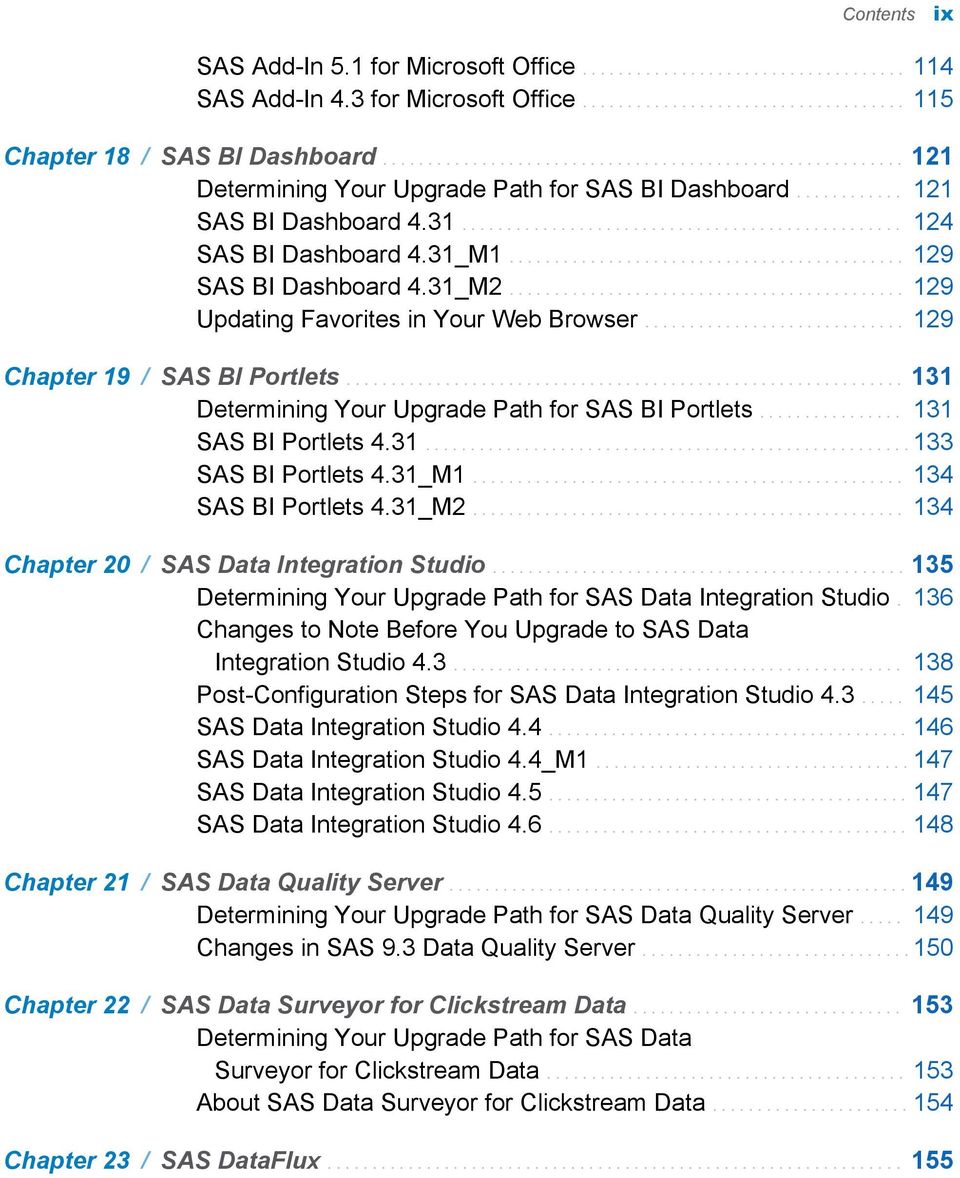
9 Contents ix SAS Add-In 5.1 for Microsoft Office SAS Add-In 4.3 for Microsoft Office Chapter 18 / SAS BI Dashboard Determining Your Upgrade Path for SAS BI Dashboard SAS BI Dashboard SAS BI Dashboard 4.31_M SAS BI Dashboard 4.31_M Updating Favorites in Your Web Browser Chapter 19 / SAS BI Portlets Determining Your Upgrade Path for SAS BI Portlets SAS BI Portlets SAS BI Portlets 4.31_M SAS BI Portlets 4.31_M Chapter 20 / SAS Data Integration Studio Determining Your Upgrade Path for SAS Data Integration Studio. 136 Changes to Note Before You Upgrade to SAS Data Integration Studio Post-Configuration Steps for SAS Data Integration Studio SAS Data Integration Studio SAS Data Integration Studio 4.4_M SAS Data Integration Studio SAS Data Integration Studio Chapter 21 / SAS Data Quality Server Determining Your Upgrade Path for SAS Data Quality Server Changes in SAS 9.3 Data Quality Server Chapter 22 / SAS Data Surveyor for Clickstream Data Determining Your Upgrade Path for SAS Data Surveyor for Clickstream Data About SAS Data Surveyor for Clickstream Data Chapter 23 / SAS DataFlux
10 x Contents SAS DataFlux How to Access the SAS DataFlux Documentation Chapter 24 / SAS Decision Services Determining Your Upgrade Path for SAS Decision Services SAS Decision Services 5.5_M SAS Decision Services Chapter 25 / SAS Document Conversion Server Determining Your Upgrade Path for SAS Document Conversion Server Upgrade to SAS Document Conversion Server SAS Document Conversion Server Chapter 26 / SAS Enterprise GRC Determining Your Upgrade Path for SAS Enterprise GRC SAS Enterprise GRC SAS Enterprise GRC 5.1_M SAS Enterprise GRC 5.1_M SAS Enterprise GRC 5.1_M SAS Enterprise GRC 5.1_M SAS Enterprise GRC 5.1_M Upgrading from SAS Enterprise GRC 5.1 or 5.1_M Chapter 27 / SAS Enterprise Guide Determining Your Upgrade Path for SAS Enterprise Guide SAS Enterprise Guide SAS Enterprise Guide Chapter 28 / SAS Enterprise Miner Determining Your Upgrade Path for SAS Enterprise Miner SAS Enterprise Miner SAS Enterprise Miner 7.1_M SAS Enterprise Miner Chapter 29 / SAS/ETS

11 Contents xi Determining Your Upgrade Path for SAS/ETS SAS/ETS Chapter 30 / SAS Financial Crimes Monitor Determining Your Upgrade Path for SAS Financial Crimes Monitor SAS Financial Crimes Monitor 2.3_M SAS Financial Crimes Monitor Chapter 31 / SAS Forecast Server Determining Your Upgrade Path for SAS Forecast Server SAS Forecast Server SAS Forecast Server 4.1_M SAS Forecast Server Chapter 32 / SAS/Genetics Determining Your Upgrade Path for SAS/Genetics SAS/Genetics Chapter 33 / SAS/GRAPH Determining Your Upgrade Path for SAS/GRAPH SAS/GRAPH SAS/GRAPH 9.3_M SAS/GRAPH 9.3_M Chapter 34 / SAS High-Performance Forecasting Determining Your Upgrade Path for SAS High- Performance Forecasting SAS High-Performance Forecasting Chapter 35 / SAS High-Performance Risk Determining Your Upgrade Path for SAS High-Performance Risk. 209 SAS High-Performance Risk SAS High-Performance Risk Chapter 36 / SAS In-Database Technology

12 xii Contents Determining Your Upgrade Path for SAS In- Database Technologies SAS 9.3 In-Database Technologies Chapter 37 / SAS/IML Determining Your Upgrade Path for SAS/IML SAS/IML Chapter 38 / SAS Information Delivery Portal Determining Your Upgrade Path for the SAS Information Delivery Portal SAS Information Delivery Portal SAS Information Delivery Portal 4.31_M SAS Information Delivery Portal 4.31_M Updating Favorites in Your Web Browser Chapter 39 / SAS Information Map Studio Determining Your Upgrade Path for SAS Information Map Studio. 229 SAS Information Map Studio SAS Information Map Studio 4.31_M SAS Information Map Studio 4.31_M Chapter 40 / SAS Integration Technologies Determining Your Upgrade Path for SAS Integration Technologies SAS 9.3 Integration Technologies SAS Integration Technologies 9.3_M SAS Integration Technologies 9.3_M Chapter 41 / SAS Intelligence Platform Determining Your Upgrade Path for SAS Intelligence Platform SAS 9.3 Intelligence Platform System Administration SAS Intelligence Platform 9.3_M SAS Intelligence Platform 9.3_M Chapter 42 / SAS/IntrNet

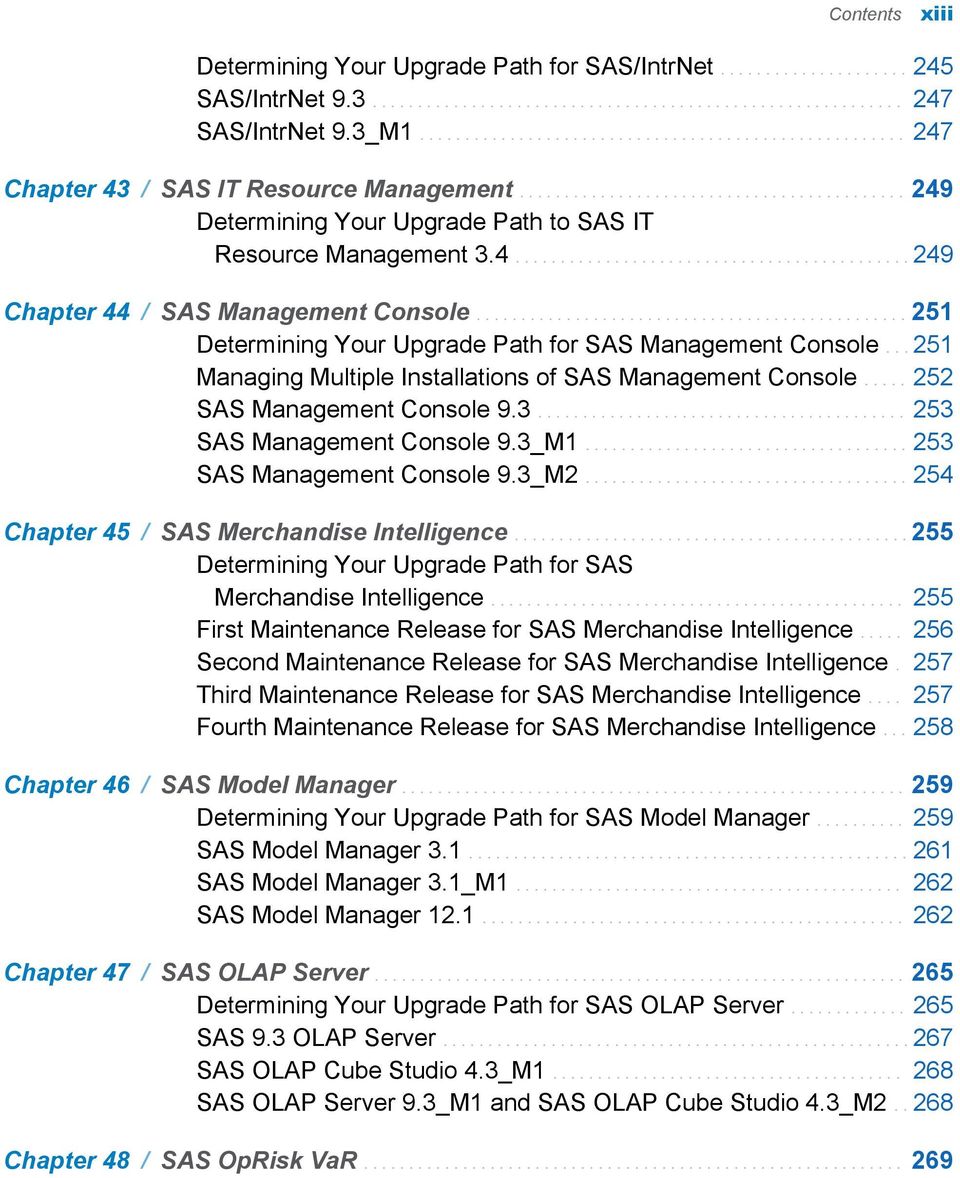
13 Contents xiii Determining Your Upgrade Path for SAS/IntrNet SAS/IntrNet SAS/IntrNet 9.3_M Chapter 43 / SAS IT Resource Management Determining Your Upgrade Path to SAS IT Resource Management Chapter 44 / SAS Management Console Determining Your Upgrade Path for SAS Management Console Managing Multiple Installations of SAS Management Console SAS Management Console SAS Management Console 9.3_M SAS Management Console 9.3_M Chapter 45 / SAS Merchandise Intelligence Determining Your Upgrade Path for SAS Merchandise Intelligence First Maintenance Release for SAS Merchandise Intelligence Second Maintenance Release for SAS Merchandise Intelligence. 257 Third Maintenance Release for SAS Merchandise Intelligence Fourth Maintenance Release for SAS Merchandise Intelligence Chapter 46 / SAS Model Manager Determining Your Upgrade Path for SAS Model Manager SAS Model Manager SAS Model Manager 3.1_M SAS Model Manager Chapter 47 / SAS OLAP Server Determining Your Upgrade Path for SAS OLAP Server SAS 9.3 OLAP Server SAS OLAP Cube Studio 4.3_M SAS OLAP Server 9.3_M1 and SAS OLAP Cube Studio 4.3_M Chapter 48 / SAS OpRisk VaR
14 xiv Contents Determining Your Upgrade Path for SAS OpRisk VaR SAS OpRisk VaR Chapter 49 / SAS/OR Determining Your Upgrade Path for SAS/OR SAS/OR Chapter 50 / SAS/QC Determining Your Upgrade Path for SAS/QC SAS/QC Chapter 51 / SAS Risk Dimensions Determining Your Upgrade Path for SAS Risk Dimensions SAS Risk Dimensions SAS Risk Dimensions Chapter 52 / SAS Risk Management for Insurance Determining Your Upgrade Path for SAS Risk Management for Insurance SAS Risk Management for Insurance Chapter 53 / SAS Social Network Analysis Determining Your Upgrade Path for SAS Social Network Analysis SAS Social Network Analysis 2.3_M SAS Social Network Analysis SAS Social Network Analysis 3.1_M Chapter 54 / SAS/STAT Determining Your Upgrade Path for SAS/STAT SAS/STAT Chapter 55 / SAS Text Miner Determining Your Upgrade Path for SAS Text Miner SAS Text Miner SAS Text Miner 5.1_M

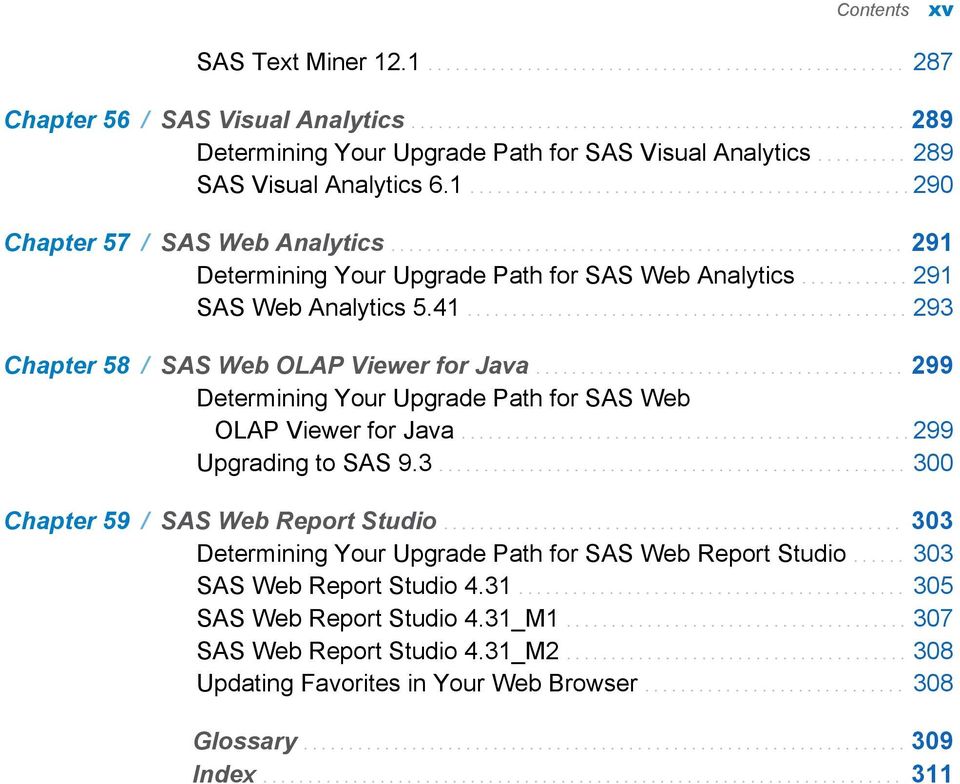
15 Contents xv SAS Text Miner Chapter 56 / SAS Visual Analytics Determining Your Upgrade Path for SAS Visual Analytics SAS Visual Analytics Chapter 57 / SAS Web Analytics Determining Your Upgrade Path for SAS Web Analytics SAS Web Analytics Chapter 58 / SAS Web OLAP Viewer for Java Determining Your Upgrade Path for SAS Web OLAP Viewer for Java Upgrading to SAS Chapter 59 / SAS Web Report Studio Determining Your Upgrade Path for SAS Web Report Studio SAS Web Report Studio SAS Web Report Studio 4.31_M SAS Web Report Studio 4.31_M Updating Favorites in Your Web Browser Glossary Index
16 xvi Contents

17 xvii Using This Book Audience This document is for existing SAS customers who are upgrading from SAS or SAS 9.2 to SAS 9.3. It is also for customers who are applying a maintenance release to SAS 9.3. The initial release of SAS 9.3 TS1M0, Rev. 930_11w29 was in July The purpose of this document is to notify customers about changes that they might see in SAS 9.3 and how those changes might affect their site. Specific information about migrating your SAS content is available in the SAS Intelligence Platform: Migration Guide. This document is organized into the following parts: Introduction to Updating SAS Software at Your Site provides information that is common to any software upgrade. This part contains the following information: o o o o a policy statement for maintenance releases at SAS a description of the general process for software updates definitions of some of the terminology that is used in this document an explanation of product releases numbers Planning for a Software Update helps you assess whether your site is ready for a software upgrade. Here is some of the information that you want to review as you plan to update the software at your site: o what products you currently have installed at your site

18 xviii o o o how future software updates might impact your site what functionality has been deprecated or will be deprecated in the future new requirements for operating systems and third-party software Preparing Your Site for a Software Update explains how to prepare your site for a software upgrade. Here is some of the information that you want to review before upgrading software at your site: o o o how a software upgrade will affect your site how to back up your current deployment and whether any customizations will be lost during the upgrade how to undeploy any SAS Web applications and stop the Web Application Servers Installing and Configuring Software Updates provides the following information: o o o o an explanation of how to use the Software Order (SOE) and the SAS Order Information (SOI) to determine what products are in your order an explanation of how to use the Instructions.html files, Deployment Summary, and audit files to complete the software upgrade or troubleshoot any problems instructions on how to install a software upgrade additional configuration steps that might be required for your Web Application Server Product Details and Requirements can include the following types of information for each product that runs on SAS 9.3: o o o steps that you need to perform before you upgrade to a new release a brief overview of some of the new features and enhancements in the new release any software updates that might be different from what you experienced in a previous release

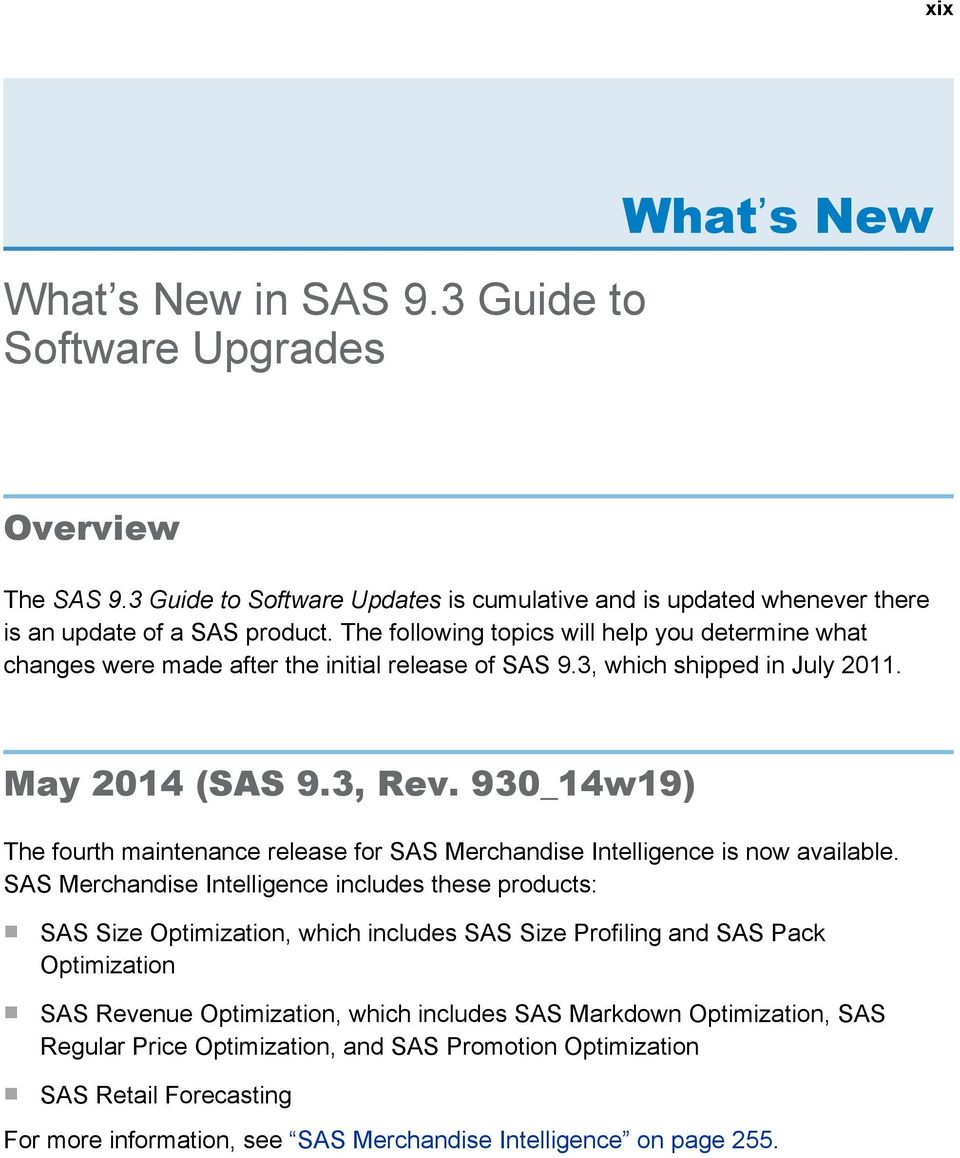
19 xix What s New in SAS 9.3 Guide to Software Upgrades Whatʼs New Overview The SAS 9.3 Guide to Software Updates is cumulative and is updated whenever there is an update of a SAS product. The following topics will help you determine what changes were made after the initial release of SAS 9.3, which shipped in July May 2014 (SAS 9.3, Rev. 930_14w19) The fourth maintenance release for SAS Merchandise Intelligence is now available. SAS Merchandise Intelligence includes these products: SAS Size Optimization, which includes SAS Size Profiling and SAS Pack Optimization SAS Revenue Optimization, which includes SAS Markdown Optimization, SAS Regular Price Optimization, and SAS Promotion Optimization SAS Retail Forecasting For more information, see SAS Merchandise Intelligence on page 255.
20 xx What s New in SAS 9.3 Guide to Software Upgrades November 2013 (SAS 9.3, Rev. 930_13w45) These products had a maintenance release: The fifth maintenance release for SAS Enterprise GRC is now available. For more information, see Chapter 26, SAS Enterprise GRC, on page 163. The third maintenance release for SAS Merchandise Intelligence is now available. SAS Merchandise Intelligence includes these products: o o SAS Size Optimization, which includes SAS Size Profiling and SAS Pack Optimization SAS Revenue Optimization, which includes SAS Markdown Optimization, SAS Regular Price Optimization, and SAS Promotion Optimization o SAS Retail Forecasting For more information, see SAS Merchandise Intelligence on page 255. April 2013 (SAS 9.3, Rev. 930_13w18) SAS Decision Services 5.6 is now available. For more information, see SAS Decision Services on page 157. The second maintenance release for SAS Merchandise Intelligence is now available. SAS Merchandise Intelligence includes these products: SAS Size Optimization, which includes SAS Size Profiling and SAS Pack Optimization SAS Revenue Optimization, which includes SAS Markdown Optimization, SAS Regular Price Optimization, and SAS Promotion Optimization

21 April 2013 (SAS 9.3, Rev. 930_13w14) xxi SAS Retail Forecasting For more information, see SAS Merchandise Intelligence on page 255. April 2013 (SAS 9.3, Rev. 930_13w14) SAS Risk Management for Insurance 2.12 is now available. For more information, see SAS Risk Management for Insurance on page 277. The following products shipped a maintenance release: The fourth maintenance release of SAS Enterprise GRC 5.1 is now available. For more information, see SAS Enterprise GRC on page 163. The second maintenance release of SAS Social Network Analysis 3.1 is now available. For more information, see SAS Social Network Analysis on page 279. Here are the updates to this document: The instructions for undeploying the WebSphere application server have been updated to include a step for deleting contents from several /temp directories. For more information, see IBM WebSphere Application Server Network Deployment on page 48. Customizations to the logon, logoff, and time-out pages for the SAS Logon Manager have been added to the list of customizations that you should back up before updating your software. For more information, see Customizations to EAR Files on page 43.
22 xxii What s New in SAS 9.3 Guide to Software Upgrades January 2013 (SAS 9.3, Rev. 930_13w05) The following products shipped a new release: SAS Financial Crimes Monitor 3.1 is now available. For more information, see SAS Financial Crimes Monitor on page 189. SAS High-Performance Risk 2.5 is now available. For more information, see SAS High-Performance Risk on page 209. SAS OpRisk VaR 5.1 is now available. For more information, see SAS OpRisk VaR on page 269. SAS Risk Dimensions 5.5 is now available. For more information, see SAS Risk Dimensions on page 275. SAS Social Network Analysis 3.1 is now available. For more information, see SAS Social Network Analysis on page 279. A new SAS DataFlux chapter has been added to reflect the integration of this product into the SAS suite of data management and data integration solutions. For more information, see SAS DataFlux on page 155. December 2012 (SAS 9.3, Rev. 930_12w50) The following products shipped a new release: SAS Data Integration Studio 4.6 is now available. For more information, see SAS Data Integration Studio on page 136. SAS Visual Analytics 6.1 is now available. For more information, see SAS Visual Analytics on page 289.
23 August 2012 (SAS 9.3, Rev. 930_12w35) xxiii The first maintenance release for SAS Merchandise Intelligence is now available. SAS Merchandise Intelligence includes these products: SAS Size Optimization, which includes SAS Size Profiling and SAS Pack Optimization SAS Revenue Optimization, which includes SAS Markdown Optimization, SAS Regular Price Optimization, and SAS Promotion Optimization SAS Retail Forecasting For more information, see SAS Merchandise Intelligence on page 255. August 2012 (SAS 9.3, Rev. 930_12w35) The documentation for these products was updated in the second maintenance release for SAS 9.3: In Base SAS 9.3_M2, new procedures have been added. There are also changes for z/os operating environments. For more information, see Base SAS on page 97. In SAS Integration Technologies 9.3_M2, a new JREOPTIONS parameter is available in the configuration file for the object spawner. For more information, see SAS Integration Technologies on page 235. Starting with the second maintenance release for SAS Information Map Studio 4.31, the first day of the week is based on the locale of the information map. For more information, see SAS Information Map Studio on page 229. In SAS/GRAPH 9.3_M2, there are three predefined librefs for libraries that contain map data sets: MAPS, MAPSSAS, and MAPSGFK. For more information, see SAS/GRAPH on page 199. In SAS Management Console 9.3_M2, there are several additions to resource templates. For more information, see SAS Management Console on page 251. Hot fixes were included in SAS OLAP Server 9.3_M2 and SAS OLAP Cube Studio 4.3_M2. For more information, see SAS OLAP Server on page 265.
24 xxiv What s New in SAS 9.3 Guide to Software Upgrades The following products shipped a new release: SAS Analytical Products 12.1 are now available: o SAS/ETS 12.1 on page 187 o SAS High-Performance Forecasting 12.1 on page 207 o SAS/IML 12.1 on page 215 o SAS/OR 12.1 on page 271 o SAS/QC 12.1 on page 273 o SAS/STAT 12.1 on page 281 SAS Analytic Components 12.1 are now available: o o o Base SAS Statistical Procedures Statistics Common Components Advanced Analytics Common Components SAS Data Integration Studio 4.5 is now available. For more information, see SAS Data Integration Studio on page 136. SAS Enterprise Miner 12.1 is now available. For more information, see SAS Enterprise Miner on page 179. SAS Forecast Server 12.1 is now available. For more information, see SAS Forecast Server on page 191. SAS Model Manager 12.1 is now available. For more information, see SAS Model Manager on page 259. SAS Text Miner is now available. For more information, see SAS Text Miner on page 283. The following products shipped a maintenance release: The second maintenance release for SAS BI Dashboard 4.31 is now available. For more information, see SAS BI Dashboard on page 121.
25 April 2012 (SAS 9.3, Rev. 930_12w16) xxv The second maintenance release for the SAS BI Portlets 4.31 is now available. For more information, see SAS BI Portlets on page 131. The second maintenance release for the SAS Information Delivery Portal 4.31 is now available. For more information, see SAS Information Delivery Portal on page 217. June 2012 (SAS 9.3, Rev. 930_12w32) A chapter was added for SAS IT Resource Management because of the new 3.3 release. For more information, see Chapter 43, SAS IT Resource Management, on page 249. April 2012 (SAS 9.3, Rev. 930_12w16) New chapters were added for these SAS products. The SAS Financial Crimes Monitor chapter was added to announce the first maintenance release of SAS Financial Crimes Monitor 2.3. For more information, see SAS Financial Crimes Monitor on page 189. The SAS Social Network Analysis chapter was added to announce the first maintenance release of SAS Social Network Analysis 2.3. For more information, see SAS Social Network Analysis on page 279. The documentation for these SAS products was updated: Information about the first maintenance release for SAS Enterprise GRC 5.1 was added. For more information, see SAS Enterprise GRC on page 163. Information about the first maintenance release for SAS Model Manager 3.1 was added. For more information, see SAS Model Manager on page 259.
26 xxvi What s New in SAS 9.3 Guide to Software Upgrades March 2012 (SAS 9.3, Rev. 930_12w10) Starting with the March 2012 release for SAS 9.3, the SAS Deployment Wizard and the SAS Deployment Manager can be run on operating systems that do not have windowing systems. For more information, see the SAS Deployment Wizard and SAS Deployment Manager User's Guide available at installcenter/en/ikdeploywizug/64204/pdf/default/user.pdf. The documentation for these SAS products was updated: The SAS Data Integration Studio chapter was updated for the new 4.4 release. For more information, see SAS Data Integration Studio on page 136. A chapter was added for SAS Enterprise GRC because of the new 5.1 release. For more information, see SAS Enterprise GRC on page 163. The documentation for undeploying SAS web applications contains these updates: clarification that you need to undeploy SAS web applications only on a tier that requires software updates. For more information, see Why You Need to Undeploy the SAS Web Applications on page 45. a reminder to back up your files before undeploying SAS web applications on a WebLogic or WebSphere server. For more information, see Oracle WebLogic Server on page 47 and IBM WebSphere Application Server Network Deployment on page 48. February 2012 (SAS 9.3, Rev. 930_12w06) The documentation for these SAS products was updated for a new product release: SAS Add-In for Microsoft Office on page 111
27 December 2011 (SAS 9.3, Rev. 930_11w50) xxvii SAS Enterprise Guide on page 171 December 2011 (SAS 9.3, Rev. 930_11w50) These topics were added for the first maintenance release of SAS 9.3: To help you understand the general process for software updates, common terms, and the policy statement for SAS: Understanding the Process for Software Updates on page 3 To help you prepare your site for a software update: o Assessing the Effect on Products at Your Site on page 37 o Using Backups and Restoring Customizations on page 41 o Undeploying SAS Web Applications and Stopping the Web Application Servers on page 45 What Is the SAS Software Depot? on page 61 now contains information about the SAS Software Depot Checker. For more information about this tool, see SAS Note 38236: Validating the SAS 9.2 and SAS 9.3 Software Depots on Windows Using the SAS Software Depot Checker at For the steps that you need to follow to apply a software update, see Installing a Software Update on page 71. The documentation for these products was updated for a maintenance release. SAS shipped the first maintenance release for these products in December o Base SAS on page 97 o SAS BI Dashboard on page 121 o SAS BI Portlets on page 131 o SAS Enterprise Miner on page 179
28 xxviii What s New in SAS 9.3 Guide to Software Upgrades o SAS Forecast Server on page 191 o SAS/GRAPH on page 199 o SAS Information Delivery Portal on page 217 o SAS Information Map Studio on page 229 o SAS Integration Technologies on page 235 o SAS/IntrNet on page 245 o SAS Management Console on page 251 o SAS OLAP Server on page 265 o SAS Text Miner on page 283 o SAS Web Report Studio on page 303 The documentation for these products was updated for a new product release: o SAS Data Surveyor for Clickstream Data on page 153 o SAS Web Analytics on page 291
29 xxix Recommended Reading Here is the recommended reading list for this title: SAS Intelligence Platform: Desktop Application Administration Guide SAS Intelligence Platform: Installation and Configuration Guide SAS Intelligence Platform: Middle-Tier Administration Guide SAS Intelligence Platform: Migration Guide SAS Intelligence Platform: System Administration Guide SAS Intelligence Platform: Web Application Administration Guide What s New in SAS 9.3 You should also review the following resources that are available at support.sas.com/software/maintenance/: The Issues Addressed Web site for SAS 9.3 is compiled by SAS Technical Support and lists the specific problems that were fixed in a product update. Customers who want to review a summary of all the issues that were addressed for a SAS product should review this Web site. SAS 9.3 product-specific documents, such as a product's Help and user s guide, provide more information about how to run the product. Administrator s guides can provide additional installation, configuration, and migration steps that are unique to that SAS product.
30 xxx What s New in SAS 9.3 Guide to Software Upgrades For a complete list of SAS books, go to support.sas.com/bookstore. If you have questions about which titles you need, please contact a SAS Book Sales Representative: SAS Books SAS Campus Drive Cary, NC Phone: Fax: [email protected] Web address: support.sas.com/bookstore
31 1 Part 1 Introduction to Updating SAS Software at Your Site Chapter 1 Understanding the Process for Software Updates
32 2
33 3 1 Understanding the Process for Software Updates Common Terminology for Software Updates Policy Statement for Maintenance Releases and Product Releases The General Process for Software Updates Common Terminology for Software Updates These terms are used throughout this document, and so are defined here so you can understand how these terms are used in conjunction with SAS products. maintenance release software updates that you apply to the installed software at your site. Maintenance releases are cumulative. For example, the third maintenance release contains all of the new features and enhancements for the first, second, and third maintenance releases. If you choose not to install a maintenance release, then you automatically receive all of the content in that maintenance release when you next upgrade your version of SAS. For example, if you decide not to install the second maintenance release, then when you install the third maintenance release, you will get the software updates from the second and third maintenance releases.
34 4 Chapter 1 / Understanding the Process for Software Updates In general, hot fixes are included in each maintenance release. However, additional hot fixes might be released after the maintenance release has shipped. To verify that you have the latest hot fixes for the products at your site, see Technical Support Hot Fixes at product-specific maintenance releases a maintenance release for a specific product, such as the first maintenance release for SAS Forecast Server. This type of maintenance release includes software changes for a single SAS product. SAS maintenance release a maintenance release for SAS Foundation. This type of maintenance release includes software changes for multiple SAS products, such as Base SAS, SAS/GRAPH. software updates any update that can be made to your existing software. Upgrading to a new product release or applying a maintenance release are types of software updates. Policy Statement for Maintenance Releases and Product Releases SAS has the following policy for maintenance releases and product releases: When you install a software update, you receive the maintenance release or product release that was available when you placed your order. If a new maintenance release or product release is available, you need to place a new order to get those software updates. SAS creates custom maintenance packages based on the software that is licensed at your site. You do not select the products to update. Because of the dependencies between SAS products, you cannot perform the following tasks: o You cannot partially install a maintenance release or update a single product. The SAS deployment tools determine which SAS products to update. You must
35 The General Process for Software Updates 5 upgrade all of the SAS software in a specific deployment whether that deployment is on one machine or multiple machines. o You cannot uninstall a maintenance release. Maintenance releases are cumulative. For example, the third maintenance release contains all of the new features and enhancements from the first, second, and third maintenance releases. Maintenance releases update the SAS software that is currently deployed at your site. Before installing a maintenance release, back up your current SAS deployment. Note: In general, SAS maintenance releases do not include any updates to JMP products. To access software updates for these products, see JMP Software Updates at Beginning in SAS 9.3, the JMP Clinical, JMP Genomics, and SAS Visual Data Discovery (for the desktop) products are installed and maintained with SAS installers. These products no longer use a separate JMP installer. The General Process for Software Updates Regardless of whether you are upgrading to a new product release, applying a SAS (Foundation) maintenance release, or applying a product-specific maintenance release, the general process for updating the software at your site is the same. 1 Learn about the availability of new product releases or maintenance releases from your SAS account representative, from the SAS Web site, or from this document. 2 Determine what products you currently have at your site. Run a deployment registry report to determine what products you currently have installed at your site. For more information, see How to Run the Deployment Registry Report on page Assess the impact of upgrading the software at your site.
36 6 Chapter 1 / Understanding the Process for Software Updates After running the deployment registry report, you should know the release numbers for the products at your site. Compare these release numbers to the release numbers of the products in this document. A difference in release numbers will help you identify what products at your site have updates. By reviewing the product-specific information in this document, you can determine how upgrading your software could affect your site. For example, you will learn about any new features that are available and how those features might affect your existing SAS content. You also learn any post-configuration steps that you need to complete before you start using the product. 4 Contact your SAS account representative to request a new product release or maintenance release. To request a maintenance release, the SAS Installation Representative at your site can also use the self-service application that is available from the Maintenance Release Announcement. See the Request a Maintenance Release topic at the bottom of 5 Review your software order. After you request a maintenance release, a product upgrade, or a new SAS product, you receive a Software Order (SOE), which lists the product bundle that you ordered and the software revision number (such as SAS 9.3, Rev. 930_11w50). 6 Prepare your site for the software updates. These preparations include downloading the order to a SAS 9.3 Software Depot, creating backups, determining how long the upgrade will take, and notifying users about the scheduled update. You also perform any pre-installation steps for the products at your site. You determined these preinstallation steps when you assessed the impact of the software update at your site. 7 Install and configure any software updates. When you run the SAS Deployment Wizard, SAS automatically detects any files on your system that are older than the files in your order. If there are software updates to be installed for products already in your deployment, the SAS Deployment Wizard goes into Update mode. If no software updates need to be installed, then the SAS Deployment Wizard does not go into Update mode, and you can exit the SAS Deployment Wizard. 8 If your site is running Web application servers, reconfigure these servers.
37 The General Process for Software Updates 7 9 Complete any post-configuration steps for the products at your site. You determine these post-configuration steps when you assess the impact of the software update at your site. To determine the post-configuration steps, see the Product Details and Requirements section.
38 8 Chapter 1 / Understanding the Process for Software Updates
39 9 Part 2 Planning for a Software Update Chapter 2 Determining the Product Release Numbers for Products at Your Site Chapter 3 Reviewing Current and Future Software Updates Chapter 4 Updating Operating Environments and Third- Party Software Chapter 5 Frequently Asked Questions
40 10
41 11 2 Determining the Product Release Numbers for Products at Your Site Understanding Product Release Numbers Understanding Technical Support Numbers Product-Specific Release Numbers for Other SAS Products Understanding Maintenance Release Numbers How to Run the Deployment Registry Report Understanding the Contents of the Deployment Registry Report Understanding Product Release Numbers Understanding Technical Support Numbers Each release of SAS has a unique Technical Support level (TSLEVEL). The format of a Technical Support level is TSxMy. For example, the Technical Support level for SAS 9.3 is TS1M0. In documentation or on SAS Web sites, you might see SAS 9.3 (TS1M0). After you apply the first maintenance release for SAS 9.3, the Technical Support level is TS1M1.
42 12 Chapter 2 / Determining the Product Release Numbers for Products at Your Site To determine the Technical Support level for the SAS release that you are running at your site: 1 Start SAS. On Windows, start SAS by double-clicking the sas.exe file in your SAS installation directory. Examples of a SAS installation directory include C: \Program Files\SASHome\x86\SASFoundation\9.3 and C:\Program Files\SASHome\SASFoundation\9.3. You can also start SAS from the Start menu. For example, select Start Programs SAS SAS 9.3 (English). On UNIX, start SAS by typing./sas nodms at a command prompt. To exit, type endsas;. On z/os, start SAS by typing sas o(nodms). To exit, type endsas;. You can also invoke SAS in a batch job. Look for the Technical Support level in the SASLOG DD output stream. 2 In Windows and UNIX environments, review the information at the top of the log when SAS starts. In the SAS Display Manager, you can also view this information by selecting Help About SAS 9. Note: If you are working in a z/os environment, look for the 9.3 (TS1M0) string in the output. Product-Specific Release Numbers for Other SAS Products SAS products use product-specific release numbers. To determine what products are running at your site, generate a deployment registry report. For more information, see How to Run the Deployment Registry Report on page 14.
43 Understanding Product Release Numbers 13 The following table shows examples of some product release numbers for products that shipped in SAS 9.3: Product Name Release Number Base SAS 9.3 SAS Add-In for Microsoft Office 5.1 SAS Data Integration Studio 4.4 SAS Management Console 9.3 SAS Web Report Studio 4.31 Understanding Maintenance Release Numbers After you install a maintenance release, the product release number for updated products changes to include maintenance-specific identification, such as M1. This maintenance number is incremented by one for each maintenance release of that product. However, a maintenance release (such as the first maintenance release for SAS 9.3) might not contain updates for all SAS products. Therefore, maintenance numbers can differ across SAS products. To determine the maintenance numbers for products at your site, generate a deployment registry report. For more information, see How to Run the Deployment Registry Report on page 14. Product Name Base SAS SAS Enterprise Miner SAS Forecast Server SAS/GRAPH Release Number 9.3_M1 7.1_M1 4.1_M1 9.3_M1
44 14 Chapter 2 / Determining the Product Release Numbers for Products at Your Site As this table shows, all products currently have a maintenance release number of M1. Suppose Base SAS shipped a second maintenance release. Then the maintenance release number for Base SAS would be M2. Then, the maintenance release numbers are different because there have been two maintenance releases for Base SAS. If the other products in the table are not updated in the second maintenance release for SAS 9.3, their maintenance release number stays M1. For more information about product numbers, see productnumbers.html. How to Run the Deployment Registry Report Before upgrading your SAS products, you need the product release numbers for all SAS products at your site. To determine these product release numbers for each machine in your SAS deployment, generate a deployment registry report and save it for future reference. For more information about how to generate this report, see SAS Note at Note: If you did not generate a deployment registry report before you upgraded the software at your site, you can determine your product release number for each SAS product at your site by reviewing the Deployment Summary that is generated by the SAS Deployment Wizard (when you upgrade your software).for more information, see The Deployment Summary for the Installation on page 67. Understanding the Contents of the Deployment Registry Report The deployment registry report lists all of the SAS 9.3 products that are installed in the same SAS installation directory (SAS Home).
45 Note: The deployment registry report lists all of the installed products. These products might not be deployed or configured at your site. For example, if your deployment includes an installation of SAS Web Report Studio 4.31, then the deployment registry report could include the following entry: Host: wx6 Product Code: citationweb Version: 4.31 Display Name: SAS Web Report Studio Display Version: 4.31 Understanding the Contents of the Deployment Registry Report 15 The Display Version field shows that SAS Web Studio 4.31 is installed at your site.
46 16 Chapter 2 / Determining the Product Release Numbers for Products at Your Site
47 17 3 Reviewing Current and Future Software Updates The Importance of Understanding Current and Future Software Updates Current Product Releases Product Releases by Release Date Learning More about Each Product Release Deprecated Functionality The Importance of Understanding Current and Future Software Updates Before installing a software update, you might want to know about future product updates or plans to deprecate functionality. Learning this information early in your planning process enables you to determine the following information: when to place your software order. For example, suppose that you are running SAS Enterprise Guide and SAS Enterprise Miner at your site. A new release of SAS Enterprise Guide might be available in June, but the new release of SAS Enterprise Miner will not be available until August. To minimize your downtime and to go through the installation process only once, you decide to place your order in August when you can get both new products.
48 18 Chapter 3 / Reviewing Current and Future Software Updates For help with determining when to place a software order, contact your SAS account representative. how plans to deprecate functionality could affect your site. For example, the SAS Visual Data Explorer has been deprecated in SAS 9.3. Knowing this information during the planning stage helps you allot time in your schedule to convert the data explorations to reports that can be opened in SAS Web Report Studio. For more information, see Deprecated Functionality on page 23. Current Product Releases Product Releases by Release Date Use this table to determine when your product release initially shipped. Use the Software Order or Software Order Information to determine the revision number for the software in your order. For more information, see Reviewing Your Software Order on page 55. Note: Only products that are mentioned in this document are included in the table. The table is not a comprehensive list of all the products that shipped at a specific time. For a list of the products in your order, see the install_doc/order-number/ ordersummary.html file in your SAS Software Depot. If you are installing SAS from a DVD, the ordersummary.html file is available on SAS Software Disc 1 in the install_doc\order-number directory.
49 Current Product Releases 19 Release Date (Revision Number) Products July 2011 (SAS 9.3, Rev. 930_11w29) Base SAS 9.3 SAS/ACCESS 9.3 Interface to Aster ncluster SAS/ACCESS 9.3 Interface to DB2 SAS/ACCESS 9.3 Interface to Greenplum SAS/ACCESS 9.3 Interface to HP Neoview SAS/ACCESS 9.3 Interface to INFORMIX SAS/ACCESS 9.3 Interface to Microsoft SQL SAS/ACCESS 9.3 Interface to MySQL SAS/ACCESS 9.3 Interface to Netezza SAS/ACCESS 9.3 Interface to ODBC SAS/ACCESS 9.3 Interface to OLE DB SAS/ACCESS 9.3 Interface to Oracle SAS/ACCESS 9.3 Interface to PC Files SAS/ACCESS 9.3 Interface to Sybase SAS/ACCESS 9.3 Interface to Sybase IQ SAS/ACCESS 9.3 Interface to Teradata SAS Add-In for Microsoft Office SAS BI Dashboard 4.31 SAS Data Integration Studio 4.3 SAS Enterprise Guide SAS Enterprise Miner 7.1 SAS Forecast Server 4.1 SAS/GRAPH 9.3 SAS Information Delivery Portal 4.31 SAS Information Map Studio 4.31 SAS Integration Technologies 9.3 SAS/IntrNet 9.3 SAS Management Console 9.3 SAS Model Manager 3.1 SAS OLAP Server 9.3 SAS Web Report Studio 4.31
50 20 Chapter 3 / Reviewing Current and Future Software Updates Release Date (Revision Number) Products November 2011 (SAS 9.3, Rev. 930_11w45) SAS Data Surveyor for Clickstream 2.21 SAS Forecast Server 4.1_M1 SAS Web Analytics 5.41 December 2011 (SAS 9.3, Rev. 930_11w50) February 2012 (SAS 9.3, Rev. 930_12w06) Base SAS 9.3_M1 SAS/ACCESS 9.3_M1 Interface to Greenplum SAS/ACCESS 9.3_M1 Interface to MySQL SAS/ACCESS 9.3_M1 Interface to ODBC SAS/ACCESS 9.3_M1 Interface to OLE DB SAS/ACCESS 9.3_M1 Interface to PC Files SAS BI Dashboard 4.31_M1 SAS BI Portlets 4.31_M1 SAS Enterprise Miner 7.1_M1 SAS/GRAPH 9.3_M1 SAS Information Delivery Portal 4.31_M1 SAS Information Map Studio 4.31_M1 SAS Integration Technologies 9.3_M1 SAS/IntrNet 9.3_M1 SAS Management Console 9.3_M1 SAS OLAP Cube Studio 4.3_M1 SAS OLAP Server 9.3_M1 SAS Text Miner 5.1_M1 SAS Web Report Studio 4.31_M1 SAS Add-In 5.1 for Microsoft Office SAS Enterprise Guide 5.1 March 2012 (SAS 9.3, Rev. 930_12w10) SAS Data Integration Studio 4.4 SAS Enterprise GRC 5.1
51 Current Product Releases 21 Release Date (Revision Number) April 2012 (SAS 9.3, Rev. 930_12w16) Products SAS Enterprise GRC 5.1_M1 SAS Financial Crimes Monitor 2.3_M1 SAS Model Manager 3.1_M1 SAS Social Network Analysis 2.3_M1 June 2012 (SAS 9.3, Rev. 930_12w23) SAS IT Resource Management 3.3
52 22 Chapter 3 / Reviewing Current and Future Software Updates Release Date (Revision Number) August 2012 (SAS 9.3, Rev. 930_12w35) Products Base SAS 9.3_M2 SAS/ACCESS 9.3_M2 Interface for Relational Databases SAS BI Dashboard 4.31_M2 SAS BI Portlets 4.31_M2 SAS Data Integration Studio 4.5 SAS Enterprise Miner 12.1 SAS/ETS 12.1 SAS/Genetics 12.1 SAS/GRAPH 9.3_M2 SAS High-Performance Forecasting 12.1 SAS/IML 12.1 SAS Information Delivery Portal 4.31_M2 SAS Information Map Studio 4.31_M2 SAS Integration Technologies 9.3_M2 SAS Forecast Server 12.1 SAS Management Console 9.3_M2 SAS Model Manager 12.1 SAS OLAP Cube Studio 4.3_M2 SAS OLAP Server 9.3_M2 SAS/OR 12.1 SAS/QC 12.1 SAS Risk Dimensions 5.4 SAS/STAT 12.1 SAS Text Miner 12.1 SAS Web Report Studio 4.31_M2 December 2012 (SAS 9.3, Rev. 930_12w50) SAS Data Integration Studio 4.6 SAS Retail Forecasting 5.2_M1 SAS Revenue Optimization 5.2_M1 SAS Size Optimization 3.2_M1 SAS Visual Analytics 6.1
53 Deprecated Functionality 23 Release Date (Revision Number) Products January 2013 (SAS 9.3, Rev. 930_13w05) SAS High-Performance Risk 2.5 SAS OpRisk VaR 5.1 SAS Risk Dimensions 5.5 April 2013 (SAS 9.3, Rev. 930_13w14) SAS Enterprise GRC 5.1_M4 SAS Risk Management for Insurance 2.12 SAS Social Network Analysis 3.1_M2 Learning More about Each Product Release To learn about the new features and enhancements in a product, use this document in conjunction with the following documents and SAS websites: The Issues Addressed website is complied by SAS Technical Support and lists the specific problems that were fixed in SAS 9.3. Customers who want to review a summary of all the issues that were addressed in a SAS product should review this website. What s New in SAS 9.3 describes new features and enhancements to products that are available in SAS 9.3. The What s New documentation is cumulative and is updated whenever there is an update of a SAS product. Review the What s New topics for your products whenever you receive a product update. SAS 9.3 product-specific documents, such as a product s Help or user s guide, provide detailed information about how to use the new features and enhancements. To access these documents, see Deprecated Functionality In SAS 9.3, SAS deprecates the following functionality: The SAS Visual Data Explorer has been deprecated in SAS 9.3.
54 24 Chapter 3 / Reviewing Current and Future Software Updates The SAS Data Surveyor for PeopleSoft has been deprecated and is no longer supported. The SAS Data Surveyor for PeopleSoft continues to be supported on SAS 9.2 systems. SAS BI Web Services for.net has been discontinued. SAS BI Web Services for Java supports.net versions of generated web services that are migrated from SAS 9.2 in a way that is transparent for clients. In fact, clients need to change only endpoint addresses. (And this step can be omitted if a proxy server is used.) For more information, see Migrating SAS BI Web Services for.net to SAS BI Web Services for Java in Chapter 1 of SAS BI Web Services: Developer's Guide. In SAS Data Quality Server, several functions and procedures have been deprecated. For more information, see Deprecated Procedures on page 152 and Replacing the DQSRV Functions with DMSRV Functions on page 151. The SAS Analytics Platform has been deprecated. Products that used the Analytics Platform as their middle tier (such as SAS Forecast Studio, SAS Enterprise Miner, and SAS Model Manager) now use the SAS Web Infrastructure Platform, which requires a web application server. For more information about web application servers, see The SAS Table Server is replaced by the SAS Framework Data Server when you configure the target system by using the SAS Migration Utility. The DataFlux Integration Server is replaced by the DataFlux Data Management Server. For more information about the SAS Migration Utility, see SAS Migration Utility Reference in Chapter 1 of SAS Intelligence Platform: Migration Guide. Note: Even though the SAS Table Server is deprecated, it continues to be displayed in the Products to Upgrade section of the Review Required Updates page in the SAS Deployment Wizard. You can ignore this instance. SAS Shared Services was incorporated into the Web Infrastructure Platform in SAS 9.3. Note: Even though SAS Shared Services is deprecated, it continues to be displayed in the Products to Upgrade section of the Review Required Updates page in the SAS Deployment Wizard. You can ignore this instance.
55 Deprecated Functionality 25 Note: If you are upgrading from SAS 9.1.3, the following functionality was deprecated in SAS 9.2: SAS Web OLAP Viewer for Java will have no new releases. It has been replaced by functionality that is available in SAS Web Report Studio 4.3. For more information, see SAS Web OLAP Viewer for Java on page 299. The Replication Wizard in SAS Management Console has been deprecated. For more information, see SAS Note at 40/834.html. Note: The NLSCOMPATMODE option will be deprecated in a future release of SAS, and NLS compatibility mode will no longer be supported. For more information, contact a SAS representative or Technical Support.
56 26 Chapter 3 / Reviewing Current and Future Software Updates
57 27 4 Updating Operating Environments and Third-Party Software Support for Operating Environments Modifying the Date-and-Time Stamps for Non- Versioned Files in UNIX Environments Additional Support for Third-Party Software Support for Operating Environments To determine the level of support for each operating environment (for example, which editions of Windows Server 2008 are supported), see resources/sysreq/hosts/. If you are upgrading from SAS or SAS 9.2 to SAS 9.3, carefully review these pages to learn the new operating environments that are supported and the operating environments that are no longer supported. If you are already running SAS 9.3 and you are applying a maintenance release or upgrading to a new product release, review these pages to determine whether any updates or patches need to be applied to your operating environment.
58 28 Chapter 4 / Updating Operating Environments and Third-Party Software Modifying the Date-and-Time Stamps for Non-Versioned Files in UNIX Environments Note: The tar command is the recommended method for copying and moving a SAS deployment in UNIX because this command preserves the date-and-time stamps on the files. This information is relevant only if you used the cp command without the -p option (which is required to preserve the date-and-time stamps on your files) to copy your SAS deployment from one location to another. The installation for a maintenance release uses the date-and-time stamps for some non-versioned files to determine whether the files need to be updated. If you copied a deployment of SAS 9.3 (using the cp command without the -p option), then the maintenance release might not install properly. The date-and-time stamps on the copied files might be different from the deployment that was installed using the SAS Deployment Wizard. In order for the maintenance release to install correctly, the dateand-time stamps on the copied files must be July 12, To change the date-and-time stamps on your files to July 12, 2011, enter the following command from the SAS installation directory: find. xargs touch -t You must run this UNIX command under the user ID that was used to install SAS 9.3. You can modify the attributes of these SAS files under that user ID only. Additional Support for Third-Party Software When you initially configured your third-party software, these products should have met the minimum requirements that are documented on the Third-Party Software Requirements for Use with SAS Software and Applications website at support.sas.com/resources/thirdpartysupport/.
59 Additional Support for Third-Party Software 29 However, because third-party vendors sometimes release updates to address defects and security issues, SAS might recommend that you apply a recent upgrade or path. For example, if you are using an Oracle WebLogic Server, an IBM WebSphere Application Server, or a JBoss Application Server, you might need to apply a patch or upgrade before installing SAS 9.3. Before installing SAS 9.3, applying a maintenance release, or upgrading to a new product release, verify that your site is using the required versions of third-party software. If you need to update the web application server or your version of Java, see Upgrading Web Application Servers That Are Used with the SAS 9.3 Middle-Tier Configuration at appservers/jdkjrewebappchange.pdf. Note: If you are running SAS 9.3 or the first maintenance release for SAS 9.3, you must apply the second maintenance release for SAS 9.3 before updating any third-party components (the JRE, the JDK, or the web application server) to Java 7.
60 30 Chapter 4 / Updating Operating Environments and Third-Party Software
61 31 5 Frequently Asked Questions How Much Time Should I Allow for Applying a Maintenance Release? How Can I Optimize the Download of a Maintenance Release? Can I Add New Products While Applying a Maintenance Release? How Do I Know If the Maintenance Release Installed Successfully? How Do I Validate a Deployment? How Can I Determine Whether a Maintenance Release Has Already Been Applied? Can I Uninstall a Maintenance Release? How Much Time Should I Allow for Applying a Maintenance Release? The outage time that is required for applying a maintenance release varies from site to site. Installing product updates is only a small part of applying a maintenance release. When estimating the outage time for your site, you must also include time for configuring your Web application servers, restoring customizations, and completing any
62 32 Chapter 5 / Frequently Asked Questions post-configuration steps for products at your site. To estimate how long it will take to apply a maintenance release, identify the steps in the Product-Specific Details and Post-Configuration Requirements part that you need to complete. How Can I Optimize the Download of a Maintenance Release? If you created a SAS Software Depot for SAS 9.3, it is recommended that you download the maintenance release for SAS 9.3 to this depot. When you download a maintenance release for SAS 9.3 to an existing SAS 9.3 Software Depot, only the files that were updated in the maintenance release will be downloaded. If you download the maintenance release to a new SAS Software Depot, then all files in the SAS 9.3 release must be downloaded. Can I Add New Products While Applying a Maintenance Release? In addition to the updates from a maintenance release, your software order might include products that you are adding to your current deployment. Before you install any new products, you must apply any maintenance releases or product upgrades. After these software updates are applied, you restart the SAS Deployment Wizard to add any new products. For more information, see Adding a New Product on page 78. How Do I Know If the Maintenance Release Installed Successfully? To confirm that the maintenance release installed successfully, review the Installation section of the Deployment Summary. For more information, see The Deployment Summary for the Installation on page 67.
63 Can I Uninstall a Maintenance Release? 33 To troubleshoot a product that failed to install, use the product s audit files. The audit files list each file that was added, deleted, or replaced for that product. For more information, see Audit Files on page 69. How Do I Validate a Deployment? SAS provides several tools that you can use to validate your deployment. To validate products that are part of SAS Foundation, see the SAS 9.3 Qualification Tools User s Guide. To validate your SAS servers, see Checking the Status of Servers in Chapter 6 of SAS Intelligence Platform: System Administration Guide. How Can I Determine Whether a Maintenance Release Has Already Been Applied? To determine whether your site is running the latest version of your SAS products, run the SAS Deployment Wizard. If a machine does not require any product updates, then the SAS Deployment Wizard will not go into Update mode, and the installation on that machine is complete. Can I Uninstall a Maintenance Release? Because of the dependencies between SAS products, you cannot uninstall maintenance updates. However, when applying a maintenance release, SAS automatically backs up any files that are modified in the SAS installation directory. It does not back up any changes that you made to the SAS configuration directory.
64 34 Chapter 5 / Frequently Asked Questions Therefore, before installing a maintenance release, it is recommended that you back up all of the files in your SAS deployment. If you need to restore a previous deployment of SAS, it is recommended that you use these backup copies. For more information, see Creating and Removing Backup Files on page 42.
65 35 Part 3 Preparing Your Site for a Software Update Chapter 6 Assessing the Effect on Products at Your Site Chapter 7 Using Backups and Restoring Customizations Chapter 8 Undeploying SAS Web Applications and Stopping the Web Application Servers
66 36
67 37 6 Assessing the Effect on Products at Your Site Review the List of Products at Your Site Review the Product Details and Requirements Review the List of Products at Your Site Before you apply a software update to your site, review the list of products that will be updated on a machine. From the SAS Deployment Wizard, generate a list of the product updates that SAS will apply to the current machine. This list of product updates could vary for each machine at your site, so it is important that you generate this list on every machine that runs SAS 9.3. Note: If no product updates are required for a machine, then you will not see a list of product updates, and your installation of the product upgrade or maintenance release is complete on that machine. To view SAS products that will be updated on a machine: 1 Run the SAS Deployment Wizard from the software depot that contains your SAS 9.3 installation. You must use the same user ID that you used to install SAS 9.3. Note: In a Windows environment, you must be an administrator to run the SAS Deployment Wizard, but you do not have to use the same user ID that you used to install SAS 9.3. In UNIX environments, you must use the same user ID that you
68 38 Chapter 6 / Assessing the Effect on Products at Your Site used to install SAS 9.3. For both operating environments, the SDW_yyyy-mm-ddhh.mm.ss.log file lists the ID for the current user. From the highest-level directory in your SAS Software Depot, start the SAS Deployment Wizard by using the command for your operating environment. Table 6.1 How to Start the SAS Deployment Wizard Operating System Windows UNIX z/os Start-up Commands for the SAS Deployment Wizard setup.exe record Note: If you are running Windows Vista, Windows 7, or Windows Server 2008, you might have to right-click on the setup.exe file and select Run as administrator. setup.sh record setup.rexx record To use a temporary directory other than /tmp, specify templocation new-temp-dir. 2 In the Review Required Updates step, click Print to print the list of required updates for the current machine. (Alternatively, you can copy and paste this content into another document, such as an .) Review the list of products in the Update Summary section. Note: If no product updates are required, then the list of required updates does not appear, and you can exit the SAS Deployment Wizard.

69 Review the Product Details and Requirements 39 3 Because you are not installing any software at this time, click Cancel to exit the SAS Deployment Wizard. After reviewing the contents of the list of required updates and assessing the effect on products at your site, you can install these product updates by restarting the SAS Deployment Wizard. Note: When you exit the SAS Deployment Wizard, the list of product updates is not saved. When you install the software, a Deployment Summary for the installation (which contains this list of product updates) is saved to the SAS-installationdirectory/InstallMisc/InstallLogs directory. Review the Product Details and Requirements After obtaining the list of products that will be updated, review the product information in Part 5 Product Details and Requirements.
70 40 Chapter 6 / Assessing the Effect on Products at Your Site Reviewing these product topics now will enable you to perform the following tasks: prepare for any feature changes that will affect your site identify any pre-installation or post-configuration steps that need to be performed for the products that you have installed at your site plan for additional time to complete any product-specific steps for each updated product If no topic is listed for a product, then no product-specific steps are required for that product.
71 41 7 Using Backups and Restoring Customizations Estimating Disk Space Requirements Creating and Removing Backup Files Effect on Customizations Customizations to EAR Files Customizations to the Server Configuration Files Customizations to Files for Your Web Application Server Record Any Additional Customizations at Your Site Estimating Disk Space Requirements When you apply a SAS maintenance release, here are the four areas that might require additional disk space: SAS Software Depot SAS installation directories SAS configuration directories space for the deployed SAS web applications The specific size increase depends on how SAS is deployed at your site.
72 42 Chapter 7 / Using Backups and Restoring Customizations Some of this increase in disk space is temporary because you can remove some files after applying a maintenance release. For more information, see Creating and Removing Backup Files on page 42. Creating and Removing Backup Files CAUTION! You cannot combine SAS 9.2 and SAS 9.3 orders in the same software depot. When you initially install SAS 9.3, you are required to create a new software depot. Note: Before you update an existing SAS 9.3 installation, you must stop all SAS servers. It is recommended that you back up all the files in your SAS installation and configuration directories. Create backups of the installation and configuration directories for SAS for each machine in your deployment, and use these backups if you need to restore your previous SAS deployment. For more information, see Best Practices for Backing Up and Restoring Your SAS Content in Chapter 11 of SAS Intelligence Platform: System Administration Guide. When you apply a maintenance release, SAS automatically backs up any file in the SAS installation directory that will be modified during this update. These backups are saved in the maintenance directory for each product. The general format of this directory path is SAS-installation-directory\product\release\maintenance. Here are two examples of these backup directories: For Base SAS 9.3: SAS-installation-directory\SASFoundation \9.3\maintenance Examples of this path in Windows environment include C:\Program Files \SASHome\x86\SASFoundation\9.3\maintenance and C:\Program Files \SASHome\SASFoundation\9.3\maintenance For SAS Web Report Studio 4.3: SAS-installation-directory \SASWebReportStudio\4.3\maintenance If disk space is limited, then after the maintenance release has been installed, you can use the SAS Update File Cleanup Utility to remove the backups that SAS created. This utility must be run under the user ID that was used to install SAS. For more information
73 Effect on Customizations 43 about how to use this utility, see Remove Update Backup Files in Chapter 3 of SAS Intelligence Platform: Installation and Configuration Guide. Effect on Customizations Customizations to EAR Files If you did not manually configure your SAS web application servers, SAS rebuilds and redeploys the enterprise archive (EAR) files for all web applications at your site. (Examples of web applications include SAS Web Report Studio and the SAS Information Delivery Portal.) Therefore, customizations that you made to the EAR files after initial deployment might be lost. Here are examples of customizations that you might have specified in your EAR files: changes to the context root for web applications, such as the SAS Information Delivery Portal and the SAS BI Dashboard. After your initial installation of SAS, you might have customized the URL that is used to access a SAS web application at your site. However, after applying a maintenance release, this customization is lost, and you must specify this customization again in order for your site-specific URL to work. customizations for web authentication. customizations to the logon, logoff, and time-out pages for SAS Logon Manager. Back up the customized JSP files in the SAS-installation-directory \SASWebInfrastructurePlatform\9.3\Static\wars\sas.svcs.logon. Customizations to the Server Configuration Files For the SAS Metadata Server, SAS Application Servers, and SAS/SHARE Servers, SAS provides configuration files that you can use to specify site-specific modifications to the server s start-up options and the autoexec.sas file. Any configuration file that you
74 44 Chapter 7 / Using Backups and Restoring Customizations can modify contains _usermods in its name. Any modifications to these files are not overwritten when you apply a maintenance release or upgrade to a new product. For more information, see Reference: Configuration Files for SAS Servers in Chapter 25 of SAS Intelligence Platform: System Administration Guide. Customizations to Files for Your Web Application Server If your site is running JBoss, you can update the memory settings and alternate security methods in the wrapper.conf file. When you apply a maintenance release, this wrapper.conf file is overwritten, and any customizations are lost. As a result, back up your wrapper.conf file before applying a maintenance release.for more information, see JBoss Application Server on page 50. Record Any Additional Customizations at Your Site After your initial installation of SAS, you might make additional customization at your site. Before you upgrade to a new product release or apply a maintenance release, note any customizations that you made so that you can restore these customizations after your software update. For more information, see Using Configuration Manager in Chapter 5 of SAS Intelligence Platform: Middle-Tier Administration Guide.
75 45 8 Undeploying SAS Web Applications and Stopping the Web Application Servers Why You Need to Undeploy the SAS Web Applications Maintenance Considerations for Web Application Servers Deployed on Another Machine Effect on Any Modifications to Your Web Server Files Oracle WebLogic Server IBM WebSphere Application Server Network Deployment JBoss Application Server Why You Need to Undeploy the SAS Web Applications When you update the software at your site, SAS automatically performs these tasks: rebuilds all SAS Web applications redeploys all SAS Web applications restarts your Web application servers
76 46 Chapter 8 / Undeploying SAS Web Applications and Stopping the Web Application Servers In order to update your software, you must undeploy any SAS Web applications on the tier where you are updating the software, and you must stop any Web application servers that run SAS Web applications. Note: You need to undeploy the SAS Web applications only on the tier where software is being updated. If the SAS Deployment Wizard does not go into update mode, then no software updates are required, and you do not need to undeploy your SAS Web applications on that tier. Maintenance Considerations for Web Application Servers Deployed on Another Machine One deployment option is to create a middle-tier configuration on a machine that does not contain a Web application server. After the configuration completes, you move the middle-tier configuration to the Web application server machine and manually deploy it. If you have deployed your SAS middle tier in this manner, you must move the Web directories back to the original machine before applying maintenance and updates, apply your SAS maintenance and updates, and then finally move the updated Web directories back to the target Web application server machine. For more information, see Building a Web Application Server Configuration for Deployment on Another Machine in Chapter 4 of SAS Intelligence Platform: Installation and Configuration Guide. Effect on Any Modifications to Your Web Server Files When SAS rebuilds and redeploys the SAS Web applications on your Web server, any modifications that you specified for your Web server (such as a reverse proxy setup)
77 Oracle WebLogic Server 47 might be overwritten. After updating the SAS software at your site, review the files for your Web Server to determine if you need to restore these modifications. Oracle WebLogic Server Complete these steps: 1 Create a backup of each WebLogic directory. Note: WebLogic files are saved in SAS-configuration-directory/Levn/Web. If you have backed up your SAS configuration directory, then you have successfully backed up your WebLogic directory. For more information, see Creating and Removing Backup Files on page Stop and delete all SAS Web applications. a b c d e f Open the WebLogic Administration Console. In the Domain Structure panel, select Deployments. In the Change Center panel, click Lock and Edit. In the Summary of Deployments panel, select the check boxes for all SAS Web applications. Then select Stop Force Stop Now. In the Force Stop Application Assistance panel, click Yes. In the Summary of Deployments panel, refresh the view until all selected applications show a Prepared state. Note: The SAS managed servers should still be running. g h In the Summary of Deployments panel, select the check boxes for all the SAS Web applications, and then click Delete. In the Delete Application Assistant panel, click Yes. A message confirms the deletion of the selected deployments.
78 48 Chapter 8 / Undeploying SAS Web Applications and Stopping the Web Application Servers i In the Change Center panel, click Activate Changes. 3 Stop the managed servers for the Web applications (such as SASServer1 and SASServer2). For more information, see Starting or Stopping an Oracle WebLogic Server in Chapter 5 of SAS Intelligence Platform: System Administration Guide. 4 Stop the Administration Server and the Node Manager. IBM WebSphere Application Server Network Deployment Complete these steps: 1 Use the WebSphere Application Server backupconfig utility to back up all profiles and configuration data. To back up the profiles and configuration data, enter the command for your operating environment from the WAS_INSTALL_ROOT/profiles/SAS-nodeprofilename/bin: In Windows environments, run backupconfig.bat backup-filename profilename SAS-node-profilename In UNIX environments, execute backupconfig.sh backup-filename profilename SAS-node-profilename For more information about how to run the backupconfig utility, see the documentation for the WebSphere application server. 2 Stop all SAS web applications. In the WebSphere Administrative Console, select the check box for each SAS web application, and then click Stop. 3 Uninstall all SAS web applications. In the WebSphere Administrative Console, select the check box for each SAS web application, and then click Uninstall.
79 After the SAS web application is uninstalled, click Review. Select the Synchronize changes with nodes check box, and then click Save. 4 Stop the application servers for the SAS Web applications (such as SASServer1). For more information, see the following resources: Starting or Stopping an IBM WebSphere Application Server or an IBM WebSphere Application Server Network Deployment (ND) on Windows or UNIX in Chapter 5 of SAS Intelligence Platform: System Administration Guide Starting or Stopping an IBM WebSphere Application Server Network Deployment (ND) on z/os in Chapter 5 of SAS Intelligence Platform: System Administration Guide 5 Stop the WebSphere Deployment Manager (dmgr) server and the nodeagent server. 6 Delete the contents of these folders: <WAS_INSTALL_ROOT>/temp <WAS_INSTALL_ROOT>/profiles/<node-profilename>/temp <WAS_INSTALL_ROOT>/profiles/<dmgr-profilename>/temp 7 Restart the WebSphere Deployment Manager server and the nodeagent server. To start the dmgr server, in the <WAS_INSTALL_ROOT>/profiles/<dmgrprofilename>/bin directory, run startmanager.bat in Windows environments or execute startmanager.sh in UNIX environments. By default, <dmgr-profilename> is SASDmgr01. IBM WebSphere Application Server Network Deployment 49 To start the nodeagent server, in the <WAS_INSTALL_ROOT>/profiles/ <node-profilename>/bin directory, run startnode.bat in Windows environments or execute startnode.sh in UNIX environments. The default for <node-profilename> depends on your current SAS 9.3 deployment. For an existing SAS 9.3 (TS1M0) deployment, <nodeprofilename> is SASAppSrv01.
80 50 Chapter 8 / Undeploying SAS Web Applications and Stopping the Web Application Servers JBoss Application Server Complete these steps: 1 Stop the JBoss application server. For more information, see Starting or Stopping a JBoss Application Server in Chapter 5 of SAS Intelligence Platform: System Administration Guide. 2 Create a backup of your JBoss-home-directory\server\SASServern \wrapper.conf file. For more information, see Customizations to Files for Your Web Application Server on page Create a backup of each JBoss-home-directory/server/SASServern directory. a Delete these directories and all of their contents: JBoss-home-directory/server/SASServern/tmp JBoss-home-directory/server/SASServern/work b Copy the contents of the JBoss-home-directory/server/SASServern directory to a SASServern_premaint directory. On UNIX, enter the following commands at a UNIX prompt: cd <JBoss-home-directory>\server cp -pr SASServer<n> SASServer<n>_premaint On Windows, copy the files by using Windows Explorer or by entering the following commands at a DOS prompt: cd <JBoss-home-directory>\server xcopy /E /I SASServer<n> SASServer<n>_premaint 4 Delete all EAR files for all SAS Web applications from the JBoss-homedirectory/server/SASServern/deploy_sas directory.
81 5 If you have configured your environment to use restrictive policies, then disable restrictive policy handling for JBoss. For more information, see Configuring and Deploying Restrictive Policy Files in Chapter 3 of SAS Intelligence Platform: Middle-Tier Administration Guide. Note: If you have multiple servers (such as SASServer1 and SASServer2), then you must disable the restrictive policy files on all these servers. To manually disable the use of SAS restrictive policy files: JBoss Application Server 51 a b On Windows, open the JBoss-home-directory\bin\SASServer1.bat file. On UNIX, open the JBoss-home-directory/bin/SASServer1.sh file. In the start_as_script section, remove the following parameters from the JAVA_OPTS line: Djava.security.manager Djava.security.policy = JBoss-home-directory\server \SASServer1\sas.restrictive.permissions.policy If JBoss is running as a Windows service: a b On Windows, open the JBoss-home-directory\server \SASServer1\wrapper.conf file. Remove the following parameters from the wrapper.conf file: wrapper.java.additional.##= Djava.security.manager wrapper.java.additional.##= Djava.security.policy = JBosshome-directory\server\SASServer1\conf\sas.restrictive.permissions.policy After you update your software, the restrictive policy file might be re-created automatically, or you might have to create this file manually. For more information, see Restore Restrictive Policy Settings on page 85.
82 52 Chapter 8 / Undeploying SAS Web Applications and Stopping the Web Application Servers
83 53 Part 4 Installing and Configuring Software Updates Chapter 9 Reviewing Your Software Order Chapter 10 Understanding the SAS Software Depot Chapter 11 Understanding the Instruction.html Files, the Deployment Summary, and Audit Files Chapter 12 Installing a Software Update
84 54 Chapter 13 Additional Configuration Steps for Your Web Application Servers
85 55 9 Reviewing Your Software Order What Is in My Order? Software Order SAS Order Information What Is in My Order? When determining what products will be updated at your site, it is often useful to review the list of products in your software order. SAS provides two resources that you can use to determine what is in your order and when your order was placed. Software Order (SOE) SAS Order Information (SOI) Software Order The Software Order (SOE) is sent to you after you request a software update. Here is an example of the information that you might see in the SOE if you requested SAS 9.3:
86 56 Chapter 9 / Reviewing Your Software Order In the SOE, review the following information: the Deployment type field. o o If Basic is the deployment type, then you are installing only Foundation SAS at your site. Products that are included with Foundation SAS include Base SAS, SAS/ACCESS software, and SAS/GRAPH. For more information about Foundation SAS, see Understanding Foundation SAS on page 94. If Planned (Deployment plan needed) is the deployment type, then a deployment plan is needed when you initially install SAS or when you are adding a product to your SAS deployment. For more information, see About Deployment Plans in Chapter 5 of SAS Intelligence Platform: Installation and Configuration Guide. A deployment plan is not required if you are upgrading a product that is already installed at your site. For example, a deployment plan is
87 not required if you are applying the first maintenance release to SAS Enterprise Miner 7.1. However, the deployment plan was required when you initially installed SAS Enterprise Miner 7.1. the Product field to confirm that your order is for SAS 9.3. SAS Order Information 57 To determine when your order was placed, use the revision number in the Product field. In this example, the revision number is Rev. 930_11w50, which means that the software initially shipped in the 50th week of the list of products ordered to determine whether any new products are included in your order. Any new products that you are licensing are indicated by an asterisk. SAS Order Information After you download your order to an existing SAS Software Depot, you can use the SAS Order Information (SOI) file to determine the contents in your order and when the order was placed. The location of the SOI is in your SAS Software Depot. On Windows, this path is install_doc\order-number\soi.html. On UNIX and z/os, this path is install_doc/order-number/soi.html. Here is an example of the information that you might see in the SAS Order Information file.
88 58 Chapter 9 / Reviewing Your Software Order In the SOI, review the following information: the Deployment type field. o o If Basic is the deployment type, then you are installing only Foundation SAS at your site. Products that are included with Foundation SAS include Base SAS, SAS/ACCESS software, and SAS/GRAPH. For more information about Foundation SAS, see Understanding Foundation SAS on page 94. If Planned (Deployment plan needed) is the deployment type, then a deployment plan is needed when you initially install SAS or when you are adding a product to your SAS deployment. For more information, see About Deployment Plans in Chapter 5 of SAS Intelligence Platform: Installation and Configuration Guide. A deployment plan is not required if you are upgrading a product that is already installed at your site. For example, a deployment plan is not required if you are applying the first maintenance release to SAS Enterprise Miner 7.1. However, the deployment plan was required when you initially installed SAS Enterprise Miner 7.1.
89 SAS Order Information 59 the Product field to confirm that your order is for SAS 9.3. To determine when your order was placed, use the revision number in the Product field. In this example, the revision number is Rev. 930_11w50, which means that the software initially shipped in the 50th week of the list of products ordered to determine whether any new products are included in your order. Any new products that you are licensing are indicated by an asterisk.
90 60 Chapter 9 / Reviewing Your Software Order
91 61 10 Understanding the SAS Software Depot What Is the SAS Software Depot? Comparing Your Plan File to the Contents of Your Depot What Is the SAS Software Depot? The SAS Software Depot is a file system that consists of a collection of SAS installation files that represent one or more orders. The depot contains the SAS Deployment Wizard executable, one or more deployment plans (if you have a planned deployment), a SAS installation data file, order data and product data. Before you can install SAS, you must have a software depot. During a SAS software download, the SAS Download Manager downloads your order, verifies it, and automatically creates the SAS Software Depot. Note: When you install SAS 9.3, you are required to create a new software depot. You cannot combine SAS 9.2 and SAS 9.3 orders in the same software depot. For more information about the SAS Software Depot, see the following resources: Creating SAS Software Depots in Chapter 3 of SAS Intelligence Platform: Installation and Configuration Guide SAS Installation Note 39379: Documentation and Frequently Asked Questions for the SAS Software Depot at
92 62 Chapter 10 / Understanding the SAS Software Depot SAS Note 38236: Validating the SAS 9.2 and SAS 9.3 Software Depots on Windows Using the SAS Software Depot Checker at Comparing Your Plan File to the Contents of Your Depot When you initially install SAS 9.3 or when you add a product to an existing SAS 9.3 deployment, the SAS Deployment Wizard uses a plan file to install and configure your SAS products. You can use a standard deployment file that is provided by SAS. The benefit of downloading a standard deployment file from SAS is all the extra files that you receive (such as a pre-installation checklist) in addition to the plan.xml file. Standard deployment plans are available from sysdep_t6.jsp?packageid=000803&jmpflag=n. Note: If you need to create a custom deployment plan, contact your SAS account representative. To see what products will be installed and configured, review the plan.xml file before you start the SAS Deployment Wizard. To view a diagram of your customized deployment plan, see details_diagram_for_ff.htm (optimized for FireFox) or details_diagram_for_ie.htm (optimized for Internet Explorer) in your SAS Software Depot. In the SAS Deployment Wizard, compare the contents of your plan file with the items in your SAS Software Depot. In the Specify Deployment Plan step, you can see the structure of the selected plan file. Items that are in bold, black font are either not in your order or are not supported on this platform. If software is missing from your order, contact your SAS account representative.
93 Comparing Your Plan File to the Contents of Your Depot 63 TIP As a best practice, copy your plan.xml file to the plan_files directory in your SAS Software Depot so that other users at your site can use the same plan file. The plan files in this directory are displayed in the Specify the full path to a customized deployment plan field by default. After you complete your installation, a copy of the plan file that you used is saved in the SAS-configuration-directory/Levn/Utilities directory. An example of this directory path on Windows is C:\SAS\Config\Lev1\Utilities \plan.date_time.xml.
94 64 Chapter 10 / Understanding the SAS Software Depot
95 65 Understanding the Instruction.html Files, the Deployment Summary, and Audit Files 11 What Are The Instruction.html Files, Deployment Summary, and Audit Files? Instructions.html and UpdateInstructions.html Files The Deployment Summary for the Installation How to Locate the Deployment Summary for the Installation About Each Section in the Deployment Summary Audit Files What Are The Instruction.html Files, Deployment Summary, and Audit Files? When you apply a software update, SAS automatically creates several files that you can use to determine what products where updated, verify that the update was successful, and troubleshoot any errors. Instructions.html and UpdateInstructions.html Deployment Summary for the installation
96 66 Chapter 11 / Understanding the Instruction.html Files, the Deployment Summary, and Audit Files audit files Instructions.html and UpdateInstructions.html Files After you install SAS for the first time, configure a new product, or reconfigure an existing product, you must complete the manual steps in the Instructions.html file to complete your deployment. The latest version of the Instructions.html file is available from a link in the last step of the SAS Deployment Wizard and in the SASconfiguration-directory/Levn/Documents/ directory. When you open the Instructions.html file, you see a document titled Configuration Guidelines and Details for your-machine-name. This document contains the validation steps for the last deployment that you performed. Previous versions of the Instructions.html file are available from the SAS-configuration-directory/Levn/Backup directory. You might need to refer to a previous Instructions.html file to re-validate your deployment. After you install a maintenance release or upgrade to a new product release, you could see an UpdateInstructions.html file, which contains the configuration steps that you must manually complete. The UpdateInstructions.html file could contain a subset of steps from the original Instructions.html file, or it could contain new steps that you must complete because you are applying a maintenance release or upgrading to a new product. The latest version of the UpdateInstructions.html file is available from the SASconfiguration-directory/Levn/Documents directory. Previous versions of the UpdateInstructions.html file are available from the SAS-configurationdirectory/InstallMisc/InstallLogs directory. Note: If you need to re-validate your deployment after a software update, use the Instructions.html file from your initial deployment.
97 The Deployment Summary for the Installation 67 The Deployment Summary for the Installation How to Locate the Deployment Summary for the Installation A Deployment Summary for the installation process is saved in the SASinstallation-directory/InstallMisc/InstallLogs directory. If you exit the SAS Deployment Wizard without installing any updates, then the Deployment Summary is not saved to this directory. Note: A Deployment Summary for each previous installation is saved in the home directory of the user ID that was used to install SAS. The Deployment Summary for the latest installation of the maintenance release is always available from SASinstallation-directory/InstallMisc/InstallLogs. About Each Section in the Deployment Summary Update Summary The Update Summary lists the products that were updated. Only products that were previously installed on your machine are updated during a maintenance release or when you upgrade to a new product release. The updates are divided into two categories. The Products to Install category lists any new products that you installed or any products that you upgraded to a new release. The Products to Upgrade category lists the products that were updated when you applied a software upgrade, such as a SAS maintenance release or a productspecific maintenance release.
98 68 Chapter 11 / Understanding the Instruction.html Files, the Deployment Summary, and Audit Files For each product in the Update Summary, there are two columns of release numbers: The Installed column lists the product release number that was on your machine before you applied the maintenance release or product upgrade. The Updated column lists the product release number that is on your machine after you applied the maintenance release or product upgrade. For each product in the Deployment Summary, review the information in Product Details and Requirements to determine the post-configuration steps that are necessary for your site. If you do not complete these post-configuration steps, you might experience unexpected behavior or errors that will affect the use of your SAS software. Installation Section The Installation section lists whether each product update installed successfully. In the following example, all products installed successfully, so you can complete any postconfiguration steps for these products. However, if a product installation failed or completed with errors (such as the SAS Add- In for Microsoft Office in the following example), review the audit files for that product.
99 Note: The installation of the SAS Add-In for Microsoft Office might fail if Microsoft Office is not on the machine or if a Microsoft Office product is open. Audit Files 69 Audit Files Audit files identify all of the changes that occurred during an installation of a SAS maintenance release (such as the first maintenance release for SAS 9.3) or a productspecific maintenance release (such as SAS Enterprise Miner 7.1_M1). The audit files list each file that was added, deleted, or replaced. All audit files are saved in the SASinstallation-directory/InstallMisc/InstallLogs directory. For each SAS product that is updated in a maintenance release, there are two audit files: product-identification_preexec.log lists all of the files that will be updated when you install the maintenance release. product-identification_postexec.log lists all of the files that were updated when you installed the maintenance release. In the filename, product-identification contains the 12-byte code of the SAS product that is associated with that audit file. To determine the name of the SAS product that is associated with a 12-byte code, you can generate a deployment registry report. For more information about how to generate this report, see SAS Note at support.sas.com/kb/35/968.html. The deployment registry report lists all of the SAS 9.3 products that are installed in the SAS installation directory. For example, if your deployment includes SAS Web Report Studio 4.31, then the report would include the following entry: Host: wx6 Product Code: citationweb Version: 4.31 Display Name: SAS Web Report Studio Display Version: 4.31
100 70 Chapter 11 / Understanding the Instruction.html Files, the Deployment Summary, and Audit Files From this entry, you can determine that a product code of citationweb represents SAS Web Report Studio, so any audit files with citationweb in the filename are for SAS Web Report Studio.
101 71 12 Installing a Software Update About the Installation Process Note to Review Before You Install Install and Configure a Software Update Adding a New Product Installing a Hot Fix About the Installation Process You install software updates by using the SAS Deployment Wizard. If any product updates are required, then the SAS Deployment Wizard goes into Update mode and installs those product updates on that machine. Updates that are installed apply only to the software that is already installed at your site. No new software is installed during this process. If you have a planned deployment and your SAS Home directory contains one or more configuration directories, then after installation and deployment is complete, the SAS Deployment Manager opens so you can configure your environment. If a machine does not require any product upgrades, then the SAS Deployment Wizard does not go into Update mode, and the installation of the software update is complete for that machine. Simply click Cancel to exit the SAS Deployment Wizard.
102 72 Chapter 12 / Installing a Software Update Note to Review Before You Install Depending on your environment, one or more of the following notes might apply to your site: When installing SAS 9.3 in a multiple machine deployment, you must install SAS 9.3 on the servers in a specific order. For more information, see Installation Order Rules for Multiple Machine Deployments in Chapter 5 of SAS Intelligence Platform: Installation and Configuration Guide. When you are performing a new deployment on a UNIX system, the SAS Deployment Wizard prompts you to run setuid.sh as root (or sudo) before configuration. Certain SAS products and features use functionality that requires SAS to check user ID authentication and file access authorizations. This requirement necessitates that certain files within your SAS installation have setuid permissions and be owned by root. In the second maintenance release for SAS 9.3, files that must be setuid are updated. Therefore, setuid must be run a second time. If your site has a custom sasauth file that is supplied by SAS, as a best practice, store a backup of this file in a location other than SAS-installation-directory/ SASFoundation/9.3/utilites/bin or SASHome/SASFoundation/9.3/ utilites/bin/setuid. If you are updating a deployment that runs on z/os, you must update the deployment in the same order that you installed SAS in your initial deployment. For more information, see index.html. Before you can start the SAS Deployment Wizard, the cell where you are going to perform the software upgrade must be running. To specify a different version of the Java Runtime Environment (JRE) that you want to use with the SAS Java applications, see Specify a Different JRE in Chapter 3 of SAS Intelligence Platform: Installation and Configuration Guide.
103 Install and Configure a Software Update 73 Install and Configure a Software Update To install a software update for SAS 9.3: 1 If your deployment includes a Web application server, undeploy all of your SAS Web applications. For more information, see Undeploying SAS Web Applications and Stopping the Web Application Servers on page Terminate all active SAS sessions, daemons, spawners, and servers. It is important to stop the SAS servers in the inverse order that they were started. For more information, see Overview of Server Operation in Chapter 5 of SAS Intelligence Platform: System Administration Guide. 3 Verify that all machines where you are installing the software update have SAS 9.3 software installed. Note: When installing the software update, you must use the same operating system accounts that you used to install SAS For each machine in your deployment, start the SAS Deployment Wizard from the highest-level directory in your SAS Software Depot. You can start the SAS Deployment Wizard in the following ways: Table 12.1 Operating System Windows How to Start the SAS Deployment Wizard How to Start the SAS Deployment Wizard Double-click setup.exe in the highest-level of your SAS Software Depot. Note: If you are running Windows Vista, Windows 7, or Windows Server 2008, you might have to right-click the setup.exe file and select Run as administrator.
104 74 Chapter 12 / Installing a Software Update Operating System UNIX z/os How to Start the SAS Deployment Wizard Execute setup.sh from the highest-level directory of your SAS Software Depot. For basic deployments, type setup.rexx to run the SAS Deployment Wizard. For planned deployments: The first invocation of the SAS Deployment Wizard is to install the metadata server as a 64-bit application.setup.rexx z64 The second invocation of the SAS Deployment Wizard is to install the remainder of your SAS 9.3 order as a 31-bit application: setup.rexx To use a temporary directory other than /tmp, specify templocation new-temp-dir. Note: If you install SAS using the -nojobsubmit option, the process for applying a software update differs from the one described in this document. For more information, see the Documentation for a SAS 9.3 installation in z/os operating environment at documentation/installcenter/93/mvs/index.html. 5 If any product updates are required, then the SAS Deployment Wizard goes into Update mode and installs any product updates on that machine. Note: If a machine does not require any product updates, then the SAS Deployment Wizard will not go into Update mode, and the installation of the maintenance release on that machine is complete. Click Cancel to exit the SAS Deployment Wizard. 6 After the deployment is complete, click Next in the SAS Deployment Wizard.

105 Install and Configure a Software Update 75 Note: If you have a basic deployment, then your software update is complete, and you can ignore the remaining steps. If you have a planned deployment, continue with step 7. 7 In the Select Configuration Directory/Level step of the SAS Deployment Wizard, select the configuration directories that you want to update, and then click Start. The SAS Deployment Manager opens to guide you through the configuration steps.

106 76 Chapter 12 / Installing a Software Update Note: If you click Cancel, you will have installed but not configured the software updates. You must configure the updated SAS products before you can run them. To complete these configuration steps at a later time, see Configure SAS Products in Chapter 3 of SAS Intelligence Platform: Installation and Configuration Guide. 8 If necessary, restart the SAS Metadata Server. In both Windows and UNIX environments, the SAS Metadata Server should restart automatically. In Windows environments, the following message appears in the SAS Deployment Manager if the SAS Metadata Server is not running: A SAS Metadata Server is not currently running on the Port. To continue the configuration steps, restart the SAS Metadata Server manually. For more information, see Use SAS Management Console to Stop, Pause, Resume, or Reset the SAS Metadata Server in Chapter 5 of SAS Intelligence Platform: System Administration Guide. To restart the SAS Metadata Server manually in UNIX environments: 1 At a UNIX prompt, navigate to the directory where the SAS Metadata Server is configured. 2 Type./MetadataServer.sh start.
107 9 In the Specify Connection Information panel of the SAS Deployment Manager, enter the user ID and password of an unrestricted administrative user (for example, 10 Use the SAS Deployment Manager to update the configuration of your environment. The panels that appear depend on your deployment. You must complete each panel. When prompted for passwords for database IDs, you must use the same passwords that you used to install SAS 9.3. Note: In the SAS Web Infrastructure Database JDBC Properties panel, the SAS Deployment Manager prompts you for the password for the JDBC connection for the Web Infrastructure Platform. You must specify the password for the JDBC connection. If the SAS Framework Data Server is being used for the Web Infrastructure Platform, then generally this password is for If you use an alternate database for the Web Infrastructure Platform, specify the password for the user ID that you associated with the database during configuration. For more information about how alternative databases are configured, see Configuring an Alternative Database for SAS Web Infrastructure Platform Services at support.sas.com/resources/thirdpartysupport/v93/appservers/ SharedServicesAlternativeDatabase.pdf. Install and Configure a Software Update 77 When you update your configuration, SAS automatically starts your SAS servers, configures your Web application servers, and rebuilds and redeploys your SAS Web applications. Note: Any time you configure your deployment, you must also configure your Web application server, even if your configuration does not involve the SAS middle tier. If you manually configured your Web application server in your initial deployment, perform any Web application server changes that are specified in the UpdateInstructions.html file, and then manually deploy your SAS Web applications again. For more information about how to manually deploy your SAS Web applications, see the Instructions.html file from your initial deployment. Then to correctly apply your software update, complete the steps in the UpdateInstructions.html file. If the SAS Deployment Wizard automatically configured your Web application server, then choose the automatic configuration option.
108 78 Chapter 12 / Installing a Software Update When the configuration is complete, the Deployment Summary opens. You will need this information later to determine whether there are additional post-configuration steps for any of your products. Note: The Deployment Summary for the installation is automatically saved, so if the Deployment Summary does not open automatically or if you need it later, you can open it from your SAS installation directory. For more information, see The Deployment Summary for the Installation on page Complete any necessary configuration steps for your Web application server. 12 Review the list of products in the Update Summary section of the Deployment Summary. For each product that was updated, determine whether there are any additional configuration steps to complete. 13 To validate the changes to your Web application servers and SAS Web applications, review the validation sections in your Instructions.html file. Adding a New Product Your software order might include products that you are adding to your current deployment. Before you install any new products, you must apply any software updates. After you apply these updates, restart the SAS Deployment Wizard to add any new products. For more information, see Adding SAS Products in Chapter 3 of SAS Intelligence Platform: Installation and Configuration Guide. If you are adding a SAS solution to an existing SAS 9.3 deployment (or if you need to renew your software license for a SAS solution), then update the SAS installation data (SID) file in the metadata. Use the SAS Deployment Manager to update the SID file. For more information, see Updating the SID File in Metadata for SAS Solutions in Chapter 3 of SAS Intelligence Platform: Installation and Configuration Guide.
109 Installing a Hot Fix 79 Installing a Hot Fix All hot fixes that were released before the current maintenance release are automatically installed when you run the SAS Deployment Wizard. Additional hot fixes might be available for your products. If so, now is a good time to install these hot fixes. To determine whether there are additional hot fixes for your products, see ftp.sas.com/techsup/download/hotfix/hotfix.html. In the second maintenance release for SAS 9.3, the SAS Download Manager automatically downloads the necessary SAS hot fixes required by the SAS products in your order. However, these hot fixes are not automatically applied by the SAS Deployment Wizard during the update of your existing SAS environment. Note: You can force the SAS Download Manager to skip downloading hot fixes when downloading and creating your SAS Software Depot. For more information, see Hot Fixes Now Part of Your Initial SAS Installation in SAS Intelligence Platform: Installation and Configuration Guide.
110 80 Chapter 12 / Installing a Software Update
111 81 Additional Configuration Steps for Your Web Application Servers 13 Overview Oracle WebLogic Server Configuration Steps for Your WebLogic Server Restore Customizations for Web Authentication IBM WebSphere Application Server Network Deployment Configuration Steps for Your WebSphere Application Server Set File Security in UNIX Environments Enable WebSphere Admin Security Restore Customizations for Web Authentication JBoss Application Server Configuration Steps for Your JBoss Application Server Set File Security in UNIX Environments Restore Restrictive Policy Settings Restore Customizations to Web Authentication Overview If you did not manually configure your SAS Web application servers, then SAS automatically configures your Web application servers. However, depending on your site, you might need to manually complete additional configuration steps.
112 82 Chapter 13 / Additional Configuration Steps for Your Web Application Servers For instructions about these optional steps for your Web application servers, see the following topics: Oracle WebLogic Server on page 82 IBM WebSphere Application Server Network Deployment on page 83 JBoss Application Server on page 84 Oracle WebLogic Server Configuration Steps for Your WebLogic Server By default, SAS automatically configures your WebLogic Server. However, depending on your site, you might need to complete these additional steps. Note: If you deployed your Web applications across multiple servers, then complete these steps on the server where Web Infrastructure Platform is deployed. Typically, this server is named SASServer1. Restore Customizations for Web Authentication Here are the high-level steps that you must complete to restore any customizations for Web authentication. 1 Modify Logon Manager. 2 Include SAS JAR files in the system Classpath. 3 Set the CLASSPATH for the Remote Services JVM and restart Remote Services. 4 Start the WebLogic server. 5 Log on to verify the Web authentication configuration.
113 IBM WebSphere Application Server Network Deployment 83 For more information about each task, see the corresponding topics in Configuring Oracle WebLogic Server 10.3 for Web Authentication with SAS 9.3 Web Applications. This document is available from thirdpartysupport/v93/appservers/configuringwlswebauth.pdf. IBM WebSphere Application Server Network Deployment Configuration Steps for Your WebSphere Application Server By default, SAS automatically configures your WebSphere Application Server. However, depending on your site, you might need to complete these additional steps. Set File Security in UNIX Environments The login.config file contains login module definitions for connecting to SAS Remote Services by using the SAS Metadata Server. Because this file contains connection information, you want to restrict access to this file. To restrict access to the owner of this file, type the following commands at the UNX prompt: cd SAS-configuration-directory/Lev1/Web chmod go=common/login.config Enable WebSphere Admin Security To use Web authentication, you must secure your WebSphere console (if you have not done so already). For more information, see Configuring IBM WebSphere Application Server 7.0 for Web Authentication with SAS 9.3 Web Applications. This document is available from ConfiguringWAS7WebAuth.pdf.
114 84 Chapter 13 / Additional Configuration Steps for Your Web Application Servers Restore Customizations for Web Authentication Here are the high-level steps that you must complete to restore any customizations for Web authentication. 1 Modify the Logon Manager. 2 Reinstall the SAS Web Infrastructure Platform applications EAR file. 3 Copy SAS JAR files to the WebSphere installation. 4 Set the CLASSPATH for the Remote Servers JVM. 5 Restart Remote Services and the WebSphere Application Server. 6 Log on to verify the Web authentication configuration. For more information about each task, see the corresponding topics in Configuring IBM WebSphere Application Server 7.0 for Web Authentication with SAS 9.3 Web Applications. This document is available from thirdpartysupport/v93/appservers/configuringwas7webauth.pdf. JBoss Application Server Configuration Steps for Your JBoss Application Server SAS automatically configures your JBoss Application Server. However, depending on your site, you might need to complete these additional steps.
115 JBoss Application Server 85 Set File Security in UNIX Environments The login.config file contains login module definitions for connecting to SAS Remote Services by using the SAS Metadata Server. Because this file contains connection information, you want to restrict access to this file. To restrict access to the owner of this file, type the following commands at the UNX prompt: cd SAS-configuration-directory/Lev1/Web chmod go=common/login.config Restore Restrictive Policy Settings If you configured your environment to use restrictive policy settings, then you had to disable these policy settings before installing your SAS software. How you restore these settings depends on whether SAS automatically reconfigured JBoss and whether you specified to use restricted permissions in your initial deployment. Use the following table to determine the post-configuration steps for your site. Table 13.1 When Post-Configuration Steps Are Required Type of Configuration SAS automatically reconfigures the JBoss server and re-creates the restrictive policy file. Post-Configuration Steps If you selected to use restrictive permissions the first time you configured your SAS 9.3 deployment, then SAS specified the following options in the start-up script: -Djava.security.manager -Djava.security.policy=full-path-to-restrictivepolicy-file Therefore, you do not need to specify these options again. When SAS automatically restarts the JBoss server, the restricted permissions file should be created and copied to the server.
116 86 Chapter 13 / Additional Configuration Steps for Your Web Application Servers Type of Configuration You manually configured the JBoss server, or you manually created the restrictive policy file. Post-Configuration Steps If you manually configured JBoss, or if you created the restrictive policy file the first time you configured your SAS 9.3 deployment, then the restrictive policy file is stored in SASconfiguration-directory/Lev1/Web/Common/ jboss. After you update your SAS software, you must specify the following options in the start-up script: -Djava.security.manager -Djava.security.policy=full-path-to-restrictivepolicy-file Restore Customizations to Web Authentication Here are the high-level steps that you must complete to restore any customizations for Web authentication. 1 Update the login.config configuration file. 2 Modify the server login-config.xml file. 3 Modify Logon Manager. 4 Set the CLASSPATH for Remote Services JVM. 5 Set the WebApp.AuthDomain property. 6 Log on to verify the Web authentication configuration. For more information about each task, see the corresponding topics in Configuring JBoss Application Server 4.3 for Web Authentication with SAS 9.3 Web Applications. This document is available from thirdpartysupport/v93/appservers/configuringjbosswebauth.pdf.
117 87 Part 5 Product Details and Requirements Chapter 14 Introduction to Product Details and Requirements Chapter 15 Base SAS Chapter 16 SAS/ACCESS Software Chapter 17 SAS Add-In for Microsoft Office Chapter 18 SAS BI Dashboard
118 88 Chapter 19 SAS BI Portlets Chapter 20 SAS Data Integration Studio Chapter 21 SAS Data Quality Server Chapter 22 SAS Data Surveyor for Clickstream Data Chapter 23 SAS DataFlux Chapter 24 SAS Decision Services Chapter 25 SAS Document Conversion Server Chapter 26 SAS Enterprise GRC Chapter 27 SAS Enterprise Guide Chapter 28 SAS Enterprise Miner Chapter 29 SAS/ETS Chapter 30 SAS Financial Crimes Monitor Chapter 31 SAS Forecast Server
119 Chapter 32 SAS/Genetics Chapter 33 SAS/GRAPH Chapter 34 SAS High-Performance Forecasting Chapter 35 SAS High-Performance Risk Chapter 36 SAS In-Database Technology Chapter 37 SAS/IML Chapter 38 SAS Information Delivery Portal Chapter 39 SAS Information Map Studio Chapter 40 SAS Integration Technologies Chapter 41 SAS Intelligence Platform Chapter 42 SAS/IntrNet Chapter 43 SAS IT Resource Management Chapter 44 SAS Management Console
120 90 Chapter 45 SAS Merchandise Intelligence Chapter 46 SAS Model Manager Chapter 47 SAS OLAP Server Chapter 48 SAS OpRisk VaR Chapter 49 SAS/OR Chapter 50 SAS/QC Chapter 51 SAS Risk Dimensions Chapter 52 SAS Risk Management for Insurance Chapter 53 SAS Social Network Analysis Chapter 54 SAS/STAT Chapter 55 SAS Text Miner Chapter 56 SAS Visual Analytics Chapter 57 SAS Web Analytics
121 Chapter 58 SAS Web OLAP Viewer for Java Chapter 59 SAS Web Report Studio
122 92
123 93 14 Introduction to Product Details and Requirements How Do I Use This Documentation? Understanding Foundation SAS Installing Multiple Products Adding a New Product How Do I Use This Documentation? In general, the process for installing and configuring all SAS products is the same. You can perform this installation and configuration by using the SAS Deployment Wizard. However, some products require that you perform steps before upgrading to a new release or perform post-configuration steps after installing the product. The Product Details and Requirements section of this document contains information about product changes and any pre-installation and post-configuration steps that you need to perform for a specific SAS product. Each chapter begins with an upgrade path table. In the table, find the row for your current release and the release that you are upgrading to. The last column in that row contains the high-level steps that you must perform to install and configure a SAS product. It is important that you review the documentation for all products at your site before updating the software at your site, so you can create a complete installation and configuration checklist for your site.
124 94 Chapter 14 / Introduction to Product Details and Requirements If a product is not listed in this part, then no pre-installation or post-configuration steps are required. Note: To determine the product release numbers for each machine in your SAS deployment, generate a deployment registry report. For more information, see How to Run the Deployment Registry Report on page 14. Understanding Foundation SAS When you install SAS 9.3, several products are included in Foundation SAS: Base SAS SAS/AF SAS/ASSIST SAS/ACCESS software SAS/CONNECT SAS Data Quality Server SAS/EIS SAS/ETS SAS/FSP SAS/GIS SAS/GRAPH SAS/IntrNet SAS Integration Technologies SAS OLAP Server SAS/SHARE
125 Adding a New Product 95 Often when there is a maintenance release for one product in Foundation SAS, another product will also have a maintenance release. Both maintenance releases will be applied at the same time. (For more information, see Installing Multiple Products on page 95.) Before you start the SAS Deployment Wizard, check the Product Details and Requirements section of this document to determine whether any product preinstallation or post-configuration steps are required. Installing Multiple Products Often, you are updating several software products at the same time. If this is true for your site, you do not need to install each SAS product separately. The SAS Deployment Wizard identifies any files in your SAS Software Depot that are older than the files in your software order, so these software updates are made at the same time. For example, your software order might contain SAS Enterprise Guide and SAS Forecast Server 4.1. When you run the SAS Deployment Wizard, both products are installed by default. Adding a New Product Your software order might include products that you are adding to your current deployment. Before you install any new products, you must apply any software updates. After you apply these updates, restart the SAS Deployment Wizard to add any new products. For more information, see Adding SAS Products in Chapter 3 of SAS Intelligence Platform: Installation and Configuration Guide. If you are adding a SAS solution to an existing SAS 9.3 deployment (or if you need to renew your software license for a SAS solution), then update the SAS installation data (SID) file in the metadata. Use the SAS Deployment Manager to update the SID file. For more information, see Updating the SID File in Metadata for SAS Solutions in Chapter 3 of SAS Intelligence Platform: Installation and Configuration Guide.
126 96 Chapter 14 / Introduction to Product Details and Requirements
127 97 15 Base SAS Determining Your Upgrade Path for Base SAS SAS Changes to Default Behavior of Output in the SAS Windowing Environment Additional Support Changes in Software Behavior from SAS 9.2 to Deprecated Functionality Documentation Changes to SAS Language Reference: Dictionary SAS 9.3_M SAS 9.3_M Overview of the Changes in the Second Maintenance Release SAS Procedures Changes in z/os Operating Environments Deprecated Functionality Determining Your Upgrade Path for Base SAS Use the following table to determine the upgrade path for your site:
128 98 Chapter 15 / Base SAS Current Release at Your Site 9.2_M3 9.2_M Release That You Are Upgrading to _M1 9.3_M2 High-Level Steps and Resources 1 Before you upgrade, see SAS 9.3 on page 99, SAS 9.3_M1 on page 104, and SAS 9.3_M2 on page 104 (if appropriate). 2 Install and configure SAS 9.3. To determine the steps for installing and configuring SAS 9.3 at your site, see the following resources: QuickStart Guides at support.sas.com/documentation/ installcenter/93 SAS Intelligence Platform: Installation and Configuration Guide For migration information, see the following resources: SAS Intelligence Platform: Migration Guide the product documentation for Base SAS at onlinedoc/base _M1 9.3_M2 1 Before you upgrade, see SAS 9.3_M1 on page 104 and SAS 9.3_M2 on page 104(if appropriate). 2 To upgrade to SAS 9.3_M1 or SAS 9.3_M2, see Install and Configure a Software Update on page _M1 9.3_M2 1 Before you upgrade, see SAS 9.3_M2 on page To upgrade to SAS 9.3_M2, see Install and Configure a Software Update on page 73.
129 SAS SAS 9.3 Changes to Default Behavior of Output in the SAS Windowing Environment New Output Defaults in the SAS Windowing Environment In the SAS windowing environment for SAS 9.3, several new defaults are being implemented in the UNIX and Windows operating environments. Area of Change Previous Default New Default in SAS 9.3 Output Destination LISTING HTML Default style for HTML destination Styles.Default Styles.HTMLBlue ODS Graphics OFF ON Where graphs are saved Current SAS directory SAS Work Library The previous defaults are still used in the following cases: when you run SAS in batch mode when you use the SAS windowing environment in operating environments other than UNIX or Windows Because of the changes in the default values, you will see the following changes: Results are displayed in the HTMLBlue style, which is a modern style well suited for displaying graphs and tables together. Prior to SAS 9.3, tables were displayed in monospace, and graphs were displayed using the LISTING style. Analytical procedures that support ODS Graphics automatically create graphs. Prior to SAS 9.3, you had to explicitly enable ODS Graphics.
130 100 Chapter 15 / Base SAS Tables and graphs are displayed together in the HTML results viewer window. Prior to SAS 9.3, tables and graphs were displayed separately in the Output and Graph windows. Graphs are no longer saved in the current SAS directory by default. Instead, they are saved in the directory that corresponds to your SAS Work library. Hence, by default, graphs are automatically deleted at the end of your SAS session. You can specify a different directory in your SAS preferences. To change the defaults: 1 In the SAS Display Manager, select Tools Options Preferences. The Preferences dialog box appears. 2 Click the Results tab. 3 From the Style drop-down list, select a new style. 4 Select LISTING or HTML as the default destination. 5 Disable or enable ODS Graphics by selecting the check box. 6 Change the directory where graphs are saved. ODS Graphics Designer The ODS Graphics Designer is now part of Base SAS software. SAS/GRAPH is not required in order to use the designer. The documentation has also moved to the Base SAS node in SAS Help and Documentation. The first production release of ODS Graphics Designer was in the third maintenance release for SAS 9.2. If you are migrating from the third maintenance release for SAS 9.2, here are other changes that you need to consider: If you customized preferences, styles, or Graph Gallery files in the previous production release, you must migrate your custom files to the new location for the ODS Graphics Designer. If you do not perform this one-time task, the ODS Graphics Designer in SAS 9.3 will not be able to use your customized preferences, styles, or Graph Gallery files. For instructions, see Manual Tasks for Upgrading to SAS 9.3
131 ODS Graphics Designer in Chapter 1 of SAS ODS Graphics Designer: User's Guide. The ODS Graphics Designer retains the SAS 9.2 default style for output. However, if you copy and paste the SAS code from the designer code window and run this code in a SAS session, the output will probably look different from the output in the Designer. Graphs that are output to the default ODS destination in SAS use a different style. ODS Graphics Editor The ODS Graphics Designer is now part of Base SAS software. SAS/GRAPH is not required in order to use the editor. The documentation has also moved to the Base SAS node in SAS Help and Documentation. The stand-alone ODS Graphics Editor is no longer required to open ODS Graphics Editor (SGE) files from SAS. However, the stand-alone editor is still available as a download. The editor does not support the HTMLBlue style, but instead supports a similar style, HTMLBlueCML. These styles differ only when there are groups of observations (for example, separate functions for a GENDER variable). To produce the same output as HTMLBlue in the editor for grouped data, specify the HTMLBlueCML style, and then change the line style and markers to match those used by the HTMLBlue style. ODS Graphics Procedures The ODS Graphics procedures, formally called SAS/GRAPH Statistical Graphics procedures, are now part of Base SAS software. SAS/GRAPH is not required in order to use the procedures. The documentation has also moved to the Base SAS node in SAS Help and Documentation. Note: Graph Template Language has also moved to Base SAS. If you are migrating from the third maintenance release for SAS 9.2, then you also need to consider the following: The SGDESIGN procedure is now available on z/os systems with the following restrictions: SAS o The SGDESIGN procedure does not render SGD files that were generated with the previous release of the ODS Graphics Designer. You must open the SGD file
132 102 Chapter 15 / Base SAS in the 9.3 release of the ODS Graphics Designer (in a Windows or UNIX operating environment). Then save the file in the 9.3 format. o SGD files must be transferred to the HFS file system of UNIX System Services in order to be rendered by the SGDESIGN procedure. The SGDESIGN procedure does not support SGD files that were created before the third maintenance release for SAS 9.2. Additional Support SAS 9.3 adds metadata server support for 64-bit z/os operating environments. Changes in Software Behavior from SAS 9.2 to 9.3 SAS Procedures FORMAT procedure A user-defined format or informat that defines a missing value supersedes a value that is specified by the MISSING system option. FREQ procedure Frequency plots and cumulative frequency plots are no longer produced by default when ODS Graphics is enabled. You can request these plots with the PLOTS=FREQPLOT and PLOTS=CUMFREQPLOT options in the TABLES statement. PRINT procedure Here are some important changes to SAS 9.3: Each BY group is a separate table, and the observation count is reset to zero at the beginning of each BY group. For the LISTING destination, if HEADING=V, the variable name is used in place of a label if the column heading is too long for the page. ROWS= is valid only for the LISTING destination.
133 If you specify a BY variable whose values are not sorted, SAS stops printing and writes a message to the log. PRINTTO procedure Here are some important changes to SAS 9.3: If you use the PRINTTO procedure to write to a file or a catalog entry, you must open the LISTING destination. If SAS is started in object server mode, the PRINTTO procedure does not route log messages to the log that is specified by the ALTLOG= system option. SAS System Options SAS APPEND and INSERT system options These options can no longer be restricted by the site administrator. These options can now be used by any user to modify the value of valid system options. VALIDVARNAME system option When VALIDVARNAME=V7 and the variable name is an n literal in a procedure step, the variable name is left-justified and trailing blanks are ignored. Deprecated Functionality The use of TAPE drives on UNIX is no longer supported. Documentation Changes to SAS Language Reference: Dictionary Starting with SAS 9.3, SAS Language Reference: Dictionary has been divided into seven documents: SAS Data Set Options: Reference SAS Formats and Informats: Reference SAS Functions and CALL Routines: Reference SAS System Options: Reference
134 104 Chapter 15 / Base SAS SAS Statements: Reference SAS Component Objects: Reference (contains the documentation for the hash, hash iterator, and Java objects) Base SAS Utilities: Reference (contains the documentation for the SAS DATA step debugger and the SAS Utility macro %DS2CSV) SAS 9.3_M1 In December 2011 (SAS 9.3, Rev. 930_11w50), SAS shipped the first maintenance release for SAS 9.3. For a list of the issues addressed in this maintenance release, see SAS93_TS1M1_issues_addressed.html. No additional configuration steps are required to upgrade to SAS 9.3_M1. SAS 9.3_M2 Overview of the Changes in the Second Maintenance Release In August 2012, SAS shipped the second maintenance release for SAS 9.3. SAS Procedures To transform the XML document, the XSL procedure uses the Saxon-EE V9.3 software package from Saxonica. In the SORT procedure, the NOUNIQUEKEY and UNIQUEOUT= options are new.
135 SAS 9.3_M2 105 Changes in z/os Operating Environments z/os resource names such as z/os data set names, UNIX file system paths, and so on are processed without being converted to a different encoding. Deprecated Functionality The LIBNAME statement for the XMLV2 engine nickname no longer supports the WSDL markup type for the XMLTYPE= option. The LIBNAME statement for the XML nickname no longer supports the EXPORT markup type for the XMLTYPE=option. In the second maintenance release of SAS 9.3, these options in the SORT procedure were deprecated: o o o o o NODUPRECS NODUP NOUNIREC NOUNIRECS NOUNIQUEREC
136 106 Chapter 15 / Base SAS
137 SAS/ACCESS Software Determining Your Upgrade Path for the SAS/ ACCESS Software SAS/ACCESS 9.3 Software Configuring Some SAS/ACCESS Products on UNIX Changed Default Port Number for SAS/ACCESS to PC Files SAS/ACCESS 9.3_M1 Software SAS/ACCESS 9.31_M1 Software SAS/ACCESS 9.3_M2 Software Determining Your Upgrade Path for the SAS/ACCESS Software Use the following table to determine the upgrade path for your site:
138 108 Chapter 16 / SAS/ACCESS Software Current Release at Your Site 9.2_M3 9.2_M Release That You Are Upgrading to _M1 9.3_M2 High-Level Steps and Resources 1 Before you upgrade, review SAS/ACCESS 9.3 Software on page 109, SAS/ACCESS 9.3_M1 Software on page 110, and SAS/ACCESS 9.3_M2 Software on page 110 (if appropriate). 2 Install and configure SAS 9.3. To determine the steps for installing and configuring SAS 9.3 at your site, see the following resources: QuickStart Guides at documentation/installcenter/93 SAS Intelligence Platform: Installation and Configuration Guide For migration information, see the following resources: SAS Intelligence Platform: Migration Guide the product documentation for SAS/ACCESS at onlinedoc/access _M1 9.3_M2 1 Before you upgrade, review SAS/ACCESS 9.3 Software on page 109, SAS/ACCESS 9.3_M1 Software on page 110, and SAS/ACCESS 9.3_M2 Software on page 110 (if appropriate). 2 To upgrade to SAS 9.3_M1 or SAS 9.3_M2, see Install and Configure a Software Update on page _M1 1 Before you upgrade, review SAS/ACCESS 9.3_M2 Software on page To upgrade to SAS 9.3_M1, see Install and Configure a Software Update on page 73.
139 SAS/ACCESS 9.3 Software 109 Current Release at Your Site Release That You Are Upgrading to High-Level Steps and Resources 9.3_M1 9.3_M2 1 Before you upgrade, review SAS/ACCESS 9.3_M2 Software on page To upgrade to SAS 9.3_M2, see Install and Configure a Software Update on page 73. SAS/ACCESS 9.3 Software Configuring Some SAS/ACCESS Products on UNIX Starting in SAS 9.3, some SAS/ACCESS products are configured as part of the installation process. In previous releases, you used a separate setup program or performed manual steps to configure these SAS/ACCESS products on UNIX: SAS/ACCESS Interface to Greenplum SAS/ACCESS Interface to Microsoft SQL Server SAS/ACCESS Interface to MySQL SAS/ACCESS Interface to Netezza SAS/ACCESS Interface to Oracle SAS/ACCESS Interface to Sybase IQ When you run the SAS Deployment Wizard in SAS 9.3, you can configure these products with the appropriate database. If you choose to defer this configuration until later, then you can run the SAS Deployment Manager to configure these SAS/ACCESS products.
140 110 Chapter 16 / SAS/ACCESS Software Changed Default Port Number for SAS/ACCESS to PC Files Starting in SAS 9.3, the default port number for SAS/ACCESS to PC Files changed from 8621 to The PCFILES LIBNAME engine and the Import and Export utilities that use this engine also default to SAS/ACCESS 9.3_M1 Software In December 2011 (SAS 9.3, Rev. 930_11w50), SAS shipped the first maintenance release for SAS/ACCESS 9.3_M1 software. For a list of the issues addressed in this maintenance release, see SAS93_TS1M1_issues_addressed.html. No additional configuration steps are required to upgrade to the SAS/ACCESS 9.3_M1 software. SAS/ACCESS 9.31_M1 Software In August 2012 (SAS 9.3, Rev. 930_12w35), SAS shipped the first maintenance release for SAS/ACCESS 9.31_M1 software. SAS/ACCESS 9.3_M2 Software In August 2012 (SAS 9.3, Rev. 930_12w35), SAS shipped the first maintenance release for SAS/ACCESS 9.3_M2 software.
141 SAS Add-In for Microsoft Office Determining Your Upgrade Path for the SAS Add-In for Microsoft Office Managing Multiple Installations of the SAS Add- In for Microsoft Office SAS Add-In 5.1 for Microsoft Office SAS Add-In 4.3 for Microsoft Office New Features in the SAS Add-In 4.3 for Microsoft Office About Running on SAS Upgrading from the SAS Add-In 2.1 for Microsoft Office or an Earlier Release Upgrading from the SAS Add-In 4.2 for Microsoft Office Determining Your Upgrade Path for the SAS Add-In for Microsoft Office Use the following table to determine the upgrade path for your site:
142 112 Chapter 17 / SAS Add-In for Microsoft Office Current Release at Your Site Release That You Are Upgrading to High-Level Steps and Resources Before you upgrade, see SAS Add-In 5.1 for Microsoft Office on page The SAS Add-In 5.1 for Microsoft Office works with SAS 9.2 and SAS 9.3. This document assumes that you want to run the SAS Add-In 5.1 for Microsoft Office on SAS 9.3. When you upgrade to SAS 9.3, you can migrate, or you can create a new deployment. For specific steps, see the SAS 9.3 Intelligence Platform: Migration Guide (if you are migrating to the new release) or the SAS 9.3 Intelligence Platform: Installation and Configuration Guide (if you are creating a new deployment). For post-configuration steps, see the SAS 9.3 Intelligence Platform: Desktop Application Administration Guide Before you upgrade, see New Features in the SAS Add-In 4.3 for Microsoft Office on page 115 and Upgrading from the SAS Add-In 2.1 for Microsoft Office or an Earlier Release on page The SAS Add-In for Microsoft Office works with SAS 9.2 and SAS 9.3. This document assumes that you are installing the SAS Add-In for Microsoft Office from a SAS 9.3 depot. When you upgrade to SAS 9.3, you can migrate, or you can create a new deployment. For specific steps, see the SAS 9.3 Intelligence Platform: Migration Guide (if you are migrating to the new release) or the SAS 9.3 Intelligence Platform: Installation and Configuration Guide (if you are creating a new deployment). For postconfiguration steps, see the SAS 9.3 Intelligence Platform: Desktop Application Administration Guide.
143 Managing Multiple Installations of the SAS Add-In for Microsoft Office 113 Current Release at Your Site Release That You Are Upgrading to High-Level Steps and Resources Before you upgrade, see New Features in the SAS Add-In 4.3 for Microsoft Office on page 115 and Upgrading from the SAS Add-In 4.2 for Microsoft Office on page 118. If you are also running SAS Enterprise Miner 7.1 at your site, see Additional Considerations: The Rapid Predictive Modeler Task on page The SAS Add-In for Microsoft Office works with SAS 9.2 and SAS 9.3. This document assumes that you are installing the SAS Add-In for Microsoft Office from a SAS 9.3 depot. When you upgrade to SAS 9.3, you can migrate, or you can create a new deployment. For specific steps, see the SAS 9.3 Intelligence Platform: Migration Guide (if you are migrating to the new release) or the SAS 9.3 Intelligence Platform: Installation and Configuration Guide (if you are creating a new deployment). For postconfiguration steps, see the SAS 9.3 Intelligence Platform: Desktop Application Administration Guide. Managing Multiple Installations of the SAS Add-In for Microsoft Office You can have multiple releases of the SAS Add-In for Microsoft Office installed on your computer. The release of the SAS add-in determines what SAS content you can access. You can use the SAS Add-In 5.1 or for Microsoft Office to access SAS 9.3 content. You can use the SAS Add-In 5.1, 4.3, or 4.2 for Microsoft Office to access SAS 9.2 content.
144 114 Chapter 17 / SAS Add-In for Microsoft Office You can use the SAS Add-In 2.1 for Microsoft Office to access SAS content. However, you can use only one release of the SAS add-in at a time. Using the SAS Add-In for Microsoft Office Utility, you can select which release of the SAS add-in to enable for selected Microsoft Office applications. (Always use the SAS Add-In for Microsoft Office Utility that is included with the latest release of the SAS add-in.) Note: You must have administrator privileges to use the SAS Add-In for Microsoft Office Utility. For more information, see the Help for the SAS Add-In for Microsoft Office. SAS Add-In 5.1 for Microsoft Office Here are some of the new features in the SAS Add-In 5.1 for Microsoft Office: The SAS Add-In 5.1 for Microsoft Office is now available as either a 32-bit or a 64-bit application. If you are using a 32-bit Microsoft Windows operating system, then you must use the 32-bit version of the SAS Add-In for Microsoft Office. If you are using a 64-bit Windows operating system, then you can run either the 32-bit or the 64-bit version of the SAS Add-In for Microsoft Office. Your version of the SAS Add-In for Microsoft Office must match your version of Microsoft Office. For example, if you are running the 32-bit version of Microsoft Office, you must use the 32-bit version of the SAS Add-In for Microsoft Office. These new features and enhancements are available when you use the SAS Add-In for Microsoft Office in Microsoft Outlook: o o o role-based settings, so an administrator can manage the availability of features in Microsoft Outlook integration with instant messaging tools the ability to add and view comments for a specific report Note: This functionality requires SAS Web Report Studio 4.31 M1 to be running at your site.
145 SAS Add-In 4.3 for Microsoft Office 115 A new Quick Start interface enables you to quickly create automatic charts or generate basic statistics based on your input data source. In Microsoft Excel, you can specify whether to display the results from the Bar Chart, Bubble Plot, Line Plot, Pie Chart, or Scatter Plot task as a Microsoft Excel chart. For more information about the new features and enhancements, see the What s New in the SAS Add-In 5.1 for Microsoft Office topic at documentation/onlinedoc/addin/. SAS Add-In 4.3 for Microsoft Office New Features in the SAS Add-In 4.3 for Microsoft Office Here are some of the new features in the SAS Add-In 4.3 for Microsoft Office: integration with Microsoft Outlook a more robust automation interface a new OLAP Viewer for working with OLAP cubes in Microsoft Excel the ability to replicate SAS content the ability to edit data sets that are saved on a SAS server. You can open these data sets in Microsoft Excel. While you have a data set in Edit mode, the data set is locked and cannot be opened by other users at your site. When you commit your changes to the SAS server, your changes are applied to the existing data set, so your changes can be accessed by others at your site. several new and enhanced tasks that you can use to analyze your data. For more information about the new features and enhancements, see the What s New in the SAS Add-In 4.3 for Microsoft Office topic at documentation/onlinedoc/addin/.
146 116 Chapter 17 / SAS Add-In for Microsoft Office About Running on SAS 9.3 The SAS Add-In 4.3 for Microsoft Office and the SAS Add-In for Microsoft Office run on SAS 9.2. If you install the SAS Add-In for Microsoft Office 4.3 or from a SAS 9.2 depot, then to run these releases on a SAS 9.3 server you must apply hot fix 10 or later. However, if you install the SAS Add-In for Microsoft Office from a SAS 9.3 depot, then hot fix 10 is included. The functionality is identical in both releases. If you install SAS 9.3 on the client tier, any existing installation of the SAS Add-In 4.3 for Microsoft Office is moved to the SAS 9.3 home directory. By default, this directory is C:\Program Files\SASHome. You are not required to install SAS 9.3 Foundation on your client tier. Any existing installation of the SAS Add-In for Microsoft Office can connect to a SAS 9.3 Foundation environment. The release that ships with SAS 9.3 includes any hot fixes that have been released since the SAS Add-In for Microsoft Office first shipped in August 2010 and the initial release of SAS 9.3. If you do not install SAS 9.3 on your client machine (and therefore you are still running the 4.3 release that was delivered with SAS 9.2), you must download and apply hot fix C46010 (or later) to your 4.3 installation. For more information, see Upgrading from the SAS Add-In 2.1 for Microsoft Office or an Earlier Release The following considerations apply to the SAS Add-In 4.3 for Microsoft Office customers who are upgrading from the SAS Add-In 2.1 for Microsoft Office. Because the SAS Add-In for Microsoft Office is used by a variety of people and group within an organization, your administrator might choose to restrict the menu items and functionality that users can access. By default, the SAS add-in ships with several default roles. These roles manage the availability of application features, called capabilities.
147 SAS Add-In 4.3 for Microsoft Office 117 By using SAS Management Console, your administrator for the SAS Add-In for Microsoft Office can modify these roles and specify the capabilities that are available to users at your site. If you have a Microsoft Office document that contains SAS content that was generated using the 2.1 release of the SAS add-in, then you can open this document by using the SAS Add-In 4.3 for Microsoft Office. If you need to migrate multiple files or you need to remap references to metadata objects (such as servers, libraries, information maps, and stored processes), then you can use the Migration Wizard. To run this wizard, double-click MigrationWizard.exe in the directory where the SAS Add-In for Microsoft Office was installed. By default, this directory is C:\Program Files\SAS\Add- InForMicrosoftOffice\4.3. In the SAS Add-In 4.3 for Microsoft Office, you can open reports that were generated by SAS Web Report Studio. You must have SAS Web Report Studio 4.3 or later installed to open prompted reports in the SAS Add-In 4.3 for Microsoft Office. For more information, see When you refresh an item in the document, the SAS content from the 2.1 release is automatically converted to the 4.3 format. After the content is refreshed using the SAS Add-In 4.3 for Microsoft Office, you cannot refresh the content by using the 2.1 release of the SAS add-in. Content that was generated in the 2.1 release must be refreshed before you can use the new restore content functionality in the 4.3 release. In general, it is recommended that you refresh content from a previous release when you migrate it to the SAS Add-In 4.3 for Microsoft Office. When you initially refresh content from a previous release of the SAS add-in in the SAS Add-In for Microsoft Office, you might notice that the style for the output has changed. The location of the styles differs between releases of the SAS add-in, so when you initially refresh content, the SAS add-in cannot find the style that you applied to the output. When you refresh the content again in the SAS Add-In 4.3 for Microsoft Office, the SAS add-in uses the style that you previously selected.
148 118 Chapter 17 / SAS Add-In for Microsoft Office To work around this problem: 1 Before refreshing content that you have migrated from a previous release of the SAS add-in, select the content in Microsoft Excel, Microsoft Word, or Microsoft PowerPoint and click Properties. 2 In the Properties dialog box, select the style that you want to use, and then refresh the content in 4.3. Upgrading from the SAS Add-In 4.2 for Microsoft Office Before upgrading to the SAS Add-In 4.3 for Microsoft Office, review the following differences between the 4.2 release and the 4.3 release: Because of the similar file formats in the 4.3 release and the 4.2 release, you can open a file that was created in the 4.2 release in the SAS Add-In 4.3 for Microsoft Office, and then open the file again in the SAS Add-In 4.2 for Microsoft Office. However, if you open the 4.2 document in the SAS Add-In 4.3 for Microsoft Office and add new content, it is not recommended that you reopen this document in the SAS Add-In 4.2 for Microsoft Office. If you need to migrate multiple files or you need to remap references to metadata objects (such as servers, libraries, information maps, and stored processes), then you can use the Migration Wizard. To run this wizard, double-click MigrationWizard.exe in the directory where the SAS Add-In for Microsoft Office was installed. In the SAS Add-In 4.3 for Microsoft Office, you can open reports that were generated by SAS Web Report Studio. You must be running SAS Web Report Studio 4.3 to open prompted reports in the SAS Add-In 4.3 for Microsoft Office. For more information, see If you open content from the 4.2 release and the Show Preview Changes dialog box check box is selected on the Results tab in the SAS Options dialog box, then you can select what content to include in the results and what content to hide. However, because this is migrated content, the SAS add-in might not be able to find
149 the original results to know which content to hide. If the SAS add-in cannot find the original results, then all of the results are displayed. In general, it is recommended that you refresh content from a previous release when you migrate it to the SAS Add-In 4.3 for Microsoft Office. When you initially refresh content from a previous release of the SAS add-in in the SAS Add-In 4.3 for Microsoft Office, you might notice that the style for the output has changed. The location of the styles differs between releases of the SAS add-in, so when you initially refresh content, the SAS add-in cannot find the style that you applied to the output. When you refresh the content again in the SAS Add-In 4.3 for Microsoft Office, the SAS add-in uses the style that you previously selected. To work around this problem: SAS Add-In 4.3 for Microsoft Office Before refreshing content that you have migrated from a previous release of the SAS add-in, select the content in Microsoft Excel, Microsoft Word, or Microsoft PowerPoint and click Properties. 2 In the Properties dialog box, select the style that you want to use, and then refresh the content in 4.3.
150 120 Chapter 17 / SAS Add-In for Microsoft Office
151 SAS BI Dashboard Determining Your Upgrade Path for SAS BI Dashboard SAS BI Dashboard Overview of SAS BI Dashboard 4.3 and Upgrading from SAS BI Dashboard 4.2 or a Previous Release 125 Upgrading from SAS BI Dashboard SAS BI Dashboard 4.31_M SAS BI Dashboard 4.31_M Updating Favorites in Your Web Browser Determining Your Upgrade Path for SAS BI Dashboard Use the following table to determine the upgrade path for your site:
152 122 Chapter 18 / SAS BI Dashboard Current Release at Your Site any previous release Release That You Are Upgrading to _M1 4.31_M2 High-Level Steps and Resources 1 Before you upgrade, review Overview of SAS BI Dashboard 4.3 and 4.31 on page 124 and Upgrading from SAS BI Dashboard 4.2 or a Previous Release on page 125, and SAS BI Dashboard 4.31_M1 on page 129(if relevant), SAS BI Dashboard 4.31_M2 on page 129(if relevant). 2 You must upgrade to SAS 9.3 in order to upgrade to the latest release of SAS BI Dashboard When you upgrade to SAS 9.3, you can migrate, or you can create a new deployment. For more information, see the SAS 9.3 Intelligence Platform: Migration Guide (if you are migrating to the new release) or the SAS 9.3 Intelligence Platform: Installation and Configuration Guide (if you are creating a new deployment). For post-configuration steps, see the SAS 9.3 Intelligence Platform: Web Application Administration Guide. 3 Complete the post-configuration steps in Updating Favorites in Your Web Browser on page 129.
153 Determining Your Upgrade Path for SAS BI Dashboard 123 Current Release at Your Site 4.3_M2 4.3 Release That You Are Upgrading to _M1 4.31_M2 High-Level Steps and Resources 1 Before you upgrade, review Overview of SAS BI Dashboard 4.3 and 4.31 on page 124, Upgrading from SAS BI Dashboard 4.3 on page 127, SAS BI Dashboard 4.31_M1 on page 129(if relevant), and SAS BI Dashboard 4.31_M2 on page 129(if relevant). 2 You must upgrade to SAS 9.3 in order to upgrade to the latest release of SAS BI Dashboard When you upgrade to SAS 9.3, you can migrate, or you can create a new deployment. For more information, see the SAS 9.3 Intelligence Platform: Migration Guide (if you are migrating to the new release) or the SAS 9.3 Intelligence Platform: Installation and Configuration Guide (if you are creating a new deployment). For post-configuration steps, see the SAS 9.3 Intelligence Platform: Web Application Administration Guide _M1 4.31_M2 1 Before you upgrade, review SAS BI Dashboard 4.31_M1 on page 129 and SAS BI Dashboard 4.31_M2 on page 129(if relevant). 2 To upgrade to the latest release of SAS BI Dashboard 4.31, see Install and Configure a Software Update on page _M1 4.31_M2 1 Before you upgrade, review SAS BI Dashboard 4.31_M2 on page To upgrade to the latest release of SAS BI Dashboard, see Install and Configure a Software Update on page 73.
154 124 Chapter 18 / SAS BI Dashboard SAS BI Dashboard 4.31 Overview of SAS BI Dashboard 4.3 and 4.31 Several new features and enhancements were added in SAS BI Dashboard 4.3. Many of these features did not change for SAS BI Dashboard 4.31, which runs on SAS 9.3. Here are some of the new features that were added in SAS BI Dashboard 4.3: configuration information is now saved in the metadata, which simplifies the ability to deploy the SAS BI Dashboard in a clustered middle-tier environment. more integration with other SAS products, such as the SAS Add-In for Microsoft Office. a new dashboard designer that enables you to create a dashboard by using a dragand-drop operation. optimization of screen space so you can view the entire dashboard at once. You also have the ability to zoom in on each indicator. the ability to filter all dashboard indicators at once. bookmarks to quickly access your favorite dashboards and indicators. the ability to create and view comments on dashboards and indicators. For more information about the new features and enhancements, see the What s New in SAS BI Dashboard 4.3 topic at bidashboard.
155 SAS BI Dashboard Upgrading from SAS BI Dashboard 4.2 or a Previous Release Changes in the Appearance of the Dashboard Here are the changes that you might see when viewing a dashboard in SAS BI Dashboard 4.31: In bar charts, solid colored bars are used. In SAS BI Dashboard 4.2, the bars were gray for bar charts with reference lines. Using solid colors enables you to more easily identify the individual bars. The values of the column that is assigned to the Column group by role appear at the top of the graph. In 4.2, these values appeared at the bottom of the graph and were labeled with the name of the column that was assigned to the Column group by role. Some labels on the X axis might be repeated. The bars on the right side of the graph might be wider than the bars on the left side of the graph. HTML is not supported in SAS BI Dashboard 4.3. For example, if an indicator includes HTML output from a SAS Stored Process, then these indicators are blank or display an error message in SAS BI Dashboard 4.3. If you used HTML to change the color of a label in SAS BI Dashboard 4.2, then this HTML code is displayed as part of the label in SAS BI Dashboard 4.3. Use the new static label functionality that is available in SAS BI Dashboard 4.3 to customize your labels. SAS BI Dashboard 4.3 automatically aggregates the data for you, so you will not see bar charts stacked on top of each other or pie charts with numerous slices. Tooltips are not available for any summarized indicator. To display tooltips on a summarized indicator, optimize the query so that the query (rather than the indicator) aggregates the data. If an indicator from a previous release of SAS BI Dashboard contains images, then the images might not be displayed when these indicators are migrated. To view the
156 126 Chapter 18 / SAS BI Dashboard images in these indicators, open the dashboard that contains the affected indicators in the dashboard designer. Click the indicator in the workspace. In the Object section of the dashboard Properties pane, select Use proxy. Then save the dashboard. You must make this change in each dashboard that uses an affected indicator. As a result of these changes, your output in SAS BI Dashboard 4.3 could be different from your output in SAS BI Dashboard 4.2. In SAS BI Dashboard 4.3, you can edit the objects in the dashboard (such as change the size of an indicator or modify a label) to meet your needs. Review SAS Notes for SAS BI Dashboard 4.3 Before you upgrade to SAS BI Dashboard 4.3, review SAS Note 40474: SAS BI Dashboard is completely new software at From this SAS Note, you can view other SAS Notes for SAS BI Dashboard 4.3. Location of Dashboards and Indicators After you upgrade to SAS BI Dashboard 4.3 or 4.31, dashboards and any objects in the dashboard (for example, indicators, models, and ranges) are metadata objects and are saved in SAS Folders. Any dashboards that you created prior to SAS BI Dashboard 4.3 are saved as metadata objects. The default location for these metadata objects is the SAS Folders\Products\BI Dashboard 4.3 directory. This directory contains the DashboardConfigs, IndicatorDefinitions, ModelConfigs, and RangeDefinitions subdirectories. For more information, see Folder Structure after an Upgrade in Chapter 14 of SAS Intelligence Platform: Web Application Administration Guide. Documentation Enhancements Instead of the traditional Help delivery system, SAS BI Dashboard 4.3 now includes more embedded user assistance, so you can get help when you need it. Additional documentation is available from the SAS BI Dashboard: User s Guide at support.sas.com/documentation/onlinedoc/bidashboard.
157 SAS BI Dashboard Upgrading from SAS BI Dashboard 4.3 Changes in SAS BI Dashboard 4.31 The following administration features are available in the 4.31 release of SAS BI Dashboard: Using the Export SAS Package and Import SAS Package wizards that are provided by the SAS Intelligence Platform, you can promote individual metadata objects or groups of objects in SAS BI Dashboard 4.31 from one server to another or within the same metadata server. The frequency with which the data cache is inspected for caching updates can be configured and customized for your environment by supplying a custom value for the configuration property in SAS Management Console. Two new configuration properties are available for data caching. The values for these configuration properties can be customized in SAS Management Console. These values enable you to determine the frequency with which configuration objects or dashboard objects are updated in the cache. Message logging is accomplished with logging contexts that are added to the SASBIDashboard-log4j file. For more information, see Administering SAS BI Dashboard in Chapter 14 of SAS Intelligence Platform: Web Application Administration Guide. Features Ported from the 4.3 Release The following enhancements and changes that were introduced in the 4.3 release have been ported to the 4.31 release: Storage folders for SAS BI Dashboard 4.31 now exist in both the SAS Metadata Repository and the SAS Content Server. Content folders for SAS BI Dashboard 4.31 can be located anywhere below the SAS Folders directory on the Folders tab of SAS Management Console. In SAS BI Dashboard 4.2, you were required to use predefined storage folders.
158 128 Chapter 18 / SAS BI Dashboard Configuration files for SAS BI Dashboard 4.31 are stored on the SAS Content Server. Previously, all files were stored in a file system. You can use the SAS Content Server Administration Console to manage SAS BI Dashboard 4.31 files and WebDAV folders in the SAS Content Server. You can enable users to log on, view, and interact with a dashboard by creating metadata identities for the users. You can register a stored process and make it available to SAS BI Dashboard 4.31 users. Three types of caching are available: data caching, content caching, and client caching. Data caching was available in SAS BI Dashboard 4.2. Beginning with SAS BI Dashboard 4.31, files for data caching are stored in the SAS Content Server. Content caching, which is a new type of caching, is enabled by default in SAS BI Dashboard Client browsers that display dashboards with SAS BI Dashboard 4.31 use Adobe Flash Player (Version 10.0 or later) in the Rich Internet Application (RIA) architecture. Client caching is enabled by default. Image files are no longer cached. SAS BI Dashboard 4.31 supports the SAS Comment Manager. All users that can log on to the application can view and add comments. To edit and delete comments, users or administrators must belong to the Comments:Administrator role. DSX files are stored in the SAS Content Server. DSX files are modified by exporting the DSX file from SAS Management Console, making necessary changes to the files, and importing the files. The SAS BI Dashboard Portlet is installed along with the other SAS BI Portlets. This portlet enables users to display a dashboard that is created with the SAS BI Dashboard application. The configuration of this portlet is identical to the configuration of the SAS BI Portlets for the WebSphere Portal. You can specify a session time-out interval for inactive user sessions.
159 Updating Favorites in Your Web Browser 129 You can alert users by displaying a warning message before they are logged out of their inactive sessions. SAS BI Dashboard 4.31_M1 In December 2011 (SAS 9.3, Rev. 930_11w50), SAS shipped the first maintenance release for SAS BI Dashboard. This maintenance release includes non-visible changes to support dashboards in the SAS Add-In for Microsoft Office. For a list of the issues addressed in this maintenance release, see maintsas93/sas93_ts1m1_issues_addressed.html. No additional configuration steps are required to upgrade to SAS BI Dashboard 4.31_M1. SAS BI Dashboard 4.31_M2 In August 2012 (SAS 9.3, Rev. 930_12w35), SAS shipped the second maintenance release for SAS BI Dashboard. Updating Favorites in Your Web Browser After the deployment of any new release, you must change the release number in the resolved URL that you use to open the product. For example, if you upgraded from 4.2 to 4.31, then the updated URL is server:port/saslogon/index.jsp?_sasapp=bi+dashboard+4.3&. If you saved the URL for the 4.2 release as a Favorites link in a Web browser, then this link is broken when you upgrade to the 4.31 release. You must re-create this favorite for the 4.3 release. You can also access SAS BI Dashboard 4.31 by using this unresolved link:
160 130 Chapter 18 / SAS BI Dashboard
161 SAS BI Portlets Determining Your Upgrade Path for SAS BI Portlets SAS BI Portlets SAS BI Portlets 4.31_M SAS BI Portlets 4.31_M Determining Your Upgrade Path for SAS BI Portlets Use the following table to determine the upgrade path for your site:
162 132 Chapter 19 / SAS BI Portlets Current Release at Your Site 4.3 or any previous release Release That You Are Upgrading to _M1 High-Level Steps and Resources 1 Before you upgrade, see SAS BI Portlets 4.31 on page 133, SAS BI Portlets 4.31_M1 on page 134(if relevant), SAS BI Portlets 4.31_M2 on page 134(if relevant), and SAS Information Delivery Portal on page You must upgrade to SAS 9.3 and the SAS Information Delivery Portal When you upgrade to the SAS Information Delivery Portal 4.31, you also upgrade to SAS BI Portlets You can migrate or you can create a new deployment. For more information, see the SAS 9.3 Intelligence Platform: Migration Guide (if you are migrating to the new release) or the SAS 9.3 Intelligence Platform: Installation and Configuration Guide (if you are creating a new deployment). 3 For information about administering the SAS BI Portlets, see SAS 9.3 Intelligence Platform: Web Application Administration Guide _M1 4.31_M2 1 Before you upgrade, see SAS BI Portlets 4.31_M1 on page 134, SAS BI Portlets 4.31_M2 on page 134(if relevant), and SAS Information Delivery Portal on page To upgrade to the latest release of SAS BI Portlets 4.31, see Install and Configure a Software Update on page For information about administering the SAS BI Portlets, see the SAS 9.3 Intelligence Platform: Web Application Administration Guide.
163 SAS BI Portlets Current Release at Your Site Release That You Are Upgrading to High-Level Steps and Resources 4.31_M1 4.31_M2 1 Before you upgrade, see SAS BI Portlets 4.31_M2 on page 134 and SAS Information Delivery Portal on page To upgrade to the latest release of SAS BI Portlets 4.31, see Install and Configure a Software Update on page For information about administering the SAS BI Portlets, see the SAS 9.3 Intelligence Platform: Web Application Administration Guide. SAS BI Portlets 4.31 The SAS BI Portlets 4.31 have the same new features and enhancements as the SAS BI Portlets 4.3. The difference between these two releases is that the SAS BI Portlets 4.31 runs on SAS 9.3, and the SAS BI Portlets 4.3 runs on SAS 9.2. Here are some features that were ported to the 4.31 release: The SAS BI Dashboard portlet is a new addition to the suite of SAS BI Portlets. The Diagnostics portlet is a new portlet that enables you to determine the current status of the portal's environment. The SAS Collection Portlet, which is included in the suite of SAS BI Portlets and is compliant with JSR 168, does not allow users to search for data explorations. All data explorations are migrated to SAS Web Report Studio 4.31 reports. Users can, however, search for information maps or reports in SAS BI Portlets. For more information about the SAS BI Portlets, see the SAS Intelligence Platform: Web Application Administration Guide.
164 134 Chapter 19 / SAS BI Portlets SAS BI Portlets 4.31_M1 In December 2011 (SAS 9.3, Rev. 930_11w50), SAS shipped the first maintenance release for SAS BI Portlets This maintenance release has the same new features and enhancements as SAS BI Portlets No additional configuration steps are required to upgrade to SAS BI Portlets 4.31_M1. SAS BI Portlets 4.31_M2 In August 2012 (SAS 9.3, Rev. 930_12w35), SAS shipped the second maintenance release for SAS BI Portlets This maintenance release includes hot fixes for SAS BI Portlets. For a list of the issues addressed in this maintenance release, see support.sas.com/techsup/reports/maintsas93/sas93_ts1m2_issues_addressed.html and search for SAS BI Portlets. No additional configuration steps are required to upgrade to SAS BI Portlets 4.31_M2.
165 SAS Data Integration Studio Determining Your Upgrade Path for SAS Data Integration Studio Changes to Note Before You Upgrade to SAS Data Integration Studio Objects That Are Not Migrated Updates to Jobs and Transformations during Migration Migrate Content Stored outside the SAS Configuration Directory User Action Required for Migrated Jobs with Data Quality Transformations Updates to Jobs and Transformations during Partial Promotion Changes to the Tree View SAS Workspace Server Requirements for New Jobs Impacts on Change Management Impacts on SAS Solutions Post-Configuration Steps for SAS Data Integration Studio Adding Resource Templates for Neoview and Netezza Libraries Migrating Generated Transformations SAS Data Integration Studio New Features and Enhancements in SAS Data Integration Studio
166 136 Chapter 20 / SAS Data Integration Studio Upgrading from a Previous Release to SAS Data Integration Studio SAS Data Integration Studio 4.4_M SAS Data Integration Studio New Features and Enhancements in SAS Data Integration Studio Upgrading from a Previous Release to SAS Data Integration Studio SAS Data Integration Studio Determining Your Upgrade Path for SAS Data Integration Studio Use the following table to determine the upgrade path for your site: Current Release at Your Site Release That You Are Upgrading to High-Level Steps and Resources Before you upgrade, see Changes to Note Before You Upgrade to SAS Data Integration Studio 4.3 on page SAS Data Integration Studio 4.3 works with SAS 9.3. When you upgrade to SAS 9.3, you can migrate, or you can create a new deployment. For more information, see the SAS 9.3 Intelligence Platform: Migration Guide (if you are migrating to the new release) or the SAS 9.3 Intelligence Platform: Installation and Configuration Guide (if you are creating a new deployment). 3 After installation and configuration is complete, you must complete the steps in Post- Configuration Steps for SAS Data Integration Studio 4.3 on page 145.
167 Determining Your Upgrade Path for SAS Data Integration Studio 137 Current Release at Your Site Release That You Are Upgrading to _M High-Level Steps and Resources 1 Before you upgrade, review SAS Data Integration Studio 4.4 on page 146, Changes to Note Before You Upgrade to SAS Data Integration Studio 4.3 on page 138, SAS Data Integration Studio 4.4_M1 on page 147 (if relevant), SAS Data Integration Studio 4.5 on page 147 (if relevant), and SAS Data Integration Studio 4.6 on page 148 (if relevant). 2 SAS Data Integration Studio 4.4, 4.5, and 4.6 work with SAS 9.3. When you upgrade to SAS 9.3, you can migrate, or you can create a new deployment. For more information, see the SAS 9.3 Intelligence Platform: Migration Guide (if you are migrating to the new release) or the SAS 9.3 Intelligence Platform: Installation and Configuration Guide (if you are creating a new deployment) _M Before you upgrade, review SAS Data Integration Studio 4.4 on page 146, SAS Data Integration Studio 4.4_M1 on page 147 (if relevant), SAS Data Integration Studio 4.5 on page 147 (if relevant), and SAS Data Integration Studio 4.6 on page 148 (if relevant). 2 SAS Data Integration Studio 4.3, 4.4, 4.5, and 4.6 work with SAS 9.3. When you installed SAS Data Integration Studio 4.3, you upgraded to SAS 9.3. To upgrade to SAS Data Integration Studio 4.4, 4.5, or 4.6, see Installing a Software Update on page 71.
168 138 Chapter 20 / SAS Data Integration Studio Current Release at Your Site Release That You Are Upgrading to High-Level Steps and Resources _M Before you upgrade, see SAS Data Integration Studio 4.4_M1 on page 147, SAS Data Integration Studio 4.5 on page 147, and SAS Data Integration Studio 4.6 on page 148 (if relevant). 2 SAS Data Integration Studio 4.4, 4.5, and 4.6 work with SAS 9.3. When you installed SAS Data Integration Studio 4.4, you upgraded to SAS 9.3. To upgrade to SAS Data Integration Studio 4.5 or 4.6, see Installing a Software Update on page 71. Changes to Note Before You Upgrade to SAS Data Integration Studio 4.3 Objects That Are Not Migrated External file metadata that is older than SAS 9.1.3, and any jobs that include such metadata, will not be migrated. The external files must be re-registered in the 9.3 environment. Any jobs that include external file metadata that is older than SAS must be re-created in the 9.3 environment. Updates to Jobs and Transformations during Migration After migration, you will see the following changes to jobs and transformations: All migrated transformations, including pre-3.2 version-generated transformations, are converted to use the new prompting framework. For most users, the main impact of this change is on the Options tab for transformations. It is now easier to select options from this tab. After migration, jobs with updated transformations should produce the same output as before.
169 Changes to Note Before You Upgrade to SAS Data Integration Studio Any pre-3.4 versions of the Table Loader transformation and the SQL Join transformation are replaced with the latest versions of these transformations. After migration, jobs with converted transformations should provide the same output as before. Any job whose process flow included a separate Report transformation, such as Correlations Report and Frequency Report, no longer has that transformation in the process flow. The need for separate Report transformations has been eliminated. After migration, jobs that used to require the Report transformations should produce the same output as before. All jobs that were deployed for scheduling or were deployed as stored processes should be redeployed in the SAS 9.3 environment. From the SAS Data Integration Studio desktop, select Tools Redeploy Jobs for Scheduling or Tools Redeploy Jobs to Stored Processes. Any job that was deployed as a Web service in SAS Data Integration Studio 3.4 appears in the Stored Process folder of the Inventory tree, not the Web service (generated) folder. This special type of stored process can be used as before. The DataFlux IS Job transformation is now called the DataFlux Batch Job Transformation. The DataFlux IS Service transformation is now called the DataFlux Data Service transformation. For other changes related to these transformations, see Chapter 27, Working with Data Quality Transformations, in SAS Data Integration Studio: User's Guide. Migrate Content Stored outside the SAS Configuration Directory Some metadata objects specify paths to physical files. If these files are stored outside of the directories that are part of the standard migration process, then you must manually migrate the files. If a file on the target computer has a different physical path than the file had on the source computer, then any migrated metadata that points to that file has to be updated to point to the new location. For example, the metadata for a transformation within a job can point to a file that contains source code. If the file is stored outside of the SAS configuration directory, the
170 140 Chapter 20 / SAS Data Integration Studio file will not be moved during the standard migration process. If you execute the job after migration, an error will appear in the SAS log, saying that the transformation could not access the source code file. To fix the problem, use the operating system tools to copy the source code file to the target computer, preserving the directory structure, if possible. Then run the job again. If the transformation fails, review the physical path to the file and either change the path on the file system or update the metadata that points to the file. Similarly, if the metadata for an external file points to a file that is stored outside of the SAS configuration directory, the file will not be moved during the standard migration process. If you right-click the metadata for the external file and select Open, a file does not exist error displays. To fix the problem, manually migrate the file to the target computer and complete the steps described earlier for transformations. The metadata for a deployed job, such as a job that has been deployed for scheduling, points to a file that contains the code for the job. If you migrate the metadata for a deployed job, and the metadata is pointing to a file that does not exist in the target environment, then the deployed job will fail. To fix the problem, manually migrate the file to the target computer and complete the steps described earlier for transformations. However, if the path to the source code files in the target environment cannot be the same as the path was in the old environment, you must update the directory definition in the target environment, and then reschedule all flows that include jobs that use the updated deployment directory definition. To update directory definitions in the target environment: 1 In SAS Management Console, right-click Schedule Manager and select Deployment Directories. 2 Edit any outdated deployment directory definitions so that they point to the location where you moved the source code files. To identify jobs that use an updated deployment directory definition: 1 In SAS Management Console, right-click Schedule Manager and select Manage Deployed Jobs. 2 In the Manage Deployed Jobs window, right-click the job and select Properties.
171 Changes to Note Before You Upgrade to SAS Data Integration Studio In the Properties window, click the Scheduling Details tab. 4 On the Scheduling Details tab, see whether an updated deployment directory definition is specified in the Directory field. 5 Note the names of all jobs that specify an updated deployment directory definition. To identify flows that include a job that uses an updated deployment directory definition: 1 In SAS Management Console, right-click Schedule Manager and select Manage Deployed Jobs. 2 In the Manage Deployed Jobs window, expand a job that uses an updated deployment directory definition. Note all flows that include the job. 3 Repeat for all jobs that use an updated deployment directory definition. To reschedule flows that include a job that uses an updated deployment directory definition: 1 In SAS Management Console, right-click Schedule Manager and select Manage Deployed Jobs. 2 In the Manage Deployed Jobs window, expand a job that uses an updated deployment directory definition. Note all flows that include the job. 3 Repeat for all jobs that use an updated deployment directory definition. To reschedule flows that include a job that uses an updated deployment directory definition: 1 In SAS Management Console, select Schedule Manager. 2 In the table view on the right, select ALL in the Filter control, and then click Filter Now. All flows are displayed. 3 In the table view, press the CTRL key and click to select all flows that use an updated deployment directory definition.
172 142 Chapter 20 / SAS Data Integration Studio 4 Right-click a selected flow, and then select Schedule Flow. User Action Required for Migrated Jobs with Data Quality Transformations User Action Required for Migrated Jobs with Data Service Transformations The DataFlux Integration Server has been replaced by the DataFlux Data Management Server. Jobs that include the DataFlux Integration Server require a new server definition. You can specify a new server definition in either of the following ways: Open each job and select the new server definition in the transformation. Note: For this option to work, the DataFlux Data Management Server must be running and loaded with the jobs that were migrated from the DataFlux Integration Server. In SAS Management Console, change the name of the DataFlux Data Management Server to use the same name as the definition for the DataFlux Integration Server. User Action Required for Migrated Jobs with the Create Match Code Transformation If jobs that include the Create Match Code transformation do not run successfully after migration, verify that the appropriate Quality Knowledge Base (QKB) location value (DQSETUPLOC value) is specified on the global options window for SAS Data Integration Studio. To verify the DQSETUPLOC value, select Tools Options from the menu bar, click the Data Quality tab, and then verify that the appropriate value is specified in the DQ Setup Location field. User Action Required for Migrated Jobs with the Apply Lookup Standardization Transformation Migration to 9.3 when the QKB is different on the target system If you are migrating from SAS or SAS 9.2 to SAS 9.3, and the target system has a different QKB than you had on the source system, then user action is required
173 in order for a job with the Apply Lookup Standardization transformation to work. You must open each affected job and replace the migrated Apply Lookup Standardization transformation with a new (4.3) Apply Lookup Standardization transformation. You must restore the mappings in each job. Migration to 9.3 when the QKB is the same on the target system If you are migrating from SAS 9.2 to SAS 9.3, and the target system has the same QKB that you had on the source system, then no user action is required in order for a job with the Apply Lookup Standardization transformation to work. If you are migrating from SAS to SAS 9.3, and the target system has the same QKB that you had on the source system, then user action is required in order for a job with the Apply Lookup Standardization transformation to work. You can take one of the following actions: Changes to Note Before You Upgrade to SAS Data Integration Studio Open each affected job and replace the migrated Apply Lookup Standardization transformation with a new (4.3) Apply Lookup Standardization transformation. You must restore the mappings in each job. After replacing the transformation, the Control Flow of the transformation in the job is out of order. Use the Details panel to restore Control Flow. Alternatively, you could return to your old SAS Data Integration Studio environment, export the original Apply Lookup Standardization jobs to the SAS package format, and then use the Import SAS Package wizard in SAS Data Integration Studio 4.3 to convert and register these jobs on your metadata server. The following additional steps are required in order for the export SAS Package method to work: 1 (Optional) In SAS Data Integration Studio 4.3, if you will not be using the migrated jobs that include the Apply Lookup Standardization transformation, delete them. Otherwise, you will have to manage multiple copies of the same metadata objects when you import the same jobs as a SAS Package. 2 In the previous release of SAS Data Integration Studio, create a package of jobs that uses the same scheme repository type in the Apply Lookup Standardization. Create one package for the BFD scheme type and a separate package for the NOBFD scheme type.
174 144 Chapter 20 / SAS Data Integration Studio 3 In SAS Data Integration Studio 4.3, verify that the default DQ Setup Location is correct, and that the default Scheme Repository Type matches the type (BFD or NOBFD) for the package of jobs that you are importing. Updates to Jobs and Transformations during Partial Promotion You might have jobs stored in locations that are not part of the migration process. If these jobs can be exported to the SAS Package format, you can use the Import from SAS Package wizard in SAS Data Integration Studio 4.3 to convert and register these jobs on your metadata server. If you have jobs that were exported in XML format prior to SAS Data Integration Studio 3.4., you must perform one of the following tasks: include these jobs in a system migration import these jobs in SAS Data Integration Studio 3.4, export them as a SAS Package, and then import the SAS Package in SAS Data Integration Studio 4.3 Note: When a job in the SAS Package format is imported with the Import from SAS Package wizard, the job and its transformations are updated as they are during migration. Changes to the Tree View If you are migrating from SAS to SAS 9.3, you will see a number of changes to the tree view on the left side of the desktop. For more information, see About the Initial Folder Structure for Systems That Are Migrated from SAS in Chapter 17 of SAS Intelligence Platform: System Administration Guide. SAS Workspace Server Requirements for New Jobs New jobs with code that is generated by SAS Data Integration Studio 4.3 must be executed on a SAS 9.3 Workspace Server.
175 Post-Configuration Steps for SAS Data Integration Studio Impacts on Change Management Administrators who are responsible for setting up change-management in SAS Data Integration Studio have additional work to do after migration. For more information about administering SAS Data Integration Studio, see SAS Intelligence Platform: Desktop Application Administration Guide. Impacts on SAS Solutions Some SAS 9.3 solutions might not be available until after the release of SAS Data Integration Studio 4.3. Accordingly, if your site is using a SAS solution, as a best practice, do not import individual solution objects until that solution is ready for SAS 9.3 and is installed. Alternatively, you can migrate or import jobs with missing solution transformations and simply not open them until after the SAS 9.3 solution is installed. After the SAS 9.3 solution is installed, you could select a job in a tree view and use the Upgrade pop-up menu option to upgrade the job. Post-Configuration Steps for SAS Data Integration Studio 4.3 Adding Resource Templates for Neoview and Netezza Libraries Resource templates have been added for Neoview and Netezza libraries. If you install SAS for the first time using this release, the resource templates are loaded automatically. However, if you install the maintenance release onto an existing SAS 9.2 installation, the resource templates are not added automatically. If you want to access resource templates for Neoview and Netezza in SAS Data Integration Studio and you did not manually add these templates in a previous release of SAS Data Integration Studio, you must manually add the templates now by completing the post-configuration
176 146 Chapter 20 / SAS Data Integration Studio steps for SAS Management Console. For more information, see SAS Management Console on page 251. Migrating Generated Transformations If you are migrating from SAS 9.2 or SAS 9.1.3, any existing generated transformations are updated when you migrate. No additional steps are required. SAS Data Integration Studio 4.4 New Features and Enhancements in SAS Data Integration Studio 4.4 Here are some of the new features and enhancements in this release: new SQL transformations a new DB2 Bulk Table Loader experimental support for Apache Hadoop For more information, see the What s New in SAS Data Integration Studio 4.4 topic at Upgrading from a Previous Release to SAS Data Integration Studio 4.4 The 4.4 release of SAS Data Integration Studio overlays the installation of the 4.3 release. Therefore, if you are upgrading from a previous release (such as SAS Data Integration Studio 4.2 or 3.4), you must first install 4.3, and then upgrade to the 4.4 release. If you are upgrading from SAS Data Integration Studio 4.3, you can simply overlay the 4.4 release onto your existing 4.3 installation.
177 SAS Data Integration Studio SAS Data Integration Studio 4.4_M1 SAS Data Integration Studio 4.4_M1 is actually SAS Data Integration Studio 4.5, which shipped in August When you upgrade to SAS Data Integration Studio 4.5, the SAS Deployment Wizard lists the release number as 4.4_M1. However, after you install SAS Data Integration Studio, the release number that appears in the software is 4.5. For more information, see SAS Data Integration Studio 4.5 on page 147. SAS Data Integration Studio 4.5 New Features and Enhancements in SAS Data Integration Studio 4.5 Here are some of the new features and enhancements in SAS Data Integration Studio 4.5: The experimental Hadoop transformations that were introduced in SAS Data Integration Studio 4.4 are now production. The new business rules transformation enables you to use the business rule flow packages that are created in SAS Business Rules Manager in the context of a SAS Data Integration Studio job. For more information, see What s New in SAS Data Integration Studio 4.5 at support.sas.com/documentation/onlinedoc/etls. Upgrading from a Previous Release to SAS Data Integration Studio 4.5 When you upgrade to SAS Data Integration Studio 4.5, the SAS Deployment Wizard lists the release number as 4.4_M1. However, after you install SAS Data Integration
178 148 Chapter 20 / SAS Data Integration Studio Studio, the release number that appears in the software is 4.5. No additional configuration steps are required. SAS Data Integration Studio 4.6 Here are some of the new features and enhancements in SAS Data Integration Studio 4.6: support for exporting lineage metadata to DataFlux Business Data Network experimental support for sending Hadoop Pig Code to a SAS LASR Analytic Server For more information, see What s New in SAS Data Integration Studio 4.6 at support.sas.com/documentation/onlinedoc/etls.
179 SAS Data Quality Server Determining Your Upgrade Path for SAS Data Quality Server. 149 Changes in SAS 9.3 Data Quality Server Overview of the Changes Replacing the DQSRV Functions with DMSRV Functions Deprecated Procedures Determining Your Upgrade Path for SAS Data Quality Server Use the following table to determine the upgrade path for your site:
180 150 Chapter 21 / SAS Data Quality Server Current Release at Your Site Release That You Are Upgrading to High-Level Steps and Resources 9.2_M3 9.2_M Before you upgrade, review Changes in SAS 9.3 Data Quality Server on page Install and configure SAS 9.3. To determine the steps for installing and configuring SAS 9.3 at your site, see the following resources: QuickStart Guides at documentation/installcenter/93 SAS Intelligence Platform: Installation and Configuration Guide For migration information, see the following resources: SAS Intelligence Platform: Migration Guide the product documentation for SAS Data Quality Server at documentation/onlinedoc/dataqual Changes in SAS 9.3 Data Quality Server Overview of the Changes In SAS 9.3, all functions and procedures that contain the DQSRV prefix are deprecated. SAS 9.3 continues to support the DQSRV functions and procedures. However, when you use these language elements, you receive a warning message that these language elements are being deprecated. The DQSRV language elements are being replaced by the DMSRV language elements. Some functions and procedures are simply renamed. Other functions and procedures are being replaced by a new function or procedure. All of the changes are documented in the following tables.
181 Changes in SAS 9.3 Data Quality Server 151 Note: The DQSRV functions were used with the DataFlux Integration Server. However, the DMSRV functions support the DataFlux Data Management Server. Replacing the DQSRV Functions with DMSRV Functions Description of Function Deprecated Name New Name Runs a file-type DataFlux dfprofile job on a server and returns a job identifier Runs a repository-type DataFlux dfprofile job on a server and returns a job identifier DQSRVPROFJOBFILE DQSRVPROFJOBREP not applicable not applicable Generates a profile not applicable DMSRVPROFILEJOB Runs a DataFlux dfpower Architect job on a server and returns a job identifier DQSRVARCHJOB DMSRVBATCHJOB Runs a process job not applicable DMSRVBATCHJOB Returns the status of a job that was submitted to the server Copies a job s log file from a server DQSRVJOBSTATUS DQSRVCOPYLOG DMSRVJOBSTATUS DMSRVCOPYLOG Runs a data job not applicable DMSVRBATCHJOB Deletes a job s log file from the server Terminates a job that is running on a server DQSRVDELETELOG DQSRVKILLJOB DMSRVDELETELOG DMSRVKILLJOB
182 152 Chapter 21 / SAS Data Quality Server Description of Function Deprecated Name New Name Authenticates a user on a server Returns the version of the server DQSRVUSER DQSRVVER DMSRVUSER DMSRVVERSION Deprecated Procedures Description of Procedure Deprecated Name New Name Runs a DataFlux dfpower Architect real-time service on a server Creates a data set that provides the name, type, and description of all DataFlux dfpower Architect and DataFlux dfpower Profile jobs that have been run on the server PROC DQSRVSVC PROC DQSRVADM PROC DMSRVDATASVC PROC DMSRVADM Runs a process service not applicable PROC DMSRVPROCESSSVC
183 SAS Data Surveyor for Clickstream Data Determining Your Upgrade Path for SAS Data Surveyor for Clickstream Data About SAS Data Surveyor for Clickstream Data Determining Your Upgrade Path for SAS Data Surveyor for Clickstream Data Use the following table to determine the upgrade path for your site: Current Release at Your Site Release That You Are Upgrading to High-Level Steps and Resources SAS Data Surveyor for Clickstream Data is updated when you install SAS Data Integration Studio. Before you upgrade, review SAS Data Integration Studio on page 136 and About SAS Data Surveyor for Clickstream Data on page 154.
184 154 Chapter 22 / SAS Data Surveyor for Clickstream Data About SAS Data Surveyor for Clickstream Data SAS Data Surveyor for Clickstream Data is a plug-in to SAS Data Integration Studio. This plug-in enables you to create jobs that extract and transform clickstream data from Web logs, and then load the resulting data into a SAS table. Other applications, such as SAS Web Analytics, can then take the refined clickstream data and analyze it. If you license SAS Data Surveyor for Clickstream Data and you migrate SAS Data Integration Studio, you might see several analysis report messages for SAS Data Surveyor for Clickstream Data in the SAS Migration Utility. For more information about these messages, see clickmidtier.html.
185 SAS DataFlux SAS DataFlux How to Access the SAS DataFlux Documentation SAS DataFlux The DataFlux suite of data quality, data governance, and master data management solutions has now been fully integrated into the SAS suite of data management and data integration solutions. This integration is reflected in the new name, SAS DataFlux. Incorporating the DataFlux brand into SAS helps customers build a more integrated information management approach that goes beyond data management and governance to support analytics and decision management. How to Access the SAS DataFlux Documentation The SAS integration of DataFlux products has resulted in certain resource changes. MyDataFlux Portal now directs customers to the SAS Customer Support site ( support.sas.com) for all resources. For the SAS DataFlux product documentation, see the A-Z index on the SAS Product Documentation site at
186 156 Chapter 23 / SAS DataFlux Note: The SAS DataFlux documentation is password-protected and available only to customers who license SAS DataFlux products.
187 SAS Decision Services Determining Your Upgrade Path for SAS Decision Services SAS Decision Services 5.5_M SAS Decision Services Determining Your Upgrade Path for SAS Decision Services After you have applied the second maintenance release for SAS 9.3 at your site, SAS Decision Services requires an upgrade to DataFlux Federation Server and Authentication Server 3.1. For information about performing this upgrade, see "Migrating Federation Server" in DataFlux Federation Server Administrator s Guide, available at Use the following table to determine the upgrade path for your site: Current Release at Your Site Release That You Are Upgrading to High-Level Steps and Resources _M1 For more information about how to request this new release and the features that are available, contact 5.5_M1 5.6 your SAS account representative. 5.5
188 158 Chapter 24 / SAS Decision Services SAS Decision Services 5.5_M1 SAS shipped the first maintenance release for SAS Decision Services 5.5 in November For more information about this release, contact your SAS account representative. Note: The documentation for SAS Decision Services is available only to customers who license this product. SAS Decision Services 5.6 SAS shipped SAS Decision Services 5.6 in April For more information about this release, contact your SAS account representative. Note: The documentation for SAS Decision Services is available only to customers who license this product.
189 SAS Document Conversion Server Determining Your Upgrade Path for SAS Document Conversion Server Upgrade to SAS Document Conversion Server SAS Document Conversion Server Upgrading to SAS Document Conversion Server Prerequisites Operating SAS Document Conversion Server Change the SAS Document Conversion Server Port Determining Your Upgrade Path for SAS Document Conversion Server The SAS Document Conversion Server is a helper service that extracts plain text from file formats, so that the text can be analyzed by SAS Text Miner. File formats include PDF, Microsoft Office (DOC, DOCX, PPT, PPTX, XLS, XLSX), OpenOffice.org (ODT, ODP, ODS), and RTF. By default, the Text Import node and the tmfilter macro communicate with the SAS Document Conversion Server on TCP port Use the following table to determine the upgrade path for your site:
190 160 Chapter 25 / SAS Document Conversion Server Current Release at Your Site SAS Text Miner 5.1 SAS Text Miner 5.1 (SAS Document Conversion Server 1.21) SAS Text Miner 5.1_M1 (SAS Document Conversion Server 1.21) Release That You Are Upgrading to SAS Text Miner 5.1_M1 (SAS Document Conversion Server 1.21) SAS Text Miner 12.1 (SAS Document Conversion Server 12.1) High-Level Steps and Resources SAS Document Conversion Server 1.21 is installed when you upgrade to SAS Text Miner 5.1_M1. For more information about how to request this new release and the features that are available, contact your SAS account representative. For more information about SAS Text Miner, see SAS Text Miner on page 283. Upgrade to SAS Document Conversion Server 1.21 SAS Document Conversion Server 1.21 is automatically installed when you upgrade to SAS Text Miner 5.1_M1. If the SAS Document Conversion Server runs on a different Windows machine than SAS Text Miner, you must apply the maintenance release to both machines (the one that runs SAS Text Miner and the one that runs the SAS Document Conversion Server), so both products have applied the maintenance release. To upgrade to SAS Document Conversion Server 1.21: 1 In the Windows Control panel, use the Add or Remove Programs functionality to uninstall the SAS Document Conversion Server.
191 SAS Document Conversion Server Run the SAS Deployment Wizard to update all relevant components, including the first maintenance release for SAS Text Miner After this installation is complete, run the SAS Deployment Wizard again and install only the SAS Document Conversion Server. SAS Document Conversion Server 12.1 Upgrading to SAS Document Conversion Server 12.1 Prior to this release, if you installed SAS Text Miner on a UNIX machine and wanted document conversion functionality, the SAS Document Conversion Server had to be installed on a separate Windows machine. With this release, SAS Document Conversion Server is available on UNIX. When the SAS Deployment Wizard applies updates to an existing deployment on the UNIX machine where SAS Text Miner Server is installed, it automatically installs and starts the SAS Document Conversion Server on its default port (7111). This version of the SAS Document Conversion Server that is running on UNIX can now be used to replace the old version that is running on Windows. SAS Document Conversion Server 12.1 is automatically installed when you upgrade to SAS Text Miner Prerequisites The SAS Document Conversion Server requires Java 1.5 or later, either the Java Runtime Environment (JRE) or the Java Development Kit (JDK). On Windows, the version of Java installed is detected automatically, but on UNIX, you must ensure that the Java bin directory is in the PATH.
192 162 Chapter 25 / SAS Document Conversion Server Operating SAS Document Conversion Server On Windows platforms, the SAS Document Conversion Server runs as a Windows service, and can be started and stopped via the Windows Services Control panel. On UNIX platforms, the SAS Document Conversion Server runs as a background process, and can be started and stopped via the scripts in SAS-installation-directory/ SASTextAnalyticsDocumentConversion/12.1. The SAS Document Conversion Server is started automatically when it is first installed, but it must be restarted manually each time the machine is restarted. Change the SAS Document Conversion Server Port The default port for the SAS Document Conversion Server is To change the port for the SAS Document Conversion Server: 1 Stop the SAS Document Conversion Server: SAS-installation-directory/SASTextAnalyticsDocumentConversion/12.1/stop 2 Open the following file in a text editor, and specify the new port: SAS-installation-directory/SASTextAnalyticsDocumentConversion/12.1/ document-conversion-server.port 3 Restart the SAS Document Conversion Server: SAS-installation-directory/SASTextAnalyticsDocumentConversion/12.1/start 4 Open the following file in a text editor, and specify the new port in the DCSPORT field: (If the machine name has changed, update the DCSHOST field, too.) SAS-installation-directory/SASFoundation/9.3/sasv9.cfg 5 If you previously installed the SAS Document Conversion Server on Windows, you can uninstall it on that machine.
193 SAS Enterprise GRC Determining Your Upgrade Path for SAS Enterprise GRC SAS Enterprise GRC SAS Enterprise GRC 5.1_M SAS Enterprise GRC 5.1_M SAS Enterprise GRC 5.1_M SAS Enterprise GRC 5.1_M SAS Enterprise GRC 5.1_M Upgrading from SAS Enterprise GRC 5.1 or 5.1_M Determining Your Upgrade Path for SAS Enterprise GRC Use the following table to determine the upgrade path for your site:
194 164 Chapter 26 / SAS Enterprise GRC Current Release at Your Site Release That You Are Upgrading to High-Level Steps and Resources _M1 5.1_M2 5.1_M3 5.1_M4 5.1_M _M1 5.1_M2 5.1_M3 5.1_M4 5.1_M5 For more information about the new features and enhancements in the 5.1 release, see SAS Enterprise GRC 5.1 on page 166, SAS Enterprise GRC 5.1_M1 on page 167, SAS Enterprise GRC 5.1_M2 on page 167, SAS Enterprise GRC 5.1_M3 on page 167, SAS Enterprise GRC 5.1_M4 on page 168, and SAS Enterprise GRC 5.1_M5 on page 168 (if appropriate). For more information about how to request this new release and the features that are available, contact your SAS account representative. For instructions on how to upgrade to this new release, see the SAS Enterprise GRC: Administrator's Guide at support.sas.com/documentation/ onlinedoc/securedoc/index_egrc.html. For more information about each release, see SAS Enterprise GRC 5.1_M1 on page 167, SAS Enterprise GRC 5.1_M2 on page 167, SAS Enterprise GRC 5.1_M3 on page 167, SAS Enterprise GRC 5.1_M4 on page 168, and SAS Enterprise GRC 5.1_M5 on page 168 (if appropriate). For more information about how to request this new release and the features that are available, contact your SAS account representative. For more information about upgrading, see Upgrading from SAS Enterprise GRC 5.1 or 5.1_M1 on page 169.
195 Determining Your Upgrade Path for SAS Enterprise GRC 165 Current Release at Your Site 5.1_M1 5.1_M2 5.1_M3 Release That You Are Upgrading to 5.1_M2 5.1_M3 5.1_M4 5.1_M5 5.1_M3 5.1_M4 5.1_M5 5.1_M4 5.1_M5 High-Level Steps and Resources For more information about each release, see SAS Enterprise GRC 5.1_M2 on page 167, SAS Enterprise GRC 5.1_M3 on page 167, SAS Enterprise GRC 5.1_M4 on page 168, and SAS Enterprise GRC 5.1_M5 on page 168(if appropriate). For more information about how to request this new release and the features that are available, contact your SAS account representative. For more information about upgrading, see Upgrading from SAS Enterprise GRC 5.1 or 5.1_M1 on page 169. For more information about this release, see SAS Enterprise GRC 5.1_M3 on page 167, SAS Enterprise GRC 5.1_M4 on page 168, and SAS Enterprise GRC 5.1_M5 on page 168 (if appropriate). For more information about how to request this new release and the features that are available, contact your SAS account representative. For instructions on how to upgrade to this new release, see the SAS Enterprise GRC: Administrator's Guide at support.sas.com/documentation/ onlinedoc/securedoc/index_egrc.html. For more information about this release, see SAS Enterprise GRC 5.1_M4 on page 168 and SAS Enterprise GRC 5.1_M5 on page 168 (if appropriate). For more information about how to request this new release and the features that are available, contact your SAS account representative. For instructions on how to upgrade to this new release, see the SAS Enterprise GRC: Administrator's Guide at support.sas.com/documentation/ onlinedoc/securedoc/index_egrc.html.
196 166 Chapter 26 / SAS Enterprise GRC Current Release at Your Site Release That You Are Upgrading to High-Level Steps and Resources 5.1_M4 5.1_M5 For more information about this release, see SAS Enterprise GRC 5.1_M5 on page 168. For more information about how to request this new release and the features that are available, contact your SAS account representative. For instructions on how to upgrade to this new release, see the SAS Enterprise GRC: Administrator's Guide at support.sas.com/documentation/ onlinedoc/securedoc/index_egrc.html. Note: The product documentation is available only to customers who license SAS Enterprise GRC. SAS Enterprise GRC 5.1 SAS Enterprise GRC 5.1 has several new features, which include, but are not limited to, the following: The user interface has been redesigned. This includes replacement of tabs and subtabs with customizable menus, and improvements to navigation for mobile devices. In addition, the home page has been redesigned to allow for more customization, and the task list is now a table that can be filtered. In addition, the home page can now include SAS BI Dashboard elements. SAS Enterprise GRC now supports the use of Microsoft SQL Server 2008 databases. A number of new workflow templates have been added for this release, including the integration of incident management with SAS Workflow Studio. In addition, workflow templates have been created for managing risks, controls, and potential impacts.
197 SAS Enterprise GRC 5.1_M3 167 SAS Enterprise GRC 5.1 has improved out-of-the-box integration with SAS BI Dashboard and SAS Information Map Studio for reporting. SAS Enterprise GRC now enables the cataloging of potential future impacts. Users can predict and enter potential impacts for risks and scenarios before a loss event occurs. A new business object called a scenario topic can now be created. Scenario topics enable you to identify areas or topics that can be covered for performing scenario analysis. Action plans can be created independently of issues. This allows for more operational flexibility. For example, an action plan could be created to respond to incidents or KRIs without requiring you to create an issue. SAS Enterprise GRC 5.1_M1 SAS shipped the first maintenance release for SAS Enterprise GRC 5.1 in April With this maintenance release, a new delegation feature is available. SAS Enterprise GRC 5.1_M2 SAS shipped the second maintenance release for SAS Enterprise GRC 5.1 in July With this maintenance release, SAS Workflow Administrator functionality is integrated with the product. SAS Enterprise GRC 5.1_M3 SAS shipped the third maintenance release for SAS Enterprise GRC 5.1 in November 2012.
198 168 Chapter 26 / SAS Enterprise GRC This maintenance release has added several new features, which include, but are not limited to the following: SAS Enterprise GRC now supports the creation of custom business objects, which enables you to extend other GRC-related tasks into the user interface. You can now customize key risk indicator (KRI) functionality using the custom page builder. You can now view descriptions of screen definition variables in the user interface. You can now view table customization information in the user interface. SAS Enterprise GRC 5.1_M4 SAS shipped the fourth maintenance release for SAS Enterprise GRC 5.1 in April This maintenance release includes improved SAS Web Report Studio integration and enhancements to the user-interface for questionnaire-based assessments. SAS Enterprise GRC 5.1_M5 SAS shipped the fifth maintenance release for SAS Enterprise GRC 5.1 in November This maintenance release has added several new features, which include, but are not limited to the following: You can now turn off the customizable workflow and revert to legacy behavior for objects related to risk management (risks, controls, and potential impacts). You can now turn off the customizable incident management workflow and revert to the legacy behavior for incident management objects. (Turning off this option also disables workflow for any incident-related objects such as financial effects, allocations, and so on.) The Workflows data loader can now be used to delete or stop workflows.
199 Risk assessments can now be saved as drafts. Form-based assessments can now accept free-form text entries for assessment measures. Returned or rejected assessments now appear in the task list for assessors. A new information map has been added for cause instances. Upgrading from SAS Enterprise GRC 5.1 or 5.1_M1 169 All information maps have been updated to correct the assessment trend when there are multiple scores for the same measure and question within a given assessment. The last score per measure per assessment is used in the trend calculation. Insurance policies can now use the Custom Page Builder functionality. Capabilities have been enhanced to allow for improved security and flexibility. Action plans can now be reopened after they have been approved. SAS Enterprise now supports the use of Oracle Real Application Clusters. Upgrading from SAS Enterprise GRC 5.1 or 5.1_M1 If you are upgrading from SAS Enterprise GRC 5.1 or 5.1_M1, you must run the SAS Deployment Wizard twice on the middle tier to get the Workflow Administrator. The first run of the SAS Deployment Wizard updates your existing environment. During the second run of the SAS Deployment Wizard, you must select a current plan and install and configure SAS Workflow Administration Mid-Tier Help and Documentation and SAS Workflow Administrator. For more information about how to upgrade, see the SAS Enterprise GRC: Administrator's Guide at onlinedoc/securedoc/index_egrc.html.
200 170 Chapter 26 / SAS Enterprise GRC
201 SAS Enterprise Guide Determining Your Upgrade Path for SAS Enterprise Guide SAS Enterprise Guide SAS Enterprise Guide New Features in SAS Enterprise Guide About Running on SAS Upgrading from SAS Enterprise Guide Upgrading from SAS Enterprise Guide Determining Your Upgrade Path for SAS Enterprise Guide Use the following table to determine the upgrade path for your site:
202 172 Chapter 27 / SAS Enterprise Guide Current Release at Your Site Release That You Are Upgrading to High-Level Steps and Resources Before you upgrade, review SAS Enterprise Guide 5.1 on page SAS Enterprise Guide 5.1 works with SAS 9.2 and SAS 9.3. This document assumes that you want to run SAS Enterprise Guide 5.1 on SAS 9.3. When you upgrade to SAS 9.3, you can migrate, or you can create a new deployment. For more information, see the SAS 9.3 Intelligence Platform: Migration Guide (if you are migrating to the new release) or the SAS 9.3 Intelligence Platform: Installation and Configuration Guide (if you are creating a new deployment). For post-configuration steps, see the SAS 9.3 Intelligence Platform: Desktop Application Administration Guide Before you upgrade, review New Features in SAS Enterprise Guide 4.3 on page 174 and Upgrading from SAS Enterprise Guide 4.1 on page 176. If you are also running SAS Enterprise Miner 7.1 at your site, see Additional Considerations: The Rapid Predictive Modeler Task on page SAS Enterprise Guide works with SAS 9.2 and SAS 9.3. This document assumes that you are installing SAS Enterprise Guide from a SAS 9.3 depot. When you upgrade to SAS 9.3, you can migrate, or you can create a new deployment. For more information, see the SAS 9.3 Intelligence Platform: Migration Guide (if you are migrating to the new release) or the SAS 9.3 Intelligence Platform: Installation and Configuration Guide (if you are creating a new deployment). For post-configuration steps, see the SAS 9.3 Intelligence Platform: Desktop Application Administration Guide.
203 SAS Enterprise Guide Current Release at Your Site Release That You Are Upgrading to High-Level Steps and Resources Before you upgrade, review New Features in SAS Enterprise Guide 4.3 on page 174 and Upgrading from SAS Enterprise Guide 4.2 on page 177.If you are also running SAS Enterprise Miner 7.1 at your site, see Additional Considerations: The Rapid Predictive Modeler Task on page SAS Enterprise Guide works with SAS 9.2 and SAS 9.3. This document assumes that you are installing SAS Enterprise Guide from a SAS 9.3 depot. When you upgrade to SAS 9.3, you can migrate, or you can create a new deployment. For more information, see the SAS 9.3 Intelligence Platform: Migration Guide (if you are migrating to the new release) or the SAS 9.3 Intelligence Platform: Installation and Configuration Guide (if you are creating a new deployment). For post-configuration steps, see the SAS 9.3 Intelligence Platform: Desktop Application Administration Guide. SAS Enterprise Guide 5.1 Here are some of the new features in SAS Enterprise Guide 5.1: SAS Enterprise Guide 5.1 is now available as either a 32-bit or a 64-bit application. If you are using a 32-bit Microsoft Windows operating system, then you must use the 32-bit version of SAS Enterprise Guide. If you are using a 64-bit Windows operating system, then you can run either the 32-bit or the 64-bit version of SAS Enterprise Guide. Your version of SAS Enterprise Guide must match your version of Microsoft Office. For example, if you are running the 32-bit version of Microsoft Office, you must use the 32-bit version of SAS Enterprise Guide.
204 174 Chapter 27 / SAS Enterprise Guide A new Data Explorer tool enables you to view a SAS data set without adding the data set to your project. HtmlBlue is the new default style for SAS Report and HTML results. New options enable SAS Enterprise Guide to run tasks in a SAS grid computing environment and allow parallel execution of tasks on the same server. You can use these options at the project level or for an individual task. You can create stored processes that are compatible with SAS 9.2 or stored processes that run only on SAS 9.3 servers. In the new Show ODS Statistical Graph task, you select the graph definition (SGD file) to use for a selected data source. The graph definition can be created in SAS Enterprise Guide. For more information about the new features and enhancements, see the What s New in SAS Enterprise Guide 5.1 topic at guide. SAS Enterprise Guide 4.3 New Features in SAS Enterprise Guide 4.3 Here are some of the new features in SAS Enterprise Guide 4.3: a new program editor with autocompletion for hundreds of SAS statements, procedures, and options. The program editor also provides parenthesis matching, built-in syntax and function help, and automatic code formatting. new views and charts for the OLAP Analyzer. You can now view scatter plots, bubble plots, and tile charts from the OLAP Analyzer. Also, when you open an OLAP cube, the OLAP Analyzer can automatically create the best graph based on the data. code analysis to quickly identify the different parts of the program and convert the program to a process flow. You can also use code analysis to take advantage of grid computing.
205 explicit pass-through mode for queries that use data from an external database. the ability to open reports that were created with SAS Web Report Studio. several new and enhanced tasks that you can use to analyze your data. SAS Enterprise Guide For more information about the new features and enhancements, see the What s New in SAS Enterprise Guide 4.3 topic at guide. About Running on SAS 9.3 SAS Enterprise Guide 4.3 and SAS Enterprise Guide run on SAS 9.2. If you install SAS Enterprise Guide 4.3 or from a SAS 9.2 depot, then to run these releases on a SAS 9.3 server you must apply hot fix 10 or later. However, if you install SAS Enterprise Guide from a SAS 9.3 depot, then hot fix 10 is included. The functionality is identical in both releases. When you install SAS 9.3 on the client tier, any existing installation of SAS Enterprise Guide 4.3 is moved to the SAS 9.3 home directory. By default, this directory is PROGRAMFILES\SASHome. You are not required to install SAS 9.3 on your client tier. Any existing installation of SAS Enterprise Guide 4.3 can connect to a SAS 9.3 environment. The 4.3 release that ships with SAS 9.3 includes any hot fixes that have been released since SAS Enterprise Guide 4.3 first shipped in August 2010 and the initial release of SAS 9.3. If you do not install SAS 9.3 on your client machine (and therefore you are still running the 4.3 release that was delivered with SAS 9.2), you must download and apply hot fix C46010 (or later) to your 4.3 installation. For more information, see
206 176 Chapter 27 / SAS Enterprise Guide Upgrading from SAS Enterprise Guide 4.1 The following considerations apply to SAS Enterprise Guide 4.3 customers who have used an earlier release of SAS Enterprise Guide: Support for SAS Enterprise Guide repositories has been discontinued; all metadata must be stored in a SAS Metadata Repository. Servers are no longer administered through SAS Enterprise Guide Explorer and must now be administered using SAS Management Console. Users and user groups are no longer administered through SAS Enterprise Guide Explorer and must now be administered using SAS Management Console. Tasks are no longer enabled or disabled for user groups, so any task assignments for SAS Enterprise Guide users are not maintained. Any restrictions on SAS Enterprise Guide tasks must be made through roles and administered though SAS Management Console. For more information, see the SAS Enterprise Guide chapter in the SAS Intelligence Platform: Desktop Application Administration Guide. The project format has changed from earlier releases. To change the format, you must either open each project in SAS Enterprise Guide 4.3 or use the migration wizard for SAS Enterprise Guide. You must use the migration wizard to import metadata changes that occurred. For more information, see SAS Intelligence Platform: Desktop Application Administration Guide. The new Map Chart task creates a two-dimensional (choropleth) or threedimensional (block and prism) color map that shows the variation in the value of a response variable for different geographical areas, such as counties, states, and countries. The Create Map Chart task no longer requires specially prepared data (called feature tables ) to create useful maps. Now, it is easier to create map charts that use only a map data set and your response values. The Create Map Feature Table task, provided with earlier versions of SAS Enterprise Guide, is no longer needed. Your existing projects that use this task will still run. However, you will not be able to create new steps that use the Create Map Feature Table task.
207 SAS Enterprise Guide In previous releases of SAS Enterprise Guide, the project file stored external file references as absolute paths. In SAS Enterprise Guide 4.3, these external file references are stored as relative paths, which makes it easier for you to move the project file, data, and programs to a different folder or a different machine. In SAS Enterprise Guide 4.3, use pathnames that are relative to the current location of the project file instead of using a full path. In SAS Enterprise Guide 4.3, you can open reports that were generated by SAS Web Report Studio 4.3. You must have SAS Web Report Studio 4.3 installed to open prompted reports in SAS Enterprise Guide 4.3. For more information, see If the input data source for a task is from a DBMS engine, then SAS uses the sort functionality on the database to sort the data before running the task. Using the database functionality rather than the SORT procedure, which is used for files that are not saved to a database, optimizes the performance of the SAS task. Upgrading from SAS Enterprise Guide 4.2 The following considerations apply to SAS Enterprise Guide 4.3 customers who have used an earlier release of SAS Enterprise Guide: The new Map Chart task creates a two-dimensional (choropleth) or threedimensional (block and prism) color map that shows the variation in the value of a response variable for different geographical areas, such as counties, states, and countries. The Create Map Chart task no longer requires specially prepared data (called feature tables ) to create useful maps. Now, it is easier to create map charts that use only a map data set and your response values. The Create Map Feature Table task, provided with earlier versions of SAS Enterprise Guide, is no longer needed. Your existing projects that use this task will still run. However, you will not be able to create new steps that use the Create Map Feature Table task. In previous releases of SAS Enterprise Guide, the project file stored external file references as absolute paths. In SAS Enterprise Guide 4.3, these external file
208 178 Chapter 27 / SAS Enterprise Guide references are stored as relative paths, which makes it easier for you to move the project file, data, and programs to a different folder or a different machine. In SAS Enterprise Guide 4.3, use pathnames that are relative to the current location of the project file instead of using a full path. In the Import Data task, there are two new performance options that enable you to specify the level of data cleansing to perform on the imported data. To perform data cleansing, SAS Enterprise Guide downloads data from the server to the client. You can specify how much data is downloaded to optimize performance. In SAS Enterprise Guide 4.3, you can open reports that were generated by SAS Web Report Studio 4.3. You must have SAS Web Report Studio 4.3 installed to open prompted reports in SAS Enterprise Guide 4.3. For more information, see If the input data source for a task is from a DBMS engine, then SAS uses the sort functionality on the database to sort the data before running the task. Using the database functionality rather than the SORT procedure, which is used for files that are not saved to a database, optimizes the performance of the SAS task.
209 SAS Enterprise Miner Determining Your Upgrade Path for SAS Enterprise Miner SAS Enterprise Miner Overview of New Features and Enhancements End-User Features and Enhancements Administration Changes SAS Credit Scoring for SAS Enterprise Miner SAS Text Miner Additional Considerations: The Rapid Predictive Modeler Task SAS Enterprise Miner 7.1_M SAS Enterprise Miner New Version Number Overview of New Features and Enhancements Determining Your Upgrade Path for SAS Enterprise Miner Use the following table to determine the upgrade path for your site:
210 180 Chapter 28 / SAS Enterprise Miner Current Release at Your Site Release That You Are Upgrading to High-Level Steps and Resources Before you upgrade, see SAS Enterprise Miner 7.1 on page You must upgrade to SAS 9.3 in order to upgrade to SAS Enterprise Miner 7.1. When you upgrade to SAS 9.3, you can migrate or you can create a new deployment. For more information, see the SAS Enterprise Miner 7.1: Administration and Configuration Guide. 7.1_M1 1 Before you upgrade, see SAS Enterprise Miner 7.1 on page 181 and SAS Enterprise Miner 7.1_M1 on page You must upgrade to SAS 9.3_M1 in order to upgrade to SAS Enterprise Miner 7.1_M1. When you upgrade to SAS 9.3_M1, you can migrate, or you can create a new deployment. For more information, see the SAS Enterprise Miner 7.1: Administration and Configuration Guide _M1 1 Before you upgrade, see SAS Enterprise Miner 7.1_M1 on page To upgrade to SAS Enterprise Miner 7.1_M1, see Install and Configure a Software Update on page For any post-configuration steps, see the SAS Enterprise Miner 7.1: Administration and Configuration Guide Before you upgrade, see SAS Enterprise Miner 7.1 on page 181, SAS Enterprise Miner 7.1_M1 on page 183, and SAS Enterprise Miner 12.1 on page You must upgrade to SAS 9.3 in order to upgrade to SAS Enterprise Miner When you upgrade to SAS 9.3, you can migrate or you can create a new deployment. For more information, see the SAS Enterprise Miner 12.1: Administration and Configuration Guide.
211 SAS Enterprise Miner Current Release at Your Site Release That You Are Upgrading to High-Level Steps and Resources _M Before you upgrade, see SAS Enterprise Miner 12.1 on page For more information about how to install and configure SAS Enterprise Miner 12.1, see the SAS Enterprise Miner 12.1: Administration and Configuration Guide. SAS Enterprise Miner 7.1 Overview of New Features and Enhancements SAS Enterprise Miner 7.1 includes many new and enhanced features that benefit both users and administrators. For more information about SAS Enterprise Miner 7.1, see the SAS Enterprise Miner product page at support.sas.com/software/products/miner. End-User Features and Enhancements A Survival Data Mining node has been added for analysis, such as customer churn prediction. An Insurance Rate Making node has been added for modeling claim count, severity, and premium. The Time Series Data Mining nodes (which are experimental for this release) have been added for modeling time-stamped data. A Support Vector Machine node (which is experimental for this release) has been added for highly nonlinear models. Enhancements have been made to many other nodes in all categories.
212 182 Chapter 28 / SAS Enterprise Miner Performance has been improved for many nodes that execute data-intensive operations, such as computing transformations or estimating models. Administration Changes Deprecation of the SAS Analytics Platform The SAS Analytics Platform server has been deprecated. The SAS Analytics Platform service is not used for any SAS 9.3 products or solutions, including SAS Enterprise Miner 7.1. Workstation Installation and Configuration In workstation mode, SAS Foundation 9.3 and SAS Enterprise Miner 7.1 are deployed on a Microsoft Windows system in a single user configuration. This configuration is indicated for SAS Enterprise Miner for Desktop, SAS Data Mining for the Classroom, and SAS Enterprise Miner Personal Client licenses. This deployment does not require the configuration step of the SAS Deployment Wizard, and installing users should not select a configuration plan option. Instead of selecting a planned deployment in the SAS Deployment Wizard, you select to install SAS Foundation and all related products. This selection installs SAS Enterprise Miner Desktop, SAS Data Mining for the Classroom, and SAS Enterprise Miner Workstation. The workstation mode configuration does not require the SAS Metadata Server or the SAS Application Server. Installations based on SAS 9.2 and earlier did require those servers. However, these servers can be removed if they are not required for any other SAS software. Client Server Installation and Configuration In client/server mode, SAS Foundation 9.3 and SAS Enterprise Miner 7.1 Server can be installed on a local or remote system for multi-user access. The SAS Web Infrastructure Platform is installed as the server for the middle tier. This is a standard Web service that can run on JBoss, WebSphere, or WebLogic servers. The SAS Enterprise Miner 7.1 Workstation client can be installed on a Microsoft Windows system, or you can connect to the server by using the Java Web Start client. For more information, see the SAS Enterprise Miner 7.1: Administration and Configuration Guide.
213 SAS Enterprise Miner 7.1_M1 183 SAS Credit Scoring for SAS Enterprise Miner 7.1 SAS Credit Scoring for Enterprise Miner 7.1 has been significantly enhanced by the addition of a global solution to the problem of applying business constraints to the core binning process. SAS has developed a new patent-pending process for solving this problem. This functionality is found and documented in the online Help for the Interactive Grouping Node. SAS Text Miner SAS Text Miner 5.1 is also now available. For more information, see SAS Text Miner on page 283. Additional Considerations: The Rapid Predictive Modeler Task If you install or upgrade to SAS Enterprise Guide or the SAS Add-In for Microsoft Office and you are using SAS Enterprise Miner 7.1, you can use the Rapid Predictive Modeler task only when you are connected to a SAS 9.3 server. Other tasks in SAS Enterprise Guide and the SAS Add-In for Microsoft Office work if you are connected to either a SAS 9.2 or SAS 9.3 server. SAS Enterprise Miner 7.1_M1 In December 2011 (SAS 9.3, Rev. 930_11w50), SAS shipped the first maintenance release of SAS Enterprise Miner 7.1. For more information about the first maintenance release of SAS Enterprise Miner 7.1, see the SAS Enterprise Miner product page at Here are some of the new features and enhancements in this release: support for high-performance data mining
214 184 Chapter 28 / SAS Enterprise Miner a new Incremental Response node, which is experimental for this release enhanced nodes include the Scorecard node in Credit Scoring, the Interactive Grouping node, the Ratemaking node, the Survival node, and the Multiplot node changes to the behavior of the project migration macros a new experimental procedure for PMML scoring For a list of the issues addressed in this maintenance release, see support.sas.com/techsup/reports/maintsas93/sas93_ts1m1_issues_addressed.html. Note: The first maintenance release of SAS Text Miner 5.1 also shipped in December For more information, see SAS Text Miner 5.1_M1 on page 286. SAS Enterprise Miner 12.1 New Version Number SAS has consolidated the version numbers for the main analytical products. The new version number for SAS Enterprise Miner is The most recent version number was 7.1m1, which was released in December Overview of New Features and Enhancements SAS Enterprise Miner 12.1 includes many new and enhanced features that benefit both users and administrators. For more information about SAS Enterprise Miner 12.1, see the SAS Enterprise Miner product page at support.sas.com/software/products/miner. Here are some of the new features in this release: Several important and common properties that were previously available only as macro variables that had to be specified in SAS code have been added to the user interface.
215 The GUI client can now be opened directly into a specific project or diagram, or the most recent project and diagram. In SAS Credit Scoring, the Interactive Grouping and Scorecard nodes were updated. The Incremental Response node and Time Series Data Mining nodes have been promoted from experimental to production status. All of the high performance data mining procedures have been enhanced with new features. SAS Enterprise Miner
216 186 Chapter 28 / SAS Enterprise Miner
217 SAS/ETS Determining Your Upgrade Path for SAS/ETS SAS/ETS Determining Your Upgrade Path for SAS/ETS Use the following table to determine the upgrade path for your site: Current Release at Your Site Release That You Are Upgrading to Sections to Review any previous release 12.1 Before you upgrade, review SAS/ETS 12.1 on page 187. SAS/ETS 12.1 In August 2012, SAS shipped SAS/ETS For more information about this release, see What s New in SAS/ETS 12.1 at ets.
218 188 Chapter 29 / SAS/ETS
219 SAS Financial Crimes Monitor Determining Your Upgrade Path for SAS Financial Crimes Monitor SAS Financial Crimes Monitor 2.3_M SAS Financial Crimes Monitor Determining Your Upgrade Path for SAS Financial Crimes Monitor Use the following table to determine the upgrade path for your site: Current Release at Your Site Release That You Are Upgrading to High-Level Steps and Resources _M1 3.1 For more information about how to request this new release and the features that are available, contact your SAS account representative. 2.3_M1 3.1 For more information about how to request this new release and the features that are available, contact your SAS account representative.
220 190 Chapter 30 / SAS Financial Crimes Monitor SAS Financial Crimes Monitor 2.3_M1 SAS shipped the first maintenance release for SAS Financial Crimes Monitor 2.3 in April For more information about this release, contact your SAS account representative. Note: The documentation for SAS Financial Crimes Monitor is available only to customers who license this product. SAS Financial Crimes Monitor 3.1 SAS shipped SAS Financial Crimes Monitor 3.1 in January For more information about this release, contact your SAS account representative. Note: The documentation for SAS Financial Crimes Monitor is available only to customers who license this product.
221 SAS Forecast Server Determining Your Upgrade Path for SAS Forecast Server SAS Forecast Server SAS Forecast Server 4.1_M SAS Forecast Server New Features and Enhancements Changes to Formatting and Presentation of Graphs and Tables Determining Your Upgrade Path for SAS Forecast Server Use the following table to determine the upgrade path for your site:
222 192 Chapter 31 / SAS Forecast Server Current Release at Your Site 3.1 or any previous release Release That You Are Upgrading to _M1 High-Level Steps and Resources 1 Before you upgrade, see SAS Forecast Server 4.1 on page You must be upgrade to SAS 9.3 in order to upgrade to SAS Forecast Server 4.1. When you upgrade to SAS 9.3, you can migrate or you can create a new deployment. For more information about how to migrate to a new release or to create a new deployment, see the SAS Forecast Server 4.1: Administrator s Guide _M1 1 Before you upgrade, see SAS Forecast Server 4.1_M1 on page To upgrade to SAS Forecast Server 4.1_M1, see Install and Configure a Software Update on page 73. For more information about postconfiguration steps, see the SAS Forecast Server 4.1: Administrator s Guide. 3.1 or any previous release Before you upgrade, see SAS Forecast Server 4.1 on page 193 and SAS Forecast Server 12.1 on page You must be upgraded to SAS 9.3 in order to upgrade to SAS Forecast Server When you upgrade to SAS 9.3, you can migrate, or you can create a new deployment. For more information about how to migrate to a new release, see the SAS Forecast Server 12.1: Migration Guide. For more information about how to create a new deployment, see the SAS Forecast Server 12.1: Administrator s Guide.
223 SAS Forecast Server Current Release at Your Site Release That You Are Upgrading to High-Level Steps and Resources _M Before you upgrade, see SAS Forecast Server 12.1 on page When you upgrade to SAS Forecast Server 12.1, you can migrate, or you can create a new deployment. For more information about how to migrate to a new release, see the SAS Forecast Server 12.1: Migration Guide. For more information about how to create a new deployment, see the SAS Forecast Server 12.1: Administrator s Guide. SAS Forecast Server 4.1 Here are some of the major new features and enhancements for this release: New role-based functionality enables administrators to specify what capability should be available to a group of users. You can now add custom code that runs when the project or environment opens and when the project or environment closes. Support has been added for custom time intervals. You can now combine forecasting models that can result in superior results when compared to a single forecasting model. Rolling simulations enable you to view the statistics, generated values, and actual values for a range of observations simultaneously rather than testing each out-ofsample value individually. For more information about SAS Forecast Server, see software/products/forecast.
224 194 Chapter 31 / SAS Forecast Server SAS Forecast Server 4.1_M1 In November 2011 (SAS 9.3, Rev. 930_11w45), SAS shipped the first maintenance release of SAS Forecast Server, which is a localization-only release. A localization-only release means that the software was translated into additional languages. For more information about this maintenance release, contact your SAS account representative. SAS Forecast Server 12.1 New Features and Enhancements Here are some of the new features and enhancements in SAS Forecast Server 12.1: a new administration component, SAS Forecast Project Manager Note: To deploy the new component, SAS Forecast Project Manager, you must launch the SAS Deployment Wizard and select the Install Additional Software option. For more information, see Add SAS Products That Do Not Require Configuration in Chapter 3 of SAS Intelligence Platform: Installation and Configuration Guide. the ability to change the name of the input data set, to import project settings, to use a user-defined list of events, and to filter by model source, input variable, and reporting variable new and enhanced SAS Forecast Batch interface new reports new SAS Forecast Server utilities For more information about SAS Forecast Server, see software/products/forecast.
225 SAS Forecast Server Changes to Formatting and Presentation of Graphs and Tables When upgrading from a previous release, you might see different formatting in the graphs in the Forecasting View, Modeling View, and Series View. In SAS Forecast Server 12.1, there were changes to the SILK graph component. The information in the graphs is the same. Here are some examples of these formatting changes: The values on the x-axis and y-axis could differ from a previous release. For example, on the y-axis, 4E8 now displays as The format for the x-axis is still used to set the time interval for the x-axis. The organization of the legend has changed. Also, the legend no longer includes the Reconciled Forecast Lower 95% and Reconciled Forecast Upper 95%. The values in the data table are no longer rounded. In SAS Forecast Server 12.1, the NLBEST format is used by default, and the format width has been increased to avoid truncation. In some cases, changes to the 64 bit floating point calculations could results in different decimal positions. For example, in SAS Forecast Server 12.1, you might see instead of 5.0.
226 196 Chapter 31 / SAS Forecast Server
227 SAS/Genetics Determining Your Upgrade Path for SAS/Genetics SAS/Genetics Determining Your Upgrade Path for SAS/Genetics Use the following table to determine the upgrade path for your site: Current Release at Your Site Release That You Are Upgrading to Sections to Review any previous release 12.1 Before you upgrade, review SAS/Genetics 12.1 on page 197. SAS/Genetics 12.1 In August 2012, SAS shipped SAS/Genetics For more information about this release, see What s New in SAS/Genetics 12.1 at documentation/onlinedoc/genetics.
228 198 Chapter 32 / SAS/Genetics
229 SAS/GRAPH Determining Your Upgrade Path for SAS/GRAPH SAS/GRAPH New Output Defaults ODS Statistical Graphics SAS/GRAPH 9.3_M SAS/GRAPH 9.3_M Determining Your Upgrade Path for SAS/GRAPH Use the following table to determine the upgrade path for your site:
230 200 Chapter 33 / SAS/GRAPH Current Release at Your Site 9.2_M3 9.2_M Release That You Are Upgrading to _M1 9.3_M2 High-Level Steps and Resources 1 Before you upgrade, review SAS/GRAPH 9.3 on page 201, SAS/GRAPH 9.3_M1 on page 203, and SAS/GRAPH 9.3_M2 on page 203 (if appropriate). 2 Install and configure SAS 9.3. To determine the steps for installing and configuring SAS 9.3 at your site, see the following resources: QuickStart Guides at support.sas.com/documentation/ installcenter/93 SAS Intelligence Platform: Installation and Configuration Guide For migration information, see the following resources: SAS Intelligence Platform: Migration Guide the product documentation for SAS/GRAPH at documentation/onlinedoc/graph _M1 9.3_M2 1 Before you upgrade, review SAS/GRAPH 9.3_M1 on page 203 and SAS/GRAPH 9.3_M2 on page 203 (if appropriate). 2 To upgrade to SAS 9.3_M1 or SAS 9.3_M2, see Install and Configure a Software Update on page _M1 9.3_M2 1 Before you upgrade, review SAS/GRAPH 9.3_M1 on page 203 and SAS/GRAPH 9.3_M2 on page 203 (if appropriate). 2 To upgrade to SAS 9.3_M1 or SAS 9.3_M2, see Install and Configure a Software Update on page 73.
231 SAS/GRAPH SAS/GRAPH 9.3 New Output Defaults In the SAS windowing environment for SAS 9.3, several new defaults are being implemented in the UNIX and Windows operating environments. Area of Change Previous Default New Default in SAS 9.3 Output Destination LISTING HTML Default style for HTML destination Styles.Default Styles.HTMLBlue ODS Graphics OFF ON Where graphs are saved Current SAS directory SAS Work Library The previous defaults are still used in the following cases: when you run SAS in batch mode when you use the SAS windowing environment in operating environments other than UNIX or Windows Because of the changes in the default values, you will see the following changes: Results are displayed in the HTMLBlue style, which is a modern style well suited for displaying graphs and tables together. Prior to SAS 9.3, tables were displayed in monospace, and graphs were displayed using the LISTING style. Analytical procedures that support ODS Graphics automatically create graphs. Prior to SAS 9.3, you had to explicitly enable ODS Graphics. Tables and graphs are displayed together in the HTML results viewer window. Prior to SAS 9.3, tables and graphs were displayed separately in the Output and Graph windows.
232 202 Chapter 33 / SAS/GRAPH Graphs are no longer saved in the current SAS directory by default. Instead, they are saved in the directory that corresponds to your SAS Work library. Hence, by default, graphs are automatically deleted at the end of your SAS session. You can specify a different directory in your SAS preferences. To change the defaults: 1 In the SAS Display Manager, select Tools Options Preferences. The Preferences dialog box appears. 2 Click the Results tab. 3 From the Style drop-down list, select a new style. 4 Select LISTING or HTML as the default destination. 5 Disable or enable ODS Graphics by selecting the check box. 6 Change the directory where graphs are saved. ODS Statistical Graphics ODS Statistical Graphics (ODS Graphics) software has moved from SAS/GRAPH to Base SAS. ODS Graphics includes the following components: SAS ODS Graphics Designer SAS ODS Graphics Editor SAS ODS Graphics Procedures (formerly SAS/GRAPH Statistical Graphics Procedures) SAS Graph Template Language For more information, see Changes to Default Behavior of Output in the SAS Windowing Environment on page 99.
233 SAS/GRAPH 9.3_M2 203 SAS/GRAPH 9.3_M1 In December 2011 (SAS 9.3, Rev. 930_11w50), SAS shipped the first maintenance release for SAS 9.3. For a list of the issues addressed in this maintenance release, see SAS93_TS1M1_issues_addressed.html and search for SAS/GRAPH. In addition, there are now three predefined librefs for libraries that contain map data sets. Those librefs are as follows: MAPS MAPSGFK (preproduction) MAPSSAS (preproduction) Use the MAPS libref in your applications. CAUTION! Do not use the MAPSGFK or MAPSSAS librefs as they are reserved for future SAS development. Using these librefs could cause unexpected results when run with your existing code. When these libraries are no longer preproduction, the usage information will be available. The digital vector map data sets for MAPSGFK require an increased allotment of disk space. For more information, see System Requirements for SAS 9.3 Foundation for Windows at /PDF/default/sreq.pdf. SAS/GRAPH 9.3_M2 In August 2012, SAS shipped the second maintenance release for SAS 9.3 (SAS 9.3, Rev. 930_12w35). For a list of the issues addressed in this maintenance release, see SAS93_TS1M2_issues_addressed.html and search for SAS/GRAPH.
234 204 Chapter 33 / SAS/GRAPH In addition, there are now three predefined librefs for libraries that contain map data sets: MAPS points to updated versions of the traditional map data sets that are provided by SAS, just as in the past. This libref existed prior to the second maintenance release for SAS 9.3. MAPSSAS points to the same updated map data sets as the MAPS libref. This libref is new in the second maintenance release for SAS 9.3. MAPSGFK points to map data sets based on the digital maps from GfK GeoMarketing, the single source for this map data. These data sets are covered by the GfK GeoMarketing copyright. See This libref is also new in the second maintenance release for SAS 9.3. These new single-source data sets ensure that the map data is accurate and uniform for the entire world. Additional map data obtained from GfK GeoMarketing GmbH matches up seamlessly with SAS/GRAPH map data. GfK GeoMarketing GmbH is solely responsible for all updates and changes to their map data. This includes political boundary updates which were up to this time hard to obtain. SAS offers the ability to download the updates to map data via SAS Maps Online ( support.sas.com/rnd/datavisualization/mapsonline/html/downloads.html). Note: Using the GfK map data sets with an existing application that currently uses the traditional map data sets requires modification to the application. Without these modifications, using the GfK map data could cause unexpected results. For more information to aid in modifying existing applications, see Differences between GfK and Traditional Map Data Sets in Chapter 52 of SAS/GRAPH: Reference. You can redefine the MAPS libref to point to GfK map data sets by using the MAPS= system option. For more information, see MAPS= System Option in SAS/GRAPH: Reference. Note: The digital vector map data sets for MAPSGFK require an increased allotment of disk space. For more information, see System Requirements for SAS 9.3 Foundation for
235 SAS/GRAPH 9.3_M2 205 Windows at /PDF/default/sreq.pdf. To get started with GfK map data sets, see About GfK GeoMarketing Map Data Sets in Chapter 52 of SAS/GRAPH: Reference.
236 206 Chapter 33 / SAS/GRAPH
237 207 SAS High-Performance Forecasting 34 Determining Your Upgrade Path for SAS High- Performance Forecasting SAS High-Performance Forecasting Determining Your Upgrade Path for SAS High-Performance Forecasting Use the following table to determine the upgrade path for your site: Current Release at Your Site Release That You Are Upgrading to Sections to Review any previous release 12.1 Before you upgrade, review SAS High-Performance Forecasting 12.1 on page 207. SAS High-Performance Forecasting 12.1 In August 2012, SAS shipped SAS High-Performance Forecasting For more information about this release, see What s New in SAS High-Performance Forecasting 12.1 at
238 208 Chapter 34 / SAS High-Performance Forecasting
239 SAS High-Performance Risk Determining Your Upgrade Path for SAS High- Performance Risk SAS High-Performance Risk SAS High-Performance Risk Determining Your Upgrade Path for SAS High-Performance Risk Use the following table to determine the upgrade path for your site: Current Release at Your Site Release That You Are Upgrading to Sections to Review For more information about how to request this new release and the features that are available, contact your SAS account representative For more information about how to request this new release and the features that are available, contact your SAS account representative.
240 210 Chapter 35 / SAS High-Performance Risk SAS High-Performance Risk 2.2 SAS shipped SAS High-Performance Risk 2.2 in August For more information about this release, contact your SAS account representative. For the product documentation, see hprisk/. Note: The documentation for SAS High-Performance Risk is available only to customers who license this product. SAS High-Performance Risk 2.5 SAS shipped SAS High-Performance Risk 2.5 in January For more information about this release, contact your SAS account representative. For the product documentation, see hprisk/. Note: The documentation for SAS High-Performance Risk is available only to customers who license this product.
241 SAS In-Database Technology Determining Your Upgrade Path for SAS In- Database Technologies SAS 9.3 In-Database Technologies Determining Your Upgrade Path for SAS In-Database Technologies Use the following table to determine the upgrade path for your site:
242 212 Chapter 36 / SAS In-Database Technology Current Release at Your Site 9.2_M3 9.2_M2 9.2 Release That You Are Upgrading to 9.3 (the initial release of SAS 9.3 from Rev. 930_11w29) High-Level Steps and Resources 1 Before you upgrade, see SAS 9.3 In-Database Technologies on page Install and configure SAS 9.3. To determine the steps for installing and configuring SAS 9.3 at your site, see the following resources: QuickStart Guides at documentation/installcenter/93 SAS Intelligence Platform: Installation and Configuration Guide For pre-installation and post-configuration information, see the SAS 9.3 In-Database Processing: Administrator s Guide at support.sas.com/documentation/onlinedoc/indbtech (from SAS 9.3, Rev. 930_ 11w45 or 11w50) 1 Before you upgrade, see SAS 9.3 In-Database Technologies on page Install and configure SAS 9.3. To determine the steps for installing and configuring SAS 9.3 at your site, see the following resources: QuickStart Guides at documentation/installcenter/93 SAS Intelligence Platform: Installation and Configuration Guide For pre-installation and post-configuration information, see the SAS 9.3 In-Database Processing: Administrator s Guide at support.sas.com/documentation/onlinedoc/indbtech.
243 SAS 9.3 In-Database Technologies 213 SAS 9.3 In-Database Technologies In November 2011 (SAS 9.3, Rev. 930_11w45), format publishing is supported for Aster ncluster and Greenplum. Format publishing enables you to execute SAS PUT function calls inside the database. You can reference most of the formats that SAS supplies and the custom formats that you create with PROC FORMAT. In addition, in-database scoring for Teradata has been enhanced by the addition of the SAS Embedded Process. The SAS Embedded Process is a SAS server process that runs within Teradata to read and write data. In December 2011 (SAS 9.3, Rev. 930_11w50), in-database scoring for DB2 has been enhanced by the addition of the SAS Embedded Process. The SAS Embedded Process is a SAS server process that runs within DB2 to read and write data. In April 2012 (SAS 9.3, Rev. 930_12w16), you can use the SAS Scoring Accelerator in conjunction with SAS Model Manager to manage and deploy scoring models in Greenplum. In June 2012 (SAS 9.3, Rev. 930_12w23), in-database scoring is supported for Oracle by using the SAS Embedded Process. In the second maintenance release for SAS 9.3 (SAS 9.3, Rev. 930_12w35), indatabase scoring for Greenplum has been enhanced by the addition of the SAS Embedded Process. Also, SAS Scoring Accelerator and SAS Model Manager now support importing SAS/STAT linear models and SAS High-Performance Analytics models from a SAS package file (.SPK). In December 2012 (SAS 9.3, Rev. 930_12w50), installation and configuration information for the SAS Embedded Process for Hadoop was added to the SAS In- Database Products: Administrator's Guide. The SAS Embedded Process must be installed and configured before you can read and write data to a Hadoop Distributed File System (HDFS) in parallel with High-Performance Analytics (HPA).
244 214 Chapter 36 / SAS In-Database Technology
245 SAS/IML Determining Your Upgrade Path for SAS/IML SAS/IML Determining Your Upgrade Path for SAS/IML Use the following table to determine the upgrade path for your site: Current Release at Your Site Release That You Are Upgrading to Sections to Review any previous release 12.1 Before you upgrade, review SAS/IML 12.1 on page 215. SAS/IML 12.1 In August 2012, SAS shipped SAS/IML For more information about this release, see What s New in SAS/IML 12.1 at onlinedoc/iml.
246 216 Chapter 37 / SAS/IML
247 SAS Information Delivery Portal Determining Your Upgrade Path for the SAS Information Delivery Portal SAS Information Delivery Portal New Features and Enhancements in the SAS Information Delivery Portal Upgrading from the SAS Information Delivery Portal Upgrading from the SAS Information Delivery Portal Upgrading from the SAS Information Delivery Portal SAS Information Delivery Portal 4.31_M SAS Information Delivery Portal 4.31_M Updating Favorites in Your Web Browser Determining Your Upgrade Path for the SAS Information Delivery Portal Use the following table to determine the upgrade path for your site:
248 218 Chapter 38 / SAS Information Delivery Portal Current Release at Your Site Release That You Are Upgrading to High-Level Steps and Resources _M1 4.31_M2 1 Before you upgrade, see New Features and Enhancements in the SAS Information Delivery Portal 4.31 on page 221, Upgrading from the SAS Information Delivery Portal 2.0 on page 221, SAS Information Delivery Portal 4.31_M1 on page 226(if relevant), and SAS Information Delivery Portal 4.31_M2 on page 226(if relevant). 2 You must upgrade to SAS 9.3 in order to upgrade to the latest release of SAS Information Delivery Portal When you upgrade to SAS 9.3, you can migrate, or you can create a new deployment. For specific steps, see the SAS 9.3 Intelligence Platform: Migration Guide (if you are migrating to a new release) or the SAS 9.3 Intelligence Platform: Installation and Configuration Guide (if you are creating a new deployment). For postconfiguration steps, see the SAS 9.3 Intelligence Platform: Web Application Administration Guide. 3 Complete any post-configuration steps. For more information, see Updating Favorites in Your Web Browser on page 226.
249 Determining Your Upgrade Path for the SAS Information Delivery Portal 219 Current Release at Your Site Release That You Are Upgrading to High-Level Steps and Resources _M1 4.31_M2 1 Before you upgrade, see New Features and Enhancements in the SAS Information Delivery Portal 4.31 on page 221, Upgrading from the SAS Information Delivery Portal 4.2 on page 223, SAS Information Delivery Portal 4.31_M1 on page 226 (if relevant), and SAS Information Delivery Portal 4.31_M2 on page 226(if relevant). 2 You must upgrade to SAS 9.3 in order to upgrade to SAS Information Delivery Portal When you upgrade to SAS 9.3, you can migrate, or you can create a new deployment. For specific steps, see the SAS 9.3 Intelligence Platform: Migration Guide (if you are migrating to a new release) or the SAS 9.3 Intelligence Platform: Installation and Configuration Guide (if you are creating a new deployment). For post-configuration steps, see the SAS 9.3 Intelligence Platform: Web Application Administration Guide. 3 Complete any post-configuration steps. For more information, see Updating Favorites in Your Web Browser on page 226.
250 220 Chapter 38 / SAS Information Delivery Portal Current Release at Your Site Release That You Are Upgrading to High-Level Steps and Resources _M1 4.31_M _M1 4.31_M2 1 Before you upgrade, see New Features and Enhancements in the SAS Information Delivery Portal 4.31 on page 221, Upgrading from the SAS Information Delivery Portal 4.3 on page 224, SAS Information Delivery Portal 4.31_M1 on page 226(if relevant), and SAS Information Delivery Portal 4.31_M2 on page 226(if relevant). 2 You must upgrade to SAS 9.3 in order to upgrade to the latest release of SAS Information Delivery Portal When you upgrade to SAS 9.3, you can migrate, or you can create a new deployment. For specific steps, see the SAS 9.3 Intelligence Platform: Migration Guide (if you are migrating to a new release) or the SAS 9.3 Intelligence Platform: Installation and Configuration Guide (if you are creating a new deployment). For postconfiguration steps, see the SAS 9.3 Intelligence Platform: Web Application Administration Guide. 3 Complete any post-configuration steps. For more information, see Updating Favorites in Your Web Browser on page Before you upgrade, review SAS Information Delivery Portal 4.31_M1 on page 226 and SAS Information Delivery Portal 4.31_M2 on page 226(if relevant). 2 To upgrade to the latest release of SAS Information Delivery Portal 4.31, see Install and Configure a Software Update on page _M1 4.31_M2 1 Before you upgrade, review SAS Information Delivery Portal 4.31_M2 on page To upgrade to the latest release of SAS Information Delivery Portal 4.31, see Install and Configure a Software Update on page 73.
251 SAS Information Delivery Portal SAS Information Delivery Portal 4.31 New Features and Enhancements in the SAS Information Delivery Portal 4.31 Several new features and enhancements were added in the SAS Information Delivery Portal 4.3. These features have not changed for the SAS Information Delivery Portal The difference between these two releases is that the SAS Information Delivery Portal 4.31 runs on SAS 9.3, and the SAS Information Delivery Portal 4.3 runs on SAS 9.2. Here are some of the new features in the SAS Information Delivery Portal 4.3: a new report portlet that uses SAS Web Report Studio or the SAS Web Report Viewer to display SAS Information Maps. the ability to restrict the options on the title bar. a new Customize menu and a redesigned Options menu. if you also have SAS BI Portlets 4.3 installed at your site, then the new Dashboard Portlet and Diagnostic Portlet are available. For more information, see Upgrading from the SAS Information Delivery Portal 2.0 The SAS Information Delivery Portal 2.0 runs on SAS The following considerations apply to SAS Information Delivery Portal 4.31 customers who are upgrading from the SAS Information Delivery Portal 2.0. The following changes in the user interface can cause differences in the portal: o In the SAS Information Delivery Portal 2.0, a Public Kiosk was not available to comply with a stricter security model. However, starting in the first maintenance
252 222 Chapter 38 / SAS Information Delivery Portal release for the SAS Information Delivery Portal 4.2, you can now enable unchallenged access. For more information, see Enabling Unchallenged Portal Access in Chapter 10 of SAS Intelligence Platform: Web Application Administration Guide. o o The Alerts portlet has been renamed the Stored Process Alerts portlet. This change avoids possible confusion with a new general-purpose alerts portlet that is included with the SAS Enterprise BI Server package. The behavior of the Stored Process Alerts portlet has not changed. The portal uses a new common logon interface to authenticate users. This change results in a different logon and logoff flow. For example, by default no Logon page appears after you log off. The following changes affect portlets that have been migrated: o o o Due to infrastructure changes to the portal, custom-developed portlets require code changes. For more information, see Developing Portlets for the SAS Information Delivery Portal. Migrated WebDAV content and the WebDAV graph portlet use a new SAS Content Server instead of a Xythos WebFile server. Migrated navigator portlets might display locations that are no longer documented. The documentation for the SAS Information Delivery Portal 4.31 describes a SAS Folders tree. The documentation for the SAS Information Delivery Portal 2.0 described a root-level folder called the BIP Tree. The following changes affect SAS Publication Channels: o o o Users might need to re-create subscriber profiles and subscriptions for channels that have been migrated. Due to stricter security enforcement, users cannot create subscriber profiles by default. For a user to create subscriber profiles, an administrator must grant permissions to the user in SAS Management Console. SAS reports cannot be published.
253 SAS Information Delivery Portal o The channels to which users subscribe are automatically added to their Publication Channel Subscriptions portlets only if the related profiles have been defined with a delivery mechanism of Portal. The following changes apply to SAS Information Maps and data explorations: o o o o Depending on the software that is installed at your site, the portal now uses SAS Web Report Studio or the SAS Web Report Viewer to display SAS Information Maps. Data explorations are no longer available from the portal. Any data explorations from earlier version of SAS are converted to reports that can be viewed in SAS Web Report Studio. The Information Map Viewer portlet is no longer available. You can use the new report portlet to display reports with data from information maps. Any Information Map Viewer portlets from previous releases of SAS are converted to report portlets. Publishing SAS Information Maps is no longer supported. Upgrading from the SAS Information Delivery Portal 4.2 The SAS Information Delivery Portal 4.2 runs on SAS 9.2. The following considerations apply to SAS Information Delivery Portal 4.31 customers who are upgrading from the SAS Information Delivery Portal 4.2. Depending on the software that is installed at your site, the portal now uses SAS Web Report Studio or the SAS Web Report Viewer to display SAS Information Maps. Data explorations are no longer available from the portal. Any data explorations from earlier version of SAS are converted to reports that can be viewed in SAS Web Report Studio. The Information Map Viewer portlet is no longer available. You can use the new report portlet to display reports with data from information maps. Any Information Map Viewer portlets from previous releases of SAS are converted to report portlets.
254 224 Chapter 38 / SAS Information Delivery Portal Publishing SAS Information Maps is no longer supported. Upgrading from the SAS Information Delivery Portal 4.3 Administration Changes in the 4.31 Release The 4.31 release of the SAS Information Delivery Portal includes the following changes and enhancements: The content promotion tool includes a new build.properties file. When promoting portal content from a SAS environment to a SAS 9.2 or SAS 9.3 environment, the values for certain parameters in this file are modified to ensure that the appropriate metadata repository ID and the names of the internal accounts for sasadm and sastrust are specified to prepare the target system. An additional upgrademetadata command is used when promoting a Portal Application Tree or a portlet instance to a target SAS 9.3 system from a source system with SAS or SAS 9.2. Message logging is accomplished with logging contexts that are added to the SASportal-log4j file. Features Ported from the 4.3 Release The following enhancements and changes that were introduced in the 4.3 release have been ported to the 4.31 release: Messages that are displayed at the top of pages and in the title bar of portlets can be hidden by specifying two new properties and their values in SAS Management Console. A content promotion tool is provided. This tool consists of stand-alone batch scripts, shell scripts, and metadata extraction templates. These scripts and templates use the metadata server's import and export capabilities to promote portal metadata. By default, SAS BI Portlets are displayed with the Flex interface.
255 You can alert users by displaying a warning message before the users are logged out of their inactive sessions. For information about using this feature, see the SAS Intelligence Platform: Middle-Tier Administration Guide. You can choose to enable unchallenged access to the portal. Users can then access the portal and interact with selected content without providing a user ID and password. The option is similar to the Public Kiosk feature in the SAS release of the SAS Information Delivery Portal. A Diagnostics Portlet enables you to view information about the portal's environment. The SAS Web OLAP Viewer for Java is no longer supported. It has been replaced by functionality that is available in SAS Web Report Studio. Therefore, the SAS Information Delivery Portal 4.31 contains the following changes: Bookmarks and data explorations are not supported. All data explorations are migrated to SAS Web Report Studio 4.31 reports. However, users can still use the search capabilities within the SAS Information Delivery Portal 4.31 to find those reports, as well as information maps. The SAS Information Delivery Portal 4.31 includes a new Report Portlet that displays SAS Web Report Studio 4.31 reports. During software updates, the SAS Information Delivery Portal converts instances of the Information Map Viewer portlet to the new Report Portlet. Visual Data Explorer is not available to display information maps. SAS Information Delivery Portal If the SAS Information Delivery Portal 4.31 runs on a JBoss Web application server and Secure Sockets Layer is configured in your environment, then edit the server.xml file to specify the emptysessionpath parameter within the section on SSL Connector. This is necessary to enable the SAS BI Portlets to run in this environment.
256 226 Chapter 38 / SAS Information Delivery Portal SAS Information Delivery Portal 4.31_M1 In December 2011 (SAS 9.3, Rev. 930_11w50), SAS shipped the first maintenance release of the SAS Information Delivery Portal. This maintenance release includes a change to the command syntax for the removeportal command that is used for removing a User or Group Permissions Tree. When an existing Permissions Tree is being deleted and this tree contains non-dbcs characters or non-latin characters, include the PermissionsTree_extract.xml file instead of the PermissionsTree.xml file in the command syntax. No additional configuration steps are required to upgrade to SAS Information Delivery Portal 4.31_M1. SAS Information Delivery Portal 4.31_M2 In August 2012 (SAS 9.3, Rev. 930_12w35), SAS shipped the second maintenance release for the SAS Information Delivery Portal. This maintenance release includes hot fixes for the SAS Information Delivery Portal. For a list of the issues addressed in this maintenance release, see SAS93_TS1M2_issues_addressed.html and search for SAS Information Delivery Portal. No additional configuration steps are required to upgrade to SAS Information Delivery Portal 4.31_M2. Updating Favorites in Your Web Browser After the deployment of any new release, you must change the release number in the resolved URL that you use to open the product. For example, if you upgraded from 4.2
257 Updating Favorites in Your Web Browser 227 to 4.31, then the updated URL is server:port/saslogon/index.jsp?_sasapp=info+delivery+portal+4.3. If you saved the URL for the 4.2 release as a Favorite link in a Web browser, then this link is broken when you upgrade to the 4.31 release. You must re-create this favorite for the 4.3 release. You can also access the SAS Information Delivery Portal by using this unresolved link:
258 228 Chapter 38 / SAS Information Delivery Portal
259 SAS Information Map Studio Determining Your Upgrade Path for SAS Information Map Studio SAS Information Map Studio Special Considerations in SAS Information Map Studio Upgrading from SAS Information Map Studio Upgrading from SAS Information Map Studio SAS Information Map Studio 4.31_M SAS Information Map Studio 4.31_M Determining Your Upgrade Path for SAS Information Map Studio Use the following table to determine the upgrade path for your site:
260 230 Chapter 39 / SAS Information Map Studio Current Release at Your Site Release That You Are Upgrading to High-Level Steps and Resources _M _M1 1 Before you upgrade, see Upgrading from SAS Information Map Studio 3.1 on page 232 and SAS Information Map Studio 4.31_M1 on page 234 (if appropriate). 2 You must upgrade to SAS 9.3 in order to upgrade to SAS Information Map Studio When you upgrade to SAS 9.3, you can migrate or you can create a new deployment. For specific steps, see the SAS 9.3 Intelligence Platform: Migration Guide (if you are migrating to a new release) or the SAS 9.3 Intelligence Platform: Installation and Configuration Guide (if you are creating a new deployment). For post-configuration steps, see the SAS 9.3 Intelligence Platform: Desktop Applications Guide. 1 Before you upgrade, review Upgrading from SAS Information Map Studio 4.2 on page 233 and SAS Information Map Studio 4.31_M1 on page 234 (if appropriate). 2 You must upgrade to SAS 9.3 in order to upgrade to SAS Information Map Studio When you upgrade to SAS 9.3, you can migrate or you can create a new deployment. For specific steps, see the SAS 9.3 Intelligence Platform: Migration Guide (if you are migrating to a new release) or the SAS 9.3 Intelligence Platform: Installation and Configuration Guide (if you are creating a new deployment). For post-configuration steps, see the SAS 9.3 Intelligence Platform: Desktop Applications Guide _M1 1 Before you upgrade, see SAS Information Map Studio 4.31_M1 on page To upgrade to SAS Information Map Studio 4.31_M1, see Install and Configure a Software Update on page 73.
261 SAS Information Map Studio Current Release at Your Site Release That You Are Upgrading to High-Level Steps and Resources _M1 4.31_M2 1 Before you upgrade, see SAS Information Map Studio 4.31 on page 231 and SAS Information Map Studio 4.31_M2 on page You must upgrade to SAS 9.3 in order to upgrade to SAS Information Map Studio When you upgrade to SAS 9.3, you can migrate, or you can create a new deployment. For specific steps, see the SAS 9.3 Intelligence Platform: Migration Guide (if you are migrating to a new release) or the SAS 9.3 Intelligence Platform: Installation and Configuration Guide (if you are creating a new deployment). For post-configuration steps, see the SAS 9.3 Intelligence Platform: Desktop Application Administration Guide. 4.31_M2 1 Before you upgrade, see SAS Information Map Studio 4.31_M2 on page To upgrade to SAS Information Map Studio 4.31_M2, see Install and Configure a Software Update on page 73. SAS Information Map Studio 4.31 Special Considerations in SAS Information Map Studio 4.31 SAS Information Map Studio cannot open an information map that uses the advanced join model, assigned results filter, or localized properties features that were introduced in SAS 9.3. You can use the INFOMAPS procedure in SAS 9.3 to add these features to an information map.
262 232 Chapter 39 / SAS Information Map Studio For SAS Information Map Studio, continue to use stored processes that are compatible with SAS 9.2. Upgrading stored processes to use new features that are available in SAS 9.3 might cause errors when the upgraded stored processes are used by information maps. If you have already upgraded your stored processes and you are experiencing problems, you can make your stored processes compatible with SAS 9.2. For more information, see the Make Compatible feature in the SAS 9.3 Management Console Help. If you cannot find a stored process in SAS Information Map Studio, the SAS 9.3 Hide from user option might have been specified for the stored process. Upgrading from SAS Information Map Studio 3.1 SAS Information Map Studio 3.1 runs on SAS The following considerations apply to SAS Information Map Studio 4.31 customers who are upgrading from SAS Information Map Studio 3.1. The following changes to filters and prompts might affect how your filters function: o o o When you create a filter that is based on a column, the filter can now be seen in SAS Web Report Studio. For information about how to hide a filter from SAS Web Report Studio, see the SAS Information Map Studio Help. Prior to SAS Information Map Studio 4.2, if no value was returned for an identitydriven property, then an error message was issued when a filter that used one of these properties was executed. In SAS Information Map Studio 4.31, no error message is issued. Instead, when no value is returned for an identity-driven property, an empty string value is used in the filter. For more information about identity-driven properties, see the chapter on fine-grained controls in the SAS Intelligence Platform: Security Administration Guide. When you create a prompt, you can no longer use a data item's value-generation method for that prompt. In SAS Information Map Studio 4.31, you can specify a similar method within the prompt itself. Any prompt that was created before this release and that relies on the value-generation method of a data item will be converted to use its own corresponding method. If a converted prompt originally
263 SAS Information Map Studio used a static (custom) list from a data item, then that list is added to the prompt during the conversion. o When you import, migrate, or open from XML an information map that was created prior to SAS Information Map Studio 4.2, the following special considerations apply to any of its prompts with a static (custom) list: If the static list contains duplicate formatted values, then each unformatted value is enclosed in square brackets ([ ]) and appended to its corresponding formatted value. If the static list contains a row that is invalid in SAS Information Map Studio 4.31 (for example, if a row contains blank or null unformatted values), then the row is deleted. o o When you export or migrate an information map that was created prior to SAS Information Map Studio 4.2, the default values for any multi-value prompts within that information map are saved in reverse order. SAS Information Map Studio 4.31 cannot automatically convert prompt values to uppercase before a query is run. Any prompt that was created prior to SAS Information Map Studio 4.2 but that is saved in this release will also lose that ability. For more information about prompts, see the SAS Information Map Studio 4.31 Help. You can no longer export information maps as XML files. (You can still use the Open from XML menu option to import previously exported information maps.) For information about importing and exporting information maps as packages, see the section about using promotion tools in the SAS Intelligence Platform: System Administration Guide. The icons in the user interface no longer indicate when a table column is a unique key or when you are denied WriteMetadata access to an information map or folder. Upgrading from SAS Information Map Studio 4.2 SAS Information Map Studio 4.31 has the same new features and enhancements as SAS Information Map Studio 4.2. The difference between these two releases is that
264 234 Chapter 39 / SAS Information Map Studio SAS Information Map Studio 4.31 runs on SAS 9.3, and SAS Information Map Studio 4.2 runs on SAS 9.2. SAS Information Map Studio 4.31_M1 In December 2011 (SAS 9.3, Rev. 930_11w50), SAS shipped the first maintenance release of SAS Information Map Studio This maintenance release has the same new features and enhancements as SAS Information Map Studio No additional configuration steps are required to upgrade to SAS Information Map Studio 4.31_M1. SAS Information Map Studio 4.31_M2 In August 2012 (SAS 9.3, Rev. 930_12w35), SAS shipped the second maintenance release for SAS Information Map Studio In previous releases of SAS Information Map Studio, if you specify a relative date or timestamp value for a relational filter, Sunday is used as the first day of the week, regardless of locale. Starting with the second maintenance release for SAS Information Map Studio 4.31, the first day of the week is based on the locale of the information map.
265 SAS Integration Technologies Determining Your Upgrade Path for SAS Integration Technologies SAS 9.3 Integration Technologies SAS Stored Processes SAS BI Web Services SAS Integration Technologies 9.3_M SAS Integration Technologies 9.3_M Determining Your Upgrade Path for SAS Integration Technologies Use the following table to determine the upgrade path for your site:
266 236 Chapter 40 / SAS Integration Technologies Current Release at Your Site Release That You Are Upgrading to _M1 High-Level Steps and Resources 1 Before you upgrade, see SAS 9.3 Integration Technologies on page 237 and SAS Integration Technologies 9.3_M1 on page 237 (if appropriate). 2 Install and configure SAS 9.3. To determine the steps for installing and configuring SAS 9.3 at your site, see the following resources: QuickStart Guides at support.sas.com/documentation/ installcenter/93 SAS Intelligence Platform: Installation and Configuration Guide For migration information, see the following resources: SAS Intelligence Platform: Migration Guide the product documentation for SAS Integration Technologies at documentation/onlinedoc/inttech _M1 9.3_M2 1 Before you upgrade, see SAS Integration Technologies 9.3_M1 on page 237 and SAS Integration Technologies 9.3_M2 on page To upgrade to SAS Integration Technologies 9.3_M1 or 9.3_M2, see Install and Configure a Software Update on page _M1 9.3_M2 1 Before you upgrade, see SAS Integration Technologies 9.3_M2 on page To upgrade to SAS Integration Technologies 9.3_M1 or 9.3_M2, see Install and Configure a Software Update on page 73.
267 SAS Integration Technologies 9.3_M1 237 SAS 9.3 Integration Technologies SAS Stored Processes When you register a new stored process by using the New Stored Process wizard in SAS Management Console, that stored process can use the new features that are available in SAS 9.3. If your client does not support new stored process features, then you might need to make your stored processes compatible with 9.2. For more information about how to make stored processes compatible with SAS 9.2, see the Help in SAS Management Console. Stored processes that use the new features that are available with SAS 9.3 and that pass parameters to a workspace server now return the program status to the client. Programs that previously showed errors only in the log might now also report errors to the client. SAS BI Web Services SAS BI Web Services for.net has been discontinued. SAS BI Web Services for Java supports.net versions of generated Web services that are migrated from SAS 9.2 in a way that is transparent for clients. You do not need to use the Deploy as Web Service wizard to make changes to a Web service any changes take effect immediately. However, the Web Services Description Language (WSDL) is cached, so you must use?wsdl&reload=true to regenerate the WSDL when you change the stored process. SAS Integration Technologies 9.3_M1 In December 2011 (SAS 9.3, Rev. 930_11w50), SAS shipped the first maintenance release for SAS Integration Technologies 9.3. This maintenance release has the same
268 238 Chapter 40 / SAS Integration Technologies new features and enhancements as SAS Integration Technologies 9.3. For a list of the issues addressed in this maintenance release, see reports/maintsas93/sas93_ts1m1_issues_addressed.html. No additional configuration steps are required to upgrade to SAS Integration Technologies 9.3_M1. SAS Integration Technologies 9.3_M2 In August 2012 (SAS 9.3, Rev. 930_12w35), SAS shipped the second maintenance release for SAS Integration Technologies 9.3. One of the new features is the JREOPTIONS parameter in the configuration file for the object spawner. The JREOPTIONS parameter simplifies the task of configuring the object spawner for use with a message queue polling server. No additional configuration steps are required to upgrade to SAS Integration Technologies 9.3_M2.
269 SAS Intelligence Platform Determining Your Upgrade Path for SAS Intelligence Platform SAS 9.3 Intelligence Platform System Administration Metadata Server Backup Metadata Server Administration Metadata Management SAS Framework Data Server SAS Deployment Tester Server SAS Intelligence Platform 9.3_M SAS Intelligence Platform 9.3_M Determining Your Upgrade Path for SAS Intelligence Platform Use the following table to determine the upgrade path for your site:
270 240 Chapter 41 / SAS Intelligence Platform Current Release at Your Site 9.2_M3 9.2_M Release That You Are Upgrading to _M1 High-Level Steps and Resources 1 Before you upgrade, see SAS 9.3 Intelligence Platform System Administration on page 240 and SAS Intelligence Platform 9.3_M1 on page 243(if appropriate). 2 To upgrade to the SAS 9.3 Intelligence Platform, you can migrate or you can create a new deployment. For specific steps, see the SAS 9.3 Intelligence Platform: Migration Guide (if you are migrating to the new release) or the SAS 9.3 Intelligence Platform: Installation and Configuration Guide (if you are creating a new deployment) _M1 9.3_M2 1 Before you upgrade, see SAS Intelligence Platform 9.3_M1 on page 243 and SAS Intelligence Platform 9.3_M2 on page 243 (if appropriate). 2 To install SAS Intelligence Platform 9.3_M1 or 9.3_M2, see Install and Configure a Software Update on page _M1 9.3_M2 1 Before you upgrade, see SAS Intelligence Platform 9.3_M2 on page To install SAS Intelligence Platform 9.3_M2, see Install and Configure a Software Update on page 73. SAS 9.3 Intelligence Platform System Administration Metadata Server Backup The SAS 9.3 Metadata Server includes a new server-based facility that performs metadata server backups automatically on a scheduled basis. By default, backups are
271 performed daily at 1:00 a.m. server local time. The new facility can also be used to perform recoveries (including roll-forward recovery) and ad hoc backups. The facility is available from the Metadata Manager plug-in in SAS Management Console. For more information, see Backing Up and Recovering the SAS Metadata Server in Chapter 12 of SAS Intelligence Platform: System Administration Guide. The following features have been removed in SAS 9.3: The Backup Wizard and the Restore Wizard have been removed from SAS Management Console. The %OMABAKUP macro is not supported in SAS 9.3. SAS 9.3 Intelligence Platform System Administration 241 The metadata server batch command no longer has a restore option. Restores must be performed using the server-based backup and recovery facility, which is available in the Metadata Manager plug-in in SAS Management Console. When you migrate to SAS 9.3, the SAS Deployment Wizard removes all SAS and SAS 9.2 backup and restore jobs, backup schedules, and backup programs that are registered in SAS Management Console. Metadata Server Administration The following options for the metadata server configuration file (omaconfig.xml) have been deprecated: o o OMA ALERT ATTACHMENT OMA JNLPRE The %OMARUNAN macro has been deprecated. It has been replaced by the -optimizeimdb option for the metadata server command. The %OMAPORT macro is not supported in SAS 9.3. The Replication Wizard has been removed from SAS Management Console. For more information, see SAS Note at
272 242 Chapter 41 / SAS Intelligence Platform You can use the SAS Migration Utility to migrate your SAS content from one SAS 9.3 deployment to another. For more information, see SAS Migration Utility Reference in Chapter 1 of SAS Intelligence Platform: Migration Guide. Metadata Management When promoting metadata from a SAS system, refer to Special Considerations for Promoting Content to SAS 9.3 from an Earlier SAS Version in Chapter 21 of SAS Intelligence Platform: System Administration Guide. The SAS Folders tree includes new virtual folders from which you can promote SAS Application Server objects and security objects (including users, user groups, roles, and access control templates). The virtual folders are represented by white folder icons. They are called virtual folders because they do not actually store metadata objects. SAS Framework Data Server The SAS Table Server has been replaced by the SAS Framework Data Server. This server is the default location for middle-tier data such as alerts, comments, and workflows, as well as data for the SAS Content Server and SAS Service Parts Optimization. The server is provided as an alternative to using a third-party DBMS. (The server cannot be used as a general-purpose data store.) SAS Deployment Tester Server The SAS Deployment Tester Server is not started by default in SAS 9.3. If the server is installed as a Windows service, it is set up to be started manually. On UNIX and z/os systems, the server is not included in the sas.servers script. When you finish deploying, upgrading, or applying maintenance to SAS 9.3, the SAS Deployment Tester Server is automatically started on each server-tier and middle-tier machine so that you can test the newly installed components. After you perform these initial tests, as a best practice, stop the server so that the resources will be available for other processes. To run subsequent tests for troubleshooting or other purposes, you can start the server as needed.
273 SAS Intelligence Platform 9.3_M2 243 For more information, see Using the Deployment Tester in Chapter 7 of SAS Intelligence Platform: System Administration Guide. SAS Intelligence Platform 9.3_M1 In December 2011 (SAS 9.3, Rev. 930_11w50), SAS shipped the first maintenance release for the SAS Intelligence Platform. For more information about the new features and enhancements, see What s New in SAS 9.3 Intelligence Platform at support.sas.com/documentation/onlinedoc/intellplatform/index.html. SAS Intelligence Platform 9.3_M2 In August 2012 (SAS 9.3, Rev. 930_12w35), SAS shipped the second release for the SAS Intelligence Platform. For more information about the new features and enhancements, see What s New in SAS 9.3 Intelligence Platform at support.sas.com/documentation/onlinedoc/intellplatform/index.html.
274 244 Chapter 41 / SAS Intelligence Platform
275 SAS/IntrNet Determining Your Upgrade Path for SAS/IntrNet SAS/IntrNet SAS/IntrNet 9.3_M Determining Your Upgrade Path for SAS/IntrNet Use the following table to determine the upgrade path for your site:
276 246 Chapter 42 / SAS/IntrNet Current Release at Your Site Release That You Are Upgrading to High-Level Steps and Resources Before you upgrade, see SAS/IntrNet 9.3 on page Install and configure SAS 9.3. To determine the steps for installing and configuring SAS 9.3 at your site, see the following resources: QuickStart Guides at documentation/installcenter/93 SAS Intelligence Platform: Installation and Configuration Guide For migration information, see the following resources: SAS Intelligence Platform: Migration Guide the product documentation for SAS/IntrNet at onlinedoc/intrnet _M1 1 Before you upgrade, see SAS/IntrNet 9.3 on page 247 and SAS/IntrNet 9.3_M1 on page Install and configure SAS 9.3. To determine the steps for installing and configuring SAS 9.3 at your site, see the following resources: QuickStart Guides at documentation/installcenter/93 SAS Intelligence Platform: Installation and Configuration Guide For migration information, see the following resources: SAS Intelligence Platform: Migration Guide the product documentation for SAS/IntrNet at onlinedoc/intrnet
277 SAS/IntrNet 9.3_M1 247 Current Release at Your Site Release That You Are Upgrading to High-Level Steps and Resources _M1 1 Before you upgrade, see SAS/IntrNet 9.3_M1 on page To upgrade to SAS/IntrNet 9.3_M1, see Install and Configure a Software Update on page 73. SAS/IntrNet 9.3 The SAS/IntrNet Configuration Utility has been replaced by the SAS/IntrNet Service Tasks in the SAS Deployment Manager. The Create a New IntrNet Service utility on Windows and the inetcfg.pl script on UNIX are no longer available. SAS/IntrNet 9.3_M1 In December 2011 (SAS 9.3, Rev. 930_11w50), SAS shipped the first maintenance release for SAS/IntrNet 9.3_M1. This maintenance release has the same new features and enhancements as SAS/IntrNet 9.3. No additional configuration steps are required to upgrade to SAS/IntrNet 9.3_M1.
278 248 Chapter 42 / SAS/IntrNet
279 SAS IT Resource Management Determining Your Upgrade Path to SAS IT Resource Management Upgrading an Existing SAS 9.4_M1 Deployment Migrating to SAS Determining Your Upgrade Path to SAS IT Resource Management 3.4 Upgrading an Existing SAS 9.4_M1 Deployment SAS IT Resource Management 3.4 runs on SAS 9.4_M1 or a later maintenance release of SAS 9.4. Migrating to SAS 9.4 To run SAS IT Resource Management 3.4, you must be running SAS 9.4_M1 or a later maintenance release of SAS 9.4. You can migrate to SAS 9.4_M1 (or a later maintenance release) or create a new deployment of SAS 9.4_M1 (or a later maintenance release).
280 250 Chapter 43 / SAS IT Resource Management Table 43.1 Migrating to SAS IT Resource Management 3.4 Current Release at Your Site (SAS Release) Release That You Are Migrating To (SAS Release) High-Level Steps and Resources 3.4 (SAS 9.4_M1) 3.21, 3.3 (SAS 9.3) 3.2 (SAS 9.2) 2.7 or 2.6 (SAS or earlier) 3.4 (SAS 9.4) 1 For information about SAS IT Resource Management, see What s New in IT Resource Management For information about migration, see the SAS IT Resource Management 3.4: Migration Guide. 3.4 (SAS 9.4) 1 For information about SAS IT Resource Management, see What s New in IT Resource Management For information about utilities to migrate SAS IT Resource Management 2.7 or 2.6 PDBs to IT data marts, see the SAS IT Resource Management 3.4: Migration Guide. Note: These documents are available on the SAS IT Resource Management product documentation page here: SAS IT Resource Management.
281 SAS Management Console Determining Your Upgrade Path for SAS Management Console Managing Multiple Installations of SAS Management Console SAS Management Console Changes to the Metadata Manager Plug-in Stored Processes in SAS SAS Management Console 9.3_M SAS Management Console 9.3_M Determining Your Upgrade Path for SAS Management Console Use the following table to determine the upgrade path for your site:
282 252 Chapter 44 / SAS Management Console Current Release at Your Site Release That You Are Upgrading to _M1 9.3_M2 High-Level Steps and Resources 1 Before you upgrade, see SAS Management Console 9.3 on page 253, SAS Management Console 9.3_M1 on page 253, and 2 You must upgrade to SAS 9.3 in order to upgrade to the latest release of SAS Management Console 9.3. When you upgrade to SAS 9.3, you can migrate, or you can create a new deployment. For specific steps, see the SAS 9.3 Intelligence Platform: Migration Guide (if you are migrating to the new release) or the SAS 9.3 Intelligence Platform: Installation and Configuration Guide (if you are creating a new deployment) _M1 9.3_M2 1 Before you upgrade, see SAS Management Console 9.3_M1 on page 253 and SAS Management Console 9.3_M2 on page 254 (if relevant). 2 To upgrade to SAS Management Console 9.3_M1 or 9.3_M2, see Install and Configure a Software Update on page _M1 9.3_M2 1 Before you upgrade, see SAS Management Console 9.3_M2 on page To upgrade to SAS Management Console 9.3_M2, see Install and Configure a Software Update on page 73. Managing Multiple Installations of SAS Management Console You can install SAS Management Console 9.2 and SAS Management Console 9.3 on the same machine. Use SAS Management Console 9.2 to connect to SAS 9.2 servers,
283 SAS Management Console 9.3_M1 253 and SAS Management Console 9.3 to connect to SAS 9.3 servers. Do not try to connect to a different version of a SAS server. SAS Management Console 9.3 Changes to the Metadata Manager Plug-in In SAS Management Console 9.3, the Backup Wizard and the Replication Wizard have been removed from the Metadata Manager plug-in. These wizards have been replaced by the Server Backup and Restore facility, which is in the Metadata Utilities folder of the Metadata Manager plug-in. If you have created or scheduled any backup or restore jobs, these jobs will not run in SAS Management Console 9.3. You must use the Server Backup and Restore facility to re-create those jobs. Stored Processes in SAS 9.3 When you register a new stored process by using the New Stored Process wizard in SAS Management Console, that stored process can use the new features that are available in SAS 9.3. If your client does not support new stored process features, then you might need to make your stored processes compatible with 9.2. For more information about how to make stored processes compatible with SAS 9.2, see the Help in SAS Management Console. SAS Management Console 9.3_M1 In December 2011 (SAS 9.3, Rev. 930_11w50), SAS shipped the first maintenance release for SAS Management Console. This maintenance release has the same new features and enhancements as SAS Management Console 9.3. No additional configuration steps are required to upgrade to SAS Management Console 9.3_M1.
284 254 Chapter 44 / SAS Management Console SAS Management Console 9.3_M2 In August 2012 (SAS 9.3, Rev. 930_12w35), SAS shipped the second maintenance release for SAS Management Console. This release included some additions to resource templates. For more information about the new features and enhancements, see the What s New in SAS Management Console 9.3 topic at support.sas.com/documentation/onlinedoc/sasmc.
285 SAS Merchandise Intelligence Determining Your Upgrade Path for SAS Merchandise Intelligence First Maintenance Release for SAS Merchandise Intelligence. 256 Second Maintenance Release for SAS Merchandise Intelligence Third Maintenance Release for SAS Merchandise Intelligence Fourth Maintenance Release for SAS Merchandise Intelligence Determining Your Upgrade Path for SAS Merchandise Intelligence Use the following table to determine the upgrade path for your site:
286 256 Chapter 45 / SAS Merchandise Intelligence Current Release at Your Site _M1, 3.2_M2 5.2_M1, 5.2_M2, 5.2_M3 Release That You Are Upgrading to 3.2_M1, 3.2_M2, 3.2_M3 5.2_M1, 5.2_M2, 5.2_M3, 5.2_M4 High-Level Steps and Resources For more information about how to request this new release and the features that are available, contact your SAS account representative. First Maintenance Release for SAS Merchandise Intelligence SAS shipped the first maintenance release for SAS Merchandise Intelligence in December These products are included in this maintenance release: SAS Size Optimization 3.2_M1, which includes SAS Size Profiling and SAS Pack Optimization SAS Revenue Optimization 5.2_M1, which includes SAS Markdown Optimization, SAS Regular Price Optimization, and SAS Promotion Optimization SAS Retail Forecasting 5.2_M1 For more information about this release, contact your SAS account representative. To upgrade to this release, see the documentation for SAS Merchandise Intelligence. Note: The documentation for SAS Merchandise Intelligence is available only to customers who license this product.
287 Third Maintenance Release for SAS Merchandise Intelligence 257 Second Maintenance Release for SAS Merchandise Intelligence SAS shipped the second maintenance release for SAS Merchandise Intelligence in April These products are included in this maintenance release: SAS Size Optimization 3.2_M2, which includes SAS Size Profiling and SAS Pack Optimization SAS Revenue Optimization 5.2_M2, which includes SAS Markdown Optimization, SAS Regular Price Optimization, and SAS Promotion Optimization SAS Retail Forecasting 5.2_M2 For more information about this release, contact your SAS account representative. To upgrade to this release, see the documentation for SAS Merchandise Intelligence. Note: The documentation for SAS Merchandise Intelligence is available only to customers who license this product. Third Maintenance Release for SAS Merchandise Intelligence SAS shipped the third maintenance release for SAS Merchandise Intelligence in November These products are included in this maintenance release: SAS Size Optimization 3.2_M3, which includes SAS Size Profiling and SAS Pack Optimization SAS Revenue Optimization 5.2_M3, which includes SAS Markdown Optimization, SAS Regular Price Optimization, and SAS Promotion Optimization
288 258 Chapter 45 / SAS Merchandise Intelligence SAS Retail Forecasting 5.2_M3 For more information about this release, contact your SAS account representative. To upgrade to this release, see the documentation for SAS Merchandise Intelligence. Note: The documentation for SAS Merchandise Intelligence is available only to customers who license this product. Fourth Maintenance Release for SAS Merchandise Intelligence SAS shipped the fourth maintenance release for SAS Merchandise Intelligence in May These products are included in this maintenance release: SAS Size Optimization 3.2_M4, which includes SAS Size Profiling and SAS Pack Optimization SAS Revenue Optimization 5.2_M4, which includes SAS Markdown Optimization, SAS Regular Price Optimization, and SAS Promotion Optimization SAS Retail Forecasting 5.2_M4 For more information about this release, contact your SAS account representative. To upgrade to this release, see the documentation for SAS Merchandise Intelligence. Note: The documentation for SAS Merchandise Intelligence is available only to customers who license this product.
289 SAS Model Manager Determining Your Upgrade Path for SAS Model Manager SAS Model Manager New Features and Enhancements in SAS Model Manager Redesigned Middle Tier for SAS Model Manager SAS Model Manager 3.1_M SAS Model Manager New Version Number Overview of New Features and Enhancements Administration Changes Determining Your Upgrade Path for SAS Model Manager Use the following table to determine the upgrade path for your site:
290 260 Chapter 46 / SAS Model Manager Current Release at Your Site Release That You Are Upgrading to _M1 High-Level Steps and Resources 1 Before you upgrade, see SAS Model Manager 3.1 on page 261 and SAS Model Manager 3.1_M1 on page 262 (if appropriate). 2 You must upgrade to SAS 9.3 (or later) in order to upgrade to the latest release of SAS Model Manager 3.1. When you upgrade to SAS 9.3, you can migrate, or you can create a new deployment. For specific steps, see the SAS Model Manager 3.1: Migration Guide (if you are migrating to the new release) or the SAS 9.3 Intelligence Platform: Installation and Configuration Guide (if you are creating a new deployment). For post-configuration steps, see the SAS Model Manager 3.1: Administrator s Guide _M1 1 Before you upgrade, see SAS Model Manager 3.1_M1 on page To apply the first maintenance release to SAS Model Manager 3.1, see Install and Configure a Software Update on page Before you upgrade, see SAS Model Manager 3.1 on page 261, SAS Model Manager 3.1_M1 on page 262, and SAS Model Manager 12.1 on page You must upgrade to SAS 9.3 (or later) in order to upgrade to the latest release of SAS Model Manager When you upgrade to SAS 9.3, you can migrate, or you can create a new deployment. For specific steps, see the SAS Model Manager 12.1: Migration Guide (if you are migrating to the new release) or the SAS 9.3 Intelligence Platform: Installation and Configuration Guide (if you are creating a new deployment). For post-configuration steps, see the SAS Model Manager 12.1: Administrator s Guide.
291 SAS Model Manager Current Release at Your Site Release That You Are Upgrading to High-Level Steps and Resources _M Before you upgrade, see SAS Model Manager 12.1 on page When you upgrade to SAS Model Manager 12.1, you can migrate, or you can create a new deployment. For specific steps, see the SAS Model Manager 12.1: Migration Guide (if you are migrating to the new release) or the SAS 9.3 Intelligence Platform: Installation and Configuration Guide (if you are creating a new deployment). For post-configuration steps, see the SAS Model Manager 12.1: Administrator s Guide. SAS Model Manager 3.1 New Features and Enhancements in SAS Model Manager 3.1 Here are some of the new features and enhancements in SAS Model Manager 3.1: the ability to retrain models customized dashboard reports enhanced support for modifying project definitions the ability to import R models modifying and uploading templates and SAS files managing the progress of a project or version by using SAS Workflow enhanced support for PMML models For more information about the new features and enhancements in this release, see
292 262 Chapter 46 / SAS Model Manager Redesigned Middle Tier for SAS Model Manager The SAS Analytics Platform has been deprecated, and SAS Model Manager now supports deployment to Web application servers that are supported in SAS 9.3. Additional functionality that was previously provided by the SAS Analytics Platform is now provided by the SAS Web Infrastructure Platform. With the exception of the Log On dialog box, these changes do not affect or change the user experience in SAS Model Manager. SAS Model Manager 3.1_M1 SAS shipped the first maintenance release for SAS Model Manager 3.1 in April In the first maintenance release for SAS Model Manager 3.1, you can publish scoring functions to a Greenplum database. SAS Model Manager uses the scoring publishing macros that are included in the SAS/ACCESS Interface to Greenplum to publish the scoring information for a model to the database. For more information, see the product documentation at documentation/onlinedoc/modelmgr. SAS Model Manager 12.1 New Version Number SAS has consolidated the version numbers for the main analytical products. The new version number for SAS Model Manager is The most recent version number was 3.1 M1, which was released in April 2012.
293 SAS Model Manager Overview of New Features and Enhancements SAS Model Manager 12.1 includes many new and enhanced features that benefit both users and administrators: enhanced support to manage documents ability to use tables from a local or network drive ability to import SAS/STAT linear models and SAS High-Performance Analytics models ability to create DATA step score code for PMML models ability to schedule scoring tasks enhanced support for champion and challenger models enhanced support for publishing models enhanced performance of monitoring and reporting ability to create aggregated reports ability to create Basel model validation reports ability to view dashboard reports and manage dashboard report definitions ability to perform model management tasks by using SAS Model Manager Workflow Console ability to associate milestones with workflow activities For more information about the new features and enhancements in this release, see Administration Changes Additional pre-installation configuration tasks have been added to create and configure the new Model Manager database, before the Software Deployment Wizard is run. The
294 264 Chapter 46 / SAS Model Manager Model Manager database is used to store operational, historical, and auditing data for SAS Model Manager. For more information, see the SAS Model Manager 12.1: Administrator s Guide athttp://support.sas.com/documentation/onlinedoc/modelmgr/.
295 SAS OLAP Server Determining Your Upgrade Path for SAS OLAP Server SAS 9.3 OLAP Server Cube Migration SAS OLAP Cube Studio SAS OLAP Server Monitor SAS OLAP Cube Studio 4.3_M SAS OLAP Server 9.3_M1 and SAS OLAP Cube Studio 4.3_M Determining Your Upgrade Path for SAS OLAP Server Use the following table to determine the upgrade path for your site:
296 266 Chapter 47 / SAS OLAP Server Current Release at Your Site Release That You Are Upgrading to _M1 9.3_M2 High-Level Steps and Resources 1 Before you upgrade, see SAS 9.3 OLAP Server on page 267 and SAS OLAP Cube Studio 4.3_M1 on page 268 (if relevant). 2 Install and configure SAS 9.3. To determine the steps for installing and configuring SAS 9.3 at your site, see the following resources: QuickStart Guides at support.sas.com/documentation/ installcenter/93 SAS Intelligence Platform: Installation and Configuration Guide For migration information, see the following resources: SAS Intelligence Platform: Migration Guide the product documentation for SAS OLAP Server at documentation/onlinedoc/olap _M1 9.3_M2 1 Before you upgrade, see SAS OLAP Cube Studio 4.3_M1 on page 268 and SAS OLAP Server 9.3_M1 and SAS OLAP Cube Studio 4.3_M2 on page 268 (if relevant). 2 To upgrade to the latest release of SAS OLAP Server, see Install and Configure a Software Update on page _M1 9.3_M2 1 Before you upgrade, see SAS OLAP Server 9.3_M1 and SAS OLAP Cube Studio 4.3_M2 on page To upgrade to the latest release of SAS OLAP Server, see Install and Configure a Software Update on page 73.
297 SAS 9.3 OLAP Server 267 SAS 9.3 OLAP Server Cube Migration OLAP cubes that were built in SAS 9.2 can be used in SAS 9.3 without changes or migration. Before rebuilding your cubes in SAS 9.3, review your cubes to ensure that all paths are correct. Note: Cubes that you build in SAS 9.3 are not supported on SAS 9.2 OLAP Servers. The migration process has not changed since the SAS 9.2 release. For more information, see About Migrated OLAP Cubes in Chapter 5 of SAS Intelligence Platform: Migration Guide. SAS OLAP Cube Studio Wizard processes such as the Cube Designer have been improved to facilitate the cube edit process. The wizards feature fewer pages and better navigation to other pages. All of the functionality of previous versions has been retained, and new features have been added. For more information, see the What s New topic in the Help for SAS OLAP Cube Studio 4.3. SAS OLAP Server Monitor In SAS Management Console 9.3, the SAS OLAP Server Monitor has been redesigned for efficiency and to enable the control of load-balanced SAS OLAP Servers. For more information, see the Help for the SAS OLAP Server Monitor by using the Help menu in SAS Management Console.
298 268 Chapter 47 / SAS OLAP Server SAS OLAP Cube Studio 4.3_M1 In December 2011 (SAS 9.3, Rev. 930_11w50), SAS shipped the first maintenance release for SAS OLAP Cube Studio 4.3. This maintenance release has the same new features and enhancements as SAS OLAP Cube Studio 4.3. No additional configuration steps are required to upgrade to this maintenance release. SAS OLAP Server 9.3_M1 and SAS OLAP Cube Studio 4.3_M2 In August 2012 (SAS 9.3, Rev. 930_12w35), SAS shipped the first maintenance release for SAS OLAP Server 9.3 and the second maintenance release for SAS OLAP Cube Studio 4.3. For a list of the issues addressed in these maintenance releases, see SAS93_TS1M2_issues_addressed.html and search for SAS OLAP Server and SAS OLAP Cube Studio. No additional configuration steps are required to upgrade to these maintenance releases.
299 SAS OpRisk VaR Determining Your Upgrade Path for SAS OpRisk VaR SAS OpRisk VaR Determining Your Upgrade Path for SAS OpRisk VaR Use the following table to determine the upgrade path for your site: Current Release at Your Site Release That You Are Upgrading to Sections to Review SAS OpRisk VaR runs on SAS 9.3. For more information about how to request this new release and the features that are available, contact your SAS account representative. SAS OpRisk VaR 5.1 SAS shipped SAS OpRisk VaR in January For more information about this release, contact your SAS account representative.
300 270 Chapter 48 / SAS OpRisk VaR For the product documentation, see securedoc/index_opriskvar.html. Note: The documentation for SAS OpRisk VaR is available only to customers who license this product.
301 SAS/OR Determining Your Upgrade Path for SAS/OR SAS/OR Determining Your Upgrade Path for SAS/OR Use the following table to determine the upgrade path for your site: Current Release at Your Site Release That You Are Upgrading to Sections to Review any previous release 12.1 Before you upgrade, review SAS/OR 12.1 on page 271. SAS/OR 12.1 In August 2012, SAS shipped SAS/OR For more information about this release, see What s New in SAS/OR 12.1 at onlinedoc/or.
302 272 Chapter 49 / SAS/OR
303 SAS/QC Determining Your Upgrade Path for SAS/QC SAS/QC Determining Your Upgrade Path for SAS/QC Use the following table to determine the upgrade path for your site: Current Release at Your Site Release That You Are Upgrading to Sections to Review any previous release Before you upgrade, review SAS/QC 12.1 on page Prepare your site. 3 Install the update.
304 274 Chapter 50 / SAS/QC SAS/QC 12.1 In August 2012, SAS shipped SAS/QC For more information about this release, see the What s New in SAS/QC 12.1 topic at onlinedoc/qc.
305 SAS Risk Dimensions Determining Your Upgrade Path for SAS Risk Dimensions SAS Risk Dimensions SAS Risk Dimensions Determining Your Upgrade Path for SAS Risk Dimensions Use the following table to determine the upgrade path for your site: Current Release at Your Site Release That You Are Upgrading to Sections to Review For more information about how to request this new release and the features that are available, contact your SAS account representative For more information about how to request this new release and the features that are available, contact your SAS account representative.
306 276 Chapter 51 / SAS Risk Dimensions SAS Risk Dimensions 5.4 SAS shipped SAS Risk Dimensions 5.4 in August For more information about this release, contact your SAS account representative. For the product documentation, see riskdimen/. Note: The documentation for SAS Risk Dimensions is available only to customers who license this product. SAS Risk Dimensions 5.5 SAS shipped SAS Risk Dimensions 5.5 in January For more information about this release, contact your SAS account representative. For the product documentation, see riskdimen/. Note: The documentation for SAS Risk Dimensions is available only to customers who license this product.
307 277 SAS Risk Management for Insurance 52 Determining Your Upgrade Path for SAS Risk Management for Insurance SAS Risk Management for Insurance Determining Your Upgrade Path for SAS Risk Management for Insurance Use the following table to determine the upgrade path for your site: Current Release at Your Site Release That You Are Upgrading to High-Level Steps and Resources _M For more information about how to request this new release and the features that are available, contact your SAS account representative.
308 278 Chapter 52 / SAS Risk Management for Insurance SAS Risk Management for Insurance 2.12 SAS shipped SAS Risk Management for Insurance 2.12 in April For more information about this release, contact your SAS account representative. For the product documentation, see rmi. Note: The documentation for SAS Risk Management for Insurance is available only to customers who license the product.
309 SAS Social Network Analysis Determining Your Upgrade Path for SAS Social Network Analysis SAS Social Network Analysis 2.3_M SAS Social Network Analysis SAS Social Network Analysis 3.1_M Determining Your Upgrade Path for SAS Social Network Analysis Use the following table to determine the upgrade path for your site: Current Release at Your Site Release That You Are Upgrading to High-Level Steps and Resources _M _M1 For more information about how to request this new release and the features that are available, contact your SAS account representative. 2.3_M _M _M1
310 280 Chapter 53 / SAS Social Network Analysis SAS Social Network Analysis 2.3_M1 SAS shipped the first maintenance release for SAS Social Network Analysis 2.3 in April For more information about this release, contact your SAS account representative. Note: The documentation for SAS Social Network Analysis is available only to customers who license this product. SAS Social Network Analysis 3.1 SAS shipped SAS Social Network Analysis 3.1 in January For more information about this release, contact your SAS account representative. Note: The documentation for SAS Social Network Analysis is available only to customers who license this product. SAS Social Network Analysis 3.1_M1 SAS shipped the first maintenance release for SAS Social Network Analysis 3.1 in April For more information about this release, contact your SAS account representative. Note: The documentation for SAS Social Network Analysis is available only to customers who license this product.
311 SAS/STAT Determining Your Upgrade Path for SAS/STAT SAS/STAT Determining Your Upgrade Path for SAS/STAT Use the following table to determine the upgrade path for your site: Current Release at Your Site Release That You Are Upgrading to Sections to Review any previous release 12.1 Before you upgrade, review SAS/STAT 12.1 on page 281. SAS/STAT 12.1 In August 2012, SAS shipped SAS/STAT For more information about this release, see the What s New in SAS/STAT 12.1 topic at documentation/onlinedoc/stat.
312 282 Chapter 54 / SAS/STAT
313 SAS Text Miner Determining Your Upgrade Path for SAS Text Miner SAS Text Miner New Features and Enhancements in SAS Text Miner Replacement of the Original Text Miner Node Replacement of the DOCPARSE Procedure SAS Text Miner 5.1_M SAS Text Miner Determining Your Upgrade Path for SAS Text Miner Use the following table to determine the upgrade path for your site:
314 284 Chapter 55 / SAS Text Miner Current Release at Your Site Release That You Are Upgrading to High-Level Steps and Resources Before you upgrade, review SAS Text Miner 5.1 on page You must upgrade to SAS 9.3 in order to upgrade to SAS Text Miner 5.1. When you install and configure SAS Enterprise Miner 7.1, you can also install and configure SAS Text Miner 5.1. For more information, see the SAS Enterprise Miner 7.1: Administration and Configuration Guide. 5.1_M1 1 Before you upgrade, review SAS Text Miner 5.1 on page 285 and SAS Text Miner 5.1_M1 on page You must upgrade to SAS 9.3_M1 in order to upgrade to SAS Text Miner 5.1_M1. When you install and configure SAS Enterprise Miner 7.1_M1, you can also install and configure SAS Text Miner 5.1_M1. For more information, see the SAS Enterprise Miner 7.1: Administration and Configuration Guide _M1 1 Before you upgrade, review SAS Text Miner 5.1_M1 on page To upgrade to Text Miner 5.1_M1, see Install and Configure a Software Update on page For any post-configuration steps, see the SAS Enterprise Miner 7.1: Administration and Configuration Guide.
315 SAS Text Miner Current Release at Your Site Release That You Are Upgrading to High-Level Steps and Resources _M Before you upgrade, review SAS Text Miner 5.1 on page 285, SAS Text Miner 5.1_M1 on page 286, and SAS Text Miner 12.1 on page You must upgrade to SAS 9.3 in order to upgrade to SAS Text Miner When you install and configure SAS Enterprise Miner 12.1, you can also install and configure SAS Text Miner For more information, see the SAS Enterprise Miner 12.1: Administration and Configuration Guide Before you upgrade, see SAS Text Miner 12.1 on page You must upgrade to SAS 9.3 in order to upgrade to SAS Text Miner When you install and configure SAS Enterprise Miner 12.1, you can also install and configure SAS Text Miner For more information, see the SAS Enterprise Miner 12.1: Administration and Configuration Guide. SAS Text Miner 5.1 New Features and Enhancements in SAS Text Miner 5.1 Here are some of the new features and enhancements for SAS Text Miner 5.1: a new Text Cluster node and a new Text Import node additional language support
316 286 Chapter 55 / SAS Text Miner enhancements to the Text Filter node, the Text Topic node, table editing and creating, and the Text Topic Viewer For more information, see Replacement of the Original Text Miner Node The Text Miner node that was available in previous releases of SAS Text Miner has been replaced by the functionality in other SAS Text Miner nodes. Using SAS Text Miner 5.1, you can import diagrams from a previous release that had a Text Miner node in the process flow diagram. However, new Text Miner nodes can no longer be created, and property values cannot be changed in imported Text Miner nodes. Replacement of the DOCPARSE Procedure The DOCPARSE procedure has been replaced by the TGPARSE procedure. If you currently use the DOCPARSE procedure, modify your code to use the TGPARSE procedure. SAS Text Miner 5.1_M1 In December 2011 (SAS 9.3, Rev. 930_11w50), SAS shipped the first maintenance release of SAS Text Miner 5.1. No additional configuration steps are required for SAS Text Miner 5.1_M1, unless you are also running the SAS Document Conversion Server, which is an optional part of SAS Text Miner. SAS Document Conversion Server 1.21 is installed when you upgrade to SAS Text Miner 5.1_M1. For more information, see Upgrade to SAS Document Conversion Server 1.21 on page 160.
317 SAS Text Miner SAS Text Miner 12.1 Here are some of the new features and enhancements for SAS Text Miner 12.1: New Text Rule Builder node, which can do predictive modeling directly from the term-by-document matrix, allows user-assisted or active learning, and creates rules that can be exported to SAS Content Categorization Studio. enhancements to the Text Filter node and viewer, the Text Topic node and viewer, and the Text Cluster node SAS Document Conversion Server 12.1 is automatically installed when you upgrade to SAS Text Miner 12. For more information, see SAS Document Conversion Server 12.1 on page 161. For more information about the new features and enhancements in SAS Text Miner 12.1, see
318 288 Chapter 55 / SAS Text Miner
319 SAS Visual Analytics Determining Your Upgrade Path for SAS Visual Analytics SAS Visual Analytics Determining Your Upgrade Path for SAS Visual Analytics Use the following table to determine the upgrade path for your site: Current Release at Your Site Release That You Are Upgrading to High-Level Steps and Resources Before you upgrade, see SAS Visual Analytics 6.1 on page To upgrade to SAS Visual Analytics 6.1, see the SAS Visual Analytics 6.1: Installation and Configuration Guide.
320 290 Chapter 56 / SAS Visual Analytics SAS Visual Analytics 6.1 In previous releases of the SAS Visual Analytics home page, the thumbnails were a representative image of the report or the exploration. Starting in release 6.1, generic thumbnails are being used for security purposes. In previous releases of SAS Visual Analytics Designer, graphs did not show missing values. Starting with SAS Visual Analytics 6.1, graphs can show missing values. You must re-create the graphs in SAS Visual Analytics Designer 6.1 to see the missing values. In the SAS Visual Analytics 5.2 release, the data preparation interface enabled administrators to start and stop SAS LASR Analytic Server instances as well as to distribute data and perform data preparation. In this release, the SAS Visual Analytics Administrator application provides enhancements to server management and data distribution.
321 SAS Web Analytics Determining Your Upgrade Path for SAS Web Analytics SAS Web Analytics New Features in SAS Web Analytics Upgrading from SAS Web Analytics and Earlier Upgrading from SAS Web Analytics Post-Configuration Steps for SAS Web Analytics Determining Your Upgrade Path for SAS Web Analytics Use the following table to determine the upgrade path for your site:
322 292 Chapter 57 / SAS Web Analytics Current Release at Your Site Release That You Are Upgrading to High-Level Steps and Resources Before you upgrade, review New Features in SAS Web Analytics on page 293 and Upgrading from SAS Web Analytics and Earlier on page To upgrade from SAS 9.2 to SAS 9.3, review the SAS 9.3 Intelligence Platform: Migration Guide. 3 To upgrade to SAS Web Analytics 5.41, you must install and configure SAS Web Analytics on the target machine. For more information, see Performing Pre-migration Tasks in Chapter 3 of SAS Intelligence Platform: Migration Guide and Installing SAS 9.3 and Migrating Your SAS Content in Chapter 4 of SAS Intelligence Platform: Migration Guide. 4 After installation and configuration is complete, you must complete the steps in Post- Configuration Steps for SAS Web Analytics 5.41 on page Before you upgrade, review New Features in SAS Web Analytics on page 293 and Upgrading from SAS Web Analytics 5.4 on page To upgrade from SAS 9.2 to SAS 9.3, review the SAS 9.3 Intelligence Platform: Migration Guide. 3 To upgrade to SAS Web Analytics 5.41, you must install and configure SAS Web Analytics on the target machine. For more information, see Performing Pre-migration Tasks in Chapter 3 of SAS Intelligence Platform: Migration Guide and Installing SAS 9.3 and Migrating Your SAS Content in Chapter 4 of SAS Intelligence Platform: Migration Guide. 4 After installation and configuration is complete, you must complete the steps in Post- Configuration Steps for SAS Web Analytics 5.41 on page 295.
323 SAS Web Analytics Current Release at Your Site Release That You Are Upgrading to High-Level Steps and Resources on a new machine 1 Before you upgrade, review New Features in SAS Web Analytics on page 293 and Upgrading from SAS Web Analytics 5.4 on page To upgrade to SAS Web Analytics 5.41, you must install and configure SAS Web Analytics on the target machine. For more information, see Performing Pre-migration Tasks in Chapter 3 of SAS Intelligence Platform: Migration Guide and Installing SAS 9.3 and Migrating Your SAS Content in Chapter 4 of SAS Intelligence Platform: Migration Guide. 3 After installation and configuration is complete, you must complete the steps in Post- Configuration Steps for SAS Web Analytics 5.41 on page 295. SAS Web Analytics 5.41 New Features in SAS Web Analytics Overview of the New Features SAS Web Analytics 5.41 has the same new features and enhancements as SAS Web Analytics 5.4. The difference between these two releases is that SAS Web Analytics 5.41 runs on SAS 9.3, and SAS Web Analytics 5.4 runs on SAS 9.2. (For information about installing SAS 9.3, see the SAS Intelligence Platform: Installation and Configuration Guide.) New User Features and Enhancements new Adobe Flash user interface enhanced Online Analytics Data Model
324 294 Chapter 57 / SAS Web Analytics improved performance extended search reporting with new internal search capabilities response tracking for SAS Real-Time Decision Manager click-based page overlay third-party platform support changes updated support for Google Adwords 2009 search engine handling for new search engines (including Baidu, Bing, Najdi, Terra.com, and Voila.fr) New Administrator Features and Enhancements new jobs for preparing analytic data new aggregates that support internal searches and capabilities for creating custom aggregates support for data that originates from SAS Real-Time Decision Manager support for making reports available in a production environment new tables added to the data model that support internal searches, session attribution, and goals new capabilities for creating OLAP cubes new procedures for setting internal and external domains new documentation enhancements for migrating Web marts and for creating Clickstream jobs Upgrading from SAS Web Analytics and Earlier To upgrade from SAS Web Analytics and earlier to SAS Web Analytics 5.41, you must first install SAS Web Analytics 5.41, and then migrate your Web marts.
325 SAS Web Analytics Upgrading from SAS Web Analytics 5.4 SAS Web Analytics 5.41 has the same new features and enhancements as SAS Web Analytics 5.4. The difference between these two releases is that SAS Web Analytics 5.41 runs on SAS 9.3, and SAS Web Analytics 5.4 runs on SAS 9.2. Post-Configuration Steps for SAS Web Analytics 5.41 Step 1: Identify Directory Paths After you install SAS 9.3 and SAS Web Analytics 5.41, you must complete your configuration by identifying the directory paths for your Web mart data on SAS 9.3. Choose the post-configuration process that applies to your site. Web mart directory path is unchanged. (Recommended) If the directory path for the Web mart is unchanged from the SAS Web Analytics 5.4 installation on SAS 9.2, then continue to use the existing directory. The existing Web mart data directory will be used by SAS Web Analytics Note: If you have installed SAS 9.3 on a new machine, you must copy the Web mart data to the new machine. You must redeploy all of the ETL jobs for each site using SAS Data Integration Studio. For more information, see Redeploying Jobs for Scheduling in Chapter 10 of SAS Data Integration Studio: User's Guide. Note: You must redeploy the jobs even if the library path did not change. Web mart directory path is new. If you are using a different Web mart directory path from the SAS Web Analytics 5.4 installation on SAS 9.2, complete the following steps: 1 Copy the Web mart data to the new directory path. Note: You must copy the data to the new directory path regardless of whether SAS 9.3 was installed on the same machine or on a new machine.
326 296 Chapter 57 / SAS Web Analytics 2 Modify the path in the metadata of all Weba libraries. Use SAS Management Console to modify the directory path. 3 Redeploy all of the ETL jobs for each site using SAS Data Integration Studio. For more information, see Redeploying Jobs for Scheduling in Chapter 10 of SAS Data Integration Studio: User's Guide. To modify the library properties using SAS Management Console: 1 Select Data Library Manager Libraries to locate the library that you want to modify. 2 Right-click the library and select Properties. 3 Click the Options tab and modify the path for the library. For more information, see the SAS Management Console online Help. Step 2: Migrate Web Marts (for SAS Web Analytics and Earlier) You must migrate your Web marts to 5.4 Web marts. Before you migrate, review Upgrading from SAS Web Analytics and Earlier on page 294. To migrate the 5.3x Web marts to 5.4 Web marts, see Preparing to Migrate in Appendix 6 of the SAS Web Analytics 5.4: Administrator s Guide.
327 Update the appserver_autoexec.sas and sasv9.cfg Files (SAS Web Analytics 5.41 to 5.41 Migration Only) To migrate from SAS Web Analytics 5.41 to SAS Web Analytics 5.41 on a different machine, you must complete these steps to update the appserver_autoexec.sas and sasv9.cfg files. CAUTION! You must complete these steps, or you will not be able to successfully run SAS Web Analytics jobs or reports. 1 On the server tier, navigate to the SAS-configuration-directory\lev \appserver context directory. The default appserver context is SASApp. Example for Windows operating systems: C:\SAS\config\Lev1\SASApp Example for UNIX operating systems: /usr/local/config/lev1/sasapp 2 Edit the sasv9.cfg file. On the line that follows rsasuser, add the following text for Windows operating systems: -insert sasautos "SAS-installation-directory\SASFoundation\9.3\weba\ucmacros" Add the following text for UNIX operating systems: -insert sasautos "SAS-installation-directory/SASFoundation/9.3/ucmacros/weba" After you make your changes, save the sasv9.cfg file. 3 Edit the appserver_autoexec.sas file. On the line that follows /* Include autoexec files */, add the following text for Windows operating systems: %include "SAS-installation-directory\SASFoundation\9.3\weba\ sasmisc\weba_autoexec.sas" Add the following text for UNIX operating systems: %include "SAS-installation-directory/SASFoundation/9.3/misc/ weba/weba_autoexec.sas" After you make your changes, save the appserver_autoexec.sas file. SAS Web Analytics
328 298 Chapter 57 / SAS Web Analytics
329 SAS Web OLAP Viewer for Java Determining Your Upgrade Path for SAS Web OLAP Viewer for Java Upgrading to SAS Before You Convert Differences between Data Explorations and Reports Determining Your Upgrade Path for SAS Web OLAP Viewer for Java Use the following table to determine the upgrade path for your site:
330 300 Chapter 58 / SAS Web OLAP Viewer for Java Current Release at Your Site Release That You Are Upgrading to High-Level Steps and Resources Any release of SAS Web OLAP Viewer for Java SAS 9.3 In the November 2010 release of SAS 9.2, SAS Web OLAP Viewer for Java was discontinued, and data explorations are now maintained as reports. When you upgrade your existing SAS 9.2 deployment, the SAS deployment tools automatically convert each bookmark in a data exploration to a report that you can view in SAS Web Report Studio. If the automatic conversion fails, a warning appears in the Instructions.html file. To convert these data explorations manually, see Manually Convert Data Explorations to Reports in Chapter 5 of SAS Intelligence Platform: Migration Guide. For more information, see Upgrading to SAS 9.3 on page 300. Upgrading to SAS 9.3 Before You Convert If a data exploration was created from an OLAP cube or SAS Information Map that is saved to a restricted directory (such as My Folder), then the converted report will not be available to other users at your site. Before converting a data exploration, re-create this data exploration by using a SAS Information Map. Users of the final report must have permission to the directory where the information map is saved. If your data exploration includes a calculated measure that is used as a slicer, this calculated measure is removed when the data exploration is converted to a report. As a result, you cannot open the report in SAS Web Report Studio. To avoid this issue, move the calculated measure to the row or column axis before you convert. Note: If you have not applied the second or third maintenance release for SAS 9.2, then you cannot use the SAS Visual Data Explorer to save data explorations as reports.
331 Upgrading to SAS If you want to save your data explorations as reports before upgrading your SAS 9.2 deployment, use SAS Web OLAP Viewer 4.2 for Java. For more information, see SAS Note at Differences between Data Explorations and Reports Some reports might appear slightly different from the data explorations. Here are some examples of how the report and data exploration differ: The colors in the report and data exploration are different. Conditional images are removed from the reports. Calculated measures that are used as slicers are lost when the data exploration is converted to a report. The Percent of Total columns and rows are removed from the reports. A color-mapped table is removed or replaced by a noncolor-mapped table. o o If a data exploration contains a color-mapped table and a table, then the colormapped table is removed. If a data exploration contains only a color-mapped table, then the color-mapped table is replaced with a table. If a data exploration contains a bar-line chart, then this chart might not display as expected. To fix this problem, open the report in SAS Web Report Studio. Right-click on the chart and select Assign Data. Then save the report. To view the drill-to-detail data of a report, the associated information map must have the Drill-to-Detail option selected in SAS Information Map Studio. If a data exploration displays data values in a graph, these data values are not automatically displayed in the graph in the converted report. To display these values in the graph in the report, open the graph properties and select the option for displaying data values.
332 302 Chapter 58 / SAS Web OLAP Viewer for Java
333 SAS Web Report Studio Determining Your Upgrade Path for SAS Web Report Studio. 303 SAS Web Report Studio New Features in SAS Web Report Studio Upgrading from SAS Web Report Studio Upgrading from SAS Web Report Studio Upgrading from SAS Web Report Studio SAS Web Report Studio 4.31_M SAS Web Report Studio 4.31_M Updating Favorites in Your Web Browser Determining Your Upgrade Path for SAS Web Report Studio Use the following table to determine the upgrade path for your site:
334 304 Chapter 59 / SAS Web Report Studio Current Release at Your Site Release That You Are Upgrading to _M1 4.31_M2 High-Level Steps and Resources 1 Before you upgrade, review the topics that are relevant for your site: Upgrading from SAS Web Report Studio 3.1 on page 305, Upgrading from SAS Web Report Studio 4.2 on page 307, Upgrading from SAS Web Report Studio 4.3 on page 307, SAS Web Report Studio 4.31 on page 305, and SAS Web Report Studio 4.31_M2 on page You must upgrade to latest release or SAS 9.3 in order to upgrade to SAS Web Report Studio (SAS Web Report Studio 4.31_M1 requires SAS 9.3_M1.) When you upgrade to SAS 9.3, you can migrate or you can create a new deployment. For specific steps, see the SAS 9.3 Intelligence Platform: Migration Guide (if you are migrating to the new release) or the SAS 9.3 Intelligence Platform: Installation and Configuration Guide (if you are creating a new deployment). For post-configuration steps, see the SAS 9.3 Intelligence Platform: Web Application Administration Guide. 3 Complete any post-configuration steps. For more information, see Updating Favorites in Your Web Browser on page _M1 4.31_M2 1 Before you upgrade, review SAS Web Report Studio 4.31_M1 on page 307 and SAS Web Report Studio 4.31_M2 on page 308 (if appropriate). 2 To upgrade to SAS Web Report Studio 4.31_M1 or 4.31_M2, see Install and Configure a Software Update on page _M1 4.31_M2 1 Before you upgrade, review SAS Web Report Studio 4.31_M2 on page To upgrade to SAS Web Report Studio 4.31_M2, see Install and Configure a Software Update on page 73.
335 SAS Web Report Studio SAS Web Report Studio 4.31 New Features in SAS Web Report Studio 4.31 SAS Web Report Studio 4.31 has the same new features and enhancements as SAS Web Report Studio 4.3. The difference between these two releases is that SAS Web Report Studio 4.31 runs on SAS 9.3, and SAS Web Report Studio 4.3 runs on SAS 9.2. Here are some of the new features in SAS Web Report Studio 4.3: improved layout for report headers and footers. enhanced graph features. Skins are available for graphs, so you can change the appearance. A bubble plot has been added. the ability to view and print comments with the report output. the ability to copy sections of reports. the ability to select multiple publication channels when you schedule a report and the ability for multiple users to make multiple schedules for a single report. three new UDP ports for in-process scheduling: 7570, 7571, and For more information, see Pre-installation Checklist for Ports for SAS in Chapter 2 of SAS Intelligence Platform: Installation and Configuration Guide. For more information about the new features and enhancements in SAS Web Report Studio 4.3, see the What s New in SAS Web Report Studio 4.3 topic at support.sas.com/documentation/onlinedoc/wrs/. Upgrading from SAS Web Report Studio 3.1 SAS Web Report Studio 3.1 runs on SAS The following considerations apply to SAS Web Report 4.31 customers who are upgrading from SAS Web Report Studio 3.1. A SAS Web Report Studio 3.1 user who had a role of report author might not have the same capabilities after they upgrade to SAS Web Report Studio 4.3. If you no
336 306 Chapter 59 / SAS Web Report Studio longer have access to a capability in SAS Web Report Studio 4.2, contact your system administrator. SAS Web Report Studio 4.3 uses a themes architecture, which is also used by other SAS Intelligence Platform clients, such as the SAS Information Delivery Portal. The product-specific method of branding that was available in SAS Web Report Studio 3.1 is no longer supported. Branded areas must be redefined using themes. For more information, see SAS Web Application Themes and Custom Report Styles in Chapter 6 of SAS Intelligence Platform: Web Application Administration Guide. The following changes were made to reports: o o o o Parent totals for OLAP reports are now defined as totals that retrieve parent values from the data source. (In SAS Web Report Studio 3.1, parent totals were an aggregation.) The new visual totals are derived from the values that are included in the output. How relational dates display in line graphs has changed. For example, in SAS Web Report Studio 3.1, lines for two years were overlaid, and the dates along the horizontal axis were continuous (for example, January through December). In SAS Web Report Studio 4.3, the lines appear one before the other, and the dates on the horizontal axis repeat (for example, January through December for the first line and January through December for the second line). In SAS Web Report Studio 4.3 and 4.31, each report header and footer is divided into three content areas (left, middle, and right). When you upgrade a report that was created in SAS Web Report Studio 3.1 or 4.2, the existing content in the report header or footer will be placed in the middle content area of the header or footer in the upgraded report. In SAS Web Report Studio 4.3, data explorations are converted into reports. During migration, the conversion of data explorations to reports will not succeed if any of the objects are based on cubes until the cube files are rebuilt. If the LoadContent step displays a warning during migration, follow the instructions in the Instructions.html file to build the cube files and modify and re-run the LoadContent scripts.
337 SAS Web Report Studio 4.31_M1 307 For more information about how the workflow has changed for building reports, see SAS Web Report Studio 4.2: Exploring Changes to the Report-Building Workflow at Upgrading from SAS Web Report Studio 4.2 In SAS Web Report Studio 4.3 and 4.31, each report header and footer is divided into three content areas (left, middle, and right). When you upgrade a report that was created in SAS Web Report Studio 3.1 or 4.2, the existing content in the report header or footer will be placed in the middle content area of the header or footer in the upgraded report. In SAS Web Report Studio 4.3, data explorations are converted into reports. During migration, the conversion of data explorations to reports will not succeed if any of the objects are based on cubes until the cube files are rebuilt. If the LoadContent step displays a warning during migration, follow the instructions in the Instructions.html file to build the cube files and modify and re-run the LoadContent scripts. Upgrading from SAS Web Report Studio 4.3 SAS Web Report Studio 4.3 has the same new features and enhancements as SAS Web Report Studio The only difference between these two releases is that SAS Web Report Studio 4.31 runs on SAS 9.3, and SAS Web Report Studio 4.3 runs on SAS 9.2. SAS Web Report Studio 4.31_M1 In December 2011 (SAS 9.3, Rev. 930_11w50), SAS shipped the first maintenance release of SAS Web Report Studio For a list of the issues addressed in this maintenance release, see SAS93_TS1M1_issues_addressed.html. No additional configuration steps are required to upgrade to SAS Web Report Studio 4.31_M1.
338 308 Chapter 59 / SAS Web Report Studio SAS Web Report Studio 4.31_M2 In August 2012 (SAS 9.3, Rev. 930_12w35), SAS shipped the second maintenance release of SAS Web Report Studio Updating Favorites in Your Web Browser After the deployment of any new release, you must change the release number in the resolved URL that you use to open the product. For example, if you upgraded from 4.2 to 4.31, then the updated URL is server:port/saslogon/index.jsp?_sasapp=web+report+studio+4.3&. If you saved the URL for the 4.2 release as a Favorite link in a Web browser, then this link is broken when you upgrade to the 4.31 release. You must re-create this favorite for the 4.31 release. You can also access SAS Web Report Studio 4.31 by using this unresolved link:
339 309 Glossary planned deployment a method of installing and configuring a SAS business intelligence system. This method requires a deployment plan that contains information about the different hosts that are included in the system and the software and SAS servers that are to be deployed on each host. The deployment plan then serves as input to an installation and configuration tool called the SAS Deployment Wizard. SAS configuration directory the location where configuration information for a SAS deployment is stored. The configuration directory contains configuration files, logs, scripts, repository files, and other items for the SAS software that is installed on the machine. SAS Deployment Manager a cross-platform utility that manages SAS deployments. The SAS Deployment Manager supports functions such as updating passwords for your SAS deployment, rebuilding SAS Web applications, and removing configurations. SAS Deployment Wizard a cross-platform utility that installs and initially configures many SAS products. Using a SAS installation data file and, when appropriate, a deployment plan for its initial input, the wizard is designed to prompt the customer for all the remaining input at the start of the session so that the customer does not have to monitor an entire deployment. SAS installation directory the location where your SAS software is installed. This location is the parent directory to the installation directories of all SAS products. The SAS installation directory is also referred to as SAS Home in the SAS Deployment Wizard.
340 310 Glossary software order (SOE) an message that is sent to your site that announces the availability of the software and details the order. It also lists the initial installation steps and, for SAS 9.3, contains instructions for using Electronic Software Delivery (ESD), if applicable.
341 311 Index A APPEND system option 103 B basic deployment 56, 58 C configuration files metadata server 241 Configuration Guidelines and Details 66 customized deployment plan 62 D data explorations 300 DataFlux 155 DataFlux Data Management Server 150 DataFlux Integration Server 23, 150 deployment registry report contents of 14 running 14 deployment summary for the installation 67 deployment types 56, 58 deployments planned 55 deprecated functionality 23 DMSRV functions 150 DOCPARSE procedure 286 Document Conversion Server 286 DQSRV functions 150 F favorites updating 308 FORMAT procedure 102 format publishing 213 FREQ procedure 102 H hot fixes 79
342 312 Index I IBM WebSphere Application Server 83 INSERT system option 103 Instructions.html 66 J JBoss Application Server 84 restrictive policy settings 85 P plan file 62 planned deployment 56, 58 port numbers SAS/ACCESS to PC Files 110 PRINT procedure 102 PRINTTO procedure 102 product release numbers 18 products adding 78, 95 M Metadata Manager Plug-in 253 metadata server configuration files 241 R Replication Wizard in SAS Management Console 23 N NLSCOMPATMODE option 23 O ODS Graphics Designer 100 ODS Graphics Editor 101 ODS Graphics Procedures 101 operating environments 27 Oracle WebLogic Server 82 S SAS Add-In for Microsoft Office 111 SAS Analytics Platform 23 SAS BI Dashboard 121 SAS BI Portlets 131 SAS Data Integration Studio 136 SAS Data Quality Server 149 DMSRV functions 150 DQSRV functions 150 SAS Data Surveyor for Clickstream Data 153 SAS DataFlux 155
343 Index 313 SAS Deployment Tester Server 242 SAS Embedded Process 213 SAS Enterprise GRC new features for 5.1 release 166 upgrade path 163 SAS Enterprise Guide 171 SAS Enterprise Miner 179 SAS Forecast Server 191 SAS Foundation 97 documentation changes 103 SAS procedures 102 SAS system options 103 SAS Framework Data Server 23, 242 SAS In-Database Technologies 211 SAS Information Delivery Portal 217 SAS Information Map Studio 229 SAS Integration Technologies 235 SAS Intelligence Platform 239 SAS Management Console 240, 251 SAS Metadata Server 240 SAS Model Manager 259 SAS OLAP Server 265 SAS Order Information (SOI) file 57 SAS Scoring Accelerator for Aster ncluster 213 SAS Scoring Accelerator for Greenplum 213 SAS Scoring Accelerator for Teradata 213 SAS Software Depot 61 SAS Stored Processes 253 SAS Table Server 23, 242 SAS Text Miner 283 DOCPARSE procedure 286 Text Miner node 286 TGPARSE procedure 286 SAS Visual Data Explorer 23 SAS Web Analytics 291 SAS Web OLAP for Java 23 SAS Web Report Studio 289, 303 favorites in Web browser 308 SAS windowing environment output defaults 99 SAS/ACCESS software 107 configuring 109 Greenplum 109 Microsoft SQL Server 109 MySQL 109 Netezza 109 Oracle 109 PC Files 110 Sybase IQ 109 SAS/GRAPH 199 SAS/IntrNet 245 software license renewing 78, 95 software order 55 Software Order (SOE) 55
344 314 Index software renewal 78, 95 T TAPE drives 103 Text Miner node 286 TGPARSE procedure 286 third-party software 28 U UNIX environments TAPE drives 103 UpdateInstructions.html 66 W Web application servers configuration 81 customizations 81 IBM WebSphere Application Server 83 JBoss Application Server 84 Oracle WebLogic Server 82 Web browser favorites 308 Z z/os environments 102 V VALIDVARNAME system option 103
SAS. 9.4 Guide to Software Updates. SAS Documentation
 SAS 9.4 Guide to Software Updates SAS Documentation The correct bibliographic citation for this manual is as follows: SAS Institute Inc. 2013. SAS 9.4 Guide to Software Updates. Cary, NC: SAS Institute
Guide to Operating SAS IT Resource Management 3.5 without a Middle Tier
 Guide to Operating SAS IT Resource Management 3.5 without a Middle Tier SAS Documentation The correct bibliographic citation for this manual is as follows: SAS Institute Inc. 2014. Guide to Operating SAS
SAS 9.4 Intelligence Platform
 SAS 9.4 Intelligence Platform Installation and Configuration Guide Second Edition SAS Documentation The correct bibliographic citation for this manual is as follows: SAS Institute Inc. 2015. SAS 9.4 Intelligence
OnDemand for Academics
 SAS OnDemand for Academics User s Guide SAS Documentation The correct bibliographic citation for this manual is as follows: SAS Institute Inc. 2015. SAS OnDemand for Academics: User's Guide. Cary, NC:
SAS 9.4 Intelligence Platform: Migration Guide, Second Edition
 SAS 9.4 Intelligence Platform: Migration Guide, Second Edition SAS Documentation The correct bibliographic citation for this manual is as follows: SAS Institute Inc. 2015. SAS 9.4 Intelligence Platform:
SAS Task Manager 2.2. User s Guide. SAS Documentation
 SAS Task Manager 2.2 User s Guide SAS Documentation The correct bibliographic citation for this manual is as follows: SAS Institute Inc. 2015. SAS Task Manager 2.2: User's Guide. Cary, NC: SAS Institute
SAS 9.3 Intelligence Platform
 SAS 9.3 Intelligence Platform System Administration Guide Second Edition SAS Documentation The correct bibliographic citation for this manual is as follows: SAS Institute Inc. 2012. SAS 9.3 Intelligence
Scheduling in SAS 9.4 Second Edition
 Scheduling in SAS 9.4 Second Edition SAS Documentation The correct bibliographic citation for this manual is as follows: SAS Institute Inc. 2015. Scheduling in SAS 9.4, Second Edition. Cary, NC: SAS Institute
SAS 9.4 PC Files Server
 SAS 9.4 PC Files Server Installation and Configuration Guide SAS Documentation The correct bibliographic citation for this manual is as follows: SAS Institute Inc. 2014. SAS 9.4 PC Files Server: Installation
SAS BI Dashboard 4.4. User's Guide Second Edition. SAS Documentation
 SAS BI Dashboard 4.4 User's Guide Second Edition SAS Documentation The correct bibliographic citation for this manual is as follows: SAS Institute Inc. 2013. SAS BI Dashboard 4.4: User's Guide, Second
SAS 9.4 Intelligence Platform
 SAS 9.4 Intelligence Platform Application Server Administration Guide SAS Documentation The correct bibliographic citation for this manual is as follows: SAS Institute Inc. 2013. SAS 9.4 Intelligence Platform:
Grid Computing in SAS 9.4 Third Edition
 Grid Computing in SAS 9.4 Third Edition SAS Documentation The correct bibliographic citation for this manual is as follows: SAS Institute Inc. 2014. Grid Computing in SAS 9.4, Third Edition. Cary, NC:
SAS IT Resource Management 3.2
 SAS IT Resource Management 3.2 Reporting Guide Second Edition SAS Documentation The correct bibliographic citation for this manual is as follows: SAS Institute Inc 2011. SAS IT Resource Management 3.2:
SAS. Cloud. Account Administrator s Guide. SAS Documentation
 SAS Cloud Account Administrator s Guide SAS Documentation The correct bibliographic citation for this manual is as follows: SAS Institute Inc. 2014. SAS Cloud: Account Administrator's Guide. Cary, NC:
SAS 9.4 Logging. Configuration and Programming Reference Second Edition. SAS Documentation
 SAS 9.4 Logging Configuration and Programming Reference Second Edition SAS Documentation The correct bibliographic citation for this manual is as follows: SAS Institute Inc. 2014. SAS 9.4 Logging: Configuration
SAS University Edition: Installation Guide for Amazon Web Services
 SAS University Edition: Installation Guide for Amazon Web Services i 17 June 2014 The correct bibliographic citation for this manual is as follows: SAS Institute Inc. 2015. SAS University Edition: Installation
SAS Visual Analytics 7.1 for SAS Cloud. Quick-Start Guide
 SAS Visual Analytics 7.1 for SAS Cloud Quick-Start Guide The correct bibliographic citation for this manual is as follows: SAS Institute Inc. 2014. SAS Visual Analytics 7.1 for SAS Cloud: Quick-Start Guide.
SAS Business Data Network 3.1
 SAS Business Data Network 3.1 User s Guide SAS Documentation The correct bibliographic citation for this manual is as follows: SAS Institute Inc. 2014. SAS Business Data Network 3.1: User's Guide. Cary,
SAS 9.3 Intelligence Platform Middle-Tier Administration Guide Third Edition
 SAS 9.3 Intelligence Platform Middle-Tier Administration Guide Third Edition SAS Documentation The correct bibliographic citation for this manual is as follows: SAS Institute Inc. 2012. SAS 9.3 Intelligence
SAS University Edition: Installation Guide for Windows
 SAS University Edition: Installation Guide for Windows i 17 June 2014 The correct bibliographic citation for this manual is as follows: SAS Institute Inc. 2015. SAS University Edition: Installation Guide
Scheduling in SAS 9.3
 Scheduling in SAS 9.3 SAS Documentation The correct bibliographic citation for this manual is as follows: SAS Institute Inc 2011. Scheduling in SAS 9.3. Cary, NC: SAS Institute Inc. Scheduling in SAS 9.3
System Requirements for SAS 9.2 Foundation for Microsoft Windows for x64 Copyright 2011, SAS Institute Inc., Cary, NC, USA.
 Copyright Notice The correct bibliographic citation for this manual is as follows: SAS Institute Inc., System Requirements for SAS 9.2 Foundation for Microsoft Windows for x64, Cary, NC: SAS Institute
SAS University Edition: Installation Guide for Linux
 SAS University Edition: Installation Guide for Linux i 17 June 2014 The correct bibliographic citation for this manual is as follows: SAS Institute Inc. 2014. SAS University Edition: Installation Guide
9.1 SAS/ACCESS. Interface to SAP BW. User s Guide
 SAS/ACCESS 9.1 Interface to SAP BW User s Guide The correct bibliographic citation for this manual is as follows: SAS Institute Inc. 2004. SAS/ACCESS 9.1 Interface to SAP BW: User s Guide. Cary, NC: SAS
9.4 Intelligence. SAS Platform. Overview Second Edition. SAS Documentation
 SAS Platform Overview Second Edition 9.4 Intelligence SAS Documentation The correct bibliographic citation for this manual is as follows: SAS Institute Inc. 2016. SAS 9.4 Intelligence Platform: Overview,
SAS 9.3 Intelligence Platform
 SAS 9.3 Intelligence Platform Application Server Administration Guide SAS Documentation The correct bibliographic citation for this manual is as follows: SAS Institute Inc 2011. SAS SAS 9.3 Intelligence
System Requirements. SAS Regular Price Optimization 4.2. Server Tier. SAS Regular Price Optimization Long Jobs Server
 System Requirements SAS Regular Price Optimization 4.2 Server Tier For information about the file sizes required for the server tier software, please visit Install Center (http://support.sas.com/installcenter)
SAS 9.3 Logging: Configuration and Programming Reference
 SAS 9.3 Logging: Configuration and Programming Reference SAS Documentation The correct bibliographic citation for this manual is as follows: SAS Institute Inc. 2011. SAS 9.3 Logging: Configuration and
Implementing a SAS 9.3 Enterprise BI Server Deployment TS-811. in Microsoft Windows Operating Environments
 Implementing a SAS 9.3 Enterprise BI Server Deployment TS-811 in Microsoft Windows Operating Environments Table of Contents Introduction... 1 Step 1: Create a SAS Software Depot..... 1 Step 2: Prepare
Guide to SAS/AF Applications Development
 Guide to SAS/AF Applications Development SAS Documentation The correct bibliographic citation for this manual is as follows: SAS Institute Inc. 2012. Guide to SAS/AF Applications Development. Cary, NC:
SAS 9.4 In-Database Products
 SAS 9.4 In-Database Products Administrator s Guide Fifth Edition SAS Documentation The correct bibliographic citation for this manual is as follows: SAS Institute Inc. 2015. SAS 9.4 In-Database Products:
Business Administration of Windchill PDMLink 10.0
 Business Administration of Windchill PDMLink 10.0 Overview Course Code Course Length TRN-3160-T 3 Days After completing this course, you will be well prepared to set up and manage a basic Windchill PDMLink
SAS Deployment Wizard and SAS Deployment Manager 9.4: User s Guide
 SAS Deployment Wizard and SAS Deployment Manager 9.4: User s Guide Copyright Notice The correct bibliographic citation for this manual is as follows: SAS Institute Inc., SAS Deployment Wizard and SAS Deployment
Introduction to Windchill PDMLink 10.0 for Heavy Users
 Introduction to Windchill PDMLink 10.0 for Heavy Users Overview Course Code Course Length TRN-3146-T 2 Days In this course, you will learn how to complete the day-to-day functions that enable you to create
9.4 Intelligence Platform
 SAS 9.4 Intelligence Platform Middle-Tier Administration Guide Third Edition SAS Documentation The correct bibliographic citation for this manual is as follows: SAS Institute Inc. 2015. SAS 9.4 Intelligence
SAS BI Dashboard 4.3. User's Guide. SAS Documentation
 SAS BI Dashboard 4.3 User's Guide SAS Documentation The correct bibliographic citation for this manual is as follows: SAS Institute Inc. 2010. SAS BI Dashboard 4.3: User s Guide. Cary, NC: SAS Institute
System Requirements for SAS 9.1.3 Foundation for Microsoft Windows
 System Requirements for SAS 9.1.3 Foundation for Microsoft Windows Copyright Notice The correct bibliographic citation for this manual is as follows: SAS Institute Inc., System Requirements for SAS 9.1.3
SAS. 9.1.3 Intelligence Platform. System Administration Guide
 SAS 9.1.3 Intelligence Platform System Administration Guide The correct bibliographic citation for this manual is as follows: SAS Institute Inc. 2006. SAS 9.1.3 Intelligence Platform: System Administration
Determine What SAS Version and Components Are Available
 Determine What SAS Version and Components Are Available David D. Chapman, Chapman Analytics LLC, Alexandria, VA ABSTRACT For many reasons a user may not know the version of SAS used or what components
SAS 9.3 Foundation for Microsoft Windows
 Software License Renewal Instructions SAS 9.3 Foundation for Microsoft Windows Note: In this document, references to Microsoft Windows or Windows include Microsoft Windows for x64. SAS software is licensed
Workflow Administration of Windchill 10.2
 Workflow Administration of Windchill 10.2 Overview Course Code Course Length TRN-4339-T 2 Days In this course, you will learn about Windchill workflow features and how to design, configure, and test workflow
After the hot fix is installed, you will be able to use the backup copy to help you apply the same customizations to the new version of the files.
 SAS OpRisk Monitor 3.4.1 Windows Install Instructions for Hot Fix 341orm12 Introduction This document describes the steps necessary to install and deploy the SAS OpRisk Monitor 3.4.1 Hot fix Release 341orm12
Scheduler Job Scheduling Console
 Tivoli IBM Tivoli Workload Scheduler Job Scheduling Console Feature Level 1.3 (Revised December 2004) User s Guide SC32-1257-02 Tivoli IBM Tivoli Workload Scheduler Job Scheduling Console Feature Level
Installation Instructions for Version 8 (TS M1) of the SAS System for Microsoft Windows
 Installation Instructions for Version 8 (TS M1) of the SAS System for Microsoft Windows Table of Contents Chapter 1, Introduction...1 Terminology and Symbols Used in this Document...1 SASROOT Directory...1
SAS 9.3 Intelligence Platform
 SAS 9.3 Intelligence Platform Security Administration Guide SAS Documentation The correct bibliographic citation for this manual is as follows: SAS Institute Inc. 2011. SAS 9.3 Intelligence Platform: Security
VERITAS NetBackup TM 6.0
 VERITAS NetBackup TM 6.0 System Administrator s Guide, Volume II for UNIX and Linux N15258B September 2005 Disclaimer The information contained in this publication is subject to change without notice.
Juris Installation / Upgrade Guide
 Juris Installation / Upgrade Guide Version 2.7 2015 LexisNexis. All rights reserved. Copyright and Trademark LexisNexis, Lexis, and the Knowledge Burst logo are registered trademarks of Reed Elsevier Properties
User Installation Guide for SAS 9.1 Foundation for 64-bit Microsoft Windows
 User Installation Guide for SAS 9.1 Foundation for 64-bit Microsoft Windows Installation Instructions Where to Begin SAS Setup Wizard Repair or Remove SAS Software Glossary Where to Begin Most people who
SAS BI Dashboard 3.1. User s Guide
 SAS BI Dashboard 3.1 User s Guide The correct bibliographic citation for this manual is as follows: SAS Institute Inc. 2007. SAS BI Dashboard 3.1: User s Guide. Cary, NC: SAS Institute Inc. SAS BI Dashboard
SAS 9.4 Management Console
 SAS 9.4 Management Console Guide to Users and Permissions SAS Documentation The correct bibliographic citation for this manual is as follows: SAS Institute Inc 2015. SAS 9.4 Management Console: Guide to
Master Name Index SAS SAS SAS
 A Activity-Based Management Activity-Based Management Adapter for SAP Activity-Based Management - Select Edition Activity Dictionary for Adaptive Forecasting by Capgemini Add-In for Microsoft Office Ambassador
Windchill PDMLink 10.2. Curriculum Guide
 Windchill PDMLink 10.2 Curriculum Guide Live Classroom Curriculum Guide Update to Windchill PDMLink 10.2 from Windchill PDMLink 9.0/9.1 for the End User Introduction to Windchill PDMLink 10.2 for Light
Oracle Fusion Middleware
 Oracle Fusion Middleware Installation Guide for Oracle Business Intelligence 11g Release 1 (11.1.1) E10539-05 February 2013 Explains how to install and deinstall Oracle Business Intelligence products (including
SAS 9.4 Installation Instructions Summary
 Overview SAS 9.4 Installation Instructions Summary University of Massachusetts Site License June 2014 (TS1M1, Rev: 940_14w19) You will be downloading a zipped SAS Software Depot, which requires a SAS Installation
Technical Paper. Defining an ODBC Library in SAS 9.2 Management Console Using Microsoft Windows NT Authentication
 Technical Paper Defining an ODBC Library in SAS 9.2 Management Console Using Microsoft Windows NT Authentication Release Information Content Version: 1.0 October 2015. Trademarks and Patents SAS Institute
System Administration of Windchill 10.2
 System Administration of Windchill 10.2 Overview Course Code Course Length TRN-4340-T 3 Days In this course, you will gain an understanding of how to perform routine Windchill system administration tasks,
Securing SAS Web Applications with SiteMinder
 Configuration Guide Securing SAS Web Applications with SiteMinder Audience Two application servers that SAS Web applications can run on are IBM WebSphere Application Server and Oracle WebLogic Server.
Configuring IBM HTTP Server as a Reverse Proxy Server for SAS 9.3 Web Applications Deployed on IBM WebSphere Application Server
 Configuration Guide Configuring IBM HTTP Server as a Reverse Proxy Server for SAS 9.3 Web Applications Deployed on IBM WebSphere Application Server This document is revised for SAS 9.3. In previous versions
SAS 9.3 Open Metadata Interface: Reference and Usage
 SAS 9.3 Open Metadata Interface: Reference and Usage SAS Documentation The correct bibliographic citation for this manual is as follows: SAS Institute Inc. 2011. SAS 9.3 Open Metadata Interface: Reference
Take a Whirlwind Tour Around SAS 9.2 Justin Choy, SAS Institute Inc., Cary, NC
 Take a Whirlwind Tour Around SAS 9.2 Justin Choy, SAS Institute Inc., Cary, NC ABSTRACT The term productivity can mean a number of different things and can be realized in a number of different ways. The
Cognos (R) 8 Analytic Applications
 Cognos(R) 8 Analytic Applications Installation and Configuration Guide INSTALLATION AND CONFIGURATION GUIDE Cognos (R) 8 Analytic Applications INSTALLATION AND CONFIGURATION GUIDE Product Information This
NetIQ Identity Manager Setup Guide
 NetIQ Identity Manager Setup Guide July 2015 www.netiq.com/documentation Legal Notice THIS DOCUMENT AND THE SOFTWARE DESCRIBED IN THIS DOCUMENT ARE FURNISHED UNDER AND ARE SUBJECT TO THE TERMS OF A LICENSE
9.2 User s Guide SAS/STAT. Introduction. (Book Excerpt) SAS Documentation
 SAS/STAT Introduction (Book Excerpt) 9.2 User s Guide SAS Documentation This document is an individual chapter from SAS/STAT 9.2 User s Guide. The correct bibliographic citation for the complete manual
Communications Access Methods for SAS/CONNECT 9.3 and SAS/SHARE 9.3 Second Edition
 Communications Access Methods for SAS/CONNECT 9.3 and SAS/SHARE 9.3 Second Edition SAS Documentation The correct bibliographic citation for this manual is as follows: SAS Institute Inc. 2012. Communications
Technical Paper. Provisioning Systems and Other Ways to Share the Wealth of SAS
 Technical Paper Provisioning Systems and Other Ways to Share the Wealth of SAS Table of Contents Abstract... 1 Introduction... 1 System Requirements... 1 Deploying SAS Enterprise BI Server... 6 Step 1:
Oracle Fusion Middleware
 Oracle Fusion Middleware Installation Guide for Oracle Business Intelligence 11g Release 1 (11.1.1) E10539-04 April 2012 Explains how to install and deinstall Oracle Business Intelligence products (including
SAP BusinessObjects Business Intelligence Suite Document Version: 4.1 Support Package 3-2014-05-07. Patch 3.x Update Guide
 SAP BusinessObjects Business Intelligence Suite Document Version: 4.1 Support Package 3-2014-05-07 Table of Contents 1 Document History....3 2 Introduction....4 2.1 About this Document....4 2.1.1 Constraints....4
Introduction to Windchill Projectlink 10.2
 Introduction to Windchill Projectlink 10.2 Overview Course Code Course Length TRN-4270 1 Day In this course, you will learn how to participate in and manage projects using Windchill ProjectLink 10.2. Emphasis
IBM Security QRadar Vulnerability Manager Version 7.2.1. User Guide
 IBM Security QRadar Vulnerability Manager Version 7.2.1 User Guide Note Before using this information and the product that it supports, read the information in Notices on page 61. Copyright IBM Corporation
Add-In 7.1 for Microsoft Office
 SAS Add-In 7.1 for Microsoft Office Getting Started in Microsoft Excel, Microsoft Word, and Microsoft PowerPoint Second Edition SAS Documentation The correct bibliographic citation for this manual is as
User's Guide - Beta 1 Draft
 IBM Tivoli Composite Application Manager for Microsoft Applications: Microsoft Hyper-V Server Agent vnext User's Guide - Beta 1 Draft SC27-2319-05 IBM Tivoli Composite Application Manager for Microsoft
VERITAS Bare Metal Restore 4.6 for VERITAS NetBackup
 VERITAS Bare Metal Restore 4.6 for VERITAS NetBackup System Administrator s Guide for UNIX and Windows N09870C Disclaimer The information contained in this publication is subject to change without notice.
Configuring Apache HTTP Server as a Reverse Proxy Server for SAS 9.2 Web Applications Deployed on BEA WebLogic Server 9.2
 Configuration Guide Configuring Apache HTTP Server as a Reverse Proxy Server for SAS 9.2 Web Applications Deployed on BEA WebLogic Server 9.2 This document describes how to configure Apache HTTP Server
BSM 9.0 ESSENTIALS. Instructor-Led Training
 BSM 9.0 ESSENTIALS Instructor-Led Training INTENDED AUDIENCE New users of Business Service Management (BSM) 9.0, including: Database Administrators System Administrators Network Administrators Operations
Administration & Support
 Getting from SAS 9.1.3 to SAS 9.2: Migration Tools or Promotion Tools Diane Hatcher and Sandy McNeill, SAS Institute Inc., Cary, NC ABSTRACT If you are running a metadata server in your SAS 9.1.3 environment,
SAS Add-In 2.1 for Microsoft Office: Getting Started with Data Analysis
 SAS Add-In 2.1 for Microsoft Office: Getting Started with Data Analysis The correct bibliographic citation for this manual is as follows: SAS Institute Inc. 2007. SAS Add-In 2.1 for Microsoft Office: Getting
Windchill Service Information Manager 10.2. Curriculum Guide
 Windchill Service Information Manager 10.2 Curriculum Guide Live Classroom Curriculum Guide Introduction to Windchill Service Information Manager 10.2 Building Information Structures with Windchill Service
UNIX Operating Environment
 97 CHAPTER 14 UNIX Operating Environment Specifying File Attributes for UNIX 97 Determining the SAS Release Used to Create a Member 97 Creating a Transport File on Tape 98 Copying the Transport File from
SAS 9.4 Intelligence Platform
 SAS 9.4 Intelligence Platform Security Administration Guide Second Edition SAS Documentation The correct bibliographic citation for this manual is as follows: SAS Institute Inc. 2013. SAS 9.4 Intelligence
Oracle BI Discoverer Administrator 11g: Develop an EUL
 Oracle BI Discoverer Administrator 11g: Develop an EUL Volume I Student Guide D60283GC10 Edition 1.0 February 2010 D65281 Author Lea Shaw Technical Contributors and Reviewers Praveen Deshpande Kumar Dhanagopal
SAS MDM 4.2. Administrator s Guide. SAS Documentation
 SAS MDM 4.2 Administrator s Guide SAS Documentation The correct bibliographic citation for this manual is as follows: SAS Institute Inc. 2015. SAS MDM 4.2: Administrator's Guide. Cary, NC: SAS Institute
IBM DB2 Data Archive Expert for z/os:
 Front cover IBM DB2 Data Archive Expert for z/os: Put Your Data in Its Place Reduce disk occupancy by removing unused data Streamline operations and improve performance Filter and associate data with DB2
DataFlux Data Management Server 2.5
 DataFlux Data Management Server 2.5 Administrator s Guide SAS Documentation The correct bibliographic citation for this manual is as follows: SAS Institute Inc. 2013. DataFlux Data Management Server 2.5:
Contents Introduction... 5 Installation Instructions... 6 Uninstall the Unifier File Transfer Utility... 8 For More Information...
 Unifier File Transfer Utility Instructions Release 10.1 September 2014 Contents Introduction... 5 About the Unifier File Transfer Utility... 5 Installation Instructions... 6 Download and Install Java...
Release 6.2.1 System Administrator s Guide
 IBM Maximo Release 6.2.1 System Administrator s Guide Note Before using this information and the product it supports, read the information in Notices on page Notices-1. First Edition (January 2007) This
ABSTRACT INTRODUCTION SOFTWARE DEPLOYMENT MODEL. Paper 341-2009
 Paper 341-2009 The Platform for SAS Business Analytics as a Centrally Managed Service Joe Zilka, SAS Institute, Inc., Copley, OH Greg Henderson, SAS Institute Inc., Cary, NC ABSTRACT Organizations that
DOCUMENTATION FILE RESTORE
 DOCUMENTATION Copyright Notice The use and copying of this product is subject to a license agreement. Any other use is prohibited. No part of this publication may be reproduced, transmitted, transcribed,
SAS 9.3 Management Console
 SAS 9.3 Management Console Guide to Users and Permissions SAS Documentation The correct bibliographic citation for this manual is as follows: SAS Institute Inc 2011. SAS 9.3 Management Console: Guide to
(Exam 70-680): Configuring
 Microsoft MCTS Self-Paced Training Kit (Exam 70-680): Configuring Windows? Ian McLean Orin Thomas Contents Introduction Lab Setup Instructions Hardware Requirements Using the DVD xxv How to Install the
INSTALLATION INSTRUCTIONS. Installation Instructions for Release 8.2 (TS2M0) of the SAS System for Microsoft Windows
 INSTALLATION INSTRUCTIONS Installation Instructions for Release 8.2 (TS2M0) of the SAS System for Microsoft Windows Installation Instructions for Release 8.2 (TS2M0) of the SAS System for Microsoft Windows
SAS Marketing Automation 5.1. User s Guide
 SAS Marketing Automation 5.1 User s Guide The correct bibliographic citation for this manual is as follows: SAS Institute Inc. 2007. SAS Marketing Automation 5.1: User s Guide. Cary, NC: SAS Institute
SAS Quality Knowledge Base for Contact Information 25. Installation and Configuration Guide
 SAS Quality Knowledge Base for Contact Information 25 Installation and Configuration Guide The correct bibliographic citation for this manual is as follows: SAS Institute Inc. 2015. SAS Quality Knowledge
Cross platform Migration of SAS BI Environment: Tips and Tricks
 ABSTRACT Cross platform Migration of SAS BI Environment: Tips and Tricks Amol Deshmukh, California ISO Corporation, Folsom, CA As a part of organization wide initiative to replace Solaris based UNIX servers
System Requirements for SAS 9.4 Foundation for Linux for x64
 System Requirements for SAS 9.4 Foundation for Linux for x64 Copyright Notice The correct bibliographic citation for this manual is as follows: SAS Institute Inc. 2014. System Requirements for SAS 9.4
SAS/IntrNet 9.4: Application Dispatcher
 SAS/IntrNet 9.4: Application Dispatcher SAS Documentation The correct bibliographic citation for this manual is as follows: SAS Institute Inc. 2013. SAS/IntrNet 9.4: Application Dispatcher. Cary, NC: SAS
DataFlux Data Management Server 2.6
 DataFlux Data Management Server 2.6 Administrator s Guide SAS Documentation The correct bibliographic citation for this manual is as follows: SAS Institute Inc. 2014. DataFlux Data Management Server 2.6:
System Requirements for SAS 9.4 Foundation for Microsoft Windows for x64
 jo System Requirements for SAS 9.4 Foundation for Microsoft Windows for x64 Copyright Notice The correct bibliographic citation for this manual is as follows: SAS Institute Inc. 2015. System Requirements
CA Clarity Project & Portfolio Manager
 CA Clarity Project & Portfolio Manager Connector for CA Unicenter Service Desk & CA Software Change Manager for Distributed Product Guide v2.0.00 This documentation, which includes embedded help systems
Oracle WebCenter Content Service for Microsoft Exchange
 Oracle WebCenter Content Service for Microsoft Exchange Installation and Upgrade Guide 10g Release 3 (10.3) November 2008 Oracle WebCenter Content Service for Microsoft Exchange Installation and Upgrade