
Anacostia - Poplar Point
|
|
|
- Donna Harrell
- 10 years ago
- Views:
Transcription
1 DC Retail Action Strategy Anacostia - Poplar Point SWOT Analysis, Retail Demand Analysis, Strategy and Preliminary Planning Diagrams December, 2009

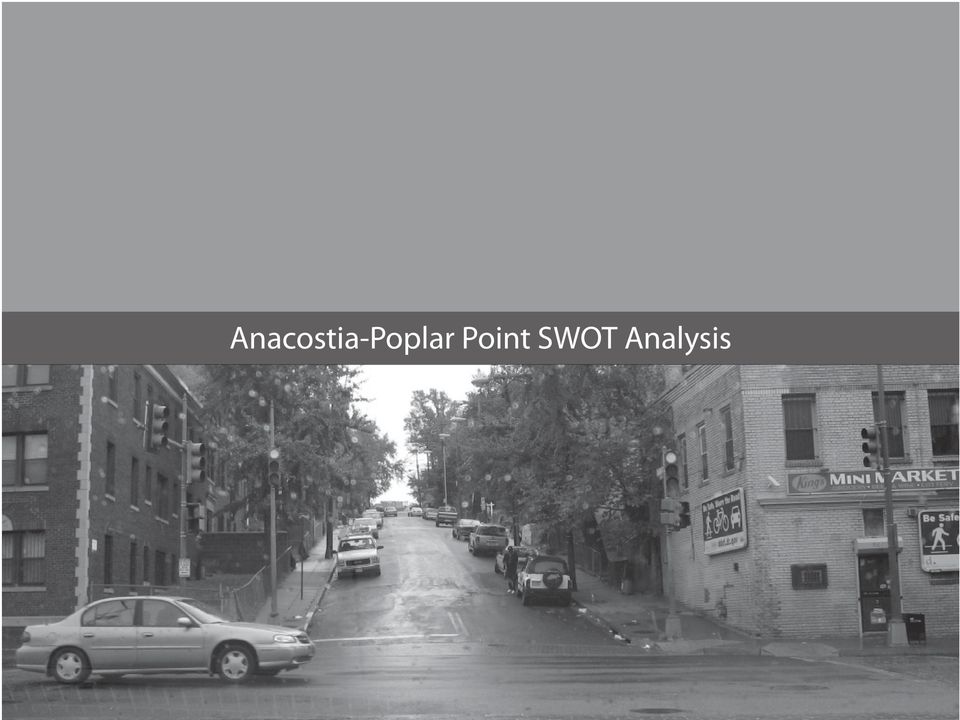
2 Anacostia-Poplar Point SWOT Analysis
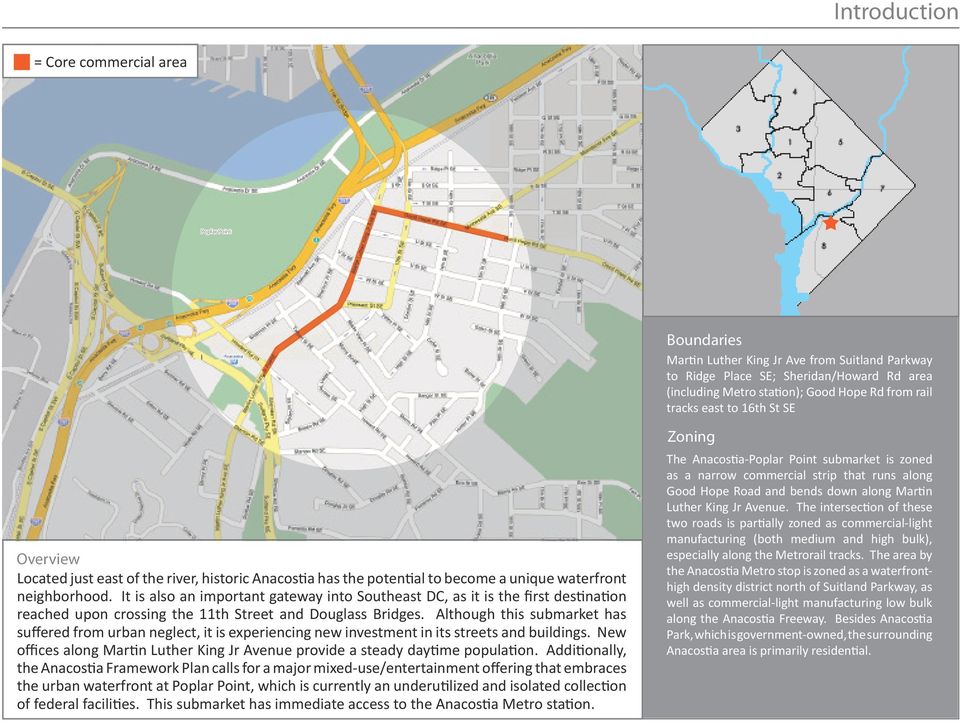
3 Introduction = Core commercial area Poplar Point Boundaries Martin Luther King Jr Ave from Suitland Parkway to Ridge Place SE; Sheridan/Howard Rd area (including Metro station); Good Hope Rd from rail tracks east to 16th St SE Overview Located just east of the river, historic Anacostia has the potential to become a unique waterfront neighborhood. It is also an important gateway into Southeast DC, as it is the first destination reached upon crossing the 11th Street and Douglass Bridges. Although this submarket has suffered from urban neglect, it is experiencing new investment in its streets and buildings. New offices along Martin Luther King Jr Avenue provide a steady daytime population. Additionally, the Anacostia Framework Plan calls for a major mixed-use/entertainment offering that embraces the urban waterfront at Poplar Point, which is currently an underutilized and isolated collection of federal facilities. This submarket has immediate access to the Anacostia Metro station. Zoning The Anacostia-Poplar Point submarket is zoned as a narrow commercial strip that runs along Good Hope Road and bends down along Martin Luther King Jr Avenue. The intersection of these two roads is partially zoned as commercial-light manufacturing (both medium and high bulk), especially along the Metrorail tracks. The area by the Anacostia Metro stop is zoned as a waterfronthigh density district north of Suitland Parkway, as well as commercial-light manufacturing low bulk along the Anacostia Freeway. Besides Anacostia Park, which is government-owned, the surrounding Anacostia area is primarily residential.
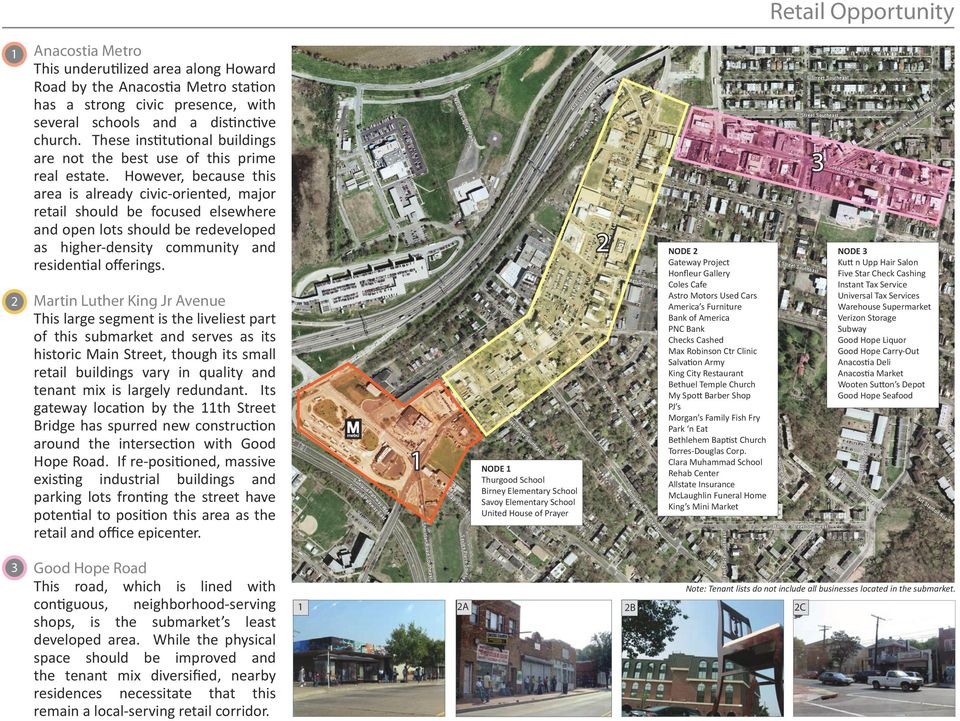
4 Retail Opportunity 1 2 Anacostia Metro This underutilized area along Howard Road by the Anacostia Metro station has a strong civic presence, with several schools and a distinctive church. These institutional buildings are not the best use of this prime real estate. However, because this area is already civic-oriented, major retail should be focused elsewhere and open lots should be redeveloped as higher-density community and residential offerings. Martin Luther King Jr Avenue This large segment is the liveliest part of this submarket and serves as its historic Main Street, though its small retail buildings vary in quality and tenant mix is largely redundant. Its gateway location by the 11th Street Bridge has spurred new construction around the intersection with Good Hope Road. If re-positioned, massive existing industrial buildings and parking lots fronting the street have potential to position this area as the retail and office epicenter. 1 NODE 1 Thurgood School Birney Elementary School Savoy Elementary School United House of Prayer 2 NODE 2 NODE 3 Gateway Project Kutt n Upp Hair Salon Honfleur Gallery Five Star Check Cashing Coles Cafe Instant Tax Service Astro Motors Used Cars Universal Tax Services America s Furniture Warehouse Supermarket Bank of America Verizon Storage PNC Bank Subway Checks Cashed Good Hope Liquor Max Robinson Ctr Clinic Good Hope Carry-Out Salvation Army Anacostia Deli King City Restaurant Anacostia Market Bethuel Temple Church Wooten Sutton s Depot My Spott Barber Shop Good Hope Seafood PJ s Morgan s Family Fish Fry Park n Eat Bethlehem Baptist Church Torres-Douglas Corp. Clara Muhammad School Rehab Center Allstate Insurance McLaughlin Funeral Home King s Mini Market 3 3 Good Hope Road This road, which is lined with contiguous, neighborhood-serving shops, is the submarket s least developed area. While the physical space should be improved and the tenant mix diversified, nearby residences necessitate that this remain a local-serving retail corridor. 1 2A 2B Note: Tenant lists do not include all businesses located in the submarket. 2C
5 Retail Node 1: Anacostia Metro = Major Intersection = Minor Intersection The area around the Anacostia Metro Station can be divided into 2 sub-nodes: Civic Buildings and Open Space. = Neighborhood Intersection = Sub-node A = Sub-node B B A B A - Civic Buildings define this area by the Metro station. A cluster of stately schools (Thurgood Marshall Charter School, Birney Elementary, and Savoy Elementary) are densely packed together in one block and have little outdoor space. While these schools lack space, the United House of Prayer For All People across the street sits on an overly prominent and spacious lot circled by Metrobus infrastructure. As important as these civic buildings are, they are not the highest and best use of this prime real estate, which is suited to (and already zoned for) high-density development. However, because there is no existing retail here and retail energy already exists in Node 2, this area should continue to be developed as a civic center. New high-density residential construction is appropriate, and existing buildings such as the church should be re-evaluated and possibly relocated. B - Open space exists in abundance at the edges of this node. While these stretches of grassy land are not out of place around the existing civic buildings, they are grossly underutilized considering this area s prime location by the Metro and a major freeway. Both large parcels have potential to become significant offerings for the community. Again, because this area is already civic-oriented, future development would be most appropriate as higher-density community institutions.

6 = Major Intersection = Minor Intersection = Neighborhood Intersection = Sub-node A = Sub-node B = Sub-node C B C Retail Node 2: Martin Luther King Jr Avenue The historic heart of Anacostia, Martin Luther King Jr Avenue warrants its own Master Plan. It has the right ingredients to become a successful Main Street but will require enormous effort. As it exists now, it can be divided into 3 sub-nodes: Industrial Buildings, Inline Retail, and Offices. A C A - Industrial Buildings and sprawling parking lots occupy the west side of the street, creating massive gaps in the streetscape. These lots have potential to be redeveloped into major mixeduse retail offerings, as they have significant depth and room for rear service and loading. A 19½-foot chair is a local landmark, and reflects the street s history. B B - Inline Retail is redundant and in poor condition, although the area is lively with pedestrian activity. Shops near the intersection with Good Hope Road are in better condition; the Honfleur Gallery represents recent investment in this gateway area. While nearby residences limit the potential for expansion, there is service and loading room for smaller tenants. C C - Offices such as the Gateway Building, Peebles Building, and Salvation Army project dot Martin Luther King Jr Avenue and provide a steady daytime population. This area s prime location and zoning incentives make it suited to office development.

7 Retail Node 3: Good Hope Road = Major Intersection = Neighborhood Intersection = Zone 1 = Zone 2 = Major Intersection = Minor Intersection = Neighborhood Intersection = Sub-node A = Sub-node B A B B Good Hope Road has the same general character throughout; however, building types can be divided into Marginal Shops and Large Warehouses. A - Marginal Shops run the length of Good Hope Road. Retail is redundant and buildings are in poor condition. Depths are limited because of adjacent residences, so retail cannot be expanded beyond smaller-format tenants. For these shops, the existing infrastructure for serving and loading is adequate; most blocks have an alley parallel to Good Hope Road that is accessed from side streets. However, there is very little parking, except for small surface lots that disrupt the retail streetscape. B - Large Warehouses break the streetscape of small shops on Good Hope Road in 2 instances: Verizon Storage and Warehouse Supermarket. These huge buildings have expansive blank facades that act essentially like gaps in the retail streetscape and deaden the pedestrian experience. Because of their depth, these spots could easily become larger-format anchors. As it is best not to spread retail efforts too thin, however, revitalization should be focused on Martin Luther King Jr Avenue and these large structures should not be considered for rehabilitation/re-positioning for the time being. Anacostia-Poplar Point Working Group Draft May

8 Streets & Blocks Intersections Buildings Alleys & Service Martin Luther King Jr Avenue is the submarket s spine and historic Main Street, while Good Hope Road and Howard Road are important secondary roads that branch off this primary corridor. Martin Luther King Jr Avenue has the appropriate scale to become a vibrant Main Street (2 lanes of traffic in each direction), and it is also the busiest of the 3 roads. While large gaps in the streetscape negatively affect the pedestrian experience on Martin Luther King Jr Avenue, its streetscape is in decent condition. Brick-paved sidewalks run the length of the street, as well as down Good Hope Road, and there are regular plantings. In sharp contrast, Howard Road has had little investment in its streetscape; its expansive Metro infrastructure makes it stark and auto-dominant. While the largest intersection occurs at the submarket s southern periphery (where Martin Luther King Jr Avenue crosses Howard and Sheridan Roads), this sparsely developed area is not the heart of Anacostia-Poplar Point. Rather, the main intersection occurs further north at Martin Luther King Jr Avenue and Good Hope Road (see image below). This area s gateway location from the 11th Street Bridge has spurred investment in new construction, including the 63,000sf Anacostia Gateway office project and smaller-format buildings like the Honfleur Gallery, a former pawn shop. While this area is quickly transitioning, dilapidated buildings remain at the intersection s southern half. The submarket s remaining intersections are all currently neighborhood-scaled. Anacostia-Poplar Point has a mix of buildings. Most retail consists of 2-story buildings with ground-floor shops and lofted apartments. These shops are in very poor condition, with marginal tenants such as carry-out, liquor, and cash-checking shops. There are also several massive industrial buildings set far back from the street behind large parking lots. Newer construction consists mostly of 3- to 4-story office buildings with ground-floor retail. Closer to the Metro station, large civic buildings like schools and churches predominate. The submarket is surrounded by residences in varying condition. Decent single-family homes and new condos are concentrated east of Martin Luther King Jr Avenue, while nice rowhouses pop up on Martin Luther King Jr Avenue near Morris Street. Retail Infrastructure Because there is not substantial retail in this submarket, there is not a consistent system of alleys for service and loading. While shops near the intersection of Martin Luther King Jr Avenue and Good Hope Road have minimal rear service space, the block of shops between W and Pleasant Streets has a clearly defined rear alley. This inconsistency is somewhat mitigated by the large size of lots along Martin Luther King Jr Avenue, since they can accommodate new infrastructure where necessary. Shops along Good Hope Road are more limited in their potential for expansion (because of nearby residences), but their smaller-format tenants can tap into existing residential alleys. Anacostia-Poplar Point Working Group Draft May

9 SWOT Analysis Strengths Martin Luther King Jr Avenue has the right ingredients to become a successful Main Street; it is a scale-appropriate, historic street whose blocks have good proportions and depths The existing streetscape is mostly in good condition, with brick paving along Martin Luther King Jr Avenue and Good Hope Road The submarket s key location as the gateway into Southeast D.C. gives it added significance and momentum for redevelopment Redevelopment across the river (ie. the Capitol Riverfront) is increasing the level of amenities provided along the Anacostia riverfront and increasing momentum for revitalization in far Southeast The Anacostia Framework Plan laid the groundwork for significant investment to be channeled to this area, including redevelopment at Poplar Point Numerous office buildings provide a steady daytime population and major construction for new offices is already underway (including the 63,000sf Anacostia Gateway project and 69,000sf Salvation Army project) The submarket has historic clout and several tourist attractions nearby, including the Frederick Douglass Home and Anacostia Museum Unlike many other submarkets, Anacostia has several areas where it can successfully locate retail Weaknesses Land surrounding the Anacostia Metro station is underutilized and a missed opportunity for transit-oriented development; the densest and liveliest parts of the submarket are further north and do not have easy access to this station The area surrounding the submarket is very suburban; currently there is inadequate residential density to support an expanded and thriving retail scene The submarket s per capita income is lower than average and consistent with pricepoint-sensitive retail; diversifying retail offerings may price out the existing population Properties along Good Hope Road have limited depth because of nearby residences and many are in disrepair Even at the submarket s major intersection (at Martin Luther King Jr Avenue and Good Hope Road), most buildings are vacant and dilapidated Large parking lots in front of industrial buildings break the flow of retail along Martin Luther King Jr Avenue, while large buildings with blank facades do the same along Good Hope Road Disinvestment has contributed to high crime rates in this area Opportunities Poplar Point is one of the city s few remaining parcels of open waterfront and, therefore, represents a unique opportunity for major development; the selected proposal for development calls for 405,000sf of retail, 3,200 residential units, 1.5 million sf of offices, and 224,000 sf of hotels Redevelopment of Saint Elizabeth s campus could strengthen the submarket s employee base (as it will be the new home of the U.S. Coast Guard); it will also help create a commercial/retail corridor of varying typologies This submarket represents a unique chance to create a gateway that takes advantage of its waterfront location in a part of the city that has suffered from disinvestment

10 SWOT Analysis Redevelop Node 2 (Martin Luther King Avenue) as the submarket s retail and office epicenter, taking advantage of its large lots, more than adequate depths, and historic Main Street role Residential development at Poplar Point and surrounding areas can add to the neighborhood consumer base and potentially support Main Street retail in historic Anacostia Allow Good Hope Road to remain a neighborhood-serving corridor; it would be an excellent place to incubate local businesses Take advantage of existing infrastructure and proximate uses (e.g., the Thurgood Marshall Charter School, Birney Elementary, and Savoy Elementary) to establish Howard Road and the area near the Metro station as the submarket s civic center; retail should be focused elsewhere Continue to develop the area near the intersection of Martin Luther King Jr Avenue and Good Hope Road, focusing on gateway elements for the intersection s southern half, where buildings remain in poor condition Developing a comprehensive merchandising strategy will help to reduce redundant retail throughout the submarket Implementing streetscape guidelines will help to brand the district s distinct areas, drawing attention to its historic past Threats Higher than average crime statistics can deter potential retailers from locating here, though significant public and private investments in housing, schools, libraries, recreation, and employment opportunities are expected to lead to improved safety in the area In areas of the submarket where ownership is fragmented, it may be a challenge to get multiple owners to work together; additionally, major property owners have not actively effected change

11 Anacostia-Poplar Point Preliminary Planning Diagrams

12 Planning Analysis Node 1: Anacostia Metro = Major Intersection = Neighborhood Intersection = Node 1 = Residential = Commercial = Public/Civic = Vacant General Observations about Existing Area: 1) Development around the Anacostia Metro is primarily suburban in nature. 2) Lower-density buildings occupy many of the parcels around the metro station with limited commercial programming. 3) The surrounding civic and educational uses currently serve the community; however, these uses are inconsistent with the city s goals of transit-oriented development around Metro stations. Retail Planning Principles: 1) Focus long-term efforts on establishing higher density around the Metro. 2) Capitalize on vacant parcels and poorly performing commercial properties. Redevelopment in these areas will be less complicated than acquiring civic and educational buildings.

13 Planning Concepts Node 1: Anacostia Metro = Prime Corner = Mixed-Use Opportunity = Multi-Use Opportunity = Major Intersection = Neighborhood Intersection The following concept diagrams are intended to be used as a general guide for retail improvement opportunities. Actual building configurations and mix of uses should be reviewed on a case-by-case basis. Two redevelopment options explore a varying degree of programming. Redevelopment Option 1 Redevelopment Option 2 Anacostia Fwy Chicago St, SE Anacostia Fwy Chicago St, SE Shannon Pl, SE Shannon Pl, SE Howard Rd, SE Talbert St, SE Howard Rd, SE Talbert St, SE Suitland Pky, SE Suitland Pky, SE Martin Luther King Jr Ave, SE Sheridan Rd, SE Martin Luther King Jr Ave, SE Sheridan Rd, SE Sayles Pl, SE Sayles Pl, SE HIGH-DENSITY, MIXED-USE, AND MULTI-USE DEVELOPMENT OPPORTUNITIES With existing civic uses limiting dense transitoriented development, new development should take every opportunity to reposition vacant parcels, as well as underserving single-story residential and retail uses. These parcels and single-story buildings are ideally suited to becoming higher-density, mixed-use, or multi-use offerings. HIGH-DENSITY, MIXED-USE, AND MULTI-USE DEVELOPMENT OPPORTUNITIES When considering increased growth for this neighborhood, the existing school and church buildings are not the most appropriate uses for lots adjacent to the Metro. To achieve the highest and best use for this node, these properties (including the Metro parcel itself) need to be consolidated and redeveloped into a more transit-oriented product type.

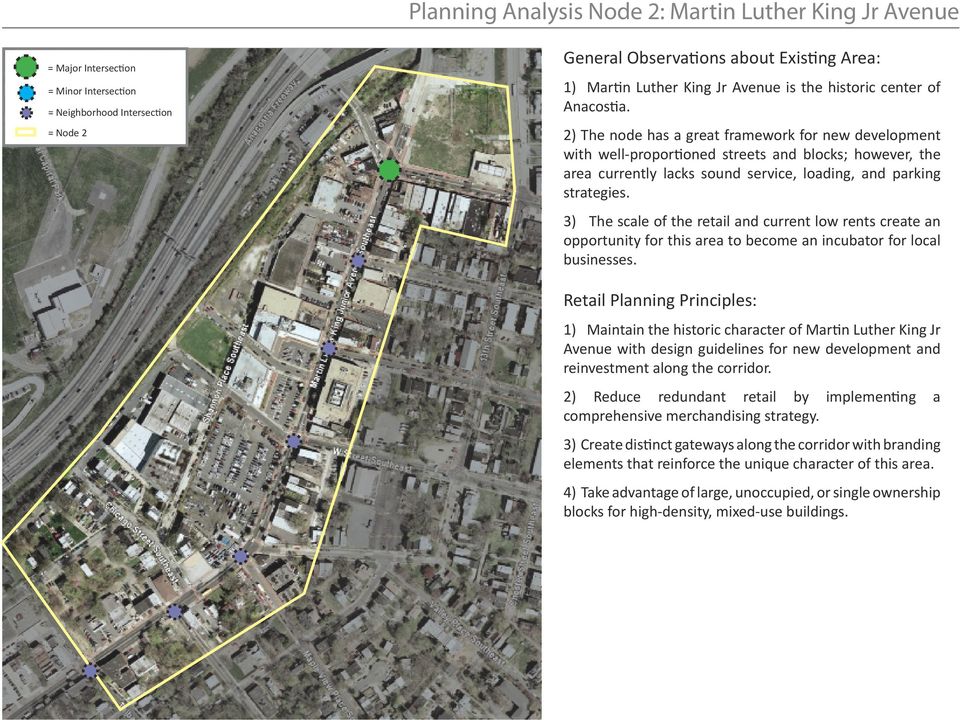
14 Planning Analysis Node 2: Martin Luther King Jr Avenue = Major Intersection = Minor Intersection = Neighborhood Intersection = Node 2 General Observations about Existing Area: 1) Martin Luther King Jr Avenue is the historic center of Anacostia. 2) The node has a great framework for new development with well-proportioned streets and blocks; however, the area currently lacks sound service, loading, and parking strategies. 3) The scale of the retail and current low rents create an opportunity for this area to become an incubator for local businesses. Retail Planning Principles: 1) Maintain the historic character of Martin Luther King Jr Avenue with design guidelines for new development and reinvestment along the corridor. 2) Reduce redundant retail by implementing a comprehensive merchandising strategy. 3) Create distinct gateways along the corridor with branding elements that reinforce the unique character of this area. 4) Take advantage of large, unoccupied, or single ownership blocks for high-density, mixed-use buildings.
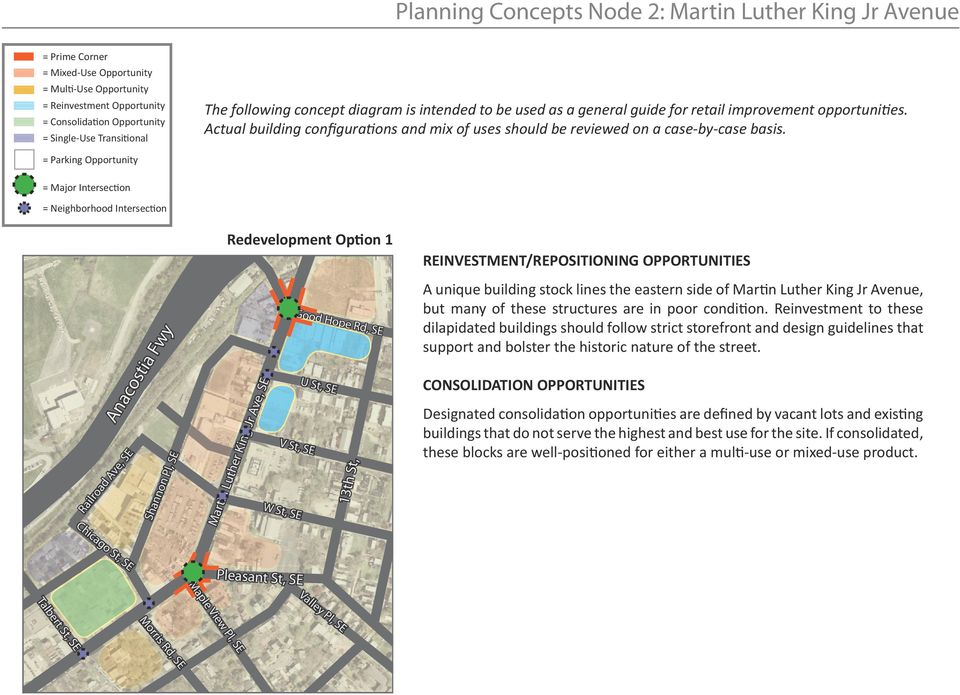
15 Planning Concepts Node 2: Martin Luther King Jr Avenue = Prime Corner = Mixed-Use Opportunity = Multi-Use Opportunity = Reinvestment Opportunity = Consolidation Opportunity = Single-Use Transitional = Parking Opportunity The following concept diagram is intended to be used as a general guide for retail improvement opportunities. Actual building configurations and mix of uses should be reviewed on a case-by-case basis. = Major Intersection = Neighborhood Intersection Railroad Ave, SE Chicago St, SE Anacostia Fwy Shannon Pl, SE Redevelopment Option 1 Martin Luther King Jr Ave, SE U St, SE V St, SE W St, SE Pleasant St, SE Good Hope Rd, SE 13th St, Valley Pl, SE HIGH-DENSITY, MIXED-USE, AND MULTI-USE DEVELOPMENT OPPORTUNITIES Significant new development opportunities lie along the western side of Martin Luther King Jr. Avenue, where large site depths can support high-density buildings. Retail that faces out onto the heavily trafficked avenue will take advantage of strong visibility. As the development approaches the Anacostia Freeway, program should transition from mixed-use to multi-use to single-use. The intersection of Martin Luther King Jr. Avenue and Maple View Place/ Pleasant Street is an opportunity to create a significant entrance into the shopping corridor of the node. New development surrounding the intersection will create prime corners for retail investment. The intersection provides many of the key elements for a successful and vibrant retail environment: - A location for gateway elements and a sense of place - A focus for pedestrian activity - Public plazas or other open spaces - Focal entrances to mixed-use buildings - High visibility for larger retail tenants Maple View Pl, SE Talbert St, SE Morris Rd, SE

16 Planning Concepts Node 2: Martin Luther King Jr Avenue = Prime Corner = Mixed-Use Opportunity = Multi-Use Opportunity = Reinvestment Opportunity = Consolidation Opportunity = Single-Use Transitional The following concept diagram is intended to be used as a general guide for retail improvement opportunities. Actual building configurations and mix of uses should be reviewed on a case-by-case basis. = Parking Opportunity = Major Intersection = Neighborhood Intersection Railroad Ave, SE Anacostia Fwy Shannon Pl, SE Redevelopment Option 1 Martin Luther King Jr Ave, SE U St, SE V St, SE W St, SE Good Hope Rd, SE 13th St, REINVESTMENT/REPOSITIONING OPPORTUNITIES A unique building stock lines the eastern side of Martin Luther King Jr Avenue, but many of these structures are in poor condition. Reinvestment to these dilapidated buildings should follow strict storefront and design guidelines that support and bolster the historic nature of the street. CONSOLIDATION OPPORTUNITIES Designated consolidation opportunities are defined by vacant lots and existing buildings that do not serve the highest and best use for the site. If consolidated, these blocks are well-positioned for either a multi-use or mixed-use product. Chicago St, SE Pleasant St, SE Maple View Pl, SE Valley Pl, SE Talbert St, SE Morris Rd, SE
17 Planning Analysis Node 3: Good Hope Road = Neighborhood Intersection Major Intersection = Node 3 Neighborhood Intersection = Zone 1 = Zone 2 General Observations about Existing Area: 1) Heavy traffic along Good Hope Road will bring good visibility to retailers; however, retail development efforts along Martin Luther King Jr Avenue and surrounding power centers will limit potential for retail in this node. 2) Limited site depths and a lack of critical mass put a strain on establishing retail cohesiveness. Retail Planning Principles: 1) Limit and focus retail reinvestment on filling in gaps to make a more contiguous retail street. 2) Continue to provide basic neighborhood goods and services with new retail. 3) Merchandise retail that distinguishes itself from the programming along Martin Luther King Jr Avenue.

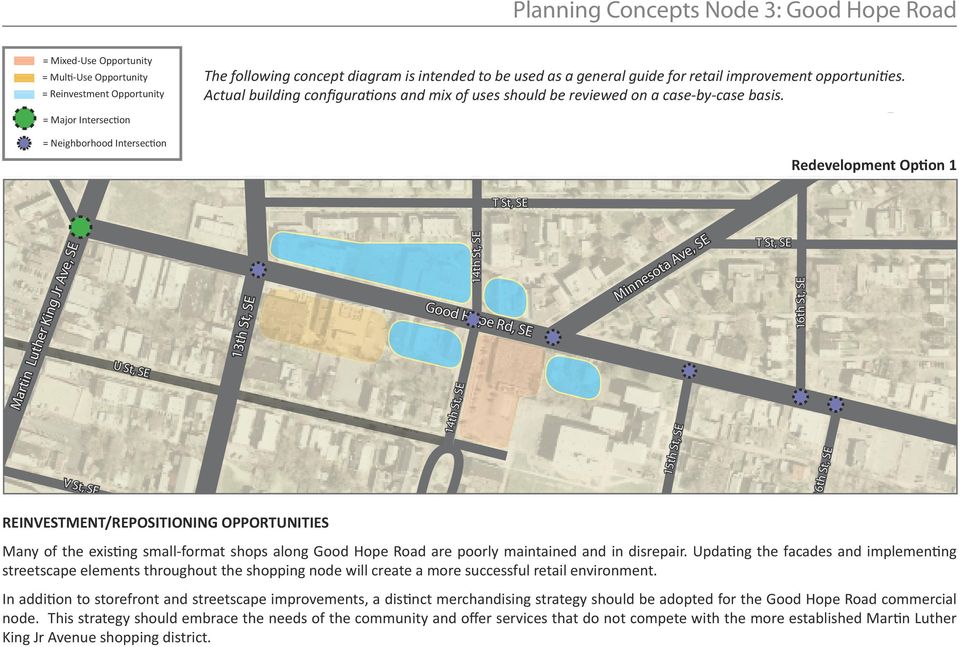
18 16th St, SE 14th St, SE Planning Concepts Node 3: Good Hope Road = Mixed-Use Opportunity = Multi-Use Opportunity = Reinvestment Opportunity = Major Intersection = Neighborhood Intersection The following concept diagram is intended to be used as a general guide for retail improvement opportunities. Actual building configurations and mix of uses should be reviewed on a case-by-case basis. Redevelopment Option 1 T St, SE Martin Luther King Jr Ave, SE V St, SE U St, SE 13th St, SE Good Hope Rd, SE 14th St, SE Minnesota Ave, SE 15th St, SE T St, SE 16th St, SE HIGH-DENSITY, MIXED-USE, AND MULTI-USE DEVELOPMENT OPPORTUNITIES Where underperforming large-format retailers exist, there is an opportunity to redevelop the property to an anchor tenant that better meets the needs of the community. Parking will remain a concern and creative parking solutions, such as underground parking, should be explored. Only one location has the potential for a large-scale mixed-use product. This site, on the southern side of Good Hope Road near the intersection with Minnesota Avenue, has the required site depth for a large anchor tenant with an integrated parking structure.

19 16th St, SE 14th St, SE Planning Concepts Node 3: Good Hope Road = Mixed-Use Opportunity = Multi-Use Opportunity = Reinvestment Opportunity The following concept diagram is intended to be used as a general guide for retail improvement opportunities. Actual building configurations and mix of uses should be reviewed on a case-by-case basis. = Major Intersection = Neighborhood Intersection Redevelopment Option 1 T St, SE Martin Luther King Jr Ave, SE V St, SE U St, SE 13th St, SE Good Hope Rd, SE 14th St, SE Minnesota Ave, SE 15th St, SE T St, SE 16th St, SE REINVESTMENT/REPOSITIONING OPPORTUNITIES Many of the existing small-format shops along Good Hope Road are poorly maintained and in disrepair. Updating the facades and implementing streetscape elements throughout the shopping node will create a more successful retail environment. In addition to storefront and streetscape improvements, a distinct merchandising strategy should be adopted for the Good Hope Road commercial node. This strategy should embrace the needs of the community and offer services that do not compete with the more established Martin Luther King Jr Avenue shopping district.
20 Development Concepts

21 Development Concepts
22 Development Concepts
23 Development Concepts
24 Development Concepts
25 Anacostia-Poplar Point Retail Demand Analysis
26 The retail submarket is located along MLK Jr. Avenue from Suitland Parkway to Ridge Place, SE; Sheridan / Howard Road area (including metro); Good Hope Road from rail tracks east to 16th Street, SE Key Elements Trade areas assess residents and other potential customers that could be drawn to the site The primary trade area encompasses the block groups within a ¼ mile of the retail submarket; the secondary trade area includes the block groups within a ½ mile of the retail submarket (reasonable walking distances for pedestrian shopping) Primary trade area residents are expected to be frequent customers, with a focus on those living closest to the site; secondary trade area residents are expected to be consistent, but not frequent customers Potential customers who are not primary or secondary trade area residents are accounted for by an inflow factor; this is a percentage applied to potential expenditures at the site
27 The Anacostia trade area is expected to have minimal increases in population and housing units over the next five years New residential projects may add 1,137 households or approximately 3,012 new residents (based on average household size in each trade area), ERA accounted for this addition in the 2012 figures for population and households Total population in the trade area is projected to increase from 20,449 in 2007 to 23,461 in 2012; an average annual growth rate of 2.8 percent Major new projects include Anacostia Gateway, Anacostia Square, Sheridan Terrace, Anacostia Metrorail Station, Riverview Plaza, and Barry Farm Trade Area Population Growth, 2007 and 2012 Primary Secondary 25,000 20,000 15,000 10,000 5, Trade Area Household Growth, 2007 and 2012 Estimated 2007 Projected 2012 Primary 2,636 3,187 Secondary 4,949 5,535 Total 7,585 8,722 Source: ESRI Business Analyst; ERA 2007
28 Anacostia Key Demographics: Trade Area Household Profile The Anacostia trade area is comprised of mostly middle-lower and lower income households Income Statistics, 2007 Median household income in the primary trade area is $28,804 and is $30,612 in the secondary trade area $40,000 Primary Secondary Per Capita income in the primary trade area is $13,068 and is $16,963 in the secondary trade area; both of which are well below the national average at $27,916 $30,000 The trade area is primarily African-American at 97%* $20,000 * Other includes mixed racial populations or populations self-identified as such. The group may include Latinos or Hispanics who do not identify with another race. Latino and Hispanic are ethnic groups, not racial, but may include people of several racial groups $10,000 $0 Median HH Income Median Family Income Median Net Worth Per Capita Income Racial and Ethnic Groups, 2007 Am Indian 0% Asian 0% Other 1% White 2% African Am 97% Source: ESRI Business Analyst; ERA 2007 White African Am Am Indian Asian Other
29 The trade area is expected to see the greatest population increase within the 15 to 24 and 55 to 64 age cohorts over the next five years The trade area is expected to see the greatest population increase within the 15 to 24 and 55 to 64 age cohorts over the next five years The 15 through 24 age cohort increase is a positive indicator for retail demand for apparel and accessories, electronics, and quick service restaurants Growth in the 55 to 64 cohort will increase demand for goods and services associated w/ Empty Nesters and those heading towards retirement. This group tends to spend less on furnishings and household formation categories The population decreases in age cohorts 25 to 34 and 35 to 44 are negative indicators for residential demand and goods and services intended for use by families with children 3,000 2,500 2,000 1,500 1, Source: ESRI Business Analyst; ERA 2007
30 Key Demographics: Trade Area Household Profile A higher percentage of households in the Anacostia trade area rent their homes, versus own (74% v. 26%) Home Ownership, 2007 Reviewing the trade area s household expenditures provides a snapshot of how households spend their disposable dollars. In order to increase opportunities for retail sales in the community, the retail submarket needs to be able to capture more of the total expenditures available Own 74% Rent 26% In 2007 trade area residents spent a total of $77.8 million on products and services in the categories represented on the graph. This is total spending everywhere, not just in the submarket Trade area residents spend the most money on groceries Household Expenditures (In Millions) by Category, 2007 Food and drink away from home, especially in the secondary trade area, represents the second highest expenditures category for trade area residents $14 $12 Primary Secondary $10 $8 $6 $4 $2 $0 Apparel & Apparel Services Entertainment & Recreation Personal Care Household Furnishings and Equipment Grocery Food & Drink Away From Home Source: ESRI Business Analyst; ERA 2007
31 Development Pipeline Pipeline Projects There are multiple mixed-use projects planned in and near the Anacostia trade area. Development at Poplar Point will significantly effect Anacostia s retail submarket There are an five projects in the trade area that are scheduled to deliver approximately 934 residential units and 363,600 square feet of retail They are: Anacostia Metrorail Station Anacostia Square Riverview Plaza Sheridan Terrace Anacostia Gateway There are currently four different proposals for large developments within the primary trade area at Poplar Point that would deliver between 400,000 and 900,000 square feet of retail Source: ESRI Business Analyst; ERA 2007
32 Overview of Market Demand Analysis The purpose of the market analysis is to provide quantitative data that, combined with qualitative analysis in the Strengths-Weaknesses-Opportunities- Threats (SWOT) section, inform the retail development strategy for the submarket and provide a tool to DC government, private developers, retailers, and community organizations for developing retail business opportunities. Developing Estimates of Supportable Square Footage A key component of the quantitative analysis is the determination of the quantity of retail space supportable in each submarket. To calculate this, retail demand or spending within the trade area along with an estimate of the spending that the submarket could capture are measured. Various factors are taken into account in developing submarket capture rates, such as the quality of existing retail offerings and trade area competition. Retail spending potential for each major retail category (Convenience Retail, Specialty Retail and Food & Beverage/Restaurants other Food Service) is divided by the retail industry standard for sales-per-square foot (sometimes called retail sales productivity) to arrive at an estimate of retail square footage that the submarket can support. Submarket demand is compared to supply by subtracting the existing retail inventory to determine the net supportable square feet for retail space. For potential future development in 2012, pipeline residential and commercial projects, and associated increases in trade area expenditures, are factored into future demand. On the supply side, the pipeline of under construction and planned retail projects is subtracted from the estimate of supportable retail space, as it is assumed that the new space will absorb an equivalent amount of space at the threshold productivity levels. Generally speaking, retail market demand analysis should not be considered conclusive, as it combines typical and industry average performance measures with professional judgment based on local conditions and knowledge of the market and retail industry. There are several factors that will determine the success or failure of any individual retail business; that is why the industry is constantly changing. This analysis is intended to guide the Retail Action Strategy to opportunities to recruit potential successful retail categories based on estimated demand potential. *Estimated retail spending potential is based on household spending patterns, household income and household composition as reported by the Consumer Expenditure Survey prepared by the US Census for the US Bureau of labor Statistics. For retail sales productivity rates, ERA used a range of retail industry-based sales per square foot estimates based on the company s experience in urban commercial districts similar to each individual submarket, as shopping center industry standards do not always reflect comparable performance in either market orientation or financial structure by locally-owned businesses or by smaller/older commercial buildings.
33 Retail Demand: Primary Trade Area Supportable Retail Space Retailers measure business success by comparing their sales per square foot or productivity against their costs and revenue objectives as well as reported retail industry standards for comparable types of stores. The amount retailers can afford to spend for rent is also determined by annual sales (both the total amount and sales per square foot per year). Retail rents usually range between 8 percent and 12 percent of total annual sales. This industry standard is a benchmark by which retail performance can be determined. Local retailers whose sales fall below these industry standards may be considered to be underperforming; the reasons for underperformance may be a result of the size of the market, stronger competitors with better merchandise, merchandising, and/or better pricing, or undercapitalization. Underperforming retailers may cause the analysis of supportable square footage to be underestimated. The higher performing operators can capture market share from existing retailers as well as new customers not currently patronizing a commercial district. When considering a commercial location or district such as the submarkets included in this analysis, retailers often review the levels of rent achieved by property owners as an indication of the level of sales that other retailers are generating. Lower average rent levels also influence the amount that property owners can afford to invest in property improvements to retain existing tenants or recruit new ones. If property owners are unable to offer tenant improvements because rents are too low, the retailers are then required to increase the amount they must spend to prepare a building to become a store, café, or consumer service business. The greater the amount the retailer is required to invest in space improvements, the greater the financial risk, resulting in additional financial pressures during the early years while the retailer is becoming established and building a customer base. Districts presenting a higher risk of failure have difficulty attracting well managed, well capitalized businesses. This relationship establishes the connection between the total sales that retailers can achieve, the amount they can afford to pay in rent, and whether the property owners will be willing (or able) to invest in major needed building upgrades (electrical systems, HVAC, or tenant improvements) to attract or retain retail tenants.
34 Trade Area Resident Spending Retail opportunities are measured using trade area retail expenditures, which describe consumer spending patterns Expenditures typically cover resident spending, but have been adjusted to include worker, visitor, and other spending, as appropriate Trade Area Expenditures By Category (In Millions), 2007 $77.8 Million Total Key categories include: $50 Apparel and Apparel Services $45 Primary Secondary Entertainment and Recreation $40 Personal Care $35 $30 Household Furnishing and Equipment $25 Grocery $20 Food and Drink Away from Home $15 $10 Entertainment and Recreation includes expenditures such as fees and admissions, TV/video/sound equipment, pets, toys, recreational vehicles, sports equipment, photo accessories, and reading $5 $0 Apparel & Apparel Services Entertainment & Recreation Personal Care Household Furnishings and Equipment Grocery Food and Drink Away From Home Personal Care includes stores such as, drugstores (excluding prescription drugs) cosmetic stores, and services (nail salons, hair salons, shoe repair, etc.) Grocery (food and drink for consumption at home) absorbs the most expenditures for the households in the trade area Source: ESRI Business Analyst; ERA 2007
35 Capture rates are applied to total trade area expenditures in order to estimate potential expenditures within the retail submarket A capture rate is calculated as a percentage of sales expected from households or inflow shoppers in the entire trade area. The rate is developed by examining the trade area s existing retail offerings, quality of retailers, the potential for increased sales with improved retail operations, size of the trade area and a professional judgment considering nearby competition and other available retail purchasing opportunities for customers. The analysis utilizes capture rates specific to the trade area to calculate likely on-site spending within the retail submarket. For example: A 10% capture rate = $10 of every $100 spent will occur in the retail submarket Note that 100% capture rate is not possible, as the rate reflects all retail purchasing opportunities available to the shoppers in the trade area Anacostia Submarket Capture Rates By Category Primary Secondary Inflow Apparel & Apparel Services 30% 20% 15% Entertainment & Recreation 35% 20% 10% Personal Care 60% 40% 15% Household Furnishings and Equipment 35% 25% 15% Grocery 60% 40% 15% Food and Drink Away From Home 50% 35% 20% Source: ESRI Business Analyst; Economics Research Associates, 2007 The capture rate is generally a major determinate of a retail submarket s viability Source: ESRI Business Analyst; ERA 2007
36 Estimated Captured Spending within the Retail Market Captured spending in the retail trade area was estimated to be $32.4 million in 2007 compared to total trade area spending of $77.8 million in the same year Estimated Captured Retail Trade Area Spending, 2007 $32.4 Million Captured spending in the retail trade area is expected to be $37.5 million in 2012 compared to total trade area spending of $89.4 million in the same year $8,198,204 $3,290,735 $3,815,657 ERA estimates by 2012 that Grocery spending will account for a little more than $14.5 million annually and Food and Drink (away from home) will account for more than $9.4 million annually $12,578,921 $2,743,059 $1,782,467 Captured spending in the retail submarket is expected to increase by more than $5 million between 2007 and 2012, due mostly to significant changes in population and income levels Apparel & Apparel Services Personal Care Grocery Entertainment & Recreation Household Furnishings and Equipment Food and Drink Away From Home Estimated Captured Retail Trade Area Spending, 2012 $37.5 Million $3,843,752 $4,423,326 $9,465,882 $3,171,291 $14,538,234 $2,057,904 Source: ESRI Business Analyst; ERA 2007 Apparel & Apparel Services Personal Care Grocery Entertainment & Recreation Household Furnishings and Equipment Food and Drink Away From Home
37 Productivity and Typical Store Size A calculation of store productivity is typically based on optimal performance of quality retailers, not actual operators However the lower quality of the retail space available in this retail submarket requires that a lower than optimal productivity rate must be used to adjust the supportable square footage calculation The square footage of retail type does not indicate number of stores since stores sizes vary Typical stores sizes might be: Apparel 3,500 SF Accessories 2,000 10,000 SF Personal Care 2,000 10,000 SF Household Furnishings 3,500 10,000 SF Grocery Stores- 30,000 to 65,000 Restaurants 3,000 6,000+ SF Quick Service food 1,200 3,500 SF The best way to estimate a site s productivity is to assess annuals sales per square foot for comparable projects The type of retail often impacts the sales per square foot (i.e. jewelry versus furniture) Sales per Square Foot Category Low High Apparel & Apparel Services $ 250 $ 400 Entertainment & Recreation $ 200 $ 300 Personal Care $ 350 $ 450 Household Furnishings and Equipment $ 250 $ 350 Grocery $ 350 $ 550 Food and Drink Away From Home $ 350 $ 450 1/ International Council of Shopping Centers, Dollars & Cents of Shopping Centers 2006 Source: Economics Research Associates, 2007 While the productivity rates used for this submarket were based on national averages as reported by the International Council of Shopping Centers (ICSC), ERA used the lower national rates to reflect space limitations and likely performance in the submarket. The rate still reflects the minimum productivity that would be needed for a quality retail operation return on investment. Source: ESRI Business Analyst; ERA 2007
38 2007 Net Supportable Square Feet Based on the current and projected level of households spending in the market area, the Anacostia submarket can support between 95,900 and 127,800 square feet of retail in 2007 The existing retail inventory totals 100,682 square feet within the retail submarket. In order to take into account the lower quality space it was discounted to 35,239 square feet The retail submarket in Anacostia has a net supportable square foot range between 60,551 and 92,561 in 2007 Estimated Net Supportable Square Feet 2007 Area Low Range Site Supportable High Range Apparel & Apparel Services 11,900 13,200 15,800 Entertainment & Recreation 17,200 19,100 22,900 Personal Care 7,000 7,800 9,400 Household Furnishings and Equipment 6,400 7,100 8,500 Grocery 32,300 35,900 43,100 Food and Drink Away From Home 21,100 23,400 28,100 Subtotal 2007 Supportable 95, , ,800 Less Adjusted Existing Inventory 1/ (35,239) (35,239) (35,239) Total 2007 Net Supportable 60,661 71,261 92,561 1/ Includes adjusted inventory Source: ESRI Business Analyst; Economics Research Associates, 2007 Source: ESRI Business Analyst; ERA 2007
39 2012 Net Supportable Square Feet Based on estimated trade area expenditures and capture rates, the Anacostia submarket can support between 111,100 and 147,900 square feet of retail in 2012 Estimated Supportable Square Feet 2012 There is approximately 363,600 square feet of new retail planned in the trade area-not including potential development at Poplar Point The existing retail square footage and planned new projects are subtracted from the subtotal to arrive at net supportable square footage for 2012 Due to the amount of existing and pipeline retail square footage in the Anacostia trade area, the retail submarket has a negative supportable square foot range between (287,739) and (250,989) in 2012 Significantly more households will be needed in the trade area to support the planned retail projects. In order to increase inflow spending, destination retail may be necessary Source: ESRI Business Analyst; ERA 2007
40 What Does Negative Supportable Square Feet Mean? Negative supportable square feet indicates that, at a certain point in time, there may be more retail space than the current market expenditure potential can support Many existing retailers in Washington DC (a) operate in lower priced spaces that can be considered functionally inefficient/obsolete (too small, too shallow, in poor condition, etc.) or (b) are not well capitalized to compete in an improved environment. ERA has discounted the square footage of these retailers in many areas to reflect the qualitative/competitive differences in operating capacity Markets evolve and shift as the amount and type of available retail changes; what today may appear to be oversupply can attract new spenders from outside the immediate trade area and become positive over time (such as Adams-Morgan or downtown Washington near the Verizon Center). A negative supportable square footage estimate in 2012 does not mean an area is permanently oversupplied Retail submarkets may have a retail store mix imbalance and unfulfilled retail potential. These areas may have too much of one kind of retail and not enough of other types. An improved retail mix could increase demand and reduce the perceived oversupply of retail space. The retail submarket strategies will include programs and incentives to assist local retailers operating in growth/expanding markets where substantial new retail is being introduced
41 Commentary on the Current Retail Inventory According to CoStar Group Real Estate Information Services, there is 100,682 square feet of retail space in the Anacostia retail submarket. To determine net supportable square feet, the existing retail space is subtracted from the gross supportable square feet. One major determinant of opportunity relies on the quality of the existing space how competitive is the space relative to the rest of the trade area and other competitive districts? ERA analyzed the existing retail along the Anacostia retail submarket and concluded that 65% of the retail inventory in the trade area was Grade C, or inadequate, for contemporary retailing needs. In order to calculate supportable square footage, the existing space was discounted by removing the Grade C inventory from the equation. Inventory Adjustment Existing Retail Inventory in Submarket 100,682 Less Discounted Space ("C" Grade) 65,443 Adjusted Existing Inventory 35,239 Source: CoStar; Economics Research Associates, 2008.
42 Multiple factors will ultimately affect the supportable square feet and success of the retail submarket s offerings over the long-term Factors Affecting Store Supportable Square Feet, ,661 SF 71,261 SF 92,561 SF Well-formed Merchandise Mix Incorporation of Other Uses Higher Store Productivity The success and appeal of a retail district is directly linked to its merchandise mix and its function as a destination Incorporating other uses and programs may limit retail space, but complement overall project The trade areas are capable of spending a certain amount. If more $$ are spent in one store less $$ will be spent elsewhere Factors Affecting Store Productivity Low Sales / SF Location, Design, & Configuration Stores Cater to Market Characteristics Type of Store High Sales / SF A store s size, placement within the district, interior and storefront design are part of total appeal for customers Price-points and merchandise should accurately reflect the demographics and lifestyle characteristics of the customers Merchandise quality/price positioning/merchandising/markup relative to cost of goods, as well as store size and other operating factors, influence a retailers profitability (Sales / SF)
43 Detailed captured retail spending on site by category and market 2007 Potential Captured Spending on Site 2012 Potential Captured Spending on Site Primary Retail Categories By Market Potential Spending Captured On-Site Expenditure Distribution by Category Apparel & Apparel Services $ 1,172, % Entertainment & Recreation $ 1,556, % Personal Care $ 986, % Household Furnishings and Equipment $ 613, % Grocery $ 4,479, % Food and Drink Away From Home $ 2,710, % Subtotal $ 11,519, % Primary Retail Categories By Market Potential Spending Captured On-Site Expenditure Distribution by Category Apparel & Apparel Services $ 1,451, % Entertainment & Recreation $ 1,881, % Personal Care $ 1,191, % Household Furnishings and Equipment $ 740, % Grocery $ 5,412, % Food and Drink Away From Home $ 3,275, % Subtotal $ 13,953, % Secondary Apparel & Apparel Services $ 1,689, % Entertainment & Recreation $ 1,911, % Personal Care $ 1,398, % Household Furnishings and Equipment $ 936, % Grocery $ 6,458, % Food and Drink Away From Home $ 4,120, % Subtotal $ 16,516, % Secondary Apparel & Apparel Services $ 1,891, % Entertainment & Recreation $ 2,139, % Personal Care $ 1,565, % Household Furnishings and Equipment $ 1,048, % Grocery $ 7,229, % Food and Drink Away From Home $ 4,612, % Subtotal $ 18,487, % Inflow Apparel & Apparel Services $ 429, % Entertainment & Recreation $ 346, % Personal Care $ 357, % Household Furnishings and Equipment $ 232, % Grocery $ 1,640, % Food and Drink Away From Home $ 1,366, % Subtotal $ 4,373, % Inflow Apparel & Apparel Services $ 501, % Entertainment & Recreation $ 402, % Personal Care $ 413, % Household Furnishings and Equipment $ 268, % Grocery $ 1,896, % Food and Drink Away From Home $ 1,577, % Subtotal $ 5,059, % All Markets Apparel & Apparel Services $ 3,290, % Entertainment & Recreation $ 3,815, % Personal Care $ 2,743, % Household Furnishings and Equipment $ 1,782, % Grocery $ 12,578, % Food and Drink Away From Home $ 8,198, % Total $ 32,409, % All Markets Apparel & Apparel Services $ 3,843, % Entertainment & Recreation $ 4,423, % Personal Care $ 3,171, % Household Furnishings and Equipment $ 2,057, % Grocery $ 14,538, % Food and Drink Away From Home $ 9,465, % Total $ 37,500, %
44 Anacostia-Poplar Point Strategy
45 Anacostia Introduction The Anacostia and Poplar Point submarket contains three current nodes and a proposed fourth retail center in the Poplar Point area. The Anacostia Metro Station node maintains primarily institutional uses, with churches, civic uses and schools. The Martin Luther King, Jr. Avenue node represents the primary retail spine of the historic Anacostia commercial area. The third retail node is located along Good Hope Road. With the development of the Gateway Government Center, the intersection of Martin Luther King, Jr. Avenue and Good Hope Road is becoming positioned as a major employment center. The Anacostia area has the advantage of various incentives already in place to encourage reinvestment. The submarket is a good candidate for use of New Market Tax Credits as well as Historic Rehabilitation Tax Credits. If it is possible to combine several historic properties in a single redevelopment, the twin New Markets and Historic tax credits create an attractive reinvestment opportunity. Retail development as part of the Barry Farm New Community project would be most competitive as neighborhood-serving retail. Retail at this site should focus on convenience retail to serve residents and commuters. Due to its clear access to Metro rail and bus lines, along with providing sufficient parking, this site will serve as the main concentration of convenience retail in the area prior to the development of Poplar Point. Over the long term the largest opportunity site is Poplar Point. The Deputy Mayor s Office for Planning and Economic Development (DMPED) is managing the development process for this area. When completed, the potential retail, combined with residential, office, hotel and civic uses will serve the needs of the residents and employees on site, as well as a large market in Ward 8 and nearby Maryland suburbs. This site is a unique opportunity for waterfront, destination retail and restaurants. Despite this development and the proposed Barry Farm New Community redevelopment near the Metro station, the most significant factor in determining the retail future of the Anacostia submarket is the proposed Poplar Point development. The selected concept includes 405,000 square feet of retail space. While the final development program may adjust that amount of retail space and full delivery will be beyond the timeline of the DC Retail Strategy, it must be acknowledged that, in time, completion of the Poplar Point developments will significantly change the Anacostia submarket. Repositioning the historic Anacostia submarket and addressing key issues will put the existing commercial area in a more competitive and complimentary position. The positioning strategies for Anacostia and Poplar Point will differ according to location and timing. For the near term, the two nodes represented by the area around the Anacostia Metro Station the historic Anacostia commercial district offer the most immediate opportunities. The Metro Station node is limited by the amount of available space for commercial development, as the institutional uses near the subway take up most of the land and are not likely to relocate in the near future, if at all. The more pedestrian-friendly Main Street character and scale along Martin Luther King, Jr. Avenue needs more options for casual dining food service that would serve both residents and office workers at Metro and the DC offices located in the study areas. Vacancies, several historic, but un-rehabilitated buildings and infill construction opportunities exist to provide more retail space offering banks, consumer services, hair and nail salons and professional offices.
46 Merchandising Niches Node 1- Adjacent to Metro: This is a prime convenience retail location next to Metro but is currently occupied by institutional uses such as schools and churches. In the Metro station area development sites for mixed uses (residential, office, civic, institutional) should be encouraged to provide denser development, supplying additional potential customers. The large, unoccupied or single ownership blocks along Martin Luther King Jr. Avenue present an opportunity to be developed as higher density, mixed-use spaces with a quality retail storefront presence, but this approach will likely require assemblage of parcels. If there is ever an opportunity created to relocate these uses the tenant mix should include convenience retail below mixed-use developments; convenience uses would include lunch-time casual dining such as a Potbelly Deli (or a locally owned deli shop), typically 850 to 1,500 square feet with dining area), a bank or ATM, or other consumer services. Node 2- Martin Luther King Avenue: This node should be the near term focus of the submarket retail efforts. The tenant mix should concentrate on serving nearby residents and office workers and drive-through customers who live in underserved nearby neighborhoods with convenience retail as well as quick-service and independent table-service restaurants. The Office of Planning may wish to explore developing a neighborhood Restaurant Initiative similar to the one created in Boston, Massachusetts. The retail corridor along Martin Luther King Jr. Avenue has the potential over time to be positioned as the Main Street of historic Anacostia. With its traditional storefronts and lower rents than elsewhere in the District (have more competitive rent levels when compared), Martin Luther King Avenue could serve as a pedestrian-friendly core of small business developments, with significant office use. The lack of parking and presence of one-way streets, however, suggest that this corridor will not be as competitive with areas; such as the Shops at Park Village. As a result, this Main Street style location will primarily continue to serve an increasing number of office-workers, residents and visitors to the area s many service providers. Appropriate retail uses include a drug store such as CVS or Walgreens (usually 6,000 to 8,000 square feet) to serve a range of consumer needs, and a neighborhood grocery such as Yes!Organic (usually 5,000 to 8,000 square feet). These uses would all add to the limited existing mix and draw nearby neighborhood residents for shopping on a recurring basis. Until the critical mass of residents and workers is created when the Poplar Point projected is completed, limited selection of these types of retail uses will be supportable in the submarket. When Poplar Point is developed (beyond the five year RAS study period), the character and scale of available offerings in the Martin Luther King node will remain small, more local/resident-serving, and pedestrian-oriented (assuming that the parking and one-way access issues are resolved). The Martin Luther King, Jr. area should offer an alternative to the larger national chains, that will likely be located at Poplar Point. The other aspect of the future development of Poplar Point is the impact of its proposed scale of retail on the existing areas of Anacostia. At 363,600 square feet, the amount of space proposed is significant; from a market proximity standpoint, it will be the project that pushes the supportable retail square footage into the negative if based solely on the primary and secondary trade areas. However, the project s scale is also large enough that it will create retail critical mass, and will attract inflow customers from outside the primary and secondary trade areas while adding new retail that the Anacostia residential base alone could not support. The DCUSA project has demonstrated this inflow effect. Node 3- Good Hope Road: The development focus for this node should be multi-use residential and office buildings with limited supporting retail. The Good Hope Road commercial area should also remain small, neighborhood serving retail, also offering a location for a small number
47 of locations for start-up businesses. Overall, the submarket strategy should be to reduce the total amount of retail along Martin Luther King Jr. Avenue and Good Hope Road (eliminating poor quality retail), while improving the quality of the retail to serve residents and office workers. Urban Design Large gaps in the Martin Luther King Jr. Avenue core retail spine diminish the potential retail shopping experience and shopper foot traffic for retailers. The streetscape is in relatively good condition, but new development should be encouraged to be built at the edge of the sidewalk (rather than allowing setback store fronts) to create a more contiguous pedestrian shopping experience and a denser, urban shopping environment. The traditional, historic storefronts along Martin Luther King Jr. Avenue need rehabilitation to take advantage of their potential appeal to shoppers. Targeted design assistance and rehabilitation plans can reinforce the corridor as a Main Street shopping area that serves local, primarily pedestrian shoppers including commuters from the Metro station. A coordinated streetscape design is needed for Howard Road and the area surrounding the Metro station. As that node develops, the urban design plan should reinforce pedestrian-scaled character and clarity of orientation. Transportation Improvements While the Anacostia submarket is served by the Green Line s Anacostia Metro Station, the distance between the station area and the retail and office center near the Martin Luther King, Jr. Avenue/Good Hope Road intersection and further up Good Hope Road is significant. In addition, the walking distance from the Metro station to the proposed Poplar Point development is great. A shopper shuttle would provide better connectivity between the Metro and the retail centers. The lack of public parking along Good Hope Road and Martin Luther King Jr. Avenue make the area non-competitive (i.e., inconvenient) as a location for convenience retail. These distances between activity centers suggest that uniform connectivity will be difficult, but establishing distinct but complimentary retail identities works. Supportable Square Footage and Evolving Markets As described in the Anacostia and Poplar Point market analysis, over time the submarket will be one of the more dramatically evolving market areas in the District. When pipeline projects are taken into account the area will have more retail space than would be considered supportable by its resident market under existing and near-term market conditions. The estimate of supportable retail space, sometimes indicated by so-called negative square footage, should not be viewed as a permanent condition, and will be affected by both near-term improvements as well as longer-term (beyond the five-year study period) growth through projects such as the massive Poplar Point development project for which Clark Companies was recently selected as the designated developer. This project represents millions of square feet of new residential and office space that will alter the previously underserved retail character of the area. Available expenditures and the rate at which H Street can capture a share of those expenditures will be based on both median household income levels as well as the quality and quantity of retail uses that are retained and recruited to the corridor s four nodes. To put into perspective the incremental resident demand needed to balance the planned under-supported/ negative space, this was determined by using a disposable income estimate based on present and projected median household income levels for the primary and secondary trade
48 areas and reasonable capture rates. Expenditures from approximately 67,000 additional households would be required to place retail supply and demand in balance. The answer to this support gap is that the proposed retail will need to serve a mixture of markets, including an expanded number of residents, significant new office development and implementation of one or more destination attractions such as the proposed Soccer Stadium. This sports venue would attract some portion of its visitors from the greater Washington DC population, but a specialty market drawn by sports may also be the answer. Some of these resident expenditures may occur as inflow from beyond the primary and secondary trade areas as Anacostia continues to evolve. The proposed addition of a professional soccer stadium in Poplar Point will establish the area as a sports/ entertainment destination with regional appeal that will draw both non-resident traffic as well as providing inflow support for retailers that will also serve existing and new residents. Longer term, the addition of new office space can add employee-based spending as well, potentially providing another share of market support. Based on reasonable percentages of household income spent on retail/dining/consumer services and an assumed rate of capture reflecting a good, mix of available offerings, each new resident in a commercial area supports between four and seven square feet of retail space. Each new employee will support between two and five square feet. The tourist/visitor market is less likely to be a major contributor to the H Street corridor in the near term; each visitor supports between one-half and one and one-half square feet of retail. In all cases, the range of supportable square footage is based on available retail offerings, the quality of the public spaces and continuity of retail within the corridor, and relative proximity to where people live, work, or want to visit an attraction. The relative differences in spending support indicate the importance of the resident and (beyond the five year study period) employee markets to provide sales for the additional retail space. Retail Support Main Street Anacostia, working with the Anacostia Economic Development Corporation (AEDC), DMPED, and the DC Department of Small and Local Businesses Development (DSLBD) should coordinate the retail strategy implementation for Historic Anacostia and the neighboring developments. Food service (quick in and quick out) for new office development is an area where clear market gaps exist. Further along the corridors, retail is limited to those stores that can serve the price points and needs of residents and the daytime population visiting the various social service organizations located in the submarket. This could include children s apparel and shoes, one or more sit down diner-style restaurants, etc. The range of technical support that will be needed includes: Design assistance for facades, signs and storefronts using Great Streets and other available funding or tax credits; Marketing and business planning assistance through ReStore DC and DC Main Streets program offerings; Small business development assistance through SCORE and the Small Business Development Center at Howard University.
49 DSLBD working with Main Street Anacostia would be a likely delivery system for such assistance. Key Recommendations 1. Prepare and implement a retail component of the Barry Farm New Communities redevelopment plan for the area adjacent to the Metro for dense multi-use development. Consider issues related to retail uses that are not incompatible with the school uses on the northeast corner of the Howard Road intersection with Martin Luther King Jr. Avenue (i.e., no bars or restaurants serving alcohol). 2. Encourage non-retail uses to relocate from Martin Luther King Jr. Avenue to allow introduction of new retail uses and for effective branding of the corridor as a retail area. The lack of parking and one way streets along the corridor may limit the amount of viable retail along this main street. 3. Create a building rehabilitation strategy for the historic core on Martin Luther King Jr. Avenue. This strategy should be coordinated by a Main Street Anacostia program working with AEDC and DMPED. Consider reaching out to the National Trust Community Development Corporation for technical assistance on twinning New Market and Federal Historic Tax Credits. 4. Develop branding elements to reinforce the Martin Luther King Jr. Avenue position as primary retail spine in Anacostia. 5. With DSLBD, prepare a plan for small business start-up assistance for the Good Hope Road area. 6. Plan for shuttle services from the Metro to the retail and employment core. Discuss funding and connection with developer of Poplar Point. 7. Long term, plan for the transition in scale, market support, new offerings, and expanded customer base created by the Popular Point project.
Near West Side Comprehensive Plan Executive Summary (Revised) April 2004 City of Milwaukee DCD
 Near West Side Comprehensive Plan Executive Summary (Revised) April 2004 City of Milwaukee DCD Boundaries The Near West Side Comprehensive Plan covers a broad area immediately west of Milwaukee s downtown.
Market Summary. prepared by FXM Associates 6.1. North River Canal Corridor
 Market Summary prepared by FXM Associates North River Canal Corridor 6.1 6.2 North River Canal Corridor Introduction In order to provide a context for planning within the North Canal Neighborhood Corridor,
Downtown Core Sub-district
 3-10 Land Use Downtown Core Sub-district District development will be most intense and most urban in character in the Downtown Core. The objective is to establish this area as a citywide and regional retail
Leasing Opportunity. Retail Intelligence. Shops at Focal Point. 31st Street and South Kedzie Avenue, Chicago, Illinois. www.jllretail.
 Leasing Opportunity Retail Intelligence Shops at Focal Point 31st Street and South Kedzie Avenue, Chicago, Illinois www.jllretail.com Transforming the Neighborhood Transforming Chicago s southwest side
Smart Growth Illustrated: Developer s Guidebook. City of Bentonville Community Development Department October 2006
 Smart Growth Illustrated: Developer s Guidebook City of Bentonville Community Development Department October 2006 1 Table of Contents What is Smart Growth...3 Six Goals of Smart Growth 5 Ten Tools of Smart
IV. Market Analysis. A. Executive Summary. The Economy. The Site
 IV. Market Analysis A. Executive Summary The Economy The St. Louis metropolitan area population has grown at the moderate annual rate of 4.4% over the last eight years while employment (the best measure
Wheaton Urban District Market Analysis: Part I Report. Submitted To: Maryland Department of Transportation
 Wheaton Urban District Market Analysis: Part I Report Submitted To: Maryland Department of Transportation January 2010 Executive Summary Summary of Market Findings 1. How much new development could Wheaton
21.04 LAND USE. Managing amenity through land use strategies
 21.04 LAND USE This section contains objectives and strategies for land use, under the themes of: Housing and community Retail, entertainment and the arts Office and commercial use Industry Education and
Demographic Characteristics (Tables 1-4)
 Jupiter TOD Market Overview Jupiter, FL ERA Real Estate & Economic Advisors Washington, D.C. Why a Market Overview? Understand current market conditions and impacts on near-term redevelopment opportunities
Big K Site Advisory Group Update. Thursday, September 22, 2011
 District of Columbia Department of Housing and Community Development Big K Site Advisory Group Update and Stabilization Meeting Thursday, September 22, 2011 1 Meeting Overview Introductions (5 minutes)
Downtown Sebring CRA Business Recruitment and Retention Plan June 2010
 Downtown Sebring CRA Business Recruitment and Retention Plan June 2010 As the summer months draw to a close and the summer streetscape project ends, Downtown Sebring will need to implement a plan of action
Sharswood/Blumberg Choice Neighborhoods HOUSING TASK FORCE WORK SESSION #3
 Sharswood/Blumberg Choice Neighborhoods HOUSING TASK FORCE WORK SESSION #3 TUESDAY, AUGUST 26,2014 HAVEN PENIEL UNITED METHODIST 2301 W OXFORD STREET PHILADELPHIA, PA 19121 1 Welcome SHARSWOOD/BLUMBERG
THIRD STREET RETAIL ASSESSMENT
 THIRD STREET RETAIL ASSESSMENT prepared for The San Francisco Redevelopment Agency Prepared By Conley Consulting Group Revised April 2003 THIRD STREET RETAIL ASSESSMENT prepared for The San Francisco Redevelopment
Schenk-Atwood Neighborhood Business District Master Plan
 Schenk-Atwood Neighborhood Business District Master Plan Prepared for the Schenk-Atwood Revitalization Association (SARA) and the City of Madison SCHREIBER/ANDERSON ASSOCIATES, INC. BEST Real Estate Group,
Residential Market. Downtown Houston
 Downtown Houston The Houston Market Houston s residential market represents one of the best values in the United States. The city ranks third in the 2010 Forbes list of best housing markets, and second
Market Analysis Retail Housing Office [CITY OF BERLIN MARKET ANALYSIS] City of Berlin, Wisconsin
![Market Analysis Retail Housing Office [CITY OF BERLIN MARKET ANALYSIS] City of Berlin, Wisconsin](/thumbs/34/17190064.jpg "Market Analysis Retail Housing Office [CITY OF BERLIN MARKET ANALYSIS] City of Berlin, Wisconsin") 2013 Market Analysis Retail Housing Office [CITY OF BERLIN MARKET ANALYSIS] City of Berlin, Wisconsin Executive Summary Berlin is a community of roughly 5,500 residents, located along the Fox River in
2013 Market Analysis Retail Housing Office [CITY OF BERLIN MARKET ANALYSIS] City of Berlin, Wisconsin Executive Summary Berlin is a community of roughly 5,500 residents, located along the Fox River in
For more information, visit: rethinkingstreets.com
 For more information, visit: rethinkingstreets.com 37 Arterial Rehab Busy, multi-lane streets, often referred to as arterials, crisscross the landscape of our cities and suburbs. Alongside these wide thoroughfares,
RDA Development Opportunities
 RDA Development Opportunities West Capitol Hill Development Opportunity Marmalade Block Development RDA hired Citiventure Associates to create a development strategy and implementation plan RDA property
BUSINESS TECHNOLOGY CENTER REDEVELOPMENT PLAN SUMMARY
 BUSINESS TECHNOLOGY CENTER REDEVELOPMENT PLAN SUMMARY F rom autumn 2014 through spring 2015, HBDi worked closely with its consultant team to create a redevelopment vision for the Palm Center Business Technology
DIVISION STREET CORRIDOR STRATEGY Arlington, Texas May 17, 2012
 DIVISION STREET CORRIDOR STRATEGY Arlington, Texas May 17, 2012 Project Review: DCAC Meeting #2 March 8, 2012 Reviewed stakeholder meetings Online survey findings Market Assessment Macro Market Factors,
ECONOMIC DEVELOPMENT. in this chapter. 8.1 Overview of Economic Conditions. 8.2 Priority Economic Development Needs
 8 ECONOMIC DEVELOPMENT in this chapter 8.1 Overview of Economic Conditions 8.2 Priority Economic Development Needs 8.3 Economic Development Goals and Policies chapter 8 economic development Creating new
28.0 Development Permit Area #2 (Neighbourhood District)
 28.0 Development Permit Area #2 (Neighbourhood District) Goals and Objectives To provide a guide for infill and new development in the Neighbourhood District. To outline the nature, form and character
For Lease $19,500/Per Month
 Industrial Warehouse For Lease -10,000 SQFT 473 President Street, Brooklyn, NY Prepared by: For Lease $19,500/Per Month Coldwell Banker Reliable Commercial Division Office: (718)921-3100 Coldwell Banker
BASSETT CREEK VALLEY MASTER PLAN OPEN HOUSE
 BASSETT CREEK VALLEY MASTER PLAN OPEN HOUSE February 23, 2006 PROJECT INTRODUCTION Project Area 230 acres $50 million estimated market value (approximately) 50 acres parkland 100 residences (estimated)
ASPEN HILL Minor Master Plan Amendment
 ASPEN HILL Minor Master Plan Amendment Agenda Welcome and Introductions (6:30 PM) Staff Presentation (6:40-7:30 PM) Q&A (7:30-8:00 PM) Community Meeting #2 April 1, 2014 Aspen Hill Library Planning Process
CITY OF NORMANDY PARK MANHATTAN VILLAGE REDEVELOPMENT AREA STRATEGY AND CONCEPTUAL MASTER PLAN
 CITY OF NORMANDY PARK MANHATTAN VILLAGE REDEVELOPMENT AREA STRATEGY AND CONCEPTUAL MASTER PLAN Project Purpose The City of Normandy Park is studying ways to help property owners in the Manhattan Village
1. Land Use. Chapter 1: Land Use 1-1 Adopted 10/2/09 Amended 3/22/11, 8/16/11
 1. Land Use Minneapolis will develop and maintain a land use pattern that strengthens the vitality, quality and urban character of its downtown core, commercial corridors, industrial areas, and neighborhoods
Appendix C Related Studies
 Appendix C Related Studies Intermodal Transit Village Concept Plan Appendix C Related Studies This appendix summarizes studies that are current at the time of this Plan. Intermodal Transit Village Concept
A PPENDICES C OLLIERVILLE 2040 LAND USE PLAN UPDATE
 A PPENDICES C OLLIERVILLE 2040 LAND USE PLAN UPDATE Traditional Neighborhood Character Study with a Neighborhood Center Commercial Node Aldi s is appropriate in a Neighborhood Center School Greenbelt Trail
Philadelphia County. Land Use and Growth Management Profile
 Philadelphia County is located in the southeastern corner of Pennsylvania and is bordered by the Pennsylvania counties of Delaware, Montgomery, and Bucks, and the New Jersey counties of Burlington, Camden,
The Lancaster Medical District Master Plan. The Lancaster Campus District 1
 The Lancaster Medical District Master Plan The Lancaster Campus District 1 Table of Contents 1 INTRODUCTION 3 2 THE PLANNING PROCESS 4 Assumptions 6 3 PLANNING CONTEXT AND ECONOMIC OUTLOOK 7 Site Analysis
Market Analysis for Main Street
 Ulster County Main Streets: A Regional Approach Ulster County Planning Department, 244 Fair Street, Kingston NY 12401 Why do we take a regional approach to Main Streets? There are many different approaches
QUESTIONS FROM THE COMMUNITY DURING THE PHASE I DEVELOPMENT TEAM PRESENTATIONS St. Elizabeths East Phase I Master Developer RFP
 QUESTIONS FROM THE COMMUNITY DURING THE PHASE I DEVELOPMENT TEAM PRESENTATIONS St. Elizabeths East Phase I Master Developer RFP Responses that are approximately 100 words or less are preferred. Answers
What we build today will create Denver s tomorrow. Signature development projects will strengthen our economy, create jobs and improve neighborhoods.
 Mayor Hancock s Vision for Building a World-Class City What we build today will create Denver s tomorrow. Signature development projects will strengthen our economy, create jobs and improve neighborhoods.
4.2 Vaughan s Commercial Nodes
 4. Existing Retail Structure Inventory In this section, we have undertaken an analysis of the existing commercial structure in Vaughan. This section provides a review of the distribution of retail and
Revere Beach Transit-Oriented Development Parcels Revere, Massachusetts. Design and Development Guidelines. Part Two.
 Revere Beach Transit-Oriented Development Parcels Revere, Massachusetts Design and Development Guidelines Request for Qualifications and Expressions of Interest with Preliminary Development Plans Part
Critical goal is to identify underserved market demand and market gaps to fill
 Retail and Real Estate Market Analysis Purposes: Assess market feasibility for economic uses and type of development at specific sites Define target industries to attract to a community or development
Education, Entrepreneurship & Urban Revitalization
 Education, Entrepreneurship & Urban Revitalization Over-The-Rhine Architecture, Urban Planning, and Economics students worked with Public school administrators to envision a new Entrepreneurial and a revitalized
SECTION ONE CHAPTER 2: A LAND USE PROFILE OF MANCHESTER
 SECTION ONE CHAPTER 2: A LAND USE PROFILE OF MANCHESTER Land use is the central element of a comprehensive plan because it establishes the overall physical configuration of the city, including the mix
Draft Goals and Objectives Wadena Comprehensive Plan City of Wadena, Minnesota. Land Use Goals:
 Draft Goals and Objectives Wadena Comprehensive Plan City of Wadena, Minnesota Land Use Goals: 1. Growth in Wadena will be undertaken in such a manner as to create a full range of living, working, shopping,
CITY OF FLORENCE NEIGHBORHOOD REVITALIZATION STRATEGY SECOND PUBLIC MEETING
 CITY OF FLORENCE NEIGHBORHOOD REVITALIZATION STRATEGY SECOND PUBLIC MEETING Prepared for: City of Florence July 7th, 2014 AGENDA Review Feedback from First Community Meeting Present Catalytic Project Areas
CITY COUNCIL / PLANNING COMMISSION JOINT STUDY SESSION AGENDA REPORT
 CITY COUNCIL / PLANNING COMMISSION JOINT STUDY SESSION AGENDA REPORT MEETING DATE: SEPTEMBER 8, 2015 ITEM NUMBER: 1 SUBJECT: PROPOSED GENERAL PLAN LAND USE ALTERNATIVE FOR THE YEAR 2015-2025 GENERAL PLAN
University Pointe Opportunity Summary. Remaining in Phase I. University Pointe. Hwy. 29 & Brookside Lane Charlotte, NC.
 250,000 Sq. Ft. Walmart Supercenter Anchored Development University Pointe Opportunity Summary Only 6,000 Sq. Ft. Remaining in Phase I University Pointe Hwy. 29 & Brookside Lane Charlotte, NC University
Downtown Los Angeles Streetcar Economic Analysis
 Downtown Los Angeles Streetcar Economic Analysis Executive Briefing Prepared for: Los Angeles Streetcar, Inc. 550 S. Hope Street, Ste. 2300 Los Angeles, CA 90071 Prepared by: AECOM 515 S. Flower Street,
TABLE OF CONTENTS. Executive Summary 1-3. Introduction 4-6. Illustrative Site Plan 7. East-West Streets 8. Cooper Street 9-10. Market Street 11-14
 TABLE OF CONTENTS Executive Summary 1-3 Introduction 4-6 Illustrative Site Plan 7 East-West Streets 8 Cooper Street 9-10 Market Street 11-14 Federal Street 15-16 MLK Boulevard 17-20 North-South Streets
VISION, DESIGN PRINCIPLES & OVERALL PLANNING STRATEGY
 3 VISION, DESIGN PRINCIPLES & OVERALL PLANNING STRATEGY The overall planning strategy for the Bank Street CDP is to ensure that future development is undertaken in a coordinated and planned approach, supported
Downtown Vancouver Full Block For Sale 1.03 Acre Redevelopment Opportunity
 FOR SALE E Mill Plain & E Main Street, Vancouver, WA E 16th St Main St Columbia St Washington St E 15th St E Mill Plain Blvd Downtown Vancouver Full Block For Sale 1.03 Acre Redevelopment Opportunity $2,00,000
DENSITY AND PUBLIC SPACE AT BISHOP STREET
 DENSITY AND PUBLIC SPACE AT BISHOP STREET Niehoff Urban Studio Senior Planning Capstone Spring 2015 Justin M. Lightfield U N I V E R S I T Y O F C I N C I N N A T I Table of Contents Overview... 3 Design
Lents Town Center Mixed-Use Market Study Office Market Analysis Lents, Oregon
 Lents Town Center Mixed-Use Market Study Office Market Analysis Lents, Oregon Portland Development Commission January 2008 Draft Copy 9220 SW Barbur Boulevard Portland, Oregon 97219 503.636.1659 www.marketekinc.com
GARFIELD BOULEVARD. concept planning 54TH PL CALUMET AVE ELLSWORTH DR CTA STATION STUDY AREA GAS STATION GARFIELD BLVD PRAIRIE AVE
 GARFIELD BOULEVARD concept planning PRAIRIE AVE CTA STATION CURRENCY EXCHANGE CAFE ARTS INCUBATOR CALUMET AVE 54TH PL GAS STATION GARFIELD BLVD MUFFLER SHOP 55TH PL DR MARTIN LUTHER KING JR DR STUDY AREA
2. Market Area Background and Demographics Deliverable 1B
 2. Market Area Background and Demographics Deliverable 1B This section evaluates demographic and economic characteristics of the two principal sources of demand in the market area, the resident population
MARKET OPPORTUNITIES. Incentives for Food Retailers
 MARKET OPPORTUNITIES Incentives for Food Retailers South : Opportunity for Growth... Increasing healthy eating options by locating new grocery stores, sit-down restaurants and fresh food markets in the
BANK UNITED GROUND LEASE 2495 S. Orange Ave Orlando, FL
 CONTACT: Erik Nelson 407-650-3667 [email protected] BANK UNITED GROUND LEASE 2495 S. Orange Ave Orlando, FL Investment Summary INVESTMENT OVERVIEW Investment Grade Tenant BankUnited (NYSE:BKU) 11+
Marshall V. Davidson Jr. Richard N. Gill
 Marshall V. Davidson Jr. Richard N. Gill 512-225-2481 210-581-7720 TOTAL ACREAGE: 762.203 KMDS SITES: D E F INFRASTRUCTURE I J K L O U P Q R lum Creek offers over 700 acres of commercial real estate for
NC (WTWP) R-1 R-1B (WTWP)
 ID-1 SHIER-RINGS RD CC TF AVERY RD TF SO SITE IRELAN PL SO TF NC (WTWP) R-1 TUSWELL DR R-1 ARDMORE WAY KENDAL L R IDGE LOO P R-1B (WTWP) 16-005CU Conditional Use 6131 Avery Road 0 75 150 Feet F Print Dublin,
 Walkable Communities Florida Department of Transportation State Safety Office Pedestrian and Bicycle Program April 1995 www.dot.state.fl.us/safety Twelve Steps for an Effective Program Page 1 Twelve Steps
Citizen Advisory Group Meeting #1 December 8, 2011 6:00 p.m.
 Citizen Advisory Group Meeting #1 December 8, 2011 6:00 p.m. Meeting Agenda 1. Background Information 2. Policy Framework 3. Plan Development Process 4. Public Input Results 5. Vision Statement 6. Group
METROPOLITAN REDEVELOPMENT PLAN II OLD ALBUQUERQUE HIGH SCHOOL
 METROPOLITAN REDEVELOPMENT PLAN II OLD ALBUQUERQUE HIGH SCHOOL Preface This revised plan for redevelopment of the Old Albuquerque High School Metropolitan Redevelopment Area has been prepared pursuant
01/31/13 ACHIEVING THE VISION FOR RESTON. Reston Master Plan Special Study Task Force
 ACHIEVING THE VISION FOR RESTON Reston Master Plan Special Study Task Force The Reston Master Plan Special Study Task Force was appointed by Hunter Mill District Supervisor Catherine Hudgins to review
Nine Story, LEED Certified Class A Office Building ONE SUMMERLIN. 1980 Festival Plaza Drive, Las Vegas, Nevada 89135
 Nine Story, LEED Certified Class A Office Building ONE SUMMERLIN 1980 Festival Plaza Drive, Las Vegas, Nevada 89135 PROPERTY HIGHLIGHTS LEED Certified Silver, core and shell. Green building initiatives
Economic Impact and Development Analysis. Proposed Sports Entertainment District
 THE LONDON GROUP Economic Impact and Development Analysis Proposed Sports Entertainment District Prepared For: The City of Escondido November 2010 The London Group 2010 Report Prepared by: Gary H. London,
2010 Salida Community Priorities Survey Summary Results
 SURVEY BACKGROUND The 2010 Salida Community Priorities Survey was distributed in September in an effort to obtain feedback about the level of support for various priorities identified in the draft Comprehensive
20,000 s.f. office space available for lease
 20,000 S.F. OFFICE SPACE Highlights: 20,000 s.f. office space available for lease 638 Bloomfield Avenue, Montclair, New Jersey Limited office space in new mixed-use development in downtown Montclair Highly
RIVER NORTH - OFFICE BUILDING FORMER FIRE STATION 158 WEST ERIE STREET CHICAGO IL 60610
 RIVER NORTH - OFFICE BUILDING FORMER FIRE STATION FOR SALE The subject property is a 7,000 square foot office building on 2,544 square feet of land, currently occupied by a law firm. Built around the turn
FOR LEASE TURNKEY OFFICE/SHARED OFFICE SPACE 910 W CHICAGO AVE (GOOSE ISLAND)
 FOR LEASE TURNKEY OFFICE/SHARED OFFICE SPACE 910 W CHICAGO AVE (GOOSE ISLAND) Location: This site is located on Chicago Avenue between Halsted and the Ogden/Milwaukee Avenue intersection, just south of
SECTION 2 CORRIDOR A
 SECTION 2 CORRIDOR A 2.1 CORRIDOR A (HILLSBOROUGH RIVER TO 40 TH STREET IN TAMPA) The boundaries for Corridor A can be seen in Figure 2-1. They are as follows: North: I-4 South: Crosstown Expressway (now
1.0 Background 1.1 TOWN OF GANANOQUE 1.2 DOWNTOWN CORE
 TOWN OF GANANOQUE BUSINESS MIX ANALYSIS TOWN OF GANANOQUE BUSINESS MIX ANALYSIS Prepared by: Town of Gananoque Economic Development Department 2014 1.0 Background 1.1 TOWN OF GANANOQUE The Town of Gananoque
Category: Creative Financing Project: Progression Place - " An Anchor for the Community" Project Location: 1805 7th St, NW Washington DC, 20001
 Category: Creative Financing Project: Progression Place - " An Anchor for the Community" Project Location: 1805 7th St, NW Washington DC, 20001 Status: Operational Cost: $157,654,244 Description: The Four
Eagle Commuter Rail Denver, Colorado Final Design (Based upon information received by FTA in November 2010)
 Eagle Commuter Rail Denver, Colorado Final Design (Based upon information received by FTA in November 2010) Summary Description Proposed Project: Electrified Commuter Rail 30.2 Miles, 13 Stations Total
Opal Service District Plan
 8 The Opal Service District includes a variety of planned land uses including commercial, mixed-use, flex office, industrial, and hospitality. This Plan seeks to simplify the land use categories to allow
Flickr: Randy Pertiet. Baltimore s Inner Harbor: Economic Impact, Importance, and Opportunities for Investment October 31, 2013
 Flickr: Randy Pertiet Baltimore s Inner Harbor: Economic Impact, Importance, and Opportunities for Investment October 31, 2013 Executive Summary: Baltimore s Inner Harbor drives substantial economic and
East Somerville. What is important to me Survey Results
 What is important to me Survey Results The What is important to me survey was used at the Somerville by Design: Crowdsourcing meeting on May 28, 213. About 35 people filled out the survey at that meeting,
Villages at Paseo Del SOl
 186 Single Family Attached Units Planned Over 23.000 Cars Per Day Margarita Rd De Portola Rd Paloma Del Sol Park 288 Apartments Planned Over 9,900 Cars Per Day Meadows Pkwy Campanula Way Proposed Medical
FOR MORE INFORMATION, PLEASE CONTACT
 Major Properties, as the exclusive listing agent, is pleased to present this rare opportunity to acquire S. Central Avenue, located in the Downtown Los Angeles Produce District. This site is just two blocks
7.0 GOALS, OBJECTIVES & POLICIES
 7.0 GOALS, OBJECTIVES & POLICIES The following Goals, Objectives and Policies specific to Housing are organized into broad categories including: 7.1: Housing Availability 7.2: Protection of Existing Neighborhoods
DESIGN ASSISTANCE APPLICATION
 DESIGN ASSISTANCE APPLICATION for FY 2016 NEW RIVER MULTI USE PATH: PINNACLE PEAK ROAD TO HAPPY VALLEY ROAD CITY OF PEORIA APPLICATIONS ARE DUE VIA ONLINE SUBMITTAL BY 10:00 AM ON MONDAY, JUNE 29, 2015
Costco Wholesale Corporation Site Suitability in the Seven-County Metro Area of the Twin Cities, Minnesota USA
 Costco Wholesale Corporation Site Suitability in the Seven-County Metro Area of the Twin Cities, Minnesota USA Barbara L. Wolff Department of Resource Analysis, Saint Mary s University of Minnesota, Minneapolis,
Downtown Tampa Transportation Vision
 Downtown Tampa Transportation Vision Executive Summary August 1, 2006 Hillsborough County Metropolitan Planning Organization County Center, 18 th Floor Tampa, Florida 33602 813-272-5940 www.hillsboroughmpo.org
DOWNTOWN BROOKLYN PLAN. Summary
 DOWNTOWN 1 BROOKLYN PLAN Summary Economic Perspective 2 NYC Jobs at Risk as Result of Lack of Affordable Office Space NYC's regional position in decline Over past three decades, NYC s share of regional
HARRIS TEETER AT LADY S ISLAND CITY OF BEAUFORT DRB CONCEPTUAL PROJECT NARRATIVE Submittal Date: September 2, 2015 Meeting Date: September 10, 2015
 HARRIS TEETER AT LADY S ISLAND CITY OF BEAUFORT DRB CONCEPTUAL PROJECT NARRATIVE Submittal Date: September 2, 2015 Meeting Date: September 10, 2015 PROPOSED REDEVELOPMENT The project consists of demolishing
Available for Lease or Sale
 Available for Lease or Sale 74,718 SF HIGH IMAGE OFFICE BUILDING SUITES RANGING FROM 9,649 25,000 SF CHRIS MIGLIORI 714-385-1801 [email protected] CA License #00972843 KARA GUARIENTI 949-724-1900
PLANNING FOR NEW DEVELOPMENT AT THE COTTONWOOD MALL SITE
 APPENDIX F PLANNING FOR NEW DEVELOPMENT AT THE COTTONWOOD MALL SITE Table of Contents The Setting Background Planning Objectives Neighborhood Protection The Concept Plan Exhibits Cottonwood Mall Site 1
5 March 12, 2014 Public Hearing
 5 March 12, 2014 Public Hearing APPLICANT: MOORE FARM, L.L.L.P. PROPERTY OWNER: MOORE FARM L.L.L.P. STAFF PLANNER: Kevin Kemp REQUEST: Change of Zoning (B-1A Limited Community Business to Conditional B-2
Land Use and Zoning. Land Use Within the Port Madison Indian Reservation
 Land Use and Zoning Land Use Within the Port Madison Indian Reservation A portion of the Suquamish Rural Village is Trust land, owned either by the Tribe or individual tribal members. The following list