
Undergraduate programs INFORMATION AND COMMUNICATIONS TECHNOLOGY
|
|
|
- Todd Johnston
- 10 years ago
- Views:
Transcription
1 Undergraduate programs INFORMATION AND COMMUNICATIONS TECHNOLOGY 2015

2 WHY CHOOSE UQ? A university in the world s top 100 that offers excellence in teaching, world-class learning environments, state-of-the-art facilities and opportunities to excel beyond the classroom: what more could you want? INTERNATIONAL REPUTATION UQ is ranked in the world s top 100, as measured through four key global university rankings Times Higher Education, Shanghai Jiao Tong, Performance Ranking of Scientific Papers for World Universities and QS World University. UQ is also one of only three Australian members of Universitas 21, a select international network of comprehensive, research-intensive universities. QUALITY PROGRAMS UQ has the most comprehensive range of high-quality programs in Queensland, with just under 400 programs and more than 4000 courses offered at undergraduate and postgraduate levels. Concurrent undergraduate diplomas in languages, global issues or music performance, as well as UQx (uncredited) massive open online courses (MOOCs) are also available. GREAT EXPERIENCES Many programs at UQ offer a range of practical experiences including field trips and industry placements to boost your skills. You can also make the most of the UQ Advantage with many extra-curricular activities such as Summer and Winter Research programs, intensive language training, volunteering opportunities, and overseas exchange programs. WORLD-CLASS FACILITIES UQ is continually upgrading its teaching facilities to meet the needs of students. We have one of the fastest and most advanced information networks in the world, one of the best research libraries in the country, and modern teaching spaces that enable the latest technology. Our active building program reflects our commitment to providing highquality, sustainable facilities. HIGHLY AWARDED TEACHERS Our teachers share a passion for excellence in education that has led to them receiving more national teaching awards than any other Australian university. The University has more than 2800 highly-qualified academic staff dedicated to teaching, research and mentorship, many of whom are recognised internationally as leaders in their fields. LEADING RESEARCHERS Our researchers are answering some of the toughest questions facing humanity. With eight internationally recognised Institutes on-site, UQ is one of the country s top three research universities across many measures, including annual PhD graduations, commercialisation of discoveries, industry collaboration, Excellence in Research for Australia survey results, and funds received from both government and the private sector. VIBRANT CAMPUSES Life beyond the classroom is a big part of university life, and UQ is a great place to meet new people and access a wide range of sporting, social and cultural activities. You will enjoy the sense of community that pervades UQ s diverse campuses at St Lucia, Ipswich, Gatton and Herston. The campuses are renowned as being among the most beautiful and well-equipped in Australia. SUCCESSFUL GRADUATES UQ has a tradition of leadership in all spheres of society, both here and overseas, and our 210,000+ alumni include many outstanding performers. UQ qualifications are highly regarded by Australian and international employers, and both the employment rate and starting salary for UQ graduates are considerably higher than the national average.

3 CONTENTS UQ ICT Shaping the world 2 Why study Information and Communications Technology (ICT)? 3 The UQ ICT Experience 4 Careers in ICT 6 Industry connections 7 How do I choose a program? 8 ACADEMIC PROGRAMS Information Technology 10 Multimedia Design 14 ICT and Engineering 18 ICT and Science 22 Dual degree programs 24 Concurrent diplomas 25 RWH Hawken Scholars 26 Scholarships 27 Money matters 28 International students 29 What do we mean? 30 Admission information 31 Overseas opportunities 32 Quick reference guide 32 YOUR UQ. YOUR ADVANTAGE.

4 2 ICT UQ Guide 2015 Information and Communications Technology (ICT) is part of so many aspects of our daily lives and the key for much innovation, including significant health inventions like MRI technology and environmental solutions like hybrid cars. WHY STUDY INFORMATION AND COMMUNICATIONS TECHNOLOGY? UQ ICT SHAPING THE WORLD ICT covers all forms of computer and communications equipment and software used to create, design, store, transmit, interpret and manipulate information in its various formats. Laptops, tablets, televisions, mobile phones and apps, social networks, and the Internet are just some examples of the diverse array of life-changing products and applications that are enabled by ICT. Studies in ICT give you the opportunity to combine many disciplines, such as information technology, engineering, business and design. The skills acquired in an ICT degree can be applied to everything from satellites and iphone apps to medical imaging and computer games. While many people think of Information Technology when they think of ICT, Multimedia Design and Computer Systems Engineering also lead to careers in ICT.

5 ICT UQ Guide We live in a rapidly changing world that is constantly transformed by new technologies. Information and Communications Technology (ICT) offers you the opportunity to make a positive difference to our future. ICT professionals are in strong demand to help shape the world. They are pushing the boundaries in a wide range of areas, including the Internet and multimedia communications. They develop entertainment applications such as computer games, and help companies and community organisations improve their efficiency and interactions with people. ICT professionals also help improve our human infrastructure and the environment. Challenges such as sustainable development and climate change require large-scale, complex systems to solve problems. ICT is essential to meeting these challenges. By studying ICT you become part of the vibrant and important world of technology. Your study program gives you a solid foundation in software and hardware, and will equip you with advanced theoretical understanding and practical skills to enable you to adapt to ongoing changes throughout your career. At UQ, lecturers from industry and work experience programs ensure that you become exposed to your future working environment while you progress through your degree. UQ offers a wide range of ICT programs. You can study Information Technology or Multimedia Design, and you can also include ICT majors as part of your degree in Engineering, or Science. In this Study Guide you will find an overview of the many programs that UQ ICT offers. Find out now how you can shape the world. ARTS

6 4 ICT UQ Guide 2015 THE UQ ICT EXPERIENCE UQ offers industryfocused ICT programs that prepare you to work with current technologies and programming languages, as well as those that haven t even been developed yet. WORLD CLASS ICT PROGRAMS UQ s ICT programs feature in the top tier of global universities, being ranked 25th in 2013 QS World Universities and in the Times Higher Education s top 50 technology programs the only Queensland university to do so. INDUSTRY-FOCUSED PROGRAMS In a dynamic industry like ICT, requirements are constantly changing. Therefore, UQ s ICT programs give you the knowledge and skills to allow you to understand the many facets of ICT and the ability to respond to constant progression. Your studies are structured around a variety of study plans developed in conjunction with industry. These plans are designed to prepare you for professional positions in the ICT industry and give you a strong foundation for your career. Through a combination of industry projects and placements, you can also experience ICT in industry while you are still studying. See page 7 for more information about industry connections. TEACHING EXCELLENCE Our award-winning ICT teaching staff have helped make UQ one of the top teaching and learning institutions in Australia. You will learn from and work with leading academics and researchers who pass on the latest methods that are not always available in textbooks. UQ staff have won more national teaching awards than any other university in Australia. HANDS-ON LEARNING Each of our degree programs has a core component of project work using the latest tools. In your final year, we offer industry projects to allow eligible students to work for several months in real workplaces. This work experience counts as part of your degree and is well recognised by industry employers as excellent preparation for your career in ICT. All UQ projects are relevant to current industry needs and give you an opportunity to use your ICT skills. Industry certification courses licensed by major software developers, such as Microsoft, Cisco and SAP can also contribute towards your degree. STATE-OF-THE-ART FACILITIES UQ ICT offers an extensive range of facilities and equipment to support your studies, including: modern lecture theatres, seminar rooms and laboratories more than 10 computing laboratories with 24-hour access to high-end workstations specialist laboratories in biomedicine, robotics, electronics, computer systems, communications, power systems, optics, signal processing and microwaves studios for Multimedia Design with high-end video, sound and animation production, including professional audio input and mixing equipment the School network providing gigabit connectivity and supporting more than a tetrabyte of disk storage with several multi-processor high-end UNIX servers wireless networking dedicated team of technical support staff self-directed study area where you can plug in your own computer any time access to the internet, laser printing, photocopying facilities, and large-scale print facilities. INNOVATION SHOWCASE AND INTERACTION DESIGN EXHIBIT In the Bachelor of Information Technology (Honours), Bachelor of Multimedia Design, and final year of related majors in the Bachelor of Engineering you will have the chance to demonstrate your work at the annual UQ Innovation Showcase and Interaction Design Exhibit. Both events are attended by business and government representatives, which provides a unique opportunity for industry to intersect with UQ ICT graduate talent. DIVERSE RESEARCH OPPORTUNITIES UQ s ICT students benefit from close interaction with UQ academics and postgraduate students. Research is about innovation and discovery, and UQ is Queensland s top-ranked research university with a worldwide reputation. UQ ICT academics and students are at the forefront of exciting research in ICT. More than 50 academic staff and 200 research higher degree students are active in a diverse range of research areas, such as Complex and Intelligent Systems, Data and Knowledge Engineering, eresearch, Interaction Design, Robotics, Security and Surveillance, Systems and Software Engineering, and Ubiquitous Computing. SCHOLARSHIPS UQ offers a range of scholarships and prizes to ICT students, including a number of Excellence and Equity scholarships for Year 12 graduates valued up to $12000 each. There are also scholarships for international students that cover tuition fees. To encourage and enable school-leavers to join UQ programs leading to careers in the ICT industry, a significant number of ICT Excellence Scholarships valued at a minimum of $3000 are awarded each year to eligible students who apply for and take up a place in the Bachelor of Information Technology, the Bachelor of Multimedia Design, or ICT-related fields in the Bachelor of Engineering (Honours). For more information see page 27 or visit
7 ICT UQ Guide 2015 WOMEN IN COMPUTING ICT EXCELLENCE PROGRAM At The University of Queensland, we envisage a future where technology designers, engineers and innovators are a true reflection of the communities that use them. We are committed to investing in building a pipeline of talent that is at the forefront of technology innovation and societal impact. A key element in the achievement of this vision is the improvement of women s participation in IT as creators of technology, not just as users. Towards this end, we are building a targeted program for improvement of women s participation in ICT study and career paths. To match the challenges of the changing ICT landscape, there is an evident and urgent need to invest in training and support of high performing students, highlighting specifically the opportunities for research, industry experience and entrepreneurial activities. The school is committed to expanding the range of experiences and opportunities for its best students, including the growing pool of industry sponsored ICT Excellence Scholarships available to commencing students; engagement with cutting-edge research and technology innovation; events, mentoring and networking with industry leaders; support for internships; and work placement. STUDENT SOCIETIES The life of an academic institution extends beyond the confines of the classroom. Many students enjoy student society membership finding it provides them with opportunities for professional development and networking with peers, staff and industry. ITEE students are active in several societies including: ACS Australian Computer Society Humbug Home Unix Machine Brisbane Users Group UQ Computing Society EBESS Electrically-Based Engineering Student Society IEEE UQ Student Branch (Institute of Electrical and Electronics Engineers) Robogals UQ Skirts in Engineering. 5

8 6 ICT UQ Guide 2015 CAREERS IN ICT THE FACTS The ICT industry is constantly growing and so are employment opportunities. Even though the number of ICT graduates is rising, the demand for ICT professionals remains high. Therefore, industry and recruitment agencies are currently facing a shortage of qualified people. In 2013, the Australian Computer Society reported a shortfall of 14,000 computing professionals, expected to increase to a shortfall of 21,000 by In the Business Review 2013, 20 out of the top 50 listed best places to work were ICT related companies. The IT category on Australia s leading online job site, seek.com.au, consistently has more vacancies than any other category. DIVERSE CAREER PATHS ICT qualifications can open the door to a wide array of careers in a number of industries. As the world of ICT evolves, so do the career opportunities available. Software designer, hardware engineer, multimedia designer, enterprise architect, system security specialist, network analyst, games developer, IT consultant, and web developer are just a few of the diverse career options that ICT offers. People in the ICT industry work on large-scale projects, on business process re-engineering, or on human problems, all requiring interaction with people and being part of a team. The hours are often flexible and it is possible to work from home by using mobile technology. Employers increasingly seek ICT-trained people possessing a combination of business, problem-solving and interpersonal skills, who can communicate effectively and develop relationships with customers, suppliers and business partners, and within teams. The demand for qualified ICT professionals is both local and international. ICT skills are readily transferable from one employer to another and ICT is ever-evolving with jobs being developed to meet the industry needs across a wide range of new areas. Some of these aren t even identified yet, so the industry needs people who are flexible, creative and unafraid of change. WHERE UQ GRADUATES ARE NOW Mandy Ross studied Information Technology and is now the Chief Information Officer at Wotif.com Emily Pearce studied Multimedia Design and is now an Interaction Designer for Flight Centre James McGill studied Engineering (Computer Systems) and now works as a technical leader for Google Australia Andrew Kesper studied Information Technology and now works for ABC Brisbane as the Lead Developer, ABC Online Nathan Hoad studied Multimedia Design and is now a Software Developer at Kondoot Nia Schuhen studied Electrical Engineering and now works as a Radio Support Engineer for Queensland Rail. PROFILE MANDY ROSS Bachelor of Information Technology Wotif Group - Chief Information Officer Responsible for the Wotif Group s 100+ websites and portals, staff computers, telecommunications, IT infrastructure, corporate systems and IT strategy, Mandy s career within the ICT industry has exceeded far beyond her wildest expectations. Simply seeing software development projects go live is always a highlight for me, particularly when the initiative has a positive impact on revenue. Another highlight has been the work-related travel that I have been fortunate enough to do. In addition to my domestic travel, I have travelled internationally to a number of countries.

9 ICT UQ Guide UQ ICT Graduate, James McGill, now works for Google Australia INDUSTRY CONNECTIONS COOPERATIVE EDUCATION FOR ENTERPRISE DEVELOPMENT (CEED) PLACEMENT PROGRAM The CEED Placement Program integrates industry-based training with the Bachelor of Information Technology, Bachelor of Multimedia Design and Bachelor of Engineering by allowing students to complete their final-year thesis project in industry. Students are given the opportunity to apply theoretical knowledge to a real-life project, being responsible for the planning and management of a project to completion, to gain meaningful industry experience. As a CEED student you will typically work on-site for three to four days per week throughout the semester. You will be co-supervised by a mentor from industry and an academic advisor at the University. You will also receive a tax-free scholarship. Over 640 CEED projects have been completed and 80 per cent of the students have received a distinction or high distinction for their final-year thesis. Many students go directly into graduate careers as a result of their project. INTERNSHIPS UQ industry partners such as IBM, Google and SAP offer a number of different paid industry experience programs. You can access the industry placements during vacation periods or by deferring your studies. Many UQ ICT students have been successful in gaining graduate employment through these work experience programs. CREDIT FOR PROFESSIONAL INDUSTRIAL CERTIFICATION If you wish to complete or have completed industrial certification courses licensed by major software developers, you can gain credit towards your UQ ICT undergraduate or postgraduate program. Credit is available for selected accredited Microsoft, CISCO and SAP certifications. INDUSTRY LECTURES Each semester, guest speakers from the ICT industry come to the UQ campus to talk about their work and the latest ICT trends. Guest speakers from past semesters include ICT professionals from Google, Suncorp and software provider SAP. INDUSTRY ADVISORY BOARDS Practising ICT professionals are actively involved in ensuring UQ s ICT programs meet the requirements of industry. Industry Advisory Boards meet on campus to consider trends in IT, multimedia and engineering, and to plan curriculum changes. Industry partners also provide feedback on UQ graduates progress. EMPLOYER VISITS Every year, numerous ICT professionals are drawn to the student showcases Innovation Showcase and Interaction Design Exhibit to examine student work and meet potential future employees. Industry also sponsors final year studio projects. UQ runs a student and graduate employment program that provides students with information about job vacancies, an online career hub, career events and overseas opportunities.

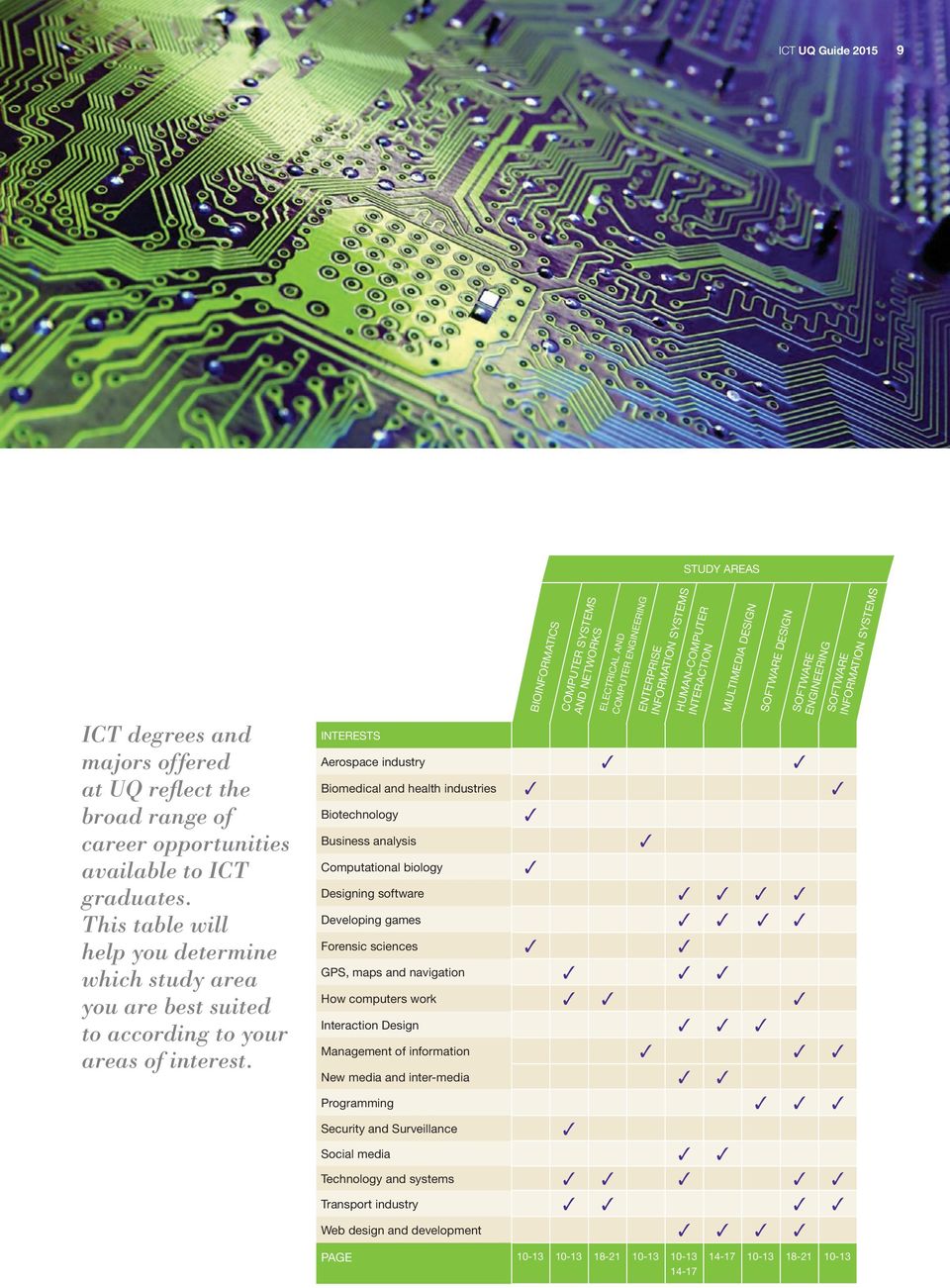
10 8 ICT UQ Guide 2015 HOW DO I CHOOSE A PROGRAM? Information and Communications Technology is a broad term that encompasses a wide variety of areas. UQ offers the following ICT-focused degrees: Bachelor of Information Technology Bachelor of Multimedia Design. ICT-related majors are offered in the following degrees: Bachelor of Engineering (Honours) Bachelor of Science. The information in the table on the next page matches specific areas of interest with recommended study areas within ICT and its associated careers. Use the table to help you identify your areas of interest and determine which study area suits you best. The table only includes some of the many possible areas of interest. More information about the available study areas can be found in this study guide and on our website at EASY TO FOLLOW STUDY PLANS The first year of UQ s ICT programs is structured to give you a taste of the fundamentals of all ICT studies. As you get to know what you like or confirm what you already like, you can specialise in the second and third year. Our suggested study plans can help you plan your degree. DUAL DEGREES The University of Queensland also offers dual programs where you can study two degrees at the same time. This gives you greater scope for employment and allows you to focus on your specific areas of interest. Dual programs are shorter in length than completing both degrees separately. For a list of dual programs see page 24. FLEXIBLE PATHWAYS UQ degrees in ICT are designed so that it is easy for you to transfer to one of our other degrees, or to transfer to UQ from another university. For example, the first year of the Information Technology degree is designed to make it possible for you to transfer to the Bachelor of Multimedia Design in your second year should you decide to do so. CROSS-DISCIPLINARY ICT DEGREES The Bachelor of Information Technology offers majors that are cross-disciplinary with substantial components available outside the IT program. This allows you to gain experience not only in ICT but also in other areas, such as business, sciences or the arts, expanding your career opportunities. Alternatively, you can include a major sequence of ICT studies within an even wider range of areas as part of the Bachelor of Science (page 22) or Bachelor of Communication (Interaction Design). FURTHER STUDY UQ ICT graduates can undertake a fourth year of honours or further study programs leading to graduate certificate, graduate diploma, masters or doctorate in most ICT study areas and specialties.

11 ICT UQ Guide STUDY AREAS ICT degrees and majors offered at UQ reflect the broad range of career opportunities available to ICT graduates. This table will help you determine which study area you are best suited to according to your areas of interest. INTERESTS Aerospace industry Biomedical and health industries Biotechnology Business analysis Computational biology Designing software Developing games Forensic sciences GPS, maps and navigation How computers work Interaction Design Management of information New media and inter-media Programming Security and Surveillance BIOINFORMATICS COMPUTER SYSTEMS AND NETWORKS Social media ELECTRICAL AND COMPUTER ENGINEERING Technology and systems Transport industry Web design and development HUMAN-COMPUTER INTERACTION ENTERPRISE INFORMATION SYSTEMS MULTIMEDIA DESIGN SOFTWARE SOFTWARE DESIGN SOFTWARE ENGINEERING INFORMATION SYSTEMS PAGE
12 10 ICT UQ Guide 2015 BACHELOR DEGREE INFORMATION TECHNOLOGY BACHELOR OF Information Technology Duration Location Delivery mode Entry requirements 2014 entry score 3 years full-time. Part-time equivalent available to Australian residents and citizens St Lucia Internal QTAC code Dual programs Honours What will I study? Qld Year 12 or equivalent; English; Mathematics B QTAC code OP 12; Rank 74; ATAR 72.25; IB 26 See page 24 for codes Available as an extra year of study The underlying principles of Information Technology (IT) are based in mathematics, logic, physics and psychology. The UQ Bachelor of Information Technology (BInfTech) is project-focused, educating students in computer systems and their applications. You will develop the ability to process data or information in order to solve problems, and study programming languages, algorithms and information structures. Work experience opportunities As a student in the Bachelor of Information Technology you will have the opportunity to apply theoretical knowledge in the work-based CEED (Cooperative Education for Enterprise Development) Placement Program. Find out more about our industry experience programs on page 7. Where will I work? IT skills are applied to a diverse range of applications in a wide range of industries from areas like e-commerce to developing computer games. Hence our graduates find employment in a wide range of jobs, with roles in systems and software development as analysts, architects, designers, developers, programmers and project managers. They can be involved in managing sophisticated computing facilities, such as distributed computer systems implemented over complex computer networks, or business information systems supported by large databases. Who recognises my qualification? Professional membership and accreditation is available from the Australian Computer Society (ACS), the recognised association for ICT professionals, with a large and active membership. You will be eligible to become an associate of the ACS upon graduation and a full professional member after four years relevant experience. Can I do more than one degree? The Bachelor of Information Technology may be taken as a dual program with a number of programs. See the dual programs section on page 24 for more details. What about scholarships? A wide range of scholarships are available to students in the Bachelor of Information Technology. Scholarship opportunities from UQ, the Faculty of Engineering, Architecture and Information Technology, and the School of Information Technology and Electrical Engineering are listed on pages What are the majors? The Bachelor of Information Technology offers flexible study plans. You can choose your own study plan to focus on your desired outcomes, or follow one of the standard plans (majors) designed to provide typical career outcomes: Bioinformatics For a career in the computing behind the new biology, including: computer science information systems analysis genetics molecular biology. Computer Systems and Networks For a career in developing and managing computer networks, distributed systems and their applications, including: programming computer architecture computer networks operating systems systems security distributed systems internet applications. Enterprise Information Systems For a career in designing enterprise-wide and multi-enterprise information systems, including: database systems information system analysis design programming e-commerce Web technologies business and organisational issues. Human-Computer Interaction For a career in designing human-oriented computer and network systems, which may involve: social and mobile computing visual thinking interaction design programming. Software Design For a career in the creation and management of software applications, which may involve: programming software engineering project management needs analysis specification and process internet design. Software Information Systems For a career in developing and managing data-intensive information systems, which will build skills in: web information systems large scale data management business and scientific applications. More information Phone (07) [email protected]
13 ICT UQ Guide 2015 PROFILE AIMEE LEONG Bachelor of Information Technology/Commerce Current student The IT degree at UQ focuses on empowering students to create applications from scratch and learn how to pitch them to clients/employers. Don t expect to just be sitting in a classroom learning code. Most of my time is taken up by exciting team projects, where we come up with a novel idea for an application, get passionate about it, and then actually create it. In this way, I will graduate with not only a degree, but also a portfolio. We also have a vast array of resources at our fingertips. Whether I need a server, prototyping tool or the full Adobe Suite to design and build my application, UQ gives me everything I could need, whenever I need it. 11

14 12 ICT UQ Guide 2015 BACHELOR DEGREE INFORMATION TECHNOLOGY STUDY PLANS What is my study plan? The study plans on this page are indicative only and do not include all courses or all areas of interest. For an outline of each area of interest or a detailed indicative study plan, please visit our website at BIOINFORMATICS Build your own study plan At UQ we offer a range of majors so you can choose your main area of interest. Alternatively, you can build your own study plan. You will study a number of compulsory core courses and can build your chosen areas of study around them. Electives allow you to either focus on a particular area of interest, or to broaden your background. Academic advisors are available to assist you with this. Flexible study plan If you enrol in the Bachelor of Information Technology and decide that you would prefer to study Software Engineering, you have some flexibility to change. First-year IT courses are also available in the Bachelor of Engineering (Software Engineering) program. By choosing additional first-year courses needed for the BE degree as electives in the BInfTech, you can satisfy the entry prerequisites for Engineering and, subject to satisfactory grades, proceed to the BE (Software Engineering). More information [email protected] Year 1 Introduction to Software Engineering Design Thinking Introduction to Web Design Introduction to Information Systems Discrete Mathematics Design Computing Studio 1 Electives Year 2 Programming in the Large Relational Database Systems Introduction to Bioinformatics Numerical Methods in Computational Science Genetics Electives Year 3 Advanced Bioinformatics Algorithms and Data Structures Genomics and Bioinformatics Mathematical Biology Electives HUMAN-COMPUTER INTERACTION Year 1 Introduction to Software Engineering Design Thinking Introduction to Web Design Introduction to Information Systems Discrete Mathematics Design Computing Studio 1 Electives Year 2 Programming in the Large Relational Database Systems Digital Prototyping Human-Computer Interaction Design Computing Studio 2 Electives Year 3 Social and Mobile Computing Physical Computing and Interaction Design Studio Web Information Systems Design Computing Studio 3 - Proposal Design Computing Studio 3 - Build Electives SOFTWARE INFORMATION SYSTEMS MAJOR Year 1 Introduction to Software Engineering Design Thinking Introduction to Web Design Introduction to Information Systems Discrete Mathematics Design Computing Studio 1 Electives Year 2 Programming in the Large Relational Database Systems Digital Prototyping Human-Computer Interaction Design Computing Studio 2 Electives Year 3 Advanced Database Systems Web Information Systems Service-Oriented Architectures Systems Analysis and Design Design Computing Studio 3 - Proposal Design Computing Studio 3 - Build Electives

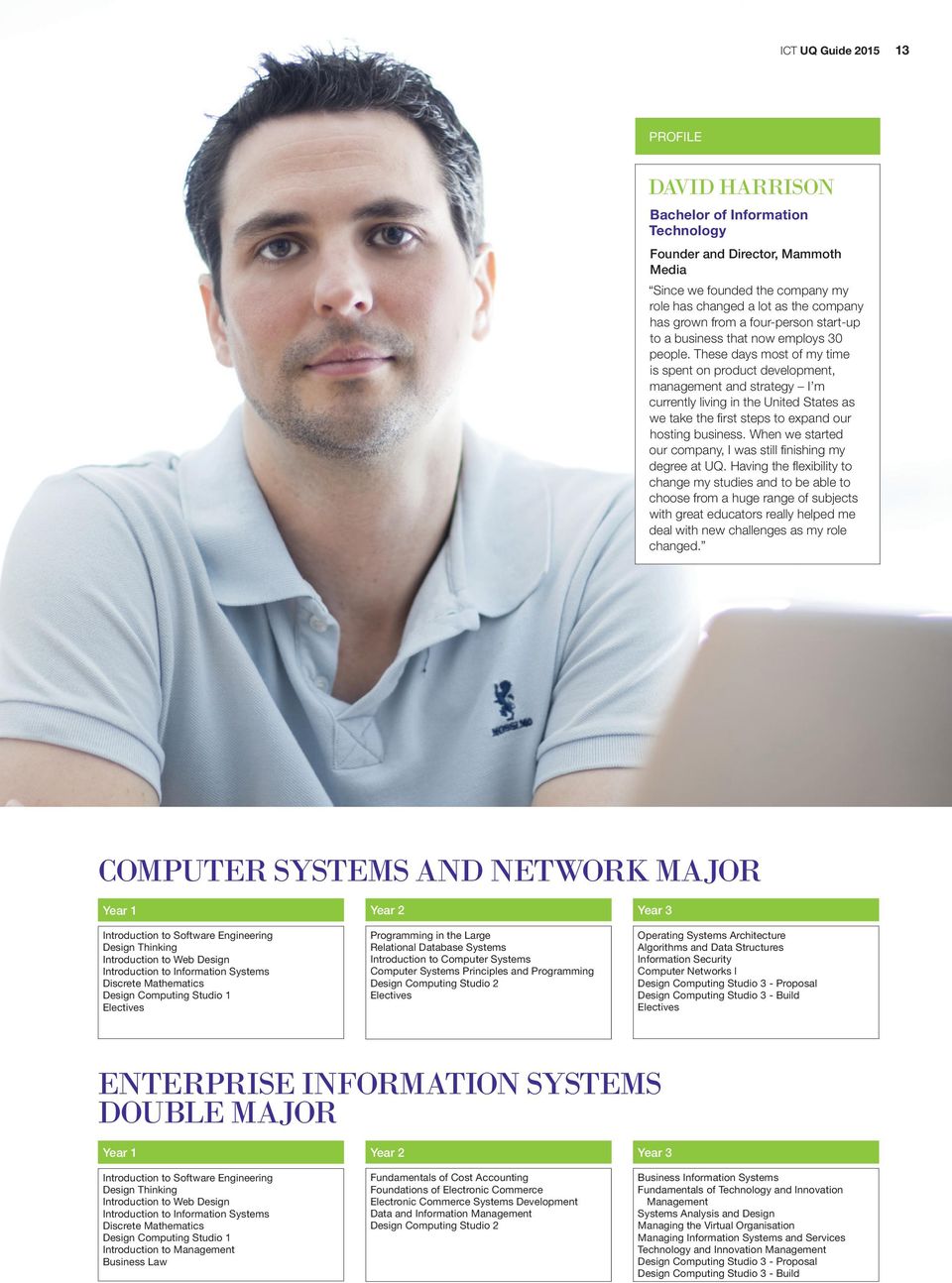
15 ICT UQ Guide PROFILE DAVID HARRISON Bachelor of Information Technology Founder and Director, Mammoth Media Since we founded the company my role has changed a lot as the company has grown from a four-person start-up to a business that now employs 30 people. These days most of my time is spent on product development, management and strategy I m currently living in the United States as we take the first steps to expand our hosting business. When we started our company, I was still finishing my degree at UQ. Having the flexibility to change my studies and to be able to choose from a huge range of subjects with great educators really helped me deal with new challenges as my role changed. COMPUTER SYSTEMS AND NETWORK MAJOR Year 1 Introduction to Software Engineering Design Thinking Introduction to Web Design Introduction to Information Systems Discrete Mathematics Design Computing Studio 1 Electives Year 2 Programming in the Large Relational Database Systems Introduction to Computer Systems Computer Systems Principles and Programming Design Computing Studio 2 Electives Year 3 Operating Systems Architecture Algorithms and Data Structures Information Security Computer Networks l Design Computing Studio 3 - Proposal Design Computing Studio 3 - Build Electives ENTERPRISE INFORMATION SYSTEMS DOUBLE MAJOR Year 1 Introduction to Software Engineering Design Thinking Introduction to Web Design Introduction to Information Systems Discrete Mathematics Design Computing Studio 1 Introduction to Management Business Law Year 2 Fundamentals of Cost Accounting Foundations of Electronic Commerce Electronic Commerce Systems Development Data and Information Management Design Computing Studio 2 Year 3 Business Information Systems Fundamentals of Technology and Innovation Management Systems Analysis and Design Managing the Virtual Organisation Managing Information Systems and Services Technology and Innovation Management Design Computing Studio 3 - Proposal Design Computing Studio 3 - Build
16 14 ICT UQ Guide 2015 BACHELOR DEGREE MULTIMEDIA DESIGN BACHELOR OF Multimedia Design Duration Location Delivery mode Entry requirements 2014 entry score 3 years full-time. Part-time equivalent available to Australian residents and citizens St Lucia Internal QTAC code Honours Qld Year 12 or equivalent; English. Recommended: Mathematics A or B OP 12; Rank 74; ATAR 72.25; IB 26 Available as an extra year of study What will I study? The Bachelor of Multimedia Design is a studio-based program providing you with the knowledge and skills to design, prototype and implement engaging interactive ICT experiences with multimedia technology. The major focus of the program is people-centred design of ICT products and systems. Areas included in Multimedia Design are interactive product design, graphic design, digital prototyping, web design and development, social and mobile computing, and human-computer interaction. Our graduates are multi-skilled people with a broad understanding of a range of physical and digital technologies, the user-centred design process, and how to study contexts of use in order to make products and systems that work for people. The demand for this high level of graduate expertise is increasing worldwide. Where will I work? Multimedia designers are in demand within the education, arts and commercial industries that want to engage customers and understand the experiences that their products and systems create in use. Whether it is the Internet, games, film or television, multimedia designers are at the forefront of designing user interactions with technology. Are there scholarships? A wide range of scholarships is available to students of the Bachelor of Multimedia Design. Scholarship opportunities from UQ, the Faculty of Engineering, Architecture and Information Technology, and the School of Information Technology and Electrical Engineering are listed on page 27. What are the areas of study? Courses cover the breadth of user experience within four main streams of expertise: Design of Digital Media Technology Skills and Digital Tools Interaction Design Elective stream for specialisation (your own choice of area of interest). For suggested areas of focus for study, see the recommended study plans on page 16. These areas of study are explored through traditional courses as well as hands-on project experience in studio courses. Design of Digital Media Design is about ideas. It encompasses how to establish the validity of ideas and how to critically evaluate and refine them. Courses in this stream cover the essential design skills of seeing, imagining and communicating, which are then developed through the execution of hands-on design projects in a studio-based learning environment. Areas covered include visual thinking, user-centred thinking, creative design methods, theories of digital media, aesthetics, functionality and form. You will gain experience in problemsolving strategies, rapid visualisation techniques and construction of physical prototypes as artefacts exploring design. Technology Skills and Digital Tools Through this program, you will gain a sound set of fundamental and advanced skills in a variety of multimedia and information technologies including digital prototyping, animation, web design, interaction design, information systems and software engineering. You will learn to use a broad range of software and design tools that will enable you to understand and apply the fundamentals of contemporary industry packages, and quickly adapt to new developments. You will be able to apply your skills to challenging and relevant projects. Interaction Design Interaction Design is about the people you are designing for, and the experience you want them to have with the products you design. Courses in this stream cover fundamental aspects of understanding how people interact with technology, as well as how they interact with each other through technology. You will learn about the latest methods used in research and industry for studying people in context, and how to improve your designs of screen-based, physical, social and mobile technologies. You will learn and apply qualitative and creative user-research methods in real-world settings, and evaluate designs in-situ.

17 ICT UQ Guide PROFILE FREYA HARVEY Bachelor of Multimedia Design Online Advertising Consultant Telstra ICT is an exciting industry. There are so many different pathways and career opportunities in fields I never imagined. I have worked in HR companies, as a design consultant, in social media and online marketing, in video production and as a tutor and researcher. These roles all related in some way back to my Multimedia degree. Having my degree was a vital component in the recruitment process for these roles. Nearly every company hires ICT professionals in roles ranging from designers and social media advisors to software designers and IT managers. Many people I have spoken to have expressed a need for more ICT professionals within companies and have said they are unable to find enough qualified graduates. With the heavy reliance on technology, I definitely see this trend continuing. Elective Stream Your selection of other courses offered either by the School of Information Technology and Electrical Engineering, or other degree programs on campus, including Business or Media Studies, allows you to integrate your own unique interests into your studies. We provide recommendations on elective choices for different areas of specialisations. Suggested study plans for Film and Television, Web Design and Development, Communications, Advertising and Marketing, Creative Arts and e-learning are provided on the following pages. The e-learning specialisation with an extra year of study for the Graduate Diploma in Education is an optional one-year teacher preparation program designed for students who already hold a tertiary degree. The program combines practical learning with the latest research into effective teaching methods. The e-learning focus opens up careers in Middle Years or Secondary schooling as well as deepening knowledge for e-learning in corporate settings. Studio Studio is a project-based, collaborative work environment that includes workshops, guest lectures, field trips, experiential exercises and self-directed learning. You work in groups, explore ideas, and learn to critique and be critiqued. Studio is where you build your ideas by applying what you study in other courses. It is here that you gain three years of valuable hands-on experience. UQ ICT students value the high level of interaction with experienced staff in their Studio courses. Multimedia Design students especially enjoy demonstrating their work to the public in the Interaction Design Exhibit in their final year. More information Phone (07) [email protected]

18 16 ICT UQ Guide 2015 BACHELOR DEGREE MULTIMEDIA DESIGN STUDY PLANS What is my study plan? The study plans on this page are only indicative and do not include all courses or all areas of interest. For an outline of each area of interest or a detailed indicative study plan, please visit our website at Build your own study plan In the Bachelor of Multimedia Design you can build your own study plan around the compulsory core of ICT and user experience courses. Electives allow you to either focus on a particular area of interest, or to broaden your background. The focus areas below are example study plans that provide you with a starting point for constructing more focused elective streams in associated areas of study. Academic advisors are available to assist you with constructing your own plan. More information [email protected] GENERIC STUDY PLAN (USER EXPERIENCE) Year 1 Introduction to Web Design Introduction to Software Engineering Design Thinking Design Computing Studio 1 Introduction to Information Systems Discrete Mathematics Electives Year 2 Human-Computer Interaction Graphic Design Programming in the Large Design Computing Studio 2 Digital Prototyping Electives Year 3 Physical Computing and Interaction Design Studio (double units) Design Computing Studio 3 - Proposal Design Computing Studio 3 - Build Web Information Systems Social and Mobile Computing Electives WEB DESIGN AND DEVELOPMENT FOCUS Year 1 The Web from Inside Out Introduction to Communication & Cultural Studies Year 2 Foundations of Electronic Commerce Relational Database Systems Introduction to Visual Communication Year 3 New Media - Ideas and Uses Electronic Commerce Systems Development ADVERTISING AND MARKETING FOCUS Year 1 Foundations of Marketing The Web from Inside Out Year 2 Online Advertising Advertising and Consumer Culture Brand Management & Strategy Year 3 Marketing Strategy Advertising Strategy COMMUNICATIONS FOCUS Year 1 Introduction to Visual Communication The Web from Inside Out Year 2 Convergent Communication Creative Writing Art of Communication Year 3 Talk, Interaction and Technology Media, Culture and Society

19 ICT UQ Guide Studio spaces for ICT students Architect: arklab Architecture CREATIVE ARTS FOCUS Year 1 Introduction to Music Technology Introduction to Communication and Cultural Studies Year 2 Music Studio Techniques A Studies in Photography Year 3 Music Studio Techniques B New Media Ideas and Uses FILM AND TELEVISION FOCUS Year 1 Introduction to Film and Television Studies Introduction to Visual Communication Year 2 Television and Popular Culture Australian Cinema Year 3 Creative Writing Screenwriting Critical Concepts in Film and Television E-LEARNING FOCUS Year 1 Year 2 Year 3 Year 4 (optional) Foundations of Corporate Communications Introduction to Education Introduction to Visual Communication New Media in Art, Video, Computer, Internet Fundamentals of Writing Writing and Editing for the Professions Media and Technologies in Education Elective Graduate Diploma in Education

20 18 ICT UQ Guide 2015 BACHELOR DEGREE ICT AND ENGINEERING BACHELOR OF Engineering (Honours) Duration Location Delivery mode Entry requirements 2014 entry score 4 years full-time. Part-time equivalent available to Australian residents and citizens St Lucia Internal QTAC code Honours Qld Year 12 or equivalent; English; Mathematics B; Chemistry or Physics (both recommended) OP6; Rank 89; ATAR 89.10; IB 33 Available as part of the standard program: students are awarded a class of honours based on their overall grade point average in engineering courses Why study engineering as an ICT option? If you pursue in-depth studies in the traditional areas of software and hardware you will find the four-year Bachelor of Engineering (Honours) degree provides a respected qualification for entry into either the ICT or engineering professions. What will I study? Bachelor of Engineering (Honours) program offers the largest choice of engineering specialisations in Queensland. ICT-related majors are listed as follows: Software Engineering Software engineering is the systematic approach to the development, operation, maintenance and retirement of software; the controlling element of the computerbased systems used in almost every field of human endeavour. You will study the complexities associated with large-scale, high-quality software: technical construction; size and complexity; cooperation between developers, clients and users; and evolution of software over time to maintain its value. Electrical and Computer Engineering Electrical engineers with in-depth knowledge of computer systems are needed in virtually any industry where advanced electrical and electronic equipment is designed, upgraded or maintained. The Electrical and Computer Engineering major prepares you to work in these innovative environments, designing cutting-edge products. You will develop skills in electrical engineering, computer engineering and information technology, in conjunction with professional skills. Mechatronic Engineering Mechatronic engineers integrate precision mechanical engineering with electronics, computer systems, and advanced controls, to design and construct products and processes. This major provides a broadbased education in the basic principles of electrical, mechanical and computer engineering. You can choose from a range of electives covering areas such as engineering analysis and design, engineering mechanics, dynamics and automatic control, signals and communication, electrical hardware and computer software. Where will I work? Our graduates find employment in areas such as telecommunications; games development; security and surveillance; aerospace and defence; robotics and intelligent systems; electrical power generation, transmission and distribution; and biomedical engineering. What about industry experience? UQ Engineering students complete at least 60 days of industry practice as part of their degree. Qualifying students can also do up to a semester full-time in a professional placement. The work-based learning program CEED (Cooperative Education for Enterprise Development) Placement Program offers UQ Engineering students the opportunity to apply theoretical knowledge to real life projects. Find out more about our industry experience programs on page 7. Who recognises my qualification? The Bachelor of Engineering (Honours) program is accredited by Engineers Australia and our students and graduates are entitled to membership of this organisation. International recognition is offered by countries such as the USA, United Kingdom, Hong Kong (SAR), New Zealand, Canada, South Africa and others that are co-signatories to international agreements on joint recognition. Graduates and students are also eligible for membership of the Association of Professional Engineers, Scientists and Managers Australia (APESMA). This organisation provides practical information, representation and advice on employment and career advancement issues. The Australian Computer Society (ACS) also offers membership to Bachelor of Engineering computing graduates. ACS is the recognised association for ICT professionals. Is there alternative entry? You can enrol in the Bachelor of Information Technology and undertake courses that are also available in the Bachelor of Engineering (Honours) (Software Engineering) program. By choosing your first-year electives carefully, you may satisfy the entry prerequisites for the Bachelor of Engineering (Honours) and, subject to satisfactory grades, proceed to the BE (Software Engineering). Are there scholarships? A wide range of scholarships is available to students of the Bachelor of Engineering (Honours). Scholarship opportunities from UQ, the Faculty of Engineering, Architecture and Information Technology, and the School of Information Technology and Electrical Engineering are listed on page 27. A full list of courses is available on the prospective students website at For further information on UQ Engineering: [email protected]

21 ICT UQ Guide
22 20 ICT UQ Guide 2015 ICT AND ENGINEERING STUDY PLANS What is my study plan? The study plans on this page are only indicative and do not include all courses or all areas of interest. For an outline of each area of interest or a detailed indicative study plan, please visit our website at Build your own study plan At UQ we offer a range of majors so you can choose your main area of interest. Alternatively, you can build your own study plan. You will study a number of compulsory core courses and can build your chosen areas of study around them. Electives allow you to either focus on a particular area of interest, or to broaden your background. Academic advisors are available to assist you with this. More information [email protected] Bachelor of Engineering (Honours)/ Master of Engineering The integrated Bachelor of Engineering (Honours) and Master of Engineering (BE(Hons)/ME) is an exciting new addition to The University of Queensland s Engineering programs. If you undertake the Integrated BE(Hons)/ME program, you will enrol and follow the same course outline as other Bachelor of Engineering (Honours) students for the first three years. In the second semester of the fourth year, you will take up an industry or research semester placement with industry partners or research institutions, either locally or internationally. The fifth year will be the capstone experience of the BE(Hons)/ME degree and will involve challenging design and research projects. More information: MECHATRONIC ENGINEERING Year 1 Year 2 Year 3 Year 4 Engineering Design Introduction to Electrical Systems Engineering Mechanics: Statics and Dynamics Calculus and Linear Algebra Engineering Modelling and Problem Solving Multivariate Calculus and Ordinary Differential Equations Introduction to Software Engineering I Electromagnetism and Modern Physics Introduction to Computer Systems Calculus and Linear Algebra II Structures and Materials Circuits, Signals and Systems Analysis of Ordinary Differential Equations Electives Dynamics and Orbital Mechanics Mechatronic System Design Project I Probability Models for Engineering and Science Electromechanics and Electronics Signals, Systems and Control Introduction to Control Systems Machine Element Design Advanced Dynamics and Vibrations Advanced Control and Robotics Sensors and Actuators Electives Mechatronic System Design Project II Thesis/Design Project ELECTRICAL AND COMPUTER ENGINEERING Year 1 Year 2 Year 3 Year 4 Engineering Design Introduction to Electrical Systems Calculus and Linear Algebra Engineering Modelling and Problem Solving Multivariate Calculus and Ordinary Differential Equations Introduction to Software Engineering I Electromagnetism and Modern Physics Programming in the Large Introduction to Computer Systems Electromechanics and Electronics Calculus and Linear Algebra II Computer Systems Principles and Programming Circuits, Signals and Systems Team Project I Analysis of Ordinary Differential Equations Probability Models for Engineering and Science Embedded Systems Design and Interfacing Signals, Systems and Control Electronic Circuits Digital System Design Fundamentals of Electromagnetic Fields and Waves Thesis Project Advanced Embedded Systems Team Project II Professional Practice and the Business Environment SOFTWARE ENGINEERING Year 1 Year 2 Year 3 Year 4 Engineering Design Introduction to Software Engineering Calculus and Linear Algebra Engineering Modelling and Problem Solving Multivariate Calculus and Ordinary Differential Equations Introduction to Electrical Systems Discrete Mathematics Introduction to Information Systems Introduction to Computer Systems Programming in the Large Algorithms and Data Structures Computer Systems Principles and Programming Design Computing Studio 2 Testing and Evaluation Probability Models and Data Analysis for Engineering The Software Process Human-Computer Interaction Team Project I Software Engineering Electives Thesis Project Team Project II Advanced Software Engineering Electives
23 ICT UQ Guide
24 22 ICT UQ Guide 2015 BACHELOR DEGREE ICT AND SCIENCE BACHELOR OF Science Duration Location Delivery mode Entry requirements 2014 entry score 3 years full-time Part-time equivalent available to Australian residents and citizens only St Lucia Internal QTAC code Honours Qld Year 12 or equivalent; English; Mathematics B; Chemistry or Physics OP11; Rank 77; ATAR 75.90; IB 27 Available as an extra year of study Why study Science as an ICT option? Advances in many areas of modern science are increasingly driven by ICT. A perfect example is bioinformatics, where ICT is used to process, store, model and understand the vast amount of data produced in biology (e.g. DNA sequence analysis). Including ICT studies within the Bachelor of Science allows you to expand your career opportunities for a scientific career and gives you a very flexible degree program where you can tailor a program to your individual needs and select courses from science, information technology and other disciplines across the University. What will I study? In the Bachelor of Science you can study: a computer science major (single or extended), which provides core ICT courses in programming and information systems a dual major in bioinformatics, which provides an integrated program of study in ICT and biology working towards the growing area at the interface of these disciplines a dual major in computational science. In this major, the emphasis is on science and you select any single major from the BSc program and combine it with a number of computational science courses that emphasise the use of ICT as a tool to facilitate solving scientific problems. What if this isn t enough? If you enroll in the UQ Science degree, you may apply for the Advanced Study Program in Science (ASPinS). The ASPinS provides opportunities for high-achieving first-year students to enhance their university experiences through an enriched program of study. The program includes individual mentoring by a scientist, access to research laboratories in first year and exposure to creative thinkers across all disciplines. Where will I work? Our graduates find employment in areas such as: genome research molecular science microbial science bioinformatics computer science consulting games development quantum computing research computational physics. What are the areas of study? The Bachelor of Science program offers ICT-related majors in the following areas. Bioinformatics for a career in: bioinformatics computational biology microbiology biochemistry chemistry genetics biotechnology. Computational Science for a career in: genome research molecular science microbial science bioinformatics biology mathematics numerical computing visualisation quantum computing computational physics. Computer Science for a career in a sciencebased application of: information systems programming operating systems numerical computing software engineering artificial intelligence data management systems. STUDY PLANS What is my study plan? The study plans on this page are only indicative and do not include all courses or all areas of interest. For an outline of each area of interest or a detailed indicative study plan, please visit our website at More information A full list of courses is available on the prospective students website at For further information on Science at UQ: [email protected] Phone (07)
25 ICT UQ Guide BIOINFORMATICS Year 1 Genes, Cells and Evolution Chemistry for Science and Engineering Theory and Practice in Science Year 2 Genetics Biochemistry and Molecular Biology Human-Computer Interaction Programming in the Large Numerical Methods in Computational Science Year 3 Advanced Bioinformatics High-Performance Computing Web Information Systems Artificial Intelligence COMPUTATIONAL SCIENCE Year 1 Theory and Practice in Science 1 st year courses for your chosen single major to combine with computational science Year 2 Introduction to Computational Biology Numerical Methods in Computational Science Year 3 Visualisation and Computer Graphics High-performance Computing COMPUTER SCIENCE Year 1 Introduction to Software Engineering I Introduction to Information Systems Discrete Mathematics Year 2 Programming in the Large Introduction to Computer Systems Year 3 Algorithms and Data Structures Design Computing Studio 3 Build
26 24 ICT UQ Guide 2014 DUAL DEGREE PROGRAMS Dual programs offer the opportunity to combine different areas of interest and enable you to complete two degrees in a shorter amount of time. A dual program gives you the flexibility to study several areas of interest at once. The additional knowledge and skills gained give you a competitive edge in the workplace and significantly broaden your career possibilities. Dual programs can also be completed more quickly than two separate degrees, as students complete the core components of each program. Applicants for UQ dual programs must satisfy prerequisites and entry score requirements for both programs. You apply through normal QTAC application procedures. The appropriate QTAC application codes are shown below. In some programs you can choose to undertake additional courses during the summer semesters to finish the program even quicker by up to one semester. Business Management/Information Technology (BBusMan/BInfTech) Program duration: 4 years QTAC Code By combining these two areas of study, you will develop expertise in a niche field that offers a wide range of employment options and excellent opportunities for overseas employment. Commerce/Information Technology (BCom/BInfTech) Program duration: 4 years QTAC Code By combining these two areas of study in a dual degree, you will get a focused background in commerce, along with specific practical and theoretical understandings relevant to your chosen field in ICT. Engineering (Honours)/Information Technology (BE/BInfTech) Program duration: 5.5 years QTAC Code This dual program is ideal if you wish to combine the theory and practice of modern computing with another field in engineering. This program is available with Engineering single majors in Chemical, Civil, Electrical, Materials, Mechanical or Mining Engineering. Information Technology/Arts (BInfTech/BA) Program duration: 4 years QTAC Code This program allows combinations of the humanities and ICT. It is an excellent plan if you want to combine languages, education, communication or other areas of interest with an ICT base. Information Technology/Science (BInfTech/BSc) Program duration: 4 years QTAC Code ICT and science are complementary areas of study, especially in areas such as bioinformatics, computational science, health sciences, mathematics or psychology. This dual degree provides a stronger science base for ICT students than is possible by undertaking a single degree. *Dual program entry requirements are listed on Page 32
27 ICT UQ Guide CONCURRENT DIPLOMAS Once you are enrolled at UQ, you may decide to undertake a Diploma in either Music Performance, Languages, or Global Studies at the same time as you complete your bachelor degree. At UQ, you can now study one of three undergraduate diplomas concurrently with your bachelor degree. You may complete it over an accelerated period, or spread the load across the duration of your degree. MUSIC PERFORMANCE If you love music, this is the diploma for you no matter what your main academic interest. Discover the world of ensembles as you participate in ensemble rehearsals and performances. Develop excellence in rhythmic accuracy and pitch discrimination, acquire a full dynamic range, and develop musical style and vitality through a variety of rehearsal techniques employed by each ensemble director. Indulge your passion for music! LANGUAGES If you are keen to learn a new language, whether for personal interest or to enhance your career prospects in the global economy, you can study the Diploma in Languages. This diploma will suit you if you studied a language at high school and want to maintain your proficiency. It will also suit you if you have never studied a foreign language you don t need any prior experience. The diploma is available in Chinese, Classical languages, French, German, Indonesian, Japanese, Korean, Russian and Spanish. GLOBAL ISSUES The Diploma in Global Issues will appeal to you if you wish to pursue a career in an area where having a global perspective on the environment, economics, politics, and social change will be of advantage. In this program, you will learn how individuals, societies and countries are all interconnected. One exciting feature is the opportunity to make the most of UQ s extensive international connections through study at one of our partner universities. How to enrol in a concurrent diploma If you are interested in the Diploma in Music Performance or the Diploma in Languages, you can apply for these programs directly to UQ once QTAC offers you a UQ place. If you wish to do the Diploma in Global Issues, you will need to complete one year (#16 units) of undergraduate studies before applying. To find out more about undergraduate diplomas, please contact the Faculty of Humanities and Social Sciences. Faculty of Humanities and Social Sciences [email protected] Phone (07)
28 26 ICT UQ Guide 2015 RWH HAWKEN SCHOLARS The Hawken Scholars Program welcomes, supports and gives special opportunities to the Faculty of Engineering, Architecture and Information Technology s best and brightest students. The program emulates the vision of Professor RWH Hawken (a founding Professor of Civil Engineering at UQ) who believed that the complete student should have an education that takes in a combination of wide-ranging and cultural insights, coupled with academic excellence. It encourages academically gifted scholars in selected faculty course work degrees in engineering, architecture and information technology to aspire to take their degree to the highest possible level. The Hawken Scholars Program membership is open to full-time students who are high academic achievers and comprise the top five per cent of academic performance (as measured by Grade Point Average) in the faculty s course work student cohort. The program provides Hawken Scholars with enhanced academic, industry and cultural experiences. Through exposing this motivated and elite group of the faculty s top 200 students to new networks and opportunities, we aim to further develop their skills, knowledge and experiences, in preparation for long-term leadership positions. Program requirements The program is only available to eligible students while they are enrolled full-time in one of the following degree programs: Bachelor of Architectural Design Bachelor of Engineering (Honours) Bachelor of Engineering (Honours) dual degrees including the integrated Bachelor and Master of Engineering Bachelor of Information Technology Bachelor of Information Technology dual degrees Bachelor of Multimedia Design. How to apply High-achieving students who enrol in an Engineering, Architecture, Multimedia Design, or Information Technology degree and receive a UQ Vice-Chancellor s or UQ Excellence Scholarship automatically become a Hawken Scholar for the first (calendar) year of their enrolment. You must apply for a UQ Excellence Scholarship through the Undergraduate Scholarships and Prizes Office at If you then enrol in one of the above undergraduate degrees you will be invited to enter the RWH Hawken Scholars program. More information: ROGER WILLIAM HERCULES HAWKEN ( ) was the first Professor and lecturer in Civil Engineering at The University of Queensland. Professor Hawken played a leading role in the formation of Engineers Australia in 1919 and worked on many major projects including Brisbane s Story Bridge. He was an inspiring member of The University of Queensland academic staff for more than 35 years.
29 ICT UQ Guide SCHOLARSHIPS UQ offers a range of scholarship options to make university study more affordable. Check out what you may be eligible for before you start. Undergraduate research scholarships UQ s Summer and Winter Research Programs provide an opportunity to gain research experience working alongside some of UQ s most talented researchers. Projects are available in most disciplines for six-10 weeks over the summer break and four-six weeks over the winter break. You can apply for scholarships valued at up to $3000 for the UQ Summer Research program and up to $1000 for the UQ Winter Research Program. SCHOLARSHIPS UQ scholarships are awarded to recognise academic excellence combined with outstanding leadership; to assist students from families experiencing significant financial hardship; to support elite athletes; to help offset the costs of overseas study; and to aid students wishing to gain valuable research experience. Scholarships are not only funded by the University, but are also generously supported by industry partners, private donors and the government. ICT Excellence Scholarships In view of a growing shortage of ICT graduates, The University of Queensland and its industry partners continue to encourage and enable school-leavers to join programs leading to careers in the Information and Communications (ICT) industry. ICT Excellence Scholarships, to the value of $3000 each, are awarded to students based on their Year 12 results coupled with their passion to study ICT at UQ. To be eligible to apply for an ICT Excellence Scholarship you must be applying for a place in one of the following degrees: Bachelor of Information Technology Bachelor of Multimedia Design Bachelor of Engineering (Honours) / (ICT related majors). If you are applying for a dual degree which includes one of these degree programs, you can also apply for an ICT Excellence Scholarship. Prospective students expecting to obtain in the range of OP 1 5 are encouraged to apply. Academic scholarships Academic scholarships aim to reward very highachieving school leavers who, in their senior years, have also demonstrated outstanding community service and/or significant leadership potential. Three categories are offered: UQ Vice-Chancellor s, UQ Excellence and UQ Merit. Applications open in August and close on 31 October each year. Equity scholarships UQ is keen to support students from financially disadvantaged backgrounds to realise their tertiary study aspirations. More than 100 UQ-Link Access Scholarships, valued at $12,000 over four years, are awarded each year to commencing students who demonstrate significant financial hardship. If you wish to be considered for one of these scholarships, you should complete the Financial Hardship section of QTAC s Educational Access Scheme when submitting your QTAC application. Centrelink scholarships If you receive a study support payment such as Youth Allowance or ABSTUDY, you may be able to access the Student Start-Up Scholarship through Centrelink. Relocation Scholarships are also available to regional/ remote students needing to relocate from home to attend university: contact Centrelink at for more information. Field of study scholarships Thanks to generous financial support from industry partners and University donors, UQ is able to offer a wide range of scholarships across most study areas. In general, you must complete at least one year of study before you can apply, although some faculties do offer entry scholarships for commencing students. Scholarships for students studying at UQ Ipswich or UQ Gatton If you plan to enrol in a program at UQ Ipswich or UQ Gatton, you may be eligible for additional scholarship opportunities. Check the UQ Scholarships website for more information about campus-specific scholarships. Scholarships for Indigenous students There are many scholarships for Aboriginal and Torres Strait Islander students. Indigenous Access Scholarships (IAS) provide a one-off payment of more than $4700 to assist with the costs of starting university (please note that preference is given to commencing students who have to relocate). IAS recipients may also be eligible for other Commonwealth-funded Indigenous Scholarships. Scholarships for overseas study An overseas study experience is a great way to build global networks, increase employability, learn a new language, and experience a new culture. Through UQ Abroad, UQ s student exchange program, you can study overseas for a semester or a year on exchange while gaining credit towards your UQ degree. Scholarships valued at up to $3000 are available to help with travel and other costs. Global experiences and professional development UQ is committed to providing opportunities for you to realise your aspirations, become a leader in your chosen field, and make a positive impact on society. UQ Advantage Grants of up to $1000 can provide financial assistance to support your participation in professional development and co-curricular activities such as internships, volunteering, short-term study programs, conference presentations and more. Sporting scholarships If you play sport at an elite level, the following scholarships are available: UQ Sports Achievement Scholarship, valued at $6000 for one year Clem Jones Sporting Scholarship, valued at $6000 a year for up to three years. Sporting scholarship recipients also receive free access to the University s sporting facilities and services. Apply online by 31 October each year via the UQ Sport website. If you have represented at open, national or international level in your chosen sport, you can apply for the UQ Sport Scholarship Ambassador Program, worth $1500 per year. Please visit for more detailed information on any of the above as well as other scholarship opportunities available at UQ. Undergraduate Scholarships and Prizes Office [email protected] Phone UQ Abroad UQ Sport Phone (07)
30 28 ICT UQ Guide 2015 MONEY MATTERS Budgeting skills will help you manage your new life... FEES AND COSTS Course fees and student contributions When you study at University, at the start of each semester or teaching period (study period) you are charged a fee for each course in which you enrol. Most undergraduate places at UQ are Commonwealth supported, i.e. funded partly by the Australian Government (Commonwealth support) and partly by you (student contribution). You are eligible for Commonwealth support if you are an Australian or New Zealand citizen, or an Australian permanent resident and have a Commonwealth supported place (CSP). (International students pay full tuition fees.) If you have a CSP, the amount you pay for a course (your student contribution amount) depends on the fee band level of the course (see table below for 2014 fee bands). As fees are charged according to the courses you undertake, not the program in which you are enrolled, it is not possible to publish a fixed fee for a program. Indicative annual fees (based on average first-year enrolment patterns) are listed on our Courses and Programs website to help you plan your budget. Courses and Programs Fees calculator To help you estimate your course fees for a study period, UQ has an online Fees Calculator, available on the Courses and Programs website. The Fees Calculator shows individual course fees and lets you add them to a list to estimate the overall fee for your enrolment. Before you enrol, Academic Advisors can help you develop a study plan. Fees calculator (under What It Costs/UQ Toolkit) 2014* Student contribution bands and amounts band area of study Student Services and Amenities Fee (SSAF) In 2011 the Australian Parliament passed legislation allowing universities and other higher education providers to charge a fee for non-academic services such as sporting and recreation activities, employment and career advice, child care, financial advice, and food services. UQ levies the SSAF which is capped at a maximum of $280 for 2014 according to whether you are an internal or external student, or enrolled full-time or part-time. The fee is indexed annually. SSAF Living costs As a university student, you will also need to consider other costs of living, especially if you are living away from home for the first time. These include accommodation, books and study requirements, transport, and parking. Fortunately, a wide range of assistance is available. UQU, the student union, has a secondhand bookshop at St Lucia, and provides many low-cost entertainment activities plus an employment service. UQ s Student Services offer help with accommodation. And the Australian Government provides financial support for low-income earners, as well as fee repayment options for most students. UQU UQ Student Services accommodation Accounting, Administration, Commerce, Dentistry, Economics, Law, Medicine, Tourism, Veterinary Science Agriculture, Allied Health, Built Environment, Computing, Engineering, Mathematics, Other Health, Science, Statistics, Surveying Behavioural Science, Clinical Psychology, Education, Foreign Languages, Humanities, Nursing, Social Studies, Visual and Performing Arts annual* student contribution $10,085 $8613 $6044 * 2014 figures only, based on full-time (16-unit) workload: figures indexed annually CENTRELINK STUDENT SERVICES The Australian Government s Centrelink provides three income-support payments for Australian tertiary students: Youth Allowance, Austudy, and ABSTUDY. You can apply for these payments at any Centrelink Customer Service Centre. Other schemes include: an interest-free advance loan for students, where you are paid part of your allowance as a lump-sum advance the Pensioner Education Supplement (PES) the Health Care Card, which enables Commonwealth health concessions, such as low-cost pharmaceuticals, under the Pharmaceutical Benefits Scheme (PBS) Fares Allowance Child Care Benefit (CCB) or Rebate (if you have children in your care). Centrelink Youth Allowance, Austudy, PES, Health Care Card, CCB, Fares: Phone ABSTUDY: Phone OTHER GOVERNMENT ASSISTANCE HECS-HELP If you have a Commonwealth supported place, you may be eligible to receive HECS-HELP. HECS-HELP is an Australian Government loan scheme that allows an eligible Australian citizen or permanent humanitarian visa holder in Australia to defer repayment of all or part of their student contribution amount until their income meets a specific threshold. This means you do not have to start repaying your HECS-HELP debt until you earn above a certain income level ($51,309 for the financial year). Loan repayments are then taken out of your pay as additional tax. You need to supply your tax file number if you wish to obtain a HECS-HELP loan. SA-HELP SA-HELP is a loan scheme that helps you pay for all or part of the Student Services and Amenities Fee (SSAF). If you use SA- HELP, the amount will be added to your accumulated HELP debt. You can take out a SA-HELP loan even if you do not wish to take out any other HELP loan. You require a tax file number to obtain SA-HELP. HECS-HELP and SA-HELP information
31 ICT UQ Guide INTERNATIONAL STUDENTS You are an International student if you are a: Temporary Resident (visa status) of Australia Permanent Resident (visa status) of New Zealand, or Resident or Citizen of any other country. Eligibility for UQ study For admission into undergraduate programs at UQ, you must have: completed recognised upper secondary or equivalent Year 12 studies to the required standard satisfied individual program requirements (e.g. specific subject prerequisites, auditions or interviews) satisfied English language requirements. If you do not meet these criteria, you might consider taking the Foundation Year bridging course offered by International Education Services (IES) or English language training offered by the Institute of Continuing and TESOL Education (ICTE). More information Study Abroad and Incoming Exchange If you are an international student currently enrolled at an accredited overseas university, you may be eligible to study at UQ for one or two semesters under the Study Abroad or Incoming Exchange program. Credit gained at UQ is usually transferred towards your degree at your home university, where you will continue to pay your tuition fees. More information Fees, charges and expenses All international students applying to study in Australia must have a student visa and study full-time, on-campus. Please consider expenses such as visa and medical (pre-departure) fees, tuition fees, general living expenses, return airfares, and Overseas Student Health Cover (OSHC) when you plan your budget. As a fee-paying student, you pay tuition fees based on the courses you undertake, regardless of the program in which you enrol. Department of Immigration and Border Protection (DIBP) Fee information Fee calculator Services for international students UQ s Student Services can arrange to collect you from the airport, organise your orientation, and schedule your academic preparation sessions. International Student Advisors can help you quickly settle into life as a UQ student and can also answer your questions about health services, family matters, schooling or childcare, social events, and cultural or religious organisations. More information getting-started Applying to UQ For instructions on how to apply to UQ and to download an application form, go to application-instructions. More than 11,000 international students from 142 countries currently call UQ home. International Enquiries (online enquiry form) Phone (outside Australia) (within Australia)
32 30 ICT UQ Guide 2015 WHAT DO WE MEAN? You will hear a lot of new terms at University: here is an explanation of some of them... Bachelor degree A qualification awarded for the first level of study undertaken at university, generally requiring three to five years of study. Course (formerly known as subject) A component of study within a program, similar to a subject at school. Full-time students usually study four courses per semester. Dual program A combination of two UQ degree programs undertaken at the same time (sometimes called dual, parallel, combined, or double degrees). Elective A course that you can choose to study from a set of options. Some UQ programs allow electives from outside your main area of study, or from other programs. Entry scores Undergraduate students are given an entry score based on high school studies or other post-secondary studies: OP for Queensland Year 12s, Interstate Transfer Index (ITI) for Year 12s from other Australian states, and Rank for all others. Once you complete the equivalent of one full-time year of tertiary study (Bachelor level or higher), your OP or ranking is converted to a rank based on Grade Point Average (GPA). Faculty A major organisational unit within UQ, with responsibility for academic programs, e.g., Faculty of Science. Faculties may have a number of sub-faculty academic units called Schools, e.g., School of... The head of a faculty is called an Executive Dean. Grade Point Average (GPA) The average grade of your results, weighted by the unit value of each course. GPA is determined on a semester basis and ranges from 1 (lowest) to 7 (highest). Honours At UQ, Honours may be awarded as a oneyear Bachelor Honours degree following completion of a bachelor degree; or as a four-year Bachelor Honours degree. Some undergraduate programs allow eligible students to transfer to a Bachelor Honours degree at a defined point in the Bachelor degree. International student A student who is not an Australian citizen or permanent resident, nor a New Zealand citizen, and is enrolled or proposes to enrol at an institution in Australia. Temporary residents of Australia are classified as international students. Major An area of specialised study within a program of at least #12 units, e.g, History in Arts, which may be a formal requirement. Extended majors and dual majors are when the specialised study comprises a higher proportion of the degree. Minor A small group of courses in a discipline. A minor is worth approximately half the value of a major. Overall Position (OP) Overall Positions, or OPs, provide a Statewide rank order of students from 1-25 (1 highest), based on achievement in Authority subjects studied for the Queensland Senior Certificate. Your OP shows how well you have performed in your senior studies when compared with the performances of all other OP-eligible students in Queensland. Placements A course requiring you to undertake a period of practical, work-related experience, usually at an organisation external to the University, designed to enable you to practise the skills of the profession in a real-life setting. Postgraduate programs Programs studied after graduating from undergraduate degrees which include graduate certificates and diplomas, masters, and doctorates. Program (formerly known as course) A sequence of study involving enrolment, study and graduation, normally awarded with a qualification such as a bachelor degree, graduate diploma, or certificate. Program code A unique identifying number assigned by the University to a program. QTAC Queensland Tertiary Admissions Centre (QTAC), the central admissions body for most Queensland undergraduate programs: see Semester The University teaching year is divided into three semesters: Semester 1, Semester 2, and Summer Semester. Most programs only require you to be enrolled in Semesters 1 and 2 each year. Study Abroad (Exchange to UQ) A program where students enrolled at an overseas university study at UQ for one or two semesters as part of their home university degrees. Undergraduate programs Usually refers to first-time university programs including diplomas and bachelor degrees. Unit The value of a course (#). Most courses at UQ are worth two units but some are higher. UQ Abroad (Exchange from UQ) A program where students enrolled at UQ may be eligible to study in another country under UQ s student exchange program. UQ Terminology
33 ICT UQ Guide ADMISSION INFORMATION Admission requirements To gain admission to undergraduate programs, you must satisfy prerequisites and have a sufficient entry score (OP/IB/Rank). But there are alternative pathways for entry if you do not meet the requirements, and you can upgrade your score. Prerequisites Subject prerequisites are the Queensland Year 12 subjects required for individual programs. You may also gain admission to programs with subject equivalents from interstate or overseas schooling, selected bridging programs, or tertiary studies. Some programs have additional prerequisites, e.g. the Undergraduate Medicine and Health Sciences Admission Test (UMAT). Entry scores Entry scores include Overall Positions (OP) and entry ranks. Eligible applicants are selected for admission to a program in order of merit based on entry scores. Those with the highest entry score are selected first, and so on until the program quota is filled. The minimum OP or rank required for entry varies from year to year and is determined once applications have been processed and places allocated. While it is difficult to predict exactly what OP or rank will be needed for entry to a program, you can use the previous year s cut-off points as a guide. Current Queensland Year 12 students receive an OP on the basis of their overall achievement at school in comparison with other students. OPs are determined by the Queensland Studies Authority and range from 1 to 25, with 1 being the highest. All other applicants are allocated a rank on a scale of 1-99, with 99 being the highest. This common ranking scale allows many different types of qualifications to be compared, such as: the Australian Tertiary Admissions Rank (ATAR), which is used to calculate a rank for interstate Year 12 students the Combined Rank by QTAC, which is used to rank Australian International Baccalaureate (IB) students (see page 92) Entry rank for non-school leavers (including previous Queensland Year 12 students who qualified for an OP) and OP-ineligible Year 12 school leavers based on previous secondary, tertiary, bridging and preparatory studies, and/or work experience. UQ OP Guarantee If you achieve an OP score in the range of 1-5 (or entry rank equivalent) and have completed required prerequisite subjects, you are guaranteed a place in the majority of UQ s undergraduate programs, regardless of the published program cut-offs. See www. uq.edu.au/study/?page= English language requirements If you are from a non-english speaking background, you will need to provide evidence of English proficiency. You can do this by passing Queensland Year 12 English (or interstate equivalent), or by other means detailed in the Entry Options booklet available at: domestic/entry-options.pdf. Alternative entry If you did not complete Year 12, did not achieve a high enough entry score for your preferred program, or are a matureaged applicant, there are alternative entry pathways to UQ. Contact UQ Admissions for advice. Improving an entry score (upgrading) If you are not offered a place in your preferred program and want to improve your entry score or meet subject prerequisites, you can accept an offer in a less competitive program with fewer prerequisites and try to improve your entry score. This is called upgrading. We recommend that you complete one full year of bachelor degree study to upgrade to higher demand programs (such as dentistry or veterinary science) because the entry ranks allocated to attempts totalling less than one full-time year are capped. Depending on your academic performance your new entry rank could be higher than your previous rank. For more information on how to improve your entry score, contact UQ Admissions. Special entry programs If you are of Australian Aboriginal and/ or Torres Strait Islander descent, or have suffered financial hardship or severe disadvantage beyond your control that has affected previously satisfactory results, you may be eligible for special entry to UQ. Contact UQ Admissions for more information. UQ s Bonus Rank Scheme gives current Year 12 high school students bonus points towards their entry score for completing certain approved subjects or courses. Contact UQ Admissions for more information. Programs for high-school students UQ s Enhanced Studies Program (ESP) is the perfect opportunity to test-drive a tertiary-level course before you start university. While still in Year 12, you can complete a university course, attend lectures and tutorials, and access UQ facilities. Once you pass the course, you may get credit towards a UQ program and can also boost your university entry rank through the Bonus Rank Scheme: see The Young Scholars Program is another opportunity to discover, learn and engage with UQ s academic community and likeminded students from across Queensland. See How to apply You can apply for admission to undergraduate programs at UQ through the Queensland Tertiary Admissions Centre (QTAC). Check the QTAC Guide for details on how to apply and what entry requirements you need. Free copies are given to all current Queensland Year 12 students and some interstate schools. You can also buy a copy from some newsagents or through QTAC. Check the QTAC website for the 2015 application deadlines. Current Year 12 students lodge an application online via QTAC s Twelve-to-Tertiary (TTT) web application service at International students studying Year 12 in Australia visit for more information on application procedures and entry requirements Other prospective students lodge an online application using QTAC s Apply-by-Web service at Enrolment Once you have been offered a place in a UQ program, you can formally accept the offer by lodging a response with QTAC. You can then enrol at UQ by using the UQ link from QTAC s Current Applicant online service. The UQ enrolment website at provides information about the enrolment process to help you get started. QTAC Phone 1300 GO QTAC ( ) UQ Admissions [email protected] Phone (07) International Admissions Section Queensland Year 12 students Phone (07) Interstate Year 12 students Phone
34 32 ICT UQ Guide 2015 INTERNATIONAL OPPORTUNITIES Studying in another country is a great way to learn about the world and broaden your horizons. UQ can help with costs and give you credit towards your degree. UQ Abroad Through UQ s student exchange program, UQ Abroad, you can study overseas for up to one year while gaining credit towards your UQ degree. With 185 exchange partners in 41 countries, UQ Abroad is an ideal way to combine study and travel and can be the adventure of a lifetime. Improve your foreign language skills, broaden your professional and academic experience, and establish a worldwide network of friends. While on exchange, tuition fees at the host university are waived and you continue to be enrolled at and pay fees to UQ. You can even apply for student exchange scholarships or an OS-HELP loan to assist with airfares, accommodation, health insurance and living costs. UQ Abroad Phone (07) or (07) Learn a language If you would like to add another skill to your portfolio, why not learn a new language? The Institute of Modern Languages (IML), located within the University, offers courses in more than 30 languages, from Arabic to Vietnamese, at beginner to advanced levels, and you are most welcome to enrol while studying at UQ. IML s flexible time schedule and wellqualified tutors ensure that you not only gain valuable language skills but also receive an exciting cultural experience. IML language courses cover all four communication skill areas listening, speaking, reading and writing in small, friendly classes. You do not need any formal entry requirements for IML courses and they will not be counted towards your degree. IML also offers translation and interpreting services on a fee-for-service basis. Institute of Modern Languages [email protected] Phone (07) QUICK REFERENCE GUIDE ACADEMIC PROGRAMS QTAC CODE CSP (1) BACHELOR DEGREE IN DURATION (YEARS) DELIVERY MODE LOCATION QLD 2014 OP QLD 2014 RANK 2014 INTERSTATE INDEX PREREQUISITES PAGE NO Information Technology 3 Internal St Lucia Qld Year 12 or equivalent: English, Maths B Multimedia Design 3 Internal St Lucia Qld Year 12 or equivalent: English, Recommended Maths A or Maths B Engineering (Honours) 4 Internal St Lucia Qld Year 12 or equivalent: English, Maths B, Chemistry or Physics Science 3 Internal St Lucia Qld Year 12 or equivalent: English, Maths B, Chemistry or Physics Commonwealth Supported Place
35 UQ CAMPUSES UQ s campuses are renowned as being among the most beautiful and well-equipped in Australia. UQ ST LUCIA Situated on the Brisbane River just seven kilometres from the central business district, UQ St Lucia is one of Australia s most attractive campuses. With its striking sandstone buildings and beautiful parklands, it is the ideal setting for both study and recreation. You can find just about everything you need onsite, including excellent sporting venues, shops and cafés. UQ GATTON UQ Gatton delivers excellence in agricultural and natural resource sciences in a relaxed, friendly atmosphere. Just over an hour s drive west of Brisbane, the campus offers a unique blend of recreational amenities, support services, modern teaching facilities, state-of-the-art laboratories and historic buildings, along with the $100 million School of Veterinary Science. UQ IPSWICH UQ Ipswich provides a high-quality teaching and learning environment in a supportive, friendly campus community. You will benefit from small classes held in purpose-designed teaching spaces and enjoy a range of support, amenities and recreational services, including a bookshop, cafés, sports court, oval and gym. UQ Ipswich is also home to UQ College, a new academic preparation centre. UQ HERSTON Herston is UQ s core clinical health teaching and research site. The campus is close to Brisbane city and is located alongside the Royal Brisbane and Women s Hospital and the Royal Children s Hospital. This co-location demonstrates UQ s commitment to working closely with health professionals and researchers to deliver innovative and contemporary health education programs.
36 CONTACT DETAILS AND FURTHER INFORMATION Faculty of Engineering, Architecture and Information Technology Hawken Engineering Building The University of Queensland Brisbane QLD 4072 AUSTRALIA Phone (07) Fax (07) Internet UQ Admissions JD Story Building The University of Queensland Brisbane Qld 4072 AUSTRALIA Phone (07) Fax (07) Internet UQ International Admissions JD Story Building The University of Queensland Brisbane Qld 4072 AUSTRALIA Phone (07) / Fax (07) Internet QTAC PO Box 1331 Level 2, 33 Park Road, Milton Brisbane Qld 4064 AUSTRALIA Phone (07) / Fax (07) Internet Undergraduate Scholarships and Prizes Office Phone (07) Fax (07) Internet Student Services Accessibility Student Services Building 21D The University of Queensland Brisbane Qld 4072 AUSTRALIA Phone (07) Fax (07) [email protected] Internet studentswithadisability If you have a disability, please contact a Disability Advisor in Student Services at the start of semester to learn about the services and alternative academic arrangements available to you as a UQ student. UQ publications UQ Admissions holds several publications that can help you find out more about UQ programs, campuses, student services, admissions procedures and fees: UQ Guide: Australian Undergraduate UQ Guide: International Campus tours If you would like to experience UQ through a hosted campus tour, please contact the UQ School Liaison team (details below). Campus tours of UQ Ipswich and UQ Gatton are available all year round. UQ St Lucia tours are provided during Queensland school holidays, and you can download a self-guided discovery tour map for visits at any other time. Phone (07) [email protected] Internet discovery-tour or campustours In the event of any conflict arising from information contained in this publication, the material approved by The University of Queensland Senate shall prevail. CRICOS Provider Number 00025B KEY DATES Tertiary Studies Expo (TSXPO) RNA Showgrounds Saturday and Sunday, July 19-20, 2014 QTAC closing date Check website for details: Cert no. UQ Open Day UQ St Lucia campus Sunday, August 3, 2014 UQ Ipswich campus Wednesday, August 6, 2014 UQ Gatton campus Sunday, August 17, 2014 Semester 1, 2013 Classes commence Monday, March 2, PW 7K APR14
Bachelor of Information Technology
 Bachelor of Information Technology Detailed Course Requirements The 2016 Monash University Handbook will be available from October 2015. This document contains interim 2016 course requirements information.
electrical and computer engineering AT CURTIN
 Bachelor of in: Electrical Power Electronic and Communication Computer Systems Double Degrees degrees with Computer Science degrees with Physics degrees with Commerce electrical and computer engineering
Electrical Engineering Postgraduate coursework programs
 Electrical Engineering Postgraduate coursework programs Never Stand Still Engineering Electrical Engineering and Telecommunications Your future. Your choice. Postgraduate study in electrical engineering
Information Technology
 Information Technology Bachelor of Information Technology Master of Information Technology Joint Degree: Master of Information Technology - Master of Business Administration 1 university 2 countries 3
Bachelor of Bachelor of Computer Science
 Bachelor of Bachelor of Computer Science Detailed Course Requirements The 2016 Monash University Handbook will be available from October 2015. This document contains interim 2016 course requirements information.
Information Technology
 Monash is the only research-intensive, Group of Eight university to have a dedicated IT faculty. What makes at Monash University special? Quality instruction and varied choice: At Monash, students learn
STUDY AT ONE OF THE WORLD S BEST UNIVERSITIES
 STUDY AT ONE OF THE WORLD S BEST UNIVERSITIES WHY AT UOW Psychology at UOW connects you with people, programs and technology to enhance your learning experience. 1. RECOGNISED AUSTRALIA-WIDE When peak
Multimedia Systems Engineering
 Appendix 3.11 Multimedia Systems Engineering Major Profile MASSEY UNIVERSITY BACHELOR OF ENGINEERING with HONOURS Multimedia Systems Engineering Major Profile Description and Competency Framework 2009
FACULTY OF ENGINEERING AND INFORMATION SCIENCES
 FACULTY OF ENGINEERING AND INFORMATION SCIENCES ENGINEERING INFORMATION & COMMUNICATION TECHNOLOGY MATHEMATICS & STATISTICS PHYSICS ENGINEERING Master of Engineering go.uow.edu.au/meng 083844B ENTRY REQUIREMENTS
INTEGRATED DEGREE PROGRMAS Duration UAC Code HECS BE ME (Electrical) with Minor 5 years 425150 (Bachelor of Engineering Master of Engineering)
 Frequently Asked Questions Undergraduate Programs School of Electrical Engineering & Telecommunications WHAT PROGRAMS ARE OFFERED BY THE SCHOOL? The School offers a range of single and dual degree programs.
Diploma of Art and Design
 Diploma of Art and Design Your pathway into a degree from the Faculty of Art, Design and Architecture monashcollege.edu.au/diploma Your pathway to an art, design and architecture degree at Monash starts
UNIVERSITY OF WOLLONGONG www.uow.edu.au
 82 LAW A UOW Bachelor of Laws (LLB) degree provides an excellent foundation for a career in legal practice, and it also opens up a diverse range of other career options as well (see Graduate Destinations,
Faculty of Engineering, the Built Environment and Information Technology Technology for tomorrow
 Faculty of Engineering, the Built Environment and Information Technology If you want to be at the forefront of what s happening in engineering, construction or IT, then stick around because NMMU is where
Education. griffith.edu.au/education. How your hippocampus helps you learn. At a glance. Dr Sarah Prestridge. Education
 At a glance es: Students: 3500+ Research and Academic Centres: 2 Undergraduate degrees: 6 degrees: 11 Rankings: ranked top 100 in the world* * QS World University Rankings by Subject 2015 Griffith s School
Telecommunications Postgraduate coursework programs
 Telecommunications Postgraduate coursework programs Never Stand Still Engineering Electrical Engineering and Telecommunications Your future. Your choice. If you currently work in the telecommunications
School of Electrical Engineering and Telecommunications
 School of Electrical Engineering and Telecommunications Masters By Coursework Never Stand Still Faculty of Engineering School of Electrical Engineering and Telecommunications Electrical Engineering With
Doctor of Information Technology Management
 Doctor of Information Technology Management The challenge facing IT today is its rapid advance offers both opportunities and challenges for all organisations. To successfully navigate through such an evolving
School of Natural and Built Environments
 School of Natural and Built Environments The School of Natural and Built Environments (NBE) focuses on the unique relationships and synergies between natural and built environments, with a particular interest
CONTENT. King Abdullah II Faculty of Engineering
 CONTENT About Mission, Vision & Goals Engineering Faculty Engineering Resources Bachelor Programs B. Sc. Program in Electronics Engineering B. Sc. Program in Computer Engineering B. Sc. Program in Communication
Information Technology
 Information Technology Bachelor of Information Technology Master of Information Technology Joint Masters of Information Technology and Business Administration 1 university 2 countries 3 tropical locations
Degrees and diplomas. Media and Communications }2015. swinburne.edu.au
 Degrees and diplomas Media and Communications }2015 swinburne.edu.au I have taken much more than theory from my course at Swinburne. I completed an Industry-Based Learning placement in local government
COMPUTER ENGINEERING ELECTRONIC ENGINEERING MECHANICAL ENGINEERING EMBEDDED SYSTEM DESIGN YOU THINK YOU MIGHT WANT TO STUDY:
 YOU THINK YOU MIGHT WANT TO STUDY: COMPUTER ENGINEERING ELECTRONIC ENGINEERING MECHANICAL ENGINEERING EMBEDDED SYSTEM DESIGN 120 Electronic and Mechanical Engineering Course LISTING Bachelor of Engineering
College of Science, Engineering and Technology. School of Computing. college of science, engineering and technology. Learn without limits.
 College of Science, Engineering and Technology School of Computing Learn without limits. college of science, engineering and technology WELCOME TO THE SCHOOL OF COMPUTING The vision of the school is to
Information provided by De Montfort University
 1 INTRODUCTION Engineering is a fundamental aspect of our everyday lives. It is concerned with the design, development, installation, operation and maintenance of just about anything that moves, from large
Postgraduate Computing at Goldsmiths
 Postgraduate Computing at Goldsmiths We aim to develop your creative as well as your technical skills. That s what makes computing at Goldsmiths so distinctive Key features Our range of Masters extend
Engineering Technology
 http://continuinged.uml.edu Engineering Technology Part-Time Degrees in Mechanical Engineering Technology & Electronic Engineering Technology UMass Lowell s Engineering Technology B.S. degree programs
FIVE REASONS TO STUDY PSYCHOLOGY AT UOW
 CONNECT: WELCOME Psychology, as an academic discipline, is the study of the human mind and behavior. We study both the why and how of human behavior. We try to understand how the human mind gives rise
BUSINESS SCHOOL. Master of Commerce A WORLD CLASS BUSINESS EDUCATION
 BUSINESS SCHOOL Master of Commerce A WORLD CLASS BUSINESS EDUCATION Advance your career A Master of Commerce from the internationally accredited can boost your employment opportunities around the world.
EDITH COWAN UNIVERSITY
 EDITH COWAN UNIVERSITY Master OF Engineering Edith Cowan University Edith Cowan University is Western Australia s second largest university, with a diverse mix of local, interstate and international students.
Plymouth University, United Kingdom 英 國 普 理 茅 斯 大 學. Bachelor of Science (Honours) Tourism Management #
 2015/16 Full-time Undergraduate Programmes 全 日 制 大 學 學 位 課 程 Plymouth University, United Kingdom 英 國 普 理 茅 斯 大 學 Bachelor of Science (Honours) Tourism Management # 旅 遊 業 管 理 ( 榮 譽 ) 理 學 士 Course Code:
JCU Singapore is the first organisation with this accreditation.
 Education Bachelor of Education (Early Childhood Education) Master of Education (Leadership and Management) Master of Education (Global Contexts) Master of Guidance and Counselling Graduate Certificate
Business. HANNE AASEN Norway Master of Business Advanced graduate
 Business HANNE AASEN Norway Master of Business Advanced graduate Studying an Advanced Masters Degree allowed me to specialise solely in my key interest, marketing. The subjects were both creative and practical,
How To Get A Social Work Degree In Hku.Hku.Hk
 FACULTY OF SOCIAL 93 SOCIAL DEGREES OFFERED Website: http://www.hku.hk/socsc/ Title Abbreviation to be used JUPAS Code in the application form Bachelor of Social Sciences BSS 6717 BSocSc Bachelor of Social
YOU THINK YOU MIGHT WANT TO STUDY:
 YOU THINK YOU MIGHT WANT TO STUDY: COMPUTER ENGINEERING ELECTRONIC ENGINEERING MECHANICAL ENGINEERING EMBEDDED SYSTEM DESIGN 120 Electronic and Mechanical Engineering Course LISTING Bachelor of Engineering
How To Become A Successful Information System Consultant
 Information Systems Vision The School of Information Systems strives to become a reputable and leading information system school for developing world-class professionals with excellent skills in both business
Degrees and diplomas. Film and Television. swinburne.edu.au
 Degrees and diplomas Film and Television }2014 } swinburne.edu.au 2 }Put } your career into action A Swinburne course in film and television can help you master production skills, develop your scriptwriting
REVISED GRID FOR MICRO LEVEL APPROACH
 Cover sheet Country: Sector: Level: United Kingdom Bank EQF Level: 6 IT NQF Level: 6 Institution (private/state): Name of the study program : Duration (in years/months): University (state) BSc Computer
connect: secondary education
 connect: secondary education WELCOME Hello and congratulations for picking up this booklet, which provides information on the fantastic opportunities an Education degree from the University of Wollongong
Psychology Online MSc Programmes
 Online MSc Programmes 2 Why study for an online masters in psychology with the University of Liverpool? Gain a masters degree from a pioneering, globally respected university with a School of Psychology
Programme name Mathematical Science with Computer Science Mathematical Science with Computer Science with Placement
 PROGRAMME SPECIFICATION KEY FACTS Programme name Mathematical Science with Computer Science Mathematical Science with Computer Science with Placement Award BSc (Hons) School School of Mathematics, Computer
INFORMATION TECHNOLOGY
 Celebrating 2003 2013 INFORMATION TECHNOLOGY Bachelor of Information Technology Master of Information Technology Joint Masters of Information Technology and Business Administration ABOUT JCU SINGAPORE
City University of Hong Kong
 CIR-MAJ City University of Hong Kong Department of Computer Science Effective from Semester A 2015/16 For Students Admitted/Changed to the Major with Catalogue Term Semester A 2015/16 and thereafter Part
Upper Thomson Campus Ang Mo Kio Campus
 Business Bachelor of Business Bachelor of Business and Environmental Science Master of Business Administration Master of Professional Accounting Master of International Tourism and Hospitality Management
H103: General Engineering
 H103: General Engineering Undergraduate BEng 2016 Essentials UCAS code Degree Professional accreditation Mode of study Duration Location A-Level International Baccalaureate Department(s) Website Email
Programme Specification. MSc Human Resource Management. Valid from: September 2015 Faculty of Business
 Programme Specification MSc Human Resource Management Valid from: September 2015 Faculty of Business SECTION 1: GENERAL INFORMATION Awarding body: Teaching institution and location: Final award: Programme
International Business. Faculty of Business and Economics. Postgraduate Courses International Business 2014. Master of International Business
 Faculty of Business and Economics Postgraduate Courses International Business 2014 International Business Master of International Business AUSTRALIA CHINA INDIA ITALY MALAYSIA SOUTH AFRICA www.monash.edu/business-economics
Programme Specification. BSc (Hons) Computer Games and Animation. Valid from: September 2012 Faculty of Technology, Design and Environment
 Programme Specification BSc (Hons) Computer Games and Animation Valid from: September 2012 Faculty of Technology, Design and Environment SECTION 1: GENERAL INFORMATION Awarding body: Teaching institution
Bachelor Degree in Informatics Engineering Master courses
 Bachelor Degree in Informatics Engineering Master courses Donostia School of Informatics The University of the Basque Country, UPV/EHU For more information: Universidad del País Vasco / Euskal Herriko
The era of the project manager is here.
 The University of Sydney sydney.edu.au Project Management and Project Leadership Postgraduate Guide 2016 Contact us sydney.edu.au/ask-domestic sydney.edu.au/ask-international sydney.edu.au/engineering
THE UNIVERSITY OF QUEENSLAND. Faculty of Business, Economics & Law
 THE UNIVERSITY OF QUEENSLAND Faculty of Business, Economics & Law WHERE IS UQ? BRISBANE, QUEENSLAND The University of Queensland GLOBAL REPUTATION UQ s international standing is reinforced by its global
BACHELOR OF VETERINARY BIOLOGY / DOCTOR OF VETERINARY
 BACHELOR OF VETERINARY BIOLOGY / DOCTOR OF VETERINARY MEDICINE i VETERINARY SCIENCE MESSAGE FROM THE DEAN As a high achiever, you can realise your dreams of contributing to a noble and rewarding mission:
DOCTORAL STUDIES IN BUSINESS AND LAW MELBOURNE GEELONG WARRNAMBOOL OFF CAMPUS BUSINESS AND LAW
 DOCTORAL STUDIES IN BUSINESS AND LAW MELBOURNE GEELONG WARRNAMBOOL OFF CAMPUS 2012 BUSINESS AND LAW Doctoral studies in Business and Law Would a doctoral degree support your career plans? Are you interested
Degrees. Psychology }2015. swinburne.edu.au
 Degrees Psychology }2015 swinburne.edu.au }Study } areas Psychology Psychology and forensic science Psychology and psychophysiology Psychology and sport science 3 The best thing about my degree has been
New Health Science Courses
 New Health Science Courses The University of Western Sydney is introducing a new set of flexible health science courses in 2010. The new approach responds to the demand for healthcare professionals, especially
BEng Biomedical Engineering / BEng Biomedical Engineering with Placement
 PROGRAMME SPECIFICATION KEY FACTS Programme name Award School Department or equivalent UCAS Code BEng Biomedical Engineering / BEng Biomedical Engineering with Placement BEng (Hons) School of Mathematics
Degrees. Psychology. swinburne.edu.au
 Degrees Psychology }2014 } swinburne.edu.au 2 }Study } areas Psychology Psychology and forensic science Psychology and psychophysiology Psychology and sport science VTAC fee-type codes CSP: Commonwealth
Electrical and Computer Engineering Undergraduate Advising Manual
 Electrical and Computer Engineering Undergraduate Advising Manual Department of Engineering University of Massachusetts Boston Revised: October 5, 2015 Table of Contents 1. Introduction... 3 2. Mission
Online Computer Science Degree Programs. Bachelor s and Associate s Degree Programs for Computer Science
 Online Computer Science Degree Programs EDIT Online computer science degree programs are typically offered as blended programs, due to the internship requirements for this field. Blended programs will
Foundation Degree in Animation and Creative Video. This programme is only offered at Barking & Dagenham College
 UNIVERSITY OF EAST LONDON UNDERGRADUATE PROGRAMME SPECIFICATION Foundation Degree in Animation and Creative Video Production This programme is only offered at Barking & Dagenham College Final award Intermediate
YOU THINK YOU MIGHT WANT TO STUDY:
 YOU THINK YOU MIGHT WANT TO STUDY: ANIMATION DIGITAL MEDIA DESIGN PRODUCT DESIGN VISUAL COMMUNICATION MOTION GRAPHICS 70 DESIGN & CREATIVE MEDIA Course LISTING Bachelor of Arts in Animation Bachelor of
The University of Queensland Library Your Partner in Scholarship STRATEGIC PLAN 2013-2017
 The University of Queensland Library Your Partner in Scholarship STRATEGIC PLAN 2013-2017 2 CONTENTS 3 INTRODUCTION 3 Senior Deputy Vice-Chancellor 3 University Librarian 4 THE LIBRARY IN THE 21ST CENTURY
Computer Science CATALOG 2014/2015 BINUS UNIVERSITY
 Computer Science Vision To become a leading and world class Computer Science School that is reputable and excellent in teaching and research, in order to keep relevant with the needs of the global industry
Master of Information Technology and Systems
 School of Computing and Information Systems Master of Information Technology and Systems UNIVERSITY OF TASMANIA www.utas.edu.au/cis master of Information Technology and systems The Master of Information
PRIMARY EDUCATION. 1 P age
 PRIMARY EDUCATION WHY STUDY PRIMARY EDUCATION AT AVONDALE?... 2 BACHELOR OF EDUCATION (PRIMARY) [BEd (Primary)]... 2 Details... 2 Overview... 2 Where it could take you... 3 Course Structure... 3 BACHELOR
LONDON SCHOOL OF COMMERCE. Programme Specification for the. Cardiff Metropolitan University. BSc (Hons) in Computing
 LONDON SCHOOL OF COMMERCE Programme Specification for the Cardiff Metropolitan University BSc (Hons) in Computing Contents Programme Aims and Objectives Programme Structure Programme Outcomes Mapping of
Engineering & Technology High School. Course Description
 & Technology High School The Following Courses will be offered for the High School program under & Technology for the year 2013 & 14 year. These courses are the First Phase for the development of new Pathways,
Graduate research courses
 Faculty of Education Graduate research courses The Faculty of Education views research as one of its core responsibilities. Our research activities aim to inform and lead professional practice, public
Programme Specification. MSc Accounting. Valid from: September 2014 Faculty of Business
 Programme Specification MSc Accounting Valid from: September 2014 Faculty of Business 1 SECTION 1: GENERAL INFORMATION Awarding body: Teaching institution and location: Final award: Programme title: Interim
THE CHEADLE COLLEGE THE CHEADLE COLLEGE. college guide
 college guide ambitious to be an outstanding college within its community, and for its community. STUDENTS BETWEEN lessons Our grades have improved every year for the past five years The Cheadle College
Faculty of of Science
 Faculty of of Science At Ryerson, we believe science is all about discovery and results. We call our approach connected science an approach that forms unique bonds between disciplines to solve some of
Faculty of Engineering and Informatics School of Electrical Engineering and Computer Science Programme Specification Programme title: MSc Computing
 Faculty of Engineering and Informatics School of Electrical Engineering and Computer Science Programme Specification Programme title: MSc Computing Academic Year: 2015-2016 Degree Awarding Body: Partner(s),
MASTER OF TEACHING SOCIAL SCIENCES
 MASTER OF TEACHING SOCIAL SCIENCES 5 REASONS TO STUDY EDUCATION AT UOW Education at UOW connects you with people, programs and technology to enhance your learning experience. 1. OUR PROGRAMS Our quality
COMMUNITY SERVICES SOCIAL WORK. inspiring achievement FLINDERS.EDU.AU
 COMMUNITY SERVICES SOCIAL WORK inspiring achievement FLINDERS.EDU.AU 04 SOCIAL WORK AT FLINDERS 06 COMMUNITY SERVICES 08 SOCIAL WORK University should be about much more than classes, coursework and exams.
N/A. Art and Design CONTENTS. This programme specification contains the following components:
 UNIVERSITY OF EAST LONDON UNDERGRADUATE PROGRAMME SPECIFICATION BA (Hons) Degree in Animation This programme is only offered at Barking & Dagenham College Final award BA (Hons) in Animation Intermediate
RESTRICTED. Professional Accreditation Handbook For Computer Science Programmes
 Professional Accreditation Handbook For Computer Science Programmes Revised by authority of the Accreditation Committee for Computer Science Programmes as of August 2014 CONTENTS 1. FRAMEWORK FOR ACCREDITATION
MSc Cyber Security UKPASS P052286. Course 1 Year Full-Time, 2-3 Years Part-Time
 MSc Cyber Security International Students Can Apply UKPASS P052286 Code: Course 1 Year Full-Time, 2-3 Years Part-Time Length: Start Dates: September 2015, January 2016, September 2016, January 2017 Department:Department
2015/16. BA (Hons) Sport Development with Coaching 體 育 發 展 與 訓 練 ( 榮 譽 ) 文 學 士 Course Code: CE68-502-00/51
 2015/16 Full-time Undergraduate Programmes 全 日 制 大 學 學 位 課 程 University of Northumbria at Newcastle 紐 卡 素 諾 森 比 亞 大 學 BA (Hons) Sport Development with Coaching 體 育 發 展 與 訓 練 ( 榮 譽 ) 文 學 士 Course Code:
This programme is only offered at: AKMI Metropolitan College (AMC)
 UNIVERSITY OF EAST LONDON UNDERGRADUATE PROGRAMME SPECIFICATION BEng (Hons) Electrical and Electronic Systems This programme is only offered at: AKMI Metropolitan College (AMC) Final award BEng (Hons)
College of Agriculture, Engineering and Science INSPIRING GREATNESS
 School of Engineering College of Agriculture, Engineering and Science INSPIRING GREATNESS Don t accept what is, always ask what if. The School of Engineering is one of five Schools that form UKZN s College
UNDERGRADUATE PROGRAMME SPECIFICATION
 UNDERGRADUATE PROGRAMME SPECIFICATION Programme Title: Awarding Body: Teaching Institution: Final Awards: Intermediate Awards: Mode of Study: UCAS Codes: QAA Benchmarks: Music Business and Production Staffordshire
MEng/BEng (Honours) ELECTRONIC and ELECTRICAL ENGINEERING
 MEng/BEng (Honours) ELECTRONIC and ELECTRICAL ENGINEERING MEng/BEng (Honours) ELECTRONIC and ELECTRICAL ENGINEERING Everywhere you look electronic & electrical engineering is there from efficient energy
Sims Drive Campus Psychological Science Psychological Science (Honours) Psychology Psychology (Clinical) Psychology (Clinical Psychology)
 Psychology Bachelor of Psychological Science Bachelor of Psychological Science (Honours) Graduate Diploma of Psychology Master of Psychology (Clinical) Doctor of Psychology (Clinical Psychology) 1 university
UNIVERSITY OF ULSTER PROGRAMME SPECIFICATION. Honours Subject Business Studies Major and Honours Subject Business Minor
 SECTION B1 Programme Specifications UNIVERSITY OF ULSTER PROGRAMME SPECIFICATION HONOURS SUBJECT TITLE: BSc Hons Business Studies with Specialisms Honours Subject Business Studies Major and Honours Subject
Master of Clinical Psychology (Program 7601- coursework) Doctor of Philosophy (Clinical Psychology) (Program 9064 research)
 Graduate Programs in Clinical Psychology Master of Clinical Psychology (Program 7601- coursework) Doctor of Philosophy (Clinical Psychology) (Program 9064 research) In 2015, the Research School of Psychology
The University of Melbourne tuition fees 2016
 The University of Melbourne tuition fees Tuition fee tables for Effective as at 1 January The tuition fee tables form part of the tuition fee terms and conditions for and should be read in conjunction
GRAPHIC COMMUNICATIONS MANAGEMENT AND TECHNOLOGY NEW YORK UNIVERSITY MASTER OF ARTS IN SCHOOL OF CONTINUING AND PROFESSIONAL STUDIES
 NEW YORK UNIVERSITY SCHOOL OF CONTINUING AND PROFESSIONAL STUDIES MASTER OF ARTS IN GRAPHIC COMMUNICATIONS MANAGEMENT AND TECHNOLOGY DIVISION FOR MEDIA INDUSTRY STUDIES AND DESIGN MASTER OF ARTS IN GRAPHIC
PROGRAMME SPECIFICATION UNDERGRADUATE PROGRAMMES
 PROGRAMME SPECIFICATION UNDERGRADUATE PROGRAMMES KEY FACTS Programme name BEng Electrical & Electronic Engineering / BEng Electrical & Electronic Engineering with Placement Award BEng (Hons) School School
The University of Melbourne tuition fees 2016
 The University of Melbourne tuition fees Tuition fee tables for Effective as at 1 January The tuition fee tables form part of the tuition fee terms and conditions for and should be read in conjunction
Master in School Leadership
 Education with specialist streams in Literacy and Numeracy Australia n China n India n Italy n Malaysia n South Africa www.education.monash.edu Become a transformational leader with the Faculty of Education
Sims Drive Campus Ang Mo Kio Campus Arts (Psychology) Psychology Psychology Psychology (Clinical) Psychology (Clinical Psychology)
 Psychology Bachelor of Arts (Psychology) Bachelor of Psychology Graduate Diploma of Psychology Master of Psychology (Clinical) Doctor of Psychology (Clinical Psychology) 1 university 2 countries 3 tropical