
DVP-PM APPLICATION MANUAL
|
|
|
- Jody Matthews
- 10 years ago
- Views:
Transcription
1
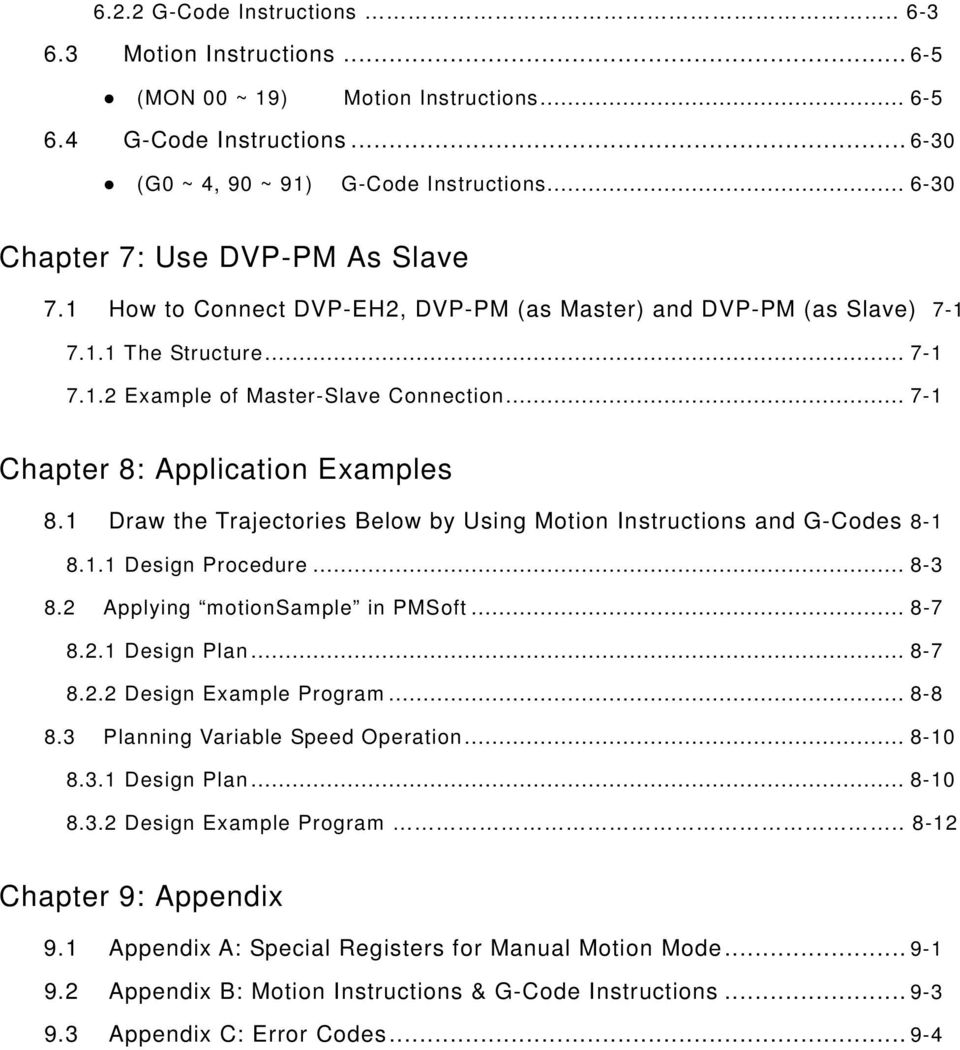
2 DVP-PM APPLICATION MANUAL Table of Contents Chapter 1: Program Structure of DVP-PM 1.1 O100 Main Program Manual Motion in O100 Main Program Structure of OX Motion Subroutine Structure of Pn Subroutine Structure of O100, OX and Pn Program Design The Program Structure 1-6 Chapter 2: Hardware Specifications and Wiring 2.1 Hardware Specifications Power Specifications I/O Point Specifications Dimension Installation & Wiring Wiring Power Input Wiring Safety Wiring I/O Point Wiring Wiring with Drives Communication Ports COM1 (RS-232) COM2 (RS-485) Chapter 3: Functions of Devices in DVP-PM 3.1 Device in DVP-PM Values, Constants [K]/[H], Floating Points [F] Numbering and Functions of External Input/Output Contacts [X]/[Y] Numbering and Functions of Auxiliary Relays [M] Numbering and Functions of Step Relays [S] Numbering and Functions of Timers [T] Numbering and Functions of Counters [C] Numbering and Functions of Registers [D]]

3 3.8.1 Data Register [D] Index Registers [V], [Z] Pointer [N], Pointer [P n ] Special Auxiliary Relays [M], Special Data Register [D] Functions of Special Auxiliary Relays and Special Registers Special Registers for Manual Motion Mode Functions of Special Registers for Manual Motion Mode Manual Modes Application Position & Speed Control Registers for Manual Modes Chapter 4: Basic Instructions 4.1 Basic Instructions Explanations of Basic Instructions Chapter 5: Categories and Use of Basic Application Instructions 5.1 List of Instructions Composition of Application Instruction Handling of Numeric Values V, Z Index Register Modification Instruction Index Application Instructions (API 00 ~ 09) Loop Control (API 10 ~ 19) Transmission Comparison (API 20 ~ 29) Four Arithmetic Operation (API 40 ~ 49) Data Processing (API 70 ~ 79) Display of External Settings (API 100 ~ 109) Communication (API 110 ~ 138) Floating Point Operation (API 215 ~ 223) Contact Type Logic Operation Instruction (API 250 ~ 260) New Instructions Chapter 6: Motion Instructions and G-Code Instructions 6.1 List of Motion Instructions and G-Code Instructions Composition of Motion Instructions and G-Code Instructions Motion Instructions

4 6.2.2 G-Code Instructions Motion Instructions (MON 00 ~ 19) Motion Instructions G-Code Instructions (G0 ~ 4, 90 ~ 91) G-Code Instructions Chapter 7: Use DVP-PM As Slave 7.1 How to Connect DVP-EH2, DVP-PM (as Master) and DVP-PM (as Slave) The Structure Example of Master-Slave Connection Chapter 8: Application Examples 8.1 Draw the Trajectories Below by Using Motion Instructions and G-Codes Design Procedure Applying motionsample in PMSoft Design Plan Design Example Program Planning Variable Speed Operation Design Plan Design Example Program Chapter 9: Appendix 9.1 Appendix A: Special Registers for Manual Motion Mode Appendix B: Motion Instructions & G-Code Instructions Appendix C: Error Codes
5 1 Program Structure of DVP-PM Delta s DVP-PM series MPU is a high-speed positioning and multi-functional programmable logic controller with 2-axis linear/arc interpolation, featuring functions as basic instructions, application instruction, motion instructions and G-code instructions, making the editing and compiling of program more diverse. This chapter will introduce the program structure of DVP-PM series MPU. DVP-PM combines the sequential control and 2-axis interpolation positioning control; therefore, the program is in three types: O100 main program, OX motion subroutine and Pn subroutine, which will be illustrated in this chapter. The basic instructions, application instructions and G-Code instructions will be given in Chapter 4 ~ O100 Main Program O100 main program is the PLC sequential control program, which is the main program of sequential control for DVP-PM series MPU. The O100 main program section only supports basic instructions and application instructions. Besides processing I/O signals and calling Pn subroutine, basic instructions and application instructions also control 100 OX motion subroutines which enable OX0 ~ OX99. Therefore, O100 main program establishes the main control program, and the main control program sets up and activates motion subroutines. This is the control structure of the operation of DVP-PM. See below the operation procedure and features of O100 main program. 1. There are two ways to activate O100 main program When DVP-PM is powered, and the AUTO/MANU switch goes from MANU to AUTO, M1072 will be On automatically, and O100 main program will be in RUN status. When DVP-PM is powered, you can set M1072 to be On or O100 main program to be in RUN status by communication. Auto/Manual Communication OR M1072 O100 Run 2. The program is scanned in cycles. When O100 main program is enabled, the scan will starts at the start flag of O100. When the scan reaches M102 (main program ends instruction), it will return to the start flag of. O100 and resume the scan, as shown in the figure below: The instruction can be compiled in any forms when Auto/Manual is in the main control program section, i.e. the sequential control program area" O100 Main program start flag Cyclic scan Sequential control program area M102 Main program ends instruction 3. There are three ways to stop the operation of O100 main program: When DVP-PM is powered, and the AUTO/MANU switch goes from AUTO to MANU, M1072 will be Off automatically, and O100 main program will be in STOP status. The operation of OX and Pn subroutines will stop at this moment. When DVP-PM is powered, you can set M1072 to be Off or O100 main program to be in STOP DVP-PM Application Manual 1-1

6 1 Program Structure of DVP-PM status by communication. The operation of OX and Pn subroutines will stop immediately. When errors occur during the design, compiling or operation of the program, O100 main program will stop automatically. See 3.13 for the table of the error codes and their causes. 4. O100 main program supports basic instructions and application instructions; therefore, you can design the program according to your actual needs. Besides, you can further activate OX0 ~ OX99 motion subroutines by setting up the parameters in motion instructions and the activation No. in the motion program. O100 main program does not support motion instructions and G-Code instructions; therefore, please design motion instructions and G-Code instructions in OX0 ~ OX99 motion subroutines. See 1.2 for more details. O100 main program is able to call Pn subroutine. See 1.3 for more details. 5. The above explanations are sorted in the table below: O100 main program Start of the program End of the program Execution of the program How to operate Instruction supported Quantity Features & functions Explanation Start flag of O100 main program (*In ladder diagram editing mode, it will be set up automatically. Therefore you do not have to compile this row.) End of M102 main program (*In ladder diagram editing mode, it will be set up automatically. Therefore you do not have to compile this row.) 1. DVP-PM MANU AUTO 2. M1072 Off On by communication Scan and operation in cycles Basic instructions and application instructions Only one O100 program is allowed in the program 1. A PLC sequential control program 2. Able to activate OX0 ~ OX99 motion subroutines and call Pn subroutine 3. The three sequences can be piled freely when used with OX0 ~ OX99 motion subroutines and Pn subroutines. 6. Manual Motion in O100 Main Program In O100 main program, you can use special registers for designing your own manual motion modes (see 3.12 for how to set it up). 1.2 Structure of OX Motion Subroutine OX0 ~ OX99 motion subroutines are motion control programs for controlling the motions on X and Y axes in DVP-PM. The OX0 ~ OX99 motion subroutine sections support basic instruction, application instructions, motion instructions and G-Code instructions, and they are able to call Pn subroutines. OX0 ~ OX99 are for the user to design and compile the moving path of X and Y axes. See below the operation procedure and features of OX motion subroutines. 1. How to activate OX0 ~ OX99 motion subroutines: When O100 main program is in RUN status, you can set up the execution No. of OX in O100 main 1-2 DVP-PM Application Manual

7 Main co ntro l p ro gram section Execute once Cyclic scan 1 Program Structure of DVP-PM program (D1868: K0 ~ K99) and set b12 of X-Y axis operation instruction (D1846) to be On to enable OX motion subroutine. When you enable OX motion subroutine, please make sure there are no other motion subroutines in Oxn' operation. O100 OXn AND D1846 Run in operation 2. The scan starts whenever the program is enabled. When O100 main program activates OX motion subroutine, the scan will start from the start flag of OX motion subroutine and end at M2 (motion subroutine ends instruction), i.e. the end of the motion subroutine, as shown in the figure below: X0.MOV. OUT H800A M1074 D1868 Set OX as OX10 Set X0 = On to enable OX10 motion subroutine Motion s ubrouting secti on X0 On. OX 10 M2 Start flag of motion subr outine Motion subroutine ends instr uction When X0 = On, OX10 motion subroutine will be enabled and stop when the execution reaches M2 (motion subroutine ends instruction). The execution will only execute once. If you need a re-execution, re-activate X0 to re-enable OX10 motion subroutine. 3. There are four ways to stop OX motion subroutine: When DVP-PM is powered, and the AUTO/MANU switch goes from AUTO to MANU, M1072 will be Off automatically, and O100 main program will be in STOP status. The operation of OX motion subroutines will stop at this moment. You can also stop OX by controlling the input signals of the external control terminal (STOP0). When DVP-PM is powered, you can also stop OX by setting D1846 to be 0 through communication. When errors occur during the design, compiling or operation of the motion subroutine, OX will stop automatically. See 3.13 for the table of the error codes and their causes. DVP-PM Application Manual 1-3

8 1 Program Structure of DVP-PM 4. OX motion subroutines support basic instructions, application instructions, motion subroutines and G-Code subroutines. Therefore, you can design your own motion program by using these instructions and setting up X-Y axis parameters for your desired X-Y motion control. The instructions mentioned above shall be designed in OX0 ~ OX99 motion subroutines. OX motion subroutine supports calling Pn subroutine. See 1.3 for more details. 5. The above explanations are sorted in the table below: OX motion subroutine Start of the program End of the program Execution of the program How to operate Instruction supported Quantity Features & functions Explanation OX motion subroutine (OX0 ~ OX99, 100 motion subroutines) M2 motion subroutine ends 1. When O100 main program is in RUN statues, set D1846_b12 as 1 to enable OX motion subroutine. 2. When O100 main program is in RUN status, set D1846_b12 by communication to also enable OX motion subroutine. 3. Stop OX motion subroutine by the input signals at external control terminal (STOP0). Note: When you need to enable OX motion subroutine, make sure there are no other motion subroutines in operation. Execute once whenever the subroutine is enabled. Re-enable it for the re-execution. Basic instructions, application instructions, motion instructions, and G-Code instructions. Note: Avoid pulse-type instruction when using basic instructions and application instructions. The program can only contain 100 OX motion subroutines. If you need to active other OX motion subroutines, you can set up D1868 and enable the subroutine (SET M1074). 1. A motion subroutine which can only be enabled by designing O100 main program. 2. Offers the third axis (Z) control. See 6.4 G00 and G01 instructions for more details. 3. Can be enabled/ disabled by controlling the external terminals, program design and communication. 4. Able to call Pn subroutine. 5. The three sequences can be piled freely when used with O100 main program and Pn subroutines. 1.3 Structure of Pn Subroutine Pn subroutine is a general-purpose subroutine for calling subroutines by O100 main program and OX motion subroutines. When Pn subroutine is called in O100 main program, the Pn subroutine area will support basic instructions and application instructions. When Pn subroutines is called in OX0 ~ OX99 motion subroutines, the Pn subroutine area will support basic instructions, application instructions, motion instructions and G-Code instructions. The Pn subroutine is called in O100 or OX, O100 or OX will jump to Pn subroutine when Pn subroutine is being executed and return to the next row after Pn subroutine to resume the execution when SRET is executed. 1. How to enable Pn subroutine: Call Pn subroutine in O100 main program. Call Pn subroutine in OX motion subroutine. 1-4 DVP-PM Application Manual

9 Sub rou tine section Sub rou tine section 1 Program Structure of DVP-PM 2. How does the scan work: The scan executes once whenever Pn subroutine is called once. After Pn subroutine is called in O100, Pn subroutine will be executed, and the subroutine will end when the execution reaches SRET (subroutine ends instruction). The program will return to the next row after Pn and resume the scan. The same operation also applied to OX motion subroutine calling Pn subroutine. Main co ntrol prog ram section Cyclic scan O1 00 and OX10 prog ram bifu rcation point b a M1000 X0 CALL MOV OUT P0 H800A M1074 Call P 0 subroutine D1868 Set O X as OX 10 When X 0 = On, OX10 motion s ubroutine will be enabl e. Path a will be true. Motio n subro utine section Exec ute onc e Execute once M1000.CALL. OX 10 M2 Start flag of motion subroutine P2 Call P 2 subroutine Motion subroutine ends instruc ti on Execute once Execute once P2. SRET.P0 SRET P2 subroutine Subroutine ends instruction P0 subroutine Subroutine ends instruction In P0 subroutine section, you can compile basic instructions and application instructions freely, and in P2 subroutine section, you can compile basic instructions, application instructions, motion instructions and G-Code instructions freely. 3. There are three ways to stop Pn subroutine: When DVP-PM is powered, and the AUTO/MANU switch goes from AUTO to MANU, M1072 will be Off automatically, and O100 main program will be in STOP status. The operation of OX motion subroutines and Pn subroutine will stop at this moment. When DVP-PM is powered, you can also stop OX by setting D1846 to be 0 through communication. DVP-PM Application Manual 1-5

10 1 Program Structure of DVP-PM When errors occur during the operation of Pn subroutine, Pn will stop automatically. See 3.13 for the table of the error codes and their causes. 4. When Pn subroutine is called in O100 main program, the Pn subroutine will only support basic instructions and application instructions. When Pn subroutines is called in OX0 ~ OX99 motion subroutines, the Pn subroutine will support basic instructions, application instructions, motion instructions and G-Code instructions. 5. The above explanations are sorted in the table below: Pn subroutine Explanation Start of the program Start flag of Pn subroutine (P0 ~ P255) End of the program Execution of the program How to operate Instructions supported Quantity Features & functions End of SRET subroutine 1. Call Pn subroutine in O100 main program. 2. Call Pn subroutine in OX motion subroutine. Execute once whenever the subroutine is enabled. Re-enable it for the re-execution. 1. When called in O100: supports basic instructions and application instructions 2. When called in OX: supports basic instructions, application instructions, motion instructions and G-Code instructions. Note: When you need to call Pn in OX and use basic instructions and application instructions, please avoid pulse-type instructions. The program can only contain 256 Pn subroutines. 1. A general-purpose subroutine 2. For O100 main program and OX motion subroutine to call a subroutine. 3. The three sequences can be piled freely when used with O100 main program and OX motion subroutine. 1.4 Structure of O100, OX and Pn Program Design O100 main program, OX motion subroutine and Pn subroutine are introduced in 1.1 ~ 1.3. In this section, we will further illustrate how to mix the structures of the three and how to design it The Program Structure Assume we would like to design a O100 main program, OX0 motion subroutine, P1 subroutine and P2 subroutine (5 program sections), please follow the design procedure as the follow: 1-6 DVP-PM Application Manual
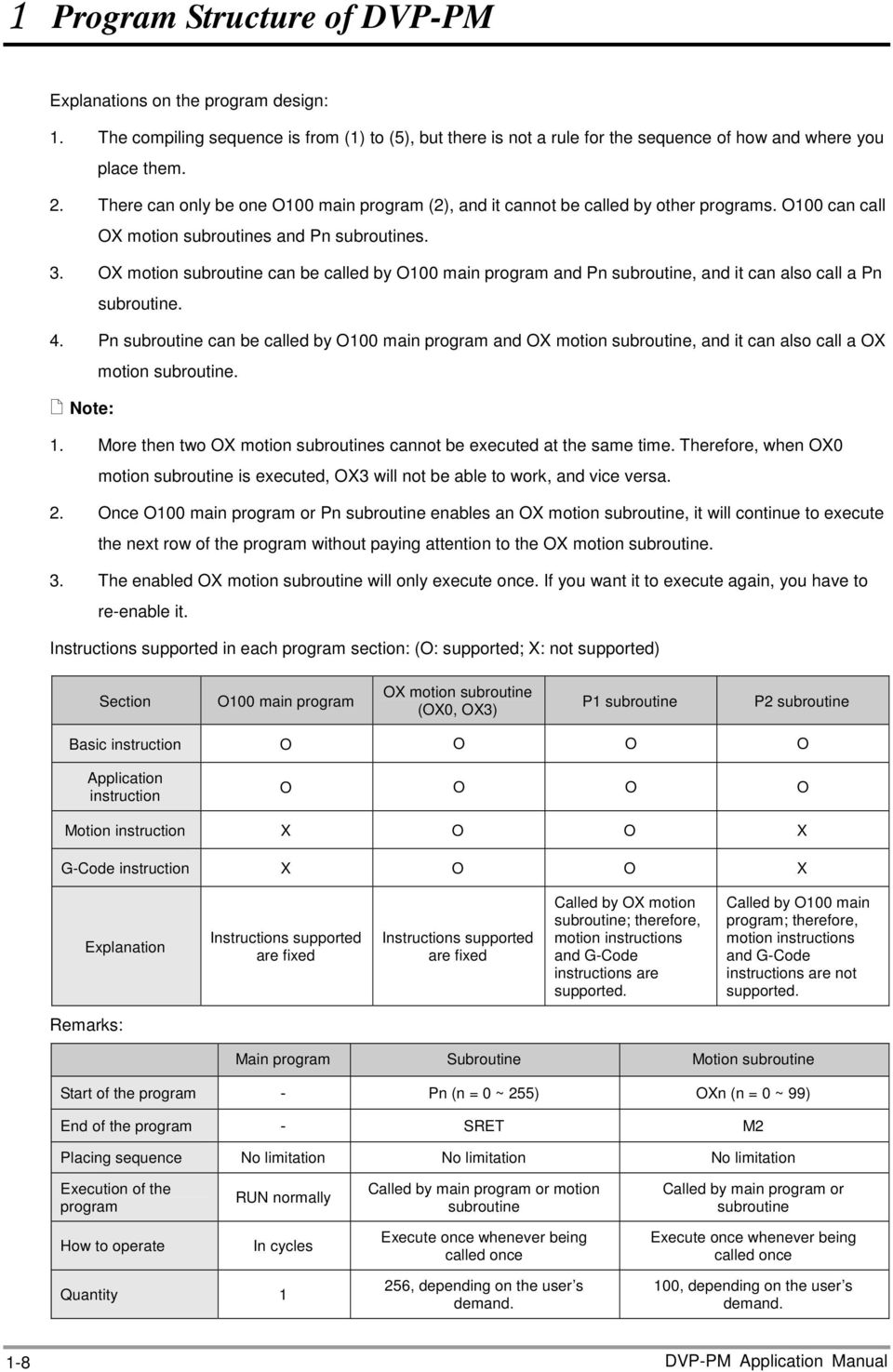
11 Motion subroutine section Motion subroutine section O100 main program Call OX0. Call P2 M102 1 Program Structure of DVP-PM OX0 motion subroutine Call P1.. M2 P2 subroutine Call OX3 SRET. P1 subroutine SRET OX3 motion subroutine M2 To explain the. example in an easier way, the program design will be given in section (1) ~ (5), as shown below: OX0 Start flag of O X0 motion subroutine M1000 CALL P1 Call P1 subroutine (1) M2 Motion subroutine ends instruction Main control program section.. M1000 MOV H8000 D1868 SET CALL P1 M1074 P2 (2) (3).. M2 P1 subroutine Set OX as OX0 Enable OX0 motion subroutine Call P2 subroutine Subroutine section OX3 P0 MOV SET SRET Start flag of OX3 motion subroutine Motion instruction ends instruction P0 subroutine H8003 D1868 M1074 Set O X as OX3 Enable OX3 motion subroutine Motion subroutine ends instruct ion (4) (5) Subroutine section SRET Motion subroutine ends instruction DVP-PM Application Manual 1-7

12 1 Program Structure of DVP-PM Explanations on the program design: 1. The compiling sequence is from (1) to (5), but there is not a rule for the sequence of how and where you place them. 2. There can only be one O100 main program (2), and it cannot be called by other programs. O100 can call OX motion subroutines and Pn subroutines. 3. OX motion subroutine can be called by O100 main program and Pn subroutine, and it can also call a Pn subroutine. 4. Pn subroutine can be called by O100 main program and OX motion subroutine, and it can also call a OX motion subroutine. Note: 1. More then two OX motion subroutines cannot be executed at the same time. Therefore, when OX0 motion subroutine is executed, OX3 will not be able to work, and vice versa. 2. Once O100 main program or Pn subroutine enables an OX motion subroutine, it will continue to execute the next row of the program without paying attention to the OX motion subroutine. 3. The enabled OX motion subroutine will only execute once. If you want it to execute again, you have to re-enable it. Instructions supported in each program section: (O: supported; X: not supported) Section O100 main program OX motion subroutine (OX0, OX3) P1 subroutine P2 subroutine Basic instruction O O O O Application instruction O O O O Motion instruction X O O X G-Code instruction X O O X Explanation Instructions supported are fixed Instructions supported are fixed Called by OX motion subroutine; therefore, motion instructions and G-Code instructions are supported. Called by O100 main program; therefore, motion instructions and G-Code instructions are not supported. Remarks: Main program Subroutine Motion subroutine Start of the program - Pn (n = 0 ~ 255) OXn (n = 0 ~ 99) End of the program - SRET M2 Placing sequence No limitation No limitation No limitation Execution of the program RUN normally Called by main program or motion subroutine Called by main program or subroutine How to operate In cycles Execute once whenever being called once Execute once whenever being called once Quantity 1 256, depending on the user s demand. 100, depending on the user s demand. 1-8 DVP-PM Application Manual
13 2 Hardware Specifications and Wiring 2.1 Hardware Specifications This chapter only provides information on electrical specification and wiring. For detailed information on program design and instructions, please refer to Chapter 5 ~ 6. For how to purchase its peripheral devices, please refer to the instruction sheet enclosed with the product Power Specifications Item Description Power supply voltage 100 ~ 240V AC(-15% ~ 10%), 50/60Hz ± 5% Fuse capacity Power consumption DC24V current supply Power protection Withstand voltage Insulation impedance Noise immunity Earth Operation/storage Vibration/shock immunity 2A/250V AC 60VA 500mA DC24V; output short-circuited 1,500V AC (Primary-secondary); 1,500V AC (Primary-PE); 500V AC (Secondary-PE) > 5MΩ (all I/O point-to-ground: 500V DC) ESD: 8KV Air Discharge; EFT: Power Line: 2KV, Digital I/O: 1KV, Analog & Communication I/O: 250V The diameter of grounding wire shall not be less that of L, N terminal of the power. When many PLCs are in use at the same time, please make sure every PLC is properly grounded. Operation: 0 C ~ 55 C (temperature), 50 ~ 95% (humidity), pollution degree 2 Storage: -25 C ~ 70 C (temperature), 5 ~ 95% (humidity) International standards: IEC , IEC (TEST Fc)/IEC & IEC (TEST Ea) Weigh (approx. g.) 478/ I/O Point Specifications Input point specifications: Terminal Description Response characteristics Max. input current START0, START1 Enabling input 10ms 6mA STOP0, STOP1 Disabling input 10ms 6mA LSP0/LSN0, LSP1/LSN1 Right limit input/left limit input 10ms 6mA A0+, A0-, A1+, A1- MPG A-phase pulse input +, - (differential signal input) 200KHz 15mA B0+, B0-, B1+, B1- MPG B-phase pulse input +, - (differential signal input) 200KHz 15mA PG0+, PG0-, PG1+, PG1- Zero point signal input +, - (differential signal input) 1ms 15mA There are two variations according to different operation modes: DOG0, DOG1 1. DOG signal when zero return 1ms 10mA 2. Inserting enabling signal at 1-segment speed or 2-segment speed DVP-PM Application Manual 2-1

14 2 Hardware Specifications and Wiring Output point specifications: Terminal Description Response characteristics Max. input current CLR0+, CLR0-, CLR1+, CLR1- Clearing signals (by the error counter in servo drive) 10ms 20mA FP0+, FP0-, FP1+, FP1- Forward/reverse running mode: Forward pulse output Pulse direction: Towards pulse output end 500KHz 40mA A, B phase: A-phase output RP0+, RP0-, RP1+, RP1- Forward/reverse running mode: Reverse pulse output Pulse direction: Towards output end 500KHz 40mA A, B phase: B-phase output Digital input points: Item 24V DC single common port input Spec Low speed High speed (200KHz) Note Input wiring type Input indicator Change wiring from S/S to SINK or SOURCE LED display; light on = ON, light off = OFF Input voltage - Action Off On 20us level On Off 30us Input point X0 ~ X7 can conduct 10 ~ 60ms digital filter adjustment. Response time/noise immunity Digital output point: 10ms 0.5us Item Single common port transistor output Spec Low speed High speed Single common port relay output Maximum frequency 10KHz 200KHz For load ON/OFF control Output indicator LED display; light on = ON, light off = OFF Minimum load - 2mA/DC power supply Working voltage 5 ~ 30V DC < 250V AC, 30V DC Isolation Photocoupler isolation Electromagnetic isolation Current specification 0.3A/1 point@ 40 C 30mA 2A/1 point (5A/COM) 75VA (conductive), 90W (resistive) Max. output delay time Off On On Off 20us 30us 0.2us 10ms Over-current protection N/A 2-2 DVP-PM Application Manual

15 2 Hardware Specifications and Wiring Dimension (Unit: mm) Product Profile & Outline: Communication port cover 2 I/O terminal cover Function card/memory card cover 4 I/O terminals 5 I/O terminal No. 6 Extension module connection port cover 10 7 Input indicator Output indicator 9 DIN rail clip DIN rail (35mm) Mounting screw 2 Direct mounting hole Battery socket Function card mounting hole 5 Memory card port POWER/BAT.LOW/ERROR indicator 7 Extension module connection port 8 Function card port Open COM1 cover Open COM2 cover DVP-PM Application Manual 2-3
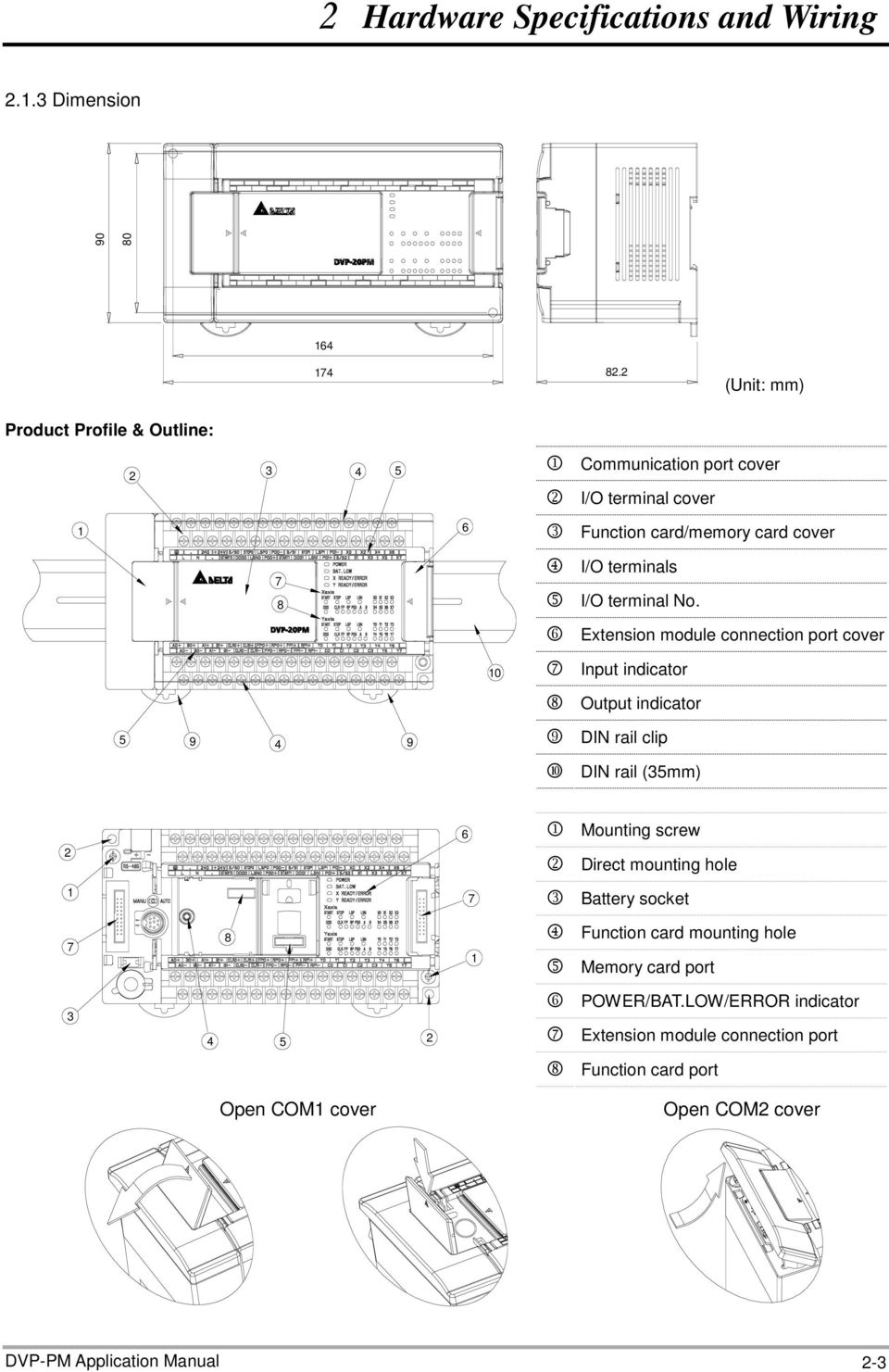
16 2 Hardware Specifications and Wiring The battery shall be changed within 1 minute. Remove RS-485 terminal Removable Terminal Block COM 2 (RS-485) MANU / AUTO switch COM 1 (RS-232) Battery Part Description COM2 (RS-485) MANU/AUTO switch COM1 (RS-232) For both master and slave modes RUN/STOP control Slave mode (can be used with COM2 at the same time) Wiring Terminals: See for detailed specifications. 24G +24V S/S0 STOP0 LSP0 PG0- S/S1 STOP1 LSP1 PG1- X0 X2 X4 X6 START0 DOG0 LSN0 PG0+ START1 DOG1 LSN1 PG1+ S/S2 X1 X3 X5 X7 DVP-20PM ( AC Power IN, DC Signal IN ) A0+ B0+ A1+ B1+ CLR0+ CLR1+ FP0+ RP0+ FP1+ RP1+ Y0 Y1 Y2 Y3 Y4 Y6 A0- B0- A1- B1- CLR0- CLR1- FP0- RP0- FP1- RP1- C0 C1 C2 C3 Y5 Y7 2.2 Installation & Wiring DVP-PM is and OPEN-TYPE device and therefore should be installed in an enclosure free of airborne dust, humidity, electric shock and vibration. The enclosure should prevent non-maintenance staff from operating the device (e.g. key or specific tools are required for opening the enclosure) in case danger and damage on the device may occur. DO NOT connect input AC power supply to any of the I/O terminals; otherwise serious damage may occur. Check all the wiring again before switching on the power. Make sure the ground terminal to prevent electromagnetic interferences. is correctly grounded in order 2-4 DVP-PM Application Manual

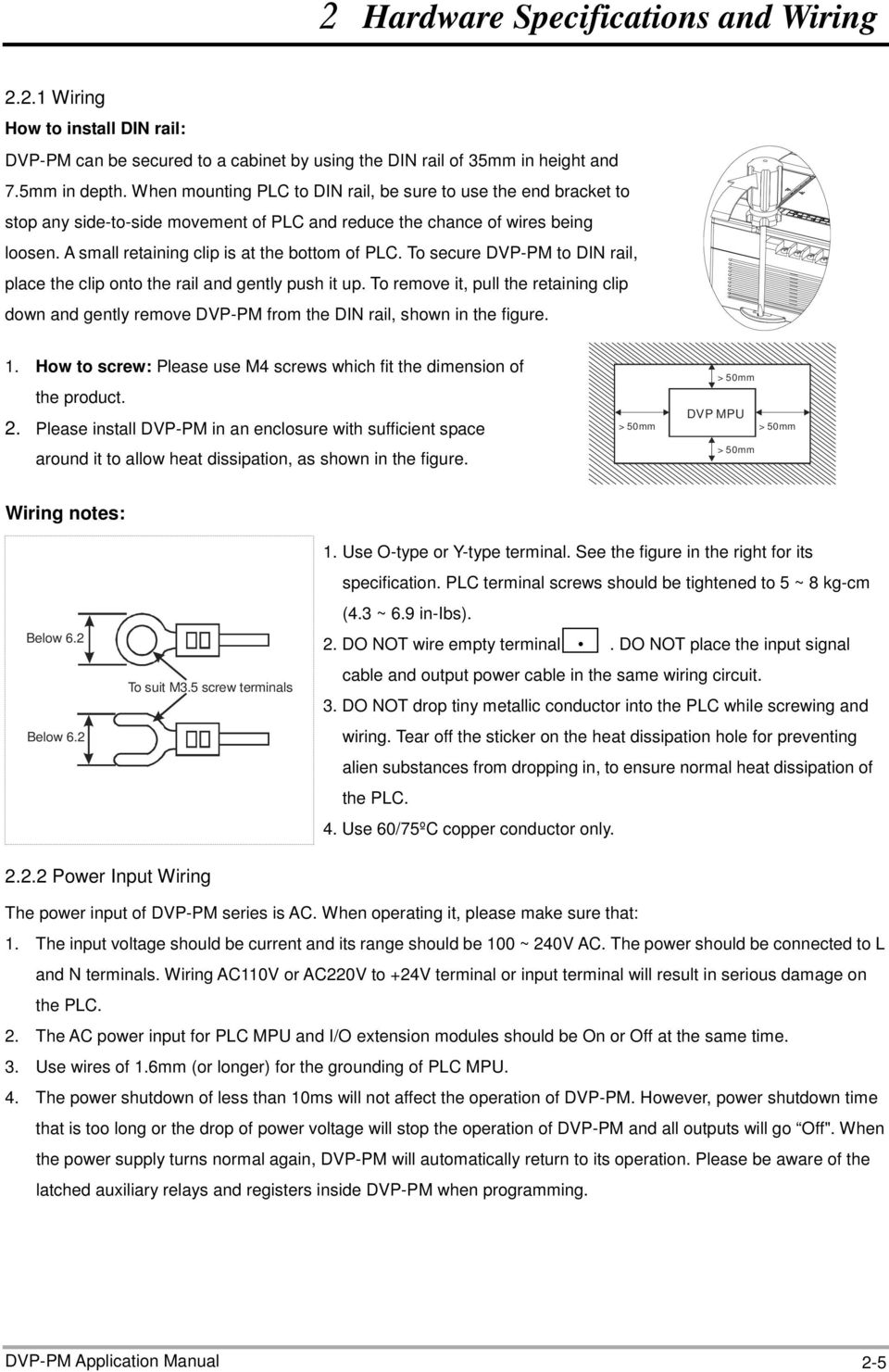
17 2 Hardware Specifications and Wiring Wiring How to install DIN rail: DVP-PM can be secured to a cabinet by using the DIN rail of 35mm in height and 7.5mm in depth. When mounting PLC to DIN rail, be sure to use the end bracket to stop any side-to-side movement of PLC and reduce the chance of wires being loosen. A small retaining clip is at the bottom of PLC. To secure DVP-PM to DIN rail, place the clip onto the rail and gently push it up. To remove it, pull the retaining clip down and gently remove DVP-PM from the DIN rail, shown in the figure. 1. How to screw: Please use M4 screws which fit the dimension of the product. 2. Please install DVP-PM in an enclosure with sufficient space around it to allow heat dissipation, as shown in the figure. > 50mm > 50mm DVP MPU > 50mm > 50mm Wiring notes: Below 6.2 Below 6.2 To suit M3.5 screw terminals 1. Use O-type or Y-type terminal. See the figure in the right for its specification. PLC terminal screws should be tightened to 5 ~ 8 kg-cm (4.3 ~ 6.9 in-ibs). 2. DO NOT wire empty terminal. DO NOT place the input signal cable and output power cable in the same wiring circuit. 3. DO NOT drop tiny metallic conductor into the PLC while screwing and wiring. Tear off the sticker on the heat dissipation hole for preventing alien substances from dropping in, to ensure normal heat dissipation of the PLC. 4. Use 60/75ºC copper conductor only Power Input Wiring The power input of DVP-PM series is AC. When operating it, please make sure that: 1. The input voltage should be current and its range should be 100 ~ 240V AC. The power should be connected to L and N terminals. Wiring AC110V or AC220V to +24V terminal or input terminal will result in serious damage on the PLC. 2. The AC power input for PLC MPU and I/O extension modules should be On or Off at the same time. 3. Use wires of 1.6mm (or longer) for the grounding of PLC MPU. 4. The power shutdown of less than 10ms will not affect the operation of DVP-PM. However, power shutdown time that is too long or the drop of power voltage will stop the operation of DVP-PM and all outputs will go Off". When the power supply turns normal again, DVP-PM will automatically return to its operation. Please be aware of the latched auxiliary relays and registers inside DVP-PM when programming. DVP-PM Application Manual 2-5
18 2 Hardware Specifications and Wiring AC power input: 100~240VAC L N +24V 24G S/S X0 X1 X2 2.0 A DC/DC +5V 0.5A is the maximum power supply for +24V power supply output terminal. DO NOT connect other external power supplies to this terminal. Every input terminal requires 6 ~ 7mA to be driven; e.g. the 16-point input will require approximately 100mA. Therefore, +24V cannot give output to external load that is more than 400mA Safety Wiring Since DVP-PM controls many devices, actions of any device may affect actions of other devices and the breakdown of any one device may cause the breakdown of the entire auto-control system and danger. Therefore, we suggest you wire a protection circuit at the power input terminal, as shown in the figure below. 1 AC power supply load 5 4 MC 1 2 Power circuit protection fuse (3A) 3 Power indicator 8 Guard Limit 2 4 Emergency stop This button can cut off the system power supply when accidental emergency takes place. MC 3 MC 1 5 System circuit isolation device The device is made of electromagnetic contactor and relay as the switch to prevent the instability of system when the power is intermittently supplied. L N 7 6 DVP-PLC (main processing unit) 6 7 Earth 8 Power supply: AC: 100 ~ 240V AC, 50/60Hz I/O Point Wiring There are two types of DC input, SINK and SOURCE. (DC Signal IN) S/S Sinking X0 SINK mode: Common port for current input S/S 2-6 DVP-PM Application Manual

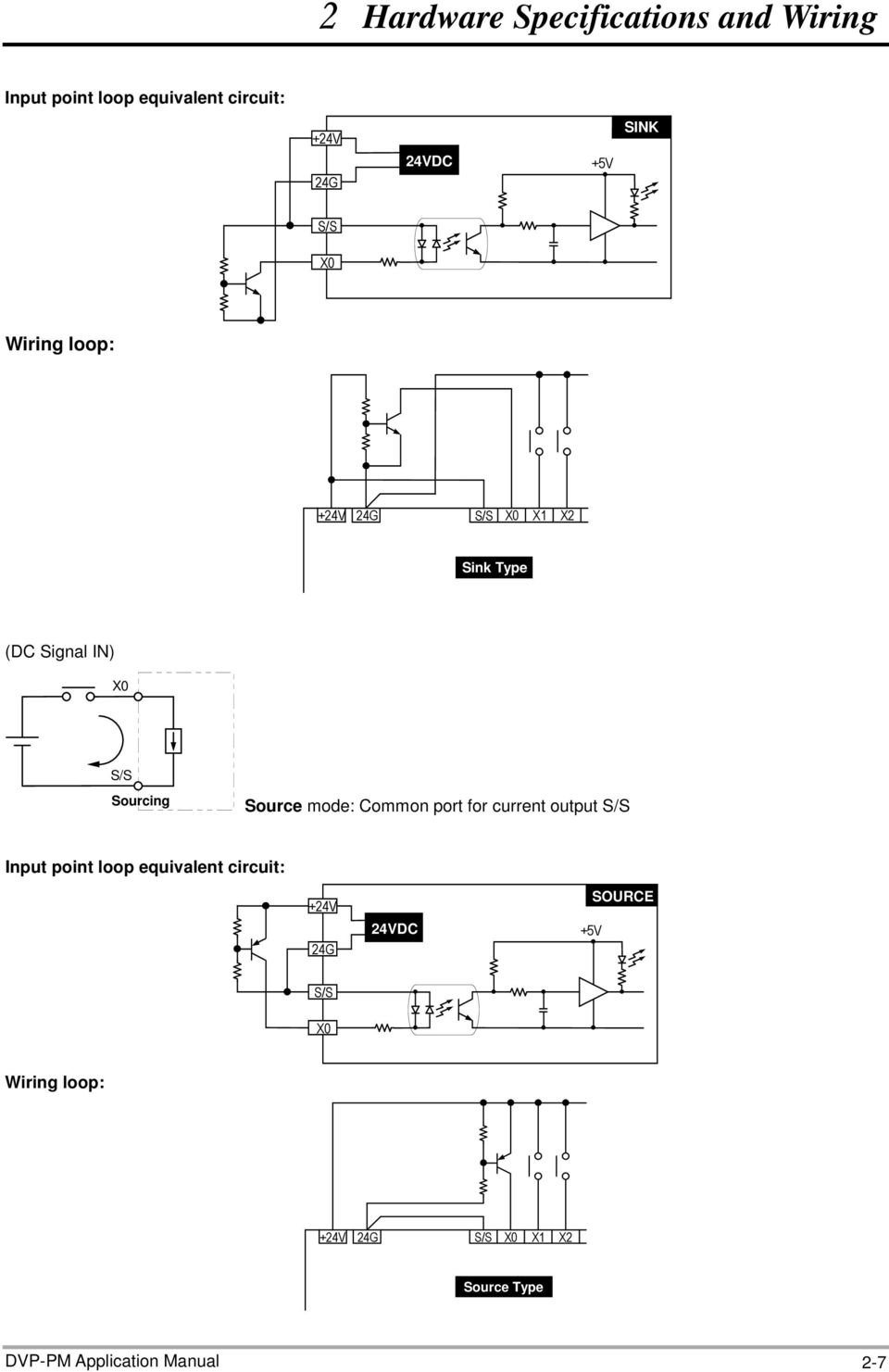
19 2 Hardware Specifications and Wiring Input point loop equivalent circuit: +24V 24G 24VDC +5V SINK S/S X0 Wiring loop: +24V 24G S/S X0 X1 X2 Sink Type (DC Signal IN) X0 S/S Sourcing Source mode: Common port for current output S/S Input point loop equivalent circuit: +24V 24G 24VDC +5V SOURCE S/S X0 Wiring loop: +24V 24G S/S X0 X1 X2 Source Type DVP-PM Application Manual 2-7
20 2 Hardware Specifications and Wiring Wiring of differential input: A0 ~ A1 and B0 ~ B1 of DVP-PM are all high-speed input circuit, and others are DC24V input. The working frequency of high-speed input circuit can reach up to 200KHz and is mainly for connecting to differential (double-wire) LINE DRIVER output circuit. Wiring in a high-speed, high-noise environment Encoder output DVP20PM00D high-speed input A A+ A - A0+ A0 - Differential output B A+ B - Twisted pair cable B0+ B0 - Wiring of DVP20PM00D DC5V SINK PG0+ PG0 - (5V SINK) NPN SENSOR + 5~24V Wiring of DVP20PM00D DC5V SOURCE PNP SENSOR PG0+ PG0 - (5V SOURCE) + 5~24V Relay (R) contact circuit wiring DVP-**-**-**-R LED RY LOAD Y0 C0 RELAY OUTPUT POWER C2 Y2 C3 Y3 C4 ~ C7 Y4 Y5 Y6 Y MC1 MC Flywheel diode: To extend the lift span of contact 2 Emergency stop: Uses external switch 3 Fuse: Uses 5 ~ 10A fuse at the shared terminal of output contacts to protect the output circuit 2-8 DVP-PM Application Manual

21 2 Hardware Specifications and Wiring 4 Varistor: To reduce the interference on AC load 6 Neon indicator 8 Incandescent light (resistive load 5 DC power supply 7 AC power supply 9 Manually exclusive output: Uses external circuit and forms an interlock, together with PLC internal program, to ensure safe protection in case of any unexpected errors. Transistor (T) contact circuit wiring DVP-**-**-**-T 5 5 C0 Y0 C1 Y1 C3 Y4 Y5 Y6 Y7 LED Y0 C0 < 0.5A LOAD MC1 MC2 TRANSISTOR OUTPUT DC power supply 3 Circuit protection fuse 2 Emergency stop 4 Flywheel diode + inductive load 5 Manually exclusive output: Uses external circuit and forms an interlock, together with PLC internal program, to ensure safe protection in case of any unexpected errors. Wiring of differential output DVP20PM00D Drive FP RP FP+ FP- RP+ RP- Twisted pair cable A + A - FG B + B - Photocoupler Input example Line Receiver Input example DVP-PM Application Manual 2-9
22 2 Hardware Specifications and Wiring Wiring with Drives DVP-PM and Delta ASD-A series servo drive: +24VDC input Delta servo drive ASD-A series START0 STOP0 24V 0V VDD COM+ 24V LSP0 +24V LSN0 FP 0+ FP 0- RP 0+ PLS /PLS SIGN START1 RP 0- /SIGN STOP1 LSP1 CLR0+ DI2 LSN1 CLR0- COM- +24V 5-24VDC MPG pulses Shielded cable Delta servo drive A phase B phase A0+ B0+ A0- B0- VDD COM+ ASD-A series 24V FP 1+ PLS MPG pulses A phase Shielded cable A1+ A1- FP 1- RP 1+ RP 1- /PLS SIGN /SIGN B phase B1+ B1- CLR1+ DI2 PG 0+ CLR1-5-24VDC COM- 5-24VDC PG 0 - PG 1+ PG VDC 2-10 DVP-PM Application Manual
23 2 Hardware Specifications and Wiring DVP-PM and Panasonic CN5 series servo drive: +24VDC input Panasonic servo drive CN5 series START0 STOP0 24V 0V LSP0 LSN0 FP 0+ PULS V DOG0 S/S0 FP 0- RP 0+ PULS2 SIGN1 4 5 START1 RP 0- SIGN2 6 STOP1 LSP1 CLR0+ LSN1 CLR0- MPG pulses +24V Shielded cable DOG1 S/S1 5-24VDC Panasonic servo drive A phase A0+ A0- CN5 series B phase B0+ B0- FP 1+ PULS1 3 A phase MPG pulses Shielded cable A1+ A1- FP 1- RP 1+ RP 1- PULS2 SIGN1 SIGN B phase B1+ B1- CLR VDC PG 0+ PG 0 - CLR1-5-24VDC PG VDC PG 1- DVP-PM Application Manual 2-11
24 2 Hardware Specifications and Wiring DVP-PM and Yaskawa servo drive: +24VDC input Yaskaw a servo drive START0 STOP0 24V 0V LSP0 LSN0 FP 0+ PULS 7 +24V DOG0 S/S0 FP 0- RP 0+ /PULS 8 SIGN 11 START1 RP 0- /SIGN 12 STOP1 LSP1 CLR0+ CLR 15 LSN1 CLR0- /CLR 14 MPG pulses +24V Shielded cable DOG1 S/S1 5-24VDC Yaskaw a servo drive A phase A0+ A0- B phase B0+ B0- FP 1+ PULS 7 MPG pulses A phase Shielded cable A1+ A1- FP 1- RP 1+ RP 1- /PULS 8 SIGN 11 /SIGN 12 B phase B1+ B1- CLR1+ CLR VDC PG 0+ PG 0 - CLR1-5-24VDC /CLR 14 PG VDC PG DVP-PM Application Manual
25 2 Hardware Specifications and Wiring DVP-PM and Mitsubishi MJR2 series servo drive: +24VDC input Mit subishi servo drive MJR2 series START0 24V STOP0 0V LSP0 LSN0 FP 0+ PP 3 +24V DOG0 S/S0 FP 0- RP 0+ PG 13 NP 2 START1 RP 0- NG 12 STOP1 LSP1 CLR0+ CR 8 LSN1 CLR0- SG 10 MPG pulses +24V Shielded cable DOG1 S/S1 5-24VDC Mitsubishi servo drive A phase A0+ A0- MJR2 series B phase B0+ B0- FP 1+ PP 3 MPG pulses A phase Shielded cable A1+ A1- FP 1- RP 1+ RP 1- PG 13 NP 2 NG 12 B phase B1+ B1- CLR1+ CR VDC PG 0+ PG 0 - CLR1-5-24VDC SG 10 PG VDC PG 1- DVP-PM Application Manual 2-13
26 2 Hardware Specifications and Wiring DVP-PM and FUJI servo drive: +24VDC input FUJI servo drive START0 STOP0 24V 0V LSP0 LSN0 FP 0+ CA V DOG0 S/S0 FP 0- RP 0+ *CA CB START1 RP 0- *CB 34 STOP1 LSP1 CLR0+ LSN1 CLR0- MPG pulses +24V Shielded cable DOG1 S/S1 5-24VDC FUJI servo drive A phase A0+ A0- B phase B0+ B0- FP 1+ CA 35 MPG pulses A phase Shielded cable A1+ A1- FP 1- RP 1+ RP 1- *CA CB *CB B phase B1+ B1- CLR VDC PG 0+ PG 0 - CLR1-5-24VDC PG VDC PG DVP-PM Application Manual
27 2 Hardware Specifications and Wiring 2.3 Communication Ports DVP-PM has two communication ports, COM1 (RS-232 communication) and COM2 (RS-485 communication) COM1 (RS-232) 1. The interface of COM1 is RS-232, for uploading and downloading of the program. It supports Modbus communication format with baud rate 9,600 ~ 115, 200bps. The communication cable: 9 5 TO PC TO 20PM PIN D-SUB MINI DIN TERMINAL PC/TP COM Port 9 PIN D-SUB female PM COM1 Port 8 PIN MINI DIN Tx 3 Rx 2 GND Rx 5 Tx 8 GND 1,2 5V See the catalog of Delta PLCs for detailed model names or download the most updated information on the accessories on Delta's website. 2. COM1 is for Slave mode. Therefore, it can be connected to a human machine interface for monitoring purposes COM2 (RS-485) 1. The interface of COM2 is RS-485, for the communication among many masters and slaves. It supports Modbus communication format with baud rate 9,600 ~ 115,200bps. 2. COM2 is for Master or Slave mode. When for Master mode, it can be connected to a Delta PLC or a drive in the next level (e.g. Delta servo drive, temperature controller, AC motor drive, and so on) for reading/writing data. When for Slave mode, it can be connected to a human machine interface (e.g. Delta s TP and DOP series HMI) for monitoring purposes. DVP-PM Application Manual 2-15
28 2 Hardware Specifications and Wiring MEMO 2-16 DVP-PM Application Manual
29 3 Functions of Devices in DVP-PM 3.1 Devices in DVP-PM Function Specifications: Item Specification Note Number of control axes Program storage 2-axis synchronous linear/arc interpolation and independent 2-axis control Built-in 64K step storage device 1 Units Motor system Combined system Machine system How does MPU read/write extension module Series connection with MPU Pulse output method Uses FROM/TO instruction to read/write the contents of CR in the extension module. If the content is 32-bit, it needs 2 CRs for the content. When used as an extension module, the built-in CR0 ~ CR199 (corresponding to its own D1500 ~ D1699) are for the MPU to read/write. 3 modes: Pulse/Dir, FP(CW) / RP(CCW), A/B by differential output Maximum speed For single axis: 500K PPS For interpolation axis: 500K PPS Operation switch AUTO/MANU (auto/manual selection), START, STOP Input signal Output signal Special extension module Detector General input point Servo output General output point Series communication port Optional DOG (near point), LSP (forward running limit), LSN (reverser running limit), PG0 (zero point) X0 ~ X7, I/O modules extendable; maximum 256 points extendable FP (forward pulse), RP (reverse pulse), CLR (clear signal) Y0 ~ Y7, I/O modules extendable; maximum 256 points extendable Program write-in/read-out communication port: COM1: RS-232/COM2: RS-485 (can be master or slave) Program stored by HPP03 The right-side extension module and DVP-EH2 series share all modules, AD, DA, PT, TC, XA, PU (maximum 8 modules extendable). The left side can connect to new high-speed extension modules (maximum 8). Maximum 8 modules extendable and will not occupy any I/O points. Basic instruction 27 Application instruction 56 Motion instruction 22 M -Code G-Code Self-diagnosis OX0 ~ 99 (Positioning Program): M02: program stops (END) M00 ~ M01, M03 ~ M99: program pauses (WAIT), for free use O100 (Sub-task Program): M102: program stops (END) G0 (fast move), G1 (linear interpolation), G2 (clockwise arc interpolation), G3 (counter-clockwise arc interpolation), G4 (pause), G90 (absolute coordinate), G91 (relative coordinate) Displaying parameter error, program error, external error, and so on. DVP-PM Application Manual 3-1
30 3 Functions of Devices in DVP-PM X External input relay X0 ~ X377, octal encoding, 256 points Y External output relay Y0 ~ Y377, octal encoding, 256 points Total 512 points Corresponds to external input points Corresponds to external output points General purpose M0 ~ M499, 500 points (*2) M3000 ~ M4095, 2,096 points (*3) M Auxiliary relay Latched M500 ~ M999, 500 points (*3) Total 4,096 points The contact can be On/Off in the program. Relay (bit) Special purpose M1000 ~ M2999, 2,000 points (part for latched) T Timer 10ms T0 ~ T255, 256 points (*2) Total 256 points TMR instruction. If the timing reaches its target, the T contact of the same No. will be On. C Counter 16-bit C0 ~ C99, 100 points (*2) counting up C100 ~ C199, 100 points (*3) 32-bit C200 ~ C219, 20 points (*2) counting up/down C220 ~ C255, 36 points (*3) Total 256 points The counter indicated by CNT (DCNT) instruction. If the counting reaches its target, the C contact of the same No. will be On. S Internal relay General purpose S0 ~ S499, 500 points (*2) Latched S500 ~ S1023, 524 points (*3) Total 1,024 points The contact can be On/Off in the program. T Present value in timer T0 ~ T255, 256 points When the timing reaches its target, the contact of the timer will be On. Register (word data) C D Present value in counter Data register General purpose Latched Special purpose C0 ~ C199, 16-bit counter, 200 points C200 ~ C255, 32-bit counter, 56 points D0 ~ D199, 200 points (*2) D200 ~ D999, 800 points (*3) D3000 ~ D9999, 7,000 points (*3) D1000 ~ D2999, 2,000 points (part for latched) Total 10,000 points When the counting reaches its target, the contact of the counter will be On. Memory area for data storage. V/Z can be used for indirect designation. Indirect designation V0 ~ V7 (16-bit), Z0 ~ Z7, 16 points (32-bit) (*1) Index P For CJ, CJN, CALL, JMP instructions P0 ~ P255, 256 points Position index of CJ, CJN, CALL and JMP Constant K Decimal K-32,768 ~ K32,767 (16-bit operation) K-2,147,483,648 ~ K2,147,483,647 (32-bit operation) H Hex H0000 ~ HFFFF (16-bit operation); H ~ HFFFFFFFF (32-bit operation) F Floating point Displaying floating points by the length of 32 bits with IEEE754 standard. ±1.1755X10-38 ~ ±3.4028X *1: Non-latched area cannot be modified. *2: Non-latched area, can be modified into latched area by changing the parameter settings 3-2 DVP-PM Application Manual
31 3 Functions of Devices in DVP-PM *3: Latched area, can be modified into non-latched area by changing the parameter settings *4: Latched area, cannot be modified Settings of latched and non-latched memory devices: General purpose Special auxiliary relay M (Auxiliary relay) M0 ~ M499 M500 ~ M999 M2000 ~ M4095 M1000 ~ M1999 Default: non-latched Default: latched Default: non-latched Also in general purpose area Start: D1200 (K500)*1 End: D1201 (K999) *1 Some are latched and cannot be modified. 10ms T (Timer) T0 ~ T255 Default: non-latched Start: D1202 (K-1) *2 End: D1203 (K-1) *2 16-bit counting up 32-bit counting up/down C (Counter) C0 ~ C99 C100 ~ C199 C200 ~ C219 C220 ~ C255 Default: non-latched Default: latched Default: non-latched Default: latched Start: D1204 (K100) Start: D1206 (K220) End: D1205 (K199) End: D1207 (K255) Initial General purpose Latched S (Step relay) S0 ~ S9 S10 ~ S499 S500 ~ S1023 Default: non-latched Default: latched Start: D1208 (K500), End: D1209 (K1023) General purpose Latched Special register D (Register) D0 ~ D199 D200 ~ D9999 Default: non-latched Default: latched Start: D1210 (K200) *3 End: D1211 (K9999) *3 D1000 ~ D1999 Also in "general purpose and latched area Some are latched and cannot be modified. *1: If you set D1200 = 0 and D1201 = 4095, DVP-PM will automatically ignore M1000 ~ M2999 and set M0 ~ M999 and M3000 ~ M4095 as latched area. *2: K-1 refers to default = non-latched. *3: If you set D1210 = 0 and D1211 = 9999, DVP-PM will automatically ignore D1000 ~ D2999 and set D0 ~ D999 and D3000 ~ D9999 as latched areas. Status of general devices when power On/Off or MPU switches between MANU/AUTO (excluding internal devices) Memory type Power OFF->ON MANU->AUTO AUTO->MANU Clear all non-latched areas (M1031) Clear all latched area (M1032) Default Non-latched Cleared Unchanged Cleared when M1033 = Off Remain unchanged when M1033 = On Cleared Unchanged 0 Latched Unchanged Unchanged Cleared 0 DVP-PM Application Manual 3-3
32 3 Functions of Devices in DVP-PM 3.2 Values, Constants [K] / [H], Floating Points [F] Constant K H Decimal form Hexadecimal form K-32,768 ~ K32,767 (16-bit operation) K-2,147,483,648 ~ K2,147,483,647 (32-bit operation) H0 ~ HFFFF (16-bit operation) H0 ~ HFFFFFFFF (32-bit operation) Floating point F 32 bits ±1.1755X10-38 ~ ±3.4028X10+38 (The floating point is presented in 32 bits, with IEEE754 standard.) For different control purposes, there are 5 types of values inside DVP-PM for executing the operations. See the explanations bellows for the functions and works of every type of value. 1. Binary value (BIN) All the operations and storages of values in DVP-PM are conducted in BIN. See below for the terms for BIN values. Bit: The basic unit for a BIN value, either 1 or 0. Nibble: Byte: Word: Composed of 4 continuous bits (e.g. b3 ~ b0). Presented as the decimal value 0 ~ 9 of a digit or 0 ~ F in hex. Composed of 2 continuous nibbles (i.e. 8 bits, b7 ~ b0). Presented as 00 ~ FF in hex. Composed of 2 continuous bytes (i.e. 16 bits, b15 ~ b0), Presented as 4-digit 0000 ~ FFFF in hex. Double word: Composed of 2 continuous words (i.e. 32 bits, b31 ~ b0). Presented as 8-digit ~ FFFFFFFF in hex. Bit, nibble, byte, word and double word in a binary system: DW Double word W1 W0 Word BY3 BY2 BY1 BY0 Byte NB7 NB6 NB5 NB4 NB3 NB2 NB1 NB0 Nibble Bit 2. Octal value (OCT) The No. of external input and output terminals in DVP-PM in numbered in octal system. For example: External input: X0 ~ X7, X10 ~ X17... (device No.) External output: Y0 ~ Y7, Y10 ~ Y17 (device No.) 3. Decimal value (DEC) The timings of using decimal values in DVP-PM are as follows: As the set value for timer T and counter C, e.g. TMR T0 K50 (constant K) As the No. of device S, M, T, C, D, V, Z, P, e.g. M10, T30 (device No.) As an operand in the application instruction, e.g. MOV K123 D0 (constant K) 4. Binary code decimal (BCD) 3-4 DVP-PM Application Manual
33 3 Functions of Devices in DVP-PM A decimal datum is presented by a nibble or 4 bits. Therefore, a continuous 16 bits can be presented as a 4-digit decimal value. BCD is mainly used on reading the input value from the DIP switch or the data output to a 7-segment display. 5. Hexadecimal value (HEX) Occasion of using hexadecimal values: Operands in application instructions, e.g. MOV H1A2B D0 (constant H) Constant K: K is normally placed before a decimal value in DVP-PM. For example, K100 refers to a decimal value, 100. Exception: K and bit devices X, Y, M and S can combine into data in bit, byte, word or double word, e.g. K2Y10, K4M100. Here K1 refers to a 4-bit data and K2 ~ K4 refer to 8-bit, 12-bit and 16-bit data. Constant H: "H is normally placed before a hexadecimal value in DVP-PM. For example, H100 refers to a hexadecimal value,100. Floating point F: F is normally placed before a floating point value in DVP-PM. For example, F3.123 refers to a floating point value, Reference table: Binary (BIN) Octal (OCT) Decimal (DEC) Binary Code Decimal (BCD) Hexadecimal (HEX) For DVP-PM internal operation No. of device X, Y Constant K, No. of device M, S, T, C, D, V, Z, P For DIP switch and 7-segment display Constant H A B C D E F DVP-PM Application Manual 3-5
34 3 Functions of Devices in DVP-PM Binary (BIN) Octal (OCT) Decimal (DEC) Binary Code Decimal (BCD) Hexadecimal (HEX) For DVP-PM internal operation : No. of device X, Y : Constant K, No. of device M, S, T, C, D, V, Z, P For DIP switch and 7-segment display Constant H Numbering and Functions of External Input/Output Contacts [X] / [Y] : Input relay X0 ~ X377 The numbering of input relay (or input terminal) is in octal form. DVP-PM is designed for up to 256 points, and the range is: X0 ~ X7, X10 ~ X17,...X370 ~ X377. Output relay Y0 ~ Y377 The numbering of output relay (or output terminal) is in octal form. DVP-PM is designed for up to 256 points, and the range is: Y0 ~ Y7, Y10 ~ Y17, Y370 ~ Y377. Functions of input contact X The input contact X is connected to the input device and reads the input signals into DVP-PM. There is no limitation on the times of using contact A or B of input contact X in the program. On/Off of the input contact X only changes with On/Off of the input device. You cannot use the peripheral devices (HPP03 or PMSoft) to force On/Off of input contact X. Force On/Off of M1304 When M1304 = On, the peripheral HPP03 or PMSoft will be allowed to forced On/Off of input contact X on DVP-PM. However, the function of updating the input signals by external scan will be disabled. Functions of output contact Y Output contact Y sends out On/Off signals to drive the load connected to output contact Y. There are two types of output contacts, relay and transistor. There is no limitation on the times of using contact A or B of output contact Y in the program, but the No. of output coil Y can only be used once in the program; otherwise according to the scan principle of the program, the output status will be determined by the circuit of the last output Y in the program. : : X0 Y0 1 The output of Y0 will be determined by circuit 2, i.e. On/Off of X10 will determine the output status of Y0. Y0 is repeated. X10 Y DVP-PM Application Manual
35 3 Functions of Devices in DVP-PM The handling process of DVP-PM program: Regenerate input signal Program processing Regenerate output X0 Y0 X input Input terminal Read into memory Input signal memory Read X0 status from memory Y0 M0 Write in Y0 status Read Y0 status from memory Write in M0 status Output Output latched memory Output terminal Y output Device memory Regenerate input signal 1. Before the execution of the program, DVP-PM reads the On/Off status of the external input signals into the input signal memory at a time. 2. The On/Off status of the input signal during the execution of the program will not change the signal status in the input signal memory. The new On/Off status will be read in the next scan. 3. There will be approximately a 10ms delay from the On Off or Off On changes to the status being recognized by the contact in the program. The delay time may be affected by the scan time in the program. Program processing After DVP-PM reads the On/Off status of every input signal in the input signal memory, it will start to execute every instruction in the program in order starting from address 0. The execution result (On/Off of every output coil) will be stored in order into the device memory. Regenerate output 1. When the program executes to M102 instruction, it will send the On/Off status of Y in the device memory to the output latched memory. The output latched memory is the coil of the output relay. 2. There will be a 10ms delay from On Off or Off On of the relay coil to the On/Off status of the contact. 3. There will be a 10 ~ 20us delay from On Off or Off On of the transistor module to the On/Off status of the contact. 3.4 Numbering and Functions of Auxiliary Relays [M] No. of auxiliary relays (in decimal): Auxiliary relay M General purpose Latched M0 ~ M499, 500 points, can be modified into latched area by setting up parameters. M500 ~ M999, M3000 ~ M4095, 1,596 points, can be modified into non-latched area by setting up parameters. Total 4,096 points Special purpose M1000 ~ M2999, 2,000 points, some are latched. Functions of auxiliary relays: Both auxiliary relay M and output relay Y have output coils and contact A, B, and there is no limitation on the times of using the contact. You can use auxiliary relay M to assemble a control loop, but it cannot directly drive the external DVP-PM Application Manual 3-7
36 3 Functions of Devices in DVP-PM load. There are three types of auxiliary relays. 1. General purpose auxiliary relay: If the relay encounters power cut during the operation of DVP-PM, its status will be reset to Off and stay Off when the power is On again. 2. Latched auxiliary relay: If the relay encounters power cut during the operation of DVP-PM, its status will be retained and stay at the status before the power cut when the power is On again. 3. Special purpose auxiliary relay: Every relay of this kind has its specific function. DO NOT use undefined special purpose auxiliary relay. See 3.10 for special purpose relay and special registers and 3.11 for their functions. 3.5 Numbering and Functions of Step Relays [S] No. of step relay (in decimal): Step relay S General purpose Latched S0 ~ S499, 490 points, can be modified into latched area by setting up parameters. S500 ~ S1023, 524 points, can be modified into non-latched area by setting up parameters. Total 1,024 points Functions of step relays: The device No. of S is S0 ~ S1023 (total 1,024 points) and both step relay S and output relay Y have output coils and contact A, B, and there is no limitation on the times of using the contact. S cannot directly drive the external load and can be used as a normal auxiliary relay. 3.6 Numbering and Functions of Timers [T] No. of timers (in decimal): Timer T 10ms general purpose T0 ~ T255, 256 points, can be modified into latched area by setting up parameters. Functions of timers: The unit of the timer is 10ms, and the counting method is counting up. When the present value in the timer equals the set value, the output coil will be On, The set value should be a K value in decimal, and the data register D can also be a set value. The actual set time in the timer = timing unit set value General purpose timer: The timer executes once when the program reaches TMR instruction. When TMR instruction is executed, the output coil will be On when the timing reaches its target. 3-8 DVP-PM Application Manual
37 3 Functions of Devices in DVP-PM X0 T0 TMR T0 K100 Y0 1 sec When X0 = On, The PV in timer T0 will count up by 10ms. When the PV = SV K100, the output coil T0 will be On. When X0 = Off or the power is Off, the PV in timer T0 will be cleared as 0, and the output coil will be Off. X0 T0 Y0 PV SV = K100 How to designate SV: The actual set time in the timer = timing unit set value 1. Designating constant K: SV is a constant K 2. Indirectly designating D: SV is a data register D 3.7 Numbering and Functions of Counters [C] No. of counters (in decimal): Counter C 16-bit counting up 32-bit counting up/down C0 ~ C199, 200 points C200 ~ C255, 56 points (accumulative) Total 256 points When the timing of timer designated by CNT (DCNT) instruction reaches its target, contact C of the same No. will be On. Features of counter: 16-bit counter 32-bit counter Type General purpose General purpose Counting direction Counting up Counting up, counting down Set value 0 ~ 32,767-2,147,483,648 ~ +2,147,483,647 SV designation Constant K or data register D Constant K or data register D (designating 2 values) Present value Counting will stop after SV is reached. Counting will continue after SV is reached. Output contact On and being retained when the counting reaches SV. On and keeps being On when the counting up reaches SV. Reset to Off when the counting down reaches SV. Reset PV will return to 0 when RST instruction is executed, and the contact will be reset to Off. Contact action The contact acts when the scan is completed. The contact acts when the scan is completed. Functions of counters: When the pulse input signals of the counter goes from Off to On, and the present value in the counter equals the set value, the output coil will be On. The set value should be a K value in decimal, and the data register D can also be a set value. 16-bit counters C0 ~ C199: 1. The setup range of 16-bit counter: K0 ~ K32,767. K0 is the same as K1. The output contact will be On immediately when the first counting starts. DVP-PM Application Manual 3-9
38 3 Functions of Devices in DVP-PM 2. PV in the general purpose counter will be cleared when the power of DVP-PM is switched off. If the counter is a latched type, PV and the contact status before the power is off will be retained, and the counting will resume after the power is On again. 3. If you use MOV instructions, PMSoft or HPP03 to send a value bigger than SV to the present value register of C0, next time when X1 goes from Off to On, the contact of counter C0 will be On and its PV will equal SV. 4. SV in the counter can be constant K (set up directly) or the values in register D (set up indirectly, excluding special data register D1000~D1999). 5. If you set up a constant K as SV, it should be a positive value. Data register D as SV can be positive or negative. When PV reaches up to 32,767. The next PV will turn to -32,768. Example: LD RST LD CNT LD X0 C0 X1 C0 K5 C0 X0 X1 C0 RST CNT Y0 C0 C0 K5 OUT Y0 1. When X0 = On, RST instruction will be executed, PV in C0 will be 0, and the output contact will be reset to Off. 2. When X1 goes from Off to On, PV in the counter will count up (plus 1). 3. When the counting of C0 reaches SV = K5, the contact of C0 will be On, and PV of C0 = SV = K5. The X1 trigger signal comes afterwards will not be accepted by C0, and PV of C0 will stay at K5. X0 X1 PV in C SV 0 Contacts Y0,C0 32-bit general purpose addition/subtraction counters C200 ~ C255: 1. The setup range of 32-bit counter: K-2,147,483,648 ~ K2,147,483,647. Addition or subtraction of the counter is designated by On/Off status of special auxiliary relay M1200 ~ M1255. For example, when M1200 = Off, C200 will be an addition counter; when M1200 = On, C200 will be a subtraction counter. 2. SV can be constant K or data register D (excluding special data register D1000 ~ D1999). Data register D as SV can be a positive or negative value, and an SV will occupy 2 consecutive data registers. 3. PV in the general purpose counter will be cleared when the power of DVP-PM is switched off. If the counter is a latched type, PV and the contact status before the power is off will be retained, and the counting will resume after the power is On again DVP-PM Application Manual
39 3 Functions of Devices in DVP-PM 4. When PV reaches up to 2,147,483,647, the next PV will turn to -2,147,483,648. When PV reaches down to -2,147,483,648, the next PV will turn to 2,147,483,647. Example: LD X10 OUT M1200 LD X11 RST C200 LD X12 DCNT C200 K-5 LD C200 X10 X11 X12 C200 M1200 RST DCNT Y0 C200 C200 K-5 OUT Y0 1. X10 drives M1200 to determine whether C200 is an addition or subtraction counter. 2. When X11 goes from Off to On, RST instruction will be executed, PV in C200 will be cleared to "0, and the contact will be Off. 3. When X12 goes from Off to On, PV in the counter will count up (plus 1) or down (minus 1). 4. When PV in C200 changes from K-6 to K-5, the contact of C200 will go from Off to On. When PV in C200 changes from K-5 to K-6, the contact of C200 will go from On to Off. 5. If you use MOV instruction, PMSoft or HPP03 to send a value bigger than SV to the present value register of C0, next time when X1 goes from Off to On, the contact of counter C0 will be On, and its PV will equal SV. X10 X11 Accumulatively increasing Progressively decreasing Accumulatively increasing X12 PV in C When the output contact was On Contacts Y0,C0 3.8 Numbering and Functions of Registers [D] Data Register [D] A data register is for storing a 16-bit datum of values between -32,768 ~ +32,767. The highest bit is + or - sign. Two 16-bit registers can be combined into a 32-bit register (D + 1; D of smaller No. is for lower 16 bits). The highest bit is + or - sign, and it can store a 32-bit datum of values between -2,147,483,648 ~ +2,147,483,647. DVP-PM Application Manual 3-11
40 3 Functions of Devices in DVP-PM General purpose D0 ~ D199, 200 points, can be modified into latched area by setting up parameters. Data register D Latched D200 ~ D999, D3000 ~ D9999, 7,800 points, can be modified into non-latched area by setting up parameters. Total 10,000 points Special purpose D1000 ~ D2999, 2,000 points, some are latched Index register V, Z V0 ~ V7, Z0 ~ Z7, 16 points File register K0 ~ K9,999, MPU 10,000 points, fixed as latched 10,000 points There are five types of registers: 1. General purpose register: When DVP-PM goes from AUTO to MANU or the power is switched off, the data in the register will be cleared to 0. When M1033 = On and DVP-PM goes from AUTO to MANU, the data will not be cleared but will still be cleared to 0 when the power is Off. 2. Latched register: When the power of DVP-PM is switched off, the data in the register will not be cleared but will retain at the value before the power if off. You can use RST or ZRST instruction to clear the data in the latched register. 3. Special purpose register: Every register of this kind has its special definition and purpose, mainly for storing the system status, error messages and monitored status. See 3.10 and 3.11 for more details. 4. Index register V, Z: V is a 16-bit register, and Z is a 32-bit register. V0 ~ V7, Z0 ~ Z7, total 16 points Index Registers [V], [Z] 16 bits V0 32 bits Z0 Register V is a 16-bit data register and can be written and read. V as a general register can only be used in 16-bit instructions. Z is a 32-bit data register. Z as a general register can only be used in 32-bit instructions. X0 MOV K8 V0 DMOV K14 Z1 When X0 = On, V0=8, Z1 = 14. MOV D0@V0 D2@Z1 If you need to use V and Z to modify the operand, you can mix-use16-bit and 32-bit instructions (see left). DMOV D3@Z1 D4@V0 The index register is the same as normal operands, can be used for moving or comparison on word devices (KnX, KnY, KnM, KnS, T, C, D) and bit devices (X, Y, M, S). It supports constant (K, H) index register. V0 ~ V7, Z0 ~ Z7, total 16 point Some instructions do not support index registers. For how to use index register V, Z to modify the operands, see Chapter for more details. When you use the instruction mode in PMSoft to generate constant (K, H) index register function, please use For example, MOVK10@V0D0V1 When you use index register V, Z to modify the operands, the modification range CANNOT exceed the area of special purpose registers D1000 ~ D1999 and special auxiliary relays M1000 ~ M1999 in case errors may occur DVP-PM Application Manual
41 3 Functions of Devices in DVP-PM 3.9 Pointer [N], Pointer [P n ] Pointer N For master control loop N0 ~ N7, 8 points Control point of master control loop P For CJ, CJN, JMP instructions P0 ~ P255, 256 points Position pointer of CJ, CJN, JMP Pointer P: Used with API 00 CJ, API 256 CJN, and API 257 JMP. See Chapter 5 for explanations on CJ, CJN and JMP instructions for more details. CJ conditional jump: 0 N X0 X1 X2 CJ Y1 P1 Y2 P** P1 When X0 = On, the program will jump from address 0 to N (designated label P1) and keep on the execution. The addresses in the middle will be ignored. When X0 = Off, the program will execute from address 0 and keep on executing. At this time, CJ instruction will not be executed Special Auxiliary Relays [M], Special Data Register [D] The types and functions of special auxiliary relays (special M) and special data register (special D) are listed in the tables below. Special M and special D marked with * will be further illustrated in Columns marked with R refers to read only, R/W refers to read and write, - refers to the status remains unchanged, and # refers to the system will set it up according to the status of DVP-PM. Special M M1000* M1001* M1002* M1003* Function Monitoring normally open contact (A): Normally On when in AUTO. Monitoring normally closed contact (B): Normally Off when in AUTO. Enabling positive pulses (On when AUTO). Initial pulses of contact A. Pulse width = scan period. Enabling negative pulses (Off when AUTO). Initial pulses of contact A. Pulse width = scan period. Off On MANU AUTO AUTO MANU Attribute Latched Default Page number Off On Off R NO Off 3-22 On Off On R NO On 3-22 Off On Off R NO Off 3-22 On Off On R NO On 3-22 M1008 Scanning watchdog timer (WDT) On Off Off - R NO Off - M1009 LV signal has been occurred. Off - - R NO Off M ms clock pulse, 5ms On/5ms Off Off - - R NO Off - M ms clock pulse, 50ms On/50ms Off Off - - R NO Off - M1013 1s clock pulse, 0.5s On/0.5s Off Off - - R NO Off - M1014 1min clock pulse, 30s On/30s Off Off - - R NO Off - M1025 There is incorrect request for communication service. (When HPP03, PC or HMI is connected with DVP-PM, and DVP-PM receives illegal request for communication service during the data transmission, M1025 will be set, and the error code will be stored in D1025.) Off Off - R NO Off - M1031 Clear all non-latched areas Off - - R/W NO Off - M1032 Clear all latched areas Off - - R/W NO Off - M1033 Memory latched when not in operation Off - - R/W NO Off - DVP-PM Application Manual 3-13
42 3 Functions of Devices in DVP-PM Special M Function Off On MANU AUTO AUTO MANU Attribute Latched Default M1034 Disabling all Y outputs Off - - R/W NO Off - M1039* Fixing scan time Off - - R/W NO Off 3-26 M1072 Executing AUTO instruction (communication) Off On Off R/W NO Off - M1074* Enabling OX motion subroutine Off - - R/W NO Off M1077 Battery in low voltage, malfunction or no battery Off - - R/W NO Off - M1087 Enabling LV signal Off - - R/W NO Off - M1120* Retaining the communication setting of COM2 (RS-485). Modifying D1120 will be invalid when M1120 is set. Page number Off Off - R/W NO Off 3-23 M1121 Waiting for the sending of RS-485 communication data Off On - R NO Off - M1122 Sending request Off Off - R/W NO Off - M1123 Receiving is completed Off Off - R/W NO Off - M1124 Waiting for receiving Off Off - R NO Off - M1125 Communication reset Off Off - R/W NO Off - M1127 Sending/receiving data of communication instruction is completed. Off Off - R/W NO Off - M1128 Sending /receiving indication Off Off - R NO Off - M1129 Receiving time-out Off Off - R/W NO Off - M1138* M1139* Retaining the communication setting of COM1 (RS-232). Modifying D1036 will be invalid when M1138 is set. Selecting ASCII or RTU mode of COM1 (RS-232) when in Slave mode Off: ASCII; On: RTU Off - - R/W NO Off 3-23 Off - - R/W NO Off 3-23 M1140 MODRD/MODWR data receiving error Off Off - R NO Off - M1141 MODRD/MODWR parameter error Off Off - R NO Off - M1143* M1161 Selecting ASCII or RTU mode of COM2 (RS-485) when in Slave mode Off: ASCII; On: RTU Selecting ASCII or RTU mode of COM2 (RS-485) when in Master mode (used together with MODRD/MODWR instructions Off: ASCII; On: RTU 8-bit mode On: 8-bit mode; Off: 16-bit mode Off - - R/W NO Off 3-23 Off - - R/W NO Off - M1200 Counting mode of C200 (On: counting down) Off - - R/W NO Off - M1201 Counting mode of C201 (On: counting down) Off - - R/W NO Off - M1202 Counting mode of C202 (On: counting down) Off - - R/W NO Off - M1203 Counting mode of C203 (On: counting down) Off - - R/W NO Off - M1204 Counting mode of C204 (On: counting down) Off - - R/W NO Off - M1205 Counting mode of C205 (On: counting down) Off - - R/W NO Off - M1206 Counting mode of C206 (On: counting down) Off - - R/W NO Off - M1207 Counting mode of C207 (On: counting down) Off - - R/W NO Off - M1208 Counting mode of C208 (On: counting down) Off - - R/W NO Off - M1209 Counting mode of C209 (On: counting down) Off - - R/W NO Off DVP-PM Application Manual
43 3 Functions of Devices in DVP-PM Special M Function Off On MANU AUTO AUTO MANU Attribute Latched Default M1210 Counting mode of C210 (On: counting down) Off - - R/W NO Off - M1211 Counting mode of C211 (On: counting down) Off - - R/W NO Off - M1212 Counting mode of C212 (On: counting down) Off - - R/W NO Off - M1213 Counting mode of C213(On: counting down) Off - - R/W NO Off - M1214 Counting mode of C214 (On: counting down) Off - - R/W NO Off - M1215 Counting mode of C215 (On: counting down) Off - - R/W NO Off - M1216 Counting mode of C216 (On: counting down) Off - - R/W NO Off - M1217 Counting mode of C217 (On: counting down) Off - - R/W NO Off - M1218 Counting mode of C218 (On: counting down) Off - - R/W NO Off - M1219 Counting mode of C219 (On: counting down) Off - - R/W NO Off - M1220 Counting mode of C220 (On: counting down) Off - - R/W NO Off - M1221 Counting mode of C221 (On: counting down) Off - - R/W NO Off - M1222 Counting mode of C222 (On: counting down) Off - - R/W NO Off - M1223 Counting mode of C223 (On: counting down) Off - - R/W NO Off - M1224 Counting mode of C224 (On: counting down) Off - - R/W NO Off - M1225 Counting mode of C225 (On: counting down) Off - - R/W NO Off - M1226 Counting mode of C226 (On: counting down) Off - - R/W NO Off - M1227 Counting mode of C227 (On: counting down) Off - - R/W NO Off - M1228 Counting mode of C228 (On: counting down) Off - - R/W NO Off - M1229 Counting mode of C229 (On: counting down) Off - - R/W NO Off - M1230 Counting mode of C230 (On: counting down) Off - - R/W NO Off - M1231 Counting mode of C231 (On: counting down) Off - - R/W NO Off - M1232 Counting mode of C232 (On: counting down) Off - - R/W NO Off - M1233 Counting mode of C233 (On: counting down) Off - - R/W NO Off - M1234 Counting mode of C234 (On: counting down) Off - - R/W NO Off - M1235 Counting mode of C235 (On: counting down) Off - - R/W NO Off - M1236 Counting mode of C236 (On: counting down) Off - - R/W NO Off - M1237 Counting mode of C237 (On: counting down) Off - - R/W NO Off - M1238 Counting mode of C238 (On: counting down) Off - - R/W NO Off - M1239 Counting mode of C239 (On: counting down) Off - - R/W NO Off - M1240 Counting mode of C240 (On: counting down) Off - - R/W NO Off - M1241 Counting mode of C241 (On: counting down) Off - - R/W NO Off - M1242 Counting mode of C242 (On: counting down) Off - - R/W NO Off - M1243 Counting mode of C243 (On: counting down) Off - - R/W NO Off - M1244 Counting mode of C244 (On: counting down) Off - - R/W NO Off - M1245 Counting mode of C245 (On: counting down) Off - - R/W NO Off - M1246 Counting mode of C246 (On: counting down) Off - - R NO Off - Page number DVP-PM Application Manual 3-15
44 3 Functions of Devices in DVP-PM Special M Function Off On MANU AUTO AUTO MANU Attribute Latched Default M1247 Counting mode of C247 (On: counting down) Off - - R NO Off - M1248 Counting mode of C248 (On: counting down) Off - - R NO Off - M1249 Counting mode of C249 (On: counting down) Off - - R NO Off - M1250 Counting mode of C250 (On: counting down) Off - - R NO Off - M1251 Counting mode of C251 (On: counting down) Off - - R NO Off - M1252 Counting mode of C252 (On: counting down) Off - - R NO Off - M1253 Counting mode of C253 (On: counting down) Off - - R NO Off - M1254 Counting mode of C254 (On: counting down) Off - - R NO Off - M1255 Counting mode of C255 (On: counting down) Off - - R NO Off - M1304* Enabling force On/Off of input point X Off - - R/W NO Off 3-27 M1744* OX M code Off Off Off - R/W NO Off 3-27 M1745 Disabling zero return of X axis in OX Off - - R/W NO Off - M1760 Using radian/degree of OX Off - - R/W NO Off - M 1792 Ready flag for OX and X axis On On On R NO On - M1793* Clearing motion on X axis; error flag of X axis (automatically cleared when X axis is enabled) Page number Off - - R/W NO Off 3-28 M1794* OX M code On (automatically cleared when OX is enabled) Off - Off R NO Off 3-27 M1795 OX M0 code On (automatically cleared when OX is enabled) Off - - R NO Off - M1796 OX M2 code On (automatically cleared when OX is enabled) Off On - R NO Off - M1808 OX zero flag Off - - R NO Off - M1809 OX borrow flag Off - - R NO Off - M1810 OX carry flag Off - - R NO Off - M1825 Disabling zero return of Y axis Off - - R/W NO Off - M1872 Y axis ready flag On On On R NO On M1873* Clearing motion on Y axis; error flag of Y axis (automatically cleared when Y axis is enabled) Off - - R NO Off 3-28 M1920 Using radian/degree of O100 Off - - R/W NO Off - M1952 O100 ready flag On Off On R NO On - M1953* O100 error flag/clear Off Off - R/W NO Off 3-29 M1957 Switching to AUTO mode Off On - R NO Off - M1958 Low battery Off - - R NO Off M1968 O100 zero flag Off - - R NO Off - M1969 O100 borrow flag Off - - R NO Off - M1970 O100 carry flag Off - - R NO Off - M1971 O100 floating point operation error flag Off - - R NO Off DVP-PM Application Manual
45 3 Functions of Devices in DVP-PM Special D Function Off On MANU AUTO AUTO MANU Attribute Latched Default Page number D1000* Scanning watchdog timer (WDT) (unit: ms) R/W NO D1001 Displaying the program version of DVP-PM (in default version) # - - R NO # - D1002 Program capacity 65, R NO 65,535 - D1003 Sum of program memory R YES 0 - D1008 STSC address when WDT is On R NO 0 - D1010 Current scan time (unit: 1ms) R NO 0 - D1011 Minimum scan time (unit: 1ms) R NO 0 - D1012 Maximum scan time (unit: 1ms) R NO 0 - D1020 X0 ~ X7 input filter (unit: ms) R/W NO 10 - D1025 Code for communication request error R NO 0 - D1036* COM1 communication protocol H R/W NO H D1038* Delay time of data response when DVP-PM as slave in RS-485 communication. Range: 0 ~ 3,000 (unit: 10ms) R/W YES D1039* Fixing scan time (ms) R/W NO D1050 D1055 D1070 D1085 D1089 D1099 Process of data for Modbus communication instruction. DVP-PM automatically converts the ASCII data in D1070 ~ D1085 into hex data. Process of data for Modbus communication instruction. When the RS-485 communication instruction built-in in DVP-PM sent out is received, the response message will be stored in D1070 ~ D1085. You can view the response messages by checking these registers. Process of data for Modbus communication instruction. When the RS-485 communication instruction built-in in DVP-PM is executed, the words of the instruction will be stored in D1089 ~ D1099. You can check whether the instruction is correct by the contents in these registers R NO R NO R NO 0 - D1120* COM2 (RS-485) communication protocol H R/W NO H D1121 DVP-PM communication address (latched) R/W YES 1 - D1122 Remaining number of words of sent data R NO 0 - D1123 Remaining number of words of received data R NO 0 - D1129 Abnormal communication time-out (ms) R/W NO 0 - D1130 Error code returning from Modbus R NO 0 - D1140* Number of right-side special extension modules (max. 8) R NO D1142* Number of points X in digital extension unit R NO D1143* Number of points Y in digital extension unit R NO D1200* Start latched address for auxiliary relays M R/W YES D1201* End latched address for auxiliary relays M R/W YES D1202* Start latched address for timer T R/W YES D1203* End latched address for timer T R/W YES D1204* Start latched address for 16-bit counter C R/W YES DVP-PM Application Manual 3-17
46 3 Functions of Devices in DVP-PM Special D Function Off On MANU AUTO AUTO MANU Attribute Latched Default Page number D1205* End latched address for 16-bit counter C R/W YES D1206* Start latched address for 32-bit counter C R/W YES D1207* End latched address for 32-bit counter C R/W YES D1208* Start latched address for step relay S R/W YES D1209* End latched address for step relay S R/W YES 1, D1210* Start latched address for data register D R/W YES D1211* End latched address for data register D R/W YES 9, D1320* ID of the 1 st right-side extension module R NO D1321* ID of the 2 nd right-side extension module R NO D1322* ID of the 3 rd right-side extension module R NO D1323* ID of the 4 th right-side extension module R NO D1324* ID of the 5 th right-side extension module R NO D1325* ID of the 6 th right-side extension module R NO D1326* ID of the 7 th right-side extension module R NO D1327* ID of the 8 th right-side extension module R NO D1328 Low word of the third axis control of G-Code, G00 and G R/W NO NO 6-30 D1329 High word of the third axis control of G-Code, G00 and G R/W NO NO 6-30 D1330* D1331* Low word of condition of G-Code, G R/W NO NO Low word of interpolation speed of G-Code, G High word of condition of G-Code, G R/W NO NO High word of interpolation speed of G-Code, G D1500 FROM/TO data area, corresponding to CR#0 H R NO H D1501 D1699 FROM/TO data area, corresponding to CR#1 ~ CR# R/W NO 0 - D1700 No. of OX for execution R NO 0 - D1702 Step No. of OX execution R NO 0 - D1703* OX executing M-Code R NO D1704 Set waiting time of OX R NO 0 - D1705 Present waiting time of OX R NO 0 - D1706 Set value of OX RPT instruction R NO 0 - D1707 Present value of OX RPT instruction R NO 0 - D1708 Low word of compensation value of X-axis moving distance D1709 High word of compensation value of X-axis moving distance D1710 Low word of compensation value of X-axis center D1711 High word of compensation value of X-axis center R NO R NO 0 - D1712 Low word of compensation radius of X-axis arc R NO DVP-PM Application Manual
47 3 Functions of Devices in DVP-PM Special D Function Off On MANU AUTO AUTO MANU Attribute Latched Default Page number D1713 High word of compensation radius of X-axis arc D1724 Low word of compensation value of Y-axis moving distance D1725 High word of compensation value of Y-axis moving distance D1726 Low word of compensation value of Y-axis center D1727 High word of compensation value of Y-axis center D1728 Low word of compensation radius of Y-axis arc D1729 High word of compensation radius of Y-axis arc R NO R NO R NO 0 D1736 Set waiting time (TIM) of O R NO 0 - D1737 Present waiting time (TIM) of O R NO 0 - D1738 Set value of O100 RPT instruction R NO 0 - D1739 Present value of O100 RPT instruction R NO 0 - D1799* Polarity of input terminal R/W NO D1800* Status of input terminal R NO D1802* Incorrect No. of O R/W NO D1803* Incorrect STEP position of O R/W NO D1816* Parameter setting of X axis R/W YES D1817 Backlash compensation of X axis R/W YES 0 - D1818 D1819 D1820 D1821 Number of pulses required per revolution of motor at X axis (low word) Number of pulses required per revolution of motor at X axis (high word) Distance created by 1 revolution of motor at X axis (low word) Distance created by 1 revolution of motor at X axis (high word) R/W YES 2, R/W YES 1,000 - D1822 Maximum speed of X axis: V MAX (low word) D1823 Maximum speed of X axis: V MAX (high word) D1824 Bias speed of X axis: V BIAS (low word) D1825 Bias speed of X axis: V BIAS (high word) D1826 JOG speed of X axis: V JOG (low word) D1827 JOG speed of X axis: V JOG (high word) D1828 Zero return speed of X axis: V RT (low word) D1829 Zero return speed of X axis: V RT (high word) D1830 Zero return deceleration speed of X axis: V CR (low word) D1831 Zero return deceleration speed of X axis: V CR (high word) R/W YES 500K R/W YES R/W YES 5, R/W YES 50K R/W YES 1,000 - D1832 Number of zero point signals at X axis: N R/W YES 0 - D1833 Supplemented distance at X axis: P R/W YES 0 - D1834 Definition of zero point at X axis:hp (low word) D1835 Definition of zero point at X axis: HP (high word) R/W YES 0 - DVP-PM Application Manual 3-19
48 3 Functions of Devices in DVP-PM Special D Function Off On MANU AUTO AUTO MANU Attribute Latched Default Page number D1836 Acceleration time of X axis: T ACC R/W YES D1837 Deceleration time of X axis: T DEC R/W YES D1838 Target position (I) of X axis: P(I) (low word) D1839 Target position (I) of X axis: P(I) (high word) D1840 Operation speed (I) of X axis: V(I) (low word) D1841 Operation speed (I) of X axis: V(I) (high word D1842 Target position (II) of X axis: P(II) (low word) D1843 Target position (II) of X axis: P(II) (high word) D1844 Operation speed (II) of X axis: V(II) (low word) D1845 Operation speed(ii) of X axis: V(II) (high word) R/W NO 0-1, R/W NO 1, R/W NO 0-2, R/W NO 2,000 - D1846* Operation instruction for X axis R/W NO D1847* Work mode of X axis R/W NO D1848 Current position of X axis: CP (PLS) (low word) D1849 Current position of X axis: CP (PLS) (high word) D1850 Current speed of X axis: PPS (low word) D1851 Current speed of X axis: PPS (high word) D1852 Current position of X axis: CP (unit) (low word) D1853 Current position of X axis: CP (unit) (high word) D1854 Current speed of X axis: CS (unit) (low word) D1855 Current speed of X axis:cs (unit) (high word) R/W NO R/W NO R/W NO R/W NO 0 - D1856* Execution status of X axis R NO D1857* Incorrect No. of OX, X axis R NO D1858 Electronic gearing of X axis (numerator) R/W YES 1 - D1859 Electronic gearing of X axis (denominator) R/W YES 1 - D1860 MPG input frequency at X axis (low word) D1861 MPG input frequency at X axis (high word) R/W NO 0 - D1862 D1863 Accumulated number of MPG input pulses at X axis (low word) Accumulated number of MPG input pulses at X axis (high word) R/W NO 0 - D1864 Responding speed of MPG input at X axis R/W YES 5 - D1865 Stop mode for OX0 ~ 99. (K1 completing unfinished distance after next activation, K2 executing the next instruction after next activation, Others restart) R/W YES 0 - D1866 Electrical zero point address on X axis (low word) D1867 Electrical zero point address on X axis (high word) R/W YES 0 - D1868* Setting up the No. of OX R/W YES D1869 Incorrect STEP position of OX R/W NO 0 - D1872 Enabling Y output when OX is ready R/W NO DVP-PM Application Manual
49 3 Functions of Devices in DVP-PM Special D Function Off On MANU AUTO AUTO MANU Attribute Latched Default Page number High byte: K1; low byte: designating start No. of Y output D1873 Enabling Y output when OX executes M-code High byte: K1; low byte: designating start No. of Y output R/W YES 0 - D1874 OX M-Code Off, start No. of input point X R/W NO 0 - D1875 Enabling external MANU of X axis (ZRN, MPG, JOG-, JOG+) R/W YES D1896* Parameter setting of Y axis R/W YES D1897 Backlash compensation of Y axis R/W YES 0 - D1898 D1899 D1900 D1901 Number of pulses required per revolution of motor at Y axis (low word) Number of pulses required per revolution of motor at Y axis (high word) Distance created for 1 revolution of motor at Y axis (low word) Distance created for 1 revolution of motor at Y axis (high word) R/W YES 2, R/W YES 1,000 - D1902 Maximum speed of Y axis: V MAX (low word) D1903 Maximum speed of Y axis:v MAX (high word) D1904 Bias speed of Y axis: V BIAS (low word) D1905 Bias speed of Y axis:v BIAS (high word) D1906 JOG speed of Y axis: V JOG (low word) D1907 JOG speed of Y axis:v JOG (high word) D1908 Zero return speed of Y axis:v RT (low word) D1909 Zero return speed of Y axis: V RT (high word) D1910 Zero return deceleration of Y axis (low word) D1911 Zero return deceleration of Y axis (high word) R/W YES 500K R/W YES R/W YES 5, R/W YES 50K R/W YES 1,000 - D1912 Number of zero point signals at Y axis: N R/W YES 0 - D1913 Supplemented distance at Y axis: P R/W YES 0 - D1914 Definition of zero point at Y axis: HP (low word) D1915 Definition of zero point at Y axis: HP (high word) R/W YES 0 - D1916 Acceleration time of Y axis: T ACC R/W YES D1917 Deceleration time of Y axis: T DEC R/W YES D1918 Target position (I) of Y axis: P(I) (low word) D1919 Target position (I) of Y axis: P(I) (high word) D1920 Operation speed (I) of Y axis: V(I) (low word) D1921 Operation speed (I) of Y axis: V(I) (high word) D1922 Target position (II) of Y axis: P(II) (low word) D1923 Target position (II) of Y axis: P(II) (high word) D1924 Operation speed (II) of Y axis: V(II) (low word) D1925 Operation speed (II) of Y axis: V(II) (high word) R/W NO 0-1, R/W NO 1, R/W NO 0-2, R/W NO 2,000 - DVP-PM Application Manual 3-21
50 3 Functions of Devices in DVP-PM Special D Function Off On MANU AUTO AUTO MANU Attribute Latched Default Page number D1926* Operation instruction of Y axis R/W NO D1927* Work mode of Y axis R/W NO D1928 Current position of Y axis: CP (PLS) (low word) D1929 Current position of Y axis: CP (PLS) (high word) D1930 Current speed of Y axis: PPS (low word) D1931 Current speed of Y axis: PPS (high word) D1932 Current position of Y axis: CP (unit) (low word) D1933 Current position of Y axis: CP (unit) (high word) D1934 Current speed of Y axis: CS (unit) (low word) D1935 Current speed of Y axis: CS (unit) (high word) R/W NO R/W NO R/W NO R/W NO 0 - D1936* Execution status of Y axis R NO D1937* Incorrect No. of Y axis R NO D1938 Electronic gearing of Y axis (numerator) R/W YES 1 - D1939 Electronic gearing of Y axis (denominator) R/W YES 1 - D1940 MPG input frequency at Y axis (low word) D1941 MPG input frequency at Y axis (high word) 0-0 R/W NO 0 - D1942 D1943 Accumulated number of MPG input pulses at Y axis (low word) Accumulated number of MPG input pulses at Y axis (high word) R/W NO 0 - D1944 Responding speed of MPG input at Y axis R/W YES 5 - D1946 Electrical zero point address on Y axis (low word) D1947 Electrical zero point address on Y axis (high word) R/W YES 0 - D1955* Enabling external MANU of Y axis (ZRN, MPG, JOG-, JOG+) R/W YES Functions of Special Auxiliary Relays and Special Registers Function Group: Number: DVP-PM Operation Flag M1000 ~ M M1000: M1000 (A contact) is constantly On during the operation and monitoring. When DVP-PM is in AUTO status, M1000 will remain On. M1000 Normally On contact in DVP-PM AUTO Y0 DVP-PM is running Keeps being On 2. M1001: M1001 (B contact) is constantly Off during the operation and monitoring, When DVP-PM is in AUTO status, M1001 will remain Off. 3. M1002: M1002 is On during the first scan when DVP-PM starts to be AUTO and remains Off afterward. The 3-22 DVP-PM Application Manual
51 3 Functions of Devices in DVP-PM pulse width = 1 scan time. Use this contact for all kinds of initial setting. 4. M1003: M1003 is Off during the first scan when DVP-PM starts to be AUTO and remains On afterward. M1003 enables negative direction ( Off immediately when AUTO) pulses. DVP-PM RUN M1000 M1001 M1002 M1003 Scan time Function Group: Number: Monitor Timer D1000 Contents: 1. The monitor timer is used for monitoring DVP-PM scan time. When the scan time exceeds the set time in the monitor timer, the red ERROR LED indicator will keep beaconing, and all outputs will be Off. 2. The initial set value of the time in the monitor timer is 200ms. If the program is too long, or the operation is too complicated, MOV instruction can be used for changing the set value. See the example below for SV = 300ms. M MOV K300 D1000 Initial pulse 3. The maximum set value in the monitor timer is 32,767ms. Please be noted that if the SV is too big, the timing of detecting operational errors will be delayed. Therefore, it is suggested that you remain the scan time of shorter than 200ms. 4. Complicated instruction operations or too many extension modules being connected to DVP-PM will result in the scan time being too long. Check D1010 ~ D1012 to see if the scan time exceeds the SV in D1000. If so, modify the SV in D1000. Function Group: Number: Communication Port Function M1120, M1138, M1139, M1143, D1036, D1120 Content: COM ports (COM1: RS-232, COM2: RS232/RS-485/RS-422) in DVP-PM support Modbus ASCII/RTU communication format with speed of up to 115,200bps. COM1 and COM2 can be used at the same time. COM1: For slave stations only. COM1 supports ASCII/RTU communication format, adjustable baud rate with speed of up to 115,200bps, and modification on data length (data bits, parity bits, stop bits). COM2: For master or slave stations. COM2 supports ASCII/RTU communication format, adjustable baud rage with speed of up to 115,200bps, and modification on data length (data bits, parity bits, stop bits). Communication format settings: DVP-PM Application Manual 3-23
52 3 Functions of Devices in DVP-PM COM1: 1. Communication format is set in D Communication setting is M1138 remains. 3. ASCII/RTU mode is set in M1139. COM2: 1. Communication format is set in D Communication setting in M1120 remains. 3. ASCII/RTU mode is set in M1143. D1136: b8 ~ b15 do not support the communication protocol of COM1 (RS-232) Slave D1120: Communication protocol of COM2 (RS-232/RS-485/RS-422) Master or Slave Communication protocols and how to set: Content 0 1 b0 Data length b0=0:7 b0=1:8 b2, b1=00 None b1 Parity bit b2, b1=01 Odd b2 b2, b1=11 Even b3 Stop bits b3=0:1 bit b3=1:2 bit Content b4 b7 ~ b4 = 0001 (H1) 110 bps b5 b7 ~ b4 = 0010 (H2) 150 bps b6 b7 b7 ~ b4 = 0011 (H3) 300 bps b7 ~ b4 = 0100 (H4) 600 bps b7 ~ b4 = 0101 (H5) 1,200 bps b7 ~ b4 = 0110 (H6) 2,400 bps b7 ~ b4 = 0111 (H7) 4,800 bps : b7 ~ b4 = 1000 (H8) 9,600 bps b7 ~ b4 = 1001 (H9) 19,200 bps b7 ~ b4 = 1010 (HA) 38,400 bps b7 ~ b4 = 1011 (HB) 57,600 bps b7 ~ b4 = 1100 (HC) 115,200 bps b8 Select start bit b8=0: None b8=1:d1124 : : b9 Select the 1 st end bit b9=0: None b9=1:d1125 b10 Select the 2 nd end bit b10=0: None b10=1:d1126 b15 ~ b11 Not defined Example 1: Modifying communication format of COM2 1. Add the program code below on top of the program to modify the communication format of COM2. When DVP-PM switches from MANU to AUTO, the program will detect whether M1120 is On in the first scan time. If M1120 is On, the program will modify the relevant settings of COM2 according to the value set in D Modify the communication format of COM2 into ASCII mode, 9,600bps, 7 data bits, even parity, 1 stop bit (9,600, 7, E, 1) 3-24 DVP-PM Application Manual
53 3 Functions of Devices in DVP-PM M1002 MOV H86 D1120 SET M1120 Notes: 1. If COM2 is to be used as a Slave terminal, make sure there is no communication instruction existing in the program. 2. After the communication format is modified, the format will stay intact when DVP-PM switches from AUTO to MANU. 3. If you shut down the power of DVP-PM and re-power it again, the modified communication format will return to default setting. Example 2: Modifying the communication format of COM1 1. Add the program code below on top of the program to modify the communication format of COM1. When DVP-PM switches from MANU to AUTO, the program will detect whether M1138 is On in the first scan time. If M1138 is On, the program will modify the relevant settings of COM1 according to the value set in D Modify the communication format of COM1 into ASCII mode, 9,600bps, 7 data bits, even parity, 1 stop bit (9,600, 7, E, 1) M1002 MOV H86 D1036 SET M1138 Note: 1. After the communication format is modified, the format will stay intact when DVP-PM switches from AUTO to MANU. 2. If you shut down the power of DVP-PM and re-power it again, the modified communication format will return to default setting. Setting up RTU mode of COM1 and COM2 COM1: M1002 MOV H87 D1036 SET M1138 SET M1139 COM2: M1002 MOV H87 D1120 SET M1120 SET M1143 DVP-PM Application Manual 3-25
54 3 Functions of Devices in DVP-PM Function Group: Number: Communication Response Delay D1038 Contents: When DVP-PM is used as a slave, in RS-485 interface, you can set up communication response delay time ranging from 0 to 1,000 (0 ~ 1 second). If the time falls without the range, D1038 = 0 (time unit: 0.1ms). The set value of time must be less than that in D1000. Function Group: Number: Fixed Scan Time M1039, D1039 Contents: 1. When M1039 = On, the scan time of the program is determined by the content in D1039. When the execution of the program is completed, the next scan will take place when the fixed scan time is reached. If the content in D1039 is less than the actual scan time of the program, the scan time will follow the actual scan time of the program. M1000 M1039 Fixed scan time Normally On contact MOV P K20 D1039 Scan time is fixed to 20ms. 2. The scan time displayed in D1010 ~ D1012 also include the fixed scan time. Function Group: Number: Setting up the No. of OX Program M1074, D1868 Contents: D1868 designates the No. of OX program to be executed. How to set: 1. Set b14 of D1068 to be 1 or b15 = 1", or b14 = b15 = 1 (only one of the three needs to be true). Write b0 ~ b13 of D1868 into K99 (= H 63), i.e. set OX as OX99. Later, write H 8063 into D Set up M1074 to enable the OX program designated by D Program example: X0 In O100 main program, X0 enables subroutine OX99 and executes the program in OX DVP-PM Application Manual
55 3 Functions of Devices in DVP-PM Function Group: Number: Detecting Extension D1140, D1142, D1143 Contents: 1. D1140: Number of special right-side extension modules (AD, DA, XA, PT, TC, RT, HC, PU); Max D1142: Number of X input points on the digital extension unit. 3. D1143: Number of Y output points on the digital extension unit. Function Group: Number: Setting Up Latched Area D1200 ~ D1211 Contents: 1. The latched area is from the start address to end address in DVP-PM latched setting. 2. See the tables in 3.1 for more details. Function Group: Number: Force Om/Off of Input Point X M1304 Contents: When M1304 = On, the peripheral devices (e.g. PMSoft, HPP03) can force On/Off of X0 ~ X17, but the hardware LED will not respond to ot. Function Group: Number: Right-Side Special Extension Module ID D1320 ~ D1327 Contents: 1. The ID of special extension module, if any, connected to DVP-PM are stored in D1320 ~ D1327 in sequence. 2. Special extension module ID for DVP-PM: Module Name Module ID (hex) Module Name Module ID (hex) DVP04AD-H2 H 6400 DVP01PU-H2 H 6110 DVP04DA-H2 H 6401 DVP04PT-H2 H 6402 DVP04TC-H2 H 6403 DVP06XA-H2 H 6604 DVPPM H 6260 DVP01HC-H2 H 6120 Function Group: Number: Clearing M-Code In Execution M1744, M1794, D1703 Contents: 1. Make M1744 = 1 to clear the M-Code instruction. When M1744 is executed, D1703 will be cleared and M1794 will be reset. DVP-PM Application Manual 3-27
56 3 Functions of Devices in DVP-PM 2. M1794 is the flag indicating M-Code of OX has been executed. D1703 is the register for M-Code of OX. Function Group: Number: Clearing Erroneous Motion M1793, D1857, M1873, D1937 Contents: 1. When errors occur on X or Y axis, the error flags are M1793 for X and M1873 for Y, and the error messages will be stored in D1857 for X and D1937 for Y. 2. To eliminate the error, please clear the error message registers and reset the error flags. Function Group: Number: Setting up Polarity of Input Terminal D1799 Contents: Set bit# to be On to make the polarity of the input terminal as contact A. Set bit# to be Off to make the polarity of the input terminal as contact B. bit# Polarity of input terminal on X axis bit# Polarity of input terminal on Y axis 0 PG0 8 PG0 1 MPGB 9 MPGB 2 MPGA 10 MPGA 3 LSN 11 LSN 4 LSP 12 LSP 5 DOG 13 DOG 6 STOP 14 STOP 7 START 15 START Function Group: Number: Reading the Status of Input Terminal D1800 Contents: bit# = On indicates there is signal input. bit# = Off indicates there is no signal input. bit# Input terminal status on X axis bit# Input terminal status on Y axis 0 PG0 8 PG0 1 MPGB 9 MPGB 2 MPGA 10 MPGA 3 LSN 11 LSN 4 LSP 12 LSP 5 DOG 13 DOG 6 STOP 14 STOP 7 START 15 START 3-28 DVP-PM Application Manual
57 3 Functions of Devices in DVP-PM Function Group: Number: Error Check on O100 M1953, D1802, D1803 Contents: 1. When errors occur in O100 program, the error flag in O100, M1953, will be set On, and the error message will be D1802. The STEP where the error occurs will be stored in D See the table of error messages in Appendix C of Chapter 9. Function Group: Number: Parameter Settings on X-Y Axis D1816, D1896 Contents: D1816 is the parameter setting for X axis, and D1896 for Y axis. See the tables below: bit# X-Y axis parameter setting bit# X-Y axis parameter setting 0 8 Zero return direction (*4) Unit (*1) 1 9 Zero return mode (*4) 2 10 Detecting DOG falling edge in zero return (*4) Multiplication of position data (*2) 3 11 Pulse rotation direction (*4) 4 12 Relative/absolute coordinate (*4) Pulse type (*3) 5 13 DOG trigger mode (*4) 6 14 Curve selection (*4) 7 15 Note *1: b1 b0 Unit Motor unit Combined unit Machine unit 0 0 Motor pulse um 0 1 Machine Position pulse m deg Combined Speed pulse Note *2: Note *3: b3 b2 Multiplication of position data pulse/sec pulse/sec pulse/sec 10-4 inch b5 b4 Description cm/min 10deg/min inch/min Forward pulse + reverse pulse Pulse + direction Note *4: bit# Explanation b[8]=0: Decreasing current position (CP) towards zero b[8]=1: Increasing current position (CP) towards zero b[9]=0: normal mode b[9]=1: overwrite mode b[10]=0: Detecting DOG falling edge in zero return b[10]=1: Detecting DOG rising edge in zero return A/B phase pulse (2-phase 2) DVP-PM Application Manual 3-29
58 3 Functions of Devices in DVP-PM bit# Explanation b[11]=0: Increasing current position (CP) when in forward running b[11]=1: Decreasing current position (CP) when in forward running b[12]=0: Absolute coordinate positioning b[12]=1: Relative coordinate positioning b[13]=0: Triggering DOG rising edge b[13]=1: Triggering DOG falling edge (Valid in single-speed positioning interruption mode and 2-speed positioning interruption mode) b[14]=0: Adopting trapezoid acceleration curve b[14]=1: Adopting S acceleration curve Function Group: Number: Parameter Settings for X-Y Axis Operation D1846, D1926 Contents: D1846 is for operation setting of X axis, and D1926 for Y axis. bit# X-Y operation setting bit# X-Y operation setting 0 Software STOP 8 Enabling single-speed positioning 1 Software START 9 Enabling single-speed positioning interruption 2 JOG+ operation 10 Enabling 2-speed positioning 3 JOG- operation 11 Enabling 2-speed positioning interruption 4 Enabling variable speed operation 12 0: Stop OX; 1: Start OX 5 MPG input operation 13 6 Enabling zero return mode Function Group: Number: Work Mode of X-Y Axis D1847, D1927 Contents: D1847 is for the work mode setting of X axis, and D1927 for Y axis. bit# Work mode of X-Y bit# Work mode of X-Y MASK selection 2 CLR signal output mode 10 3 CLR output On/Off control 11 4 CLR polarity setting 12 5 STOP mode setting 13 6 Range for MPG 14 7 LSP/LSN stop mode 15 Returning to default setting 3-30 DVP-PM Application Manual
59 3 Functions of Devices in DVP-PM bit# Explanation When b[2] = 0, CLR will output 130ms signal to the servo when the zero return is completed as the clear signal for the error counter in the servo. When b[2] = 1, CLR will be a general output point, and its status will be controlled by On/Off of b[3]. When b[3] = 0, output point CLR will be Off. When b[3] = 1, output point CLR will be On. b[5] = 0: During the running of motor, when encountering STOP signal input, the motor will decelerate to stop. When the next motion instruction comes in, the motor will ignore the unfinished distance and immediately execute the distance in the next step. b[5] = 1: During the running of motor, when encountering STOP signal input, the motor will decelerate to stop. When the next motion instruction comes in, the motor will complete the unfinished distance before executing the next positioning step. b[6] = 0: No limitation on MPG pulse input b[6] = 1: The range for MPG pulse output is limited with P(I) and P(II). When the range is exceeded, the pulse deceleration will stop. b[7] = 0: During the running of motor, the motor decelerates to stop when encountering LSP/LSN signal input b[7] = 1: During the running of motor, the motor stops immediately when encountering LSP/LSN signal input. MASK settings (single-speed positioning, 2-speed positioning, single-speed positioning interruption, 2-speed positioning interruption) b[10~8] = K0 (000): or other values: No MASK function b[10~8] = K1 (001): Triggering MASK by the rising edge of input terminal ΦA± b[10~8] = K2 (010): Triggering MASK by the falling edge of input terminal ΦA± b[10~8] = K3 (011): Triggering MASK by the rising edge of input terminal ΦB± b[10~8] = K4 (100): Triggering MASK by the falling edge of input terminal ΦB± Function Group: Number: Execution Status of X-Y Axis D1856, D1936 Contents: D1856 is for the execution status of X axis, and D1936 for Y. bit# Execution status of X-Y bit# Execution status of X-Y 0 Forward pulse output in progress 8 1 Reverse pulse output in progress 9 2 Operation in progress 10 3 Error occurs 11 4 Operation pauses 12 5 Forward MPG input 13 6 Reverse MPG input Function Group: Number: External Start for X-Y Axis D1875, D1955 Contents: 1. The high byte of D1875 and D1955 = H 01 indicates enabling external input. H 00 indicates disabling external input. 2. The low byte of D1875 and D1955 = H 00 indicates designating 4 consecutive external input X, X0 ~ X3, for enabling JOG+, JOG-, MPG and ZRN. DVP-PM Application Manual 3-31
60 3 Functions of Devices in DVP-PM 3. Example: D1875 and D1955 = H 0110 refers to X10 ~ X13 are able to enable JOG+, JOG-, MPG and ZRN Special Registers for Manual Motion Mode Below are the types and functions of special registers (special D) for motion modes. See the next section for more details on the functions. You will know more about the system information by comparing the set value read with the instructions in this manual. X axis Special D Y axis HW LW HW LW Content Range Default setting D1816 D1896 Parameter setting b0 ~ b15 H0 D1817 D1897 Backlash compensation 1 ~ +32,767 PLS K0 D1819 D1818 D1899 D1898 D1821 D1820 D1901 D1900 Number of pulses required per revolution of the motor (A) Distance created for 1 motor revolution (B) 1 ~ +2,147,483,647 PLS/REV K2,000 1 ~ +2,147,483,647 *1 K1,000 D1823 D1822 D1903 D1902 Maximum speed 0 ~ +2,147,483,647 *2 K500,000 D1825 D1824 D1905 D1904 Bias speed 0 ~ +2,147,483,647 *2 K0 D1827 D1826 D1907 D1906 JOG speed V JOG 0 ~ +2,147,483,647 *2 K5,000 D1829 D1828 D1909 D1908 Zero return speed V RT 0 ~ +2,147,483,647 *2 K50,000 D1831 D1830 D1911 D1910 Zero return deceleration speed V CR 0 ~ +2,147,483,647 *2 K1,000 D1832 D1912 Number of PG0 signals N 0 ~ +32,767 PLS K0 D1833 D1913 Number of pulse signals P -32,768~+32,767 PLS K0 D1835 D1834 D1915 D1914 Definition of zero point HP 0 ~ ±999,999 *1 K0 D1836 D1916 Acceleration time T ACC 10 ~ +32,767 ms K100 D1837 D1917 Deceleration time T DEC 10 ~ +32,767 ms K100 D1839 D1838 D1919 D1918 Target position (I) P(I) -2,147,483,648 ~ +2,147,483,647 *1 K0 D1841 D1840 D1921 D1920 Operation speed (I) V(I) -2,147,483,648 ~ +2,147,483,647 *1 K1,000 D1843 D1842 D1923 D1922 Target position (II) P(II) -2,147,483,648 ~ +2,147,483,647 *1 K0 D1845 D1844 D1925 D1924 Operation speed (II) V(II) 0 ~ +2,147,483,647 *1 K2,000 D1846 D1926 Operation instruction b0 ~ b15 H0 D1847 D1927 Work mode b0 ~ b15 H0 D1849 D1848 D1929 D1928 Current position CP (PLS) -2,147,483,648 ~ +2,147,483,647 *1 K0 D1851 D1850 D1931 D1930 Current speed CS (PPS) 0 ~ +2,147,483,647 PPS K0 D1853 D1852 D1933 D1932 Current position CP (unit *2 ) -2,147,483,648 ~ +2,147,483,647 *1 K0 D1855 D1854 D1935 D1934 Current speed CS (unit *2) 0 ~ +2,147,483,647 PPS K0 D1856 D1936 Execution status b0 ~ b15 H0 D1857 D1937 Error code See the error code table H0 D1858 D1938 Electronic gear (numerator) 1 ~ +32,767 K1 D1859 D1939 Electronic gear (denominator) 1 ~ +32,767 K1 D1861 D1860 D1941 D1940 MPG input frequency Pulse frequency by MPG input K0 D1863 D1862 D1943 D1942 D1864 D1944 Accumulated number of MPG input pulses Response speed of MPG input Number of input pulses from MPG Response speed of MPG input K0 K DVP-PM Application Manual
61 3 Functions of Devices in DVP-PM *1: Units available: um/rev, m deg/rev and 10-4 inch/rev. *2: The unit setting follows the settings of b0 and b1 of D1816 and D1896 (for parameter setting) Functions of Special Registers for Manual Motion Mode X axis Y axis HW LW HW LW D1816 D1896 Parameter Setting See the tables below for the meanings of b0 ~ b15. b0 and b1 of D1816 (D1896): setting of the unit b1 b0 Unit Explanation 0 0 Motor Unit: pulse 0 1 Machine Unit: length, angle Combined Unit for position: length, angle (machine) Unit for speed: pulse (motor) Position Speed Motor unit Combined unit Machine unit pulse um pulse m deg pulse 10-4inch pulse/sec cm/min pulse/sec 10deg/min pulse/sec inch/min Position data: zero point position (HP), target position (I) (P(I)), target position (II) (P(II), current position (CP). Speed data: maximum speed (V MAX ), bias speed (V BIAS ), JOG speed (V JOG ), zero return speed (V RT ), zero return deceleration speed (V CR ), operation speed (I) (V(I)), operation speed (II) (V(II)). Example 1: Motor unit b[1:0] = 00 unit for position data: pulse; unit for speed data: pulse/sec (PPS) Setting: target position P(I): 10,000 (pulse); operation speed V(I): 10K (PPS) Explanation: The positioning controller only needs to send out 10,000 pulses (frequency at 10KPPS) to move to the target position. The distance created by every pulse is calculated by the user according to the parameter settings. Example 2: Machine unit b[1:0] = 01 unit for position data: um; unit for speed data: cm/min Assume DD1818 (DD1898) =1,000 (Pulse/REV), DD1820 (DD1900) = 100 (um/rev), target position P(I) = 10,000 (um), and operation speed V(I) = 1,000 (cm/min), what are the number of pulses and the frequency from the pulse instruction of the positioning controller? Solve: Distance Circle Distance = Number of pulses Circle 123 Number of pulses B 1 A Number of pulses required for running to P(I) calculated by the positioning controller DVP-PM Application Manual 3-33
62 3 Functions of Devices in DVP-PM P(I)um A = = P(I) =100,000 Pulse B B A Operation speed V(I): 6 (cm/min) = 60,000/60 (um/sec) Speed = Distance Time Distance Circle Number of pulses = Circle Number of pulses Time B 1 A PPS, pulse / sec Calculate the pulse frequency (PPS) by the positioning controller 4 10 = V(I) 60 Example 3: A B 60,000 1,000 = = 10, 000 PPS Combined unit b[1:0] = 10, 11 unit for position data: um; unit for speed data: pulse/sec (PPS) Assume DD1818 (DD1898) = 2,000 (Pulse/REV), DD1820 (DD1900) =100 (um/rev), target position P(I): 10,000 (um), and operation speed V(I): 10K (PPS), what is the number of pulses from the pulse instruction of the positioning controller? Solve: Calculate the number of pulses required for running to P(I) by the positioning controller P(I)um A = = P(I) = 200,000 PULSE B B A b2 and b3 of D1816 (D1896): setting of multiplication of position data The position data, i.e. zero point position (HP), target position (I) (P(I)), target position (II) (P(II)), current position (CP), have to be multiplied by the multiplication values listed in the table below. b3 b2 Multiplication 0 0 Position data Position data Position data Position data 10 3 b4 and b5 of D1816 (D1896): pulse output type b5 b4 Pulse output type (positive logic) Explanation 0 0 FP forward pulses Dual pulses RP reverse puls es 0 1 FP pulses RP direction (DIR) Forward running Reverse running Single pulse 3-34 DVP-PM Application Manual
63 3 Functions of Devices in DVP-PM b5 b4 Pulse output type (positive logic) Explanation 1 0 FP A-phase pulses 1 1 RP B-phase pulses Forward running Reverse running A/B phase pulse b8 of D1816 (D1896): zero return direction b[8] = 0: decreasing current position (CP) value towards zero b[8] = 1: increasing current position (CP) value towards zero b9 of D1816 (D1896): zero return mode b[9] = 0: normal mode. After the DOG signal is generated, N PG0 signals and P pulse signals, the motor will stop immediately. b[9]=1: overwrite mode. After the DOG signal is generated, N PG0 signals and P pulse signals, the motor will stop immediately when either N or P is reached. b10 of D1816 (D1896): detecting DOG falling edge in zero return b[10] = 0: detecting DOG falling edge (On) b[10] = 1: detecting DOG rising edge (Off) b [9:10] = 00: normal mode; detecting DOG falling edge in zero return (On) 1. Zero return: The motors operates at zero return speed V RT, and when it encounters DOG signal, it will decelerate to zero return deceleration speed V CR. After passing N PG0 signals and P pulse signals for zero return, the motor will stop. 2. If the set N or P is too small, when the motor encounters DOG signal, it will decelerate to zero return deceleration speed V CR and detect the DOG falling edge. When the designated N is reached, and after passing P, the motor will stop immediately (whether it has reached V CR ). 3. Assume N is set as 0 and P as 0, the motor will stop immediately after it touches DOG signal and detects DOG falling edge. Speed (PPS) Away from DOG signal Touch DOG signal VCR VCR Zero return direction Number of pulses (P) in zero return Number of PG0 signals (N) in zero return DOG Detecting DOG falling edge b[9:10] = 10: normal mode; detecting DOG falling edge in zero return is Off 1. Zero return: The motors operates at zero return speed V RT, and when it encounters DOG signal, it will decelerate to zero return deceleration speed V CR. After passing N PG0 signals and P pulse signals for zero DVP-PM Application Manual 3-35
64 3 Functions of Devices in DVP-PM return, the motor will stop. 2. If the set N or P is too small, when the motor encounters DOG signal, it will decelerate to zero return deceleration speed V CR. When the designated N is reached, and after passing P, the motor will stop immediately (whether it has reached V CR ). 3. Assume N is set as 0 and P as 0, the motor will stop immediately after it touches DOG signal. Speed (PPS) Away from DOG signal Touch DOG signal VCR VCR Zero return direction Number of pulses (P) in zero return Number of PG0 signals (N) in zero return DOG b[9:10] = 01: overwrite mode; detecting DOG falling edge in zero return is On 1. Zero return: The motors operates at zero return speed V RT, and when it encounters DOG signal, it will decelerate to zero return deceleration speed V CR. After the motor detects the DOG falling edge and passes N PG0 signals or P pulse signals for zero return, it will stop. 2. If the set N or P is too small, when the motor encounters DOG signal, it will decelerate to zero return deceleration speed V CR. When the designated N or P is reached, the motor will stop immediately (whether it has reached V CR ). 3. Assume N is set as 0 and P as 0, the motor will stop immediately after it touches DOG signal. Speed (PPS) Away from DOG signal Touch DOG signal VCR VCR Zero return direction Number of pulse (P) in zero return Number of PG0 signals in zero return DOG b[9:10] = 11: overwrite mode; detecting DOG falling edge in zero return is Off 1. Zero return: The motors operates at zero return speed V RT, and when it encounters DOG signal, it will decelerate to zero return deceleration speed V CR. After the motor passes N PG0 signals or P pulse signals for zero return, it will stop. 2. If the set N or P is too small, when the motor encounters DOG signal, it will decelerate to zero return 3-36 DVP-PM Application Manual
65 3 Functions of Devices in DVP-PM deceleration speed V CR. When the designated N or P is reached, the motor will stop immediately (whether it has reached V CR ). 3. Assume N is set as 0 and P as 0, the motor will stop immediately after it touches DOG signal. Speed (PPS) Away from DOG signal Touch DOG signal VCR V CR Zero return speed Number of pulses (P) in zero return Number of PG0 signals (N) in zero return DOG b11 of D1816 (D1896): rotation direction b[11] = 0: CP value increases when in forward running b[11] = 1: CP value decreases when in forward running b12 of D1816 (D1896): absolute/relative coordinate setting b[12] = 0: absolute coordinate positioning b[12] = 1: relative coordinate positioning b13 of D1816 (D1896): triggering DOG b[13] = 0: triggering DOG rising edge b[13] = 1: triggering DOG falling edge (valid in single-speed positioning interruption mode and 2-speed positioning interruption mode) b14 of D1816 (D1896): acceleration/deceleration curve selection b[14] = 0: trapezoid curve b[14] = 1: S curve X axis Y axis HW LW HW LW D1817 D1897 Backlash Compensation Backlash compensation is used for compensating the mechanical error, e.g. the errors in lead screw transmission, and enhancing the accuracy of positioning. X axis Y axis HW LW HW LW D1819 D1818 D1899 D1898 Number of Pulses Required Per Revolution of Motor (A) 1. Due to that you can set up the electronic gearing ratio in the servo drive, the number of pulses required for 1 motor revolution does not need to equal the number required for 1 motor revolution in the servo drive. (A) electronic gear (CMX/CDV) = pulses generated from 1 revolution of encoder 2. The unit varies according to the settings of b0 and b1 in D1816 (D1896). Parameter A is valid when the unit is set DVP-PM Application Manual 3-37
66 3 Functions of Devices in DVP-PM to be machine unit or combined unit. Parameter A cannot be set to be motor unit. X axis Y axis HW LW HW LW D1821 D1820 D1901 D1900 Distance Created From 1 Motor Revolution (B) 1. There are three units available for the distance created from 1 motor revolution, and they can be set in b0 and b1 of D1816 (D1896). Range of B: 1 ~ +2,147,483,647 (um/rev, mdeg/rev, 10-4 inch/rev) 2. The unit varies according to the settings of b0 and b1 in D1816 (D1896). Parameter B is valid when the unit is set to be machine unit or combined unit. Parameter B cannot be set to be motor unit. X axis Y axis HW LW HW LW D1823 D1822 D1903 D1902 Maximum Speed (V MAX ) 1. Maximum speed for all kinds of operation modes. Range: 0 ~ +2,147,483,647; the unit is set by b0 and b1 of D1816 (D1896). 2. Corresponding to pulse instruction 10 ~ 500KPPS. If the speed is bigger than 500K, the output will be in 500K; if the speed is smaller than 10, the output will be in 10. X axis Y axis HW LW HW LW D1825 D1824 D1905 D1904 Bias Speed (V BIAS ) 1. Start speed for pulse output. Range: 0 ~ +2,147,483,647; the unit is set by b0 and b1 of D1816 (D1896). 2. Corresponding to pulse instruction 10 ~ 500KPPS. If the speed is bigger than 500K, the output will be in 500K; if the speed is smaller than 10, the output will be in If you are using a step drive system, please be aware of the resonance frequency in the step motor. Set the bias speed above the resonance frequency for safe startup. X axis Y axis HW LW HW LW D1827 D1826 D1907 D1906 JOG Speed (V JOG ) 1. Range: 0 ~ +2,147,483,647; the unit is set by b0 and b1 of D1816 (D1896). 2. Corresponding to pulse instruction 10 ~ 500KPPS. If the speed is bigger than 500K, the output will be in 500K; if the speed is smaller than 10, the output will be in Setup range limitation: V MAX > V JOG > V BIAS. If V JOG > V MAX, V JOG output = V MAX. If V JOG < V BIAS, V JOG = V BIAS. 4. V JOG cannot be modified during the execution DVP-PM Application Manual
67 3 Functions of Devices in DVP-PM Speed VMAX V JOG V BIAS T A T D X axis Y axis HW LW HW LW D1829 D1828 D1909 D1908 Zero Return Speed V RT 1. The speed for returning to mechanical zero point. Range: 0 ~ +2,147,483,647; the unit is set by b0 and b1 of D1816 (D1896). 2. Corresponding to pulse instruction 10 ~ 500KPPS. If the speed is bigger than 500K, the output will be in 500K; if the speed is smaller than 10, the output will be in Setup range limitation: V MAX > V RT > V BIAS 4. V RT cannot be modified during the execution. X axis Y axis HW LW HW LW D1831 D1830 D1911 D1910 Zero Return Deceleration Speed V CR 1. Range: 0 ~ +2,147,483,647; the unit is set by b0 and b1 of D1816 (D1896). 2. Corresponding to pulse instruction 10 ~ 500KPPS. If the speed is bigger than 500K, the output will be in 500K; if the speed is smaller than 10, the output will be in When zero return is executed, the motor will operate at zero return speed V RT. When DOG signal is touched, the motor will decelerate to zero return deceleration speed V CR. 4. To position precisely at the zero point, we suggest you set up V CR in low speed. 5. V CR cannot be modified during the execution. X axis Y axis HW LW HW LW D1832 D1912 Number of Zero Signals (PG0) in Zero Return (N) 1. Range: -32,768 ~ 32,767 (PULSE). Positive values are for the number of pulses P in forward direction. Negative values are for the number of pulses P in reverse direction. 2. See explanation on b9 of D1816 (D1896) (zero return mode) for signals of motor deceleration and stop. DVP-PM Application Manual 3-39
68 3 Functions of Devices in DVP-PM X axis Y axis HW LW HW LW D1833 D1913 Number of Pulse Signals in Zero Return (P) 1. Range: -32,768 ~ 32,767 (PULSE). Positive values are for the number of pulses P in forward direction. Negative values are for the number of pulses P in reverse direction. 2. See explanation on b9 of D1816 (D1896) (zero retuen mode) for signals of motor deceleration and stop. X axis Y axis HW LW HW LW D1835 D1834 D1915 D1914 Definition of Zero Point (HP) 1. Range: 0 ~ ±999,999; the unit is set by b0 and b1 of D1816 (D1896). 2. After the zero return is completed, current position (CP) will be updated into zero point (HP). X axis Y axis HW LW HW LW D1836 D1916 Acceleration Time T ACC 1. T ACC is the time required from bias speed V BIAS (DD1824 (DD1904)) to maximum speed V MAX (DD1822 (DD1902)). 2. When the setting <10ms, it will be regarded as 10ms. When the setting is > 32,767ms, it will be regarded as 32,767 ms. 3. If you need a complete S acceleration curve, please set the operation speed as maximum speed V MAX. X axis Y axis HW LW HW LW D1837 D1917 Deceleration Time T DEC 1. T DEC is the time required from maximum speed V MAX (DD1822 (DD1902)) to bias speed V BIAS (DD1824 (DD1904)). 2. When the setting <10ms, it will be regarded as 10ms. When the setting is > 32,767ms, it will be regarded as 32,767 ms. 3. If you need a complete S acceleration curve, please set the operation speed as maximum speed V MAX. X axis Y axis HW LW HW LW D1839 D1838 D1919 D1918 Target Position (I) (P(I)) 1. Range: -2,147,483,648 ~ +2,147,483,647; the unit is set by b0 and b1 of D1816 (D1896). 2. Attribute of target position P(I): Absolute coordinate: b12 of D1816 (D1896) = 0 Starting from 0, when the target position P(I) > current position (DD1848 (DD1928)), the motor will conduct forward running. When the target position P(I) < current position, the motor will conduct reverse running. Relative coordinate: b12 of D1816 (D1896) = 1 Calculating the distance created by the motor starting from the current position (DD1848 (DD1928)). When 3-40 DVP-PM Application Manual
69 3 Functions of Devices in DVP-PM the relative coordinate is a positive value, the motor will conduct forward running. When the relative coordinate is a negative value, the motor will conduct reverse running. 3. The data multiplication of the target position P(I) varies according to the settings of b2 and b3 in D1816 (D1896). X axis Y axis HW LW HW LW D1841 D1840 D1921 D1920 Operation Speed (I) (V(I)) 1. Range: -2,147,483,648 ~ +2,147,483,647; the unit is set by b0 and b1 of D1816 (D1896). 2. Corresponding to pulse instruction 10 ~ 500KPPS. If the speed is bigger than 500K, the output will be in 500K; if the speed is smaller than 10, the output will be in Setup range limitation: V MAX > V(I) > V BIAS. 4. When operating in variable speed (b4 of D1846 (D1926) = 1), the operation speed V(I) can be modified during the operation. When the sign of V(I) is +, the motor will conduct forward running; when the sign of V(I) is -, the motor will conduct reverse running. X axis Y axis HW LW HW LW D1843 D1842 D1923 D1922 Target Position (II) (P(II)) 1. Range: -2,147,483,648 ~ +2,147,483,647; the unit is set by b0 and b1 of D1816 (D1896). 2. Attribute of target position P(II): Absolute coordinate: b12 of D1816 (D1896) = 0 Starting from 0, when the target position P(II) > current position (DD1848 (DD1928)), the motor will conduct forward running. When the target position P(II) < current position, the motor will conduct reverse running. Relative coordinate: b12 of D1816 (D1896) = 1 Calculating the distance created by the motor starting from the current position (DD1848 (DD1928)). When the relative coordinate is a positive value, the motor will conduct forward running. When the relative coordinate is a negative value, the motor will conduct reverse running. 3. The data multiplication of the target position P(II) varies according to the settings of b2 and b3 in D1816 (D1896). X axis Y axis HW LW HW LW D1845 D1844 D1925 D1924 Operation Speed (II) (V(II)) 1. Range: -2,147,483,648 ~ +2,147,483,647; the unit is set by b0 and b1 of D1816 (D1896). 2. Corresponding to pulse instruction 10 ~ 500KPPS. If the speed is bigger than 500K, the output will be in 500K; if the speed is smaller than 10, the output will be in Setup range limitation: V MAX > V(II) > V BIAS. DVP-PM Application Manual 3-41
70 3 Functions of Devices in DVP-PM X axis Y axis HW LW HW LW D1846 D1926 Operation Instruction 1. b0 of D1846 (D1926): software STOP Action timing: 0 1. The function is the same as external input force STOP. The positioning controller will decelerate and stop positioning. 2. b1 of D1846 (D1926): software START b[1] = 0 1: The operation starts and operates according to the settings of D1846 (D1926) 3. b2 of D1846 (D1926): enabling JOG+ b[2] = 1: JOG+ sends out forward pulses (CW) 4. b3 of D1846 (D1926): enabling JOG- b[3] = 1: JOG- sends out reverse pulses (CCW) 5. b4 of D1846 (D1926): variable speed operation When b[4] is triggered and START On, the positioning controller will start to operate at variable speed V(I), and DVP-PM will start to send out pulses. The action: The operation speed will be stable from VBIAS accelerating to the expected V(I). During the pulse output, you can modify V(I), and the pulse output from DVP-PM will accelerate or decelerate according to the modification. At this point, the external STOP input contact cannot stop the pulse output from DVP-PM. To stop the pulse output, you have to control the software STOP flag (b0 of D1846 (D1926) = 1) by the operation instruction. Action diagram: Speed TACC TDEC VMAX V(I) VBIAS Start Stop Time 6. b5 of D1846 (D1926): manual pulse generator (MPG) input b[5] = 1: enabling MPG input. See D1858 ~ D1864 (D1938 ~ D1944) for more details. 7. b6 of D1846 (D1926): enabling zero return mode b[6] = 0 1: starting zero return. The motions of zero return vary depending on different current positions (CP) Zero return route: 3-42 DVP-PM Application Manual
71 3 Functions of Devices in DVP-PM Hardware polarity switch Direction of zero return Hardware polarity switch LSN DOG LSP [4] [3] [2] [1] Zero CP 1: Starting from position [1], to the right of zero and DOG; DOG = Off. CP 2: Starting from position [2], to the right of zero; DOG = On. CP 3: Starting from position [3], to the left of zero and DOG; DOG = Off, LSN =Off. CP 4: Starting from position [4], to the left of zero and DOG; DOG = Off, LSN = On. 8. b8 of D1846 (D1926): enabling single-speed positioning When b[8] is triggered, receives the instruction for single-speed positioning and START On, the first positioning program will start to execute. The number of steps and speed are determined by P(I) and V(I). Operation direction: The relative coordinate positioning is determined by the sign bit of the register for P(I). The absolute coordinate positioning is determined by P(I) (set in D1838 (D1918)). Forward running when the absolute coordinate is bigger than the current position; reverse running when the absolute coordinate is smaller than the current position. The operation speed will be stable from V BIAS accelerating to the expected V(I). When it is approaching the P(I) value set in the register, the positioning will start to decelerate to V BIAS and stop. There are P(I) pulses generated during the positioning. The registers involved: DD1824 (DD1904) (V BIAS ), DD1840 (DD1920) (V(I)), DD1822 (DD1902) (V MAX ), DD1838 (DD1918) (P(I)), D1836 (D1916) (T ACC ) and D1837 (D1917) (T DEC ). Speed TACC TDEC VMAX V(I) P(I) VBIAS Start Time 9. b9 of D1846 (D1926): inserting single-speed positioning interruption When b[1] is trigger, receives the instruction for single-speed positioning and START On, the output pulses will start. When the external DOG signal is executed, the P(I) value will be reloaded in. Operation direction: The relative coordinate positioning is determined by the sign bit of the register for P(I). The absolute coordinate positioning is determined by P(I) (set in D1838 (D1918)). Forward running when the absolute coordinate is bigger than the current position; reverse running when the absolute coordinate is smaller than the current position. The operation speed will be stable from V BIAS accelerating to the expected V(I). When encountering DOG DVP-PM Application Manual 3-43
72 3 Functions of Devices in DVP-PM signals during the pulse output, the pulse output unit will send out the number of steps in P(I). When it is approaching the P(I) value set in the register, the positioning will start to decelerate to V BIAS and stop. The registers involved: DD1824 (DD1904) (V BIAS ), DD1840 (DD1920) (V(I)), DD1822 (DD1902) (V MAX ), DD1838 (DD1918) (P(I)), D1836 (D1916) (T ACC ) and D1837 (D1917) (T DEC ). Speed TACC TDEC VMAX V(I) P(I) VBIAS Start Time DOG 10. b10 of D1846 (D1926): enabling 2-speed positioning When b[10] is triggered and START On, the second positioning program will start to execute. The second positioning program will start immediately after the first positioning program reaches P(I). Operation direction: The relative coordinate positioning is determined by the sign bit of the register for P(I). The absolute coordinate positioning is determined by P(I) (set in D1838 (D1918)). Forward running when the absolute coordinate is bigger than the current position; reverse running when the absolute coordinate is smaller than the current position. The operation speed will be stable from V BIAS accelerating to the expected V(I). After the pulse output unit sends out the number of pulses equivalent to P(I), it will accelerate/decelerate again from V(I) to V(II) and operate at V(II) stably until P(II) is reached. The pulse output will then decelerate to V BIAS and stop. Total P(I) + P(II) pulses are sent during the operation. The registers involved: DD1824 (DD1904) (V BIAS ), DD1840 (DD1920) (V(I)), DD1822 (DD1902) (V MAX ), DD1838 (DD1918) (P(I)), DD1842 (DD1922) (P(II), D1836 (D1916) (T ACC ) and D1837 (D1917) (T DEC ). Speed TACC TDEC VMAX P(I) V(I) P(II) V(II) VBIAS Start Time The output accelerates to V(I) and operates at V(I) stably until it reaches P(I). It will then accelerate or decelerate to V(II) stably until it reaches P(II) and stops. 11. b11 of D1846 (D1926): inserting 2-speed positioning interruption When b[11] is triggered and START On, the second positioning program will start immediately after an external DOG signal is enabled during the first positioning program. The pulse output unit will start to send 3-44 DVP-PM Application Manual
73 3 Functions of Devices in DVP-PM out pulses. Operation direction: The relative coordinate positioning is determined by the sign bit of the register for P(I). The absolute coordinate positioning is determined by P(I) (set in D1838 (D1918)). Forward running when the absolute coordinate is bigger than the current position; reverse running when the absolute coordinate is smaller than the current position. The operation speed will be stable from V BIAS accelerating to the expected V(I). When encountering DOG signals during the pulse output, the pulse output will accelerate/decelerate again from V(I) to V(II) and operate at V(II) stably. In the second positioning program, the external STOP input will force the pulse output unit to immediately stop the pulse output. The registers involved: DD1824 (DD1904) (V BIAS ), DD1840 (DD1920) (V(I)), DD1822 (DD1902) (V MAX ), DD1838 (DD1918) (P(I)), DD1842 (DD1922) (P(II), D1836 (D1916) (T ACC ) and D1837 (D1917) (T DEC ). Speed TACC TDEC VMAX V(I) P(II) V(II) Start DOG V BIAS Time The output accelerates to V(I) and operates at V(I) stably until it reaches P(I). After the external DOG signal is enabled, the output will then accelerate or decelerate to V(II) and operate at V(II) stably until it reaches P(II) and stops. 12. b12 of D1846 (D1926): enabling OX b[12] = 1: start OX program; b[12] = 0: stop OX program X axis Y axis HW LW HW LW D1847 D1927 Work Mode 1. b2 of D1847 (D1927): CLR signal output mode b[2] = 0: When zero return is completed, CLR will output 130ms to servo as the clear signal for the error counter in the servo. b[2] = 1: CLR output point as general output point, controlled by On/Off of b[3]. 2. b3 of D1847 (D1927): CLR output On/Off b[3] = 0: CLR is Off. b[3] = 1: CLR is On. 3. b4 of D1847 (D1927): CLR polarity b[4] = 0: CLR is contact a. b[4] = 1: CLR is contact b. 4. b5 of D1847 (D1927): STOP mode b[5] = 0: During the running of motor, when encountering STOP signal input, the motor will decelerate to DVP-PM Application Manual 3-45
74 3 Functions of Devices in DVP-PM stop. When the next motion instruction comes in, the motor will ignore the unfinished distance and immediately execute the distance in the next step. b[5] = 1: During the running of motor, when encountering STOP signal, the motor will decelerate to stop. When the next motion instruction comes in, the motor will complete the unfinished distance before executing the next positioning step. 5. b6 of D1847 (D1927): manual pulse generator (MPG) range b[6] = 0: No limitation on MPG pulse output b[6] = 1: The range of MPG pulse output is limited within P(I) and P(II). When the range is exceeded, the pulse will decelerate and stop. 6. b7 of D1847 (D1927): LSP/LSN stop mode b[7] = 0: During the running of motor, the motor will decelerate to stop when encountering LSP/LSN signal input. b[7] = 1: During the running of motor, the motor will stop immediately when encountering LSP/LSN signal input. 7. b8 ~ b10 of D1847 (D1927): MASK settings MASK settings include single-speed positioning, 2-speed positioning, single-speed positioning interruption and 2-speed positioning interruption. b[10~8] = K0 (000) or other values: No MASK function b[10~8] = K1 (001): Triggering MASK by the rising edge of input terminal ΦA±. b[10~8] = K2 (010): Triggering MASK by the falling edge of input terminal ΦA±. b[10~8] = K3 (011): Triggering MASK by the rising edge of input terminal ΦB±. b[10~8] = K4 (100): Triggering MASK by the falling edge of input terminal ΦB±. 8. b15 of D1847 (D1927): returning to default setting b[15] = 1: All parameters return to default settings. X axis Y axis HW LW HW LW D1849 D1848 D1929 D1928 Current Position (CP) (PLS) 1. Range: -2,147,483,648 ~ +2,147,483, The current position is displayed in pulse value (PLS) and set by b0 and b1 of D1816 (D1896). When the zero return is completed, the definition of zero point (HP) (DD1834 (DD1914)) will be filled into current position CP (PLS). X axis Y axis HW LW HW LW D1851 D1850 D1931 D1930 Current Speed (CS) (PPS) 1. Range: 0 ~ +2,147,483, Displayed in PPS DVP-PM Application Manual
75 3 Functions of Devices in DVP-PM X axis Y axis HW LW HW LW D1853 D1852 D1933 D1932 Current Position (CP) (Unit) 1. Range: -2,147,483,648 ~ +2,147,483, The unit of the current position varies according to be settings of b0 and b1 in D1816 (D1896). When the zero return is completed, the definition of zero point (HP) (DD1834 (DD1914)) will be filled into current position (DD1852 (DD1932)). X axis Y axis HW LW HW LW D1855 D1854 D1935 D1934 Current Speed (CS) (Unit) 1. Range: 0 ~ +2,147,483, The unit of the current speed varies according to be settings of b0 and b1 in D1816 (D1896). X axis Y axis HW LW HW LW D1856 D1936 Execution Status bit# D1856 (D1936) bit# D1856 (D1936) 0 Forward pulses output in progress 8 Reverse MPG input 1 Reverse pulses output in progress 9 Not defined 2 Operation in progress 10 Not defined 3 Error occurs 11 Not defined 4 Operation pauses 12 Not defined 5 Error occurs 13 Not defined 6 Operation pauses 14 Not defined 7 Forward MPG input 15 Not defined X axis Y axis HW LW HW LW D1857 D1937 Error Code See Appendix C in Chapter 9 for details. X axis Y axis HW LW HW LW Special Registers D1858 D1938 Electronic gear (numerator) D1859 D1939 Electronic gear (denominator) 1. Set On b5 of D1846 (D1926) to enable the work mode of MPG input. 2. Generate A/B phase pulse input by MPG to ΦA and ΦB. See the figure below for the relation between FP/RP input and output pulses. DVP-PM Application Manual 3-47
76 3 Functions of Devices in DVP-PM Servo Drive A-phase B-phase D1858(D1938) Input pulse x D1859(D1939) = Output pulse FP RP Servo Motor 3. During the operation, if LSP or LSN is enabled, the output will stop immediately. If LSP is enabled, the forward pulse will be forbidden, and reverse pulse will be allowed. If LSN is enabled, the reverse pulse will be forbidden, and forward pulse will be allowed. 4. The pulse input generated by MPG is proportional to the electronic gearing (D1858 (D1938), D1859 (D1939)). X axis Y axis HW LW HW LW D1861 D1860 D1941 D1940 MPG Input Frequency The frequency of MPG input is not affected by the MPG electronic gearing ratio. X axis Y axis HW LW HW LW D1863 D1862 D1943 D1942 Accumulated Number of MPG Input Pulses 1. Accumulating the number of pulse from MPG input. Forward pulses are accumulated by plus, and reverse pulses are accumulated by minus. 2. The accumulated value will not be affected by the electronic gearing ratio (D1858 (D1938), D1859 (D1939)). X axis Y axis HW LW HW LW Response Speed of MPG Input D1864 D The faster the response speed, the more synchronous the pulse output and MPG input. 2. The slower the response speed, the more possible the pulse output lags behind MPG input. Set value Response speed 5 4ms (default) 4 32ms 3 108ms 2 256ms 1 or 0 500ms Manual Modes 1. There are 8 motion modes in DVP-PM as a position module 1. Mechanical zero return 5. 2-speed positioning 2. JOG mode 6. 2-speed positioning interruption 3. Single-speed positioning 7. Variable speed mode 4. Single-speed positioning interruption 8. MPG input 3-48 DVP-PM Application Manual
77 3 Functions of Devices in DVP-PM 2. When many work modes are enabled at the same time, they will be processed in the following order. 1. STOP 6. Variable speed mode 2. Mechanical zero return 7. Single-speed positioning 3. JOG+ mode 8. Single-speed positioning interruption 4. JOG- mode 9. 2-speed positioning 5. MPG input speed positioning interruption When one of the work modes is being executed, and another work mode is enabled, DVP-PM will remain in the original work mode. 3. There are two types of pulse acceleration curves. 1. Trapezoid curve 2. S curve Application Position & Speed Control Registers for Manual Modes Registers for the Motion Operation Mode X axis Y axis HW LW HW LW D1819 D1818 D1899 D1898 D1821 D1820 D1901 D1900 Parameter Name Number of pulses required per revolution of motor (A) Distance created by 1 revolution of motor (B) D1816 D1896 Parameter setting D1823 D1822 D1903 D1902 Maximum speed (V MAX) D1825 D1824 D1905 D1904 Bias speed (V BIAS) D1827 D1826 D1907 D1906 JOG speed (V JOG) D1829 D1828 D1909 D1908 Zero return speed (V RT) D1831 D1830 D1911 D1910 D1832 D1833 D1912 D1913 Zero return deceleration speed (V CR) Number of PG0 signals in zero return (N) Number of pulse signals in zero return (P) D1835 D1834 D1915 D1914 Definition of zero point (HP) D1836 D1916 Acceleration time (T ACC) D1837 D1917 Deceleration time (T DEC) D1839 D1838 D1919 D1918 Target position(i) (P(I)) - - D1841 D1840 D1921 D1920 Operation speed (I) (V(I)) - - JOG Zero return Single-speed positioning D1843 D1842 D1923 D1922 Target position (II) (P(II)) D1845 D1844 D1925 D1924 Operation speed (II) (V(II)) D1846 D1926 Operation instruction D1847 D1927 Work mode D1849 D1848 D1929 D1928 Current position (CP) (PLS) Single-speed positioning interruption 2-speed positioning 2-speed positioning interruption No need to be set up if the unit (b0, b1 of D1816 (D1896)) is motor unit. Needs to be set up if the unit is machine unit or combined unit Variable speed MPG input DVP-PM Application Manual 3-49
78 3 Functions of Devices in DVP-PM Registers for the Motion X axis Y axis HW LW HW LW Parameter Name D1851 D1850 D1931 D1930 Current speed (CS) (PPS) D1853 D1852 D1833 D1932 Current position (CP) (unit) D1855 D1854 D1935 D1934 Current speed (CS) (unit) Numerator of electronic gear JOG Zero return Single-speed positioning Operation Mode Single-speed positioning interruption 2-speed positioning 2-speed positioning interruption D1858 D Denominator of electronic D1859 D gear D1861 D1860 D1941 D1940 Frequency of MPG input Accumulated number of D1863 D1862 D1943 D MPG input pulses D1864 D1944 MPG response speed refers to the control register for the operation mode. Variable speed MPG input 3-50 DVP-PM Application Manual
79 3 Functions of Devices in DVP-PM MEMO DVP-PM Application Manual 3-51
80 4 Basic Instructions 4.1 Basic Instructions General Instructions Instruction code Function Operands Execution speed (us) Step Page number LD Loading in A contact X, Y, M, S, T, C LDI Loading in B contact X, Y, M, S, T, C AND Series connection- A contact X, Y, M, S, T, C ANI Series connection- B contact X, Y, M, S, T, C OR Parallel connection- A contact X, Y, M, S, T, C ORI Parallel connection- B contact X, Y, M, S, T, C ANB Series connection- loop blocks N/A ORB Parallel connection- loop blocks N/A Output Instructions Instruction code Function Operands Execution speed (us) Step Page number OUT Output coil Y, M, S SET Latched (On) Y, M, S RST Clear the contact or register Y, M, S, T, C, D, V, Z Timers, Counters API Instruction code Function Operands Execution speed (us) Step Page number 96 TMR 16-bit timer T-K or T-D CNT 16-bit counter C-K or C-D (16 bits) DCNT 32-bit counter C-K or C-D (32 bits) Instructions for Detecting Contacts of Rising-/Falling-Edge API Instruction code Function Operands Execution speed (us) Step Page number 90 LDP 91 LDF 92 ANDP 93 ANDF 94 ORP 95 ORF Rising-edge detection operation Falling-edge detection operation Rising-edge series connection Falling-edge series connection Rising-edge parallel connection Falling-edge parallel connection X, Y, M, S, T, C X, Y, M, S, T, C X, Y, M, S, T, C X, Y, M, S, T, C X, Y, M, S, T, C X, Y, M, S, T, C Rising-/Falling-Edge Output Instruction DVP-PM Application Manual 4-1
81 4 Basic Instructions API Instruction code Function Operands Execution speed (us) Step Page number 89 PLS Rising-edge output Y, M PLF Falling-edge output Y, M Other Instructions API Instruction code Function Operands Execution speed (us) Step Page number - NOP No operation N/A P Pointer P0 ~ P O Subroutine pointer O100, OX0 ~ OX M M-Code instruction M0 ~ M65535 M102: O100 main program ends M2: OX0 ~ OX99 motion subroutine ends Explanations on Basic Instructions Mnemonic LD Function Loading in A Contact Operand X0~X377 Y0~Y377 M0~M4095 S0~S1023 T0~T255 C0~C255 D0~D Explanations: LD instruction is used on the A contact that has its start from the left bus or the A contact that is the start of a contact circuit. The functions are to save the present contents and store the acquired contact status into the accumulative register. Program Example: Ladder diagram: Instruction code: Operation: LD X0 Loading in contact A of X0 X0 X1 Y1 AND X1 Connecting to contact A of X1 in series OUT Y1 Driving Y1 coil Mnemonic LDI Function Loading in B Contact Operand X0~X377 Y0~Y377 M0~M4095 S0~S1023 T0~T255 C0~C255 D0~D Explanations: LDI instruction is used on the B contact that has its start from the left bus or the B contact that is the start of a contact 4-2 DVP-PM Application Manual
82 4 Basic Instructions circuit. The functions are to save the present contents and store the acquired contact status into the accumulative register. Program Example: Ladder diagram: Instruction code: Operation: LD X0 Loading in contact B of X0 X0 X1 Y1 AND X1 Connecting to contact A of X1 in series OUT Y1 Driving Y1 coil Mnemonic AND Function Series Connection A Contact Operand X0~X377 Y0~Y377 M0~M4095 S0~S1023 T0~T255 C0~C255 D0~D Explanations: AND instruction is used in the series connection of A contact. The functions are to read out the status of present series connection contacts and perform the AND operation with the logical operation result obtained. The final result will be stored in the accumulative register. Program Example: Ladder diagram: Instruction code: Operation: LD X1 Loading in contact B of X1 X1 X0 Y1 AND X0 Connecting to contact A of X0 in series OUT Y1 Driving Y1 coil Mnemonic ANI Function Series Connection B Contact Operand X0~X377 Y0~Y377 M0~M4095 S0~S1023 T0~T255 C0~C255 D0~D Explanations: ANI instruction is used in the series connection of B contact. The functions are to read out the status of present designated series connection contacts and perform the "AND operation with the logical operation result obtained. The final result will be stored in the accumulative register. DVP-PM Application Manual 4-3
83 4 Basic Instructions Program Example: Ladder diagram: Instruction code: Operation: LD X1 Loading in contact A of X1 X1 X0 Y1 ANI X0 Connecting to contact B of X0 in series OUT Y1 Driving Y1 coil Mnemonic OR Function Parallel Connection A Contact Operand X0~X377 Y0~Y377 M0~M4095 S0~S1023 T0~T255 C0~C255 D0~D Explanations: OR instruction is used in the parallel connection of A contact. The functions are to read out the status of present designated parallel connection contacts and perform the "OR operation with the logical operation result obtained. The final result will be stored in the accumulative register. Program Example: Ladder diagram: Instruction code: Operation: X0 LD X0 Loading in contact A of X0 Y1 X1 OR X1 Connecting to contact A of X1 in parallel OUT Y1 Driving Y1 coil Mnemonic ORI Function Parallel Connection B Contact Operand X0~X377 Y0~Y377 M0~M4095 S0~S1023 T0~T255 C0~C255 D0~D Explanations: ORI instruction is used in the parallel connection of B contact. The functions are to read out the status of present designated parallel connection contacts and perform the OR operation with the logical operation result obtained. The final result will be stored in the accumulative register. Program Example: Ladder diagram: Instruction code: Operation: X0 X1 Y1 LD X0 Loading in contact A of X0 ORI X1 Connecting to contact B of X1 in parallel OUT Y1 Driving Y1 coil 4-4 DVP-PM Application Manual
84 4 Basic Instructions Mnemonic ANB Function Series Connection Loop Blocks Operand N/A Explanations: Perform the AND operation of the preserved logic results and content in the accumulative register. Program Example: Ladder diagram: Instruction code: Operation: LD X0 Loading in contact A of X0 X0 ANB X1 ORI X2 Connecting to contact B of X2 in parallel Y1 LDI X1 Loading in contact B of X1 X2 X3 OR X3 Connecting to contact A of X3 in parallel Block A Block B ANB Connecting circuit block in series OUT Y1 Driving Y1 coil Mnemonic ORB Function Parallel Connection Loop Blocks Operand N/A Explanations: To perform the OR" operation of the preserved logic result and content in the accumulative register. Program Example: Ladder diagram: Instruction code: Operation: LD X0 Loading in contact A of X0 X0 X1 Block A ANI X1 Connecting to contact B of X2 in series Y1 LDI X2 Loading in contact B of X2 X2 X3 ORB AND X3 Connecting to contact A of X3 in series Block B ORB Connecting circuit block in parallel OUT Y1 Driving Y1 coil DVP-PM Application Manual 4-5
85 4 Basic Instructions Mnemonic OUT Function Output Coil Operand X0~X377 Y0~Y377 M0~M4095 S0~S1023 T0~T255 C0~C255 D0~D Explanations: 1. To output the logical operation result before OUT instruction into a designated device. 2. Actions of coil contact: Operational result Coil OUT instruction Contact A contact (normally open) B contact (normally closed) FALSE OFF OFF ON TRUE ON ON OFF Program Example: Ladder diagram: Instruction code: Operation: X0 X1 Y1 LDI X0 Loading in contact B of X0 AND X1 Connecting to contact A of X1 in series OUT Y1 Driving Y1 coil Mnemonic SET Function Latched (On) Operand X0~X377 Y0~Y377 M0~M4095 S0~S1023 T0~T255 C0~C255 D0~D Explanations: When SET instruction is driven, its designated device will be On and keep being On both when SET instruction is still being driven or not driven. Use RST instruction to set Off the device. Program Example: Ladder diagram: Instruction code: Operation: X0 Y0 LD X0 Loading in contact A of X0 SET Y1 ANI Y0 Connecting to contact B of Y0 in series SET Y1 Y1 latched (On) 4-6 DVP-PM Application Manual
86 4 Basic Instructions Mnemonic RST Function Clear the Contact or Register Operand X0~X377 Y0~Y377 M0~M4095 S0~S1023 T0~T255 C0~C255 D0~D9999 V, Z - Explanations: 1. When RST instruction is driven, the actions of the designated devices are: Device Status S, Y, M Coil and contact will be set to Off. T, C Present value in the timer or counter will be set to 0, and the coil and contact will be set to be Off. D, V, Z The content will be set to If RST instruction is not being executed, the status of the designated device will stay intact. Program Example: Ladder diagram: Instruction code: Operation: X0 RST Y5 LD X0 Loading in contact A of X0 RST Y5 Resetting contact Y5 Mnemonic TMR Function 16-bit Timer Operand T-K T0 ~ T255, K0 ~ K32,767 T-D T0 ~ T255, D0 ~ D9999 Explanations: When TMR instruction is executed, the designated coil of the timer will be On, and the timer will start to time. When the set value in the timer is reached (present set value), The contact will be: NO (normally open) contact NC (normally closed) contact Open collector Close collector Program Example: Ladder diagram: Instruction code: Operation: X0 LD X0 Loading in contact A of X0 TMR T5 K1000 TMR T5 K1,000 Set value in timer T5 as K1,000 Remarks: See the specification of DVP-PM for the range of operand T. DVP-PM Application Manual 4-7
87 4 Basic Instructions Mnemonic CNT Function 16-bit Counter Operand C-K C0 ~ C199, K0 ~ K32,767 C-D C0 ~ C199, D0 ~ D9999 Explanations: 1. When CNT instruction goes from Off to On, the designated counter coil will be driven, and the present value in the counter will plus 1. When the counting reaches the set value (present value = set value), the contact will be: NO (normally open) contact Open collector NC (normally closed) contact Close collector 2. If there are other counting pulse inputs after the counting reaches its target, the contact and present value will stay intact. Use RST instruction to restart or reset the counting. Program Example: Ladder diagram: Instruction code: Operation: X0 LD X0 Loading in contact A of X0 CNT C20 K100 CNT C20 K100 Set value in counter C20 as K100 Mnemonic DCNT Function 32-bit Counter Operand C-K C-D C200 ~ C255, K-2,147,483,648 ~ K2,147,483,647 C200 ~ C255, D0 ~ D9999 Explanations: 1. DCNT is the instruction for enabling the 32-bit counters C200 ~ C For general-purpose addition/subtraction counter C200 ~ C255, when DCNT instruction goes from Off to On, the present value in the counter will plus 1 (counting up) or minus 1 (counting down) according to the modes set in M1200 ~ M1234. Program Example: Ladder diagram: Instruction code: Operation: M0 LD M0 Loading in contact A of M0 DCNT C254 K1000 DCNT C254 K1,000 Set value in counter C254 as K1, DVP-PM Application Manual
88 4 Basic Instructions Mnemonic LDP Function Rising-Edge Detection Operation Operand X0~X377 Y0~Y377 M0~M4095 S0~S1023 T0~T255 C0~C255 D0~D Explanations: The method of using LDP instruction is the same as using LD, but the actions of the two instructions differ. LDP saves the current content and store the detected status of the rising edge into the accumulative register. Program Example: Ladder diagram: Instruction code: Operation: LDP X0 Starting X0 rising-edge detection X0 X1 Y1 AND X1 Connecting to contact A of X1 in series OUT Y1 Driving Y1 coil Remarks: 1. See the specification of DVP-PM for the range of operands. 2. If the status of a designated rising edge is On before DVP-PM is powered, the contact of the rising edge will be TRUE after DVP-PM is powered. Mnemonic LDF Function Falling-Edge Detection Operation Operand X0~X377 Y0~Y377 M0~M4095 S0~S1023 T0~T255 C0~C255 D0~D Explanations: The method of using LDF instruction is the same as using LD, but the actions of the two instructions differ. LDF saves the current content and store the detected status of the falling edge to the accumulative register. Program Example: Ladder diagram: Instruction code: Operation: LDP X0 Starting X0 falling-edge detection X0 X1 Y1 AND X1 Connecting to contact A of X1 in series OUT Y1 Driving Y1 coil DVP-PM Application Manual 4-9
89 4 Basic Instructions Mnemonic ANDP Function Rising-Edge Series Connection Operand X0~X377 Y0~Y377 M0~M4095 S0~S1023 T0~T255 C0~C255 D0~D Explanations: ANDP instruction is used in the series connection of the contacts rising-edge detection. Program Example: Ladder diagram: Instruction code: Operation: LD X0 Loading in A contact of X0 X0 X1 Y1 ANDP X1 X1 rising-edge detection in series connection OUT Y1 Driving Y1 coil Mnemonic ANDF Function Falling-Edge Series Connection Operand X0~X377 Y0~Y377 M0~M4095 S0~S1023 T0~T255 C0~C255 D0~D Explanations: ANDF instruction is used in the series connection of the contacts falling-edge detection. Program Example: Ladder diagram: Instruction code: Operation: LD X0 Loading in A contact of X0 X0 X1 Y1 ANDF X1 X1 falling-edge detection in series connection OUT Y1 Driving Y1 coil Mnemonic ORP Function Rising-Edge Parallel Connection Operand X0~X377 Y0~Y377 M0~M4095 S0~S1023 T0~T255 C0~C255 D0~D Explanations: ORP instruction is used in the parallel connection of the contacts rising-edge detection DVP-PM Application Manual
90 4 Basic Instructions Program Example: Ladder diagram: Instruction code: Operation: X0 X1 Y1 LD X0 Loading in A contact of X0 ORP X1 X1 rising-edge detection in parallel connection OUT Y1 Driving Y1 coil Mnemonic ORF Function Falling-Edge Parallel Connection Operand X0~X377 Y0~Y377 M0~M4095 S0~S1023 T0~T255 C0~C255 D0~D Explanations: ORF instruction is used in the parallel connection of the contacts falling-edge detection. Program Example: Ladder diagram: Instruction code: Operation: X0 X1 Y1 LD X0 Loading in A contact of X0 ORF X1 X1 falling-edge detection in parallel connection OUT Y1 Driving Y1 coil Mnemonic PLS Function Rising-Edge Output Operand X0~X377 Y0~Y377 M0~M4095 S0~S1023 T0~T255 C0~C255 D0~D Explanations: When X0 goes from Off to On (rising-edge trigger), PLS instruction will be executed, and M0 will send out pulses for once in 1 scan time. Program Example: Ladder diagram: Instruction code: Operation: X0 LD X0 Loading in A contact of X0 PLS M0 PLS M0 M0 rising-edge output M0 SET Y0 LD M0 Loading in A contact of M0 SET Y0 Y0 latched (On) DVP-PM Application Manual 4-11
91 4 Basic Instructions Timing diagram: X0 M0 1scan time Y0 Mnemonic PLF Function Falling-Edge Output Operand X0~X377 Y0~Y377 M0~M4095 S0~S1023 T0~T255 C0~C255 D0~D Explanations: When X0 goes from On to Off (falling-edge trigger), PLF instruction will be executed, and M0 will send out pulses for once in 1 scan time. Program Example: Ladder diagram: Instruction code: Operation: X0 LD X0 Loading in A contact of X0 PLF M0 PLF M0 M0 falling-edge output M0 SET Y0 LD M0 Loading in A contact of M0 SET Y0 Y0 latched (On) Timing diagram: X0 M0 1 scan time Y0 Mnemonic NOP Operand Function No Operation N/A Explanations: NOP instruction does not conduct any operations in the program; therefore, after the execution of NOP, the existing logical operational result will be kept. If you want to delete a certain instruction without altering the length of the program, you can use NOP instruction DVP-PM Application Manual
92 4 Basic Instructions Program Example: Ladder diagram: Instruction code: Operation: X0 NOP instruction will be omitted in the ladder diagram. NOP Y1 LD X0 Loading in B contact of X0 NOP No operation OUT Y1 Driving Y1 coil Mnemonic P Function Pointer Operand P0 ~ P255 Explanations: Pointer P is used in API 00 CJ, API 01 CALL, API 256 CJN and API 257 JMP instructions. The use of P does not need to start from No. 0, and the No. of P cannot be repeated; otherwise, unexpected errors may occur Program Example: Ladder diagram: Instruction code: Operation: X0 X1 CJ P10 Y1 P10 LD X0 Loading in contact A of X0 CJ P10 From instruction CJ to P10 : P10 Pointer P10 LD X1 Loading in A contact of X1 OUT Y1 Driving Y1 coil Mnemonic O Operand Sequential control program pointer: O100 Motion control program pointer: OX0 ~ OX99 Function Subroutine Pointer Explanations: 1. O100 is the start pointer of general main control programs. You need the main control program to activate OX0 ~ OX99 motion subroutines. Execute M102 instruction to end O100 main control program. 2. OX0 ~ OX99 are the pointers for 100 motion control subroutines and can be compiled by the programming engineer for different motion routes. Register D1868 (CR72) stores the No. of subroutine, in which b14 or b15 has to be 1, and finally b12 of D1846 (CR50) will activate the program. See the example below. Example: To activate OX99 motion subroutine, follow the two steps below: (1) Set up the No. to be activated: D1868 = H 4063 (or H 8063, H C063) (2) Enable OX99: D1846 = H 1000 DVP-PM Application Manual 4-13
93 4 Basic Instructions 3. M2 is the instruction to end OX0 ~ OX99 motion subroutines. Program Example: In the program example below, N0000 ~ N0100 are O100 main control program; N0102 ~ N0304 are OX50 motion subroutines. No. of row N000 N001 : : N0099 N0100 N0101 N0102 N0103 N0104 : : N0304 Program O100 LD M1000 : : OUT Y30 M102 NOP OX50 DRVZ ABS : : M2 Mnemonic M Function M-Code Instruction Operand M0 ~ M65535 Explanations: 1. M-Code instruction is used in motion instruction. When M-Code is executed, first store the No. of M-Code into D1703. When M-Code is enabled, M1794 will be On automatically. If M1744 is set On, M1794 will become Off, indicating that the execution of M-Code is completed. 2. Execute M-Code to control Y output. Set the high byte of D1873 as 1 to enable the output. The low byte is the start No. of Y output. When M1794 is On (i.e. starting to execute M-Code), the Y output No. corresponding to the setting in D1873 will be On. When M1794 is Off, the Y will be Off. See Program Example M-Code generally is used in the sections of OX00 ~ OX00 subroutines. 4. There are two modes for M-Code instruction: after mode and with mode. The difference between the two modes is the timing of enabling M-Code instruction. See Program Example When the execution of M-Code is completed, M1794 will turn from On to Off in two ways: (1) Set M1794 to be 0 directly to reset the action. (2) Set M1744 to be On directly. Program Example 1: 1. How to design the procedure when you want to display the current No. of M-Code being executed in device Y when M6 is executed: (1) First set the parameter in D1873 as follow: 4-14 DVP-PM Application Manual
94 MOV H0 D1873 N: Start No. Of Y output 0: Disable 1: Enable 4 Basic Instructions (2) Execute M-Code (M6), and DVP-PM will automatically write H 6 (binary 1010) into D1703 and The value in D1703 into K2YN. N is the start No. of Y output. MOV H6 D1703 MOV D1703 K2Y N When the M-Codes of the two programs above are enabled, the program will run automatically. Therefore, you do not need to compile the program (3) When N in D1873 is set as the settings in the table below, see also the table below for the output status of K2Y N. D1873 Y7 Y6 Y5 Y4 Y3 Y2 Y1 Y0 H00 No Y output.. Program Example 2: H H H H after mode: Only M-Code instruction in a single row of the program. LIN XKK500 Y300 F5000 M100 The timing diagram: LIN The action of LIN is completed. M100 M1794 M1744 When LIN instruction is completed, M-Code (M100) will be enabled automatically. M1794 will be On automatically as well. To stop M100, set On M1744. If you need to re-enable M-Code, all you have to do is reset and re-enable M-Code in the program. 2. with mode: Place M-Code instruction at the end of the motion instruction. LIN XKK500 Y300 F5000 M100 DVP-PM Application Manual 4-15
95 4 Basic Instructions The timing diagram: The action of LIN is completed. LIN M100 M1794 M1744 When LIN instruction is triggered, M-Code (M100) will be enabled automatically. M1794 will be On automatically as well. Set On M1744 to stop M100. If you need to re-enable M-Code, you have to wait until the action of LIN instruction is completed and reset the parameter, and next trigger M-Code by the program design. Program Example 3: N0100 and N0301 are special instruction for M-Code. N0105 = M-Code with mode; N0250 = M-Code after mode. No. of row N000 N001 : : N0099 N0100 N0101 N0102 N0103 N0104 N0105 : N0250 : N0304 Program O100 LD M1000 : : OUT Y30 M102 NOP OX50 DRVZ ABS DRV XD10 FXD12 M20 : M08 : M2 Remarks: There are two special designated methods of using M-Code: 1) M102 for ending O100 main program; 2) M2 for ending OX0 ~ OX99 motion subroutines. Therefore, please avoid using M02 and M102 when using M-Codes DVP-PM Application Manual
96 4 Basic Instructions MEMO DVP-PM Application Manual 4-17
97 5 Categories and Use of Basic Application Instructions 5.1 List of Instructions Category Loop Control Transmission Comparison Four Arithmetic Operation Data API 16-bit Mnemonic 32-bit P instruction Function STEPS 16-bit 32-bit 00 CJ - Conditional Jump CALL - Call Subroutine SRET - - Subroutine Return RPT - - Repetition Start (only 1 layer) RPE - - Repetition End CMP DCMP Compare ZCP DZCP Zone Compare MOV DMOV Move BCD DBCD Binary Coded Decimal BIN DBIN Binary ADD DADD Addition SUB DSUB Subtraction MUL DMUL Multiplication DIV DDIV Division INC DINC Increment DEC DDEC Decrement WAND DWAND Logical Word AND WOR DWOR Logical Word OR WXOR DWXOR Logical Exclusive OR NEG DNEG 2 s Complement (Negative) ZRST - Zone Reset DFLT Floating Point Page 78 FROM DFROM Read CR Data in Special Modules I/O 79 TO DTO Write CR Data into Special Modules Basic Instructions Communications Floating Point Operation 89 PLS - - Rising-Edge Output LDP - - Rising-Edge Detection Operation LDF - - Falling-Edge Detection Operation ANDP - - Rising-Edge Series Connection ANDF - - Falling-Edge Series Connection ORP - - Rising-Edge Parallel Connection ORF - - Falling-Edge Parallel Connection TMR bit Timer CNT DCNT - 16-bit/32-bit Counter PLF - - Falling-Edge Output MODRD - - Read Modbus Data MODWR - - Write Modbus Data DECMP Floating Point Compare DEZCP Floating Point Zone Compare DRAD Angle Radian DDEG Radian Angle DEADD Floating Point Addition DESUB Floating Point Subtraction DEMUL Floating Point Multiplication DEDIV Floating Point Division DVP-PM Application Manual 5-1
98 5 Categories and Use of Basic Application Instructions Category Contact Type Logic Operation Contact Type Comparison Instruction Other Instructions API 16-bit Mnemonic 32-bit P instruction Function STEPS 16-bit 32-bit DEXP Exponent of Binary Floating Point DLN Natural Logarithm of Binary Floating Point DLOG Logarithm of Binary Floating Point DESQR Floating Point Square Root DPOW Floating Point Power Operation DINT Float to Integer DSIN Sine DCOS Cosine DTAN Tangent DASIN Arc Sine DACOS Arc Cosine DATAN Art Tangent DSINH Hyperbolic Sine DCOSH Hyperbolic Cosine DTANH Hyperbolic Tangent LD& DLD& - S1 & S LD DLD - S1 S LD^ DLD^ - S1 ^ S AND& DAND& - S1 & S AND DAND - S1 S AND^ DAND^ - S1 ^ S OR& DOR& - S1 & S OR DOR - S1 S OR^ DOR^ - S1 ^ S LD= DLD= - S1 = S LD> DLD> - S1 > S LD< DLD< - S1 < S LD<> DLD<> - S1 S LD<= DLD<= - S1 S LD>= DLD>= - S1 S AND= DAND= - S1 = S AND> DAND> - S1 > S AND< DAND< - S1 < S AND<> DAND<> - S1 S AND<= DAND<= - S1 S AND>= DAND>= - S1 S OR= DOR= - S1 = S OR> DOR> - S1 > S OR< DOR< - S1 < S OR<> DOR<> - S1 S OR<= DOR<= - S1 S OR>= DOR>= - S1 S CJN - Negated Conditional Jump JMP - - Unconditional Jump BRET - - Return to Bus Line MMOV - Manifying Transfer with Sign Extension RMOV - Reducing Transfer with Sign Holding Page 5-2 DVP-PM Application Instruction
99 5 Categories and Use of Basic Application Instructions 5.2 Composition of Application Instruction An application instruction has two parts: the instruction and operands Instruction: The function of the instruction Operands: The device for processing the operation of the instruction An application instruction usually occupies 1 step, and 1 operand occupies 2 or 3 steps depending on the instruction is a 16-bit or 32-bit one. Format of an application instruction API No. Indication of if there is a 16-bit or 32-bit instruction. If there is a 32-bit instruction, the column will be marked with D". Mnemonic of the application instruction Indication of if there is a pulse execution type instruction. If there is a pulse instruction, the column will be marked with P. Operands Function of the application instruction Steps occupied by the 16-bit/32-bit instruction Column marked with * and in grey refers to V, Z index register modification is applicable. Column marked with * is the device applicable for the operand. Device name Device type Input of application instruction: Some application instructions are only composed of the instruction such as BRET and SRET. However, most application instructions are composed of the instruction part and many operands. The application instructions represented as API 00 ~ API 260 for DVP-PM and every application instruction has its own mnemonic, e.g. the mnemonic of API 12 is MOV. Therefore, when using the ladder diagram editing software (PMSoft) to input API 12 into the program, you simply need to enter MOV ; when using the hand-held programming panel (HPP03) to input API 12 into the program, enter the API No. 12. The different application instructions designate different operands. Take MOV instruction for example: X0 MOV K10 D10 Instruction mnemonic Operands MOV instruction is to move the operand designated in S to the operand designated in D. DVP-PM Application Manual 5-3
100 5 Categories and Use of Basic Application Instructions S D Source operand: If there are more than 1 source operands, they will be represented as S 1, S 2 and so on. Destination operand: If there are more than 1 destination operands, they will be represented as D 1, D 2 and so on. If the operand can only be constant K/H or a register, it will be represented as m, m 1, m 2, n, n 1, n 2 Length of operand (16-bit instruction or 32-bit instruction) The length of an operand can be 16-bit or 32-bit depending on the contents in the operand. The 32-bit instruction is indicated by adding a D before the 16-bit instruction. 16 bits MOV instruction X0 MOV K10 D10 When X0 = On, K10 will be sent to D bits DMOV instruction X1 When X1 = On, the content in (D11, D10) will be sent to (D21, D20). D10 D20 Continuous-execution instruction and pulse-execution instruction Continuous-execution and pulse-execution are two types of execution for an application instruction. The pulse-execution instructions are used more because it can decrease the period of program scan. And, if the continuous-execution instruction is not working, the required execution time will be shorter. Thus, some instructions are mostly used as pulse execution type, e.g. INC, DEC, and the kind of displacement instruction. Instructions marked with a P following the mnemonic are pulse execution instruction. Pulse-execution instruction X0 D10 D12 When X0 goes from Off to On, MOVP instruction will be executed once, and the instruction will not be executed again in the scan period. Continuous-execution instruction X1 MOV D10 D12 In every scan period when X1 = On, MOV instruction will be executed once. In the two figures, when X0, X1 = Off, the instruction will not be executed, and the content in operand D will remain unchanged. Designation of operands 1. Bit devices X, Y, M and S can be combined into word device to store values and data for operations in the form of KnX, KnY, KnM and KnS in an application instruction. 2. Data register D, time T, counter C and index register V, Z are designated by general operands. 3. A data register is usually in 16-bit, i.e. of the length of 1 register D. A designated 32-bit data register refers to 2 consecutive register Ds. 4. If an operand of a 32-bit instruction designates D0, the 32-bit data register composed of (D1, D0) will be occupied. D1 is the higher 16-bit; D0 is the lower 16-bit. The same rule also apply to timer T and 16-bit counters C0 ~ C When the 32-bit counters C200 ~ C255 are used as data registers, they can only be designated by the operands of 32-bit instructions. Format of operand 1. X, Y, M and S can only On/Off a single point and are defined as bit devices. 5-4 DVP-PM Application Instruction
101 5 Categories and Use of Basic Application Instructions bit (or 32-bit) devices T, C, D and V, Z are defined as word devices. 3. You can place Kn (n = 1 refers to 4 bits. For 16-bit instruction, n = K1 ~ K4; for 32-bit instructions, n = K1 ~ K8) before bit devices X, Y, M and S to make it a word device for performing word-device operations. For example, K2M0 referes to 8 bits, M0 ~ M7. X0 K2M0 D10 When X0 = On, the contents in M0 ~ M7 will be moved to b0 ~ b7 in D19, and b8 ~ b15 will be set as 0. Data processing of word devices combined from bit devices 16-bit instruction Designated value: K-32,768 ~ K32, bit instruction Designated value: K-2,147,483,648 ~ K2,147,483,647 Values for designated K1 ~ K4 Values for designated K1 ~ K8 K1 (4 bits) 0 ~ 15 K1 (4 bits) 0 ~ 15 K2 (8 bits) 0 ~ 255 K2 (8 bits) 0 ~ 255 K3 (12 bits) 0 ~ 4,095 K3 (12 bits) 0 ~ 4,095 K4 (16 bits) -32,768 ~ +32,767 K4 (16 bits) 0 ~ 65,535 K5 (20 bits) 0 ~ 1,048,575 K6 (24 bits) 0 ~ 167,772,165 K7 (28 bits) 0 ~ 268,435,455 K8 (32 bits) -2,147,483,648 ~ +2,147,483,647 Flags The flags listed below are for indicating the operational result of the application instruction. M1968: zero flag M1969: borrow flag M1970: carry flag All flags will turn On or Off according to the operational result of an instruction. For example, the execution result of operation instruction ADD/SUB/MUL/DIV in the sections of O100 ~ M102 main control programs will affect the status of M1968 ~ M1970. When the instruction is not executed, the On/Off status of the flag will be held. The status of the four flags relates to many instructions. See explanations on the relevant instructions for more details. 5.3 Handling of Numeric Values Devices only with On/Off status are called bit devices, e.g. X, Y, M and S. Devices used exclusively for storing numeric values are called word devices, e.g. T, C, D, V and Z. Bit device plus a specific bit device (place a digit before the bit device in Kn) can be used in the operand of an application instruction in the form of numeric value. n = K1 ~ K4 for a 16-bit value; n = K1 ~ K8 for a 32-bit value. For example, K2M0 refers to an 8-bit value composed of M0 ~ M7. DVP-PM Application Manual 5-5
102 5 Categories and Use of Basic Application Instructions Valid data M15 M14 M13 M12 M11 M10 M9 M8 M7 M6 M5 M4 M3 M2 M1 M Low byte Transmit to Reset to 0 D b15 b14 b13 b12 b11 b10 b9 b8 b7 b6 b5 b4 b3 b2 b1 b0 Equals Low byte D K1M0, K2M0 and K3M0 are transmitted to 16-bit registers, and the vacant high bits will be filled in 0. The same rule can be applied when K1M0, K2M0, K3M0, K4M0, K5M0, K6M0 and K7M0 are transmitted to 32-bit registers, and the vacant high bits will be filled in 0. In the 16-bit (or 32-bit) operation, if the contents of the operand are designated as bit devices K1 ~ K3 (or K4 ~ K7), the vacant high bits will be regarded as 0. Therefore, the operation is a positive-value one. M0 BIN K2X4 D0 The BCD value composed of X4 ~ X13 will be converted to BIN value and sent to D0. You can choose any No. for bit devices, but please make the 1s place of X and Y "0, e.g. X0, X10, X20, Y0, Y10, and the 1s place of M and S 8 s multiple ( 0 is still the best choice), e.g. M0, M10, M20. Designating continuous device No. Take data register D for example, continuous D refers to D0, D1, D2, D3, D4... For bit devices with specifically designated digit, continuous No. refers to: K1X0 K1X4 K1X10 K1X14 K2Y0 K2Y10 K2Y20 Y2X30 K3M0 K3M12 K3M24 K3M36. K4S0 K4S16 K4S32 K4S48. Please follow the No. in the table and do not skip No. in case confusion may occur. In addition, if you use K4Y0 in the 32-bit operation, the higher 16 bits will be regarded as 0. For 32-bit data, please use K8Y0. The operations in DVP-PM are conducted in BIN integers. When the integer performs division, e.g = 13, the remainder is 1. When the integer performs square root operations, the decimal point will be left out. Use decimal point operation instructions to obtain the decimal point. Application instructions relevant to decimal point: API 110(DECMP) API 111(DEZCP) API 116(DRAD) API 117(DDEG) API 120(DEADD) API 121(DESUB) API 122(DEMUL) API 123(DEDIV) API 124(DEXP) API 125(DLN) API 126(DLOG) API 127(DESQR) API 128(DPOW) API 130(DSIN) API 131(DCOS) API 132(DTAN) API 133(DASIN) API 134(DACOS) API 135(DATAN) API 136(DSINH) API 137(DCOSH) API 138(DTANH) 5-6 DVP-PM Application Instruction
103 5 Categories and Use of Basic Application Instructions Binary Floating Point DVP-PM presents floating points in 32 bits and adopts the IEEE754 standard: 8-bit 23-bit S Exponent Mantissa b 31 b 0 Sign bit 0: positive 1: negative 23 S EB M, in which B = 127 Therefore, the range for the 32-bit floating point is ±2-126 ~ ±2 +128, i.e. ± ~ ± Example 1: Representing 23 in 32-bit floating point Step 1: Convert into a binary value: 23.0 = Step 2: Normalize the binary value: = , in which 0111 is mantissa, and 4 is exponent. Step 3: Obtain the exponent E B = 4 E 127 = 4 E = 131 = Step 4: Combine the sign bit, exponent and mantissa into a floating point = 41B Example 2: Representing into 32-bit floating point The steps required are the same as those in Example 1. The only difference is user have to alter the sign bit into 1. DVP-PM uses registers of 2 continuous No. to combine into a 32-bit floating point. For example, we use registers (D1, D0) for storing a binary floating point as below: D1(b15~b0) D0(b15~b0) S E7 E6 E5 E1 E0 A22 A21 A20 A6 A5 A4 A3 A2 A1 A0 b31 b30 b29 b28 b24 b23 b22 b21 b20 b6 b5 b4 b3 b2 b1 b0 8 bits of exponent 23 bits of mantissa Hidden decimal point Sign bit (0: positive 1: negative) When b0 ~ b3 is 0, the content is 0. Decimal Floating Point Since the binary floating point is not very user-friendly, we can convert it into a decimal floating point for use. Please be noted that the decimal point operation in DVP-PM is still in binary floating point. The decimal floating point is represented by 2 continuous registers. The register of smaller No. is for the constant while the register of bigger No. for the exponent. DVP-PM Application Manual 5-7
104 5 Categories and Use of Basic Application Instructions Example: Storing a decimal floating point in register (D1, D0) [exponent D1] Decimal floating point = [constant D0] x 10 Constant D0 = ±1,000 ~ ±9,999 Exponent D1 = -41 ~ +35 The constant 100 does not exist in D0 due to 100 is represented as 1, The range of decimal floating point is ±1, ~ ±3, The decimal floating point can be used in the following instructions: DEBCD: Converting binary floating point into decimal floating point DEBIN: Converting decimal floating point into binary floating point In O100 ~ M102 main control programs, when using ADD/SUB/MUL/DIV instructions, the execution result will affect the status of M1968 ~ M1970. See below for zero flag (M1968), borrow flag (M1970), carry flag (M1969) and their corresponding status to floating point operation instructions: Zero flag: M1968 = On if the operational result is 0. Borrow flag: M1970 = On if the operational result exceeds the minimum unit. Carry flag: M1969 = On if the absolute value of the operational result exceeds the range of use. 5.4 V, Z Index Register Modification The index registers are 16-bit registers. V is 16-bit register, and Z is 32-bit register. In DVP-PM, there are V0~ V7 and Z0 ~ Z7, totaling 16 points. 16 bits V0~V7 32 bits V is 16-bit data register, can be read and written. If you need a 32-bit register, you have to designate Z. High byte Low byte Z0~Z7 MOV K20@Z0 D10V0 Z0=8 V0= = =24 Transmission K28 D24 See the diagram on the left hand side. V, Z index register modification refers to the content in the operand changes with the contents in V and Z. For example, Z0 = 8 and K20@Z0 represents constant K28 (20 + 8). When the condition is true, constant K28 will be transmitted to register D24. Devices modifiable in DVP-PM: P, I, X, Y, M, S, K, H, KnX, KnY, KnM, KnS, T, C, D. V and Z can modify the devices listed above but cannot modify themselves and Kn. K4M0Z0 is valid and K0Z0M0is invalid. Grey columns in the table of operand at the beginning page of each application instruction indicate the operands modifiable by V and Z. If you need to modify device P, I, X, Y, M, S, KnX, KnY, KnM, KnS, T, C and D by V and Z, you have to designate V or Z. 5-8 DVP-PM Application Instruction
105 5 Categories and Use of Basic Application Instructions When you use the instruction mode in PMSoft to modify constant K and H, you have to for example, MOV K10@Z0 D0V Instruction Index Sorted by alphabetic order: Category A B C D E F I API 16-bit Mnemonic 32-bit P Instruction Function 16-bit STEPS 32-bit 20 ADD DADD Addition ANDP - - Rising-Edge Series Connection ANDF - - Falling-Edge Series Connection DASIN Arc Sine DACOS Arc Cosine DATAN Arc Tangent AND& DAND& - S1 & S AND DAND - S1 S AND^ DAND^ - S1 ^ S AND= DAND= - S1 = S AND> DAND> - S1 > S AND< DAND< - S1 < S AND<> DAND<> - S1 S AND<= DAND<= - S1 S AND>= DAND>= - S1 S BCD DBCD Binary Coded Decimal BIN DBIN Binary BRET - - Return to Bus Line CJ - Conditional Jump CALL - Call Subroutine CMP DCMP Compare CNT DCNT - 16-bit/32-bit Counter DCOS Cosine DCOSH Hyperbolic Cosine CJN - Negated Conditional Jump DIV DDIV Division DEC DDEC Decrement DDEG Radian Angle DECMP Floating Point Compare DEZCP Floating Point Zone Compare DEADD Floating Point Addition DESUB Floating Point Subtraction DEMUL Floating Point Multiplication DEDIV Floating Point Division DEXP Exponent of Binary Floating Point DESQR Floating Point Square Root DFLT Floating Point FROM DFROM Read CR Data in Special Modules INC DINC Increment DINT Float to Integer J 257 JMP - - Unconditional Jump Page DVP-PM Application Manual 5-9
106 5 Categories and Use of Basic Application Instructions Category L M API 16-bit Mnemonic 32-bit P Instruction Function 16-bit STEPS 32-bit 90 LDP - - Rising-Edge Detection Operation LDF - - Falling-Edge Detection Operation DLN Natural Logarithm of Binary Floating Point DLOG Logarithm of Binary Floating Point LD& DLD& - S1 & S LD DLD - S1 S LD^ DLD^ - S1 ^ S LD= DLD= - S1 = S LD> DLD> - S1 > S LD< DLD< - S1 < S LD<> DLD<> - S1 S LD<= DLD<= - S1 S LD>= DLD>= - S1 S MOV DMOV Move MUL DMUL Multiplication MODRD - - Read Modbus Data MODWR - - Write Modbus Data MMOV - Magnifying Transfer with Sign Extension N 29 NEG DNEG 2 s Complement (Negative) O P R S T W 94 ORP - - Rising-Edge Parallel Connection ORF - - Falling-Edge Parallel Connection OR& DOR& - S1 & S OR DOR - S1 S OR^ DOR^ - S1 ^ S OR= DOR= - S1 = S OR> DOR> - S1 > S OR< DOR< - S1 < S OR<> DOR<> - S1 S OR<= DOR<= - S1 S OR>= DOR>= - S1 S PLS - - Rising-Edge Output PLF - - Falling-Edge Output DPOW Floating Point Power Operation RPT - - Repetition Start (only 1 layer) RPE - - Repetition End DRAD Angle Radian RMOV - Reducing Transfer with Sign Holding SRET - - Subroutine Return SUB DSUB Subtraction DSIN Sine DSINH Hyperbolic Sine TO DTO Write CR Data into Special Modules TMR bit Timer DTAN Tangent DTANH Hyperbolic Tangent WAND DWAND Logical Word AND WOR DWOR Logical Word OR Page 5-10 DVP-PM Application Instruction
107 5 Categories and Use of Basic Application Instructions Category Z API 16-bit Mnemonic 32-bit P Instruction Function 16-bit STEPS 32-bit 28 WXOR DWXOR Logical Exclusive OR ZCP DZCP Zone Compare ZRST - Zone Reset Page DVP-PM Application Manual 5-11
108 5 Categories and Use of Basic Application Instructions 5.6 Application Instructions API Mnemonic Operands Function 00 CJ P Conditional Jump OP Range Program Steps P0 ~ P255 CJ, CJP: 3 steps Operands: S: The destination pointer of conditional jump Explanations: 1. Operand S can designate P0 ~ P P cannot be modified by index register V, Z. 3. When you do not want to execute a particular part of O100 main program in order to shorten the scan time and execute dual outputs, CJ instruction or CJP instruction can be adopted. 4. When the program designated by pointer P is prior to CJ instruction, WDT time-out will occur, and O100 main program will stop running. Please use it carefully. 5. CJ instruction can designate the same pointer P repeatedly. However, CJ and CALL cannot designate the same pointer P; otherwise errors may occur. 6. Actions of all devices while conditional jump is being executed. a) Y, M and S remain their previous status before the conditional jump takes place. b) The 10ms timer which is executing stops. c) General-purpose counter will stop counting, and general application instruction will not be executed. d) If the reset instruction of the timer is executed before the conditional jump, the device will be in the reset status while conditional jumping is being executed. Program Example 1: 1. When X0 = On, the program will automatically jump from address 0 to N (the designated label P1) and keep its execution. The addresses between 0 and N will not be executed. 2. When X0 = Off, as an ordinary program, the program will keep on executing from address 0. CJ instruction will not be executed at this time. 0 X0 (CJ instruction) CJ P1 X1 Y1 N X2 P1 Y2 Program Example 2: 1. The status of each device: 5-12 DVP-PM Application Instruction
109 5 Categories and Use of Basic Application Instructions Device Contact status before CJ is executed Contact status when CJ is being executed Output coil status when CJ is being executed Y, M, S M1, M2, M3 Off M1, M2, M3 On M1, M2, M3 Off On M1, M2, M3 On Off Y1 *1, M20, S1 Off Y1 *1, M20, S1 On M4 Off M4 Off On Timer T0 is not enabled. 10ms Timer *2 M4 On M4 On Off Time T0 immediately stops and is latched. M0 On Off. T0 is reset as 0. M6 Off M6 Off On Timer T240 is not enabled. M6 On M6 On Off Time T240 immediately stops and is latched. M0 On Off. T240 is reset as 0. M7, M10 Off M10 On/Off trigger Counter C0 does not count. C0 ~ C234 M7 Off, M10 On/Off trigger M10 On/Off trigger Counter C0 stops counting and stays latched. After M0 goes Off, C0 will resume its counting. Application instruction M11 Off M11 Off On Application instructions are not executed. M11 On M11 On Off The skipped application instructions are not executed, but API 53 ~ 59, API 157 ~ 159 keep being executed. *1: Y1 is a dual output. When M0 is Off, M1 will control Y1. When M0 is On, M12 will control Y1. *2: When the timers used by a subroutine are driven and encounter the execution of CJ instruction, the timing will resume. After the timing target is reached, the output contact of the timer will be On. 2. Y1 is a dual output. When M0 = Off, Y1 is controlled by M1. When M0 = On, Y1 is controlled by M12. DVP-PM Application Manual 5-13
110 5 Categories and Use of Basic Application Instructions M0 M1 M2 M3 M4 M5 M6 M7 M10 M11 CJ P0 Y1 M20 S1 TMR T0 K10 RST T240 TMR T240 K1000 RST C0 CNT C0 K20 MOV K3 D0 M0 M12 M13 P0 CJ Y1 P63 RST RST RST P63 T240 C0 D DVP-PM Application Instruction
111 5 Categories and Use of Basic Application Instructions API Mnemonic Operands Function 01 CALL P Call Subroutine OP Range Program Steps P0 ~ P255 CALL, CALLP: 3 steps Operands: S: The pointer of call subroutine Explanations: 1. Operand S can designate P0 ~ P P cannot be modified by index register V, Z. 3. Please compile the subroutine designated by the pointer after M102, M2 and SRET instructions. 4. The number of pointer P, when used by CALL, cannot be the same as the number designated by CJ, CJN and JMP instructions. 5. If only CALL instruction is in use, it can call subroutines of the same pointer number with no limits on the times. 6. You cannot use CALL to call other subroutines in a subroutine. API Mnemonic Function 02 SRET Subroutine Return OP Descriptions Program Steps N/A Explanations: Automatically returns to the step immediately following the CALL instruction which activated the subroutine 1. No operand. No contact to drive the instruction is required. SRET: 1 steps 2. The subroutine will return to O100 main program from SRET adter the termination of subroutine and exxecute the instruction next to CALL instruction. Program Example 1: When X0 = On, CALL instruction will be executed, and the program will jump to the subroutine designated by P2. When SRET instruction is executed, the program will return to address 24 and continue its execution X0 X1 CALL Y1 P2 Call subroutine P2 P2 Y0 Subroutine P2 Y0 SRET Subroutine return Program Example 2: 1. When X10 goes from Off to On, its rising-edge trigger will execute CALL P10 instruction, and the program will DVP-PM Application Manual 5-15
112 5 Categories and Use of Basic Application Instructions jump to the subroutine designated by P10. P 2. When X11 is On, CALL P11 will be executed, and the program will jump to the subroutine designated by P When X12 is On, CALL P12 will be executed, and the program will jump to the subroutine designated by P When X13 is On, CALL P13 will be executed, and the program will jump to the subroutine designated by P When X14 is On, CALL P14 will be executed, and the program will jump to the subroutine designated by P14. When SRET is executed, the program will return to the previous subroutine and continue its execution. 6. After SRET instruction is executed in P10 subroutine, the execution will return to the main program. X0 INC Y0 D0 X2 P12 INC D30 X10 X0 X2 X11 X2 CALL INC Y1 P10 INC Y4 CALL INC Y5 SRET P10 D1 D10 P11 D11 Main program Subroutine X13 X2 X2 X14 X2 Y10 CALL INC Y11 SRET P13 INC Y12 CALL INC Y13 P13 D31 D40 P14 D41 Subroutine Subroutine X2 X12 X2 P11 INC Y6 CALL INC D20 P12 D21 Subroutine X2 SRET P14 INC Y14 SRET D50 Subroutine Y7 SRET 5-16 DVP-PM Application Instruction
113 5 Categories and Use of Basic Application Instructions API Mnemonic Operands Function 08 RPT Repetition Start OP Type Bit Devices Word Devices Program Steps X Y M S K H KnX KnY KnM KnS T C D V Z S * * * * * * * * * * RPT: 3 steps Operands: S: The number of repeated nested loops Explanations: 1. No contact to drive the instruction is required. 2. RPT instruction supports V device. 3. See the specification of DVP-PM for its range of use. 4. The nested RPT ~ RPE loop can only be 1 layer. Errors will occur when the number of layers is more than 1. API Mnemonic Function 09 RPE Repetition End OP Descriptions Program Steps N/A RPE: 1 steps Explanations: 1. No operand. No contact to drive the instruction is required. 2. RPT instruction designates RPT ~ RPE loops to execute back and forth for N times before they escape for the next execution. 3. N = K1 ~ K32,767. N is regarded as K1 when N K1. 4. When RPT ~ RPE loop are not executed, you can use CJ instruction to escape the loop. 5. Errors will occur when - RPE instruction is placed before RPT instruction. - RPT instruction exists, but RPE instruction does not exist. - The numbers of instructions between RPT ~ RPE differ. 6. The nested RPT ~ RPE loop can only be 1 layer. Errors will occur when the number of layers is more than 1. Program Example 1: If you would like program section A to execute for 3 time, you can use RPT ~ RPE written as follow: RPT K3 A RPE DVP-PM Application Manual 5-17
114 5 Categories and Use of Basic Application Instructions Program Example 2: When X7 = Off, PLC will execute the program between RPT ~ RPE. When X7 = On, CJ instruction will jump to P6 and skip the program between RPT ~ RPE. X7 CJ P6 M0 MOV K0 D0 M0 RPT MOV K3 D0 D1 INC D0 RPE P6 X10 Y DVP-PM Application Instruction
115 5 Categories and Use of Basic Application Instructions API Mnemonic Operands Function 10 D CMP P Compare OP Type Bit Devices Word Devices Program Steps X Y M S K H KnX KnY KnM KnS T C D V Z S 1 * * * * * * * * * * * S 2 * * * * * * * * * * * D * * * Operands: S 1 : Comparison value 1 S 2 : Comparison value 2 D: Comparison result Explanations: CMP, CMPP: 7 steps DCMP, DCMPP: 9 steps 1. CMP instruction supports V and Z. When CMP is used as 16-bit instruction, Z device cannot be adopted; when CMP is used as 32-bit instruction, V device cannot be adopted. 2. See the specification of DVP-PM for its range of use. 3. The contents in S 1 and S 2 are compared, and the result will be stored in D. 4. D will occupy 3 consecutive points. Program Example: 1. Designate device Y0, and operand D will automatically occupy Y0, Y1 and Y2. 2. When X10 = On, CMP instruction will be executed, and one of Y0, Y1 and Y2 will be On. When X10 = Off, CMP instruction will not be executed, and Y0, Y1 and Y2 will remain in their status before X10 = Off. 3. If you need to obtain a comparison result with, and, make a series/parallel connection between Y0 and Y2. X10 Y0 Y1 Y2 CMP K10 D10 Y0 When K10 > D10, Y0 = On When K10 = D10, Y1 = On When K10 < D10, Y2 = On DVP-PM Application Manual 5-19
116 5 Categories and Use of Basic Application Instructions API Mnemonic Operands Function 11 D ZCP P Zone Compare OP Type Bit Devices Word Devices Program Steps X Y M S K H KnX KnY KnM KnS T C D V Z S 1 * * * * * * * * * * * S 2 * * * * * * * * * * * S * * * * * * * * * * * D * * * Operands: ZCP, ZCPP: 9 steps DZCP, DZCPP: 12 steps S 1 : Lower bound of zone comparison S 2 : Upper bound of zone comparison S: Comparison value D: Comparison result Explanations: 1. ZCP instruction supports V and Z. When ZCP is used as 16-bit instruction, Z device cannot be adopted; when ZCP is used as 32-bit instruction, V device cannot be adopted. 2. See the specification of DVP-PM for its range of use. 3. S is compared with S 1, S 2, and the result is stored in D. 4. The content in S1 should be smaller than the content in S2. 5. Operand D occupies 3 consecutive devices. Program Example: 1. Designate device M0, and M0, M1 and M2 will be occupied automatically. 2. When X0 = On, ZCP instruction will be executed, and one of M0, M1 and M2 will be On. When X0 = Off, ZCP instruction will not be executed, and M0, M1 and M2 will remain their status before X0 = Off. X0 M0 M1 M2 ZCP K10 K100 C10 M0 When K10 > C10, M0 = On When K10 < C10, < K100, M1 = On When C10> K100, M2 = On 5-20 DVP-PM Application Instruction
117 5 Categories and Use of Basic Application Instructions API Mnemonic Operands Function 12 D MOV P Move OP Type Bit Devices Word Devices Program Steps X Y M S K H KnX KnY KnM KnS T C D V Z S * * * * * * * * * * * D * * * * * * * * MOV, MOVP: 5 steps DMOV, DMOVP: 6 steps Operands: S: Source of data D: Destination of data Explanations: 1. MOV instruction supports V and Z. When MOV is used as 16-bit instruction, Z device cannot be adopted; when MOV is used as 32-bit instruction, V device cannot be adopted. 2. See the specification of DVP-PM for its range of use. 3. When MOV instruction is executed, the content in S will be moved directly to D. When MOV is not executed, the content in D will remain unchanged. 4. If the operational result refers to a 32-bit output (e.g. application instruction MUL and so on), you will have to use DMOV instruction to move the data. Program Example: 1. MOV instruction has to be adopted in the moving of 16-bit data. a) When X0 = Off, the content in D10 will remain unchanged. If X0 = On, the value K10 will be moved to data register D10. b) When X1 = Off, the content in D10 will remain unchanged. If X1 = On, the present value in K2M4 will be moved to data register D DMOV instruction has to be adopted in the moving of 32-bit data. When X2 = Off, the content in (D31, D30) and (D41, D40) will remain unchanged. If X2 = On, the present value in (D21, D20) will be sent to data register (D31, D30). Meanwhile, the present value in (D51, D50) will be moved to data register (D41, D40). X0 X1 X2 MOV K10 D0 MOV K2M4 D10 DMOV D20 D30 DMOV D50 D40 DVP-PM Application Manual 5-21
118 5 Categories and Use of Basic Application Instructions API Mnemonic Operands Function 18 D BCD P Binary Coded Decimal OP Type Bit Devices Word Devices Program Steps X Y M S K H KnX KnY KnM KnS T C D V Z S * * * * * * * * * D * * * * * * * * BCD, BCDP: 5 steps DBCD, DBCDP: 6 steps Operands: S: Source of data D: Result of conversion Explanations: 1. BCD instruction supports V and Z. When BCD is used as 16-bit instruction, Z device cannot be adopted; when BCD is used as 32-bit instruction, V device cannot be adopted. 2. See the specification of DVP-PM for its range of use. 3. Flags: M1811, M1891, M1971 (operational error) 4. The content in S (BIN value) is converted into BCD value and stored in D. 5. If the conversion result exceeds the range of 0 ~ 9,999, BCD will not be executed. If the conversion result exceeds the range of 0 ~ 99,999,999, DBCD will not be executed. 6. BCD instruction converts the BIN data in the positioning unit into BCD data (7-segment display and so on) to be output to the external device. Program Example: When X0 = On, the binary value in D10 will be converted into BCD value, and the 1s digit of the conversion result will be stored in K1Y0 (Y0 ~ Y3, the 4 bit devices). X0 BCD D10 K1Y0 If D10 = 001E (hex) = 0030 (decimal), the execution result will be: Y0 ~ Y3 = 0000 (BIN) DVP-PM Application Instruction
119 5 Categories and Use of Basic Application Instructions API Mnemonic Operands Function 19 D BIN P Binary OP Type Bit Devices Word Devices Program Steps X Y M S K H KnX KnY KnM KnS T C D V Z S * * * * * * * * * D * * * * * * * * BIN, BINP: 5 steps DBIN, DBINP: 6 steps Operands: S: Source of data D: Result of conversion Explanations: 1. BIN instruction supports V and Z. When BIN is used as 16-bit instruction, Z device cannot be adopted; when BIN is used as 32-bit instruction, V device cannot be adopted. 2. See the specifications of DVP-PM for its range of use. 3. Flags: M1811, M1891, M1971 (operational error) 4. The content in S (BCD value) is converted into BIN value and stored in D. 5. Valid range of S: BCD (0 ~ 9,999), DBCD (0 ~ 99,999,999) 6. Constant K and H will automatically be converted into BIN format. Thus, they do not need to adopt this instruction. Program Example: When X0 = On, the BCD value in K1M0 will be converted into BIN value and stored in D10. X0 BIN K1M0 D10 Remarks: Explanations on BCD and BIN instructions: 1. When DVP-PM needs to read an external DIP switch in BCD format, BIN instruction has to be first adopted to convert the read data into BIN value and store the data in DVP-PM. 2. When DVP-PM needs to display its stored data by a 7-segment display in BCD format, BCD instruction has to be first adopted to convert the data into BCD value and send the data to the 7-segment display. 3. When X0 = On, the BCD value in K4X0 will be converted into BIN value and sent to D100. The BIN value in D100 will then be converted into BCD value and sent to K4Y20. X0 BIN K4X0 D100 BCD D100 K4Y20 DVP-PM Application Manual 5-23
120 5 Categories and Use of Basic Application Instructions API Mnemonic Operands Function 20 D ADD P Addition OP Type Bit Devices Word Devices Program Steps X Y M S K H KnX KnY KnM KnS T C D V Z S 1 * * * * * * * * * * * S 2 * * * * * * * * * * * D * * * * * * * * Operands: S 1 : Summand S 2 : Addend D: Sum ADD, ADDP: 7 steps DADD, DADDP: 9 steps Explanations: 1. ADD instruction supports V and Z. When ADD is used as 16-bit instruction, Z device cannot be adopted; when ADD is used as 32-bit instruction, V device cannot be adopted. 2. See the specifications of DVP-PM for its range of use. 3. Flags: OX OY O100 Zero flag M1808 M1888 M1968 Borrow flag M1809 M1889 M1969 Carry flag M1810 M1890 M1970 See below for more information. 4. ADD instruction adds up S 1 and S 2 in BIN format and stores the result in D. 5. The highest bit is sign bit 0 (+) and 1 (-), which is for algebraic addition, e.g. 3 + (-9) = Flag changes in binary addition In 16-bit BIN addition, a) If the operational result = 0, the zero flag will be On. b) If the operational result < -32,768, the borrow flag will be On. c) If the operational result > 32,767, the carry flag will be On. In 32-bit BIN addition, a) If the operational result = 0, the zero flag will be On. b) If the operational result < -2,147,483,648, the borrow flag will be On. c) If the operational result > 2,147,483,647, the carry flag will be On. Program Example 1: In 16-bit BIN addition: When X0 = On, the content in D0 will plus the content in D10, and the sum will be stored in D20. X0 ADD D0 D10 D20 Program Example 2: In 32-bit BIN addition: When X1 = On, the content in (D31, D30) will plus the content in (D41, D40), and the sum will be stored in (D51, D50). D30, D40 and D50 are low 16-bit data; D31, D41 and D51 are high 16-bit data DVP-PM Application Instruction
121 5 Categories and Use of Basic Application Instructions X1 DADD D30 D40 D50 Remarks: Flags and the positive/negative sign of the values: 16-bit: Zero flag Zero flag Zero flag , , Borrow flag The highest bit of The highest bit of Carry flag the data = 1 (negative) the data = 0 (positive) 32-bit: Zero flag Zero flag Zero flag ,147,483, ,147,483, Borrow flag The highest bit of the data = 1 (negative) The highest bit of the data = 0 (positive) Carry flag DVP-PM Application Manual 5-25
122 5 Categories and Use of Basic Application Instructions API Mnemonic Operands Function 21 D SUB P Subtraction OP Type Bit Devices Word Devices Program Steps X Y M S K H KnX KnY KnM KnS T C D V Z S 1 * * * * * * * * * * * S 2 * * * * * * * * * * * D * * * * * * * * Operands: S 1 : Minuend S 2 : Subtrahend D: Remainder SUB, SUBP: 7 steps DSUB, DSUBP: 9 steps Explanations: 1. SUB instruction supports V and Z. When SUB is used as 16-bit instruction, Z device cannot be adopted; when SUB is used as 32-bit instruction, V device cannot be adopted. 2. See the specifications of DVP-PM for its range of use. 3. Flags: OX OY O100 Zero flag M1808 M1888 M1968 Borrow flag M1809 M1889 M1969 Carry flag M1810 M1890 M1970 See below for more information. 4. SUB instruction subtracts S 1 and S 2 in BIN format and stores the result in D. 5. The highest bit is sign bit 0 (+) and 1 (-), which is for algebraic subtraction. 6. Flag changes in binary subtraction In 16-bit DIN subtraction, a) If the operational result = 0, the zero flag will be On. b) If the operational result < -32,768, the borrow flag will be On. c) If the operational result > 32,767, the carry flag will be On. In 32-bit BIN subtraction, a) If the operational result = 0, the zero flag will be On. b) If the operational result < -2,147,483,648, the borrow flag will be On. c) If the operational result > 2,147,483,647, the carry flag will be On. 7. For flag operation of SUB instruction and the positive/negative sign of the values, see the explanations in ADD instruction on the pervious page. Program Example 1: In 16-bit BIN subtraction: When X0 = On, the content in D0 will minus the content in D10, and the remainder will be stored in D20. X0 SUB D0 D10 D20 Program Example 2: In 32-bit BIN subtraction: When X1 = On, the content in (D31, D30) will minus the content in (D41, D40), and the remainder will be stored in 5-26 DVP-PM Application Instruction
123 5 Categories and Use of Basic Application Instructions (D51, D50). D30, D40 and D50 are low 16-bit data; D31, D41 and D51 are high 16-bit data. X1 DSUB D30 D40 D50 DVP-PM Application Manual 5-27
124 5 Categories and Use of Basic Application Instructions API Mnemonic Operands Function 22 D MUL P Multiplication OP Type Bit Devices Word Devices Program Steps X Y M S K H KnX KnY KnM KnS T C D V Z S 1 * * * * * * * * * * * S 2 * * * * * * * * * * * D * * * Operands: S 1 : Multiplicand S 2 : Multiplicator D: Product Explanations: MUL, MULP: 7 steps DMUL, DMULP: 9 steps 1. MUL instruction supports V and Z. When SUB is used as 16-bit instruction, Z device cannot be adopted; when MUL is used as 32-bit instruction, V device cannot be adopted. 2. See the specifications of DVP-PM for its range of use. 3. MUL instruction multiplies S 1 by S 2 in BIN format and stores the result in D. Be careful with the positive/negative sign of S 1, S 2 and D when doing 16-bit and 32-bit operations. 4. In 16-bit BIN multiplication: S 1 S 2 D +1 D b15...b0 b15 is a sign bit b15...b0 X = b15 is a sign bit b31...b16 b15...b0 b31 is a sign bit (i.e. b15 of D+1) Sign bit = 0 refers to a positive value. Sign bit = 1 refers to a negative value. 5. In 32-bit BIN multiplication: S 1 S 1 S 2 S 2 D D D D +1 b31...b16 b31 is a sign bit b31...b16 b15...b0 X = b31 is a sign bit b63...b48 b47...b32 b31...b16 b15...b0 b63 is a sign bit (i.e. b15 of D+3) Sign bit = 0 refers to a positive value. Sign bit = 1 refers to a negative value. Program Example: The 16-bit D0 is multiplied by the 16-bit D10 and brings forth a 32-bit product. The higher 16 bits are stored in D21, and the lower 16 bits are stored in D20. On/Off of the most left bit indicates the positive/negative status of the result. X0 MUL D0 D10 D20 MUL D0 D10 K8M DVP-PM Application Instruction
125 5 Categories and Use of Basic Application Instructions API Mnemonic Operands Function 23 D DIV P Division OP Type Bit Devices Word Devices Program Steps X Y M S K H KnX KnY KnM KnS T C D V Z S 1 * * * * * * * * * * * S 2 * * * * * * * * * * * D * * * Operands: S 1 : Dividend S 2 : Divisor D: Quotient and remainder DIV, DIVP: 7 steps DDIV, DDIVP: 9 steps Explanations: 1. DIV instruction supports V and Z. When DIV is used as 16-bit instruction, Z device cannot be adopted; when DIV is used as 32-bit instruction, V device cannot be adopted. 2. See the specifications of DVP-PM for its range of use. 3. DIV instruction divides S 1 and S 2 in BIN format and stores the result in D. Be careful with the positive/negative signs of S 1, S 2 and D when doing 16-bit and 32-bit operations. 4. DIV will not be executed when the divisor is In 16-bit BIN division: S 1 S 2 Quotient Remainder In 32-bit BIN division: +1 / = Quotient Remainder S 1 +1 S S 1 S 2 / = Program Example: When X0 = On, D0 will be divided by D10, and the quotient will be stored in D20 and remainder in D21. On/Off of the highest bit indicates the positive/negative status of the result. X0 DIV D0 D10 D20 DIV D0 D10 K4Y0 DVP-PM Application Manual 5-29
126 5 Categories and Use of Basic Application Instructions API Mnemonic Operands Function 24 D INC P Increment OP Type Bit Devices Word Devices Program Steps X Y M S K H KnX KnY KnM KnS T C D V Z D * * * * * * * * INC, INCP: 3 steps DINC, DINCP: 3 steps Operands: D: Destination device Explanations: 1. INC instruction supports V and Z. When INC is used as 16-bit instruction, Z device cannot be adopted; when INC is used as 32-bit instruction, V device cannot be adopted. 2. See the specifications of DVP-PM for its range of use. 3. If the instruction is not a pulse execution one, the content in the designated device D will plus 1 in every scan period whenever the instruction is executed. 4. API 24 adopts the pulse execution instruction (INCP, DINCP). 5. In the 16-bit operation, 32,767 pluses 1 into -32,768. In the 32-bit operation, 2,147,483,647 pluses 1 into -2,147,483,648. Program Example: When X0 goes from Off to On, the content in D0 will plus 1 automatically. X0 INCP D DVP-PM Application Instruction
127 5 Categories and Use of Basic Application Instructions API Mnemonic Operands Function 25 D DEC P Decrement OP Type Bit Devices Word Devices Program Steps X Y M S K H KnX KnY KnM KnS T C D V Z D * * * * * * * * DEC, DECP: 3 steps DDEC, DDECP: 3 steps Operands: D: Destination device Explanations: 1. DEC instruction supports V and Z. When DEC is used as 16-bit instruction, Z device cannot be adopted; when DEC is used as 32-bit instruction, V device cannot be adopted. 2. See the specifications of DVP-PM for its range of use. 3. If the instruction is not a pulse execution one, the content in the designated device D will minus 1 in every scan period whenever the instruction is executed. 4. API 25 adopts the pulse execution instruction (DECP, DDECP). 5. In the 16-bit operation, -32,768 mimuses 1 into 32,767. In the 32-bit operation, -2,147,483,648 minuses 1 into 2,147,483,647. Program Example: When X0 goes from Off to On, the content in D0 will minus 1 automatically. X0 DECP D0 DVP-PM Application Manual 5-31
128 5 Categories and Use of Basic Application Instructions API Mnemonic Operands Function OP 26 D WAND P Logical Word AND Type Bit Devices Word Devices Program Steps X Y M S K H KnX KnY KnM KnS T C D V Z S 1 * * * * * * * * * * * S 2 * * * * * * * * * * * D * * * * * * * * Operands: S 1 : Source data device 1 S 2 : Source data device 2 D: Operational result Explanations: WAND, WANDP: 7 steps DWAND, DWANDP: 9 steps 1. WAND instruction supports V and Z. When WAND is used as 16-bit instruction, Z device cannot be adopted; when WAND is used as 32-bit instruction, V device cannot be adopted. 2. See the specifications of DVP-PM for its range of use. 3. WAND instruction conducts logical AND operation of S 1 and S 2 and stores the result in D. 4. Operation rule: The operational result will be 0 if any of the bits in S 1 or S 2 is 0. Program Example 1: When X0 = On, the 16-bit D0 and D2 will perform WAND logical AND operation, and the result will be stored in D4. X0 WAND D0 D2 D4 Before execution b15 D D2 WAND b After execution D Program Example 2: When X1 = On, the 32-bit (D11, D10) and (D21, D20) will perform DWAND logical AND operation, and the result will be stored in (D41, D40). X1 DWAND D10 D20 D40 Before execution After execution D11 D10 D21 D20 D41 D40 b31 b15 b DAND DVP-PM Application Instruction
129 5 Categories and Use of Basic Application Instructions API Mnemonic Operands Function OP 27 D WOR P Logical Word OR Type Bit Devices Word Devices Program Steps X Y M S K H KnX KnY KnM KnS T C D V Z S 1 * * * * * * * * * * * S 2 * * * * * * * * * * * D * * * * * * * * Operands: S 1 : Source data device 1 S 2 : Source data device 2 D: Operational result Explanations: WOR, WORP: 7 steps DWOR, DWORP: 9 steps 1. WOR instruction supports V and Z. When WOR is used as 16-bit instruction, Z device cannot be adopted; when WOR is used as 32-bit instruction, V device cannot be adopted. 2. See the specifications of DVP-PM for its range of use. 3. WOR instruction conducts logical OR operation of S 1 and S 2 and stores the result in D. 4. Operation rule: The operational result will be 1 if any of the bits in S 1 or S 2 is 1. Program Example 1: When X0 = On, the 16-bit D0 and D2 will perform WOR logical OR operation, and the result will be stored in D4. X0 WOR D0 D2 D4 Before execution b15 b0 D WOR D After execution D Program Example 2: When X1 = On, the 32-bit (D11, D10) and (D21, D20) will perform DWOR logical OR operation, and the result will be stored in (D41, D40). X1 DWOR D10 D20 D40 Before execution D11 D10 b31 b15 b DOR D21 D After execution D41 D DVP-PM Application Manual 5-33
130 5 Categories and Use of Basic Application Instructions API Mnemonic Operands Function OP 28 D WXOR P Logical Exclusive OR Type Bit Devices Word Devices Program Steps X Y M S K H KnX KnY KnM KnS T C D V Z S 1 * * * * * * * * * * * S 2 * * * * * * * * * * * D * * * * * * * * Operands: S 1 : Source data device 1 S 2 : Source data device 2 D: Operational result Explanations: WXOR, WXORP: 7 steps DWXOR, DWXORP: 9 steps 1. WXOR instruction supports V and Z. When WXOR is used as 16-bit instruction, Z device cannot be adopted; when WXOR is used as 32-bit instruction, V device cannot be adopted. 2. See the specifications of DVP-PM for its range of use. 3. WXOR instruction conducts logical XOR operation of S 1 and S 2 and stores the result in D. 4. Operation rule: If the bits in S 1 and S 2 are the same, the corresponding bit of the operational result in D will be 0. If the bits in S 1 and S 2 are different, the corresponding bit of the operational result in D will be 1. Program Example 1: When X0 = On, the 16-bit D0 and D2 will perform WXOR logical XOR operation, and the result will be stored in D4. X0 WXOR D0 D2 D4 Before execution b15 b0 D WXOR D After execution D Program Example 2: When X1 = On, the 32-bit (D11, D10) and (D21, D20) will perform DWXOR logical XOR operation, and the result will be stored in (D41, D40). X1 DXOR D10 D20 D40 Before execution After execution D11 D10 D21 D20 D41 D40 b31 b15 b DXOR DVP-PM Application Instruction
131 5 Categories and Use of Basic Application Instructions API Mnemonic Operands Function 29 D NEG P 2 s Complement (Negative) OP Type Bit Devices Word Devices Program Steps X Y M S K H KnX KnY KnM KnS T C D V Z D * * * * * * * * NEG, NEGP: 7 steps DNEG, DNEGP: 9 steps Operands: D: Device to store 2 s complement Explanations: 1. NEG instruction supports V and Z. When NEG is used as 16-bit instruction, Z device cannot be adopted; when NEG is used as 32-bit instruction, V device cannot be adopted. 2. See the specifications of DVP-PM for its range of use. 3. NEG instruction converts a negative BIN value into an absolute value. 4. API 29 adopts the pulse execution instruction (NEGP, DNEGP). Program Example 1: When X0 goes from Off to On, the phase of every bit of the content in D10 will be reversed (i.e. 0 1, 1 0) and plus 1. The result will then be stored in D10. X0 NEGP D10 Program Example 2: Obtaining the absolute value of a negative value: 1. When the 15 th bit of D0 is 1, M0 will be On. (D0 is a negative value.) 2. When M0 = On, use NEG instruction to obtain 2 s complement of D0 and further its absolute value. M1000 Normally On contact M0 BON D0 M0 K15 NEGP D0 Program Example 3: Obtaining the absolute value of the remainder in the subtraction. When X0 = On, 1. If D0 > D2, M0 = On. 2. If D0 = D2, M1 = On. 3. If D0 < D2, M2 = On. 4. D4 is then able to remain positive. DVP-PM Application Manual 5-35
132 5 Categories and Use of Basic Application Instructions X0 CMP D0 D2 M0 M0 M1 SUB D0 D2 D4 M2 SUB D2 D0 D4 Remarks: Negative value and its absolute value: 1. The sign of a value is indicated by the highest (most left) bit in the register. 0 indicates that the value is a positive on, and 1 indicates that the value is a negative one. 2. NEG instruction is able to convert a negative value into its absolute value. (D0)= (D0)= (D0)= (D0)= (D0)+1= (D0)= (D0)+1= (D0)=-3 (D0)+1= (D0)= (D0)+1= (D0)=-5 (D0)+1= (D0)=-32, (D0)=-32, (D0)=-32, (D0)=-32, (D0)+1=32, (D0)+1=32, (D0)+1=32, (D0)+1=-32, Maximum aabsolute value = 32, DVP-PM Application Instruction
133 5 Categories and Use of Basic Application Instructions API Mnemonic Operands Function 40 ZRST P Zero Reset Type Bit Devices Word Devices Program Steps OP X Y M S K H KnX KnY KnM KnS T C D V Z ZRST, ZRSTP: 5 steps D 1 * * * * * * D 2 * * * * * * Operands: D 1 : Start device of the range to be reset D 2 : End device of the range to be reset Explanations: 1. The No. of operand D 1 the No. of operand D D 1 and D 2 have to designate devices of the same type. 3. All the devices do not support V and Z index modification. 4. See the specifications of DVP-PM for its range of use bit counter and 32-bit counter can use ZRST instruction together. 6. When D 1 > D 2, only operands designated by D 2 will be reset. Program Example: 1. When X0 = On, auxiliary relay M300 ~ M399 will be reset to Off. 2. When X1 = On, 16-bit counters C0 ~ C127 will all be reset (being written in 0; contact and coil reset to Off). 3. When X10 = On, timers T0 ~ T127 will all be reset (being written in 0; contact and coil reset to Off). 4. When X2 = On, steps S0 ~ S127 will be reset to Off. 5. When X3 = On, data registers D0 ~ D100 will be reset to When X4 = On, 32-bit counters C235 ~ C254 will all be reset (being written in 0; contact and coil being reset to Off). X0 X1 X10 X2 X3 X4 ZRST M300 M399 ZRST C0 C127 ZRST T0 T127 ZRST S0 S127 ZRST D0 D100 ZRST C235 C254 Remarks: Bit devices Y, M, S and word devices T, C, D can use RST instruction individually. DVP-PM Application Manual 5-37
134 5 Categories and Use of Basic Application Instructions API Mnemonic Operands Function 49 D FLT P Floating Point OP Type Bit Devices Word Devices Program Steps X Y M S K H KnX KnY KnM KnS T C D V Z S * * * D * DFLT, DFLTP: 6 steps Operands: S: Source device for conversion D: Device for storing the conversion result Explanations: 1. See the specifications of DVP-PM for its range of use. 2. Only 32-bit instructions DFLT and DFLTP are applicable. 3. Flags: OX OY O100 Zero flag M1808 M1888 M1968 Borrow flag M1809 M1889 M1969 Carry flag M1810 M1890 M1970 See below for more information. 4. FLT instruction converts BIN integer into binary floating point value. a) If the absolute value of the converstion result > max. floating point value, the carry flag will be On. b) If the absolute value of the conversion result < min. floating point value, the borrow flag will be On. c) If the conversion result is 0, the zero flag will be On. Program Example 1: 1. When X11 = On, D1 and D0 (BIN integers) are converted into D21 and D20 (binary floating point values). 2. If 32-bit register D0 (D1) = K100,000, X11 will be On. The 32-bit value of the converted floating point will be H and stored in the 32-bit register D20 (D21). X11 DFLT D0 D20 Program Example 2: Using FLT instruction to complete the following operation: (D11,D10) (X7~X0) K bit BIN 2-digit BCD 6 (D21,D20) binary floating point (D101,D100) (D201,D200) BIN binary floating point 3 (D301,D300) binary floating point 7 8 (D31,D30) decimal floating point (for monitoring) (D41,D40) 32-bit integer (D203,D202) binary floating point (D401,D400) binary floating point 5-38 DVP-PM Application Instruction
135 5 Categories and Use of Basic Application Instructions M DFLT D10 D100 DBIN K2X0 D200 DFLT D200 D202 DEDIV K615 K10 D300 DEDIV D100 D202 D400 DEMUL D400 D300 D20 DEBCD D20 D30 DINT D20 D40 1 D11 and D10 (BIN integers) are converted into D101 and D100 (binary floating point values). 2 X7 ~ X0 (BCD values) are converted into D201 and D200 (BIN values). 3 D201 and D200 (BIN integers) are converted into D203 and D202 (binary floating point values). 4 The result of K615 K10 is stored in D301 and D300 (binary floating point values). 5 The result of binary decimal division (D101, D100) (D203, D202) is stored in D401 and D400 (binary floating point values). 6 The result of binary decimal multiplication (D401, D400) (D301, D300) is stored in D21 and D20 (binary floating point values). 7 D21 and D20 (binary floating point values) are converted into D31 and D30 (decimal floating point values). 8 D21 and D20 (binary floating point values) are converted into D41 and D40 (BIN integers). DVP-PM Application Manual 5-39
136 5 Categories and Use of Basic Application Instructions API Mnemonic Operands Function 78 D FROM P Read CR Data in Special Modules OP Type Bit Devices Word Devices Program Steps X Y M S K H KnX KnY KnM KnS T C D V Z m 1 * * * * * * * m 2 * * * * * * * D * * * * * n * * * * * * * FROM, FROMP: 9 steps DFROM, DFROMP: 17 steps Operands: m 1 : No. of special module m 2 : CR# in special module to be read D: Device for storing read data n: Number of data to be read at a time Explanations: 1. Range of m 1 (16-bit and 32-bit): 0 ~ Range of m 2 (16-bit and 32-bit): 0 ~ Range of n: 16-bit: 1 ~ (500 m2) 32-bit: 1 ~ (500 m2)/2 4. FROM instruction supports V and Z. When FROM is used as 16-bit instruction, Z device cannot be adopted; when FROM is used as 32-bit instruction, V device cannot be adopted. 5. FROM instruction is used for reading the data in the CR in special modules. 6. See Remarks of API 79 TO for the numbering of special modules. Program Example: 1. Read CR#29 of special module No. 0 into D0 and CR#30 into D1. Only 2 groups of data are read at a time (n = 2). 2. When X0 = On, the instruction will be executed. When X0 = Off, the instruction will not be executed, and the data read will not be changed. X0 FROM K0 K29 D0 K DVP-PM Application Instruction
137 5 Categories and Use of Basic Application Instructions API Mnemonic Operands Function 79 D TO P Write CR Data into Special Modules OP Type Bit Devices Word Devices Program Steps X Y M S K H KnX KnY KnM KnS T C D V Z m 1 * * * * * * * m 2 * * * * * * * S * * * * * * * n * * * * * * * TO, TOP: 9 steps DTO, DTOP: 17 steps Operands: m 1 : No. of special module m 2 : CR# in special module to be written S: Data to be written in CR n: Number of data to be written at a time Explanations: 1. Range of m 1 (16-bit and 32-bit): 0 ~ Range of m 2 (16-bit and 32-bit): 0 ~ Range of n: 16-bit: 1 ~ (500 m2) 32-bit: 1 ~ (500 m2)/2 4. TO instruction supports V and Z. When TO is used as 16-bit instruction, Z device cannot be adopted; when TO is used as 32-bit instruction, V device cannot be adopted. 5. TO instruction is used for writing the data into the CR in special modules. Program Example: 1. Use 32-bit instruction DTO to write the contents in D11 and D10 into CR#13 and CR#12 of special module No. 0. Only 1 group of data is written in at a time ( n = 1). 2. When X0 = On, the instruction will be executed. When X0 = Off, the instruction will not be executed, and the data written will not be changed. X0 DTO K0 K12 D10 K1 Remarks: Operand rules: 1. m 1 : The No. of special modules connected to DVP-PM. No. 0 is the module closest to DVP-PM. Maximum 8 modules are allowed to connect to DVP-PM, and they will not occupy any I/O points. 2. m2: CR#. CR (control register) is the 16-bit memories built in the special module, numbered in decimal as #0 ~ #n. All operational status and settings of the special modules are contained in the CR. 3. FROM/TO instruction is for reading/writing 1 CR at a time. DFROM/DTO instruction is for reading/writing 2 CRs at a time. Higher 16 bits Lower 16 bits CR #10 CR #9 Designated CR# 4. Number of groups n to be transmitter: n = 2 in 16-bit instructions and n = 1 in 32-bit instruction mean the same. DVP-PM Application Manual 5-41
138 5 Categories and Use of Basic Application Instructions Designated device Designated device Designated CR D0 CR #5 D0 CR #5 D1 D2 CR #6 CR #7 D1 D2 CR #6 CR #7 D3 D4 CR #8 CR #9 D3 D4 CR #8 CR #9 D5 CR #10 D5 CR #10 16-bit instruction when n = 6 32-bit instruction when n = 3 FROM/TO Application Example 1: Adjust the A/D conversion curve of DVP04AD-H2. Set the OFFSET value of CH1 as 0V ( = K0 LSB ) and GAIN value as 2.5V ( = K2,000 LSB ). M1002 TO K0 K1 H0 K1 TO K0 K33 H0 K1 X0 TO K0 K18 K0 K1 TO K0 K24 K2000 K1 1. Write H 0 into CR#1 of analog input module No. 0, and set CH1 as mode 0 (voltage input: -10V ~ +10V). 2. Write H 0 into CR#33 and allow OFFSET/GAIN tuning in CH1 ~ CH4. 3. When X0 goes from Off to On, write the OFFSET value K0 LSB into CR#18 and GAIN value K2,000 LSB into CR#24. FROM/TO Application Example 2: Adjust the A/D conversion curve of DVP04AD-H2. Set the OFFSET value of CH2 as 2mA ( = K400 LSB) and GAIN value as 18mA ( = K3,600 LSB). M1002 TO K0 K1 H18 K1 TO K0 K33 H0 K1 X0 TO K0 K19 K400 K1 TO K0 K25 K3600 K1 1. Write H 18 into CR#1 of analog input module No. 0, and set CH2 as mode 3 (current input: -20mA ~ +20mA). 2. Write H 0 into CR#33 and allow OFFSET/GAIN tuning in CH1 ~ CH4. 3. When X0 goes from Off to On, write the OFFSET value K400 LSB into CR#19 and the GAIN value K3,600 LSB into CR# DVP-PM Application Instruction
139 5 Categories and Use of Basic Application Instructions FROM/TO Application Example 3: Adjust the D/A conversion curve of DVP02DA-H2. Set the OFFSET value of CH2 as 0mA ( = K0 LSB ) and GAIN value as 10mA(= K1,000 LSB ). M1002 TO K1 K1 H18 K1 TO K1 K33 H0 K1 X0 TO K1 K22 K0 K1 TO K1 K28 K1000 K1 1. Write H 18 into CR#1 of analog output module No. 1 and set CH2 as mode 3 (current output: 0mA ~ +20mA). 2. Write H 0 into CR#33 and allowe OFFSET/GAIN tuning in CH1 and CH2. 3. When X0 goes from Off to On, write the OFFSET value K0 LSB into CR#22 and the GAIN value K1,000 LSB into CR#28. FROM/TO Application Example 4: Adjust the D/A conversion curve of DVP02DA-H2. Set the OFFSET value of CH2 as 2mA ( = K400 LSB ) and GAIN value as 18mA ( = K3,600 LSB ) M1002 TO K1 K1 H10 K1 TO K1 K33 H0 K1 X0 TO K1 K23 K400 K1. TO K1 K29 K3600 K1 1. Write H 10 to CR#1 of analog output module No. 1 and set CH2 as mode 2 (current output: +4mA ~ +20mA). 2. Write H 0 to CR#33 and allow OFFSET/GAIN tuning in CH1 and CH2. 3. When X0 goes from Off to On, write the OFFSET value K400 LSB into CR#23 and GAIN value K3,600 LSB into CR#29. DVP-PM Application Manual 5-43
140 5 Categories and Use of Basic Application Instructions API Mnemonic Operands Function 100 MODRD Read Modbus Data OP Type Bit Devices Word Devices Program Steps X Y M S K H KnX KnY KnM KnS T C D V Z MODRD: 7 steps S 1 * * * S 2 * * * n * * * Operands: S 1 : Address of communication device S 2 : Address of data to be read n: Length of read data Explanations: 1. Range of S 1 : K0 ~ K Range of n: K1 n K6 3. See the specifications of DVP-PM for its range of use. 4. Flags: M1120 ~ M1129, M1140 ~ M1143. See Remarks for more information. 5. MODRD is a drive instruction exclusively for peripheral communication equipment in Modbus ASCII mode/rti mode. The built-in RS-485 communication ports in Delta VFD series AC motor drives (except for VFD-A series) are all compatible with Modbus communication format. MODRD can be used for controlling communication (data reading) of Delta AC motor drives. 6. If S 2 is illegal to the designated communication device, the device will respond with an error, and DVP-PM will record the error code in D1130. M1141 will be On as well. 7. The feedback (returned) data from the peripheral equipment will be stored in D1070 ~ D1085. After receiving the feedback data is completed, DVP-PM will auto-check if all data are correct. If there is an error, M1140 will be On. 8. In ASCII mode, due to that the feedback data are all in ASCII, DVP-PM will convert the feedback data into numerals and store them in D1050 ~ D1055. D1050 ~ D1055 will be invalid in RTU mode. 9. After M1140 or M1140 turns On, the program will send a corrent datum to the peripheral equipment. If the feedback datum is correct, M1140 and N1141 will be reset. Program Example 1: Communication between DVP-PM and VFD-S series AC motor drive (ASCII mode, M1143 = Off) M1002 MOV H87 D1120 Set up communication protocol 9,600, 8, E, 1 SET M1120 Retain communication protocol X0 X0 M1127 receiving completed MOV SET K100 M1122 D1129 Set up communication time-out:100ms Set up sending request Set up communication instruction MODRD K1 H2101 K6 device address 01 data address H2101 data length 6 words The received data are stored in D1070 ~ D1085 in ASCII format. Process of received data DVP-PM will automatically convert the data into numerals and store them in D1050 ~ D1055. RST M1127 Sending/receiving of data is completed. The flag is reset DVP-PM Application Instruction
141 5 Categories and Use of Basic Application Instructions DVP-PM VFD-S, DVP-PM sends: D4 VFD-S DVP-PM, DVP-PM receives: C B Registers for sent data (sending messages) Register DATA Explanation D1089 low 0 30 H ADR 1 D1089 high 1 31 H ADR 0 D1090 low 0 30 H CMD 1 D1090 high 3 33 H CMD 0 D1091 low 2 32 H D1091 high 1 31 H D1092 low 0 30 H D1092 high 1 31 H D1093 low 0 30 H D1093 high 0 30 H D1094 low 0 30 H D1094 high 6 36 H Starting Data Address D1095 low D 44 H LRC CHK 1 D1095 high 4 34 H LRC CHK 0 Registers for received data (responding messages) Address of AC motor drive: ADR (1,0) Instruction code: CMD (1,0) Number of Data (counted by words) Register DATA Explanation D1070 low 0 30 H ADR 1 D1070 high 1 31 H ADR 0 D1071 low 0 30 H CMD 1 D1071 high 3 33 H CMD 0 D1072 low 0 30 H D1072 high C 43 H D1073 low 0 30 H D1073 high 1 31 H D1074 low 0 30 H D1074 high 0 30 H D1075 low 1 31 H D1075 high 7 37 H D1076 low 6 36 H D1076 high 6 36 H D1077 low 0 30 H D1077 high 0 30 H D1078 low 0 30 H D1078 high 0 30 H D1079 low 0 30 H D1079 high 0 30 H D1080 low 0 30 H D1080 high 0 30 H D1081 low 0 30 H D1081 high 1 31 H D1082 low 3 33 H D1082 high 6 36 H D1083 low 0 30 H D1083 high 0 30 H Number of Data (counted by byte) Content in address 2101 H Content in address 2102 H Content in address 2103 H Content in address 2104 H Content in address 2105 H Content in address 2106 H Chekcsum: LRC CHK (0,1) DVP-PM automatically converts ASCII codes to numerals and stores the numeral in D1050 = 0100 H DVP-PM automatically converts ASCII codes to numerals and stores the numeral in D1051 = 1766 H DVP-PM automatically converts ASCII codes to numerals and stores the numeral in D1052 = 0000 H DVP-PM automatically converts ASCII codes to numerals and stores the numeral in D1053 = 0000 H DVP-PM automatically converts ASCII codes to numerals and stores the numeral in D1054 = 0136 H DVP-PM automatically converts ASCII codes to DVP-PM Application Manual 5-45
142 5 Categories and Use of Basic Application Instructions Register DATA Explanation D1084 low 0 30 H D1084 high 0 30 H D1085 low 3 33 H LRC CHK 1 D1085 high B 42 H LRC CHK 0 numerals and stores the numeral in D1055 = 0000 H Program Example 2: Communication between DVP-PM and VFD-S series AC motor drive (RTU mode, M1143 = On) M1002 MOV H87 D1120 Set up communication protocol 9,600, 8, E, 1 SET M1120 Retain communication protocol MOV K100 D1129 Set up communication time-out: 100ms X0 SET SET M1143 M1122 Set up as RTU mode Set up sending request X0 M1127 receiving completed MODRD K1 H2102 Process of received data RST M1127 K2 Set up communication instruction device address 01 data address H2102 data length 2 words The received data in hex are stored in D1070 ~ D1085. Sending/receiving of data is completed. The flag is reset. DVP-PM VFD-S, DVP-PM sends: F F7 VFD-S DVP-PM, DVP-PM receives: FE 5C Registers for sent data (sending messages) Register DATA Explanation D1089 low 01 H Address D1090 low 03 H Function D1091 low 21 H D1092 low 02 H Starting Data Address D1093 low 00 H D1094 low 02 H Number of Data (counted by words) D1095 low 6F H CRC CHK Low D1096 low F7 H CRC CHK High Registers for received data (responding messages) Register DATA Explanation D1070 low 01 H Address D1071 low 03 H Function D1072 low 04 H Number of Data (counted by byte) D1073 low 17 H D1074 low 70 H Content in address 2102 H D1075 low 00 H D1076 low 00 H Content in address 2103 H D1077 low FE H CRC CHK Low D1078 low 5C H CRC CHK High 5-46 DVP-PM Application Instruction
143 5 Categories and Use of Basic Application Instructions Program Example 3: 1. In the communication between DVP-PM and VFD-S series AC motor drive (ASCII mode, M1143 = Off), retry when communication time-out, data receiving error and sending address error occur. 2. When X0 = On, DVP-PM will read the data in VFD-S data address H 2100 of device 01 and store the data in ASCII format in D1070 ~ D1085. DVP-PM will automatically convert the data into numerals and store them in D1050 ~ D M1129 will be On when communication time-out occurs. The program will trigger M1129 and send request to M1122 for reading the data again. 4. M1140 will be On when data receiving error occurs. The program will trigger M1140 and send request to M1122 for reading the data again. 5. M1140 will be On when sending address error occurs. The program will trigger M1140 and send request to M1122 for reading the data again. M1002 MOV H87 D1120 Set up communication protocol 9,600, 8, E, 1 SET M1120 Retain communication protocol X0 M1129 M1140 MOV K100 D1129 Set up communication time-out: 100ms SET M1122 Set up sending request Communication time-out Retry Data receiving error Retry M1141 X0 Sending address error Retry MODRD K1 H2100 K 6 Set up communication instruction: device address 01 data address H2101 data length 6 words M1127 receiving completed Process of received data The received data are stored in D1070 ~ D1085 in ASCII format. DVP-PM will automatically convert the data into numerals and store them in D1050 ~ D1055. RST M1127 Sending/receiving of data is completed. The flag is reset. M1129 RST M1129 Communication time-out. The flag is reset. Remarks: 1. The activation condition placed before the three instructions, API 100 MODRD (Function Code H 03) cannot use rising-edge contacts (LDP, ANDP, ORP) and falling-edge contacts (LDF, ANDF, ORF); otherwise, the data stored in the receiving registers will be incorrect. 2. There is no limitation on the times of using this instruction in the program, but only one instruction is allowed to be executed at a time. DVP-PM Application Manual 5-47
144 5 Categories and Use of Basic Application Instructions API Mnemonic Operands Function 101 MODWR Write Modbus Data OP Type Bit Devices Word Devices Program Steps X Y M S K H KnX KnY KnM KnS T C D V Z S 1 * * * S 2 * * * n * * * MODWR: 7 steps Operands: S 1 : Address of communication device S 2 : Address of data to be read n: Data to be written Explanations: 1. Range of S 1 : K0 ~ K See the specifications of DVP-PM for its range of use. 3. Flags: M1120 ~ M1129, M1140 ~ M1143. See Remarks for more information. 4. MODWR is a drive instruction exclusively for peripheral communication equipment in Modbus ASCII mode/rtu mode. The built-in RS-485 communication ports in Delta VFD series AC motor drives (except for VFD-A series) are all compatible with Modbus communication format. MODWR can be used for controlling communication (data writing) of Delta AC motor drives. 5. If S2 is illegal to the designated communication device, the device will respond with an error, and DVP-PM will record the error code in D1130. M1141 will be On as well. For example, if 8000H is illegal to VFD-S, M1140 will be On and D1130 = 2. For error codes, please refer to the user manual of VFD-S. 6. The feedback (returned) data from the peripheral equipment will be stored in D1070 ~ D1076. After receiving the feedback data is completed, DVP-PM will auto-check if all data are correct. If there is an error, M1140 will be On. 7. After M1140 or M1140 turns On, the program will send a correct datum to the peripheral equipment. If the feedback datum is correct, M1140 and M1141 will be reset. Program Example 1: Communication between DVP-PM and VFD-S series AC motor drive (ASCII mode, M1143 = Off) M1002 MOV H87 D1120 Set up communication protocol 9,600, 8, E, 1 SET M1120 Retain communication protocol X0 X0 M1127 receiving completed MOV SET RST K100 M1122 M1127 D1129 MODWR K1 H0100 H1770 Process of received data Set up communication time-out: 100ms Set up sending request Set up communication instruction device address 01 data address H0100 data H1770 The received data are stored in D1070 ~ D1085 in ASCII format. DVP-PM will automatically convert the data into numerals and store them in D1050 ~ D1055. Sending/receiving of data is completed. The flag is reset. DVP-PM VFD-S, DVP-PM sends: DVP-PM Application Instruction
145 5 Categories and Use of Basic Application Instructions VFD-S DVP-PM, DVP-PM receives: Registers for sent data (sending messages) Register DATA Explanation D1089 low 0 30 H ADR 1 D1089 high 1 31 H ADR 0 D1090 low 0 30 H CMD 1 D1090 high 6 36 H CMD 0 D1091 low 0 30 H D1091 high 1 31 H D1092 low 0 30 H Data Address D1092 high 0 30 H D1093 low 1 31 H D1093 high 7 37 H D1094 low 7 37 H Data contents D1094 high 0 30 H D1095 low 7 37 H LRC CHK 1 D1095 high 1 31 H LRC CHK 0 Address of AC motor drive: ADR (1,0) Instruction code: CMD (1,0) Error checksum: LRC CHK (0,1) Registers for received data (responding messages) Register DATA Explanation D1070 low 0 30 H ADR 1 D1070 high 1 31 H ADR 0 D1071 low 0 30 H CMD 1 D1071 high 6 36 H CMD 0 D1072 low 0 30 H D1072 high 1 31 H D1073 low 0 30 H Data Address D1073 high 0 30 H D1074 low 1 31 H D1074 high 7 37 H D1075 low 7 37 H Data content D1075 high 0 30 H D1076 low 7 37 H LRC CHK 1 D1076 high 1 31 H LRC CHK 0 Program Example 2: Communication between DVP-PM and VFD-S series AC motor drive (RTU mode, M1143 = On) DVP-PM Application Manual 5-49
146 5 Categories and Use of Basic Application Instructions M1002 MOV H87 D1120 Set up communication protocol 9,600, 8, E, 1 SET M1120 Retain communication protocol MOV K100 D1129 Set up communication time-out: 100ms X1 X0 M1127 receiving completed SET SET Process of received data RST M1143 M1122 MODWR K1 H2000 H12 M1127 Set up as RTU mode Set up sending request Set up communication instruction device address 01 data address H2000 write in data H12 The received data in hex are stored in D1070 ~ D1085. Sending/receiving of data is completed. The flag is reset. DVP-PM VFD-S, DVP-PM sends: " VFD-S DVP-PM, DVP-PM receives: Registers for sent data (sending messages) Register DATA Explanation D1089 low 01 H Address D1090 low 06 H Function D1091 low 20 H D1092 low 00 H Data Address D1093 low 00 H D1094 low 12 H Data content D1095 low 02 H CRC CHK Low D1096 low 07 H CRC CHK High Registers for received data (responding messages) Register DATA Explanation D1070 low 01 H Address D1071 low 06 H Function D1072 low 20 H D1073 low 00 H Data Address D1074 low 00 H D1075 low 12 H Data content D1076 low 02 H CRC CHK Low D1077 low 07 H CRC CHK High Program Example 3: 1. In the communication between DVP-PM and VFD-S series AC motor drive (ASCII mode, M1143 = Off), retry when communication time-out, data receiving error and sending address error occur. 2. When X0 = On, DVP-PM will write H1770 (K6,000) into VFD-S data address H0100 of device M1129 will be On when communication time-out occurs. The program will trigger M1129 and send request to M1122 for writing the data again. 4. M1140 will be On when data receiving error occurs. The program will trigger M1140 and send request to M DVP-PM Application Instruction
147 5 Categories and Use of Basic Application Instructions for writing the data again. 5. M1141 will be On when sending address error occurs. The program will trigger M1141 and send request to M1122 for writing the data again. M1002 MOV H87 D1120 Set up communication protocol 9,600, 8, E, 1 SET M1120 Retain communication protocol X0 M1129 M1140 M1141 X0 MOV K100 D1129 SET M1122 Communication time-out Retry Data receiving error Retry Sending address error Retry Set up sending request MODWR K1 H0100 H1770 Set up communication time-out: 100ms Set up communication instruction: device address 01 data address H0100 data H1770 M1127 receiving completed Process of received data The received data are stored in D1070 ~ D1085 in ASCII format. M1129 RST RST M1127 M1129 Sending/receiving of data is completed. The flag is reset. Communication time-out. The flag is reset. Program Example 4: 1. In the communication between DVP-PM and VFD-S series AC motor drive (ASCII mode, M1143 = Off), retry when communication time-out, data receiving error and sending address error occur. The times of retry = D0 (default = 3). When communication Retry is successful, you can return to controlling by triggering condition. 2. When X0 = On, DVP-PM will write H1770 (K6,000) into VFD-S data address H0100 of device M1129 will be On when communication time-out occurs. The program will trigger M1129 and send request to M1122 for writing the data again. The times of retry = D0 (default = 3). 4. M1140 will be On when data receiving error occurs. The program will trigger M1140 and send request to M1122 for writing the data again. The times of retry = D0 (default = 3). 5. M1141 will be On when sending address error occurs. The program will trigger M1141 and send request to M1122 for writing the data again. The times of retry = D0 (default = 3). DVP-PM Application Manual 5-51
148 5 Categories and Use of Basic Application Instructions M1002 MOV H87 D1120 Set up communication protocol 9,600, 8, E, 1 SET M1120 Retain communication protocol MOV K100 D1129 Set up communication time-out: 100ms X0 M1129 M1140 M1141 X0 M1122 M1127 LD>= D0 D100 Data receiving error Retry Sending address error Retry Receiving completed MOV K3 D0 SET M1122 Communication time-out Retry MODWR K1 H0100 H1770 INC D100 Process of received data Set up sending request Set up communication instruction: device address 01 data address H0100 data H1770 The received data are stored in D1070 ~ D1085 in ASCII format. RST M1127 Sending/receiving of data is completed. The flag is reset. M1129 RST RST D100 M1129 Communication time-out. The flag is reset. M1140 M1141 RST RST M1140 M1141 Remarks: 1. The activation condition placed before API 101 MODWR (Function Code H 06, H 10) cannot use rising-edge contacts (LDP, ANDP, ORP) and falling-edge contacts (LDF, ANDF, ORF) and have to enable sending request M1122 first. 2. There is no limitation on the times of using this instruction in the program, but only one instruction is allowed to be executed at a time DVP-PM Application Instruction
149 5 Categories and Use of Basic Application Instructions API Mnemonic Operands Function 110 D ECMP P Floating Point Compare OP Type Bit Devices Word Devices Program Steps X Y M S F H KnX KnY KnM KnS T C D V Z S 1 * * S 2 * * D * * * DECMP, DECMPP: 9 steps Operands: S 1 : Binary floating point comparison value 1 S 2 : Binary floating point comparison value 2 D: Comparison result Explanations: 1. See the specifications of DVP-PM for its range of use. 2. Only 32-bit instructions DECMP and DECMPP are applicable. 3. D occupies 3 consecutive devices. 4. F refers to floating point input. Be sure to add a decimal point when using it. 5. The binary floating point values S 1 and S 2 are compared with each other. The comparison result (>, =, <) is stored in D. 6. If S 1 or S 2 is a designated floating point F, the instruction will compare in binary floating point. Program Example: 1. Designate device M10, and M10 ~ M12 will be occupied automatically. 2. When X0 = On, DECMP instruction will be executed, and one of M10 ~ M12 will be On. When X0 = Off, DECMP will not be executed, and M10 ~ M12 will remain in their status before X0 = Off. 3. To obtain results in,,, series/parallel connect M10 ~ M Use RST or ZRST instruction to clear the result. X0 M10 M11 M12 DECMP D0 D100 M10 On when (D1, D0) > (D101, D100) On when (D1, D0) = (D101, D100) On when (D1, D0) < (D101, D100) Remarks: For floating point operations, see 5.3 Handling of Numeric Values. DVP-PM Application Manual 5-53
150 5 Categories and Use of Basic Application Instructions API Mnemonic Operands Function 111 D EZCP P Floating Point Zone Compare OP Type Bit Devices Word Devices Program Steps X Y M S F H KnX KnY KnM KnS T C D V Z S 1 * * S 2 * * S * * D * * * DEZCP, DEZCPP: 12 steps Operands: S 1 : Lower bound of binary floating point S 2 : Upper bound of binary floating point S: Binary floating point comparison result D: Comparison result Explanations: 1. D occupies 3 consecutive devices. 2. S 1 S See the specifications of DVP-PM for its range of use. 4. F refers to floating point input. Be sure to add a decimal point when using it. 5. Only 32-bit instructions DEZCP and DEZCPP are applicable. 6. The binary floating point values S 1 and S 2 are compared with each other. The comparison result (>, =, <) is stored in D. 7. If S 1 or S 2 is a designated floating point F, the instruction will compare in binary floating point. 8. When S 1 > S 2, S 1 will be used as upper/lower bound for the comparison. Program Example: 1. Designate device M0, and M0 ~ M2 will be occupied automatically. 2. When X0 = On, DEZCP instruction will be executed, and one of M0 ~ M2 will be On. When X0 = Off, DEZCP will not be executed, and M0 ~ M2 will remain in their status before X0 = Off. 3. Use RST or ZRST instruction to clear the result. X0 M0 M1 M2 DEZCP D0 D10 D20 M0 On when (D1, D0) > (D21, D20) On when (D1, D0) < (D21, D20) < (D11, D10) On when (D21, D20) > (D11, D10) Remarks: For floating point operations, see 5.3 Handling of Numeric Values DVP-PM Application Instruction
151 5 Categories and Use of Basic Application Instructions API Mnemonic Operands Function 116 D RAD P Angle Radian OP Type Bit Devices Word Devices Program Steps X Y M S F H KnX KnY KnM KnS T C D V Z S * * D * DRAD, DRADP: 6 steps Operands: S: Source (angle) D: Result (radian) Explanations: 1. See the specifications of DVP-PM for its range of use. 2. F refers to floating point input. Be sure to add a decimal point when using it. 3. Only 32-bit instructions DRAD and DRADP are applicable. 4. Flags: OX OY O100 Zero flag M1808 M1888 M1968 Borrow flag M1809 M1889 M1969 Carry flag M1810 M1890 M1970 See below for more information. 5. Radian = angle (π/180) 6. If the absolute value of the result > maximum floating point available, the carry flag will be On. 7. If the absolute value of the result < minimum floating point available, the borrow flag will be On. 8. If the result = 0, the zero flag will be On. Program Example: When X0 = On, designate the angle of the binary floating point (D1, D0). Convert the angle into radian and store the result in binary floating point in (D11, D10). X0 DRAD D0 D10 D 1 D 0 Angle binary floating point X π/ D 11 D 10 Radian (angle 180) binary floating point Remarks: For floating point operations, see 5.3 Handling of Numeric Values. DVP-PM Application Manual 5-55
152 5 Categories and Use of Basic Application Instructions API Mnemonic Operands Function 117 D DEG P Radian Angle OP Type Bit Devices Word Devices Program Steps X Y M S F H KnX KnY KnM KnS T C D V Z S * * D * DDEG, DDEGP: 6 steps Operands: S: Source (radian) D: Result (angle) Explanations: 1. See the specifications of DVP-PM for its range of use. 2. F refers to floating point input. Be sure to add a decimal point when using it. 3. Only 32-bit instructions DDEG and DDEGP are applicable. 4. Flags: OX OY O100 Zero flag M1808 M1888 M1968 Borrow flag M1809 M1889 M1969 Carry flag M1810 M1890 M1970 See below for more information. 5. Angle = radian (180 /π) 6. If the absolute value of the result > maximum floating point available, the carry flag will be On. 7. If the absolute value of the result < minimum floating point available, the borrow flag will be On. 8. If the result = 0, the zero flag will be On. Program Example: When X0 = On, designate the radian of the binary floating point (D1, D0). Convert the radian into angle and store the result in binary floating point in (D11, D10). X0 DDEG D0 D10 D 1 D 0 Radian binary floating point D 11 D 10 Angle (radian x 180 / π) binary floating point Remarks: For floating point operations, see 5.3 Handling of Numeric Values DVP-PM Application Instruction
153 5 Categories and Use of Basic Application Instructions API Mnemonic Operands Function 120 D EADD P Floating Point Addition OP Type Bit Devices Word Devices Program Steps X Y M S F H KnX KnY KnM KnS T C D V Z S 1 * * S 2 * * D * DEADD, DEADDP: 9 steps Operands: S 1 : Summand S 2 : Addend D: Sum Explanations: 1. See the specifications of DVP-PM for its range of use. 2. F refers to floating point input. Be sure to add a decimal point when using it. 3. Only 32-bit instructions DEADD and DEADDP are applicable. 4. Flags: OX OY O100 Zero flag M1808 M1888 M1968 Borrow flag M1809 M1889 M1969 Carry flag M1810 M1890 M1970 See below for more information. 5. S 1 + S 2 = D. The floating point value in the register designated by S 1 and S 2 are added up, and the sum is stored in the register designated by D. The addition in conducted in binary floating point system. 6. If S 1 or S 2 is a designated floating point F, the instruction will conduct the addition in binary floating point. 7. S 1 and S 2 can designate the same register. In this case, if the continuous execution instruction is in use, during the period when the contact is On, the register will be added once in every scan by pulse execution instruction DEADDP. 8. If the absolute value of the result > maximum floating point available, the carry flag will be On. 9. If the absolute value of the result < minimum floating point available, the borrow flag will be On. 10. If the result = 0, the zero flag will be On. Program Example 1: When X0 = On, binary floating point (D1, D0) + binary floating point (D3, D2), and the result will be stored (D11, D10). X0 DEADD D0 D2 D10 Program Example 2: When X2 = On, binary floating point (D11, D10) + F (automatically converted into binary floating point), and the result will be stored in (D21, D20). X2 DEADD D10 F D20 Remarks: For floating point operations, see 5.3 Handling of Numeric Values. DVP-PM Application Manual 5-57
154 5 Categories and Use of Basic Application Instructions API Mnemonic Operands Function 121 D ESUB P Floating Point Subtraction OP Type Bit Devices Word Devices Program Steps X Y M S F H KnX KnY KnM KnS T C D V Z S 1 * * S 2 * * D * DESUB, DESUBP: 9 steps Operands: S 1 : Minuend S 2 : Subtrahend D: Remainder Explanations: 1. See the specifications of DVP-PM for its range of use. 2. F refers to floating point input. Be sure to add a decimal point when using it. 3. Only 32-bit instructions DEADD and DEADDP are applicable. 4. Flags: OX OY O100 Zero flag M1808 M1888 M1968 Borrow flag M1809 M1889 M1969 Carry flag M1810 M1890 M1970 See below for more information. 5. S 1 S 2 = D. The floating point value in the register designated by S 2 is subtracted from the floating point value in the register designated by S 1, and the result will be stored in the register designated by D. The subtraction is conducted in binary floating point system. 6. If S 1 or S 2 is a designated floating point F, the instruction will conduct the subtraction in binary floating point. 7. S 1 and S 2 can designate the same register. In this case, if the continuous execution instruction is in use, during the period when the contact is On, the register will be subtracted once in every scan by pulse execution instruction DESUBP. 8. If the absolute value of the result > maximum floating point available, the carry flag will be On. 9. If the absolute value of the result < minimum floating point available, the borrow flag will be On. 10. If the result = 0, the zero flag will be On. Program Example 1: When X0 = On, binary floating point (D1, D0) binary floating point (D3, D2), and the result will be stored in (D11, D10). X0 DESUB D0 D2 D10 Program Example 2: When X2 = On, F (automatically converted into binary floating point) binary floating point (D1, D0), and the result will be stored in (D11, D10). X2 DESUB F D0 D10 Remarks: For floating point operations, see 5.3 Handling of Numeric Values DVP-PM Application Instruction
155 5 Categories and Use of Basic Application Instructions API Mnemonic Operands Function 122 D EMUL P Floating Point Multiplication OP Type Bit Devices Word Devices Program Steps X Y M S F H KnX KnY KnM KnS T C D V Z S 1 * * S 2 * * D * DEMUL, DEMULP: 9 steps Operands: S 1 : Multiplicand S 2 : Multiplicator D: Product Explanations: 1. See the specifications of DVP-PM for its range of use. 2. F refers to floating point input. Be sure to add a decimal point when using it. 3. Only 32-bit instructions DEMUL and DEMULP are applicable. 4. Flags: OX OY O100 Zero flag M1808 M1888 M1968 Borrow flag M1809 M1889 M1969 Carry flag M1810 M1890 M1970 See below for more information. 5. S 1 S 2 = D. The floating point value in the register designated by S 1 is multiplied with the floating point value in the register designated by S 2, and the result will be stored in the register designated by D. The multiplication is conducted in binary floating point system. 6. If S 1 or S 2 is a designated floating point F, the instruction will conduct the multiplication in binary floating point. 7. S 1 and S 2 can designate the same register. In this case, if the continuous execution instruction is in use, during the period when the contact is On, the register will be multiplied once in every scan by pulse execution instruction DEMULP. 8. If the absolute value of the result > maximum floating point available, the carry flag will be On. 9. If the absolute value of the result < minimum floating point available, the borrow flag will be On. 10. If the result = 0, the zero flag will be On. Program Example 1: When X1 = On, binary floating point (D1, D0) binary floating point (D11, D10), and the result will be stored in (D21, D20). X1 DEMUL D0 D10 D20 Program Example 2: When X2 = On, F (automatically converted into binary floating point) binary floating point (D1, D0), and the result will be stored in (D11, D10). X2 DEMUL F D0 D10 Remarks: For floating point operations, see 5.3 Handling of Numeric Values. DVP-PM Application Manual 5-59
156 5 Categories and Use of Basic Application Instructions API Mnemonic Operands Function 123 D EDIV P Floating Point Division OP Type Bit Devices Word Devices Program Steps X Y M S F H KnX KnY KnM KnS T C D V Z S 1 * * S 2 * * D * DEDIV, DEDIVP: 9 steps Operands: S 1 : Dividend S 2 : Divisor D: Quotient and remainder Explanations: 1. See the specifications of DVP-PM for its range of use. 2. F refers to floating point input. Be sure to add a decimal point when using it. 3. Only 32-bit instructions DEDIV and DEDIVP are applicable. 4. Flags: OX OY O100 Zero flag M1808 M1888 M1968 Borrow flag M1809 M1889 M1969 Carry flag M1810 M1890 M1970 Operational error flag M1793 M1873 M1953 See below for more information. 5. S 1 S 2 = D. The floating point value in the register designated by S 1 is divided by the floating point value in the register designated by S 2, and the result will be stored in the register designated by D. The division is conducted in binary floating point system. 6. If S 1 or S 2 is a designated floating point F, the instruction will conduct the division in binary floating point. 7. If S 2 = 0, operational error will occur, and the instruction will not be executed. The operational error flag will be On, and the error code H 0E19 will be recorded. 8. If the absolute value of the result > maximum floating point available, the carry flag will be On. 9. If the absolute value of the result < minimum floating point available, the borrow flag will be On. 10. If the result = 0, the zero flag will be On. Program Example 1: When X1 = On, binary floating point (D1, D0) binary floating point (D11, D10), and the quotient will be stored in (D21, D20). X1 DEDIV D0 D10 D20 Program Example 2: When X2 = On, binary floating point (D1, D0) F (automatically converted into binary floating point), and the result will be stored in (D11, D10). X2 DEDIV D0 F D10 Remarks: For floating point operations, see 5.3 Handling of Numeric Values DVP-PM Application Instruction
157 5 Categories and Use of Basic Application Instructions API Mnemonic Operands Function 124 D EXP P Exponent of Binary Floating Point OP Type Bit Devices Word Devices Program Steps X Y M S F H KnX KnY KnM KnS T C D V Z S * * D * DEXP, DEXPP: 6 steps Operands: S: Device for operation source D: Device for operational result Explanations: 1. See the specifications of DVP-PM for its range of use. 2. F refers to floating point input. Be sure to add a decimal point when using it. 3. Only 32-bit instructions DEXP and DEXPP are applicable. 4. Flags: OX OY O100 Zero flag M1808 M1888 M1968 Borrow flag M1809 M1889 M1969 Carry flag M1810 M1890 M1970 See below for more information. 5. e = as the base and S as exponent for EXP operation: EXP [D+1, D ] = [S + 1, S] 6. Both positive and negative values are valid for S. When designating D registers, the data should be 32-bit, and the operation should be performed in floating point system. Therefore, S should be converted into a floating point value. 7. The content in D = e S ; e = , S = designated source data. 8. If the absolute value of the result > maximum floating point available, the carry flag will be On. 9. If the absolute value of the result < minimum floating point available, the borrow flag will be On. 10. If the result = 0, the zero flag will be On. Program Example: 1. When M0 = On, convert (D1, D0) into binary floating point and store it in register (D11, D10). 2. When M1 = On, use (D11, D10) as the exponent for EXP operation and store the binary floating point result in register (D21, D20). 3. When M2 = On, convert the binary floating point (D21, D20) into decimal floating point (D30 10 [D31] ) and store it in register (D31, D30) M0 M1 M2 DFLT D0 D10 DEXP D10 D20 DEBCD D20 D30 Remarks: For floating point operations, see 5.3 Handling of Numeric Values. DVP-PM Application Manual 5-61
158 5 Categories and Use of Basic Application Instructions API Mnemonic Operands Function 125 D LN P Natural Logarithm of Binary Floating Point OP Type Bit Devices Word Devices Program Steps X Y M S F H KnX KnY KnM KnS T C D V Z S * * D * DLN, DLNP: 6 steps Operands: S: Device for operational source D: Device for operational result Explanations: 1. See the specifications of DVP-PM for its range of use. 2. F refers to floating point input. Be sure to add a decimal point when using it. 3. Only 32-bit instructions DLN and DLNP are applicable. 4. Flags: OX OY O100 Zero flag M1808 M1888 M1968 Borrow flag M1809 M1889 M1969 Carry flag M1810 M1890 M1970 Operational error flag M1793 M1873 M1953 See below for more information. 5. LN instruction performs natural logarithm In operation by S: LN [ S +1, S] = [ D + 1, D] 6. Only positive values are valid for S. When designating D registers, the data should be 32-bit, and the operation should be performed in floating point system. Therefore, S should be converted into a floating point value. 7. If S is not a positive value, operational error will occur, and the instruction will not be executed. The operational error flag will be On, and the error code H 0E19 will be recorded. 8. e D = S The content in D = InS; S = designated source data. 9. If the absolute value of the result > maximum floating point available, the carry flag will be On. 10. If the absolute value of the result < minimum floating point available, the borrow flag will be On. 11. If the result = 0, the zero flag will be On. Program Example: 1. When M0 = On, convert (D1, D0) into binary floating point and store it in (D11, D10). 2. When M1 = On, use register (D11, D10) as the real number for In operation and store the binary floating point result in register (D21, D20). 3. When M2 = On, convert the binary floating point (D21, D20) into decimal floating point (D30 10 [D31] ) and store it in register (D31, D30). M0 DFLT D0 D10 M1 M2 DLN D10 D20 DEBCD D20 D30 Remarks: For floating point operations, see 5.3 Handling of Numeric Values DVP-PM Application Instruction
159 5 Categories and Use of Basic Application Instructions API Mnemonic Operands Function 126 D LOG P Logarithm of Binary Floating Point Type Bit Devices Word Devices Program Steps OP X Y M S F H KnX KnY KnM KnS T C D V Z DLOG, DLOGP: 9 steps S 1 * * S 2 * * D * Operands: S 1 : Device for base S 2 : Device for operation source D: Device for operational result Explanations: 1. See the specifications of DVP-PM for its range of use. 2. F refers to floating point input. Be sure to add a decimal point when using it. 3. Only 32-bit instructions DLOG and DLOGP are applicable. 4. Flags: OX OY O100 Zero flag M1808 M1888 M1968 Borrow flag M1809 M1889 M1969 Carry flag M1810 M1890 M1970 See below for more information. 5. LOG instruction performs log operation of the content in S 1 and S 2 and stores the result in D. 6. Only positives are valid for the content in S 1 and S 2. When designating D registers, the data should be 32-bit, and the operation should be performed in floating point system. Therefore, S 1 and S 2 should be converted into floating point values. 7. S 1 D = S 2, D =? D = Log S1 S2 8. If the absolute value of the result > maximum floating point available, the carry flag will be On. 9. If the absolute value of the result < minimum floating point available, the borrow flag will be On. 10. If the result = 0, the zero flag will be On. Program Example: 1. When M0 = On, convert (D1, D0) and (D3, D2) into binary floating points and store them in the 32-bit registers (D11, D10) and (D13, D12). 2. When M1 = On, perform log operation on the binary floating points in the 32-bit registers (D11, D10) and (D13, D12) and store the result in the 32-bit register (D21, D20). 3. When M2 = On, convert the binary floating point (D21, D20) into decimal floating point (D30 10 [D31] ) and store it in register (D31, D30). M0 DFLT D0 D10 M1 M2 DFLT D2 D12 DLOG D10 D12 DEBCD D20 D30 D20 Remarks: For floating point operations, see 5.3 Handling of Numeric Values. DVP-PM Application Manual 5-63
160 5 Categories and Use of Basic Application Instructions API Mnemonic Operands Function 127 D ESQR P Floating Point Square Root OP Type Bit Devices Word Devices Program Steps X Y M S F H KnX KnY KnM KnS T C D V Z DESQR, DESQRP: 6 steps S * * D * Operands: S: Source device D: Operational result Explanations: 1. See the specifications of DVP-PM for its range of use. 2. S F refers to floating point input. Be sure to add a decimal point when using it. 4. Only 32-bit instructions DESQR and DESQRP are applicable. 5. Flags: OX OY O100 Zero flag M1808 M1888 M1968 Operational error flag M1793 M1873 M1953 See below for more information. 6. ESQR instruction performs a square root operation on the content in the register designated by S and stores the result in the register designated by D. The square root operation is performed in floating point system. 7. If S is a designated floating point F, the instruction will convert it into a binary floating point value before the operation. 8. If the result of the operation = 0, the zero flag will be On. 9. S can only be a positive value. Performing any square root operation on a negative value will result in operational error, and ESQR will not he executed. The operational error flag will be On, and the error code H 0E19 will be recorded. Program Example 1: When X0 = On, calculate the square root of the binary floating point (D1, D0) and store the result in register (D11, D10). X0 DESQR D0 D10 (D1, D0) (D11, D10) Binary floating point Program Example 2: Binary floating point When X2 = On, calculate the square root of F (automatically converted into binary floating point) and store the result in register (D11, D10) X2 DESQR F D10 Remarks: For floating point operations, see 5.3 Handling of Numeric Values DVP-PM Application Instruction
161 5 Categories and Use of Basic Application Instructions API Mnemonic Operands Function 128 D POW P Floating Point Power Operation OP Type Bit Devices Word Devices Program Steps X Y M S K H KnX KnY KnM KnS T C D V Z S 1 * * S 2 * * D * DPOW, DPOWP: 9 steps Operands: S 1 : Device for base S 2 : Device for exponent D: Device for operational result Explanations: 1. See the specifications of DVP-PM for its range of use. 2. F refers to floating point input. Be sure to add a decimal point when using it. 3. Only 32-bit instructions DPOW and DPOWP are applicable. 4. Flags: OX OY O100 Zero flag M1808 M1888 M1968 Borrow flag M1809 M1889 M1969 Carry flag M1810 M1890 M1970 Operational error flag M1793 M1873 M1953 See below for more information. 5. POW instruction performs power multiplication of binary floating point S1 and S2 and stores the result in D. D = POW [ S 1 + 1, S 1 ] ^ [ S 2 + 1, S 2 ] 6. Only positives are valid for the content in S1. Both positives and negatives are valid for the content in S2. When designating D registers, the data should be 32-bit, and the operation should be performed in floating point system. Therefore, S1 and S2 should be converted into floating point values. 7. If S1 and S2 are invalid, operational error will occur, and the instruction will not be executed. The operational error flag will be On, and the error code H 0E19 will be recorded. 8. If the absolute value of the result > maximum floating point available, the carry flag will be On. 9. If the absolute value of the result < minimum floating point available, the borrow flag will be On. 10. If the result = 0, the zero flag will be On. Program Example: 1. When M0 = On, convert (D1, D0) and (D3, D2) into binary floating points and store them in the 32-bit registers (D11, D10) and (D13, D12). 2. When M1 = On, perform POW operation on the binary floating points in 32-bit registers (D11, D10) and (D13, D12) and store the result in the 32-bit registers (D21, D20). 3. When M2 = On, convert the binary floating point (D21, D20) into decimal floating point (D30 10 [D31] ) and store it in register (D31, D30). DVP-PM Application Manual 5-65
162 5 Categories and Use of Basic Application Instructions M0 M1 M2 D2 D12 D10 D12 DEBCD D20 D30 D20 Remarks: For floating point operations, see 5.3 Handling of Numeric Values DVP-PM Application Instruction
163 5 Categories and Use of Basic Application Instructions API Mnemonic Operands Function 129 D INT P Float to Integer OP Type Bit Devices Word Devices Program Steps X Y M S K H KnX KnY KnM KnS T C D V Z S * D * DINT, DINTP: 5 steps Operands: S: Source device D: Converted result Explanations: 1. See the specifications of DVP-PM for its range of use. 2. Only 32-bit instructions DINT and DINTP are applicable. 3. Flags: OX OY O100 Zero flag M1808 M1888 M1968 Borrow flag M1809 M1889 M1969 Carry flag M1810 M1890 M1970 See below for more information. 4. The binary floating point value in the register designated by S is converted to BIN integer and stored in the register designated by D. The decimal of BIN integer is left out. 5. INT is the inverse operation of API 49 DFLT instruction. 6. If the conversion result = 0, the zero flag will be On If there is any decimal left out, the borrow flag will be On. If the result exceeds the range (-2,147,483,648~2,147,483,647), the carry flag will be On. Program Example: When X1 = On, the binary floating point (D21, D20) will be converted into BIN integer, and the result will be stored in (D31, D30). The decimal of the BIN integer will be left out. X1 DINT D20 D30 DVP-PM Application Manual 5-67
164 5 Categories and Use of Basic Application Instructions API Mnemonic Operands Function 130 D SIN P Sine OP Type Bit Devices Word Devices Program Steps X Y M S F H KnX KnY KnM KnS T C D V Z S * * D * DSIN, DSINP: 6 steps Operands: S: Source value D: SIN result Explanations: 1. See the specifications of DVP-PM for its range of use. 2. F refers to floating point input. Be sure to add a decimal point when using it. 3. Only 32-bit instructions DSIN and DSINP are applicable angle < Flags: OX OY O100 Zero flag M1808 M1888 M1968 Angle/radian flag M1760 M1840 M1920 See below for more information. 6. S can be an angle or radian, decided by the angle/radian flag. 7. When the angle/radian flag is Off, the program will be in radian mode, and the RAD value = angle π/ When the angle/radian flag is On, the program will be in angle mode, and the range of angle should be 0 angle < If the result = 0, the zero flag will be On. 10. The SIN value obtained by S is calculated and stored in the register designated by D. The figure below offers the relation between radian and the result. 1 R S: Radian R: Result (SIN value) S -1 Program Example 1: When the angle/radian flag = Off, the program will be in radian mode. When X0 = On, use the RAD value of binary floating point (D1, D0) and obtain its SIN value. The binary floating point result will be stored in (D11, D10). M1002 X0 RST Angle/radian flag DSIN D0 D DVP-PM Application Instruction
165 π/ 5 Categories and Use of Basic Application Instructions X D 1 D 0 RAD value (angle 180) binary floating point D 11 D 10 SIN value binary floating point Program Example 2: When the angle/radian flag = Off, the program is in radian mode. Input terminals X0 and X1 will select the angle. The angles will be converted into RAD value for calculating the SIN value. X0 DMOVP K30 D10 (K30) (D11,D10) X1 DMOVP K60 D10 (K60) (D11,D10) M1000 DFLT D10 D14 (D11,D10) (D15,D14) binary floating point DEDIV K K D20 ( /180) (D21,D20) binary floating point (D15,D14) angle x ( /180) DEMUL D14 D20 D40 (D41,D40) RAD binary floating point (D41,D40) RAD (D51,D50) SIN binary floating point DSIN D40 D50 Program Example 3: When the angle/radian flag = On, the program will be in angle mode. When X0 = On, use the angle of (D1, D0) to obtain SIN value and store the binary floating point result in (D11, D10). 0 angle <360 M1002 X0 SET Angle/radian flag DSIN D0 D10 D 1 D 0 Angle value D 11 D 10 SIN value binary floating point Remarks: For floating point operations, see 5.3 Handling of Numeric Values. DVP-PM Application Manual 5-69
166 5 Categories and Use of Basic Application Instructions API Mnemonic Operands Function 131 D COS P Cosine OP Type Bit Devices Word Devices Program Steps X Y M S F H KnX KnY KnM KnS T C D V Z S * * D * DCOS, DCOSP: 6 steps Operands: S: Source value D: COS result Explanations: 1. See the specifications of DVP-PM for its range of use. 2. F refers to floating point input. Be sure to add a decimal point when using it. 3. Only 32-bit instructions DCOS and DCOSP are applicable angle < Flags: OX OY O100 Zero flag M1808 M1888 M1968 Angle/radian flag M1760 M1840 M1920 See below for more information. 6. S can be angle or radian, decided by the angle/radian flag. 7. When the angle/radian flag is Off, the program will be in radian mode, and the RAD value = angle π/ When the angle/radian flag is On, the program will be in angle mode, and the range of angle should be 0 angle < If the result = 0, the zero flag will be On. 10. The COS value obtained by S is calculated and stored in the register designated by D. The figure below offers the relation between radian and the result. 1 R S: Radian R: Result (COS value) S 11. Switch between radian and angle by the angle/radian flag: When the flag = Off, S will be a RAD value; when the flag = On, S will be an angle value (0 ~ 360 ). Program Example 1: When the angle/radian flag = Off, the program will be in radian mode. When X0 = On, use the RAD value of binary floating point (D1, D0) and obtain its COS value. The binary floating point result will be stored in (D11, D10). M1002 X0 RST Angle/radian flag DCOS D0 D DVP-PM Application Instruction
167 5 Categories and Use of Basic Application Instructions RAD value (angle X π 180) D 1 D 0 binary floating point/ COS value D 1 D 10 binary floating point Program Example 2: When the angle/radian flag = On, the program will be in angle mode. When X0 = On, use the angle of (D1, D0) to obtain COS value and store the binary floating point result in (D11, D10). 0 angle <360 M1002 X0 SET Angle/radian flag DCOS D0 D10 D 1 D 0 Angle value D 1 D 10 COS value binary floating point Remarks: For floating point operations, see 5.3 Handling of Numeric Values. DVP-PM Application Manual 5-71
168 5 Categories and Use of Basic Application Instructions API Mnemonic Operands Function 132 D TAN P Tangent OP Type Bit Devices Word Devices Program Steps X Y M S F H KnX KnY KnM KnS T C D V Z S * * D * DTAN, DTANP: 6 steps Operands: S: Source value D: TAN result Explanations: 1. See the specifications of DVP-PM for its range of use. 2. F refers to floating point input. Be sure to add a decimal point when using it. 3. Only 32-bit instructions DTAN and DTANP are applicable angle < Flags: OX OY O100 Zero flag M1808 M1888 M1968 Angle/radian flag M1760 M1840 M1920 See below for more information. 6. S can be angle or radian, decided by the angle/radian flag. 7. When the angle/radian flag is Off, the program will be in radian mode, and the RAD value = angle π/ When the angle/radian flag is On, the program will be in angle mode, and the range of angle should be 0 angle < If the result = 0, the zero flag will be On. 10. The TAN value obtained by S is calculated and stored in the register designated by D. The figure below offers the relation between radian and the result. R S: Radian R: Result (TAN value) S Program Example 1: When the angle/radian flag = Off, the program will be in radian mode. When X0 = On, use the RAD value of binary floating point (D1, D0) and obtain its TAN value. The binary floating point result will be stored in (D11, D10) DVP-PM Application Instruction
169 M1002 X0 5 Categories and Use of Basic Application Instructions RST Angle/radian flag DTAN D0 D10 RAD value (angle X π 180) binary floating point/ D 1 D 0 TAN value D 11 D 10 binary floating point Program Example 2: When the angle/radian flag = On, the program will be in angle mode. When X0 = On, use the angle of (D1, D0) to obtain TAN value and store the binary floating point result in (D11, D10). 0 angle <360 M1002 X0 SET Angle/radian flag DTAN D0 D10 D 1 D 0 Angle value D 1 D 10 TAN value binary floating point Remarks: For floating point operations, see 5.3 Handling of Numeric Values. DVP-PM Application Manual 5-73
170 5 Categories and Use of Basic Application Instructions API Mnemonic Operands Function 133 D ASIN P Arc Sine OP Type Bit Devices Word Devices Program Steps X Y M S F H KnX KnY KnM KnS T C D V Z S * * D * DASIN, DASINP: 6 steps Operands: S: Source value (binary floating point) D: ASIN result Explanations: 1. See the specifications of DVP-PM for its range of use. 2. F refers to floating point input. Be sure to add a decimal point when using it. 3. Only 32-bit instructions DASIN and DASINP are applicable. 4. Flags: OX OY O100 Zero flag M1808 M1888 M1968 Operational error flag M1793 M1873 M1953 See below for more information. 5. ASIN value = sin -1. The figure below offers the relation between the entered sin value and the result. R S: Entered data (sine value) R: ASIN value (radian) 2-1,0 0 1,0 S The decimal floating point of the SIN value designated by S should be in the range -1.0 ~ If the value falls without the range, the operational error flag will be On, and the error code H 0E19 will be recorded. 7. If the result = 0, the zero flag will be On. Program Example: When X0 = On, obtain the ASIN value of binary floating point (D1, D0) and store the binary floating point result in (D11, D10). X0 DASIN D0 D10 D 1 D 0 Binary floating point D 11 D 10 ASIN value binary floating point Remarks: For floating point operations, see 5.3 Handling of Numeric Values DVP-PM Application Instruction
171 5 Categories and Use of Basic Application Instructions API Mnemonic Operands Function 134 D ACOS P Arc Cosine OP Type Bit Devices Word Devices Program Steps X Y M S F H KnX KnY KnM KnS T C D V Z S * * D * DACOS, DACOSP: 6 steps Operands: S: Source value (binary floating point) D: ACOS result Explanations: 1. See the specifications of DVP-PM for its range of use. 2. F refers to floating point input. Be sure to add a decimal point when using it. 3. Only 32-bit instructions DACOS and DACOSP are applicable. 4. Flags: OX OY O100 Zero flag M1808 M1888 M1968 Operational error flag M1793 M1873 M1953 See below for more information. 5. ACOS value = cos -1. The figure below offers the relation between the entered cos value and the result. R S: Entered data (cosine value) R: ACOS value (radian) 2-1,0 0 1,0 S 6. The decimal floating point of the COS value designated by S should be in the range -1.0 ~ If the value falls without the range, the operational error flag will be On, and the error code H 0E19 will be recorded. 7. If the result = 0, the zero flag will be On. Program Example: When X0 = On, obtain the ACOS value of binary floating point (D1, D0) and store the binary floating point result in (D11, D10). X0 DACOS D0 D10 D 1 D 0 Binary floating point Remarks: D 11 D 10 ACOS value binary floating point For floating point operations, see 5.3 Handling of Numeric Values. DVP-PM Application Manual 5-75
172 5 Categories and Use of Basic Application Instructions API Mnemonic Operands Function 135 D ATAN P Arc Tangent OP Type Bit Devices Word Devices Program Steps X Y M S F H KnX KnY KnM KnS T C D V Z S * * D * DATAN, DATANP: 6 steps Operands: S: Source value (binary floating point) D: ATAN result Explanations: 1. See the specifications of DVP-PM for its range of use. 2. F refers to floating point input. Be sure to add a decimal point when using it. 3. Only 32-bit instructions DATAN and DATANP are applicable. 4. Flags: OX OY O100 Zero flag M1808 M1888 M1968 See below for more information. 5. ATAN value = tan -1. The figure below offers the relation between the entered tan value and the result R S: Entered data (tangent value) R: ATAN value (radian) 2 0 S If the result = 0, the zero flag will be On. Program Example: When X0 = On, obtain the ATAN value of binary floating point (D1, D0) and store the binary floating point result in (D11, D10). X0 DATAN D0 D10 D 1 D 0 Binary floating point Remarks: D 11 D 10 ATAN value binary floating point For floating point operations, see 5.3 Handling of Numeric Values DVP-PM Application Instruction
173 5 Categories and Use of Basic Application Instructions API Mnemonic Operands Function 136 D SINH P Hyperbolic Sine OP Type Bit Devices Word Devices Program Steps X Y M S F H KnX KnY KnM KnS T C D V Z S * * D * DSINH, DSINHP: 6 steps Operands: S: Source value (binary floating point) D: SINH result Explanations: 1. See the specifications of DVP-PM for its range of use. 2. F refers to floating point input. Be sure to add a decimal point when using it. 3. Only 32-bit instructions DSINH and DSINHP are applicable. 4. Flags: OX OY O100 Zero flag M1808 M1888 M1968 Borrow flag M1809 M1889 M1969 Carry flag M1810 M1890 M1970 See below for more information. 5. SINH value = (e s e -s ) / 2 Program Example: 1. When X0 = On, obtain the SINH value of binary floating point (D1, D0) and store the binary floating point result in (D11, D10). X0 DSINH D0 D10 D 1 D 0 Binary floating point D 11 D 10 SINH binary floating point 2. If the absolute value of the result > maximum floating point available, the carry flag will be On. 3. If the absolute value of the result < minimum floating point available, the borrow flag will be On. 4. If the result = 0, the zero flag will be On. Remarks: For floating point operations, see 5.3 Handling of Numeric Values. DVP-PM Application Manual 5-77
174 5 Categories and Use of Basic Application Instructions API Mnemonic Operands Function 137 D COSH P Hyperbolic Cosine OP Type Bit Devices Word Devices Program Steps X Y M S F H KnX KnY KnM KnS T C D V Z S * * D * DCOSH, DCOSHP: 6 steps Operands: S: Source value (binary floating point) D: COSH result Explanations: 1. See the specifications of DVP-PM for its range of use. 2. F refers to floating point input. Be sure to add a decimal point when using it. 3. Only 32-bit instructions DCOSH and DCOSHP are applicable. 4. Flags: OX OY O100 Zero flag M1808 M1888 M1968 Borrow flag M1809 M1889 M1969 Carry flag M1810 M1890 M1970 See below for more information. 5. COSH value = (e s + e -s ) / 2 Program Example: 1. When X0 = On, obtain the COSH value of binary floating point (D1, D0) and store the binary floating point result in (D11, D10). X0 DCOSH D0 D10 D 1 D 0 Binary floating point D 11 D 10 COSH value binary floating point 2. If the absolute value of the result > maximum floating point available, the carry flag will be On. 3. If the absolute value of the result < minimum floating point available, the borrow flag will be On. 4. If the result = 0, the zero flag will be On. Remarks: For floating point operations, see 5.3 Handling of Numeric Values DVP-PM Application Instruction
175 5 Categories and Use of Basic Application Instructions API Mnemonic Operands Function 138 D TANH P Hyperbolic Tangent OP Type Bit Devices Word Devices Program Steps X Y M S F H KnX KnY KnM KnS T C D V Z S * * D * DTANH, DTANHP: 6 steps Operands: S: Source value (binary floating point) D: TANH result Explanations: 1. See the specifications of DVP-PM for its range of use. 2. F refers to floating point input. Be sure to add a decimal point when using it. 3. Only 32-bit instructions DTANH and DTANHP are applicable. 4. Flags: OX OY O100 Zero flag M1808 M1888 M1968 Borrow flag M1809 M1889 M1969 Carry flag M1810 M1890 M1970 See below for more information. 5. TANH value = (e s e -s ) / (e s + e -s ) Program Example: 1. When X0 = On, obtain the TANH value of binary floating point (D1, D0) and store the binary floating point result in (D11, D10). X0 DTANH D0 D10 D 1 D 0 Binary floating point D 11 D 10 TANH value binary floating point 2. If the absolute value of the result > maximum floating point available, the carry flag will be On. 3. If the absolute value of the result < minimum floating point available, the borrow flag will be On 4. If the result = 0, the zero flag will be On. Remarks: For floating point operations, see 5.3 Handling of Numeric Values. DVP-PM Application Manual 5-79
176 5 Categories and Use of Basic Application Instructions API Mnemonic Operands Function 215~ 217 D LD# Contact Logical Operation LD# OP Type Bit Devices Word Devices Program Steps X Y M S K H KnX KnY KnM KnS T C D V Z S 1 * * * * * * * * * * * S 2 * * * * * * * * * * * LD#: 5 steps DLD#: 7 steps Operands: S 1 : Data source device 1 S 2 : Data source device 2 Explanations: 1. See the specifications of DVP-PM for its range of use. 2. #: &,, ^ 3. LD# instruction compares the content in S 1 and S 2. If the result is not 0, the instruction will be On. If the result is 0, instruction will be Off. 4. LD# can be connected directly with bus. API No. 16-bit instruction 32-bit instruction On condition Off condition 215 LD& DLD& S 1 & S 2 0 S 1 & S 2 = LD DLD S 1 S 2 0 S 1 S 2 = LD^ DLD^ S 1 ^ S 2 0 S 1 ^ S 2 = 0 5. &: Logical AND operation 6. : Logical OR operatioin 7. ^: Logical XOR operation 8. When 32-bit counters (C200 ~ C255) are used in this instruction for operation, please adopt 32-bit instruction (DLD#). If 16-bit instruction (LD#) is adopted, program error will occur, and the ERROR LED indicator on the panel of DVP-PM will flash. Program Example: 1. When the result of logical AND operation of C0 and C10 0, Y10 will be On. 2. When the result of logical OR operation of D200 and D300 0 and X1 = On, Y11 will be On and held. 3. When the result of logical XOR operation of C201 and C200 0 or M2 = On, M50 will be On. LD & C0 C10 Y10 X1 LD I D200 D300 SET Y11 M3 DLD^ C201 C200 M DVP-PM Application Instruction
177 5 Categories and Use of Basic Application Instructions API Mnemonic Operands Function 218~ 220 OP D AND# Contact Logical Operation AND# Type Bit Devices Word Devices Program Steps X Y M S K H KnX KnY KnM KnS T C D V Z S 1 * * * * * * * * * * * S 2 * * * * * * * * * * * Operands: S 1 : Data source device 1 S 2 : Data source device 2 AND#: 5 steps DAND#: 7 steps Explanations: 1. See the specifications of DVP-PM for its range of use. 2. #: &,, ^ 3. AND# instruction compares the content in S 1 and S 2. If the result is not 0, the instruction will be On. If the result is 0, instruction will be Off. 4. AND# is series connected to contacts: API No. 16-bit instruction 32-bit instruction On" condition Off condition 218 AND& DAND& S 1 & S 2 0 S 1 & S 2 = AND DAND S 1 S 2 0 S 1 S 2 = AND^ DAND^ S 1 ^ S 2 0 S 1 ^ S 2 = 0 5. &: Logical AND operation 6. : Logical OR operatioin 7. ^: Logical XOR operation 8. When 32-bit counters (C200 ~ C255) are used in this instruction for operation, please adopt 32-bit instruction (DAND#). If 16-bit instruction (AND#) is adopted, program error will occur, and the ERROR LED indicator on the panel of DVP-PM will flash. Program Example: 1. When the result of logical AND operation of C0 and C10 0, Y10 will be On. 2. When the result of logical OR operation of D10 and D0 0 and X1 = Off, Y11 will be On and held. 3. When X2 = On and the result of logical XOR operation of 32-bit register D200 (D201) and 32-bit register D100 (D101) 0 or M3 = On, M50 will be On. X0 X1 X2 M3 AND & C0 C10 Y10 AND I D10 D0 SET DAND^ D200 D100 M50 Y11 DVP-PM Application Manual 5-81
178 5 Categories and Use of Basic Application Instructions API Mnemonic Operands Function 221~ 223 D OR# Contact Logical operation OR# Type Bit Devices Word Devices Program Steps OP X Y M S K H KnX KnY KnM KnS T C D V Z OR#: 5 steps S 1 * * * * * * * * * * * DOR#: 7 steps S 2 * * * * * * * * * * * Operands: S 1 : Data source device 1 S 2 : Data source device 2 Explanations: 1. See the specifications of DVP-PM for its range of use. 2. #: &,, ^ 3. OR# instruction compares the content in S 1 and S 2. If the result is not 0, the instruction will be On. If the result is 0, instruction will be Off. 4. OR# is parallel connected to contacts: API No. 16-bit instruction 32-bit instruction On condition Off condition 221 OR& DOR& S 1 & S 2 0 S 1 & S 2 = OR DOR S 1 S 2 0 S 1 S 2 = OR^ DOR^ S 1 ^ S 2 0 S 1 ^ S 2 = 0 5. &: Logical AND operation 6. : Logical OR operatioin 7. ^: Logical XOR operation 8. When 32-bit counters (C200 ~ C255) are used in this instruction for operation, please adopt 32-bit instruction (DOR#). If 16-bit instruction (OR#) is adopted, program error will occur, and the ERROR LED indicator on the panel of DVP-PM will flash. Program Example: 1. When X1 = On, or the result of logical AND operation of C0 and C10 0, Y0 will be On 2. M60 will be On when X2 = On, M30 = On, or the result of logical OR operation of 32-bit register D10 (D11) and 32-bit register D20 (D21) 0, or the result of logical XOR operation of 32-bit register D200 (D201) and 32-bit counter C X1 Y0 OR & C0 C10 X2 M30 M60 DOR I D10 D20 DOR ^ C235 D DVP-PM Application Instruction
179 5 Categories and Use of Basic Application Instructions API Mnemonic Operands Function 224~ 230 D LD Load Compare Type Bit Devices Word Devices Program Steps OP X Y M S K H KnX KnY KnM KnS T C D V Z LD : 5 steps S 1 * * * * * * * * * * * DLD : 7 steps S 2 * * * * * * * * * * * Operands: S 1 : Data source device 1 S 2 : Data source device 2 Explanations: 1. See the specifications of DVP-PM for its range of use. 2. : =, >, <, <>,, 3. instruction compares the content in S 1 and S 2. Take API 224 (LD=) for example, if the result is =, the instruction will be On. If the result is, the instruction will be Off. 4. LD can be connected directly with bus. API No. 16-bit instruction 32-bit instruction On condition Off condition 224 LD= DLD= S 1 = S 2 S 1 S LD> DLD> S 1 > S 2 S 1 S LD< DLD< S 1 < S 2 S 1 S LD<> DLD<> S 1 S 2 S 1 = S LD<= DLD<= S 1 S 2 S 1 > S LD>= DLD>= S 1 S 2 S 1 < S 2 5. When 32-bit counters (C200 ~ C255) are used in this instruction for comparison, please adopt 32-bit instruction (DLD ). If 16-bit instruction (LD ) is adopted, program error will occur, and the ERROR LED indicator on the panel of DVP-PM will flash. Program Example: 1. When the content in C10 = K200, Y10 will be On. 2. When the content in D200 > K-30 and X1 = )n, Y11 will be On and held. 3. When the content in C200 < K678, 493 or M3 = On, M50 will be On. LD= K200 C10 Y10 LD> D200 K-30 X1 SET Y11 DLD> K C200 M50 M3 DVP-PM Application Manual 5-83
180 5 Categories and Use of Basic Application Instructions API Mnemonic Operands Function 232~ 238 OP D AND AND Compare Type Bit Devices Word Devices Program Steps X Y M S K H KnX KnY KnM KnS T C D V Z S 1 * * * * * * * * * * * S 2 * * * * * * * * * * * Operands: S 1 : Data source device 1 S 2 : Data source device 2 Explanations: 1. See the specifications of DVP-PM for its range of use. AND : 5 steps DAND : 7 steps 2. : =, >, <, <>,, 3. instruction compares the content in S 1 and S 2. Take API 232 (AND=) for example, if the result is =, the instruction will be On. If the result is, the instruction will be Off. 4. AND is series connected to contacts: API No. 16-bit instruction 32-bit instruction On condition "Off condition 232 AND= DAND= S 1 = S 2 S 1 S AND> DAND> S 1 > S 2 S 1 S DAND< S 1 < S 2 S 1 S AND<> DAND<> S 1 S 2 S 1 = S AND<= DAND<= S 1 S 2 S 1 > S AND>= DAND>= S 1 S 2 S 1 < S 2 5. When 32-bit counters (C200 ~ C255) are used in this instruction for comparison, please adopt 32-bit instruction (DAND ). If 16-bit instruction (AND ) is adopted, program error will occur, and the ERROR LED indicator on the panel of DVP-PM will flash. Progran Example: 1. When X0 = On and the present value in C10 = K200, Y10 will be On. 2. When X1 = Off and the content in register D10 K-10, Y11 will be On and held. 3. When X2 = On and the content in the 32-bit register D0 (D11) < 678, 493 or M3 = On, M50 will be On. X0 AND= K200 C10 Y10 X1 AND<> K-10 D0 SET Y11 X2 M3 DAND> K D10 M DVP-PM Application Instruction
181 5 Categories and Use of Basic Application Instructions API Mnemonic Operands Function 240~ 246 OP D OR OR Compare Type Bit Devices Word Devices Program Steps X Y M S K H KnX KnY KnM KnS T C D V Z S 1 * * * * * * * * * * * S 2 * * * * * * * * * * * Operands: S 1 : Data source device 1 S 2 : Data source device 2 Explanations: 1. See the specifications of DVP-PM for its range of use. OR : 5 steps DOR : 7 steps 2. : =, >, <, <>,, 3. instruction compares the content in S 1 and S 2. Take API 240 (OR=) for example, if the result is =, the instruction will be On. If the result is, the instruction will be Off. 4. OR is parallel connected to contacts: API No. 16-bit instruction 32-bit instruction On condition Off condition 240 OR= DOR= S 1 = S 2 S 1 S OR> DOR> S 1 > S 2 S 1 S OR< DOR< S 1 < S 2 S 1 S OR<> DOR<> S 1 S 2 S 1 = S OR<= DOR<= S 1 S 2 S 1 > S OR>= DOR>= S 1 S 2 S 1 < S 2 5. When 32-bit counters (C200 ~ C255) are used in this instruction for comparison, please adopt 32-bit instruction (DOR ). If 16-bit instruction (OR ) is adopted, program error will occur, and the ERROR LED indicator on the panel of DVP-PM will flash. Program Example: 1. When X1 = On and the present value in C10 = K200, Y0 will be On. 2. M60 will be On when X2 = On, M30 = On and the content in 32-bit register D100 (D101) K100,000. X1 Y0 OR= K200 C10 X2 M30 M60 DOR> D100 K = DVP-PM Application Manual 5-85
182 5 Categories and Use of Basic Application Instructions API Mnemonic Operands Function 256 CJN P Negated Conditional Jump OP Range Program Steps P0 ~ P255 CJN, CJNP: 3 steps Operands: S: The destination pointer of conditional jump Explanations: 1. Operand S can designate P. 2. Device P does not support V and Z index register modification. 3. When the contact before CJN is On, the execution will continue in the next row of the program. When the contact before CJN is Off, the execution will jump to where the designated P is. 4. When you do not want to execute a particular part of O100 main program in order to shorten the scan time and execute dual outputs, CJN instruction or CJNP instruction can be adopted. 5. When the program designated by pointer P is prior to CJN instruction, WDT time-out will occur, and O100 main program will stop running. Please use it carefully. 6. CJN instruction can designate the same pointer P repeatedly. However, CJN and CALL cannot designate the same pointer P; otherwise errors may occur 7. Actions of all devices while the negated conditional jump is being executed. a) Y, M and S remain their previous status before the jumping takes place. b) The 10ms timer which is executing stops. c) General-purpose counter will stop counting, and general application instruction will not be executed. d) If the reset instruction of the timer is executed before the jumping, the device will be in the reset status while the jumping is being executed. Program Example 1: 1. When X0 = On, the program will automatically jump from address 0 to N (the designated label P1) and keep its execution. The addresses between 0 and N will not be executed. 2. When X0 = On, as an ordinary program, the program will keep on executing from address 0. CJN instruction will not be executed at this time. (CJN instruction) X0 0 CJN P1 N X1 X2 Y1 P1 Y DVP-PM Application Instruction
183 5 Categories and Use of Basic Application Instructions API Mnemonic Operands Function 257 JMP Unconditional Jump OP Range Program Steps P0 ~ P255 JMP: 3 steps Operands: S: The destination pointer of conditional jump Explanations: 1. Operand S can designate P. 2. No contact to drive the instruction is required. 3. Device P does not support V and Z index register modification. 4. JMP instruction is similar to CJ instruction. The difference is that a contact before CJ instruction to drive it is required, but JMP instruction does not need such contact to drive it. 5. JMP does not support pulse execution JMPP instruction. Program Example: When the scan of program reaches address 0, either there is a contact (regardless of the contact status) or no contact before JMP, the program will automatically jump from address 0 to N (the designated label P1) and continue its execution. The addresses between 0 and N will not be executed. (JMP instruction) 0 JMP P1 N X1 X2 Y1 P1 Y2 DVP-PM Application Manual 5-87
184 5 Categories and Use of Basic Application Instructions API Mnemonic Function 258 BRET Return to Bus Line OP Descriptions Program Steps N/A N/A BRET: 1 steps Explanations: 1. No operand. No contact to drive the instruction is required. 2. When BRET instruction is executed, the instructions which need a contact to be driven will be equivalent to being connected to a bus. Therefore, you can execute these instructions directly. Program Example: 1. In general programs, the instructions behind the contact will be executed only when X0 = On. X0 MOV K500 D10 CJ P10 2. When BRET instruction is added into the program, the instructions which need a contact to be driven will be equivalent to being connected to a bus and can be executed directly. BRET MOV K500 D10 CJ P DVP-PM Application Instruction
185 5 Categories and Use of Basic Application Instructions API Mnemonic Operands Function 259 MMOV P Magnifying Transfer with Sign Extension OP Type Bit Devices Word Devices Program Steps X Y M S K H KnX KnY KnM KnS T C D V Z S * * * * * * * * * * * D * * * * * * * * MMOV, MMOVP: 5 steps Operands: S: Data source (16-bit) D: Data destination (32-bit) Explanations: 1. See the specifications of DVP-PM for its range of use. 2. MMOV instruction sends the data (including the sign bit) in S into D. "+" Program Example: "-" When X23 = On, the data in D4 will be sent to D6 and D7. X23 MMOV D4 D6 b b0 1 D D7, D6 b31 b16 b15 b0 b15 of D4 is sent to b15 ~ b31 of (D7, D6) as a negative value (same as it is in D4). DVP-PM Application Manual 5-89
186 5 Categories and Use of Basic Application Instructions API Mnemonic Operands Function 260 RMOV P Reducing Transfer with Sign Holding OP Type Bit Devices Word Devices Program Steps X Y M S K H KnX KnY KnM KnS T C D V Z S * * * * * * * * * * * D * * * * * * * * RMOV, RMOVP: 5 steps Operands: S: Data source (16-bit) D: Data destination (32-bit) Explanations: 1. See the specifications of DVP-PM for its range of use. 2. RMOV instruction sends the data (without the sign bit) in S into D Program Example: When X24 = On, the data in D6 and D7 will be sent to D4. X24 RMOV D6 D4 b b16b b0 1 D7, D D4 b15 b0 When X24 = On, b31 (the most significant bit) of D7 (S) will be sent to b15 (the most significant bit) of D4 (D). Other less significant bits will then start to be sent in sequence. b15 ~ b30 of D7 will be ignored (not be sent) DVP-PM Application Instruction
187 5 Categories and Use of Basic Application Instructions MEMO DVP-PM Application Manual 5-91
188 6 Motion Instructions and G-Code Instructions 6.1 List of Motion Instructions and G-Code Instructions Category MON Mnemonic Function Response Time Page 00 DRV High-Speed Positioning 20 ~ 25ms LIN 2-Axis Synchronous Linear Interpolation (considering remaining distance) 20 ~ 22ms CW Clockwise Arc Movement (set the position of center) 20 ~ 24ms CCW Counterclockwise Arc Movement (set the position of center) 20 ~ 24ms CW Clockwise Arc Movement (set the radius) 20 ~ 24ms CCW Counterclockwise Arc Movement (set the radius) 20 ~ 24ms TIM Pause Time Motion Instruction 07 DRVZ Return to Mechanical Zero Point (zero return) 20 ~ 25ms SETR Set up Electrical Zero Point DRVR Return to Electrical Zero Point 20 ~ 25ms INTR 2-Axis Synchronous Single-Speed Interpolation (ignoring remaining distance) 20 ~ 25ms SINTR Inserting Single-Speed Operation 20 ~ 25ms DINTR Inserting 2-Speed Operation 20 ~ 25ms MOVC Set up Linear Movement Compensation CNTC Arc Center Compensation RADC Arc Radius Compensation CANC Cancel Compensation ABST Set up Absolute Coordinate INCT Set up Relative Coordinate SETT Set up Current Position Category G-Code Mnemonic Function Page 0 DRV High-Speed Positioning LIN 2-Axis Synchronous Linear Interpolation (considering remaining distance) 6-34 G-Code Instruction 2 CW Clockwise Arc Movement (set the position of center) CCW Counterclockwise Arc Movement (set the position of center) CW Clockwise Arc Movement (set the radius) CCW Counterclockwise Arc Movement (set the radius) TIM Pause Time ABS Set up Absolute Coordinate INC Set up Relative Coordinate 6-39 DVP-PM Application Manual 6-1
189 6 Motion Instructions & G-Code Instructions 6.2 Composition of Motion Instructions and G-Code Instructions Motion Instructions A motion instruction has two parts: the mnemonic and operand Mnemonic Function of the instruction Function For which axis Operand Parameter Parameter value Function part in the operand must not be ignored. Parameter part in the operand can be represented as follows: 1. Enter numeral + 32-bit register (DD). The operand parameters are all in 32 bits. For example: DRV X1000 FX1000 Y1000 FYDD Enter K, H, D + numeral. The operand parameters are all in 16 bits. For example: DRV XK1000 FXH1000 YK1000 FYD Enter numeral. The operand parameters can be 16 bits or 32 bits. For example: DRV X1000 FXH1000 YK1000 FY1000 Program steps occupied by motion instruction Mnemonic: 1 step. Operand parameter with only numeral: 3 steps per operand Operand parameter with K, H, D, DD + numeral: 2 steps per operand Operand parameter with KK, HH + numeral: 3 steps per operand Format of a motion instruction: MON (motion) No. Mnemonic Operand function: for which axis Operand parameter: parameter value Function of the MON instruction Device type Device name Parameter column marked with * is the device applicable for the operand. Parameter column marked with * and in grey refers to V, Z index register modification is applicable. Notes for the instruction 6-2 DVP-PM Application Manual
190 6 Motion Instructions and G-Code Instructions Input of motion instruction Some motion instructions are only composed of the instruction part (mnemonic), e.g. DRVZ, SETR, ABS and so on. However, most motion instructions are composed of the instruction part and many operands. No contact is required to be placed before a motion instruction G-Code Instructions A G-Code instruction has two parts: the mnemonic and operand Mnemonic Function of the instruction Function For which axis Operand Parameter Parameter value Function part in the operand must not be ignored Enter integer or decimal in numeral. The operand parameters are all in 32 bits. For example: G0 X100 Y100 or G0 X100.0 Y100.0 Operand with decimal is 1,000 times larger than it being without decimal point. For example: G0 X100.0 Y100.0 = G0 X Y Program steps occupied by G-Code instruction Mnemonic: 1 step Operand parameter with numeral: 3 steps per operand Format of a G-Code instruction: G-Code instruction No. Operand function: for which axis Operand parameter: parameter value Function of the G-Code instruction Input of G-Code instruction Some G-Code instructions are only composed of the instruction part (mnemonic), e.g. G90, G91. However, most G-Code instructions are composed of the instruction part and many operands. No contact is required to be placed before a G-Code instruction. How to use G-Code (a) Many instructions can be placed in the same row in the program For example: G91G01 X100.0 Y300.0 F500.0 M8 G04 X4.5; (b) When the same group of instructions is placed in the same row in the program, the last instruction has the priority. For example: G2 G0 G03 G01 X100.0 Y300.0 F500.0; => G1 X100.0 Y300.0 F500.0; (c) Fast moving instruction (G00) does not need to use parameter V MAX For example: G0 X100.2 Y500.0; DVP-PM Application Manual 6-3
191 6 Motion Instructions & G-Code Instructions In which the speed is the maximum moving speed (V MAX ) set in the parameter in DVP-PM. (d) Fast moving instruction (G0) and linear interpolation instruction (G1) have continuity. N0000 G0 X500.0 Y125.0; N0001 X Y-500.0; N0002 G1 X100.0 Y25.0 F200.0; N0003 X Y50.0; (e) Speed parameter F of G1 G2 G3 has continuity. N0000 G1 X500.0 Y125.0 F200.0; N0001 G3 X-40.0 Y-50.0 R100.0; N0002 G2 X100.0 Y25.0 I400.5 F200.0; N0003 G1 X Y50.0; => G0 X Y-500.0; => G1 X Y50.0 F200.0; => G3 X-40.0 Y-50.0 R100. F200.0; => G1 X Y50.0 F200.0; (f) G90 (absolute coordinate) and G91 (relative coordinate) have the top priority. G90 G1 X100.0 Y300.0 F500.0; => G90 G1 X100.0 Y300.0 F500.0; G1G90 X100.0 Y300.0 F500.0; => G90 G1 X100.0 Y300.0 F500.0; (g) Program code with or without spaces can all be identified. G1G91X500.0 Y125.0F200.0; => G1 G91 X500.0 Y125.0 F200.0; (h) Coordinates and speeds will all be converted into 32 bits. G1 X F200.0; => G1 X F200000; (i) Coordinates and speeds with decimal (.) will be multiplied by 1,000. G1 X100 Y F200.0; => G1 X100 Y F200000; (j) The unit of pause instruction: 10ms G4 X4.5 (pause for 4.5 seconds) => TIM 450; G4 X5 (pause for 5 seconds) => TIM 500; G4 P4500 (pause for 4.5 seconds) => TIM 450; G4 P2509 (pause for 2.5 seconds) => TIM 250; (k) G-Codes DVP-PM does not support will be ignored. G21G54G1 X F200.0; => G1 X F200000; G43G87G96 X250.5 F200.0; => G1 X F200000; 6-4 DVP-PM Application Manual
192 6 Motion Instructions and G-Code Instructions 6.3 Motion Instructions MON Mnemonic Operands Function 00 DRV X P 1 FX V1 Y P2 FY V 2 High-Speed Positioning OP Type Bit Devices Double-Word Devices Notes K H D KK HH DD P 1 * * * * * * V 1 * * * * * * P 2 * * * * * * V 2 * * * * * * Operands: DRV instruction supports V, Z index register modification on the devices. See specifications of DVP-PM for the range of use. You can place an M-Code instruction after DRV. P 1 : Target position on X axis V 1 : Moving speed on X axis P 2 : Target position on Y axis V 2 : Moving speed on Y axis Explanations: 1. Maximum V 1, V 2 = V MAX 2. Range of parameters: (16-bit) K = -32, 768 ~ 32,767; H = 0 ~ FFFF; D = 0 ~ 9,999; (32-bit) KK = -2,147,483,648 ~ 2,147,483,647; HH = 0 ~ FFFFFFFF; DD = 0 ~ 9, Acceleration/deceleration time and bias speed can be set up in special D. 4. Acceleration/deceleration time increases or decreases in proportional to the setting of V MAX. 5. The operation: Speed TACC TDEC VMAX Operation speed Target position VBIAS Start Time 6. The 16-bit parameter devices and 32-bit parameter devices can be used together. 7. If you set up the moving speed on axis, you have to set up the target position on the axis. However, if you set up the target position, it is not necessary to set up the moving speed. There are 8 parameter combinations for DRV instruction. NO. Instruction Parameter combination 1 X P1 2 X P1 FX V1 3 Y P2 4 Y P2 FY V 2 DRV 5 X P1 Y P2 6 X P1 Y P2 FY V 2 7 X P1 FX V1 Y P2 8 X P1 FX V1 Y P2 FY V 2 DVP-PM Application Manual 6-5
193 6 Motion Instructions & G-Code Instructions 8. If you set up the target position on the axis without setting up the moving speed, the operation will run at V MAX. Program Example: 1. DRV XK12345 YH7567 FYKK40000 In this example, the two axes will fast move to target position (K12,345, H7567) in linear movement. The target position can be an absolute coordinate or relative coordinate, which is determined by the instruction closest to DRV. The moving speed on X axis is not set (i.e. output by V MAX ), and Y axis outputs at 40K per second. 2. Moving path X Target position Current position Y 3. Combination of operand: DRV XKK FXD100 YDD10Z5 FYDD102 DRV XDD20 FXHH2345 YK456@V4 FYDD0 These instructions are legal. Device D is indirect set value. Remarks: Relevant special registers D1822, D1823 Maximum speed of X axis. D1822 for low word; D1823 for high word. D1824, D1825 Bias speed of X axis. D1824 for low word; D1825 for high word. D1836 Acceleration time of X axis D1837 Deceleration time of X axis D1902, D1903 Maximum speed of Y axis. D1902 for low word; D1903 for high word. D1904, D1905 Bias speed of Y axis. D1904 for low word; D1905 for high word. D1916 Acceleration time of Y axis D1917 Deceleration time of Y axis 6-6 DVP-PM Application Manual
194 6 Motion Instructions and G-Code Instructions MON Mnemonic Operands Function OP 01 LIN X P1 Y P2 F V Type 2-Axis Synchronous Linear Interpolation (considering remaining distance) Bit Devices Double-Word Devices Notes K H D KK HH DD P 1 * * * * * * P 2 * * * * * * F * * * * * * Operands: LIN instruction supports V, Z index register modification on the devices. See specifications of DVP-PM for the range of use. P 1 : Target position on X axis P 2 : Target position on Y axis V: Speed for 2-axis linear interpolation Explanations: 1. Maximum V = V MAX. 2. Range of parameters: (16-bit) K = -32,768 ~ 32,767; H = 0 ~ FFFF; D = 0 ~ 9,999; (32-bit) KK = -2,147,483,648 ~ 2,147,483,647; HH = 0 ~ FFFFFFFF; DD = 0 ~ 9, Acceleration/deceleration time and bias speed can be set up in special D. 4. Acceleration/deceleration time increases or decreases in proportional to the setting of V MAX. 5. Individual output on X, Y axis: Speed TACC TDEC VMAX Interpolation speed Target position VBIAS Start Time 6. The interpolation speed is monitored by special registers: D1850 ~ D1851 for X axis; D1930 ~ D1931 for Y axis. 7. D1865 is for setting up stop mode with the consideration on the remaining distance (see Remarks for more information). 8. The 16-bit parameter devices and 32-bit parameter devices can be used together. 9. Target position is necessary, and moving speed is not necessary. There are 6 parameter combinations for LIN instruction. NO. Instruction Parameter combination 1 X P1 2 X P1 F V 3 Y P2 LIN 4 Y P2 F V 5 X P1 Y P2 6 X P1 Y P2 F V 10. If you set up the target position on the axis without setting up the moving speed, the operation will run at V MAX. DVP-PM Application Manual 6-7
195 6 Motion Instructions & G-Code Instructions Program Example: 1. LIN XK12345 YH7567 FKK40000 In this example, the two axes fast move to (K12,345, H7567) in linear movement. The target position can be an absolute coordinate or relative coordinate, which is determined by the instruction closest to LIN. The linear movement operates at speed 40KHz. 2. Moving path: X Target position Current position Y 3. Combination of operand: LIN XKK YDD10Z5 FD100 LIN XDD20 Y456@V4 These instructions are legal. Device D is indirect set value. Remarks: Relevant special registers D1822, D1823 Maximum speed of X axis. D1822 for low word; D1823 for high word. D1824, D1825 Bias speed of X axis. D1824 for low word; D1825 for high word. D1836 D1837 D1865 Acceleration time of X axis Deceleration time of X axis Stop mode for OX0 ~ 99 (K1: completing unfinished distance after next activation => considering remaining distance K2: executing the next instruction after next activation Others: restart) D1902, D1903 Maximum speed of Y axis. D1902 for low word; D1903 for high word. D1904, D1905 Bias speed of Y axis. D1904 for low word; D1905 for high word. D1916 D1917 Acceleration time of Y axis Deceleration time of Y axis 6-8 DVP-PM Application Manual
196 6 Motion Instructions and G-Code Instructions MON Mnemonic Operands Function OP Type CW / CCW X P1 Y P2 I P3 J P4 F V Clockwise/Counterclockwise Arc Movement (set the position of center) Bit Devices Double-Word Devices Notes K H D KK HH DD P 1 * * * * * * P 2 * * * * * * P 3 * * * * * * P 4 * * * * * * V * * * * * * Operands: CW/CCW instruction supports V, Z index register modification on the devices. You can place an M-Code instruction after CW/CCW. P 1 : Target position of arc on X axis P 2 : Target position of arc on Y axis P 3 : Center of arc on X axis P 4 : Center of arc on Y axis V: Arc interpolation speed Explanations: 1. V MAX = 500KHz. 2. Range of parameters: (16-bit) K = -32,768 ~ 32,767; H = 0 ~ FFFF; D = 0 ~ 9,999; (32-bit) KK = -2,147,483,648 ~ 2,147,483,647; HH = 0 ~ FFFFFFFF; DD = 0 ~ 9, Acceleration/deceleration time and bias speed can be set up in special D. 4. Acceleration/deceleration time increases or decreases in proportional to the setting of V MAX. 5. Individual output on X, Y axis: Speed TACC TDEC VMAX Operation speed Target position VBIAS Start Time 6. 2-axis synchronous interpolation: Y CCW Starting point (current position) Center (I, J) CW Target point ( X, YP ) P 1 2 X 7. If the target position is not in the trajectory of the center and starting point, DVP-PM will automatically set up the termination of the arc at the contact point of the arc and tangent line according to the target position set up by the user. 8. The 16-bit parameter devices and 32-bit parameter devices can be used together. DVP-PM Application Manual 6-9
197 6 Motion Instructions & G-Code Instructions 9. Target position is necessary, and moving speed is not necessary. There are 18 parameter combinations for CW/CCW instruction. NO. Instruction Parameter combination 1 X P1 I P3 2 X P1 I P3 F V 3 X P1 J P4 4 X P1 J P4 F V 5 X P1 6 X P1 I P3 J P4 I P3 J P4 F V 7 Y P2 I P3 8 Y P2 I P3 F V 9 Y P2 CW/CCW J P4 10 Y P2 J P4 F V 11 Y P2 12 Y P2 13 X P1 14 X P1 15 X P1 16 X P1 I P3 J P4 I P3 J P4 F V Y P2 I P3 Y P2 I P3 F V Y P2 J P4 Y P2 J P4 F V 17 X P1 Y P2 I P3 J P4 18 X P1 Y P2 I P3 J P4 F V 10. If you set up the target position on the axis without setting up the moving speed, the operation will run at V MAX. 11. The arc movement can reach 360. Program Example: 1. Set the program in absolute coordinate, using CW clockwise arc instruction, target position of arc as (10000, 10000), the center at (2500, 2500) relative to the starting point of the arc, and output speed as 2,000Hz. 10,000 Y Operation speed 2KHz Center Target point (target position) (10000, 10000) 5,000 2,500 2,500 Starting point (current position) (5000, 5000) 5,000 10,000 X The program should be written as: ABS CW XK10000 YK10000 IK2500 JK2500 FK Combination of parameters: The instructions below can also adopt indirect set value and are legal. CW XK123 YDD10V7 I JD10 FKK50000 CCW XHAABB YDD100 IK4500 JK3500 FK4000@V DVP-PM Application Manual
198 6 Motion Instructions and G-Code Instructions MON Mnemonic Operands Function OP Type CW / CCW X P1 Y P2 R L F V Clockwise/Counterclockwise Arc Movement (set the radius) Bit Devices Double-Word Devices Notes K H D KK HH DD P 1 * * * * * * P 2 * * * * * * L * * * * * * V * * * * * * Operands: P 1 : Target position of arc on X axis P 2 : Target position of arc on Y axis L: Radius of arc (R = + when radian < 180 ; R = - when radian > 180 ) V: Speed for arc to move to target position Explanations: 1. Maximum V = V MAX. CW/CCW instruction supports V, Z index register modification on the devices. You can place an M-Code instruction after DRV. 2. Range of parameters: (16-bit) K = -32,768 ~ 32,767; H = 0 ~ FFFF; D = 0 ~ 9,999; (32-bit) KK = -2,147,483,648 ~ 2,147,483,647; HH = 0 ~ FFFFFFFF; DD = 0 ~ 9, Acceleration/deceleration time and bias speed can be set up in special D. 4. Acceleration/deceleration time increases or decreases in proportional to the setting of V MAX axis synchronous interpolation: Center +R Target point (P 1, P 2) -R Target point (P 1, P 2) Center -R +R Starting point (current position) Center Starting point (current position) Center CCW Counterclockwise Operation CW Clockwise Operation 6. The 16-bit parameter devices and 32-bit parameter devices can be used together. 7. Target position is necessary, and moving speed is not necessary. There are 6 parameter combinations for CW/CCW instruction. NO. Instruction Parameter combination 1 X P1 R L 2 X P1 R L F V 3 Y P2 CW/CCW R L 4 Y P2 R L F V 5 X P1 Y P2 R L 6 X P1 Y P2 R L F V 8. If you set up the target position on the axis without setting up the moving speed, the operation will run at V MAX Program Example: 1. Set the program in absolute coordinate, using CW clockwise arc instruction, target position of arc as (10000, DVP-PM Application Manual 6-11
199 6 Motion Instructions & G-Code Instructions 10000), radius = 500, radian < 180 (+), and speed at 1,000 pulses per second. 10,000 Y Operation speed Target point (absolute position) : (10000, 10000) Radius (R) = 5,000 - arc radius compensation 5,000 Center Starting point (current position) : (5000, 5000) 5,000 10,000 X The program should be written as: ABS CW XK10000 YK10000 RK5000 FK For how to set up arc radius compensation, please refer to MON 15 RADC. 3. The arc movement cannot reach Combination of parameters: The instructions below can also adopt indirect set value and are legal. CW XK123 YDD10 RKK FKK50000 CCW XHAABB R F400000@V DVP-PM Application Manual
200 6 Motion Instructions and G-Code Instructions MON Mnemonic Operands Function 06 TIM T Pause Time OP Type Bit Devices Double-Word Devices Notes K H D KK HH DD T * * * * * * TIM instruction supports V, Z index register modification on the devices. See the specifications of DVP-PM for the range of use. You can place an M-Code instruction after DRV. Operands: T: Pause time (unit: 10ms => K100 refers to pausing for 1 second) Explanations: 1. TIM instruction is used for setting up the pause time between instruction and instruction. Time TIM 2. Range of parameters: (16-bit) K = -32,768 ~ 32,767; H = 0 ~ FFFF; D = 0 ~ 9,999; (32-bit) KK = -2,147,483,648 ~ 2,147,483,647; HH = 0 ~ FFFFFFFF; DD = 0 ~ 9,998. Program Example: The program should be written as follow:. OX0 TIM K100 Pausing for 1 second M2 DVP-PM Application Manual 6-13
201 6 Motion Instructions & G-Code Instructions MON Mnemonic Operands Function 07 DRVZ N/A Return to Mechanical Zero Point (Zero Return) Explanations: 1. You can place an M-Code instruction after DRVZ. 2. Before enabling DRVZ, you have to first set up its parameters as follow: a) Zero return speed (V RT ): The speed for returning to mechanical zero point. V RT cannot be modified during the execution. Range: 0 ~ 500KHz. Limitation: V MAX > V RT > V BIAS b) Zero return deceleration speed (V CR ): The speed generated when the zero point signal is triggered during the operation. In order to accurately position at the zero point, it is suggested that you set V CR at low speed. Range: 0 ~ 500KHz. Limitation: V CR < V RT. V CR cannot be modified during the execution. c) Acceleration time: The time spent on accelerating to V RT. d) Deceleration time: The time spent on decelerating from V RT to V CR and from V CR to zero speed. e) Number of zero point signals (PG0) in zero return (N): Reference signal for the motor to decelerate and stop. When a DOG signal is detected, the program will start to count the number of PG0 pulses for the reference to stop. Range: 0 ~ +32,767 PLS. f) Number of pulse signals in zero return (P): Reference signal for the motor to decelerate and stop. Positive set values are for forward-running pulses, and negative set values are for reverse-running pulses. Range: -32,768 ~ 32,767. g) Disabling zero return on X, Y axis. 3. Parameters below should be set up in special registers. D1816 for X axis; D1896 for Y axis. a) Zero return direction b[8] = 0: Decreasing towards current position (CP) b[8] = 1: Increasing towards current position (CP) b) Zero return mode b[9] = 0: Normal mode b[9] = 1: Overwrite mode c) Detecting DOG falling edge in zero return b[10] = 0: On b[11] = 1: Off d) There are four zero return modes in total. See 3.12 for how they work. Program Example: When X0 = On, DRVZ instruction in OX00 will be executed, and the zero return on Y axis will be disabled. X axis accelerates for 100ms to V RT (500KHz), searching for the mechanical zero point. When DOG signal is triggered, X axis will decelerate for 100ms to 10KHz. When the falling edge of DOG signal is triggered, the zero return mode will be in normal mode, starting to count the number of PG0 signals (N) and number of pulse signals in zero return (P) until the counting and the positioning is completed DVP-PM Application Manual
202 6 Motion Instructions and G-Code Instructions X0 MOVP H8000 D1868 X0 OUT M1074 MOVP H0 D1846 OX0 BRET DMOV K D1828 DMOV K10000 D1830 MOV K100 D1836 MOV K100 D1837 MOV K0 D1832 MOV K0 D1833 MOV H0030 D1816 SET M1825 DRVZ M2 Remarks: 1. Relevant flags: M1745 Disabling zero return of X axis in OX M1825 Disabling zero return of Y axis in OX M1074 Enabling OX motion subroutine 2. Relevant special registers: D1816 Parameter setting of X axis D1846 Operation instruction for X axis D1868 Setting up the No. of OX D1828 Zero return speed of X axis: V RT (low word) D1829 Zero return speed of X axis: V RT (high word) D1830 Zero return deceleration speed of X axis: V CR (low word) D1831 Zero return deceleration speed of X axis: V CR (high word) D1832 Number of zero point signals at X axis: N D1833 Supplemented distance at X axis: P D1836 Acceleration time of X axis: T ACC D1837 Deceleration time of X axis: T DEC DVP-PM Application Manual 6-15
203 6 Motion Instructions & G-Code Instructions D1896 D1908 D1909 D1910 D1911 D1912 D1913 D1916 D1917 Parameter setting of Y axis Zero return speed of Y axis: V RT (low word) Zero return speed of Y axis: V RT (high word) Zero return deceleration of Y axis (low word) Zero return deceleration of Y axis (high word) Number of zero point signals at Y axis: N Supplemented distance at Y axis: P Acceleration time of Y axis: T ACC Deceleration time of Y axis: T DEC 6-16 DVP-PM Application Manual
204 6 Motion Instructions and G-Code Instructions MON Mnemonic Operands Function 08 SERT N/A Set up Electrical Zero Point Explanations: 1. You can place an M-Code instruction after SERT. 2. When SETR is executed, you can set the current position of X, Y axis as the electrical zero point. That is, you can move the content in the current position register into the register for electrical zero point. Program Example: The program should be written as:. Ox0 SETR M2 Remarks: Relevant special registers D1848 D1849 D1866 D1867 D1928 D1929 D1946 D1947 Current position of X axis: CP (low word) Current position of X axis: CP (high word) Electrical zero point address on X axis (low word) Electrical zero point address on X axis (high word) Current position of Y axis: CP (low word) Current position of Y axis: CP (high word) Electrical zero point address on Y axis (low word) Electrical zero point address on Y axis (high word) DVP-PM Application Manual 6-17
205 6 Motion Instructions & G-Code Instructions MON Mnemonic Operands Function 09 DRVR N/A Return to Electrical Zero Point Explanations: 1. You can place an M-Code instruction after DRVR. 2. When DRVR instruction is executed, X and Y axes will return to electrical zero point at V MAX (0 ~ 500KHz). 3. Moving path: X Current position Electrical zero point Y Program Example: The program should be written as:. Ox0 DRVR M2 Remarks: Relevant special registers D1822 Maximum speed of X axis: V MAX (low word) D1823 Maximum speed of X axis: V MAX (high word) D1848 Current position of X axis: CP (low word) D1849 Current position of X axis: CP (high word) D1866 Electrical zero point address on X axis (low word) D1867 Electrical zero point address on X axis (high word) D1902 Maximum speed of Y axis: V MAX (low word) D1903 Maximum speed of Y axis: V MAX (high word) D1928 Current position of Y axis: CP (low word) D1929 Current position of Y axis: CP (high word) D1946 Electrical zero point address on Y axis (low word) D1947 Electrical zero point address on Y axis (high word) 6-18 DVP-PM Application Manual
206 6 Motion Instructions and G-Code Instructions MON Mnemonic Operands Function OP 10 INTR X P1 Y P2 F V Type 2-Axis Synchronous Single-Speed Interpolation (ignoring remaining distance) Bit Devices Double-Word Devices Notes K H D KK HH DD P 1 * * * * * * P 2 * * * * * * F * * * * * * INTR instruction supports V, Z index register modification on the devices. See specifications of DVP-PM for the range of use. You can place an M-Code instruction after INTR. Operands: P 1 : Target position of arc on X axis V: Speed for 2-axis linear interpolation P 2 : Target position of arc on Y axis Explanations: 1. Maximum V = V MAX. 2. Range of parameters: (16-bit) K = -32,768 ~ 32,767; H = 0 ~ FFFF; D = 0 ~ 9,999; (32-bit) KK = -2,147,483,648 ~ 2,147,483,647; HH = 0 ~ FFFFFFFF; DD = 0 ~ 9, Acceleration/deceleration time and bias speed can be set up in special D. 4. Acceleration/deceleration time increases or decreases in proportional to the setting of V MAX. 5. Individual output on X, Y axis: Speed TACC TDEC VMAX Interpolation speed Target position VBIAS Time Start 6. The interpolation speed is monitored by special registers: D1850 ~ D1851 for X axis; D1930 ~ D1931 for Y axis. 7. The functions of LIN and INTR are the same, except that LIN can set up stop mode. 8. Target position is necessary, and moving speed is not necessary. There are 6 parameter combinations for INTR instruction. NO. Instruction Parameter combination 1 X P1 2 X P1 F V 3 Y P2 INTR 4 Y P2 F V 5 X P1 Y P2 6 X P1 Y P2 F V Remarks: See Remarks of LIN instruction for relevant special registers. DVP-PM Application Manual 6-19
207 6 Motion Instructions & G-Code Instructions MON Mnemonic Operands Function OP 11 SINTR Type X P1 F V Y P2 F V Inserting Single-Speed Operation Bit Devices Double-Word Devices Notes K H D KK HH DD P 1 * * * * * * P 2 * * * * * * F * * * * * * SINTR instruction supports V, Z index register modification on the devices. See specifications of DVP-PM for the range of use. You can place an M-Code instruction after SINTR. Operands: P 1 : Additional distance on X axis P 2 : Additional distance on Y axis V: Operation speed Explanations: 1. Maximum V = V MAX. 2. The first operand in SINTR can be inserting single-speed positioning on X axis or Y axis. 3. Range of parameters: (16-bit) K = -32,768 ~ 32,767; H = 0 ~ FFFF; D = 0 ~ 9,999; (32-bit) KK = -2,147,483,648 ~ 2,147,483,647; HH = 0 ~ FFFFFFFF; DD = 0 ~ 9, Acceleration/deceleration time and bias speed can be set up in special D. 5. Acceleration/deceleration time increases or decreases in proportional to the setting of V MAX. 6. The 16-bit parameter devices and 32-bit parameter devices can be used together. 7. The operation: Speed TACC VMAX TDEC Operation speed V(I) Additional distance VBIAS Start Time DOG 8. When SINTR instruction is enabled, the operation speed will start from V BIAS and accelerate to V(I) and then operate stably. When the execution encounters triggered DOG signals, it will follow the additional distance set in the program and continue the operation. 9. The target position and moving speed have to be set up. There are 2 parameter combinations for SINTR instruction. NO. Instruction Parameter combination 1 X P1 SINTR F V 2 Y P2 F V Program Example: 1. When X0 = On, SINTR instruction in program OX00 will be executed. X axis accelerates to single-speed 6-20 DVP-PM Application Manual
208 6 Motion Instructions and G-Code Instructions operation at 500KHz in 100ms. When the DOG signal is triggered, the additional 500,000 pulses output set in the program and the positioning will be completed. 2. Program OX00 and SINTR instruction will be disabled. X0 MOVP H8000 D1868 X0 SET RST M1074 M1074 OX0 BRET MOVP K100 D1836 MOVP K100 D1837 SINTR XKK FKK M2 Remarks: 1. Even you adopt absolute coordinate system in the program, once SINTR is executed, the displacement will be regarded as additional distance. 2. Relevant special registers: D1848 D1849 D1836 D1837 Current position of X axis: CP (low word) Current position of X axis: CP (high word) Acceleration time of X axis: T ACC Deceleration time of X axis: T DEC DVP-PM Application Manual 6-21
209 6 Motion Instructions & G-Code Instructions MON Mnemonic Operands Function OP 12 DINTR Type X P1 Y P2 F V1 F V2 F V1 F V2 Inserting 2-Speed Operation Bit Devices Double-Word Devices Notes K H D KK HH DD P 1 * * * * * * P 2 * * * * * * V 1 * * * * * * V 2 * * * * * * Operands: DINTR instruction supports V, Z index register modification on the devices. See specifications of DVP-PM for the range of use. You can place an M-Code instruction after DINTR. P 1 : Additional distance on X axis P 2 : Additional distance on Y axis V 1 : The first speed V 2 : The second speed Explanations: 1. Maximum V 1, V 2 = V MAX. 2. The first operand in DINTR can be inserting 2-speed positioning on X axis or Y axis. 3. Range of parameters: (16-bit) K = -32,768 ~ 32,767; H = 0 ~ FFFF; D = 0 ~ 9,999; (32-bit) KK = -2,147,483,648 ~ 2,147,483,647; HH = 0 ~ FFFFFFFF; DD = 0 ~ 9, Acceleration/deceleration time and bias speed can be set up in special D. 5. Acceleration/deceleration time increases or decreases in proportional to the setting of V MAX. 6. The 16-bit parameter devices and 32-bit parameter devices can be used together. 7. The operation: Speed VMAX First speed V(I) TDEC Second speed V(II) Additional distance VBIAS Start DOG Time 8. When DINTR instruction is enabled, the operation speed will start from V BIAS and accelerate to V(I) and then operate stably. When the execution encounters triggered DOG signals, it will further accelerate to V(II) and follow the additional distance set in the program and continue the operation. 9. The target position and moving speed have to be set up. There are 2 parameter combinations for SINTR instruction. NO. Instruction Parameter combination 1 X P1 DINTR 2 Y P2 F V1 F V2 F V1 F V DVP-PM Application Manual
210 6 Motion Instructions and G-Code Instructions Program Example: 1. When X0 = On, DINTR instruction in program OX00 will be executed. X axis accelerates to the first speed 250KHz in 100ms and operate at the speed stably. When the DOG signal is triggered, it will further accelerate to the second speed 500KHz, and the additional 500,000 pulses output set in the program and the positioning will be completed. 2. When X0 = Off, program OX00 and DINTR instruction will be disabled. X0 MOVP H8000 D1868 X0 SET RST M1074 M1074 OX0 BRET MOVP K100 D1916 MOVP K100 D1917 DINTR YKK FKK FKK M2 Remarks: Relevant special registers D1848 D1849 D1836 D1837 Current position of X axis: CP (low word) Current position of X axis: CP (high word) Acceleration time of X axis: T ACC Deceleration time of X axis: T DEC DVP-PM Application Manual 6-23
211 6 Motion Instructions & G-Code Instructions MON Mnemonic Operands Function OP 13 MOVC X L1 Y L2 Set up Linear Movement Compensation Type Bit Devices Double-Word Devices Notes K H D KK HH DD L 1 * * * * * * L 2 * * * * * * MOVC instruction supports V, Z index register modification on the devices. See specifications of DVP-PM for the range of use. You can place an M-Code instruction after MOVC. Operands: L 1 : Compensation on X axis L 2 : Compensation on Y axis Explanations: 1. You can set up only the compensation on X axis, e.g. MOVC XDD0. 2. When MOVC instruction is executed, the set compensation will be written automatically into special registers: D1708 ~ D1709 for X axis; D1724 ~ D1725 for Y axis. 3. The linear movement compensation can be adopted in DRV, LIN and TNTR instructions. 4. Write the compensation value into the compensation register and execute linear movement instructions, and the compensation will be executed. 5. Range of parameters: (16-bit) K = -32,768 ~ 32,767; H = 0 ~ FFFF; D = 0 ~ 9,999; (32-bit) KK = -2,147,483,648 ~ 2,147,483,647; HH = 0 ~ FFFFFFFF; DD = 0 ~ 9, The 16-bit parameter devices and 32-bit parameter devices can be used together. NO. Instruction Parameter combination 1 X L1 MOVC 2 X L1 Y L2 Remarks: Relevant special registers D1708 Compensation value of X-axis moving distance (low word) D1709 Compensation value of X-axis moving distance (high word) D1724 Compensation value of Y-axis moving distance (low word) D1725 Compensation value of Y-axis moving distance (high word) 6-24 DVP-PM Application Manual
212 6 Motion Instructions and G-Code Instructions MON Mnemonic Operands Function OP 14 CNTC I L1 J L2 Arc Center Compensation Type Bit Devices Double-Word Devices Notes K H D KK HH DD L 1 * * * * * * L 2 * * * * * * CNTC instruction supports V, Z index register modification on the devices. See specifications of DVP-PM for the range of use. You can place an M-Code instruction after CNTC. Operands: L 1 : Compensation of center on X axis L 2 : Compensation of center on Y axis Explanations: 1. When CNTC instruction is executed, the set compensation will be written automatically into special registers: D1710 ~ D1711 for X axis; D1726 ~ D1727 for Y axis. 2. The arc center compensation can be adopted in CW and CCW instructions. 3. Write the compensation value into the compensation register and execute arc instructions, and the compensation will be executed. 4. Range of parameters: (16-bit) K = -32,768 ~ 32,767; H = 0 ~ FFFF; D = 0 ~ 9,999; (32-bit) KK = -2,147,483,648 ~ 2,147,483,647; HH = 0 ~ FFFFFFFF; DD = 0 ~ 9, The 16-bit parameter devices and 32-bit parameter devices can be used together. Remarks: Relevant special registers D1710 D1711 D1726 D1727 Compensation value of X-axis center (low word) Compensation value of X-axis center (high word) Compensation value of Y-axis center (low word) Compensation value of Y-axis center (high word) DVP-PM Application Manual 6-25
213 6 Motion Instructions & G-Code Instructions MON Mnemonic Operands Function 15 RADC R L Arc Radius Compensation OP Type Bit Devices Double-Word Devices Notes K H D KK HH DD L * * * * * * RADC instruction supports V, Z index register modification on the devices. See specifications of DVP-PM for the range of use. You can place an M-Code instruction after RADC. Operands: L: Compensation of arc radius on X-Y axis Explanations: 1. When RADC instruction is executed, the set compensation will be written automatically into special registers D1712 ~ D The arc radius compensation can be adopted in CW and CCW instructions. 3. Write the compensation value into the compensation register and execute arc instructions, and the compensation will be executed. 4. Range of parameters: (16-bit) K = -32,768 ~ 32,767; H = 0 ~ FFFF; D = 0 ~ 9,999; (32-bit) KK = -2,147,483,648 ~ 2,147,483,647; HH = 0 ~ FFFFFFFF; DD = 0 ~ 9, The 16-bit parameter devices and 32-bit parameter devices can be used together. Remarks: Relevant special registers D1712 D1713 Compensation radius of X-axis arc (low word) Compensation radius of X-axis arc (high word) 6-26 DVP-PM Application Manual
214 6 Motion Instructions and G-Code Instructions MON Mnemonic Operands Function 16 CANC N/A Cancel Compensation Explanations: 1. You can place an M-Code instruction after CANC. 2. When CANC instruction is executed, all motion compensations will be cancelled, i.e. special registers D1708 ~ D1709, D1724 ~ D1725, D1710 ~ D1711, D1726 ~ D1727, and D1712 ~ D1713 will all be cleared automatically. Remarks: D1708 D1709 D1724 D1725 D1710 D1711 D1726 D1727 D1712 D1713 Compensation value of X-axis moving distance (low word) Compensation value of X-axis moving distance (high word) Compensation value of Y-axis moving distance (low word) Compensation value of Y-axis moving distance (high word) Compensation value of X-axis center (low word) Compensation value of X-axis center (high word) Compensation value of Y-axis center (low word) Compensation value of Y-axis center (high word) Compensation radius of X-axis arc (low word) Compensation radius of X-axis arc (high word) DVP-PM Application Manual 6-27
215 6 Motion Instructions & G-Code Instructions MON Mnemonic Operands Function 17 ABST N/A Set up Absolute Coordinate MON Mnemonic Operands Function 18 INCT N/A Set up Relative Coordinate Explanations: 1. Executing ABST instruction: Starting from 0, when the target position > current position, the motor will run forwardly. When the target position < current position, the motor will run reversely. 2. Executing INCT instruction. Calculating the distance created by the motor from the current position. When the relative coordinate is positive, the motor will run forwardly. When the relative coordinate is negative, the motor will run reversely. 3. The arc center coordinate (I, J), radius (R) and the displacement coordinates set by SINT and DINT instructions are all regarded as additional values. Program Example: When DVP-PM switches from MANU to AUTO, if ABST or INCT is not designated in the program, the default setting for the program will be in ABST (relative coordinate) system. After INCT instruction is executed, the motion instructions starting from the next row (e.g. DRV, LIN, CW, CCW) will be operated in relative coordinate system. The program should be written as:. OX0 INCT M DVP-PM Application Manual
216 6 Motion Instructions and G-Code Instructions MON Mnemonic Operands Function OP 19 SETT X P1 Y P2 Set up Current Position Type Bit Devices Double-Word Devices Notes K H D KK HH DD P 1 * * * * * * P 2 * * * * * * SETT instruction supports V, Z index register modification on the devices. See specifications of DVP-PM for the range of use. You can place an M-Code instruction after SETT. Operands: P 1 : Current position on X axis P 2 : Current position on Y axis Explanations: 1. You can set up only the current position on X axis, e.g. SETT XDD0. 2. When SETT instruction is executed, the set current position will be written automatically into the special register: D1848 ~ D1849 for X axis; D1928 ~ D1929 for Y axis. 3. Range of parameters: (16-bit) K = -32,768 ~ 32,767; H = 0 ~ FFFF; D = 0 ~ 9,999; (32-bit) KK = -2,147,483,648 ~ 2,147,483,647; HH = 0 ~ FFFFFFFF; DD = 0 ~ 9, The 16-bit parameter devices and 32-bit parameter devices can be used together. 5. When SETT instruction is executed, the value in the current position register will be modified into the value designated by the instruction. Therefore, the mechanical zero point and electrical zero point will be changed. 6. There are 2 parameter combinations for SETT instruction. NO. Instruction Parameter combination 1 X P1 SETT 2 X P1 Y P2 Program Example: The program should be written as: OX0 SETT M2 X100 Y100 X Current position (1000, 1000) X Current position (100, 100) (500, 500) (-400, -400) SETT execution Remarks: Relevant special registers D1848 D1849 D1928 D1929 Y Current position of X axis: CP (low word) Current position of X axis: CP (high word) Current position of Y axis: CP (low word) Current position of Y axis: CP (high word) Y DVP-PM Application Manual 6-29
217 6 Motion Instructions & G-Code Instructions 6.4 G-Code Instructions G-Code Mnemonic Operands Function G0 X P1 Y P2 Z P3 High-Speed Positioning (I) Operands: P 1 : Target position on X axis P 2 : Target position on Y axis P 3 : Target position on Z axis (built-in 3 rd axis) Explanations: 1. Range of parameters: -2,147,483,648 ~ 2,147,483,647 (without decimal point); -2,147, ~ 2,147, (with decimal point) 2. For relevant special registers, see Remarks of MON 00 DRV. 3. When G0 instruction is executed, the moving speed will be fixed at maximum speed V MAX. 4. The settings of position have continuity. See Remarks. 5. Acceleration/deceleration time and bias speed can be set up in special D. 6. Acceleration/deceleration time and bias speed increase or decrease in proportional to the setting of V MAX. 7. The operation: Speed Moving at V MAX Bias speed Number of output pulses Time Acceleration time Deceleration time 8. DVP-PM does not support 3-axis synchronous control; therefore, you have to design a 2-axis high-speed interpolation in X-Y axis and Z axis for independent high-speed movement. For the safety of the mechanical operation, when G0 instruction is executed, Z-axis high-speed movement will be executed first before the X-Y-axis high-speed interpolation. That is to say, when DVP-PM is executing G0 instruction with X-Z, Y-Z, X-Y-Z combinations, the program will automatically be divided as: G0 Z P 3 G0 X P 1 YP 2 (A) (B) See Remarks for more explanations on row (A) and (B) Remarks: 1. The settings of position have continuity, for example: G0 X500.0 Y500.0 X Y After the row with G0 instruction is executed, the program will execute the next row. The second row of the program will reach the target position automatically by G0. 2. The program example when G0 adopts Z-axis target position (built-in 3 rd axis control): 6-30 DVP-PM Application Manual
218 6 Motion Instructions and G-Code Instructions G0 X1000 Y1000 Z100 After the compilation: G0 Z100;... (A) G0 X1000 Y1000;... (B) (A) is the first executed, and at this time Z axis fast moves to position K100. Next (B) is executed and moves to target position (1000, 1000) at the maximum speed. DVP-PM Application Manual 6-31
219 6 Motion Instructions & G-Code Instructions G-Code Mnemonic Operands Function G0 Z P3 High-Speed Positioning (3 rd axis control) Remarks: The program example when G0 adopts Z-axis target position (built-in 3 rd axis control): G0 Z100;... (A) (A) is first executed. At this time, DVP-PM writes target position K100 on Z axis into the 32-bit D1328. The moving speed for G0 has already existed in the program. Therefore, write K-1 into the 32-bit D1330 (for the program to determine whether it is G0 or G1). After that, call and execute P255 subroutine. Operation of step (A): G0 Z100; When (A) is executed. M1000 DMOV K100 D1328 DMOV K-1 D1330 CALL P255 P255 is a subroutine for controlling the 3 rd axis (e.g. pen lifting, clipping and release, and so on) compiled from the data in 32-bit D1328 and 32-bit D1330. Execute G-Code program Moving data Store the position data in D1328 Write K-1 into D1330 When you use Z-axis control, please do not use D1328 ~ D1331 and P255 repeatedly. rd 3 axis control P255 controls the rd movement of 3 axis (designed by user) Use 32-bit D1328 and 32-bit D1330 to control rd the 3 axis DVP-PM Application Manual
220 6 Motion Instructions and G-Code Instructions G-Code Mnemonic Operands Function G0 X P1 Y P2 High-Speed Positioning (II) Explanations: See Remarks of MON 00 DRV for relevant special registers. DVP-PM Application Manual 6-33
221 6 Motion Instructions & G-Code Instructions G-Code Mnemonic Operands Function 2-Axis Synchronous Linear Interpolation G1 X P1 Y P2 Z P3 F V (considering remaining distance) Operands: P 1 : Target position on X axis P 2 : Target position on Y axis P 3 : Target position on Z axis (built-in 3 rd axis control) V: Speed for 2-axis linear interpolation Explanations: 1. Range of P 1, P 2 : -2,147,483,648 ~ 2,147,483,647 (without decimal point); -2,147, ~ 2,147, (with decimal point) 2. Range of V: 0 ~ 500,000 (without decimal point); 0 ~ (with decimal point) 3. The speed has continuity. See Remarks. 4. For how to position, see MON 01 LIN. 5. DVP-PM does not support 3-axis synchronous control; therefore, you have to design a 2-axis high-speed interpolation in X-Y axis and Z axis for independent high-speed movement. For the safety of the mechanical operation, when G1 instruction is executed, Z-axis movement will be executed first before the X-Y-axis interpolation. That is to say, when DVP-PM is executing G1 instruction with X-Z, Y-Z, X-Y-Z combinations, the program will automatically be divided as: G1 Z P 3 FV (A) G1 X P 1 YP 2 FV (B) See Remarks for more explanations on row (A) and (B) Remarks: 1. The settings of speed have continuity, for example: G1 X100 Y100 F200; X200 Y200; After the row with G1 instruction is executed, the program will execute the next row. The second row of the program will reach the target position automatically by speed F200 set in the first row. 2. The program example when G1 adopts Z-axis target position (built-in 3 rd axis control): G1 X1000 Y1000 Z100 F200; After the compilation: G1 Z100 F200;... (A) G1 X1000 Y1000 F200;... (B) (A) is first executed, and at this time Z axis fast moves to target position K100 at speed K200. Next (B) is executed and moves to target position (1000, 1000) at speed K DVP-PM Application Manual
222 6 Motion Instructions and G-Code Instructions G-Code Mnemonic Operands Function G1 Z P3 F V The 3 rd Axis Control Remarks: The program example when G1 adopts Z-axis target position (built-in 3 rd axis control): G0 Z100 F200;... (A) (A) is first executed. At this time, DVP-PM writes target position K100 on Z axis into the 32-bit D1328 and 2-axis linear interpolation speed K200 into the 32-bit D1330. After that, call and execute P255 subroutine. Operation of step (A): G1 Z100; When (A) is executed. M1000 DMOV DMOV K100 D1328 K200 D1330 CALL P255 P255 is a subroutine for controlling the 3 rd axis (e.g. pen lifting, clipping and release, and so on) compiled from the data in 32-bit D1328 and 32-bit D1330. Execute G-Code program Moving data Store the position data in D1328 Write K-1 into D1330 rd 3 axis control P255 controls the rd movement of 3 axis (designed by user) Using Z-axis control, please do not use D1328 ~ D1331 and P255 repeatedly. Use 32-bit D1328 and 32-bit D1330 to control rd the 3 axis. DVP-PM Application Manual 6-35
223 6 Motion Instructions & G-Code Instructions G-Code Mnemonic Operands Function G1 X P1 Y 2-Axis Synchronous Linear Interpolation P2 (considering remaining distance) Explanations: See Remarks of MON 01 LIN for how to position DVP-PM Application Manual
224 6 Motion Instructions and G-Code Instructions G-Code Mnemonic Operands Function G2 G3 X P1 Y P2 I P3 J P4 F V Clockwise/Counterclockwise Arc Movement (set the position of center) Operands: P 1 : Target position of arc on X axis P 2 : Target position of arc on Y axis P 3 : Center of arc on X axis P 4 : Center of arc on Y axis V: Speed for arc interpolation Explanations: 1. Range of P 1, P 2, P 3, P 4 : -2,147,483,648 ~ 2,147,483,647 (without decimal point); -2,147, ~ 2,147, (with decimal point) 2. Range of V: 0 ~ 500,000 (without decimal point); 0 ~ (with decimal point) 3. The speed has continuity. See Remarks. 4. For how to position, see MON 02 CW and MON 03 CCW. Remarks: 1. The settings of speed have continuity, for example: G2 X0.0 Y100.0 I0.0 J50.0 F100.0; X0.0 Y0.0 I0.0 J50.0; 2. After the row with G2 instruction is executed, the program will execute the next row. The second row of the program will reach the target position automatically by speed F100 set in the first row. DVP-PM Application Manual 6-37
225 6 Motion Instructions & G-Code Instructions G-Code Mnemonic Operands Function G2 G3 X P1 Y P2 R L F V Clockwise/Counterclockwise Arc Movement (set the radius) Operands: P 1 : Target position of arc on X axis P 2 : Target position of arc on Y axis L: Radius of arc (R = - when radian < 180 ; R = + when radian > 180 ) V: Speed for arc to move to target position Explanations: 1. Range of P 1, P 2, R: -2,147,483,648 ~ 2,147,483,647 (without decimal point); -2,147, ~ 2,147, (with decimal point) 2. Range of V: 0 ~ 500,000 (without decimal point); 0 ~ (with decimal point) 3. For how to position, see MON 04 CW and MON 05 CCW DVP-PM Application Manual
226 6 Motion Instructions and G-Code Instructions G-Code Mnemonic Operands Function G4 X T P T Pause Time Operands: XT: Pause time (unit: 1 sec). G4X1 refers to pausing for 1 second; G4 X2.5 refers to pausing for 2.5 seconds. PT: Pause time (unit: 1 ms). G4 P100 refers to pausing for 0.1 second; G4 P4500 refers to pausing for 4.5 seconds. Explanations: 1. 10ms is the base for PT. If PT < 10ms, PT will be regarded as 0ms. That is to say, if PT = 23ms, it will be regarded as 20ms. 2. See MON 06 TIM for the operation of G4. G-Code Mnemonic Operands Function G90 N/A Set up Absolute Coordinate See MON 17 ABS for the operation of G90 G-Code Mnemonic Operands Function G91 N/A Set up Relative Coordinate See MON 18 INC for the operation of G90 DVP-PM Application Manual 6-39
227 7 Use DVP-PM As Slave 7.1 How to Connect DVP-EH2, DVP-PM (as Master) and DVP-PM (as Slave) There is a special register area in DVP-PM which corresponds to the control registers in the Master. The users can thereby control the data exchange and motion between the Slave and Master depending on their actual demands The Structure DVP-EH2 and DVP-PM Master use FROM/TO instruction to drive DVP-PM Slave for executing all kinds of motions. DVP-EH2 and DVP-PM Master use FROM/TO instruction to read/write the control registers (CR#0 ~ CR#199, corresponding to special registers D1500 ~ D1699 in the Slave) in DVP-PM Slave. CR#0 ~ CR#199 DVP-EH2/DVP-PM Master Master reads/writes data in Slave by FROM/TO instruction D1500 Model code D1501~D1699 FROM/TO data Special register D The user designs a program to correspond to them. DVP-PM Slave Example of Master-Slave Connection How to set up 1. Decide which the data in DVP-PM Slave to be controlled by the Master are. Use MOV instruction to move the data into the special registers in DVP-PM. 2. Decide which control registers in the Master will control the Slave. Example 1 Requirements: DVP-EH2 Master gives FROM/TO instruction, corresponding to D1500 ~ D1699 in DVP-PM Slave, to control X and Y axes for executing all kinds of manual motion modes (see ). DVP-PM Application Manual 7-1
228 7 Use DVP-PM As Slave Table for CR in the Master and corresponding special registers in the Slave: Master Slave Planned internally Planned by user Content CR#0 D1500 Set up by the system Model code of DVP-PM Slave CR#1 D1501 D1846 Operation instruction for X axis CR#2 ~ 3 D1502 ~ D1503 D1848 ~ D1849 Current position of X axis CP (PLS) CR#4 ~ 5 D1504 ~ D1505 D1850 ~ D1851 Current speed of X axis (PPS) CR#6 ~ 7 D1506 ~ D1507 D1860 ~ D1861 MPG input frequency of X axis CR#8 ~ 9 D1508 ~ D1509 D1862 ~ D1863 Accumulated number of MPG input pulses of X axis 1. If you need to use other modes in DVP-PM Slave, please refer to Chapter 3 and correspond the registers for the functions required with the Planned by the user column and add the functions in the example program to execute all kinds of control modes offered by DVP-PM. 2. D1500 ~ D1699 are the special registers planned internally in the Slave, among which D1500 is the read-only register for storing the model code (H 6260) of DVP-PM. Therefore, D1501 ~ D1699 are the registers which can be used freely. Program in DVP-EH2 Master Ladder diagram: M1002 FROM K0 K0 D0 K1 TO K0 K1 H1 K1 M1000 DFROM K0 K2 D2 K1 DFROM K0 K4 D4 K1 DFROM K0 K6 D6 K1 DFROM K0 K8 D8 K1 Operation: When DVP-EH2 Master is in RUN, read CR#0 of the Slave, corresponding to D1500 in Slave. Write CR#1 of Slave, corresponding to D1501 in Slave, to enable STOP mode for X axis in Slave. Read CR#2 of Slave, corresponding to D1502 ~ D1503 in Slave. Read CR#2 of Slave, corresponding to D1504 ~ D1505 in Slave. Read CR#2 of Slave, corresponding to D1506 ~ D1507. Read CR#2 of Slave, corresponding to D1508 ~ D DVP-PM Application Manual
229 7 Use DVP-PM As Slave X0 X1 X2 X3 X4 X5 X6 X7 X0 X1 TOP K0 K1 H6 K1 TOP K0 K1 HA K1 TOP K0 K1 H42 K1 TOP K0 K1 H102 K1 TOP K0 K1 H402 K1 TOP K0 K1 H202 K1 TOP K0 K1 H802 K1 TOP K0 K1 H22 K1 TOP K0 K1 H1 K1 When X0 = On, write CR#1 of Slave, corresponding to D1501 in Slave, to enable JOG+ mode of X axis in Slave. When X1 = On, write CR#1 of Slave, corresponding to D1501 in Slave, to enable JOG- mode of X axis in Slave. When X2 = On, write CR#1 of Slave, corresponding to D1501 in Slave, to enable zero return mode of X axis in Slave. When X3 = On, write CR#1 of Slave, corresponding to D1501 in Slave, to enable single-speed mode of X axis in Slave. When X4 = On, write CR#1 of Slave, corresponding to D1501 in Slave, to enable 2-speed mode of X axis in Slave. When X5 = On, write CR#1 of Slave, corresponding to D1501 in Slave, to enable inserting single-speed mode of X axis in Slave. When X6 = On, write CR#1 of Slave, corresponding to D1501 in Slave, to enable inserting 2-speed mode of X axis in Slave. When X7 = On, write CR#1 of Slave, corresponding to D1501 in Slave, to enable MPG mode of X axis in Slave. When X0 ~ X7 = Off, write CR#1 of Slave, corresponding to D1501 in Slave, to enable STOP mode of X axis in Slave. X2 X3 X4 X5 X6 X7 END DVP-PM Application Manual 7-3
230 7 Use DVP-PM As Slave Program in DVP-PM Slave Ladder diagram: Operation: M1002 DMOV K0 D1848 Enable O100 in Slave, and clear the current position of X axis as 0. DMOV K0 D1862 Clear the number of accumulated MPG pulses of X axis as 0. DMOV K10000 D1838 Set up the target position (I) of X axis P(I) DMOV K10000 D1840 Set up the operation speed (I) of X axis V(I) DMOV K20000 D1842 Set up the target position (II) of X axis P(II) M1000 DMOV MOV K20000 D1501 D1844 D1846 Set up the operation speed (II) of X axis V(II) Move D1501, corresponding to CR#0, to X axis for parameter setting. DMOV DMOV DMOV D1848 D1850 D1860 D1502 D1504 D1506 Move the current position of X axis D1848 ~ D1849 to D1502 ~ D1503, corresponding to CR#2 ~ CR#3. Move the current speed of X axis D1850 ~ D1851 to D1504 ~ D1505, corresponding to CR#4 ~ CR#5. Move MPG input frequency of X axis D1860 ~ D1861 to D1502 ~ D1503, corresponding to CR#6 ~ CR#7. DMOV D1862 D1508 Move the number of MPG pulses of X axis D1862 ~ D1863 to D1508 ~ D1509, corresponding to CR#8 ~ CR# DVP-PM Application Manual
231 7 Use DVP-PM As Slave Example 2 Requirements: DVP-EH2 Master gives FROM/TO instruction, corresponding to D1500 ~ D1699 in DVP-PM Slave, to control OX motion program and execute all kinds of motion modes (see Chapter 6 for how to use motion instructions). Table for CR in the Master and corresponding special registers in the Slave: Master Slave Planned internally Planned by user Content CR#0 D Model code of DVP-PM Slave CR#1 D1501 D1868 No. of OX program CR#2 D1502 D1846 Operation instruction for X axis (OX) Program of DVP-EH2 Master Ladder diagram: Operation: M1002 X0 X1 X2 X3 X4 FROM K0 K0 D0 K1 TOP K0 K1 H8000 K1 TOP K0 K2 H1000 K1 TOP K0 K1 H8001 K1 TOP K0 K2 H1000 K1 TOP K0 K1 H8002 K1 TOP K0 K2 H1000 K1 TOP K0 K1 H8003 K1 TOP K0 K2 H1000 K1 TOP K0 K1 H1000 K1 TOP K0 K2 H8004 K1 When DVP-EH2 Master is in RUN, read CR#0 of Slave, corresponding to D1500 in Slave. Write CR#1 of Slave, corresponding to D1501 in Slave, to enable OX00 and execute DRV instruction in Slave. Write CR#2 of Slave, corresponding to D1502 in Slave, to enable OX subroutine in Slave. Write CR#1 of Slave, corresponding to D1501 in Slave, to enable OX01 and execute LIN instruction in Slave. Write CR#2 of Slave, corresponding to D1502 in Slave, to enable OX subroutine in Slave. Write CR#1 of Slave, corresponding to D1501 in Slave, to enable OX02 and execute CW instruction in Slave. Write CR#2 of Slave, corresponding to D1502 in Slave, to enable OX subroutine in Slave. Write CR#1 of Slave, corresponding to D1501 in Slave, to enable OX03 and execute CCW instruction in Slave. Write CR#2 of Slave, corresponding to D1502 in Slave, to enable OX subroutine in Slave. Write CR#1 of Slave, corresponding to D1501 in Slave, to enable OX03 and execute DRVZ instruction in Slave. Write CR#2 of Slave, corresponding to D1502 in Slave, to enable OX subroutine in Slave. DVP-PM Application Manual 7-5
232 7 Use DVP-PM As Slave X0 X1 TOP K0 K1 H0 K1 When X0 ~ X4 = Off, write CR#1 of Slave, corresponding to D1501 in Slave, to disable OX subroutine in Slave. X2 X3 X4 END Program in DVP-PM Slave Instruction mode: O100 LD M1002 DMOV K0 D1848 DMOV K0 D1928 M102 OX00 DRV X FX Y FY M2 OX01 LIN X Y F M2 OX02 CW X0 Y I0 J50000 F M2 OX03 CCW X0 Y I0 J50000 F M2 OX04 BRET DMOV K D1828 DMOV K D1830 DMOV K D1908 DMOV K D1910 DRVZ M2 Operation: Place the initialized value in O100 main program. Enable O100 in Slave and clear the record of the current position of X, Y axis as 0. Place motion instruction DRV in OX00 subroutine. Place motion instruction LIN in OX01 subroutine. Place motion instruction CW in OX02 subroutine. Place motion instruction CCW in OX03 subroutine. Place motion instruction DRVZ in OX04 subroutine, and set up relevant parameters for DRVZ. 7-6 DVP-PM Application Manual
233 8 Application Examples 8.1 Draw the Trajectories Below by Using Motion Instructions and G-Codes Trajectory 1 Trajectory 2 DVP-PM Application Manual 8-1
234 8 Application Examples Trajectory 3 Trajectory DVP-PM Application Manual
235 8 Application Examples Design Procedure 1. Trajectory 1: Set up the absolute coordinates of the four points (-20, 20), (60, 20), (60, 100) and (-20, 100). Depart from (0, 0). 2. Trajectory 2: Set up the absolute coordinates of the four points (-10, 10), (20, 10), (20, 70) and (-10, 70). Depart from (0, 0). 3. Trajectory 3: Set up the absolute coordinates of the three points (-25, 25), (25, 25) and (0, 85). Depart from (0, 0). 4. Trajectory 4: Set up the absolute coordinates of the seven points (10, 10), (10, 30), (10, 110), (10, 230), (10, 210), (10, 130) and (10, 10). Depart from (0, 0). 5. How to write the program codes of a motion instruction: /*instruction mode: Place the initialized value in O100 main program. Clear the current position of X, Y axis as 0 and enable OX0 subroutine*/ O100 /*O100 main program*/ LD M1002 DMOV K0 D1848 /*Set the current position of X axis as 0*/ DMOV K0 D1928 /*Set the current position of Y axis as 0*/ RST M1074 /*Disable OX motion subroutine*/ MOV H8000 D1868 /*Write the No. (0) of OX to be enabled*/ SET M1074 /*Enable OX motion subroutine*/ M102 /*OX0 subroutine: Call pointer P0 in subroutine*/ OX0 BRET /*OX motion subroutine*/ /*Trigger condition*/ CALL P0 /*Call P0 subroutine*/ M2 /*Program codes below are how to write the motion instruction for trajectory 1*/ P0 ABST /*P0 subroutine*/ /*Obtain absolute coordinate*/ DRV X Y20000 /*Fast move to designated position*/ LIN X60000 Y20000 F20000 LIN X60000 Y F20000 LIN X Y F20000 LIN X Y20000 F20000 SRET /*Move to designated position by linear interpolation. Can also be written as LIN X60000 F20000 */ /*Move to designated position by linear interpolation. Can also be written as LIN Y */ /*Move to designated position by linear interpolation. Can also be written as LIN X */ /*Move to designated position by linear interpolation. Can also be written as LIN Y20000 */ DVP-PM Application Manual 8-3
236 8 Application Examples /*Program codes below are how to write G-Code for trajectory 1: Place the motion program to be operated in the pointer.*/ P0 /*P0 subroutine*/ G90 /*Obtain absolute coordinate*/ G0 X-20.0 Y20.0 /*Fast move to designated position*/ G1 X60.0 Y20.0 F20.0 G1 X60.0 Y100.0 F20.0 G1 X-20.0 Y100.0 F20.0 G1 X-20.0 Y20.0 F20.0 SRET /*Program codes below are how to write the motion instruction for trajectory 2*/ /*Move to designated position by linear interpolation. Can also be written as G1 X60.0 F20.0 */ /*Move to designated position by linear interpolation. Can also be written as G1 Y100.0 */ /*Move to designated position by linear interpolation. Can also be written as G1 X-20.0 */ /*Move to designated position by linear interpolation. Can also be written as G1 Y20.0 */ P0 ABST /*P0 subroutine*/ /*Obtain absolute coordinate*/ DRV X Y10000 /*Fast move to designated position*/ LIN X20000 Y10000 F40000 CCW X20000 Y70000 R30000 F20000 LIN X Y70000 F20000 CCW X Y10000 J F20000 SRET /*Program codes below are how to write G-Code for trajectory 2*/ /*Move to designated position by linear interpolation. Can also be written as LIN X20000 F40000 */ /*Move to designated position by arc interpolation. Can also be written as CCW Y70000 R30000 F20000 */ /*Move to designated position by linear interpolation. Can also be written as LIN X */ /*Move to designated position by arc interpolation. Can also be written as CCW Y10000 J */ P0 G90 /*P0 subroutine*/ /*Obtain absolute coordinate*/ G0 X-10.0 Y10.0 /*Fast move to designated position*/ G1 X20.0 Y10.0 F40.0 G3 X20.0 Y70.0 R30.0 F20.0 G1 X-10.0 Y70.0 F20.0 G3 X-10.0 Y10.0 J-30.0 F20.0 SRET /*Move to designated position by linear interpolation. Can also be written as G1 X20.0 F40.0 */ /*Move to designated position by arc interpolation. Can also be written as G3 Y70.0 R30.0 F20.0 */ /*Move to designated position by linear interpolation. Can also be written as G1 X-10.0 */ /*Move to designated position by arc interpolation. Can also be written as G3 Y10.0 J-30.0 */ 8-4 DVP-PM Application Manual
237 8 Application Examples /*Program codes below are how to write the motion instruction for trajectory 3*/ P0 INCT /*P0 subroutine*/ /*Obtain relative position*/ DRV X Y25000 /*Fast move to designated position*/ LIN X50000 Y0 F20000 LIN X Y60000 F20000 LIN X Y F20000 /*Move to designated position by linear interpolation. Can also be written as LIN X50000 Y0 F20000 */ /*Move to designated position by linear interpolation. Can also be written as LIN X Y60000 */ /*Move to designated position by linear interpolation. Can also be written as LIN Y */ DRV X25000 Y /*Fast move to designated position*/ SRET /*Program codes below are how to write G-Code for trajectory 3*/ P0 G91 /*P0 subroutine*/ /*Obtain relative coordinate*/ G0 X-25.0 Y25.0 /*Fast move to designated position*/ G1 X50.0 Y0 F20.0 G1 X-25.0 Y60.0 F20.0 G1 X-25.0 Y-60.0 F20.0 /*Move to designated position by linear interpolation. Can also be written as G1 X50.0 Y0 F20.0 */ /*Move to designated position by linear interpolation. Can also be written as G1 X-25.0 Y60.0 */ /*Move to designated position by linear interpolation. Can also be written as G1 Y-60.0 */ G0 X25.0 Y-25.0 /*Fast move to designated position*/ SRET /*Program codes below are how to write the motion instruction for trajectory 4*/ P0 ABST /*P0 subroutine*/ /*Obtain absolute coordinate*/ DRV X10000 Y10000 /*Fast move to designated position*/ LIN X10000 Y30000 F20000 CCW X10000 Y J40000 F20000 CW X10000 Y R60000 F15000 LIN X10000 Y F15000 CCW X10000 Y J F15000 CW X10000 Y10000 R60000 F20000 /*Move to designated position by linear interpolation. Can also be written as LIN Y30000 F20000 */ /*Move to designated position by arc interpolation. Can also be written as CCW Y J40000 */ /*Move to designated position by arc interpolation. Can also be written as CW Y R60000 F15000 */ /*Move to designated position by linear interpolation. Can also be written as LIN Y */ /*Move to designated position by arc interpolation. Can also be written as CCW Y J */ /*Move to designated position by arc interpolation. Can also be written as CW Y10000 F20000 */ DVP-PM Application Manual 8-5
238 8 Application Examples SRET /*Program codes below are how to write G-Code for trajectory 4*/ P0 G90 /*P0 subroutine*/ /*Obtain absolute coordinate*/ G0 X10.0 Y10.0 /*Fast move to designated position*/ G1 X10.0 Y30.0 F20.0 G3 X10.0 Y110.0 J40.0 F20.0 G2 X10.0 Y230.0 R60.0 F15.0 G1 X10.0 Y210.0 F15.0 G3 X10.0 Y130.0 J-40.0 F15.0 G2 X10.0 Y10.0 R60.0 F20.0 SRET 6. When M1072 in DVP-PM is On, the motion mode will start to be executed. /*Move to designated position by linear interpolation. Can also be written as G1 Y30.0 F20.0 */ /*Move to designated position by arc interpolation. Can also be written as G3 Y110.0 J40.0 */ /*Move to designated position by arc interpolation. Can also be written as G2 Y230.0 R60.0 F15.0 */ /*Move to designated position by linear interpolation. Can also be written as G1 Y210.0 */ /*Move to designated position by arc interpolation. Can also be written as G3 Y130.0 J-40.0 */ /*Move to designated position by arc interpolation. Can also be written as G2 Y10.0 F20.0 */ 8-6 DVP-PM Application Manual
239 8 Application Examples 8.2 Applying motionsample in PMSoft Follow the example below to draw English letters, any graph or text. If you wish to apply this function to any 2-axis control equipment, you can modify the example program below for you to realize more diverse control programs. Path: Open PMSoft => File => Open Examples... => select motionsample_26letter file to open the example program Design Plan Suppose we have decided to draw English letters and graphs by DVP-PM, we have to convert the letter and graph into G-Code (i.e. NC code) before designing the main control program of DVP-PM. Due to that DVP-PM only offers 2-axis (X, Y) interpolation, we have to add a Z axis for the pen-lifting controlled by the third axis. In this example, we will use DVP-EH series MPU (can be replaced by other controllers) to complete the third axis control. The design plan: DVP-PM MANU=>AUTO DVP-PM Program Area O100 main control program After X axis is ready and completes M1792, enable OX0 by X0. Set up X-Y axis parameter CALL P0 OX0 motion subroutine Call P255 when Z axis movement appears in the program. P0 subroutine (can place NCcode motion path program) P255 subroutine OX0 motion subroutine ends. X-Y axis servo DVP-EH 3rd axis control Servo motor Step motor X-Y axis (2-axis machine) X-Y axis drive machine Z axis (3rd-axis machine) Z axis drive machine DVP-PM Application Manual 8-7
240 8 Application Examples Design Example Program First, we design the main program of DVP-PM. To make to clearer, we will divide the program into four blocks. 1. OX0 ~ M2: For setting up function parameters of X, Y axes When DVP-PM is in AUTO status and OX is ready (M1792 = On), X0 will be On to enable OX0 subroutine. After OX0 is enabled, we have to set up parameters required for zero return, JOG speed and input terminal polarity on X, Y axes. Next, enable zero return and move X, Y axes to ( , ) by 100KHz. Clear the current position as 0 and call P0 subroutine. OX0 subroutine will end when the execution of P0 subroutine is completed. If you need to use other control modes, please refer to explanations on special register D in Chapter 2. Ladder diagram: Operation: OX0 Start of OX0 motion subroutine BRET DMOV K D1828 Zero return speed (V RT ) of X axis = 200KHz DMOV K D1830 Zero return deceleration speed (V CR ) of X axis = 200KHz DMOV K D1908 Zero return speed (V RT ) of Y axis = 200KHz DMOV K D1910 Zero return deceleration speed (V CR ) of Y axis = 200KHz DMOV K D1826 JOG speed of X axis = 100KHz DMOV K D1906 JOG speed of Y axis =100KHz MOV H3838 D1799 Set up input terminal polarity of X, Y axes DRVZ DRV X FX Y FY M1000 DMOV K0 D1848 Enable zero return on X, Y axes X, Y axes move to ( , ) by 100KHz. Clear the current position of X axis as 0 DMOV K0 D1928 Clear the current position of Y axis as 0 CALL P0 Y calls P0 subroutine M2 End of OX0 motion subroutine 8-8 DVP-PM Application Manual
241 8 Application Examples 2. O100 ~ M102: Main program control O100 main program controls whether to enable OX0 subroutine. When X0 (condition contact for enabling OX0) and M1792 (flag deciding whether OX is ready) in the program are On, OX0 subroutine will be enabled. You can further place other operations in the main program. Ladder diagram: Operations: X0 M1792 MOV H8000 D1868 When OX is ready (M1792 = On), prepare to enable OX0 motion subroutine. T1 T0 OUT TMR TMR M1074 T0 T1 K100 K100 Enable OX0 motion subroutine It can execute other operations It can execute other operations OUT Y0 It can execute other operations 3. P255 ~ SRET: Generation of the 3 rd axis (Z) control signals When we use G0 and G1 (G-Code) in given in Chapter 6 for the target position on Z axis, the generated value in D1328 will decide the On/Off status of Y7, which will further give signals for DVP-EH series MPU to lift or release the pen (i.e. up/down movement of Z axis). When Z operand appears in the G-Code (NC-Code) instruction in P0 subroutine, P255 subroutine will be enabled automatically. For more details, please refer to G0 and G1 instructions in Chapter 6. Ladder diagram: Operations: P255 Start of P255 subroutine DLD= D1328 K0 OUT Y7 Y7 (control signals for pen lifting) is decided by the target position (D1328) on Z axis. TIM K10 Pausing for 0.1 second SRET End of P255 subroutine Due to that there is the control signal (Y7) to drive Z axis in P255 subroutine in DVP-PM, offering On/Off of Y7 to the external input point X0 in DVP-EH, when X0 = On, the output pulses will control the step motor and move the Z axis to position 1 (i.e. lifting the pen). When X0 = Off, the output pulses will control the step motor and move the Z axis to position 2 (i.e. releasing the pen). The program of DVP-EH: DVP-PM Application Manual 8-9
242 8 Application Examples X0 X0 DDRVI K5000 K Y0 Y1 DDRVI K-5000 K Y0 Y1 Connect the input devices Y0 and Y1 in DVP-EH to the pulse input terminals on the step motor. 4. P0 ~ SRET: 2-axis (X, Y) interpolation control After we convert the letter or graph into G-Code (NC-Code), we will not place the G-Code into OX0 subroutine but into P0 subroutine in order to simplify the program. We will then be able to draw the letter or graph following the three program blocks above. Ladder diagram: Operations: P0. G0G90X1.759Y87.87 G1Z0.0F19.4 Start of P0 subroutine Where we place G-Code (NC-Code) G0X56.164Z5.0 SRET End of P0 subroutine When the program blocks 1 ~ 4 are completed, we will be able to draw English letters, graphs or any text by DVP-PM. 8.3 Planning Variable Speed Operation This section introduces how to trigger many segments of speed (variable speed) in a fixed route by using single-speed output mode Design Plan 1. Trigger condition 1: Controlled by external input signal. X0 ~ X3 are for switching to the 2 nd ~ 5 th speed. 2. Trigger condition 2: Determined by current position. M0 ~ M3 are for switching to the 2 nd ~ 5 th speed. 3. Trigger condition 3: Controlled by time. T0 ~ T3 are for switching to the 2 nd ~ 5 th speed DVP-PM Application Manual
243 8 Application Examples Frequency (Hz) TACC TDEC TACC TACC TDEC TDEC V BIAS Time (ms) Number of pulses in Segment 1 Number of pulses in Segment 2 Number of pulses in Segment 3 Number of pulses in Segment 4 Number of pulses in Segment 5 Start X7 Trigger condition 1 Trigger condition 2 Trigger condition 3 X0 X1 X2 X3 M0 M1 M2 M3 T0 T1 T2 T3 32-bit D1838 (total number of output pulses) = number of pulses in Segment 1 + Segment Segment 5 DVP-PM Application Manual 8-11
244 8 Application Examples Design Example Program Ladder diagram of trigger condition 1: Operations: M1002 MOV K100 D1824 Set up bias speed of X axis (V BIAS ) MOV K100 D1836 Set up acceleration time of X axis (T ACC ) MOV K100 D1837 Set up deceleration time of X axis (T DEC ) X0 X1 X2 X3 X7 DMOV K0 D1848 DMOV K D1838 DMOV K10000 D1840 DMOVPK20000 D1840 DMOVP K9000 D1840 DMOVP K18000 D1840 DMOVP K7000 D1840 DMOVP H102 D1846 Clear the current position of X axis as 0 Set up the moving distances of all segments for X axis Set up the operation speed for the 1 st segment on X axis X0 = On, modify the operation speed into 20,000Hz X1 = On, modify the operation speed into 9,000Hz X2 = On, modify the operation speed into 18,000Hz X3 = On, modify the operation speed into 7,000Hz X7 = On, software enables motion instruction (single-speed) of X axis. The output executes until the end of the entire route DVP-PM Application Manual
245 8 Application Examples Ladder diagram for trigger condition 2: Operations: M1002 MOV K100 D1824 Set up the bias speed of X axis (V BIAS ) MOV K100 D1836 Set up the acceleration time of X axis (T ACC ) MOV K100 D1837 Set up the deceleration time of X axis (T DEC ) DMOV K0 D1848 Clear the current position of X axis as 0 DMOV K D1838 DMOV K10000 D1840 Set up the moving distances of all segments for X axis Set up the operation speed for the 1 st segment on X axis D>= D1848 K15000 SET M0 M0 DMOVPK20000 D1840 Compare the current position M0 = On, modify the operation speed into 20,000Hz M1 D>= D1848 K30000 SET M1 DMOVP K9000 D1840 Compare the current position M1 = On, modify the operation speed into 9,000Hz M2 D>= D1848 K50000 SET M2 DMOVPK18000 D1840 Compare the current position M2 = On, modify the operation speed into 18,000Hz M3 D>= D1848 K80000 SET M3 DMOVP K7000 D1840 Compare the current position M3 = On, modify the operation speed into 7,000Hz. The output executes until the end of the entire route. X7 MOVP H102 D1846 X7 = On, software enables motion instruction (single-speed) of X axis. DVP-PM Application Manual 8-13
246 8 Application Examples Ladder diagram for trigger condition 3: Operations: M1002 MOV K100 D1824 Set up the bias speed of X axis (V BIAS ) MOV K100 D1836 Set up the acceleration time of X axis (T ACC ) MOV K100 D1837 Set up the deceleration time of X axis (T DEC ) X7 T0 T1 T2 T3 DMOV DMOV DMOV MOVP K0 D1848 K D1838 K10000 D1840 H102 D1846 TMR T0 K100 DMOVP K20000 D1840 TMR T1 K100 DMOVP K9000 D1840 TMR T2 K100 DMOVP K18000 D1840 TMR T3 K100 DMOVP K7000 D1840 Clear the current position of X axis as 0 Set up the moving distances of all segments for X axis Set up the operation speed for the 1 st segment on X axis X7 = On, the software enables the motion instruction (single-speed) of X axis and starts to count, preparing for switching to the 2 nd segment. T0 = On, modify the operation speed into 20,000Hz and start to count, preparing for switching to the 3 rd segment. T1 = On, modify the operation speed into 9,000Hz and start to count, preparing for switching to the 4 th segment. T2 = On, modify the operation speed into 18,000Hz and start to count, preparing for switching to the 5 th segment. T2 = On, modify the operation speed into 7,000Hz. The output executes until the end of the entire route DVP-PM Application Manual
247 8 Application Examples 8.4 How to Connect DVP-PM (as Master) and DVP01PU-H2 (as Slave) for 3 rd Axis Control The operation: 1. Enable O100 and execute OX0. 2. Wen the execution encounters G01 Z F10000 in OX0 subroutine, the program will call P When in P255 and D1328 < 0, execute DVP01PU-H2 with target position K1,000 and operation speed K10, Return to OX0 after the execution of P255 is completed. Wait for 10 seconds. 5. When the execution encounters G01 Z10000 F20000 in OX0 subroutine, the program will call P When in P255 and D1328 > 0, execute DVP01PU-H2 with target position K2,000 and operation speed K20, Return to OX0 after the execution of P255 is completed. How to write the program codes: /*instruction mode: Place the initialized value in O100 main program. Clear the current position of X, Y axis as 0 and enable OX0 subroutine*/ O100 /*O100 main program*/ LD M1002 MOV H8000 D1868 /*Write the No. (0) of OX to be enabled*/ SET M1074 /*Enable OX motion subroutine*/ M102 /*OX0 subroutine*/ G1 Z F10000 /*G1 3 rd axis control*/ TIM K1000 /*Pause for 10 seconds*/ G1 Z10000 F20000 /*G1 3 rd axis control*/ M2 /*P255 subroutine*/ BRET TO K0 K31 H2 K1 /*Close DVP01PU software*/ DLD>= K0 D1328 /*D1328 comparison*/ DTO K0 K23 K1000 K1 /*Set up target position for DVP01PU*/ DTO K0 K25 D1330 K1 /*Set up operation speed for DVP01PU*/ TO K0 K32 H1 K1 /*Set up single speed for DVP01PU*/ TO K0 K31 H100 K1 /*Enable DVP01PU software*/ DLD< K0 D1328 /*D1328 comparison*/ DTO K0 K23 K2000 K1 /*Set up target position for DVP01PU*/ DTO K0 K25 D1330 K1 /*Set up operation speed for DVP01PU*/ TO K0 K32 H1 K1 /*Set up single speed for DVP01PU*/ TO K0 K31 H100 K1 /*Enable DVP01PU software*/ DVP-PM Application Manual 8-15
248 9 Appendix 9.1 Appendix A: Special Registers for Manual Motion Mode X axis Special D Y axis HW LW HW LW Content Range Default setting D1816 D1896 Parameter setting b0 ~ b15 H D1817 D1897 Backlash compensation 1 ~ +32,767 PLS K D1819 D1818 D1899 D1898 D1821 D1820 D1901 D1900 Number of pulses required per revolution of the motor (A) Distance created for 1 motor revolution (B) 1 ~ +2,147,483,647 PLS/REV Page K2, ~ +2,147,483,647 *1 K1, D1823 D1822 D1903 D1902 Maximum speed 0 ~ +2,147,483,647 *2 K500, D1825 D1824 D1905 D1904 Bias speed 0 ~ +2,147,483,647 *2 K D1827 D1826 D1907 D1906 JOG speed V JOG 0 ~ +2,147,483,647 *2 K5, D1829 D1828 D1909 D1908 Zero return speed V RT 0 ~ +2,147,483,647 *2 K50, D1831 D1830 D1911 D1910 Zero return deceleration speed V CR 0 ~ +2,147,483,647 *2 K1, D1832 D1912 Number of PG0 signals N 0 ~ +32,767 PLS K D1833 D1913 Number of pulse signals P -32,768 ~ +32,767 PLS K D1835 D1834 D1915 D1914 Definition of zero point HP 0 ~ ±999,999 *1 K D1836 D1916 Acceleration time T ACC 10 ~ +32,767 ms K D1837 D1917 Deceleration time T DEC 10 ~ +32,767 ms K D1839 D1838 D1919 D1918 Target position (I) P(I) D1841 D1840 D1921 D1920 Operation speed (I) V(I) D1843 D1842 D1923 D1922 Target position (II) P(II) -2,147,483,648 ~ +2,147,483,647 *1-2,147,483,648 ~ +2,147,483,647 *1-2,147,483,648 ~ +2,147,483,647 *1 K K K D1845 D1844 D1925 D1924 Operation speed (II)V(II) 0 ~ +2,147,483,647 *1 K2, D1846 D1926 Operation instruction b0 ~ b15 H D1847 D1927 Work mode b0~b15 H D1849 D1848 D1929 D1928 Current position CP (PLS) -2,147,483,648 ~ +2,147,483,647 *1 K D1851 D1850 D1931 D1930 Current speed CS (PPS) 0 ~ +2,147,483,647 PPS K D1853 D1852 D1933 D1932 Current position CP (unit *2 ) -2,147,483,648 ~ +2,147,483,647 *1 K D1855 D1854 D1935 D1934 Current speed CS (unit *2) 0 ~ +2,147,483,647 PPS K D1856 D1936 Execution status b0 ~ b15 H D1857 D1937 Error code See the error code table H D1858 D1938 Electronic gear (numerator) 1 ~ +32,767 K D1859 D1939 Electronic gear (denominator) D1861 D1860 D1941 D1940 MPG input frequency D1863 D1862 D1943 D1942 D1864 D1944 Accumulated number of MPG input pulses Response speed of MPG input 1 ~ +32,767 K Pulse frequency by MPG input Number of input pulses from MPG Response speed of MPG input K K K DVP-PM Application Manual 9-1
249 9 Appendix Registers for the Motion X axis Y axis HW LW HW LW D1819 D1818 D1899 D1898 D1821 D1820 D1901 D1900 Parameter Name Number of pulses required per revolution of motor (A) Distance created by 1 revolution of motor (B) D1816 D1896 Parameter setting D1823 D1822 D1903 D1902 Maximum speed (V MAX ) D1825 D1824 D1905 D1904 Bias speed (V BIAS ) D1827 D1826 D1907 D1906 JOG speed (V JOG ) D1829 D1828 D1909 D1908 Zero return speed (V RT ) D1831 D1830 D1911 D1910 D1832 D1833 D1912 D1913 Zero return deceleration speed (V CR ) Number of PG0 signals in zero return (N) Number of pulse signals in zero return (P) D1835 D1834 D1915 D1914 Definition of zero point (HP) D1836 D1916 Acceleration time (T ACC ) D1837 D1917 Deceleration time (T DEC ) D1839 D1838 D1919 D1918 Target position(i) (P(I)) - - D1841 D1840 D1921 D1920 Operation speed (I) (V(I)) - - JOG Zero return Single-speed positioning Operation Mode Single-speed positioning interruption D1843 D1842 D1923 D1922 Target position (II) (P(II)) D1845 D1844 D1925 D1924 Operation speed (II) (V(II)) D1846 D1926 Operation instruction D1847 D1927 Work mode D1849 D1848 D1929 D1928 Current position (CP) (PLS) D1851 D1850 D1931 D1930 Current speed (CS) (PPS) D1853 D1852 D1833 D1932 Current position (CP) (unit) 2-speed positioning 2-speed positioning interruption Variable speed MPG input No need to be set up if the unit (b0, b1 of D1816 (D1896)) is motor unit. Needs to be set up if the unit is machine unit or combined unit D1855 D1854 D1935 D1934 Current speed (CS) (unit) D1858 D1938 Numerator of electronic gear D1859 D1939 Denominator of electronic gear D1861 D1860 D1941 D1940 Frequency of MPG input Accumulated number of MPG D1863 D1862 D1943 D input pulses D1864 D1944 MPG response speed refers to the control register for the operation mode. See for how to set up the special registers in manual motion mode DVP-PM Application Manual
250 9 Appendix 9.2 Appendix B: Motion Instructions & G-Code Instructions Category MON Mnemonic Function Page Motion Instructions 00 DRV High-Speed Positioning LIN 2-Axis Synchronous Linear Interpolation (considering remaining distance) 02 CW Clockwise Arc Movement (set the position of center) CCW Counterclockwise Arc Movement (set the position of center) CW Clockwise Arc Movement (set the radius) CCW Counterclockwise Arc Movement (set the radius) TIM Pause Time DRVZ Return to Mechanical Zero Point (zero return) SETR Set up Electrical Zero Point DRVR Return to Electrical Zero Point INTR 2-Axis Synchronous Single-Speed Interpolation (ignoring remaining distance) 11 SINTR Inserting Single-Speed Operation DINTR Inserting 2-Speed Operation MOVC Set up Linear Movement Compensation CNTC Arc Center Compensation RADC Arc Radius Compensation CANC Cancel Compensation ABST Set up Absolute Coordinate INCT Set up Relative Coordinate SETT Set up Current Position Category G-Code Mnemonic Function Page G-Code Instructions 0 DRV High-Speed Positioning LIN 2-Axis Synchronous Linear Interpolation (considering remaining distance) 2 CW Clockwise Arc Movement (set the position of center) CCW Counterclockwise Arc Movement (set the position of center) CW Clockwise Arc Movement (set the radius) CCW Counterclockwise Arc Movement (set the radius) TIM Pause Time ABS Set up Absolute Coordinate INC Set up Relative Coordinate See 6.3 and 6.4 for details of motion instructions and G-Code instructions. DVP-PM Application Manual 9-3
251 9 Appendix 9.3 Appendix C: Error Codes After you write the program into DVP-PM, the illegal use of operands (devices) or incorrect syntax in different program blocks, O100, OX, will result in flashing of ERROR indicator and error flag being On. See the tables below for the error codes (in hex) stored in the error code register if the motion parameters set are incorrect. Devices for storing error codes and number of steps in different program blocks: Program block O100 OX Error type Program Motion error error X axis Y axis Program Motion error error X axis Y axis Error flag M1953 M1793 M1873 M1793 M1793 M1873 Error register D1802 D1857 D1937 D1857 D1857 D1937 Number of steps D1803 D1869 D1869 D1869 Error codes (in hex) Code Cause of error Code Cause of error 0002 No content in the subroutine in use 0031 Forward pulses are forbidden No corresponding Pn in CJ, CJN and JMP Subroutine flag exists in the main program 0032 Reverse pulses are forbidden Left/right limit is reached No subroutine 0040 The device used is in incorrect range The pointer in the same program is repeated MODRD, MODWR communication time-out 0007 The subroutine pointer is repeated Incorrect V/Z index register modification A Pointers of jump instruction in different subroutines are repeated. The jump instruction and call subroutine instruction use the same flags. The pointer is the same as the pointer in the subroutine Incorrect floating point conversion 0E18 Incorrect BCD conversion 0E19 Incorrect division (divisor = 0) 0011 Incorrect target position (I) C401 General circuit error 0012 Incorrect target position (II) C402 LD/LDI instruction is used continuously for more than 9 times Incorrect operation speed (I) C404 RPT ~ RPE is more than 1 layers 0022 Incorrect operation speed (II) C405 SRET is used between RPT and RPE Incorrect zero return deceleration speed ( V RT ) Incorrect zero return deceleration speed (V CR ) 0025 Incorrect JOG speed C4EE C4FF There is no end instruction (M102, M2) in the program. No such instruction/ operand, or the range is incorrect. 9-4 DVP-PM Application Manual
DVPPF02-H2. PROFIBUS DP Slave Communication Module Application Manual
 DVPPF02-H2 PROFIBUS DP Slave Communication Module Application Manual Warning Please read this instruction carefully before use and follow this instruction to operate the device in order to prevent damages
RTU-EN01 Modbus TCP Remote I/O Communication Module Operation Manual
 RTU-EN01 Modbus TCP Remote I/O Communication Module Operation Manual DVP-0213920-01 Introduction This operation manual only provides introductory information on electrical specification, installation
JNIOR. Overview. Get Connected. Get Results. JNIOR Model 310. JNIOR Model 312. JNIOR Model 314. JNIOR Model 410
 The INTEG is an Ethernet I/O (digital, analog) device that monitors and controls a small set of process signals. functions as both basic I/O for integration with another application or system AND as a
Programming Logic controllers
 Programming Logic controllers Programmable Logic Controller (PLC) is a microprocessor based system that uses programmable memory to store instructions and implement functions such as logic, sequencing,
CMC-DN01 DeviceNet Slave Communication Card Operation Manual
 CMC-DN01 DeviceNet Slave Communication Card Operation Manual 2011-12-26-A Warning This operation manual provides introduction on the functions, specifications, installation, basic operation and settings
EXTERNAL DIMENSIONS AND PARTS
 FX2N-4DA SPECIAL FUNCTION BLOCK USER S GUIDE JY992D65901A This manual contains text, diagrams and explanations which will guide the reader in the correct installation and operation of the FX2N-4DA special
Automation System TROVIS 6400 TROVIS 6493 Compact Controller
 Automation System TROVIS 6400 TROVIS 6493 Compact Controller For panel mounting (front frame 48 x 96 mm/1.89 x 3.78 inch) Application Digital controller to automate industrial and process plants for general
Application/Connection Examples
 This Quick Start Guide is designed to familiarize the user with the connection and configuration of the DTS-305 DIN rail mounted single / 3 phase power & energy meter with RS-485 or TCP communications.
DMX-K-DRV. Integrated Step Motor Driver + (Basic Controller) Manual
 DMX-K-DRV Integrated Step Motor Driver + (Basic Controller) Manual DMX-K-DRV Manual page 1 rev 1.33 COPYRIGHT 2007 ARCUS, ALL RIGHTS RESERVED First edition, June 2007 ARCUS TECHNOLOGY copyrights this document.
How to read this guide
 How to read this guide The following shows the symbols used in this Quick start guide with descriptions and examples. Symbol Description Example P oint Reference Caution [ ] This symbol explains information
TIMING, COUNTING, AND DATA-HANDLING INSTRUCTIONS. Key Points
 M O D U L E F O U R TIMING, 4 COUNTING, AND DATA-HANDLING INSTRUCTIONS Key Points This module is a further exploration of the MicroLogix s programming instructions. Module 3 covered basic relay instructions,
TECHNICAL DATASHEET #TD1404AX PWM CONTROLLED SOLENOID DRIVER
 TECHNICAL DATASHEET #TD1404AX PWM CONTROLLED SOLENOID DRIVER (PWM Input, 1.2A or 2A Output, Metal Box or PCB) PCB Board - P/N: PWMC-PCB-2A, PWMC-PCB-1.2A Packaged Driver (metal box with 1.5 m (5 ft.) cable)
38 Series - Relay interface modules 0.1-2 - 3-5 - 6-8 A
 38 Series - Relay interface modules 0.1-2 - 3-5 - 6-8 A Common features Instant ejection of relay by plastic retaining clip Integral coil indication and protection circuit EMR Electromechanical Relays
ModBus Server - KNX. Gateway for integration of KNX equipment into Modbus (RTU and TCP) control systems.
 IntesisBox ModBus Server - KNX Gateway for integration of KNX equipment into Modbus (RTU and TCP) control systems. Integrate KNX based lighting control into your SCADA, BMS, PLC "talking" Modbus. Master
38 Series - Relay interface modules 0.1-2 - 3-5 - 6-8 - 16 A
 38 Series - Relay interface modules 0.1-2 - 3-5 - 6-8 - 16 A 38 SERIES Common features Instant ejection of relay by plastic retaining clip Integral coil indication and protection circuit EMR Electromechanical
RISH EM 3490 DS Dual Source Energy Meter RISH EM 3490 DS. Application : Product Features:
 Application : RISH Master 3490 DS measures important electrical parameters of Utility (in normal mode) & Generators (in Power back up) in three phase and single phase Network & replaces the multiple analog
FLOW CALCULATOR INSTRUCTION MANUAL MESURES BAMOPHOX 759 26-06-2007 759 M1 02 E MES FLOW CALCULATOR 759-02/1
 BAMOPHOX 759 E - M FLOW CALCULATOR INSTRUCTION MANUAL MESURES 22, Rue de la Voie des Bans - Z.I. de la Gare - 95100 ARGENTEUIL Tél : (33) 01 30 25 83 20 - Web : www.bamo.fr Fax : (33) 01 34 10 16 05 -
Rack mounted telephone- and leased line modem for industrial applications
 Rack mounted telephone- and leased line modem for industrial applications TR-6 Rack modem for industrial PSTNand /-wire leased line applications The TR-6 is an analogue V. 9 -rack PSTN modem as well as
CMC-PD01 PROFIBUS DP Slave Communication Card Operation Manual
 CMC-PD01 PROFIBUS DP Slave Communication Card Operation Manual CMC-0205820-01 Table of Content 1 Introduction to CMC-PD01... 2 1.1 Product Introduction... 2 1.2 Features... 2 2 Product Profile and Outline...
Current valve. for AC 24 V pulse/pause control of electrical loads up to 30 kw
 4 937 DESIO Current valve for AC 24 V pulse/pause control of electrical loads up to 30 kw SEA45.1 Use The current valve is used for the control of electric heating elements in heating, ventilation and
Contents. Document information
 User Manual Contents Document information... 2 Introduction... 3 Warnings... 3 Manufacturer... 3 Description... Installation... Configuration... Troubleshooting...11 Technical data...12 Device Scope: PCB
Industrial Automation Training Academy. PLC, HMI & Drives Training Programs Duration: 6 Months (180 ~ 240 Hours)
 nfi Industrial Automation Training Academy Presents PLC, HMI & Drives Training Programs Duration: 6 Months (180 ~ 240 Hours) For: Electronics & Communication Engineering Electrical Engineering Instrumentation
When any of the following symbols appear, read the associated information carefully. Symbol Meaning Description
 Samba OPLC SM35-J-R20 Installation Guide The Unitronics SM35-J-R20 offers the following onboard I/Os: 12 Digital Inputs, configurable via wiring to include: 1 HSC/Shaft-encoder Input, 2 Analog inputs (only
Modbus RTU Communications RX/WX and MRX/MWX
 15 Modbus RTU Communications RX/WX and MRX/MWX In This Chapter.... Network Slave Operation Network Master Operation: RX / WX Network Master Operation: DL06 MRX / MWX 5 2 D0 Modbus Network Slave Operation
Safety Precautions. Copyright / Trademarks
 Safety Precautions Observe the following notices to ensure personal safety or to prevent accidents. To ensure that you use this product correctly, read this User s Manual thoroughly before use. Make sure
Quick Connect. quick - simple - efficient. www.g-mw.de
 Quick Connect quick - simple - efficient www.g-mw.de Phone: +49 9103 7129-0 Fax: +49 9103 7129-207 Innovative connection technology to plug three single-phase current transformers to multifunctional power
Model: DC-A2IO Advanced HVAC Controller
 Model: DC-A2IO Advanced HVAC Controller Job Name: Schedule Reference: Date: DC-A2IO Advanced HVAC Controller Package PAC-IF01 M-Net Adapter AL2-14MR-D α2 Simple Application Controller Accessories AL2-2DA
Model 5511 Filler Controller User s Manual Version 1.1 October 2011
 Thompson Scale Company WEIGHING SYSTEMS & PACKAGING MACHINERY CONTROLS 2758 Bingle Road Houston, Texas 77055 Phone: 713/932-9071 Fax: 713/932-9379 www.thompsonscale.com Model 5511 Filler Controller User
NTE2053 Integrated Circuit 8 Bit MPU Compatible A/D Converter
 NTE2053 Integrated Circuit 8 Bit MPU Compatible A/D Converter Description: The NTE2053 is a CMOS 8 bit successive approximation Analog to Digital converter in a 20 Lead DIP type package which uses a differential
CAUTION! THE 7I29 USES VOLTAGE AND POWER LEVELS THAT REPRESENT A HAZARD TO LIFE AND LIMB.
 7I29 MANUAL Rev 1.5 CAUTION! THE 7I29 USES VOLTAGE AND POWER LEVELS THAT REPRESENT A HAZARD TO LIFE AND LIMB. THE 7I29 IS INTENDED FOR USE BY OEMS THAT WILL INTEGRATE IT INTO A SYSTEM WITH INTERLOCKS AND
Programmable Controller G Series. New. Models
 Programmable Controller G Series The IMO G6 is a very compact modular programmable controller offering extremely high performance. It is ideal for all applications from process control to machine control
Optimize your simple machines... Modicon M218 Selection Guide
 Optimize your simple machines... Modicon M218 Selection Guide Compact Solution for Simple Machines Optimized Logic Controller Modicon M218 With intelligent software platform, specialized functional s,
Telephone- and leased line modem for industrial applications TD-36
 Telephone- and leased line modem for industrial applications TD-36 Modem for industrial PSTN- and leased line applications The TD-36 is an analogue V.34 PSTN modem as well as an industrial 2-wire leased
FC9Y-B1278(4) FC5A SERIES. User s Manual Web Server CPU Module
 FC9Y-B1278(4) FC5A SERIES User s Manual Web Server CPU Module SAFETY PRECAUTIONS Read this user s manual to make sure of correct operation before starting installation, wiring, operation, maintenance,
T7560A,B,C Digital Wall Module
 T7560A,B,C Digital Wall Module HONEYWELL EXCEL 5000 OPEN SYSTEM BEFORE INSTALLATION All wiring must comply with local electrical codes and ordinances or as specified on installation wiring diagrams. Digital
Process modules Digital input PMI for 24 V DC inputs for 120 V AC inputs
 E031026 000823 Process modules Digital input PMI for inputs for 120 V AC inputs PMI Input E4, E5, GND L- PMI 120 V AC Input E4, E5, Common C E6, E7, GND L- E6, E7, Common C LEDs for the inputs operation
2. Terminal arrangement. Default (PV display) (SV display) Communication protocol selection Selects the Communication protocol. Modbus ASCII mode:
 COMMUNICATION INSTRUCTION MANUAL TEMPERATURE CONTROLLER KT4, KT8 and KT9 No.KTC1E6 2009.05 To prevent accidents arising from the misuse of this controller, please ensure the operator receives this manual.
RISH CON - Hz. Salient Features : Application : Product Features: FREQUENCY TRANSDUCER
 Application : The RISH CON - Hz transducer is used for frequency measurement. The output signal is proportional to measured frequency and is either load independent DC Current or load independent DC Voltage.
Impulse G+/VG+ Series 3, 24 VDC Interface Card Terminal Designations
 Impulse G+/VG+ Series 3, 24 VDC Interface Card Terminal Designations Addendum to: IMPULSE G+ Series 3 Manual (140-10258) IMPULSE VG+ Series 3 Manual (140-10257) This addendum should be used when a 24VDC
Type: EASY719 DC RC Article No.: 274119. Ordering information Relay outputs Quantity 6 Power supply V DC 24 V DC. Description
 Type: EASY719 DC RC Article.: 274119 Ordering information Relay outputs Quantity 6 Power supply V DC 24 V DC Description 12 digital inputs (4 inputs available as analog inputs) 6 relay outputs LCD display
SIMATIC NET. CP 243-2 AS-Interface Master B C. Preface Contents. Technical Description and Installation Instructions Interface to the User Program
 Preface Contents SIMATIC NET CP 243-2 AS-Interface Master Manual Technical Description and Installation Instructions Interface to the User Program 2 in the S7-200 CPU Access to the Data of the AS-i Slaves
ABB i-bus EIB / KNX Analogue Input AE/S 4.2
 Product Manual ABB i-bus EIB / KNX Analogue Input AE/S 4.2 Intelligent Installation Systems This manual describes the functionality of Analogue Input AE/S 4.2. Subject to changes and errors excepted. Exclusion
CONTROLS DATA MANAGEMENT PROCESS AUTOMATION EUROCUBE. General purpose single phase thyristors and solid state relays Product data.
 425 CONTROLS DATA MANAGEMENT PROCESS AUTOMATION EUROCUBE General purpose single phase thyristors and solid state relays Product data abc 425 EUROCUBE A complete range of low cost solid state relays and
Series Six Plus Programmable Controller
 Series Six Plus Programmable Controller Gl?K-0147B June 1989 Central Processor Unit 8-Slot Rack 1l-Slot Rack General Description The Central Processor Unit (CPU) for the Series Six Plus Programmable Logic
Whale 3. User Manual and Installation Guide. DC Servo drive. Contents. 1. Safety, policy and warranty. 1.1. Safety notes. 1.2. Policy. 1.3. Warranty.
 Whale 3 DC Servo drive User Manual and Installation Guide Contents 1. Safety, policy and warranty. 1.1. Safety notes. 1.2. Policy. 1.3. Warranty. 2. Electric specifications. 2.1.Operation ranges. 3. Connections
Programmable Terminal. NPSeries. Easy Setup with the Low-cost, Compact NP Series
 Programmable Terminal NPSeries Easy Setup with the Low-cost, Compact NP Series Simpler and More Versatile.OMRON s Compact NP Series Connect! Easier connection to OMRON PLCs and Temperature Controllers,
CPU systron S 200 - S 250 - S 250c. systron S 200 - S 250 - S 250c. CPUs to the process modules. Stand-alone PLC
 E031019 000823 systron S 200 - S 250 - S 250c CPU systron S 200 - S 250 - S 250c 45 mm width Flexible and expandable Easy to use software for bus connection (S 250/ S 250c) CPUs to the process modules
is then retained absolutely without interruption.
 Page 1 of 11 DC UPS uninterruptible power supplies - DC UPS module 15 A Compact design, only 50 mm wide Absolutely interruption-free buffering of power failures through immediate electronic connection
PLC Master / Slave Example
 PLC Master / Slave Example A 2 PLC The Example This chapter provides an example of a PLC master / slave network and is designed for the experienced user. This chapter does not provide detailed descriptions
AC-115 Compact Networked Single Door Controller. Installation and User Manual
 AC-115 Compact Networked Single Controller Installation and User Manual December 2007 Table of Contents Table of Contents 1. Introduction...5 1.1 Key Features... 6 1.2 Technical Specifications... 7 2.
Adjustment functions for both span and shift have been incorporated
 SENSORS FOR SERIES LED Type Wafer Alignment Sensor FX-0-F FT-F9 FD-F7 EX-F70/F60 M SH-7 FD-L4 M-DW The use of a safe LED light beam now allows for high precision detection with a resolution of 0!m (.8
INSTALLATION/PROGRAMMING INSTRUCTIONS E4KP ENTRYCHECK
 Security Door Controls 3580 Willow Lane, Westlake Village, CA 91361-4921 (805) 494-0622 Fax: (805) 494-8861 www.sdcsecurity.com E-mail: [email protected] INSTALLATION/PROGRAMMING INSTRUCTIONS E4KP
COM. port RS232C RS232C RS232C RS485. Thermocouple input. Part number. Not available. Not available. Available. Not available Available RS485.
 Control Unit New Born! Advanced PC! Timer, Counter, Hour meter, Temperature Controller and PC in a Unit Features. 5-character, -line, -color Display Simple characters and numerical values can be displayed.
Multifunction devices
 devices devices devices, electronic Type Page LED multifunction displays pulse, frequency, time (DC) Codix 524 240 pulse, frequency, time (AC+DC) Codix 544 243 LCD multifunction preset counters 1 or 2
TM7BDM8B expansion block - TM7 - IP67-8 DI/DO - 24V DC - 0.5 A - M8 connector
 Product datasheet Characteristics TM7BDM8B expansion block - TM7 - IP67-8 DI/DO - 24V DC - 0.5 A - M8 connector Main Range of product Product or component type Range compatibility Enclosure material Bus
Smart DeviceNet Remote I/O Terminals
 Smart DeviceNet Remote I/O Terminals ather and Use Information for Effective Preventive Maintenance et more useful data for preventive maintenance when you build cost-effective parallel information systems
IntesisBox KNX Modbus RTU master
 IntesisBox KNX RTU master Gateway for integration of RTU devices into KNX control systems. Integrate RTU devices (Chillers, Roof Tops, electricity meters, heating floors, heat pumps, PLCs ) into KNX control
Flexible Counter Series in DIN size 24 x 48 mm
 Flexible Counter Series in DIN size 24 x 48 mm high contrast 8-digit LCD display or brilliant 6-digit LED display 2 different supply voltages available: independent of mains supply with lithium battery
EXPERIMENT 2 TRAFFIC LIGHT CONTROL SYSTEM FOR AN INTERSECTION USING S7-300 PLC
 YEDITEPE UNIVERSITY ENGINEERING & ARCHITECTURE FACULTY INDUSTRIAL ELECTRONICS LABORATORY EE 432 INDUSTRIAL ELECTRONICS EXPERIMENT 2 TRAFFIC LIGHT CONTROL SYSTEM FOR AN INTERSECTION USING S7-300 PLC Introduction:
TAC I/NETTM MR-VAV-AX. Application Specific MicroRegulator TM
 TAC I/NETTM TM TAC s TM has an extensive range ofpre-engineered VAV control sequences, which combined with a fully integrated actuator and airflow transducer, makes it a low Total Installed Cost solution
0.8 U N /0.5 U N 0.8 U N /0.5 U N 0.8 U N /0.5 U N 0.2 U N /0.1 U N 0.2 U N /0.1 U N 0.2 U N /0.1 U N
 55 Series - General purpose relays 7-10 A Features 55.12 55.13 55.14 Printed circuit mount, general purpose 2, 3 & 4 Pole relays 55.12-2 Pole 10 A 55.13-3 Pole 10 A 55.14-4 Pole 7 A AC coils & DC coils
Inductive Sensors Single or Dual Loop Detectors Type LD with teach-in
 Inductive Sensors Single or Dual Loop Detectors Type LD with teach-in Single or Dual loop detector Automatically adjustment of detection level Manual sensitivity for compensations of variations Easy installation
RY2 miniature industrial relays
 6 RY2 Relays of general application For plug-in sockets, 35 mm rail mount acc. to PN-EN 60715 or on panel mounting Flat insert connectors - faston x 0,5 mm Recognitions, certifications, directives: RoHS,
g9sp Programmable Safety controllers compact Stand-Alone Programmable controller NEW! example of System configuration G9SP
 Programmable Safety controllers g9sp G9SP compact Stand-Alone Programmable controller Stand-alone safety controller for small and mid-sized machinery Easy programming for complex safety control Three types
NC-12 Modbus Application
 NC-12 Modbus Application NC-12 1 Table of Contents 1 Table of Contents... 2 2 Glossary... 3 SCADA...3 3 NC-12 Modbus in general... 3 4 Entire system... 4 4.1 PFC to PC connection alternatives...4 4.1.1
Industrial Bar Code Scanners
 DS4800 Industrial Bar Code Scanners Enhanced Connectivity Ease of use Configuration SW Tool ACR4 technology Smart focus adjustment APPLICATIONS Automated warehousing Reading on pallets Picking systems
Series LC6D/LC6C. To power supply PLC. LC6C dedicated teaching box P.971. Options P.973
 Series LCD To power supply Electric Actuator Series LCC Stepper Motor Driver LCD Series LX Dedicated Stepper Motor Driver and Positioning Driver Series LCD/LCC PLC Positioning unit (Not incl. To be provided
6ES7313-5BF03-0AB0. Supply voltages Rated value 24 V DC Yes permissible range, upper limit (DC) circuit breaker type B, min. 4 A
 6ES7313-5BF03-0AB0 Page 1 Product data sheet 6ES7313-5BF03-0AB0 SIMATIC S7-300, CPU 313C, COMPACT CPU WITH MPI, 24 DI/16 DO, 4AI, 2AO 1 PT100, 3 FAST COUNTERS (30 KHZ), INTEGRATED 24V DC POWER SUPPLY,
Input signal Maximum Range Accuracy. Thermocouple E -50 to 700 C (-58 to 1832 F) ±1 C
 F4 Process Controller Installation and Operation Guide SAFETY ALERTS The symbols below are used on the equipment and throughout this document to draw the user s attention to important operational and safety
Contactless Encoder RI360P0-QR24M0-INCRX2-H1181
 Compact, rugged housing Many mounting possibilities Status displayed via LED Immune to electromagnetic interference 1024 pulses per revolution (default) 360, 512, 1000, 1024, 2048, 2500, 3600, 4096, parametr.
14.5GHZ 2.2KW CW GENERATOR. GKP 22KP 14.5GHz WR62 3x400V
 14.5GHZ 2.2KW CW GENERATOR GKP 22KP 14.5GHz WR62 3x400V UTILIZATION OF GKP 22KP GENERATOR With its characteristics of power stability whatever the load, very fast response time at a pulse, low ripple,
OPLC Installation Guide
 Samba OPLC SM43-J-T20/ SM35-J-T20 OPLC Installation Guide 12 Digital Inputs, include 1 HSC/Shaft-encoder Input, 2 Analog inputs (only when the digital inputs are set to pnp), 8 Relay Outputs 12 Digital
DAM Series DAM124 4DIN+8AI+4DO Module Model No.:DAM124 WebSite: www.gsm-m2m.com
 DAM Series DAM124 4DIN+8AI+4DO Module Model No.:DAM124 WebSite: www.gsm-m2m.com This handbook has been designed as a guide to the installation and operation of King Pigeon Hi-Tech.Co.,Ltd DAM series. Statements
WEA-Base. User manual for load cell transmitters. UK WEA-Base User manual for load cell transmitters Version 3.2 UK
 WEA-Base User manual for load cell transmitters 1 Contents 1. Technical data... 3 2. Assembly... 4 2.1 Power supply... 4 2.2 Load cells... 4 2.3 RS-485... 4 2.4 Relays... 5 2.5 Digital input... 5 2.6 Analogue
ZC-24DO CANopen I/O Module: 24 Digital Outputs
 Z-PC Line EN ZC-24DO CANopen I/O Module: 24 Digital Outputs Installation Manual Contents: - General Specifications - Technical Specifications - Installation Rules - Electrical connections - DIP-switches
MAKING MODERN LIVING POSSIBLE. AK-SC255 On-Site Installation Guide DANFOSS ELECTRONIC CONTROLS & SENSORS
 MAKING MODERN LIVING POSSIBLE AK-SC255 On-Site Installation Guide DANFOSS ELECTRONIC CONTROLS & SENSORS How to Use This Guide Read this Guide completely as you install and start up your new AK-SC 255 controller.
Vision OPLC. V350-35-R34/V350-J-R34 Technical Specifications. Technical Specifications
 Vision OPLC V350-35-R34/V350-J-R34 Technical Specifications The Unitronics V350-35-R34/V350-J-R34 offers the following onboard I/Os: 22 Digital Inputs, configurable via wiring to include 2 Analog and 3
Variable Preset Counter signo 723.1
 Variable Preset Counter signo 723.1 Large, 6-digit, 14 mm high LED display Up/down counter with prescaler 2 presets, one programmable as trailing preset Easy direct selection by 2 function keys 2 relay
Hardware Specifications of V2AF Series Hybrid Card Reader
 B (1/ 14) Hardware Specifications of V2AF Series Hybrid Card Reader Rev. A Sep. 28, 1999 Rev. B Feb. 22, 2000 Card Business Promotion Division OMRON Corporation 1999 All Rights Reserved O M R O N B (2/
MasterINTERFACE 39 Series - Relay interface modules
 MasterINTERFACE 39 Series - Relay interface modules Common features Space saving 6.2 mm wide Connections for 16-way jumper link Integral coil indication and protection circuit Secure retention and easy
CAUTION OPC-LM1-IL. Option Card for Encoder of Line Driver Output. Instruction Manual
 Instruction Manual OPC-LM1-IL Option Card for Encoder of Line Driver Output CAUTION Deliver this instruction manual without fail to those who actually operate the equipment. Read this operation manual
Industrial Bar Code Scanners
 DS2100N & DS2400N Industrial Bar Code Scanners Enhanced Connectivity Ease of use Configuration SW Tool ACR-Lite APPLICATIONS Small conveyor sorting Picking systems Items and parts tracking Process control
MasterINTERFACE 39 Series - Relay interface modules
 MasterINTERFACE 39 Series - 39 Common features Space saving 6.2 mm wide Connections for 16-way jumper link Integral coil indication and protection circuit Secure retention and easy ejection by plastic
ABB Drives. User s Manual HTL Encoder Interface FEN-31
 ABB Drives User s Manual HTL Encoder Interface FEN-31 HTL Encoder Interface FEN-31 User s Manual 3AUA0000031044 Rev B EN EFFECTIVE: 2010-04-06 2010 ABB Oy. All Rights Reserved. 5 Safety instructions
PART B QUESTIONS AND ANSWERS UNIT I
 PART B QUESTIONS AND ANSWERS UNIT I 1. Explain the architecture of 8085 microprocessor? Logic pin out of 8085 microprocessor Address bus: unidirectional bus, used as high order bus Data bus: bi-directional
SECTION 13850 DETECTION AND ALARM
 SECTION 13850 DETECTION AND ALARM PART 1 GENERAL 1.01 SUMMARY A. Section Includes 1. Control Panel 2 Associated Equipment B. Products Installed But Not Supplied Under This Section 1. Section 16140 - Wiring
MICROPROCESSOR. Exclusive for IACE Students www.iace.co.in iacehyd.blogspot.in Ph: 9700077455/422 Page 1
 MICROPROCESSOR A microprocessor incorporates the functions of a computer s central processing unit (CPU) on a single Integrated (IC), or at most a few integrated circuit. It is a multipurpose, programmable
SECTION 13XXX CONTROL DESCRIPTION (DICP Models 02-412NC, 412, 622, 826, 1030)
 PART 1 - GENERAL SECTION 13XXX CONTROL DESCRIPTION (DICP Models 02-412NC, 412, 622, 826, 1030) 1.01 SUMMARY This section describes the operation and control of a drip irrigation system. The major components
Incremental Rotary Encoder E6B2
 Incremental Rotary Encoder General-Purpose Rotary Encoder Withstands arge Shaft oads Wide variety of supply voltages and output forms Easy-to-adjust zero index (phase Z) with origin indicating function
ALARM ANNUNCIATOR ME - 3010 INSTRUCTION MANUAL
 ALARM ANNUNCIATOR ME - 3010 INSTRUCTION MANUAL INTRODUCTION... 2.. TECHNICAL DATA... 3 ACCESSORIES... 5. INSTALLATION... 7 OPERATION... 12. TECHNICAL INFORMATION... 13 MAINTENANCE... 14. CONFIGURATIONS...
TAC I/NETTM MR-AHU-HP. Application Specific Controller
 TAC I/NETTM MR-AHU-HP Both the MR-AHU and MR-HP controllers are application specific controllers (ASCs). The intention of the design is to reduce total install cost through pre-engineered control algorithms
EDI Distributor Control Interface Wiring and Setup Instructions
 Universal I/O EDI Distributor Control Interface Wiring and Setup Instructions EDI UNIVERSAL I/O INTERFACE MODULE The only interface needed for EDI-V5 controls Network compatible with all older EDI controls
DS1307ZN. 64 x 8 Serial Real-Time Clock
 DS137 64 x 8 Serial Real-Time Clock www.maxim-ic.com FEATURES Real-time clock (RTC) counts seconds, minutes, hours, date of the month, month, day of the week, and year with leap-year compensation valid
NX safety stand-alone
 NX-S@ NX safety stand-alone stand-alone into machine automation Expandable safety system up to 32 safety connections or 63 standard connections controller flexible system lets your freely mix safety I/O
Programmable set for Ethernet Modbus/TCP in IP67 TI-BL67-PG-EN-2
 Type code Ident no. 1545065 Number of channels 2 Dimensions (W x L x H) 108 x 145 x 77.5 mm CoDeSys-programmable acc. to IEC 61131-3 Cable max. 50 m between interface and read/write head 10/100 Mbps Male
Data sheet GIOD.1 Input/output module with CAN bus. ERP no.: 5204183. www.guentner.de. Data sheet GIOD.1 V_3.0
 Data sheet GIOD.1 Input/output module with CAN bus ERP no.: 5204183 www.guentner.de Page 2 / 10 Contents 1 GIOD.1... 3 1.1 Functional description...3 1.2 Connections... 5 1.3 Electrical properties of...
Copley Camming User Guide
 Copley Camming User Guide P/N 95-00501-000 Revision 2 June 2008 Copley Camming User Guide. TABLE OF CONTENTS About This Manual... 5 1: Operational Overview... 7 1.1: Host System Requirements... 8 1.2:
RS - SPM. Serial parallel translator module
 ReSatron GmbH Boisheimer Str. 162 D-41751 Viersen Telefon (+49) 02162-45 06 80 Telefax (+49) 02162-45 03 04 email: [email protected] RS - SPM Serial parallel translator module RSSPM000215SPM-021 - Subject
FOSTCDR. Industrial Serial to Multimode Fiber Optic Converter PRODUCT INFORMATION B&B ELECTRONICS. Specifications Serial Technology
 FOSTCDR pn 8684R1 FOSTCDR-0812ds page 1/5 Industrial Serial to Multimode Fiber Optic Converter Data Rates up to 115.2 kbps 2.5 Mile (4 km) Range 10 to 30 VDC Input Voltage Wide Operating Temperature 2000V
Inwall Room Temperature Unit
 Inwall Room Temperature Unit TM11B01KNX TM11B11KNX TM11B21KNX Product Handbook Product: Inwall Room Temperature Unit Order Code: TM11B01KNX TM11B11KNX TM11B21KNX Application Program ETS: TM11B_1KNX Inwall