
Hurricane Ike Impact Report
|
|
|
- Lawrence Washington
- 10 years ago
- Views:
Transcription
1 Texas Engineering Extension Service Knowledge Engineering

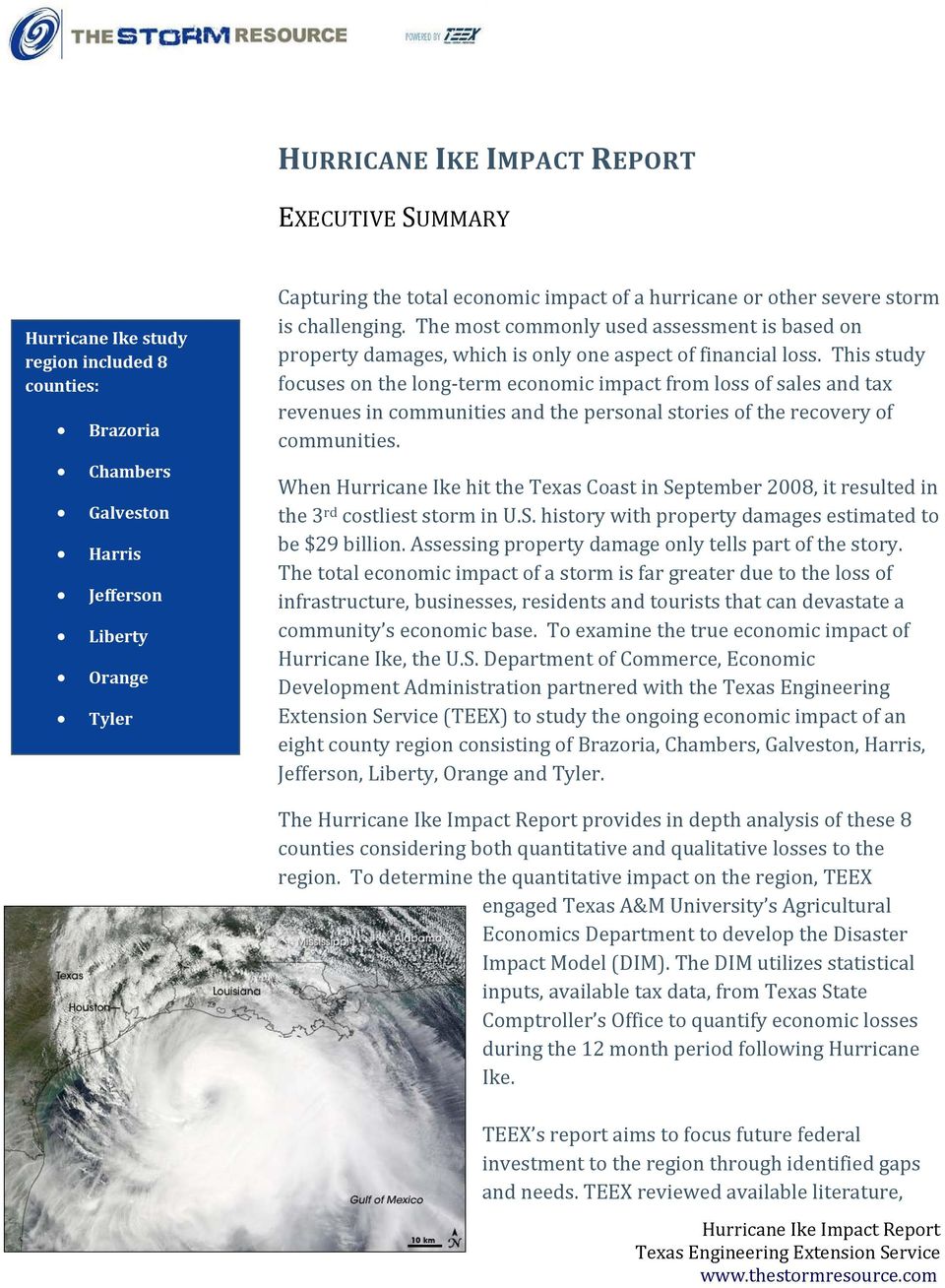
2 HURRICANE IKE IMPACT REPORT EXECUTIVE SUMMARY Hurricane Ike study region included 8 counties: Brazoria Chambers Galveston Harris Jefferson Liberty Orange Tyler Capturing the total economic impact of a hurricane or other severe storm is challenging. The most commonly used assessment is based on property damages, which is only one aspect of financial loss. This study focuses on the long term economic impact from loss of sales and tax revenues in communities and the personal stories of the recovery of communities. When Hurricane Ike hit the Texas Coast in September 2008, it resulted in the 3 rd costliest storm in U.S. history with property damages estimated to be $29 billion. Assessing property damage only tells part of the story. The total economic impact of a storm is far greater due to the loss of infrastructure, businesses, residents and tourists that can devastate a community s economic base. To examine the true economic impact of Hurricane Ike, the U.S. Department of Commerce, Economic Development Administration partnered with the Texas Engineering Extension Service (TEEX) to study the ongoing economic impact of an eight county region consisting of Brazoria, Chambers, Galveston, Harris, Jefferson, Liberty, Orange and Tyler. The provides in depth analysis of these 8 counties considering both quantitative and qualitative losses to the region. To determine the quantitative impact on the region, TEEX engaged Texas A&M University s Agricultural Economics Department to develop the Disaster Impact Model (DIM). The DIM utilizes statistical inputs, available tax data, from Texas State Comptroller s Office to quantify economic losses during the 12 month period following Hurricane Ike. TEEX s report aims to focus future federal investment to the region through identified gaps and needs. TEEX reviewed available literature,
3 Case studies have been developed to highlight areas of resilience and adversity following Hurricane Ike: K 12 Education Vital Records City Planning Agriculture Preservation Residential Tourism post disaster reports and conducted primary research strategies to collect missing data. To complete TEEX s understanding of the impact of Hurricane Ike, research activities were conducted at the local and county levels. Interviews and surveys were conducted with subject matter experts, and a wide variety of local, county and regional officials representing members of Texas Task Force One, members of the Public Works Response Team, TEEX Urban Search and Rescue, city mayors, emergency management coordinators, county judges, city administrators, public works officials, economic development managers, school district personnel, business owners and residents. These interviews were incorporated into case studies to tell the stories of recovery and lessons learned in preparation, during and the aftermath of the storm. The data collected through the Disaster Impact Model and primary and secondary research has been analyzed and compiled into this report and the Storm Resource website located at.
4 BACKGROUND Total damages from Hurricane Ike are estimated to be as high as $29 million Approved insurance claims for the State of Texas were approximately $12 million On September 13, 2008, Hurricane Ike made landfall over Galveston Island with maximum sustained winds reaching 110 mph and extending outward nearly 120 miles from the eye. The damage to homes, personal property, the environment, infrastructure and businesses devastated communities along the Texas Gulf Coast. Hurricane Ike s total damages are estimated to be as high as $29 billion. The Insurance Council of Texas puts the total insured damages in Texas at approximately $12 billion. Actual damages, however, are considerably higher due to the number of uninsured properties and properties without flood insurance. Damage estimates and insurance payouts only tell part of the story when determining the true impact of Hurricane Ike or any disaster. In order to develop a more complete analysis of Hurricane Ike s economic impact, the Economic Development Administration (EDA) determined a study was needed to look past initial damages and analyze how the storm affected the economy over time. In July 2009, the EDA provided the (TEEX) funding to document the effects of Hurricane Ike and disseminate findings to partners to mitigate the long term economic impacts of the storm. In order to analyze the total economic impact of Hurricane Ike and establish a model for documenting effects of future storms, TEEX assembled a team of disaster preparedness experts, continuity planners, economic developers and economists to document both the quantitative and qualitative impacts of storms. The team established models and methods that can be rapidly deployed to document impacts for future storms and most importantly, capture lessons learned to help others prepare and recover more quickly. To quantify storm impacts, TEEX partnered with economists at Texas A&M University s Department of Agricultural Economics, who

5 developed the peer reviewed Disaster Impact Model (DIM). The DIM captures local sales data and quantifies losses at the county level. In short, actual historical county sales tax data has been modeled developing statistical trends over time. Deviations from this trend in the 12 month period following the aftermath of Ike (Q Q2009 3) are then used to determine the storm s direct effect. The Disaster Impact Model (DIM) was developed by Texas A&M University s Agricultural Economics Department to quantify the economic impacts of Hurricane Ike In order to capture qualitative impacts of the storm, TEEX capitalized on its role in disaster response to identify regions especially hard hit by the storm and circumstances and events of significant impact to document best practices and lessons learned. When members of TEEX Public Works Response Team or Urban Search and Rescue responders, leading Texas Task Force One, saw extreme devastation, they informed the economic development team who in turn sought to understand and document these circumstances. Through a series of site visits and interviews with local leaders, TEEX documented qualitative impacts of Hurricane Ike. Perhaps the most important outcome of this effort is the documentation of best practices and lessons learned presented here and ready for reference when preparing for, or responding to the next disaster. METHODOLOGY Disaster Impact Model To quantify the economic impacts of Hurricane Ike, TEEX partnered with economists at Texas A&M University s Agricultural Economics Department who developed the Disaster Impact Model (DIM). The DIM is intended to be a county level tool to enhance risk management and storm recovery efforts. As such, the study considered the county level impact of the storm on output, total value added (contribution to gross regional product), labor income, employment, and indirect businesses taxes. Using the model, county officials will be able to identify industrial sectors that are critical to economic recovery and estimate the
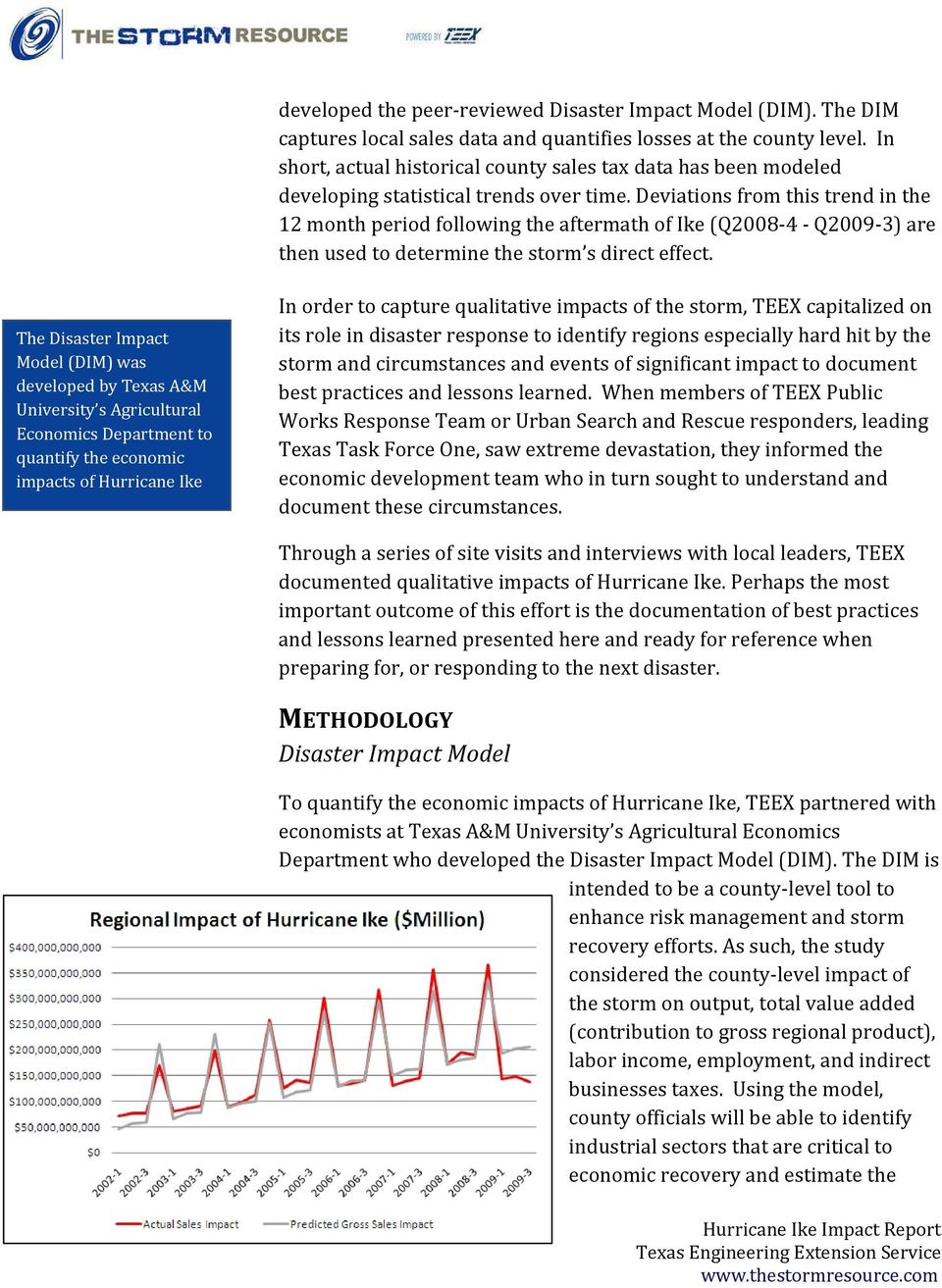
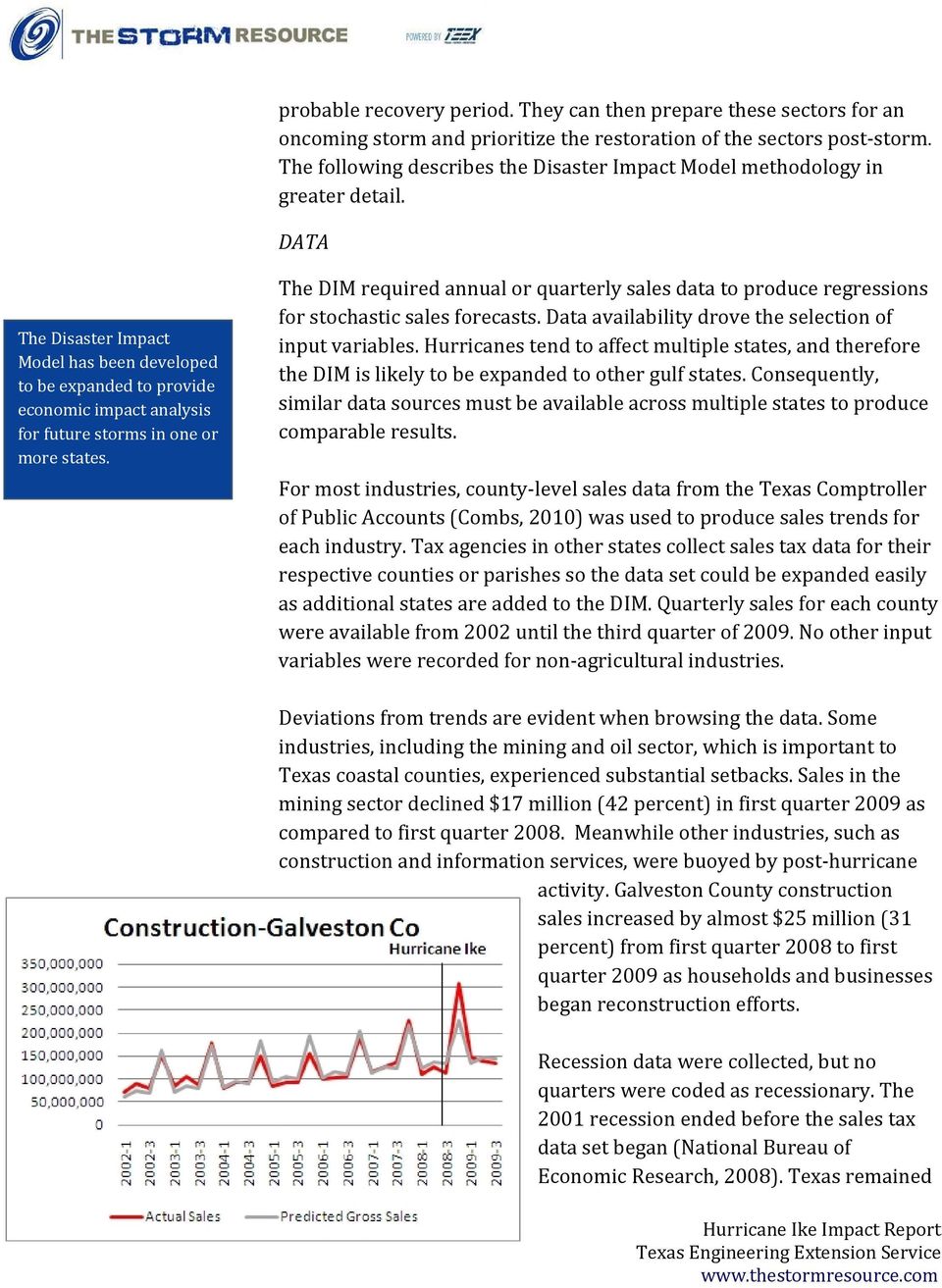
6 probable recovery period. They can then prepare these sectors for an oncoming storm and prioritize the restoration of the sectors post storm. The following describes the Disaster Impact Model methodology in greater detail. DATA The Disaster Impact Model has been developed to be expanded to provide economic impact analysis for future storms in one or more states. The DIM required annual or quarterly sales data to produce regressions for stochastic sales forecasts. Data availability drove the selection of input variables. Hurricanes tend to affect multiple states, and therefore the DIM is likely to be expanded to other gulf states. Consequently, similar data sources must be available across multiple states to produce comparable results. For most industries, county level sales data from the Texas Comptroller of Public Accounts (Combs, 2010) was used to produce sales trends for each industry. Tax agencies in other states collect sales tax data for their respective counties or parishes so the data set could be expanded easily as additional states are added to the DIM. Quarterly sales for each county were available from 2002 until the third quarter of No other input variables were recorded for non agricultural industries. Deviations from trends are evident when browsing the data. Some industries, including the mining and oil sector, which is important to Texas coastal counties, experienced substantial setbacks. Sales in the mining sector declined $17 million (42 percent) in first quarter 2009 as compared to first quarter Meanwhile other industries, such as construction and information services, were buoyed by post hurricane activity. Galveston County construction sales increased by almost $25 million (31 percent) from first quarter 2008 to first quarter 2009 as households and businesses began reconstruction efforts. Recession data were collected, but no quarters were coded as recessionary. The 2001 recession ended before the sales tax data set began (National Bureau of Economic Research, 2008). Texas remained
7 insulated from the recession that began in December 2007 until The recession in Texas was not severe by the first quarter of 2009, which is the only post hurricane quarter currently used in the study. At the same time, the recession hit different industries and different counties at different times. Recessionary effects will be explored more fully in a multi state data set. Agriculture losses include the loss of production capacity and livestock losses due to death and decreased livestock inventories Most agricultural production and price data were obtained from the US Department of Agriculture National Agricultural Statistics Service (2009). Agricultural statistics are available for all states at the county or parish level for each year back to Production and price data for the past eleven years (1999 to 2009) were collected. The 1999 to 2008 data were used to estimate production coefficients. Productivity has changed rapidly over time, and ten years was deemed to reflect current farming practices and policy while providing a sufficient time series from which to estimate future production. The 2009 data was the only year of posthurricane comparison data available. National average prices were used, reflecting the global market for agricultural products and simplifying the future addition of counties and states to the model. Historical price data for goats and sheep were not published by USDA. Those annual prices were obtained from the Livestock Marketing Information Center (Anderson, 2010). Deviations from the expected production levels account for losses to each crop. For most crops and livestock, the deviation was noted for By September, most 2008 crops had been harvested. The first livestock inventory after the hurricane occurred in January Crop losses thus included the loss of production capacity, and livestock losses include animal deaths and decreased livestock inventories. Data on additional variables was collected and considered for the data set. However, gas prices were not significant in initial estimations. Disaster designations occur on a county basis and additionally have different effects on crops with different
8 maturation cycles. Furthermore, disasters occur with varying levels of intensity. For example, droughts and flooding are both disasters but have different effects. Thus disaster designations were excluded from the data set due to the difficulty of gathering sufficient and meaningful data. Simetar was developed to provide simulation and graphical analysis tools for conducting risk analysis of policy changes on agribusinesses. METHODS The first step in quantifying the economic losses to the eight counties in the study area was to identify the sales trend for each industry. Sales by each industry or commodity were regressed using the Simetar Excel add on (Richardson, Schumann, and Feldman, 2008). Simetar generated stochastic sales forecasts based on the regression coefficients. The stochastic element reflected production and price risk and the variability of production across years. These stochastic estimates were then combined with IMPLAN (MIG, 2009) multipliers to estimate total economic losses following Hurricane Ike. The county level sales data from the Texas Comptroller of Public Accounts (Combs, 2010) was used to establish a trend for sales based on the previous seven years and produce a stochastic sales forecast for the next eight quarters (two years). Actual county sales data were modeled for a period of seven years with quarterly sales as the exogenous variable. Years and quarter dummies were the endogenous variables accounting for trends over time and between fiscal quarters. A recession dummy was included in the model for future use, but no quarters were coded as recessionary. Sales for the eight quarters from first quarter 2009 (September to November 2008) until fourth quarter 2010 (June to August 2010) were stochastically forecasted for each sector. The sales of major agricultural products were estimated with year from the base year 1999, year from base squared, and previous year s price as the endogenous variables. Products that had only been grown a few times or that had not been grown in the last two years were not modeled. Commodities included in the model were corn, cotton, grain sorghum, rice, soybeans, wheat, beef cattle, goats, and sheep. Data from 1999 to 2008 were used to estimate coefficients for each commodity.
9 Two additional years were stochastically forecasted for each product. IMPLAN software system helps analysts address two common questions about economic study and analysis: How does my local economy function? What would the economic consequences of a project or action be? Comptroller data was available only at the two digit sector level. However, IMPLAN (MIG, 2009) uses more precise sector breakdowns in calculating industry multipliers. Weighted multipliers were used to capture the major industries within each two digit sector. IMPLAN output data were used to identify the top three IMPLAN industries in each sector and determine their relative proportions within each county. The industry relative shares were multiplied by the respective industry multipliers for the county and the results summed to construct the weighted multiplier for each two digit sector. Agricultural commodities used the multipliers for their respective IMPLAN assigned industry. The weighted multipliers were taken times the stochastic industry forecasts for each quarter to generate total economic effects. The eight quarterly total economic effects reflected the economic linkages associated with each industry and the indirect and induced effects of final demand sales. Agricultural commodities multipliers and annual forecasts generated annual total economic effects for each economy. The total economic effect forecasts for each industry/commodity and quarter/year were then simulated using Simetar. The minimum, maximum, and mean total economic effect forecasts from the simulations were recorded as the average and bounds of the forecasted industry sales. Only the summary statistics were used to facilitate conversion to a Web based delivery format and to aid comprehension by the general public. Stochastic effects were assigned a lower bound of zero as negative sales are precluded. States also have an interest in determining the state wide impact from a storm. Summing county level impacts leads to an underrepresentation of state wide effects. Therefore, Texas state multipliers were used with the county industry shares and stochastic forecasts to calculate impacts across the entire state. The modeling process was identical to that used for the county level models. Only

10 the multipliers differed between the county and state models. Because IMPLAN is a linear model, summing the state multiplier results across counties produces an accurate estimation of statewide impacts. The Disaster Impact Model identified sectors in Texas most vulnerable to disruption Manufacturing Wholesale Trade Beef Cattle Rice CONCLUSIONS The results of the disaster impact model for Hurricane Ike validated that the storm did result in economic losses across Texas counties. The DIM also identified sectors that were most vulnerable to disruption and sectors that were positively affected by the storm. This knowledge should enhance disaster preparedness efforts and help officials to request and target disaster assistance. Local and state officials may be able to work with vulnerable sectors in mitigating storm damage. Officials may be able to promote rapid economic recovery by encouraging coordinated disaster planning across all sectors. Primary and Secondary Research The has been compiled and documented by (TEEX) over the 18 month project life through both quantitative (secondary data collection) and qualitative (primary data collection). TEEX has utilized primary and secondary research techniques to complete this report. PRIMARY RESEARCH Primary research for this report was conducted by Texas Engineering Extension Service (TEEX) through interviews, workshops, phone calls, s and trips into the Hurricane Ike study region. TEEX initially utilized their direct relationships throughout the agency to interview members of Texas Task Force One, Public Works Response Team, TEEX Urban Search and Rescue along with members of TEEX National Emergency Response and Recovery Training Center. The interviews were strategic in developing TEEX approach to capturing qualitative insight from the Hurricane Ike region. TEEX initiated interviews in the Hurricane Ike study region in July of Over a two month period of time, TEEX employees traveled into the region and interviewed county judges and emergency management coordinators from all eight counties in

11 order to capture local perspectives of the Hurricane Ike impacts. TEEX travel was postponed in August 2009 in recognition of Texas hurricane season. TEEX conducted interviews with local leaders, school district officials, task force members, county judges, emergency management coordinators and others to gather data for this study. Over the last 12 months TEEX researchers have contacted individuals residing in identified regions or sectors to hear first hand the stories and experiences recounted. These interviews allowed TEEX to create the Ike Case Studies available at to capture local experiences and best practices arising from Hurricane Ike. SECONDARY RESEARCH TEEX aims to provide the U.S. Department of Commerce, Economic Development Administration, the state of Texas and the eight counties in the project study area, a valuable resource for understanding the economic impacts of the storm. To ensure the reports value, secondary research was used extensively. TEEX compiled published, after action reports from Federal Emergency Management Agency (FEMA), numerous federal and state agencies along with county and city level reports to ensure the provided new and valuable insights to the economic impacts of the storm. For the development of the Texas A&M University s Department of Agricultural Economics, Disaster Impact Model (DIM) TEEX compiled sales tax data from the Texas State Comptroller s office. Historical data was collected for the past 10 years, across 29 different industry sectors. The DIM was able to provide a by county, estimated total economic impact from Hurricane Ike for the 4 quarters or 12 month period following the storm. Through subscription databases, open source web libraries, and suggestions from the extensive interviewing process, TEEX has compiled multiple resources for the preparation of future events. These resources will be made available through The Storm Resource website for reference purposes.

12 Hurricane Ike Overall Economic Impact Hurricane Ike is the 3 rd costliest storm in U.S. history causing an estimated $29 billion in property damage. In the 12 months immediately following Ike, it is estimate that the study region suffered an economic loss of $142 billion. Hurricane Ike is estimated to have caused $29 billion in property damages, making Ike the 3 rd costliest storm in U.S. history. However, the true economic impact of Hurricane Ike was considerably greater. The impact region alone suffered losses and downtime of infrastructure, food services, retail, manufacturing and utilities along with the displacement of workers, consumer and tourists. The Hurricane Ike Impact Study s Disaster Impact Model (DIM) has calculated the total economic impact of Hurricane Ike for the 12 months immediately following the storm (2008Q4 2009Q3) to be an estimated $142 billion. TEEX partnered with Texas A&M University s Department of Agricultural Economics to have the Disaster Impact Model (DIM) developed. DIM was built to allow economists the ability to analyze economic impacts, both gains and reductions, in 29 different industry sectors at the county level. Utilizing historical sales and tax data expected receipts were forecasted for the 12 months period immediately following Hurricane Ike. Then as sales and tax data became available through Texas State Comptroller s office, DIM calculated the actual reduction or gain in sales and taxes experienced in the 8 counties studied. Historical data has been compiled for 29 industry sectors that were then categorized into three clusters often represented in coastal regions: Industrial Services Agriculture The following three tables provide total economic impacts across all 8 counties. Each sector is broken down into the following impacts: total, quarterly and weekly.
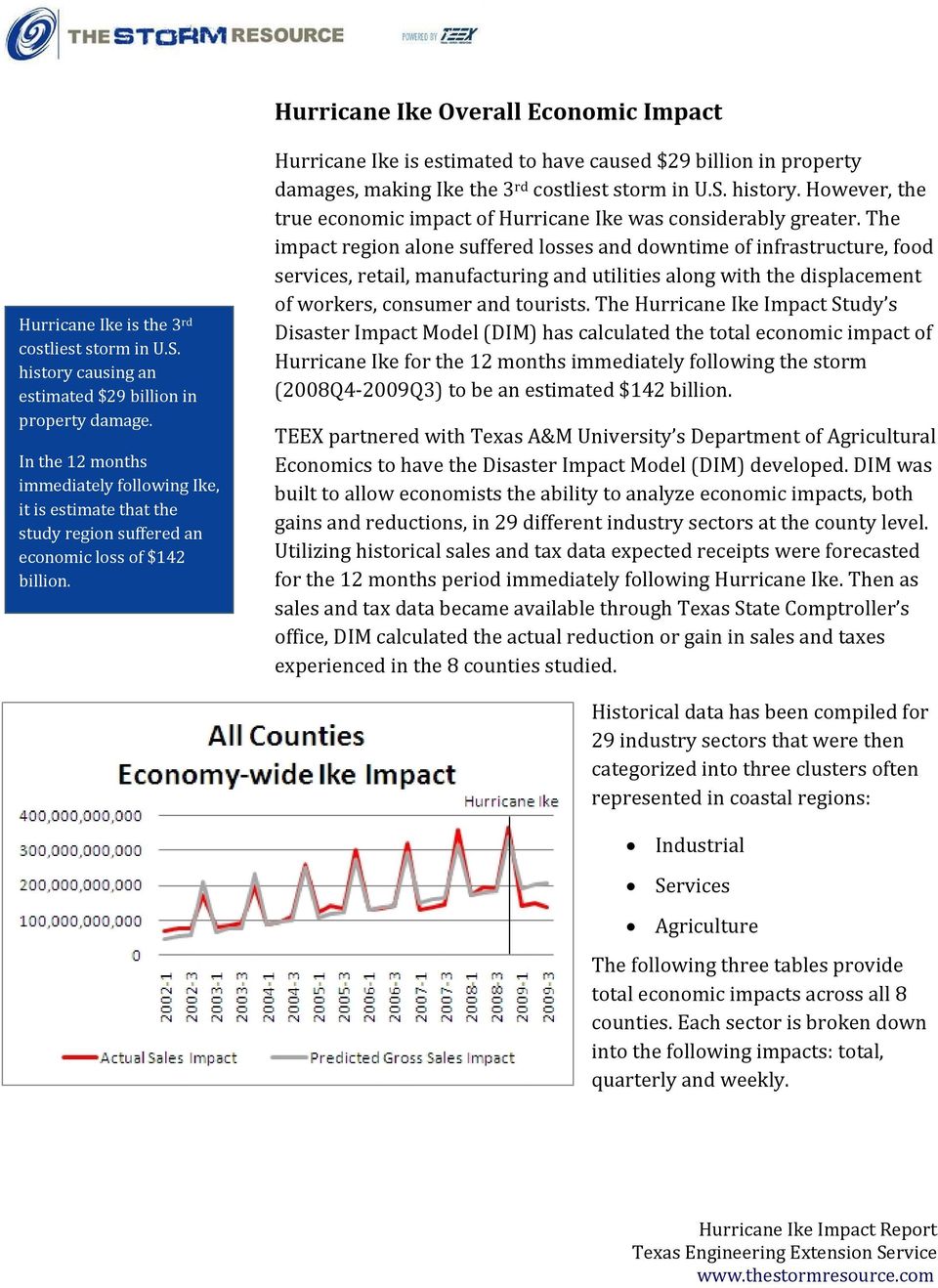
13 TABLE 1: INDUSTRIAL SECTORS Industrial Sectors Total Avg. Loss Quarterly Avg. Loss Weekly Avg. Loss Agricultural $38,793,587 $9,698,396 $746,030 Support Utilities $9,624,794,721 $2,406,198,680 $185,092,206 Construction $3,080,566,408 $770,141,602 $59,241,661 Manufacturing $93,580,886,674 $23,395,221,668 $1,799,632,436 Wholesale Trade $40,119,203,939 $10,029,800,985 $771,523,152 Retail Trade $6,696,308,711 $1,674,077,178 $128,775,168 Transportation/ $2,123,495,670 $530,873,918 $40,836,455 Warehousing Mining/Oil/Gas $3,099,595,502 $774,898,876 $59,607,606 TABLE 2: AGRICULTURAL SECTORS Agriculture Sectors Total Avg. Loss Quarterly Avg. Loss Weekly Avg. Loss Corn $311,931 $77,983 $5,999 Cotton $6,836,967 $1,709,242 $131,480 Grain Sorghum $5,178,324 $1,294,581 $99,583 Rice $23,004,119 $5,751,030 $442,387 Soybeans $1,196,979 $299,245 $23,019 Wheat $935,334 $233,834 $17,987 Beef $66,095,870 $16,523,968 $1,271,074 Goats $1,231,737 $307,934 $23,687 Sheep $207,508 $2,804 $3,991
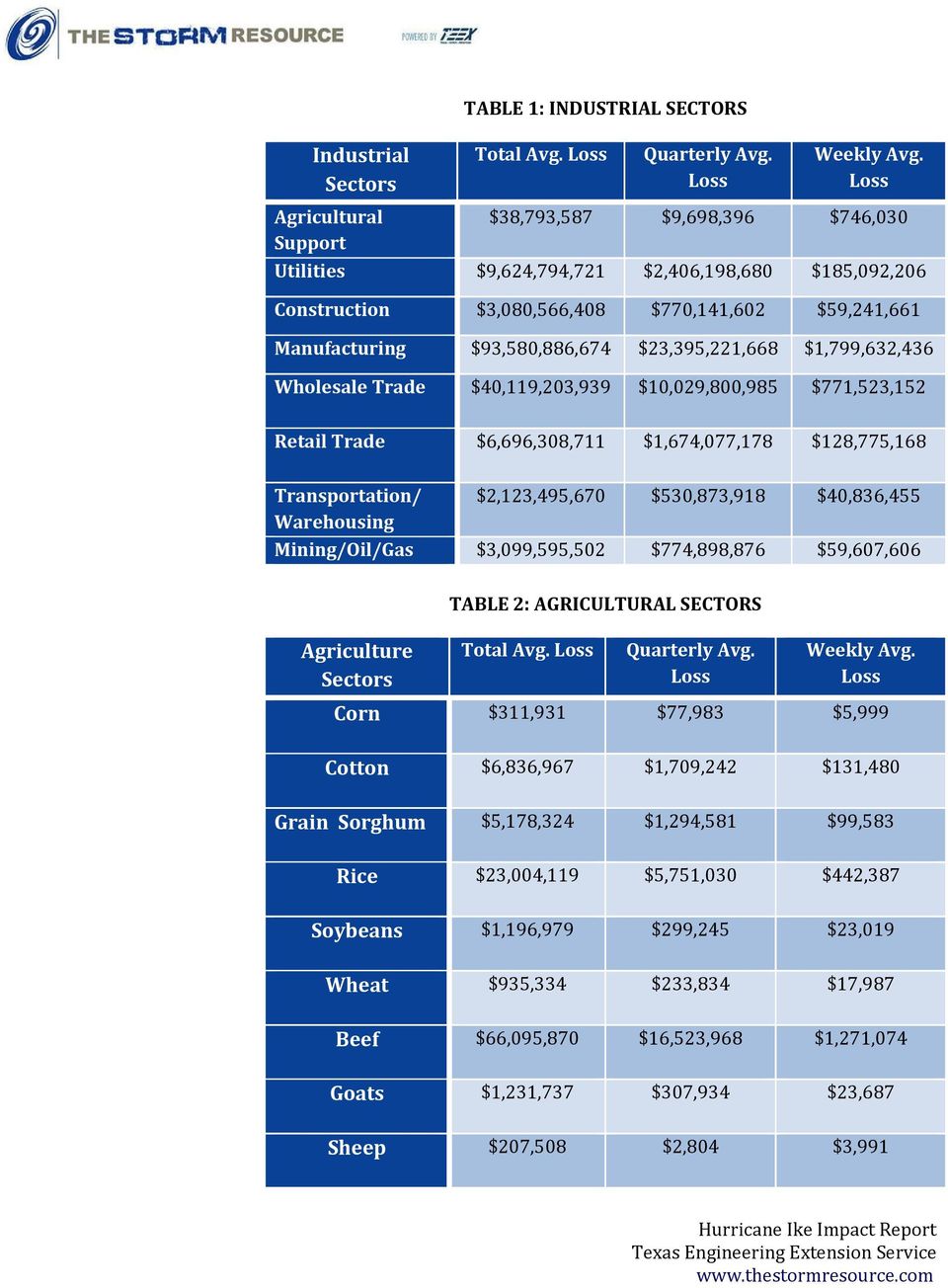
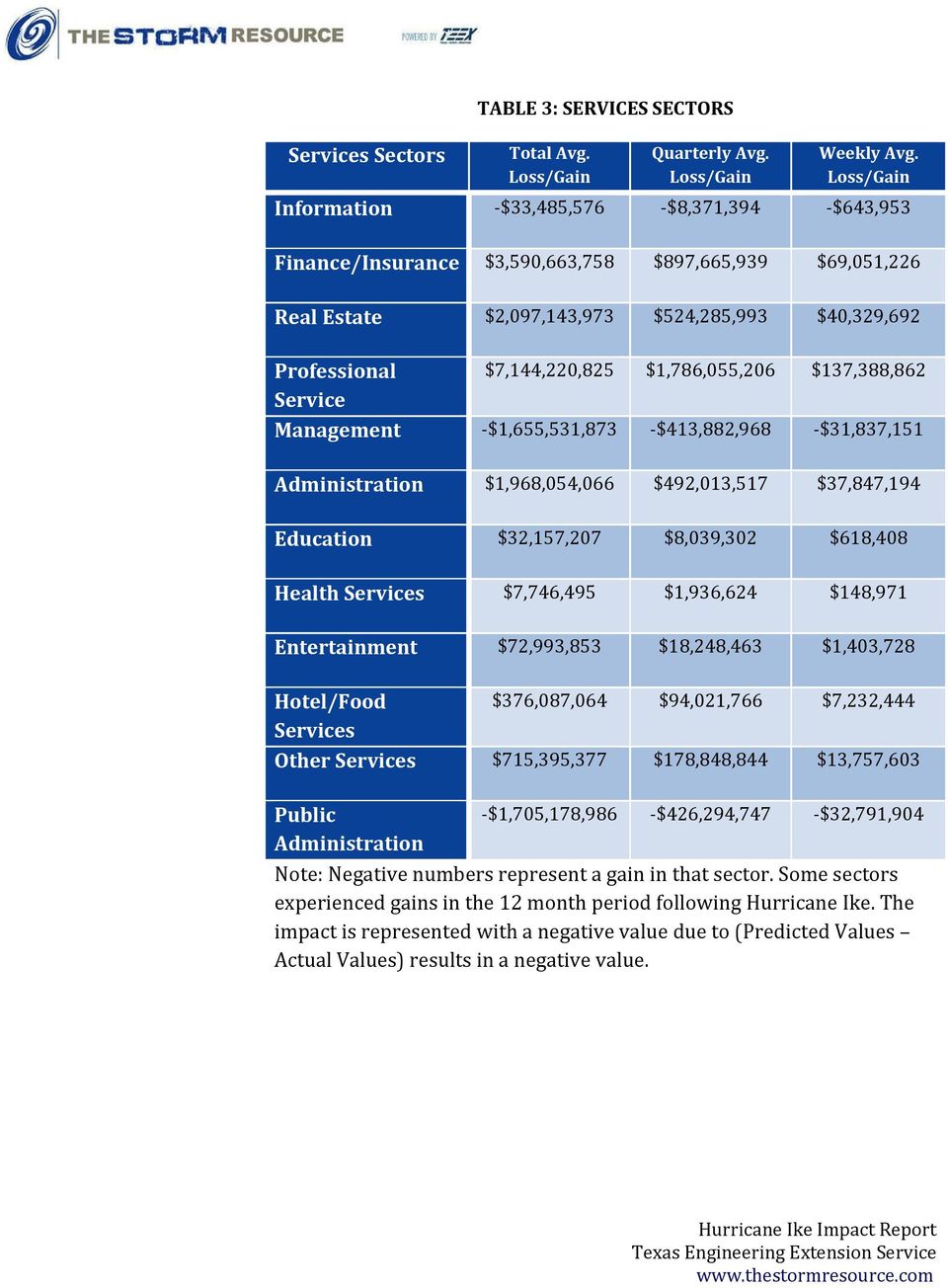
14 Services Sectors TABLE 3: SERVICES SECTORS Total Avg. Loss/Gain Quarterly Avg. Loss/Gain Weekly Avg. Loss/Gain Information $33,485,576 $8,371,394 $643,953 Finance/Insurance $3,590,663,758 $897,665,939 $69,051,226 Real Estate $2,097,143,973 $524,285,993 $40,329,692 Professional $7,144,220,825 $1,786,055,206 $137,388,862 Service Management $1,655,531,873 $413,882,968 $31,837,151 Administration $1,968,054,066 $492,013,517 $37,847,194 Education $32,157,207 $8,039,302 $618,408 Health Services $7,746,495 $1,936,624 $148,971 Entertainment $72,993,853 $18,248,463 $1,403,728 Hotel/Food $376,087,064 $94,021,766 $7,232,444 Services Other Services $715,395,377 $178,848,844 $13,757,603 Public $1,705,178,986 $426,294,747 $32,791,904 Administration Note: Negative numbers represent a gain in that sector. Some sectors experienced gains in the 12 month period following Hurricane Ike. The impact is represented with a negative value due to (Predicted Values Actual Values) results in a negative value.
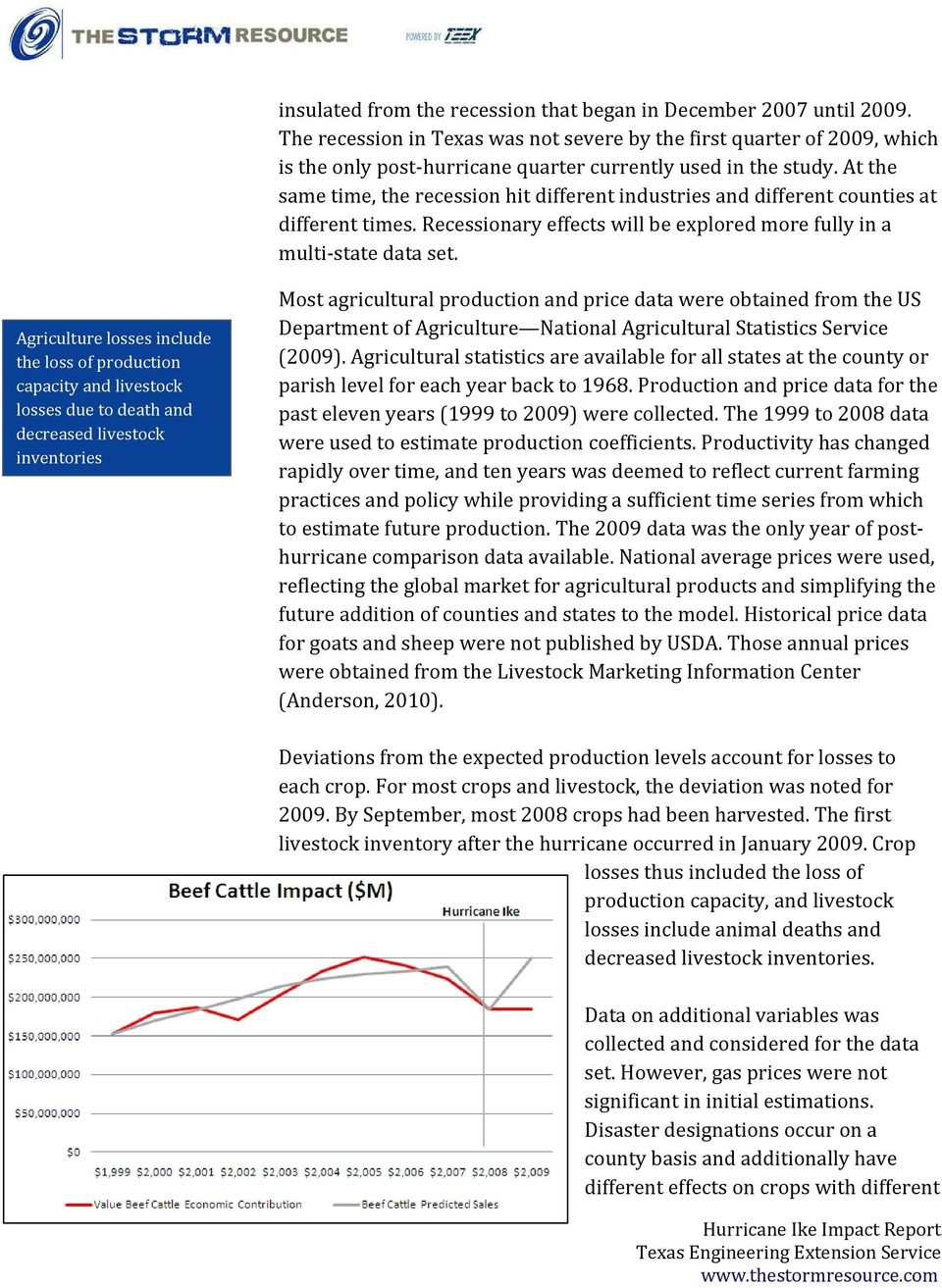
15 INDUSTRY IMPACTS Impact on Agriculture Production For the agricultural sectors, production and price data were obtained from the USDA National Agricultural Statistics Service. Annual production of each commodity by county was modeled. Deviations from the expected production levels account for losses to that crop. For most crops and livestock, the deviation is noted for The first livestock inventory after the hurricane occurred in January Crop losses thus include the loss of production capacity, and livestock losses include animal deaths and decreased livestock inventories. Agricultural Commodities: Corn Cotton Grain Sorghum Rice Soybeans Wheat Beef Cattle Goats Sheep The sales and economic contribution of production agriculture has declined slightly in recent years. Weather and world wide supply and demand conditions result in highly volatile agricultural production and prices, complicating sales and contribution predictions. Most crops were harvested when Hurricane Ike hit the study area. Thus, 2008 sales were largely unaffected. Hurricane induced changes to soil conditions can continue to affect crop production for several years. The economic contribution of production agriculture was 9 percent below predictions for 2009.

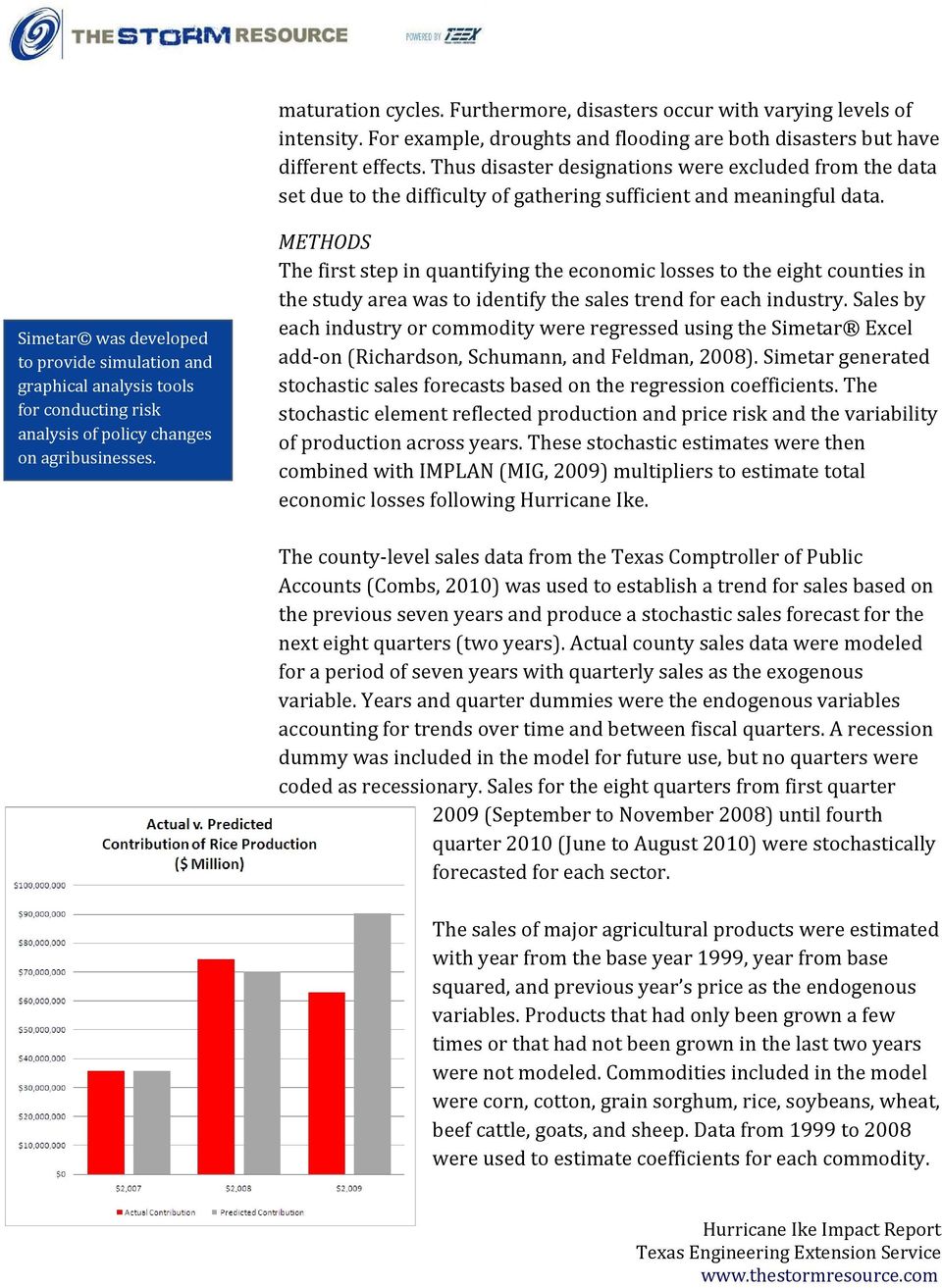
16 Value Beef Cattle Economic Contribution, ($ Million) Although many livestock animals were destroyed by the storm and others were sold due to lack of grazing areas, livestock inventories were relatively stable from 2008 to Regional livestock herds had been shrinking since peaking in The hurricane sustained that trend. Beef numbers rose through the early 2000s but declined after prices peaked. Goat and sheep numbers followed a similar trend. Many livestock were lost in the storm, devastating producers in some locations. However, other counties gained livestock, offsetting those losses In 2009, the contribution of rice production was approximately $10 million less than predicted by the Disaster Impact Model 2009 rice production was lower than 2008 values and 2009 predictions, partially as a result of high salinity in rice paddies resulting from Ike pushing saline water inland. However, rice generated a significantly larger contribution than in most other years of the 2000s Actual v. Predicted Contribution of Rice Production ($ Million) Actual Contribution Predicted Contribution

17 IMPACT ON INDUSTRIAL SECTORS For most industries, county level sales data from the Texas Comptroller of Public Accounts (Combs, 2010) was used to produce sales trends for each industry. Quarterly sales for each county were available from 2002 until the third quarter of Industrial Sectors: Agriculture Support Mining/Oil/Natural Gas Utilities Construction Manufacturing Wholesale Trade Retail Trade Transportation/ Warehousing The region s industrial sector is cyclical, and some businesses report annual sales during the fourth quarter. Reported sales consistently spike in the fourth quarter and trend up only slightly during the rest of the year. Never the less, the economic contribution of the industrial sectors has trended up over the past decade. Growth prior to the hurricane (late Q3 2008) exceeded predictions. Following Ike, the actual industrial impact lagged predicted sales by the more than during previous shortfalls. In the first two quarters following Hurricane Ike, actual contributions fell short of predicted levels by about $45 million per quarter. This increased to $68 million in the third quarter of 2009 when the negative effect on tourism became more evident, although that
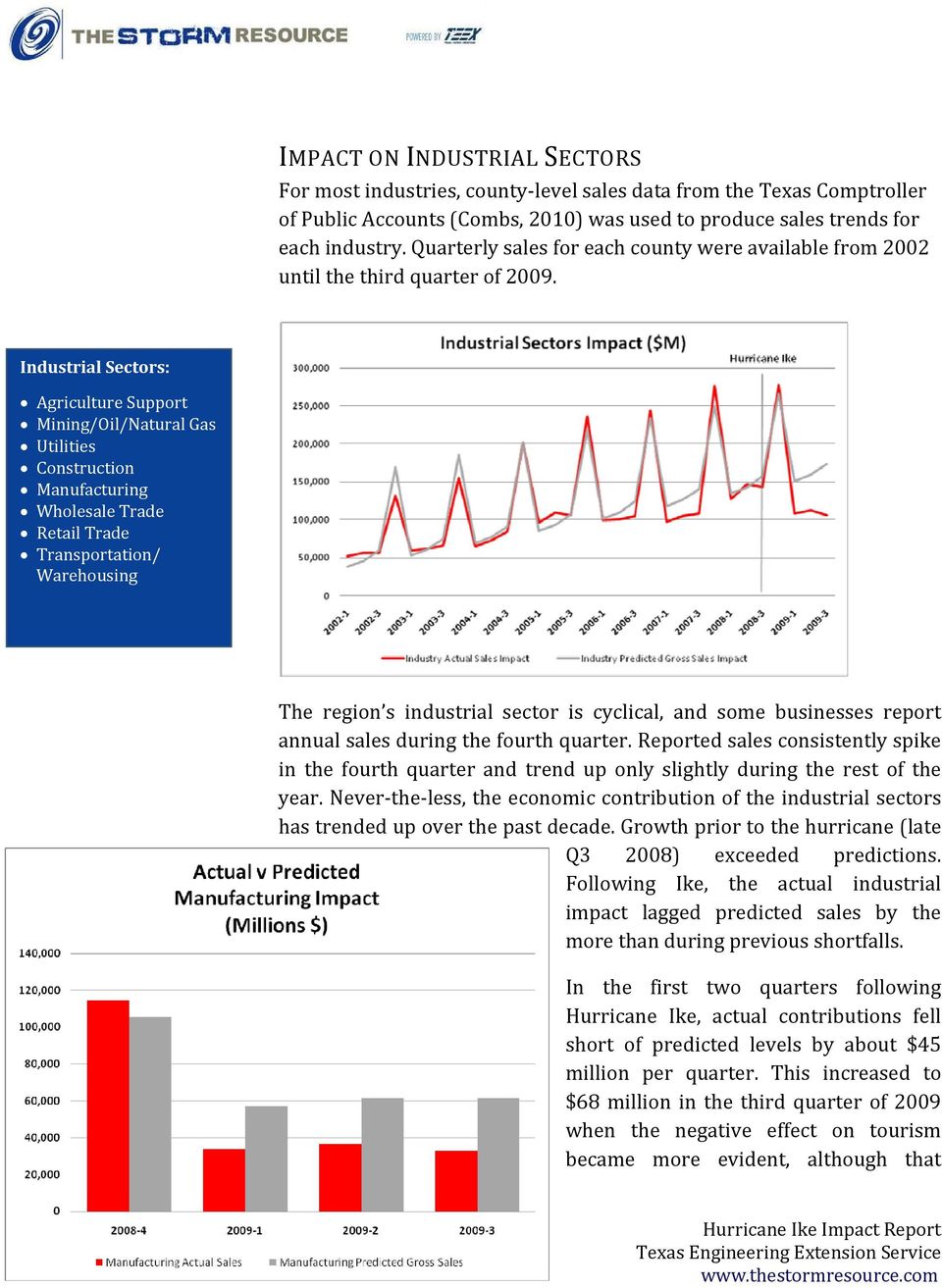
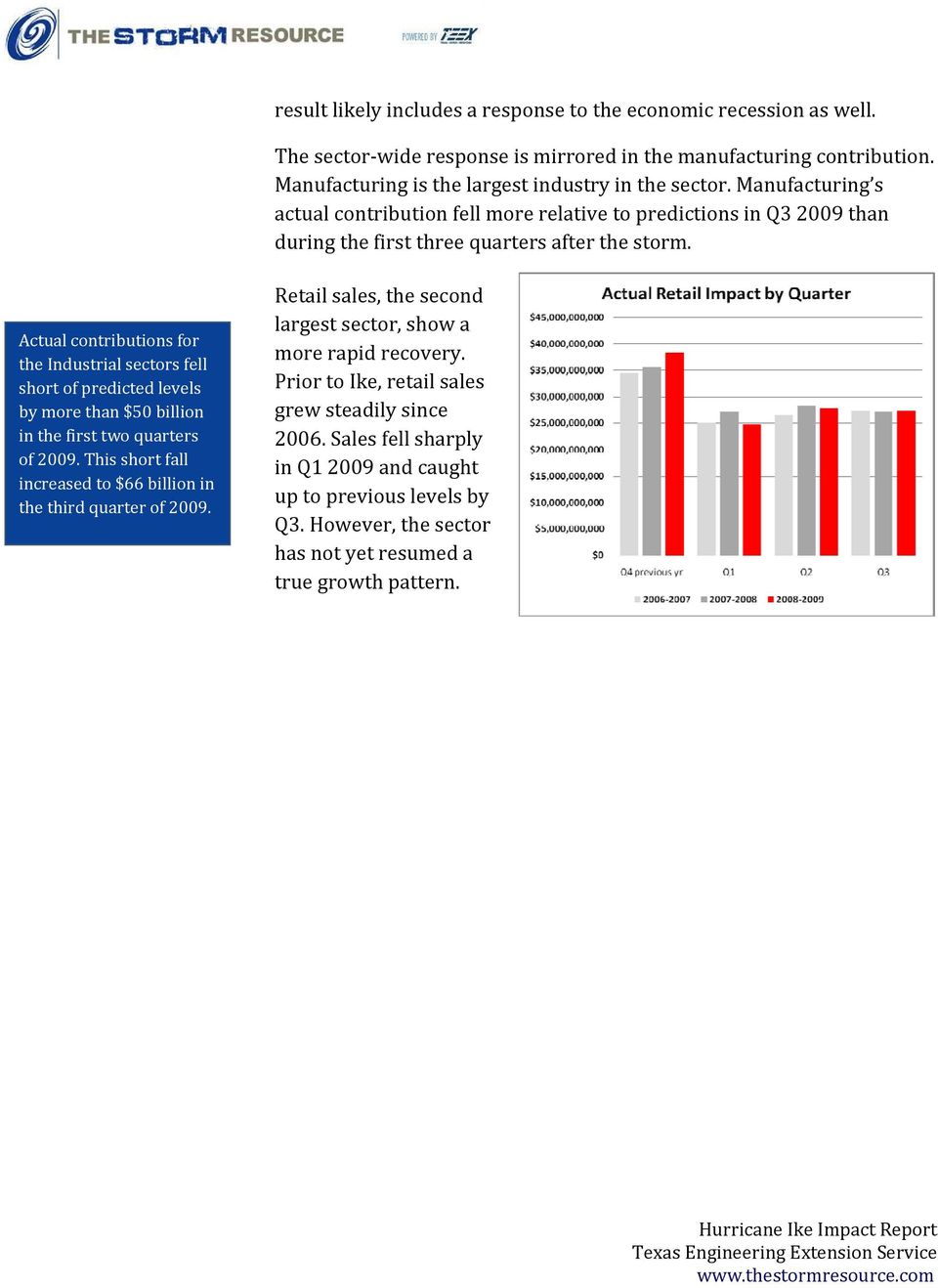
18 result likely includes a response to the economic recession as well. The sector wide response is mirrored in the manufacturing contribution. Manufacturing is the largest industry in the sector. Manufacturing s actual contribution fell more relative to predictions in Q than during the first three quarters after the storm. Actual contributions for the Industrial sectors fell short of predicted levels by more than $50 billion in the first two quarters of This short fall increased to $66 billion in the third quarter of Retail sales, the second largest sector, show a more rapid recovery. Prior to Ike, retail sales grew steadily since Sales fell sharply in Q and caught up to previous levels by Q3. However, the sector has not yet resumed a true growth pattern.
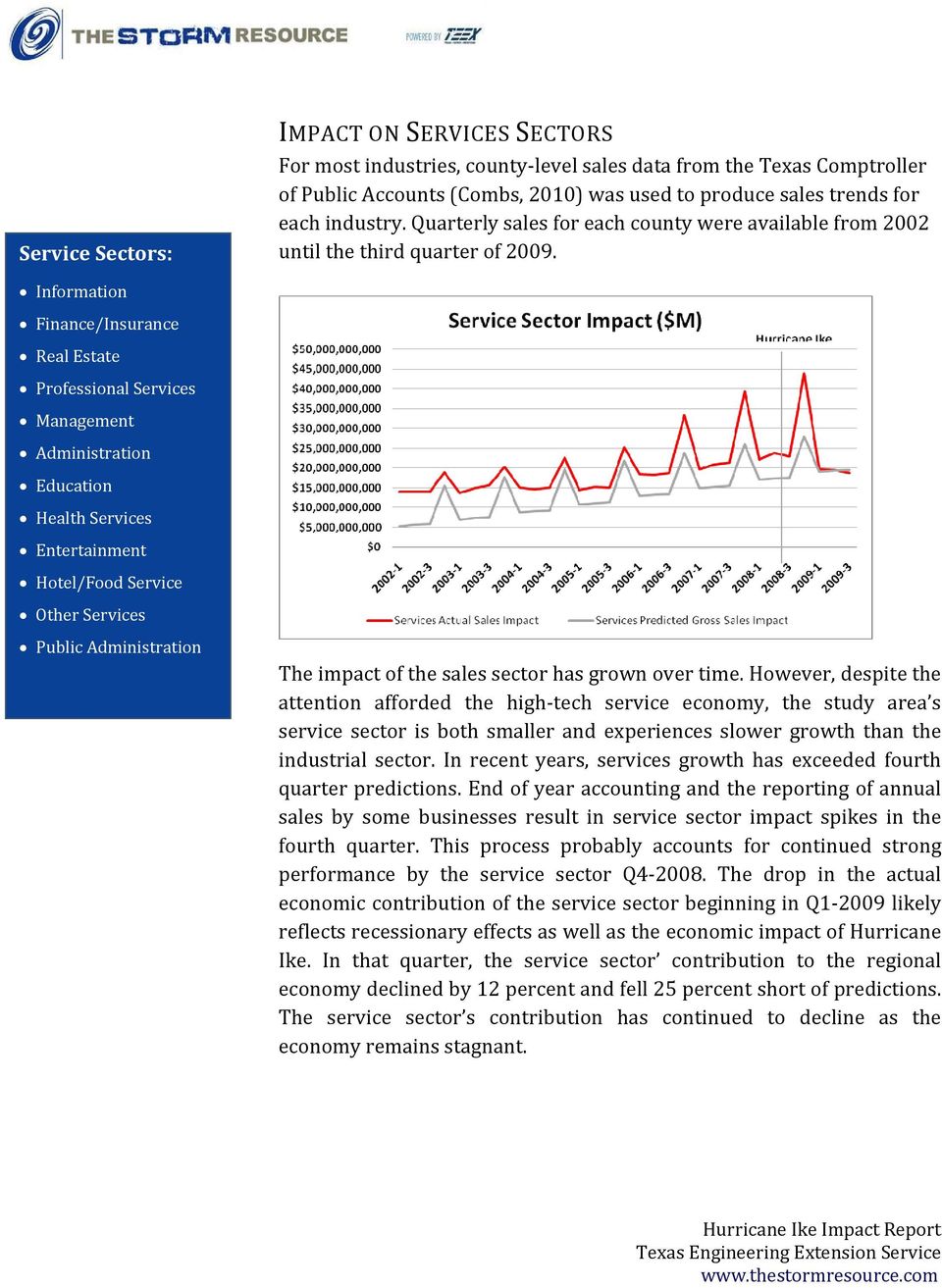
19 Service Sectors: IMPACT ON SERVICES SECTORS For most industries, county level sales data from the Texas Comptroller of Public Accounts (Combs, 2010) was used to produce sales trends for each industry. Quarterly sales for each county were available from 2002 until the third quarter of Information Finance/Insurance Real Estate Professional Services Management Administration Education Health Services Entertainment Hotel/Food Service Other Services Public Administration The impact of the sales sector has grown over time. However, despite the attention afforded the high tech service economy, the study area s service sector is both smaller and experiences slower growth than the industrial sector. In recent years, services growth has exceeded fourth quarter predictions. End of year accounting and the reporting of annual sales by some businesses result in service sector impact spikes in the fourth quarter. This process probably accounts for continued strong performance by the service sector Q The drop in the actual economic contribution of the service sector beginning in Q likely reflects recessionary effects as well as the economic impact of Hurricane Ike. In that quarter, the service sector contribution to the regional economy declined by 12 percent and fell 25 percent short of predictions. The service sector s contribution has continued to decline as the economy remains stagnant.
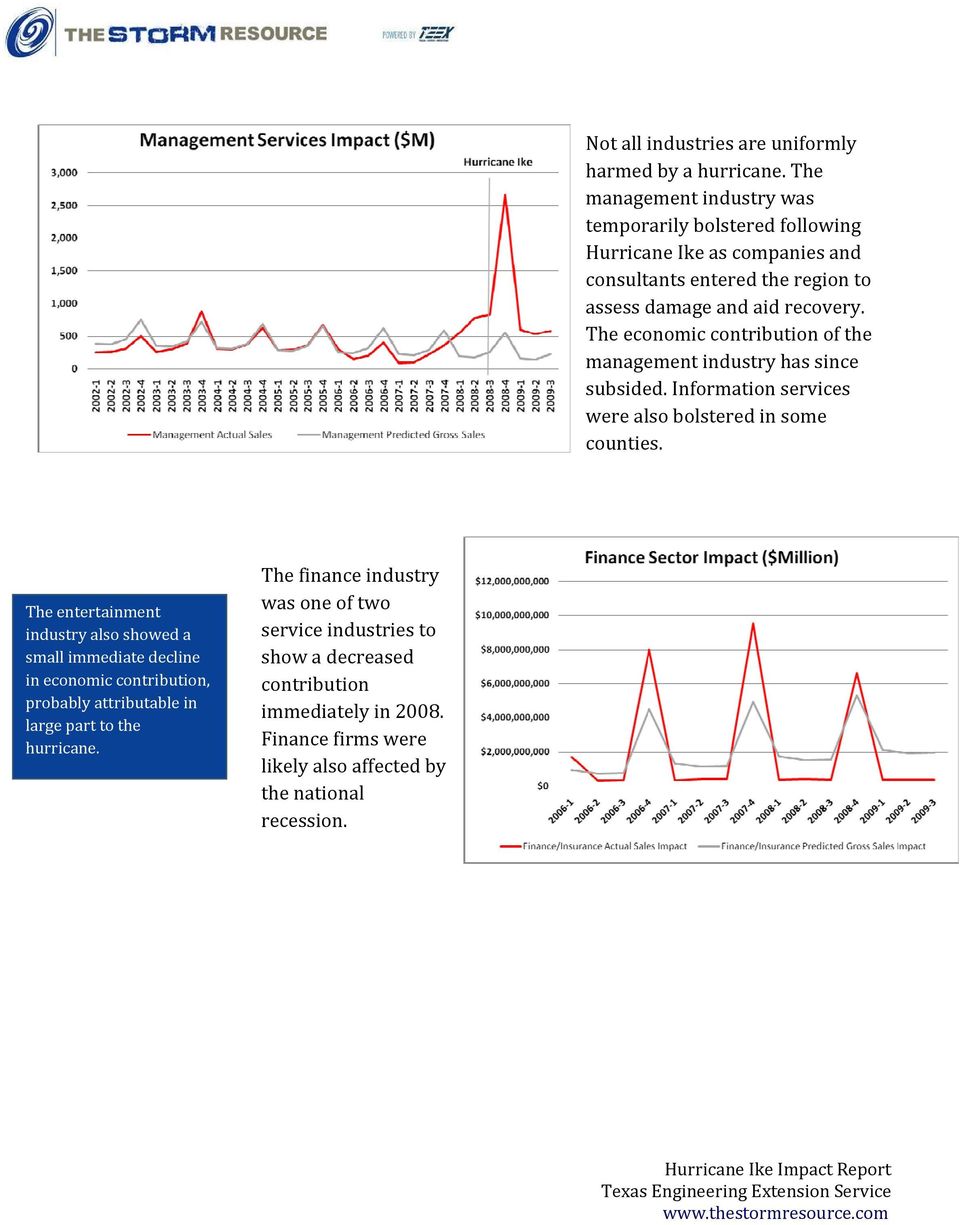
20 Not all industries are uniformly harmed by a hurricane. The management industry was temporarily bolstered following Hurricane Ike as companies and consultants entered the region to assess damage and aid recovery. The economic contribution of the management industry has since subsided. Information services were also bolstered in some counties. The entertainment industry also showed a small immediate decline in economic contribution, probably attributable in large part to the hurricane. The finance industry was one of two service industries to show a decreased contribution immediately in Finance firms were likely also affected by the national recession.
21 COUNTY IMPACTS BRAZORIA COUNTY SUMMARY Economic Impact Overall Economic Impact to Brazoria County is estimated to be $1.8 billion. $1.3 billion in estimated losses to the industrial sectors $483 million in estimated losses to the services sectors $729 thousand in estimated losses to the agricultural sectors The total economic impact (loss) to Brazoria County from Hurricane Ike is estimated to be $1.8 billion. Numbers are based on the, Disaster Impact Model s, accumulation of loss in sales during the four quarters (2008 Q Q3) following Hurricane Ike. Already considered the most costly storm to make landfall in Texas, Hurricane Ike s true economic impacts to the region continue to be analyzed. Brazoria County s manufacturing sector was impacted the hardest experiencing an estimated $528.5 million in losses alone. Impact Report COUNTY INFORMATION Brazoria County is a Texas coastal county located on the Gulf Coast of Mexico just southwest of Houston, TX. Brazoria County is home to 301,044 (2008) residents and several tourist escapes including Lake Jackson, Freeport and Surfside Beach. Its county seat is Angleton, and its largest city is Pearland. Brazoria County, like nearby Brazos County, takes its name from the Brazos River. The county also includes what was once Velasco, Texas, which was the first capital of the Republic of Texas. It served as the first settlement area for Anglo Texas, whereby the Old Three Hundred immigrated from the United States. HURRICANE IKE Brazoria County has endured numerous Hurricanes, including the storm of 1900 that destroyed Angleton s High School and the University of South Texas. However, the Hurricane of 1909 destroyed the rebuilt schools. Hurricane Ike made landfall with Category 2 winds and Category 4 water surges. As the eye of the storm moved over Galveston Island and up Galveston Bay, Brazoria County sustained nearly 8 hours of 75 to 110 mile per hour winds.
22 Federal Funding $16,727, in Individual Assistance grants $14,408, in Housing Assistance grants $2,318, in Other Needs Assistance grants $38,427, in Public Assistance grants $28,636, in U.S. Small Business Administration loans COUNTY IMPACTS According to the Disaster Impact Model, developed by Texas A&M AgriLife, the estimated economic impact to Brazoria County for the 12 month period following Ike was $1.8 billion. Among the 29 industry sectors evaluated in Brazoria County, manufacturing suffered the greatest loss at $528.5 million. Brazoria County is home to the Blue Water Highway that connects San Luis Pass of Galveston Island with the western portion of Brazoria County at Freeport. The Blue Water Highway was deemed impassible following Ike after roughly 2.3 miles were totally destroyed and another 3.5 miles were seriously damaged. In the City of Alvin, the Winchester Lodge Healthcare Center, a 94 bed facility, was closed indefinitely due to severe damages reducing Brazoria County s nursing home capacity by 9.2% Debris was a major problem following the storm; the cost of debris removal for Brazoria County was $23,656, (FEMA.gov). After Hurricane Ike (2008 4Q Q), Brazoria County experienced on average a 14% per quarter reduction in gross sales during the four quarters following the storm. Total losses to the county are estimated at $1.8 billion.
23 CHAMBERS COUNTY SUMMARY Economic Impact Overall Economic Impact to Chambers County is estimated to be $20 billion $20.9 billion in estimated losses to the industrial sectors $24.4 million in estimated losses to the services sectors $10.9 million in estimated losses to the agricultural sectors The total economic impact (loss) to Chambers County from Hurricane Ike is estimated to be $20 billion. Numbers are based on the Disaster Impact Model s accumulation of loss in sales during the four quarters (2008 Q Q3) following Hurricane Ike. Already considered the most costly storm to make landfall in Texas, Hurricane Ike s true economic impacts to the region continue to be analyzed. Chambers County s utilities sector was impacted the hardest following Ike, experiencing an estimated $12.1 billion in losses alone. Impact Report COUNTY INFORMATION Chambers County is a Texas coastal attraction that relies primarily on natural assets and agricultural industries in the central and eastern parts of the county, and the petro chemical industry in the west. Chambers County is home to 29,356(2008) residents along with the Anahuac National Wildlife Refuge and Bolivar Flats. Primarily rural, Chambers County relies on rice farming, ranching, hunting, fishing, marine trades and eco tourism to support jobs in their economy. The county is bordered by two bodies of water with Galveston Bay on the West and bounded on the south by Galveston s East Bay. Hurricane Ike made landfall on September 13, 2008, with category 2 winds and Category 4 water surges. As the eye of the storm moved through Galveston Bay water surges reached 20 feet. The water surge was responsible for wiping out two small fishing communities, Smith Point and Oak Island, along with inundating nearly 143,000 acres with salt water. Hurricane Ike Chambers County has endured numerous Hurricanes, including Katrina, Rita, Dolly, Gustav and Ike, along with tropical storm Eduardo, within the three year span from
24 Federal Funding $15,586, in Individual Assistance grants $13,712, in Housing Assistance grants $1,873, in Other Needs Assistance grants $74,610, in Public Assistance grants $14,504, in U.S. Small Business Administration loans County Impacts According to the Disaster Impact Model, developed by Texas A&M AgriLife, the estimated economic impact to Chambers County for the 12 month period following Ike was $20 billion. Among the 29 industry sectors evaluated in Chambers County, the utilities sector suffered the greatest economic loss at $12.1 billion. Chambers County also suffered the greatest loss, among impacted counties, in certified nursing home beds. Chambers County lost nearly 45.5% of the county s capacity, primarily from the closing of the Anahuac Healthcare Center s 100 bed facility due to Ike related damages. Housing and jobs along the western shore of Chambers County are a major concern. Communities like Smith Point and Oak Island suffered severe home losses. Of the 350 homes in Oak Island prior to Ike, only 50 were left standing, half of which were uninhabitable. The residents of these communities were the backbone to Chambers County s clam, oyster and shrimp industry which were inoperable with the loss of boats, shelter and processing facilities. Hurricane Ike surged salt water onto roughly 146,000 acres of land in Chambers County washing away livestock fences and destroying crop lands. The salt waters impacted the rice farms the hardest with 12 month losses following Ike estimated at $9.7 million. After Hurricane Ike (2008 4Q Q) Chambers County experienced on average a 71% per quarter reduction in gross sales during the four quarters following the storm. Total losses to the county are estimated at $20 billion. Debris was also a major problem following the storm, especially for Chambers County which received large debris deposits from their southern neighbor Bolivar Penninsula and High Island in Galveston County. Chambers County endured debris 15 to 18 miles in land resulting in miles of debris piles during clean up. The cost of debris removal for Chambers County was $64,439, (FEMA.gov).
25
26 GALVESTON COUNTY SUMMARY Economic Impacts $21.9 billion estimated industrial sector losses $475 million estimated services sector losses $11.4 million estimated agricultural sector losses Overall Economic Impact to Galveston County is estimated to be $22.16 billion. The total economic impact (loss) to Galveston County from Hurricane Ike is estimated to be $22.16 billion. Numbers are based on the Disaster Impact Model s accumulation of loss in sales during the four quarters (2008 Q Q3) following Hurricane Ike. Already considered the most costly storm to make landfall in Texas, Hurricane Ike s true economic impacts to the region continue to be analyzed. Galveston County s Manufacturing sector was impacted the hardest, experiencing an estimated $19.5 billion in losses alone. Impact Report COUNTY INFORMATION Galveston County is a coastal escape for tourist and residents alike. Home to NASA s Johnson Space Center and 283,987 (2007) residents, Galveston County is 72% family households. The county is bordered by two bodies of water with Galveston Bay on the East and bounded on the south by the seawall and beaches of Gulf of Mexico. Formerly established as a county under the Republic of Texas in 1839, Galveston County has grown into an economic engine for the region and state of Texas with large revenues and tax dollars coming from the County s petrochemical industry, shipping, educational and medical facilities and tourism. The City of Galveston is protected by a Seawall which spared the city a direct impact by the storm surge from the Gulf of Mexico. The city was still inundated by surge waters when they began to recede from the bay side of the island. HURRICANE IKE Galveston County has endured numerous Hurricanes, 25 of which have caused loss of life or property damage since the storm of When Hurricane Ike made landfall on September 13, 2008, despite county officials and residents preparation, Galveston County experienced the most expensive hurricane in the history of Texas.
27 Federal Funding $190,286,557 in Individual Assistance grants $141,341,638 in Housing Assistance grants $48,944,918 in Other Needs Assistance grants $362,003,736 in Public Assistance grants $242,058,800 in U.S. Small Business Administration loans Hurricane Ike made landfall with Category 2 winds and Category 4 water surges. As the eye of the storm moved up Galveston Bay the Galveston Sea Wall held strong to the challenging waves. However, once the water levels receded, they flooded Galveston Island from the Bay causing catastrophic flooding to nearly 50% of Galveston Island. Galveston Island endured 12+ hours of salt water inundation from Ike s 15 foot storm surge. COUNTY IMPACTS According to the Disaster Impact Model, developed by Texas A&M AgriLife, the estimated economic impact to Galveston County for the 12 month period following Ike was $22.16 billion. Among the 29 industry sectors evaluated in Galveston County, Manufacturing suffered the greatest loss at $19.5 billion. Estimates by Houston Galveston Area COG found that more than 53,000 employees were put out of work; more than 3,800 businesses were interrupted; and more than 18,000 businesses were damaged in Galveston County. These estimates do not include information from some severely impacted areas, such as Galveston Island. (Hurricane Ike Impact Report, TDEM) Texas A&M University Galveston experienced $28.6 million in damages which caused them to relocate 1,500 faculty and staff and approximately 1,800 students to the main Texas A&M campus in College Station, TX for the remainder of the 2008 fall semester. The above graph illustrates post Hurricane Ike (2008 4Q Q) Galveston County experienced on average a 42% per quarter reduction in gross sales during the four quarters Ike. Totaling an estimated billion loss to Galveston County After Ike, debris was a major problem. The cost of debris removal for Galveston Island alone was $7,790,002 and the remainder of the county cost $2,059,541.
28 HARRIS COUNTY SUMMARY Economic Impacts Overall Economic Impact to Harris County is estimated to be $103.8 billion $90.3 billion in estimated losses to the industrial sectors $13.5 billion in estimated losses to the services sectors The total economic impact (loss) to Harris County from Hurricane Ike is estimated to be $103.8 billion. Numbers are based on the Disaster Impact Model s accumulation of loss in sales during the four quarters (2008 Q Q3) following Hurricane Ike. Already considered the most costly storm to make landfall in Texas, Hurricane Ike s true economic impacts to the region continue to be analyzed. Harris County s wholesale sector was impacted the hardest, experiencing an estimated $38.8 billion in losses alone. Impact Report COUNTY INFORMATION Harris County, located on the upper Gulf Coast in Southeast Texas, was originally formed as Harrisburg County by the First Congress in Harris County developed as an industrial power in 1911 with the approved formation of the Harris County Navigation District. What started as a small settlement of a few thousand has grown to a population of nearly 3,984,349 (2008), making it the most populous county in Texas and the third most populous county in the United States. The county seat is Houston, the largest city in Texas. Harris County has grown into an economic engine for the region and state of Texas with large revenues and tax dollars coming from the county s petrochemical industry, shipping, manufacturing, wholesale, educational and medical facilities and tourism. HURRICANE IKE Hurricane Ike made landfall with Category 2 winds and Category 4 water surges. In fact, Ike produced the highest storm surge along the Texas coast since As a result foot surges flooded several communities along the southeast portion of Harris County. The storm s 100 mile an hour winds through downtown Houston blew out several windows in large business buildings and roofs from residential structures.
29 Federal Funding $151,546, in Individual Assistance grants $111,691, in Housing Assistance grants $39,854, in Other Needs Assistance grants $396,286, in Public Assistance grants $178,842, in U.S. Small Business Administration loans COUNTY IMPACTS According to the Disaster Impact Model, developed by Texas A&M AgriLife, the estimated economic impact to Harris County for the 12 month period following Ike was $103.8 billion. Among the 29 industry sectors evaluated in Harris County, the wholesale sector suffered the greatest loss at $38.8 billion. Harris County was severely affected by the winds and storm surge from Ike. The county s waterfront communities of Morgan s Point, La Porte and Galena Park, which are not protected by a levee, had 581 structures suffer major damage or destroyed at an estimated cost $162.4 million in damages. Harris County suffered $8.3 billion in total property damages. Houston, nicknamed the Energy Capital of the World, is home to five of the 6 super major energy companies. Several of these companies endured infrastructure damages. Texas experienced the largest power outage in history when CenterPoint Energy, Inc took a direct hit from Ike, resulting in 2.15 million power outages. CenterPoint Energy had an estimated 62.8 miles of cable down and nearly 86% of their circuits were out. It took 7 days and 10 crews of nearly 450 people to finish major repairs. After Ike, debris was a major problem. The cost of debris removal for Harris Island alone was $240,410,776. After Hurricane Ike (2008 4Q Q), Harris County experienced on average a 19% per quarter reduction in gross sales during the four quarters following the storm. Total losses for the county are estimated at $103.8 billion.
30 JEFFERSON COUNTY SUMMARY Economic Impacts Overall economic impact to Jefferson County is estimated to be $11.9 billion. $13.6 billion in estimated losses to the industrial sectors $45.2 million in estimated losses to the agricultural sectors The total economic impact (loss) to Jefferson County from Hurricane Ike is estimated to be $11.9 billion. Numbers are based on the Disaster Impact Model s accumulation of loss in sales during the four quarters (2008 Q Q3) following Hurricane Ike. Already considered the most costly storm to make landfall in Texas, Hurricane Ike s true economic impacts to the region continue to be analyzed. Jefferson County s manufacturing sector was impacted the hardest, experiencing an estimated $9.1 billion in losses alone. Impact Report COUNTY INFORMATION Founded in 1836 and named after Thomas Jefferson, Jefferson County was one of first in the Republic of Texas. Growth in the county was spurred by the opening of the Spindletop oilfield in 1901 and the petrochemical industry continues to drive the county s economy. Now home to 243,090 residents (2008), it is estimated the petro chemical industry provides 40% the county s paychecks and 75% of the tax burden. The Port Arthur ship canal, on the west shore of Sabine Lake, connects with the Neches and Sabine rivers to provide deepwater ports at Beaumont, Port Arthur, Nederland, and Port Neches. Beef cattle and rice yield major farm income, but the majority of wage earners are employed by the petrochemical, shipbuilding, and rubber industries. Storm surge in Jefferson County brought saltwater more than 30 miles inland contaminating Beaumont s water supply HURRICANE IKE Jefferson County is among the most Southeast counties in Texas that has endured multiple hurricanes over the three year span from , including Katrina, Rita, Gustav and Ike. The significant difference with Hurricane Ike was Jefferson County was now on the wet
31 side of the storm. Federal Funding $29,661, in Individual Assistance grants $24,668, in Housing Assistance grants $4,993, in Other Needs Assistance grants $90,371, in Public Assistance grants $39,143, in U.S. Small Business Administration loans Hurricane Ike made landfall with Category 2 winds and Category 4 water surges. As the eye of the storm moved to the west of Jefferson County, the storm surge pushed waters far into the southwest portion of the county. As the storm surge moved north it tested the Port Arthur Levee, pushing waters further to the north. COUNTY IMPACTS According to the Disaster Impact Model, developed by Texas A&M AgriLife, the estimated economic impact to Jefferson County for the 12 month period following Ike was $11.9 billion. Among the 29 industry sectors evaluated in Jefferson County, manufacturing suffered the greatest loss at $9.1 billion. Hurricanes from the three previous years impacted Jefferson County primarily through wind damage. However, Ike also brought disastrous flooding. The storm s surge moved inland more than 30 miles, contaminating Beaumont s water supply with salt water. In the Sabine River basin storm surge flooding devastated 1970s era homes built on the ground. Waters rose to elevations greater than the 100 year flood plain. Nearly 4,000 head of cattle are estimated to have drowned in pastures. Hurricane Ike also impacted Texas Parks & Wildlife Department lands which include the J.D. Murphree Wildlife Management Area, where marsh habitats were inundated with an 11 to 16 feet of surge water flooding. Debris was a major problem following the storm. The cost of debris removal for Jefferson alone County was more than $36 million After Hurricane Ike (2008 4Q Q) Jefferson County experienced on average a 24% per quarter reduction in gross sales during the four quarters following the storm. Total losses to the county are estimated at $11.9 billion
32 Liberty County Summary Economic Impacts $53.9 million in estimated losses to the services sectors $277 million in estimated losses to the manufacturing sector Liberty County is the only county in the study area whose overall economy grew following Hurricane Ike, gaining an estimated $169.8 million. Numbers are based on the Disaster Impact Model s accumulation of sales during the four quarters (2008 Q Q3) following Hurricane Ike. Already considered the most costly storm to make landfall in Texas, Hurricane Ike s true economic impacts to the region continue to be analyzed. Liberty County s manufacturing sector was impacted the hardest experiencing an estimated $277 million in losses. Impact Report COUNTY INFORMATION Liberty County is a rural east Texas county located within the Houston Sugar Land Baytown metropolitan area and home to roughly 75,333 (2008) residents. Located roughly 60 miles northeast of Houston and 40 miles from Galveston Bay, Liberty County offers an escape from the city to hunt, fish and enjoy the outdoors. Bisected by the Trinity River, Liberty County supports a variety of agricultural production and is rich in natural resources including lignite, iron ore and sulfur. Hurricane Ike Hurricane Ike made landfall with Category 2 winds and Category 4 water surges. As Ike moved up Galveston Bay the eye of the storm moved north northeast up Liberty County s western border. The eye wall moved through the western portion of the county with sustained winds of 110 miles per hour, destroying homes, forest land and power lines throughout the county.
33 Federal Funding $15,785, in Individual Assistance grants $14,317, in Housing Assistance grants $1,468, in Other Needs Assistance grants $34,611, in Public Assistance grants $7,688, in U.S. Small Business Administration loans COUNTY IMPACTS According to the Disaster Impact Model, developed by Texas A&M AgriLife, Liberty County s economy for the 12 month period following Ike was able to grow an estimated $169.8 million over projected sales from the DIM model. However, among the 29 industry sectors evaluated in Liberty County, the manufacturing sector still suffered $227 million in losses. The winds from Hurricane Ike caused the most damage to Liberty County. The strong southern winds from Ike destroyed property, forests and made several roads impassable until cleared by tractors and/or saws. The storm knocked out every single resident s electricity in the county due to downed power lines and blown transformers. Of the 234,000 acres of timberlands damaged by Hurricane Ike, nearly 30%, or 68,300 acres, were located in Liberty County. Residents of Liberty were unable to proceed with the recovery process until proper equipment could be used to safely remove these large trees from roofs, power lines, and roadways. Debris was also a major problem following the storm, with the cost of debris removal for Liberty alone exceeding $26.8 million. After Hurricane Ike (2008 4Q Q) Liberty County experienced on average a 6% per quarter gain in gross sales during the four quarters following the storm. Totaling an estimated $147.8 million gain to Liberty County. Total gains to the county are estimated at $147.8 million.
34 Economic Impact Overall economic impact to Orange County is estimated to be $365 million. $116 million estimated lost in the retail sector. $372 million in estimated losses to the industrial sector ORANGE COUNTY SUMMARY The total economic impact (loss) to Orange County from Hurricane Ike is estimated to be $364.9 million. Numbers are based on the Disaster Impact Model s accumulation of loss in sales during the four quarters (2008 Q Q3) following Hurricane Ike. Already considered the most costly storm to make landfall in Texas, Hurricane Ike s true economic impacts to the region continue to be analyzed. Orange County s retail trade sector was impacted the hardest, experiencing an estimated $116 million in losses alone. Impact Report Orange County, located 80 miles east of where Hurricane Ike made landfall, was flooded by a 22 foot storm surge. COUNTY INFORMATION Orange County is located in the deep southeast portion of Texas and is part of the Golden Triangle, an area of Southeast Texas lying between the cities of Beaumont, Port Arthur, and Orange. The county is bounded to the east by the Sabine River, which forms a portion of the Texas Louisiana border, to the southeast by the Gulf of Mexico, and to the west by the Neches River. Today Orange County is home to 83,022 residents (2008) whose primary sources of employment come from petroleum refining, paper milling, rice farming, fishing and shrimping. Hurricane Ike Orange County, along with other deep east Texas counties, has endured multiple hurricanes during the three year span from 2005 to Prior to Hurricane Ike, Orange County had traditionally experienced the dry side of hurricanes, primarily suffering damages from severe winds. Hurricane Ike made landfall with Category 2 winds and Category 4 water surges. The entire city of Orange, which is the county seat, experienced flooding ranging from 6 inches to 15 feet.
35 Federal Funding $68,469, in Individual Assistance grants $55,159, in Housing Assistance grants $13,309, in Other Needs Assistance grants $41,527, in Public Assistance grants $96,882, in U.S. Small Business Administration loans County Impacts According to the Disaster Impact Model developed by Texas A&M AgriLife the estimated economic impact to Orange County for the 12 month period following Ike was $364.9 million. Among the 29 industry sectors evaluated in Orange County, the retail trade sector suffered the greatest loss, $116 million. Despite being 20 miles inland, Orange County s deepwater ports, supported by the Neches and Sabine River, provided pathways for Ike s 22 foot storm surge to create the worst flood ever documented in Orange County. The city of Orange sustained serious flood damage to its entire area, and several government buildings near the port were devastated, costing the county an estimated $5.1 million in administration losses. Orange County also experienced the disaster regions most significant loss of capacity to intermediate care facilities, with an 88.5% reduction. The loss reduced Orange County s overall capacity from 0.6 to 0.1 beds per 1,000 people, well below the state average of three beds per 1,000 people. The hurricane also caused significant damage to the schools of Orange County. Ike flooded the Head Start Center in the West Orange Cove Consolidated Independent School District in Orange County. Bridge City ISD high school was inundated with flood water, leaving 2,550 students displaced. Debris was also a major problem following After Hurricane Ike (2008 4Q Q), Orange County experienced on average a 14% per quarter reduction in gross sales for four quarters following the storm. Total losses to the county are estimated at $364.9 million due to off setting from the gains experienced by the service sector. the storm with the cost of debris removal for Orange County alone exceeding $20.5 million.
36 TYLER COUNTY SUMMARY Economic Impact Overall economic impact to Tyler County is estimated to be $79.9 million. $28.5 million in estimated losses to the industrial sectors $51 million in estimated losses to the services sectors, $50.4 million of which was due to losses in the real estate sector The total economic impact (loss) to Tyler County from Hurricane Ike is estimated to be $79.9 million. Numbers are based on the Disaster Impact Model s accumulation of loss in sales during the four quarters (2008 Q Q3) following Hurricane Ike. Already considered the most costly storm to make landfall in Texas, Hurricane Ike s true economic impacts to the region continue to be analyzed. Tyler County s real estate sector was impacted the hardest, experiencing an estimated $50.4 million in losses alone. Impact Report COUNTY INFORMATION Tyler County is located in the southeastern region of Texas close to the Louisiana border, and is bordered on the north and east by the Neches River. Woodville, TX, is the county seat and the largest town in the rural county. Tyler County is home to 20,470 residents, along with the Big Thicket National Preserve. A mandatory evacuation was ordered for the residents of Tyler County on Sept. 11, Wind gust from mph were recorded throughout the county during Hurricane Ike, causing property damages to Tyler County estimated at $47 million. Hurricane Ike Tyler County experienced a variety of hurricanes over the three year span from 2005 to 2008, including Katrina, Rita, Gustav and Ike. Tyler County is a rural east Texas county that serves as an evacuation pass through county for residents living south of the county. Tyler County does not have the appropriate housing or shelters to accommodate their own residents, nor those of Hardin, Jefferson or Orange Counties in a storm event. Hurricane Ike made landfall with Category 2 winds and Category 4 water surges. Despite a mandatory evacuation by County
37 Federal Funding $190,286,557 in Individual Assistance grants $141,341,638 in Housing Assistance grants $48,944,918 in Other Needs Assistance grants $362,003,736 in Public Assistance grants $242,058,800 in U.S. Small Business Administration loans Judge Blanchette, many residents of southeast Texas hesitated to leave as they had only returned home 10 days prior following Hurricane Gustav. The minimal damage caused by Gustav and high personal expense of evacuation prevented numerous Tyler County residents from reevacuating for Hurricane Ike. COUNTY IMPACTS According to the Disaster Impact Model developed by Texas A&M AgriLife the estimated economic impact to Tyler County in the 12 month period following Ike was $79.9 million. Among the 29 industry sectors evaluated in Tyler County, the real estate sector suffered the greatest loss at $50.4 million. Tyler County is more than 150 miles northeast of where Hurricane Ike made land fall and is located 90 miles inland from the Texas Gulf Coast. However, the storm s strong winds and heavy rains still tore through the county, laying over trees and telephone poles along the way. Wind from Hurricane Ike damaged an estimated 21,000 acres of Tyler County s forest lands. Debris was a major problem following the storm and the cost of debris removal for Tyler exceeded $ 2 million After Hurricane Ike (2008 4Q Q), Tyler County experienced on average a 28% per quarter reduction in gross sales during the four quarters following the storm. Total losses to the county are estimated at $79.9 million.
38 HURRICANE IKE CASE STUDIES Case studies were conducted on the following topics: K 12 Education Vital Records City Planning Agriculture Preservation Residential Tourism The true impacts of a storm can be difficult to absorb solely through quantitative data. Sometimes, the impacts of disasters are captured most understandably, through the personal stories of people who experienced it and faced the task of rebuilding their lives and communities in its wake. Property damages and economic data alone cannot illustrate the full impact of Hurricane Ike and its effect on people s day to day lives in the Ike region, though they are crucial for understanding its long term effects. The stories told in the following case studies give a face, a picture, a name to the impacts the numbers describe and create a series of best practices and lessons learned for future events. TEEX researchers utilized a number of sources to determine areas of focus for the case studies. First, TEEX personnel conducted a series of interviews with county judges and emergency management personnel, capturing their high level impressions of storm impacts in the county and hearing stories that emerged from storm experiences. Through the utilization of these responses and the TEEX agency role in disaster response, researchers were able to identify cities especially hard hit by the storm. These discussions, along with interviews with local leaders and a series of site visits, enabled the economic development team to compile a series of case studies based on success stories and lessons learned regarding planning prior to the storm and recovery after Ike. In the end, case studies were conducted on experiences regarding issues with K 12 education, vital records, city planning, agriculture, preservation, residential concerns, and tourism in the impacted counties. Interviews and surveys with subject matter experts, and a wide variety of local, county and regional officials representing members of Texas Task Force One, members of the Public Works Response Team, TEEX Urban Search and Rescue, city mayors, emergency management coordinators, county judges, city administrators, public works officials, economic development managers, school district personnel, business owners and residents have been documented and combined in an effort to complete our understanding of Hurricane Ike s effects.
39 AGRICULTURE CASE STUDY COOPERATION CRUCIAL TO MANAGING LIVESTOCK DURING A DISASTER Storm History 1986 Hurricane Bonnie 2001 Tropical Storm Allison 2005 Hurricane Rita 2008 Hurricane Ike Liberty, Tyler, Chambers and Jefferson Counties along with several others comprise a region in southeast Texas that includes the coastal prairie and derives a substantial portion of its economy from agriculture. Common crops in the area include rice, soy, cattle, sorghum, and sheep. Logging the natural abundance of timber is also a local source of income. The area itself is primarily rural, but the cities of Houston and Beaumont are nearby. Case Facts On September 13, 2008, Hurricane Ike made landfall with category two winds; however, it was the storm surge, not the wind, that caused real damage. More than half a million acres of land used for farming and ranching in southeast Texas were submerged in salt water as a result of the storm surge. It s the worst storm we can ever remember, said rancher Dan Hankamer of Hurricane Ike. Before Ike, Southeast Texas had over 30,000 head of cattle. At least 4,000 were lost during the storm, and due to 17,000 miles of fencing being destroyed and the increase salinity in the soil since Ike, the number of cattle in this region has been reduced to 7,000. In fact, Ike s overall effect on Texas agriculture is estimated to be $433 million. Key Decisions Many animals perished during the storm from flying debris and flood waters or in the days afterward from lack of food and water. Removing carcasses became a pressing public health and sanitation issue. It seemed that no one had the time or resources to deal with the increasing problem of animal remains. The United States Department of Agriculture Natural Resource Conservation Service stepped in, and with
40 Texas Agrilife s Operation No Fences 9,000 hay bales 165 tons of feed 400 water troughs 12,000 head of cattle fed and watered just a phone call identifying the location, species and quantity of the dead animal, NRCS would remove and dispose of the remains free of charge. In several storm ravaged counties in East Texas, large numbers of cattle, horses and poultry caught in Hurricane Ike died, said Don Gohmert, NRCS state conservationist for Texas. We are working with soil and water conservation districts, local county governments and the Texas Animal Health Commission to properly dispose of carcasses to protect public health and safety. The salt soaked earth ruined the ground for grazing, and all freshwater ponds and tanks had been flooded out with the storm surge. Southeast Texas had become unlivable for livestock. Even before the floodwaters had fully receded, it became a race against the clock to round up all living animals into areas where they could be fed, watered and treated for sickness, without regard to who technically owned the cattle. In what the Texas Agrilife Extension Service termed Operation No Fences, volunteers took on the initial responsibility to recover and care for the livestock. Later they would organize and return cattle to their proper owners. Assisting Agrilife in Operation No Fences was the Texas Department of Agriculture, Texas Animal Health Commission, Texas and Southwestern Cattle Raisers Association, and the Independent Cattlemen s Association, as well as numerous other organizations. In total, Operation No Fences delivered more than 9,000 hay bales, 165 tons of feed and 400 water troughs for ranchers who were unable to feed their cattle. As a result, the volunteers gathered, fed and watered 12,000 head of cattle. While the cost of Hurricane Ike damage was substantial, the savings resulting from this recovery effort are estimated at $8.3 million. Six months after the storm, the Texas Department of Agriculture hosted another event called Operation New Fences with the goal of donating fencing and feeding supplies to help area ranchers begin again. Operation New Fences distributed over $100,000 of donated supplies to almost 100 ranchers in the southeast Texas area. "Hurricane Ike landed on Texas soil six months ago, but
41 its wake of destruction still exists," Commissioner Staples said. "The massive storm destroyed the land, homes and livelihoods of Southeast Texas ranchers, but it did not destroy their spirit. These cattle raisers need our help to resume business and restore their agricultural production, which impacts the state economy by more than $130 million." Operation New Fences distributed over $100,000 of donated supplies to almost 100 ranchers in the southeast Texas area. Texas Animal Health Commission is now the primary agency for responses to animals in emergencies Conclusions Since Hurricane Ike, the Texas Animal Health Commission has been identified as the primary coordinating agency for responses to animals in emergency or disaster situations. They have developed a number of state and local planning guides that could help communities develop emergency animal shelters, evacuations and carcass disposal plans in the event of a major catastrophe. Brazoria County Texas AgriLife Extension Service released a document advising livestock owners to have a plan for handling livestock in the event of hurricane evacuation. Agrilife knew that in the event of a major storm, it could be necessary to keep animals out of the county for weeks or even months. For those who would need to shelter their livestock in place, Agrilife recommends pasturing horses and cattle away from barns in areas where they might reach higher ground and where loose debris have been removed or totally secure. No amount of planning can stop a hurricane in its tracks or undo the damage that Ike has already caused, but it can mitigate losses and damages from future storms.
42 CITY PLANNING CASE STUDY City Mobilizes Residents to Develop Recovery Plan Storm History 1900 Galveston Hurricane 1961 Hurricane Carla 1983 Hurricane Alicia 2008 Hurricane Ike At 32 miles wide and 2 ½ miles long, Galveston Island is the most heavily populated coastal barrier island in the United States. One of the major features of Galveston Island is a unique seventeen foot high seawall constructed more than a century ago following the Great 1900 Hurricane to protect the city from future storm surges. As such, there is no model for city officials and planners to follow their experiences create the model for others, and this is no easy task in Galveston where the urban historic setting values must be balanced against the beach and ecological considerations and modern, commercial development as well. Case Facts Galveston Island slopes from seventeen feet above sea level just behind the seawall to only three feet above sea level on the bay side. The difference is so vast that the zone behind the seawall is actually outside of the flood plain. During Ike, the island was flooded by the storm surge from bay side. As a result of Hurricane Ike, more than 75% of the structures on Galveston Island were damaged. Enrollment in Galveston Independent School district fell by more than 20% in the year following Ike, resulting in numerous teacher layoffs. Similar stories of downsizing were echoed across the seemingly crippled island. Galveston Island is still estimated to be 15,000 people below its pre storm population of 58,000. Key Decisions A vital step in the process of recovery from Ike was for Galveston City Council to appoint the Galveston Community Recovery Committee (GCRC), a 330 person group of Galveston residents, whose responsibility it was to develop a vision, plan and projects that would guide Galveston from disaster to a state of being fully
43 The Galveston Community Recovery Committee is comprised of 330 Galveston residents. They were task with developing a vision, plan and projects to restore Galveston recovered. A major strength of the GCRC was that it truly reflected the needs and desires of Galvestonians. Through open houses, public meetings, community surveys and their website, the GCRC collected more than 2,700 comments and suggestions from fellow Galvestonians about the shape and direction for reviving the island. Based on that input, the GCRC identified five main areas for recovery: environment, economic development, housing and character of the community, health and education, transportation and infrastructure and disaster planning. Based on these five focus areas, the committee then broke itself down further into thirteen work groups and eventually forty two project teams. This structured organization would allow them the focus and cohesion necessary to develop a long term recovery plan for Galveston on a tight time frame. From February through March 2009, committee members devoted more than 4,200 hours of work to crafting the recovery plan. Finally, at the end of March 2009, the GCRC had a long term recovery plan ready to present. The bulk of the plan was comprised of forty two projects that, if completed, would lead to a fully recovered and stronger Galveston. The GCRC worked closely with FEMA to give each of the projects a recovery value of high, moderate, low or community interest. Projects with a high recovery value were deemed directly related to damages, had community support and community wide benefits, were achievable in three to five years, were sustainable, had high visibility, would reduce future loss, used resources wisely and enhanced the quality of life for the community. Given that the majority of homes on Galveston Island were damaged, many of the Housing and Community Character projects earned a high recovery value. One project is a Housing Market Study. Another is the Galveston Housing and Rehabilitation Infill, which aims to create partnerships between public and private entities so that rebuilding of homes on a large scale can begin immediately. Reestablishing secure homes in healthy neighborhoods is a necessary step in bringing the population back to Galveston Island, so a Master Neighborhood Plan was designed and is meant to address such issues as preservation, development, safety, public space and transportation.
44 A Master Neighborhood plan was developed to address preservation, development, safety, public space and transportation. Sustainability is a priority issue in the development of a long term recovery plan. The plan works to define what it means to be sustainable in Galveston and address equity, resource, and environmental issues in the area. The First round Community Development Block Grant funding was used to rewrite all of the city s development codes, and part of that rewrite included attempts to incorporate green building design into the rehabilitation process for the island. A hazard mitigation plan specific to the city is also one of the recovery projects previously, the city was included in the county s hazard mitigation plan, but as a barrier island, Galveston faces unique challenges. Conclusions The housing rehabilitation program and the Master Neighborhood Plan have already taken root in Galveston. Neighborhood meetings are being held city wide so that citizens can continue to determine the future of Galveston s recovery. Applications are being accepted, and construction has begun for the Homeowner Program. In fact, Approximately 1800 homes were being rehabilitated or newly constructed in August of Galveston was unprepared for the type of devastation brought on by Hurricane Ike. However, the painstaking process of recovery is leaving the community better equipped for future events. this plan includes upgrades to the flood ordinance, including the additional requirement that new building be built a foot over the minimum elevation required. Galveston s city planners have turned Hurricane Ike s devastation into a chance for opportunity and learning in the two years since the storm wreaked havoc on their home. Perhaps one of the most successful elements of Galveston s recovery so far has been keeping the input and participation of the citizens at the heart of the planning process.
45 K 12 CASE STUDY School District Proves Vital in Reestablishing Community Storm History 2005 Hurricane Rita 2007 Hurricane Humberto 2008 Hurricane Gustav 2008 Hurricane Ike Bridge City, Texas is located in southern Orange County near the Texas Louisiana border. It is a self proclaimed bed room community surrounded on three sides by water with a population of under 10,000, making it an ideal escape for fishermen, bird watchers and water sport enthusiasts. Bridge City has faced many of Texas worst hurricanes. In 2005 it withstood Rita; in 2007 the only death associated with Humberto occurred in Bridge City; and on August 25, 2008, the town experienced severe flooding as a result of Gustav. Case Facts On September 13, 2008, Hurricane Ike made landfall on the upper Texas Coast, just as residents were recovering from Gustav. While Ike s winds were strong, it was the storm surge that left Bridge City with only twenty four of its 3,400 homes habitable and every business either damaged or destroyed. Bridge City ISD felt the brunt of Ike as well, with every school but the high school inundated, the worst of which with four feet of standing water. Two elementary schools would be unsalvageable and would eventually cost $19 million to replace. Nine days into the school year, the disaster left Bridge City s 2,550 students totally displaced. Key Decisions Superintendent Jamey Harrison returned to Bridge City with two other school district officials before the storm had even subsided. They quickly determined that reopening the schools in Bridge City before parents enrolled their children in other districts was crucial to bringing residents back to the community. District officials evaluated the remaining
46 facilities and set the deadline to reopen the schools for October 6 giving them just three weeks. 2,550 students Bridge City students were displaced by Ike, 2,370 students were in attendance on the day Bridge City schools reopened their doors. In the first ten days following Ike, Bridge City community and school district officials worked tirelessly, often in nineteen hour shifts, to prepare the campuses for students. At the start of their efforts to restore the schools, administrators were homeless themselves. They soon purchased RVs to live in for the duration of the project. In fact, most of the city personnel were homeless due to the hurricane. Nearly all of the town's fifty firefighters lost their homes, and many camped out at the fire station. The mayor moved into the courthouse. Bridge City High School would become the main hub for FEMA operations and community life during this time of rebuilding, the place where food was prepared and operations were directed. In this way, life in Bridge City following the storm was truly dependent on its schools. In fact, the push to reopen schools in Bridge City became a uniting factor within the surrounding area in addition to Bridge City itself. This was apparent when mid way through the repair process news came that temporary housing would not be in place by the time the district reopened. The issue of how to transport students from their temporary homes in surrounding counties, some as far as forty five minutes away, was addressed by district officials with the aid of local media. Student pick up and drop off sites were designated in central locations of nearby communities such as the Wal Mart in Port Arthur and the Home Depot in Orange. The local media and the district web site were crucial to getting the information to parents that the schools were reopening and how transportation to and from school had been arranged. Superintendent Harrison also worked with the local phone company to organize a phone bank for parents to improve communication about bus pick up and drop off locations and other details about the students. Secretaries and teachers worked the phone lines and helped create a system in which some students were driven an hour each way, passing through three school districts on their way to their classrooms. The effort to get Bridge City children back into Bridge City schools seemed to touch
47 everyone from the largest of retailers to the most discouraged of residents. $19 million in damages to the school district. Insurance covered $3 million, FEMA provided $10 million and Texas Legislature provided $8.5 million However, bringing the students back was only half the fight. Superintendent Harrison wanted campuses that would provide a new, solid, safe and orderly environment for children already facing a great deal of tumult in their lives due to the storm and subsequent displacement. It would be unacceptable for families to return with their children only to find substandard or improper buildings. The decision was made to merge the two irreparably damaged elementary school campuses. Superintendent Harrison outlined his needs to three modular facility companies. The company that could meet his deadline began construction. Conclusions Today, the high school, intermediate and middle school are fully repaired. The combined elementary campus consists of twenty five modular classroom buildings and twelve ancillary buildings which also house the district offices. The $19 million in funding needed for the repairs and construction of the new campus came from multiple sources. Insurance was the smallest portion, covering only $3 million. After four applications for assistance, FEMA approved $10 million. The district was still short $6 million in necessary funds to replace the elementary schools. Raising the money through property taxes was not a possibility due to declining property values. Superintendent Harrison turned to the state for assistance. He testified before legislature multiple times. Eventually, Bridge City ISD received $8.5 million and began building its new school. The day Bridge City ISD reopened its doors, 92% of the district s original enrollment, or 2,370 students, returned. As of 2010, they have surpassed pre Ike enrollment.
48 PRESERVATION CASE STUDY City Works to Restore Community Character Storm History 1900 Galveston Hurricane 1961 Hurricane Carla 1983 Hurricane Alicia 2008 Hurricane Ike The catastrophic 1900 Hurricane remains the deadliest natural disaster to ever strike the United States. It is estimated that 8,000 human lives were lost during the storm. That event was equally destructive to Galveston s economy and infrastructure. Extensive ruin to the major icons and emblems of Galveston caused a community wide identity crisis, depleting morale and hope for the devastated city. The 1900 Hurricane also decimated plant life on Galveston Island. In the twelve years following that storm, more than 10,000 trees and 2,500 oleanders were planted along Galveston esplanades and thoroughfares. Those century old trees continued to grow, ornamenting the streets and Victorian era buildings they shaded. The trees became a living part of Galveston s character, one that connected current Galvestonians with their roots. More importantly, the scenic tree lined streets and historic downtown district termed The Strand had become cornerstones to one of Galveston s main industries: tourism. Case Facts Hurricane Ike struck Galveston Island in September of Flooding from Ike s storm surge resulted in devastation to the distinctive trees and buildings that had been present on the island for a century or longer. City officials estimated that up to 11,000 trees on public property and as many as 31,000 trees on private property would die as a result of the storm. Eightypercent of Galveston s East end trees would need to be cut down. Officials from Galveston s historic preservation office estimated that some of the city s nineteenth century buildings had more than eight feet of flooding and that of the 7,000 documented historic properties, at least 1,500 were seriously damaged.
49 Key Decisions Galveston lost 40,000 trees due to Hurricane Ike 1,500 historic properties were severely damaged It was initially thought that some of the old oak trees might recover if their roots were regularly soaked with fresh water and gypsum was applied to the soil. This process ultimately failed, and forestry officials were forced to begin cutting 40,000 of the once majestic trees down to stumps. They were met with resistance. Galvestonians fixed black ribbons and sentimental poems to the trees that seemed to be such an integral part of their home. Sensitive to the effects of the systematic treecutting, city officials refrained from cutting down the trees lining Broadway, Galveston s entrance and main thoroughfare, until the end because it was thought that removal of those trees would have the greatest emotional impact on residents. It was necessary to educate the citizens on the hazard posed by the dead and dying trees. In addition to the risk of dead trees and tree limbs falling on citizens, in the event of another storm, dead trees would be easily uprooted and become projectiles in the violent wind. Galveston residents were upset that trees that sprouted leaves were being cut down in addition to the obviously dead ones. However, the trees that seemed to be sprouting were, in truth, very nearly dead and needed to be removed. However, Galveston s is not a story of death, but of rebirth and renewal. Even while the trees were being cut, plans were made to preserve some of the legacy of the historic oaks. Sculpture artists were invited to carve the stumps left behind from some of massive trees. In this way, Galveston s celebrated trees live on for the public to enjoy. While efforts to replant trees in Galveston began the year before, in November 2010, the City of Galveston in partnership with Galveston Island Tree Conservancy and the Texas Forest Service released Galveston ReLeaf: A Strategic Plan for Replanting. The forty four page document outlined reasons to plant, planting tactics as well as a timeline for replanting. They plan to fully
50 ReLeaf Galveston s public and private property through municipal planting programs; tree giveaways to private business, churches and residents. Galveston Releaf, a partnership between the Galveston Island Tree Conservancy and the Texas Forest Service outlines a plan 25,000 trees in 5 years In addition to the trees, officials were pressed to save and restore Galveston s nineteenth century historic buildings. The facades of many of Galveston s historic buildings are made of cast iron, and the salt water from the storm surge severely compromised them. In 2009, the National Trust for Historic Preservation listed The Strand s cast iron facades as one of the 11 Most Endangered Historic Places. Then Mayor Lyda Ann Thomas took up the call and secured $750,000 to rehabilitate historic building facades in The Strand, one of Galveston s oldest and most popular tourist destinations. Conclusions For her efforts in restoring The Strand, Mayor Thomas was honored with a National Preservation Award in The Strand s Victorian era buildings that house shops and cafes are hallmarks of the tourism industry, and preserving those recognizable buildings is another crucial step in preserving Galveston s character. Few events exemplify Galveston s ability to move forward and create beauty out of wreckage more than the story of its oaks. The trees were planted as a part of the recovery effort after the devastating 1900 storm, only to be themselves destroyed by a crushing hurricane a century later. Galveston ReLeaf outlines a plan for planting 25,000 new trees on Galveston Island in five years. With that accomplished, Galveston s old arbors will be fully replaced, but not forgotten. The older, historic oaks now dot Galveston streets, parks and yards as carvings that exemplify both Galvestonian quirkiness and beauty, and soon the new trees will be planted to grow around them as the cycle of restoration on Galveston Island continues.
51 RESIDENTIAL CASE STUDY Bridge City Residents Reestablish to Lost Homes Storm History 2005 Hurricane Rita 2007 Hurricane Humberto 2008 Hurricane Gustav 2008 Hurricane Ike Bridge City, Texas is home to approximately 8,500 people, and nearly surrounded by water. In order to enter, one must cross one of three historic bridges over either Cow Bayou, the Neches River, or a branch of the Sabine River hence the name, Bridge City. In fact, Bridge City s motto is Building Bridges Together, a nod to the physical bridges in located there and also the adversity Bridge City has overcome as a community in facing the seemingly constant threat of floods and hurricanes. Case Facts Hurricane Ike made landfall on Saturday, September 13, 2008 with Category 5 equivalent storm surge. Mayor Kirk Roccaforte of Bridge City estimates that after Hurricane Ike roared through Bridge City, only fourteen structures in the city limits and twenty five in the entire school district remained dry. Other estimates have it that 90% of the 3,400 homes were damaged or destroyed. Much of the city experienced flooding, which peaked early that Saturday morning. By Saturday night some waters had receded and by Sunday, only the southern portion of the city was still under water. On Monday, the waters had returned to their usual resting places between the banks of the river and the bayous. When city officials returned and began attempting to catalogue what remained of their homes, Mayor Roccaforte says they quickly realized there was hardly a structure undamaged. Key Decisions Prior to the arrival of Hurricane Ike, officials in Bridge City, Texas, knew they needed to plan ahead for the massive storm s wake and incoming floodwater. Mayor Roccaforte met with the city manager, and based on their recent experiences during Hurricane Rita, decided to place an order for resources and generators the day before Ike made landfall. Floodwaters were a certainty for low lying Bridge City
52 and, thanks to this decision, the city s infrastructure was operational again mere days after the storm hit. 90% of homes were damaged or destroyed 1 st priority was to secure equipment and assess damages to facilities and utilities Upon returning, city officials first priority was to secure the equipment stored elsewhere and to assess damages to facilities as well as water and wastewater systems. Contracts for sleepers and contractors had already been triggered and Mayor Roccaforte s primary goal was to ready the city for the return of its populace as soon as possible. The generators arrived from California on Sunday and the electricity for Bridge City was working by Wednesday. City workers were able to get the water systems running by Sunday evening after placing generators at water wells. Mayor Roccaforte knew that two things were absolutely vital for Bridge City to recover and thrive: first, FEMA trailers; second, schools would need to open as quickly as possible. If the schools opened, people would be motivated to return and would be given a sense of hope and normalcy upon arrival. The mayor and city officials delivered when it came to the school district. Schools in Bridge City opened their doors just three weeks later, and had 92% of their pre Ike enrollment. With these priorities in mind, planning began to revolve around how to get the recovery process moving, how to get teachers and staff back in the city and back to work. With so many buildings flooded, returning teachers and staff would have no place to live. With so many buildings flooded, returning residents would have no place to live. People could not be expected to drive miles a day for work and, with 6,000 contractors in the area, if there was a bed within 100 miles, it was already occupied. FEMA trailers were coming in at a very slow rate and nearly every resident needed a place to live while they rebuilt. During the initial stages of recovery, city employees lived in sleeper trucks with a shower truck stationed at City Hall. They used the utility building for a kitchen and were told to take whatever they needed from the local Wal Mart that had not been destroyed by the floodwater. City officials advertised to returning citizens that when they returned there would be no resources available families needed to bring their
53 own food and supplies. Medical and emergency care facilities were available in surrounding cities such as Orange, Port Arthur and Beaumont. 30% of city residents received assistance from their employer including $5 million from MOTIVA The local Wal mart allowed people to take whatever they needed that was above the floodline In a gesture of community spirit, corporations in the area assisted their employees in their time of need. At least 30% of the city was assisted by their employer. MOTIVA, an oil refinery and distributor, spent at least $5 million on employees, area responders and churches. The local paper mill donated $50,000. The Church of Christ operated out of the Community Center until May of 2009 providing food, appliances, and clothes to residents as well as operating a database of needs in the area. Conclusions In the end, many residents received FEMA trailers. Mayor Roccaforte estimates 1,800 FEMA trailers were brought to the city with 3,000 temporary housing units of some type in the city and surrounding area, including those purchased by homeowners or travel trailers already owned by residents. As of summer 2010, there remained 158 temporary housing units in Bridge City, but fewer than ten of those belonged to FEMA. Overall the city s economy has largely recovered from the storm. Businesses that did not return were replaced. In fact, Bridge City is home to more businesses today than before Ike, including two large drug stores. City Hall, where 3.5 feet of water stagnated for a day, was remodeled, as were the municipal building and the community center, which is now a popular location for events. Mayor Roccaforte attributes Bridge City s recovery to having the right people, in the right place, at the right time. "We really owe the credit to our citizens," Roccaforte said, "They are the ones that held everything together and put back the pieces after the storm."
54 TOURISM CASE STUDY Tourism Rebounds as Beaches, Businesses Rebuild Storm History 1900 Galveston Hurricane 1961 Hurricane Carla 1983 Hurricane Alicia 2008 Hurricane Ike Galveston was once known as the Wall Street of the South for its booming financial district, but through the years its reputation shifted, and it eventually was renamed The Playground of the South. True to that title, in 1943 a major project was completed in the name of play. The Galveston Pleasure Pier extended 300 feet into the Gulf of Mexico and featured numerous attractions. It was also a main feature in Galveston s annual Splash Day an event held to celebrate the opening of beach season each year until In 1961 Hurricane Carla damaged many of the structures on the pier. The Flagship Hotel was built in place of the Pleasure Pier amusements shortly after as a show of strength and confidence following that devastating storm. Case Facts Since then, the Flagship Hotel has been a symbol of Galveston. However, on September 13, 2008, Hurricane Ike destroyed much of it along with the rest of Galveston Island. Galveston s economy is largely based on the $800 million tourism industry. The historic downtown district termed The Strand which faced eight feet of water from the massive storm surge and the miles of beaches which were completely swept away, were main attractions for visitors who poured in every weekend from Houston and across Texas. Ike s storm surge also struck the exhibits at Moody Gardens, another major tourist destination on Galveston Island which attracts about 2 million visitors annually. Flood waters submerged the entire basement of the Rain Forest Pyramid and killed numerous animals inside. Other buildings in the complex also suffered extensive water damage.
55 Key Decisions $800 million tourism industry was the basis of Galveston s economy prior to Ike 5.4 million tourist visited Galveston in million tourist a year visit the exhibits at Moody Gardens, contributing about $100 million to the Galveston economy in 2007 A study, commissioned by the Galveston Park Board and conducted by Austin based AngelouEconomics, determined that 5.4 million tourists visited Galveston in 2007, an impressive number given the city s relatively small size of about 60,000 residents. Tourism pumped $ million in direct and indirect spending into the island economy and accounted for about 9,300 jobs, or about 30 percent of all jobs in the city. Restoring tourism would be vital to Galveston s recovery Disaster tourists were the first visitors to return to Galveston. It was quickly apparent that speed would be the key factor in rebuilding the Galveston tourism industry. People wanted to come back; Galveston just needed to be ready for them. Local lenders such as Moody National Bank made a rapid recovery more possible. Local banks loaned millions to help community businesses begin rebuilding and preparing for tourists even while they waited for insurance payouts and SBA loans. Another primary element to recovery was rebuilding Galveston s beaches. While the island has historically offered tourists a number of attractions, beach access has always been at the heart of it. The Texas General Land Office and Park Board provided $12 million in funding for emergency sand placement. Sand was collected from East Beach, Stewart Beach and dredged from the Gulf of Mexico to fill in the popular beaches along the seawall. A significant benchmark for the island s recovery was the reopening of portions of Moody Gardens just three weeks after the storm. A major attraction was available again for tourists, signaling that Galveston was serious about a quick recovery. The Rainforest Pyramid, the 3 D theater and the Discovery Museum all remained closed with staggered reopening dates over the next year. Other events indicated that tourism in Galveston would thrive again. Dickens on the Strand, a festival that began in the early 1970s and is held every December, was the first major community event
56 following Hurricane Ike. Attendance was down from the year before, but nevertheless, it was a signal that Galveston was again open for business. $12 million was provided by the Texas General Land Office and Galveston Park Board for emergency sand placement 250,000 tourist converged on Galveston Island over Memorial Day weekend Spring break 2009 was another indicator that tourism was recovering. Only a handful of Galveston s forty hotels remained closed, and the indoor portion of Schlitterbahn Water Park reopened after six months of cleaning and renovation. Then, on Memorial Day, just eight months after the storm, the 250,000 tourists equaled the number of people who made the trip the year before. It was a sign that Galveston tourism would indeed fully recover. One of the last visual reminders of Hurricane Ike was the Flagship Hotel. With gaping holes in it and all but crumbling into the ocean, the Flagship went unrepaired as recovery and revitalization took hold in the rest of Galveston. Conclusions In all, initial state funding allowed for 500,000 cubic meters of sand to be restored to popular Galveston beaches. There s new sand. There s people everywhere. Everybody s happy. Beach looks beautiful, said Leann Payne of Baytown, Texas, one of an estimated 250,000 holiday visitors to Galveston, a sliver of an island just off the coast. Couldn t ask for anything better. Plans are now in place to completely destroy what remains of the Flagship Hotel and build an amusement park reminiscent of the original 1943 structure in its place. The Flagship Hotel itself was built as a show of confidence following the devastating Hurricane Carla in the 1961, and that tradition continues as the attractions to be built on the existing pier are meant to project the triumphant return of Galveston tourism following Ike.
57 VITAL RECORDS CASE STUDY Efficient Recovery Requires Accessible, Accurate Information Storm History 1900 Galveston Hurricane 1961 Hurricane Carla 1983 Hurricane Alicia 2008 Hurricane Ike Galveston, Texas is an island community on the Gulf Coast, just fifty miles from Houston. Once known as the Wall Street of the South, Galveston was formerly a major center for finance before the 1900 Hurricane destroyed the business district and Galveston s first major industry. Today the barrier island s economy is primarily derived from the University of Texas Medical Branch, which in 2008 employed 12,500 people and supported 7,000 other jobs, and tourism. On a typical Memorial day, as many as a quarter million vacationers will crowd the beaches of the town that s population is currently estimated at only 46,000. Case Facts With Hurricane Ike in September of 2008 came a mandatory evacuation to residents of some parts Galveston Island. The hurricane itself seemed dire, but it was what came after the mammoth storm that was truly terrible. There was no electricity, fuel or running water. Sewage, sludge and garbage covered the streets and were a major source of concern for public health. Communication to and from the island was also extremely limited. First responders would be necessary in making Galveston habitable for those who had left and for recovering those who had remained for the storm. A sixty five vehicle convoy of Texas Task Force One responders would meet part of that need. Their primary mission was to repair as much of the infrastructure as they could, including broken water and sewage lines. Communication would play a vital role in operations of the twelve hundred responders, but a key element was missing. There were no up todate electronic maps of the city s utilities. In fact, it took half a day to track down the only copy of the only existing maps of Galveston s water system.
58 Key Decisions Joanna Sanchez used GIS mapping and an online map of Galveston s streets to develop an layered, digital map of Galveston s water lines to aid responders in locating and repairing leaks. The lack of adequate maps would define Joanna Sanchez s part in aiding Galveston s recovery. She was selected to accompany the Task Force One convoy to Galveston based on her experience using GIS in the aftermath of Hurricane Dolly to make maps of topographical data, which allowed crews to see elevations and better place water pumps to restore water supply following the storm. However, Sanchez would play a slightly different role in recovering from Hurricane Ike. Drawing on her experience with mapping, Sanchez concluded that a single copy of outdated maps would be totally insufficient. However, none of FEMA s or Task Force One s copiers were large enough to accommodate the 24X36 inch maps, and she was only allowed to keep the original maps for one night to reproduce them. In fourteen hours, Sanchez used GIS software and an online map of Galveston s streets to develop a layered, digital map of Galveston s water lines in five zones that could be duplicated as often as necessary. Teams of responders now had the information they needed to begin shutting valves and sealing leaks in water lines. Sanchez s next priority was the sewage system. The sewage system seemed completely out of commission, and filth was backing up into homes, businesses and the streets. Lift stations pump sewage from lower level pipes into pipes that are elevated enough to access treatment facilities. When lift stations malfunction, sewage backs up in the pipes and can result in these major sanitation and public health issues. Sanchez digitized and mass produced maps detailing the locations of sewage lift stations, allowing teams to visit and analyze the status of each one. Ultimately the responders were able to address the waterlines and the sewage lift stations; however, it was only after they had lost three work days to collecting necessary data. Shortly thereafter, the Army Corps of Engineers arrived and wanted this same maps and information, but in latitude and longitude.
59 This data needed to be standardized and accessible to all first responders. Sanchez used the Global Positioning System (GPS) and GIS to map the exact locations of Galveston s utilities that would be usable for groups beyond Texas Task Force One. Conclusions Task Force One repaired 70 traffic signals, 207 water leaks and cleared street signs and trash containers The Task Force One team repaired seventy traffic signals, 207 water leaks, and cleared countless street signs and residential trash containers. In addition to that, Sanchez developed a thorough and sophisticated mapping system that was applicable and seamlessly translatable to the operations of the Army Corps of Engineers, the Texas Forest Service and the City of Galveston. Sanchez identified unreachable city and public works information as one of the most concerning issues she dealt with in her response to Hurricane Ike. To that end, she is working to improve the accessibility of municipal infrastructure information in the event of an emergency. Texas Natural Resource Inventory System (TNRIS) already had a Texas data repository, which is how Sanchez found the street map of Galveston upon which to layer other data on the GIS map she produced while responding to Hurricane Ike. However, infrastructure and public works information as well as other information for emergency personnel was not preserved in the TNRIS repository. Sanchez has since worked with both TNRIS and the Columbia Center in Nacogdoches to create a server for Texas communities to replicate and store infrastructure data in multiple locations in order to have it protected and readily available in an emergency situation.
60 THE STORM RESOURCE One of the goals of this project was to provide an easy to use, searchable database tool that simplifies the capture, cataloguing, searching and ultimate study of Ike impact data as well as future storms. To attain that goal, The Storm Resource at was developed. The Storm Resource is a website developed by the Texas Engineering Extension Services, Knowledge Engineering IT Center. It provides an easy to use interface to quickly access information on the economic impacts of storms and practical resources to help communities prepare and recover. The site contains the contents of this report, resources and best practices to help communities prepare, plan and recover from a storm, information about experts who can assist communities, and storm related multi media. The site is designed to be expanded to include the economic impacts of future storms and become a comprehensive resource for anyone wanting to study how severe storms impact communities.
61 CONTINUITY PLANNING Continuity planning is vital to a community s recovery from a disaster such as Hurricane Ike. A continuity plan arms business and government agencies with the tools to resume operations and recover quickly. A quick recovery is critical to businesses staying viable and communities maintaining their tax base. Continuity Planning is planning and analysis effort that builds resiliency of businesses and communities by preparing to continue essential business or community functions across a wide range of potential emergencies or disruptions. During this study, many community leaders were interviewed and continuity planning was a significant topic of conversation. Economic developers and emergency managers stress the importance of continuity planning to the agencies and businesses in their area, but many don t see the value or can t find the time until disaster strikes and it is too late. The cost of responding to and recovering from a disaster is high and when the government begins to lose its tax base because of delayed recovery, the costs rise even higher. Businesses don t reopen or shut down, citizens relocate and don t return and tourist stop visiting when the community struggles with recovery. After a disaster, it is imperative that a community reestablish its economic base as quickly as possible. This can only be done if the government, private industry and citizens have planned in advance to be a disaster resilient community. Each piece of the community is dependent on the other in order to recover from a disaster. In order to ensure that the community can be restored in an acceptable amount of time, all critical departments, business and agencies must develop a comprehensive Continuity of Operations program (COOP). A comprehensive COOP program is more than just writing a plan. It involves getting commitment from the top, involving all parties in the planning process, and training. By involving government, private industry and the citizens, a community will have the support it needs go through this process and move towards becoming a disaster resilient community.
62 RECOMMENDATIONS GOING FORWARD The information in this report included only eight of the many counties impacted by Hurricane Ike. Over the four quarters following Ike, these eight counties alone lost $142 billion. Without further study, the full economic impact of Hurricane Ike will never be known. Additional quarters of data for these eight counties need to be analyzed using the Disaster Impact Model and data collected and analyzed for the other impacted areas. The importance of understanding the true economic impact of any disaster is the reaction communities will have to the data. People see the devastation and the dollar values FEMA and insurance companies put to the damage, what they often don t see is how much money the community lost due to lost sales. When a community realizes that a storm caused them to lose $20 billion (Chambers County) in sales during the year that followed, it incentivizes them to prepare for the next storm. Communities will begin to look for ways to mitigate their losses in the future. Preparedness plays a key role in mitigating economic losses. Through preparedness initiatives such as continuity planning, communities can work towards becoming disaster resilient. Government agencies, economic development entities and private industry should collaborate to develop a comprehensive continuity program for their community. This will allow the community as a whole to make a rapid recovery and reduce the economic impact of severe storms or any disaster. In order to accomplish this, communities, government agencies, and private industry need to be educated on the value of continuity planning, how to develop a community wide program and on developing effective continuity plans. Another tool used to reduce economic losses is tactical response teams that can be prepositioned before a hurricane or other severe storms. These teams include assets such as the Texas Public Works Response Team (PWRT), established in late 2007 by the Texas Division of Emergency Management (TDEM) and the Texas Engineering Extension Service (TEEX). This state resource helps communities restore their infrastructure more quickly by providing public works technical assistance to facilitate the recovery of critical infrastructure such as
63 electricity, gas, water and wastewater. A team such as this can turn what would have been weeks of infrastructure downtime and into only a few days and save hundreds of thousands of dollars in lost revenue for the community and its businesses.
64 BIBLIOGRAPHY City of Galveston. Galveston ReLeaf: A Strategic Plan for Replanting PDF file. Galveston, Texas, Former Mayor Lyda Ann Thomas to Receive National Preservation Award. National Trust for Historic Preservation, 29 Oct Web. 21 Dec Historic officials survey Galveston damage. KTRK TV Houston. 15 Sep Web. 21 Dec Ike s effect on Galveston s tourism. KTRK TV Houston. 28 Sep Web. 21 Dec News Room. Texas Forest Service and TAMUS, n.d.. Web. 21 Dec Tree Sculpture Tour. Galveston Island. Galveston.com&Company, Inc., n.d.. Web. 21 Dec Galveston Community Recovery Committee. Galveston Long term Community Recovery Plan. 9 Apr PDF file. Ike s effect on Galveston s tourism. KTRK TV Houston. 28 Sep Web. 21 Dec City of Galveston Recovers and City of Galveston. Web. 23 Dec After Ike, Bridge City Residents Await Return Home. Interview by Tom Bearden. PBS Newshour. PBS, Web. 13, Dec Aulds, T.J.. Storm ravaged Galveston faces disaster tourism dilemma Dec Web. Berkowitz, Lana. A Moody Gardens penguin s eye view of Ike. The Houston Chronicle. 23 Sep Web. Casanova, Amanda. Landry s to demolish iconic Flagship Hotel. Galveston Daily News. 6 Oct Web. Chambers Recovery Team. Chambers Long Term Recovery Plan. April Chambers, Shannon. Personal Interview. July2010.
65 Davis, Brian M.. Images of America: The Lost Galveston. Charleston, South Carolina: Arcadia Publishing, Print. FEMA.. December 2008 Fitzgerald, Tyler. Personal Interview. July Forman, Gale. Weekender: Galveston, Texas. Travel+Leisure. Travelandleisure.com. Jan Dec Hardy, Lawrence. Starting Over. American School Board Journal.December Harrison, Dr. Jamey. Personal Interview. July 28, Johnson, Alex. Galveston still hurting from hurricane s beating. Msnbc.com. 1 Jun Web. Lindell, Chuck. Galveston, state officials ask Supreme Court to reconsider beach ruling. Austin American Statesman. 13 Dec Web. Lozano, Juan A. Galveston Fears Post Ike Census Means Lost Funds: Galveston fears post hurricane Ike census count will mean millions of dollars in lost funding. ABC News. ABCnews.go.com. 17 Feb Dec Mann, Jr. Tommy. Attendance Figures Improve. The Orange Leader. 11 Sep Martin, Hugo. Galveston, Texas, tries to rebound after Hurricane Ike. Los Angeles Times. 8 Apr Web. Perry, Rick; Eckels, Robert; Newby, Brian. Texas Rebounds Report. November Rice, Harvey. Nursing Moody Gardens back to health. The Houston Chronicle. 2 Oct Web. Rice, Harvey. Galveston looks to iconic festival to revive post Ike tourism. The Houston Chronicle. 5 Dec Web. Rice, Harvey. Home again and not a day too soon. Houston Chronicle. 22 Dec Web. 23 Dec Rice, Harvey. First day of tree removal cuts Galveston residents deep. The Houston Chronicle. 8 Jul Web.
66 Rice, Harvey. Galveston tries to save its historic oak trees. The Houston Chronicle. 17 Oct Web. Sanchez, Joanna. Personal Interview. 25 Jun Schwartz, Lori. Personal interview. 4 Aug Stanton, Robert. It s official: Galveston the No. 1 tourist attraction in Texas. The Houston Chronicle. 11 May Web. Steffy, Loren. After Hurricane Ike, hardship and hope in Galveston. The Houston Chronicle. 13 Mar Web. Turner, Allen. Landry s announces plan to restore Galveston s Flagship. The Houston Chronicle. 29 Oct Web. Turner, Allan. Thousands of dead trees to be removed soon. The Houston Chronicle. 9 Jun Web. Urbina, Ian. After Surviving Storm, Fleeing a Fetid, Devastated Galveston. New York Times. Nytimes.com. 14 Sep Dec
A Coastal Barrier Protecting the Houston/Galveston Region from Hurricane Storm Surge
 A Coastal Barrier Protecting the Houston/Galveston Region from Hurricane Storm Surge 1/20/2011 The Houston/Galveston Region Is home to about 2 Million people and may double by 2050 Galveston Bay provides
Tropical Storm Allison 2001
 Texas State Senate Subcommittee on Flooding and Evacuations Testimony of Robert Eckels 18 October 2010 The challenges of Hurricanes and Flooding can best be illustrated in the Tale of Two Storms. Tropical
Texas Universities Recover from Hurricane Ike University of Texas Medical Branch Galveston and Texas A&M University Galveston
 Texas Universities Recover from Hurricane Ike University of Texas Medical Branch Galveston and Texas A&M University Galveston Business Continuity and Disaster Recovery State of Texas Executive Summary
Impact of Fuel Price Increases on Texas Crops
 Impact of Fuel Price Increases on Texas Crops Chris R. Eggerman Research Assistant Department of Agricultural Economics Texas A&M University College Station, Texas 77843-2124 [email protected] James
New Orleans Hurricane Storm Damage Risk Reduction System Tour March 23 24, 2012
 New Orleans Hurricane Storm Damage Risk Reduction System Tour March 23 24, 2012 Host: Falcolm E. Hull, Vice President/Technical Expert, ARCADIS, U.S. Inc. Attending: Cherie Coffman, Coastal Projection
Hurricanes and Storm Surge www.hcfcd.org/tropicalweather
 Hurricanes and Storm Surge www.hcfcd.org High-level winds fl ow outward Strong surface winds spiral inward EYE Calm, sometimes cloudfree, sinking air Air sinks in calm area at the storm s eye THUNDERSTORMS
Storm tide is the water level rise during a storm due to the combination of storm surge and the astronomical tide.
 INTRODUCTION TO STORM SURGE Introduction to Storm Surge BOLIVAR PENINSULA IN TEXAS AFTER HURRICANE IKE (2008) What is Storm Surge? Inland Extent Storm surge can penetrate well inland from the coastline.
Storm tide is the water level rise during a storm due to the combination of storm surge and the astronomical tide.
 INTRODUCTION TO STORM SURGE Introduction to Storm Surge National Hurricane Center Storm Surge Unit BOLIVAR PENINSULA IN TEXAS AFTER HURRICANE IKE (2008) What is Storm Surge? Inland Extent Storm surge can
HURRICANE SANDY One Year Later A LOOK BACK AT ATLANTIC CITY ELECTRIC S STORM RESTORATION EFFORTS
 HURRICANE SANDY One Year Later A LOOK BACK AT ATLANTIC CITY ELECTRIC S STORM RESTORATION EFFORTS OCTOBER 2013 SANDY STRIKES Hurricane Sandy made landfall bringing maximum sustained winds of 80 mph and
Pay Later: The Cost of Inaction. Climate change will have a negative impact on many of the industries that 3500 3000 2500 2000 1500 1000 500 5.
 FACTS CONNECTICUT A M E R I C A N S E C U R I T Y P R O J E C T Pay Now, Pay Later: Connecticut The Environmental Protection Agency estimates that the cost of protecting Connecticut s coast from the potential
Impacts of Global Warming on Hurricane-related Flooding in Corpus Christi,Texas
 Impacts of Global Warming on Hurricane-related Flooding in Corpus Christi,Texas Sea-level Rise and Flood Elevation A one-foot rise in flood elevation due to both sea-level rise and hurricane intensification
Houston-Galveston Area Council. Disaster Recovery Housing Needs Assessment. Round 2 Phase 2 Funding
 Houston-Galveston Area Council Disaster Recovery Housing Needs Assessment Round 2 Phase 2 Funding Disaster Recovery Community Development Block Grant Funding DR-1791 Hurricanes Ike & Dolly Prepared by
Flood Risk Management
 Flood Risk Management Value of Flood Risk Management Every year floods sweep through communities across the United States taking lives, destroying property, shutting down businesses, harming the environment
Flood Risk Management
 Flood Risk Management Value of Flood Risk Management Value to Individuals and Communities Every year floods sweep through communities across the United States taking lives, destroying property, shutting
CRS Report for Congress
 Order Code RS22285 Updated March 22, 2006 CRS Report for Congress Received through the CRS Web Hurricane-Damaged Drinking Water and Wastewater Facilities: Impacts, Needs, and Response Summary Claudia Copeland
Migration Patterns and Mover Characteristics from the 2005 ACS Gulf Coast Area Special Products
 Migration Patterns and Mover Characteristics from the 2005 ACS Gulf Coast Area Special Products Kin Koerber Housing and Economic Household Statistics Division U.S. Census Bureau Presented at the Southern
Coastal Restoration Spending in Louisiana Economic Impact Analysis
 Coastal Restoration Spending in Louisiana Economic Impact Analysis Louisiana Workforce Commission www.lmi.laworks.net/green September 2011 In 2009, Louisiana and Mississippi partnered to research economic
Testimony of. President David L. Callender, MD, MBA, FACS The University of Texas Medical Branch. before the
 Testimony of President David L. Callender, MD, MBA, FACS The University of Texas Medical Branch before the Joint Hearing of the House of Representatives Select Committee on Hurricane Ike Devastation and
Federal Reserve Bank of Kansas City
 Lesson Description This lesson will introduce students to the Federal Reserve s Beige Book and how this report assesses economic conditions in the U.S. through looking at changes in different economic
HURRICANE WORKFORCE ANALYSIS HURRICANES ANDREW AND OPAL
 HURRICANE WORKFORCE ANALYSIS HURRICANES ANDREW AND OPAL Florida Agency for Workforce Innovation Labor Market Statistics September 2004 Hurricane Workforce Analysis Hurricanes Andrew & Opal Introduction
U.S. Army Corps of Engineers
 Walla Walla District U.S. Army Corps of Engineers Hurricane Katrina Response Briefer: Joseph Saxon Today s Briefing U.S. Army Corps of Engineers Mission Events leading up to New Orleans flooding Corp s
Hurricane Preparedness in Pinellas County
 Emergency Management Contact: Gary Vickers, Director (727) 464-5550 Hurricane Preparedness in Pinellas County Hurricane Katrina s devastation in the Louisiana- Mississippi area has refocused attention
Outlook for the 2013 U.S. Farm Economy
 Outlook for the 213 U.S. Farm Economy Kevin Patrick Farm and Rural Business Branch Resource and Rural Economics Division Highlights Net farm income in 213 forecast: $128.2 billion Net cash income in 213
Tennessee Agricultural Production and Rural Infrastructure
 Tennessee Trends in Agricultural Production and Infrastructure Highlights - In many states the percentage of the state population designated by the U.S. Census Bureau as living in rural areas has declined,
THE 2006 LOUISIANA TOURISM SATELLITE ACCOUNT AN UPDATE
 THE 2006 LOUISIANA TOURISM SATELLITE ACCOUNT AN UPDATE Submitted to The Louisiana Department of Culture, Recreation and Tourism And The Office of the Lieutenant Governor By Professor Dek Terrell Director,
Flickr: Randy Pertiet. Baltimore s Inner Harbor: Economic Impact, Importance, and Opportunities for Investment October 31, 2013
 Flickr: Randy Pertiet Baltimore s Inner Harbor: Economic Impact, Importance, and Opportunities for Investment October 31, 2013 Executive Summary: Baltimore s Inner Harbor drives substantial economic and
Goal 1 To protect the public health, safety and property from the harmful effects of natural disasters.
 Plan Framework for Coastal Management The purpose of this element is to provide for the protection of residents and property in within the coastal area of the host community, and to limit expenditures,
How To Get A Home Insurance Policy On The Gulf Coast
 INSURANCE IN MISSISSIPPI 10 YEARS AFTER KATRINA Mike Chaney, Commissioner A publication of the Mississippi Insurance Department August 2015 Message from Commissioner of Insurance Mike Chaney One of the
CRS Report for Congress
 Order Code RS22285 Updated October 19, 2005 CRS Report for Congress Received through the CRS Web Hurricane-Damaged Drinking Water and Wastewater Facilities: Impacts, Needs, and Response Summary Claudia
Toronto Employment Survey 2014
 This bulletin summarizes the highlights of the 2014 City of Toronto annual Survey, marking its 32 nd consecutive year. This information resource presents a picture of change in Toronto s economy throughout
Hurricane Rita September 20 24, 2005 Situation Paper
 Hurricane Rita September 20 24, 2005 Situation Paper ABOVE: Hurricane Rita on Sept. 21, 2005 Prepared by Crawford & Company www.crawfordandcompany.com September 28, 2005 Information in this briefing is
Emergency Management THERE WHEN YOU NEED US
 Emergency Management THERE WHEN YOU NEED US Disasters can change our lives in an instant. Although emergency preparedness, response and recovery are primarily the responsibilities of states and local communities,
SOURCES AND USES OF FUNDS ON KFMA FARMS
 KANSAS FARM MANAGEMENT ASSOCIATION Your Farm - Your Information - Your Decision N E W S L E T T E R Volume 6, Issue 3 March 2012 SOURCES AND USES OF FUNDS ON KFMA FARMS A flow of funds report, often referred
Missouri Soybean Economic Impact Report
 Missouri Soybean Economic Report State Analysis March 2014 The following soybean economic impact values were estimated by Value Ag, LLC, as part of a Missouri Soybean Merchandising Council funded project.
we fail to take action against climate change, North Carolina has much to lose. Pay Later: The Cost of Inaction
 FACTS NORTH CAROLINA A M E R I C A N S E C U R I T Y P R O J E C T Pay Now, Pay Later: North Carolina The iconic Outer Banks are visited by thousands of tourists each year, but beginning in 2030, spending
Lake Manitoba Financial Assistance Program (LMFAP)
 Lake Manitoba Financial Assistance Program (LMFAP) Part B Agricultural Infrastructure, Transportation and Crop/Forage Loss Component Frequently Asked Questions 1. What is the purpose of Part B? The Province
Flood After Fire Fact Sheet
 FACT SHEET Flood After Fire Fact Sheet Risks and Protection Floods are the most common and costly natural hazard in the nation. Whether caused by heavy rain, thunderstorms, or the tropical storms, the
Wind vs. Water and Unique Monroe County Mitigating Factors for Wind Damage
 Wind vs. Water and Unique Monroe County Mitigating Factors for Wind Damage A Presentation to the Florida Commission on Hurricane Loss Projection Methodologies Prepared by the Grassroots Organization FIRM
Agricultural Production and Research in Heilongjiang Province, China. Jiang Enchen. Professor, Department of Agricultural Engineering, Northeast
 1 Agricultural Production and Research in Heilongjiang Province, China Jiang Enchen Professor, Department of Agricultural Engineering, Northeast Agricultural University, Harbin, China. Post code: 150030
The Economic Impact of Tourism in Ohio. May 2011
 The Economic Impact of Tourism in Ohio May 2011 Key themes for 2010 The Ohio visitor economy rebounded in 2010, recovering about 70% of the losses experienced during the recession Visitor volumes expanded
ECONOMIC ANALYSIS FLOOD DAMAGE REDUCTION. Lower Carmel River Floodplain Restoration and Enhancement Project
 ECONOMIC ANALYSIS FLOOD DAMAGE REDUCTION Lower Carmel River Floodplain Restoration and Enhancement Project I. Description of the Project and its Relationship to Other Projects in the Proposal The Lower
298,320 3,041 107,825. Missouri Economic Research Brief FARM AND AGRIBUSINESS. Employment. Number of Agribusinesses.
 Missouri Economic Research Brief FARM AND AGRIBUSINESS Missouri s Farm and Agribusiness Missouri s farm and agribusiness sectors include crops, livestock, industries supporting farm production and farm-related
Climate Change Long Term Trends and their Implications for Emergency Management August 2011
 Climate Change Long Term Trends and their Implications for Emergency Management August 2011 Overview A significant amount of existing research indicates that the world s climate is changing. Emergency
C O M P R E H E N S I V E H O U S I N G M A R K E T A N A L Y S I S. Dallas, Texas. Summary. Economy. Sales Market
 C O M P R E H E N S I V E H O U S I N G M A R K E T A N A L Y S I S Dallas, Texas U.S. Department of Housing and Urban Development Office of Policy Development and Research As of April 1, 26 Summary Housing
HW 2 Macroeconomics 102 Due on 06/12
 HW 2 Macroeconomics 102 Due on 06/12 1.What are the three important macroeconomic goals about which most economists, and society at large, agree? a. economic growth, full employment, and low interest rates
In the Caribbean, August and September are peak months during the hurricane season that lasts from June 1 through November 30.
 Hurricane Fact sheet What is a hurricane? A hurricane is a tropical storm with winds that have reached a constant speed of 74 miles per hour more. Hurricane winds blow in a large spiral around a relative
2015 -- H 5478 S T A T E O F R H O D E I S L A N D
 LC00 01 -- H S T A T E O F R H O D E I S L A N D IN GENERAL ASSEMBLY JANUARY SESSION, A.D. 01 H O U S E R E S O L U T I O N CREATING THE RHODE ISLAND HOUSE COMMISSION ON ECONOMIC RISK DUE TO FLOODING AND
Weather Briefing for Southeast Texas October 24 th, 2015
 Weather Briefing for Southeast Texas October 24 th, 2015 Dangerous Flash Flood Event Saturday through Sunday 8:16 AM Overview Ongoing: record deep moisture in place, elevated seas, rip currents, high surf,
Philadelphia County. Land Use and Growth Management Profile
 Philadelphia County is located in the southeastern corner of Pennsylvania and is bordered by the Pennsylvania counties of Delaware, Montgomery, and Bucks, and the New Jersey counties of Burlington, Camden,
Public Opinions, Attitudes and Awareness Regarding Water in Colorado
 Public Opinions, Attitudes and Awareness Regarding Water in Colorado Colorado Water Conservation Board FINAL REPORT Final Report July 22, 2013 Public Opinions, Attitudes and Awareness Regarding Water in
Ecosystem Services, Wetlands and Houston s Growth. Jim Lester
 Ecosystem Services, Wetlands and Houston s Growth Jim Lester Definitions (MEA 2005) Ecosystem: a dynamic complex of plant, animal, and microorganism communities and the nonliving environment interacting
Hurricane Sandy Recovery Efforts
 Hurricane Sandy: Recovery Efforts One Year Later There's nothing more important than us getting this right. And we're going to spend as much time, effort and energy as necessary to make sure that all the
HAZUS 2014. 7 th Annual Conference
 HAZUS 2014 7 th Annual Conference HAZUS Comparison of Storm Surge Levels from Different Hurricanes to the Newest SLOSH Models for Berkeley, Charleston, & Dorchester Counties Along the SC Coastline. Charlie
Briefing Paper on Lower Galveston Bay and Bayou Watersheds Lower Bay I: Armand Bayou to Moses Lake and Adjacent Bay Waters
 Briefing Paper on Lower Galveston Bay and Bayou Watersheds Lower Bay I: Armand Bayou to Moses Lake and Adjacent Bay Waters Jim Lester, PhD. and Lisa Gonzalez Houston Advanced Research Center Galveston
HOSPITAL INDUSTRY IN SOUTHERN CALIFORNIA ECONOMIC IMPACT ANALYSIS. Los Angeles County Economic Development Corporation
 HOSPITAL INDUSTRY IN SOUTHERN CALIFORNIA ECONOMIC IMPACT ANALYSIS Los Angeles County Economic Development Corporation Christine Cooper, Ph.D. Myasnik Poghosyan Shannon Sedgwick January 2012 This report
The Economic Impact of Fire Damage on Wyoming s Economy from a Business Perspective
 The Economic Impact of Fire Damage on Wyoming s Economy from a Business Perspective A Regional Economic Models, Inc. (REMI) Policy Insight Analysis Prepared by Amy Bittner and Justin Ballard August 18,
Foreword by Jack Colley, Chief, Governor s Office of Homeland Security
 Foreword by Jack Colley, Chief, Governor s Office of Homeland Security ii Foreword by Jack Colley, Chief, Governor s Office of Homeland Security The 2008 hurricane season came on the heels of six months
Status of Building Codes in New Jersey and New York: The Future of Resilience in a Post-Sandy Environment
 Status of Building Codes in New Jersey and New York: The Future of Resilience in a Post-Sandy Environment Sandy devastated properties in several states, but primarily in New York and New Jersey. Now, as
We have seen in the How
 : Examples Using Hedging, Forward Contracting, Crop Insurance, and Revenue Insurance To what extent can hedging, forward contracting, and crop and revenue insurance reduce uncertainty within the year (intrayear)
Aligning Natural and Built Infrastructure for
 Aligning Natural and Built Infrastructure for Houston Climate Resilience National Exercise Program (NEP) Houston Climate Change Preparedness & Resilience Workshop Edmond J. Russo, Jr., PhD, PE, D.CE, D.NE,
Structural Damage Due to Floods
 Structural Damage Due to Floods By Craig D. Rogers, P.E. The Federal Emergency Management Agency (FEMA) reports that each year approximately 90 percent of all disaster-related property damage results from
CenterPoint Energy Executes Emergency Operating Plan. Hurricane Ike Restoration
 CenterPoint Energy Executes Emergency Operating Plan Hurricane Ike Restoration Who is CenterPoint Energy Public company traded on the New York Stock Exchange (CNP) Headquartered in Houston, TX Operate
THE ECONOMIC IMPACTS OF THE PORTS OF LOUISIANA AND THE MARITIME INDUSTRY
 THE ECONOMIC IMPACTS OF THE PORTS OF LOUISIANA AND THE MARITIME INDUSTRY Prepared by: TIMOTHY P. RYAN UNIVERSITY OF NEW ORLEANS February, 2001 EXECUTIVE SUMMARY The ports of Louisiana and the maritime
Brief 1 The State of North Carolina: Jobs, Poverty and Family. Jeannine Sato, Center for Child and Family Policy
 Brief 1 The State of North Carolina: Jobs, Poverty and Family Jeannine Sato, Center for Child and Family Policy The connection among jobs, poverty and family well-being is well established. Research shows
Major Windstorms of 2008
 Major Windstorms of 2008 The 2008 Atlantic hurricane season produced a record number of consecutive storms to strike the United States. A total of 16 named storms formed this season, five of which were
Gulf Coast Jobs and the Deepwater Horizon Oil Spill
 Gulf Coast Jobs and the Deepwater Horizon Oil Spill On April 20 2010, the Deepwater Horizon explosion caused 11 deaths and the largest oil-well spill in U.S. history. Prior to the explosion, total employment
Offshore development benefits. www.shell.us/alaska
 8 C H A P T E R E i g h t: Offshore development benefits www.shell.us/alaska Barrow, Alaska The Ripples of Offshore Development Benefits Energy production has done much for Alaskans previously, and by
Market-Driven Inventory System (MDIS)
 Market-Driven Over the last dozen years, low-price and high-price extremes revealed shortcomings of the U.S. agricultural commodity program. Under the current program when supply exceeds demand, crop prices
Map 1. Average Dollar Value of Agricultural Products Sold per Farm
 Profiles: Government Farm Payments and Other Government Transfer Payments in the United States Iowa State University Department of Economics Authors: Liesl Eathington, Research Associate Dave Swenson,
Coastal Erosion Risk Mitigation Strategies applied in a Small Island Developing State: The Barbados Model
 Coastal Erosion Risk Mitigation Strategies applied in a Small Island Developing State: The Barbados Model BY Dr. Leo Brewster, Director Coastal Zone Management Unit, Barbados Presented At UNFCCC Expert
Deepwater Horizon Oil Spill Phase I Early Restoration Plan and Environmental Assessment
 Deepwater Horizon Oil Spill Phase I Early Restoration Plan and Environmental Assessment Prepared by the Deepwater Horizon Natural Resource Trustees from State of Alabama State of Florida State of Louisiana
TFMA 2015 Spring Conference Dallas, TX. John E. Bourdeau Jr: FEMA Region 6, Risk Analysis Branch
 TFMA 2015 Spring Conference Dallas, TX John E. Bourdeau Jr: FEMA Region 6, Risk Analysis Branch Southeastern Louisiana Hurricane Isaac, 2012 Hazard Mitigation, Region 6 DR-4080-LA Figure 3. Hurricane