
Tropical Rain Forest
|
|
|
- Flora Park
- 9 years ago
- Views:
Transcription
1 Tropical Rain Forest INTRODUCTION Tropical rain forests have more species of life than any other terrestrial environment. At least half of the species of land animals in the world live in tropical rain forests. That means they contain anywhere from 2 million to 20 million species. The area covered by rain forests is only about 6% of Earth s surface. Tropical rain forests are found near the equator, in Australia, Asia, Africa, Central and South America, the Caribbean Islands, and the Pacific Islands. Half of all tropical rain forests are found in Latin America; one third of the world s rain forests are in Brazil. Page 1 of 8
2 Rain forests are characterized by moisture. The humidity can cause clouds to form within the forest itself. ABIOTIC DATA Because tropical rain forests lie near the equator, the days do not get shorter in winter and longer in summer. A day has about 12 hours of sunlight throughout the year. Data from Missouri Botanical Garden The average rainfall in the rain forest is the highest for any ecoregion on Earth. The climate in tropical rain forests is constantly warm and moist. The average rainfall in most rain forests is very heavy, about centimeters ( inches) per year. Some areas, however, get as much as 1000 Page 2 of 8
3 centimeters (400 inches) of rain per year! Standing water and rivers are common sights in the rain forest. Rivers in the rain forest provide more than water; they are also essential for transportation of goods for the human inhabitants. One important feature of the rain-forest climate is the average temperature range. The difference between the hottest and coldest months is only about 10 C (18 F). The temperature ranges from 25 C (77 F) in the coldest months to 25 C (95 F) in the hottest months. BIOTIC DATA About 70% of rain-forest plants are trees. Tropical rain forests have a layered structure. A middle layer of trees forms a canopy, or roof, above the forest. This canopy allows little light through. Many trees have leaves with drip tips that channel water off the leaves. Thick, woody vines called lianas are found in the canopy. They can be as big around as a person. Plants called epiphytes grow on canopy trees. Epiphytes include orchids, ferns, mosses, and lichens. Epiphytes use the tree for support and get water from falling rain. Monkeys, sloths, bats, tree frogs, ants, beetles, parrots, hummingbirds, and snakes are just a few of the animals that live in the canopy. Page 3 of 8
4 Many orchids are epiphytes that grow on trees. Bromeliads are also epiphytes. They hold water in the center of the cup of leaves that can be home to insects and frogs. Emergents, or tall trees, poke up through the canopy. They can grown up to meters ( feet) tall. Animals such as eagles, monkeys, butterflies, insect-eating bats, and snakes live in the emergent layer. Some of these animals never travel into the layers below. Below the canopy is a layer called the understory. This part of the forest remains green all year round. Vines, small trees, ferns, and palms grow here. They don t need much direct sunlight or rainfall. Jaguars, leopards, snakes, frogs, parakeets, and many types of insects make the understory their home. Page 4 of 8
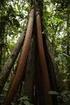
5 Shallow soil cannot hold up the giant rain-forest trees without the added support of buttress roots that flare out from the base. Tapirs are small, hoofed animals found in tropical rain forests. They are hunted for food. Not many plants grow on the forest floor, because not much sunlight reaches that far. Mosses, herbs, and fungi grow there. The floor is covered with wet leaves and leaf litter. This is where most of the decay occurs in the rain forest. Decay provides nutrients that return to the soil. The leaf litter may hide the largest number of rain-forest inhabitants. Many insects thrive in the leaf litter, including termites, ants, cockroaches, beetles, centipedes, millipedes, and scorpions. Earthworms and fungi use the organic litter as food. Large mammals, such as tapirs, forage for roots on the forest floor. Page 5 of 8
6 Fallen trees quickly begin to decompose in this warm, moist environment. Ferns, mosses, and fungi cover the forest floor. Rain-forest soil is shallow and not very fertile. Most of the nutrients that plants need to survive are contained in the trees. If the trees are cut down and taken away, the nutrients are lost to the ecoystem. It takes a long time for tropical rain forests to grow back once the trees are removed. Iguanas hide in trees over a river. When threatened, they fall into the water below and escape. Chameleons lie motionless and wait for insects to come into reach. They often change color to blend in with their surroundings. Many of the plants people keep as houseplants originated in rain forests. These include bromeliads, African violets, periwinkle, anthurium, philodendron, and Christmas cactus. Bananas, avocados, pineapples, peppers, peanuts, oranges, lemons, papaya, pepper (the spice), coconut, sugarcane, cassava, and cacao (chocolate) all grow in the rain forest. Coffee beans, cashews, and Brazil nuts are also rain-forest products. Page 6 of 8
7 Coffee and spices sold at an outdoor market are the same as those found in grocery stores throughout the world. Many fruits and vegetables have their origins in the rain forest. About one-fourth of all medicines come from rain-forest plants. These include curare (a tropical vine from which a surgical anesthetic is created), quinine (a treatment for malaria), and rosy periwinkle (from which a drug for lymphocytic leukemia is derived). ISSUES One hundred years ago, rain forests covered a much greater area than they do now. Today trees are cut down and burned to create new farmland. They are also cut for lumber and access to mineral resources. About 20 hectares (50 acres) of rain forest is destroyed every minute, somewhere in the world. If the destruction continues, tropical rain forests may be wiped out during the 21st century. The easiest way to clear the forest to create farmland is to cut and burn. When nutrients are depleted, the land is abandoned and a new area is cleared. Because of the poor quality of the soil, few crops can grow for more than a few years. Page 7 of 8
8 Eighty percent of the life-forms in tropical rain-forests have not been named or scientifically identified. Some live only in very small and remote areas and may be important sources of drugs or other medical uses. The fear is that species are disappearing with rain forests before they are discovered and scientifically described. Some species may be lost to human greed. Animals such as jaguars are hunted for their fur. Many animals are illegally captured and end up in the pet trade. Pet iguanas and parrots could be bred in captivity rather than removed from their native habitat. Ecotourism has brought many people to view and experience the rain forest. This business produces income for local inhabitants in a way that is less destructive than using the forest as farmland. Ecotourism may also create problems, however, as more people seek remote areas of the rain forest. Illegally captured parrots can end up in pet stores. A treehouse built so that tourists can experience life in the canopy. Data is available to scientists that suggests the amount of carbon dioxide in the atmosphere is increasing. This is good for plants that use it in photosynthesis to make food. But global temperatures may also be rising. This affects precipitation patterns. Precipitation has increased by about one percent over the world's continents in the last century. High latitude areas are tending to see more significant increases in rainfall, while precipitation has actually declined in many tropical areas. Page 8 of 8
Tropical rainforests grow in areas of high rainfall, they are found between the Tropic of Cancer and the Tropic of Capricorn.
 Tracking KS3 the Tropics In our Tropical Rainforest Biome you will discover how plants, animals and people of the Tropical Rainforest fit together. Let s Start! Look point 1 (Map on Left as you enter the
Ranger Report About Tropical Rainforest (in Costa Rica)
 1. Ranger Report About Tropical Rainforest (in Costa Rica) www. Therainforestrangers.com About Rainforest Images by Jan Dwire A rainforest is an environment that receives high rainfall and is dominated
What Are Rainforests?
 What Are Rainforests? Where are tropical rainforests located? Tropical rainforests are located close to the Equator between the Tropic of Cancer and the Tropic of Capricorn. This means that it is always
Deciduous Forest. Courtesy of Wayne Herron and Cindy Brady, U.S. Department of Agriculture Forest Service
 Deciduous Forest INTRODUCTION Temperate deciduous forests are found in middle latitudes with temperate climates. Deciduous means that the trees in this forest change with the seasons. In fall, the leaves
If you would like more biome reading comprehensions like this, check out my Biome Bundle. It is on sale for 50% off for 3 days only!
 If you would like more biome reading comprehensions like this, check out my Biome Bundle. It is on sale for 50% off for 3 days only! Includes: Coral Reefs Deserts Grasslands Arctic Tundra Wetlands Rainforest
Step. BASIC ACTIVITY - Create a forest ecosystem and observe factors that impact it. Discover the importance of diverse forest ecosystems
 Step 1 Discover the importance of diverse forest ecosystems BASIC ACTIVITY - Create a forest ecosystem and observe factors that impact it Classroom Activity: Students will create a tropical rain forest
Unit 6 - Habitats. Kinds of habitats
 Unit 6 - Habitats A habitat is a place where certain organisms (plant and animal species) naturally live and grow. Like your home, habitats support life by providing the food, water and shelter that its
Exhibit Inquiry. Rainforest. Aug 11
 Exhibit Inquiry Exhibit Inquiry Have students look for the following exhibits related to living things during their visit to the Ontario Science Centre: Where to go: (Level 6) What it's about: Tropical
By Gerald Urquhart, Walter Chomentowski, David Skole, and Chris Barber http://earthobservatory.nasa.gov/library/deforestation/
 By Gerald Urquhart, Walter Chomentowski, David Skole, and Chris Barber http://earthobservatory.nasa.gov/library/deforestation/ The clearing of tropical forests across the Earth has been occurring on a
4. Which choice below lists the biomes in order from lowest precipitation amounts to highest precipitation amounts?
 Ecosystems and Biomes 1. All of the living organisms in a forest plus their environment is an example of A. a biome. B. a community. C. a population. D. an ecosystem. 2. Which of the following best describes
The Tropical Rainforest Rainforest Series, Part 1 - by Mikki Sadil
 Rainforest Series, Part 1 - Tropical rainforests are among the most mysterious of all geographical biomes in the world. A biome is an area with very distinctive plants and animals that have adapted to
Tropical Tracks. Tropical rainforests are located along the Equator. Look at the map in the Biome. Draw the Equator on your map and label it.
 Tropical Tracks KS2 In Eden s Rainforest Biome you will discover how plants, animals and people of the Tropical Rainforest fit together. Let s Start! Look Point 1 (The Map, grid reference 175 482) Tropical
6.4 Taigas and Tundras
 6.4 Taigas and Tundras In this section, you will learn about the largest and coldest biomes on Earth. The taiga is the largest land biome and the tundra is the coldest. The taiga The largest land biome
Key Idea 2: Ecosystems
 Key Idea 2: Ecosystems Ecosystems An ecosystem is a living community of plants and animals sharing an environment with non-living elements such as climate and soil. An example of a small scale ecosystem
Rainforest Concern Module 2 Why do we need rainforests?
 Rainforest Concern Module 2 Why do we need rainforests? Rainforest Concern Module 2: Why do we need Rainforest? Before we go any further, there are some words you may not understand, and these words and
THE TROPICAL HOUSE RAINFOREST TEACHER'S NOTES
 THE TROPICAL HOUSE RAINFOREST TEACHER'S NOTES TEACHER'S NOTES THE TROPICAL HOUSE (Area 3 on map) INTRODUCTION to the RAINFOREST. There are three main rainforest areas: - 1. Central and South America 2.
Climate and Vegetation Regions of the World: Tropical Rainforests
 TROPICAL RAINFORESTS The Main Biomes (Vegetation Regions) A biome is a large geographical area with distinctive plant and animal groups, which are adapted for that particular environment. The climate and
Growing Cocoa Beans. Growing Region
 Growing Cocoa Beans All chocolate begins with cocoa beans, the fruit of the cacao tree (also called a cocoa tree). Scientists know that the cacao tree originated somewhere in South or Central America.
Tropical Rainforest. Abiotic Factors Amount of Water, Sunlight, Soil, Precipitation
 World Biomes A biome is an area of land that shares similar temperatures and precipitation. The observation of the temperature and precipitation over a period time make up a biome s climate. Each biome
Water from the Air: Cloud Forests
 Water from the Air: Cloud Forests Alden Wicker Water from the Air: Cloud Forests In the Americas, Asia, and Africa, there s a special kind of forest. It s rare, beautiful, and incredibly important to the
Tropical Forest Ecosystems
 Unit 2 TROPICAL FOREST ECOSYSTEMS Focus questions What is a tropical rainforest? What roles do arthropods play in the rainforest ecosystem? What are green and brown food webs and how are they connected?
Layers of the Rain Forest Distance Learning
 Layers of the Rain Forest Distance Learning Summary and Goals Students will be able to identify the layers of the rain forest and animal species that live in each layer. Grade Levels Grades 3-5 Engage
THE ECOSYSTEM - Biomes
 Biomes The Ecosystem - Biomes Side 2 THE ECOSYSTEM - Biomes By the end of this topic you should be able to:- SYLLABUS STATEMENT ASSESSMENT STATEMENT CHECK NOTES 2.4 BIOMES 2.4.1 Define the term biome.
Ranger Report About Deforestation of the Rainforest
 Ranger Report About Deforestation of the Rainforest About deforestation Forests are cut down for many reasons, but most of them are related to money or to people s need to provide for their families. The
WHAT ARE RAINFORESTS?
 WHAT ARE RAINFORESTS? kids.mongabay.com Tropical rainforests are forests with tall trees, warm climate, and lots of rain. In some rainforests it rains more than one inch every day! Rainforests are found
KS2 Rainforest Activities
 KS2 Rainforest Activities Pack Contents Teachers notes 3 Rainforest plants activity (Tropical World) 4 Rainforest plants answer sheet 6 Rainforest animals activity 8 Rainforest animals answer sheet 9 Map
Unit 4 - Shelter. Plants
 Unit 4 - Shelter Shelter is one of the elements of survival, along with food and water. Shelter offers people safety and security. Often a person s shelter is a reflection of their personal habitat. Outside
Rainforest Rescuers Overview
 Rainforest Rescuers Overview Rainforest Rescuers takes students into a thriving coastal rainforest to learn about its ecosystem and the delicate balance and interdependence of its flora and fauna. Through
Lesson Overview. Biodiversity. Lesson Overview. 6.3 Biodiversity
 Lesson Overview 6.3 6.3 Objectives Define biodiversity and explain its value. Identify current threats to biodiversity. Describe how biodiversity can be preserved. THINK ABOUT IT From multicolored coral
Chapter 3 Communities, Biomes, and Ecosystems
 Communities, Biomes, and Ecosystems Section 1: Community Ecology Section 2: Terrestrial Biomes Section 3: Aquatic Ecosystems Click on a lesson name to select. 3.1 Community Ecology Communities A biological
Plants Scavenger Hunt Activity
 Name: Plants Activity Materials: Question worksheet (pages 2-3) 16 Fact Cards (pages 4-8) Tape, Scissors, Classroom Preparation: Print the fact cards on card stock or brightly-colored paper and cut them
Rainforest Activities By the Erie Zoo www.eriezoo.org
 What is Special about Rainforests? Rainforest Activities By the Erie Zoo www.eriezoo.org Objective: Students will work in teams to identify the importance of the rainforests to the world, people, and plants
Biodiversity: The. Amazon Rainforest
 Biodiversity (Maliszewski) 1 Running Header: Biodiversity Biodiversity: The Amazon Rainforest Jessica Maliszewski Stockton University Biodiversity (Maliszewski) 2 Table of Contents I. Introduction 3 II.
Today, we re going to tackle your GUM U7, L2 & L3 Cause and Effect Essay! Chat me your best sentence using the word conscientious.
 Good Morning Conscientious 7 th Graders! Today, we re going to tackle your GUM U7, L2 & L3 Cause and Effect Essay! Chat me your best sentence using the word conscientious. Rainforest Destruction: Causes
Guardian of the Rainforest
 Page0 Guardian of the Rainforest Activity Packet Name: Page1 This packet will help you through your journey to earning a Rainforest Hero Badge. Use the information packet as a guide on what to complete
DESCRIBING DESERT, TAIGA, AND TUNDRA BIOMES
 Lesson B5 1 DESCRIBING DESERT, TAIGA, AND TUNDRA BIOMES Unit B. Science and Technology in Wildlife Management Problem Area 5. Desert, Taiga, and Tundra Biomes National Academic Standard. NS.9-12.1 Science
Rainforest Photo Sort Information Gap
 Rainforest Photo Sort Information Gap These activities form part of a sequence that can be used in a variety of ways and are very suitable for adaption to suit the children you are working with. The texts
In this lesson, students will identify a local plant community and make a variety of
 MAKING COMMUNITY MEASUREMENTS: ABIOTIC FACTORS Grades 3 6 I. Introduction In this lesson, students will identify a local plant community and make a variety of measurements, preferably during two different
totally Tropical Rainforest Outreach Guide Sponsored By
 totally Tropical Rainforest Outreach Guide Sponsored By Pre-Visit Checklist Review the Background Information with your students before the Zoo s visit. Review the enclosed Lesson Plans which compliment
ì<(sk$m)=bdefea< +^-Ä-U-Ä-U
 Suggested levels for Guided Reading, DRA, Lexile, and Reading Recovery are provided in the Pearson Scott Foresman Leveling Guide. Earth Science Tropical Rain Forests and You by J. Matteson Claus Genre
Making a Terrarium. fairchild tropical botanic garden 1
 Making a Terrarium What is a Terrarium? A terrarium is a collection of small plants growing in a transparent, sealed container. A terrarium is a closed environment, and can actually be used to illustrate
What is a Terrarium? Supplies Choosing your container Choosing your plants Building Your Terrarium
 What is a Terrarium? A terrarium is a collection of small plants growing in a transparent, sealed container. A terrarium is a closed environment, and can actually be used to illustrate how an ecosystem
Plants, like all other living organisms have basic needs: a source of nutrition (food),
 LEARNING FROM LEAVES: A LOOK AT LEAF SIZE Grades 3 6 I. Introduction Plants, like all other living organisms have basic needs: a source of nutrition (food), water, space in which to live, air, and optimal
3.1 Measuring Biodiversity
 3.1 Measuring Biodiversity Every year, a news headline reads, New species discovered in. For example, in 2006, scientists discovered 36 new species of fish, corals, and shrimp in the warm ocean waters
Life Science Study Guide. Environment Everything that surrounds and influences (has an effect on) an organism.
 Life Science Study Guide Environment Everything that surrounds and influences (has an effect on) an organism. Organism Any living thing, including plants and animals. Environmental Factor An environmental
Biology Keystone (PA Core) Quiz Ecology - (BIO.B.4.1.1 ) Ecological Organization, (BIO.B.4.1.2 ) Ecosystem Characteristics, (BIO.B.4.2.
 Biology Keystone (PA Core) Quiz Ecology - (BIO.B.4.1.1 ) Ecological Organization, (BIO.B.4.1.2 ) Ecosystem Characteristics, (BIO.B.4.2.1 ) Energy Flow 1) Student Name: Teacher Name: Jared George Date:
Reptiles and Amphibians by Guy Belleranti
 Name: Take a look at the four animals pictures below. Do you know which ones are reptiles and which ones are amphibians? The chameleon is an unusual lizard that can change the color of its scaly body.
Which of the following can be determined based on this model? The atmosphere is the only reservoir on Earth that can store carbon in any form. A.
 Earth s Cycles 1. Models are often used to explain scientific knowledge or experimental results. A model of the carbon cycle is shown below. Which of the following can be determined based on this model?
NOTE TO TEACHER: It is appropriate to introduce the mitochondria (where energy is made) as a major structure common to all cells.
 5.2.1 Recall the cell as the smallest unit of life and identify its major structures (including cell membrane, cytoplasm, nucleus, and vacuole). Taxonomy level: 1.1 and 1.2-A Remember Factual Knowledge
www.irishseedsavers.ie Natural surface water on earth includes lakes, ponds, streams, rivers, estuaries, seas and oceans.
 www.irishseedsavers.ie POND LIFE FACT SHEET Natural surface water on earth includes lakes, ponds, streams, rivers, estuaries, seas and oceans. A pond is a small body of fresh water shallow enough for sunlight
PLANET EARTH: Seasonal Forests
 PLANET EARTH: Seasonal Forests Teacher s Guide Grade Level: 6-8 Running Time: 42 minutes Program Description Investigate temperate forests and find some of the most elusive creatures and welladapted plant
10B Plant Systems Guided Practice
 10B Plant Systems Guided Practice Reproduction Station 1 1. Observe Plant A. Locate the following parts of the flower: stamen, stigma, style, ovary. 2. Draw and label the parts of a flower (listed above)
The atmosphere has a number of gases, often in tiny amounts, which trap the heat given out by the Earth.
 The Earth is wrapped in a blanket of air called the atmosphere, which is made up of several layers of gases. The sun is much hotter than the Earth and it gives off rays of heat (radiation) that travel
Discover Entomology. Discover Entomology. A Science, a Career, a Lifetime. A Science, a Career, a Lifetime
 Discover Entomology A Science, a Career, a Lifetime Discover Entomology A Science, a Career, a Lifetime What is Entomology? Entomology is the study of insects. Entomologists study bees, ants, beetles,
WEATHER, CLIMATE AND ADAPTATIONS OF ANIMALS TO CLIMATE
 7 WEATHER, CLIMATE AND ADAPTATIONS OF ANIMALS TO CLIMATE TEXTBOOK QUESTIONS AND ANSWERS Q.1. Why weather changes so frequently? Ans. All changes in the weather are caused by the sun. The movement of the
5.1 Ecosystems, Energy, and Nutrients
 CHAPTER 5 ECOSYSTEMS 5.1 Ecosystems, Energy, and Nutrients Did anyone ever ask you the question: Where do you get your energy? Energy enters our world from the Sun but how does the Sun s energy become
Climate, Vegetation, and Landforms
 Climate, Vegetation, and Landforms Definitions Climate is the average weather of a place over many years Geographers discuss five broad types of climates Moderate, dry, tropical, continental, polar Vegetation:
Report from Research in Surama Village, Guyana. The Contemporary Landscape of the Makushi Society in Guyana
 Report from Research in Surama Village, Guyana Report Prepared by: Project Title: Location of Research: James Andrew Whitaker, Researcher The Contemporary Landscape of the Makushi Society in Guyana Surama
Emerald Tree Boa: Emerald Tree Boas are bright green to blend in with their habitat. They are part of the boa family and are constrictors.
 Anaconda: The anaconda lives in the swamps and rivers. Anacondas can also climb trees. Adults can get as big as 20 feet long. Anacondas are good swimmers. They have scales and can swim quickly. They kill
Physical Environment. There are economic reasons for countries to cut down their rainforests.
 Tropical Rainforests Reasons for their Destruction Tropical Rainforests are found in the Amazon Basin of South America, (e.g. Brazil) Central Africa (e.g. Congo) and South East Asia (e.g. Indonesia). There
Communities, Biomes, and Ecosystems
 Communities, Biomes, and Ecosystems Before You Read Before you read the chapter, respond to these statements. 1. Write an A if you agree with the statement. 2. Write a D if you disagree with the statement.
Use this diagram of a food web to answer questions 1 through 5.
 North arolina Testing Program EO iology Sample Items Goal 4 Use this diagram of a food web to answer questions 1 through 5. coyotes 3. If these organisms were arranged in a food pyramid, which organism
Importance of Wildlife
 Importance of Wildlife The wildlife comprises all living organism (plants, animals, microorganisms) in their natural habitats which are neither cultivated or domesticated nor tamed. But in its strictest
ENDANGERED AND THREATENED
 ENDANGERED AND THREATENED Understand how species in the Sonoran Desert Region may become endangered or threatened and what is being done to protect them. ARIZONA SCIENCE STANDARDS SC03-S4C3-03&04, SC08-S1C3-07,
Let s Learn About Plants and Animals!
 Grade Two Pre-Visit Activities Let s Learn About Plants and Animals! i. Teacher Introduction ii. Standards Addressed iii. Pre-Visit Activities 1. Identifying Parts of a Plant 2. Plant a Seed 3. Life Cycles
Lesson Plan Two - Ecosystems
 Lesson Plan Two - Ecosystems Summary Students discuss what living things need to survive. They identify the abiotic and biotic components of an ecosystem and describe the roles and interactions of producers
Principles of Ecology
 2 Principles of Ecology section 1 Organisms and Their Relationships Before You Read On the lines below, list the organisms that you have encountered today. You share the same environment with these organisms.
Rain Forests. America's. Web of Life. Rain Forest Ecology. Prince William Network's OVERVIEW OBJECTIVES SUBJECTS
 Rain Forest Ecology National Science Education Standards Standard C: Life Sciences Populations and ecosystems. Standard C: Life Sciences Diversity and adaptation of organisms. Standard F: Science in Personal
Natural Resources and Landscape Survey
 Landscape Info Property Name Address Information Contact Person Relationship to Landscape Email address Phone / Fax Website Address Landscape Type (private/muni/resort, etc.) Former Land Use (if known)
Matter and Energy in Ecosystems
 Matter and Energy in Ecosystems The interactions that take place among biotic and abiotic factors lead to transfers of energy and matter. Every species has a particular role, or niche, in an ecosystem.
4THE UNIVERSITY OF THE STATE OF NEW YORK
 4THE UNIVERSITY OF THE STATE OF NEW YORK GRADE 4 ELEMENTARY-LEVEL SCIENCE TEST WRITTEN TEST JUNE 6, 2011 Student Name School Name Print your name and the name of your school on the lines above. The test
2 nd Grade Science Unit B: Life Sciences Chapter 3: Plants and Animals in Their Environment Lesson 1: How are plants and animals like their parents?
 2 nd Grade Science Unit B: Life Sciences Chapter 3: Plants and Animals in Their Environment Lesson 1: How are plants and animals like their parents? offspring Offspring are young plants and animals. Offspring
4th GRADE MINIMUM CONTENTS-NATURAL SCIENCE UNIT 11: PLANTS
 PLANT BITS 4th GRADE MINIMUM CONTENTS-NATURAL SCIENCE UNIT 11: PLANTS There are four main parts to a plant. They are the root, stem, leaf and flower. Each part has an important task to do in the life of
Unit 3 Lesson 5: People Need Plants
 Focus Areas: Characteristics of Plants; Science Focus Skills: observing, identifying, drawing conclusions Dedicated to Reducing Pesticides Objectives To identify parts of a plant To recognize the importance
Climate Change: A Local Focus on a Global Issue Newfoundland and Labrador Curriculum Links 2010-2011
 Climate Change: A Local Focus on a Global Issue Newfoundland and Labrador Curriculum Links 2010-2011 HEALTH Kindergarten: Grade 1: Grade 2: Know that litter can spoil the environment. Grade 3: Grade 4:
Virginia Gardener http://www.hort.vt.edu/envirohort
 The Virginia Gardener http://www.hort.vt.edu/envirohort Name Help Sheets: Seeds What Is a Seed? A seed is a very young plant that is in the dormant, or resting stage. It is very much alive. There are three
The Polar Climate Zones
 The Polar Climate Zones How cold is it in the polar climate? Polar areas are the coldest of all the major climate zones The Sun is hardly ever high enough in the sky to cause the plentiful ice to melt,
Section 1 The Earth System
 Section 1 The Earth System Key Concept Earth is a complex system made up of many smaller systems through which matter and energy are continuously cycled. What You Will Learn Energy and matter flow through
Chapter 18 Introduction to. A f r i c a
 Chapter 18 Introduction to A f r i c a Ch. 18:1 Landforms & Resources 1. Africa s shape & landforms are the result of its location in the southern part of the ancient supercontinent of. Pangaea Over thousands
Chapter 3: Climate and Climate Change Answers
 Chapter 3: Climate and Climate Change Answers Section A: Climate 1. (a) Explain what each of the following means: (4 x 1 mark) (i) climate the average weather of an area over a 25 30 year period (ii) maritime
Name Date Hour. Plants grow in layers. The canopy receives about 95% of the sunlight leaving little sun for the forest floor.
 Name Date Hour Directions: You are to complete the table by using your environmental text book and the example given here. You want to locate all the abiotic (non-living) and biotic (living) factors in
ENVIRONMENTAL CHANGES
 reflect How do you respond to environmental changes? Maybe you wear different types of clothes in different seasons. Maybe you only ride your bike during certain times of the year. What if you moved to
Producers, Consumers, and Food Webs
 reflect Think about the last meal you ate. Where did the food come from? Maybe it came from the grocery store or a restaurant. Maybe it even came from your backyard. Now think of a lion living on the plains
Animals of the Desert
 Animals of the Desert (NatureScope Discovering Deserts page 26-27) Third Grade Core: Standard 2 Objective 2 Describe the interactions between living and nonliving things in a small environment. Teach a
Worksheet A Environmental Problems
 Worksheet A Environmental Problems Vocabulary Can you talk about Environmental issues in English? With a partner, try to explain the terms in the diagram below. Why are the words divided into two groups
A Most Colorful Mammal by Guy Belleranti
 Name: In the tropical rainforests of western Africa lives a mammal with a most colorful face and rump. This mammal is the mandrill, the world's largest monkey. The skin on a male mandrill's face has a
Regional Parks Botanic Garden Plant Adaptations to Habitat Tour: Selected Plant Adaptations by Garden Section
 INTRO Regional Parks Botanic Garden Plant Adaptations to Habitat Tour: Selected Plant Adaptations by Garden Section Tools (optional, but nice to use): -Discovery Scope -Spray bottle of water--from the
Flowers; Seeds enclosed in fruit
 Name Class Date Chapter 22 Plant Diversity Section Review 22-1 Reviewing Key Concepts Short Answer On the lines provided, answer the following questions. 1. Describe the main characteristics of plants.
3.1. Succession, Recovery, and Renewal in Natural Communities. A35 Starting Point. What Happens to a Vacant Lot?
 3.1 Succession, Recovery, and Renewal in Natural Communities Here is a summary of what you will learn in this section: Ecosystems change in predictable ways known as succession. Ecosystems can establish
Educator's Guide to the Assembly Program: RAINFORESTS ALIVE! www.reptilesalive.com ReptilesAlive! LLC 1/15
 Educator's Guide to the Assembly Program: RAINFORESTS ALIVE! www.reptilesalive.com ReptilesAlive! LLC 1/15 Program Overview Tropical rainforests are the most biologically diverse terrestrial ecosystems
Pond Vocabulary Words and Meanings
 Pond Vocabulary Words and Meanings Adapt: to adjust to a use or situation Aquatic: from or in the water Bacteria: tiny organisms, too small to be seen with the naked eye Carnivore: an animal that eats
Main Menu Table of Contents Back Chapter 16 Biomes
 Chapter 16 Biomes In Chapter 6, you learned about seasons, wind, ocean currents, and weather patterns. All of these elements work together to produce different climates in different parts of the world.
Animal Adaptations -- Vocabulary
 Section 1 Objectives o Children will understand what animal adaptations are. o Children will be able to explain why animal adaptations are important. o Children will be able to explain different types
Rainforest Alliance Learning Site Third Grade-Lesson 2 1 www.rainforest-alliance.org/education
 Third Grade Ecuadorian Rainforest National Standards for Grade 3 Lessons Language Arts Writing Standard 4 Level 2 Grade 3-5 2. 3. 4. Gathers and uses information for research purposes (encyclopedias, dictionaries,