
Cranefield College of Project and Programme Management
|
|
|
- Dylan Chandler
- 10 years ago
- Views:
Transcription
1 Cranefield College of Project and Programme Management Prospectus 2015 Registered with the Department of Education as a Private Higher Education Institution under the Higher Education Act, Registration certificate no. 2000/HE 07/010. Incorporated as Cranefield College Ltd in England and Wales, and Cranefield College (Pty) Ltd in South Africa, trading as Cranefield College of Project and Programme Management. Contact Details: tel: +27 (0) ; fax: +27 (0) ; [email protected]. Postal Address: P O Box 70591, The Willows, 0041.

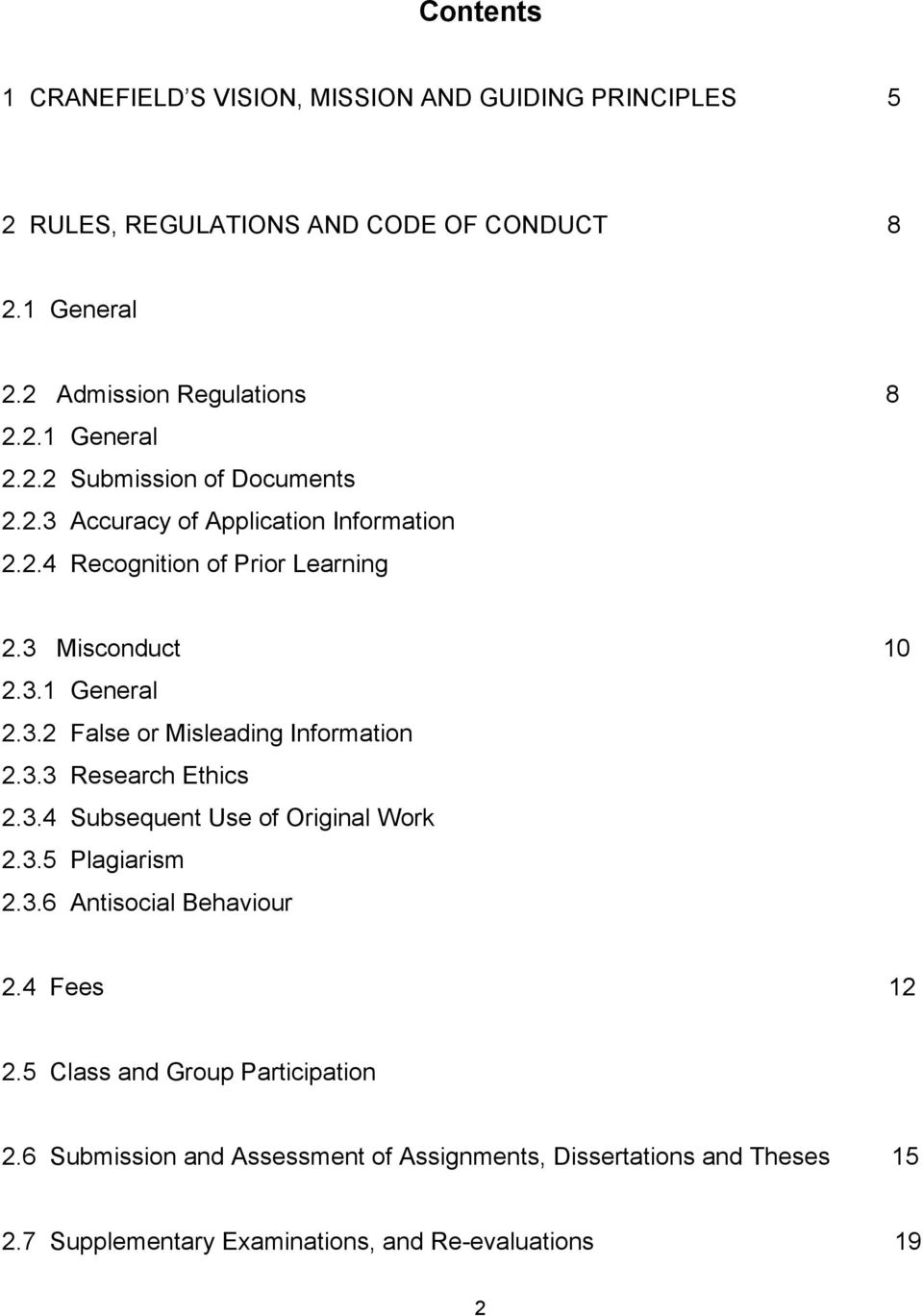
2 Contents 1 CRANEFIELD S VISION, MISSION AND GUIDING PRINCIPLES 5 2 RULES, REGULATIONS AND CODE OF CONDUCT General 2.2 Admission Regulations General Submission of Documents Accuracy of Application Information Recognition of Prior Learning 2.3 Misconduct General False or Misleading Information Research Ethics Subsequent Use of Original Work Plagiarism Antisocial Behaviour 2.4 Fees Class and Group Participation 2.6 Submission and Assessment of Assignments, Dissertations and Theses Supplementary Examinations, and Re-evaluations 19 2
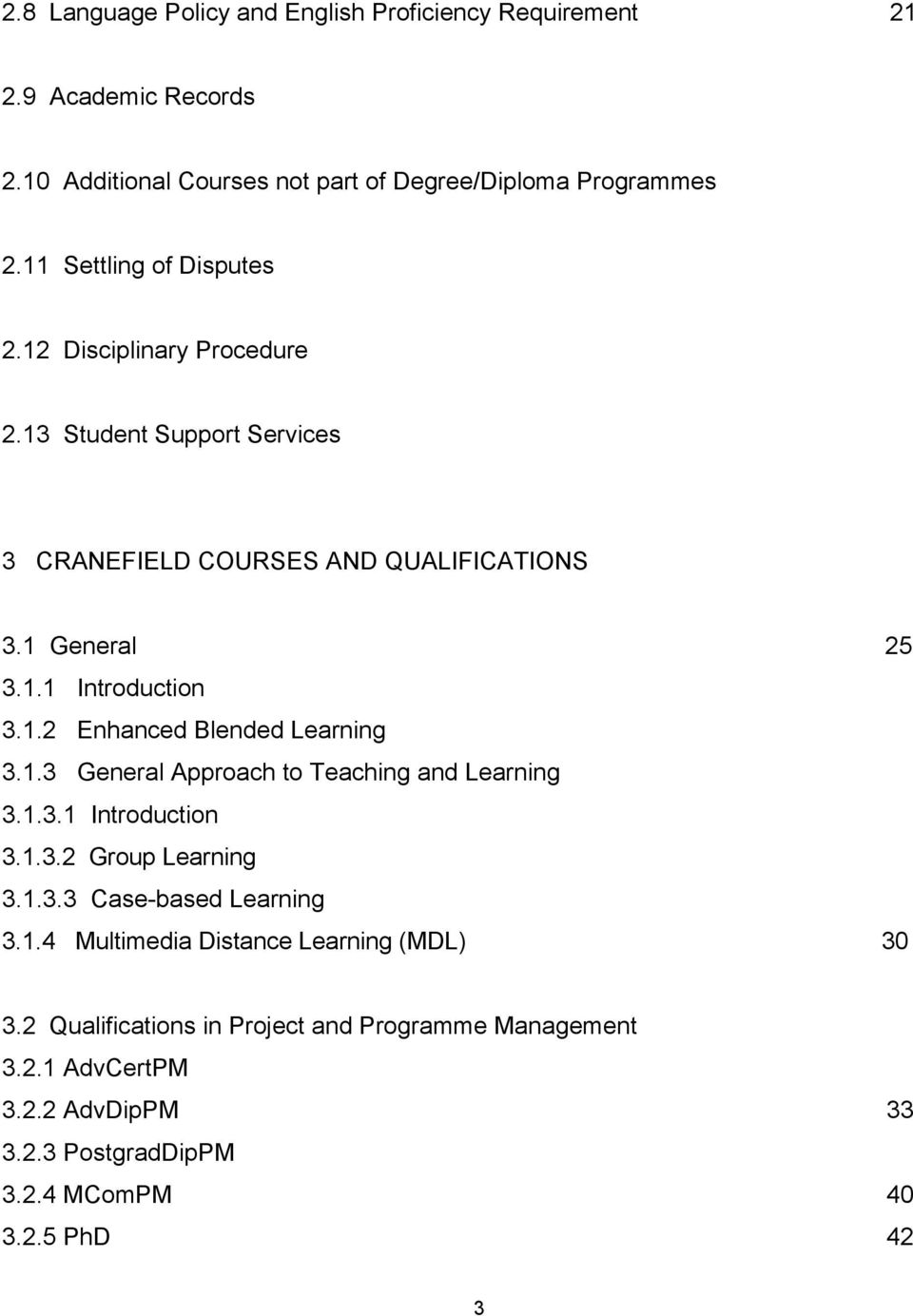
3 2.8 Language Policy and English Proficiency Requirement Academic Records 2.10 Additional Courses not part of Degree/Diploma Programmes 2.11 Settling of Disputes 2.12 Disciplinary Procedure 2.13 Student Support Services 3 CRANEFIELD COURSES AND QUALIFICATIONS 3.1 General Introduction Enhanced Blended Learning General Approach to Teaching and Learning Introduction Group Learning Case-based Learning Multimedia Distance Learning (MDL) Qualifications in Project and Programme Management AdvCertPM AdvDipPM PostgradDipPM MComPM PhD 42 3
4 3.3 Individual Short Courses (NDP) 44 4 FEES AND FINANCIAL SUPPORT Class-based Courses 4.2 Courses through Multimedia Distance Learning (MDL) 4.3 Financial Support 4.4 Refunds with Cancellation 5 ACADEMIC STAFF AND COUNCIL MEMBERS 48 Appendix 1: The Statute of Cranefield College Appendix 2: Procedure at Graduation Ceremonies 57 4

5 SECTION 1 CRANEFIELD S VISION, MISSION AND GUIDING PRINCIPLES 1.1 Vision and Mission Cranefield s vision is to provide top-quality private higher education in Africa and further internationally, and to remain at the cutting edge of new-economy leadership education. Our mission is continuously to improve the quality of our learning programmes and services to meet our students (and, where applicable, their employers ) needs, in order to add economic and social value to society as a whole. 1.2 Values and Beliefs Fundamental to the success of Cranefield are the following basic values: We endeavour to be committed, to have a positive attitude at all times, and to nurture behaviour where trust, cohesion, integrity, transparency and ethical practices are allowed to flourish. In the context of maintaining staff members excellent team spirit, we strive for a culture of involvement and empowerment where each team member takes full responsibility for the role that he or she fulfils, and is continuously exposed to learning. Our human resources provide the creativity and innovation that guide perceptions about our qualities in the marketplace. The contents of our learning programmes, and the manner in which we present these to our students, are the end result of our combined efforts. We are judged according to 5

6 perceptions regarding the quality that we maintain. Ensuring total quality in all our endeavours so as best to serve the needs of all our clients, is a value that influences every part of our service delivery. 1.3 Guiding Principles Our main aim is to focus on service excellence to our internal and external customers, and to measure the performance of delivery processes for assessment of strategic benefits. Quality is uppermost in our minds: to achieve stakeholder satisfaction, the quality of our learning programmes and services must enjoy the highest priority. We firmly believe in following a systems approach to managing our processes, and in achieving innovative learning and continuous improvement in everything we do. Dedication to continuous improvement is uppermost on our minds: we strive for excellence in respect of everything we do, including quality, service and quick response. Staff empowerment and involvement are entrenched: we encourage high-performance teamwork and promote good human relationships and trust among our employees, as well as between our staff and our students. Through a culture of trustworthy support sponsored by our leaders, we ensure open communication and a free flow of information. Improved technology is essential for effectiveness and efficiency: incrementally improved technology is favoured, while human resources are constantly retrained to master innovations. Our students and their employers are the focus of everything we do: we are focused on delivering improved learning programmes and services to our stakeholders on a continuous basis, and to deliver them better than any competitor locally or internationally. 6

7 The Department of Education, the Council on Higher Education, SAQA and our students employers are our partners: together we must create and sustain mutually beneficial relationships to enhance the quality of learning programmes and services to our students. 7

8 SECTION 2 RULES, REGULATIONS AND CODE OF CONDUCT 2.1 General All students and members of staff must acquaint themselves with the code of conduct, and the rules and regulations of Cranefield College. By enrolling with Cranefield, students agree to abide by these, and acknowledge the scope of Cranefield s disciplinary powers Students shall be bound by this code and the aforementioned rules and regulations for the duration of their learning programme. Cranefield may from time to time announce additions or amendments to the rules and regulations Cranefield expects all students and members of staff to conduct themselves in such a way as to enable Cranefield to fulfil its aims effectively and efficiently, without hindrance. No student or member of staff shall act in breach of any regulation of Cranefield where he or she knows or ought to know that he or she is acting in breach thereof. Those who breach regulations will be subjected to disciplinary action, coupled with legal action where appropriate. 2.2 Admission Regulations General Possession of prescribed qualifications for admission to any learning programme does not automatically qualify a student to register for it. He or she may be requested to comply with additional requirements such as a special assignment or an oral or written examination. The admission policy is reviewed annually, and the 8

9 admission requirements from the previous year may not apply. It is the responsibility of prospective students to keep abreast of developments Because of the nature of the admission procedures, deadlines are enforced strictly. All relevant documentation must be provided by the specified deadlines. Application for any programme implies acceptance by the applicant of the admission policies and procedures Submission of Documents When applying for admission to any class-based programme, applicants must submit certified copies of their highest qualifications, and must also submit a curriculum vitae, which must reflect all qualifications and the latest grades received, to the Registrar (Academic). The Admissions Committee may, however, require applicants to provide certified copies relating to all courses/programmes attended at any other institution, prior to approving admission to the learning programme involved When undergraduate courses are still in progress at the time of application, or graduate programmes have not been completed, and are not reported on the certified copies, applicants must provide a statement of registration to the Registrar (Academic) Accuracy of Application Information Where it is discovered that any application information is false or misleading, the application will be invalid. This will result in immediate rejection. If the student has already been registered, withdrawal from the programme will be mandatory Recognition of Prior Learning Recognition of prior learning (RPL) plays an important role in the process of assessing eligibility for admission to a specific academic programme where the 9
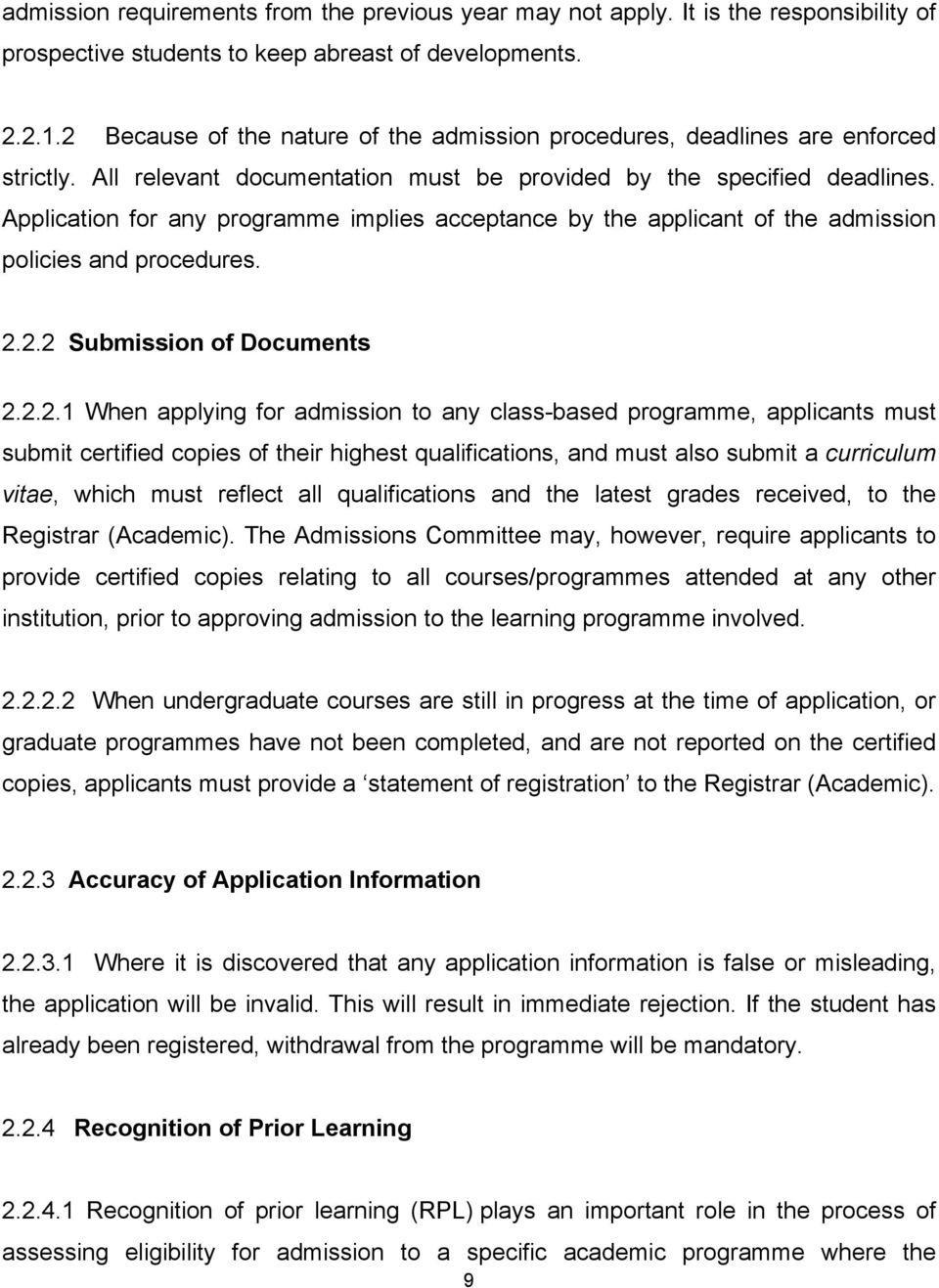
10 applicant has not yet obtained a higher qualification at the minimum level as required by the standard admission criteria for that programme. The criteria for RPL for access to Cranefield s respective academic programmes are set out in the Admission sections of each program in Section 3 below. 2.3 Misconduct General. In line with section above, misconduct on the part of students or members of staff can take the form of any conduct that amounts to inappropriate interference with the functioning or activities of Cranefield, or anyone associated therewith. The following particular provisions highlight some noteworthy specific instances of misconduct. Misconduct against which appropriate disciplinary action can be taken therefore includes, but is not limited to, the following: False or misleading information. No student shall falsify or misuse any certificate or other document and/or knowingly make any false statement in the course of his or her endeavours with Cranefield. The discovery of any false statements or fraudulent omissions at any time (including in the application process; see above) may lead to cancellation of, or preclusion from, registration Research Ethics. Cranefield requires all those who undertake research, both staff and students, to practise sound research ethics, both to ensure the highest quality of research and to avoid the potential for misconduct. Such misconduct can inter alia be in the form plagiarism (see section below) or any other form of deception, or in the form of the violation of the rights of others (including unauthorised use of confidential information and involving persons in research without their informed consent). If a student has any doubts or questions regarding ethics, he or she should discuss the matter with his or her supervisor. Further guidance can also be found in the M7 study material, which is available to all graduate researchers at Cranefield College. The College has a dedicated Ethics Committee, which deals impartially with all ethical matters involving any member of staff or any student. 10

11 2.3.4 Subsequent use of original work. Although copyright in any assignment, dissertation or thesis by an enrolled student of Cranefield vests in him or her, it is mandatory for such student-author to inform Cranefield of any subsequent use of the material, and to acknowledge his or her supervisor/s and Cranefield therein. Failure to do so shall constitute a breach of contract with Cranefield Plagiarism. If in the assessment of any assignment, dissertation or thesis it is found that any portion of any piece of work is unduly similar to, or the same as, that of another student at Cranefield or of any other unacknowledged author, the student/s involved will receive 0%. In the case of a first offence, a warning will be issued and the opportunity of doing a supplementary examination may be granted (requiring payment of the prescribed R examination fee). Depending on the details of the case, the student/s may be requested to appear before the Ethics Committee. In the case of a further offence, the student/s will generally be requested to appear before the Ethics Committee (depending on where the student is based). The Committee will subsequently decide whether a supplementary will be granted or whether the student s/s studies will be suspended. The Committee will determine the period of suspension, according to the specific case. Suspended student/s will have to reapply for registration on the relevant programme after the expiration of the suspension period. In the case of multiple offences, a student may be barred from further study. Students must take great care to ensure that they acknowledge all their sources, and that they do not use others words or ideas without clearly indicating this Antisocial behaviour. Action will be taken against any student or member of staff who engages in behaviour that is malevolent, injurious or offensive, and/or causes distress. Moreover, where such a person causes damage to the property of Cranefield, or commits any other criminal offence or causes other damage in respect of Cranefield or its students or staff, appropriate legal action will be taken. 11

12 2.4 Fees Where a course is based on multimedia distance learning (MDL), the full amount for the module for which a student is enrolled shall be paid prior to dispatch of the learning material (unless instalments apply, by special arrangement) Where a course is class-based and the student is personally liable for fees, he or she is required to pay the full registration fee (R for 2015) before his or her registration can be finalised. The student will then receive an invoice for the full fee once the registration has been finalised. Payment in respect of the module must be effected (in full or, by special arrangement, in part) within fourteen days from the date of such invoice, or before the first lecture date, whichever is earlier. In the case of a student who starts the module through online participation, such payment must be made before receipt of study material. The student must produce proof of payment of the two amounts above (within the times stipulated), via fax, , or other appropriate means, and must follow up with the Administration in time to be able to participate in the class Where a course is class-based and the student s company is paying, an approval letter from the company for payment of studies must reach the Administration before the registration can be finalised. The student s company will then receive an invoice for the full fee of the first module once the registration has been finalised. The full amount must then be paid in due course. The onus remains on the student to produce proof of payment via fax, , or other appropriate means, and to follow up with the Administration in time to be able to participate in the class. The company will still be liable for the registration fee (R for 2015) where the student/company elects not to continue after registration A student who, for any reason, still has any outstanding fees at the time of completing his or her final examination will not receive his or her results. 12
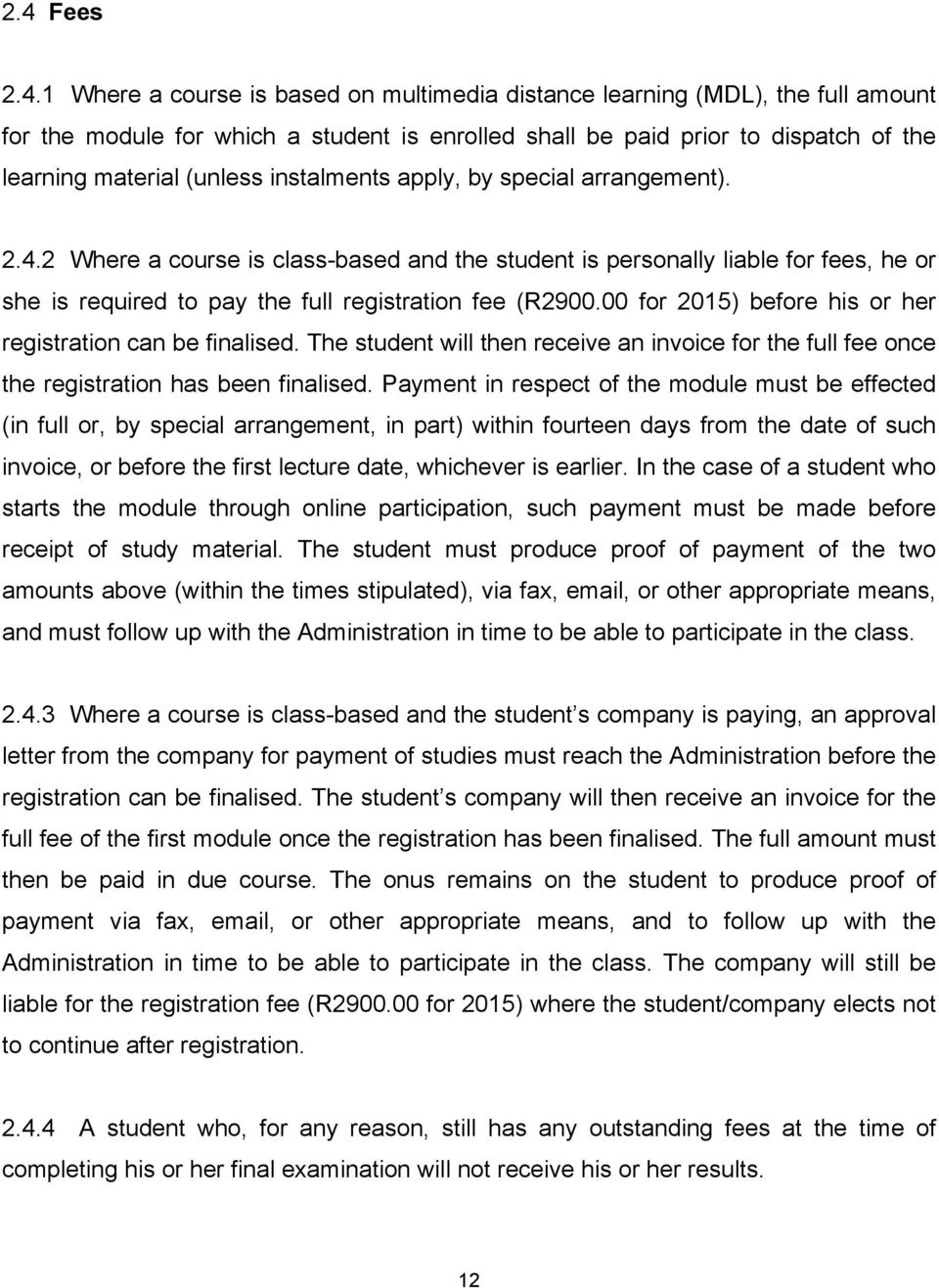
13 2.4.5 No refunds are payable to any student who does not fulfil his or her study obligations. In the case of class-based modules, where a student has not yet paid in full, and withdraws after the first lecture day but before the second lecture day in a particular cycle, he or she shall be liable for a cancellation fee (see Section 4 below). Such cancellations are permissible only before the second class date A student who withdraws from his or her studies after the second lecture date shall still be liable for the full module fee (regardless of whether he or she has submitted any of his or her assignments on time or at all) A student who repeats a class-based module shall be liable for 50% of the current full module fee (in addition to the fees paid for his or her first attempt). In the case of MDL short courses, however, the 2015 repeat fees are specified: R for Advanced Business English, and R for Project Management A student who exceeds the maximum time limit for any MDL course (as set in the study guide: usually six months), will be liable for an administration fee to enable him or her to renew registration for the course. The 2015 renewal fee is R If study material has in the meantime been updated, the student will have the option of purchasing the updated material at an additional fee (as appropriate). If more than two years have elapsed since first receiving study material, the student will have to reregister for the course. He or she will then receive the latest study material (as applicable) and will be liable for a repeat module fee. If more than three years have elapsed, the difference between the current full fee and the original fee will be payable Fees paid electronically must be accompanied by the invoice reference number, or the name and surname of the student, and the Administration must be informed of such a transfer by fax or In the case where a company will be liable for tuition fees, the VAT registration number must be provided with registration. 13

14 2.5 Class and Group Participation For all lectured modules, class participation is strongly encouraged, and it is in the ordinary course expected that a student will be engaged in all live lectures for a particular module, whether on campus or via Blackboard. It is especially important to participate in the first lecture day of a particular module. Nevertheless, Cranefield College can in special cases offer some flexibility in this regard, since it officially operates in terms of the distance mode of delivery, as confirmed by the Council on Higher Education (CHE). Cranefield College has substantial capacity for reaching students nationally and internationally via its Blackboard Learning Management System (LMS). Cranefield s distance mode of delivery offers substantial advantages in the flexibility and agility of its programme delivery. Cranefield s Blackboard LMS also enables students to attend classes interactively online from the office or home, and to study recordings of the live classes. Students must notify the Administration timeously regarding their needs With Cranefield s enhanced distance learning, all classes are streamed live on the Internet, and students may opt to participate in any or all of their classes online, thereby saving time and travel. However, students are compelled to notify the Administration and receive the Blackboard link at least one day before the class. It is imperative for students who participate online to adhere exactly to the Midrand dates and the assignment deadlines for these modules. If a student is unable to participate in any of the online classes due to special circumstances, however, the student may still be permitted to study the recording of the class that he or she has missed. In cases where the student s company is funding his or her studies, such student must submit proof of company approval for not participating in the live class. Refer to and below regarding the procedure to be followed depending on the lecture day in question Regardless of any special arrangements regarding class participation, it is compulsory for all students, including online participants, in all modules (apart from individual MDL courses) to participate actively and timeously in group activities and 14

15 assignments. Lack of such participation would result in a student not being able to continue further with the module in that cycle. For case discussions in syndicate groups, students are also able to meet via the Internet in a dedicated online collaboration room where they can see and hear each other in an organised fashion, using Cranefield s Blackboard Collaborate system. Such group sessions can also be recorded for revision purposes Cranefield s formal lecture sessions span five hours on a lecture day: commencing strictly at 08h00 and ending at 13h00. The contact days are three per module for all programmes. After the formal lecture session, the auditorium facilities will be at the disposal of students who wish to have syndicate group discussions. The lecturer will be available to assist with individual or group matters. Lunch will be served to students who wish to make use of this time to engage further with each other and/or with the lecturer. However, for food security purposes and prevention of waste, students must kindly indicate before 09h00 their intention to stay beyond 13h00. Remote syndicate groups can engage with the lecturer at any time, utilising their online collaboration room or alternative media For students who attend on campus, no one will be allowed to enter a class after the facilitator has closed the door. Students who are late will be allowed into the class only at teatime. A student who arrives later than teatime will not be allowed to attend, and will hence be treated as absent for the day. A student who leaves before the end of class will also be treated as absent. Online participants are also expected to be on time and actively engaged throughout the class, and their interactive participation will be monitored by the session moderators The Administration may under appropriate circumstances permit a student who is unable to participate in the first lecture day nevertheless to start the module, utilising the recording of the first lecture day. The student, or his or her representative, must in such a case formally request this, in writing, from the Head of Administration, Ms Karen Pretorius ([email protected]), in advance of missing the first lecture day. This 15

16 information will be placed on record. In cases where the student s company is funding his or her studies, such student must submit proof of company approval for not participating in the live class. It is then imperative that the student follow up timeously to be allocated to a syndicate group (see above) in order to be able to continue with the module. It is not possible to start a module after the second lecture date As described in above, it is in the ordinary course expected that any student participate in all three lecture days of any module (in person or live online). Under special circumstances, a student who has been allocated to a group may miss participating in the second or third lecture day, or both. In that event, he or she must, in writing, inform the Head of Administration of the need for his or her absence, preferably in advance. This information will be placed on record. In cases where the student s company is funding his or her studies, such student must submit proof of company approval for not participating in the live class. The student must then study the recording/s of the live session/s and must still ensure full participation in group sessions in order to be admitted to the examination Submission and Assessment of Assignments, Dissertations and Theses All examination sessions involve a first and second examiner (the latter of whom may be internal or external). All dissertations and theses are assessed and graded by a first examiner (the supervisor/promoter), and, where there is a co-supervisor or joint promoter, assessed by him or her as second examiner, and then finally also assessed by an independent external examiner Adherence to submission dates for individual and group assignments, and dissertations and theses, is strictly required. In the case of individual examination assignments, any student who fails to submit on time and provides a valid reason (supported by evidence, as appropriate) may, however, be granted an extension for submission. Nevertheless, any late submission will generally result in the student having 16

17 to wait until the assessment of supplementary examinations for the late assignment to be assessed. In the case of group assignments on class-based modules, no extension may be granted under any circumstances, since the case is discussed in class on the day of the deadline. Late submissions with a valid excuse (and supporting evidence, where relevant) will be treated as supplementary examinations (with 50% being the maximum awardable mark) with no feedback report. Where the submission is substantially beyond the deadline or there is no valid excuse as mentioned, the group will receive 0% In the case of dissertations and theses, late submission may not be accepted, and a student who fails to submit on time, for whatever reason, shall have to submit for the next available submission deadline. The submission deadlines for dissertations and theses are 1 November (for March graduation) and 1 June (for September graduation) of every year. A student must submit within three years of starting his or her MComPM programme to avoid having to reregister for the programme All individual assignments shall contain the following honest declaration: I hereby declare that this assignment is my own work, and that it has not previously been submitted to any other Higher Education Institution. I also declare that all published and unpublished sources have been fully acknowledged and properly referenced. This includes figures, tables and exhibits. Where modified by me, this has also been indicated All dissertations and theses submitted for examination shall contain the following honest declaration: I hereby declare that this [dissertation/thesis] is my own work, and that it has not previously been submitted to any other Higher Education Institution. I have acknowledged all other persons who have assisted in the content or presentation of the work. I also declare that all published and unpublished sources have been fully acknowledged and properly referenced. This includes figures, tables and exhibits. Where modified by me, this has also been indicated. 17

18 2.6.6 The following honest declaration, signed by each member of the group, must be included in all group assignments: We, the undersigned, hereby declare that each of us has contributed to this assignment, and that it is entirely our own work. We also declare that all published and unpublished sources have been fully acknowledged and properly referenced. This includes figures, tables and exhibits. Where modified by us, this has also been indicated All assignments must be submitted in electronic form in MS Word format. In accordance with Higher Education practice, all final examinations remain the property of the College, and may not be returned to students. However, students will be granted the opportunity to discuss their marked examinations with the examiner/s by special request, which request must reach the Administration within 14 days of the results being released In the case of a dissertation for a degree, at least two ring-bound hardcopies of the dissertation must be submitted for examination. Where there are more than two examiners, the candidate will be required to submit further copies. Where improvements to a dissertation are recommended by any internal or external examiner, such improvements must be made within six weeks of notification, and must be resubmitted for perusal and approval. This would be applicable only in the case of minor improvements (see below regarding the possibility of resubmission following rejection of the dissertation) If the dissertation is accepted, two hardbound copies (with the student s name, the title, and the year of submission on the spine and cover) of the dissertation must reach Cranefield s Administration on or before a specified date (of which the student will be advised), before the final awarding of the degree An electronic version of the dissertation (on CD-ROM), must accompany the hardbound copies referred to in above. The CD-ROM must be enclosed in a cover that indicates the title of the dissertation and the name of the student. The calendar year 18

19 of submission must also be indicated thereon. 2.7 Supplementary Examinations, Re-evaluations and Repeats A student who, due to reasons beyond his or her control, fails to undertake or to submit an examination assignment on time, may be granted the opportunity to do a special supplementary examination, for which a full mark will be awarded. In the case of MDL courses, this is subject to payment of the prescribed standard supplementary examination fee of R Details (with supporting evidence, where appropriate) of the reasons for such failure must be submitted to the Head of Administration before the due date, or shortly thereafter, depending on the nature of the situation, and will be placed on record. Every case will be evaluated on its own merits. Confidentiality of any personal information is assured A student who, without a valid excuse as contemplated in above, fails to submit a first examination assignment on time, or submits and fails the examination, will have the opportunity to do a supplementary examination. The result of such a supplementary examination will then be pass (50%) or fail: there will no longer be the opportunity for achieving a higher mark. In the case of MDL courses, the supplementary examination fee following a failed exam is R In the case of all courses/modules, the fee for a supplementary examination following failure to undertake or to submit, without a valid excuse as contemplated in above, is currently R A supplementary examination will not be permitted in the case where a student has failed both to submit his or her individual assignment and also to participate in, or to submit, the group assignment. In such a case, the student will be invited to undertake a repeat module A supplementary examination must, in all cases, be undertaken within 6 months after failing, or failing to submit, the previous examination, failing which the student will have the opportunity to repeat the module in question. 19

20 2.7.5 A student who fails a first supplementary examination will have the opportunity to undertake a second supplementary upon payment of the prescribed examination fee for a second supplementary (currently R750.00). A student who fails the second supplementary will fail the module in question, and will then have the opportunity to repeat the module (subject to above) A student who fails to submit his or her supplementary examination on time (or at all) will fail and will have the opportunity to repeat the course In the case of all MDL modules, a repeat course must be embarked on within one year after not passing the examination. Otherwise full reregistration will be required In the case of all modules, no person will be permitted to undertake any module more than three times (in total) All supplementary examinations must be submitted electronically as indicated in above A student who fails an examination, or fails to attain a distinction, may, by paying the prescribed fee (currently R385.00), apply to the Registrar (Academic) for a reevaluation by the internal examiner and, should the original result be upheld, by an external examiner. This application must reach the Registrar (Academic) within 14 days of the results being released. (If it is a first failed examination for that module, he or she will be offered a supplementary examination, as contemplated in above). In the case of dissertations and theses, resubmission of an improved manuscript (where the student would otherwise fail) is allowed only under exceptional circumstances, by special permission of the Principal Should a student be of the opinion that any assigned mark is not a true reflection of his or her ability, he or she may request a discussion with the relevant lecturer. The 20

21 aim of such a discussion would not be to change the assigned mark, but rather to provide insight regarding the reasons for the mark. Should the student wish to have the mark re-evaluated, he or she can follow the procedure in above In the case of MDL courses, if a student has passed the examination with a mark under 60%, and strongly feels that the performance is not a true reflection of his or her ability, he or she may request to have the opportunity to undertake a special supplementary examination (upon payment of the prescribed fee) in order to obtain a higher mark. This is allowed only under such specific circumstances, in the interests of furthering the development of such students and motivating them to improve. 2.8 Language Policy and English Proficiency Requirement The official language of the College is English. All learning materials, instructions and facilitation are presented/conducted in English. All correspondence with and from the College is also in English All students enrolled at Cranefield College are expected to be proficient in English. In addition to such basic proficiency, students are expected to develop their English skills progressively during their studies. To this end, and following recommendations from the Council on Higher Education, a compulsory module (the MDL short course Advanced Business English ) is part of the PostgradDipPM programme so as to promote the development of advanced English skills for all students who continue with higher studies at Cranefield College. The module contributes 15 of the 135 credits towards the full Postgraduate Diploma Where a Master s Degree student at Cranefield College has not yet completed the required English module (privately or as a compulsory course during the PostgradDipPM), the course must be added to his or her MComPM modules. The module must be completed in conjunction with the first class-based module of the student s MComPM programme. In cases where special permission is granted for a 21
22 deferment, it is still compulsory for any MComPM student to have passed the Business English course at the very latest by the fourth month after being allocated a supervisor. 2.9 Academic records Cranefield shall keep comprehensive records of the academic achievement of all its past and present students Cranefield shall make available to any enrolled student or past student, on request, a transcript of his or her academic record, and, where required, a copy of his or her degree/diploma certificate(s) subject to the payment of the relevant fee Additional Courses not part of Degree/Diploma Programmes Cranefield may, in line with section 28 of the Regulations for the Registration of Private Higher Education Institutions (2002), present tailored in-house courses or any other additional courses of recreational/developmental or general public interest (in the areas of the academic and professional competence of its staff), which do not form part of any of its programmes that lead to a qualification registered on the NQF (all Cranefield s academic programmes lead to accredited qualifications) The additional courses contemplated in will accordingly not be marketed as being accredited qualifications or approved by the CHE or registered by the Department of Education Settling of Disputes If a dispute should arise between a student and lecturer regarding the assessment of the work of that student, or a related matter, such dispute should be settled informally between the parties wherever possible. The lecturer will provide explanations, and the student will be given the opportunity to state his or her point of 22
23 view and to ask the questions that he or she wishes to ask. Most matters should be easily resolved via this simple process If a student is not satisfied with the explanations provided by the lecturer, he or she can then formally (in writing) bring the matter to the attention of the Administration. Confidentiality is assured in as far as possible. The Administration will then arrange for another lecturer (in the same specialised area) to evaluate the matter. Where the dispute involves an examination, this lecturer would generally be the second (independent) examiner. The student can elect to arrange a meeting with that lecturer, or can view his or her brief report on the matter. If there is any need for further action, the lecturer can make such recommendation to the Principal, who will then take the final steps to resolve the matter Where the recommendation mentioned in is not made, and the student is still dissatisfied with the outcome, he or she can formally (in writing) request the Principal or Vice-Principal to settle the dispute All procedures shall have regard to the principles of natural justice, and administrative-law remedies shall as a matter of course be available to any party who is dissatisfied with the final decision of the Principal or Vice-Principal Disciplinary Procedure The Principal of Cranefield College, has, in terms of section 3.2 of Cranefield s Statutes, the responsibility of attending to matters related to the maintenance of discipline, and has the power to authorise cancellation of registration or termination of studies of any student on disciplinary grounds, following due process. Where relevant, the Principal must also represent Cranefield in legal action against such student Any member of staff of Cranefield may, if he or she finds it necessary, instruct a student whose conduct is in his or her opinion in breach of Cranefield s code of conduct, 23
24 to withdraw from any facility affected by the conduct in question. The matter must then be brought to the attention of the Principal, and taken further A complaint of misconduct either by one student against another or by a member of staff against a student, or vice versa, shall be made to the Principal. It will be endeavoured to resolve complaints informally by consultation between the student(s) and staff concerned, facilitated by the Principal. Where this fails, however, a formal complaint, in writing, must be submitted to the Principal, who will then take appropriate disciplinary action against the individual(s) concerned (following a hearing, where necessary) Disciplinary action against members of staff shall be conducted according to the South African laws governing the relationship between employer and employee A student who is awaiting the outcome of a hearing may be suspended for a reasonable period of time, pending the outcome All procedures shall have regard to the principles of natural justice, and administrative-law remedies shall as a matter of course be available to any party who is dissatisfied with the final decision of the Principal Student Support Services A full virtual library is available to students, at no additional cost A limited subject matter library is available to students at the Administrative Headquarters Full academic and academic administrative support is available to students on a continuous basis, and limited career counselling is available to students on demand. 24
25 SECTION 3 CRANEFIELD COURSES AND QUALIFICATIONS 3.1 General Introduction All Cranefield qualifications are accredited by the Council on Higher Education, and all courses and modules are presented in English. Cranefield College has positioned its academic qualifications to serve the leadership and management needs of organisations best, in both the private and public sectors. Its academic qualifications focus on value chain management, including the organisation s supply chain activities, its project management portfolios, and the appropriate leadership behaviours for strategic success. In the current economic climate, employers prefer job-relevant education and training for improving the competence of employees and for providing them with the necessary skills to be of immediate benefit to the organisation. What you learn from Cranefield today, you are able to implement in your work context tomorrow. Due to the modular structure of Cranefield s academic programmes, students need to spend only one day per month away from work for class contact. Between class contact days, student syndicate groups meet outside work hours to discuss their practical case studies Enhanced Blended Learning Through its Blackboard Learning Management System (LMS), Cranefield College offers enhanced blended learning (combining contact and distance learning). Cranefield College officially operates in terms of the distance mode of delivery, enabling it to provide maximum flexibility and agility of its programme delivery to students. With Cranefield s Blackboard LMS, the entire process of programme delivery is enhanced, 25
26 also enabling students to attend classes interactively online from the office or home, and/or to view recordings of the classes. Live classes are conducted on the main campus in Midrand and elsewhere, but students are no longer compelled to be physically present. Students may choose to physically attend the live classes where this is convenient for them. With Cranefield s enhanced distance learning, all classes are streamed live on the Internet, and students may opt to participate in any or all of their classes online, thereby saving time and travel. However, students are compelled to notify the administration and receive the Blackboard link at least one day before the class. For case discussions in syndicate groups, students are also able to meet via the Internet in a dedicated online collaboration room where they can see and hear each other in an organised fashion, using Cranefield s Blackboard Collaborate system. Cranefield s formal lecture sessions span five hours on a lecture day: commencing strictly at 08h00 and ending at 13h00. The contact days are three per module for all qualifications. For those attending class physically, the auditorium facilities are, after the formal lecture session, at the disposal of students who wish to have syndicate group discussions. The lecturer will also be available to assist with individual or group matters. Lunch will be served to students who wish to make use of this time to engage further with each other and/or with the lecturer. Remote syndicate groups can engage with the lecturer at any time, utilising their online collaboration room or alternative media. As alluded to above, where a student is unable to participate in any of the live classes (due to a particular work situation, for instance), he or she can, by special arrangement, still subsequently view the recording thereof. Students who participated may elect to view the recording for revision purposes. All class-based academic programmes, including the master s degree (MComPM), are accordingly available to students in all areas in South Africa and internationally through blended learning (BL), combining class contact with online support. Exceptional 26
27 students may advance all the way to the PhD degree, which signifies the highest level of academic attainment. Apart from Cranefield s full academic programmes, selected short courses are also available through multimedia distance learning (MDL), which courses do not involve live class participation. The MDL-based courses are accordingly also available to students in any country, provided that they are proficient in English and have basic Internet access General Approach to Teaching and Learning Introduction The andragogic (adult learning) approach is followed in all Cranefield s courses. This means that the emphasis is on learning instead of teaching. It is essential for students to prepare themselves thoroughly for each session by studying the prescribed text and recommended reading material. This facilitates on-the-spot processing of large amounts of information, and also promotes meaningful class participation. Classes take the form of presentation and discussion, rather than conventional lectures. Both theoretical understanding and practical skills in application are promoted, and then assessed, in all Cranefield s programmes. The emphasis is on hands-on problem solving, and an integrative approach to the subject matter in question. The key features of Cranefield s learning programmes are: 1. the analysis of realistic case scenarios from a solid theoretical foundation, providing practical solutions and insight in applying knowledge and skills in dealing with those case studies; 2. the development of independent, lifelong learning skills on the part of students; 27
28 3. the use, wherever possible, of syndicate groups as a means of stimulating peer interaction (developing both knowledge and interpersonal skills), promoting teamwork, and facilitating broader and deeper learning (due to the nature of action learning, where peers share and challenge ideas and knowledge); and 4. the continuous exposure of students (for the most part) to their work situations and environment while they are acquiring the knowledge and skills central to the programme; they hence have the opportunity to start applying these in their field of practice immediately as they acquire them Group Learning In all class-based courses (whether contact is in class or online), students are divided into syndicate groups for the purpose of group learning. Every group must appoint among themselves a coordinator, who will have the responsibility of coordinating activities, and, where applicable, of delivering the group presentation in class. Whether in relation to virtual (Internet-based) meetings or face-to-face meetings, attendance/participation reports must be submitted to the Administration, indicating the form and frequency of meetings, and confirming each member s participation/attendance. In a group-learning environment, the ability to communicate effectively with other syndicate members is an essential skill. Students should be able to provide feedback in a constructive and supportive manner to each other in order to improve individual and group performance in a team setting. The ability to present materials learned during individual study to the group in a clear and articulate manner, based on evidence, is an important asset in group learning. It is also important that syndicate members must be cooperative and supportive of each other, and share knowledge and resources freely among themselves. How to make creative use of the energy of louder members, and how to encourage the participation of quieter members in a group, are examples of the type of group skills that are essential for a successful team. 28
29 Syndicate members should be able to set individual objectives, while respecting and participating in the setting and fulfilling of the objectives set by the group. When they have been assigned the problem case study, they will discuss and argue the issues involved. Students must weigh the factors, probe the underlying issues, compare the advantages and disadvantages of different alternatives, and develop courses of action and solutions (see further below). Cooperation in syndicate teamwork ensures that maximum benefit is derived from the overall learning experience. In class (where applicable) and in syndicate groups, Cranefield students benefit exponentially from the varied backgrounds and perspectives of their fellow students, learning from each other as well as from the lecturer Case-based Learning In any applied discipline it is vitally important to be able to define problems (often with limited information), to suggest what further analysis is necessary (or indeed possible), and to devise and to implement a reasonable action plan to resolve the problems at hand. All project and programme management modules use case-based learning. The case method is aimed at developing the student s ability to apply sound theoretical knowledge and fine-tuned practical skills in confronting and solving real problems. Cases are often based on first-hand accounts of real situations, taking as their subjects problems that stem from many interdependent factors. Students must analyse the case, identify the problem, examine the contributory causes (where relevant) and possible solutions, and consider alternative courses of action before arriving at a suitable conclusion and recommendation. The case method requires the student to learn by doing. For this reason, Cranefield always bases any case scenario to be analysed and reported on, on realistic problems (usually incorporating a combination of actual past events) so that the student may recognise that decision-making under real conditions is not an exact science, and that the 29
30 results of actions in professional practice are often far less precise than academic theory might suggest. The overall result of Cranefield s case-based and group-learning methods is a unique learning experience that transcends the mere assimilation of facts, techniques and methodology. To assist students in achieving the required outcomes, the generic and subject-specific learning outcomes are stipulated in the study guide for each module Multimedia Distance Learning (MDL) Whereas all Cranefield s academic programmes, apart from the PhD, offer class participation (whether physical or online) and require group activity, MDL courses do not involve these (although student collaboration is encouraged) and may be completed individually within specified timeframes. Registration for Cranefield s first two MDL courses opened in 2007, and there are now many students who benefit from this convenient and effective learning method. Any individual in any part of the world with access to the Internet can register in any month of the year for the course of his or her choice. For detailed information on the MDL courses available in 2015, please see the MDL Prospectus (available at Qualifications in Project and Programme Management Advanced Certificate in Project Management (AdvCertPM) Structure and Scope The Advanced Certificate in Project Management is accredited at NQF level 6, with 120 credits (consisting of three modules of 40 credits each). The programme particularly 30
31 serves to meet the need for a professional qualification at the undergraduate level in project and programme management. The AdvCertPM is fully aligned with the USA Project Management Institute s (PMI) PMBOK (Project Management Body of Knowledge) and is an ideal route towards gaining international certification as a PMP (Project Management Professional). This is currently deemed to be the internationally most important industry-recognised certification for project managers. There are three days of lectures per module, spread evenly over the three months duration of each module. Please see the "Academic Calendars" on the Cranefield College website for timeslots. Note again that all lectures at the main campus are streamed live via Cranefield's Blackboard Collaborate system, making it possible to attend interactive classes live via the Internet. The only specification in terms of the order of precedence of modules is that Module Mα must be completed first: Step 1: Module Mα: Project Management: Perspective, Planning and Implementation (40 credits) (Fundamental) Step 2: Complete, in any order, Module AC1: General Management Perspective (40 credits) (Core) and AC2: Project Accounting, Contract and Procurement Management (40 credits) Note that the following electives will be offered from 2016 onwards: AC3: Public-Private Partnerships (40 credits) (Elective) AC4: Project Documentation Management (40 credits) (Elective) The full AdvCertPM programme takes nine months to complete. 31
32 Availability of the Programme Module Mα is offered in every quarter, while module AC1 and AC 2 are offered in alternative quarters, allowing for flexibility throughout the year to commence and continue with the programme. The learning programme can be commenced in any quarter of the year: Jan to March. April to June. July to Sept. Oct to Dec Admission General Requirement A Higher Certificate, or at least a Senior Certificate ( matric or international equivalent) coupled with relevant management experience and/or additional courses for the purpose of recognition of prior learning (RPL) Recognition of Prior Learning Whereas the standard minimum requirement for admission to the Advanced Certificate programme is a Higher Certificate (NQF Level 5), applicants not in possession of the aforementioned qualification may be assessed for eligibility for admission on the basis of RPL. All relevant information and documentation, including a detailed curriculum vitae (particularly describing the applicant s work experience) must be submitted to the Registrar (Academic). This category is designed to provide opportunities to those who meet the following criteria: a) Have completed at least the National Senior Certificate (or international equivalent). 32
33 b) Have been employed or vocationally active in the community for at least two years since earning the Senior Certificate, c) Have gained relevant management experience in the workplace, holding a position of authority and responsibility. d) Have completed relevant credible courses related to the required competencies at credible institutions. Applicants must generally comply with at least a) to c) above, but evidence related to d) will also contribute significantly to a favourable outcome and may render obviate the need for c). Where an applicant has been identified by his or her employer as having leadership potential resulting from Human Resources career-path tracking, it is sufficient for him or her to comply only with a) and c) above Advanced Diploma in Project Management (AdvDipPM) Structure and Scope The AdvDipPM consists of three modules. Each of the three modules contributes 40 credits to the total of 120 credits for the qualification. A candidate who does not have a tertiary qualification and/or has not formally covered the necessary work (project planning and implementation, effectively applying PM tools and techniques) will be required to complete a foundational prerequisite module, Module Mα ( Project Management: Perspective, Planning and Implementation ), before being admitted to continue with M1. Such candidates may also choose to undertake the PM Short Course ( Project Management: Perspective, Planning and Implementation ) through multimedia distance learning (MDL) to meet the requirements. Experience has shown that it is generally advisable to complete this foundational module, since it equips students with fundamentals that are invaluable in the workplace and on the Advanced Diploma programme. These fundamentals are very often not adequately covered in other management courses. 33
34 The structure of the AdvDipPM programme is as follows: Module M1: Project Management: Leading, Creating, Implementing and Improving, and Module M2: Programme-Managing Organisational Performance and Innovative Improvement, and then one of the following: Module M3: Supply Chain Quality and Performance Management, or Module M4: Transformational Corporate Strategy, or Module M5: Creating High-Performance Project and Process Teams, or Module M6: Financial Management of Corporate Projects and Programmes. The AdvDipPM programme takes nine months to complete Availability of the Programme M1 and M2 are presented four times per annum at Cranefield s Midrand campus (to allow for flexibility throughout the year to commence and continue the AdvDipPM, since M1 must be undertaken first and then followed by M2). It is also presented once per annum in selected other locations (please consult our website). The elective modules (a choice between M3, M4, M5 and M6) are each presented twice per annum in Gauteng, and once per annum in other locations. There are three days of lectures per module, spread evenly over the three months duration of each module. The learning programme can be commenced in any quarter of the year; M1 runs four times per annum in the following timeslots: Jan to March (Initial); April to June (Repeat); July to Sept (Repeat); and Oct to Dec (Repeat). Note again that all lectures at the main campus are streamed live via Cranefield's Blackboard Collaborate system, making it possible to attend interactive classes live via the Internet. Therefore, you do not need to be based in Gauteng to undertake a module presented at the main campus. 34
35 M2 also runs four times per annum in the same timeslots as M1 above, and M3 to M6 are there presented in the following timeslots: M3: Jan to March & July to Sept; M4: April to June & Oct to Dec; M5: Jan to March & July to Sept; and M6: April to June & Oct to Dec. For specific dates, and calendar information for other locations, please consult our website Admission General Requirement The general requirement for admission is a tertiary qualification coupled with relevant experience. Prospective students may, however, be admitted to the AdvDipPM learning programme without already holding a degree or a National Diploma (or equivalent), provided that they have already successfully completed Module Mα or the PM Short Course (as mentioned under above) and/or other relevant courses (recognition of prior learning), have passed matric (or international equivalent), and have also gained substantial appropriate practical experience. Proficiency in English is also required (please see 2.8 above) Recognition of Prior Learning As alluded to above, prospective students who are not in possession of an accredited tertiary qualification may in some cases be considered for entry onto the Advanced Diploma programme. Recognition of prior learning (RPL) plays an important role in this process. All relevant information and documentation, including a detailed curriculum vitae (particularly describing the applicant s substantial work experience) must be submitted 35
36 to the Registrar (Academic). This is designed to provide opportunities to those who meet the following criteria: a) Have completed at least the National Senior Certificate (or international equivalent). b) Have been employed or active in the community for at least eight years since leaving secondary school. c) Have gained substantial management experience in the workplace, holding a position of authority and responsibility. d) Have successfully completed the foundational module Mα (Project Management: Perspective, Planning and Implementation) or PM Short Course (Project Management: Perspective, Planning and Implementation) at Cranefield College. e) Have completed other courses related to the required competencies at credible institutions. Applicants must generally comply with at least a) to d) above, but evidence related to e) will also contribute significantly to RPL. Where an applicant has been identified by his or her employer as having leadership potential resulting from Human Resources careerpath tracking, it is sufficient for him or her to comply only with a), c) and d) above. In evaluating students for RPL purposes, current competencies in the field of Project Management that have been acquired by experiential learning through related studies and/or experience will be closely assessed Assessment Practical Case-Study Assignments Assessment involves a formal group assignment and an individual examination assignment, each based on a case study. Students are required to submit the group assignment on the last lecture day of each module before the final month of the course 36
37 (exact dates are announced for each session). The group assignment contributes 20% towards the final course mark. The format is identical to the individual examination assignment. The individual examination assignment must be submitted around five weeks after the last lecture in the final month (exact dates are announced by the lecturer, for each session), and contributes 80% of the final mark for the course. The group and individual assignments must be neatly typed and technically presented in the form of a report to top management. These must be submitted as MS Word files. The report must contain the following: 1. A cover page indicating the title of the case analysed and reported on, the student s/s name(s) and student number(s). 2. A contents page, which reflects the contents of the assignment. 3. A one-page executive summary briefly describing the main problems together with the causes, and recommended solutions. 4. The main body of the assignment must contain a well-motivated solution to the case. 5. Reference to the literature that was consulted, and knowledge drawn from personal experience, must be made throughout. 6. A bibliography, which must reflect all the sources referred to, must be included. All examinations are moderated by a second examiner (who may be internal or external). For this reason, all assignments must be submitted on time. Submission dates will appear on the examination paper. Adherence to submission dates for examination and group assignments is strictly required. The rules and regulations regarding late submission apply (see 2.6 and 2.7 above) Evaluation Criteria for Assignments Understanding the course content 10 Problem identification 10 Analysing the causes 35 37
38 Conclusions and recommendations 30 Technical presentation: executive summary, language, 15 illustrations, and bibliography Total: 100 A mark is awarded in the form of a percentage. At least 50% is required to pass the assignment. Both assignments must be passed in order to pass the module. A mark of 75%, or higher, signifies a distinction Postgraduate Diploma in Programme Management (PostgradDipPM) Structure The PostgradDipPM, which provides 135 credits, consists of four modules. Following recommendations from the CHE, a compulsory module (15 credits) is part of the PostgradDipPM programme to assist students who continue with higher studies at Cranefield College in developing their English skills. The Advanced Business English module (please see below) must be completed concurrently with the first module (students receive their MDL study material at the first class, and then continue in interaction with their online lecturers), unless special permission for deferral to the following module is obtained. The structure of the programme is as follows: Module ME: Advanced Business English, and any three of the following: Module M3: Supply Chain Quality and Performance Management, or Module M4: Transformational Corporate Strategy, or Module M5: Creating High-Performance Project and Process Teams, or Module M6: Financial Management of Corporate Projects and Programmes. The full course takes nine months to complete. 38
39 Availability of the Programme There are three days of lectures per class-based module, spread evenly over the three months duration of each module. Please consult the Cranefield website for details of dates and locations. Note again that all lectures at the main campus are streamed live via Cranefield's Blackboard Collaborate system, making it possible to attend interactive classes live via the Internet. Therefore, you do not need to be based in Gauteng to undertake a module presented at the main campus. Please see the Cranefield College website for the timeslots for M3 to M6. At the main campus, M3 to M6 are presented as follows: M3: Jan to March & July to Sept; M4: April to June & Oct to Dec; M5: Jan to March & July to Sept; and M6: April to June & Oct to Dec Admission Completion of Cranefield s Advanced Diploma in Project Management, or any qualification recognised by the Admissions Committee as being equivalent, is a prerequisite for admission to the Postgraduate Diploma in Programme Management. An equivalent qualification means any NQF level 7 (original scale) or higher qualification with similar content as the Advanced Diploma programme. If certain subjects were not sufficiently covered, or not covered at all in the equivalent qualification, relevant modules from the Advanced Diploma learning programme will have to be taken in addition to those of the Postgraduate Diploma learning programme. Every case will be evaluated on its own merits Assessment The assessment information is the same as for the Advanced Diploma in Project Management (see above). 39
40 3.2.4 Master s Degree in Programme Management (MComPM) Structure The MComPM, which provides 240 credits, consists of four modules, and requires the student to have passed the Advanced Business English MDL short course, prior to completing his or her dissertation (see 2.8 above). This follows recommendations from the Council on Higher Education. The four modules comprising the MComPM are as follows: M 7: Leadership and Management Research Methodology M 8: Strategic Value Chain Management M 9: Advanced Cases in Leading and Managing the Learning Organisation M10: Work-context Dissertation. The programme usually takes two to three years to complete, depending on the candidate s progress with his or her dissertation. The candidate s registration will be reviewed and renewed annually, dependent on satisfactory progress. Registration may be renewed no more than twice. Should a candidate require more than three years, reregistration will be necessary (with the appropriate arrangements and payment of the prescribed re-registration fee) Work-context Dissertation The candidate is required to complete a dissertation of limited scope, which investigates a problem-based project or programme management situation in his or her work environment. Cranefield s Dissertation Committee appoints the supervisor for the dissertation. Once the student s research proposal has been approved, he or she will establish a working relationship with his or her supervisor, and final submission must occur on or before the 1 November or 1 June deadline in the second or third year of his 40
41 or her MComPM studies (please see 2.6 above regarding the rules and regulations concerning submission). In preparing the research dissertation, students must pay special attention to the structure, style and technical presentation thereof. It is a basic requirement that all dissertations must be written in clear and correct language, and must contain accurate references using the correct method. Before a supervisor will allow any dissertation to be submitted for examination, such basic requirements must be met. To ensure that the required writing standards are met, it is compulsory for every Master s Degree student at Cranefield to have passed the MDL short course Advanced Business English, or the Advanced Writing Skills course, before completing his or her dissertation (see above). Where he or she has not yet completed the course (privately or as a compulsory course during the PostgradDipPM), the course is added to the MComPM modules. Students English skills will continue to develop in the dissertation-writing process, and this will consequently also further improve the quality of their writing in their professional contexts. Students are generally required to communicate and meet with their supervisor(s) on a regular basis. The supervisor will, however, determine the frequency of communications and meetings Admission Students who hold the Postgraduate Diploma in Programme Management from Cranefield College, or any qualification recognised by the Admissions Committee as being equivalent, may apply for admission to the MComPM learning programme, successful completion of which will lead to the attainment of the MComPM Degree. A student must have achieved an average mark of at least 63% for the combination of the Advanced Diploma and the Postgraduate Diploma (or his or her equivalent highest qualification) to be eligible to apply for admission to the Master s Degree learning programme. In addition, the chairperson of the Master s Degree panel may at his or her discretion call for an interview with the applicant. 41
42 Assessment The same policies and procedures for assessment of examination assignments in the AdvCertPM, AdvDipPM and PostgradDipPM apply to those in the MComPM. In addition, the assessment of the work-context dissertation is based on: The student s knowledge of the subject matter; insight into the problem being researched; practical application of knowledge, skills and attitudes in solving the problem; understanding the analysis and application of theory applicable to the topic; the research methodology followed; meaningfulness of the conclusions and recommendations; style, structure, technical presentation, and language. A dissertation shall be awarded a distinction if the average marks of the examiners equal 75% or higher. It is compulsory that an article prepared for potential publication in a recognised journal accompany the final submission for examination of the dissertation (see 2.6 above). As mentioned above, should a student need more than the usual maximum of three years to complete the programme, re-registration will be required (with the appropriate arrangements and payment of the re-registration fee) Doctor of Philosophy (PhD) The degree of Doctor of Philosophy is a research degree, awarded on the basis of a doctoral thesis. The Cranefield PhD is accredited at NQF level 10, with 360 credits. When considering an application for registration for the PhD degree, the Doctoral Selection Committee shall be guided by the following admission requirements: 42
43 (a) An appropriate master's degree; or (b) Recognition of prior learning (RPL) that results in a level of research and subjectmatter competencies that may be regarded as comparable to master's level and sufficient to complete doctoral studies successfully. The appropriate level could, for instance, be evidenced by research articles published in refereed journals. (c) Provision (b) above must be read with existing Cranefield RPL policies. In line with the above, a person shall not be admitted as a candidate for the degree unless he or she: (a) is a graduate of the College or of any other Higher Education Institution recognised by the Doctoral Selection Committee, holding at least a master's degree or equivalent qualification; or (b) has, in any other appropriate manner, attained a level of competence which, in the assessment of the Doctoral Selection Committee, and on the recommendation of the Registrar (Academic), is sufficient for the purpose of admission as a candidate for the PhD degree. Applications for registration must be submitted to the Registrar (Academic). Any application of a candidate who did not obtain his or her previous qualifications from Cranefield College must be accompanied by an original statement from the academic institution where the qualifications were obtained. The statement must indicate the marks or symbols obtained for all successfully completed courses. Candidates must not submit original degree certificates. Only certified copies of original certificates will be accepted. Candidates must, with their application for registration, also submit a comprehensive portfolio of evidence with regard to their technical knowledge and skills application in project and programme management, their managerial experience in project and programme management leadership, and their contextual experience in portfolio and 43
44 programme management. Candidates may approach Cranefield's Administration directly, or use the registration facility on our website. Upon receipt of a candidate's application and academic records (in respect of qualifications not obtained at Cranefield), the Doctoral Selection Committee will decide whether the candidate meets the minimum requirements prescribed for registration. Doctoral candidates are expected to make suggestions regarding the specific topic within the area of study in which they would like to conduct research. All doctoral theses must be work-based, researched with the aim of creating new knowledge and adding value to the relevant organisation and society at large. It is expected of candidates to submit, with their application for registration, an initial draft research proposal in this regard. This will enable the Doctoral Selection Committee to obtain a complete view of the probability of the successful execution of doctoral studies at Cranefield, to select a potential promoter, and also to establish which members to appoint on the colloquium where the potential candidate will submit and defend his or her research proposal. Registration will take place only after the colloquium committee has approved the candidate's research proposal. The PhD signifies the ultimate level of professional study and academic attainment. 3.3 Individual Short Courses (NDP) Cranefield College offers some of the modules from the academic programmes above as individual short courses that may be taken not for degree/diploma purposes. There is a class-based short course in Project Management (40 credits), which usually serves as a module of the Advanced Certificate in Project Management programme (Module Mα). This module may also be taken independently as a short course not for diploma purposes (NDP), for personal enrichment. As reflected on the Cranefield website, the College also offers seminars and workshops in Leadership and Organisational Value Chain Management, tailored to the needs of 44
45 clients, as well as point-earning CPD courses (validated by the Engineering Council of South Africa). A multimedia distance learning (MDL) module in Advanced Business English (three months) forms part (15 credits) of the curriculum of the Postgraduate Diploma in Programme Management, but may also be taken independently as a short course not for diploma purposes (NDP), for personal enrichment. Applied courses in Advanced Writing Skills are available to persons who have successfully completed the Advanced Business English course. An MDL short course in Project Management (three months) is available not for diploma purposes. However, it may also contribute to RPL for admission to the AdvDipPM in cases where the Admissions Committee finds that an AdvDipPM applicant does not have the required comprehensive knowledge of project management planning and implementation tools and techniques, but is otherwise eligble to enrol. In such cases, the PM Short Course can serve to provide the necessary foundational knowledge before a student proceeds to Module M1, which deals at a higher level with leadership, strategy and programme management. For detailed information on the MDL courses available in 2015, please see the MDL Prospectus (available at 45
46 SECTION 4 FEES AND FINANCIAL SUPPORT 4.1 Class-based Courses Fees include all textbooks and other materials and catering on the days of the lectures. Financial support is provided by students employers and education trusts. Arrangements for alternative payment schedules must be made in advance with Ms Rouvé Potgieter telephonically during office hours at +27 (0) , or by at [email protected]. Students who are personally liable for course fees must pay the full amount for the module in question prior to the first lecture day, and fax proof of payment to +27 (0) or such proof to [email protected]. The basic fee structure for academic programmes in 2015 is as follows: The registration fee for the AdvDipPM, PostgradDipPM or AdvCertPM programme is R The fee per module for Advanced Certificate (AdvCertPM), Advanced Diploma (AdvDipPM) and Postgraduate Diploma (PostgradDipPM): R , apart from module ME (Advanced Business English), for which the fee is R when taken as part of the Postgraduate Diploma. The fees for MComPM are as follows: Registration fee of R plus R for the full programme (including the dissertation module). Cancellation fee (after one lecture day) for all class-based modules: Third of the full fee for that module, plus the full registration fee. Module repeat fee for class-based modules: Half of the current module fee. For MDL courses, please see above. 46
47 For further information on fees, including fees for supplementary examinations, please see section 2.4 and 2.7 above (in the Rules, Regulations and Code of Conduct). 4.2 Courses through Multimedia Distance Learning (MDL) Full payment of fees must be effected before dispatch of the study material. In special cases, an arrangement can be made for payment in two to three installments. The fee for each course is stipulated in the MDL Prospectus (available at Financial Support No special financial support is provided. Where students find it difficult to pay the full amount upfront, the fees can be structured per individual arrangement with the College via the Financial Coordinator, Ms Rouvé Potgieter at 4.4 Refunds with Advance Cancellation In the case of cancellation in advance of the start of the programme, the full fee minus the registration fee would be reimbursed to the student. 47
48 SECTION 5 ACADEMIC STAFF AND COUNCIL MEMBERS 7.1 Management Staff Prof Pieter Steyn (Principal) Pr Eng, BSc(Eng), MBA, DCom Dr Erik Schmikl (Vice-Principal) MA(Psych), MBL, DLitt et Phil, ITP (Harvard) Dr Pieter van Dyk (Registrar) DCom Dr Roche Steyn (Director: International Blended Learning and MDL) BLC, LLB, HonsBA(Psych), LLM(Med), AdvDipPM, LLD Ms Karen Pretorius (Head of Administration) MComPM 7.2 Academic Staff Prof Pieter Steyn* (Principal) Pr Eng, BSc(Eng), MBA, DCom Dr Erik Schmikl* (Vice-Principal) MA(Psych), MBL, DLitt et Phil, ITP (Harvard) Dr Pieter van Dyk* (Registrar) DCom Prof Andre Watkins* PhD, DPhil, DCom, Dsc Mr Marius Maritz MA, MBL, CFM (Harvard), CA (SA) Ms Hilary Anderson* BCom (Math. Stats), AdvDipPM, BCom(Hons)(Econometrics), MPhil 48
49 Mr Lunga Msengana MComPM Prof Dr Brane Semolic* PhD Dr Roche Steyn* BLC, LLB, HonsBA(Psych), LLM(Med), AdvDipPM, LLD Mr Ernst Swanepoel PrEng, BSc(Eng)(Hons), MComPM *Indicates permanent staff members 7.3 Council Members Prof Simon Maimela BA, Th.M (USA), Th.D (Harvard) Prof Raymond Parsons BCom, BA(Hons) (UCT), DCom (hc) (UPE), F.Ist.D Dr Joyce Matube BA(SS), BA (Hons), MA(SS), DPhil Ms Sinnah Ramakhula BA Soc, MBA Mr Sekhopi Malebo PostgradDipPM (Cranefield) Dr Erik Schmikl (Vice-Principal) MA, MBL, DLitt et Phil, ITP (Harvard) Prof Pieter Steyn (Principal) Pr Eng, BSc (Eng), MBA, DCom Dr Pieter van Dyk (Registrar) DCom For details of the International Advisory Panel, please see 49
50 APPENDIX 1: The Statute of Cranefield College STATUTE The Council of Cranefield College has, by virtue of the powers derived from the official registration of the Institute with the Department of Education in terms of the Higher Education Act 101 of 1997, approved a Statute, the provisions of which are set out below: 1.0 DEFINITIONS In this Statute an expression used shall have the following meaning: Act means the Higher Education Act 101 of 1997; auditor means any person registered as such in terms of the Public Accountants and Auditors Act, 80 of 1991; Board means the Board of Directors of Cranefield; Chairperson means the person appointed as Chairperson of the College Council; College means Cranefield College; Convocation means the convocation of the College; employee means any person employed full-time or part-time in a permanent or temporary capacity by the College; Principal means a person appointed as Principal of the College; Registrar means a person appointed as Registrar of the College; and, student means a person registered as a student according to the applicable rules and procedures of the College. 50
51 2.0 THE COUNCIL 2.1 There shall be a Council whose members shall be appointed by the Board on recommendation of the Principal. 2.2 The Council shall consist of fit and proper persons who shall, as much as possible, be representative of the broader South African society, and who shall add value to the affairs of the College. 2.3 The powers, functions and responsibilities of the Council shall be to govern the College within the parameters of this Statute. Where this Statute is silent, or in the case of uncertainty about the lawfulness of Council s action or decision, guidance shall be sought from the Board and the general practice relating to Councils of other tertiary education institutions. 2.4 The term of office of members of Council shall be three years provided that the Board shall endeavour to re-appoint at least fifty-percent of outgoing members to the Council for the following term of office. 3.0 CHAIRPERSON 3.1 The Board shall appoint a fit and proper person as Chairperson of the College Council. 3.2 The Chairperson of the Council is the titular head of the College and shall have the following functions and powers: The constitution of the congregation of the College; The conferral of degrees and the award of diplomas and certificates of the College; and, The dissolution of the congregation of the College. 3.3 In the absence of the Chairperson, the Principal shall perform the functions and exercise the powers of the Chairperson. 3.4 The term of office of the Chairperson shall be three years after which he/she may be re-appointed for further terms of office. 51
52 4.0 PRINCIPAL 4.1 The Board shall appoint a fit and proper person as Principal of the College. 4.2 The Principal is the Chief Executive Officer of the College and shall have the powers, functions and responsibilities normally associated with such a position. 4.3 The Principal may, whenever he/she deems it necessary, appoint one or more fit and proper persons as Acting Principals to exercise the Principal s various powers, functions and responsibilities until not later than the next meeting of the Council. 5.0 REGISTRAR AND ADMINISTRATION 5.1 The Board may, on recommendation of the Principal, appoint a fit and proper person as Registrar of the College. The term of office and conditions of service of the Registrar shall be determined by the Board in consultation with the Principal. 5.2 The powers, functions and responsibilities of the Registrar shall be the same as those of a Registrar of a similar tertiary education institution. 5.3 The Principal may appoint any fit or proper person(s) as employees to assist the Registrar with the administrative functions and responsibilities of the College. 6.0 MEETINGS OF COUNCIL 6.1 The Council shall meet at least twice a year. 6.2 Proper notice of meetings shall be given to members of Council, which notice shall be given timeously and be accompanied by an agenda and a copy of the minutes of the proceedings of the previous meeting. 6.3 The Registrar shall be responsible for the arrangements pertaining to meetings of Council, including the compilation of agendas and the recording of proceedings of such meetings. 6.4 The normal legal duties and procedures relating to the approval and signature of minutes of meetings of Council shall apply and be followed by the Chairperson and the Registrar. 52
53 7.0 PANEL OF ACADEMIC ADVISERS 7.1 The Council may, on recommendation of the Principal, appoint a panel of academic advisers to the College. 7.2 The panel of academic advisers shall also include fit and proper persons from professional practice. 7.3 The functions of the panel of academic advisers shall be to advise the Principal on the academic affairs of the College. 7.4 The Principal shall convene and chair meetings of the panel of academic advisers. 8.0 CONVOCATION 8.1 The convocation of the College shall consist of graduates, and holders of diplomas and certificates of the College and may also include holders of honorary degrees of the College. 8.2 The convocation may be represented on the Council and shall form part of the alumni association of the College. 9.0 DESIGNATION OF QUALIFICATIONS The College may offer the following accredited qualifications: 9.1 Advanced Certificate in Project Management - AdvCertPM 9.2 Advanced Diploma in Project Management - AdvDipPM 9.3 Postgraduate Diploma in Programme Management - PostgradDipPM 9.4 Master s Degree in Programme Management - MComPM 9.5 Doctor of Philosophy in Commerce and Administration - PhD 10.0 COMPULSORY REGISTRATION FOR TUITION 10.1 Registration with the College shall be a prerequisite for tuition in any of the courses offered by the College No person shall be allowed to enter for examination in any course offered by the College without the necessary tuition through the College in the relevant course. 53
54 10.3 The successful completion of all the prescribed courses and their examinations shall be a prerequisite for the conferral of a degree or the award of a diploma or certificate by the College HONORARY DEGREES 11.1 The Council may, on recommendation of the Principal, confer honorary degrees on fit and proper persons who have rendered outstanding services during their lifetime, provided that such conferral must add to the prestige of the College CONFERRAL OF DEGREES AND AWARD OF DIPLOMAS AND CERTIFICATES 12.1 The conferral of degrees, including honorary degrees, and the award of diplomas and certificates, shall take place only at properly constituted congregations of the College DISCIPLINE 13.1 Disciplinary action against employees and students of the College shall be conducted according to the South African laws governing the relationship between employer and employee and, in the case of students, the principles of natural justice and the other provisions of the Disciplinary Code of the College ACADEMIC STAFF The Council may, on recommendation of the Principal, appoint fit and proper persons to the following status and positions in the College: 14.1 Principal Lecturer 14.2 Senior Lecturer 14.3 Lecturer 14.4 Associate Lecturer The Council shall, on recommendation of the Principal, determine the conditions of service of an appointee in any of the positions mentioned above. 54
55 15.0 EXTERNAL EXAMINERS 15.1 The Principal shall be responsible for the appointment of external examiners for the courses in which examinations are conducted APPOINTMENT OF COMMITTEES 16.1 The Council and the Principal may appoint committees for whatever purpose it is deemed necessary to investigate any matter relating to the affairs of the College or to perform any task in connection therewith FINANCES OF THE COLLEGE 17.1 The Principal shall be responsible and accountable for the proper management and control of the financial affairs of the College and shall report to the Council on a regular basis The financial affairs and statements of the College shall be audited annually by an independent auditor, who shall report on the finances to the Principal and to the Council TUITION, EXAMINATION AND OTHER FEES 18.1 The Council shall, on recommendation of the Principal, determine the fees that students shall pay for registration, tuition, examinations and other services provided by the College PROCEDURE AT CEREMONIES 19.1 The Council shall, on recommendation of the Principal, determine the procedure to be followed at ceremonies of the College GENERAL PROVISIONS 20.1 The College subscribes to and shall encourage the implementation of all the principles of the International Declaration of Human Rights, the Constitution of the Republic of South Africa and the Act, in all its activities and affairs. 55
56 21.0 AMENDMENT OF STATUTE 21.1 The provisions of the Statute may be amended by the Council on recommendation of the Principal, provided that proper and timeous notice of proposed amendments shall be given to all serving Council members Approved amendments shall be published and brought to the notice of all relevant parties who deal with the College. 56
57 APPENDIX 2: Procedure at Graduation Ceremonies The Council of the College has, in terms of paragraph 19.0 of the Statute of the College, approved a procedure to be followed by all participants, including the public, at graduation ceremonies. The steps of the procedure are set out hereunder: INTRODUCTION Graduation ceremonies shall be held in appropriate venues and conducted in a style and manner which befit the good name of the College in society. Such ceremonies are joyous occasions for students, parents and relatives. Therefore every endeavour should be made to create a relaxed and cheerful, yet dignified and respectful, atmosphere. Soft background music appropriate to the occasion should be played once the members of the public start to take their seats. Under supervision of a College staff member, all participating students must be seated in a specially demarcated area in order of sequence as indicated on the programme. A member of the staff should explain the procedure to the students and the public before the proceedings commence, requesting the public to stand while the academic procession enters the venue and also when the procession leaves after the chairperson has dissolved the congregation. STEP 1. All members of the academic procession, properly gowned, enter the venue (while the audience is standing and fitting music is playing) from the rear or the side, heading for the stage. The procession, on entering, is led by the most junior staff member followed by others in seniority-order with the Principal and Chairperson of the Council forming the rear-guard. Each member of the procession must know in advance where he/she will be seated on the stage and will stand in front of his/her seat facing the audience. The Chairperson, who will take the middle-seat, will indicate to everyone, including the public, when to sit down. Music must then stop. STEP 2. The Principal takes the podium and welcomes all present, making special mention of the students, parents and relatives, as well as of any special guests present. 57
58 STEP 3. The Principal then states as follows: I NOW CALL UPON THE CHAIRPERSON TO CONSTITUTE THE CONGREGATION OF CRANEFIELD COLLEGE The Principal returns to his seat on the stage. STEP 4. The Chairperson moves to the podium and announces as follows: BY VIRTUE OF THE POWERS VESTED IN ME IN TERMS OF THE STATUTE OF THE COLLEGE, I CONSTITUTE THIS GATHERING AS A CONGREGATION OF CRANEFIELD COLLEGE FOR THE PURPOSE OF CONFERRING DEGREES AND AWARDING DIPLOMAS AND CERTIFICATES: The Chairperson returns to his seat on the stage. STEP 5. The Principal takes the podium and follows the following procedure: a) In the case of an invited speaker, he gives a short account of the speaker s CV and then calls upon him or her to address the congregation. Speakers should be requested not to speak for longer than fifteen to twenty minutes. b) In the absence of an invited speaker, or after the speaker s address, the Principal calls upon the Chairperson to confer degrees and award diplomas and certificates by stating: MR CHAIRPERSON, I REQUEST YOU TO CONFER THE DEGREES ON AND TO AWARD THE DIPLOMAS AND CERTIFICATES TO THOSE PERSONS WHOSE NAMES APPEAR ON THE PROGRAMME The Principal remains next to the podium because he has to congratulate each recipient who comes forward on the calling of his/her name. STEP 6. Standing up but without leaving his seat, the Chairperson replies: I CONFER THE DEGREES TO AND AWARD THE DIPLOMAS AND CERTIFICATES ON THOSE PERSONS WHOSE NAMES APPEAR ON THE PROGRAMME The Chairperson remains standing. 58
59 STEP 7. STEP 8. STEP 9. An administrative official of the College takes the podium and reads out the names of each of the candidates on the programme. The Principal stands next to the podium in such a position that a photo, with the right background, can be taken of each candidate and the Principal shaking hands. After shaking hands with the Principal, the recipients move to the Chairperson, one at a time, who, depending on whether a degree is conferred or a diploma or certificate is awarded, either caps the recipients with the degree-capping cap, or, in the case of a diploma or certificate, shakes hands with the recipients. Thereafter the recipients move to the Registrar, who hangs the hood around their necks and shakes hands with the recipients. The recipients then move to the administrative table to receive their certificates before returning to their seats. After the last recipient has taken his/her seat, the Principal takes the podium to congratulate the recipients and their parents, and to make any announcements. In the absence of an invited speaker, and should he wish to do so, the Principal may call upon the Chairperson to give a short address to the audience in which case the Chairperson will take the podium and deliver a short address. He then returns to his seat. STEP 10. STEP 11. The Principal takes the podium and invites the public to enjoy tea/coffee afterwards. He then calls upon the Chairperson to dissolve the congregation, and returns to his seat. The Chairperson, standing up, announces: BY VIRTUE OF THE POWERS VESTED IN ME IN TERMS OF THE STATUTE OF CRANEFIELD COLLEGE, I DISSOLVE THIS CONGREGATION STEP 12. The music starts playing and the audience stands up, while the Chairperson leads the procession off the stage. After the procession has left the venue, the public may disperse to enjoy their tea/coffee etc. NB It is important that the College publish a programme with the full names and surname of each recipient as well as the qualification that he/she receives. 59
60 Furthermore, it must be stated by the administrative officer that a recipient, who is not present, receives the qualification in absentia. A signed copy of the programme of each graduation ceremony must be kept in the protocol of the College. ---ooo000ooo--- 60
ADVANCED CERTIFICATE IN PROJECT MANAGEMENT. (AdvCertPM) PROSPECTUS
 ADVANCED CERTIFICATE IN PROJECT MANAGEMENT (AdvCertPM) PROSPECTUS ACADEMIC QUALIFICATIONS OVERVIEW ACADEMIC QUALIFICATIONS Project, Programme, Portfolio, and Value Chain Management have become a key knowledge
ADVANCED DIPLOMA IN PROJECT MANAGEMENT. (AdvDipPM) PROSPECTUS
 ADVANCED DIPLOMA IN PROJECT MANAGEMENT (AdvDipPM) PROSPECTUS ACADEMIC QUALIFICATIONS OVERVIEW ACADEMIC QUALIFICATIONS Project, Programme, Portfolio, and Value Chain Management have become a key knowledge
How To Get A Degree In Project Management From Cranefield College
 MASTER S DEGREE IN PROGRAMME MANAGEMENT (MComPM) PROSPECTUS ACADEMIC QUALIFICATIONS OVERVIEW ACADEMIC QUALIFICATIONS Project, Programme, Portfolio, and Value Chain Management have become a key knowledge
DOCTOR OF PHILOSOPHY DEGREE. (PhD) PROSPECTUS
 DOCTOR OF PHILOSOPHY DEGREE (PhD) PROSPECTUS ACADEMIC PROGRAMMES QUALIFICATIONS OVERVIEW ACADEMIC QUALIFICATIONS Project and Programme management has become one of the key techniques in the management
SHORT COURSES FROM THE CRANEFIELD ACADEMY OF KNOWLEDGE PROSPECTUS. Cranefield College Ltd, 2007-2016
 SHORT COURSES FROM THE CRANEFIELD ACADEMY OF KNOWLEDGE 2016 PROSPECTUS Cranefield College Ltd, 2007-2016 CONTENTS 1. Introduction: Short Courses 2. Project Management: Perspective, Planning and Implementation
REGULATIONS: SCHOOL OF NURSING AND MIDWIFERY FREMANTLE AND BROOME
 REGULATIONS: SCHOOL OF NURSING AND MIDWIFERY FREMANTLE AND BROOME Purpose: These School Regulations apply to all students in the courses and units offered by the Schools of Nursing and Midwifery at the
GENERAL REGULATIONS AND RULES
 GENERAL REGULATIONS AND RULES ISBN 978-1-77592-088-5 General regulations 2015 SECTION A GENERAL REGULATIONS This section contains the General Regulations (G Regulations) that apply to all faculties of
UCL IOE Doctor in Educational Psychology (DEdPsy) Regulations 2015-16 (New Students)
 UCL Academic Manual 2015-16 Chapter 8: Derogations and Variations UCL Institute of Education UCL IOE Doctor in Educational Psychology (DEdPsy) Regulations 2015-16 (New Students) Contact: Lizzie Vinton,
ACADEMIC AWARD REGULATIONS Framework and Regulations for Professional Doctorates. Approval for this regulation given by :
 ACADEMIC AWARD REGULATIONS Framework and Regulations for Professional Doctorates Name of regulation : Purpose of regulation : Approval for this regulation given by : Responsibility for its update : Regulation
Certificate IV in Legal Services
 Certificate IV in Legal Services BSB42215 Course Guidelines General Information This document provides an overview of the Certificate IV in Legal Services (BSB42215) qualification offered via the Queensland
UNIVERSITY OF SOUTH AFRICA
 UNIVERSITY OF SOUTH AFRICA UNISA S NEW APPLICATION AND REGISTRATION PHASES APPLICATION PHASE First-time students at UNISA must apply for admission on the prescribed form which is to be submitted together
General Regulations 2015 16
 General Regulations 2015 16 Important document please read This document contains important information that governs your registration, assessment and programme of study Contents Important information
University of Malta. Finance Office. University Fees Policy Guidelines
 University of Malta Finance Office University Fees Policy Guidelines Approved Financial Management Committee Date of Publication 24 th March 2015 1 1 Scope 1.1. This policy relates to all fees and charges
αβχδεφ UNIVERSITY OF LONDON REGULATIONS FOR THE DEGREES OF MPHIL AND PHD with effect from September 2005
 αβχδεφ UNIVERSITY OF LONDON REGULATIONS FOR THE DEGREES OF MPHIL AND PHD with effect from September 2005 University of London Senate House Malet Street WC1E 7HU UNIVERSITY OF LONDON REGULATIONS FOR THE
POLICY DOCUMENT POLICY DOCUMENT. Admissions Policy
 POLICY DOCUMENT Students Admissions Policy Prepared by: Carol Gibney Title: Accreditation Manager Approved by: Gilliane Burford Title: CEO Development date: 07/05/2014 Approval Date: 07/05/2014 Revision
Where these regulations require a member of the School's staff or a body of the School to act, this authority may be delegated where appropriate.
 REGULATIONS FOR RESEARCH DEGREES These Regulations are approved by the Academic Board. Last updated: June 2015 Where these regulations require a member of the School's staff or a body of the School to
REGULATION 22: DEGREE OF MASTER OF ARTS IN SOCIAL WORK AND ITS ASSOCIATED AWARDS
 126 REGULATION 22: DEGREE OF MASTER OF ARTS IN SOCIAL WORK AND ITS ASSOCIATED AWARDS General 1. This Regulation applies to the Master of Arts in Social Work (MA),, Postgraduate Diploma in Social Workand
UNIVERSITY OF SOUTH AFRICA
 UNIVERSITY OF SOUTH AFRICA DEPARTMENT OF HEALTH STUDIES INFORMATION CONCERNING THE DEGREES FOR THE HONOURS BACHELOR OF ARTS IN HEALTH STUDIES MASTER OF ARTS IN HEALTH STUDIES MASTER OF PUBLIC HEALTH AND
1. Regulations for Professional Doctorate Qualifications. 1.1.1 These regulations apply to all Professional Doctorate degrees at Unitec.
 PROGRAMME REGULATIONS Professional Doctorate Regulations 1. Regulations for Professional Doctorate Qualifications 1.1 Summary 1.1.1 These regulations apply to all Professional Doctorate degrees at Unitec.
Policies & procedures for the admission of students to post-graduate degrees
 Policies & procedures for the admission of students to post-graduate degrees Unless expressly noted otherwise, the following policies & procedures will apply with regard to all post-graduate qualifications
THE PROFESSIONAL BOARD FOR PSYCHOLOGY POLICY REGARDING INTERN PSYCHOLOGISTS: GLOSSARY OF TERMS
 Form 160 THE PROFESSIONAL BOARD FOR PSYCHOLOGY POLICY REGARDING INTERN PSYCHOLOGISTS: GUIDELINES FOR UNIVERSITIES, INTERNSHIP TRAINING INSTITUTIONS AND INTERN PSYCHOLOGISTS GLOSSARY OF TERMS The Board
RESEARCH DEGREE REGULATIONS
 RESEARCH DEGREE REGULATIONS These regulations apply to programmes of study leading to the award of Master of Philosophy and Doctor of Philosophy, including the Doctor of Philosophy awarded on the basis
1.2 The Chairman of the Board of Examiners shall be a member of the academic staff of the College.
 Regulations for the Examination of Taught Master s Degrees 1 Appointment of Examiners 1 Boards of Examiners 1.1 A Chairman and External Examiners for each Master s Degree course shall be appointed annually
ACADEMIC REGULATIONS for Postgraduate Research Degrees
 ACADEMIC REGULATIONS for Postgraduate Research Degrees LIVERPOOL HOPE UNIVERSITY AWARDS CONTENTS A: Overall Regulatory Framework... 3 A1 Components of the Framework... 3 A2 Approval of the Regulations
REGULATIONS FOR THE DEGREES OF MPHIL AND PHD. These regulations are approved by Senate. They were most recently updated in July 2014.
 REGULATIONS FOR THE DEGREES OF MPHIL AND PHD These regulations are approved by Senate. They were most recently updated in July 2014. Effective date: July 2014 Institute of Education University of London
UNIVERSITY OF LONDON REGULATIONS FOR THE DEGREE OF MD (RES)
 abcdef UNIVERSITY OF LONDON REGULATIONS FOR THE DEGREE OF MD (RES) (Doctor of Medicine (Research)) With effect from September 2005 University of London Senate House Malet Street London WC1E 7HU August
Subject Examination and Academic Regulations for the Research on Teaching and Learning Master s Programme at the Technische Universität München
 Page 1 The version is provided merely as a convenience and is not intended to be a legally binding document. Subject Examination and Academic Regulations for the Research on Teaching and Learning Master
Regulations for Degrees, Diplomas and Certificates Awarded Jointly by the University of Sussex and the University of Brighton
 Regulations for Degrees, Diplomas and Certificates Awarded Jointly by the University of Sussex and the University of Brighton General 1. These Regulations shall apply to every student who is taking a programme
Common Rules Courses leading to the Awarding of a Professional Doctorate (Research) Doctor of
 Common Rules Courses leading to the Awarding of a Professional Doctorate (Research) Doctor of Version: 3.00 Approved: Council Date: 20 June 2008 Administered: Governance Next Review: June 2011 COMMON RULES
REGULATION 5.1 HIGHER DOCTORATES, THE DOCTORAL DEGREE (RESEARCH), THE DOCTORAL DEGREE (PROFESSIONAL) AND THE MASTERS DEGREE (RESEARCH)
 REGULATION 5.1 HIGHER DOCTORATES, THE DOCTORAL DEGREE (RESEARCH), THE DOCTORAL DEGREE (PROFESSIONAL) AND THE MASTERS DEGREE (RESEARCH) PART A GENERAL PART B HIGHER DOCTORATES PART B THE SCHEDULE PART C
Master of Philosophy Doctor of Philosophy PhD by Published Work and Postgraduate Diploma (by Research)
 MAC1981 University of Wolverhampton Regulations for the Degree Awards of: Master of Philosophy Doctor of Philosophy PhD by Published Work and Postgraduate Diploma (by Research) Effective from 1 January
Research Degree Procedures
 Research Degree Procedures The policies and procedures of the Australian Institute of Business (AIB) relating to research higher degree study are included in this document. 1. Research at AIB AIB is a
ENDORSEMENT OF VOCATIONAL GRADUATE CERTIFICATE QUALIFICATION POLICY AND PROCEDURES STATEMENT CAREER INDUSTRY COUNCIL OF AUSTRALIA
 ENDORSEMENT OF VOCATIONAL GRADUATE CERTIFICATE QUALIFICATION POLICY AND PROCEDURES STATEMENT CAREER INDUSTRY COUNCIL OF AUSTRALIA POLICY STATEMENT The Career Industry Council of Australia (herein referred
2.2 Assessors shall not be members of Boards or Joint Boards of Examiners and shall not be entitled unless invited to attend their meetings.
 Regulations for the Examination of Master s Level Degrees 1 Appointment of Examiners 1 Definition of Terms Used: Examiners 1.1 Members of Boards of Examiners shall be designated as Examiners, as follows:
Calendar 2014-15 DEGREES AWARDED IN CONJUNCTION WITH EDINBURGH THEOLOGICAL SEMINARY
 Calendar 2014-15 DEGREES AWARDED IN CONJUNCTION WITH EDINBURGH THEOLOGICAL SEMINARY CONTENTS LIST Page Appeals... 4 Introduction... 4 Undergraduate Degree of Bachelor of Theology... 4 Postgraduate Degree
MBL Master of Business Leadership
 MASTER OF BUSINESS LEADERSHIP (MBL) Managers at senior and top level will enhance their global and professional perspective as well as their strategic leadership skills in order to lead and change their
1. This Regulation applies to the Doctor of Education and to the Doctor of Social Work.
 153 REGULATION 24: PROFESSIONAL DOCTORATES AND EXIT AWARDS General 1. This Regulation applies to the Doctor of Education and to the Doctor of Social Work. 2. In accordance with Article 10 of the Charter
2. In accordance with Article 10(1) of the Charter and in accordance with the Statutes, the University shall:
 REGULATION 21: DEGREES OF MASTER OF ARTS, MASTER OF BUSINESS ADMINISTRATION (MBA), MASTER OF FINE ARTS, MASTER OF LAWS, MASTER OF PHILOSOPHY (DEVELOPMENT STUDIES), MASTER OF RESEARCH, MASTER OF SCIENCE,
Calendar 2015-16 DEGREES AWARDED IN CONJUNCTION WITH EDINBURGH THEOLOGICAL SEMINARY
 Calendar 2015-16 DEGREES AWARDED IN CONJUNCTION WITH EDINBURGH THEOLOGICAL SEMINARY CONTENTS LIST Page Appeals... 4 Introduction... 4 Undergraduate Degree of Bachelor of Theology... 4 Postgraduate Degree
UNIVERSITY OF SOUTH AFRICA
 UNIVERSITY OF SOUTH AFRICA DEPARTMENT OF HEALTH STUDIES INFORMATION CONCERNING POST GRADUATE PROGRAMMES HONOURS BACHELOR OF ARTS IN HEALTH STUDIES POSTGRADUATE DIPLOMA IN PUBLIC HEALTH MASTER OF PUBLIC
UNIVERSITY OF LONDON REGULATIONS FOR THE DEGREES OF MPHIL AND PHD. with effect from September 2008
 abcdef UNIVERSITY OF LONDON REGULATIONS FOR THE DEGREES OF MPHIL AND PHD with effect from September 2008 University of London Senate House Malet Street WC1E 7HU UNIVERSITY OF LONDON REGULATIONS FOR THE
Bachelor of Business Administration (NQF 7) (3 Years) CHE (HEQF) Accredited Qualification SAQA ID: 88921
 Bachelor of Business Administration (NQF 7) (3 Years) CHE (HEQF) Accredited Qualification SAQA ID: 88921 1. 1. Bachelor of Business Administration (NQF 7) (3 Years) The PC Training & Business College (Pty)
PhD IN MARKETING MANAGEMENT (code 07267041) PhD THESIS INFORMATION
 DEPARTMENT OF MARKETING MANAGEMENT PhD IN MARKETING MANAGEMENT (code 07267041) PhD THESIS INFORMATION 1. INTRODUCTION The value-adding advantage of this degree lies in the exposure to independent research
Diploma of Legal Services
 Diploma of Legal Services BSB52215 Course Guidelines General Information This document provides an overview of the Diploma of Legal Services (BSB52215) qualification offered via the Queensland Law Society
Regulations for taught Master's Degrees, M.Res and Postgraduate and Professional Diplomas and Certificates (excluding PGCE AND PgCE)
 Regulations for taught Master's Degrees, M.Res and Postgraduate and Professional Diplomas and Certificates (excluding PGCE AND PgCE) These regulations are approved by Senate. They were most recently updated
Calendar 2011-12 DEGREES AWARDED IN CONJUNCTION WITH THE FREE CHURCH OF SCOTLAND COLLEGE
 Calendar 2011-12 DEGREES AWARDED IN CONJUNCTION WITH THE FREE CHURCH OF SCOTLAND COLLEGE CONTENTS LIST Page Appeals... 4 Introduction... 4 Undergraduate Degree of Bachelor of Theology... 4 Postgraduate
KEELE UNIVERSITY CODE OF PRACTICE ON POSTGRADUATE RESEARCH DEGREES
 KEELE UNIVERSITY CODE OF PRACTICE ON POSTGRADUATE RESEARCH DEGREES Revisions Approved by Senate 25 June 2014 First Approved by Senate and Effective from 5 March 2008 Minor modifications June 2008, February
DEPARTMENT OF HISTORY
 DEPARTMENT OF HISTORY INFORMATION REGARDING POSTGRADUATE STUDIES BA HONOURS MA DLitt et Phil Thank you for your interest in the postgraduate degrees offered by UNISA s Department of History. This booklet
STATUTE OF THE POLISH ACCREDITATION COMMITTEE
 Annex to Resolution No. 1/2015 of the Polish Accreditation Committee of 23 February 2015 STATUTE OF THE POLISH ACCREDITATION COMMITTEE 1. 1. The Polish Accreditation Committee, hereafter referred to as
5. Student Rights and Responsibilities
 5. Student Rights and Responsibilities The Office of the Registrar strives to be transparent, objective, impartial and fair in its regulation, governance and registration practices. The Registrar endeavors
ISO LESO NETWORK PROVIDER AGREEMENT. Between: and. ISO LESO OPTICS LIMITED Registration number: 1999/13972/06 ("Iso Leso Optics")
 ISO LESO NETWORK PROVIDER AGREEMENT Between: EACH OPTOMETRIC PRACTICE AND OPTOMETRIST WHO ELECTS TO PARTICIPATE IN THE PROVIDER AGREEMENTS ALREADY ENTERED INTO OR TO BE ENTERED INTO BETWEEN ISO LESO OPTICS
REGULATIONS FOR THE PHILOSOPHIAE DOCTOR DEGREE (PHD) AT THE NORWEGIAN UNIVERSITY OF SCIENCE AND TECHNOLOGY (NTNU) 1
 REGULATIONS FOR THE PHILOSOPHIAE DOCTOR DEGREE (PHD) AT THE NORWEGIAN UNIVERSITY OF SCIENCE AND TECHNOLOGY (NTNU) 1 Passed by the Board of NTNU on 23 January 2012 under the provisions of the Act of 1 April
Master s degrees: Procedures Governing Academic Regulation
 1 Master s degrees: Procedures Governing Academic Regulation As part of its responsibilities for the administration of the different master s programmes, it is incumbent upon the Direction of Studies to
2 Education council. 3 Graduate School
 Approved on the University Board s meeting March 20,, 2015 DEGREE REGULATIONS of the UNIVERSITY of VAASA NB! This is a translation from Finnish. In case of controversial interpretations, the original Finnish
Contract Terms and Conditions Of Engagement Of Limited Company Suppliers
 1. DEFINITIONS In these terms of engagement the following definitions apply:- NP The Client The Company The Contractor The Assignment The Terms means Nationwide People Limited. means the person, firm or
[A series of papers, whether published or otherwise, is not acceptable for submission as a thesis.
 Regulations for the award of PhD and MPhil These Regulations apply to students registering in and after January 2011 1 1 Admission and Registration 1.1 The normal minimum entrance requirement for registration
Aarhus Graduate School of Business and Social Sciences
 Aarhus Graduate School of Business and Social Sciences School of Business and Social Sciences, Aarhus University Rules and regulations for the PhD degree programme (April 2014) The following is an English
Examination Regulations
 Examination Regulations for the Post Graduate Course of Study in International Business Informatics at the Faculty of Economics and Business Administration of the European University Viadrina Frankfurt
4. The criteria for the award of the Degree of PhD (by Published Works) shall be the same as those established for the Degree of PhD by Research.
 5 th Edition of the Common Academic Regulations for the Degree of PhD (by Published Works) Introduction 1. These pages comprise Regulations for the degree of PhD (by Published Works) of the University
Application Form Postgraduate Programmes
 London School of Business & Finance London Campus Application Form Postgraduate Programmes 1 LSBF Postgraduate Programmes Instructions for Applicants Thank you for choosing to study with London School
Regulations for the Philosophiae Doctor (Ph.D.) degree
 Regulations for the Philosophiae Doctor (Ph.D.) degree Adopted by the Executive Board of the Norwegian School of Economics and Business Administration on 26 April 2007. Changes adopted by the Executive
Academic Regulations for MBA Master of Business Administration
 Academic Regulations for MBA Master of Business Administration September 2014 Academic Regulations for MBA 2014 2 Contents ACADEMIC REGULATATIONS FOR MASTER OF BUSINESS ADMINISTRATION MBA... 3 General...
University of Aberdeen ACADEMIC QUALITY HANDBOOK SECTION 8 RESEARCH STUDENTS
 University of Aberdeen ACADEMIC QUALITY HANDBOOK SECTION 8 RESEARCH STUDENTS This Section of the Academic Quality Handbook should be of particular interest to research students, Supervisors and Heads of
METU Undergraduate Education Regulation (Northern Cyprus Campus)*
 METU Undergraduate Education Regulation (Northern Cyprus Campus)* Part I Aim, Scope, Basis and Definitions of Terms Aim ARTICLE 1 (1) The aim of this Regulation is to lay out the rules for student admissions
4. A course must be pursued continuously except by where a break in study is approved by the College.
 BIRKBECK, UNIVERSITY OF LONDON REGULATIONS FOR THE DEGREES OF MPhil AND PhD 1 Programme of Study 1. The length of a research degree is determined for each student individually by the authorities of the
Joint PhD Programs Guidelines
 Joint PhD Programs Guidelines Contents: PART A - Overview PART B - Overarching Joint PhD Agreement template to be prepared initially PART C - Checklist to be used in developing a Joint PhD Program for
S A COUNCIL FOR THE PROPERTY VALUERS PROFESSION
 Policy and Procedures Document : S A COUNCIL FOR THE PROPERTY VALUERS PROFESSION Accreditation of University and University of Technology Programmes, leading to registration as a candidate valuer. The
International Entrepreneurs Association, UK
 International Entrepreneurs Association, UK Accreditation Recognition & Credit Transfer Procedures Copyright IEA UK 2008 1 of 9 Updated as at 1 st December 2008 IEA Accreditation Recognition and Credit
University of KwaZulu-Natal. Recommended examination policies and procedures for Masters degrees
 1 University of KwaZulu-Natal Recommended examination policies and procedures for Masters degrees Definition of terms: The definitions of terms provided in the General Academic Rules and Rules for Students
PROVISIONS REGARDING ADMISSION ADMISSIONS CRITERIA MASTERS BY DISSERTATION, MASTER OF PHILOSOPHY AND INTEGRATED PHD DOCTOR OF MEDICINE
 Principal Regulations for Research Degrees 4.1. In the University the following research degrees are conferred: Masters by Dissertation (MA or MSc by Dissertation), Master of Philosophy (MPhil), Doctor
SECTION ONE: POLICIES RELATING TO TUITION FEES, PAYMENT AND NON- PAYMENT OF FEES
 SENATE REGULATION 10: Student Financial Regulations Introduction The University s general policies relating to the setting and payment of tuition and other fees are set out in Council Ordinance 10 (CO10).
Undergraduate Regulations
 Undergraduate Regulations Admission to the College Registration and Enrolment Programmes and Awards Courses Assessment Progression Within Programmes Consideration for the Award Termination of Registration
Met Film School Admissions Policy
 Met Film School Admissions Policy 1. Scope 1.1 The Admissions policy applies to the admission of all students to Met Film School (MFS). 2. Underlying Philosophy 2.1 Met Film School aims to recruit students
Chapter 6A SPONSORS AND COMPLIANCE ADVISERS
 Chapter 6A SPONSORS AND COMPLIANCE ADVISERS Definitions and interpretation 6A.01 In this Chapter: (1) Compliance Adviser means any corporation or authorised financial institution licensed or registered
Programme Specification (Postgraduate) Date amended: Aug 2013
 Programme Specification (Postgraduate) Date amended: Aug 2013 1. Programme Title(s): LLM International Law 2. Awarding body or institution: University of Leicester 3. a) Mode of study Full Time b) Type
Recommended Guidelines for the Doctor of Philosophy Degree (PhD)
 Recommended Guidelines for the Doctor of Philosophy Degree (PhD) Recommended by the Board of the Norwegian Association of Higher Education Institutions on 29 April 2011. Updated and amended on 16 January
MSc Courses offered in exclusive partnership with Robert Kennedy College
 MSc Courses offered in exclusive partnership with Robert Kennedy College About the University of Salford About the University of Salford Founded in 1896 the University has a successful global presence
Professional Doctorate Regulations: Doctor of Education (EdD) International
 Professional Doctorate Regulations: Doctor of Education (EdD) International 1. Introduction (a) These regulations govern the delivery and assessment of the EdD International which is an award of Roehampton
Players Agent Registration Regulations
 Players Agent Registration Regulations 1 Definitions 1.1 In these, the following terms shall have the following meanings: Agency Activity means acting in any way and at any time in the capacity of agent,
DIPLOMA IN BUSINESS ADMINISTRATION (NQF 6) (3 YEAR) CHE (HEQF) ACCREDITED QUALIFICATION SAQA ID: 88897
 DIPLOMA IN BUSINESS ADMINISTRATION (NQF 6) (3 YEAR) CHE (HEQF) ACCREDITED QUALIFICATION SAQA ID: 88897 1. Diploma in Business Administration (NQF 6) (6 Year) The PC Training & Business College (Pty) Ltd
REGULATIONS OF THE UNIVERSITY OF BIRMINGHAM SECTION 5 - ADMISSION AND REGISTRATION
 REGULATIONS OF THE UNIVERSITY OF BIRMINGHAM SECTION 5 - ADMISSION AND REGISTRATION Executive Brief Sets out the Regulations governing admission of Students to the University and the terms and obligations
University of Kent Academic Regulations. Regulations for Taught Programmes of Study
 1 Definition of Terms 1.1 Wherever in these regulations the word `Faculty' appears, it shall be read as referring also to other institutions offering programmes of study which lead to an award of the University.
REGULATION 18: DEGREES, DIPLOMAS AND CERTIFICATES AWARDED JOINTLY BY THE UNIVERSITY OF SUSSEX AND THE UNIVERSITY OF BRIGHTON
 82 REGULATION 18: DEGREES, DIPLOMAS AND CERTIFICATES AWARDED JOINTLY BY THE UNIVERSITY OF SUSSEX AND THE UNIVERSITY OF BRIGHTON General 1. This Regulation applies to every student who is taking a course
INSTITUTE OF ART, DESIGN AND ENTERPRISE - UNIVERSITY
 INSTITUTE OF ART, DESIGN AND ENTERPRISE - UNIVERSITY REGULATION ON RE-ENTRY, COURSE CHANGE, TRANSFER AND SPECIAL ENTRY ARRANGEMENTS IN COURSES TAUGHT AT IADE-U Decree-law 196/2006, of 10 October, established
NEWMAN UNIVERSITY DISCIPLINARY POLICY AND PROCEDURE
 1. Scope and Purpose NEWMAN UNIVERSITY DISCIPLINARY POLICY AND PROCEDURE 1.1 Newman University [hereafter referred to as the University] recognises disciplinary rules and procedures are necessary for the
General Information: Postgraduate Diploma in Financial Planning
 0 General Information: Postgraduate Diploma in Financial Planning 2014 Contents Welcome 1 Contact details 1 Postgraduate Diploma in Financial Planning 2 Admission Requirements 2 Academic Overview 3 Application
Disciplinary Policy and Procedure
 Disciplinary Policy and Procedure Policy The success of the University is dependent on its most important resource, its staff. It is therefore vital that all employees are encouraged to work to the best
10.12 REGULATIONS FOR MODULAR MASTERS DEGREES
 10.12 REGULATIONS FOR MODULAR MASTERS DEGREES 1 CARDIFF METROPOLITAN UNIVERSITY REGULATIONS FOR MODULAR MASTERS DEGREES These regulations govern the award of a number of types of taught Masters degrees,
Management Advancement Programme Application Form
 Management Advancement Programme Application Form Please complete and return to: MAP Programme Manager: Khosi Nkosi Wits Business School, 2 St David s Place, Parktown, 2193 PO Box 98, Wits, 2050, South
REGULATIONS: SCHOOL OF HEALTH SCIENCES FREMANTLE
 REGULATIONS: SCHOOL OF HEALTH SCIENCES FREMANTLE Purpose: These School Regulations apply to all students in the courses and units offered by the School of Health Sciences at the University of Notre Dame,
Quality Handbook. Part B: Assuring and Enhancing Quality. Section 11: Research degrees. Section11. Nottingham Trent University
 Nottingham Trent University Quality Handbook Part B: Assuring and Enhancing Quality Section : Research degrees Contents. The postgraduate research environment... 2 2. Course monitoring and reporting...
Document Name: Diploma Student Handbook Revision Number: 2.3 1
 1 CONTENTS Welcome... 3 Our course... 3 Assessment guidelines... 4 Student selection... 5 Student enrolment... 5 Recognition of Prior Learning (RPL)... 6 Student services... 7 Training pathways... 7 The
GEDIZ UNIVERSITY UNDERGRADUATE EDUCATION AND EXAMINATION REGULATIONS PART ONE
 GEDIZ UNIVERSITY UNDERGRADUATE EDUCATION AND EXAMINATION REGULATIONS PART ONE Aim, Scope, Basis and Definitions Aim ARTICLE 1 (1) The aim of these regulations is to stipulate the procedure and principles
INFORMATION BROCHURE. and RESEARCH PROCEDURAL MANUAL
 DEPARTMENT OF PSYCHOLOGY INFORMATION BROCHURE and RESEARCH PROCEDURAL MANUAL 2015 INTRODUCTION This brochure and manual contains all the necessary information about the Master s and Doctoral degree programmes
POLICIES, ADMINISTRATIVE PROCEDURES AND GUIDELINES ADMISSION POLICY PART ONE: ADMISSION POLICY AS FROM 2009
 POLICIES, ADMINISTRATIVE PROCEDURES AND GUIDELINES 1. INTRODUCTION ADMISSION POLICY PART ONE: ADMISSION POLICY AS FROM 2009 The University of the Western Cape has been at the forefront of South Africa
LAUREA UNIVERSITY OF APPLIED SCIENCES DEGREE REGULATIONS
 LAUREA UNIVERSITY OF APPLIED SCIENCES DEGREE REGULATIONS The Laurea University of Applied Sciences degree regulations are based on the current Polytechnics Act and Government Decree on Polytechnics. The