
Lab #2: Parallel and Series Resistors
|
|
|
- Annice Paul
- 9 years ago
- Views:
Transcription
1 Fall 2013 EELE 250 Circuits, Devices, and Motors Lab #2: Parallel and Series Resistors Scope: Use a multimeter to measure resistance, DC voltage, and current Use the color code for resistors. Use the prototype-board (breadboard) Understand the terms open circuit and short circuit Practice presenting laboratory results in a professional manner Home preparation: Review Chapters 1 and 2 of the Hambley text. Read through the experiment and plan out each step. Calculate the theoretical values for all electrical parameters you will be measuring in the lab, and fill out the prelab sheets (see the last two pages). Create tables in your notebook that you will use to record the calculated and measured results for the experiment. The nominal resistance value and its tolerance for 5, 10, and 20% resistors are indicated by four colored bands (ABCD) on the resistor body. A B C D Value given by digits: AB x 10 C, and D indicates tolerance. Note that tighter tolerance (1%) resistors have 5 bands (3 significant digits rather than 2). The numerical values corresponding to the colors are: 0 = Black 5 = Green Tolerance: 1 = Brown 6 = Blue 20% = No band 2 = Red 7 = Violet 10% = Silver 3 = Orange 8 = Gray 5% = Gold 4 = Yellow 9 = White -1= Gold Example: Brown Black Red Gold = 10 x 10 2 = 1000 = 1 kω ±5% 1

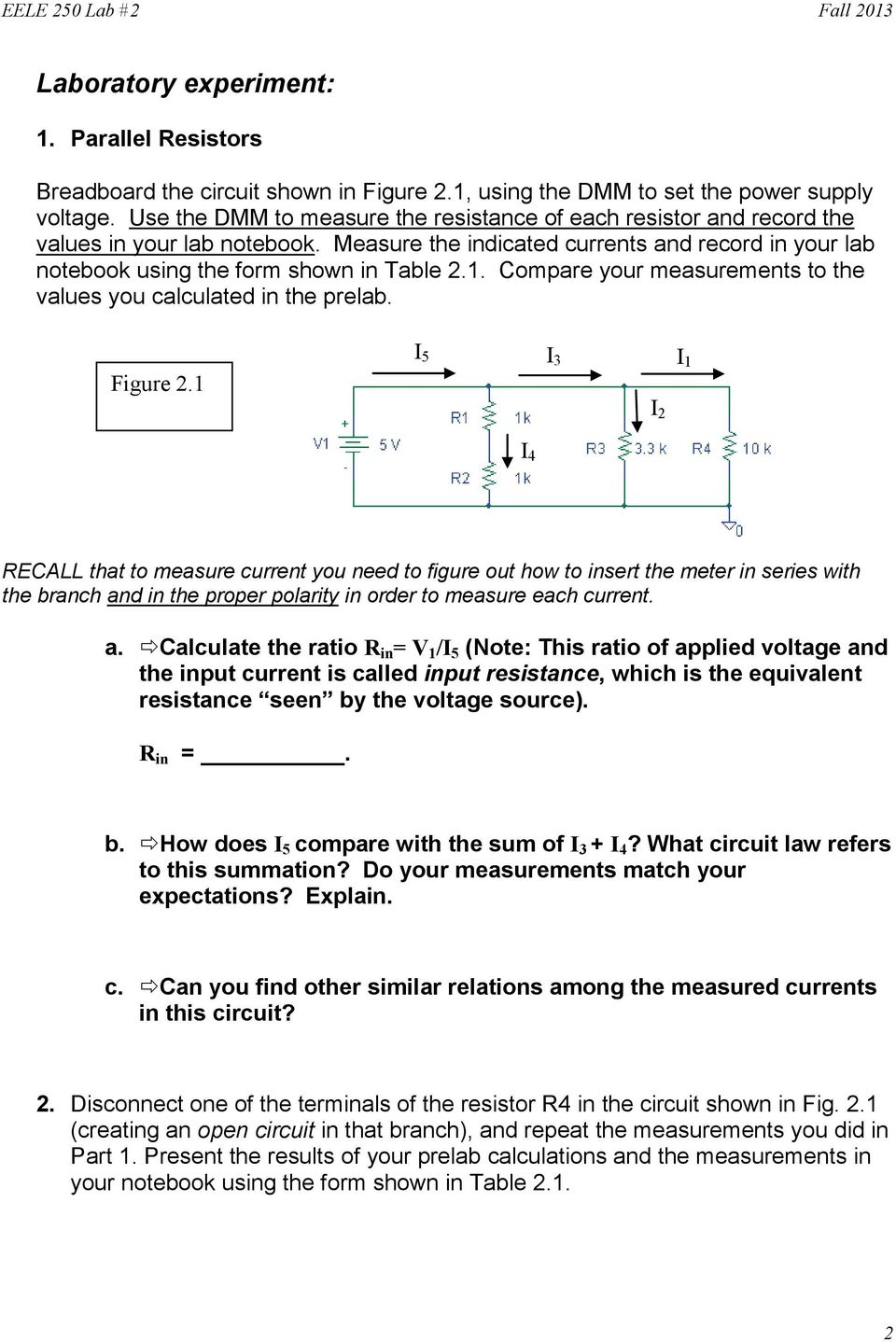
2 EELE 250 Lab #2 Fall 2013 Laboratory experiment: 1. Parallel Resistors Breadboard the circuit shown in Figure 2.1, using the DMM to set the power supply voltage. Use the DMM to measure the resistance of each resistor and record the values in your lab notebook. Measure the indicated currents and record in your lab notebook using the form shown in Table 2.1. Compare your measurements to the values you calculated in the prelab. Figure 2.1 RECALL that to measure current you need to figure out how to insert the meter in series with the branch and in the proper polarity in order to measure each current. a. Calculate the ratio R in = V 1 / (Note: This ratio of applied voltage and the input current is called input resistance, which is the equivalent resistance seen by the voltage source). R in =. b. How does compare with the sum of +? What circuit law refers to this summation? Do your measurements match your expectations? Explain. c. Can you find other similar relations among the measured currents in this circuit? 2. Disconnect one of the terminals of the resistor R4 in the circuit shown in Fig. 2.1 (creating an open circuit in that branch), and repeat the measurements you did in Part 1. Present the results of your prelab calculations and the measurements in your notebook using the form shown in Table
3 EELE 250 Lab #2 Fall 2013 Table 2.1: Parallel Circuit Calculations and Measurements + + Currents Part 1 (Fig. 2.1 with R4 connected) Measured Part 2 (Fig. 2.1 with R4 disconnected) Measured Comment on the currents when R4 is connected and disconnected. Figure Series Resistors Use the DMM to measure the resistance of each resistor and record the values in your lab notebook. Breadboard the circuit shown in Figure 2.2 and (a) measure the node voltages,,, with respect to the source voltage ground, (b) measure the individual voltage drops across the resistors (,, ), and (c) measure the current through the circuit elements. Record the measurements in your lab notebook using the form shown in Table 2.2. a. How does the sum of + + compare with the applied voltage V1? What circuit law is verified? b. Calculate the ratio between applied voltage V1 and input current : R in = V1/ =. 3
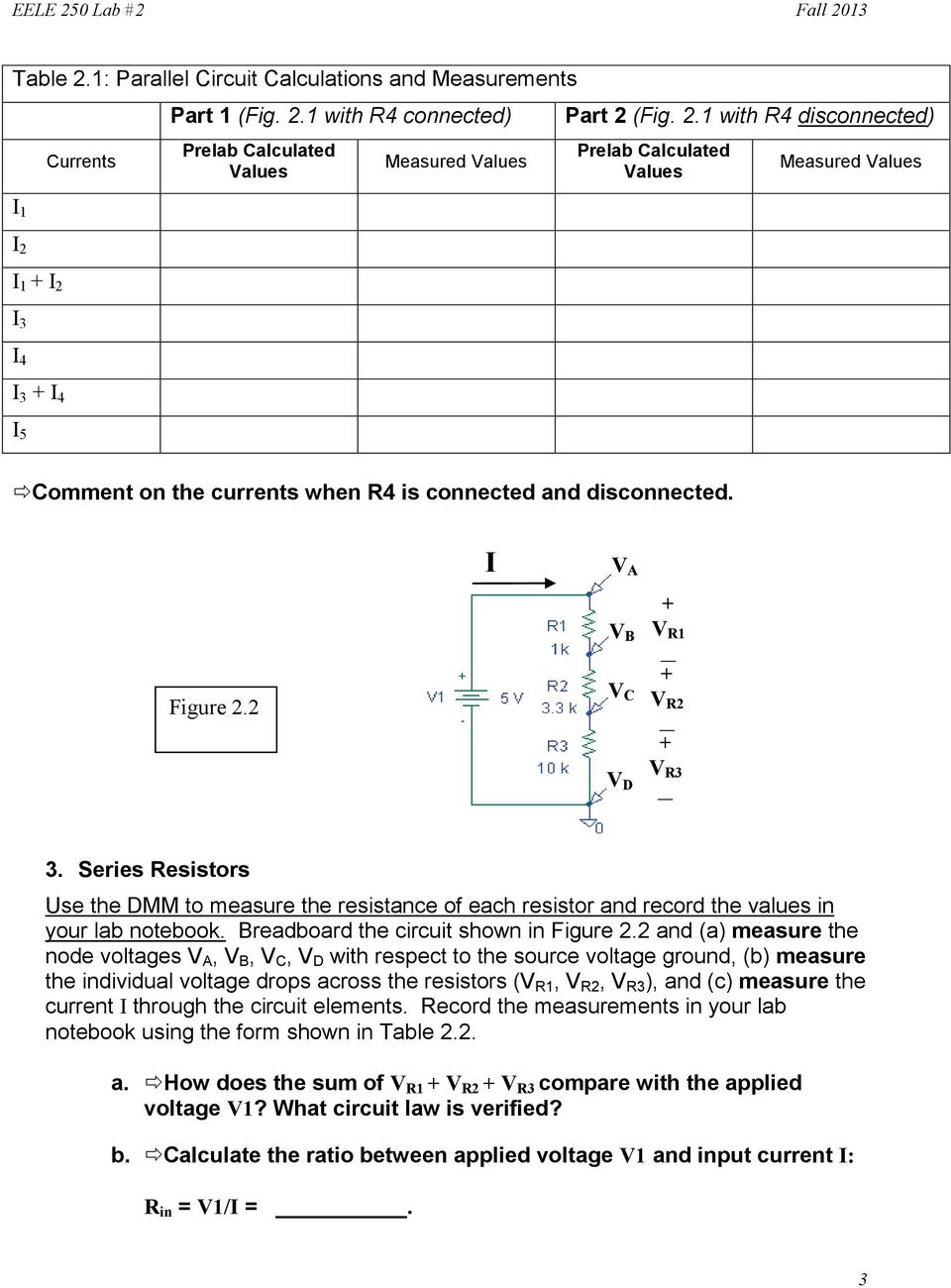
4 EELE 250 Lab #2 Fall Connect a jumper wire on your breadboard between the terminals of R1. You have established what is called a SHORT CRCUT across R1. Now repeat the calculations and measurements of Part 3 for the circuit with R1 shorted. Present the calculations and measured results of experiment Part 3 and Part 4 in your notebook using the form shown in Table 2.2. Table 2.2: Series Circuit Calculations and Measurements Measure + + Part 3 (Fig. 2.2 with R1 connected) Measured Part 4 (Fig. 2.2 with R1 shorted) Measured Before leaving lab, show your notebook with recorded lab results to your instructor for credit. Turn off all equipment and return cables to their proper place. Leave your lab station clean and ready for other students to use. You do not leave until your TA checks and approves the condition of your lab station! 4

5 EELE 250 Lab #2 NAME: PRELAB SHEETS Perform the calculations before coming to lab, and show a summary of your work. Your lab TA will collect these sheets at the start of the lab period for grading. A. Using a resistor band color code chart, determine the color codes of the resistors to be used in this lab and record the colors in the table below and in your lab notebook. Resistor Nominal Value (Ω) Color Band 1 Color Band 2 Color Band 3 Color Band 4 Color Band 5? 1 kω 3.3 kω 10 kω + + B. Calculate the indicated currents for the circuit in Figure 2.1 and place the results in the table below and in your lab notebook. Part 1 (Fig. 2.1 with R4 connected) + + C. For the circuit in Figure 2.1 but with one of the terminals of the resistor R4 disconnected, re-calculate the currents when the R4 branch is an open circuit. Part 2 (Fig. 2.1 with R4 DSCONNECTED Prelab page 1

6 EELE 250 Lab #2 NAME: D. Calculate the indicated current and voltages for the circuit in Figure 2.2 and place the results in the table below and in your lab notebook. Part 3 (Fig. 2.2 with R1 connected) + + E. Calculate the indicated current and voltages for the circuit in Figure 2.2 but with resistor R1 replaced by a short circuit, and place the results in the table below and in your lab notebook. Part 4 (Fig. 2.2 with R1 shorted) + + Prelab page 2

DC Circuits (Combination of resistances)
 Name: Partner: Partner: Partner: DC Circuits (Combination of resistances) EQUIPMENT NEEDED: Circuits Experiment Board One Dcell Battery Wire leads Multimeter 100, 330, 1k resistors Purpose The purpose
Series and Parallel Resistive Circuits Physics Lab VIII
 Series and Parallel Resistive Circuits Physics Lab VIII Objective In the set of experiments, the theoretical expressions used to calculate the total resistance in a combination of resistors will be tested
Your Multimeter. The Arduino Uno 10/1/2012. Using Your Arduino, Breadboard and Multimeter. EAS 199A Fall 2012. Work in teams of two!
 Using Your Arduino, Breadboard and Multimeter Work in teams of two! EAS 199A Fall 2012 pincer clips good for working with breadboard wiring (push these onto probes) Your Multimeter probes leads Turn knob
Experiment1: Introduction to laboratory equipment and basic components.
 Experiment1: Introduction to laboratory equipment and basic components. 1 OBJECTIVES. This experiment will provide exposure to the various test equipment to be used in subsequent experiments. A primary
THE BREADBOARD; DC POWER SUPPLY; RESISTANCE OF METERS; NODE VOLTAGES AND EQUIVALENT RESISTANCE; THÉVENIN EQUIVALENT CIRCUIT
 THE BREADBOARD; DC POWER SUPPLY; RESISTANCE OF METERS; NODE VOLTAGES AND EQUIVALENT RESISTANCE; THÉVENIN EQUIVALENT CIRCUIT YOUR NAME LAB MEETING TIME Reference: C.W. Alexander and M.N.O Sadiku, Fundamentals
Circuit Analyses. Laboration 1 how to measure Current and Voltage and Resistance
 Circuit Analyses. Laboration 1 how to measure Current and Voltage and Resistance This booklet, signed by the teacher, serves as a receipt for passing the lab. Each student must have a booklet of his own
Using Ohm s Law to Build a Voltage Divider
 Using Ohm s Law to Build a Voltage Provided by TryEngineering - Lesson Focus Students will design, build, and characterize one of the basic circuits of electrical engineering, the voltage divider. These
Experiment 8 Series-Parallel Circuits
 Experiment 8 Series-Parallel Circuits EL 111 - DC Fundamentals By: Walter Banzhaf, E.K. Smith, and Winfield Young University of Hartford Ward College of Technology Objectives: 1. For the student to measure
Lab 3 - DC Circuits and Ohm s Law
 Lab 3 DC Circuits and Ohm s Law L3-1 Name Date Partners Lab 3 - DC Circuits and Ohm s Law OBJECTIES To learn to apply the concept of potential difference (voltage) to explain the action of a battery in
Series and Parallel Circuits
 Pre-Laboratory Assignment Series and Parallel Circuits ECE 2100 Circuit Analysis Laboratory updated 16 May 2011 1. Consider the following series circuit. Derive a formula to calculate voltages V 1, V 2,
LAB2 Resistors, Simple Resistive Circuits in Series and Parallel Objective:
 LAB2 Resistors, Simple Resistive Circuits in Series and Parallel Objective: In this lab, you will become familiar with resistors and potentiometers and will learn how to measure resistance. You will also
Using Ohm s Law to Build a Voltage Divider
 Using Ohm s Law to Build a Voltage Provided by TryEngineering - Lesson Focus Students will design, build, and characterize one of the basic circuits of electrical engineering, the voltage divider. These
Experiment 4 ~ Resistors in Series & Parallel
 Experiment 4 ~ Resistors in Series & Parallel Objective: In this experiment you will set up three circuits: one with resistors in series, one with resistors in parallel, and one with some of each. You
Pantone Matching System Color Chart PMS Colors Used For Printing
 Pantone Matching System Color Chart PMS Colors Used For Printing Use this guide to assist your color selection and specification process. This chart is a reference guide only. Pantone colors on computer
Kirchhoff s Laws Physics Lab IX
 Kirchhoff s Laws Physics Lab IX Objective In the set of experiments, the theoretical relationships between the voltages and the currents in circuits containing several batteries and resistors in a network,
PHYSICS 111 LABORATORY Experiment #3 Current, Voltage and Resistance in Series and Parallel Circuits
 PHYSCS 111 LABORATORY Experiment #3 Current, Voltage and Resistance in Series and Parallel Circuits This experiment is designed to investigate the relationship between current and potential in simple series
Electronics I - Laboratory 1 Diode I/V Characteristics
 Electronics I - Laboratory 1 Diode I/V Characteristics I. Objectives 1. Develop I/V characteristics of a silicon diode. 2. Develop I/V characteristics of a germanium diode. 3. Develop I/V characteristics
Lab 3 Rectifier Circuits
 ECET 242 Electronic Circuits Lab 3 Rectifier Circuits Page 1 of 5 Name: Objective: Students successfully completing this lab exercise will accomplish the following objectives: 1. Learn how to construct
Resistors in Series and Parallel Circuits
 69 Resistors in Series and Parallel Circuits E&M: Series and parallel circuits Equipment List DataStudio file: Not Required Qty s Part Numbers 1 C/DC Electronics Lab EM-8656 2 D cell 1.5 volt Introduction
Resistance, Ohm s Law, and the Temperature of a Light Bulb Filament
 Resistance, Ohm s Law, and the Temperature of a Light Bulb Filament Name Partner Date Introduction Carbon resistors are the kind typically used in wiring circuits. They are made from a small cylinder of
OHM S LAW AND RESISTANCE
 OHM S LAW AND RESISTANCE Resistance is one of the basic principles of Ohm s law, and can be found in virtually any device used to conduct electricity. Georg Simon Ohm was a German physicist who conducted
Electrical Fundamentals Module 3: Parallel Circuits
 Electrical Fundamentals Module 3: Parallel Circuits PREPARED BY IAT Curriculum Unit August 2008 Institute of Applied Technology, 2008 ATE310- Electrical Fundamentals 2 Module 3 Parallel Circuits Module
How To Color Print
 Pantone Matching System Color Chart PMS Colors Used For Printing Use this guide to assist your color selection and specification process. This chart is a reference guide only. Pantone colors on computer
Maximum value. resistance. 1. Connect the Current Probe to Channel 1 and the Differential Voltage Probe to Channel 2 of the interface.
 Series and Parallel Circuits Computer 23 Components in an electrical circuit are in series when they are connected one after the other, so that the same current flows through both of them. Components are
Experiment: Series and Parallel Circuits
 Phy203: General Physics Lab page 1 of 6 Experiment: Series and Parallel Circuits OBJECTVES MATERALS To study current flow and voltages in series and parallel circuits. To use Ohm s law to calculate equivalent
SERIES-PARALLEL DC CIRCUITS
 Name: Date: Course and Section: Instructor: EXPERIMENT 1 SERIES-PARALLEL DC CIRCUITS OBJECTIVES 1. Test the theoretical analysis of series-parallel networks through direct measurements. 2. Improve skills
Oscilloscope, Function Generator, and Voltage Division
 1. Introduction Oscilloscope, Function Generator, and Voltage Division In this lab the student will learn to use the oscilloscope and function generator. The student will also verify the concept of voltage
SECTION 26 09 13 - POWER MONITOR FOR ELECTRICAL, STEAM CONDENSATE, AND WATER PART I - GENERAL
 SECTION 26 09 13 - POWER MONITOR FOR ELECTRICAL, STEAM CONDENSATE, AND WATER PART I - GENERAL 1.1 SUMMARY A. This section describes the requirements for the installation of Power Monitors and associated
Chapter 7 Direct-Current Circuits
 Chapter 7 Direct-Current Circuits 7. Introduction...7-7. Electromotive Force...7-3 7.3 Resistors in Series and in Parallel...7-5 7.4 Kirchhoff s Circuit Rules...7-7 7.5 Voltage-Current Measurements...7-9
Physics 42 Lab 4 Fall 2012 Cathode Ray Tube (CRT)
 Physics 42 Lab 4 Fall 202 Cathode Ray Tube (CRT) PRE-LAB Read the background information in the lab below and then derive this formula for the deflection. D = LPV defl 2 SV accel () Redraw the diagram
Pantone Color Chart Plexiglas Cross Reference
 Pantone Color Chart Plexiglas Cross Reference T = Transparent, TL = Translucent, O = Opaque Pantone Color Type Plexiglas Number Pantone Color 288 PMS 288 Type Plexiglas Number Pantone Color 485 C2X PMS
Color Mark Sensor with Red or Green LED E3S-VS
 Color Mark Sensor with Red or Green LED Rugged IP67 Color Mark Sensor 1 ms response time Detects a wide variety of color marks PNP or NPN output ls Light-on/ Dark-on operation, wire selectable Vertical
HOW TO USE MULTIMETER. COMPILE BY: Dzulautotech
 HOW TO USE MULTIMETER COMPILE BY: Dzulautotech 1. GENERAL Electricity is absolutely necessary for an automobile. It is indispensable when the engine is started, the air fuel mixture is ignited and exploded,
EXPERIMENT 7 OHM S LAW, RESISTORS IN SERIES AND PARALLEL
 260 7- I. THEOY EXPEIMENT 7 OHM S LAW, ESISTOS IN SEIES AND PAALLEL The purposes of this experiment are to test Ohm's Law, to study resistors in series and parallel, and to learn the correct use of ammeters
Experiment #5, Series and Parallel Circuits, Kirchhoff s Laws
 Physics 182 Summer 2013 Experiment #5 1 Experiment #5, Series and Parallel Circuits, Kirchhoff s Laws 1 Purpose Our purpose is to explore and validate Kirchhoff s laws as a way to better understanding
3704-0147 Lithichrome Stone Paint- LT Blue Gallon 3704-0001 Lithichrome Stone Paint- Blue 2 oz 3704-0055 Lithichrome Stone Paint- Blue 6 oz 3704-0082
 Lithichrome Colors Item Number Item Description 120-COL Lithichrome Stone Paint - Any Size or Color 3704-0011 Lithichrome Stone Paint- LT Blue 2 oz 3704-0066 Lithichrome Stone Paint- LT Blue 6 oz 3704-0093
Experiment NO.3 Series and parallel connection
 Experiment NO.3 Series and parallel connection Object To study the properties of series and parallel connection. Apparatus 1. DC circuit training system 2. Set of wires. 3. DC Power supply 4. Digital A.V.O.
RESISTANCE SUBSTITUTION BOX
 RESISTANCE SUBSTITUTION BOX MODEL RS-400 / K-37 Assembly and Instruction Manual TM Elenco Electronics, Inc. Copyright 1990 Elenco TM Electronics, Inc. Revised 2003 REV-G 753RS400 The Resistance Substitution
Electronics and Soldering Notes
 Electronics and Soldering Notes The Tools You ll Need While there are literally one hundred tools for soldering, testing, and fixing electronic circuits, you only need a few to make robot. These tools
BURGLAR ALARM KIT MODEL K-23. Assembly and Instruction Manual ELENCO
 BURGLAR ALARM KIT MODEL K-23 Assembly and Instruction Manual ELENCO Copyright 2013, 1989 ELENCO Electronics, Inc. Revised 2011 REV-Q 753223 No part of this book shall be reproduced by any means; electronic,
What is a multimeter?
 What is a multimeter? A multimeter is a devise used to measure voltage, resistance and current in electronics & electrical equipment It is also used to test continuity between to 2 points to verify if
Annex: VISIR Remote Laboratory
 Open Learning Approach with Remote Experiments 518987-LLP-1-2011-1-ES-KA3-KA3MP Multilateral Projects UNIVERSITY OF DEUSTO Annex: VISIR Remote Laboratory OLAREX project report Olga Dziabenko, Unai Hernandez
MATERIALS. Multisim screen shots sent to TA.
 Page 1/8 Revision 0 9-Jun-10 OBJECTIVES Learn new Multisim components and instruments. Conduct a Multisim transient analysis. Gain proficiency in the function generator and oscilloscope. MATERIALS Multisim
Lab 2: Resistance, Current, and Voltage
 2 Lab 2: Resistance, Current, and Voltage I. Before you come to la.. A. Read the following chapters from the text (Giancoli): 1. Chapter 25, sections 1, 2, 3, 5 2. Chapter 26, sections 1, 2, 3 B. Read
Part Marking Instructions Chip Resistors
 Chip Resistors Part Marking Instructions Part Marking Instructions Chip Resistors 1% Marking The nominal resistance is marked on the surface of the overcoating with the use of 4 digit markings. 0201 and
Physics 3330 Experiment #2 Fall 1999. DC techniques, dividers, and bridges R 2 =(1-S)R P R 1 =SR P. R P =10kΩ 10-turn pot.
 Physics 3330 Experiment #2 Fall 1999 DC techniques, dividers, and bridges Purpose You will gain a familiarity with the circuit board and work with a variety of DC techniques, including voltage dividers,
Lab #4 Thevenin s Theorem
 In this experiment you will become familiar with one of the most important theorems in circuit analysis, Thevenin s Theorem. Thevenin s Theorem can be used for two purposes: 1. To calculate the current
Robot Board Sub-System Testing. Abstract. Introduction and Theory. Equipment. Procedures. EE 101 Spring 2006 Date: Lab Section # Lab #6
 EE 101 Spring 2006 Date: Lab Section # Lab #6 Name: Robot Board Sub-System Testing Partner: No Lab partners this time! Abstract The ECEbot robots have a printed circuit board (PCB) containing most of the
ENERGY SMART TROUBLESHOOTING GUIDE TABLE OF CONTENTS:
 ENERGY SMART TROUBLESHOOTING GUIDE TABLE OF CONTENTS: COMPONENTS/BOARD LAYOUT... 2 HOT WATER... 3 1 FLASH (GREEN DIAGSTIC LIGHT)... 4 2 FLASHES (GREEN DIAGSTIC LIGHT)... 5 3 FLASHES (GREEN DIAGSTIC LIGHT)...
Equipment: Power Supply, DAI, Variable resistance (8311), Variable inductance (8321)
 Lab 4: 3-phase circuits. Objective: to study voltage-current relationships in 3-phase circuits; to learn to make delta and Y connections; to calculate and measure real, apparent, and reactive powers. Equipment:
EE101 Labs and ECEbot Assembly/Testing Instructions
 EE101 Labs and ECEbot Assembly/Testing Instructions by Montana State University Department of Electrical and Computer Engineering A Montana Space Grant Consortium Project December 3, 2008 Beginning in
Essential Electrical Concepts
 Essential Electrical Concepts Introduction Modern vehicles incorporate many electrical and electronic components and systems: Audio Lights Navigation Engine control Transmission control Braking and traction
RC Circuits and The Oscilloscope Physics Lab X
 Objective RC Circuits and The Oscilloscope Physics Lab X In this series of experiments, the time constant of an RC circuit will be measured experimentally and compared with the theoretical expression for
UNIVERSITY OF NORTH CAROLINA AT CHARLOTTE. Department of Electrical and Computer Engineering
 UNIVERSITY OF NORTH CAROLINA AT CHARLOTTE Department of Electrical and Computer Engineering Experiment No. 10 - Balanced Three-Phase Networks Overview: Three-phase networks can be connected either in a
ANADOLU UNIVERSITY DEPARTMENT OF ELECTRICAL AND ELECTRONICS ENGINEERING
 ANADOLU UNIVERSITY DEPARTMENT OF ELECTRICAL AND ELECTRONICS ENGINEERING EEM 102 INTRODUCTION TO ELECTRICAL ENGINEERING EXPERIMENT 9: DIODES AND DC POWER SUPPLY OBJECTIVE: To observe how a diode functions
Fitting/Installation Guide - UNIVERSAL
 ATTENTION: This wiring information is being provided free of charge and on an as is basis, without any representation or warranty. It is your responsibility to verify any circuit before interfacing with
THREE PHASE CIRCUITS
 THREE PHASE CIRCUITS A. PREPARATION 1. Three Phase Voltages and Systems 2. The Determination of Phase Sequence 3. Blondel's Theorem and Its Consequences 4. References B. EXPERIMENT 1. Equipment List 2.
Lab E1: Introduction to Circuits
 E1.1 Lab E1: Introduction to Circuits The purpose of the this lab is to introduce you to some basic instrumentation used in electrical circuits. You will learn to use a DC power supply, a digital multimeter
OPERATIONAL AMPLIFIERS
 INTRODUCTION OPERATIONAL AMPLIFIERS The student will be introduced to the application and analysis of operational amplifiers in this laboratory experiment. The student will apply circuit analysis techniques
Current Electricity Lab Series/Parallel Circuits. Safety and Equipment Precautions!
 Current Electricity Lab Series/Parallel Circuits Name Safety and Equipment Precautions! Plug in your power supply and use ONLY the D.C. terminals of the power source, NOT the A. C. terminals. DO NOT touch
CoolWave r 2 Phase Control Board and Cable Replacement Kits
 Instruction Sheet P/N 1102452A CoolWave r 2 Phase Control Board and Cable Replacement Kits Two kits are available to replace the CoolWave 2 phase control board: S S Phase Control Board and Cable Kit (required
Green = 0,255,0 (Target Color for E.L. Gray Construction) CIELAB RGB Simulation Result for E.L. Gray Match (43,215,35) Equal Luminance Gray for Green
 Red = 255,0,0 (Target Color for E.L. Gray Construction) CIELAB RGB Simulation Result for E.L. Gray Match (184,27,26) Equal Luminance Gray for Red = 255,0,0 (147,147,147) Mean of Observer Matches to Red=255
INTERNATIONAL ATOMIC ENERGY AGENCY INSTRUMENTATION UNIT SMD (SURFACE MOUNTED DEVICES) REPAIR S. WIERZBINSKI FEBRUARY 1999
 (SURFACE MOUNTED DEVICES) REPAIR S. WIERZBINSKI FEBRUARY 1999 (SURFACE MOUNTED DEVICES) REPAIR 1 TABLE OF CONTENTS PAGE 1. INTRODUCTION 3 2. ADVANTAGES 4 3. LIMITATIONS 4 4. DIALECT 5 5. SIZES AND DIMENSIONS
Model 201 Wiegand Touchpad Reader Installation Guide
 Model 201 Wiegand Touchpad Reader Installation Guide P/N 460353001C 15AUG11 2011 UTC Fire & Security. All rights reserved. This document may not be copied in whole or in part or otherwise reproduced without
DET Practical Electronics (Intermediate 1)
 DET Practical Electronics (Intermediate 1) 731 August 2000 HIGHER STILL DET Practical Electronics (Intermediate 1) Support Materials CONTENTS Section 1 Learning about Resistors Section 2 Learning about
BATTERY BOX INSTALLATION WARNING WARNING CAUTION ATTENTION AVERTISSEMENT ADVERTENCIA PRECAUCIÓN SOLBBOX12V CARTON INVENTORY COMPLETED OVERVIEW
 WARNING CARTON INVENTORY CAUTION with: Charger, Cable 15', Fuses (2), Battery Strap and Strain Relief (2) Model SOLBBOX 12V Battery Not Included AVERTISSEMENT ATTENTION DC Power Adapter 12Vdc to 32Vdc
PTC-Resistor Temperature-Sensors MINIKA to DIN 44 081 and DIN 44 082
 PTC-Resistor Temperature-Sensors MINIKA to DIN 44 081 and DIN 44 082 General PTC-resistor temperature sensors (also called PTC-resistors or thermistors) are temperatur dependent semiconductor resistors
Experiment 4: Sensor Bridge Circuits (tbc 1/11/2007, revised 2/20/2007, 2/28/2007) I. Introduction. From Voltage Dividers to Wheatstone Bridges
 Experiment 4: Sensor Bridge Circuits (tbc //2007, revised 2/20/2007, 2/28/2007) Objective: To implement Wheatstone bridge circuits for temperature measurements using thermistors. I. Introduction. From
Measurement of Capacitance
 Measurement of Capacitance Pre-Lab Questions Page Name: Class: Roster Number: Instructor:. A capacitor is used to store. 2. What is the SI unit for capacitance? 3. A capacitor basically consists of two
PANTONE Solid to Process
 PANTONE Solid to Process PANTONE C:0 M:0 Y:100 K:0 Proc. Yellow PC PANTONE C:0 M:0 Y:51 K:0 100 PC PANTONE C:0 M:2 Y:69 K:0 106 PC PANTONE C:0 M:100 Y:0 K:0 Proc. Magen. PC PANTONE C:0 M:0 Y:79 K:0 101
LABORATORY 2 THE DIFFERENTIAL AMPLIFIER
 LABORATORY 2 THE DIFFERENTIAL AMPLIFIER OBJECTIVES 1. To understand how to amplify weak (small) signals in the presence of noise. 1. To understand how a differential amplifier rejects noise and common
How To Use Multiisim On A Computer Or A Circuit Design Suite 10.0 (Aero)
 MULTISIM TUTORIAL Start Click on Start All Programs National Instruments Circuit Design Suite 10.0 Multisim. Component Toolbar Ammeter/ Voltmeter Toolbar Virtual Component Toolbar Simulation Toolbar Instrument
Laboratory 4: Feedback and Compensation
 Laboratory 4: Feedback and Compensation To be performed during Week 9 (Oct. 20-24) and Week 10 (Oct. 27-31) Due Week 11 (Nov. 3-7) 1 Pre-Lab This Pre-Lab should be completed before attending your regular
Discovering Ohm s Law. Original: Revision: 17 October 2003 11 July 2007 George Wolfe, Alison Shull, Martin Alderman
 Title: Discovering Ohm s Law Original: Revision: Authors: Appropriate Level: Abstract: Time Required: NY Standards Met: Special Notes: 17 October 2003 11 July 2007 George Wolfe, Alison Shull, Martin Alderman
Measuring Electric Phenomena: the Ammeter and Voltmeter
 Measuring Electric Phenomena: the Ammeter and Voltmeter 1 Objectives 1. To understand the use and operation of the Ammeter and Voltmeter in a simple direct current circuit, and 2. To verify Ohm s Law for
BUILDING INSTRUCTIONS
 etap2hw 38 mm I2C to LCD Interface BUILDING INSTRUCTIONS October 2013 P. Verbruggen Rev 1.01 15-Oct-13 Page 1 Table of Contents Chapter 1 General Information 1.1 ESD Precautions 1.2 Further Supplies 1.3
WORLDWIDE. GW400k SERIES MAINTENANCE MANUAL PROVEN PERIMETER PROTECTION
 ORLDIDE G400k SERIES MAINTENANCE MANUAL PROVEN PERIMETER PROTECTION GEOQUIP LIMITED Kingsfield Industrial Estate, Derby Road irksworth, Matlock, Derbyshire, DE4 4BG Tel : 01629 824891 Fax : 01629 824896
Softstart. Changing of Printed Circuit Board, Display, Keypad and upgrade to Torque control PSTB370 1050. Contents. 1. ESD Warning...2. 2. Tools...
 Softstart Changing of Printed Circuit Board, Display, Keypad and upgrade to Torque control PST30 300 PSTB370 1050 1SFC132009M0201 Rev A Dec-06 Contents 1. ESD Warning...2 2. Tools...2 3. PCB information...2
GENERAL SCIENCE LABORATORY 1110L Lab Experiment 6: Ohm s Law
 GENERAL SCIENCE LABORATORY 1110L Lab Experiment 6: Ohm s Law OBJECTIVES: To verify Ohm s law, the mathematical relationship among current, voltage or potential difference, and resistance, in a simple circuit.
STUDY OF CELLPHONE CHARGERS
 STUDY OF CELLPHONE CHARGERS Author : Suraj Hebbar Systems Lab, CeNSE,IISc Banglore ABSTRACT This report shows charging nature of different cellphone chargers with different cellphones. Here we took into
HG600/HG800. Hydro-Power Unit. Installation and Operation Guide
 HG600/HG800 Hydro-Power Unit Installation and Operation Guide Copyright 04 HydroSpin, All rights reserved. The data contained in this document is proprietary to HydroSpin. It is disclosed to the receiving
Experiment #4, Ohmic Heat
 Experiment #4, Ohmic Heat 1 Purpose Physics 18 - Fall 013 - Experiment #4 1 1. To demonstrate the conversion of the electric energy into heat.. To demonstrate that the rate of heat generation in an electrical
RAMPS 1.4 Assembly Guide
 RAMPS 1.4 Assembly Guide 3D Printer Czar Version 1 Table of Content Getting to know RAMPS 1.4 ---------------------------------------------------3 Insert jumpers to RAMPS 1.4---------------------------------------------------4
Series and Parallel Circuits
 Series and Parallel Circuits Components in a circuit can be connected in series or parallel. A series arrangement of components is where they are inline with each other, i.e. connected end-to-end. A parallel
The purposes of this experiment are to test Faraday's Law qualitatively and to test Lenz's Law.
 260 17-1 I. THEORY EXPERIMENT 17 QUALITATIVE STUDY OF INDUCED EMF Along the extended central axis of a bar magnet, the magnetic field vector B r, on the side nearer the North pole, points away from this
Fastastic Frequencies
 Fastastic Frequencies Subject Area(s) Associated Unit Associated Lesson Activity Title Header mathematics, physics Fantastic Frequencies Image 1 ADA Description: Students working with the Basic Stamp 2
Experiment 2 Diode Applications: Rectifiers
 ECE 3550 - Practicum Fall 2007 Experiment 2 Diode Applications: Rectifiers Objectives 1. To investigate the characteristics of half-wave and full-wave rectifier circuits. 2. To recognize the usefulness
Chapter 5. Parallel Circuits ISU EE. C.Y. Lee
 Chapter 5 Parallel Circuits Objectives Identify a parallel circuit Determine the voltage across each parallel branch Apply Kirchhoff s current law Determine total parallel resistance Apply Ohm s law in
PART 1 - INTRODUCTION...
 Table of Contents PART 1 - INTRODUCTION... 3 1.1 General... 3 1.2 Sensor Features... 3 1.3 Sensor Specifications (CDE-45P)... 4 Figure 1-1 CDE-45P Sensor Dimensions (standard, convertible style)... 4 PART
Germanium Diode AM Radio
 Germanium Diode AM Radio LAB 3 3.1 Introduction In this laboratory exercise you will build a germanium diode based AM (Medium Wave) radio. Earliest radios used simple diode detector circuits. The diodes
Experiment #3, Ohm s Law
 Experiment #3, Ohm s Law 1 Purpose Physics 182 - Summer 2013 - Experiment #3 1 To investigate the -oltage, -, characteristics of a carbon resistor at room temperature and at liquid nitrogen temperature,
Instruction Manual. 2in1 LAN Tester & Multimeter. Model: LA-1011
 Instruction Manual 2in1 LAN Tester & Multimeter Model: LA-1011 1 Contents Introduction... Features... Safety Precautions.. Meter Description... Electrical Specification... Operation.. AutoRanging Multimeter.
Creative Inquiry Electronics Project Lab Manual. NI mydaq
 Creative Inquiry Electronics Project Lab Manual NI mydaq TABLE OF CONTENTS Introduction... 5 LabVIEW Package and Driver Installation Tutorial for ENGR 90... 5 Basic Troubleshooting... 6 Files on ENGR90_VIs.zip...
RECOMMENDED TOOLS PERSONAL & VEHICLE PROTECTION SAFETY GLASSES
 HYUNDAI ACCENT 2010- /ELANTRA 2012- / KIA RIO 2012- PART NUMBER: 250-9628 GENERAL APPLICABILITY THIS CRUISE WAS TESTED AND VERIFIED ON: (AT/MT) VEHICLES RECOMMENDED TOOLS PERSONAL & VEHICLE PROTECTION
* DISCLAIMER: Contents. How to Use This Guide: COMMERCIAL INSTALL GUIDE 2
 COMMERCIAL INSTALL GUIDE 2 Contents How to Use This Guide: The first section of this guide is designed to assist you with the installation of your DECK Monitoring hardware. The revenue grade meter and
Fig. 1 Analogue Multimeter Fig.2 Digital Multimeter
 ELECTRICAL INSTRUMENT AND MEASUREMENT Electrical measuring instruments are devices used to measure electrical quantities such as electric current, voltage, resistance, electrical power and energy. MULTIMETERS
2011 Volvo Color Compatibility Guide
 C30 019 Black Underhood 019 Black Color Name C30 426 Mystic Silver Metallic Underhood 426 Mystic Silver Metallic C30 452 Black Sapphire Metallic Underhood 452 Black Sapphire Metallic C30 455 Titanium Gray
PROCEDURE: 1. Measure and record the actual values of the four resistors listed in Table 10-1.
 The answer to two questions will help you identify a series or parallel connection: (1) Will the identical current go through both components? f the answer is yes, the components are in series. (2) Are
Light Bulbs in Parallel Circuits
 Light Bulbs in Parallel Circuits In the last activity, we analyzed several different series circuits. In a series circuit, there is only one complete pathway for the charge to travel. Here are the basic