
Transportation challenges in a booming city
|
|
|
- Teresa Harper
- 10 years ago
- Views:
Transcription
1 Addis Ababa City Government Transportation challenges in a booming city Coordination of the mass transit network and urban development in Addis Ababa This document has been produced as background to CODATU XV October 2012 The role of urban mobility in (reshaping cities AACPPO Addis Ababa City Planning Project Office Lyon Town Planning Agency Transportation challenges in a booming city I 1

2 2 I Transportation challenges in a booming city With the support of

3 Table of contents Foreword by CODATU, Addis Ababa City Government and Greater Lyon Urban Community 4 1. Addis Ababa: a booming city 6 Addis Ababa: a major African metropolis 6 The institutional framework of the Ethiopian capital 8 A mixed urban fabric Urban Development and Transport Integration: planning and implementation process ( The coordination of planning processes 12 City Development Plan, CDP ( A comprehensive transportation master plan ( Helpfull assessments of the City Development Plan s implementation 16 A successful implementation preparing transport projects Multi-scale stakes for tomorrow 20 National context and regional level (Addis Ababa and Oromia special zone 20 City level (City Development Plan 22 Urban Integration around main mass transit stations Strategies for urban development and transport integration 26 Transportation challenges in a booming city I 3

4 Transportation challenges in a booming city Coordination of the mass transit network and urban development in Addis Ababa Foreword key reasons. The 15th CODATU conference is hosted by Addis Ababa from the 22nd to the 25th of October Ten years after the last conference in Africa, CODATU returns to the continent to discuss the role of urban mobility in (re shaping cities. CODATU chose the Ethiopian capital city for its conference for two CODATU works more and more to develop city-to-city cooperation on mobility, transport and town planning. Cooperation between the Municipality of Addis Ababa and Greater Lyon has been a very successful partnership for transportation planning especially. Moreover, Addis Ababa has reached a milestone in its urban development. The city is growing tremendously and the decision-makers are facing many challenges. A mass transit system should be operational in the next five years and many development projects will be integrated in a comprehensive public transport network. The theme of CODATU XV perfectly matches Addis Ababa s current issues. Mobility growth and transport projects shape cities and the future urban form of Addis Ababa will depend on the policies of its decision-makers. I would like to express my thanks to the Municipality of Addis Ababa and Greater Lyon for publishing this document which summarizes the current situation in Addis, its transportation planning and the stakes for tomorrow. Jean Louis Léonard, Chairman of CODATU It gives me a great pleasure to welcome the participants of the CODATU-XV international Conference, hosted by our beloved city. Addis Ababa has been undergoing spectacular changes in all the economic sectors. We are conducting a development that is vibrant, people friendly and genuinely integrated with different modes of transit. It is on this historic moment that CODATU-XV is going to be held. The urbanization of the city has brought different mobility challenges. However, the city government is doing all that is available to tackle these challenges. Our ambitious plans of resolving these challenges are expected to shape our city. We acknowledge that public transport is the backbone for our city development and mobility. We want our public transport to be fast, convenient, safe and reliable and include other mobility mix that best fits our situation. Conferences like CODATU are the means for getting rich experience and scholarly thought ideas for urban development. A lot is expected from the conference. It is with this concept that we welcome the conference. On behalf of the city government of Addis Ababa and myself, I wish all our participants a happy and successful conference! Abate Setotaw, Deputy Mayor City Government of Addis Ababa, Ethiopia 4 I Transportation challenges in a booming city
5 Road works on Bole Road Since 2000 with the cooperation of the Lyon Town Planning Agency on the city development plan of Addis Ababa and its implementation, and since 2010 with the city to city cooperation agreement between Addis Ababa and Lyon, the experts from Lyon have worked with the city government of Addis Ababa on technical issues such as public transports, urban planning and solid waste management. The aim of this cooperation is to organize technical exchanges, seminars, trainings in Lyon and expert missions in Addis Ababa on the different issues. The objective of Addis Ababa is to manage and succeed its urban development and one of the most important clues is the strong link between transports organization and urban planning. The cooperation tends to stress and to dig this comprehensive approach of the urban development. The fifteenth Conference Codatu takes place within the framework of this cooperation and will strengthen the links between the city of Addis Ababa and the city of Lyon. Buildings on Churchill Avenue Hubert JULIEN-LAFERRIERE, Vice-president of Greater Lyon in charge of the city to city cooperation. Transportation challenges in a booming city I 5

6 1 Addis Ababa: a booming city Ethiopian Urban network and surrounding countries Addis Ababa: a major African metropolis The diplomatic capital of Africa A prospective trend of strong urban growth Forecasts for continued economic growth in Ethiopia A young city with a distinctive geography Addis Ababa, which means new flower in Amharic, was established in 1887 by Emperor Menelik II and Empress Taytu. According to historical records, the first stone buildings were erected in Located in the middle of the country, on a 2400-metre high plateau at the foot of Mount Entoto, Addis Ababa is the highest metropolis in Africa. This distinctive geography determines much the urbanization process, which follows the hilly surrounding landscape. A fast-growing city, like other major African metropolises With a population of about 84 million in 2012, Ethiopia is the second most populous country in Africa, with annual growth at 2.6%. Addis Ababa s population is more than 3 million, i.e. ten times larger than the second largest city in the country. Consequently, the city s radius has expanded, particularly to the east and south. Many peripheral areas have become part of the metropolis. Over the next 15 years, the population is expected to grow annually by 3.8%. Within 50 years, the urban region (Addis Ababa and Oromia (Addis Finfine will overpass ten million people. South East of Addis Ababa An international city searching for a global status Addis Ababa is the diplomatic capital of Africa since it hosts the headquarters of the African Union and the United Nations Economic Commission for Africa created in 1958 to encourage economic cooperation. This role is also confirmed by the presence of more than a hundred embassies, international level hotels and conference centres. It is also considered as a major transportation hub at the continental scale, thanks to Bole International Airport. Ethiopia s unrivalled economic centre Addis Ababa is the hub of the Ethiopian urban economy. The GDP of the city accounts for a significant share of the National GDP. As one looks into sectoral contributions to GDP of Addis Ababa, the lion s share (76.5% comes from the service sector, while industry and agriculture contribute 23.3% and 0.2% respectively. The city economy exhibited a steady growth during the last decade. This steady economic growth has been propelled, largely, by the massive construction boom that occurred in recent past and likely to continue in the future at increasing pace. According to data from government sources, from total employed population, 23% are engaged in trade and commerce; 22% in manufacturing and industry; 15% in different homemakers; 13% in civil administration; 9% in transport and communication; 8% in education, health and social services; 6% in hotel and catering services; and 3% in agriculture. A major urban employment and income generating activity is in the Micro and Small scale Enterprises. According to official data, some 350,000 citizens have enjoyed employment opportunities in the sector during the last four years. The informal sector is also a major contributor to the urban socioeconomic performance. It generates substantial employment opportunities in diverse economic arenas such as petty trade, transportation, handicraft, waste recycling, as well as in the provision of shelter. 6 I Transportation challenges in a booming city

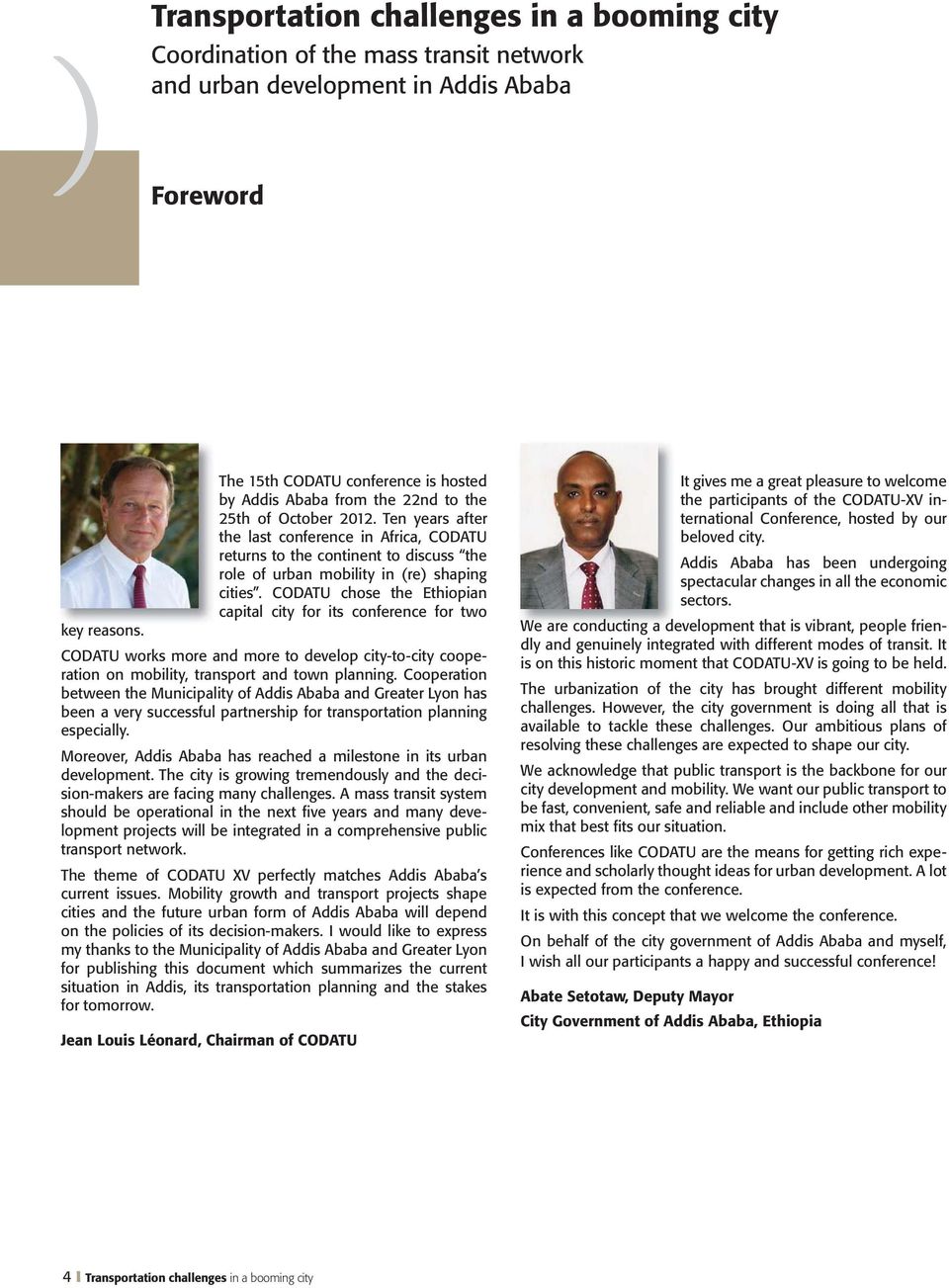
7 Addis Ababa s location beneath Entoto mountains Urban extension from 2000 to 2010 Transportation challenges in a booming city I 7
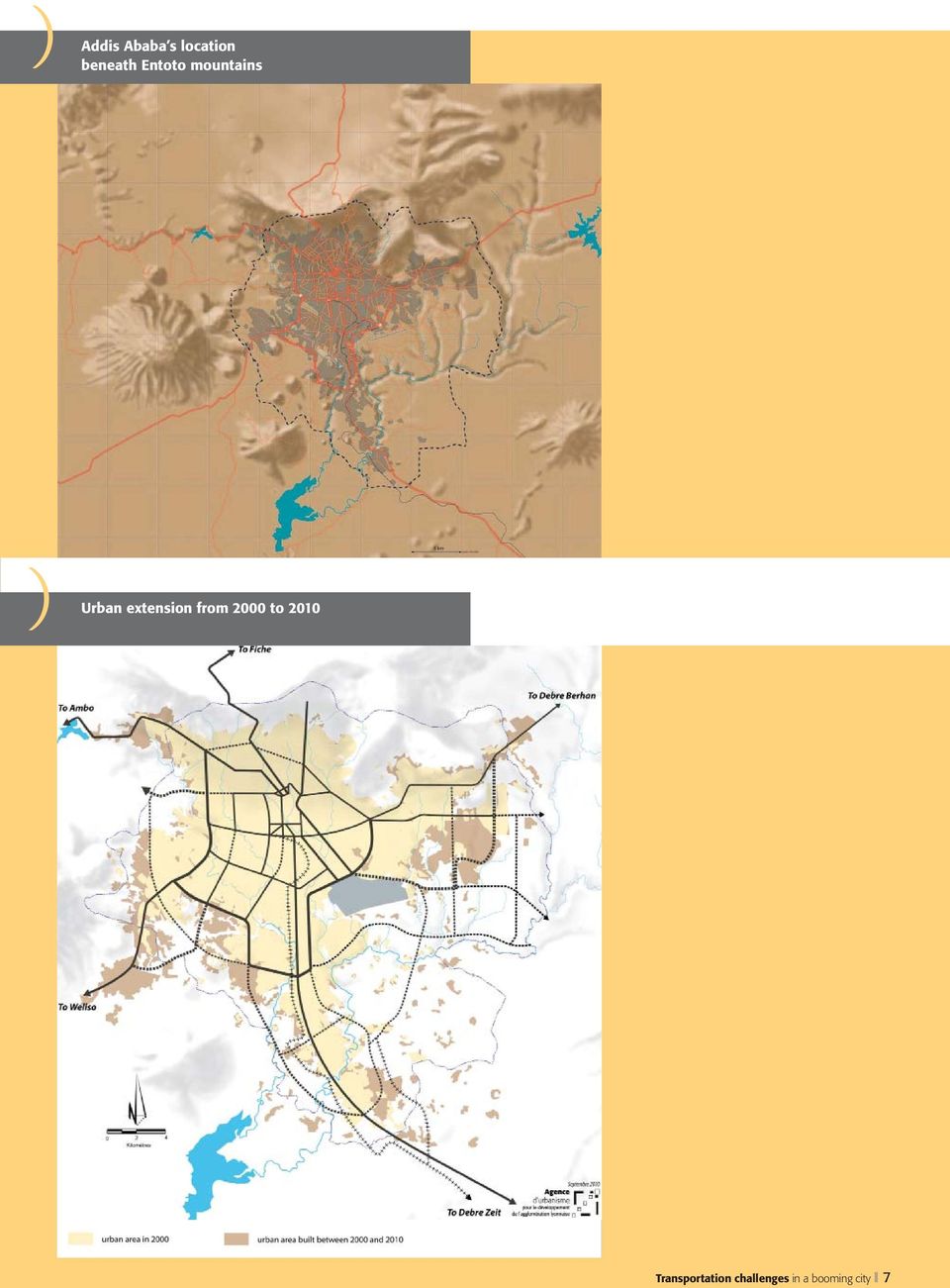
8 1 Addis Ababa: a booming city The institutional framework of the Ethiopian capital In the federal system An autonomous administrative area with a growing budget Addis Ababa City Government s building A Special status in the Ethiopia's federal organization Ethiopia has a federal structure composed of nine states (Kilils and two autonomous administrative areas: the cities of Dire Dawa and Addis Ababa. A substantial public budget During the last 10 years ( , city revenue has grown five-fold, from less than 1 billion to 16 billion Birr (about 800 million euros or 1 billion USD. This is a remarkable achievement and has helped to ensure large-scale infrastructure, housing and other public investments. This budget is thus one of the highest among similar-sized African cities. Institutional context for urban planning and transport Addis Ababa City Government (AACG level: Addis Ababa City is divided into 10 sub-cities, themselves divided into Woredas (total of 116 Woredas. Transport policy is managed at the city level by the Bureau of Roads and Transportation. This Bureau is responsible for the Addis Ababa City Road Authority (AACRA, the bus network managed through Anbessa and the Addis Ababa Transport Branch (AATB Urban planning is also managed at the city level. Recently, the Addis Ababa City Planning Project Office (AACPPO was created to prepare a new City Development Plan, including proper coordination with urban transportation projects. Federal Government level : The Federal Government created the ERC (Ethiopian Railway Corporation in This company is in charge of developing the Addis Ababa LRT network and the national railway system. The 10 sub-cities of Addis Ababa 8 I Transportation challenges in a booming city
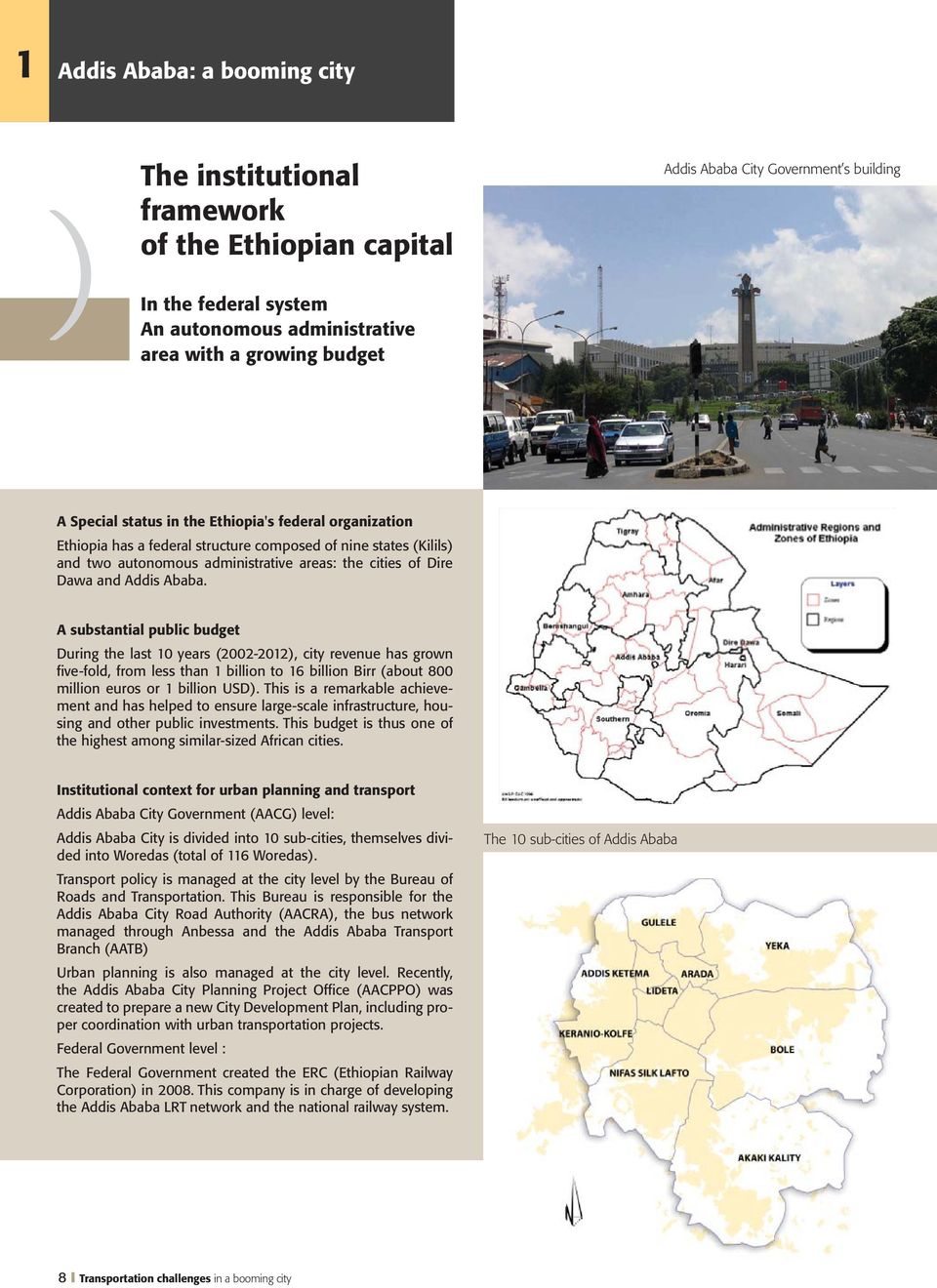
9 Organisation of AACG focusing on urban transport and urban development Transportation challenges in a booming city I 9
10 1 Addis Ababa: a booming city Condominium development on the East side of Addis Ababa A mixed urban fabric A massive public effort on urban development to cope with housing shortage, to develop infrastructure and public transport Middle low and low income old housing district in the city centre Housing: between the informal market and major government condominium projects Housing production in Addis is led by four major actors: - Real estate companies (or private sector produce good quality and formal, but expensive, housing - Condominiums are developed by the government with some subsidies and long term loans. This represents the majority of middle-income housing and should be further developed for low income people. Faced with a real housing shortage, in 2004, the municipality began a major housing program to build 200,000 units in a five-year period. About 80,000 have been built so far, on a hundred different sites. Currently, about 60,000 more units are under construction. - Cooperatives are small groups of citizen-run companies which buy and settle lands and build their own housing. - Informal and unplanned housing has been the response to rapid urbanization, the limited housing supply, and the low income of many people. This is still a fast-growing form of housing. Green spaces: the challenge to protect natural and environmentally sensitive areas Though green spaces are decreasing as the city expands, the protection of these areas has been included in the 2002 City Development Plan, contributing to preserving the environment, particularly to the north (Entoto and the southeast (beyond Bole airport. The urban land lease system enables the government, which owns the land, to transfer land use rights and benefits from the state to companies, investors and private individuals through leasing. Once individuals or investors acquire land use rights they acquire tenure. The land administration agency of AACG now gives incentives to attract investors to certain areas, via Private Public Partnerships (PPP. A high level of infrastructure: major roads and transport improvements in the last 10 years AACRA s performance had been so efficient that the total road length grew from 1360 km to 3192 km, i.e. 135% growth in a period of 12 years ( Building pedestrian walkways at the same time as roads is becoming a priority for municipal services. Public Transport: a major public company and a swarm of private operators Anbessa City Bus Service Enterprise runs the conventional bus system. Currently, it operates 650 buses, 100 articulated buses and manages four terminals (Mercato, La Gare, Menelik Square and Megenagna. The total network is composed of 104 routes and the most important one operates 13 trips per day in each direction. The fare is based on distance and ranges from 1 Birr (city centre to 7 Birr (suburb and there is a 45-cent public subsidy per ticket. Currently, Anbessa carries 400,000 passengers per day. Alternative public transport is also an important feature of the system. There are about 10,000 private-owned taxis and mini buses. This type of transportation is decreasing because of the priority given to AACG public transportation. There are also three stations for regional buses: Mercato, Asco and Kality. In 2006, the city s modal share was about 45% pedestrian, 46% public transport and 9% private modes. 10 I Transportation challenges in a booming city

11 Mini buses and taxis Road works on the north segment of the ring road Anbessa buses Minibus Plan (routes and hubs; GTZ 2006 Transportation challenges in a booming city I 11

12 2 Urban Development and Transport Integration: planning and implementation process ( The coordination of planning processes The 2002 City Development Plan provided a long-term vision of the city s future development based on a mass transit backbone. The 2006 transportation master plan reinforced the focus on this backbone. City Development Plan including LDPs (Local Development Plan The Revised City Development Plan was officially endorsed by the city government in The revision aimed to correct the weaknesses of the former master plan (1986 and build on its strengths. To improve effectiveness, a hybrid approach was adopted in the form of structural and action-oriented strategic planning. The Structural Plan provided a long-term vision of the city s future development and focused on the big picture in order to ensure overall sustainability. It comprised a general framework for infrastructure development and for investment, based on the spatial organisation of the main elements as well as legal and regulatory provisions for planning and building. By avoiding excessive details, the City Development Plan was made more understandable by all stakeholders and easier to implement. Here are some of the main planning principles of the revision of the City Development Plan: - Preparing the organisation of a strong backbone with the mass transit system for a city of more than 10 million inhabitants in the long run; - Create mass transit links along the backbone connecting the central business district (CBD and the main centre to the sub-centres; Mercato area - Transform the city into a polycentric metropolis to reduce the congestion of the centre and Mercato. It should be organised between the two regions (Addis Ababa and Oromia, notably along the two main axes (north-south and east-west; - Prioritize strategic development sites (through Public Private Partnership for investments (notably along the two main axes; - Protect and develop green spaces for the long term to provide quality of life (parks and nature and peri-urban agriculture for the metropolis, especially in the area south-east of the airport; - Adopt mixed use land use except for heavy industrial areas and freight areas; - Promote the mix of populations to reduce segregation and social problems resulting in the long run; - Develop urban design along the avenues, in open public spaces and in the districts for a better quality of life and image to attract investors; - Develop a double-leg system on the east and south exits: one boulevard with mass transit and urban density, one thoroughfare connected to the ring road; - Develop diversified economic areas: CBD, offices in subcentres, heavy industries, technology parks linked to universities, new market places, handcrafts areas... to boost economic development; - Develop subsidiarity through sub-cities but preserve the lead role of AACG for strategic issues of the City Development Plan. 12 I Transportation challenges in a booming city

13 The 2 main maps of the Revised City Development Plan 2002 Strong frame of the structure plan Revised City Development Plan 2002 Land Use Plan Revised City Development Plan 2002 Transportation challenges in a booming city I 13

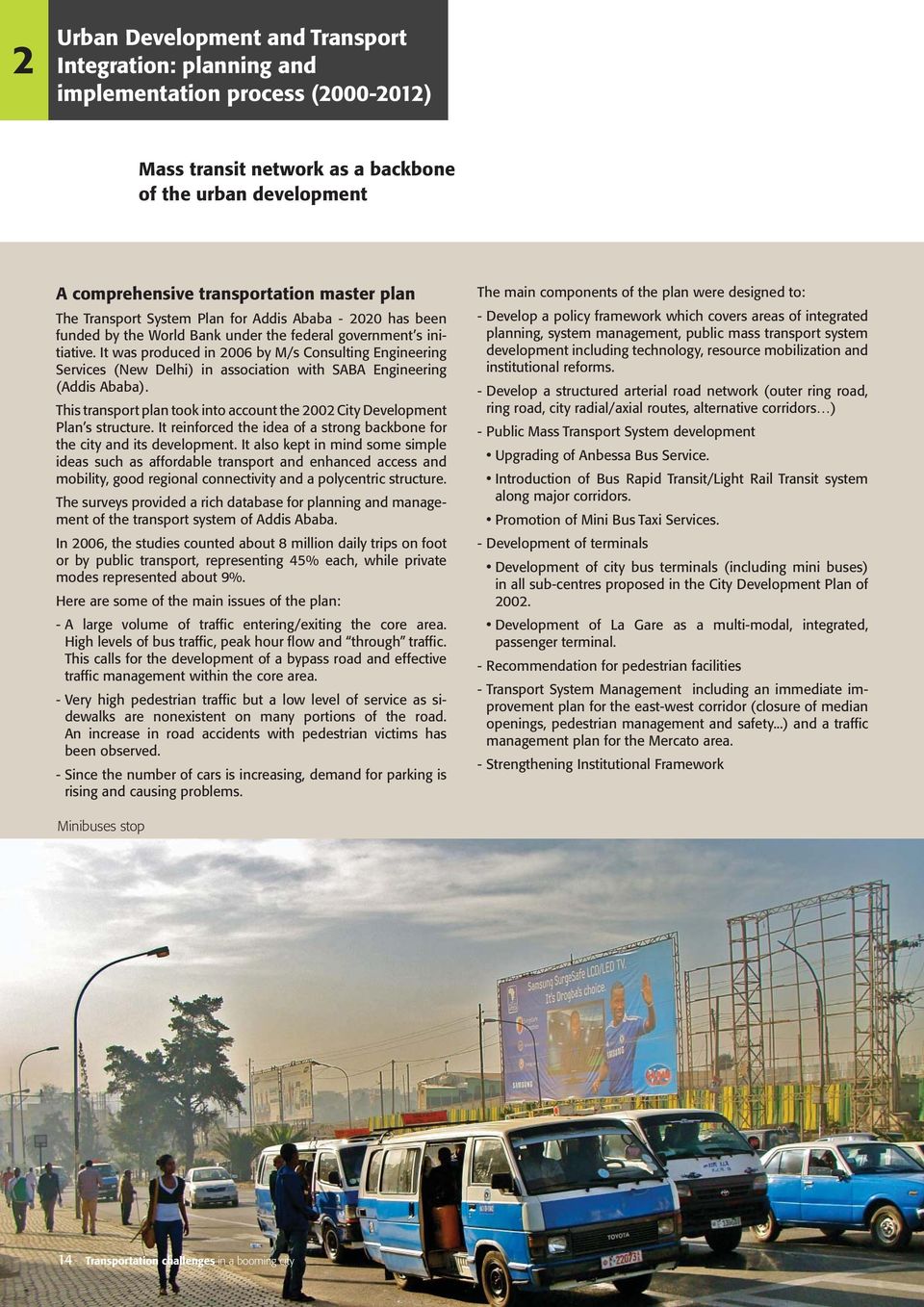
14 2 Urban Development and Transport Integration: planning and implementation process ( Mass transit network as a backbone of the urban development A comprehensive transportation master plan The Transport System Plan for Addis Ababa has been funded by the World Bank under the federal government s initiative. It was produced in 2006 by M/s Consulting Engineering Services (New Delhi in association with SABA Engineering (Addis Ababa. This transport plan took into account the 2002 City Development Plan s structure. It reinforced the idea of a strong backbone for the city and its development. It also kept in mind some simple ideas such as affordable transport and enhanced access and mobility, good regional connectivity and a polycentric structure. The surveys provided a rich database for planning and management of the transport system of Addis Ababa. In 2006, the studies counted about 8 million daily trips on foot or by public transport, representing 45% each, while private modes represented about 9%. Here are some of the main issues of the plan: - A large volume of traffic entering/exiting the core area. High levels of bus traffic, peak hour flow and through traffic. This calls for the development of a bypass road and effective traffic management within the core area. - Very high pedestrian traffic but a low level of service as sidewalks are nonexistent on many portions of the road. An increase in road accidents with pedestrian victims has been observed. - Since the number of cars is increasing, demand for parking is rising and causing problems. The main components of the plan were designed to: - Develop a policy framework which covers areas of integrated planning, system management, public mass transport system development including technology, resource mobilization and institutional reforms. - Develop a structured arterial road network (outer ring road, ring road, city radial/axial routes, alternative corridors - Public Mass Transport System development Upgrading of Anbessa Bus Service. Introduction of Bus Rapid Transit/Light Rail Transit system along major corridors. Promotion of Mini Bus Taxi Services. - Development of terminals Development of city bus terminals (including mini buses in all sub-centres proposed in the City Development Plan of Development of La Gare as a multi-modal, integrated, passenger terminal. - Recommendation for pedestrian facilities - Transport System Management including an immediate improvement plan for the east-west corridor (closure of median openings, pedestrian management and safety... and a traffic management plan for the Mercato area. - Strengthening Institutional Framework Minibuses stop 14 I Transportation challenges in a booming city
15 Proposed Transportation Master Plan (LRT-BRT-bus 2006 Funded by World Bank Proposed public transport network by the consultants in 2006 Proposed: LRT BRT BRT BRT LRT BRT LRT Addis Ababa modal share (2006 Walking 45% (3.48 million trips Public Transport (Anbessa, minibuses and taxis 46% (3.56 million trips Private Modes 9% (0.7 million trips Transportation challenges in a booming city I 15

16 2 Urban Development and Transport Integration: planning and implementation process ( Helpfull assessments of the City Development Plan s implementation The 2002 City Development Plan has been implemented for the last 10 years. During the first eight years the degree of implementation of the different issues varied greatly from rather good (transportation, housing... to rather weak (centrality... In 2010, a first evaluation of the master plan was done by the Lyon Town Planning Agency (LTPA and Mathewos Consult. It concluded that the 2002 Revised City Development Plan of Addis Ababa had made an important contribution by introducing a new paradigm shift, by providing shared, clear guidelines for Addis Ababa and by influencing the planning processes of many Ethiopian urban centres. During the first eight years, the degree of implementation of the different issues varied greatly from rather good (transportation, housing to rather weak (centrality, market hierarchy... Preparation of the backbone of the city, road network, green space protection, reducing the housing gap, developing industrial areas, and starting a process for Local Development Plans (LDP were all at a rather good level of implementation. On the other hand, preparing sub-centres, developing secondary markets, developing real strategic LDPs with urban quality, upgrading or renewal of the existing city, land and housing policy for low income people, etc., had seen a rather weak level of implementation. The reasons for these shortcomings were either financial or regulatory, but mainly institutional and organisational, engendered by a lack of continuity in urban management. This could be further explained by: - A poor exit strategy for preparing implementation in 2003: dismantling of the former project office for the 2002 City Development Plan; - High turnover among political and technical decision-makers, gradual loss of commitment and the resulting loss of knowledge in the organisation to be passed on to newcomers both at city and sub-city level; - Inadequate human resources dedicated to planning, urban management and LDPs; - Excessive decentralization to sub-cities of some city-level strategic issues. In 2011, a second assessment has been finalised by EiABC (Ethiopian Institute of Architecture. Much more detailed, this document reviewed the 10 chapters of the 2002 city development plan, assessing the implementation process and making recommendations to enhance it. The implementation process of the city development plan had somehow failed to either interpret the full meaning of the strategic concept and/or to apply it completely and consistently. The LDP s lack of integration is mainly due to a sectoral approach to the issue and poor critical understanding of space and developments factors. The current huge number of LDP's cancels de facto the idea of strategic planning that needs to focus on a few main objectives. The main observations of this assesment about transportation were: - Over the past few years, extensive road network development has been carried out in Addis Ababa, providing a solid base for the economic and social development of the city. - Transport fares have increased much more than household income in the last three years. This has made its services unaffordable for a large percentage of the population. - Lack of coordination between the different providers of public transport services (Anbessa, minibuses,... A multimodal approach should take into account all feasible modes of transportation. - Concentration of public transportation on a few major roads chosen for their profitability. Routes which are considered to be unprofitable suffer from poor levels of service. - The need for establishing a traffic management unit, particularly during the implementation phase. This was achieved with the creation of the bureau of Road and Transportation in I Transportation challenges in a booming city

17 Implementation of the backbone Road network implementation Transportation challenges in a booming city I 17

18 2 Urban Development and Transport Integration: planning and implementation process ( A successful implementation preparing transport projects Since 2003, urban planning policies have generated implementation and organisation in the transportation field. The first steps towards a sustainable transport policy. Below is a chronologic description of the actions taken. Reservation of right-of-way on the two main axes During the last eight years, some sections of the right-of-way in the middle of the road has been reserved for BRT/LRT on the two main axis (east-west axis from Megenagna to Ayat and north-south axis from Meskel to Akaki. There is no true BRT yet, but standard public buses (minimum of 23 seats use the dedicated lanes. This was a major step towards the implementation of mass transit. Even though the political decision to develop mass transit came later, opening the way to studies by ERC to develop LRT systems along the two axes and ongoing studies to create the major hub in La Gare represented significant progress. Several studies helped determine the choice of modes (LRT/BRT In 2007, a specialised study of the mass transport issue in the framework of Ethiopian-French cooperation was conducted by a private consultant (G. Menckhoff. It compared BRT and LRT technologies focusing on implementation strategies, operating costs and institutional set-up. The federal authorities chose LRT to be built on the east-west and north-south axis. AACG opted for a BRT network on smaller corridors, notably to feed LRT lines. Creation of the Road and Transportation Bureau of Addis Ababa City Government in 2011 This Bureau coordinates the different bodies involved in transport, primarily AACRA, AATB, and Anbessa. It is closely linked with the highest authorities of the AACG and even the Ministry of Transport. It is a very good step towards a comprehensive approach to the transport issue. Enhancement and development of the Anbessa bus network Anbessa now aims to boost its fleet to 800 buses including 100 articulated buses for use on the future BRT lanes. Anbessa recently began operating articulated buses assembled by a local Ethiopian company, with spare parts coming from different foreign countries. Two new terminals are being built at Ayer Tena and Kaliti. An electronic ticketing system and a fleet management system are underway. ERC s on-going studies to implement LRT on the two main axes China Railway Group Limited, consultants from Hong Kong, completed a first study in It defined two routes: On the east-west axis (from Ayat to Tor Hailoch On the north-south axis (from Menelik II Square to Kality (see map opposite. Two segments are prioritized: Megenagna/Ayat (7 kms and Mesquel/Kaliti (8 kms. The feasibility study is completed and approved. Final route alignment, depots and stations locations are determined. Integration of the LRT scheme with the road master plan is undergoing. Schematic design is completed and detail final design is under progress. Predicted peak hour passenger capacity should be per direction and will increase later. Reservation of the corresponding right-of-ways and first excavations are underway. Need for a BRT network developed by AACG, complementary to LRT Egis Rail and LTPA completed a pre-feasibility study of the BRT B2 corridor for Addis Ababa City Government and Agence Française de Développement (AFD in Currently, detailed design and implementation components of this project are under study. AFD should provide funding. The B2 line will become part of a larger BRT network, complementary to LRT. Today, AACG is studying the feasibility of other BRT lines. 18 I Transportation challenges in a booming city

19 Reservation BRT project (B2 line with probable extension to Jemmo, southwest of the city of right of ways in the middle of the two main axes LRT network (Source ERC Transportation challenges in a booming city I 19

20 3 Multi-scale stakes for tomorrow URBAN AND TRANSPORT LINKAGE MUST BE DEVELOPED AT DIFFERENT SCALES TO BE FULLY EFFICIENT: NATIONAL, REGIONAL, CITY AND MAIN URBAN MASS TRANSIT STATIONS National and regional level (Addis Ababa and Oromia special zone The city development is interconnected with Oromia special zone development and national railway project A forthcoming national railway network The Ethiopian Railways Corporation has identified eight railway corridors in the country for study, design and subsequent implementation. The Addis Ababa-Djibouti line is prioritized and should be the first one to be implemented, in early The need for integration and co-operation with Oromia Addis Ababa is surrounded by Oromia state which identified a special zone all around the city s boundary named Oromia Special Zone. Planning actions must be coordinated with AACG. This zone attracts a great deal of foreign investment, especially from industry. Synchronization of the city s plans and developments with the surrounding Oromia Special Zone is now managed by a steering committee gathering elected officials from both authorities. A joint team of Oromia and Addis Ababa city planners has also been created to work on the issue of regional planning. This initiative is already underway between AACG and Oromia state to identify common interests. It needs to be strengthened with a more comprehensive vision for the urban region as a whole. The Addis Ababa City Planning Project Office (AACPPO has also become instrumental in creating a common forum to facilitate the cooperation between the two parties. The Supervisory Board and the Technical Advisory Committee of AACPPO have members from higher officials of the Oromia State. Consensus has been reached to integrate efforts and to prepare an integrated development plan to meet common interests and vision. Urban management and development policies should focus on the main challenges of regional planning such as a polycentric metropolis, transportation, infrastructure, urban sprawl, green zones, risks and agriculture. Location of major national, regional and central stations of the future Ethiopian railway network in the Addis Ababa region Two of the national railway network s stations (freight and passengers will be located close to Addis Ababa at Lebu and Gelan. In the long term, ERC plans to connect these two stations to the extended LRT network. La Gare might become a major hub as it will be served by the two LRT lines and all public transport. As a second step, ERC also plans to create a passenger central railway station at La Gare. Development of major hubs at the two main train stations and strategic development sites. All of these changes will surely have consequences on regional urban development. Some secondary cities could be strengthened in the long run into Oromyia special zone and contribute to globally reframe the regional urban network. National Railway Network Project (ERC 20 I Transportation challenges in a booming city

21 Addis Regional urban network Ababa Regional Framework Oromia Special Zone LRT network and future connections to the national railway network in the Addis Ababa region (Source ERC Transportation challenges in a booming city I 21
22 3 Multi-scale stakes for tomorrow City level A new City Development Plan under review in 2012: An opportunity to enhance dialogue between planners and transport operators to organize a future polycentric urban structure linked by the mass transit system A polycentric model articulated by mass transit corridors The 2002 City Development Plan promoted a polycentric urban structure. The efficiency of such a structure comes from the improved articulation between centres, sub-centres, hubs and mass transit corridors. The distribution of functions should be planned with regard to the current and future needs of each location. It aims to reduce mobility demand by providing equivalent standards of services and social facilities in sub-centres. A crucial turning point for mass transit projects (LRT/BRT and the new city development plan Transportation is a priority for AACG. Several mass transit projects are under study for implementation within a few years in Addis Ababa. This is an opportunity to (reshape the urban structure by reinforcing or creating centres and sub-centres in accordance with the projected mass transit network. Enhancing accessibility to the different centres by connecting them to mass transit will be a significant step towards creating a polycentric urban structure. Establishing two types of primary roads A hierarchy of roads should be established to avoid inappropriate infrastructure development in urban areas: - Boulevard type into the core city centre and sub-centres, prioritizing slow traffic, pedestrian flows and mass transit. - Highway type with good connections to the ring road to manage fast and heavy traffic in the outskirts. The need for a traffic management system The use of Addis Ababa s road network could be optimized with a greater traffic management based notably on a better discipline of minibuses drivers (replace hazardous stops by parking areas and the use of new technologies. 22 I Transportation challenges in a booming city
23 Polycentric urban structure proposed by the City Development Plan 2002 The need for a car park strategy There is a need for a comprehensive parking strategy for the city consisting of building off-street parking in the city core and prioritizing mass transit over car use. In peripheral areas, a park-and-ride strategy should be developed next to future mass transit stations. Creating a dialogue between planners and transport operators Joint involvement and knowledge-sharing between ERC, AACG (Bureau of Roads and Transportation and AACPPO for future projects in Addis Ababa is necessary to properly coordinate urban development and the mass transit network. It is one of the key factors of future planning policies particularly at the starting point of a new City Development Plan. ERC and AACPPO began cooperating by making planners and transport professionals work together. AACPPO and AACG are accustomed to working together. Nevertheless, this dynamic needs to be strengthened by increasing involvement of all the stakeholders such as ERC, AACG through the Bureau of Transportation (AACRA, Anbessa, AATB and AACPPO. These institutions must also enhance their dialogue with taxi/ mini bus associations which are a major feature of public transportation all over the city and beyond. Periodic meetings would contribute to maximizing integration with the transportation network. Transportation challenges in a booming city I 23
24 3 Multi-scale stakes for tomorrow Urban Integration around main mass transit stations Integrating the mass transit system into public spaces in terms of management of pedestrian flows, urban quality, urban design and landscaping Enhancing the urban image and quality through the development of the mass transit network Though there are huge construction investments in the city, most show little concern for the urban image and quality of open public spaces. Poorly designed roundabouts, grade separations, inter-changes and pedestrian overpasses and structures create obstacles, visual pollution, unattractive spaces and landscaping, uneconomical use of land and potentially unsafe sites. They require immediate attention. Improved urban design in open public spaces, notably to enhance access to mass transit stations Because walking is still the most vital means of transportation in the city, it should be an important element in urban transportation planning. Separation of pedestrians from vehicles by providing adequate sidewalks is critical to improve safety and accessibility to public mass transit. Development of a pedestrian system requires an understanding of pedestrian flow characteristics. Churchill Avenue Local Development Plans of the 10 main LRT stations The LRT will have 10 main hubs (Ayat, Megenagna, La Gare, Lideta, Tor Hailoch, Menilik Square, Mercato, Gotera, Dama Hotel, and Kality out of a total of 32 stations. The hubs will be close to important public areas or service centers, such as the stadium, university, hospitals, CBD, markets and shopping malls. They will also provide important connections with other modes of transport such as BRT (Bus Rapid Transit, taxis, minibuses etc. The LDPs of these 10 hubs should be particularly well planned, especially the one at La Gare which is meant to become the biggest hub and the CBD. ERC launched a consultation for urban design proposals for the 10 main stations. Integration of LRT at grade, elevated and underground sections. Renovation of Anbessa network including new BRT lines Choices that have been made or to be made concerning the integration of a future LRT system will impact the entire landscape of the city, urban image and functioning of the mass transit system. Some cities in the world have deteriorated their urban landscape because of poor integration of elevated systems. These different LRT/BRT lines and stations will need adequate right-of-ways and therefore will have an impact on existing or new public spaces. Choices will have to be made concerning accessibility to the stations and street furniture, as they will contribute to defining the new identity of Addis Ababa. 24 I CODATU XV The role of urban mobility in (reshapping cities
25 Absent Former LDP of La Gare to be revised, long term major hub of the central business district of Addis Ababa and dangerous walkways Sources: Guerric Péré, landscaper, Lyon and Lyon Town Planning Agency, LRT network s main stations Transportation challenges in a booming city I 25
26 4 Strategies for urban development and transport integration Perspectives on critical issues for a transversal approach The main challenges for sustainable urban development Integration of the regional paradigm into city planning process Promote a polycentric urban fabric connecting centres and sub-centres with efficient mass transit corridors and transport systems. This will help to reduce unregulated urban sprawl to areas which are difficult to reach by mass transit. Development of urban quality Maximise comfortable open public spaces for pedestrians to improve access to mass transit stations. Systematically develop street vegetation to make walking more pleasant. A city with significant national and international status must have high-standard public open spaces, squares and services. Strengthening the polycentric urban structure Promote attractive, dense and mixed-use centres and subcentres to provide good services to districts and avoid insofar as possible the need to go to the city core. Coordination of transport policies Concerning roadways, a road hierarchy network should be developed: - Urban boulevards with mass transit and comfortable sidewalks for pedestrians within the city, as far as the ring road. - Outlet expressways to manage transit, freight, heavy and fast traffic connected to the ring road. Concerning mass transit: - Develop dedicated lanes for mass transit (LRT and BRT on major dense corridors, fed by current Anbessa bus lines, minibuses and taxis - Limit the use of cars for daily commuting when located near mass transit stations; - Optimize current lines of Anbessa buses, minibuses and taxis, in particular for peripheral travel. Diversification of housing policies Develop a compact mixed-use city along mass transit corridors according to a comprehensive urban renewal approach. Diversify housing policies to promote affordable housing, including collective housing, connected to basic services. Integration of environmental issues as decisive ones Protect all of the metropolitan green zones (slopes of mountains, natural sites, parks, river banks, urban agriculture, natural and technological risk areas from urban sprawl and focus urbanization along corridors. Emphasize means of transportation which minimize the need for energy, notably carbon energy, to reduce climate change effects. Landmark building complex of the African Union 26 I Transportation challenges in a booming city
27 Four Former LDP of La Gare to be updated Source: EPFL, Lausanne Reviewed by LTPA conditions for an efficient mass transit policy: 1. Coordinate the city s structure plan and develop attractive mass transit corridors and hubs in order to improve accessibility to centres, sub-centres and dense city areas by public transport. 2. Develop attractive pedestrian sidewalks, squares and access to the stations of the mass transit network and organise efficient hubs. Develop bicycle lanes in specific areas. 3. Reduce private car use for commuting and promote the use of mass transit when existing in the employment basin; limit the parking supply in city core and in areas where mass transit network provides easy access. Implement transport technology to improve traffic management. 4. Organise efficient transport of goods and freight in the city, to avoid additional congestion on the main urban corridors. A booming city: Casanghis development project Transportation challenges in a booming city I 27
28 Contacts CODATU Alexis JOVIGNOT : [email protected] Julien ALLAIRE : [email protected] AACPPO Addis Ababa City Planning Project Office Mathewos ASFAW : [email protected] LTPA Lyon Town Planning Agency Patrice BERGER : [email protected] Sources AACPPO AARTB ERC GIZ EPFLausanne M/s Consulting Engineering Services Master Plan carte-du-monde.net Lyon Town Planning Agency
Growth of Addis Ababa
 Growth of Addis Ababa Founded in 1887, and has expanded rapidly Now among the ten largest cities in Sub Saharan Africa Annual growth rate is 3.8% By 2020 population growth would reach to eight million.
Railway Development in Ethiopia
 Ethiopian Railways Corporation (ERC) Railway Development in Ethiopia November 2015, Rijswijk Yehualaeshet Jemere (MSc. CEng) Chief Officer, Construction and Project Execution Department Outline Introduction
Addis Ababa Light Rail Transit Project
 Ethiopian Railways Corporation (ERC) Addis Ababa Light Rail Transit Project Yehualaeshet Jemere (MSc. CEng) Chief Officer, Construction and Project Execution Department July, 2012 OUTLINE OF THE PRESENTATION
Downtown Tampa Transportation Vision
 Downtown Tampa Transportation Vision Executive Summary August 1, 2006 Hillsborough County Metropolitan Planning Organization County Center, 18 th Floor Tampa, Florida 33602 813-272-5940 www.hillsboroughmpo.org
Goals & Objectives. Chapter 9. Transportation
 Goals & Objectives Chapter 9 Transportation Transportation MISSION STATEMENT: TO PROVIDE A TRANSPORTATION NETWORK CAPABLE OF MOVING PEOPLE AND GOODS EFFICIENTLY AND SAFELY. T he transportation system
Planning and Design for Sustainable Urban Mobility
 1 Planning and Design for Sustainable Urban Mobility 2 1 UrbanizationUrbanization Rapid pace, largely uncontrolled growth, taking place mainly in developing countries 3 Global Urbanization Trends World
Sustainable urban mobility: visions beyond Europe. Brest. Udo Mbeche, UN-Habitat
 Sustainable urban mobility: visions beyond Europe 2 nd October 2013 Brest Udo Mbeche, UN-Habitat The Global Report for Human Settlements Published every two years under a UN General Assembly mandate. Aims
Development of Shanghai Integrated Transport (2010-2015) XIAO Hui and GU Yu
 Development of Shanghai Integrated Transport (2010-2015) XIAO Hui and GU Yu Abstract This article summarises the general situation of Shanghai s integrated transport system and then determines the trends
Chapter 9: Transportation
 Chapter 9: Transportation What is this chapter about? The goals and policies in this chapter convey the City s intent to: Create a coordinated, efficient, and more affordable multimodal transportation
PROJECT PREPARATORY TECHNICAL ASSISTANCE
 A. Justification PROJECT PREPARATORY TECHNICAL ASSISTANCE 1. The Government of Azerbaijan, the Ministry of Transport and Baku Metro Company requested ADB to help improving its urban transport system and
VISION, DESIGN PRINCIPLES & OVERALL PLANNING STRATEGY
 3 VISION, DESIGN PRINCIPLES & OVERALL PLANNING STRATEGY The overall planning strategy for the Bank Street CDP is to ensure that future development is undertaken in a coordinated and planned approach, supported
URBAN PUBLIC TRANSPORT PLANNING IN TEHRAN AND THE OUTCOME OF THE IMPLEMENTED BRT LINES
 United Nations Forum on Climate Change Mitigation, Fuel Efficiency and Sustainable Urban Transport URBAN PUBLIC TRANSPORT PLANNING IN TEHRAN AND THE OUTCOME OF THE IMPLEMENTED BRT LINES S. MEHDI TASHAKKORI
Farshad Jalali. Hojat Behrooz
 Integrated E-Ticket System for multimodal Public Transport Network: Toward a multi application e-purse A Review on Tehran Project Farshad Jalali Tehran Traffic Control Company Iran Hojat Behrooz Tehran
Cities for Mobility. World Congress 2008 City of Stuttgart June 1-4, 2008. The Transport System in the City of Yaoundé, Cameroon.
 Cities for Mobility World Congress 2008 City of Stuttgart June 1-4, 2008 The Transport System in the City of Yaoundé, Cameroon Presented by Mr Gilbert Tsimi Evouna Dear Mayors, dear participants, I am
Metropolitan Setting l
 Metropolitan Setting l GENERAL CHARACTERISTICS Los Angeles lies at the heart of one of the most complex metropolitan regions in the United States. As a major center of commerce, finance, and industry in
Examples of Transportation Plan Goals, Objectives and Performance Measures
 Examples of Transportation Plan Goals, Objectives and Performance Measures The next step in the Long Range Transportation Plan (LRTP) process is to develop goals, objectives, and performance measures.
Trends and issues Lake Te Koutu walkway, Cambridge
 27 Trends and issues Lake Te Koutu walkway, Cambridge 3 Trends 3.1 Journey to work Over the past two to three decades there has been a significant increase in private vehicle ownership and usage and a
Department of State Development, Infrastructure and Planning. State Planning Policy state interest guideline. State transport infrastructure
 Department of State Development, Infrastructure and Planning State Planning Policy state interest guideline State transport infrastructure July 2014 Great state. Great opportunity. Preface Using this state
Eagle Commuter Rail Denver, Colorado Final Design (Based upon information received by FTA in November 2010)
 Eagle Commuter Rail Denver, Colorado Final Design (Based upon information received by FTA in November 2010) Summary Description Proposed Project: Electrified Commuter Rail 30.2 Miles, 13 Stations Total
Integrated Public Transport. Planning. National workshop on promoting sustainable transport solutions for East Africa
 Integrated Public Transport National workshop on promoting sustainable transport solutions for East Africa Carly Koinange, GEF Sustran Consultant UN-HABITAT Urban Mobility Unit Urban Basic Services Branch
Cycle Strategy 2006 2011
 Cycle Strategy 2006 2011 TABLE OF CONTENTS 1 INTRODUCTION... 1 2 POLICY BACKGROUND... 2 3 BACKGROUND... 6 4 MAIN OBJECTIVES... 8 5 TARGETS... 9 6 THE CYCLE NETWORK... 10 7 CONCLUSION... 13 Appendix A:
ORANGE COUNTY TRANSPORTATION AUTHORITY. Final Long-Range Transportation Plan - Destination 2035. Attachment A
 ORANGE COUNTY TRANSPORTATION AUTHORITY Final Long-Range Transportation Plan - Destination 2035 Attachment A DESTINATION 2035 DESTINATION 2035 EXECUTIVE SUMMARY ATTACHMENT A Moving Toward a Greener Tomorrow
Sustainable city development through smart urban planning
 Sustainable city development through smart urban planning Agenda Summary Points Urban Planning Overview Urbanization in India Objectives of Smart Urban planning Key Focus Areas in Smart Urban Planning
THE OBJECTIVES AND FRAMEWORK FOR THE DEVELOPMENT OF FORUS
 What Forus will be CONTENTS WHY A JOINT PLAN FOR FORUS?... 3 WHAT IS A PLAN PROGRAMME?... 3 THE OBJECTIVES AND FRAMEWORK FOR THE DEVELOPMENT OF FORUS... 3 THE PLAN AREA... 4 THE LONG-TERM GOALS FOR FORUS...
Alternatives to the Circ Project Prioritization Methodology Prepared for Circ Task Force July 28, 2011
 Alternatives to the Circ Project Prioritization Methodology Prepared for Circ Task Force July 28, 2011 CCRPC staff has developed a draft methodology described below and detailed in the attached pages for
Introduction of the Project
 The Project on Urban Transport Improvement in Federal Democratic Republic of Nepal July, 2015 Introduction of the Project Government of Nepal Ministry of Physical Infrastructure and Transport (MOPIT) Department
SOUTH EAST EUROPE TRANSNATIONAL CO-OPERATION PROGRAMME. Terms of reference
 SOUTH EAST EUROPE TRANSNATIONAL CO-OPERATION PROGRAMME 3 rd Call for Proposals Terms of reference Efficient access to a SEE coordinated multimodal freight network between ports and landlocked countries
How To Develop A Balanced Transport System In Devon
 Devon Structure Plan First Review - 1995 to 2011 7 Transportation (T Policies) Explanatory Memorandum (September 1999) (Policies and Proposals adopted February 1999) 7. TRANSPORTATION 7.1 Transportation
A new Garden Neighbourhood for West Guildford An opportunity for Smart Growth. university of surrey November 2013
 A new Garden Neighbourhood for West Guildford An opportunity for Smart Growth university of surrey November 2013 A new Garden Neighbourhood for West Guildford Preface Since the County and Borough Councils
This document is part of a series of Building a Stronger South Australia policy initiatives from the Government of South Australia.
 3. Public Transport This document is part of a series of Building a Stronger South Australia policy initiatives from the Government of South Australia. 1. Future Fund 2. Jobs and Skills 3. Public Transport
Infrastructure and Growth Leadership Advisory Group Ideas and Approaches Survey
 Infrastructure and Growth Leadership Advisory Group Ideas and Approaches Survey In its second meeting, the Infrastructure and Growth Leadership Advisory Group expanded and refined the list of approaches/ideas
Multi-year Expert Meeting on Transport, Trade Logistics and Trade Facilitation
 Multi-year Expert Meeting on Transport, Trade Logistics and Trade Facilitation Sustainable Freight Transport Systems: Opportunities for Developing Countries 14-16 October 2015 EGYPT'S POLICIES FOR SUSTAINABLE
Introduction to Station Area Planning The Charlotte Story
 Introduction to Station Area Planning The Charlotte Story Boston 2009 Steve Hamwey - Sasaki Associates, Inc. Troy Russ - Glatting Jackson, Inc. October 31 st, 2009 Station Area Planning October 15th History
Academic Reading sample task Identifying information
 A B C D E There are now over 700 million motor vehicles in the world - and the number is rising by more than 40 million each year. The average distance driven by car users is growing too - from 8km a day
Seoul Metro line 9 O&M Contract
 Seoul Metro line 9 O&M Contract 1 1 Veolia Transport Veolia Transport is a leading operator of public transportation in Europe More than 3000 public clients 2007 annual turnover: 5.6 billion 82 000 employees
DRAFT MASTER PLAN - 2015
 DRAFT MASTER PLAN - 2015 An Integrated Planning Approach... Amenities Housing Transport Solid Waste Land Use Industry Slums Logistics Agriculture Natural Areas Hi-Tech Population Heritage Water Small Industry...
 Walkable Communities Florida Department of Transportation State Safety Office Pedestrian and Bicycle Program April 1995 www.dot.state.fl.us/safety Twelve Steps for an Effective Program Page 1 Twelve Steps
From Mobility to Accessibility: Addressing the Barrier Effect of Railway Infrastructure in Urban South Africa
 des s Publics From Mobility to Accessibility: Addressing the Barrier Effect of Railway Infrastructure in Urban South Africa Sisa Maboza Rail Planner Passenger Rail Agency of SA Contents des s Publics 1.
Evaluation Criteria and Mode Progression for RouteAhead Rapid Transit Projects
 Evaluation Criteria and Mode Progression for RouteAhead Rapid Transit Projects C2012-0684 ATTACHMENT 2 The RouteAhead draft 30-year rapid transit plan was developed in coordination with the Investing in
Mayors Welcome Strong Surrey Votes Yes Coalition Support. Yes Vote Would Vastly Improve Transit and Transportation in Fast Growing City
 Mayors Welcome Strong Surrey Votes Yes Coalition Support Yes Vote Would Vastly Improve Transit and Transportation in Fast Growing City February 11, 2015 Vancouver, BC The Mayors Council on Regional Transportation
OVERVIEW OF ADDIS ABABA CITY SOLID WASTE MANAGEMENT SYSTEM. February/ 2010 Addis Ababa Ethiopia
 OVERVIEW OF ADDIS ABABA CITY SOLID WASTE MANAGEMENT SYSTEM February/ 2010 Addis Ababa Ethiopia PRESENTAION OUTLINE BACKGROUND SOLID WASTE GENERATION & COMPOSITION SOLID WASTE MANAGEMENT PRACTICES IDENTIFIED
Investing in Smart Cities
 Investing in Smart Cities The European Investment Bank (EIB) is the financial arm of the European Union (EU) and is owned by its 28 Member States. Founded in 1958, it operates in the 28 EU Member States
PLANNING RAIL BASED TRANSIT FOR BETTER LIVING. S.K.GUPTA DIRECTOR(PROJECTS), Mumbai Metro Rail Corp. Ltd Mumbai
 PLANNING RAIL BASED TRANSIT FOR BETTER LIVING S.K.GUPTA DIRECTOR(PROJECTS), Mumbai Metro Rail Corp. Ltd Mumbai Background While authorities are proceeding with planning and implementation of Metros in
Case Study REGIONAL TRANSPORTATION DISTRICT (RTD) DENVER, COLORADO
 Case Study REGIONAL TRANSPORTATION DISTRICT (RTD) DENVER, COLORADO Transit Agency Profile and Reason for Selection of Transit Agency Overview The Regional Transportation District (RTD) in Denver is one
Welcome to our exhibition
 Welcome to our exhibition Welcome to this public exhibition for Cherry Park, Westfield, Stratford. This exhibition has been organised to update residents on Cherry Park, the next phase of development in
Tier 1 Strategies. WV Route 14 Corridor Management Plan
 1.1 1.2 1.3 1.4 Signal timing optimization system improvements. Improve geometry traffic control at high crash intersections. Construct intersection capacity improvement projects. Widen longer sections
2 Integrated planning. Chapter 2. Integrated Planning. 2.4 State highway categorisation and integrated planning
 2 Integrated planning Chapter 2 Integrated Planning This chapter contains the following sections: Section No. Topic 2.1 Introduction to integrated planning 2.2 Transit s Integrated Planning Policy 2.3
Rural Road Safety Policy in Korea: Lesson Learned
 Regional Seminar on Safe, Climate Adaptive and Disaster Resilient Transport for Sustainable Development Nov. 17 th, Seoul Rural Road Safety Policy in Korea: Lesson Learned Sangjin HAN Korea Transport Institute
Dr. Kamal Shoar, Head of Transport Planning Department
 January 22 & 23, 2008, Skhirat, Morocco THE URBAN TRANSPORT CHALLENGE-Recent Innovative Policies and Measures In Tehran Dr. Kamal Shoar, Head of Transport Planning Department Tarh-e-Haftom Consulting Engineers
TITLE A CTS FOR THE NEW ROME EXHIBITION
 CityMobil2 - Socio-economic impact study Reference Group Meeting Lausanne 23 June 2015 TITLE A CTS FOR THE NEW ROME EXHIBITION Carlo Sessa Gabriele Giustiniani, ISIS ITR 30/3/2015 1 Envisioning AUTOMATED
HÁ LIMITES PARA O CRESCIMENTO DO SETOR IMOBILIÁRIO? Jacques van Zijl Rea Vaya Project Manager
 HÁ LIMITES PARA O CRESCIMENTO Jacques van Zijl Rea Vaya Project Manager Johannesburg South Africa Johannesburg 3.8 million population Biggest City in South and Southern Africa Only City in South Africa
WEST YORKSHIRE BUS STRATEGY
 WEST YORKSHIRE BUS STRATEGY Phase 1 Consultation on Vision and Principles Introduction and Purpose There is a statutory requirement for the West Yorkshire Combined Authority (WYCA) to produce a Local Transport
Transport and planning in France
 AFD Formes urbaines et transport urbain Transport and planning in France 10 and 11 June 2010 Thomas Vidal CERTU / DD Ministère de l'écologie, de l'énergie, du Développement durable et de la Mer www.developpement-durable.gouv.fr
Overview of the Travel Demand Forecasting Methodology
 Overview of the Travel Demand Forecasting Methodology Prepared by the Central Transportation Planning Staff (CTPS) Authors: Scott A. Peterson, Manager Ian Harrington, Chief Planner March 29, 2008 1 OVERVIEW
From : Başpınar & Partners Law Firm. Date : 27.06.2014. Subject : Communiqué on Spatial Planning Preparation I. INTRODUCTION
 From : Başpınar & Partners Law Firm Date : 27.06.2014 Subject : Communiqué on Spatial Planning Preparation I. INTRODUCTION Communiqué on Spatial Planning Preparation ( Communiqué ) which is prepared by
Practices and Policies of Green Urban Transport in China
 Practices and Policies of Green Urban Transport in China JIANG Yulin and LI Zhenyu Abstract China faces serious challenges as a result of rapid urbanisation and motorisation. Congestion and environmental
Railway Development in Ethiopia
 Ethiopian Railways Corporation (ERC) Railway Development in Ethiopia Yehualaeshet Jemere (MSc. CEng) Addis Ababa-Djibouti Railway Project Manager Railway Development in Ethiopia Introduction National Railway
Planning of the Pre-Concept Architectural Design For the McGill University Health Centre, Montreal
 Planning of the Pre-Concept Architectural Design For the McGill University Health Centre, Montreal Robert Hamilton Robert A. Hamilton MRAIC, OAQ Robert Hamilton is Senior Associate responsible for Architectural
Customer Satisfaction Index 2014
 Customer Satisfaction Index 01 Contents Executive summary Customer satisfaction methodology Initiatives to improve customer satisfaction November 01 results Overall train network Overall bus regions Overall
Sustainable Mobility in Almada
 RUSE, Redirecting Urban Areas Development Towards Sustainable Energy Sustainable Mobility in Almada Carlos Sousa AGENEAL, Local Energy Management Agency of Almada Almada, 17th November 2005 Transport Sector
Infrastructure & Growth Leadership Pillar Strategy Statements from Existing Plans Developing Florida s Strategic 5-Year Direction, 29 November 2011
 Infrastructure & Growth Leadership Pillar Strategy Statements from Existing Plans Developing Florida s Strategic 5-Year Direction, 29 November 2011 Key Themes Global trade infrastructure seaports, airports,
INTEGRATION OF PUBLIC TRANSPORT AND NMT PRINCIPLES AND APPLICATION IN AN EAST AFRICAN CONTEXT
 INTEGRATION OF PUBLIC TRANSPORT AND NMT PRINCIPLES AND APPLICATION IN AN EAST AFRICAN CONTEXT MARK BRUSSEL CONTENTS Examples of integration from the Netherlands Rationale and principles of integration
OVERVIEW PROJECT SUMMARY
 OVERVIEW Cesar Chavez showcases how to successfully redesign a primary arterial route into a neighborhood destination, improving modal share, water sensitive design, biodiversity and safety whilst maintaining
STRATEGIC PUBLIC TRANSPORTATION SYSTEMS PROGRAM
 DOCUMENT OF THE INTER-AMERICAN DEVELOPMENT BANK COLOMBIA STRATEGIC PUBLIC TRANSPORTATION SYSTEMS PROGRAM (CO-L1091) This document was prepared by the program team consisting of: Miroslava de Nevo, Program
Integrated Public Transport Service Planning Guidelines. Sydney Metropolitan Area
 Integrated Public Transport Service Planning Guidelines Sydney Metropolitan Area December 2013 CONTENTS 1. INTRODUCTION 3 1.1 Purpose 3 1.2 Background 3 1.3 Travel in Sydney Metropolitan Area 5 1.4 Objectives
The Mobility Opportunity Improving urban transport to drive economic growth
 , CEO Infrastructure & Cities Sector, Siemens The Mobility Opportunity Improving urban transport to drive economic growth Answers for infrastructure and cities. We are in the "urban millennium" Population
Melbourne Airport Rail Link Study. Study overview and findings
 Melbourne Airport Rail Link Study Study overview and findings Melbourne Airport caters for 28 million air passenger trips each year and this figure is expected to double in the next 20 years. Transport
Implementing Instructions - Sustainable Locations for Federal Facilities
 Implementing Instructions - Sustainable Locations for Federal Facilities Page 1 Background On October 5, 2009, President Obama signed Executive Order (E.O.) 13514, Federal Leadership in Environmental,
Africa Industrialization Day 2012
 CONCEPT NOTE Africa Industrialization Day 2012 Accelerating Industrialization for Boosting Intra-Africa Trade 5 December 2012 Addis Ababa, Ethiopia 1. INTRODUCTION During the 25th General Session of the
Primer on Transportation Funding and Governance in Canada s Large Metropolitan Areas
 Transportation Association of Canada Primer on Transportation Funding and Governance in Canada s Large Metropolitan Areas The transportation funding and governance frameworks of Canada s metropolitan regions
Green Mobility - an action plan for the way forward
 Green Mobility - an action plan for the way forward Annette Kayser Project Manager, M. Sc. City of Copenhagen The Øresund Region 2.4 mio. Inhabitants in the Region. ¾ of these at the Danish side 540.000
What we build today will create Denver s tomorrow. Signature development projects will strengthen our economy, create jobs and improve neighborhoods.
 Mayor Hancock s Vision for Building a World-Class City What we build today will create Denver s tomorrow. Signature development projects will strengthen our economy, create jobs and improve neighborhoods.
AUTONOMOUS CARS: 25 MEASURES FOR 2025
 AUTONOMOUS CARS: 25 MEASURES FOR 2025 Report Workshop 25 great minds towards 25 11/03/ 15 in Ghent In January 2015 Taxistop and Autopia participated in a workshop in the German Wremen with as subject the
HIGHWAY DESIGN REPORT. Appendix 4. Proposed Design Principles for City Passings
 HIGHWAY DESIGN REPORT Appendix 4 Proposed Design Principles for City Passings June 2000 Contents Page 1 Introduction 2 1.1 Purpose 2 1.2 Definition of city passing 2 1.3 Safety Problems 2 1.4 Planning
Transportation Policy and Design Strategies. Freight Intensive. Level of Freight Presence
 Appendix G Transportation Policy and Design Strategies CONTEXT SENSITIVE SOLUTIONS To address the need to describe freight systems which account for the population distress which may result, an analysis
Chapter VIII: Long-Term Outlook and the Financial Plan
 A. Long-Term Outlook Chapter VIII: Long-Term Outlook and the Financial Plan When examining the long-term outlook for transportation planning and programming over the foreseeable future, there are several
4.4 ECOCITY Tampere - Vuores
 4.4 ECOCITY Tampere - Vuores Figure 4.4.1 Location of the Vuores area 4.4.1 General information The Vuores case area is a typical greenfield development in a woodland area to the south of the city of Tampere.
DRAFT ECONOMIC DEVELOPMENT STRATEGY, RETAIL AND TOURISM ACTION PLANS PUBLIC EXHIBITION
 ITEM 2. FILE NO: DRAFT ECONOMIC DEVELOPMENT STRATEGY, RETAIL AND TOURISM ACTION PLANS PUBLIC EXHIBITION S038970 SUMMARY Sydney is Australia s largest and only global city. It is the leading knowledge-based
The world economy is moving.
 The world economy is moving. Can America keep up? Efficient transportation creates the competitive edge. The growth in the world economy promises to be astounding like nothing you ve ever seen before....
CAPACITY AND LEVEL-OF-SERVICE CONCEPTS
 CHAPTER 2 CAPACITY AND LEVEL-OF-SERVICE CONCEPTS CONTENTS I. INTRODUCTION...2-1 II. CAPACITY...2-2 III. DEMAND...2-2 IV. QUALITY AND LEVELS OF SERVICE...2-2 Service Flow Rates...2-3 Performance Measures...2-3
Submission from Living Streets Aotearoa Wellington City Public Transport Spine Study
 Submission from Living Streets Aotearoa Wellington City Public Transport Spine Study Contact person: Ellen Blake Email: [email protected] Phone: 021 1067139 Date: 30 September 2013 About
For more information, visit: rethinkingstreets.com
 For more information, visit: rethinkingstreets.com 37 Arterial Rehab Busy, multi-lane streets, often referred to as arterials, crisscross the landscape of our cities and suburbs. Alongside these wide thoroughfares,
Appendix C Related Studies
 Appendix C Related Studies Intermodal Transit Village Concept Plan Appendix C Related Studies This appendix summarizes studies that are current at the time of this Plan. Intermodal Transit Village Concept
Demand Responsive Transport as integration to urban regular transport service: a case in Cape Town
 Demand Responsive Transport as integration to urban regular transport service: a case in Cape Town Giannini Monica Head of International Cooperation, PluService SS Adriatica Sud 228/d, Senigallia (AN)
THE IMPLICATIONS OF ALTERNATIVE GROWTH PATTERNS ON INFRASTRUCTURE COSTS
 City of Calgary THE IMPLICATIONS OF ALTERNATIVE GROWTH PATTERNS ON INFRASTRUCTURE COSTS REPORT APRIL 2, 2009 IBI GROUP REPORT City of Calgary EXECUTIVE SUMMARY Purpose of Report Calgary has seen record
HOUSTON COUNTY Economic Development Authority STRATEGIC PLAN - 2009 [Approved November 4, 2009]
![HOUSTON COUNTY Economic Development Authority STRATEGIC PLAN - 2009 [Approved November 4, 2009]](/thumbs/27/11643273.jpg "HOUSTON COUNTY Economic Development Authority STRATEGIC PLAN - 2009 [Approved November 4, 2009]") HOUSTON COUNTY Economic Development Authority STRATEGIC PLAN - 2009 [Approved November 4, 2009] Houston County Economic Development Authority Strategic Plan 2009 1 Table of Contents Introduction..3 Strategic
HOUSTON COUNTY Economic Development Authority STRATEGIC PLAN - 2009 [Approved November 4, 2009] Houston County Economic Development Authority Strategic Plan 2009 1 Table of Contents Introduction..3 Strategic
Corridor Goals and Objectives
 Corridor Goals and Objectives This chapter presents the goals and objectives, developed by the Corridor Study Committee, that serve as the purpose and intent of the Corridor Plan. This plan covers a twenty
San Francisco Complete Streets Strategy
 San Francisco Complete Streets Strategy Timothy Papandreou Deputy Director Sustainable Streets 2013 Sacramento 2 million San Francisco Bay Area 8 million Central Valley 4 million Los Angeles 19 million
Bedford s Network Management Strategy (2011 2021) November 2010
 Bedford s Network Management Strategy (2011 2021) November 2010 Page 1 of 13 1. Introduction 1.1. The Bedford Borough Council Network Management Strategy has been developed to support local and national
Philadelphia County. Land Use and Growth Management Profile
 Philadelphia County is located in the southeastern corner of Pennsylvania and is bordered by the Pennsylvania counties of Delaware, Montgomery, and Bucks, and the New Jersey counties of Burlington, Camden,
Mobility Management for Companies
 Regina Luedert, 2MOVE2 Measure Leader S7.01 Mobility Information and Service Centre Stuttgart Municipality of Stuttgart / Germany Stuttgart / Germany 600,000 inhabitants Centre of the metropolitan Region
10 Aviation Element. 10.1 Introduction. 10.1.1 Purpose of Chapter
 10 Aviation Element 10.1 Introduction 10.1.1 Purpose of Chapter This chapter provides the aviation element of the RFATS 2035 Long Range Transportation Plan. It describes the existing conditions and trends
Integrated Public Transport Control Systems Information Day
 Integrated Public Transport Control Systems Information Day www.wyg.com creative minds safe hands Tender Procedure 1 Integrated Package Electronic Ticketing AVL / RTPI On-bus CCTV Intersection CCTV / Bus