
Optimized Modeling and Design of Concrete Structures using ETABS. presented by MODELING & DESIGNING CONCRETE BUILDING SYSTEMS
|
|
|
- Myles Horton
- 9 years ago
- Views:
Transcription
1 Optimized Modeling and Design of Concrete Structures using ETABS presented by Seminar Topics MODELING & DESIGNING CONCRETE BUILDING SYSTEMS Integrated Object Based Concrete Building Models Special Modeling of Concrete Floor Systems Complex 2D and 3D Shear Walls and Beam Column Frames Elevator Cores and Walls with Openings and Curved Shear Walls Straight and Spiral Parking Garage Ramps Creating Complex Reinforced Concrete Sections Auto Gravity Load Auto Lateral Wind and Seismic Rigid, Semi-rigid and Flexible Floor Diaphragms Cracked Properties and Lateral Drift Control Virtual Work Drift Lateral Optimization Design for Torsion Effects in 3D Walls MODELING & DESIGNING CONCRETE FLOOR SYSTEMS Flat Slabs, Foundation Mats, Spread & Combined Footings Cracked Slab Deflection Control DRAFTING & DETAILING OF CONCRETE STRUCTURES Drawing and Detailing of Complex Slabs Creating Plans and Elevations Reinforcing Details & Bar Schedules SPECIAL ITEMS Construction Sequence Loading Effects of Creep & Shrinkage Auto Gravity Load Transfers Auto Lateral Wind and Seismic Live Load Reduction Factors Concrete Floor Diaphragm Shears & Section Cuts Nodal Force Integration Chord & Collector Forces Element Property Modification Factors Eccentricities Due to Changes in Member Dimensions Auto Loading Combinations, Design Groups Meshing Techniques for Shear Walls and Floors

2 Link Beam Modeling and Design Structural Dynamics - Response Spectrum and Time History Analysis Ritz Vector Analysis Panel Zone Deformations Models Using Line Constraints Centers of Rigidity, P-Delta and Mass Source - 2 -

3 Copyright The computer program ETABS and all associated documentation are proprietary and copyrighted products. Worldwide rights of ownership rest with Computers and Structures, Inc. Unlicensed use of the program or reproduction of the documentation in any form, without prior written authorization from Computers and Structures, Inc., is explicitly prohibited. Further information and copies of this documentation may be obtained from: CSI Educational Services Computers and Structures, Inc University Avenue Berkeley, California USA Phone: (510) FAX: (510) (for general questions) (for technical support questions) web:

4 - 4 -

5 Table of Contents Introduction 6 Example I Flexural Design Verification Rectangular Concrete Beam 7 Example II Verification of Uniaxial Rectangular Column Design 13 Example III General Modeling Techniques Three-story Concrete Frame 19 Example IV Advanced Modeling Techniques Eight-story Parking Garage 35 Example V Modeling/Design of Concrete Floor System Two way Slab 41 Example VI Structural Dynamics Time History Analysis 51 About the Speakers 59 Mesh Transitioning and Compatibility Automated Line Constraint in ETABS and SAP

6 Introduction This lecture is generally geared towards the intermediate user level of ETABS. However, if you have never used ETABS before, do not be set back. We have designed this course in such a way that even the inexperienced ETABS user will have no problem following along. All of the examples that we present (except for the few real life models in the beginning) will be drawn from scratch to exhibit the most general and common modeling techniques mentioned above. We have chosen five examples that we will describe in the presentation. In these seminar notes, you will find descriptions, computer model definitions, and results for each example. As we present each example, please feel free to follow along

7 EXAMPLE I Flexural Design Verification - Rectangular Concrete Beam Description This example verifies a flexural beam seismic design performed in ETABS. The model is a one-bay, one-story frame with two concrete columns hinged at the base with a continuous concrete beam in between. The beam has a point load at a distance of 10 ft from the left support of the frame as shown in Figure 1-1. The beam moment can be computed analytically. The data consider for this problem are shown below. The total factored moments are compared with ETABS results. After the analysis was completed, a concrete frame design was performed using the ACI code. The design longitudinal reinforcements are compared in Figure 1-3. Computer Model Definition The structure is a one-story concrete frame structure. Each bay is spaced 24 feet apart. Kip-inch-second units are used. To see frame geometry, please refer to Figure 1-1. Other parameters associated with the structure are as follows: Clear span of beam, L = 288 in Overall depth, h = 30 in Width of beam, b = 18 in Depth of Tensile Reinf., d c = 4.5 in Effective depth, d = 25.5 in Depth of comp. Reinf., d o = 4.5 in Concrete strength, f c = 4000 psi Yield strength of steel, f y = psi Concrete unit weight, W c = 0 pcf Modulus of elasticity, E c = 3600 ksi Modulus of elasticity, E s = ksi Poisson's ratio, v = 0 Dead load, P = 30 Kips - 7 -

8 Figure 1-1 One Story Concrete Frame In Figure 1-2, you will see the factored moments used to determine the amount of steel required in the concrete beam. Complete hand calculations will be illustrated using the ACI concrete code. These hand calculations are compared and verified using ETABS. Please see Figure 1-3 for results. In this example, we will consider a sway ordinary case. Point B (Kip-in) Point E (Kip-in) Point C (Kip-in) Figure 1-2 Frame Moment Chart - 8 -

9 First, calculated below is the minimum area of steel required as well as a max. Next, the area of steel for Points B, C and E will be calculated using the moments displayed in Figure 1-2. Point B Sway Ordinary - 9 -

10 Point E Sway Ordinary Point C Sway Ordinary

11 Comparison of Results The hand calculated flexural reinforcement is shown in Figure 1-3 for the seismic design of a Sway Ordinary type frame. The design flexural reinforcement is also compared calculated by ETABS is also shown in Figure 1-3. Steel (in 2 ) At point B ETABS Calculated Top Bottom Top Bottom Steel (in 2 ) At point E ETABS Calculated Top Bottom Top Bottom Steel (in 2 ) At point C ETABS Calculated Top Bottom Top Bottom Figure 1-3 Longitudinal Reinforcement Comparison

12 - 12 -

13 EXAMPLE II Verification of Uniaxial Rectangular Column Design Description This example verifies a concrete column design performed in ETABS. The square reinforced concrete column has a service dead and live load of 320 and 190 kips respectively. Column size is set at 18 in. by 18 in. Computer Model Definition Parameters associated with the concrete column are as follows: Length of column, l Width of beam, b Column dimension, h Column dimension, b Clear length to rebar, d Concrete strength, f c Yield strength of steel, f y Effective depth, d Dead Load, P d Live load, P l = 8.5 ft = 18 in = 18 in = 18 in = 2.5 in = 4000 psi = psi = 18 in = 320 kips = 190 kips

14 P d = 320k P l =190k Figure 2-1 3D Extruded View of Column Calculation of Steel The neutral axis for the balance failure condition is found out by using the following formula: We know,

15 Depth of stress block: Concrete Compression Force: Stress in compression steel: If compression steel is within the compression block: Stress in the tension steel is: Tension zone steel: Compression zone steel:

16 Load Capacity for balance condition: Moment Capacity for balanced condition: Top Compression point load: Top Tension point load:

17 Shown below are the interaction values for different steel ratios: Steel ratio: 1% Steel ratio: 2% P (Kip) M (Kip-ft) P (Kip) M(Kip-ft) Figure 2-2 Interaction Diagram Values The design load for this column is: P = 1.4(320 kips) + 1.7(190 kips) = 770 kips The Capacity ratio calculations for the concrete column are as follows: 1% steel: Ratio = 770 kips / kips = % steel: Ratio = 770 kips / kips =

18 Figure 2-3 Interaction Diagram Values Finally, from Figure 2-3, we can see that when the Capacity ratio is 1, the corresponding Steel ratio is 1.53%. Therefore: The design flexural reinforcement is compared in Figure 2-4. As you can see, the results are nearly equal. Method Steel area (in 2 ) ETABS Calculated Figure 2-4 Flexural Reinforcement Comparisons

19 EXAMPLE III General Modeling Techniques Three Story L-Shaped Concrete Frame Description This is a three-story L-shaped model, subjected to vertical static loading and computergenerated earthquake loading per the 1997 Uniform Building Code. The structure consists of concrete beams and columns along with a concrete slab on every level. There is an elevator core located in the middle of the building. Significant Options of ETABS Exemplified Integrated Object Based Concrete Building Models Auto Gravity Load Transfers Auto Gravity Load Auto Lateral Wind and Seismic Panel Zone Deformations Special Modeling of Concrete Floor Systems Shear Wall Design- Auto Loading Combinations- Design Groups Reference Lines and Reference Planes Pier/Spandrel Assignments Elevator Cores and Walls with Openings and Curved Shear Walls Complex 2D and 3D Shear Walls and Beam Column Frames Design for Torsion Effects in 3D Walls Creating Complex Reinforced Concrete Sections Rigid, Semi-rigid and Flexible Floor Diaphragms Cracked Properties and Lateral Drift Control Auto Line Constraints Centers of Rigidity, P-Delta and Mass Source

20 Computer Model Definition The structure is an L-shaped concrete frame structure. Each bay is spaced 24 feet apart. Kip-inch-second units are used. The modulus of elasticity used for concrete is 3600 ksi. To see frame geometry, please refer to Figure 3-2. Other parameters associated with the structure are as follows: Coefficient of Thermal Expansion = 6.500E-06 Poisson's ratio = 0.3 Concrete Compression Strength, f c = 4 ksi Bending Reinforcement Yield Stress, f y = 60 ksi Slab Properties: Slab Thickness (Bending) Slab Thickness (Membrane) = 12 in = 12in Building Loads: Live Load Roof = 25 psf Story 2 = 75 psf Story 1 = 75 psf Corridor Live Load (non-reducible) Roof Story 2 Story 1 = 100 psf = 100 psf = 100 psf For the UBC97 seismic load analysis, the following code parameters associated with the structure are as follows: UBC Seismic zone factor, Z = 0.40 UBC Soil Profile Type = SC UBC Importance factor, I = 1.0 UBC Overstrength Factor = 8.5 UBC coefficient C t = UBC Near source Factor, Seismic Source Type = B Distance to Source = 15 km

21 Gridline Generation Go to File -> New Model-> enter the number of lines in the X direction (6). Do the same for the Y direction (5). Spacing in the X and Y direction is 24 feet. It is a 3-story structure with 12 ft story heights. Click on the Custom Grid Spacing option and click on Edit Grid. Select the Display Grids as Spacing option. For Grid ID E, enter 216 in. as the spacing. For Grid ID 4, enter 216 in. as the spacing. The Define Grid Data box should look like Figure 3-1: Figure 3-1 Grid Data To create this model, go to the Roof plan. In the bottom right hand corner of the screen, select the Similar Stories option. This will create objects drawn in plan to occur at all story levels designated as similar to the level where the object is drawn. An assignment made to an object in a plan view also occurs at all levels designated as similar to the story where the assignment is actually made where there is an object of the same type in the same plan location as the selected object. When an object is selected in plan view, objects of the same type in the same location at different story levels that are designated as similar to the story where the selection is actually made are also selected. Go to edit story data to change similar story settings
22 Draw Wall Objects The Draw menu -> Draw Area Objects -> Create Walls in Region or at Clicks (plan) command works in two ways. Click on any grid line (in plan view) and a wall below (area object) is drawn on that grid line between the two adjacent intersecting grid lines from the same coordinate/grid system. Depress and hold down the left button on your mouse. While keeping the left button depressed, drag the mouse to "rubber band" a window around one or more grid line segments. Then release the left mouse button. Area objects (walls below) are automatically placed at each grid line segment included in the "rubber band" window. The term grid line segment in this paragraph means that portion of a grid line that is between the two adjacent intersecting grid lines from the same coordinate/grid system. Draw single bay walls on Grid lines A, 4,1 and E. (see Figure 3-2). Draw Elevator Core Before drawing the elevator core, click on the Snap to Fine Grid button. (or use Draw-> Snap to-> Fine grid). This option snaps to an invisible grid of points. The spacing of the points is controlled by the Plan Fine Grid Spacing Item that is available under the Options menu -> Preferences -> Dimensions/Tolerances command. This feature works in plan view only. It does not work in elevation or three-dimensional views. To create the elevator core, go to Draw->Draw Area Objects-> Draw Walls. Draw an E shaped elevator core as shown on Figure 3-2: Wall Object Elevator Core Walls Figure 3-2 Walls and Elevator Core Layout
23 Reference Lines and Planes Next, create reference lines along the front of the elevator core (gridline 2). Reference lines are vertical lines at user-specified global X and Y coordinates. The reference lines are useful for snapping when drawing objects in elevation or plan view. Reference lines appear as points in plan view. See Figure 3-2. Right click the mouse and select the Create Reference Lines on Plan option. On Gridline 2, click on the front edges on the elevator core creating reference lines every 4 feet. (the fine grid spacing default). Reference planes are horizontal planes at user-specified Z-ordinates. The main purpose of those planes is to provide a horizontal plane/line that you can snap to when drawing objects in elevation views. You can also view reference planes in a plan view. This option can be useful for adding mezzanine-type framing when you have not specified the mezzanine as a story level in the story data. In this case, the reference planes will signify the top elevation of the openings to be created in our shear walls. Go to Edit-> Edit Reference Planes-> and enter elevations of 8ft, 20ft and 32 ft and click OK. Draw Shear Wall/ Assign Pier and Spandrel Labels To draw the shear wall, go to Elevation 2 and you will see all of the reference lines and planes you have just created. Go to Draw->Draw Area Objects->Create Areas at Clicks, depress and hold down the left button on your mouse. While keeping the left button depressed, drag the mouse to "rubber band" a window around gridline B and C, then release the left mouse button. Area objects (walls below) are automatically placed at each grid line segment included in the "rubber band" window. The term grid line segment in this paragraph means that portion of a grid line that is between the two adjacent intersecting grid lines from the same coordinate/grid system. Delete the areas that represent the elevator doors. Please refer to Figure 3-3. A wall pier or spandrel can be made up from a combination of both area objects (shell elements) and line objects (frame elements). To get output forces reported for wall piers or to design wall piers, you must first define them. Define a wall pier by selecting all of the line and/or area objects that make up the pier and assigning them the same pier label. This can be done by going to Assign- >Shell/Area->Pier Label or Spandrel Label. Assign Pier and Spandrel labels for the shear wall on Elevation 2. See Figure 3-3. Although the assignment of spandrel labels is made separately to line and area objects (when the spandrel is made up of both), additions, changes or deletions of available spandrel names do not need to be made separately (i.e., you do not need to access the Spandrel/Pier Names for using both the Assign menu -> Frame/Line-> Spandrel/Pier Label and Assign menu -> Shell/Area -> Spandrel/Pier Label commands)
24 Figure 3-3 Elevation 2- Shear Wall with Openings Draw Column and Slab elements Go to the roof plan view and select the Similar Stories option as discussed beforehand. Activate the Draw menu -> Draw Line Objects -> Create Columns in Region or at Clicks (plan) command, select the ConcCol property. There are two ways you can draw the columns: 1) Left click at any location in a plan view to draw a column (vertical line object below). 2) Working in plan view, depress and hold down the left button on your mouse. While keeping the left button depressed drag your mouse to "rubber band" a window around one or more grid line intersections. Then release the left mouse button. Columns (vertical line objects below) are automatically placed at each grid line intersection of two grid lines in the same coordinate/grid system included in the "rubber band" window. Draw the columns at the 5 corners of the structure located at the intersections of gridlines A5, C5, C3, F3, F1 and A1. Next, draw columns at every grid intersection along the perimeter in between the specified corner columns. Refer to Figure 3-4. To draw an area object using the Draw menu -> Draw Area Objects -> Draw Areas command, select the SLAB property and left click once at the first corner point of the area, drag the mouse to the next corner point and left click, and so on to define each corner point of the area object. Note that as you drag the mouse a dashed line is visible indicating the current extent of the area object. When you reach the last corner point of the area object, double left click to finish the object or single left click and then press the Enter key on the keyboard. Areas object drawn using this command must have at least three corner points. Typically area objects are limited to no more than four corner points; however, there is no limit on the maximum number of corner points allowed for horizontal area objects. Draw the 6-sided, L-shaped area element with its corners at the same locations of the columns. Refer to Figure
25 Draw Openings (Elevator Core) To draw an area object using the Draw menu > Draw Area Objects > Draw Areas command, select the OPENING property and left click once at the first corner point of the area, drag the mouse to the next corner point and left click, and so on to define each corner point of the area object. Select the Similar Stories option in the bottom right hand corner of the screen and draw two openings on the left and right side of gridline C in between gridlines 2 and 3. Openings are designated with X marks in plan. Refer to figure 3-4. Draw Corridor Area Element In ETABS, users can assign a NULL property to an area element. NULL properties have no mass, weight or stiffness associated with them but have the ability to transfer load. Corridors can be draw as an area element with a NULL property assigned to them. To draw an area object using the Draw menu > Draw Area Objects > Draw Areas command, select the NULL property type. Select the Similar Stories option in the bottom right hand corner of the screen and draw an L-shaped corridor as shown in Figure 3-4. Corridor Elevator Opening Figure 3-4 Roof Plan View
26 Area Load Assignment Click the Define menu > Static Load Cases command, which brings up the Define Static Load Case Names form. For this example, we are interested in creating three load cases: 1. Lateral earthquake loads The Auto Lateral Load item is inactive unless the load type specified is Quake or Wind. When you specify the load type as Quake or Wind, the Auto Lateral Load drop-down box becomes active and you can choose None or one of several different code-specified loads that is then automatically created for the specified load case. In this example, select the UBC 97 code and click ADD. Next, click the Modify Lateral Load button and fill in parameters on the form as appropriate. 2. Live loads Type a live load case name and select the LIVE load type and click ADD. 3. Non-Reducible live loads A live load that is specified as reducible is reduced automatically by ETABS for use in the design postprocessors. The live load reduction parameters are specified using the Options menu -> Preferences -> Live Load Reduction command. Type a reducible live load case name and select the REDUCE LIVE load type and click add. Next, select the floor area elements and click the Assign menu -> Shell/Areas Loads -> Uniform command to display the Uniform Surface Loads form. Enter a load value and select the Live load case, then select a direction from the drop-down list. Note that the Gravity direction is taken to be in the negative Global-Z direction. To enter a load in the gravity direction, enter a positive number if the direction is set to gravity. Next, select the corridor area elements and follow the same directions to assign a non-reducible live load to them
27 Response Spectrum Analysis A response spectrum function is simply a list of period versus spectral acceleration values. In ETABS the acceleration values in the function are assumed to be normalized; that is, the functions themselves are not assumed to have units. Instead the units are associated with a scale factor that multiplies the function and is specified when you define the response spectrum case. Define response spectrum functions as follows: Click the Define menu > Response Spectrum Functions command to access the Define Response Spectrum Functions form. The Response Spectra area of this form lists the names of all the currently defined response spectrum functions. Select the UBC97 spectrum and click OK. After a response spectrum function has been defined, define a response spectrum case as follows: Click the Define menu > Response Spectrum Cases command to bring up the Define Response Spectra form. The Spectra area of the Define Response Spectrum form lists the names of all the currently defined response spectrum cases. Click on the Add New Spectrum button, which brings up the Response Spectrum Case Data form. Enter the structural damping as.05. It is important that you understand the structural and function damping item. This item specifies modal damping that is present for all modes in the response spectrum analysis. Also, ETABS assumes that the response spectrum functions specified for the response spectrum case are all specified for this particular damping ratio. Select the CQC modal combination option. This is the Complete Quadratic Combination method described by Wilson, Kiureghian and Bayo (1981). This modal combination technique takes into account the statistical coupling between closely spaced modes caused by modal damping. Increasing the modal damping increases the coupling between closely spaced modes. If the modal damping is 0 for all modes, then the CQC method degenerates to the SRSS method. Select the SRSS directional combination option. For each displacement, force or stress quantity in the structure, modal combination produces a single, positive result for each direction of acceleration. These directional values for a given response quantity are combined to produce a single positive result. SRSS combines the directional results by taking the square root of the sum of their squares. All other input items remain unchanged. The results obtained using this method do not vary regardless of the excitation angle that you specify. This is the recommended method for directional combination and is the default
28 Under the Input Response Spectra, specify any defined response spectrum function for each of the three local coordinate system directions of the response spectrum case. In this case, the spectrum name should be FUNC1. Click OK and this will conclude the response spectrum input for this model. Shear Wall Design Uniform Reinforcing Section: For flexural designs and/or checks, the program automatically (and internally) creates a Section Designer pier section of the same shape as the analysis section pier. Uniform reinforcing is placed in this pier. The reinforcing can be modified in the pier overwrites. The Uniform Reinforcing Section pier may be planar or it may be three-dimensional. For shear design and boundary zone checks, the program automatically (and internally) breaks the analysis section pier up into planar legs and then performs the design on each leg separately and reports the results separately for each leg. General Reinforcing Section: For flexural designs and/or checks, the pier geometry and the reinforcing are defined by the user in the Section Designer utility. The pier defined in Section Designer may be planar or it may be three-dimensional. For shear design and boundary zone checks, the program automatically (and internally) breaks the analysis section pier up into planar legs and then performs the design on each leg separately and reports the results separately for each leg. Simplified Pier Section: This pier section is defined in the pier design overwrites. The simplified section is defined by a length and a thickness. The length is in the pier 2- axis direction and the thickness is in the pier 3-axis direction. In addition, you can, if desired, specify thickened edge members at one or both ends of the simplified pier section. You cannot specify reinforcing in a simplified section. Thus, the simplified section can only be used for design, not for checking user-specified sections. Simplified sections are always planar
29 Using Section Designer Section Designer is a powerful utility that allows design of simple and complex cross sections of beams, columns and piers. Section properties, interaction surface and moment-curvature relationships can be displayed. To utilize Section Designer, go to Define->Frame Section->Add SD Section->click on Section Designer. You can draw a poly shape by clicking the Draw menu -> Draw Poly Shape command. A poly shape is defined by the coordinates of its corner points. To draw the Poly shape you simply click on the desired location of each corner point. You can complete the shape by double clicking on the last corner point, or by single clicking on the last point and then pressing the Enter key (or the Esc key) on your keyboard. Click the DONE button and in the SD Section Data box, give this section a name(c-shape). This section name will now be available in the Assign -> Frame Section dialogue box. Draw a Polygon shape as shown in the Figure 3-5. Figure 3-5 Section Designer Module
30 You can now assign this section to a column element. Assign the C-SHAPE section to all of the columns at the intersection of Grid line C and 3. Select all off the columns at this intersection and go to Assign->Frame/Line->Frame Section-> and select the CSHAPE section. If you look at the plan view (See Figure 3-6), you can see that the actual section shape is displayed. Square Concrete Section C-SHAPE section Auto Line Constraint Figure 3-6 Plan view You can assign a specific mesh to area elements under Assign->Shell/Area->Area Object Mesh Options. In the model, all mesh points do not connect to the corner points of the shear walls. In typical finite element analysis, shell elements are connected to other elements at corner points only. When an element does not frame into the corner point of a shell element, but instead frames into the edge of the shell element, no connection exists between the element and the shell element. ETABS is able to perform the analysis in this fashion. However, ETABS also has the capability of using an auto line constraint. The ETABS auto line constraints feature allows you to specify that elements framing into the edge of a shell element be connected to the shell element. ETABS internally takes care of connection between the elements by constraining points lying along an edge of the shell element to move with that edge of the element. Additional information regarding the auto line constraint functionality in ETABS can be found in Mesh Transitioning and Compatibility The Automated Line Constraint in ETABS and SAP2000. This paper can be found on page 57 of these notes
31 Section Cut Forces There are two options available to define Section Cuts: 1. The first option is to define the location of the cut. Use the Define menu - > Section Cuts command to obtain resultant forces acting at section cuts through a model. Define section cuts before or after an analysis is run; however, it is safest to wait until after the analysis has been run. Typically do not define section cuts, and more importantly, the groups used in the section cut definition, until all manual meshing of the model (if any) has been completed. If the groups are defined before manual meshing, some of the point objects that should be in the group may not yet be created. 2. The second option is to manually draw the section cut on any portion of the model. This can be by utilizing the Draw->Draw Section Cut option. You must make sure that the model has been analyzed and you are viewing a member force/stress diagram. This can be found under Display- > Show Member Force/Stress Diagram-> select either frame or shell forces. This second option is used in this example to obtain section cuts forces. To obtain shell stress forces on Story 3 between Grid lines C and D, go to Draw - > Draw Section Cut. Draw a line parallel to Grid line D. The flashing line represents the section cut along Grid line D. Section Cut forces will now be visible on the screen. Please refer to Figure 3-7 and 3-8. Section Cut Figure 3-7 Stress Diagram (S12) for Earthquake Load Case
32 Figure 3-8 Section Cuts force output Results After you complete the Shear Wall Design portion of the program you can view the results in many different ways. Use the Design menu > Shear Wall Design > Display Design Info command to display on-screen output plotted directly on the model. All Shear Wall design output can be printed under File->Print Tables- >Shear Wall Design. If desired, the screen graphics can then be printed using the File menu > Print Graphics command. Listed below are some of the design output options one can view: Simplified pier longitudinal reinforcing Simplified pier edge members Section Designer pier reinforcing ratios Section Designer pier D/C ratios Spandrel longitudinal reinforcing Shear reinforcing Pier demand/capacity ratios When displaying design output information on the screen, right-click on the pier/spandrel to view more detailed information. See Figure 3-9:
33 Figure 3-9 Shear Wall Design Output
34 - 34 -
35 EXAMPLE IV Advanced Modeling Techniques Eight Story Parking Garage Structure Description This is an eight-story parking garage structure with curved ramps located at each level. Each floor has a 12 ft story height. Each bay is 24 feet long in the X-direction and 36 feet long in the Y-direction. The structure is laterally supported by a curved shear wall system located at the edge of the ramp system.. Significant Options of ETABS Exemplified Replication Features Extrude Lines to Areas Feature Straight and Spiral Parking Garage Ramp Generation Curved Shear Wall Generation Draw Developed Elevations Auto Line Constraint Feature Creation of OpenGL Views Auto Gravity Load Auto Lateral Wind and Seismic Rigid, Semi-rigid and Flexible Floor Diaphragm Live Load Reduction Factors Concrete Floor Diaphragm Shears & Section Cuts Element Property Modification Factors Chord and Collector Forces Meshing Techniques for Shear Walls and Floors
36 Computer Model Definition Grid and Line Generation The structure is an 11-column line, 5-bay system. Kip-inch-second units are used. Spacing in the X and Y direction is 24 and 36 feet respectively. It is an 8-story structure with 12 ft story heights. To create this model, go to elevation line 3. Draw a line from Grid line A to Grid line C. Select this line, go to Edit-> Replicate-> Story Tab and select the EVEN story levels. (holding down the CTRL key while selecting levels). Draw a line from Grid line I to Grid line K and replicate this line on all odd story levels. Next, draw a line starting at level 8 diagonally down to level 7 connecting each line at every level. (In this example, it does not matter which beam size you select). Currently, the model should look like this: Ramp Generation Figure 4-1 Elevation of Ramp Structure Next, select all flat beams on every level and every other inclined beam element. Go to Edit -> Extrude Lines to Areas -> Linear. In the Increment Data box, enter 36 feet for dy and number of replications = 2. Now, select all of the flat beams again and the inclined beams that were not selected the first time. Perform the same extrusion application except use 36ft for dy. Your model should now look like Figure 4-2:
37 Circular Edge Ramp Generation Figure D View of Ramp Structure Now, we are ready to create our circular ramp. Go to Elevation A, and draw a line from a point in between Grid line 3 and 4 to Grid line 5. (Make sure snap to lines and edges is activated under Draw-> Snap to -> Line and Edges). Replicate this line on all even floors. Select all lines in Elevation A, go to Edit-> Extrude lines to Areas-> Radial tab. The ramp is a semi-circle so enter 10-degree angles extruded 18 times creating a 180-degree curved surface. The total drop of the ramp is 2 stories or 288 in
38 The ramp is rotated about Grid line 3 and A. Y coordinate is 864. Figure 4-3 Extrude Lines to Areas Box After completing this step, your model should look like Figure 4-4: Curved Shear Wall Generation Figure 4-4 Circular Ramp Structure Now, we are interested in creating a curved shear wall surface around the edge of the circular ramp surface, which will run the full height of the structure. Go to floor plan 8 and select all stories the drop down box at the bottom right hand corner of the screen. This will create shear walls on all floors instead of just the 8 th floor. Under View -> Set Building View Options -> de-select the toggle labeled invisible under point objects. This will enable the user to view and snap to joints when creating the curved shear wall. Go to the Draw ->Draw Area Objects -> Draw Walls and click on the joint located at the intersection of Grid line A and 5. Keep clicking on every joint around the edge of the ramp. When you get half way around the semi-circle, you will need to go to floor plan
39 because the rest of the joints that are located below Story 8 cannot be seen. Complete the semi circle once you get to the intersection of Grid line 1 and A. Developed Elevation Developed elevations can simultaneously show multiple faces of the building in a single "unfolded" elevation view. To draw a developed elevation, from the menu select Draw-> Draw Developed Elevation Definition, type a name for the developed elevation in the edit box in the Developed Elevations area of the form and click on Add New Name. Next, in floor plan 8, draw an elevation the same way you drew the curved shear wall, by clicking on the edge joints of the ramp until you ve created a semi-circle again. To view the elevation, click the View menu-> Set elevation view and select the name of your Developed Elevation. Note: If the Options menu -> Window command is set to two or more windows and those windows are set to Plan or 3D View, the location of the developed elevation is illustrated with a cyan line (default) in the Plan and 3D view windows. Click on a couple of wall elements and delete them. This will create an opening in the curved shear wall element. Your model should look like Figure 4-5: Figure 4-5 Circular Ramp Structure with Curved Shear Wall
40 - 40 -
41 EXAMPLE V Modeling/Design of Concrete Floor System Two Way Flat Plate Slab System Description This is example 19.1 in the Notes on ACI Building Code Requirements for Structural Concrete produced by the Portland Cement Association. This is a four-story concrete structure with a two-way slab without beams at each level. Each floor has a 9 ft story height. Each bay is 14 feet long in the X-direction and 18 feet long in the Y- direction. An intermediate floor will be exported to the SAFE program from ETABS for slab analysis and design purposes.. Significant Options of ETABS and SAFE Exemplified Drawing and Detailing of Complex Slabs Creating Plans and Elevations Export/Import Options Concrete Slab Design Cracked Slab Deflection Control Reinforcing Details & Bar Schedule
42 Computer Model Definition Grid and Line Generation The structure is a 4-column line, 3-bay system. Kip-inch-second units are used. It is a four-story structure with 9 ft story heights. Other parameters associated with the structure are as follows: Coefficient of Thermal Expansion = 6.500E-06 Poisson's ratio = 0.3 Concrete Compression Strength, f c = 4 ksi Bending Reinforcement Yield Stress, f y = 60 ksi Slab Properties: Slab Thickness (Bending) Slab Thickness (Membrane) = 12 in = 12in Building Loads: Live Load Roof = 40 psf Story 3 = 40 psf Story 2 = 40 psf Story 1 = 40 psf Superimposed Dead Load Roof Story 3 Story 2 Story 1 = 20 psf = 20 psf = 20 psf = 20 psf To create this model, go to File->New Model. Under the Grid Dimensions section, fill in the number of lines in the X and Y direction (4). Enter the spacing in the X and Y direction. (14 ft and 18ft respectively). Under the Story Dimensions section, fill in the number of stories (4) and story height (9ft). Now, in the Add Structural Objects section, click on the Flab Slab button. The Flab Slab dialogue box appears on the screen. Change the Drop Panel dimension to 16in. Enter a dead load of 20 psf and live load of 40 psf. Click OK to exit the Flab Slab dialogue box. Click OK again to view the model. The model should look like Figure 5-1:
43 Import/Export options Figure D View of Two-Way Slab Model The File menu -> Export -> Save Story as SAFE.f2k Text File command saves the specified story level as a SAFE.f2k text input file. You can later import this file/model into SAFE. Story to Export drop-down list: Select the story level to export from the dropdown list. We are interested in selecting Story 3. There are a few options available when exporting the model. They are: o Export Floor Loads Only o Export Floor Loads and Loads from Above o Export Floor Loads plus Column and Wall Distortions Uncheck the check box and the item will not be included. Only one check box can be checked at a time. We are interested in exporting floor loads and loads from above. Select Cases Button. Clicking this button displays the Select Loads form. Highlight the available loads to select or deselect them. Select the Dead and Live loads and click OK
44 Now, ETABS prompts the user to give the model a name. Enter a model name and press SAVE. Next, open the SAFE program. Under the File menu, select the Import -> SAFE.f2k file. Select the.f2k file and click OPEN. The model should look like Figure 5-2: Figure 5-2 Plan View of Two-Way Slab Model You will the see the entire 3 rd floor has now been imported into the SAFE program. All of the material properties, slab properties and loads from the 3 rd floor and above have been included in this model. Cracked Slab Analysis Under the Analyze menu -> Set Options command provides access to the Analysis Options form. The options available on the Analysis Options form depend on the Analysis Type selected. There are three options available: Normal. When the Analysis Type is Normal, accept the default Maximum Mesh Dimension or enter a new value by typing in the edit box. The Maximum Mesh Dimension is described below. Normal and Cracked Deflections. When the Analysis Type is Normal and Cracked Deflections, select the Interpolation Options for Slab Cracking Modifier
45 (linear, Quadratic, Cubic, or 4th order). Accept the default Maximum Mesh Dimension or enter a new value by typing in the edit box. The Maximum Mesh Dimension is described below. When the Specify Cracked Reinforcement button is clicked, SAFE displays the Reinforcing specification for cracked analysis form. The Reinforcing Specification for Cracking Analysis form is used to specify the rebar to be used in the cracking analysis. Note that the spreadsheet in the middle of the form displays a strip ID, the X and Y starting points for the rebar, the width and length of the rebar, and the location (top or bottom) of the rebar. The form has been designed to allow you to use the three options (Program Calculated, User Typical and User Other) in conjunction with one another to quickly tailor data entry to meet your specific needs. For example, if most, but not all, of the rebar can be calculated by SAFE, (1) click the Program Calculated button; (2) click the cell in the Reinf Type column for the row of data to be altered; (3) select the User Typical or User Other option; and (4) provide additional data input as described above for the User Typical or User Other options to modify those rebar that require specification other than the default. Iterative for Uplift. When the Analysis Type is Iterative for Uplift, accept the default values for the maximum number of iterations and the convergence tolerance or enter new values by typing them directly in the edit boxes. This option is specifically needed to remove any tension when analyzing mat foundations. Accept the default Maximum Mesh Dimension or enter a new value by typing in the edit box. The Maximum Mesh Dimension is described below. For this model, select the Normal and Cracked deflection option and click the OK button. We are now ready to analyze and design this slab. Under the Analyze menu, click on the Run Analysis button. SAFE will analyze the model three times. The first iteration is a regular elastic analysis. The second iteration is a cracked analysis due to dead load only. Finally the third iteration is a cracked analysis due to dead plus live loads. After this is completed, the user can view the cracked analysis deflections under Display -> Show Deformed Shape and select the long-term cracked deflection button. Results We are now ready to run the design portion of the program. Go to the Design menu and click on the Start Design button. You will see your model in plan view showing the amount of steel required based upon the moment calculated. Go to Design->Display Design Info and the Slab Reinforcing dialogue box will appear. We are interested in viewing the y-direction strip and determining the amount #4 bars required for the middle
46 strip. After making these selections, the Slab Reinforcing dialogue box should look like Figure 5-3: Figure 5-3 Slab Reinforcing Dialogue Box Click the OK button and you will see the amount of #4 bars required in the Y-direction for each strip. See Figure 5-4:
47 Figure 5-4 Slab Reinforcing for Y-Strip If you look at the middle strip in between grid lines B and C, you will that 3-#4 bars are required along the strip. This result matches the result given in example 19.1 from the Notes on ACI Building Code Requirements for Structural Concrete book. CSIDetailer CSiDetailer prepares detailed engineering drawings in accordance with detailing codes, such as ACI , and preferences set by the user. Those preferences may comply with building codes as well as be customized to meet additional requirements. CSiDetailer generates drawings from data generated through analysis and design completed using SAFE. The user is responsible for thoroughly examining and modifying the CSiDetailer-generated detailing and drawings. To facilitate modification, CSiDetailer can generate DXF and DWG files of the drawings. Those drawings then can be opened and edited using AutoCAD or other CAD software
48 The basic process for generating engineering drawings using CSiDetailer involves using the output generated by SAFE and then using a variety of forms to set options and preferences to guide the detailing process. After the Detailer is activated, various views are added to the drawings and arranged automatically. The views and preferences can be altered by the user as required. The drawings can then be printed to a printer, or exported in DXF or DWG format for use by AutoCAD. After setting the preferences, click the Detailing menu > Start Detailer command to start CSiDetailer and display the Detailing Status form. As the program details the model, progress will be shown on the Detailing Status form. When the detailing is complete, the program will automatically generate all possible drawings and add them to the project file. The main CSiDetailer window will display the File, Edit, View, Drawing, Tables, Options and Help menus. If the drawings need additional refinement, export them to an AutoCAD/CAD compatible format. Click the File menu -> Export Drawings command to display the Export Drawings form. Use the form to specify the format for the export and the drawings to be exported (current, all, or selected). The files may be exported in DXF or DWG file format. In Figure 5-5, you will see an example of the type of drawings that can be created by CSiDetailer:
49 Figure 5-5 CSiDetailer Slab Reinforcement
50 - 50 -
51 EXAMPLE VI Structural Dynamics Time History Analysis Description This simple 2D frame example is used to illustrate the powerful time history feature in ETABS. The purpose of this model is to show the change in deflection of a point for two separate load conditions. The first load condition consists of a 100 kip force applied to the center of the beam. Please see Figure 6-1. The second load condition is the same 100 kip load applied as a time history function. The load will be applied in a very short time frame, which will resemble an impact load. Significant Options of ETABS and SAFE Exemplified Time History Functions Time History Traces Eigenvector Analysis Figure 6-1 2D view of Concrete Frame

52 Computer Model Definition The structure is a two column, one bay system. Kip-inch-second units are used. The columns have a height of 24 ft and the beam has a length of 24 ft. The concrete beam section is a 12x18 rectangular member. The concrete column is an 18x18 square member. To assign a 100 kip load to the beam, select the beam, go to Assign -> frame line loads -> point loads. Select the LIVE load case, then under the point loads section, enter a distance of.5 and a load of 100 kips. We have now defined the first load condition. Time History Function Definition A time history function may be (a) a list of time and function values or (b) a list of function values that are assumed to occur at equal spaced intervals. The function values in a time history function may be (a) ground acceleration values or (b) multipliers for specified load cases (force or displacement). Define a time history function as follows: 1. Click the Define menu -> Time Functions command. 2. When the Define Time History Functions form appears, select Add User Function and press the modify/show function button. A form reflecting the type of function will appear. Modify the values in the form as necessary. Enter the values shown in Figure 6-2:
53 Time History Case Definition Figure 6-2 Time History Function Form Click the Define menu -> Time History Cases command to define, modify, or delete a time history case. Note that you must have at least one time history function defined for this command to be active. 1. Highlight an existing time history case in the History area of the form. 2. Click the Modify button to access the Time History Case Data Form. Use that form to make the desired modifications. 3. Choose the Linear Analysis Type. In a linear time history analysis, all objects behave linearly. Only the linear properties assigned to link elements are considered in a linear time history analysis. In this example, we are not using any link elements. 4. Click the modal damping button and enter.01. This assigns as 1% damping for all modes. This is a percent critical damping value. 5. Enter 1000 as the number of output time steps. The number of output time steps is the number of equally spaced steps at which the output results are reported. Do not confuse this with the number of time steps in your input time history function. The number of output time steps can be different from the number of time steps in your input time history function. The number of output time steps times the output time step size is equal to the length of time over which output results are reported. 6. Enter.002 as the output time step size. The output time step size is the time in seconds between each of the equally spaced output time steps. Do not confuse this with the time step size in your input time history function. The number of output time step size can be different from the input time step size in your input time history function. The number of output time steps time the output time step size is equal to the length of time over which output results are reported. 7. Under the Load Assignments box, select the LIVE load case; select the STEP time history function and scale factor of 1. Press the ADD button and press OK. 8. Before you run the analysis, select the beam, go to Edit -> divide lines and select the first option and divide beam into 4 elements. You will now have 3 joints located at the quarter points of the beam element

54 Results After you run the analysis, go to Display -> Show deformed shape -> select the LIVE load case and click OK. You will see the deflected shape of the frame due to the static 100 kip applied load. Right click on the joint to see the deflection value. You will see below that the deflection is.953 in. Figure 6-3 Joint Deflection Time History Traces After running a time history analysis, click the Display menu -> Show Time History Traces command to access the Time History Display Definition form. Use the form to specify the appropriate data to plot various time history curves. A time history trace is simply a plot of a vertical time history function versus a horizontal time history function. The vertical time history function can be any defined time history function. Although the horizontal time history function defaults to Time, it can be any defined time history function. When you click the Display menu -> Show Time History Traces command, ETABS automatically creates time history display functions for all selected objects. Use the Time History Display Definition form to define additional time history display functions as desired. To display the time history trace for a particular point, for example, it is easiest to select that joint before selecting the Display menu -> Show Time History Traces command. ETABS creates the time history display function automatically for that point. You can easily modify the component of displacement displayed if ETABS did not default to the one you want

55 We are interested in the deflection value of joint 25 in this example. Add this joint to the Vertical function column in the Time History Traces dialogue box. Click the Define functions and select joint 25 and press Modify/Show TH function. Make the sure the Displacement option is selected under the Vector Type. Select UZ under the Component box. We are now ready to view the time history traces. See Figure 6-4: Figure 6-4 Time History Trace Plot You can see that joint 25 has a maximum deflection of 1.19 inches for the time history load condition. As expected, the deflection for the time history load (impact load) is higher than the 100 kip static load (.93 in.) Now, go back to the Define->Time History Function->Show Function and decrease the amount of time the load is applied. Initially, the time values assigned were and 0.025(see Figure 6-2). Change these values to and 0.25 respectively. Click OK and run the analysis again. Click the Display menu -> Show Time History Traces command and look at the deflection for Joint 25 again. See Figure 6-5:
56 Figure 6-5 Time History Trace Plot You can see that joint 25 has a maximum deflection of 1.03 inches for the time history load condition. The deflection for the time history load (impact load) is only slightly higher than the 100 kip static load (.93 in.) Finally, go back to the Define->Time History Function->Show Function and drastically decrease the amount of time the load is applied one more time. This time change the time values assigned to and respectively. Click OK and run the analysis again. Click the Display menu -> Show Time History Traces command and look at the deflection for Joint 25 again. See Figure 6-6:

57 Figure 6-6 Time History Trace Plot You can see that joint 25 has a maximum deflection of.165 inches for the time history load condition. The deflection for the time history load (impact load) is only slightly higher than the 100 kip static load (.93 in.) For dynamic analysis, you can see the deflection values are directly dependent upon the amount of time the load has been applied. If the load is applied for a very short period of time, this results in a small deflection value. Conversely, if the load is applied for a longer period of time, the result is a larger deflection value as illustrated by this example
58 - 58 -
59 About the Speakers ROBERT TOVANI Robert Tovani has twenty-five years of experience in structural analysis, design, project management, and construction administration. He is currently president of Engineering Analysis Corporation and a Principal at Degenkolb Engineers. Mr. Tovani has developed an extensive background in computer-aided analysis and design. His analysis background includes work on a variety of structures using linear and nonlinear analysis of new and existing structures in static and dynamic loading environments. He has developed computer models on high rise structures in excess of 100 stories and has provided design work on a variety of structural framing systems including base isolation and other complex framing systems. Mr. Tovani has been using the SAP and ETABS computer programs for over twenty-five years and has worked with CSI on example models and documentation. ATIF HABIBULLAH Atif Habibullah has worked as a Software Support Engineer at CSI for the past 4 years. He has extensive experience in modeling of a variety of structural systems, solving special modeling problems and interpretation of analysis results. Prior to working at CSI, Atif has worked in a design office for 6 years using CSI products, particularly in the design of multi-story steel and concrete building structures such as hospitals, office buildings, towers, bridges, stadiums and dams
60 - 60 -
61 MESH TRANSITIONING AND COMPATIBILITY THE AUTOMATED LINE CONSTRAINT IN ETABS & SAP2000 Ashraf Habibullah, S.E., President & CEO, Computers & Structures, Inc. M. Iqbal Suharwardy, S.E., Ph.D., Director of Research & Development, Computers & Structures, Inc. In the application of the Finite Element Analysis Method, the most time consuming task is usually the creation and modification of the finite element mesh of the system. Not to mention the fact that creation of mesh transitions from coarse to fine meshes can be very tedious. Also matching up node points to create compatible meshes at intersecting planes, such as walls and floors can be very labor intensive. And even if the mesh generation is automated the mesh transitioning usually produces irregular or skewed elements that may perform poorly. This may have adverse effects on the design, especially in regions of stress concentration, such as in the vicinity of intersecting planes. The object based modeling environment of ETABS & SAP2000 clearly addresses these time-consuming shortcomings of the Finite Element Method. In the object-based modeling environment the Engineer generates the structural model by creating only a few large area objects that physically define the structural units such as wall panels, floors or ramps. The finite element mesh is not explicitly created by the user, but is automatically generated by assigning meshing parameters to the area objects. These parameters may include variables, such as mesh size, mesh spacing and mesh grading among others. With this capability the engineer can study the effects of mesh refinement by just defining a few control parameters. The new model with the desired level of refinement is thus created with minimal effort. If the meshes on common edges of adjacent area objects do not match up, automated line constraints are generated along those edges. These Line Constraints enforce displacement compatibility between the mismatched meshes of adjacent objects and eliminate the need for mesh transition elements. What makes this technology really powerful is that while making modifications to the model the Engineer need only be concerned about the few large physical objects of the structure. The modified finite element analytical model gets recreated automatically with any changes to the base objects. The following examples are designed to illustrate the power and practicality of this technology
62 1 EXAMPLE 1 Simply Supported Plate (Mismatched Meshing) As illustrated in Figure 1, this is a model of a simply supported plate, which has been modeled in two different ways. In one case the mesh is uniform across the plate and in the other case the mesh is fine on one half of the plate and coarse on the other half of the plate. In the latter case, an interpolating line constraint is automatically generated to enforce displacement compatibility between the adjacent halves of the plate where the mesh does mot match. As shown in the figure, correlation between the two models is very good. STRESS DIAGRAMS DEFORMED SHAPES Fine Mesh Coarse Mesh Mismatched Meshes Line Constraint Matching Meshes (Uniform) Figure 1: Simply Supported Plate with Mismatching Edges


63 EXAMPLE 2 Curved Ramp Supported by Curved Wall This example, Figure 2, illustrates the use of Line Constraints to capture the interaction of a curved shear wall supporting a curved ramp. Notice that there are no joints at the points where the ramp element edges intersect the wall element edges. Displacement compatibility along the lines of intersection of the ramp and the wall is enforced automatically by the generation of Line Constraints along those lines. Notice how the application of Line Constraints allows the wall and ramp mesh to retain a simple rectangular (or quadrilateral) configuration. A conventional finite element model would be very irregular because it would need all the additional joints (and corresponding elements) to allow for the ramp element and wall element edge intersections. WALL & RAMP OBJECTS INTERNAL MESHING Figure 2: Curved Ramp Supported by Curved Wall
64 EXAMPLE 3 Floor Slab - Shear Wall Compatibility This example, Figure 3, illustrates a 3D Concrete Flat Plate Building with shear walls and an elevator core. Again, in this model, Line Constraints automatically appear at the lines where the floor and wall objects intersect. This, of course, as in previous examples, will enforce displacement compatibility when mesh geometries do not match. As shown in the deformed shape of the Elevator Core, in many places the wall meshing does not match the floor meshing. All elements meeting at common edges, however, still show no displacement incompatibilities, even though the element nodes do not coincide. Figure 3: Floor Slab - Shear Wall Compatibility

65 EXAMPLE 4 Shear Wall Spandrel Transition This example, Figure 4, models a Shear wall Spandrel System, illustrating mesh transitioning from the spandrel to the shear wall. Line Constraints are generated as needed in any direction. In this case the Line Constraints are vertical as well as horizontal. WALL OBJECTS INTERNAL MESHING Figure 4: Shear Wall - Spandrel Transition
66 BIBLIOGRAPHY 1. Computers & Structures, Inc., SAP2000 Integrated Software for Structural Analysis & Design, Technical Reference Manual 2. Computers & Structures, Inc Website:
ETABS. Integrated Building Design Software. Concrete Shear Wall Design Manual. Computers and Structures, Inc. Berkeley, California, USA
 ETABS Integrated Building Design Software Concrete Shear Wall Design Manual Computers and Structures, Inc. Berkeley, California, USA Version 8 January 2002 Copyright The computer program ETABS and all
TABLE OF CONTENTS. INTRODUCTION... 5 Advance Concrete... 5 Where to find information?... 6 INSTALLATION... 7 STARTING ADVANCE CONCRETE...
 Starting Guide TABLE OF CONTENTS INTRODUCTION... 5 Advance Concrete... 5 Where to find information?... 6 INSTALLATION... 7 STARTING ADVANCE CONCRETE... 7 ADVANCE CONCRETE USER INTERFACE... 7 Other important
ETABS. Integrated Building Design Software. Concrete Frame Design Manual. Computers and Structures, Inc. Berkeley, California, USA
 ETABS Integrated Building Design Software Concrete Frame Design Manual Computers and Structures, Inc. Berkeley, California, USA Version 8 January 2002 Copyright The computer program ETABS and all associated
SAP2000 Getting Started Tutorial
 SAP2000 Getting Started Tutorial Learn how to define materials, sections, grids, and supports with basic modeling concepts for creating and modifying a concrete bent structure model using a nonprismatic
Design of reinforced concrete columns. Type of columns. Failure of reinforced concrete columns. Short column. Long column
 Design of reinforced concrete columns Type of columns Failure of reinforced concrete columns Short column Column fails in concrete crushed and bursting. Outward pressure break horizontal ties and bend
4B-2. 2. The stiffness of the floor and roof diaphragms. 3. The relative flexural and shear stiffness of the shear walls and of connections.
 Shear Walls Buildings that use shear walls as the lateral force-resisting system can be designed to provide a safe, serviceable, and economical solution for wind and earthquake resistance. Shear walls
SAFE. Key Features and Terminology DESIGN OF SLABS, BEAMS AND FOUNDATIONIS REINFORCED AND POST-TENSIONED CONCRETE
 SAFE DESIGN OF SLABS, BEAMS AND FOUNDATIONIS REINFORCED AND POST-TENSIONED CONCRETE Key Features and Terminology ISO SAF012209M1 Berkeley, California, USA Version 12.1.0 January 2009 Copyright Copyright
ETABS. Integrated Building Design Software. Composite Floor Frame Design Manual. Computers and Structures, Inc. Berkeley, California, USA
 ETABS Integrated Building Design Software Composite Floor Frame Design Manual Computers and Structures, Inc. Berkeley, California, USA Version 8 January 2002 Copyright The computer program ETABS and all
DESIGN OF SLABS. 3) Based on support or boundary condition: Simply supported, Cantilever slab,
 DESIGN OF SLABS Dr. G. P. Chandradhara Professor of Civil Engineering S. J. College of Engineering Mysore 1. GENERAL A slab is a flat two dimensional planar structural element having thickness small compared
DESIGN OF SLABS. Department of Structures and Materials Engineering Faculty of Civil and Environmental Engineering University Tun Hussein Onn Malaysia
 DESIGN OF SLABS Department of Structures and Materials Engineering Faculty of Civil and Environmental Engineering University Tun Hussein Onn Malaysia Introduction Types of Slab Slabs are plate elements
SEISMIC DESIGN. Various building codes consider the following categories for the analysis and design for earthquake loading:
 SEISMIC DESIGN Various building codes consider the following categories for the analysis and design for earthquake loading: 1. Seismic Performance Category (SPC), varies from A to E, depending on how the
FOUNDATION DESIGN. Instructional Materials Complementing FEMA 451, Design Examples
 FOUNDATION DESIGN Proportioning elements for: Transfer of seismic forces Strength and stiffness Shallow and deep foundations Elastic and plastic analysis Foundation Design 14-1 Load Path and Transfer to
Window Glass Design 5 According to ASTM E 1300
 A User s Guide to: Window Glass Design 5 According to ASTM E 1300 A product of: 1 Table of Contents Table of Contents List of Figures Chapter 1: Window Glass Design 5 1.1 Introduction 1.2 Features ii iv
SLAB DESIGN. Introduction ACI318 Code provides two design procedures for slab systems:
 Reading Assignment SLAB DESIGN Chapter 9 of Text and, Chapter 13 of ACI318-02 Introduction ACI318 Code provides two design procedures for slab systems: 13.6.1 Direct Design Method (DDM) For slab systems
Section 5A: Guide to Designing with AAC
 Section 5A: Guide to Designing with AAC 5A.1 Introduction... 3 5A.3 Hebel Reinforced AAC Panels... 4 5A.4 Hebel AAC Panel Design Properties... 6 5A.5 Hebel AAC Floor and Roof Panel Spans... 6 5A.6 Deflection...
SECTION 5 ANALYSIS OF CONTINUOUS SPANS DEVELOPED BY THE PTI EDC-130 EDUCATION COMMITTEE LEAD AUTHOR: BRYAN ALLRED
 SECTION 5 ANALYSIS OF CONTINUOUS SPANS DEVELOPED BY THE PTI EDC-130 EDUCATION COMMITTEE LEAD AUTHOR: BRYAN ALLRED NOTE: MOMENT DIAGRAM CONVENTION In PT design, it is preferable to draw moment diagrams
IES <Virtual Environment> Tutorial. ModelIT (Version 6.0)
 IES Tutorial ModelIT (Version 6.0) 1 Introduction: ModelIT Tutorial This document shows you how to use ModelIT, IES s 3D building geometry modelling tool. The tutorial is intended
Type of Force 1 Axial (tension / compression) Shear. 3 Bending 4 Torsion 5 Images 6 Symbol (+ -)
 Cause: external force P Force vs. Stress Effect: internal stress f 05 Force vs. Stress Copyright G G Schierle, 2001-05 press Esc to end, for next, for previous slide 1 Type of Force 1 Axial (tension /
9.3 Two-way Slabs (Part I)
 9.3 Two-way Slabs (Part I) This section covers the following topics. Introduction Analysis and Design Features in Modeling and Analysis Distribution of Moments to Strips 9.3.1 Introduction The slabs are
Introduction to Solid Modeling Using SolidWorks 2012 SolidWorks Simulation Tutorial Page 1
 Introduction to Solid Modeling Using SolidWorks 2012 SolidWorks Simulation Tutorial Page 1 In this tutorial, we will use the SolidWorks Simulation finite element analysis (FEA) program to analyze the response
1997 Uniform Administrative Code Amendment for Earthen Material and Straw Bale Structures Tucson/Pima County, Arizona
 for Earthen Material and Straw Bale Structures SECTION 70 - GENERAL "APPENDIX CHAPTER 7 - EARTHEN MATERIAL STRUCTURES 70. Purpose. The purpose of this chapter is to establish minimum standards of safety
RFEM 5. Spatial Models Calculated acc. to Finite Element Method. of DLUBAL SOFTWARE GMBH. Dlubal Software GmbH Am Zellweg 2 D-93464 Tiefenbach
 Version July 2013 Program RFEM 5 Spatial Models Calculated acc. to Finite Element Method Tutorial All rights, including those of translations, are reserved. No portion of this book may be reproduced mechanically,
House Design Tutorial
 Chapter 2: House Design Tutorial This House Design Tutorial shows you how to get started on a design project. The tutorials that follow continue with the same plan. When we are finished, we will have created
Optimum proportions for the design of suspension bridge
 Journal of Civil Engineering (IEB), 34 (1) (26) 1-14 Optimum proportions for the design of suspension bridge Tanvir Manzur and Alamgir Habib Department of Civil Engineering Bangladesh University of Engineering
National Council of Examiners for Engineering and Surveying. Principles and Practice of Engineering Structural Examination
 Structural Effective Beginning with the April 2011 The structural engineering exam is a breadth and exam examination offered in two components on successive days. The 8-hour Vertical Forces (Gravity/Other)
Concrete Frame Design Manual
 Concrete Frame Design Manual Turkish TS 500-2000 with Turkish Seismic Code 2007 For SAP2000 ISO SAP093011M26 Rev. 0 Version 15 Berkeley, California, USA October 2011 COPYRIGHT Copyright Computers and Structures,
INTRODUCTION TO BEAMS
 CHAPTER Structural Steel Design LRFD Method INTRODUCTION TO BEAMS Third Edition A. J. Clark School of Engineering Department of Civil and Environmental Engineering Part II Structural Steel Design and Analysis
The following is an overview of lessons included in the tutorial.
 Chapter 2 Tutorial Tutorial Introduction This tutorial is designed to introduce you to some of Surfer's basic features. After you have completed the tutorial, you should be able to begin creating your
Chapter 8. Flexural Analysis of T-Beams
 Chapter 8. Flexural Analysis of T-s 8.1. Reading Assignments Text Chapter 3.7; ACI 318, Section 8.10. 8.2. Occurrence and Configuration of T-s Common construction type.- used in conjunction with either
Introduction. Background
 Introduction Welcome to CFS, the comprehensive cold-formed steel component design software. The endless variety of shapes and sizes of cold-formed steel members, combined with the complex failure modes
Understand the Sketcher workbench of CATIA V5.
 Chapter 1 Drawing Sketches in Learning Objectives the Sketcher Workbench-I After completing this chapter you will be able to: Understand the Sketcher workbench of CATIA V5. Start a new file in the Part
Technical Notes 3B - Brick Masonry Section Properties May 1993
 Technical Notes 3B - Brick Masonry Section Properties May 1993 Abstract: This Technical Notes is a design aid for the Building Code Requirements for Masonry Structures (ACI 530/ASCE 5/TMS 402-92) and Specifications
ABAQUS/CAE Tutorial: Analysis of an Aluminum Bracket
 H. Kim FEA Tutorial 1 ABAQUS/CAE Tutorial: Analysis of an Aluminum Bracket Hyonny Kim last updated: August 2004 In this tutorial, you ll learn how to: 1. Sketch 2D geometry & define part. 2. Define material
TECHNICAL NOTE. Design of Diagonal Strap Bracing Lateral Force Resisting Systems for the 2006 IBC. On Cold-Formed Steel Construction INTRODUCTION
 TECHNICAL NOTE On Cold-Formed Steel Construction 1201 15th Street, NW, Suite 320 W ashington, DC 20005 (202) 785-2022 $5.00 Design of Diagonal Strap Bracing Lateral Force Resisting Systems for the 2006
EVALUATION OF SEISMIC RESPONSE - FACULTY OF LAND RECLAMATION AND ENVIRONMENTAL ENGINEERING -BUCHAREST
 EVALUATION OF SEISMIC RESPONSE - FACULTY OF LAND RECLAMATION AND ENVIRONMENTAL ENGINEERING -BUCHAREST Abstract Camelia SLAVE University of Agronomic Sciences and Veterinary Medicine of Bucharest, 59 Marasti
Formwork for Concrete
 UNIVERSITY OF WASHINGTON DEPARTMENT OF CONSTRUCTION MANAGEMENT CM 420 TEMPORARY STRUCTURES Winter Quarter 2007 Professor Kamran M. Nemati Formwork for Concrete Horizontal Formwork Design and Formwork Design
SMIP05 Seminar Proceedings VISUALIZATION OF NONLINEAR SEISMIC BEHAVIOR OF THE INTERSTATE 5/14 NORTH CONNECTOR BRIDGE. Robert K.
 VISUALIZATION OF NONLINEAR SEISMIC BEHAVIOR OF THE INTERSTATE 5/14 NORTH CONNECTOR BRIDGE Robert K. Dowell Department of Civil and Environmental Engineering San Diego State University Abstract This paper
Applying a circular load. Immediate and consolidation settlement. Deformed contours. Query points and query lines. Graph query.
 Quick Start Tutorial 1-1 Quick Start Tutorial This quick start tutorial will cover some of the basic features of Settle3D. A circular load is applied to a single soil layer and settlements are examined.
EFFECTS ON NUMBER OF CABLES FOR MODAL ANALYSIS OF CABLE-STAYED BRIDGES
 EFFECTS ON NUMBER OF CABLES FOR MODAL ANALYSIS OF CABLE-STAYED BRIDGES Yang-Cheng Wang Associate Professor & Chairman Department of Civil Engineering Chinese Military Academy Feng-Shan 83000,Taiwan Republic
An introduction to 3D draughting & solid modelling using AutoCAD
 An introduction to 3D draughting & solid modelling using AutoCAD Faculty of Technology University of Plymouth Drake Circus Plymouth PL4 8AA These notes are to be used in conjunction with the AutoCAD software
Linear Static Analysis of a Cantilever Beam Using Beam Library (SI Units)
 APPENDIX A Linear Static Analysis of a Cantilever Beam Using Beam Library (SI Units) Objectives: Create a geometric representation of a cantilever beam. Use the geometry model to define an MSC.Nastran
AutoCAD Structural Detailing 2011. Getting Started with AutoCAD Structural Detailing, Reinforcement module
 AutoCAD Structural Detailing 2011 Getting Started with AutoCAD Structural Detailing, Reinforcement module 2010 Autodesk, Inc. All Rights Reserved. Except as otherwise permitted by Autodesk, Inc., this
SECTION 3 DESIGN OF POST TENSIONED COMPONENTS FOR FLEXURE
 SECTION 3 DESIGN OF POST TENSIONED COMPONENTS FOR FLEXURE DEVELOPED BY THE PTI EDC-130 EDUCATION COMMITTEE LEAD AUTHOR: TREY HAMILTON, UNIVERSITY OF FLORIDA NOTE: MOMENT DIAGRAM CONVENTION In PT design,
Bridging Your Innovations to Realities
 Graphic User Interface Graphic User Interface Modeling Features Bridge Applications Segmental Bridges Cable Bridges Analysis Features Result Evaluation Design Features 02 07 13 17 28 34 43 48 2 User Interface
What s New V 11. Preferences: Parameters: Layout/ Modifications: Reverse mouse scroll wheel zoom direction
 What s New V 11 Preferences: Reverse mouse scroll wheel zoom direction Assign mouse scroll wheel Middle Button as Fine tune Pricing Method (Manufacturing/Design) Display- Display Long Name Parameters:
Draft Table of Contents. Building Code Requirements for Structural Concrete and Commentary ACI 318-14
 Draft Table of Contents Building Code Requirements for Structural Concrete and Commentary ACI 318-14 BUILDING CODE REQUIREMENTS FOR STRUCTURAL CONCRETE (ACI 318 14) Chapter 1 General 1.1 Scope of ACI 318
2013 Getting Started Guide
 2013 Getting Started Guide The contents of this guide and accompanying exercises were originally created by Nemetschek Vectorworks, Inc. Vectorworks Fundamentals Getting Started Guide Created using: Vectorworks
Introduction to the TI-Nspire CX
 Introduction to the TI-Nspire CX Activity Overview: In this activity, you will become familiar with the layout of the TI-Nspire CX. Step 1: Locate the Touchpad. The Touchpad is used to navigate the cursor
Pro/ENGINEER Wildfire 4.0 Basic Design
 Introduction Datum features are non-solid features used during the construction of other features. The most common datum features include planes, axes, coordinate systems, and curves. Datum features do
Tutorial for Assignment #2 Gantry Crane Analysis By ANSYS (Mechanical APDL) V.13.0
 Tutorial for Assignment #2 Gantry Crane Analysis By ANSYS (Mechanical APDL) V.13.0 1 Problem Description Design a gantry crane meeting the geometry presented in Figure 1 on page #325 of the course textbook
[TECHNICAL REPORT I:]
![[TECHNICAL REPORT I:]](/thumbs/26/8259375.jpg "[TECHNICAL REPORT I:]") [Helios Plaza] Houston, Texas Structural Option Adviser: Dr. Linda Hanagan [TECHNICAL REPORT I:] Structural Concepts & Existing Conditions Table of Contents Executive Summary... 2 Introduction... 3 Structural
[Helios Plaza] Houston, Texas Structural Option Adviser: Dr. Linda Hanagan [TECHNICAL REPORT I:] Structural Concepts & Existing Conditions Table of Contents Executive Summary... 2 Introduction... 3 Structural
Getting Started with ANSYS ANSYS Workbench Environment
 Getting Started with ANSYS ANSYS Workbench Environment Overview The purpose of this tutorial is to get you started with the ANSYS Workbench environment. We will use a simple, static analysis of a single
TurboCAD Architectural
 TurboCAD Architectural Version 15 Getting Started Guide IMSI/Design LLC, US 100 Rowland Blvd. Novato. CA 94945, USA Tel: +1-415-878-4000 Fax: +1-415-897-2544 Web Site www.imsisoft.com www.turbocad.com
Raising the Roof Creating Roofs in Revit David Cohn
 David Cohn AB322-1 Roofs are one of the most complex architectural elements to model, but with Revit you can create just about any type of roof. This class will explore the best methods for creating various
Piston Ring. Problem:
 Problem: A cast-iron piston ring has a mean diameter of 81 mm, a radial height of h 6 mm, and a thickness b 4 mm. The ring is assembled using an expansion tool which separates the split ends a distance
bi directional loading). Prototype ten story
 NEESR SG: Behavior, Analysis and Design of Complex Wall Systems The laboratory testing presented here was conducted as part of a larger effort that employed laboratory testing and numerical simulation
Introduction to Measurement Tools
 Introduction to Measurement Tools Revu's built-in measurement tools make it easy to take length, area, perimeter, diameter, volume and radius measurements, count from PDFs and perform area cutouts. Compatibility
Tutorial: 3D Pipe Junction Using Hexa Meshing
 Tutorial: 3D Pipe Junction Using Hexa Meshing Introduction In this tutorial, you will generate a mesh for a three-dimensional pipe junction. After checking the quality of the first mesh, you will create
Introduction to Autodesk Inventor for F1 in Schools
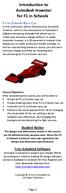 Introduction to Autodesk Inventor for F1 in Schools F1 in Schools Race Car In this course you will be introduced to Autodesk Inventor, which is the centerpiece of Autodesk s digital prototyping strategy
Module 5 (Lectures 17 to 19) MAT FOUNDATIONS
 Module 5 (Lectures 17 to 19) MAT FOUNDATIONS Topics 17.1 INTRODUCTION Rectangular Combined Footing: Trapezoidal Combined Footings: Cantilever Footing: Mat foundation: 17.2 COMMON TYPES OF MAT FOUNDATIONS
House Design Tutorial
 Chapter 2: House Design Tutorial This House Design Tutorial shows you how to get started on a design project. The tutorials that follow continue with the same plan. When you are finished, you will have
16. Beam-and-Slab Design
 ENDP311 Structural Concrete Design 16. Beam-and-Slab Design Beam-and-Slab System How does the slab work? L- beams and T- beams Holding beam and slab together University of Western Australia School of Civil
Scientific Graphing in Excel 2010
 Scientific Graphing in Excel 2010 When you start Excel, you will see the screen below. Various parts of the display are labelled in red, with arrows, to define the terms used in the remainder of this overview.
SpaceClaim Introduction Training Session. A SpaceClaim Support Document
 SpaceClaim Introduction Training Session A SpaceClaim Support Document In this class we will walk through the basic tools used to create and modify models in SpaceClaim. Introduction We will focus on:
Reinforced Concrete Design
 FALL 2013 C C Reinforced Concrete Design CIVL 4135 ii 1 Chapter 1. Introduction 1.1. Reading Assignment Chapter 1 Sections 1.1 through 1.8 of text. 1.2. Introduction In the design and analysis of reinforced
Tutorial Plate Concrete
 Tutorial Plate Concrete Release: SCIA Engineer 2008.0 Req. Module: ESA.00 Base Modeller ESA.01 ESAS.00 ESA.08.x 2D Surfaces Linear Statics 2D a language module Manual: SCIA Engineer Tutorial Plate Concrete
Detailing of Reinforcment in Concrete Structures
 Chapter 8 Detailing of Reinforcment in Concrete Structures 8.1 Scope Provisions of Sec. 8.1 and 8.2 of Chapter 8 shall apply for detailing of reinforcement in reinforced concrete members, in general. For
Chapter 23: Drafting in Worksheet View
 Chapter 23: Drafting in Worksheet View Worksheet View is a powerful, 2D production drafting module. Here you can find all of the drawing and editing tools needed to create fast, accurate, detailed working
TABLE OF CONTENTS. Roof Decks 172 B, BA, BV Deck N, NA Deck. Form Decks 174.6 FD,.6 FDV Deck 1.0 FD, 1.0 FDV Deck 1.5 FD Deck 2.0 FD Deck 3.
 Pages identified with the NMBS Logo as shown above, have been produced by NMBS to assist specifiers and consumers in the application of New Millennium Building Systems Deck products. Pages identified with
SECTION 3 DESIGN OF POST- TENSIONED COMPONENTS FOR FLEXURE
 SECTION 3 DESIGN OF POST- TENSIONED COMPONENTS FOR FLEXURE DEVELOPED BY THE PTI EDC-130 EDUCATION COMMITTEE LEAD AUTHOR: TREY HAMILTON, UNIVERSITY OF FLORIDA NOTE: MOMENT DIAGRAM CONVENTION In PT design,
Microsoft Excel 2010 Charts and Graphs
 Microsoft Excel 2010 Charts and Graphs Email: [email protected] Web Page: http://training.health.ufl.edu Microsoft Excel 2010: Charts and Graphs 2.0 hours Topics include data groupings; creating
SDC. Schroff Development Corporation WWW.SDCACAD.COM PUBLICATIONS. MultiMedia CD by Jack Zecher
 MultiMedia CD by Jack Zecher An audioi/visual presentation of the tutorial exercises SDC PUBLICATIONS Schroff Development Corporation WWW.SDCACAD.COM AutoCAD 2002 Tutorial 2-1 Lesson 2 Geometric Construction
Introduction to Autodesk Inventor for F1 in Schools
 F1 in Schools race car Introduction to Autodesk Inventor for F1 in Schools In this course you will be introduced to Autodesk Inventor, which is the centerpiece of Autodesk s Digital Prototyping strategy
GeoGebra. 10 lessons. Gerrit Stols
 GeoGebra in 10 lessons Gerrit Stols Acknowledgements GeoGebra is dynamic mathematics open source (free) software for learning and teaching mathematics in schools. It was developed by Markus Hohenwarter
POST AND FRAME STRUCTURES (Pole Barns)
 POST AND FRAME STRUCTURES (Pole Barns) Post and frame structures. The following requirements serve as minimum standards for post and frame structures within all of the following structural limitations:
Roof Tutorial. Chapter 3:
 Chapter 3: Roof Tutorial The majority of Roof Tutorial describes some common roof styles that can be created using settings in the Wall Specification dialog and can be completed independent of the other
Structural Axial, Shear and Bending Moments
 Structural Axial, Shear and Bending Moments Positive Internal Forces Acting Recall from mechanics of materials that the internal forces P (generic axial), V (shear) and M (moment) represent resultants
Objectives. Experimentally determine the yield strength, tensile strength, and modules of elasticity and ductility of given materials.
 Lab 3 Tension Test Objectives Concepts Background Experimental Procedure Report Requirements Discussion Objectives Experimentally determine the yield strength, tensile strength, and modules of elasticity
Tutorial: 2D Pipe Junction Using Hexa Meshing
 Tutorial: 2D Pipe Junction Using Hexa Meshing Introduction In this tutorial, you will generate a mesh for a two-dimensional pipe junction, composed of two inlets and one outlet. After generating an initial
Introductory Examples. InfoCAD Program System
 Introductory Examples InfoCAD Program System The description of program functions within this documentation should not be considered a warranty of product features. All warranty and liability claims arising
Visual Tutorial Basic Edition 1. Visual. Basic Edition Tutorial. www.visuallightingsoftware.com
 Visual Tutorial Basic Edition 1 Visual Basic Edition Tutorial www.visuallightingsoftware.com Visual Tutorial Basic Edition 2 Basic Edition Tutorial Introduction In this tutorial, you will use the Visual
How to make a line graph using Excel 2007
 How to make a line graph using Excel 2007 Format your data sheet Make sure you have a title and each column of data has a title. If you are entering data by hand, use time or the independent variable in
Reinforced Concrete Design Project Five Story Office Building
 Reinforced Concrete Design Project Five Story Office Building Andrew Bartolini December 7, 2012 Designer 1 Partner: Shannon Warchol CE 40270: Reinforced Concrete Design Bartolini 2 Table of Contents Abstract...3
Collaborating Across Disciplines with Revit Architecture, MEP, and Structure
 Collaborating Across Disciplines with Revit Architecture, MEP, and Structure David Cohn AB104-3 Are you ready to take the next step and use building information modeling to share data across the entire
Prepared For San Francisco Community College District 33 Gough Street San Francisco, California 94103. Prepared By
 Project Structural Conditions Survey and Seismic Vulnerability Assessment For SFCC Civic Center Campus 750 Eddy Street San Francisco, California 94109 Prepared For San Francisco Community College District
Design Of Reinforced Concrete Structures ii Two-Way Slabs
 1. Inroduction When the ratio (L/S) is less than 2.0, slab is called two-way slab, as shown in the fig. below. Bending will take place in the two directions in a dish-like form. Accordingly, main reinforcement
Chapter 1. Creating Sketches in. the Sketch Mode-I. Evaluation chapter. Logon to www.cadcim.com for more details. Learning Objectives
 Chapter 1 Creating Sketches in Learning Objectives the Sketch Mode-I After completing this chapter you will be able to: Use various tools to create a geometry. Dimension a sketch. Apply constraints to
BLIND TEST ON DAMAGE DETECTION OF A STEEL FRAME STRUCTURE
 BLIND TEST ON DAMAGE DETECTION OF A STEEL FRAME STRUCTURE C.J. Black< 1 >,C.E. Ventura(2) Graduate Student, < 2 > Associate Professor University of British Columbia Department of Civil Engineering
ACS Version 10.6 - Check Layout Design
 ACS Version 10.6 - Check Layout Design Table Of Contents 1. Check Designer... 1 About the Check Design Feature... 1 Selecting a Check Template... 2 Adding a Check Template... 2 Modify a Check Template...
Copyright 2011 Casa Software Ltd. www.casaxps.com. Centre of Mass
 Centre of Mass A central theme in mathematical modelling is that of reducing complex problems to simpler, and hopefully, equivalent problems for which mathematical analysis is possible. The concept of
Parametric Technology Corporation. Pro/ENGINEER Wildfire 4.0 Tolerance Analysis Extension Powered by CETOL Technology Reference Guide
 Parametric Technology Corporation Pro/ENGINEER Wildfire 4.0 Tolerance Analysis Extension Powered by CETOL Technology Reference Guide Copyright 2007 Parametric Technology Corporation. All Rights Reserved.
Excel -- Creating Charts
 Excel -- Creating Charts The saying goes, A picture is worth a thousand words, and so true. Professional looking charts give visual enhancement to your statistics, fiscal reports or presentation. Excel
Introduction to CATIA V5
 Introduction to CATIA V5 Release 16 (A Hands-On Tutorial Approach) Kirstie Plantenberg University of Detroit Mercy SDC PUBLICATIONS Schroff Development Corporation www.schroff.com www.schroff-europe.com
Analysis and Repair of an Earthquake-Damaged High-rise Building in Santiago, Chile
 Analysis and Repair of an Earthquake-Damaged High-rise Building in Santiago, Chile J. Sherstobitoff Ausenco Sandwell, Vancouver, Canada P. Cajiao AMEC, Vancouver, Canada P. Adebar University of British
Communicate: In Print
 Communicate: In Print A simple guide Work areas Communicate: In Print has two different modes in which to edit your documents: Create and Adjust modes. These are easily interchangeable and the toolbars