
Qualification Handbook. Level 4 Certificate in Education and Training
|
|
|
- Cecily Lewis
- 9 years ago
- Views:
Transcription
1 Qualification Handbook Level 4 Certificate in Education and Training
2 Qualification Handbook SFJ Awards Level 4 Certificate in Education and Training Qualification Number: 601/2040/X Version 4 2

3 Contents 1 Introduction 1.1 About us 1.2 Customer Service Charter 1.3 Centre Support 2 The Qualifications 2.1 Overall Objective for the Qualification 2.2 Minimum Core of Literacy, Language, Numeracy and ICT 2.3 Pre-entry Requirements 2.4 Units and Rules of Combination 2.5 Guided Learning Hours (GLH) 2.6 Age Restriction 2.7 Opportunities for Progression 2.8 Exemption 2.9 Credit Transfer 2.10 Links to Other Qualifications in the Education and Training Suite 3 Centre Requirements 4 Assessment 4.1 Requirements for those delivering units and/or observing and assessing practice 4.2 Assessment and quality assurance of Learning and Development units Assessors Internal Quality Assurance 4.3 Workplace Assessment 4.4 Expert Witnesses 4.5 Use of Languages 4.6 Simulations 4.7 External Quality Assurance 4.8 Practice Requirements Overall practice requirements Observed and assessed practice requirements Assessment criteria in the mandatory units that can be met during assessed observations of practice Transfer of practice 5 Qualification Units Appendix 1 Credit transfer of units in the Level 4 Certificate in Education and Training Appendix 2 Summary of practice, including observed and assessed practice, requirements for the mandatory units Appendix 3 Ofsted grade characteristics: Quality of teaching, learning and assessment Version 4 3

4 1 Introduction 1.1 About us SFJ Awards is part of the Skills for Justice Group. For the last 10 years Skills for Justice has been working with employers, Governments of the UK and agencies within the skills system, to better equip workforces with the right skills now and for the future. During this time Skills for Justice has earned an enviable reputation for its knowledge of the sector and its proactive approach to the development of skills and qualifications, along with an ability to deliver genuinely workable solutions for the employers it represents. SFJ Awards is an awarding organisation that builds upon this reputation, and understands the specific challenges facing the Policing, Community Safety, Legal and Armed Forces sectors, enabling us to quality assure learning outcomes that are suited to the needs of the sectors. Customer satisfaction is the cornerstone of our organisation, and is delivered through an efficient, customer-led service, providing excellent value for money. 1.2 Customer Service Charter Our Customer Service Charter is published on SFJ Awards website giving the minimum level of service that Centres can expect. The Charter will be reviewed annually and revised as necessary in response to customer feedback, changes in legislation, and guidance from the qualifications Regulators. 1.3 Centre Support SFJ Awards works in partnership with its customers. For help or advice contact: SFJ Awards 1st Floor, Unit C Meadowcourt Business Park 4 Hayland Street Sheffield S9 1BY Tel: Fax: [email protected] Website: Version 4 4

5 2 The Qualification 2.1 Overall Objective for the Qualification This handbook relates to the following qualification: SFJ Awards Level 4 Certificate in Education and Training The main objective of this qualification is to develop learners skills in practical teaching skills and prepare them for work in a wide range of educational contexts. It requires observation and assessment of practice. The qualification can meet the needs of a range of trainee teachers, including: individuals who are not currently teaching and training but who can meet the practice requirements, including the observed and assessed practice requirements, of the qualification; individuals who are currently teaching and training (including those who have just begun teaching and training) who can meet the practice requirements, including the observed and assessed practice requirements, of the qualification; individuals currently working as assessors who wish to achieve a teaching qualification. The development of the units and structure which make up this qualification was led by the Learning and Skills Improvement Service (LSIS) 1. LSIS also produced guidance for employers and practitioners on the qualifications and regulations for teachers in the further education and skills sector in England. 2 All supporting guidance produced by LSIS referenced in this handbook is available on the Excellence Gateway website Minimum Core of Literacy, Language, Numeracy and ICT The minimum core of literacy, language, numeracy and ICT details the knowledge, understanding and personal skills in English, mathematics and ICT expected of all teachers in the sector. The minimum core requirements are detailed in the document, Addressing Literacy, Language, Numeracy and ICT needs in education and training: Defining the minimum core of programmes (LLUK, 2007; updated LSIS, 2013). 1 LSIS has closed and the Education and Training Foundation is now responsible for standards in the education and skills sector 2 Teaching and Training Qualifications for the Further Education and Skills Sector in England - Guidance for employers and practitioners, LSIS (July 2013) Version 4 5

6 The minimum core document comprises three sections: Language and literacy Numeracy Information and communication technology (ICT) Each of these sections comprises two parts: Part A knowledge and understanding Part B personal skills Knowledge, understanding and personal skills requirements for literacy, language, numeracy and ICT are included in the teaching qualifications and details are included in the above document Requirements for knowledge and understanding elements Elements of the minimum core should be selected appropriate to the context and needs of each cohort of trainee teachers. The selected elements should be delivered and assessed across the following mandatory units: Planning to meet the needs of learners in education and training (Level 4) Delivering education and training (Level 4) Assessing learners in education and training (Level 4) Using resources for education and training (Level 4) Requirements for personal skills in English, mathematics and ICT elements All trainee teachers joining this qualification programme should undertake an initial assessment of skills in English, mathematics and ICT, as detailed in Section 2.3 Pre-entry Requirements below. If trainees join the qualification programme having already completed a Level 3 Award in Education and Training, their record of development needs and any previous actions taken to address them should inform opportunities to continue to develop their skills as required by the appropriate minimum core elements. Opportunities to develop these personal skills should be made available across the mandatory units as a minimum. Teacher education teams should ensure that the personal skills developed by trainees are those most appropriate for their professional role as teachers. 2.3 Pre-entry Requirements In order to successfully achieve the qualification learners will be required to complete a minimum teaching practice of 30 hours and should therefore confirm that they will be able to meet this requirement. In addition, all learners/trainee teachers should: Version 4 6

7 Undertake an initial assessment of their skills in English, mathematics and ICT. They should record their development needs and where applicable agree an action plan to address them. If learners/trainee teachers have already completed an initial assessment of their skills in English, mathematics and ICT prior to starting the qualification, their existing record of development needs and any previous actions taken to address them should be reviewed and updated as required. Be able to study at Level 4 A previous version of unit Understanding roles, responsibilities and relationships in education and training was included in the former Level 3 and Level 4 Awards in Preparing to Teach in the Lifelong Learning Sector (PTLLS). Therefore evidence of learners achieving one of these legacy qualifications will be sufficient evidence for unit Understanding roles, responsibilities and relationships in education and training in the Level 4 Certificate in Education and Training. 2.4 Units and Rules of Combination Learners must achieve a minimum of 36 credits. 21 credits must be completed from Group A (Mandatory units) and 15 credits from Group B (Optional units). A minimum of 21 credits must be achieved at Level 4 or above. A maximum of 15 credits can be taken at Level 3. Group A Mandatory Units Unit Reference Number Unit Title Level Credit Value H/505/0053 Understanding roles, responsibilities and relationships in education and training 3 3 M/505/0122 Delivering education and training 4 6 L/505/0127 Using resources for education and training 4 3 F/505/0125 Assessing learners in education and training 4 6 A/505/1189 Planning to meet the needs of learners in education and training 4 3 Group B1 Optional Units Level 3 Unit Reference Number Unit Title Level Credit Value H/601/5314 F/601/5319 Assess occupational competence in the work environment (Learning and Development unit) Assess vocational skills, knowledge and understanding (Learning and Development unit) Version 4 7

8 F/502/9551 Y/502/9555 K/502/9544 J/503/4850 Engage learners in the learning and development process (Learning and Development unit) Engage with employers to develop and support learning provision (Learning and Development unit) Identify individual learning and development needs (Learning and Development unit) Analysing English language for literacy and language teaching R/503/4852 Reading skills for literacy and language teaching 3 3 D/503/4854 Speaking and listening skills for literacy and language teaching 3 3 K/503/4856 Writing skills for literacy and language teaching 3 3 A/503/4859 Using mathematics: personal and public life 3 6 F/503/4863 Using mathematics: professional and vocational contexts 3 6 T/503/4861 Using mathematics: academic subjects 3 6 F/505/0187 Assessment and support for the recognition of prior learning through the accreditation of learning outcomes 3 6 Group B2 Optional Units Level 4 Unit Reference Number Unit Title Level Credit Value A/502/9547 M/502/9545 D/502/9556 H/502/9543 A/601/5321 Develop and prepare resources for learning and development (Learning and Development unit) Develop learning and development programmes (Learning and Development unit) Engage with employers to facilitate workforce development (Learning and Development unit) Identify the learning needs of organisations (Learning and Development unit) Internally assure the quality of assessment (Learning and Development unit) Version 4 8

9 A/502/9550 F/601/5322 T/601/5320 Manage learning and development in groups (Learning and Development unit) Understanding the principles and practices of externally assuring the quality of assessment (Learning and Development unit) Understanding the principles and practices of internally assuring the quality of assessment (Learning and Development unit) M/505/1089 Delivering employability skills 4 6 Y/503/5310 Effective partnership working in the learning and teaching context 4 15 Y/503/5789 Equality and diversity 4 6 K/505/1091 Evaluating learning programmes 4 3 L/503/5384 Inclusive practice 4 15 J/505/0188 Preparing for the coaching role 4 3 L/505/0189 Preparing for the mentoring role 4 3 T/505/1093 Preparing for the personal tutoring role 4 3 L/504/0231 Principles and practice of lipreading teaching 4 12 R/504/0229 Specialist delivery techniques and activities 4 9 J/505/1096 Teaching in a specialist area 4 15 Y/505/1099 Understanding and managing behaviours in a learning environment 4 6 D/505/1105 Working with the age range in education and training 4 9 Version 4 9

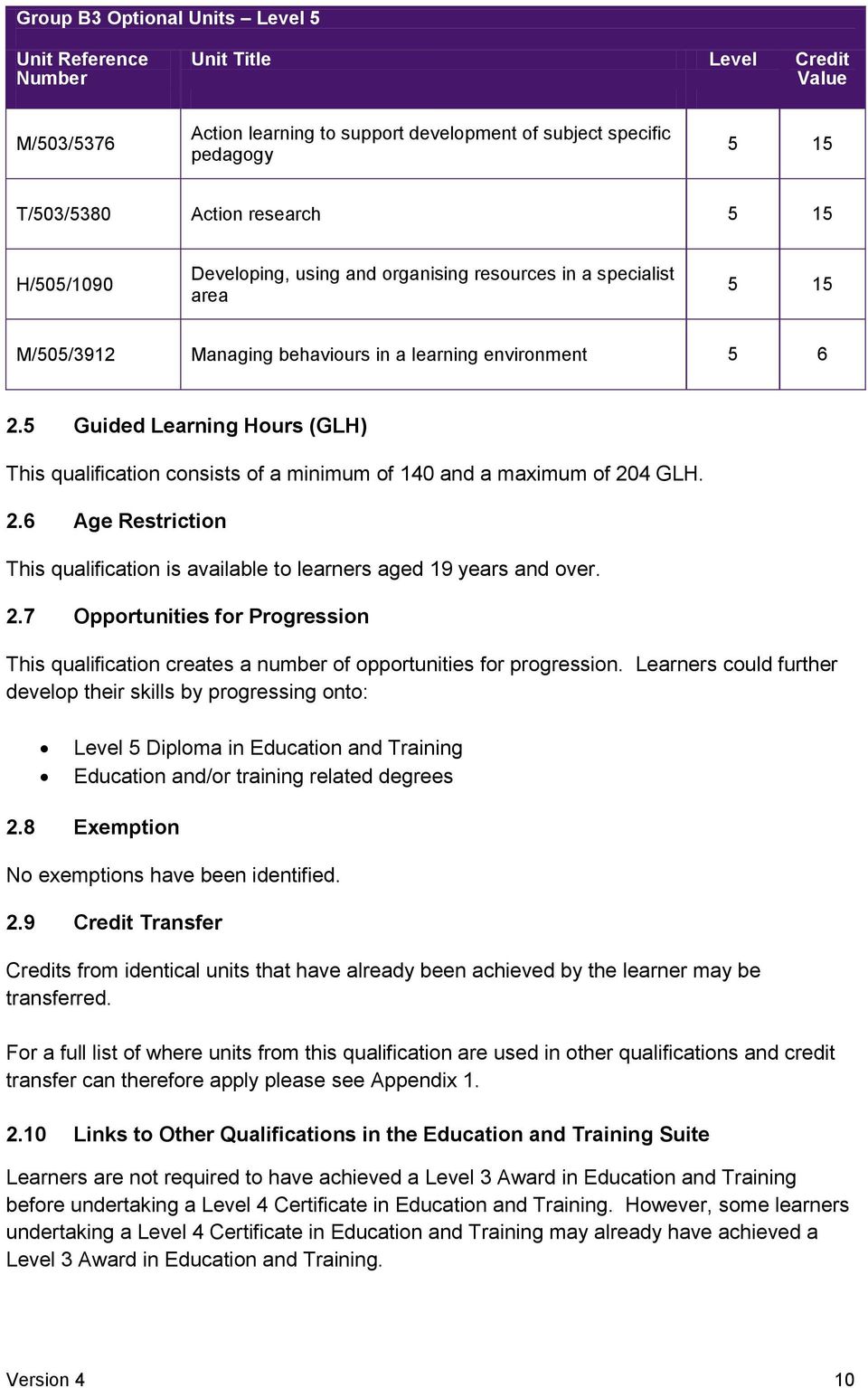
10 Group B3 Optional Units Level 5 Unit Reference Number Unit Title Level Credit Value M/503/5376 Action learning to support development of subject specific pedagogy 5 15 T/503/5380 Action research 5 15 H/505/1090 Developing, using and organising resources in a specialist area 5 15 M/505/3912 Managing behaviours in a learning environment Guided Learning Hours (GLH) This qualification consists of a minimum of 140 and a maximum of 204 GLH. 2.6 Age Restriction This qualification is available to learners aged 19 years and over. 2.7 Opportunities for Progression This qualification creates a number of opportunities for progression. Learners could further develop their skills by progressing onto: Level 5 Diploma in Education and Training Education and/or training related degrees 2.8 Exemption No exemptions have been identified. 2.9 Credit Transfer Credits from identical units that have already been achieved by the learner may be transferred. For a full list of where units from this qualification are used in other qualifications and credit transfer can therefore apply please see Appendix Links to Other Qualifications in the Education and Training Suite Learners are not required to have achieved a Level 3 Award in Education and Training before undertaking a Level 4 Certificate in Education and Training. However, some learners undertaking a Level 4 Certificate in Education and Training may already have achieved a Level 3 Award in Education and Training. Version 4 10
11 The Level 3 unit Understanding roles, responsibilities and relationships in education and training in this qualification is also a mandatory unit in the Level 3 Award in Education and Training. SFJ Awards, following LSIS guidance, recommends that this unit be delivered before other units in both the Award and Certificate qualifications in order to support progression. For those achieving this unit as part of the Award, credit transfer will apply when undertaking the Certificate qualification. Learners who have achieved the Level 4 Certificate in Education and Training and who are progressing to an AO-accredited Level 5 Diploma in Education and Training should have their prior achievement recognised. Recognition of prior learning (RPL) will apply between the mandatory credit from the Certificate and the unit Teaching, learning and assessment in education and training for the Level 5 Diploma in Education and Training. Learners should not be required to present further evidence other than that required to demonstrate that their prior learning is at Level 4. Version 4 11

12 3 Centre Requirements Centres offering this qualification must have approval from SFJ Awards. The assessment centre must: ensure that there are sufficient people trained or qualified to assess the number of learners they anticipate to register and qualify provide quality assured training for those people identified as being responsible for assessing learners have quality assurance systems and Internal Quality Assurers in place to ensure that all assessments are valid, reliable, authentic and sufficient provide quality assured assessment that meets the requirements of SFJ Awards for those people identified as being responsible for internal quality assurance ensure that there is a system of standardisation in place to ensure that all assessments are consistent and fair ensure that those undertaking the roles of quality assurance and assessment maintain their skills, knowledge and competence comply with the requirements of SFJ Awards and the qualifications Regulators. Centres offering this qualification must provide internal quality assurance to ensure assessment meets all SFJ Awards requirements and is standardised across individual assessors, assessment locations and learners. Version 4 12

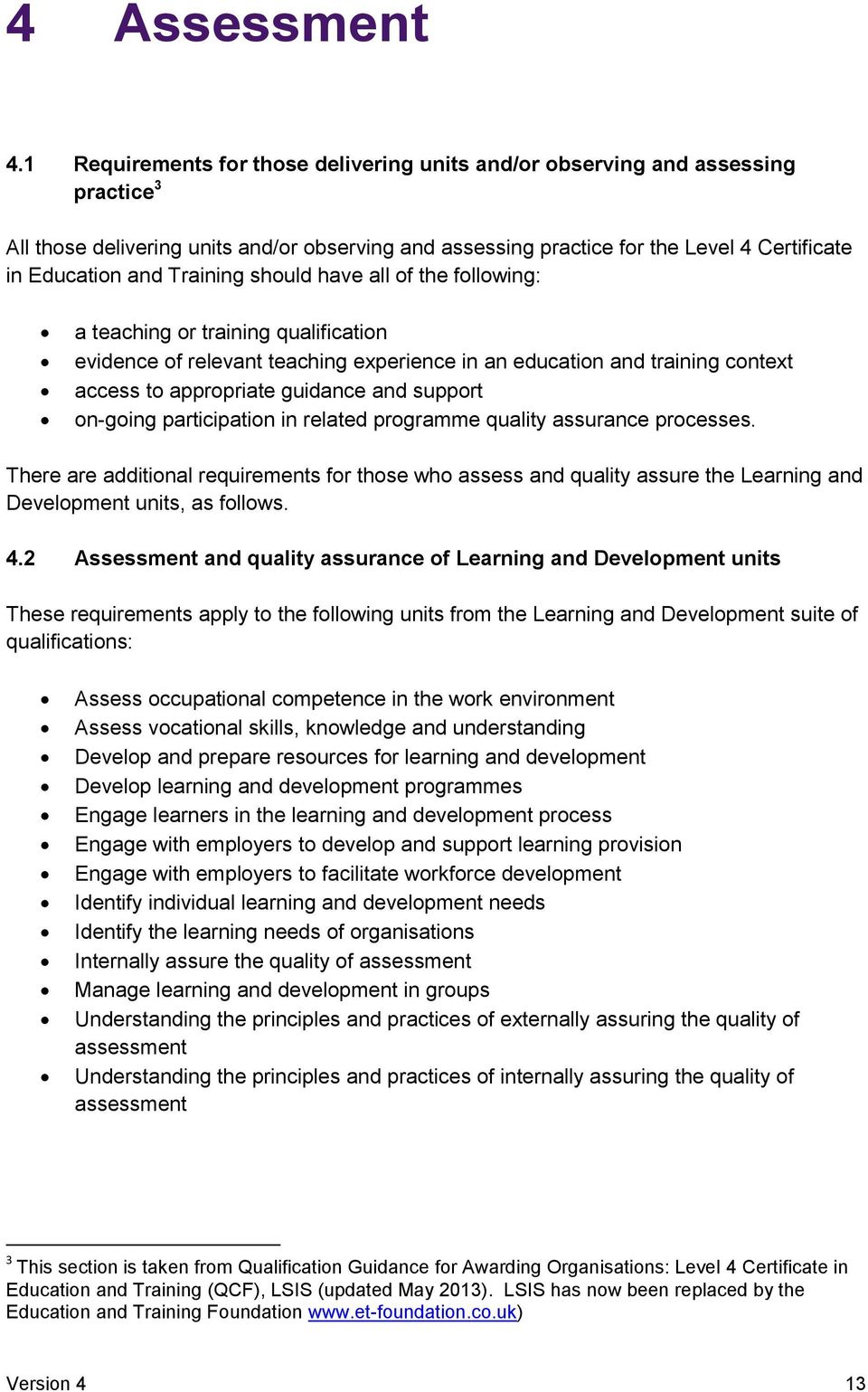
13 4 Assessment 4.1 Requirements for those delivering units and/or observing and assessing practice 3 All those delivering units and/or observing and assessing practice for the Level 4 Certificate in Education and Training should have all of the following: a teaching or training qualification evidence of relevant teaching experience in an education and training context access to appropriate guidance and support on-going participation in related programme quality assurance processes. There are additional requirements for those who assess and quality assure the Learning and Development units, as follows. 4.2 Assessment and quality assurance of Learning and Development units These requirements apply to the following units from the Learning and Development suite of qualifications: Assess occupational competence in the work environment Assess vocational skills, knowledge and understanding Develop and prepare resources for learning and development Develop learning and development programmes Engage learners in the learning and development process Engage with employers to develop and support learning provision Engage with employers to facilitate workforce development Identify individual learning and development needs Identify the learning needs of organisations Internally assure the quality of assessment Manage learning and development in groups Understanding the principles and practices of externally assuring the quality of assessment Understanding the principles and practices of internally assuring the quality of assessment 3 This section is taken from Qualification Guidance for Awarding Organisations: Level 4 Certificate in Education and Training (QCF), LSIS (updated May 2013). LSIS has now been replaced by the Education and Training Foundation Version 4 13
14 4.2.1 Assessors All those who assess the Learning and Development units must: already hold the qualification (or previous equivalent qualifications) they are assessing and have successfully assessed learners for other qualifications; if assessing quality assurance roles, they must have experience as a qualified quality assurance practitioner of carrying out internal or external quality assurance of qualifications for a minimum of two assessors have up-to-date working knowledge and experience of best practice in assessment and quality assurance hold one of the following qualifications or their recognised equivalent: o the Level 3 Award in Assessing Competence in the Work Environment or o the Level 3 Certificate in Assessing Vocational Achievement, or o A1 Assess candidate performance using a range of methods, or o D32 Assess candidate performance and D33 Assess candidate using differing sources of evidence. show current evidence of continuing professional development in assessment and quality assurance Internal Quality Assurance 4 All those who internally quality assure this qualification must: have up-to-date working knowledge and experience of best practice in assessment and quality assurance hold one of the following assessor qualifications or their recognised equivalent: o the Level 3 Award in Assessing Competence in the Work Environment, or o the Level 3 Certificate in Assessing Vocational Achievement, or o A1 Assess candidate performance using a range of methods, or o D32 Assess candidate performance and D33 Assess candidate using differing sources of evidence. hold one of the following internal quality assurance qualifications or their recognised equivalent: o the Level 4 Award in the Internal Quality Assurance of Assessment Processes and practice, or o the Level 4 Certificate in Leading the Internal Quality Assurance of Assessment Processes and Practice, or o V1 Conduct internal quality assurance of the assessment process, or o D34 Internally verify the assessment process. show current evidence of continuing professional development in assessment and quality assurance. 4 Ibid note 3, p13 Version 4 14

15 4.3 Workplace Assessment SFJ Awards believes that direct observation by a competent assessor (as outlined above) or testimony from an Expert Witness or Manager, is always preferable. Expert Witness testimony has parity with assessor observation unless otherwise stated in unit evidence requirements. The assessor is responsible for making the final judgement in terms of the Learner meeting the assessment requirements for the unit. SFJ Awards recognise that there are alternative evidence sources which may be used where direct observation is not possible or practical, e.g. work products, records, reflective accounts, professional discussion etc. In order to ensure that the evidence used to assess Learners is valid, all Centres must demonstrate that Learners have access to the types of resources commonly in use in the sector and that the pressures and constraints of the workplace are reflected. It is accepted that the assessment of some knowledge and understanding may take place in a different environment, for example in a training and development centre or another environment, which is not the immediate workplace. However, the assessment of this knowledge and understanding should be linked directly to workplace performance and should include performance evidence. 4.4 The Expert Witnesses When using Expert Witnesses as a source of evidence, Expert Witnesses must: 1. be occupationally competent. This means that each Expert Witness must, according to current sector practice, be competent in the functions covered by the units to which they are contributing. They will have gained their occupational competence working within the Justice and Community Safety sector or within an appropriate occupational sector 2. be able to demonstrate consistent application of the skills and the current supporting knowledge and understanding in the context of a recent role directly related to the qualification unit that they are witnessing as a practitioner, trainer or manager 3. be familiar with the qualification unit(s); and must be able to interpret current working practices and technologies within the area of work. 4.5 Use of Languages SFJ Awards conducts its business activities in English and the qualification handbook for this qualification is provided in English. The SFJ Awards policy on the use of languages (Welsh and Irish) is available on the website. SFJ Awards will provide assessment materials and qualification handbooks expressed in English. If there is sufficient demand; in Wales materials will be provided in English and Welsh or Welsh. In Northern Ireland assessment materials will be provided in English and Irish. Version 4 15

16 For vocational qualifications SFJ Awards will support the assessment of Learners in Irish or Welsh provided that sufficient notice is given to ensure that an assessment in a language other than English is comparable. SFJ Awards carries out its business activities in English and may employ the services of a translator for quality assurance purposes. Reasonable adjustments may be made by carrying out the assessment in British or Irish Sign Language. The qualification handbook for this qualification is currently available in English. 4.6 Simulations Assessment in a simulated environment should only be used in the following circumstances: 1. where evidence in the workplace will not be demonstrated within an acceptable time frame 2. where the nature of the work activity presents high risk or danger to the Learner and others, for example, personal safety. Where simulation is not permitted, this is specified in the Assessment Guidance section for the individual units. Simulations must be agreed between SFJ Awards and the Centre contact from the Assessment Centre prior to use. All simulations should follow these basic principles: 1. a Centre s overall strategy for simulation must be agreed and approved by SFJ Awards 2. the nature of the contingency and the physical environment for the simulation must be realistic and Learners should be given no indication as to exactly what contingencies they may come across 3. where simulations are used they must reflect the requirements of the qualification units 4. the location and environment of simulation must be agreed between SFJ Awards and the Centre contact prior to it taking place 5. all simulations must be planned, developed and documented by the Centre in a way that ensures the simulation correctly reflects what the specific qualification unit seeks to assess and all simulations should follow these documented plans 6. There should be a range of simulations to cover the same aspect of a unit so that the risk of Learners successfully colluding is reduced. Version 4 16

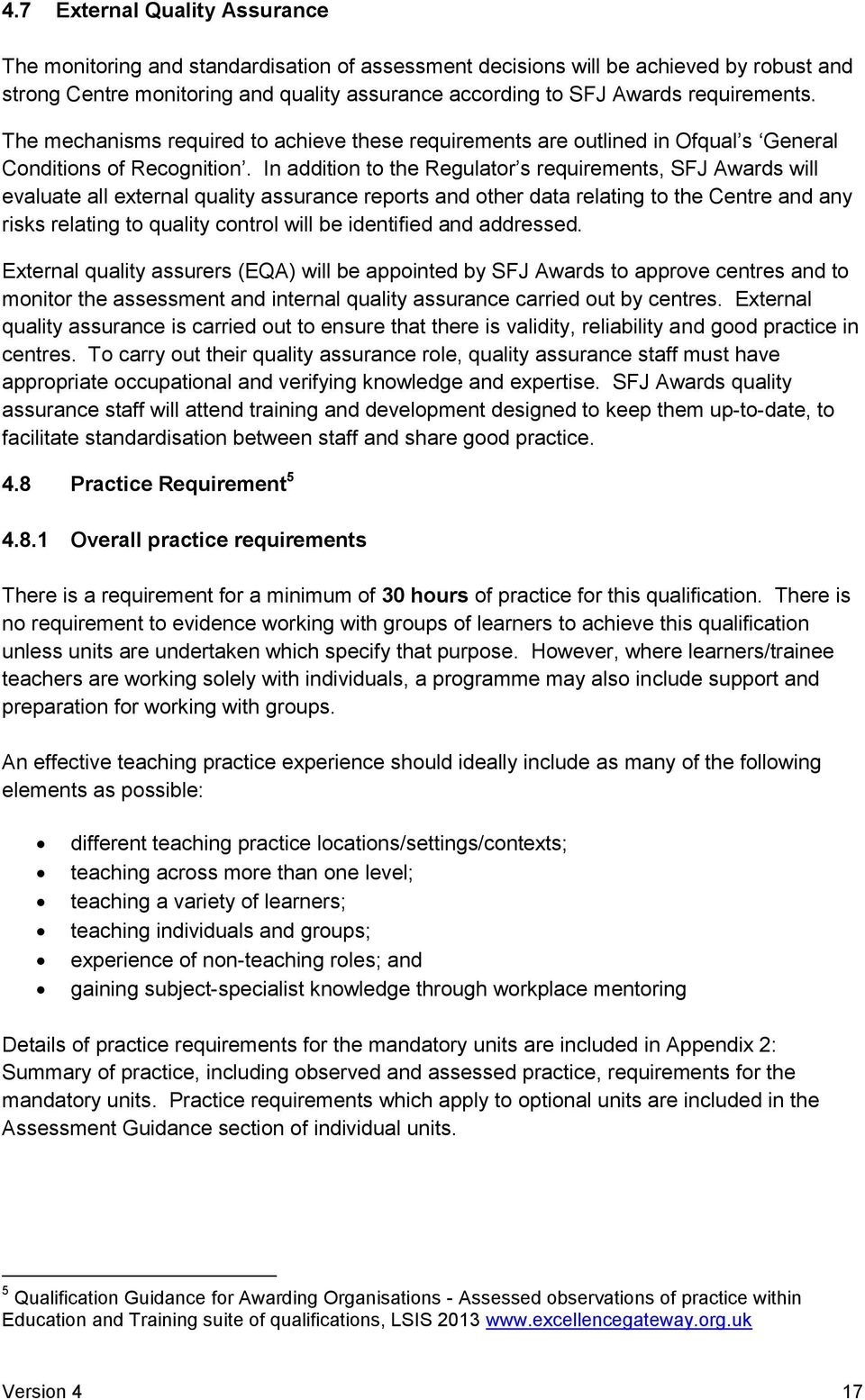
17 4.7 External Quality Assurance The monitoring and standardisation of assessment decisions will be achieved by robust and strong Centre monitoring and quality assurance according to SFJ Awards requirements. The mechanisms required to achieve these requirements are outlined in Ofqual s General Conditions of Recognition. In addition to the Regulator s requirements, SFJ Awards will evaluate all external quality assurance reports and other data relating to the Centre and any risks relating to quality control will be identified and addressed. External quality assurers (EQA) will be appointed by SFJ Awards to approve centres and to monitor the assessment and internal quality assurance carried out by centres. External quality assurance is carried out to ensure that there is validity, reliability and good practice in centres. To carry out their quality assurance role, quality assurance staff must have appropriate occupational and verifying knowledge and expertise. SFJ Awards quality assurance staff will attend training and development designed to keep them up-to-date, to facilitate standardisation between staff and share good practice. 4.8 Practice Requirement Overall practice requirements There is a requirement for a minimum of 30 hours of practice for this qualification. There is no requirement to evidence working with groups of learners to achieve this qualification unless units are undertaken which specify that purpose. However, where learners/trainee teachers are working solely with individuals, a programme may also include support and preparation for working with groups. An effective teaching practice experience should ideally include as many of the following elements as possible: different teaching practice locations/settings/contexts; teaching across more than one level; teaching a variety of learners; teaching individuals and groups; experience of non-teaching roles; and gaining subject-specialist knowledge through workplace mentoring Details of practice requirements for the mandatory units are included in Appendix 2: Summary of practice, including observed and assessed practice, requirements for the mandatory units. Practice requirements which apply to optional units are included in the Assessment Guidance section of individual units. 5 Qualification Guidance for Awarding Organisations - Assessed observations of practice within Education and Training suite of qualifications, LSIS Version 4 17
18 4.8.2 Observed and assessed practice requirements There must be a minimum of three observations totalling a minimum of three hours. This excludes any observed practice completed as part of the Level 3 Award in Education and Training. Any single observation must be a minimum of half an hour. Observations should be appropriately spaced throughout the whole programme and take into account a learner s/trainee teacher s progress. The three observations must be linked to the following Level 4 mandatory units: 1. Delivering educations and training 2. Assessing learners in education and training 3. Using resources for education and training A holistic approach to observed and assessed practice is recommended so that each observation and assessment of practice enables learners/trainee teachers to provide evidence for all of the three units identified above. Note: to be eligible for the award of credit for any one of the above three units, learners/trainee teachers must be able to provide evidence of a minimum of one assessed observation of practice that meets the required standard of practice. To be eligible for the award of credit for all three units, learners/trainee teachers must be able to provide evidence of a minimum of three assessed observations of practice that meet the required standard of practice. There are also practice requirements, including observed and assessed practice, for some optional units. These requirements are in addition to the observed and assessed practice requirements identified above for the mandatory units and are detailed in the Assessment Guidance section of the relevant units. For some optional units, practice must be in a real work environment and in the appropriate context with groups of learners or with individual learners. The number of hours of practice required and the number of hours to be observed and assessed are not specified. These requirements are in addition to the observed and assessed practice requirements identified above for the mandatory units and are detailed in the Assessment Guidance section of the relevant units. SFJ Awards expects that at least 1 hour of observed and assessed practice in observations linked to the mandatory units should meet the requirements for Good (grade 2) criteria and grading characteristics for judging the quality of teaching, learning and assessment identified in Ofsted s Handbook for the inspection of further education and skills 6. The relevant extract from the handbook is available in Appendix 3. 6 Ofsted, updated Version 4 18
19 Learners/trainee teachers will however be observed at different stages in their development during the programme. It is recognised that in the early stages of their development, some learners/trainee teachers may not yet demonstrate the characteristics of good practice (grade 2) identified in Appendix 3. Assessed observations of practice judged Inadequate (grade 4) should not count towards assessed observations of practice required for the qualification, though these observations should be recorded with feedback provided Assessment criteria in the mandatory units that can be met during assessed observations of practice The assessment criteria that can be met during assessed observations of practice are highlighted in bold in the following tables. Assessment criteria or elements of assessment that are not highlighted may not necessarily generate evidence of their achievement during observations of practice and supplementary evidence may be required. Although no assessed observations are required for unit Planning to meet the needs of learners in education and training*, evidence for the assessment criteria highlighted below may be generated during assessed observations. Unit: Assessing learners in education and training AC 1.3 Use types and methods of assessment to meet the individual needs of learners AC 1.4 Use peer and self assessment to promote learners involvement and personal responsibility in the assessment for, and of, their learning AC 1.5 Use questioning and feedback to contribute to the assessment process AC 2.1 Identify the internal and external assessment requirements and related procedures of learning programmes AC 2.2 Use assessment types and methods to enable learners to produce assessment evidence that is valid, reliable, sufficient, authentic and current AC 2.3 Conduct assessments in line with internal and external requirements AC 2.4 Record the outcomes of assessment to meet internal and external requirements AC 2.5 Communicate assessment information to other professionals with an interest in learner achievement AC 3.2 Apply minimum core elements in assessing learners Version 4 19

20 Unit: Delivering education and training AC 1.2 Create an inclusive teaching and learning environment AC 1.3 Demonstrate an inclusive approach to teaching and learning in accordance with internal and external requirements AC 2.2 Use communication methods and media to meet individual learner needs AC 2.3 Communicate with other learning professionals to meet individual learner needs and encourage progression AC 3.2 Use technologies to enhance teaching and meet individual learner needs AC 4.2 Apply minimum core elements in delivering inclusive teaching and learning Unit: Planning to meet the needs of learners in education and training* AC 1.1 Use methods of initial and diagnostic assessment to negotiate and agree individual learning goals AC 1.2 Record learners individual learning goals AC 2.1 Devise a scheme of work in accordance with internal and external requirements AC 2.2 Design teaching and learning plans which meet the aims and individual needs of all learners and curriculum requirements AC3.2 Apply minimum core elements in planning inclusive teaching and learning Unit: Using resources for education and training AC 1.2 Use resources to promote equality, value diversity and meet the individual needs of learners AC 1.3 Adapt resources to meet the individual needs of learners AC 2.2 Apply minimum core elements when using resources for inclusive teaching and learning Transfer of practice There is no transfer of practice, including observed and assessed practice, from a previously achieved Level 3 Award in Education and Training. Learners/trainee teachers who have achieved the Level 4 Certificate in Education and Training can transfer twenty hours of practice and two hours of observed and assessed practice towards the practice requirements for the Level 5 Diploma in Education and Training. Version 4 20

21 5 Qualification Units Mandatory Units Title: Understanding roles, responsibilities and relationships in education and training Level: 3 Credit value: 3 GLH: 12 Learning outcomes The learner will: Assessment criteria The learner can: 1. Understand the teaching role and responsibilities in education and training 1.1 Explain the teaching role and responsibilities in education and training 1.2 Summarise key aspects of legislation, regulatory requirements and codes of practice relating to own role and responsibilities 1.3 Explain ways to promote equality and value diversity 1.4 Explain why it is important to identify and meet individual learner needs 2. Understand ways to maintain a safe and supportive learning environment 2.1 Explain ways to maintain a safe and supportive learning environment 2.2 Explain why it is important to promote appropriate behaviour and respect for others 3. Understand the relationships between teachers and other professionals in education and training 3.1 Explain how the teaching role involves working with other professionals 3.2 Explain the boundaries between the teaching role and other professional roles 3.3 Describe points of referral to meet the individual needs of learners Version 4 21
22 Additional information about the unit Assessment Guidance N/A Version 4 22
23 Title: Delivering education and training Level: 4 Credit value: 6 GLH: 24 Learning outcomes The learner will: Assessment criteria The learner can: 1. Be able to use inclusive teaching and learning approaches in accordance with internal and external requirements 1.1 Analyse the effectiveness of teaching and learning approaches used in own area of specialism in relation to meeting the individual needs of learners 1.2 Create an inclusive teaching and learning environment 1.3 Demonstrate an inclusive approach to teaching and learning in accordance with internal and external requirements 2. Be able to communicate with learners and other learning professionals to promote learning and progression 2.1 Analyse benefits and limitations of communication methods and media used in own area of specialism 2.2 Use communication methods and media to meet individual learner needs 2.3 Communicate with other learning professionals to meet individual learner needs and encourage progression 3. Be able to use technologies in delivering inclusive teaching and learning 3.1 Analyse benefits and limitations of technologies used in own area of specialism 3.2 Use technologies to enhance teaching and meet individual learner needs Version 4 23
24 4. Be able to implement the minimum core when delivering inclusive teaching and learning 4.1 Analyse ways in which minimum core elements can be demonstrated when delivering inclusive teaching and learning 4.2 Apply minimum core elements in delivering inclusive teaching and learning 5. Be able to evaluate own practice in delivering inclusive teaching and learning 5.1 Review the effectiveness of own practice in meeting the needs of individual learners, taking account of the views of learners and others 5.2 Identify areas for improvement in own practice in meeting the individual needs of learners Additional information about the unit Assessment Guidance The learning outcomes must be assessed in a teaching and learning environment. Simulation is not permitted. There is a requirement to observe and assess practice in this unit. To be eligible for the award of credit for this unit, a trainee teacher must be able to provide evidence of a minimum of one assessed observation of practice that has met the required standard of practice. Version 4 24
25 Title: Using resources for education and training Level: 4 Credit value: 3 GLH: 15 Learning outcomes The learner will: Assessment criteria The learner can: 1. Be able to use resources in the delivery of inclusive teaching and learning 1.1 Analyse the effectiveness of resources used in own area of specialism in relation to meeting the individual needs of learners 1.2 Use resources to promote equality, value diversity and meet the individual needs of learners 1.3 Adapt resources to meet the individual needs of learners 2. Be able to implement the minimum core when using resources in the delivery of inclusive teaching and learning 2.1 Analyse ways in which minimum core elements can be demonstrated when using resources for inclusive teaching and learning 2.2 Apply minimum core elements when using resources for inclusive teaching and learning 3. Be able to evaluate own use of resources in the delivery of inclusive teaching and learning 3.1 Review the effectiveness of own practice in using resources to meet the individual needs of learners, taking account of the views of learners and others 3.2 Identify areas for improvement in own use of resources to meet the individual needs of learners Version 4 25
26 Additional information about the unit Assessment Guidance The learning outcomes must be assessed in a teaching and learning environment. Simulation is not permitted. There is a requirement to observe and assess practice in this unit. To be eligible for the award of credit for this unit, a trainee teacher must be able to provide evidence of a minimum of one assessed observation of practice that has met the required standard of practice. Version 4 26
27 Title: Assessing learners in education and training Level: 4 Credit value: 6 GLH: 24 Learning outcomes The learner will: Assessment criteria The learner can: 1. Be able to use types and methods of assessment to meet the needs of individual learners 1.1 Explain the purposes of types of assessment used in education and training 1.2 Analyse the effectiveness of assessment methods in relation to meeting the individual needs of learners 1.3 Use types and methods of assessment to meet the individual needs of learners 1.4 Use peer- and self-assessment to promote learners involvement and personal responsibility in the assessment for, and of, their learning 1.5 Use questioning and feedback to contribute to the assessment process Version 4 27
28 2. Be able to carry out assessments in accordance with internal and external requirements 2.1 Identify the internal and external assessment requirements and related procedures of learning programmes 2.2 Use assessment types and methods to enable learners to produce assessment evidence that is valid, reliable, sufficient, authentic and current 2.3 Conduct assessments in line with internal and external requirements 2.4 Record the outcomes of assessments to meet internal and external requirements 2.5 Communicate assessment information to other professionals with an interest in learner achievement 3. Be able to implement the minimum core when assessing learners 3.1 Analyse ways in which minimum core elements can be demonstrated in assessing learners 3.2 Apply minimum core elements in assessing learners 4. Be able to evaluate own assessment practice 4.1 Review the effectiveness of own assessment practice, taking account of the views of learners and others 4.2 Identify areas for improvement in own assessment practice Additional information about the unit Assessment Guidance The learning outcomes must be assessed in a teaching and learning environment. Simulation is not permitted. There is a requirement to observe and assess practice in this unit. To be eligible for the award of credit for this unit, a trainee teacher must be able to provide evidence of a minimum of one assessed observation of practice that has met the required standard of practice. Version 4 28
29 Title: Planning to meet the needs of learners in education and training Level: 4 Credit value: 3 GLH: 15 Learning outcomes The learner will: Assessment criteria The learner can: 1. Be able to use initial and diagnostic assessment to agree individual learning goals with learners 1.1 Analyse the role and use of initial and diagnostic assessment in agreeing individual learning goals 1.2 Use methods of initial and diagnostic assessment to negotiate and agree individual learning goals with learners 1.3 Record learners individual learning goals 2. Be able to plan inclusive teaching and learning in accordance with internal and external requirements 2.1 Devise a scheme of work in accordance with internal and external requirements 2.2 Design teaching and learning plans which meet the aims and individual needs of all learners and curriculum requirements 2.3 Explain how own planning meets the individual needs of learners 2.4 Explain ways in which teaching and learning plans can be adapted to meet the individual needs of learners 2.5 Identify opportunities for learners to provide feedback to inform inclusive practice 3. Be able to implement the minimum core in planning inclusive teaching and learning 3.1 Analyse ways in which minimum core elements can be demonstrated in planning inclusive teaching and learning 3.2 Apply minimum core elements in planning inclusive teaching and learning Version 4 29
30 4. Be able to evaluate own practice when planning inclusive teaching and learning 4.1 Review the effectiveness of own practice when planning to meet the individual needs of learners, taking account of the views of learners and others 4.2 Identify areas for improvement in own planning to meet the individual needs of learners Additional information about the unit Assessment Guidance N/A Version 4 30
31 Optional Units Level 3 Title: Assess occupational competence in the work environment Level: 3 Credit value: 6 GLH: 30 Learning outcomes The learner will: Assessment criteria The learner can: 1. Be able to plan the assessment of occupational competence 1.1 Plan assessment of occupational competence based on the following methods: observation of performance in the work environment examining products of work questioning the learner discussing with the learner use of others (witness testimony) looking at learner statements recognising prior learning 1.2 Communicate the purpose, requirements and processes of assessing occupational competence to the learner 1.3 Plan the assessment of occupational competence to address learner needs and current achievements 1.4 Identify opportunities for holistic assessment Version 4 31
32 2. Be able to make assessment decisions about occupational competence 2.1 Use valid, fair and reliable assessment methods including: observation of performance examining products of work questioning the learner discussing with the learner use of others (witness testimony) looking at learner statements recognising prior learning 2.2 Make assessment decisions of occupational competence against specified criteria 2.3 Follow standardisation procedures 2.4 Provide feedback to learners that affirms achievement and identifies any further implications for learning, assessment and progression 3. Be able to provide required information following the assessment of occupational competence 4. Be able to maintain legal and good practice requirements when assessing occupational competence 3.1 Maintain records of the assessment of occupational competence, its outcomes and learner progress 3.2 Make assessment information available to authorised colleagues 3.3 Follow procedures to maintain the confidentiality of assessment information 4.1 Follow relevant policies, procedures and legislation for the assessment of occupational competence, including those for health, safety and welfare 4.2 Apply requirements for equality and diversity and, where appropriate, bilingualism, when assessing occupational competence 4.3 Evaluate own work in carrying out assessments of occupational competence 4.4 Maintain the currency of own expertise and competence as relevant to own role in assessing occupational competence Version 4 32
33 Additional information about the unit Assessment Guidance This is a Learning and Development unit. Evidence for all learning outcomes must come from carrying out assessments in a work environment. As a minimum, there must be performance evidence for the following assessment methods: observation of performance in the work environment examining products of work questioning the learner Simulations are not allowed. Other forms of evidence will be acceptable for the remaining assessment methods: discussing with the learner use of others (witness testimony) looking at learner statements recognising prior learning There must be evidence of the trainee assessor carrying out at least two assessments of two learners occupational competence (four assessments in total). This occupational competence must not come from the trainee assessing another trainee assessor who in turn is assessing someone else. In gathering evidence for these qualifications, an unqualified trainee assessor is not allowed to assess the competence of another unqualified assessor. Version 4 33
34 Title: Assess vocational skills, knowledge and understanding Level: 3 Credit value: 6 GLH: 30 Learning outcomes The learner will: Assessment criteria The learner can: 1. Be able to prepare assessments of vocational skills, knowledge and understanding 1.1 Select methods to assess vocational skills, knowledge and understanding which address learner needs and meet assessment requirements, including: assessments of the learner in simulated environments skills tests oral and written questions assignments projects case studies recognising prior learning 1.2 Prepare resources and conditions for the assessment of vocational skills, knowledge and understanding 1.3 Communicate the purpose, requirements and processes of assessment of vocational skills, knowledge and understanding to learners Version 4 34
35 2. Be able to carry out assessments of vocational skills, knowledge and understanding 2.1 Manage assessments of vocational skills, knowledge and understanding to meet assessment requirements 2.2 Provide support to learners within agreed limitations 2.3 Analyse evidence of learner achievement 2.4 Make assessment decisions relating to vocational skills, knowledge and understanding against specified criteria 2.5 Follow standardisation procedures 2.6 Provide feedback to the learner that affirms achievement and identifies any further implications for learning, assessment and progression 3. Be able to provide required information following the assessment of vocational skills, knowledge and understanding 3.1 Maintain records of the assessment of vocational skills, knowledge and understanding, its outcomes and learner progress 3.2 Make assessment information available to authorised colleagues as required 3.3 Follow procedures to maintain the confidentiality of assessment information Version 4 35
36 4. Be able to maintain legal and good practice requirements when assessing vocational skills, knowledge and understanding 4.1 Follow relevant policies, procedures and legislation relating to the assessment of vocational skills, knowledge and understanding, including those for health, safety and welfare 4.2 Apply requirements for equality and diversity and, where appropriate, bilingualism 4.3 Evaluate own work in carrying out assessments of vocational skills, knowledge and understanding 4.4 Take part in continuing professional development to ensure current expertise and competence in assessing vocational skills, knowledge and understanding Additional information about the unit Assessment Guidance This is a Learning and Development unit. Evidence for all learning outcomes must come from performance in the work environment. There must be evidence to cover all of the assessment methods listed in the unit. As a minimum, there must be performance evidence for at least three of the following assessment methods: assessments of the learner in simulated environments skills tests oral and written questions assignments projects case studies recognising prior learning Other forms of evidence will be acceptable for the remaining assessment methods. There must be evidence of the trainee assessor carrying out at least two assessments of two learners skills, knowledge and understanding (four assessments in total). Version 4 36
37 Title: Engage learners in the learning and development process Level: 3 Credit value: 6 GLH: 30 Learning outcomes The learner will: Assessment criteria The learner can: 1. Understand principles and purpose of engaging learners in learning and development 1.1 Explain principles of learner engagement in the learning and development process 1.2 Evaluate the processes and activities used to engage learners in learning and development 1.3 Explain information and advice learners need for learning and development 1.4 Analyse learner motivation for learning and development 1.5 Analyse ways to overcome barriers to learning and development faced by learners 1.6 Explain methods of engaging learners in their own progress review of learning 2. Understand the role of mentoring in facilitating learning 2.1 Explain how mentoring can engage and motivate learners 2.2 Summarise the role and characteristics of a mentor 2.3 Analyse mentoring relationships that engage and motivate learners Version 4 37
38 3. Be able to assist and engage the learner in the learning and development process 3.1 Demonstrate working relationships with learners to motivate learning 3.2 Provide assistance to learners to encourage them to take responsibility for their own learning and development 3.3 Provide learners with the information and advice to engage in learning and development that meets their needs 4. Be able to assist the learner in reviewing their own progress 4.1 Establish opportunities to review progress with learners 4.2 Provide learners with constructive feedback on their learning and development 4.3 Enable learners to give feedback on their learning experience 4.4 Analyse progress and achievement with learners 4.5 Assist learners to in adapting learning and development plans to reflect future learning needs Additional information about the unit Assessment Guidance This is a Learning and Development unit. This unit assesses occupational competence. Evidence for learning outcomes 3 and 4 must come from performance in the work environment. Simulations, projects or assignments are not allowed for these outcomes. Version 4 38
39 Title: Engage with employers to develop and support learning provision Level: 3 Credit value: 6 GLH: 25 Learning outcomes The learner will: Assessment criteria The learner can: 1. Understand information relating to employers developing provision for learners 1.1 Analyse information sources about individual employers and employment sectors, locally and nationally 1.2 Summarise learning provision available to an employer 1.3 Summarise legal requirements that apply to employers developing and supporting provision for learners 2. Understand how to engage with employers for the benefit of learners 2.1 Explain how to prepare for first contact with employers to discuss learning provision 2.2 Evaluate employers level of interest in providing learning opportunities for learners 2.3 Evaluate strategies that help employers overcome concerns about offering learning opportunities 2.4 Explain why employers might need support to provide learning for learners 2.5 Explain the importance of clear channels of communication with employers as delivery partners Version 4 39
40 3. Be able to engage with employers for the benefit of learners 3.1 Provide employers with clear information and advice about learning requirements for learners 3.2 Provide advice and assistance to employers delivering learning opportunities 3.3 Establish channels of communication for feedback from employers on the progress of learners 4. Be able to evaluate the effect of employer provision on the learner and partner organisation 4.1 Assess the impact of employer provision on learners learning outcomes 4.2 Review the impact of employer provision on partner organisations Additional information about the unit Assessment Guidance This is a Learning and Development unit. This unit assesses understanding and occupational competence. Evidence for learning outcomes 3 and 4 must come from performance in the work environment. Simulations, projects or assignments are not allowed for these learning outcomes. Version 4 40
41 Title: Identify individual learning and development needs Level: 3 Credit value: 3 GLH: 24 Learning outcomes The learner will: Assessment criteria The learner can: 1. Understand the principles and practices of learning needs analysis for individuals 1.1 Explain the principles and practices of learning needs analysis for individuals 1.2 Analyse the factors that influence individual learning needs, preferences and styles 1.3 Compare methods used to assess individual learning needs 2. Be able to conduct learning needs analysis for individuals 2.1 Agree the purpose, aims and methodology of the learning needs analysis with individuals 2.2 Apply learning needs analysis methodology to assess the individual s current level of achievement and potential 2.3 Analyse learning needs and communicate to the learner 3. Be able to agree individual learning and development needs 3.1 Agree and prioritise individual learning and development needs 3.2 Advise individuals about learning and development options to meet: learner priorities learning preferences learning styles Version 4 41
42 Additional information about the unit Assessment Guidance This is a Learning and Development unit. This unit assesses occupational competence. Evidence for learning outcomes 2 and 3 must come from performance in a work environment. Simulations, projects or assignments are not allowed for these learning outcomes. Version 4 42
43 Title: Analysing English language for literacy and language teaching Level: 3 Credit value: 3 GLH: 15 Learning outcomes The learner will: Assessment criteria The learner can: 1. Understand the relationship between forms of language and meaning 1.1 Analyse key aspects of meaning of words 1.2 Analyse the relationship between grammatical form and meaning 2. Understand structural features of language 2.1 Analyse key features of word formation 2.2 Categorise words according to their classes 2.3 Categorise verbs according to their forms 2.4 Analyse phonological aspects of language including phonemes and stress patterns Additional information about the unit Assessment Guidance N/A Version 4 43
44 Title: Reading skills for literacy and language teaching Level: 3 Credit value: 3 GLH: 15 Learning outcomes The learner will: Assessment criteria The learner can: 1. Be able to read written texts 1.1 Select written texts for specific purposes 1.2 Use reading skills for specific purposes 1.3 Evaluate linguistic devices in texts 2. Be able to respond to written texts 2.1 Utilise results of own reading for specific purpose 2.2 Produce coherent records of own interpretations of texts Additional information about the unit Assessment Guidance N/A Version 4 44
45 Title: Speaking and listening skills for literacy and language teaching Level: 3 Credit value: 3 GLH: 15 Learning outcomes The learner will: Assessment criteria The learner can: 1. Be able to present information 1.1 Select linguistic strategies and techniques to enable cohesion in own expression of information 1.2 Express information clearly and coherently 2. Be able to listen and respond to non verbal and verbal information 2.1 Identify types of non verbal communication 2.2 Use and respond to non verbal communication to indicate engagement and interest 2.3 Listen critically to verbal information 2.4 Indicate understanding of verbal information 2.5 Identify speakers intentions 2.6 Respond to verbal information according to its nature and content Additional information about the unit Assessment Guidance N/A Version 4 45
46 Title: Writing skills for literacy and language teaching Level: 3 Credit value: 3 GLH: 15 Learning outcomes The learner will: Assessment criteria The learner can: 1. Be able to prepare written texts 1.1 Plan written texts according to the intended audience, purpose and situation 1.2 Draft written texts using techniques at: text level sentence level word level 2. Be able to produce written texts 2.1 Write fluently, coherently and cohesively 2.2 Write accurately and legibly using conventions of lexis and syntax including grammar, spelling and punctuation according to purpose 2.3 Edit and proof read written texts at text level, sentence level and word level Additional information about the unit Assessment Guidance N/A Version 4 46
47 Title: Using mathematics: personal and public life Level: 3 Credit value: 6 GLH: 30 Learning outcomes The learner will: Assessment criteria The learner can: 1. Be able to interpret mathematical situations in personal and public life 1.1 Explain the role of models in representing mathematical situations 1.2 Analyse situations to interrogate for mathematical information and problems in personal and public life 1.3 Select mathematical methods, operations and tools to extract mathematical information from problem based contexts in personal and public life 2. Be able to process mathematical problems in personal and public life 2.1 Analyse mathematical procedures for efficiency and effectiveness 2.2 Examine linear and non-linear mathematical patterns in personal and public life 2.3 Change values and assumptions when investigating mathematical situations in personal and public life 2.4 Use extended logic and multi-step structured processes to find mathematical solutions in personal and public life 3. Be able to analyse mathematical findings from personal and public life 3.1 Analyse the effect of accuracy on the reliability of mathematical findings in personal and public life 3.2 Interrogate mathematical conclusions for errors or misconceptions 3.3 Interpret findings to draw conclusions in personal and public life Version 4 47
48 4. Be able to use mathematical communication in personal and public life 4.1 Select mathematical language for debate in personal and public life 4.2 Select mathematical communication techniques to suit audience 4.3 Present mathematical processing and analysis 4.4 Describe findings using mathematical communication skills in personal and public life Additional information about the unit Assessment Guidance N/A Version 4 48
49 Title: Using mathematics: professional and vocational contexts Level: 3 Credit value: 6 GLH: 30 Learning outcomes The learner will: Assessment criteria The learner can: 1. Be able to interpret mathematical situations in professional and vocational contexts 1.1 Explain the role of models in representing mathematical situations 1.2 Analyse situations to interrogate for mathematical information and problems in professional and vocational contexts 1.3 Select mathematical methods, operations and tools to extract mathematical information from problem based contexts in professional and vocational contexts 2. Be able to process mathematical problems in professional and vocational contexts 2.1 Analyse mathematical procedures for efficiency and effectiveness 2.2 Examine linear and non-linear mathematical patterns in professional and vocational contexts 2.3 Change values and assumptions when investigating mathematical situations in professional and vocational contexts 2.4 Use extended logic and multi-step structured processes to find mathematical solutions in professional and vocational contexts 3. Be able to analyse mathematical findings from professional and vocational contexts 3.1 Analyse the effect of accuracy on the reliability of mathematical findings in professional and vocational contexts 3.2 Interrogate mathematical conclusions for errors or misconceptions 3.3 Interpret findings to draw conclusions in professional and vocational contexts Version 4 49
50 4. Be able to use mathematical communication in professional and vocational contexts 4.1 Select mathematical language for debate in professional and vocational contexts 4.2 Select mathematical communication techniques to suit audience 4.3 Present mathematical processing and analysis 4.4 Describe findings using mathematical communication skills in professional and vocational contexts Additional information about the unit Assessment Guidance N/A Version 4 50
51 Title: Using mathematics: academic subjects Level: 3 Credit value: 6 GLH: 30 Learning outcomes The learner will: Assessment criteria The learner can: 1. Be able to interpret mathematical situations in academic subjects 1.1 Explain the role of models in representing mathematical situations 1.2 Analyse situations to interrogate for mathematical information and problems in academic subjects 1.3 Select mathematical methods, operations and tools to extract mathematical information from problem based contexts in academic subjects 2. Be able to process mathematical problems in academic subjects 2.1 Analyse mathematical procedures for efficiency and effectiveness 2.2 Examine linear and non-linear mathematical patterns in academic subjects 2.3 Change values and assumptions when investigating mathematical situations in academic subjects 2.4 Use extended logic and multi-step structured processes to find mathematical solutions in academic subjects 3. Be able to analyse mathematical findings from academic subjects 3.1 Analyse the effect of accuracy on the reliability of mathematical findings in academic subjects 3.2 Interrogate mathematical conclusions for errors or misconceptions 3.3 Interpret findings to draw conclusions in academic subjects Version 4 51
52 4. Be able to use mathematical communication in academic subjects 4.1 Select mathematical language for debate in academic subjects 4.2 Select mathematical communication techniques to suit audience 4.3 Present mathematical processing and analysis 4.4 Describe findings using mathematical communication skills in academic subjects Additional information about the unit Assessment Guidance N/A Version 4 52
53 Title: Assessment and support for the recognition of prior learning through the accreditation of learning outcomes Level: 3 Credit value: 6 GLH: 30 Learning outcomes The learner will: Assessment criteria The learner can: 1. Be able to promote understanding of recognition and accreditation of prior learning with external stakeholders 1.1 Describe models of recognition to learners, assessors and other relevant stakeholders 1.2 Describe how external stakeholders can support the professional skills and competencies of those involved in providing guidance on recognition and accreditation of prior learning 1.3 Explain the relevant processes, procedures and criteria that ensure recognition of prior learning is accepted as equivalent to other forms of assessment by relevant external stakeholders 2. Understand how to provide guidance for learners 2.1 Describe procedures for providing professional guidance for learners, assessors and other relevant stakeholders 2.2 Explain the importance of guidance that ensures learners have ownership of the process of recognition and, where appropriate, accreditation, as an entitlement or right Version 4 53
54 3. Be able to support learners to recognise prior learning and achievement 3.1 Provide guidance for learners in choosing target qualifications that include their prior learning 3.2 Describe evidence required to meet the relevant learning outcomes, assessment criteria and verification requirements for the learners target unit(s) 3.3 Support learners with different needs to collect, organise and present theoretical and performance evidence to meet the requirements of the target unit(s) 4. Be able to assess evidence presented by learners 4.1 Explain how a consistent approach is achieved by the assessment team within the processes of quality assurance 4.2 Judge the reliability, validity, authenticity, currency, relevance and sufficiency of a range of evidence presented by a learner to meet the learning outcomes of the target unit(s) 4.3 Provide clear and constructive feedback to learners who have not satisfied the learning outcomes of the target unit(s), identifying the additional evidence required 4.4 Maintain records for assessment and verification purposes 5. Be able to evaluate and improve practice 5.1 Evaluate own, learner and the assessment team experiences of applying the recognition process 5.2 Identify improvements to practice Additional information about the unit Assessment Guidance The learning outcomes must be assessed in a teaching and learning environment. Simulation is not permitted. There is a requirement to observe and assess practice in this unit. Version 4 54
55 Optional Units Level 4 Title: Develop and prepare resources for learning and development Level: 4 Credit value: 6 GLH: 25 Learning outcomes The learner will: Assessment criteria The learner can: 1. Understand principles underpinning development and preparation of resources for learning and development 1.1 Explain principles underpinning resource selection for learning and development 1.2 Analyse factors that are important when developing and preparing resources that conform to national legislation and organisational policies 1.3 Evaluate the contribution of technology to the development of learning and development resources 2. Be able to develop resources to meet learning and development needs 2.1 Agree needs of learners for whom resources are being developed 2.2 Prepare resources for the delivery of learning and development ensuring legislative and organisational health, safety, welfare, equality and inclusion requirements are met 2.3 Plan adaptations to and use of technology within resources to meet learning and development needs 2.4 Prepare guidance to assist those using learning and development resources 2.5 Evaluate the suitability of resources for learning and development Version 4 55
56 Additional information about the unit Assessment Guidance This is a Learning and Development unit. This unit assesses occupational competence. Evidence for learning outcome 2 must come from performance in the work environment. Simulations, projects or assignments are not allowed. Version 4 56
57 Title: Develop learning and development programmes Level: 4 Credit value: 6 GLH: 30 Learning outcomes The learner will: Assessment criteria The learner can: 1. Understand the principles underpinning the development of learning and development programmes 1.1 Explain the objectives of learning and development programmes 1.2 Evaluate the factors of learning and development that impact on: development delivery assessment and accreditation 1.3 Explain the importance of learner involvement when developing learning and development programmes 1.4 Evaluate the risks that need to be managed when developing learning and development programmes 1.5 Compare methodologies to monitor and evaluate learning and development programmes 2. Be able to develop learning and development programmes 2.1 Identify the learning outcomes required for learning and development programmes 2.2 Develop a plan for a learning and development programme 2.3 Plan the assessment approaches to meet the learning outcomes of learning and development programmes 2.4 Produce resources for learning and development programmes Version 4 57
58 3. Be able to review learning and development programmes 3.1 Evaluate the learning outcomes of a learning and development programme 3.2 Evaluate the delivery and assessment of a learning and development programme 3.3 Identify areas for improvement for learning and development programmes Additional information about the unit Assessment Guidance This is a Learning and Development unit. This unit assesses occupational competence. Evidence for learning outcome 2 must come from performance in the work environment. Simulations, projects or assignments are not allowed for this learning outcome. Version 4 58
59 Title: Engage with employers to facilitate workforce development Level: 4 Credit value: 6 GLH: 30 Learning outcomes The learner will: Assessment criteria The learner can: 1. Understand the opportunities available for workforce development 1.1 Analyse national approaches related to the skilling and productivity of the workforce in line with current legislation and socio-economic requirements 1.2 Explain what constitutes workforce development in a business context 1.3 Explain the funding opportunities available for workforce development 2. Understand how to engage with employers to promote workforce development 2.1 Analyse information about individual employers and employment sectors, locally and nationally 2.2 Explain how to gauge employers level of interest in workforce development opportunities 2.3 Evaluate methods of approaching and engaging with employers to motivate them to engage in workforce development 3. Understand how to design learning and development opportunities in the workplace 3.1 Analyse what motivates employees to undertake learning and development in the workplace 3.2 Explain the key factors to be considered when designing learning and development solutions for employers and employees 3.3 Critically compare learning and development programmes which already exist with newly developed opportunities Version 4 59
60 4. Understand how to facilitate learning and development opportunities in the workplace 4.1 Identify the sources of support and resources that are available from stakeholders 4.2 Explain how employees might overcome obstacles when engaging with learning and development 4.3 Explain how to select, support and monitor staff delivering learning and development solutions 4.4 Evaluate the impact of workforce development opportunities on: employees businesses 5. Be able to engage with employers on workforce development issues 5.1 Research information about the business needs of employers in relation to productivity and performance 5.2 Report to employers employee development needs in a professional manner 6. Be able to work with employers to facilitate workforce development solutions 6.1 Prepare information and advice for the employer on solutions relevant to their business 6.2 Review employer workforce development needs using methods relevant to the nature of the business and its employees 6.3 Propose solutions that recognise the needs of the workforce 6.4 Implement processes to develop and support the workforce within a business partnership with the employer 6.5 Provide ongoing evaluation of workforce development for the purposes of quality improvement 6.6 Work with the employer to measure the impact of workforce development on their business Version 4 60
61 Additional information about the unit Assessment Guidance This is a Learning and Development unit. This unit assesses occupational competence. Evidence for learning outcomes 5-6 must come from performance in the work environment. Simulations, projects or assignments are not allowed for these learning outcomes. Version 4 61
62 Title: Identify the learning needs of organisations Level: 4 Credit value: 6 GLH: 30 Learning outcomes The learner will: Assessment criteria The learner can: 1. Understand the principles and practices of learning needs analysis for organisations 1.1 Explain the principles and practice of learning needs analysis for organisations 1.2 Analyse the factors that can influence the identification of organisational learning needs 1.3 Explain why it is important to gain the support and commitment of relevant people 1.4 Review the methodologies required for a learning needs analysis 2. Be able to conduct learning needs analysis for the organisation 2.1 Confirm the purpose and aims of learning needs analysis with relevant people 2.2 Select the organisational learning needs analysis methodology 2.3 Apply the organisational learning needs analysis methodology 2.4 Analyse the learning needs of the organisation 2.5 Review methods of communicating findings from learning needs analysis to relevant people in organisations 3. Be able to agree organisational learning and development plans with relevant people 3.1 Present recommendations for learning and development to relevant people 3.2 Review and revise priorities with relevant people Version 4 62
63 Additional information about the unit Assessment Guidance This is a Learning and Development unit. This unit assesses occupational competence. Evidence for learning outcomes 2-3 must come from performance in the work environment. Simulations, projects or assignments are not allowed for these learning outcomes. Version 4 63
64 Title: Internally assure the quality of assessment Level: 4 Credit value: 6 GLH: 45 Learning outcomes The learner will: Assessment criteria The learner can: 1. Be able to plan the internal quality assurance of assessment 1.1 Plan monitoring activities according to the requirements of own role 1.2 Make arrangements for internal monitoring activities to assure quality 2. Be able to internally evaluate the quality of assessment 2.1 Carry out internal monitoring activities to quality requirements 2.2 Evaluate assessor expertise and competence in relation to the requirements of their role 2.3 Evaluate the planning and preparation of assessment processes 2.4 Determine whether assessment methods are safe, fair, valid and reliable 2.5 Determine whether assessment decisions are made using the specified criteria 2.6 Compare assessor decisions to ensure they are consistent 3. Be able to internally maintain and improve the quality of assessment 3.1 Provide assessors with feedback, advice and support, including professional development opportunities, which help them to maintain and improve the quality of assessment 3.2 Apply procedures to standardise assessment practices and outcomes Version 4 64
65 4. Be able to manage information relevant to the internal quality assurance of assessment 4.1 Apply procedures for recording, storing and reporting information relating to internal quality assurance 4.2 Follow procedures to maintain confidentiality of internal quality assurance information 5. Be able to maintain legal and good practice requirements when internally monitoring and maintaining the quality of assessment 5.1 Apply relevant policies, procedures and legislation in relation to internal quality assurance, including those for health, safety and welfare 5.2 Apply requirements for equality and diversity and, where appropriate, bilingualism, in relation to internal quality assurance 5.3 Critically reflect on own practice in internally assuring the quality of assessment 5.4 Maintain the currency of own expertise and competence in internally assuring the quality of assessment Additional information about the unit Assessment Guidance This is a Learning and Development unit. Evidence for all learning outcomes must come from performance in the work environment. All learning outcomes in this unit must be assessed using methods appropriate to the candidate IQA s performance. These must include: observation of performance examining products of work questioning Direct evidence of this kind may be supplemented, where necessary, by discussion, reflective accounts or witness testimony. Simulations are not allowed. Version 4 65
66 Title: Manage learning and development in groups Level: 4 Credit value: 6 GLH: 30 Learning outcomes The learner will: Assessment criteria The learner can: 1. Understand the principles and practices of managing learning and development in groups 1.1 Analyse the characteristics of group environments that foster learning and development 1.2 Evaluate strategies to manage group behaviour and dynamics 1.3 Evaluate management techniques which facilitate the delivery of learning and development in groups 1.4 Analyse ways to involve learners in the management of their own learning and development in groups 1.5 Analyse risks to be considered when managing learning and development in groups 1.6 Explain how to manage barriers to individual learning in groups 2. Be able to manage group learning and development environments 2.1 Facilitate communication, collaboration and learning between group members 2.2 Use motivational methods to engage the group and its individual members in the learning and development process 2.3 Consult with group members to adapt their learning and development environments to improve their learning outcomes 2.4 Manage the risks associated with group learning and development Version 4 66
67 3. Be able to apply methodologies to manage learning and development in groups 3.1 Involve learners in agreeing group learning and development objectives 3.2 Adapt and implement delivery methods, activities and resources to meet the learning and development objectives of the group 3.3 Manage group learning strategies and delivery methods to reflect changing requirements 3.4 Provide individual advice to learners to assist their decision-making about future learning needs 4. Be able to manage learning and development in groups to comply with legal and organisational requirements 4.1 Support learner s rights in relation to equality, diversity and inclusion 4.2 Minimise risks to safety, health, wellbeing and security of learners 4.3 Manage confidentiality in relation to learners and the organisation 4.4 Maintain learning and development records in accordance with organisational procedures Additional information about the unit Assessment Guidance This is a Learning and Development unit. This unit assesses occupational competence. Evidence for the learning outcomes 2, 3 and 4 must come from performance in the work environment. Simulations, projects or assignments are not allowed. Version 4 67
68 Title: Understanding the principles and practices of externally assuring the quality of assessment Level: 4 Credit value: 6 GLH: 45 Learning outcomes The learner will: Assessment criteria The learner can: 1. Understand the context and principles of external quality assurance 1.1 Analyse the functions of external quality assurance of assessment in learning and development 1.2 Evaluate the key concepts and principles of external quality assurance of assessment 1.3 Evaluate the roles of practitioners involved in the quality assurance process 1.4 Explain the regulations and requirements for external and internal quality assurance in own area of practice 2. Understand how to plan the external quality assurance of assessment 2.1 Evaluate the importance of planning and preparing external quality assurance activities 2.2 Explain what an external quality assurance plan should contain 2.3 Summarise the preparations that need to be made for external quality assurance activities, including: information collection communications administrative arrangements resources 2.4 Explain how to adapt external monitoring and evaluation approaches to meet customer need without compromising quality standards Version 4 68
69 3. Understand how to externally evaluate the quality of assessment and internal quality assurance 3.1 Explain the procedures for externally monitoring and evaluating internal quality assurance arrangements and practices 3.2 Interpret the requirements for externally monitoring and evaluating internal assessment arrangements and practices 3.3 Evaluate different techniques for externally sampling evidence of assessment, including those that use technology 4. Understand how to externally maintain and improve the quality of assessment 4.1 Critically compare the types of feedback, support and advice that internal assessment and quality assurance staff may need to maintain and improve the quality of assessment 4.2 Evaluate standardisation requirements relevant to the external quality assurance of assessment 4.3 Explain the importance of providing feedback, support and advice to internal assessment and quality assurance staff that is consistent with standardisation requirements 4.4 Explain the relevant procedures to follow when there are disputes concerning quality assurance and assessment 5. Understand how to manage information relevant to external quality assurance 5.1 Evaluate the requirements for information management, data protection and confidentiality in relation to external quality assurance Version 4 69
70 6. Understand the legal and good practice requirements relating to external quality assurance 6.1 Evaluate legal issues, policies and procedures that are relevant to external quality assurance, including those for health, safety and welfare 6.2 Critically compare different ways in which technology can contribute to external quality assurance 6.3 Evaluate requirements for equality and diversity and, where appropriate, bilingualism, in relation to the external quality assurance of assessment 6.4 Explain the value of reflective practice and continuing professional development in relation to external quality assurance Additional information about the unit Assessment Guidance This is a Learning and Development unit. Version 4 70
71 Title: Understanding the principles and practices of internally assuring the quality of assessment Level: 4 Credit value: 6 GLH: 45 Learning outcomes The learner will: Assessment criteria The learner can: 1. Understand the context and principles of internal quality assurance 1.1 Explain the functions of internal quality assurance in learning and development 1.2 Explain the key concepts and principles of the internal quality assurance of assessment 1.3 Explain the roles of practitioners involved in the internal and external quality assurance process 1.4 Explain the regulations and requirements for internal quality assurance in own area of practice 2. Understand how to plan the internal quality assurance of assessment 2.1 Evaluate the importance of planning and preparing internal quality assurance activities 2.2 Explain what an internal quality assurance plan should contain 2.3 Summarise the preparations that need to be made for internal quality assurance, including: information collection communications administrative arrangements resources 3. Understand techniques and criteria for monitoring the quality of assessment internally 3.1 Evaluate different techniques for sampling evidence of assessment, including use of technology 3.2 Explain the appropriate criteria to use for judging the quality of the assessment process Version 4 71
72 4. Understand how to internally maintain and improve the quality of assessment 4.1 Summarise the types of feedback, support and advice that assessors may need to maintain and improve the quality of assessment 4.2 Explain standardisation requirements in relation to assessment 4.3 Explain relevant procedures regarding disputes about the quality of assessment 5. Understand how to manage information relevant to the internal quality assurance of assessment 5.1 Evaluate requirements for information management, data protection and confidentiality in relation to the internal quality assurance of assessment 6. Understand the legal and good practice requirements for the internal quality assurance of assessment 6.1 Evaluate legal issues, policies and procedures relevant to the internal quality assurance of assessment, including those for health, safety and welfare 6.2 Evaluate different ways in which technology can contribute to the internal quality assurance of assessment 6.3 Explain the value of reflective practice and continuing professional development in relation to internal quality assurance 6.4 Evaluate requirements for equality and diversity and, where appropriate, bilingualism, in relation to the internal quality assurance of assessment Additional information about the unit Assessment Guidance This is a Learning and Development unit. Version 4 72
73 Title: Delivering employability skills Level: 4 Credit value: 6 GLH: 20 Learning outcomes The learner will: Assessment criteria The learner can: 1. Understand the differences between employability skills and employment skills 1.1 Explain differences between employability skills and employment skills 1.2 Explain the benefits to learners of having employability skills 2. Understand the influence of personal qualities and skills on the delivery of employability skills 2.1 Analyse personal qualities and skills required for the delivery of employability skills 2.2 Analyse the influence of personal presentation on the success of the delivery of employability skills 3. Be able to use techniques, strategies and practices that reflect the workplace in the delivery of employability skills 3.1 Review techniques for the delivery of employability skills 3.2 Review strategies used to transform training areas to reflect a realistic working environment 3.3 Plan employability skills sessions that: meet the needs of learners; and reflect a realistic working environment 3.4 Use selected techniques and strategies to deliver employability skills sessions 3.5 Demonstrate ways to negotiate behavioural parameters when using workplace practices with learners Version 4 73
74 4. Be able to evaluate own delivery of employability skills 4.1 Evaluate the effectiveness of techniques, strategies and practices used for the delivery of employability skills 4.2 Identify own strengths and areas for improvement for the delivery of employability skills Additional information about the unit Assessment Guidance The learning outcomes must be assessed in a teaching and learning environment. Simulation is not permitted. There is a requirement to observe and assess practice in this unit. Version 4 74
75 Title: Effective partnership working in the learning and teaching context Level: 4 Credit value: 15 GLH: 50 Learning outcomes The learner will: Assessment criteria The learner can: 1. Understand the purpose and nature of partnership working 1.1 Explain reasons for partnership working 1.2 Review opportunities and challenges of working within a partnership 1.3 Review models of partnerships 1.4 Explain ways of sustaining partnerships and their outputs 1.5 Explain the need for ground rules and terms of reference in partnership working 1.6 Justify the need for realistic timescales and deadlines in effective partnership working 2. Understand the purpose, aims and objectives of a partnership 2.1 Explain the purpose of a specific partnership 2.2 Identify the aims and objectives of a specific partnership Version 4 75
76 3. Understand the structure and management of a partnership 3.1 Review individual roles and responsibilities within a specific partnership 3.2 Summarise the potential contribution of stakeholders to a specific partnership 3.3 Identify boundaries of individual roles and ownership issues within a specific partnership 3.4 Review resource implications for a specific partnership and its individual members 3.5 Review how a specific partnership is managed identifying potential management issues 4. Understand how to measure and report on a partnership s outputs 4.1 Summarise performance indicators used to measure the effectiveness of a specific partnership 4.2 Review the effectiveness of a specific partnership s outputs drawing on valid and reliable data 4.3 Summarise methods of presenting partnership outputs to interested parties 5. Understand how to communicate effectively within a partnership 5.1 Summarise methods for effective communication between partners 5.2 Review the communication strategy of a specific partnership 5.3 Review own communication methods and skills as a partnership member 6. Understand the wider context within which a partnership operates 6.1 Explain the potential impact of other stakeholders and agencies relating to a specific partnership 6.2 Summarise the impact of key government policies and initiatives on a specific partnership 6.3 Review ways for a partnership to establish and maintain communities of practice Version 4 76
77 Additional information about the unit Assessment Guidance N/A Version 4 77
78 Title: Equality and diversity Level: 4 Credit value: 6 GLH: 25 Learning outcomes The learner will: Assessment criteria The learner can: 1. Understand the key features of a culture which promotes equality and values diversity 1.1 Define the meanings of equality and diversity in the UK context 1.2 Analyse the benefits of promoting equality and diversity for individual learners 1.3 Define legislation, employment regulations and codes of practice relevant to the promotion of equality and valuing of diversity 2. Understand the importance of promoting equality and valuing diversity in lifelong learning 2.1 Reflect on how the promotion of equality and diversity can protect learners from risk of harm 2.2 Explain actions that can be taken to value individual learners 2.3 Explain good practice in providing individual learners with information 3. Be able to promote equality and value diversity 3.1 Use communication strategies to promote equality and diversity 3.2 Analyse how own behaviour can impact on an organisation s culture in relation to equality and diversity 3.3 Explain how working with other agencies can promote diversity 4. Understand how to help others in the promotion of equality and valuing of diversity 4.1 Describe actions by individuals which can undermine equality and diversity 4.2 Recommend modifications to systems and structures which do not promote equality and diversity Version 4 78
79 5. Be able to review own contribution to promoting equality and valuing diversity in lifelong learning 5.1 Reflect on own strengths in promoting equality and valuing diversity 5.2 Evaluate the impact of own practice in promoting equality and valuing diversity 5.3 Identify areas for further personal development in promoting equality and valuing diversity Additional information about the unit Assessment Guidance N/A Version 4 79
80 Title: Evaluating learning programmes Level: 4 Credit value: 3 GLH: 15 Learning outcomes The learner will: Assessment criteria The learner can: 1. Understand the principles and methods of evaluating learning programmes 1.1 Analyse the principles of evaluating learning 1.2 Explain how principles of evaluating learning can be applied to the evaluation of learning programmes 1.3 Analyse methods used for evaluating the effectiveness of learning programmes 1.4 Analyse methods of data collection and analysis used to evaluate learning programmes 2. Be able to plan the evaluation of a learning programme 2.1 Develop a framework for the evaluation of a learning programme 2.2 Devise objectives in order to achieve evaluation aims 2.3 Select methods for evaluating the effectiveness of a learning programme 2.4 Select methods for collecting data to evaluate the effectiveness of a learning programme Version 4 80
81 3. Be able to evaluate the effectiveness of a learning programme 3.1 Apply selected methods to evaluate the effectiveness of a learning programme 3.2 Apply selected methods to collect data to evaluate the effectiveness of a learning programme 3.3 Analyse data collected to evaluate the effectiveness of a learning programme 3.4 Apply relevant guidelines and legislation relevant to data collection and analysis 3.5 Present analysis of evaluation results 3.6 Explain how analysis of evaluation results can be used to improve the effectiveness of a learning programme Additional information about the unit Assessment Guidance N/A Version 4 81
82 Title: Inclusive practice Level: 4 Credit value: 15 GLH: 50 Learning outcomes The learner will: Assessment criteria The learner can: 1. Understand factors which influence learning 1.1 Review the impact of personal, social and cultural factors on learning 1.2 Review the impact of different cognitive, physical, and sensory abilities on learning 2. Understand the impact of policy and regulatory frameworks on inclusive practice 2.1 Summarise policy and regulatory frameworks relating to inclusive practice 2.2 Explain how policy and regulatory frameworks influence organisational policies relating to inclusive practice 2.3 Explain how policy and regulatory frameworks influence own inclusive practice 3. Understand roles and responsibilities relating to inclusive practice 3.1 Summarise own role and responsibilities relating to inclusive practice 3.2 Explain the relationship between own role and the roles of other professionals involved in inclusive practice 3.3 Identify points of referral available to meet individual learning needs Version 4 82
83 4. Understand how to create and maintain an inclusive learning environment 4.1 Review key features and benefits of an inclusive learning environment 4.2 Analyse ways to promote equality and value diversity 4.3 Analyse ways to promote inclusion 4.4 Review strategies for effective liaison between professionals involved in inclusive practice 5. Understand how to evaluate own inclusive practice 5.1 Review the effectiveness of own inclusive practice 5.2 Identify own strengths and areas for improvement in relation to inclusive practice 5.3 Plan opportunities to improve own skills in inclusive practice Additional information about the unit Assessment Guidance N/A Version 4 83
84 Title: Preparing for the coaching role Level: 4 Credit value: 3 GLH: 15 Learning outcomes The learner will: Assessment criteria The learner can: 1. Understand own role and responsibilities in relation to coaching 1.1 Analyse the skills and qualities required for a specific coaching role 1.2 Explain how own values, behaviours, attitudes and emotional awareness can impact on the coaching role 1.3 Explain why it is important to establish ground rules for engagement and boundaries in a coaching relationship 1.4 Explain the importance of acting according to ethical and professional standards in a coaching relationship 1.5 Analyse ways of building a relationship with a client in a coaching role 2. Understand the use of coaching in a specific context 2.1 Analyse the benefits of coaching in a specific context 2.2 Analyse the impact of coaching on individual learning and development 2.3 Explain legal and organisational requirements in a specific context relating to: data protection; privacy; confidentiality; and safeguarding and disclosure 2.4 Identify sources of support to deal with issues which are outside of own expertise or authority 2.5 Explain what constitutes a safe and comfortable environment for a coaching session Version 4 84
85 3. Understand how to identify client goals and outcomes 3.1 Analyse ways of identifying and agreeing outcomes and goals with clients 3.2 Explain the role of a coaching agreement 3.3 Explain the importance of agreeing with the client records of interaction and progress towards agreed objectives and goals 3.4 Analyse client responsibility and autonomy for making changes Additional information about the unit Assessment Guidance N/A Version 4 85
86 Title: Preparing for the mentoring role Level: 4 Credit value: 3 GLH: 15 Learning outcomes The learner will: Assessment criteria The learner can: 1. Understand own role and responsibilities in relation to mentoring 1.1 Analyse the skills and qualities required for a specific mentoring role 1.2 Explain how own values, behaviours, attitudes and emotional awareness can impact on the mentoring role 1.3 Explain why it is important to establish ground rules for engagement and boundaries in a mentoring relationship 1.4 Explain the importance of acting according to ethical and professional standards in a mentoring relationship 1.5 Analyse ways of building a relationship with a client in a mentoring role 2. Understand the use of mentoring in a specific context 2.1 Analyse the benefits of mentoring in a specific context 2.2 Analyse the impact of mentoring on individual learning and development 2.3 Explain legal and organisational requirements in a specific context relating to: data protection; privacy; confidentiality; and safeguarding and disclosure 2.4 Identify sources of support to deal with issues which are outside of own expertise or authority 2.5 Explain what constitutes a safe and comfortable environment for a mentoring session Version 4 86
87 3. Understand how to identify client goals and outcomes 3.1 Analyse ways of identifying and agreeing outcomes and goals with clients 3.2 Explain the role of a mentoring agreement 3.3 Explain the importance of agreeing with the client records of interaction and progress towards agreed objectives and goals 3.4 Analyse client responsibility and autonomy for making changes Additional information about the unit Assessment Guidance N/A Version 4 87
88 Title: Preparing for the personal tutoring role Level: 4 Credit value: 3 GLH: 15 Learning outcomes The learner will: Assessment criteria The learner can: 1. Understand own role and responsibilities in relation to the personal tutoring role 1.1 Analyse the skills and qualities required for a personal tutoring role 1.2 Explain how own values, behaviours and attitudes can impact on the personal tutoring role 1.3 Explain the boundaries and limitations of a personal tutoring role 1.4 Explain the importance of acting according to ethical and professional codes and standards in a personal tutoring role 1.5 Analyse the importance of communication in a personal tutoring role 2. Understand factors affecting learners approaches to learning 2.1 Analyse how learners socio-economic, cultural and personal background, work history and educational achievement can affect their needs, aspirations, decision-making abilities and approach to learning 2.2 Explain why it is important that learners take responsibility for their own learning 2.3 Explain why it is important that personal tutoring programmes support the development of learning and transferable skills 2.4 Analyse strategies to enable learners to engage with learning 2.5 Explain factors which identify learners at risk of disengaging from learning Version 4 88
89 3. Understand the use of personal tutoring in a specific context 3.1 Describe the range of support available for learners within a specific context 3.2 Explain legal and organisational requirements in a specific context relating to: data protection; copyright privacy; confidentiality; and safeguarding and disclosure 3.3 Explain how to work with others in a specific context to support learners 3.4 Explain how to work with external stakeholders and partners to support learners 4. Understand how personal learning targets are created and monitored 4.1 Explain the purpose of an individual learning plan 4.2 Analyse approaches to support learners to create personal learning targets 4.3 Explain the importance of reviewing learner progress and targets Additional information about the unit Assessment Guidance N/A Version 4 89
90 Title: Principles and practice of lipreading teaching Level: 4 Credit value: 12 GLH: 48 Learning outcomes The learner will: Assessment criteria The learner can: 1. Understand the physiological processes and psychological functions of hearing 1.1 Identify the physiological processes involved in hearing 1.2 Identify the psychological functions of hearing 2. Understand the effects of acquired hearing loss 2.1 Analyse factors which lead to acquired hearing loss 2.2 Analyse types of hearing loss and the psychological, social and emotional effects of the impact of acquired hearing loss 2.3 Analyse the impact of acquired hearing loss on education and employment opportunities 3. Understand ways in which amplification and lipreading are optimised by those with hearing loss 3.1 Evaluate hearing aids and implants available to support hearing loss 3.2 Analyse the roles of health professionals in identifying and supporting hearing loss 3.3 Analyse the optimum conditions for lipreading and using a hearing aid 4. Understand the phonology of spoken English and its application to lipreading learning and teaching 4.1 Explain aspects of the phonology of spoken English which have implications for learning and teaching lipreading 4.2 Identify the shapes of spoken English to adults with acquired hearing loss 4.3 Explain strategies used to lipread by adults with acquired hearing loss Version 4 90
91 5. Be able to use specialist techniques and methodology for teaching lipreading 5.1 Explain and demonstrate the use of voice and devoice techniques in supporting lipreading development 5.2 Explain and demonstrate the use of specialist methods for teaching lipreading to adults 5.3 Justify own selection and use of specialist resources to support the development of lipreading skills by adults 6. Understand assistive aids and services available to those with acquired hearing loss 6.1 Evaluate assistive equipment available to those with hearing loss 6.2 Evaluate services offered by agencies and organisations to those with acquired hearing loss Additional information about the unit Assessment Guidance The learning outcomes must be assessed in a teaching and learning environment. Simulation is not permitted Version 4 91
92 Title: Specialist delivery techniques and activities Level: 4 Credit value: 9 GLH: 30 Learning outcomes The learner will: Assessment criteria The learner can: 1. Understand the role of specialist delivery techniques in a specific area 1.1 Explain the purpose of specialist delivery techniques in meeting learner needs in a specific area 1.2 Identify learning needs that can be met through the use of specialist delivery techniques 1.3 Justify the use of specialist delivery techniques to meet the needs of learners in a specific area 2. Be able to develop specialist delivery techniques and learning activities in own specific area 2.1 Review issues that influence the development of specialist delivery techniques 2.2 Select specialist delivery techniques to meet the needs of learners 2.3 Plan the use of specific learning activities to support specialist delivery techniques 2.4 Select resources to support specialist delivery techniques and learning activities 2.5 Identify ways in which specialist delivery techniques can be adapted to meet the needs of individual learners 3. Be able to use specialist delivery techniques and learning activities 3.1 Use specialist delivery techniques and learning activities to meet the needs of learners 3.2 Use a resources to support specialist delivery techniques and learning activities Version 4 92
93 4. Be able to evaluate own practice in relation to specialist delivery techniques 4.1 Review the effectiveness of own use of specialist delivery techniques to meet the needs of learners 4.2 Identify strengths and areas for improvement in own skills in the development and use of specialist delivery techniques Additional information about the unit Assessment Guidance The learning outcomes must be assessed in a teaching and learning environment. Simulation is not permitted. Version 4 93
94 Title: Teaching in a specialist area Level: 4 Credit value: 15 GLH: 50 Learning outcomes The learner will: Assessment criteria The learner can: 1. Understand the aims and philosophy of education and training in a specialist area 1.1 Explain key aims of education and training in own specialist area 1.2 Analyse philosophical issues relating to education and training in own specialist area 2. Understand the aims and structure of key qualifications and learning programmes available to learners in a specialist area 2.1 Describe the aims and structure of key qualifications in own specialist area 2.2 Describe the aims and structure of learning programmes in own specialist area 2.3 Explain how own approach to planning and preparation for the delivery of a learning programme in own specialist area enables its aims to be met 3. Understand principles of inclusive teaching and learning and key curriculum issues in a specialist area 3.1 Analyse the inclusiveness of own approach to the planning and preparation of a learning programme in own specialist area 3.2 Explain how own approach to the planning and preparation of a learning programme in own specialist area takes account of key curriculum issues, including the role of new and emerging technologies Version 4 94
95 4. Understand how to use resources for inclusive teaching and learning in a specialist area 4.1 Analyse ways in which teaching and learning resources, including new and emerging technologies, meet the individual needs of learners in own specialist area 4.2 Analyse the inclusiveness of own use of teaching and learning resources in a specialist area 5. Be able to work with others within a specialist area to develop own practice 5.1 Liaise with others within a specialist area to develop own practice 5.2 Review the impact of liaison with other teachers and trainers within own specialist area on own practice 6. Be able to evaluate, improve and update own knowledge and skills in a specialist area 6.1 Review the effectiveness of own knowledge and skills in a specialist area 6.2 Identify own strengths and areas for improvement in relation to practice in a specialist area 6.3 Identify opportunities to improve and update own knowledge and skills in a specialist area Additional information about the unit Assessment Guidance N/A Version 4 95
96 Title: Understanding and managing behaviours in a learning environment Level: 4 Credit value: 6 GLH: 20 Learning outcomes The learner will: Assessment criteria The learner can: 1. Understand potential factors leading to behaviours that disrupt a learning environment 1.1 Describe behaviours that can occur in a learning environment 1.2 Explain potential factors leading to behaviours that can disrupt a learning environment 2. Understand organisational policies relating to managing behaviours in a learning environment 2.1 Explain key aspects of legislation relating to managing behaviours in a learning environment 2.2 Explain key aspects of an organisation s policies relating to managing behaviours in a learning environment 3. Be able to promote behaviours that contribute to a purposeful learning environment 3.1 Analyse ways of encouraging behaviours that contribute to a purposeful learning environment 3.2 Use strategies for encouraging behaviours that contribute to a purposeful learning environment 4. Be able to manage behaviours that disrupt a purposeful learning environment 4.1 Analyse ways of managing behaviours that disrupt a purposeful learning environment 4.2 Use strategies for managing behaviours that disrupt a purposeful learning environment Version 4 96
97 5. Be able to evaluate own practice in managing behaviours in a learning environment 5.1 Evaluate the effectiveness of own practice in relation to promoting and managing behaviours in a learning environment 5.2 Identify own strengths and areas for improvement in relation to promoting and managing behaviours in a learning environment Additional information about the unit Assessment Guidance The learning outcomes must be assessed in a teaching and learning environment. Simulation is not permitted. There is a requirement to observe and assess practice in this unit. Version 4 97
98 Title: Working with the age range in education and training Level: 4 Credit value: 9 GLH: 30 Learning outcomes The learner will: Assessment criteria The learner can: 1. Understand national developments in educational provision for the age range 1.1 Explain national policies and initiatives for the education of the age range 1.2 Analyse the relationship between schools and other providers of learning for the age range 2. Understand roles and responsibilities of teachers working with the age range 2.1 Describe the legal framework and key legislation relating to teachers working with the age range 2.2 Analyse own role and responsibilities in relation to working with the age range 2.3 Evaluate impact on own practice of legislation relating to working with the age range 3. Be able to plan learning to meet the needs of individual learners 3.1 Analyse teaching, learning and assessment approaches for use with learners 3.2 Plan learning sessions for learners, taking account of: own analysis of teaching, learning and assessment approaches for use with learners; curriculum requirements; and individual learner needs Version 4 98
99 4. Be able to deliver learning to meet the needs of individual learners 4.1 Use teaching and learning approaches that take account of: own analysis of teaching and learning approaches for use with learners; curriculum requirements; and individual needs of learners. 4.2 Use assessment methods that take account of: own analysis of teaching and learning approaches for use with learners; curriculum requirements; and individual needs of learners. 5. Be able to evaluate own practice in working with the age range 5.1 Evaluate own practice in working with learners 5.2 Identify areas for improvement in own practice in working with learners Additional information about the unit Assessment Guidance The learning outcomes must be assessed in a teaching and learning environment. Simulation is not permitted. There is a requirement to observe and assess practice in this unit. Version 4 99
100 Optional Units Level 5 Title: Action learning to support development of subject specific pedagogy Level: 5 Credit value: 15 GLH: 50 Learning outcomes The learner will: Assessment criteria The learner can: 1. Understand how to identify an area of interest related to practice in own subject specific area 1.1 Justify own selection of an area of interest for investigation 1.2 Evaluate ways in which enhanced knowledge from investigation of an area of interest could improve subject specific pedagogy 2. Be able to investigate current good practice in own subject specific area 2.1 Justify own selection of sources for investigation 2.2 Critically review current literature relating to practice in own subject specific area 2.3 Evaluate the practice of other subject specialists in own subject specific area 3. Be able to work with others to improve own skills in reflective practice 3.1 Engage in professional debate within an action learning set 3.2 Engage in reflection on practice with peers 4. Be able to evaluate own practice in a subject specific area 4.1 Identify own strengths and areas for improvement in relation to a selected area of interest 4.2 Evaluate the potential impact on own practice of new learning from investigation of an area of interest Version 4 100
101 5. Be able to apply learning from investigation of an area of interest to own practice in a subject specific area 5.1 Justify selected areas for development based on findings from investigation of an area of interest 5.2 Evaluate the benefits of changes made to own practice 6. Be able to present findings from investigation of an area of interest in own subject specific area 6.1 Report own findings from investigation of an area of practice 6.2 Justify own conclusions drawn from investigation of an area of practice 6.3 Justify own recommendations for improving practice within subject specific pedagogy Additional information about the unit Assessment Guidance N/A Version 4 101
102 Title: Action research Level: 5 Credit value: 15 GLH: 50 Learning outcomes The learner will: Assessment criteria The learner can: 1. Understand the purpose and nature of action research 1.1 Explain the purpose of action research 1.2 Analyse key features of the action research process 1.3 Analyse the implications of a model of action research 2. Be able to initiate action research 2.1 Justify own choice of an area of practice for action research 2.2 Plan a clear intervention strategy 2.3 Justify the choice and timescales of an intervention strategy 2.4 Explain how ethical and political considerations and issues of confidentiality will be observed in practice 2.5 Implement a clear intervention strategy 3. Understand ways of carrying out action research 3.1 Evaluate methods for action research 3.2 Evaluate methods of collecting qualitative and quantitative data 3.3 Review ways in which collected data may be analysed Version 4 102
103 4. Be able to carry out action research 4.1 Draw on selected literature relating to an area of practice for action research 4.2 Justify own choice of methods selected for action research 4.3 Collect data relating to an area of practice for action research 4.4 Analyse data collected from action research 4.5 Present data collected from action research 4.6 Draw conclusions based on findings from action research 5. Be able to present the outcomes of action research 5.1 Report own findings and conclusions from action research 5.2 Justify own recommendations for action to be taken based on conclusions from action research 6. Be able to evaluate own practice in relation to action research 6.1 Analyse the effectiveness of own practice in relation to action research 6.2 Identify own strengths and areas for improvement in relation to action research 6.3 Plan opportunities to improve own skills in action research Additional information about the unit Assessment Guidance N/A Version 4 103
104 Title: Developing, using and organising resources in a specialist area Level: 5 Credit value: 15 GLH: 50 Learning outcomes The learner will: Assessment criteria The learner can: 1. Understand the purpose and use of resources in own specialist area 1.1 Explain the purpose of resources in teaching and learning 1.2 Evaluate the effectiveness of specific resources from own specialist area in meeting individual learning needs 2. Be able to develop and use inclusive resources in own specialist area 2.1 Analyse principles of resource design 2.2 Evaluate sources that inform resource development in own specialist area 2.3 Analyse how theories, principles and models of inclusive curriculum design can be used to inform resource development in own specialist area 2.4 Analyse ways in which resources can be adapted to enable an inclusive approach in own specialist area 2.5 Design resources, including those that involve new and emerging technologies, to engage and meet the individual needs of learners in own specialist area 2.6 Employ resources to engage and meet the individual needs of learners in own specialist area 3. Understand how to organise and enable access to resources 3.1 Explain ways in which resources can be classified and stored 3.2 Review ways of sharing resources with other learning professionals Version 4 104
105 4. Understand legal requirements and responsibilities relating to the development and use of resources 4.1 Review legal requirements and responsibilities relating to the development and use of resources 4.2 Analyse the implications of intellectual property rights and copyright for the development and use of resources 5. Be able to evaluate own practice in relation to development and use of resources in own specialist area 5.1 Evaluate the effectiveness of own design and use of resources to engage and meet the individual needs of learners in own specialist area 5.2 Identify own strengths and areas for improvement in relation to development and use of resources in own specialist area 5.3 Plan opportunities to improve own skills in development and use of resources in own specialist area Additional information about the unit Assessment Guidance N/A Version 4 105
106 Title: Managing behaviours in a learning environment Level: 5 Credit value: 6 GLH: 20 Learning outcomes The learner will: Assessment criteria The learner can: 1. Understand the characteristics and impact of behaviours in a learning environment 1.1 Analyse behaviours that can occur in a learning environment 1.2 Analyse potential factors contributing to behaviours in a learning environment 1.3 Analyse the impact of behaviours on a learning environment 2. Understand legislation and organisational policies relating to managing behaviours in a learning environment 2.1 Analyse legislation relating to managing behaviours in a learning environment 2.2 Analyse organisational policies relating to managing behaviours in a learning environment 3. Be able to apply theories of behaviour management to create and maintain a purposeful learning environment 3.1 Analyse theories of behaviour management 3.2 Establish a purposeful learning environment 3.3 Explain how own practice in creating a purposeful learning environment has taken account of theories of behaviour management 4. Be able to evaluate own practice in managing behaviours in a learning environment 4.1 Analyse the effectiveness of own practice in relation to managing behaviours in a learning environment 4.2 Identify own strengths and areas for improvement in relation to managing behaviours in a learning environment Version 4 106
107 Additional information about the unit Assessment Guidance The learning outcomes must be assessed in a teaching and learning environment. Simulation is not permitted. There is a requirement to observe and assess practice in this unit. Version 4 107
108 Appendix 1 Credit transfer of units in the Level 4 Certificate in Education and Training Unit Understanding roles, responsibilities and relationships in education and training Assess occupational competence in the work environment Assess vocational skills, knowledge and understanding Action learning to support development of subject specific pedagogy Assess vocational skills, knowledge and understanding Engage learners in the learning and development process Engage with employers to develop and support learning provision Identify individual learning and development needs Qualification(s) unit is also included in SFJ Awards Level 3 Award in Education and Training SFJ Awards Level 3 Award In Assessing Competence in the Work Environment SFJ Awards Level 3 Certificate In Assessing Vocational Achievement SFJ Awards Level 3 Certificate In Learning and development SFJ Awards Level 4 Diploma In Learning and Development SFJ Awards Level 3 Award In Assessing Vocationally Related Achievement SFJ Awards Level 3 Certificate In Assessing Vocational Achievement SFJ Awards Level 3 Certificate In Learning and development SFJ Awards Level 4 Diploma In Learning and Development SFJ Awards Level 5 Diploma in Education and Training SFJ Awards Level 3 Award In Assessing Vocationally Related Achievement SFJ Awards Level 3 Certificate In Assessing Vocational Achievement SFJ Awards Level 3 Certificate In Learning and Development SFJ Awards Level 4 Diploma In Learning and Development SFJ Awards Level 3 Certificate In Learning and Development SFJ Awards Level 4 Diploma In Learning and Development SFJ Awards Level 3 Certificate In Learning and Development SFJ Awards Level 4 Diploma In Learning and Development SFJ Awards Level 3 Certificate In Learning and development SFJ Awards Level 4 Diploma In Learning and Development Version 4 108
109 Unit Analysing English language for literacy and language teaching Reading skills for literacy and language teaching Speaking and listening skills for literacy and language teaching Writing skills for literacy and language teaching Using mathematics: personal and public life Using mathematics: professional and vocational contexts Using mathematics: academic subjects Develop and prepare resources for learning and development Develop learning and development programmes Engage with employers to facilitate workforce development Identify the learning needs of organisations Internally assure the quality of assessment Manage learning and development in groups Understanding the principles and practices of externally assuring the quality Qualification(s) unit is also included in Level 3 Award In English for Literacy and Language Teaching Level 3 Award In English for Literacy and Language Teaching Level 3 Award In English for Literacy and Language Teaching Level 3 Award In English for Literacy and Language Teaching Level 3 Award In Mathematics for Numeracy Teaching Level 3 Award In Mathematics for Numeracy Teaching Level 3 Award In Mathematics for Numeracy Teaching SFJ Awards Level 3 Certificate In Learning and Development SFJ Awards Level 4 Diploma In Learning and Development SFJ Awards Level 5 Diploma in Education and Training SFJ Awards Level 4 Diploma In Learning and Development SFJ Awards Level 5 Diploma in Education and Training SFJ Awards Level 4 Diploma In Learning and Development SFJ Awards Level 5 Diploma in Education and Training SFJ Awards Level 4 Diploma In Learning and Development SFJ Awards Level 5 Diploma in Education and Training SFJ Awards Level 4 Award In Internal Quality Assurance of Assessment Processes and Practice SFJ Awards Level 4 Certificate In Leading the Internal Quality Assurance of Assessment Processes and Practice SFJ Awards Level 4 Diploma In Learning and Development SFJ Awards Level 5 Diploma in Education and Training SFJ Awards Level 4 Diploma In Learning and Development SFJ Awards Level 5 Diploma in Education and Training SFJ Awards Level 4 Award in the External Quality Assurance of Assessment Processes and Practice Version 4 109
110 Unit of assessment Understanding the principles and practices of internally assuring the quality of assessment Delivering employability skills Effective partnership working in the learning and teaching context Equality and diversity Evaluating learning programmes Inclusive practice Preparing for the coaching role Preparing for the mentoring role Preparing for the personal tutoring role Principles and practice of lipreading teaching Specialist delivery techniques and activities Teaching in a specialist area Understanding and managing behaviours in a learning environment Action research Developing, using and organising Qualification(s) unit is also included in SFJ Awards Level 4 Award in Understanding the External Quality Assurance of Assessment Processes and Practice SFJ Awards Level 4 Certificate in Leading the External Quality Assurance of Assessment Processes and Practice SFJ Awards Level 5 Diploma in Education and Training SFJ Awards Level 4 Certificate In Leading the Internal Quality Assurance of Assessment Processes and Practice SFJ Awards Level 4 Award In Internal Quality Assurance of Assessment Processes and Practice SFJ Awards Level 4 Award In Understanding the Internal Quality Assurance of Assessment Processes and Practice SFJ Awards Level 4 Diploma In Learning and Development SFJ Awards Level 5 Diploma in Education and Training SFJ Awards Level 5 Diploma in Education and Training SFJ Awards Level 5 Diploma in Education and Training SFJ Awards Level 5 Diploma in Education and Training SFJ Awards Level 5 Diploma in Education and Training SFJ Awards Level 5 Diploma in Education and Training SFJ Awards Level 5 Diploma in Education and Training SFJ Awards Level 5 Diploma in Education and Training SFJ Awards Level 5 Diploma in Education and Training SFJ Awards Level 5 Diploma in Education and Training SFJ Awards Level 5 Diploma in Education and Training SFJ Awards Level 5 Diploma in Education and Training SFJ Awards Level 5 Diploma in Education and Training SFJ Awards Level 5 Diploma in Education and Training SFJ Awards Level 5 Diploma in Education and Version 4 110
111 Unit resources in a specialist area Managing behaviours in a learning environment Qualification(s) unit is also included in Training SFJ Awards Level 5 Diploma in Education and Training Version 4 111
112 Appendix 2 Summary of practice, including observed and assessed practice, requirements for the mandatory units 7 7 Ibid note 3, p13 Version 4 112
113 Unit Practice requirement Observation and assessment of practice requirement Notes on requirements Mandatory units Understanding roles, responsibilities and relationships in education and training Level 3 Planning to meet the needs of learners in education and training Level 4 Delivering education and training Level 4 Assessing learners in education and training Level 4 No No This will allow trainee teachers to start on programmes and achieve a unit without a practical teaching element. No No Although there is no requirement for practice for this unit, it may be possible to use evidence from assessed observations towards meeting some of the learning outcomes for this unit. Yes Yes The minimum number of practice hours for this unit is not specified. However, it is not possible to achieve this unit without completing some hours of practice. To be eligible for the award of credit for any one of the three units where practice is required, a trainee teacher must be able to provide evidence of a minimum of one observation of practice that has met the required standard of practice. Yes Yes The minimum number of practice hours for this unit is not specified. However, it is not possible to achieve this unit without completing some hours of practice. To be eligible for the award of credit for any one of the three units where practice is required, a trainee teacher must be able to provide evidence of a minimum of one observation of practice that has met the required standard of practice. Version 4 113
114 Unit Practice requirement Observation and assessment of practice requirement Notes on requirements Using resources for education and training Level 4 Yes Yes The minimum number of practice hours for this unit is not specified. However, it is not possible to achieve this unit without completing some hours of practice. To be eligible for the award of credit for any one of the three units where practice is required, a trainee teacher must be able to provide evidence of a minimum of one observation of practice that has met the required standard of practice. Version 4 114
115 Appendix 3 Ofsted grade characteristics: Quality of teaching, learning and assessment 8 8 Ofsted s Handbook for the inspection of further education and skills, January Version 4 115
116 Criteria In judging the quality of teaching, learning and assessment, inspectors evaluate the extent to which: learners benefit from high expectations, engagement, care, support and motivation from staff; staff use their skills and expertise to plan and deliver teaching, learning and support to meet each learner s needs; staff initially assess learners starting points and monitor their progress, set challenging tasks, and build on and extend learning for all learners; learners understand how to improve as a result of frequent, detailed and accurate feedback from staff following assessment of their learning; teaching and learning develop English, mathematics and functional skills, and support the achievement of learning goals and career aims; appropriate and timely information, advice and guidance support learning effectively; equality and diversity are promoted through teaching and learning. Version 4 116
117 Grade characteristics: Quality of teaching, learning and assessment Outstanding (1) Much teaching, learning and assessment for all age groups and learning programmes is outstanding and rarely less than consistently good. As a result, the very large majority of learners consistently make very good and sustained progress in learning sessions that may take place in a variety of locations, such as the classroom, workplace or wider community. All staff are highly adept at working with and developing skills and knowledge in learners from different backgrounds. Staff have consistently high expectations of all learners and demonstrate this in a range of learning environments. Drawing on excellent subject knowledge and/or industry experience, teachers, trainers, assessors and coaches plan astutely and set challenging tasks based on systematic, accurate assessment of learners prior skills, knowledge and understanding. They use well-judged and often imaginative teaching strategies that, together with sharply focused and timely support and intervention, match individual needs accurately. Consequently, the development of learners skills and understanding is exceptional. Staff generate high levels of enthusiasm for participation in, and commitment to, learning. Teaching and learning develop high levels of resilience, confidence and independence in learners when they tackle challenging activities. Teachers, trainers, and assessors check learners understanding effectively throughout learning sessions. Time is used very well and every opportunity is taken to develop crucial skills successfully, including being able to use their literacy and numeracy skills on other courses and at work. Appropriate and regular coursework contributes very well to learners progress. High quality learning materials and resources including information and communication technology (ICT) are available and are used by staff and learners during and between learning and assessment sessions. Marking and constructive feedback from staff are frequent and of a consistent quality, leading to high levels of engagement and interest. The teaching of English, mathematics and functional skills is consistently good with much outstanding. Teachers and other staff enthuse and motivate most learners to participate in a wide range of learning activities. Equality and diversity are integrated fully into the learning experience. Staff manage learners behaviour skilfully; they show great awareness of equality and diversity in teaching sessions. Advice, guidance and support motivate learners to secure the best possible opportunities for success in their learning and progression. Version 4 117
118 Good (2) Teaching, learning and assessment are predominantly good, with examples of outstanding teaching. All staff are able to develop learners skills and knowledge regardless of their backgrounds. As a result, learners make good progress. Staff have high expectations of all learners. Staff in most curriculum and learning programme areas use their well-developed skills and expertise to assess learners prior skills, knowledge and understanding accurately, to plan effectively and set challenging tasks. They use effective teaching, learning and assessment strategies that, together with appropriately targeted support and intervention, match most learners individual needs effectively. Teaching generally develops learners resilience, confidence and independence when tackling challenging activities. Staff listen perceptively to, carefully observe and skilfully question learners during learning sessions. Teaching deepens learners knowledge and understanding consistently and promotes the development of independent learning skills. Good use of resources, including ICT, and regular coursework contribute well to learners progress. Staff assess learners progress regularly and accurately and discuss assessments with them so that learners know how well they have done and what they need to do to improve. The teaching of English, mathematics and functional skills is generally good. Teachers and other staff enthuse and motivate most learners to participate in a wide range of learning activities. Equality and diversity are promoted and learners behaviour is managed well, although some work is still needed to integrate aspects of equality and diversity into learning fully. Advice, guidance and support provide good opportunities for learners to be motivated and make the necessary connection between learning and successful progression. Version 4 118
119 Requires improvement (3) Teaching, learning and assessment require improvement and are not yet good. They result in most learners, and groups of learners, making progress that is broadly in line with that made by learners nationally with similar starting points. However, there are weaknesses in areas of delivery, such as in learning or assessment. There is likely to be some good teaching, learning and assessment and there are no endemic inadequacies in particular courses, across levels or age groups, or for particular groups of learners. Staff work with and develop skills and knowledge in learners from different backgrounds satisfactorily. Staff expectations enable most learners to work hard and achieve satisfactorily, and encourage them to make progress. Due attention is given to the careful initial assessment and ongoing assessment of learners progress, but these are not always conducted rigorously enough, which may result in some unnecessary repetition of work for learners, and tasks being planned and set that do not fully challenge them. Staff monitor learners work during learning sessions, set appropriate tasks and are capable of adjusting their plans to support learning. These adaptations are usually successful but occasionally are not timely or relevant, and this slows learning for some learners. Teaching strategies ensure that learners individual needs are usually met. Staff deploy available additional support carefully, use available resources well and set appropriate coursework for learners. Learners are informed about the progress they are making and how to improve further through marking and dialogue with staff that is usually timely and encouraging. This approach ensures that most learners want to work hard and improve. The teaching of English, mathematics and functional skills is satisfactory overall. The promotion of equality and support for diversity in teaching and learning are satisfactory. Advice, guidance and support help to motivate learners to succeed in their learning and progress. Version 4 119
120 Inadequate (4) Teaching, learning and assessment are likely to be inadequate where any of the following apply. As a result of weak teaching, learning and assessment over time, learners or groups of learners are making inadequate progress and have been unsuccessful in attaining their learning goals. Staff do not have sufficiently high expectations and, over time, teaching fails to excite, enthuse, engage or motivate particular groups of learners, including those with learning difficulties and/or disabilities. Staff lack expertise and the ability to promote learning. Teaching of English, mathematics and functional skills is inadequate and a significant proportion of learners do not receive appropriate support to address English, mathematics and language needs. Learning activities and resources are not sufficiently well matched to the needs of learners and, as a result, they make inadequate progress. Staff show insufficient understanding and promote equality and diversity insufficiently in teaching sessions. Version 4 120
EDI Level 3 Assessing Qualifications. EDI Level 4 Internal Quality Assurance Qualifications. EDI Level 4 External Quality Assurance Qualifications
 Vocational Qualifications EDI Level 3 Assessing Qualifications EDI Level 4 Internal Quality Assurance Qualifications EDI Level 4 External Quality Assurance Qualifications Candidate Pack Effective from:
Unit purpose and aim. The learner may explain: What documentation the candidates organisation uses The company policies and procedures on
 Unit Title: Assess in the work environment OCR unit number 2 Sector unit number 2 Level: 3 Credit value: 6 Guided learning hours: 30 Unit accreditation number: H/601/5314 Unit purpose and aim The aim of
Specification. Edexcel NVQ qualification. Edexcel Level 3 NVQ Certificate in Management (QCF)
 Specification Edexcel NVQ qualification Edexcel Level 3 NVQ Certificate in Management (QCF) For first registration August 2010 Edexcel, a Pearson company, is the UK s largest awarding organisation offering
Qualification Specification. Higher Apprenticeship in Retail Management Level 4 (England)
 Qualification Specification Higher Apprenticeship in Retail Management Level 4 (England) Version 2.0 (July 2016) Page 1 of 21 This qualification specification covers the following qualifications: Qualification
Edexcel Level 3 Awards and Certificate in Assessing the Quality of Assessment (QCF)
 Edexcel Level 3 Awards and Certificate in Assessing the Quality of Assessment (QCF) Specification Edexcel specialist qualification First teaching September 2010 Issue 2 Pearson Education Ltd is one of
Supporting Teaching and Learning in Schools
 QCF Supporting Teaching and Learning in Schools OCR Level 3 Certificate in Supporting Teaching and Learning in Schools Scheme code 04468 Scheme code 04469 Scheme code 04470 Centre Handbook OCR Level 3
QCF. Residential childcare. Centre Handbook
 QCF Residential childcare Centre Handbook OCR Level 3 Diploma for Residential Childcare (England) Entry code 10405 OCR Level 5 Diploma in Leadership and Management for Residential Childcare (England) Entry
QUALIFICATION HANDBOOK
 QUALIFICATION HANDBOOK Level 2 Extended Certificate in Health Informatics (7450-12) February 2012 Version 1.0 Qualification at a glance Subject area City & Guilds number 7450 Health Informatics Age group
Qualification Specification. Higher Apprenticeship in Business & Professional Administration Level 4 (England)
 Qualification Specification Higher Apprenticeship in Business & Professional Administration Level 4 (England) Version 2.0 (July 2016) Qualification Specification: Business Administration: Higher Apprenticeship
Assess Occupational Competence in the Work Environment
 Title: Level: 3 Credit value: 6 General Guidance This unit assesses a candidate assessor s competence in assessing the of others. Primary evidence for the learning outcomes and assessment criteria must
Pearson Edexcel Level 5 NVQ Diploma in Management (QCF) Specification
 Pearson Edexcel Level 5 NVQ Diploma in Management (QCF) Specification NVQ/Competence-based qualification First registration February 2014 Edexcel and BTEC qualifications are awarded by Pearson, the UK
Libraries, Archives, Records and Information Management Services (England)
 Libraries, Archives, Records and Information Management Services (England) Issued by Learning and Skills Improvement Service Libraries, Archives, Records and Information Management Services (England) Information
datasheet QCF Contact Centre Operations What is an NVQ?
 QCF Contact Centre Operations Contact Centre Operations Level 2 Certificate (10265) Contact Centre Operations Level 3 Diploma (10268) Contact Centre Operations Level 4 Diploma (10269) OCR s qualifications
OIL AND GAS INDUSTRY COMPETENCE ASSESSMENT AND VERIFICATION GUIDELINES
 OIL AND GAS INDUSTRY COMPETENCE ASSESSMENT AND VERIFICATION GUIDELINES September 2013 AMENDMENT Revision 0 released September 2013 PAGES CHANGES MADE BY: CHECKED BY: H Sanderson APPROVED BY: P Lammiman
IQ Level 3 NVQ Diploma in Management (QCF) Specification
 IQ Level 3 NVQ Diploma in Management (QCF) Specification Regulation No: 600/6699/4 Page 1 of 94 IQB/0.2/115 Version 1.0 10/10/2012 Author CZ Contents Page Introduction... 4 About this Qualification (Description,
QTLS. Frequently asked questions. Contents
 QTLS Frequently asked questions www.cityandguilds.com January 2008 Version 2.0 Contents 1 Teacher training and QTLS framework questions 4 Q1. What is the QTLS framework? 4 Q2. What is the QCF? 4 Q3. What
Level 3 Diploma for Children s Care, Learning and Development (4227-06) (Wales and Northern Ireland)
 Level 3 Diploma for Children s Care, Learning and Development (4227-06) (Wales and Northern Ireland) Qualification handbook for centres 501/1410/4 Group A units (Mandatory) www.cityandguilds.com December
Training, Assessment and Quality Assurance (6317)
 Training, Assessment and Quality Assurance (6317) Frequently asked questions www.cityandguilds.com Aug 2011 Version 1.7 Contents 1. Who developed these qualifications? 4 2. What does TAQA stand for? 4
Understanding the Principles and Practices of Assessment
 Title: Level: 3 Credit value: 3 General Guidance This unit assesses a candidate assessor s knowledge of the principles and practices of in a learning and development context. Evidence for this unit could
VTCT Level 3 NVQ Diploma in Hospitality Supervision and Leadership (QCF)
 VTCT Level 3 NVQ Diploma in Hospitality Supervision and Leadership (QCF) Operational start date: 1 March 2012 Credit value: 37 Guided learning hours (GLH): 206-276 Qualification number: 600/4532/2 Statement
QAA Recognition Scheme for Access to Higher Education. The Access to Higher Education Diploma specification 2013
 QAA Recognition Scheme for Access to Higher Education The Access to Higher Education Diploma specification 2013 Contents Preface 1 Using this document 1 The Access to HE Diploma 2 Qualification characteristics
QCF. Warehousing and Storage Logistics Operations. Centre Handbook
 Centre Handbook QCF Warehousing and Storage Logistics Operations Level 2 Certificate in Warehousing and Storage Level 3 Certificate in Logistics Operations Scheme code 04419 Scheme code 04420 OCR 2013
Advanced Certificate in Professional Business and Enterprise Support Services. Qualification and Unit Specification
 Advanced Certificate in Professional Business and Enterprise Support Services Qualification and Unit Specification Contents Page Qualification Overview.............................................. 3 Unit
Assessment Strategy for. Audit Practice, Tax Practice, Management Consulting Practice and Business Accounting Practice.
 Assessment Strategy for Audit Practice, Tax Practice, Management Consulting Practice and Business Accounting Practice December 2013 Introduction This Assessment Strategy has been designed to apply to qualifications
Pearson Edexcel Level 3 Certificate in Hospitality Retail Outlet Management (QCF) Specification
 Pearson Edexcel Level 3 Certificate in Hospitality Retail Outlet Management (QCF) Specification NVQ/Competence-based qualification First registration January 2014 Pearson Education Limited is one of the
Level 3 IVQs in Teaching, Training and Assessing Learning (1106)
 Level 3 IVQs in Teaching, Training and Assessing Learning (1106) Level 3 IVQ Advanced Diploma in Teaching, Training and Assessing Learning (1106-21) (500/5753/4) www.cityandguilds.com September 2006 Version
QUALIFICATION HANDBOOK
 QUALIFICATION HANDBOOK Level 2 and 3 NVQ Certificate in Rail Engineering Traction and Rolling Stock (7597-05/10) September 2011 Version 1.1 (September 2011) Qualification at a glance Subject area Rail
CERTIFICATE SUITE QUALIFICATION HANDBOOK
 2016 Suite Cambridge TECHNICALS LEVEL 3 IT CERTIFICATE SUITE QUALIFICATION HANDBOOK OCR Level 3 Cambridge Technical Certificate in IT (05838) OCR Level 3 Cambridge Technical Extended Certificate in IT
Police Sector Standard for the Training of Trainers. Trainer Standard. Version 2.0
 Police Sector Standard for the Training of Trainers Version 2.0 - College of Policing Limited (the College) March 2013 All rights reserved. No part of this publication may be reproduced, modified, amended,
Level 5 NVQ in Occupational Health and Safety Practice (3644) Candidate logbook
 Level 5 NVQ in Occupational Health and Safety Practice (3644) Candidate logbook Publications and enquiries The publications listed below are available free of charge from Publications Sales City & Guilds
Level 2 Certificate in Warehousing and Storage Skills (QCF)
 Level 2 Certificate in Warehousing and Storage Skills (QCF) Qualification Handbook www.cityandguilds.com September 2010 Version 1.1 Level 2 Certificate 1016-02 QAN 501/1082/2 About City & Guilds City &
TAE40110 Certificate IV in Training and Assessment... 1. Press Crtl + Click to go to link... 1. Table of Contents... 1. Employment opportunities...
 TAE40110 Certificate IV in Training and Assessment Press Crtl + Click to go to link Table of Contents TAE40110 Certificate IV in Training and Assessment... 1 Press Crtl + Click to go to link... 1 Table
Contents Page. Introduction 1. About Core Skills 1 Recent changes 1. The new workplace-assessed Core Skills Units for 2008 2
 Contents Page Introduction 1 About Core Skills 1 Recent changes 1 The new workplace-assessed Core Skills Units for 2008 2 Levels 3 Communication 4 Numeracy 5 Information and Communication Technology 6
datasheet NVQ What is an NVQ? Who are these NVQs for? What is its purpose?
 NVQ OCR Level 1 NVQ in Contact Centre Operations (03447) OCR Level 2 NVQ in Contact Centre Operations (03448) OCR Level 3 NVQ for Contact Centre Professionals (03449) OCR Level 4 NVQ for Contact Centre
Qualification and Assessment Specification
 Qualification and Assessment Specification NOCN Level 3 Award in Skills for Employment, Training and Personal Qualification No: 601/1683/3 NOCN Level 3 Certificate in Skills for Employment, Training and
Assessment Strategy for SVQ 3 in Dental Nursing. Skills for Health
 Assessment Strategy for SVQ 3 in Dental Nursing Skills for Health 1. General Introduction This Assessment Strategy has been produced by Skills for Health in cooperation with sector representative and Awarding
BTEC International Quality Assurance Handbook 2015-16
 BTEC International Quality Assurance Handbook 2015-16 1. Introduction Contents How to use this handbook... 2 Introduction... 2 WHAT IS QUALITY ASSURANCE?... 2 WHICH QUALIFICATIONS DOES THIS HANDBOOK COVER?...
QCF. Business Administration. Centre Handbook. OCR Level 2 Diploma in Business Administration Entry code 10383. Oxford Cambridge and RSA
 Oxford Cambridge and RSA QCF Business Administration Centre Handbook OCR Level 2 Diploma in Business Administration Entry code 10383 OCR 2014 September 2014 OCR Level 2 Diploma in Business Administration
2. To support the Management Team through the assessment of learners work and assist in moderation where required.
 Job Description Job Title: Lecturer Location: Sutton College Group: People s Directorate / Sutton College Post Number: S314655 Grade: Lect Mgt Spine 7 15 Department: Curriculum Responsible To: Assistant
EDI Level 3 Certificate in Customer Service
 Vocational Qualifications EDI Level 3 Certificate in Customer Service Specification Effective from: 1 August 2010 QCFS0110 Version 1 For further information contact us: Tel. +44 (0) 8707 202 909 Email.
Level 5 Diploma in Leadership for Children s Care, Learning and Development (Advanced Practice) Wales and Northern Ireland (4227-07/97)
 Level 5 Diploma in Leadership for Children s Care, Learning and Development (Advanced Practice) Wales and Northern Ireland (4227-07/97) Qualification handbook for centres 501/1930/8 Group A Units (Mandatory)
Qualification Specification for OCN NI Level 3 Certificate in Holistic Health and Complementary Therapies (QCF) Qualification No: 601/2776/4
 Qualification Specification for OCN NI Level 3 Certificate in Holistic Health and Complementary Therapies (QCF) Qualification No: 601/2776/4 1 Qualification Regulation Information Qualification Number:
Level 2 NVQ Certificate in Pharmacy Service Skills (QCF) (5355-02)
 Level 2 NVQ Certificate in Pharmacy Service Skills (QCF) (5355-02) Qualification handbook for centres 500/9234/0 www.cityandguilds.com September 2010 Version 3.0 (May 2013) About City & Guilds City & Guilds
Release: 1. CPPDSM4080A Work in the real estate industry
 Release: 1 CPPDSM4080A Work in the real estate industry CPPDSM4080A Work in the real estate industry Modification History Not Applicable Unit Descriptor Unit descriptor This unit of competency specifies
EDI Level 1-2 NVQ Award in Business and Administration. EDI Level 1-4 NVQ Certificate in Business and Administration
 Vocational Qualifications EDI Level 1-2 NVQ Award in Business and Administration EDI Level 1-4 NVQ Certificate in Business and Administration EDI Level 2-4 NVQ Diploma in Business and Administration Specification
VOCATIONAL SKILLS & EMPLOYABILITY TUTOR
 Job Title: Please note: Responsible To: VOCATIONAL SKILLS & EMPLOYABILITY TUTOR Where Staff work at dual sites, both sites will be regarded as your normal places of work and the company will not contribute
Provide information and advice to learners and employers
 Provide information and advice to learners and employers UV30797 R/502/9554 Learner name: VRQ Learner number: VTCT is the specialist awarding body for the Hairdressing, Beauty Therapy, Complementary Therapy
TAE40110 Certificate IV in Training and Assessment. Course Overview
 TAE40110 Certificate IV in Training and Assessment Course Overview Table of Contents Table of Contents... 1 1. Welcome... 2 1.1 VECCI Team... 2 2. TAE40110 Certificate IV in Training and Assessment...
Customer Service. Level 2 & Level 3 Certificate in. Specification. Including Guidance on the Customer Service Apprenticeship Framework
 Level 2 & Level 3 Certificate in Customer Service Specification Including Guidance on the Customer Service Apprenticeship Framework Ascentis Level 2 Certificate in Customer Service: Ofqual Accreditation
Level 3 Diploma in Dental Nursing (5234-01/91) January 2014 Version 1.1 (February 2015)
 Level 3 Diploma in Dental Nursing (5234-01/91) QUALIFICATION HANDBOOK January 2014 Version 1.1 (February 2015) Qualification at a glance Subject area City & Guilds number 5234 Age group approved 16+ Assessment
Specification ISMM Level 2 NVQ Certificate in Sales (QCF)
 Specification ISMM Level 2 NVQ Certificate in Sales (QCF) Level 2 NVQ Competence Based Qualification for the Apprenticeship Valid from 01.12.12 Version 3 Ofqual regulated The Institute of Sales and Marketing
Best Practice Guidance for Learning and Assessment
 Best Practice Guidance for Learning and Assessment in Social Care, the Care of Children and Young People and Early Years in Wales consultationdocument Consultation closes 24 October 2014 How to submit
JOB DESCRIPTION/ CANDIDATE SPECIFICATION
 JOB DESCRPTON/ CANDDATE SPECFCATON POST DEPARTMENT SALARY HOURS RESPONSBLE TO Lecturer Electrical and Electronic Engineering Maths, Computing, Engineering & Technology 20,271-36,072 per annum inclusive
Level 2 Diploma in Health and Social Care (Adults) for Wales and Northern Ireland (4222-22)
 Level 2 Diploma in Health and Social Care (Adults) for Wales and Northern Ireland (4222-22) Qualification handbook for centres 501/1260/0 www.cityandguilds.com January 2013 Version 3.0 (September2015)
Community Services Institute of Training
 Community Services Institute of Training U 6 : 1 9 Information Fact Sheets for CHC50702 Diploma of Community Welfare Work 4 3 3 L o g a n R o a d S t o n e s C o r n e r Q 4 1 2 0 P h : 0 7 3 1 6 5 2 0
IAM Level 2. NVQ Certificate in Business and Administration. Qualification handbook. 2012 edition
 IAM Level 2 NVQ Certificate in Business and Administration Qualification handbook 2012 edition Published by the IAM IAM 2012 Registered charity number 254807 Published 2012 All rights reserved. This publication
TAE40110 - Certificate IV in Training and Assessment
 TAE40110 - Certificate IV in Training and Assessment This qualification reflects the roles of individuals delivering training and assessment services in the vocational education and training (VET) sector.
OCR Level 3 Cambridge Technical Certificate and Diplomas in IT 1
 OCR Level 3 Cambridge Technical Certificate in IT 05347 OCR Level 3 Cambridge Technical Introductory Diploma in IT 05349 OCR Level 3 Cambridge Technical Subsidiary Diploma in IT 05352 OCR Level 3 Cambridge
Level 2 Diploma in Health and Social Care (Adults) for England (4222-21)
 Level 2 Diploma in Health and Social Care (Adults) for England (4222-21) Qualification handbook for centres 501/1306/9 www.cityandguilds.com September 2015 Version 6.1 About City & Guilds City & Guilds
Lecturer in Psychology and Anthropology. A C 20,899-30,948 per annum, pro rata. Head of Sixth Form/ Director of Academic Studies
 Post number: K139 Closing date: 10.00 pm, Sunday 20 th May 2012 Interview date: 28 th May 2012 We are committed to ensuring all individuals are valued and work in a safe environment, promoting the ethos
Level 2 Certificate in Preparing and Delivering a Sustainable Social Enterprise Activity (QCF)
 Level 2 Certificate in Preparing and Delivering a Sustainable Social Enterprise Activity (QCF) 601/0432/6 Qualification and Unit Specification 2013 SFEDI Awards Contents About SFEDI Awards... 3 Customer
QCF ITQ 2009. Centre Handbook
 QCF ITQ 2009 OCR Level 2 Diploma in IT User Skills (ITQ) Entry code 13996 OCR Level 3 Diploma in IT User Skills (ITQ) Entry code 13999 For use with Apprenticeships Updated October 2015 Centre Handbook
Levels 1 & 2 in Cleaning and Support Services Skills (QCF)
 Levels 1 & 2 in Cleaning and Support Services Skills (QCF) Qualification Handbook Level 1 Award/Certificate 7648-01 Award 500/9760/X Certificate 500/9209/1 www.cityandguilds.com May 2011 Version 1.1 Level
Next Steps for the IBSA VET Capability Framework. Options Paper prepared for IBSA
 Next Steps for the IBSA VET Capability Framework Options Paper prepared for IBSA October 2012 Contents Introduction... 1 Mapping the Capability Framework to TAE10 units and qualifications... 3 At Level
STUDENT INFORMATION GUIDE
 STUDENT INFORMATION GUIDE Future Skills is a registered training organisation with scope to deliver and assess against a range of qualifications, including the TAE40110 Certificate IV in Training and Assessment
NOS. Supply Chain Management Occupational Standards
 NOS National Supply Chain Management Occupational Standards Contents Unit Supply Chain Management National Occupational Standards - Technical T1 Maintain operational relationships within the supply chain
SPORT AND PHYSICAL ACTIVITY
 2016 Suite Cambridge TECHNICALS LEVEL 3 SPORT AND PHYSICAL ACTIVITY CERTIFICATE SUITE QUALIFICATION HANDBOOK OCR Level 3 Cambridge Technical Certificate in Sport and Physical Activity (05826) OCR Level
The Retail Sector s Assessment Principles for the Qualifications & Credit Framework
 The Retail Sector s Assessment Principles for the Qualifications & Credit Framework Final version for use from January 2012 www.skillsmartretail.com Skillsmart Retail Retail Sector Assessment Principles
Level 5 Diploma in Managing the Supply Chain (QCF) Qualification Specification
 Level 5 Diploma in Managing the Supply Chain (QCF) Qualification Specification Created: May 2012 Version: 1.0 Accreditation Number: 600/5605/8 Qualification Start Date: 1 st June 2012 Qualification Last
TAE40110 Certificate IV in Training and Assessment
 TAE40110 Certificate IV in Training and Assessment Course information and vocational outcomes This is a nationally accredited qualification that reflects the roles of individuals delivering training and
Assess Workplace Competence Using Direct and Indirect Methods (FD41 04)
 Unit L&D9DI Assess Workplace Competence Using Direct and Indirect Methods (FD41 04) Source: Learning and Development Standard 9 Who this Unit is for This Unit is for those who assess in the workplace using
Level 2 Certificate in Accounting (7437-02)
 Level 2 Certificate in Accounting (7437-02) Qualification handbook for centres 501/0004/X www.cityandguilds.com October 2010 Version 1.0 About City & Guilds City & Guilds is the UK s leading provider of
Level 1 Award in ICT Systems Support (7276-11)
 Level 1 Award in ICT Systems Support (7276-11) Qualification handbook 501/1174/7 500/6805/2 www.cityandguilds.com September 2010 Version 1.0 About City & Guilds City & Guilds is the UK s leading provider
Vocational Qualifications. EDI Level 3 NVQ Diploma in Customer Service. Specification
 Vocational Qualifications EDI Level 3 NVQ Diploma in Customer Service Specification Effective from: 1 August 2010 Accreditation number: 500/8823/3 QCFS0106A For further information contact us: Tel. +44
Level 2 Certificate in International Trade and Logistics Operations (3293-01)
 Level 2 Certificate in International Trade and Logistics Operations (3293-01) Qualification handbook 501/1989/8 www.cityandguilds.com April 2011 Version 1.1 (June 2011) About City & Guilds As the UK s
LEVEL 3 LEGAL SERVICES APPRENTICE QUALIFICATIONS FACTSHEET
 LEVEL 3 LEGAL SERVICES APPRENTICE QUALIFICATIONS FACTSHEET WHAT ARE THE CILEx LEVEL 3 LEGAL SERVICES APPRENTICE QUALIFICATIONS? What is an Apprenticeship? Apprenticeships are a combination of on-the-job
LSI SE00 Supported Employment National Occupational Standards
 LSI SE00 Supported Employment National Occupational Standards Contents Suite Overview About the NOS Performance & Knowledge Scope: * Definition * Functional Process Values of SE Mapping Functions to the
Social Media and Digital Marketing (England)
 Social Media and Digital Marketing (England) Latest framework version? Please use this link to see if this is the latest issued version of this framework: afo.sscalliance.org/frameworkslibrary/index.cfm?id=fr01743
ITEC Level 2 Diploma in Business Administration Rationale
 2 Diploma in Business Administration Rationale Aims and Objectives The 2 Diploma in Business Administration is a vocational qualification regulated by Ofqual within the Qualifications and Framework. It
Arrangements for: SQA Level 2 Certificate in Plant Operations General Construction (Construction) (QCF) SQA Code: GD3R 54 Ofqual Code: 600/2724/1
 Arrangements for: SQA Level 2 Certificate in Plant Operations General Construction (Construction) (QCF) SQA Code: GD3R 54 Ofqual Code: 600/2724/1 Operational start date: 1 September 2011 Date of original
LEVEL QCF. Accredited
 LEVEL QCF Accredited Issue 5 March 2015 Edexcel, BTEC and LCCI qualifications Edexcel, BTEC and LCCI qualifications are awarded by Pearson, the UK s largest awarding body offering academic and vocational
Level 2 NVQ Award/Certificate/Diploma in Business and Administration (4428-02/92)
 Level 2 NVQ Award/Certificate/Diploma in Business and Administration (4428-02/92) Qualification handbook for centres www.cityandguilds.com November 2012 Version 1.4 (Nov 2012) Level 2 NVQ Award in Business
Assessment Criteria The learner can: 1.1 Describe the purpose of a team
 Unit Title: Set objectives and provide support for team members OCR Unit No: 50 Sector Unit No: MSC B5 Level: 3 Credit value: 5 Guided learning hours: 35 Unit purpose and aim This purpose of this unit
Inspection judgements Key to judgements: Grade 1 is outstanding; grade 2 is good; grade 3 is requires improvement; grade 4 is inadequate
 Teesside University Initial Teacher Education (ITE) inspection report 28-31 January 2013 This inspection was carried out by three of Her Majesty s Inspectors and one additional inspector in accordance
Literacy catch-up programme
 Literacy catch-up programme Fischer Family Trust Wave 3 Summary Target audience Evidence of impact Method of delivery Practitioner support Learners aged six and seven who are reading and writing at a low
The Sector Skills Council for Active Leisure and Learning
 The Sector Skills Council for Active Leisure and Learning SHAPING SKILLS FOR THE FUTURE ASSESSMENT STRATEGY FOR NVQs & SVQs INTRODUCTION This document sets out the recommendations of SkillsActive, the
Level 2 Certificate in Understanding the Safe Handling of Medicines (QCF)
 Skillsfirst Awards Handbook Level 2 Certificate in Understanding the Safe Handling of Medicines (QCF) SHMC2 Suite 215 Fort Dunlop Fort Parkway Birmingham B24 9FD www.skillsfirst.co.uk Contents Page Section
Pearson BTEC Level 5 Award in Principles of Managing the Learning and Development Function (QCF)
 Pearson BTEC Level 5 Award in Principles of Managing the Learning and Development Function (QCF) BTEC Professional qualifications Specification First teaching August 2014 Pearson Education Limited is one
Support Staff Essential Training. Information
 Support Staff Essential Training Information Introduction These essential training materials are modular in design and intended for school support staff who have been recently or newly appointed, have
- SVQ 2 Social Services (Children and Young People) at SCQF Level 6. - SVQ 3 Social Services (Children and Young People) at SCQF Level 7
 Social Services Healthcare SVQ 2, 3 4 Social Services (Children Young People) SVQ 2, 3 4 Introduction This strategy sets out recommendations specifications for the assessment quality control of SVQs in
Level 3 Certificate in assessing candidates using a range of methods (7317)
 Level 3 Certificate in assessing candidates using a range of methods (7317) Candidate guide A1 Assess candidates using a range of methods www.cityandguilds.com November 2004 About City & Guilds City &
Human Resource Management
 Course Specification Human Resource Management Association of Business Executives (ABE) July 2012 Prepared By Arun Chalise Course Specification 2012 Page 1 Course Specification Human Resource Management
OCR Teaching in the Lifelong Learning Sector Qualification Units. Unit 30 Level 5 Continuing Personal and Professional Development
 OCR Teaching in the Lifelong Learning Sector Qualification Units Unit 30 Level 5 Continuing Personal and Professional Development Level 5 QCA Accreditation Number H/500/9888 Unit description Unit aim This
Multi-skilled Vehicle Collision Repair (England)
 Multi-skilled Vehicle Collision Repair (England) Latest framework version? Please use this link to see if this is the latest issued version of this framework: afo.sscalliance.org/frameworkslibrary/index.cfm?id=fr02283
Salary The postholder will be paid on the appropriate point of the pay scale with the addition of the TLR 2B.
 JOB DESCRIPTION ASSISTANT CURRICULUM LEADER FOR SCIENCE (TLR 2B) Salary The postholder will be paid on the appropriate point of the pay scale with the addition of the TLR 2B. Line of Responsibility The
EDI Level 3 NVQ in Customer Service
 EDI Level 3 NVQ in Customer Service Candidate Pack Effective from: 1 August 2006 Accreditation Number: 100/6105/8 Subject code : N2263 ASNC1235 Vision Statement Our vision is to contribute to the achievements
Unit purpose and aim. The Learner will: 1 Understand the structure of their organisation
 Unit Title: Understanding the employing organisation OCR unit number 7 Sector unit number EA3-3 Level: Level 3 Credit value: 3 Guided learning hours: 23 Unit accreditation number R/600/1764 Unit purpose
Information Pack. TAE40110 Certificate IV in Training and Assessment. Central Coast Community College. Shirley Street (PO Box 156), Ourimbah NSW 2258
 TAE40110 Certificate IV in Training and Assessment Central Coast Community College Shirley Street (PO Box 156), Ourimbah NSW 2258 P: 02 4348 4300 I F: 02 4348 4345 E: [email protected] I W: ww.cccc.nsw.edu.au