
Avro RJ100, HB-IYU. 47 years
|
|
|
- Kory Cole
- 9 years ago
- Views:
Transcription
1 ACCIDENT Aircraft Type and Registration: No & Type of Engines: Avro RJ100, HB-IYU 4 Honeywell ALF507-1F turbofan engines Year of Manufacture: 2000 Date & Time (UTC): Location: Type of Flight: 18 August 2007 at 0940 hrs Runway 28, London City Airport Commercial Air Transport (Passenger) Persons on Board: Crew - 5 Passengers - 88 Injuries: Crew - None Passengers - None Nature of Damage: Commander s Licence: Commander s Age: Commander s Flying Experience: Information Source: Significant structural damage to the lower rear fuselage Airline Transport Pilot s Licence 47 years 9,000+ hours (of which 1,340 were on type) Last 90 days hours Last 28 days - 25 hours AAIB Field Investigation Synopsis The commander was carrying out an ILS approach to Runway 28 at London City Airport, with the approach stabilised from the glideslope capture at 3,000 ft. At between 50 and 30 ft above the runway the pilots felt the aircraft dropping and the commander, who was the pilot flying, pulled back on the control column to prevent a hard landing. The pitch attitude of the aircraft increased to a maximum of 9.3º and the lower aft fuselage briefly contacted the runway, causing significant damage. History of the flight The aircraft was operating a scheduled service from Zurich to London City Airport (LCY) with the commander as the pilot flying, which was in accordance with the operator s requirements for landings at LCY. 50 The weather forecast indicated southerly winds of 10 kt, with short periods of rain. The aircraft was fully configured for the landing, prior to intercepting the glideslope for the ILS approach to Runway 28. The glideslope was intercepted at 3,000 ft and the autopilot was disconnected at 1,300 ft. The last surface wind reported by the tower before landing was from 190º at 10 kt. As the automated radio altitude calls were announced at 50 and 30 ft the pilots sensed that the aircraft was dropping suddenly. The commander pulled the control column back and the aircraft touched down on the aft fuselage with a bump, before landing on the mainwheels.

2 Neither the pilots nor the cabin crew were aware that there had been a tailstrike, although the rear cabin crew member reported that there had been a loud noise on touchdown. Aircraft information The BAE 146/RJ100 aircraft were first certified for operations into LCY in 1995 following a number of test flights. During the tests it was concluded that, when flown on the 5.5º glidepath at V REF -5kt, a pitch-limiting attitude of 7º was attained. The body angle clearance at landing for the RJ100 is approximately 7º, depending on the touchdown parameters. The aircraft's calculated landing mass was 37.8 tonnes (T). The V REF for flap 33º, from the landing performance card for 38 T, was 119 kt. The calculated landing distance for a 37.8 T aircraft from a steep approach was 640 m, and the required runway length for a dry runway was 1,066 m. The approach speeds published in the Operations Manual (OM) and the corresponding target speeds for this approach were: Operations Manual When stabilised on the approach V REF + 5kt Below 200 ft to the threshold reduce to V REF Touchdown, V REF -7 kt HB-IYU target speeds 124 kt 119 kt 112 kt There have been a number of previous tailscrape events recorded for this aircraft type at LCY. The manufacturer carried out investigations into some of these and concluded that the key factors were: Approach at speeds below VREF, requiring a high angle of attack High rate of descent in latter stages leading to a higher pitch attitude in the flare Excess speed leading to float and high pitch attitude on touchdown. Meteorological information A meteorological aftercast was obtained from the Met Office. The synoptic situation showed there was a low pressure area centred over Northern Ireland, resulting in a fresh to strong south-westerly flow across southern England. Visibility was very good. The airmass was unstable and contained various layers of cloud, with the lowest layer being convective cloud between 1,800 and 2,500 ft. An AMDAR-equipped (Aircraft Meteorological Data Reporting) aircraft which departed from London Heathrow (19 nm to the west) at 0939 hrs recorded a wind profile which showed there was a reduction of wind strength, from the wind at the surface of 11 kt, to 5 kt at 300 ft aal, followed by an increase again at 600 ft aal. This is indicative, at the 300 ft level, of a combination of mechanical and convective turbulence. The ATIS information Uniform for LCY reported at 0936 hrs was: Surface wind from 190º at 11 kt, visibility 16 km, scattered cloud at 2,200 ft, broken cloud at 4,500 ft, temperature 18ºC, dewpoint 15ºC and pressure 1012 mb. There were no landings at LCY for the 50 minutes preceding the accident but another aircraft landed 20 minutes afterwards. The commander of that aircraft 51

3 reported that, considering the reported wind of 10 kt at the surface, he had found the approach more turbulent and difficult than he expected. He also reported that, after landing, he had required an input of into wind aileron to prevent the left wing from lifting, until he had slowed to taxi speed. Aerodrome information London City Airport has a single concrete Runway 10/28, which is 1,508 m long and 30 m wide. The Landing Distance Available (LDA) from both directions is 1,319 m. Runway 28 is provided with an ILS approach which has a glidepath of 5.5º. PAPIs are located on the right side, set at 5.5º. There are two pairs of white high intensity lights placed on either side of the runway at 336 m from the touchdown point; these mark the end of the touchdown zone. A missed approach is required if an aircraft is not expected to touch down before the end of the zone. There are two anenometers located on the airfield, situated on the north side of the runway, approximately abeam the end of each touchdown zone. Information from the anenometers is relayed to the ATC tower and is presented on a switchable side-by-side display. The display is normally selected to show each source separately, giving an instantaneous wind and a two minute average value. London City Airport is located in a built-up area and in unstable meteorological conditions, and crosswinds, there is a strong possibility of building induced turbulence. There is no windshear detection system at the airfield but pilot reports of windshear are incorporated into the ATIS. Flight recorders The aircraft was fitted with a Flight Data Recorder (FDR) and a Cockpit Voice Recorder (CVR). They were successfully downloaded and had both captured the event. The following description is based on the FDR and CVR recordings; all times refer to UTC. The aircraft took off from Zurich at 0822 hrs, climbed and cruised at FL 280. During the cleared descent to 4,000 ft the flight crew were joined by a third person, a senior member of cabin crew approved by the operator, who remained in the cockpit for the rest of the flight. Communication of operational information and checks continued smoothly between the pilots. The final descent into London City Airport from 3,000 ft amsl was initiated at glideslope capture, with the landing gear down, 33 of flap and the airbrake deployed. The autopilot and approach FDR parameters indicate a CAT 1 autopilot approach, with dual localiser and dual glideslope capture. The airspeed varied between 117 and 128 KCAS. Passing through 1,300 ft agl the AP FD mode switched from autopilot to flight director. At this point the comment was made between the pilots that they needed to concentrate. Whilst further comments were made by the pilots to the third person, these were all related to the actual landing process. Soon after the autopilot was switched off there was a wind check from ATC of 10 kt from 190ºM and the non-handling pilot began periodic reading of airspeed relative to a reference speed. In the space of 23 seconds, whilst passing 500 ft agl, relative speeds of +7, +3, +1, +3 and +4 were called. Figure 1 shows the salient parameters from the FDR, covering the approach from approximately 350 ft agl. This also shows the relevant target speeds for comparison. 52

4 Figure 1 Salient FDR Parameter (Accident to HB-IYU on 18 August 2007) 53

5 Referring to the PAPIs, the crew observed that they were slightly high, which was then corrected. At the point the EGPWS issued a minimums automatic callout, the non-handling pilot issued a +2 speed update, shortly followed by a +1 call, just after the EGPWS fifty callout. With a radio height of between 50 ft and 30 ft agl, the power levers were retarded. A comparison of calibrated airspeed and groundspeed indicates that the aircraft had a variable and slight headwind component until approximately 50 ft agl, at which point it became a variable and slight tailwind. At this point the descent rate was approximately 900 ft/min and reducing smoothly. The FDR data showed no sudden drop in altitude, though the sample rate could be a limitation in capturing a short duration event. Prior to 50 ft agl the aircraft had a nose-down pitch attitude that was slowly being brought level. As the power levers were moved back, large elevator inputs were recorded and during this period of increased elevator activity the aircraft developed an average nose up pitch rate of 4.5º/sec. A left roll was also recorded; as this reached 5º, the left main gear weight on-wheels sensor activated, and the roll direction reversed. At touchdown the pitch attitude reached 9.3º nose up and a 2.3g normal acceleration was recorded. After the spike in normal acceleration at touchdown, the aircraft s pitch rate reversed to 10º/sec nose-down, with the nose gear registering weight-on-wheels 1 second later. and do not appear to reflect gusty conditions. The wind direction shown during the final approach was just less than 90º from the left, providing only a small headwind component. Ground marks Scrape marks on Runway 28 indicated that the aircraft touched down adjacent to the PAPIs and slightly to the right of the runway centreline. The first contact with the runway was made by the rear galley drain pipe, which left a mark approximately 5 m long. A second scrape mark, made by the lower rear fuselage, started 2 m after the first mark and ran for approximately 11 m. Aircraft damage An inspection of the aircraft was carried out by the manufacturer and the AAIB. The inspection revealed that significant structural damage had occurred to the lower fuselage in the area of the aft cargo hold between frames 35 to 43 and stringers 27 port to 27 starboard (Figure 2). Scrape marks ran along the lower fuselage for approximately 3.9 m and were aligned approximately 4 to the left of the aircraft centreline (Figure 3). The composite fairing around the rear galley drain pipe had been damaged and the pipe had been distorted upwards. The tailscrape indicator had mostly worn away and the skin panels were extensively abraded and distorted. There was also a crack running fore-and-aft just outboard of stringer 34 port. The wind direction and wind speed, shown in Figure 1, are derived within the aircraft from other parameters. They are only sampled by the FDR every 4 seconds 54 Footnote BAE Systems structural survey ART/RJ/ dated 23/Aug/07.

6 Figure 2 Area of damage to the lower fuselage Figure 3 Damage to the rear of the aircraft Nine frames had sustained various amounts of cracking and most of the frames in the damaged area had sustained some buckling or distortion. All the stringers in the damaged area showed distortion of the skin attachment flange. 55

7 Testing of the Air Data Computer system A functional test of the Air Data Computer 2 (ADC) system was carried out by the aircraft operator and witnessed by the AAIB. In addition, the airspeed just prior to the aircraft touching down was replicated by setting the altitude in the ADC test equipment at 100 ft and the airspeed at 100, 105, 110, 115 and 120 knots. The airspeed indicated on the pilots displays was then checked against the airspeed set in the test equipment. The tests established that the ADC system was serviceable and the airspeeds indicated on both pilots displays were identical and agreed with the data set in the test equipment. Organisational and management information The operator s flight operations were conducted in accordance with the requirements of JAR-OPS. Special approval was held, as required by UK regulation, for operations into LCY. The operator had categorised LCY as a Category C aerodrome and special crew qualification and training were required. All landings were to be carried out by the aircraft commander. The Operations Manual (OM) contained guidance and information on general approach and landing techniques. There was also specific information provided for steep approach and landings and the possible problems associated with them. Some extracts from the OM are reproduced below: General landing technique: When gusts are reported, the approach speed shall be adapted to a maximum of VREF plus 10kts Footnote 2 AMM Air Data System, Part 2, air data computer functional test. The thrust levers must be at idle position at the beginning of the landing flare Touchdown speed for all landings should be 7 kt less than the speed flown over the threshold Steep approach technique: It is essential to maintain the correct speed on final approach. The high descent rate during a steep approach can increase the effect of a windshear. The lower power settings during approach increases the need for anticipation and windshear awareness. Pitch attitude should not exceed plus 7 during the flare. For the last flight phase of a steep approach onto a short runway, the PIC may order the COPI to read out the actual speed in regard to VREF (e.g. in short intervals: plus 2, REF, minus 2, minus 5..), this technique will allow the PIC focusing on outside visual reference. Since this event the operator has conducted its own internal investigation and made the following internal recommendations: It is recommended that the AVRO Fleet consider amending the flight procedures for speed management for the Steep Approach to fly the approach until the begin of the landing phase with a minimum speed of Vapp It is recommended to amend the flight procedures for the Steep Approach to require a call-out by the PNF for any pitch attitude above 5 56

8 It is recommended that the AVRO fleet provide some additional guidance material on the conduct of the steep approach and highlight the most likely causes of tail strikes. Analysis Engineering The damage to the lower rear fuselage and the marks on the runway indicated that the aircraft touched down left wing low whilst yawed to the left by approximately 4º. Using the touchdown ground speed of 113 knots, the rear section of the aircraft would have been in contact with the runway for approximately 0.24 seconds. The engineering investigation could identify no fault with the aircraft, or its systems, which would have contributed to the accident. Whilst the rear of the aircraft was damaged during the landing, the aircraft remained structurally intact and decelerated and taxied to the stand normally. Operational factors - general From the manufacturer s analysis of previous tailstrike events on landing it can be seen that there is not one single factor which causes these events, they are the result of differing circumstances which lead to excessive pitch attitudes at touchdown. On a steep approach the thrust setting will tend to be lower than usual. Should a high rate of descent develop, a higher pitch attitude than normal will be needed to arrest it. The previous events at LCY show that for a successful steep approach onto the relatively short runway, a high degree of accuracy needs to be achieved. The meteorological conditions on the approach were turbulent, but the aircraft was stable in good time and remained so until the landing phase. The surface 57 wind was also likely to have been gusty, although the gusts were not reported on the ATIS. There was an indication from the recorded data that there was a wind shift, from headwind to tailwind, when the aircraft was below 50 ft. The co-pilot made a number of calls in the latter stages of the approach with reference to the target V REF. These indicated that the aircraft was generally below the target speed and this is confirmed by the recorded data. Figure 1 shows that at 50 ft and 35 ft the aircraft was some 4 kt below target speed. At this point the thrust levers were retarded to idle and the recorded groundspeed reduced, without a corresponding decrease in the airspeed, indicating a loss of headwind or an increased tailwind component. The aircraft was already in a low energy state; then thrust was reduced and this reduction, and the loss of headwind component, both made the situation worse. A combination of these factors reduced the energy of the aircraft, which was felt as a sink by the pilots, and the commander responded by pulling back to prevent a hard landing. It was this, probably instinctive, pull back on the column that caused the pitch attitude to increase to 9.3º at the point of touchdown. Another operator of this aircraft type, who had previously experienced several tailstrikes at LCY, introduced revised training and procedures for their pilots. One element of this was to introduce an SOP monitoring call of ATTITUDE if a pitch angle of 5º or greater is seen during the flare. If this call is made, then the pilot flying must not increase pitch but is required either to accept the pitch attitude for landing or to go around. Safety action Since this accident the operator has undertaken a

9 re assessment of the risk level of its operations into LCY. A further review of procedures and training requirements for LCY has also been completed. Some changes to SOPs have been implemented and an additional training programme for LCY has been incorporated into the recurrent simulator schedule. 58

INCIDENT. Aircraft Type and Registration: Boeing 737-8K5, G-FDZR. No & Type of Engines: 2 CFM56-7B27/3 turbofan engines. Year of Manufacture: 2009
 INCIDENT Aircraft Type and Registration: No & Type of Engines: Boeing 737-8K5, G-FDZR 2 CFM56-7B27/3 turbofan engines Year of Manufacture: 2009 Date & Time (UTC): Location: Type of Flight: 25 November
Automation at Odds. A 737 stalled when a radio altimeter malfunction caused the autothrottle and autopilot to diverge during an approach to Schiphol.
 Automation at Odds The pilots of a Boeing 737-800 did not heed indications of a significant decrease in airspeed until the stick shaker activated on final approach to Runway 18R at Amsterdam (Netherlands)
Compiled by Matt Zagoren
 The information provided in this document is to be used during simulated flight only and is not intended to be used in real life. Attention VA's - you may post this file on your site for download. Please
SERIOUS INCIDENT. Aircraft Type and Registration: No & Type of Engines: 2 SNECMA CFM 56-7B turbofan engines. Year of Manufacture: 1999
 SERIOUS INCIDENT Aircraft Type and Registration: No & Type of Engines: Boeing 737-86N, SE-RHX 2 SNECMA CFM 56-7B turbofan engines Year of Manufacture: 1999 Date & Time (UTC): Location: Type of Flight:
Cessna 172SP & NAV III Maneuvers Checklist
 Cessna 172SP & NAV III Maneuvers Checklist Introduction Power Settings This document is intended to introduce to you the standard method of performing maneuvers in Sunair Aviation s Cessna 172SP and NAV
Accident Bulletin 1/2010. Date and time of accident: 13 April 2010 at 1343 hours local time (0543 UTC)
 Chief Inspector of Accidents Accident Investigation Division Civil Aviation Department 46 th Floor Queensway Government Offices 66 Queensway Hong Kong Accident Bulletin 1/2010 Aircraft type: Airbus A330-342
Air Accident Investigation Unit Ireland. PRELIMINARY ACCIDENT REPORT SA-227-BC Metro III, EC-ITP, Cork Airport, Ireland 10 February 2011
 Air Accident Investigation Unit Ireland PRELIMINARY ACCIDENT REPORT SA-227-BC Metro III, EC-ITP, Cork Airport, Ireland 10 February 2011 SA-227-BC Metro III EC-ITP Cork Airport, Ireland 10 February 2011
APPENDIX 3-B Airplane Upset Recovery Briefing. Briefing. Figure 3-B.1
 APPENDIX 3-B Airplane Upset Recovery Briefing Industry Solutions for Large Swept-Wing Turbofan Airplanes Typically Seating More Than 100 Passengers Briefing Figure 3-B.1 Revision 1_August 2004 Airplane
This section includes performance data on the King Air B200. Information consists of:
 King Air B200 POH Pilot's Operating Handbook: This section includes performance data on the King Air B200. Information consists of: 1. Critical Airspeeds 2. Operating NOTAMS 3. Fuel Loading Formula Checklists:
Date: 30 January 2013. Minor damage to aircraft
 Bundesstelle für Flugunfalluntersuchung German Federal Bureau of Aircraft Accident Investigation Interim Report Identification Type of Occurrence: Serious incident Date: 30 January 2013 Location: Aircraft:
This is the fourth of a series of Atlantic Sun Airways CAT B pilot procedures and checklists for our fleet. Use them with good judgment.
 This is the fourth of a series of Atlantic Sun Airways CAT B pilot procedures and checklists for our fleet. Use them with good judgment. Dimensions: Wing Span: 112 ft 7 in Length: 129 ft 6 in Height: 41
General Characteristics
 This is the third of a series of Atlantic Sun Airways CAT C pilot procedures and checklists for our fleet. Use them with good judgment. Note, the start procedures may vary from FS9 Panel to Panel. However
Air Accidents Investigation Branch. Department for Transport
 AIRCRAFT ACCIDENT REPORT 4/2008 Air Accidents Investigation Branch Department for Transport Report on the incident to Airbus A320-214, registration G-BXKD at Runway 09, Bristol Airport on 15 November 2006
ENGINE FIRE / SEVERE DAMAGE / SEPARATION ON TAKEOFF
 ENGINE FIRE / SEVERE DAMAGE / SEPARATION ON TAKEOFF According to RYANAIR Procedures PF PM REMARKS Control the aircraft (FULL T/O thrust can be manually selected) Announce «ENGINE FAILURE» or «ENGINE FIRE»
2014 NIFA CRM Contestant Briefing Guide San Diego, California
 2014 NIFA CRM Contestant Briefing Guide San Diego, California Region 2 SAFECON 2014 November 12 15 This document supports the 2014 NIFA Collegiate Cockpit Resource Management Simulation and is not for
This is the third of a series of Atlantic Sun Airways CAT B pilot procedures and checklists for our fleet. Use them with good judgment.
 This is the third of a series of Atlantic Sun Airways CAT B pilot procedures and checklists for our fleet. Use them with good judgment. Dimensions: Span 107 ft 10 in Length 147 ft 10 in Height 29ft 7 in
Flight Safety Foundation. Approach-and-landing Accident Reduction. Tool Kit. FSF ALAR Briefing Note 4.2 Energy Management
 Flight Safety Foundation Approach-and-landing Accident Reduction Tool Kit FSF ALAR Briefing Note 4.2 Energy Management The flight crew s inability to assess or to manage the aircraft s energy condition
FACTUAL REPORT AVIATION
 Location/Time Aircraft Registration Number: Most Critical Injury: Minor Investigated By: NTSB N911BL Nearest /Place Zip Code Local Time Time Zone Las Vegas NV 89032 1600 PDT Airport Proximity: On Airport/Airstrip
FINAL INVESTIGATION REPORT Loss of Altitude during cruise of M/s Jet Airways B777-300ER aircraft VT-JEL on 08.08.2014
 FINAL INVESTIGATION REPORT Loss of Altitude during cruise of M/s Jet Airways B777-300ER aircraft VT-JEL on 08.08.2014 1. Aircraft Type : Boeing Model : B777-300ER Nationality : Indian Registration : VT-JEL
Flight Operations Briefing Notes
 Flight Operations Briefing Notes I Introduction Rushed and unstabilized approaches are the largest contributory factor in CFIT and other approach-and-landing accidents. Rushed approaches result in insufficient
TAXI, TAKEOFF, CLIMB, CRUISE, DESCENT & LANDING
 OPERATIONS MANUAL FLT CREW TRAINING COMMERCIAL LEVEL SIMULATIONS TAXI, TAKEOFF, CLIMB, CRUISE, DESCENT & LANDING Commercial Level Simulations www.commerciallevel.com 1 Disclaimer This manual is not provided
Procedures related event Melbourne Airport, VIC
 ATSB TRANSPORT SAFETY INVESTIGATION REPORT Aviation Occurrence Investigation AO-2007-055 Preliminary Procedures related event Melbourne Airport, VIC 4 November 2007 HS-TJW Boeing Company 777-2D7 ATSB
Flight Operations Briefing Notes
 Flight Operations Briefing Notes I Introduction Encountering wake turbulence in flight can be a surprising experience, both for crews and passengers. Wake turbulence occurs suddenly, and is usually accompanied
AVIATION INVESTIGATION REPORT A04A0111 LOSS OF CONTROL - COLLISION WITH TERRAIN
 Transportation Safety Board of Canada Bureau de la sécurité des transports du Canada AVIATION INVESTIGATION REPORT A04A0111 LOSS OF CONTROL - COLLISION WITH TERRAIN CANADIAN HELICOPTERS LIMITED AEROSPATIALE
Multi-Engine Training And The PTS
 Multi-Engine Training And The PTS GHAFI John Sollinger/Larry Hendrickson October 28, 2000 Overview FAR differences between original and add-on Multi-Engine PTS Training methods Common training scenarios
B777. Automatic Flight DO NOT USE FOR FLIGHT
 B777 Automatic Flight DO NOT USE FOR FLIGHT 4.10 Automatic Flight-Controls and Indicators Mode Control Panel (MCP) A/T ARM L R IAS MACH HDG TRK V/S FPA ALTITUDE A/P F/D ON OFF CLB CON IAS LNAV VNAV AUTO
FLIGHT TRAINING (AEROPLANE) BASED ON JAR FCL - PPL(A) FLIGHT INSTRUCTION Syllabus
 FLIGHT TRAINING (AEROPLANE) BASED ON JAR FCL - PPL(A) FLIGHT INSTRUCTION Syllabus for MARSPOLAR, DUBAI UAE Exercise 1 Familiarisation with the aeroplane characteristics of the aeroplane cockpit layout
Flight crew awareness and alertness are key factors in the
 APPROACH-AND-LANDING ACCIDENT REDUCTION TOOL KIT fsf alar briefing note 5.4 Wind Shear Flight crew awareness and alertness are key factors in the successful application of wind shear avoidance techniques
AIRCRAFT GENERAL www.theaviatornetwork.com GTM 1.1 2005 1-30-05 CONTENTS
 www.theaviatornetwork.com GTM 1.1 CONTENTS INTRODUCTION... 1.2 GENERAL AIRPLANE... 1.2 Fuselage... 1.2 Wing... 1.2 Tail... 1.2 PROPELLER TIP CLEARANCE... 1.2 LANDING GEAR STRUT EXTENSION (NORMAL)... 1.2
AIRCRAFT PERFORMANCE Pressure Altitude And Density Altitude
 Performance- Page 67 AIRCRAFT PERFORMANCE Pressure Altitude And Density Altitude Pressure altitude is indicated altitude corrected for nonstandard pressure. It is determined by setting 29.92 in the altimeter
OPERATIONS CIRCULAR. OC NO 2 OF 2014 Date: 1 st May 2014. Continuous Descent Final Approach (CDFA) 1. PURPOSE
 GOVERNMENT OF INDIA CIVIL AVIATION DEPARTMENT DIRECTOR GENERAL OF CIVIL AVIATION OC NO 2 OF 2014 Date: 1 st May 2014 OPERATIONS CIRCULAR Subject: Continuous Descent Final Approach (CDFA) 1. PURPOSE This
Flight Operations Briefing Notes
 Flight Operations Briefing Notes I Introduction Flight crew awareness and alertness are key factors in the successful application of windshear avoidance and escape / recovery techniques. This Flight Operations
Flight Operations Briefing Notes
 Flight Operations Briefing Note I Introduction Operations in crosswind conditions require strict adherence to applicable crosswind limitations or maximum recommended crosswind values, operational recommendations
REPORT QUITO-1/2007 DATA SUMMARY
 REPORT QUITO-1/2007 DATA SUMMARY LOCATION Date and time Site Friday, 31 August 2007; 21:05 h UTC Mariscal Sucre International Airport in Quito (Ecuador) AIRCRAFT Registration Type and model Operator EC-JFX
Aircraft incident to SE-KPE during approach to the Malmö/Sturup airport, M county, Sweden, on 03 December 1999
 Aircraft incident to SE-KPE during approach to the Malmö/Sturup airport, M county, Sweden, on 03 December 1999 Micro-summary: On approach, this Saab 340 was hit by lightning, causing dual generator electrical
MEMO AIRBUS A319/A320/A321. SOP / Flow Pattern
 MEMO AIRBUS A319/A320/A321 SOP / Flow Pattern F/O side only ( or ) A320 Flow Pattern SOP Visual Pattern Engine Out Memory Items Emergency procedures Laurent ALAPHILIPPE Page 1/18 Année 2011 Summary Memo
None. Private. 48 years
 ACCIDENT Aircraft Type and Registration: No & Type of Engines: DG505 Elan Orion, BGA 4432 JDN None Year of Manufacture: 1997 Date & Time (UTC): Location: Type of Flight: 22 April 2007 at 1542 hrs North
BE76 Beechcraft Duchess Maneuvers Checklist
 BE76 Beechcraft Duchess Maneuvers Checklist Introduction Power Settings This document is intended to introduce to you the standard method of performing maneuvers in Sunair Aviation s Beechcraft Duchess
Microlight Accident and Incident Summary 01/2010
 Microlight and Incident Summary 01/2010 This accident report summary is collated by the BMAA from information gathered. The information sources used are the Air Investigation Branch of the Department for
Cessna 172S. Flight Training Standardization Guide REVISION: ORIGINAL
 Cessna 172S Flight Training Standardization Guide REVISION: ORIGINAL Contents Purpose... 4 Normal and Crosswind Takeoff and Climb... 5 Normal and Crosswind Landing... 6 Soft Field Takeoff and Climb...
AAIB Bulletin 3/2015 SPECIAL
 Farnborough House Berkshire Copse Road Aldershot, Hants GU11 2HH Tel: 01252 510300 Fax: 01252 376999 www.aaib.gov.uk AAIB Air Accidents Investigation Branch AAIB Bulletin 3/2015 SPECIAL ACCIDENT Aircraft
BOMBARDIER CRJ700. Bombardier CRJ700 Aircraft Reference
 Bombardier CRJ700 Aircraft Reference V 1 Takeoff Decision Speed, dry runway 50,000 lbs, (flaps 8) 144 KIAS 50,000 lbs, (flaps 20) 134 KIAS V R Rotation Speed, dry runway 50,000 lbs, (flaps 8) 144 KIAS
Light Sport West Standard Flight Training Procedures for N110GX (Remos GX, 100 H.P.)
 Light Sport West Standard Flight Training Procedures for N110GX (Remos GX, 100 H.P.) Welcome to Light Sport West! Thank you for giving us the opportunity to provide all of your flight training needs. Our
Accident Analysis: Single-pilot versus Two-pilot - Is There a Safety Advantage?
 Accident Analysis: Single-pilot versus Two-pilot - Is There a Safety Advantage? AIN analysis comparing accidents involving one-pilot versus two-pilot business jet operations from 1977 through 2014 reveals,
Flight Safety Foundation. Approach-and-landing Accident Reduction. Tool Kit. FSF ALAR Briefing Note 8.3 Landing Distances
 Flight Safety Foundation Approach-and-landing Accident Reduction Tool Kit FSF ALAR Briefing Note 8.3 Landing Distances When discussing landing distance, two categories must be considered: Actual landing
INTERIM STATEMENT. Accident occurred to AW609 registration marks N609AG, on 30 th October 2015, in Tronzano Vercellese (VC), Italy.
 INTERIM STATEMENT Accident occurred to AW609 registration marks N609AG, on 30 th October 2015, in Tronzano Vercellese (VC), Italy. 1. Foreword. On 30 th October 2015, the experimental tiltrotor AW609 registration
The Warsaw Accident. System Safety Course Material. 23. Juli 2010. 1 History of the ight
 The Warsaw Accident System Safety Course Material 23. Juli 2010 The following is a summary from Report on the Accident to Airbus A320-211 Aircraft in Warsaw on 14 September 1993 by Main Commission Aircraft
Test of. Boeing B707 Captain. Produced by Captain Sim
 Test of Boeing B707 Captain Produced by Captain Sim Boeing B707 is a 4-engine, narrow body, mid size jet airliner built by Boeing Commercial Airplanes since the late 1950 ies. It has the capacity to carry
FACTUAL REPORT AVIATION
 Aircraft Registration Number: N8098T Occurrence Date: Occurrence Type: 03/07/005 Accident Most Critical Injury: Minor Investigated By: NTSB Location/Time Nearest City/Place Shreveport Zip Code Local Time
09 FLIGHT MANAGEMENT, NAVIGATION
 Course overview N E X T G E N E R A T I O N Airplane General Air Systems Warning Systems, Communications, Ice & Rain Protection Electrical Engines, APU, Fuel System Hydraulics, Flight Controls, Landing
Exam questions for obtaining aircraft licenses and ratings
 Exam questions for obtaining aircraft licenses and ratings Subject: PPL (A) Flight performance and planning Revision 1 07.10.2009. Period of validity: 01 January 2010 th - 31 December 2010 th Belgrade
AVIATION OCCURRENCE REPORT A98W0192 ENGINE FAILURE
 Transportation Safety Board of Canada Bureau de la sécurité des transports du Canada AVIATION OCCURRENCE REPORT A98W0192 ENGINE FAILURE MARTINAIR HOLLAND N.V. BOEING 767-300 PH-MCI CALGARY INTERNATIONAL
B777. Landing Gear DO NOT USE FOR FLIGHT
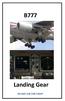 B777 Landing Gear DO NOT USE FOR FLIGHT Introduction The airplane has two main landing gear and a single nose gear. The nose gear is a conventional steerable two wheel unit. Each main gear has six wheels
Beechcraft 1900D: Fuel, Emissions & Cost Savings Operational Analysis
 Specific Range Solutions Ltd. Your partner in flight operations optimization [email protected] / 1.613.883.5045 www.srs.aero Beechcraft 1900D: Fuel, Emissions & Cost Savings Operational Analysis by
AVIATION INVESTIGATION REPORT A06F0014 MISALIGNED TAKE-OFF
 AVIATION INVESTIGATION REPORT A06F0014 MISALIGNED TAKE-OFF AIR CANADA AIRBUS A319-114 C-FYKR LAS VEGAS, NEVADA 30 JANUARY 2006 The Transportation Safety Board of Canada (TSB) investigated this occurrence
Advisory Circular. U.S. Department of Transportation Federal Aviation Administration
 U.S. Department of Transportation Federal Aviation Administration Advisory Circular Subject: Mitigating the Risks of a Runway Overrun Upon Landing Date: 9/17/14 Initiated by: AFS-800 AC No: 91-79A Change:
SPORT PILOT TRAINING SYLLABUS
 Checked out from the Members Only Library Page 1 of 13 Society of Aviation and Flight Educators www.safepilots.0rg SPORT PILOT TRAINING SYLLABUS LESSON ONE: INTRODUCTORY FLIGHT TIME: 1 hour Ground Instruction;
MALAYSIA REQUIREMENT FOR THE ESTABLISHMENT OF FLIGHT DATA ANALYSIS (FDA) PROGRAM
 AIC MALAYSIA PHONE : 6-03-7846 5233 TELEX : PENAWA MA 30128 FAX : 6-03-7847 2997 AFTN : WMKKYAYS COMM : AIRCIVIL KUALA LUMPUR AERONAUTICAL INFORMATION SERVICES DEPARTMENT OF CIVIL AVIATION BLOCK A AIR
Oral Preparation Questions
 Oral Preparation Questions The oral section of the practical test is the time when you need to demonstrate your understanding of the various tasks listed in the practical test standards and the factors
FLIGHT CONTROLS 1. GENERAL 2. MAIN COMPONENTS AND SUBSYSTEMS ROLL CONTROL. Smartcockpit.com BOEING 737 SYSTEMS REVIEW Page 1
 Smartcockpit.com BOEING 737 SYSTEMS REVIEW Page 1 FLIGHT CONTROLS 1. GENERAL The primary flight controls, ailerons, elevators and rudders, are hydraulically powered. Hydraulic power is provided from hydraulic
Airbus A320 wingstrike at Hamburg Airport going around the world within hours via YouTube. Johann Reuss
 Airbus A320 wingstrike at Hamburg Airport going around the world within hours via YouTube. Johann Reuss Johann Reuss holds a master degree in engineering and has been working since 1987 as an accident
Investigation Report
 Bundesstelle für Flugunfalluntersuchung German Federal Bureau of Aircraft Accident Investigation Investigation Report Identification Type of Occurrence: Accident Date: 14 December 2011 Location: Aircraft:
CIRRUS AIRPLANE MAINTENANCE MANUAL
 UNSCHEDULED MAINTENANCE CHECKS 1. DESCRIPTION The following describes those maintenance checks and inspections on the aircraft which are dictated by special or unusual conditions which are not related
Aerospace Engineering 3521: Flight Dynamics. Prof. Eric Feron Homework 6 due October 20, 2014
 Aerospace Engineering 3521: Flight Dynamics Prof. Eric Feron Homework 6 due October 20, 2014 1 Problem 1: Lateral-directional stability of Navion With the help of Chapter 2 of Nelson s textbook, we established
Crashed during approach, Boeing 737-800, near amsterdam schiphol airport, 25 February 2009
 Crashed during approach, Boeing 737-800, near amsterdam schiphol airport, 25 February 2009 The Hague, May 2010 (project number M2009LV0225_01) The reports of the Dutch Safety Board are available to the
Air Accident Investigation Sector. Serious Injury to a Cabin Crewmember Due to Turbulence
 Air Accident Investigation Sector Accident - Preliminary Report - AAIS Case File N o : AIFN/0009/2015 Serious Injury to a Cabin Crewmember Due to Turbulence Operator: Emirates Make and Model: Airbus A380-800
FINAL REPORT. AAIU Synoptic Report No: 2006-012 AAIU File No: 2005/0030 Published: 24/7/06
 AAIU Synoptic Report No: 2006-012 AAIU File No: 2005/0030 Published: 24/7/06 In accordance with the provisions of SI 205 of 1997, the Chief Inspector of Accidents, on 8 June 2005, appointed Mr John Hughes
parts of an airplane Getting on an Airplane BOX Museum Aeronautics Research Mission Directorate in a Series
 National Aeronautics and Space Administration GRADES K-2 Aeronautics Research Mission Directorate Museum in a BOX Series www.nasa.gov parts of an airplane Getting on an Airplane MUSEUM IN A BOX Getting
Low Level Windshear Alert System (LLWAS) An integral part of the U.S. FAA Wind-shear safety program
 Low Level Windshear Alert System (LLWAS) An integral part of the U.S. FAA Wind-shear safety program Low-level windshear is a hazard to aircraft in the airport runway corridors. With Climatronics LLWAS,
N17UF Most Critical Injury: FATAL ACCIDENT
 Location/Time Nearest City / Place Page 1 Aircraft Registration Number N17UF Most Critical Injury: FATAL Investigated By: AAIPU Occurrence Date: Nov. 9, 2014 Occurrence Type: Zip Code ACCIDENT Local Time
Investigation Report
 Bundesstelle für Flugunfalluntersuchung German Federal Bureau of Aircraft Accident Investigation Investigation Report Identification Type of Occurrence: Accident Date: 14 February 2010 Location: Aircraft:
WEATHER THEORY Temperature, Pressure And Moisture
 WEATHER THEORY Temperature, Pressure And Moisture Air Masses And Fronts Weather Theory- Page 77 Every physical process of weather is a result of a heat exchange. The standard sea level temperature is 59
Best Practices for Fuel Economy
 AACO ICAO Operational Technical Forum Measures / Beirut, Workshop 19th of / November Montreal, 20/21 2005 September 2006 Presented by: Olivier HUSSE Senior Performance Engineer Best Practices for Fuel
A new dimension in infotainment
 Cabin & IFE Inventions 3-D moving map system niceview A new dimension in infotainment Fly where you want to fly, see what you want to see Do you like to know where you are going and how you got there?
Turbulence: The Invisible Hazard presented by Scott Miller PIA Symposium 2005 Jacksonville, Florida, USA
 1300 E. International Speedway Blvd DeLand, FL 32724 USA Tel: +1.386.738.2224 Fax: +1.734.8297 www.performancedesigns.com Turbulence: The Invisible Hazard presented by Scott Miller PIA Symposium 2005 Jacksonville,
Helicopter Emergencies and Hazards
 Chapter 11 Helicopter Emergencies and Hazards Introduction Today, helicopters are quite reliable. However, emergencies do occur, whether a result of mechanical failure or pilot error, and should be anticipated.
12 AERO Second-Quarter 2003 April CAPT. RAY CRAIG 737 CHIEF PILOT FLIGHT OPERATIONS BOEING COMMERCIAL AIRPLANES
 CAPT. RAY CRAIG 737 CHIEF PILOT FLIGHT OPERATIONS BOEING COMMERCIAL AIRPLANES DREW HOUCK ASSOCIATE TECHNICAL FELLOW FLIGHT DECK DISPLAYS BOEING COMMERCIAL AIRPLANES ROLAN SHOMBER ASSOCIATE TECHNICAL FELLOW
a. AC 25-7, Flight Test Guide for Certification of Transport Category Airplanes.
 U.S. Department of Transportation Federal Aviation Administration Advisory Circular Subject: Runway Overrun Prevention Date: 11/06/07 Initiated by: AFS-800 AC No: 91-79 Change: 1. PURPOSE. This advisory
High Alpha 3D Maneuvers
 High Alpha 3D Maneuvers Harrier Pass Elevator Back Flip Parachute Whip Stalls Rolling Harrier 3D Rolling Turn 3D Knife Edge C-82 Rudder Warmup Note: Every flight mode and maneuver presented in this section
DIRECCION DE PERSONAL AERONAUTICO DPTO. DE INSTRUCCION PREGUNTAS Y OPCIONES POR TEMA
 MT DIREION DE PERSONL ERONUTIO DPTO. DE INSTRUION PREGUNTS Y OPIONES POR TEM Pag.: 1 TEM: 0321 INSTRUTOR_DVNED_06_ENR FLT & NVIGTION OD_PREG: PREGUNT: RPT: 6856 GIVEN: Departure path... straight out Takeoff
AVIATION INVESTIGATION REPORT A08W0162 CONTROLLED FLIGHT INTO WATER
 AVIATION INVESTIGATION REPORT A08W0162 CONTROLLED FLIGHT INTO WATER TRANS NORTH TURBO AIR LIMITED BELL 206B (HELICOPTER) C-FGGC CARMACKS, YUKON 09 AUGUST 2008 The Transportation Safety Board of Canada
Wind shear - poses challenges and dangers at the most critical stages of flight
 Wind shear - poses challenges and dangers at the most critical stages of flight Authored and illustrated by Sari Jay June 2009 Introduction Over 40 years ago, in the 1960s, low level wind shear was just
REPORT IN-041/2008 DATA SUMMARY
 REPORT IN-041/2008 DATA SUMMARY LOCATION Date and time Site 31 October 2008; 07:15 UTC Lanzarote Airport AIRCRAFT Registration EC-HJQ Type and model BOEING 737-800 S/N: 28387 Operator Air Europa Engines
Flight Operations Briefing Notes
 Flight Operations Briefing Notes I Introduction For every flight of any given day, it is necessary for the flight crew to be prepared for a high speed rejected takeoff during the takeoff roll. The decision
060-4314-000 Rev. C - May 2004 MK VI & MK VIII EGPWS Pilot Guide. MK VI and MK VIII Enhanced Ground Proximity Warning System (EGPWS) Pilot's Guide
 MK VI & MK VIII EGPWS Pilot Guide MK VI and MK VIII Enhanced Ground Proximity Warning System (EGPWS) Pilot's Guide This document is an unpublished work Copyright 2004 Honeywell International Inc. All rights
Requirements to servo-boosted control elements for sailplanes
 Requirements to servo-boosted control elements for sailplanes Aerospace Research Programme 2004 A. Gäb J. Nowack W. Alles Chair of Flight Dynamics RWTH Aachen University 1 XXIX. OSTIV Congress Lüsse, 6-136
OPERATING MINIMA FOR AEROPLANES AND HELICOPTER OPERATIONS PURPOSE REFERENCE 4.0 DEFINITION
 ORDER TCAA-O-OPS034A March 2013 OPERATING MINIMA FOR AEROPLANES AND HELICOPTER OPERATIONS PURPOSE 1. This Order gives guidance to the Authority s Operations Inspector on the procedures for approval of
and Implementing Rules for Air Operations of Community Operators F. Cross Reference Tables
 European Aviation Safety Agency 30 Jan 2009 NOTICE OF PROPOSED AMENDMENT (NPA) NO 2009 02F DRAFT OPINIONS OF THE EUROPEAN AVIATION SAFETY AGENCY, FOR A COMMISSION REGULATION establishing the implementing
Flightlab Ground School 5. Longitudinal Static Stability
 Flightlab Ground School 5. Longitudinal Static Stability Copyright Flight Emergency & Advanced Maneuvers Training, Inc. dba Flightlab, 2009. All rights reserved. For Training Purposes Only Longitudinal
Aviation Supplies & Academics, Inc. 7005 132nd Place SE Newcastle, Washington 98059-3153 www.asa2fly.com
 The Pilot s Manual 1: Flight School Aviation Supplies & Academics, Inc. 7005 132nd Place SE Newcastle, Washington 98059-3153 www.asa2fly.com Originally published by Aviation Theory Centre 1990 1993. Fourth
Flight Safety Foundation. Approach-and-landing Accident Reduction. Tool Kit. FSF ALAR Briefing Note 3.1 Barometric Altimeter and Radio Altimeter
 Flight Safety Foundation Approach-and-landing Accident Reduction Tool Kit FSF ALAR Briefing Note 3.1 Barometric Altimeter and Radio Altimeter Flight crews on international routes encounter different units
S-Tec System Thirty Autopilot
 Cirrus Design Section 9 Pilot s Operating Handbook and FAA Approved Airplane Flight Manual Supplement for S-Tec System Thirty Autopilot When the S-Tec System Thirty Autopilot is installed in the Cirrus
REPORT IN-043/2011 DATA SUMMARY
 REPORT IN-043/2011 DATA SUMMARY LOCATION Date and time Thursday, 4 August 2011; 17:05 UTC 1 Site Madrid-Barajas Airport (LEMD) (Spain) AIRCRAFT Registration Type and model Operator LX-LGX EMBRAER 145 LU
Paper presented at ISASI 2014 Seminar, October 2014, Adelaide, Australia. Safety Management; Reversing the False Glide Slope Myth
 Safety Management; Reversing the False Glide Slope Myth Kas Beumkes Senior Air Safety Investigator/Project Manager Michiel Schuurman Senior Air Safety Investigator/Technical Investigation Dutch Safety
Service, Security, Solutions Since 1924. Insurance and Risk Management Considerations for UAS RPAS Symposium, Montreal. March 2015
 Service, Security, Solutions Since 1924 Insurance and Risk Management Considerations for UAS RPAS Symposium, Montreal Global Aerospace Begins Spirit of St. Louis First Transatlantic flight by unmanned