
Lecture 9. Surface Treatment, Coating, Cleaning
|
|
|
- Lenard Cannon
- 9 years ago
- Views:
Transcription
1 1 Lecture 9. Surface Treatment, Coating, Cleaning These processes are sometimes referred to as post-processing. They play a very important role in the appearance, function and life of the product. Broadly, these are processes that affect either a thin layer on the surface of the part itself, or add a thin layer on top of the surface of the part. There are different coating and surface treatments processes, with different applications, uses, etc. The important uses include: Improving the hardness Improving the wear resistance Controlling friction, Reduction of adhesion, improving the lubrication, etc. Improving corrosion resistance Improving aesthetics 9.1. Mechanical hardening of the surface These methods apply mechanical impulses (e.g. light hammering) on the surface of a metallic part. This hammering action causes tiny amount of plastic flow on the surface, resulting in the work-hardening of the surface layer due to the introduction of compressive residual stresses. Examples of these processes include Shot peening (uses tiny balls of metal or ceramic), Water-jet peening (uses a jet of water at high pressures, e.g. 400 MPa), or Laser peening (surface is hit by tiny impulses from a laser) an expensive process used to improve fatigue strength of jet fan blades and turbine impellers. Another method is explosive hardening, where a layer of explosive coated on the surface is blasted the resulting impact results in tremendous increase in the surface hardness. This method is used to harden the surface of train rails Case hardening This is a very common process that is used to harden the outer surface of parts such as gear teeth, cams, shafts, bearings, fasteners, pins, tools, molds, dies etc. In most of these types of components, the use involves dynamic forces, occasional impacts, and constant friction. Therefore the surface needs to be hard to prevent wear, but the bulk of the part should be tough (not brittle); this is achieved best by case hardening. There are several types of case hardening: in most cases, the chemical structure of the metal is changed by diffusing atoms of an alternate element which results in alterations to the micro-structure on the crystals on the surface. The basic method is fairly simple: the metal parts are put in an oven, and heated with the atmosphere containing excess of a gaseous/liquid form of the doping substance. This causes the dopant to diffuse into
2 2 the surface. The duration and temperature control the concentration and depth of the doping. Most of these processes are used to case harden steel and other iron alloys, including low carbon steels, alloy steels, tool steels etc. Process Dopant Procedure Notes Applications Carburizing C Low-carbon steel part in oven at C with excess CO 2 CarboNitriding C and N Low-carbon steel part in oven at C with excess CO 2 and NH ~ 1.5mm case gets to 65 HRC; poor dimension control 0.07~0.5mm case, up to 62 HRC, lower distortion Cyaniding C and N Low-carbon steel part in bath of 0.025~0.25mm case, up cyanide salts with 30% NaCN to 65 HRC Nitriding N Low-carbon steel part in oven 0.1~0.6mm case, up to at C with excess NH HV Boronizing B Part heated in oven with Boron Very hard, wear containing gas resistant case, 0.025~0.075mm Gears, cams, shafts, bearings Nuts, bolts, gears nuts, bolts, gears, screws tools, gears, shafts Tool and die steels 9.3. Thermal spraying Metal is melted in a specially designed spray gun (using oxy-fuel, plasma, or other means to heat the sprayed metal till it melts). High pressure gas then sprays the liquid metal, depositing a layer on top the part similar to a painting process Vapor deposition In these processes, the layer of deposited material is very thin only a few microns. In the vacuum evaporation process, the metal to be deposited is heated in an enclosed oven at high temperature and very low pressure; some of the metal vapor deposits as a thin layer on the part. The surface can be coated not only with metal, but also with some carbides, nitrides, or ceramics. Typical applications include surface coating of cutting tools, e.g. drills, reamers, punches, dies etc. A very important coating process is Sputtering it is important because of its extensive use in production of electronic chips. Here, an electric field ionizes an inert gas (e.g. Argon), and the ions are used to bombard the coating substance. Atoms of the coating material (on the cathode), when hit by the ions, are knocked out of the lattice, and later get deposited on the surface of the part by condensation. Aluminum sputtering is used to create most internal connections in VLSI chips in semiconductor manufacturing.

3 3 [source: Kalpakjian and Schmid] Figure 1. Thermal spraying processes (a) thermal wire spray (b) Thermal metal powder spray (c) Plasma spray

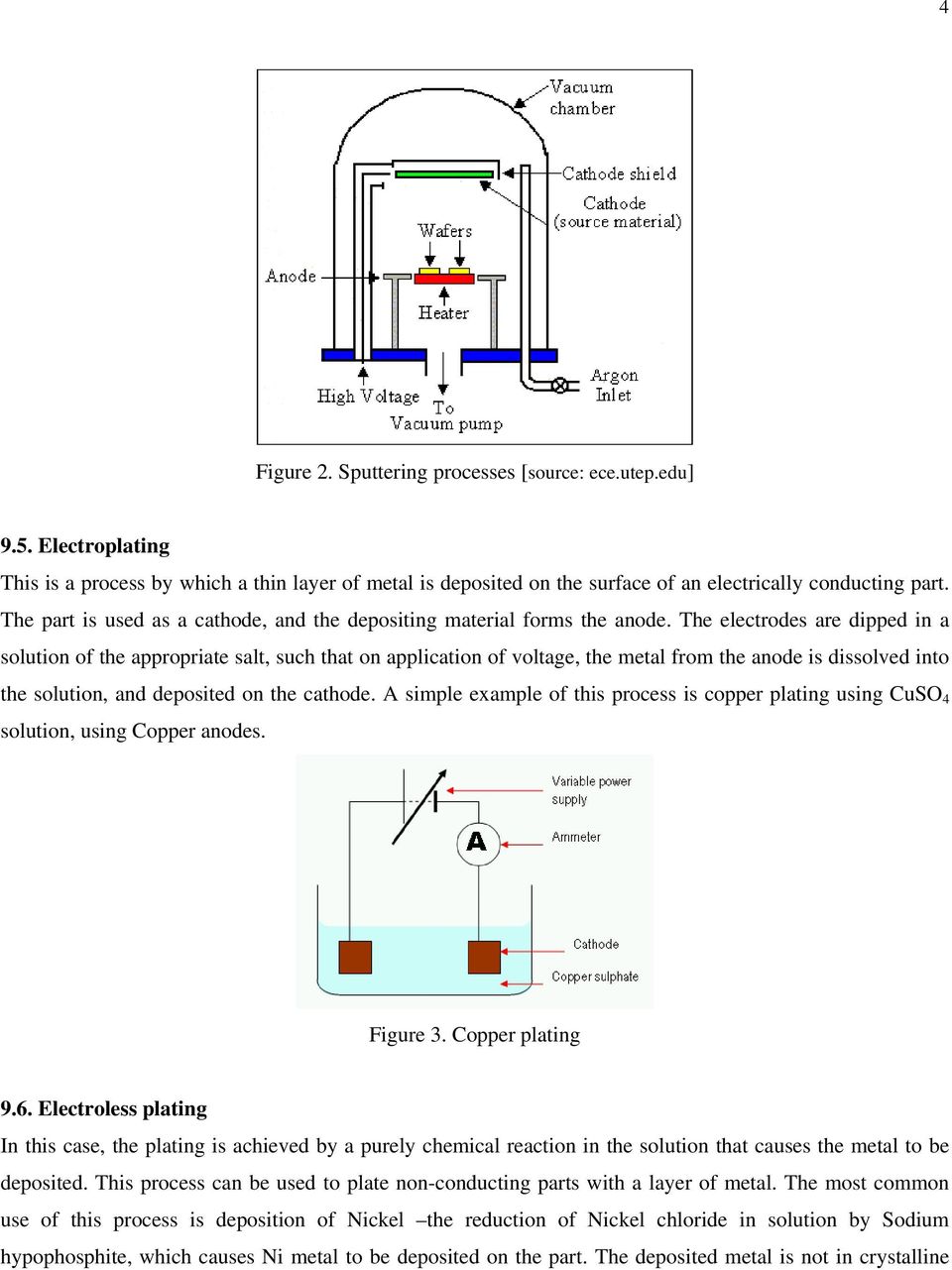
4 4 Figure 2. Sputtering processes [source: ece.utep.edu] 9.5. Electroplating This is a process by which a thin layer of metal is deposited on the surface of an electrically conducting part. The part is used as a cathode, and the depositing material forms the anode. The electrodes are dipped in a solution of the appropriate salt, such that on application of voltage, the metal from the anode is dissolved into the solution, and deposited on the cathode. A simple example of this process is copper plating using CuSO 4 solution, using Copper anodes. Figure 3. Copper plating 9.6. Electroless plating In this case, the plating is achieved by a purely chemical reaction in the solution that causes the metal to be deposited. This process can be used to plate non-conducting parts with a layer of metal. The most common use of this process is deposition of Nickel the reduction of Nickel chloride in solution by Sodium hypophosphite, which causes Ni metal to be deposited on the part. The deposited metal is not in crystalline
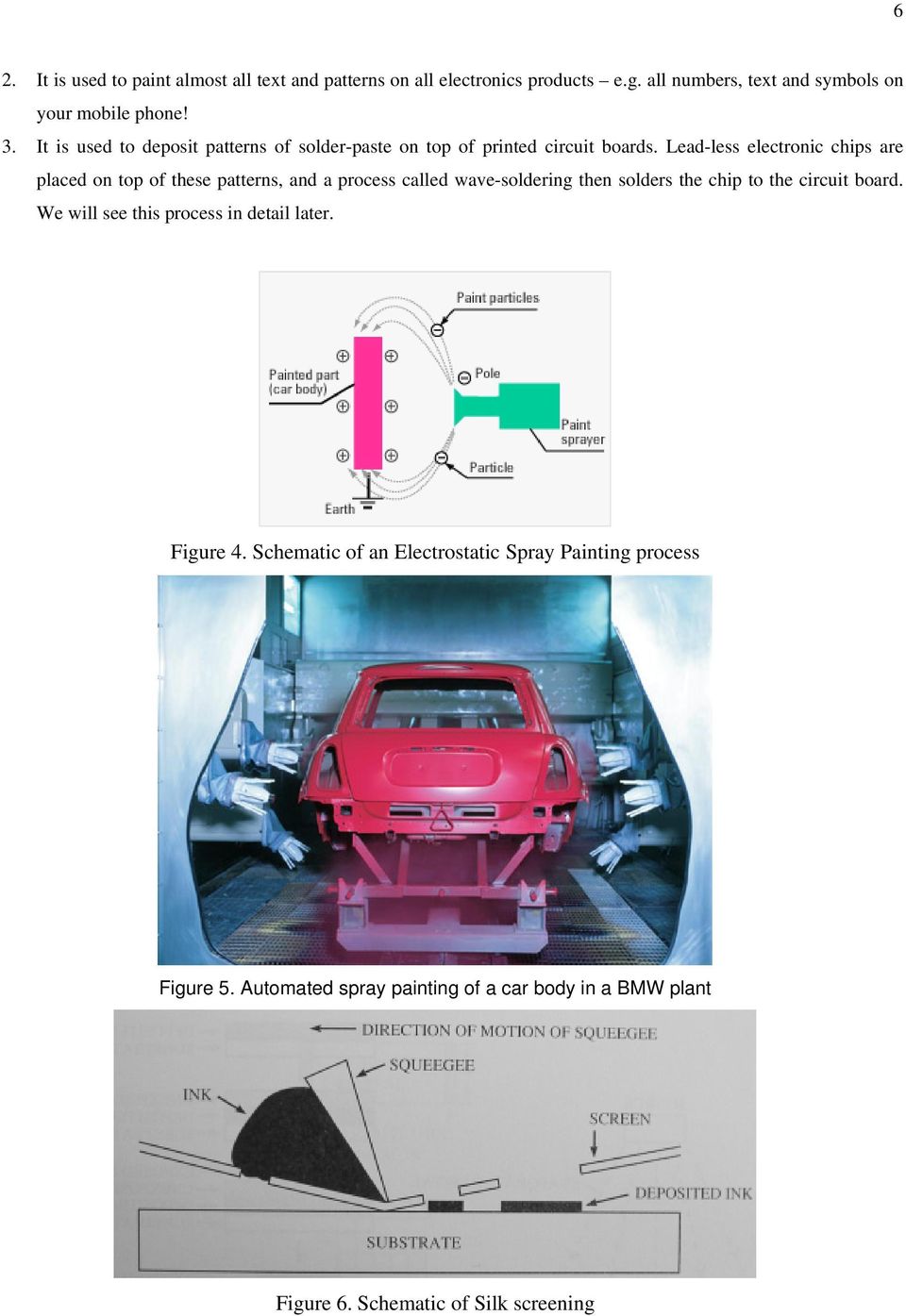
5 5 form, so this process is followed by heat-treatment and quenching. Ni-coating using this method is used for making tool coatings that are quite hard (up to 1000 HV) Anodizing This is a very common process many common Aluminum parts are surface treated by anodizing to give them a different color (usually black, red, blue, etc). The process uses the metal part as an anode; using electrolytic process, a layer of hard metal oxide is formed at the anode (i.e. on the surface of the part). Common examples include aluminum parts, such as picture frames, car-body parts, door-knobs and other building fixtures, bathroom fixtures and racks, sporting goods, e.g. baseball bats, and so on Painting Of course, the most common surface treatment is painting. Examples of its functional value include: (i) car body paints are corrosion resistant; (ii) boats are painted with anti corrosion paint with (toxic) chemicals to avoid growth of barnacles, seaweed etc. Examples of aesthetic or decorative value are too numerous. Paints are of three types: (a) Enamel: oil-based paints that produce a smooth surface and glossy appearance (b) Lacquers: these are resin based paints that dry to a thin coat after the solvent evaporates out. Common examples are varnish used in painting wood. (c) Water-based paints: common examples include several wall paints and home-interior paints. The most common methods of paint application include: (i) Dip coating: part is dipped into a container of paint, and pulled out. (ii) Spray coating: one or more spray guns move along the surface of the part to give a uniform coat of paint; this is the method most commonly used in painting auto bodies, home appliances, e.g. fridge doors, etc. (iii) Electrostatic spraying: Here the paint particles are given an electrostatic charge and the spray is achieved by applying a voltage difference across the paint particles and the part. (iv) Silk-screening: this is the most common method of painting patterns, text, etc on top of most products. Tine holes are made in a thin (silk-like) sheet, corresponding to the pattern that needs to be painted. The screen is kept on top of the part in the correct position, and the paint is poured n top of the screen. A roller (or squeegee brush) is used to squeeze the paint out through the holes in the silk screen and onto the part. The screen is removed and the part is sent to dry in an oven. Silk screening has several very important uses: 1. It is used extensively in the textile industry to create colored patterns on textiles (e.g. logos on T-shirts).

6 6 2. It is used to paint almost all text and patterns on all electronics products e.g. all numbers, text and symbols on your mobile phone! 3. It is used to deposit patterns of solder-paste on top of printed circuit boards. Lead-less electronic chips are placed on top of these patterns, and a process called wave-soldering then solders the chip to the circuit board. We will see this process in detail later. Figure 4. Schematic of an Electrostatic Spray Painting process Figure 5. Automated spray painting of a car body in a BMW plant Figure 6. Schematic of Silk screening
UNIT 4 METAL COATING PROCESSES
 UNIT 4 METAL COATING PROCESSES Structure 4.1 Introduction Objectives 4.2 Metal and Non-metal Coatings 4.2.1 Metallic Coatings 4.2.2 Non-Metallic Coatings 4.3 Electroforming 4.4 Galvanizing 4.5 Anodizing
FLEXIBLE CIRCUITS MANUFACTURING
 IPC-DVD-37 FLEXIBLE CIRCUITS MANUFACTURING Below is a copy of the narration for DVD-37. The contents of this script were developed by a review group of industry experts and were based on the best available
Tableting Punch Performance Can Be Improved With Precision Coatings
 Tableting Punch Performance Can Be Improved With Precision Coatings by Arnold H. Deutchman, Ph. D. Director of Research and Development (614) 873-4529 X 114 [email protected] Mr. Dale C. Natoli
How compact discs are made
 How compact discs are made Explained by a layman for the laymen By Kevin McCormick For Science project at the Mountain View Los Altos High School Abstract As the major media for music distribution for
Coating Technology: Evaporation Vs Sputtering
 Satisloh Italy S.r.l. Coating Technology: Evaporation Vs Sputtering Gianni Monaco, PhD R&D project manager, Satisloh Italy 04.04.2016 V1 The aim of this document is to provide basic technical information
Surface Treatments. Corrosion Protective coatings for harsh environments (catalytic converters, electrochemical cells )
 Surface Treatments Applications Biomedical (biocompatible coatings on implants, drug coatings for sustained release ) Mechanical Tribological friction and wear (tool steels, implants ) Fatigue minimize
CHAPTER 3: MATTER. Active Learning Questions: 1-6, 9, 13-14; End-of-Chapter Questions: 1-18, 20, 24-32, 38-42, 44, 49-52, 55-56, 61-64
 CHAPTER 3: MATTER Active Learning Questions: 1-6, 9, 13-14; End-of-Chapter Questions: 1-18, 20, 24-32, 38-42, 44, 49-52, 55-56, 61-64 3.1 MATTER Matter: Anything that has mass and occupies volume We study
Specifications for Programs: 737, 747, 757, 767, 777, 787
 = Performed by GKN BAC 5000 AN General Sealing 6-262, 6-265, 6-267, 6-270 PSD for 787 Only: 6-242, 6-269, 6-271 PSD for 777 Only: 6-261,6-264, 6-266, 6-269, 6-271 BAC 5004 L Installation of Permanent Fasteners
ULTRA 865HD HIGH PERFORMANCE MULTI PURPOSE GREASE
 ULTRA 865HD HIGH PERFORMANCE MULTI PURPOSE GREASE Contains penetrants, lubricants and greases All weather Water-resistant Penetrates like an oil, then cures to a thick, water-resistant grease Recommended
Name Class Date. What is ionic bonding? What happens to atoms that gain or lose electrons? What kinds of solids are formed from ionic bonds?
 CHAPTER 1 2 Ionic Bonds SECTION Chemical Bonding BEFORE YOU READ After you read this section, you should be able to answer these questions: What is ionic bonding? What happens to atoms that gain or lose
the runnerless types of molds are explained post molding operations are described the basic methods of applied decoration methods are examined
 Training Objectives After watching the video and reviewing this printed material, the viewer will gain knowledge and understanding of the various plastic finishing processes used in industry and their
CATHODIC PROTECTION SYSTEM DESIGN
 CATHODIC PROTECTION SYSTEM DESIGN Presented By DENIS L ROSSI P.E. CORROSION ENGINEER New England C P Inc. Corrosion Fundamentals What is corrosion? It is defined as the degradation or deterioration of
Chapter 5 - Aircraft Welding
 Chapter 5 - Aircraft Welding Chapter 5 Section A Study Aid Questions Fill in the Blanks 1. There are 3 types of welding:, and, welding. 2. The oxy acetylene flame, with a temperature of Fahrenheit is produced
Conductivity of silicon can be changed several orders of magnitude by introducing impurity atoms in silicon crystal lattice.
 CMOS Processing Technology Silicon: a semiconductor with resistance between that of conductor and an insulator. Conductivity of silicon can be changed several orders of magnitude by introducing impurity
Vacuum Evaporation Recap
 Sputtering Vacuum Evaporation Recap Use high temperatures at high vacuum to evaporate (eject) atoms or molecules off a material surface. Use ballistic flow to transport them to a substrate and deposit.
How to Build a Printed Circuit Board. Advanced Circuits Inc 2004
 How to Build a Printed Circuit Board 1 This presentation is a work in progress. As methods and processes change it will be updated accordingly. It is intended only as an introduction to the production
The mechanical properties of metal affected by heat treatment are:
 Training Objective After watching this video and reviewing the printed material, the student/trainee will learn the basic concepts of the heat treating processes as they pertain to carbon and alloy steels.
RESIDUAL STRESSES AND THEIR EFFECTS ON FATIGUE RESISTANCE
 RESIDUAL STRESSES AND THEIR EFFECTS ON FATIGUE RESISTANCE Ali Fatemi-University of Toledo All Rights Reserved Chapter 8 Residual Stresses & Their Effects 1 RESIDUAL STRESSES AND THEIR EFFECTS ON FATIGUE
Question Bank Electrolysis
 Question Bank Electrolysis 1. (a) What do you understand by the terms (i) electrolytes (ii) non-electrolytes? (b) Arrange electrolytes and non-electrolytes from the following substances (i) sugar solution
Introduction to electrolysis - electrolytes and non-electrolytes
 Introduction to electrolysis - electrolytes and non-electrolytes Electrolysis is the process of electrically inducing chemical changes in a conducting melt or solution e.g. splitting an ionic compound
Anodizing Reference Guide
 Anodizing Reference Guide Type Thickness Type II Conventional coatings produced 1.8µ-25.4µ from sulfuric acid bath Type I A Conventional coatings produced 0.5µ-7.6µ (microns) from chromic acid bath Type
LASER CUTTING OF STAINLESS STEEL
 LASER CUTTING OF STAINLESS STEEL Laser inert gas cutting is the most applicable process type used for cutting of stainless steel. Laser oxygen cutting is also applied in cases where the cut face oxidation
Lecture slides on rolling By: Dr H N Dhakal Lecturer in Mechanical and Marine Engineering, School of Engineering, University of Plymouth
 Lecture slides on rolling By: Dr H N Dhakal Lecturer in Mechanical and Marine Engineering, School of Engineering, University of Plymouth Bulk deformation forming (rolling) Rolling is the process of reducing
Atomic Structure. Atoms consist of: Nucleus: Electrons Atom is electrically balanced equal electrons and protons. Protons Neutrons
 Basics of Corrosion Performance Metals Sacrificial anode manufacturer Specialize in aluminum alloy anodes All products made in the USA (Berks county, PA) ISO9001/2001 Certified Quality System Also traditional
How To Make A Pvd Coating
 Hard and Superhard Nanocomposite Coating deposited by PVD technology for industrial application Dott. Romagnoli Denis STS Service and Tools STS s.r.l. via Parini 12 40033 Casalecchio di Reno(Bo) Tel. 051-969882
Anodes and Misc Equipment
 Anodes and Misc Equipment Application: Platinised Titanium Anodes Platinised titanium anodes are recommended for use in the following electrolytic processes:- Precious metal electroplating - e.g. Au, Pt,
COATED CARBIDE. TiN. Al 2 O 3
 COATED CARBIDE GENERAL INFORMATION CVD = Chemical Vapour Deposition coated grades GC2015, GC2025, GC2135, GC235, GC3005, GC3015, GC3020, GC3025, GC3115, GC4015, GC4025, GC4035, S05F, and CD1810. PVD =
Stainless steel grade chart
 Stainless steel grade chart ATLAS STEELS METAL DISTRIBUTION Chemical analysis (%) specified C Si Mn P S Cr Mo Ni Other Austenitic stainless steels 253MA S30815 0.05 1.1-2.0 0.8 0.040 0.030 20.0-22.0 10.0-12.0
Cutting Tool Materials
 Training Objectives After watching the video and reviewing this printed material, the viewer will gain knowledge and understanding of cutting tool metallurgy and specific tool applications for various
Technical Paper. Corrosion Resistance of Bolt Coatings. Dmitry Zhmurkin, Ph.D. Tyco Electronics Harrisburg, PA. July 23, 2009
 Technical Paper Corrosion Resistance of Bolt Coatings Dmitry Zhmurkin, Ph.D. Tyco Electronics Harrisburg, PA July 23, 2009 Hot-Dip Galvanizing Batch hot-dip galvanizing has been the most commonly used
expectation as hot dip galvanizing?
 FREQUENTLY ASKED QUESTIONS ********************************* Q. 1.What exactly is Cold galvanizing? A. Cold galvanisation is an organic, single-component zinc coating of minimum 92% (weight) zinc in the
TechCut 4 Precision Low Speed Saw
 Product Brochure TechCut 4 Precision Low Speed Saw 3" - 6" Blade Range Digital Speed Display 1-Micron Sample Indexing Spring-Loaded Dressing Stick Attachment All Aluminum & Stainless Steel Construction
An Ammonium-free, Acid. Zinc/Nickel (12-15% Ni) Process
 An Ammonium-free, Acid Zinc/Nickel (12-15% Ni) Process Requirements of an acid zinc/nickel process Technical requirements High plating speed (current efficiency up to 90 %) High thicknesses of deposits
AN900 APPLICATION NOTE
 AN900 APPLICATION NOTE INTRODUCTION TO SEMICONDUCTOR TECHNOLOGY INTRODUCTION by Microcontroller Division Applications An integrated circuit is a small but sophisticated device implementing several electronic
Hanshan Dong Birmingham Surface Engineering Group The University of Birmingham
 Advanced Surface Engineering Technologies for Remanufacturing Hanshan Dong Birmingham Surface Engineering Group The University of Birmingham UK - China Joint Project Towards long-life remanufactured heavy-duty
HEAT TREATMENT OF STEEL
 HEAT TREATMENT OF STEEL Heat Treatment of Steel Most heat treating operations begin with heating the alloy into the austenitic phase field to dissolve the carbide in the iron. Steel heat treating practice
The objectives of this program are shown.
 1 2 Selecting the proper Tool Steels, Heat Treatment, & Surface Treatments for a stamping application can be a complex and confusing process. To simplify this process, a few basic facts should be understood.
Chapter 21a Electrochemistry: The Electrolytic Cell
 Electrochemistry Chapter 21a Electrochemistry: The Electrolytic Cell Electrochemical reactions are oxidation-reduction reactions. The two parts of the reaction are physically separated. The oxidation reaction
Drill Pipe Hard-facing
 Drill Pipe Hard-facing GLOBAL PROTECTION AGAINST WEAR AND TEAR Oxyacetylene Rods Flux- and Metal Cored Wires Electrodes PTA - Welding Oxyacetylene Welding and Spray Powders Flame Spraying FLSP Arc Spraying
Introduction to VLSI Fabrication Technologies. Emanuele Baravelli
 Introduction to VLSI Fabrication Technologies Emanuele Baravelli 27/09/2005 Organization Materials Used in VLSI Fabrication VLSI Fabrication Technologies Overview of Fabrication Methods Device simulation
Ion Beam Sputtering: Practical Applications to Electron Microscopy
 Ion Beam Sputtering: Practical Applications to Electron Microscopy Applications Laboratory Report Introduction Electron microscope specimens, both scanning (SEM) and transmission (TEM), often require a
TAIYO PSR-4000 AUS703
 TAIYO PSR-4000 AUS703 LIQUID PHOTOIMAGEABLE SOLDER MASK Designed for Flip Chip Packaging Applications Halogen-Free (300ppm) Excellent Thermal and Crack Resistance Low Water Absorption RoHS Compliant Excellent
Auditing a Printed Circuit Board Fabrication Facility Greg Caswell
 Auditing a Printed Circuit Board Fabrication Facility Greg Caswell Introduction DfR is often requested to audit the PCB fabrication process of a customer s supplier. Understanding the process variations
PVD coatingsin transmissions: case studies I rivestimenti PVD su componenti di trasmissioni: esempi
 PVD coatingsin transmissions: case studies I rivestimenti PVD su componenti di trasmissioni: esempi Paola Recanati Oerlikon Balzers Italy- Precision Components Product Manager Claudio Torrelli Oerlikon
Permanent Magnetic Generator Construction Manual
 Permanent Magnetic Generator Construction Manual http://hojomotor.com Our Team Doing an On-site Assembly in Peru http://hojomotor.com Section 1) Introduction This manual describes how to build a 'permanent
Cambridge International Examinations Cambridge International General Certificate of Secondary Education
 Cambridge International Examinations Cambridge International General Certificate of Secondary Education *0123456789* CHEMISTRY 0620/04 Paper 4 Theory (Extended) For Examination from 2016 SPECIMEN PAPER
Name Date Class CHAPTER 1 REVIEW. Answer the following questions in the space provided.
 CHAPTER 1 REVIEW Matter and Change SECTION 1 SHORT ANSWER Answer the following questions in the space provided. 1. a Technological development of a chemical product often (a) lags behind basic research
Deposition of Thin Metal Films " (on Polymer Substrates)!
 Deposition of Thin Metal Films " (on Polymer Substrates)! Shefford P. Baker! Cornell University! Department of Materials Science and Engineering! Ithaca, New York, 14853! MS&E 5420 Flexible Electronics,
Good Boards = Results
 Section 2: Printed Circuit Board Fabrication & Solderability Good Boards = Results Board fabrication is one aspect of the electronics production industry that SMT assembly engineers often know little about.
Metal Rescue Rust Remover Technical Data
 Technical Data Product Description Metal Rescue TM is an innovative new technology that efficiently removes rust without harming surrounding materials. It is a water-based, non-toxic solution that is biodegradable
Flex Circuit Design and Manufacture.
 Flex Circuit Design and Manufacture. Hawarden Industrial Park, Manor Lane, Deeside, Flintshire, CH5 3QZ Tel 01244 520510 Fax 01244 520721 [email protected] www.merlincircuit.co.uk Flex Circuit
KNOCK OUT NAK80 INTRODUCING PLASTIC MOLDS RUBBER MOLDS JIGS & FIXTURES PRESS DIES. 40 HRC Pre-Hardened High Performance High Precision Mold Steel
 INTRODUCING NAK80 40 HRC Pre-Hardened High Performance High Precision Mold Steel KNOCK OUT THE COMPETITION PLASTIC MOLDS RUBBER MOLDS JIGS & FIXTURES PRESS DIES Features: Machines up to 20 percent faster
Metals and Non-metals. Comparison of physical properties of metals and non metals
 Metals and Non-metals Comparison of physical properties of metals and non metals PHYSICAL PROPERTY METALS NON-METALS Physical State Metallic lustre (having a shining surface) Mostly solids (Liquid -mercury)
Wear Resistant Coatings. Corrosion Protection
 Wear Resistant Coatings Thermal Spray Technologies offers an almost endless variety of coating solutions to provide Wear Resistance. Wear mechanisms including erosion, abrasion, adhesion, cavitations,
Saw Tooth Design and Tipping Materials
 Saw Tooth Design and Tipping Materials Bruce Lehmann, P.Eng, Ph.D. Sr. Engineer, Thin Kerf Technologies Inc. British Columbia, Canada Introduction The purposes of a saw tooth are to: 1. Remove a chip from
Microwave absorbing tiles:
 On the basis of the results obtained from the first project activities, the grinding conditions on a larger scale were determined. As regards the sintering, an adjustment has been made to the roller furnaces
Flocking of textiles. Flocked shirt 13. flocking drying cleaning. adhesive. application. creation
 Flocking of textiles > The motif flocking is the high-class alternative to textile printing. One not only flocks sports wear for schools, sport clubs, associations etc., but also fabrics for garments,
2. Deposition process
 Properties of optical thin films produced by reactive low voltage ion plating (RLVIP) Antje Hallbauer Thin Film Technology Institute of Ion Physics & Applied Physics University of Innsbruck Investigations
Dissimilar Metal Corrosion
 PDHonline Course S118 (1 PDH) Dissimilar Metal Corrosion Instructor: D. Matthew Stuart, P.E., S.E., F.ASCE, F.SEI, SECB, MgtEng 2013 PDH Online PDH Center 5272 Meadow Estates Drive Fairfax, VA 22030-6658
Text References are to Manufacturing Engineering and Technology, Kalpakjian & Schmid, 6/e, 2010
 ENGI 3941 Production Technology Problem Set #3 Suggested s Text References are to Manufacturing Engineering and Technology, Kalpakjian & Schmid, 6/e, 2010 Chapter 16: Sheet-Metal Forming Processes 1. Text
Duplex Stainless Steel Fabrication. Gary M. Carinci TMR Stainless Consultant for International Molybdenum Association
 Duplex Stainless Steel Fabrication Gary M. Carinci TMR Stainless Consultant for International Molybdenum Association 1 Promoting molybdenum - as a material with superior properties and performance in a
E. INTERNAL PACKAGING
 ANTI-CRRSIN MEASURES E. INTERNAL PACKAGING 1. ANTI-CRRSIN MEASURES During transport, handling and storage especially during overseas shipping more intensive stresses occur, which are often not sufficiently
Solutions without Boundaries. PCB Surface Finishes. Todd Henninger, C.I.D. Sr. Field Applications Engineer Midwest Region
 Solutions without Boundaries PCB Surface Finishes Todd Henninger, C.I.D. Sr. Field Applications Engineer Midwest Region 1 Notice Notification of Proprietary Information: This document contains proprietary
Welding. Module 19.2.1
 Welding Module 19.2.1 Hard Soldering Hard soldering is a general term for silver soldering and brazing. These are very similar thermal joining processes to soft soldering in as much that the parent metal
Use of Carbon Nanoparticles for the Flexible Circuits Industry
 Use of Carbon Nanoparticles for the Flexible Circuits Industry Ying (Judy) Ding, Rich Retallick MacDermid, Inc. Waterbury, Connecticut Abstract FPC (Flexible Printed Circuit) has been growing tremendously
Copper Alloys COPPER ALLOYS. Weld Tech News VOL 1. NO. 8
 Copper Alloys Weld Tech News VOL 1. NO. 8 WELD TECH NEWS is a newsletter for welders working primarily in maintenance and repair. Each issue contains useful information on materials (cast irons, steels,
Understanding the Wire EDM Process
 5 Understanding the Wire EDM Process 69 Accuracy and Tolerances Wire EDM is extremely accurate. Many machines move in increments of 40 millionths of an inch (.00004") (.001 mm), some in 10 millionths of
& CLEANING GUIDE MAINTAIN BEAUTY & PERFORMANCE
 & CLEANING GUIDE MAINTAIN BEAUTY & PERFORMANCE BATHS, SHOWERS & WHIRLPOOLS MADE OF SOLID VIKRELL Everything Sterling puts its name on is painstakingly designed and precision-engineered to ensure excellence.
Lecture 35: Atmosphere in Furnaces
 Lecture 35: Atmosphere in Furnaces Contents: Selection of atmosphere: Gases and their behavior: Prepared atmospheres Protective atmospheres applications Atmosphere volume requirements Atmosphere sensors
NetShape - MIM. Metal Injection Molding Design Guide. NetShape Technologies - MIM Phone: 440-248-5456 31005 Solon Road FAX: 440-248-5807
 Metal Injection Molding Design Guide NetShape Technologies - MIM Phone: 440-248-5456 31005 Solon Road FAX: 440-248-5807 Solon, OH 44139 [email protected] 1 Frequently Asked Questions Page What
Name Electrochemical Cells Practice Exam Date:
 Name Electrochemical Cells Practice Exam Date: 1. Which energy change occurs in an operating voltaic cell? 1) chemical to electrical 2) electrical to chemical 3) chemical to nuclear 4) nuclear to chemical
PROTECTIVE LAYERS OF IRON AND NICKEL ALUMINIDES ON STEEL
 This work is licensed under the Creative Commons Attribution-NonCommercial-NoDerivs 3.0 Unported License. To view a copy of this license, visit http://creativecommons.org/licenses/by-nc-nd/3.0/ or send
Chapter 14. Printed Circuit Board
 Chapter 14 Printed Circuit Board A printed circuit board, or PCB, is used to mechanically support and electrically connect electronic components using conductive pathways, or traces, etched from copper
Aluminum Metallurgy What Metal Finishers Should Know
 Help Log-in Site News Home About Us Services Publications Links Contact Us Accreditation Q & A Forums Print This Document Back again for installment #5 of the Omega Update! This past summer we began our
AUSTENITIC STAINLESS DAMASCENE STEEL
 AUSTENITIC STAINLESS DAMASCENE STEEL Damasteel s austenitic stainless Damascene Steel is a mix between types 304L and 316L stainless steels which are variations of the 18 percent chromium 8 percent nickel
Crystal Structure of Aluminum, Zinc, and their Alloys By: Omar Fajardo Sebastian Henao Devin Baines ENGR45, F2014, SRJC
 Crystal Structure of Aluminum, Zinc, and their Alloys By: Omar Fajardo Sebastian Henao Devin Baines ENGR45, F2014, SRJC Purpose The purpose of this experiment was to examine and observe the microstructure
Manufacturing Technology II. Exercise 6. Tool materials for forming tools
 Lehrstuhl für Technologie der Fertigungsverfahren Laboratorium für Werkzeugmaschinen und Betriebslehre Manufacturing Technology II Exercise 6 Tool materials for forming tools Werkzeugmaschinenlabor Lehrstuhl
Pinta EQ Environmental impact assessment MRK/ 4-5-2010 Page 1(6) 2 Description and assessment of the Production process
 Page 1(6) Pinta EQ 1 Description and assessment of the Materials used in the Product 2 Description and assessment of the Production process 3 Description and assessment of the Surface Treatment Methods
Warranty. www.tissot.ch 1/5. Warranty
 Warranty Warranty Your TISSOT watch is warranted by TISSOT S.A. for a period of twenty-four (24) months from the date of purchase under the terms and conditions of this warranty. The international TISSOT
PAINTING OVER HOT DIP GALVANIZED STEEL
 PAINTING OVER HOT DIP GALVANIZED STEEL Thomas J. Langill, Ph.D., Technical Director American Galvanizers Association 12200 E. Iliff Ave. Suite 204 Aurora, CO 80014 Abstract: Duplex systems, also known
CONTENTS. 1 cooling technology white paper
 Using Surface Coatings to Extend LIfe and ImprovE Performance in industrial air conditioners CONTENTS 1. Introduction 2. Type of Corrosions 2.1 Galvanic Corrosion 2.2 General Corrosion 2.3 Formicary Corrosion
Printed Circuits. Danilo Manstretta. microlab.unipv.it/ [email protected]. AA 2012/2013 Lezioni di Tecnologie e Materiali per l Elettronica
 Lezioni di Tecnologie e Materiali per l Elettronica Printed Circuits Danilo Manstretta microlab.unipv.it/ [email protected] Printed Circuits Printed Circuits Materials Technological steps Production
care & cleaning guide
 guide guide Everything Sterling puts its name on is painstakingly designed and precisionengineered to ensure excellence. With proper care and cleaning, your high-quality product will stand the test of
UDDEHOLM VANADIS 30 SUPERCLEAN
 UDDEHOLM VANADIS 30 SUPERCLEAN UDDEHOLMS AB No part of this publication may be reproduced or transmitted for commercial purposes without permission of the copyright holder. This information is based on
Crevice Corrosion on Stainless Steel Propeller Shafts
 Crevice Corrosion on Stainless Steel Propeller Shafts A Quick Summary: What is it? How to Prevent it. How to Repair it. Stainless steel propeller shafts and running gear are subject to pitting & crevice
ALLOY C276 DATA SHEET
 ALLOY C276 DATA SHEET //// Alloy C276 (UNS designation N10276) is a nickel-molybdenum-chromium-iron-tungsten alloy known for its corrosion resistance in a wide range of aggressive media. It is one of the
Metal Injection Molding (MIM) of components made of Titanium and its alloys
 Metal Injection Molding (MIM) of components made of Titanium and its alloys 1 Presentation content Introduction to Metal Injection Molding (MIM) Technology - explaination Products - examples Company brief
Ionic and Metallic Bonding
 Ionic and Metallic Bonding BNDING AND INTERACTINS 71 Ions For students using the Foundation edition, assign problems 1, 3 5, 7 12, 14, 15, 18 20 Essential Understanding Ions form when atoms gain or lose
Coating Solutions for Wind Energy
 Coating Solutions for Wind Energy Wind energy is deemed to be an especially eco-friendly and favorable energy source for power generation. Whether wind power plants work efficiently and economically strongly
VeMet, Utrecht, NL «Solution in Wear Protection» 26.10.2011 Dipl.-Ing. Wolfgang Leichnitz. Quit
 VeMet, Utrecht, NL «Solution in Wear Protection» 26.10.2011 Dipl.-Ing. Wolfgang Leichnitz Quit Theory and Practice of Wear Definition In materials science, wear is the erosion of material from a solid
FlyMe Environmental impact assessment MHI/ 24-1-2007 Page 1(6) 2 Description and assessment of the Production process
 Page 1(6) Fly Me CHAIR 1 Description and assessment of the Materials used in the Product 2 Description and assessment of the Production process 3 Description and assessment of the Surface Treatment Methods
Grade Selection... Coated Grades / CVD... Coated Grades / PVD... Cermet... PCBN (T-CBN)... PCD (T-DIA)... Ceramics...
 Products Grade Selection... Coated / CVD... Coated / PVD... Cermet... PCBN (T-CBN)... PCD (T-DIA)... Ceramics... Uncoated Cemented Carbides... Ultra fine Grain Cemented Carbides... -2-4 -6-8 -0-2 - -4-5
Electrochemistry Revised 04/29/15
 INTRODUCTION TO ELECTROCHEMISTRY: CURRENT, VOLTAGE, BATTERIES, & THE NERNST EQUATION Experiment partially adapted from J. Chem. Educ., 2008, 85 (8), p 1116 Introduction Electrochemical cell In this experiment,
Introduction to Photolithography Concepts via printed circuit board (PCB) manufacturing. PCB Background Information (courtesy of Wikipedia)
 Introduction to Photolithography Concepts via printed circuit board (PCB) manufacturing Introduction As you saw on the video (http://www.youtube.com/watch?v=9x3lh1zfggm), photolithography is a way to nanomanufacture
Houston Plating & Coatings
 Houston Plating & Coatings Electroless Nickel SBN QPQ TM Teflon Coating Polyurethane Multi-Coat Epoxy System Dry Film Lubricant Phosphate and Oil Xylan Fluoropolymer Molybdenum Disulfide Houston Plating
Materials Sciences. Dr.-Ing. Norbert Hort [email protected]. International Masters Programme in Biomedical Engineering
 Materials Sciences International Masters Programme in Biomedical Engineering Magnesium Innovations Center (MagIC) GKSS Forschungszentrum Geesthacht GmbH Dr.-Ing. Norbert Hort [email protected] Contents
italtec PRINTED CIRCUITS EQUIPMENT PRINTED CIRCUITS EQUIPMENT Insulator machines Echting machines Special equipment and machines
 PRINTED CIRCUITS EQUIPMENT PRINTED CIRCUITS EQUIPMENT Insulator machines Echting machines Special equipment and machines On customer request it is possible to supply: Benches for PCB Oven for PCB Chemicals