
Hybrid Poplar (Populus spp) 1
|
|
|
- Joy Edwards
- 9 years ago
- Views:
Transcription
1 Hybrid Poplar (Populus spp) 1 SHORT ROTATION WOODY CROPS FACTSHEET SERIES #1 BACKGROUND Due to its widespread geographic adaptation, rapid growth, ease of reproduction and coppicing ability, Populus species are ideal candidates for SRWCs. Populus is a widely researched tree genus and is the most studied genus among all SRWC taxa (Tuskan et al., 2006). Populus spp. and their hybrids (i.e., poplars) are a significant component of the total biofuels and bioenergy feedstock resource in the USA, Canada, and Europe. They are capable of producing in excess of ha -1 yr -1 by age six even in the harsh climate of the North Central region of the United States (Riemenschneider et al., 2001; Zalesny et al., 2009). BIOLOGY AND PRODUCTION SYSTEM There are 29 recognized Populus species worldwide, with 12 native to North America. They possess abundant genetic variation, occurring at the genus, sectional, species, and clonal levels (Berguson et al., 2010; Zalesny et al., 2011). Features that make them suitable for biomass production include their ease of rooting and vegetative propagation, quick establishment and fast growth, and ability to resprout following repeated harvesting (Fig1). Cuttings Poplar plantation establishment uses unrooted, hardwood stem cuttings approximately cm in length. The use of Fig 1. Two-year old hybrid poplar trees planted in a loam soil in central Minnesota, US (Photo: Bernie McMahon, University of Minnesota-Duluth). vegetative propagation allow for easy and inexpensive planting stem cuttings from dormant material. Once harvested, cuttings are stored under refrigeration, and then planted in the field when soil temperatures reach levels appropriate to specific regions and genotypes. Spacing 1 Information presented in this factsheet series was taken from a peer reviewed book chapter by: Zamora D, Apostol K, Berguson W, Volk T, Wright J, Ogdahl E. (In Press). Short Rotation Woody Crops Production. In S. Jose (ed). Feedstock for Advance Biorefineries. CRC Publishing.

2 Plant spacing of poplars can vary widely depending on the intended end product. In situations where debarked wood is required (e.g., paper, oriented strand board, potentially biochemical liquid fuels), lower plant populations ranging from 750 to 1700 stems ha -1 are used to produce large diameter trees which facilitate debarking, typically on a ten to twelve year rotation. However, plantations oriented toward repeated coppice production of woody biomass for energy applications may be planted at higher densities ranging from 5,000 to 10,000 stems ha -1 (Al Afas et al., 2008). Plantations require intensive weed management during the first one to three years, until canopy closure is reached. Management and Harvesting Poplars can be managed in a number of ways, depending on the desired end product, management system, and target rotation age. More closely spaced systems have the potential advantage of reaching canopy closure more quickly and producing higher biomass yield. However, this advantage is partially offset by higher planting costs, thus affecting economics (Berguson et al., 2012). Populus fiber production systems are harvested every 7-15 years (Zalensy et al., 2011). Populus bioenergy plantations require shorter rotation periods, although more research on bioenergy rotation periods, as well as how yields from these compare to longer rotation periods, is needed. The most important drivers of poplar SRWC system productivity include proper species or hybrid selection for site conditions, correct site preparation, pest/disease resistance (Hansen, 1994; Berguson et al., 2010; Zalesny et al., 2011,) and weed control at establishment (Hansen, 1994; Kauter et al., 2003). Typical operational procedures may include tillage, fertilization, and irrigation (Sartori et al., 2007). Thinning is sometimes conducted at higher planting densities to provide a supply of biomass at intermediate points in the rotation. Populus species are typically harvested after several years, with a rotation period of five years or less for bioenergy crops. Rotation lengths for poplar are expected to range from 3-5 years in coppice regeneration as opposed to 5-15 years in more traditional single-rotation, single-stem plantations (Hansen et al., 1994; Berguson et al., 2010, Zalesny et al., 2011) (Fig 2). The means through which trees resprout after harvest, or coppicing, varies with species. Sprouting characteristics affect ease of harvest and machinery requirements as species that are restricted to stump sprouting retain the original planted row orientation. The ability for many Populus species to resprout after harvests defrays the cost of replanting in successful plantations. Fig 2. Twelve year old hybrid poplar plantation in a single-stem, single-harvest management system in Minnesota, US ready for harvest (Photo: Bernard McMahon, University of Minnesota, Duluth).

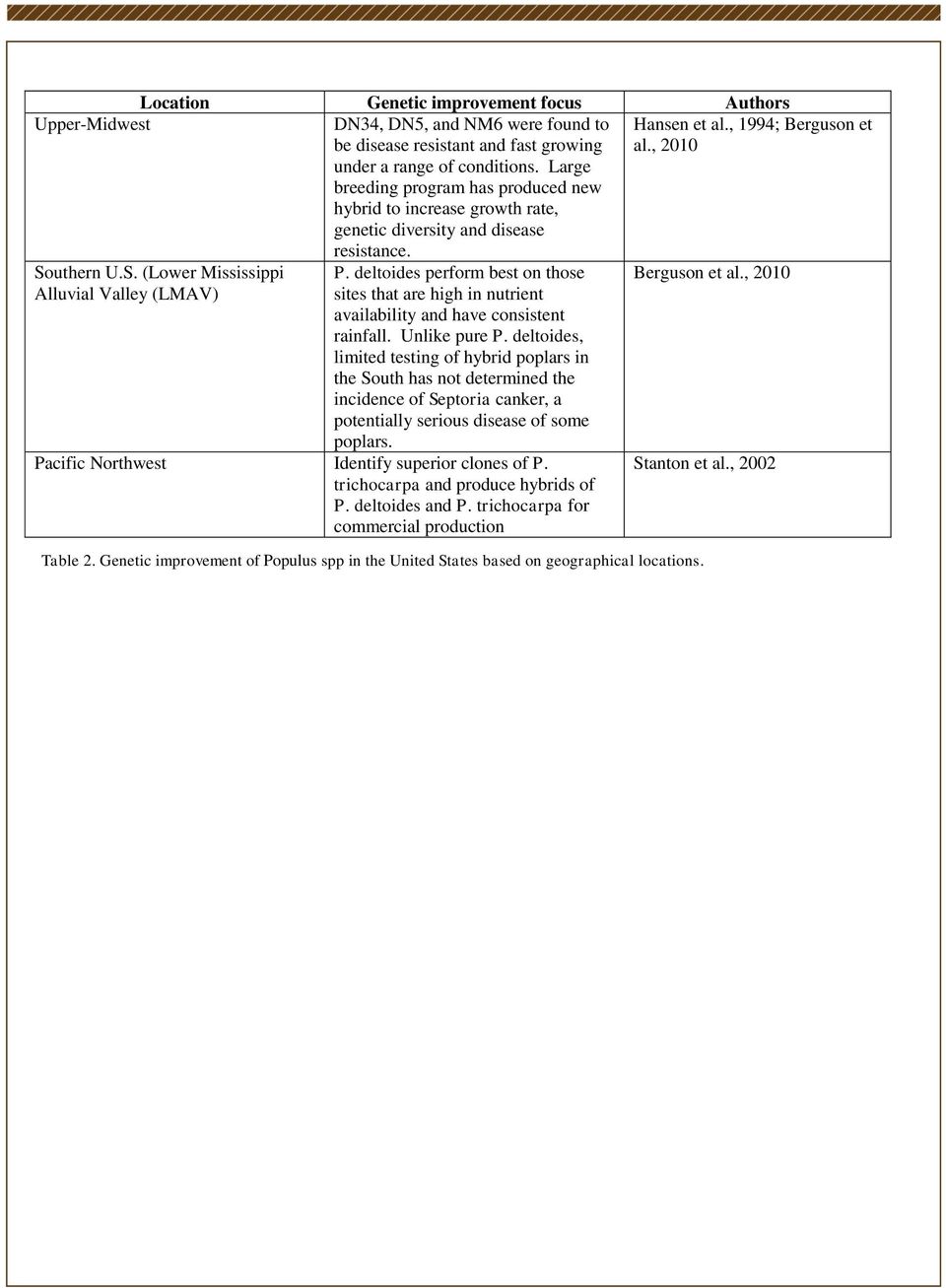
3 BREEDING AND GENETIC IMPROVEMENTS Genetic variation among both pure-species collections and hybrids is very high in Populus, which presents opportunities to improve biomass yield and nutrient efficiency. There are many possible breeding strategies that can be applied to the development of a hybrid poplar woody biomass crop (Riemenschneider et al., 2001). Yet, all breeding strategies derive from the need for a commercial variety to possess several attributes simultaneously such as an adventitious root system, rapid growth, and resistance to pests (US DOE, 2011). Elsewhere, interspecific hybridization may be necessary. This need for an aggregate genotype possessing all required commercial attributes gives rise to the several breeding programs found throughout North America (Table 1) and elsewhere in the world. Commercial genotypes have most, if not all, of the important traits affecting production. However, the number of commercial genotypes in use today is relatively low, and diversification, as well as yield improvement, is a goal of breeding programs (Berguson et al., 2010; US DOE, 2011; Zalesny et al., 2011). In the US, genetic improvement research varies considerable across the country (Table 2). BIOMASS PRODUCTION Biomass production is one of the criteria of assessing feasibility of Populus clones for bioenergy and bioproducts application. The sprouting ability of these species is also necessary to understand yield potential. It is currently understood that over 20,000 stems ha -1 of Populus can resprout after first-year thinnings from a combination of stump and root sprouts depending on the species. Populus species have great potential for biomass production. Certain genotypes of the Eastern cottonwood (P. deltoides) and its hybrids, for example, are capable of producing yields ranging from 9-20 Mg ha -1 yr -1 in the US (Wright, 2006; Berguson et al., 2010; Zalesny et al., 2011, Zamora et al., 2013) and other parts of the world (Table 3) with a wide range of environmental conditions suitable for their production, which differs based on climate, soil properties, and cultural practices.

4 Company Location Region of concentration Boardman, Oregon, USA Greenwood Resource Institute Alberta-Pacific Forest Products ArborGen University of Minnesota. Duluth -Natural Resources Research Institute Alberta, Canada USA, New Zealand, Australia and Brazil Area Table 1. Currently active Populus spp. breeding programs in North America. Focus USA 9,300 ha - Operating on a 15-year rotation with the output going into the saw log market. - Signed an agreement with ZeaChem, a cellulosic ethanol company, to supply them with feedstock from their hybrid poplar farm. Canada 8,000 ha - Growing hybrid poplar trees to feed pulp mills in Alberta, Canada and nearby regions. - Ensuring fiber supply availability in response to the deforestation activities in Alberta caused by Tar Sand development. Worldwide - Largest global supplier of seedling products and a leading provider of improved technologies to the commercial forest industry - Developing high value products through conventional breeding and genetic improvement. - Working to improve the sustainability of working forests while helping to meet the world s growing need for wood, fiber and energy. USA USA - Working to increase yield and genetic diversity of poplar for use as an energy crop - Collecting data from clonal trials, yield tests, spacing trials, and large-scale genetics tests with some locations containing over 900 genotypes.

5 Location Genetic improvement focus Authors Upper-Midwest DN34, DN5, and NM6 were found to be disease resistant and fast growing under a range of conditions. Large breeding program has produced new hybrid to increase growth rate, genetic diversity and disease resistance. Southern U.S. (Lower Mississippi Alluvial Valley (LMAV) P. deltoides perform best on those sites that are high in nutrient availability and have consistent rainfall. Unlike pure P. deltoides, limited testing of hybrid poplars in the South has not determined the incidence of Septoria canker, a potentially serious disease of some poplars. Pacific Northwest Identify superior clones of P. trichocarpa and produce hybrids of P. deltoides and P. trichocarpa for commercial production Table 2. Genetic improvement of Populus spp in the United States based on geographical locations. Hansen et al., 1994; Berguson et al., 2010 Berguson et al., 2010 Stanton et al., 2002
6 Table 3. Biomass yield of Populus spp. across the globe. Country Varieties Rotation Biomass (Mg ha-1) Ghent, Belgium Populus trichocarpa x deltoides-hoogvorst annual 3.5 Reference Vande Walle et al., 2007 Nanjing, China P. deltoides Bartr. cv. `Lux', P. euramericana (Dode) Guinier cv. `San Martino', P. deltoides Bartr. cv. `Havard' annual 10.3 Fang et al., 1999 Jiangsu Province, China P. deltoides cv. 35 annual Fang et al., 1999 Bihar, India P. deltoides G3 intercropping system annual 12.1 Das and Chaturvedi, 2005 Sweden P. balsamifera L., P. maximowiczii x P. trichocarpa, P. trichocarpa x P. deltoides, P. trichocarpa 4 years Johansson and Karačić, 2011 Quebec, Canada 2 clones of P. maximowiczii x P. nigra (NM5 and NM6) 4 years 66.5 Labrecque and Teodorescu, 2005 Hungary P. trichocarpa x deltoides annual 16.3 Marosvölgyi et al., 1999 Scotland P. balsamifera var. Michauxii (Henry) x P. trichocarpa var. Hastata (Dode) Farwell annual 5.5 Proe et al., 1999 US Iowa years 16.8 US Wisconsin 80X years 8.5 US Minnesota D121 5 years 6.8 US-Iowa Eugenii 7 years 17.0 US-Iowa Eugenii 7 years 5.4 US-Iowa Cradon 10 years 30.0 Riemenschneider et al., 2001 Riemenschneider et al., 2001 Riemenschneider et al., 2001 Goerndt and Mize, 2008 Tufekcioglu et al., 2003 Goerndt and Mize, 2008 NEED FOR INFORMATION? Contact Diomy Zamora at [email protected] or or Gary Wyatt at [email protected] or Regents of the University of Minnesota. All rights reserved. University of Minnesota Extension is an equal opportunity educator and employer. In accordance with the Americans with Disabilities Act, this publication/material is available in alternative formats upon request. Direct requests to or [email protected]. Printed on recycled and recyclable paper with at least 10 percent postconsumer waste material.

ENERGY. Sun Grant/Department of Energy- Office of Biomass Programs. Regional Biomass Feedstock Partnership Executive Summary March 2011
 Sun Grant/Department of Energy- Office of Biomass Programs Regional Biomass Feedstock Partnership Executive Summary March 2011 U.S. DEPARTMENT OF ENERGY The Regional Biomass Feedstock Partnership continued
Supply Chain Comparison. COEE Project 1
 Supply Chain Comparison COEE Project 1 Table of Contents Gaps in Research... 1 National Biofuels Plan... 1 Idaho National Laboratory... 1 Sandia National Laboratory... 2 Oak Ridge National Laboratory...
Woody Biomass Supply and Demand 1
 Woody Biomass Supply and Demand 1 Bryce Stokes, Ph.D. Senior Advisor Navarro Research & Engineering, Inc. Department of Energy, Golden Field Office Golden, CO Introduction Forest biomass is one of the
Emerging BioFuel Crops and Technology Kurt Thelen Michigan State University, East Lansing, Michigan ABSTRACT
 Emerging BioFuel Crops and Technology Kurt Thelen Michigan State University, East Lansing, Michigan ABSTRACT United States energy policy requires 36 billion gallons of ethanol by the year 2022, with 21
Mobilizing agricultural crop residues for energy and higher value bio-products
 Mobilizing agricultural crop residues for energy and higher value bio-products Niclas Scott Bentsen 1, Patrick Lamers 2, Charles Lalonde 3, Maria Wellisch 4, Virginia H. Dale 5, Ian Bonner 2, Jacob Jacobson
Culture in field conditions - Challenges A South American point of view Roberto Campos Pura Natura, Argentina
 A South American point of view Roberto Campos Pura Natura, Argentina EUSTAS 6 th Stevia Symposium Leuven, July 3 rd and 4 th I. Area of cultivation II. Environment III. Production of seedlings IV. Planting
THE PERFORMANCE OF EUCALYPTUS HYBRID CLONES AND LOCAL LANDRACES IN VARIOUS AGROECOLOGICAL ZONES IN KENYA
 THE PERFORMANCE OF EUCALYPTUS HYBRID CLONES AND LOCAL LANDRACES IN VARIOUS AGROECOLOGICAL ZONES IN KENYA By PHANUEL OBALLA EBBY CHAGALA-ODERA LYDIA WAMALWA VINCENT OEBA ESTON MUTITU LINUS MWANGI MARCH
Liquid Biofuels for Transport
 page 1/11 Scientific Facts on Liquid Biofuels for Transport Prospects, risks and opportunities Source document: FAO (2008) Summary & Details: GreenFacts Context - Serious questions are being raised about
Report from Life Coastal Woodlands. Forest management methods in the coastal woodlands
 Report from Life Coastal Woodlands Forest management methods in the coastal woodlands Ida Wigrup, Swedish Forest Agency 2007 Content 1 Introduction 3 2 Regeneration cutting with nature conservation consideration
BCAP Project Area 10: New York Willow. Mike Buckley ReEnergy Holdings. Tim Volk Justin Heavey SUNY-ESF
 BCAP Project Area 10: New York Willow Mike Buckley ReEnergy Holdings Tim Volk Justin Heavey SUNY-ESF Fast Facts: ReEnergy Holdings ~300 MWs of renewable energy generation ~ 300 employees; 5 states Renewable
Energy Offices Meeting
 NASEO 2014 Mid Atlantic Regional State 25x 25: Progressing Towards the Goal Ernie Shea Project Coordinator May 1, 2014 Valley Forge, PA Energy Offices Meeting 25x 25: A National Alliance Formed through
Efficient forest biomass supply chain for biorefineries A project for cross border cooperation
 Forest Refine Efficient forest biomass supply chain for biorefineries A project for cross border cooperation HighBio 2 Seminar Luleå 16 Jan Magnus Matisons BioFuel Region Project Manager Forest Refine
UPM Grow with Biofore. Vesiyhdistyksen Jätevesijaoston seminaari Esa Laurinsilta 25.11.2015
 UPM Grow with Biofore Vesiyhdistyksen Jätevesijaoston seminaari Esa Laurinsilta 25.11.2015 A new concept to describe a new direction THE FOREST OF NEW OPPORTUNITIES The world is changing Resource scarcity
AGRICULTURE FOR FOOD AND FOR BIOENEGY: IS IT POSSIBLE?
 GLOBAL SUSTAINABLE BIOENERGY PROJECT AGRICULTURE FOR FOOD AND FOR BIOENEGY: IS IT POSSIBLE? Dr. Rodolfo Quintero-Ramírez March 24 th, 2010 Sao Paulo, Brazil ? FOOD ANIMAL FEED AGRICULTURE BIOENERGY BIOPRODUCTS
What are biofuels? Pocket K No. 24. Biotechnology for Green Energy: Biofuels
 Pocket K No. 24 Biotechnology for Green Energy: Biofuels What are biofuels? Biofuels are alternative fuels made from plant and plant-derived resources. Biofuels are used mainly for transportation. There
Division of Forestry
 Guidelines for Managing Sites with Ash To Address the Threat of Emerald Ash Borer On Forestry-Administered Lands BACKGROUND The ash genus (Fraxinus) in Minnesota comprises some 900 million trees and is
The Feedstock Supply Chain and Centers of Energy Excellence Update
 The Feedstock Supply Chain and Centers of Energy Excellence Update Donna LaCourt, Ph.D. Sustainable Forestry Conference 4/16/2009 Key Issues Michigan is the 8th most energy intensive state Expend almost
Eric Zeldin 1, Jason Fishbach 2, Michael Demchik 3
 The Application of Clonal Propagation to the Genetic Improvement of the American Hazelnut A Holistic Approach Presented at the 4th Annual Hazelnut Growers Conference, March 2nd, 2013, Eau Claire, WI Eric
Moringa Oleifera a Multipurpose Tree:
 Moringa Oleifera a Multipurpose Tree: 1.0 Introduction: Amandla Resources 1.1 Moringa Oleifera belongs to the onogeneric family of shrubs and trees and originated south of the Himalayas in Northern India.
Growing Giant Miscanthus in Illinois
 Growing Giant Miscanthus in Illinois Rich Pyter 1, Tom Voigt 2, Emily Heaton 3, Frank Dohleman 4, and Steve Long 5 University of Illinois Images Courtesy of Frank Dohleman Highlights Giant Miscanthus (Miscanthus
DOE Office of Biological & Environmental Research: Biofuels Strategic Plan
 DOE Office of Biological & Environmental Research: Biofuels Strategic Plan I. Current Situation The vast majority of liquid transportation fuel used in the United States is derived from fossil fuels. In
CURLY BIRCH (Betula pendula var. carelica) AND ITS MANAGEMENT IN FINLAND
 CURLY BIRCH (Betula pendula var. carelica) AND ITS MANAGEMENT IN FINLAND Risto Hagqvist Finnish Forest Research Institute Haapastensyrjä Tree Breeding Station Karkkilantie 247, FIN-12600 Läyliäinen e-mail:
Ranger Report About Deforestation of the Rainforest
 Ranger Report About Deforestation of the Rainforest About deforestation Forests are cut down for many reasons, but most of them are related to money or to people s need to provide for their families. The
FORESTED VEGETATION. forests by restoring forests at lower. Prevent invasive plants from establishing after disturbances
 FORESTED VEGETATION Type of strategy Protect General cold adaptation upland and approach subalpine forests by restoring forests at lower Specific adaptation action Thin dry forests to densities low enough
How To Improve Energy Efficiency In The Paper Industry
 Presentation 3.1: Report on energy efficient technologies and CO 2 reduction potentials in the pulp and paper industry Thore S. Berntsson Professor Chalmers University of Technology, Gothenburg, Sweden
The Food-Energy-Water Nexus in Agronomy, Crop and Soil Sciences
 The Food-Energy-Water Nexus in Agronomy, Crop and Soil Sciences February 4, 2016 In the fall of 2015 the Agronomy, Crop Science and Soil Science societies put out a call for white papers to help inform
THE SCIENCE THE FUTURE OF CANADIAN CANOLA: APPLY THE SCIENCE OF AGRONOMICS TO MAXIMIZE GENETIC POTENTIAL.
 THE SCIENCE THE FUTURE OF CANADIAN CANOLA: APPLY THE SCIENCE OF AGRONOMICS TO MAXIMIZE GENETIC POTENTIAL. WHERE WE HAVE BEEN CANOLA PRODUCTION HAS SURPASSED THE INDUSTRY TARGET OF 15 MMT. This was achieved
Crop rotation and legumes cultivation: Effective measures to increase the environmental performance and long-term viability of European agriculture.
 Crop rotation and legumes cultivation: Effective measures to increase the environmental performance and long-term viability of European agriculture. Christine Watson (SAC), Donal Murphy-Bokern (DMB), Fred
4.0 Discuss some effects of disturbances on the forest.
 4.0 Discuss some effects of disturbances on the forest. 4.1 Describe common disturbances that occur in the Boreal forest. Disturbances are normal to the life of the forest. Forests are very resilient (able
FACT SHEET. Production Risk
 ALABAMA AGRICULTURAL & MECHANICAL UNIVERSITY SMALL FARMERS RESEARCH CENTER FACT SHEET Production Risk Any production related activity or event that is uncertain is a production risk. Agricultural production
By Gerald Urquhart, Walter Chomentowski, David Skole, and Chris Barber http://earthobservatory.nasa.gov/library/deforestation/
 By Gerald Urquhart, Walter Chomentowski, David Skole, and Chris Barber http://earthobservatory.nasa.gov/library/deforestation/ The clearing of tropical forests across the Earth has been occurring on a
Available study programs at Czech University of Life Sciences Prague
 EU subject code University subject Name of course/program Mobility Language Homepage 1,1 1,1 Environmental Engineering in Agriculture II Rural Communication and Extension 1,1 Tropical Forestry and Agroforestry
Research Roadmap for the Future. National Grape and Wine Initiative March 2013
 Research Roadmap for the Future National Grape and Wine Initiative March 2013 Objective of Today s Meeting Our mission drives the roadmap Our Mission Drive research to maximize productivity, sustainability
Biorefinery 101: Maximizing Benefits and Minimizing Risks Associated with Implementing the Forest Biorefinery
 Biorefinery 101: Maximizing Benefits and Minimizing Risks Associated with Implementing the Forest Biorefinery Virginie Chambost and Paul Stuart NSERC Environmental Design Engineering Chair Department of
Twelve years of short rotation forest studies in Estonia
 Twelve years of short rotation forest studies in Estonia Andres Koppel, Katrin Heinsoo, Estonian Agricultural University Enköping, Sweden 26 May 2005 1 Overview The environment for SRF in Estonia 1.1.
DO WE VALUE RESEARCH & DEVELOPMENT?
 IFA Plantation Productivity Symposium 12-14 May 2014 Mt Gambier DO WE VALUE RESEARCH & DEVELOPMENT? Rudolf van Rensburg, Director Pöyry Management Consulting THE PÖYRY GROUP - GLOBAL EXPERTISE AND ASIAN
The renewable materials company
 The renewable materials company We are the experts in forest-based renewable materials. influence the way people consume now and in the future. Rightly managed, these trends provide Stora Enso with extensive
Are My. Pine Trees. Ready To Thin?
 Are My Pine Trees Ready To Thin? ARE MY PINE TREES READY TO THIN? One question private forest landowners ask most frequently is, Are my pine trees ready to thin? There is no definite answer to this question,
Bengt Brunberg Manager Sustainability, BillerudKorsnäs Gävle, Sweden
 SUSTAINABILITY AND ENERGY SAVINGS Sustainable Supply of Wood Raw Material for Pulp Bengt Brunberg Manager Sustainability, BillerudKorsnäs Gävle, Sweden Bengt Brunberg experience is based on 15 years in
Assessment of cork production in new Quercus suber plantations under future climate. Joana A Paulo Margarida Tomé João HN Palma
 Assessment of cork production in new Quercus suber plantations under future climate Joana A Paulo Margarida Tomé João HN Palma 22 May 2012 1 Introduction Climate is related to several variables that affect
FEED 2011. The International Forum on Strategic Studies for Agriculture and Livestock Development and Respect for the Climate. Deborah La Franchi
 FEED 2011 The International Forum on Strategic Studies for Agriculture and Livestock Development and Respect for the Climate Deborah La Franchi CEO & President, Strategic Development Solutions Financing
Ecologically based weed management! Chuck Mohler! Cornell University!
 Ecologically based weed management! Chuck Mohler! Cornell University! Outline! Understanding weeds! Behavior of wandering perennials! Tillage and emergence cues! Life and death of weed seeds in the soil!
Establishing ecologically sustainable forest biomass supply chains: A case study in the boreal forest of Canada
 Establishing ecologically sustainable forest biomass supply chains: A case study in the boreal forest of Canada Evelyne Thiffault Canadian Forest Service David Paré Canadian Forest Service Sylvain Volpé
System of Rice Intensification (SRI)
 System of Rice Intensification (SRI) Ramasamy Selvaraju Climate, Energy and Tenure Division (NRC), FAO Fifth annual Investment Days, Rome, Italy; 17 December 2013 Contents What is SRI? Main concepts of
Introduction to Integrated Pest Management. John C. Wise, Ph.D. Michigan State University MSU Trevor Nichols Research Complex
 Introduction to Integrated Pest Management John C. Wise, Ph.D. Michigan State University MSU Trevor Nichols Research Complex What is Integrated Pest Management? Integrated Pest Management (IPM) New concept;
Country Report, SWEDEN
 Country Report, SWEDEN Bo Hektor 1 & Erik Ling 2 1. Talloil AB, Klarabergsviadukten 70, D7, SE 111 64 Stockholm, Sweden, +46 70 6570043, [email protected] 2. Sveaskog AB, 105 22 Stockholm, Sweden, +46
Determining the Use of Technology in World Food and Fiber Production
 Lesson A8 1 Determining the Use of Technology in World Food and Fiber Production Unit A. Mechanical Systems and Technology Problem Area 8. Technology Systems Lesson 1. Determining the Use of Technology
Assignment 8: Comparison of gasification, pyrolysis and combustion
 AALTO UNIVERSITY SCHOOL OF CHEMICAL TECHNOLOGY KE-40.4120 Introduction to biorefineries and biofuels Assignment 8: Comparison of gasification, pyrolysis and combustion Aino Siirala 309141 Assignment submitted
DELIVERING THE BIOENERGY TRIPLE BOTTOM LINE TO THE GLOBAL COMMUNITY
 DELIVERING THE BIOENERGY TRIPLE BOTTOM LINE TO THE GLOBAL COMMUNITY Ralph E. H. Sims 2 and Keith Richards 1 1 Thames Valley Energy Ltd., Newbury, England. 2 Centre for Energy Research, Massey University,
Environmental Monitoring and Modeling of the Genetic Potential of Sugarcane Cultivars under Appropriate Water Availability in the Soil
 Environmental Monitoring and Modeling of the Genetic Potential of Sugarcane Cultivars under Appropriate Water Availability in the Soil Eduardo Machado, Glauco Rolim, Leonardo B. Oliveira, Marcos Landell,
King Fire Restoration Project, Eldorado National Forest, Placer and El Dorado Counties, Notice of intent to prepare an environmental impact statement.
 This document is scheduled to be published in the Federal Register on 12/24/2014 and available online at http://federalregister.gov/a/2014-30158, and on FDsys.gov [3410-11- P] DEPARTMENT OF AGRICULTURE
Speaker Summary Note
 2020 CONFERENCE MAY 2014 Session: Speaker: Speaker Summary Note Building Resilience by Innovating and Investing in Agricultural Systems Mark Rosegrant Director, Environment and Production Technology Division
Data Mining and Meta-analysis as Tools to Evaluate the Impact of Management Practices on Dynamic Soil Properties
 Data Mining and Meta-analysis as Tools to Evaluate the Impact of Management Practices on Dynamic Soil Properties Carmen Ugarte, Michelle M. Wander University of Illinois at Urbana-Champaign National Cooperative
Enhancing Biodiversity. Proactive management of biodiversity in intensive agriculture
 Enhancing Biodiversity Proactive management of biodiversity in intensive agriculture Contents Introduction Increasing food security in a sustainable way 3 The importance of biodiversity The vitality and
Managing Black Walnut
 Managing Black Walnut Mel Baughman Professor Emeritus University of Minnesota Lenny Farlee Extension Forester Purdue University Why Grow Black Walnut? Wood Products Rich, brown color Novelty items Lumber
Bioenergy. A sustainable energy source.
 Bioenergy. A sustainable energy source. The natural energy cycle Skellefteå Kraft strongly believes that bioenergy will play an important role in future Swedish energy production. Its raw material consists
CORN IS GROWN ON MORE ACRES OF IOWA LAND THAN ANY OTHER CROP.
 CORN IS GROWN ON MORE ACRES OF IOWA LAND THAN ANY OTHER CROP. Planted acreage reached a high in 1981 with 14.4 million acres planted for all purposes and has hovered near 12.5 million acres since the early
UPM THE BIOFORE COMPANY
 UPM THE BIOFORE COMPANY The Future from the Industry Point of View Jan-Erik Teirfolk Joensuu Forestry Networking Week 2011 UPM today 22,000 employees Sales 8.9 billion euros in 2010 - Production in 15
Introduction to Plant Propagation. Glenn T. Sako Assistant County Extension Agent CTAHR, UHM
 Introduction to Plant Propagation Glenn T. Sako Assistant County Extension Agent CTAHR, UHM Purposes for Plant Propagation Multiply the number of a species Perpetuate a species Maintain the youthfulness
The Future. Trees. climate change and the timber industry ROGER SEDJO
 The Future of Trees climate change and the timber industry ROGER SEDJO N Not all the news on global climate change is gloomy. Global production of industrial timber should increase, even in the face of
1 SEEDLING QUALITY. Seedling quality
 Seedling quality Quality versus quantity A nursery manager s most important goal is to produce quality trees. Quality is more important than quantity. It is a common mistake in nurseries to concentrate
Forest carbon sequestration and climate change. Dr Brian Tobin University College Dublin
 Forest carbon sequestration and climate change Dr Brian Tobin University College Dublin Overview Sequestration what is it & why important? Role of forests in climate change CARBiFOR research project Forest
FOREST RESTORATION MONITORING TOOL
 FOREST RESTORATION MONITORING TOOL Draft version for field test INTRODUCTION FAO upon recommendation of its members identified the need to initiate a comprehensive analysis, evaluation and documentation
Life Cycle Of A Plant Population
 Life Cycle Of A Plant Population Seed Rain n=3 Growth And Mortality n=7 Seedling Cohort n=22 Environmental Sieve Seed Bank n=5 Copyright G. Bonan 22 Suvivorship Of Seedlings In A Northern Hardwood Forest
BIOMASS SUPPLY CHAIN MANAGEMENT AND CONTROLLING
 BIOMASS SUPPLY CHAIN MANAGEMENT AND CONTROLLING FOCUS AND CONTENT The focus of the presentation is on forest biomass in Central Finland Content Entities of the forest biomass demand and supply chain Forest
GMO. Investor Perspectives: Criteria and Issues in Supporting Indigenous Forestry Projects. June 4, 2002 Vancouver B.C. Renewable Resources LLC
 GMO Boston London San Francisco Sydney Investor Perspectives: Criteria and Issues in Supporting Indigenous Forestry Projects June 4, 2002 Vancouver B.C. Renewable Resources LLC Renewable Resources LLC
Australian Pine Log Price Index
 Australian Pine Log Price Index Updated to June 28 : ADVISORY This page has been intentionally left blank. Advisory This report contains 39 pages HVP8 Jan - Jun (Public Version) 26 KPMG, an Australian
SDE+ sustainability requirements for solid biomass
 SDE+ sustainability requirements for solid biomass >> Sustainable. Agricultural. Innovative. International. 2 The sustainability requirements for the categories Existing capacity for co-gasification and
Optimization of Biomass Harvesting and Supply Chain Logistics
 Optimization of Biomass Harvesting and Supply Chain Logistics Dr. Matt Darr Agricultural and June 14, 2012 for Lignocellulosic Biofuels Workshop Iowa State Biomass Feedstock Research partner for corn stover
Torrefied Bamboo: an alternative for sustainable biomass export
 Torrefied Bamboo: an alternative for sustainable biomass export C.M. Daza Montano March 2014 ECN-L--14-014 Torrefied Bamboo: an alternative for sustainable biomass export Claudia Daza Montaño Sustainable
Forward. Contents. Bioenergy Development Plan
 Forward Energy supply security and reduction of greenhouse gas emission are important issues in the ASEAN region where bioenergy is realized as one of the highest potential renewable energies. Thailand
THE CHRISTMAS TREE INDUSTRY IN THE U.S.A. A STATUS REPORT M. L. McCormack, Jr. and Wolfgang Mieder
 THE CHRISTMAS TREE INDUSTRY IN THE U.S.A. A STATUS REPORT M. L. McCormack, Jr. and Wolfgang Mieder There is a wide variation in the volume of Christmas trees produced by individual growers across north
Bioenergy from agroforestry can lead to improved food security, climate change, soil quality and rural development
 Bioenergy from agroforestry can lead to improved food security, climate change, soil quality and rural development Navin Sharma World Agroforestry Centre Mobilizing Sustainable Bioenergy Supply Chains
FREQUENTLY ASKED QUESTIONS Biomass Harvest Guidelines
 FREQUENTLY ASKED QUESTIONS Biomass Harvest Guidelines What do Biomass Harvest Guidelines offer? They offer recommendations to manage forest-, brush- and open- land with the intent to protect water, timber,
Biomass availability and supply for co-firing projects in Alberta. Dominik Roser, Ph.D.
 Biomass availability and supply for co-firing projects in Alberta Dominik Roser, Ph.D. About FPInnovations A private non-profit Canadian corporation Supports competitiveness of the Canadian forest sector
GLOBAL WOOD AND WOOD PRODUCTS FLOW
 ITEM 5 GLOBAL WOOD AND WOOD PRODUCTS FLOW TRENDS AND PERSPECTIVES Table of Contents GLOBAL WOOD AND WOOD PRODUCTS FLOW - TRENDS AND PERSPECTIVES... 1 SUMMARY... 2 INTRODUCTION... 3 INTERNATIONAL TRADE...
Agroforestry and climate change. Emmanuel Torquebiau FAO webinar 5 February 2013
 Agroforestry and climate change Emmanuel Torquebiau FAO webinar 5 February 2013 Agroforestry: well-known buffering and resilience effects Climate variability is well buffered by agroforestry because of
THE PRACTICAL, PROVEN PATH TO GREEN ENERGY. RTP rapid thermal processing from Envergent Technologies
 THE PRACTICAL, PROVEN PATH TO GREEN ENERGY. RTP rapid thermal processing from Envergent Technologies RTP CONVERTS BIOMASS TO PYROLYSIS OIL FAST. Less than two seconds. That s all the time it takes to convert
Creating Green Jobs within the Environment and Culture sector.
 Creating Green Jobs within the Environment and Culture sector. Matilda Skosana Environmental Programmes (ILO Definition): 1. DEFINITION OF GREEN JOB. Jobs are green when they help reduce negative environmental
Building a Sustainable Biofuels Business: an Overview of the Market and BP Biofuels
 Building a Sustainable Biofuels Business: an Overview of the Market and BP Biofuels BP Biofuels a growing alternative Presentation title second line if required Kristen Kurczak, BP Biofuels Johannesburg,
-1 7.04 Propagules adapted to wind dispersal n. -1 7.05 Propagules water dispersed n
 Australia/New Zealand Weed Risk Assessment adapted for Florida. Data used for analysis published in: Gordon, D.R., D.A. Onderdonk, A.M. Fox, R.K. Stocker, and C. Gantz. 2008. Predicting Invasive Plants
2 CHAPTER 1 Introduction
 Introduction 1 Tropical tree seed handling continuously develops. Scientific research and less advanced, yet persistent practical progress bring about new knowledge and experience on tropical species.
DSM Position on Sustainable Biomass
 Corporate Public Affairs Het Overloon 1, 6411 TE Heerlen, the Netherlands www.dsm.com April 2012 DSM Position on Sustainable Biomass Key messages DSM is a leading Life Sciences and Materials Sciences company
Direct sowing versus planting
 Direct sowing versus planting Experience with tropical afforestation and land rehabilitation, pros. and cons. Danish and Swedish field trials. Results until now. Why are trees usually planted and not sown?
III. THE MICROBIAL BIOMASS
 III. THE MICROBIAL BIOMASS Required Readings: Ley, R.E., D.A. Lipson and S.K. Schmidt. 2001. Microbial biomass levels in barren and vegetated high altitude talus soils. Soil Sci. Soc. Am. J. 65:111 117.