
User s Guide DR130, DR230, DR240 SERIES. Conversion Software. [email protected]
|
|
|
- Donald Turner
- 9 years ago
- Views:
Transcription
1 User s Guide [email protected] DR130, DR230, DR240 SERIES Conversion Software
2 OMEGAnet On-Line Service h t t p :// w w w.omega.com Internet i n f o m e g a. c o m Servicing North America: USA: One Omega Drive, Box 4047 ISO 9001 Certified Stamford, CT Tel: (203) FAX: (203) [email protected] Canada: 976 Bergar Laval (Quebec) H7L 5A1 Tel: (514) FAX: (514) [email protected] For immediate technical or application assistance: USA and Canada: Sales Service: / TC-OMEGA SM Customer Service: / BEST SM Engineering Service: / USA-WHEN SM TELEX: EASYLINK: CABLE: OMEGA Mexico and Latin America: Tel: (001) FAX: (001) En Español: (001) [email protected] Benelux: Czech Republic: France: Germany/Austria: United Kingdom: ISO 9002 Certified Servicing Europe: Postbus 8034, 1180 LA Amstelveen, The Netherlands Tel: (31) FAX: (31) Toll Free in Benelux: [email protected] ul. Rude armady 1868, Karvina-Hranice Tel: 420 (69) FAX: 420 (69) Toll Free: [email protected] 9, rue Denis Papin, Trappes Tel: (33) FAX: (33) Toll Free in France: [email protected] Daimlerstrasse 26, D Deckenpfronn, Germany Tel: 49 (07056) 3017 FAX: 49 (07056) 8540 Toll Free in Germany: [email protected] One Omega Drive, River Bend Technology Centre Northbank, Irlam, Manchester M44 5EX, United Kingdom Tel: +44 (0) FAX: +44 (0) Toll Free in United Kingdom: [email protected] It is the policy of OMEGA to comply with all worldwide safety and EMC/EMI regulations that apply. OMEGA is constantly pursuing certification of its products to the European New Approach Directives. OMEGA will add the CE mark to every appropriate device upon certification. The information contained in this document is believed to be correct, but OMEGA Engineering, Inc. accepts no liability for any errors it contains, and reserves the right to alter specifications without notice. WARNING: These products are not designed for use in, and should not be used for, patient-connected applications.

3 Chapter 1 Before Operation 1.1 Data Acquisition Software Omega Intro Data Acquisition Software consists of so called Launcher software and four kinds of software which will open when the launcher icons are clicked. Those icons will automatically be displayed when you open the Launcher software. The four kinds of software are: 1 Software Configurator 2 Hardware Configurator 3 Logger 4 Historical Viewer 1 Before Operation Launcher software Launcher software serves to open the above four kinds of software. When you install Omega Part #, the Launcher software and (4) Historical Viewer software will automatically be saved in the Windows Program file. 1 Software Configurator Enables you to make operation settings to the software. There are four setting displays. Communications Used to select a directory to save logging data to, and to make several communication settings between DR hardware and software. Diagnostic Used to make the necessary system configurations when using your DR for the first time. Calibration Used to calibrate DR. 2 Hardware Configurator Enables you to make settings to the DR. The hardware setting data can be saved to a PC. Three kinds of data can serve as basis for further settings: Data earlier saved to a PC harddisk or to a floppydisk from the DR. Data settings as they remained when Hardware Configurator was last closed. Data settings of a directly PC-connected DR. 1-1
4 1.1 Data Acquisition Software Intro 3 Logger Enables you to display DR measurement and calculated Math data on your PC s monitor, and save data to its harddisk or another external memory storage. Allows you to set the interval for saving data, and for display renewal. Saving measurement data can be selected to start either, immediately, or, at a fixed time. Saving measurement data can be selected to end either, immediately, or, at a fixed time, or, after a fixed data number has been reached. It is possible to make daily report files. On your PC you can display the following monitors: Trend monitor Displays both measurement and computed waveforms. Useful for trend observation. Numeric monitor Displays numeric values of both measurement and computed waveforms. Useful when reading a large number of values at the same time. Monitor settings can be connected by clicking the Link button. 4 Historical Viewer Using Historical Viewer you can use the following 3 kinds of data to monitor waveforms, numerical values, etc. on a PC screen, or to print them out. Data saved to an external memory storage using Logger software. Data files from earlier obtained software for instruments (DOS or Windows). Data files saved directly to a floppy disk from a DR. It is possible to use a cursor to read the values of data on display. Data can be converted to ASCII, Lotus or Excel formats, and then saved. 1-2

5 1.2 Required PC Environment 1 Hardware Personal computer A PC with Windows 95/98, or Windows NT 4.0. CPU: Pentium 133MHz (Pentium II 200 MHz recommended). Internal Memory More than 32 MB. For speedy operation, we recommend a Pentium II processor, with 64 to 96 MB internal memory. Harddisk More than 100 MB available memory. Disk Drive 3.5 Floppy disk drive, 1.44 MB. Printer, printer driver Supporting Windows 95/98, or Windows NT 4.0. Display For Windows 95/98, Windows NT 4.0. At least 800x600, with 32 colors. 1024x768, with a color display is recommended. Mouse Supporting Windows 95/98, Windows NT 4.0. Communication board GP-IB: GP-IB interface board (National Instruments; AT-GPIB/TNT, PCI-GPIB, GPIB-98 Turbo). RS-232-C: Compatible only with a built-in COM port. Before Operation Operating System Windows 95/98, or Windows NT
6 1.3 Setting up Set up Data Acquisition software as follows: 1 Start Windows 95/98, or Windows NT Put the (backup) floppy disk delivered with software in your disk drive. 3 Double-click 3.5 inch FD in My Computer to open the 3.5 inch FD Dialog box. 4 Double-click the setup.exe file, and wait for the software to set up. Next, follow the instructions on your screen. Note Before installing, it is recommended to deactivate virus busters. When installed, the Launcher and Viewer Software will appear in the Start menu. Only reinstall after uninstalling the software in the below fashion. Uninstalling: 1 Open Start menu > Settings > Control Panel > Add/Remove Programs. 2 Please make a backup in a separate directory of the following important files: All files of the data directories All files with extensions.ast,.rst,.cst,.pnl,.set,.txt, for every project. 3 Remove files created after DAQ was installed (left-over data files or subdirectories) using explorer. Don t set time zones using the Windows system autoexec.bat. Please select Start menu > Settings > Control Panel > Date/Time, and use the Date/Time properties setting screen. (Place the REM command before commands like TZ=GMTO for autoexec.bat.) In the Windows Date/Time Properties Time Zone setting screen, check automatically adjust clock for daylight saving changes, as the default setting is OFF. If this setting is not active, errors may appear in Hardware Configurator Summer Winter time settings. 1-4
7 1.4 Opening and Closing each Software 1 Opening the Software 1 Select from the Start Menu, Program > Software > Launcher. When the Launcher software is activated, the below Launcher buttons will appear in the top of your screen. From left to right you will find the Menu button, Logger button, Historical Viewer button, Hardware Configurator button, and Software Configurator button. Before Operation 2 Open the desired software by clicking its Launcher button. You can also select the software after right-clicking the Omega icon on the task bar (see below). Note First exit the non-matching software to activate the launcher icons for other software. Historical Viewer and Launcher software can be opened using the Start menu. (Select from the Start > Program > Viewer.) Logger, Historical Viewer, and Hardware Configurator software can be opened simultaneously. Historical Viewer and Tag Editor software can be opened simultaneously as well. Other software combinations can t be activated at the same time. First exit the non-matching software to activate the launcher icons for other software When using a DR for the first time, make sure to configure the devices with the actual device. After this initial configuration you can use software, to make configurations. Closing the Software To close one of the five software programs, click the close button, or select File > Exit. To close the Launcher, first make sure all software programs are closed. Then, click the Menu button and select Exit, or click the icon on the task bar, and select Exit. Closing the Launcher will also close the software. 1-5

8 Chapter 2 Communication Software 2.1 Launcher Software 2 Launcher Software enables you to launch each software, use the Project Function, and to protect software settings. Launching each software Select from the Start menu, Programs > DWMain. Software start buttons (see below) will be displayed automatically when Launcher software is opened. The four kinds of software are Software Configurator, Hardware Configurator, Logger, Historical Viewer, and Tag Editor. Communications Software Project function A Project is a saved group of software settings with changed conditions. Using the Project Function it is possible to open software which settings were changed earlier. In order to do this you must have saved the setting conditions you created earlier as a Project. The Project Function is useful if you want to observe DR measurement data on only one PC with a number of people. It enables one user to observe waveforms without influencing other people s settings. Note that you can only open a Project after you have closed other software. Protection settings Enables you to protect settings from getting erased. After a password is entered (in the Project Settings dialogbox), the toolbar will become pink to mark that protection is active. About... To check software Name and Version, click About... on the menubar. 2-1

9 2.2 Version Information Launcher version information To get version information for Launcher software click the Menu icon and select About..., or by double-click the Launcher icon on the taskbar and select About.... Version information for each software To get version information for each software click the Help button, or select Help > About

10 Chapter 3 Software Configurator 3.1 Using Software Configurator Starting Software Configurator Click the Software Configurator button on the Launcher toolbar, or right-click the Launcher icon on the taskbar and select Software Configurator. Setting Screen The Software Configurator setting screen should be similar to below illustration. 3 Software Configurator Setting Order Before communicating with the DR, please take note of below difference in setting order. For communication with GP-IB/RS232-C 1 Make the Communication settings. 2 Reconstruct the System (Diagnostic > Reconstruct) 3 Make the Diagnostic settings. For calibration see Chapter
11 3.2 Communication Settings Use Software Configurator to set the communication method between PC and DR. 1 Startup and select Software Configurator with the Launcher toolbar. 2 Click the Communications tab to display the Communications setting screen. Select the desired communication method by clicking its setting frame, or click Communications and select the desired method. 3 Click in the setting windows to display the listbox from which you can choose a value. 4 RS-232-C If you use the setting windows for RS-232-C the setting depending positions of the dip switches on the module, will also be displayed. After switching power OFF on the connected device, make sure to match the dip switch positions on the modules with those on the setting screen. GP-IB After switching power on the connected device OFF, make sure for the GP-IB that the rotary switch on the module matches the address displayed on screen. Note Only change the dipswitch combination on the connected device, after power on the device is turned OFF. If settings don t match module settings a Communication error message will be displayed. 3-2

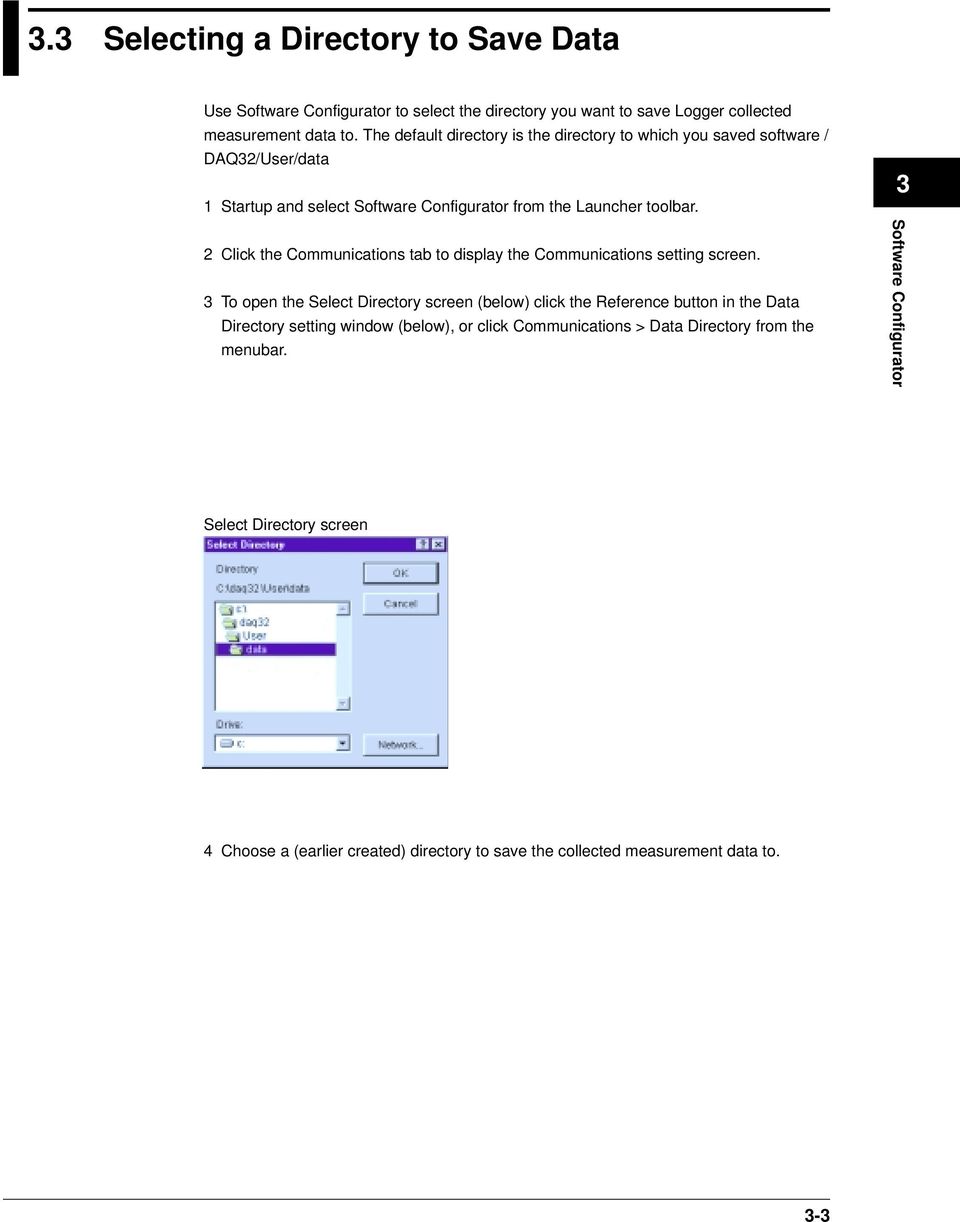
12 3.3 Selecting a Directory to Save Data Use Software Configurator to select the directory you want to save Logger collected measurement data to. The default directory is the directory to which you saved software / DAQ32/User/data 1 Startup and select Software Configurator from the Launcher toolbar. 3 2 Click the Communications tab to display the Communications setting screen. 3 To open the Select Directory screen (below) click the Reference button in the Data Directory setting window (below), or click Communications > Data Directory from the menubar. Software Configurator Select Directory screen 4 Choose a (earlier created) directory to save the collected measurement data to. 3-3
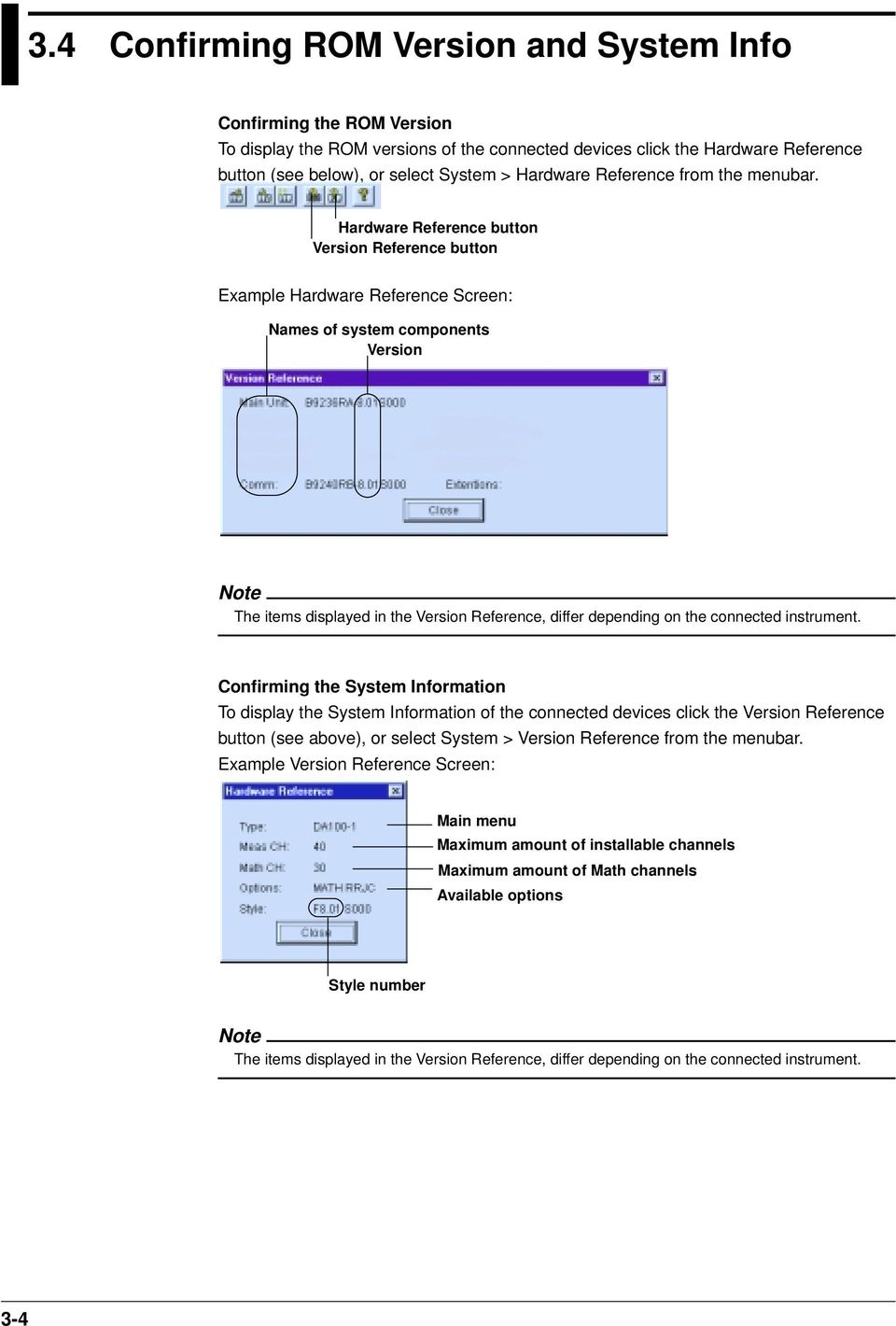
13 3.4 Confirming ROM Version and System Info Confirming the ROM Version To display the ROM versions of the connected devices click the Hardware Reference button (see below), or select System > Hardware Reference from the menubar. Hardware Reference button Version Reference button Example Hardware Reference Screen: Names of system components Version Note The items displayed in the Version Reference, differ depending on the connected instrument. Confirming the System Information To display the System Information of the connected devices click the Version Reference button (see above), or select System > Version Reference from the menubar. Example Version Reference Screen: Main menu Maximum amount of installable channels Maximum amount of Math channels Available options Style number Note The items displayed in the Version Reference, differ depending on the connected instrument. 3-4
14 Hardware Configurator Chapter 4 Hardware Configurator 4.1 Using Hardware Configurator Hardware Configurator enables you to make settings to the DR. Settings differ for each device. The hardware setting data can be saved to a PC. Starting Hardware Configurator Click the Hardware Configurator button on the Launcher toolbar, or right-click the Launcher icon on the taskbar and select Hardware Configurator. Setting Screen The Hardware Configurator setting screen should look like below illustration. 4 Displayed tabs and setting items, differ depending on the kind of connected device. Base Setting Data Three kinds of data can serve as basis for further settings: Data earlier saved to the PC harddisk or to a floppydisk from the DR. Setting conditions when Hardware Configurator closed last. Data settings of loaded from a DR connected to a PC. 4-1

15 4.1 Using Hardware Configurator Selecting Setting Screen Select a setting screen by selecting Settings > SET (Regular) Settings, or Settings > SETUP (Basic) Settings, followed by the desired setting item; or by clicking a contents tab. Below example of DR setting screen. DR System Configurations Changing any of the system configurations, will result in initialization of Hardware Configurator settings. Therefore, perform system configuration (Config. > System Configuration...) before making any other settings. 4-2

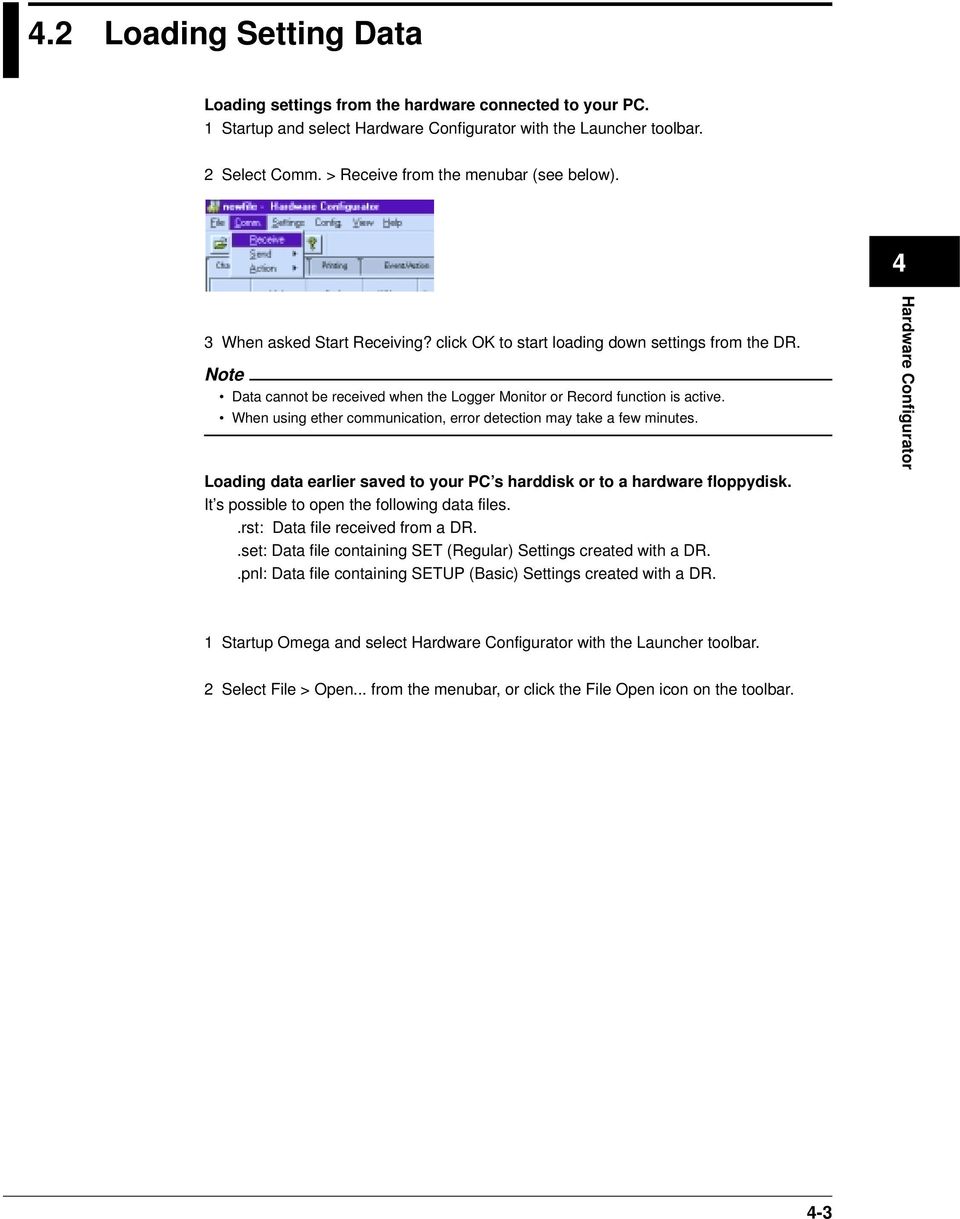
16 Hardware Configurator 4.2 Loading Setting Data Loading settings from the hardware connected to your PC. 1 Startup and select Hardware Configurator with the Launcher toolbar. 2 Select Comm. > Receive from the menubar (see below). 4 3 When asked Start Receiving? click OK to start loading down settings from the DR. Note Data cannot be received when the Logger Monitor or Record function is active. When using ether communication, error detection may take a few minutes. Loading data earlier saved to your PC s harddisk or to a hardware floppydisk. It s possible to open the following data files..rst: Data file received from a DR..set: Data file containing SET (Regular) Settings created with a DR..pnl: Data file containing SETUP (Basic) Settings created with a DR. 1 Startup Omega and select Hardware Configurator with the Launcher toolbar. 2 Select File > Open... from the menubar, or click the File Open icon on the toolbar. 4-3
17 4.2 Loading Setting Data The File Open dialog box will appear. 3 Select the desired file from the File list. 4 When you click Open the file will be opened, and all data of the open file, including its system configurations, will be cleared. Checkmark the Overwrite function if you want to overwrite the file currently being edited, without changing system configurations. 5 If you click open the data will be downloaded. If the setting data which are at that time being edited aren t saved yet, you will be asked whether to save them or not. A warning will be displayed, if all data can t be loaded. The Overwrite function If you open a file from the File list without using the Overwrite function, the file will be opened, clearing the data earlier edited open file, including its system configurations. If you use the Overwrite function when opening a file from the File list, the file will be opened, overwriting the data settings edited so far. System Configurations of the file edited so far will remain the same. If overwriting results in system inconsistencies, the entire file may be impossible to open. Caution when loading a data file saved to a DR internal floppydisk. If you open a file from a DR floppydisk, system info will not be included, and therefore it may be impossible to open the data using the overwrite function. To prevent this from happening, do the following: 1 Open the SETUP (Basic) Settings (which belong to the SET (Regular) setting file in (3)) without using the Overwrite function. A dialogbox for system configuration confirmation will appear. 2 Synchronize the system configurations and open the file. 3 Checkmark the Overwrite function and open the SET (Regular) settings. 4-4

18 Hardware Configurator 4.3 Setting Input Range, Span, and Linear Scaling Setting Input Range, Span, and Linear Scaling 1 To open the Channel Settings related setting screen, click the Channels tab, or select Settings > SET (Regular) Settings > Channel Settings from the menubar. 4 2 Set the input type (Mode) in the pull-down menu which appears when you click the setting area below the Mode label. The content of the pull-down menu depends on the kind of modules that are active. 3 Linear Scaling will be possible, unless you selected above (2) SKIP (no measurement), DELTA (inter-channel calculations), or RJJC (Remote RJC). For linear scaling Scale must be set ON. For the pulse module ON is fixed, and will not be displayed. Note Alarm settings will automatically be set OFF when wiring or the input range is changed. 5 Set the Range in the pull-down menu which appears when you click the setting area below the Range label. The content of the pull-down menu depends on the Mode selected at step (2). 6 Set the Span, left (L) and right (R). 7 Set the Reference Channel (Ref.) only if you selected the DELTA Mode (inter-channel calculations) at step (2) above. 8 For linear scaling Scale (L/R) and Unit settings are required (Scale must be set to ON -except for PULSE when ON is fixed). The Scale (L/R) setting range is to For pulse inputs, however, it is 0 to Units may contain a maximum of 6 alphanumerics (and: #, %, &, (), *, +, -,., /). 4-5

19 4.3 Setting Input Range, Span, and Linear Scaling Selecting the Range and Type of Input The following types of input can be selected. The default setting is VOLT. SKIP Measurement, data saving and display (except for page display) will not be carried out. Measurement, data saving and display will be carried out for the next channel whose input type is not set to SKIP. VOLT (DC voltage) This input type can be selected from 20mV, 60mV, 200mV, 2V, 6V, 20V and 50V. Refer to chapter 14 for the measurement range of each setting. The default setting is 2V. TC (thermocouple) This input type can be selected from R, S, B, K, E, J, T, N, W, L, U and KP (KPvsAu7Fe). Refer to chapter 14 for the measurement range of each setting. The default setting is R. RTD (resistance temperature detector) This input type can be selected from PT1 (Pt100 1mA), PT2 (Pt100 2mA), JPT1 (JPt100 1mA), JPT2 (JPt100 2mA), PT50 (Pt50 2mA), NI1 (Ni100 1mA SAMA), NI2 (Ni100 1mA DIN), NI3 (Ni120 1mA), CU1 (Cu10 GE), CU2 (Cu10 L&N), CU3 (Cu10 WEED), CU4 (Cu10 BAILEY), PT1S (Pt100 1mA high resolution), PT2S (Pt100 2mA high resolution), JPT1S (JPt100 1mA high resolution), JPT2S (JPt100 2mA high resolution) and J263B (J263*B). Refer to chapter 14 for the measurement range of each setting. The default setting is PT1. DI (select LEVL (voltage level) or CONT (contact) For LEVL, a voltage of less than approx. 2.4 V will be recognized as 0 (OFF), whereas a voltage of approx. 2.4 V or more (max. allowable voltage is up to ±60 VDC) will be recognized as 1 (ON). For CONT, an open, externally connected contact to which no voltage is applied, will be recognized as 0 (OFF), whereas a closed contact will be recognized as 1 (ON). The default setting is LEVL. ma (DC current, ma input module) This input can be set only for ma input channels. The measuring range is -20 ma to 20 ma. 4-6

20 Hardware Configurator 4.3 Setting Input Range, Span, and Linear Scaling DELTA (difference between channels) Computation can be done only in the same unit. Destination channels should lie within the first channel No. to the last channel No. range. The number of the reference channel (REF) should be lower than the number of the destination channels. The default setting for the reference channel is 01. The type of input and the measuring range in the distination channel are the same as for the reference channel. After setting the DELTA (difference between channels), if you attempted to change the type of input and the measuring range, setting the difference between channels is released, thereby the type of input and the measuring range in the destination channel are returned to their original settings, and the span is returned to its initial value. RRJC (Remote RJC, available for instruments with the optional MATH function, only) Reference channel (RJC): Within the setting range of reference channel No. TC (thermocouple) must be selected as the type of input to the reference channel. If the channel No. or type of input for the reference channel, or the type of thermocouple is changed, the alarm function will be turned OFF. If the type of input for the reference channel or the type of thermocouple is changed, the RRJC settings will be cleared and the type of input and measuring range for the reference channel will be set to the one which was in effect before the change was made. The span will be set to the initial value of the measuring range. 4 Setting the Span The measurement range is decided according to the type of input. The left and right span must lie within the measurement range. However, the span is 0 to 1 for the DI input type. By setting the span, the setting range for the upper/lower alarm limit of the rate-ofchange is determined. The value on the left side of the SPAN menu shows the left span, and the value on the right side of the SPAN menu shows the right span. For the remote RJC, the setting range for span is the same as that for the reference channel. 4-7

21 4.3 Setting Input Range, Span, and Linear Scaling Selecting the Input Type for Linear Scaling The input type can be selected from the following. VOLT (DC voltage) TC (thermocouple) RTD (resistance temperature detector) DI (contact) ma (DC current) AC (Power Monitor STRAIN Setting Linear Scaling Values (SCL) The left scaling and right scaling values are set following the left and right span values of the span menu. The value on the left side of the SCL menu shows the left scaling value, and the value on the right side of the SCL menu shows the right scaling value. The setting ranges from to The decimal point can be set in any position of the scale as shown below. Set it when the left scale is set..,.,.,., or. The default settings are 0.00 for the left span and for the right span. 4-8
22 Hardware Configurator 4.3 Setting Input Range, Span, and Linear Scaling This page intentionally left blank
23 4.3 Setting Input Range, Span, and Linear Scaling Setting the Span (SPAN) Set the left and right spans within the limits of an input range. In the SPAN menu item, the left-hand value is the left span and the right-hand value the right span. Set the span within the measuring range. The measurable limits vary depending on the measuring range you select, as shown below. 4-10
24 Hardware Configurator 4.4 Alarm Settings In this Section you will find the setting methods for different kinds of alarm, the alarm level, and the alarm output relay. Alarm Setting Procedures 1 To open the Channel Settings related setting screen, click the Channels tab, or select Settings > SET (Regular) Settings > Channel Settings from the menubar. For the Math channel related setting screen click the Math tab, or select Settings > SET (Regular) Settings > Math Functions from the menubar. 4 2 Set the Type (alarm type) in the pull-down menu which appears when you click the setting area below the Type label. Select OFF if not using any alarm. 3 Set the alarm Value. The value range depends on the selected alarm type. 4 Set the alarm output relay (Relay). To set the relay terminal of an alarm output relay module or the relay terminal of a DI/DO module, select a relay number. To set an internal switch choose from S(=switch)01 to S60. 5 You can choose to print a mark, and an additional message, at the time an alarm occurs. To get a mark printed, click a channel below the Alarm Print label and use the pull-down menu to select OFF, ON1, or ON2 6 To get a message printed, click a channel below the Message label and use the pulldown menu to select the desired message number, or to select OFF for no message. Selecting the type of alarm Select an alarm type for each alarm number from among the following: OFF (default set): No alarm is set. H: Upper-limit alarm. An alarm occurs when the measured value exceeds the upperlimit alarm setpoint. L: Lower-limit alarm. An alarm occurs when the measured value exceeds the lowerlimit alarm setpoint. RH: Rate-of-change upper-limit alarm. An alarm occurs when the measured value changes in the increasing direction within a certain time (rate-of-change alarm interval) and exceeds the upper-limit alarm setpoint. 4-11
25 4.4 Alarm Settings RL: Rate-of-change lower-limit alarm. An alarm occurs when the measured value changes in the decreasing direction within a certain time (rate-of-change alarm interval) and exceeds the lower-limit alarm setpoint. dh: An alarm occurs when the difference between two channels exceeds the upperlimit alarm setpoint. This only applies to a channel for which interchannel differential computation is selected, and can be set as a type of alarm. dl: An alarm occurs when the difference between two channels exceeds the lowerlimit alarm setpoint. This only applies to a channel for which interchannel differential computation is selected, and can be set as a type of alarm. See also Section 4.19, Setting Alarm Interval, Hysteresis, and Alarm Display Hold. Only H (upper-limit alarm) and L (lower-limit alarm) are available for computation channels. Note Alarms can t be set if the input type is SKIP, or if the Math channel mode is OFF. If you make below changes, channel alarms will automatically be switched OFF: Input type. Measurement range. Reference channels of inter-channel computations. RRJC reference channels, reference channel inputs, or thermocouples. Setting Math channels ON, OFF, Math equations Setting alarm values Set one alarm value for each alarm number within the following range, depending on the type of input. The default value is 0 (zero). H and L VOLT, TC, RTD, DI, DELTA, AC, STRAIN, and ma: Within the measuring range in the related channel. DI can be set to either 0 or 1. SCALE: Within a linear scaling value. Math channel: Within the range specified by the Math function. RH and RL VOLT, TC, RTD, DI, and DELTA, AC, STRAIN, and ma: Within 1 to [maximum measuring range minus minimum measuring range] in the related channel. For example, set (without using a decimal point) if the maximum value exceeds DI can be set to only 1. SCALE: Set 1 to without using a decimal point. dh and dl When the reference channel uses VOLT: Within the measuring range. When the reference channel uses other than VOLT: [maximum measuring range minus minimum measuring range] to - [maximum measuring range minus minimum measuring range] 4-12
26 Hardware Configurator 4.4 Alarm Settings Note When setting alarm values in continuous channels, use the decimal point as follows: The decimal point of an alarm value when the continuous channels have different measuring ranges should be in the position determined by the individual measuring range. If the decimal point is outside the measuring range, an error occurs. For example, if channels with measuring ranges 20 mv and 2 V, and a type T thermocouple channel, are all set to an alarm value of 10000, then the alarm values in the respective channels are as follows: mv in the 20 mv measuring range channel V in 2 V measuring range channel C in the type T thermocouple channel A type T thermocouple has a measuring range from to C, so an error results. If you make below changes, channel alarm values will also change automatically: Recording span. Linear scaling settings. Power monitor channel wiring and input range. 4 Setting Relays (Internal Switches) Set which alarm output relay or internal switch should be triggered when an alarm occurs: Select the desired alarm output relay or internal switch from among the following. The default setting is OFF. OFF: Alarm output relays and internal switches remain OFF. S01 to S60: 60 internal switches are provided. UMN U: Unit number for an alarm module or a DI/DO module. M: Slot number for an alarm module or a DI/DO module. N: Number 0 to 9. For details, see page 3-8. Multiple alarm setpoints can be set for one alarm output relay or internal switch. The operation mode in the alarm output relay or internal switch can be set when an alarm occurs. For details, see Section 4-20, Setting Operation Mode of Relay/ Internal Switch. When the alarm module or DI/DO module is not recognized as system module, the relay is set to OFF. Selecting the Alarm Printout This setting can be selected from the following. The default setting is ON2. OFF: Alarm printout will not be carried out; ON1: Alarms will only be printed out on occurrence. The alarm occurrence mark, channel No. or tag, type of alarm, alarm heading or time of occurrence will be printed with trend recordings. ON2: Alarms will both be printed out on occurrence and release. The alarm occurrence/release mark, channel No. or tag, type of alarm, alarm heading or time of occurrence/release will be printed with trend recordings. Selecting a Message Printout This setting specifies whether to print a message on alarm occurrence, and if so, which message will be printed. The default setting is OFF. OFF: No message will be printed. See also Section 4.16, Setting Messages. 4-13
27 4.5 Setting Moving Average and Filter Moving Average Settings 1 To open the Channel Settings related setting screen, click the Channels tab, or select Settings > SET (Regular) Settings > Channel Settings from the menubar. 2 Set the moving average in the pull-down menu which appears when you click the setting area below the Mode label. Filter Settings Moving Average (MOVE AVE) Moving average can be set for each channel individually. The number of samples used for the moving average can be set from 2 to 64. The default value is 0, which means that no moving average is carried out. The result of the moving average is recorded and displayed. 1 To open the Channel Settings related setting screen, click the Channels tab, or select Settings > SET (Regular) Settings > Channel Settings from the menubar. 2 Set the Filter ON or OFF in the pull-down menu which appears when you click the setting area below the Filter label. Filter settings are only possible for pulse input. Setting the Filter ON can eliminate pulse chattering of up to 5 ms. 4-14
28 Hardware Configurator 4.6 Recording-related Settings Setting Procedure In this Section the following recording-related setting for DR: Recording zones Partially expanded recording Interpolation Trend recording Digital printout ON/OFF Manual printout ON/OFF Scale printout ON/OFF List printout ON/OFF 1 To open the Channel Settings related setting screen, click the Channels tab, or select Settings > SET (Regular) Settings > Channel Settings from the menubar. For the Math channel related setting screen click the Math tab, or select Settings > SET (Regular) Settings > Math Functions from the menubar. 4 2 To specify the recording zone, set the left and right position. The distance between the two sides should be more than 55 mm. 3 Set partially expanded recording ON or OFF, and set the Position and Boundary. Position and Boundary can t be set if partially expanded recording is OFF. 4 Set Interpolation ON or OFF. If set to ON, interpolation will be carried out according to the priority order of recording colors. 6 Set Trend Print ON or OFF. Only channels set ON will get a trend printout. 7 Set Manual Print ON or OFF. Only channels set ON will get a manual printout. 8 Set Scale Print to 0N1 ~ ON3 to print Scale values during trend recording, or OFF. 9 Set List Print ON or OFF. The contents of channels set to ON will be included in the List printout. Setting Recording Zones (ZONE) The set left and right position of the zone correspond to the left and right span set at the SPAN menu (recording span). Zones can be set in 1mm steps and cannot exceed the recording range (i.e. 250mm). The left position setting ranges from 0 to 245mm. Right position setting ranges from 5 to 250mm. The minimum width of a zone is 5mm. No decimal points. Default settings: 0mm for the left position, 250mm for the right position. If the instrument is equipped with the optional Math function, this setting can also be made for computation channels A01 to A
29 4.6 Recording-related Settings Partially Expanded Recording (PARTIAL) This setting specifies whether to carry out partially expanded recording, and if so, which percentage of the recording span will be compressed and the corresponding boundary value. If the instrument is equipped with the optional computation function or floppy disk drive, this setting can also be made for computation channels A01 to A30. Selecting Partial Recording ON/OFF ON: Partial recording will be carried out; OFF: Partial recording will not be carried out. Specifying the Compressed Part and Boundary Value RATE : This setting specifies which percentage (1 to 99%) of the full recording span will be compressed. The default value is 50%. Boundary value: This setting specifies the boundary value which corresponds to the previous set compressed part. The setting lies within the recording span, but when linear scaling is being used, the setting lies within the left/right scale range. The default value is 0. Note If boundary values are to be set for succeeding channels, the decimal point is handled as below. If succeeding channels are set, the decimal point position of boundary values when the measurement range for each channel setting is different, is that determined for each corresponding range. As a result, it exceeds the measurable range, an error occurs. For example, if channels whose measurement ranges are 20 mv, 2 V, and type T thermocouple are set and the boundary value is set to 10000, the following applies: The boundary value of the channel whose measurement range is 20 mv: mv; The boundary value of the channel whose measurement range is 2 V: V; and The boundary value of the channel whose measurement range is type T thermocouple: C As the range of type T thermocouple is to C, an error occurs for this channel. Notes on Partially Expanded Recording Partial recording cannot be carried out if the input type of the computation channels is SKIP or DI or if the computation channels are OFF. Partially expanded settings will be automatically canceled when either of the following changes occur. the input type has been changed; the measurement range has been changed; the recording span has been changed; linear scaling settings have been changed; the reference channel for difference between channels has been changed. Interpolation (INTERPOL) This setting can be set for each channel individually. If the instrument is equipped with the optional computation function or floppy disk drive, this setting can also be made for computation channels A01 to A60. The default setting is OFF. OFF: no interpolation will be carried out. ON: interpolation will be carried out according to the priority of recording colors. The priority of recording colors is black > purple > reddish purple > navy blue > red > blue > brown > green > orange > yellowish green. 4-16
30 Hardware Configurator 4.6 Recording-related Settings Digital Printout Setting (DIGITAL PR) This setting can be selected for each channel from the following. This setting applies to the digital print of the analog mode and logging mode. The recording interval can be selected from the following. If the instrument is equipped with the optional computation function or floppy disk drive, this setting can also be made for computation channels A01 to A30. When LOG INTERVAL is set to SINGLE: The recording interval is decided automatically, depending on the chart speed, and the columns of channels to be printed. When LOG INTERVAL is set to MULTIPLE: The recording interval can be selected from six timer settings. The default value is 1. Trend Recording Recording can be set ON/OFF per channel. The default setting is ON. Manual Printout Setting (MANUAL PR) This setting can be selected from the following. The default setting is ON. If the instrument is equipped with the optional computation function or floppy disk drive, this setting can also be made for computation channels A01 to A30. OFF: Manual printout will not be carried out for this channel; ON: Manual printout will be carried out for this channel. 4 Scale Printout (SCALE PR) Assigned to each channel individually. The scaled values will be printed out with trend recordings. No printout if a zone of 49mm or less is set. The scaled values of the following channels will be printed. If the instrument is equipped with the optional computation function or floppy disk drive, this setting can also be made for computation channels A01 to A30. When Partial Expanded Recording is OFF OFF: Scaled values will not be printed. ON1: when the recording zone is 150mm or more: scaled values at each 20%-interval of the recording span will be printed at positions at 20%-intervals of the zone. when the recording zone is 50mm to 149mm: scaled values at 0% and 100% of the recording span will be printed at 0% and 100% positions of the zone. ON2: Scaled values at 0% and 100% of the recording span will be printed at 0% and 100% positions of the zone. ON3: when the recording zone is 100mm or more: scaled values at 0%, 50% and 100% of the recording span will be printed at 0%, 50% and 100% positions of the zone. when the recording zone is 50mm to 99mm: scaled values at 0% and 100% of the recording span will be printed at 0% and 100% positions of the zone. When Partial Expanded Recording is ON OFF: Scaled values will not be printed. ON1/ON2/ON3: When the recording zone is 100mm or more: scaled values at 0%, 100% of the recording span and at the boundary value will be printed at 0%, 100% and boundary value positions of the zone. When the recording zone is 50mm to 99mm: scaled values at 0% and 100% of the recording span will be printed at 0% and 100% positions of the zone. List Printout (LIST PR) This setting can be assigned to each channel individually. Starting a list printout can be done at the PRINT menu. For instruments with the optional Math function or floppy disk drive, this setting can also be made for computation channels A01 to A30. OFF: List printout will not be printed. ON: Setting information per channel will be printed. 4-17
31 4.7 Selecting Channels to Save (for DR with FDD Option Only) To save measurement data of the DR with FDD Option, to a floppydisk, data will first be saved to an internal RAM disk. To select the measurement or Math channels which data you want to write to the internal memory, follow below procedures: 1 To open the Channel Settings related setting screen, click the Channels tab, or select Settings > SET (Regular) Settings > Channel Settings from the menubar. For the Math channel related setting screen click the Math tab, or select Settings > SET (Regular) Settings > Math Functions from the menubar. 2 Select ON to save data to internal memory / floppydisk, or OFF, in the pull-down menu which appears when you click the setting area below the Memory label (on the far right side of the Channels setting screen). 4-18
32 Hardware Configurator 4.8 Tag Settings 1 To open the Channel Settings related setting screen, click the Channels tab, or select Settings > SET (Regular) Settings > Channel Settings from the menubar. For the Math channel related setting screen click the Math tab, or select Settings > SET (Regular) Settings > Math Functions from the menubar. 4 2 Set a tag in the setting area below the Tag label. Maximum amount of alphanumerics: for DR: 16. Additionally allowed symbols #, %, &, ( ), *, +, -,., and /. 4-19
33 4.9 Making Settings Per Channel The settings explained in Section 4.2 to 4.8 can also be carried out per channel, by following below procedures: 1 To open the channel settings related setting screen, click the Channels tab, or select Settings > SET (Regular) Settings > Channel Settings from the menubar. 2 To open a single channel-specific setting screen, double-click the desired channel number, displayed on the left side of the Channels setting screen. 3 If a DR is connected, you can make print settings in the setting screen that appears when clicking the About Printing tab. 4-20
34 Hardware Configurator 4.9 Making Settings Per Channel 4 Click the Range Information tab to select the type of input and to make range related settings
35 4.10 Setting Math Channel Equations 1 For the Math channel related setting screen click the Math tab, or select Settings > SET (Regular) Settings > Math Functions from the menubar. 2 Set Math ON to activate the Math channel. 3 Set a Math Channel Equation. To use the equation operators, first double-click the desired Math channel number, displayed on the left side of the Math setting screen. Then, click the square button on the right side of the equation setting box. In the Operators Selection dialog box choose the desired equation operator, which will appear in the equation setting box when clicked. 4 Set the display/recording span in the ~ range. 4-22
36 Hardware Configurator 4.10 Setting Math Channel Equations 5 Set the Unit you want to use for calculation using maximum 6 alphanumericals or the symbols #, %, &, ( ), *, +, -,., and /. 6 Alarm settings and printing-related DR settings, are equal to those made for measurement channels. Computation equation In addition to operators in the Operators Selection dialog box the following symbols can be used in equations: (/) : Used for ( ) setting. K : Used if equations contain constants K01 to K30. C : Used to specify communication input data (digital data). G : Used to specify the group No. for which CLOG (computation of data of a group measured on the same time) is to be used. 4 Restrictions in equations The specified computation equation for a computation channel No. can contain only computation channel Nos. as variable which are equal to or smaller than said computation channel No. (Example) A02=001+A01 In this example, any computation channel No. which is equal to or greater than A03 cannot be used. Either TLOG or CLOG can be used in an equation. Note Each equation must consist of up to 40 characters. The total number of channels and constants to be used for each equation is 16 or smaller. 4-23
37 4.11 Copying Channel Settings Copy measurement and Math settings to other channels as follows. 1 To open the Channel Settings related setting screen, click the Channels tab, or select Settings > SET (Regular) Settings > Channel Settings from the menubar. For the Math channel related setting screen click the Math tab, or select Settings > SET (Regular) Settings > Math Functions from the menubar. 2 Click the channel number which settings you want to copy to other channels The display color changes. 3 Click the copy button in lower left corner of the setting screen. Below dialog box will appear to select the items you wish to copy to other channels. 4 Select the desired items to copy, and then close the dialog box. 5 Click the first channel you want to copy the settings to, and drag the mouse pointer down to the last channel the settings should be copied to. The display color of the selected channels changes. 6 Click the Paste button, to copy the selected settings to the selected channels. 4-24
38 Hardware Configurator 4.11 Copying Channel Settings Absolute and relative position settings for DELTA, RRJC When copying DELTA and RRJC channels, it is necessary to determine the relation to reference channels. Absolute position The reference channel of the copy destination doesn t change. For example, if the reference channel of Ch 005 is Ch 002, and you would copy Ch 005 settings to Ch 007, the reference channel of Ch 007 will remain Ch002. However, if you are copying between units, the reference channel of the copy destination will change. For example, if the reference channel of Ch 005 is Ch 002, and Ch 002 settings are TC, Type R, and you would copy Ch 005 settings to Ch 107, the reference channel of Ch 107 will become Ch 102. Copying is, in this case, only possible if Ch 102, like Ch 002, is set to TC, Type R, and in addition, the scale must be set OFF. Relative position The relative positions of channels and relative channels set in DELTA or RRJC, will be maintained when copied. Therefore the reference channel of copy destination and copy base will differ. For example, if the reference channel of Ch 005 is Ch 002, and Ch 002 settings are TC, Type R, and you would copy Ch 005 settings to Ch 009, the reference channel of Ch 009 will become Ch 002. Copying is, in this case, only possible if Ch 009, like Ch 002, is set to TC, Type R. It is advisable to let the copying include the reference channel
39 4.12 Setting Constants Up to 30 constants (K01 to K30) can be set. The number of significant digits is 5 excluding the decimal point. If an exponent is used, the mantissa and exponent must consist of 5 digits and 2 digits, respectively. Configurable ranges: E+35 to E E-35 to E+35 1 Click the Constant tab, or select Settings > SET (Regular) Settings > Constants from the menubar 2 Set the Constants in the above Constants setting screen. 4-26
40 Hardware Configurator 4.13 Event/Action, Match Time, and Group Settings Event/Action and Match Time settings are possible, if the (M1) Math option is being used. 1 Click the Event/Action tab, or select Settings > SET (Regular) Settings > Event/Action, > Match Times, or > Groups, from the menubar. The Event/Action, Match Time, Groups setting screen will open. 4 2 Select an Event using the pull-down menu which appears when you click the setting area below the Event label. 3 If you use REMOTE, RELAY, TIMER, MATCH TIME, or (for the DR) MFUNC as an Event setting, enter the appropriate number. 4 Select the Edge or Level mode in the setting space under the Mode label. 5 Select an action in the setting space under the Action label. The kind of actions you can select depends on the events selected earlier. 6 Depending on the action selected above (5), it may be necessary to make additional settings on the right of the setting space under the Action label. Use the pull-down menu to make a selection.. 7 Set the Match Times, days and time, in the Match Times dialog box. 8 Make the Groups setting. Divide the channels you choose for the Group setting by commas. Between a continuing series of channel numbers place a hyphen. For example: 001,005, (channel 001 to 005) 4-27
41 4.13 Event/Action, Match Time, and Group Settings Selecting Events Select any event from among the following: NONE releases the event/action setting. REMOTE This menu is displayed only with the DI/DO modules that are recognized as system modules. When a remote control signal is applied, the action is executed. There are 12 control signals available. Select any control signal from these numbers for event setting. Remote control signal terminal numbers are applicable for this selection. ALARM If an alarm occurs, the action is executed. RELAY If the selected internal switch or relay is operating, the action is executed. When the alarm module or the DI/DO modules are not recognized as system modules, the relay is set to OFF. CHART END When the end of the chart is detected, the action is executed. FILE END When the end of file (the time when the writing operation is terminated and the file is closed) is detected, the action is executed. TIMER If the selected timer s set time is up, the action is executed. Six timers are available. Select any from among these timers. See Section 14.4, Setting the Timer. In combination with the level action, the action is repeated alternately between executing and stopping each time the timer s set time is up. MFUNC KEY When the M.FUNC key on the operation panel is pressed, the action is executed. In combination with the level action, the action is repeated alternately between executing and stopping each time the M.FUNC key is pressed. MATCH TIME Match time setting allows you to preset a time to start/stop event/action functions. Set the Action you want to happen in the Action setting space. Match Times Setting There are three types of applicable Match Times. Select any of them in the Match time dialog box on the right of the event/action setting screen. Select the day and time you want the Match Time event to occur. If the day is set to 0, events will occur every day at the set time. In combination with the level action, the corresponding action is repeated alternately between executing and stopping for each set time. Selecting Edge or Level Action Edge action (EDGE) This action is executed when an event is detected. Level action (LEVL) This action is executed when an event is detected. When an event is released, this action will be canceled. An edge action and a level action cannot be set at the same time. For a level action, only one setting can be made. 4-28
42 Hardware Configurator 4.13 Event/Action, Match Time, and Group Settings Selecting Actions Actions may be selectable depending on earlier Events and Edge/ Level action settings. The following describes all available actions: ALARM ACK This allows alarm acknowledgment. ALARM RST Resets alarms. When the RELAY is selected for an event, this function cannot be selected. TIMER RST Resets timers. RECORD (DR only) ON: Starts recording. The recording format is set individually. For details, see Section 10.2, Setting Recording Format, on page OFF: Stops recording. The level action does not include record ON/OFF functions. When the level action is set, the ON/OFF functions using the RECORD key are disabled. The edge and level actions cannot be set simultaneously. For the level action, only one action is available. MANUAL PR Enables manual printing. DIGITAL PR Digital printing starts in the analog trend mode. The recording intervals depend on the timer setting (see Section 14.4). When the event/action functions are set, normal digital print functions are disabled. Only one setting can be made in the event/action function. MSG PR Prints messages. Select any message from the corresponding codes 01 to 20. MSG DISP Displays messages. Select any message from the corresponding codes 01 to 20. To cancel the message display, press any key. SPEED CHG Changes chart speed 1 to chart speed 2. When the recording interval is set to automatic (see Section 4.15), the recording interval is also changed. When the event is released, the chart speed and recording interval return to their original positions. Only one setting can be made in the event/action function. GR TREND This executes the recording in a channel in which the group setting has already been made. For this, set the dot-recording (see on page 10-4) to GROUP and start recording by key operations following the RECORD given above. Select any group from G01 to G07. Only one identical group can be set in the event/action functions. Note If Chart End appears, counter-actions such as RECORD ON are not executed. Actions such as RECORD or SPEED CHG may operate later than an event occurrence. For example, with RECORD set in the action setting, if an alarm occurs, the measured values in that condition are not recorded. This is because recording operations are delayed due to an action operation
43 4.13 Event/Action, Match Time, and Group Settings MATH (for instruments with M1 option or FDD option only) START: Starts computation. STOP: Stops computation. RESET: Resets computation channel data at the end of completion of the first computation in case an event takes place. CLEAR: Resets computation channel data immediately in case an event takes place. If MATH is selected as a level action, computation will be carried out while an event is present. Computation will stop when the event is cleared. MEMORY (for DR with FDD option only) DR with FDD option DATA_WR: Saves a data item each time an event occurs, until the specified data length is reached. WR_TRIG: Saves measured/computed data on the built-in RAM disk. RD_TRIG: Reads measured/computed data from the built-in RAM disk. LD_TRG1-3:Reads setup data from the built-in RAM disk. FLAG (only for Math option models; DR style nr 8 or higher) F01 to 16: Set the flag number (F01 to F16) to 1. F01 to F16 are normally 0. Flags can be placed in computing equations to hold the computed result using a certain event as a trigger, or reset to 0. FLOPPY LD_TRG1-3:Reads setup data from the floppy disk. Note If, in the SETUP mode, the report function is set to OFF for all data items, you cannot select the action item REPORT. Groups Setting Make Group settings for DR group trend recording or for group computation statistics, in the setting screen on the right side of the Event/Action setting screen. 4-30
44 Hardware Configurator 4.14 Setting Timers and Summer/Winter Time Setting Timers The Timer function can be used to trigger a number of event/action functions. It can also set the time interval between digital printouts of analog values, or between logging printouts. 1 Click the Event/Action tab, or select Settings > SET (Regular) Settings > Timers from the menubar. The Timers setting screen will open. 4 2 Select the kind of Timer, Absolute (from the reference time), or Relative (a fixed time). See the below illustration. 3 If you choose to set an Absolute time, set the desired time interval, and a reference time. If you select a Relative time, set the fixed amount of days, hours, and minutes you would like between events. Event detection occurs every specified time interval. Six timers can be set. They are reset with an action. 4-31
45 4.14 Setting Timers and Summer/Winter Time Summer/Winter Time If your hardware device is equipped with the L1 option it is possible to let the hardware automatically change its date and time to summer or winter time when appropriate. If you specify Summer Time the time will be adjusted to one hour later when the specified date and time is reached. If you specify Winter Time, the time will be adjusted to one hour earlier when the specified date and time is reached. Make sure the Summer/Winter Time option is activated in the System Configuration setting screen. 1 Click the Event/Action tab, or select Settings > SET (Regular) Settings > Timers from the menubar. The Timers and Summer/Winter Time setting screen will open. 2 Set the date and time. Note Don t set time zones using the Windows system autoexec.bat. Please select Start menu > Settings > Control Panel > Date/Time, and use the Date/Time properties setting screen. (Place the REM command before commands like TZ=GMTO for autoexec.bat.) In the Windows Date/Time Properties Time Zone setting screen, check automatically adjust clock for daylight saving changes, as the default setting is OFF. If this setting is not active, errors may appear in Hardware Configurator Summer Winter time settings. 4-32
46 Hardware Configurator 4.15 Printing Settings The following print setting can be made for DRs: Recording Mode (Trend or Logging) Trend Printing interval (Fixed or Automatic) Chart speed Chart speed 2 Header Title List Format To open the Printing related setting screen (see below), click the Printing tab, or select Settings > SET (Regular) Settings > and either Recording Mode, Chart Speed, Chart Speed 2, Header, Title, or List Format, from the menubar. 4 Recording Mode Settings The following types of recording mode can be selected. The default is TREND. LOGGING (LOGGING MODE); measurement values will be printed out as digital values. TREND (ANALOG TREND MODE); measurement values will be recorded as analog trends (dot recording) and printed out as digital values. Selecting the recording interval This setting can only be done for the TREND mode, and its default setting is AUTO. FIX: Recording takes place at intervals equal to the measurement period (scan interval). However, if the measuring period is 0.5 or 1 second, the recording interval is fixed to 2 seconds. The measured data during the excess period is ignored. AUTO: recording takes place at intervals automatically decided by measurement interval and chart speed. 4-33
47 4.15 Printing Settings Chart Speed Settings Chart Speed 1 (CHART) This setting specifies the chart speed of ordinary trend recordings. The setting ranges from 1 to 1500mm/h, in 1 mm steps. The default setting is 100mm/h. Chart Speed 2 (CHART2) This setting consists of a chart speed and recording interval. Depending on the Event/ Action function, the chart speed and recording interval will change into chart speed 2 and its corresponding interval. Chart speed 2 setting This setting is the same as for chart speed 1, and its default setting is 100mm/h. Recording interval This setting specifies the recording interval for the digital printout in the logging and analog trend recording mode. Set either the Absolute or Relative interval If the SPEED CHG action is selected as event/action setting, the Recording Interval will be change as follows: Trend Recording Normal: Speed set as Chart Speed 1 When an event occurs: Speed set as Chart Speed 2 Logging Recording Normal: Depends on the (SETUP) Recording Format settings for the Recording interval in digital printing/logging. It can be set to Single or Multiple: Single- Interval for timer one. Multiple- Intervals selected from 6 kinds of timers. When an event occurs: Interval set as Chart Speed 2. Entering a Header HEADER LINE No.: One header can consist of up to five lines. LINE 1 to 5: The header contents can be entered here using up to 80 alphanumerics for each line, and thus up to 400 characters for the entire header. The default setting is all spaces. To print the header press the Print button on the DR and select HEADER START from the menu. Entering a Title One title can be set, using up to 32 alphanumerics. Set the Title printing pitch to 600 mm, 1500 mm or set it OFF, in the (SETUP) Recording Format setting screen Setting the List Format The List Format (LIST FMT) setting specifies which setting information will be printed out in case of list printouts. Each of the following lists can be selected ON or OFF, and the default setting is ON. Print setting range info: Information about settings related to tags, type of input, recording span, linear scaling and computation equation. Print alarm settings info Print printing settings info (LIST PRINT) : Information about settings related to analog trend recording, digital printout, interpolation, recording zones, partial expanded recording, recording interval of digital printouts for logging mode and analog mode, moving average, scaled values, alarm printout, manual printout and data saving ON/ OFF. Print other settings info: Information about settings related to match time, groups, headers, messages, event/action function, list format and computation constant. Information which always be included in a list printout, regardless of the above settings, are title, measurement interval, recording interval (trend), chart speeds 1 and 2, recording mode and time. 4-34
48 Hardware Configurator 4.16 Setting Messages Messages can be printed out on the occurrences of an alarm, instantly using the FUNC menu, or as an event/action setting. 1 To open the Messages setting screen, click the Messages tab, or select Settings > SET (Regular) Settings > Messages from the menubar. 4 2 Enter messages with maximum 16 alphanumerics. 4-35
49 4.17 Setting A/D Converter Integration Time, Filter, and Scan Interval Open the A/D Converter Integration Time, Filter, and Scan Interval setting screen (see below) as follows: Click the SETUP tab and select Interval from the SETUP (Basic) Setting contents box, or select from the menubar Settings > SETUP (Basic) Settings > and then either, A/D Converter Integration Time, Filter, or Scan Interval. A/D Converter Integration Time Select the A/D converter integration time for each unit. Select it from the following: Auto: the frequency of 50/60 Hz is automatically switched corresponding to the power frequency of this instrument. Note that Auto does not function for the stand-alone DC power supply model or for extended types using a DC power supply subunit. 50 Hz: the integration time is set to 20 ms (50 Hz). 60 Hz: the integration time is set to 16.7 ms (60 Hz). 100 ms: the integration time is set to 100 ms (10 Hz) The default setting is AUTO. However, if the instrument is a stand-alone DC power supply model, the default setting is 20 ms (50 Hz). Filter Scan Interval Set the filter to reduce normal mode noise, ON or OFF. The duration of time (one scan) in which the measurement of all channels is carried out, is called the scan interval. This interval can be set to any value from 0.5 second to 60 seconds. The shortest is 40 ch/500 ms for the stand-alone model, or 300 ch/500 ms for the expandable model (varies with the shortest measurement period of the input module). 4-36
50 Hardware Configurator 4.18 Setting Alarm Interval, Hysteresis, and Alarm Display Hold Open the Alarm Setup setting screen (see below) for Alarm Interval, Hysteresis, and Alarm Display Hold as follows: Click the SETUP tab and select Alarm from the SETUP (Basic) Setting contents box, or select from the menubar Settings > SETUP (Basic) Settings > Alarm Setup. 4 Alarm Interval Hysteresis For high/low limit on rate-of-change alarms, variation is measured over a preset interval. If the variation exceeds the preset value, an alarm occurs. This interval can be set and applied to all channels. Set the width between the value of alarm occurrence and its release. This setting prevents frequent alarm occurrences/releases in an unstable environment. Hysteresis values can be set in the 0-1% percentage range of the span. The hysteresis setting is used for high and low limit alarms. Set the span percentage using the Alarm Hysteresis pull-down box. Alarm Display Hold Select whether to hold the alarm indicator after the alarm is released, or not. 4-37
51 4.19 Setting Relay and Internal Switch Actions Open the Alarm Setup setting screen for Relay and Internal Switch Actions as follows: Click the SETUP tab and select Relay from the SETUP (Basic) Setting contents box, or select from the menubar Settings > SETUP (Basic) Settings > Relay > and the desired relay setting. Reflashing Alarm Setting When several alarms share the same alarm output relay, you can select this setting which results in a short de-operation of the relay when a second alarm occurs. Relay AND/OR Select how the internal switches/alarm output relays will be operated, when a group of alarms share the same internal switch or alarm output relay. AND: will be operated when all alarms are occurring; OR: will be operated when at least one alarm is occurring. Use the pull-down menu to select AND settings in a range starting from relay 1, or choose NONE for all OR actions. Relay (De-)Energizing Select alarm output relays to be energized or de-energized on alarm occurrence. A blue circle in the (De-)Energizing dialog box marks the active setting. Copy Relay (De-)Energizing settings by clicking the number of the settings you want to copy to other channels. The display color changes. Click the copy button in lower left corner of the setting screen. Click the first channel you want to copy the settings to, and drag the mouse pointer down to the last channel the settings should be copied to. The display color of the selected channels changes. Click the Paste button, to copy the selected settings to the selected channels. Relay Hold Setting Select whether to Hold, or Not Hold, the operating status of operated internal switches or alarm output relays. This setting applies to both the internal switches and the alarm output relays. 4-38
52 Hardware Configurator 4.20 Setting Burn-out, RJC, and Recording Colors Open the Alarm Setup setting screen (see below) for Burn-out, Reference Junction Compensation, and (for DR Only) Recording Colors as follows: Click the SETUP tab and select Channel from the SETUP Setting contents box, or select from the menu bar Settings > SETUP (Basic) Settings > Relay > and Burn-out, RJC, or Recording Colors. 4 Copying Settings Copy below settings to other channels as explained in Section Burn-out Set the recording position for each channel when burn-out occurs. Click OFF, DOWN, or UP. A blue circle marks the active setting. OFF: The burn-out function is not actuated. DOWN: The output extends to the minimum value of the span. UP: The output extends to the maximum value of the span. Reference Junction Compensation (RJC) Set either the internal or the external compensation for each channel in the RJC Type setting space. A blue circle in the Burn-out setting area marks the active setting. INT: internal compensation is performed. EXT: external compensation is performed. For external compensation, set the voltage to be compensated in the RJC Voltage setting area. Voltage to be externally compensated: set in the range of to mv. Recording Colors To set the colors used for DR trend recording, click the color setting area to display the Recording Colors setting screen. Select the desired channel color and click OK. 4-39
53 4.21 Setting (TLOG) Math Setup, and Temperature Unit Click the SETUP tab and select Options from the SETUP (Basic) Setting contents box, or select from the menubar Settings > SETUP (Basic) Settings > and either Math Setup, or Temperature Unit. The below setting screen appears. Math Setup Displaying / recording in case of computation error Used to determine whether +OVER or -OVER be displayed/saved in case of computation error. Time axis scale for TLOG SUM For TLOG.SUM of time series, data is added at each measurement interval. However, in the case of an input having unit of /s, /min or /h like flow rate, the computation result will differ from the actual value, if addition of data is carried out. In this case, setting TLOG TIME SCALE according to the unit of the input will cause the data measured at measurement intervals to be processed according to the unit of the input. For instance, if the measurement interval is 2s and input value is 100 m 3 /min, the computation result will be after the elapse of one minute, since 100 is added every 2 seconds. Setting TLOG TIME SCALE to /min will cause the measured data to be multiplied by 2s/60s at each measurement interval, thus making the result close to the actual input value. If this function is set to OFF, simple addition of data will be carried out. Process of abnormal data during TLOG or CLOG (TLOG CH ERROR) Used to select the process method for abnormal data obtained during TLOG or CLOG. ERROR : Abnormal data processed as a computation error. SKIP : Abnormal data ignored and computation is continued. 4-40
54 Hardware Configurator 4.21 Setting (TLOG) Math Setup and Temperature Unit Process of overflow data during TLOG or CLOG (TLOG CH OVER) Used to select the process method for overflow data obtained during TLOG or CLOG. ERROR : Overflow data processed as a computation error. SKIP : Overflow data ignored and computation is continued. LIMIT : Overflow data treated as the next data for computation. Measurement channels to which linear scaling is applied: Specified scaling upper-/lowerlimit. Measurement channels to which no linear scaling is applied: Upper-/lower-limit of the measuring range. Computation channels: Specified LEFT/RIGHT value. 4 Processing of the results of TLOG.PSUM computation for pulse input OVER: If the result of a separate calculation of TLOG.PSUM (XXXX) exceeds , the instrument goes into an overflow. ROTATE: If the result of a separate calculation of TLOG.PSUM (XXXX) exceeds , the instrument resets the value subsequent to to 0 and continues computing. For example, if the measured data subsequent to which has been reached is 3, the computed result becomes 2 by counting 0, 1 and 2. The process is effective only when a pulse input module is installed. This setting cannot be made for a DR stand-alone type 4-41
55 4.22 Setting FUNC Key, and SET Key Operations Click the SETUP tab and select FUNC Menu, or SET Menu from the SETUP (Basic) Setting contents box, or select from the menubar Settings > SETUP (Basic) Settings > and FUNC/FUNC3 Menu, or SET/SET3 Menu. The below explanation is for the FUNC key. Set key setting works the same. Select the menu to be displayed by pressing the FUNC key whether in the FUNC menu or the FUNC3 menu. The FUNC menu is displayed by pressing the FUNC key at a touch and the FUNC3 menu is displayed by pressing the FUNC key for about 3 seconds continuously. Select one of the following three options using the radio buttons: 1 FUNC: displayed in the FUNC menu. 2 FUNC3: displayed in the FUNC3 menu. 3 OFF: not displayed in either menu. 4-42
56 Hardware Configurator 4.23 Setting the Recording Format Click the SETUP tab and select Recording Format from the SETUP (Basic) Setting contents box, or select from the menubar Settings > SETUP (Basic) Settings > Recording Format. 4 Channel number or Tag display Select to print or display measured values using channel number labels or tag names. Select either Channel or Tag. Note that the channel number will be printed/displayed regardless of selection, if no Tag setting is made (or all spaces). Number of Tag printing characters Select 7, 8, 9, 10, 11, 12, 13, 14, 15 or 16. The default setting is 7. If the selected number of printing characters is less than the actually entered Tag, only the number of characters selected here will be printed. Dot-printing Recording System Select it from the following systems. The default setting is NORMAL. To practically record it, the RECORD must be turned on. Channels to be recorded are those selected to be ON in Setting the Channels to be Recorded, Dot Recording on page 6-2. Normal: To record all object channels. Alarm 1: To record only the channels with on-going alarm. Recording continues even if the alarm is released. Alarm 2: To record only the channels with on-going alarm. Recording stops when the alarm is released. Group: To record the channels which are set into a group only. Recorded only if GR TREND is set in the event/action function. 4-43
57 4.23 Setting the Recording Format Printing when chart speed is changed (SPEED CHANGE PR) When the chart speed is changed in dot-recording, select whether to print with the changed chart speed or not. OFF: does not print. ON: prints. Printing recording start/stop time mark (ON/OFF MARK PR) In dot recording, select whether the record-start/stop time is printed or not. OFF: not printed. ON: printed.. Number of columns for digital printing (DIGITAL PR CLMN) Select the amount of channels to be printed in one horizontal line. Select 1, 2, 3, or 4 columns. If Tag has been selected in selecting the channel number/tag, this is limited to 3 columns. If Tag is set to 16 characters, the Tag entry is limited to two columns. Channel number printing pitch (CHANNEL PITCH) For dot recording, select the number of millimeters for the channel number printing interval. When Tag has been selected in channel number/tag selection, the Tag corresponding to the channel number is printed. OFF: not printed. 5.0 mm: printed every 5.0 mm mm: printed every 12.5 mm. Title printing pitch (TITLE PITCH) For dot recording, select the title printing interval in millimeters. OFF: not printed. 600 mm: printed every 600 mm mm: printed every 1500 mm. Scale check mark printing (SCALE TIC PR) For dot recording, a tic mark indicating the scale mark positions can be printed. OFF: no mark printing. ON: printing the tic mark. Horizontal or vertical printing (LOG FORMAT) In logging mode, select either horizontal or vertical printing of the channel number/tag. Horizontal: horizontal printout Vertical: vertical printout Recording Interval in Digital Printing/ Logging Mode (LOG INTERVAL) Select to record channel numbers/tags and measured values at one interval or at a selected interval for each channel using the 6 timers. SINGLE: Digital print: The interval is determined by the chart speed and the number of columns to be printed. Logging mode: interval for timer No. 1. MULTIPLE: intervals selected for each channel from 6 kinds of timers for either Digital printing or the Logging mode. 4-44
58 Hardware Configurator 4.24 Setting Keylock, Display Update Interval, Ch/ Tag Display Indication To open the Keylock, Display Update Interval, and Channel/Tag Display Indication setting screen do as follows. Click the SETUP tab and select Key Lock/Display from the SETUP (Basic) Setting contents box, or select from the menubar Settings > SETUP (Basic) Settings > and either Key Lock, Display Update Interval, or Display Indication. 4 Key Lock Selection of Use or Nonuse of Key Lock Selection for key lock function to (in)activate setting keys on your DR. Non-use: DR keys can be used. Use: DR keys will be inactive when pressed. Even if key lock is executed, the power switch, DISP/MODE key operation and cursor key operation remain effective. Some keys can be selected to be locked or free. Selectable keys are: the Start key, the Stop key, the Clock key, the FUNC key, the FD COPY key, and the M.FUNC key. Click Free to activate them, Lock to lock them. Setting Password After activating the keylock it is possible to (in)validate the keylock using the FUNC Key (depending on the settings in the FUNC menu). To use the FUNC option it is necessary to enter a password in the range of 0 to Display Update Interval Select the display update interval when the operation display mode is set to Auto. Select 2, 3, 4, or 5 seconds. Indication for Display Select whether to have Channel Number or Tag indication on the DR display. Note that the channel number will be printed/displayed regardless of selection, if no Tag setting is made (or all spaces). 4-45
59 4.25 System Configuration 1 Select Config. > System Configuration from the menubar to display the System Configuration setting screen (see below). 2 Select Model DR2xx (DR231/241). 3 Select Type Stand-alone. 4 Select the appropriate Style Number using the pull-down menu. Make sure to set it as the setting screen contents also depend on the Style number. 5 Select the Options related to the DR2xx you use. 6 Click OK to initialize the above System Configuration settings. Note During system configuration, all settings are initialized. Before connecting the hardware, check if Module Configuration matches the actual module construction. During system configuration, data files that are being edited, will be named newfile. Please add a name before saving such a file. 4-46
60 Hardware Configurator 4.26 Initializing Settings It is necessary to initialize the edited settings as follows: 1 Select Settings > Initialize Settings from the menubar to display the Initialization dialog box (see below). 2 Select whether to set All Settings, or the SET (Regular) Settings Only. 4 3 To start initializing click OK, and again OK when a reconfirmation message appears. 4-47
61 4.27 Sending Setting Data Send the Hardware configurator setting data to the DR as follows. 1 Select from the menu bar Comm. > Send > and then, All Settings, SET (Regular) Settings Only, or Modified CH/Math Settings. Depending on which settings you want to send to the hardware, and possibly to save a lot of sending time, select: All Settings. SET (Regular) Settings Only. Modified CH/Math Settings. This means sending all the settings actually modified on the Channels and Math setting screens only. 2 Sending will start after you click OK when the reconfirmation message is displayed. Note Before connecting the hardware, check if Module Configuration matches the actual module construction. If the following settings have been changed, only the channel data for the SET (regular) mode will be send. System configuration, or module construction. Initialization of edited data. Re-configuration. Initialization of DR. Writing method of measurement data. Communication is not possible of the Logging monitor or record function is active. If data are send, during computation, reporting those actions will be canceled. If only altered settings are send event/action, Math, Report, or Memory Pause, LEVEL actions, will not be canceled. When using ether communication, error detection may take a few minutes. 4-48
62 Hardware Configurator 4.28 Saving Setting Data Save the Hardware Configurator settings as follows: 1 Select File > Save, or Save As... from the menubar. You may also use the save icon 4 2 If you choose Save As... you will be requested to select where to save the file to, and to enter a File name and Comment. After this click the Save button. Saving direction File overview File name Select a file type (same as the file be saved file) Saved data info Comment It is necessary to add the following extensions:.rst: for a DR settings data file..set: for a data file containing SET (Regular) Settings created with a DR..pnl: for a data file containing SETUP (Basic) Settings created with a DR. A Comment can only be set for DR (.rst) data files. 4-49
63 4.29 Hardware Configurator Display Settings Displaying/hiding the Standard toolbar and Status bar Choose to display or hide the Standard toolbar and Status bar (de)selecting the terms under View on the menubar. 4-50
64 Hardware Configurator 4.30 Printing Settings 1 To print all settings select File > Print... from the menubar. 4 The Print setting screen will appear. 2. After finishing Printer, Print range, and Copy settings click OK to start printing. To check the printout before printing select File > Print Preview from the menubar. Select File > Print Setup for the standard Windows print settings. 4-51
65 4.31 Activating Hardware Actions The following DR hardware actions can be activated: System Restructuring. Initializing Hardware. Math: Start/Stop/Clear and Start/Clear. Report: Start/Stop. DC100 Writing Data Action: Start/Stop/Pause. Strain Balancing/Initialization/Object Input Channels. (Only for strain modules) Math, Report, Writing and Strain actions can only be made if settings have first been received from a DR. 1 Select Comm. > Action > and choose the desired action. 2 Read the follow-up instructions on the screen, to make detailed settings, and reconfirmation. Note If one of the below five settings have been altered, the following actions cannot be activated: Math: Start/Stop/Clear and Start/Clear; Report: Start/Stop. System configuration, or module construction. Initialization of edited data. Re-configuration. Initialization of DR. Writing method of measurement data. If the Logging monitor or record function is active following actions are impossible: Math: Start/ Stop/Clear and Start/Clear, Report: Start/Stop. If only altered settings are send event/action, Math, Report, or Memory Pause, LEVEL actions, will not be canceled. When using ether communication, error detection may take a few minutes. 4-52
66 Chapter 5 Logger Software 5.1 Operating Logger Software Starting Logger software To start Logger, and click the Logger button on the Launcher toolbar, or right-click the Launcher icon on the taskbar, and select Logger. 5 Displaying Measurement/Math Channel Data Measurement or Math channel data can be displayed as waveforms on a Trend monitor, on a Meter monitor, or a Numerical monitor. From the available 2 groups you can display the data of one group at a time. A group can contain the data of maximum 10 channels. Select the desired group by clicking the group tab in the monitor screens. Logger Software 5-1
67 5.2 Logging Configuration Please set the following conditions before collecting measurement data: 1 Select from the Logger menubar Logging > Logging Configuration... to open the Logging Configuration setting screen. Monitoring/Recording Interval 2 Enter the interval for renewing the observation monitor in the Monitor setting box. 3 Enter the recording interval for writing data to, for example, the harddisk of your PC, in the Record interval setting box. The recording renewal interval will be the integer of the DR measuring interval (displayed on the right side of the Monitor/Record interval setting boxes) times the recording interval set in the Record interval setting box. Recording Start/End Set starting and ending conditions for writing measurement data to, for example, the harddisk of your PC. 4 Starting Time: Set the Start dialog box to On Record or Fixed time. On Record, means recording will start on the moment you press the Record icon on the Logger toolbar, or when you select Logging > Record from the Logger menubar. When selecting Fixed Time, set the automatic recording starting time. 5 Ending Time: Set the End dialog box to None, Data count or Fixed time. None: Recording will start on the moment you press the Stop icon on the Logger toolbar, or when you select Logging > Stop from the Logger menubar. Data count: Enter the exact datacount after which you want recoding to hold. When selecting Fixed Time, set the automatic recording ending time. 5-2
68 5.2 Logging Configuration Miscellaneous settings 6 To collect, besides Measurement data, Math data, check the Math data checkbox in the Misceleneous dialog box. 7 If you selected Math data above, use the dialog box on the right to set the Math action to either Clear, Start, Stop, or Clear & Start. Applying the Setting conditions 8 Click the OK button to activate the above settings without starting data collection. Click Monitor to acknowledge the settings and immediately start monitoring. Click Record to acknowledge the settings and immediately start recording. 5 Logger Software 5-3
69 5.3 Group Settings 1 Select Logging > General Display Settings... to open the General Display Settings dialog box. The dialog box can also be opened from each monitor screen by selecting View > General Display Settings. 2 Click the tab of the group you want to open. 3 Select the channel you wish to record in the group. Select a channel number and a overview of the channel numbers will appear. The channel you select here will be recorded. 4 Click the boxes in front of the waveform numbers on the left, to select which data you want to be displayed. 5 Set the maximum and minimum Scale. Note The input range is between and , excluding decimal points. Additional decimal points will automatically be round off depending on the measured data and scale. 6 Set the waveform display area (Zone). Note If the highest and lowest scale values are the same, then the highest setting will automatically be increased with 1, and the lowest setting value will be decreased with 1. The lowest setting range for the Zone is 0 to 99%, the highest is 1 to 100%. In the waveform monitor display area, the lowest value is 0%, the highest value is 100%. 5-4
70 5.3 Group Settings 8 Click in the color channel of each channel to display the Color setting box. Select the desired color and click OK. To make your own colors, click Define Custom Colors >>. The dialog box below for setting custom colors appears. Set the desired hue, brilliance and brightness. After setting the custom color, click Add to Custom Colors. Click OK to save the colors. 5 9 To apply click OK (the General Display Settings dialog box will disappear), or Apply, if you wish to keep the General Display Settings dialog box open. Copy the Settings To copy settings made for one channel to other channels, do as follows: 2 Click the copy base channel. The display color will change. 3 Click the Copy button. 4 Click the channel numbers you want to copy the base settings to. The display color will change. Drag the mouse point down from the first to the last channel, if you wish to copy to a successive serie of channels. 5 To copy the base channel to the selected channels, click the Paste button. Logger Software 5-5
71 5.4 Displaying Waveforms on the Monitor Logger software allows you to display measurement data on a Trend Monitor and Numeric Monitor. 1 To open monitors, push the Trend or Numeric icon in the Logger toolbox or select Logging >,and the the appropriate monitor from the menubar. 2 To start actual moitoring, click the Monitor icon in the Logger toolbox or select Logging > Monitor. Measurement values will start to get displayed on all display monitors. Note If the whole screen is filled with monitors, hiding the Logger Toolbar, you can lett it appear again by clicking the Logger icon above each monitor screen, or by selecting Window > Logger from the monitors menubar. Without starting monitoring, no measurement values will get displayed even when you open the monitor screens. If monitoring is started, but no monitors are opened, data acquiring commences. The data will all be displayed, as soon as you open a monitor. It is possible to open several monitors at the same time, but it may slow down performance. 5-6
72 5.4 Displaying Waveforms on the Monitor Digital value display 5 Displaying groups. To change the group on display, click the appropriate group tab above the monitoring screen. Logger Software 5-7
73 5.5 Stopping or Pausing Monitor display Pausing monitor display When monitoring is paused, data aquisition continues. When restarting the display, data aquired during the pause will be displayed. 1 To pause, click the red Pause button above each monitor. 2 To resume montoring, click the Pause button again. Closing monitor display When a monitor is closed, data aquisition continues. When reopening the display, data aquired during the pause will be displayed. To close a monitor click from the menubar x Monitor > Exit Stopping monitor display When monitoring is stopped, data aquisition also stops, and no more data will be displayed. 1 To stop monitoring click the Stop button on the Logger toolbar. If monitoring and recording are active simultaneously, clicking the Stop button will first result in stopping the Record function. Click Stop again to stop the Monitor. 5-8
74 5.6 Changing Monitor Display General Display Settings 1 Click the General Display Settings button on the Monitor toolbar, or select View > General Display Settings, to open the General Display Settings dialog box. See Section 5.3 Group Settings for details. Enlarging or reducing the Time Axis scale To change the Time Axis scale, use the Zoom In or Zoom Out buttons, or select TimeAxis > and Zoom In or Zoom Out,. Zooming will change display in the order: 1/20x, 1/10x, 1/5x, 1/2x, x1, 2x, 5x, 10x, 20x. The most detailed possible display may however vary depending on the pixel amount in the display area. Selecting the waveform display zone Use the below zone buttons on the monitor toolbar, or select Y-Axis > and the desired zone. Full Zone User zone Auto zone Select the User Zone, Full Zone, or Auto Zone. User Zone The User Zone shows Edit Zone settings, but these zone settings can not be changed. 5 Logger Software Full Zone Use the Full Zone to display all waveforms in a 100% zone range. Auto Zone In Auto Zone the Y-axis of the waveform display area is divided into equal parts for each selected waveform. 5-9
75 5.6 Changing Monitor Display Setting the Y-Axis display limiting Clip It s possible to apply a display limit Clip to waveforms you view. When you set the display limit function, waveforms will be limited between the minimum and maximum values on the Y-Axis scale. Waveforms with data points smaller than the minimum scale value or larger than the maximum scale value will be truncated. This function enables you to view waveforms outside the screen range as horizontal lines in the display area. Click the Clip button (below) from the monitor toolbar, or select Y-Axis > Clip. Clip button Waveform with Clip : Waveform without Clip : Linking other monitors If you Link the monitor display with other monitor displays, settings for one display will get copied to all other displays. To do so, click the Link button from the monitor toolbar, or select Trend Monitor > Monitor Link. Link button Setting waveform display ON/OFF inside the display area Click the channel buttons on the bottom of the Zone display area on right side of the wavefrom display window. Adjusting display grid and background colors Move the buttons on the right of the Zone display area on right side of the wavefrom display window up and down to adjust display grid and background colors. 5-10
76 5.7 Cursor Measurement It is possible to read time and measurement data values on the X-Axis using two cursors: cursor A and cursor B. This may be useful if you want to know the time or voltage difference between two occurrences. Use the cursors as follows: 1 During monitoring cursors are not displayed. Therefore, before setting any cursors, click the red Pause button. 2 Point the mouse at the position in the waveform display area where you want to read measurement data. The vertical bar that appears first is cursor A. Hold the mouse and drag the pointer to the next position where you want to read measurement data. Cursor B gets set when you release the mouse. Example of cursor display: Cursor A Cursor B 5 Logger Software 3 Select Window > Display Cursor s Value, or click the Cursor Value button on the toolbar. Cursor value display In the Cursor s Value dialog box you can now read measurement values at the cursor positions and the value difference between the two cursors positions. If you wish to accurately adjust the position of a cursor, click the arrow buttons next to data No. values in the Cursor Value dialog box. The cursor will move one steps per data item. 4 To erase cursors from the waveform display area, select View > Hide Cursor. After doing this, no values will remain in the Cursor Value dialog box. 5-11
77 5.8 Starting and Stopping Recording To write Channel measurement and Math data to the harddisk of a PC, first finish the communication settings as discribed in Section 3.4, Selecting a Directory to Save Data.. Start Recording After that, click the Record button, or select Logging > Record from the Logger menubar. Stop Recording Click the Stop button, or select Logging > Stop from the Logger menubar. If monitoring and recording are active simultaneously, clicking the Stop button will first result in stopping the Record function. Click Stop again to stop monitoring. Data will be Recorded according to the conditions set in Section 5.2 Logging Configuration, Recording Start/End. If a fixed time was set, the Record button will be inactive. When starting recording, a communication performance bar will get displayed. If some data from the DR aren t acquired properly, then this will be visible on the performance bar, as the indicator will start blinking. 0% Performance bar 100% Current percentage Starts blinking when 100% is exceeded In such a case, reduce the number of recorded channels, enlarge the recording interval, or increase the communication speed. 5-12
78 5.9 Icon Display during Monitoring/Recording During Monitoring/Recording the following icons may be activated: Communication icon Plain icon: Icon with thunder mark: Icon with exclamation! mark: Acquisition icon Gray icon: Red blinking icon: Red stable icon: Icon with exclamation! mark: Communication stop. Communicating. Communication error. Check cables and power supply. Acquisition stop. Acquiring data. Acquisition stand by. Disk error. Saving space may be insufficient. 5 Logger Software Math icon Gray icon: Icon with an X-mark on it: Blue blinking icon: Blue stable icon: Icon with exclamation! mark: Not making calculations. No Math option available. Calculating. Stopping Math. Math error. Hardware Math values my be overflowed. Hardware measurement condition icon Plain icon: Normal measurement. Icon with exclamation! mark: Hardware measurement ommision occuring. 5-13
79 5.10 Setting Math Actions, and Resetting Alarms Setting Math Actions To Start, Stop, Clear & Start, or Clear Math actions on Measurement data, select Option >, and the desired Math action from the Logger menubar. Resetting Alarms To Reset Alarms select Option > Reset Alarm, from the Logger menubar. 5-14
80 5.11 Checking Logging Status, and Printing Waveforms Checking Logging Status To check the logging status, select Logging > Current Logging Status. Print Setup 1 Select Trend Monitor > Print Setup... and make the Printer settings. Click OK Start Printing 1 To print waveforms, first make sure monitoring or recording is being stopped. Then select Trend Monitor > Print. The Print Setting dialog box opens. 2 Select Black & White, or Color printing, and optionally enter a Comment in the textbox. 3 After clicking OK, and additional Print setting dialog box opens, to make Printer and Print Range settings, and to set the amount of copies. 4 Click OK again to start actual printing. 5 Logger Software 5-15
81 Chapter 6 Historical Viewer Software 6.1 Introducing Historical Viewer Software Start Historical Viewer software Click the Historical Viewer button on the Launcher toolbar, or right-click the Launcher icon on the taskbar, and select Historical Viewer. From the Windows Start menu select Program > DAQ32 > Historical Viewer. Note When Historical Viewer is opened using the Launcher, it is possible to display data that are being recorded with Logger software. You can not view data as they are being recorded with Logger if Historical Viewer is opened with the Windows Start menu. From the available 2 groups you can display the data of one group at a time. A group can contain the data of maximum 10 channels. Select the desired group by clicking the group tab in the monitor screens. The following data can be viewed: Measurement, and Math channel data. Measurement, and Math channel data between cursors. 6 Furthermore, as for Logger, you can enlarge/reduce the Time Axis, use the Clip (waveform limiter) option, and set zones. Historical Viewer Software 6-1
82 6.1 Introducing Historical Viewer Software Use the following display screen; Waveform display Digital value sheet 6-2
83 6.2 Opening Files for Display The following data files can be displayed: Data files acquired with Logger software. Data files currently being recorded with Logger software. Data files saved to a floppy disk with a DR. 1 To open a file, click the File Open button, from the toolbar, or select File > Open. 2 Select a file from the file Open listbox. 6 Historical Viewer Software 3 Click Open to display the desired waveform. 4 For big files (more than 10 MB to load), the Select option dialog box opens asking you how to load the data file. 5 Select to read necessary data only, or to read all data. Read necessary data only (minimum memory): Read all data (Fast Update): Reading speed will be fast, but a lot of memory space will be used. 6 Click Select to display the waveform. Note It is possible to open several data files simultaneously. The amount of files that can be opened simultaneously depends on the memory size and free harddisk space of your PC. It is recommended to load data files to your harddisk using a floppydisk. Files you open must have DAT, DAS, Yxx, or BFD extensions. File info is displayed if you select File > Open. Note that file info for acquired files is not displayed. 6-3
84 6.2 Opening Files for Display DR131/DR2XX acquired files can be loaded, even if they have other extensions than above. Displaying data as they are being recorded 1 Click the Current Data button from the Historical Viewer toolbar. Data currently recorded with Logger software will get displayed. 2 To renew the recording screen to get the latest reorded data click the Current Data button again. Note The Current Data button is only active if Logger data are being recorded. Viewing file info To view information on the active data file which waveform is being displayed, select Information > About Document, to open below File Information window. You may change the print title here. The title will be displayed in the Print setup dialog box (File > Print Preview), where you can also set a print title. 6-4
85 6.3 General Display Settings 1 Select View > General Display Settings..., or click the General Display Settings button to open the General Display Settings dialog box. General Display setting dialog box 6 Historical Viewer Software 2 Click the tab of the group you want to open. 3 Select the channel you wish to record in the group. Select a channel number and a overview of the channel numbers will appear. The channel you select here will be recorded. 4 Click the boxes in front of the waveform numbers on the left (W01 to W10), to select which data you want to be displayed. 5 Set the maximum and minimum Scale. Note The input range is between and , excluding decimal points. Additional decimal points will automatically be round off depending on the measured data and scale. 6 Set the waveform display area (Zone). Note If the highest and lowest scale values are the same, then the highest setting will automatically be increased with 1, and the lowest setting value will be decreased with 1. The lowest setting range for the Zone is 0 to 99%, the highest is 1 to 100%. In the waveform monitor display area, the lowest value is 0%, the highest value is 100%. 6-5
86 6.3 General Display Settings A trip point sets the position of a horizontal line on a waveform display you can use to highlight specific values. You can set two different trip points. Trip point 1 is displayed in red, trip point 2 in blue. 9 Click in the color channel of each channel to display the Color setting box. Select the desired color and click OK. To make your own colors, click Define Custom Colors >>. The dialog box below for setting custom colors appears. Set the desired hue, brilliance and brightness. After setting the custom color, click Add to Custom Colors. Click OK to save the colors. 10To apply click OK (the General Display Settings dialog box will disappear), or Apply, if you wish to keep the General Display Settings dialog box open. Copy the Settings To copy settings made for one channel to other channels, do as follows: 2 Click the copy base channel. The display color will change. 3 Click the Copy button. 4 Click the waveform numbers you want to copy the base settings to. The display color will change. Drag the mouse point down from the first to the last waveform, if you wish to copy to a successive serie of waveforms. 5 Click the Paste button, copy the base channel to the selected channels. Setting the largest and smallest scale 2 Click the object Waveform number. If the settings are for a group of successive waveforms drag the mouse from the first to last waveform. 3 Click the Scale Calc. button, to set each waveform to the calculated maximum and minimum scale. Note that if no channels are selected, all waveforms will be set to their calculated maximum and minimum scale. 6-6
87 6.4 Setting Zones and the Y-Axis Clip Selecting the waveform display zone Use the zone buttons on the monitor toolbar (below), or select Y-Axis > and the desired zone. Select the Edit Zone, User Zone, Full Zone, Slide Zone, or Auto Zone. User Zone The User Zone shows Edit Zone settings, but these zone settings can not be changed. Full Zone Use the Full Zone to display all waveforms in a 100% zone range. 6 Auto Zone In Auto Zone the Y-axis of the waveform display area is divided into equal parts for each selected waveform. Historical Viewer Software The zone settings will be reflected in the General Display Settings dialog box. Setting the Y-axis display limiting Clip It s possible to apply a display limit to waveforms you view. When you set the display limit function, waveforms will be limited between the minimum and maximum values on the Y-Axis scale. Waveforms with data points smaller than the minimum scale value or larger than the maximum scale value will be truncated. This function enables you to view waveforms outside the screen range as horizontal lines in the display area. Waveform with clip : Waveform without clip : 6-7
88 6.5 Setting the Waveform Time Axis TimeAxis Zoom Historical Viewer allows two ways to zoom waveforms in X-Axis direction: - Easily enlarge / reduce a waveform using the Auto Zoom function. - Exact Zoom using the TimeAxis > Set Scale... function. Auto Zoom To enlarge waveforms in TimeAxis direction, select TimeAxis > Zoom In, or click the Zoom In button on the toolbar (see below). To reduce a waveform in TimeAxis direction, select TimeAxis > Zoom Out, or click the Zoom Out button on the toolbar (below). Exact Zoom If you wish to set the zoom factor more precise, do as follows: 1 Select TimeAxis > Set Scale. 2 To enlarge a waveform, enter the magnification factor in the upper box. To reduce a waveform, enter the reduction factor in the lower box. 3 Click OK. The waveform appears enlarged / reduced in the TimeAxis direction. Note Set an integer between 1 and 20 as magnification factor. Magnification factor 5 means that 5 data items per vertical monitor line are displayed. Set the reduction factor between 1/1 and 1/1000. Reduction factor 1/500 means that 1 data item per 500 vertical monitor lines is displayed. If a cursor is set, it will be the center of the zoom action if the first data is not displayed. If cursor A and B are set, the middlepoint of the two cursors become the center of the zoom action if the first measurement data is not displayed. 6-8
89 6.6 Cursor Measurement It is possible to read time and measurement data values on the X-Axis using two cursors: cursor A and cursor B. This may be useful if you want to know the time or voltage difference between two occurrences.use the cursors as follows: 1 Point the mouse at the position in the waveform display area where you want to read measurement data. The vertical bar that appears is cursor A. Hold the mouse and drag the pointer to the next position where you want to read measurement data. Cursor B gets set when you release the mouse. Example of cursor display: Cursor A Cursor B 6 2 To display the cursor values, select Window > Control, or click the cursor Control button on the toolbar (below). In the cursor Control dialog box you can now read measurement values at the cursor positions and the value difference between the two cursors positions. If you wish to accurately adjust the position of a cursor, click the arrow buttons next to data No. values in the cursor Control dialog box. The cursor will move in steps of one data item. Historical Viewer Software Cursor control moving 3 To erase cursors from the waveform display area, select View > Erase Cursor. After doing this, no values will remain in the cursor Control dialog box. Note To easily put cursor s at the first and last measurement data, select Edit > Select All, from the menubar. Cursors will appear both on the waveform and on the digital value sheet. If a different display group is selected, cursors will appear in the same position on that display. 6-9
90 6.7 Converting the Data Format With waveforms or digital values displayed, you can convert measurement data into one of three data formats, ASCII, Lotus and Excel. 1 Select Convert > and, to ASCII, to Locus, or to Excel. 2 Using each xxx Conversion Details dialog box, enter the range of the data to be converted (the first and last data point) and the step (e.g. if you enter 3, two out of three consecutive data items are skipped; to convert all of the data in the specified range, enter 1 ). Click the check box of each channel which data you wish to convert. 3 Select Group or Channel, and enter the desired values in the textbox. 4 If you wish to save to a different folder or file, click File.... Select a file name from the File Name box, or type a file name in the text box. If necessary, select the type of folder or file in which the data is to be saved. Click Save. 5 Click OK in the xxx Conversion dialog box. The measurement data is converted into the selected data format, and saved in a file. Note The range of the data you wish to convert, indicated in each xxx Conversion dialog box, is automatically set to the range specified by cursor A and B. If the range is not specified by the cursors, or if the cursors have been deleted, the first data point is automatically set to 0, the final to the last recorded data point minus 1. An extension that identifies the data format is automatically added behind the displayed filename. The extension are:.prn for ASCII conversion;.wrk for Lotus (only version 2.0 or later ) conversion; and.xls for Excel conversion (only version 4.0 or later). Lotus and Excel convert a limited number of data sets. This software doesn t have such a limit. Before carrying out conversion, set the number of data items to be converted so that the number of converted data items does not exceed the maximum number of items. Note also that if the memory capacity of your PC is small, it may be impossible to read the data even if the number of converted data items is below the limit. 6-10
91 6.7 Converting the Data Format Converted File Formats Converted data should appear on your screen similar to the following examples: Example of an ASCII-converted file. "DAQ32 (R ) Software ID AAAAAAAA" "Start Time","1998/10/14","16:59:35.0" "End Time","1998/10/14","17:02:37.0" "Sample Rate (Sec)", 1.0 "Data Count", 183 "Group","01-01" "Ch. No."," 001"," 002"," 003"," 004"," 005"," 006"," 007"," 008"," 009"," 010"," 011"," 012" "Unit","V ","V ","V ","V ","V ","V ","V ","V ","V ","V ","V ","V " "YYYY-MM-DD HH:mm:SS.S" " :59:35.0", 0.745, 1.480, 2.191, 2.868, 3.501, 4.080, 4.595, 5.039, 5.404, 5.686, 5.880, " :59:36.0", 0.754, 1.496, 2.215, 2.899, 3.536, 4.118, 4.634, 5.076, 5.438, 5.713, 5.898, " :59:37.0", 0.763, 1.513, 2.239, 2.929, 3.571, 4.155, 4.672, 5.113, 5.471, 5.739, 5.915, Example of a Lotus-converted file. 6 Historical Viewer Software Example of an Excel-converted file. 6-11
92 6.8 File Formats In this section you can find ASCII, Lotus and Excel file formats. ASCII file converted format Title First data acquisition time Last data acquisition time Measurement interval Data count Group Channel number TagID Tag Unit Date format Data number, All channel data (Continuous data numbers) CR CR CR CR CR CR CR CR CR CR CR CR LF LF LF LF LF LF LF LF LF LF LF LF Title " R ) S o f t w a r e I D A A A A A A A A " CR LF R is the Software revision number. The Software ID in this software is "AAAAAAAA". Acquisition time, first data " S t a r t T I m e ", " : 0 2 : " CR LF 6-12
93 6.8 File Formats Acquisition time, last data " E n d T i m e ", " : 5 9 : " CR LF Sample rate " S a m p l e R a t e ( S e c ) ", Data acquisition interval CR 32 LF 6 Example of data acquisition interval (0.5 sec, and 60 sec) Data count Historical Viewer Software " D a t a C o u n t ", Data count CR LF Example of data count (100 data, and data) Group " G r o u p ", " " If a group was converted, the group's channel range will be displayed here. If a single channel was converted the group range will be empty. 6-13
94 6.8 File Formats Channel number " C H. N o. ", channel number, channel ?? number, CR LF One channel number occupies 6 character spaces, including double quotation marks. One channel number can't be longer than 4 alphanumerics. Example of channel number (Measurement channels 001 and 030. Math channel A20) " " " " " A 2 0 " Unit " U n i t ", " Unit ", " Unit ", ? CR? LF One Unit occupies 10 character spaces, including double quotation marks. After a Unit with less than 8 alphanumerics, spaces will appear. A Unit can't be longer than 8 alphanumerics. Unit example (For Unit V) " V " Time Date format " Y Y Y Y - M M - D D H H : m m : S S S 23 " Time period " D D D H H : m m : S S. S " 6-14
95 6.8 File Formats Measurement time, and period 6 Historical Viewer Software 6-15
96 6.9 Printout Settings Printer Setting Set your printer in the following manner: 1 Select File > Print Setup. 2 Set the name of your printer, paper size and source, and print orientation in the Printer Setup dialog box, and click OK. Print Preview To preview the pages you want to print, do as follows: 1 Select File > Print Preview. 2 For waveform prinout, the below Print Setting dialog box appears. Make the desired settings. The Print Setting box consits of three sections: Color: Select either Black & White or Color print. Y-Axis: Set whether to print out the waveform with active Y-Axis only, or all waveforms. Print Title: If you wish select File > Print Setting..., and insert a name in the Print Title textbox. The title you insert in the Print Title text box will appear top-left on the print-out. Note The print preview starts with the first file data. The print preview may slightly differ from the actual prinout. Refer to the instruction manual of your own PC for further info on print preview operation. 6-16
97 6.9 Printout Settings 3 When printing a digital value sheet, below Printout Setup box will open. Select whether to print only values between cursors or all values, and the page range. 4 Click OK to display the print preview dialog box. Printing Waveforms and Digital Values 1 To print waveforms and digital values, first select File > Print... or click the Print button on the toolbar. 2 Set as Print Preview action 2 or 3. 6 Historical Viewer Software 3 Set the name of your printer, paper size and source, and print orientation in the Printer Setup dialog box, and click OK. 6-17
98 Chapter 7 Calibration 7.1 Operating Procedures on the Calibration Screen Displaying the calibration screen Calibration is done using the Software Configurator. After selecting the project, click the Software Configurator from the launcher software or right-click the launcher icon on the task bar and select Start Software Configurator. The Software Configurator starts. Clicking the Calibration tab displays the calibration screen. 7 Calibration procedures There are two ways to perform calibration. Auto: Apply the specified voltage to the terminal displayed on the screen, and calibrate all channels based on that input signal. Manual: Calibrate by setting a calibration value for each channel. Calibration 7-1
99 7.2 Auto Calibration Operating Procedures 1. Click the connect button on the calibration screen. The DR system that is connected is displayed. Module that does not need to be calibrated!!! marks are displayed for modules that do not need to be calibrated. 2. Clicking the module to be calibrated displays the calibration dialog box. 3. Click the Auto tab to display the auto calibration screen. 4. Clicking the range to be calibrated shows the selected range in red. To calibrate all ranges click All. 7-2
100 7.2 Auto Calibration 5. Clicking the Start button displays the connection type of the terminal and the input value in an illustration and a message for confirming the connection and input Wire the terminals of the DR as shown in the displayed illustration and apply the specified voltage to the specified terminal. 7. If you had selected multiple ranges to be calibrated, the wiring and the input value for the next range is shown in an illustration, just like in step 5, along with the confirming message when the OK button is clicked. 8. After confirming the wiring and the input for all ranges according to steps 5 and 6, a final confirming message is displayed to fix the calibration value. Clicking the OK button displays a message notifying that the calibration value has been fixed. 9. Clicking the OK button terminates the calibration. To calibrate another module, click the Close button and repeat from step 2. OK is displayed for the modules that have completed the calibration. Calibration 7-3
101 7.3 Manual Calibration Operating Procedures 1. Click the connect button on the calibration screen. The DR system that is connected is displayed. 2. Clicking the module to be calibrated displays a calibration dialog box. 3. Click the Manual tab to display the manual calibration screen. 4. Clicking the range to be calibrated shows the selected range in red. To calibrate all ranges click All. 5. Set the calibration values for Zero and Span, individually. Clicking the Zero or Span display area shows the setting range. 6. Clicking the Start button displays a message for writing the calibration value. 7. Clicking the OK button displays a final message for fixing the calibration value. 8. Clicking the OK button displays a message notifying that the calibration value has been fixed. 9. Clicking the OK button terminates the calibration. The range that has been calibrated is displayed in Cyan. To calibrate another module, click the Close button and repeat from step 2. OK is displayed for the modules that have completed the calibration. 7-4
102 7.3 Manual Calibration Explanation Perform the calibration in the following sequence. Universal Input Module 20mV ZERO 20mV SPAN 60mV ZERO 60mV SPAN 200mV ZERO 200mV SPAN 2V ZERO 2V SPAN 6V ZERO 6V SPAN 20V ZERO 20V SPAN 50V ZERO 50V SPAN Pt:1mA ZERO Pt:1mA SPAN Pt:2mA ZERO Pt:2mA SPAN Pt:1mA-H SPAN Pt:2mA-H SPAN Cu:2mA ZERO Cu:2mA SPAN DCV/TC/DI Input Module Same sequence as the Universal Input Module except for the RTD (resistance temperature detector). ma Input Module 20mA ZERO 20mA SPAN Strain Input Module 2k ZERO 2k SPAN 20k ZERO 20k SPAN 200k ZERO 200k SPAN Digital Module 60mV ZERO 60mV SPAN 6V ZERO 6V SPAN Adjustable range/error conditions/display djustable range is from to However, 16384, , 16385, and are excluded. Note The adjustable range is as described above. However, if the following conditions are not met, the module is considered erroneous. ZERO calibration value: to The ideal value is 0. SPAN calibration value: to The ideal value is to for the strain input module. The ideal value is Calibration ZERO calibration value (21000) (20000) (19000) SPAN calibration value Values in parenthesis are for strain input modules. 7-5
103 Chapter 8 Troubleshooting 8.1 Troubleshooting If a message appears on the screen, refer to paragraph 8.2 on page 8-2. Problem The DR does not turn ON. The DA100 s status lamp does not turn ON. The measured value is not correct. Cannot communicate properly. Communication is established, but fails to operate. Probable Cause/Corrective Action The power supply is out of the ratings. Use an appropriate power supply. The input signal does not satisfy the specifications. Check the input specifications. The measurement mode is not correct. Change to an appropriate measurement mode. The measurement range, span, and scale settings are not correct. Change the settings to the correct values. Noise is affecting the measurement. Take measures to cut the noise. The reference junction compensation is not correct. Set the reference junction compensation correctly. The ambient temperature is outside the allowed range. Set the ambient temperature within the allowed range. Memory resident programs such as virus detecting programs are running. Remove the program from memory. The PC is in the power-saving or standby mode. Do not use the powersaving or standby mode. Using a screen saver. Do not use a screen saver. Communication settings are not correct. Check the switch settings on the communication module and check using the Software Configurator. The DR was turned OFF or the cable was disconnected while the communication was in progress. If the DR is turned OFF while receiving data with the logger software, the timeout can take several hours. 8 Troubleshooting 8-1
104 8.2 Error Messages and Corrective Actions Displayed when incorrect settings have been entered or when the instrument is malfunctioning If the same problem still occurs after the proper corrective action has been taken, diagnose the problem using the diagnosis software Warning Messages No. W1102 W3304 W3305 W3315 W3316 W3317 W3318 W3319 W3320 W3332 W3333 W3451 W3671 W3672 W3673 W3674 W3675 W3676 W3677 W3678 W3679 W3680 W3681 W3682 W3683 W3684 W3685 W3686 Message/Description Converted data file will be overwritten. OK? Start Initiliazing? Start Reconstructing? Stop Calibration? Send Calibration Values? 60 mv, 200 mv have not been calibrated. Do you want to continue? Store Calibration Values? Abort Calibration? Initial Balance Failed. Retry? Close network? Set the network address? Delete the current Project? Please change connected hardware to SET mode. Hardware model doesn't match software setting. Continue sending? Style numbers don't match. Continue sending? Hardware and Software configurations don't match. Continue sending data? Hardware and Software options don't match. Continue sending? Some data couldn't be read. Some existing data were changed. This is a reference channel. Channels refering to this channel will be changed too! Settings of other power module channels will be changed too! Some channels out of the copy range will be changed too! Some channels can't be copied. Writing operation was changed. Following the change of temperature unit, SET (Regular) settings have been initialized. The digital print settings of some measurement and Math channels have been changed. The relay settings of some measurement and math channels were set OFF. Some Event/Action settings have been changed. Error Messages <Common> No. E0001 E0002 E0003 E0101 E0201 E0202 E0203 Message /Corrective action Insufficient Memory. Exit other programs and restart, or reboot the OS and restart the program. Insufficient Memory. Please close at once. Exit other programs and restart, or reboot the OS and restart the program. Can t open shared memory. Exit other programs and restart, or reboot the OS and restart the program. Please use launcher to open. Please use launcher to open. Run the program from the launcher. Can t open. No binary file. Cannot handle this file. Can t open. No binary file. Cannot handle this file. No data available. Cannot handle this file. 8-2
105 8.2 Error Messages and Corrective Actions No. E0211 E0212 E0213 E0214 E0215 E0216 E0401 E0404 Message /Corrective action Can t write to file. Check the directory s free space. Check that other programs are not using the file. Can t read file. Check the existence of the file. Check that the file system is operating properly. Can t open file. Check the existence of the file. Check that the file system is operating properly. Insufficient disk capacity. Free disk space. No such file. Check the existence of the file. Illegal file name. Use a different file name. Communication error. The Logger Software cannot communicate while the setup software is communicating. Check that the DR is turned ON, the communication module is being recognized by the DR, and the cable is connected properly. In addition, check the following items according to the communication methods. For GPIB communication: Is the address correct? Is the driver is properly installed? Is the GPIB card manufactured by NI? For RS-232-C, RS-422-A, and RS-485 Is the baud rate correct? Is the port (COM1 to COM4) correct? Is the address correct (RS422)? Is the PC s serial port functioning? Is the correct type of cable being used? Can t load DLL of GPIB. Correctly install the GPIB driver. 8 Error Messages <Launcher> No. E3401 E3402 Message /Corrective action Incorrect Password. Enter the correct password. Passwords may not be blank. Enter the password. Troubleshooting E3403 Project names may not be blank Enter the project name. Error Messages <Logger> No. E3001 Message /Corrective action Incorrect File type or Version! The program will use default settings because the previous settings (such as display settings) could not be loaded. 8-3
106 8.2 Error Messages and Corrective Actions Error Messages <Software Configuration> No. E3301 E3302 E3303 E3312 E3313 E3314 E3331 E3337 E3338 E3339 Message /Corrective action Failed to scan. Check that the DR is turned ON, the communication module is being recognized by the DR, and the cable is connected properly. In addition, check the following items according to the communication methods. For GPIB communication: Is the address correct? Is the driver is properly installed? Is the GPIB card manufactured by NI? For RS-232-C, RS-422-A, and RS-485 Is the baud rate correct? Is the port (COM1 to COM4) correct? Is the address correct (RS422)? Is the PC s serial port functioning? Is the correct type of cable being used? Failed to reconstruct. See the corrective actions for E3301. Failed to initialize. See the corrective actions for E3301. Select all ranges that has invalid values. Even though there is a range with an invalid calibration value, that range is not selected. Select the range with the invalid calibration value and calibrate it. Failed to calibrate. Check that the module is connected properly. Check the wiring, rated input, and etc. For xxx is invalid. Enter the correct value. There is no module. Or there are many modules. Several modules exist when setting up the network. Specify only one module. The address is invalid. Properly set the combination of the IP address, subnet mask, and default gateway. Can not set the network address. An error occurred while setting the address. Modules not found. Set the module s dipswitch and turn DR ON. Check that the cables are connected properly. Error Messages <Historical Viewer> No. E3101 E3102 Message /Corrective action No data. Valid data do not exist. No channesl. Valid channel does not exist. 8-4
107 8.2 Error Messages and Corrective Actions Error Messages <Hardware Configuration> No. E3631 E3632 E3633 E3636 E3637 E3638 E3639 E3640 E3641 Message /Corrective action Communication not possible during logging. Terminate Logger s communication before executing. Communication not possible while monitoring data. Terminate Logger s communication before executing. Connected to unkown model. Modify the system or change the settings. Failed to send command. Some items could not be set. Check the setup data. Can t reconstruct. Displayed when the DR stand-alone model is connected. Initial balancing failed. Check the input, initialize, and perform initial balancing again. If it fails again, servicing is needed. Incorrect file name! Check the file name and extension. File operation failed. Check the free space on the PC s hard drive. Check that the hard disk is operating properly. These data were generated by another model. Select a different file. E3643 E3644 E3645 E3646 Failed to load data. Some data initialized. Check the setup data. Invalid channels are included in the copy source. Check the copy source and copy destination settings. Please enter an equation. Enter an equation. Unknown symbol is entered. Please change equation. Check the setup data. 8 Troubleshooting E3647 E3648 E3649 E3650 E3651 E3652 E3653 Invalid channel number is entered. Please change equation. Check the channel number. Incorrect use of parenthesis. Please change equation. Check the setup data. Grammatical error. Please change equation. Check the setup data. Character string is incorrect. Check the setup data. Invalid channel number. Change the channel number. For input range, please keep CH numbers: Left < Right. Check the setup data. Channel number is already being used! Check the setup data. 8-5
108 8.2 Error Messages and Corrective Actions Messages No. Message /Corrective action M3404 Invalid Project name.please enter a new name. M3405 This Project name is already being used.please enter a new Project name. M3406 There must be at least one unlocked Project. M3407 Can't contain any of the following characters / :, ; *? " < > M3031 Do you want to stop recording? M3032 Please stop Measuring before you exit. M3033 You must Unlock and enter Password to Exit. M3231 Send Tags? M3232 Send TagIDs? M3601 Start Receiving? M3602 Start Sending? M3603 Reconstruct? M3604 File is already open. Reopen will cause your changes to be discarded. Do you want to reopen? M3605 All settings will be initialized! M3606 SET (Regular) settings will be initialized! M3607 Add Unit? M3608 Delete Unit? 8-6
109 Index A A/D converter integration time A/D integral time AC Activating hardware actions Alarm delta high limit delta low limit interval lower limit rate-of-change lower limit rate-of-change upper limit settings time before file end type upper limit value Auto zone , 6-7 B Boundary Value Burn-out C Calibration Auto Manual Channel display indication number display number print pitch Chart speed Chart Speed Chart Speed Clip Columns Communication Settings Computation equation Computation settings Configuration module system Confirming ROM Version Constants Converting data formats Copy-lock password to floppy disk Copying channel settings Cursor measurement , 6-9 D D2 option Daily report DR Hardware Configurator , 4-1 De-energize Default Gateway , 3-3 DELTA Delta high limit alarm Delta low limit alarm DI , 4-8 Digital printout ON/OFF printout setting directory to save data Display indication update interval Dot-printing E Edge action energize Equations , 4-23 Event/Action Event/Action settings Extensions F File deleting oldest deletion when copying overwriting, same name File formats , 6-13, 6-14, 6-15 Filter , 4-40 Full zone , 6-7 G General display settings , 6-6, 6-11 Group settings , 5-5 H Hardware Configurator display settings Header Historical viewer Hold Hourly report Hysteresis , 4-41 I Initialization , 3-7, 3-8 Initializing settings Input type for linear scaling Input Range , 4-6, 4-7, 4-8, 4-9, 4-10 Input types Internal Switches , 4-42 Interpolation , 4-16 Introduction K Keylock Index Index Index-1
110 Index L setting Launcher Software Launcher software Level action Limiter Linear Scaling , 4-6, 4-7, 4-8, 4-9, 4-10 List Format List Printout List printout Logger Logger software Logging configuration , 5-3, 5-12 Logging mode Lower limit alarm M ma , 4-8 ma input Manual printout , 4-17 Match Times Math channel Math actions Math Channel Math setting Measurement range Module adding/removing Module configuration Monitor display , 5-10 Monitoring interval Monitors , 5-7 Monthly report Moving average , 4-14 N Non-hold O Opening files Opening software Operating system Overwrite function P Partial Expanded Recording Partially Expanded Recording PC environment Power Module Power monitor , 4-8 Pretrigger Printing settings settings vertical Printout settings Project Function Pulse input R Rate-of-change lower limit alarm Rate-of-change upper limit alarm Reconstruction , 3-7, 3-8 Reconstucting Recording colors (DR only) format (DR only) Interval, digital print/logging mode modes zones Recording Format Recording interval Recording Start/End Reference Junction Compensation Reflash Alarm Reflashing Alarm Relay (De-)Energizing Relay AND/OR , 4-42 Relays Remote RJC Resistance temperature detector (RTD) RRJC RS-232-C RTD , 4-8 S Saving settings Scale check mark printing printout scale Scale Printout Scan , 3-7, 3-8 Scan Interval Sending settings Set up Setting screen Slide zone Software Configurator , 3-1, 7-1 Span , 4-5, 4-6, 4-7, 4-8, 4-9, 4-10 setting Standard toolbar Status bar Strain , 4-8 Strain input Summer/Winter time setting , 4-33 System configuration , 4-54 T Tag display display indication print characters setting TC , 4-8 Temperature Unit Thermocouple (TC) Time axis scale for TLOG SUM Index-2
111 Index Time Axis scale Timers , 4-33 Title Title printing pitch TLOG.PSUM Toolbar Trend mode Trend recording , 4-17 troubleshooting U Upper limit alarm User zone V Version Information Viewer software , 6-2 VOLT W Warning messages Waveform display zone , 6-7 Wiring Writing Data Length Z Zones Index Index Index-3
112 WARRANTY/DISCLAIMER OMEGA ENGINEERING, INC. warrants this unit to be free of defects in materials and workmanship for a period of 25 months f rom date of purchase. OMEGA Warranty adds an additional one (1) month grace period to the normal two (2) year product war r a n t y to cover handling and shipping time. This ensures that OMEGA s customers receive maximum coverage on each product. If the unit malfunctions, it must be re t u rned to the factory for evaluation. O M E G A s Customer Serv i c e D e p a rtment will issue an Authorized Return (AR) number immediately upon phone or written re q u e s t. Upon examination by OMEGA, if the unit is found to be defective, it will be re p a i red or replaced at no c h a rge. O M E G A s WARRANTY does not apply to defects resulting from any action of the purc h a s e r, including but not limited to mishandling, improper interfacing, operation outside of design limits, i m p roper re p a i r, or unauthorized modification. This WARRANTY is VOID if the unit shows evidence of having been tampered with or shows evidence of having been damaged as a result of excessive corro s i o n ; or current, heat, moisture or vibration; improper specification; misapplication; misuse or other operating conditions outside of O M E G A s c o n t rol. Components which wear are not warranted, including but not limited to contact points, fuses, and triacs. OMEGA is pleased to offer suggestions on the use of its various products. However, OMEGA neither assumes responsibility for any omissions or errors nor assumes liability for any damages that result from the use of its products in accordance with information provided by OMEGA, either verbal or written. OMEGA warrants only that the parts manufactured by it will be as specified and free of defects. OMEGA MAKES NO OTHER WARRANTIES OR R E P R E S E N TATIONS OF ANY KIND WHATSOEVER, EXPRESS OR IMPLIED, EXCEPT THAT OF TITLE, AND ALL IMPLIED WARRANTIES INCLUDING ANY WARRANTY OF MERCHANTABILITY AND FIT- NESS FOR A P A R TICULAR PURPOSE ARE HEREBY DISCLAIMED. LIMITATION OF L I A B I L I T Y: The remedies of purchaser set forth herein are exclusive, and the total liability of OMEGA with respect to this or d e r, whether based on contract, war r a n t y, negligence, indemnification, strict liability or otherwise, shall not exceed the purchase price of the component upon which liability is based. In no event shall OMEGA be liable for consequential, incidental or special damages. CONDITIONS: Equipment sold by OMEGA is not intended to be used, nor shall it be used: (1) as a Basic Component under 10 CFR 21 (NRC), used in or with any nuclear installation or activity; or (2) in medical applications or used on humans. Should any Product(s) be used in or with any nuclear installation or a c t i v i t y, medical application, used on humans, or misused in any way, OMEGA assumes no re s p o n s i b i l i t y as set forth in our basic WA R R A N TY/ DISCLAIMER language, and, additionally, purchaser will indemnify OMEGA and hold OMEGA h a rmless from any liability or damage whatsoever arising out of the use of the P roduct(s) in such a manner. RETURN REQUESTS / INQUIRIES Direct all warranty and repair requests/inquiries to the OMEGA Customer Service Department. BEFORE RETURNING ANY PRODUCT(S) TO OMEGA, PURCHASER MUST OBTAIN AN AUTHORIZED RETURN (AR) NUMBER FROM OMEGA S CUSTOMER SERVICE DEPA RTMENT (IN ORDER TO AV O I D PROCESSING DELAYS). The assigned AR number should then be marked on the outside of the return package and on any correspondence. The purchaser is responsible for shipping charges, freight, insurance and proper packaging to prevent breakage in transit. FOR WARRANTY RETURNS, please have the following information available BEFORE contacting OMEGA: 1. P u rchase Order number under which the pro d u c t was PURCHASED, 2. Model and serial number of the product under warranty, and 3. Repair instructions and/or specific problems relative to the product. FOR NON-WARRANTY REPAIRS, consult OMEGA for current repair charges. Have the following information available BEFORE contacting OMEGA: 1. Purchase Order number to cover the COST of the repair, 2. Model and serial number of the product, and 3. Repair instructions and/or specific problems relative to the product. OMEGA s policy is to make running changes, not model changes, whenever an improvement is possible. This affords our customers the latest in technology and engineering. OMEGA is a registered trademark of OMEGA ENGINEERING, INC. Copyright 1998 OMEGA ENGINEERING, INC. All rights reserved. This document may not be copied, photocopied, reproduced, translated, or reduced to any electronic medium or machine-readable form, in whole or in part, without the prior written consent of OMEGA ENGINEERING, INC.
113 W h e re Do I Find Everything I Need for P rocess Measurement and Control? OMEGA Of Course! T E M P E R AT U R E Thermocouple, RTD & Thermistor Probes, Connectors, Panels & Assemblies Wire: Thermocouple, RTD & Thermistor Calibrators & Ice Point References Recorders, Controllers & Process Monitors Infrared Pyrometers PRESSURE, STRAIN AND FORCE Transducers & Strain Gauges Load Cells & Pressure Gauges Displacement Transducers Instrumentation & Accessories F L O W / L E V E L Rotameters, Gas Mass Flowmeters & Flow Computers Air Velocity Indicators Turbine/Paddlewheel Systems Totalizers & Batch Controllers p H / C O N D U C T I V I T Y ph Electrodes, Testers & Accessories Benchtop/Laboratory Meters Controllers, Calibrators, Simulators & Pumps Industrial ph & Conductivity Equipment D ATA ACQUISITION Data Acquisition & Engineering Software Communications-Based Acquisition Systems Plug-in Cards for Apple, IBM & Compatibles Datalogging Systems Recorders, Printers & Plotters H E AT E R S Heating Cable Cartridge & Strip Heaters Immersion & Band Heaters Flexible Heaters Laboratory Heaters E N V I R O N M E N TA L MONITORING AND CONTROL Metering & Control Instrumentation R e f r a c t o m e t e r s Pumps & Tubing Air, Soil & Water Monitors Industrial Water & Wastewater Treatment ph, Conductivity & Dissolved Oxygen Instruments M3418/0699
OME-SERIES DATA ACQUISITION CARDS
 User s Guide Shop online at www.omega.com e-mail: [email protected] OME-SERIES DATA ACQUISITION CARDS Resource Checking User Manual OMEGAnet Online Service www.omega.com Internet e-mail [email protected] Servicing
OWNERS MANUAL. Status Monitor. for Windows 95, 98, ME, NT 4, 2000 & XP. SIGNALCRAFTERS TECH, INC. www.signalcrafters.com
 OWNERS MANUAL Status Monitor for Windows 95, 98, ME, NT 4, 2000 & XP SIGNALCRAFTERS TECH, INC. www.signalcrafters.com 57 Eagle Rock Avenue, East Hanover, NJ 07936 Tel: 973-781-0880 or 800-523-5815 Fax:
OPERATION MANUAL. MV-410RGB Layout Editor. Version 2.1- higher
 OPERATION MANUAL MV-410RGB Layout Editor Version 2.1- higher Table of Contents 1. Setup... 1 1-1. Overview... 1 1-2. System Requirements... 1 1-3. Operation Flow... 1 1-4. Installing MV-410RGB Layout
User Manual. DG LINK Application Program 071-0056-50. www.tektronix.com. This document applies to firmware version 2.00 and above.
 User Manual DG LINK Application Program 071-0056-50 This document applies to firmware version 2.00 and above. www.tektronix.com Copyright Tektronix Japan, Ltd. All rights reserved. Copyright Tektronix,
QUICK START GUIDE. SG2 Client - Programming Software SG2 Series Programmable Logic Relay
 QUICK START GUIDE SG2 Client - Programming Software SG2 Series Programmable Logic Relay SG2 Client Programming Software T he SG2 Client software is the program editor for the SG2 Series Programmable Logic
SA-9600 Surface Area Software Manual
 SA-9600 Surface Area Software Manual Version 4.0 Introduction The operation and data Presentation of the SA-9600 Surface Area analyzer is performed using a Microsoft Windows based software package. The
SMS (Server Management Software) Digital Video Recorder. User s Manual
 SMS (Server Management Software) Digital Video Recorder User s Manual 1 SMS User s Guide Table of Contents Chapter 1 Overview.....03 1.1 In This Manual..03 1.2 Overview 03 1.3 SMS Features...03 1.4 Product
User s Guide. y = mx+b. Shop online at. A Guide to Calibration and Unit Conversion
 User s Guide Shop online at omega.com e-mail: [email protected] For latest product manuals: omegamanual.info y = mx+b A Guide to Calibration and Unit Conversion OMB-457-0949 rev 1.0 OMEGAnet Online Service
SOFTWARE EasyComm (Code 775 044) USER S MANUAL (Code M 981 357/00 - A) 1997-2000 CIRCUTOR, S.A. All rights reserved
 SOFTWARE EasyComm (Code 775 044) USER S MANUAL (Code M 981 357/00 - A) 1997-2000 CIRCUTOR, S.A. All rights reserved EasyComm INDEX 1. Introduction... Page 2 2. EasyComm contents... Page 2 3. Main features...
EasyMP Monitor Operation Guide Ver.4.40
 EasyMP Monitor Operation Guide Ver.4.40 2 Notations Used in This Guide The following table shows the symbols used in this manual, along with descriptions of what they mean. Caution q s Indicates procedures
ACS CLIENT SOFTWARE USER MANUAL
 ACS CLIENT SOFTWARE USER MANUAL 1 ACS USER GUIDE 1.1 System Requirement Recommended System Requirement OS CPU VGA RAM HDD WindowXP, Vista Pentium 4, 2Ghz 1024*768, 64MB 24bit color graphic card 1GB 20MB
Quick Start Using DASYLab with your Measurement Computing USB device
 Quick Start Using DASYLab with your Measurement Computing USB device Thank you for purchasing a USB data acquisition device from Measurement Computing Corporation (MCC). This Quick Start document contains
SHARP Digital Signage Software Pro PN-SS05 OPERATION MANUAL
 SHARP Digital Signage Software Pro PN-SS05 Version 4.1 OPERATION MANUAL Contents Introduction... 2 Precautions on Use...2 Trademarks...2 How to Read this Manual...3 Definitions...3 Installing/Launching...
Dash 18X / Dash 18 Data Acquisition Recorder
 75 Dash 18X / Dash 18 Data Acquisition Recorder QUICK START GUIDE Supports Recorder System Software Version 3.1 1. INTRODUCTION 2. GETTING STARTED 3. HARDWARE OVERVIEW 4. MENUS & BUTTONS 5. USING THE DASH
Table of Contents. INTRODUCTION...v. How to Use This Manual...v Terms Used in this Manual...v Fonts Used in this Manual...v
 Table of Contents INTRODUCTION...v How to Use This Manual...v Terms Used in this Manual...v Fonts Used in this Manual...v PC Hardware Requirements...vi Software Installation...vii Installing DataWorker
User s Guide for version 5 Page
 Network Management Interface Catalog VPi 32.15E For use with these ATS products: 7000 & 4000 Series (Group 5 Controller) Series 300 (Group 1 Controller), and 940, 962, 436, 434, 447, 448 (Group 6A/7A Control
PROCESSOR CONFIGURATION SOFTWARE USER GUIDE
 abc PROCESSOR CONFIGURATION SOFTWARE USER GUIDE Land Infrared Dronfield S18 1DJ England Telephone: (01246) 417691 Facsimile: (01246) 410585 Email: [email protected] URL: http://www.landinst.com
Korosi Monitoring System (KMS) Software Manual
 PT. KOROSI SPECINDO Corrosion Monitoring System Eng. Doc. No.: KS-MNL-KMS Korosi Monitoring System (KMS) Software Manual Revision Date Prepared Approved Description 0 23/05/2008 ES JH Issued for approval
GE Sensing. SiCalPro. Monitor and control software. User manual - K0452
 GE Sensing SiCalPro Monitor and control software User manual - K0452 Safety Before you use the SiCalPro software program, make sure that you read and understand all the related data. This includes: the
Handheld LPC Utility Software for Windows. Operation Manual
 Handheld LPC Utility Software for Windows MODEL S388-70 Operation Manual Read this manual carefully and understand the warnings described in this manual before operating the product. Keep this manual handy
STIM202 Evaluation Kit
 Table of contents: 1 FEATURES... 2 2 GENERAL DESCRIPTIONS AND SYSTEM CONTENTS... 2 3 SYSTEM REQUIREMENTS... 2 4 GETTING STARTED... 3 4.1 INSTALLATION OF NI-SERIAL CABLE ASSEMBLY DRIVER... 3 4.2 INSTALLATION
User Manual V1.0. Remote Software
 User Manual V1.0 Notice: The information in this manual was current when published. The manufacturer reserves the right to revise and improve its products. All specifications are therefore subject to change
Device configurator DRC200
 Operating manual 42/49-27 EN Engineer IT Device configurator DRC200 R&C Process Data Management Software Impressum Device configurator DRC200 Operating manual Document No. 42/49-27 EN Date of issue: 11.02
PARTNER ACS R4.0 Remote Administration R4.0. Getting Started
 PARTNER ACS R.0 Remote Administration R.0 Getting Started 8-6-66 700080 Issue May 00 Copyright 00, Avaya Inc. Document 8-6-66 All Rights Reserved 700080 Printed in USA Issue May 00 Notice Every effort
EasyMP Monitor Operation Guide Ver.4.53
 EasyMP Monitor Operation Guide Ver.4.53 2 Notations Used in This Guide The following table shows the symbols used in this manual, along with descriptions of what they mean. q s Indicates additional information
Transmitter Interface Program
 Transmitter Interface Program Operational Manual Version 3.0.4 1 Overview The transmitter interface software allows you to adjust configuration settings of your Max solid state transmitters. The following
NortechCommander Software Operating Manual MAN-00004 R6
 NortechCommander Software Operating Manual MAN-00004 R6 If the equipment described herein bears the symbol, the said equipment complies with the applicable European Union Directive and Standards mentioned
DUKANE Intelligent Assembly Solutions
 PC Configuration Requirements: Configuration Requirements for ipc Operation The hardware and operating system of the PC must comply with a list of minimum requirements for proper operation with the ipc
BIGPOND ONLINE STORAGE USER GUIDE Issue 1.1.0-18 August 2005
 BIGPOND ONLINE STORAGE USER GUIDE Issue 1.1.0-18 August 2005 PLEASE NOTE: The contents of this publication, and any associated documentation provided to you, must not be disclosed to any third party without
ADC SWATCH (v3.0) Switch Monitoring Software) User Manual)
 ADC SWATCH (v3.0) Switch Monitoring Software) User Manual) Content Page INTRODUCTION... 1 Revision History... 1 Trademark Information... 1 1 OVERVIEW... 2 1.1 System Requirements... 2 2 INSTALLATION...
Instruction manual. testo easyheat Configuration and Analysis software
 Instruction manual testo easyheat Configuration and Analysis software en 2 General Information General Information This documentation includes important information about the features and application of
GX-2009 Data Logger Management Program Operator s Manual
 GX-2009 Data Logger Management Program Operator s Manual Part Number: 71-0163RK Revision: C Released: 3/19/12 www.rkiinstruments.com Warranty RKI Instruments, Inc. warrants gas alarm equipment sold by
SW43W. Users Manual. FlukeView Power Quality Analyzer Software Version 3.20 onwards
 SW43W FlukeView Power Quality Analyzer Software Version 3.20 onwards Users Manual 4822 872 30778 December 2005, Rev.1, 04/06 2005 Fluke Corporation, All rights reserved. All product names are trademarks
Dash 8Xe / Dash 8X Data Acquisition Recorder
 75 Dash 8Xe / Dash 8X Data Acquisition Recorder QUICK START GUIDE Supports Recorder System Software Version 2.0 1. INTRODUCTION 2. GETTING STARTED 3. HARDWARE OVERVIEW 4. MENUS & BUTTONS 5. USING THE DASH
4-Channel Thermometer / Datalogger
 USER GUIDE 4-Channel Thermometer / Datalogger RTD and Thermocouple Inputs Model SDL200 Introduction Congratulations on your purchase of the Extech SDL200 Thermometer, an SD Logger Series meter. This meter
SMS (Server Management Software) Digital Video Recorder. User s Manual
 SMS (Server Management Software) Digital Video Recorder User s Manual 1 Table of Contents Chapter 1 Overview.....03 1.1 In This Manual..03 1.2 Overview 03 1.3 SMS Features...03 1.4 Product Information..03
EasyMP Monitor Operation Guide Ver.4.50
 EasyMP Monitor Operation Guide Ver.4.50 Notations Used in This Guide The following table shows the symbols used in this manual, along with descriptions of what they mean. Attention s Indicates procedures
ASTROW HR. Installation & Operation & Programming MANUAL
 ASTROW HR Installation & Operation & Programming MANUAL 2007 A.S.E. R&D EUROPE. Printed in Belgium. All rights reserved. NOTICE Information in this document is subject to change without notice and does
How To Use An Easymp Network Projector On A Computer Or Network Projection On A Network Or Network On A Pc Or Mac Or Ipnet On A Laptop Or Ipro Or Ipo On A Powerbook On A Microsoft Computer On A Mini
 EasyMP Network Projection Operation Guide Contents 2 Before Use Functions of EasyMP Network Projection....................... 5 Sharing the Projector....................................................
TestManager Administration Guide
 TestManager Administration Guide RedRat Ltd July 2015 For TestManager Version 4.57-1 - Contents 1. Introduction... 3 2. TestManager Setup Overview... 3 3. TestManager Roles... 4 4. Connection to the TestManager
SIMATIC. WinCC V7.0. Getting started. Getting started. Welcome 2. Icons 3. Creating a project 4. Configure communication 5
 SIMATIC WinCC V7.0 SIMATIC WinCC V7.0 Printout of the Online Help 1 Welcome 2 Icons 3 Creating a project 4 Configure communication 5 Configuring the Process Screens 6 Archiving and displaying values 7
A L ERT. Quick Start With
 A L ERT Quick Start With I NSTAL L ATION To launch the installation of Micromedia Solution, insert the installation CD-ROM in the CD/DVD drive. If the installation program does not start automatically
Table of Contents. 1. Overview... 3. 1.1 Materials Required. 3 1.2 System Requirements. 3 1.3 User Mode 3. 2. Installation Instructions..
 Table of Contents 1. Overview..... 3 1.1 Materials Required. 3 1.2 System Requirements. 3 1.3 User Mode 3 2. Installation Instructions.. 4 2.1 Installing the On Call Diabetes Management Software. 4 2.2
AccXES Account Management Tool Administrator s Guide Version 10.0
 AccXES Account Management Tool Administrator s Guide Version 10.0 701P41531 May 2004 Trademark Acknowledgments XEROX, AccXES, The Document Company, and the identifying product names and numbers herein
WA Manager Alarming System Management Software Windows 98, NT, XP, 2000 User Guide
 WA Manager Alarming System Management Software Windows 98, NT, XP, 2000 User Guide Version 2.1, 4/2010 Disclaimer While every effort has been made to ensure that the information in this guide is accurate
User s Guide DPF700-A. Analog Output Option Board for the DPF700 Meter. Shop on line at. www.omega.com e-mail: [email protected]
 User s Guide Shop on line at www.omega.com e-mail: [email protected] DPF700-A Analog Output Option Board for the DPF700 Meter Servicing North America: USA: One Omega Drive, P.O. Box 4047 ISO 9001 Certified
Installation and Operating Instructions for the iks Aquastar Winsoft Demo-Software V0.1. System requirements
 Installation and Operating Instructions for the iks Aquastar Winsoft Demo-Software V0.1 List of contents System requirements... 1 Installation... 2 Operation... 2 Connecting your PC to the iks aquastar...
E-Loader Operation Manual
 Multi-Function Tools for E-MU Instruments Revision A _ Before you Begin - Read and follow the instructions given in the READ BEFORE INSTALLING file that comes with the E-Loader installer program. E-Loader
13 Managing Devices. Your computer is an assembly of many components from different manufacturers. LESSON OBJECTIVES
 LESSON 13 Managing Devices OBJECTIVES After completing this lesson, you will be able to: 1. Open System Properties. 2. Use Device Manager. 3. Understand hardware profiles. 4. Set performance options. Estimated
NVMS-1200. User Manual
 NVMS-1200 User Manual Contents 1 Software Introduction... 1 1.1 Summary... 1 1.2 Install and Uninstall... 1 1.2.1 Install the Software... 1 2 Login Software... 3 2.1 Login... 3 2.2 Control Panel Instruction...
Monitoring Network DMN
 Monitoring Network DMN User Manual Table of contents Table of contents... 2 1. Product features and capabilities... 3 2. System requirements... 5 3. Getting started with the software... 5 3-1 Installation...
SMS (Server Management Software) Digital Video Recorder. User s Manual
 SMS (Server Management Software) Digital Video Recorder User s Manual Contents 1 - Introduction 2 1.1 About this manual 2 1.2 Configuration 2 1.3 SMS Functions 2 1.4 Product Information 2 1.5 System Requirements
Software for Agilent Technologies Vector Series Network Analyzers
 Using the Software Software for Agilent Technologies Vector Series Network Analyzers Software Overview The IntuiLink Vector Series Network Analyzer (VNA) software offers a set of connectivity tools that
DIGICLIENT 8.0 Remote Agent Software
 DIGICLIENT 8.0 Remote Agent Software MODEL: D17800 Series Instruction Manual English Version 1.0 Copyright 2007 Digimerge Technologies Inc Table of Contents Table of Contents About the DigiClient 8.0...
Manual. Danfoss Central Station Communications Software Version 3
 Manual Danfoss Central Station Communications Software Version 3 RS.8A.Q1.02 1-2001 Contents Introduction 4 System Overview 4 Minimum and Recommended Hardware Requirements 4 Using the Keyboard to Select
ROM ACCESS CONTROL USER S MANUAL
 ROM ACCESS CONTROL USER S MANUAL Manual Software Pro-Access Page: 1 PRO-ACCESS SOFTWARE GUIDE PRO-ACCESS SOFTWARE GUIDE 1 0. INTRODUCTION 3 1. INSTALLIG THE SOFTWARE 4 2. SOFTWARE OPERATORS AND COMPETENCIES.
General Specifications
 DATA ACQUISITION UNIT 5.27 5.29 5.33 4.98 5.21 5.15 5.14 5.38 5.00 5.25 5.07 5.27 5.29 5.33 4.98 5.21 5.15 5.14 5.38 5.00 5.25 5.07 DATA ACQUISITION UNIT 5.27 5.29 5.33 4.98 5.21 5.15 5.14 5.38 5.00 5.25
Host Connectivity Kit PVCAM for PI Cameras Installation
 4411-0074 v1b Host Connectivity Kit PVCAM for PI Cameras Installation Introduction After confirming that your computer meets all hardware and software requirements, install the Host Connectivity Kit (HCK)
Trace.Net OTDR Test Management Software User s guide
 Trace.Net OTDR Test Management Software User s guide 2007-2009, AFL Telecommunications, all rights reserved. TRAC-01-1000 Revision B, 2009-06-10 Specifications are subject to change without notice. I Contents
SoundLAB Software Download Software from the Bogen website: www.bogen.com/software
 SPLM DIGITAL SOUND PRESSURE LEVEL METER SoundLAB Software INSTALLATION & INSTRUCTION MANUAL Download Software from the Bogen website: www.bogen.com/software Specifications are subject to change without
32 Transferring Projects and Data
 32 Transferring Projects and Data This Chapter explains how to transfer GP-Pro EX project files to the GP and how to transfer the project files stored on the GP to your PC. Please start by reading 32.1
i -CEN S USER S Manual 2007. 08. 13.
 i -CEN S i -CEN'S USER S Manual 2007. 08. 13. i -CEN S Table of Contents Overview of i-cen S software... 4 1 Introduction of i-cen S... 4 2 Key Features... 5 3 Key Benefits... 5 4 System Specification...
SMS Remote Software User Manual. Pro Series & Contender Series DVRs
 SMS Remote Software User Manual Pro Series & Contender Series DVRs Table of Contents Chapter 1 Overview 1 1.1 In This Manual 1 1.2 Overview 1 1.3 SMS Features 1 1.4 Product Information 1 1.5 System Requirements
WAMLocal. Wireless Asset Monitoring - Local Food Safety Software. Software Installation and User Guide BA/WAM-L-F
 Wireless Asset Monitoring - Local Food Safety Software BA/WAM-L-F Software Installation and User Guide System Overview The BAPI Wireless Asset Monitoring Local (WAM Local) Software receives temperature
Guide to Using AMS 4.0 Marking Software
 Guide to Using AMS 4.0 Marking Software Guide to Using AMS 4.0 Marking Software Contents System Requirements...2 Software Installation...2 Selecting the Output Device and Changing Settings...2 Definitions...
FREEping Installation and User Guide
 FREEping Installation and User Guide Tools4ever Hermesweg 46 3741 GP Baarn Version 1.6 (c) Tools4ever 1998-2000 http://www.tools4ever.com 1. Contents 1. Contents...2 2. Introduction...3 3. Installation...4
Chapter 1 Downloading Images to Your Computer (Windows)
 Software User Guide For the safe use of your camera, be sure to read the Safety Precautions thoroughly before use. Types of software installed on your computer varies depending on the method of installation
User Guide Win7Zilla
 User Guide Win7Zilla Table of contents Section 1: Installation... 3 1.1 System Requirements... 3 1.2 Software Installation... 3 1.3 Uninstalling Win7Zilla software... 3 Section 2: Navigation... 4 2.1 Main
Windows XP Pro: Basics 1
 NORTHWEST MISSOURI STATE UNIVERSITY ONLINE USER S GUIDE 2004 Windows XP Pro: Basics 1 Getting on the Northwest Network Getting on the Northwest network is easy with a university-provided PC, which has
Trace600 OTDR Test Management Software User s guide
 Trace600 OTDR Test Management Software User s guide T e s t & I n s p e c t i o n A Trace600 OTDR Test Management Software User s guide T e s t & I n s p e c t i o n 2002, AFL Telecommunications, all rights
Navigator Software. Contents 1. NAVIGATOR SOFTWARE 2. INSTALLATION 3. USING NAVIGATOR SOFTWARE 3.1 STARTING THE PROGRAM 3.
 Navigator Software Contents 1. NAVIGATOR SOFTWARE 2. INSTALLATION 3. USING NAVIGATOR SOFTWARE 3.1 STARTING THE PROGRAM 3.2 SYSTEM SET UP 3.3 LOAD DATA FILE 3.3.1 LOADING PARTIAL FILES 3.4 DATA TABLE WINDOW
Operation and Maintenance Terminal (OMT 1.2) User s Manual for use with MPW2100-23
 Operation and Maintenance Terminal (OMT 1.2) User s Manual for use with MPW2100-23 1. Outline 1.1 Operation and Maintenance Terminal The OMT is powerful software when it is incorporated with the repeaters;
Introduction 1-1 Installing FAS 500 Asset Accounting the First Time 2-1 Installing FAS 500 Asset Accounting: Upgrading from a Prior Version 3-1
 Contents 1. Introduction 1-1 Supported Operating Environments................ 1-1 System Requirements............................. 1-2 Security Requirements........................ 1-3 Installing Server
WebEx Remote Access User s Guide
 About This Guide This guide introduces you to WebEx Remote Access and its features. This guide assumes that you have a user account for your Remote Access service. Note To obtain a user account, contact
RFID Logger Software User Manual Rev 1.0
 RFID Logger Software User Manual Rev 1.0 Table of Contents 1. System Overview... 2 2. Installation... 2 3. USB RFID Interface Box... 3 4. Operation... 4 4.1. Start Up... 4 4.2. Menu overview... 4 4.2.1.
Lab 3: Introduction to Data Acquisition Cards
 Lab 3: Introduction to Data Acquisition Cards INTRODUCTION: In this lab, you will be building a VI to display the input measured on a channel. However, within your own VI you will use LabVIEW supplied
HP External Hard Disk Drive Backup Solution by Seagate User Guide. November 2004 (First Edition) Part Number 373652-001
 HP External Hard Disk Drive Backup Solution by Seagate User Guide November 2004 (First Edition) Part Number 373652-001 Copyright 2004 Hewlett-Packard Development Company, L.P. The information contained
DVR4C Remote Viewer Operation Manual Table of Contents EN 3 1. OVERVIEW...5 1.1 MINIMUM PC REQUIREMENTS...5 2. INSTALLING THE PROGRAM...
 DVR4x4RemoteViewer.book Page 3 Tuesday, February 15, 2005 9:19 AM DVR4C Remote Viewer Operation Manual Table of Contents EN 3 1. OVERVIEW...5 1.1 MINIMUM PC REQUIREMENTS...5 2. INSTALLING THE PROGRAM...5
Hypercom Key Loading and Management (HKLM) RS232 PPP Key Injection PC Setup Guide
 Hypercom Key Loading and Management (HKLM) RS232 PPP Key Injection PC Setup Guide Hypercom Corporation 8888 East Raintree Drive Scottsdale, Arizona 85260 USA Corporate Telephone: 480.642.5000 Corporate
Installing S500 Power Monitor Software and LabVIEW Run-time Engine
 EigenLight S500 Power Monitor Software Manual Software Installation... 1 Installing S500 Power Monitor Software and LabVIEW Run-time Engine... 1 Install Drivers for Windows XP... 4 Install VISA run-time...
PTR/DTR. Printing Thermometer Software. Software User Manual
 PTR/DTR Printing Thermometer Software Software User Manual CONTENTS Introduction 4 To install the PTR/DTR PC software 4 General tab 6 Device 6 Settings 6 Status 6 Ticket preview 6 Layout 7 Selecting a
Meridian 1 Meridian 1 Attendant PC LAN Interface Installation Guide
 Meridian 1 Meridian 1 Attendant PC LAN Interface Installation Guide Document Number: P0874391 Document Release: Standard 1.00 Date: November 1997 Year Publish FCC TM 1997 All rights reserved Printed in
Embroidery Fonts Plus ( EFP ) Tutorial Guide Version 1.0505
 Embroidery Fonts Plus ( EFP ) Tutorial Guide Version 1.0505 1 Contents Chapter 1 System Requirements.................. 3 Chapter 2 Quick Start Installation.................. 4 System Requirements................
Xerox DocuPrint P12 Print Driver User Guide
 Xerox DocuPrint P12 Print Driver User Guide Xerox Corporation 800 Phillips Road Webster, New York 14580 1998 Xerox Corporation. Xerox, The Document Company, the stylized X, and the identifying product
Wireless Data Logger. Collect, Manage and Monitor Your Valuable Data via Wireless Communication. Register and Manage Remote Units by Groups
 Wireless Data Logger Collect, Manage and Monitor Your Valuable Data via Wireless Communication USB ion With sensor adaptor connected RS-232C ion to Computer to Network Image created for display purpose.
testo easyheat Configuration and Analysis software Instruction manual
 testo easyheat Configuration and Analysis software Instruction manual en 2 General Information General Information This documentation includes important information about the features and application of
How To Use An Easymp Network Projection Software On A Projector On A Computer Or Computer
 EasyMP Network Projection Operation Guide Contents 2 Before Use Functions of EasyMP Network Projection....................... 5 Sharing the Projector....................................................
AxxonSoft Inc. Axxon Smart. Quick Start Guide. AxxonSoft. The. Axxon Smart. Software Package. Quick Start Guide. Version 1.0
 AxxonSoft The Axxon Smart Software Package Quick Start Guide Version 1.0 Moscow 2010 1 Contents CONTENTS... 2 1 INTRODUCTION... 3 1.1 Document purpose... 3 1.2 Purpose of the Axxon Smart software package...
Short Manual Intellect v.4.7.6 SP2 module Unipos Contents:
 Short Manual Intellect v.4.7.6 SP2 module Unipos Contents: 1. Software Installation... 2 2. Hardware Configuration... 12 3. System Dispatching... 14 3.1. Create dispatching objects... 14 3.2. Graphical
Hydras 3 LT Quick Start
 Catalog Number 6234218 Hydras 3 LT Quick Start SOFTWARE MANUAL December 2005, Edition 2 Hach Company, 2005. All rights reserved. Printed in the U.S.A. Catalog Number 6234218 Hydras 3 LT SOFTWARE MANUAL
Inventory Tracking Software Operations Manual
 Version 4.1 Inventory Tracking Software Operations Manual Shipping Address: 7201 N. 98th St., Lincoln, NE 68507 Mailing Address: P.O. Box 29709, Lincoln, NE 68529 Toll Free: 800-278-4241 System Requirements
1. Make sure that no client accounts are open. 2. Click on Setup, then click Modem. The Modem Setup window will appear.
 SECURITY SYSTEM MANAGEMENT SOFTWARE FOR WINDOWS WINLOAD MODEM SETUP The modem setup is a very important step in the connection process. If the modem setup is not properly completed communication between
AEI RAIL NETWORK SERVER User Manual
 AEI RAIL NETWORK SERVER User Manual Copyright 2000 Signal Computer Consultants All rights reserved Signal Computer Consultants P.O. Box 18445 Pittsburgh, PA 15236 Tel. 888 872-4612 (toll free US and Canada
NDA-30141 ISSUE 1 STOCK # 200893. CallCenterWorX-Enterprise IMX MAT Quick Reference Guide MAY, 2000. NEC America, Inc.
 NDA-30141 ISSUE 1 STOCK # 200893 CallCenterWorX-Enterprise IMX MAT Quick Reference Guide MAY, 2000 NEC America, Inc. LIABILITY DISCLAIMER NEC America, Inc. reserves the right to change the specifications,
History of Revisions. Ordering Information
 No part of this document may be reproduced in any form or by any means without the express written consent of II Morrow Inc. II Morrow, Apollo, and Precedus are trademarks of II Morrow Inc. Windows is
QIAsymphony Management Console User Manual
 April 2012 QIAsymphony Management Console User Manual For use with software version 4.0 Sample & Assay Technologies Trademarks QIAGEN, QIAsymphony, Rotor-Gene (QIAGEN Group). InstallShield (Informer Technologies,
Table Of Contents. System Monitoring... 14 System Monitoring Display...14 Monitoring Zones...15 About Areas (partitions)...15 Area Status Display...
 Quick Start Table Of Contents Getting Started... 2 NEware Editions...2 Installing NEware...3 Installing Languages...3 Connecting to NEware...3 Changing Your IP100 Password...4 User Codes... 5 Master Feature...5
Using SSH Secure File Transfer to Upload Files to Banner
 Using SSH Secure File Transfer to Upload Files to Banner Several Banner processes, including GLP2LMP (Create PopSelect Using File), require you to upload files from your own computer to the computer system
ENTBUS PLUS SOFTWARE FOR ENERGY MONITORING AND RECORDING INSTALLATION AND OPERATING MANUAL
 ENTBUS PLUS SOFTWARE FOR ENERGY MONITORING AND RECORDING INSTALLATION AND OPERATING MANUAL Foreword Entbus services manage the collection of information and storing this information in the database. Services
User s Manual. Management Software for ATS
 ATS Monitor User s Manual Management Software for ATS Table of Contents 1. ATS Monitor Overview... 2 2. ATS Monitor Install and Uninstall... 2 2.1. System Requirement... 2 2.2. Software Install... 2 2.3.