
Alphasense Application Note AAN DESIGNING A POTENTIOSTATIC CIRCUIT
|
|
|
- Margery Cummings
- 9 years ago
- Views:
Transcription
1 AAN DESIGNING A POTENTIOSTATIC CIRCUIT Introduction In a threeelectrode sensor, each electrode has a specific use: The working electrode responds to the target gas, either oxidising or reducing the gas, creating a current flow that is proportional to the gas concentration. This current must be supplied to the sensor through the counter electrode. The reference electrode is used by the potentiostatic circuit to maintain a fixed potential at the working electrode. The working electrode potential must be maintained at the same potential as the reference electrode potential for unbiased sensors, or with an offset for sensors that require biasing. The counter electrode completes the circuit with the working electrode, reducing some chemical species (normally oxygen) if the working electrode is oxidising, or oxidising if the working electrode is reducing the target gas. The potential of the counter electrode is allowed to float, sometimes changing as the gas concentration increases. The potential on the counter electrode is not important, so long as the potentiostat circuit can provide sufficient voltage and current to maintain the working electrode at the same potential as the reference electrode. Figure 1 is a circuit diagram of a zero bias potentiostat circuit. Refer to this during the discussions below. Counter C1 C2 10nF 1nF Working Reference S D R load 10 to 100R Q1 R1 G R5 R2 V R3 1M R4 22k C3 10nF IC1 IC2 Output signal Figure 1 Preferred potentiostat circuit for zero bias toxic gas sensors. ICs require /, not single ended power supply. Alphasense Limited Page 1 of 5 March 2009

2 A typical potentiostat circuit consists of three parts: 1 Control circuit with bias voltage, if required 2 Current measuring circuit 3 Shorting FET to connect the working electrode to the reference electrode when power is off Control Circuit The control op amp (IC2 in figure 1) provides the current to the counter electrode to balance the current required by the working electrode. The inverting input into IC2 is connected to the reference electrode and must not draw any significant current from the reference electrode. An op amp with an input bias current of less than 5nA is recommended. When switching on the circuit, the depletion mode JFET (Q1 in Fig 1) goes to a high impedance state and IC2 provides the current to maintain the working electrode at the same potential as the reference electrode. Any offset due to the input offset voltage in IC2 will therefore cause a sudden shift in potential at switchon. Toxic gas sensors have a large capacitance, so significant currents can flow for small potential shifts, so ensure that your op amp has a low offset voltage, certainly less than 1 mv and preferably less than 100µV; also check the op amp offset voltage at the maximum usage temperature. Typically, for an oxidisable gas (such as CO) with a platinum reference electrode, the counter electrode will be 300 to 400mV from the ground potential. However, if hydrogen ions rather than oxygen molecules are reduced, then the potential could be as large as 1.05V. Also, reducing gases (such as NO 2 or Chlorine) force the counter electrode to oxidise water, evolving oxygen; in this case the potential relative to the reference electrode is between 600 and 800 mv, depending on the type of reference electrode. Therefore, you must allow IC2 enough voltage swing to drive the counter electrode to the required potential and with sufficient current demanded by the sensor. If the circuit is unable to do this, then extreme nonlinearities will occur at higher concentrations. It is best to allow ±1.1V swing on IC2 (plus any imposed bias voltage). This means that for a CO or H 2 S sensor the counter electrode wants to be typically 350 mv below the ground point, so IC2 needs a negative supply. If you are using a single ended low voltage power supply, pay particular attention to the available output swing on the op amp at the required current. Table 1 below shows the maximum generated steady state current for each type of sensor. At full scale no sensor generates more than 210µA, but allow at least 500µA for a general purpose circuit, although this can be decreased for specific, well tested sensor/ circuit combinations. Beware when switching the circuit ON in the presence of an electroactive gas or when a new sensor is first connected, the sensor may give a surge current of several ma that may cause IC1 to clamp, depending on the current drive capacity of IC1; it is unlikely that IC1 can maintain the virtual earth on its inverting input with a high feedback resistor during such a high current transient. Always connect the sensor before powering the circuit. Circuit stability and noise reduction in the control circuit relies on R1, R2, C1 and C2; C2 may not be necessary for certain op amps. If eliminating C2, then C1 may be increased between 10 and 100 nf. Suggested op amps are OP90 (single op amp) and OP 296 (dual op amp). Alphasense Limited Page 2 of 5 March 2009

3 Bias voltage Normally, Alphasense toxic gas sensors are operated in the zero bias mode; however, certain sensors, such as NO sensors, require a bias voltage: typically ±150 or 300mV for an NO sensor. Alternatively, sensor crosssensitivity to certain gases can be enhanced by adding a bias voltage. BEWARE! performance can also be degraded if you bias incorrectly! Remember that biasing a normally unbiased sensor may damage the sensor and certainly voids the sensor warranty. Consult Alphasense for further advice. If you wish to inject a bias voltage then also ensure that your bias voltage is stable: changes of even a few mv can affect sensitivity to gases and rapid changes in the bias voltage by only a mv will generate transient effects for up to hours on the sensor output. A simple method of biasing the sensor is shown in figure 2 below. The 10K load resistor to ground can be removed to reduce the current on V bias. C1 Working R1 R2 Reference V bias R3 IC2 Figure 2. Applying a bias voltage to the control op amp. Biasing should be maintained when the instrument is switched off this is normally accomplished by using a button cell battery that remains on at all times. In this case, the input offset of IC2 is not critical, but its drift with temperature etc. must be kept small. Current Measuring Circuit The measuring circuit is a single stage op amp (IC1) in a transimpedance configuration; the sensor current is reflected across R4, generating an output voltage relative to the virtual earth. C3 reduces high frequency noise. It is sometimes desirable to use two opamp stages to give the required output; the first stage should use a low value for R4 to allow the circuit to oppose the sensor current in transient conditions, followed by a second voltage gain stage to give the required output. The input offset voltage of IC1 will add to the sensor bias voltage (as the working electrode will be offset from 0V) so the input offset should be kept low. Remember that the generated current can be either positive or negative: sensors that oxidise at the working electrode (e.g. CO) generate a current into IC2, while reducing working electrodes (e.g. Cl 2 or NO 2 ) sink a current. So for the second case, ensure that IC2 has adequate current sinking capability. Alphasense Limited Page 3 of 5 March 2009

4 The measuring circuit uses a combination of the (load resistor (R load ) plus internal sensor resistance) and the (internal sensor capacitance) to establish an RC circuit; the selection of R load is a compromise between fastest response time (low resistance R load ) and best noise (high resistance R load ): this RC circuit affects both the rms noise and the response time: the response time increases linearly with increasing R load resistance, while noise decreases rapidly with increasing R load resistance. If you need highest resolution, then forfeit fast response time. Likewise, if fast response time is critical, then reduce the resolution of your display or sample the signal faster and average over several readings in software to eliminate jitter. Due to the low impedance nature of the circuit, it is better to use an opamp with low noise current (usually at the expense of noise voltage) to get the best overall noise performance. As sensor current flows through R load, there will be a small change to the sensor bias potential. This has the effect of increasing the sensor settling time as the sensor will require a short time to restabilise when gas is applied, but this transient will normally not be seen except at high gas concentrations and high R load resistance. Refer to Table 1 below to calculate the required gain for your measuring circuit. If your detector/ instrument does not use the full scale of the sensor, then simply multiply the Sensitivity by your Range to determine the maximum current from the sensor. Since the sensitivity is the typical value, allow 20% more than the typical full scale output into your A/D converter. Sensor Full Scale (ppm) Sensitivity (na/ppm) (typical) Full Scale output (µa) Full Scale output (V) Calibration point (ppm) COBF, COB1, COBX 1, COAF 1, COAX 2, COAE 10, ,000 CODF 1, H2SAH 50 1, H2SBH 50 2, H2SA H2SB H2SBE 2, H2SAE 2, H2SD SO2AF SO2BF SO2AE 2, NO2A NO2B NO2AE NOA1,B NOAE 1, Cl2A CL2B Table 1. List of output parameters and calibration point for Alphasense toxic gas sensors. Alphasense Limited Page 4 of 5 March 2009

5 Shorting FET It is normal practice to add a shorting FET for unbiased sensors so that the reference and working electrodes are shorted together (with a residual resistance of a few tens of ohms) when power is removed from the circuit. This ensures that the working electrode is maintained at the same potential as the reference electrode when the circuit is switched off. The shorting FET is normally open circuit as long as power is applied. This zero bias state ensures that when you switch the circuit back on, the sensor is ready immediately. If you do not use a shorting FET and leave the sensor open circuit when the circuit is off, the toxic gas sensor will take a few hours to stabilise when next switched on. If you are supplying a bias voltage through IC2, then when you switch off the circuit, the sensor will be zero biased and hence when you reapply a bias voltage it will take a significant time (up to several hours) for the sensor to reestablish equilibrium. It is recommended that, for biased circuits, the bias voltage be maintained on at all times and the shorting FET not used. This will not affect the operating life of the sensor. The JFET (Q1) should be a ptype FET. Recommended FET types include surface mount or TO 92 packages as per Table 2 below. Manufacturer Product Code Type Siliconix SST177 Surface Mount Siliconix J175 TO92 Siliconix J176 TO92 Siliconix J177 TO92 Fairchild J175 TO92 Table 2. Recommended pfets for short circuiting reference and working electrodes when the potentiostat circuit is off. Noise, RFI/EMI Screening Ideally, the measuring and controlling op amps in a potentiostat are fitted directly underneath the sensor to keep the shortest leads because of the low impedance and low sensor currents. Alphasense Application Note AAN 103 gives further advice on reducing noise and improving RFI/EMI screening. Sensor Calibration Note that toxic gas sensor sensitivities are variable, typically ±15%. So you must calibrate in software to correct for sensortosensor sensitivity variations. Alphasense maintains a database of the sensitivity of every sensor tested at Alphasense, but remember that sensitivity will drift downwards with time, typically 0.5% to 2% per month, depending on the sensor type, relative humidity and gas concentration/ temperature conditions. See Application Note AAN 108 for more information. It is also normal to correct for temperature dependence of the sensitivity; zero current is not normally temperature corrected, but for measurements requiring high accuracy at low concentrations, contact Alphasense for advice. Alphasense Limited Page 5 of 5 March 2009

SINGLE-SUPPLY OPERATION OF OPERATIONAL AMPLIFIERS
 SINGLE-SUPPLY OPERATION OF OPERATIONAL AMPLIFIERS One of the most common applications questions on operational amplifiers concerns operation from a single supply voltage. Can the model OPAxyz be operated
Section 3. Sensor to ADC Design Example
 Section 3 Sensor to ADC Design Example 3-1 This section describes the design of a sensor to ADC system. The sensor measures temperature, and the measurement is interfaced into an ADC selected by the systems
MAS.836 HOW TO BIAS AN OP-AMP
 MAS.836 HOW TO BIAS AN OP-AMP Op-Amp Circuits: Bias, in an electronic circuit, describes the steady state operating characteristics with no signal being applied. In an op-amp circuit, the operating characteristic
Chapter 12: The Operational Amplifier
 Chapter 12: The Operational Amplifier 12.1: Introduction to Operational Amplifier (Op-Amp) Operational amplifiers (op-amps) are very high gain dc coupled amplifiers with differential inputs; they are used
LF442 Dual Low Power JFET Input Operational Amplifier
 LF442 Dual Low Power JFET Input Operational Amplifier General Description The LF442 dual low power operational amplifiers provide many of the same AC characteristics as the industry standard LM1458 while
Use and Application of Output Limiting Amplifiers (HFA1115, HFA1130, HFA1135)
 Use and Application of Output Limiting Amplifiers (HFA111, HFA110, HFA11) Application Note November 1996 AN96 Introduction Amplifiers with internal voltage clamps, also known as limiting amplifiers, have
Description. 5k (10k) - + 5k (10k)
 THAT Corporation Low Noise, High Performance Microphone Preamplifier IC FEATURES Excellent noise performance through the entire gain range Exceptionally low THD+N over the full audio bandwidth Low power
Op Amp Circuit Collection
 Op Amp Circuit Collection Note: National Semiconductor recommends replacing 2N2920 and 2N3728 matched pairs with LM394 in all application circuits. Section 1 Basic Circuits Inverting Amplifier Difference
AP331A XX G - 7. Lead Free G : Green. Packaging (Note 2)
 Features General Description Wide supply Voltage range: 2.0V to 36V Single or dual supplies: ±1.0V to ±18V Very low supply current drain (0.4mA) independent of supply voltage Low input biasing current:
OPERATIONAL AMPLIFIER
 MODULE3 OPERATIONAL AMPLIFIER Contents 1. INTRODUCTION... 3 2. Operational Amplifier Block Diagram... 3 3. Operational Amplifier Characteristics... 3 4. Operational Amplifier Package... 4 4.1 Op Amp Pins
Application Note 142 August 2013. New Linear Regulators Solve Old Problems AN142-1
 August 2013 New Linear Regulators Solve Old Problems Bob Dobkin, Vice President, Engineering and CTO, Linear Technology Corp. Regulators regulate but are capable of doing much more. The architecture of
DESIGN OF FIXED CURRENT SOURCES
 APPLICATION BULLETIN Mailing Address: PO Box 11400 Tucson, AZ 85734 Street Address: 6730 S. Tucson Blvd. Tucson, AZ 85706 Tel: (602) 746-1111 Twx: 910-952-111 Telex: 066-6491 FAX (602) 889-1510 Immediate
OPERATIONAL AMPLIFIERS. o/p
 OPERATIONAL AMPLIFIERS 1. If the input to the circuit of figure is a sine wave the output will be i/p o/p a. A half wave rectified sine wave b. A fullwave rectified sine wave c. A triangular wave d. A
Isolated AC Sine Wave Input 3B42 / 3B43 / 3B44 FEATURES APPLICATIONS PRODUCT OVERVIEW FUNCTIONAL BLOCK DIAGRAM
 Isolated AC Sine Wave Input 3B42 / 3B43 / 3B44 FEATURES AC averaging technique used to rectify, amplify, and filter 50 Hz to 400 Hz sine-wave signals. Accepts inputs of between 20 mv to 550 V rms to give
Measuring Insulation Resistance of Capacitors
 Application Note Measuring Insulation Resistance of Capacitors A common use of high resistance measuring instruments (often called megohmmeters or insulation resistance testers) is measuring the insulation
Chapter 19 Operational Amplifiers
 Chapter 19 Operational Amplifiers The operational amplifier, or op-amp, is a basic building block of modern electronics. Op-amps date back to the early days of vacuum tubes, but they only became common
Reading: HH Sections 4.11 4.13, 4.19 4.20 (pgs. 189-212, 222 224)
 6 OP AMPS II 6 Op Amps II In the previous lab, you explored several applications of op amps. In this exercise, you will look at some of their limitations. You will also examine the op amp integrator and
Programmable-Gain Transimpedance Amplifiers Maximize Dynamic Range in Spectroscopy Systems
 Programmable-Gain Transimpedance Amplifiers Maximize Dynamic Range in Spectroscopy Systems PHOTODIODE VOLTAGE SHORT-CIRCUIT PHOTODIODE SHORT- CIRCUIT VOLTAGE 0mV DARK ark By Luis Orozco Introduction Precision
Op amp DC error characteristics and the effect on high-precision applications
 Op amp DC error characteristics and the effect on high-precision applications Srudeep Patil, Member of Technical Staff, Maxim Integrated - January 01, 2014 This article discusses the DC limitations of
LM741. Single Operational Amplifier. Features. Description. Internal Block Diagram. www.fairchildsemi.com
 Single Operational Amplifier www.fairchildsemi.com Features Short circuit protection Excellent temperature stability Internal frequency compensation High Input voltage range Null of offset Description
GT Sensors Precision Gear Tooth and Encoder Sensors
 GT Sensors Precision Gear Tooth and Encoder Sensors NVE s GT Sensor products are based on a Low Hysteresis GMR sensor material and are designed for use in industrial speed applications where magnetic detection
A Short Discussion on Summing Busses and Summing Amplifiers By Fred Forssell Copyright 2001, by Forssell Technologies All Rights Reserved
 A Short Discussion on Summing Busses and Summing Amplifiers By Fred Forssell Copyright 2001, by Forssell Technologies All Rights Reserved The summing network in mixing consoles is an easily misunderstood
Op-Amp Simulation EE/CS 5720/6720. Read Chapter 5 in Johns & Martin before you begin this assignment.
 Op-Amp Simulation EE/CS 5720/6720 Read Chapter 5 in Johns & Martin before you begin this assignment. This assignment will take you through the simulation and basic characterization of a simple operational
Kit 106. 50 Watt Audio Amplifier
 Kit 106 50 Watt Audio Amplifier T his kit is based on an amazing IC amplifier module from ST Electronics, the TDA7294 It is intended for use as a high quality audio class AB amplifier in hi-fi applications
How Sensors Work. How Oxygen, Electrochemical Toxic, and Metal Oxide Semiconductor Sensors Work *
 How Oxygen, Electrochemical Toxic, and Metal Oxide Semiconductor Sensors Work * 1. Oxygen sensor detection principle Most portable or survey instruments used for workplace evaluation of oxygen concentrations
www.jameco.com 1-800-831-4242
 Distributed by: www.jameco.com 1-800-831-4242 The content and copyrights of the attached material are the property of its owner. LF411 Low Offset, Low Drift JFET Input Operational Amplifier General Description
Signal Conditioning Piezoelectric Sensors
 Application Report SLOA033A - September 2000 Signal Conditioning Piezoelectric Sensors James Karki Mixed Signal Products ABSTRACT Piezoelectric elements are used to construct transducers for a vast number
Operational Amplifiers
 Module 6 Amplifiers Operational Amplifiers The Ideal Amplifier What you ll learn in Module 6. Section 6.0. Introduction to Operational Amplifiers. Understand Concept of the Ideal Amplifier and the Need
Digital to Analog Converter. Raghu Tumati
 Digital to Analog Converter Raghu Tumati May 11, 2006 Contents 1) Introduction............................... 3 2) DAC types................................... 4 3) DAC Presented.............................
Operational Amplifier - IC 741
 Operational Amplifier - IC 741 Tabish December 2005 Aim: To study the working of an 741 operational amplifier by conducting the following experiments: (a) Input bias current measurement (b) Input offset
AN105. Introduction: The Nature of VCRs. Resistance Properties of FETs
 Introduction: The Nature of s A voltage-controlled resistor () may be defined as a three-terminal variable resistor where the resistance value between two of the terminals is controlled by a voltage potential
Precision Diode Rectifiers
 by Kenneth A. Kuhn March 21, 2013 Precision half-wave rectifiers An operational amplifier can be used to linearize a non-linear function such as the transfer function of a semiconductor diode. The classic
AP-1 Application Note on Remote Control of UltraVolt HVPS
 Basics Of UltraVolt HVPS Output Voltage Control Application Note on Remote Control of UltraVolt HVPS By varying the voltage at the Remote Adjust Input terminal (pin 6) between 0 and +5V, the UV highvoltage
A Low-Cost VCA Limiter
 The circuits within this application note feature THAT218x to provide the essential function of voltage-controlled amplifier (VCA). Since writing this note, THAT has introduced a new dual VCA, as well
A Collection of Differential to Single-Ended Signal Conditioning Circuits for Use with the LTC2400, a 24-Bit No Latency Σ ADC in an SO-8
 Application Note August 999 A Collection of Differential to Single-Ended Signal Conditioning Circuits for Use with the LTC00, a -Bit No Latency Σ ADC in an SO- By Kevin R. Hoskins and Derek V. Redmayne
1587/1577. Insulation Multimeters. Technical Data. Two powerful tools in one.
 1587/1577 Insulation Multimeters Technical Data Two powerful tools in one. The Fluke 1587 and 1577 Insulation Multimeters combine a digital insulation tester with a full-featured, true-rms digital multimeter
TL082 Wide Bandwidth Dual JFET Input Operational Amplifier
 TL082 Wide Bandwidth Dual JFET Input Operational Amplifier General Description These devices are low cost high speed dual JFET input operational amplifiers with an internally trimmed input offset voltage
Pressure Transducer to ADC Application
 Application Report SLOA05 October 2000 Pressure Transducer to ADC Application John Bishop ABSTRACT Advanced Analog Products/OpAmp Applications A range of bridgetype transducers can measure numerous process
Frequency Response of Filters
 School of Engineering Department of Electrical and Computer Engineering 332:224 Principles of Electrical Engineering II Laboratory Experiment 2 Frequency Response of Filters 1 Introduction Objectives To
INDUSTRIAL VOLTAGE AMPLIFIER IC AM401 PRINCIPLE FUNCTION
 PINCIPLE FUNCTION Amplification and conversion of differential signals referenced to ground to adjustable industrial voltages (0...Vcc-5V, e.g. 0...5/10V etc.) Variable current/voltage source and integrated
PC BASED PID TEMPERATURE CONTROLLER
 PC BASED PID TEMPERATURE CONTROLLER R. Nisha * and K.N. Madhusoodanan Dept. of Instrumentation, Cochin University of Science and Technology, Cochin 22, India ABSTRACT: A simple and versatile PC based Programmable
Description. Output Stage. 5k (10k) - + 5k (10k)
 THAT Corporation Low Noise, High Performance Audio Preamplifier IC FEATURES Low Noise: 1 nv/hz input noise (60dB gain) 34 nv/hz input noise (0dB gain) (1512) Low THD+N (full audio bandwidth): 0.0005% 40dB
Basic RTD Measurements. Basics of Resistance Temperature Detectors
 Basic RTD Measurements Basics of Resistance Temperature Detectors Platinum RTD resistances range from about 10 O for a birdcage configuration to 10k O for a film type, but the most common is 100 O at 0
LF412 Low Offset Low Drift Dual JFET Input Operational Amplifier
 LF412 Low Offset Low Drift Dual JFET Input Operational Amplifier General Description These devices are low cost high speed JFET input operational amplifiers with very low input offset voltage and guaranteed
Auto-ranging Digital Multimeter 52-0052-2 INSTRUCTION MANUAL
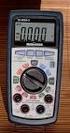 Auto-ranging Digital Multimeter 52-0052-2 INSTRUCTION MANUAL WARNING: READ AND UNDERSTAND THIS MANUAL BEFORE USING YOUR MULTIMETER. FAILURE TO UNDERSTAND AND COMPLY WITH WARNINGS AND OPERATING INSTRUCTIONS
Basic Op Amp Circuits
 Basic Op Amp ircuits Manuel Toledo INEL 5205 Instrumentation August 3, 2008 Introduction The operational amplifier (op amp or OA for short) is perhaps the most important building block for the design of
Wide Bandwidth, Fast Settling Difet OPERATIONAL AMPLIFIER
 Wide Bandwidth, Fast Settling Difet OPERATIONAL AMPLIFIER FEATURES HIGH GAIN-BANDWIDTH: 35MHz LOW INPUT NOISE: 1nV/ Hz HIGH SLEW RATE: V/µs FAST SETTLING: 24ns to.1% FET INPUT: I B = 5pA max HIGH OUTPUT
NTE2053 Integrated Circuit 8 Bit MPU Compatible A/D Converter
 NTE2053 Integrated Circuit 8 Bit MPU Compatible A/D Converter Description: The NTE2053 is a CMOS 8 bit successive approximation Analog to Digital converter in a 20 Lead DIP type package which uses a differential
Scaling and Biasing Analog Signals
 Scaling and Biasing Analog Signals November 2007 Introduction Scaling and biasing the range and offset of analog signals is a useful skill for working with a variety of electronics. Not only can it interface
LM134-LM234-LM334. Three terminal adjustable current sources. Features. Description
 Three terminal adjustable current sources Features Operates from 1V to 40V 0.02%/V current regulation Programmable from 1µA to 10mA ±3% initial accuracy Description The LM134/LM234/LM334 are 3-terminal
Kit 27. 1W TDA7052 POWER AMPLIFIER
 Kit 27. 1W TDA7052 POWER AMPLIFIER This is a 1 watt mono amplifier Kit module using the TDA7052 from Philips. (Note, no suffix.) It is designed to be used as a building block in other projects where a
DIGITAL-TO-ANALOGUE AND ANALOGUE-TO-DIGITAL CONVERSION
 DIGITAL-TO-ANALOGUE AND ANALOGUE-TO-DIGITAL CONVERSION Introduction The outputs from sensors and communications receivers are analogue signals that have continuously varying amplitudes. In many systems
LM 358 Op Amp. If you have small signals and need a more useful reading we could amplify it using the op amp, this is commonly used in sensors.
 LM 358 Op Amp S k i l l L e v e l : I n t e r m e d i a t e OVERVIEW The LM 358 is a duel single supply operational amplifier. As it is a single supply it eliminates the need for a duel power supply, thus
AS2815. 1.5A Low Dropout Voltage Regulator Adjustable & Fixed Output, Fast Response
 1.5A Low Dropout oltage Regulator Adjustable & Fixed Output, Fast Response FEATURES Adjustable Output Down To 1.2 Fixed Output oltages 1.5, 2.5, 3.3, 5.0 Output Current of 1.5A Low Dropout oltage 1.1 Typ.
High Common-Mode Rejection. Differential Line Receiver SSM2141. Fax: 781/461-3113 FUNCTIONAL BLOCK DIAGRAM FEATURES. High Common-Mode Rejection
 a FEATURES High Common-Mode Rejection DC: 00 db typ 60 Hz: 00 db typ 20 khz: 70 db typ 40 khz: 62 db typ Low Distortion: 0.00% typ Fast Slew Rate: 9.5 V/ s typ Wide Bandwidth: 3 MHz typ Low Cost Complements
How To Calculate The Power Gain Of An Opamp
 A. M. Niknejad University of California, Berkeley EE 100 / 42 Lecture 8 p. 1/23 EE 42/100 Lecture 8: Op-Amps ELECTRONICS Rev C 2/8/2012 (9:54 AM) Prof. Ali M. Niknejad University of California, Berkeley
NTE923 & NTE923D Integrated Circuit Precision Voltage Regulator
 NTE923 & NTE923D Integrated Circuit Precision Voltage Regulator Description: The NTE923 and NTE923D are voltage regulators designed primarily for series regulator applications. By themselves, these devices
PIN CONFIGURATION FEATURES ORDERING INFORMATION ABSOLUTE MAXIMUM RATINGS. D, F, N Packages
 DESCRIPTION The µa71 is a high performance operational amplifier with high open-loop gain, internal compensation, high common mode range and exceptional temperature stability. The µa71 is short-circuit-protected
School of Engineering Department of Electrical and Computer Engineering
 1 School of Engineering Department of Electrical and Computer Engineering 332:223 Principles of Electrical Engineering I Laboratory Experiment #4 Title: Operational Amplifiers 1 Introduction Objectives
Programmable Single-/Dual-/Triple- Tone Gong SAE 800
 Programmable Single-/Dual-/Triple- Tone Gong Preliminary Data SAE 800 Bipolar IC Features Supply voltage range 2.8 V to 18 V Few external components (no electrolytic capacitor) 1 tone, 2 tones, 3 tones
Transistor Biasing. The basic function of transistor is to do amplification. Principles of Electronics
 192 9 Principles of Electronics Transistor Biasing 91 Faithful Amplification 92 Transistor Biasing 93 Inherent Variations of Transistor Parameters 94 Stabilisation 95 Essentials of a Transistor Biasing
Cornerstone Electronics Technology and Robotics I Week 15 Voltage Comparators Tutorial
 Cornerstone Electronics Technology and Robotics I Week 15 Voltage Comparators Tutorial Administration: o Prayer Robot Building for Beginners, Chapter 15, Voltage Comparators: o Review of Sandwich s Circuit:
TS321 Low Power Single Operational Amplifier
 SOT-25 Pin Definition: 1. Input + 2. Ground 3. Input - 4. Output 5. Vcc General Description The TS321 brings performance and economy to low power systems. With high unity gain frequency and a guaranteed
Chapter 6: From Digital-to-Analog and Back Again
 Chapter 6: From Digital-to-Analog and Back Again Overview Often the information you want to capture in an experiment originates in the laboratory as an analog voltage or a current. Sometimes you want to
INTEGRATED CIRCUITS DATA SHEET. TDA7052 1 W BTL mono audio amplifier. Product specification File under Integrated Circuits, IC01
 INTEGRATED CIRCUITS DATA SHEET TDA7052 1 W BTL mono audio amplifier File under Integrated Circuits, IC01 July 1994 GENERAL DESCRIPTION The TDA7052 is a mono output amplifier in a 8-lead dual-in-line (DIL)
More Op-Amp Circuits; Temperature Sensing
 ECE 2A Lab #5 Lab 5 More OpAmp Circuits; Temperature Sensing Overview In this lab we will continue our exploration of opamps but this time in the context of a specific application: temperature sensing.
Lab 7: Operational Amplifiers Part I
 Lab 7: Operational Amplifiers Part I Objectives The objective of this lab is to study operational amplifier (op amp) and its applications. We will be simulating and building some basic op amp circuits,
155 Mb/s Fiber Optic Light to Logic Receivers for OC3/STM1
 155 Mb/s Fiber Optic Light to Logic Receivers for OC3/STM1 Application Note 1125 RCV1551, RGR1551 Introduction This application note details the operation and usage of the RCV1551 and RGR1551 Light to
SIGNAL GENERATORS and OSCILLOSCOPE CALIBRATION
 1 SIGNAL GENERATORS and OSCILLOSCOPE CALIBRATION By Lannes S. Purnell FLUKE CORPORATION 2 This paper shows how standard signal generators can be used as leveled sine wave sources for calibrating oscilloscopes.
AutoRanging Digital MultiMeter
 Owner's Manual AutoRanging Digital MultiMeter Model No. 82139 CAUTION: Read, understand and follow Safety Rules and Operating Instructions in this manual before using this product. Safety Operation Maintenance
LABORATORY 2 THE DIFFERENTIAL AMPLIFIER
 LABORATORY 2 THE DIFFERENTIAL AMPLIFIER OBJECTIVES 1. To understand how to amplify weak (small) signals in the presence of noise. 1. To understand how a differential amplifier rejects noise and common
PowerAmp Design. PowerAmp Design PAD135 COMPACT HIGH VOLATGE OP AMP
 PowerAmp Design COMPACT HIGH VOLTAGE OP AMP Rev G KEY FEATURES LOW COST SMALL SIZE 40mm SQUARE HIGH VOLTAGE 200 VOLTS HIGH OUTPUT CURRENT 10A PEAK 40 WATT DISSIPATION CAPABILITY 200V/µS SLEW RATE APPLICATIONS
QUICK START GUIDE FOR DEMONSTRATION CIRCUIT 735 LITHIUM-ION LINEAR BATTERY CHARGER WITH LDO REGULATOR
 DESCRIPTION QUICK START GUIDE FOR DEMONSTRATION CIRCUIT 735 LTC4063EDD Demonstration circuit 735 is a complete constantcurrent, constant-voltage battery charger for one Lithium-Ion cell and includes a
Application Notes FREQUENCY LINEAR TUNING VARACTORS FREQUENCY LINEAR TUNING VARACTORS THE DEFINITION OF S (RELATIVE SENSITIVITY)
 FREQUENY LINEAR TUNING VARATORS FREQUENY LINEAR TUNING VARATORS For several decades variable capacitance diodes (varactors) have been used as tuning capacitors in high frequency circuits. Most of these
WHY DIFFERENTIAL? instruments connected to the circuit under test and results in V COMMON.
 WHY DIFFERENTIAL? Voltage, The Difference Whether aware of it or not, a person using an oscilloscope to make any voltage measurement is actually making a differential voltage measurement. By definition,
Building the AMP Amplifier
 Building the AMP Amplifier Introduction For about 80 years it has been possible to amplify voltage differences and to increase the associated power, first with vacuum tubes using electrons from a hot filament;
OPERATION MANUAL. Pen type, separate electrode SOIL PH METER Model : PH-220S
 Pen type, separate electrode SOIL PH METER Model : PH-220S Your purchase of this SOIL PH METER marks a step forward for you into the field of precision measurement. Although this METER is a complex and
STLQ015. 150 ma, ultra low quiescent current linear voltage regulator. Description. Features. Application
 150 ma, ultra low quiescent current linear voltage regulator Description Datasheet - production data Features SOT23-5L Input voltage from 1.5 to 5.5 V Very low quiescent current: 1.0 µa (typ.) at no load
Application Note AN1
 TAKING INVENTIVE STEPS IN INFRARED. MINIATURE INFRARED GAS SENSORS GOLD SERIES UK Patent App. No. 799A USA Patent App. No. 9/78,7 World Patents Pending SENSOR OVERVIEW Application Note AN The Dynament
Buffer Op Amp to ADC Circuit Collection
 Application Report SLOA098 March 2002 Buffer Op Amp to ADC Circuit Collection Bruce Carter High Performance Linear Products ABSTRACT This document describes various techniques that interface buffer op
Using Thermocouple Sensors Connecting Grounded and Floating Thermocouples
 Connecting Grounded and Floating Thermocouples For best performance, Thermocouple sensors should be floating. This will ensure that no noise currents can flow in the sensor leads and that no common-mode
Technical Note Series
 Technical Note Series SKIN CONDUCTANCE SENSOR (SA9309M) S TN0 0 0 8-0 0 S k i n C o n d u c t a n c e S e n s o r Page 2 IMPORTANT OPERATION INFORMATION WARNING Type BF Equipment Internally powered equipment
Precision, Unity-Gain Differential Amplifier AMP03
 a FEATURES High CMRR: db Typ Low Nonlinearity:.% Max Low Distortion:.% Typ Wide Bandwidth: MHz Typ Fast Slew Rate: 9.5 V/ s Typ Fast Settling (.%): s Typ Low Cost APPLICATIONS Summing Amplifiers Instrumentation
High Speed, Low Power Dual Op Amp AD827
 a FEATURES High Speed 50 MHz Unity Gain Stable Operation 300 V/ms Slew Rate 120 ns Settling Time Drives Unlimited Capacitive Loads Excellent Video Performance 0.04% Differential Gain @ 4.4 MHz 0.198 Differential
Cancellation of Load-Regulation in Low Drop-Out Regulators
 Cancellation of Load-Regulation in Low Drop-Out Regulators Rajeev K. Dokania, Student Member, IEE and Gabriel A. Rincόn-Mora, Senior Member, IEEE Georgia Tech Analog Consortium Georgia Institute of Technology
Physics 120 Lab 6: Field Effect Transistors - Ohmic region
 Physics 120 Lab 6: Field Effect Transistors - Ohmic region The FET can be used in two extreme ways. One is as a voltage controlled resistance, in the so called "Ohmic" region, for which V DS < V GS - V
APPLICATION NOTE. Measuring Current Output Transducers with Campbell Scientific Dataloggers. App. Note Code: 2MI-B Revision: 1
 App. Note Code: 2MI-B Revision: 1 APPLICATION NOTE Measuring Current Output s with Campbell Scientific Dataloggers 815 W. 1800 N. Logan, Utah 84321-1784 (435) 753-2342 FAX (435) 750-9540 Copyright (C)
High Voltage Current Shunt Monitor AD8212
 High Voltage Current Shunt Monitor AD822 FEATURES Adjustable gain High common-mode voltage range 7 V to 65 V typical 7 V to >500 V with external pass transistor Current output Integrated 5 V series regulator
TC-9102 Series Surface Mount Temperature Controllers
 TC-9102 Series Surface Mount Temperature Controllers General Description & Applications The TC-9102 Series Temperature Controller offers a versatile solution for a wide variety of applications that may
The 2N3393 Bipolar Junction Transistor
 The 2N3393 Bipolar Junction Transistor Common-Emitter Amplifier Aaron Prust Abstract The bipolar junction transistor (BJT) is a non-linear electronic device which can be used for amplification and switching.
MicroMag3 3-Axis Magnetic Sensor Module
 1008121 R01 April 2005 MicroMag3 3-Axis Magnetic Sensor Module General Description The MicroMag3 is an integrated 3-axis magnetic field sensing module designed to aid in evaluation and prototyping of PNI
QUICK START GUIDE FOR DEMONSTRATION CIRCUIT 956 24-BIT DIFFERENTIAL ADC WITH I2C LTC2485 DESCRIPTION
 LTC2485 DESCRIPTION Demonstration circuit 956 features the LTC2485, a 24-Bit high performance Σ analog-to-digital converter (ADC). The LTC2485 features 2ppm linearity, 0.5µV offset, and 600nV RMS noise.
Application Note. So You Need to Measure Some Inductors?
 So You Need to Measure Some nductors? Take a look at the 1910 nductance Analyzer. Although specifically designed for production testing of inductors and coils, in addition to measuring inductance (L),
High Speed, Low Power Monolithic Op Amp AD847
 a FEATURES Superior Performance High Unity Gain BW: MHz Low Supply Current:.3 ma High Slew Rate: 3 V/ s Excellent Video Specifications.% Differential Gain (NTSC and PAL).9 Differential Phase (NTSC and
Laboratory 4: Feedback and Compensation
 Laboratory 4: Feedback and Compensation To be performed during Week 9 (Oct. 20-24) and Week 10 (Oct. 27-31) Due Week 11 (Nov. 3-7) 1 Pre-Lab This Pre-Lab should be completed before attending your regular
Multipurpose Analog PID Controller
 Multipurpose Analog PID Controller Todd P. Meyrath Atom Optics Laboratory Center for Nonlinear Dynamics University of Texas at Austin c 00 March 4, 00 revised December 0, 00 See disclaimer This analog
Circuit Board Sensor Products
 Circuit Board Sensor Products AG21x-07 Cylinder Position Sensors PCB Assemblies for Pneumatic Cylinder Applications Features: Precision Magnetic Operate Point Three-Wire Current Source or Current Sink
Voltage Derating Rules for Solid Tantalum and Niobium Capacitors
 Voltage Derating Rules for Solid Tantalum and Niobium Capacitors Tomáš Zedníček AVX Czech Republic s.r.o., Dvorakova 328, 563 01 Lanskroun, Czech Republic Phone: +420 467 558 126 Fax: +420 467 558 128
INTEGRATED CIRCUITS DATA SHEET. TDA7000 FM radio circuit. Product specification File under Integrated Circuits, IC01
 INTEGRATED CIRCUITS DATA SHEET File under Integrated Circuits, IC01 May 1992 GENERAL DESCRIPTION The is a monolithic integrated circuit for mono FM portable radios, where a minimum on peripheral components
Low Noise, Matched Dual PNP Transistor MAT03
 a FEATURES Dual Matched PNP Transistor Low Offset Voltage: 100 V Max Low Noise: 1 nv/ Hz @ 1 khz Max High Gain: 100 Min High Gain Bandwidth: 190 MHz Typ Tight Gain Matching: 3% Max Excellent Logarithmic